EP3294570B1 - Support de données avec caractéristique d'authenticité personnalisable - Google Patents
Support de données avec caractéristique d'authenticité personnalisable Download PDFInfo
- Publication number
- EP3294570B1 EP3294570B1 EP16721768.6A EP16721768A EP3294570B1 EP 3294570 B1 EP3294570 B1 EP 3294570B1 EP 16721768 A EP16721768 A EP 16721768A EP 3294570 B1 EP3294570 B1 EP 3294570B1
- Authority
- EP
- European Patent Office
- Prior art keywords
- data carrier
- magnetic
- feature
- layer
- spin
- Prior art date
- Legal status (The legal status is an assumption and is not a legal conclusion. Google has not performed a legal analysis and makes no representation as to the accuracy of the status listed.)
- Active
Links
Images

Classifications
-
- B—PERFORMING OPERATIONS; TRANSPORTING
- B42—BOOKBINDING; ALBUMS; FILES; SPECIAL PRINTED MATTER
- B42D—BOOKS; BOOK COVERS; LOOSE LEAVES; PRINTED MATTER CHARACTERISED BY IDENTIFICATION OR SECURITY FEATURES; PRINTED MATTER OF SPECIAL FORMAT OR STYLE NOT OTHERWISE PROVIDED FOR; DEVICES FOR USE THEREWITH AND NOT OTHERWISE PROVIDED FOR; MOVABLE-STRIP WRITING OR READING APPARATUS
- B42D25/00—Information-bearing cards or sheet-like structures characterised by identification or security features; Manufacture thereof
- B42D25/20—Information-bearing cards or sheet-like structures characterised by identification or security features; Manufacture thereof characterised by a particular use or purpose
- B42D25/23—Identity cards
-
- B—PERFORMING OPERATIONS; TRANSPORTING
- B42—BOOKBINDING; ALBUMS; FILES; SPECIAL PRINTED MATTER
- B42D—BOOKS; BOOK COVERS; LOOSE LEAVES; PRINTED MATTER CHARACTERISED BY IDENTIFICATION OR SECURITY FEATURES; PRINTED MATTER OF SPECIAL FORMAT OR STYLE NOT OTHERWISE PROVIDED FOR; DEVICES FOR USE THEREWITH AND NOT OTHERWISE PROVIDED FOR; MOVABLE-STRIP WRITING OR READING APPARATUS
- B42D25/00—Information-bearing cards or sheet-like structures characterised by identification or security features; Manufacture thereof
- B42D25/20—Information-bearing cards or sheet-like structures characterised by identification or security features; Manufacture thereof characterised by a particular use or purpose
- B42D25/24—Passports
-
- B—PERFORMING OPERATIONS; TRANSPORTING
- B42—BOOKBINDING; ALBUMS; FILES; SPECIAL PRINTED MATTER
- B42D—BOOKS; BOOK COVERS; LOOSE LEAVES; PRINTED MATTER CHARACTERISED BY IDENTIFICATION OR SECURITY FEATURES; PRINTED MATTER OF SPECIAL FORMAT OR STYLE NOT OTHERWISE PROVIDED FOR; DEVICES FOR USE THEREWITH AND NOT OTHERWISE PROVIDED FOR; MOVABLE-STRIP WRITING OR READING APPARATUS
- B42D25/00—Information-bearing cards or sheet-like structures characterised by identification or security features; Manufacture thereof
- B42D25/20—Information-bearing cards or sheet-like structures characterised by identification or security features; Manufacture thereof characterised by a particular use or purpose
- B42D25/29—Securities; Bank notes
-
- B—PERFORMING OPERATIONS; TRANSPORTING
- B42—BOOKBINDING; ALBUMS; FILES; SPECIAL PRINTED MATTER
- B42D—BOOKS; BOOK COVERS; LOOSE LEAVES; PRINTED MATTER CHARACTERISED BY IDENTIFICATION OR SECURITY FEATURES; PRINTED MATTER OF SPECIAL FORMAT OR STYLE NOT OTHERWISE PROVIDED FOR; DEVICES FOR USE THEREWITH AND NOT OTHERWISE PROVIDED FOR; MOVABLE-STRIP WRITING OR READING APPARATUS
- B42D25/00—Information-bearing cards or sheet-like structures characterised by identification or security features; Manufacture thereof
- B42D25/30—Identification or security features, e.g. for preventing forgery
- B42D25/36—Identification or security features, e.g. for preventing forgery comprising special materials
- B42D25/369—Magnetised or magnetisable materials
-
- B—PERFORMING OPERATIONS; TRANSPORTING
- B42—BOOKBINDING; ALBUMS; FILES; SPECIAL PRINTED MATTER
- B42D—BOOKS; BOOK COVERS; LOOSE LEAVES; PRINTED MATTER CHARACTERISED BY IDENTIFICATION OR SECURITY FEATURES; PRINTED MATTER OF SPECIAL FORMAT OR STYLE NOT OTHERWISE PROVIDED FOR; DEVICES FOR USE THEREWITH AND NOT OTHERWISE PROVIDED FOR; MOVABLE-STRIP WRITING OR READING APPARATUS
- B42D25/00—Information-bearing cards or sheet-like structures characterised by identification or security features; Manufacture thereof
- B42D25/40—Manufacture
- B42D25/405—Marking
- B42D25/41—Marking using electromagnetic radiation
-
- G—PHYSICS
- G06—COMPUTING OR CALCULATING; COUNTING
- G06K—GRAPHICAL DATA READING; PRESENTATION OF DATA; RECORD CARRIERS; HANDLING RECORD CARRIERS
- G06K19/00—Record carriers for use with machines and with at least a part designed to carry digital markings
- G06K19/06—Record carriers for use with machines and with at least a part designed to carry digital markings characterised by the kind of the digital marking, e.g. shape, nature, code
- G06K19/06187—Record carriers for use with machines and with at least a part designed to carry digital markings characterised by the kind of the digital marking, e.g. shape, nature, code with magnetically detectable marking
-
- G—PHYSICS
- G06—COMPUTING OR CALCULATING; COUNTING
- G06K—GRAPHICAL DATA READING; PRESENTATION OF DATA; RECORD CARRIERS; HANDLING RECORD CARRIERS
- G06K7/00—Methods or arrangements for sensing record carriers, e.g. for reading patterns
- G06K7/08—Methods or arrangements for sensing record carriers, e.g. for reading patterns by means detecting the change of an electrostatic or magnetic field, e.g. by detecting change of capacitance between electrodes
- G06K7/082—Methods or arrangements for sensing record carriers, e.g. for reading patterns by means detecting the change of an electrostatic or magnetic field, e.g. by detecting change of capacitance between electrodes using inductive or magnetic sensors
- G06K7/087—Methods or arrangements for sensing record carriers, e.g. for reading patterns by means detecting the change of an electrostatic or magnetic field, e.g. by detecting change of capacitance between electrodes using inductive or magnetic sensors flux-sensitive, e.g. magnetic, detectors
Definitions
- this method shows the coloring by bleaching, ie lightening, of a color that is visible before the irradiation.
- the substrate appears due to the visible mixture of the colored components before the irradiation in a very dark, ideally black tone.
- Such a method describes, for example, the WO 01/15910 A .
- the advantages of the further increased security against forgery through a color representation of the document holder are outweighed in the method described in this document and the products produced thereby by disadvantages which limit its practical value.
- the authors describe how color bodies, dyes or pigments with a certain absorption spectrum are bleached with a laser radiation of a certain wavelength in such a way that the complementary colors remain.
- the process is therefore technically very complex and, like laser engraving, which produces black and white images, is essentially aimed at a tamper-proof representation of photographic images.
- a method for producing an optically variable security element with a microcapsule-based color layer with a motif area is in the DE 10 2011 116 490 disclosed.
- a printing ink is provided which contains a multiplicity of microcapsules, in the capsule shell of which a carrier liquid and a magnetically reversibly orientable pigment are enclosed.
- An external magnetic field is applied in a partial area of the color layer containing the motif area in order to align the rotatable pigments in the microcapsules.
- the capsule shells in the motif area are damaged by electromagnetic radiation, so that the carrier liquid emerges from the microcapsules and the pigments remain immobile in the damaged capsule shells and thus represent the motif of the security element.
- first levels also called first-level features
- the second security level subsumes features that can be achieved using simple technical means, i.e. H. are detectable with smaller, portable devices. In the simplest case, this can be a UV lamp or a laser pointer.
- the third-level features are more complex in nature and can be verified by forensic means.
- the various security levels serve to round off the overall document security.
- the EP 1 322 478 B1 and the WO 02/26507 A1 the generation of a feature recognizable in UV light before that, based on the laser-induced bleaching process, is shown to the viewer as dark sections on a fluorescent surface element.
- the laser light or other high-energy radiation such as. B. an electron beam, accordingly deactivates a luminescent authenticity feature selected positions.
- the visible image impression corresponds to that of a negative image or a negative font.
- This feature allows the authentication of a security document with simple means such as a UV lamp, but has a limited value because the UV-active layer could also be overprinted and thus the visual impression could be reproduced under UV light.
- An advantage of the process according to the EP 1 322 478 is the economy in terms of handling, reliability, costs.
- the inventors have recognized that there is also the possibility of combining laser-based fluorescence quenching with other personalization methods based on laser technology.
- second-level features are required where a quick authentication of the document is required. This typically applies to border guards or access control to the gate area of an airport.
- the combination of additional features has proven to be advantageous at such checkpoints.
- methods based on magnetic features have proven themselves as second-stage features. Magnetic strips have long been used for storing Data records are used, the benefits of which extend beyond the security application to the storage of small amounts of data for commercial purposes. B. is also used for customer cards.
- the solution includes the property required by the task to create the magnetism with the same tool as the image, whereby the tool can be an energy beam according to the task.
- the security feature can also be used as a further customizable second-level feature.
- the carriers of magnetization which are used for magnetic security features according to the prior art, are in contrast to the mostly organic fluorescent dyes of an inorganic nature, for.
- the term atomic magnets is also used for these metal magnets.
- magnetic ink based on magnetite with a grain size between 2 nanometers and 20 nanometers is customary in order to impart a macroscopically measurable magnetism to a non-magnetic substrate such as paper or a polymer.
- a demagnetization of these magnets made of inorganic material is possible by applying a coercive field, but this does not mean that the ferromagnetism of the substrate disappears irreversibly. Rather, the ferromagnetism disappears reversibly.
- a renewed magnetization is possible at any time by applying an appropriate field. This magnetization can be achieved below the Curie temperature.
- the quantum mechanical requirements require, among other things, a minimal proximity between the unpaired electrons with rectified spin. Since thermal influences have a direct influence on the long-distance effect of the spins of the unpaired electrons, there are limit temperatures above which there is no sufficient coupling and therefore no macroscopic magnetism.
- the corresponding temperature values referred to as Curie temperatures in the case of a present ferromagnetism, are specific material constants for each magnetic material. For practical applications, in particular applications in the field of ID documents, only Curie temperatures above room temperature make sense.
- Curie temperatures (T c ) of a usable order of magnitude apply to classic magnetic materials such as Fe 768 ° C, Co 1121 ° C, Ni 360 ° C, SmCo 750 ° C, Fe 2 O 3 450 ° C or NdFeB 300 ° C.
- Known magneto-optical storage methods use the Curie temperatures in order to heat the magnetic base material above its Curie temperature by the action of a laser at a specific location on the storage medium and thus to delete the information thereon. A renewed magnetization is suitable for storing new data records on the same storage medium.
- These classic methods are not suitable for fulfilling the task, since they are not compatible with other desired security features, their manufacture or the carriers of the security feature. This is partly because the Curie temperature of an inorganic magnet is now significantly higher than that which a security document can take.
- the authenticity features according to the invention can be provided and claimed in a variety of possible integrations and installation locations in the data carrier used for identification in accordance with the embodiments detailed below.
- the magnetizable authenticity features can therefore be printed as a printing ink on a specific or several layers of the data carrier or applied in some other way.
- the authenticity features can, however, also be integrated into the plastic polymer of one or more layers of the data carrier.
- the magnetizable or magnetic authenticity features can also be incorporated into the adhesive, the lacquer or as an additive in the plastic material. It is also conceivable to apply the feature according to the invention as a spray application or to incorporate or apply it to the document as part of a lamination film or a thin film.
- the composite card can have a cover layer and a carrier layer, the cover layer being able to be arranged on the side of the data carrier facing the radiation, and which is translucent with respect to the beam used.
- the layer described in one embodiment can be on a substrate or on a data carrier, for example made of paper or polymer, for. B. polycarbonate.
- a protective layer can surround the further layers of the data carrier which have the magnetic or magnetizable components.
- These protective layers can be used as primers, as protection for the substrate, e.g. B. in the form of opaque layers against the action of laser light on a sensitive substrate, such as. B. paper, serve or carry graphical functions, e.g. B. carbonize under the influence of laser, that is, become black at the point of action of the laser radiation, or contain colored pigments or dyes, which in turn are bleached by laser light.
- the magnetizable layer can extend over the entire surface of the data carrier.
- the activation of the magnetizable or magnetic component and the generation of a visible font or a visible image such. B. the portrait of the document holder can be done by irradiation of the same type or by irradiation with different types of beams or sources. When irradiating with different types of beams, the beam sources can be active at the same time or used one after the other for personalization.
- the inventive solution is particularly attractive for the design of identification documents with image representations, in particular as a second security feature.
- the magnetic substance preferably has a Curie temperature above room temperature.
- the magnetizable or magnetic feature consists of molecular magnets that have an organic or organometallic base and are organized into sufficiently large one- to three-dimensional structures so that a ferro- or ferrimagnetism can develop.
- the purely organic molecular magnets are currently the subject of a very dynamic research area, which promises the medium-term realization of organic molecular magnets with Curie temperatures at room temperature or higher.
- organometallic substances in particular the cyano complexes, promise greater suitability in the sense of this invention.
- the research work in the field of organic magnets was carried out with notable works such as. B. over the magnetic complex V [(Cr (CN) 6 ] 0.86 ⁇ 2.8 H 2 O with a Curie temperature of 315 K repeatedly impulses.
- Typical coercive field strengths are in the order of 1000 Oe or 80 KA / m what fits well into the work area of commercially available devices that are suitable for control points for the visual representation of magnetic fields.
- the ferrimagnetic complex V (TCNE) 2 ⁇ 0.5CH 2 Cl 2 has a molecular saturation magnetization and Curie temperature comparable to chromium dioxide as well as a relatively high coercive force with 60 Oe Tetracyanoethylene dimer anion radical with a strong absorption band at 533 to 535 nm expect that a di e Excitation with visible light, especially laser light, of the appropriate wavelength destabilizes the ⁇ dimer and thus the radical.
- any diamagnetic complex in the LS state can be described as “magnetizable”.
- the HS state (high spin state) of the molecule can then be referred to as “magnetic”.
- the laser excitation would again be understood as "magnetization”.
- Shin-ichi Ohkoshi et al Light-induced spin crossover magnet, nature chemistry 3 July 2011, 564-569 ) have, for example, described an iron-niobium complex which, after LIESST excitation, exhibits a strong antiferromagnetic interaction between iron and niobium.
- the spin systems of the nuclei are coupled with it, but due to the different spin multiplicity of the two metal ions, ferrimagnetism remains.
- a ferri- or ferromagnetism presupposes a spatial superstructure within which a magnetic coupling can continue.
- organic or organometallic magnets need to be anchored in extensive networks that ensure the optimal proximity of the spin centers to one another and preferably have a periodic structure.
- These can be coordination polymers with a one-dimensional dimension or more complex two- and three-dimensional networks.
- organometallic compounds such a system is also referred to as a coordination network or metal-organic framework (MOF).
- MOF metal-organic framework
- a well-known example of such a network, although not magnetic, is Zn 4 (1,4-benzene dicarboxylate) 3 with a cubic superstructure. Such structures sometimes have very high thermal stability.
- the 2-dimensional triazole-bridged complexes of the type Fe (L) 2 with HL 3- (2-pyridyl) -5- (3-pyridyl) -1,2,4-triazole, for example, have very high non-hysteretic transition temperatures of 326K and 501K (t 1/2 ) from dia to paramagnetic, whereby the complex itself remains stable up to 623K ( Bao et al, Remarkably high-temperature spin transition exhibited by new 2D metal-organic frameworks (2012) Chem. Sci., 1629-1633 ). Pronounced magnetic orders have been demonstrated in oxalate-bridged networks.
- the chiral complex [Fe III (5-Cl-sal) 2 -triene] [Mn II Cr III (ox) 3 ] ⁇ 0.5 (CH 3 NO 2 ) shows e.g. B. up to 5K ferromagnetism and between 300K and 60K a change in magnetic susceptibility according to a partial SCO ( Coronado et al, Multifunctional magnetic materials obtained by insertion of spin-crossover FeIIIcomplexes into chiral 3D bimetallic oxalate-based ferromagnets, Inorg. Chem., 50: 9122-9130 ). It is to be expected that such transitions can also be stimulated by exposure to light (LIESST effect).
- the spin crossover with the consequence of a magnetic order can generally take place in an anionic / cationic network ( Osamu Sato et al, Multifunctional Materials Combining Spin-Crossover with Conductivity and magnetic Ordering from Spin-Crossover Materials Proberties and Applications edited by Malcom A. Halcrow, John Wiley & Sons (2013 )) It is also conceivable to use suitable coordination connections on a surface, such as a foil, e.g. B. PVA or PC to immobilize in a suitable organizational structure. Reported on the production of Langmuir-Blodgett layers from substances with SCO properties Roubeau et al in Langmuir, 23: 3110-3117 ,
- the inventive solution contains an authenticity feature as an essential element, which causes the formation of a magnetizable or magnetic property under the action of high-energy radiation, preferably electromagnetic radiation.
- high-energy radiation preferably electromagnetic radiation.
- the irradiation can take place with one wavelength in order to photochemically magnetize the magnetizable substance or additionally with a second wavelength in order to delete the magnetization again.
- the extinguishing can also be carried out by heating, since such organometallic systems relax back into the diamagnetic basic state from a certain temperature.
- the basic mechanism for this switchable magnetic property is a photochemical spin crossover effect (SCO), which can occur in organometallic compounds.
- a spin crossover is the transition from a low spin state (LS) to a high spin state (HS).
- the transition from LS to HS or vice versa in the case of an inverse SCO, can be stimulated by temperature, pressure, light, adsorption / desorption in the host lattice, via a redox reaction.
- the light-induced form is preferred for this invention.
- a thermal SCO can also be used if an acting electromagnetic radiation secondarily triggers a thermal effect.
- a thermal SCO cannot be observed in every coordination connection. Most of the time, however, it occurs in compounds that already have a LIESST effect. Thermal SCO transitions and a LIESST effect often occur together and can therefore have complex magnetic behavior cause.
- a light-induced SCO to a stable HS state can be achieved on the one hand directly by optical excitation of the metal d orbitals or is caused by the interaction between the metal core of a complex and one or more photoactive ligands.
- the direct excitation of the metal orbitals is also referred to as the LIESST effect (Light Induced Excited Spin State Trapping), while the ligand-controlled variant is known as the LD-LISC effect (Ligand Driven Light Induced Spin Crossover).
- the LIESST process is only possible at cryogenic temperatures, as in most known cases.
- LIESST transitions take place at temperatures below 50 Kelvin and, for example, in the case of octahedral complexes the 5 T 2 state is quasi-populated with the HS form by a pump effect.
- the development of the specialist area currently leads to an area that can be used for a practical application according to the invention, such as Real et al using the example of [Fe (pyrazin) ⁇ Pt (CN) 4 ⁇ ] (Angew. Chem. 2005,117 (26), 4137-4141 ).
- the transition takes place completely with a laser pulse, with a broad hysteresis of approximately rectangular shape moving around room temperature.
- the complex is stable for months at room temperature, theoretically unlimited, which is important with regard to a lifespan of 1 to 20 years, preferably 5 to 10 years, required for a security document.
- the SCO with a thermal hysteresis can also lead to the solution of the problem if, in the case of a wide hysteresis around room temperature, the thermal effect of an energy beam, preferably a laser beam, e.g. B. a conventional laser working in the NIR, the security document in the LS state of the carrier of the magnetic feature with the laser is heated in a controlled manner at the points at which a personalization is to be generated. Since the hysteresis range typically takes place at low temperatures in SCO materials, the activation of the magnetism must take place in a correspondingly cooled environment in these cases. The sophisticated conditions of such magnetization can be understood as a further safety advantage.
- an energy beam preferably a laser beam, e.g. B. a conventional laser working in the NIR
- Real et al (Enhanced bistability by guest inclusion in Fe (II) spin crossover porous coordination polymers, Chem. Commun., 2012, 48, 4686-4688 ) demonstrated an example of a MOF that three-dimensionally extended structures can also have a wide hysteresis, in this case 60K with a mean value near and in particular slightly below room temperature, for example at around 240K, and thus a cooperative coupling to a macroscopically measurable one Magnetism is possible.
- the hysteresis is therefore between 210K and 270K.
- ligand-controlled SCO Another option for fulfilling the inventive task is the ligand-controlled SCO.
- certain iron complexes with styrylpyridine ligands are known to be able to transition from the trans to the cis configuration by light-induced rearrangement and thereby undergo a transition from an LS to an -HS state.
- the trans form shows a thermal SCO below 163 K, which is associated with a massive increase in susceptibility.
- Ligand-controlled systems are also known which have an SCO at room temperature.
- Promising systems are also those in which a photo-switchable ligand changes the coordination number and thus leads to an HS or LS state.
- C. Bornholdt Dissertation, "Ligand-driven light-induced spin crossover in single molecules", Christian-Albrechts-University of Kiel, 2008 ) bistable systems based on nickel, which can be switched over when irradiated with 365nm or 440nm.
- Fig. 1 a schematic side view of a surface element 5 of a security document 9 according to an embodiment of the invention and Fig. 2 shows a top view of a data carrier with a surface element 5 of a security document 9 according to FIG Fig. 1 ,
- Fig. 1 thus shows the layer sequence in the structure of the relevant part of the security document 9.
- This can also be a section of a security document 9, for example the cross section of a section which is inserted into a section provided in a substrate, similar to a chip in a data carrier ,
- the sequence of layers is from the side A, the side facing the viewer, as follows:
- the top layer 1 which is transparent to stimulating laser radiation in the visible region and in the adjacent UV and IR regions, is followed by a functional layer 2, which has the molecular magnets described below contains.
- This functional layer 2 is arranged on a carrier layer 3, in particular a substrate, which is optionally followed by a layer 4 to support a cooling effect.
- the flat data carrier is provided with a surface element 5, which is essential for the security document 9 and thus has a functional layer 2 containing molecular magnets, which thus at least partially covers the security document 9.
- the surface element can cover the entire data carrier.
- the data carrier for example in credit card format or a data page for a passport, has a second surface element 6, which contains a visible portrait image, a third surface element 7 with a visible personalization and a fourth surface element 8 with a machine-readable personalization.
- the surface elements 6, 7 and 8 are optionally and advantageously provided to increase security. It is further of advantage in the present invention that the surface element 5 at least partially overlaps the surface elements 6, 7 and / or 8.
- the functional layer 2 essentially consists of a certain amount of molecular magnets, which are joined together in a suitable manner for sufficient magnetic coupling. It does not matter whether it is a closed layer of molecules or if they are associated with other compounds, as long as the magnetic coupling is not interrupted to the extent that there is no longer any macroscopically measurable magnetism.
- the functional layer can thus for example also from a matrix of a polymeric material, for. B. consist of polycarbonate that encloses sufficiently large clusters of molecular magnets. It is even conceivable to give the data carrier a three-dimensional shape by building it up using a 3D printing process. In this case, an arbitrarily shaped surface element with molecular magnets in a suitable assembly is to be understood as a functional layer.
- the 3 and 4 show a security document 9 according to Fig. 2 during activation (magnetization) by a laser (writing process or magnetic personalization); or a security document 9 according to Fig. 2 during the removal of the magnetization by a laser (extinguishing process).
- Security document 9 e.g. B. ID card based on polycarbonate, is here for simplification only with the surface element 5 of the functional layer molecular magnets shown.
- a first laser 11 is shown, which is the at least one first laser for generating the HS state via the LIESST path.
- the light beam from the first laser 11 penetrates the transparent cover layer 1 (not shown here) without any significant interaction and acts on the molecular magnets in order to add the "C" to the letters "U-NI" that have already been created. It is therefore a partially completed magnetization 5a.
- the first laser is additionally provided with the reference symbol 13, since, as an alternative to the first laser 11, there can also be at least one first laser 13 for generating the HS state on the way of a thermal SCO.
- the reference numeral 10 shows a cooling device 10 which is arranged below the viewing direction A on the layer 4 which improves the cooling effect and which, when the security document 9 is acted on, keeps it at a predetermined temperature, this low temperature of, for example, -60 ° Celsius as Temperature for the LIESST effect should help to avoid unpleasant molecular-chemical changes to the surface element 5 and the security document 9 as a whole.
- a security document usually tolerates brief cooling to lower temperatures, but below -60 ° C polycarbonate can no longer be used.
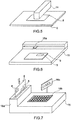
- the Fig. 5 shows a security document 9 according to Fig. 2 with magnetic information in a surface element 5 during the visualization of the magnetic field with a corresponding hand-held device 14.
- the hand-held device 14 is provided to detect and display the presence and arrangement of the molecular magnets in the functional layer 2.
- the Fig. 6 shows a security document 9 with its integrated surface element 5 according to FIG Fig. 1 with magnetic information during the two-dimensional recording of the magnetic field with a scanner 15.
- the scanner 15 is designed to detect the magnetized regions 2 of the surface element 5, optionally provided with a cooled scanner bed (not shown).
- An arm 15a is part of a module for detecting the local susceptibility or magnetization. You can of course also cool when reading out. That in the Fig. 6
- the handheld device shown does not have the option of restricting its use to molecular magnets that can be activated or detected at room temperature.
- the Fig. 7 shows a security document 9 according to Fig. 1 , which is partially inserted in a reading slot of a workstation 16, this workstation 16 containing all the elements for imaging the magnetic field.
- the workstation 16 provided in a table-top version has an integrated receptacle for the security document 9, the surface element 5 of which is at least partially inserted in the area of the magnetic scanner.
- the workstation 16 comprises a rear device part 16a with a magnetic one Scanner with which a security document 9 inserted into a slot of the workstation 16 can be checked.
- An input unit 16a of the workstation 16 can comprise a keyboard or keyboard and mouse or a touchpad etc.
- a screen 16c is also provided for the visual assessment of the magnetic image and for operating the workstation 16.
- the magnetically read lettering "U-NICA" can be seen on the screen 16c as it follows after the writing step has been completed Fig. 3 results.
Landscapes
- Engineering & Computer Science (AREA)
- Physics & Mathematics (AREA)
- Theoretical Computer Science (AREA)
- General Physics & Mathematics (AREA)
- Accounting & Taxation (AREA)
- Business, Economics & Management (AREA)
- Finance (AREA)
- Toxicology (AREA)
- Manufacturing & Machinery (AREA)
- General Health & Medical Sciences (AREA)
- Artificial Intelligence (AREA)
- Computer Vision & Pattern Recognition (AREA)
- Electromagnetism (AREA)
- Health & Medical Sciences (AREA)
- Credit Cards Or The Like (AREA)
- Paints Or Removers (AREA)
Claims (15)
- Support de données (9), en particulier une carte en matière plastique, comportant une caractéristique d'authenticité (5) qui est prévue dans le support de données et qui peut être personnalisée en modifiant des propriétés physiques et/ou chimiques lorsqu'elle est irradiée par un faisceau à haute énergie, caractérisé en ce qu'une caractéristique magnétisable est prévue dans une couche fonctionnelle (2) comme caractéristique d'authenticité personnalisable, la caractéristique magnétisable ayant un effet opto-magnétique qui permet l'écriture des informations, afin que soit formée, en un point irradié (5a), une caractéristique magnétique de deuxième niveau avec un magnétisme mesurable macroscopiquement.
- Support de données (9) selon la revendication 1, dans lequel le magnétisme mesurable macroscopiquement de la caractéristique magnétique à deux niveaux peut être annulé par irradiation avec un faisceau à haute énergie.
- Support de données selon la revendication 1 ou 2, dans lequel la caractéristique magnétique est constituée d'aimants moléculaires qui ont une base organique ou organométallique et sont organisés en structures en une à trois dimensions suffisamment grandes pour qu'un ferro- ou ferrimagnétisme puisse se développer.
- Support de données selon la revendication 2 ou 3, caractérisé en ce que les aimants moléculaires présentent, par le paramagnétisme de leurs composés organométalliques, un moment angulaire total du système électronique de ces composés qui résulte du spin total des ions métalliques concernés et du spin des systèmes électroniques de ces ions, le spin microscopique des composés organométalliques disposés en complexes, qui forment un magnétisme mesurable macroscopiquement, étant basé sur un couplage intermoléculaire du spin d'une molécule ou d'une association moléculaire.
- Support de données selon la revendication 3 ou 4, caractérisé en ce que les aimants moléculaires présentent un effet de croisement de spin photochimique (SCO) qui est inductible avec un faisceau à haute énergie.
- Support de données selon la revendication 3 ou 4, caractérisé en ce que les aimants moléculaires présentent un effet de croisement de spin thermique (SCO) inductible avec un faisceau à haute énergie.
- Support de données selon l'une des revendications ci-dessus, dans lequel le support de données présente une couche arrière (4) préparée pour un refroidissement.
- Support de données selon l'une quelconque des revendications précédentes, dans lequel le faisceau à haute énergie est un faisceau d'un laser (11, 13) ou un faisceau d'électrons ou de neutrons.
- Support de données selon l'une quelconque des revendications précédentes, dans lequel la couche fonctionnelle (2) est recouverte d'une couche de recouvrement (1) transparente pour le faisceau à haute énergie et pour la détection de caractéristiques.
- Support de données selon l'une quelconque des revendications précédentes, où l'élément magnétique présente une séquence de caractères magnétiques, en particulier du groupe comprenant les caractères alphanumériques et les codes numériques tels que les codes à barres, une image magnétique ou une autre information détectable magnétiquement.
- Support de données selon l'une quelconque des revendications précédentes, dans lequel la caractéristique magnétique est appliquée en tant que partie d'une encre d'impression sur un substrat (3) du support de données ou une autre couche du support de données ou est intégrée dans une couche, en particulier une couche polymère plastique, du support de données.
- Support de données selon la revendication 11, dans lequel la caractéristique magnétique se trouve dans une couche constituée de PVA ou de PC, cette couche étant éventuellement aussi la couche supérieure du support de données.
- Support de données selon l'une quelconque des revendications précédentes, caractérisé en ce que le composé organométallique est enfermé dans une matrice en un matériau polymère, par exemple un polycarbonate, qui renferme en particulier un nombre suffisamment grand de groupes d'aimants moléculaires.
- Procédé d'écriture d'un support de données ayant une caractéristique d'authenticité magnétisable qui est prévue dans le support de données et qui peut être personnalisée en modifiant les propriétés physiques et/ou chimiques lorsqu'elle est irradiée par un faisceau à haute énergie, pour un support de données selon une des revendications précédentes, caractérisé par les étapes consistant à générer des informations magnétiques en irradiant lesdits aimants moléculaires avec ledit rayonnement à haute énergie, éventuellement pour générer un effet SCO, et à effacer des informations magnétiques en irradiant lesdits aimants moléculaires avec ledit rayonnement à haute énergie, éventuellement pour générer un effet SCO inverse.
- Procédé selon la revendication 14, dans lequel l'étape de génération des informations magnétiques comprend le chauffage local des aimants moléculaires avec un rayonnement à haute énergie, éventuellement pour générer un effet SCO, et l'étape d'effacement des informations magnétiques comprend un refroidissement, éventuellement pour générer un effet SCO inverse.
Applications Claiming Priority (3)
| Application Number | Priority Date | Filing Date | Title |
|---|---|---|---|
| EP15167427.2A EP3093156B1 (fr) | 2015-05-12 | 2015-05-12 | Support de données ayant une caractéristique magnétique d'authenticité personnalisable et procédé d'écriture de supports de données |
| EP15194904 | 2015-11-17 | ||
| PCT/EP2016/059866 WO2016180673A2 (fr) | 2015-05-12 | 2016-05-03 | Support de données avec caractéristique d'authenticité personnalisable |
Publications (2)
| Publication Number | Publication Date |
|---|---|
| EP3294570A2 EP3294570A2 (fr) | 2018-03-21 |
| EP3294570B1 true EP3294570B1 (fr) | 2019-12-25 |
Family
ID=55963330
Family Applications (1)
| Application Number | Title | Priority Date | Filing Date |
|---|---|---|---|
| EP16721768.6A Active EP3294570B1 (fr) | 2015-05-12 | 2016-05-03 | Support de données avec caractéristique d'authenticité personnalisable |
Country Status (4)
| Country | Link |
|---|---|
| US (1) | US20180072087A1 (fr) |
| EP (1) | EP3294570B1 (fr) |
| CN (1) | CN107635788B (fr) |
| WO (1) | WO2016180673A2 (fr) |
Cited By (1)
| Publication number | Priority date | Publication date | Assignee | Title |
|---|---|---|---|---|
| WO2025083390A3 (fr) * | 2023-10-17 | 2025-05-22 | Quantum Base Limited | Fonctions physiques non clonables lisibles optiquement sur des matériaux inorganiques |
Families Citing this family (4)
| Publication number | Priority date | Publication date | Assignee | Title |
|---|---|---|---|---|
| CN109508772B (zh) * | 2018-10-12 | 2022-02-18 | 安徽胜利精密制造科技有限公司 | 一种二维码标定块 |
| US12470254B2 (en) | 2019-10-03 | 2025-11-11 | collectID AG | Methods and systems for authenticating physical products via near field communication tags and recording authentication transactions on a blockchain |
| CN114112736B (zh) * | 2020-08-28 | 2023-11-14 | 宝山钢铁股份有限公司 | 确定低碳钢冷轧薄板断裂延伸率的在线测量装置及方法 |
| CN113315881B (zh) * | 2021-04-21 | 2023-01-17 | 张晓霞 | 一种热胀外推散热型手持扫描仪 |
Family Cites Families (18)
| Publication number | Priority date | Publication date | Assignee | Title |
|---|---|---|---|---|
| DE2907004C2 (de) | 1979-02-22 | 1981-06-25 | GAO Gesellschaft für Automation und Organisation mbH, 8000 München | Ausweiskarte und Verfahren zu ihrer Herstellung |
| US5582900A (en) * | 1991-11-22 | 1996-12-10 | U.S. Philips Corporation | Spin-transition compounds and their use for storing, processing and/or displaying information |
| US5552236A (en) * | 1992-03-16 | 1996-09-03 | Matsushita Electric Industrial Co., Ltd. | Organic magnetic film and method of manufacturing the same |
| NL1010841C2 (nl) | 1998-12-18 | 2000-06-20 | Enschede Sdu Bv | Werkwijze voor het vervaardigen van een boekje, boekje vervaardigd volgens de werkwijze en boekje. |
| ATE312723T1 (de) | 1999-08-30 | 2005-12-15 | Orga Kartensysteme Gmbh | Kartenförmiger datenträger und verfahren zu seiner herstellung |
| DE10048812B4 (de) * | 2000-09-29 | 2005-07-28 | Orga Systems Gmbh | Datenträger mit mittels energiereichem Strahl personalisierbaren Echtheitsmerkmalen |
| AU2002364746A1 (en) | 2001-12-24 | 2003-07-15 | Digimarc Id Systems, Llc | Systems, compositions, and methods for full color laser engraving of id documents |
| WO2003102925A1 (fr) * | 2002-05-31 | 2003-12-11 | Leisure Electronics Technology Co.,Ltd. | Procede, systeme d'authentification de support d'enregistrement magnetique et support d'enregistrement magnetique authentifiable |
| US7040981B2 (en) | 2004-03-11 | 2006-05-09 | Canadian Bank Note Company, Limited | Laminate sheet for security booklets and method for making same |
| US9429911B2 (en) * | 2010-04-22 | 2016-08-30 | U-Nica Technology Ag | Object produced by a molding process and marked by a diffraction grating, and method for the production thereof |
| WO2011161661A2 (fr) * | 2010-06-25 | 2011-12-29 | Omarco Network Solutions Limited | Améliorations de la sécurité de substrats souples |
| CN102446451A (zh) * | 2010-10-13 | 2012-05-09 | 中国人民银行印制科学技术研究所 | 防伪元件与防伪产品 |
| CN103201118B (zh) | 2010-11-08 | 2015-01-07 | 尤尼卡技术股份有限公司 | 用于借助uv激光在着色的衬底上生成彩色图像的方法和装置以及由此制成的产品 |
| US9418282B2 (en) * | 2010-12-22 | 2016-08-16 | U-Nica Technology Ag | Method and device for authenticating documents marked with photochromic systems |
| EP2603385B1 (fr) * | 2011-09-20 | 2014-03-19 | U-NICA Technology AG | Procédé et dispositif de production d'images colorées sur des substrats comportant des corps colorés et produits ainsi fabriqués |
| DE102011116490A1 (de) * | 2011-10-20 | 2013-04-25 | Giesecke & Devrient Gmbh | Optisch variables Sicherheitselement mit mikrokapselbasierter Farbschicht |
| DE102011116491A1 (de) * | 2011-10-20 | 2013-04-25 | Giesecke & Devrient Gmbh | Mikrokapsel und Verwendung derselben, Mikrokakpseln aufweisendes Sicherheitselement und mit demselben ausgestatteter Datenträger |
| DE102013005839A1 (de) * | 2013-04-04 | 2014-10-09 | Giesecke & Devrient Gmbh | Sicherheitselement für Wertdokumente |
-
2016
- 2016-05-03 WO PCT/EP2016/059866 patent/WO2016180673A2/fr not_active Ceased
- 2016-05-03 EP EP16721768.6A patent/EP3294570B1/fr active Active
- 2016-05-03 CN CN201680027171.0A patent/CN107635788B/zh not_active Expired - Fee Related
-
2017
- 2017-11-10 US US15/808,964 patent/US20180072087A1/en not_active Abandoned
Cited By (1)
| Publication number | Priority date | Publication date | Assignee | Title |
|---|---|---|---|---|
| WO2025083390A3 (fr) * | 2023-10-17 | 2025-05-22 | Quantum Base Limited | Fonctions physiques non clonables lisibles optiquement sur des matériaux inorganiques |
Also Published As
| Publication number | Publication date |
|---|---|
| CN107635788A (zh) | 2018-01-26 |
| WO2016180673A3 (fr) | 2017-01-26 |
| EP3294570A2 (fr) | 2018-03-21 |
| WO2016180673A2 (fr) | 2016-11-17 |
| CN107635788B (zh) | 2020-06-05 |
| US20180072087A1 (en) | 2018-03-15 |
Similar Documents
| Publication | Publication Date | Title |
|---|---|---|
| EP2234816B1 (fr) | Élément de sécurité optiquement variable | |
| EP3294570A2 (fr) | Support de données avec caractéristique d'authenticité personnalisable | |
| DE102009024447A1 (de) | Sicherheitselement mit veränderbarem optischen Erscheinungsbild | |
| DE2907004B1 (de) | Ausweiskarte und Verfahren zu ihrer Herstellung | |
| DE102007043052A1 (de) | Optisch variables Sicherheitselement | |
| EP2499001A1 (fr) | Support de données en forme de carte | |
| DE102009023982A1 (de) | Sicherheitselement | |
| DE102007052477B4 (de) | Verfahren zur Herstellung eines Sicherheitsmediums und Sicherheitsmedium | |
| DE19932240B4 (de) | Optisch variabel darstellbare/versteckbare Sicherheitselemente für Wert- und Sicherheitsdokumente | |
| EP3142863A1 (fr) | Support de données à caractéristique d'authenticité personnalisable | |
| EP3093156B1 (fr) | Support de données ayant une caractéristique magnétique d'authenticité personnalisable et procédé d'écriture de supports de données | |
| DE102008012419A1 (de) | Polymerschichtverbund für ein Sicherheits- und/oder Wertdokument, Verfahren zu dessen Herstellung sowie Sicherheits- und/oder Wertdokument | |
| DE102011116494A1 (de) | Verfahren zum Herstellen eines optisch variablen Sicherheitselements mit mikrokapselbasierter Farbschicht | |
| DE102011116491A1 (de) | Mikrokapsel und Verwendung derselben, Mikrokakpseln aufweisendes Sicherheitselement und mit demselben ausgestatteter Datenträger | |
| DE102011116488A1 (de) | Optisch variables Sicherheitselement mit mikrokapselbasierter Farbschicht | |
| EP3332982B1 (fr) | Élément de sécurité pourvu de marques luminescentes | |
| WO2003002351A1 (fr) | Matiere pour support d'informations a l'epreuve des falsifications, support d'informations fabrique a partir de ladite matiere et dispositif de verification | |
| EP3079920B1 (fr) | Élément de sécurité à superposition et procédé de vérification | |
| EP4251431A1 (fr) | Procédé permettant de marquer des produits ayant une caractéristique de sécurité optique avec une dimension temporelle | |
| EP1404526B1 (fr) | Matiere pour support d'informations a l'epreuve des falsifications, support d'informations fabrique a partir de ladite matiere et dispositif de verification | |
| DE19627339C1 (de) | Verfahren zum Sichern von Erzeugnissen gegen Fälschungen mit maschinell lesbaren Sicherheitsmerkmalen | |
| EP2829411A1 (fr) | Système de sécurité pour objets de valeur | |
| EP3079919A2 (fr) | Document de sécurité comportant une caractéristique de sécurité masquée | |
| HK1150039B (en) | Optically variable security element and its manufacturing method, security device, data carrier and its function | |
| DE1772365A1 (de) | Thermomagnetisches Aufzeichnungsverfahren |
Legal Events
| Date | Code | Title | Description |
|---|---|---|---|
| STAA | Information on the status of an ep patent application or granted ep patent |
Free format text: STATUS: THE INTERNATIONAL PUBLICATION HAS BEEN MADE |
|
| PUAI | Public reference made under article 153(3) epc to a published international application that has entered the european phase |
Free format text: ORIGINAL CODE: 0009012 |
|
| STAA | Information on the status of an ep patent application or granted ep patent |
Free format text: STATUS: REQUEST FOR EXAMINATION WAS MADE |
|
| 17P | Request for examination filed |
Effective date: 20171204 |
|
| AK | Designated contracting states |
Kind code of ref document: A2 Designated state(s): AL AT BE BG CH CY CZ DE DK EE ES FI FR GB GR HR HU IE IS IT LI LT LU LV MC MK MT NL NO PL PT RO RS SE SI SK SM TR |
|
| AX | Request for extension of the european patent |
Extension state: BA ME |
|
| DAV | Request for validation of the european patent (deleted) | ||
| DAX | Request for extension of the european patent (deleted) | ||
| GRAP | Despatch of communication of intention to grant a patent |
Free format text: ORIGINAL CODE: EPIDOSNIGR1 |
|
| STAA | Information on the status of an ep patent application or granted ep patent |
Free format text: STATUS: GRANT OF PATENT IS INTENDED |
|
| INTG | Intention to grant announced |
Effective date: 20190830 |
|
| GRAS | Grant fee paid |
Free format text: ORIGINAL CODE: EPIDOSNIGR3 |
|
| GRAA | (expected) grant |
Free format text: ORIGINAL CODE: 0009210 |
|
| STAA | Information on the status of an ep patent application or granted ep patent |
Free format text: STATUS: THE PATENT HAS BEEN GRANTED |
|
| RAP1 | Party data changed (applicant data changed or rights of an application transferred) |
Owner name: U-NICA SYSTEMS AG |
|
| AK | Designated contracting states |
Kind code of ref document: B1 Designated state(s): AL AT BE BG CH CY CZ DE DK EE ES FI FR GB GR HR HU IE IS IT LI LT LU LV MC MK MT NL NO PL PT RO RS SE SI SK SM TR |
|
| REG | Reference to a national code |
Ref country code: GB Ref legal event code: FG4D Free format text: NOT ENGLISH |
|
| REG | Reference to a national code |
Ref country code: CH Ref legal event code: EP |
|
| REG | Reference to a national code |
Ref country code: AT Ref legal event code: REF Ref document number: 1216747 Country of ref document: AT Kind code of ref document: T Effective date: 20200115 |
|
| REG | Reference to a national code |
Ref country code: DE Ref legal event code: R096 Ref document number: 502016008141 Country of ref document: DE |
|
| REG | Reference to a national code |
Ref country code: IE Ref legal event code: FG4D Free format text: LANGUAGE OF EP DOCUMENT: GERMAN |
|
| REG | Reference to a national code |
Ref country code: CH Ref legal event code: NV Representative=s name: ISLER AND PEDRAZZINI AG, CH |
|
| REG | Reference to a national code |
Ref country code: NL Ref legal event code: MP Effective date: 20191225 |
|
| PG25 | Lapsed in a contracting state [announced via postgrant information from national office to epo] |
Ref country code: GR Free format text: LAPSE BECAUSE OF FAILURE TO SUBMIT A TRANSLATION OF THE DESCRIPTION OR TO PAY THE FEE WITHIN THE PRESCRIBED TIME-LIMIT Effective date: 20200326 Ref country code: LT Free format text: LAPSE BECAUSE OF FAILURE TO SUBMIT A TRANSLATION OF THE DESCRIPTION OR TO PAY THE FEE WITHIN THE PRESCRIBED TIME-LIMIT Effective date: 20191225 Ref country code: BG Free format text: LAPSE BECAUSE OF FAILURE TO SUBMIT A TRANSLATION OF THE DESCRIPTION OR TO PAY THE FEE WITHIN THE PRESCRIBED TIME-LIMIT Effective date: 20200325 Ref country code: FI Free format text: LAPSE BECAUSE OF FAILURE TO SUBMIT A TRANSLATION OF THE DESCRIPTION OR TO PAY THE FEE WITHIN THE PRESCRIBED TIME-LIMIT Effective date: 20191225 Ref country code: LV Free format text: LAPSE BECAUSE OF FAILURE TO SUBMIT A TRANSLATION OF THE DESCRIPTION OR TO PAY THE FEE WITHIN THE PRESCRIBED TIME-LIMIT Effective date: 20191225 Ref country code: NO Free format text: LAPSE BECAUSE OF FAILURE TO SUBMIT A TRANSLATION OF THE DESCRIPTION OR TO PAY THE FEE WITHIN THE PRESCRIBED TIME-LIMIT Effective date: 20200325 Ref country code: SE Free format text: LAPSE BECAUSE OF FAILURE TO SUBMIT A TRANSLATION OF THE DESCRIPTION OR TO PAY THE FEE WITHIN THE PRESCRIBED TIME-LIMIT Effective date: 20191225 |
|
| REG | Reference to a national code |
Ref country code: LT Ref legal event code: MG4D |
|
| PG25 | Lapsed in a contracting state [announced via postgrant information from national office to epo] |
Ref country code: HR Free format text: LAPSE BECAUSE OF FAILURE TO SUBMIT A TRANSLATION OF THE DESCRIPTION OR TO PAY THE FEE WITHIN THE PRESCRIBED TIME-LIMIT Effective date: 20191225 Ref country code: RS Free format text: LAPSE BECAUSE OF FAILURE TO SUBMIT A TRANSLATION OF THE DESCRIPTION OR TO PAY THE FEE WITHIN THE PRESCRIBED TIME-LIMIT Effective date: 20191225 |
|
| PG25 | Lapsed in a contracting state [announced via postgrant information from national office to epo] |
Ref country code: AL Free format text: LAPSE BECAUSE OF FAILURE TO SUBMIT A TRANSLATION OF THE DESCRIPTION OR TO PAY THE FEE WITHIN THE PRESCRIBED TIME-LIMIT Effective date: 20191225 |
|
| PG25 | Lapsed in a contracting state [announced via postgrant information from national office to epo] |
Ref country code: PT Free format text: LAPSE BECAUSE OF FAILURE TO SUBMIT A TRANSLATION OF THE DESCRIPTION OR TO PAY THE FEE WITHIN THE PRESCRIBED TIME-LIMIT Effective date: 20200520 Ref country code: RO Free format text: LAPSE BECAUSE OF FAILURE TO SUBMIT A TRANSLATION OF THE DESCRIPTION OR TO PAY THE FEE WITHIN THE PRESCRIBED TIME-LIMIT Effective date: 20191225 Ref country code: CZ Free format text: LAPSE BECAUSE OF FAILURE TO SUBMIT A TRANSLATION OF THE DESCRIPTION OR TO PAY THE FEE WITHIN THE PRESCRIBED TIME-LIMIT Effective date: 20191225 Ref country code: EE Free format text: LAPSE BECAUSE OF FAILURE TO SUBMIT A TRANSLATION OF THE DESCRIPTION OR TO PAY THE FEE WITHIN THE PRESCRIBED TIME-LIMIT Effective date: 20191225 Ref country code: NL Free format text: LAPSE BECAUSE OF FAILURE TO SUBMIT A TRANSLATION OF THE DESCRIPTION OR TO PAY THE FEE WITHIN THE PRESCRIBED TIME-LIMIT Effective date: 20191225 |
|
| PG25 | Lapsed in a contracting state [announced via postgrant information from national office to epo] |
Ref country code: SK Free format text: LAPSE BECAUSE OF FAILURE TO SUBMIT A TRANSLATION OF THE DESCRIPTION OR TO PAY THE FEE WITHIN THE PRESCRIBED TIME-LIMIT Effective date: 20191225 Ref country code: SM Free format text: LAPSE BECAUSE OF FAILURE TO SUBMIT A TRANSLATION OF THE DESCRIPTION OR TO PAY THE FEE WITHIN THE PRESCRIBED TIME-LIMIT Effective date: 20191225 Ref country code: IS Free format text: LAPSE BECAUSE OF FAILURE TO SUBMIT A TRANSLATION OF THE DESCRIPTION OR TO PAY THE FEE WITHIN THE PRESCRIBED TIME-LIMIT Effective date: 20200425 |
|
| REG | Reference to a national code |
Ref country code: DE Ref legal event code: R097 Ref document number: 502016008141 Country of ref document: DE |
|
| PG25 | Lapsed in a contracting state [announced via postgrant information from national office to epo] |
Ref country code: DK Free format text: LAPSE BECAUSE OF FAILURE TO SUBMIT A TRANSLATION OF THE DESCRIPTION OR TO PAY THE FEE WITHIN THE PRESCRIBED TIME-LIMIT Effective date: 20191225 Ref country code: ES Free format text: LAPSE BECAUSE OF FAILURE TO SUBMIT A TRANSLATION OF THE DESCRIPTION OR TO PAY THE FEE WITHIN THE PRESCRIBED TIME-LIMIT Effective date: 20191225 |
|
| PLBE | No opposition filed within time limit |
Free format text: ORIGINAL CODE: 0009261 |
|
| STAA | Information on the status of an ep patent application or granted ep patent |
Free format text: STATUS: NO OPPOSITION FILED WITHIN TIME LIMIT |
|
| PG25 | Lapsed in a contracting state [announced via postgrant information from national office to epo] |
Ref country code: SI Free format text: LAPSE BECAUSE OF FAILURE TO SUBMIT A TRANSLATION OF THE DESCRIPTION OR TO PAY THE FEE WITHIN THE PRESCRIBED TIME-LIMIT Effective date: 20191225 |
|
| 26N | No opposition filed |
Effective date: 20200928 |
|
| PG25 | Lapsed in a contracting state [announced via postgrant information from national office to epo] |
Ref country code: IT Free format text: LAPSE BECAUSE OF FAILURE TO SUBMIT A TRANSLATION OF THE DESCRIPTION OR TO PAY THE FEE WITHIN THE PRESCRIBED TIME-LIMIT Effective date: 20191225 Ref country code: MC Free format text: LAPSE BECAUSE OF FAILURE TO SUBMIT A TRANSLATION OF THE DESCRIPTION OR TO PAY THE FEE WITHIN THE PRESCRIBED TIME-LIMIT Effective date: 20191225 |
|
| PG25 | Lapsed in a contracting state [announced via postgrant information from national office to epo] |
Ref country code: PL Free format text: LAPSE BECAUSE OF FAILURE TO SUBMIT A TRANSLATION OF THE DESCRIPTION OR TO PAY THE FEE WITHIN THE PRESCRIBED TIME-LIMIT Effective date: 20191225 |
|
| REG | Reference to a national code |
Ref country code: BE Ref legal event code: MM Effective date: 20200531 |
|
| PG25 | Lapsed in a contracting state [announced via postgrant information from national office to epo] |
Ref country code: LU Free format text: LAPSE BECAUSE OF NON-PAYMENT OF DUE FEES Effective date: 20200503 |
|
| PG25 | Lapsed in a contracting state [announced via postgrant information from national office to epo] |
Ref country code: BE Free format text: LAPSE BECAUSE OF NON-PAYMENT OF DUE FEES Effective date: 20200531 |
|
| PG25 | Lapsed in a contracting state [announced via postgrant information from national office to epo] |
Ref country code: TR Free format text: LAPSE BECAUSE OF FAILURE TO SUBMIT A TRANSLATION OF THE DESCRIPTION OR TO PAY THE FEE WITHIN THE PRESCRIBED TIME-LIMIT Effective date: 20191225 Ref country code: MT Free format text: LAPSE BECAUSE OF FAILURE TO SUBMIT A TRANSLATION OF THE DESCRIPTION OR TO PAY THE FEE WITHIN THE PRESCRIBED TIME-LIMIT Effective date: 20191225 Ref country code: CY Free format text: LAPSE BECAUSE OF FAILURE TO SUBMIT A TRANSLATION OF THE DESCRIPTION OR TO PAY THE FEE WITHIN THE PRESCRIBED TIME-LIMIT Effective date: 20191225 |
|
| PG25 | Lapsed in a contracting state [announced via postgrant information from national office to epo] |
Ref country code: MK Free format text: LAPSE BECAUSE OF FAILURE TO SUBMIT A TRANSLATION OF THE DESCRIPTION OR TO PAY THE FEE WITHIN THE PRESCRIBED TIME-LIMIT Effective date: 20191225 |
|
| REG | Reference to a national code |
Ref country code: AT Ref legal event code: MM01 Ref document number: 1216747 Country of ref document: AT Kind code of ref document: T Effective date: 20210503 |
|
| PGFP | Annual fee paid to national office [announced via postgrant information from national office to epo] |
Ref country code: GB Payment date: 20220520 Year of fee payment: 7 Ref country code: FR Payment date: 20220525 Year of fee payment: 7 Ref country code: DE Payment date: 20220519 Year of fee payment: 7 |
|
| PG25 | Lapsed in a contracting state [announced via postgrant information from national office to epo] |
Ref country code: AT Free format text: LAPSE BECAUSE OF NON-PAYMENT OF DUE FEES Effective date: 20210503 |
|
| PGFP | Annual fee paid to national office [announced via postgrant information from national office to epo] |
Ref country code: CH Payment date: 20220512 Year of fee payment: 7 |
|
| P01 | Opt-out of the competence of the unified patent court (upc) registered |
Effective date: 20230522 |
|
| PGFP | Annual fee paid to national office [announced via postgrant information from national office to epo] |
Ref country code: IE Payment date: 20230424 Year of fee payment: 8 |
|
| REG | Reference to a national code |
Ref country code: DE Ref legal event code: R119 Ref document number: 502016008141 Country of ref document: DE |
|
| REG | Reference to a national code |
Ref country code: CH Ref legal event code: PL |
|
| GBPC | Gb: european patent ceased through non-payment of renewal fee |
Effective date: 20230503 |
|
| PG25 | Lapsed in a contracting state [announced via postgrant information from national office to epo] |
Ref country code: LI Free format text: LAPSE BECAUSE OF NON-PAYMENT OF DUE FEES Effective date: 20230531 Ref country code: CH Free format text: LAPSE BECAUSE OF NON-PAYMENT OF DUE FEES Effective date: 20230531 |
|
| PG25 | Lapsed in a contracting state [announced via postgrant information from national office to epo] |
Ref country code: DE Free format text: LAPSE BECAUSE OF NON-PAYMENT OF DUE FEES Effective date: 20231201 Ref country code: GB Free format text: LAPSE BECAUSE OF NON-PAYMENT OF DUE FEES Effective date: 20230503 |
|
| PG25 | Lapsed in a contracting state [announced via postgrant information from national office to epo] |
Ref country code: FR Free format text: LAPSE BECAUSE OF NON-PAYMENT OF DUE FEES Effective date: 20230531 |
|
| PG25 | Lapsed in a contracting state [announced via postgrant information from national office to epo] |
Ref country code: IE Free format text: LAPSE BECAUSE OF NON-PAYMENT OF DUE FEES Effective date: 20240503 |