EP3294784B1 - Procédé de préparation d'un copolymère, copolymère et mélange de caoutchouc ainsi que son utilisation - Google Patents
Procédé de préparation d'un copolymère, copolymère et mélange de caoutchouc ainsi que son utilisation Download PDFInfo
- Publication number
- EP3294784B1 EP3294784B1 EP16723317.0A EP16723317A EP3294784B1 EP 3294784 B1 EP3294784 B1 EP 3294784B1 EP 16723317 A EP16723317 A EP 16723317A EP 3294784 B1 EP3294784 B1 EP 3294784B1
- Authority
- EP
- European Patent Office
- Prior art keywords
- alkyl
- copolymer
- benzyl
- rubber
- group
- Prior art date
- Legal status (The legal status is an assumption and is not a legal conclusion. Google has not performed a legal analysis and makes no representation as to the accuracy of the status listed.)
- Active
Links
Images
Classifications
-
- C—CHEMISTRY; METALLURGY
- C08—ORGANIC MACROMOLECULAR COMPOUNDS; THEIR PREPARATION OR CHEMICAL WORKING-UP; COMPOSITIONS BASED THEREON
- C08F—MACROMOLECULAR COMPOUNDS OBTAINED BY REACTIONS ONLY INVOLVING CARBON-TO-CARBON UNSATURATED BONDS
- C08F236/00—Copolymers of compounds having one or more unsaturated aliphatic radicals, at least one having two or more carbon-to-carbon double bonds
- C08F236/02—Copolymers of compounds having one or more unsaturated aliphatic radicals, at least one having two or more carbon-to-carbon double bonds the radical having only two carbon-to-carbon double bonds
- C08F236/04—Copolymers of compounds having one or more unsaturated aliphatic radicals, at least one having two or more carbon-to-carbon double bonds the radical having only two carbon-to-carbon double bonds conjugated
- C08F236/06—Butadiene
-
- B—PERFORMING OPERATIONS; TRANSPORTING
- B29—WORKING OF PLASTICS; WORKING OF SUBSTANCES IN A PLASTIC STATE IN GENERAL
- B29B—PREPARATION OR PRETREATMENT OF THE MATERIAL TO BE SHAPED; MAKING GRANULES OR PREFORMS; RECOVERY OF PLASTICS OR OTHER CONSTITUENTS OF WASTE MATERIAL CONTAINING PLASTICS
- B29B7/00—Mixing; Kneading
- B29B7/74—Mixing; Kneading using other mixers or combinations of mixers, e.g. of dissimilar mixers ; Plant
- B29B7/7476—Systems, i.e. flow charts or diagrams; Plants
- B29B7/7495—Systems, i.e. flow charts or diagrams; Plants for mixing rubber
-
- B—PERFORMING OPERATIONS; TRANSPORTING
- B29—WORKING OF PLASTICS; WORKING OF SUBSTANCES IN A PLASTIC STATE IN GENERAL
- B29D—PRODUCING PARTICULAR ARTICLES FROM PLASTICS OR FROM SUBSTANCES IN A PLASTIC STATE
- B29D30/00—Producing pneumatic or solid tyres or parts thereof
- B29D30/06—Pneumatic tyres or parts thereof (e.g. produced by casting, moulding, compression moulding, injection moulding, centrifugal casting)
-
- B—PERFORMING OPERATIONS; TRANSPORTING
- B60—VEHICLES IN GENERAL
- B60C—VEHICLE TYRES; TYRE INFLATION; TYRE CHANGING; CONNECTING VALVES TO INFLATABLE ELASTIC BODIES IN GENERAL; DEVICES OR ARRANGEMENTS RELATED TO TYRES
- B60C1/00—Tyres characterised by the chemical composition or the physical arrangement or mixture of the composition
-
- C—CHEMISTRY; METALLURGY
- C08—ORGANIC MACROMOLECULAR COMPOUNDS; THEIR PREPARATION OR CHEMICAL WORKING-UP; COMPOSITIONS BASED THEREON
- C08F—MACROMOLECULAR COMPOUNDS OBTAINED BY REACTIONS ONLY INVOLVING CARBON-TO-CARBON UNSATURATED BONDS
- C08F212/00—Copolymers of compounds having one or more unsaturated aliphatic radicals, each having only one carbon-to-carbon double bond, and at least one being terminated by an aromatic carbocyclic ring
- C08F212/02—Monomers containing only one unsaturated aliphatic radical
- C08F212/04—Monomers containing only one unsaturated aliphatic radical containing one ring
- C08F212/14—Monomers containing only one unsaturated aliphatic radical containing one ring substituted by heteroatoms or groups containing heteroatoms
-
- B—PERFORMING OPERATIONS; TRANSPORTING
- B29—WORKING OF PLASTICS; WORKING OF SUBSTANCES IN A PLASTIC STATE IN GENERAL
- B29K—INDEXING SCHEME ASSOCIATED WITH SUBCLASSES B29B, B29C OR B29D, RELATING TO MOULDING MATERIALS OR TO MATERIALS FOR MOULDS, REINFORCEMENTS, FILLERS OR PREFORMED PARTS, e.g. INSERTS
- B29K2081/00—Use of polymers having sulfur, with or without nitrogen, oxygen or carbon only, in the main chain, as moulding material
-
- C—CHEMISTRY; METALLURGY
- C08—ORGANIC MACROMOLECULAR COMPOUNDS; THEIR PREPARATION OR CHEMICAL WORKING-UP; COMPOSITIONS BASED THEREON
- C08F—MACROMOLECULAR COMPOUNDS OBTAINED BY REACTIONS ONLY INVOLVING CARBON-TO-CARBON UNSATURATED BONDS
- C08F112/00—Homopolymers of compounds having one or more unsaturated aliphatic radicals, each having only one carbon-to-carbon double bond, and at least one being terminated by an aromatic carbocyclic ring
- C08F112/02—Monomers containing only one unsaturated aliphatic radical
- C08F112/04—Monomers containing only one unsaturated aliphatic radical containing one ring
- C08F112/14—Monomers containing only one unsaturated aliphatic radical containing one ring substituted by hetero atoms or groups containing heteroatoms
-
- C—CHEMISTRY; METALLURGY
- C08—ORGANIC MACROMOLECULAR COMPOUNDS; THEIR PREPARATION OR CHEMICAL WORKING-UP; COMPOSITIONS BASED THEREON
- C08F—MACROMOLECULAR COMPOUNDS OBTAINED BY REACTIONS ONLY INVOLVING CARBON-TO-CARBON UNSATURATED BONDS
- C08F12/00—Homopolymers and copolymers of compounds having one or more unsaturated aliphatic radicals, each having only one carbon-to-carbon double bond, and at least one being terminated by an aromatic carbocyclic ring
- C08F12/02—Monomers containing only one unsaturated aliphatic radical
- C08F12/04—Monomers containing only one unsaturated aliphatic radical containing one ring
- C08F12/14—Monomers containing only one unsaturated aliphatic radical containing one ring substituted by hetero atoms or groups containing heteroatoms
- C08F12/30—Sulfur
-
- C—CHEMISTRY; METALLURGY
- C08—ORGANIC MACROMOLECULAR COMPOUNDS; THEIR PREPARATION OR CHEMICAL WORKING-UP; COMPOSITIONS BASED THEREON
- C08K—Use of inorganic or non-macromolecular organic substances as compounding ingredients
- C08K3/00—Use of inorganic substances as compounding ingredients
- C08K3/02—Elements
- C08K3/06—Sulfur
Definitions
- the invention relates to a method for producing a copolymer, a copolymer which is produced by the method, a rubber compound which can be crosslinked with sulfur and the use of the rubber compound which can be crosslinked with sulfur for the production of vehicle tyres, belts, belts and hoses.
- Copolymers such as styrene-butadiene rubber are used in sulphur-crosslinkable rubber mixtures in order to influence properties such as abrasion behavior and/or tear properties and/or rolling resistance behavior.
- properties such as abrasion behavior and/or tear properties and/or rolling resistance behavior.
- the structure of the network node formation in sulfur vulcanization is largely random. As a result, the properties mentioned cannot be influenced and improved in any targeted manner.
- EP0034020 and US4483960 disclose a process for preparing a copolymer by free radical copolymerization of sodium styrene sulfonate with butadiene.
- the invention is based on the object of providing a method for producing a copolymer such that an improvement in the abrasion behavior and/or the tearing properties and/or the rolling resistance behavior is achieved with the copolymers produced in a vulcanized rubber mixture.
- At least one monomer is used in the process, which a) has at least one double bond that can take part in a polymerization, and b) a protected mercapto group, which is later deprotected during the vulcanization of the copolymers produced therewith, so that the sulfur atom of this mercapto group can take part in the vulcanization.
- the node structure of the sulfur vulcanizates produced with the copolymer can be adjusted better than in the prior art, which has a positive effect on the abrasion behavior and/or the tearing properties and/or the rolling resistance behavior of the rubber mixture.
- All customary radical methods can be used in the process according to the invention for the production of a copolymer, in particular in solution, in emulsion and under RAFT conditions with agents customary for RAFT.
- the radicals R 1 to R 9 of the protective group P mentioned in formula I) can be alkyl groups as mentioned above.
- 1 to 10 carbon atoms are preferred.
- O oxygen atom
- N nitrogen atom
- Na sodium, being in the form of Na +
- K potassium, being in the form of K + .
- the group A is a chemical group containing at least one aliphatic double bond, preferably at least one terminal double bond, i.e. vinylic double bond.
- all chemical groups are conceivable here which have at least the feature of the aliphatic, preferably terminal vinylic, C ⁇ C double bond.
- Such a double bond is suitable for taking part in a polymerization, with the compound according to formula I) being a suitable monomer of a later copolymer.
- double bond is to be understood as meaning a carbon-carbon double bond, ie C ⁇ C, unless expressly stated otherwise.
- A is particularly preferably a 4-vinylbenzyl group.
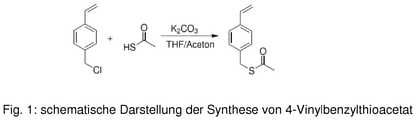
- the monomer according to formula II i.e. 4-vinylbenzyl thioacetate (abbreviated to ViBET) is prepared using the following process according to the invention:
- ViBET is synthesized in polar-aprotic solvents, the polar-aprotic solvent being selected from ketones such as acetone, nitriles such as acetonitrile, nitro compounds such as nitromethane, tertiary carboxamides such as dimethylformamide, hexamethylphosphoric triamide, sulfoxides such as dimethyl sulfoxide, sulfones such as tetrahydrothiophene-1,1 -dioxide, .
- the polar-aprotic solvent being selected from ketones such as acetone, nitriles such as acetonitrile, nitro compounds such as nitromethane, tertiary carboxamides such as dimethylformamide, hexamethylphosphoric triamide, sulfoxides such as dimethyl sulfoxide, sulfones such as tetrahydrothiophene-1,1 -dioxide, .
- the synthesis is also suitable for the pilot plant scale, since the educt reacts quantitatively and no further purification is required.
- Alcohols such as methanol with a thioacid salt (prepared in situ from thioacetic acid and an alkali metal hydroxide), which reacts with 4-vinylbenzyl chloride to give the desired product, which, however, has to be purified by distillation.
- a thioacid salt prepared in situ from thioacetic acid and an alkali metal hydroxide
- Polar aprotic solvents have a high dielectric constant or dielectric conductivity ⁇ (or also called permittivity), but do not have sufficiently acidic hydrogen atoms that can be split off as protons. Therefore, anions cannot be solvated by hydrogen bonding, only by the much weaker dispersive forces.
- DME dimethoxyethane
- THF tetrahydrofuran
- DEE diethyl ether
- acetone dioxane
- DMSO dimethyl sulfoxide
- DMF dimethylformamide
- ACN acetonitrile
- Acetone, tetrahydrofuran (THF), dioxane, diethyl ether (DEE), 1,2-dimethoxyethane (DME), very particularly preferably THF and/or acetone are particularly preferred.
- dienes according to Rompp Online are understood as meaning unsaturated aliphatic and cycloaliphatic hydrocarbons which contain two double bonds in the molecule.
- the two double bonds are preferably conjugated.
- Particularly preferred dienes here are isoprene, butadiene and chloroprene.
- isoprene 2-(C 1 -C 5 -alkyl)-1,3 -butadiene
- Particularly preferred dienes here are isoprene, butadiene and chloroprene.
- monomers such as, in particular, alkenes, vinyl compounds and/or vinylidene compounds can be involved in the process according to the invention, resulting in terpolymers or polymers with more than three different monomers as copolymers.
- Alkenes that can be involved as monomers in the polymerization are aliphatic compounds with a double bond, such as in particular ethene, propene, butene, pentene, hexene.
- vinyl compound encompasses all chemical compounds which have at least one vinyl group, such as acrylates, methacrylates, acrylic acid, methacrylic acid, acrylonitrile, and vinylaromatic compounds.
- the vinyl compound is at least one vinyl compound which, in addition to the vinyl group, has at least one further unsaturated group carbon group, such as in particular a double bond or an aromatic radical.
- the vinyl compound is at least one vinyl aromatic compound.
- vinylaromatic compound includes monovinylaromatic compounds, ie compounds in which only one
- vinyl group is attached to an aromatic group, and vinyl aromatic compounds in which two or more vinyl groups are attached to one aromatic group.
- the vinyl aromatic compound is preferably selected from the group containing, particularly preferably consisting of, styrene and/or C 1-4 -alkyl-substituted styrenes and/or stilbene and/or vinylbenzyldimethylamine and/or (4-vinylbenzyl)dimethylaminoethyl ether and/or N,N -dimethylaminoethylstyrene and/or tert-butoxystyrene and/or vinylpyridine and/or divinylaromatic compounds.
- the C 1-4 -alkyl-substituted styrenes can be, for example, 2-methylstyrene and/or 3-methylstyrene and/or 4-methylstyrene and/or 2,4-dimethylstyrene and/or 2,4,6-trimethylstyrene and/or alpha-methylstyrene and/or 2,4-diisopropylstyrene and/or 4-tert-butylstyrene.
- C 1-4 -alkyl-substituted here means that an alkyl radical having 1 to 4 carbon atoms is present as a substituent of a hydrogen atom.
- the divinylaromatic compounds can be, for example, 1,2-divinylbenzene and/or 1,3-divinylbenzene and/or 1,4-divinylbenzene.
- vinylidene compounds are understood in the context of the present invention to mean chemical compounds which have the atomic grouping R 1 R 2 ⁇ C ⁇ CH 2 linked via a double bond, such as Cl 2 C ⁇ CH 2 or F 2 C ⁇ CH 2 .
- the process for preparing a copolymer by free-radical copolymerization of the monomer with a diene is described below using the example of the copolymerization of compound II), ie 4-vinylbenzyl thioacetate (ViBET), with butadiene.
- the process is not limited to the exemplary monomers mentioned, but can be used according to the invention to produce all copolymers from those described above Monomers are used, including to make copolymers from three or more different monomers.
- AIBN is the abbreviation for the chemical compound azobis(isobutyronitrile).
- Example 3 The polymerization in Example 3 lasted 48 hours, after which a copolymer of butadiene and ViBET with a number average molar mass (or molar mass distribution) Mn according to GPC of 5052 g/mol was obtained.
- the UV absorption of the sample at a wavelength of 295 nm was determined by GPC. Pure polybutadiene does not absorb at this wavelength, but the thioester does. Since the UV detector also detects polymer in addition to the RI detector, the desired copolymer was successfully synthesized.
- the following measurement conditions apply to the determination of the molar mass or the molar mass distribution by means of GPC: SEC Analysis Systems 1260 Infinity from PSS Agilent with: PSS Agilent Technologies 1260 Iso Pump G1310B (HPLC pump), an Agilent 1260 ALS G1329B autosampler, an Agilent 1260 ALS injector, a guard column (PSS SDV, 8 ⁇ 50 mm, particle size 5 ⁇ m), three separation columns (PSS SDV, 8 ⁇ 300 mm, particle size: 5 ⁇ m, pore size 10 5 (ten to the power of five) ⁇ , 10 3 (ten to the power of three) ⁇ and 10 2 (ten to the power of two) ⁇ ) and the detectors; UV detector PSS Agilent Technologies 1260 VWDVL at a wavelength of 310 nm and RI detector PSS Agilent Technologies 1260 RID are used; Eluent THF (HPLC-grade) with toluene (> 99
- Another object of the present invention is a copolymer made by the process.
- it is a copolymer of butadiene and 4-vinylbenzyl thioacetate, which was prepared under free-radical polymerization conditions as described above.
- the copolymer according to the invention can also be a polymer of three or more different monomers.
- the copolymer of the invention may be a terpolymer of 4-vinylbenzyl thioacetate, styrene and butadiene.
- two or more different monomers according to formula I) can be used which, for example, have different protective groups P.
- a further object of the present invention is a sulfur-crosslinkable rubber mixture which contains at least one of the copolymers produced.
- the sulfur-crosslinkable rubber mixture according to the invention contains at least one of the copolymers produced and can additionally contain at least one diene rubber known in the prior art.
- the at least one diene rubber is natural polyisoprene and/or synthetic polyisoprene and/or polybutadiene (butadiene rubber) and/or unfunctionalized styrene-butadiene copolymer (styrene-butadiene rubber) and/or epoxidized polyisoprene and/or styrene - Isoprene rubber and/or halobutyl rubber and/or polynorbornene and/or isoprene-isobutylene copolymer and/or ethylene-propylene-diene rubber and/or nitrile rubber and/or chloroprene rubber and/or acrylate rubber and/or fluorine rubber and/or silicone rubber and/or polysulfide rubber and/or epichlorohydrin rubber and/or styrene-isoprene-butadiene terpolymer and/or hydrogenated acrylonitrile-butadiene rubber and
- nitrile rubber hydrogenated acrylonitrile butadiene rubber, chloroprene rubber, butyl rubber, halobutyl rubber or ethylene-propylene-diene rubber are used in the production of technical rubber articles, such as belts, straps and hoses, and/or shoe soles.
- the rubber mixture according to the invention also preferably contains at least one filler such as silica, carbon black and optionally other known polar and/or non-polar fillers such as aluminosilicates, chalk, kaolin, starch, magnesium oxide, titanium dioxide and/or rubber gels, and also carbon nanotubes (CNT) including discrete CNTs, so-called hollow carbon fibers (HCF) and modified CNT containing one or more functional groups such as hydroxy, carboxy and carbonyl groups) and/or graphite and/or graphene and/or so-called "carbon-silica dual phase filler”.
- CNT carbon nanotubes
- the rubber mixture preferably contains 1 to 300 phr, particularly preferably 1 to 200 phr, very particularly preferably 1 to 150 phr, of at least one silicic acid.
- the rubber mixture preferably contains 1 to 200 phr, particularly preferably 1 to 170 phr and very particularly preferably 1 to 100 phr of at least one carbon black.
- the silicic acids can be the silicic acids known to those skilled in the art which are suitable as fillers for tire rubber mixtures. However, it is particularly preferred if a finely divided, precipitated silica is used which has a nitrogen surface area (BET surface area) (according to DIN ISO 9277 and DIN 66132) from 35 to 350 m 2 /g, preferably from 60 to 260 m 2 /g, more preferably from 120 to 230 m 2 /g, and a CTAB surface area (according to ASTM D 3765) from 30 to 400 m 2 /g, preferably from 60 to 250 m 2 /g, more preferably from 120 to 230 m 2 /g.
- BET surface area nitrogen surface area
- CTAB surface area accordinging to ASTM D 3765
- the rubber mixture contains carbon black, all types of carbon black known to those skilled in the art are conceivable.
- a carbon black is preferably used which has an iodine adsorption number according to ASTM D 1510 from 30 to 180 g/kg, preferably 30 to 130 kg/g, and a DBP number according to ASTM D 2414 from 80 to 200 ml/100 g, preferably 100 to 200 ml/100g, particularly preferably 100 to 180 ml/100g.
- the rubber mixture according to the invention can also contain a mixture of two or more of the fillers mentioned.
- zinc oxide does not belong to the fillers, but is present in the rubber mixture according to the invention, preferably in combination with stearic acid.
- the rubber mixture preferably contains other additives.
- additives essentially include - in addition to zinc oxide (ZnO) and stearic acid - if necessary.
- silane coupling agents known to those skilled in the art for use in rubber mixtures can be used as silane coupling agents.
- one or more different silane coupling agents can be used in combination with one another.
- the rubber mixture can thus contain a mixture of different silanes.
- the silane coupling agents react with the surface silanol groups of the silicic acid or other polar groups during the mixing of the rubber or the rubber mixture (in situ) or even before the filler is added to the rubber in the sense of a pretreatment (premodification).
- Such coupling agents known from the prior art are bifunctional organosilanes which have at least one alkoxy, cycloalkoxy or phenoxy group as a leaving group on the silicon atom and which have a group as the other functionality which, after cleavage, can undergo a chemical reaction with the double bonds of the polymer .
- a silane mixture is preferably used which contains 40 to 100% by weight of disulfides, particularly preferably 55 to 85% by weight of disulfides and very particularly preferably 60 to 80% by weight Wt .-% contains disulfides.
- Such a mixture is available, for example, under the trade name Si 261® from Evonik, which can be found, for example, in DE 102006004062 A1 is described.
- Blocked mercaptosilanes, as z. B. from the WO 99/09036 are known can be used as a silane coupling agent.
- silanes as in the WO 2008/083241 A1 , the WO 2008/083242 A1 , the WO 2008/083243 A1 and the WO 2008/083244 A1 are described can be used.
- NXT eg 3-(octanoylthio)-1-propyl-triethoxysilane
- the rubber mixture can contain further activators and/or agents for binding fillers, in particular carbon black.
- This can be, for example, the example in the EP 2589619 A1 disclosed compound S- (3-aminopropyl) thiosulfuric acid and / or their metal salts act, resulting in very good physical properties of the rubber mixture, especially in combination with at least one carbon black as a filler.
- the proportion of the total amount of further additives is 3 to 150 phr, preferably 3 to 100 phr and particularly preferably 5 to 80 phr.
- GPC gel permeation chromatography, based on BS ISO 11344:2004
- the specification phr (parts per hundred parts of rubber by weight) used in this document is the quantity specification for mixture recipes that is customary in the rubber industry.
- the dosage of the parts by weight of the individual substances is always based on 100 parts by weight of the total mass of all the rubbers present in the mixture.
- the vulcanization of the sulfur-crosslinkable rubber mixture according to the invention is carried out in the presence of sulfur and/or sulfur donors with the aid of vulcanization accelerators, it being possible for some vulcanization accelerators to also act as sulfur donors.
- the accelerator is selected from the group consisting of thiazole accelerators and/or mercapto accelerators and/or sulfenamide accelerators and/or thiocarbamate accelerators and/or thiuram accelerators and/or thiophosphate accelerators and/or thiourea accelerators and/or xanthogenate accelerators and/or guanidine accelerators.
- a sulfenamide accelerator selected from the group consisting of N-cyclohexyl-2-benzothiazolesulfenamide (CBS) and/or N,N-dicyclohexylbenzothiazole-2-sulfenamide (DCBS) and/or benzothiazyl-2-sulfenmorpholide (MBS ) and/or N-tert-butyl-2-benzothiazylsulfenamide (TBBS).
- the rubber compound contains a sulphur-donating substance, this is preferably selected from the group containing, for example, thiuram disulfides, such as tetrabenzylthiuram disulfide (TBzTD) and/or tetramethylthiuram disulfide (TMTD) and/or tetraethylthiuram disulfide (TETD), and/or thiuram tetrasulfides, such as dipentamethylenethiuram tetrasulfide (DPTT) , and / or dithiophosphates, such as
- thiuram disulfides such as tetrabenzylthiuram disulfide (TBzTD) and/or tetramethylthiuram disulfide (TMTD) and/or tetraethylthiuram disulfide (TETD)
- thiuram tetrasulfides such as dipentamethylenethiuram tetrasulfide
- DipDis bis-(diisopropyl)thiophosphoryl disulphide
- bis(O,O-2-ethylhexyl-thiophosphoryl) polysulphide e.g. Rhenocure SDT 50 ® , Rheinchemie GmbH
- zinc dichloryl dithiophosphate e.g. Rhenocure ZDT/ S ® , Rheinchemie GmbH
- zinc alkyl dithiophosphate e.g. Rhenocure ZDT/ S ® , Rheinchemie GmbH
- 1,6-bis(N,N-dibenzylthiocarbamoyldithio)hexane and/or diaryl polysulfides and/or dialkyl polysulfides.
- Another object of the present invention is the use of the described sulfur-crosslinkable rubber mixture for the production of a vehicle tire.
- a further object of the invention is therefore also a vehicle tire in the production of which at least one sulfur-crosslinkable rubber mixture according to the invention—containing at least one copolymer according to the invention and produced using at least one method according to the invention as described above—was used.
- vehicle tires are understood to mean pneumatic vehicle tires and solid rubber tires, including tires for industrial and construction site vehicles, truck, passenger car and two-wheeler tires.
- it is a pneumatic vehicle tire.
- the inner tire components are essentially squeegee, inner liner (inner layer), core profile, belt, shoulder, belt profile, carcass, bead reinforcement, bead profile, horn profile and bandage.
- Rubber mixtures of the inner tire components and the sidewall are also referred to as body mixtures.
- the rubber mixture according to the invention is preferably used in tread strips of vehicle tires, preferably at least in the cap of tread strips with a cap/base construction.
- Treads contribute significantly to the abrasion behavior and rolling resistance of vehicle tires.
- treads in particular must be tear-resistant.
- the mixture is preferably brought into the form of a tread, preferably at least in the form of a tread cap, as a ready-to-use mixture before vulcanization and is applied in the known manner during the production of the green vehicle tire.
- the tread preferably at least the tread cap, can also be wound onto a green tire in the form of a narrow strip of rubber mixture.
- the rubber mixture according to the invention can be used both for the cap and for the base.
- the rubber mixture according to the invention for use as a body mixture in vehicle tires is produced as already described for the tread strip.
- the difference lies in the shaping after the extrusion process or the calendering of the mixture.
- the forms of the still unvulcanized rubber mixture obtained in this way for one or more different body mixtures are then used to build up a green tire.
- the green tire is then vulcanized under conditions known in the art.
- a further object of the present invention is the use of the sulfur-crosslinkable rubber mixture described for producing a belt, belt or hose.
- the extruded, still unvulcanized mixture is brought into the appropriate shape and, if necessary, often at the same time or afterwards Reinforcements, such as synthetic fibers or steel cords provided.
- Reinforcements such as synthetic fibers or steel cords provided. This usually results in a multi-layer structure consisting of one and/or more layers of rubber mixture, one and/or more layers of the same and/or different reinforcements and one or more other layers of the same and/or another rubber mixture.
Landscapes
- Chemical & Material Sciences (AREA)
- Engineering & Computer Science (AREA)
- Mechanical Engineering (AREA)
- Health & Medical Sciences (AREA)
- Chemical Kinetics & Catalysis (AREA)
- Medicinal Chemistry (AREA)
- Polymers & Plastics (AREA)
- Organic Chemistry (AREA)
- Compositions Of Macromolecular Compounds (AREA)
Claims (9)
- Procédé pour la préparation d'un copolymère par copolymérisation radicalaire d'un monomère selon la formule I) avec au moins un diène
I) A-S-P,
A étant un groupe chimique contenant au moins une double liaison aliphatique, etS étant un atome de soufre, etP étant un groupe protecteur, qui est choisi dans le groupe constitué parS(=O)2-R1 avec R1 = alkyle, benzyle ou phényle et/ou S-C(=S)-NR2R3 avec R2 et R3 = alkyle, benzyle ou phényle et/ouC(=O)-R4 avec R4 = alkyle et/ouNR5R6 avec R5 = atome d'hydrogène (H), alkyle, benzyle ou phényle et R6 = alkyle, benzyle ou phényle et/ouSiR7R8R9 avec R7, R8 et R9 = alkyle ou benzyle et/ou S(=O)2-OM avec M = Na, K ou H. - Procédé selon la revendication 1, caractérisé en ce que A est un groupe 4-vinylbenzyle.
- Procédé selon la revendication 2, caractérisé en ce que le monomère est le thioacétate de 4-vinylbenzyle.
- Procédé selon l'une quelconque des revendications 1 à 3, caractérisé en ce que le diène est choisi dans le groupe constitué par le 1,3-butadiène et/ou le 2-méthylbuta-1,3-diène et/ou le 2,3-diméthyl-1,3-butadiène et/ou le 1,3-pentadiène et/ou le 2,4-hexadiène et/ou le 1,3-hexadiène et/ou le 1,3-heptadiène et/ou le 1,3-octadiène et/ou le 2-méthyl-2,4-pentadiène et/ou le cyclopentadiène et/ou le 2,4-hexadiène et/ou le 1,3-cyclooctadiène et/ou le 2-chloro-1,3-butadiène.
- Copolymère caractérisé en ce qu'il a été préparé par un procédé selon l'une quelconque des revendications 1 à 4.
- Mélange de caoutchouc réticulable au soufre, caractérisé en ce qu'il contient au moins un copolymère selon la revendication 5.
- Utilisation d'un mélange de caoutchouc réticulable au soufre selon la revendication 6 pour la fabrication d'un pneu de véhicule.
- Utilisation d'un mélange de caoutchouc réticulable au soufre selon la revendication 6 pour la fabrication d'une ceinture, d'une courroie ou d'un tuyau.
- Procédé pour la préparation de thioacétate de 4-vinylbenzyle dans des solvants aprotiques polaires à partir de chlorure de 4-vinylbenzyle et d'acide thioacétique à l'aide d'une base, le solvant aprotique polaire étant choisi parmi des cétones comme l'acétone, des nitriles comme l'acétonitrile, des composés nitro comme le nitrométhane, des amides tertiaires d'acide carboxylique comme le diméthylformamide, le triamide hexaméthylphosphorique, des sulfoxydes comme le diméthylsulfoxyde, des sulfones comme le 1,1-dioxyde de tétrahydrothiophène, des diéthers de l'éthylène glycol, des esters d'acide carbonique comme le carbonate de diméthyle ou le carbonate d'éthylène et le carbonate de propylène, des dérivés d'urée comme la tétraméthylurée ou la diméthylpropylènurée, des lactames comme la N-méthyl-2-pyrrolidone et des lactones comme la γ-butyrolactone, et la base étant le carbonate de potassium.
Applications Claiming Priority (2)
| Application Number | Priority Date | Filing Date | Title |
|---|---|---|---|
| DE102015208814.6A DE102015208814A1 (de) | 2015-05-12 | 2015-05-12 | Verfahren zur Herstellung eines Copolymers, Copolymer und Kautschukmischung sowie deren Verwendung |
| PCT/EP2016/060381 WO2016180803A1 (fr) | 2015-05-12 | 2016-05-10 | Procédé de préparation d'un copolymère, copolymère et mélange de caoutchouc ainsi que son utilisation |
Publications (2)
| Publication Number | Publication Date |
|---|---|
| EP3294784A1 EP3294784A1 (fr) | 2018-03-21 |
| EP3294784B1 true EP3294784B1 (fr) | 2022-03-23 |
Family
ID=56014973
Family Applications (1)
| Application Number | Title | Priority Date | Filing Date |
|---|---|---|---|
| EP16723317.0A Active EP3294784B1 (fr) | 2015-05-12 | 2016-05-10 | Procédé de préparation d'un copolymère, copolymère et mélange de caoutchouc ainsi que son utilisation |
Country Status (6)
| Country | Link |
|---|---|
| US (1) | US11098145B2 (fr) |
| EP (1) | EP3294784B1 (fr) |
| CN (1) | CN107580610B (fr) |
| DE (1) | DE102015208814A1 (fr) |
| ES (1) | ES2912340T3 (fr) |
| WO (1) | WO2016180803A1 (fr) |
Families Citing this family (2)
| Publication number | Priority date | Publication date | Assignee | Title |
|---|---|---|---|---|
| DE102015208813A1 (de) | 2015-05-12 | 2016-11-17 | Continental Reifen Deutschland Gmbh | Monomer zur Copolymerisation mit Alkenen, Dienen, Vinyl-Verbindungen und/oder Vinyliden-Verbindungen, Verfahren zur Herstellung eines Copolymers, Copolymer und Kautschukmischung sowie deren Verwendung |
| DE102019207732A1 (de) * | 2019-05-27 | 2020-12-03 | Continental Reifen Deutschland Gmbh | Verfahren zum Herstellen einer extrudierten, schwefelvernetzbaren Kautschukmischung und Vorrichtung zur Durchführung des Verfahrens sowie deren Verwendung |
Citations (1)
| Publication number | Priority date | Publication date | Assignee | Title |
|---|---|---|---|---|
| JP2006199827A (ja) * | 2005-01-20 | 2006-08-03 | Fuji Photo Film Co Ltd | プロトン伝導体、プロトン伝導体の製造方法、電極膜接合体および燃料電池 |
Family Cites Families (19)
| Publication number | Priority date | Publication date | Assignee | Title |
|---|---|---|---|---|
| US2947731A (en) | 1957-04-04 | 1960-08-02 | Dow Chemical Co | Vinylbenzyl thiolesters of carboxylic acids and polymers thereof |
| US3162665A (en) | 1961-10-10 | 1964-12-22 | Stauffer Chemical Co | Haloallyl methanethiosulfonates |
| US3686323A (en) | 1970-02-24 | 1972-08-22 | Int Flavors & Fragrances Inc | Thioalkanal-s-oxides |
| NL7013420A (fr) | 1970-09-10 | 1972-03-14 | ||
| CA1198547A (fr) * | 1980-01-31 | 1985-12-24 | Robert A. Weiss | Copolymeres et terpolymeres sulfones |
| US4483960A (en) * | 1983-11-07 | 1984-11-20 | Exxon Research & Engineering Co. | Emulsion type adhesive compositions |
| US4929694A (en) * | 1989-05-04 | 1990-05-29 | Hoechst Celanese Corporation | Copolymers of p-mercaptostyrene and its esters |
| JP3466301B2 (ja) * | 1994-11-25 | 2003-11-10 | 三菱製紙株式会社 | 単分散性ポリスチレン系粒子の製造方法 |
| ATE239737T1 (de) | 1997-08-21 | 2003-05-15 | Crompton Corp | Blockierte merkaptosilane als kupplungsmittel für gefüllte kautschukzusammensetzung |
| US6420505B1 (en) | 2001-06-20 | 2002-07-16 | Eastman Kodak Company | Process for preparing thiosulfate salt polymers |
| KR100895123B1 (ko) * | 2005-04-27 | 2009-05-04 | 다이킨 고교 가부시키가이샤 | S-술페이트기를 갖는 불소 함유 중합체 및 이 중합체를포함하는 발수 발유제 조성물 |
| DE102006004062A1 (de) | 2006-01-28 | 2007-08-09 | Degussa Gmbh | Kautschukmischungen |
| US7968635B2 (en) | 2006-12-28 | 2011-06-28 | Continental Ag | Tire compositions and components containing free-flowing filler compositions |
| US7968634B2 (en) | 2006-12-28 | 2011-06-28 | Continental Ag | Tire compositions and components containing silated core polysulfides |
| US7968636B2 (en) | 2006-12-28 | 2011-06-28 | Continental Ag | Tire compositions and components containing silated cyclic core polysulfides |
| US7968633B2 (en) | 2006-12-28 | 2011-06-28 | Continental Ag | Tire compositions and components containing free-flowing filler compositions |
| US8182626B2 (en) | 2008-10-30 | 2012-05-22 | Continental Ag | Tire composition with improved vulcanizing agent |
| JP2012012456A (ja) | 2010-06-30 | 2012-01-19 | Sumitomo Chemical Co Ltd | S−(3−アミノプロピル)チオ硫酸および/またはその金属塩の使用方法 |
| DE102015208813A1 (de) | 2015-05-12 | 2016-11-17 | Continental Reifen Deutschland Gmbh | Monomer zur Copolymerisation mit Alkenen, Dienen, Vinyl-Verbindungen und/oder Vinyliden-Verbindungen, Verfahren zur Herstellung eines Copolymers, Copolymer und Kautschukmischung sowie deren Verwendung |
-
2015
- 2015-05-12 DE DE102015208814.6A patent/DE102015208814A1/de not_active Ceased
-
2016
- 2016-05-10 CN CN201680027291.0A patent/CN107580610B/zh active Active
- 2016-05-10 WO PCT/EP2016/060381 patent/WO2016180803A1/fr not_active Ceased
- 2016-05-10 ES ES16723317T patent/ES2912340T3/es active Active
- 2016-05-10 EP EP16723317.0A patent/EP3294784B1/fr active Active
-
2017
- 2017-11-13 US US15/810,699 patent/US11098145B2/en active Active
Patent Citations (1)
| Publication number | Priority date | Publication date | Assignee | Title |
|---|---|---|---|---|
| JP2006199827A (ja) * | 2005-01-20 | 2006-08-03 | Fuji Photo Film Co Ltd | プロトン伝導体、プロトン伝導体の製造方法、電極膜接合体および燃料電池 |
Non-Patent Citations (1)
| Title |
|---|
| CONRAD CATHRIN SONJA: "Polybutadien und Butadien enthaltende Copolymere mit gezielt eingebauten vulkanisierbaren Gruppen durch RAFT-Polymerisation", 1 January 2013 (2013-01-01), XP055808362, Retrieved from the Internet <URL:https://ediss.uni-goettingen.de/bitstream/handle/11858/00-1735-0000-0022-5E9E-D/Diss_Conrad.pdf?sequence=1> [retrieved on 20210527] * |
Also Published As
| Publication number | Publication date |
|---|---|
| WO2016180803A1 (fr) | 2016-11-17 |
| CN107580610B (zh) | 2020-08-04 |
| ES2912340T3 (es) | 2022-05-25 |
| US11098145B2 (en) | 2021-08-24 |
| CN107580610A (zh) | 2018-01-12 |
| US20180066094A1 (en) | 2018-03-08 |
| DE102015208814A1 (de) | 2016-11-17 |
| EP3294784A1 (fr) | 2018-03-21 |
Similar Documents
| Publication | Publication Date | Title |
|---|---|---|
| EP3303004B1 (fr) | Mélange de caoutchouc et pneu de véhicule | |
| EP3150402B1 (fr) | Compose caoutchouc et pneu de vehicule | |
| EP3150403B1 (fr) | Compose caoutchouc et pneu de vehicule | |
| WO2018033315A1 (fr) | Caoutchouc mixte, mélange de caoutchouc réticulable au soufre et pneumatique de véhicule | |
| EP2977227B1 (fr) | Mélange de caoutchouc réticulable au soufre et pneu | |
| EP3717557B1 (fr) | Mélange de caoutchouc réticulable au soufre, vulcanisat de ce mélange de caoutchouc et pneu de véhicule | |
| EP3717277B1 (fr) | Mélange de caoutchouc réticulable au soufre, vulcanisat de ce mélange de caoutchouc et pneu de véhicule | |
| EP4444791A1 (fr) | Mélange de caoutchouc réticulable au soufre, vulcanisat du mélange de caoutchouc, et pneu de véhicule | |
| EP3594283B1 (fr) | Mélange de caoutchouc réticulable au soufre, caoutchouc vulcanisé et pneumatiques de véhicule | |
| EP2987813B1 (fr) | Mélange de caoutchouc réticulable au soufre et pneu | |
| EP3109064B1 (fr) | Procede de copolymerisation, melange de copolymere et de caoutchouc et son utilisation | |
| EP3294784B1 (fr) | Procédé de préparation d'un copolymère, copolymère et mélange de caoutchouc ainsi que son utilisation | |
| WO2018033316A1 (fr) | Mélange de caoutchouc, mélange de caoutchouc réticulable au soufre et pneumatique de véhicule | |
| EP3452518B1 (fr) | Composition de caoutchouc, vulcanisate de la composition de caoutchouc et pneumatique | |
| EP3294785B1 (fr) | Agent de transfert raft, procédé de polymérisation, polymère ainsi que mélange de caoutchouc et son utilisation | |
| EP3294710B1 (fr) | Monomère pour copolymérisation avec des alcènes, des diènes, des composés vinyliques et/ou des composés de vinylidène, procédé de préparation d'un copolymère, et mélange de caoutchouc et son utilisation | |
| EP3301118B1 (fr) | Mélange de caoutchouc réticulable au soufre, vulcanisation de mélange de caoutchouc et pneumatique pour véhicule | |
| EP4105277A1 (fr) | Mélange de caoutchouc et pneu |
Legal Events
| Date | Code | Title | Description |
|---|---|---|---|
| STAA | Information on the status of an ep patent application or granted ep patent |
Free format text: STATUS: THE INTERNATIONAL PUBLICATION HAS BEEN MADE |
|
| PUAI | Public reference made under article 153(3) epc to a published international application that has entered the european phase |
Free format text: ORIGINAL CODE: 0009012 |
|
| STAA | Information on the status of an ep patent application or granted ep patent |
Free format text: STATUS: REQUEST FOR EXAMINATION WAS MADE |
|
| 17P | Request for examination filed |
Effective date: 20171212 |
|
| AK | Designated contracting states |
Kind code of ref document: A1 Designated state(s): AL AT BE BG CH CY CZ DE DK EE ES FI FR GB GR HR HU IE IS IT LI LT LU LV MC MK MT NL NO PL PT RO RS SE SI SK SM TR |
|
| AX | Request for extension of the european patent |
Extension state: BA ME |
|
| DAV | Request for validation of the european patent (deleted) | ||
| DAX | Request for extension of the european patent (deleted) | ||
| STAA | Information on the status of an ep patent application or granted ep patent |
Free format text: STATUS: EXAMINATION IS IN PROGRESS |
|
| 17Q | First examination report despatched |
Effective date: 20181010 |
|
| RAP1 | Party data changed (applicant data changed or rights of an application transferred) |
Owner name: CONTINENTAL REIFEN DEUTSCHLAND GMBH |
|
| RIC1 | Information provided on ipc code assigned before grant |
Ipc: B60C 1/00 20060101ALI20211005BHEP Ipc: B29D 30/06 20060101ALI20211005BHEP Ipc: B29B 7/74 20060101ALI20211005BHEP Ipc: C08F 236/06 20060101AFI20211005BHEP |
|
| GRAP | Despatch of communication of intention to grant a patent |
Free format text: ORIGINAL CODE: EPIDOSNIGR1 |
|
| STAA | Information on the status of an ep patent application or granted ep patent |
Free format text: STATUS: GRANT OF PATENT IS INTENDED |
|
| INTG | Intention to grant announced |
Effective date: 20211112 |
|
| GRAS | Grant fee paid |
Free format text: ORIGINAL CODE: EPIDOSNIGR3 |
|
| GRAA | (expected) grant |
Free format text: ORIGINAL CODE: 0009210 |
|
| STAA | Information on the status of an ep patent application or granted ep patent |
Free format text: STATUS: THE PATENT HAS BEEN GRANTED |
|
| AK | Designated contracting states |
Kind code of ref document: B1 Designated state(s): AL AT BE BG CH CY CZ DE DK EE ES FI FR GB GR HR HU IE IS IT LI LT LU LV MC MK MT NL NO PL PT RO RS SE SI SK SM TR |
|
| REG | Reference to a national code |
Ref country code: GB Ref legal event code: FG4D Free format text: NOT ENGLISH |
|
| REG | Reference to a national code |
Ref country code: CH Ref legal event code: EP |
|
| REG | Reference to a national code |
Ref country code: DE Ref legal event code: R096 Ref document number: 502016014669 Country of ref document: DE |
|
| REG | Reference to a national code |
Ref country code: IE Ref legal event code: FG4D Free format text: LANGUAGE OF EP DOCUMENT: GERMAN |
|
| REG | Reference to a national code |
Ref country code: AT Ref legal event code: REF Ref document number: 1477389 Country of ref document: AT Kind code of ref document: T Effective date: 20220415 |
|
| REG | Reference to a national code |
Ref country code: ES Ref legal event code: FG2A Ref document number: 2912340 Country of ref document: ES Kind code of ref document: T3 Effective date: 20220525 |
|
| REG | Reference to a national code |
Ref country code: LT Ref legal event code: MG9D |
|
| REG | Reference to a national code |
Ref country code: NL Ref legal event code: MP Effective date: 20220323 |
|
| PG25 | Lapsed in a contracting state [announced via postgrant information from national office to epo] |
Ref country code: SE Free format text: LAPSE BECAUSE OF FAILURE TO SUBMIT A TRANSLATION OF THE DESCRIPTION OR TO PAY THE FEE WITHIN THE PRESCRIBED TIME-LIMIT Effective date: 20220323 Ref country code: RS Free format text: LAPSE BECAUSE OF FAILURE TO SUBMIT A TRANSLATION OF THE DESCRIPTION OR TO PAY THE FEE WITHIN THE PRESCRIBED TIME-LIMIT Effective date: 20220323 Ref country code: NO Free format text: LAPSE BECAUSE OF FAILURE TO SUBMIT A TRANSLATION OF THE DESCRIPTION OR TO PAY THE FEE WITHIN THE PRESCRIBED TIME-LIMIT Effective date: 20220623 Ref country code: LT Free format text: LAPSE BECAUSE OF FAILURE TO SUBMIT A TRANSLATION OF THE DESCRIPTION OR TO PAY THE FEE WITHIN THE PRESCRIBED TIME-LIMIT Effective date: 20220323 Ref country code: HR Free format text: LAPSE BECAUSE OF FAILURE TO SUBMIT A TRANSLATION OF THE DESCRIPTION OR TO PAY THE FEE WITHIN THE PRESCRIBED TIME-LIMIT Effective date: 20220323 Ref country code: BG Free format text: LAPSE BECAUSE OF FAILURE TO SUBMIT A TRANSLATION OF THE DESCRIPTION OR TO PAY THE FEE WITHIN THE PRESCRIBED TIME-LIMIT Effective date: 20220623 |
|
| PG25 | Lapsed in a contracting state [announced via postgrant information from national office to epo] |
Ref country code: LV Free format text: LAPSE BECAUSE OF FAILURE TO SUBMIT A TRANSLATION OF THE DESCRIPTION OR TO PAY THE FEE WITHIN THE PRESCRIBED TIME-LIMIT Effective date: 20220323 Ref country code: GR Free format text: LAPSE BECAUSE OF FAILURE TO SUBMIT A TRANSLATION OF THE DESCRIPTION OR TO PAY THE FEE WITHIN THE PRESCRIBED TIME-LIMIT Effective date: 20220624 Ref country code: FI Free format text: LAPSE BECAUSE OF FAILURE TO SUBMIT A TRANSLATION OF THE DESCRIPTION OR TO PAY THE FEE WITHIN THE PRESCRIBED TIME-LIMIT Effective date: 20220323 |
|
| PG25 | Lapsed in a contracting state [announced via postgrant information from national office to epo] |
Ref country code: NL Free format text: LAPSE BECAUSE OF FAILURE TO SUBMIT A TRANSLATION OF THE DESCRIPTION OR TO PAY THE FEE WITHIN THE PRESCRIBED TIME-LIMIT Effective date: 20220323 |
|
| PG25 | Lapsed in a contracting state [announced via postgrant information from national office to epo] |
Ref country code: SM Free format text: LAPSE BECAUSE OF FAILURE TO SUBMIT A TRANSLATION OF THE DESCRIPTION OR TO PAY THE FEE WITHIN THE PRESCRIBED TIME-LIMIT Effective date: 20220323 Ref country code: SK Free format text: LAPSE BECAUSE OF FAILURE TO SUBMIT A TRANSLATION OF THE DESCRIPTION OR TO PAY THE FEE WITHIN THE PRESCRIBED TIME-LIMIT Effective date: 20220323 Ref country code: RO Free format text: LAPSE BECAUSE OF FAILURE TO SUBMIT A TRANSLATION OF THE DESCRIPTION OR TO PAY THE FEE WITHIN THE PRESCRIBED TIME-LIMIT Effective date: 20220323 Ref country code: PT Free format text: LAPSE BECAUSE OF FAILURE TO SUBMIT A TRANSLATION OF THE DESCRIPTION OR TO PAY THE FEE WITHIN THE PRESCRIBED TIME-LIMIT Effective date: 20220725 Ref country code: EE Free format text: LAPSE BECAUSE OF FAILURE TO SUBMIT A TRANSLATION OF THE DESCRIPTION OR TO PAY THE FEE WITHIN THE PRESCRIBED TIME-LIMIT Effective date: 20220323 Ref country code: CZ Free format text: LAPSE BECAUSE OF FAILURE TO SUBMIT A TRANSLATION OF THE DESCRIPTION OR TO PAY THE FEE WITHIN THE PRESCRIBED TIME-LIMIT Effective date: 20220323 |
|
| PG25 | Lapsed in a contracting state [announced via postgrant information from national office to epo] |
Ref country code: PL Free format text: LAPSE BECAUSE OF FAILURE TO SUBMIT A TRANSLATION OF THE DESCRIPTION OR TO PAY THE FEE WITHIN THE PRESCRIBED TIME-LIMIT Effective date: 20220323 Ref country code: IS Free format text: LAPSE BECAUSE OF FAILURE TO SUBMIT A TRANSLATION OF THE DESCRIPTION OR TO PAY THE FEE WITHIN THE PRESCRIBED TIME-LIMIT Effective date: 20220723 Ref country code: AL Free format text: LAPSE BECAUSE OF FAILURE TO SUBMIT A TRANSLATION OF THE DESCRIPTION OR TO PAY THE FEE WITHIN THE PRESCRIBED TIME-LIMIT Effective date: 20220323 |
|
| REG | Reference to a national code |
Ref country code: CH Ref legal event code: PL |
|
| REG | Reference to a national code |
Ref country code: DE Ref legal event code: R097 Ref document number: 502016014669 Country of ref document: DE |
|
| REG | Reference to a national code |
Ref country code: BE Ref legal event code: MM Effective date: 20220531 |
|
| PLBE | No opposition filed within time limit |
Free format text: ORIGINAL CODE: 0009261 |
|
| STAA | Information on the status of an ep patent application or granted ep patent |
Free format text: STATUS: NO OPPOSITION FILED WITHIN TIME LIMIT |
|
| PG25 | Lapsed in a contracting state [announced via postgrant information from national office to epo] |
Ref country code: MC Free format text: LAPSE BECAUSE OF FAILURE TO SUBMIT A TRANSLATION OF THE DESCRIPTION OR TO PAY THE FEE WITHIN THE PRESCRIBED TIME-LIMIT Effective date: 20220323 Ref country code: LU Free format text: LAPSE BECAUSE OF NON-PAYMENT OF DUE FEES Effective date: 20220510 Ref country code: LI Free format text: LAPSE BECAUSE OF NON-PAYMENT OF DUE FEES Effective date: 20220531 Ref country code: DK Free format text: LAPSE BECAUSE OF FAILURE TO SUBMIT A TRANSLATION OF THE DESCRIPTION OR TO PAY THE FEE WITHIN THE PRESCRIBED TIME-LIMIT Effective date: 20220323 Ref country code: CH Free format text: LAPSE BECAUSE OF NON-PAYMENT OF DUE FEES Effective date: 20220531 |
|
| 26N | No opposition filed |
Effective date: 20230102 |
|
| GBPC | Gb: european patent ceased through non-payment of renewal fee |
Effective date: 20220623 |
|
| PG25 | Lapsed in a contracting state [announced via postgrant information from national office to epo] |
Ref country code: IE Free format text: LAPSE BECAUSE OF NON-PAYMENT OF DUE FEES Effective date: 20220510 |
|
| PG25 | Lapsed in a contracting state [announced via postgrant information from national office to epo] |
Ref country code: SI Free format text: LAPSE BECAUSE OF FAILURE TO SUBMIT A TRANSLATION OF THE DESCRIPTION OR TO PAY THE FEE WITHIN THE PRESCRIBED TIME-LIMIT Effective date: 20220323 Ref country code: GB Free format text: LAPSE BECAUSE OF NON-PAYMENT OF DUE FEES Effective date: 20220623 Ref country code: BE Free format text: LAPSE BECAUSE OF NON-PAYMENT OF DUE FEES Effective date: 20220531 |
|
| P01 | Opt-out of the competence of the unified patent court (upc) registered |
Effective date: 20230602 |
|
| REG | Reference to a national code |
Ref country code: AT Ref legal event code: MM01 Ref document number: 1477389 Country of ref document: AT Kind code of ref document: T Effective date: 20220510 |
|
| PG25 | Lapsed in a contracting state [announced via postgrant information from national office to epo] |
Ref country code: IT Free format text: LAPSE BECAUSE OF FAILURE TO SUBMIT A TRANSLATION OF THE DESCRIPTION OR TO PAY THE FEE WITHIN THE PRESCRIBED TIME-LIMIT Effective date: 20220323 Ref country code: AT Free format text: LAPSE BECAUSE OF NON-PAYMENT OF DUE FEES Effective date: 20220510 |
|
| REG | Reference to a national code |
Ref country code: DE Ref legal event code: R081 Ref document number: 502016014669 Country of ref document: DE Owner name: CONTINENTAL REIFEN DEUTSCHLAND GMBH, DE Free format text: FORMER OWNER: CONTINENTAL REIFEN DEUTSCHLAND GMBH, 30165 HANNOVER, DE |
|
| PG25 | Lapsed in a contracting state [announced via postgrant information from national office to epo] |
Ref country code: HU Free format text: LAPSE BECAUSE OF FAILURE TO SUBMIT A TRANSLATION OF THE DESCRIPTION OR TO PAY THE FEE WITHIN THE PRESCRIBED TIME-LIMIT; INVALID AB INITIO Effective date: 20160510 |
|
| PG25 | Lapsed in a contracting state [announced via postgrant information from national office to epo] |
Ref country code: MK Free format text: LAPSE BECAUSE OF FAILURE TO SUBMIT A TRANSLATION OF THE DESCRIPTION OR TO PAY THE FEE WITHIN THE PRESCRIBED TIME-LIMIT Effective date: 20220323 Ref country code: CY Free format text: LAPSE BECAUSE OF FAILURE TO SUBMIT A TRANSLATION OF THE DESCRIPTION OR TO PAY THE FEE WITHIN THE PRESCRIBED TIME-LIMIT Effective date: 20220323 |
|
| PG25 | Lapsed in a contracting state [announced via postgrant information from national office to epo] |
Ref country code: MT Free format text: LAPSE BECAUSE OF FAILURE TO SUBMIT A TRANSLATION OF THE DESCRIPTION OR TO PAY THE FEE WITHIN THE PRESCRIBED TIME-LIMIT Effective date: 20220323 |
|
| PGFP | Annual fee paid to national office [announced via postgrant information from national office to epo] |
Ref country code: DE Payment date: 20250531 Year of fee payment: 10 |
|
| PGFP | Annual fee paid to national office [announced via postgrant information from national office to epo] |
Ref country code: ES Payment date: 20250627 Year of fee payment: 10 |
|
| PGFP | Annual fee paid to national office [announced via postgrant information from national office to epo] |
Ref country code: FR Payment date: 20250528 Year of fee payment: 10 |
|
| PG25 | Lapsed in a contracting state [announced via postgrant information from national office to epo] |
Ref country code: TR Free format text: LAPSE BECAUSE OF FAILURE TO SUBMIT A TRANSLATION OF THE DESCRIPTION OR TO PAY THE FEE WITHIN THE PRESCRIBED TIME-LIMIT Effective date: 20220323 |