EP3294802B1 - Gassperrbeschichtungszusammensetzungen - Google Patents
Gassperrbeschichtungszusammensetzungen Download PDFInfo
- Publication number
- EP3294802B1 EP3294802B1 EP16793213.6A EP16793213A EP3294802B1 EP 3294802 B1 EP3294802 B1 EP 3294802B1 EP 16793213 A EP16793213 A EP 16793213A EP 3294802 B1 EP3294802 B1 EP 3294802B1
- Authority
- EP
- European Patent Office
- Prior art keywords
- clay
- barrier coating
- polymer
- coating composition
- composition according
- Prior art date
- Legal status (The legal status is an assumption and is not a legal conclusion. Google has not performed a legal analysis and makes no representation as to the accuracy of the status listed.)
- Active
Links
Images





Classifications
-
- C—CHEMISTRY; METALLURGY
- C08—ORGANIC MACROMOLECULAR COMPOUNDS; THEIR PREPARATION OR CHEMICAL WORKING-UP; COMPOSITIONS BASED THEREON
- C08K—Use of inorganic or non-macromolecular organic substances as compounding ingredients
- C08K7/00—Use of ingredients characterised by shape
- C08K7/02—Fibres or whiskers
- C08K7/04—Fibres or whiskers inorganic
- C08K7/10—Silicon-containing compounds
-
- C—CHEMISTRY; METALLURGY
- C08—ORGANIC MACROMOLECULAR COMPOUNDS; THEIR PREPARATION OR CHEMICAL WORKING-UP; COMPOSITIONS BASED THEREON
- C08K—Use of inorganic or non-macromolecular organic substances as compounding ingredients
- C08K3/00—Use of inorganic substances as compounding ingredients
- C08K3/34—Silicon-containing compounds
-
- C—CHEMISTRY; METALLURGY
- C08—ORGANIC MACROMOLECULAR COMPOUNDS; THEIR PREPARATION OR CHEMICAL WORKING-UP; COMPOSITIONS BASED THEREON
- C08K—Use of inorganic or non-macromolecular organic substances as compounding ingredients
- C08K3/00—Use of inorganic substances as compounding ingredients
- C08K3/34—Silicon-containing compounds
- C08K3/346—Clay
-
- C—CHEMISTRY; METALLURGY
- C09—DYES; PAINTS; POLISHES; NATURAL RESINS; ADHESIVES; COMPOSITIONS NOT OTHERWISE PROVIDED FOR; APPLICATIONS OF MATERIALS NOT OTHERWISE PROVIDED FOR
- C09C—TREATMENT OF INORGANIC MATERIALS, OTHER THAN FIBROUS FILLERS, TO ENHANCE THEIR PIGMENTING OR FILLING PROPERTIES ; PREPARATION OF CARBON BLACK ; PREPARATION OF INORGANIC MATERIALS WHICH ARE NO SINGLE CHEMICAL COMPOUNDS AND WHICH ARE MAINLY USED AS PIGMENTS OR FILLERS
- C09C1/00—Treatment of specific inorganic materials other than fibrous fillers; Preparation of carbon black
- C09C1/40—Compounds of aluminium
- C09C1/42—Clays
-
- C—CHEMISTRY; METALLURGY
- C09—DYES; PAINTS; POLISHES; NATURAL RESINS; ADHESIVES; COMPOSITIONS NOT OTHERWISE PROVIDED FOR; APPLICATIONS OF MATERIALS NOT OTHERWISE PROVIDED FOR
- C09D—COATING COMPOSITIONS, e.g. PAINTS, VARNISHES OR LACQUERS; FILLING PASTES; CHEMICAL PAINT OR INK REMOVERS; INKS; CORRECTING FLUIDS; WOODSTAINS; PASTES OR SOLIDS FOR COLOURING OR PRINTING; USE OF MATERIALS THEREFOR
- C09D169/00—Coating compositions based on polycarbonates; Coating compositions based on derivatives of polycarbonates
-
- C—CHEMISTRY; METALLURGY
- C09—DYES; PAINTS; POLISHES; NATURAL RESINS; ADHESIVES; COMPOSITIONS NOT OTHERWISE PROVIDED FOR; APPLICATIONS OF MATERIALS NOT OTHERWISE PROVIDED FOR
- C09D—COATING COMPOSITIONS, e.g. PAINTS, VARNISHES OR LACQUERS; FILLING PASTES; CHEMICAL PAINT OR INK REMOVERS; INKS; CORRECTING FLUIDS; WOODSTAINS; PASTES OR SOLIDS FOR COLOURING OR PRINTING; USE OF MATERIALS THEREFOR
- C09D5/00—Coating compositions, e.g. paints, varnishes or lacquers, characterised by their physical nature or the effects produced; Filling pastes
-
- C—CHEMISTRY; METALLURGY
- C09—DYES; PAINTS; POLISHES; NATURAL RESINS; ADHESIVES; COMPOSITIONS NOT OTHERWISE PROVIDED FOR; APPLICATIONS OF MATERIALS NOT OTHERWISE PROVIDED FOR
- C09D—COATING COMPOSITIONS, e.g. PAINTS, VARNISHES OR LACQUERS; FILLING PASTES; CHEMICAL PAINT OR INK REMOVERS; INKS; CORRECTING FLUIDS; WOODSTAINS; PASTES OR SOLIDS FOR COLOURING OR PRINTING; USE OF MATERIALS THEREFOR
- C09D7/00—Features of coating compositions, not provided for in group C09D5/00; Processes for incorporating ingredients in coating compositions
- C09D7/40—Additives
- C09D7/66—Additives characterised by particle size
- C09D7/67—Particle size smaller than 100 nm
-
- C—CHEMISTRY; METALLURGY
- C08—ORGANIC MACROMOLECULAR COMPOUNDS; THEIR PREPARATION OR CHEMICAL WORKING-UP; COMPOSITIONS BASED THEREON
- C08K—Use of inorganic or non-macromolecular organic substances as compounding ingredients
- C08K2201/00—Specific properties of additives
- C08K2201/008—Additives improving gas barrier properties
-
- C—CHEMISTRY; METALLURGY
- C08—ORGANIC MACROMOLECULAR COMPOUNDS; THEIR PREPARATION OR CHEMICAL WORKING-UP; COMPOSITIONS BASED THEREON
- C08K—Use of inorganic or non-macromolecular organic substances as compounding ingredients
- C08K2201/00—Specific properties of additives
- C08K2201/016—Additives defined by their aspect ratio
-
- C—CHEMISTRY; METALLURGY
- C08—ORGANIC MACROMOLECULAR COMPOUNDS; THEIR PREPARATION OR CHEMICAL WORKING-UP; COMPOSITIONS BASED THEREON
- C08K—Use of inorganic or non-macromolecular organic substances as compounding ingredients
- C08K9/00—Use of pretreated ingredients
- C08K9/04—Ingredients treated with organic substances
Definitions
- the present invention is directed to gas barrier coating compositions comprising a nanocomposite formed from a polymer and a nanoparticulate clay.
- the gas barrier coatings are applied to packaging materials such as food and pharmaceutical packaging and exhibit improved adhesion and barriers to gases such as oxygen, carbon dioxide, nitrogen and water vapour.
- the present invention relates to gas barrier coatings, particularly having the ability to block the ingress of oxygen and other gases such as carbon dioxide or nitrogen, and which may be used to coat and impart gas barrier properties to a variety of materials, notably packaging for foods and pharmaceuticals, where exposure to oxygen needs to be eliminated or restricted.
- the gas barrier, adhesive, and cohesive properties of the coatings are manipulated using surface energetics.
- the present invention provides a barrier coating composition comprising a nanocomposite wherein the nanocomposite comprises
- the present invention provides a coated article or substrate comprising a barrier coating composition on the surface of the article or substrate.
- the present invention is directed to gas barrier coating compositions comprising a nanocomposite formed from a polymer and a nanoparticulate clay and in particular non aqueous gas barrier coating compositions.
- Nanoparticulate clays are typically hydrophilic and are thus primarily used with water polymers to provide aqueous coating formulations. However such aqueous coating formulations do not provide adequate water or moisture resistance for most food packaging applications.
- nanoparticulate clays in such formulations are limited to those having a fairly low aspect ratio in order to provide cohesive films that in turn maintain high lamination bond strengths.
- Clays are readily exfoliated in water and exfoliated clay dispersions are readily compatible with certain types of polymer provided they are dissolved in water or aqueous mixtures composed mainly of water with lower proportions of water miscible organic solvents such as lower alcohols (such additions of organic solvent being important to facilitate coating viscosity, rheology, anti-foaming, substrate wetting and drying speed requirements).
- water miscible organic solvents such as lower alcohols
- Such coating formulations provide excellent barriers to oxygen and other gases provided they are maintained in a dry state. However in conditions where relative humidity is high or the coating comes into contact with water, the polymer may be partially dissolved or plasticized and the hydrophilic nature of the clay particles accelerates this process further, leading to loss of barrier and even adhesive and cohesive failure of the coating to substrate or laminate.
- Flexible food and pharmaceutical packaging is usually designed and constructed to isolate the contents from the exterior environment thus keeping unwanted gases out while maintaining internal atmospheres necessary to prolong product quality and shelf life. Such situations might require humid 100% saturated internal atmospheres or completely dry internal atmospheres while the external atmospheric storage conditions may vary to being saturated with moisture vapor (e.g. as commonly found in tropical climates) or very dry (e.g. as may be found in desert or near desert locations). If the barrier coating used to enhance the performance of the packaging is affected by moisture it is likely to fail under such conditions and allow increased transmission of gases which affects the contents detrimentally.
- the present invention provides a gas barrier coating composition that overcomes the above mentioned deficiencies and it has been found that by treating the surfaces of high aspect ratio clays with surface active agents it is possible to improve their compatibility with solvent soluble polymers and thus avoid the restrictions that are present when formulating aqueous coatings.
- the particle-particle flocculation can be minized and polymer-particle interaction maximized.
- the coating compositions according to the present invention dry as fast as common impression flexo and high speed gravure printing inks, thus permitting in line conversion of printed gas barrier laminate structures suitable for flexible food and pharmaceutical packaging.
- the present invention provides stable dispersions of high aspect ratio nanoparticulate clays that do not settle or separate on storage and the gas barrier coatings based upon high aspect ratio nanoparticulate clays provide high adhesive lamination bond strengths, and barriers to gases such as oxygen, carbon dioxide and nitrogen and water vapor.
- gas barrier coatings also provide barriers to aromas and nuisance substances such as photoinitiators, unreacted monomers, plasticizers, and mineral oils.
- coating compositions provide a single commercial combined moisture and gas barrier, improved water and moisture resistance in the coated laminate or monoweb packaging, compositions that are chlorine free and that can be used in pasteurization and retort applications.
- coating compositions provide coatings that are more flexible than metal oxide or vacuum metallized barrier packaging which results in sustained barrier properties throughout the packaging process and shelf life.
- the polymer used in the coating composition of the present invention is based upon the required application properties such as adhesion to specific packaging substrates, flexibility, packaging performance and organoleptic properties.
- the polymers are selected from polyurethanes, polyester-urethanes, polyesters, polyamides, cellulose derivatives (esters, ethers, nitrated esters, carboxylated etc.) rosin esters, phenolic modified rosin esters, polypropylene carbonate resins, ketone resins, maleinised rosin esters, shellac, poly lactic acid, acrylics, styrenated acrylics, vinyl chloride co-polymers, vinyl esters and/or vinyl alcohol co-polymers.
- the polymers are selected from a polypropylene carbonate resin, a ketone resin and polyurethane.
- the clay must be of higher aspect ratio than that typically used in aqueous systems.
- the polymer used in the preparation of the nanocomposite has a surface tension of between 20 to 60 mJ/m 2 which constitutes a dispersive component of between 10 to 50 mJ/m 2 and a polar component of between 2 to 40 mJ/m 2 .
- the polymer has a surface tension of between 30 to 50 mJ/m 2 which constitutes dispersive component of between 25 to 45 mJ/m 2 and a polar component of between 3 to 20 mJ/m 2 .
- the surface of the nanoparticulate clay when modified with a surface active agent has a surface tension of between 20 to 60 mJ/m 2 which constitutes a dispersive component of between 10 to 50 mJ/m 2 and a polar component of between 2 to 40 mJ/m 2 .
- the modified clay has a surface tension of between 30 to 50 mJ/m 2 which constitutes a dispersive component of between 25 to 45 mJ/m 2 and a polar component of between 3 to 20 mJ/m 2 .
- the nanoparticulate clays have an aspect ratio of between 20 and 30,000 and create a tortuous pathway in the dry film, which hinders the passage of gases such as oxygen and carbon dioxide and moisture.
- the nanoparticulate clays have an aspect ratio greater than 100.
- the 'tortuous path theory' explains that particulates with high aspect ratios (i.e. platy particle morphology in which the longest dimension is many times greater than the smallest, typically the thickness) naturally orientate within a coating film as it dries.
- the thickness of the applied dry coating is many times greater than the thickness of a single particle and hence hundreds of layers of these particles align parallel to the substrate surface thus forming an interleaved or brick wall structure within the coating polymer.
- Each particle is itself a barrier to oxygen and moisture vapor as well as other gases, but the discontinuous arrangement of particles means that spaces exist between the particles which allow the passage of gases though the coating film.
- Suitable clays include kaolinite, hectorite, montmorillonite, vermiculite, atapulgite, illite, bentonite, halloysite, kaolin, mica, diatomaceous earth and fuller's earth, calcined aluminum silicate, hydrated aluminum silicate, magnesium aluminum silicate, sodium silicate and magnesium silicate.
- the clays are selected from montmorillonite, mica and/or vermiculite.
- suitable materials include Cloisite Na+ (available from Southern Clay), Microlite (available form Specialty Vermiculite Corp), Somasif ME 100 (available from Co-Op Chemical Japan), Kunipia F, G, G4, and G10 Montmorillonites (from Kunimine Japan) and Nanomer clay materials (ex Nanocor Inc.).
- the present invention requires the efficient disaggregation and dispersion of nanoparticulate clay platelets in lipophilic organic polymers to optimize the nanocomposite's properties and requires organophilisation of the clay.
- the clay flocculates and settles from the aqueous suspension from which the separated clay can then be re-dispersed in a compatible organic solvent or used in extrusion processes without re-dispersion in solvent.
- surfactants can be used to control the surface energy of the clay platelets and improve compatibility with the polymer component.
- Such surfactants would include, for example anionic, amphoteric and non-ionic surface active agents. Whilst ion exchange is not possible with these types of surfactants, covalent bonds between functional groups on the clay platelet and the surfactant molecules may be achieved through reaction with organo silane, organo titanate or organo zirconate intermediates, substituted phosphates and inorganic acids such as phosphoric acid.
- the present invention uses Wetting Envelopes to plot compatibility of polymers and clays in the same space.
- the successful dispersion of nano clays in a polymer matrix in qualitative terms is known to rely upon the physio-chemical nature of the clay and polymer as well as the processing techniques employed.
- a quantitative method studying similar nanocomposite mixtures for engineering plastics is known and the present invention adapts this theory to nanocomposite gas barrier coatings wherein three parameters namely, wetting, adhesion, and flocculation, are used to visualize the affinity between polymers and clays, with the assumption that the clay surface behaves as a liquid.
- the wetting, dispersion, and agglomeration relationships of polymer nano-composites, formed from clay with polymer, are studied focusing on this Wetting Envelope theory.
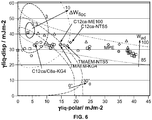
- the measured contact angles of resins and clays provide an estimation of both dispersive and polar contributions, the sum of which approximate the surface energy, using the Owens and Wendt equation (OW). Both estimated values are used to draw a wetting envelope diagram as shown in Figure 1 .
- the diagram shows enveloped areas representing wetting of clay by a polymer. In particular, in the highlighted enclosed area it is possible to determine whether a chosen clay can wet a chosen polymer, as this is the area where contact angle ⁇ is 0 deg and provides complete wetting.
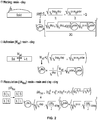
- Adhesion (W ad ) between filler and resin, and flocculation ( ⁇ W floc ) between clay and clay, and, resin and resin are studied by using the equations as shown in Figure 2 . These are determined by both dispersive and polar factors of the surface energy.
- W ad represents strength of adhesion between clay and resin. A resin adheres to clay stronger, as the value of W ad increases.
- ⁇ W floc represents dispersion of clay in a resin. Clay is less well dispersed, as the value of ⁇ W floc increases.
- the gas barrier coating composition according to the present invention has an adhesion (W ad ) greater than 60 mJ/m 2 , and preferably has adhesion (W ad ) greater than 90 mJ/m 2 .
- gas barrier coating composition exhibits a flocculation (W floc ) which is not greater than 5 mJ/m 2 , preferably not greater than 3 mJ/m 2 .
- gas barrier coating composition has a contact angle ( ⁇ ) of less than 20 and preferably less than 10, and is advantageously 0.
- the coating composition is applied to a substrate suitable for use as a packaging material, and is advantageously applied to a food, electronic or pharmaceutical packaging material.
- the coated substrate may then be used to form a coated article, such as packaging article.
- the coating composition can be applied directly to the article to form the coated article, such as a packaging article.
- Suitable substrates used to form the packaging materials may include polyesters, polyolefins, polyamides, styrenics and vinyls and the packaging materials may be formed from homopolymers or copolymers.
- packaging materials are in the form of films.
- the films may be corona treated or chemically treated i.e., with a coating such as an acrylic primer.
- the films may be vacuum metallized with a metal layer, such as aluminum or an oxide such as AlO x , SiO x or combinations thereof.
- substrates may be in the form of monolayers or multilayers.
- Multilayer structures may comprise different polymeric materials and also "tie-layers" to ensure adhesion between coextruded layers.
- the multilayer film may also be a laminate that has been extrusion laminated or laminated using a waterborne, solventborne, solvent-less or energy curable adhesive.
- Polyester substrates may include materials such as PET, PEN or PLA.
- Polyolefin substrates may include materials such as polyethylene or polypropylene and copolymers, a particular example being ethylene-methacrylic acid copolymer for packaging application is Surlyn ionomer resin.
- the packaging materials may include polyamide films such as nylons comprising aliphatic and/or aromatic monomers, whilst Styrenics include polystyrene films and Vinyls include PVC, PVB and any homo- or copolymer comprising a vinyl monomer.
- the films may be oriented for dimensional stability, such as oriented polyamide or biaxially oriented polypropylene, be stretchable or have shrink properties (e.g., PET-g) or be thermoformable (such as amorphous PET).
- composition may be applied to cellulosic substrates such as paper, preferably coated paper.
- compositions are usually applied to the surface of the substrate, which may be optionally overcoated with inks and/or an overprint varnish, or reverse printed and used in a laminated structure.
- a flexible film with the barrier coating thereron may also be overcoated via coextrusion with a layer of polymer.
- the co-extruded structure may then be thermoformed into a rigid or semi-rigid article.
- Coated flexible packaging films may be used to form articles such as pouches, bags, sachets, trays, and lids. Additionally, the composition may be applied on a shrink film or on a pressure sensitive label and provide barrier to the container it is applied onto.
- coated substrate may be in the form of monoweb or part of a multilayer laminate structure.
- compostions may also be applied directly onto rigid containers via a printing process or using a spray application.
- the composition may be applied to the article or substrate using conventional deposition techniques including known printing and coating processes.
- printing processes include flexography, gravure, lithography, inkjet, thermal or laser transfer printing.
- Typical coating processes include flexography, gravure, roll, curtain, rod, blade, spray, and casting.
- composition is dried using a thermal process such as forced air or infrared drying.
- Suitable clay dispersions and resin solutions in similar or identical solvents are coated onto a polyethylene terephthalate (PET) film without corona treatment. After removing solvents by drying, these films are stored in oven at 40°C overnight, to remove any remaining solvents. Wettability studies involve the measurement of contact angles as the primary data, which indicates the degree of wetting when a solid and liquid interact. Small contact angles ( ⁇ 90°) correspond to high wettability, while large contact angles (> 90°) correspond to low wettability. Contact angles of the specimens were measured using the dynamic drop method with the Contact Angle Analyser OCA-20 (available from DataPhysics Instruments GmbH Germany).
- the main objective was to present a convenient approach to explain wetting phenomenon using contact angle theory with review of Young's and Young-Dupre equations. Although many other test-solvents were used for this measurement, the two main liquids (typically water “H 2 O” and diiodomethane "CH 2 I 2 ”) were applied to determine contact angle. Contact angle was determined by fitting the shape of the drop in the captured video image for 50sec to the Young equation. The software, SCA20 Ver 3.60.1 build 191, does this automatically.
- ORR Oxygen Transmission Rate
- the oxygen transmission rates (OTR) of the coatings when applied to a polyester film were determined on a Mocon Oxtran 2/21 gas permeability tester at 23°C and 65/0% relative humidity. This condition represents the normal test protocol for dry food packaging. Wherein the permeanent gas (O 2 ) is adjusted to 65% RH (23°C) and the carrier gas (100% N 2 ) to 0% RH (23°C). In addition, Mocon Oxtran 2/21 gas permeability tester at 23°C and 50/50% relative humidity conditions were also evaluated.
- the substrate used was freshly corona discharge treated 12 micron Mylar 800 or Melinex S (ex DuPont).
- the coatings were applied with a No. 0-4 K-Bar (ex. RK Print), delivering about 4-40 microns wet film thickness, and were dried in a warm flow of air (lab prints were dried with a hair dryer).
- the Mocon PERMATRAN-W Model 3/33 was used to measure the water vapor transmission rate of barrier materials.
- the sample materials were placed in test cells, which are divided into two chambers separated by the sample material.
- the inner chamber is filled with nitrogen carrier gas and the outer chamber with water vapor saturated nitrogen (test gas) to a pre-determined % relative humidity.
- Mylar 800 Melinex S (ex DuPont) PET films were corona treated and coatings were applied using K-Bars (ex. RK Print) for the measurements.
- Coated films were tested for adhesion using the red tape (Cellulose spucing, 3 inch core). The results were marked 0 to 10, with 0 being no adhesion, and 10 very good adhesion.
- Clay type Modifiers Cationic surfactants bonding type
- Vermiculite CH3N(CH2CH2OH)2 CH3-(CH2)n-O-PH2O3 (n 3,5)
- NH3-CH2-Ph CH3-(CH2)10-S-(CH2)2-PH2O3 3,5) N-tri(Me)(C18) (CH3)3-C-PH2O3 N-di(Me)di(C18) Ph-O-PH2O3 N-(Me)di(C2H
- Polypropylene carbonate resin QPAC-40 demonstrates OTR (50%/50% relative humidity at 23°C) of around 90 (cc/m 2 -d) and MVTR (90%/90% relative humidity at 38°C) of 27 (g/m 2 -d) when it is evaluated at 2.8 gsm (gram square meter) on 12 micro meter PET.
- OTR 50%/50% relative humidity at 23°C
- MVTR 90%/90% relative humidity at 38°C) of 27
- W ad is approximately 90, preferably no less than 60
- W floc is low, preferably ⁇ 5, more preferably ⁇ 3.
- Table 3 Gas barrier properties of polypropylene carbonate resin QPAC-25 with various clays.
- Resins Clay Conditions and Results name dispersive factor (mJ/m 2 ) polar factor (mJ/m 2 ) name Zone Binder / Clay GSM dry OTR cc/m 2 -d (23°C, 50%/50%RH) MVTR cc/m 2 -d (38°C, 90%/90%RH) Tape test non - - 2.0 102.2 32.8 9 C12ca/C8a -KG4 2nd criteria 1.0 / 1.0 2.0 9.9 18 10 C12caME100 3rd criteria 1.0 / 1.0 2.0 16.3 26 10 QPAC-25 42 4 C12caNTS5 3rd criteria 1.0 / 1.0 2.0 57.5 31.2 10 TMAM-KG4 3rd criteria 1.0 / 1.0 2.0 44.7 31.2 8 TMAM-NTS5 3rd criteria 1.0 / 1.0 2.0 34.3 36 10 MPE out of the zone 1.0 / 1.0 2.0 10
- Table 4 Gas barrier properties of Bremar 7080 resin QPAC-25 with various clays. Resins Clay Conditions and Results name dispersive factor (mJ/m 2 ) polar factor (mJ/m 2 ) name Zone Binder / Clay GSM dry OTR cc/m 2 -d 50%/50%RH MVTR cc/m 2 -d (38°C, 90%/90%RH) Tape test Bremar7080 43 8 non - 1.0 / 1.0 0.8 86.7 N / A 9 C12ca-KG10 2nd criteria 1.0 / 1.0 0.8 34.9 N / A 9
- Table 5 Gas barrier properties of SK-611-177 resin QPAC-25 with various clays.
- Resins Clay Conditions and Results name dispersive factor (mJ/m 2 ) polar factor (mJ/m 2 ) name Zone Binder / Clay GSM dry OTR cc/m 2 d (23°C, 50%/50%RH) MVTR cc/m 2 -d (38°C, 90%/90%RH Tape test sk-611-177 31 6 non - - 1.2 86.8 N/A 9 C11ca-KG4 2nd criteria 1.0 / 0.4 43 N / A 9
- Table 6 Gas barrier properties of SK-611-176 resin QPAC-25 with various clays.
- Resins Clay Conditions and Results name dispersive factor (mJ/m 2 ) polar factor (mJ/m 2 ) name Zone Binder / Clay GSM dry OTR cc/m 2 -d (23°C, 50%/50%RH) MVTR cc/m 2 -d (38°C, 90%90%RH) Tape test sk-611-176 33 7 non - - 1.2 83.1 N / A 9 C11ca-KG4 2nd criteria 1.0 / 0.4 50.8 N / A 9
Landscapes
- Chemical & Material Sciences (AREA)
- Organic Chemistry (AREA)
- Engineering & Computer Science (AREA)
- Life Sciences & Earth Sciences (AREA)
- Materials Engineering (AREA)
- Wood Science & Technology (AREA)
- Chemical Kinetics & Catalysis (AREA)
- Health & Medical Sciences (AREA)
- Medicinal Chemistry (AREA)
- Polymers & Plastics (AREA)
- Dispersion Chemistry (AREA)
- Nanotechnology (AREA)
- Laminated Bodies (AREA)
- Paints Or Removers (AREA)
- Wrappers (AREA)
- Coating Of Shaped Articles Made Of Macromolecular Substances (AREA)
Claims (15)
- Barrierebeschichtungszusammensetzung, umfassend ein Nanokomposit, wobei das Nanokomposit umfasst:a) ein Polymer, das eine Oberflächenspannung von zwischen 20 und 60 mJ/m2 aufweist, mit einer dispersiven Komponente von zwischen 10 und 50 mJ/m2 und einer polaren Komponente von zwischen 2 und 40 mJ/m2, undb) einen nanopartikulären Ton, welcher mit einem oberflächenaktiven Mittel modifiziert ist, der ein Seitenverhältnis zwischen 20 und 30.000 und eine Oberflächenspannung zwischen 20 und 60 mJ/m2 aufweist, mit einer dispersiven Komponente zwischen 10 und 50 mJ/m2 und einer polaren Komponente zwischen 2 und 40 mJ/m2, undwobei die Adhäsion (Wad) zwischen dem Polymer und dem Ton größer als 60 mJ/m2 ist, die Ausflockung (Wfloc), welche die Dispersion des Tons in dem Polymer repräsentiert, nicht größer als 10 mJ/m2 ist und der Kontaktwinkel (θ) zwischen dem Polymer und dem Ton kleiner als 30 ist, wobei die Oberflächenspannung, die dispersive Komponente, die polare Komponente, die Adhäsion (Wad), die Ausflockung (Wfloc) und der Kontaktwinkel wie in der Beschreibung angegeben bestimmt sind.
- Barrierebeschichtungszusammensetzung nach Anspruch 1, wobei das Polymer und/oder der modifizierte Ton eine Oberflächenspannung zwischen 30 und 55 mJ/m2 mit einer dispersiven Komponente zwischen 25 und 45 mJ/m2 und einer polaren Komponente zwischen 3 und 20 mJ/m2 aufweist.
- Barrierebeschichtungszusammensetzung nach einem der vorhergehenden Ansprüche, wobei der Ton ein Streckungsverhältnis zwischen 100 und 30.000 aufweist.
- Barrierebeschichtungszusammensetzung nach einem der vorhergehenden Ansprüche, die eine oder mehrere der folgenden Eigenschaften aufweist:(i) die Adhäsion (Wad) zwischen dem Polymer und dem Ton ist größer als 90 mJ/m2;(ii) die Ausflockung (Wfloc) ist nicht größer als 5 mJ/m2, vorzugsweise ist die Ausflockung (Wfloc) nicht größer als 3 mJ/m2; und(iii) der Kontaktwinkel (θ) zwischen dem Polymer und dem Ton ist kleiner als 20, vorzugsweise ist der Kontaktwinkel (θ) zwischen dem Polymer und dem Ton kleiner als 10.
- Barrierebeschichtungszusammensetzung nach einem der vorhergehenden Ansprüche, wobei das Polymer in einem organischen Lösungsmittel löslich ist.
- Barrierebeschichtungszusammensetzung nach einem der vorhergehenden Ansprüche, wobei das Polymer ausgewählt ist aus Polyurethanen, Polyesterurethanen, Polyestern, Polyamiden, Cellulosederivaten, Kolophoniumestern, Polypropylencarbonatharzen, Ketonharzen, phenolmodifizierten Kolophoniumestern, maleinisierten Kolophoniumestern, Schellack, Polymilchsäure, Acrylaten, styrolisierten Acrylaten, Vinylchlorid-Copolymeren, Vinylestern und/oder Vinylalkohol-Copolymeren, wobei vorzugsweise das Polymer ein Polypropylencarbonatharz, ein Ketonharz oder ein Polyurethan ist.
- Barrierebeschichtungszusammensetzung nach einem der vorhergehenden Ansprüche, wobei der nanopartikuläre Ton ausgewählt ist aus Kaolinit, Hectorit, Montmorillonit, Vermiculit, Atapulgit, Illit, Bentonit, Halloysit, Kaolin, Glimmer, Diatomeenerde und Bleicherde, calciniertes Aluminiumsilikat, hydratisiertes Aluminiumsilikat, Magnesiumaluminiumsilikat, Natriumsilikat und/oder Magnesiumsilikat, wobei vorzugsweise der nanopartikuläre Ton ausgewählt ist aus Montmorillonit, Glimmer und/oder Vermiculit.
- Barrierebeschichtungszusammensetzung nach einem der vorhergehenden Ansprüche, wobei das oberflächenaktive Mittel ein organisches kationisches Tensid ist, wobei vorzugsweise das organische kationische Tensid ein kationisches Alkylammonium-Tensid ist.
- Barrierebeschichtungszusammensetzung nach einem der Ansprüche 1 bis 7, wobei das oberflächenaktive Mittel ein anionisches, amphoteres oder nichtionisches Tensid ist, wobei vorzugsweise das oberflächenaktive Mittel ausgewählt ist aus einem Organosilan, Organotitanat oder Organozirkonat-Zwischenverbindungen, Phosphonaten und anorganischen Säuren, wobei insbesondere das oberflächenaktive Mittel Phosphorsäure oder ein substituiertes Phosphonat ist.
- Barrierebeschichtungszusammensetzung nach einem der vorhergehenden Ansprüche, wobei die Zusammensetzung eine nicht-wässrige Zusammensetzung ist.
- Beschichtetes Substrat, umfassend eine Barrierebeschichtungszusammensetzung nach einem der vorhergehenden Ansprüche auf der Oberfläche des Substrats, wobei vorzugsweise das Substrat ein Verpackungsmaterial ist, z. B. in Form einer Folie.
- Beschichteter Gegenstand, umfassend ein beschichtetes Substrat nach Anspruch 11.
- Beschichteter Gegenstand, umfassend eine Barrierebeschichtungszusammensetzung nach einem der Ansprüche 1 bis 10 auf der Oberfläche des Gegenstandes.
- Beschichteter Gegenstand nach Anspruch 12 oder Anspruch 13, wobei der Gegenstand ein Verpackungsgegenstand ist, wobei vorzugsweise der Verpackungsgegenstand eine Lebensmittelverpackung oder eine pharmazeutische Verpackung ist.
- Verfahren zur Herstellung eines beschichteten Gegenstandes oder eines beschichteten Substrats, umfassend:a) Aufbringen der Barrierebeschichtungszusammensetzung nach einem der Ansprüche 1 bis 10 auf die Oberfläche des Gegenstandes oder des Substrats, undb) Trocknen der Barrierebeschichtungszusammensetzung.
Applications Claiming Priority (2)
| Application Number | Priority Date | Filing Date | Title |
|---|---|---|---|
| US201562158616P | 2015-05-08 | 2015-05-08 | |
| PCT/US2016/030879 WO2016182829A1 (en) | 2015-05-08 | 2016-05-05 | Gas barrier coating compositions |
Publications (3)
| Publication Number | Publication Date |
|---|---|
| EP3294802A1 EP3294802A1 (de) | 2018-03-21 |
| EP3294802A4 EP3294802A4 (de) | 2018-11-07 |
| EP3294802B1 true EP3294802B1 (de) | 2019-10-02 |
Family
ID=57248402
Family Applications (1)
| Application Number | Title | Priority Date | Filing Date |
|---|---|---|---|
| EP16793213.6A Active EP3294802B1 (de) | 2015-05-08 | 2016-05-05 | Gassperrbeschichtungszusammensetzungen |
Country Status (3)
| Country | Link |
|---|---|
| US (1) | US10577485B2 (de) |
| EP (1) | EP3294802B1 (de) |
| WO (1) | WO2016182829A1 (de) |
Families Citing this family (5)
| Publication number | Priority date | Publication date | Assignee | Title |
|---|---|---|---|---|
| US20180096853A1 (en) * | 2015-04-16 | 2018-04-05 | Japan Advanced Institute Of Science And Technology | Method of producing etching mask, etching mask precursor, and oxide layer, and method of manufacturing thin film transistor |
| KR102493718B1 (ko) | 2017-10-04 | 2023-01-30 | 닛폰세이시가부시키가이샤 | 배리어 소재 |
| CN108395559B (zh) * | 2018-03-22 | 2020-12-22 | 常德市金润新材料科技有限公司 | 一种高性能的高阻隔性食物包装膜及其制备方法 |
| KR102201654B1 (ko) * | 2018-07-27 | 2021-01-12 | 동원시스템즈 주식회사 | 코팅제 조성물 및 그 제조방법 |
| US20240052152A1 (en) * | 2022-08-12 | 2024-02-15 | Johns Manville | Pvc formulations with low water vapor permeability |
Family Cites Families (1)
| Publication number | Priority date | Publication date | Assignee | Title |
|---|---|---|---|---|
| US7919185B2 (en) * | 2006-02-15 | 2011-04-05 | Chaiko David J | Polymer composites, polymer nanocomposites and methods |
-
2016
- 2016-05-05 WO PCT/US2016/030879 patent/WO2016182829A1/en not_active Ceased
- 2016-05-05 EP EP16793213.6A patent/EP3294802B1/de active Active
- 2016-05-05 US US15/572,259 patent/US10577485B2/en active Active
Non-Patent Citations (1)
| Title |
|---|
| None * |
Also Published As
| Publication number | Publication date |
|---|---|
| US10577485B2 (en) | 2020-03-03 |
| EP3294802A1 (de) | 2018-03-21 |
| WO2016182829A1 (en) | 2016-11-17 |
| EP3294802A4 (de) | 2018-11-07 |
| US20180118921A1 (en) | 2018-05-03 |
Similar Documents
| Publication | Publication Date | Title |
|---|---|---|
| CN106893417B (zh) | 阻气涂料 | |
| EP3294802B1 (de) | Gassperrbeschichtungszusammensetzungen | |
| US8268108B2 (en) | Gas barrier coating having improved bond strength | |
| JP6326740B2 (ja) | グラビア印刷用水系コーティング剤およびガスバリア性フィルム | |
| GB2452718A (en) | An oxygen barrier coating composition | |
| JP3931665B2 (ja) | ガスバリアー性積層体 | |
| JP2016013690A (ja) | ガスバリヤコーティングを最適化する方法 | |
| JP2015044943A (ja) | グラビア印刷用水系コーティング剤およびガスバリア性フィルム | |
| EP2613940B1 (de) | Kohlenstoffdioxid-sperrschicht | |
| JP2009061708A (ja) | ガスバリヤ性積層フィルムの製造方法および積層フィルム | |
| JP6524781B2 (ja) | コーティング剤およびガスバリア性フィルム | |
| JP2019188783A (ja) | ガスバリア性フィルム | |
| JP2013159074A (ja) | ガスバリア積層体およびそれを用いた包装体 | |
| JP7363162B2 (ja) | ガスバリア性フィルム |
Legal Events
| Date | Code | Title | Description |
|---|---|---|---|
| STAA | Information on the status of an ep patent application or granted ep patent |
Free format text: STATUS: THE INTERNATIONAL PUBLICATION HAS BEEN MADE |
|
| PUAI | Public reference made under article 153(3) epc to a published international application that has entered the european phase |
Free format text: ORIGINAL CODE: 0009012 |
|
| STAA | Information on the status of an ep patent application or granted ep patent |
Free format text: STATUS: REQUEST FOR EXAMINATION WAS MADE |
|
| 17P | Request for examination filed |
Effective date: 20171107 |
|
| AK | Designated contracting states |
Kind code of ref document: A1 Designated state(s): AL AT BE BG CH CY CZ DE DK EE ES FI FR GB GR HR HU IE IS IT LI LT LU LV MC MK MT NL NO PL PT RO RS SE SI SK SM TR |
|
| AX | Request for extension of the european patent |
Extension state: BA ME |
|
| RIN1 | Information on inventor provided before grant (corrected) |
Inventor name: TAKEDA, HIROYUKI Inventor name: MIYAWAKI, ATSUHISA Inventor name: SCHOTTLAND, PHILIPPE Inventor name: NAKAMUR, KENJI |
|
| DAV | Request for validation of the european patent (deleted) | ||
| DAX | Request for extension of the european patent (deleted) | ||
| A4 | Supplementary search report drawn up and despatched |
Effective date: 20181005 |
|
| RIC1 | Information provided on ipc code assigned before grant |
Ipc: C08K 3/34 20060101AFI20180929BHEP Ipc: C09C 1/42 20060101ALI20180929BHEP Ipc: C08K 9/06 20060101ALI20180929BHEP Ipc: C08K 7/10 20060101ALI20180929BHEP |
|
| RIC1 | Information provided on ipc code assigned before grant |
Ipc: C08K 3/34 20060101AFI20180929BHEP Ipc: C08K 9/06 20060101ALI20180929BHEP Ipc: C09C 1/42 20060101ALI20180929BHEP Ipc: C08K 7/10 20060101ALI20180929BHEP |
|
| GRAP | Despatch of communication of intention to grant a patent |
Free format text: ORIGINAL CODE: EPIDOSNIGR1 |
|
| STAA | Information on the status of an ep patent application or granted ep patent |
Free format text: STATUS: GRANT OF PATENT IS INTENDED |
|
| RIC1 | Information provided on ipc code assigned before grant |
Ipc: C08K 9/06 20060101ALI20190502BHEP Ipc: C08K 7/10 20060101ALI20190502BHEP Ipc: C09C 1/42 20060101ALI20190502BHEP Ipc: C08K 3/34 20060101AFI20190502BHEP |
|
| INTG | Intention to grant announced |
Effective date: 20190528 |
|
| GRAS | Grant fee paid |
Free format text: ORIGINAL CODE: EPIDOSNIGR3 |
|
| GRAA | (expected) grant |
Free format text: ORIGINAL CODE: 0009210 |
|
| STAA | Information on the status of an ep patent application or granted ep patent |
Free format text: STATUS: THE PATENT HAS BEEN GRANTED |
|
| AK | Designated contracting states |
Kind code of ref document: B1 Designated state(s): AL AT BE BG CH CY CZ DE DK EE ES FI FR GB GR HR HU IE IS IT LI LT LU LV MC MK MT NL NO PL PT RO RS SE SI SK SM TR |
|
| REG | Reference to a national code |
Ref country code: GB Ref legal event code: FG4D |
|
| REG | Reference to a national code |
Ref country code: CH Ref legal event code: EP Ref country code: AT Ref legal event code: REF Ref document number: 1186115 Country of ref document: AT Kind code of ref document: T Effective date: 20191015 |
|
| REG | Reference to a national code |
Ref country code: DE Ref legal event code: R096 Ref document number: 602016021810 Country of ref document: DE |
|
| REG | Reference to a national code |
Ref country code: IE Ref legal event code: FG4D |
|
| REG | Reference to a national code |
Ref country code: NL Ref legal event code: MP Effective date: 20191002 |
|
| REG | Reference to a national code |
Ref country code: LT Ref legal event code: MG4D |
|
| REG | Reference to a national code |
Ref country code: AT Ref legal event code: MK05 Ref document number: 1186115 Country of ref document: AT Kind code of ref document: T Effective date: 20191002 |
|
| PG25 | Lapsed in a contracting state [announced via postgrant information from national office to epo] |
Ref country code: GR Free format text: LAPSE BECAUSE OF FAILURE TO SUBMIT A TRANSLATION OF THE DESCRIPTION OR TO PAY THE FEE WITHIN THE PRESCRIBED TIME-LIMIT Effective date: 20200103 Ref country code: NO Free format text: LAPSE BECAUSE OF FAILURE TO SUBMIT A TRANSLATION OF THE DESCRIPTION OR TO PAY THE FEE WITHIN THE PRESCRIBED TIME-LIMIT Effective date: 20200102 Ref country code: BG Free format text: LAPSE BECAUSE OF FAILURE TO SUBMIT A TRANSLATION OF THE DESCRIPTION OR TO PAY THE FEE WITHIN THE PRESCRIBED TIME-LIMIT Effective date: 20200102 Ref country code: PL Free format text: LAPSE BECAUSE OF FAILURE TO SUBMIT A TRANSLATION OF THE DESCRIPTION OR TO PAY THE FEE WITHIN THE PRESCRIBED TIME-LIMIT Effective date: 20191002 Ref country code: NL Free format text: LAPSE BECAUSE OF FAILURE TO SUBMIT A TRANSLATION OF THE DESCRIPTION OR TO PAY THE FEE WITHIN THE PRESCRIBED TIME-LIMIT Effective date: 20191002 Ref country code: ES Free format text: LAPSE BECAUSE OF FAILURE TO SUBMIT A TRANSLATION OF THE DESCRIPTION OR TO PAY THE FEE WITHIN THE PRESCRIBED TIME-LIMIT Effective date: 20191002 Ref country code: LT Free format text: LAPSE BECAUSE OF FAILURE TO SUBMIT A TRANSLATION OF THE DESCRIPTION OR TO PAY THE FEE WITHIN THE PRESCRIBED TIME-LIMIT Effective date: 20191002 Ref country code: SE Free format text: LAPSE BECAUSE OF FAILURE TO SUBMIT A TRANSLATION OF THE DESCRIPTION OR TO PAY THE FEE WITHIN THE PRESCRIBED TIME-LIMIT Effective date: 20191002 Ref country code: LV Free format text: LAPSE BECAUSE OF FAILURE TO SUBMIT A TRANSLATION OF THE DESCRIPTION OR TO PAY THE FEE WITHIN THE PRESCRIBED TIME-LIMIT Effective date: 20191002 Ref country code: PT Free format text: LAPSE BECAUSE OF FAILURE TO SUBMIT A TRANSLATION OF THE DESCRIPTION OR TO PAY THE FEE WITHIN THE PRESCRIBED TIME-LIMIT Effective date: 20200203 Ref country code: AT Free format text: LAPSE BECAUSE OF FAILURE TO SUBMIT A TRANSLATION OF THE DESCRIPTION OR TO PAY THE FEE WITHIN THE PRESCRIBED TIME-LIMIT Effective date: 20191002 Ref country code: FI Free format text: LAPSE BECAUSE OF FAILURE TO SUBMIT A TRANSLATION OF THE DESCRIPTION OR TO PAY THE FEE WITHIN THE PRESCRIBED TIME-LIMIT Effective date: 20191002 |
|
| PG25 | Lapsed in a contracting state [announced via postgrant information from national office to epo] |
Ref country code: IS Free format text: LAPSE BECAUSE OF FAILURE TO SUBMIT A TRANSLATION OF THE DESCRIPTION OR TO PAY THE FEE WITHIN THE PRESCRIBED TIME-LIMIT Effective date: 20200224 Ref country code: CZ Free format text: LAPSE BECAUSE OF FAILURE TO SUBMIT A TRANSLATION OF THE DESCRIPTION OR TO PAY THE FEE WITHIN THE PRESCRIBED TIME-LIMIT Effective date: 20191002 Ref country code: RS Free format text: LAPSE BECAUSE OF FAILURE TO SUBMIT A TRANSLATION OF THE DESCRIPTION OR TO PAY THE FEE WITHIN THE PRESCRIBED TIME-LIMIT Effective date: 20191002 Ref country code: HR Free format text: LAPSE BECAUSE OF FAILURE TO SUBMIT A TRANSLATION OF THE DESCRIPTION OR TO PAY THE FEE WITHIN THE PRESCRIBED TIME-LIMIT Effective date: 20191002 |
|
| PG25 | Lapsed in a contracting state [announced via postgrant information from national office to epo] |
Ref country code: AL Free format text: LAPSE BECAUSE OF FAILURE TO SUBMIT A TRANSLATION OF THE DESCRIPTION OR TO PAY THE FEE WITHIN THE PRESCRIBED TIME-LIMIT Effective date: 20191002 |
|
| REG | Reference to a national code |
Ref country code: DE Ref legal event code: R097 Ref document number: 602016021810 Country of ref document: DE |
|
| PG2D | Information on lapse in contracting state deleted |
Ref country code: IS |
|
| PG25 | Lapsed in a contracting state [announced via postgrant information from national office to epo] |
Ref country code: DK Free format text: LAPSE BECAUSE OF FAILURE TO SUBMIT A TRANSLATION OF THE DESCRIPTION OR TO PAY THE FEE WITHIN THE PRESCRIBED TIME-LIMIT Effective date: 20191002 Ref country code: EE Free format text: LAPSE BECAUSE OF FAILURE TO SUBMIT A TRANSLATION OF THE DESCRIPTION OR TO PAY THE FEE WITHIN THE PRESCRIBED TIME-LIMIT Effective date: 20191002 Ref country code: RO Free format text: LAPSE BECAUSE OF FAILURE TO SUBMIT A TRANSLATION OF THE DESCRIPTION OR TO PAY THE FEE WITHIN THE PRESCRIBED TIME-LIMIT Effective date: 20191002 Ref country code: IS Free format text: LAPSE BECAUSE OF FAILURE TO SUBMIT A TRANSLATION OF THE DESCRIPTION OR TO PAY THE FEE WITHIN THE PRESCRIBED TIME-LIMIT Effective date: 20200202 |
|
| PLBE | No opposition filed within time limit |
Free format text: ORIGINAL CODE: 0009261 |
|
| STAA | Information on the status of an ep patent application or granted ep patent |
Free format text: STATUS: NO OPPOSITION FILED WITHIN TIME LIMIT |
|
| PG25 | Lapsed in a contracting state [announced via postgrant information from national office to epo] |
Ref country code: IT Free format text: LAPSE BECAUSE OF FAILURE TO SUBMIT A TRANSLATION OF THE DESCRIPTION OR TO PAY THE FEE WITHIN THE PRESCRIBED TIME-LIMIT Effective date: 20191002 Ref country code: SK Free format text: LAPSE BECAUSE OF FAILURE TO SUBMIT A TRANSLATION OF THE DESCRIPTION OR TO PAY THE FEE WITHIN THE PRESCRIBED TIME-LIMIT Effective date: 20191002 Ref country code: SM Free format text: LAPSE BECAUSE OF FAILURE TO SUBMIT A TRANSLATION OF THE DESCRIPTION OR TO PAY THE FEE WITHIN THE PRESCRIBED TIME-LIMIT Effective date: 20191002 |
|
| 26N | No opposition filed |
Effective date: 20200703 |
|
| PG25 | Lapsed in a contracting state [announced via postgrant information from national office to epo] |
Ref country code: SI Free format text: LAPSE BECAUSE OF FAILURE TO SUBMIT A TRANSLATION OF THE DESCRIPTION OR TO PAY THE FEE WITHIN THE PRESCRIBED TIME-LIMIT Effective date: 20191002 |
|
| PG25 | Lapsed in a contracting state [announced via postgrant information from national office to epo] |
Ref country code: CH Free format text: LAPSE BECAUSE OF NON-PAYMENT OF DUE FEES Effective date: 20200531 Ref country code: LI Free format text: LAPSE BECAUSE OF NON-PAYMENT OF DUE FEES Effective date: 20200531 Ref country code: MC Free format text: LAPSE BECAUSE OF FAILURE TO SUBMIT A TRANSLATION OF THE DESCRIPTION OR TO PAY THE FEE WITHIN THE PRESCRIBED TIME-LIMIT Effective date: 20191002 |
|
| REG | Reference to a national code |
Ref country code: BE Ref legal event code: MM Effective date: 20200531 |
|
| PG25 | Lapsed in a contracting state [announced via postgrant information from national office to epo] |
Ref country code: LU Free format text: LAPSE BECAUSE OF NON-PAYMENT OF DUE FEES Effective date: 20200505 |
|
| PG25 | Lapsed in a contracting state [announced via postgrant information from national office to epo] |
Ref country code: IE Free format text: LAPSE BECAUSE OF NON-PAYMENT OF DUE FEES Effective date: 20200505 |
|
| PG25 | Lapsed in a contracting state [announced via postgrant information from national office to epo] |
Ref country code: BE Free format text: LAPSE BECAUSE OF NON-PAYMENT OF DUE FEES Effective date: 20200531 |
|
| PG25 | Lapsed in a contracting state [announced via postgrant information from national office to epo] |
Ref country code: TR Free format text: LAPSE BECAUSE OF FAILURE TO SUBMIT A TRANSLATION OF THE DESCRIPTION OR TO PAY THE FEE WITHIN THE PRESCRIBED TIME-LIMIT Effective date: 20191002 Ref country code: MT Free format text: LAPSE BECAUSE OF FAILURE TO SUBMIT A TRANSLATION OF THE DESCRIPTION OR TO PAY THE FEE WITHIN THE PRESCRIBED TIME-LIMIT Effective date: 20191002 Ref country code: CY Free format text: LAPSE BECAUSE OF FAILURE TO SUBMIT A TRANSLATION OF THE DESCRIPTION OR TO PAY THE FEE WITHIN THE PRESCRIBED TIME-LIMIT Effective date: 20191002 |
|
| PG25 | Lapsed in a contracting state [announced via postgrant information from national office to epo] |
Ref country code: MK Free format text: LAPSE BECAUSE OF FAILURE TO SUBMIT A TRANSLATION OF THE DESCRIPTION OR TO PAY THE FEE WITHIN THE PRESCRIBED TIME-LIMIT Effective date: 20191002 |
|
| P01 | Opt-out of the competence of the unified patent court (upc) registered |
Effective date: 20230521 |
|
| PGFP | Annual fee paid to national office [announced via postgrant information from national office to epo] |
Ref country code: DE Payment date: 20250423 Year of fee payment: 10 |
|
| PGFP | Annual fee paid to national office [announced via postgrant information from national office to epo] |
Ref country code: GB Payment date: 20250423 Year of fee payment: 10 |
|
| PGFP | Annual fee paid to national office [announced via postgrant information from national office to epo] |
Ref country code: FR Payment date: 20250424 Year of fee payment: 10 |