EP3295868B1 - Blutdruckberechnungsverfahren auf basis von pulsreflektierter wellentransitzeit und blutdruckmessgerät - Google Patents
Blutdruckberechnungsverfahren auf basis von pulsreflektierter wellentransitzeit und blutdruckmessgerät Download PDFInfo
- Publication number
- EP3295868B1 EP3295868B1 EP16829612.7A EP16829612A EP3295868B1 EP 3295868 B1 EP3295868 B1 EP 3295868B1 EP 16829612 A EP16829612 A EP 16829612A EP 3295868 B1 EP3295868 B1 EP 3295868B1
- Authority
- EP
- European Patent Office
- Prior art keywords
- pulse
- diastolic
- rwtt
- pressure
- blood pressure
- Prior art date
- Legal status (The legal status is an assumption and is not a legal conclusion. Google has not performed a legal analysis and makes no representation as to the accuracy of the status listed.)
- Active
Links
Images


Classifications
-
- A—HUMAN NECESSITIES
- A61—MEDICAL OR VETERINARY SCIENCE; HYGIENE
- A61B—DIAGNOSIS; SURGERY; IDENTIFICATION
- A61B5/00—Measuring for diagnostic purposes; Identification of persons
- A61B5/02—Detecting, measuring or recording for evaluating the cardiovascular system, e.g. pulse, heart rate, blood pressure or blood flow
- A61B5/021—Measuring pressure in heart or blood vessels
- A61B5/02108—Measuring pressure in heart or blood vessels from analysis of pulse wave characteristics
- A61B5/02125—Measuring pressure in heart or blood vessels from analysis of pulse wave characteristics of pulse wave propagation time
-
- A—HUMAN NECESSITIES
- A61—MEDICAL OR VETERINARY SCIENCE; HYGIENE
- A61B—DIAGNOSIS; SURGERY; IDENTIFICATION
- A61B5/00—Measuring for diagnostic purposes; Identification of persons
- A61B5/02—Detecting, measuring or recording for evaluating the cardiovascular system, e.g. pulse, heart rate, blood pressure or blood flow
- A61B5/021—Measuring pressure in heart or blood vessels
- A61B5/022—Measuring pressure in heart or blood vessels by applying pressure to close blood vessels, e.g. against the skin; Ophthalmodynamometers
-
- A—HUMAN NECESSITIES
- A61—MEDICAL OR VETERINARY SCIENCE; HYGIENE
- A61B—DIAGNOSIS; SURGERY; IDENTIFICATION
- A61B5/00—Measuring for diagnostic purposes; Identification of persons
- A61B5/02—Detecting, measuring or recording for evaluating the cardiovascular system, e.g. pulse, heart rate, blood pressure or blood flow
- A61B5/024—Measuring pulse rate or heart rate
- A61B5/02438—Measuring pulse rate or heart rate with portable devices, e.g. worn by the patient
-
- A—HUMAN NECESSITIES
- A61—MEDICAL OR VETERINARY SCIENCE; HYGIENE
- A61B—DIAGNOSIS; SURGERY; IDENTIFICATION
- A61B5/00—Measuring for diagnostic purposes; Identification of persons
- A61B5/68—Arrangements of detecting, measuring or recording means, e.g. sensors, in relation to patient
- A61B5/6801—Arrangements of detecting, measuring or recording means, e.g. sensors, in relation to patient specially adapted to be attached to or worn on the body surface
- A61B5/6813—Specially adapted to be attached to a specific body part
- A61B5/6825—Hand
- A61B5/6826—Finger
-
- A—HUMAN NECESSITIES
- A61—MEDICAL OR VETERINARY SCIENCE; HYGIENE
- A61B—DIAGNOSIS; SURGERY; IDENTIFICATION
- A61B5/00—Measuring for diagnostic purposes; Identification of persons
- A61B5/72—Signal processing specially adapted for physiological signals or for diagnostic purposes
- A61B5/7225—Details of analogue processing, e.g. isolation amplifier, gain or sensitivity adjustment, filtering, baseline or drift compensation
-
- A—HUMAN NECESSITIES
- A61—MEDICAL OR VETERINARY SCIENCE; HYGIENE
- A61B—DIAGNOSIS; SURGERY; IDENTIFICATION
- A61B5/00—Measuring for diagnostic purposes; Identification of persons
- A61B5/72—Signal processing specially adapted for physiological signals or for diagnostic purposes
- A61B5/7235—Details of waveform analysis
- A61B5/7246—Details of waveform analysis using correlation, e.g. template matching or determination of similarity
-
- A—HUMAN NECESSITIES
- A61—MEDICAL OR VETERINARY SCIENCE; HYGIENE
- A61B—DIAGNOSIS; SURGERY; IDENTIFICATION
- A61B5/00—Measuring for diagnostic purposes; Identification of persons
- A61B5/72—Signal processing specially adapted for physiological signals or for diagnostic purposes
- A61B5/7271—Specific aspects of physiological measurement analysis
- A61B5/7278—Artificial waveform generation or derivation, e.g. synthesizing signals from measured signals
-
- A—HUMAN NECESSITIES
- A61—MEDICAL OR VETERINARY SCIENCE; HYGIENE
- A61B—DIAGNOSIS; SURGERY; IDENTIFICATION
- A61B5/00—Measuring for diagnostic purposes; Identification of persons
- A61B5/74—Details of notification to user or communication with user or patient; User input means
- A61B5/742—Details of notification to user or communication with user or patient; User input means using visual displays
-
- A—HUMAN NECESSITIES
- A61—MEDICAL OR VETERINARY SCIENCE; HYGIENE
- A61B—DIAGNOSIS; SURGERY; IDENTIFICATION
- A61B2560/00—Constructional details of operational features of apparatus; Accessories for medical measuring apparatus
- A61B2560/02—Operational features
- A61B2560/0204—Operational features of power management
- A61B2560/0214—Operational features of power management of power generation or supply
-
- A—HUMAN NECESSITIES
- A61—MEDICAL OR VETERINARY SCIENCE; HYGIENE
- A61B—DIAGNOSIS; SURGERY; IDENTIFICATION
- A61B2560/00—Constructional details of operational features of apparatus; Accessories for medical measuring apparatus
- A61B2560/04—Constructional details of apparatus
- A61B2560/0475—Special features of memory means, e.g. removable memory cards
Definitions
- the present disclosure relates to a blood pressure calculation method based on pulse return wave transmission time and a blood pressure monitor, and belongs to the technical field of medical device.
- cuffs which are worn respectively at the upper arm and the lower limb (ankle) are used to measure the blood pressure of the upper arm and the blood pressure of the lower limb (S101). Further, the pulse wave of the upper arm and the pulse wave of the lower limb are measured synchronously by using these cuffs (S103). Then, the pulse wave propagation velocity (baPWV) at the upper arm and the lower limb is calculated based on the difference of the occurrence time between the two pulse waves (S105, S107).
- the upper arm pulse wave propagation velocity (upper arm PWV) is calculated based on the difference of the occurrence time between the ejection wave and the return wave of the upper arm pulse wave (S109, S111).
- This method requires two sensors, generally, one placed in the vicinity of the heart for receiving the heart sound signal (ECG), and the other placed at the human limbs (wrist, fingers, foot, etc.) or behind the ears and other parts for receiving the pulse wave signal (usually obtained by photoplethysmography, i.e., PPG) propagated thereto. By comparing the two signals, the pulse wave transmission time is measured.
- the two sensors each have a corresponding circuit and are connected to each other by a wire, so that they are not convenient to use and are usually incorporated into some wearable garments (accessories).
- the pulse wave velocity calculated by this method is local and does not conform to the definition in the PTT-BP blood pressure model, so that the estimated systolic pressure value will have a relatively large deviation.
- US 2003 / 0 036 685 A1 discloses a health monitoring and biofeedback system comprising a photoplethysmography (PPG) sensor, a processing device, and a Web site server for determining, displaying and analyzing various cardiovascular parameters.
- the PPG sensor is installed within a manually operated user input device such as a mouse or keyboard, measures a user's blood volume contour and transmits it to a processing device such as a personal computer or a personal digital assistant (PDA).
- PDA personal digital assistant
- the system determines a plurality of cardiovascular indices including mean blood pressure, heart rate, body temperature, respiratory rate, and arterial compliance on the basis of signal characteristics of the systolic wave pulse and the systolic reflected wave pulse present within the digital volume pulse derived from the PPG pulse contour.
- Signal characteristics of the systolic reflected wave pulse can be determined through various pulse analysis techniques including derivative analysis of the digital volume pulse signal, bandpass filtering or respiratory matrix frequency extraction techniques. By subtracting the systolic reflected wave pulse contour from the digital volume pulse contour, characteristics of the systolic wave pulse can also be identified.
- the system also provides for the accurate determination of systolic and diastolic blood pressure by using a non-invasive blood pressure monitor to calibrate the relationships between arterial or digital blood pressure and characteristics of the user's digital volume pulse contour. In this way, a wide variety of cardiovascular and respiratory data can be obtained.
- the system also facilitates the transmittal of such data to the system web site for further analysis, storage, and retrieval purposes.
- US 2014 / 288 445 A1 discloses a device, system and method for monitoring blood pressure information of a user.
- a device is configured with at least one pressure sensor, a fastening element, and a processing component.
- the pressure sensor is detachably attached to a position on the outer surface of a tissue of the user.
- the pressure sensor generates signal that vary according to deformations of the tissue in response to an arterial pressure wave expanding or contracting a blood vessel underlying the tissue.
- the signal is used to compute pulse wave parameters representing detected characteristics of the progressing arterial pressure wave of the user and blood pressure value of the user.
- Implantable accelerometer system for the determination of blood pressure using reflected wave transit time
- M. Theodor et al. published in Sensors And Actuators A, 14 December 2013 discloses a sensor system for continuous monitoring of blood pressure using an acceleration sensor implanted on an artery using minimally invasive techniques.
- the sensor relies on measurement of the reflected wave transit time (RWTT).
- the implantable system is fabricated on a flexible substrate using 2 mm ⁇ 2 mm acceleration sensors and a telemetric unit for transmission of the data.
- the problems underlying the invention are solved with the features of the independent patent claims.
- Embodiments of the invention are subject of the dependent patent claims.
- the technical problem to be solved by the present disclosure is to provide a new blood pressure electronic measurement technique and method based on the return wave transmission time (RWTT) in order to alleviate at least one of the above deficiencies.
- RWTT return wave transmission time
- a method for calculating blood pressure based on pulse return wave transmission time comprising steps of:
- the method further comprises a step S5 of correcting the calculated systolic and diastolic pressures for each individual.
- the method further comprises a step S21 of correcting said growth point SPL2 of the return wave in accordance with profile characteristics of different types of pulse waves.
- the step S5 comprises: comparing the calculated systolic and diastolic pressures with predetermined standard values, and obtaining a systolic pressure correction parameter K sc and a diastolic pressure correction parameter K dc ; and substituting the systolic pressure correction parameter K sc into the systolic pressure SYS formula to form a corrected systolic pressure SYS formula, and substituting the diastolic pressure correction parameter K dc into the first diastolic pressure DIA formula and second diastolic pressure DIA formula, respectively, to form a corrected first diastolic pressure DIA formula and a corrected second diastolic pressure DIA formula.
- a median RTM of the calculated RWTT array for all of the pulse periods collected in 10 seconds is used to calculate medians of systolic and diastolic pressures over 10 seconds.
- medians or averages of the calculated heart rate HR and normalized slope SL for all of the pulse periods collected in 10 seconds are used as said heart rate HR and said normalized slope SL.
- a blood pressure monitor employing the above blood pressure calculation method based on a pulse return wave transmission time, comprising a pulse sensor, wherein the pulse sensor is connected in turn with a linear current-to-voltage conversion circuit, a unity gain buffer, a low-pass amplifier circuit, an analog-to-digital conversion circuit, and a processor, and the processor is further connected with a power supply.
- only one said pulse sensor is provided.
- said processor is further connected with a memory and/or a display and input module and/or a low dropout linear regulator.
- the low-pass amplifier circuit has a cutoff frequency of 20-50 Hz.
- the analog-to-digital conversion circuit has its sampling rate set to 1 kS/s.
- the processor performs low pass digital filtering on digitized data with a cutoff frequency of 10 Hz to further remove the noise.
- 1-pulse wave sensor 2-linear current-to-voltage conversion circuit, 3-unity gain buffer, 4-low-pass amplifier circuit, 5-analog-to-digital conversion circuit, 6-processor, 7-internal memory, 8-external memory, 9-display and input module, 10-power supply, 11-low dropout linear regulator.
- a blood pressure calculation method based on a pulse return wave transmission time according to the present disclosure as shown in Fig. 2 includes the following steps:
- the blood pressure calculation method of the disclosure uses only one sensor to measure the fingertip pulse, and is simple, convenient and quick.
- the correlation models between RWTT and the systolic and diastolic pressures are established, and the systolic and diastolic pressures are calculated according to the two blood pressure models.
- the systolic and diastolic pressures calculated according to the present disclosure have higher accuracy, less error, and board range of application.
- the disclosure perfectly combines the technique with the PPG pulse sensor, obtains the pulse waveform by making fingers contact the pulse sensor, conducts a series of analysis and calculation on the pulse waveform, and finally calculates the blood pressure and obtains the heart rate data simultaneously.
- the present disclosure further includes a step S5: correcting the finally calculated systolic and diastolic pressures for each individual, wherein a user needs to first enter the height and measurement data with standard mercury sphygmomanometer upon using the electronic product of the present disclosure, and the individual height values are used for individual blood pressure automatic correction to obtain accurate measurements.
- step S21 in which said growth point SPL2 of return wave is correspondingly corrected according to the profile characteristics of different types of pulse waves.
- the correction of said growth point SPL2 of return wave involves five types of pulse wave profiles as shown in Fig. 4 , which are divided into four categories, two of which belong to category III.
- category I there is a notch between the return wave and the primary wave.
- category II there is no notch between the return wave and the primary wave, but there is a small but rather flat transitional portion.
- category III there is no notch between the return wave and the primary wave, but a change in slope.
- Category III are further divided into two types, the first one with a primary peak that maintains the original shape, while the second one with a primary peak that presents an increased width and covers the corresponding part of the return wave.
- the return wave portion further gets closer to and merges into the primary wave, and the change in slope between the two is not obvious.
- the growth point SPL2 of return wave does not need to be corrected, that is, the peak position caused by the growth point of return wave.
- the growth point SPL2 of return wave needs an appropriate fine adjustment.
- the growth point SPL2 of return wave needs a larger adjustment.
- the above mentioned adjustments are forward or backward shifting of the growth point SPL2 of return wave, which are prior art means.
- the systolic pressure is calculated by the following step: establishing the systolic pressure SYS formula according to said RWTT array.
- a process of blood propagation from the ventricle through the artery network to the fingertip may be equivalent to a process of a pulse wave propagation in a rigid pipe, and thus the work that is done by pressure is equal to the sum of kinetic and potential energy.
- the fingers are located on the same height with the heart in the measurement, only the kinetic energy needs to be considered.
- the diastolic pressure is defined as the lowest point of arterial blood pressure waveform when it attenuates during diastole.
- the rate of the attenuation of the blood pressure during diastole depends on a number of factors, including accumulation of aorta blood pressure during systole, artery system resistance (in relation to artery system, especially the stiffness of vessel wall of arteriole) and the like.
- Diastolic pressure is also highly correlated with BP, that is, with PTT 2 and RWTT 2 .
- This formula derives a diastolic pressure DIA in the unit of mmHg.
- the value of the parameters in the present disclosure may be converted according to the circumstances of use, and if the calculation formula of the present disclosure is used while just those parameters have been subjected to conventional transformation, the use shall be considered as falling into the protection scope of the present disclosure.
- This formula derives a diastolic pressure DIA in the unit of mmHg.
- the minimum level to which the arterial blood pressure attenuates is related to the allowed attenuation time and is also related to the slope of the attenuation ramp.
- the attenuation time is positively proportional to the period of the blood pressure waveform and is inversely proportional to the instantaneous heart rate.
- the slope of the attenuation ramp is in turn related to the strength (amplitude) of the measured pulse (blood pressure) waveform signal in the waveform, and therefore requires standardization (normalization) processing.
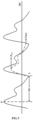
- FIG. 5 The schematic diagram of deriving standardized slope SL is shown in Fig. 5 , where T d is the attenuation time of each waveform period, P nor represents the peak, and V nor represents the trough.
- T d is the attenuation time of each waveform period
- P nor represents the peak
- V nor represents the trough.
- Each waveform is standardized with reference to the reference peak P nor , so that the standardized trough V nor is:
- V nor DC ⁇ DC ⁇ V P nor ⁇ DC P ⁇ DC
- the formula of the second diastolic pressure DIA in this embodiment is more suitable for those who have abnormal attenuation rates during blood pressure diastole, and the measured diastolic pressure is more accurate.
- the step S5 specifically includes comparing the calculated systolic and diastolic pressures with predetermined standard values.
- the calculated medians of the systolic and diastolic pressures may be used for comparison.
- a value obtained by subtracting the calculated value from the standard value is calculated as a diastolic pressure correction parameter K dc
- a value obtained by dividing the standard value by the calculated value is calculated as a systolic pressure correction parameter K sc .
- Substituting said systolic pressure correction parameter K sc into the systolic pressure SYS formula forms a corrected systolic pressure SYS formula
- substituting the diastolic pressure correction parameter K dc into the first diastolic pressure DIA formula and the second diastolic pressure DIA formula forms a corrected first diastolic pressure DIA formula and a corrected second diastolic pressure DIA formula, respectively.
- the user may first carry on a measurement with a standard mercury sphygmomanometer and input the measurement results in advance as standard values. Then, the electronic product of the present disclosure is used to take a measurement within 5 minutes. During the calculation by the product, the systolic pressure SYS formula and the first (or second) diastolic pressure DIA formula are first used to conduct calculations, and the calculated values are compared with the standard values input by the user in advance to obtain and store permanently the values of the correction parameters K sc and K dc .
- the product automatically uses the corrected systolic pressure SYS formula and the corrected first (or second) diastolic pressure DIA formula to conduct calculations.
- the values of the correction parameters K sc and K dc stored in the product are updated accordingly.
- Said RWTT array in all of the above formulas can be replaced by a median RTM of the RWTT array calculated for all pulse periods collected in 10 seconds to calculate the medians of systolic and diastolic pressures over 10 seconds.
- Calculating with RWTT array gives a group of data, which may be construed as real-time blood pressure data. There may be deviations between this group of data, or a certain data may have a calculation error because a certain collected waveform is not good enough.
- median RTM medians of the systolic and diastolic pressures within 10 seconds may be obtained, which ensures correct and stable measurement results.
- Said heart rate HR and standardized slope SL in all of the above formulas may be replaced by a median or average of the heart rates HR and the standardized slopes SL calculated for all pulse periods collected in 10 seconds.
- the specific procedure of use of the method is provided taking a patient of the height 1.7m as an example: before the first use of the electronic product of the present disclosure, the patient first uses a standard mercury sphygmomanometer to measure the patient's blood pressure data as follows: systolic pressure 120 mmHg, diastolic pressure 78mmHg.
- the patient inputs the set of standard values into the electronic product of the present disclosure and carries on measurements with the electronic product of the present disclosure within 5 minutes.
- the values of the correction parameters K sc and K dc are permanently stored, and when the patient uses the electronic product of the present disclosure to perform measurements next time, the product automatically uses the corrected systolic pressure SYS formula and the corrected first (or second) diastolic pressure DIA formula to conduct calculations. Each time the patient performs the above correction process, the values of the correction parameters K sc and K dc stored in the product are updated accordingly.
- the product measures and obtains within 10 seconds the RWTT array with a median value of 0.26s, heart rates with an average of 70, T d with an average of 0.6s, and SL with an average of 1.33 (P nor , DC, K d3 remain unchanged, since it is the same product).
- Substituting these measured data, as well as the stored correction parameters K sc and K dc , into the corrected systolic pressure SYS formula and the corrected first (or second) diastolic pressure DIA formula gives:
- a blood pressure monitor based on pulse return wave transmission time includes a pulse sensor which may use a pulse sensor based on photoplethysmography that is highly sensitive and more suitable for finger contact sensing equipment.
- Said pulse sensor is connected in turn to a linear current-voltage conversion circuit, a unity gain buffer, a low-pass amplifier circuit, an analog-to-digital conversion circuit and a processor.
- the processor is further connected with a power supply, which may use a 3.7 V (or 3.8 V) rechargeable lithium battery or nickel hydrogen battery to power the circuit, or may use a USB (5V) power supply.
- CMOS complementary metal oxide semiconductor
- the above circuitry may also be implemented by using discrete components and integrating these discrete components on a printed circuit board.
- the processor may be implemented by a field programmable gate array (FPGA), or a digital signal processor (Digital Signal Processing, DSP), a microcomputer or the like.
- the processor is also connected with a memory and/or display and input module and/or a low dropout linear regulator.
- a memory and/or display and input module Before the user inputs his or her own height or individual corrected blood pressure value into the input module, the system selects a default height and calculation formula to calculate blood pressure. After the user inputs his or her own height or individual corrected blood pressure value, the user's height and the calculated individual correction parameters will be permanently saved until the next new input occurs to be replaced by a new value.
- Said memory may be internal memory and/or external memory, specifically selected as needed, without specific limitation.
- LDO low dropout regulator
- the cutoff frequency of the low-pass amplifier circuit is 20-50 Hz and should not be set too low so as to avoid deformation of the original pulse waveform.
- low frequency noise may be eliminated by the processor performing further digital filtering.
- the sampling rate of said analog-to-digital conversion circuit is set to 1kS/s, and the analog-to-digital conversion circuit should have a precision of 10 or more bits to maintain the sampling accuracy, that is, about 10,000 samples may be obtained within 10 seconds.
- Said processor performs low-pass digital filtering on the digitized data with a cutoff frequency of 10 Hz to further remove the noise.
- a pulse wave sensor 1 detects a pulse change at the finger and outputs (usually) a corresponding small current signal
- a linear current-voltage conversion circuit 2 converts the small current signal into a small voltage signal.
- a unity gain buffer 3 has a high input impedance which acts as a signal isolation and drives a low pass amplifier circuit 4 at next stage as a buffer.
- the low-pass amplifier circuit 4 amplifies the small voltage signal of the pulse to an appropriate level and performs a first low-pass filtering with a cutoff frequency of about 50 Hz to remove the high-frequency noise to a large extent without causing original pulse waveform to be deformed.
- An analog-to-digital conversion circuit 5 converts the analog voltage signal into a digital signal by sampling and outputs it to a processor 6.
- the analog-to-digital conversion circuit 5 should have a sufficiently high sampling rate to obtain a sufficient amount of original pulse wave waveform information and stops collecting after having collected a predetermined number (e.g., 10,000) of data point.
- the processor 6 stores the data of these original waveforms in an internal memory 7, or in an external memory 8.
- the processor performs the blood pressure calculation method based on the pulse return wave transmission time as described above.
- the processor 6 then performs in-depth processes and analysis on the data of the original waveform, finds the primary wave starting point of the pulse wave and the growth point of return wave in each pulse period according to the algorithm provided by the present disclosure, and calculates a time interval between these two as the RWTT of the period.
- the processor 6 hereby calculates the RWTT for all periods and takes the median RTM, and calculates the heart rate, systolic pressure, and diastolic pressure, respectively, according to the algorithm of the present disclosure.
- embodiments of the present disclosure may be provided as a method, system, or computer program product.
- the present disclosure may take the form of a pure hardware embodiment, a pure software embodiment, or a combination of software and hardware aspects.
- the present disclosure may take the form of a computer program product implemented on one or more computer usable storage media (including but not limited to disk storage, CD-ROM, optical memory, etc.) in which computer usable program code is comprised.
- These computer program instructions may also be stored in a computer readable memory capable of operating a computer or other programmable data processing apparatuses in a particular manner such that instructions stored in the computer readable memory produce a product that includes a command device that implements a function specified in one or more flows of the flowchart or one or more blocks of the block diagram.
- These computer program instructions may also be loaded onto a computer or other programmable data processing apparatuses such that a series of operational steps are performed on the computer or other programmable apparatuses to produce computer-implemented processing, thereby instructions executed on a computer or other programmable apparatuses provide steps for implementing the functions specified in one or more flows of the flowchart or one or more blocks of the block diagram.
Landscapes
- Health & Medical Sciences (AREA)
- Life Sciences & Earth Sciences (AREA)
- Engineering & Computer Science (AREA)
- Molecular Biology (AREA)
- Animal Behavior & Ethology (AREA)
- Veterinary Medicine (AREA)
- Biophysics (AREA)
- Pathology (AREA)
- Public Health (AREA)
- Biomedical Technology (AREA)
- Heart & Thoracic Surgery (AREA)
- Medical Informatics (AREA)
- General Health & Medical Sciences (AREA)
- Surgery (AREA)
- Physics & Mathematics (AREA)
- Physiology (AREA)
- Cardiology (AREA)
- Signal Processing (AREA)
- Artificial Intelligence (AREA)
- Computer Vision & Pattern Recognition (AREA)
- Psychiatry (AREA)
- Vascular Medicine (AREA)
- Power Engineering (AREA)
- Ophthalmology & Optometry (AREA)
- Measuring Pulse, Heart Rate, Blood Pressure Or Blood Flow (AREA)
Claims (16)
- Computer-implementiertes Verfahren zum Berechnen von Blutdruck auf Basis von Pulsrücklaufwellenübertragungszeit, umfassend die Schritte:S1: Erfassen von Pulswellenformdaten an einer Fingerspitze mittels eines Pulssensors (1) und Speichern der Pulswellenformdaten durch einen Prozessor (6);S2: Verarbeiten der Pulswellenformdaten durch den Prozessor (6), um eine Herzfrequenz und Parameter einer Vielzahl von Pulsperioden zu erhalten, Ermitteln von Zeitachsenkoordinaten eines primären Wellenausgangspunkts SPL1 einer Pulswelle und eines Wachstumspunkts SPL2 einer Rücklaufwelle in jeder der Pulsperioden, und Berechnen einer entsprechenden Pulsrücklaufwellenübertragungszeit RWTT : RWTT = SPL2 - SPLl;S3: Berechnen, durch den Prozessor (6), der Pulsrücklaufwellenübertragungszeit RWTT in jeder der Pulsperioden, um einen RWTT-Array auszubilden;dadurch gekennzeichnet, dass das Verfahren ferner den folgenden Schritt umfasst:S4: Berechnen, durch den Prozessor (6), des systolischen und diastolischen Drucks auf Basis des RWTT-Arrays und der Herzfrequenz,wobei der Schritt des Berechnens des systolischen Drucks das Herleiten einer Formel für den systolischen Druck SYS gemäß dem RWTT-Arrayumfasst, wobei Ks 1,2-1,8 ist.

- Verfahren nach Anspruch 1, wobei der Schritt des Berechnens des diastolischen Drucks das Herleiten einer Formel für den ersten diastolischen Blutdruck DIA gemäß dem RWTT-Array
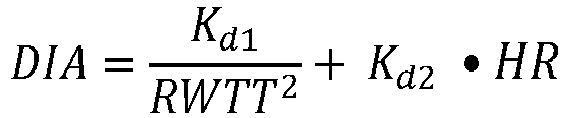
- Verfahren nach Anspruch 1, wobei der Schritt des Berechnens des diastolischen Drucks das Herleiten einer Formel für den zweiten diastolischen Blutdruck DIA gemäß dem RWTT-Array

- Verfahren nach Anspruch 1 oder 2 oder 3, ferner umfassend einen Schritt S21 des Korrigierens des Wachstumspunkts SPL2 der Rücklaufwelle entsprechend Profileigenschaften unterschiedlicher Typen von Pluswellen.
- Verfahren nach Anspruch 1, ferner umfassend einen Schritt S5 des Korrigierens des berechneten systolischen Drucks für jede Einzelperson,
wobei der Schritt S5 umfasst:Vergleichen des berechneten systolischen Drucks mit einem vorbestimmten Standardwert und Erhalten eines Korrekturparameters Ksc für den systolischen Druck; undEinsetzen des Korrekturparameters Ksc für den systolischen Druck in die Formel für den systolischen Druck SYS, um eine Formel für den korrigierten systolischen Druck SYS auszubilden,wobei die Formel für den korrigierten systolischen Druck SYS lautet: wobei Ks 1,2-1,8 ist und Ksc der Korrekturparameter für den systolischen Druck ist.
 - Verfahren nach Anspruch 2, ferner umfassend einen Schritt S5 des Korrigierens des berechneten diastolischen Drucks für jede Einzelperson,
wobei der Schritt S5 umfasst:Vergleichen des berechneten diastolischen Drucks mit einem vorbestimmten Standardwert und Erhalten eines Korrekturparameters Kdc für den diastolischen Druck; undEinsetzen des Korrekturparameters Kdc für den diastolischen Druck in die Formel für den ersten diastolischen Blutdruck DIA, um eine Formel für den korrigierten ersten diastolischen Blutdruck DIA auszubilden,wobei die Formel für den korrigierten ersten diastolischen Blutdruck DIA lautet: wobei Kd1 2,1-3,3 ist, Kd2 0,3-0,8 ist, HR die Herzfrequenz ist und Kdc der Korrekturparameter für den diastolischen Druck ist.
 - Verfahren nach Anspruch 3, ferner umfassend einen Schritt S5 des Korrigierens des berechneten diastolischen Drucks für jede Einzelperson,
wobei der Schritt S5 umfasst:Vergleichen des berechneten diastolischen Drucks mit einem vorbestimmten Standardwert und Erhalten eines Korrekturparameters Kdc für den diastolischen Druck; undEinsetzen des Korrekturparameters Kdc für den diastolischen Druck in die Formel für den zweiten diastolischen Blutdruck DIA, um eine Formel für den korrigierten zweiten diastolischen Blutdruck DIA auszubilden, wobei die Formel für den korrigierten zweiten diastolischen Blutdruck DIA lautet: wobei Kd1 1,6-2,4 ist, Kd2 12-18 ist, Kd3 52 (Pnor-DC) bis 79 (Pnor-DC) ist, SL die normalisierte Neigung ist, Kdc der Korrekturparameter für den diastolischen Druck ist, und Td eine Länge von Diastole in der Pulsperiode ist.
 - Verfahren nach Anspruch 5, wobei der vorbestimmte Standardwert einen systolischen Druck, der mit einem Standard-Quecksilber-Sphygmomanometer gemessen wurde, umfasst, und
der Korrekturparameter Ksc für den systolischen Druck erhalten wird durch Dividieren des mit dem Standard-Quecksilber-Sphygmomanometer gemessenen systolischen Drucks durch den anhand der Formel für den systolischen Druck SYS berechneten systolischen Druck. - Verfahren nach Anspruch 6, wobei der vorbestimmte Standardwert einen diastolischen Druck, der mit einem Standard-Quecksilber-Sphygmomanometer gemessen wurde, umfasst, und
der Korrekturparameter Kdc für den diastolischen Druck erhalten wird durch Subtrahieren des anhand der Formel für den ersten diastolischen Blutdruck DIA berechneten diastolischen Blutdrucks von dem mit dem Standard-Quecksilber-Sphygmomanometer gemessenen diastolischen Druck. - Verfahren nach Anspruch 7, wobei der vorbestimmte Standardwert einen diastolischen Druck, der mit einem Standard-Quecksilber-Sphygmomanometer gemessen wurde, umfasst, und
der Korrekturparameter Kdc für den diastolischen Druck erhalten wird durch Subtrahieren des anhand der Formel für den zweiten diastolischen Blutdruck DIA berechneten diastolischen Drucks von dem mit dem Standard-Quecksilber-Sphygmomanometer gemessenen diastolischen Druck. - Verfahren nach einem der Ansprüche 1 bis 10, wobei anstelle des RWTT-Arrays ein Median RTM des berechneten RWTT-Arrays für alle in 10 Sekunden erfassten Pulsperioden genutzt wird, um Mediane systolischer und diastolischer Drücke über 10 Sekunden zu berechnen, und/oderder Median oder Durchschnitt der berechneten Herzfrequenz HR für alle in 10 Sekunden erfassten Pulsperioden als die Herzfrequenz HR genutzt wird, und/oderder Median oder Durchschnitt der berechneten normalisierten Neigung SL für alle in 10 Sekunden erfassten Pulsperioden als die normalisierte Neigung SL genutzt wird.
- Blutdruckmessgerät zum Berechnen von Blutdruck auf Basis von Pulsrückkehrwellenübertragungszeit, umfassend:einen Pulssensor (1), konfiguriert, Pulswellenformdaten an einer Fingerspitze zu erfassen; undeinen Prozessor (6), konfiguriert, die von dem Pulssensor erfassten Pulswellenformdaten zu empfangen, die Pulswellenformdaten zu verarbeiten, um eine Herzfrequenz und Parameter einer Vielzahl von Pulsperioden zu erhalten, Zeitachskoordinaten eines primären Wellenausgangspunkts SPL1 einer Pulswelle und eines Wachstumspunkts SPL2 einer Rücklaufwelle in jeder der Pulsperioden zu ermitteln, und eine Pulsrücklaufwellenübertragungszeit RWTT : RWTT = SPL2 - SPLl in jeder der Pulsperioden zu berechnen, um einen RWTT-Array auszubilden, und systolische und diastolische Drücke auf Grundlage des RWTT-Arrays und der Herzfrequenz zu berechnen,dadurch gekennzeichnet, dass der Prozessor (6) konfiguriert ist, den systolischen Druck durch Herleiten einer Formel für den systolischen Druck SYS gemäß dem RWTT-Arrayumfasst, wobei Ks 1,2-1,8 ist.

- Blutdruckmessgerät nach Anspruch 12, wobei der Prozessor konfiguriert ist, den diastolischen Druck durch Herleiten einer ersten Formel für den diastolischen Blutdruck DIA gemäß dem RWTT-Array

- Blutdruckmessgerät nach Anspruch 12, wobei der Prozessor konfiguriert ist, den diastolischen Drucks durch Herleiten einer zweiten Formel für den diastolischen Druck DIA gemäß dem RWTT-Array

- Blutdruckmessgerät nach Anspruch 12 oder 13 oder 14, wobei eine Linearstrom-zu-Spannung-Wandlerschaltung (2), ein Spannungsfolger (3), eine Tiefpass-Verstärkerschaltung (4) und eine Analog-zu-Digital-Wandlerschaltung (5) zwischen dem Pulssensor und dem Prozessor verbunden sind, und der Prozessor ferner mit einer Stromversorgung (10) verbunden ist, und/oderdie Tiefpass-Verstärkerschaltung eine Abschaltfrequenz von 20-50 Hz aufweist, und/oderdie Abtastrate der Analog-zu-Digital-Wandlerschaltung auf 1 kS/s gesetzt ist, und/oderder Prozessor Tiefpass-Digitalfilterung an digitalisierten Daten mit einer Abschaltfrequenz von 10 Hz ausführt, um das Rauschen weiter zu entfernen.
- Blutdruckmessgerät nach Anspruch 12 oder 13 oder 14, wobei nur ein Pulssensor bereitgestellt ist und der Prozessor ferner mit einem Speicher (7, 8) und/oder einem Anzeige- und Eingabemodul (9) und/oder einem Low-Dropout-Linearregler (11) verbunden ist.
Applications Claiming Priority (2)
| Application Number | Priority Date | Filing Date | Title |
|---|---|---|---|
| CN201510447025.0A CN105054918B (zh) | 2015-07-28 | 2015-07-28 | 一种基于脉搏反射波传输时间的血压计算方法及血压仪 |
| PCT/CN2016/079694 WO2017016245A1 (zh) | 2015-07-28 | 2016-04-20 | 一种基于脉搏反射波传输时间的血压计算方法及血压仪 |
Publications (3)
| Publication Number | Publication Date |
|---|---|
| EP3295868A1 EP3295868A1 (de) | 2018-03-21 |
| EP3295868A4 EP3295868A4 (de) | 2018-06-27 |
| EP3295868B1 true EP3295868B1 (de) | 2023-05-10 |
Family
ID=54484623
Family Applications (1)
| Application Number | Title | Priority Date | Filing Date |
|---|---|---|---|
| EP16829612.7A Active EP3295868B1 (de) | 2015-07-28 | 2016-04-20 | Blutdruckberechnungsverfahren auf basis von pulsreflektierter wellentransitzeit und blutdruckmessgerät |
Country Status (7)
| Country | Link |
|---|---|
| US (1) | US10537254B2 (de) |
| EP (1) | EP3295868B1 (de) |
| CN (1) | CN105054918B (de) |
| AU (1) | AU2016300616B2 (de) |
| ES (1) | ES2954155T3 (de) |
| HU (1) | HUE063007T2 (de) |
| WO (1) | WO2017016245A1 (de) |
Families Citing this family (16)
| Publication number | Priority date | Publication date | Assignee | Title |
|---|---|---|---|---|
| CN105054918B (zh) * | 2015-07-28 | 2018-05-22 | 杭州暖芯迦电子科技有限公司 | 一种基于脉搏反射波传输时间的血压计算方法及血压仪 |
| CN108882869B (zh) | 2016-04-15 | 2021-03-23 | 欧姆龙株式会社 | 生物体信息分析装置、系统以及程序 |
| CN106361307B (zh) * | 2016-10-09 | 2019-09-20 | 杭州电子科技大学 | 基于光传感的可佩带式生命体征监测设备及血压检测方法 |
| KR102655671B1 (ko) * | 2016-10-12 | 2024-04-05 | 삼성전자주식회사 | 생체정보 추정 장치 및 방법 |
| CN110461224B (zh) * | 2016-12-15 | 2023-04-28 | 薇心健康有限公司 | 可穿戴脉搏波形测量系统和方法 |
| CN107320091A (zh) * | 2017-07-04 | 2017-11-07 | 华为机器有限公司 | 一种校准血压计的方法和装置 |
| CN108186000B (zh) * | 2018-02-07 | 2024-04-02 | 河北工业大学 | 基于心冲击信号与光电信号的实时血压监测系统及方法 |
| CN108719122B (zh) * | 2018-04-27 | 2020-12-11 | 中国农业科学院农业信息研究所 | 牲畜咀嚼分析方法、装置及电子设备 |
| CN113171071B (zh) * | 2021-03-05 | 2022-02-15 | 上海立阖泰医疗科技有限公司 | 一种基于pwtt的血压测量手表 |
| CN114692668B (zh) * | 2021-08-13 | 2025-02-14 | 康泰医学系统(秦皇岛)股份有限公司 | 一种压力值确定系统、方法、装置及可读存储介质 |
| CN114145724A (zh) * | 2021-12-08 | 2022-03-08 | 四川北易信息技术有限公司 | 基于ecg和ppg多生理特征参数动态监测血压的方法 |
| CN115054211B (zh) * | 2022-06-10 | 2024-07-16 | 电子科技大学 | 动态血压与房颤同步监测装置 |
| CN118924265A (zh) * | 2022-08-26 | 2024-11-12 | 北京超思电子技术有限责任公司 | 血压测量设备的校准方法及血压测量设备 |
| CN116570260A (zh) * | 2023-06-19 | 2023-08-11 | 清华大学 | 基于单点桡动脉波的无袖带血压检测装置及可穿戴设备 |
| JP7842924B2 (ja) * | 2024-06-27 | 2026-04-08 | シャープ株式会社 | 血圧推定装置、血圧推定方法及び血圧推定プログラム |
| CN119770170B (zh) * | 2025-03-11 | 2025-05-13 | 天津工业大学 | 主动脉内球囊位置的定位方法、装置、设备以及产品 |
Family Cites Families (16)
| Publication number | Priority date | Publication date | Assignee | Title |
|---|---|---|---|---|
| WO1997016114A1 (en) | 1995-11-01 | 1997-05-09 | Seiko Epson Corporation | Living body condition measuring apparatus |
| JP4096376B2 (ja) * | 1996-07-09 | 2008-06-04 | セイコーエプソン株式会社 | リラックス指導装置 |
| US6616613B1 (en) | 2000-04-27 | 2003-09-09 | Vitalsines International, Inc. | Physiological signal monitoring system |
| JP4855721B2 (ja) | 2005-06-29 | 2012-01-18 | フクダ電子株式会社 | 血圧測定装置 |
| US20070149870A1 (en) * | 2005-12-28 | 2007-06-28 | Futrex, Inc. | Systems and methods for determining an organism's pathology |
| JP5200881B2 (ja) | 2008-11-20 | 2013-06-05 | オムロンヘルスケア株式会社 | 血圧情報測定装置 |
| DE112011104312B4 (de) | 2010-12-08 | 2024-07-18 | Omron Healthcare Co., Ltd. | Blutdruckinformation-Messeinrichtung und Verfahren für das Berechnen des Indexes des Grades der Arteriosklerose mit dieser Einrichtung |
| CN102258365B (zh) * | 2011-08-17 | 2014-04-09 | 天津大学 | 一种正弦波调制光电容积脉搏波测量装置和测量方法 |
| CN102688024A (zh) * | 2012-04-24 | 2012-09-26 | 北京大学 | 一种血压无创测量方法 |
| EP2861142A4 (de) * | 2012-06-18 | 2016-04-06 | Eso Technologies Inc | Zusammensetzungen und verfahren zur messung der sauerstoffsättigung in blutgefüllten strukturen |
| FI20136306A7 (fi) | 2013-03-22 | 2014-09-23 | Murata Manufacturing Co | Parannettu verenpaineen seurantamenetelmä |
| US20140323876A1 (en) * | 2013-04-25 | 2014-10-30 | Covidien Lp | Systems and methods for determining fluid responsiveness in the presence of gain changes and baseline changes |
| CN103393415B (zh) | 2013-08-20 | 2016-08-17 | 王卫东 | 连续血压变化的测量方法 |
| CN203815441U (zh) * | 2014-04-26 | 2014-09-10 | 赵金诚 | 一种新型脉搏测试仪 |
| CN105054918B (zh) | 2015-07-28 | 2018-05-22 | 杭州暖芯迦电子科技有限公司 | 一种基于脉搏反射波传输时间的血压计算方法及血压仪 |
| CN204813858U (zh) * | 2015-07-28 | 2015-12-02 | 杭州暖芯迦电子科技有限公司 | 一种基于脉搏反射波传输时间的血压仪 |
-
2015
- 2015-07-28 CN CN201510447025.0A patent/CN105054918B/zh active Active
-
2016
- 2016-04-20 EP EP16829612.7A patent/EP3295868B1/de active Active
- 2016-04-20 WO PCT/CN2016/079694 patent/WO2017016245A1/zh not_active Ceased
- 2016-04-20 ES ES16829612T patent/ES2954155T3/es active Active
- 2016-04-20 HU HUE16829612A patent/HUE063007T2/hu unknown
- 2016-04-20 US US15/562,253 patent/US10537254B2/en active Active
- 2016-04-20 AU AU2016300616A patent/AU2016300616B2/en active Active
Also Published As
| Publication number | Publication date |
|---|---|
| EP3295868A4 (de) | 2018-06-27 |
| CN105054918B (zh) | 2018-05-22 |
| US10537254B2 (en) | 2020-01-21 |
| AU2016300616B2 (en) | 2019-04-18 |
| WO2017016245A1 (zh) | 2017-02-02 |
| AU2016300616A1 (en) | 2017-10-05 |
| HUE063007T2 (hu) | 2023-12-28 |
| EP3295868A1 (de) | 2018-03-21 |
| US20180078157A1 (en) | 2018-03-22 |
| ES2954155T3 (es) | 2023-11-20 |
| CN105054918A (zh) | 2015-11-18 |
Similar Documents
| Publication | Publication Date | Title |
|---|---|---|
| US10537254B2 (en) | Blood pressure calculation method based on pulse return wave transmission time, and blood pressure monitor | |
| Yoon et al. | Cuff-less blood pressure estimation using pulse waveform analysis and pulse arrival time | |
| US9204857B2 (en) | System and method for monitoring hemodynamic state | |
| Kurylyak et al. | A Neural Network-based method for continuous blood pressure estimation from a PPG signal | |
| JP5132003B2 (ja) | 血圧推定装置及び血圧推定方法 | |
| US20120136261A1 (en) | Systems and methods for calibrating physiological signals with multiple techniques | |
| US20070016086A1 (en) | Blood pressure monitoring apparatus | |
| EP3784121A1 (de) | Verfahren zur abschätzung des blutdrucks und der arteriellen steifigkeit basierend auf fotoplethysmografischen (ppg) signalen | |
| US20120157791A1 (en) | Adaptive time domain filtering for improved blood pressure estimation | |
| EP2501278B1 (de) | Vorrichtung zur erfassung eines blutflusses und hämodynamischer parameter | |
| CN102197998B (zh) | 示波测量法中伪影的频谱的使用 | |
| CN104116503A (zh) | 一种无创连续血压的测量方法及装置 | |
| CN112272534B (zh) | 用于估计血压替代物趋势的方法和装置 | |
| CN204542117U (zh) | 一种多模式连续血压测量装置 | |
| WO2009078967A1 (en) | Monitoring respiratory variation of pulse pressure | |
| Chang et al. | Quantification of resting-state ballistocardiogram difference between clinical and non-clinical populations for ambient monitoring of heart failure | |
| US10327649B1 (en) | Non-invasive wearable blood pressure monitoring system | |
| CN116058812A (zh) | 一种便于患者佩戴的检测装置及系统 | |
| JP4713245B2 (ja) | 血圧監視装置 | |
| CN204813858U (zh) | 一种基于脉搏反射波传输时间的血压仪 | |
| US20170119265A1 (en) | System and Method for using Demographic Data to Derive a Pulse Wave Velocity-Blood Pressure Transform | |
| JP4795731B2 (ja) | 血圧監視装置 | |
| US11452458B2 (en) | Method of deriving systolic blood pressure and/or diastolic blood pressure of a subject | |
| Jobbágy et al. | Blood pressure measurement at home | |
| Lopez et al. | Continuous blood pressure measurement in daily activities |
Legal Events
| Date | Code | Title | Description |
|---|---|---|---|
| STAA | Information on the status of an ep patent application or granted ep patent |
Free format text: STATUS: THE INTERNATIONAL PUBLICATION HAS BEEN MADE |
|
| PUAI | Public reference made under article 153(3) epc to a published international application that has entered the european phase |
Free format text: ORIGINAL CODE: 0009012 |
|
| STAA | Information on the status of an ep patent application or granted ep patent |
Free format text: STATUS: REQUEST FOR EXAMINATION WAS MADE |
|
| 17P | Request for examination filed |
Effective date: 20171213 |
|
| AK | Designated contracting states |
Kind code of ref document: A1 Designated state(s): AL AT BE BG CH CY CZ DE DK EE ES FI FR GB GR HR HU IE IS IT LI LT LU LV MC MK MT NL NO PL PT RO RS SE SI SK SM TR |
|
| AX | Request for extension of the european patent |
Extension state: BA ME |
|
| A4 | Supplementary search report drawn up and despatched |
Effective date: 20180530 |
|
| RIC1 | Information provided on ipc code assigned before grant |
Ipc: A61B 5/024 20060101ALI20180524BHEP Ipc: A61B 5/00 20060101ALI20180524BHEP Ipc: A61B 5/021 20060101AFI20180524BHEP |
|
| DAV | Request for validation of the european patent (deleted) | ||
| DAX | Request for extension of the european patent (deleted) | ||
| STAA | Information on the status of an ep patent application or granted ep patent |
Free format text: STATUS: EXAMINATION IS IN PROGRESS |
|
| 17Q | First examination report despatched |
Effective date: 20211111 |
|
| GRAP | Despatch of communication of intention to grant a patent |
Free format text: ORIGINAL CODE: EPIDOSNIGR1 |
|
| STAA | Information on the status of an ep patent application or granted ep patent |
Free format text: STATUS: GRANT OF PATENT IS INTENDED |
|
| INTG | Intention to grant announced |
Effective date: 20220701 |
|
| GRAJ | Information related to disapproval of communication of intention to grant by the applicant or resumption of examination proceedings by the epo deleted |
Free format text: ORIGINAL CODE: EPIDOSDIGR1 |
|
| STAA | Information on the status of an ep patent application or granted ep patent |
Free format text: STATUS: EXAMINATION IS IN PROGRESS |
|
| INTC | Intention to grant announced (deleted) | ||
| GRAP | Despatch of communication of intention to grant a patent |
Free format text: ORIGINAL CODE: EPIDOSNIGR1 |
|
| STAA | Information on the status of an ep patent application or granted ep patent |
Free format text: STATUS: GRANT OF PATENT IS INTENDED |
|
| GRAJ | Information related to disapproval of communication of intention to grant by the applicant or resumption of examination proceedings by the epo deleted |
Free format text: ORIGINAL CODE: EPIDOSDIGR1 |
|
| STAA | Information on the status of an ep patent application or granted ep patent |
Free format text: STATUS: EXAMINATION IS IN PROGRESS |
|
| INTG | Intention to grant announced |
Effective date: 20221021 |
|
| GRAC | Information related to communication of intention to grant a patent modified |
Free format text: ORIGINAL CODE: EPIDOSCIGR1 |
|
| STAA | Information on the status of an ep patent application or granted ep patent |
Free format text: STATUS: GRANT OF PATENT IS INTENDED |
|
| INTG | Intention to grant announced |
Effective date: 20221107 |
|
| INTC | Intention to grant announced (deleted) | ||
| INTG | Intention to grant announced |
Effective date: 20221205 |
|
| GRAS | Grant fee paid |
Free format text: ORIGINAL CODE: EPIDOSNIGR3 |
|
| GRAA | (expected) grant |
Free format text: ORIGINAL CODE: 0009210 |
|
| STAA | Information on the status of an ep patent application or granted ep patent |
Free format text: STATUS: THE PATENT HAS BEEN GRANTED |
|
| AK | Designated contracting states |
Kind code of ref document: B1 Designated state(s): AL AT BE BG CH CY CZ DE DK EE ES FI FR GB GR HR HU IE IS IT LI LT LU LV MC MK MT NL NO PL PT RO RS SE SI SK SM TR |
|
| REG | Reference to a national code |
Ref country code: GB Ref legal event code: FG4D |
|
| REG | Reference to a national code |
Ref country code: AT Ref legal event code: REF Ref document number: 1565940 Country of ref document: AT Kind code of ref document: T Effective date: 20230515 Ref country code: CH Ref legal event code: EP |
|
| REG | Reference to a national code |
Ref country code: DE Ref legal event code: R096 Ref document number: 602016079384 Country of ref document: DE |
|
| REG | Reference to a national code |
Ref country code: IE Ref legal event code: FG4D |
|
| REG | Reference to a national code |
Ref country code: LT Ref legal event code: MG9D |
|
| REG | Reference to a national code |
Ref country code: SE Ref legal event code: TRGR |
|
| REG | Reference to a national code |
Ref country code: NL Ref legal event code: MP Effective date: 20230510 |
|
| REG | Reference to a national code |
Ref country code: AT Ref legal event code: MK05 Ref document number: 1565940 Country of ref document: AT Kind code of ref document: T Effective date: 20230510 |
|
| PG25 | Lapsed in a contracting state [announced via postgrant information from national office to epo] |
Ref country code: PT Free format text: LAPSE BECAUSE OF FAILURE TO SUBMIT A TRANSLATION OF THE DESCRIPTION OR TO PAY THE FEE WITHIN THE PRESCRIBED TIME-LIMIT Effective date: 20230911 Ref country code: NO Free format text: LAPSE BECAUSE OF FAILURE TO SUBMIT A TRANSLATION OF THE DESCRIPTION OR TO PAY THE FEE WITHIN THE PRESCRIBED TIME-LIMIT Effective date: 20230810 Ref country code: NL Free format text: LAPSE BECAUSE OF FAILURE TO SUBMIT A TRANSLATION OF THE DESCRIPTION OR TO PAY THE FEE WITHIN THE PRESCRIBED TIME-LIMIT Effective date: 20230510 Ref country code: AT Free format text: LAPSE BECAUSE OF FAILURE TO SUBMIT A TRANSLATION OF THE DESCRIPTION OR TO PAY THE FEE WITHIN THE PRESCRIBED TIME-LIMIT Effective date: 20230510 |
|
| REG | Reference to a national code |
Ref country code: ES Ref legal event code: FG2A Ref document number: 2954155 Country of ref document: ES Kind code of ref document: T3 Effective date: 20231120 |
|
| PG25 | Lapsed in a contracting state [announced via postgrant information from national office to epo] |
Ref country code: RS Free format text: LAPSE BECAUSE OF FAILURE TO SUBMIT A TRANSLATION OF THE DESCRIPTION OR TO PAY THE FEE WITHIN THE PRESCRIBED TIME-LIMIT Effective date: 20230510 Ref country code: PL Free format text: LAPSE BECAUSE OF FAILURE TO SUBMIT A TRANSLATION OF THE DESCRIPTION OR TO PAY THE FEE WITHIN THE PRESCRIBED TIME-LIMIT Effective date: 20230510 Ref country code: LV Free format text: LAPSE BECAUSE OF FAILURE TO SUBMIT A TRANSLATION OF THE DESCRIPTION OR TO PAY THE FEE WITHIN THE PRESCRIBED TIME-LIMIT Effective date: 20230510 Ref country code: LT Free format text: LAPSE BECAUSE OF FAILURE TO SUBMIT A TRANSLATION OF THE DESCRIPTION OR TO PAY THE FEE WITHIN THE PRESCRIBED TIME-LIMIT Effective date: 20230510 Ref country code: IS Free format text: LAPSE BECAUSE OF FAILURE TO SUBMIT A TRANSLATION OF THE DESCRIPTION OR TO PAY THE FEE WITHIN THE PRESCRIBED TIME-LIMIT Effective date: 20230910 Ref country code: HR Free format text: LAPSE BECAUSE OF FAILURE TO SUBMIT A TRANSLATION OF THE DESCRIPTION OR TO PAY THE FEE WITHIN THE PRESCRIBED TIME-LIMIT Effective date: 20230510 Ref country code: GR Free format text: LAPSE BECAUSE OF FAILURE TO SUBMIT A TRANSLATION OF THE DESCRIPTION OR TO PAY THE FEE WITHIN THE PRESCRIBED TIME-LIMIT Effective date: 20230811 |
|
| REG | Reference to a national code |
Ref country code: HU Ref legal event code: AG4A Ref document number: E063007 Country of ref document: HU |
|
| PG25 | Lapsed in a contracting state [announced via postgrant information from national office to epo] |
Ref country code: FI Free format text: LAPSE BECAUSE OF FAILURE TO SUBMIT A TRANSLATION OF THE DESCRIPTION OR TO PAY THE FEE WITHIN THE PRESCRIBED TIME-LIMIT Effective date: 20230510 |
|
| PG25 | Lapsed in a contracting state [announced via postgrant information from national office to epo] |
Ref country code: SK Free format text: LAPSE BECAUSE OF FAILURE TO SUBMIT A TRANSLATION OF THE DESCRIPTION OR TO PAY THE FEE WITHIN THE PRESCRIBED TIME-LIMIT Effective date: 20230510 |
|
| PG25 | Lapsed in a contracting state [announced via postgrant information from national office to epo] |
Ref country code: SM Free format text: LAPSE BECAUSE OF FAILURE TO SUBMIT A TRANSLATION OF THE DESCRIPTION OR TO PAY THE FEE WITHIN THE PRESCRIBED TIME-LIMIT Effective date: 20230510 Ref country code: SK Free format text: LAPSE BECAUSE OF FAILURE TO SUBMIT A TRANSLATION OF THE DESCRIPTION OR TO PAY THE FEE WITHIN THE PRESCRIBED TIME-LIMIT Effective date: 20230510 Ref country code: RO Free format text: LAPSE BECAUSE OF FAILURE TO SUBMIT A TRANSLATION OF THE DESCRIPTION OR TO PAY THE FEE WITHIN THE PRESCRIBED TIME-LIMIT Effective date: 20230510 Ref country code: EE Free format text: LAPSE BECAUSE OF FAILURE TO SUBMIT A TRANSLATION OF THE DESCRIPTION OR TO PAY THE FEE WITHIN THE PRESCRIBED TIME-LIMIT Effective date: 20230510 Ref country code: DK Free format text: LAPSE BECAUSE OF FAILURE TO SUBMIT A TRANSLATION OF THE DESCRIPTION OR TO PAY THE FEE WITHIN THE PRESCRIBED TIME-LIMIT Effective date: 20230510 Ref country code: CZ Free format text: LAPSE BECAUSE OF FAILURE TO SUBMIT A TRANSLATION OF THE DESCRIPTION OR TO PAY THE FEE WITHIN THE PRESCRIBED TIME-LIMIT Effective date: 20230510 |
|
| REG | Reference to a national code |
Ref country code: DE Ref legal event code: R097 Ref document number: 602016079384 Country of ref document: DE |
|
| PLBE | No opposition filed within time limit |
Free format text: ORIGINAL CODE: 0009261 |
|
| STAA | Information on the status of an ep patent application or granted ep patent |
Free format text: STATUS: NO OPPOSITION FILED WITHIN TIME LIMIT |
|
| 26N | No opposition filed |
Effective date: 20240213 |
|
| PG25 | Lapsed in a contracting state [announced via postgrant information from national office to epo] |
Ref country code: SI Free format text: LAPSE BECAUSE OF FAILURE TO SUBMIT A TRANSLATION OF THE DESCRIPTION OR TO PAY THE FEE WITHIN THE PRESCRIBED TIME-LIMIT Effective date: 20230510 |
|
| PG25 | Lapsed in a contracting state [announced via postgrant information from national office to epo] |
Ref country code: SI Free format text: LAPSE BECAUSE OF FAILURE TO SUBMIT A TRANSLATION OF THE DESCRIPTION OR TO PAY THE FEE WITHIN THE PRESCRIBED TIME-LIMIT Effective date: 20230510 |
|
| PG25 | Lapsed in a contracting state [announced via postgrant information from national office to epo] |
Ref country code: BG Free format text: LAPSE BECAUSE OF FAILURE TO SUBMIT A TRANSLATION OF THE DESCRIPTION OR TO PAY THE FEE WITHIN THE PRESCRIBED TIME-LIMIT Effective date: 20230510 |
|
| PG25 | Lapsed in a contracting state [announced via postgrant information from national office to epo] |
Ref country code: BG Free format text: LAPSE BECAUSE OF FAILURE TO SUBMIT A TRANSLATION OF THE DESCRIPTION OR TO PAY THE FEE WITHIN THE PRESCRIBED TIME-LIMIT Effective date: 20230510 |
|
| PGFP | Annual fee paid to national office [announced via postgrant information from national office to epo] |
Ref country code: LU Payment date: 20250418 Year of fee payment: 10 |
|
| PGFP | Annual fee paid to national office [announced via postgrant information from national office to epo] |
Ref country code: MC Payment date: 20250425 Year of fee payment: 10 |
|
| PGFP | Annual fee paid to national office [announced via postgrant information from national office to epo] |
Ref country code: DE Payment date: 20250422 Year of fee payment: 10 |
|
| PGFP | Annual fee paid to national office [announced via postgrant information from national office to epo] |
Ref country code: GB Payment date: 20250423 Year of fee payment: 10 Ref country code: ES Payment date: 20250530 Year of fee payment: 10 |
|
| PGFP | Annual fee paid to national office [announced via postgrant information from national office to epo] |
Ref country code: HU Payment date: 20250424 Year of fee payment: 10 |
|
| PGFP | Annual fee paid to national office [announced via postgrant information from national office to epo] |
Ref country code: IT Payment date: 20250424 Year of fee payment: 10 Ref country code: BE Payment date: 20250418 Year of fee payment: 10 |
|
| PGFP | Annual fee paid to national office [announced via postgrant information from national office to epo] |
Ref country code: FR Payment date: 20250425 Year of fee payment: 10 |
|
| PGFP | Annual fee paid to national office [announced via postgrant information from national office to epo] |
Ref country code: CH Payment date: 20250501 Year of fee payment: 10 |
|
| PGFP | Annual fee paid to national office [announced via postgrant information from national office to epo] |
Ref country code: IE Payment date: 20250422 Year of fee payment: 10 |
|
| PGFP | Annual fee paid to national office [announced via postgrant information from national office to epo] |
Ref country code: SE Payment date: 20250429 Year of fee payment: 10 |
|
| PG25 | Lapsed in a contracting state [announced via postgrant information from national office to epo] |
Ref country code: CY Free format text: LAPSE BECAUSE OF FAILURE TO SUBMIT A TRANSLATION OF THE DESCRIPTION OR TO PAY THE FEE WITHIN THE PRESCRIBED TIME-LIMIT; INVALID AB INITIO Effective date: 20160420 |