EP3296068B1 - Roboterverhaltenserzeugungsverfahren - Google Patents
Roboterverhaltenserzeugungsverfahren Download PDFInfo
- Publication number
- EP3296068B1 EP3296068B1 EP16792684.9A EP16792684A EP3296068B1 EP 3296068 B1 EP3296068 B1 EP 3296068B1 EP 16792684 A EP16792684 A EP 16792684A EP 3296068 B1 EP3296068 B1 EP 3296068B1
- Authority
- EP
- European Patent Office
- Prior art keywords
- robot
- motion data
- human body
- human
- motion
- Prior art date
- Legal status (The legal status is an assumption and is not a legal conclusion. Google has not performed a legal analysis and makes no representation as to the accuracy of the status listed.)
- Active
Links
Images

Classifications
-
- B—PERFORMING OPERATIONS; TRANSPORTING
- B25—HAND TOOLS; PORTABLE POWER-DRIVEN TOOLS; MANIPULATORS
- B25J—MANIPULATORS; CHAMBERS PROVIDED WITH MANIPULATION DEVICES
- B25J9/00—Program-controlled manipulators
- B25J9/16—Program controls
- B25J9/1656—Program controls characterised by programming, planning systems for manipulators
- B25J9/1664—Program controls characterised by programming, planning systems for manipulators characterised by motion, path, trajectory planning
-
- B—PERFORMING OPERATIONS; TRANSPORTING
- B25—HAND TOOLS; PORTABLE POWER-DRIVEN TOOLS; MANIPULATORS
- B25J—MANIPULATORS; CHAMBERS PROVIDED WITH MANIPULATION DEVICES
- B25J9/00—Program-controlled manipulators
- B25J9/16—Program controls
- B25J9/1602—Program controls characterised by the control system, structure, architecture
- B25J9/1605—Simulation of manipulator lay-out, design, modelling of manipulator
-
- B—PERFORMING OPERATIONS; TRANSPORTING
- B25—HAND TOOLS; PORTABLE POWER-DRIVEN TOOLS; MANIPULATORS
- B25J—MANIPULATORS; CHAMBERS PROVIDED WITH MANIPULATION DEVICES
- B25J9/00—Program-controlled manipulators
- B25J9/16—Program controls
- B25J9/1656—Program controls characterised by programming, planning systems for manipulators
- B25J9/1671—Program controls characterised by programming, planning systems for manipulators characterised by simulation, either to verify existing program or to create and verify new program, CAD/CAM oriented, graphic oriented programming systems
-
- B—PERFORMING OPERATIONS; TRANSPORTING
- B25—HAND TOOLS; PORTABLE POWER-DRIVEN TOOLS; MANIPULATORS
- B25J—MANIPULATORS; CHAMBERS PROVIDED WITH MANIPULATION DEVICES
- B25J9/00—Program-controlled manipulators
- B25J9/16—Program controls
- B25J9/1694—Program controls characterised by use of sensors other than normal servo-feedback from position, speed or acceleration sensors, perception control, multi-sensor controlled systems, sensor fusion
- B25J9/1697—Vision controlled systems
-
- G—PHYSICS
- G05—CONTROLLING; REGULATING
- G05B—CONTROL OR REGULATING SYSTEMS IN GENERAL; FUNCTIONAL ELEMENTS OF SUCH SYSTEMS; MONITORING OR TESTING ARRANGEMENTS FOR SUCH SYSTEMS OR ELEMENTS
- G05B2219/00—Program-control systems
- G05B2219/30—Nc systems
- G05B2219/39—Robotics, robotics to robotics hand
- G05B2219/39254—Behaviour controller, robot have feelings, learns behaviour
Definitions
- the present invention relates to a method of generating behavior of a robot.
- NPL 1 and NPL 2 disclose techniques using errors from motion capture marker data and shape feature amounts as indices for reproducing behavior of a human on a humanoid robot.
- this reproduction needs to take into account constraint conditions on the ranges of motion of the joints of the humanoid robot, the balance of its center of gravity, and the like. It is also typical to employ a method involving converting motion indices of a human body model into behavior of a robot, and then applying a correction reflecting the constraint conditions.
- NPL 3 describes a method of identifying geometric parameters for expressing the skeleton of a human body model
- NPL 4 describes an inverse kinetics calculation method for robots and human body models with a large degree of freedom.
- the present invention has been made to solve this problem, and an object thereof is to provide a robot behavior generation method having enhanced accuracy in reproducing behavior of a human.
- the present invention provides a robot behavior generation method of reproducing behavior of a human body with a robot, comprising: a first step of generating a human body model by modeling a structure of the human body; a second step of generating a robot model by modeling a structure of the robot; a third step of associating the human body model generated in the first step and the robot model generated in the second step with each other; a fourth step of acquiring normative motion data indicating movement of the human body model corresponding to behavior of the human body; a fifth step of setting an evaluation standard for a reproduction error with respect to the normative motion data generated in the fourth step, by sorting out motion feature indices included in first unknown motion data indicating movement of the human body model generated in the first step; a sixth step of selecting a constraint condition necessary for the robot to move, the constraint condition being included in second unknown motion data indicating movement of the robot model generated in the second step; a seventh step of calculating the first unknown motion data and the second unknown motion data
- a robot behavior generation method having enhanced accuracy in reproducing behavior of a human can be provided.
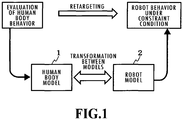
- Fig. 1 is a diagram for describing an overview of a robot behavior generation method according an embodiment of the present invention. The overview of the robot behavior generation method according to the embodiment of the present invention will be described below with reference to Fig. 1 .
- Humanoid robots which have physical similarity to the human (hereinafter referred to as "humanoids"), have been expected to be human physical simulators for implementing body control systems and somatic sensation close to the human's. For this reason, in the case of using a humanoid as a human physical simulator in a motion analysis, human behavior is desired to be reproduced on the humanoid as originally as possible without being processed.
- retargeting is important, which, as illustrated in Fig. 1 , allows human body behavior to be adjusted for a humanoid and reproduced as robot behavior while performing the above-mentioned compensation.
- human motion data is acquired which is optimized under a mapping condition between physical parameters of a human body model 1 and a robot model 2 representing their physical structures and a geometrical and mechanical constraint condition such as robot motion restrictions on performing motion control and tasks. Then, robot motions are generated using parameters calculated in this optimization.
- mapping condition refers, for example, to nonlinear functions for later-described parameters involved in motions, and a condition that the human and the robot shares the same value for some of the parameters.
- the above-mentioned robot motion restrictions mean, for example, restrictions on the robot regarding the allowed ranges of joint angles, the upper and lower limits of joint angular speeds, the upper and lower limits of joint angular accelerations, the upper and lower limits of joint torques, on-ground conditions concerning the positions and postures of the support feet, the allowed range for the center of gravity, the range of presence of the center of pressure on the bottom of each foot, and so on.
- the above-mentioned parameters involved in motions include, for example, for both the human and the robot, the joint angles, joint angular speeds, and joint angular accelerations, angles that determine the positional coordinates and postures of later-described links that serve as bases, speeds and accelerations for the above-mentioned positional coordinates and the above-mentioned angles, geometric parameters, and mechanical parameters.
- the above-mentioned geometric parameters include, for example, the relative positions of adjacent joint origins and the relative postures of adjacent joint axes or a virtual robot's joint angles.
- the above-mentioned mechanical parameters include, for example, the mass, center of gravity, and inertial tensor of each of the above-mentioned links.
- this robot behavior generation method it is possible to check how biomechanical human motion feature indices with respect to the measured human motion data acquired are saved or modified with the above-described optimization. This makes it easy to sort out the above-mentioned motion feature indices to be reflected on the above-mentioned reproduction.
- the above-mentioned motion feature indices are, for example, least square errors in a case of recovering the motion indicated by the above-mentioned measured motion data by using the above-mentioned parameters involved in motions.
- the least square errors may be replaced with errors in moment feature amounts that can be figured out from the measured motion data or in geometric-mechanical feature amounts such as Laplacian deformation energy.
- loads such as joint input torque and external force in the field of biomechanics may be minimized using the above-mentioned motion feature indices.
- the robot behavior generation method is particularly useful in a case where a humanoid is used actively for product evaluation, that is, a case where a humanoid is used as a dummy doll for simulating human motion functions, such as a case where the humanoid wears a product developed for humans and reproduces human behavior.
- Fig. 2 is a flowchart illustrating the robot behavior generation method illustrated in Fig. 1 .
- the robot behavior generation method according to the embodiment of the present invention will be specifically described below with reference to Fig. 2 .
- a human body model 1 is generated by modeling the structure of a human body.
- the human body is modeled as a multi-link system obtained by connecting a plurality of constituent elements, for example, and a generalized coordinate of the human link system is defined as q h .
- a robot model 2 is generated by modeling the structure of a robot.
- the robot is modeled as a multi-link system similar to the above-mentioned human body, for example, and a generalized coordinate of the robot link system is defined as q r .
- step S3 the human body model 1, generated in step S1, and the robot model 2, generated in step S2, are associated with each other.
- the above-mentioned generalized coordinates of the human and the robot are associated with each other by, for example, the following relational equation g for morphing.
- g q r q h ⁇ 0
- ⁇ described in equation (1) is an unknown geometric parameter representing the human's skeleton, and the robot's geometric parameter is known.
- step S4 normative motion data P h indicating movement of the human body model corresponding to behavior of the human body is acquired.
- the normative motion data P h includes, for example, motion capture marker data, ground reaction force data, and data of a myoelectric potential measurement device.
- step S5 an evaluation function is designed for which the above-mentioned biomechanical human motion feature indices are sorted out and which is capable of evaluating similarity to first unknown motion data expressed by the generalized coordinate q h and the geometric parameter ⁇ of the human model generated in step S1, in order to perform behavior recovery with respect to the normative data P h , acquired in step S4.
- step S6 a constraint condition necessary for the robot to actually implement behavior is determined for second unknown motion data expressed by the generalized coordinate q r of the robot model generated in step S2.
- step S7 the first unknown motion data and the second unknown motion data are calculated which have the smallest reproduction errors with respect to the normative motion data P h , acquired in step S4, under the morphing relational equation designed in step S3 and the constraint condition determined in step S6, by using the evaluation functions of step S5.
- a vector Q h and a vector Q r obtained by plotting time-series data q h,t and time-series data q r,t (1 ⁇ t ⁇ N T ) on the generalized coordinates of the human and the robot at discrete times t 1 , t 2 , ... , t NT are defined by the following equation (2).
- the first unknown motion data on the human body model corresponds to the geometric parameter ⁇ and the vector Q h
- the second unknown motion data on the robot model corresponds to the vector Q r .
- h in inequality (3) means a kinetic function for, for example, the range of joint motion and joint speed, the center of gravity, the zero-moment point (ZMP), or the like.
- behavior recovery problems with respect to the measured human motion dataset P h in a motion analysis are generalized as follows. [Math. 4] min Q h , ⁇ f P h Q h ⁇ Note that f in expression (4) is an evaluation function and, for example, an error norm that can be calculated from a marker position measured and a marker position on the model or the like is used.
- expression (4) is a combined problem involving human joint trajectory estimation and geometric parameter identification.
- the above-mentioned retargeting problem is formulated as follows as an optimization problem for the above-mentioned evaluation function f for human behavior recovery under equation (1), indicating the relation in morphing between the human and the robot, and inequality (3), indicating the robot motion constraint condition.
- Equation (1) indicating the relation in morphing between the human and the robot
- inequality (3) indicating the robot motion constraint condition.
- inequality (3) which indicates the constraint condition for implementing robot actions. That is, the evaluation function for human motion recovery is optimized without separating the morphing and the motion planning problem but by using the form of expression (5). In this way, how human motion features are saved or modified can be evaluated.
- equation (5) the optimization problem described in equation (5) would involve a huge amount of calculation if a directly solving method were employed.
- the calculation speed can be increased by, for example, applying an approximate calculation such as a penalty function method to inequality (3).
- step S8 the robot is controlled using the second unknown motion data Q r , calculated in step S7.
- step S9 the normative motion data P h , acquired in step S4, is corrected using the optimized first unknown motion data Q h , and new human motion data is outputted.
- P h ⁇ P ⁇ h Q h ⁇ ⁇
- P ⁇ h is a function for estimating human motion data from the first unknown motion data Q h and the geometric parameter ⁇
- P*h is the corrected human normative motion data.
- a forward kinetics calculation function is used which calculates the position of a characteristic point from the human body model and the unknown motion data, for example.
- the robot's joint pairs are formed only of rotary joints, and the joint pairs in both models identically correspond to each other.
- the geometric parameter ⁇ of the human body model 1 is expressed with the joint pairs of the robot. Further, the distance between these joints is assumed as a slide joint connecting them, for example. In this case, as described in NPL 4 listed above, the geometric parameter ⁇ can be expressed as a virtual generalized coordinate of the robot.
- the generalized coordinate q h of the human body model and the generalized coordinate q r of the robot model are expressed by the following equation (7) and equation (8), respectively.
- q h p h T ⁇ h T ⁇ h T T
- q r p r T ⁇ r T ⁇ r T
- p h and p r mean the positions of the base links of the human body model and the robot model, respectively
- ⁇ h and ⁇ r mean the postures (quaternion notation) of the base links of the human body model and the robot model, respectively
- ⁇ h and ⁇ r mean the joint angles of the human body model and the robot model, respectively.
- the bottoms of the feet of the robot are flat surfaces, and the XY plane for the feet link coordinates is parallel to the flat surfaces on the bottoms of the feet.
- the human on-ground condition in the entire time-series data is the target on-ground state in the robot motion planning, and the following condition is assumed at times when the foot links are on the ground.
- R r,foot and p r,foot described above are position and posture matrices in the inertial coordinate system for the right foot link or the left foot link coordinate.
- the following condition is further added for times when both foot links are on the ground.
- the position p h,zmp of the ZMP of the human in each piece of time-series data is used as a target value for the ZMP in the robot motion planning.
- the ZMP target value is changed to the nearest point within the support polygon.
- the ZMP target value for the robot to be finally used is a position p r,zmp .
- the ZMP can be analytically described from the equation of motion for the base link. However, the ZMP is approximated using the equation of motion for an inverted pendulum whose support point is the position pr,zmp, which is the ZMP target value, and this is used as a constraint condition.
- pr,zmp which is the ZMP target value
- p c means the position of the center of gravity of the entirety
- p c,z means its z component
- g means the gravitational acceleration.
- the XY region is set to coincide with the support region for the bottoms of the feet.
- N M marker observables p i,t ref (1 ⁇ t ⁇ N M ) are given for the discrete times t 1 , t 2 , ... , t NT .
- the following evaluation function is used for the generalized coordinate q h,t (1 ⁇ t ⁇ N T ) of the human body model at each time.
- equation (18) is solved as follows using a penalty function method on the equality restriction condition in expression (5).
- a human body parameter is identified independently of the retargeting.
- the identified parameter is defined as ⁇ '.
- g k means individual inequality conditional expressions converted from equations and inequalities (9) to (17), and k means the ordinal numbers given to equations and inequalities (9) to (17) Also, ⁇ ⁇ and ⁇ gk are weights on the penalty terms.
- trajectory of a motion of the robot can be calculated at the same time.
- the method directly optimizes the evaluation function for motion recovery by the robot, it is possible to easily evaluate change in design that saves or modifies features of a human motion.
- the human normative motion data can be corrected and outputted.
- a corrected time series of marker motions can be outputted.
- the corrected normative motion data it is possible to directly compare a portion of the human body model before a change is made thereto and the portion after the change is made thereto. Also, by biomechanically analyzing the corrected normative motion data, for example by calculating the joint angle using forward kinetics calculation or estimating the joint torque using inverse kinetics calculation, how motion features change can be quantitatively compared more specifically between before and after the above-mentioned change is made.
- the robot behavior generation method according to the embodiment of the present invention is applicable not only to the above-mentioned human or human body and but similarly to other animals whose motions can be analyzed.
- the humanoid is considered a robot replicating the animal instead.
Landscapes
- Engineering & Computer Science (AREA)
- Robotics (AREA)
- Mechanical Engineering (AREA)
- Automation & Control Theory (AREA)
- Manipulator (AREA)
Claims (4)
- Roboterverhalten-Erzeugungsverfahren zum Reproduzieren eines Verhaltens eines menschlichen Körpers mittels eines Roboters, mit:einem ersten Schritt zum Erzeugen eines Körpermodells durch Modellieren einer Struktur des menschlichen Körpers (S1);einem zweiten Schritt zum Erzeugen eines Robotermodells durch Modellieren einer Struktur des Roboters (S2);einem dritten Schritt zum Zuordnen des Körpermodells, das in dem ersten Schritt erzeugt wird, und des Robotermodells, das in dem zweiten Schritt erzeugt wird, zueinander (S3);einem vierten Schritt zum Erfassen von Standardbewegungsdaten, die eine Bewegung des Körpermodells entsprechend einem Verhalten des menschlichen Körpers angeben (S4);einem fünften Schritt zum Einstellen eines Evaluationsstandards für einen Reproduktionsfehler bezüglich der Standardbewegungsdaten, die in dem vierten Schritt erfasst werden, durch Aussortieren von Bewegungsmerkmalsindizien, die in ersten unbekannten Bewegungsdaten enthalten sind, die eine Bewegung des Körpermodells, das in dem ersten Schritt erzeugt wird, angeben (S5);einem sechsten Schritt zum Auswählen einer Randbedingung, die zur Bewegung des Roboters benötigt wird, wobei die Randbedingung in zweiten unbekannten Bewegungsdaten enthalten ist, die eine Bewegung des Robotermodells, das in dem zweiten Schritt erzeugt wird, angeben (S6);einem siebten Schritt zum Berechnen der ersten unbekannten Bewegungsdaten und der zweiten unbekannten Bewegungsdaten, deren Reproduktionsfehler minimal sind, basierend auf dem Evaluationsstandard, der in dem fünften Schritt eingestellt wird, unter der Zuordnung, die in dem dritten Schritt erhalten wird, und der Randbedingung, die in dem sechsten Schritt ausgewählt wird (S7); undeinem achten Schritt zum Steuern des Roboters unter Verwendung der zweiten unbekannten Bewegungsdaten, die in dem siebten Schritt berechnet werden (S8).
- Roboterverhalten-Erzeugungsverfahren nach Anspruch 1, ferner mit einem neunten Schritt zum Korrigieren der Standardbewegungsdaten unter Verwendung der ersten unbekannten Bewegungsdaten und Ausgeben der korrigierten Standardbewegungsdaten (S9).
- Roboterverhalten-Erzeugungsverfahren nach Anspruch 1, bei dem in dem ersten Schritt die Struktur des menschlichen Körpers unter Verwendung eines mit der Zeit variierenden Parameters modelliert wird.
- Roboterverhalten-Erzeugungsverfahren nach Anspruch 1, bei dem in dem siebten Schritt die ersten unbekannten Bewegungsdaten und die zweiten unbekannten Bewegungsdaten unter Verwendung einer Kostenfunktion berechnet werden.
Applications Claiming Priority (2)
| Application Number | Priority Date | Filing Date | Title |
|---|---|---|---|
| JP2015098106 | 2015-05-13 | ||
| PCT/JP2016/063844 WO2016181959A1 (ja) | 2015-05-13 | 2016-05-10 | ロボット動作生成方法 |
Publications (3)
| Publication Number | Publication Date |
|---|---|
| EP3296068A1 EP3296068A1 (de) | 2018-03-21 |
| EP3296068A4 EP3296068A4 (de) | 2019-01-02 |
| EP3296068B1 true EP3296068B1 (de) | 2019-10-23 |
Family
ID=57248066
Family Applications (1)
| Application Number | Title | Priority Date | Filing Date |
|---|---|---|---|
| EP16792684.9A Active EP3296068B1 (de) | 2015-05-13 | 2016-05-10 | Roboterverhaltenserzeugungsverfahren |
Country Status (4)
| Country | Link |
|---|---|
| US (1) | US10518412B2 (de) |
| EP (1) | EP3296068B1 (de) |
| JP (1) | JP6377266B2 (de) |
| WO (1) | WO2016181959A1 (de) |
Families Citing this family (9)
| Publication number | Priority date | Publication date | Assignee | Title |
|---|---|---|---|---|
| US10899017B1 (en) * | 2017-08-03 | 2021-01-26 | Hrl Laboratories, Llc | System for co-adaptation of robot control to human biomechanics |
| EP3880413B1 (de) * | 2019-10-03 | 2023-10-04 | Mitsubishi Electric Corporation | Verfahren und system zur bahnoptimierung für fahrzeuge mit geometrischen einschränkungen |
| CN110948485B (zh) * | 2019-11-21 | 2022-11-08 | 佛山科学技术学院 | 绳牵引并联机器人柔索悬链线模型精确数值解的计算方法 |
| CN113962073A (zh) * | 2021-05-18 | 2022-01-21 | 追觅创新科技(苏州)有限公司 | 智能机器人的步态控制方法及装置、存储介质、电子装置 |
| EP4198661A1 (de) * | 2021-12-15 | 2023-06-21 | Airbus SAS | System und verfahren zur kognitiven unterstützung bei mindestens teilweise manueller flugzeugmontage |
| KR102607490B1 (ko) * | 2023-04-04 | 2023-11-29 | 주식회사 아임토리 | 인체공학 기반의 휴머노이드 로봇의 모션 분석방법 및 장치 |
| KR102607493B1 (ko) * | 2023-04-04 | 2023-11-29 | 주식회사 아임토리 | 로봇의 모션 분석 방법 및 장치 |
| KR20250134833A (ko) * | 2024-03-05 | 2025-09-12 | 한국전자통신연구원 | 모션 데이터 선별 시스템 및 방법 |
| WO2025248736A1 (ja) * | 2024-05-30 | 2025-12-04 | Ntt株式会社 | 情報処理装置、情報処理方法および情報処理プログラム |
Family Cites Families (7)
| Publication number | Priority date | Publication date | Assignee | Title |
|---|---|---|---|---|
| JP3960536B2 (ja) * | 2002-08-12 | 2007-08-15 | 株式会社国際電気通信基礎技術研究所 | モーションキャプチャのためにパラメトリックな動力学モデルを人間の行為者のサイズに自動的に適応させるための、コンピュータで実現される方法およびコンピュータで実行可能なプログラム |
| JP4027838B2 (ja) * | 2003-05-08 | 2007-12-26 | 独立行政法人科学技術振興機構 | 隠れマルコフモデルによる運動データの認識・生成方法、それを用いた運動制御方法及びそのシステム |
| JP4997419B2 (ja) | 2005-11-07 | 2012-08-08 | 株式会社国際電気通信基礎技術研究所 | ロボット用動作変換システム |
| US7859540B2 (en) | 2005-12-22 | 2010-12-28 | Honda Motor Co., Ltd. | Reconstruction, retargetting, tracking, and estimation of motion for articulated systems |
| JP6321905B2 (ja) * | 2010-02-25 | 2018-05-09 | 本田技研工業株式会社 | 関節システムの制御方法、記憶媒体、制御システム |
| US9162720B2 (en) * | 2010-12-03 | 2015-10-20 | Disney Enterprises, Inc. | Robot action based on human demonstration |
| JP5892531B1 (ja) * | 2015-11-16 | 2016-03-23 | プレンプロジェクト・ホールディングス有限会社 | リンク列マッピング装置、リンク列マッピング方法、及びプログラム |
-
2016
- 2016-05-10 US US15/572,751 patent/US10518412B2/en active Active
- 2016-05-10 WO PCT/JP2016/063844 patent/WO2016181959A1/ja not_active Ceased
- 2016-05-10 JP JP2017517948A patent/JP6377266B2/ja active Active
- 2016-05-10 EP EP16792684.9A patent/EP3296068B1/de active Active
Non-Patent Citations (1)
| Title |
|---|
| None * |
Also Published As
| Publication number | Publication date |
|---|---|
| EP3296068A1 (de) | 2018-03-21 |
| US10518412B2 (en) | 2019-12-31 |
| WO2016181959A1 (ja) | 2016-11-17 |
| US20180099411A1 (en) | 2018-04-12 |
| EP3296068A4 (de) | 2019-01-02 |
| JP6377266B2 (ja) | 2018-08-22 |
| JPWO2016181959A1 (ja) | 2018-02-22 |
Similar Documents
| Publication | Publication Date | Title |
|---|---|---|
| EP3296068B1 (de) | Roboterverhaltenserzeugungsverfahren | |
| US9120227B2 (en) | Human motion tracking control with strict contact force constraints for floating-base humanoid robots | |
| Ayusawa et al. | Identifiability and identification of inertial parameters using the underactuated base-link dynamics for legged multibody systems | |
| Kulakov et al. | Methods of remote control over space robots | |
| CN108986220B (zh) | 一种加速有限元求解物体网格模型弹性变形的方法 | |
| Kumar et al. | An analytical and modular software workbench for solving kinematics and dynamics of series-parallel hybrid robots | |
| JP2012081568A (ja) | ロボットの制御装置及び制御方法、並びにコンピューター・プログラム | |
| WO2009147875A1 (ja) | 力学パラメータの同定法 | |
| Venture et al. | A numerical method for choosing motions with optimal excitation properties for identification of biped dynamics-an application to human | |
| Bilaloglu et al. | Whole-body ergodic exploration with a manipulator using diffusion | |
| Grazioso et al. | Modeling and simulation of hybrid soft robots using finite element methods: Brief overview and benefits | |
| Masuya et al. | A review of state estimation of humanoid robot targeting the center of mass, base kinematics, and external wrench | |
| Zielinska et al. | Variable inverted pendulum applied to humanoid motion design | |
| CN113119102B (zh) | 基于浮动基飞轮倒立摆的仿人机器人建模方法和装置 | |
| Nguyen et al. | FIGAROH: a Python toolbox for dynamic identification and geometric calibration of robots and humans | |
| Jovic et al. | Identification of dynamics of humanoids: Systematic exciting motion generation | |
| Zheng et al. | Adapting human motions to humanoid robots through time warping based on a general motion feasibility index | |
| Zhakatayev et al. | Human Motion Synthesis Using Trigonometric Splines | |
| Kajita et al. | ZMP and Dynamics | |
| Ayusawa et al. | Comprehensive Theory of Differential Kinematics and Dynamics for Motion Optimization. | |
| JP5586015B2 (ja) | 逆運動学を用いた動作・姿勢生成方法及び装置 | |
| Kang et al. | Motion Imitation Robot Based on Artificial Neural Network with Minimization of Restrictions on Degrees of Freedom | |
| CN121696985A (zh) | 一种融合人体动作重定向与模型预测控制的人形机器人拟人行走方法 | |
| Asif et al. | Modelling, Control and Simulation of a Six-DOF Motion Platform for a Flight Simulator | |
| Bender et al. | Empirical potential functions for driving bioinspired joint design |
Legal Events
| Date | Code | Title | Description |
|---|---|---|---|
| STAA | Information on the status of an ep patent application or granted ep patent |
Free format text: STATUS: THE INTERNATIONAL PUBLICATION HAS BEEN MADE |
|
| PUAI | Public reference made under article 153(3) epc to a published international application that has entered the european phase |
Free format text: ORIGINAL CODE: 0009012 |
|
| STAA | Information on the status of an ep patent application or granted ep patent |
Free format text: STATUS: REQUEST FOR EXAMINATION WAS MADE |
|
| 17P | Request for examination filed |
Effective date: 20171109 |
|
| AK | Designated contracting states |
Kind code of ref document: A1 Designated state(s): AL AT BE BG CH CY CZ DE DK EE ES FI FR GB GR HR HU IE IS IT LI LT LU LV MC MK MT NL NO PL PT RO RS SE SI SK SM TR |
|
| AX | Request for extension of the european patent |
Extension state: BA ME |
|
| DAV | Request for validation of the european patent (deleted) | ||
| DAX | Request for extension of the european patent (deleted) | ||
| REG | Reference to a national code |
Ref country code: DE Ref legal event code: R079 Ref document number: 602016023044 Country of ref document: DE Free format text: PREVIOUS MAIN CLASS: B25J0009220000 Ipc: B25J0009160000 |
|
| A4 | Supplementary search report drawn up and despatched |
Effective date: 20181204 |
|
| RIC1 | Information provided on ipc code assigned before grant |
Ipc: B25J 9/16 20060101AFI20181128BHEP |
|
| GRAP | Despatch of communication of intention to grant a patent |
Free format text: ORIGINAL CODE: EPIDOSNIGR1 |
|
| STAA | Information on the status of an ep patent application or granted ep patent |
Free format text: STATUS: GRANT OF PATENT IS INTENDED |
|
| INTG | Intention to grant announced |
Effective date: 20190611 |
|
| GRAS | Grant fee paid |
Free format text: ORIGINAL CODE: EPIDOSNIGR3 |
|
| GRAA | (expected) grant |
Free format text: ORIGINAL CODE: 0009210 |
|
| STAA | Information on the status of an ep patent application or granted ep patent |
Free format text: STATUS: THE PATENT HAS BEEN GRANTED |
|
| AK | Designated contracting states |
Kind code of ref document: B1 Designated state(s): AL AT BE BG CH CY CZ DE DK EE ES FI FR GB GR HR HU IE IS IT LI LT LU LV MC MK MT NL NO PL PT RO RS SE SI SK SM TR |
|
| REG | Reference to a national code |
Ref country code: GB Ref legal event code: FG4D |
|
| REG | Reference to a national code |
Ref country code: CH Ref legal event code: EP |
|
| REG | Reference to a national code |
Ref country code: IE Ref legal event code: FG4D |
|
| REG | Reference to a national code |
Ref country code: DE Ref legal event code: R096 Ref document number: 602016023044 Country of ref document: DE |
|
| REG | Reference to a national code |
Ref country code: AT Ref legal event code: REF Ref document number: 1193157 Country of ref document: AT Kind code of ref document: T Effective date: 20191115 |
|
| REG | Reference to a national code |
Ref country code: NL Ref legal event code: MP Effective date: 20191023 |
|
| REG | Reference to a national code |
Ref country code: LT Ref legal event code: MG4D |
|
| PG25 | Lapsed in a contracting state [announced via postgrant information from national office to epo] |
Ref country code: BG Free format text: LAPSE BECAUSE OF FAILURE TO SUBMIT A TRANSLATION OF THE DESCRIPTION OR TO PAY THE FEE WITHIN THE PRESCRIBED TIME-LIMIT Effective date: 20200123 Ref country code: GR Free format text: LAPSE BECAUSE OF FAILURE TO SUBMIT A TRANSLATION OF THE DESCRIPTION OR TO PAY THE FEE WITHIN THE PRESCRIBED TIME-LIMIT Effective date: 20200124 Ref country code: PL Free format text: LAPSE BECAUSE OF FAILURE TO SUBMIT A TRANSLATION OF THE DESCRIPTION OR TO PAY THE FEE WITHIN THE PRESCRIBED TIME-LIMIT Effective date: 20191023 Ref country code: NO Free format text: LAPSE BECAUSE OF FAILURE TO SUBMIT A TRANSLATION OF THE DESCRIPTION OR TO PAY THE FEE WITHIN THE PRESCRIBED TIME-LIMIT Effective date: 20200123 Ref country code: LV Free format text: LAPSE BECAUSE OF FAILURE TO SUBMIT A TRANSLATION OF THE DESCRIPTION OR TO PAY THE FEE WITHIN THE PRESCRIBED TIME-LIMIT Effective date: 20191023 Ref country code: SE Free format text: LAPSE BECAUSE OF FAILURE TO SUBMIT A TRANSLATION OF THE DESCRIPTION OR TO PAY THE FEE WITHIN THE PRESCRIBED TIME-LIMIT Effective date: 20191023 Ref country code: PT Free format text: LAPSE BECAUSE OF FAILURE TO SUBMIT A TRANSLATION OF THE DESCRIPTION OR TO PAY THE FEE WITHIN THE PRESCRIBED TIME-LIMIT Effective date: 20200224 Ref country code: FI Free format text: LAPSE BECAUSE OF FAILURE TO SUBMIT A TRANSLATION OF THE DESCRIPTION OR TO PAY THE FEE WITHIN THE PRESCRIBED TIME-LIMIT Effective date: 20191023 Ref country code: NL Free format text: LAPSE BECAUSE OF FAILURE TO SUBMIT A TRANSLATION OF THE DESCRIPTION OR TO PAY THE FEE WITHIN THE PRESCRIBED TIME-LIMIT Effective date: 20191023 Ref country code: LT Free format text: LAPSE BECAUSE OF FAILURE TO SUBMIT A TRANSLATION OF THE DESCRIPTION OR TO PAY THE FEE WITHIN THE PRESCRIBED TIME-LIMIT Effective date: 20191023 |
|
| PG25 | Lapsed in a contracting state [announced via postgrant information from national office to epo] |
Ref country code: HR Free format text: LAPSE BECAUSE OF FAILURE TO SUBMIT A TRANSLATION OF THE DESCRIPTION OR TO PAY THE FEE WITHIN THE PRESCRIBED TIME-LIMIT Effective date: 20191023 Ref country code: RS Free format text: LAPSE BECAUSE OF FAILURE TO SUBMIT A TRANSLATION OF THE DESCRIPTION OR TO PAY THE FEE WITHIN THE PRESCRIBED TIME-LIMIT Effective date: 20191023 Ref country code: IS Free format text: LAPSE BECAUSE OF FAILURE TO SUBMIT A TRANSLATION OF THE DESCRIPTION OR TO PAY THE FEE WITHIN THE PRESCRIBED TIME-LIMIT Effective date: 20200224 |
|
| PG25 | Lapsed in a contracting state [announced via postgrant information from national office to epo] |
Ref country code: AL Free format text: LAPSE BECAUSE OF FAILURE TO SUBMIT A TRANSLATION OF THE DESCRIPTION OR TO PAY THE FEE WITHIN THE PRESCRIBED TIME-LIMIT Effective date: 20191023 |
|
| REG | Reference to a national code |
Ref country code: DE Ref legal event code: R097 Ref document number: 602016023044 Country of ref document: DE |
|
| PG2D | Information on lapse in contracting state deleted |
Ref country code: IS |
|
| PG25 | Lapsed in a contracting state [announced via postgrant information from national office to epo] |
Ref country code: ES Free format text: LAPSE BECAUSE OF FAILURE TO SUBMIT A TRANSLATION OF THE DESCRIPTION OR TO PAY THE FEE WITHIN THE PRESCRIBED TIME-LIMIT Effective date: 20191023 Ref country code: DK Free format text: LAPSE BECAUSE OF FAILURE TO SUBMIT A TRANSLATION OF THE DESCRIPTION OR TO PAY THE FEE WITHIN THE PRESCRIBED TIME-LIMIT Effective date: 20191023 Ref country code: CZ Free format text: LAPSE BECAUSE OF FAILURE TO SUBMIT A TRANSLATION OF THE DESCRIPTION OR TO PAY THE FEE WITHIN THE PRESCRIBED TIME-LIMIT Effective date: 20191023 Ref country code: EE Free format text: LAPSE BECAUSE OF FAILURE TO SUBMIT A TRANSLATION OF THE DESCRIPTION OR TO PAY THE FEE WITHIN THE PRESCRIBED TIME-LIMIT Effective date: 20191023 Ref country code: RO Free format text: LAPSE BECAUSE OF FAILURE TO SUBMIT A TRANSLATION OF THE DESCRIPTION OR TO PAY THE FEE WITHIN THE PRESCRIBED TIME-LIMIT Effective date: 20191023 Ref country code: IS Free format text: LAPSE BECAUSE OF FAILURE TO SUBMIT A TRANSLATION OF THE DESCRIPTION OR TO PAY THE FEE WITHIN THE PRESCRIBED TIME-LIMIT Effective date: 20200223 |
|
| REG | Reference to a national code |
Ref country code: AT Ref legal event code: MK05 Ref document number: 1193157 Country of ref document: AT Kind code of ref document: T Effective date: 20191023 |
|
| PLBE | No opposition filed within time limit |
Free format text: ORIGINAL CODE: 0009261 |
|
| STAA | Information on the status of an ep patent application or granted ep patent |
Free format text: STATUS: NO OPPOSITION FILED WITHIN TIME LIMIT |
|
| PG25 | Lapsed in a contracting state [announced via postgrant information from national office to epo] |
Ref country code: IT Free format text: LAPSE BECAUSE OF FAILURE TO SUBMIT A TRANSLATION OF THE DESCRIPTION OR TO PAY THE FEE WITHIN THE PRESCRIBED TIME-LIMIT Effective date: 20191023 Ref country code: SM Free format text: LAPSE BECAUSE OF FAILURE TO SUBMIT A TRANSLATION OF THE DESCRIPTION OR TO PAY THE FEE WITHIN THE PRESCRIBED TIME-LIMIT Effective date: 20191023 Ref country code: SK Free format text: LAPSE BECAUSE OF FAILURE TO SUBMIT A TRANSLATION OF THE DESCRIPTION OR TO PAY THE FEE WITHIN THE PRESCRIBED TIME-LIMIT Effective date: 20191023 |
|
| 26N | No opposition filed |
Effective date: 20200724 |
|
| PG25 | Lapsed in a contracting state [announced via postgrant information from national office to epo] |
Ref country code: AT Free format text: LAPSE BECAUSE OF FAILURE TO SUBMIT A TRANSLATION OF THE DESCRIPTION OR TO PAY THE FEE WITHIN THE PRESCRIBED TIME-LIMIT Effective date: 20191023 Ref country code: SI Free format text: LAPSE BECAUSE OF FAILURE TO SUBMIT A TRANSLATION OF THE DESCRIPTION OR TO PAY THE FEE WITHIN THE PRESCRIBED TIME-LIMIT Effective date: 20191023 |
|
| PG25 | Lapsed in a contracting state [announced via postgrant information from national office to epo] |
Ref country code: LI Free format text: LAPSE BECAUSE OF NON-PAYMENT OF DUE FEES Effective date: 20200531 Ref country code: CH Free format text: LAPSE BECAUSE OF NON-PAYMENT OF DUE FEES Effective date: 20200531 Ref country code: MC Free format text: LAPSE BECAUSE OF FAILURE TO SUBMIT A TRANSLATION OF THE DESCRIPTION OR TO PAY THE FEE WITHIN THE PRESCRIBED TIME-LIMIT Effective date: 20191023 |
|
| REG | Reference to a national code |
Ref country code: BE Ref legal event code: MM Effective date: 20200531 |
|
| PG25 | Lapsed in a contracting state [announced via postgrant information from national office to epo] |
Ref country code: LU Free format text: LAPSE BECAUSE OF NON-PAYMENT OF DUE FEES Effective date: 20200510 |
|
| PG25 | Lapsed in a contracting state [announced via postgrant information from national office to epo] |
Ref country code: IE Free format text: LAPSE BECAUSE OF NON-PAYMENT OF DUE FEES Effective date: 20200510 |
|
| PG25 | Lapsed in a contracting state [announced via postgrant information from national office to epo] |
Ref country code: BE Free format text: LAPSE BECAUSE OF NON-PAYMENT OF DUE FEES Effective date: 20200531 |
|
| PG25 | Lapsed in a contracting state [announced via postgrant information from national office to epo] |
Ref country code: TR Free format text: LAPSE BECAUSE OF FAILURE TO SUBMIT A TRANSLATION OF THE DESCRIPTION OR TO PAY THE FEE WITHIN THE PRESCRIBED TIME-LIMIT Effective date: 20191023 Ref country code: MT Free format text: LAPSE BECAUSE OF FAILURE TO SUBMIT A TRANSLATION OF THE DESCRIPTION OR TO PAY THE FEE WITHIN THE PRESCRIBED TIME-LIMIT Effective date: 20191023 Ref country code: CY Free format text: LAPSE BECAUSE OF FAILURE TO SUBMIT A TRANSLATION OF THE DESCRIPTION OR TO PAY THE FEE WITHIN THE PRESCRIBED TIME-LIMIT Effective date: 20191023 |
|
| PG25 | Lapsed in a contracting state [announced via postgrant information from national office to epo] |
Ref country code: MK Free format text: LAPSE BECAUSE OF FAILURE TO SUBMIT A TRANSLATION OF THE DESCRIPTION OR TO PAY THE FEE WITHIN THE PRESCRIBED TIME-LIMIT Effective date: 20191023 |
|
| PGFP | Annual fee paid to national office [announced via postgrant information from national office to epo] |
Ref country code: GB Payment date: 20240320 Year of fee payment: 9 |
|
| PGFP | Annual fee paid to national office [announced via postgrant information from national office to epo] |
Ref country code: FR Payment date: 20240322 Year of fee payment: 9 |
|
| PGFP | Annual fee paid to national office [announced via postgrant information from national office to epo] |
Ref country code: DE Payment date: 20240320 Year of fee payment: 9 |
|
| REG | Reference to a national code |
Ref country code: DE Ref legal event code: R119 Ref document number: 602016023044 Country of ref document: DE |
|
| GBPC | Gb: european patent ceased through non-payment of renewal fee |
Effective date: 20250510 |
|
| PG25 | Lapsed in a contracting state [announced via postgrant information from national office to epo] |
Ref country code: GB Free format text: LAPSE BECAUSE OF NON-PAYMENT OF DUE FEES Effective date: 20250510 |
|
| PG25 | Lapsed in a contracting state [announced via postgrant information from national office to epo] |
Ref country code: DE Free format text: LAPSE BECAUSE OF NON-PAYMENT OF DUE FEES Effective date: 20251202 |
|
| PG25 | Lapsed in a contracting state [announced via postgrant information from national office to epo] |
Ref country code: FR Free format text: LAPSE BECAUSE OF NON-PAYMENT OF DUE FEES Effective date: 20250531 |