EP3296437A2 - Hochleistungsgewebe und zugehörige artikel - Google Patents
Hochleistungsgewebe und zugehörige artikel Download PDFInfo
- Publication number
- EP3296437A2 EP3296437A2 EP17191679.4A EP17191679A EP3296437A2 EP 3296437 A2 EP3296437 A2 EP 3296437A2 EP 17191679 A EP17191679 A EP 17191679A EP 3296437 A2 EP3296437 A2 EP 3296437A2
- Authority
- EP
- European Patent Office
- Prior art keywords
- yarn
- warp
- yarns
- weft
- fibers
- Prior art date
- Legal status (The legal status is an assumption and is not a legal conclusion. Google has not performed a legal analysis and makes no representation as to the accuracy of the status listed.)
- Withdrawn
Links
Images





Classifications
-
- D—TEXTILES; PAPER
- D03—WEAVING
- D03D—WOVEN FABRICS; METHODS OF WEAVING; LOOMS
- D03D15/00—Woven fabrics characterised by the material, structure or properties of the fibres, filaments, yarns, threads or other warp or weft elements used
- D03D15/40—Woven fabrics characterised by the material, structure or properties of the fibres, filaments, yarns, threads or other warp or weft elements used characterised by the structure of the yarns or threads
- D03D15/49—Woven fabrics characterised by the material, structure or properties of the fibres, filaments, yarns, threads or other warp or weft elements used characterised by the structure of the yarns or threads textured; curled; crimped
-
- D—TEXTILES; PAPER
- D03—WEAVING
- D03D—WOVEN FABRICS; METHODS OF WEAVING; LOOMS
- D03D1/00—Woven fabrics designed to make specified articles
- D03D1/0017—Woven household fabrics
-
- D—TEXTILES; PAPER
- D03—WEAVING
- D03D—WOVEN FABRICS; METHODS OF WEAVING; LOOMS
- D03D15/00—Woven fabrics characterised by the material, structure or properties of the fibres, filaments, yarns, threads or other warp or weft elements used
- D03D15/20—Woven fabrics characterised by the material, structure or properties of the fibres, filaments, yarns, threads or other warp or weft elements used characterised by the material of the fibres or filaments constituting the yarns or threads
- D03D15/208—Woven fabrics characterised by the material, structure or properties of the fibres, filaments, yarns, threads or other warp or weft elements used characterised by the material of the fibres or filaments constituting the yarns or threads cellulose-based
- D03D15/217—Woven fabrics characterised by the material, structure or properties of the fibres, filaments, yarns, threads or other warp or weft elements used characterised by the material of the fibres or filaments constituting the yarns or threads cellulose-based natural from plants, e.g. cotton
-
- D—TEXTILES; PAPER
- D03—WEAVING
- D03D—WOVEN FABRICS; METHODS OF WEAVING; LOOMS
- D03D15/00—Woven fabrics characterised by the material, structure or properties of the fibres, filaments, yarns, threads or other warp or weft elements used
- D03D15/20—Woven fabrics characterised by the material, structure or properties of the fibres, filaments, yarns, threads or other warp or weft elements used characterised by the material of the fibres or filaments constituting the yarns or threads
- D03D15/208—Woven fabrics characterised by the material, structure or properties of the fibres, filaments, yarns, threads or other warp or weft elements used characterised by the material of the fibres or filaments constituting the yarns or threads cellulose-based
- D03D15/225—Woven fabrics characterised by the material, structure or properties of the fibres, filaments, yarns, threads or other warp or weft elements used characterised by the material of the fibres or filaments constituting the yarns or threads cellulose-based artificial, e.g. viscose
-
- D—TEXTILES; PAPER
- D03—WEAVING
- D03D—WOVEN FABRICS; METHODS OF WEAVING; LOOMS
- D03D15/00—Woven fabrics characterised by the material, structure or properties of the fibres, filaments, yarns, threads or other warp or weft elements used
- D03D15/20—Woven fabrics characterised by the material, structure or properties of the fibres, filaments, yarns, threads or other warp or weft elements used characterised by the material of the fibres or filaments constituting the yarns or threads
- D03D15/283—Woven fabrics characterised by the material, structure or properties of the fibres, filaments, yarns, threads or other warp or weft elements used characterised by the material of the fibres or filaments constituting the yarns or threads synthetic polymer-based, e.g. polyamide or polyester fibres
-
- D—TEXTILES; PAPER
- D03—WEAVING
- D03D—WOVEN FABRICS; METHODS OF WEAVING; LOOMS
- D03D15/00—Woven fabrics characterised by the material, structure or properties of the fibres, filaments, yarns, threads or other warp or weft elements used
- D03D15/40—Woven fabrics characterised by the material, structure or properties of the fibres, filaments, yarns, threads or other warp or weft elements used characterised by the structure of the yarns or threads
- D03D15/47—Woven fabrics characterised by the material, structure or properties of the fibres, filaments, yarns, threads or other warp or weft elements used characterised by the structure of the yarns or threads multicomponent, e.g. blended yarns or threads
-
- D—TEXTILES; PAPER
- D03—WEAVING
- D03D—WOVEN FABRICS; METHODS OF WEAVING; LOOMS
- D03D27/00—Woven pile fabrics
- D03D27/02—Woven pile fabrics wherein the pile is formed by warp or weft
- D03D27/06—Warp pile fabrics
- D03D27/08—Terry fabrics
-
- D—TEXTILES; PAPER
- D10—INDEXING SCHEME ASSOCIATED WITH SUBLASSES OF SECTION D, RELATING TO TEXTILES
- D10B—INDEXING SCHEME ASSOCIATED WITH SUBLASSES OF SECTION D, RELATING TO TEXTILES
- D10B2201/00—Cellulose-based fibres, e.g. vegetable fibres
- D10B2201/01—Natural vegetable fibres
- D10B2201/02—Cotton
-
- D—TEXTILES; PAPER
- D10—INDEXING SCHEME ASSOCIATED WITH SUBLASSES OF SECTION D, RELATING TO TEXTILES
- D10B—INDEXING SCHEME ASSOCIATED WITH SUBLASSES OF SECTION D, RELATING TO TEXTILES
- D10B2201/00—Cellulose-based fibres, e.g. vegetable fibres
- D10B2201/20—Cellulose-derived artificial fibres
-
- D—TEXTILES; PAPER
- D10—INDEXING SCHEME ASSOCIATED WITH SUBLASSES OF SECTION D, RELATING TO TEXTILES
- D10B—INDEXING SCHEME ASSOCIATED WITH SUBLASSES OF SECTION D, RELATING TO TEXTILES
- D10B2331/00—Fibres made from polymers obtained otherwise than by reactions only involving carbon-to-carbon unsaturated bonds, e.g. polycondensation products
- D10B2331/04—Fibres made from polymers obtained otherwise than by reactions only involving carbon-to-carbon unsaturated bonds, e.g. polycondensation products polyesters, e.g. polyethylene terephthalate [PET]
-
- D—TEXTILES; PAPER
- D10—INDEXING SCHEME ASSOCIATED WITH SUBLASSES OF SECTION D, RELATING TO TEXTILES
- D10B—INDEXING SCHEME ASSOCIATED WITH SUBLASSES OF SECTION D, RELATING TO TEXTILES
- D10B2503/00—Domestic or personal
-
- D—TEXTILES; PAPER
- D10—INDEXING SCHEME ASSOCIATED WITH SUBLASSES OF SECTION D, RELATING TO TEXTILES
- D10B—INDEXING SCHEME ASSOCIATED WITH SUBLASSES OF SECTION D, RELATING TO TEXTILES
- D10B2503/00—Domestic or personal
- D10B2503/06—Bed linen
Definitions
- the present disclosure relates to performance fabrics, and in particular to a performance fabrics having multiple fiber.
- Sheeting fabrics require a number of different end-use properties to achieve widespread market acceptance.
- Sheeting fabrics should be wrinkle resistant and/or have easy care characteristics while having the requisite softness, durability, color retention, and quick dry properties.
- Typical sheeting fabrics are formed primarily from cotton fibers. Chemical finishes are often applied to cotton sheeting fabrics to attain the desired wrinkle resistance/easy care attributes.
- Sheeting fabrics that comprise cotton and polyester fibers may have improved wrinkle resistance due in part to the presence of the polyester fibers in the structure.
- manufacturers still seek an adequate balance of the end-use properties at a price the market will accept. Development within such cost constraints in view of end-use requirements is difficult and not a predictable endeavor.
- An embodiment of the present disclosure is a performance fabric.
- the performance fabric includes a plurality of warp yarns extending along a warp direction.
- the warp yarn includes a first warp yarn and a second warp yarn that is directly adjacent to the first warp yarn.
- the plurality of warp yarns are blended staple warp yarns each of which has cotton fibers and regenerated cellulosic fibers.
- the performance fabric includes a plurality of weft yarns interwoven with the plurality of warp yarns to define a woven fabric structure.
- the plurality of weft yarns include at least one yarn comprising thermoplastic fibers.
- the performance fabric includes a plurality of warp yarns extending along a warp direction.
- the warp yarns include a first warp yarn and a second warp yarn that is directly adjacent to the first warp yarn.
- the plurality of warp yarns are blended staple warp yarns each of which has cotton fibers and regenerated cellulosic fibers.
- the performance fabric includes a plurality of weft yarns interwoven with the plurality of warp yarns to define a woven fabric structure.
- the plurality of weft yarns includes at least one yarn comprising a blend of cotton fibers and regenerated cellulosic fibers.
- Embodiments of the present disclosure also include flat woven fabrics that includes at least three fiber types to achieve desirable end-use properties.
- the woven fabric includes cotton fibers, regenerated cellulosic fibers, and/or various types of thermoplastic fibers, such as thermoplastic staple fibers or thermoplastic filaments.
- the cotton fibers provide a natural hand-feel and improved comfort.
- the regenerated cellulosic fibers e.g. viscose rayon, lyocell, modal, and the line
- the thermoplastic fibers add strength, wrinkle resistance, and quick dry properties.
- the fiber combinations described herein may be implemented in a flat woven fabric or a terry woven fabric using a number of different yarn configurations.
- the woven fabrics as described herein are suitable for home textile applications. Accordingly, the fabrics can be formed into one or more different bedding articles, such as a flat sheet, a fitted sheet, a pillow case, a sham, a comforter, a duvet, a bed-skirt, coverlet and/or a blanket.
- the fabrics can be formed into one or more different bath articles, such as a towels, hand towels, wash clothes, bath matts, bath robes, and the like.
- an embodiment of the present disclosure is a flat woven fabric 10 includes a warp component having warp yarns 20, and a weft component including weft yarns 40 that are interwoven with the warp yarns 20 to define the woven fabric.
- the weft yarns 40 may be referred to as fill or pick yarns.
- the warp yarns 20 extends along a warp direction 4 and includes first warp yarn 20a, a second warp yarn 20b, a third warp yarn 20c and a fourth warp yarn 20d, etc..
- the weft yarns 40 extend along a weft or fill direction 6 that is perpendicular to the warp direction 4.
- the weft yarns 40 include a first weft yarn 40a, a second warp yarn 40b, a third weft yarn 40c and a fourth weft yarn 40d, etc.
- the woven fabric 10 includes a face 12 and back 14 opposite the face 12 along a thickness direction 8 that is perpendicular to the warp direction 4 and the weft direction 6.
- the warp yarns 20 are primarily blended spun yarns that include cotton fibers and regenerated cellulosic fibers.
- the weft yarns 40 may have a number of different yarn structures and arrangements, all of which include a form of thermoplastic fibers, such as polyester staple fibers or polyester continuous filaments, as will be described further below.
- the woven fabric 10 includes weft yarns 40a-40b each of which extend along the weft insertion path 19.
- the weft insertion path 19 is shown in dashed lines in figure 1 .
- the weft insertion path 19 extends along the weft direction 4 around the warp yarns 20 across an entirety of the width of the woven fabric 10.
- the weft insertion path extends under (with respect to the sheet) warp 20a, over warp yarn 20b, under warp yarn 20c, and over warp yarn 20d.
- the weft insertion path 19 varies from one woven design to another woven design.
- the woven fabric 10 as described herein may be defined by a number of different woven structures having a woven design repeat 18.
- a woven design repeat 18 includes at least a first warp yarn 20a, a second warp yarn 20b, and at least one weft yarn 40.
- a plain weave fabric has a woven design repeat that includes two adjacent warp yarns 20a, 20b and two adjacent weft yarns 40a, 40b.
- woven design repeats may repeat along: a) the weft direction 4; b) the warp direction 6; or both the weft direction 4 and warp directions 6.
- the design of the woven fabric 10 is not limited to a plain weave.
- the woven fabric can have a number of exemplary woven structures including, but are not limited to: plain weaves; basket weaves, rib weaves (e.g. 2x1 rib weave; 2x2 rib weave; or 3x1 rib weave) twill weaves; oxford weaves; percale weaves, satin weaves (e.g. satin dobby base, satin stripe satin 5/1, satin 4/1 satin; 4/1 satin base strip; 4/1 stain swiss dot; 4/1 down jacquard;5/1 satins), or sateen weaves.
- the woven fabric is a plain weave.
- the woven fabric is a basket weave.
- the woven fabric is a rib weave.
- the woven fabric is a twill. In another example, the woven fabric is an oxford weave. In another example, the woven fabric is a satin weave as shown in Figures 3-6 . Furthermore, a number of exemplary satin constructions are possible. For instance, in one satin weave example, the woven fabric is a 4/1 satin. In another example, the woven fabric is a 4/1 satin dobby diamond weave. In another example, the woven fabric is a 4/1 satin dobby stripe. In yet another example, the woven fabric is a 4/1 satin jacquard weave. In another example, the woven fabric is a 5/1 satin. In still another example, the woven fabric may be a 6/1 satin. In another example, the woven fabric is a 7/1 satin. In yet another example, the woven fabric is a 8/1 satin. In another example, the woven fabric is a 9/1 satin. In another example, the woven fabric is a 10/1 satin.
- Each of the woven fabrics described herein include warp yarns 20 that are blended staple yarns.
- the warp yarns may therefore be referred as blended staple yarns formed from staple length fibers arranged in a twisted assembly using typical short staple yarn spinning systems as further described below.
- the blended staple yarns that include cotton fibers and regenerated cellulosic fibers Any type of cotton fiber that is suitable for staple yarn manufacture may be used, such a Pima and/or Egyptian cotton fibers.
- Regenerated cellulosic fibers include rayon fibers in staple form and/or filament form. Rayon is considered a manufactured fiber composed of regenerated cellulose, as well as manufactured fibers composed of regenerated cellulose in which substituents have replaced not more than 15% of the hydrogens of the hydroxyl groups.
- a lyocell fiber is where the fiber is composed of cellulose precipitated from an organic solution in which no substitution of the hydroxyl groups takes place and no chemical intermediates are formed.
- Modal is a modified rayon fiber that has high tenacity and high wet modulus. Modal fibers are dimensionally stable and do not shrink or get pulled out of shape when wet like. Modal fibers are also wear resistant and strong while maintaining a soft, silky feel.
- the blended warp yarns 20 may have range of cotton and cellulosic fiber content.
- the blended warp yarns may include between about 20% to about 80% by weight (of the yarn) of the cotton fibers and also between about 20% to about 80% by weight of the cellulosic synthetic fibers.
- the blended warp yarns have about 25% to about 45% by weight of the cotton fibers and about 55% to about 75% by weight of the cellulosic synthetic fibers.
- the blended warp yarns preferably have about 40% by weight of the cotton fibers and 60 % by weight of the cellulosic synthetic fibers.
- the blended warp yarns preferably have about 30% to by weight of the cotton fibers and 70 % by weight of the cellulosic synthetic fibers. It should be understood that the amount of cellulosic fiber content specified above include viscose rayon fibers, model fibers, and/or lyocell fiber.
- the blended warp yarns 20 may have a range of linear densities that are suitable for bedding applications.
- the blended warp yarn 20 can have a count between 20 Ne (266 denier) and about 120 Ne (44.3 denier).
- the warp yarn count is between 20 Ne (266 denier) and about 100 Ne (53.1 denier).
- the warp yarn count is between 20 Ne (266 denier) and about 60 Ne (88.6 denier).
- the warp yarn count is between 20 Ne (266 denier) and about 40 Ne (133 denier).
- the warp yarn count is 20 Ne (266 denier) and about 30 Ne (177 denier).
- the blended warp yarns 20 may be single end yarns or plied yarns.
- the blended warp yarns may be plied yarn, such as a two ply yarn or a three-ply yarn.
- at least one of the ends in the plied yarn is a blended yarn comprising cotton fiber and regenerated cellulosic fibers.
- each one of the yarns in the plied yarn structure is blended yarn that includes cotton fibers and regenerated cellulosic fibers.
- the blended warp yarns may be any type of spun staple yarn structure.
- the blended warp yarns may be ring spun yarns, open end yarns, rotor spun yarns, vortex spun yarns, core spun yarns, jet spun yarns, or compact spun yarns.
- the blended warp yarns are ring spun yarns.
- the blended warp yarn can, however, be any type of spun yarn structure.
- the woven fabrics as described herein may utilize number of different techniques to alter the overall thread count and vary the fiber blend.
- the woven fabric 10 as shown in Figures 1 and 2 may be forming to include single-end pick insertion.
- the woven fabrics of the present disclosure may be formed utilizing co-insertion techniques to insert multiple weft yarns along a weft insertion path 19 in a single weft insertion event during weaving.
- "Co-insertion" is weaving technique where multiple pick or weft yams are inserted into the warp shed at one time during weaving. In co-insertion, for example, two pick yarns supplied from two different yarn packages are inserted at one time through the shed during weaving.
- Co-insertion may also include inserting three or more yarns supplied from the three or more different yarn packages into the shed during weaving.
- co-insertion may also include inserting two or more yarns supplied from a single yarn package into the shed in a single pick insertion event during weaving.
- each weft yarn group can have between one weft yarn (see Figures 1-2 ) and four (or more) weft yarns (see Figures 3-8 ) inserted during a single insertion event and that extend along weft insertion path 19.
- the woven fabrics as described herein may be constructed to have higher weft yarn densities than what is otherwise possible, and thus higher thread counts, yet the woven fabric exhibits desirable fabric quality, softness, hand, and drape suitable for bedding applications.
- the thread count of the woven fabrics made in accordance with present disclosure are typically greater than about 200 and can be as high as about 1400 (or even higher).
- the thread count as used herein is the total number of yarns in square inch of fabric. The thread count is determined by counting the total number of yarn ends along a given length of fabric. In other words, plied yarns are considered one yarn for the purpose of determining thread count.
- the warp yarns and weft yarns in the fabrics described herein are arranged to achieve desired warp and weft end densities, respectively, and thus desired thread count, for bedding applications.
- the woven fabric has a warp end density between about 50 warp ends per inch and about 350 warp ends per inch. In one example, the warp end density is between about 50 and 150 warp ends per inch. In another example, the warp end density is between about 150 and 450 warp ends per inch. In another example, the warp end density is between about 450 and 350 warp ends per inch.
- weft yarns are arranged to define a weft end density between about 50 weft yarns per inch and about 700 weft yarns per inch (or more).
- the weft yarn density is between about 100 and about 700 weft yarns per inch.
- the weft yarn density is between about 100 and about 300 weft yarns per inch.
- the weft yarn density is between about 300 and about 500 weft yarns per inch.
- the weft yarn density is between about 500 and about 700 weft yarns per inch.
- the weft yarn density has used herein refers to the total number of separate weft yarns along a length of the woven fabric.
- a weft yarn density of about 50 picks per inch refers the 50 total weft yarns per inch of woven fabric. If the weft yarn groups are inserted during a single weft insertion event and each weft yarn group includes three (3) weft yarns, then there would be about 16 total weft yarn groups per inch of fabric and 48 picks per inch.
- the weft yarns 40 are single end weft yarns.
- the weft yarn may be a continuous filament yarn.
- the weft yarns include a combination of a spun staple yarn and a continuous filament yarn.
- the weft yarns may be blended spun yarns that include thermoplastic fibers and either cotton fibers or cellulosic synthetic fibers. The variants of possible weft yarns are described next.
- a woven fabric 110 includes warp yarns 20 and a plurality of weft yarn groups 140a, 140b, 140c, 140d...14 0n .
- the warp yarns 20 shown in Figures 3-6 are the same as the warp yarns described above with respect to the woven fabric 10 and shown in Figures 1-3 .
- the woven fabric 110 shown in Figures 3-6 includes also a woven design repeat 18 that is similar to the woven design repeat 18 shown in Figures 1-2 and described above.
- the woven design repeat 18 for fabric 110 includes a first warp yarn 20a and a second warp yarn 20b.
- Each warp yarn 20a-20d has a first side portion 22 and a second side portion 24.
- each weft yarn group 140a-140d includes at least one yarn 145a-145d, for example a plurality of yarns 145a-145d, inserted through a warp shed during a single weft insertion event to further increase the weft count.
- each weft yarn group 140a-140d the separate weft yarns 145a-145d are substantially parallel with respect to each other and are grouped together as they extend along the weft insertion path 19 through the woven fabric 110.
- the weft yarns 145a-145d are configured as continuous filament yarns.
- the continuous filament weft yams in fabric 110 include filament yarns formed from a number of different polymer types.
- the filament yarns may include polyethylene terephthalate (PET or polyester) filaments, polylactic acid (PLA) filaments, polypropylene (PP) filaments, and/or polyamide filaments.
- the continuous filament yarns are polyester filament yarns.
- the continuous filament weft yarns 145a-145d for fabric 110 may have a range of linear densities suitable for bedding applications.
- the continuous filament weft yarns have a linear density between 15 denier (354.3 Ne) to about 150 denier (55.4 Ne).
- the continuous filament weft has a count between 20 denier to about 150 denier.
- the continuous filament weft has a count between 25 denier to about 150 denier.
- the continuous filament weft has a count between 30 denier to about 150 denier.
- the continuous filament weft has linear density between 40 denier to about 150 denier.
- the continuous filament weft has linear density between 50 denier to about 150 denier.
- the continuous filament weft has linear density between 75 denier to about 150 denier. In one example, the continuous filament weft has linear density between 80 denier to about 150 denier. In one example, the continuous filament weft has linear density between 100 denier to about 150 denier. Preferably, the continuous filament yarns have a linear density between 50 denier and 100 denier. However, ranges outside of and within the stated ranges are possible.
- the continuous filament weft yarns 145a-145d in fabric 110 may be single end yarns or plied yarns.
- the continuous filament weft yarns may be plied yarn, such as a two ply yarn or a three-ply yarn.
- at least one of the ends in the plied yarn is a continuous filament weft yarns comprising synthetic filaments.
- the woven fabric 110 may be formed using pick co-insertion whereby a multiple ends of filament yarns 145a-145d are grouped together and extend through the woven fabric along the weft insertion path 19.
- the woven fabric 110 may include one continuous filament yarn (as in Figure 1-3 ) up to four continuous filament yarn (or more, such as five or even six continuous filament yarns) with each continuous filament yarn having a denier between 15 denier and 150 denier.
- the woven fabric 10 may include one continuous filament yarns with each yarn having a denier between 15 denier and 150 denier.
- the woven fabric 10 may include groups of two continuous filament yarns with each yarn having a denier between 15 denier and 150 denier.
- the woven fabric 10 may include groups of three continuous filament yarns with each yarn having a denier between 15 denier and 150 denier. In another example, the woven fabric 10 may include groups of four continuous filament yarns with each yarn having a denier between 15 denier and 150 denier. In another example, the woven fabric 10 may include groups of five continuous filament yarns with each yarn having a denier between 15 denier and 150 denier. In another example, the woven fabric 10 may include groups of six continuous filament yarns with each yarn having a denier between 15 denier and 150 deniers.
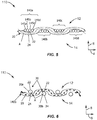
- FIG. 7-8 Another embodiment shown in Figures 7-8 is another sateen woven fabric 210 is formed from blended warp yarns 20 and a plurality of weft yarns arranged in weft yarn groups 240a.
- Figures 7-8 are sectional views of the woven fabric 210. It should be appreciated that a plan view of the woven fabric 210 is similar to the view illustrated in Figure 3 .
- each weft yarn group 240a-240d includes multiple separate weft yarns 245a, 245b, 245c, 245d..245 n that are substantially parallel with respect to each other and are grouped together as they extend along the weft insertion path 19 through the woven fabric 310.
- each weft yarn groups 240a-240d include two different yarns. As illustrated, the weft yarn groups 240a-240d may include a first yarn type configured as a spun yarn 245a and a second yarn type that is a continuous filament yarn 245b-245d.
- the spun yarn 245a is a staple yarn structure and is referred to as a spun weft yarn 245a.
- the spun weft yarn 245a may be a blended spun yarn that includes cotton fibers and cellulosic synthetic fibers (as described above) or a blended spun yarn comprising cotton fibers and thermoplastic fibers.
- the thermoplastic fibers are preferably polyester fibers. However, other thermoplastic fibers can be used.
- the spun weft yarn may comprise exclusively cotton fibers.
- the spun weft yarn 245a may be any type of spun staple yarn structure.
- the second weft yarn may be ring spun yarns, open end yarns, rotor spun yarns, vortex spun yarns, core spun yarns, jet spun yarns, or compact spun yarns.
- the spun weft yarns 245a are ring spun yarns.
- the spun weft yarns 245a can, however, be any type of spun yarn structure.
- the spun weft yarn 245a may have a range of linear densities that are suitable for bedding applications.
- the spun weft yarn 245a can have a count between 20 Ne (266 denier) and about 120 Ne (44.3 denier).
- the spun weft yarn count is between 20 Ne (266 denier) and about 100 Ne (53.1 denier). In another example, the spun weft yarn count is between 20 Ne (266 denier) and about 60 Ne (88.6 denier). In another example, the spun weft yarn count is between 20 Ne (266 denier) and about 40 Ne (133 denier). In yet another example, the spun weft yarn count is 20 Ne (266 denier) and about 30 Ne (177 denier).
- the spun weft yarns may be single end yarns or plied yarns. For instance, the spun weft yarns may be plied yarns, such as two ply yarns or a three-ply yarns.
- the second weft yarn type within the weft yarn groups 240a-240d are continuous filament yarns 245b-245d.
- the continuous filament weft yarns 245b-245d may be formed from polyester filaments. However, other filament types are possible.
- Each continuous filament yarn 245b-245d may have a linear density between 15 denier and 150 denier.
- the woven fabric 210 may include groups of a) one spun yarn and b) between one continuous filament yarn up to four continuous filament yarns (or more) with each continuous filament yarn having a denier between 15 denier and 150 denier.
- the woven fabric 210 may include groups of a) one spun yarn and b) two continuous filament yarns with each continuous filament yarn having a denier between 15 denier and 150 denier.
- the woven fabric 210 may include groups of a) one spun yarn and b) three continuous filament yarns with each continuous filament yarn having a denier between 15 denier and 150 denier.
- the woven fabric 210 may include groups of a) one spun yarn and b) four continuous filament yarns with each continuous filament yarn having a denier between 15 denier and 150 denier.
- FIG. 9-10 Another embodiment shown in Figures 9-10 is a sateen woven fabric 310 is formed from blended warp yarns 20 and a plurality of weft yarns arranged in weft yarn groups 340a-340d.
- Figures 9-10 are sectional views of the woven fabric 310. It should be appreciated that a plan view of the woven fabric 310 is similar to the view illustrated in Figure 3 .
- each weft yarn group 340a-340d includes multiple separate weft yarns 345a, 345b, 345c, 345d..345 n that are substantially parallel with respect to each other and are grouped together as they extend along the weft insertion path 19 through the woven fabric 310.
- the blended spun yarns 345a-345d are a blend of cotton fibers and thermoplastic fibers or a blend of thermoplastic fibers and cellulosic synthetic fibers.
- the thermoplastic fibers are preferably polyester fibers. However, other thermoplastic fibers can be used.
- the blended weft yarns 345a-345d may be any type of spun staple yarn structure.
- the blended weft yarns may be ring spun yarns, open end yarns, rotor spun yarns, vortex spun yarns, core spun yarns, jet spun yarns, or compact spun yarns.
- the blended spun weft yarns are ring spun yarns.
- the blended spun weft yarns 345a-345d can, however, be any type of spun yarn structure.
- the blended spun weft yarns 345a-345d may have a range of linear densities that are suitable for bedding applications.
- the blended spun weft yarns can have a count between 20 Ne (266 denier) and about 120 Ne (44.3 denier).
- the blended spun weft yarn count is between 20 Ne (266 denier) and about 100 Ne (53.1 denier). In another example, the blended spun weft yarn count is between 20 Ne (266 denier) and about 60 Ne (88.6 denier). In another example, the blended spun weft yarn count is between 20 Ne (266 denier) and about 40 Ne (133 denier). In yet another example, the blended spun weft yarn count is 20 Ne (266 denier) and about 30 Ne (177 denier).
- the blended spun weft yarn may be single end yarns or plied yarns. For instance, the blended spun weft yarns may be plied yarns, such as two ply yarns or a three-ply yarns.
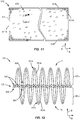
- the terry woven fabric 510 includes a ground component 530 that includes warp yarns 520 and weft yarns 540 interwoven with the warp yarns 520.
- the terry woven fabric 510 also includes one or more pile components 550a, 550b.
- the ground component 530 includes a first side 532 and a second side 534 opposite the first side.
- the pile component 550a and 550b extend away from opposite sides 532 and 534 of the ground component 130 along a thickness direction 8.
- the warp yarns 120 extend along a warp direction 4, which is perpendicular to the weft direction 6 and the thickness direction 9.
- the weft yarns 540 extend along a weft or fill direction 6 that is perpendicular to the warp direction 4.
- the woven fabric 510 includes a face 12, and back 14 opposite the face 12 along a thickness direction 8 that is perpendicular to the warp direction 4 and the weft direction 6.
- the terminal ends of the pile components 550a and 550b can define the face 12 and back 14 of the woven fabric 510.
- the piles have a pile height H that extends from the ground component to the terminal ends of the piles.
- the terry woven fabric 510 includes a first pile component 550a and a second pile component 550b. However, the terry fabric may include only the one pile component.
- Each pile component 550a, 550b includes a plurality of piles 552a, 552b that project in a direction away from the ground component 530.
- the piles 552a, 552b are defined by pile yarns 554a, 554b interwoven with the ground component 530.
- the terry woven fabric 510 can be formed using any of the hygro yarn configurations described in the present disclosure.
- the pile yarns 554a, 554b may include the plied hygro yarns 80.
- one or both of the warp yarns 520 and the weft yarns 540 may include the plied hygro yarns 80.
- the pile yarns 554a, 554b may include the blended hygro yarn 80.
- one or both of the warp yarns 520 and the weft yarns 540 may include the blended hygro yarn 80.
- the terry woven fabrics 510 may be converted bath and/or kitchen products, such as towel articles. Terry articles include a towel, a hand towel, a wash cloth, a bath robe, a rug, a kitchen towel, and the like.
- the terry fabric 510 may include a plurality of yarns as described above.
- the warp yarns 530 are blended staple warp yarns each of which has cotton fibers and regenerated cellulosic fibers.
- the weft yarns and/or the pile yarns may include at least one yarn comprising thermoplastic fibers.
- the weft yarns and/or the pile yarns may include at least one yarn comprising a blend of cotton fibers and regenerated cellulosic fibers.
- a method of making woven fabric 10, 210, 310, 510 includes yarn formation 410 for the warp yarns 20 and weft yarns 40.
- Yarn formation 410 for the warp yarns can include staple yarn formation or spinning 412 and filament yarn formation 414 (where applicable).
- Staple yarn formation 412 may utilize any number of yarn formation systems and sub-systems.
- staple yarn formation may include bale opening, carding, optionally combing, drafting, roving, and yarn spinning (yarn spinning processes are not illustrated) to the desired count and twist level.
- the warp yarns can be plied into 2-ply, 3-ply, or 4-ply configurations.
- the warp yarns are wound into the desired yarn packages for warping 420.
- ring spinning is the preferred spinning system.
- the warp yarns can be formed using open end spinning systems, rotor spun spinning systems, vortex spinning systems, core spinning yarns, jet spinning yarns, or compact spinning systems.
- Winding 416 may include use of a yarn winding apparatus (not shown) configured to wind separate yarns onto a multiple yarn packages.
- Warping 420 follows the yarn formation 410 for woven and terry fabrics. Warping 420 is where warp yarn ends are removed from their respective yarn packages, arranged in a parallel form, and wound onto a warp beam. Warping 420 also includes a sizing step where a sizing agent is applied to each warp yarn to aid in fabric formation. Warping 420 results in a warp beam of warp yarns prepared for weaving. The warp beam can be positioned on a mounting arm of a weaving loom so that the warp yarns can be drawn through the loom components, as further described below. Terry fabric production may include pile warp beam as in known in the art.
- weaving 440 operation forms a woven fabric with a weaving loom. More specifically, in weaving 440, the warp yarns are drawn-in (not shown) through various components of a weaving loom, such as drop wires, heddle eyes attached to a respective harness, reed and reed dents, in a designated order as is known in the art. After drawing-in is complete, fabric formation phase can begin.
- the weft yarns 40, 140, 240, 240 are woven with the warp yarns 20 to define the desired woven construction.
- the formation phase creates shed with the warp yarns 20 that the weft yarns can be inserted through across the width direction of the machine to create the desired woven fabric construction.
- shedding motions can include cam shedding, dobby shedding, or jacquard shedding motions, each of which can cause the selective raising and lowering of warp ends to create an open shed for weft insertion.
- the formation phase can utilize different weft insertion techniques, includes air-jet, rapier, or projectile type weft insertion techniques. In each weft insertion event, yarns are inserted through the shed.
- the weaving step can utilize a co-insertion so that multiple groups of weft yarn inserted through the shed during a single weft insertion event, as described above.
- the weaving step 440 can further include weaving one or more selvedge edges along a length L of the woven fabric. It should be appreciated that various woven constructions can made during weaving 440, including, but not limited to: plain weaves; basket weaves, satins; rib weaves; twill weaves, oxford weaves; percale weaves; and sateens.
- Desizing may be accomplished with enzymes as is known in the art.
- Bleaching may include typical bleaching agents, such as hydrogen peroxide.
- coloring agents are applied to the woven fabric in dyeing operation 460.
- the dyeing operation 460 applies color to any yarns, including any undyed continuous filament yarn and/or spun yarns, depending on the specific woven fabric construction.
- the dyeing operation is carried out in such way that coloring agents that are applied to the cotton fibers and or regenerated cellulosic fibers and/or the continuous filament yarns as the case may be.
- the dyeing operation may include sub operations depending on the fiber blends in the fabric. For instance, woven fabrics that include cotton fibers may involve application of reactive dyes. Woven fabrics that include continuous polyester filaments or staple length polyester fibers may include application of disperse dyes as is known persons of skill in the art.
- the woven fabric may be subjected to an optional finishing 470 operation.
- the optional fabric finishing 470 operation applies a composition including one or more of the functional agents to the woven fabric.
- the one or more functional agents may be, for example, a softener. Finishing includes a drying phase that is used to remove excess moisture from the woven fabric and the composition. After drying, the woven fabric may be optionally sanforized and calendared to adjust the hand and better control shrinkage.
- Article assembly 480 may include material handling a roll goods to present to cutting, hemming, and or folding machines that are used to prepare the articles.
- article assembly 480 includes cutting a panel of woven fabric to the appropriate length and width dimensions for the intended articles, such as the flat sheet or pillow case. The outer edges of the panel may be hemmed or surged to create finished edge. Secondary components can be attached to the panel at this stage. For example, ribbing, block hems, or binding can be sewn or otherwise attached to the panel. For fitted sheets, elastic materials are secured the at least the corner regions along the edge of the panel. For comforters, the fabrics can be cut to size and combined with desired batting or fill (e.g.
- article assembly 480 includes forming one or more bedding articles of a bedding system.
- the bedding articles include at least one of a flat sheet, a fitted sheet, a pillow case, a sham, a comforter, a duvet, a bed-skirt, coverlet and a blanket.
- a packaging step 490 places the bedding article in suitable packaging for shipment.
- the packaging 490 may include automatically folding the formed articles, which are in panel form, into a folded configuration. The folded article is then placed in an outer package for shipment.
Landscapes
- Engineering & Computer Science (AREA)
- Textile Engineering (AREA)
- Life Sciences & Earth Sciences (AREA)
- Botany (AREA)
- Woven Fabrics (AREA)
Applications Claiming Priority (1)
| Application Number | Priority Date | Filing Date | Title |
|---|---|---|---|
| IN201621031577 | 2016-09-16 |
Publications (2)
| Publication Number | Publication Date |
|---|---|
| EP3296437A2 true EP3296437A2 (de) | 2018-03-21 |
| EP3296437A3 EP3296437A3 (de) | 2018-07-18 |
Family
ID=59901446
Family Applications (1)
| Application Number | Title | Priority Date | Filing Date |
|---|---|---|---|
| EP17191679.4A Withdrawn EP3296437A3 (de) | 2016-09-16 | 2017-09-18 | Hochleistungsgewebe und zugehörige artikel |
Country Status (2)
| Country | Link |
|---|---|
| US (1) | US20180080151A1 (de) |
| EP (1) | EP3296437A3 (de) |
Cited By (3)
| Publication number | Priority date | Publication date | Assignee | Title |
|---|---|---|---|---|
| CN108866756A (zh) * | 2018-08-24 | 2018-11-23 | 孚日集团股份有限公司 | 一种高弹仿毛毯毛巾组织及其织造工艺 |
| WO2019197888A1 (en) | 2018-04-14 | 2019-10-17 | Gupta Ronak Rajendra | High thread/ yarn count woven textile fabric and process of preparation thereof |
| US10669651B2 (en) | 2018-07-12 | 2020-06-02 | Trident Limited | Woven fabric with improved comfort |
Families Citing this family (6)
| Publication number | Priority date | Publication date | Assignee | Title |
|---|---|---|---|---|
| GB2544864B (en) * | 2015-09-30 | 2018-06-06 | Trident Ltd | Pile fabric and methods for manufacture of the same |
| US10689782B2 (en) | 2016-12-10 | 2020-06-23 | Sachin JHUNJHUNWALA | Textile fabric fabricated of twill weave sheeting |
| CN110983556A (zh) * | 2019-11-22 | 2020-04-10 | 江苏康乃馨织造有限公司 | 一种新型酒店地巾生产工艺 |
| CN112831878A (zh) * | 2019-11-25 | 2021-05-25 | 扬州市佳美纺织有限公司 | 一种高弹性工业用纱的生产工艺 |
| JP6968464B2 (ja) * | 2020-09-15 | 2021-11-17 | 伊澤タオル株式会社 | タオル地及びその製造方法 |
| CN117418343A (zh) * | 2023-08-31 | 2024-01-19 | 浙江凯瑞博科技股份有限公司 | 一种水溶性可印刷标签带 |
Family Cites Families (4)
| Publication number | Priority date | Publication date | Assignee | Title |
|---|---|---|---|---|
| US4191221A (en) * | 1978-08-30 | 1980-03-04 | Fieldcrest Mills, Inc. | Sheeting fabric formed of corespun yarns |
| FR2798400B1 (fr) * | 1999-09-13 | 2007-10-19 | Descamps S A | Article textile comportant de la cellulose regeneree. (ii) |
| AT507758A1 (de) * | 2008-12-23 | 2010-07-15 | Chemiefaser Lenzing Ag | Yarn and threads from blends of fibres and articles therefrom |
| US20110223398A1 (en) * | 2010-03-09 | 2011-09-15 | Valley Forge Fabrics, Inc. | Upholstery and Wall Panel Weight Woven Fabrics |
-
2017
- 2017-02-03 US US15/424,586 patent/US20180080151A1/en not_active Abandoned
- 2017-09-18 EP EP17191679.4A patent/EP3296437A3/de not_active Withdrawn
Non-Patent Citations (1)
| Title |
|---|
| None |
Cited By (4)
| Publication number | Priority date | Publication date | Assignee | Title |
|---|---|---|---|---|
| WO2019197888A1 (en) | 2018-04-14 | 2019-10-17 | Gupta Ronak Rajendra | High thread/ yarn count woven textile fabric and process of preparation thereof |
| EP3781736A4 (de) * | 2018-04-14 | 2021-06-02 | Gupta, Ronak Rajendra | Gewebtes textil mit hoher faden-/garnstärke und verfahren zu seiner herstellung |
| US10669651B2 (en) | 2018-07-12 | 2020-06-02 | Trident Limited | Woven fabric with improved comfort |
| CN108866756A (zh) * | 2018-08-24 | 2018-11-23 | 孚日集团股份有限公司 | 一种高弹仿毛毯毛巾组织及其织造工艺 |
Also Published As
| Publication number | Publication date |
|---|---|
| US20180080151A1 (en) | 2018-03-22 |
| EP3296437A3 (de) | 2018-07-18 |
Similar Documents
| Publication | Publication Date | Title |
|---|---|---|
| US20180080151A1 (en) | Performance fabrics and related articles | |
| US10669651B2 (en) | Woven fabric with improved comfort | |
| US11702774B2 (en) | Soft twist terry article | |
| CN101932761B (zh) | 具有独立的弹性纱体系的弹力织品 | |
| EP3237661B1 (de) | Schnell trocknender frotteestoff und entsprechende artikel | |
| US20150167210A1 (en) | Woven towel | |
| US20170088985A1 (en) | Chambray fabric, bedding articles, and related manufacturing methods | |
| US20240008662A1 (en) | Flat woven fabric with durable drop area, and related processes | |
| WO2023074347A1 (ja) | タオル生地及びその製造方法 | |
| CN219808066U (zh) | 仿针织四面弹牛仔面料以及服装 | |
| US20180340273A1 (en) | Hydroentangled woven fabric | |
| Wadje | Textile–Fibre to fabric processing | |
| US20190316280A1 (en) | High thread/ yarn count woven textile fabric and process of preparation thereof | |
| CN114411300A (zh) | 一种双层网络提花毛巾及其织造工艺 | |
| CN218910679U (zh) | 多纤维复古牛仔面料以及复古效果牛仔服装 | |
| US12234581B2 (en) | Fabric made of multi-filament polyester warp yarns of yarn size of 75 denier or above and cellulose fiber weft yarns | |
| CN215473644U (zh) | 一种阻燃提花面料 | |
| US11795588B2 (en) | Fabric made of multi-filament polyester warp yarns of yarn size of 75 denier or above and cellulose fiber weft yarns | |
| JP5216974B2 (ja) | 芯鞘型複合糸を用いてなる布帛および衣料 | |
| CN220116762U (zh) | 一种纬向无色差的面料及具有其的服饰 | |
| US20250188654A1 (en) | Terry structure with selectively composite twist in pile and process of manufacturing | |
| WO2025191609A1 (en) | Improved woven fabrics for home textiles | |
| JP2000303304A (ja) | 擬紗織物およびその製造方法 | |
| CN114214776A (zh) | 一种仿针织毛圈面料及其织造工艺 | |
| Wood | 18. Weaving Technologies and Structures |
Legal Events
| Date | Code | Title | Description |
|---|---|---|---|
| PUAI | Public reference made under article 153(3) epc to a published international application that has entered the european phase |
Free format text: ORIGINAL CODE: 0009012 |
|
| STAA | Information on the status of an ep patent application or granted ep patent |
Free format text: STATUS: THE APPLICATION HAS BEEN PUBLISHED |
|
| AK | Designated contracting states |
Kind code of ref document: A2 Designated state(s): AL AT BE BG CH CY CZ DE DK EE ES FI FR GB GR HR HU IE IS IT LI LT LU LV MC MK MT NL NO PL PT RO RS SE SI SK SM TR |
|
| AX | Request for extension of the european patent |
Extension state: BA ME |
|
| PUAL | Search report despatched |
Free format text: ORIGINAL CODE: 0009013 |
|
| AK | Designated contracting states |
Kind code of ref document: A3 Designated state(s): AL AT BE BG CH CY CZ DE DK EE ES FI FR GB GR HR HU IE IS IT LI LT LU LV MC MK MT NL NO PL PT RO RS SE SI SK SM TR |
|
| AX | Request for extension of the european patent |
Extension state: BA ME |
|
| RIC1 | Information provided on ipc code assigned before grant |
Ipc: D03D 27/08 20060101ALI20180613BHEP Ipc: D03D 15/00 20060101AFI20180613BHEP Ipc: D03D 1/00 20060101ALI20180613BHEP |
|
| STAA | Information on the status of an ep patent application or granted ep patent |
Free format text: STATUS: THE APPLICATION IS DEEMED TO BE WITHDRAWN |
|
| 18D | Application deemed to be withdrawn |
Effective date: 20190119 |