EP3296438A1 - Spinnvlies aus endlosfilamenten - Google Patents
Spinnvlies aus endlosfilamenten Download PDFInfo
- Publication number
- EP3296438A1 EP3296438A1 EP17193288.2A EP17193288A EP3296438A1 EP 3296438 A1 EP3296438 A1 EP 3296438A1 EP 17193288 A EP17193288 A EP 17193288A EP 3296438 A1 EP3296438 A1 EP 3296438A1
- Authority
- EP
- European Patent Office
- Prior art keywords
- lubricant
- spunbonded
- polypropylene
- filaments
- component
- Prior art date
- Legal status (The legal status is an assumption and is not a legal conclusion. Google has not performed a legal analysis and makes no representation as to the accuracy of the status listed.)
- Granted
Links
Images
Classifications
-
- D—TEXTILES; PAPER
- D04—BRAIDING; LACE-MAKING; KNITTING; TRIMMINGS; NON-WOVEN FABRICS
- D04H—MAKING TEXTILE FABRICS, e.g. FROM FIBRES OR FILAMENTARY MATERIAL; FABRICS MADE BY SUCH PROCESSES OR APPARATUS, e.g. FELTS, NON-WOVEN FABRICS; COTTON-WOOL; WADDING ; NON-WOVEN FABRICS FROM STAPLE FIBRES, FILAMENTS OR YARNS, BONDED WITH AT LEAST ONE WEB-LIKE MATERIAL DURING THEIR CONSOLIDATION
- D04H3/00—Non-woven fabrics formed wholly or mainly of yarns or like filamentary material of substantial length
- D04H3/005—Synthetic yarns or filaments
- D04H3/007—Addition polymers
-
- D—TEXTILES; PAPER
- D04—BRAIDING; LACE-MAKING; KNITTING; TRIMMINGS; NON-WOVEN FABRICS
- D04H—MAKING TEXTILE FABRICS, e.g. FROM FIBRES OR FILAMENTARY MATERIAL; FABRICS MADE BY SUCH PROCESSES OR APPARATUS, e.g. FELTS, NON-WOVEN FABRICS; COTTON-WOOL; WADDING ; NON-WOVEN FABRICS FROM STAPLE FIBRES, FILAMENTS OR YARNS, BONDED WITH AT LEAST ONE WEB-LIKE MATERIAL DURING THEIR CONSOLIDATION
- D04H3/00—Non-woven fabrics formed wholly or mainly of yarns or like filamentary material of substantial length
- D04H3/08—Non-woven fabrics formed wholly or mainly of yarns or like filamentary material of substantial length characterised by the method of strengthening or consolidating
- D04H3/14—Non-woven fabrics formed wholly or mainly of yarns or like filamentary material of substantial length characterised by the method of strengthening or consolidating with bonds between thermoplastic yarns or filaments produced by welding
- D04H3/147—Composite yarns or filaments
-
- D—TEXTILES; PAPER
- D01—NATURAL OR MAN-MADE THREADS OR FIBRES; SPINNING
- D01D—MECHANICAL METHODS OR APPARATUS IN THE MANUFACTURE OF ARTIFICIAL FILAMENTS, THREADS, FIBRES, BRISTLES OR RIBBONS
- D01D5/00—Formation of filaments, threads, or the like
- D01D5/08—Melt spinning methods
- D01D5/098—Melt spinning methods with simultaneous stretching
- D01D5/0985—Melt spinning methods with simultaneous stretching by means of a flowing gas (e.g. melt-blowing)
-
- D—TEXTILES; PAPER
- D01—NATURAL OR MAN-MADE THREADS OR FIBRES; SPINNING
- D01F—CHEMICAL FEATURES IN THE MANUFACTURE OF ARTIFICIAL FILAMENTS, THREADS, FIBRES, BRISTLES OR RIBBONS; APPARATUS SPECIALLY ADAPTED FOR THE MANUFACTURE OF CARBON FILAMENTS
- D01F1/00—General methods for the manufacture of artificial filaments or the like
- D01F1/02—Addition of substances to the spinning solution or to the melt
- D01F1/10—Other agents for modifying properties
-
- D—TEXTILES; PAPER
- D01—NATURAL OR MAN-MADE THREADS OR FIBRES; SPINNING
- D01F—CHEMICAL FEATURES IN THE MANUFACTURE OF ARTIFICIAL FILAMENTS, THREADS, FIBRES, BRISTLES OR RIBBONS; APPARATUS SPECIALLY ADAPTED FOR THE MANUFACTURE OF CARBON FILAMENTS
- D01F8/00—Conjugated, i.e. bi- or multicomponent, artificial filaments or the like; Manufacture thereof
-
- D—TEXTILES; PAPER
- D01—NATURAL OR MAN-MADE THREADS OR FIBRES; SPINNING
- D01F—CHEMICAL FEATURES IN THE MANUFACTURE OF ARTIFICIAL FILAMENTS, THREADS, FIBRES, BRISTLES OR RIBBONS; APPARATUS SPECIALLY ADAPTED FOR THE MANUFACTURE OF CARBON FILAMENTS
- D01F8/00—Conjugated, i.e. bi- or multicomponent, artificial filaments or the like; Manufacture thereof
- D01F8/04—Conjugated, i.e. bi- or multicomponent, artificial filaments or the like; Manufacture thereof from synthetic polymers
- D01F8/06—Conjugated, i.e. bi- or multicomponent, artificial filaments or the like; Manufacture thereof from synthetic polymers with at least one polyolefin as constituent
-
- D—TEXTILES; PAPER
- D04—BRAIDING; LACE-MAKING; KNITTING; TRIMMINGS; NON-WOVEN FABRICS
- D04H—MAKING TEXTILE FABRICS, e.g. FROM FIBRES OR FILAMENTARY MATERIAL; FABRICS MADE BY SUCH PROCESSES OR APPARATUS, e.g. FELTS, NON-WOVEN FABRICS; COTTON-WOOL; WADDING ; NON-WOVEN FABRICS FROM STAPLE FIBRES, FILAMENTS OR YARNS, BONDED WITH AT LEAST ONE WEB-LIKE MATERIAL DURING THEIR CONSOLIDATION
- D04H3/00—Non-woven fabrics formed wholly or mainly of yarns or like filamentary material of substantial length
- D04H3/08—Non-woven fabrics formed wholly or mainly of yarns or like filamentary material of substantial length characterised by the method of strengthening or consolidating
- D04H3/16—Non-woven fabrics formed wholly or mainly of yarns or like filamentary material of substantial length characterised by the method of strengthening or consolidating with bonds between thermoplastic filaments produced in association with filament formation, e.g. immediately following extrusion
-
- D—TEXTILES; PAPER
- D10—INDEXING SCHEME ASSOCIATED WITH SUBLASSES OF SECTION D, RELATING TO TEXTILES
- D10B—INDEXING SCHEME ASSOCIATED WITH SUBLASSES OF SECTION D, RELATING TO TEXTILES
- D10B2321/00—Fibres made from polymers obtained by reactions only involving carbon-to-carbon unsaturated bonds
- D10B2321/02—Fibres made from polymers obtained by reactions only involving carbon-to-carbon unsaturated bonds polyolefins
- D10B2321/022—Fibres made from polymers obtained by reactions only involving carbon-to-carbon unsaturated bonds polyolefins polypropylene
Definitions
- the invention relates to a spunbonded non-woven of continuous filaments of thermoplastic material, wherein the continuous filaments are formed as Mehrkomponentenfilêt, in particular as bicomponent filaments with core-shell configuration.
- the spunbonded nonwovens have endless filaments.
- Such continuous filaments differ because of their quasi-endless length of staple fibers having much smaller lengths of, for example, 10 to 60 mm.
- Spunbonded fabrics of the type mentioned are known from practice in different embodiments. In such spunbonded fabrics, a high strength or high tensile strength is generally desirable. For many applications, the spunbonded nonwovens should also have a smooth, soft feel. A soft grip of the spunbonded fabric on the one hand and a high strength or tensile strength of the spunbonded fabric on the other hand is often not satisfactorily achievable in the combination. Above all, a soft grip can not be realized simultaneously with a high productivity or plant productivity.
- Polypropylene spunbonded nonwovens have long been known and are characterized by a good running behavior on the associated system. In particular, relatively few soiling occur. However, these spunbonded fabrics are not particularly soft and the possibilities for improving the softness - for example, through finer fibers - are limited and often not economical.
- the use of a lubricant to increase the softness of the spunbond web is possible but does not alter the relatively high flexural stiffness of the filaments and thus can not provide a satisfactory soft spunbonded web.
- the use of such a lubricant has the disadvantage that the lubricant during the spinning process from the filament melt or from the initially hot filaments diffuses out and pollutes the system, so that the productivity is ultimately lowered.
- polypropylene blends have been introduced, for example blends of homo-polypropylene and polypropylene-based copolymers such as Random CoPP. These blends give soft filaments, which are usually characterized by a rather blunt grip, which in turn requires the use of additional lubricants. These soft polypropylene blends have a disadvantageously reduced strength. In addition, the pollution problems described above are also present here.
- a homo-polypropylene core improves the strength and soft polypropylene blends or the use of polypropylene copolymer in the shell increase the softness of the filaments or the spunbonded nonwoven.
- the respective filament surfaces are also relatively blunt. This requires the use of a lubricant, which in turn brings the above-mentioned problems associated with contamination with it.
- a combination of a so-called jumbo roll winder and a roll-over cutting machine is used since it is no longer possible to wind up directly at these high production speeds.
- the jumbo rolls are temporarily stored, This period can take several hours.
- an incorporated lubricant can migrate to the surface of the filaments, so that the filaments or the spunbonded web become smoother and thus the rolling behavior deteriorates.
- the invention is the technical problem of specifying a spunbonded fabric of the type mentioned above, that is characterized both by a smooth soft grip as well as by a sufficient strength, which is simple and efficient to produce and in particular a evaporation of plasticizing additives or evaporation of lubricants can be largely avoided.
- the invention according to a first embodiment teaches a spunbonded filament of thermoplastic filaments Plastic, wherein the endless filaments are formed as Mehrkomponentenfilêt, in particular as bicomponent filaments, core-sheath configuration, wherein the filaments contain at least one lubricant, wherein the proportion of the lubricant - based on the entire filament - 250 to 5500 ppm, preferably 500 to 5000 ppm, preferably 700 to 3000 ppm and more preferably 700 to 2500 ppm and wherein in the shell component further at least one of the migration rate of the lubricant through the shell component reducing additive is included.
- the invention for solving the technical problem according to a second embodiment teaches a spunbond of continuous filaments of thermoplastic material, wherein the continuous filaments are formed as Mehrkomponentenfilêt, in particular as bicomponent filaments, with core-sheath configuration, wherein the filaments contain at least one lubricant, wherein the Proportion of the lubricant - based on the total filament - 250 to 5500 ppm, preferably 500 to 5000 ppm, preferably 700 to 3000 ppm and very preferably 700 to 2500 ppm, wherein the lubricant is preferably present in the shell component, wherein in the shell component at least a rate of migration of the lubricant through the shell component reducing additive is included, wherein the surface of the spunbonded in the period up to 150 minutes after the spunbonding production is harder, in particular by more than 3%, preferably by at least 3.2%, preferably by at least 3 , 3% and in particular by at least 3.5% harder than the surface of a comparison spunbond fabric otherwise prepared
- the surface of the spunbonded fabric in the period up to 150 minutes after spunbonding production by more than 3%, etc. harder than the surface of a comparison spunbonded fabric in particular means that within the first 150 minutes after the spunbonded nonwoven Generating at least one point in time at which this tolerance limit is exceeded.
- the tolerance limit may already be exceeded or exceeding the tolerance limit is given over the entire period or substantially over the entire period.
- the migration speeds are relevant depending on the jacket raw material or depending on the shell portion of the filament.
- the selected period up to 150 min. On the one hand, it is adapted to the measuring device described below and, incidentally, it also takes into account typical times from which the jumbo rolls can be rolled over. A hardness measurement directly in the course of spinning is not possible with the chosen method. It is within the scope of the invention that such a measurement about 15 min. lasts and therefore can not run continuously. However, the mentioned period can not be too long so that it can still serve as a decision-making aid during production. Overall, this period allows the decision regarding the spinning behavior (system cleanliness) and the winding behavior.
- the mass ratio between the core component and the shell component is 40:60 to 90:10, preferably 60:40 to 85:15, more preferably 65:35 to 80:20, preferably 65:35 to 75:25, and most preferably 67:33 to 73:27.
- the degree of hardness of the spunbond (see in particular claim 2) on the nonwoven surface by means of a TSA measuring device (the company Emtec, Leipzig, Germany) than the volume at the peak maximum of the volume / frequency spectrum at about 6550th Hz is determined.
- This TSA meter outputs the product property as "TS7" value.
- the TS7 value correlates with the softness of the web.
- a spunbond of rough / dull filaments has a higher TS7 value than a comparable spunbond of smoother / softer filaments.
- spunbonding is meant filing the filaments after their spinning on the tray or on the Ablagesiebband.
- the measurement is thus carried out in the period up to 150 minutes after this filing of the filaments on the tray or on the Ablagesiebband. It is within the scope of the invention that this measurement takes place after all Vorverfest Trents- and / or consolidation measures, which are performed on the nonwoven - in particular on the tray or on the Ablagesiebband.
- This is in particular also a solidification by means of a calender with a gravure roll.
- the measurement of the degree of hardness is thus carried out after these solidifications, but with the proviso that it is carried out in a period of up to 150 minutes after filing of the filaments on the tray or on the Ablagesiebband.
- the measurement of the degree of hardness takes place before winding the spunbonded on a roll or after winding the spunbonded nonwoven on a roll but always with the proviso that this measurement is carried out in a period up to 150 minutes after Filamentablage.
- This sound frequency spectrum is dependent on the overall structure of the nonwoven surface and the amplitude of the volume depends inter alia on the height of the nonwoven structure and on the degree of hardness of the nonwoven surface or the filament surfaces. Properties such as surface topology in the range below 1000 Hz and softness in the range around 6550 Hz become apparent.
- the TS7 value is used as a characteristic measurement of the degree of hardness in the context of the invention. The percentages given in claim 2 differences in the degree of hardness so relate to this value.
- the volume or the degree of hardness of the reference web is set equal to 100% and it is determined in relation to the volume or the degree of hardness of the spunbonded nonwoven invention, the percentage deviation.
- the filaments are preferably deposited on a tray, in particular on a storage screen belt. It is within the scope of the invention that the measurement of the degree of hardness on the surface of the spunbonded non-woven, which faces away from the tray or the Ablagesiebband. If the nonwoven web or the spunbonded nonwoven is solidified by means of a calender with gravure roll, the measurement of the degree of hardness is advantageously carried out on the surface of the spunbonded nonwoven, which faces the gravure roll and preferably it is the surface of the spunbonded by the tray or facing away from the storage screen belt.
- the spunbonded nonwoven on the one hand and the comparative nonwoven on the other hand are produced under the same conditions, in particular produced with the same system or spunbond system, and are deposited on the same tray or the same filing screen belt. Furthermore, it is within the scope of the invention that the spunbonded fabric on the one hand and the comparative nonwoven fabric on the other are solidified in the same way, in particular solidified with the same calender or the like, and that the filaments of the spunbond fabric on the one hand and the comparison fabric on the other hand have the same denier.
- Raw material mixtures which are preferably compatible in each case can be used in the core component and / or in the shell component.
- Core-sheath configuration means in the context of the invention that the sheath component completely or substantially completely surrounds the core component.
- the continuous filaments of the spunbonded fabric preferably have a denier of 1.0 to 2.5 denier and more preferably a titer of 1.2 to 2.2 denier for all embodiments of the invention.
- the core component and / or the shell component at least 90 wt .-%, preferably at least 95 wt .-% and preferably at least 96 wt .-% of at least one component from the group "polyolefin, polyolefin Copolymer, mixture of polyolefin and polyolefin copolymer "on.
- the core component and / or the shell component at least 90 wt .-%, preferably at least 95 wt .-%, and preferably at least 96 wt .-% of at least one component selected from the group "polypropylene, polypropylene copolymer, mixture of polypropylene and polypropylene copolymer ".
- the core component and / or the shell component there is / consist of the core component and / or the shell component in Substantially consists of a polyolefin and / or substantially of a polyolefin copolymer and / or substantially of a mixture of polyolefin and polyolefin copolymer.
- the core component and / or the sheath component consist essentially of a polypropylene and / or substantially of a polypropylene copolymer and / or substantially of a mixture of a polypropylene and a polypropylene copolymer ,
- the restriction "essentially” in the embodiment variants described above takes account of the fact that additives, in particular the lubricant and optionally an additive which reduces the migration speed of the lubricant, are or are contained in the core component and / or shell component.
- the proportion of additives (lubricant, optionally the migration rate of the lubricant reducing additive and any other additives, such as color additives) - based on the total filament - a maximum of 10 wt .-%, preferably at most 8 wt .-%, preferably at most 6 Wt .-% and very preferably at most 5 wt .-%.
- the polypropylene copolymer used in the context of the invention is, moreover, designed according to an expedient embodiment as an ethylene-propylene copolymer. Empfohlene vide, the ethylene-propylene copolymer used has an ethylene content of 1 to 6%, preferably from 2 to 6%.
- the preferably used polypropylene copolymer have a melt flow rate (MFI) of 19 to 70 g / min, in particular from 20 to 70 g / min, preferably from 25 to 50 g / min. It has been found that the polypropylene copolymer has a molecular weight distribution or molecular weight distribution (M w / M n ) of from 2.5 to 6, preferably from 3 to 5.5 and very preferably from 3.5 to 5.
- a recommended embodiment of the first and the second embodiment of the invention is characterized in that the core component consists essentially of a homo-polyolefin, in particular substantially of a homo-polypropylene. It has been proven that the core component at least 80 wt .-%, preferably at least 85 wt .-%, preferably at least 90 wt .-% and particularly preferably at least 95 wt .-% of homo-polyolefin, in particular homo-polypropylene has ,
- a recommended embodiment of the first and second embodiments is further characterized in that the sheath component consists essentially of a polyolefin copolymer, in particular substantially of a polypropylene copolymer and / or substantially of a mixture of a polyolefin or homo-polyolefin with a polyolefin copolymer, in particular essentially consists of a mixture of a polypropylene or homopolymer polypropylene with a poly
- the substances specified below are preferably used as lubricants.
- at least one fatty acid derivative and preferably at least one substance from the group "fatty acid ester, fatty acid alcohol, fatty acid amide" is used as the lubricant.
- a recommended embodiment of the invention is characterized in that as a lubricant at least one stearate - in particular glycerol monostearate - and / or a fatty acid amide such.
- the use of distearylethylenediamide is possible.
- the erucic acid amide product SL05068PP from Constab is used according to a proven embodiment variant.
- the melt flow rate (MFI) is measured in the context of the invention, in particular according to ISO 1133 and that for polypropylene and polypropylene copolymer at 230 ° C and 2.16 kg.
- the polyolefin copolymer or the polypropylene copolymer preferably has an ethylene content of from 2 to 20%, preferably from 4 to 20%.
- the polyolefin copolymer or polypropylene copolymer of this embodiment is preferably characterized in terms of carbon atoms by an average C2 content in the range of 2 to 6%.
- the polypropylene copolymer used is preferably Exxon Vistamaxx 3588 and / or Exxon Vistamaxx 6202 or a polypropylene having similar properties.
- the polypropylene copolymer is mixed as described above with the homo-polyolefin or homo-polypropylene for the shell component. Preferred data for the homo-polypropylene are listed below.
- the spunbonded nonwoven according to the invention can be carried out in view of the thermoplastic used with a recycled recyclate.
- the recycled stream is used exclusively or primarily for the core component.
- a recirculated recycled material loaded with lubricant is then returned only to the core component and it is ensured that the jacket component remains free of lubricant or essentially free of lubricant.
- copolymer is then also converted into the core component. Nonetheless, the jacket remains free of lubricant or substantially free of lubricant.
- a variant of the first embodiment of the invention is characterized in that the lubricant is present in the shell component and according to an embodiment of the invention only in the shell component is included.
- lubricants may also be present in or even only in the core component.
- lubricant is preferably present in the shell component.
- the lubricant may be contained only in the shell component.
- lubricants may also be present in the core component.
- the core component may consist of a homo-polyolefin and in particular of a homo-polypropylene or consist essentially. According to another embodiment variant, the core component has at least 75% by weight, preferably at least 80% by weight, preferably at least 85% by weight and particularly preferably at least 90% by weight of the homo-polyolefin, in particular homo-polypropylene.
- a recommended embodiment of the invention is characterized in that the sheath component or the sheath component containing the lubricant consists of a polyolefin copolymer, in particular of a polypropylene copolymer or consists essentially.
- the lubricant may be contained or contained and (additionally) of the migration rate of the lubricant reducing additive is included.
- a polyolefin copolymer or a polypropylene copolymer is preferably selected for the shell component, which has a melt flow rate (MFI) of 20 to 70 g / 10 min, preferably from 25 to 50 g / 10 min.
- MFI melt flow rate
- an ethylene-propylene copolymer is used with an ethylene content of 1 to 6%, preferably from 2 to 6%. It is recommended that the one chosen for the sheath component be distinguished Polyolefin copolymer or polypropylene copolymer by a narrow molecular weight distribution and preferably by a molecular weight distribution or molecular weight distribution (M w / M n ) of 2.5 to 6, preferably from 3 to 5.5 and very preferably from 3.5 to 5.
- M w / M n molecular weight distribution or molecular weight distribution
- the molecular weight distribution M w / M n is within the scope of the invention according to the gel permeation chromatography (GPC) according to ISO 16014-1: 2003, ISO 16014-2: 2003, ISO 16014-4: 2003 and ASTM D 6474-12. It is recommended to employ a random polypropylene copolymer such as Borealis RJ377MO or Basell Moplen RP24R having a nucleating agent or otherwise modified for a high rate of crystallization. This latter random polypropylene copolymer has z. B. a melt flow rate of 30 g / 10 min and a Vicat temperature of 120 ° C (ISO 306 / A50, 10 N).
- At least one additive which reduces the migration speed of the lubricant is used in the shell component of the endless filaments.
- This additive is at least one nucleating agent and / or at least one filler.
- at least one nucleating agent is used.
- the nucleating agent in a proportion of 500 to 2500 ppm - based on the total filament - contained in the filaments.
- nucleating agent from the group "aromatic carboxylic acid, salt of an aromatic carboxylic acid, sorbitol derivative, talc, kaolin, quinacridone, pimelic acid salt, suberic acid salt, dicyclohexyl-naphthalendicarboxamid, organophosphate, triphenyl compound, triphenyldithiazine" used.
- a sorbitol such as dibenzyl sorbitol (DBS) or 1,3: 2,4-bis (p-methylbenzylidene) sorbitol (MDBS) or the 1,3: 2,4-bis- (3, 4-dimethyl-benzylidene) Sorbitol (DMDBS) can be used.
- a preferred nucleating agent is a salt of an aromatic carboxylic acid, especially an alkali salt of benzoic acid and, for example, sodium benzoate.
- the migration speed of the lubricant in the shell is lowered and thus enables, in view of solving the technical problem, the problem-free use of lubricants in the shell component
- at least one filler in the shell component can reduce the migration speed of the lubricant.
- polypropylene copolymers for the shell component expediently random polypropylene copolymers with narrow molecular weight distribution.
- Polypropylene copolymers which are known from the injection molding sector and often contain antistatic agents and nucleating agents are also suitable here.
- antistatic agents for example fatty acid esters such as glycerol monostearate or ethoxylated fatty amines or alkylamines
- lubricant can be added to the core component and / or shell component, if the already existing proportion of the copolymer is insufficient.
- the copolymer of the shell component can be blended with homo-polypropylene. It is within the scope of the invention that the viscosity of these mixtures is less than the viscosity of a homo-polypropylene.
- a homo-polypropylene is preferably a homo-polypropylene having the following properties.
- the melt flow rate (MFI) is suitably 17 to 37 g / 10 min, preferably 19 to 35 g / 10 min.
- the homo-polypropylene is recommended to have a narrow molecular weight distribution in the range of 3.6 to 5.2, in particular in the range of 3.8 to 5 on. The measurement of the molecular weight distribution has already been specified above.
- At least one of the following products is used as homo-polypropylene: Borealis HF420FB (MFI19), HG455FB (MFI25), HG475FB (MFI25), Basell Moplen HP561R (MFI25) and Exxon 3155 PP (MFI35).
- homo-polypropylene and / or polypropylene copolymer in particular ethylene-propylene copolymer and / or mixtures thereof are used both for the core component and for the shell component.
- the PP materials have proven particularly useful in the context of the invention.
- a spunbonded nonwoven according to the invention is produced by a spunbond process.
- first multicomponent filaments or bicomponent filaments with core-sheath configuration are wound as endless filaments by means of at least one spinnerette and then these endless filaments are cooled in at least one cooling device and then the endless filaments pass through a stretching device for drawing the filaments.
- the drawn filaments are deposited on a tray, in particular on a Ablagesiebband as spunbonded.
- a particularly recommended embodiment of the invention in this context is characterized in that the unit of the cooling device and the drafting device is designed as a closed unit, wherein apart from the supply of cooling air in the cooling device takes place no further air supply into the closed unit.
- This closed embodiment has proven particularly useful in the context of the invention in the production of a spunbonded fabric according to the invention.
- At least one diffuser is arranged between the stretching device and the tray or the Ablagesiebband.
- the continuous filaments emerging from the drawing device are passed through this diffuser and then deposited on the tray or on the filing screen belt.
- a recommended embodiment variant of the invention is characterized in that at least two diffusers, preferably two diffusers in the filament flow direction, are arranged one behind the other between the drawing device and the tray.
- at least one secondary air inlet gap for the entry of ambient air is present between the two diffusers.
- the embodiment with the at least one diffuser or with the at least two diffusers and the secondary air inlet gap has also proven particularly suitable with regard to the production of the spunbonded nonwovens according to the invention.
- the preconsolidation or solidification of the spunbonded fabric expediently takes place with at least one calender.
- two interacting calender rolls are preferably used. According to a recommended embodiment, at least one of these calender rolls is heated executed.
- the embossing surface of the calender is expediently 8 to 20%, for example 12%. If, in the context of the invention, the degree of softness in a spunbonded nonwoven according to the invention, on the one hand, and a comparative nonwoven, on the other hand, is determined, the same preconsolidation or solidification of the spunbonded nonwoven takes place in both nonwovens.
- the invention is based on the finding that the spunbonded nonwovens according to the invention have an optimally smooth, soft feel and nonetheless high strength. This results in soft spunbonded nonwovens with good tensile strength. This is especially true for the preferred use of the polypropylene or polypropylene copolymers for the core component and / or shell component of the continuous filaments of the spunbonded nonwoven according to the invention. It is also essential that, compared to known solutions, the evaporation of lubricant from the filaments can be effectively reduced, thereby avoiding undesirable deposits in the system. Thus, the cleanliness of the system over the known measures can be increased and thereby the efficiency and availability of the system can be increased. In particular, the system runtime can be increased.
- the invention is also based on the finding that an inhomogeneous introduction of the lubricant into the filaments effectively contributes to the solution of the technical problem according to the invention.
- a comparable strength of the nonwovens can be achieved in comparison with the measures known from practice in the production of the spunbonded nonwovens according to the invention and in particular during the consolidation of the spunbonded nonwovens at lower energy consumption. Due to the high strength of the spunbonded fabric achieved according to the invention, it is also possible to save material in the production of the continuous filaments, in particular in comparison to other raw material combinations, such as PP / PE.
- Subsequently spunbonded bicomponent filaments of core-sheath configuration were prepared by the spunbond process described above. Homo-polypropylenes and polypropylene copolymers were used as material for the two components (core and sheath).
- the spunbonded web deposited on the filing screen belt was in all embodiments solidified with a calender having an engraving U5714A (12% embossing surface, round engraving points, 25 Fig. / Cm 2 ).
- the fineness of the filaments of all examples was about 1.6 to 1.8 denier. All samples were produced with a spinning system at the same or similar throughputs.
- Homo-polypropylene monocomponent filaments (Borealis HG455FB with MFI25) were prepared. The calendering was carried out at a surface temperature of the calender rolls of about 148 ° C. The spunbonded web produced has good strength, but in comparison to the following embodiments, but no satisfactory soft grip.
- a bicomponent spunbonded spunbonded fabric was produced, with both the core component and the jacket component consisting of homo-polypropylene (Borealis HG455FB with MFI25) containing 8% of a polypropylene from Idemitsu "L-MODU X901S" as a soft additional polypropylene.
- the mass ratio between the core component and the shell component was 70:30.
- Only in the core was the lubricant SL05068PP from Constab based on erucic acid amide. The content of the lubricant was 2000 ppm with respect to the entire filament.
- the spunbonded web was calendered at a calender roll surface temperature of about 142 ° C. The spunbonded web produced from these continuous filaments exhibited a smooth, soft feel after one day of deposition.
- the bicomponent filaments of this spunbonded web contained homo-polypropylene (Basell Moplen HP561 R with MFI25) with 10% by weight of a soft additional copolypropylene (Exxon Vistamaxx VM 6202) both in the core component and in the shell component.
- the mass ratio between the core component and the shell component was also 70:30 here.
- SL05068PP from Constab based on erucic acid amide was again used as the lubricant.
- This lubricant was contained only in the core and the content of the lubricant was 2500 ppm based on the entire filament.
- the calendering of the spunbonded fabric was carried out at a surface temperature of the calender rolls of 132 ° C.
- the handle of the produced filament had to be classified as blunt at first, after a day of storage a smooth, soft handle appeared. This shows the delayed migration of the lubricant.
- the bicomponent filaments of the spunbonded web produced here contained homo-polypropylene (Borealis HG475FB) in the core and polypropylene copolymer (Basell Moplen RP248R with MFI 30) in the shell.
- the mass ratio between the core component and the shell component was 70:30.
- a nucleating agent and an antistatic agent were included in the polypropylene copolymer of the shell.
- the calendering of the spunbonded fabric took place at a surface temperature of the calender rolls of 121.degree.
- the handle of the produced spunbonded fabric had initially to be classified as blunt, after a day of storage, a smooth, soft feel of the fleece was established. This in turn shows a delayed migration of the lubricant or antistatic here.
- the core component of the bicomponent filaments of this spunbonded web produced was homo-polypropylene (Borealis HG475FW with MFI25) and the shell component was polypropylene copolymer (Basell Moplen RP248R with MFI30).
- the mass ratio between the core component and the shell component was 50:50.
- the polypropylene copolymer contained a nucleating agent and an antistatic agent.
- the solidification was carried out with calender rolls with a surface temperature of 121 ° C.
- the handle of the spunbonded fabric was initially dull and after a day's storage time then turned a smooth, soft handle. This again shows the delayed migration of the stearate used as lubricant.
- there is a reduced strength of the nonwoven fabric see Table below), which is due to the larger proportion of polypropylene copolymer compared to the homo-polypropylene.
- the bicomponent filaments of this spunbonded fabric had homo-polypropylene (Borealis HG475FB with MFI25) in the core and polypropylene copolymer in the shell.
- the mass ratio of the core component to the shell component was 70:30.
- the polypropylene copolymer used is comparable to the copolymer Moplen RP248R, but has no nucleating agent and no antistatic agent.
- Hardening of the spunbonded web was carried out with calender rolls having a surface temperature of 121 ° C. Even after three-day storage time, the spunbonded fabric produced in this way did not reach the smooth, soft feel of embodiment 3. This shows that the use of polypropylene copolymer alone is not sufficient and a migrating lubricant is required for realizing the properties according to the invention.
- the spunbonded nonwovens of the embodiments 3 to 5 were solidified at a significantly lower calender than in Comparative Example V. Nevertheless, comparable strengths are observed, so that the energy expenditure in the production of spunbonded nonwoven fabric according to embodiments 3 to 5 could be reduced.
- the lower calender temperature supports the soft grip and thus allows a reduction in the additional lubricant to be added.
- This embodiment relates to the difference in the degree of hardness or in relation to the hardness measurements listed. Measurements of the degree of hardness were carried out on a spunbonded fabric S1 according to the invention and on a comparative nonwoven fabric V1 with a commercially available measuring device TSA (Tissue Softness Analyzer) from Emtec, Leipzig, Germany. The measuring method has already been explained above.
- the measuring head was pressed onto the nonwoven surface with a force of 100 mN. It was measured here on the spunbonded surface facing away from the filing screen belt.
- the measuring head was equipped with eight rotating or rotatable measuring sheets and the speed was 2 / sec during the measurement.
- the spunbond of the invention and the reference fleece each a volume / frequency spectrum was recorded and in each case the volume of the peak maximum (TS7 value) was determined at 6550 Hz. In each case 5 individual measurements were averaged.
- the two spunbond webs were made with the same spunbond apparatus, pre-consolidated in the same manner (ie, under the same conditions of calender consolidation), and both spunbonded webs had filaments of the same denier of 1.8 deniers. The difference between the filaments of the two spunbonded nonwovens was the distribution of the lubricant in the polymer melt as it exited the spinning plate before spinning to the respective filament.
- the filaments consisted of a homogeneous mixture of homopolypropylene and polypropylene copolymer.
- the raw materials for the bicomponent filaments were chosen analogously to the above exemplary embodiment 2, the lubricant proportion based on the total filament was 2000 ppm and a calender engraving "U2888" with 19% surface area was used.
- the content of the core was 50% (mass ratio between core component and shell component 50:50).
- To the core component of the bicomponent filaments were correspondingly added 4000 ppm of lubricant.
- As comparison fleece V1 a spunbonded fabric with filaments of the same components was used, but the lubricant was distributed homogeneously at 2000 ppm over the filament cross section.
- volume values were determined for three times, namely 15 minutes, 2 hours and 96 hours after the filaments had been deposited on a support belt.
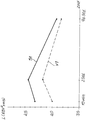
- Volume values for the spunbonded fabric S1 according to the invention and for the comparative nonwoven fabric V1 are shown in the following table: L (dBV 2 rms) in % S1 V1 S1 V1 15 minutes 4.31 3.98 108.2 100 2 hours. 4.42 4.16 106.3 100 96 hours 3.93 3.84 102.2 100
- the single figure shows the volume values TS7 (in dBV 2 rms) of the peak maximum at 6550 Hz as a function of the time of measurement.
- the TS7 value is displayed, which was determined 15 minutes after the filament deposit, and to the right is the TS7 value, which was determined 2 hours after the filament deposit.
- the TS7 value which was determined 4 days or 96 hours after filament storage.
- the solid line characterizes the TS7 values for the spunbonded fabric S1 according to the invention and the dashed line shows the TS7 values for the comparative nonwoven fabric V1.
- the spunbonded fabric S1 according to the invention initially (after 15 minutes and after 2 hours) has a significantly higher volume level and thus a lower degree of softness or higher degree of hardness than the comparative nonwoven fabric V1.
- the comparison fleece however, there is a relatively rapid migration, so that here already relatively high degrees of softness or low degrees of hardness can be achieved.
- the increase in the curve between 15 minutes and 2 hours for both spunbonded fabrics is explained by the first postcrystallization of the polypropylene blend which stiffens the filaments. This shape of the curves may be considered typical of this combination of raw materials.
- the delayed migration of the lubricant to the filament surface in the spunbonded nonwovens according to the invention has the advantage that in the course of the production of the filaments a significantly lower outgassing of lubricants from the filaments takes place and thus the system components are correspondingly less polluted.
- the winding behavior is positively influenced.
- the volume value of the spunbonded fabric according to the invention is more than 3% higher than the volume value of the comparative nonwoven fabric V1 within the first 150 minutes after the filament deposition, and the degree of firmness of the spunbonded fabric S1 according to the invention is correspondingly higher than 3% higher than the degree of hardness of the reference web V1.
- the finished spunbonded fabrics have become softer, independent of any subsequent post-crystallization, which proves the effect and meaning of the lubricant.
- the raw material combination was chosen according to Embodiment 5, but with a lubricant.
- the core used was a homopolypropylene Moplen HP561 R and the sheath used the random CoPP with MFR 30 from Example 5.
- a core-sheath ratio of 70:30 was set and the same calender temperature was used as in the exemplary embodiment 6.
- 2900 ppm of lubricant were metered in only in the core.
- fleece V2 in each case 2,000 ppm of lubricant were added both in the core and in the sheath.
- the deposited spunbonded fabric is softer (lower in TS7 value) than the newly produced spunbonded fabric.
- the following table shows the TS7 relation of spunbonded fabrics S according to the invention to comparative nonwovens V (embodiments 6 and 7) after 15 minutes, 2 hours and 96 hours, and the strength values after production and the basis weights of the spunbonded nonwovens. Strengths and basis weights were determined according to the methods described above, using a peel rate of 200 mm / min for the strength measurement.
Landscapes
- Engineering & Computer Science (AREA)
- Textile Engineering (AREA)
- Chemical & Material Sciences (AREA)
- Chemical Kinetics & Catalysis (AREA)
- General Chemical & Material Sciences (AREA)
- Mechanical Engineering (AREA)
- Manufacturing & Machinery (AREA)
- Nonwoven Fabrics (AREA)
- Multicomponent Fibers (AREA)
- Spinning Methods And Devices For Manufacturing Artificial Fibers (AREA)
- Treatments For Attaching Organic Compounds To Fibrous Goods (AREA)
Abstract
Description
- Die Erfindung betrifft ein Spinnvlies aus Endlosfilamenten aus thermoplastischem Kunststoff, wobei die Endlosfilamente als Mehrkomponentenfilamente, insbesondere als Bikomponentenfilamente mit Kern-Mantel-Konfiguration ausgebildet sind. - Erfindungsgemäß weisen die Spinnvliese Endlosfilamente auf. Solche Endlosfilamente unterscheiden sich aufgrund ihrer quasi endlosen Länge von Stapelfasern, die viel geringere Längen von beispielsweise 10 bis 60 mm aufweisen.
- Spinnvliese der eingangs genannten Art sind aus der Praxis in unterschiedlichen Ausführungsvarianten bekannt. Bei solchen Spinnvliesen ist in der Regel eine hohe Festigkeit bzw. hohe Zugfestigkeit wünschenswert. Für viele Anwendungen sollen die Spinnvliese außerdem einen glatten weichen Griff aufweisen. Ein weicher Griff der Spinnvliese einerseits und eine hohe Festigkeit bzw. Zugfestigkeit der Spinnvliese andererseits ist häufig nicht zufriedenstellend in der Kombination erreichbar. Vor allem lässt sich ein weicher Griff nicht zugleich mit einer hohen Produktivität bzw. Anlagenproduktivität realisieren.
- Spinnvliese aus Polypropylen sind seit langem bekannt und zeichnen sich durch ein gutes Laufverhalten auf der zugehörigen Anlage aus. Insbesondere treten verhältnismäßig wenige Verschmutzungen auf. Allerdings sind diese Spinnvliese nicht besonders weich und die Möglichkeiten zur Verbesserung der Weichheit - beispielsweise durch feinere Fasern - sind begrenzt und oft nicht wirtschaftlich. Der Einsatz eines Gleitmittels zur Erhöhung der Weichheit des Spinnvlieses ist möglich, verändert aber nicht die verhältnismäßig hohe Biegesteifigkeit der Filamente und kann somit kein zufriedenstellendes weiches Spinnvlies ergeben. Die Verwendung eines solchen Gleitmittels hat den Nachteil, dass das Gleitmittel während des Spinnprozesses aus der Filamentschmelze bzw. aus den anfangs heißen Filamenten ausdiffundiert und die Anlage verschmutzt, so dass die Produktivität letztendlich gesenkt wird.
- Zur Verbesserung der Weichheit wurden Polypropylen-Mischungen eingeführt, beispielsweise Mischungen aus Homo-Polypropylen und Copolymeren auf Polypropylen-Basis, wie "Random CoPP". Diese Mischungen ergeben biegeweiche Filamente, die sich allerdings in der Regel durch einen eher stumpfen Griff auszeichnen, was wiederum den Einsatz von zusätzlichen Gleitmittel erfordert. Diese weichen Polypropylen-Mischungen weisen eine nachteilhaft reduzierte Festigkeit auf. Außerdem sind die oben beschriebenen Probleme mit Verschmutzungen hier ebenfalls vorhanden. - Bei Einsatz bestimmter Bikomponentenfilamente mit Kern-Mantel-Konfiguration kann ein Kompromiss aus akzeptabler Weichheit und ausreichender Festigkeit erzielt werden. So verbessert ein Homo-Polypropylen im Kern die Festigkeit und weiche Polypropylen-Mischungen oder der Einsatz von Polypropylen-Copolymerisat im Mantel steigern die Weichheit der Filamente bzw. des Spinnvlieses. Allerdings sind die betreffenden Filamentoberflächen auch relativ stumpf. Das macht den Einsatz eines Gleitmittels erforderlich, der aber wiederum die oben geschilderten Probleme im Zusammenhang mit Verschmutzungen mit sich bringt.
- Bei den hohen Produktionsgeschwindigkeiten moderner Anlagen zur Erzeugung von Spinnvliesen wird mit einer Kombination aus einem sogenannten Jumborollen-Wickler und einer Umroll-Schneidmaschine gearbeitet, da bei diesen hohen Produktionsgeschwindigkeiten nicht mehr direkt aufgewickelt werden kann. Zwischen der Herstellung des Spinnvlieses und der damit einhergehenden Erzeugung der Jumborolle einerseits und dem Zeitpunkt des Umroll-Schneidvorganges andererseits werden die Jumborollen zwischengelagert, wobei dieser Zeitraum durchaus mehrere Stunden dauern kann. In dieser Zeit kann ein eingesetztes Gleitmittel an die Oberfläche der Filamente migrieren, so dass die Filamente bzw. die Spinnvliese glatter werden und sich damit das Umrollverhalten verschlechtert. - Es besteht somit ein Bedürfnis, die Filamente bzw. Spinnvliese bei Einsatz eines Gleitmittels so einzustellen, dass einerseits positive Endeigenschaften gewahrt bleiben, andererseits die Anlage möglichst wenig verschmutzt wird und weiterhin die Produktionsgeschwindigkeit, die Wickelfähigkeit und die Prozesssicherheit optimiert bleiben bzw. optimiert werden können.
- Bei der Herstellung von Spinnvliesen aus Endlosfilamenten ist es grundsätzlich bereits bekannt, weichmachende Additive bzw. Gleitmittel in den thermoplastischen Kunststoff der Filamente einzumischen. Dabei erfolgt gleichsam ein homogenes Einbringen des Gleitmittels in die Filamente. Diese bekannten Maßnahmen haben jedoch den Nachteil, dass die Additive im Zuge der Spinnvlies-Erzeugung aus den Filamenten ausdampfen können und die Anlage verschmutzen bzw. sich insbesondere in den luftführenden Komponenten der Anlage niederschlagen. Diese negativen Effekte sind natürlich unerwünscht.
- Demgegenüber liegt der Erfindung das technische Problem zugrunde, ein Spinnvlies der eingangs genannten Art anzugeben, dass sich sowohl durch einen glatten weichen Griff als auch durch eine ausreichende Festigkeit auszeichnet, das einfach und effizient herstellbar ist und bei dem vor allem ein Ausdampfen weichmachender Additive bzw. ein Ausdampfen von Gleitmitteln weitgehend vermieden werden kann.
- Zur Lösung des technischen Problems lehrt die Erfindung gemäß einer ersten Ausführungsform ein Spinnvlies aus Endlosfilamenten aus thermoplastischem Kunststoff, wobei die Endlosfilamente als Mehrkomponentenfilamente, insbesondere als Bikomponentenfilamente, mit Kern-Mantel-Konfiguration ausgebildet sind, wobei die Filamente zumindest ein Gleitmittel enthalten, wobei der Anteil des Gleitmittels - bezogen auf das gesamte Filament - 250 bis 5500 ppm, vorzugsweise 500 bis 5000 ppm, bevorzugt 700 bis 3000 ppm und besonders bevorzugt 700 bis 2500 ppm beträgt und wobei in der Mantelkomponente weiterhin zumindest ein die Migrationsgeschwindigkeit des Gleitmittels durch die Mantelkomponente reduzierender Zusatzstoff enthalten ist.
- Außerdem lehrt die Erfindung zur Lösung des technischen Problems gemäß einer zweiten Ausführungsform ein Spinnvlies aus Endlosfilamenten aus thermoplastischem Kunststoff, wobei die Endlosfilamente als Mehrkomponentenfilamente, insbesondere als Bikomponentenfilamente, mit Kern-Mantel-Konfiguration ausgebildet sind, wobei die Filamente zumindest ein Gleitmittel enthalten, wobei der Anteil des Gleitmittels - bezogen auf das gesamte Filament - 250 bis 5500 ppm, vorzugsweise 500 bis 5000 ppm, bevorzugt 700 bis 3000 ppm und sehr bevorzugt 700 bis 2500 ppm beträgt, wobei das Gleitmittel bevorzugt in der Mantelkomponente vorhanden ist, wobei in der Mantelkomponente zumindest ein die Migrationsgeschwindigkeit des Gleitmittels durch die Mantelkomponente reduzierender Zusatzstoff enthalten ist, wobei die Oberfläche des Spinnvlieses im Zeitraum bis 150 Minuten nach der Spinnvlies-Erzeugung härter ist, insbesondere um mehr als 3 %, vorzugsweise um mindestens 3,2 %, bevorzugt um mindestens 3,3 % und insbesondere um mindestens 3,5 % härter ist als die Oberfläche ein ansonsten unter gleichen Bedingungen hergestellten Vergleichs-Spinnvlieses ohne einen die Migrationsgeschwindigkeit des Gleitmittels reduzierenden Zusatzstoff und wobei die Oberfläche des Spinnvlieses 96 Stunden nach der Spinnvlies-Erzeugung einen gleichen Härtegrad bzw. Weichheitsgrad oder einen in etwa gleichen Härtegrad bzw. Weichheitsgrad aufweist wie das Vergleichs-Spinnvlies, wobei sich die Weichheitsgrade dann bevorzugt um maximal 3 %, vorzugsweise um maximal 2,9 % und insbesondere um maximal 2,8 % unterscheiden. Dass im Rahmen der zweiten Ausführungsform die Oberfläche des Spinnvlieses im Zeitraum bis 150 Minuten nach der Spinnvlies-Erzeugung um mehr als 3 %, etc. härter ist als die Oberfläche eines Vergleichs-Spinnvlieses meint insbesondere, dass es innerhalb der ersten 150 Minuten nach der Spinnvlies-Erzeugung zumindest einen Zeitpunkt gibt, bei dem diese Toleranzgrenze überschritten wird. Je nach Rohstoffwahl und je nach Gleitmittel bzw. Gleitmittelanteil kann es beispielsweise 120 Minuten dauern bis die Toleranzgrenze überschritten ist. Bei anderen Bedingungen kann aber auch nach 15 Minuten bereits die Toleranzgrenze überschritten sein oder die Überschreitung der Toleranzgrenze ist über den gesamten Zeitraum bzw. im Wesentlichen über den gesamten Zeitraum gegeben. Dabei sind beispielsweise die Migrationsgeschwindigkeiten je nach Mantelrohstoff bzw. je nach Mantelanteil des Filamentes relevant.
- Der hier gewählte Zeitraum bis 150 min. ist einerseits an das unten beschriebene eingesetzte Messgerät angepasst und im Übrigen werden damit auch typische Zeiten berücksichtigt, ab denen die Jumborollen umgerollt werden können. Eine Härtemessung direkt im Zuge des Spinnens ist mit dem gewählten Verfahren nicht möglich. Es liegt im Rahmen der Erfindung, dass eine solche Messung ca. 15 min. dauert und deshalb auch nicht kontinuierlich ablaufen kann. Der genannte Zeitraum kann aber auch nicht zu lange gewählt werden, damit er noch als Entscheidungshilfe während der Produktion dienen kann. Insgesamt ermöglicht dieser Zeitraum die Entscheidung bezüglich des Spinnverhaltens (Anlagensauberkeit) und des Wickelverhaltens.
- Zweckmäßigerweise beträgt das Massenverhältnis zwischen der Kernkomponente und der Mantelkomponente 40:60 bis 90:10, vorzugsweise 60:40 bis 85:15, insbesondere 65:35 bis 80:20, bevorzugt 65:35 bis 75:25 und sehr bevorzugt 67:33 bis 73:27.
- Es liegt im Rahmen der Erfindung, dass der Härtegrad des Spinnvlieses (siehe insbesondere Patentanspruch 2) an der Vliesoberfläche mittels eines TSA-Messgerätes (der Firma Emtec, Leipzig, Deutschland) als die Lautstärke bei dem Peakmaximum des Lautstärke/ Frequenz-Spektrums bei etwa 6550 Hz bestimmt wird. Dieses TSA-Messgerät gibt die Produkteigenschaft als "TS7"-Wert aus. Der TS7-Wert korreliert mit der Weichheit des Vlieses. Ein Spinnvlies aus rauen/stumpfen Filamenten weist einen höheren TS7-Wert auf als ein vergleichbares Spinnvlies aus glatteren/weicheren Filamenten. - Erfindungsgemäß erfolgt die Messung des Härtegrades bzw. der Lautstärke in dem Zeitraum bis 150 Minuten nach der Spinnvlies-Erzeugung an der Oberfläche des Spinnvlieses. Mit dem Begriff Spinnvlies-Erzeugung ist dabei die Ablage der Filamente nach ihrem Erspinnen auf der Ablage bzw. auf dem Ablagesiebband gemeint. Die Messung erfolgt also in dem Zeitraum bis 150 Minuten nach dieser Ablage der Filamente auf der Ablage bzw. auf dem Ablagesiebband. Es liegt im Rahmen der Erfindung, dass diese Messung nach allen Vorverfestigungs- und/oder Verfestigungsmaßnahmen erfolgt, die an dem Vlies - insbesondere auf der Ablage bzw. auf dem Ablagesiebband - durchgeführt werden. Dabei handelt es sich insbesondere auch um eine Verfestigung mittels eines Kalanders mit einer Gravurwalze. Die Messung des Härtegrades erfolgt also nach diesen Verfestigungen, jedoch mit der Maßgabe, dass sie in einem Zeitraum bis 150 Minuten nach der Ablage der Filamente auf der Ablage bzw. auf dem Ablagesiebband durchgeführt wird. Zweckmäßigerweise erfolgt die Messung des Härtegrades vor dem Aufwickeln des Spinnvlieses auf einer Rolle oder nach Aufwickeln des Spinnvlieses auf einer Rolle aber immer mit der Maßgabe, dass diese Messung in einem Zeitraum bis 150 Minuten nach der Filamentablage durchgeführt wird.
- Es liegt im Rahmen der Erfindung, dass der Härtegrad mit einem handelsüblichen Messgerät TSA (Tissue Softness Analyzer) der Firma Emtec, Leipzig, Deutschland gemessen wird. Es wird dabei bevorzugt das folgende Standardverfahren durchgeführt:
- Einspannen eines Teststückes des zu analysierenden Vlieses,
- Absenken des mit 8 Platten bestückten Standard-Rotors auf die Vliesoberfläche. Bei einer Kraft von 100 mN des Rotors auf die Vliesprobe dreht der Rotor mit einer Geschwindigkeit von 2/sec.
- Durch diese Rotation wird die Vliesprobe bzw. der Rotor zu Schwingungen/Geräuschen angeregt und ein Mikrofon zeichnet diese Reaktion auf. Die gemessenen Geräusche werden mittels FourierTransformation in ein Schallfrequenzspektrum umgewandelt.
- Die Lautstärke des lokalen Lautstärkemaximums im Bereich um etwa 6550 Hz wird als "TS7" von dem Messgerät ausgegeben.
- Dieses Schallfrequenzspektrum ist abhängig von der Gesamtstruktur der Vliesoberfläche und die Amplitude der Lautstärke ist unter anderem abhängig von der Höhe der Vliesstruktur als auch von dem Härtegrad der Vliesoberfläche bzw. der Filamentoberflächen. Hierbei werden Eigenschaften wie Oberflächentopologie im Bereich unter 1000 Hz deutlich und die Weichheit im Bereich um 6550 Hz. Der TS7-Wert wird als charakteristischer Messwert des Härtegrades im Rahmen der Erfindung verwendet. Die im Patentanspruch 2 aufgeführten prozentualen Angaben zu Unterschieden im Härtegrad beziehen sich also auf diesen Wert. Zweckmäßigerweise wird die Lautstärke bzw. der Härtegrad des Vergleichsvlieses gleich 100 % gesetzt und es wird in Bezug auf die Lautstärke bzw. den Härtegrad des erfindungsgemäßen Spinnvlieses die prozentuale Abweichung bestimmt. - Eine Beschreibung eines solchen Messverfahrens für den Härtegrad bzw. für den Weichheitsgrad findet sich im Übrigen in "Schloßer U., Bahners T., Schollmeyer E., Gutmann J.: Griffbeurteilung von Textilien mittels Schallanalyse, Melliand Textilberichte 1/2012, 43 bis 45".
- Im Rahmen der Herstellung des erfindungsgemäßen Spinnvlieses werden die Filamente vorzugsweise auf einer Ablage, insbesondere auf einem Ablagesiebband, abgelegt. Es liegt im Rahmen der Erfindung, dass die Messung des Härtegrades an der Oberfläche des Spinnvlieses erfolgt, die von der Ablage bzw. vom Ablagesiebband abgewandt ist. Wenn die Vliesbahn bzw. das Spinnvlies mittels eines Kalanders mit Gravurwalze verfestigt wird, erfolgt die Messung des Härtegrades zweckmäßigerweise an der Oberfläche des Spinnvlieses, die der Gravurwalze zugewandt ist und vorzugsweise handelt es sich dabei um die Oberfläche des Spinnvlieses, die von der Ablage bzw. von dem Ablagesiebband abgewandt ist. Es liegt im Rahmen der Erfindung, dass das erfindungsgemäße Spinnvlies einerseits und das Vergleichsvlies andererseits unter gleichen Bedingungen hergestellt werden, insbesondere mit der gleichen Anlage bzw. Spunbond-Anlage hergestellt werden und auf der gleichen Ablage bzw. dem gleichen Ablagesiebband abgelegt werden. Weiterhin liegt es im Rahmen der Erfindung, dass das Spinnvlies zum einen und das Vergleichsvlies zum anderen auf gleiche Weise verfestigt werden, insbesondere mit dem gleichen Kalander oder dergleichen verfestigt werden und dass die Filamente des Spinnvlieses einerseits und des Vergleichsvlieses andererseits den gleichen Titer aufweisen.
- Für alle Ausführungsformen (erste und zweite Ausführungsform) gelten die folgenden Maßgaben:
- In der Kernkomponente und/oder in der Mantelkomponente können Rohstoffmischungen eingesetzt werden, die bevorzugt jeweils kompatibel sind. Kern-Mantel-Konfiguration meint im Rahmen der Erfindung, dass die Mantelkomponente die Kernkomponente vollständig bzw. im Wesentlichen vollständig umgibt. - Die Endlosfilamente des Spinnvlieses haben für alle Ausführungsformen der Erfindung vorzugsweise einen Titer von 1,0 bis 2,5 denier und besonders bevorzugt einen Titer von 1,2 bis 2,2 denier.
- Es liegt im Rahmen der Erfindung - insbesondere im Rahmen der zweiten Ausführungsform -, dass es sich bei der Kern-Mantel-Konfiguration um eine exzentrische Kern-Mantel-Konfiguration handeln kann. Vorzugsweise ergibt sich dann durch geeignete Wahl der Rohstoffe bzw. der Kunststoffkomponenten ein spiral-gekräuseltes Filament.
- Empfohlenermaßen weist im Rahmen der ersten und der zweiten Ausführungsform die Kernkomponente und/oder die Mantelkomponente zumindest 90 Gew.-%, vorzugsweise zumindest 95 Gew.-% und bevorzugt zumindest 96 Gew.-% zumindest einer Komponente aus der Gruppe "Polyolefin, Polyolefin-Copolymerisat, Mischung aus Polyolefin und Polyolefin-Copolymerisat" auf. Besonders bevorzugt ist dabei, dass die Kernkomponente und/oder die Mantelkomponente zumindest 90 Gew.-%, vorzugsweise zumindest 95 Gew.-%, und bevorzugt zumindest 96 Gew.-% zumindest einer Komponente aus der Gruppe "Polypropylen, Polypropylen-Copolymerisat, Mischung aus Polypropylen und Polypropylen-Copolymerisat" aufweist. - Zweckmäßigerweise besteht/bestehen die Kernkomponente und/oder die Mantelkomponente im Wesentlichen aus einem Polyolefin und/oder im Wesentlichen aus einem Polyolefin-Copolymerisat und/oder im Wesentlichen aus einer Mischung aus Polyolefin und Polyolefin-Copolymerisat. Nach sehr empfohlener Ausführungsvariante der ersten und zweiten Ausführungsform besteht/bestehen die Kernkomponente und/oder die Mantelkomponente im Wesentlichen aus einem Polypropylen und/oder im Wesentlichen aus einem Polypropylen-Copolymerisat und/oder im Wesentlichen aus einer Mischung aus einem Polypropylen und einem Polypropylen-Copolymerisat. Die Einschränkung "im Wesentlichen" in den vorstehend beschriebenen Ausführungsvarianten trägt dem Umstand Rechnung, dass in der Kernkomponente und/oder Mantelkomponente Additive, insbesondere das Gleitmittel und gegebenenfalls ein die Migrationsgeschwindigkeit des Gleitmittels reduzierender Zusatzstoff, enthalten ist/sind. Vorzugsweise beträgt der Anteil der Additive (Gleitmittel, gegebenenfalls die Migrationsgeschwindigkeit des Gleitmittels reduzierender Zusatzstoff sowie eventuelle andere Additive, wie beispielsweise Farbadditive) - bezogen auf das gesamte Filament - maximal 10 Gew.-%, zweckmäßigerweise maximal 8 Gew.-%, bevorzugt maximal 6 Gew.-% und sehr bevorzugt maximal 5 Gew.-%. - Das im Rahmen der Erfindung eingesetzte Polypropylen-Copolymerisat ist im Übrigen gemäß einer zweckmäßigen Ausgestaltung als Ethylen-Propylen-Copolymerisat ausgeführt. Empfohlenermaßen weist das eingesetzte Ethylen-Propylen-Copolymerisat einen Ethylen-Anteil von 1 bis 6 %, bevorzugt von 2 bis 6 % auf. Es empfiehlt sich, dass das bevorzugt eingesetzte Polypropylen-Copolymerisat eine Schmelzflussrate (MFI) von 19 bis 70 g/min, insbesondere von 20 bis 70 g/min, vorzugsweise von 25 bis 50 g/min aufweist. Es hat sich bewährt, dass das Polypropylen-Coplymerisat eine Molekulargewichtsverteilung bzw. Molmassenverteilung (Mw/Mn) von 2,5 bis 6, bevorzugt von 3 bis 5,5 und sehr bevorzugt von 3,5 bis 5 aufweist.
- Eine empfohlene Ausführungsvariante der ersten und der zweiten Ausführungsform der Erfindung ist dadurch gekennzeichnet, dass die Kernkomponente im Wesentlichen aus einem Homo-Polyolefin, insbesondere im Wesentlichen aus einem Homo-Polypropylen besteht. Es hat sich bewährt, dass die Kernkomponente zumindest 80 Gew.-%, vorzugsweise zumindest 85 Gew.-%, bevorzugt zumindest 90 Gew.-% und besonders bevorzugt zumindest 95 Gew.-% des Homo-Polyolefins, insbesondere des Homo-Polypropylens aufweist. - Eine empfohlene Ausführungsform der ersten und der zweiten Ausführungsform zeichnet sich weiterhin dadurch aus, dass die Mantelkomponente im Wesentlichen aus einem Polyolefin-Copolymerisat, insbesondere im Wesentlichen aus einem Polypropylen-Copolymerisat und/oder im Wesentlichen aus einer Mischung eines Polyolefins bzw. Homo-Polyolefins mit einem Polyolefin-Copolymerisat, insbesondere im Wesentlichen aus einer Mischung eines Polypropylens bzw. Homo-Polypropylens mit einem Polypropylen-Copolymerisat besteht.
- Sowohl bei der ersten als auch bei der zweiten Ausführungsform der Erfindung werden vorzugsweise die nachfolgend spezifizierten Substanzen als Gleitmittel eingesetzt. Zweckmäßigerweise wird als Gleitmittel zumindest ein Fettsäurederivat und bevorzugt zumindest eine Substanz aus der Gruppe "Fettsäureester, Fettsäurealkohol, Fettsäureamid" verwendet. Eine empfohlene Ausführungsvariante der Erfindung zeichnet sich dadurch aus, dass als Gleitmittel zumindest ein Stearat - insbesondere Glycerin-Monostearat - und/oder ein Fettsäureamid wie z. B. Erucasäureamid und/oder ein Ölsäureamid eingesetzt. Beispielsweise ist auch der Einsatz von Distearylethylendiamid möglich. Als Gleitmittel-Masterbatch wird gemäß einer bewährten Ausführungsvariante das Erucasäureamid-Produkt SL05068PP der Firma Constab verwendet.
- Die Schmelzflussrate (MFI) wird im Rahmen der Erfindung insbesondere nach ISO 1133 gemessen und zwar für Polypropylen und Polypropylen-Copolymerisat bei 230°C und 2,16 kg. Das Polyolefin-Copolymerisats bzw. das Polypropylen-Copolymerisats weist vorzugsweise einen Ethylen-Anteil von 2 bis 20 %, bevorzugt von 4 bis 20 % auf. Das Polyolefin-Copolymerisat bzw. das Polypropylen-Copolymerisat dieser Ausführungsvariante zeichnet sich bevorzugt bezüglich der Kohlenstoffatome durch einen mittleren C2-Anteil im Bereich von 2 bis 6 % aus. Vorzugsweise werden als Polypropylen-Copolymerisat Exxon Vistamaxx 3588 und/oder Exxon Vistamaxx 6202 oder ein Polypropylen mit ähnlichen Eigenschaften eingesetzt. Das Polypropylen-Copolymerisat wird entsprechend den obigen Angaben mit dem Homo-Polyolefin bzw. Homo-Polypropylen für die Mantelkomponente gemischt. Bevorzugte Angaben für das Homo-Polypropylen sind weiter unten noch aufgeführt.
- Im Zuge der Herstellung des erfindungsgemäßen Spinnvlieses kann im Hinblick auf den eingesetzten thermoplastischen Kunststoff mit einer Recyclat-Rückführung gearbeitet werden. Dabei wird zweckmäßigerweise der Recyclat-Strom ausschließlich oder vornehmlich für die Kernkomponente eingesetzt. Ein mit Gleitmittel beladenes zurückgeführtes Recyclat wird dann nur in die Kernkomponente zurückgeführt und es wird gewährleistet, dass die Mantelkomponente gleitmittelfrei bzw. im Wesentlichen gleitmittelfrei bleibt. - Bei einer Recyclat- Rückführung mit Copolymerisat-Anteilen im Recyclat-Strom wird dann Copolymerisat auch in die Kernkomponente überführt. Nichtsdestoweniger bleibt der Mantel gleitmittelfrei bzw. im Wesentlichen gleitmittelfrei.
- Eine Ausführungsvariante der ersten Ausführungsform der Erfindung zeichnet sich dadurch aus, dass das Gleitmittel in der Mantelkomponente vorhanden ist und gemäß einer Ausgestaltung der Erfindung lediglich in der Mantelkomponente enthalten ist. Grundsätzlich kann bei der ersten Ausführungsform der Erfindung Gleitmittel aber auch in oder auch nur in der Kernkomponente vorhanden sein. - Gemäß der zweiten Ausführungsvariante ist Gleitmittel in der Mantelkomponente vorzugsweise vorhanden. Dabei kann nach einer Ausgestaltung das Gleitmittel lediglich in der Mantelkomponente enthalten sein. Prinzipiell kann bei dieser zweiten Ausführungsform Gleitmittel aber auch in der Kernkomponente vorhanden sein.
- Die Kernkomponente kann aus einem Homo-Polyolefin und insbesondere aus einem Homo-Polypropylen bestehen bzw. im Wesentlichen bestehen. Nach einer anderen Ausführungsvariante weist die Kernkomponente zumindest 75 Gew.-%, vorzugsweise zumindest 80 Gew.-%, bevorzugt zumindest 85 Gew.-% und besonders bevorzugt zumindest 90 Gew.-% des Homo-Polyolefins, insbesondere des Homo-Polypropylens auf.
- Eine empfohlene Ausführungsvariante der Erfindung ist dadurch gekennzeichnet, dass die Mantelkomponente bzw. die das Gleitmittel enthaltende Mantelkomponente aus einem Polyolefin-Copolymerisat, insbesondere aus einem Polypropylen-Copolymerisat besteht bzw. im Wesentlichen besteht. Dabei ist zu berücksichtigen, dass in der Mantelkomponente das Gleitmittel enthalten sein kann bzw. enthalten ist und (zusätzlich) der die Migrationsgeschwindigkeit des Gleitmittels reduzierende Zusatzstoff enthalten ist. Bei der zweiten Ausführungsform wird bevorzugt ein Polyolefin-Copolymerisat bzw. ein Polypropylen-Copolymerisat für die Mantelkomponente gewählt, das eine Schmelzflussrate (MFI) von 20 bis 70 g/10 min, vorzugsweise von 25 bis 50 g/10 min aufweist. Zweckmäßigerweise wird ein Ethylen-Propylen- Copolymerisat mit einem Ethylen-Anteil von 1 bis 6 %, bevorzugt von 2 bis 6 % eingesetzt. Empfohlenermaßen zeichnet sich das für die Mantelkomponente gewählte Polyolefin-Copolymerisat bzw. Polypropylen-Copolymerisat durch eine enge Molmassenverteilung aus und vorzugweise durch eine Molekulargewichtsverteilung bzw. Molmassenverteilung (Mw/Mn) von 2,5 bis 6, bevorzugt von 3 bis 5,5 und sehr bevorzugt von 3,5 bis 5. Die Molekulargewichtsverteilung Mw/Mn wird im Rahmen der Erfindung nach der Gel-Permeations-Chromatographie (GPC) und zwar entsprechend ISO 16014-1:2003, ISO 16014-2:2003, ISO 16014-4:2003 und ASTM D 6474-12. - Empfohlenermaßen wird ein ein Nukleierungsmittel aufweisendes oder sonst wie für eine hohe Kristallisationsgeschwindigkeit modifiziertes Random-Polypropylen-Copolymerisat eingesetzt, wie beispielsweise Borealis RJ377MO oder Basell Moplen RP24R. Dieses letztgenannte Random-Polypropylen-Copolymerisat weist z. B. eine Schmelzflussrate von 30 g/10 min und eine Vicat-Temperatur von 120°C (ISO 306/A50, 10 N) auf.
- Im Rahmen der Erfindung wird in der Mantelkomponente der Endlosfilamente zumindest ein die Migrationsgeschwindigkeit des Gleitmittels reduzierender Zusatzstoff eingesetzt. Bei diesem Zusatzstoff handelt es sich um zumindest ein Nukleierungsmittel und/oder um zumindest einen Füllstoff. Nach besonders bevorzugter Ausführungsform der Erfindung wird zumindest ein Nukleierungsmittel eingesetzt. Zweckmäßigerweise ist das Nukleierungsmittel mit einem Anteil von 500 bis 2500 ppm - bezogen auf das gesamte Filament - in den Filamenten enthalten. Dabei hat es sich besonders bewährt ein Nukleierungsmittel aus der Gruppe "Aromatische Carbonsäure, Salz einer aromatischen Carbonsäure, Sorbit-Derivat, Talkum, Kaolin, Chinacridon, Pimelinsäure-Salz, Suberinsäure-Salz, Dicyclohexyl-naphthalendicarboxamid, Organophosphat, Triphenyl-Verbindung, Triphenyldithiazin" verwendet. Als Nukleierungsmittel kann ein Sorbitol wie das Dibenzyl-Sorbitol (DBS) bzw. 1,3:2,4-bis-(p-methylbenzylidene) Sorbitol (MDBS) bzw. das 1,3:2,4-bis-(3,4-Dimethyl-benzylidene) Sorbitol (DMDBS) eingesetzt werden. Ein bevorzugtes Nukleierungsmittel ist ein Salz einer aromatischen Carbonsäure, insbesondere ein Alkalisalz der Benzoesäure und beispielsweise Natriumbenzoat.
- Durch die Nukleierung der Mantelkomponente, insbesondere des Polyolefin-Copolymerisates bzw. des Polypropylen-Copolymerisates der Mantelkomponente mit zumindest einem Nukleierungsmittel wird die Migrationsgeschwindigkeit des Gleitmittels im Mantel gesenkt und somit im Hinblick auf die Lösung des technischen Problems der problemlose Einsatz von Gleitmitteln in der Mantelkomponente ermöglicht. - Auch zumindest ein Füllstoff in der Mantelkomponente kann die Migrationsgeschwindigkeit des Gleitmittels reduzieren. Dabei wird als Füllstoff vorzugsweise zumindest ein Metallsalz und besonders bevorzugt zumindest eine Substanz aus der Gruppe "Titandioxid", Calciumcarbonat, Talkum" eingesetzt.
- Im Rahmen der Erfindung können als Polypropylen-Copolymerisate für die Mantelkomponente zweckmäßigerweise Random-Polypropylen-Copolymerisate mit enger Molmassenverteilung eingesetzt werden. Hier kommen insbesondere auch Polypropylen-Copolymerisate in Frage, die aus dem Spritzguss-Sektor bekannt sind und oft Antistatika und Nukleierungsmittel enthalten. Solche Antistatika (z. B. Fettsäureester wie beispielsweise Glycerin Monostearat oder auch ethoxylierte Fettamine bzw. Alkylamine) können oftmals als Gleitmittel bereits ausreichen und würden unter die erfindungsgemäß beanspruchte Gleitmittelmenge fallen. - Optional kann in die Kernkomponente und/oder Mantelkomponente zusätzliches Gleitmittel zudosiert werden, wenn der bereits vorhandene Anteil aus dem Copolymerisat nicht ausreicht. Das Copolymerisat der Mantelkomponente kann mit Homo-Polypropylen abgemischt werden. Es liegt im Rahmen der Erfindung, dass die Viskosität dieser Mischungen geringer als die Viskosität eines Homo-Polypropylens. Wenn ein Homo-Polypropylen eingesetzt wird, so handelt es sich dabei vorzugsweise um ein Homo-Polypropylen mit den folgenden Eigenschaften. Die Schmelzflussrate (MFI) beträgt zweckmäßigerweise 17 bis 37g/10min, bevorzugt 19 bis 35g/10min. Das Homo-Polypropylen weist empfohlenermaßen eine enge Molmassenverteilung im Bereich von 3,6 bis 5,2, insbesondere im Bereich von 3,8 bis 5 auf. Die Messung der Molmassenverteilung wurde weiter oben bereits spezifiziert. Nach bevorzugter Ausführungsform der Erfindung wird als Homo-Polypropylen zumindest eines der folgenden Produkte eingesetzt: Borealis HF420FB (MFI19), HG455FB (MFI25), HG475FB (MFI25), Basell Moplen HP561R (MFI25) und Exxon 3155 PP (MFI35).
- Nach ganz besonders empfohlener Ausführungsform der Erfindung wird sowohl für die Kernkomponente als auch für die Mantelkomponente Homo-Polypropylen und/oder Polypropylen-Copolymerisat, insbesondere Ethylen-Propylen-Copolymerisat und/oder Mischungen davon eingesetzt. Die PP-Materialien haben sich im Rahmen der Erfindung ganz besonders bewährt.
- Es liegt im Rahmen der Erfindung, dass ein erfindungsgemäßes Spinnvlies mit einem Spunbond-Verfahren hergestellt wird. Dabei werden zunächst Mehrkomponentenfilamente bzw. Bikomponentenfilamente mit Kern-Mantel-Konfiguration als Endlosfilamente mittels zumindest einer Spinnerette ersponnen und anschließend werden diese Endlosfilamente in zumindest einer Kühleinrichtung gekühlt und daraufhin durchlaufen die Endlosfilamente eine Verstreckeinrichtung zum Verstrecken der Filamente. Die verstreckten Filamente werden auf einer Ablage, insbesondere auf einem Ablagesiebband als Spinnvlies abgelegt.
- Eine besonders empfohlene Ausführungsform der Erfindung ist in diesem Zusammenhang dadurch gekennzeichnet, dass das Aggregat aus der Kühleinrichtung und der Verstreckeinrichtung als geschlossenes Aggregat ausgebildet ist, wobei außer der Zufuhr der Kühlluft in der Kühleinrichtung keine weitere Luftzufuhr in das geschlossene Aggregat stattfindet. Diese geschlossene Ausführung hat sich im Rahmen der Erfindung bei der Herstellung eines erfindungsgemäßen Spinnvlieses besonders bewährt.
- Zweckmäßigerweise ist zwischen der Verstreckeinrichtung und der Ablage bzw. dem Ablagesiebband zumindest ein Diffusor angeordnet. Die aus der Verstreckeinrichtung austretenden Endlosfilamente werden durch diesen Diffusor hindurchgeführt und dann auf der Ablage bzw. auf dem Ablagesiebband abgelegt. Eine empfohlene Ausführungsvariante der Erfindung zeichnet sich dadurch aus, dass zwischen der Verstreckeinrichtung und der Ablage zumindest zwei Diffusoren, bevorzugt zwei Diffusoren in Filamentströmungsrichtung hintereinander angeordnet sind. Zweckmäßigerweise ist zwischen den beiden Diffusoren zumindest ein Sekundärlufteintrittsspalt für den Eintritt von Umgebungsluft vorhanden. Die Ausführungsform mit dem zumindest einen Diffusor bzw. mit den zumindest zwei Diffusoren und dem Sekundärlufteintrittsspalt hat sich ebenfalls im Hinblick auf die Herstellung der erfindungsgemäßen Spinnvliese besonders bewährt.
- Nach der Ablage der Filamente zum Spinnvlies wird dieses Spinnvlies verfestigt, nach bevorzugter Ausführungsform vorverfestigt und anschließend endverfestigt. Die Vorverfestigung bzw. Verfestigung des Spinnvlieses erfolgt zweckmäßigerweise mit zumindest einem Kalander. Dabei werden bevorzugt zwei miteinander wechselwirkende Kalanderwalzen eingesetzt. Nach einer empfohlenen Ausführungsform ist zumindest eine dieser Kalanderwalzen beheizt ausgeführt. Die Prägefläche des Kalanders beträgt zweckmäßigerweise 8 bis 20 %, beispielsweise 12 %. - Wenn im Rahmen der Erfindung der Weichheitsgrad bei einem erfindungsgemäßen Spinnvlies einerseits und bei einem Vergleichsvlies andererseits ermittelt wird, erfolgt bei beiden Vliesen die gleiche Vorverfestigung bzw. Verfestigung des Spinnvlieses.
- Der Erfindung liegt die Erkenntnis zugrunde, dass die erfindungsgemäßen Spinnvliese einen optimalen glatten weichen Griff und nichtsdestoweniger eine hohe Festigkeit aufweisen. Es resultieren weiche Spinnvliese mit guter Zugfestigkeit. Das gilt vor allem für den bevorzugten Einsatz der Polypropylene bzw. Polypropylen-Copolymerisate für die Kernkomponente und/oder Mantelkomponente der Endlosfilamente des erfindungsgemäßen Spinnvlieses. Wesentlich ist weiterhin, dass gegenüber bekannten Lösungen das Ausdampfen von Gleitmittel aus den Filamenten effektiv reduziert werden kann und dadurch werden unerwünschte Abscheidungen in der Anlage vermieden. Somit kann die Sauberkeit der Anlage gegenüber den bekannten Maßnahmen erhöht werden und dadurch auch die Effizienz und Verfügbarkeit der Anlage gesteigert werden. Insbesondere kann die Anlagenlaufzeit erhöht werden. Der Erfindung liegt insoweit auch die Erkenntnis zugrunde, dass ein inhomogenes Einbringen des Gleitmittels in die Filamente zur Lösung des erfindungsgemäßen technischen Problems effektiv beiträgt. - Wie mit den nachfolgenden Ausführungsbeispielen noch belegt wird, kann im Vergleich zu den aus der Praxis bekannten Maßnahmen bei der Erzeugung der erfindungsgemäßen Spinnvliese und insbesondere bei der Verfestigung der Spinnvliese bei geringerem Energieaufwand - insbesondere bei geringeren Kalandertemperaturen - eine vergleichbare Festigkeit der Vliese erreicht werden. Aufgrund der erfindungsgemäß erreichten hohen Festigkeit der Spinnvliese kann bei der Herstellung der Endlosfilamente auch Material eingespart werden, insbesondere im Vergleich zu anderen Rohstoffkombinationen, wie beispielsweise PP/PE. Weiterhin kann bei der Herstellung der erfindungsgemäßen Spinnvliese eine einfache Recyclierung der Komponenten in den Herstellungsprozess erfolgen. Aufgrund der Kompatibilität der verwendeten Rohstoffe ist eine problemlose Rückführung von Recyclat mit hohen Anteilen möglich. Auch dadurch ergibt sich ein erheblicher Kostenvorteil gegenüber z. B. einer PP/PE-Kombination. Im Ergebnis resultieren weiche, glatte und zugfeste Spinnvliese, die mit verhältnismäßig geringen Kosten realisiert werden können.
- Es wird die Erfindung anhand von Ausführungsbeispielen näher erläutert:
- Nachfolgend wurden Spinnvliese aus Bikomponentenfilamenten mit Kern-Mantel-Konfiguration nach dem oben beschriebenen Spunbond-Verfahren hergestellt. Als Material für die beiden Komponenten (Kern und Mantel) kamen dabei Homo-Polypropylene und Polypropylen-Copolymerisate zum Einsatz. Das auf dem Ablagesiebband abgelegte Spinnvlies wurde bei allen Ausführungsbeispielen mit einem Kalander verfestigt, der eine Gravur U5714A aufwies (12 % Prägefläche, runde Gravurpunkte, 25 Fig/cm2). Die Feinheit der Filamente aller Beispiele betrug ca. 1,6 bis 1,8 denier. Alle Muster wurden mit einem Spinnsystem bei gleichen bzw. ähnlichen Durchsätzen produziert.
- Es wurden Monokomponentenfilamente aus Homo-Polypropylen (Borealis HG455FB mit MFI25) hergestellt. Die Kalandrierung erfolgte bei einer Oberflächentemperatur der Kalanderwalzen von ca. 148°C. Das erzeugte Spinnvlies hat eine gute Festigkeit, im Vergleich zu den nachfolgenden Ausführungsbeispielen aber keinen zufriedenstellenden weichen Griff.
- Ein Spinnvlies aus Bikomponentenfilamenten wurde erzeugt, wobei sowohl die Kernkomponente als auch die Mantelkomponente aus Homo-Polypropylen (Borealis HG455FB mit MFI25) mit 8 % eines Polypropylens der Firma Idemitsu "L-MODU X901S" als weichem Zusatz-Polypropylen bestanden. Das Massenverhältnis zwischen der Kernkomponente und der Mantelkomponente betrug 70:30. Ausschließlich im Kern war das Gleitmittel SL05068PP der Firma Constab auf Basis von Erucasäureamid enthalten. Der Gehalt des Gleitmittels betrug in Bezug auf das gesamte Filament 2000 ppm. Das Spinnvlies wurde bei einer Oberflächentemperatur der Kalanderwalzen von etwa 142°C kalandriert. Das aus diesen Endlosfilamenten erzeugte Spinnvlies wies nach einem Tag Ablagerzeit einen glatten weichen Griff auf.
- Die Bikomponentenfilamente dieses Spinnvlieses enthielten sowohl in der Kernkomponente als auch in der Mantelkomponente Homo-Polypropylen (Basell Moplen HP561 R mit MFI25) mit 10 Gew.-% eines weichen Zusatz-Co-Polypropylens (Exxon Vistamaxx VM 6202). Das Massenverhältnis zwischen der Kernkomponente und der Mantelkomponente betrug auch hier 70:30. Als Gleitmittel wurde wiederum SL05068PP der Firma Constab auf Basis von Erucasäureamid eingesetzt. Dieses Gleitmittel war nur im Kern enthalten und der Gehalt an dem Gleitmittel betrug 2500 ppm, bezogen auf das gesamte Filament. Die Kalandrierung des Spinnvlieses erfolgte bei einer Oberflächentemperatur der Kalanderwalzen von 132°C. Der Griff des erzeugten Filamentes musste anfangs als stumpf eingestuft werden, nach einem Tag Ablagerzeit stellte sich ein glatter weicher Griff ein. Dies zeigt die verzögerte Migration des Gleitmittels.
- Die Bikomponentenfilamente des hier erzeugten Spinnvlieses enthielten Homo-Polypropylen (Borealis HG475FB) im Kern und Polypropylen-Copolymerisat (Basell Moplen RP248R mit MFI 30) im Mantel. Das Massenverhältnis zwischen der Kernkomponente und der Mantelkomponente betrug 70:30. In dem Polypropylen-Copolymerisat des Mantels war ein Nukleierungsmittel und ein Antistatikum enthalten. Die Kalandrierung des Spinnvlieses erfolgte bei einer Oberflächentemperatur der Kalanderwalzen von 121°C. Der Griff des hergestellten Spinnvlieses musste anfangs als stumpf eingestuft werden, nach einem Tag Ablagerzeit stellte sich ein glatter weicher Griff des Vlieses ein. Das zeigt wiederum eine verzögerte Migration des Gleitmittels bzw. hier des Antistatikums.
- Die Kernkomponente der Bikomponentenfilamente dieses erzeugten Spinnvlieses bestand aus Homo-Polypropylen (Borealis HG475FW mit MFI25) und die Mantelkomponente bestand aus Polypropylen-Copolymerisat (Basell Moplen RP248R mit MFI30). Das Massenverhältnis zwischen der Kernkomponente und der Mantelkomponente betrug 50:50. In dem Polypropylen-Copolymerisat war ein Nukleierungsmittel und ein Antistatikum enthalten. Die Verfestigung erfolgte mit Kalanderwalzen mit einer Oberflächentemperatur von 121°C. Der Griff des hergestellten Spinnvlieses war anfangs stumpf und nach einem Tag Ablagerzeit stellte sich dann ein glatter weicher Griff ein. Das zeigt wiederum die verzögerte Migration des als Gleitmittel eingesetzten Stearates. Im Vergleich zum Ausführungsbeispiel 3 zeigt sich eine verminderte Festigkeit des Vlieses (s. Tabelle unten), die auf den größeren Anteil von Polypropylen-Copolymerisat im Vergleich zum Homo-Polypropylen zurückzuführen ist.
- Die Bikomponentenfilamente dieses Spinnvlieses wiesen Homo-Polypropylen (Borealis HG475FB mit MFI25) im Kern auf und Polypropylen-Copolymerisat im Mantel. Das Massenverhältnis der Kernkomponente zur Mantelkomponente betrug 70:30. Das eingesetzte Polypropylen-Copolymerisat ist vergleichbar zum Copolymerisat Moplen RP248R, besitzt aber kein Nukleierungsmittel und kein Antistatikum. Eine Verfestigung des Spinnvlieses wurde mit Kalanderwalzen mit einer Oberflächentemperatur von 121°C durchgeführt. Auch nach dreitätiger Ablagerzeit erreichte das auf diese Weise hergestellte Spinnvlies nicht den glatten weichen Griff des Ausführungsbeispiels 3. Das zeigt, dass der Einsatz von Polypropylen-Copolymerisat allein nicht ausreicht und ein migrierendes Gleitmittel zur Realisierung der erfindungsgemäßen Eigenschaften erforderlich ist.
- In der nachfolgenden Tabelle werden für die obigen Beispiele die Flächengewichte der Spinnvliese in g/m2 sowie die die Festigkeiten in Maschinenrichtung (MD) und quer zur Maschinenrichtung (CD) angegeben und zwar in N/5cm. Die Festigkeiten wurden dabei gemäß EDANA ERT 20.2-89 mit 100 mm Einspannlänge und 200 mm/min Abzugsgeschwindigkeit gemessen. Das Vergleichsbeispiel V wird hier mit den Ausführungsbeispielen 1 bis 5 verglichen:
Beispiel Flächengewicht Festigkeit MD Festigkeit CD "V" 22 49 35 1 22 44 28 2 22 39 31 3 20 55 31 4 20 48 30 5 20 55 35 - Hervorzuheben ist, dass die Spinnvliese der Ausführungsbeispiele 3 bis 5 bei einer deutlich geringeren Kalandertemperatur verfestigt wurden als beim Vergleichsbeispiel V. Trotzdem sind vergleichbare Festigkeiten zu beobachten, so dass der Energieaufwand bei der Herstellung der Spinnvliese gemäß Ausführungsbeispielen 3 bis 5 reduziert werden konnte. Die niedrigere Kalandertemperatur unterstützt den weichen Griff und ermöglicht somit eine Senkung der zusätzlich zuzudosierenden Gleitmittel.
- Dieses Ausführungsbeispiel betrifft den Unterschied im Härtegrad bzw. in Bezug auf die Härtegradmessungen angeführt. Es wurde an einem erfindungsgemäßen Spinnvlies S1 und an einem Vergleichsvlies V1 Messungen des Härtegrades mit einem handelsüblichen Messgerät TSA (Tissue Softness Analyzer) der Firma Emtec, Leipzig, Deutschland durchgeführt. Das Messverfahren wurde bereits weiter oben erläutert. Der Messkopf wurde mit einer Kraft von 100 mN an die Vliesoberfläche angedrückt. Es wurde hier an der dem Ablagesiebband abgewandten Spinnvliesoberfläche gemessen. Der Messkopf war mit acht rotierenden bzw. rotierbaren Messblättern bestückt und die Drehzahl betrug während der Messung 2/sec. - Mit dem Messgerät wurde das erfindungsgemäße Spinnvlies und für das Vergleichsvlies jeweils ein Lautstärke/Frequenz-Spektrum aufgenommen und darin wurde jeweils die Lautstärke des Peakmaximums (TS7-Wert) bei 6550 Hz bestimmt. Es wurden jeweils 5 Einzelmessungen gemittelt. Die beiden Spinnvliese wurden mit der gleichen Spunbond-Vorrichtung hergestellt, auf die gleiche Weise vorverfestigt bzw. verfestigt (d. h. unter gleichen Bedingungen der Kalanderverfestigung) und beide Spinnvliese wiesen Filamente mit dem gleichen Titer von 1,8 denier auf. Der Unterschied zwischen den Filamenten der beiden Spinnvliese bestand in der Verteilung des Gleitmittels in der Polymerschmelze beim Austritt aus der Spinnplatte vor dem Verspinnen zum jeweiligen Filament. Bei dem erfindungsgemäßen Spinnvlies S1 bestanden die Filamente aus einer homogenen Mischung aus Homo-Polypropylen und Polypropylen-Copolymerisat bestanden. Die Rohstoffe für die Bikomponentenfilamente wurden analog zu dem obigen Ausführungsbeispiel 2 gewählt, der Gleitmittelanteil bezogen auf das gesamte Filament lag bei 2000 ppm und es kam eine Kalandergravur "U2888" mit 19 % Flächenanteil zur Anwendung. Der Anteil des Kerns betrug 50 % (Massenverhältnis zwischen Kernkomponente und Mantelkomponente 50:50). Zu der Kernkomponente der Bikomponentenfilamente wurden entsprechend 4000 ppm Gleitmittel zudosiert. Als Vergleichsvlies V1 wurde ein Spinnvlies mit Filamenten aus den gleichen Komponenten eingesetzt, wobei aber das Gleitmittel homogen mit 2000 ppm über den Filamentquerschnitt verteilt war. Für beide Vliese S1 und V1 wurden die Lautstärkewerte (TS7-Werte) ermittelt, und zwar für drei Zeitpunkte, nämlich 15 Minuten, 2 Stunden und 96 Stunden nach der Ablage der Filamente auf einem Ablagesiebband. Lautstärkewerte für das erfindungsgemäße Spinnvlies S1 und für das Vergleichsvlies V1 ergeben sich aus der nachfolgenden Tabelle:
L (dBV2rms) in % S1 V1 S1 V1 15 min 4,31 3,98 108,2 100 2 Std. 4,42 4,16 106,3 100 96 Std. 3,93 3,84 102,2 100 - In der einzigen Figur sind die Lautstärkewerte TS7 (in dBV2rms) des Peakmaximums bei 6550 Hz in Abhängigkeit vom Messzeitpunkt aufgeführt. Ganz links ist der TS7-Wert dargestellt, der 15 Minuten nach der Filamentablage ermittelt wurde und rechts daneben ist der TS7-Wert dargestellt, der 2 Stunden nach der Filamentablage bestimmt wurde. Ganz rechts ist entsprechend der TS7-Wert gezeigt, der 4 Tage bzw. 96 Stunden nach Filamentablage ermittelt wurde. Die durchgezogene Linie charakterisiert die TS7-Werte für das erfindungsgemäße Spinnvlies S1 und die gestrichelte Linie zeigt die TS7-Werte für das Vergleichsvlies V1. Es zeigt sich hier, dass das erfindungsgemäße Spinnvlies S1 zunächst (nach 15 Minuten und nach 2 Stunden) einen deutlich höheren Lautstärkewert und somit einen geringeren Weichheitsgrad bzw. höheren Härtegrad aufweist als das Vergleichsvlies V1. Das resultiert daher, dass das Gleitmittel bei den Filamenten des erfindungsgemäßen Spinnvlieses S1 wesentlich langsamer zur Filamentoberfläche hin wandert bzw. migriert. Bei dem Vergleichsvlies erfolgt dagegen eine relativ schnelle Migration, so dass hier schon verhältnismäßig früh hohe Weichheitsgrade bzw. geringe Härtegrade erzielt werden. Der Anstieg der Kurve zwischen 15 Minuten und 2 Stunden für beide Spinnvliese wird durch die erste Nachkristallisation des Polypropylen-Gemisches erklärt, der die Filamente versteift. Diese Form der Kurven mag als typisch für diese Rohstoffkombination gelten. Wie zu erwarten beeinflussen sowohl Migration des Gleitmittels und Nachkristallisation gleichzeitig die Weichheit. Da sich Migrationsgeschwindigkeiten auch abhängig von der jeweiligen Kristallinität verändern können, gibt es hier keinen allgemeingültigen Kurvenverlauf, dieser ist rohstoffspezifisch. - Nach 96 Stunden stimmen die Lautstärkewerte und somit die Weichheitsgrade bzw. Härtegrade des erfindungsgemäßen Spinnvlieses S1 einerseits und des Vergleichsvlieses V1 andererseits überein bzw. quasi überein. Die verzögerte Migration des Gleitmittels zur Filamentoberfläche bei den erfindungsgemäßen Spinnvliesen hat den Vorteil, dass im Zuge der Erzeugung der Filamente eine wesentlich geringere Ausgasung von Gleitmittel aus den Filamenten stattfindet und somit auch die Anlagenkomponenten entsprechend weniger verschmutzt werden. Gleichzeitig wird das Wickelverhalten positiv beeinflusst. - Den prozentuellen Angaben in der Tabelle ist im Übrigen entnehmbar, dass der Lautstärkewert des erfindungsgemäßen Spinnvlieses innerhalb der ersten 150 Minuten nach der Filamentablage um mehr als 3 % höher liegt als der Lautstärkewert des Vergleichsvlieses V1 und entsprechend liegt der Härtegrad des erfindungsgemäßen Spinnvlieses S1 um mehr als 3 % höher als der Härtegrad des Vergleichsvlieses V1. Es ist auch ersichtlich, dass unabhängig von einer ablaufenden Nachkristallisation die fertigen Spinnvliese weicher geworden sind, was den Effekt und Sinn des Gleitmittels belegt.
- Mit der gleichen Anlage und Verfestigung wie im Ausführungsbeispiel 6 wurde die Rohstoffkombination entsprechend Ausführungsbeispiel 5 gewählt, jedoch mit einem Gleitmittel. Im Kern kam ein Homo-Polypropylen Moplen HP561 R zum Einsatz und im Mantel das Random-CoPP mit MFR 30 aus Ausführungsbeispiel 5. Es wurde ein Kern-Mantel-Verhältnis von 70:30 eingestellt und es wurde mit der gleichen Kalandertemperatur gearbeitet wie im Ausführungsbeispiel 6. Im erfindungsgemäßen Spinnvlies S2 wurden 2900 ppm Gleitmittel nur in dem Kern zudosiert. Im Vergleichsvlies V2 wurden jeweils 2000 ppm Gleitmittel sowohl im Kern als auch im Mantel zudosiert. Auch hier stellt sich wieder eine ähnliche Relation der TS7-Werte wie im Ausführungsbeispiel 6 ein, wobei allerdings der hier verwendete Mantelrohstoff mit seiner andersartigen Grundweichheit und Kristallisations- bzw. Migrationsgeschwindigkeit einen anderen zeitlichen Verlauf ergibt. Der TS7-Unterschied bildet sich hier besonders nach 2 Stunden heraus.
L (dBV2rms) S2 V2 15 min 5,03 4,91 2 Std. 5,64 4,86 96 Std. 4,3 4,19 - Auch hier ist das abgelagerte Spinnvlies weicher (niedriger im TS7-Wert) als das frisch produzierte Spinnvlies.
- In der folgenden Tabelle wird die TS7-Relation von erfindungsgemäßem Spinnvliesen S zu den Vergleichsvliesen V (Ausführungsbeispiele 6 und 7) nach 15 Minuten, 2 Stunden und 96 Stunden wiedergegeben sowie die Festigkeitswerte nach der Produktion und die Flächengewichte der Spinnvliese. Festigkeiten und Flächengewichte wurden nach den oben erläuterten Methoden bestimmt, wobei für die Festigkeitsmessung eine Abzugsgeschwindigkeit von 200 mm/min verwendet wurde.
Muster V1 S1 V2 S2 TS7 (15 min) [%] 100 108,2 100 102,4 TS7 (2 Stunden) [%] 100 106,3 100 116,1 TS7 (96 Stunden) [%] 100 102,2 100 102,5 Festigkeit MD [N/5cm] 41,6 39,4 44,2 42,3 Festigkeit CD [N/5cm] 23,7 23 28,1 28,4 Flächengewicht [gr/m2] 20,6 20,3 20,6 20,3 - Es zeigt sich ein Festigkeitsvorteil des Ausführungsbeispiels 7 gegenüber dem Ausführungsbeispiel 6. Es zeigt den Vorteil sowie die Möglichkeiten der Bikomponenten-Technologie.
Claims (14)
- Spinnvlies aus Endlosfilamenten aus thermoplastischem Kunststoff, wobei die Endlosfilamente als Mehrkomponentenfilamente, insbesondere als Bikomponentenfilamente mit Kern-Mantel-Konfiguration ausgebildet sind, wobei die Filamente zumindest ein Gleitmittel enthalten, wobei der Anteil des Gleitmittels - bezogen auf das gesamte Filament - 250 bis 5500 ppm, vorzugsweise 1000 bis 5000 ppm, bevorzugt 700 bis 3000 ppm und besonders bevorzugt 500 bis 2500 ppm beträgt und wobei in der Mantelkomponente weiterhin zumindest ein die Migrationsgeschwindigkeit des Gleitmittels durch die Mantelkomponente reduzierender Zusatzstoff enthalten ist.
- Spinnvlies aus Endlosfilamenten aus thermoplastischem Kunststoff, wobei die Endlosfilamente als Mehrkomponentenfilamente, insbesondere als Bikomponentenfilamente, mit Kern-Mantel-Konfiguration ausgebildet sind, wobei die Filamente zumindest ein Gleitmittel enthalten, wobei der Anteil des Gleitmittels - bezogen auf das gesamte Filament - 250 bis 5500 ppm, vorzugsweise 500 bis 5000 ppm, bevorzugt 700 bis 3000 ppm und sehr bevorzugt 700 bis 2500 ppm beträgt, wobei das Gleitmittel vorzugsweise in der Mantelkomponente vorhanden ist, wobei in der Mantelkomponente zumindest ein die Migrationsgeschwindigkeit des Gleitmittels durch die Mantelkomponente reduzierender Zusatzstoff enthalten ist, wobei die Oberfläche des Spinnvlieses im Zeitraum bis 150 Minuten nach der Spinnvlies-Erzeugung einen höheren Härtegrad, insbesondere einen um mehr als 3 % höheren Härtegrad aufweist als ein ansonsten unter gleichen Bedingungen hergestelltes Vergleichs-Spinnvlies ohne einen die Migrationsgeschwindigkeit des Gleitmittels reduzierenden Zusatzstoff und wobei die Oberfläche des Spinnvlieses 96 Stunden nach der Spinnvlies-Erzeugung einen gleichen Härtegrad bzw. einen in etwa gleichen Härtegrad aufweist wie das Vergleichs-Spinnvlies, wobei sich die Weichheitsgrade dann bevorzugt um maximal 3 % unterscheiden.
- Spinnvlies nach Anspruch 2, wobei als Härtegrad des Spinnvlieses an der Vliesoberfläche der TS7-Wert eines TSA-Messgerätes (Firma Emtec, Leipzig, Deutschland), d. h. die Lautstärke bei dem Peakmaximum des Lautstärke/Frequenz-Spektrums bei ca. 6550 Hz verwendet wird.
- Spinnvlies nach einem der Ansprüche 1 bis 3, wobei die Kernkomponente und/oder die Mantelkomponente zumindest 90 Gew.-%, vorzugsweise zumindest 95 Gew.-% und bevorzugt zumindest 96 Gew.-% zumindest eine Komponente aus der Gruppe "Polyolefin, Polyolefin-Copolymerisat, Mischung aus Polyolefin und Polyolefin-Copolymerisat" aufweist.
- Spinnvlies nach einem der Ansprüche 1 bis 4, wobei die Kernkomponente und/oder die Mantelkomponente zumindest 90 Gew.-%, vorzugsweise zumindest 95 Gew.-% und bevorzugt zumindest 96 Gew.-% zumindest einer Komponente aus der Gruppe "Polypropylen, Polypropylen-Copolymerisat, Mischung aus Polypropylen und Polypropylen-Copolymerisat" aufweist.
- Spinnvlies nach einem der Ansprüche 1 bis 5, wobei die Kernkomponente aus einem Homo-Polyolefin, insbesondere aus einem Homo-Polypropylen besteht bzw. im Wesentlichen besteht oder wobei die Kernkomponente zumindest 80 Gew.-%, vorzugsweise zumindest 85 Gew.-%, bevorzugt zumindest 90 Gew.-% und besonders bevorzugt zumindest 95 Gew.-% des Homo-Polyolefins, insbesondere des Homo-Polypropylens aufweist.
- Spinnvlies nach einem der Ansprüche 1 bis 6, wobei die Mantelkomponente aus einem Polyolefin-Copolymerisat, insbesondere aus einem Polypropylen-Copolymerisat und/oder aus einer Mischung eines Polyolefins mit einem Polyolefin-Copolymerisat, insbesondere eines Polypropylens mit einem Polypropylen-Copolymerisat besteht bzw. im Wesentlichen besteht.
- Spinnvlies nach einem der Ansprüche 1 bis 7, wobei das Polyolefin-Copolymerisat, insbesondere das Polypropylen-Copolymerisat eine Molekulargewichtsverteilung bzw. Molmassenverteilung (Mw/Mn) von 2,5 bis 6, bevorzugt von 3 bis 5,5 und sehr bevorzugt von 3,5 bis 5 aufweist.
- Spinnvlies nach einem der Ansprüche 1 bis 8, wobei als Gleitmittel zumindest ein Fettsäurederivat und bevorzugt zumindest eine Substanz aus der Gruppe "Fettsäureester, Fettsäurealkohol, Fettsäureamid" eingesetzt wird.
- Spinnvlies nach einem der Ansprüche 1 bis 9, wobei als Gleitmittel zumindest ein Stearat und/oder zumindest ein Erucasäureamid und/oder zumindest ein Ölsäureamid eingesetzt wird.
- Spinnvlies nach einem der Ansprüche 1 bis 10, wobei das Gleitmittel in der Mantelkomponente und gemäß einer Ausführungsform lediglich in der Mantelkomponente enthalten ist.
- Spinnvlies nach einem der Ansprüche 1 bis 10, wobei als die Migrationsgeschwindigkeit des Gleitmittels reduzierender Zusatzstoff in der Mantelkomponente zumindest ein Nukleierungsmittel und/oder zumindest ein Füllstoff, vorzugsweise zumindest ein Nukleierungsmittel enthalten ist.
- Spinnvlies nach einem der Ansprüche 1 bis 12, wobei als die Migrationsgeschwindigkeit des Gleitmittels reduzierender Zusatzstoff und insbesondere als Nukleierungsmittel zumindest ein Zusatzstoff aus der Gruppe "Aromatische Carbonsäure, Salz einer aromatischen Carbonsäure, Sorbit-Derivat, Talkum, Kaolin, Chinacridon, Pimelinsäure-Salz, Suberinsäure-Salz, Dicyclohexyl-naphthalendicarboxamid, Organophosphat, Triphenyl-Verbindung, Triphenyldithiazin" eingesetzt wird.
- Spinnvlies nach einem der Ansprüche 12 oder 13, wobei als Füllstoff zumindest ein Metallsalz bzw. zumindest eine Substanz aus der Gruppe "Titandioxid, Calciumcarbonat, Talkum" eingesetzt wird.
Priority Applications (1)
| Application Number | Priority Date | Filing Date | Title |
|---|---|---|---|
| PL17193288T PL3296438T3 (pl) | 2016-05-18 | 2017-05-17 | Włóknina otrzymana metodą spod filiery z włókien ciągłych |
Applications Claiming Priority (2)
| Application Number | Priority Date | Filing Date | Title |
|---|---|---|---|
| DE102016109115.4A DE102016109115A1 (de) | 2016-05-18 | 2016-05-18 | Spinnvlies aus Endlosfilamenten |
| EP17171592.3A EP3246447B1 (de) | 2016-05-18 | 2017-05-17 | Spinnvlies aus endlosfilamenten |
Related Parent Applications (2)
| Application Number | Title | Priority Date | Filing Date |
|---|---|---|---|
| EP17171592.3A Division EP3246447B1 (de) | 2016-05-18 | 2017-05-17 | Spinnvlies aus endlosfilamenten |
| EP17171592.3A Division-Into EP3246447B1 (de) | 2016-05-18 | 2017-05-17 | Spinnvlies aus endlosfilamenten |
Publications (2)
| Publication Number | Publication Date |
|---|---|
| EP3296438A1 true EP3296438A1 (de) | 2018-03-21 |
| EP3296438B1 EP3296438B1 (de) | 2020-04-01 |
Family
ID=58737565
Family Applications (3)
| Application Number | Title | Priority Date | Filing Date |
|---|---|---|---|
| EP17171592.3A Active EP3246447B1 (de) | 2016-05-18 | 2017-05-17 | Spinnvlies aus endlosfilamenten |
| EP19177272.2A Active EP3569753B1 (de) | 2016-05-18 | 2017-05-17 | Verfahren zur herstellung von spinnvliesen aus endlosfilamenten |
| EP17193288.2A Active EP3296438B1 (de) | 2016-05-18 | 2017-05-17 | Spinnvlies aus endlosfilamenten |
Family Applications Before (2)
| Application Number | Title | Priority Date | Filing Date |
|---|---|---|---|
| EP17171592.3A Active EP3246447B1 (de) | 2016-05-18 | 2017-05-17 | Spinnvlies aus endlosfilamenten |
| EP19177272.2A Active EP3569753B1 (de) | 2016-05-18 | 2017-05-17 | Verfahren zur herstellung von spinnvliesen aus endlosfilamenten |
Country Status (15)
| Country | Link |
|---|---|
| US (1) | US11788208B2 (de) |
| EP (3) | EP3246447B1 (de) |
| JP (4) | JP6728397B2 (de) |
| KR (2) | KR102396246B1 (de) |
| CN (2) | CN109154117B (de) |
| AR (1) | AR110601A1 (de) |
| BR (1) | BR112018072335A2 (de) |
| DE (1) | DE102016109115A1 (de) |
| DK (3) | DK3296438T3 (de) |
| ES (3) | ES2751134T3 (de) |
| MX (1) | MX371463B (de) |
| MY (3) | MY189928A (de) |
| PL (3) | PL3246447T3 (de) |
| WO (1) | WO2017198730A1 (de) |
| ZA (2) | ZA201806891B (de) |
Families Citing this family (5)
| Publication number | Priority date | Publication date | Assignee | Title |
|---|---|---|---|---|
| EP3771761B1 (de) * | 2019-07-30 | 2021-05-19 | Reifenhäuser GmbH & Co. KG Maschinenfabrik | Spunbond-vliesstoff aus endlosfilamenten und vorrichtung zur erzeugung des spunbond-vliesstoffes |
| EP3771764B1 (de) * | 2019-07-30 | 2022-02-09 | Reifenhäuser GmbH & Co. KG Maschinenfabrik | Vorrichtung und verfahren zur herstellung eines vliesstoffes |
| JP2022117962A (ja) * | 2021-02-01 | 2022-08-12 | ライフェンホイザー・ゲゼルシャフト・ミト・ベシュレンクテル・ハフツング・ウント・コンパニー・コマンデイトゲゼルシャフト・マシイネンファブリーク | スパンボンド不織布積層体及びスパンボンド不織布積層体の製造方法 |
| MY207502A (en) * | 2021-06-30 | 2025-02-28 | Mitsui Chemicals Asahi Life Mat Co Ltd | Nonwoven fabric, use of same, and method for producing nonwoven fabric |
| DE102024002169A1 (de) * | 2024-07-03 | 2026-01-08 | Hydac Filtertechnik Gmbh | Filterelement |
Citations (4)
| Publication number | Priority date | Publication date | Assignee | Title |
|---|---|---|---|---|
| EP1057916A1 (de) * | 1998-12-16 | 2000-12-06 | Mitsui Chemicals, Inc. | Vliesstoff aus kompositfasern |
| EP1275763A1 (de) * | 2000-02-10 | 2003-01-15 | Idemitsu Unitech Co., Ltd. | Vliessstoff, verfahren zur herstellung, hygienische materialien und hygieneartikel |
| US20110165470A1 (en) * | 2010-01-04 | 2011-07-07 | Trevira Gmbh | Bicomponent fiber |
| WO2014204780A1 (en) * | 2013-06-18 | 2014-12-24 | Exxonmobil Chemical Patents Inc. | Fibers and nonwoven materials prepared therefrom |
Family Cites Families (23)
| Publication number | Priority date | Publication date | Assignee | Title |
|---|---|---|---|---|
| US5082720A (en) * | 1988-05-06 | 1992-01-21 | Minnesota Mining And Manufacturing Company | Melt-bondable fibers for use in nonwoven web |
| TW339377B (en) * | 1996-09-30 | 1998-09-01 | Mitsui Petroleum Chemicals Ind | Flexible nonwoven fabric and laminate thereof |
| JP3712511B2 (ja) * | 1996-09-30 | 2005-11-02 | 三井化学株式会社 | 柔軟性不織布 |
| US6225243B1 (en) * | 1998-08-03 | 2001-05-01 | Bba Nonwovens Simpsonville, Inc. | Elastic nonwoven fabric prepared from bi-component filaments |
| JP2001254256A (ja) * | 2000-03-08 | 2001-09-21 | Japan Polychem Corp | 熱接着性不織布 |
| JP2002069820A (ja) * | 2000-06-13 | 2002-03-08 | Idemitsu Unitech Co Ltd | スパンボンド不織布および吸収性物品 |
| JP3733317B2 (ja) * | 2001-10-31 | 2006-01-11 | 日本ポリプロ株式会社 | 難燃性ポリプロピレン系繊維 |
| US20070055015A1 (en) * | 2005-09-02 | 2007-03-08 | Kraton Polymers U.S. Llc | Elastomeric fibers comprising controlled distribution block copolymers |
| RU2008151413A (ru) * | 2006-05-25 | 2010-06-27 | Дау Глобал Текнолоджиз Инк. (Us) | Мягкие и растяжимые нетканые материалы типа спанбонд на полипропиленовой основе |
| EP2034057A1 (de) * | 2007-09-10 | 2009-03-11 | ALBIS Spa | Elastisches Spinnvlies und elastische Vliesfaser damit |
| EP2151512A1 (de) * | 2008-08-01 | 2010-02-10 | Total Petrochemicals Research Feluy | Fasern und Vliese mit erhöhter Oberflächenrauhheit |
| JP5262514B2 (ja) * | 2008-09-25 | 2013-08-14 | 東レ株式会社 | ポリエステル複合繊維 |
| KR101653431B1 (ko) | 2009-01-26 | 2016-09-01 | 아사히 가라스 가부시키가이샤 | 유리 조성물 및 기판 상에 그것을 구비하는 부재 |
| JP2011006823A (ja) * | 2009-06-29 | 2011-01-13 | Unitika Ltd | 生分解性農業用被覆資材 |
| CA2807798C (en) * | 2010-08-19 | 2020-02-25 | Braskem America, Inc. | Fabricated articles comprising polyolefins |
| US20120045956A1 (en) * | 2010-08-19 | 2012-02-23 | Dow Global Technologies Inc. | Fabricated articles comprising polyolefins |
| CN103201416B (zh) * | 2010-11-09 | 2016-07-06 | 埃克森美孚化学专利公司 | 双组分纤维及其制造方法 |
| WO2012105567A1 (ja) * | 2011-02-01 | 2012-08-09 | 出光興産株式会社 | スパンボンド不織布の製造方法及びスパンボンド不織布 |
| US9611568B2 (en) * | 2011-05-11 | 2017-04-04 | Mitsui Chemicals, Inc. | Crimped conjugated fiber and non-woven fabric comprising the fiber |
| WO2014022988A1 (en) * | 2012-08-08 | 2014-02-13 | Daiwabo Holdings Co., Ltd. | Nonwoven, sheet for absorbent article from the same, and absorbent article using the same |
| RU2620747C2 (ru) * | 2012-12-21 | 2017-05-29 | Ска Хайджин Продактс Аб | Эластичный многослойный материал и способ изготовления эластичного многослойного материала |
| US20160153122A1 (en) * | 2013-07-23 | 2016-06-02 | Ube Exsymo Co., Ltd. | Method for producing drawn conjugated fiber, and drawn conjugated fiber |
| KR101664544B1 (ko) * | 2014-05-27 | 2016-10-12 | 도레이첨단소재 주식회사 | 입체 형상을 갖는 스펀본드 부직포 및 그 제조방법 |
-
2016
- 2016-05-18 DE DE102016109115.4A patent/DE102016109115A1/de not_active Withdrawn
-
2017
- 2017-05-17 WO PCT/EP2017/061877 patent/WO2017198730A1/de not_active Ceased
- 2017-05-17 PL PL17171592T patent/PL3246447T3/pl unknown
- 2017-05-17 AR ARP170101323A patent/AR110601A1/es unknown
- 2017-05-17 PL PL17193288T patent/PL3296438T3/pl unknown
- 2017-05-17 ES ES17171592T patent/ES2751134T3/es active Active
- 2017-05-17 DK DK17193288.2T patent/DK3296438T3/da active
- 2017-05-17 MY MYPI2018703978A patent/MY189928A/en unknown
- 2017-05-17 DK DK19177272.2T patent/DK3569753T3/da active
- 2017-05-17 US US16/084,048 patent/US11788208B2/en active Active
- 2017-05-17 MY MYPI2022000670A patent/MY198845A/en unknown
- 2017-05-17 EP EP17171592.3A patent/EP3246447B1/de active Active
- 2017-05-17 ES ES17193288T patent/ES2796629T3/es active Active
- 2017-05-17 CN CN201780028188.2A patent/CN109154117B/zh active Active
- 2017-05-17 KR KR1020217018049A patent/KR102396246B1/ko not_active Expired - Fee Related
- 2017-05-17 CN CN202110345284.8A patent/CN113062050B/zh active Active
- 2017-05-17 MY MYPI2022000681A patent/MY198846A/en unknown
- 2017-05-17 JP JP2018557838A patent/JP6728397B2/ja active Active
- 2017-05-17 BR BR112018072335-5A patent/BR112018072335A2/pt not_active Application Discontinuation
- 2017-05-17 DK DK17171592T patent/DK3246447T3/da active
- 2017-05-17 EP EP19177272.2A patent/EP3569753B1/de active Active
- 2017-05-17 PL PL19177272T patent/PL3569753T3/pl unknown
- 2017-05-17 EP EP17193288.2A patent/EP3296438B1/de active Active
- 2017-05-17 KR KR1020187036772A patent/KR102335064B1/ko not_active Expired - Fee Related
- 2017-05-17 ES ES19177272T patent/ES2911262T3/es active Active
- 2017-05-17 MX MX2018012969A patent/MX371463B/es active IP Right Grant
-
2018
- 2018-10-16 ZA ZA2018/06891A patent/ZA201806891B/en unknown
-
2019
- 2019-10-16 ZA ZA2019/06809A patent/ZA201906809B/en unknown
-
2020
- 2020-03-19 JP JP2020048670A patent/JP2020117852A/ja active Pending
- 2020-03-19 JP JP2020048671A patent/JP7066769B2/ja active Active
-
2022
- 2022-03-15 JP JP2022039827A patent/JP2022081627A/ja active Pending
Patent Citations (4)
| Publication number | Priority date | Publication date | Assignee | Title |
|---|---|---|---|---|
| EP1057916A1 (de) * | 1998-12-16 | 2000-12-06 | Mitsui Chemicals, Inc. | Vliesstoff aus kompositfasern |
| EP1275763A1 (de) * | 2000-02-10 | 2003-01-15 | Idemitsu Unitech Co., Ltd. | Vliessstoff, verfahren zur herstellung, hygienische materialien und hygieneartikel |
| US20110165470A1 (en) * | 2010-01-04 | 2011-07-07 | Trevira Gmbh | Bicomponent fiber |
| WO2014204780A1 (en) * | 2013-06-18 | 2014-12-24 | Exxonmobil Chemical Patents Inc. | Fibers and nonwoven materials prepared therefrom |
Also Published As
Similar Documents
| Publication | Publication Date | Title |
|---|---|---|
| EP3569753B1 (de) | Verfahren zur herstellung von spinnvliesen aus endlosfilamenten | |
| EP3054042B1 (de) | Verfahren zur Herstellung eines Laminates und Laminat | |
| EP3715517B1 (de) | Verfahren zur herstellung eines vlieslaminates und vlieslaminat | |
| DE69926497T2 (de) | Hochgeschwindigkeitsverfahren zur herstellung einer mikroporösen folie | |
| DE102007049031A1 (de) | Polypropylenmischung | |
| EP2128320A1 (de) | Verfahren und Vorrichtung zur Herstellung von Spinnvliesen aus Filamenten | |
| EP1964956A1 (de) | Hochfester leichter Tuftingträger und Verfahren zu seiner Herstellung | |
| EP2826897B1 (de) | Bikomponentenfaser zur Herstellung von Spinnvliesen | |
| DE1964060C3 (de) | Verfahren zur Herstellung von Wirrvliesen aus Hochpolymeren | |
| DE102021102287B3 (de) | Spinnvlieslaminat und Verfahren zur Herstellung eines Spinnvlieslaminates | |
| EP2826898B2 (de) | Bikomponentenfaser zur herstellung von spinnvliesen | |
| DE202014010538U1 (de) | Bikomponentenfaser zur Herstellung von Spinnvliesen | |
| EP0464400A1 (de) | Verfahren zur Herstellung von vernadelten Spinnvliesen | |
| EP4036297B1 (de) | Spinnvlieslaminat und verfahren zur herstellung eines spinnvlieslaminates | |
| DE102023109607A1 (de) | Verfahren zur Herstellung eines Formteils und Formteil | |
| DE4340562A1 (de) | Verfahren zum Herstellen eines Vliesstoffes, danach hergestellter Vliesstoff und dessen Verwendung |
Legal Events
| Date | Code | Title | Description |
|---|---|---|---|
| PUAI | Public reference made under article 153(3) epc to a published international application that has entered the european phase |
Free format text: ORIGINAL CODE: 0009012 |
|
| STAA | Information on the status of an ep patent application or granted ep patent |
Free format text: STATUS: THE APPLICATION HAS BEEN PUBLISHED |
|
| AC | Divisional application: reference to earlier application |
Ref document number: 3246447 Country of ref document: EP Kind code of ref document: P |
|
| AK | Designated contracting states |
Kind code of ref document: A1 Designated state(s): AL AT BE BG CH CY CZ DE DK EE ES FI FR GB GR HR HU IE IS IT LI LT LU LV MC MK MT NL NO PL PT RO RS SE SI SK SM TR |
|
| AX | Request for extension of the european patent |
Extension state: BA ME |
|
| STAA | Information on the status of an ep patent application or granted ep patent |
Free format text: STATUS: REQUEST FOR EXAMINATION WAS MADE |
|
| 17P | Request for examination filed |
Effective date: 20180802 |
|
| RBV | Designated contracting states (corrected) |
Designated state(s): AL AT BE BG CH CY CZ DE DK EE ES FI FR GB GR HR HU IE IS IT LI LT LU LV MC MK MT NL NO PL PT RO RS SE SI SK SM TR |
|
| STAA | Information on the status of an ep patent application or granted ep patent |
Free format text: STATUS: EXAMINATION IS IN PROGRESS |
|
| 17Q | First examination report despatched |
Effective date: 20190204 |
|
| GRAP | Despatch of communication of intention to grant a patent |
Free format text: ORIGINAL CODE: EPIDOSNIGR1 |
|
| STAA | Information on the status of an ep patent application or granted ep patent |
Free format text: STATUS: GRANT OF PATENT IS INTENDED |
|
| INTG | Intention to grant announced |
Effective date: 20191113 |
|
| GRAS | Grant fee paid |
Free format text: ORIGINAL CODE: EPIDOSNIGR3 |
|
| GRAA | (expected) grant |
Free format text: ORIGINAL CODE: 0009210 |
|
| STAA | Information on the status of an ep patent application or granted ep patent |
Free format text: STATUS: THE PATENT HAS BEEN GRANTED |
|
| AC | Divisional application: reference to earlier application |
Ref document number: 3246447 Country of ref document: EP Kind code of ref document: P |
|
| AK | Designated contracting states |
Kind code of ref document: B1 Designated state(s): AL AT BE BG CH CY CZ DE DK EE ES FI FR GB GR HR HU IE IS IT LI LT LU LV MC MK MT NL NO PL PT RO RS SE SI SK SM TR |
|
| REG | Reference to a national code |
Ref country code: GB Ref legal event code: FG4D Free format text: NOT ENGLISH |
|
| REG | Reference to a national code |
Ref country code: CH Ref legal event code: EP Ref country code: AT Ref legal event code: REF Ref document number: 1251453 Country of ref document: AT Kind code of ref document: T Effective date: 20200415 |
|
| REG | Reference to a national code |
Ref country code: DE Ref legal event code: R096 Ref document number: 502017004457 Country of ref document: DE |
|
| REG | Reference to a national code |
Ref country code: IE Ref legal event code: FG4D Free format text: LANGUAGE OF EP DOCUMENT: GERMAN |
|
| REG | Reference to a national code |
Ref country code: CH Ref legal event code: NV Representative=s name: KELLER AND PARTNER PATENTANWAELTE AG, CH |
|
| REG | Reference to a national code |
Ref country code: DK Ref legal event code: T3 Effective date: 20200528 Ref country code: SE Ref legal event code: TRGR |
|
| REG | Reference to a national code |
Ref country code: GR Ref legal event code: EP Ref document number: 20200401377 Country of ref document: GR Effective date: 20200716 |
|
| PG25 | Lapsed in a contracting state [announced via postgrant information from national office to epo] |
Ref country code: BG Free format text: LAPSE BECAUSE OF FAILURE TO SUBMIT A TRANSLATION OF THE DESCRIPTION OR TO PAY THE FEE WITHIN THE PRESCRIBED TIME-LIMIT Effective date: 20200701 |
|
| REG | Reference to a national code |
Ref country code: NL Ref legal event code: MP Effective date: 20200401 |
|
| REG | Reference to a national code |
Ref country code: LT Ref legal event code: MG4D |
|
| REG | Reference to a national code |
Ref country code: CH Ref legal event code: PFA Owner name: REIFENHAEUSER GMBH AND CO. KG MASCHINENFABRIK, DK Free format text: FORMER OWNER: REIFENHAEUSER GMBH AND CO. KG MASCHINENFABRIK, DK |
|
| PG25 | Lapsed in a contracting state [announced via postgrant information from national office to epo] |
Ref country code: NL Free format text: LAPSE BECAUSE OF FAILURE TO SUBMIT A TRANSLATION OF THE DESCRIPTION OR TO PAY THE FEE WITHIN THE PRESCRIBED TIME-LIMIT Effective date: 20200401 Ref country code: LT Free format text: LAPSE BECAUSE OF FAILURE TO SUBMIT A TRANSLATION OF THE DESCRIPTION OR TO PAY THE FEE WITHIN THE PRESCRIBED TIME-LIMIT Effective date: 20200401 Ref country code: NO Free format text: LAPSE BECAUSE OF FAILURE TO SUBMIT A TRANSLATION OF THE DESCRIPTION OR TO PAY THE FEE WITHIN THE PRESCRIBED TIME-LIMIT Effective date: 20200701 Ref country code: IS Free format text: LAPSE BECAUSE OF FAILURE TO SUBMIT A TRANSLATION OF THE DESCRIPTION OR TO PAY THE FEE WITHIN THE PRESCRIBED TIME-LIMIT Effective date: 20200801 Ref country code: FI Free format text: LAPSE BECAUSE OF FAILURE TO SUBMIT A TRANSLATION OF THE DESCRIPTION OR TO PAY THE FEE WITHIN THE PRESCRIBED TIME-LIMIT Effective date: 20200401 Ref country code: PT Free format text: LAPSE BECAUSE OF FAILURE TO SUBMIT A TRANSLATION OF THE DESCRIPTION OR TO PAY THE FEE WITHIN THE PRESCRIBED TIME-LIMIT Effective date: 20200817 |
|
| REG | Reference to a national code |
Ref country code: ES Ref legal event code: FG2A Ref document number: 2796629 Country of ref document: ES Kind code of ref document: T3 Effective date: 20201127 |
|
| PG25 | Lapsed in a contracting state [announced via postgrant information from national office to epo] |
Ref country code: HR Free format text: LAPSE BECAUSE OF FAILURE TO SUBMIT A TRANSLATION OF THE DESCRIPTION OR TO PAY THE FEE WITHIN THE PRESCRIBED TIME-LIMIT Effective date: 20200401 Ref country code: LV Free format text: LAPSE BECAUSE OF FAILURE TO SUBMIT A TRANSLATION OF THE DESCRIPTION OR TO PAY THE FEE WITHIN THE PRESCRIBED TIME-LIMIT Effective date: 20200401 Ref country code: RS Free format text: LAPSE BECAUSE OF FAILURE TO SUBMIT A TRANSLATION OF THE DESCRIPTION OR TO PAY THE FEE WITHIN THE PRESCRIBED TIME-LIMIT Effective date: 20200401 |
|
| PG25 | Lapsed in a contracting state [announced via postgrant information from national office to epo] |
Ref country code: AL Free format text: LAPSE BECAUSE OF FAILURE TO SUBMIT A TRANSLATION OF THE DESCRIPTION OR TO PAY THE FEE WITHIN THE PRESCRIBED TIME-LIMIT Effective date: 20200401 |
|
| REG | Reference to a national code |
Ref country code: DE Ref legal event code: R097 Ref document number: 502017004457 Country of ref document: DE |
|
| PG25 | Lapsed in a contracting state [announced via postgrant information from national office to epo] |
Ref country code: MC Free format text: LAPSE BECAUSE OF FAILURE TO SUBMIT A TRANSLATION OF THE DESCRIPTION OR TO PAY THE FEE WITHIN THE PRESCRIBED TIME-LIMIT Effective date: 20200401 Ref country code: EE Free format text: LAPSE BECAUSE OF FAILURE TO SUBMIT A TRANSLATION OF THE DESCRIPTION OR TO PAY THE FEE WITHIN THE PRESCRIBED TIME-LIMIT Effective date: 20200401 Ref country code: SM Free format text: LAPSE BECAUSE OF FAILURE TO SUBMIT A TRANSLATION OF THE DESCRIPTION OR TO PAY THE FEE WITHIN THE PRESCRIBED TIME-LIMIT Effective date: 20200401 Ref country code: RO Free format text: LAPSE BECAUSE OF FAILURE TO SUBMIT A TRANSLATION OF THE DESCRIPTION OR TO PAY THE FEE WITHIN THE PRESCRIBED TIME-LIMIT Effective date: 20200401 |
|
| PLBE | No opposition filed within time limit |
Free format text: ORIGINAL CODE: 0009261 |
|
| STAA | Information on the status of an ep patent application or granted ep patent |
Free format text: STATUS: NO OPPOSITION FILED WITHIN TIME LIMIT |
|
| PG25 | Lapsed in a contracting state [announced via postgrant information from national office to epo] |
Ref country code: SK Free format text: LAPSE BECAUSE OF FAILURE TO SUBMIT A TRANSLATION OF THE DESCRIPTION OR TO PAY THE FEE WITHIN THE PRESCRIBED TIME-LIMIT Effective date: 20200401 |
|
| 26N | No opposition filed |
Effective date: 20210112 |
|
| PG25 | Lapsed in a contracting state [announced via postgrant information from national office to epo] |
Ref country code: LU Free format text: LAPSE BECAUSE OF NON-PAYMENT OF DUE FEES Effective date: 20200517 |
|
| PG25 | Lapsed in a contracting state [announced via postgrant information from national office to epo] |
Ref country code: IE Free format text: LAPSE BECAUSE OF NON-PAYMENT OF DUE FEES Effective date: 20200517 |
|
| PG25 | Lapsed in a contracting state [announced via postgrant information from national office to epo] |
Ref country code: SI Free format text: LAPSE BECAUSE OF FAILURE TO SUBMIT A TRANSLATION OF THE DESCRIPTION OR TO PAY THE FEE WITHIN THE PRESCRIBED TIME-LIMIT Effective date: 20200401 |
|
| PG25 | Lapsed in a contracting state [announced via postgrant information from national office to epo] |
Ref country code: TR Free format text: LAPSE BECAUSE OF FAILURE TO SUBMIT A TRANSLATION OF THE DESCRIPTION OR TO PAY THE FEE WITHIN THE PRESCRIBED TIME-LIMIT Effective date: 20200401 Ref country code: MT Free format text: LAPSE BECAUSE OF FAILURE TO SUBMIT A TRANSLATION OF THE DESCRIPTION OR TO PAY THE FEE WITHIN THE PRESCRIBED TIME-LIMIT Effective date: 20200401 Ref country code: CY Free format text: LAPSE BECAUSE OF FAILURE TO SUBMIT A TRANSLATION OF THE DESCRIPTION OR TO PAY THE FEE WITHIN THE PRESCRIBED TIME-LIMIT Effective date: 20200401 |
|
| PG25 | Lapsed in a contracting state [announced via postgrant information from national office to epo] |
Ref country code: MK Free format text: LAPSE BECAUSE OF FAILURE TO SUBMIT A TRANSLATION OF THE DESCRIPTION OR TO PAY THE FEE WITHIN THE PRESCRIBED TIME-LIMIT Effective date: 20200401 |
|
| PGFP | Annual fee paid to national office [announced via postgrant information from national office to epo] |
Ref country code: SE Payment date: 20220524 Year of fee payment: 6 |
|
| PGFP | Annual fee paid to national office [announced via postgrant information from national office to epo] |
Ref country code: GR Payment date: 20220526 Year of fee payment: 6 Ref country code: BE Payment date: 20220520 Year of fee payment: 6 |
|
| REG | Reference to a national code |
Ref country code: AT Ref legal event code: MM01 Ref document number: 1251453 Country of ref document: AT Kind code of ref document: T Effective date: 20220517 |
|
| PG25 | Lapsed in a contracting state [announced via postgrant information from national office to epo] |
Ref country code: AT Free format text: LAPSE BECAUSE OF NON-PAYMENT OF DUE FEES Effective date: 20220517 |
|
| REG | Reference to a national code |
Ref country code: SE Ref legal event code: EUG |
|
| PG25 | Lapsed in a contracting state [announced via postgrant information from national office to epo] |
Ref country code: GR Free format text: LAPSE BECAUSE OF NON-PAYMENT OF DUE FEES Effective date: 20231208 |
|
| REG | Reference to a national code |
Ref country code: BE Ref legal event code: MM Effective date: 20230531 |
|
| PG25 | Lapsed in a contracting state [announced via postgrant information from national office to epo] |
Ref country code: SE Free format text: LAPSE BECAUSE OF NON-PAYMENT OF DUE FEES Effective date: 20230518 Ref country code: GR Free format text: LAPSE BECAUSE OF NON-PAYMENT OF DUE FEES Effective date: 20231208 |
|
| PG25 | Lapsed in a contracting state [announced via postgrant information from national office to epo] |
Ref country code: BE Free format text: LAPSE BECAUSE OF NON-PAYMENT OF DUE FEES Effective date: 20230531 |
|
| PGFP | Annual fee paid to national office [announced via postgrant information from national office to epo] |
Ref country code: PL Payment date: 20250428 Year of fee payment: 9 Ref country code: DE Payment date: 20250602 Year of fee payment: 9 |
|
| PGFP | Annual fee paid to national office [announced via postgrant information from national office to epo] |
Ref country code: ES Payment date: 20250602 Year of fee payment: 9 Ref country code: DK Payment date: 20250520 Year of fee payment: 9 Ref country code: GB Payment date: 20250524 Year of fee payment: 9 |
|
| PGFP | Annual fee paid to national office [announced via postgrant information from national office to epo] |
Ref country code: IT Payment date: 20250529 Year of fee payment: 9 |
|
| PGFP | Annual fee paid to national office [announced via postgrant information from national office to epo] |
Ref country code: FR Payment date: 20250520 Year of fee payment: 9 |
|
| PGFP | Annual fee paid to national office [announced via postgrant information from national office to epo] |
Ref country code: CH Payment date: 20250601 Year of fee payment: 9 |
|
| PGFP | Annual fee paid to national office [announced via postgrant information from national office to epo] |
Ref country code: CZ Payment date: 20250428 Year of fee payment: 9 |