EP3296491B1 - Verstellbares verriegelungsscharnier - Google Patents
Verstellbares verriegelungsscharnier Download PDFInfo
- Publication number
- EP3296491B1 EP3296491B1 EP16188882.1A EP16188882A EP3296491B1 EP 3296491 B1 EP3296491 B1 EP 3296491B1 EP 16188882 A EP16188882 A EP 16188882A EP 3296491 B1 EP3296491 B1 EP 3296491B1
- Authority
- EP
- European Patent Office
- Prior art keywords
- support plate
- distance element
- latching hinge
- hinge
- distance
- Prior art date
- Legal status (The legal status is an assumption and is not a legal conclusion. Google has not performed a legal analysis and makes no representation as to the accuracy of the status listed.)
- Active
Links
Images




Classifications
-
- E—FIXED CONSTRUCTIONS
- E05—LOCKS; KEYS; WINDOW OR DOOR FITTINGS; SAFES
- E05D—HINGES OR SUSPENSION DEVICES FOR DOORS, WINDOWS OR WINGS
- E05D7/00—Hinges or pivots of special construction
- E05D7/04—Hinges adjustable relative to the wing or the frame
-
- E—FIXED CONSTRUCTIONS
- E05—LOCKS; KEYS; WINDOW OR DOOR FITTINGS; SAFES
- E05D—HINGES OR SUSPENSION DEVICES FOR DOORS, WINDOWS OR WINGS
- E05D7/00—Hinges or pivots of special construction
- E05D7/10—Hinges or pivots of special construction to allow easy separation or connection of the parts at the hinge axis
- E05D7/1061—Hinges or pivots of special construction to allow easy separation or connection of the parts at the hinge axis in a radial direction
-
- E—FIXED CONSTRUCTIONS
- E05—LOCKS; KEYS; WINDOW OR DOOR FITTINGS; SAFES
- E05D—HINGES OR SUSPENSION DEVICES FOR DOORS, WINDOWS OR WINGS
- E05D7/00—Hinges or pivots of special construction
- E05D7/04—Hinges adjustable relative to the wing or the frame
- E05D2007/0484—Hinges adjustable relative to the wing or the frame in a radial direction
-
- E—FIXED CONSTRUCTIONS
- E05—LOCKS; KEYS; WINDOW OR DOOR FITTINGS; SAFES
- E05D—HINGES OR SUSPENSION DEVICES FOR DOORS, WINDOWS OR WINGS
- E05D5/00—Construction of single parts, e.g. the parts for attachment
- E05D5/02—Parts for attachment, e.g. flaps
- E05D5/04—Flat flaps
Definitions
- the present disclosure relates to a latching hinge, and especially to an arrangement related to the functional components of the latching hinge.
- a common configuration of the hinge comprises a hinge part fastened to a door frame and a body with a handle arrangement fastened on a door.
- WO 2006/137102 A2 discloses such a latching hinge according to the preamble of claim 1.
- a particular problem with this type of construction is the need for different latching hinges for different doors and frames with different offsets. Therefore there is a need for an improved latching hinge which can be used to minimize the penetration of air or other substance despite the offset between the door and frame.
- a latching hinge for arrangement to a door and a door frame
- the latching hinge comprising a body configured to be arranged to a door, a hinge part configured to be arranged on a door frame, wherein the body is rotatably arranged to the hinge part, a handle rotatably arranged to the body such that the body is released from the hinge part when the handle is in an unlatched position, and a support plate arranged at a door facing side of the body and configured to abut the door when the latching hinge is arranged thereto
- the latching device further comprises a distance element arranged in-between the support plate and the body and is moveable between at least a first position and a second position,wherein the distance element in the second position provides an increased offset between the body and the support plate than in the first position.
- one type latching hinge can be adapted to different types of doors with different offsets.
- the support plate may abut the door and the force with which the door is pushed against the frame may be determined by the position of the distance element setting an offset between the support plate and the body. This may provide an offset between the latching hinge's attachment to the door and its attachment to the door frame. When closing the door, such offset may provide an increased pressure and tighter sealing between the door and the door frame compared to a latching hinge without offset.
- the offset needed to achieve the desired pressure and sealing between the door and the door frame may vary and the distance element's position may be used to achieve this. As the distance element is moveable between the different portions the offset may be easily adjusted.
- the distance element may be configured to offset the support plate and the body by setting a distance between the support plate and the body.
- the distance between the body and the support plate may be adjusted by moving the distance element between the first and second position. The offset and thereby the compression of the door to the door frame may be adjusted.
- the distance element may comprise at least a first and a second portion having different thickness, wherein the thickness of the first portion may set the distance between the support plate and the body when the distance element is in the first position, and the thickness of the second portion may set said distance when the distance element is in the second position.
- a less thick portion of the distance element may be used and when a larger offset between the support plate and body is desired, a thicker portion of the distance element may be used.
- the distance element may further comprise a means for moving the distance element between the at least first and second positions.
- the moving means may protrude through the body such as to be accessible despite the distance element location in-between the support plate and the body.
- the different positions of the distance element may be used to adjust the distance between the support plate and the body.
- a thicker thickness of the distance element may push the support element away from the body towards a door and thus adjusting the latching hinge to allow it to be used on any door with different offsets between the door and door frame.
- the distance element may be movable by rotation.
- the distance element may be of a circle sectional shape and rotation of the distance element may allow for the distance element to be rotated from one position to another.
- the distance element may take rectangular shape or other shape suitable for thickness variation.
- the movement of the distance element between its different positions may be performed by moving the distance element for example by a linear movement.
- the distance element may in a further embodiment be rotatable around the means for moving. Rotation of the distance element may be around the means for moving and may facilitate the action of shifting position of the distance element. A through hole for an axis of rotation may also occupy a limited amount of space on the body.
- the means for moving may comprise an adjustment screw.
- the distance element may be rotatable around the rotational axis of the adjustment screw.
- the adjustment screw may comprise a socket head cap screw, a screw head, a nut, or other means for rotation.
- the adjustment screw may be an integrated part of the distance element.
- the distance element may be linearly moveable and the means for moving may provide such linear movement.
- the distance element may be fixed by fastening means to the body and the support plate in any of the at least first or second position. Fixation of the distance element into a position may assure that the distance element does not move out of position and thereby changes the offset of the support plate relative the body unintentionally.
- the fastening means may be loosened such as to rotate the distance element to another position, for example to adjust to a different offset between a door and door frame, and the distance element may then be fixed in the new position.
- the fastening means fixating the distance element into a first or second position may in one embodiment comprise a screw.
- the fastening means may be fixed from the body, through the distance element and into the support plate to secure the position of the distance element relative the support plate and/or the body.
- the fastening means may be fixed through the body, distance element, support plate, and into the door.
- the support plate may comprise a contacting part configured to protrude from the support plate and to abut the distance element in any of the at least first and second portions.
- the contacting part may serve as a point of contact between the support plate and the distance element to allow for a stable construction.
- the contacting part may abut the distance element in any position of the distance element.
- the contacting part may have a shape at least partly corresponding to the shape of the portions of the distance element. Such correspondence may provide a rigid contact between the two parts.
- the contacting part may be of a circle sectional shape and the angle of the sides of the shape may correspond to the angle of at least one of the sides of the portions of the distance element.
- the support plate may comprise a first area and a second area, wherein the distance element is arranged in-between the body and the support plate at the first area of the support plate, wherein the second area of the support plate is in contact with the body.
- One area of the support plate in contact with the body may allow for the body and support element to be fixed to each other to enhance stability of the construction.
- the first area of the support plate in contact with the distance element, and the distance element being located in-between the body and the support plate may allow for the support plate, the distance element, and the body to be fixed to each other by using only one means of fixation, such as a screw. Additional fixation means may be provided in the second area of the support plate.
- the first area of the support plate may be fixed to the door directly or jointly fixed to the door and the body and/or the distance element.
- the second area of the support plate may be fixed to the door directly or jointly fixed to the door and the body.
- the first area of the support plate may be located closer to a hinge portion of the latching hinge than the second area, the hinge portion configured to be arranged to a door frame.
- a protruding surface configured to maximize the contact region between the body and the second area of the support plate may be arranged on the body or on the support plate.
- a protruding surface may serve to assure contact is maintained between the support plate and the body.
- the protruding surface may be located either on the support plate facing side of the body or on the body facing side of the support plate.
- the protruding surface may be located at the second area of the support plate.
- Fastening means may be configured to be arranged through the protruding surface to attach the body to the support plate.
- the protruding surface may have a cross-sectional form of a circle segment extending above the surface of the body or the support plate.
- a circle segmental form of the protruding surface may maximize the area of contact between the support plate and the body for any offset of the support plate relative the body.
- the offset of the support plate as the thickness elements distance increases may be a rotational movement.
- the axis of rotation may be around the highest point of the circle segment of the protruding surface. Due to the protruding surface's extension above the surface of the body or the support element, the axis of rotation is moved from an end edge of the support plate to a surface of the protruding surface. The area of contact between the support plate and the body is thereby maximized regardless of the distance between the support plate and the body set by the distance element.
- the body and the support plate may be configured to be fastened by use of fastening means to each other and/or a door.
- the support plate may be fastened to the body via the distance element and additionally the body and support plate may be fastened to each other by for example screws.
- the body and/or the support plate may further be fasted to a door by for example screws to assure a fixed position on the door.
- At least one fastening means is intended to extend through the protruding surface.
- the support plate may be fixed to the body by a fastening means such as a screw to assure that these are fixed to one another and no relative movement between these affect the support element's abutment of the door.
- the location for fastening may be through the protruding surface.
- a door facing side of the body may comprises a plane A wherein the support plate comprises a lower surface placed in plane A in at least one of the positions of the distance element and wherein the lower surface of the support plate is offset from said plane in at least one other position of the distance element.
- the offset of the support plate in relation to the body may be used to adjust the latching hinge to be compatible to different doors with different offsets between the door and the door frame. As the support plate is offset and extends through the plane A, the support plate abuts the door and further presses it against the door frame to minimize the flow of air or gas through the door and door frame.
- a hinge portion of the latching hinge configured to be attached to the door frame, may be coupled to the body. An offset of the support plate relative to the body may thereby provide an offset of the support plate relative to the hinge portion and an offset of the latching hinge's attachment to the door relative to its attachment to the door frame.
- the latching hinge 1 according to the invention is illustrated in fig. 1 .
- the latching hinge is shown in latched position with the handle 2 rotated into contact with the body 3.
- a locking element 21 may be rotated to lock the handle 2 in latched position.
- the latching hinge 1 In latched position, the latching hinge 1 has the function of a hinge, wherein the body 3 and handle 2 are rotatable relative to the hinge part 4.
- the latching hinge 1 is show in unlatched position with the handle 2 rotated away from the body 3, allowing the body 3 to be released from the hinge part 4.
- the latching hinge 1 is openable as a latch for the door to a door frame.
- Fig. 3 shows a door facing side of the latching hinge 1.
- a support plate 6 is attached to the body 3 through holes 61 via fastening means such as screws.
- the body 3 and support plate 6 are configured to abut a door.
- the hinge 4 is configured to be arranged to a door frame.
- FIG. 4a An example of a body facing side of a distance element 5 according to the invention is shown in fig 4a .
- the distance element 5 is arranged between the body 3 and the support plate 6.
- the distance element 5 comprises at least one hole 51 for fastening the distance element 5 to the support plate 6 and the body 3. Fastening may be done by for example use of a screw or other fastening means.
- the thickness t varies across the distance element 5, with a first portion p1 having a thickness t1 which may be less than a thickness t2 of a second portion p2.
- the thickness t2 is further smaller than a thickness t3 of a third portion p3 of the distance element 5.
- the distance element 5 further comprises a setting screw head 52 for moving the distance element 5 between different positions of the distance element.
- the setting screw head 52 may be a socket head cap screw, a screw head, a nut, or other means for rotation.
- the setting screw head 52 protrudes through the body 3 such that the distance element 5 can be moved or rotated without exposing the body facing side of the distance element 5, as illustrated in fig 2 .
- the distance may be elected using marks 33 on the body, indicating the position or thickness of the current position of the distance element, also indicated in figure 2 .
- the different thicknesses t1, t2, t3 set the distance between the support plate 6 and the body 3.
- the distance element 5 may be moved between the positions by rotation or by a linear motion.
- the distance element is in the illustrated embodiment moved by rotation around the setting screw head 52.
- the position of the distance element may alternatively be shifted by for example linear vertical or horizontal movement of the distance element.
- the distance element 5 may further be of a circular or circle sectional shape or of any other shape, such as a rectangular shape comprising different thicknesses in different portions of the element.
- the distance element 5 comprises portions p1, p2, p3 of different thicknesses t1, t2, t3, and is moveable between different positions when arranged in the latching hinge 1. Between each portion p1, p2, p3 and an adjacent portion p1, p2, p3 there is a side edge 50, 50'.
- the side edges 50, 50' provide the change of thickness between the portions p1, p2, p3.
- the side edges 50, 50' are inclined towards the connecting portions p1, p2, p3.
- the distance element 5 further comprises a protrusion 53.
- the protruding surface 53 is at least partly circularly shaped, and has a curvature C D facing the portions p1, p2, p3.
- the protrusion 53 extends to have a thickness larger than the thickness t3 of the third portion p3.
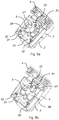
- Fig. 5a shows the distance element 5 in a first position where the first portion p1 with thickness t1 is fixed by screws 32 via the holes 51 to the body 1 and sets the distance between the body 1 and the support plate 6 (not shown).
- Fig 5a further illustrates the protruding parts 31, which may serve as to maximize the contact area between the support plate 6 and the body 3.
- the support plate 6 and the body 3 may be fixed to each other by screws 32.
- the means 32 fastening the body 3 and the support plate 6 to each other may extend through a protruding part 31.
- the protruding part 31 has a longitudinal extension and is positioned either on the support plate 6 or as illustrated on the body 3.
- the protruding part 31 has a circle segment profile to maximize the contact area as the support plate 6 and body 3 are rotated away from each other.
- the distance element 5 is positioned in a cavity 34 of the body 3 such that when the distance element 5 is positioned in a position with the thinnest portion p1 in contact with the support plate 6, the support plate 6 is in contact with the body 3 at the area next of the distance element. In such situation, the distance element 5 has no effect on the positioning of the support plate 6 relative to the body 3.
- Fig 5b shows the distance element 5 in a third position where the third portion p3 sets the distance between the body 3 and the support plate 6 to a different distance than that of p1, illustrated in fig. 5a .
- the distance element 5 is fixed in said third position by screw 32 via the holes 51 to the body 1.
- a second portion p2 having a thickness t2 sets the distance between the body 1 and the support plate 6.
- the support plate 6 is illustrated in fig. 6 .
- the support plate 6 comprises a contacting part 62 which abuts the distance element 5 as to create an area of contact there between regardless the current position of the distance element 5.
- the contact part 62 is in contact with the portion p1, p2, p3 that currently is in a distance setting position (as p1 in fig. 5a ).
- the portions p1, p2, p3 of the distance element 5 are divided as segments of the distance element 5. At least one of the sides 50, 50' of each portion p1, p2, p3 extends in a corresponding angle as the sides 60, 60' of the contacting part 62.
- the sides 50,50' of the distance element 5 and the angle corresponding sides 60, 60' of the contacting part 62 aid in holding the distance element 5 in a fixed position relative the support plate 6 in certain of the distance element's 5 positions p1, p2, p3 when the sides of the different parts are in contact with each other.
- the distance element 5 has a protrusion 53 (see fig. 4b ) extending above the portions p1, p2, p3 and facing the support plate 6.
- the protrusion 53 has a curvature C D corresponding to the curvature C S of the contacting part such that the side of the protrusion 53 of the distance element and the side 63 of the contacting part provide an area of contact between the support plate and the distance element 5. This area of contact aids in guiding the distance element 5 in the correct position with respect to the support element 6 during rotation of the distance element 5.
- the support plate 6 comprises holes 61 screws 32 to attach to the body 3 and a hole 61' for fixation to the body 3 via the distance element 5.
- the support plate 6 comprises a first area 6a and a second area 6b.
- the first area 6a may be in contact with the body 3 for a certain thickness of the distance element 5 and tilted away from the body 3 when the thickness t of the distance element 5 increases.
- the second area 6b of the support plate 6 is always in contact with the body 3.
- a cross-section of the latching hinge 1 is illustrated in fig. 7 .
- the body 3 comprises a protruding surface 31 such as to create a contact surface to the support plate 6 when the support plate 6 is distanced from the body 3 by the distance element 5 (see fig. 8b ).
- the protruding surface 31 has a cross-sectional form of a circle segment extending above the surrounding surface of the body 3.
- FIG 8a a cross-section of the body 3, the support plate 6, and the distance element 5 of the latching hinge 1 are shown.
- the distance element 5 is shown with a portion p1 of thickness t1 setting the distance between the support plate 6 and the body 3.
- a lower surface 6c of the support plate 6 lies in a plane A suspended by a door facing side of the body 3.
- Using the means 52 for moving the distance element 5 to a position p2, p3 with a thickness t2, t3 thicker than t1, will cause the first area 6a of the support plate to tilt away from the body 3 through the plane A, as illustrated in fig. 8b , such that the lower surface 6c of the support plate 6 is offset in relation to plane A.
- the latching hinge 1 may be produced from plastics, metal, a combination of these of other suitable material and may be produced in separate parts for example by injection molding.
Landscapes
- Engineering & Computer Science (AREA)
- Mechanical Engineering (AREA)
- Hinges (AREA)
- Supports Or Holders For Household Use (AREA)
Claims (15)
- Verriegelungsscharnier (1) zur Anordnung an einer Tür und einem Türrahmen, das Verriegelungsscharnier umfassend
einen Körper (3), der so konfiguriert ist, dass er an einer Tür angeordnet werden kann,
ein Scharnierteil (4), das so konfiguriert ist, dass es an einem Türrahmen angeordnet werden kann, wobei der Körper drehbar an dem Scharnierteil angeordnet ist,
einen Griff (2), der drehbar am Körper derart angeordnet ist, dass der Körper vom Verriegelungsscharnier gelöst wird, wenn sich der Griff in einer entriegelten Position befindet, und
eine Trägerplatte (6), die an einer der Tür zugewandten Seite des Körpers angeordnet und so konfiguriert ist, dass sie an der Tür anliegt, wenn das Verriegelungsscharnier daran angeordnet ist,
dadurch gekennzeichnet, dass
das Verriegelungsscharnier (1) ferner ein Abstandselement (5) umfasst, das zwischen der Trägerplatte (6) und dem Körper (3) angeordnet und zwischen mindestens einer ersten Position und einer zweiten Position bewegbar ist,
wobei das Abstandselement in der zweiten Position einen größeren Versatz zwischen dem Körper und der Trägerplatte aufweist als in der ersten Position. - Verriegelungsscharnier (1) nach Anspruch 1, wobei das Abstandselement (5) so konfiguriert ist, dass es die Trägerplatte (6) und den Körper versetzt, indem es einen Abstand zwischen der Trägerplatte und dem Körper einstellt.
- Verriegelungsscharnier (1) nach Anspruch 1 oder 2, wobei das Abstandselement (5) mindestens einen ersten und einen zweiten Abschnitt (p) mit unterschiedlicher Dicke (t) aufweist, wobei die Dicke (t1) des ersten Abschnitts (p1) den Abstand zwischen der Trägerplatte (6) und dem Körper (3) einstellt, wenn sich das Abstandselement in der ersten Position befindet, und die Dicke (t2) des zweiten Abschnitts (p2) den Abstand einstellt, wenn sich das Abstandselement in der zweiten Position befindet.
- Verriegelungsscharnier (1) nach einem der vorhergehenden Ansprüche, wobei das Abstandselement (5) ferner ein Mittel zum Bewegen (52) des Abstandselements zwischen der mindestens ersten und zweiten Position umfasst.
- Verriegelungsscharnier (1) nach einem der vorhergehenden Ansprüche, wobei das Abstandselement (5) durch Drehung bewegbar ist.
- Verriegelungsscharnier (1) nach Anspruch 4, wobei das Abstandselement (5) um das Mittel zum Bewegen (52) drehbar ist.
- Verriegelungsscharnier (1) nach einem der vorhergehenden Ansprüche, wobei das Abstandselement (5) durch Befestigungsmittel (32) an dem Körper und der Trägerplatte (6) in einer der mindestens ersten oder zweiten Position befestigt werden kann.
- Verriegelungsscharnier (1) nach Anspruch 5, wobei das Befestigungsmittel (32), das das Abstandselement (5) in einer ersten oder zweiten Position befestigt, eine Schraube umfasst.
- Verriegelungsscharnier (1) nach Anspruch 3, wobei die Trägerplatte (6) ein Kontaktteil (62) umfasst, das so konfiguriert ist, dass es von der Trägerplatte vorsteht und an das Abstandselement (5) an einem der mindestens ersten und zweiten Abschnitte (p) anstößt.
- Verriegelungsscharnier (1) nach einem der vorhergehenden Ansprüche, wobei die Trägerplatte (6) einen ersten Bereich (6a) und einen zweiten Bereich (6b) umfasst und wobei das Abstandselement (5) zwischen dem Körper (3) und der Trägerplatte am ersten Bereich der Trägerplatte angeordnet ist, wobei der zweite Bereich der Trägerplatte in Kontakt mit dem Körper ist.
- Verriegelungsscharnier (1) nach Anspruch 10, wobei eine vorstehende Fläche (31), die so konfiguriert ist, dass sie den Kontaktbereich zwischen dem Körper (3) und dem zweiten Bereich (6b) der Trägerplatte (6) maximiert, am Körper oder an der Trägerplatte angeordnet ist.
- Verriegelungsscharnier (1) nach Anspruch 11, wobei die vorstehende Fläche (31) eine Querschnittsform eines Kreissegments aufweist, das sich über die Oberfläche des Körpers (3) oder der Trägerplatte (6) erstreckt.
- Verriegelungsscharnier (1) nach einem der vorhergehenden Ansprüche, wobei der Körper (3) und die Trägerplatte (6) so konfiguriert sind, dass sie durch Verwendung von Befestigungsmitteln (32) aneinander und/oder an einer Tür befestigt werden können.
- Verriegelungsscharnier (1) nach einem der Ansprüche 12 und 13, wobei mindestens ein Befestigungsmittel (32) dazu vorgesehen ist, sich durch die vorstehende Fläche (31) zu erstrecken.
- Verriegelungsscharnier (1) nach einem der vorhergehenden Ansprüche, wobei eine der Tür zugewandte Seite des Körpers (3) eine Ebene (A) umfasst und wobei die Trägerplatte (6) eine untere Fläche (6c) umfasst, die in mindestens einer der Positionen des Abstandselements (5) in der Ebene liegt, und wobei die untere Fläche der Trägerplatte in mindestens einer anderen Position des Abstandselements von der Ebene versetzt ist.
Priority Applications (7)
| Application Number | Priority Date | Filing Date | Title |
|---|---|---|---|
| PL16188882T PL3296491T3 (pl) | 2016-09-15 | 2016-09-15 | Regulowany zawias zatrzaskowy |
| EP16188882.1A EP3296491B1 (de) | 2016-09-15 | 2016-09-15 | Verstellbares verriegelungsscharnier |
| CN201780055659.9A CN109690003B (zh) | 2016-09-15 | 2017-09-14 | 用于门的可调节配件 |
| PCT/EP2017/073085 WO2018050727A1 (en) | 2016-09-15 | 2017-09-14 | Adjustable fitting for a door |
| US16/331,725 US10982474B2 (en) | 2016-09-15 | 2017-09-14 | Adjustable fitting for a door |
| BR112019004439-6A BR112019004439B1 (pt) | 2016-09-15 | 2017-09-14 | Encaixe, e, dobradiça |
| CA3036214A CA3036214A1 (en) | 2016-09-15 | 2017-09-14 | Adjustable fitting for a door |
Applications Claiming Priority (1)
| Application Number | Priority Date | Filing Date | Title |
|---|---|---|---|
| EP16188882.1A EP3296491B1 (de) | 2016-09-15 | 2016-09-15 | Verstellbares verriegelungsscharnier |
Publications (2)
| Publication Number | Publication Date |
|---|---|
| EP3296491A1 EP3296491A1 (de) | 2018-03-21 |
| EP3296491B1 true EP3296491B1 (de) | 2021-02-24 |
Family
ID=56936333
Family Applications (1)
| Application Number | Title | Priority Date | Filing Date |
|---|---|---|---|
| EP16188882.1A Active EP3296491B1 (de) | 2016-09-15 | 2016-09-15 | Verstellbares verriegelungsscharnier |
Country Status (7)
| Country | Link |
|---|---|
| US (1) | US10982474B2 (de) |
| EP (1) | EP3296491B1 (de) |
| CN (1) | CN109690003B (de) |
| BR (1) | BR112019004439B1 (de) |
| CA (1) | CA3036214A1 (de) |
| PL (1) | PL3296491T3 (de) |
| WO (1) | WO2018050727A1 (de) |
Families Citing this family (3)
| Publication number | Priority date | Publication date | Assignee | Title |
|---|---|---|---|---|
| EP3296491B1 (de) * | 2016-09-15 | 2021-02-24 | Industrilås i Nässjö Aktiebolag | Verstellbares verriegelungsscharnier |
| WO2018081230A1 (en) * | 2016-10-25 | 2018-05-03 | Y-Knot, Llc | Devices and methods for securing knots |
| DE202019000349U1 (de) | 2019-01-24 | 2019-02-12 | Yury Kaganov | Das leicht demontierbare Scharnier |
Family Cites Families (20)
| Publication number | Priority date | Publication date | Assignee | Title |
|---|---|---|---|---|
| DE3729531A1 (de) * | 1987-09-04 | 1989-03-16 | Lautenschlaeger Kg Karl | Schnaepperscharnier fuer eckschraenke |
| US5283929A (en) * | 1992-06-01 | 1994-02-08 | Lin Tsong Chi | Hinge |
| AT405432B (de) * | 1994-11-17 | 1999-08-25 | Blum Gmbh Julius | Rahmenscharnier |
| DE29511756U1 (de) * | 1995-07-20 | 1995-09-28 | Ferco International Usine de Ferrures de Bâtiment S.A.R.L., Sarrebourg | Flügelseitiges Ecklagerbeschlagteil für Drehkippfenster |
| US5555605A (en) * | 1995-10-16 | 1996-09-17 | Mosher; Gary M. | Door hinge alignment apparatus |
| AT6962U1 (de) * | 2003-02-21 | 2004-06-25 | Blum Gmbh Julius | Scharnier |
| AT6963U1 (de) * | 2003-02-21 | 2004-06-25 | Blum Gmbh Julius | Scharnier |
| DE202005007087U1 (de) * | 2005-05-03 | 2006-09-14 | Liebherr-Hausgeräte Lienz Gmbh | Kühl- und/oder Gefriergerät |
| WO2006136939A2 (en) * | 2005-06-24 | 2006-12-28 | Aroplast S.R.L. | Disassemblable hinge and cabinet using it |
| DE102006034306A1 (de) * | 2006-07-21 | 2008-01-24 | Liberty Hardware Mfg. Corp. | Möbelscharnier |
| EP2157265B1 (de) * | 2008-08-21 | 2012-06-27 | VKR Holding A/S | Fensterscharnieranordnung und Verfahren zum Montieren eines Flügels an einem Rahmen |
| CN101956499B (zh) * | 2009-07-15 | 2013-05-22 | 赵芬 | 一种可调整合页机构及其调整方法 |
| US20110302743A1 (en) * | 2009-11-25 | 2011-12-15 | Hyeon-Jung Kim | Hinge apparatus for a door |
| DE202011101342U1 (de) * | 2011-05-25 | 2012-08-27 | Prämeta GmbH & Co. KG | Scharnier |
| EP2923019B1 (de) * | 2012-11-26 | 2017-08-02 | Industrilås I Nässjö AB | Demontierbares scharnier und sicherheitsriegel |
| CA2946755A1 (en) * | 2014-04-24 | 2015-10-29 | Upsite Technologies, Inc. | Door system for airflow control |
| US9565941B2 (en) * | 2014-05-21 | 2017-02-14 | Grass America, Inc. | Hinge locking member |
| DE202015001918U1 (de) * | 2015-03-12 | 2016-06-14 | Dirak Dieter Ramsauer Konstruktionselemente Gmbh | Scharnier für aushängbare Blechschranktüren |
| DE102015117505B3 (de) * | 2015-10-15 | 2017-02-02 | Emka Beschlagteile Gmbh & Co. Kg | Scharnierverschluss |
| EP3296491B1 (de) * | 2016-09-15 | 2021-02-24 | Industrilås i Nässjö Aktiebolag | Verstellbares verriegelungsscharnier |
-
2016
- 2016-09-15 EP EP16188882.1A patent/EP3296491B1/de active Active
- 2016-09-15 PL PL16188882T patent/PL3296491T3/pl unknown
-
2017
- 2017-09-14 CN CN201780055659.9A patent/CN109690003B/zh active Active
- 2017-09-14 CA CA3036214A patent/CA3036214A1/en not_active Abandoned
- 2017-09-14 BR BR112019004439-6A patent/BR112019004439B1/pt active IP Right Grant
- 2017-09-14 WO PCT/EP2017/073085 patent/WO2018050727A1/en not_active Ceased
- 2017-09-14 US US16/331,725 patent/US10982474B2/en active Active
Non-Patent Citations (1)
| Title |
|---|
| None * |
Also Published As
| Publication number | Publication date |
|---|---|
| WO2018050727A1 (en) | 2018-03-22 |
| US10982474B2 (en) | 2021-04-20 |
| PL3296491T3 (pl) | 2021-08-16 |
| BR112019004439B1 (pt) | 2023-05-02 |
| CN109690003B (zh) | 2021-07-27 |
| US20190203510A1 (en) | 2019-07-04 |
| CN109690003A (zh) | 2019-04-26 |
| BR112019004439A2 (pt) | 2019-05-28 |
| CA3036214A1 (en) | 2018-03-22 |
| EP3296491A1 (de) | 2018-03-21 |
Similar Documents
| Publication | Publication Date | Title |
|---|---|---|
| US10273730B2 (en) | Adjustable door hinge | |
| EP3296491B1 (de) | Verstellbares verriegelungsscharnier | |
| CA2677556C (en) | An adjustable door or window hinge | |
| KR20130131284A (ko) | 종방향 가이드가 연결된 서랍의 걸림용 걸림장치 | |
| US20180002963A1 (en) | Hinge for doors or windows | |
| RU2006130420A (ru) | Замок для установки в отверстиях на тонкой стене | |
| EP1422367B1 (de) | Verschiebbarer und einstellbarer Riegel für ein Schloss | |
| US20040128794A1 (en) | Adjustable hinge | |
| US20110099755A1 (en) | Hinge | |
| KR20070008575A (ko) | 개구부 내에 장착되는 힌지 | |
| US7971319B2 (en) | Hinge for doors or windows | |
| EP2607588B1 (de) | Scharnier für ein dachfenster mit schwenkbarem oder doppeltwirkendem flügel | |
| CN111094681A (zh) | 用于在窗户或门上的被遮盖的装置的转动配件 | |
| KR101902476B1 (ko) | 도어용 경첩 | |
| KR101758890B1 (ko) | 슬라이딩 도어용 하부 롤러 지지구조 | |
| KR200414430Y1 (ko) | 높이 조절 경첩 | |
| JP5346579B2 (ja) | ヒンジ | |
| JP2889496B2 (ja) | 蝶 番 | |
| CN111119621B (zh) | 窗撑 | |
| EP3222800A1 (de) | Fangvorrichtung zum fangen eines verriegelungselements | |
| KR102105871B1 (ko) | 브라켓본체의 승강범위를 제한하는 도어 힌지장치 | |
| CN108625706A (zh) | 用于滑动元件的可调整引导装置 | |
| KR200312751Y1 (ko) | 가구용 경첩 | |
| CN101042040B (zh) | 门窗设备及按压卡合构件 | |
| NL2012870B1 (en) | Curtain rail support. |
Legal Events
| Date | Code | Title | Description |
|---|---|---|---|
| PUAI | Public reference made under article 153(3) epc to a published international application that has entered the european phase |
Free format text: ORIGINAL CODE: 0009012 |
|
| STAA | Information on the status of an ep patent application or granted ep patent |
Free format text: STATUS: THE APPLICATION HAS BEEN PUBLISHED |
|
| AK | Designated contracting states |
Kind code of ref document: A1 Designated state(s): AL AT BE BG CH CY CZ DE DK EE ES FI FR GB GR HR HU IE IS IT LI LT LU LV MC MK MT NL NO PL PT RO RS SE SI SK SM TR |
|
| AX | Request for extension of the european patent |
Extension state: BA ME |
|
| STAA | Information on the status of an ep patent application or granted ep patent |
Free format text: STATUS: REQUEST FOR EXAMINATION WAS MADE |
|
| 17P | Request for examination filed |
Effective date: 20180607 |
|
| RBV | Designated contracting states (corrected) |
Designated state(s): AL AT BE BG CH CY CZ DE DK EE ES FI FR GB GR HR HU IE IS IT LI LT LU LV MC MK MT NL NO PL PT RO RS SE SI SK SM TR |
|
| GRAP | Despatch of communication of intention to grant a patent |
Free format text: ORIGINAL CODE: EPIDOSNIGR1 |
|
| STAA | Information on the status of an ep patent application or granted ep patent |
Free format text: STATUS: GRANT OF PATENT IS INTENDED |
|
| INTG | Intention to grant announced |
Effective date: 20200921 |
|
| GRAS | Grant fee paid |
Free format text: ORIGINAL CODE: EPIDOSNIGR3 |
|
| GRAA | (expected) grant |
Free format text: ORIGINAL CODE: 0009210 |
|
| STAA | Information on the status of an ep patent application or granted ep patent |
Free format text: STATUS: THE PATENT HAS BEEN GRANTED |
|
| AK | Designated contracting states |
Kind code of ref document: B1 Designated state(s): AL AT BE BG CH CY CZ DE DK EE ES FI FR GB GR HR HU IE IS IT LI LT LU LV MC MK MT NL NO PL PT RO RS SE SI SK SM TR |
|
| RAP1 | Party data changed (applicant data changed or rights of an application transferred) |
Owner name: INDUSTRILAS I NAESSJOE AKTIEBOLAG |
|
| REG | Reference to a national code |
Ref country code: CH Ref legal event code: EP |
|
| REG | Reference to a national code |
Ref country code: AT Ref legal event code: REF Ref document number: 1364630 Country of ref document: AT Kind code of ref document: T Effective date: 20210315 |
|
| REG | Reference to a national code |
Ref country code: IE Ref legal event code: FG4D |
|
| REG | Reference to a national code |
Ref country code: DE Ref legal event code: R096 Ref document number: 602016053003 Country of ref document: DE |
|
| REG | Reference to a national code |
Ref country code: SE Ref legal event code: TRGR |
|
| REG | Reference to a national code |
Ref country code: LT Ref legal event code: MG9D |
|
| REG | Reference to a national code |
Ref country code: NL Ref legal event code: MP Effective date: 20210224 |
|
| PG25 | Lapsed in a contracting state [announced via postgrant information from national office to epo] |
Ref country code: LT Free format text: LAPSE BECAUSE OF FAILURE TO SUBMIT A TRANSLATION OF THE DESCRIPTION OR TO PAY THE FEE WITHIN THE PRESCRIBED TIME-LIMIT Effective date: 20210224 Ref country code: FI Free format text: LAPSE BECAUSE OF FAILURE TO SUBMIT A TRANSLATION OF THE DESCRIPTION OR TO PAY THE FEE WITHIN THE PRESCRIBED TIME-LIMIT Effective date: 20210224 Ref country code: HR Free format text: LAPSE BECAUSE OF FAILURE TO SUBMIT A TRANSLATION OF THE DESCRIPTION OR TO PAY THE FEE WITHIN THE PRESCRIBED TIME-LIMIT Effective date: 20210224 Ref country code: GR Free format text: LAPSE BECAUSE OF FAILURE TO SUBMIT A TRANSLATION OF THE DESCRIPTION OR TO PAY THE FEE WITHIN THE PRESCRIBED TIME-LIMIT Effective date: 20210525 Ref country code: BG Free format text: LAPSE BECAUSE OF FAILURE TO SUBMIT A TRANSLATION OF THE DESCRIPTION OR TO PAY THE FEE WITHIN THE PRESCRIBED TIME-LIMIT Effective date: 20210524 Ref country code: PT Free format text: LAPSE BECAUSE OF FAILURE TO SUBMIT A TRANSLATION OF THE DESCRIPTION OR TO PAY THE FEE WITHIN THE PRESCRIBED TIME-LIMIT Effective date: 20210624 Ref country code: NO Free format text: LAPSE BECAUSE OF FAILURE TO SUBMIT A TRANSLATION OF THE DESCRIPTION OR TO PAY THE FEE WITHIN THE PRESCRIBED TIME-LIMIT Effective date: 20210524 |
|
| REG | Reference to a national code |
Ref country code: AT Ref legal event code: MK05 Ref document number: 1364630 Country of ref document: AT Kind code of ref document: T Effective date: 20210224 |
|
| PG25 | Lapsed in a contracting state [announced via postgrant information from national office to epo] |
Ref country code: LV Free format text: LAPSE BECAUSE OF FAILURE TO SUBMIT A TRANSLATION OF THE DESCRIPTION OR TO PAY THE FEE WITHIN THE PRESCRIBED TIME-LIMIT Effective date: 20210224 Ref country code: RS Free format text: LAPSE BECAUSE OF FAILURE TO SUBMIT A TRANSLATION OF THE DESCRIPTION OR TO PAY THE FEE WITHIN THE PRESCRIBED TIME-LIMIT Effective date: 20210224 Ref country code: NL Free format text: LAPSE BECAUSE OF FAILURE TO SUBMIT A TRANSLATION OF THE DESCRIPTION OR TO PAY THE FEE WITHIN THE PRESCRIBED TIME-LIMIT Effective date: 20210224 |
|
| PG25 | Lapsed in a contracting state [announced via postgrant information from national office to epo] |
Ref country code: IS Free format text: LAPSE BECAUSE OF FAILURE TO SUBMIT A TRANSLATION OF THE DESCRIPTION OR TO PAY THE FEE WITHIN THE PRESCRIBED TIME-LIMIT Effective date: 20210624 |
|
| PG25 | Lapsed in a contracting state [announced via postgrant information from national office to epo] |
Ref country code: CZ Free format text: LAPSE BECAUSE OF FAILURE TO SUBMIT A TRANSLATION OF THE DESCRIPTION OR TO PAY THE FEE WITHIN THE PRESCRIBED TIME-LIMIT Effective date: 20210224 Ref country code: EE Free format text: LAPSE BECAUSE OF FAILURE TO SUBMIT A TRANSLATION OF THE DESCRIPTION OR TO PAY THE FEE WITHIN THE PRESCRIBED TIME-LIMIT Effective date: 20210224 Ref country code: AT Free format text: LAPSE BECAUSE OF FAILURE TO SUBMIT A TRANSLATION OF THE DESCRIPTION OR TO PAY THE FEE WITHIN THE PRESCRIBED TIME-LIMIT Effective date: 20210224 Ref country code: SM Free format text: LAPSE BECAUSE OF FAILURE TO SUBMIT A TRANSLATION OF THE DESCRIPTION OR TO PAY THE FEE WITHIN THE PRESCRIBED TIME-LIMIT Effective date: 20210224 |
|
| PGFP | Annual fee paid to national office [announced via postgrant information from national office to epo] |
Ref country code: FR Payment date: 20210818 Year of fee payment: 6 |
|
| REG | Reference to a national code |
Ref country code: DE Ref legal event code: R097 Ref document number: 602016053003 Country of ref document: DE |
|
| PG25 | Lapsed in a contracting state [announced via postgrant information from national office to epo] |
Ref country code: DK Free format text: LAPSE BECAUSE OF FAILURE TO SUBMIT A TRANSLATION OF THE DESCRIPTION OR TO PAY THE FEE WITHIN THE PRESCRIBED TIME-LIMIT Effective date: 20210224 Ref country code: SK Free format text: LAPSE BECAUSE OF FAILURE TO SUBMIT A TRANSLATION OF THE DESCRIPTION OR TO PAY THE FEE WITHIN THE PRESCRIBED TIME-LIMIT Effective date: 20210224 Ref country code: RO Free format text: LAPSE BECAUSE OF FAILURE TO SUBMIT A TRANSLATION OF THE DESCRIPTION OR TO PAY THE FEE WITHIN THE PRESCRIBED TIME-LIMIT Effective date: 20210224 |
|
| PGFP | Annual fee paid to national office [announced via postgrant information from national office to epo] |
Ref country code: GB Payment date: 20210819 Year of fee payment: 6 |
|
| PLBE | No opposition filed within time limit |
Free format text: ORIGINAL CODE: 0009261 |
|
| STAA | Information on the status of an ep patent application or granted ep patent |
Free format text: STATUS: NO OPPOSITION FILED WITHIN TIME LIMIT |
|
| PG25 | Lapsed in a contracting state [announced via postgrant information from national office to epo] |
Ref country code: ES Free format text: LAPSE BECAUSE OF FAILURE TO SUBMIT A TRANSLATION OF THE DESCRIPTION OR TO PAY THE FEE WITHIN THE PRESCRIBED TIME-LIMIT Effective date: 20210224 Ref country code: AL Free format text: LAPSE BECAUSE OF FAILURE TO SUBMIT A TRANSLATION OF THE DESCRIPTION OR TO PAY THE FEE WITHIN THE PRESCRIBED TIME-LIMIT Effective date: 20210224 |
|
| 26N | No opposition filed |
Effective date: 20211125 |
|
| PG25 | Lapsed in a contracting state [announced via postgrant information from national office to epo] |
Ref country code: SI Free format text: LAPSE BECAUSE OF FAILURE TO SUBMIT A TRANSLATION OF THE DESCRIPTION OR TO PAY THE FEE WITHIN THE PRESCRIBED TIME-LIMIT Effective date: 20210224 |
|
| PG25 | Lapsed in a contracting state [announced via postgrant information from national office to epo] |
Ref country code: IT Free format text: LAPSE BECAUSE OF FAILURE TO SUBMIT A TRANSLATION OF THE DESCRIPTION OR TO PAY THE FEE WITHIN THE PRESCRIBED TIME-LIMIT Effective date: 20210224 |
|
| REG | Reference to a national code |
Ref country code: CH Ref legal event code: PL |
|
| REG | Reference to a national code |
Ref country code: BE Ref legal event code: MM Effective date: 20210930 |
|
| PG25 | Lapsed in a contracting state [announced via postgrant information from national office to epo] |
Ref country code: IS Free format text: LAPSE BECAUSE OF FAILURE TO SUBMIT A TRANSLATION OF THE DESCRIPTION OR TO PAY THE FEE WITHIN THE PRESCRIBED TIME-LIMIT Effective date: 20210624 Ref country code: MC Free format text: LAPSE BECAUSE OF FAILURE TO SUBMIT A TRANSLATION OF THE DESCRIPTION OR TO PAY THE FEE WITHIN THE PRESCRIBED TIME-LIMIT Effective date: 20210224 |
|
| PG25 | Lapsed in a contracting state [announced via postgrant information from national office to epo] |
Ref country code: LU Free format text: LAPSE BECAUSE OF NON-PAYMENT OF DUE FEES Effective date: 20210915 Ref country code: IE Free format text: LAPSE BECAUSE OF NON-PAYMENT OF DUE FEES Effective date: 20210915 Ref country code: BE Free format text: LAPSE BECAUSE OF NON-PAYMENT OF DUE FEES Effective date: 20210930 |
|
| PG25 | Lapsed in a contracting state [announced via postgrant information from national office to epo] |
Ref country code: LI Free format text: LAPSE BECAUSE OF NON-PAYMENT OF DUE FEES Effective date: 20210930 Ref country code: CH Free format text: LAPSE BECAUSE OF NON-PAYMENT OF DUE FEES Effective date: 20210930 |
|
| GBPC | Gb: european patent ceased through non-payment of renewal fee |
Effective date: 20220915 |
|
| PG25 | Lapsed in a contracting state [announced via postgrant information from national office to epo] |
Ref country code: HU Free format text: LAPSE BECAUSE OF FAILURE TO SUBMIT A TRANSLATION OF THE DESCRIPTION OR TO PAY THE FEE WITHIN THE PRESCRIBED TIME-LIMIT; INVALID AB INITIO Effective date: 20160915 |
|
| PG25 | Lapsed in a contracting state [announced via postgrant information from national office to epo] |
Ref country code: CY Free format text: LAPSE BECAUSE OF FAILURE TO SUBMIT A TRANSLATION OF THE DESCRIPTION OR TO PAY THE FEE WITHIN THE PRESCRIBED TIME-LIMIT Effective date: 20210224 |
|
| PG25 | Lapsed in a contracting state [announced via postgrant information from national office to epo] |
Ref country code: FR Free format text: LAPSE BECAUSE OF NON-PAYMENT OF DUE FEES Effective date: 20220930 |
|
| PG25 | Lapsed in a contracting state [announced via postgrant information from national office to epo] |
Ref country code: GB Free format text: LAPSE BECAUSE OF NON-PAYMENT OF DUE FEES Effective date: 20220915 |
|
| PG25 | Lapsed in a contracting state [announced via postgrant information from national office to epo] |
Ref country code: MK Free format text: LAPSE BECAUSE OF FAILURE TO SUBMIT A TRANSLATION OF THE DESCRIPTION OR TO PAY THE FEE WITHIN THE PRESCRIBED TIME-LIMIT Effective date: 20210224 |
|
| PG25 | Lapsed in a contracting state [announced via postgrant information from national office to epo] |
Ref country code: MT Free format text: LAPSE BECAUSE OF FAILURE TO SUBMIT A TRANSLATION OF THE DESCRIPTION OR TO PAY THE FEE WITHIN THE PRESCRIBED TIME-LIMIT Effective date: 20210224 |
|
| PGFP | Annual fee paid to national office [announced via postgrant information from national office to epo] |
Ref country code: DE Payment date: 20250814 Year of fee payment: 10 |
|
| PGFP | Annual fee paid to national office [announced via postgrant information from national office to epo] |
Ref country code: TR Payment date: 20250909 Year of fee payment: 10 Ref country code: PL Payment date: 20250804 Year of fee payment: 10 |
|
| PGFP | Annual fee paid to national office [announced via postgrant information from national office to epo] |
Ref country code: SE Payment date: 20250731 Year of fee payment: 10 |