EP3296839A1 - Système et procédé de refroidissement d'un processeur d'ordinateur - Google Patents
Système et procédé de refroidissement d'un processeur d'ordinateur Download PDFInfo
- Publication number
- EP3296839A1 EP3296839A1 EP17150732.0A EP17150732A EP3296839A1 EP 3296839 A1 EP3296839 A1 EP 3296839A1 EP 17150732 A EP17150732 A EP 17150732A EP 3296839 A1 EP3296839 A1 EP 3296839A1
- Authority
- EP
- European Patent Office
- Prior art keywords
- server
- disposed
- board
- computer processor
- refrigeration circuit
- Prior art date
- Legal status (The legal status is an assumption and is not a legal conclusion. Google has not performed a legal analysis and makes no representation as to the accuracy of the status listed.)
- Withdrawn
Links
Images




Classifications
-
- H—ELECTRICITY
- H05—ELECTRIC TECHNIQUES NOT OTHERWISE PROVIDED FOR
- H05K—PRINTED CIRCUITS; CASINGS OR CONSTRUCTIONAL DETAILS OF ELECTRIC APPARATUS; MANUFACTURE OF ASSEMBLAGES OF ELECTRICAL COMPONENTS
- H05K7/00—Constructional details common to different types of electric apparatus
- H05K7/20—Modifications to facilitate cooling, ventilating, or heating
- H05K7/20709—Modifications to facilitate cooling, ventilating, or heating for server racks or cabinets; for data centers, e.g. 19-inch computer racks
- H05K7/208—Liquid cooling with phase change
- H05K7/20809—Liquid cooling with phase change within server blades for removing heat from heat source
-
- G—PHYSICS
- G06—COMPUTING OR CALCULATING; COUNTING
- G06F—ELECTRIC DIGITAL DATA PROCESSING
- G06F1/00—Details not covered by groups G06F3/00 - G06F13/00 and G06F21/00
- G06F1/16—Constructional details or arrangements
- G06F1/20—Cooling means
-
- H—ELECTRICITY
- H05—ELECTRIC TECHNIQUES NOT OTHERWISE PROVIDED FOR
- H05K—PRINTED CIRCUITS; CASINGS OR CONSTRUCTIONAL DETAILS OF ELECTRIC APPARATUS; MANUFACTURE OF ASSEMBLAGES OF ELECTRICAL COMPONENTS
- H05K7/00—Constructional details common to different types of electric apparatus
- H05K7/20—Modifications to facilitate cooling, ventilating, or heating
- H05K7/2029—Modifications to facilitate cooling, ventilating, or heating using a liquid coolant with phase change in electronic enclosures
- H05K7/20309—Evaporators
-
- H—ELECTRICITY
- H05—ELECTRIC TECHNIQUES NOT OTHERWISE PROVIDED FOR
- H05K—PRINTED CIRCUITS; CASINGS OR CONSTRUCTIONAL DETAILS OF ELECTRIC APPARATUS; MANUFACTURE OF ASSEMBLAGES OF ELECTRICAL COMPONENTS
- H05K7/00—Constructional details common to different types of electric apparatus
- H05K7/20—Modifications to facilitate cooling, ventilating, or heating
- H05K7/2029—Modifications to facilitate cooling, ventilating, or heating using a liquid coolant with phase change in electronic enclosures
- H05K7/20318—Condensers
-
- H—ELECTRICITY
- H05—ELECTRIC TECHNIQUES NOT OTHERWISE PROVIDED FOR
- H05K—PRINTED CIRCUITS; CASINGS OR CONSTRUCTIONAL DETAILS OF ELECTRIC APPARATUS; MANUFACTURE OF ASSEMBLAGES OF ELECTRICAL COMPONENTS
- H05K7/00—Constructional details common to different types of electric apparatus
- H05K7/20—Modifications to facilitate cooling, ventilating, or heating
- H05K7/20709—Modifications to facilitate cooling, ventilating, or heating for server racks or cabinets; for data centers, e.g. 19-inch computer racks
- H05K7/20836—Thermal management, e.g. server temperature control
-
- F—MECHANICAL ENGINEERING; LIGHTING; HEATING; WEAPONS; BLASTING
- F25—REFRIGERATION OR COOLING; COMBINED HEATING AND REFRIGERATION SYSTEMS; HEAT PUMP SYSTEMS; MANUFACTURE OR STORAGE OF ICE; LIQUEFACTION SOLIDIFICATION OF GASES
- F25B—REFRIGERATION MACHINES, PLANTS OR SYSTEMS; COMBINED HEATING AND REFRIGERATION SYSTEMS; HEAT PUMP SYSTEMS
- F25B1/00—Compression machines, plants or systems with non-reversible cycle
Definitions
- Embodiments of the invention relate generally to cooling computer processors, and more specifically, to a system and method for cooling computer processors via refrigerant.
- Computer software applications increasingly require faster processing speeds.
- many computer processors are "overclocked,” e.g., configured to operate at a clock speed/frequency that is faster than the standard speed of the processor as certified by the processor's manufacturer.
- Overclocking a processor increases the amount of heat generated by the processor during operations (also referred to herein as "heat load"), which can damage the processor if not removed/dissipated in a timely manner.
- a liquid cooled Intel ® Core i7 5960x operating at 4.6GHz with a 4.3GHz cache will generate about 300W to 400W.
- cooling systems utilize refrigeration to cool the interior cavities of server nodes, i.e., the physical casing of a computer that typically houses a mother board and other various electronic components. While such refrigerant based cooling systems can safely handle larger heat loads then the aforementioned liquid cooling systems, they often require the use of large compressors, condensers, and cooling coils to dissipate heat. Accordingly, the compressor, condenser, and cooling coils of such refrigerant based cooling system are typically located in the bottom/tops of a server rack, or outside of the server rack altogether, thus requiring extensive plumbing to deliver refrigerant to a server node contained within the server rack.
- a system for cooling one or more computer processors comprising: a server chassis that is selectively mountable to a server rack; one or more server nodes each including: a body that is selectively mountable to the server chassis; at least one of the one or more computer processors disposed on-board the body; a refrigeration circuit for cooling the at least one computer processor; and wherein the refrigeration circuit includes an evaporator and a compressor disposed on-board the body.
- the evaporator may be disposed on the at least one computer processor.
- the refrigeration circuit may further include a condenser disposed on-board the body.
- the refrigeration circuit may include a metering device disposed on-board the body.
- the refrigeration circuit may further include a filter disposed on-board the body.
- At least three server nodes may be selectively mounted to the server chassis.
- each of the server nodes includes a first end and a second end, the at least one computer processor and the compressor of a first server node and of a second node of the at least three server nodes are disposed at the first end and at the second end, respectively, the at least one computer processor and the compressor of a third server node of the at least three server nodes are disposed in the first end, and the server nodes are mounted to the server chassis such that the first ends of the first and of the second server nodes are arranged opposite of the first end of the third server node.
- the at least one computer processor may be disposed on a circuit board disposed on-board the body such that the circuit board is parallel to a vertical axis of the server rack when the server chassis is mounted to the server rack.
- a server node comprising: a body; at least one computer processor disposed on-board the body; a refrigeration circuit for cooling the at least one computer processor; and wherein the refrigeration circuit includes an evaporator and a compressor disposed on-board the body.
- the evaporator may be disposed on the at least one computer processor.
- the refrigeration circuit may further include a condenser disposed on-board the body.
- the refrigeration circuit may further include a metering device disposed on-board the body.
- the refrigeration circuit may further include a filter disposed on-board the body.
- the body may be selectively mountable to a server rack.
- the body may be selectively mountable to a server chassis that is selectively mountable to a server rack.
- the at least one computer processor may be disposed on a circuit board disposed on-board the body such that the circuit board is parallel to a vertical axis of the server rack when the server chassis is mounted to the server rack.
- the at least one computer processor may be disposed at a first end of the body and the compressor is disposed at a second end of the body.
- the at least one computer processor and the compressor may be disposed at a first end of the body.
- a method for cooling a computer processor disposed on-board a server node comprising: compressing a refrigerant via a compressor disposed on-board the server node; and directing the refrigerant through an evaporator disposed on-board the server node and in heating-contact with the computer processor.
- the method may further comprise automatically adjusting the compressor in relation to a usage level of the computer processor via a controller disposed on-board the server node.
- the terms “substantially,” “generally,” and “about” indicate conditions within reasonably achievable manufacturing and assembly tolerances, relative to ideal desired conditions suitable for achieving the functional purpose of a component or assembly.
- the term “real-time,” as used herein, means a level of processing responsiveness that a user senses as sufficiently immediate or that enables the processor to keep up with an external process.
- “electrically coupled”, “electrically connected”, “electrical communication”, and “communication” mean that the referenced elements are directly or indirectly connected such that an electrical current, or other communication medium, may flow from one to the other.
- connection may include a direct conductive connection, i.e., without an intervening capacitive, inductive or active element, an inductive connection, a capacitive connection, and/or any other suitable electrical connection. Intervening components may be present.
- selective mountable means capable of being physically fixed/attached/connected/mounted and unfixed/detached/disconnected/un-mounted on or within an object within a reasonable short period of time.
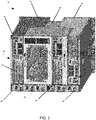
- the system 10 includes a server chassis 14, and one or more server nodes 16, 18, and 20 which may be selectively mountable to the server chassis 14.
- server node refers to a physical computing apparatus, e.g., a desktop and/or rack server, that typically includes a motherboard, processors, RAM, power supplies / conditioners, and/or other electrical equipment generally found in computing systems.
- each of the server nodes 16, 18, and 20 includes a refrigeration circuit (generally marked as 22 in FIGS. 4-7 ) for cooling the at least one processor 12.
- the server chassis 14 is configured to house the one or more server nodes 16, 18, 20.
- the server chassis 14 may include a power supply 24, and one or more communication ports, e.g., Ethernet ports, 26 for allowing remote access/control of the server chassis 14 and/or server nodes 16, 18, 20.
- the server chassis 14 may also include a cooling controller 28 that regulates/controls the refrigeration circuits 22 in each of the server nodes 16, 18, 20.
- the cooling controller 28 may automatically adjust the components of the refrigeration circuit 22 in relation to a usage level of the one or more computer processors 12 in real-time or near real-time.
- the cooling controller 28 may be disposed on-board the server nodes 16, 18, 20.
- the server chassis 14 may be selectively mountable to a server rack 30.
- the server rack 30 may be a standard server rack of the type typically found in a "server farm" / data processing center that contains a plurality of servers.
- the server chassis 14 may require 8 rack units (“8U”) in the server rack.
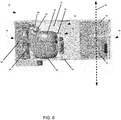
- the server node 16 includes a body 32, at least one of the one or more computer processors 12, and a refrigeration circuit 22.
- the body 32 may define an interior cavity 34 configured to house and protect electronic components such as the processor 12, a motherboard 36, RAM, and/or various disk drives and other electrical components.
- the body 32 may have an elongated shape, e.g., rectangular, with a defined first/front end 38 and a defined second/rear end 40, and may be selectively mountable to the server chassis 14 via known means in the art, e.g., tracks/rails, clips, screws, and/or other types of fasteners.
- the body 32 may also be selectively mountable to the server rack 30 independently of the server chassis 14.
- the processor 12 may be disposed on-board the server node 16. While the embodiments depicted herein show the processor disposed within the interior cavity 34, it is to be understood, that in other embodiments the processor 12 may be fully or partially disposed on a surface of the body 32. Further, the processor 12 may be disposed on a standard motherboard 36 having a longitudinal axis 42 that is itself disposed on-board the server node 16. In embodiments, the processor 12 and/or the motherboard 36 may be disposed at the first/front end 38 of the server node.
- the server node 16 includes a refrigeration circuit 22 for cooling the processor 12.
- the refrigeration circuit 22 may include an evaporator 44 and a compressor 46 and be fully contained to the server node 16, i.e., the server node 14 can be mounted and dismounted from the server rack 30 and/or the server chassis 14 without the need to dismantle the refrigeration circuit 22.
- the refrigerant flowing through the refrigeration circuit 22 may be a non-flammable, and/or non-toxic, HFC refrigerant such as R134A, R404A, R507A, or R407A or other suitable refrigerant.
- the refrigerant may have a boiling temperature of at least -10 °C or lower.
- the evaporator 44 may be disposed on-board the server node 16 so as to be in heating-contact with the processor 12.
- the term heating-contact means that the referenced objects, e.g., the evaporator 44 and the processor 12, are located in relation to each other such that the referenced objects can exchange thermal energy.
- the evaporator 44 may be disposed on the processor 12. Accordingly, the evaporator 44 transfers heat from the processor 12 to refrigerant flowing within the refrigeration circuit 22, thus cooling the processor 12.
- the compressor 46 may be disposed on-board the server node 16.
- the compressor 46 may be of a compact design, e.g., the compressor 46 may have a rated capacity of at least 550 W or greater at -25 °C with a maximum overall width of 150 mm or less so as to provide for a density of 3 nodes in an 8U rack space while having a weight of 50 lbs or less, and be disposed at the second/rear end 40 of the server node 16.
- the interior cavity 34 of the server node may be divided into a front compartment (48 FIG. 4 ), that houses traditional computer components, e.g., the motherboard 36 and processor 12, and a rear compartment (50 FIG.
- the server node 16 may include a support structure (70 in FIG. 6 ) for preventing the interior cavity 34 from collapsing, or the compressor 46 from falling through the body 32, due to the weight of the compressor 46 in the event that the server node 16 is turned on its side.
- the support structure 70 may be made of metal, plastic, composite fiber, and/or another other appropriate material(s).
- the support structure 70 may be a plate mounted to the body 32 and to the compressor 46 such that the compressor 46 is restricted from moving within the interior cavity 34.
- the support structure 70 may be a "U" shaped bracket, which in some embodiments, may be 10 mm.
- the refrigeration circuit may further include a condenser 52, a metering device 54, a strainer/filter/drier 56, and/or other refrigeration components also disposed on-board the server node 16 / body 32.
- refrigerant may be compressed by the compressor 46 and sent via line 58 to the condenser 52, which may include a series of condensing coils 60 configured to dissipate heat from the refrigerant to the outside environment.
- the coils 60 may be made from machined finned copper tubing so as to maximize heat transfer by eliminating mechanical joints and thermal resistance.
- the coils 60 may be arranged in a diagonally staggered orientation relative to each other so as to maximize airflow and turbulation, while conserving the amount of space occupied by the coils 60.
- the finned copper tubing 60 may have ends that are swaged so as to allow a U-bend copper joint to be recessed and brazed, thereby keeping a lateral profile of a 120 mm x 2 fan form factor condenser within a width of 150 mm.
- the refrigerant may then flow from the condenser 52 to the metering device 54 which reduces the pressure and temperature of the refrigerant.
- the metering device 54 may be capillary tubing and/or a thermostatic expansion valve.
- the refrigerant may also flow through the filter 56 on its way from the condenser 52 to the metering device 54.
- the filter 56 may remove contaminants from the refrigerant.
- the refrigerant then flows via line 62, which may be flexible, from the metering device 54 to the evaporator 44 where it absorbs heat from the processor 12 such that the refrigerant increases in temperature.
- the transfer of heat from the processor 12 into the refrigerant via the evaporator 44 may cause the refrigerant to change state, e.g., from liquid to a gas.
- the heated refrigerant then flows via line 64, which may be flexible, back to the compressor 46, thus completing the refrigeration circuit 22.
- server node 20 is nearly identical to server node 16 with the exception that the motherboard 36, processor 12, and the compressor 46 are located in the same first end 38 of the body 32, e.g., the processor 12 and the compressor 46 are located side-by-side, as opposed to tandem.
- server nodes 16, 18, and 20 may be selectively mounted to the server chassis 14.
- server nodes 16 and 18 may be mirror images of each other such that server node 16 is configured to be on a first, e.g., left and/or right, side of server node 20, and server node 18 is configured to be on the opposite side of server node 20 from server node 16.
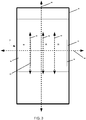
- the server nodes 16, 18, and 20 may be arranged such that the front ends 38 of server nodes 16 and 18 are opposite that of the front end 38 of server node 20.
- the motherboard/circuit board 36, of one or more of the server nodes 16, 18, 20 is parallel to a vertical axis 66 of the server rack 30, i.e., a horizontal axis 68 of the server rack 30 is perpendicular to a longitudinal axis 42 (also shown in FIGS. 4-7 ) of the motherboard/circuit board 36.
- the normal vector of the plane formed by the motherboard/circuit board 36 is perpendicular to the vertical axis 66 of the server rack 30.
- the system 10 may include the necessary electronics, software, memory, storage, databases, firmware, logic/state machines, microprocessors, communication links, displays or other visual or audio user interfaces, printing devices, and any other input/output interfaces to perform the functions described herein and/or to achieve the results described herein.
- the server chassis 14 may include at least one processor 28, and system memory / data storage structures (70 in FIG. 2 ), which may include random access memory (RAM) and read-only memory (ROM).
- the at least one processor of the server chassis 14 and/or the server nodes 16, 18, and 20 may include one or more conventional microprocessors and one or more supplementary co-processors such as math co-processors or the like.
- the data storage structures discussed herein may include an appropriate combination of magnetic, optical and/or semiconductor memory, and may include, for example, RAM, ROM, flash drive, an optical disc such as a compact disc and/or a hard disk or drive.
- a software application that provides for automated control and/or remote management of the server chassis 14, server nodes 16, 18, and 20, and/or their corresponding compressors 46, may be read into a main memory of the at least one processors 12, 28 from a computer-readable medium.
- the term "computer-readable medium”, as used herein, refers to any medium that provides or participates in providing instructions to the at least one processors 12, 28 (or any other processor of a device described herein) for execution. Such a medium may take many forms, including but not limited to, non-volatile media and volatile media.
- on-volatile media include, for example, optical, magnetic, or opto-magnetic disks, such as memory.
- Volatile media include dynamic random access memory (DRAM), which typically constitutes the main memory.
- Computer-readable media include, for example, a floppy disk, a flexible disk, hard disk, magnetic tape, any other magnetic medium, a CD-ROM, DVD, any other optical medium, a RAM, a PROM, an EPROM or EEPROM (electronically erasable programmable read-only memory), a FLASH-EEPROM, any other memory chip or cartridge, or any other medium from which a computer can read.
- a system for cooling one or more computer processors includes a server chassis and one or more server nodes.
- the server chassis is selectively mountable to a server rack.
- the one or more server nodes each include a body, at least one of the one or more computer processors, and a refrigeration circuit.
- the body is selectively mountable to the server chassis.
- the at least one of the one or more computer processors is disposed on-board the body.
- the refrigeration circuit is for cooling the at least one computer processor and includes an evaporator and a compressor disposed on-board the body.
- the evaporator is disposed on the at least one computer processor.
- the refrigeration circuit further includes a condenser disposed on-board the body.
- the refrigeration circuit further includes a metering device disposed on-board the body. In certain embodiments, the refrigeration circuit further includes a filter disposed on-board the body. In certain embodiments, at least three server nodes are selectively mounted to the server chassis. In certain embodiments, the body of each of the server nodes includes a first end and a second end, the at least one computer processor and the compressor of a first server node and of a second server node of the at least three server nodes are disposed at the first end and at the second end, respectively, and the at least one computer processor and the compressor of a third server node of the at least three server nodes are disposed in the first end.
- the server nodes are mounted to the server chassis such that the first ends of the first and of the second server nodes are arranged opposite of the first end of the third server node.
- the at least one computer processor is disposed on a circuit board disposed on-board the body such that the circuit board is parallel to a vertical axis of the server rack when the server chassis is mounted to the server rack.
- the server node includes a body, at least one computer processor, and a refrigeration circuit.
- the at least one computer processor is disposed on-board the body.
- the refrigeration circuit is for cooling the at least one computer processor and includes an evaporator and a compressor disposed on-board the body.
- the evaporator is disposed on the at least one computer processor.
- the refrigeration circuit further includes a condenser disposed on-board the body.
- the refrigeration circuit further includes a metering device disposed on-board the body.
- the refrigeration circuit further includes a filter disposed on-board the body.
- the body is selectively mountable to a server rack.
- the body is selectively mountable to a server chassis that is selectively mountable to a server rack.
- the at least one computer processor is disposed on a circuit board disposed on-board the body such that the circuit board is parallel to a vertical axis of the server rack when the server chassis is mounted to the server rack.
- the at least one computer processor is disposed at a first end of the body and the compressor is disposed at a second end of the body. In certain embodiments, the at least one computer processor and the compressor are disposed at a first end of the body.
- Yet still other embodiments provide for a method for cooling a computer processor disposed on-board a server node.
- the method includes: compressing a refrigerant via a compressor disposed on-board the server node; and directing the refrigerant through an evaporator disposed on-board the server node and in heating-contact with the computer processor.
- the method further includes automatically adjusting the compressor in relation to a usage level of the computer processor via a controller disposed on-board the server.
- some embodiments of the present invention provide for the ability to overclock the processors at speeds greater than cooling systems that utilize heat sinks or liquid coolants., e.g., non-refrigerants.
- some embodiments provide for an Intel Core i7 5960x to be overclocked to 5.0 GHz with a 4.6GHz cache such that processor generates 500W to 580W but is kept at temperatures up to 56 °C with the evaporator 44 at a temperature of -28 °C to -35 °C.
- the refrigerant circuit 22 is formed from components, e.g., the evaporator 44, compressor 46, condenser 52, metering device 54, and/or filter 56, disposed on-board a server node 16, 18, 20, some embodiments of the invention provide for a refrigerant based cooling system 10 that does not require extensive plumbing and/or large compressors contained in a lower server rack compartment or external of the server rack altogether. Accordingly, some embodiments of the present invention provide for a refrigerant based cooling system that facilitates easy installation and/or movement of the server nodes 16, 18, 20 into and/or between server rack 30 locations, or between other server racks (not shown).
Landscapes
- Engineering & Computer Science (AREA)
- Microelectronics & Electronic Packaging (AREA)
- Physics & Mathematics (AREA)
- Thermal Sciences (AREA)
- General Engineering & Computer Science (AREA)
- Theoretical Computer Science (AREA)
- Computer Hardware Design (AREA)
- Human Computer Interaction (AREA)
- General Physics & Mathematics (AREA)
- Cooling Or The Like Of Electrical Apparatus (AREA)
Applications Claiming Priority (1)
| Application Number | Priority Date | Filing Date | Title |
|---|---|---|---|
| US15/270,038 US20180084679A1 (en) | 2016-09-20 | 2016-09-20 | System and method for cooling a computer processor |
Publications (1)
| Publication Number | Publication Date |
|---|---|
| EP3296839A1 true EP3296839A1 (fr) | 2018-03-21 |
Family
ID=57821800
Family Applications (1)
| Application Number | Title | Priority Date | Filing Date |
|---|---|---|---|
| EP17150732.0A Withdrawn EP3296839A1 (fr) | 2016-09-20 | 2017-01-09 | Système et procédé de refroidissement d'un processeur d'ordinateur |
Country Status (3)
| Country | Link |
|---|---|
| US (1) | US20180084679A1 (fr) |
| EP (1) | EP3296839A1 (fr) |
| AU (1) | AU2017232087A1 (fr) |
Cited By (1)
| Publication number | Priority date | Publication date | Assignee | Title |
|---|---|---|---|---|
| GB2624468A (en) * | 2022-11-21 | 2024-05-22 | Jem2Ps Tech Limited | Modular processor cooling system |
Families Citing this family (1)
| Publication number | Priority date | Publication date | Assignee | Title |
|---|---|---|---|---|
| US11312619B1 (en) * | 2018-10-04 | 2022-04-26 | EngeniusMicro, LLC | Methods of manufacture of microisolators and devices for mechanical isolation or mechanical damping of microfabricated inertial sensors |
Citations (2)
| Publication number | Priority date | Publication date | Assignee | Title |
|---|---|---|---|---|
| WO2004038308A1 (fr) * | 2002-10-23 | 2004-05-06 | Jong Won Kim | Microrefroidisseur actif |
| US20040107718A1 (en) * | 2002-12-06 | 2004-06-10 | Michael Bowman | Method, system and apparatus for cooling high power density devices |
-
2016
- 2016-09-20 US US15/270,038 patent/US20180084679A1/en not_active Abandoned
-
2017
- 2017-01-09 EP EP17150732.0A patent/EP3296839A1/fr not_active Withdrawn
- 2017-09-20 AU AU2017232087A patent/AU2017232087A1/en not_active Abandoned
Patent Citations (2)
| Publication number | Priority date | Publication date | Assignee | Title |
|---|---|---|---|---|
| WO2004038308A1 (fr) * | 2002-10-23 | 2004-05-06 | Jong Won Kim | Microrefroidisseur actif |
| US20040107718A1 (en) * | 2002-12-06 | 2004-06-10 | Michael Bowman | Method, system and apparatus for cooling high power density devices |
Cited By (1)
| Publication number | Priority date | Publication date | Assignee | Title |
|---|---|---|---|---|
| GB2624468A (en) * | 2022-11-21 | 2024-05-22 | Jem2Ps Tech Limited | Modular processor cooling system |
Also Published As
| Publication number | Publication date |
|---|---|
| US20180084679A1 (en) | 2018-03-22 |
| AU2017232087A1 (en) | 2018-04-05 |
Similar Documents
| Publication | Publication Date | Title |
|---|---|---|
| US7551440B2 (en) | System and method for cooling an electronic component | |
| EP1466234B1 (fr) | Evaporateurs repartis en serie | |
| US9410751B2 (en) | Controlled cooling of an electronic system for reduced energy consumption | |
| US6786056B2 (en) | Cooling system with evaporators distributed in parallel | |
| US8755945B2 (en) | Efficient computer cooling methods and apparatus | |
| US9342079B2 (en) | Controlled cooling of an electronic system based on projected conditions | |
| US9301433B2 (en) | Vapor-compression refrigeration apparatus with backup air-cooled heat sink and auxiliary refrigerant heater | |
| US20080266794A1 (en) | Processor control of cooling fluid | |
| Ohadi et al. | A comparison analysis of air, liquid, and two-phase cooling of data centers | |
| CN111526694B (zh) | 用于服务器机柜的液冷系统和服务器机柜 | |
| US9983641B2 (en) | Tunable two phase liquid cooling thermal management method and apparatus | |
| US20110056225A1 (en) | Control of system coolant to facilitate two-phase heat transfer in a multi-evaporator cooling system | |
| WO2013153467A1 (fr) | Commande et entretien de système de refroidissement fondés sur une variation temporelle d'une variable de fonctionnement | |
| EP1917487A2 (fr) | Systemes et methodes pour refroidir des composants electroniques a l'aide d'une refrigeration par compression de vapeur | |
| WO2013079237A1 (fr) | Limitation dynamique de l'énergie consommée par un appareil de refroidissement | |
| JP2013175069A (ja) | 電子機器装置および冷却システム | |
| JP2017537295A (ja) | ハイブリッド熱輸送システム | |
| CN111107732A (zh) | 使服务器机柜维持于预定温度范围内的方法及其冷却系统 | |
| CN111278262A (zh) | 服务器芯片重力型热管和热管背板结合的服务器散热系统 | |
| EP3296839A1 (fr) | Système et procédé de refroidissement d'un processeur d'ordinateur | |
| CN105805838A (zh) | 全显热节能型机房/机柜专用精密空气调节器 | |
| Vuckovic et al. | Impacts of local cooling technologies on air cooled data center server performance: Test data analysis of Heatsink, Direct Liquid Cooling and passive 2-Phase Enhanced Air Cooling based on Loop Heat Pipe | |
| CN221913975U (zh) | 压缩机控制器冷却系统以及电动车 | |
| CN210381746U (zh) | 智能水冷机柜 | |
| CN120916378A (zh) | 对服务器和其他电子设备的液体辅助和基于热电的温度控制 |
Legal Events
| Date | Code | Title | Description |
|---|---|---|---|
| PUAI | Public reference made under article 153(3) epc to a published international application that has entered the european phase |
Free format text: ORIGINAL CODE: 0009012 |
|
| STAA | Information on the status of an ep patent application or granted ep patent |
Free format text: STATUS: THE APPLICATION HAS BEEN PUBLISHED |
|
| AK | Designated contracting states |
Kind code of ref document: A1 Designated state(s): AL AT BE BG CH CY CZ DE DK EE ES FI FR GB GR HR HU IE IS IT LI LT LU LV MC MK MT NL NO PL PT RO RS SE SI SK SM TR |
|
| AX | Request for extension of the european patent |
Extension state: BA ME |
|
| STAA | Information on the status of an ep patent application or granted ep patent |
Free format text: STATUS: THE APPLICATION IS DEEMED TO BE WITHDRAWN |
|
| 18D | Application deemed to be withdrawn |
Effective date: 20180922 |