EP3296899A1 - Verfahren und vorrichtung zur erzeugung eines 3d-modells eines objekts - Google Patents
Verfahren und vorrichtung zur erzeugung eines 3d-modells eines objekts Download PDFInfo
- Publication number
- EP3296899A1 EP3296899A1 EP16189533.9A EP16189533A EP3296899A1 EP 3296899 A1 EP3296899 A1 EP 3296899A1 EP 16189533 A EP16189533 A EP 16189533A EP 3296899 A1 EP3296899 A1 EP 3296899A1
- Authority
- EP
- European Patent Office
- Prior art keywords
- volumetric
- cluster
- materials
- model
- volumetric model
- Prior art date
- Legal status (The legal status is an assumption and is not a legal conclusion. Google has not performed a legal analysis and makes no representation as to the accuracy of the status listed.)
- Withdrawn
Links
Images


Classifications
-
- G—PHYSICS
- G05—CONTROLLING; REGULATING
- G05B—CONTROL OR REGULATING SYSTEMS IN GENERAL; FUNCTIONAL ELEMENTS OF SUCH SYSTEMS; MONITORING OR TESTING ARRANGEMENTS FOR SUCH SYSTEMS OR ELEMENTS
- G05B19/00—Program-control systems
- G05B19/02—Program-control systems electric
- G05B19/18—Numerical control [NC], i.e. automatically operating machines, in particular machine tools, e.g. in a manufacturing environment, so as to execute positioning, movement or co-ordinated operations by means of program data in numerical form
- G05B19/4097—Numerical control [NC], i.e. automatically operating machines, in particular machine tools, e.g. in a manufacturing environment, so as to execute positioning, movement or co-ordinated operations by means of program data in numerical form characterised by using design data to control NC machines, e.g. CAD/CAM
- G05B19/4099—Surface or curve machining, making three-dimensional [3D] objects, e.g. desktop manufacturing
-
- B—PERFORMING OPERATIONS; TRANSPORTING
- B33—ADDITIVE MANUFACTURING TECHNOLOGY
- B33Y—ADDITIVE MANUFACTURING, i.e. MANUFACTURING OF THREE-DIMENSIONAL [3D] OBJECTS BY ADDITIVE DEPOSITION, ADDITIVE AGGLOMERATION OR ADDITIVE LAYERING, e.g. BY 3D PRINTING, STEREOLITHOGRAPHY OR SELECTIVE LASER SINTERING
- B33Y50/00—Data acquisition or data processing for additive manufacturing
-
- G—PHYSICS
- G06—COMPUTING OR CALCULATING; COUNTING
- G06F—ELECTRIC DIGITAL DATA PROCESSING
- G06F30/00—Computer-aided design [CAD]
-
- G—PHYSICS
- G06—COMPUTING OR CALCULATING; COUNTING
- G06F—ELECTRIC DIGITAL DATA PROCESSING
- G06F30/00—Computer-aided design [CAD]
- G06F30/20—Design optimisation, verification or simulation
-
- G—PHYSICS
- G06—COMPUTING OR CALCULATING; COUNTING
- G06F—ELECTRIC DIGITAL DATA PROCESSING
- G06F30/00—Computer-aided design [CAD]
- G06F30/20—Design optimisation, verification or simulation
- G06F30/23—Design optimisation, verification or simulation using finite element methods [FEM] or finite difference methods [FDM]
-
- G—PHYSICS
- G05—CONTROLLING; REGULATING
- G05B—CONTROL OR REGULATING SYSTEMS IN GENERAL; FUNCTIONAL ELEMENTS OF SUCH SYSTEMS; MONITORING OR TESTING ARRANGEMENTS FOR SUCH SYSTEMS OR ELEMENTS
- G05B2219/00—Program-control systems
- G05B2219/30—Nc systems
- G05B2219/49—Nc machine tool, till multiple
- G05B2219/49023—3-D printing, layer of powder, add drops of binder in layer, new powder
-
- G—PHYSICS
- G06—COMPUTING OR CALCULATING; COUNTING
- G06F—ELECTRIC DIGITAL DATA PROCESSING
- G06F2111/00—Details relating to CAD techniques
- G06F2111/06—Multi-objective optimisation, e.g. Pareto optimisation using simulated annealing [SA], ant colony algorithms or genetic algorithms [GA]
-
- G—PHYSICS
- G06—COMPUTING OR CALCULATING; COUNTING
- G06F—ELECTRIC DIGITAL DATA PROCESSING
- G06F2113/00—Details relating to the application field
- G06F2113/10—Additive manufacturing, e.g. three-dimensional [3D] printing
-
- G—PHYSICS
- G06—COMPUTING OR CALCULATING; COUNTING
- G06F—ELECTRIC DIGITAL DATA PROCESSING
- G06F2113/00—Details relating to the application field
- G06F2113/26—Composites
-
- G—PHYSICS
- G06—COMPUTING OR CALCULATING; COUNTING
- G06F—ELECTRIC DIGITAL DATA PROCESSING
- G06F2119/00—Details relating to the type or aim of the analysis or the optimisation
- G06F2119/18—Manufacturability analysis or optimisation for manufacturability
-
- Y—GENERAL TAGGING OF NEW TECHNOLOGICAL DEVELOPMENTS; GENERAL TAGGING OF CROSS-SECTIONAL TECHNOLOGIES SPANNING OVER SEVERAL SECTIONS OF THE IPC; TECHNICAL SUBJECTS COVERED BY FORMER USPC CROSS-REFERENCE ART COLLECTIONS [XRACs] AND DIGESTS
- Y02—TECHNOLOGIES OR APPLICATIONS FOR MITIGATION OR ADAPTATION AGAINST CLIMATE CHANGE
- Y02P—CLIMATE CHANGE MITIGATION TECHNOLOGIES IN THE PRODUCTION OR PROCESSING OF GOODS
- Y02P90/00—Enabling technologies with a potential contribution to greenhouse gas [GHG] emissions mitigation
- Y02P90/02—Total factory control, e.g. smart factories, flexible manufacturing systems [FMS] or integrated manufacturing systems [IMS]
Definitions
- the instant invention relates the design and fabrication of multi-material objects from 3D models.
- the invention relates to methods and apparatus for generating 3D models of multi-material objects.
- additive manufacturing is understood as any process in which a three-dimensional object is synthetized from a 3D model.
- AM techniques exist such as stereolithography, fused deposition modeling, 3D inkjet printing, also known as Polyjet TM (Stratasys Ltd., North America), Continuous Liquid Interface Production (CLIP) or the like.
- a three-dimensional object may typically be formed by sequential-layer material addition/joining throughout a 3D work envelope under automated control.
- sequential-layer material addition/joining throughout a 3D work envelope under automated control.
- novel AM techniques do not involve such sequential-layer addition.
- Continuous Liquid Interface Production is Continuous Liquid Interface Production.
- 3D inkjet printing in which building materials are selectively jetted from one or more printing heads and deposited onto a fabrication tray in consecutive layers according to a pre-determined configuration defined by a software file.
- the printing head may be, for example, an ink jet head provided with a plurality of dispensing nozzles arranged in an array of one or more rows along a longitudinal axis of the printing head.
- Multi-colored objects are straightforward applications of these techniques but many other applications shows great potential.
- One example of application is related to surgical training and medical device development and testing in which benchtop devices realistically reproducing the behavior of an organ could be of great interest for training surgeon to perform surgery or testing medical device in real life conditions.
- the invention can thus find applications in surgical training and medical device development and testing.
- the deformation of the object results from global interactions between the various parts of the object.
- the selection and positioning of materials within the object thus involve a global computation of the dynamic behavior of the object.
- printing materials are primarily selected on the basis of their printing properties and the range of physical properties is thus also limited.
- the physical properties of the materials are not regularly spaced from one another along the full range of physical properties. A discrete optimization process then often produces more accurate results.
- a first object of the invention is a method for generating a 3D model for fabricating a multimaterial object using additive manufacturing, the method comprising:
- Another object of the invention is an apparatus for generating a 3D model for fabricating a multi-material object using additive manufacturing, the apparatus comprises at least:
- Figure 1 and 2 illustrate a method for generating a 3D model for fabricating a multi-material object using additive manufacturing according to a first embodiment of the invention.
- the fabricated multi-material object presents controlled deformations, meaning that, under predefined loads and constraints (Stress field, Volumetric forces, Boundary conditions), the object takes a target deformation configuration.
- the object is a copy of an original object which is a portion of a human organ.
- the mechanical properties of the object materials that the printer/fabricator has to work with are measured and characterized. This can be done ahead of time and stored as intrinsic material properties associated to each material of a database of object materials stored in electronically-readable storage.
- mechanical properties and “mechanical behaviors”, it is meant for instance uni-axial or multi-axial tensile strength or modulus, uni-axial or multi-axial compressive strength or modulus, shear strength or modulus, coefficient of static or dynamic friction, surface tension, elasticity.
- the database of object materials may comprise a plurality of 3D printed materials.
- the object materials may exhibit linear mechanical behaviors but also non-linear, hyper-elastic stress-strain mechanical behaviors.
- the physical behavior of the materials can be represented by defining intrinsic material properties.
- the intrinsic material properties comprise functions modeling the physical behavior of a material.
- the intrinsic material properties can include a density of a material, Young Modulus, Poisson ratio, thermal conductivity, electric conductivity.
- the intrinsic material properties may also take into account non-linear effects in the material.
- the intrinsic material properties define for instance a stress-strain relationship as a function of the local strain ⁇ (u).
- the stress-strain relationship can be stored as a matrix E and parameterized by a set of parameters.
- the parameters can be static values or function of various parameters, for instance a non-linear function of strain.
- the matrix E can thus also represents a non-linear function E(p(u)).
- additional metamaterials and/or non-printable material may be included in the database of object materials.
- Metamaterials are microstructures of materials whose mechanical properties may be averaged over the structures to be assimilated to an equivalent homogeneous material.
- Non-printable materials comprise for instance non-polymerizable materials.
- Such non-printable materials may for instance comprise water, gels, metals, ions, ceramics, bio-molecules and the like.
- object materials may also be provided by a 3D printer but usually don't have to be polymerized during the printing process and may stay fluid or liquid in the object.
- the size of the sub-region of the object made solely from these non-printable materials may thus be limited in some specific application of the invention in order to ensure the mechanical stability of the object.
- a first step of the method is illustrated on figure 1 and comprises providing a first volumetric model VM1 of an object.
- the first volumetric model is for instance received by an input unit of an apparatus for generating a 3D model as detailed further below.
- the first volumetric model may also be generated by the apparatus for generating a 3D model.
- the first volumetric model comprises a three-dimensional set of nodes which defines a plurality of elementary volumetric elements partitioning a first space region modeled by the first volumetric model.
- the three-dimensional set of nodes and the elementary volumetric elements of the first volumetric model are defined in order to be able to perform a three-dimensional numeric simulation of the deformations of the first volumetric model.
- numeric simulation are finite element simulation, discrete element method, combined finite element-discrete element method and the like.
- the elementary volumetric elements are for instance selected among the shapes of tetrahedron, pyramid, triangular prism and hexahedron.
- tetrahedrons may be selected as elementary volumetric elements.
- the first volumetric model may in particular comprise unstructured grid, i.e. tessellation of the first space regions in an irregular pattern.
- the first volumetric model may be adapted to present a refined structure where spatial variations of deformations of the mesh are locally high.
- the first volumetric model may in particular be generated from a three dimensional surface mesh by performing a volumetric model generation, for instance finite-element volumetric model generation for example by using a software such as "Abaqus” ® by Dassault System Inc..
- the first volumetric model may for instance be generated and received by an apparatus for generating a 3D model as follow.
- a three dimensional model of an object comprising at least one surface mesh representative of an interface of the object may be received.
- surface mesh it is meant a three-dimensional surface which may be closed or open.
- the thee-dimensional surface may be a CAD model or a polygon mesh and may be tessellated or defined by a set of equations.
- the interface of the object may for instance be associated to a discontinuity in the physical properties of the object.
- the three dimensional model of the object is generated on a computer, for instance by using a 3D modeling software.
- the three dimensional model of the object may be acquired from measurements of a physical original object copied by the manufacturing object.
- the measurements may comprise a 3D scanning of the object and/or volumetric measurements, in particular non-invasive measurements, for instance if the object is an internal part of a larger object that should not be destroyed, for instance living tissues.
- Nondestructive measurement of an imaged region located inside the heterogeneous object it is mean a measurement of a local physical parameter of a region located inside the heterogeneous object without damaging said object.
- Nondestructive imaging methods are known in the field of medical imaging and comprise for instance Radiography, Magnetic Resonance Imaging (MRI), Ultrasound, Elastography, Tactile imaging, Photoacoustic imaging, Thermography, Echocardiography, Functional near-infrared spectroscopy, Tomography, Computer-assisted Tomography such as X-ray computed tomography, Positron emission tomography or Magnetic resonance imaging and Nuclear medicine such as Scintigraphy or Single-photon emission computed tomography for instance.
- MRI Magnetic Resonance Imaging
- Ultrasound Ultrasound
- Elastography Ultrasound
- Tactile imaging Photoacoustic imaging
- Thermography Echocardiography
- Functional near-infrared spectroscopy Tomography
- Computer-assisted Tomography such as X-ray computed tomography,
- a volumetric measurement typically output a three dimension scalar field or vector field of an imaged region.
- the volumetric measurement usually comprises a set of three-dimensional pixels, commonly referred as "voxel" (short for "volumetric pixel") juxtaposed with one another along the three dimensions.
- voxel three-dimensional pixels
- a scalar or vector field representative of the local physical parameter in a voxel may be associated to every voxel.
- the scalar field is for example a locally measured density (enlarged to the voxel).
- a surface mesh of the object may then be determined by performing a topological segmentation of the measurement.
- Such a topological segmentation can be automatically performed by applying an image processing algorithm, adapted to identify clusters of three-dimensional pixels in the three dimensional model of an imaged region according to :
- a surface reconstruction process - for example a "marching cubes" method - may be implemented to build a three-dimensional surface mesh of the object from the output of the topological segmentation operation.
- the surface mesh is thus a three-dimensional surface which delimits a boundary of a cluster of voxel identified during the topological segmentation operation.
- the surface mesh may be an internal interface of a larger object, delimiting the original object.
- the original object may then for instance be an organ or a portion of an organ inside a body and the surface mesh may be an interface of said organ.
- Surface meshes may be part of the three dimensional model of the imaged region.
- This embodiment may be combined with the previous embodiment, i.e. the three dimensional model of the physical original object may be modified on a computer, for example by using a 3D modeling software, in order to make an object that is not an attempt at a copy but has different characteristics than the original object.
- the first volumetric model VM1 is then generated from said three dimensional surface mesh by performing a volumetric model generation, for instance finite-element volumetric model generation.
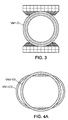
- the first volumetric model is provided in at least a deformed configuration VM1-CD illustrated on figure 4A .
- a “configuration of a volumetric model” it is meant three-dimensional locations of the nodes which defines the plurality of elementary volumetric elements partitioning the space region modeled by the volumetric model.
- At least two configurations of the first volumetric model may be provided.
- an initial configuration of the first volumetric model VM1-CI (illustrated on figure 3 ) and a deformed configuration of the first volumetric model VM1-CD (illustrated on figure 4A to 4C )) may be provided.
- the deformed configuration of the first volumetric model may also be called a "target deformed configuration" as explained in greater details further below.
- the initial configuration and the deformed configuration comprise distinct locations of at least one node, in particular of several or all nodes of the first volumetric model.
- the initial configuration and the deformed configuration may be determined for several three dimensional surface meshes as detailed above, for instance by performing several volumetric measurements of a physical original object copied by the manufacturing object under various load conditions.These measurements are similar to the measurements used to determine the three dimensional model of the object mentioned before and will not be described again.
- the deformed configuration of the first volumetric model may also be generated on a computer, for instance by using a 3D modeling software or by using a numerical simulation software to compute a deformed configuration of the first volumetric model.
- the initial configuration of the first volumetric may be generated on a computer or determined by volumetric measurements of a physical original object copied by the manufacturing object and the deformed configuration may be then be determined from the initial configuration by a numerical simulation of a deformation of the initial configuration of the first volumetric under a first set of predefined loads and constraints.
- the deformed configuration of the first volumetric model of the object may then be associated to the first set of predefined loads and constraints.
- a set of predefined loads and constraints it is meant the effect of the surrounding environment on the model.
- the predefined loads and constraints may thus comprise loads which may be mechanical such as volumetric forces (gravity), surface forces (loads, pressure), ponctual forces (moment, ..), thermic such as thermal load, or electric or magnetic such as concentrated charge.
- the predefined loads and constraints may also comprise boundary conditions which may also be mechanical such as encastrement, displacement/rotation, velocity, general contact, self-contact but also thermal or fluidic such as temperature, acoustic pressure and electric potential.
- the predefined loads and constraints may also comprise global environmental effects such as temperature field and pressure field (scalar or vector field).
- a second volumetric model VM2 is then generated from the first volumetric model.
- the second volumetric model also comprises a three-dimensional set of nodes which define a plurality of elementary volumetric elements dividing a second space region modeled by the second volumetric model.
- the second volumetric model VM2 may be generated from the initial configuration VM1-CI of the first volumetric model.
- the configuration of the second volumetric model may be similar to the initial configuration of the first volumetric model, meaning that the location of its nodes may be similar.
- the external surface or interface of the second volumetric model only may be similar to the external surface or interface of the second volumetric model and the internal arrangement of the nodes of the first and second volumetric models may be distinct.
- the second volumetric model is a model of the fabricated object whose deformed configuration under a second set of predefined loads and constraints is intended to be as close as possible to the deformed configuration of the first volumetric model.
- the second volumetric model may thus mesh a similar space region than the first volumetric model and may in general be roughly identical to the first volumetric model.
- Each elementary volumetric element i of the second volumetric model is respectively associated with at least one elementary volumetric element i of the first volumetric model.
- the second volumetric model may also slightly depart from the first volumetric model and/or be adapted to take into account various constrains related to the fabrication process.
- Such adaptation can involve a simplification of the topology to ensure a reliable or possible manufacturing.
- manufacturing constraints are: setting a minimum wall thickness, preventing undercut molding, taking into account the minimal droplet size of the three-dimensional printing process (about 16 microns diameter). Additional constraints are related to cleaning the support material after the 3D printing.
- One or more constraints from the following list can thus be taken into account:
- a second set of Predefined loads and constrains is provided and intended to be applied on the second volumetric model of the object.
- the second set of predefined loads and constraints may be identical to the first set of predefined loads and constraints used to determine the deformed configuration of the first volumetric model. In other embodiments, the second set of predefined loads and constraints may depart from the first set of predefined loads and constraints, for instance by incorporating additional physical phenomenon such as gravity and/or ignoring some phenomenon.
- the predefined loads and constraints are representatives of surgical mechanical forces that are exerted on the tissues of the internal element during a predefined surgical operation.
- the second set of predefined loads and constraints may then comprise an external stress field ⁇ defined to correspond to the stress field exerted by a neuroradiologist introducing a catheter in a carotid artery, and deploying a stent in the artery.
- the set of predefined loads and constraints may include additional force field such as surrounding organs stress field and/or blood pressure.
- the set of predefined loads and constraints will be similar to the stress field applied on the inner surface of the carotid artery and for example directed along the outer local normal at each point of the inner surface of the carotid artery with a magnitude similar to the magnitude of a force exerted by a stent, typically between 10 and 100 kPa.Once the configurations VM1-CI, VM1-CD of the first volumetric model, the second volumetric model VM2 and the set of predefined loads and constraints have been provided or generated, the method according to the invention involves an operation of assigning to each elementary volumetric element of the second volumetric model a material selected in a database of M object materials as illustrated on figure 2 and 4A-4C .
- This operation comprises the following general steps that are illustrated on figures 4A to 4C :
- step a a cluster of elementary volumetric elements of the second volumetric model is defined.
- the cluster of elementary volumetric elements may comprise the totality of the elementary volumetric elements of the second volumetric model.
- the cluster may comprise a smaller and smaller number of elementary volumetric elements until it reaches a single elementary volumetric element as it will become apparent from the following description of the method.
- An object material is then selected in the database of object materials for the cluster.
- the selection of the object material for the cluster is obtained as the results of minimizing a cost function of the cluster.
- This cost function is a function of the deformed configuration of the first volumetric model and a deformed configuration of the cluster detailed further below and illustrated on figure 4A .
- the cost function is for instance a function of a strain error between the deformed configuration of the cluster and the deformed configuration of the first volumetric model.
- the strain error may in particular be written as ⁇ i M ⁇ ⁇ i ⁇ where ⁇ M i is a strain of an elementary volumetric element i of the cluster between an initial configuration of the second volumetric model without the set of predefined loads and constraints and a deformed configuration of the cluster under the set of predefined loads and constraints and ⁇ i T is a displacement of an elementary volumetric element i of the first volumetric model between the initial configuration of the first volumetric model and the deformed configuration of the first volumetric model.
- the cost functions may be function of strain, stress, reaction force and the like.
- This cost function (1) is always positive.
- This cost function (2) can be positive or negative.
- J i ⁇ i M ⁇ ⁇ i T ⁇ i T
- ⁇ i M ⁇ ⁇ i T is the strain error between the deformed configuration of the cluster and the deformed configuration of the first volumetric model.
- This cost function (3) can be positive or negative.
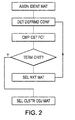
- a selected cost function (1)-(3) is computed during an operation b1) which is illustrated in greater detail on figure 2 and comprises a first sub-operation of b1-1) assigning to each elementary volumetric element of said cluster identical intrinsic material properties associated to a selected material.
- the object material may be then selected in a predefined subset of M materials of the database of object materials.
- a deformed configuration VM2-CD of the second volumetric model under the set of predefined loads and constraints is determined as illustrated on figure 4A .
- the deformed configuration of the second volumetric model may be determined by performing a finite element simulation of the deformation of the second volumetric model under the set of predefined loads and constraints.
- the cost function of the cluster associated to said material can be computed b1-3).
- the cost function is for instance computed from the selected equation (1)-(3) detailed above.
- operation b1) is performed for each material of a subset of M materials of the database of object materials.
- Each material of the subset of M materials of the database of object materials is thus successively selected, assigned to every elementary volume element of the cluster, the deformed configuration of the second volumetric model is determined and the associated cost function is computed.
- a cluster object material can be selected (operation b2) in the database of object materials by comparing the cost functions and selecting the object material associated to the lowest cost function for instance.
- the subset of M materials of the database of object materials can be ordered according to a physical property of said materials.
- the physical property may for instance be selected among the intrinsic material properties, for instance a density of a material, Young Modulus, Poisson ratio, thermal conductivity, electric conductivity.
- the materials in the subset can be ordered based on their stiffness, from the softest to the hardest, for instance according to a multi-axial tensile modulus.
- step b) may be performed as follows:
- a first deformed configuration cost function may be computed b1) for said pre-selected material.
- a function of the computed cost function for instance an absolute difference between the computed cost function and a previously computed cost function, is compared to a termination criterion in an operation b2).
- the termination criterion is for instance a maximal difference threshold.
- the pre-selected material can be selected as the cluster object material in an operation b3-1).
- Another material is pre-selected in the subset of M materials.
- the cost function is compared to a direction criterion, for instance a direction threshold and another material of the ordered subset is selected on the basis of the result of said comparison.
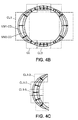
- FIG. 4B and 4C An example is illustrated on figure 4B and 4C .
- the cost function is computed according to equation (2) which can get positive and negative values.
- the direction criterion is a comparison with the threshold value 0.
- the material is thus updated to the next softer material of the subset of M materials.
- the material is thus updated to the next stiffer material of the subset of M materials.
- Operations b1) through b3) can then be reiterated until the termination criterion is met.
- the terminal criterion is important to ensure that the algorithm can terminate and don't stay locked oscillating between two materials.
- the difference between the deformed configuration of the second volumetric model and the deformed configuration can usually not be reduced to zero.
- a remaining error thus has to be accepted and is encoded in the termination criterion.
- the termination criterion may also take into account cases when an extremity of the range of physical property of the subset of material is reached.
- the method can move on to step c).
- step c) the elementary volumetric elements of the cluster are partitioned in at least two sub-clusters based on the deformed configuration of the cluster.
- a location of each elementary volumetric element in the deformed configuration of the cluster may be compared with a location of the associated elementary volumetric element in the deformed configuration of the first volumetric model (operation c1).
- a number of sub-clusters can be defined to classify the results of these comparisons as illustrated on figure 4B and 4C .
- sub-clusters may be defined in order to partition more finely or more roughly the cluster.
- the partitioning operation may take into account other properties relating to the deformed configuration of the cluster.
- An example of higher order property is for instance the normal direction of each elementary volume element with regard to the normal direction of the associated element in the deformed configuration.
- a subset of materials of the database of object materials may be associated (operation c2) to each sub-cluster on the basis of the deformed configuration of the cluster.
- Sub-cluster A which comprises the elementary volumetric elements that are displaced too much in the deformed configuration of the second volumetric model, can then be associated with a subset of harder materials of the material database, for instance the subset Mat_k, ..., Mat_m.
- Sub-cluster B which comprises the elementary volumetric elements that are not displaced enought in the deformed configuration of the second volumetric model, can be associated with a subset of softer materials of the material database, for instance the subset Mat_1 ..., Mat_k.
- Sub-cluster C comprises the elementary volumetric elements that are considered to have an acceptable behavior and whose selected material can thus stay identical. The subset associated to sub-cluster C can thus be restricted to Mat_k.
- the cluster may comprise the entire second volumetric model.
- the subset of materials associated to this cluster may then comprise the whole range of material of the database.
- steps b) and c) of the method can be repeated for each sub-cluster of the partition.
- the method can then involve a recursive computation on smaller and smaller cluster until each sub-clusters comprise a single elementary volumetric element.
- steps b) and c) of the method can be repeated until a difference between the deformed configuration of the second volumetric model and the deformed configuration of the first volumetric model of the object satisfy a convergence criterion.
- a general cost function of the deformed configuration of the entire second volumetric model may be computed and compared to a convergence criterion, for instance a threshold on the maximum error over the whole second volumetric model.
- a 3D surface model for fabricating the object may be generated from the second volumetric model and the materials assigned to each elementary volumetric element of the second volumetric model.
- the 3D model may for example comprise a plurality of 3D files such as STL files (file format native to the stereolithography CAD software created by 3D Systems, Rock Hill, South Carolina). Each file may be associated to a single material of the plurality of material printable by a 3D printer.
- STL files file format native to the stereolithography CAD software created by 3D Systems, Rock Hill, South Carolina.
- the 3D surface model may be used for manufacturing the object.
- the method according to the invention may include the final step of fabricating the object.
- the fabrication of the object may be performed at least in part by additive manufacturing in particular by 3D printing.
- the final object can be manufactured using both traditional and state-of-the-art methods including, but not limited to, casting, 3D printing, mechanical linkages of disparate materials and material deposition manufacturing.
- non-polymerizable materials such as water, gels, metals, ions, ceramics, bio-molecules and the like may be used and may be deposited using various techniques encompassing casting, 3D printing, mechanical linkages of desparate materials and shape deposition manufacturing.
- the elementary volumetric elements may be replicated with a plurality of printed layers, e.g. 5-20 printing layers.
- a multi-material additive manufacturing device able to fabricate the object may be equipped with several building materials, in particular at least two building materials, each having different mechanical properties as detailed above.
- the multi-material additive manufacturing device may be equipped to dispense the additional material, e.g. non-printable materials such as water, gels, metals, ions, ceramics, bio-molecules and the like.
- additional material e.g. non-printable materials such as water, gels, metals, ions, ceramics, bio-molecules and the like.
- advanced 3D printing technology may be used that enable seamless integration of various materials in the object.
- Stratasys, Ltd. North America, 7665 Commerce Way Eden Prairie, MN 55344.
- this technology allows to develop simulation device with mechanical properties that are adjusted at the scale of the living tissues.
- another object of the invention is an apparatus 500 for generating a 3D model for fabricating a multi-material object according to a method as detail above.
- Such an apparatus is illustrated on figure 6 and comprises:
- a screen 501 and a keyboard 502 may be provided and connected to the processing unit 504.
- compositions comprising, “comprising”, “includes”, “including”, “having” and their conjugates mean “including but not limited to”.
- Consisting of means “including and limited to”.
- Consisting essentially of means that the composition, method or structure may include additional ingredients, steps and/or parts, but only if the additional ingredients, steps and/or parts do not materially alter the basic and novel characteristics of the claimed composition, method or structure.
Landscapes
- Engineering & Computer Science (AREA)
- Physics & Mathematics (AREA)
- Theoretical Computer Science (AREA)
- General Physics & Mathematics (AREA)
- Manufacturing & Machinery (AREA)
- General Engineering & Computer Science (AREA)
- Geometry (AREA)
- Evolutionary Computation (AREA)
- Computer Hardware Design (AREA)
- Human Computer Interaction (AREA)
- Automation & Control Theory (AREA)
- Chemical & Material Sciences (AREA)
- Materials Engineering (AREA)
Priority Applications (7)
| Application Number | Priority Date | Filing Date | Title |
|---|---|---|---|
| EP16189533.9A EP3296899A1 (de) | 2016-09-19 | 2016-09-19 | Verfahren und vorrichtung zur erzeugung eines 3d-modells eines objekts |
| EP17768145.9A EP3516553A1 (de) | 2016-09-19 | 2017-09-19 | Verfahren und vorrichtung zur erzeugung eines 3d-modells eines objekts |
| US16/333,872 US10976722B2 (en) | 2016-09-19 | 2017-09-19 | Method and apparatus for generating a 3D model of an object |
| PCT/EP2017/073621 WO2018050915A1 (en) | 2016-09-19 | 2017-09-19 | Method and apparatus for generating a 3d model of an object |
| CN201780071139.7A CN110325991A (zh) | 2016-09-19 | 2017-09-19 | 用于生成对象的3d模型的方法和装置 |
| IL265483A IL265483B (en) | 2016-09-19 | 2019-03-19 | Method and device for creating a 3D model of an object |
| US17/227,202 US20210232119A1 (en) | 2016-09-19 | 2021-04-09 | Methoid and apparatus for generating a 3d model of an object |
Applications Claiming Priority (1)
| Application Number | Priority Date | Filing Date | Title |
|---|---|---|---|
| EP16189533.9A EP3296899A1 (de) | 2016-09-19 | 2016-09-19 | Verfahren und vorrichtung zur erzeugung eines 3d-modells eines objekts |
Publications (1)
| Publication Number | Publication Date |
|---|---|
| EP3296899A1 true EP3296899A1 (de) | 2018-03-21 |
Family
ID=56943441
Family Applications (2)
| Application Number | Title | Priority Date | Filing Date |
|---|---|---|---|
| EP16189533.9A Withdrawn EP3296899A1 (de) | 2016-09-19 | 2016-09-19 | Verfahren und vorrichtung zur erzeugung eines 3d-modells eines objekts |
| EP17768145.9A Pending EP3516553A1 (de) | 2016-09-19 | 2017-09-19 | Verfahren und vorrichtung zur erzeugung eines 3d-modells eines objekts |
Family Applications After (1)
| Application Number | Title | Priority Date | Filing Date |
|---|---|---|---|
| EP17768145.9A Pending EP3516553A1 (de) | 2016-09-19 | 2017-09-19 | Verfahren und vorrichtung zur erzeugung eines 3d-modells eines objekts |
Country Status (5)
| Country | Link |
|---|---|
| US (2) | US10976722B2 (de) |
| EP (2) | EP3296899A1 (de) |
| CN (1) | CN110325991A (de) |
| IL (1) | IL265483B (de) |
| WO (1) | WO2018050915A1 (de) |
Cited By (2)
| Publication number | Priority date | Publication date | Assignee | Title |
|---|---|---|---|---|
| US11263373B2 (en) * | 2019-01-25 | 2022-03-01 | Autodesk, Inc. | Predictive machining for forging distortions |
| CN116422903A (zh) * | 2023-06-08 | 2023-07-14 | 四川工程职业技术学院 | 一种航空发动机涡轮导向器激光选区熔化制造方法 |
Families Citing this family (13)
| Publication number | Priority date | Publication date | Assignee | Title |
|---|---|---|---|---|
| EP3475675B1 (de) * | 2016-06-24 | 2020-12-30 | Covestro Deutschland AG | Verfahren zur mechanischen prüfung einer einteilig ausgebildeten struktur anhand von über ein 3d-druckverfahren erzeugten prüfkörpern |
| US10073440B1 (en) * | 2018-02-13 | 2018-09-11 | University Of Central Florida Research Foundation, Inc. | Method for the design and manufacture of composites having tunable physical properties |
| US10838402B2 (en) * | 2018-08-22 | 2020-11-17 | University Of Central Florida Research Foundation, Inc. | Deformation-based additive manufacturing optimization |
| US11663372B2 (en) * | 2018-09-04 | 2023-05-30 | Siemens Industry Software Inc. | Spatially-aware detection of trapped support areas in 3D printing |
| EP3853837A1 (de) | 2018-09-20 | 2021-07-28 | Biomodex S.A.S. | Patientenspezifische kardiovaskuläre simulationsvorrichtung |
| CN111222264B (zh) * | 2019-11-01 | 2023-03-03 | 长春英利汽车工业股份有限公司 | 一种复合连续玻璃纤维增强前端模块的制造方法 |
| CA3163611A1 (en) | 2019-12-30 | 2021-07-08 | Frederic CHAMP | Multi-material three-dimensional printed portion of a heart |
| US20220032549A1 (en) * | 2020-07-30 | 2022-02-03 | General Electric Company | Additive manufacturing systems and methods including build characteristic contribution profile |
| WO2022144838A1 (en) | 2020-12-30 | 2022-07-07 | Biomodex, S.A.S. | System for advanced physician training and patient specific rehearsals |
| CN113134230B (zh) * | 2021-01-08 | 2024-03-22 | 成都完美时空网络技术有限公司 | 一种虚拟对象的分簇方法、装置、存储介质和电子装置 |
| WO2022208470A1 (en) | 2021-04-02 | 2022-10-06 | Biomodex, S.A.S. | Patient specific cardiovascular simulation device |
| EP4377942A1 (de) | 2021-07-25 | 2024-06-05 | Mentice AB | System für fortgeschrittenes arzttraining und patientenspezifische erlernungen |
| CN116487038B (zh) * | 2023-06-25 | 2023-08-18 | 四川大学华西医院 | 轻度认知障碍向阿尔茨海默发展的预测系统和存储介质 |
Citations (3)
| Publication number | Priority date | Publication date | Assignee | Title |
|---|---|---|---|---|
| US20120185218A1 (en) * | 2011-01-18 | 2012-07-19 | Disney Enterprises, Inc. | Physical face cloning |
| US8565909B2 (en) | 2010-02-24 | 2013-10-22 | Disney Enterprises, Inc. | Fabrication of materials with desired characteristics from base materials having determined characteristics |
| US20160096318A1 (en) * | 2014-10-03 | 2016-04-07 | Disney Enterprises, Inc. | Three dimensional (3d) printer system and method for printing 3d objects with user-defined material parameters |
Family Cites Families (9)
| Publication number | Priority date | Publication date | Assignee | Title |
|---|---|---|---|---|
| US8041095B2 (en) | 2008-06-11 | 2011-10-18 | Siemens Aktiengesellschaft | Method and apparatus for pretreatment planning of endovascular coil placement |
| EP2490602B1 (de) | 2009-10-21 | 2019-01-16 | Koninklijke Philips N.V. | Interaktive bestimmung von wickelparametern |
| US9042613B2 (en) | 2013-03-01 | 2015-05-26 | Heartflow, Inc. | Method and system for determining treatments by modifying patient-specific geometrical models |
| US10354304B2 (en) * | 2013-03-15 | 2019-07-16 | Kemeera Inc. | Systems and methods for creating 3D objects |
| CN103171151B (zh) * | 2013-03-24 | 2015-12-09 | 广州市文搏智能科技有限公司 | 一种3d打印成形方法以及3d打印成形装置 |
| US20140316748A1 (en) | 2013-04-23 | 2014-10-23 | Eth Zurich | Posture Guided Design Of Deformable Objects |
| CN104504186B (zh) * | 2014-12-10 | 2017-10-31 | 广州中国科学院先进技术研究所 | 一种基于3d打印数据处理软件平台的实现方式 |
| US20160167306A1 (en) * | 2014-12-11 | 2016-06-16 | Massachusetts Institute Of Technology | Systems and methods of hierarchical material design for additive fabrication |
| CN105528494B (zh) * | 2015-12-29 | 2019-02-22 | 上海大学 | 基于三维元胞自动机的轻量化模型生成及优化方法 |
-
2016
- 2016-09-19 EP EP16189533.9A patent/EP3296899A1/de not_active Withdrawn
-
2017
- 2017-09-19 CN CN201780071139.7A patent/CN110325991A/zh active Pending
- 2017-09-19 WO PCT/EP2017/073621 patent/WO2018050915A1/en not_active Ceased
- 2017-09-19 EP EP17768145.9A patent/EP3516553A1/de active Pending
- 2017-09-19 US US16/333,872 patent/US10976722B2/en active Active
-
2019
- 2019-03-19 IL IL265483A patent/IL265483B/en unknown
-
2021
- 2021-04-09 US US17/227,202 patent/US20210232119A1/en not_active Abandoned
Patent Citations (4)
| Publication number | Priority date | Publication date | Assignee | Title |
|---|---|---|---|---|
| US8565909B2 (en) | 2010-02-24 | 2013-10-22 | Disney Enterprises, Inc. | Fabrication of materials with desired characteristics from base materials having determined characteristics |
| US20140046469A1 (en) * | 2010-02-24 | 2014-02-13 | Disney Enterprises, Inc. | Design and fabrication of materials with desired characteristics from base materials having determined characteristics |
| US20120185218A1 (en) * | 2011-01-18 | 2012-07-19 | Disney Enterprises, Inc. | Physical face cloning |
| US20160096318A1 (en) * | 2014-10-03 | 2016-04-07 | Disney Enterprises, Inc. | Three dimensional (3d) printer system and method for printing 3d objects with user-defined material parameters |
Non-Patent Citations (4)
| Title |
|---|
| HONGYI XU ET AL: "Interactive Material Design Using Model Reduction", ACM TRANSACTIONS ON GRAPHICS (TOG), ACM, US, vol. 34, no. 2, 2 March 2015 (2015-03-02), pages 1 - 14, XP058065798, ISSN: 0730-0301, DOI: 10.1145/2699648 * |
| HONGYI XU: "Interactive Material Design Using Model Reduction", ACM TRANSACTIONS ON GRAPHICS, vol. 34, no. 2, February 2015 (2015-02-01) |
| MELINA SKOURAS ET AL.: "Computational Design of Actuated Deformable Characters", ACM TRANSACTIONS ON GRAPHICS (TOG) - SIGGRAPH 2013 CONFERENCE PROCEEDINGS TOG HOMEPAGE, vol. 32, no. 4, July 2013 (2013-07-01), XP055361120, DOI: doi:10.1145/2461912.2461979 |
| MÉLINA SKOURAS ET AL: "Computational design of actuated deformable characters", ACM TRANSACTIONS ON GRAPHICS (TOG), vol. 32, no. 4, 1 July 2013 (2013-07-01), US, pages 1, XP055361120, ISSN: 0730-0301, DOI: 10.1145/2461912.2461979 * |
Cited By (2)
| Publication number | Priority date | Publication date | Assignee | Title |
|---|---|---|---|---|
| US11263373B2 (en) * | 2019-01-25 | 2022-03-01 | Autodesk, Inc. | Predictive machining for forging distortions |
| CN116422903A (zh) * | 2023-06-08 | 2023-07-14 | 四川工程职业技术学院 | 一种航空发动机涡轮导向器激光选区熔化制造方法 |
Also Published As
| Publication number | Publication date |
|---|---|
| US20190204810A1 (en) | 2019-07-04 |
| EP3516553A1 (de) | 2019-07-31 |
| US20210232119A1 (en) | 2021-07-29 |
| WO2018050915A1 (en) | 2018-03-22 |
| IL265483B (en) | 2022-05-01 |
| US10976722B2 (en) | 2021-04-13 |
| CN110325991A (zh) | 2019-10-11 |
| IL265483A (en) | 2019-05-30 |
Similar Documents
| Publication | Publication Date | Title |
|---|---|---|
| US20210232119A1 (en) | Methoid and apparatus for generating a 3d model of an object | |
| Liu et al. | A survey of modeling and optimization methods for multi-scale heterogeneous lattice structures | |
| JP7605909B2 (ja) | 三次元印刷指向の画像区分化のための方法およびシステム | |
| Löhner et al. | Adaptive embedded and immersed unstructured grid techniques | |
| Bhandari et al. | 3D polycrystalline microstructure reconstruction from FIB generated serial sections for FE analysis | |
| Biancolini et al. | Fast interactive CFD evaluation of hemodynamics assisted by RBF mesh morphing and reduced order models: the case of aTAA modelling | |
| US20220137593A1 (en) | Method for fabricating a physical simulation device, simulation device and simulation system | |
| US20160096318A1 (en) | Three dimensional (3d) printer system and method for printing 3d objects with user-defined material parameters | |
| Bickel et al. | Physical face cloning | |
| Tedia et al. | Manufacturability analysis tool for additive manufacturing using voxel-based geometric modeling | |
| CN106373168A (zh) | 一种基于医疗图像的分割与三维重建方法、3d打印系统 | |
| Zhang et al. | Data‐driven bending elasticity design by shell thickness | |
| EP3425539A1 (de) | Materialformsimulationsvorrichtung, materialformsimulationsverfahren und herstellungsverfahren für dreidimensionalen gewebten faserartikel | |
| CN115952705A (zh) | 设计建模对象 | |
| Iwamoto et al. | Multi‐layer Lattice Model for Real‐Time Dynamic Character Deformation | |
| US11042671B1 (en) | Methods of using vector fields and texture maps as inputs to design and manufacture composite objects with tunable properties | |
| Shimada | Current issues and trends in meshing and geometric processing for computational engineering analyses | |
| CN116442514A (zh) | 一种曲面分层3d打印路径规划方法及系统 | |
| Tozoni et al. | Cut‐Cell Microstructures for Two‐scale Structural Optimization | |
| Mahdi | Buckling analysis and design of varying stiffness lattice-cored sandwich panels | |
| Doi et al. | 3d volume extraction and mesh generation using energy minimization techniques | |
| Zhang | A GPU Accelerated Signed Distance Voxel Modeling System | |
| Basloom | A Survey On Physical Methods For Deformation Modeling | |
| Ladron de Guevara et al. | A multi-resolution design methodology based on discrete models | |
| Krishnamurti | A Multi-resolution Design Methodology Based |
Legal Events
| Date | Code | Title | Description |
|---|---|---|---|
| PUAI | Public reference made under article 153(3) epc to a published international application that has entered the european phase |
Free format text: ORIGINAL CODE: 0009012 |
|
| STAA | Information on the status of an ep patent application or granted ep patent |
Free format text: STATUS: THE APPLICATION HAS BEEN PUBLISHED |
|
| AK | Designated contracting states |
Kind code of ref document: A1 Designated state(s): AL AT BE BG CH CY CZ DE DK EE ES FI FR GB GR HR HU IE IS IT LI LT LU LV MC MK MT NL NO PL PT RO RS SE SI SK SM TR |
|
| AX | Request for extension of the european patent |
Extension state: BA ME |
|
| STAA | Information on the status of an ep patent application or granted ep patent |
Free format text: STATUS: THE APPLICATION IS DEEMED TO BE WITHDRAWN |
|
| 18D | Application deemed to be withdrawn |
Effective date: 20180922 |