EP3298062B1 - Kohlenwasserstoffpolymere mit zwei (2-thion-1,3-oxathiolan-4-yl)alkyloxycarbonyl-endgruppen - Google Patents
Kohlenwasserstoffpolymere mit zwei (2-thion-1,3-oxathiolan-4-yl)alkyloxycarbonyl-endgruppen Download PDFInfo
- Publication number
- EP3298062B1 EP3298062B1 EP16723423.6A EP16723423A EP3298062B1 EP 3298062 B1 EP3298062 B1 EP 3298062B1 EP 16723423 A EP16723423 A EP 16723423A EP 3298062 B1 EP3298062 B1 EP 3298062B1
- Authority
- EP
- European Patent Office
- Prior art keywords
- group
- formula
- groups
- polymer
- compound
- Prior art date
- Legal status (The legal status is an assumption and is not a legal conclusion. Google has not performed a legal analysis and makes no representation as to the accuracy of the status listed.)
- Active
Links
- 229920000642 polymer Polymers 0.000 title claims description 121
- 150000002430 hydrocarbons Chemical class 0.000 title claims description 39
- 239000004215 Carbon black (E152) Substances 0.000 title claims description 37
- 229930195733 hydrocarbon Natural products 0.000 title claims description 37
- 125000004453 alkoxycarbonyl group Chemical group 0.000 title claims description 12
- 239000012986 chain transfer agent Substances 0.000 claims description 56
- 238000006243 chemical reaction Methods 0.000 claims description 42
- 150000001875 compounds Chemical class 0.000 claims description 30
- 125000000217 alkyl group Chemical group 0.000 claims description 28
- 239000003054 catalyst Substances 0.000 claims description 25
- QGJOPFRUJISHPQ-UHFFFAOYSA-N Carbon disulfide Chemical compound S=C=S QGJOPFRUJISHPQ-UHFFFAOYSA-N 0.000 claims description 22
- 239000000203 mixture Substances 0.000 claims description 22
- 125000004432 carbon atom Chemical group C* 0.000 claims description 18
- 238000000034 method Methods 0.000 claims description 18
- 238000005649 metathesis reaction Methods 0.000 claims description 17
- 125000001570 methylene group Chemical group [H]C([H])([*:1])[*:2] 0.000 claims description 16
- 229920006395 saturated elastomer Polymers 0.000 claims description 16
- 238000002360 preparation method Methods 0.000 claims description 15
- 125000004435 hydrogen atom Chemical group [H]* 0.000 claims description 13
- 229910052799 carbon Inorganic materials 0.000 claims description 12
- 125000000623 heterocyclic group Chemical group 0.000 claims description 12
- 229910052760 oxygen Inorganic materials 0.000 claims description 12
- 125000004043 oxo group Chemical group O=* 0.000 claims description 11
- 125000005843 halogen group Chemical group 0.000 claims description 10
- 229910052717 sulfur Inorganic materials 0.000 claims description 10
- 125000004404 heteroalkyl group Chemical group 0.000 claims description 9
- 125000002947 alkylene group Chemical group 0.000 claims description 8
- 230000008569 process Effects 0.000 claims description 7
- 238000004519 manufacturing process Methods 0.000 claims description 6
- 125000003277 amino group Chemical group 0.000 claims description 5
- 239000011203 carbon fibre reinforced carbon Substances 0.000 claims description 5
- 238000005984 hydrogenation reaction Methods 0.000 claims description 5
- 238000007152 ring opening metathesis polymerisation reaction Methods 0.000 claims description 5
- 125000003700 epoxy group Chemical group 0.000 claims description 3
- 230000035484 reaction time Effects 0.000 claims description 3
- 150000002642 lithium compounds Chemical class 0.000 claims description 2
- 229930195734 saturated hydrocarbon Natural products 0.000 claims 3
- 229930195735 unsaturated hydrocarbon Natural products 0.000 claims 3
- CREMABGTGYGIQB-UHFFFAOYSA-N carbon carbon Chemical compound C.C CREMABGTGYGIQB-UHFFFAOYSA-N 0.000 claims 1
- -1 poly (thio) urethanes Polymers 0.000 description 46
- YMWUJEATGCHHMB-UHFFFAOYSA-N Dichloromethane Chemical compound ClCCl YMWUJEATGCHHMB-UHFFFAOYSA-N 0.000 description 25
- OKKJLVBELUTLKV-UHFFFAOYSA-N Methanol Chemical compound OC OKKJLVBELUTLKV-UHFFFAOYSA-N 0.000 description 24
- 150000001925 cycloalkenes Chemical class 0.000 description 22
- 238000003786 synthesis reaction Methods 0.000 description 22
- 239000004913 cyclooctene Substances 0.000 description 21
- URYYVOIYTNXXBN-UPHRSURJSA-N cyclooctene Chemical compound C1CCC\C=C/CC1 URYYVOIYTNXXBN-UPHRSURJSA-N 0.000 description 20
- 230000015572 biosynthetic process Effects 0.000 description 19
- 229920002635 polyurethane Polymers 0.000 description 17
- 239000004814 polyurethane Substances 0.000 description 17
- WYURNTSHIVDZCO-UHFFFAOYSA-N Tetrahydrofuran Chemical compound C1CCOC1 WYURNTSHIVDZCO-UHFFFAOYSA-N 0.000 description 16
- 238000001542 size-exclusion chromatography Methods 0.000 description 15
- 238000012360 testing method Methods 0.000 description 14
- 239000002904 solvent Substances 0.000 description 13
- XKRFYHLGVUSROY-UHFFFAOYSA-N Argon Chemical compound [Ar] XKRFYHLGVUSROY-UHFFFAOYSA-N 0.000 description 12
- 239000000047 product Substances 0.000 description 12
- YXFVVABEGXRONW-UHFFFAOYSA-N Toluene Chemical compound CC1=CC=CC=C1 YXFVVABEGXRONW-UHFFFAOYSA-N 0.000 description 11
- 230000001070 adhesive effect Effects 0.000 description 11
- 239000000853 adhesive Substances 0.000 description 10
- 125000004429 atom Chemical group 0.000 description 10
- 229920000098 polyolefin Polymers 0.000 description 10
- YLQBMQCUIZJEEH-UHFFFAOYSA-N tetrahydrofuran Natural products C=1C=COC=1 YLQBMQCUIZJEEH-UHFFFAOYSA-N 0.000 description 10
- 239000012948 isocyanate Substances 0.000 description 9
- 150000002513 isocyanates Chemical class 0.000 description 9
- JFNLZVQOOSMTJK-KNVOCYPGSA-N norbornene Chemical compound C1[C@@H]2CC[C@H]1C=C2 JFNLZVQOOSMTJK-KNVOCYPGSA-N 0.000 description 9
- 239000007788 liquid Substances 0.000 description 8
- AMXOYNBUYSYVKV-UHFFFAOYSA-M lithium bromide Chemical compound [Li+].[Br-] AMXOYNBUYSYVKV-UHFFFAOYSA-M 0.000 description 8
- 238000006116 polymerization reaction Methods 0.000 description 8
- 238000007151 ring opening polymerisation reaction Methods 0.000 description 8
- 239000007787 solid Substances 0.000 description 8
- 239000003795 chemical substances by application Substances 0.000 description 7
- UHOVQNZJYSORNB-UHFFFAOYSA-N Benzene Chemical compound C1=CC=CC=C1 UHOVQNZJYSORNB-UHFFFAOYSA-N 0.000 description 6
- RTZKZFJDLAIYFH-UHFFFAOYSA-N Diethyl ether Chemical compound CCOCC RTZKZFJDLAIYFH-UHFFFAOYSA-N 0.000 description 6
- LFQSCWFLJHTTHZ-UHFFFAOYSA-N Ethanol Chemical compound CCO LFQSCWFLJHTTHZ-UHFFFAOYSA-N 0.000 description 6
- 108010029660 Intrinsically Disordered Proteins Proteins 0.000 description 6
- 102100037845 Isocitrate dehydrogenase [NADP], mitochondrial Human genes 0.000 description 6
- IMNFDUFMRHMDMM-UHFFFAOYSA-N N-Heptane Chemical compound CCCCCCC IMNFDUFMRHMDMM-UHFFFAOYSA-N 0.000 description 6
- 150000001412 amines Chemical class 0.000 description 6
- 229910052786 argon Inorganic materials 0.000 description 6
- 230000008034 disappearance Effects 0.000 description 6
- 238000001035 drying Methods 0.000 description 6
- 229940082150 encore Drugs 0.000 description 6
- 238000001914 filtration Methods 0.000 description 6
- VLKZOEOYAKHREP-UHFFFAOYSA-N n-Hexane Chemical compound CCCCCC VLKZOEOYAKHREP-UHFFFAOYSA-N 0.000 description 6
- 238000001556 precipitation Methods 0.000 description 6
- WLPUWLXVBWGYMZ-UHFFFAOYSA-N tricyclohexylphosphine Chemical compound C1CCCCC1P(C1CCCCC1)C1CCCCC1 WLPUWLXVBWGYMZ-UHFFFAOYSA-N 0.000 description 6
- MLVSWIXRZNPEKF-OWOJBTEDSA-N bis(oxiran-2-ylmethyl) (e)-but-2-enedioate Chemical compound C1OC1COC(=O)/C=C/C(=O)OCC1CO1 MLVSWIXRZNPEKF-OWOJBTEDSA-N 0.000 description 5
- 239000011984 grubbs catalyst Substances 0.000 description 5
- OKTJSMMVPCPJKN-UHFFFAOYSA-N Carbon Chemical compound [C] OKTJSMMVPCPJKN-UHFFFAOYSA-N 0.000 description 4
- KMTRUDSVKNLOMY-UHFFFAOYSA-N Ethylene carbonate Chemical group O=C1OCCO1 KMTRUDSVKNLOMY-UHFFFAOYSA-N 0.000 description 4
- URLKBWYHVLBVBO-UHFFFAOYSA-N Para-Xylene Chemical group CC1=CC=C(C)C=C1 URLKBWYHVLBVBO-UHFFFAOYSA-N 0.000 description 4
- OFBQJSOFQDEBGM-UHFFFAOYSA-N Pentane Chemical compound CCCCC OFBQJSOFQDEBGM-UHFFFAOYSA-N 0.000 description 4
- 239000004793 Polystyrene Substances 0.000 description 4
- PNPBGYBHLCEVMK-UHFFFAOYSA-N benzylidene(dichloro)ruthenium;tricyclohexylphosphanium Chemical compound Cl[Ru](Cl)=CC1=CC=CC=C1.C1CCCCC1[PH+](C1CCCCC1)C1CCCCC1.C1CCCCC1[PH+](C1CCCCC1)C1CCCCC1 PNPBGYBHLCEVMK-UHFFFAOYSA-N 0.000 description 4
- 125000001309 chloro group Chemical group Cl* 0.000 description 4
- MVPPADPHJFYWMZ-UHFFFAOYSA-N chlorobenzene Chemical compound ClC1=CC=CC=C1 MVPPADPHJFYWMZ-UHFFFAOYSA-N 0.000 description 4
- 230000000052 comparative effect Effects 0.000 description 4
- 150000001923 cyclic compounds Chemical class 0.000 description 4
- 238000010586 diagram Methods 0.000 description 4
- 150000004985 diamines Chemical class 0.000 description 4
- 150000004702 methyl esters Chemical group 0.000 description 4
- QEMSHZOGUJXBQA-UHFFFAOYSA-N sulfanyl carbamate Chemical compound NC(=O)OS QEMSHZOGUJXBQA-UHFFFAOYSA-N 0.000 description 4
- SXHIHLSVTALYDY-WAYWQWQTSA-N (1Z)-5-hexylcyclooctene Chemical compound CCCCCCC1CCC\C=C/CC1 SXHIHLSVTALYDY-WAYWQWQTSA-N 0.000 description 3
- 239000004593 Epoxy Substances 0.000 description 3
- KJTLSVCANCCWHF-UHFFFAOYSA-N Ruthenium Chemical compound [Ru] KJTLSVCANCCWHF-UHFFFAOYSA-N 0.000 description 3
- 229920006362 Teflon® Polymers 0.000 description 3
- QVGXLLKOCUKJST-UHFFFAOYSA-N atomic oxygen Chemical compound [O] QVGXLLKOCUKJST-UHFFFAOYSA-N 0.000 description 3
- FCDPQMAOJARMTG-UHFFFAOYSA-M benzylidene-[1,3-bis(2,4,6-trimethylphenyl)imidazolidin-2-ylidene]-dichlororuthenium;tricyclohexylphosphanium Chemical compound C1CCCCC1[PH+](C1CCCCC1)C1CCCCC1.CC1=CC(C)=CC(C)=C1N(CCN1C=2C(=CC(C)=CC=2C)C)C1=[Ru](Cl)(Cl)=CC1=CC=CC=C1 FCDPQMAOJARMTG-UHFFFAOYSA-M 0.000 description 3
- 239000011248 coating agent Substances 0.000 description 3
- 239000008199 coating composition Substances 0.000 description 3
- 238000000576 coating method Methods 0.000 description 3
- 238000004132 cross linking Methods 0.000 description 3
- 238000001704 evaporation Methods 0.000 description 3
- 125000005842 heteroatom Chemical group 0.000 description 3
- 238000003760 magnetic stirring Methods 0.000 description 3
- 125000002496 methyl group Chemical group [H]C([H])([H])* 0.000 description 3
- 150000002924 oxiranes Chemical group 0.000 description 3
- 239000001301 oxygen Substances 0.000 description 3
- 125000002924 primary amino group Chemical group [H]N([H])* 0.000 description 3
- 239000000126 substance Substances 0.000 description 3
- 150000003573 thiols Chemical class 0.000 description 3
- 238000012546 transfer Methods 0.000 description 3
- SCYULBFZEHDVBN-UHFFFAOYSA-N 1,1-Dichloroethane Chemical compound CC(Cl)Cl SCYULBFZEHDVBN-UHFFFAOYSA-N 0.000 description 2
- OCJBOOLMMGQPQU-UHFFFAOYSA-N 1,4-dichlorobenzene Chemical compound ClC1=CC=C(Cl)C=C1 OCJBOOLMMGQPQU-UHFFFAOYSA-N 0.000 description 2
- VZCYOOQTPOCHFL-OWOJBTEDSA-N Fumaric acid Chemical compound OC(=O)\C=C\C(O)=O VZCYOOQTPOCHFL-OWOJBTEDSA-N 0.000 description 2
- QIGBRXMKCJKVMJ-UHFFFAOYSA-N Hydroquinone Chemical compound OC1=CC=C(O)C=C1 QIGBRXMKCJKVMJ-UHFFFAOYSA-N 0.000 description 2
- WHXSMMKQMYFTQS-UHFFFAOYSA-N Lithium Chemical compound [Li] WHXSMMKQMYFTQS-UHFFFAOYSA-N 0.000 description 2
- YGYAWVDWMABLBF-UHFFFAOYSA-N Phosgene Chemical compound ClC(Cl)=O YGYAWVDWMABLBF-UHFFFAOYSA-N 0.000 description 2
- 240000005428 Pistacia lentiscus Species 0.000 description 2
- 239000002202 Polyethylene glycol Substances 0.000 description 2
- 239000004721 Polyphenylene oxide Substances 0.000 description 2
- 238000001069 Raman spectroscopy Methods 0.000 description 2
- NINIDFKCEFEMDL-UHFFFAOYSA-N Sulfur Chemical compound [S] NINIDFKCEFEMDL-UHFFFAOYSA-N 0.000 description 2
- 241001080024 Telles Species 0.000 description 2
- GNVMUORYQLCPJZ-UHFFFAOYSA-M Thiocarbamate Chemical compound NC([S-])=O GNVMUORYQLCPJZ-UHFFFAOYSA-M 0.000 description 2
- 239000000654 additive Substances 0.000 description 2
- PNPBGYBHLCEVMK-UHFFFAOYSA-L benzylidene(dichloro)ruthenium;tricyclohexylphosphane Chemical compound Cl[Ru](Cl)=CC1=CC=CC=C1.C1CCCCC1P(C1CCCCC1)C1CCCCC1.C1CCCCC1P(C1CCCCC1)C1CCCCC1 PNPBGYBHLCEVMK-UHFFFAOYSA-L 0.000 description 2
- 125000001246 bromo group Chemical group Br* 0.000 description 2
- 150000001721 carbon Chemical group 0.000 description 2
- 239000003153 chemical reaction reagent Substances 0.000 description 2
- 239000013065 commercial product Substances 0.000 description 2
- 238000010968 computed tomography angiography Methods 0.000 description 2
- 125000004122 cyclic group Chemical group 0.000 description 2
- 125000000113 cyclohexyl group Chemical group [H]C1([H])C([H])([H])C([H])([H])C([H])(*)C([H])([H])C1([H])[H] 0.000 description 2
- ZSWFCLXCOIISFI-UHFFFAOYSA-N cyclopentadiene Chemical compound C1C=CC=C1 ZSWFCLXCOIISFI-UHFFFAOYSA-N 0.000 description 2
- 229940117389 dichlorobenzene Drugs 0.000 description 2
- 125000005442 diisocyanate group Chemical group 0.000 description 2
- 125000002228 disulfide group Chemical group 0.000 description 2
- 125000001153 fluoro group Chemical group F* 0.000 description 2
- 125000002887 hydroxy group Chemical group [H]O* 0.000 description 2
- 239000000543 intermediate Substances 0.000 description 2
- 125000002346 iodo group Chemical group I* 0.000 description 2
- 229910052744 lithium Inorganic materials 0.000 description 2
- RTWNYYOXLSILQN-UHFFFAOYSA-N methanediamine Chemical compound NCN RTWNYYOXLSILQN-UHFFFAOYSA-N 0.000 description 2
- RMAZRAQKPTXZNL-UHFFFAOYSA-N methyl bicyclo[2.2.1]hept-2-ene-5-carboxylate Chemical compound C1C2C(C(=O)OC)CC1C=C2 RMAZRAQKPTXZNL-UHFFFAOYSA-N 0.000 description 2
- 125000001280 n-hexyl group Chemical group C(CCCCC)* 0.000 description 2
- RPQRDASANLAFCM-UHFFFAOYSA-N oxiran-2-ylmethyl prop-2-enoate Chemical compound C=CC(=O)OCC1CO1 RPQRDASANLAFCM-UHFFFAOYSA-N 0.000 description 2
- 125000001997 phenyl group Chemical group [H]C1=C([H])C([H])=C(*)C([H])=C1[H] 0.000 description 2
- 125000003367 polycyclic group Chemical group 0.000 description 2
- 229920000570 polyether Polymers 0.000 description 2
- 229920001223 polyethylene glycol Polymers 0.000 description 2
- 229910052707 ruthenium Inorganic materials 0.000 description 2
- 239000000565 sealant Substances 0.000 description 2
- VZCYOOQTPOCHFL-UHFFFAOYSA-N trans-butenedioic acid Natural products OC(=O)C=CC(O)=O VZCYOOQTPOCHFL-UHFFFAOYSA-N 0.000 description 2
- XLYOFNOQVPJJNP-UHFFFAOYSA-N water Substances O XLYOFNOQVPJJNP-UHFFFAOYSA-N 0.000 description 2
- HVSYSQGJZITGQV-CCAGOZQPSA-N (1Z,3Z)-cyclonona-1,3-diene Chemical compound C1CC\C=C/C=C\CC1 HVSYSQGJZITGQV-CCAGOZQPSA-N 0.000 description 1
- ZIWNJZLXPXFNGN-GXTQQWMXSA-N (z)-7-[(3r,4s)-3-[(e,3s)-3-hydroxyoct-1-enyl]-4-bicyclo[3.1.1]heptanyl]hept-5-enoic acid Chemical compound OC(=O)CCC\C=C/C[C@@H]1[C@@H](/C=C/[C@@H](O)CCCCC)CC2CC1C2 ZIWNJZLXPXFNGN-GXTQQWMXSA-N 0.000 description 1
- VYXHVRARDIDEHS-UHFFFAOYSA-N 1,5-cyclooctadiene Chemical compound C1CC=CCCC=C1 VYXHVRARDIDEHS-UHFFFAOYSA-N 0.000 description 1
- 239000004912 1,5-cyclooctadiene Substances 0.000 description 1
- WTFAGPBUAGFMQX-UHFFFAOYSA-N 1-[2-[2-(2-aminopropoxy)propoxy]propoxy]propan-2-amine Chemical compound CC(N)COCC(C)OCC(C)OCC(C)N WTFAGPBUAGFMQX-UHFFFAOYSA-N 0.000 description 1
- FRPZMMHWLSIFAZ-UHFFFAOYSA-N 10-undecenoic acid Chemical compound OC(=O)CCCCCCCCC=C FRPZMMHWLSIFAZ-UHFFFAOYSA-N 0.000 description 1
- HECLRDQVFMWTQS-RGOKHQFPSA-N 1755-01-7 Chemical compound C1[C@H]2[C@@H]3CC=C[C@@H]3[C@@H]1C=C2 HECLRDQVFMWTQS-RGOKHQFPSA-N 0.000 description 1
- GQCOYUXUYOTFRM-UHFFFAOYSA-N 3,10-dioxatricyclo[5.2.1.01,5]dec-5-ene-2,4-dione Chemical class C1CC2C=C3C(=O)OC(=O)C13O2 GQCOYUXUYOTFRM-UHFFFAOYSA-N 0.000 description 1
- YCNYCBYHUAGZIZ-UHFFFAOYSA-N 7-oxabicyclo[2.2.1]hept-2-ene Chemical compound O1C2CCC1C=C2 YCNYCBYHUAGZIZ-UHFFFAOYSA-N 0.000 description 1
- YWFPXWMSGJXUFS-UHFFFAOYSA-N 9-oxabicyclo[6.1.0]non-4-ene Chemical compound C1CC=CCCC2OC21 YWFPXWMSGJXUFS-UHFFFAOYSA-N 0.000 description 1
- NIXOWILDQLNWCW-UHFFFAOYSA-M Acrylate Chemical compound [O-]C(=O)C=C NIXOWILDQLNWCW-UHFFFAOYSA-M 0.000 description 1
- CPELXLSAUQHCOX-UHFFFAOYSA-M Bromide Chemical compound [Br-] CPELXLSAUQHCOX-UHFFFAOYSA-M 0.000 description 1
- RBGHZLIWLPEVLM-AZXOHOHHSA-N C\1C\C=C/C=C\CC\C=C/1 Chemical compound C\1C\C=C/C=C\CC\C=C/1 RBGHZLIWLPEVLM-AZXOHOHHSA-N 0.000 description 1
- 238000005698 Diels-Alder reaction Methods 0.000 description 1
- 150000004661 S-thiocarbamates Chemical group 0.000 description 1
- UCKMPCXJQFINFW-UHFFFAOYSA-N Sulphide Chemical compound [S-2] UCKMPCXJQFINFW-UHFFFAOYSA-N 0.000 description 1
- 150000001298 alcohols Chemical class 0.000 description 1
- 150000001338 aliphatic hydrocarbons Chemical class 0.000 description 1
- 125000005907 alkyl ester group Chemical group 0.000 description 1
- 150000008064 anhydrides Chemical class 0.000 description 1
- 238000013459 approach Methods 0.000 description 1
- 239000003125 aqueous solvent Substances 0.000 description 1
- 150000004945 aromatic hydrocarbons Chemical class 0.000 description 1
- 230000008901 benefit Effects 0.000 description 1
- KHAVLLBUVKBTBG-UHFFFAOYSA-N caproleic acid Natural products OC(=O)CCCCCCCC=C KHAVLLBUVKBTBG-UHFFFAOYSA-N 0.000 description 1
- 230000003197 catalytic effect Effects 0.000 description 1
- 150000008280 chlorinated hydrocarbons Chemical class 0.000 description 1
- 238000010276 construction Methods 0.000 description 1
- 238000005520 cutting process Methods 0.000 description 1
- 125000000753 cycloalkyl group Chemical group 0.000 description 1
- UCIYGNATMHQYCT-OWOJBTEDSA-N cyclodecene Chemical compound C1CCCC\C=C\CCC1 UCIYGNATMHQYCT-OWOJBTEDSA-N 0.000 description 1
- HYPABJGVBDSCIT-UPHRSURJSA-N cyclododecene Chemical compound C1CCCCC\C=C/CCCC1 HYPABJGVBDSCIT-UPHRSURJSA-N 0.000 description 1
- ZXIJMRYMVAMXQP-UHFFFAOYSA-N cycloheptene Chemical compound C1CCC=CCC1 ZXIJMRYMVAMXQP-UHFFFAOYSA-N 0.000 description 1
- BESIOWGPXPAVOS-UPHRSURJSA-N cyclononene Chemical compound C1CCC\C=C/CCC1 BESIOWGPXPAVOS-UPHRSURJSA-N 0.000 description 1
- GMUVJAZTJOCSND-OWOJBTEDSA-N cycloundecene Chemical compound C1CCCC\C=C\CCCC1 GMUVJAZTJOCSND-OWOJBTEDSA-N 0.000 description 1
- 230000007547 defect Effects 0.000 description 1
- 150000002009 diols Chemical class 0.000 description 1
- 238000006735 epoxidation reaction Methods 0.000 description 1
- 125000004185 ester group Chemical group 0.000 description 1
- 150000002170 ethers Chemical class 0.000 description 1
- 238000002270 exclusion chromatography Methods 0.000 description 1
- 239000012530 fluid Substances 0.000 description 1
- 239000011261 inert gas Substances 0.000 description 1
- 239000004615 ingredient Substances 0.000 description 1
- 238000011068 loading method Methods 0.000 description 1
- 229920002521 macromolecule Polymers 0.000 description 1
- 238000005259 measurement Methods 0.000 description 1
- 239000000178 monomer Substances 0.000 description 1
- 238000000655 nuclear magnetic resonance spectrum Methods 0.000 description 1
- PWZUZQNZVZKCBI-UHFFFAOYSA-N o-ethyl carbamothioate Chemical group CCOC(N)=S PWZUZQNZVZKCBI-UHFFFAOYSA-N 0.000 description 1
- 239000003960 organic solvent Substances 0.000 description 1
- 125000004430 oxygen atom Chemical group O* 0.000 description 1
- 229920000768 polyamine Polymers 0.000 description 1
- 229920001228 polyisocyanate Polymers 0.000 description 1
- 239000005056 polyisocyanate Substances 0.000 description 1
- 229920001296 polysiloxane Polymers 0.000 description 1
- 229920002223 polystyrene Polymers 0.000 description 1
- 230000002028 premature Effects 0.000 description 1
- 239000002994 raw material Substances 0.000 description 1
- 230000009257 reactivity Effects 0.000 description 1
- 238000011160 research Methods 0.000 description 1
- 150000003303 ruthenium Chemical class 0.000 description 1
- 230000003381 solubilizing effect Effects 0.000 description 1
- 239000007858 starting material Substances 0.000 description 1
- 238000003860 storage Methods 0.000 description 1
- 239000011593 sulfur Substances 0.000 description 1
- CZDYPVPMEAXLPK-UHFFFAOYSA-N tetramethylsilane Chemical compound C[Si](C)(C)C CZDYPVPMEAXLPK-UHFFFAOYSA-N 0.000 description 1
- 125000003944 tolyl group Chemical group 0.000 description 1
- 231100000167 toxic agent Toxicity 0.000 description 1
- 238000005809 transesterification reaction Methods 0.000 description 1
- 229910052723 transition metal Inorganic materials 0.000 description 1
- 150000003624 transition metals Chemical class 0.000 description 1
- 229960002703 undecylenic acid Drugs 0.000 description 1
- 231100000925 very toxic Toxicity 0.000 description 1
Images
Classifications
-
- C—CHEMISTRY; METALLURGY
- C08—ORGANIC MACROMOLECULAR COMPOUNDS; THEIR PREPARATION OR CHEMICAL WORKING-UP; COMPOSITIONS BASED THEREON
- C08G—MACROMOLECULAR COMPOUNDS OBTAINED OTHERWISE THAN BY REACTIONS ONLY INVOLVING UNSATURATED CARBON-TO-CARBON BONDS
- C08G61/00—Macromolecular compounds obtained by reactions forming a carbon-to-carbon link in the main chain of the macromolecule
- C08G61/02—Macromolecular compounds containing only carbon atoms in the main chain of the macromolecule, e.g. polyxylylenes
- C08G61/04—Macromolecular compounds containing only carbon atoms in the main chain of the macromolecule, e.g. polyxylylenes only aliphatic carbon atoms
- C08G61/06—Macromolecular compounds containing only carbon atoms in the main chain of the macromolecule, e.g. polyxylylenes only aliphatic carbon atoms prepared by ring-opening of carbocyclic compounds
- C08G61/08—Macromolecular compounds containing only carbon atoms in the main chain of the macromolecule, e.g. polyxylylenes only aliphatic carbon atoms prepared by ring-opening of carbocyclic compounds of carbocyclic compounds containing one or more carbon-to-carbon double bonds in the ring
-
- C—CHEMISTRY; METALLURGY
- C08—ORGANIC MACROMOLECULAR COMPOUNDS; THEIR PREPARATION OR CHEMICAL WORKING-UP; COMPOSITIONS BASED THEREON
- C08G—MACROMOLECULAR COMPOUNDS OBTAINED OTHERWISE THAN BY REACTIONS ONLY INVOLVING UNSATURATED CARBON-TO-CARBON BONDS
- C08G61/00—Macromolecular compounds obtained by reactions forming a carbon-to-carbon link in the main chain of the macromolecule
- C08G61/12—Macromolecular compounds containing atoms other than carbon in the main chain of the macromolecule
-
- C—CHEMISTRY; METALLURGY
- C08—ORGANIC MACROMOLECULAR COMPOUNDS; THEIR PREPARATION OR CHEMICAL WORKING-UP; COMPOSITIONS BASED THEREON
- C08G—MACROMOLECULAR COMPOUNDS OBTAINED OTHERWISE THAN BY REACTIONS ONLY INVOLVING UNSATURATED CARBON-TO-CARBON BONDS
- C08G71/00—Macromolecular compounds obtained by reactions forming a ureide or urethane link, otherwise, than from isocyanate radicals in the main chain of the macromolecule
- C08G71/04—Polyurethanes
-
- C—CHEMISTRY; METALLURGY
- C08—ORGANIC MACROMOLECULAR COMPOUNDS; THEIR PREPARATION OR CHEMICAL WORKING-UP; COMPOSITIONS BASED THEREON
- C08L—COMPOSITIONS OF MACROMOLECULAR COMPOUNDS
- C08L65/00—Compositions of macromolecular compounds obtained by reactions forming a carbon-to-carbon link in the main chain; Compositions of derivatives of such polymers
-
- C—CHEMISTRY; METALLURGY
- C09—DYES; PAINTS; POLISHES; NATURAL RESINS; ADHESIVES; COMPOSITIONS NOT OTHERWISE PROVIDED FOR; APPLICATIONS OF MATERIALS NOT OTHERWISE PROVIDED FOR
- C09J—ADHESIVES; NON-MECHANICAL ASPECTS OF ADHESIVE PROCESSES IN GENERAL; ADHESIVE PROCESSES NOT PROVIDED FOR ELSEWHERE; USE OF MATERIALS AS ADHESIVES
- C09J165/00—Adhesives based on macromolecular compounds obtained by reactions forming a carbon-to-carbon link in the main chain; Adhesives based on derivatives of such polymers
-
- C—CHEMISTRY; METALLURGY
- C08—ORGANIC MACROMOLECULAR COMPOUNDS; THEIR PREPARATION OR CHEMICAL WORKING-UP; COMPOSITIONS BASED THEREON
- C08G—MACROMOLECULAR COMPOUNDS OBTAINED OTHERWISE THAN BY REACTIONS ONLY INVOLVING UNSATURATED CARBON-TO-CARBON BONDS
- C08G2261/00—Macromolecular compounds obtained by reactions forming a carbon-to-carbon link in the main chain of the macromolecule
- C08G2261/10—Definition of the polymer structure
- C08G2261/16—End groups
- C08G2261/164—End groups comprising organic end groups
- C08G2261/1644—End groups comprising organic end groups comprising other functional groups, e.g. OH groups, NH groups, COOH groups or boronic acid
-
- C—CHEMISTRY; METALLURGY
- C08—ORGANIC MACROMOLECULAR COMPOUNDS; THEIR PREPARATION OR CHEMICAL WORKING-UP; COMPOSITIONS BASED THEREON
- C08G—MACROMOLECULAR COMPOUNDS OBTAINED OTHERWISE THAN BY REACTIONS ONLY INVOLVING UNSATURATED CARBON-TO-CARBON BONDS
- C08G2261/00—Macromolecular compounds obtained by reactions forming a carbon-to-carbon link in the main chain of the macromolecule
- C08G2261/30—Monomer units or repeat units incorporating structural elements in the main chain
- C08G2261/33—Monomer units or repeat units incorporating structural elements in the main chain incorporating non-aromatic structural elements in the main chain
- C08G2261/332—Monomer units or repeat units incorporating structural elements in the main chain incorporating non-aromatic structural elements in the main chain containing only carbon atoms
- C08G2261/3322—Monomer units or repeat units incorporating structural elements in the main chain incorporating non-aromatic structural elements in the main chain containing only carbon atoms derived from cyclooctene
-
- C—CHEMISTRY; METALLURGY
- C08—ORGANIC MACROMOLECULAR COMPOUNDS; THEIR PREPARATION OR CHEMICAL WORKING-UP; COMPOSITIONS BASED THEREON
- C08G—MACROMOLECULAR COMPOUNDS OBTAINED OTHERWISE THAN BY REACTIONS ONLY INVOLVING UNSATURATED CARBON-TO-CARBON BONDS
- C08G2261/00—Macromolecular compounds obtained by reactions forming a carbon-to-carbon link in the main chain of the macromolecule
- C08G2261/40—Polymerisation processes
- C08G2261/41—Organometallic coupling reactions
- C08G2261/418—Ring opening metathesis polymerisation [ROMP]
-
- C—CHEMISTRY; METALLURGY
- C08—ORGANIC MACROMOLECULAR COMPOUNDS; THEIR PREPARATION OR CHEMICAL WORKING-UP; COMPOSITIONS BASED THEREON
- C08G—MACROMOLECULAR COMPOUNDS OBTAINED OTHERWISE THAN BY REACTIONS ONLY INVOLVING UNSATURATED CARBON-TO-CARBON BONDS
- C08G2261/00—Macromolecular compounds obtained by reactions forming a carbon-to-carbon link in the main chain of the macromolecule
- C08G2261/70—Post-treatment
- C08G2261/72—Derivatisation
-
- C—CHEMISTRY; METALLURGY
- C08—ORGANIC MACROMOLECULAR COMPOUNDS; THEIR PREPARATION OR CHEMICAL WORKING-UP; COMPOSITIONS BASED THEREON
- C08G—MACROMOLECULAR COMPOUNDS OBTAINED OTHERWISE THAN BY REACTIONS ONLY INVOLVING UNSATURATED CARBON-TO-CARBON BONDS
- C08G2261/00—Macromolecular compounds obtained by reactions forming a carbon-to-carbon link in the main chain of the macromolecule
- C08G2261/70—Post-treatment
- C08G2261/74—Further polymerisation of the obtained polymers, e.g. living polymerisation to obtain block-copolymers
-
- C—CHEMISTRY; METALLURGY
- C08—ORGANIC MACROMOLECULAR COMPOUNDS; THEIR PREPARATION OR CHEMICAL WORKING-UP; COMPOSITIONS BASED THEREON
- C08G—MACROMOLECULAR COMPOUNDS OBTAINED OTHERWISE THAN BY REACTIONS ONLY INVOLVING UNSATURATED CARBON-TO-CARBON BONDS
- C08G2261/00—Macromolecular compounds obtained by reactions forming a carbon-to-carbon link in the main chain of the macromolecule
- C08G2261/70—Post-treatment
- C08G2261/75—Reaction of polymer building blocks for the formation of block-copolymers
Definitions
- the present invention relates to hydrocarbon polymers comprising two end groups (2-thione-1,3-oxathiolan-4-yl) alkyloxycarbonyl (also referred to as "dithiocyclocarbonate” terminated hydrocarbon polymers in the present application), process for their preparation and their use in the manufacture of coating compositions, mastics or adhesives.
- compositions may be in the form of one-component or two-component compositions.
- the reagents necessary for the synthesis of the polyurethane are stored separately, optionally in the presence of other ingredients (additives), and are intended to be mixed before use of the composition, to synthesize the polyurethane at the last moment. .
- polyurethanes The synthesis of polyurethanes is traditionally done by reaction of a diisocyanate with a diol.
- diisocyanates are toxic compounds as such, and are generally obtained from phosgene, itself very toxic by inhalation or by contact.
- the manufacturing process used in the industry generally involves the reaction of an amine with an excess of phosgene to form an isocyanate.
- polyisocyanates are very sensitive compounds in the presence of atmospheric moisture and require taking appropriate measures to prevent their premature crosslinking, and therefore their loss of reactivity, during handling and storage (anhydrous conditions).
- polyurethane polymers capable of reacting with amines or oligomers of amines to form polyurethanes or derivatives structurally close to polyurethanes, such as poly (thio) urethanes, which will generically be referred to as present application by "polyurethane polymers".
- hydrocarbon polymers comprising two terminal groups (2-oxo-1,3-dioxolan-4-yl) which can be obtained by ring opening polymerization by metathesis from at least one cyclic cycloolefin, at least one non-cyclic unsaturated chain transfer agent comprising a terminal group (2-oxo-1,3-dioxolan-4-yl), and at least one metathesis catalyst.
- Example 4 of the patent application WO 2014/091173 discloses in particular the reaction of an unsaturated polyolefin comprising two terminal groups (2-oxo-1,3-dioxolan-4-yl) methyl oxycarbonyl with a primary diamine of polyether diamine type, used in stoichiometric proportions, to form a polyurethane which can be formulated as a two-component adhesive composition.
- the duration of this reaction is 12 hours at 80 ° C.
- the patent application WO 2005/016908 also discloses the use of (DTC-OH) to prepare conventional polyurethanes having two (2-thione-1,3-oxathiolan-4-yl) methyloxycarbonyl end groups (DTC-Polyurethane) and low molecular weight (less than 2700). g / mol), but their manufacture uses isocyanates.
- the object of the present invention is to provide novel polyurethane-type polymer synthesis intermediates for the manufacture of coating compositions, putties or adhesives, and all or part of the disadvantages of the prior art.
- the present invention aims to provide novel intermediates whose synthesis does not use isocyanates and are capable of reacting more quickly with a (poly) amine, compared to hydrocarbon polymers with terminations (2-oxo -1,3-dioxolan-4-yl) of the application WO 2014/091173 .
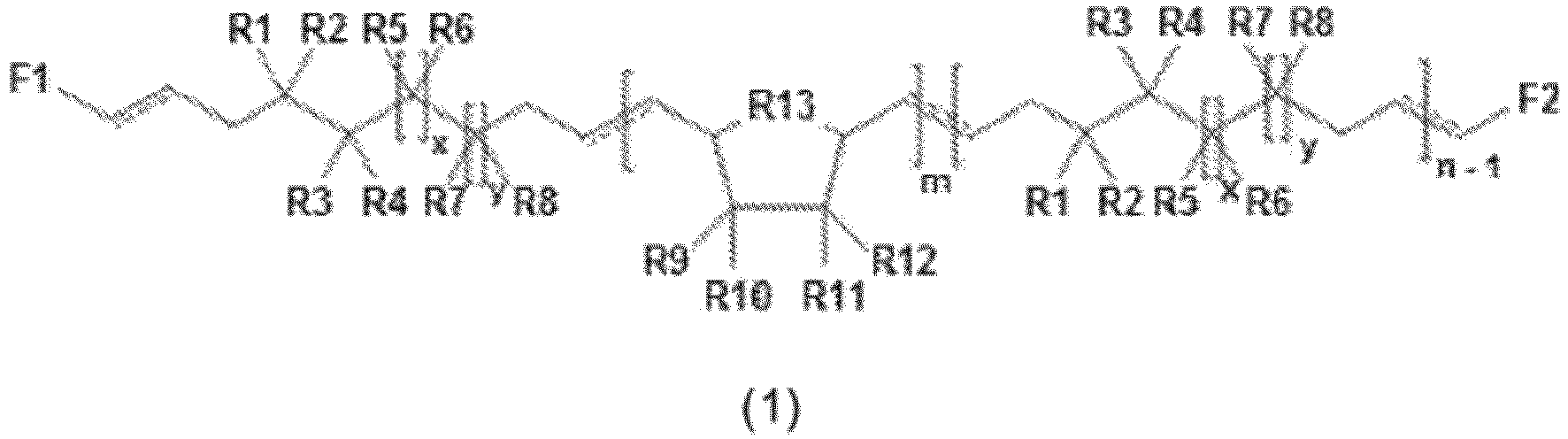
- the main chain of the polymer of formula (1) thus comprises one or two types of repeating units, a first type of repeat unit repeated n times and a second type of repeat unit, optional, repeated m times.
- terminal groups F1 and F2 are generally symmetrical with respect to the main chain, that is to say that they correspond substantially, with the exception of the indices p1 and p2.
- x is equal to 1 and y is equal to 1.
- the polymolecularity PDI (or dispers M dispersity) is defined as the Mw / Mn ratio, that is to say the ratio of the weight average molecular weight of the polymer to the number average molar mass of said polymer.
- the two average molar masses Mn and Mw are measured according to the invention by Size Exclusion Chromatography (SEC), usually with PEG (PolyEthyleneGlycol) or PS (PolyStyrene) calibration, preferably PS.
- SEC Size Exclusion Chromatography
- PEG PolyEthyleneGlycol
- PS PolyStyrene
- the measurements are generally made in a solvent for solubilizing the sample to be analyzed.
- the various polymers of the invention may be solubilized for example in dichloromethane (DCM) or tetrahydrofuran (THF).
- the groups R5 to R8 are each a hydrogen atom. More preferably, the groups R 1 to R 8 are hydrogen atoms.
- Each of the double bonds of the polymer of formula (1) is oriented geometrically cis or trans, and is preferably of cis orientation.
- the geometric isomers of the polymer of formula (1) are generally present in variable proportions, with most often a majority of cis (Z) and preferably all the double bonds are oriented cis (Z). It is also possible according to the invention to obtain only one of the geometric isomers, according to the reaction conditions and in particular according to the nature of the catalyst used.
- the polymers of formula (1) according to the invention can be solid polymers or liquid (very fluid) polymers at ambient temperature (approximately 23 ° C.).
- liquid polymers at 23 ° C, that is to say having a viscosity ranging from 1 to 500,000 mPa.s at 23 ° C.
- the viscosity can be measured in a manner well known to those skilled in the art.
- the viscosity can be measured with a Brookfield viscometer, by selecting the needle and the speed of the module appropriately according to the viscosity range to be measured.
- the polymer of formula (1) when m is equal to 0, can be represented by the following formula (2): wherein: x, y, n, F1, F2, R1 to R8 are as described in any one of the preceding paragraphs.
- Formula (2) illustrates the case where the main chain of the polymer of formula (1) comprises a single type of repeating unit, repeated n times.
- m is equal to 0 and R1 to R8 denote hydrogen atoms, with at least one of the pairs (R1, R2), (R3, R4), (R5, R6) and / or (R7, R8) may designate an oxo group, the polymer of formula (2) is solid at room temperature.
- the polymer of formula (1) is liquid at ambient temperature.
- the invention also relates to dithiocyclocarbonate-terminated hydrocarbon polymers of the formula (1H) and (2H) wherein the chains main polymers of formula (1) and (2) are saturated, that is to say that they comprise only saturated bonds: wherein: x, y, n, m, F 1 , F 2 , R 1 to R 13 are as described in any one of the preceding paragraphs.
- the above preparation process comprises between steps I) and II), a step of selective hydrogenation of the double bonds of the polymer obtained from step I) having two epoxy end groups and corresponding to the unsaturated diepoxidized polymer of formula (1E) or (2E).
- the selective hydrogenation of the polymer of formula (1E) or (2E) resulting from stage I) having two terminal epoxy groups, leading to the corresponding hydrogenated polymer of formula (1H) or (2H) respectively, can be carried out according to the process described in the application WO 9,535,290 from EASTMAN CHEMICAL.
- Metathesis ring opening polymerization (or "Ring-Opening Metathesis Polymerization") is a reaction well known to those skilled in the art.
- the duration and the temperature for the polymerization reaction described in stage I) generally depend on the reaction conditions and in particular the catalytic loading level. The skilled person is able to adapt them depending on the circumstances.
- the metathesis ring opening polymerization reaction is carried out in the presence of a mono-functional CTA of formula (C1) or of a difunctional CTA of formula (C2).
- the CTA of formula (C1) is said to be monofunctional when it comprises an epoxide group.
- the CTA of formula (C2) is said to be difunctional when it comprises two epoxide groups, which may be identical or different.
- the CTA used is of formula (C1).
- the compound of formula (C1b) can be obtained by transesterification according to scheme (2) below, in which p1 and A retain the same meanings as given above, and Me denotes the methyl group, and following one of procedures described in the publication entitled “Kinetics of Epoxidation of Alkyl Esters of Undecylenic Acid: Comparison of Traditional Routes vs. Ishii-Venturello Chemistry "by GD Yadav and DV Satoskar (JAOCS, Vol.74, no.4 (1997), pages 397-407 ), including those described in Tables 9 and 10:
- the epoxy alkanoates used in this reaction can be synthesized according to the procedures described in the US Patent 3,448,125 to Rohm & Haas and EP 0,208,272 to MONTEDISON .
- the CTA used is of formula (C2).
- the compound of formula (C2a) can be obtained according to scheme (3) below, corresponding to an original variant of scheme (1) in which p1, p2, A and retain the same meanings as previously given.
- the molar ratio of the CTA of formula (C1) to the compound of formula (A), or to the sum of the compounds of formulas (A) and (B) if the compound of formula (B) is present, is from 1.10 -3 at 1.0 and preferably from 1.10 -2 to 0.250.
- the molar ratio of the CTA of formula (C2) to the compound of formula (A), or to the sum of the compounds of formulas (A) and (B) if the compound of formula (B) is present ranges from 0.5.10 -3 to 0.5 and preferably 0.5.10 -2 to 0.125.
- the compounds of formula (A) generally comprise from 6 to 30, preferably from 6 to 22, carbon atoms.
- the cyclic compounds of formula (A) according to the invention are chosen from the group formed by cycloheptene, cyclooctene, cyclononene, cyclodecene, cycloundecene, cyclododecene, 1,5-cyclooctadiene, cyclononadiene, 1,5,9-cyclodecatriene, 5-alkyl-cyclooctenes including C1-C22 alkyl, and preferably C1-C14, and mixtures thereof.
- R is an n- hexyl group.
- the compounds of formula (B) generally comprise from 6 to 30, preferably from 6 to 22, carbon atoms.
- the cyclic compounds of formula (B) are chosen from the group formed by norbornene (NBN), dicyclopentadiene and 7-oxanorbornene which are respectively of the following formulas:
- the cyclic compounds of formula (B) may also be chosen from the group formed by the compounds of the following formulas: in which: R is an alkyl group comprising from 1 to 22, preferably 1 to 14, carbon atoms. For example, R is n-hexyl.
- the cyclic compounds of formula (B) may also be chosen from the group formed by the addition products (or adducts in English) resulting from the Diels-Alder reaction using cyclopentadiene or furan as starting material, as well as the compounds derived from norbornene as described in WO 2001/04173 (such as: isobornyl norbornene carboxylate, phenyl norbornene carboxylate, ethylhexyl norbornene carboxylate, phenoxyethyl norbornene carboxylate and alkyl norbornene dicarboxymide, alkyl most often having 3 to 8 carbon atoms) and those described in WO 2011/038057 (dicarboxylic anhydrides of norbornene and optionally 7-oxanorbornene dicarboxylic anhydrides).
- stage I) of ring opening polymerization by metathesis is most often carried out in the presence of at least one solvent, generally chosen from the group formed by the aqueous or organic solvents typically used in the polymerization reactions and which are inert under the conditions of the polymerization described above.
- the dithiocarbonation step II) and / or the optional hydrogenation step may be carried out in the same solvent as in step I).
- the dithiocyclocarbonate-terminated hydrocarbon polymer according to the invention can be generated by successively carrying out step I) and step II), without having to isolate the epoxy-terminated polymer from formula (1E) or (2E) from step I) between the two steps.
- the solvent is selected from the group consisting of benzene, toluene, para-xylene, methylene chloride, dichloroethane, dichlorobenzene, chlorobenzene, tetrahydrofuran, diethyl ether, pentane, hexane , heptane, methanol, ethanol, water or their mixtures.
- the solvent is selected from the group consisting of benzene, toluene, para-xylene, methylene chloride, dichloroethane, dichlorobenzene, chlorobenzene, tetrahydrofuran, diethyl ether, pentane, hexane , heptane, methanol, ethanol, and mixtures thereof.
- the solvent is toluene, heptane, or a mixture of toluene and methylene chloride.
- the solubility of the polymer formed during the polymerization reaction depends generally and mainly on the choice of solvent and the molar mass of the polymer obtained. It is also possible that the reaction is carried out without solvent.
- the metathesis catalyst such as for example a "Grubbs" type catalyst, is generally a commercial product.
- the metathesis catalyst is most often a catalyst comprising at least one transition metal, such as ruthenium, most often in the form of complex.
- the metathesis catalyst is chosen from ruthenium complexes such as a ruthenium-carbene complex.
- the metathesis catalyst is selected from the "Grubbs" type catalysts.
- Grubbs catalyst is generally defined according to the invention a Grubbs catalyst 1 st or 2 nd, but also any other Grubbs catalyst (such as ruthenium-carbene) accessible to the skilled person, such as for example the substituted Grubbs catalysts described in the patent US 5,849,851 .
- the IUPAC name of the catalyst (G1) is: benzylidene-bis (tricyclohexylphosphine) dichlororuthenium (number CAS 172222-30-9 ).
- the IUPAC name of the catalyst (G2) is: benzylidene [1,3-bis (2,4,6-trimethylphenyl) -2-imidazolidinylidene] dichloro (tricyclohexylphosphine) ruthenium (number CAS 246047-72-3 ).
- the catalyst is a 2nd generation Grubbs catalyst, as defined for example by the formula (G2).
- the carbon disulfide (CS 2 ) and the epoxy-terminated polymer from the previous step are used in a stoichiometric proportion, i.e. two moles of carbon disulfide are reacted with one mole of carbon. epoxy-terminated polymer from step previous, so that all epoxy functions of said is reacted with carbon disulfide.
- a slight variation with respect to the stoichiometries given above, in particular a slight defect of CS 2 can be envisaged without any inconvenience. In the latter case, it can be envisaged to work, for example with a molar ratio of the amount of CS 2 on the amount of epoxy-terminated polymer from the previous step ranging from 0.96 to 1.
- the invention also relates to a process for the preparation of poly (thio) urethane comprising the reaction of at least one dithiocyclocarbonate-terminated hydrocarbon polymer according to the invention, capable in particular of being obtained by the preparation process according to the invention, with at least one compound comprising at least one, preferably at least two, amine groups, for example chosen from monoamines, diamines, triamines and other polyamines; and the poly (thio) urethanes obtainable by this preparation process.
- poly (thio) urethane is meant in the present application a polymer comprising at least two groups (thio) urethane, the definition is given below.
- the amine compounds that can be used according to the invention are preferably such that at least one amine group, preferably all the amine groups, are primary amine groups.
- These amino compounds can be oligomers. These oligomers generally have a number average molecular weight of less than 2000 g / mol.
- the synthesis reaction of the poly (thio) urethane according to the invention can take place at a temperature below 100 ° C., or even at ambient temperature (that is to say about 23 ° C.) when the hydrocarbon polymer with dithiocyclocarbonate terminations used is liquid at 23 ° C.
- the dithiocyclocarbonate-terminated hydrocarbon polymer (s) and amino compound (s) are used in such amounts that each of the dithiocyclocarbonate groups of the polymer (s) reacted with an amine group of an amino compound to form a (thio) urethane group.
- the dithiocyclocarbonate-terminated hydrocarbon polymer (s) are reacted with one or more primary (poly) amine (s) in stoichiometric amounts, i.e. the molar ratio of number of dithiocyclocarbonates groups on the number of primary amine groups is approximately equal to 1.
- the poly (thio) urethane according to the invention also has SH pendant groups in the main chain of the polymer, unlike the polyurethanes of the prior art.
- the poly (thio) urethane according to the invention may be more specifically designated by the term polymercapto (thio) urethane. Thanks to its SH functions, the polymer according to the invention can crosslink on itself, once in contact with air, which is particularly suitable for use thereof as a two-component composition.
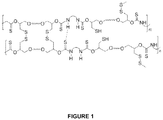
- SH groups are able to react spontaneously with each other, in the presence of oxygen (even in the form of traces), to form SS disulphide bridges between the polymeric chains of the poly (thio) urethane and thus create a three-dimensional polymeric network.
- a representation of such a polymer network is given by way of example in the figure 1 of this application.
- the poly (thio) urethanes according to the invention thus have the advantage of being able to be formulated (that is to say with the possible addition of additives) in the form of two-component compositions which are particularly reactive, and to possess, once crosslinked. mechanical properties of particular interest, particularly for the field of adhesives, sealants and surface coating.
- crosslinked poly (thio) urethanes according to the invention exhibit, in particular, cohesion values greater than 1.5 MPa (megapascal).
- Such cohesive values allow use as an adhesive, for example in the field of construction, transport or industry in general.
- the mechanical properties, and especially the cohesion values, of the crosslinked poly (thio) urethanes according to the invention can be measured in accordance with the standard ISO 527-1 or ASTM D 638-03, and in particular according to the protocol described below. .
- the principle of measuring the strength and elongation at break of the tensile test-tested compositions is to stretch in a tensile machine, whose moving jaw moves at a constant speed equal to 100 mm / min. standard test piece consisting of the crosslinked adhesive composition and to record, at the moment when the test piece breaks, the tensile stress applied (in MPa) and the extension of the test piece (in%).
- the standard test piece is dumbbell-shaped, as shown in International Standard ISO 37.
- the narrow part of the dumbbell used has a length of 20 mm, a width of 4 mm and a thickness of 300 ⁇ m.
- the adhesive composition was heated to 100 ° C and then extruded on an A4 sheet of silicone paper in an amount sufficient to form thereon a film having a thickness of 300 ⁇ m.
- the film is left for 7 days at 23 ° C. and 50% relative humidity for crosslinking, then the dumbbell is obtained by simple cutting in the crosslinked film.
- the ROMP reaction lasts 24 hours at a temperature of 40 ° C.
- CTA chain transfer agent
- Cyclooctene (COE) is a commercial product of Sigma Aldrich.
- 5- N- hexyl-cyclooctene (5-hexyl-COE) can be synthesized from 5,6-epoxycyclooctene (5-epoxy-COE) according to the route indicated in reaction scheme (7) below, with following yields in parentheses:
- the 5-hexyl-cyclooctene (5-hexyl-COE referenced in scheme (5) above) was synthesized according to the procedure indicated in the publication of A. Diallo et al., Polymer Chemistry , supra (which referred to Kobayashi et al., J. Am. Chem. Soc. 2011, 133, pages 5794-5797 ).
- NMR spectra were recorded under AM-500 Bruker and AM-400 Brüker spectrometers at 25 ° C in CDCl 3 . Chemical shifts were referenced to tetramethylsilane (TMS) using resonance ( 1 H) or ( 13 C) deuterated solvents.
- the number and weight average molecular weights (M n and M w ) and the PDI polydispersity (M w / M n ) of the polymers were determined by steric exclusion chromatography (SEC) in THF, with PS calibration using a Polymer Laboratories PL-GPC 50 instrument.
- the cycloolefin of formula (A) ( 108.00 mmol ), hydroquinone ( 0.54 mmol ) and dry CH 2 Cl 2 (50 ml) were mixed in a 1000 ml flask. The flask and its contents were then put under argon. CTA ( 10.80 mmol ) of type (C1) was introduced into the flask by syringe. The flask was then immersed in an oil bath at 40 ° C., then G2 catalyst ( 54.00 ⁇ mol ) in solution in CH 2 Cl 2 (20 mL) was immediately added by means of a cannula. ).
- the solution is concentrated by partially evaporating the CH 2 Cl 2 (up to the solubility limit of the polymer).
- the product is recovered after precipitation in methanol (15 mL), filtration and drying at 20 ° C under vacuum.
- the polymer obtained is solid at ambient temperature.
- Example 2 Synthesis of the polymer of Example 1 from cyclooctene (COE) and diglycidyl fumarate (CTA 2 )
- the cycloolefin of formula (A) ( 108.00 mmol ) and dry CH 2 Cl 2 (50 ml) are mixed in a 1000 ml flask. The flask and its contents were then put under argon. CTA ( 5.40 mmol ) of type (C2) was introduced into the flask by syringe. The flask was then immersed in an oil bath at 40 ° C., then G2 catalyst ( 54.00 ⁇ mol ) dissolved in CH 2 Cl 2 (FIG. 20 mL). 24 hours after the addition of the catalyst, the solution is concentrated by partially evaporating the CH 2 Cl 2 (up to the solubility limit of the polymer).
- the product is recovered after precipitation in methanol (15 mL), filtration and drying at 20 ° C under vacuum.
- the above isolated product ( 0.05 mmol ), lithium bromide ( 0.05 mmol ) and dry THF (10 mL) were placed in a 50 mL flask in which was also placed a magnetic stirring bar coated with Teflon®. The flask and its contents were then put under argon. The carbon disulphide ( 0.10 mmol ) was then introduced into the flask drop by syringe. The flask was then immersed in an oil bath at 40 ° C for 17 h. A product was recovered after precipitation in methanol (20 mL), filtration and drying at 23 ° C under vacuum.
- the polymer obtained is solid at ambient temperature.
- the polymer obtained is liquid at room temperature.
- cycloolefins of formula (A) and (B) used in Examples 4 and 5 are respectively the following:
- Cyclooctene (COE) of greater than 95% purity, norbornene (NBN) and methyl 5-norbornene-2-carboxylate (NBN-ester) of purity greater than 99% are available commercially from Sigma Aldrich. These products were previously distilled on CaH 2 , before being used in Examples 4 and 5.
- the solution is concentrated by partially evaporating the CH 2 Cl 2 (up to the solubility limit of the polymer).
- the product is recovered after precipitation in methanol (15 mL), filtration and drying at 20 ° C under vacuum.
- the polymer obtained is liquid at room temperature.
- the polymer obtained is liquid at room temperature.
- the polymer obtained is solid at ambient temperature.
- the polyolefin of Comparative Example 6 was reacted at 80 ° C., separately and in a stoichiometric ratio, with a primary diamine of the polyether diamine type (JEFFAMINE EDR 148, Huntsman) until complete disappearance.
- JEFFAMINE EDR 148 a primary diamine of the polyether diamine type
- reaction time recorded during the complete disappearance of the infrared band characteristic of the 1,3-dioxolan-2-one groups was approximately 12 h at 80 ° C.
- Example 8 Synthesis of a Poly (Thio) Urethane from the Solid Unsaturated Polyolefin of Example 2 According to the Invention
- Example 7 was repeated replacing the polyolefin of Example 6 with the solid polyolefin of Example 2 until complete disappearance of the infrared band characteristic of the 2-thione-1,3-oxathiol groups.
- 4-yl (C S band at 1200 cm -1 in Infra-Red)
- appearance of the characteristic bands of the thiocarbamate link (C S band at 1530 cm -1 in Infra-Red)
- SH band at 2500 cm -1 and SS band at 510 cm -1 in Raman the appearance of the characteristic bands of the thiol and disulfide functions
- the duration of the reaction noted during the complete disappearance of the infrared band characteristic of the 1,3-dioxolan-2-one groups was less than 3 hours at 80 ° C.
- the duration of the reaction noted during the complete disappearance of the infrared band characteristic of the 1,3-dioxolan-2-one groups was less than 3 h at 23 ° C.
Landscapes
- Chemical & Material Sciences (AREA)
- Chemical Kinetics & Catalysis (AREA)
- Organic Chemistry (AREA)
- Health & Medical Sciences (AREA)
- Medicinal Chemistry (AREA)
- Polymers & Plastics (AREA)
- Compositions Of Macromolecular Compounds (AREA)
- Addition Polymer Or Copolymer, Post-Treatments, Or Chemical Modifications (AREA)
- Polyurethanes Or Polyureas (AREA)
Claims (8)
- Kohlenwasserstoffpolymer, umfassend zwei terminale Dithiocyclocarbonatgruppen, wobei das Kohlenwasserstoffpolymer die folgende Formel (1):
 • jede Kohlenstoff-Kohlenstoff-Bindung der alsbezeichneten Kette eine Doppelbindung oder eine Einfachbindung ist;
 • die Gruppen R1, R2, R3, R4, R5, R6, R7 und R8, die identisch oder verschieden sind, aus einem Wasserstoffatom, einem Halogenatom, einer Alkylgruppe, einer Heteroalkylgruppe, einer Alkoxycarbonylgruppe oder einer Heteroalkoxycarbonylgruppe ausgewählt sind,• mindestens eine der Gruppen R1 bis R8 mit mindestens einer anderen der Gruppen R1 bis R8 einen Teil desselben gesättigten oder ungesättigten Kohlenwasserstoffcyclus oder Heterocyclus bilden kann;• mindestens eines der Paare (R1,R2), (R3,R4), (R5,R6) und (R7,R8) eine Oxogruppe sein kann;• x und y, die gleich oder verschieden sind, ganze Zahlen von 0 bis 5 sind;• die Gruppen R9, R10, R11 und R12, die gleich oder verschieden sind, aus einem Wasserstoffatom, einem Halogenatom, einer Alkylgruppe, einer Heteroalkylgruppe, einer Alkoxycarbonylgruppe oder einer Heteroalkoxycarbonylgruppe ausgewählt sind,• mindestens eine der Gruppen R9 bis R12 mit mindestens einer anderen der Gruppen R9 bis R12 einen Teil desselben gesättigten oder ungesättigten Kohlenwasserstoffcyclus oder Heterocyclus bilden kann;• die Gruppe R13 CH2, O, S, C(=O) oder NR0 ist, wobei R0 eine Alkylgruppe mit 1 bis 22 Kohlenstoffatomen ist; und• n eine ganze Zahl größer oder gleich 2 ist und m eine ganze Zahl größer oder gleich 0 ist, das Stoffmengenverhältnis m/n 0/100 bis 90/10 beträgt; n und m derart sind, dass das Zahlenmittel Mn der Molmasse des Kohlenwasserstoffpolymers der Formel (1) von 500 bis 50 000 g/mol beträgt und die Polymolekularität (PDI) des Kohlenwasserstoffpolymers der Formel (1) von 1,0 bis 3,0 beträgt;• F1 durch die folgende Formel veranschaulicht ist:
 • und F2 durch die folgende Formel veranschaulicht ist:
 A eine C1- bis C9-Alkylengruppe ist;Z derart ist, dass die zweiwertige Gruppe -A-Z- die Gruppe -A-C(=O)O- oder -A-OC(=O)- und vorzugsweise -A-OC(=O)- ist;p1 und p2, die gleich oder verschieden sind, jeweils eine ganze Zahl gleich 0, 1, 2 oder 3 darstellen.
 - Zwei terminale Dithiocyclocarbonatgruppen umfassendes Kohlenwasserstoffpolymer nach Anspruch 1, dadurch gekennzeichnet, dass es ein Zahlenmittel Mn der Molmasse von 600 bis 45 000 g/mol aufweist.
- Zwei terminale Dithiocyclocarbonatgruppen umfassendes Kohlenwasserstoffpolymer nach Anspruch 1 oder 2, dadurch gekennzeichnet, dass Z derart ist, dass die zweiwertige Gruppe -A-Z-die Gruppe -A-OC(=O)- ist und/oder p1 = p2 = 0, und/oder A die Methylengruppe ist und/oder die Gruppen R1 bis R8 jeweils ein Wasserstoffatom sind.
- Zwei terminale Dithiocyclocarbonatgruppen umfassendes Kohlenwasserstoffpolymer nach einem der Ansprüche 1 bis 3, dadurch gekennzeichnet, dass x=y=1.
- Zwei terminale Dithiocyclocarbonatgruppen umfassendes Kohlenwasserstoffpolymer nach einem der Ansprüche 1 bis 4, dadurch gekennzeichnet, dass seine Hauptkette gesättigt ist.
- Verfahren zur Herstellung von mindestens einem Kohlenwasserstoffpolymer, das zwei terminale Dithiocyclocarbonatgruppen umfasst, dadurch gekennzeichnet, dass es Folgendes umfasst:I) einen Polymerisationsschritt durch Öffnen des Cyclus durch Metathese in Gegenwart:- mindestens eines Metathesekatalysators,- mindestens eines Mono- oder Diepoxid-Kettenübertragungsmittels der folgenden Formel (C1) oder (C2) :
 • F1e durch die folgende Formel veranschaulicht ist:
 • und F2e durch die folgende Formel veranschaulicht ist:
 • A, Z, p1 und p2 der Formeln F1e und F2e wie in einem der vorhergehenden Ansprüche definiert sind,• die Bindungeine Kohlenstoff-Kohlenstoff-Einfachbindung ist, die in Bezug auf die Doppelbindung in der Formel (C2) auf der einen oder der anderen Seite geometrisch orientiert ist (cis oder trans);
 - mindestens einer Verbindung der folgenden Formel (A):
 - wobei:• die Gruppen R1, R2, R3, R4, R5, R6, R7 und R8, die identisch oder verschieden sind, aus einem Wasserstoffatom, einem Halogenatom, einer Alkylgruppe, einer Heteroalkylgruppe, einer Alkoxycarbonylgruppe oder einer Heteroalkoxycarbonylgruppe ausgewählt sind,• mindestens eine der Gruppen R1 bis R8 mit mindestens einer anderen der Gruppen R1 bis R8 einen Teil desselben gesättigten oder ungesättigten Kohlenwasserstoffcyclus oder Heterocyclus bilden kann, und• mindestens eines der Paare (R1,R2), (R3,R4), (R5,R6) und (R7,R8) eine Oxogruppe sein kann;• x und y wie in einem der vorhergehenden Ansprüche definiert sind; und- gegebenenfalls mindestens einer Verbindung der
Formel (B):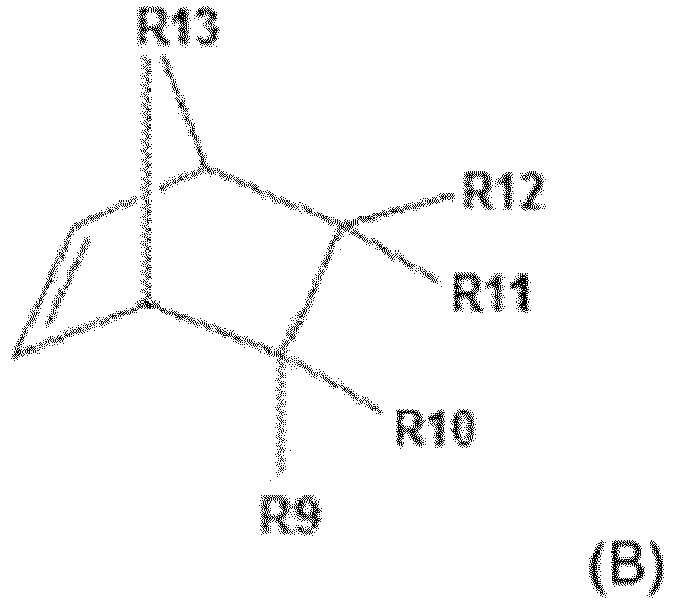 • die Gruppen R9, R10, R11 und R12, die gleich oder verschieden sind, aus einem Wasserstoffatom, einem Halogenatom, einer Heteroalkylgruppe, einer Alkoxycarbonylgruppe und einer Heteroalkoxycarbonylgruppe ausgewählt sind,• mindestens eine der Gruppen R9 bis R12 mit mindestens einer anderen der Gruppen R9 bis R12 einen Teil desselben gesättigten oder ungesättigten Cyclus oder Heterocyclus bilden kann; und• die Gruppe R13 CH2, O, S, C(=O) oder NR0 ist, wobei R0 eine Alkylgruppe mit 1 bis 22 Kohlenstoffatomen ist;für eine Reaktionszeit von 2 bis 24 h und bei einer Temperatur von 20 bis 60 °C; und anschließend
gegebenenfalls einen Schritt der selektiven Hydrierung von Doppelbindungen des Polymers aus Schritt I), das zwei terminale Epoxygruppen aufweist; und anschließendII) einen Schritt der Dithiocarbonisierung des im vorhergehenden Schritt erhaltenen Produkts durch eine Umsetzung mit Kohlenstoffdisulfid (CS2) in Gegenwart einer Lithiumhalogenverbindung bei einer Temperatur von 20 bis 60 °C. - Herstellungsverfahren nach Anspruch 6, wobei:- das Stoffmengenverhältnis des Kettenübertragungsmittels der Formel (C1) zur Verbindung der Formel (A) oder zur Summe der Verbindungen der Formeln (A) und (B), wenn die Verbindung der Formel (B) vorhanden ist, 1·10-3 bis 1,0 beträgt, oder- das Stoffmengenverhältnis des Kettenübertragungsmittels der Formel (C2) zur Verbindung der Formel (A) oder zur Summe der Verbindungen der Formeln (A) und (B), wenn die Verbindung der Formel (B) vorhanden ist, 0,5·10-3 bis 0,5 beträgt.
- Zweikomponentenzusammensetzung, umfassend:- in einer ersten Kammer mindestens ein zwei terminale Dithiocyclocarbonatgruppen umfassendes Kohlenwasserstoffpolymer nach einem der Ansprüche 1 bis 5 oder wie nach dem Herstellungsverfahren von Anspruch 6 erhalten und- in einer zweiten Kammer mindestens eine Verbindung, die mindestens eine Amingruppe umfasst.
Applications Claiming Priority (2)
| Application Number | Priority Date | Filing Date | Title |
|---|---|---|---|
| FR1554501A FR3036399B1 (fr) | 2015-05-20 | 2015-05-20 | Polymeres hydrocarbones comprenant deux groupements terminaux (2-thione-1,3-oxathiolan-4-yl)alkyloxycarbonyle |
| PCT/FR2016/050914 WO2016185106A1 (fr) | 2015-05-20 | 2016-04-20 | Polymeres hydrocarbones comprenant deux groupements terminaux (2-thione-1,3-oxathiolan-4-yl)alkyloxycarbonyle |
Publications (2)
| Publication Number | Publication Date |
|---|---|
| EP3298062A1 EP3298062A1 (de) | 2018-03-28 |
| EP3298062B1 true EP3298062B1 (de) | 2019-05-22 |
Family
ID=53801026
Family Applications (1)
| Application Number | Title | Priority Date | Filing Date |
|---|---|---|---|
| EP16723423.6A Active EP3298062B1 (de) | 2015-05-20 | 2016-04-20 | Kohlenwasserstoffpolymere mit zwei (2-thion-1,3-oxathiolan-4-yl)alkyloxycarbonyl-endgruppen |
Country Status (4)
| Country | Link |
|---|---|
| EP (1) | EP3298062B1 (de) |
| ES (1) | ES2739173T3 (de) |
| FR (1) | FR3036399B1 (de) |
| WO (1) | WO2016185106A1 (de) |
Families Citing this family (4)
| Publication number | Priority date | Publication date | Assignee | Title |
|---|---|---|---|---|
| FR3071502B1 (fr) | 2017-09-28 | 2020-06-19 | Bostik Sa | Copolymeres hydrocarbones liquides a deux groupements terminaux ester cyclocarbonate |
| FR3071501A1 (fr) | 2017-09-28 | 2019-03-29 | Bostik Sa | Copolymeres hydrocarbones liquides a deux groupements terminaux ether cyclocarbonate |
| EP3818097B1 (de) | 2018-07-04 | 2022-08-17 | Basf Se | Klebeverfahren unter verwendung von 2-komponentenklebstoffen auf basis von verbindungen mit cyclothiocarbonat-einheiten |
| CN113372555B (zh) * | 2021-06-25 | 2022-04-22 | 浙江大学 | 一种具有低介电常数、低介电损耗的复合材料及其制备方法和应用 |
Family Cites Families (11)
| Publication number | Priority date | Publication date | Assignee | Title |
|---|---|---|---|---|
| GB791285A (en) | 1954-02-09 | 1958-02-26 | Rohm & Haas | Epoxidation of unsaturated fatty acid esters |
| IT1187681B (it) | 1985-07-05 | 1987-12-23 | Montedison Spa | Metodo per la preparazione di 3,4-epossibutirrati alchilici |
| EP1253156A3 (de) | 1992-04-03 | 2004-01-07 | California Institute Of Technology | Hochwirksame Ruthenium- oder Osmium- Metall-Carben-Komplexe für Olefinmetathesereaktionen, und deren Herstellung und Verwendung |
| US5391773A (en) * | 1994-06-17 | 1995-02-21 | Eastman Chemical Company | Process for the selective hydrogenation of epoxyalkenes to epoxyalkanes |
| GB9916235D0 (en) | 1999-07-09 | 1999-09-15 | Univ Durham | Process for polymerisation of olefins and novel polymerisable olefins |
| AU7451700A (en) * | 1999-09-30 | 2001-04-30 | Kyowa Yuka Co., Ltd. | Method of diminishing odor emission |
| EP1506964A1 (de) * | 2003-08-15 | 2005-02-16 | Henkel Kommanditgesellschaft auf Aktien | Cyclische Dithiocarbonate, deren Herstellung und Verwendung |
| US8283410B2 (en) | 2009-03-30 | 2012-10-09 | Isp Investments Inc. | Ring-opening metathesis polymerization of norbornene and oxanorbornene moieties and uses thereof |
| WO2013137175A1 (ja) * | 2012-03-15 | 2013-09-19 | 日本ゼオン株式会社 | 重合性組成物、樹脂成形体、及び樹脂複合成形体 |
| CN102757409B (zh) | 2012-07-19 | 2014-07-16 | 湖南罗比特化学材料有限公司 | 一种丙烯酸缩水甘油酯的制备方法 |
| FR2999577B1 (fr) * | 2012-12-14 | 2016-07-01 | Bostik Sa | Polymeres hydrocarbones a groupements terminaux (2-oxo-1,3-dioxolan-4-yl)methyloxycarbonyle |
-
2015
- 2015-05-20 FR FR1554501A patent/FR3036399B1/fr not_active Expired - Fee Related
-
2016
- 2016-04-20 EP EP16723423.6A patent/EP3298062B1/de active Active
- 2016-04-20 WO PCT/FR2016/050914 patent/WO2016185106A1/fr not_active Ceased
- 2016-04-20 ES ES16723423T patent/ES2739173T3/es active Active
Non-Patent Citations (1)
| Title |
|---|
| None * |
Also Published As
| Publication number | Publication date |
|---|---|
| WO2016185106A1 (fr) | 2016-11-24 |
| EP3298062A1 (de) | 2018-03-28 |
| FR3036399B1 (fr) | 2017-06-16 |
| ES2739173T3 (es) | 2020-01-29 |
| FR3036399A1 (fr) | 2016-11-25 |
Similar Documents
| Publication | Publication Date | Title |
|---|---|---|
| EP2931760B1 (de) | Polymere auf kohlenwasserstoffbasis mit zwei endgruppen mit 2-oxo-1,3-dioxolan-4-yl-endungen, herstellung davon und verwendung davon | |
| EP3280706B1 (de) | Kohlenwasserstoffpolymere mit zwei cyclischen exo-vinylen-carbonatendgruppen | |
| EP3428203B1 (de) | Kohlenwasserstoffpolymere mit alcoxysilan-endgruppe | |
| EP3298062A1 (de) | Kohlenwasserstoffpolymere mit zwei (2-thion-1,3-oxathiolan-4-yl)alkyloxycarbonyl-endgruppen | |
| EP3247733A1 (de) | Kohlenwasserstoffpolymere mit zwei alkoxysilan-endgruppen | |
| EP3404047B1 (de) | Kohlenwasserstoffpolymere mit zwei alkoxysilan-endgruppen | |
| EP3523286B1 (de) | Neuartige kohlenwasserstoffpolymere mit cyclischen exo-vinylen-carbonat-endgruppen | |
| EP2931783A2 (de) | Kohlenwasserstoffpolymere mit einer 2-oxo-1,3-dioxolan-4-yl-endgruppe, herstellung und verwendung davon | |
| EP3242902A1 (de) | Kohlenwasserstoffpolymere mit zwei alkoxysilan-endgruppen | |
| EP3284766A1 (de) | Neue kohlenwasserstoffpolymere mit dithiocyclocarbonat-endgruppen | |
| WO2015107289A1 (fr) | Polymères hydrocarbonés comprenant un groupement terminal à terminaison 2-oxo-1,3-dioxolan-4-yl, leur préparation et leur utilisation | |
| WO2019063944A1 (fr) | Copolymeres hydrocarbones liquides a deux groupements terminaux ether cyclocarbonate | |
| WO2019063945A1 (fr) | Copolymeres hydrocarbones liquides a deux groupements terminaux ester cyclocarbonate | |
| EP3512898A1 (de) | Kohlenwasserstoffpolymere mit zwei 2-oxo-1,3-dioxolan-4-carboxylat-endgruppen |
Legal Events
| Date | Code | Title | Description |
|---|---|---|---|
| STAA | Information on the status of an ep patent application or granted ep patent |
Free format text: STATUS: THE INTERNATIONAL PUBLICATION HAS BEEN MADE |
|
| PUAI | Public reference made under article 153(3) epc to a published international application that has entered the european phase |
Free format text: ORIGINAL CODE: 0009012 |
|
| STAA | Information on the status of an ep patent application or granted ep patent |
Free format text: STATUS: REQUEST FOR EXAMINATION WAS MADE |
|
| 17P | Request for examination filed |
Effective date: 20171116 |
|
| AK | Designated contracting states |
Kind code of ref document: A1 Designated state(s): AL AT BE BG CH CY CZ DE DK EE ES FI FR GB GR HR HU IE IS IT LI LT LU LV MC MK MT NL NO PL PT RO RS SE SI SK SM TR |
|
| AX | Request for extension of the european patent |
Extension state: BA ME |
|
| DAV | Request for validation of the european patent (deleted) | ||
| DAX | Request for extension of the european patent (deleted) | ||
| GRAP | Despatch of communication of intention to grant a patent |
Free format text: ORIGINAL CODE: EPIDOSNIGR1 |
|
| STAA | Information on the status of an ep patent application or granted ep patent |
Free format text: STATUS: GRANT OF PATENT IS INTENDED |
|
| INTG | Intention to grant announced |
Effective date: 20190208 |
|
| GRAS | Grant fee paid |
Free format text: ORIGINAL CODE: EPIDOSNIGR3 |
|
| RAP1 | Party data changed (applicant data changed or rights of an application transferred) |
Owner name: UNIVERSITE DE RENNES I Owner name: BOSTIK SA Owner name: CENTRE NATIONAL DE LA RECHERCHE SCIENTIFIQUE |
|
| GRAA | (expected) grant |
Free format text: ORIGINAL CODE: 0009210 |
|
| STAA | Information on the status of an ep patent application or granted ep patent |
Free format text: STATUS: THE PATENT HAS BEEN GRANTED |
|
| AK | Designated contracting states |
Kind code of ref document: B1 Designated state(s): AL AT BE BG CH CY CZ DE DK EE ES FI FR GB GR HR HU IE IS IT LI LT LU LV MC MK MT NL NO PL PT RO RS SE SI SK SM TR |
|
| REG | Reference to a national code |
Ref country code: GB Ref legal event code: FG4D Free format text: NOT ENGLISH |
|
| REG | Reference to a national code |
Ref country code: CH Ref legal event code: EP |
|
| REG | Reference to a national code |
Ref country code: IE Ref legal event code: FG4D Free format text: LANGUAGE OF EP DOCUMENT: FRENCH |
|
| REG | Reference to a national code |
Ref country code: DE Ref legal event code: R096 Ref document number: 602016014320 Country of ref document: DE |
|
| REG | Reference to a national code |
Ref country code: AT Ref legal event code: REF Ref document number: 1136020 Country of ref document: AT Kind code of ref document: T Effective date: 20190615 |
|
| REG | Reference to a national code |
Ref country code: NL Ref legal event code: FP |
|
| REG | Reference to a national code |
Ref country code: LT Ref legal event code: MG4D |
|
| PG25 | Lapsed in a contracting state [announced via postgrant information from national office to epo] |
Ref country code: AL Free format text: LAPSE BECAUSE OF FAILURE TO SUBMIT A TRANSLATION OF THE DESCRIPTION OR TO PAY THE FEE WITHIN THE PRESCRIBED TIME-LIMIT Effective date: 20190522 Ref country code: PT Free format text: LAPSE BECAUSE OF FAILURE TO SUBMIT A TRANSLATION OF THE DESCRIPTION OR TO PAY THE FEE WITHIN THE PRESCRIBED TIME-LIMIT Effective date: 20190922 Ref country code: FI Free format text: LAPSE BECAUSE OF FAILURE TO SUBMIT A TRANSLATION OF THE DESCRIPTION OR TO PAY THE FEE WITHIN THE PRESCRIBED TIME-LIMIT Effective date: 20190522 Ref country code: LT Free format text: LAPSE BECAUSE OF FAILURE TO SUBMIT A TRANSLATION OF THE DESCRIPTION OR TO PAY THE FEE WITHIN THE PRESCRIBED TIME-LIMIT Effective date: 20190522 Ref country code: HR Free format text: LAPSE BECAUSE OF FAILURE TO SUBMIT A TRANSLATION OF THE DESCRIPTION OR TO PAY THE FEE WITHIN THE PRESCRIBED TIME-LIMIT Effective date: 20190522 Ref country code: SE Free format text: LAPSE BECAUSE OF FAILURE TO SUBMIT A TRANSLATION OF THE DESCRIPTION OR TO PAY THE FEE WITHIN THE PRESCRIBED TIME-LIMIT Effective date: 20190522 Ref country code: NO Free format text: LAPSE BECAUSE OF FAILURE TO SUBMIT A TRANSLATION OF THE DESCRIPTION OR TO PAY THE FEE WITHIN THE PRESCRIBED TIME-LIMIT Effective date: 20190822 |
|
| PG25 | Lapsed in a contracting state [announced via postgrant information from national office to epo] |
Ref country code: LV Free format text: LAPSE BECAUSE OF FAILURE TO SUBMIT A TRANSLATION OF THE DESCRIPTION OR TO PAY THE FEE WITHIN THE PRESCRIBED TIME-LIMIT Effective date: 20190522 Ref country code: RS Free format text: LAPSE BECAUSE OF FAILURE TO SUBMIT A TRANSLATION OF THE DESCRIPTION OR TO PAY THE FEE WITHIN THE PRESCRIBED TIME-LIMIT Effective date: 20190522 Ref country code: BG Free format text: LAPSE BECAUSE OF FAILURE TO SUBMIT A TRANSLATION OF THE DESCRIPTION OR TO PAY THE FEE WITHIN THE PRESCRIBED TIME-LIMIT Effective date: 20190822 Ref country code: GR Free format text: LAPSE BECAUSE OF FAILURE TO SUBMIT A TRANSLATION OF THE DESCRIPTION OR TO PAY THE FEE WITHIN THE PRESCRIBED TIME-LIMIT Effective date: 20190823 |
|
| REG | Reference to a national code |
Ref country code: AT Ref legal event code: MK05 Ref document number: 1136020 Country of ref document: AT Kind code of ref document: T Effective date: 20190522 |
|
| REG | Reference to a national code |
Ref country code: ES Ref legal event code: FG2A Ref document number: 2739173 Country of ref document: ES Kind code of ref document: T3 Effective date: 20200129 |
|
| PG25 | Lapsed in a contracting state [announced via postgrant information from national office to epo] |
Ref country code: DK Free format text: LAPSE BECAUSE OF FAILURE TO SUBMIT A TRANSLATION OF THE DESCRIPTION OR TO PAY THE FEE WITHIN THE PRESCRIBED TIME-LIMIT Effective date: 20190522 Ref country code: AT Free format text: LAPSE BECAUSE OF FAILURE TO SUBMIT A TRANSLATION OF THE DESCRIPTION OR TO PAY THE FEE WITHIN THE PRESCRIBED TIME-LIMIT Effective date: 20190522 Ref country code: CZ Free format text: LAPSE BECAUSE OF FAILURE TO SUBMIT A TRANSLATION OF THE DESCRIPTION OR TO PAY THE FEE WITHIN THE PRESCRIBED TIME-LIMIT Effective date: 20190522 Ref country code: RO Free format text: LAPSE BECAUSE OF FAILURE TO SUBMIT A TRANSLATION OF THE DESCRIPTION OR TO PAY THE FEE WITHIN THE PRESCRIBED TIME-LIMIT Effective date: 20190522 Ref country code: EE Free format text: LAPSE BECAUSE OF FAILURE TO SUBMIT A TRANSLATION OF THE DESCRIPTION OR TO PAY THE FEE WITHIN THE PRESCRIBED TIME-LIMIT Effective date: 20190522 Ref country code: SK Free format text: LAPSE BECAUSE OF FAILURE TO SUBMIT A TRANSLATION OF THE DESCRIPTION OR TO PAY THE FEE WITHIN THE PRESCRIBED TIME-LIMIT Effective date: 20190522 |
|
| REG | Reference to a national code |
Ref country code: DE Ref legal event code: R097 Ref document number: 602016014320 Country of ref document: DE |
|
| PG25 | Lapsed in a contracting state [announced via postgrant information from national office to epo] |
Ref country code: SM Free format text: LAPSE BECAUSE OF FAILURE TO SUBMIT A TRANSLATION OF THE DESCRIPTION OR TO PAY THE FEE WITHIN THE PRESCRIBED TIME-LIMIT Effective date: 20190522 |
|
| PLBE | No opposition filed within time limit |
Free format text: ORIGINAL CODE: 0009261 |
|
| STAA | Information on the status of an ep patent application or granted ep patent |
Free format text: STATUS: NO OPPOSITION FILED WITHIN TIME LIMIT |
|
| PG25 | Lapsed in a contracting state [announced via postgrant information from national office to epo] |
Ref country code: TR Free format text: LAPSE BECAUSE OF FAILURE TO SUBMIT A TRANSLATION OF THE DESCRIPTION OR TO PAY THE FEE WITHIN THE PRESCRIBED TIME-LIMIT Effective date: 20190522 |
|
| 26N | No opposition filed |
Effective date: 20200225 |
|
| PG25 | Lapsed in a contracting state [announced via postgrant information from national office to epo] |
Ref country code: PL Free format text: LAPSE BECAUSE OF FAILURE TO SUBMIT A TRANSLATION OF THE DESCRIPTION OR TO PAY THE FEE WITHIN THE PRESCRIBED TIME-LIMIT Effective date: 20190522 |
|
| PG25 | Lapsed in a contracting state [announced via postgrant information from national office to epo] |
Ref country code: SI Free format text: LAPSE BECAUSE OF FAILURE TO SUBMIT A TRANSLATION OF THE DESCRIPTION OR TO PAY THE FEE WITHIN THE PRESCRIBED TIME-LIMIT Effective date: 20190522 |
|
| REG | Reference to a national code |
Ref country code: DE Ref legal event code: R119 Ref document number: 602016014320 Country of ref document: DE |
|
| PG25 | Lapsed in a contracting state [announced via postgrant information from national office to epo] |
Ref country code: MC Free format text: LAPSE BECAUSE OF FAILURE TO SUBMIT A TRANSLATION OF THE DESCRIPTION OR TO PAY THE FEE WITHIN THE PRESCRIBED TIME-LIMIT Effective date: 20190522 |
|
| REG | Reference to a national code |
Ref country code: CH Ref legal event code: PL |
|
| REG | Reference to a national code |
Ref country code: NL Ref legal event code: MM Effective date: 20200501 |
|
| PG25 | Lapsed in a contracting state [announced via postgrant information from national office to epo] |
Ref country code: DE Free format text: LAPSE BECAUSE OF NON-PAYMENT OF DUE FEES Effective date: 20201103 Ref country code: LU Free format text: LAPSE BECAUSE OF NON-PAYMENT OF DUE FEES Effective date: 20200420 Ref country code: FR Free format text: LAPSE BECAUSE OF NON-PAYMENT OF DUE FEES Effective date: 20200430 Ref country code: LI Free format text: LAPSE BECAUSE OF NON-PAYMENT OF DUE FEES Effective date: 20200430 Ref country code: CH Free format text: LAPSE BECAUSE OF NON-PAYMENT OF DUE FEES Effective date: 20200430 |
|
| REG | Reference to a national code |
Ref country code: BE Ref legal event code: MM Effective date: 20200430 |
|
| PG25 | Lapsed in a contracting state [announced via postgrant information from national office to epo] |
Ref country code: BE Free format text: LAPSE BECAUSE OF NON-PAYMENT OF DUE FEES Effective date: 20200430 |
|
| GBPC | Gb: european patent ceased through non-payment of renewal fee |
Effective date: 20200420 |
|
| PG25 | Lapsed in a contracting state [announced via postgrant information from national office to epo] |
Ref country code: NL Free format text: LAPSE BECAUSE OF NON-PAYMENT OF DUE FEES Effective date: 20200501 |
|
| PG25 | Lapsed in a contracting state [announced via postgrant information from national office to epo] |
Ref country code: GB Free format text: LAPSE BECAUSE OF NON-PAYMENT OF DUE FEES Effective date: 20200420 Ref country code: IE Free format text: LAPSE BECAUSE OF NON-PAYMENT OF DUE FEES Effective date: 20200420 |
|
| REG | Reference to a national code |
Ref country code: ES Ref legal event code: FD2A Effective date: 20210830 |
|
| PG25 | Lapsed in a contracting state [announced via postgrant information from national office to epo] |
Ref country code: IT Free format text: LAPSE BECAUSE OF NON-PAYMENT OF DUE FEES Effective date: 20200420 |
|
| PG25 | Lapsed in a contracting state [announced via postgrant information from national office to epo] |
Ref country code: ES Free format text: LAPSE BECAUSE OF NON-PAYMENT OF DUE FEES Effective date: 20200421 |
|
| PG25 | Lapsed in a contracting state [announced via postgrant information from national office to epo] |
Ref country code: MT Free format text: LAPSE BECAUSE OF FAILURE TO SUBMIT A TRANSLATION OF THE DESCRIPTION OR TO PAY THE FEE WITHIN THE PRESCRIBED TIME-LIMIT Effective date: 20190522 Ref country code: CY Free format text: LAPSE BECAUSE OF FAILURE TO SUBMIT A TRANSLATION OF THE DESCRIPTION OR TO PAY THE FEE WITHIN THE PRESCRIBED TIME-LIMIT Effective date: 20190522 |
|
| PG25 | Lapsed in a contracting state [announced via postgrant information from national office to epo] |
Ref country code: MK Free format text: LAPSE BECAUSE OF FAILURE TO SUBMIT A TRANSLATION OF THE DESCRIPTION OR TO PAY THE FEE WITHIN THE PRESCRIBED TIME-LIMIT Effective date: 20190522 Ref country code: IS Free format text: LAPSE BECAUSE OF FAILURE TO SUBMIT A TRANSLATION OF THE DESCRIPTION OR TO PAY THE FEE WITHIN THE PRESCRIBED TIME-LIMIT Effective date: 20190922 |