EP3298154B1 - Production de 3-hydroxybutyrate - Google Patents
Production de 3-hydroxybutyrate Download PDFInfo
- Publication number
- EP3298154B1 EP3298154B1 EP16739141.6A EP16739141A EP3298154B1 EP 3298154 B1 EP3298154 B1 EP 3298154B1 EP 16739141 A EP16739141 A EP 16739141A EP 3298154 B1 EP3298154 B1 EP 3298154B1
- Authority
- EP
- European Patent Office
- Prior art keywords
- hydroxybutyrate
- cell
- clostridium
- acetoacetate
- cell according
- Prior art date
- Legal status (The legal status is an assumption and is not a legal conclusion. Google has not performed a legal analysis and makes no representation as to the accuracy of the status listed.)
- Active
Links
Images
Classifications
-
- C—CHEMISTRY; METALLURGY
- C12—BIOCHEMISTRY; BEER; SPIRITS; WINE; VINEGAR; MICROBIOLOGY; ENZYMOLOGY; MUTATION OR GENETIC ENGINEERING
- C12P—FERMENTATION OR ENZYME-USING PROCESSES TO SYNTHESISE A DESIRED CHEMICAL COMPOUND OR COMPOSITION OR TO SEPARATE OPTICAL ISOMERS FROM A RACEMIC MIXTURE
- C12P7/00—Preparation of oxygen-containing organic compounds
- C12P7/40—Preparation of oxygen-containing organic compounds containing a carboxyl group including Peroxycarboxylic acids
- C12P7/42—Hydroxy-carboxylic acids
-
- C—CHEMISTRY; METALLURGY
- C12—BIOCHEMISTRY; BEER; SPIRITS; WINE; VINEGAR; MICROBIOLOGY; ENZYMOLOGY; MUTATION OR GENETIC ENGINEERING
- C12N—MICROORGANISMS OR ENZYMES; COMPOSITIONS THEREOF; PROPAGATING, PRESERVING, OR MAINTAINING MICROORGANISMS; MUTATION OR GENETIC ENGINEERING; CULTURE MEDIA
- C12N15/00—Mutation or genetic engineering; DNA or RNA concerning genetic engineering, vectors, e.g. plasmids, or their isolation, preparation or purification; Use of hosts therefor
- C12N15/09—Recombinant DNA-technology
- C12N15/11—DNA or RNA fragments; Modified forms thereof; Non-coding nucleic acids having a biological activity
- C12N15/52—Genes encoding for enzymes or proenzymes
-
- C—CHEMISTRY; METALLURGY
- C12—BIOCHEMISTRY; BEER; SPIRITS; WINE; VINEGAR; MICROBIOLOGY; ENZYMOLOGY; MUTATION OR GENETIC ENGINEERING
- C12N—MICROORGANISMS OR ENZYMES; COMPOSITIONS THEREOF; PROPAGATING, PRESERVING, OR MAINTAINING MICROORGANISMS; MUTATION OR GENETIC ENGINEERING; CULTURE MEDIA
- C12N9/00—Enzymes; Proenzymes; Compositions thereof; Processes for preparing, activating, inhibiting, separating or purifying enzymes
- C12N9/0004—Oxidoreductases (1.)
- C12N9/0006—Oxidoreductases (1.) acting on CH-OH groups as donors (1.1)
-
- C—CHEMISTRY; METALLURGY
- C12—BIOCHEMISTRY; BEER; SPIRITS; WINE; VINEGAR; MICROBIOLOGY; ENZYMOLOGY; MUTATION OR GENETIC ENGINEERING
- C12N—MICROORGANISMS OR ENZYMES; COMPOSITIONS THEREOF; PROPAGATING, PRESERVING, OR MAINTAINING MICROORGANISMS; MUTATION OR GENETIC ENGINEERING; CULTURE MEDIA
- C12N9/00—Enzymes; Proenzymes; Compositions thereof; Processes for preparing, activating, inhibiting, separating or purifying enzymes
- C12N9/10—Transferases (2.)
- C12N9/1025—Acyltransferases (2.3)
- C12N9/1029—Acyltransferases (2.3) transferring groups other than amino-acyl groups (2.3.1)
-
- C—CHEMISTRY; METALLURGY
- C12—BIOCHEMISTRY; BEER; SPIRITS; WINE; VINEGAR; MICROBIOLOGY; ENZYMOLOGY; MUTATION OR GENETIC ENGINEERING
- C12N—MICROORGANISMS OR ENZYMES; COMPOSITIONS THEREOF; PROPAGATING, PRESERVING, OR MAINTAINING MICROORGANISMS; MUTATION OR GENETIC ENGINEERING; CULTURE MEDIA
- C12N9/00—Enzymes; Proenzymes; Compositions thereof; Processes for preparing, activating, inhibiting, separating or purifying enzymes
- C12N9/10—Transferases (2.)
- C12N9/13—Transferases (2.) transferring sulfur containing groups (2.8)
-
- C—CHEMISTRY; METALLURGY
- C12—BIOCHEMISTRY; BEER; SPIRITS; WINE; VINEGAR; MICROBIOLOGY; ENZYMOLOGY; MUTATION OR GENETIC ENGINEERING
- C12N—MICROORGANISMS OR ENZYMES; COMPOSITIONS THEREOF; PROPAGATING, PRESERVING, OR MAINTAINING MICROORGANISMS; MUTATION OR GENETIC ENGINEERING; CULTURE MEDIA
- C12N9/00—Enzymes; Proenzymes; Compositions thereof; Processes for preparing, activating, inhibiting, separating or purifying enzymes
- C12N9/88—Lyases (4.)
-
- C—CHEMISTRY; METALLURGY
- C12—BIOCHEMISTRY; BEER; SPIRITS; WINE; VINEGAR; MICROBIOLOGY; ENZYMOLOGY; MUTATION OR GENETIC ENGINEERING
- C12P—FERMENTATION OR ENZYME-USING PROCESSES TO SYNTHESISE A DESIRED CHEMICAL COMPOUND OR COMPOSITION OR TO SEPARATE OPTICAL ISOMERS FROM A RACEMIC MIXTURE
- C12P7/00—Preparation of oxygen-containing organic compounds
- C12P7/40—Preparation of oxygen-containing organic compounds containing a carboxyl group including Peroxycarboxylic acids
-
- C—CHEMISTRY; METALLURGY
- C12—BIOCHEMISTRY; BEER; SPIRITS; WINE; VINEGAR; MICROBIOLOGY; ENZYMOLOGY; MUTATION OR GENETIC ENGINEERING
- C12Y—ENZYMES
- C12Y101/00—Oxidoreductases acting on the CH-OH group of donors (1.1)
- C12Y101/01—Oxidoreductases acting on the CH-OH group of donors (1.1) with NAD+ or NADP+ as acceptor (1.1.1)
- C12Y101/01001—Alcohol dehydrogenase (1.1.1.1)
-
- C—CHEMISTRY; METALLURGY
- C12—BIOCHEMISTRY; BEER; SPIRITS; WINE; VINEGAR; MICROBIOLOGY; ENZYMOLOGY; MUTATION OR GENETIC ENGINEERING
- C12Y—ENZYMES
- C12Y203/00—Acyltransferases (2.3)
- C12Y203/01—Acyltransferases (2.3) transferring groups other than amino-acyl groups (2.3.1)
- C12Y203/01009—Acetyl-CoA C-acetyltransferase (2.3.1.9)
-
- C—CHEMISTRY; METALLURGY
- C12—BIOCHEMISTRY; BEER; SPIRITS; WINE; VINEGAR; MICROBIOLOGY; ENZYMOLOGY; MUTATION OR GENETIC ENGINEERING
- C12Y—ENZYMES
- C12Y208/00—Transferases transferring sulfur-containing groups (2.8)
- C12Y208/03—CoA-transferases (2.8.3)
- C12Y208/03008—Acetate CoA-transferase (2.8.3.8)
-
- C—CHEMISTRY; METALLURGY
- C12—BIOCHEMISTRY; BEER; SPIRITS; WINE; VINEGAR; MICROBIOLOGY; ENZYMOLOGY; MUTATION OR GENETIC ENGINEERING
- C12Y—ENZYMES
- C12Y401/00—Carbon-carbon lyases (4.1)
- C12Y401/01—Carboxy-lyases (4.1.1)
- C12Y401/01004—Acetoacetate decarboxylase (4.1.1.4)
Definitions
- the present invention relates to a biotechnological method of producing 3-hydroxybutyrate and/or variants thereof.
- the method relates to a biotechnological production of 3-hydroxybutyrate from a carbon source via acetoacetyl-CoA and acetoacetate.
- 3-hydroxybutyrate also known as beta-hydroxybutyric acid is an organic compound with the formula CH 3 CH(OH)CH 2 CO 2 H. It is a beta hydroxy acid and is a chiral compound having two enantiomers, D-3-hydroxybutyric acid and L-3-hydroxybutyric acid. Its oxidized and polymeric derivatives occur widely in nature.
- 3-hydroxybutyrate is the precursor to polyesters, which are biodegradable plastics including poly(3-hydroxybutyrate).
- 3-hydroxybutyrate is also the precursor for production of 2-hydroxyisobutyric acid and polyhydroxyalkanoates containing 2-hydroxyisobutyric acid monomer units including methacrylic acid. Methacrylic acid, its esters and polymers are widely used for producing acrylic glass panes, injection-moulded products, coatings and many other products.
- Cyanobacteria are also natural producers of the naturally-occurring biodegradable plastic poly-hydroxybutyrate (PHB).
- PHB biosynthesis by cyanobacteria was a multistage cultivation process that involved nitrogen starvation followed by supplementation of fructose or acetate, which does not capitalize on the important photosynthetic potential of cyanobacteria.
- the required processes for their extraction are energy-intensive and remain as one of the major hurdles for commercial applications.
- WO 03/046159 discloses production of 3-hydroxybutyrate by genetically engineered microbial Escherichia coli cells comprising polyhydroxyalkanoate (PHA) biosynthesis-related enzymes from Ralstonia eutropha, including beta-ketothiolase (PhaA), NAPDH-dependent acetoacetyl-CoA reductase (PhaB) and PHA synthase (PhaC), as well as R. eutropha PHA depolymerase, wherein furthermore (R)-3-hydroxybutyrate would not be metabolized to acetoacetate in the absence of an endogenous (R)-3-hydroxybutyrate dehydrogenase.
- PHA polyhydroxyalkanoate
- the present invention provides a cell that has been genetically modified to produce acetoacetate.
- the cell may be capable of converting the acetoacetate to 3-hydroxybutyrate. This is advantageous as a single cell may be used to produce 3-hydroxybutyrate, making the process simpler and requiring no steps of separation and thus no loss of material along the way.
- the cell according to any aspect of the present invention may also be reused reducing waste and causing an overall increased efficiency of production of 3-hydroxybutyrate.
- 3-hydroxybutyrate may also be produced from waste gases thus not relying on fossil fuels.
- a microbial cell which is capable of producing 3-hydroxybutyrate and/or 3-hydroxybutyrate variants, wherein the cell is genetically modified to comprise an increased expression relative to its wild type cell of:
- wild type as used herein in conjunction with a cell or microorganism may denote a cell with a genome make-up that is in a form as seen naturally in the wild. The term may be applicable for both the whole cell and for individual genes. The term “wild type” therefore does not include such cells or such genes where the gene sequences have been altered at least partially by man using recombinant methods.
- the genetically modified cell may be genetically modified so that in a defined time interval, within 2 hours, in particular within 8 hours or 24 hours, it forms at least twice, especially at least 10 times, at least 100 times, at least 1000 times or at least 10000 times more acetoacetate and/or 3-hydroxybutyrate than the wild-type cell.
- the increase in product formation can be determined for example by cultivating the cell according to any aspect of the present invention and the wild-type cell each separately under the same conditions (same cell density, same nutrient medium, same culture conditions) for a specified time interval in a suitable nutrient medium and then determining the amount of target product (3-hydroxybutyrate) in the nutrient medium.
- the genetically modified cell or microorganism may be genetically different from the wild type cell or microorganism.
- the genetic difference between the genetically modified microorganism according to any aspect of the present invention and the wild type microorganism may be in the presence of a complete gene, amino acid, nucleotide etc. in the genetically modified microorganism that may be absent in the wild type microorganism.
- the genetically modified microorganism comprises enzymes that enable the microorganism to produce acetoacetate and/or 3-hydroxybutyrate and/or 3-hydroxybutyrate variants, wherein the 3-hydroxybutyrate variant is selected from the group consisting of (S)-3-hydroxybutyric acid, (S)-3-hydroxybutyrate ester, (R)-3-hydroxybutyric acid, (R)-3-hydroxybutyrate ester, sodium 3-hydroxybutyrate, and methyl 3-hydroxybutyrate.
- the wild type microorganism relative to the genetically modified microorganism of the present invention may have none or no detectable activity of the enzymes that enable the genetically modified microorganism to produce the acetoacetate and/or 3-hydroxybutyrate and/or variants thereof.
- the term 'genetically modified microorganism' may be used interchangeably with the term 'genetically modified cell'.
- the genetic modification according to any aspect of the present invention is carried out on the cell of the microorganism.
- the cells according to any aspect of the present invention are genetically transformed according to any method known in the art.
- the cells may be produced according to the method disclosed in WO/2009/077461 .
- the genetically modified cell has an increased activity, in comparison with its wild type, in enzymes' as used herein refers to the activity of the respective enzyme that is increased by a factor of at least 2, in particular of at least 10, more in particular of at least 100, yet more in particular of at least 1000 and even more in particular of at least 10000.
- the increased expression of an enzyme according to any aspect of the present invention may be 5, 10, 15, 20, 25, 30, 25, 40, 45, 50, 55, 60, 65, 70, 75, 80, 85, 90, 95 or 100% more relative to the expression of the enzyme in the wild type cell.
- the decreased expression of an enzyme according to any aspect of the present invention may be 5, 10, 15, 20, 25, 30, 25, 40, 45, 50, 55, 60, 65, 70, 75, 80, 85, 90, 95 or 100% less relative to the expression of the enzyme in the wild type cell.
- an increase in enzymatic activity can be achieved by increasing the copy number of the gene sequence or gene sequences that code for the enzyme, using a strong promoter or employing a gene or allele that codes for a corresponding enzyme with increased activity and optionally by combining these measures.
- Genetically modified cells used in the method according to the invention are for example produced by transformation, transduction, conjugation or a combination of these methods with a vector that contains the desired gene, an allele of this gene or parts thereof and a vector that makes expression of the gene possible.
- Heterologous expression is in particular achieved by integration of the gene or of the alleles in the chromosome of the cell or an extrachromosomally replicating vector.
- 'increased activity of an enzyme' in a cell may refer to an overexpression of the enzyme in the cell.
- the microorganism according to any aspect of the present invention may be an acetogenic bacterium.
- acetogenic bacteria refers to a microorganism which is able to perform the Wood-Ljungdahl pathway and thus is able to convert CO, CO 2 and/or hydrogen to acetate.
- These microorganisms include microorganisms which in their wild-type form do not have a Wood-Ljungdahl pathway, but have acquired this trait as a result of genetic modification.
- Such microorganisms include but are not limited to E. coli cells. These microorganisms may be also known as carboxydotrophic bacteria.
- acetogenic bacteria 21 different genera of the acetogenic bacteria are known in the art (Drake et al., 2006), and these may also include some clostridia (Drake & Kusel, 2005). These bacteria are able to use carbon dioxide or carbon monoxide as a carbon source with hydrogen as an energy source (Wood, 1991). Further, alcohols, aldehydes, carboxylic acids as well as numerous hexoses may also be used as a carbon source (Drake et al., 2004). The reductive pathway that leads to the formation of acetate is referred to as acetyl-CoA or Wood-Ljungdahl pathway.
- the acetogenic bacteria may be selected from the group consisting of Acetoanaerobium notera (ATCC 35199), Acetonema longum (DSM 6540), Acetobacterium carbinolicum (DSM 2925), Acetobacterium malicum (DSM 4132), Acetobacterium species no. 446 ( Morinaga et al., 1990, J. Biotechnol., Vol. 14, p.
- DSM 521 formerly Clostridium thermoaceticum
- DSM 1974 Oxobacter pfennigii
- DM 13326 Sporomusa ovata
- DM 2662 Sporomusa silvacetica
- DSM 2875 Sporomusa termitida
- DSM 4440 Thermoanaerobacter kivui
- the strain ATCC BAA-624 of Clostridium carboxidivorans may be used. Even more in particular, the bacterial strain labelled "P7" and "P11" of Clostridium carboxidivorans as described for example in U.S. 2007/0275447 and U.S. 2008/0057554 may be used.
- Clostridium Ijungdahlii may be Clostridium Ijungdahlii.
- strains selected from the group consisting of Clostridium Ijungdahlii PETC, Clostridium Ijungdahlii ERI2, Clostridium Ijungdahlii COL and Clostridium Ijungdahlii 0-52 may be used in the conversion of synthesis gas to hexanoic acid. These strains for example are described in WO 98/00558 , WO 00/68407 , ATCC 49587, ATCC 55988 and ATCC 55989.
- the strain Clostridium autoethanogenum (DSM 10061, DSM 19630 and DSM 23693) may be used.
- the strain may be Clostridium autoethanogenum DSM 10061.
- 3-hydroxybutyrate (3HB) and variants thereof include (S)-3-hydroxybutyric acid, (S)-3-hydroxybutyrate ester, (R)-3-hydroxybutyric acid, (R)-3-hydroxybutyrate ester, sodium 3-hydroxybutyrate, and methyl 3-hydroxybutyrate.
- the cell according to any aspect of the present invention may produce at least acetoacetate.
- the acetoacetate may then be converted to 3HB.
- the final result always comprises a small percentage of acetoacetate that has not been converted to 3HB. Accordingly, the cell according to any aspect of the present invention may be capable of producing acetoacetate and/or 3HB.
- E 1 may be a thiolase (E.C.2.3.1.9)
- E 2 may be an acetoacetate CoA transferase (EC 2.8.3.8)
- E 3 may be a secondary alcohol dehydrogenase (EC 1.1.1.1).
- the combination of these enzymes in the cell according to any aspect of the present invention allows for a 'pull' towards the formation of the final desired product, 3-hydroxybutyrate and/or variants thereof from the starting carbon source, wherein the 3-hydroxybutyrate variant is selected from the group consisting of (S)-3-hydroxybutyric acid, (S)-3-hydroxybutyrate ester, (R)-3-hydroxybutyric acid, (R)-3-hydroxybutyrate ester, sodium 3-hydroxybutyrate, and methyl 3-hydroxybutyrate.
- the cell according any aspect of the present invention may lead to the hydrolysis of acetoacetyl-CoA with a high reaction rate at low substrate concentrations and therefore can prevent accumulation of acetoacetyl-CoA and establish a "pull" on the preceding, thiolase mediated reversible acetoacetyl-CoA biosynthesis reaction.
- E 1 may be capable of catalyzing the conversion of acetyl-CoA to acetoacetyl-CoA.
- E 1 may be an acetoacetyl-CoA thiolase also known as an acetyl-Coenzyme A acetyltransferase.
- Acetoacetyl-CoA thiolase enzymes include the gene products of atoB from E. coli (Martin et al., 2003) with accession number NP_416728, thiolase derived from C. acetobutylicum.
- E 1 may comprise an amino acid sequence that has 50, 55, 60, 65, 70, 75, 80, 85, 90, 95 or 100% sequence identity to SEQ ID NO: 2.
- the cell according to any aspect of the present invention may be genetically modified to comprise the sequence of SEQ ID NO:2.
- a skilled person may be capable of identifying other thiolases that may play the role of E 1 .
- the a skilled person may be capable of assessing whether a functionally equivalent variant has substantially the same function as the nucleic acid or polypeptide of which it is a variant using any number of known methods.
- the methods outlined in Wiesenborn et al 1988, Wiesenborn et al, 1989, Peterson and Bennet, 1990, Ismail et al., 1993, de la Plaza et al, 2004 or may be used to assess the enzyme activity of E 1 .
- E 2 may be an acetoacetate CoA transferase (EC 2.8.3.9).
- the acetoacetate CoA transferase conserves the energy stored in the CoA-ester bond.
- These enzymes either naturally exhibit the desired acetoacetyl-CoA transferase activity or they can be engineered via directed evolution to accept acetetoacetyl-CoA as a substrate with increased efficiency. In particular, such enzymes, may also be capable of catalyzing the conversion of 3-hydroxybutyryl-CoA to 3-hydroxybutyrate via a transferase mechanism.
- Examples of E 2 may include the CoA transferase from E.
- E 2 may also be selected from the group consisting of the gene products of catl, cat2, and cat3 of Clostridium kluyveri with accession number P38946.1, P38942.2, and EDK35586.1 respectively (Seedorf et al., 2008; Sohling and Gottschalk, 1996), transferase products of Trichomonas vaginalis with accession number XP_001330176 (van Grinsven et al., 2008), Trypanosoma brucei with accession number XP_828352 (Riviere et al, 2004), Fusobacterium nucleatum (Barker et al., 1982), Clostridium SB4 (Barker et al., 1978), Clostridium acetobutylicum (Wiesenborn et al., 1989), FN0272 and FN0273 with accession numbers NP_603179.1 and NP_603180.1 respectively (Kapatral et al.,
- E 2 may comprise an amino acid sequence that has 50, 55, 60, 65, 70, 75, 80, 85, 90, 95 or 100% sequence identity to SEQ ID NO: 4 or 6.
- E 2 may comprise an amino acid sequence SEQ ID NO: 4 and 6.
- E 2 may comprise a nucleotide sequence that has 50, 55, 60, 65, 70, 75, 80, 85, 90, 95 or 100% sequence identity to SEQ ID NO: 3 or 5.
- E 2 may comprise a nucleotide sequence that has 50, 55, 60, 65, 70, 75, 80, 85, 90, 95 or 100% sequence identity to SEQ ID NO: 3 and 5.
- the expression of E 2 may be measured using any method known in the art.
- the increase in expression of E 2 may be measured by determining the amount of final product obtained in the presence of the enzyme and comparing the result to the amount of final product obtained in the absence of the enzyme E 2 .
- the final product may be a 3-hydroxybutyrate.
- the expression of E 2 may be determined by determining the amount of E 2 protein expressed in the resulting medium.
- the expression of E 2 may be measured using the method disclosed in Charrier C., 2006.
- E 3 may be an alcohol dehydrogenase.
- Alcohol dehydrogenases may include alcohol dehydrogenases which are capable of catalysing the conversion of ketones (such as acetone) to secondary alcohols (such as isopropanol), or vice versa.
- Such alcohol dehydrogenases include secondary alcohol dehydrogenases and primary alcohol dehydrogenases.
- a "secondary alcohol dehydrogenase” is one which can convert ketones (such as acetone) to secondary alcohols (such as isopropanol), or vice versa.
- a “primary alcohol dehydrogenase” is one which can convert aldehydes to primary alcohols, or vice versa; however, a number of primary alcohol dehydrogenases are also capable of catalysing the conversion of ketones to secondary alcohols, or vice versa. These alcohol dehydrogenases may also be referred to as "primary-secondary alcohol dehydrogenases”.
- Membrane-bound, flavin-dependent alcohol dehydrogenases of the Pseudomonas putida GPO1 AlkJ type exist which use flavor cofactors instead of NAD+.
- a further group comprises iron-containing, oxygen-sensitive alcohol dehydrogenases which are found in bacteria and in inactive form in yeast.
- Another group comprises NAD+-dependent alcohol dehydrogenases, including zinc-containing alcohol dehydrogenases, in which the active center has a cysteine-coordinated zinc atom, which fixes the alcohol substrate.
- alcohol dehydrogenase as used herein, it is understood to mean an enzyme which oxidizes an aldehyde or ketone to the corresponding primary or secondary alcohol.
- the alcohol dehydrogenase according to any aspect of the present invention may be an NAD+-dependent alcohol dehydrogenase, i.e. an alcohol dehydrogenase which uses NAD+ as a cofactor for oxidation of the alcohol or NADH for reduction of the corresponding aldehyde or ketone.
- the alcohol dehydrogenase is an NAD+-dependent, zinc-containing alcohol dehydrogenase.
- suitable NAD+-dependent alcohol dehydrogenases may include the alcohol dehydrogenase A from Rhodococcus ruber (database code AJ491307.1) or a variant thereof.
- Further examples comprising the alcohol dehydrogenases of Ralstonia eutropha (ACB78191.1), Lactobacillus brevis (YP_795183.1), Lactobacillus kefiri (ACF95832.1), from horse liver, of Paracoccus pantotrophus (ACB78182.1) and Sphingobium yanoikuyae (EU427523.1) and also the respective variants thereof.
- the expression "NAD(P)+-dependent alcohol dehydrogenase” designates an alcohol dehydrogenase which is NAD+- and/or NADP+-dependent.
- E 3 may be a secondary alcohol dehydrogenase or selected from other alcohol dehydrogenases or equivalently aldehyde reductases and can also serve as candidates for 3-hydroxybutyraldehyde reductase.
- T. E 3 may be the product of the gene selected from the group consisting of adhl from Geobacillus thermoglucosidasius with accession number AAR91477.1 (Jeon et al., 2008), SADH from C. beijerinckii the alcohol dehydrogenases disclosed in Tani et al., 2000 with accession number BAB122273.1 may be used as E 3 .
- E 3 may also be selected from the group consisting of ADH2 from Saccharomyces cerevisiae with accession number NP_014032.1 (Atsumi et al., 2008), yqhD from E. coli with accession number NP_417484.1 (Sulzenbacher et al.,2004 and Perez et al., 2008), bdh I and bdh II from C. acetobutylicum with accession number NP_349892.1 and NP_349891.1 respectively (Walter et aI., 1992), and ADH1 from Zymomonas mobilis with accession number YP_162971.1 (Kinoshita et aI., 1985).
- E 3 may be a secondary alcohol dehydrogenase. Even more in particular, E 3 may be a secondary alcohol dehydrogenase from C. beijerinckii.
- E 3 may comprise an amino acid sequence that has 50, 55, 60, 65, 70, 75, 80, 85, 90, 95 or 100% sequence identity to SEQ ID NO: 8.
- E 3 may comprise a nucleotide sequence that has 50, 55, 60, 65, 70, 75, 80, 85, 90, 95 or 100% sequence identity to SEQ ID NO: 7.
- accession number used in the application refers to the respective sequence from the Genbank database run by the NCBI, wherein the release referred to is the one available online on the 30 th March 2015.
- the expression of E 3 may be measured using any method known in the art.
- the increase in expression of E 3 may be measured by determining the amount of final product obtained in the presence of the enzyme and comparing the result to the amount of final product obtained in the absence of the enzyme E 3 .
- the final product may be a primary and/or secondary alcohol.
- the expression of E 3 may be determined by determining the amount of E 3 protein expressed in the resulting medium.
- the expression of E 3 may be measured using the method disclosed in Ismaiel, A.A. (1993).
- the cell comprises enzymes E 1 , E 2 and E 3 .
- E 1 may be a thiolase (E.C.2.3.1.9)
- E 2 may be an acetoacetate CoA transferase
- E 3 may be a secondary alcohol dehydrogenase.
- E 1 may comprise amino acid sequence SEQ ID NO:2
- E 2 may comprise amino acid sequence SEQ ID NO:4 or 6
- E 3 may comprise amino acid sequence SEQ ID NO:8.
- E 1 may comprise amino acid sequence SEQ ID NO:2
- E 2 may comprise amino acid sequence SEQ ID NO:4 and 6
- E 3 may comprise amino acid sequence SEQ ID NO:8.
- E 1 may consists of amino acid sequence SEQ ID NO:2
- E 2 may consists of amino acid sequence SEQ ID NO:4 and 6
- E 3 may consists of amino acid sequence SEQ ID NO:8.
- the cell comprises enzymes E 1 , E 2 and E 3 and reduced or no expression of acetoacetate decarboxylase (Adc; EC 4.1.1.4).
- the cell according to any aspect of the invention in order to express significantly reduced levels of adc, may be genetically modified to remove expression of adc which may be achieved by using standard recombinant DNA technology known to the person skilled in the art.
- the gene sequences respectively responsible for production of adc may be inactivated or partially or entirely eliminated.
- the cell according to any aspect of the present invention expresses reduced or undetectable levels of adc or expresses functionally inactive adc.
- the cell according to any aspect of the present invention may express adc naturally and may be genetically modified to reduce the expression of adc in the cell to about 0% or undetectable levels relative to the wild type cell. In another example, the cell according to any aspect of the present invention has about 0% or undetectable levels of expression of adc in its' wild type form.
- the activity of the secondary dehydrogenase (E 3 ) may be enhanced thus possibly resulting in increased production of acetoacetate and/or 3-hydroxybutyrate. The final product, acetoacetate and/or 3-hydroxybutyrate may also be found in the reaction mixture.
- the cell according to any aspect of the present invention may result in the export and/or release of acetoacetate and/or 3-hydroxybutyrate into the aqueous medium.
- the cells will thus not have to go through a further step of extracting the target products and therefore possibly killing the cells in the process of doing so.
- Enzymes that are encoded by nucleic acids that have 90%, 95%, 99% and in particular 100% identity to the sequences according to SEQ ID NOs: 1, 3, 5 and 7, are suitable in the method of the present invention.
- the "nucleotide identity" relative to SEQ ID NOs: 1, 3, 5 and 7 is determined using known methods. In general, special computer programs with algorithms are used, taking into account special requirements. Methods that may be used for determination of identity first produce the greatest agreement between the sequences to be compared.
- Computer programs for determination of identity comprise, but are not restricted to, the GCG software package, including GAP (Deveroy, J. et al., 1984), and BLASTP, BLASTN and FASTA (Altschul, S. et al., 1990).
- the BLAST program can be obtained from the National Center for Biotechnology Information (NCBI) and from other sources ( BLAST Manual, Altschul S. et al., 1990 ).
- the well-known Smith-Waterman algorithm can also be used for determining nucleotide identity.
- Parameters for nucleotide comparison may comprise the following:
- the culture medium to be used must be suitable for the requirements of the particular strains. Descriptions of culture media for various microorganisms are given in "Manual of Methods for General Bacteriology”.
- the source of substrates comprising carbon dioxide and/or carbon monoxide
- a skilled person would understand that many possible sources for the provision of CO and/or CO 2 as a carbon source exist. It can be seen that in practice, as the carbon source of the present invention any gas or any gas mixture can be used which is able to supply the microorganisms with sufficient amounts of carbon, so that acetate and/or ethanol, may be formed from the source of CO and/or CO 2 .
- the carbon source comprises at least 50% by weight, at least 70% by weight, particularly at least 90% by weight of CO 2 and/or CO, wherein the percentages by weight - % relate to all carbon sources that are available to the cell according to any aspect of the present invention.
- the carbon material source may be provided.
- Examples of carbon sources in gas forms include exhaust gases such as synthesis gas, flue gas and petroleum refinery gases produced by yeast fermentation or clostridial fermentation. These exhaust gases are formed from the gasification of cellulose-containing materials or coal gasification. In one example, these exhaust gases may not necessarily be produced as by-products of other processes but can specifically be produced for use with the mixed culture of the present invention.
- the carbon source may be synthesis gas.
- Synthesis gas can for example be produced as a by-product of coal gasification.
- the microorganism according to any aspect of the present invention may be capable of converting a substance which is a waste product into a valuable resource.
- synthesis gas may be a by-product of gasification of widely available, low-cost agricultural raw materials for use with the mixed culture of the present invention to produce substituted and unsubstituted organic compounds.
- raw materials that can be converted into synthesis gas, as almost all forms of vegetation can be used for this purpose.
- raw materials are selected from the group consisting of perennial grasses such as miscanthus, corn residues, processing waste such as sawdust and the like.
- synthesis gas may be obtained in a gasification apparatus of dried biomass, mainly through pyrolysis, partial oxidation and steam reforming, wherein the primary products of the synthesis gas are CO, H 2 and CO 2 .
- the primary products of the synthesis gas are CO, H 2 and CO 2 .
- a portion of the synthesis gas obtained from the gasification process is first processed in order to optimize product yields, and to avoid formation of tar. Cracking of the undesired tar and CO in the synthesis gas may be carried out using lime and/or dolomite.
- Mixtures of sources can be used as a carbon source.
- a reducing agent for example hydrogen may be supplied together with the carbon source.
- this hydrogen may be supplied when the C and/or CO 2 is supplied and/or used.
- the hydrogen gas is part of the synthesis gas present according to any aspect of the present invention.
- additional hydrogen gas may be supplied.
- the conditions in the container e.g. fermenter
- the conditions in the container may be varied depending on the first and second microorganisms used.
- the varying of the conditions to be suitable for the optimal functioning of the microorganisms is within the knowledge of a skilled person.
- the method of the present invention may be carried out in an aqueous medium with a pH between 5 and 8, 5.5 and 7.
- the pressure may be between 1 and 10 bar.
- contacting means bringing about direct contact between the cell according to any aspect of the present invention and the medium comprising the carbon source.
- the cell, and the medium comprising the carbon source may be in different compartments.
- the carbon source may be in a gaseous state and added to the medium comprising the cells according to any aspect of the present invention.
- the aqueous medium may comprise the cells and a carbon source comprising CO and/or CO 2 .
- the carbon source comprising CO and/or CO 2 is provided to the aqueous medium comprising the cells in a continuous gas flow.
- the continuous gas flow comprises synthesis gas. These gases may be supplied for example using nozzles that open up into the aqueous medium, frits, membranes within the pipe supplying the gas into the aqueous medium and the like.
- the overall efficiency, alcohol productivity and/or overall carbon capture of the method of the present invention may be dependent on the stoichiometry of the CO 2 , CO, and H 2 in the continuous gas flow.
- the continuous gas flows applied may be of composition CO 2 and H 2 .
- concentration range of CO 2 may be about 10-50 %, in particular 3 % by weight and H 2 would be within 44 % to 84 %, in particular, 64 to 66.04 % by weight.
- the continuous gas flow can also comprise inert gases like N 2 , up to a N 2 concentration of 50 % by weight.
- the carbon source according to any aspect of the present invention may comprise 50% or more H 2 .
- the term 'about' as used herein refers to a variation within 20 percent.
- the term “about” as used herein refers to +/- 20%, more in particular, +/-10%, even more in particular, +/-5% of a given measurement or value.
- Control of the composition of the stream can be achieved by varying the proportions of the constituent streams to achieve a target or desirable composition.
- the composition and flow rate of the stream can be monitored by any means known in the art.
- the system is adapted to continuously monitor the flow rates and compositions of the streams and combine them to produce a single blended substrate stream in a continuous gas flow of optimal composition, and means for passing the optimised substrate stream to the cell of of the present invention.
- Microorganisms which convert CO 2 and/or CO to acetate and/or ethanol, in particular acetate, as well as appropriate procedures and process conditions for carrying out this metabolic reaction is well known in the art. Such processes are, for example described in WO9800558 , WO2000014052 and WO2010115054 .
- an aqueous solution or “medium” comprises any solution comprising water, mainly water as solvent that may be used to keep the cell according to any aspect of the present invention, at least temporarily, in a metabolically active and/or viable state and comprises, if such is necessary, any additional substrates.
- inventive cells for example LB medium in the case of E. coli, ATCC1754-Medium may be used in the case of C. Ijungdahlii. It is advantageous to use as an aqueous solution a minimal medium, i.e.
- M9 medium may be used as a minimal medium.
- the cells are incubated with the carbon source sufficiently long enough to produce the desired product, 3HB and variants thereof, wherein the 3-hydroxybutyrate variant is selected from the group consisting of (S)-3-hydroxybutyric acid, (S)-3-hydroxybutyrate ester, (R)-3-hydroxybutyric acid, (R)-3-hydroxybutyrate ester, sodium 3-hydroxybutyrate, and methyl 3-hydroxybutyrate.
- the desired product 3HB and variants thereof, wherein the 3-hydroxybutyrate variant is selected from the group consisting of (S)-3-hydroxybutyric acid, (S)-3-hydroxybutyrate ester, (R)-3-hydroxybutyric acid, (R)-3-hydroxybutyrate ester, sodium 3-hydroxybutyrate, and methyl 3-hydroxybutyrate.
- the 3-hydroxybutyrate variant is selected from the group consisting of (S)-3-hydroxybutyric acid, (S)-3-hydroxybutyrate ester, (R)-3
- the temperature chosen must be such that the cells according to any aspect of the present invention remains catalytically competent and/or metabolically active, for example 10 to 42°C, preferably 30 to 40 °C, in particular, 32 to 38 °C in case the cell is a C. Ijungdahlii cell.
- the cell according to any aspect of the present invention for the production of 3-hydroxybutyrate and/or variants thereof, wherein the 3-hydroxybutyrate variant is selected from the group consisting of (S)-3-hydroxybutyric acid, (S)-3-hydroxybutyrate ester, (R)-3-hydroxybutyric acid, (R)-3-hydroxybutyrate ester, sodium 3-hydroxybutyrate, and methyl 3-hydroxybutyrate.
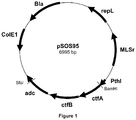
- Figure 1 is an illustration of plasmid backbone pSOS95
- the genes Thiolase (thl) from C. acetobutylicum ATTC 824, Acetoacetat-transferase (ctfAB) from C. acetobutylicum ATTC 824 and the secondary alcohol dehydrogenase (sadh) from C. beijerinckii DSM 6423 were inserted into the vector pEmpty.
- This plasmid is based on the plasmid backbone pSOS95 ( Figure 1 ). To use pSOS95, it was digested with BamHI and Kasl. This removes the operon ctfA-ctfB-adc, but leaves the thl promoter and the rho-independent terminator of adc.
- C. Ijungdahlii and C. autoethanogenum were done as disclosed in Leang et al. 2013.
- the nucleotide sequences of the enzymes used are SEQ ID NOs:1, 3 (ctfA), 5 (ctfB) and 7 respectively. These sequences were transformed to be controlled by a thiolase promotor and integrated as a single operon into the vector backbone.
- the created vector was named pTCtS.
- the vector pTCts was then used to modify C. ljungdahlii and C. autoethanogenum using a method disclosed in Leang et al. 2013.
- the modified C. ljungdahlii strain was named C. ljungdahlii pTCtS.
- the modified C. autoethanogenum strain was named C. autoethanogenum pTCtS.
- Cultivation was carried out in duplicate into 1 L glass bottles with a premixed gas mixture composed of 67% H 2 , 33% CO 2 in an open water bath shaker at 37°C, 150 rpm and aeration of 3 L/h for 70.3 h.
- the gas entered the medium through a filter with a pore size of 10 microns, which was mounted in the middle of the reactor, at a gassing tube.
- a filter with a pore size of 10 microns which was mounted in the middle of the reactor, at a gassing tube.
- the determination of the product concentration was performed by semi-quantitative 1 H-NMR spectroscopy.
- T(M) SP sodium trimethylsilylpropionate was used (T(M) SP).
- a culture produced 7 ppm acetoacetate and 26 ppm 3-HB in 70.3 hours.
- the other culture produced 24 ppm acetoacetate and 104 ppm 3-HB in 70.3 hours.
- Cultivation was carried out in duplicate into 1 L glass bottles with a premixed gas mixture composed of 67% H 2 , 33% CO 2 in an open water bath shaker at 37°C, 150 rpm and aeration of 3 L/h for 70.3 h.
- the gas entered the medium through a filter with a pore size of 10 microns, which was mounted in the middle of the reactor, at a gassing tube.
- a filter with a pore size of 10 microns which was mounted in the middle of the reactor, at a gassing tube.
- the determination of the product concentration was performed by semi-quantitative 1 H-NMR spectroscopy.
- sodium trimethylsilylpropionate was used (T(M) SP). Neither acetoacetate nor 3HB was produced.
- Cultivation was carried out in duplicate into 1 L glass bottles with a premixed gas mixture composed of 55% CO, 20 % H 2 , 10 % CO 2 and 15 % N 2 in an open water bath shaker at 37°C, 150 rpm and aeration of 3 L/h for 7 days.
- the gas entered the medium through a filter with a pore size of 10 microns, which was mounted in the middle of the reactor, in a gassing tube.
- a filter with a pore size of 10 microns which was mounted in the middle of the reactor, in a gassing tube.
- 5 ml samples were removed for determination of OD 600 , pH and the product range.
- the determination of the product concentration was performed by semi-quantitative 1 H-NMR spectroscopy.
- T(M) SP) sodium trimethylsilylpropionate
- Cultivation was carried out in duplicate in 1 L glass bottles with a premixed gas mixture composed of 55% CO, 20 % H 2 , 10 % CO 2 an open water bath shaker at 37°C, 150 rpm and aeration of 3 L/h for 7 days.
- the gas entered the medium through a filter with a pore size of 10 microns, which was mounted in the middle of the reactor, in a gassing tube.
- a filter with a pore size of 10 microns which was mounted in the middle of the reactor, in a gassing tube.
- 5 ml samples were removed for determination of OD 600 nm, pH and the product range.
- the determination of the product concentration was performed by semi-quantitative 1 H-NMR spectroscopy.
- sodium trimethylsilylpropionate was used (T(M) SP). Neither acetoacetate nor 3HB was produced.
Landscapes
- Chemical & Material Sciences (AREA)
- Organic Chemistry (AREA)
- Life Sciences & Earth Sciences (AREA)
- Health & Medical Sciences (AREA)
- Engineering & Computer Science (AREA)
- Genetics & Genomics (AREA)
- Wood Science & Technology (AREA)
- Zoology (AREA)
- Bioinformatics & Cheminformatics (AREA)
- General Engineering & Computer Science (AREA)
- General Health & Medical Sciences (AREA)
- Biochemistry (AREA)
- Biotechnology (AREA)
- Microbiology (AREA)
- Biomedical Technology (AREA)
- Molecular Biology (AREA)
- Medicinal Chemistry (AREA)
- Chemical Kinetics & Catalysis (AREA)
- General Chemical & Material Sciences (AREA)
- Physics & Mathematics (AREA)
- Biophysics (AREA)
- Plant Pathology (AREA)
- Micro-Organisms Or Cultivation Processes Thereof (AREA)
Claims (14)
- Cellule microbienne qui est capable de produire de l'acétoacétate, du 3-hydroxybutyrate et/ou des variants du 3-hydroxybutyrate, la cellule étant génétiquement modifiée pour comprendre une expression accrue, par rapport à sa cellule de type sauvage, de :- une enzyme E1 étant capable de catalyser la conversion d'acétyl-CoA en acétoacétyl-CoA ;- une enzyme E2 étant capable de catalyser la conversion d'acétoacétyl-CoA en acétoacétate ; et- une enzyme E3 étant capable de catalyser la conversion d'acétoacétate en 3-hydroxybutyrate et/ou des variants de celui-ci, et la cellule génétiquement modifiée ayant une expression réduite ou nulle d'une acétoacétate décarboxylase (Adc ; EC 4.1.1.4),dans laquelle le variant du 3-hydroxybutyrate est choisi dans le groupe constitué par l'acide (S)-3-hydroxybutyrique, l'ester (S)-3-hydroxybutyrate, l'acide (R)-3-hydroxybutyrique, l'ester (R)-3-hydroxybutyrate, le 3-hydroxybutyrate de sodium et le 3-hydroxybutyrate de méthyle.
- Cellule selon la revendication 1, dans laquelle E1 est une thiolase, E2 est une acétoacétate CoA transférase et/ou E3 est une déshydrogénase d'alcool secondaire.
- Cellule selon l'une ou l'autre des revendications 1 ou 2, dans laquelle la thiolase (E1) provient de C. acetobutylicum.
- Cellule selon l'une quelconque des revendications précédentes, dans laquelle l'acétoacétate CoA transférase (E2) provient de C. acetobutylicum.
- Cellule selon l'une quelconque des revendications précédentes, dans laquelle la déshydrogénase d'alcool secondaire (E3) provient de C. beijerinckii.
- Cellule selon l'une quelconque des revendications précédentes, dans laquelle- E1 comprend une identité de séquence de 60% avec la SEQ ID n° : 2,- E2 comprend une identité de séquence de 60% avec les SEQ ID n° : 4 ou 6, et/ou- E3 comprend une identité de séquence de 60% avec la SEQ ID n° : 8.
- Cellule selon l'une quelconque des revendications précédentes, dans laquelle- E1 comprend la SEQ ID n° : 2,- E2 comprend les SEQ ID n° : 4 et 6, et- E3 comprend la SEQ ID n° : 8.
- Cellule selon l'une quelconque des revendications précédentes, la cellule étant une cellule acétogène.
- Cellule selon la revendication 8, la cellule acétogène étant choisie dans le groupe constitué par Clostridium autothenogenum DSMZ 19630, Clostridium ragsdahlei ATCC n° : BAA-622, Clostridium autoethanogenum, Moorella sp HUC22-1, Moorella thermoaceticum, Moorella thermoautotrophica, Rumicoccus productus, Acetoanaerobum, Oxobacter pfennigii, Methanosarcina barkeri, Methanosarcina acetivorans, Carboxydothermus, Desulfotomaculum kutznetsovii, Pyrococcus, Peptostreptococcus, Butyribacterium methylotrophicum ATCC 33266, Clostridium formicoaceticum, Clostridium butyricum, Lactobacillus delbrukii, Propionibacterium acidoproprionici, Proprionispera arboris, Anaerobierspirillum succiniproducens, Bacterioides amylophilus, Becterioides ruminicola, Thermoanaerobacter kivui, Acetobacterium woodii, Acetoanaerobium notera, Clostridium aceticum, Butyribacterium methylotrophicum, Moorella thermoacetica, Eubacterium limosum, Peptostreptococcus productus, Clostridium ljungdahlii, Clostridium ATCC 29797 et Clostridium carboxidivorans.
- Cellule selon l'une quelconque des revendications précédentes, la cellule étant Clostridium ljungdahlii ou Clostridium autothenogenum DSMZ 10061.
- Procédé de production d'acétoacétate, de 3-hydroxybutyrate et/ou de variants du 3-hydroxybutyrate, le procédé comprenant l'étape consistant à- mettre en contact une cellule microbienne recombinante, selon l'une quelconque des revendications 1 à 10, avec un milieu comprenant une source de carbone dans laquelle le variant du 3-hydroxybutyrate est choisi dans le groupe constitué par l'acide (S)-3-hydroxybutyrique, l'ester (S)-3-hydroxybutyrate, l'acide (R)-3-hydroxybutyrique, l'ester (R)-3-hydroxybutyrate, le 3-hydroxybutyrate de sodium et le 3-hydroxybutyrate de méthyle.
- Procédé selon la revendication 11, dans lequel la source de carbone comprend du CO2 et/ou du CO.
- Procédé selon l'une ou l'autre des revendications 11 ou 12, dans lequel la source de carbone comprend 50% ou plus de H2.
- Utilisation de la cellule, selon l'une quelconque des revendications 1 à 10, pour la production d'acétoacétate, de 3-hydroxybutyrate et/ou de variants du 3-hydroxybutyrate, dans laquelle le variant du 3-hydroxybutyrate est choisi dans le groupe constitué par l'acide (S)-3-hydroxybutyrique, l'ester (S)-3-hydroxybutyrate, l'acide (R)-3-hydroxybutyrique, l'ester (R)-3-hydroxybutyrate, le 3-hydroxybutyrate de sodium et le 3-hydroxybutyrate de méthyle.
Applications Claiming Priority (2)
| Application Number | Priority Date | Filing Date | Title |
|---|---|---|---|
| EP15178769 | 2015-07-29 | ||
| PCT/EP2016/066875 WO2017016902A1 (fr) | 2015-07-29 | 2016-07-15 | Production de 3-hydroxybutyrate |
Publications (2)
| Publication Number | Publication Date |
|---|---|
| EP3298154A1 EP3298154A1 (fr) | 2018-03-28 |
| EP3298154B1 true EP3298154B1 (fr) | 2019-09-11 |
Family
ID=53762041
Family Applications (1)
| Application Number | Title | Priority Date | Filing Date |
|---|---|---|---|
| EP16739141.6A Active EP3298154B1 (fr) | 2015-07-29 | 2016-07-15 | Production de 3-hydroxybutyrate |
Country Status (4)
| Country | Link |
|---|---|
| US (1) | US20180148743A1 (fr) |
| EP (1) | EP3298154B1 (fr) |
| CN (1) | CN107709542B (fr) |
| WO (1) | WO2017016902A1 (fr) |
Families Citing this family (4)
| Publication number | Priority date | Publication date | Assignee | Title |
|---|---|---|---|---|
| MX2019005420A (es) * | 2017-04-04 | 2019-11-18 | Nnb Nutrition Usa Llc | Preparacion de acido (r)-3-hidroxibutirico o sus sales mediante fermentacion de una etapa. |
| CN107083406B (zh) * | 2017-05-27 | 2021-02-02 | 浙江华睿生物技术有限公司 | (r)-3-羟基丁酸的生产方法 |
| CN110093302B (zh) * | 2019-06-13 | 2020-08-28 | 浙江华睿生物技术有限公司 | 一种乳杆菌突变菌株及其应用 |
| CN112760256B (zh) * | 2021-01-25 | 2023-01-24 | 南京工业大学 | 一株耐高浓度甲醇、高产丁醇食甲基丁酸杆菌及其制备方法 |
Family Cites Families (9)
| Publication number | Priority date | Publication date | Assignee | Title |
|---|---|---|---|---|
| DE2733202A1 (de) * | 1976-08-04 | 1978-02-09 | Agroferm Ag | Verfahren zur herstellung der d(-)-3-hydroxybuttersaeure |
| KR100447532B1 (ko) * | 2001-11-28 | 2004-09-08 | 한국과학기술원 | (알)-하이드록시카르복실산 생산 재조합 미생물 및 그를이용한 (알)-하이드록시카르복실산의 제조방법 |
| CN1217001C (zh) * | 2002-01-04 | 2005-08-31 | 清华大学 | 一种生产d-(-)-3-羟基丁酸的方法 |
| KR101114918B1 (ko) * | 2007-08-09 | 2012-02-15 | 주식회사 엘지화학 | 재조합 미생물을 이용한 광학활성(s)-3-하이드록시부탄산 및(s)-3-하이드록시부티레이트 에스테르의 제조방법 |
| BR112014001174A2 (pt) * | 2011-07-20 | 2017-02-21 | Genomatica Inc | métodos para aumento de rendimentos de produto |
| EP2753689B1 (fr) * | 2011-09-07 | 2018-02-14 | William Marsh Rice University | Acides carboxyliques et alcools fonctionnalisés par oxydation inverse des acides gras |
| EP2770062B1 (fr) * | 2011-10-18 | 2017-01-18 | Showa Denko K.K. | PROCÉDÉ DE PRODUCTION D'UN ACIDE ORGANIQUE EN UTILISANT UNE CoA-TRANSFÉRASE |
| WO2013172928A1 (fr) * | 2012-05-14 | 2013-11-21 | Arizona Board Of Regents, A Body Corporate Of The State Of Arizona Acting For And On Behalf Of Arizonia State University | Production photosynthétique de 3-hydroxybutyrate à partir de dioxyde de carbone |
| US11814664B2 (en) * | 2013-05-24 | 2023-11-14 | Genomatica, Inc. | Microorganisms and methods for producing (3R)-hydroxybutyl (3R)-hydroxybutyrate |
-
2016
- 2016-07-15 EP EP16739141.6A patent/EP3298154B1/fr active Active
- 2016-07-15 WO PCT/EP2016/066875 patent/WO2017016902A1/fr not_active Ceased
- 2016-07-15 CN CN201680035160.7A patent/CN107709542B/zh not_active Expired - Fee Related
- 2016-07-15 US US15/578,331 patent/US20180148743A1/en not_active Abandoned
Non-Patent Citations (1)
| Title |
|---|
| None * |
Also Published As
| Publication number | Publication date |
|---|---|
| CN107709542B (zh) | 2021-08-17 |
| US20180148743A1 (en) | 2018-05-31 |
| CN107709542A (zh) | 2018-02-16 |
| EP3298154A1 (fr) | 2018-03-28 |
| WO2017016902A1 (fr) | 2017-02-02 |
Similar Documents
| Publication | Publication Date | Title |
|---|---|---|
| Schiel-Bengelsdorf et al. | Pathway engineering and synthetic biology using acetogens | |
| KR101312107B1 (ko) | 미생물 알콜 생산 방법 | |
| Lee et al. | Microbial production of ethanol from acetate by engineered Ralstonia eutropha | |
| EP3273782B9 (fr) | Procédé de fermentation mixotrophe pour produire de l'acétone, de l'isopropanol et d'autre bioproduits, et mélanges de ceux-ci | |
| NZ553984A (en) | Alcohol production process | |
| EP2975131A1 (fr) | Synthèse d'alcanes | |
| WO2018019847A1 (fr) | Procédé de production d'alcools dans des conditions aérobies et extraction de produit en utilisant un mélange de polypropylèneglycol et d'alcane | |
| US20180148743A1 (en) | Production of 3-hydroxybutyrate | |
| US20110250629A1 (en) | Alcohol production process | |
| EP3464603B1 (fr) | Production biotechnologique de propanol et/ou d'acide propionique en présence d'acétate | |
| US20180142266A1 (en) | A method of producing alcohols | |
| KR102324599B1 (ko) | 발효 공정 | |
| WO2015013132A1 (fr) | Procédé et milieu pour la réduction des niveaux de sélénium dans la biomasse provenant de la fermentation de substrats gazeux contenant du co | |
| KR20260010725A (ko) | 아세톤의 생명공학적 생산 |
Legal Events
| Date | Code | Title | Description |
|---|---|---|---|
| STAA | Information on the status of an ep patent application or granted ep patent |
Free format text: STATUS: THE INTERNATIONAL PUBLICATION HAS BEEN MADE |
|
| PUAI | Public reference made under article 153(3) epc to a published international application that has entered the european phase |
Free format text: ORIGINAL CODE: 0009012 |
|
| STAA | Information on the status of an ep patent application or granted ep patent |
Free format text: STATUS: REQUEST FOR EXAMINATION WAS MADE |
|
| 17P | Request for examination filed |
Effective date: 20171221 |
|
| AK | Designated contracting states |
Kind code of ref document: A1 Designated state(s): AL AT BE BG CH CY CZ DE DK EE ES FI FR GB GR HR HU IE IS IT LI LT LU LV MC MK MT NL NO PL PT RO RS SE SI SK SM TR |
|
| AX | Request for extension of the european patent |
Extension state: BA ME |
|
| DAV | Request for validation of the european patent (deleted) | ||
| DAX | Request for extension of the european patent (deleted) | ||
| GRAP | Despatch of communication of intention to grant a patent |
Free format text: ORIGINAL CODE: EPIDOSNIGR1 |
|
| STAA | Information on the status of an ep patent application or granted ep patent |
Free format text: STATUS: GRANT OF PATENT IS INTENDED |
|
| INTG | Intention to grant announced |
Effective date: 20190416 |
|
| GRAS | Grant fee paid |
Free format text: ORIGINAL CODE: EPIDOSNIGR3 |
|
| GRAA | (expected) grant |
Free format text: ORIGINAL CODE: 0009210 |
|
| STAA | Information on the status of an ep patent application or granted ep patent |
Free format text: STATUS: THE PATENT HAS BEEN GRANTED |
|
| AK | Designated contracting states |
Kind code of ref document: B1 Designated state(s): AL AT BE BG CH CY CZ DE DK EE ES FI FR GB GR HR HU IE IS IT LI LT LU LV MC MK MT NL NO PL PT RO RS SE SI SK SM TR |
|
| REG | Reference to a national code |
Ref country code: GB Ref legal event code: FG4D |
|
| REG | Reference to a national code |
Ref country code: CH Ref legal event code: EP |
|
| REG | Reference to a national code |
Ref country code: AT Ref legal event code: REF Ref document number: 1178495 Country of ref document: AT Kind code of ref document: T Effective date: 20190915 |
|
| REG | Reference to a national code |
Ref country code: DE Ref legal event code: R096 Ref document number: 602016020427 Country of ref document: DE Ref country code: IE Ref legal event code: FG4D |
|
| RAP2 | Party data changed (patent owner data changed or rights of a patent transferred) |
Owner name: EVONIK OPERATIONS GMBH |
|
| REG | Reference to a national code |
Ref country code: DE Ref legal event code: R081 Ref document number: 602016020427 Country of ref document: DE Owner name: EVONIK OPERATIONS GMBH, DE Free format text: FORMER OWNER: EVONIK DEGUSSA GMBH, 45128 ESSEN, DE Ref country code: NL Ref legal event code: FP |
|
| REG | Reference to a national code |
Ref country code: LT Ref legal event code: MG4D |
|
| PG25 | Lapsed in a contracting state [announced via postgrant information from national office to epo] |
Ref country code: NO Free format text: LAPSE BECAUSE OF FAILURE TO SUBMIT A TRANSLATION OF THE DESCRIPTION OR TO PAY THE FEE WITHIN THE PRESCRIBED TIME-LIMIT Effective date: 20191211 Ref country code: FI Free format text: LAPSE BECAUSE OF FAILURE TO SUBMIT A TRANSLATION OF THE DESCRIPTION OR TO PAY THE FEE WITHIN THE PRESCRIBED TIME-LIMIT Effective date: 20190911 Ref country code: BG Free format text: LAPSE BECAUSE OF FAILURE TO SUBMIT A TRANSLATION OF THE DESCRIPTION OR TO PAY THE FEE WITHIN THE PRESCRIBED TIME-LIMIT Effective date: 20191211 Ref country code: SE Free format text: LAPSE BECAUSE OF FAILURE TO SUBMIT A TRANSLATION OF THE DESCRIPTION OR TO PAY THE FEE WITHIN THE PRESCRIBED TIME-LIMIT Effective date: 20190911 Ref country code: LT Free format text: LAPSE BECAUSE OF FAILURE TO SUBMIT A TRANSLATION OF THE DESCRIPTION OR TO PAY THE FEE WITHIN THE PRESCRIBED TIME-LIMIT Effective date: 20190911 Ref country code: HR Free format text: LAPSE BECAUSE OF FAILURE TO SUBMIT A TRANSLATION OF THE DESCRIPTION OR TO PAY THE FEE WITHIN THE PRESCRIBED TIME-LIMIT Effective date: 20190911 |
|
| PG25 | Lapsed in a contracting state [announced via postgrant information from national office to epo] |
Ref country code: GR Free format text: LAPSE BECAUSE OF FAILURE TO SUBMIT A TRANSLATION OF THE DESCRIPTION OR TO PAY THE FEE WITHIN THE PRESCRIBED TIME-LIMIT Effective date: 20191212 Ref country code: AL Free format text: LAPSE BECAUSE OF FAILURE TO SUBMIT A TRANSLATION OF THE DESCRIPTION OR TO PAY THE FEE WITHIN THE PRESCRIBED TIME-LIMIT Effective date: 20190911 Ref country code: ES Free format text: LAPSE BECAUSE OF FAILURE TO SUBMIT A TRANSLATION OF THE DESCRIPTION OR TO PAY THE FEE WITHIN THE PRESCRIBED TIME-LIMIT Effective date: 20190911 Ref country code: RS Free format text: LAPSE BECAUSE OF FAILURE TO SUBMIT A TRANSLATION OF THE DESCRIPTION OR TO PAY THE FEE WITHIN THE PRESCRIBED TIME-LIMIT Effective date: 20190911 Ref country code: LV Free format text: LAPSE BECAUSE OF FAILURE TO SUBMIT A TRANSLATION OF THE DESCRIPTION OR TO PAY THE FEE WITHIN THE PRESCRIBED TIME-LIMIT Effective date: 20190911 |
|
| REG | Reference to a national code |
Ref country code: AT Ref legal event code: MK05 Ref document number: 1178495 Country of ref document: AT Kind code of ref document: T Effective date: 20190911 |
|
| PG25 | Lapsed in a contracting state [announced via postgrant information from national office to epo] |
Ref country code: PL Free format text: LAPSE BECAUSE OF FAILURE TO SUBMIT A TRANSLATION OF THE DESCRIPTION OR TO PAY THE FEE WITHIN THE PRESCRIBED TIME-LIMIT Effective date: 20190911 Ref country code: IT Free format text: LAPSE BECAUSE OF FAILURE TO SUBMIT A TRANSLATION OF THE DESCRIPTION OR TO PAY THE FEE WITHIN THE PRESCRIBED TIME-LIMIT Effective date: 20190911 Ref country code: RO Free format text: LAPSE BECAUSE OF FAILURE TO SUBMIT A TRANSLATION OF THE DESCRIPTION OR TO PAY THE FEE WITHIN THE PRESCRIBED TIME-LIMIT Effective date: 20190911 Ref country code: AT Free format text: LAPSE BECAUSE OF FAILURE TO SUBMIT A TRANSLATION OF THE DESCRIPTION OR TO PAY THE FEE WITHIN THE PRESCRIBED TIME-LIMIT Effective date: 20190911 Ref country code: EE Free format text: LAPSE BECAUSE OF FAILURE TO SUBMIT A TRANSLATION OF THE DESCRIPTION OR TO PAY THE FEE WITHIN THE PRESCRIBED TIME-LIMIT Effective date: 20190911 Ref country code: PT Free format text: LAPSE BECAUSE OF FAILURE TO SUBMIT A TRANSLATION OF THE DESCRIPTION OR TO PAY THE FEE WITHIN THE PRESCRIBED TIME-LIMIT Effective date: 20200113 |
|
| PG25 | Lapsed in a contracting state [announced via postgrant information from national office to epo] |
Ref country code: CZ Free format text: LAPSE BECAUSE OF FAILURE TO SUBMIT A TRANSLATION OF THE DESCRIPTION OR TO PAY THE FEE WITHIN THE PRESCRIBED TIME-LIMIT Effective date: 20190911 Ref country code: SK Free format text: LAPSE BECAUSE OF FAILURE TO SUBMIT A TRANSLATION OF THE DESCRIPTION OR TO PAY THE FEE WITHIN THE PRESCRIBED TIME-LIMIT Effective date: 20190911 Ref country code: IS Free format text: LAPSE BECAUSE OF FAILURE TO SUBMIT A TRANSLATION OF THE DESCRIPTION OR TO PAY THE FEE WITHIN THE PRESCRIBED TIME-LIMIT Effective date: 20200224 Ref country code: SM Free format text: LAPSE BECAUSE OF FAILURE TO SUBMIT A TRANSLATION OF THE DESCRIPTION OR TO PAY THE FEE WITHIN THE PRESCRIBED TIME-LIMIT Effective date: 20190911 |
|
| REG | Reference to a national code |
Ref country code: DE Ref legal event code: R097 Ref document number: 602016020427 Country of ref document: DE |
|
| PLBE | No opposition filed within time limit |
Free format text: ORIGINAL CODE: 0009261 |
|
| STAA | Information on the status of an ep patent application or granted ep patent |
Free format text: STATUS: NO OPPOSITION FILED WITHIN TIME LIMIT |
|
| PG2D | Information on lapse in contracting state deleted |
Ref country code: IS |
|
| PG25 | Lapsed in a contracting state [announced via postgrant information from national office to epo] |
Ref country code: IS Free format text: LAPSE BECAUSE OF FAILURE TO SUBMIT A TRANSLATION OF THE DESCRIPTION OR TO PAY THE FEE WITHIN THE PRESCRIBED TIME-LIMIT Effective date: 20200112 Ref country code: DK Free format text: LAPSE BECAUSE OF FAILURE TO SUBMIT A TRANSLATION OF THE DESCRIPTION OR TO PAY THE FEE WITHIN THE PRESCRIBED TIME-LIMIT Effective date: 20190911 |
|
| REG | Reference to a national code |
Ref country code: BE Ref legal event code: HC Owner name: EVONIK OPERATIONS GMBH; DE Free format text: DETAILS ASSIGNMENT: CHANGE OF OWNER(S), CHANGEMENT DE NOM DU PROPRIETAIRE; FORMER OWNER NAME: EVONIK DEGUSSA GMBH Effective date: 20200403 |
|
| 26N | No opposition filed |
Effective date: 20200615 |
|
| PG25 | Lapsed in a contracting state [announced via postgrant information from national office to epo] |
Ref country code: SI Free format text: LAPSE BECAUSE OF FAILURE TO SUBMIT A TRANSLATION OF THE DESCRIPTION OR TO PAY THE FEE WITHIN THE PRESCRIBED TIME-LIMIT Effective date: 20190911 |
|
| REG | Reference to a national code |
Ref country code: NL Ref legal event code: HC Owner name: EVONIK OPERATIONS GMBH; DE Free format text: DETAILS ASSIGNMENT: CHANGE OF OWNER(S), CHANGE OF OWNER(S) NAME; FORMER OWNER NAME: EVONIK DEGUSSA GMBH Effective date: 20200928 |
|
| PG25 | Lapsed in a contracting state [announced via postgrant information from national office to epo] |
Ref country code: MC Free format text: LAPSE BECAUSE OF FAILURE TO SUBMIT A TRANSLATION OF THE DESCRIPTION OR TO PAY THE FEE WITHIN THE PRESCRIBED TIME-LIMIT Effective date: 20190911 |
|
| REG | Reference to a national code |
Ref country code: CH Ref legal event code: PL |
|
| PG25 | Lapsed in a contracting state [announced via postgrant information from national office to epo] |
Ref country code: LU Free format text: LAPSE BECAUSE OF NON-PAYMENT OF DUE FEES Effective date: 20200715 Ref country code: LI Free format text: LAPSE BECAUSE OF NON-PAYMENT OF DUE FEES Effective date: 20200731 Ref country code: CH Free format text: LAPSE BECAUSE OF NON-PAYMENT OF DUE FEES Effective date: 20200731 |
|
| PG25 | Lapsed in a contracting state [announced via postgrant information from national office to epo] |
Ref country code: IE Free format text: LAPSE BECAUSE OF NON-PAYMENT OF DUE FEES Effective date: 20200715 |
|
| PGFP | Annual fee paid to national office [announced via postgrant information from national office to epo] |
Ref country code: GB Payment date: 20210722 Year of fee payment: 6 |
|
| PG25 | Lapsed in a contracting state [announced via postgrant information from national office to epo] |
Ref country code: TR Free format text: LAPSE BECAUSE OF FAILURE TO SUBMIT A TRANSLATION OF THE DESCRIPTION OR TO PAY THE FEE WITHIN THE PRESCRIBED TIME-LIMIT Effective date: 20190911 Ref country code: MT Free format text: LAPSE BECAUSE OF FAILURE TO SUBMIT A TRANSLATION OF THE DESCRIPTION OR TO PAY THE FEE WITHIN THE PRESCRIBED TIME-LIMIT Effective date: 20190911 Ref country code: CY Free format text: LAPSE BECAUSE OF FAILURE TO SUBMIT A TRANSLATION OF THE DESCRIPTION OR TO PAY THE FEE WITHIN THE PRESCRIBED TIME-LIMIT Effective date: 20190911 |
|
| PG25 | Lapsed in a contracting state [announced via postgrant information from national office to epo] |
Ref country code: MK Free format text: LAPSE BECAUSE OF FAILURE TO SUBMIT A TRANSLATION OF THE DESCRIPTION OR TO PAY THE FEE WITHIN THE PRESCRIBED TIME-LIMIT Effective date: 20190911 |
|
| GBPC | Gb: european patent ceased through non-payment of renewal fee |
Effective date: 20220715 |
|
| PG25 | Lapsed in a contracting state [announced via postgrant information from national office to epo] |
Ref country code: GB Free format text: LAPSE BECAUSE OF NON-PAYMENT OF DUE FEES Effective date: 20220715 |
|
| P01 | Opt-out of the competence of the unified patent court (upc) registered |
Effective date: 20230524 |
|
| PGFP | Annual fee paid to national office [announced via postgrant information from national office to epo] |
Ref country code: NL Payment date: 20230719 Year of fee payment: 8 |
|
| PGFP | Annual fee paid to national office [announced via postgrant information from national office to epo] |
Ref country code: FR Payment date: 20230726 Year of fee payment: 8 Ref country code: DE Payment date: 20230719 Year of fee payment: 8 Ref country code: BE Payment date: 20230719 Year of fee payment: 8 |
|
| REG | Reference to a national code |
Ref country code: DE Ref legal event code: R119 Ref document number: 602016020427 Country of ref document: DE |
|
| REG | Reference to a national code |
Ref country code: NL Ref legal event code: MM Effective date: 20240801 |
|
| PG25 | Lapsed in a contracting state [announced via postgrant information from national office to epo] |
Ref country code: DE Free format text: LAPSE BECAUSE OF NON-PAYMENT OF DUE FEES Effective date: 20250201 |
|
| PG25 | Lapsed in a contracting state [announced via postgrant information from national office to epo] |
Ref country code: NL Free format text: LAPSE BECAUSE OF NON-PAYMENT OF DUE FEES Effective date: 20240801 |
|
| PG25 | Lapsed in a contracting state [announced via postgrant information from national office to epo] |
Ref country code: BE Free format text: LAPSE BECAUSE OF NON-PAYMENT OF DUE FEES Effective date: 20240731 |
|
| PG25 | Lapsed in a contracting state [announced via postgrant information from national office to epo] |
Ref country code: FR Free format text: LAPSE BECAUSE OF NON-PAYMENT OF DUE FEES Effective date: 20240731 |
|
| REG | Reference to a national code |
Ref country code: BE Ref legal event code: MM Effective date: 20240731 |