EP3298638B1 - Mit einem metallkomplex dotiertes organisches halbleitermaterial - Google Patents
Mit einem metallkomplex dotiertes organisches halbleitermaterial Download PDFInfo
- Publication number
- EP3298638B1 EP3298638B1 EP16719212.9A EP16719212A EP3298638B1 EP 3298638 B1 EP3298638 B1 EP 3298638B1 EP 16719212 A EP16719212 A EP 16719212A EP 3298638 B1 EP3298638 B1 EP 3298638B1
- Authority
- EP
- European Patent Office
- Prior art keywords
- atoms
- radicals
- group
- substituted
- aromatic
- Prior art date
- Legal status (The legal status is an assumption and is not a legal conclusion. Google has not performed a legal analysis and makes no representation as to the accuracy of the status listed.)
- Active
Links
Classifications
-
- H—ELECTRICITY
- H10—SEMICONDUCTOR DEVICES; ELECTRIC SOLID-STATE DEVICES NOT OTHERWISE PROVIDED FOR
- H10K—ORGANIC ELECTRIC SOLID-STATE DEVICES
- H10K85/00—Organic materials used in the body or electrodes of devices covered by this subclass
- H10K85/30—Coordination compounds
-
- H—ELECTRICITY
- H10—SEMICONDUCTOR DEVICES; ELECTRIC SOLID-STATE DEVICES NOT OTHERWISE PROVIDED FOR
- H10K—ORGANIC ELECTRIC SOLID-STATE DEVICES
- H10K50/00—Organic light-emitting devices
- H10K50/10—OLEDs or polymer light-emitting diodes [PLED]
- H10K50/14—Carrier transporting layers
- H10K50/15—Hole transporting layers
- H10K50/155—Hole transporting layers comprising dopants
-
- H—ELECTRICITY
- H10—SEMICONDUCTOR DEVICES; ELECTRIC SOLID-STATE DEVICES NOT OTHERWISE PROVIDED FOR
- H10K—ORGANIC ELECTRIC SOLID-STATE DEVICES
- H10K71/00—Manufacture or treatment specially adapted for the organic devices covered by this subclass
- H10K71/30—Doping active layers, e.g. electron transporting layers
-
- H—ELECTRICITY
- H10—SEMICONDUCTOR DEVICES; ELECTRIC SOLID-STATE DEVICES NOT OTHERWISE PROVIDED FOR
- H10K—ORGANIC ELECTRIC SOLID-STATE DEVICES
- H10K85/00—Organic materials used in the body or electrodes of devices covered by this subclass
- H10K85/60—Organic compounds having low molecular weight
- H10K85/615—Polycyclic condensed aromatic hydrocarbons, e.g. anthracene
- H10K85/626—Polycyclic condensed aromatic hydrocarbons, e.g. anthracene containing more than one polycyclic condensed aromatic rings, e.g. bis-anthracene
-
- H—ELECTRICITY
- H10—SEMICONDUCTOR DEVICES; ELECTRIC SOLID-STATE DEVICES NOT OTHERWISE PROVIDED FOR
- H10K—ORGANIC ELECTRIC SOLID-STATE DEVICES
- H10K85/00—Organic materials used in the body or electrodes of devices covered by this subclass
- H10K85/60—Organic compounds having low molecular weight
- H10K85/631—Amine compounds having at least two aryl rest on at least one amine-nitrogen atom, e.g. triphenylamine
-
- H—ELECTRICITY
- H10—SEMICONDUCTOR DEVICES; ELECTRIC SOLID-STATE DEVICES NOT OTHERWISE PROVIDED FOR
- H10K—ORGANIC ELECTRIC SOLID-STATE DEVICES
- H10K85/00—Organic materials used in the body or electrodes of devices covered by this subclass
- H10K85/60—Organic compounds having low molecular weight
- H10K85/649—Aromatic compounds comprising a hetero atom
- H10K85/657—Polycyclic condensed heteroaromatic hydrocarbons
- H10K85/6576—Polycyclic condensed heteroaromatic hydrocarbons comprising only sulfur in the heteroaromatic polycondensed ring system, e.g. benzothiophene
-
- H—ELECTRICITY
- H10—SEMICONDUCTOR DEVICES; ELECTRIC SOLID-STATE DEVICES NOT OTHERWISE PROVIDED FOR
- H10K—ORGANIC ELECTRIC SOLID-STATE DEVICES
- H10K2102/00—Constructional details relating to the organic devices covered by this subclass
- H10K2102/10—Transparent electrodes, e.g. using graphene
- H10K2102/101—Transparent electrodes, e.g. using graphene comprising transparent conductive oxides [TCO]
- H10K2102/103—Transparent electrodes, e.g. using graphene comprising transparent conductive oxides [TCO] comprising indium oxides, e.g. ITO
-
- H—ELECTRICITY
- H10—SEMICONDUCTOR DEVICES; ELECTRIC SOLID-STATE DEVICES NOT OTHERWISE PROVIDED FOR
- H10K—ORGANIC ELECTRIC SOLID-STATE DEVICES
- H10K85/00—Organic materials used in the body or electrodes of devices covered by this subclass
- H10K85/60—Organic compounds having low molecular weight
- H10K85/631—Amine compounds having at least two aryl rest on at least one amine-nitrogen atom, e.g. triphenylamine
- H10K85/633—Amine compounds having at least two aryl rest on at least one amine-nitrogen atom, e.g. triphenylamine comprising polycyclic condensed aromatic hydrocarbons as substituents on the nitrogen atom
-
- Y—GENERAL TAGGING OF NEW TECHNOLOGICAL DEVELOPMENTS; GENERAL TAGGING OF CROSS-SECTIONAL TECHNOLOGIES SPANNING OVER SEVERAL SECTIONS OF THE IPC; TECHNICAL SUBJECTS COVERED BY FORMER USPC CROSS-REFERENCE ART COLLECTIONS [XRACs] AND DIGESTS
- Y02—TECHNOLOGIES OR APPLICATIONS FOR MITIGATION OR ADAPTATION AGAINST CLIMATE CHANGE
- Y02E—REDUCTION OF GREENHOUSE GAS [GHG] EMISSIONS, RELATED TO ENERGY GENERATION, TRANSMISSION OR DISTRIBUTION
- Y02E10/00—Energy generation through renewable energy sources
- Y02E10/50—Photovoltaic [PV] energy
- Y02E10/549—Organic PV cells
-
- Y—GENERAL TAGGING OF NEW TECHNOLOGICAL DEVELOPMENTS; GENERAL TAGGING OF CROSS-SECTIONAL TECHNOLOGIES SPANNING OVER SEVERAL SECTIONS OF THE IPC; TECHNICAL SUBJECTS COVERED BY FORMER USPC CROSS-REFERENCE ART COLLECTIONS [XRACs] AND DIGESTS
- Y02—TECHNOLOGIES OR APPLICATIONS FOR MITIGATION OR ADAPTATION AGAINST CLIMATE CHANGE
- Y02P—CLIMATE CHANGE MITIGATION TECHNOLOGIES IN THE PRODUCTION OR PROCESSING OF GOODS
- Y02P70/00—Climate change mitigation technologies in the production process for final industrial or consumer products
- Y02P70/50—Manufacturing or production processes characterised by the final manufactured product
Definitions
- the present invention relates to a composition comprising at least one hole-transport or/and one hole-injection material and at least one metal complex as a p-dopant.
- the present invention furthermore relates to electronic devices and to a process for the production thereof.
- Organic-based charge-transport materials for example triarylamine-based hole transporters
- OLEDs or PLEDs organic or polymeric light-emitting diodes
- O-SC organic solar cells
- O-FET organic field-effect transistors
- O-TFT organic thin-film transistors
- O-IC organic integrated circuits
- O-lasers organic laser diodes
- an OLED comprises an anode, a cathode and an organic light emitting unit.
- the last one comprises several functional layers like hole- or electron-injection layers, hole- or electron-transport layers and organic light emitting layers.
- WO 2009/021107 A1 and WO 2010/006680 A1 describe organic compounds which are suitable for the production of electronic devices, where these compounds can be processed both via gas-phase deposition and also from solution.
- the electronic devices which are obtained via gas-phase deposition exhibit a more favourable property profile.
- a further problem is, in particular, the energy efficiency with which an electronic device achieves the specified object.
- the light yield in particular, should be high, so that as little electrical power as possible has to be applied in order to achieve a certain light flux.
- the lowest possible voltage should also be necessary in order to achieve a specified luminous density. Accordingly, these properties should not be adversely affected by the process.
- layers which are directly connected to emitting layers especially hole-transport layers have a great influence on the properties of the adjacent emitting layer.
- the quality of the hole-injection layer, which is directly connected to the hole-transport layer, plays also a significant role in the performance of the OLED.
- compositions which comprise an organic semiconductor and a metal complex like in WO2013/182389 , can be successfully used as a hole-injection and/or a hole-transport layer for the production of organic electronic components.
- These kind of compositions can be deposited using either a vacuum evaporation technique or a solution-based coating method.
- Suitable solution-based coating method are spin-coating methods and methods based on printing processes, such as, for example, screen printing, flexographic printing, nozzle printing or offset printing, LITI (light induced thermal imaging, thermal transfer printing) or ink-jet printing.
- Document WO 2005/061654 A1 discloses a metal diketonato complex as a light emitting compound for OLEDs.
- compositions which can be used as hole-injection and/or a hole-transport layers for the production of organic electronic components and which can be deposited using either a vacuum evaporation technique or a solution-based coating method.
- compositions comprising at least one hole-transport or/and one hole-injection material and at least one particular metal complex as a p-dopant, lead to very homogenous hole-transport or hole-injection layers for the production of electronic devices, which can be efficiently deposited using a solution-based coating method.
- the first object of the present invention is a composition comprising at least one hole-transport or/and one hole-injection material which is a polymer comprising a structural unit according formula (I) or a compound according formula (I') as defined in claim 1 and at least one metal complex as a p-dopant, wherein the metal complex is a compound of formula (MC-1): where
- a hole-injection material is a material that simplifies or facilitates the transfer of holes, i.e. positive charges, from the anode into an organic layer and a hole-transport material is a material that is capable of transporting holes, i.e. positive charges, which are generally injected from the anode or an adjacent layer, for example a hole-injection layer.
- Molecular orbitals in particular also the highest occupied molecular orbital (HOMO) and the lowest unoccupied molecular orbital (LUMO), their energy levels and the energy of the lowest triplet state T 1 or of the lowest excited singlet state S 1 of the materials are determined via quantum-chemical calculations.
- HOMO highest occupied molecular orbital
- LUMO lowest unoccupied molecular orbital
- their energy levels and the energy of the lowest triplet state T 1 or of the lowest excited singlet state S 1 of the materials are determined via quantum-chemical calculations.
- a geometry optimisation is carried out using the "Ground State/Semi-empirical/Default Spin/AM1/Charge 0/Spin Singlet" method.
- An energy calculation is subsequently carried out on the basis of the optimised geometry.
- the "TD-SCF/ DFT/Default Spin/B3PW91" method with the "6-31 G(d)" base set (charge 0, spin singlet) is used here.
- the geometry is optimised via the "Ground State/ Hartree-Fock/Default Spin/LanL2MB/ Charge 0/Spin Singlet” method.
- the energy calculation is carried out analogously to the above-described method for the organic substances, with the difference that the "LanL2DZ" base set is used for the metal atom and the "6-31 G(d)" base set is used for the ligands.
- the energy calculation gives the HOMO energy level HEh or LUMO energy level LEh in hartree units.
- these values are to be regarded as HOMO and LUMO energy levels respectively of the materials.
- the lowest triplet state T 1 is defined as the energy of the triplet state having the lowest energy which arises from the quantum-chemical calculation described.
- the lowest excited singlet state S 1 is defined as the energy of the excited singlet state having the lowest energy which arises from the quantum-chemical calculation described.
- a hole-injection material has an HOMO level which is in the region of or above the level of the anode, i.e. in general is at least -5.3 eV.
- a hole-transport material generally has a high HOMO level of preferably at least -5.4 eV.
- the hole-injection and/or hole-transport material can be a compound having a low molecular weight or a polymer, where the hole-injection material and/or hole-transport material may also be in the form of a mixture.
- the formulations according to the invention may comprise two compounds as hole-injection material and/or hole-transport material having a low molecular weight, one compound having a low molecular weight and one polymer or two polymers (blend).
- a p-dopant material is a material, which exhibits a lewis-acidity and/or which are able to form a complex with the matrix material, in which these materials act as Lewis-acids (also mention only formal).
- An aryl group or heteroaryl group here is taken to mean either a simple aromatic ring, i.e. benzene, or a simple heteroaromatic ring, for example pyridine, pyrimidine or thiophene, or a condensed (annellated) aromatic or heteroaromatic polycycle, for example naphthalene, phenanthrene, quinoline or carbazole.
- a condensed (annellated) aromatic or heteroaromatic polycycle in the sense of the present application consists of two or more simple aromatic or heteroaromatic rings condensed with one another.
- An aryl or heteroaryl group which may in each case be substituted by the above-mentioned radicals and which may be linked to the aromatic or heteroaromatic ring system via any desired positions, is taken to mean, in particular, groups derived from benzene, naphthalene, anthracene, phenanthrene, pyrene, dihydropyrene, chrysene, perylene, fluoranthene, benzanthracene, benzophenanthrene, tetracene, pentacene, benzopyrene, furan, benzofuran, isobenzofuran, dibenzofuran, thiophene, benzothiophene, isobenzothiophene, dibenzothiophene, pyrrole, indole, isoindole, carbazole, pyridine, quinoline, isoquinoline, acridine, phenanthridine, benzo-5,6-quinoline,
- aryloxy group in accordance with the definition of the present invention is taken to mean an aryl group, as defined above, which is bonded via an oxygen atom.
- An analogous definition applies to heteroaryloxy groups.
- An aromatic ring system in the sense of this invention contains 6 to 60 C atoms in the ring system.
- a heteroaromatic ring system in the sense of this invention contains 5 to 60 aromatic ring atoms, at least one of which is a heteroatom.
- the heteroatoms are preferably selected from N, O and/or S.
- An aromatic or heteroaromatic ring system in the sense of this invention is intended to be taken to mean a system which does not necessarily contain only aryl or heteroaryl groups, but instead in which, in addition, a plurality of aryl or heteroaryl groups may be connected by a non-aromatic unit (preferably less than 10% of the atoms other than H), such as, for example, an sp 3 -hybridised C, Si, N or O atom, an sp 2 -hybridised C or N atom or an sp-hybridised C atom.
- systems such as 9,9'-spirobifluorene, 9,9'-diarylfluorene, triarylamine, diaryl ether, stilbene, etc., are also intended to be taken to be aromatic ring systems in the sense of this invention, as are systems in which two or more aryl groups are connected, for example, by a linear or cyclic alkyl, alkenyl or alkynyl group or by a silyl group.
- systems in which two or more aryl or heteroaryl groups are linked to one another via single bonds are also taken to be aromatic or heteroaromatic ring systems in the sense of this invention, such as, for example, systems such as biphenyl, terphenyl or diphenyltriazine.
- An aromatic or heteroaromatic ring system having 5 - 60 aromatic ring atoms, which may in each case also be substituted by radicals as defined above and which may be linked to the aromatic or heteroaromatic group via any desired positions, is taken to mean, in particular, groups derived from benzene, naphthalene, anthracene, benzanthracene, phenanthrene, benzophenanthrene, pyrene, chrysene, perylene, fluoranthene, naphthacene, pentacene, benzopyrene, biphenyl, biphenylene, terphenyl, terphenylene, quaterphenyl, fluorene, spirobifluorene, dihydrophenanthrene, dihydropyrene, tetrahydropyrene, cis- or trans-indenofluorene, truxene, isotruxene, spirotruxene,
- a straight-chain alkyl group having 1 C atom in which, in addition, individual H atoms may be substituted by the groups mentioned above under the definition of the radicals, is taken to mean the radical methyl.
- An alkoxy or thioalkyl group having 1 to 40 C atoms is preferably taken to mean methoxy, trifluoromethoxy, ethoxy, n-propoxy, i-propoxy, n-butoxy, i-butoxy, s-butoxy, t-butoxy, n-pentoxy, s-pentoxy, 2-methyl-butoxy, n-hexoxy, cyclohexyloxy, n-heptoxy, cycloheptyloxy, n-octyloxy, cyclooctyloxy, 2-ethylhexyloxy, pentafluoroethoxy, 2,2,2-trifluoroethoxy, methylthio, ethylthio, n-propylthio, i-propylthio, n-butylthio, i-butylthio, s-butylthio, t-butylthio, n-pent
- the above-mentioned formulation is also intended to be taken to mean that, in the case where one of the two radicals represents hydrogen, the second radical is bonded at the position to which the hydrogen atom was bonded, with formation of a ring. This is illustrated by the following scheme:
- composition of the present invention comprises at least one metal complex of formula (MC-1):
- M is selected from Sn, Bi and Te. More preferably, M is selected from Bi.
- X is equal to O.
- R 3 is selected from the group consisting of H, D, a straight-chain alkyl group having 1 to 4 C atoms or a branched or cyclic alkyl having 3 to 4 C atoms, each of which may be substituted by one or more radicals R 4 , or an aryl or heteroaryl group having 5 to 14 aromatic ring atoms, which may in each case be substituted by one or more radicals R 4 . It is particularly preferred that R 3 stands for H, a methyl group or a phenyl group.
- At least one of the radicals R 1 and R 2 stands F, CN, NO 2 , a straight-chain fluoroalkyl group having 1 to 40 C atoms or a branched or cyclic fluoroalkyl group having 3 to 40 C atoms, each of which may be substituted by one or more radicals R 4 , or an aryl or heteroaryl group having 5 to 30 aromatic ring atoms, which may in each case be substituted by one or more radicals R 4 .
- radicals R 1 and R 2 stands for F, CN, NO 2 , a straight-chain perfluoroalkyl group having 1 to 14 C atoms or a branched or cyclic perfluoroalkyl group having 3 to 14 C atoms, or an aryl or heteroaryl group having 5 to 14 aromatic ring atoms, which may in each case be substituted by one or more radicals R 4 .
- both radicals R 1 and R 2 stands, identically or differently, for F, CN, NO 2 , a straight-chain perfluoroalkyl group having 1 to 14 C atoms or a branched or cyclic perfluoroalkyl group having 3 to 14 C atoms, or an aryl or heteroaryl group having 5 to 14 aromatic ring atoms, which may in each case be substituted by one or more radicals R 4 .
- L is selected from the group of neutral ligands consisting of bipyridine, phenanthroline, phosphine oxide, phosphonimido ligands and sulfoxide, each of which may be substituted by one or more radicals R 4 as defined above.
- p is equal to 0 or 1. It is even more preferred that p is equal to 0 and q is equal to 1, 2 or 3, depending on the oxidation number of M.
- metal complexes of formula (MC-I) that are suitable for the compositions according to the invention are the following ones:
- the concentration of the at least one metal complex of formula (MC-1) in the composition according to the invention is preferably in the range of from 1 to 60 wt.%, more preferably 2 to 50 wt.%, and most preferably from 3 to 30 wt.%, based on the total composition.
- compositions according to the present invention comprise at least one hole-transport or/and one hole-injection material.
- the at least one hole-transport or/and one hole-injection material is a polymer compound, or an oligomer compound.
- the polymer compound preferably has 10 to 10000, more preferably 10 to 5000 and most preferably 10 to 2000 structural units (i.e. repetitive units).
- the oligomer compound preferably has 3 to 9 structural units.
- the branching factor of the polymer is between 0 (linear polymer, no branching) and 1 (polymer completely branched).
- Polymers according to the disclosure have a molecular weight (M w ) in the range of 10,000 to 2,000,000 g/mol, preferably in the range of 50,000 to 1,500,000 g/mol, and more preferably in the range of 100,000 to 1,000,000 g/mol.
- M w molecular weight
- the molecular weight (M w ) is determined by means of GPC (Gel Permeation Chromatography) using an internal polystyrene standard.
- Polymers according to the disclosure are either conjugated, partly conjugated or non-conjugated polymers, preferably conjugated or partly conjugated.
- the polymer comprises a structural unit, which is a triarylamine unit having three aromatic or heteroaromatic ring systems Ar 1 , Ar 2 , Ar 3 , wherein at least one of Ar 1 , Ar 2 , Ar 3 is substituted by Ar 4 in at least one, preferably in one of the two ortho positions, where Ar 4 is a mono- or polycyclic , aromatic or heteroaromatic ring system having 5 to 60 aromatic ring atoms, which may be substituted by one or more radicals R.
- the triarylamine unit has the following formula (I): where
- Ar 3 according to formula (I) is in at least one, preferably in one of the two ortho-positions relating to the Nitrogen atom represented in formula (I), substituted by Ar 4 , where Ar 4 is a mono- or polycyclic, aromatic or heteroaromatic ring system with 5 to 60 aromatic ring atoms, which may be substituted by one or more radical R, where R can adopt the meanings indicated above.
- Ar 4 here may either be linked directly, i.e. via a single bond, to Ar 3 , or alternatively via a linking group X.
- the compound of formula (I) thus preferably has the following formula (Ia).
- Ar 1 , Ar 2 , Ar 3 , Ar 4 and R can adopt the meanings indicated above,
- structural units of formula (I) can be comprised In the main chain or in the side chain.
- Structural units of formula (I) are preferably comprised in the main chain of the polymer.
- structural units of formula (I) are either mono- or bivalent, i.e. they either exhibit one or two bonds to the adjacent structural units in the polymer.
- the term "mono- or polycyclic, aromatic ring system” in the present application is taken to mean an aromatic ring system having 6 to 60, preferably 6 to 30 and particularly preferably 6 to 24 aromatic ring atoms, which does not necessarily contain only aromatic groups, but instead in which a plurality of aromatic units may also be interrupted by a short non-aromatic unit ( ⁇ 10% of the atoms other than H, preferably ⁇ 5% of the atoms other than H), such as, for example, an sp 3 -hybridised C atom or O or N atom, a CO group, etc.
- systems such as, for example, 9,9'-spirobifluorene, 9,9-diarylfluorene and 9,9-dialkylfluorene are also intended to be taken to be aromatic ring systems.
- the aromatic ring systems may be mono- or polycyclic, i.e. they may contain one ring (for example phenyl) or a plurality of rings, which may also be condensed (for example naphthyl) or covalently linked (for example biphenyl), or contain a combination of condensed and linked rings.
- Preferred aromatic ring systems are, for example, phenyl, biphenyl, terphenyl, [1,1':3',1 "]terphenyl-2'-yl, quaterphenyl, naphthyl, anthracene, binaphthyl, phenanthrene, dihydrophenanthrene, pyrene, dihydropyrene, chrysene, perylene, tetracene, pentacene, benzopyrene, fluorene, indene, indenofluorene and spirobifluorene.
- the term "mono- or polycyclic, heteroaromatic ring system” in the present application is taken to mean an aromatic ring system having 5 to 60, preferably 5 to 30 and particularly preferably 5 to 24 aromatic ring atoms, where one or more of these atoms is (are) a heteroatom.
- the "mono- or polycyclic, heteroaromatic ring system” does not necessarily contain only aromatic groups, but instead may also be interrupted by a short non-aromatic unit ( ⁇ 10% of the atoms other than H, preferably ⁇ 5% of the atoms other than H), such as, for example, an sp 3 -hybridised C atom or O or N atom, a CO group, etc.
- heteroaromatic ring systems may be mono- or polycyclic, i.e. they may contain one ring or a plurality of rings, which may also be condensed or covalently linked (for example pyridylphenyl), or contain a combination of condensed and linked rings. Preference is given to fully conjugated heteroaryl groups.
- Preferred heteroaromatic ring systems are, for example, 5-membered rings, such as pyrrole, pyrazole, imidazole, 1,2,3-triazole, 1,2,4-triazole, tetrazole, furan, thiophene, selenophene, oxazole, isoxazole, 1,2-thiazole, 1,3-thiazole, 1,2,3-oxadiazole, 1,2,4-oxadiazole, 1,2,5-oxadiazole, 1,3,4-oxadiazole, 1,2,3-thiadiazole, 1,2,4-thiadiazole, 1,2,5-thiadiazole, 1,3,4-thiadiazole, 6-membered rings, such as pyridine, pyridazine, pyrimidine, pyrazine, 1,3,5-triazine, 1,2,4-triazine, 1,2,3-triazine, 1,2,4,5-tetrazine, 1,2,3,4-tetraz
- the mono- or polycyclic, aromatic or heteroaromatic ring system may be unsubstituted or substituted. Substituted in the present application means that the mono- or polycyclic, aromatic or heteroaromatic ring system contains one or more substituents R.
- the compound of. formula (I) is characterised in that Ar 3 is substituted by Ar 4 in one of the two ortho positions, and Ar 3 is additionally linked to Ar 4 in the meta position that is adjacent to the substituted ortho position.
- the compound of formula (I) thus preferably has the following formula (Ib): where Ar 1 , Ar 2 , Ar 3 , Ar 4 and R can adopt the meanings indicated above,
- the compound of formula (I) is selected from the following formulae (II), (III) and (IV): where Ar 1 , Ar 2 , Ar 4 and R can adopt the meanings indicated above,
- the compound of formula (II) is selected from the following formula (V): where Ar 1 , Ar 2 , R and m can adopt the meanings indicated above, and
- the compound of formula (III) is selected from the following formula (VI): where Ar 1 , Ar 2 , R, m and n can adopt the meanings indicated above.
- the compound of formula (IV) is selected from the following formula (VII): where Ar 1 , Ar 2 , R, m and n can adopt the meanings indicated above.
- the compound of formula (V) is selected from the following formula (Vg): where R, m and p can adopt the meanings indicated above.
- Vg-1 Vg-2) (Vg-3) (Vg-4) (Vg-5) (Vg-6) (Vg-7) (Vg-8) where R, k, m, n and p can adopt the meanings indicated above and o is 0, 1 or 2.
- the compound of formula (VI) is selected from the following formula (Vlg): where R, X, m and n can adopt the meanings indicated above.
- the compound of formula (VII) is selected from compounds of the following formula (VIIg): where R, X, m and n can adopt the meanings indicated above.
- VIIg Examples of preferred structural units of formula (VIIg) are depicted in the following table: (VIIg-1) (VIIg-2) (VIIg-3) where R, m and n can adopt the meanings indicated above.
- the dashed lines represent bonds to adjacent structural units in the polymer. They can be, independently from each other, identically or differently, in ortho-, meta- or para-position, preferably identically in ortho-, meta- or para-position, more preferably in meta- or para-position and most preferably in para-position.
- the polymer comprises at least one structural unit of formula (I), selected from structural units of the following formula (VIIIa): or from structural units oft he following formula (VIIIb): where w is 1, 2 or 3, Ar 5 to Ar 9 is on each occurence, in each case identically or differently, a mono- or polycyclic, aromatic or heteroaromatic ring system having 5 to 60 aromatic ring atoms, which may be substituted by one or more radicals R; where R can adopt the meaning indicated in formula (I); the dashed lines represent bonds to adjacent structural units in the polymer; and at least one of Ar 5 to Ar 9 is substituted by a radical R comprising at least 2 C atoms, preferably at least 4 C atoms and more preferably at least 6 C atoms.
- a radical R comprising at least 2 C atoms, preferably at least 4 C atoms and more preferably at least 6 C atoms.
- At least one of Ar 5 and/or Ar 8 according to formulae (VIIIa) and/or (VIIIb) is substituted by Ar 4 in at least one, preferably in one of the two ortho-positions relating to the Nitrogen atom represented in formula (VIIIa) and/or (VIIIb), where Ar 4 is a mono- or polycyclic, aromatic or heteroaromatic ring system having 5 to 60 aromatic ring atoms, which may be substituted by one or more radicals R, where R can adopt the meaning indicated above, in particular for formula (I).
- Ar 4 here may either be linked directly, i.e. via a single bond, to Ar 5 and/or Ar 8 according to formulae (VIIIa) and/or (VIIIb) or alternatively via a linking group X.
- the structural unit of formula (VIIIa) and/or (VIIIb) is therefore preferably selected from the structures of following formulae (VIIIa-1a), (VIIIa-1b), (VIIIa-1c) and/or (VIIIa-1d).
- Ar 4 , Ar 5 , Ar 6 , Ar 7 , Ar 8 , Ar 9 , X, m, n, r, s, t and R can adopt the meaning indicated above, in particular for formulae (I), (Ia), (Ib), (VIIIa) and/or (VIIIb).
- the structural unit of formulae (VIIIa) and/or (VIIIb) can be selected from the structural units of formulae (VIIIb-a), (VIIIb-b), (VIIIb-c) and/or (VIIIb-d).
- Ar 4 , Ar 5 , Ar 6 , Ar 7 , Ar 8 , Ar 9 , X, m, n, s, t and R can adopt the meaning indicated above, in particular for formulae (I), (Ia), (Ib), (VIIIa) and/or (VIIIb).
- the at least one structural unit of formula (VIIIa) is selected from the structural units of the following formulae (IX), (X), (XI), (XII), (XIII), (XIV), (XV) and (XVI):
- Ar 4 , Ar 5 , Ar 6 , Ar 7 , Ar 8 , Ar 9 , X, m, n, p, R and the dashed lines can adopt the meaning indicated above, in particular for formulae (I), (Ia), (Ib), (VIIIa) and/or (VIIIb).
- the structural units of formulae (IX) and (X) are selected from the structural units of the following formulae (IXa) and (Xa): where Ar 6 , Ar 7 , Ar 8 , Ar 9 , R, m, p and the dashed lines can adopt the meaning indicated above, in particular for formulae (I), (Ia), (Ib), (VIIIa) and/oder (VIIIb).
- the structural units of formulae (XI) and (XII) are selected from the structural units of the following formulae (XIa) and (XIIa): where Ar 6 , Ar 7 , Ar 8 , Ar 9 , R, m, n and X can adopt the meaning indicated above, in particular for formulae (I), (Ia), (Ib), (VIIIa) and/or (VIIIb).
- the structural units of formulae (XIII) and (XIV) are selected from the structural formulae of the following formulae (XIIIa) and (XIVa): where Ar 6 , Ar 7 , Ar 8 , Ar 9 , R, m, n and X can adopt the meaning indicated above, in particular for formulae (I), (Ia), (Ib), (VIIIa) and/or (VIIIb).
- the structural units of formulae (IXa) and (Xa) are selected from the structural units of the following formulae (IXb) and (Xb): where Ar 9 , R, m and p can adopt the meaning indicated above, in particular for formulae (I), (Ia), (Ib), (VIIIa) and/or (VIIIb).
- Example of preferred structural units of formulae (IXb) and (Xb) are depicted in the following table: where R, m, n and p can adopt the meaning indicated above, in particular for formulae (I), (la), (Ib), (VIIIa) and/or (VIIIb) and, o is 0, 1 or 2.
- the structural units of formulae (XIa) and (XIIa) are selected from the structural units of the following formulae (XIb) and (XIIb): where Ar 9 , R, X, m, n and p can adopt the meaning indicated above, in particular for formulae (I), (Ia), (Ib), (VIIIa) and/or (VIIIb).
- the structural units of formulae (XIIIa) and (XIVa) are selected from the structural units of the following formulae (XIIIb) and (XIVb): where R, X, m, n and p can adopt the meaning indicated above, in particular for formulae (I), (Ia), (Ib), (VIIIa) and/or (VIIIb).
- the dashed lines represent bonds to adjacent structural units in the polymer. They can be, independently from each other, identically or differently, in ortho-, meta- or para-position, preferably identically in ortho-, meta- or para-position, more preferably in meta- or para-position and most preferably in para-position.
- a "crosslinkable group Q" is a functional group, which is able to react and to form a non-soluble bond.
- the reaction can take place with a further, identical group Q, a further, different group Q or any other part of the same or of another polymer chain.
- Crosslinkable groups are this reactive groups.
- the result of the reaction of the crosslinkable groups is a corresponding crosslinked compound.
- the chemical reaction can also take place in the layer, where an unsoluble layer is produced as a result.
- the crosslinking can usually be supported with heat or with UV-, microwave-, X-Ray- or electron radiation, optionally in the presence of an initiator.
- Unsoluble in the context of the present invention means preferably, that the polymer according to the present invention exhibits, after the crosslinking reaction, thus after the reaction of the crosslinkable groups, a solubility at room temperature in an organic solvent, which is at least reduced with a factor 3, preferably with a factor 10, in comparison with the corresponding non-crosslinked polymer of the invention in the same organic solvent.
- At least one crosslinkable group means that one structural unit has one or more crosslinkable groups.
- One structural unit preferably has exactly one crosslinkable group.
- the structural unit of formula (I) has a crosslinkable group
- this group can be linked to Ar 1 , Ar 2 or Ar 3 .
- the crosslinkable group is linked to the monovalent linked, mono- or polycyclic, aromatic or heteroaromatic Ar 3 .
- a structural unit of formulae (VIIIa) or (VIIIb) has a crosslinkable group, then this group can be linked to Ar 5 , Ar 6 , Ar 7 , Ar 8 or Ar 9 .
- the crosslinkable group is preferably linked to one of the monovalent linked, mono- or polycyclic, aromatic or heteroaromatic ring system, that is Ar 5 or Ar 8 .
- indices have the following meaning:
- indices have the following meaning:
- indices have the following meaning:
- the concentration of the polymer in the composition according to the invention is preferably in the range of from 40 to 99 wt.%, more preferably 50 to 98 wt.%, and most preferably from 70 to 97 wt.%, based on the total composition.
- the hole-transport or/and one hole-injection material according to the invention is a low-molecular material having a molecular weight of ⁇ 5000 g/mol, preferably ⁇ 3000 g/mol, and more preferably ⁇ 2000 g/mol.
- the low molecular hole-transport or/and one hole-injection material is a triarylamine compound having three aromatic or heteroaromatic ring systems Ar 1 , Ar 2 , Ar 3 , wherein at least one of Ar 1 , Ar 2 , Ar 3 is substituted by Ar 4 in at least one, preferably in one of the two ortho positions, where Ar 4 is a mono- or polycyclic , aromatic or heteroaromatic ring system having 5 to 60 aromatic ring atoms, which may be substituted by one or more radicals R.
- the triarylamine compound has the following formula (I'): where the symbols and indices can adopt the same meaning as for formula (I).
- Ar 3 according to formula (I') is in at least one, preferably in one of the two ortho-positions relating to the Nitrogen atom represented in formula (I'), substituted by Ar 4 , where Ar 4 is a mono- or polycyclic, aromatic or heteroaromatic ring system with 5 to 60 aromatic ring atoms, which may be substituted by one or more radical R, where R can adopt the meanings indicated above.
- Ar 4 here may either be linked directly, i.e. via a single bond, to Ar 3 , or alternatively via a linking group X.
- the compound of formula (I) thus preferably has the following formula (Ia').
- Ar 1 , Ar 2 , Ar 3 , Ar 4 and R can adopt the meanings indicated above,
- the compound of formula (I') is characterised in that Ar 3 is substituted by Ar 4 in one of the two ortho positions, and Ar 3 is additionally linked to Ar 4 in the meta position that is adjacent to the substituted ortho position.
- the compound of formula (I') thus preferably has the following formula (lb'): where Ar 1 , Ar 2 , Ar 3 , Ar 4 and R can adopt the meanings indicated above,
- the compound of formula (I') is selected from the following formulae (II'), (III') and (IV'): where Ar 1 , Ar 2 , Ar 4 and R can adopt the meanings indicated above,
- the compound of formula (III') is selected from the following formula (VI'): where Ar 1 , Ar 2 , R, m and n can adopt the meanings indicated above.
- the compound of formula (IV') is selected from the following formula (VII'): where Ar 1 , Ar 2 , R, m and n can adopt the meanings indicated above.
- the compound of formula (V') is selected from the following formula (Vg'): where R, m and p can adopt the meanings indicated above.
- Vg' Examples of preferred compounds of formula (Vg') are depicted in the following table: (Vg)-1') (Vg-2') (Vg-3') (Vg-4') (Vg-5') (Vg-6') (Vg-7') (Vg-8') where R, k, m, n and p can adopt the meanings indicated above.
- the compound of formula (VI') is selected from the following formula (Vlg'): where R, X, m and n can adopt the meanings indicated above.
- the compound of formula (VII') is selected from compounds of the following formula (Vllg'): where R, X, m and n can adopt the meanings indicated above.
- Vllg' Examples of preferred compounds of formula (Vllg') are depicted in the following table: (VIIg-1') (VIIg-2') (VIIg-3') where R, m and n can adopt the meanings indicated above.
- the concentration of the at least one low molecular hole-transport or/and one hole-injection material according to the invention is preferably in the range of from 40 to 99 wt.%, more preferably 50 to 98 wt.%, and most preferably 85 to 97 wt.%, based on the total composition.
- the weight ratio of the at least one hole-transport or/and one hole-injection material to the at least one metal complex in the composition according to the invention is from 1000:1 to 1:2, preferably from 400:1 to 1:1, more preferably from 100:1 to 3:2 and most preferably from 30:1 to 2:1. It is possible to use a higher or lower amount of metal complex, but the performance of the layer obtained from the composition according to the invention can decrease as a consequence.
- Further object of the present invention is a formulation comprising at least one hole-transport or/and one hole-injection material, at least one metal complex of formula (MC-1) as a p-dopant and at least one solvent.
- the formulation according to the invention may comprise further additives and processing assistants.
- additives and processing assistants include, inter alia, surface-active substances, surfactants, lubricants and greases, additives which increase the conductivity, dispersants, hydrophobicising agents, adhesion promoters, flow improvers, antifoams, deaerating agents, diluents, which may be reactive or unreactive, fillers, assistants, processing assistants, dyes, pigments, stabilisers, sensitisers, nanoparticles and inhibitors.
- a composition in accordance with the present invention can be employed for the production of a layer or multilayered structure in which the organofunctional materials are present in layers, as required for the production of preferred electronic or opto-electronic components, such as OLEDs.
- composition of the present invention can preferably be employed for the formation of a functional layer comprising a hole-transport or/and one hole-injection material and a metal complex on a substrate or on one of the layers applied to the substrate.
- Still further object of the invention is a process for the production of an electronic device, wherein at least one layer is obtained from the deposition of a composition according to the invention or from the application of a formulation according to the invention.
- Still further object of the invention is a process for the production of an electronic device with a multilayer structure, wherein at least one layer is obtained from a composition of the present invention.
- Another object of the invention is an electronic device obtainable by such a process for the production of an electronic device.
- An electronic device is taken to mean a device which comprises an anode, a cathode and at least one functional layer in between.
- the electronic device comprises at least one layer comprising a composition according to the invention, wherein the at leat one layer is a hole-transport layer.
- the electronic device comprises at least one layer comprising a composition according to the invention, wherein the at leat one layer is a hole-injection layer.
- the electronic device is preferably an organic electroluminescent device (OLED), a polymeric electroluminescent device (PLED), an organic integrated circuit (O-IC), an organic field-effect transistor (O-FET), an organic thin-film transistor (O-TFT), an organic, light-emitting transistor (O-LET), an organic solar cell (O-SC), an organic, optical detector, an organic photoreceptor, an organic field-quench device (O-FQD), an organic electrical sensor, a light-emitting electrochemical cell (LEC) or an organic laser diode (O-laser). Preference is given to organic electroluminescent device (OLED).
- OLED organic electroluminescent device
- PLED polymeric electroluminescent device
- O-IC organic integrated circuit
- O-FET organic field-effect transistor
- OFTFT organic thin-film transistor
- O-LET organic, light-emitting transistor
- O-SC organic solar cell
- O-SC organic, optical detector, an organic photoreceptor, an organic field-que
- Part B Organic Semiconductor
- OS organic semiconductors
- Part C Device examples
- compositions of the present invention can be used in solution-based coating methods by preparing formulations comprising a solvent, an organic semiconductor and a metal complex according to the invention.
- the compositions of the present invention used in solution-based coating methods lead to OLEDs which are much easier to produce than OLEDs obtained from vacuum processes, and at the same time still exhibit good properties.
- compositions according to the invention can be used in two different layer sequences:
- the substrate consists of glass platelets, which are coated with a structured 50 nm thick ITO (indium tin oxide) layer.
- ITO indium tin oxide
- the functional layers are then applied onto the coated substrate according to the structures of Stacks A and B.
- formulations according to the invention are prepared, which comprise one organic semiconductor, one metal complex and one solvent.
- the solvent consists in a mixture of Anisole: Xylene in the ratio 2:1.
- the typical solid content of such solutions is about 5-20 g/l, when film thicknesses of between 20 nm and 100 nm have to be achieved by means of spin coating.
- the layers were spin coated in an inert gas atmosphere, in this case argon, and heated for 60 minutes at 180 °C or 220 °C.
- the hole-transport layer in Stack B is formed by thermal evaporation in a vacuum chamber.
- the materials used in this case are shown in Table C1.
- Table C1 Structural formula of the hole-transport material (vacuum processed) HT1
- the emissive layer in Stack B is formed by thermal evaporation in a vacuum chamber.
- the layer may consist of more than one material, which are deposited by means of co-evaporation in a given volume fraction.
- a reference such as MB1:SEB (95%:5%) in this case means that the materials MB1 and SEB are present in the layer in a volume fraction of 95%:5%.
- Table C2 Structural formulae of the materials used in the emissive layer MB1 SEB
- the materials for the electron-transport layer are also thermally evaporated in a vacuum chamber and are shown in Table C3.
- the electron-transport layer consists of the two materials ETM1 and ETM2, which are deposited by means of co-evaporation in a volume fraction of 50%:50%.
- Table C3 Structural formulae of the materials used in the hole-blocking and/or electron-transport layers ETM1 ETM2
- the cathode is formed by the deposition of a 100 nm thick aluminum layer by means of thermal evaporation.
- the OLEDs are characterized by standard methods. For this purpose, the electroluminescence spectra, the current-voltage-luminance characteristics (IUL characteristics), assuming a Lambertian radiation pattern and in the case of Stack B, the operating lifetime are determined. Data like the operating voltage (in V) and the external quantum efficiency (in %) at a certain brightness are determined from the IUL characteristics.
- LD80@4000cd/m 2 corresponds to the lifetime until which the brightness of the OLED drops from an initial brightness of 4000 cd/m 2 to a brightness equal to 80% of the initial intensity, i.e. at 3600 cd/m 2 .
- Examples V1 and V2 correspond to comparative examples, where the layers comprise no metal complex.
- Table C5a shows results of hole-dominated components according to Stack A. In such components, the current is dominated by holes, which is why no recombination with electrons takes place that would lead to luminescence.
- Table C5a Ex. Voltage at 1 mA/cm2 [V] V1 5.5 C2 1.5 C3 1.3 C4 1.6 V2 6 C5 1.6 C6 1.2 C7 1.4
- Table C5a The results in Table C5a show that the operating voltage of components obtained from compositions according to the invention is significantly lower than the operating voltage of components obtained from comparative compositions, which do not comprise a metal complex.
- the compositions according to the invention can be advantageously used for the preparation of hole-injection layers, which lead to a decrease of the operating voltage of the OLEDs.
- Table C5b Ex. Efficiency at 1000 cd/m 2 Voltage at 1000 cd/m 2 LD80 at 4000 cd/m 2 % EQE [V] [h] C1 7.8 5.2 245
- Table C5b shows that the use of compositions according to the invention for the preparation of hole-injection layers leads to OLEDs with a good lifetime and efficiency.
Landscapes
- Chemical & Material Sciences (AREA)
- Engineering & Computer Science (AREA)
- Materials Engineering (AREA)
- Physics & Mathematics (AREA)
- Spectroscopy & Molecular Physics (AREA)
- Inorganic Chemistry (AREA)
- Optics & Photonics (AREA)
- Manufacturing & Machinery (AREA)
- Electroluminescent Light Sources (AREA)
Claims (12)
- Zusammensetzung, umfassend mindestens ein Lochtransport- oder/und ein Lochinjektionsmaterial und mindestens einen Metallkomplex als p-Dotand, dadurch gekennzeichnet, dass es sich bei dem Metallkomplex um eine Verbindung der Formel (MC-1) handelt:
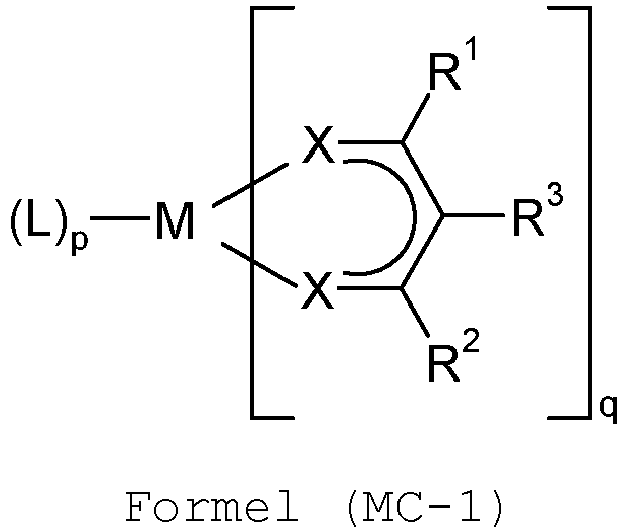 M aus Ga, In, Ge, Sn, Pb, Sb, Bi, Se oder Te ausgewählt ist;X für O, NR0 oder S steht;R0 aus H, einem geradkettigen Alkyl mit 1 bis 40 C-Atomen oder einem verzweigten oder cyclischen Alkyl mit 3 bis 40 C-Atomen, wobei jede dieser Gruppen durch einen oder mehrere Reste R4 substituiert sein kann, wobei eine oder mehrere nicht benachbarte CH2-Gruppen durch R4C=CR4, C=C, Si(R4)2, C=O, C=S, C=NR4, P(=O)(R4), SO, SO2, NR4, O, S oder CONR4 ersetzt sein können und wobei ein oder L mehrere H-Atome durch D, F, Cl, Br, I oder CN ersetzt sein können, oder einem mono- oder polycyclischen, aromatischen oder heteroaromatischen Ringsystem mit 5 bis 60 aromatischen Ringatomen, das jeweils durch einen oder mehrere Reste R4 substituiert sein kann, ausgewählt ist; für einen neutralen Liganden steht;R1, R2 bei jedem Auftreten gleich oder verschieden für F, Cl, Br, I, CN, NO2, eine geradkettige Alkylgruppe mit 2 bis 40 C-Atomen, eine verzweigte oder cyclische Alkylgruppe mit 3 bis 40 C-Atomen, eine geradkettige Fluoralkylgruppe mit 1 bis 40 C-Atomen oder eine verzweigte oder cyclische Fluoralkylgruppe mit 3 bis 40 C-Atomen, wobei jede dieser Gruppen durch einen oder mehrere Reste R4 substituiert sein kann, wobei eine oder mehrere nicht benachbarte CH2-Gruppen durch R4C=CR4, C=C, Si(R4)2, C=O, C=S, C=NR4, P(=O) (R4), SO, SO2, NR4, O, S oder CONR4 ersetzt sein können und wobei ein oder mehrere H-Atome durch D, Cl, Br, I oder CN ersetzt sein können, oder ein mono- oder polycyclisches, aromatisches oder heteroaromatisches Ringsystem mit 5 bis 60 aromatischen Ringatomen, das jeweils durch einen oder mehrere Reste R4 substituiert sein kann, steht, wobei die Reste R1 und R3 oder die Reste R2 und R3 miteinander ein mono- oder polycyclisches, aliphatisches, aromatisches und/oder benzoanneliertes Ringsystem bilden können;R3 aus der Gruppe bestehend aus H, D, einer geradkettigen Alkylgruppe mit 1 bis 40 C-Atomen oder einem verzweigten oder cyclischen Alkyl mit 3 bis 40 C-Atomen, wobei jede dieser Gruppen durch einen oder mehrere Reste R4 substituiert sein kann, wobei eine oder mehrere nicht benachbarte CH2-Gruppen durch R4C=CR4, C=C, Si(R4)2, C=O, C=S, C=NR4, P(=O) (R4), SO, SO2, NR4, O, S oder CONR4 ersetzt sein können und wobei ein oder mehrere H-Atome durch D, F, Cl, Br, I oder CN ersetzt sein können, oder einem mono- oder polycyclischen, aromatischen oder heteroaromatischen Ringsystem mit 5 bis 60 aromatischen Ringatomen, das jeweils durch einen oder mehrere Reste R4 substituiert sein kann, ausgewählt ist;R4 bei jedem Auftreten gleich oder verschieden für H, D, F oder einen aliphatischen, aromatischen oder heteroaromatischen organischen Rest mit 1 bis 20 C-Atomen steht, in dem zusätzlich ein oder mehrere H-Atome durch D oder F ersetzt sein können; zwei oder mehr Substituenten R5 hier miteinander verknüpft sein können und einen Ring bilden können;p für 0, 1 oder 2 steht;q für eine Zahl mit einem Wert von 1, 2, 3 oder 4 steht, die der Oxidationszahl von M entspricht; undes sich bei dem mindestens einen Lochtransportoder/und einen Lochinjektionsmaterial um ein Polymer, das mindestens eine Struktureinheit der folgenden Formel (I) umfasst, oder eine Verbindung der Formel (I') handelt:
Ar1 bis Ar3 bei jedem Auftreten jeweils gleich oder verschieden für ein mono- oder polycyclisches, aromatisches oder heteroaromatisches Ringsystem mit 5 bis 60 aromatischen Ringatomen, das durch einen oder mehrere Reste R5 substituiert sein kann, stehen;
R5 bei jedem Auftreten gleich oder verschieden für H, D, F, Cl, Br, I, N(R6)2, CN, NO2, Si (R6)3, B(OR6)2, C(=O)R6, P(=O)(R6)2, S(=O)R6, S(=O)2R6, OSO2R6, eine geradkettige Alkyl-, Alkoxy- oder Thioalkoxygruppe mit 1 bis 40 C-Atomen oder eine verzweigte oder cyclische Alkyl-, Alkoxy- oder Thioalkoxygruppe mit 3 bis 40 C-Atomen, wobei jede dieser Gruppen durch einen oder mehrere Reste R6 substituiert sein kann, wobei eine oder mehrere nicht benachbarte CH2-Gruppen durch R6C=CR6, C=C, Si(R6)2, C=O, C=S, C=NR6, P(=O) (R6), SO, SO2, NR6, O, S oder CONR6 ersetzt sein können und wobei ein oder mehrere H-Atome durch D, F, Cl, Br, I oder CN ersetzt sein können, oder ein mono- oder polycyclisches, aromatisches oder heteroaromatisches Ringsystem mit 5 bis 60 aromatischen Ringatomen, das jeweils durch einen oder mehrere Reste R6 substituiert sein kann, oder eine Aryloxy- oder Heteroaryloxygruppe mit 5 bis 60 aromatischen Ringatomen, die durch einen oder mehrere Reste R6 substituiert sein kann, oder eine Aralkyl- oder Heteroaralkylgruppe mit 5 bis 60 aromatischen Ringatomen, die jeweils durch einen oder mehrere Reste R6 substituiert sein kann, oder eine Diarylaminogruppe, Diheteroarylaminogruppe oder Arylheteroarylaminogruppe mit 10 bis 40 aromatischen Ringatomen, die durch einen oder mehrere Reste R6 substituiert sein kann, steht, wobei zwei oder mehr Reste R5 auch miteinander ein mono- oder polycyclisches, aliphatisches, aromatisches und/oder benzoanelliertes Ringsystem bilden können;
R6 bei jedem Auftreten gleich oder verschieden für H, D, F oder einen aliphatischen Kohlenwasserstoffrest mit 1 bis 20 C-Atomen, einen aromatischen und/oder einen heteroaromatischen Kohlenwasserstoffrest mit 5 bis 20 C-Atomen, in dem außerdem ein oder mehrere H-Atome durch F ersetzt sein können, steht; wobei zwei oder mehr Substituenten R6 auch miteinander ein mono- oder polycyclisches, aliphatisches oder aromatisches Ringsystem bilden können; und
die gestrichelten Linien in Formel (I) Bindungen an die benachbarten Struktureinheiten in dem Polymer darstellen,
und wobei mindestens eines von Ar1, Ar2 und/oder Ar3 durch einen Rest R5 mit mindestens 2 C-Atomen substituiert ist. - Zusammensetzung nach Anspruch 1, wobei M aus Sn, Bi und Te, weiter bevorzugt Bi, ausgewählt ist.
- Zusammensetzung nach Anspruch 1, wobei der neutrale Ligand L aus Bipyridin, Phenanthrolin, Phosphinoxid, Phosphonimido-Liganden und Sulfoxid, die jeweils durch einen oder mehrere Reste R4 gemäß Anspruch 1 substituiert sein können, ausgewählt ist.
- Zusammensetzung nach einem oder mehreren der vorhergehenden Ansprüche, wobei mindestens einer der Reste R1 und R2 aus der Gruppe bestehend aus F, CN, NO2, einer geradkettigen Fluoralkylgruppe mit 1 bis 40 C-Atomen oder einer verzweigten oder cyclischen Fluoralkylgruppe mit 3 bis 40 C-Atomen, wobei jede dieser Gruppen durch einen oder mehrere Reste R4 substituiert sein kann, oder einer Aryloder Heteroarylgruppe mit 5 bis 30 aromatischen Ringatomen, die jeweils durch einen oder mehrere Reste R4 substituiert sein kann, ausgewählt ist.
- Zusammensetzung nach einem oder mehreren der vorhergehenden Ansprüche, wobei mindestens einer der Reste R1 und R2 aus der Gruppe bestehend aus F, CN, NO2, einer geradkettigen Perfluoralkylgruppe mit 1 bis 14 C-Atomen oder einer verzweigten oder cyclischen Perfluoralkylgruppe mit 3 bis 14 C-Atomen oder einer Aryl- oder Heteroarylgruppe mit 5 bis 14 aromatischen Ringatomen, die jeweils durch einen oder mehrere Reste R4 substituiert sein kann, ausgewählt ist.
- Zusammensetzung nach einem oder mehreren der vorhergehenden Ansprüche, wobei R3 aus der Gruppe bestehend aus H, D, einer geradkettigen Alkylgruppe mit 1 bis 4 C-Atomen oder einem verzweigten oder cyclischen Alkyl mit 3 bis 4 C-Atomen, wobei jede dieser Gruppen durch einen oder mehrere Reste R4 substituiert sein kann, oder einer Aryl- oder Heteroarylgruppe mit 5 bis 14 aromatischen Ringatomen, die jeweils durch einen oder mehrere Reste R4 substituiert sein kann, ausgewählt ist.
- Zusammensetzung nach einem oder mehreren der vorhergehenden Ansprüche, wobei es sich bei dem mindestens einen Lochtransport- oder/und einen Lochinjektionsmaterial um ein Polymer der Formel (I) handelt, das mindestens eine Struktureinheit einer der folgenden Formeln (II), (III) oder (IV) umfasst:


Ar4 für ein mono- oder polycyclisches, aromatisches oder heteroaromatisches Ringsystem mit 5 bis 60 aromatischen Ringatomen, das durch einen oder mehrere Reste R substituiert ist, steht,
R bei jedem Auftreten gleich oder verschieden für H, D, F, Cl, Br, I, N(R1)2, CN, NO2, Si(R1)3, B(OR1)2, C(=O)R1, P(=O)(R1)2, S(=O)R1, S(=O)2R1, OSO2R1, eine geradkettige Alkyl-, Alkoxy- oder Thioalkoxygruppe mit 1 bis 40 C-Atomen oder eine verzweigte oder cyclische Alkyl-, Alkoxy- oder Thioalkoxygruppe mit 3 bis 40 C-Atomen, wobei jede dieser Gruppen durch einen oder mehrere Reste R1 substituiert sein kann, wobei eine oder mehrere nicht benachbarte CH2-Gruppen durch R1C=CR1, C=C, Si(R1)2, C=O, C=S, C=NR1, P(=O) (R1), SO, SO2, NR1, O, S oder CONR1 ersetzt sein können und wobei ein oder mehrere H-Atome durch D, F, Cl, Br, I oder CN ersetzt sein können, oder ein mono- oder polycyclisches, aromatisches oder heteroaromatisches Ringsystem mit 5 bis 60 aromatischen Ringatomen, das jeweils durch einen oder mehrere Reste R1 substituiert sein kann, oder eine Aryloxy- oder Heteroaryloxygruppe mit 5 bis 60 aromatischen Ringatomen, die durch einen oder mehrere Reste R1 substituiert sein kann, oder eine Aralkyl- oder Heteroaralkylgruppe mit 5 bis 60 aromatischen Ringatomen, die jeweils durch einen oder mehrere Reste R1 substituiert sein kann, oder eine Diarylaminogruppe, Diheteroarylaminogruppe oder Arylheteroarylaminogruppe mit 10 bis 40 aromatischen Ringatomen, die durch einen oder mehrere Reste R1 substituiert sein kann, oder eine vernetzbare Gruppe Q steht, wobei zwei oder mehr Reste R auch miteinander ein mono- oder polycyclisches, aliphatisches, aromatisches und/oder benzoanelliertes Ringsystem bilden können und R1 die in Anspruch 1 angegebene Bedeutung annehmen kann,m = 0, 1, 2, 3 oder 4,n = 0, 1, 2 oder 3 undX = CR2, NR, SiR2, O, S, C=O oder P=O, vorzugsweise CR2, NR, O oder S. - Verwendung eines Metallkomplexes der Formel (MC-1) gemäß Anspruch 1 als p-Dotand in einer elektronischen Vorrichtung, vorzugsweise in einer organischen Elektrolumineszenzvorrichtung, einem organischen Feldeffekttransistor, einer organischen integrierten Schaltung, einem organischen Dünnfilmtransistor, einem organischen lichtemittierenden Transistor, einer organischen Solarzelle, einem organischen optischen Detektor, einem organischen Photorezeptor, einer organischen Feld-Quench-Vorrichtung, einer lichtemittierenden elektrochemischen Zelle oder einer organischen Laserdiode.
- Formulierung, umfassend mindestens ein Lochtransport- oder/und ein Lochinjektionsmaterial der Formel (I) oder (I') gemäß Anspruch 1, mindestens einen Metallkomplex der Formel (MC-1) gemäß Anspruch 1 als p-Dotand und mindestens ein Lösungsmittel.
- Verfahren zur Herstellung einer elektronischen Vorrichtung, wobei mindestens eine Schicht durch Abscheiden einer Zusammensetzung nach einem der vorhergehenden Ansprüche 1 bis 7 oder durch Aufbringen einer Zusammensetzung nach Anspruch 9 erhalten wird.
- Elektronische Vorrichtung mit Mehrschichtstruktur, wobei mindestens eine Schicht eine Zusammensetzung gemäß einem der vorhergehenden Ansprüche 1 bis 7 umfasst.
- Elektronische Vorrichtung nach Anspruch 11, wobei die elektronische Vorrichtung aus organischen Elektrolumineszenzvorrichtungen, organischen integrierten Schaltungen, organischen Feldeffekttransistoren, organischen Dünnfilmtransistoren, organischen lichtemittierenden Transistoren, organischen Solarzellen, organischen optischen Detektoren, organischen Photorezeptoren, organischen Feld-Quench-Vorrichtungen, lichtemittierenden elektrochemischen Zellen, organischen Laserdioden und vorzugsweise organischen Leuchtdioden ausgewählt ist.
Applications Claiming Priority (2)
| Application Number | Priority Date | Filing Date | Title |
|---|---|---|---|
| EP15001557 | 2015-05-22 | ||
| PCT/EP2016/000673 WO2016188604A1 (en) | 2015-05-22 | 2016-04-27 | Composition comprising an organic semiconductor and a metal complex |
Publications (2)
| Publication Number | Publication Date |
|---|---|
| EP3298638A1 EP3298638A1 (de) | 2018-03-28 |
| EP3298638B1 true EP3298638B1 (de) | 2021-08-25 |
Family
ID=53283952
Family Applications (1)
| Application Number | Title | Priority Date | Filing Date |
|---|---|---|---|
| EP16719212.9A Active EP3298638B1 (de) | 2015-05-22 | 2016-04-27 | Mit einem metallkomplex dotiertes organisches halbleitermaterial |
Country Status (3)
| Country | Link |
|---|---|
| EP (1) | EP3298638B1 (de) |
| KR (1) | KR102550275B1 (de) |
| WO (1) | WO2016188604A1 (de) |
Families Citing this family (17)
| Publication number | Priority date | Publication date | Assignee | Title |
|---|---|---|---|---|
| DE102017111425A1 (de) * | 2017-05-24 | 2018-11-29 | Osram Oled Gmbh | Organisches elektronisches Bauelement und Verfahren zur Herstellung eines organischen elektronischen Bauelements |
| CN111018921B (zh) * | 2018-10-10 | 2024-02-27 | 北京夏禾科技有限公司 | 一种金属络合物及包含金属络合物的电致发光器件 |
| EP3859811B1 (de) | 2020-01-28 | 2025-03-19 | Novaled GmbH | Organische elektronische vorrichtung mit einer anodenschicht, einer kathodenschicht, mindestens einer emissionsschicht (eml) und mindestens einer lochinjektionsschicht (hil) |
| EP4105201A1 (de) * | 2021-06-18 | 2022-12-21 | Novaled GmbH | Organische elektrolumineszente vorrichtung mit einem substrat, einer anodenschicht und einer kathodenschicht, mindestens einer lichtemittierenden schicht und mindestens einer halbleiterschicht, die mindestens eine metallverbindung aus einem metall und mindestens einem liganden umfasst |
| WO2022023260A1 (en) | 2020-07-27 | 2022-02-03 | Novaled Gmbh | Metal complexes of 3-(2,3,5-trifluoro-6-(trifluoromethyl)pyridin-4-yl)pentane-2,4-dione and similar ligands as semiconductor materials for use in electronic devices |
| EP4496458A3 (de) | 2020-07-27 | 2025-03-26 | Novaled GmbH | Metallkomplexe von 3-(2,3,5-trifluor-6-(trifluormethyl)pyridin-4-yl)pentan-2,4-dion und ähnlichen liganden als halbleitermaterialien zur verwendung in elektronischen vorrichtungen |
| US20230242562A1 (en) | 2020-07-28 | 2023-08-03 | Novaled Gmbh | Compound of Formula (I), a Semiconductor Material Comprising at Least One Compound of Formula (I), a Semiconductor Layer Comprising at Least One Compound of Formula (I) and an Electronic Device Comprising at Least One Compound of Formula (I) |
| EP3945125A1 (de) | 2020-07-28 | 2022-02-02 | Novaled GmbH | Verbindung der formel (i), halbleitermaterial mit mindestens einer verbindung der formel (i), halbleiterschicht mit mindestens einer verbindung der formel (i) und elektronische vorrichtung mit mindestens einer verbindung der formel (i) |
| EP4152423A1 (de) * | 2021-09-20 | 2023-03-22 | Novaled GmbH | Organische elektronische vorrichtung mit mindestens einem metallkomplex der formel (i) |
| KR20240067934A (ko) | 2021-09-20 | 2024-05-17 | 노발레드 게엠베하 | 화합물, 화합물을 포함하는 반도체층 및 유기 전자 장치 |
| EP4151642B1 (de) | 2021-09-20 | 2025-11-19 | Novaled GmbH | Verbindung, halbleiterschicht mit einer verbindung und organische elektronische vorrichtung |
| EP4321506A1 (de) | 2022-08-09 | 2024-02-14 | Novaled GmbH | Metallkomplex, halbleiterschicht, die einen metallkomplex umfasst, und organische elektronische vorrichtung |
| EP4340581A1 (de) * | 2022-09-19 | 2024-03-20 | Novaled GmbH | Elektrolumineszente vorrichtung mit anodenschicht, kathodenschicht, lochinjektionsschicht und erster lochtransportschicht mit einer metallhaltigen verbindung. |
| KR20250073115A (ko) | 2022-09-19 | 2025-05-27 | 노발레드 게엠베하 | 애노드층, 캐소드층, 제1 발광층, 정공주입층 및 금속을 함유하는 화합물을 포함하는 제1 정공수송층을 포함하는 전기발광 장치 |
| EP4710741A1 (de) * | 2023-05-09 | 2026-03-18 | Novaled GmbH | Organische elektrolumineszenzvorrichtung mit einer metallverbindung und einer chinoidverbindung und anzeigevorrichtung mit der organischen elektrolumineszenzvorrichtung |
| EP4462979A1 (de) * | 2023-05-09 | 2024-11-13 | Novaled GmbH | Organische elektrolumineszenzvorrichtung mit einer metallverbindung und einer chinoidverbindung und anzeigevorrichtung mit der organischen elektrolumineszenzvorrichtung |
| JP2025101957A (ja) * | 2023-12-26 | 2025-07-08 | 信越化学工業株式会社 | 金属含有膜形成用化合物、金属含有膜形成用組成物、パターン形成方法 |
Family Cites Families (2)
| Publication number | Priority date | Publication date | Assignee | Title |
|---|---|---|---|---|
| DE10360681A1 (de) * | 2003-12-19 | 2005-07-14 | Basf Ag | Verwendung von Hauptgruppenmetall-Diketonatokomplexen als lumineszierende Materialien in organischen Leuchtdioden (OLEDs) |
| US8487527B2 (en) * | 2005-05-04 | 2013-07-16 | Lg Display Co., Ltd. | Organic light emitting devices |
-
2016
- 2016-04-27 EP EP16719212.9A patent/EP3298638B1/de active Active
- 2016-04-27 WO PCT/EP2016/000673 patent/WO2016188604A1/en not_active Ceased
- 2016-04-27 KR KR1020177036730A patent/KR102550275B1/ko active Active
Also Published As
| Publication number | Publication date |
|---|---|
| KR102550275B1 (ko) | 2023-06-30 |
| EP3298638A1 (de) | 2018-03-28 |
| KR20180011202A (ko) | 2018-01-31 |
| WO2016188604A1 (en) | 2016-12-01 |
Similar Documents
| Publication | Publication Date | Title |
|---|---|---|
| EP3298638B1 (de) | Mit einem metallkomplex dotiertes organisches halbleitermaterial | |
| US8809566B2 (en) | Materials for organic electroluminescence devices | |
| US11098019B2 (en) | Materials for organic electroluminescent devices | |
| US9871201B2 (en) | Electronic devices | |
| US9217006B2 (en) | Materials for organic electroluminescent devices | |
| KR102139456B1 (ko) | 전계발광 소자용 9,9'-스피로바이잔텐 유도체 | |
| KR102310370B1 (ko) | Oled 에서의 사용을 위한 붕소 함유 화합물 | |
| KR102660538B1 (ko) | 유기 전계발광 소자용 재료 | |
| US9738826B2 (en) | Materials for organic electroluminescence devices | |
| KR102760292B1 (ko) | 유기 전계발광 소자용 재료 | |
| US11261291B2 (en) | Materials for electronic devices | |
| KR102487147B1 (ko) | 유기 전계발광 소자용 재료 | |
| KR20110097612A (ko) | 유기 전계발광 소자 | |
| KR20240005158A (ko) | 헤테로시클릭 스피로 화합물 | |
| US10566550B2 (en) | Formulation containing an organic semiconductor and a metal complex | |
| US10377766B2 (en) | Heterocyclic compounds with benzo(c)coumarin-structures | |
| US20110095280A1 (en) | Novel polymers having low polydispersity | |
| US9496504B2 (en) | Materials for organic electroluminescent devices | |
| WO2017012694A1 (en) | Phenyl derivatives substituted with at least two electron acceptors and at least two electron donors for use in organic electronic devices | |
| US20230139809A1 (en) | Benzimidazole derivatives |
Legal Events
| Date | Code | Title | Description |
|---|---|---|---|
| STAA | Information on the status of an ep patent application or granted ep patent |
Free format text: STATUS: THE INTERNATIONAL PUBLICATION HAS BEEN MADE |
|
| PUAI | Public reference made under article 153(3) epc to a published international application that has entered the european phase |
Free format text: ORIGINAL CODE: 0009012 |
|
| STAA | Information on the status of an ep patent application or granted ep patent |
Free format text: STATUS: REQUEST FOR EXAMINATION WAS MADE |
|
| 17P | Request for examination filed |
Effective date: 20171102 |
|
| AK | Designated contracting states |
Kind code of ref document: A1 Designated state(s): AL AT BE BG CH CY CZ DE DK EE ES FI FR GB GR HR HU IE IS IT LI LT LU LV MC MK MT NL NO PL PT RO RS SE SI SK SM TR |
|
| AX | Request for extension of the european patent |
Extension state: BA ME |
|
| RIN1 | Information on inventor provided before grant (corrected) |
Inventor name: HEIL, HOLGER Inventor name: STOESSEL, PHILIPP Inventor name: STEGMAIER, KATJA Inventor name: VOGES, FRANK Inventor name: SEIM, HENNING Inventor name: BURKHART, BEATE |
|
| DAV | Request for validation of the european patent (deleted) | ||
| DAX | Request for extension of the european patent (deleted) | ||
| GRAP | Despatch of communication of intention to grant a patent |
Free format text: ORIGINAL CODE: EPIDOSNIGR1 |
|
| STAA | Information on the status of an ep patent application or granted ep patent |
Free format text: STATUS: GRANT OF PATENT IS INTENDED |
|
| INTG | Intention to grant announced |
Effective date: 20210511 |
|
| GRAS | Grant fee paid |
Free format text: ORIGINAL CODE: EPIDOSNIGR3 |
|
| GRAA | (expected) grant |
Free format text: ORIGINAL CODE: 0009210 |
|
| STAA | Information on the status of an ep patent application or granted ep patent |
Free format text: STATUS: THE PATENT HAS BEEN GRANTED |
|
| AK | Designated contracting states |
Kind code of ref document: B1 Designated state(s): AL AT BE BG CH CY CZ DE DK EE ES FI FR GB GR HR HU IE IS IT LI LT LU LV MC MK MT NL NO PL PT RO RS SE SI SK SM TR |
|
| REG | Reference to a national code |
Ref country code: CH Ref legal event code: EP |
|
| REG | Reference to a national code |
Ref country code: IE Ref legal event code: FG4D Ref country code: AT Ref legal event code: REF Ref document number: 1424706 Country of ref document: AT Kind code of ref document: T Effective date: 20210915 |
|
| REG | Reference to a national code |
Ref country code: DE Ref legal event code: R096 Ref document number: 602016062693 Country of ref document: DE |
|
| REG | Reference to a national code |
Ref country code: LT Ref legal event code: MG9D |
|
| REG | Reference to a national code |
Ref country code: NL Ref legal event code: MP Effective date: 20210825 |
|
| REG | Reference to a national code |
Ref country code: AT Ref legal event code: MK05 Ref document number: 1424706 Country of ref document: AT Kind code of ref document: T Effective date: 20210825 |
|
| PG25 | Lapsed in a contracting state [announced via postgrant information from national office to epo] |
Ref country code: RS Free format text: LAPSE BECAUSE OF FAILURE TO SUBMIT A TRANSLATION OF THE DESCRIPTION OR TO PAY THE FEE WITHIN THE PRESCRIBED TIME-LIMIT Effective date: 20210825 Ref country code: SE Free format text: LAPSE BECAUSE OF FAILURE TO SUBMIT A TRANSLATION OF THE DESCRIPTION OR TO PAY THE FEE WITHIN THE PRESCRIBED TIME-LIMIT Effective date: 20210825 Ref country code: PT Free format text: LAPSE BECAUSE OF FAILURE TO SUBMIT A TRANSLATION OF THE DESCRIPTION OR TO PAY THE FEE WITHIN THE PRESCRIBED TIME-LIMIT Effective date: 20211227 Ref country code: NO Free format text: LAPSE BECAUSE OF FAILURE TO SUBMIT A TRANSLATION OF THE DESCRIPTION OR TO PAY THE FEE WITHIN THE PRESCRIBED TIME-LIMIT Effective date: 20211125 Ref country code: FI Free format text: LAPSE BECAUSE OF FAILURE TO SUBMIT A TRANSLATION OF THE DESCRIPTION OR TO PAY THE FEE WITHIN THE PRESCRIBED TIME-LIMIT Effective date: 20210825 Ref country code: ES Free format text: LAPSE BECAUSE OF FAILURE TO SUBMIT A TRANSLATION OF THE DESCRIPTION OR TO PAY THE FEE WITHIN THE PRESCRIBED TIME-LIMIT Effective date: 20210825 Ref country code: HR Free format text: LAPSE BECAUSE OF FAILURE TO SUBMIT A TRANSLATION OF THE DESCRIPTION OR TO PAY THE FEE WITHIN THE PRESCRIBED TIME-LIMIT Effective date: 20210825 Ref country code: AT Free format text: LAPSE BECAUSE OF FAILURE TO SUBMIT A TRANSLATION OF THE DESCRIPTION OR TO PAY THE FEE WITHIN THE PRESCRIBED TIME-LIMIT Effective date: 20210825 Ref country code: BG Free format text: LAPSE BECAUSE OF FAILURE TO SUBMIT A TRANSLATION OF THE DESCRIPTION OR TO PAY THE FEE WITHIN THE PRESCRIBED TIME-LIMIT Effective date: 20211125 Ref country code: LT Free format text: LAPSE BECAUSE OF FAILURE TO SUBMIT A TRANSLATION OF THE DESCRIPTION OR TO PAY THE FEE WITHIN THE PRESCRIBED TIME-LIMIT Effective date: 20210825 |
|
| PG25 | Lapsed in a contracting state [announced via postgrant information from national office to epo] |
Ref country code: PL Free format text: LAPSE BECAUSE OF FAILURE TO SUBMIT A TRANSLATION OF THE DESCRIPTION OR TO PAY THE FEE WITHIN THE PRESCRIBED TIME-LIMIT Effective date: 20210825 Ref country code: LV Free format text: LAPSE BECAUSE OF FAILURE TO SUBMIT A TRANSLATION OF THE DESCRIPTION OR TO PAY THE FEE WITHIN THE PRESCRIBED TIME-LIMIT Effective date: 20210825 Ref country code: GR Free format text: LAPSE BECAUSE OF FAILURE TO SUBMIT A TRANSLATION OF THE DESCRIPTION OR TO PAY THE FEE WITHIN THE PRESCRIBED TIME-LIMIT Effective date: 20211126 |
|
| PG25 | Lapsed in a contracting state [announced via postgrant information from national office to epo] |
Ref country code: NL Free format text: LAPSE BECAUSE OF FAILURE TO SUBMIT A TRANSLATION OF THE DESCRIPTION OR TO PAY THE FEE WITHIN THE PRESCRIBED TIME-LIMIT Effective date: 20210825 |
|
| PG25 | Lapsed in a contracting state [announced via postgrant information from national office to epo] |
Ref country code: DK Free format text: LAPSE BECAUSE OF FAILURE TO SUBMIT A TRANSLATION OF THE DESCRIPTION OR TO PAY THE FEE WITHIN THE PRESCRIBED TIME-LIMIT Effective date: 20210825 |
|
| RAP4 | Party data changed (patent owner data changed or rights of a patent transferred) |
Owner name: MERCK PATENT GMBH |
|
| REG | Reference to a national code |
Ref country code: DE Ref legal event code: R097 Ref document number: 602016062693 Country of ref document: DE |
|
| PG25 | Lapsed in a contracting state [announced via postgrant information from national office to epo] |
Ref country code: SM Free format text: LAPSE BECAUSE OF FAILURE TO SUBMIT A TRANSLATION OF THE DESCRIPTION OR TO PAY THE FEE WITHIN THE PRESCRIBED TIME-LIMIT Effective date: 20210825 Ref country code: SK Free format text: LAPSE BECAUSE OF FAILURE TO SUBMIT A TRANSLATION OF THE DESCRIPTION OR TO PAY THE FEE WITHIN THE PRESCRIBED TIME-LIMIT Effective date: 20210825 Ref country code: RO Free format text: LAPSE BECAUSE OF FAILURE TO SUBMIT A TRANSLATION OF THE DESCRIPTION OR TO PAY THE FEE WITHIN THE PRESCRIBED TIME-LIMIT Effective date: 20210825 Ref country code: EE Free format text: LAPSE BECAUSE OF FAILURE TO SUBMIT A TRANSLATION OF THE DESCRIPTION OR TO PAY THE FEE WITHIN THE PRESCRIBED TIME-LIMIT Effective date: 20210825 Ref country code: CZ Free format text: LAPSE BECAUSE OF FAILURE TO SUBMIT A TRANSLATION OF THE DESCRIPTION OR TO PAY THE FEE WITHIN THE PRESCRIBED TIME-LIMIT Effective date: 20210825 Ref country code: AL Free format text: LAPSE BECAUSE OF FAILURE TO SUBMIT A TRANSLATION OF THE DESCRIPTION OR TO PAY THE FEE WITHIN THE PRESCRIBED TIME-LIMIT Effective date: 20210825 |
|
| PLBE | No opposition filed within time limit |
Free format text: ORIGINAL CODE: 0009261 |
|
| STAA | Information on the status of an ep patent application or granted ep patent |
Free format text: STATUS: NO OPPOSITION FILED WITHIN TIME LIMIT |
|
| PG25 | Lapsed in a contracting state [announced via postgrant information from national office to epo] |
Ref country code: IT Free format text: LAPSE BECAUSE OF FAILURE TO SUBMIT A TRANSLATION OF THE DESCRIPTION OR TO PAY THE FEE WITHIN THE PRESCRIBED TIME-LIMIT Effective date: 20210825 |
|
| 26N | No opposition filed |
Effective date: 20220527 |
|
| PG25 | Lapsed in a contracting state [announced via postgrant information from national office to epo] |
Ref country code: SI Free format text: LAPSE BECAUSE OF FAILURE TO SUBMIT A TRANSLATION OF THE DESCRIPTION OR TO PAY THE FEE WITHIN THE PRESCRIBED TIME-LIMIT Effective date: 20210825 |
|
| REG | Reference to a national code |
Ref country code: DE Ref legal event code: R079 Ref document number: 602016062693 Country of ref document: DE Free format text: PREVIOUS MAIN CLASS: H01L0051500000 Ipc: H10K0050000000 |
|
| REG | Reference to a national code |
Ref country code: CH Ref legal event code: PL |
|
| GBPC | Gb: european patent ceased through non-payment of renewal fee |
Effective date: 20220427 |
|
| REG | Reference to a national code |
Ref country code: BE Ref legal event code: MM Effective date: 20220430 |
|
| PG25 | Lapsed in a contracting state [announced via postgrant information from national office to epo] |
Ref country code: MC Free format text: LAPSE BECAUSE OF FAILURE TO SUBMIT A TRANSLATION OF THE DESCRIPTION OR TO PAY THE FEE WITHIN THE PRESCRIBED TIME-LIMIT Effective date: 20210825 Ref country code: LU Free format text: LAPSE BECAUSE OF NON-PAYMENT OF DUE FEES Effective date: 20220427 Ref country code: GB Free format text: LAPSE BECAUSE OF NON-PAYMENT OF DUE FEES Effective date: 20220427 Ref country code: FR Free format text: LAPSE BECAUSE OF NON-PAYMENT OF DUE FEES Effective date: 20220430 Ref country code: CH Free format text: LAPSE BECAUSE OF NON-PAYMENT OF DUE FEES Effective date: 20220430 Ref country code: LI Free format text: LAPSE BECAUSE OF NON-PAYMENT OF DUE FEES Effective date: 20220430 |
|
| PG25 | Lapsed in a contracting state [announced via postgrant information from national office to epo] |
Ref country code: BE Free format text: LAPSE BECAUSE OF NON-PAYMENT OF DUE FEES Effective date: 20220430 |
|
| PG25 | Lapsed in a contracting state [announced via postgrant information from national office to epo] |
Ref country code: IE Free format text: LAPSE BECAUSE OF NON-PAYMENT OF DUE FEES Effective date: 20220427 |
|
| P01 | Opt-out of the competence of the unified patent court (upc) registered |
Effective date: 20230518 |
|
| PG25 | Lapsed in a contracting state [announced via postgrant information from national office to epo] |
Ref country code: HU Free format text: LAPSE BECAUSE OF FAILURE TO SUBMIT A TRANSLATION OF THE DESCRIPTION OR TO PAY THE FEE WITHIN THE PRESCRIBED TIME-LIMIT; INVALID AB INITIO Effective date: 20160427 |
|
| PG25 | Lapsed in a contracting state [announced via postgrant information from national office to epo] |
Ref country code: MK Free format text: LAPSE BECAUSE OF FAILURE TO SUBMIT A TRANSLATION OF THE DESCRIPTION OR TO PAY THE FEE WITHIN THE PRESCRIBED TIME-LIMIT Effective date: 20210825 Ref country code: CY Free format text: LAPSE BECAUSE OF FAILURE TO SUBMIT A TRANSLATION OF THE DESCRIPTION OR TO PAY THE FEE WITHIN THE PRESCRIBED TIME-LIMIT Effective date: 20210825 |
|
| PG25 | Lapsed in a contracting state [announced via postgrant information from national office to epo] |
Ref country code: TR Free format text: LAPSE BECAUSE OF FAILURE TO SUBMIT A TRANSLATION OF THE DESCRIPTION OR TO PAY THE FEE WITHIN THE PRESCRIBED TIME-LIMIT Effective date: 20210825 |
|
| PG25 | Lapsed in a contracting state [announced via postgrant information from national office to epo] |
Ref country code: MT Free format text: LAPSE BECAUSE OF FAILURE TO SUBMIT A TRANSLATION OF THE DESCRIPTION OR TO PAY THE FEE WITHIN THE PRESCRIBED TIME-LIMIT Effective date: 20210825 |
|
| PGFP | Annual fee paid to national office [announced via postgrant information from national office to epo] |
Ref country code: DE Payment date: 20250319 Year of fee payment: 10 |