EP3299375A1 - Nanoparticules de metal noble revetues de ligants terphenulphosphine pour production de h2 a partir de borane d'ammoniac et alcools - Google Patents
Nanoparticules de metal noble revetues de ligants terphenulphosphine pour production de h2 a partir de borane d'ammoniac et alcools Download PDFInfo
- Publication number
- EP3299375A1 EP3299375A1 EP16382444.4A EP16382444A EP3299375A1 EP 3299375 A1 EP3299375 A1 EP 3299375A1 EP 16382444 A EP16382444 A EP 16382444A EP 3299375 A1 EP3299375 A1 EP 3299375A1
- Authority
- EP
- European Patent Office
- Prior art keywords
- noble metal
- ligands
- nanoparticles according
- terphenylphosphine
- alkyl
- Prior art date
- Legal status (The legal status is an assumption and is not a legal conclusion. Google has not performed a legal analysis and makes no representation as to the accuracy of the status listed.)
- Withdrawn
Links
Images








Classifications
-
- C—CHEMISTRY; METALLURGY
- C07—ORGANIC CHEMISTRY
- C07F—ACYCLIC, CARBOCYCLIC OR HETEROCYCLIC COMPOUNDS CONTAINING ELEMENTS OTHER THAN CARBON, HYDROGEN, HALOGEN, OXYGEN, NITROGEN, SULFUR, SELENIUM OR TELLURIUM
- C07F9/00—Compounds containing elements of Groups 5 or 15 of the Periodic Table
- C07F9/02—Phosphorus compounds
- C07F9/28—Phosphorus compounds with one or more P—C bonds
- C07F9/50—Organo-phosphines
- C07F9/5045—Complexes or chelates of phosphines with metallic compounds or metals
-
- B—PERFORMING OPERATIONS; TRANSPORTING
- B01—PHYSICAL OR CHEMICAL PROCESSES OR APPARATUS IN GENERAL
- B01J—CHEMICAL OR PHYSICAL PROCESSES, e.g. CATALYSIS OR COLLOID CHEMISTRY; THEIR RELEVANT APPARATUS
- B01J35/00—Catalysts, in general, characterised by their form or physical properties
- B01J35/40—Catalysts, in general, characterised by their form or physical properties characterised by dimensions, e.g. grain size
- B01J35/45—Nanoparticles
-
- B—PERFORMING OPERATIONS; TRANSPORTING
- B01—PHYSICAL OR CHEMICAL PROCESSES OR APPARATUS IN GENERAL
- B01J—CHEMICAL OR PHYSICAL PROCESSES, e.g. CATALYSIS OR COLLOID CHEMISTRY; THEIR RELEVANT APPARATUS
- B01J23/00—Catalysts comprising metals or metal oxides or hydroxides, not provided for in group B01J21/00
- B01J23/38—Catalysts comprising metals or metal oxides or hydroxides, not provided for in group B01J21/00 of noble metals
- B01J23/40—Catalysts comprising metals or metal oxides or hydroxides, not provided for in group B01J21/00 of noble metals of the platinum group metals
- B01J23/42—Platinum
-
- B—PERFORMING OPERATIONS; TRANSPORTING
- B01—PHYSICAL OR CHEMICAL PROCESSES OR APPARATUS IN GENERAL
- B01J—CHEMICAL OR PHYSICAL PROCESSES, e.g. CATALYSIS OR COLLOID CHEMISTRY; THEIR RELEVANT APPARATUS
- B01J31/00—Catalysts comprising hydrides, coordination complexes or organic compounds
-
- B—PERFORMING OPERATIONS; TRANSPORTING
- B01—PHYSICAL OR CHEMICAL PROCESSES OR APPARATUS IN GENERAL
- B01J—CHEMICAL OR PHYSICAL PROCESSES, e.g. CATALYSIS OR COLLOID CHEMISTRY; THEIR RELEVANT APPARATUS
- B01J31/00—Catalysts comprising hydrides, coordination complexes or organic compounds
- B01J31/16—Catalysts comprising hydrides, coordination complexes or organic compounds containing coordination complexes
- B01J31/24—Phosphines, i.e. phosphorus bonded to only carbon atoms, or to both carbon and hydrogen atoms, including e.g. sp2-hybridised phosphorus compounds such as phosphabenzene, phosphole or anionic phospholide ligands
- B01J31/2404—Cyclic ligands, including e.g. non-condensed polycyclic ligands, the phosphine-P atom being a ring member or a substituent on the ring
-
- B—PERFORMING OPERATIONS; TRANSPORTING
- B01—PHYSICAL OR CHEMICAL PROCESSES OR APPARATUS IN GENERAL
- B01J—CHEMICAL OR PHYSICAL PROCESSES, e.g. CATALYSIS OR COLLOID CHEMISTRY; THEIR RELEVANT APPARATUS
- B01J37/00—Processes, in general, for preparing catalysts; Processes, in general, for activation of catalysts
- B01J37/02—Impregnation, coating or precipitation
- B01J37/0215—Coating
- B01J37/0221—Coating of particles
-
- C—CHEMISTRY; METALLURGY
- C01—INORGANIC CHEMISTRY
- C01B—NON-METALLIC ELEMENTS; COMPOUNDS THEREOF; METALLOIDS OR COMPOUNDS THEREOF NOT COVERED BY SUBCLASS C01C
- C01B3/00—Hydrogen; Gaseous mixtures containing hydrogen; Separation of hydrogen from mixtures containing it; Purification of hydrogen; Reversible storage of hydrogen
- C01B3/02—Production of hydrogen; Production of gaseous mixtures containing hydrogen
- C01B3/06—Production of hydrogen; Production of gaseous mixtures containing hydrogen by reaction of inorganic compounds containing electro-positively bound hydrogen with inorganic reducing agents
-
- B—PERFORMING OPERATIONS; TRANSPORTING
- B01—PHYSICAL OR CHEMICAL PROCESSES OR APPARATUS IN GENERAL
- B01J—CHEMICAL OR PHYSICAL PROCESSES, e.g. CATALYSIS OR COLLOID CHEMISTRY; THEIR RELEVANT APPARATUS
- B01J2235/00—Indexing scheme associated with group B01J35/00, related to the analysis techniques used to determine the catalysts form or properties
-
- B—PERFORMING OPERATIONS; TRANSPORTING
- B01—PHYSICAL OR CHEMICAL PROCESSES OR APPARATUS IN GENERAL
- B01J—CHEMICAL OR PHYSICAL PROCESSES, e.g. CATALYSIS OR COLLOID CHEMISTRY; THEIR RELEVANT APPARATUS
- B01J2235/00—Indexing scheme associated with group B01J35/00, related to the analysis techniques used to determine the catalysts form or properties
- B01J2235/05—Nuclear magnetic resonance [NMR]
-
- B—PERFORMING OPERATIONS; TRANSPORTING
- B01—PHYSICAL OR CHEMICAL PROCESSES OR APPARATUS IN GENERAL
- B01J—CHEMICAL OR PHYSICAL PROCESSES, e.g. CATALYSIS OR COLLOID CHEMISTRY; THEIR RELEVANT APPARATUS
- B01J2235/00—Indexing scheme associated with group B01J35/00, related to the analysis techniques used to determine the catalysts form or properties
- B01J2235/30—Scanning electron microscopy; Transmission electron microscopy
-
- B—PERFORMING OPERATIONS; TRANSPORTING
- B01—PHYSICAL OR CHEMICAL PROCESSES OR APPARATUS IN GENERAL
- B01J—CHEMICAL OR PHYSICAL PROCESSES, e.g. CATALYSIS OR COLLOID CHEMISTRY; THEIR RELEVANT APPARATUS
- B01J2531/00—Additional information regarding catalytic systems classified in B01J31/00
- B01J2531/80—Complexes comprising metals of Group VIII as the central metal
- B01J2531/82—Metals of the platinum group
- B01J2531/821—Ruthenium
-
- B—PERFORMING OPERATIONS; TRANSPORTING
- B01—PHYSICAL OR CHEMICAL PROCESSES OR APPARATUS IN GENERAL
- B01J—CHEMICAL OR PHYSICAL PROCESSES, e.g. CATALYSIS OR COLLOID CHEMISTRY; THEIR RELEVANT APPARATUS
- B01J2531/00—Additional information regarding catalytic systems classified in B01J31/00
- B01J2531/80—Complexes comprising metals of Group VIII as the central metal
- B01J2531/82—Metals of the platinum group
- B01J2531/824—Palladium
-
- B—PERFORMING OPERATIONS; TRANSPORTING
- B01—PHYSICAL OR CHEMICAL PROCESSES OR APPARATUS IN GENERAL
- B01J—CHEMICAL OR PHYSICAL PROCESSES, e.g. CATALYSIS OR COLLOID CHEMISTRY; THEIR RELEVANT APPARATUS
- B01J2531/00—Additional information regarding catalytic systems classified in B01J31/00
- B01J2531/80—Complexes comprising metals of Group VIII as the central metal
- B01J2531/82—Metals of the platinum group
- B01J2531/828—Platinum
-
- Y—GENERAL TAGGING OF NEW TECHNOLOGICAL DEVELOPMENTS; GENERAL TAGGING OF CROSS-SECTIONAL TECHNOLOGIES SPANNING OVER SEVERAL SECTIONS OF THE IPC; TECHNICAL SUBJECTS COVERED BY FORMER USPC CROSS-REFERENCE ART COLLECTIONS [XRACs] AND DIGESTS
- Y02—TECHNOLOGIES OR APPLICATIONS FOR MITIGATION OR ADAPTATION AGAINST CLIMATE CHANGE
- Y02E—REDUCTION OF GREENHOUSE GAS [GHG] EMISSIONS, RELATED TO ENERGY GENERATION, TRANSMISSION OR DISTRIBUTION
- Y02E60/00—Enabling technologies; Technologies with a potential or indirect contribution to GHG emissions mitigation
- Y02E60/30—Hydrogen technology
- Y02E60/36—Hydrogen production from non-carbon containing sources, e.g. by water electrolysis
Definitions
- the invention relates to noble metal nanoparticles coated with terphenylphosphine ligands as catalysts for production of H 2 from the alcoholysis of ammonia-borane (AB, NH 3 ⁇ BH 3 ).
- Hydrogen Economy Hydrogen as a Future Energy Carrier, Eds. A. Zuttel, A. Borgschulte, L. Schalpbach, 2008, Wiley-VCH ].
- fuel cells the energy stored in the molecule of H 2 can be cleanly converted into electricity.
- water is the only generated by-product, preventing emissions of greenhouse gases.
- this technology in different fields, such as in mobile electronic devices and in the automotive industry (i.e. hydrogen-powered vehicles).
- H 2 -storage in a chemical reagent by formation of covalent bonds has attracted considerable attention [ M. Yadav, Q. Xu, Energy Environ. Sci. 2012, 5, 9698-9725 ; U. Eberle, M. Felderhoff, F. Schuth, Angew. Chem. Int. Ed. 2009, 48, 6608-6630 ].
- ammonia-borane (AB, NH 3 ⁇ BH 3 ), due to its high gravimetric content of hydrogen (19.6% wt) and physical properties (stable solid, non-flammable) is considered as one of the most promising H 2 -rich containing materials for applications in automotive and mobile devices [ T.B. Marder, Angew. Chem. Int. Ed. 2007, 46, 8116-81118 ; B. Peng, J. Chen, Energy Environ. Sci. 2008, 1, 479-483 ].
- Hydrogen generation from AB can be performed in different ways.
- a first method is based on the thermal or catalytic decomposition of AB. This methodology has the disadvantage of the formation of different by-products, from which it is difficult to regenerate the AB molecule [ N. C. Smythe, J.C. Gordon, Eur. J. Inorg. Chem. 2010, 509-521 ].
- full release of the available hydrogen in AB (3 equiv. of H 2 ) is normally not achieved.
- a second type of processes is based on the generation of H 2 through solvolysis of AB by a protic solvent, such as water [ U. Sanyal, U.B. Demirci, B. R. Jagirdar, P.
- the present invention discloses novel catalysts comprising noble metal nanoparticles coated with terphenylphosphine ligands and their use for H 2 generation by reaction of ammonia-borane with an alcohol.
- the first aspect of the present invention relates to noble metal nanoparticles coated with terphenylphosphine ligands of formula (I), wherein:
- a C 1 -C 10 alkyl refers to a linear or branched alkyl chain containing between 1 to 10 carbon atoms and includes the groups methyl, ethyl, propyl, isopropyl, butyl, isobutyl, sec- butyl, terc -butyl, etc.
- a C 3 -C 10 cycloalkyl refers to a non-aromatic ring that it is fully hydrogenated containing a cycle of an alkyl chain between 3 and 10 carbon atoms.
- Examples of such carbocyclic rings include cyclopropyl, cyclobutyl, cyclopentyl,etc.
- a C 1 -C 10 alkoxy refers to a linear or branched alkoxy chain containing between 1 to 10 carbon atoms and includes the groups methoxy, ethoxy, 1-propyloxy, 2-propyloxy, 1-butoxy, isobutoxy, sec -butoxy and terc -butoxy etc.
- a C 5 -C 7 heteroaryl is an aromatic ring of 5 to 7 members which contains one or two heteroatoms (an atom different from carbon) selected from N, O and S.
- a nanoparticle coated with ligands is a nanoparticle comprising a noble metal surface functionalized by covalently bound ligands.
- the noble metal is selected from Ru, Pd and Pt, preferably the noble metal is Pt.
- n and m is 1 or 2, preferably n is 2 and/or m is 2.
- the terphenylphosphine ligands have the formula (II): wherein R 1 , R 2 , R 3 and R 4 were defined above.
- each R 1 and R 2 represents independently C 1 -C 10 alkyl or C 3 -C 10 cycloalky; preferably each R 1 and R 2 represents independently C 1 -C 4 alkyl, more preferably each R 1 and R 2 represents independently methyl, ethyl, propyl and isopropyl. Preferably, R 1 and R 2 are equal.
- R 1 and R 2 are methyl.
- the terphenylphosphine ligands have the formula (II), the noble metal is Pt and R 1 and R 2 are methyl.
- R 1 and R 2 are isopropyl.
- the terphenylphosphine ligands have the formula (II), the noble metal is Pt and R 1 and R 2 are isopropyl.
- R 3 and R 4 are independently C 1 -C 10 alkyl or C 3 -C 10 cycloalkyl, preferably R 3 and R 4 are independently C 1 -C 4 alkyl, more preferably R 3 and R 4 are independently methyl or ethyl.
- the terphenylphosphine ligands have the formula (II), the noble metal is Pt, R 1 and R 2 are methyl and R 3 and R 4 are independently C 1 -C 10 alkyl or C 3 -C 10 cycloalkyl, preferably R 3 and R 4 are independently C 1 -C 4 alkyl, more preferably R 3 and R 4 are independently methyl or ethyl.
- the terphenylphosphine ligands have the formula (II), the noble metal is Pt, R 1 and R 2 are isopropyl and R 3 and R 4 are independently C 1 -C 10 alkyl or C 3 -C 10 cycloalkyl, preferably R 3 and R 4 are independently C 1 -C 4 alkyl, more preferably R 3 and R 4 are independently methyl or ethyl.
- R 3 and R 4 are methyl.
- the terphenylphosphine ligands have the formula (II), the noble metal is Pt, R 1 and R 2 are isopropyl and R 3 and R 4 are methyl.
- the terphenylphosphine ligands have the formula (II), the noble metal is Pt, R 1 and R 2 are methyl and R 3 and R 4 are methyl.
- R 3 and R 4 are ethyl.
- the terphenylphosphine ligands have the formula (II), the noble metal is Pt, R 1 and R 2 are isopropyl and R 3 and R 4 are ethyl.
- the terphenylphosphine ligands have the formula (II), the noble metal is Pt, R 1 and R 2 are methyl and R 3 and R 4 are ethyl.
- the terphenylphosphine ligands have the formula (A), (B) or (C):
- nanoparticles of the invention are coated by ligands of formula (A), (B), (C) or mixtures thereof.
- the terphenylphosphine ligands have the formula B.
- the terphenylphosphine ligands have the formula B and the ligand/Pt molar ratio is 0.2
- the ligand/noble metal molar ratio is between 0.1 and 0.7, preferably between 0.2 and 0.5.
- the ligand/noble metal molar ratio is between 0.1 and 0.7, preferably between 0.2 and 0.5 and the noble metal is Pt.
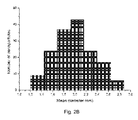
- the mean diameter of the noble metal nanoparticles is between 1 nm and 3 nm, preferably between 1.5 nm and 2.5 nm, more preferably between 1.9 nm and 2.3 nm.
- a second aspect of the present invention relates to a process for obtaining the nanoparticles as described above comprising the steps:
- the noble metal complex is selected from [Pt 2 (dba) 3 ], [Pt(dba) 2 ], Pt(COD) 2 , PtCl 2 (COD) 2 , PtMe2(COD)2, PtMe2(NBD), PtPh 2 (COD) 2 , Pt(NBD) 3 , [Pd(dba) 2 ], [Ru(COD)(COT)], [Rh(allyl) 3 ], [Ir(allyl) 3 ], Ir(acac) 3 , [Rh(OMe)(COD)] 2 [Ir(OMe)(COD)] 2 and mixtures thereof, preferably the noble metal complex is selected from [Pt(dba) 2 ], [Pt 2 (dba) 3 ] and mixtures thereof, more preferably the metal complex is a mixture of [Pt(dba) 2 ], [Pt 2 (dba) 3
- the noble metal is selected from Ru, Pd and Pt, preferably Pt. Therefore, the noble metal complex is selected from [Pt 2 (dba) 3 ], [Pt(dba) 2 ], Pt(COD) 2 , PtCl 2 (COD) 2 , PtMe2(COD)2, PtMe2(NBD), PtPh 2 (COD) 2 , Pt(NBD) 3 , [Pd(dba) 2 ], [Ru(COD)(COT)], and mixtures thereof, preferably the noble metal complex is selected from [Pt(dba) 2 ], [Pt 2 (dba) 3 ] and mixtures thereof, more preferably the metal complex is a mixture of [Pt(dba) 2 ], [Pt 2 (dba) 3 ].
- Dba is dibenzylideneacetone
- COD is 1,5-cyclooctadiene
- NBD is 2,5-norbornadiene
- COT is 1,3,5,7-cyclooctatetraene
- acac is acetylacetonate.
- n and m is 1 or 2, preferably n is 2 and/or m is 2.
- the terphenylphosphine ligands have the formula (II): wherein R 1 , R 2 , R 3 and R 4 were defined above.
- each R 1 and R 2 represents independently C 1 -C 10 alkyl or C 3 -C 10 cycloalkyl; preferably each R 1 and R 2 represents independently C 1 -C 4 alkyl, more preferably each R 1 and R 2 represents independently methyl, ethyl, propyl and isopropyl. Preferably, R 1 and R 2 are equal.
- R 1 and R 2 are methyl.
- the terphenylphosphine ligands have the formula (II), the noble metal is Pt and R 1 and R 2 are methyl.
- R 1 and R 2 are isopropyl.
- the terphenylphosphine ligands have the formula (II), the noble metal is Pt and R 1 and R 2 are isopropyl.
- R 3 and R 4 are independently C 1 -C 10 alkyl or C 3 -C 10 cycloalkyl, preferably R 3 and R 4 are independently C 1 -C 4 alkyl, more preferably R 3 and R 4 are independently methyl or ethyl.
- the terphenylphosphine ligands have the formula (II), the noble metal is Pt, R 1 and R 2 are methyl and R 3 and R 4 are independently C 1 -C 10 alkyl or C 3 -C 10 cycloalkyl, preferably R 3 and R 4 are independently C 1 -C 4 alkyl, more preferably R 3 and R 4 are independently methyl or ethyl.
- the terphenylphosphine ligands have the formula (II), the noble metal is Pt, R 1 and R 2 are isopropyl and R 3 and R 4 are independently C 1 -C 10 alkyl or C 3 -C 10 cycloalkyl, preferably R 3 and R 4 are independently C 1 -C 4 alkyl, more preferably R 3 and R 4 are independently methyl or ethyl.
- R 3 and R 4 are methyl.
- the terphenylphosphine ligands have the formula (II), the noble metal is Pt, R 1 and R 2 are isopropyl and R 3 and R 4 are methyl.
- the terphenylphosphine ligands have the formula (II), the noble metal is Pt, R 1 and R 2 are methyl and R 3 and R 4 are methyl.
- R 3 and R 4 are ethyl.
- the terphenylphosphine ligands have the formula (II), the noble metal is Pt, R 1 and R 2 are isopropyl and R 3 and R 4 are ethyl.
- the terphenylphosphine ligands have the formula (II), the noble metal is Pt, R 1 and R 2 are methyl and R 3 and R 4 are ethyl.
- the terphenylphosphine ligands have the formula (A), (B) or (C), preferably the terphenylphosphine ligands have the formula (B).
- the ligand/noble metal molar ratio is between 0.1 and 0.7, preferably between 0.2 and 0.5.
- the ligand/noble metal molar ratio is between 0.1 and 0.7, preferably between 0.2 and 0.5 and the noble metal is Pt.
- the mean diameter of the noble metal nanoparticles is between 1 nm and 3 nm, preferably between 1.5 nm and 2.5 nm, more preferably between 1.9 nm and 2.3 nm.
- a third aspect of the present invention relates to the use of the nanoparticles as described above as a catalyst for hydrogen generation from ammonia-borane.
- the hydrogen generation from the alcoholysis of ammonia-borane more preferably from the methanolysis of ammonia-borane.
- a fourth aspect of the present invention relates to a process for the hydrogen generation from ammonia-borane and an C 1 -C 6 alcohol comprising contacting a C 1 -C 6 alcohol with ammonia-borane in the presence of the noble metal nanoparticles coated with terphenylphosphine ligands of formula (I) as described above at a temperature between 20°C to 60°C.
- a C 1 -C 6 alcohol refers to a linear or branched alkyl chain containing 1 to 6 carbon atoms and at least one hydroxyl group.
- examples of such alcohol are methanol, ethanol, propanol, isopropanol, butanol, isobutanol, sec -butanol, terc -butanol, pentanol, etc.
- the C 1 -C 6 alcohol is selected from methanol, ethanol, propanol and isopropanol, more preferably the C 1 -C 6 alcohol is methanol.
- the molar ratio ammonia-borane/noble metal is 100 to 10000, preferably the molar ratio ammonia-borane/noble metal is 500 to 5000.
- H 2 generation was followed using a Fischer-Porter bottle (25 ml) connected to a vacuum line and coupled to a pressure gauge model GS4200-USB (0-6 bar) plugged to a computer.
- Quantitative formation of ammonium tetramethoxide (NH 4 B(OMe) 4 ) was determined by 11 B NMR (singlet at ⁇ 7.5 ppm) [ P. V. Ramachandran, P. D. Gagare, Inorg. Chem. 2007, 46, 7810-7817 ].
- H 2 generation was followed using a Fischer-Porter bottle (25 ml) connected to a vacuum line and coupled to a pressure gauge model GS4200-USB (0-6 bar) plugged to a computer.
- Quantitative formation of ammonium tetramethoxide (NH 4 B(OMe) 4 ) was determined by 11 B NMR (singlet at ⁇ 7.5 ppm) [ P. V. Ramachandran, P. D. Gagare, Inorg. Chem. 2007, 46, 7810-7817 ].
Landscapes
- Chemical & Material Sciences (AREA)
- Organic Chemistry (AREA)
- Engineering & Computer Science (AREA)
- Chemical Kinetics & Catalysis (AREA)
- Materials Engineering (AREA)
- Health & Medical Sciences (AREA)
- Inorganic Chemistry (AREA)
- General Health & Medical Sciences (AREA)
- Life Sciences & Earth Sciences (AREA)
- Biochemistry (AREA)
- Molecular Biology (AREA)
- Combustion & Propulsion (AREA)
- Catalysts (AREA)
Priority Applications (1)
| Application Number | Priority Date | Filing Date | Title |
|---|---|---|---|
| EP16382444.4A EP3299375A1 (fr) | 2016-09-23 | 2016-09-23 | Nanoparticules de metal noble revetues de ligants terphenulphosphine pour production de h2 a partir de borane d'ammoniac et alcools |
Applications Claiming Priority (1)
| Application Number | Priority Date | Filing Date | Title |
|---|---|---|---|
| EP16382444.4A EP3299375A1 (fr) | 2016-09-23 | 2016-09-23 | Nanoparticules de metal noble revetues de ligants terphenulphosphine pour production de h2 a partir de borane d'ammoniac et alcools |
Publications (1)
| Publication Number | Publication Date |
|---|---|
| EP3299375A1 true EP3299375A1 (fr) | 2018-03-28 |
Family
ID=57003470
Family Applications (1)
| Application Number | Title | Priority Date | Filing Date |
|---|---|---|---|
| EP16382444.4A Withdrawn EP3299375A1 (fr) | 2016-09-23 | 2016-09-23 | Nanoparticules de metal noble revetues de ligants terphenulphosphine pour production de h2 a partir de borane d'ammoniac et alcools |
Country Status (1)
| Country | Link |
|---|---|
| EP (1) | EP3299375A1 (fr) |
Cited By (4)
| Publication number | Priority date | Publication date | Assignee | Title |
|---|---|---|---|---|
| CN109772455A (zh) * | 2019-03-14 | 2019-05-21 | 福州大学 | 一种包裹细小高分散钯纳米粒子的多孔聚胺复合材料的制备和应用 |
| EP3766891A4 (fr) * | 2018-03-07 | 2021-12-08 | Dongguan Stephen Catalyst Co., Ltd. | Ligands de triarylphosphine, leur procédé de préparation et leur utilisation dans la catalyse de réactions de couplage |
| EP4438173A1 (fr) * | 2023-03-29 | 2024-10-02 | Université de Bourgogne | Systèmes nanocatalyseurs et leur utilisation pour l'administration de h2 à partir d'un stockage solide |
| EP4714542A1 (fr) * | 2024-09-20 | 2026-03-25 | Université de Bourgogne | Nanodiamants fonctionnalisés et catalyseurs pour la distribution catalytique à haut débit de h2 à partir de stockage solide |
Citations (2)
| Publication number | Priority date | Publication date | Assignee | Title |
|---|---|---|---|---|
| US20070243122A1 (en) | 2006-03-13 | 2007-10-18 | Ramachandran P V | Process for the synthesis and methanolysis of ammonia borane and borazine |
| WO2008141439A1 (fr) | 2007-05-18 | 2008-11-27 | Kanata Chemical Technologies Inc. | Procédé de production d'hydrogène à partir de borane d'ammoniac |
-
2016
- 2016-09-23 EP EP16382444.4A patent/EP3299375A1/fr not_active Withdrawn
Patent Citations (2)
| Publication number | Priority date | Publication date | Assignee | Title |
|---|---|---|---|---|
| US20070243122A1 (en) | 2006-03-13 | 2007-10-18 | Ramachandran P V | Process for the synthesis and methanolysis of ammonia borane and borazine |
| WO2008141439A1 (fr) | 2007-05-18 | 2008-11-27 | Kanata Chemical Technologies Inc. | Procédé de production d'hydrogène à partir de borane d'ammoniac |
Non-Patent Citations (30)
| Title |
|---|
| "Hydrogen as a Future Energy Carrier", 2008, WILEY-VCH |
| B. BUSTER; A. A. DIAZ; T. GRAHAM; R. KHAN; M. A. KHAN; D. R. POWELL; R. J. WEHMSCHULTE, INORG. CHIM. ACTA, vol. 362, 2009, pages 3465 - 3474 |
| B. PENG; J. CHEN, ENERGY ENVIRON. SCI., vol. 1, 2008, pages 479 - 483 |
| C. AMIENS ET AL., J. AM. CHEM. SOC., vol. 115, 1993, pages 11638 |
| D. OZHAVA; S. OZKAR, APPL. CATAL. B ENVIRON., vol. 181, 2016, pages 716 - 726 |
| D. OZHAVA; S. OZKAR, INT. J. HYDROGEN ENERGY, vol. 40, 2015, pages 10491 - 10501 |
| DERMOT O'HARE: "Applications III: Functional Materials, Environmental and Biological Applications", 2007, pages: 71 - 99 |
| H. ERDOGAN; O. METIN; S. OZKAR, CATAL. TODAY, vol. 170, 2011, pages 93 - 98 |
| H. ERDOGAN; O. METIN; S. OZKAR, PHYS. CHEM. CHEM. PHYS., vol. 11, 2009, pages 10519 - 10525 |
| H-B. DAI; X-D. KANG; P. WANG, INT. J. HYDROGEN ENERGY, vol. 35, 2010, pages 10317 - 10323 |
| H-L. JIANG; Q. XU, CATAL. TODAY, vol. 170, 2011, pages 56 - 63 |
| JESSICA F. SONNENBERG ET AL: "Evidence for Iron Nanoparticles Catalyzing the Rapid Dehydrogenation of Ammonia-Borane", ACS CATALYSIS, vol. 3, no. 6, 7 June 2013 (2013-06-07), US, pages 1092 - 1102, XP055343410, ISSN: 2155-5435, DOI: 10.1021/cs400115p * |
| J-K. SUN; W-W. ZHAN; T. AKITA; Q. XU, J. AM. CHEM. SOC., vol. 137, 2015, pages 7063 - 7066 |
| K. MOSELEY; P. M. MAITLIS, CHEM. COMMUN., 1971, pages 982 - 983 |
| K. PHILIPPOT; B. CHAUDRET: "Comprehensive Organometallic Chemistry III", vol. 12, ELSEVIER |
| L. ORTEGA-MORENO; M. FERNANDEZ-ESPADA; J. J. MORENO; C. NAVARRO-GILABERT; J. CAMPOS; S. CONEJERO; J. LOPEZ-SERRANO; C. MAYA; R. PE, POLYHEDRON, vol. 116, 2016, pages 170 - 181 |
| M. YADAV; Q. XU, ENERGY ENVIRON. SCI., vol. 5, 2012, pages 9698 - 9725 |
| M. ZAHMAKIRAN; S. OZKAR, TOP. CATAL., vol. 56, 2013, pages 1171 - 1183 |
| MARCO FETZ ET AL: "Hydrolysis of Ammonia Borane Catalyzed by Aminophosphine-Stabilized Precursors of Rhodium Nanoparticles: Ligand Effects and Solvent-Controlled Product Formation", CHEMISTRY - A EUROPEAN JOURNAL, vol. 17, no. 17, 18 April 2011 (2011-04-18), pages 4732 - 4736, XP055343393, ISSN: 0947-6539, DOI: 10.1002/chem.201003543 * |
| N. C. SMYTHE; J.C. GORDON, EUR. J. INORG. CHEM., 2010, pages 509 - 521 |
| N.ARMAROLI; V. BALZANI, CHEMSUSCHEM, vol. 4, 2011, pages 21 - 26 |
| P. V. RAMACHANDRAN; P. D. GAGARE, INORG. CHEM., vol. 46, 2007, pages 7810 - 7817 |
| P. V. RAMACHANDRAN; P.D. GAGARE, INORG. CHEM., vol. 46, 2007, pages 7810 - 7817 |
| R. C. SMITH; R. A. WOLOSZYNEK; W. CHEN; T. RENB; J. D. PROTASIEWICZA, TETRAHEDRON LETT., vol. 45, 2004, pages 8327 - 8330 |
| S. PENG; J. LIU; J. ZHANG; F. WANG, INT. J. HYDROGEN ENERGY, vol. 40, 2015, pages 10856 - 10866 |
| S. QALI KAN; M. ZAHMAKIRAN; S. OZKAR, APPL. CATAL. B ENVIRON, vol. 93, 2010, pages 387 - 394 |
| T.B. MARDER, ANGEW. CHEM. INT. ED., vol. 46, 2007, pages 8116 - 81118 |
| U. EBERLE; M. FELDERHOFF; F. SCHUTH, ANGEW. CHEM. INT. ED., vol. 48, 2009, pages 6608 - 6630 |
| U. SANYAL; U.B. DEMIRCI; B. R. JAGIRDAR; P. MIELE, CHEMSUSCHEM, vol. 4, 2011, pages 1731 - 1739 |
| VIRGINIA SAN NACIANCENO ET AL: "Hydrido{(acylphosphine)(diphenylphosphinous acid)}rhodium(III) Complexes. Catalysts for the Homogeneous Hydrolysis of Ammonia- or Amine-Boranes under Air", ORGANOMETALLICS, vol. 33, no. 21, 10 November 2014 (2014-11-10), US, pages 6044 - 6052, XP055343368, ISSN: 0276-7333, DOI: 10.1021/om500666w * |
Cited By (6)
| Publication number | Priority date | Publication date | Assignee | Title |
|---|---|---|---|---|
| EP3766891A4 (fr) * | 2018-03-07 | 2021-12-08 | Dongguan Stephen Catalyst Co., Ltd. | Ligands de triarylphosphine, leur procédé de préparation et leur utilisation dans la catalyse de réactions de couplage |
| CN109772455A (zh) * | 2019-03-14 | 2019-05-21 | 福州大学 | 一种包裹细小高分散钯纳米粒子的多孔聚胺复合材料的制备和应用 |
| EP4438173A1 (fr) * | 2023-03-29 | 2024-10-02 | Université de Bourgogne | Systèmes nanocatalyseurs et leur utilisation pour l'administration de h2 à partir d'un stockage solide |
| WO2024200745A1 (fr) * | 2023-03-29 | 2024-10-03 | Université de Bourgogne | Systèmes de nanocatalyseurs et leur utilisation pour la distribution de h2 à partir d'un stockage solide |
| EP4714542A1 (fr) * | 2024-09-20 | 2026-03-25 | Université de Bourgogne | Nanodiamants fonctionnalisés et catalyseurs pour la distribution catalytique à haut débit de h2 à partir de stockage solide |
| WO2026062139A1 (fr) * | 2024-09-20 | 2026-03-26 | Université Bourgogne Europe | Nanodiamants fonctionnalisés et catalyseurs associés pour la distribution catalytique à haut débit de h2 à partir d'un stockage solide |
Similar Documents
| Publication | Publication Date | Title |
|---|---|---|
| Mellone et al. | Selective formic acid dehydrogenation catalyzed by Fe-PNP pincer complexes based on the 2, 6-diaminopyridine scaffold | |
| Mavila et al. | A general approach to mono-and bimetallic organometallic nanoparticles | |
| Qin et al. | Visible-light reduction CO2 with dodecahedral zeolitic imidazolate framework ZIF-67 as an efficient co-catalyst | |
| Liao et al. | Post-synthetic exchange (PSE) of UiO-67 frameworks with Ru/Rh half-sandwich units for visible-light-driven H 2 evolution and CO 2 reduction | |
| Lara et al. | Phosphane‐decorated Platinum Nanoparticles as Efficient Catalysts for H2 Generation from Ammonia Borane and Methanol | |
| Sen et al. | Highly efficient catalytic dehydrogenation of dimethyl ammonia borane via monodisperse palladium–nickel alloy nanoparticles assembled on PEDOT | |
| Rui et al. | The synergistic catalysis on Co nanoparticles and CoNx sites of aniline-modified ZIF derived Co@ NCs for oxidative esterification of HMF | |
| Robertson et al. | Heterogeneous dehydrocoupling of amine–borane adducts by skeletal nickel catalysts | |
| Kassymova et al. | Post-synthetically modified MOF for the A 3-coupling reaction of aldehyde, amine, and alkyne | |
| Asensio et al. | Synthesis of Water‐Soluble Palladium Nanoparticles Stabilized by Sulfonated N‐Heterocyclic Carbenes | |
| Duman et al. | Oleylamine-stabilized ruthenium (0) nanoparticles catalyst in dehydrogenation of dimethylamine-borane | |
| CN108298499B (zh) | 一种水溶性金属配合物催化甲酸分解放氢的方法 | |
| Ding et al. | A Hexagonal Covalent Porphyrin Framework as an Efficient Support for Gold Nanoparticles toward Catalytic Reduction of 4‐Nitrophenol | |
| Ma et al. | Ruthenium single-atom anchored in polyoxometalate-ionic liquids for N-formylation of amines with CO2 and H2 | |
| CN111041517A (zh) | 一种二维铋烯纳米片的制备方法及其应用 | |
| Rösler et al. | Encapsulation of Bimetallic Metal Nanoparticles into Robust Zirconium‐Based Metal–Organic Frameworks: Evaluation of the Catalytic Potential for Size‐Selective Hydrogenation | |
| Dutta et al. | Dehydrogenation of formic acid mediated by a Phosphorus–Nitrogen PN3P-manganese pincer complex: Catalytic performance and mechanistic insights | |
| CN106749417A (zh) | 一种三核钌nnn配合物及其制备方法 | |
| Du et al. | Hemicelluloses supported palladium/xylan nanocomposites containing N and O ligands: highly-performance heterogeneous catalysts for Suzuki reaction | |
| Chen et al. | Synergy of metallic Co and oxygen vacancy sites in Co/Ce-MOF catalysts for efficiently promoting lignin derived phenols and macromolecular lignin hydrodeoxygenation | |
| Birkelbach et al. | Enabling the terpyridine ligand motif for Ir-based solid molecular catalysts | |
| Hao et al. | “In situ immobilization” of a multicomponent chiral catalyst (MCC) via non-covalent interactions for heterogeneous asymmetric hydrogenation reactions | |
| Yuan et al. | Three birds, one-stone strategy for fabrication of hierarchically arrayed Ru/BU-TiO2 nanoribbon assemblies toward efficient hydrogen evolution | |
| Schröder et al. | Simultaneous Gas‐Phase Loading of MOF‐5 with Two Metal Precursors: towards Bimetallics@ MOF | |
| Kumar et al. | Heterogenization of cobalt nanoparticles on hollow carbon capsules: Lab-in-capsule for catalytic transfer hydrogenation of carbonyl compounds |
Legal Events
| Date | Code | Title | Description |
|---|---|---|---|
| PUAI | Public reference made under article 153(3) epc to a published international application that has entered the european phase |
Free format text: ORIGINAL CODE: 0009012 |
|
| STAA | Information on the status of an ep patent application or granted ep patent |
Free format text: STATUS: THE APPLICATION HAS BEEN PUBLISHED |
|
| AK | Designated contracting states |
Kind code of ref document: A1 Designated state(s): AL AT BE BG CH CY CZ DE DK EE ES FI FR GB GR HR HU IE IS IT LI LT LU LV MC MK MT NL NO PL PT RO RS SE SI SK SM TR |
|
| AX | Request for extension of the european patent |
Extension state: BA ME |
|
| STAA | Information on the status of an ep patent application or granted ep patent |
Free format text: STATUS: THE APPLICATION IS DEEMED TO BE WITHDRAWN |
|
| 18D | Application deemed to be withdrawn |
Effective date: 20180929 |