EP3299910A1 - Technique pour améliorer les performances de commande prédictive de modèle multidirectionnelle d'une machine à papier en créant une trajectoire de référence d'un profil de mesure - Google Patents
Technique pour améliorer les performances de commande prédictive de modèle multidirectionnelle d'une machine à papier en créant une trajectoire de référence d'un profil de mesure Download PDFInfo
- Publication number
- EP3299910A1 EP3299910A1 EP17191715.6A EP17191715A EP3299910A1 EP 3299910 A1 EP3299910 A1 EP 3299910A1 EP 17191715 A EP17191715 A EP 17191715A EP 3299910 A1 EP3299910 A1 EP 3299910A1
- Authority
- EP
- European Patent Office
- Prior art keywords
- mpc
- profile
- measurement
- reference trajectory
- target
- Prior art date
- Legal status (The legal status is an assumption and is not a legal conclusion. Google has not performed a legal analysis and makes no representation as to the accuracy of the status listed.)
- Withdrawn
Links
Images



Classifications
-
- D—TEXTILES; PAPER
- D21—PAPER-MAKING; PRODUCTION OF CELLULOSE
- D21G—CALENDERS; ACCESSORIES FOR PAPER-MAKING MACHINES
- D21G9/00—Other accessories for paper-making machines
- D21G9/0009—Paper-making control systems
- D21G9/0027—Paper-making control systems controlling the forming section
-
- G—PHYSICS
- G05—CONTROLLING; REGULATING
- G05B—CONTROL OR REGULATING SYSTEMS IN GENERAL; FUNCTIONAL ELEMENTS OF SUCH SYSTEMS; MONITORING OR TESTING ARRANGEMENTS FOR SUCH SYSTEMS OR ELEMENTS
- G05B13/00—Adaptive control systems, i.e. systems automatically adjusting themselves to have a performance which is optimum according to some preassigned criterion
- G05B13/02—Adaptive control systems, i.e. systems automatically adjusting themselves to have a performance which is optimum according to some preassigned criterion electric
- G05B13/04—Adaptive control systems, i.e. systems automatically adjusting themselves to have a performance which is optimum according to some preassigned criterion electric involving the use of models or simulators
- G05B13/048—Adaptive control systems, i.e. systems automatically adjusting themselves to have a performance which is optimum according to some preassigned criterion electric involving the use of models or simulators using a predictor
-
- G—PHYSICS
- G05—CONTROLLING; REGULATING
- G05B—CONTROL OR REGULATING SYSTEMS IN GENERAL; FUNCTIONAL ELEMENTS OF SUCH SYSTEMS; MONITORING OR TESTING ARRANGEMENTS FOR SUCH SYSTEMS OR ELEMENTS
- G05B2219/00—Program-control systems
- G05B2219/30—Nc systems
- G05B2219/40—Robotics, robotics mapping to robotics vision
- G05B2219/40148—Predict locally machining forces from model to control remote machine
Definitions
- the present invention generally relates to monitoring and controlling continuous sheeting making systems using model predictive controllers and more specifically to techniques that provide a measurement profile target reference trajectory over the prediction horizon in the MPC cost function.
- MD control concerns the paper properties along the machine direction and many control strategies have been reported and implemented.
- CD control aims to reduce the variability of the paper property along the cross direction and to tune the dynamical property to meet the end users' specifications.
- the paper property is measured by a scanner mounted downstream traversing back and forth across the paper sheet; various feedback control strategies are proposed to achieve consistency of the paper profile.
- CD control is a challenging control problem that may involves hundreds of process actuators and hundreds or thousands of process measurements, and process models typically have a large amount of uncertainty associated with them.
- spatial aspect relates to variability of the process measurements across the sheet while the temporal aspect relates to variability of each process measurement over time.
- Model predictive control a control strategy which takes control and state constraints explicitly into consideration, has seen thousands of applications in industry, and has been recently introduced into CD control in paper-making processes with the advance of computational capability as well as the development of fast quadratic programming (QP) solvers.
- CD-MPC Cross-directional model predictive control
- the present invention is based in part on the recognition that improved CD-MPC performance can be ascertained by employing a measurement profile target reference trajectory over the prediction horizon in the MPC cost function. Instead of using the same target profile over the entire prediction horizon, a series of target profiles is used, creating a reference trajectory to bring the cross-direction measurements smoothly from their current profile to the final target. By appropriately designing the reference trajectory, the CD-MPC can achieve a good (non-sluggish) measurement response without requiring undesirably aggressive control action.
- the invention is directed to a system which forms a material in a spatially-distributed multivariable-array cross-directional process
- the system includes: at least one set of actuator arrays each distributed adjacent to the material in the cross direction (CD), wherein each set of actuator arrays is controllable to vary the properties of the material; means for measuring and acquiring data about the properties of the material and generating a cross-directional measurement; and a multivariable model predictive controller (MPC) for providing CD control to the cross-directional process, wherein the MPC employs a cost function incorporating a prediction horizon, wherein the MPC in response to signals that are indicative of the properties of the material, provides signals to the at least one set of actuator arrays to vary properties of the material, and wherein the MPC is configured to provide a measurement profile target reference trajectory over the prediction horizon of the MPC cost function.
- CD cross direction
- MPC multivariable model predictive controller
- the invention is directed to a method of controlling a spatially-distributed multiple-array, sheetmaking cross-directional (CD) process that forms a material and having at least one manipulated actuator array and at least one controlled measurement array that generates a cross-directional measurement, said method includes employing a multivariable model predictive controller (MPC) which employs a cost function incorporating a prediction horizon, wherein the MPC in response to signals that are indicative of the properties of the material, provides signals to at least one set of actuator arrays to vary properties of the material, and wherein the MPC is configured to provide a measurement profile target reference trajectory over the prediction horizon of the MPC cost function.
- MPC multivariable model predictive controller
- a preferred technique of implementing the invention is to filter the current measurement target profile through a first order plus deadtime process at each controller update. This filter operation is repeated once for each step of the MPC prediction horizon to generate a full reference trajectory for the profile.
- the filter is initialized to the current measurement profile so that the reference trajectory provides a smooth path from the current profile towards the final target profile. Operations of the MPC are tuned by the filtered signals.
- the inventive technique is particularly suited for CD control of paper machines where the profile generation can is applied to each measurement array.
- a reference trajectory is applied to an entire CD measurement profile.
- its model relationship to the actuator array which is selected for control is examined to determine the appropriate reference trajectory. This allows good design of the reference profiles but does not restrict the multivariable controller from using all available actuator arrays to control the measurement profiles.
- paper weight measurement is paired with a slice lip actuator beam or a headbox dilution flow beam
- paper moisture measurement is paired with a steambox beam or a rewet shower beam
- paper caliper measurement is paired with a calender induction heater array.
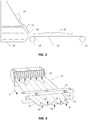
- a system for producing continuous sheet material includes various processing stages such as headbox 10, steambox 12, a calendering stack 14 and reel.
- the array of actuators 18 in headbox 10 controls the discharge of wet stock (or feedstock) material through a rectangular opening of locally adjustable width, known as a slice, onto supporting web or wire 30 which rotates between rollers 22 and 24.
- actuators 20 on steambox 12 can control the amount of steam that is injected at points across the moving sheet.
- An array of rewet shower actuators located within the dryer section 34 down from calendering stack 14 add water onto the surface of the paper to control the moisture profile, reduce or prevent over-drying or correct any dry streaks in the paper.
- Sheet material exiting the wire 30 passes through a series of dryers 34 which includes additional actuator arrays 36 such as rewet showers and/or additional steamboxes to influence the cross-directional moisture profile of the sheet.
- Calender induction heater 60 is a non-contacting device which creates a magnetic field that makes electrons in the adjacent metal roll move around and heats the roll. The expanding roll reduces the gap between the rolls thereby further smoothing the paper. There are many zones across the induction heater so the calender roll can be adjusted at many points along its length which allows CD profile control.
- a scanning sensor 38 which is supported on supporting frame 40, continuously traverses and measures properties of the finished sheet in the cross direction. The finished sheet product 42 is then collected on reel 16.
- Each array of actuators is often referred to as a "beam".
- the "wet end” portion of the system includes the headbox, the web, and those sections just before the dryer, and the “dry end” comprises the sections that are downstream from the dryer.
- the two edges of the wire in the cross direction are designated “front” and “back” (alternatively, referred as the “tending” and 'drive”) with the back side being adjacent to other machinery and less accessible than the front side.
- the system further includes a computer 44 that receives measurement profile information obtained by scanner sensors 38, and that is connected, for example, to actuators 18, 20, 32 and 36 on the headbox 10, steam box 12, vacuum boxes 28, and dryer 34, respectively.
- the computer 44 includes a control system that operates in response to the cross-directional measurements from scanner sensor 38. In operation, scanning sensor 38 provides the computer 44 with signals that are indicative of the magnitude of a measured sheet property, e.g., caliper, dry basis weight, gloss or moisture, at various cross-directional measurement points.
- the computer 44 also includes software for controlling the operation of various components of the sheetmaking system, including, for example, the above described actuators.
- computer 44 can include memory 62 and processing devices 64 to execute software/firmware instructions for performing various operations related to MPC control of an industrial process.
- Fig. 2 depicts a slice lip control system which is mounted on a headbox 10 for controlling the extent to which a flexible slice lip 46 extends across the discharge gap 48 at the base of the headbox 10.
- the slice lip 46 extends along the headbox 10 across the entire width of the web in the cross-direction.
- the actuator 18 is an array of independently operable slice lip actuators, each able to locally deflect the slice lip 46 to change to the width of gap 48.
- the spacing between the individual actuators in the actuator array may or may not be uniform.
- Wetstock 50 is discharged onto wire 30 which rotates by the action of roller 24 and the wire turning roll (not shown).
- the amount of feedstock that is discharged through the gap and onto the wire 30 at various points across the machine is controlled by adjusting the individual actuators of the slip lip actuator 18.
- the feed flow rates through the gaps ultimately affect the properties of the finished sheet material, i.e., the paper 42.
- a plurality of actuators 18 extend in the cross direction over wire 30 that is moving in the machine direction indicated by arrow 6.
- Actuators 18 can be manipulated to control sheet parameters in the cross direction.
- a scanning device 38 is located downstream from the actuators and it measures one or more the properties of the sheet.
- actuators 18 are displaced as indicated by arrows 4 and the resulting changes in sheet property is detected by scanner 38 as indicated by peaks 56 in the scanner profile 54.
- This type of operation is typically used in traditional open and closed-loop bump tests.
- CD actuators can be placed at one or more strategic locations in the papermaking machine including, for example, steamboxes, rewet showers and calender roll induction heaters.
- inventive technique is sufficiently flexible as to be applicable for online implementation with any large-scale industrial at least one actuator array and at least one product quality measurements cross-directional process that is controlled by a multivariable model predictive controller (MPC) such as in papermaking.
- MPC multivariable model predictive controller
- Suitable paper machine processes where paper is continuously manufactured from wet stock are further described, for instance, in U.S. Pat. Nos. 6,807,510 to Backstrom and He and 8,224,476 to Chu et al. , and U.S. 2015/0268645 to Shi et al., which are incorporated herein by reference. While the invention will be described with respect to a paper-making machine, it is understood that the invention is applicable to industrial plastic sheetmaking, rubber sheetmaking, sheet metal operations and other sheetmaking operations.
- the closed-loop CD-MPC structure for a paper-making process consists of four parts: the real process G p (z) (74), the nominal model G(z) (76), the MPC (72) and the temporal filter F ⁇ (z) (70), which are described in detail in the following.
- the associated signals are defined as follows: y tgt , Y sp , u(z), d(z), y p (z), and y(z) are the output target, the reference trajectory, the actuator profile, the disturbance profile, the measurement profile, and the predicted output profile, respectively.
- ⁇ , ⁇ and b are the constraint matrices (vectors) derived based on the physical limitations of the process.
- the traditional output reference trajectory is constructed as a step change, which requires the predicted output profile to track the output target immediately after the dead time of the process.
- the process can be controlled with an MPC controller.
- a suitable controller is described in U.S. 6,807,510 to Backstrom and He .
- the cost function for the MPC controller is set forth in optimization problem (3).
- the simulations modeled a papermaking machine as depicted in Fig. 1 with a headbox having a plurality of actuators that controlled pulp stock discharge through the corresponding slice lip opening.
- the weight of the finished paper was measured by a scanner at 250 points or bins across the width of the paper from the front to back side of the machine; each bin represents a distance of about 5 mm.
- the model also simulated closed-loop control of the actuators in response to signals from the scanner.
- the simulation includes a dynamic model of how a paper weight measurement profile changes over time in response to changes in the autoslice (a paper machine slice lip actuator array) profile.
- the autoslice actuator positions are used to control the weight profile, using feedback control.
- the control algorithm used was a model predictive control where the cost function (4) is minimized.
- the model predictive control includes the generation of the profile target trajectories which is the main idea that we are claiming. The generation of smooth and achievable profile target trajectories moderates the behavior of the controller since it reduces the need for large and frequent actuator movements.
- Fig. 5 illustrates a "typical" generation of the profile reference trajectory with its characteristic sharp change to the new target profile once the time delay elapses.
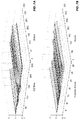
- Figs. 6A and 6B illustrate a CD-MPC response to the target profile change illustrated in Fig. 5 .
- a low value for the Q 2 matrix is used which allowed for aggressive actuator movement to track the profile reference trajectory.
- Figs. 6A and 6B show the (over) aggressive behavior of the controller without the reference trajectories (or with the simple, step reference trajectory shown in Fig. 5 ) and with low (Q) movement penalty weights.
- FIGS. 7A and 7B show the same controller (basic trajectory) with heavier weights. As is apparent, the movements of the actuator and measurement profiles are now too slow.
- Figs. 7A and 7B illustrate the CD-MPC response to the target profile change illustrated in Fig. 5 .
- a higher value for the value for the Q 2 matrix thereby moderating actuator movement but resulting in slower tracking of the reference trajectory.
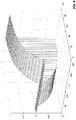
- Fig 8 illustrates a temporally filtered profile reference trajectory exhibiting a gradual change towards the new target profile once the time delay elapses.
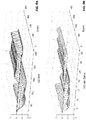
- Figs. 9A and 9B show the CD-MPC response to the target change illustrated in Fig. 8 .
- a low value for the Q 2 matrix is used but the actuator movement is moderate since that is all that is required to track the filtered reference trajectory.
- the movements of the measurement and actuator arrays are neither too slow nor too fast. This is (qualitatively) the type of behavior that is desired in paper machine control and in other flat sheet process control.
- the a r parameters in the reference trajectory generation also allow adjustment of the speeds of change of actuator (and measurement) profiles in a straightforward, predictable and intuitive manner.
- the S b and q 4 cost function matrices can be used to explicitly penalize high frequency actuator spatial variation.
- Another approach is to spatially filter the reference profile error. That is, a spatial filter is employed to remove uncontrollable spatial frequencies from the error profile y ( k + i ) -y sp ( k + i ) .
- the use of the spatial filter could be more meaningful to some users, and by removing spatially uncontrollable frequencies from the measurement error profile, it would prevent the controller from moving the actuator with high spatial frequencies. Since temporal filtering of the profile reference trajectory reduces the need to penalize actuator movement in the temporal direction, it is expected that something analogous could be achieved spatially, that is, spatially filtering the error profiles reduces the need penalize actuator movement in the spatial direction. However, when the spatially filtered measurement error profiles can still not be easily controlled, such as when some actuator elements cannot be moved, it may still be necessary to penalize high frequency actuator spatial variation. Therefore, although the modified controller can include a spatial filter, it appears that it is a more robust approach to continue to use the filter S b and the weighting matrix q 4 .
Landscapes
- Engineering & Computer Science (AREA)
- Health & Medical Sciences (AREA)
- Artificial Intelligence (AREA)
- Computer Vision & Pattern Recognition (AREA)
- Evolutionary Computation (AREA)
- Medical Informatics (AREA)
- Software Systems (AREA)
- Physics & Mathematics (AREA)
- General Physics & Mathematics (AREA)
- Automation & Control Theory (AREA)
- Paper (AREA)
- Feedback Control In General (AREA)
Applications Claiming Priority (1)
| Application Number | Priority Date | Filing Date | Title |
|---|---|---|---|
| US15/273,702 US10174456B2 (en) | 2016-09-23 | 2016-09-23 | Technique to improve paper machine cross-directional model predictive control performance by creating a measurement profile reference trajectory |
Publications (1)
| Publication Number | Publication Date |
|---|---|
| EP3299910A1 true EP3299910A1 (fr) | 2018-03-28 |
Family
ID=59914328
Family Applications (1)
| Application Number | Title | Priority Date | Filing Date |
|---|---|---|---|
| EP17191715.6A Withdrawn EP3299910A1 (fr) | 2016-09-23 | 2017-09-18 | Technique pour améliorer les performances de commande prédictive de modèle multidirectionnelle d'une machine à papier en créant une trajectoire de référence d'un profil de mesure |
Country Status (2)
| Country | Link |
|---|---|
| US (1) | US10174456B2 (fr) |
| EP (1) | EP3299910A1 (fr) |
Cited By (1)
| Publication number | Priority date | Publication date | Assignee | Title |
|---|---|---|---|---|
| EP4062239A4 (fr) * | 2019-11-20 | 2023-12-13 | Abb Schweiz Ag | Procédé et appareil de coordination de l'utilisation de zones fonctionnelles pour atteindre des objectifs de production |
Families Citing this family (3)
| Publication number | Priority date | Publication date | Assignee | Title |
|---|---|---|---|---|
| US10890882B2 (en) | 2017-03-06 | 2021-01-12 | Honeywell International Inc. | Method and apparatus for designing model-based control having spatial robustness for multiple array cross-direction (CD) web manufacturing or processing systems or other systems |
| US20240384469A1 (en) | 2023-05-19 | 2024-11-21 | Honeywell International Inc. | Mini-Scan for Dynamic Correlation |
| CN121091687A (zh) * | 2025-10-31 | 2025-12-09 | 深圳精技工业科技有限公司 | 磁悬浮输送线变曲率轨迹预测控制方法、系统及存储介质 |
Citations (6)
| Publication number | Priority date | Publication date | Assignee | Title |
|---|---|---|---|---|
| US6807510B1 (en) | 2003-05-05 | 2004-10-19 | Honeywell Acsa Inc. | Model predictive controller for coordinated cross direction and machine direction control |
| US20070239310A1 (en) * | 2006-03-30 | 2007-10-11 | Honeywell Asca Inc. | Fast performance prediction of multivariable model predictive controller for paper machine cross-directional processes |
| US20070255446A1 (en) * | 2006-04-28 | 2007-11-01 | Honeywell International Inc. | Apparatus and method for controlling a paper machine or other machine using measurement predictions based on asynchronus sensor information |
| US8224476B2 (en) | 2010-05-31 | 2012-07-17 | Honeywell Asca Inc. | Closed-loop monitoring and identification of CD alignment for papermaking processes |
| US20150268645A1 (en) | 2014-03-18 | 2015-09-24 | Honeywell Asca Inc. | Method and apparatus for specifying and visualizing robust tuning of model-based controllers |
| US20150330022A1 (en) * | 2012-12-21 | 2015-11-19 | Valmet Automation Oy | Controller And Method For Controlling A Property Of An Object |
Family Cites Families (15)
| Publication number | Priority date | Publication date | Assignee | Title |
|---|---|---|---|---|
| US5566134A (en) | 1972-05-04 | 1996-10-15 | Lockheed Martin Corporation | Digital computer algorithm for processing sonar signals |
| US4916615A (en) | 1986-07-14 | 1990-04-10 | Conoco Inc. | Method for stratigraphic correlation and reflection character analysis of setsmic signals |
| US5758047A (en) | 1995-06-14 | 1998-05-26 | Lu; Zhuxin Joseph | Method of process controller optimization in a multivariable predictive controller |
| US6086237A (en) | 1995-12-13 | 2000-07-11 | Measurex Devron Inc. | Automated identification of web shrinkage and alignment parameters in sheet making machinery using a modeled actuator response profile |
| US6233495B1 (en) * | 1998-06-12 | 2001-05-15 | Abb Automation, Inc. | Methods for modeling two-dimensional responses of cross-machine direction actuators in sheet-forming processes |
| US6915180B2 (en) * | 2003-02-24 | 2005-07-05 | Yokogawa Electronic Corporation | Identification method for cross directional position correspondence and manufacturing equipment using this method for sheet form products |
| US20060111858A1 (en) | 2004-11-22 | 2006-05-25 | Yucai Zhu | Computer method and apparatus for online process identification |
| US7459060B2 (en) | 2005-08-22 | 2008-12-02 | Honeywell Asca Inc. | Reverse bump test for closed-loop identification of CD controller alignment |
| US7650195B2 (en) | 2005-10-27 | 2010-01-19 | Honeywell Asca Inc. | Automated tuning of large-scale multivariable model predictive controllers for spatially-distributed processes |
| US7577483B2 (en) | 2006-05-25 | 2009-08-18 | Honeywell Asca Inc. | Automatic tuning method for multivariable model predictive controllers |
| ES2842967T3 (es) | 2010-04-19 | 2021-07-15 | Abb Schweiz Ag | Método y sistema para actualizar un modelo en un controlador predictivo por modelo |
| US8862249B2 (en) * | 2010-05-27 | 2014-10-14 | Honeywell Asca Inc. | Apparatus and method for modeling and control of cross-direction fiber orientation processes |
| US9122261B2 (en) | 2012-04-24 | 2015-09-01 | Honeywell International Inc. | Apparatus and method for real-time sequential quadratic programming in industrial process control systems |
| US9557724B2 (en) | 2013-05-31 | 2017-01-31 | Honeywell Limited | Technique for converting a model predictive control (MPC) system into an explicit two-degrees of freedom (2DOF) control system |
| US9897984B2 (en) | 2014-08-05 | 2018-02-20 | Mitsubishi Electric Research Laboratories, Inc. | Model predictive control with uncertainties |
-
2016
- 2016-09-23 US US15/273,702 patent/US10174456B2/en active Active
-
2017
- 2017-09-18 EP EP17191715.6A patent/EP3299910A1/fr not_active Withdrawn
Patent Citations (6)
| Publication number | Priority date | Publication date | Assignee | Title |
|---|---|---|---|---|
| US6807510B1 (en) | 2003-05-05 | 2004-10-19 | Honeywell Acsa Inc. | Model predictive controller for coordinated cross direction and machine direction control |
| US20070239310A1 (en) * | 2006-03-30 | 2007-10-11 | Honeywell Asca Inc. | Fast performance prediction of multivariable model predictive controller for paper machine cross-directional processes |
| US20070255446A1 (en) * | 2006-04-28 | 2007-11-01 | Honeywell International Inc. | Apparatus and method for controlling a paper machine or other machine using measurement predictions based on asynchronus sensor information |
| US8224476B2 (en) | 2010-05-31 | 2012-07-17 | Honeywell Asca Inc. | Closed-loop monitoring and identification of CD alignment for papermaking processes |
| US20150330022A1 (en) * | 2012-12-21 | 2015-11-19 | Valmet Automation Oy | Controller And Method For Controlling A Property Of An Object |
| US20150268645A1 (en) | 2014-03-18 | 2015-09-24 | Honeywell Asca Inc. | Method and apparatus for specifying and visualizing robust tuning of model-based controllers |
Non-Patent Citations (1)
| Title |
|---|
| JUNQIAG FAN: "MODEL PREDICTIVE CONTROL FOR MULTIPLE CROSS-DIRECTIONAL PROCESSES: ANALYSIS, TUNING, AND IMPLEMENTATION", 30 September 2003 (2003-09-30), XP055021326, Retrieved from the Internet <URL:http://skeena.library.ubc.ca/theses/available/etd-07142004-143355/unrestricted/JunqiangFanThesis.pdf> [retrieved on 20120308] * |
Cited By (1)
| Publication number | Priority date | Publication date | Assignee | Title |
|---|---|---|---|---|
| EP4062239A4 (fr) * | 2019-11-20 | 2023-12-13 | Abb Schweiz Ag | Procédé et appareil de coordination de l'utilisation de zones fonctionnelles pour atteindre des objectifs de production |
Also Published As
| Publication number | Publication date |
|---|---|
| US20180087219A1 (en) | 2018-03-29 |
| US10174456B2 (en) | 2019-01-08 |
Similar Documents
| Publication | Publication Date | Title |
|---|---|---|
| US7454253B2 (en) | Fast performance prediction of multivariable model predictive controller for paper machine cross-directional processes | |
| US7496413B2 (en) | Apparatus and method for coordinating controllers to control a paper machine or other machine | |
| US7650195B2 (en) | Automated tuning of large-scale multivariable model predictive controllers for spatially-distributed processes | |
| US10358771B2 (en) | Method of designing model predictive control for cross directional flat sheet manufacturing processes to guarantee spatial robustness and to prevent actuator picketing | |
| US10174456B2 (en) | Technique to improve paper machine cross-directional model predictive control performance by creating a measurement profile reference trajectory | |
| CN100520645C (zh) | 用于协调横向和机器方向控制的模型预测控制器 | |
| EP2024560B1 (fr) | Dispositif et procédé de contrôle d'un processus en utilisant des prédictions de mesure | |
| US8862249B2 (en) | Apparatus and method for modeling and control of cross-direction fiber orientation processes | |
| US10429800B2 (en) | Layered approach to economic optimization and model-based control of paper machines and other systems | |
| US10309059B2 (en) | Method of designing model predictive control for cross directional flat sheet manufacturing processes to guarantee temporal robust stability and performance | |
| EP1922447B1 (fr) | Methode et systeme d'alignement transversal dans une machine de fabrication de feuilles | |
| CA2867212C (fr) | Identification d'alignement en boucle fermee avec technique de conception de signal de sondage pour systemes de fabrication et de traitement de bande | |
| EP3457226A1 (fr) | Application d'une montée en puissance forcée basée sur une commande prédictive par modèle (mpc) de variables d'entrée de processus et conception de trajectoire de référence de sortie de processus sur un horizon de prédiction pour commande de changement de qualité de machine à papier basée sur mpc | |
| Wellstead et al. | Signal processing and control paradigms for industrial web and sheet manufacturing | |
| US20250244727A1 (en) | Predictive Feedforward Control Allowing Dedicated Control of Some Variables While Minimizing Impact on Other Variables | |
| Gheorghe et al. | Multivariable CD control with adaptive alignment for a high-production linerboard machine | |
| CA3055430C (fr) | Procede et appareil de conception de commande en fonction d'un modele ayant une stabilite et une efficacite robustes dans le temps pour des systemes de fabrication ou de traitemen t de bande transversale a reseaux multiples (cd) ou d'autres systemes | |
| Corscadden | Cross-Directional Estimation and Control of Web Forming Processes | |
| Wellstead et al. | Signal processing and control paradigms for industrial web processes | |
| KJAER¹ et al. | FORMING PROCESSES |
Legal Events
| Date | Code | Title | Description |
|---|---|---|---|
| PUAI | Public reference made under article 153(3) epc to a published international application that has entered the european phase |
Free format text: ORIGINAL CODE: 0009012 |
|
| STAA | Information on the status of an ep patent application or granted ep patent |
Free format text: STATUS: THE APPLICATION HAS BEEN WITHDRAWN |
|
| 17P | Request for examination filed |
Effective date: 20170918 |
|
| AK | Designated contracting states |
Kind code of ref document: A1 Designated state(s): AL AT BE BG CH CY CZ DE DK EE ES FI FR GB GR HR HU IE IS IT LI LT LU LV MC MK MT NL NO PL PT RO RS SE SI SK SM TR |
|
| AX | Request for extension of the european patent |
Extension state: BA ME |
|
| 18W | Application withdrawn |
Effective date: 20180302 |