EP3300272B1 - Affectation de longueur d'onde et de spectre à l'intérieur de réseaux optiques à paquets - Google Patents
Affectation de longueur d'onde et de spectre à l'intérieur de réseaux optiques à paquets Download PDFInfo
- Publication number
- EP3300272B1 EP3300272B1 EP17195746.7A EP17195746A EP3300272B1 EP 3300272 B1 EP3300272 B1 EP 3300272B1 EP 17195746 A EP17195746 A EP 17195746A EP 3300272 B1 EP3300272 B1 EP 3300272B1
- Authority
- EP
- European Patent Office
- Prior art keywords
- optical
- packet
- optical transport
- controller
- routing
- Prior art date
- Legal status (The legal status is an assumption and is not a legal conclusion. Google has not performed a legal analysis and makes no representation as to the accuracy of the status listed.)
- Active
Links
Images



Classifications
-
- H—ELECTRICITY
- H04—ELECTRIC COMMUNICATION TECHNIQUE
- H04Q—SELECTING
- H04Q11/00—Selecting arrangements for multiplex systems
- H04Q11/0001—Selecting arrangements for multiplex systems using optical switching
- H04Q11/0005—Switch and router aspects
-
- H—ELECTRICITY
- H04—ELECTRIC COMMUNICATION TECHNIQUE
- H04J—MULTIPLEX COMMUNICATION
- H04J14/00—Optical multiplex systems
- H04J14/02—Wavelength-division multiplex systems
- H04J14/0227—Operation, administration, maintenance or provisioning [OAMP] of WDM networks, e.g. media access, routing or wavelength allocation
- H04J14/0254—Optical medium access
- H04J14/0267—Optical signaling or routing
- H04J14/0268—Restoration of optical paths, e.g. p-cycles
-
- H—ELECTRICITY
- H04—ELECTRIC COMMUNICATION TECHNIQUE
- H04J—MULTIPLEX COMMUNICATION
- H04J14/00—Optical multiplex systems
- H04J14/02—Wavelength-division multiplex systems
- H04J14/0227—Operation, administration, maintenance or provisioning [OAMP] of WDM networks, e.g. media access, routing or wavelength allocation
-
- H—ELECTRICITY
- H04—ELECTRIC COMMUNICATION TECHNIQUE
- H04J—MULTIPLEX COMMUNICATION
- H04J14/00—Optical multiplex systems
- H04J14/02—Wavelength-division multiplex systems
- H04J14/0227—Operation, administration, maintenance or provisioning [OAMP] of WDM networks, e.g. media access, routing or wavelength allocation
- H04J14/0254—Optical medium access
- H04J14/0256—Optical medium access at the optical channel layer
- H04J14/0257—Wavelength assignment algorithms
-
- H—ELECTRICITY
- H04—ELECTRIC COMMUNICATION TECHNIQUE
- H04J—MULTIPLEX COMMUNICATION
- H04J14/00—Optical multiplex systems
- H04J14/02—Wavelength-division multiplex systems
- H04J14/0227—Operation, administration, maintenance or provisioning [OAMP] of WDM networks, e.g. media access, routing or wavelength allocation
- H04J14/0254—Optical medium access
- H04J14/0267—Optical signaling or routing
-
- H—ELECTRICITY
- H04—ELECTRIC COMMUNICATION TECHNIQUE
- H04Q—SELECTING
- H04Q11/00—Selecting arrangements for multiplex systems
- H04Q11/0001—Selecting arrangements for multiplex systems using optical switching
- H04Q11/0062—Network aspects
- H04Q11/0071—Provisions for the electrical-optical layer interface
-
- H—ELECTRICITY
- H04—ELECTRIC COMMUNICATION TECHNIQUE
- H04J—MULTIPLEX COMMUNICATION
- H04J2203/00—Aspects of optical multiplex systems other than those covered by H04J14/05 and H04J14/07
- H04J2203/0001—Provisions for broadband connections in integrated services digital network using frames of the Optical Transport Network [OTN] or using synchronous transfer mode [STM], e.g. SONET, SDH
- H04J2203/0051—Network Node Interface, e.g. tandem connections, transit switching
- H04J2203/0055—Network design, dimensioning, topology or optimisation
-
- H—ELECTRICITY
- H04—ELECTRIC COMMUNICATION TECHNIQUE
- H04J—MULTIPLEX COMMUNICATION
- H04J2203/00—Aspects of optical multiplex systems other than those covered by H04J14/05 and H04J14/07
- H04J2203/0001—Provisions for broadband connections in integrated services digital network using frames of the Optical Transport Network [OTN] or using synchronous transfer mode [STM], e.g. SONET, SDH
- H04J2203/0057—Operations, administration and maintenance [OAM]
-
- H—ELECTRICITY
- H04—ELECTRIC COMMUNICATION TECHNIQUE
- H04J—MULTIPLEX COMMUNICATION
- H04J2203/00—Aspects of optical multiplex systems other than those covered by H04J14/05 and H04J14/07
- H04J2203/0001—Provisions for broadband connections in integrated services digital network using frames of the Optical Transport Network [OTN] or using synchronous transfer mode [STM], e.g. SONET, SDH
- H04J2203/0057—Operations, administration and maintenance [OAM]
- H04J2203/0058—Network management, e.g. Intelligent nets
-
- H—ELECTRICITY
- H04—ELECTRIC COMMUNICATION TECHNIQUE
- H04J—MULTIPLEX COMMUNICATION
- H04J2203/00—Aspects of optical multiplex systems other than those covered by H04J14/05 and H04J14/07
- H04J2203/0001—Provisions for broadband connections in integrated services digital network using frames of the Optical Transport Network [OTN] or using synchronous transfer mode [STM], e.g. SONET, SDH
- H04J2203/0098—Traffic aspects, e.g. arbitration, load balancing, smoothing, buffer management
-
- H—ELECTRICITY
- H04—ELECTRIC COMMUNICATION TECHNIQUE
- H04Q—SELECTING
- H04Q11/00—Selecting arrangements for multiplex systems
- H04Q11/0001—Selecting arrangements for multiplex systems using optical switching
- H04Q11/0062—Network aspects
- H04Q2011/0075—Wavelength grouping or hierarchical aspects
-
- H—ELECTRICITY
- H04—ELECTRIC COMMUNICATION TECHNIQUE
- H04Q—SELECTING
- H04Q11/00—Selecting arrangements for multiplex systems
- H04Q11/0001—Selecting arrangements for multiplex systems using optical switching
- H04Q11/0062—Network aspects
- H04Q2011/0086—Network resource allocation, dimensioning or optimisation
Definitions
- the disclosure relates to computer networks and, more particularly, to optical networks.
- Modern communication networks continue to grow at a rapid pace in both geographical size (e.g., sites, racks, physical ports, interconnects) and traffic volume (i.e., bandwidth requirements). Moreover, communication networks are increasingly required to support diverse types of traffic and higher-agility traffic patterns.
- Packet-Optical Transport represents a convergence of converging time-division multiplexing (TDM) and wave-division multiplexing (WDM) technologies.
- TDM time-division multiplexing
- WDM wave-division multiplexing
- large-scale packet-optical transport systems utilize a variety of components including Re-configurable Optical Add Drop Multiplexers (ROADMs), Photonic Cross Connects (PXCs), optical cross-connects (OXCs), Dense Wavelength Division Multiplexing equipment (DWDMs), amplifiers, transponders, Optical Termination Terminals (OTTs) and other equipment.
- ROADMs Re-configurable Optical Add Drop Multiplexers
- PXCs Photonic Cross Connects
- OXCs optical cross-connects
- DWDMs Dense Wavelength Division Multiplexing equipment
- amplifiers amplifiers
- transponders transponders
- OTTs Optical Termination Terminals
- EP 0 969 619 A2 discloses an optical network capable of flexibly performing a choice of protection optical paths upon the occurrence of a failure without depending on an installation form of an optical transmission line.
- EP 2 672 668 A1 discloses the creation of a searchable and global database of user visible process traces.
- an integrated network controller comprises a path computation element that computes paths for the network traffic through a routing and switching network having a plurality of interconnected layer three (L3) routing components and layer two (L2) switching components for communicating packet-based network traffic; a software defined networking (SDN) control module that communicates updated routing information to the routing components of the routing and switching network to control packet flows through the routing and switching network in accordance with the computed paths; and a routing wavelength and spectrum assignment control module that configures each of a plurality of packet-optical transport devices an optical transport system to operate at particular wavelengths in response to the updated routing information and bandwidth requirements for the network traffic for optically transporting the network traffic between the routing and switching components.
- SDN software defined networking
- An example method comprises: receiving, with an integrated network controller, state information from optical components of an optical transport system having a plurality of interconnected packet-optical transport devices; applying, with an analytics engine, a set of rules to identify a failure of any of the optical components; computing, with a path computation element of the controller and in response to identifying the failure, at least one updated path through a routing and switching network having a plurality of interconnected layer three (L3) routing components and layer two (L2) switching components for communicating packet-based network traffic; communicating, with a software defined network (SDN) control module of the controller, updated routing information to the routing components to control packet flows through the routing and switching network in accordance with the updated path; and responsive to the updated routing information, configuring, with a routing wavelength and spectrum assignment control module of the controller, the packet-optical transport devices to operate at particular wavelengths based upon bandwidth requirements for the network traffic at each of the routing components.
- SDN software defined network
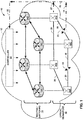
- FIG. 1 is a block diagram illustrating an example system 10 in which a network 12 includes one or more network devices that employ the techniques of this disclosure.
- network 12 includes a routing / switching system 15 in which network elements 14A-14D ("network elements 14") control switching and routing of packet flows.
- network elements 14 include layer three (L3) routers and layer two (L2) switches that collective provide routing / switching system 14.
- network 12 includes an underlying optical transport system 16 for transporting, multiplexing and switching packet-based communications through high-speed optical fiber links.
- packet-optical communication devices 18A-18D are interconnected via optical links 20 and control transmission of optical signals carrying packet data along the links.
- optical transport system provides a physical layer that physically interconnects network elements 14 of routing / switching layer 15.
- optical transport system 16 may include other types of physical links as well, such as Ethernet PHY, Synchronous Optical Networking (SONET)/Synchronous Digital Hierarchy (SDH), Optical Transport Networks (OTN) switches, Lambda, or other Layer 2 data links that include packet transport capability.
- Ethernet PHY Synchronous Optical Networking (SONET)/Synchronous Digital Hierarchy (SDH), Optical Transport Networks (OTN) switches, Lambda, or other Layer 2 data links that include packet transport capability.
- SONET Synchronous Optical Networking
- SDH Synchronous Digital Hierarchy
- OTN Optical Transport Networks
- Lambda or other Layer 2 data links that include packet transport capability.
- controller 22 provides integrated control over both network elements 14 and packet-optical transport devices 18 of underlying optical transport network 16 with respect to transport of packet data through the optical links and other equipment.
- controller 22 may not only control path selection and traffic engineering operations of routing / switching system 15 but may also, as described in detail below, provide integrated control over allocation or utilization of the optical spectrum and wavelengths utilized by each packet-optical transport device 18 within optical transport system 16 that underlie the network elements of routing / switching system 15.
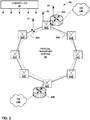
- network system 40 includes a collection of packet-optical transport devices 44 arranged to form an optical transport system 46 having a ring topology.
- routers 48A, 48B operate to provide packet-based network access services for customer networks 13A, 13B, respectively.
- optical transport system 46 operates to provide fast packet-based transport of communications between customer networks 13, 15, respectively.
- Each customer network 13, 15 may comprise a private network and may include local area networks (LANs) or wide area networks (WANs) that comprise a plurality of subscriber devices.
- LANs local area networks
- WANs wide area networks
- optical transport system 46 may be used to provide optical connectivity between any type of packet-based network, such as public networks, core networks, access networks and the like.
- controller 42 When implementing the closed-loop control process of FIG. 2 to assign optical communication channels and allocate wavelength assignments for each of packet-optical transport devices 4, controller 42 utilizes status information 52 from routers 48 to partition the spectral range to reserve groups (blocks) of sequential optical channels the packet-optical transport devices based on traffic demands reported by higher-level routing / switching elements, such as routers 48A and 48B in the example of FIG. 2 .
- State information 52 from routers 48A, 48B provides an indication of current bandwidth consumption based on current traffic flows, e.g., traffic flows 50A, 50B in the example of FIG. 2 , and/or may provide an indicator of layer three (L3) congestion at each of the routers.
- L3 layer three
- FIG. 4 is a graph illustrating example wavelength assignment in an optical transport system having N packet-optical transport devices ("nodes").
- NODE 1 , NODE 2 and NODE 3 are allocated channel groups having three communication channels
- NODE 4 is allocated a channel group having four communication channels
- NODE N is allocated a channel group having nine communication channels.
- NODE 1 only a single wavelength is assigned and, therefore, is assigned in the spectral portion associated with NODE 1 .
- NODE 2 two wavelengths are assigned of the three optical communication channels of the group.
- controller 42 assigns the wavelength to the middle channel in each group of channels. Taking Node 3 as an example, the maximum channel ( Ch x,max ) assigned to Node 3 is channel 16 and the minimum channel ( Ch x,max ) assigned to Node 3 is channel 1. The center of gravity for the channel group is determined as described above to be channel 8. In this way, the controller assigns wavelengths are for each node Node x as shown in the fifth column of Table 3.
- Table 4 Node T_ij 1 2 3 4 5 6 7 8 Total local add Total express at site (counter-clock) Total express at site (clockwise) 1 100 100 200 100 100 100 100 200 100 100 0 900 2 100 0 0 0 0 0 0 0 100 100 700 3 200 0 0 0 0 0 0 0 200 200 600 4 100 0 0 0 0 0 0 0 100 400 500 5 100 0 0 0 0 0 0 0 100 500 400 6 100 0 0 0 0 0 0 0 100 600 200 7 200 0 0 0 0 0 0 0 0 100 700 100 8 100 0 0 0 0 0 0 0 0 0 100 900 0 Total 1000 100 200 100 100 100 100 100 100 100 100 100 100 100 1000
- the controller similarly assigns an additional pair of wavelengths within the channel group allocated to Node 7 , such as communication channels 20, 28 around the initial communication channel 24 currently in use. Results of this example are reflected in Table 5.
- the controller determines that the current allocation of communication channels is insufficient to support the bandwidth requirements for at least Node 3 and Node 7 . As such, the controller determines whether an incremental update to the channel group configuration and wavelength assignment can be performed by at least temporarily reassigning one or more unused communication channels from other groups to the affected channel group (see block 114 of FIG. 3 ).
- the controller may determine that an incremental update to the channel configuration groups and wavelength assignment is not appropriate (see NO branch of block 114 of FIG. 3 ).
- the controller may be programmed configuration data specifying a maximum threshold number of communication channels to reassign without re-initiate the closed-loop control process so as to entirely recalculate the channel communication groups and wavelength assignments.
- the threshold number is configured to one (1)
- the controller in this example would determine that at least two communication channels (one for each of Node 3 and Node 7 ) are needed and, therefore, bypass the incremental update and instead perform a new channel group allocation and wavelength assignment for all nodes.
- controller 202 provides centralized, closed-loop control and management of routers 206A, 206B, and packet-optical transport devices 204A, 204B of the underlying packet-optical transport system. Controller 202 continuously controls wavelength and spectrum assignment within packet-optical transport devices by applying analytics to status information 210 from monitoring agents distributed and installed within routers 206 as well as packet-optical transport devices 204 and optical components 208 of the underlying optical transport system.
- controller 202 processes status information 210 with an internal analytics engine and, using higher-level topology information, responds to the status information to map packets into network 200 including routers 206 and transport resources associated with packet-optical transport devices 204.
- controller 210 provides closed-loop environment having a real-time analytical engine that predicts outages based on status information 210.
- the analytics engine may predicts events and, for events for which a likelihood of occurrence that exceeds defined thresholds, reconfigures the router and switching (L3/L2) devices and/or reconfigures the spectral allocation and wavelength assignments of the underlying analog optical transport devices.
- controller 202 may combine features of advanced L3/L2 software defined networking (SDN) controller with an analog control architecture for controlling the underlying analog optical transport system, where the real-time control for both of these systems is driven by predictable analytics.
- the analytical engine of controller 202 is responsive to real-time status information 210 and allows controller 202 to optimize the routing, wavelength and spectrum assignment (RWSA) implemented by the combination of the routing / switching system and the underlying optical transport system.
- RWSA wavelength and spectrum assignment
- packet-optical devices 204A, 204B typically include advanced optical transmit and receive interfaces having multiple components, any of which may be monitored by an internal monitoring agent that determines and communicates respective status information 210B, 210F to controller 202.
- Packet-optical devices 204A, 204B typically may, for example, include optical mixers, optical multiplexers, optical amplifiers and other components that communicate optical signals, any of which may be monitored by internal monitoring agents of the packet-optical devices that determine and communicate respective status information 210B, 210F to controller 202.
- optical transport system of FIG. 5 includes a plurality of optical components 208A-208C for transmission of optical packet data along an optical link between packet optical devices 204A, 204B.
- Example optical components 208 include amplifiers, transponders, OTTs, repeaters and other equipment.
- Each of optical components 208A-208C provide respective status information 210C, 201D and 210 E.
- one or more of status information 210A-210G take the form of communications that convey operating parameters of one or more components, such as power consumption, current draw, voltage levels, operating temperature and other parameters measured from electrical or optical components within the respective devices.
- Analytical device-specific agents may be used to predict the outage based on measurements of the behavior of an individual device, and these agents can be associated /adapted to their special properties.
- the analytical engine of controller 202 applies rules based on either the current measurements or based on a time-series of current and past measurements and computes probabilities of failures or other compromising events based on the operating conditions measured at the various components, thereby predicting future outages or compromised states associated with network resources within network 200.
- a path computation module of controller 200 high-level traffic engineering and topology information associated with the routing and switching system (e.g, routers 206 in this example) to proactively redirect traffic in the event one or more components are likely to fail or otherwise result in a topology-changing event.
- status information 210C, 210D and 210E respective convey current power consumption of amplifiers within optical components 208A, 208B and 208C, respectively.
- Controller 202 may poll monitoring agents within optical components 208 and request status information 210, or the monitoring agents may send the status information periodically or upon determining that an operating parameter is approaching a configured trigger within an operating range.
- the analytics engine within controller 202 applies rules that specify triggers for proactively changing the topology of network 200.
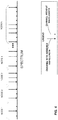
- FIG. 6 is a graph that illustrates an example expected relationship between current draw over time by an optical amplifier and a probability of failure. As illustrated, it may be expected that current draw 220 for a given model of amplifier increases (e.g., linearly) over time so as to maintain a constant transmit power. Moreover, a trigger 224 may be defined as an indicator that the expected operating life of the amplifier is within a threshold probability 222 of failure. As such, the analytics engine of controller 202 may be configured with a rule that implements the example expected relationship illustrated in FIG. 6 . That is, an administrator may create, for example, a rule that triggers a topology changing action in the event current draw from an underlying optical component 208 exceeds trigger 222. Responsive to detecting that such a condition exists, the path computation element of controller 202 may proactively reroute traffic around the link that has been predicted to fail.
- measurement of the functional parameters described above may be combined with the reported age of a device. Prediction for failure for devices that operating at maximum of specification may be defined within the rules to have a much lower device life-time than devices not consistently operated at its maximum specification. For example, based on the measurable environmental conditions such as temperature and humidity, the impact of mechanical vibrations with respect to life-time of the device can be predicted by the analytical engine.
- any of the monitoring agents may locally apply rules, such as the example rule discussed above, to operating parameters of the local electronic components.
- any of status information 210A-210G may take the form of communications that convey results of the rules.
- any of status information 210 may convey results of one or more locally applied rules, such as: (1) STATUS OK indicating that all parameters are below trigger points, (2) FAILURE PENDING indicating that a corresponding rule resulted in a threshold be triggered, and (3) FAILED indicating that a component has actually failed.
- the status information (2) FAILURE PENDING might, in some example, include a prediction of when the outage of the component may be expected to occur, an indicator that the determined probability of an outage is exceeding a pre-configurable threshold or even the determined probability itself.
- controller 202 may apply complex rules that are based on status information received from multiple underlying components. For example, rules may be defined based on an overall probability of failure for multiple devices or components associated with the same optical link or routing / switching location. As one example, controller 202 may apply a complex rule to status information 210C-210E as all of the respective optical components 208A-208C are associated with a common optical link between packet-optical transport devices 204A, 204B. Although none of optical components 208 may individually trigger the rule discussed above so as to cause a topology change, a second rule may be defined to trigger a topology change in the event that any two or more of the optical components are experience current draw above a second, lower threshold 226.
- controller 202 provides centralized, closed-loop control and management of both systems, including routers 206A, 206B of the routing/switching system and packet-optical transport devices 204A, 204B of the underlying packet-optical transport system.
- FIG. 7 is a block diagram illustrating an example centralized controller 300 that operates in accordance with the techniques of this disclosure.
- Controller 300 may be implemented as a separate physical device or virtual device and for example, and may represent an example instance of controllers 22, 42, 202 described herein.
- Controller 300 includes a control unit 302 coupled to one or more network interfaces 304 to exchange packets with other network devices by links 306.
- Control unit 302 include one or more processors (not shown in FIG. 7 ) that execute software instructions, such as those used to define a software or computer program, stored to a computer-readable storage medium, such as non-transitory computer-readable mediums including a storage device (e.g., a disk drive, or an optical drive) or a memory (such as Flash memory or random access memory (RAM)) or any other type of volatile or nonvolatile memory, that stores instructions to cause the one or more processors to perform the techniques described herein.
- a storage device e.g., a disk drive, or an optical drive
- a memory such as Flash memory or random access memory (RAM)
- RAM random access memory
- controller 300 includes both an RWSA (Routing Wavelength and Spectrum Assignment) control module 324 and an SDN control module 325 that cooperate to provide integrated closed-loop control over both routing / switching system and an underling optical transport system within a network.
- control unit 302 provides an operating environment for path computation element 310, topology discover module 312, message processor 320, analytics engine 322, RWSA control module 324, SDN control module 325 and network services application 326.
- these modules may be implemented as one or more processes within control unit 302 or may execute on one or more virtual machines of one or more servers communicatively coupled to controller 300. That is, while generally illustrated and described as executing on a single controller 300, aspects of these modules may be delegated to other computing devices in a distributed manner.
- Message processor 320 receives real-time status information from monitoring agents distributed and installed within packet-optical transport devices and optical components of underlying optical transport system. Message processor 320 processes the status information and updates network state database 332. Responsive to the status information, analytics engine 322 applies rule-based of policies 334 and outputs messages to RWSA control module 324 and SDN control module 325, thereby adaptively and proactively reroute communications within the network.
- SDN control module 325 may invoke path computation element 310 to compute one or more new paths through a network.
- SDN control module 325 configures routers and/or switches within the network to adaptively and proactively reroutes communications within the network in accordance with the computed paths.
- SDN control module 325 may implement, for instance, a Path Computation Element Communication Protocol (PCEP) or a software-defined networking (SDN) protocol, such as the OpenFlow protocol, to provide and direct the nodes to install forwarding information to their respective data planes. Additional details regarding OpenFlow are found in " OpenFlow Switch Specification version 1.1.0", OpenFlow Consortium, February 2011 , which is incorporated by reference herein.
- PCEP Path Computation Element Communication Protocol
- SDN software-defined networking
- PCEP Path Computation Element
- PCEP Network Working Group
- SDN control module 325 may configure forwarding tables within routers by other interface types, such as a Simple Network Management Protocol (SNMP) interface, path computation element protocol (PCEP) interface, a Device Management Interface (DMI), a CLI, Interface to the Routing System (IRS), or any other node configuration interface.
- SNMP Simple Network Management Protocol
- PCEP path computation element protocol
- DMI Device Management Interface
- CLI Interface to the Routing System
- IMS Routing System
- RWSA control module 324 cooperatively and responsively updates routing wavelength and spectrum assignments (RWSA) based on any traffic flow changes engineered by path computation element 310. That is, based on any updated changes to current and/or predicted traffic flow due to SDN control module 324, RWSA control module 324 controls and rebalances wavelength and spectrum assignment of the underlying packet-optical transport system.
- RWSA routing wavelength and spectrum assignments
- the control architecture in FIG 7 may be applied to address other very severe challenges in networks.
- the architecture may help overcome challenges with the availability of devices and the health of the network connections, as described, but also help overcome some of the restrictions induced by the optical transport network itself.
- One of restrictions that may be overcome is rolling-over wavelengths, that might be blocking, by way of the controller architecture.
- the system may help overcome limitation due to the optical filter structure, DWDM bandwidth limitation in one path or physical limitation of the ROADM and PXC architecture.
- the underlying transport infrastructure may become, at least to some extent, virtualized for the end-to-end path.
- a ROADM or PXC might be fully or partially eliminated and replaced by routers/switches that are directly connected with a DWDM transport system.
- ROADM's would not physically exist but the system as such could steer the network traffic in a way that is equivalent to a virtual tunable & directionless ROADM or PXC.
- a ROADM and point-to-point DWDM system might be deployed physically at the same location but some of the DWDM wavelength might be terminated directly at the router w/o the ROADM.
- the system could steer the network traffic in a way that is equivalent to a virtual tunable & directionless ROADM or PXC.
- the controller described herein may automatically build multiple redundancies on the transport layers (e.g. creating several redundant wavelengths) and on the router & switched layer (e.g. port redundancy), and is able to analyze the availability prediction and match it with the network service requirements.
- Computer-readable medium such as a computer-readable storage medium, containing instructions. Instructions embedded or encoded in a computer-readable medium may cause a programmable processor, or other processor, to perform the method, e.g., when the instructions are executed.
- Computer-readable media may include non-transitory computer-readable storage media and transient communication media.
Landscapes
- Engineering & Computer Science (AREA)
- Computer Networks & Wireless Communication (AREA)
- Signal Processing (AREA)
- Optical Communication System (AREA)
- Data Exchanges In Wide-Area Networks (AREA)
Claims (14)
- Procédé comprenant :la réception, avec un contrôleur de réseau défini par logiciel, SDN, d'informations d'état venant de composants optiques d'un système de transport optique ayant une pluralité de dispositifs interconnectés de transport optique de paquets ;l'application, avec un moteur d'analytique du contrôleur SDN, d'un ensemble de règes pour identifier une défaillance de l'un quelconque des composants optiques, l'identification de cette défaillance étant en réponse à la détermination qu'une probabilité combinée de défaillance pour une pluralité de composants optiques le long d'un chemin commun à travers un réseau dépasse un seuil ;le calcul, avec le contrôleur SDN et en réponse à l'identification de la défaillance, d'au moins un chemin mis à jour à travers un réseau d'acheminement et de commutation ayant une pluralité de composants d'acheminement de couche trois, L3, et de composants de commutation de couche deux, L2, interconnectés pour communiquer un trafic de réseau par paquets ; eten réponse au chemin mis à jour, la configuration, avec le contrôleur SDN, des dispositifs de transport optique de paquets pour qu'ils fonctionnent à des longueurs d'onde particulières en se basant sur les changements des larguer de band requise au niveau chacun des composants d'acheminement L3 à cause du chemin mis à jour.
- Procédé selon la revendication 1, dans lequel l'identification d'une défaillance de l'un quelconque des composants optiques comprend l'application, avec le moteur d'analytique, de l'ensemble de règles afin de déterminer une probabilité d'une défaillance future de l'un quelconque des composants optiques.
- Procédé selon la revendication 2, dans lequel l'identification de la défaillance consiste en l'identification de la défaillance en réponse à la détermination que la probabilité de défaillance pour un composant individuel des composants optiques dépasse un seuil spécifié par l'ensemble de règles.
- Procédé selon la revendication 2, ou selon l'une quelconque des revendications dépendantes de celle-ci, dans lequel les informations d'état comprennent une ou plusieurs des informations suivantes : consommation d'énergie, appel de courant, niveaux de tension ou température de fonctionnement pour les composants optiques du réseau de transport optique.
- Procédé selon l'une quelconque des revendications 1 à 4, dans lequel les dispositifs de transport optique de paquets consistent en les dispositifs quelconques suivants : multiplexeurs d'insertion-extraction optiques reconfigurables, ROADM, interconnexions photoniques, PXC, interconnexions optiques, OXC, matériel de multiplexage par répartition en longueur d'onde dense, DWDM, amplificateurs, transpondeurs, et terminaux de terminaison optique, OTT.
- Procédé selon l'une quelconque des revendications 1 à 5, dans lequel la configuration de dispositifs de transport optique de paquets pour qu'ils fonctionnent à des longueurs de bande particulières comprend :la détermination, pour chacun de la pluralité de dispositifs de transport optique de paquets interconnectés pour former un système de transport optique, d'une taille de groupe de voies optiques spécifiant un certain nombre de voies optiques à réserver pour chacun des dispositifs de transport optique de paquets parmi un nombre total de voies optiques prises en charge par le système de transport optique, la taille respective du groupe de voies pour chacun des dispositifs de transport optique de paquets étant déterminée en se basant sur une exigence de largeur de bande pour le dispositif de transport optique de paquets respectif ;la réservation, en fonction des tailles déterminées des groupes de voies, d'un ensemble de voies optiques pour chacun des dispositifs de transport optique de paquets parmi un spectre optique pris en charge par les dispositifs de transport optique de paquets, chacune des voies optiques réservées ayant une longueur d'onde non spécifiée dans les limites du spectre optique, chacun des ensembles de voies optiques étant associé à une partie différente du spectre optique et ayant une plage spectrale qui est basée sur la taille du groupe de voies déterminée pour le dispositif de transport optique de paquets respectif ; etpour chacun des dispositifs de transport optique de paquets, l'attribution d'une longueur d'onde respective parmi le spectre optique à une ou plusieurs des voies optiques de l'ensemble de voies optiques réservées pour le dispositif de transport optique de paquets afin d'équilibrer le niveau de trafic du réseau associé au dispositif de transport optique de paquets autour d'un centre de la partie du spectre optique associée à l'ensemble de voies optiques réservées pour le dispositif de transport optique de paquets.
- Procédé selon la revendication 6, dans lequel l'attribution d'une longueur d'onde respective parmi le spectre optique à une ou plusieurs des voies optiques de l'ensemble de voies optiques réservées pour le dispositif de transport optique de paquets comprend, pour chacun des dispositifs de transport optique de paquets :la détermination d'un centre de la partie du spectre optique réservée pour le dispositif de transport optique de paquets respectif ;la détermination du nombre de voies optiques dans les voies optiques respectives réservées pour le dispositif de transport optique de paquets auxquelles attribuer une longueur d'onde respective afin de fournir une largeur de bande qui dépasse l'exigence de largeur de bande associée au dispositif de transport optique de paquets respectif ; etl'attribution, pour chacun des dispositifs de transport optique de paquets, d'une longueur d'onde respective au nombre de voies optiques pour équilibrer les flux de trafic autour du centre de la partie respective du spectre optique réservée pour le dispositif de transport optique de paquets.
- Procédé selon l'une quelconque des revendications 1 à 7, dans lequel l'exigence de largeur de bande pour chacun des dispositifs de transport optique de paquets est basée sur une utilisation de largeur de bande courante pour le dispositif de transport optique de paquets respectif.
- Procédé selon l'une quelconque des revendications 1 à 8, dans lequel l'exigence de largeur de bande pour chacun des dispositifs de transport optique de paquets est basée sur une utilisation de largeur de bande prédite pour le dispositif de transport optique de paquets respectif.
- Procédé selon l'une quelconque des revendications 1 à 9, comprenant en outre :l'exécution, avec le contrôleur SDN, d'un protocole d'acheminement qui maintient des informations d'acheminement conformément à une topologie d'acheminement pour le réseau d'acheminement et de commutation ;avec le contrôleur SDN, la détermination d'informations d'acheminement mises à jour en se basant sur le chemin mis à jour ; etla communication des informations d'acheminement mises à jour aux composants d'acheminement L3 pour commander les flux de paquets à travers le réseau d'acheminement et de commutation conformément au chemin mis à jour.
- Contrôleur de réseau intégré comprenant :un processeur de messages qui reçoit des informations d'état de composants optiques d'un système de transport optique ayant une pluralité de dispositifs interconnectés de transport optique de paquets ;un moteur d'analytique qui applique un ensemble de règles pour identifier une défaillance de l'un quelconque des composants optiques, l'identification de cette défaillance étant en réponse à la détermination qu'une probabilité combinée de défaillance pour une pluralité des composants optiques le long d'un chemin commun à travers un réseau dépasse un seuil ;un élément de calcul de chemin qui, en réponse à la défaillance identifiée, calcule au moins un chemin mis à jour pour le trafic de réseau à travers un réseau d'acheminement et de commutation ayant une pluralité de composants d'acheminement de couche trois, L3, et de composants de commutation de couche deux, L2, interconnectés pour communiquer un trafic de réseau par paquets ; etun module de commande d'attribution de longueur d'onde d'acheminement et de spectre qui, en réponse au chemin mis à jour, configure chacun d'une pluralité de dispositifs de transport optique de paquets pour qu'ils fonctionnent à des longueurs d'onde particulières en se basant sur des changements d'exigence de largeur de bande de chacun des composants d'acheminement L3 à cause du chemin mis à jour.
- Contrôleur intégré selon la revendication 11, configuré de façon à exécuter le procédé selon l'une quelconque des revendications 1 à 10.
- Support lisible par ordinateur comportant des instructions exécutables par ordinateur pour faire en sorte qu'un ou plusieurs ordinateurs programmables deviennent configurés de façon à implémenter un contrôleur de réseau défini par logiciel, SDN, configuré de façon à :recevoir, avec le contrôleur SDN, des informations d'état de composants optiques d'un système de transport optique ayant une pluralité de dispositifs interconnectés de transport optique de paquets ;appliquer, avec un moteur d'analytique du contrôleur SDN, un ensemble de règles pour identifier une défaillance de l'un quelconque des composants optiques, l'identification de cette défaillance étant en réponse à la détermination qu'une probabilité combinée de défaillance pour une pluralité des composants optiques le long d'un chemin commun à travers un réseau dépasse un seuil ;calculer, avec le contrôleur SDN et en réponse à l'identification de la défaillance, au moins un chemin mis à jour à travers un réseau d'acheminement et de commutation ayant une pluralité de composants d'acheminement de couche trois (L3) et de composants de commutation de couche deux (L2) interconnectés pour communiquer un trafic de réseau par paquets ; et àen réponse au chemin mis à jour, configurer, avec le contrôleur SDN, les dispositifs de transport optique de paquets pour qu'ils fonctionnent à des longueurs d'onde particulières en se basant sur des changements d'exigences de largeur de bande au niveau de chacun des composants d'acheminement L3 à cause du chemin mis à jour.
- Support lisible par ordinateur selon la revendication 13, comportant en outre des instructions exécutables par ordinateur pour faire en sorte qu'un ou plusieurs ordinateurs programmables deviennent configurés de façon à implémenter un contrôleur de réseau défini par logiciel, SDN, configuré de façon à exécuter le procédé selon l'une quelconque des revendications 1 à 10.
Applications Claiming Priority (2)
| Application Number | Priority Date | Filing Date | Title |
|---|---|---|---|
| US14/575,637 US9077478B1 (en) | 2014-12-18 | 2014-12-18 | Wavelength and spectrum assignment within packet-optical networks |
| EP15200044.4A EP3035574B1 (fr) | 2014-12-18 | 2015-12-15 | Affectation de longueur d'onde et de spectre à l'intérieur de réseaux optiques à paquets |
Related Parent Applications (2)
| Application Number | Title | Priority Date | Filing Date |
|---|---|---|---|
| EP15200044.4A Division EP3035574B1 (fr) | 2014-12-18 | 2015-12-15 | Affectation de longueur d'onde et de spectre à l'intérieur de réseaux optiques à paquets |
| EP15200044.4A Division-Into EP3035574B1 (fr) | 2014-12-18 | 2015-12-15 | Affectation de longueur d'onde et de spectre à l'intérieur de réseaux optiques à paquets |
Publications (2)
| Publication Number | Publication Date |
|---|---|
| EP3300272A1 EP3300272A1 (fr) | 2018-03-28 |
| EP3300272B1 true EP3300272B1 (fr) | 2020-11-04 |
Family
ID=53492092
Family Applications (2)
| Application Number | Title | Priority Date | Filing Date |
|---|---|---|---|
| EP17195746.7A Active EP3300272B1 (fr) | 2014-12-18 | 2015-12-15 | Affectation de longueur d'onde et de spectre à l'intérieur de réseaux optiques à paquets |
| EP15200044.4A Active EP3035574B1 (fr) | 2014-12-18 | 2015-12-15 | Affectation de longueur d'onde et de spectre à l'intérieur de réseaux optiques à paquets |
Family Applications After (1)
| Application Number | Title | Priority Date | Filing Date |
|---|---|---|---|
| EP15200044.4A Active EP3035574B1 (fr) | 2014-12-18 | 2015-12-15 | Affectation de longueur d'onde et de spectre à l'intérieur de réseaux optiques à paquets |
Country Status (3)
| Country | Link |
|---|---|
| US (1) | US9077478B1 (fr) |
| EP (2) | EP3300272B1 (fr) |
| CN (1) | CN105721961B (fr) |
Families Citing this family (23)
| Publication number | Priority date | Publication date | Assignee | Title |
|---|---|---|---|---|
| US9369200B1 (en) | 2014-12-18 | 2016-06-14 | Juniper Networks, Inc. | Network controller having predictable analytics and failure avoidance in packet-optical networks |
| JP6458560B2 (ja) * | 2015-03-06 | 2019-01-30 | 富士通株式会社 | 波長割当方法及び波長割当装置 |
| US20170026292A1 (en) * | 2015-07-20 | 2017-01-26 | Schweitzer Engineering Laboratories, Inc. | Communication link failure detection in a software defined network |
| US10644955B2 (en) * | 2015-08-21 | 2020-05-05 | Huawei Technologies Co., Ltd. | Method and apparatus for network slicing |
| US10149193B2 (en) | 2016-06-15 | 2018-12-04 | At&T Intellectual Property I, L.P. | Method and apparatus for dynamically managing network resources |
| US10505870B2 (en) | 2016-11-07 | 2019-12-10 | At&T Intellectual Property I, L.P. | Method and apparatus for a responsive software defined network |
| CN106973335B (zh) * | 2017-01-23 | 2020-02-14 | 苏州大学 | 基于可靠性感知的频谱资源最优化方法 |
| US10749796B2 (en) | 2017-04-27 | 2020-08-18 | At&T Intellectual Property I, L.P. | Method and apparatus for selecting processing paths in a software defined network |
| US10819606B2 (en) | 2017-04-27 | 2020-10-27 | At&T Intellectual Property I, L.P. | Method and apparatus for selecting processing paths in a converged network |
| US10673751B2 (en) | 2017-04-27 | 2020-06-02 | At&T Intellectual Property I, L.P. | Method and apparatus for enhancing services in a software defined network |
| US10257668B2 (en) | 2017-05-09 | 2019-04-09 | At&T Intellectual Property I, L.P. | Dynamic network slice-switching and handover system and method |
| US10382903B2 (en) | 2017-05-09 | 2019-08-13 | At&T Intellectual Property I, L.P. | Multi-slicing orchestration system and method for service and/or content delivery |
| US10070344B1 (en) | 2017-07-25 | 2018-09-04 | At&T Intellectual Property I, L.P. | Method and system for managing utilization of slices in a virtual network function environment |
| US10104548B1 (en) | 2017-12-18 | 2018-10-16 | At&T Intellectual Property I, L.P. | Method and apparatus for dynamic instantiation of virtual service slices for autonomous machines |
| US10547384B2 (en) | 2018-06-28 | 2020-01-28 | At&T Intellectual Property I, L.P. | Multi-layer system optimization |
| WO2020095313A1 (fr) * | 2018-11-09 | 2020-05-14 | Telefonaktiebolaget Lm Ericsson (Publ) | Gestion de la charge de calcul dans un réseau en brouillard |
| CN109547874B (zh) * | 2018-12-03 | 2021-09-28 | 国家电网有限公司 | 电力骨干光传输网业务可靠均衡路由波长分配方法及系统 |
| US10873392B2 (en) * | 2019-04-18 | 2020-12-22 | Microsoft Technology Licensing, Llc | Throughput increases for optical communications |
| US10735837B1 (en) * | 2019-07-11 | 2020-08-04 | Ciena Corporation | Partial activation of a media channel on channel holder-based optical links |
| US11509578B2 (en) | 2019-12-13 | 2022-11-22 | Cisco Technology, Inc. | Flexible policy semantics extensions using dynamic tagging and manifests |
| JP7548295B2 (ja) * | 2020-03-27 | 2024-09-10 | 日本電気株式会社 | 光通信システム、故障原因推定装置、故障解析装置及び光通信システムの故障解析方法 |
| US11546078B1 (en) | 2021-03-30 | 2023-01-03 | Amazon Technologies, Inc. | Optimizing routes across an optical network based on traffic stream bandwidth utilization |
| EP4320761B1 (fr) * | 2021-04-09 | 2026-03-25 | Sony Interactive Entertainment Inc. | Matrice de commutation optimisée avec optique à points multiples dans un centre de données |
Family Cites Families (14)
| Publication number | Priority date | Publication date | Assignee | Title |
|---|---|---|---|---|
| JP3753866B2 (ja) * | 1998-07-01 | 2006-03-08 | 株式会社日立製作所 | 自己救済型光ネットワーク |
| WO2001086998A1 (fr) * | 2000-05-11 | 2001-11-15 | Btg International Limited | Reseaux de transport optiques |
| US7630635B1 (en) * | 2001-07-19 | 2009-12-08 | Alcatel-Lucent Usa Inc. | Channel wavelength assignment with transient reduction |
| US7724676B2 (en) | 2007-03-21 | 2010-05-25 | Cisco Technology, Inc. | Proactive protection mechanism based on advanced failure warning |
| US20090317087A1 (en) * | 2008-06-19 | 2009-12-24 | Bernard Marc R | Configurable control for network device operation |
| US8909043B2 (en) * | 2011-02-04 | 2014-12-09 | Nec Laboratories America, Inc. | Routing, wavelength assignment, and spectrum allocation in wavelength convertible flexible optical wavelength-division multiplexing networks |
| US8553725B2 (en) * | 2011-07-22 | 2013-10-08 | Infinera Corporation | Super-channel assignment using a flexible grid |
| EP2745441A1 (fr) * | 2011-09-08 | 2014-06-25 | Telefonaktiebolaget L M Ericsson (publ) | Calcul de chemin dans des réseaux optiques à commutation de longueur d'onde |
| US8942557B2 (en) * | 2012-03-05 | 2015-01-27 | Infinera Corporation | Super-channel optical parameters GMPLS signaling and routing extensions systems and methods |
| US9252912B2 (en) * | 2012-04-09 | 2016-02-02 | Telefonaktiebolaget L M Ericsson (Publ) | Method for routing and spectrum assignment |
| EP2672668B1 (fr) * | 2012-06-06 | 2018-09-26 | Juniper Networks, Inc. | Faciliter le fonctionnement d'un réseau virtuel en prédisant un défaut |
| WO2014015915A1 (fr) * | 2012-07-26 | 2014-01-30 | Telefonaktiebolaget L M Ericsson (Publ) | Routage pour super-canal destiné à un réseau optique commuté en longueur d'onde variable de bande passante |
| US9258238B2 (en) * | 2013-08-30 | 2016-02-09 | Juniper Networks, Inc. | Dynamic end-to-end network path setup across multiple network layers |
| US9369785B1 (en) * | 2014-12-18 | 2016-06-14 | Juniper Networks, Inc. | Integrated controller for routing / switching network and underlying optical transport system |
-
2014
- 2014-12-18 US US14/575,637 patent/US9077478B1/en active Active
-
2015
- 2015-11-27 CN CN201510850075.3A patent/CN105721961B/zh active Active
- 2015-12-15 EP EP17195746.7A patent/EP3300272B1/fr active Active
- 2015-12-15 EP EP15200044.4A patent/EP3035574B1/fr active Active
Non-Patent Citations (1)
| Title |
|---|
| None * |
Also Published As
| Publication number | Publication date |
|---|---|
| CN105721961B (zh) | 2018-09-07 |
| CN105721961A (zh) | 2016-06-29 |
| US9077478B1 (en) | 2015-07-07 |
| EP3035574B1 (fr) | 2017-11-22 |
| EP3300272A1 (fr) | 2018-03-28 |
| EP3035574A1 (fr) | 2016-06-22 |
Similar Documents
| Publication | Publication Date | Title |
|---|---|---|
| EP3035570B1 (fr) | Contrôleur de réseau présentant une analytique prévisible et une prévention de défaillance dans des réseaux optiques à paquets | |
| EP3300272B1 (fr) | Affectation de longueur d'onde et de spectre à l'intérieur de réseaux optiques à paquets | |
| EP3035573B1 (fr) | Dispositif de commande intégré d'acheminement/de commutation de réseau et système de transport optique sous-jacent | |
| US11303565B2 (en) | Traffic matrix prediction and fast reroute path computation in packet networks | |
| Chatterjee et al. | Routing and spectrum allocation in elastic optical networks: A tutorial | |
| Tomkos et al. | A tutorial on the flexible optical networking paradigm: State of the art, trends, and research challenges | |
| Talebi et al. | Spectrum management techniques for elastic optical networks: A survey | |
| EP2843888B1 (fr) | Établissement d'un chemin de réseau de bout en bout dynamique à travers de multiples couches de réseau | |
| US9559770B2 (en) | WSON restoration | |
| Sengupta et al. | From network design to dynamic provisioning and restoration in optical cross-connect mesh networks: An architectural and algorithmic overview | |
| US10587500B2 (en) | Intelligent optical restoration in integrated multi-layer networks | |
| US10056973B2 (en) | Multi layer network resiliency with software defined orchestration | |
| Koulougli et al. | Efficient routing using flexible ethernet in multi-layer multi-domain networks | |
| Zhang et al. | Applicability of a Stateful Path Computation Element (PCE) | |
| US20150373434A1 (en) | Method and apparatus for managing link on multi-layer networks | |
| US10231035B2 (en) | Optical network controller and optical network control method | |
| Amar | Performance assessment and modeling of flexible optical networks | |
| Kebede | Constraint-Based Hybrid Resiliency Mechanisms for Better Resource Utilization and Service Performance Quality in ASON SLA | |
| Rezagholizadeh et al. | Single-Hop-First Routing and Dynamic Rerouting for Greener OTN over EON | |
| Ruiz Pérez | Virtualisation and resource allocation in MECEnabled metro optical networks | |
| Zhang et al. | RFC 8051: Applicability of a Stateful Path Computation Element (PCE) | |
| SUDPARIS | Djamel AMAR | |
| Wang | Dynamic Resource Scheduling and Optimization in Elastic Optical Networks |
Legal Events
| Date | Code | Title | Description |
|---|---|---|---|
| PUAI | Public reference made under article 153(3) epc to a published international application that has entered the european phase |
Free format text: ORIGINAL CODE: 0009012 |
|
| STAA | Information on the status of an ep patent application or granted ep patent |
Free format text: STATUS: THE APPLICATION HAS BEEN PUBLISHED |
|
| AC | Divisional application: reference to earlier application |
Ref document number: 3035574 Country of ref document: EP Kind code of ref document: P |
|
| AK | Designated contracting states |
Kind code of ref document: A1 Designated state(s): AL AT BE BG CH CY CZ DE DK EE ES FI FR GB GR HR HU IE IS IT LI LT LU LV MC MK MT NL NO PL PT RO RS SE SI SK SM TR |
|
| STAA | Information on the status of an ep patent application or granted ep patent |
Free format text: STATUS: REQUEST FOR EXAMINATION WAS MADE |
|
| 17P | Request for examination filed |
Effective date: 20180928 |
|
| RBV | Designated contracting states (corrected) |
Designated state(s): AL AT BE BG CH CY CZ DE DK EE ES FI FR GB GR HR HU IE IS IT LI LT LU LV MC MK MT NL NO PL PT RO RS SE SI SK SM TR |
|
| GRAP | Despatch of communication of intention to grant a patent |
Free format text: ORIGINAL CODE: EPIDOSNIGR1 |
|
| STAA | Information on the status of an ep patent application or granted ep patent |
Free format text: STATUS: GRANT OF PATENT IS INTENDED |
|
| INTG | Intention to grant announced |
Effective date: 20200527 |
|
| GRAS | Grant fee paid |
Free format text: ORIGINAL CODE: EPIDOSNIGR3 |
|
| GRAA | (expected) grant |
Free format text: ORIGINAL CODE: 0009210 |
|
| STAA | Information on the status of an ep patent application or granted ep patent |
Free format text: STATUS: THE PATENT HAS BEEN GRANTED |
|
| AC | Divisional application: reference to earlier application |
Ref document number: 3035574 Country of ref document: EP Kind code of ref document: P |
|
| AK | Designated contracting states |
Kind code of ref document: B1 Designated state(s): AL AT BE BG CH CY CZ DE DK EE ES FI FR GB GR HR HU IE IS IT LI LT LU LV MC MK MT NL NO PL PT RO RS SE SI SK SM TR |
|
| REG | Reference to a national code |
Ref country code: GB Ref legal event code: FG4D |
|
| REG | Reference to a national code |
Ref country code: CH Ref legal event code: EP |
|
| REG | Reference to a national code |
Ref country code: AT Ref legal event code: REF Ref document number: 1332183 Country of ref document: AT Kind code of ref document: T Effective date: 20201115 |
|
| REG | Reference to a national code |
Ref country code: IE Ref legal event code: FG4D |
|
| REG | Reference to a national code |
Ref country code: DE Ref legal event code: R096 Ref document number: 602015061736 Country of ref document: DE |
|
| REG | Reference to a national code |
Ref country code: NL Ref legal event code: MP Effective date: 20201104 |
|
| REG | Reference to a national code |
Ref country code: AT Ref legal event code: MK05 Ref document number: 1332183 Country of ref document: AT Kind code of ref document: T Effective date: 20201104 |
|
| PG25 | Lapsed in a contracting state [announced via postgrant information from national office to epo] |
Ref country code: RS Free format text: LAPSE BECAUSE OF FAILURE TO SUBMIT A TRANSLATION OF THE DESCRIPTION OR TO PAY THE FEE WITHIN THE PRESCRIBED TIME-LIMIT Effective date: 20201104 Ref country code: PT Free format text: LAPSE BECAUSE OF FAILURE TO SUBMIT A TRANSLATION OF THE DESCRIPTION OR TO PAY THE FEE WITHIN THE PRESCRIBED TIME-LIMIT Effective date: 20210304 Ref country code: NO Free format text: LAPSE BECAUSE OF FAILURE TO SUBMIT A TRANSLATION OF THE DESCRIPTION OR TO PAY THE FEE WITHIN THE PRESCRIBED TIME-LIMIT Effective date: 20210204 Ref country code: FI Free format text: LAPSE BECAUSE OF FAILURE TO SUBMIT A TRANSLATION OF THE DESCRIPTION OR TO PAY THE FEE WITHIN THE PRESCRIBED TIME-LIMIT Effective date: 20201104 Ref country code: GR Free format text: LAPSE BECAUSE OF FAILURE TO SUBMIT A TRANSLATION OF THE DESCRIPTION OR TO PAY THE FEE WITHIN THE PRESCRIBED TIME-LIMIT Effective date: 20210205 |
|
| PG25 | Lapsed in a contracting state [announced via postgrant information from national office to epo] |
Ref country code: SE Free format text: LAPSE BECAUSE OF FAILURE TO SUBMIT A TRANSLATION OF THE DESCRIPTION OR TO PAY THE FEE WITHIN THE PRESCRIBED TIME-LIMIT Effective date: 20201104 Ref country code: BG Free format text: LAPSE BECAUSE OF FAILURE TO SUBMIT A TRANSLATION OF THE DESCRIPTION OR TO PAY THE FEE WITHIN THE PRESCRIBED TIME-LIMIT Effective date: 20210204 Ref country code: IS Free format text: LAPSE BECAUSE OF FAILURE TO SUBMIT A TRANSLATION OF THE DESCRIPTION OR TO PAY THE FEE WITHIN THE PRESCRIBED TIME-LIMIT Effective date: 20210304 Ref country code: PL Free format text: LAPSE BECAUSE OF FAILURE TO SUBMIT A TRANSLATION OF THE DESCRIPTION OR TO PAY THE FEE WITHIN THE PRESCRIBED TIME-LIMIT Effective date: 20201104 Ref country code: LV Free format text: LAPSE BECAUSE OF FAILURE TO SUBMIT A TRANSLATION OF THE DESCRIPTION OR TO PAY THE FEE WITHIN THE PRESCRIBED TIME-LIMIT Effective date: 20201104 Ref country code: AT Free format text: LAPSE BECAUSE OF FAILURE TO SUBMIT A TRANSLATION OF THE DESCRIPTION OR TO PAY THE FEE WITHIN THE PRESCRIBED TIME-LIMIT Effective date: 20201104 Ref country code: ES Free format text: LAPSE BECAUSE OF FAILURE TO SUBMIT A TRANSLATION OF THE DESCRIPTION OR TO PAY THE FEE WITHIN THE PRESCRIBED TIME-LIMIT Effective date: 20201104 |
|
| REG | Reference to a national code |
Ref country code: LT Ref legal event code: MG9D |
|
| PG25 | Lapsed in a contracting state [announced via postgrant information from national office to epo] |
Ref country code: HR Free format text: LAPSE BECAUSE OF FAILURE TO SUBMIT A TRANSLATION OF THE DESCRIPTION OR TO PAY THE FEE WITHIN THE PRESCRIBED TIME-LIMIT Effective date: 20201104 |
|
| PG25 | Lapsed in a contracting state [announced via postgrant information from national office to epo] |
Ref country code: RO Free format text: LAPSE BECAUSE OF FAILURE TO SUBMIT A TRANSLATION OF THE DESCRIPTION OR TO PAY THE FEE WITHIN THE PRESCRIBED TIME-LIMIT Effective date: 20201104 Ref country code: SK Free format text: LAPSE BECAUSE OF FAILURE TO SUBMIT A TRANSLATION OF THE DESCRIPTION OR TO PAY THE FEE WITHIN THE PRESCRIBED TIME-LIMIT Effective date: 20201104 Ref country code: SM Free format text: LAPSE BECAUSE OF FAILURE TO SUBMIT A TRANSLATION OF THE DESCRIPTION OR TO PAY THE FEE WITHIN THE PRESCRIBED TIME-LIMIT Effective date: 20201104 Ref country code: EE Free format text: LAPSE BECAUSE OF FAILURE TO SUBMIT A TRANSLATION OF THE DESCRIPTION OR TO PAY THE FEE WITHIN THE PRESCRIBED TIME-LIMIT Effective date: 20201104 Ref country code: CZ Free format text: LAPSE BECAUSE OF FAILURE TO SUBMIT A TRANSLATION OF THE DESCRIPTION OR TO PAY THE FEE WITHIN THE PRESCRIBED TIME-LIMIT Effective date: 20201104 Ref country code: LT Free format text: LAPSE BECAUSE OF FAILURE TO SUBMIT A TRANSLATION OF THE DESCRIPTION OR TO PAY THE FEE WITHIN THE PRESCRIBED TIME-LIMIT Effective date: 20201104 |
|
| REG | Reference to a national code |
Ref country code: CH Ref legal event code: PL |
|
| REG | Reference to a national code |
Ref country code: DE Ref legal event code: R097 Ref document number: 602015061736 Country of ref document: DE |
|
| PG25 | Lapsed in a contracting state [announced via postgrant information from national office to epo] |
Ref country code: DK Free format text: LAPSE BECAUSE OF FAILURE TO SUBMIT A TRANSLATION OF THE DESCRIPTION OR TO PAY THE FEE WITHIN THE PRESCRIBED TIME-LIMIT Effective date: 20201104 Ref country code: MC Free format text: LAPSE BECAUSE OF FAILURE TO SUBMIT A TRANSLATION OF THE DESCRIPTION OR TO PAY THE FEE WITHIN THE PRESCRIBED TIME-LIMIT Effective date: 20201104 |
|
| REG | Reference to a national code |
Ref country code: BE Ref legal event code: MM Effective date: 20201231 |
|
| PLBE | No opposition filed within time limit |
Free format text: ORIGINAL CODE: 0009261 |
|
| STAA | Information on the status of an ep patent application or granted ep patent |
Free format text: STATUS: NO OPPOSITION FILED WITHIN TIME LIMIT |
|
| 26N | No opposition filed |
Effective date: 20210805 |
|
| PG25 | Lapsed in a contracting state [announced via postgrant information from national office to epo] |
Ref country code: LU Free format text: LAPSE BECAUSE OF NON-PAYMENT OF DUE FEES Effective date: 20201215 Ref country code: IT Free format text: LAPSE BECAUSE OF FAILURE TO SUBMIT A TRANSLATION OF THE DESCRIPTION OR TO PAY THE FEE WITHIN THE PRESCRIBED TIME-LIMIT Effective date: 20201104 Ref country code: IE Free format text: LAPSE BECAUSE OF NON-PAYMENT OF DUE FEES Effective date: 20201215 Ref country code: AL Free format text: LAPSE BECAUSE OF FAILURE TO SUBMIT A TRANSLATION OF THE DESCRIPTION OR TO PAY THE FEE WITHIN THE PRESCRIBED TIME-LIMIT Effective date: 20201104 Ref country code: NL Free format text: LAPSE BECAUSE OF FAILURE TO SUBMIT A TRANSLATION OF THE DESCRIPTION OR TO PAY THE FEE WITHIN THE PRESCRIBED TIME-LIMIT Effective date: 20201104 |
|
| PG25 | Lapsed in a contracting state [announced via postgrant information from national office to epo] |
Ref country code: LI Free format text: LAPSE BECAUSE OF NON-PAYMENT OF DUE FEES Effective date: 20201231 Ref country code: CH Free format text: LAPSE BECAUSE OF NON-PAYMENT OF DUE FEES Effective date: 20201231 Ref country code: SI Free format text: LAPSE BECAUSE OF FAILURE TO SUBMIT A TRANSLATION OF THE DESCRIPTION OR TO PAY THE FEE WITHIN THE PRESCRIBED TIME-LIMIT Effective date: 20201104 |
|
| PG25 | Lapsed in a contracting state [announced via postgrant information from national office to epo] |
Ref country code: IS Free format text: LAPSE BECAUSE OF FAILURE TO SUBMIT A TRANSLATION OF THE DESCRIPTION OR TO PAY THE FEE WITHIN THE PRESCRIBED TIME-LIMIT Effective date: 20210304 Ref country code: TR Free format text: LAPSE BECAUSE OF FAILURE TO SUBMIT A TRANSLATION OF THE DESCRIPTION OR TO PAY THE FEE WITHIN THE PRESCRIBED TIME-LIMIT Effective date: 20201104 Ref country code: MT Free format text: LAPSE BECAUSE OF FAILURE TO SUBMIT A TRANSLATION OF THE DESCRIPTION OR TO PAY THE FEE WITHIN THE PRESCRIBED TIME-LIMIT Effective date: 20201104 Ref country code: CY Free format text: LAPSE BECAUSE OF FAILURE TO SUBMIT A TRANSLATION OF THE DESCRIPTION OR TO PAY THE FEE WITHIN THE PRESCRIBED TIME-LIMIT Effective date: 20201104 |
|
| PG25 | Lapsed in a contracting state [announced via postgrant information from national office to epo] |
Ref country code: MK Free format text: LAPSE BECAUSE OF FAILURE TO SUBMIT A TRANSLATION OF THE DESCRIPTION OR TO PAY THE FEE WITHIN THE PRESCRIBED TIME-LIMIT Effective date: 20201104 |
|
| PG25 | Lapsed in a contracting state [announced via postgrant information from national office to epo] |
Ref country code: BE Free format text: LAPSE BECAUSE OF NON-PAYMENT OF DUE FEES Effective date: 20201231 |
|
| P01 | Opt-out of the competence of the unified patent court (upc) registered |
Effective date: 20230520 |
|
| PGFP | Annual fee paid to national office [announced via postgrant information from national office to epo] |
Ref country code: DE Payment date: 20251126 Year of fee payment: 11 |
|
| PGFP | Annual fee paid to national office [announced via postgrant information from national office to epo] |
Ref country code: GB Payment date: 20251120 Year of fee payment: 11 |
|
| PGFP | Annual fee paid to national office [announced via postgrant information from national office to epo] |
Ref country code: FR Payment date: 20251120 Year of fee payment: 11 |