EP3300402B1 - Procédé d'émission sans licence et équipement d'utilisateur correspondent - Google Patents
Procédé d'émission sans licence et équipement d'utilisateur correspondent Download PDFInfo
- Publication number
- EP3300402B1 EP3300402B1 EP15895891.8A EP15895891A EP3300402B1 EP 3300402 B1 EP3300402 B1 EP 3300402B1 EP 15895891 A EP15895891 A EP 15895891A EP 3300402 B1 EP3300402 B1 EP 3300402B1
- Authority
- EP
- European Patent Office
- Prior art keywords
- user equipment
- network device
- grant
- request message
- access network
- Prior art date
- Legal status (The legal status is an assumption and is not a legal conclusion. Google has not performed a legal analysis and makes no representation as to the accuracy of the status listed.)
- Active
Links
Images




Classifications
-
- H—ELECTRICITY
- H04—ELECTRIC COMMUNICATION TECHNIQUE
- H04W—WIRELESS COMMUNICATION NETWORKS
- H04W12/00—Security arrangements; Authentication; Protecting privacy or anonymity
-
- H—ELECTRICITY
- H04—ELECTRIC COMMUNICATION TECHNIQUE
- H04L—TRANSMISSION OF DIGITAL INFORMATION, e.g. TELEGRAPHIC COMMUNICATION
- H04L63/00—Network architectures or network communication protocols for network security
- H04L63/04—Network architectures or network communication protocols for network security for providing a confidential data exchange among entities communicating through data packet networks
- H04L63/0428—Network architectures or network communication protocols for network security for providing a confidential data exchange among entities communicating through data packet networks wherein the data content is protected, e.g. by encrypting or encapsulating the payload
-
- H—ELECTRICITY
- H04—ELECTRIC COMMUNICATION TECHNIQUE
- H04W—WIRELESS COMMUNICATION NETWORKS
- H04W12/00—Security arrangements; Authentication; Protecting privacy or anonymity
- H04W12/02—Protecting privacy or anonymity, e.g. protecting personally identifiable information [PII]
-
- H—ELECTRICITY
- H04—ELECTRIC COMMUNICATION TECHNIQUE
- H04W—WIRELESS COMMUNICATION NETWORKS
- H04W12/00—Security arrangements; Authentication; Protecting privacy or anonymity
- H04W12/03—Protecting confidentiality, e.g. by encryption
- H04W12/033—Protecting confidentiality, e.g. by encryption of the user plane, e.g. user's traffic
-
- H—ELECTRICITY
- H04—ELECTRIC COMMUNICATION TECHNIQUE
- H04W—WIRELESS COMMUNICATION NETWORKS
- H04W12/00—Security arrangements; Authentication; Protecting privacy or anonymity
- H04W12/04—Key management, e.g. using generic bootstrapping architecture [GBA]
-
- H—ELECTRICITY
- H04—ELECTRIC COMMUNICATION TECHNIQUE
- H04W—WIRELESS COMMUNICATION NETWORKS
- H04W12/00—Security arrangements; Authentication; Protecting privacy or anonymity
- H04W12/08—Access security
-
- H—ELECTRICITY
- H04—ELECTRIC COMMUNICATION TECHNIQUE
- H04W—WIRELESS COMMUNICATION NETWORKS
- H04W48/00—Access restriction; Network selection; Access point selection
- H04W48/16—Discovering, processing access restriction or access information
-
- H—ELECTRICITY
- H04—ELECTRIC COMMUNICATION TECHNIQUE
- H04W—WIRELESS COMMUNICATION NETWORKS
- H04W72/00—Local resource management
- H04W72/02—Selection of wireless resources by user or terminal
-
- H—ELECTRICITY
- H04—ELECTRIC COMMUNICATION TECHNIQUE
- H04W—WIRELESS COMMUNICATION NETWORKS
- H04W74/00—Wireless channel access
- H04W74/002—Transmission of channel access control information
-
- H—ELECTRICITY
- H04—ELECTRIC COMMUNICATION TECHNIQUE
- H04W—WIRELESS COMMUNICATION NETWORKS
- H04W4/00—Services specially adapted for wireless communication networks; Facilities therefor
- H04W4/70—Services for machine-to-machine communication [M2M] or machine type communication [MTC]
-
- H—ELECTRICITY
- H04—ELECTRIC COMMUNICATION TECHNIQUE
- H04W—WIRELESS COMMUNICATION NETWORKS
- H04W74/00—Wireless channel access
- H04W74/08—Non-scheduled access, e.g. ALOHA
- H04W74/0866—Non-scheduled access, e.g. ALOHA using a dedicated channel for access
- H04W74/0891—Non-scheduled access, e.g. ALOHA using a dedicated channel for access for synchronized access
-
- H—ELECTRICITY
- H04—ELECTRIC COMMUNICATION TECHNIQUE
- H04W—WIRELESS COMMUNICATION NETWORKS
- H04W8/00—Network data management
- H04W8/22—Processing or transfer of terminal data, e.g. status or physical capabilities
- H04W8/24—Transfer of terminal data
Definitions
- Embodiments of the present invention relate to the field of communications technologies, and in particular, to a grant-free transmission method, user equipment, an access network device, and a core network device.
- LTE Long Term Evolution
- UE user equipment
- SR uplink scheduling request
- the UE sends an uplink scheduling request to a base station, and informs the base station that the UE requires an uplink resource for data transmission.
- the base station allocates specific resources to the UE.
- the UE transmits data on the allocated resources.
- MTC Machine Type Communication
- Grant free means that, in a public land mobile network (Public Land Mobile Network, PLMN), UE does not need to use a scheduling request to request a base station to allocate a resource for data transmission.
- a grant free user can directly transmit a packet on a contention transmission unit (CTU) in a grant-free transmission mode according to different characteristics, such as transmission delay requirements or transmission reliability requirements, of to-be-transmitted data.
- CTU contention transmission unit
- RRC radio resource control
- MME mobility management entity
- HLR Home Location Register
- a bearer channel needs to be established between the user equipment, a base station, a serving gateway (Serving Gateway, S-GW), and a public data network (Public Data Network, PDN) gateway (PDN Gateway, P-GW), so as to transmit a service data flow over the established bearer channel.
- Serving Gateway Serving Gateway
- PDN gateway Public Data Network Gateway
- a protocol stack context including a Packet Data Convergence Protocol (Packet Data Convergence Protocol, PDCP) entity, a radio link control (RLC) entity, a Medium Access Control (MAC) entity, a physical layer (PHY) entity, and the like, further needs to be established for the user equipment and a network device.
- PDCP Packet Data Convergence Protocol
- RLC radio link control
- MAC Medium Access Control
- PHY physical layer
- user equipment may be in an idle state or may be in a connected state.
- the user equipment and a network device can maintain context resources required for air-interface transmission, that is, PDCP, RLC, MAC, and PHY entities, so as to ensure integrity and security of data transmission.
- context resources required for air-interface transmission that is, PDCP, RLC, MAC, and PHY entities.
- redundant additional information of a protocol stack results in a decrease in transmission efficiency.
- the user equipment does not need to establish an RRC connection to a network side, and can directly transmit a packet on a contention transmission unit (CTU) in a grant-free transmission mode.
- CTU contention transmission unit
- Embodiments of the present invention provide a grant-free transmission method, user equipment, an access network device, and a core network device, to implement simple, effective, and secure communication in a grant-free transmission scenario.
- a method for grant-free transmission including: obtaining, by user equipment, a user equipment identifier and a key that are allocated by a core network device and that are used for grant-free transmission; encrypting and encapsulating, by the user equipment, data by using the key and the user equipment identifier; and transmitting, by the user equipment, the encrypted and encapsulated data to an access network device on a first contention transmission unit (CTU) resource in a grant-free transmission mode.
- CTU contention transmission unit
- the obtaining, by user equipment, a user equipment identifier and a key that are allocated by a core network device and that are used for grant-free transmission includes: sending, by the user equipment, a first request message to the core network device by using the access network device, where the first request message is used to indicate that the user equipment supports grant-free transmission and to request the core network device to allocate, to the user equipment, the user equipment identifier and the key that are used for grant-free transmission; and receiving, by the user equipment by using the access network device, a first response message sent by the core network device, where the first response message carries the user equipment identifier and the key.
- the transmitting, by the user equipment, the encrypted and encapsulated data to an access network device on a first CTU resource in a grant-free transmission mode includes: selecting, by the user equipment, the first CTU resource from multiple CTU resources, and mapping the encrypted and encapsulated data to the first CTU resource for transmission.
- the user equipment selects a second CTU resource from multiple CTU resources, and the sending, by the user equipment, a first request message to the core network device by using the access network device includes: mapping, by the user equipment, the first request message to the second CTU resource to send the first request message to the access network device, so that the access network device sends the first request message to the core network device.
- the method before the sending, by the user equipment, a first request message to the core network device by using the access network device, the method further includes: receiving, by the user equipment, a system information block (SIB) message that is broadcast by the access network device, where the SIB message includes a public key generated by the core network device; and encrypting, by the user equipment, the first request message by using the public key, where the sending, by the user equipment, a first request message to the core network device by using the access network device includes: sending, by the user equipment, the encrypted first request message to the core network device by using the access network device.
- SIB system information block
- the method according to the first aspect further includes: receiving, by the user equipment, indication information of the multiple CTU resources that is sent by the access network device.
- the encrypting and encapsulating, by the user equipment, data by using the key and the user equipment identifier includes: encrypting and encapsulating, by the user equipment, the data at a transport adaptation layer of the user equipment by using the key and the user equipment identifier.
- a method for grant-free transmission including: receiving, by an access network device, a first request message from user equipment, where the first request message is used to indicate that the user equipment supports grant-free transmission and to request a core network device to allocate, to the user equipment, a user equipment identifier and a key that are used for grant-free transmission; sending, by the access network device, the first request message to the core network device; receiving, by the access network device, a first response message sent by the core network device, where the first response message carries the user equipment identifier and the key; sending, by the access network device, the first response message to the user equipment; receiving on a first contention transmission unit (CTU) resource in a grant-free transmission mode from the user equipment, by the access network device, data encrypted and encapsulated by the user equipment using the key and the user equipment identifier; and sending, by the access network device, the data to the core network device.
- CTU contention transmission unit
- the receiving, by an access network device, a first request message from user equipment includes: receiving, by the access network device, the first request message transmitted by the user equipment on a second CTU resource in multiple CTU resources.
- the method according to the third aspect further includes: receiving, by the access network device, a public key from the core network device; and broadcasting, by the access network device, the public key in a system information block (SIB) message, where the sending, by the access network device, the first request message to the core network device includes: receiving, by the access network device, the first request message encrypted by the user equipment by using the public key, and sending the encrypted first request message to the core network device; and the receiving, by the access network device, a first response message sent by the core network device includes: receiving, by the access network device, the first response message encrypted by the core network device by using a private key.
- SIB system information block
- a user equipment including: an obtaining module, configured to obtain a user equipment identifier and a key that are allocated by a core network device and that are used for grant-free transmission; an encryption module, configured to encrypt data by using the key; an encapsulation module, configured to encapsulate the data by using the user equipment identifier; and a sending module, configured to transmit the encrypted and encapsulated data to an access network device on a first contention transmission unit (CTU) resource in a grant-free transmission mode.
- CTU contention transmission unit
- the obtaining module is configured to send a first request message to the core network device by using the access network device, where the first request message is used to indicate that the user equipment supports grant-free transmission and to request the core network device to allocate, to the user equipment, the user equipment identifier and the key that are used for grant-free transmission; and the obtaining module is configured to receive a first response message sent by the core network device, where the first response message carries the user equipment identifier and the key.
- the sending module is configured to select the first CTU resource from multiple CTU resources, and maps the encrypted and encapsulated data to the first CTU resource for transmission.
- the sending module is further configured to select a second CTU resource from multiple CTU resources, and map the first request message to the second CTU resource to send the first request message to the access network device.
- the obtaining module is further configured to receive a system information block (SIB) message that is broadcast by the access network device, where the SIB message includes a public key generated by the core network device; the encryption module is configured to encrypt the first request message by using the public key; and the sending module is configured to send the encrypted first request message to the core network device by using the access network device.
- SIB system information block
- the obtaining module is further configured to receive indication information of the multiple CTU resources that is sent by the access network device.
- the encryption module is configured to encrypt the data at a transport adaptation layer of the user equipment by using the key; and the encapsulation module is configured to encapsulate the data at the transport adaptation layer of the user equipment by using the user equipment identifier.
- user equipment obtains, from a core network device, a user equipment identifier and a key that are specially used for grant-free transmission, encrypts and encapsulates to-be-transmitted data by using the user equipment identifier and the key, and transmits the data on a CTU resource in a grant-free transmission mode. Because redundant additional information of a protocol stack is avoided, simple and effective communication is implemented. Moreover, using a dedicated user identifier and a dedicated key ensures packet transmission security. Therefore, simple, effective, and secure communication is implemented in a grant-free transmission scenario.
- a component may be but is not limited to a process that runs on a processor, a processor, an object, an executable file, a thread of execution, a program, and/or a computer.
- an application that runs on a computing device and a computing device may be components.
- One or more components may reside within a process and/or a thread of execution, and a component may be located on one computer and/or distributed between two or more computers.
- these components may be executed from various computer readable media that store various data structures.
- the components may communicate by using a local and/or remote process and according to, for example, a signal having one or more data packets (for example, data from a component interacting with another component in a local system, a distributed system, and/or across a network such as the Internet interacting with another system by using the signal).
- a signal having one or more data packets (for example, data from a component interacting with another component in a local system, a distributed system, and/or across a network such as the Internet interacting with another system by using the signal).
- GSM Global System for Mobile Communications
- CDMA Code Division Multiple Access
- WCDMA Wideband Code Division Multiple Access
- LTE Long Term Evolution
- FDD frequency division duplex
- TDD Time division duplex
- UMTS Universal Mobile Telecommunications System
- the present invention describes the embodiments with reference to a terminal device.
- the terminal device may also be user equipment ("UE" for short), an access terminal, a subscriber unit, a subscriber station, a mobile station, a mobile station, a remote station, a remote terminal, a mobile device, a user terminal, a terminal, a wireless communications device, a user agent, or a user apparatus.
- UE user equipment
- the access terminal may be a cellular phone, a cordless phone, a Session Initiation Protocol ("SIP” for short) phone, a wireless local loop “WLL” for short) station, a personal digital assistant (“PDA” for short), a handheld device with a wireless communication function, a computing device, another processing device connected to a wireless modem, an in-vehicle device, a wearable device, a terminal device in a future 5G network, a terminal device in a future evolved PLMN network, or the like.
- SIP Session Initiation Protocol
- WLL wireless local loop
- PDA personal digital assistant
- the present invention describes the embodiments with reference to a network device.
- the network device may be a device configured to communicate with a terminal device.
- the network device may be a base transceiver station ("BTS" for short) in a GSM system or in a CDMA system, may be a NodeB (NodeB, "NB” for short) in a WCDMA system, or may be an evolved NodeB (“eNB” or "eNodeB” for short) in an LTE system.
- the network device may be a relay station, an access point, an in-vehicle device, a wearable device, a core network device in a future 5G network, a network device in a future evolved PLMN network, or the like.
- aspects or features of the present invention may be implemented as a method, an apparatus, or a product that uses standard programming and/or engineering technologies.
- the term "product" used in this application covers a computer program that can be accessed from any computer readable component, carrier, or medium.
- the computer readable medium may include but is not limited to: a magnetic storage device (for example, a hard disk, a floppy disk, or magnetic tape), an optical disc (for example, a CD (Compact Disk) or a DVD (Digital Versatile Disk), a smart card, and a flash memory device (for example, an EPROM (Erasable Programmable Read-Only Memor), a card, a stick, or a key drive).
- a magnetic storage device for example, a hard disk, a floppy disk, or magnetic tape
- an optical disc for example, a CD (Compact Disk) or a DVD (Digital Versatile Disk)
- a smart card for example, an EPROM (Erasable Programmable
- various storage media described in this specification may indicate one or more devices and/or other machine-readable media configured to store information.
- machine-readable media may include but is not limited to a radio channel, and various other media that can store, contain, and/or bear an instruction and/or data.
- supported communication is mainly for voice and data communication.
- a quantity of connections supported by a conventional base station is limited and is easy to implement.
- a next-generation mobile communications system not only supports conventional communication but also supports machine-to-machine (“M2M” for short) communication which is also referred to as machine type communication (“MTC” for short). It is predicted that, in 2020, there will be 50 billion to 100 billion MTC devices connected over a network. This greatly exceeds a current quantity of connections. For M2M, because of its diversified types of services, requirements for networks are greatly different. Roughly, there may exist the following several requirements: (I) reliable transmission, but insensitive to a delay; (II) a low delay, and highly reliable transmission.
- a service that requires reliable transmission but is insensitive to a delay is relatively easy to handle.
- a service that requires a low delay and highly reliable transmission such as a V2V (English full name: Vehicle to Vehicle) service
- V2V Vehicle to Vehicle
- a large quantity of connections need to consume more resources for terminal device access and for scheduling signaling transmission that is related to data transmission by a terminal device.
- a component may be but is not limited to a process that runs on a processor, a processor, an object, an executable file, a thread of execution, a program, and/or a computer.
- an application that runs on a computing device and a computing device may be components.
- One or more components may reside within a process and/or a thread of execution, and a component may be located on one computer and/or distributed between two or more computers.
- these components may be executed from various computer readable media that store various data structures.
- the components may communicate by using a local and/or remote process and according to, for example, a signal having one or more data packets (for example, data from two components interacting with another component in a local system, a distributed system, and/or across a network such as the Internet interacting with another system by using the signal).
- a signal having one or more data packets (for example, data from two components interacting with another component in a local system, a distributed system, and/or across a network such as the Internet interacting with another system by using the signal).
- GSM Global System for Mobile Communications
- CDMA Code Division Multiple Access
- WCDMA Wideband Code Division Multiple Access
- LTE Long Term Evolution
- FDD Frequency Division Duplex
- TDD Time Division Duplex
- UTD Universal Mobile Telecommunications System
- the present invention describes the embodiments with reference to a terminal device.
- the terminal device may also be user equipment (User Equipment, "UE” for short), an access terminal, a subscriber unit, a subscriber station, a mobile station, a mobile station, a remote station, a remote terminal, a mobile device, a user terminal, a terminal, a wireless communications device, a user agent, or a user apparatus.
- UE User Equipment
- the access terminal may be a cellular phone, a cordless phone, a Session Initiation Protocol (Session Initiation Protocol, "SIP” for short) phone, a wireless local loop (Wireless Local Loop, “WLL” for short) station, a personal digital assistant (Personal Digital Assistant, "PDA” for short), a handheld device with a wireless communication function, a computing device, another processing device connected to a wireless modem, an in-vehicle device, a wearable device, a terminal device in a future 5G network, a terminal device in a future evolved PLMN network, or the like.
- SIP Session Initiation Protocol
- WLL Wireless Local Loop
- PDA Personal Digital Assistant
- the present invention describes the embodiments with reference to a network device.
- the network device may be a device configured to communicate with a terminal device.
- the network device may be a base transceiver station (Base Transceiver Station, "BTS” for short) in a GSM system or in CDMA, may be a NodeB (NodeB, "NB” for short) in a WCDMA system, or may be an evolved NodeB (Evolutional Node B, "eNB” or “eNodeB” for short) in an LTE system.
- BTS Base Transceiver Station
- NB NodeB
- eNB evolved NodeB
- eNodeB evolved NodeB
- the network device may be a relay station, an access point, an in-vehicle device, a wearable device, a network-side device in a future 5G network, a network device in a future evolved PLMN network, or the like.
- aspects or features of the present invention may be implemented as a method, an apparatus, or a product that uses standard programming and/or engineering technologies.
- product used in this application covers a computer program that can be accessed from any computer readable component, carrier, or medium.
- the computer readable medium may include but is not limited to: a magnetic storage device (for example, a hard disk, a floppy disk, or magnetic tape), an optical disc (for example, a CD (Compact Disk, compact disc) or a DVD (Digital Versatile Disk, digital versatile disc)), a smart card, and a flash memory device (for example, an EPROM (Erasable Programmable Read-Only Memory, erasable programmable read only memory), a card, a stick, or a key drive).
- various storage media described in this specification may indicate one or more devices and/or other machine-readable media configured to store information.
- the term "machine-readable media" may include but is not limited to a radio channel, and various other media that can store, contain, and/or bear an instruction and/or data.
- GSM Global System for Mobile Communications
- WCDMA Wideband Code Division Multiple Access
- LTE Long Term Evolution
- a next-generation mobile communications system not only supports conventional communication but also supports M2M (Machine to Machine) communication which is also referred to as MTC (Machine Type Communication) communication. It is predicted that, by 2020, a quantity of MTC devices connected to networks will be up to 50 billion to 100 billion, a quantity far greater than a quantity of existing connections. For M2M, because of its diversified types of services, requirements for networks are greatly different. Roughly, there may exist the following several requirements: reliable transmission, but insensitive to a delay; and a low delay, and highly reliable transmission. A service that requires reliable transmission but is insensitive to a delay is relatively easy to handle.
- V2V Vehicle to Vehicle
- a large quantity of connections need to consume more resources for terminal device access and for scheduling signaling transmission that is related to data transmission by a terminal device.
- FIG. 1 is a simplified schematic network diagram.
- a network 100 there is, for example, a network device 102.
- the network device 102 is connected to terminal devices 104 to 114 (referred to as UE for short in the figure) in a wireless manner, a wired manner, or another manner.
- terminal devices 104 to 114 referred to as UE for short in the figure
- a network in this patent may be a public land mobile network (PLMN for short), a D2D network, an M2M network, or another network.
- PLMN public land mobile network
- FIG. 1 is merely a simplified schematic diagram used as an example.
- a network may further include another network device, which is not shown in FIG. 1 .
- a terminal device in this patent application may also be user equipment (UE for short), an access terminal, a subscriber unit, a subscriber station, a mobile station, a mobile station, a remote station, a remote terminal, a mobile device, a user terminal, a terminal, a wireless communications device, a user agent, or a user apparatus.
- UE user equipment
- the access terminal may be a cellular phone, a cordless phone, a Session Initiation Protocol (SIP for short) phone, a wireless local loop (WLL for short) station, a personal digital assistant (PDA for short), a handheld device with a wireless communication function, a computing device, another processing device connected to a wireless modem, an in-vehicle device, a wearable device, a terminal device in a future 5G network, a terminal device in a future evolved PLMN network, or the like.
- SIP Session Initiation Protocol
- WLL wireless local loop
- PDA personal digital assistant
- a network device in this patent application may be a device configured to communicate with a terminal device.
- the network device may be a BTS (Base Transceiver Station) in GSM or Code Division Multiple Access (Code Division Multiple Access, CDMA for short), may be an NB (NodeB) in WCDMA, may be a wireless controller in a cloud radio access network (CRAN for short) scenario, or may be an eNB or eNodeB (Evolutional Node B) in LTE.
- the network device may be an access point, an in-vehicle device, a wearable device, a network-side device in a future 5G network, a network device in a future evolved PLMN network, or the like.
- Grant-free transmission may be represented as grant free in English.
- grant-free transmission may be for uplink data transmission.
- Grant-free transmission may be understood as any one or more of the following meanings, or as a combination of some technical features in more than one of the following meanings.
- Grant-free transmission may mean: A network device preallocates multiple transmission resources to a terminal device and informs the terminal device of the multiple transmission resources; when the terminal device has an uplink data transmission requirement, the terminal device selects at least one transmission resource from the multiple transmission resources preallocated by the network device, and sends uplink data by using the selected transmission resource; the network device detects, on one or more of the preallocated multiple transmission resources, the uplink data sent by the terminal device.
- the detection may be blind detection, may be detection performed according to control information related to the uplink data in the uplink data, or may be detection performed in another manner.
- Grant-free transmission may mean: A network device preallocates multiple transmission resources to a terminal device and informs the terminal device of the multiple transmission resources, so that when the terminal device has an uplink data transmission requirement, the terminal device selects at least one transmission resource from the multiple transmission resources preallocated by the network device and sends uplink data by using the selected transmission resource.
- Grant-free transmission may mean: Information about preallocated multiple transmission resources is obtained; when there is an uplink data transmission requirement, at least one transmission resource is selected from the multiple transmission resources, and uplink data is sent by using the selected transmission resource.
- An obtaining manner may be obtaining the information about the preallocated multiple transmission resources from a network device.
- Grant-free transmission may mean a method for implementing uplink data transmission of a terminal device without dynamic scheduling performed by a network device.
- the dynamic scheduling may be a scheduling manner in which the network device indicates, by using signaling, a transmission resource for each uplink data transmission of the terminal device.
- implementing uplink data transmission of a terminal device may be understood as follows: Two or more terminal devices are allowed to perform uplink data transmission on a same time-frequency resource.
- the transmission resource may be a transmission resource in one or more transmission time units following a time point at which the UE receives the signaling.
- One transmission time unit may be a minimum time unit of one transmission, for example, a TTI (Transmission Time Interval), and its value may be 1 ms.
- one transmission time unit may be a preset transmission time unit.
- Grant-free transmission may mean: A terminal device performs uplink data transmission without being granted by a network device.
- the grant may mean: A terminal device sends an uplink scheduling request to a network device; after receiving the scheduling request, the network device sends an uplink grant to the terminal device, where the uplink grant indicates an uplink transmission resource allocated to the terminal device.
- Grant-free transmission may mean a contention-based transmission mode, and may specifically mean that multiple terminals simultaneously perform uplink data transmission on a same preallocated time-frequency resource without being granted by a base station.
- the data may include service data or signaling data.
- the blind detection may be understood as detection performed, when it is unknown in advance whether data arrives, on data that may arrive.
- the blind detection may also be understood as detection performed without explicit signaling indication.
- the transmission resource may include but is not limited to one or a combination of the following resources:
- the foregoing transmission resource may be used for transmission performed according to a control mechanism including but not limited to the following:
- a contention transmission unit may be a basic transmission resource for grant-free transmission.
- the CTU may be a transmission resource with a combination of a time, frequency, and code domain resource, may be a transmission resource with a combination of a time, frequency, and pilot resource, or may be a transmission resource with a combination of a time, frequency, code domain, and pilot resource.
- a CTU access region may be a time-frequency resource region used for grant-free transmission.
- a patent application numbered PCT/CN2014/073084 (published as US 2014/254544 ) and entitled "System and Method for Uplink Grant-Free Transmission Scheme" provides a technical solution of uplink grant-free transmission.
- the application PCT/CN2014/073084 describes that a radio resource may be divided into various CTUs and that UE is mapped to a CTU.
- One code group may be allocated to each CTU.
- the allocated code group may be a group of CDMA codes, or may be an SCMA codebook set, an LDS group, a signature (signature) group, or the like.
- Each code may be corresponding to one pilot group.
- a user may select one code and one pilot in a pilot group corresponding to the code, to perform uplink transmission.
- a terminal device When performing grant-free transmission, a terminal device may be in a connected state or may be in an idle state. In the idle state, because context resources on the terminal device and a network device have been released, when the terminal device transmits a packet in a grant-free transmission mode, an encryption and decryption key used in the connected state cannot be used. Therefore, data transmission security cannot be ensured. In addition, in the grant-free transmission mode, redundant additional information of a protocol stack resulting in reduction of transmission efficiency is unwanted. A protocol stack should be as simple and effective as possible. Moreover, a network device in a connected state identifies a user by temporarily allocating a cell radio network temporary identifier (C-RNTI) to a terminal device.
- C-RNTI cell radio network temporary identifier
- the CRNTI used in the connected state cannot be used in GF transmission to identify a user.
- the terminal device performs GF transmission, if an application-layer IP packet is directly forwarded without any encapsulation, simple and high-efficiency transmission can be implemented.
- a CTU resource is not allocated by a base station to a terminal device for use alone, but may be contended for by multiple terminal devices simultaneously for use. This easily results in packet masquerading or attack by another terminal device, affecting security.
- FIG. 2 is a schematic architecture diagram of a communications system 200 according to another embodiment of the present invention.
- the system 200 includes a low-delay service function (LDSF) entity 210, a base station 230, an MME/HLR/a home subscriber server (Home Subscriber Server, HSS) 120, a serving gateway (S-GW)/public data network gateway (P-GW) 250, and other network nodes.
- User equipment 240 communicates with the base station 230 by using an air interface.
- the LDSF 210 may be a logical function entity, or may be an actual physical device.
- the LDSF is mainly responsible for two sub-functions of grant-free transmission: a function of performing identity registration for user equipment that supports grant-free transmission, and a function of distributing data (for example, a packet) that is transmitted in a grant-free manner.
- the user equipment when the user equipment performs grant-free transmission, the user equipment requests, to the LDSF by using the base station, to register a grant-free transmission identity, and the LDSF allocates, to the user equipment, a key and a user equipment identifier that are specially used for grant-free transmission.
- the user equipment encrypts and encapsulates data by using the key and the user equipment identifier, and transmits the data in a grant-free transmission mode.
- the base station After receiving the data that is transmitted by the user equipment in the grant-free transmission mode, the base station sends the data to the LDSF.
- the LDSF distributes the data according to a destination address carried in the data.
- the LDSF in this embodiment of the present invention may be a logical function entity of an MME or of another core network device.
- the following provides descriptions by using an example in which an LDSF is an independent physical device, unless otherwise specified.
- the system 200 may include at least one LDSF.
- Each base station is connected to at least one LDSF.
- a transmission channel for a packet that is transmitted in a grant-free manner is maintained between the base station and the LDSF.
- the LDSF is a logical function entity of an MME
- an interface between the LDSF and a network device is an S1 interface
- the LDSF and a network device may be connected by using an interface similar to an S1 interface.
- a network device is a base station.
- the network device may be another access device (for example, a radio access point).
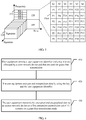
- FIG. 3 is a schematic diagram of a CTU resource definition according to an embodiment of the present invention.
- FIG. 3 shows four contention access regions (also referred to as CTU access regions) 310, 320, 330, and 340. Available bandwidth is divided into time-frequency regions of the four contention access regions.
- Each contention access region may occupy a preset quantity of resource blocks (Resource Block).
- the contention access region 310 includes four RBs: an RB 1, an RB 2, an RB 3, and an RB 4.
- This embodiment of the present invention is not limited thereto.
- different contention access regions may include different quantities of RBs.
- each contention access region can support 36 UEs contending for 36 CTUs defined in the contention access region.
- Each CTU is a combination of time, a frequency, a code resource or a signature, and a pilot.
- the code resource includes a CDMA code, an SCMA (Sparse Code Multiple Access) code, an LDS (Low Density Signature), another signature (signature), or the like.
- Each contention access region occupies one time-frequency resource region.
- Each time-frequency resource region supports six signatures (S1 to S6), and each signature is mapped to six pilots, thereby generating a total of 36 pilots (PI to P36).
- a network device may detect or decode, by using a pilot/signature decorrelator, a signal sent by each UE on a CTU.
- the UE can receive higher layer signaling sent by the network device.
- the higher layer signaling may carry a CTU access region definition (CTU access region definition), a total quantity of CTUs, a default mapping rule, and the like. Alternatively, the UE may preconfigure a default mapping rule.
- the UE may determine an appropriate CTU to perform grant-free transmission on the CTU. When different UEs perform grant-free transmission on a same CTU, that is, contend for a same CTU, a collision occurs.
- the UE may determine, according to an indication from the network device, whether a collision exists. For example, a problem resulting from a collision can be resolved by using an asynchronous HARQ method.
- the UE may request, to the network device, to remap data to a CTU.
- the network device sends information about a remapped-to CTU to the UE, so that the UE performs grant-free transmission on the remapped-to CTU.
- FIG. 3 shows four contention access regions. This embodiment of the present invention is not limited thereto. More or fewer contention access regions may be defined according to a need.
- FIG. 4 is a schematic flowchart of a grant-free transmission method according to an embodiment of the present invention.
- the method in FIG. 4 may be executed by the user equipment in FIG. 2 .
- An access network device in this embodiment may be the network device in FIG. 2 .
- the user equipment obtains a user equipment identifier and a key that are allocated by a core network device and that are used for grant-free transmission.
- the user equipment encrypts and encapsulates data by using the key and the user equipment identifier.
- the user equipment transmits the encrypted and encapsulated data to the access network device on a first contention transmission unit CTU resource in a grant-free transmission mode.
- the user equipment registers a grant-free transmission identity with the core network device by using the access network device, so that the core network device allocates, to the user equipment, the user equipment identifier and the encryption and decryption key that are specially used for grant-free transmission.
- the user equipment uses the key to encrypt the data, and uses the user equipment identifier to encapsulate the encrypted data.
- the user equipment may select a CTU from multiple CTUs to send the encrypted and encapsulated data.
- the core network device may be an independent physical device with an LDSF.
- the core network device may be a mobility management entity, and the mobility management entity includes an LDSF.
- the user equipment may transmit the data by using at least one contention transmission unit resource.
- a sequence of encryption and encapsulation is not limited in this embodiment of the present invention.
- the data may be first encrypted and then encapsulated with the user equipment identifier, or the data may be first encapsulated with the user equipment identifier and then encrypted.
- the user equipment may be user equipment that supports only grant-free transmission, or may be user equipment in which grant-based transmission and grant-free transmission are compatible.
- the user equipment may be user equipment in a connected state, or may be user equipment in an idle state. If grant-based transmission and grant-free transmission are compatible in the user equipment, this embodiment of the present invention may be executed if a condition for performing grant-free transmission is met (for example, if a preset condition is met or a switching instruction is received), or this embodiment of the present invention may be executed if the user equipment switches from the connected state to the idle state, or this embodiment of the present invention may be executed regardless of whether the user equipment is in the connected state or the idle state.
- user equipment obtains, from a core network device, a user equipment identifier and a key that are specially used for grant-free transmission, encrypts and encapsulates to-be-transmitted data by using the user equipment identifier and the key, and transmits the data on a CTU resource in a grant-free transmission mode. Because redundant additional information of a protocol stack is avoided, simple and effective communication is implemented. Moreover, using a dedicated user identifier and a dedicated key ensures data transmission security. Therefore, simple, effective, and secure communication is implemented in a grant-free transmission scenario.
- the user equipment sends a first request message to the core network device by using the access network device.
- the first request message is used to indicate that the user equipment supports grant-free transmission and to request the core network device to allocate, to the user equipment, the user equipment identifier and the key that are used for grant-free transmission.
- the user equipment receives, by using the access network device, a first response message sent by the core network device.
- the first response message carries the user equipment identifier and the key.
- the user equipment before performing grant-free transmission, the user equipment first sends a first request message to the core network device by using the access network device, to request to register an identity with the core network device.
- the core network device allocates, to the user equipment, a unique user equipment identifier and a unique encryption and decryption key that are specially used for grant-free transmission, and sends, to the user equipment by using the access network device, a first response message that carries the user equipment identifier and the key.
- the user equipment When performing grant-free transmission, the user equipment encrypts data by using the key, encapsulates the encrypted data by using the user equipment identifier that is specially used for grant-free transmission, and sends the encrypted and encapsulated data to the access network device on a CTU in a grant-free transmission mode.
- the access network device may perform blind detection on the data that is transmitted in a grant-free manner, and forwards the obtained data to the core network device.
- the core network device After receiving, according to the user equipment identifier, the data that is transmitted in a grant-free manner and that is sent by the user equipment by using the access network device, the core network device decrypts the data and distributes the decrypted data to a destination.
- first request message and the first response message may be newly added dedicated signaling messages, or may be message fields newly added to existing signaling messages.
- the first request message may be a/an non-access stratum/attach ((Non-Access Stratum, NAS)/Attach) request message.
- the non-access request message/attach request message in this embodiment of the present invention may include a register grant-free request (REGISTER_GF_REQ) field.
- the register grant-free request field is used to indicate that the user equipment supports grant-free transmission and to request the core network device to allocate, to the user equipment, the user equipment identifier and the key that are used for grant-free transmission.
- the core network device that receives the register grant-free request field knows that the user equipment supports a grant-free transmission function, and then allocates, to the user equipment, the user equipment grant-free identifier and the grant-free key that are required for grant-free transmission.
- the first response message may be a/an non-access/attach accept (NAS/Attach accept) message.
- the non-access accept message/attach accept message may include a register grant-free response (REGISTER_GF_RESP) field.
- the register grant-free response field carries the user equipment identifier and the key.
- the register grant-free request and the register grant-free response are implemented by using existing signaling, thereby reducing signaling overheads.
- the first request message may be a dedicated register grant-free request message
- the first response message may be a dedicated registration response message
- the user equipment may perform registration by using a dedicated register grant-free request message and a dedicated registration response message.
- step 430 the user equipment selects the first CTU resource from multiple contention transmission unit CTU resources, and maps the data to the first CTU resource for transmission.
- each contention transmission access region may include multiple CTUs.
- the UE may select at least one appropriate CTU according to a default mapping rule, to perform grant-free transmission on the CTU.
- the default mapping rule may be preset on the user equipment and the access network device, or may be informed by the access network device to the user equipment by using higher layer signaling.
- the method in FIG. 4 further includes: selecting, by the user equipment, a second CTU resource from the multiple CTU resources; and when the user equipment sends the first request message to the core network device by using the access network device, mapping, by the user equipment, the first request message to the second CTU resource to send the first request message to the access network device, so that the access network device sends the first request message to the core network device.
- the user equipment in an idle state, the user equipment does not establish an RRC connection to the access network device.
- the user equipment may transmit the first request message by using a CTU resource.
- the user equipment may select an appropriate CTU from multiple CTUs in an access region, to transmit the first request message.
- first CTU resource and the second CTU resource may be the same. This can simplify system design. Alternatively, the first CTU resource and the second CTU resource may be different, that is, a corresponding CTU may be selected according to an actual need of the first request message. This can improve resource utilization.
- the method in FIG. 4 further includes: receiving, by the user equipment, a system information block SIB message that is broadcast by the access network device, where the SIB message includes a public key generated by the core network device; encrypting, by the user equipment, the first request message by using the public key; and sending, by the user equipment, the encrypted first request message to the core network device by using the access network device.
- the core network device may generate a pair of the public key and a private key, and sends the public key to the access network device.
- the access network device broadcasts, over a broadcast channel, the SIB message to the user equipment within coverage of the access network device, where the SIB message carries the public key.
- the user equipment extracts the public key from the received SIB message, and encrypts the first request message by using the public key.
- the user equipment may select an appropriate CTU, and map the first request message encrypted in a grant-free manner to the selected CTU, to send the first request message to the access network device.
- the access network device performs blind detection, and sends the detected first request message to the core network device.
- the core network device decrypts the first request message by using the private key, performs authentication on the user equipment according to the decrypted first request message, and allocates, to the user equipment, the user identifier and the key that are specially used for grant-free transmission.
- the core network device encrypts, by using the private key, the first response message that includes the user equipment identifier and the key, and sends the encrypted first response message to the user equipment by using the access network device.
- the user equipment decrypts the first response message by using the public key, to obtain the user equipment identifier and the key that are allocated by the core network device and that are specially used for grant-free transmission.
- the access network device may send the first response message by using a broadcast message similar to an SIB message.
- the broadcast message may carry an identifier associated with a CTU that is used for sending the first request message, so that the user equipment can identify and receive the first response message.
- step 420 the user equipment encrypts and encapsulates the data at a transport adaptation layer of the user equipment by using the key and the user equipment identifier.
- the method in FIG. 4 further includes: receiving, by the user equipment, indication information of the multiple CTU resources that is sent by the access network device, where the indication information is used to indicate the CTU resources that can be used by the user equipment.
- the access network device may broadcast, over a broadcast channel, the indication information of the multiple CTU resources to the user equipment within coverage of the access network device.
- the user equipment may select at least one appropriate CTU resource from the multiple CTU resources according to a preset mapping rule, to perform grant-free transmission.
- the multiple CTU resources that can be used for the user equipment may be preset on the user equipment.
- FIG. 5 is a schematic flowchart of a grant-free transmission method according to another embodiment of the present invention.
- a core network device is an LDSF
- the method in FIG. 5 may be executed by the core network device (for example, the LDSF in FIG. 1 ).
- the embodiment in FIG. 5 corresponds to the embodiment in FIG. 4 . Some details are omitted herein as appropriate.
- An access network device in this embodiment is the network device in FIG. 2 .
- the core network device receives, from the access network device, data transmitted by user equipment on a first contention transmission unit in a grant-free transmission mode, where the data is encrypted and encapsulated by using a user equipment identifier and a key that are allocated by the core network device to the user equipment and that are used for grant-free transmission.
- the core network device decapsulates and decrypts the data according to the user equipment identifier and the key.
- the core network device sends the decapsulated and decrypted data to a destination address in the data.
- the core network device may allocate, to the user equipment according to a request that is sent by the user equipment by using the access network device, the user equipment identifier and the key that are specially used for grant-free transmission. After receiving the data of the user equipment forwarded by the access network device, the core network device decrypts the data by using the key, and then distributes the decrypted data to a destination (for example, an access network device corresponding to a destination address in the packet).
- the core network device may manage distribution of uplink data from multiple access network devices in a network, and the core network device establishes, with each access network device, a dedicated channel for an uplink packet that is transmitted in a grant-free manner.
- a core network device provides, for user equipment, a user equipment identifier and a key that are specially used for grant-free transmission, and decapsulates and decrypts received data by using the user equipment identifier and the key. Because redundant additional information of a protocol stack is avoided, simple and effective communication is implemented. Moreover, using a dedicated user identifier and a dedicated key ensures data transmission security. Therefore, simple, effective, and secure communication is implemented in a grant-free transmission scenario.
- the method in FIG. 5 further includes: receiving, by the core network device, a first request message from the user equipment by using the access network device, where the first request message is used to indicate that the user equipment supports grant-free transmission and to request the core network device to allocate, to the user equipment, the user equipment identifier and the key that are used for grant-free transmission; allocating, by the core network device to the user equipment, the user equipment identifier and the key that are used for grant-free transmission; and sending, by the core network device, a first response message to the user equipment by using the access network device, where the first response message carries the user equipment identifier and the key.
- the core network device when receiving the first request message sent by the access network device, the core network device interacts with an HSS or an HLR according to the user equipment identifier indicated by the first request message, to perform an identity authentication process and an authentication process on the user equipment. After identity authentication of the user equipment succeeds and it is confirmed that the user equipment has grant-free transmission permission, the core network device may allocate the user equipment grant-free identifier to the user equipment. Then, the core network device further performs a security process to allocate, to the user equipment, the grant-free key that is required for grant-free transmission and that is used for packet encryption and decryption.
- the foregoing identity authentication, authentication, and security processes are similar to conventional identity authentication, authentication, and security processes of user equipment, and details are not described herein.
- a difference from the conventional processes lies in that: a result of performing the foregoing processes is allocating, to the user equipment, the user equipment identifier and the key that are specially used for grant-free transmission.
- the method in FIG. 5 further includes: generating, by the core network device, a pair of a public key and a private key; sending, by the core network device, the public key to the user equipment by using the access network device; and decrypting, by the core network device by using the private key, the first request message that includes the public key.
- the public key is used to encrypt the first request message.
- the encrypted first request message can be decrypted only by the core network device by using the private key. This ensures that a register grant-free request message is not hijacked.
- the first request message may include a user equipment identifier (the identifier is a common user equipment identifier, distinguished from the user equipment identifier that is specially used for grant-free transmission).
- the user equipment identifier may be encrypted together with the first request message, so that the core network device can determine that the first request message is sent by user equipment that has the user equipment identifier.
- the first request message is a non-access stratum message/an attach message
- the non-access message/attach message includes a register grant-free request field
- the first response message is a non-access accept message/an attach accept message
- the non-access accept message/attach accept message includes a register grant-free response field.
- the first request message is a register grant-free request message
- the first response message is a registration response message
- the core network device decapsulates and decrypts the data at a transport adaptation layer of the core network device by using the user equipment identifier and the key.
- the core network device is an independent physical device with a low-delay service function, or the core network device is a mobility management entity, where the mobility management entity includes a low-delay service function entity.
- FIG. 6 is a schematic flowchart of a grant-free transmission method according to still another embodiment of the present invention.
- the method in FIG. 6 is executed by the access network device in FIG. 1 .
- the embodiment in FIG. 6 corresponds to the embodiment in FIG. 4 . Some details are omitted herein as appropriate. In this embodiment, descriptions are provided by using an example in which an access network device is the access network device in FIG.1 .
- the access network device receives a first request message from user equipment, where the first request message is used to indicate that the user equipment supports grant-free transmission and to request a core network device to allocate, to the user equipment, a user equipment identifier and a key that are used for grant-free transmission.
- the access network device sends the first request message to the core network device.
- the access network device receives a first response message sent by the core network device, where the first response message carries the user equipment identifier and the key.
- the access network device sends the first response message to the user equipment, so that the user equipment encrypts and encapsulates data by using the key and the user equipment identifier.
- the access network device receives the data that is transmitted by the user equipment to the access network device on a first contention transmission unit CTU resource in a grant-free transmission mode.
- the access network device sends the data to the core network device.
- an access network device provides, for user equipment, a user equipment identifier and a key that are allocated by a core network device and that are specially used for grant-free transmission, receives data that is transmitted by the user equipment on a CTU resource in a grant-free transmission mode, and forwards the data to the core network device. Because redundant additional information of a protocol stack is avoided, simple and effective communication is implemented. Moreover, using a dedicated user identifier and a dedicated key ensures data transmission security. Therefore, simple, effective, and secure communication is implemented in a grant-free transmission scenario.
- the access network device receives the first request message that is transmitted by the user equipment on a second CTU resource in multiple CTU resources.
- the multiple CTU resources include the first CTU and the second CTU.
- the method in FIG. 6 further includes: receiving, by the access network device, a public key from the core network device, and broadcasting, by the access network device, the public key in a system information block SIB message.
- the access network device receives the first request message encrypted by the user equipment by using the public key, and sends the encrypted first request message to the core network device.
- the access network device receives the first response message encrypted by the core network device by using a private key.
- the method in FIG. 6 further includes: sending, by the access network device, indication information of the multiple CTU resources to the user equipment.
- the first request message is a non-access stratum message/an attach message
- the non-access message/attach message includes a register grant-free request field
- the first response message is a non-access accept message/an attach accept message
- the non-access accept message/attach accept message includes a register grant-free response field.
- the first request message is a register grant-free request message
- the first response message is a registration response message
- the core network device is an independent physical device with a low-delay service function, or the core network device is a mobility management entity, where the mobility management entity includes a low-delay service function entity.
- FIG. 9 is a schematic diagram of a signaling flow used for grant-free transmission according to another embodiment of the present invention.
- the following signaling process is executed in both the embodiments in FIG. 7 and FIG. 8 : UE sends a register grant-free request (REGISTER_GF_REQ) to an LDSF, and the LDSF sends a register grant-free response (REGISTER_GF_RESP) to the UE, so that the LDSF allocates, to the user equipment, a user equipment identifier and a key that are used for grant-free transmission.
- REGISTER_GF_REQ register grant-free request
- REGISTER_GF_RESP register grant-free response
- FIG. 7 is a schematic flowchart based on a grant-free transmission process according to another embodiment of the present invention.
- the process in FIG. 7 is an example of the methods in FIG. 4 , FIG. 5 , and FIG. 6 . Some details are omitted herein as appropriate.
- descriptions are provided by using an example in which an access network device is an eNB.
- the eNB represents a control base station of a cell that UE currently serves.
- the present invention is not limited to a specific standard represented by the term, but may be similarly applied to base stations of other standards.
- the user equipment supports both conventional grant-based transmission and grant-free transmission. That is, grant-based transmission and grant-free transmission are compatible in the user equipment, and therefore, transition from grant-based transmission to grant-free transmission can be provided. For example, generally, when the user equipment performs grant-based transmission, when a condition for grant-free transmission is met (for example, a preset condition is met or a switching instruction is received), the user equipment switches from grant-based transmission to grant-free transmission.
- a condition for grant-free transmission for example, a preset condition is met or a switching instruction is received
- user equipment supporting a grant-free transmission function may establish a connection to an LDSF by means of a process of requesting to register for grant-free transmission.
- the LDSF may allocate, to the user equipment, a user equipment grant-free identifier (UE_GF_ID) and a grant-free key (GF_KEY) that are used for grant-free transmission.
- UE_GF_ID user equipment grant-free identifier
- GF_KEY grant-free key
- steps 710 and 720 a random access process and an RRC connection process are performed between the user equipment and the eNB.
- the user equipment Upon joining a network, the user equipment performs the random access process and the RRC connection process to establish a connection to the network. After completing RRC connection, the user equipment enters a connected state.
- the foregoing processes are similar to conventional random access and RRC connection processes, and details are not described herein.
- the user equipment sends a register grant-free request (REGISTER_GF_REQ) message to the eNB, to request to register for grant-free transmission, that is, to request, by using the eNB, the LDSF to allocate, to the user equipment, the user equipment grant-free identifier and the grant-free key that are required for grant-free transmission.
- REGISTER_GF_REQ register grant-free request
- the LDSF When the LDSF provides a registration function for the user equipment, the LDSF may be an independent physical device, or may be a function entity in a mobility management entity (MME).
- MME mobility management entity
- the register grant-free request message may be a newly added dedicated signaling message, or may be a message field newly added to an existing signaling message.
- the register grant-free request message may be a separate signaling message or may be a field that is newly added to a non-access stratum request message/an attach request message, and is used to indicate that the user equipment supports a grant-free transmission function and to request identity information registration for grant-free transmission.
- a register grant-free request (REGISTER_GF_REQ) field may be added to an existing non-access stratum request message/attach request message, so that the LDSF receiving the non-access stratum request message/attach request message knows that the user equipment supports a grant-free transmission function, and therefore allocates, to the user equipment, the user equipment grant-free identifier and the grant-free key that are required for grant-free transmission.
- REGISTER_GF_REQ register grant-free request
- the user equipment may send the register grant-free request message to the LDSF by using an air interface. Because the LDSF needs to identify different user equipments, the user equipment may add a user equipment ID (UEID) to the register grant-free request message.
- UEID user equipment ID
- the UEID may be an international mobile subscriber identity (IMSI), an international mobile equipment identity (IMEI), or the like.
- the LDSF may directly obtain the UEID from the register grant-free request message. If the register grant-free request message is a REGISTER_GF_REQ message field in a non-access stratum request message/an attach request message, the UEID does not need to be carried in the REGISTER_GF_REQ message field; the LDSF may indirectly obtain the UEID from another message field in the non-access stratum request message/attach request message.
- the eNB forwards the register grant-free request message to the LDSF.
- the user equipment may send the register grant-free request message to the LDSF by using an air interface. That is, the user equipment first sends the register grant-free request message to the eNB, and then, the eNB forwards the register grant-free request message to the LDSF over a channel between the eNB and the LDSF.
- the channel between the eNB and the LDSF may be established when the eNB is started, and is similar to an S1 interface between the eNB and an MME. Because the LDSF needs to identify different user equipments, alternatively, the eNB may add the UEID to the register grant-free request message, and the user equipment does not need to add the UEID to the register grant-free request message when sending the register grant-free request.
- the register grant-free request message sent by the user equipment to the eNB may directly carry the UEID.
- the eNB transparently transmits the register grant-free request message to the LDSF.
- the LDSF performs authentication (Authority), authentication (Authentication), and security (Security) processes with an HLR/HSS.
- the LDSF When receiving the register grant-free request message forwarded by the eNB, the LDSF performs the identity authentication and authentication processes on the user equipment according to the UEID indicated by the register grant-free request message. After identity authentication of the user equipment succeeds and it is confirmed that the user equipment has grant-free transmission permission, the LDSF allocates the user equipment grant-free identifier (UE_GF_ID) to the user equipment. Then, the LDSF further performs the security process to allocate, to the user equipment, the grant-free key (GF_KEY) that is required for grant-free transmission and that is used for data encryption and decryption.
- UE_GF_ID user equipment grant-free identifier
- the LDSF further performs the security process to allocate, to the user equipment, the grant-free key (GF_KEY) that is required for grant-free transmission and that is used for data encryption and decryption.
- GF_KEY grant-free key
- the identity authentication, authentication, and security processes may be triggered by the non-access stratum request message/attach request message.
- the LDSF when receiving the non-access stratum request message/attach request message, the LDSF performs the identity authentication process according to the UEID.
- the authentication process is performed to determine whether the user equipment has the grant-free transmission permission.
- the security process is performed to obtain the grant-free key that is required for grant-free transmission and that is used for encryption and decryption, and to allocate the user equipment grant-free identifier to the user equipment.
- the LDSF needs to perform identity authentication on the user equipment by means of the identity authentication process, and determine, by means of the authentication process, whether the user equipment has the grant-free transmission permission. If the user equipment has the grant-free transmission permission, the LDSF performs the security process to obtain the grant-free key that is required for grant-free transmission and that is used for encryption and decryption, and to allocate the user equipment grant-free identifier to the user equipment.
- the LDSF sends a register grant-free response message (REGISTER_GF_RESP) to the eNB.
- REGISTER_GF_RESP a register grant-free response message
- the LDSF adds, to the register grant-free response message, the user equipment grant-free identifier (UE_GF_ID) and the grant-free key (GF_KEY) that are allocated to the user equipment.
- the register grant-free response message may be a newly added dedicated signaling message, or may be a REGISTER_GF_RESP message field newly added to an existing signaling message.
- the register grant-free response message may be a field newly added to a non-access stratum accept message/an attach accept message.
- the REGISTER_GF_RESP is similar to the REGISTER_GF_REQ.
- the REGISTER_GF_REQ is a message field in a non-access stratum request message/an attach request message
- the REGISTER_GF_RESP is a message field in a non-access stratum accept message/an attach accept message and carries parameters about the user equipment grant-free identifier and the grant-free key.
- the foregoing identity authentication, authentication, and security processes are similar to conventional identity authentication, authentication, and security processes of user equipment, and details are not described herein.
- a difference from the conventional processes lies in that: a result of performing the foregoing processes is allocating, to the user equipment, the user equipment grant-free identifier and the grant-free key that are specially used for grant-free transmission.
- the eNB forwards the register grant-free response message to the user equipment.
- the eNB forwards, to the user equipment, the register grant-free response message received from the LDSF.
- the eNB may remove the UEID from the register grant-free response message, to save air-interface resources, or may transparently transmit the registration response message directly, to reduce impact on the eNB.
- the eNB informs the user equipment of a CTU resource used for grant-free transmission.
- the eNB may periodically broadcast, over a broadcast channel, the CTU resource used for grant-free transmission.
- the eNB may broadcast multiple CTU resources once, to form a CTU resource set.
- These CTU resources may be distributed in one radio frame.
- One radio frame may include multiple transmission timeslots, and occupies specific frequency domain resources.
- One CTU resource is a part of a time-frequency resource in one transmission timeslot. Different CTU resources are not completely the same in respect of time-frequency resources, codebooks, pilots, and the like.
- the user equipment may randomly select a CTU resource or may select a CTU resource according to a preset rule, and transmit an uplink packet by using a time-frequency resource, a code resource, a pilot, and other transmission parameters specified by the CTU resource. When multiple user equipments simultaneously select a same CTU resource for uplink transmission, a transmission relationship based on contention for the resource is formed.
- this embodiment of the present invention does not limit a sequence in which the eNB informs the user equipment of the CTU resource.
- the eNB may inform the user equipment of the CTU resource at any time point before the user equipment transmits an uplink packet that is to be transmitted in a grant-free manner.
- the user equipment encrypts and encapsulates an uplink packet that is to be transmitted in a grant-free manner.
- the user equipment may extract the grant-free key and the user equipment identifier from the received register grant-free response message, and encrypt and encapsulate, by using the grant-free key and the user equipment identifier, the uplink packet that is to be transmitted in a grant-free manner.
- the user equipment when the user equipment needs to transmit an uplink packet, the user equipment first determines whether to perform transmission in a grant-free transmission mode, and when a condition for grant-free transmission is met, determines to perform transmission in the grant-free transmission mode.
- the user equipment needs to perform grant-free transmission, the user equipment needs to encrypt a packet by using the grant-free key and encapsulate the encrypted packet with the user equipment grant-free identifier.
- the user equipment sends, to the eNB, the uplink packet that is to be transmitted in a grant-free manner.
- the user equipment may randomly select one CTU resource or one group of CTU resources from multiple CTU resource sets broadcast by the eNB, and then determine a time-frequency resource, a codebook, and a pilot in each CTU resource.
- the user equipment encodes the packet by using a codebook and a pilot corresponding to the selected CTU, and maps an encoded packet to a time-frequency resource corresponding to the CTU, to transmit the packet.
- the eNB sends, to the LDSF, the uplink packet that is transmitted in a grant-free manner.
- the eNB performs, on a CTU resource, blind detection on the uplink packet that is transmitted in a grant-free manner, and forwards, to the LDSF, the received uplink packet that is transmitted in a grant-free manner.
- the LDSF decrypts the uplink packet that is transmitted in a grant-free manner, and distributes the decrypted uplink packet to a destination address of the uplink packet.
- the LDSF decrypts the packet by using the grant-free key of the user equipment, and then distributes the decrypted packet to a destination (for example, an access network device corresponding to a destination address in the packet).
- a destination for example, an access network device corresponding to a destination address in the packet.
- the LDSF may be an independent physical device, or may be an entity function of an S-GW or a P-GW.
- the LDSF manages distribution of uplink packets that are transmitted in a grant-free manner and that are from multiple eNBs in a network.
- the LDSF establishes, with each eNB, a dedicated transmission channel for an uplink packet that is transmitted in a grant-free manner. All uplink packets of user equipment, that are transmitted in a grant-free manner, in the eNB are transmitted over the transmission channel. After receiving the uplink packet that is transmitted by the user equipment in a grant-free manner and that is forwarded by the base station, the LDSF decrypts the packet by using the grant-free key of the user equipment, and then distributes the decrypted packet to the destination (for example, an access network device corresponding to a destination address in the packet).
- the destination for example, an access network device corresponding to a destination address in the packet.
- FIG. 8 is a schematic flowchart based on a grant-free transmission process according to another embodiment of the present invention.
- the process in FIG. 8 is an example of the methods in FIG. 3, FIG. 4 , and FIG. 5 . Some details are omitted herein as appropriate.
- descriptions are provided by using an example in which an access network device is an eNB.
- the eNB represents a control base station of a cell that UE currently serves.
- the present invention is not limited to a specific standard represented by the term, but may be similarly applied to base stations in other forms.
- the user equipment In this embodiment, how to implement grant-free transmission when user equipment is in an idle state or does not establish an RRC connection to a network side is described.
- the user equipment In the idle state, the user equipment supports only grant-free transmission and does not support grant-based transmission.
- the user equipment may be a machine type communication (MTC) device that has very high requirements on a transmission delay, reliability, power consumption, and the like and that has a low requirement on a transmission rate.
- MTC machine type communication
- the user equipment When transmitting a packet, the user equipment does not need to establish a connection to a network in advance, and does not require that the network allocate, to the user equipment, a dedicated time-frequency resource required for transmission. All packets or messages are transmitted in a grant-free transmission mode.
- the user equipment may establish a connection to an LDSF by means of a process of requesting to register for grant-free transmission.
- the LDSF may allocate, to the user equipment, a user equipment grant-free identifier (UE_GF_ID) and a grant-free key (GF_KEY) that are used for grant-free transmission.
- UE_GF_ID user equipment grant-free identifier
- GF_KEY grant-free key
- the eNB informs the user equipment of a grant-free CTU resource.
- the eNB may periodically broadcast, over a broadcast channel, the CTU resource used for grant-free transmission.
- the eNB may broadcast multiple CTU resources once, to form a CTU resource set.
- These CTU resources may be distributed in one radio frame.
- One radio frame may include multiple transmission timeslots, and occupies specific frequency domain resources.
- One CTU resource is a part of a time-frequency resource in one transmission timeslot. Different CTU resources are not completely the same in respect of time-frequency resources, codebooks, pilots, and the like.
- the user equipment may randomly select a CTU resource or may select a CTU resource according to a preset rule, and transmit an uplink packet by using a time-frequency resource, a code resource, a pilot, and other transmission parameters specified by the CTU resource. When multiple user equipments simultaneously select a same CTU resource for uplink transmission, a transmission relationship based on contention for the resource is formed.
- this embodiment of the present invention does not limit a sequence in which the eNB informs the user equipment of the CTU resource.
- the eNB may inform the user equipment of the CTU resource at any time point before the user equipment transmits an uplink packet.
- the LDSF sends a grant-free register public key (GF_REG_PUB_KEY) to the eNB.
- G_REG_PUB_KEY grant-free register public key
- the LDSF may generate a key pair including a pair of the public key and a private key, and send the public key to all eNBs that are within control.
- the public key is used to encrypt information, and is used to decrypt information encrypted by using the private key.
- the private key is used to encrypt information, and is used to decrypt information encrypted by using the public key.
- the eNB broadcasts, in a cell to which the eNB belongs, the grant-free register public key (GF_REG_PUB_KEY) to the user equipment, so that the user equipment encrypts, by using the GF_REG_PUB_KEY, a packet that needs to be transmitted, so as to ensure that the packet is not hijacked during a transmission process.
- the base station may broadcast the GFREG PUBKEY to the user equipment by using a system information block (System information block, SIB) message.
- SIB system information block
- this embodiment of the present invention does not limit a sequence in which the eNB obtains the public key and informs the user equipment of the public key.
- the eNB may inform the user equipment of the public key at any time point before the user equipment sends a register grant-free request.
- the user equipment sends a register grant-free request (REGISTER_GF_REQ) message to the eNB, to request to register for grant-free transmission, that is, to request, by using the eNB, the LDSF to allocate, to the user equipment, a user equipment grant-free identifier and a grant-free key that are required for grant-free transmission.
- REGISTER_GF_REQ register grant-free request
- the LDSF may be an independent physical device, or may be a function entity in a mobility management entity (MME).
- MME mobility management entity
- the register grant-free request message may be a newly added dedicated signaling message, or may be a REGISTER_GF_REQ message field newly added to an existing signaling message.
- the user equipment may transmit the register grant-free request message on the CTU resource.
- the user equipment may encrypt the register grant-free request message by using the public key.
- the user equipment may send the register grant-free request message to the LDSF by using an air interface. Because the LDSF needs to identify different user equipments, the user equipment may add a user equipment ID (UEID) to the register grant-free request message.
- UEID user equipment ID
- step 820 and step 830 are optional.
- the register grant-free request message may be directly sent on the CTU resource without being encrypted.
- the eNB sends the register grant-free request message to the LDSF.
- the eNB performs blind detection on the register grant-free request message on a CTU resource, and sends, to the LDSF, the register grant-free request message that is obtained through blind detection.
- the eNB forwards the register grant-free request message to the LDSF over a channel between the eNB and the LDSF.
- the channel between the eNB and the LDSF may be established when the eNB is started, and is similar to an S1 interface between the eNB and an MME.
- the LDSF performs authentication (Authority), authentication (Authentication), and security (Security) processes with an HLR/HSS.
- the register grant-free request message encrypted by using the public key can be decrypted only by the LDSF by using the private key. This ensures that the register grant-free request message is not hijacked.
- the register grant-free request message includes the UEID.
- the UEID is also encrypted together with the register grant-free request message. Therefore, the LDSF can also determine that the register grant-free request message is sent by the user equipment that has the UEID.
- the LDSF When receiving the register grant-free request message sent by the eNB, the LDSF interacts with the HSS or the HLR according to the UEID indicated by the register grant-free request message, to perform the identity authentication process and the authentication process on the user equipment. After identity authentication of the user equipment succeeds and it is confirmed that the user equipment has grant-free transmission permission, the LDSF allocates the user equipment grant-free identifier to the user equipment. Then, the LDSF further needs to perform the security process to allocate, to the user equipment, the grant-free key that is required for grant-free transmission and that is used for packet encryption and decryption.
- the LDSF needs to perform identity authentication on the user equipment by means of the authentication process, and determine, by means of the authentication process, whether the user equipment has the grant-free transmission permission. If the user equipment has the grant-free transmission permission, the LDSF performs the security process to obtain the grant-free key that is required for grant-free transmission and that is used for encryption and decryption, and to allocate the user equipment grant-free identifier to the user equipment.
- the LDSF sends a register grant-free response message to the eNB.
- the LDSF adds, to the register grant-free response message, the user equipment grant-free identifier (UE_GF_ID) and the grant-free key (GF_KEY) that are allocated to the user equipment.
- the register grant-free response message may be a newly added dedicated signaling message, or may be a REGISTER_GF_RESP message field newly added to an existing signaling message.
- the foregoing identity authentication, authentication, and security processes are similar to conventional identity authentication, authentication, and security processes of user equipment, and details are not described herein.
- a difference from the conventional processes lies in that: a result of performing the foregoing processes is allocating, to the user equipment, the user equipment grant-free identifier and the grant-free key that are specially used for grant-free transmission.
- the eNB forwards the register grant-free response message to the user equipment.
- the eNB forwards, to the user equipment, the register grant-free response message received from the LDSF.
- the eNB may remove the UEID from the register grant-free response message, to save air-interface resources, or may transparently transmit the registration response message directly, to reduce impact on the eNB.
- the terminal may receive, by means of blind detection, the register grant-free response message sent by the eNB.
- the user equipment encrypts and encapsulates an uplink packet that is to be transmitted in a grant-free manner.
- the user equipment may extract the grant-free key and the user equipment identifier from the received register grant-free response message, and encrypt and encapsulate, by using the grant-free key and the user equipment identifier, the uplink packet that is to be transmitted in a grant-free manner.
- the user equipment when the user equipment needs to transmit an uplink packet, the user equipment first determines whether to perform transmission in a grant-free transmission mode, and when a condition for grant-free transmission is met, determines to perform transmission in the grant-free transmission mode.
- the user equipment needs to perform grant-free transmission, the user equipment needs to encrypt a packet by using the grant-free key and encapsulate the encrypted packet with the user equipment grant-free identifier.
- the LDSF may encrypt the register grant-free response message by using the private key in the key pair.
- the user equipment may decrypt the register grant-free response message by using the corresponding public key. In this way, the user equipment can ensure that the register grant-free response message is sent by the LDSF generating the public key rather than by another device that cannot be trusted. This ensures that the user equipment grant-free identifier and the grant-free key that are obtained by using the register grant-free response message can be trusted, thereby ensuring subsequent secure grant-free transmission performed by using the user equipment grant-free identifier and the grant-free key.
- the user equipment sends, to the eNodeB, the uplink packet that is to be transmitted in a grant-free manner.
- the user equipment may randomly select one CTU resource or one group of CTU resources from multiple CTU resource sets broadcast by the eNB, and then determine a time-frequency resource, a codebook, and a pilot in each CTU resource.
- the user equipment encodes the packet by using a codebook and a pilot corresponding to the selected CTU, and maps an encoded packet to a time-frequency resource corresponding to the CTU, to transmit the packet.
- the eNB forwards, to the LDSF, the uplink packet that is transmitted in a grant-free manner.
- the eNB performs, on a CTU resource, blind detection on the uplink packet that is transmitted in a grant-free manner, and sends, to the LDSF, the received uplink packet that is transmitted in a grant-free manner.
- the LDSF decrypts the uplink packet that is transmitted in a grant-free manner, and distributes the decrypted uplink packet to a destination address of the uplink packet.
- the LDSF decrypts the packet by using the grant-free key of the user equipment, and then distributes the decrypted packet to a destination (for example, an access network device corresponding to a destination address in the packet).
- a destination for example, an access network device corresponding to a destination address in the packet.
- the LDSF may be an independent physical device, or may be an entity function of S-GW or P-GW user equipment.
- the LDSF may manage distribution of uplink packets that are transmitted in a grant-free manner and that are from multiple eNBs in a network.
- the LDSF establishes, with each eNB, a dedicated channel for an uplink packet that is transmitted in a grant-free manner. All packets that are transmitted by user equipment in a grant-free manner and that are in the eNB are transmitted over the channel. After receiving the uplink packet that is transmitted by the user equipment in a grant-free manner and that is forwarded by the base station, the LDSF decrypts the packet by using the grant-free key of the user equipment, and then distributes the decrypted packet to the destination (for example, an access network device corresponding to a destination address in the packet).
- the destination for example, an access network device corresponding to a destination address in the packet.
- FIG. 10 is a schematic diagram of a protocol stack used for grant-free transmission according to an embodiment of the present invention.
- a difference from a conventional protocol stack lies in that, a transport adaptation layer and a physical layer in this embodiment of the present invention are used for grant-free transmission.
- a transport adaptation layer and a physical layer in this embodiment of the present invention are used for grant-free transmission.
- FIG. 10 protocol stacks, of user equipment, an eNB, and an LDSF, used for grant-free transmission are described in detail.
- the user equipment is an initial node of grant-free packet transmission.
- the protocol stack, of the user equipment, used for grant-free transmission includes an application layer, a TCP layer/an IP layer, a grant-free transport adaptation layer, and a grant-free physical layer.
- Functions implemented at the grant-free transport adaptation layer include: When an uplink packet that is to be transmitted in a grant-free manner is being sent, the packet can be encrypted by using a GF_KEY, and the encrypted packet can be encapsulated with a UE_GF_ID.
- Functions implemented at the grant-free physical layer include: One CTU resource or one group of CTU resources is randomly selected from a CTU resource set that is broadcast by the eNB, and then, a codebook and a pilot in each CTU is determined; a data packet is encoded by using the determined resources and parameters, so that a generated code stream is suitable for transmission on the CTU; the generated code stream is sent in a CTU-specific manner.
- the eNB implements relay forwarding of a packet that is transmitted in a grant-free manner. Reception and decoding of the packet that is transmitted in a grant-free manner are implemented at an air-interface physical layer of the eNB. Then, the packet is sent over a transmission channel, for a packet that is transmitted in a grant-free manner, between the eNB and the LDSF.
- the transmission channel, for a packet that is transmitted in a grant-free manner, between the eNB and the LDSF is based on an Ethernet protocol.
- a tunneling technology is generally used between the Ethernet and the grant-free transport adaptation layer, to implement transparent transmission of a packet that is transmitted in a grant-free manner.
- the LDSF After receiving the packet that is transmitted in a grant-free manner, the LDSF processes, at the grant-free transport adaptation layer, the packet that is transmitted in a grant-free manner, and determines an identity of the user equipment according to the UE_GF_ID in the packet that is transmitted in a grant-free manner, that is, determines whether the user equipment that sends the packet is user equipment that has registered for grant-free transmission. If yes, the LDSF decrypts the packet by using the GF_KEY and distributes the successfully decrypted packet to a destination address of the packet.
- the LDSF may be a control point of grant-free transmission, and further needs to perform another function when sending and receiving packets, for example, to count received and sent packets that are transmitted in a grant-free manner, to facilitate charging.
- FIG. 11 is a schematic structural diagram of user equipment 1100 according to an embodiment of the present invention.
- the user equipment 1100 includes an obtaining module 1110, an encryption module 1120, an encapsulation module 1130, and a sending module 1140.
- the obtaining module 1110 is configured to obtain a user equipment identifier and a key that are allocated by a core network device and that are used for grant-free transmission.
- the encryption module 1120 is configured to encrypt data by using the key.
- the encapsulation module 1130 is configured to encapsulate the data by using the user equipment identifier.
- the sending module 1140 is configured to transmit the encrypted and encapsulated data to an access network device on a first contention transmission unit CTU resource in a grant-free transmission mode.
- user equipment obtains, from a core network device, a user equipment identifier and a key that are specially used for grant-free transmission, encrypts and encapsulates to-be-transmitted data by using the user equipment identifier and the key, and transmits the data on a CTU resource in a grant-free transmission mode. Because redundant additional information of a protocol stack is avoided, simple and effective communication is implemented. Moreover, using a dedicated user identifier and a dedicated key ensures data transmission security. Therefore, simple, effective, and secure communication is implemented in a grant-free transmission scenario.
- the obtaining module 1110 sends a first request message to the core network device by using the access network device.
- the first request message is used to indicate that the user equipment supports grant-free transmission and to request the core network device to allocate, to the user equipment, the user equipment identifier and the key that are used for grant-free transmission.
- the obtaining module 1110 receives, by using the access network device, a first response message sent by the core network device.
- the first response message carries the user equipment identifier and the key.
- the sending module 1140 selects the first CTU resource from multiple contention transmission unit CTU resources, and maps the encrypted and encapsulated data to the first CTU resource for transmission.
- the sending module 1140 further selects a second CTU resource from the multiple CTU resources, and maps the first request message to the second CTU resource to send the first request message to the access network device, so that the access network device sends the first request message to the core network device.
- the obtaining module 1110 before the user equipment sends the first request message to the core network device by using the access network device, the obtaining module 1110 further receives a system information block SIB message that is broadcast by the access network device, where the SIB message includes a public key generated by the core network device; the encryption module 1120 encrypts the first request message by using the public key; and the sending module 1140 sends the encrypted first request message to the core network device by using the access network device.
- SIB message includes a public key generated by the core network device
- the encryption module 1120 encrypts the first request message by using the public key
- the sending module 1140 sends the encrypted first request message to the core network device by using the access network device.
- the first request message is a non-access stratum message/an attach message
- the non-access message/attach message includes a register grant-free request field
- the first response message is a non-access accept message/an attach accept message
- the non-access accept message/attach accept message includes a register grant-free response field
- the first request message is a register grant-free request message
- the first response message is a registration response message.
- the obtaining module 1110 further receives indication information of the multiple CTU resources that is sent by the access network device.
- the encryption module 1120 encrypts the data at a transport adaptation layer of the user equipment by using the key
- the encapsulation module 1130 encapsulates the data at the transport adaptation layer of the user equipment by using the user equipment identifier.
- the core network device is an independent physical device with a low-delay service function, or the core network device is a mobility management entity, where the mobility management entity includes a low-delay service function entity.
- FIG. 12 is a schematic structural diagram of a core network device 1200 according to an embodiment of the present invention.
- the core network device 1200 includes a receiving module 1210, a decapsulation module 1220, a decryption module 1230, and a sending module 1240.
- the receiving module 1210 is configured to receive, from an access network device, data transmitted by user equipment on a first contention transmission unit in a grant-free transmission mode, where the data is encrypted and encapsulated by using a key and a user equipment identifier that are allocated by the core network device to the user equipment and that are used for grant-free transmission.
- the decapsulation module 1220 is configured to decapsulate the data according to the user equipment identifier.
- the decryption module 1230 is configured to decrypt the data according to the key.
- the sending module 1240 is configured to send the decrypted data to a destination address in the data.
- a core network device provides, for user equipment, a user equipment identifier and a key that are specially used for grant-free transmission, and decapsulates and decrypts received data by using the user equipment identifier and the key. Because redundant additional information of a protocol stack is avoided, simple and effective communication is implemented. Moreover, using a dedicated user identifier and a dedicated key ensures data transmission security. Therefore, simple, effective, and secure communication is implemented in a grant-free transmission scenario.
- the core network device further includes an allocation module 1250; the receiving module 1210 further receives a first request message from the user equipment by using the access network device, where the first request message is used to indicate that the user equipment supports grant-free transmission and to request the core network device to allocate, to the user equipment, the user equipment identifier and the key that are used for grant-free transmission; the allocation module 1250 allocates, to the user equipment, the user equipment identifier and the key that are used for grant-free transmission; the sending module 1240 further sends a first response message to the user equipment by using the access network device, where the first response message carries the user equipment identifier and the key.
- the core network device 1200 further includes a generation module 1260; the generation module 1260 generates a pair of a public key and a private key; the sending module 1240 further sends the public key to the user equipment by using the access network device; the decryption module 1230 further decrypts, by using the private key, the first request message that includes the public key.
- the first request message is a non-access stratum message/an attach message
- the non-access message/attach message includes a register grant-free request field
- the first response message is a non-access accept message/an attach accept message
- the non-access accept message/attach accept message includes a register grant-free response field
- the first request message is a register grant-free request message
- the first response message is a registration response message.
- the decapsulation module 1220 decapsulates the data at an adaptation layer of the core network device by using the user equipment identifier and the key, and the decryption module 1230 decrypts the data at the adaptation layer of the core network device by using the key.
- the core network device is an independent physical device with a low-delay service function, or the core network device is a mobility management entity, where the mobility management entity includes a low-delay service function entity.
- FIG. 13 is a schematic structural diagram of an access network device 1300 according to an embodiment of the present invention.
- the access network device 1300 includes a receiving module 1310 and a sending module 1320.
- the receiving module 1310 is configured to receive a first request message from user equipment.
- the first request message is used to indicate that the user equipment supports grant-free transmission and to request a core network device to allocate, to the user equipment, a user equipment identifier and a key that are used for grant-free transmission.
- the sending module 1320 is configured to send the first request message to the core network device.
- the receiving module 1310 further receives a first response message sent by the core network device.
- the first response message carries the user equipment identifier and the key.
- the sending module 1320 further sends the first response message to the user equipment, so that the user equipment encrypts and encapsulates data by using the key and the user equipment identifier.
- the receiving module 1310 further receives the data that is transmitted by the user equipment on a first contention transmission unit CTU resource in a grant-free transmission mode.
- the sending module 1320 further sends the data to the core network device.
- an access network device provides, for user equipment, a user equipment identifier and a key that are allocated by a core network device and that are specially used for grant-free transmission, receives data that is transmitted by the user equipment on a CTU resource in a grant-free transmission mode, and forwards the data to the core network device. Because redundant additional information of a protocol stack is avoided, simple and effective communication is implemented. Moreover, using a dedicated user identifier and a dedicated key ensures data transmission security. Therefore, simple, effective, and secure communication is implemented in a grant-free transmission scenario.
- the receiving module 1310 further receives the first request message that is transmitted by the user equipment on a second CTU resource in multiple CTU resources.
- the receiving module 1310 further receives a public key from the core network device.
- the sending module 1320 further broadcasts the public key in a system information block SIB message.
- the receiving module 1310 receives the first request message that is encrypted by the user equipment by using the public key, and sends the encrypted first request message to the core network device.
- the receiving module 1310 receives the first response message that is encrypted by the core network device by using a private key.
- the sending module 1320 further sends indication information of the multiple CTU resources to the user equipment.
- the first request message is a non-access stratum message/an attach message
- the non-access message/attach message includes a register grant-free request field
- the first response message is a non-access accept message/an attach accept message
- the non-access accept message/attach accept message includes a register grant-free response field
- the first request message is a register grant-free request message
- the first response message is a registration response message.
- the core network device is an independent physical device with a low-delay service function, or the core network device is a mobility management entity, where the mobility management entity includes a low-delay service function entity.
- FIG. 14 is a schematic structural diagram of user equipment 1400 according to another embodiment of the present invention.
- the user equipment 1400 includes a processor 1410, a transceiver 1420, a memory 1430, and a bus 1440.
- the processor 1410 is configured to invoke, by using the bus 1440, code stored in the memory 1430, so as to obtain a user equipment identifier and a key that are allocated by a core network device and that are used for grant-free transmission, encrypt data by using the key, and encapsulate the data by using the user equipment identifier.
- the transceiver 1420 is configured to transmit the encrypted and encapsulated data to an access network device on a first contention transmission unit CTU resource in a grant-free transmission mode.
- user equipment obtains, from a core network device, a user equipment identifier and a key that are specially used for grant-free transmission, encrypts and encapsulates to-be-transmitted data by using the user equipment identifier and the key, and transmits the data on a CTU resource in a grant-free transmission mode. Because redundant additional information of a protocol stack is avoided, simple and effective communication is implemented. Moreover, using a dedicated user identifier and a dedicated key ensures data transmission security. Therefore, simple, effective, and secure communication is implemented in a grant-free transmission scenario.
- the processor 1410 controls the transceiver 1420 to send a first request message to the core network device by using the access network device.
- the first request message is used to indicate that the user equipment supports grant-free transmission and to request the core network device to allocate, to the user equipment, the user equipment identifier and the key that are used for grant-free transmission.
- the processor 1410 controls the transceiver 1420 to receive, by using the access network device, a first response message sent by the core network device.
- the first response message carries the user equipment identifier and the key.
- the transceiver 1420 selects the first CTU resource from multiple contention transmission unit CTU resources, and maps the encrypted and encapsulated data to the first CTU resource for transmission.
- the transceiver 1420 further selects a second CTU resource from the multiple CTU resources, and maps the first request message to the second CTU resource to send the first request message to the access network device, so that the access network device sends the first request message to the core network device.
- the transceiver 1420 before the user equipment sends the first request message to the core network device by using the access network device, the transceiver 1420 further receives a system information block SIB message that is broadcast by the access network device, where the SIB message includes a public key generated by the core network device; the processor 1410 encrypts the first request message by using the public key; and the transceiver 1420 sends the encrypted first request message to the core network device by using the access network device.
- SIB message includes a public key generated by the core network device
- the processor 1410 encrypts the first request message by using the public key
- the transceiver 1420 sends the encrypted first request message to the core network device by using the access network device.
- the first request message is a non-access stratum message/an attach message
- the non-access message/attach message includes a register grant-free request field
- the first response message is a non-access accept message/an attach accept message
- the non-access accept message/attach accept message includes a register grant-free response field
- the first request message is a register grant-free request message
- the first response message is a registration response message.
- the transceiver 1420 further receives indication information of the multiple CTU resources that is sent by the access network device.
- the processor 1410 encrypts the data at a transport adaptation layer of the user equipment by using the key, and encapsulates the data at the transport adaptation layer of the user equipment by using the user equipment identifier.
- the core network device is an independent physical device with a low-delay service function, or the core network device is a mobility management entity, where the mobility management entity includes a low-delay service function entity.
- FIG. 15 is a schematic structural diagram of a core network device 1500 according to another embodiment of the present invention.
- the core network device 1500 includes a processor 1510, a transceiver 1520, a memory 1530, and a bus 1540.
- the transceiver 1520 is configured to receive, from an access network device, data transmitted by user equipment on a first contention transmission unit in a grant-free transmission mode, where the data is encrypted and encapsulated by using a key and a user equipment identifier that are allocated by the core network device to the user equipment and that are used for grant-free transmission.
- the processor 1510 is configured to invoke, by using the bus 1540, code stored in the memory 1530, so as to decapsulate the data according to the user equipment identifier and decrypt the data by using the key.
- the transceiver 1510 further sends the decrypted data to a destination address in the data.
- a core network device provides, for user equipment, a user equipment identifier and a key that are specially used for grant-free transmission, and decapsulates and decrypts received data by using the user equipment identifier and the key. Because redundant additional information of a protocol stack is avoided, simple and effective communication is implemented. Moreover, using a dedicated user identifier and a dedicated key ensures data transmission security. Therefore, simple, effective, and secure communication is implemented in a grant-free transmission scenario.
- the transceiver 1520 further receives a first request message from the user equipment by using the access network device, where the first request message is used to indicate that the user equipment supports grant-free transmission and to request the core network device to allocate, to the user equipment, the user equipment identifier and the key that are used for grant-free transmission; the processor 1510 further allocates, to the user equipment, the user equipment identifier and the key that are used for grant-free transmission; the transceiver 1520 further sends a first response message to the user equipment by using the access network device, where the first response message carries the user equipment identifier and the key.
- the processor 1510 further generates a pair of a public key and a private key; the transceiver 1520 further sends the public key to the user equipment by using the access network device; the processor 1510 further decrypts, by using the private key, the first request message that includes the public key.
- the first request message is a non-access stratum message/an attach message
- the non-access message/attach message includes a register grant-free request field
- the first response message is a non-access accept message/an attach accept message
- the non-access accept message/attach accept message includes a register grant-free response field
- the first request message is a register grant-free request message
- the first response message is a registration response message.
- the processor 1510 decapsulates the data at an adaptation layer of the core network device by using the user equipment identifier and the key, and decrypts the data at the adaptation layer of the core network device by using the key.
- the core network device is an independent physical device with a low-delay service function, or the core network device is a mobility management entity, where the mobility management entity includes a low-delay service function entity.
- FIG. 16 is a schematic structural diagram of an access network device 1600 according to another embodiment of the present invention.
- the access network device 1600 includes a processor 1610, a transceiver 1620, a memory 1630, and a bus 1640.
- the processor 1610 is further configured to control the transceiver 1620 to: receive a first request message from user equipment, where the first request message is used to indicate that the user equipment supports grant-free transmission and to request a core network device to allocate, to the user equipment, a user equipment identifier and a key that are used for grant-free transmission; and send the first request message to the core network device.
- the transceiver 1620 further receives a first response message sent by the core network device.
- the first response message carries the user equipment identifier and the key.
- the transceiver 1620 further sends the first response message to the user equipment, so that the user equipment encrypts and encapsulates data by using the key and the user equipment identifier.
- the transceiver 1620 further receives the data that is transmitted by the user equipment on a first contention transmission unit CTU resource in a grant-free transmission mode.
- the transceiver 1620 further sends the data to the core network device.
- an access network device provides, for user equipment, a user equipment identifier and a key that are allocated by a core network device and that are specially used for grant-free transmission, receives data that is transmitted by the user equipment on a CTU resource in a grant-free transmission mode, and forwards the data to the core network device. Because redundant additional information of a protocol stack is avoided, simple and effective communication is implemented. Moreover, using a dedicated user identifier and a dedicated key ensures data transmission security. Therefore, simple, effective, and secure communication is implemented in a grant-free transmission scenario.
- the transceiver 1620 further receives the first request message that is transmitted by the user equipment on a second CTU resource in multiple CTU resources.
- the transceiver 1620 further receives a public key from the core network device.
- the transceiver 1620 further broadcasts the public key in a system information block SIB message.
- the transceiver 1620 receives the first request message that is encrypted by the user equipment by using the public key, and sends the encrypted first request message to the core network device.
- the transceiver 1620 receives the first response message that is encrypted by the core network device by using a private key.
- the transceiver 1620 further sends indication information of the multiple CTU resources to the user equipment.
- the first request message is a non-access stratum message/an attach message
- the non-access message/attach message includes a register grant-free request field
- the first response message is a non-access accept message/an attach accept message
- the non-access accept message/attach accept message includes a register grant-free response field
- the first request message is a register grant-free request message
- the first response message is a registration response message.
- the core network device is an independent physical device with a low-delay service function, or the core network device is a mobility management entity, where the mobility management entity includes a low-delay service function entity.
- the disclosed system, apparatus, and method may be implemented in other manners.
- the described apparatus embodiment is merely an example.
- the unit division is merely logical function division, and there may be another division manner in actual implementation.
- multiple units or components may be combined or may be integrated into another system, or some features may be ignored or not performed.
- the displayed or discussed mutual couplings or direct couplings or communication connections may be implemented by using some interfaces.
- the indirect couplings or communication connections between the apparatuses or units may be electrical, mechanical, or in other forms.
- the units described as separate parts may or may not be physically separate, and parts displayed as units may or may not be physical units, may be located in one position, or may be distributed on multiple network units. Some or all of the units may be selected according to actual needs, to achieve the objectives of the solutions in the embodiments.
- function units in the embodiments of the present invention may be integrated into one processing unit, or each of the units may exist alone physically, or two or more units may be integrated into one unit.
- the functions When the functions are implemented in a form of a software function unit and sold or used as an independent product, the functions may be stored in a computer readable storage medium. Based on such an understanding, the technical solutions of the present invention essentially, or the part contributing to the prior art, or a part of the technical solutions may be implemented in a form of a software product.
- the computer software product is stored in a storage medium, and includes several instructions for instructing a computer device (which may be a personal computer, a server, a network device, or the like) to perform all or a part of the steps of the methods described in the embodiments of the present invention.
- the foregoing storage medium includes any medium that can store program code, such as a USB flash drive, a removable hard disk, a read-only memory (ROM, Read-Only Memory), a random access memory (RAM, Random Access Memory), a magnetic disk, or an optical disc.
- program code such as a USB flash drive, a removable hard disk, a read-only memory (ROM, Read-Only Memory), a random access memory (RAM, Random Access Memory), a magnetic disk, or an optical disc.
Landscapes
- Engineering & Computer Science (AREA)
- Computer Security & Cryptography (AREA)
- Computer Networks & Wireless Communication (AREA)
- Signal Processing (AREA)
- Computer Hardware Design (AREA)
- Computing Systems (AREA)
- General Engineering & Computer Science (AREA)
- Databases & Information Systems (AREA)
- Mobile Radio Communication Systems (AREA)
Claims (17)
- Procédé pour une transmission sans licence consistant :à obtenir (410), au moyen d'un équipement utilisateur, un identifiant d'équipement utilisateur et une clé qui sont attribués par un dispositif de réseau central et qui sont utilisés pour une transmission sans licence ;à crypter et à encapsuler (420), au moyen de l'équipement d'utilisateur, des données en utilisant la clé et l'identifiant d'équipement utilisateur ; età transmettre (430), au moyen de l'équipement utilisateur, les données cryptées et encapsulées à un dispositif de réseau d'accès sur une première ressource d'unité de transmission par contention (CTU) dans un mode de transmission sans licence.
- Procédé selon la revendication 1, dans lequel l'obtention, par un équipement utilisateur, d'un identifiant d'équipement utilisateur et d'une clé qui sont attribués par un dispositif de réseau central et qui sont utilisés pour une transmission sans licence, consiste :à envoyer, au moyen de l'équipement utilisateur, un premier message de demande au dispositif de réseau central en utilisant le dispositif de réseau d'accès, dans lequel le premier message de demande est utilisé pour indiquer que l'équipement utilisateur prend en charge une transmission sans licence et pour demander au dispositif de réseau central d'attribuer, à l'équipement utilisateur, l'identifiant d'équipement utilisateur et la clé qui sont utilisés pour une transmission sans licence ; età recevoir, au moyen de l'équipement utilisateur en utilisant le dispositif de réseau d'accès, un premier message de réponse envoyé par le dispositif de réseau central, dans lequel le premier message de réponse comporte l'identifiant d'équipement utilisateur et la clé.
- Procédé selon la revendication 2, dans lequel la transmission, par l'équipement utilisateur, des données cryptées et encapsulées à un dispositif de réseau d'accès sur une première ressource d'unité CTU dans un mode de transmission sans licence consiste :
à sélectionner, au moyen de l'équipement utilisateur, la première ressource d'unité CTU parmi de multiples ressources d'unité CTU et à mettre en correspondance les données cryptées et encapsulées avec la première ressource d'unité CTU pour une transmission. - Procédé selon la revendication 3, le procédé consistant en outre :à sélectionner, au moyen de l'équipement utilisateur, une seconde ressource d'unité CTU parmi les multiples ressources d'unité CTU, dans lequell'envoi, par l'équipement utilisateur, d'un premier message de demande au dispositif de réseau central en utilisant le dispositif de réseau d'accès consiste :
à mettre en correspondance, au moyen de l'équipement utilisateur, le premier message de demande avec la seconde ressource d'unité CTU pour envoyer le premier message de demande au dispositif de réseau d'accès de telle sorte que le dispositif de réseau d'accès envoie le premier message de demande au dispositif de réseau central. - Procédé selon l'une quelconque des revendications 2 à 4, avant l'envoi, par l'équipement utilisateur, d'un premier message de demande au dispositif de réseau central en utilisant le dispositif de réseau d'accès, consistant en outre :à recevoir, au moyen de l'équipement utilisateur, un message de bloc d'informations système (SIB) qui est diffusé par le dispositif de réseau d'accès, dans lequel le message de bloc SIB comprend une clé publique générée par le dispositif de réseau central ; età crypter, au moyen de l'équipement utilisateur, le premier message de demande en utilisant la clé publique, dans lequell'envoi, par l'équipement utilisateur, d'un premier message de demande au dispositif de réseau central en utilisant le dispositif de réseau d'accès consiste :
à envoyer, au moyen de l'équipement utilisateur, le premier message de demande crypté au dispositif de réseau central en utilisant le dispositif de réseau d'accès. - Procédé selon l'une quelconque des revendications 3 et 4, consistant en outre :
à recevoir, au moyen de l'équipement utilisateur, des informations d'indication des multiples ressources d'unité CTU qui sont envoyées par le dispositif de réseau d'accès. - Procédé selon l'une quelconque des revendications 1 à 6, dans lequel le cryptage et l'encapsulation, par l'équipement utilisateur, de données en utilisant la clé et l'identifiant d'équipement utilisateur consistent :
à crypter et à encapsuler, au moyen de l'équipement utilisateur, les données au niveau d'une couche d'adaptation de transport de l'équipement utilisateur en utilisant la clé et l'identifiant d'équipement utilisateur. - Procédé pour une transmission sans licence consistant :à recevoir (610), au moyen d'un dispositif de réseau d'accès, un premier message de demande en provenance d'un équipement utilisateur, dans lequel le premier message de demande est utilisé pour indiquer que l'équipement utilisateur prend en charge une transmission sans licence et pour demander à un dispositif de réseau central d'attribuer, à l'équipement utilisateur, un identifiant d'équipement utilisateur et une clé qui sont utilisés pour une transmission sans licence ;à envoyer (620), au moyen du dispositif de réseau d'accès, le premier message de réponse au dispositif de réseau central ;à recevoir (630), au moyen du dispositif de réseau d'accès, un premier message de réponse envoyé par le dispositif de réseau central, dans lequel le premier message de réponse comporte l'identifiant d'équipement utilisateur et la clé ;à envoyer (640), au moyen du dispositif de réseau d'accès, le premier message de réponse à l'équipement utilisateur ;à recevoir (650), sur une première ressource d'unité de transmission par contention (CTU) dans un mode de transmission sans licence en provenance de l'équipement utilisateur, au moyen du dispositif de réseau d'accès, des données cryptées et encapsulées par l'équipement utilisateur à l'aide de la clé et de l'identifiant d'équipement utilisateur ; età envoyer (660), au moyen du dispositif de réseau d'accès, les données au dispositif de réseau central.
- Procédé selon la revendication 8, dans lequel
la réception, par un dispositif de réseau d'accès, d'un premier message de demande en provenance de l'équipement utilisateur consiste :
à recevoir, au moyen du dispositif de réseau d'accès, le premier message de demande transmis par l'équipement utilisateur sur une seconde ressource d'unité CTU dans de multiples ressources d'unité CTU. - Procédé selon la revendication 8 ou 9, consistant en outre :à recevoir, au moyen du dispositif de réseau d'accès, une clé publique en provenance du dispositif de réseau central ; età diffuser, au moyen du dispositif de réseau d'accès, la clé publique dans un message de bloc d'informations système (SIB), dans lequell'envoi, par le dispositif de réseau d'accès, du premier message de demande au dispositif de réseau central consiste :à recevoir, au moyen du dispositif de réseau d'accès, le premier message de demande crypté par l'équipement utilisateur en utilisant la clé publique et à envoyer le premier message de demande crypté au dispositif de réseau central ; etla réception, par le dispositif de réseau d'accès, d'un premier message de réponse envoyé par le dispositif de réseau central consistant :
à recevoir, au moyen du dispositif de réseau d'accès, le premier message de réponse crypté par le dispositif de réseau central en utilisant une clé privée. - Équipement utilisateur (1100) comprenant :un module d'obtention (1110), configuré pour obtenir un identifiant d'équipement utilisateur et une clé qui sont attribués par un dispositif de réseau central et qui sont utilisés pour une transmission sans licence ;un module de cryptage (1120), configuré pour crypter des données en utilisant la clé ;un module d'encapsulation (1130), configuré pour encapsuler les données en utilisant l'identifiant d'équipement utilisateur ; etun module d'envoi (1140), configuré pour transmettre les données cryptées et encapsulées à un dispositif de réseau d'accès sur une première ressource d'unité de transmission par contention (CTU) dans un mode de transmission sans licence.
- Équipement utilisateur selon la revendication 11, dans lequel le module d'obtention est configuré pour envoyer un premier message de demande au dispositif de réseau central en utilisant le dispositif de réseau d'accès, dans lequel le premier message de demande est utilisé pour indiquer que l'équipement utilisateur prend en charge une transmission sans licence et pour demander au dispositif de réseau central d'attribuer, à l'équipement utilisateur, l'identifiant d'équipement utilisateur et la clé qui sont utilisés pour une transmission sans licence ; et le module d'obtention est configuré pour recevoir, du dispositif de réseau d'accès, un premier message de réponse envoyé par le dispositif de réseau central, dans lequel le premier message de réponse comporte l'identifiant d'équipement utilisateur et la clé.
- Équipement utilisateur selon la revendication 12, dans lequel le module d'envoi est configuré pour sélectionner la première ressource d'unité CTU parmi de multiples ressources d'unité CTU et pour mettre en correspondance les données cryptées et encapsulées avec la première ressource d'unité CTU pour une transmission.
- Équipement utilisateur selon la revendication 13, dans lequel le module d'envoi est en outre configuré pour sélectionner une seconde ressource d'unité CTU parmi les multiples ressources d'unité CTU et pour mettre en correspondance le premier message de demande avec la seconde ressource d'unité CTU pour envoyer le premier message de demande au dispositif de réseau d'accès.
- Équipement utilisateur selon l'une quelconque des revendications 12 à 14, dans lequel, avant que l'équipement utilisateur n'envoie le premier message de demande au dispositif de réseau central en utilisant le dispositif de réseau d'accès, le module d'obtention est en outre configuré pour recevoir un message de bloc d'informations système (SIB) qui est diffusé par le dispositif de réseau d'accès, dans lequel le message de bloc SIB comprend une clé publique générée par le dispositif de réseau central ; le module de cryptage est configuré pour crypter le premier message de demande en utilisant la clé publique ; et le module d'envoi est configuré pour envoyer le premier message de demande crypté au dispositif de réseau central en utilisant le dispositif de réseau d'accès.
- Équipement utilisateur selon l'une quelconque des revendications 13 et 14, dans lequel le module d'obtention est en outre configuré pour recevoir des informations d'indication des multiples ressources d'unité CTU qui sont envoyées par le dispositif de réseau d'accès.
- Équipement utilisateur selon l'une quelconque des revendications 12 à 16, dans lequel le module de cryptage est configuré pour crypter les données au niveau d'une couche d'adaptation de transport de l'équipement utilisateur en utilisant la clé ; et le module d'encapsulation est configuré pour encapsuler les données au niveau de la couche d'adaptation de transport de l'équipement utilisateur en utilisant l'identifiant d'équipement utilisateur.
Applications Claiming Priority (1)
| Application Number | Priority Date | Filing Date | Title |
|---|---|---|---|
| PCT/CN2015/082031 WO2016205991A1 (fr) | 2015-06-23 | 2015-06-23 | Procédé d'émission sans licence, équipement d'utilisateur, dispositif d'accès au réseau et appareil de réseau central |
Publications (3)
| Publication Number | Publication Date |
|---|---|
| EP3300402A1 EP3300402A1 (fr) | 2018-03-28 |
| EP3300402A4 EP3300402A4 (fr) | 2018-06-20 |
| EP3300402B1 true EP3300402B1 (fr) | 2019-11-13 |
Family
ID=57586023
Family Applications (1)
| Application Number | Title | Priority Date | Filing Date |
|---|---|---|---|
| EP15895891.8A Active EP3300402B1 (fr) | 2015-06-23 | 2015-06-23 | Procédé d'émission sans licence et équipement d'utilisateur correspondent |
Country Status (7)
| Country | Link |
|---|---|
| US (1) | US20180124598A1 (fr) |
| EP (1) | EP3300402B1 (fr) |
| KR (1) | KR101953269B1 (fr) |
| CN (1) | CN107710801B (fr) |
| RU (1) | RU2691054C1 (fr) |
| SG (1) | SG11201710745SA (fr) |
| WO (1) | WO2016205991A1 (fr) |
Families Citing this family (30)
| Publication number | Priority date | Publication date | Assignee | Title |
|---|---|---|---|---|
| EP3446515B1 (fr) | 2016-04-20 | 2020-12-02 | Convida Wireless, LLC | Provision d'informations de système |
| WO2017184865A1 (fr) | 2016-04-20 | 2017-10-26 | Convida Wireless, Llc | Signaux de référence configurables |
| KR102153077B1 (ko) | 2016-04-20 | 2020-09-07 | 콘비다 와이어리스, 엘엘씨 | 다운링크 동기화 |
| JP6837492B2 (ja) | 2016-04-20 | 2021-03-03 | コンヴィーダ ワイヤレス, エルエルシー | 新しい無線における物理チャネル |
| EP3437426A4 (fr) * | 2016-04-28 | 2019-04-24 | Huawei Technologies Co., Ltd. | Commande du mode de fonctionnement d'un équipement d'utilisateur |
| EP3455985B1 (fr) | 2016-05-11 | 2022-03-09 | Convida Wireless, LLC | Nouveau canal de commande de liaison descendante radio |
| WO2017218849A1 (fr) * | 2016-06-15 | 2017-12-21 | Convida Wireless, Llc | Recherche et sélection de tranches de réseau |
| CN109565370B (zh) | 2016-06-15 | 2021-06-15 | 康维达无线有限责任公司 | 用于新无线电的上传控制信令的装置 |
| WO2017218847A1 (fr) * | 2016-06-15 | 2017-12-21 | Convida Wireless, Llc | Opérations sans accord |
| JP2019518392A (ja) | 2016-06-15 | 2019-06-27 | コンヴィーダ ワイヤレス, エルエルシー | 新しい無線のための許可不要アップリンク伝送 |
| CN110545570B (zh) * | 2016-08-09 | 2020-07-21 | 华为技术有限公司 | 一种系统消息的发送方法和设备 |
| CN107734651B (zh) * | 2016-08-10 | 2021-10-26 | 华为技术有限公司 | 一种数据传输方法及终端、网络设备 |
| US10840982B2 (en) | 2016-08-11 | 2020-11-17 | Convidia Wireless, LLC | Beamforming sweeping and training in a flexible frame structure for new radio |
| US10440742B2 (en) * | 2016-09-23 | 2019-10-08 | Qualcomm Incorporated | Dynamic grant-free and grant-based uplink transmissions |
| EP3520545B1 (fr) * | 2016-09-30 | 2021-12-29 | Sierra Wireless, Inc. | Procédé et appareil pour un accès d'équipement d'utilisateur à un système de communication sans fil |
| CN109891772B (zh) | 2016-11-03 | 2022-10-04 | 康维达无线有限责任公司 | Nr中的帧结构 |
| CN108282738B (zh) * | 2017-01-05 | 2020-08-14 | 华为技术有限公司 | 传输数据的方法、终端设备和网络侧设备 |
| WO2018188170A1 (fr) * | 2017-04-14 | 2018-10-18 | 华为技术有限公司 | Procédé, dispositif, et système de communication de données |
| WO2018214052A1 (fr) | 2017-05-24 | 2018-11-29 | Qualcomm Incorporated | Transmission sens montant à l'état inactif de petites données |
| CN109219148A (zh) * | 2017-06-29 | 2019-01-15 | 索尼公司 | 基于免授权频段的无线通信方法和装置 |
| GB2565772B (en) * | 2017-08-17 | 2020-02-26 | Tcl Communication Ltd | Improvements in or relating to UL Grant Free Transmissions - Configuration and resource bundling |
| BR112020009736A2 (pt) | 2017-11-17 | 2020-11-03 | Huawei Technologies Co., Ltd. | método e dispositivo para determinar recursos no domínio de tempo usados para transmissão gratuita |
| CN112753265B (zh) | 2018-09-27 | 2025-02-11 | 交互数字专利控股公司 | 新无线电的未经许可的频谱中的子频带操作 |
| CN111031486B (zh) * | 2018-10-10 | 2021-05-11 | 电信科学技术研究院有限公司 | 一种定位服务密钥分发方法及其装置 |
| WO2021046787A1 (fr) * | 2019-09-12 | 2021-03-18 | Qualcomm Incorporated | Transmission de communications de liaison montante à l'aide de ressources spécialisées et partagées |
| CN113098826A (zh) * | 2019-12-23 | 2021-07-09 | 中兴通讯股份有限公司 | 物联网数据传输的方法及终端、存储介质 |
| KR102846565B1 (ko) | 2020-05-15 | 2025-08-18 | 삼성전자주식회사 | 거대 다중 입출력을 지원하는 무선 통신 시스템에서 유저 검출 기법 및 채널 추정 방법 및 장치 |
| CN114650530A (zh) | 2020-12-18 | 2022-06-21 | 华为技术有限公司 | 鉴权认证方法和相关装置 |
| WO2022151094A1 (fr) * | 2021-01-13 | 2022-07-21 | 北京小米移动软件有限公司 | Procédé et appareil de configuration de ressources, et procédé et appareil de détermination de ressources |
| CN116234033B (zh) * | 2022-11-23 | 2025-11-07 | 北京佰才邦技术股份有限公司 | 数据传输方法和装置 |
Family Cites Families (31)
| Publication number | Priority date | Publication date | Assignee | Title |
|---|---|---|---|---|
| US7200383B2 (en) * | 2004-04-26 | 2007-04-03 | Nokia Corporation | Subscriber authentication for unlicensed mobile access signaling |
| US8670359B2 (en) * | 2005-02-14 | 2014-03-11 | Lg Electronics Inc. | Method of controlling data transmission for MBS in broadband wireless access system |
| US20090061877A1 (en) * | 2006-07-14 | 2009-03-05 | Gallagher Michael D | Generic Access to the Iu Interface |
| US20080076392A1 (en) * | 2006-09-22 | 2008-03-27 | Amit Khetawat | Method and apparatus for securing a wireless air interface |
| US8180058B2 (en) * | 2007-06-21 | 2012-05-15 | Qualcomm Incorporated | Encryption of the scheduled uplink message in random access procedure |
| US9143349B2 (en) * | 2008-09-19 | 2015-09-22 | Lantiq Deutschland Gmbh | Configurable media access controller |
| US8483392B2 (en) * | 2009-09-25 | 2013-07-09 | Apple Inc. | Methods and apparatus for compensation for corrupted user identification data in wireless networks |
| US10187758B2 (en) * | 2009-12-29 | 2019-01-22 | Qualcomm Incorporated | Method and apparatus for providing shared scheduling request resources |
| KR101814396B1 (ko) * | 2010-04-28 | 2018-01-03 | 엘지전자 주식회사 | 경쟁 기반의 식별자를 이용한 상향링크 신호 전송 방법 |
| KR101589352B1 (ko) * | 2010-08-05 | 2016-01-27 | 닛본 덴끼 가부시끼가이샤 | 통신 장치, 통신 시스템, 통신 방법 및 통신 프로그램을 저장하는 컴퓨터 판독 가능 저장 매체 |
| CN102752269B (zh) * | 2011-04-21 | 2015-10-07 | 中国移动通信集团广东有限公司 | 基于云计算的身份认证的方法、系统及云端服务器 |
| JP2014523672A (ja) * | 2011-07-11 | 2014-09-11 | エルジー エレクトロニクス インコーポレイティド | M2mマルチキャストグループのためのトラフィック暗号化キー管理 |
| CN103096308B (zh) * | 2011-11-01 | 2016-01-20 | 华为技术有限公司 | 生成组密钥的方法和相关设备 |
| JP6209595B2 (ja) * | 2012-05-11 | 2017-10-04 | インターデイジタル パテント ホールディングス インコーポレイテッド | コンテキストアウェアピアツーピア通信 |
| JP6031610B2 (ja) * | 2012-08-23 | 2016-11-24 | インターデイジタル パテント ホールディングス インコーポレイテッド | デバイスツーデバイス発見を行うための方法および装置 |
| EP2915354A4 (fr) * | 2012-11-01 | 2016-06-29 | Lg Electronics Inc | Procédé et appareil pour la fourniture d'une protection d'intégrité en vue d'une recherche de service basée sur la proximité avec une plage de recherche étendue |
| JP2015535153A (ja) * | 2012-11-07 | 2015-12-07 | ▲ホア▼▲ウェイ▼技術有限公司 | Ca公開鍵を更新するための方法および装置、ueおよびca |
| US10028302B2 (en) * | 2013-03-08 | 2018-07-17 | Huawei Technologies Co., Ltd. | System and method for uplink grant-free transmission scheme |
| CN104365158B (zh) * | 2013-05-28 | 2018-10-02 | 华为技术有限公司 | 数据块长确定方法、装置及用户设备 |
| US9445443B2 (en) * | 2013-09-27 | 2016-09-13 | Qualcomm Incorporated | Network based provisioning of UE credentials for non-operator wireless deployments |
| WO2015055257A1 (fr) * | 2013-10-18 | 2015-04-23 | Nokia Solutions And Networks Oy | Sélection et utilisation d'un agent de sécurité pour les communications sans fil de dispositif à dispositif (d2d) |
| WO2015085273A1 (fr) * | 2013-12-06 | 2015-06-11 | Interdigital Patent Holdings, Inc. | Connectivité en couches dans des systèmes sans fil |
| US20150372717A1 (en) * | 2014-06-18 | 2015-12-24 | Qualcomm Incorporated | Slotted message access protocol for powerline communication networks |
| US20150372996A1 (en) * | 2014-06-20 | 2015-12-24 | Qualcomm Incorporated | Slotted message access protocol for powerline communication networks |
| US9825937B2 (en) * | 2014-09-23 | 2017-11-21 | Qualcomm Incorporated | Certificate-based authentication |
| US9820184B2 (en) * | 2014-09-23 | 2017-11-14 | Qualcomm Incorporated | Methods and apparatus for secure connectionless uplink small data transmission |
| US9872313B2 (en) * | 2014-10-02 | 2018-01-16 | Qualcomm Incorporated | Contention based uplink transmissions for latency reduction |
| US9497624B2 (en) * | 2014-10-30 | 2016-11-15 | Alcatel-Lucent Usa Inc. | Connectionless wireless access |
| US10582522B2 (en) * | 2015-09-04 | 2020-03-03 | Lg Electronics Inc. | Data transmission and reception method and device of terminal in wireless communication system |
| CN108370506B (zh) * | 2015-11-04 | 2021-07-13 | Lg 电子株式会社 | 无线通信系统中的服务节点重新定位方法及其设备 |
| EP3386265B1 (fr) * | 2015-12-04 | 2021-07-21 | LG Electronics Inc. | Procédé et appareil pour transmettre une identité d'équipement utilisateur dans un système de communication sans fil |
-
2015
- 2015-06-23 SG SG11201710745SA patent/SG11201710745SA/en unknown
- 2015-06-23 EP EP15895891.8A patent/EP3300402B1/fr active Active
- 2015-06-23 WO PCT/CN2015/082031 patent/WO2016205991A1/fr not_active Ceased
- 2015-06-23 RU RU2018102253A patent/RU2691054C1/ru not_active IP Right Cessation
- 2015-06-23 CN CN201580081136.2A patent/CN107710801B/zh active Active
- 2015-06-23 KR KR1020187001678A patent/KR101953269B1/ko not_active Expired - Fee Related
-
2017
- 2017-12-22 US US15/853,525 patent/US20180124598A1/en not_active Abandoned
Non-Patent Citations (1)
| Title |
|---|
| None * |
Also Published As
| Publication number | Publication date |
|---|---|
| EP3300402A4 (fr) | 2018-06-20 |
| KR101953269B1 (ko) | 2019-06-11 |
| CN107710801A (zh) | 2018-02-16 |
| WO2016205991A1 (fr) | 2016-12-29 |
| US20180124598A1 (en) | 2018-05-03 |
| CN107710801B (zh) | 2020-04-14 |
| EP3300402A1 (fr) | 2018-03-28 |
| KR20180019692A (ko) | 2018-02-26 |
| SG11201710745SA (en) | 2018-01-30 |
| RU2691054C1 (ru) | 2019-06-07 |
Similar Documents
| Publication | Publication Date | Title |
|---|---|---|
| EP3300402B1 (fr) | Procédé d'émission sans licence et équipement d'utilisateur correspondent | |
| US11606786B2 (en) | Data transmission method, terminal device, and access network device | |
| US20240224035A1 (en) | Methods and apparatus for secure access control in wireless communications | |
| US11863975B2 (en) | Protection of initial non-access stratum protocol message in 5G systems | |
| US11064557B2 (en) | Method and device for establishing radio resource control connection | |
| EP2847947B1 (fr) | Procédé et système pour la transmission en mode sans connexion lors de la transmission en liaison montante et en liaison descendante de paquets de données | |
| EP3301984A1 (fr) | Procédé et dispositif de régulation de puissance d'émission de données | |
| US10548005B2 (en) | Method for security of user equipment connection identifier in wireless communication system and apparatus therefor | |
| US20140126489A1 (en) | Managing operating parameters for communication bearers in a wireless network | |
| EP3500046A1 (fr) | Procédé et dispositif de routage | |
| EP3738332A1 (fr) | Établissement de liaison de diffusion individuelle cellulaire pour communication de véhicule à véhicule (v2v) | |
| US20250254524A1 (en) | Communication method and communication apparatus | |
| EP3306994B1 (fr) | Procédé et appareils pour la transmission de données sans autorisation | |
| US11388588B2 (en) | Optimized small data transmission over uplink | |
| US11546887B2 (en) | Information transmission method and apparatus, and computer storage medium | |
| EP3952373B1 (fr) | Procédé de sélection de cellule et dispositif | |
| CN116546489A (zh) | 用于随机接入过程中数据处理的方法和装置 | |
| US11057947B2 (en) | Radio network temporary identifier generation | |
| KR20090080915A (ko) | 복수개의 CRC 알고리즘을 이용하여 데이터 유닛을 암호화(encoding)하는 방법 |
Legal Events
| Date | Code | Title | Description |
|---|---|---|---|
| STAA | Information on the status of an ep patent application or granted ep patent |
Free format text: STATUS: THE INTERNATIONAL PUBLICATION HAS BEEN MADE |
|
| PUAI | Public reference made under article 153(3) epc to a published international application that has entered the european phase |
Free format text: ORIGINAL CODE: 0009012 |
|
| STAA | Information on the status of an ep patent application or granted ep patent |
Free format text: STATUS: REQUEST FOR EXAMINATION WAS MADE |
|
| 17P | Request for examination filed |
Effective date: 20171222 |
|
| AK | Designated contracting states |
Kind code of ref document: A1 Designated state(s): AL AT BE BG CH CY CZ DE DK EE ES FI FR GB GR HR HU IE IS IT LI LT LU LV MC MK MT NL NO PL PT RO RS SE SI SK SM TR |
|
| AX | Request for extension of the european patent |
Extension state: BA ME |
|
| A4 | Supplementary search report drawn up and despatched |
Effective date: 20180524 |
|
| RIC1 | Information provided on ipc code assigned before grant |
Ipc: H04W 12/04 20090101AFI20180517BHEP Ipc: H04W 12/02 20090101ALN20180517BHEP Ipc: H04W 74/08 20090101ALN20180517BHEP Ipc: H04W 74/00 20090101ALN20180517BHEP |
|
| DAV | Request for validation of the european patent (deleted) | ||
| DAX | Request for extension of the european patent (deleted) | ||
| REG | Reference to a national code |
Ref country code: DE Ref legal event code: R079 Ref document number: 602015041858 Country of ref document: DE Free format text: PREVIOUS MAIN CLASS: H04W0012040000 Ipc: H04W0012020000 |
|
| GRAP | Despatch of communication of intention to grant a patent |
Free format text: ORIGINAL CODE: EPIDOSNIGR1 |
|
| STAA | Information on the status of an ep patent application or granted ep patent |
Free format text: STATUS: GRANT OF PATENT IS INTENDED |
|
| RIC1 | Information provided on ipc code assigned before grant |
Ipc: H04W 74/00 20090101ALN20190506BHEP Ipc: H04W 8/24 20090101ALN20190506BHEP Ipc: H04W 12/02 20090101AFI20190506BHEP Ipc: H04W 12/04 20090101ALI20190506BHEP Ipc: H04W 12/08 20090101ALI20190506BHEP Ipc: H04W 74/08 20090101ALN20190506BHEP |
|
| INTG | Intention to grant announced |
Effective date: 20190523 |
|
| RIC1 | Information provided on ipc code assigned before grant |
Ipc: H04W 12/08 20090101ALI20190513BHEP Ipc: H04W 12/04 20090101ALI20190513BHEP Ipc: H04W 74/08 20090101ALN20190513BHEP Ipc: H04W 74/00 20090101ALN20190513BHEP Ipc: H04W 8/24 20090101ALN20190513BHEP Ipc: H04W 12/02 20090101AFI20190513BHEP |
|
| GRAS | Grant fee paid |
Free format text: ORIGINAL CODE: EPIDOSNIGR3 |
|
| GRAA | (expected) grant |
Free format text: ORIGINAL CODE: 0009210 |
|
| STAA | Information on the status of an ep patent application or granted ep patent |
Free format text: STATUS: THE PATENT HAS BEEN GRANTED |
|
| AK | Designated contracting states |
Kind code of ref document: B1 Designated state(s): AL AT BE BG CH CY CZ DE DK EE ES FI FR GB GR HR HU IE IS IT LI LT LU LV MC MK MT NL NO PL PT RO RS SE SI SK SM TR |
|
| REG | Reference to a national code |
Ref country code: CH Ref legal event code: EP Ref country code: AT Ref legal event code: REF Ref document number: 1202969 Country of ref document: AT Kind code of ref document: T Effective date: 20191115 |
|
| REG | Reference to a national code |
Ref country code: DE Ref legal event code: R096 Ref document number: 602015041858 Country of ref document: DE |
|
| REG | Reference to a national code |
Ref country code: IE Ref legal event code: FG4D |
|
| REG | Reference to a national code |
Ref country code: NL Ref legal event code: MP Effective date: 20191113 |
|
| REG | Reference to a national code |
Ref country code: LT Ref legal event code: MG4D |
|
| PG25 | Lapsed in a contracting state [announced via postgrant information from national office to epo] |
Ref country code: NL Free format text: LAPSE BECAUSE OF FAILURE TO SUBMIT A TRANSLATION OF THE DESCRIPTION OR TO PAY THE FEE WITHIN THE PRESCRIBED TIME-LIMIT Effective date: 20191113 Ref country code: FI Free format text: LAPSE BECAUSE OF FAILURE TO SUBMIT A TRANSLATION OF THE DESCRIPTION OR TO PAY THE FEE WITHIN THE PRESCRIBED TIME-LIMIT Effective date: 20191113 Ref country code: GR Free format text: LAPSE BECAUSE OF FAILURE TO SUBMIT A TRANSLATION OF THE DESCRIPTION OR TO PAY THE FEE WITHIN THE PRESCRIBED TIME-LIMIT Effective date: 20200214 Ref country code: BG Free format text: LAPSE BECAUSE OF FAILURE TO SUBMIT A TRANSLATION OF THE DESCRIPTION OR TO PAY THE FEE WITHIN THE PRESCRIBED TIME-LIMIT Effective date: 20200213 Ref country code: LT Free format text: LAPSE BECAUSE OF FAILURE TO SUBMIT A TRANSLATION OF THE DESCRIPTION OR TO PAY THE FEE WITHIN THE PRESCRIBED TIME-LIMIT Effective date: 20191113 Ref country code: PL Free format text: LAPSE BECAUSE OF FAILURE TO SUBMIT A TRANSLATION OF THE DESCRIPTION OR TO PAY THE FEE WITHIN THE PRESCRIBED TIME-LIMIT Effective date: 20191113 Ref country code: PT Free format text: LAPSE BECAUSE OF FAILURE TO SUBMIT A TRANSLATION OF THE DESCRIPTION OR TO PAY THE FEE WITHIN THE PRESCRIBED TIME-LIMIT Effective date: 20200313 Ref country code: SE Free format text: LAPSE BECAUSE OF FAILURE TO SUBMIT A TRANSLATION OF THE DESCRIPTION OR TO PAY THE FEE WITHIN THE PRESCRIBED TIME-LIMIT Effective date: 20191113 Ref country code: LV Free format text: LAPSE BECAUSE OF FAILURE TO SUBMIT A TRANSLATION OF THE DESCRIPTION OR TO PAY THE FEE WITHIN THE PRESCRIBED TIME-LIMIT Effective date: 20191113 Ref country code: NO Free format text: LAPSE BECAUSE OF FAILURE TO SUBMIT A TRANSLATION OF THE DESCRIPTION OR TO PAY THE FEE WITHIN THE PRESCRIBED TIME-LIMIT Effective date: 20200213 |
|
| PG25 | Lapsed in a contracting state [announced via postgrant information from national office to epo] |
Ref country code: RS Free format text: LAPSE BECAUSE OF FAILURE TO SUBMIT A TRANSLATION OF THE DESCRIPTION OR TO PAY THE FEE WITHIN THE PRESCRIBED TIME-LIMIT Effective date: 20191113 Ref country code: HR Free format text: LAPSE BECAUSE OF FAILURE TO SUBMIT A TRANSLATION OF THE DESCRIPTION OR TO PAY THE FEE WITHIN THE PRESCRIBED TIME-LIMIT Effective date: 20191113 Ref country code: IS Free format text: LAPSE BECAUSE OF FAILURE TO SUBMIT A TRANSLATION OF THE DESCRIPTION OR TO PAY THE FEE WITHIN THE PRESCRIBED TIME-LIMIT Effective date: 20200313 |
|
| PG25 | Lapsed in a contracting state [announced via postgrant information from national office to epo] |
Ref country code: AL Free format text: LAPSE BECAUSE OF FAILURE TO SUBMIT A TRANSLATION OF THE DESCRIPTION OR TO PAY THE FEE WITHIN THE PRESCRIBED TIME-LIMIT Effective date: 20191113 |
|
| PG25 | Lapsed in a contracting state [announced via postgrant information from national office to epo] |
Ref country code: CZ Free format text: LAPSE BECAUSE OF FAILURE TO SUBMIT A TRANSLATION OF THE DESCRIPTION OR TO PAY THE FEE WITHIN THE PRESCRIBED TIME-LIMIT Effective date: 20191113 Ref country code: RO Free format text: LAPSE BECAUSE OF FAILURE TO SUBMIT A TRANSLATION OF THE DESCRIPTION OR TO PAY THE FEE WITHIN THE PRESCRIBED TIME-LIMIT Effective date: 20191113 Ref country code: ES Free format text: LAPSE BECAUSE OF FAILURE TO SUBMIT A TRANSLATION OF THE DESCRIPTION OR TO PAY THE FEE WITHIN THE PRESCRIBED TIME-LIMIT Effective date: 20191113 Ref country code: EE Free format text: LAPSE BECAUSE OF FAILURE TO SUBMIT A TRANSLATION OF THE DESCRIPTION OR TO PAY THE FEE WITHIN THE PRESCRIBED TIME-LIMIT Effective date: 20191113 Ref country code: DK Free format text: LAPSE BECAUSE OF FAILURE TO SUBMIT A TRANSLATION OF THE DESCRIPTION OR TO PAY THE FEE WITHIN THE PRESCRIBED TIME-LIMIT Effective date: 20191113 |
|
| REG | Reference to a national code |
Ref country code: DE Ref legal event code: R097 Ref document number: 602015041858 Country of ref document: DE |
|
| REG | Reference to a national code |
Ref country code: AT Ref legal event code: MK05 Ref document number: 1202969 Country of ref document: AT Kind code of ref document: T Effective date: 20191113 |
|
| PG25 | Lapsed in a contracting state [announced via postgrant information from national office to epo] |
Ref country code: SK Free format text: LAPSE BECAUSE OF FAILURE TO SUBMIT A TRANSLATION OF THE DESCRIPTION OR TO PAY THE FEE WITHIN THE PRESCRIBED TIME-LIMIT Effective date: 20191113 Ref country code: SM Free format text: LAPSE BECAUSE OF FAILURE TO SUBMIT A TRANSLATION OF THE DESCRIPTION OR TO PAY THE FEE WITHIN THE PRESCRIBED TIME-LIMIT Effective date: 20191113 |
|
| PLBE | No opposition filed within time limit |
Free format text: ORIGINAL CODE: 0009261 |
|
| STAA | Information on the status of an ep patent application or granted ep patent |
Free format text: STATUS: NO OPPOSITION FILED WITHIN TIME LIMIT |
|
| 26N | No opposition filed |
Effective date: 20200814 |
|
| PG25 | Lapsed in a contracting state [announced via postgrant information from national office to epo] |
Ref country code: SI Free format text: LAPSE BECAUSE OF FAILURE TO SUBMIT A TRANSLATION OF THE DESCRIPTION OR TO PAY THE FEE WITHIN THE PRESCRIBED TIME-LIMIT Effective date: 20191113 Ref country code: AT Free format text: LAPSE BECAUSE OF FAILURE TO SUBMIT A TRANSLATION OF THE DESCRIPTION OR TO PAY THE FEE WITHIN THE PRESCRIBED TIME-LIMIT Effective date: 20191113 |
|
| PG25 | Lapsed in a contracting state [announced via postgrant information from national office to epo] |
Ref country code: MC Free format text: LAPSE BECAUSE OF FAILURE TO SUBMIT A TRANSLATION OF THE DESCRIPTION OR TO PAY THE FEE WITHIN THE PRESCRIBED TIME-LIMIT Effective date: 20191113 Ref country code: IT Free format text: LAPSE BECAUSE OF FAILURE TO SUBMIT A TRANSLATION OF THE DESCRIPTION OR TO PAY THE FEE WITHIN THE PRESCRIBED TIME-LIMIT Effective date: 20191113 |
|
| REG | Reference to a national code |
Ref country code: CH Ref legal event code: PL |
|
| PG25 | Lapsed in a contracting state [announced via postgrant information from national office to epo] |
Ref country code: LU Free format text: LAPSE BECAUSE OF NON-PAYMENT OF DUE FEES Effective date: 20200623 |
|
| REG | Reference to a national code |
Ref country code: BE Ref legal event code: MM Effective date: 20200630 |
|
| PG25 | Lapsed in a contracting state [announced via postgrant information from national office to epo] |
Ref country code: LI Free format text: LAPSE BECAUSE OF NON-PAYMENT OF DUE FEES Effective date: 20200630 Ref country code: FR Free format text: LAPSE BECAUSE OF NON-PAYMENT OF DUE FEES Effective date: 20200630 Ref country code: IE Free format text: LAPSE BECAUSE OF NON-PAYMENT OF DUE FEES Effective date: 20200623 Ref country code: CH Free format text: LAPSE BECAUSE OF NON-PAYMENT OF DUE FEES Effective date: 20200630 |
|
| PG25 | Lapsed in a contracting state [announced via postgrant information from national office to epo] |
Ref country code: BE Free format text: LAPSE BECAUSE OF NON-PAYMENT OF DUE FEES Effective date: 20200630 |
|
| PG25 | Lapsed in a contracting state [announced via postgrant information from national office to epo] |
Ref country code: TR Free format text: LAPSE BECAUSE OF FAILURE TO SUBMIT A TRANSLATION OF THE DESCRIPTION OR TO PAY THE FEE WITHIN THE PRESCRIBED TIME-LIMIT Effective date: 20191113 Ref country code: MT Free format text: LAPSE BECAUSE OF FAILURE TO SUBMIT A TRANSLATION OF THE DESCRIPTION OR TO PAY THE FEE WITHIN THE PRESCRIBED TIME-LIMIT Effective date: 20191113 Ref country code: CY Free format text: LAPSE BECAUSE OF FAILURE TO SUBMIT A TRANSLATION OF THE DESCRIPTION OR TO PAY THE FEE WITHIN THE PRESCRIBED TIME-LIMIT Effective date: 20191113 |
|
| PG25 | Lapsed in a contracting state [announced via postgrant information from national office to epo] |
Ref country code: MK Free format text: LAPSE BECAUSE OF FAILURE TO SUBMIT A TRANSLATION OF THE DESCRIPTION OR TO PAY THE FEE WITHIN THE PRESCRIBED TIME-LIMIT Effective date: 20191113 |
|
| PGFP | Annual fee paid to national office [announced via postgrant information from national office to epo] |
Ref country code: DE Payment date: 20250429 Year of fee payment: 11 |
|
| PGFP | Annual fee paid to national office [announced via postgrant information from national office to epo] |
Ref country code: GB Payment date: 20250501 Year of fee payment: 11 |