EP3300417A1 - Verfahren, vorrichtung und system zur erkennung einer anomalie einer endgerätevorrichtung - Google Patents
Verfahren, vorrichtung und system zur erkennung einer anomalie einer endgerätevorrichtung Download PDFInfo
- Publication number
- EP3300417A1 EP3300417A1 EP15897445.1A EP15897445A EP3300417A1 EP 3300417 A1 EP3300417 A1 EP 3300417A1 EP 15897445 A EP15897445 A EP 15897445A EP 3300417 A1 EP3300417 A1 EP 3300417A1
- Authority
- EP
- European Patent Office
- Prior art keywords
- terminal device
- abnormal event
- event triggering
- anomaly
- network node
- Prior art date
- Legal status (The legal status is an assumption and is not a legal conclusion. Google has not performed a legal analysis and makes no representation as to the accuracy of the status listed.)
- Granted
Links
Images



Classifications
-
- H—ELECTRICITY
- H04—ELECTRIC COMMUNICATION TECHNIQUE
- H04L—TRANSMISSION OF DIGITAL INFORMATION, e.g. TELEGRAPHIC COMMUNICATION
- H04L63/00—Network architectures or network communication protocols for network security
- H04L63/14—Network architectures or network communication protocols for network security for detecting or protecting against malicious traffic
- H04L63/1408—Network architectures or network communication protocols for network security for detecting or protecting against malicious traffic by monitoring network traffic
- H04L63/1425—Traffic logging, e.g. anomaly detection
-
- H—ELECTRICITY
- H04—ELECTRIC COMMUNICATION TECHNIQUE
- H04W—WIRELESS COMMUNICATION NETWORKS
- H04W12/00—Security arrangements; Authentication; Protecting privacy or anonymity
- H04W12/06—Authentication
-
- H—ELECTRICITY
- H04—ELECTRIC COMMUNICATION TECHNIQUE
- H04W—WIRELESS COMMUNICATION NETWORKS
- H04W12/00—Security arrangements; Authentication; Protecting privacy or anonymity
- H04W12/12—Detection or prevention of fraud
-
- H—ELECTRICITY
- H04—ELECTRIC COMMUNICATION TECHNIQUE
- H04W—WIRELESS COMMUNICATION NETWORKS
- H04W24/00—Supervisory, monitoring or testing arrangements
- H04W24/04—Arrangements for maintaining operational condition
-
- H—ELECTRICITY
- H04—ELECTRIC COMMUNICATION TECHNIQUE
- H04W—WIRELESS COMMUNICATION NETWORKS
- H04W24/00—Supervisory, monitoring or testing arrangements
- H04W24/08—Testing, supervising or monitoring using real traffic
-
- H—ELECTRICITY
- H04—ELECTRIC COMMUNICATION TECHNIQUE
- H04W—WIRELESS COMMUNICATION NETWORKS
- H04W88/00—Devices specially adapted for wireless communication networks, e.g. terminals, base stations or access point devices
- H04W88/16—Gateway arrangements
Definitions
- Embodiments of the present invention relate to communications technologies, and in particular, to a method, an apparatus, and a system for detecting a terminal device anomaly.
- An evolved packet system of the 3rd Generation Partnership Project (3GPP, 3rd Generation Partnership Project) includes an evolved universal terrestrial radio access network (E-UTRAN, Evolved Universal Terrestrial Radio Access Network), a mobility management entity (MME, Mobility Management Entity), a serving gateway (SGW, Serving Gateway), a packet data network gateway (PGW, PDN Gateway), and a home subscriber server (HSS, Home Subscriber Server) (or a subscription profile repository (SPR, Subscription Profile Repository)).
- E-UTRAN Evolved Universal Terrestrial Radio Access Network
- MME Mobility Management Entity
- SGW Serving Gateway
- PGW packet data network gateway
- HSS home subscriber server
- SPR Subscriber Server
- the E-UTRAN generally includes a terminal device and an evolved NodeB (eNodeB, Evolved Node B), and the terminal device accesses the EPS system by using the eNodeB.
- the terminal device may include user equipment (UE, User Equipment), a machine to machine (M2M, machine to machine) device, and the like.
- UE User Equipment
- M2M machine to machine
- a user may perform a service, such as making a call and accessing the Internet, by using the UE and the EPS system.
- a user of the M2M device may perform a service such as intelligent measurement, remote monitoring, tracing, and medical treatment by using the M2M device and the EPS system.
- the terminal device may perform, by using the EPS system, all services that are supported by the EPS system.
- some anomalies may occur in the terminal device.
- the terminal device performs a service beyond a specified range (for example, a smoke sensor is configured to only exchange data with a fire detection center at a peer end of the EPS system, and should not perform a service such as downloading or accessing the Internet; or some specific UE is configured to only make a call, and cannot access the Internet), and (2) the M2M device is faulty and cannot normally work.
- a service beyond a specified range for example, a smoke sensor is configured to only exchange data with a fire detection center at a peer end of the EPS system, and should not perform a service such as downloading or accessing the Internet; or some specific UE is configured to only make a call, and cannot access the Internet
- Embodiments of the present invention provide a method, an apparatus, and a system for detecting a terminal device anomaly.
- an embodiment of the present invention provides a method for detecting a terminal device anomaly, including:
- the method further includes:
- the sending, by the PGW, anomaly information of the terminal device to a network node includes:
- the obtaining, by a PGW, abnormal event triggering information of a terminal device includes:
- the receiving, by the PGW, the abnormal event triggering information sent by the network node includes:
- the abnormal event triggering condition of the terminal device includes at least one of the following:
- an embodiment of the present invention provides a method for detecting a terminal device anomaly, including:
- the network node is a policy and charging rules function PCRF node or an application function AF node.
- the obtaining, by a network node, abnormal event triggering information of a terminal device includes:
- the sending, by the network node, the abnormal event triggering information to a PGW includes:
- the method further includes:
- the method before the receiving, by the network node, anomaly information of the terminal device that is sent by the PGW, the method further includes:
- the abnormal event triggering condition of the terminal device includes at least one of the following:
- an embodiment of the present invention provides an apparatus for detecting a terminal device anomaly, where the apparatus is a packet data network gateway PGW, and the apparatus includes:
- the apparatus further includes:
- the apparatus further includes:
- the obtaining module is specifically configured to receive the abnormal event triggering information sent by the network node, and the network node is the PCRF node or the AF node.
- the obtaining module is specifically configured to: receive a re-auth-request RAR message sent by the network node, where the RAR message includes the abnormal event triggering information; or receive a credit control answer CCA message sent by the network node, where the CCA message includes the abnormal event triggering information.
- the abnormal event triggering condition of the terminal device includes at least one of the following:
- an embodiment of the present invention provides an apparatus for detecting a terminal device anomaly, where the apparatus is a network node, and the apparatus includes:
- the network node is a policy and charging rules function PCRF node or an application function AF node.
- the obtaining module is specifically configured to: receive the abnormal event triggering information sent by the AF node; or receive the abnormal event triggering information sent by a subscription profile repository SPR or a home subscriber server HSS.
- the obtaining module is specifically configured to: send a re-auth-request RAR message to the PGW, where the RAR message includes the abnormal event triggering information; or send a credit control answer CCA message to the PGW, where the CCA message includes the abnormal event triggering information.
- the apparatus further includes a receiving module, configured to receive anomaly information of the terminal device that is sent by the PGW.
- the sending module is further configured to send an anomaly obtaining request to the PGW; and the receiving module is specifically configured to receive an anomaly obtaining response sent by the PGW, where the anomaly obtaining response includes the anomaly information of the terminal device.
- the abnormal event triggering condition of the terminal device includes at least one of the following:
- an embodiment of the present invention provides a system for detecting a terminal device anomaly, including the packet data network gateway PGW according to any one of the third aspect or the first to the fifth possible implementations of the third aspect, and the network node according to any one of the fourth aspect or the first to the sixth possible implementations of the fourth aspect.
- the present invention provides a method, an apparatus, and a system for detecting a terminal device anomaly.
- the PGW obtains the abnormal event triggering information of the terminal device, and the abnormal event triggering information includes at least one of the following: the abnormal event triggering condition or the configuration information of the abnormal event trigger; and the PGW determines, according to the abnormal event triggering information, that the anomaly occurs in the terminal device, so that when the terminal device has a behavior (for example, the terminal device carries out a service related behavior beyond a specified range or the terminal device is damaged and abnormal) that is indicated by the abnormal event triggering information, the PGW can detect the anomaly of the terminal device, and an administrator of the terminal device can obtain the anomaly information of the terminal device from the PGW node.
- the abnormal event triggering information includes at least one of the following: the abnormal event triggering condition or the configuration information of the abnormal event trigger
- the PGW determines, according to the abnormal event triggering information, that the anomaly occurs in the terminal device, so that when the terminal device has a
- FIG. 1 is a schematic diagram of an application scenario of a method for detecting a terminal device anomaly according to the present invention.
- the application scenario shown in FIG. 1 is a scenario in which an M2M device sends monitoring data to a server over an EPS network.
- the M2M device such as a smoke sensor, a humidity sensor, a temperature sensor, a camera or a meter
- a service flow is transmitted on routes 1, 2, and 3.
- a PGW does not receive, in a specified time range, data that is transmitted by the M2M device. If an error occurs during running of the M2M device, the PGW receives incorrect data.
- a route of the service flow deviates from an original normal route (for example, routes of a service flow for making a call are 1, 2, and 4, and routes of a service flow for accessing the Internet or downloading a file are 1, 2, and 5).
- An administrator of the terminal device may have a requirement for obtaining anomaly information of the terminal device and determining whether to replace or repair the terminal device that has an anomaly.
- the administrator of the terminal device cannot obtain the anomaly information of the terminal device.
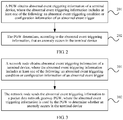
- FIG. 2 is a flowchart of a first embodiment of a method for detecting a terminal device anomaly according to the present invention. As shown in FIG. 2 , the method in this embodiment may include the following steps.
- Step 201 A PGW obtains abnormal event triggering information of a terminal device, where the abnormal event triggering information includes at least one of the following: an abnormal event triggering condition or configuration information of an abnormal event trigger.
- the PGW obtains the abnormal event triggering information includes:
- the network node may be a policy and charging rules function (PCRF, Policy and Charging Rules Function) node or an application function (AF, Application Function) node.
- PCRF policy and charging rules function
- AF Application Function
- Step 202 The PGW determines, according to the abnormal event triggering information, that an anomaly occurs in the terminal device.
- that the PGW determines, according to the configuration information of the abnormal event trigger, that the anomaly occurs in the terminal device may include:
- the PGW determines, according to the abnormal event triggering condition, that the anomaly occurs in the terminal device may include:
- some anomalies may occur in the terminal device.
- the terminal device performs a service beyond a specified range (for example, a smoke sensor is configured to only exchange data with a fire detection center at a peer end of the EPS system, and should not perform a service such as downloading or accessing the Internet; or some specific UE is configured to only make a call, and cannot access the Internet), and (2) the M2M device is faulty and cannot normally work.
- a service beyond a specified range for example, a smoke sensor is configured to only exchange data with a fire detection center at a peer end of the EPS system, and should not perform a service such as downloading or accessing the Internet; or some specific UE is configured to only make a call, and cannot access the Internet
- the PGW obtains the abnormal event triggering information of the terminal device, and the abnormal event triggering information includes at least one of the following: the abnormal event triggering condition or the configuration information of the abnormal event trigger; and the PGW determines, according to the abnormal event triggering information, that the anomaly occurs in the terminal device, so that when the terminal device has a behavior (for example, the terminal device carries out a service related behavior beyond the specified range or the terminal device is damaged and abnormal) that is indicated by the abnormal event triggering information, the PGW can detect the anomaly of the terminal device, and the administrator of the terminal device can obtain the anomaly information of the terminal device from the PGW node.
- the abnormal event triggering information includes at least one of the following: the abnormal event triggering condition or the configuration information of the abnormal event trigger
- the PGW determines, according to the abnormal event triggering information, that the anomaly occurs in the terminal device, so that when the terminal device has a behavior (for example, the terminal device carries out a service related behavior beyond the specified range or the terminal device is damaged and abnormal
- FIG. 3 is a flowchart of a second embodiment of a method for detecting a terminal device anomaly according to the present invention. As shown in FIG. 3 , the method in this embodiment may include the following steps.
- Step 301 A network node obtains abnormal event triggering information of a terminal device, where the abnormal event triggering information includes at least one of the following: an abnormal event triggering condition or configuration information of an abnormal event trigger.
- the network node may be a PCRF node, or an AF node.
- Step 302 The network node sends the abnormal event triggering information to a packet data network gateway PGW, where the abnormal event triggering information is used by the PGW to determine whether an anomaly occurs in the terminal device.
- the network node obtains the abnormal event triggering information of the terminal device, and the abnormal event triggering information includes at least one of the following: the abnormal event triggering condition or the configuration information of the abnormal event trigger; and the network node sends the abnormal event triggering information to the packet data network gateway PGW, and the abnormal event triggering information is used by the PGW to determine whether the anomaly occurs in the terminal device, so that the PGW can determine an anomaly of the terminal device according to the abnormal event triggering information that is obtained from the network node.
- the method may further include: sending, by the PGW, anomaly information of the terminal device to the network node.
- the method may further include: receiving, by the network node, anomaly information of the terminal device that is sent by the PGW.
- the method before the receiving, by the network node, the anomaly information of the terminal device that is sent by the PGW, the method further includes:
- the receiving, by the network node, anomaly information of the terminal device that is sent by the PGW includes: receiving, by the network node, an anomaly obtaining response sent by the PGW, where the anomaly obtaining response includes the anomaly information of the terminal device.
- the sending, by the PGW, anomaly information of the terminal device to the network node includes:
- the anomaly information of the terminal device is sent to the network node, so that an administrator of the terminal device can obtain the anomaly information of the terminal device from a network node except the PGW node.
- FIG. 4 is a flowchart of a third embodiment of a method for detecting a terminal device anomaly according to the present invention. As shown in FIG. 4 , the method in this embodiment may include the following steps.
- Step 401 An AF node sends a first message to a PCRF node, where the first message includes an identifier of a group to which a terminal device belongs, and abnormal event triggering information corresponding to the identifier of the group to which the terminal device belongs.
- the abnormal event triggering information includes at least one of the following: an abnormal event triggering condition or configuration information of an abnormal event trigger.
- abnormal event triggering information corresponding to the identifier of the group to which the terminal device belongs should be considered as abnormal event triggering information of each terminal device that belongs to the group.
- the abnormal event triggering condition of the terminal device includes at least one of the following:
- the AF node is an application function entity, and the AF node may be configured to provide dynamic information related to a user system.
- the AF node may be a server in FIG. 1 .
- the method may further include: sending, by the PCRF node to the AF, an acknowledgment (ack) message corresponding to the first message.
- ack acknowledgment
- step 401 is an optional manner in which the PCRF node obtains the abnormal event triggering information of the terminal device.
- Step 401 is an optional step.
- the PCRF node may obtain the abnormal event triggering information from local configuration information of the PCRF node.
- the local configuration information includes the abnormal event triggering information.
- Step 402 The terminal device sends an attach request (Attach Request) message to an MME.
- Step 403 The MME sends a first create session request (create session request) message to an SGW, where the first create session request message includes the identifier of the group to which the terminal device belongs.
- the MME may perform user authentication on the terminal device by interacting with an HSS, to obtain the identifier of the group from the HSS.
- Step 404 The SGW sends a second create session request message to a PGW, where the second create session request message includes the identifier of the group to which the terminal device belongs.
- Step 405 The PGW sends a credit control request (CCR, Credit Control Request) message to the PCRF node, where the CCR message includes the identifier of the group to which the terminal device belongs.
- CCR Credit Control Request
- Step 406 The PCRF node determines, according to the identifier of the group to which the terminal device belongs, the abnormal event triggering information of the terminal device, and returns a credit control answer (CCA, Credit Control Answer) message to the PGW, where the CCA message includes the abnormal event triggering information of the terminal device.
- CCA Credit Control Answer
- the PGW may also determine the abnormal event triggering information from the local configuration information of the PGW, and the local configuration information of the PGW includes the abnormal event triggering information.
- the CCA message in step 406 may not include the abnormal event triggering information of the terminal device.
- the method may further include: the PCRF node interacts with a domain name system (DNS, Domain Name System) server to obtain an Internet Protocol (IP, Internet Protocol) address corresponding to the FQDN identifier; and the PCRF node replaces the FQDN identifier in the abnormal event triggering condition with the IP address corresponding to the FQDN identifier.
- the abnormal event triggering condition in the abnormal event triggering information included in the CCA message is an abnormal event triggering condition after replacement.
- Step 407 The PGW returns a second create session response (create session response) message to the SGW.
- the second create session response message is an answer message for the second create session request message.
- Step 408 The SGW returns a first create session response message to the MME.
- the first create session response message is an answer message for the first create session request message.
- Step 409 The MME returns an attach accept (Attach Accept) message to the terminal device according to the first create session response message.
- step 409 an attachment process of the terminal device ends, that is, the terminal device has been attached to a network in which the PGW is located.
- Step 410 The PGW determines, according to the abnormal event triggering information of the terminal device, that an anomaly occurs in the terminal device.
- the PGW determines, according to the abnormal event triggering information of the terminal device, that an anomaly occurs in the terminal device may include:
- that the PGW determines, according to the abnormal event triggering information of the terminal device, that an anomaly occurs in the terminal device may include:
- the access technology may be, for example, Wireless Fidelity (WIFI, Wireless Fidelity), Worldwide Interoperability for Microwave Access (WIMAX, Worldwide Interoperability for Microwave Access), or Code Division Multiple Access (CDMA, Code-Division Multiple Access).
- WIFI Wireless Fidelity
- WIMAX Worldwide Interoperability for Microwave Access
- CDMA Code Division Multiple Access
- Step 411 The PGW sends anomaly information of the terminal device to the PCRF node.
- the PGW may perform step 411 after determining the anomaly information of the terminal device in step 410 (in this case, the PGW may send the anomaly information of the terminal device to the PCRF node by using the CCR message); or the PGW may periodically perform step 411 (in this case, the PGW may send the anomaly information of the terminal device to the PCRF node by using the CCR message); or the PGW may perform step 411 after receiving the anomaly obtaining request from the PCRF (in this case, the PGW may send the anomaly information of the terminal device to the PCRF node by using the anomaly obtaining response corresponding to the anomaly obtaining request).
- Step 412 The PCRF node rectifies anomaly of the terminal device.
- the PCRF node reduces quality of service (QoS, Quality of Service) for the terminal device, or terminates an IP-connectivity access network (CAN, Connectivity Access Network) session of the terminal device.
- QoS quality of service
- CAN IP-connectivity access network
- step 412 is an optional step.
- Step 413 The PCRF node sends the anomaly information of the terminal device to the AF node.
- step 413 is also an optional step, and there is no sequence between step 412 and step 413.
- step 413 may be not included; and when the administrator of the terminal device needs to obtain the anomaly information of the terminal device from the AF node, step 413 needs to be included.
- the PCRF node obtains the abnormal event triggering information of the terminal device before the terminal device initiates attachment; the PCRF node sends the abnormal event triggering information of the terminal device to the PGW in the attachment procedure of the terminal device; and the PGW determines, according to the abnormal event triggering information, that the anomaly occurs in the terminal device, so that the PGW can determine the anomaly of the terminal device according to the abnormal event triggering information obtained from the PCRF node.
- FIG. 5 is a flowchart of a fourth embodiment of a method for detecting a terminal device anomaly according to the present invention. As shown in FIG. 5 , the method in this embodiment may include the following steps.
- Step 501 A terminal device sends an attach request message to an MME.
- Step 502 The MME sends a first create session request message to an SGW.
- Step 503 The SGW sends a second create session request message to a PGW.
- Step 504 The PGW sends a CCR message to a PCRF node.
- steps 501 to 504 are similar to those in the prior art, and details are not described herein.
- Step 505 The PCRF node sends a request message to an HSS/SPR, where request message is used for requesting subscription data of the terminal device, and the subscription data of the terminal device includes abnormal event triggering information of the terminal device.
- Step 506 The HSS/SPR returns a response message to the PCRF node, where the response message includes the subscription data of the terminal device.
- Step 507 The PCRF node returns a CCA message to the PGW, where the CCA message includes the abnormal event triggering information of the terminal device.
- Step 508 The PGW returns a second create session response message to the SGW.
- Step 509 The SGW returns a first create session response message to the MME.
- Step 510 The MME returns an attach accept message to the terminal device according to the first create session response message.
- Step 511 The PGW determines, according to the abnormal event triggering information of the terminal device, that an anomaly occurs in the terminal device.
- step 511 is similar to step 410, and details are not described herein again.
- Step 512 The PGW sends anomaly information of the terminal device to the PCRF node.
- step 512 is similar to step 411, and details are not described herein again.
- Step 513 The PCRF node rectifies anomaly of the terminal device.
- step 513 is an optional step, and step 513 is similar to step 412, and details are not described herein again.
- Step 514 The PCRF node sends the anomaly information of the terminal device to the AF node.
- step 514 is an optional step, and step 514 is similar to step 413, and details are not described herein again.
- the PCRF node obtains the abnormal event triggering information of the terminal device from the HSS/SPR in an attachment process of the terminal device; the PCRF node sends the abnormal event triggering information of the terminal device to the PGW in the attachment procedure of the terminal device; and the PGW determines, according to the abnormal event triggering information, that the anomaly occurs in the terminal device, so that the PGW can determine the anomaly of the terminal device according to the abnormal event triggering information obtained from the PCRF node.
- FIG. 6 is a flowchart of a fifth embodiment of a method for detecting a terminal device anomaly according to the present invention. As shown in FIG. 6 , the method in this embodiment may include the following steps.
- Step 601 A terminal device sends a registration request message to an AF node, where the registration request message includes an identifier of the terminal device.
- Step 602 The AF node determines, according to the registration request message, abnormal event triggering information of the terminal device, and sends a second message to a PCRF node, where the second message includes the abnormal event triggering information of the terminal device and the identifier of the terminal device.
- the method may further include: sending, by the PCRF node to the AF, an acknowledgment (ack) message corresponding to the second message.
- ack acknowledgment
- Step 603 The PCRF node sends a re-auth-request (RAR, Re-Auth-Request) message to a PGW, where the RAR message includes an abnormal event triggering condition of the terminal device.
- RAR re-auth-request
- Step 604 The PGW returns, to the PCRF node, a re-auth-answer (RAA, Re-Auth-Answer) message that is corresponding to the RAR message.
- RAA re-auth-answer
- Step 605 The PGW determines, according to the abnormal event triggering information of the terminal device, that an anomaly occurs in the terminal device.
- step 605 is similar to step 410, and details are not described herein again.
- Step 606 The PGW sends anomaly information of the terminal device to the PCRF node.
- step 606 is similar to step 411, and details are not described herein again.
- Step 607 The PCRF node rectifies anomaly of the terminal device.
- step 607 is an optional step, and step 607 is similar to step 412, and details are not described herein again.
- Step 608 The PCRF node sends the anomaly information of the terminal device to the AF node.
- step 608 is an optional step, and step 608 is similar to step 413, and details are not described herein again.
- the terminal device after the terminal device is attached to a network in which the PGW is located, the terminal device sends the registration request message to the AF node; the AF node sends the abnormal event triggering condition of the terminal device to the PCRF node; the PCRF node sends the abnormal event triggering information of the terminal device to the PGW; and the PGW determines, according to the abnormal event triggering information, that the anomaly occurs in the terminal device, so that the PGW can determine the anomaly of the terminal device according to the abnormal event triggering information obtained from the PCRF node.
- FIG. 7 is a schematic structural diagram of a first embodiment of an apparatus for detecting a terminal device anomaly according to the present invention, and the apparatus is a PGW.
- the apparatus in this embodiment may include an obtaining module 701 and a determining module 702.
- the obtaining module 701 is configured to obtain abnormal event triggering information of a terminal device, where the abnormal event triggering information includes at least one of the following: an abnormal event triggering condition or configuration information of an abnormal event trigger.
- the determining module 702 is configured to determine, according to the abnormal event triggering information, that an anomaly occurs in the terminal device.
- the apparatus in this embodiment may further include a sending module 703, configured to send anomaly information of the terminal device to a network node, where the network node is a policy and charging rules function PCRF node or an application function AF node.
- a sending module 703 configured to send anomaly information of the terminal device to a network node, where the network node is a policy and charging rules function PCRF node or an application function AF node.
- the apparatus in this embodiment may further include a receiving module 704, configured to receive an anomaly obtaining request sent by the network node.
- the sending module 703 is specifically configured to send an anomaly obtaining response to the network node, and the anomaly obtaining response includes the anomaly information of the terminal device.
- the obtaining module 701 is specifically configured to receive the abnormal event triggering information sent by the network node, and the network node is the PCRF node or the AF node.
- the obtaining module 701 is specifically configured to: receive a re-auth-request RAR message sent by the network node, where the RAR message includes the abnormal event triggering information; or receive a credit control answer CCA message sent by the network node, where the CCA message includes the abnormal event triggering information.
- the abnormal event triggering condition of the terminal device includes at least one of the following:
- the apparatus in this embodiment may be configured to perform the technical solution in the method embodiment shown in FIG. 2 , and the technical solutions on a PGW side in the method embodiments shown in FIG. 4 to FIG. 6 . Implementation principles and technical effects thereof are similar and details are not described herein.
- FIG. 8 is a schematic structural diagram of a second embodiment of an apparatus for detecting a terminal device anomaly according to the present invention.
- the apparatus in this embodiment may include an obtaining module 801 and a sending module 802.
- the obtaining module 801 is configured to obtain abnormal event triggering information of a terminal device, and the abnormal event triggering information includes at least one of the following: an abnormal event triggering condition or configuration information of an abnormal event trigger.
- the sending module 802 is configured to send the abnormal event triggering information to a packet data network gateway PGW, and the abnormal event triggering information is used by the PGW to determine whether an anomaly occurs in the terminal device.
- the network node is a policy and charging rules function PCRF node or an application function AF node.
- the obtaining module 801 is specifically configured to: receive the abnormal event triggering information sent by the AF node; or receive the abnormal event triggering information sent by a subscription profile repository SPR or a home subscriber server HSS.
- the obtaining module 801 is specifically configured to: send a re-auth-request RAR message to the PGW, where the RAR message includes the abnormal event triggering information; or send a credit control answer CCA message to the PGW, where the CCA message includes the abnormal event triggering information.
- the apparatus in this embodiment further includes a receiving module 803, configured to receive anomaly information of the terminal device that is sent by the PGW.
- the sending module 802 is further configured to send an anomaly obtaining request to the PGW.
- the receiving module 803 is specifically configured to receive an anomaly obtaining response sent by the PGW, and the anomaly obtaining response includes the anomaly information of the terminal device.
- the abnormal event triggering condition of the terminal device includes at least one of the following:
- the apparatus in this embodiment may be configured to perform the technical solution in the method embodiment shown in FIG. 3 , and the technical solutions on a PCRF side and an AF side in the method embodiments shown in FIG. 4 to FIG. 6 . Implementation principles and technical effects thereof are similar and details are not described herein.
- the present invention further provides a system for detecting a terminal device anomaly, including the PGW according to the first embodiment of the apparatus for detecting a terminal device anomaly, and the network node according to the second embodiment of the apparatus for detecting a terminal device anomaly.
- the system in this embodiment may be configured to perform the technical solutions in the method embodiments shown in FIG. 2 to FIG. 6 .
- Implementation principles and technical effects thereof are similar and details are not described herein.
- FIG. 9 is a schematic structural diagram of a third embodiment of an apparatus for detecting a terminal device anomaly according to the present invention, and the apparatus is a PGW.
- the apparatus in this embodiment may include a processor 901 and a memory 902.
- the apparatus may further include a transmitter 903 and a receiver 904.
- the transmitter 903 and the receiver 904 may be connected to the processor 901.
- the transmitter 903 is configured to send data or information
- the receiver 904 is configured to receive the data or the information
- the memory 902 stores an execution instruction.
- the processor 901 communicates with the memory 902, and the processor 901 invokes the execution instruction in the memory 902 to perform the following operations:
- the operations further include: sending anomaly information of the terminal device to a network node, where the network node is a policy and charging rules function PCRF node or an application function AF node.
- the network node is a policy and charging rules function PCRF node or an application function AF node.
- that the PGW sends the anomaly information of the terminal device to the network node includes:
- the PGW obtains the abnormal event triggering information of the terminal device includes:
- the receiving, by the PGW, the abnormal event triggering information sent by the network node includes:
- the abnormal event triggering condition of the terminal device includes at least one of the following:
- the apparatus in this embodiment may be configured to perform the technical solution in the method embodiment shown in FIG. 2 , and the technical solutions on a PGW side in the method embodiments shown in FIG. 4 to FIG. 6 . Implementation principles and technical effects thereof are similar and details are not described herein.
- FIG. 10 is a schematic structural diagram of a fourth embodiment of an apparatus for detecting a terminal device anomaly according to the present invention, and the apparatus is a network node.
- the apparatus in this embodiment may include a processor 1001 and a memory 1002.
- the apparatus may further include a transmitter 1003 and a receiver 1004.
- the transmitter 1003 and the receiver 1004 may be connected to the processor 1001.
- the transmitter 1003 is configured to send data or information
- the receiver 1004 is configured to receive the data or the information
- the memory 1002 stores an execution instruction.
- the processor 1001 communicates with the memory 1002, and the processor 1001 invokes the execution instruction in the memory 1002 to perform the following operations:
- the network node is a policy and charging rules function PCRF node or an application function AF node.
- the network node is the PCRF node
- that the network node obtains the abnormal event triggering information of the terminal device includes:
- the network node is the PCRF node
- that the network node sends the abnormal event triggering information to the PGW includes:
- the operations further include:
- the operations before the receiving, by the network node, the anomaly information of the terminal device that is sent by the PGW, the operations further include:
- the abnormal event triggering condition of the terminal device includes at least one of the following:
- the apparatus in this embodiment may be configured to perform the technical solution in the method embodiment shown in FIG. 3 , and the technical solutions on a PCRF side and an AF side in the method embodiments shown in FIG. 4 to FIG. 6 . Implementation principles and technical effects thereof are similar and details are not described herein.
- the program may be stored in a computer-readable storage medium.
- the foregoing storage medium includes: any medium that can store program code, such as a ROM, a RAM, a magnetic disk, or an optical disc.
Landscapes
- Engineering & Computer Science (AREA)
- Computer Networks & Wireless Communication (AREA)
- Signal Processing (AREA)
- Computer Security & Cryptography (AREA)
- Computer Hardware Design (AREA)
- Computing Systems (AREA)
- General Engineering & Computer Science (AREA)
- Mobile Radio Communication Systems (AREA)
- Telephonic Communication Services (AREA)
- Alarm Systems (AREA)
- Data Exchanges In Wide-Area Networks (AREA)
Applications Claiming Priority (1)
| Application Number | Priority Date | Filing Date | Title |
|---|---|---|---|
| PCT/CN2015/083444 WO2017004789A1 (zh) | 2015-07-07 | 2015-07-07 | 检测终端设备异常的方法、装置及系统 |
Publications (3)
| Publication Number | Publication Date |
|---|---|
| EP3300417A1 true EP3300417A1 (de) | 2018-03-28 |
| EP3300417A4 EP3300417A4 (de) | 2018-03-28 |
| EP3300417B1 EP3300417B1 (de) | 2019-12-11 |
Family
ID=57684793
Family Applications (1)
| Application Number | Title | Priority Date | Filing Date |
|---|---|---|---|
| EP15897445.1A Active EP3300417B1 (de) | 2015-07-07 | 2015-07-07 | Verfahren, vorrichtung und system zur erkennung einer anomalie einer endgerätevorrichtung |
Country Status (6)
| Country | Link |
|---|---|
| US (1) | US10645106B2 (de) |
| EP (1) | EP3300417B1 (de) |
| CN (1) | CN106664540B (de) |
| MY (1) | MY196450A (de) |
| RU (1) | RU2684487C1 (de) |
| WO (1) | WO2017004789A1 (de) |
Families Citing this family (8)
| Publication number | Priority date | Publication date | Assignee | Title |
|---|---|---|---|---|
| CN111918280B (zh) | 2019-05-07 | 2022-07-22 | 华为技术有限公司 | 一种终端信息的处理方法、装置及系统 |
| CN112105053B (zh) * | 2019-06-17 | 2022-04-22 | 华为技术有限公司 | 一种拥塞控制方法及装置 |
| CN110703937A (zh) * | 2019-09-03 | 2020-01-17 | Oppo(重庆)智能科技有限公司 | 一种异常检测方法、装置、存储介质和终端设备 |
| US12089125B2 (en) * | 2020-07-24 | 2024-09-10 | Globally Unified Air Quality | Modular hardware and software integration for environmental sensor devices |
| CN113486799A (zh) * | 2021-07-07 | 2021-10-08 | 深圳市商汤科技有限公司 | 设备联动方法、装置、设备、存储介质及程序产品 |
| CN114296983B (zh) * | 2021-12-30 | 2022-08-12 | 重庆允成互联网科技有限公司 | 基于触发器运转记录的流程异常处理方法及存储介质 |
| US12032462B2 (en) * | 2022-10-20 | 2024-07-09 | Dell Products L.P. | Preserving hardware status points in operating system environment for use in preboot diagnostics |
| CN116701101B (zh) * | 2022-12-30 | 2024-07-30 | 荣耀终端有限公司 | 一种SensorHUB的异常检测方法和电子设备 |
Family Cites Families (21)
| Publication number | Priority date | Publication date | Assignee | Title |
|---|---|---|---|---|
| US6011790A (en) * | 1996-06-07 | 2000-01-04 | Bell Mobility Cellular Inc. | Wireless terminal data network communication |
| JP4173889B2 (ja) * | 2005-01-07 | 2008-10-29 | エルジー エレクトロニクス インコーポレイティド | 移動通信システムにおける複製端末機の認証処理方法 |
| WO2008080430A1 (en) * | 2006-12-29 | 2008-07-10 | Telecom Italia S.P.A. | METHOD AND SYSTEM FOR ENFORCING SECURITY POLICIES IN MANETs |
| US20150071085A1 (en) * | 2008-06-10 | 2015-03-12 | ClioTech Inc. | Network gateway for real-time inspection of data frames and identification of abnormal network behavior |
| US8873381B2 (en) * | 2009-06-22 | 2014-10-28 | Qualcomm Incorporated | Bearer quality of service selection |
| CN102056128B (zh) * | 2009-10-30 | 2014-04-09 | 中兴通讯股份有限公司 | 机器类通讯终端信息的获取方法和系统 |
| CN102056140B (zh) * | 2009-11-06 | 2013-08-07 | 中兴通讯股份有限公司 | 机器类通讯终端信息的获取方法和系统 |
| WO2011063559A1 (zh) * | 2009-11-24 | 2011-06-03 | 华为技术有限公司 | 控制机器类型通信mtc终端行为的方法、装置和系统 |
| US20110138463A1 (en) * | 2009-12-07 | 2011-06-09 | Electronics And Telecommunications Research Institute | Method and system for ddos traffic detection and traffic mitigation using flow statistics |
| EP2403186B1 (de) * | 2010-07-02 | 2017-12-27 | Vodafone IP Licensing limited | Telekommunikationsnetzwerke |
| EP2574133B1 (de) * | 2010-08-20 | 2019-03-13 | Huawei Technologies Co., Ltd. | Verfahren und vorrichtung zur meldung von funkträgerverlust |
| US8812020B2 (en) * | 2010-10-15 | 2014-08-19 | Tekelec, Inc. | Methods, systems, and computer readable media for location-based policy enhancement |
| US9215244B2 (en) * | 2010-11-18 | 2015-12-15 | The Boeing Company | Context aware network security monitoring for threat detection |
| RU2580448C2 (ru) * | 2011-11-15 | 2016-04-10 | Телефонактиеболагет Л М Эрикссон (Пабл) | Генерирование статистики сети на основе контроллера политик |
| CA2768483C (en) * | 2011-12-30 | 2019-08-20 | Sandvine Incorporated Ulc | Systems and methods for managing quality of service |
| CN103517252A (zh) * | 2012-06-21 | 2014-01-15 | 中兴通讯股份有限公司 | 分组网关标识信息的更新方法、aaa服务器和分组网关 |
| US8868030B2 (en) * | 2012-07-30 | 2014-10-21 | General Motors Llc | Automated vehicle intrusion device |
| CN108282814B (zh) * | 2012-09-29 | 2021-10-26 | 华为技术有限公司 | 用户设备信息监视方法及装置、系统 |
| CN103781015A (zh) * | 2012-10-17 | 2014-05-07 | 中兴通讯股份有限公司 | 一种机器类型通信设备事件的监控方法、系统和网络侧 |
| US9282113B2 (en) * | 2013-06-27 | 2016-03-08 | Cellco Partnership | Denial of service (DoS) attack detection systems and methods |
| US9503467B2 (en) * | 2014-05-22 | 2016-11-22 | Accenture Global Services Limited | Network anomaly detection |
-
2015
- 2015-07-07 WO PCT/CN2015/083444 patent/WO2017004789A1/zh not_active Ceased
- 2015-07-07 EP EP15897445.1A patent/EP3300417B1/de active Active
- 2015-07-07 MY MYPI2017704991A patent/MY196450A/en unknown
- 2015-07-07 CN CN201580042908.1A patent/CN106664540B/zh active Active
- 2015-07-07 RU RU2018104339A patent/RU2684487C1/ru active
-
2018
- 2018-01-02 US US15/859,752 patent/US10645106B2/en active Active
Also Published As
| Publication number | Publication date |
|---|---|
| WO2017004789A1 (zh) | 2017-01-12 |
| EP3300417A4 (de) | 2018-03-28 |
| US20180124087A1 (en) | 2018-05-03 |
| EP3300417B1 (de) | 2019-12-11 |
| RU2684487C1 (ru) | 2019-04-09 |
| CN106664540B (zh) | 2020-01-31 |
| CN106664540A (zh) | 2017-05-10 |
| MY196450A (en) | 2023-04-12 |
| US10645106B2 (en) | 2020-05-05 |
Similar Documents
| Publication | Publication Date | Title |
|---|---|---|
| US10645106B2 (en) | Method, apparatus, and system for detecting terminal device anomaly | |
| US9313094B2 (en) | Node and method for signalling in a proxy mobile internet protocol based network | |
| EP3529968B1 (de) | System und verfahren für knotenauswahl auf der grundlage von ereignisinformationen in der mitte und am ende einer sitzung | |
| EP2824951B1 (de) | Verfahren, vorrichtung und system zum markieren eines dienstdatenpakets | |
| EP3018943B1 (de) | Verfahren und vorrichtung zur drahtlosen autorisierung auf basis von funkbewusster verkehrsverwaltung | |
| EP2950509B1 (de) | Handhabung von stray-session-anfragen in einer netzwerkumgebung | |
| US10474522B2 (en) | Providing a network access failure cause value of a user equipment | |
| US20110225280A1 (en) | Methods, systems, and computer readable media for communicating policy information between a policy charging and rules function and a service node | |
| US20120110193A1 (en) | Reselection system for bearer binding and event reporting function and method thereof | |
| KR101902324B1 (ko) | 통신 네트워크에서 사용자 장비와 데이터 네트워크 간의 통신을 위한 기술 | |
| CN108781192B (zh) | 用于处理承载的方法和节点 | |
| US20170086162A1 (en) | Location Information in Managed Access Networks | |
| US20130039277A1 (en) | Machine type communication event reporting method, device and system | |
| US20220046484A1 (en) | Method and Functions for Handling a UE's Access to a DN | |
| RU2626084C2 (ru) | Способ, устройство и система для установления сеанса | |
| WO2018231660A1 (en) | Enhanced mobile subscriber privacy in telecommunications networks | |
| WO2017219754A1 (zh) | 一种位置信息获取方法、设备及系统 | |
| KR20170045262A (ko) | 셀룰러 네트워크에서의 플렉시블 모바일 스티어링을 위한 방법 및 장치 | |
| US9960950B2 (en) | Apparatus, method, system and computer program product for server failure handling | |
| JP6845323B2 (ja) | ルータとしてのueに接続されるデバイスのためのサービス区別 | |
| WO2011134370A1 (zh) | 机器类通信事件上报方法及系统 | |
| EP2837162B1 (de) | Vorrichtung, verfahren, system und komputerprogrammprodukt zur verwaltung von server-ausfall | |
| CN108702619A (zh) | 获取、发送用户设备标识的方法及设备 | |
| CN104066114A (zh) | 融合网络中的策略控制方法、系统及装置 | |
| HK40049480A (en) | Removal of application identifier |
Legal Events
| Date | Code | Title | Description |
|---|---|---|---|
| STAA | Information on the status of an ep patent application or granted ep patent |
Free format text: STATUS: THE INTERNATIONAL PUBLICATION HAS BEEN MADE |
|
| PUAI | Public reference made under article 153(3) epc to a published international application that has entered the european phase |
Free format text: ORIGINAL CODE: 0009012 |
|
| STAA | Information on the status of an ep patent application or granted ep patent |
Free format text: STATUS: REQUEST FOR EXAMINATION WAS MADE |
|
| 17P | Request for examination filed |
Effective date: 20171222 |
|
| A4 | Supplementary search report drawn up and despatched |
Effective date: 20180222 |
|
| AK | Designated contracting states |
Kind code of ref document: A1 Designated state(s): AL AT BE BG CH CY CZ DE DK EE ES FI FR GB GR HR HU IE IS IT LI LT LU LV MC MK MT NL NO PL PT RO RS SE SI SK SM TR |
|
| AX | Request for extension of the european patent |
Extension state: BA ME |
|
| DAV | Request for validation of the european patent (deleted) | ||
| DAX | Request for extension of the european patent (deleted) | ||
| GRAP | Despatch of communication of intention to grant a patent |
Free format text: ORIGINAL CODE: EPIDOSNIGR1 |
|
| STAA | Information on the status of an ep patent application or granted ep patent |
Free format text: STATUS: GRANT OF PATENT IS INTENDED |
|
| RIC1 | Information provided on ipc code assigned before grant |
Ipc: H04W 24/04 20090101AFI20190521BHEP Ipc: H04W 12/12 20090101ALI20190521BHEP |
|
| INTG | Intention to grant announced |
Effective date: 20190624 |
|
| GRAS | Grant fee paid |
Free format text: ORIGINAL CODE: EPIDOSNIGR3 |
|
| GRAA | (expected) grant |
Free format text: ORIGINAL CODE: 0009210 |
|
| STAA | Information on the status of an ep patent application or granted ep patent |
Free format text: STATUS: THE PATENT HAS BEEN GRANTED |
|
| AK | Designated contracting states |
Kind code of ref document: B1 Designated state(s): AL AT BE BG CH CY CZ DE DK EE ES FI FR GB GR HR HU IE IS IT LI LT LU LV MC MK MT NL NO PL PT RO RS SE SI SK SM TR |
|
| REG | Reference to a national code |
Ref country code: GB Ref legal event code: FG4D |
|
| REG | Reference to a national code |
Ref country code: CH Ref legal event code: EP |
|
| REG | Reference to a national code |
Ref country code: AT Ref legal event code: REF Ref document number: 1213426 Country of ref document: AT Kind code of ref document: T Effective date: 20191215 |
|
| REG | Reference to a national code |
Ref country code: DE Ref legal event code: R096 Ref document number: 602015043679 Country of ref document: DE |
|
| REG | Reference to a national code |
Ref country code: IE Ref legal event code: FG4D |
|
| REG | Reference to a national code |
Ref country code: NL Ref legal event code: MP Effective date: 20191211 |
|
| REG | Reference to a national code |
Ref country code: LT Ref legal event code: MG4D |
|
| PG25 | Lapsed in a contracting state [announced via postgrant information from national office to epo] |
Ref country code: FI Free format text: LAPSE BECAUSE OF FAILURE TO SUBMIT A TRANSLATION OF THE DESCRIPTION OR TO PAY THE FEE WITHIN THE PRESCRIBED TIME-LIMIT Effective date: 20191211 Ref country code: BG Free format text: LAPSE BECAUSE OF FAILURE TO SUBMIT A TRANSLATION OF THE DESCRIPTION OR TO PAY THE FEE WITHIN THE PRESCRIBED TIME-LIMIT Effective date: 20200311 Ref country code: GR Free format text: LAPSE BECAUSE OF FAILURE TO SUBMIT A TRANSLATION OF THE DESCRIPTION OR TO PAY THE FEE WITHIN THE PRESCRIBED TIME-LIMIT Effective date: 20200312 Ref country code: LT Free format text: LAPSE BECAUSE OF FAILURE TO SUBMIT A TRANSLATION OF THE DESCRIPTION OR TO PAY THE FEE WITHIN THE PRESCRIBED TIME-LIMIT Effective date: 20191211 Ref country code: LV Free format text: LAPSE BECAUSE OF FAILURE TO SUBMIT A TRANSLATION OF THE DESCRIPTION OR TO PAY THE FEE WITHIN THE PRESCRIBED TIME-LIMIT Effective date: 20191211 Ref country code: NO Free format text: LAPSE BECAUSE OF FAILURE TO SUBMIT A TRANSLATION OF THE DESCRIPTION OR TO PAY THE FEE WITHIN THE PRESCRIBED TIME-LIMIT Effective date: 20200311 Ref country code: SE Free format text: LAPSE BECAUSE OF FAILURE TO SUBMIT A TRANSLATION OF THE DESCRIPTION OR TO PAY THE FEE WITHIN THE PRESCRIBED TIME-LIMIT Effective date: 20191211 |
|
| PG25 | Lapsed in a contracting state [announced via postgrant information from national office to epo] |
Ref country code: RS Free format text: LAPSE BECAUSE OF FAILURE TO SUBMIT A TRANSLATION OF THE DESCRIPTION OR TO PAY THE FEE WITHIN THE PRESCRIBED TIME-LIMIT Effective date: 20191211 Ref country code: HR Free format text: LAPSE BECAUSE OF FAILURE TO SUBMIT A TRANSLATION OF THE DESCRIPTION OR TO PAY THE FEE WITHIN THE PRESCRIBED TIME-LIMIT Effective date: 20191211 |
|
| PG25 | Lapsed in a contracting state [announced via postgrant information from national office to epo] |
Ref country code: AL Free format text: LAPSE BECAUSE OF FAILURE TO SUBMIT A TRANSLATION OF THE DESCRIPTION OR TO PAY THE FEE WITHIN THE PRESCRIBED TIME-LIMIT Effective date: 20191211 |
|
| PG25 | Lapsed in a contracting state [announced via postgrant information from national office to epo] |
Ref country code: ES Free format text: LAPSE BECAUSE OF FAILURE TO SUBMIT A TRANSLATION OF THE DESCRIPTION OR TO PAY THE FEE WITHIN THE PRESCRIBED TIME-LIMIT Effective date: 20191211 Ref country code: NL Free format text: LAPSE BECAUSE OF FAILURE TO SUBMIT A TRANSLATION OF THE DESCRIPTION OR TO PAY THE FEE WITHIN THE PRESCRIBED TIME-LIMIT Effective date: 20191211 Ref country code: EE Free format text: LAPSE BECAUSE OF FAILURE TO SUBMIT A TRANSLATION OF THE DESCRIPTION OR TO PAY THE FEE WITHIN THE PRESCRIBED TIME-LIMIT Effective date: 20191211 Ref country code: PT Free format text: LAPSE BECAUSE OF FAILURE TO SUBMIT A TRANSLATION OF THE DESCRIPTION OR TO PAY THE FEE WITHIN THE PRESCRIBED TIME-LIMIT Effective date: 20200506 Ref country code: RO Free format text: LAPSE BECAUSE OF FAILURE TO SUBMIT A TRANSLATION OF THE DESCRIPTION OR TO PAY THE FEE WITHIN THE PRESCRIBED TIME-LIMIT Effective date: 20191211 Ref country code: CZ Free format text: LAPSE BECAUSE OF FAILURE TO SUBMIT A TRANSLATION OF THE DESCRIPTION OR TO PAY THE FEE WITHIN THE PRESCRIBED TIME-LIMIT Effective date: 20191211 |
|
| PG25 | Lapsed in a contracting state [announced via postgrant information from national office to epo] |
Ref country code: SM Free format text: LAPSE BECAUSE OF FAILURE TO SUBMIT A TRANSLATION OF THE DESCRIPTION OR TO PAY THE FEE WITHIN THE PRESCRIBED TIME-LIMIT Effective date: 20191211 Ref country code: SK Free format text: LAPSE BECAUSE OF FAILURE TO SUBMIT A TRANSLATION OF THE DESCRIPTION OR TO PAY THE FEE WITHIN THE PRESCRIBED TIME-LIMIT Effective date: 20191211 Ref country code: IS Free format text: LAPSE BECAUSE OF FAILURE TO SUBMIT A TRANSLATION OF THE DESCRIPTION OR TO PAY THE FEE WITHIN THE PRESCRIBED TIME-LIMIT Effective date: 20200411 |
|
| REG | Reference to a national code |
Ref country code: DE Ref legal event code: R097 Ref document number: 602015043679 Country of ref document: DE |
|
| REG | Reference to a national code |
Ref country code: AT Ref legal event code: MK05 Ref document number: 1213426 Country of ref document: AT Kind code of ref document: T Effective date: 20191211 |
|
| PLBE | No opposition filed within time limit |
Free format text: ORIGINAL CODE: 0009261 |
|
| STAA | Information on the status of an ep patent application or granted ep patent |
Free format text: STATUS: NO OPPOSITION FILED WITHIN TIME LIMIT |
|
| PG25 | Lapsed in a contracting state [announced via postgrant information from national office to epo] |
Ref country code: DK Free format text: LAPSE BECAUSE OF FAILURE TO SUBMIT A TRANSLATION OF THE DESCRIPTION OR TO PAY THE FEE WITHIN THE PRESCRIBED TIME-LIMIT Effective date: 20191211 |
|
| 26N | No opposition filed |
Effective date: 20200914 |
|
| PG25 | Lapsed in a contracting state [announced via postgrant information from national office to epo] |
Ref country code: AT Free format text: LAPSE BECAUSE OF FAILURE TO SUBMIT A TRANSLATION OF THE DESCRIPTION OR TO PAY THE FEE WITHIN THE PRESCRIBED TIME-LIMIT Effective date: 20191211 Ref country code: SI Free format text: LAPSE BECAUSE OF FAILURE TO SUBMIT A TRANSLATION OF THE DESCRIPTION OR TO PAY THE FEE WITHIN THE PRESCRIBED TIME-LIMIT Effective date: 20191211 |
|
| PG25 | Lapsed in a contracting state [announced via postgrant information from national office to epo] |
Ref country code: MC Free format text: LAPSE BECAUSE OF FAILURE TO SUBMIT A TRANSLATION OF THE DESCRIPTION OR TO PAY THE FEE WITHIN THE PRESCRIBED TIME-LIMIT Effective date: 20191211 Ref country code: PL Free format text: LAPSE BECAUSE OF FAILURE TO SUBMIT A TRANSLATION OF THE DESCRIPTION OR TO PAY THE FEE WITHIN THE PRESCRIBED TIME-LIMIT Effective date: 20191211 |
|
| REG | Reference to a national code |
Ref country code: CH Ref legal event code: PL |
|
| REG | Reference to a national code |
Ref country code: BE Ref legal event code: MM Effective date: 20200731 |
|
| PG25 | Lapsed in a contracting state [announced via postgrant information from national office to epo] |
Ref country code: LU Free format text: LAPSE BECAUSE OF NON-PAYMENT OF DUE FEES Effective date: 20200707 Ref country code: LI Free format text: LAPSE BECAUSE OF NON-PAYMENT OF DUE FEES Effective date: 20200731 Ref country code: FR Free format text: LAPSE BECAUSE OF NON-PAYMENT OF DUE FEES Effective date: 20200731 Ref country code: IE Free format text: LAPSE BECAUSE OF NON-PAYMENT OF DUE FEES Effective date: 20200707 Ref country code: CH Free format text: LAPSE BECAUSE OF NON-PAYMENT OF DUE FEES Effective date: 20200731 |
|
| PG25 | Lapsed in a contracting state [announced via postgrant information from national office to epo] |
Ref country code: BE Free format text: LAPSE BECAUSE OF NON-PAYMENT OF DUE FEES Effective date: 20200731 |
|
| PG25 | Lapsed in a contracting state [announced via postgrant information from national office to epo] |
Ref country code: TR Free format text: LAPSE BECAUSE OF FAILURE TO SUBMIT A TRANSLATION OF THE DESCRIPTION OR TO PAY THE FEE WITHIN THE PRESCRIBED TIME-LIMIT Effective date: 20191211 Ref country code: MT Free format text: LAPSE BECAUSE OF FAILURE TO SUBMIT A TRANSLATION OF THE DESCRIPTION OR TO PAY THE FEE WITHIN THE PRESCRIBED TIME-LIMIT Effective date: 20191211 Ref country code: CY Free format text: LAPSE BECAUSE OF FAILURE TO SUBMIT A TRANSLATION OF THE DESCRIPTION OR TO PAY THE FEE WITHIN THE PRESCRIBED TIME-LIMIT Effective date: 20191211 |
|
| PG25 | Lapsed in a contracting state [announced via postgrant information from national office to epo] |
Ref country code: MK Free format text: LAPSE BECAUSE OF FAILURE TO SUBMIT A TRANSLATION OF THE DESCRIPTION OR TO PAY THE FEE WITHIN THE PRESCRIBED TIME-LIMIT Effective date: 20191211 |
|
| PGFP | Annual fee paid to national office [announced via postgrant information from national office to epo] |
Ref country code: GB Payment date: 20250529 Year of fee payment: 11 |
|
| PGFP | Annual fee paid to national office [announced via postgrant information from national office to epo] |
Ref country code: DE Payment date: 20250604 Year of fee payment: 11 |
|
| PGFP | Annual fee paid to national office [announced via postgrant information from national office to epo] |
Ref country code: IT Payment date: 20250623 Year of fee payment: 11 |