EP3300599A1 - Procédé et dispositif de contrôle des mauvaises herbes - Google Patents
Procédé et dispositif de contrôle des mauvaises herbes Download PDFInfo
- Publication number
- EP3300599A1 EP3300599A1 EP17181033.6A EP17181033A EP3300599A1 EP 3300599 A1 EP3300599 A1 EP 3300599A1 EP 17181033 A EP17181033 A EP 17181033A EP 3300599 A1 EP3300599 A1 EP 3300599A1
- Authority
- EP
- European Patent Office
- Prior art keywords
- nozzle
- solar
- water
- outlet opening
- heating water
- Prior art date
- Legal status (The legal status is an assumption and is not a legal conclusion. Google has not performed a legal analysis and makes no representation as to the accuracy of the status listed.)
- Withdrawn
Links
- 241000196324 Embryophyta Species 0.000 title claims abstract description 25
- 238000000034 method Methods 0.000 title claims abstract description 22
- 239000007921 spray Substances 0.000 claims abstract description 24
- 239000008236 heating water Substances 0.000 claims abstract description 13
- XLYOFNOQVPJJNP-UHFFFAOYSA-N water Substances O XLYOFNOQVPJJNP-UHFFFAOYSA-N 0.000 claims description 53
- 238000009434 installation Methods 0.000 claims description 5
- 230000002093 peripheral effect Effects 0.000 claims description 4
- 239000007788 liquid Substances 0.000 claims description 3
- 238000005507 spraying Methods 0.000 claims description 3
- 239000000446 fuel Substances 0.000 claims description 2
- 239000007787 solid Substances 0.000 claims description 2
- 230000006378 damage Effects 0.000 description 3
- 239000004033 plastic Substances 0.000 description 3
- 229920003023 plastic Polymers 0.000 description 3
- 108010064851 Plant Proteins Proteins 0.000 description 2
- 238000010438 heat treatment Methods 0.000 description 2
- VNWKTOKETHGBQD-UHFFFAOYSA-N methane Chemical compound C VNWKTOKETHGBQD-UHFFFAOYSA-N 0.000 description 2
- 235000021118 plant-derived protein Nutrition 0.000 description 2
- 241000254173 Coleoptera Species 0.000 description 1
- 108010082495 Dietary Plant Proteins Proteins 0.000 description 1
- 229910000831 Steel Inorganic materials 0.000 description 1
- 230000032683 aging Effects 0.000 description 1
- 230000015572 biosynthetic process Effects 0.000 description 1
- 238000011109 contamination Methods 0.000 description 1
- 238000004925 denaturation Methods 0.000 description 1
- 230000036425 denaturation Effects 0.000 description 1
- 238000009826 distribution Methods 0.000 description 1
- 239000003337 fertilizer Substances 0.000 description 1
- 239000003345 natural gas Substances 0.000 description 1
- 230000005855 radiation Effects 0.000 description 1
- 230000001105 regulatory effect Effects 0.000 description 1
- 239000010959 steel Substances 0.000 description 1
- 239000008399 tap water Substances 0.000 description 1
- 235000020679 tap water Nutrition 0.000 description 1
- 238000009827 uniform distribution Methods 0.000 description 1
Images

Classifications
-
- A—HUMAN NECESSITIES
- A01—AGRICULTURE; FORESTRY; ANIMAL HUSBANDRY; HUNTING; TRAPPING; FISHING
- A01M—CATCHING, TRAPPING OR SCARING OF ANIMALS; APPARATUS FOR THE DESTRUCTION OF NOXIOUS ANIMALS OR NOXIOUS PLANTS
- A01M21/00—Apparatus for the destruction of unwanted vegetation, e.g. weeds
- A01M21/04—Apparatus for destruction by steam, chemicals, burning, or electricity
Definitions
- the invention relates to a device for Beikrautkontrolle on stationary systems, in particular solar systems, fences and other structural facilities, with at least one nozzle, at least one means for heating water and a supply line from the means for heating water to the nozzle and a control device for releasing and shut off the supply line and a method for Beikrautkontrolle with this device.
- a device for thermal weed control of the manufacturer WAVE Weed Control bv. comprises a solar storage tank for hot water.
- the preheated water is refueled in a suitable machine for further heating and heated to 98 ° C.
- the hot water is discharged as a jet of water via a hand lance or via a dosing system attached to a motor vehicle.
- the known device comprises a reservoir for water, a pressure pump connected to this, a heater for generating superheated steam and nozzles for spraying superheated steam on the surface.
- the water is heated in the heater designed as a water heater to a temperature between 90 ° C and 140 ° C to produce superheated steam.
- the nozzles are arranged on a distributor rake.
- the superheated steam is applied to the weeds at a temperature of at least 140 ° C and a pressure of at least 60 bar.
- the object of the invention is to provide a device of the type mentioned, which is suitable for stationary use.
- the nozzle and the supply line are permanently installed and that the nozzle generates a droplet spray, the droplets having a mean volume diameter of more than 500 microns, in particular more than 1,000 microns.
- the median volume diameter (MVD) is a drop diameter that lies in the middle of the total volume of the drops or divides the total volume of the drops into two equal parts. Accordingly, one-half of the total volume consists of droplets having a diameter equal to or greater than the median volume diameter and the other half droplets having a diameter equal to or less than that mean volume diameter.
- the control device may be located on the device itself or be remotely operable.
- a staff effort for Beikrautkontrolle is minimized and the device is particularly suitable for poorly accessible systems, such as solar panels on roofs.
- a droplet size is chosen so that water droplets do not cool below a predefined temperature during a traveled distance and impinge on the Beikraut to be controlled with the temperature, which leads to an at least partial destruction of the Beikrauts, in particular to a denaturation of plant proteins, but no damage Caused system parts.
- a temperature of 42 ° C to 100 ° C ready preferably 85 ° C.
- Many common plastics as well as complete solar modules are resistant in this temperature range and take no damage even with repeated exposure to 85 ° C hot water. For example, there is no deformation or further aging of plastic parts.
- the device for heating water with liquid, solid or gaseous fuels operated with electrical energy and / or solar energy.
- the water is preheated with solar energy and / or then heated, for example, with an electric, gasoline, natural gas or oil-fired heating system. Preheating with solar energy improves the efficiency of the device, is environmentally friendly and conserves resources. With appropriate design, the water can also be heated exclusively with solar energy.
- the device for heating water on a stationary solar thermal collector is preheated in the thermal solar collector to improve the efficiency.
- the nozzle is designed as a flat jet nozzle, wherein a flat jet is aligned in particular horizontally.
- the beetle to be controlled can be wetted by the flat jet at a defined height with the droplet spray.
- a height growth of Beikrauts is controlled and the Beikraut does not grow significantly above the specified height.
- the nozzle has a housing with an outlet chamber and an outlet opening, wherein the outlet opening is slit-like and is arranged in a peripheral wall of the outlet chamber. Through the slit-like outlet opening a broad and flat spray pattern of the flat jet can be generated with large drops.
- the nozzle has a housing with an outlet opening and a baffle plate, wherein the baffle plate is arranged in the outlet direction downstream of the outlet opening.
- the baffle plate is arranged at right angles to a central longitudinal axis of the outlet opening. This results in a uniform distribution of the water jet on a surface of the baffle plate.
- the baffle plate can be sprayed from below or from above. In this case, the nozzle can be arranged hanging or standing.
- the baffle plate is arranged in a use position of the device above the outlet opening.
- the baffle plate is sprayed from below and the spray is distributed horizontally on a bottom of the baffle plate.
- a rigid hot water pipe can also be used as a frame for the stationary nozzle in order to position it in the required height.
- the nozzle has a plurality of arranged on a curved surface outlet openings.
- the jet pattern can be adjusted via the design of the curved surface and a distribution of the outlet openings.
- the nozzle provides a maximum throw of the drops of 1,000 mm to 1,500 mm, in particular 1,300 mm. Thus, even an area below large solar modules can be sprayed with the drops everywhere.
- the nozzle is arranged above a bottom surface and generates a substantially horizontally directed droplet jet immediately downstream of the nozzles, the outlet opening being 100 mm to 500 mm above the bottom surface, in particular 200 mm above the bottom surface, is arranged.
- the required throw of the drops can be achieved.
- the object is further achieved by a method for Beikrautkontrolle on stationary systems, especially solar systems. Since, in particular, solar systems are mounted on roofs usually close to the floor surface of the roof, there is little space underneath to control the weir with mobile devices. In addition, if a green roof is specified, the Beikraut must not be destroyed. Thus, advantageously a weed vegetation can be controlled in the sense that the green roof is maintained, the Beikraut but does not extend over solar panels of the solar system and these shaded.
- water is heated to 42 ° C to 100 ° C, in particular to 85 ° C.
- the solar modules are not damaged.
- Beikraut is damaged when hot water reaches 85 ° C and is prevented from further growth.
- a droplet spray having an average volume diameter of more than 500 ⁇ m is produced, in particular more than 1,000 ⁇ m.
- the average volume diameter of the droplet spray is so large that the droplet spray impinges with sufficient heat energy on the Beikraut and not during a dispensing already cools to a temperature at which the Beikraut is no longer damaged.
- the droplet sprays are generated in a substantially horizontal discharge direction 100 mm to 500 mm above the bottom surface, in particular 200 mm above the bottom surface.
- a large surface of Beikrauts can be treated with the drop spray.
- a treatment height of Beikrauts can be determined with the hot water on the horizontal orientation.
- the Beikraut is wetted at the height of the horizontal discharge of the hot water and does not grow significantly at a regular repetition of the treatment beyond this height.
- a treatment of the Beikrauts with the hot water at a height of 200 mm above the ground surface ensures effective operation of the solar system without loss of efficiency, which can be caused by a shading of weeds, and usually sufficient green roofs.
- the drop is discharged with a throw of 1,000 mm to 1,500 mm, in particular 1,300 mm.
- a whole of depth covered with the solar module is treated with the hot water and the height growth of Beikrauts are controlled over the entire depth of the solar module.
- an amount of water of 1 l / m 2 to 2 l / m 2 is discharged, preferably 1.6 l / m 2 .
- the amount of water of 1.6 l / m 2 during a treatment is sufficient to effectively control the weed.
- a treatment takes a few minutes or seconds. During this time, the amount of water is discharged, which corresponds to drizzle in about one hour. Thus, a seepage or drainage of the water is possible without problems.
- a Beikraut is sprayed with the drops side.
- the Beikraut can be controlled by a lateral impact of hot water in its height growth, without destroying the Beikraut completely.
- the weeds are damaged at the level at which the hot water impinges, and the area above the impact dies. The area below the impingement of the hot water remains relatively undamaged. If a greening is desired or predetermined, uncontrolled height growth of weed can thus be regulated.
- the method is repeated at a time interval of 14 days to 28 days, in particular 21 days.
- the intervals for the treatment of Beikrauts can be varied with hot water. It has been shown that a regular treatment of the Beikrauts at a distance of 21 days achieves good results and regulates the height growth sufficiently.
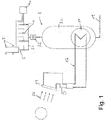
- a device for Beikrautkontrolle has according to Fig. 1 a thermal solar collector 27.
- a heat transfer circuit 17 connects the solar thermal collector 27 with a heat exchanger 18, which is in heat exchange with a water reservoir 20. Via a cold water supply line 19 to the heat exchanger 18 to be heated water is supplied. From the heat exchanger 18 preheated water is heated in a heater 32 to a discharge temperature of 85 ° C and can be removed via a hot water line 21. In a region of the hot water line 21 valves 4 are arranged. By means of the valves 4, a hot water inflow to the nozzles 2 can be opened or closed. Opening and closing can be done both manually on a solar system and via a control device 4a. The nozzles 2 are below in the Fig. 1 Solar collectors 8 not shown arranged.
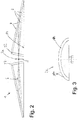
- the solar system 1 has, as in Fig. 2 shown, in a known manner, a base frame 22 on which the solar panels 8 are arranged.
- the base frame 22 stands with a bottom on a bottom surface 14.
- the floor surface 14 may be a roof of a building.
- the bottom surface 14 is a horizontal area at a level of a footprint of the base frame 22.
- Below the solar panels 8 can be done intentionally or unwanted Beikrautbewuchs.
- the Beikrautkontrolle below the solar panels 8 with mobile devices for Beikrautkontrolle is difficult to realize due to the prevailing cramped space there. If several solar collectors 8 are close to each other, reaching a weed growth with the mobile device may be impossible.
- the nozzles 2a are arranged below the solar collectors 8, the nozzles 2a are arranged.
- the nozzles 2a are connected to a supply line 5, which may be rigid or flexible.
- the supply line 5 is rigid.
- These are, for example, steel or plastic pipes to which the nozzles 2a are attached.
- two nozzles 2a designed as fan nozzles are shown, which are arranged offset by 180 ° to one another on the feed line 5.
- outlet openings 11a of the nozzles 2a are oriented in such a way that a droplet spray 6 dispensed from the nozzle 2a is dispensed into a region below each of the respective solar collectors 8.
- the droplet spray 6 impinges laterally on the weeds and the weed is damaged in a region of the incident droplet spray 6.
- Hot water destroys Beikraut's vegetable protein and the weed dies in this area. An area of Beikrauts below a damaged area is maintained.
- the solar collectors 8 can be both photovoltaic systems and thermal solar collectors.
- the solar collectors 8 can be arranged both statically and dynamically and driven by a motor to follow a course of the sun.
- the solar collectors 8 are, as in the FIG. 2 shown, at an angle.
- An area of each solar panel 8 is located near the floor and an opposite area is held by the base rack 22.
- the solar panels 8 each facing east or west, to ensure the greatest possible solar yield. In each case, an east and a west-oriented solar collector 8 are arranged together on a base frame 22.
- the in the Fig. 3 shown nozzle 2a has a curved nozzle body. In a peripheral region, it has a plurality of outlet openings 11a, which are indicated here by dash-dotted lines.
- the nozzle 2a is designed as a fan nozzle and thus produces a fan-like spray pattern.
- the outlet openings 11a opposite a threaded connection is arranged, by means of which the nozzle 2a can be connected to the supply line 5.
- the threaded connection is designed here as a union nut in order to allow an angle adjustment of the nozzle 2a.
- the nozzle 2a produces droplets 7 having a droplet size of between 500 ⁇ m and 1000 ⁇ m or even larger droplets.
- Fig. 4 shows a solar system with a device for Beikrautkontrolle as in Fig. 2 However, the nozzle 2b of the soft in the Fig. 2 shown nozzles 2a. In Fig. 4 a baffle plate nozzle is shown.
- the baffle plate 2b shown as well as in the Fig. 4 is shown.
- the baffle plate 2b can distribute the drop spray 6 at an angle of 360 ° below the solar collectors 8.
- the baffle plate 12 is formed above an outlet opening 11 b.
- a baffle plate 12 is a round baffle, which downstream of the Outlet opening 11 b is fixed with a trapezoidal bracket 24 to a nozzle housing.
- the nozzle 2b has a hex key surface on an outer periphery and a nut thread on an inner periphery.
- the female thread of the nozzle 2b can be screwed with a suitable tool with a bolt thread of the supply line 5.
- the nozzle 2b generates droplets 7 with a droplet size between 500 ⁇ m and 1000 ⁇ m or even larger droplets.
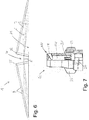
- Fig. 6 shows a solar system with a device for Beikrautkontrolle as in the Fig. 2 described, however, the nozzle 2c of the soft in the Fig. 2 shown nozzles 2a.
- the nozzles 2c are formed as flat jet nozzles.
- There are two slotted nozzles 2 c are provided, which are arranged offset by 180 ° to each other on a supply line 5.
- the slits 28 are each oriented in the direction of an area below the solar collectors 8 and the droplet spray 6 is dispensed under the solar collectors 8 accordingly.
- Fig. 7 is one of the nozzles 2c shown, as well as in the Fig. 6 are shown, the outlet opening 11 c formed slit-like and arranged in a peripheral wall of the outlet chamber 10c.
- a slot 28 is shown, from which the water heated by the heater 32, ie hot water, is discharged from the nozzle 2c.
- the nozzle body is a stepped cylinder, which additionally has two radially projecting wings 29, which serve as an operating handle for an operator. By means of the wings 29, the nozzle 2c can be manually connected to the supply line 5.
- a helical groove structure 30 is shown in a lower region of the nozzle body.
- the groove structure 30 is part of a bayonet closure with which the nozzle 2c and the feed line 5 can be connected to one another.
- a cup-shaped guide device 31 is inserted with axial passage openings, which swirls the supplied water and promotes droplet formation.
- the nozzle 2c generates droplets 7 with a droplet size between 500 ⁇ m and 1000 ⁇ m and is also used as a liquid fertilizer nozzle.
- a heat transfer medium such as a thermal oil or water
- the heated heat carrier is passed through the heat exchanger 18.
- the heat energy of the heat carrier is transferred to water in the water tank 20 and this preheated.
- the preheated water is heated by the heater 32 to 85 ° C and discharged through the nozzles 2a, 2b, 2c.
- a levy of the Hot water occurs at a height of about 200 mm above the bottom surface in the form of the drop spray 6 with a drop size between 500 microns and 1,000 microns.
- the weed is wetted by the hot water.
- the drops 7 are discharged substantially horizontally and impinge laterally on the weeds, wherein denatured by the high temperature of the impinging drops 7, the plant protein, the plant is damaged in the region of the impingement of hot water and thus prevented from further height growth.
- the throw of the drops is 1,300 mm, while a hot water volume of about 1.6 I is applied per m 2 of the bottom surface.
- the process, and in particular the spraying of the weeds with heated water is repeated at a time interval of about 21 days in order to regulate the height growth of the weeds.
Landscapes
- Life Sciences & Earth Sciences (AREA)
- Engineering & Computer Science (AREA)
- Insects & Arthropods (AREA)
- Pest Control & Pesticides (AREA)
- Wood Science & Technology (AREA)
- Zoology (AREA)
- Environmental Sciences (AREA)
- Catching Or Destruction (AREA)
Applications Claiming Priority (1)
| Application Number | Priority Date | Filing Date | Title |
|---|---|---|---|
| DE102016218624.8A DE102016218624A1 (de) | 2016-09-27 | 2016-09-27 | Vorrichtung und Verfahren zur Beikrautkontrolle |
Publications (1)
| Publication Number | Publication Date |
|---|---|
| EP3300599A1 true EP3300599A1 (fr) | 2018-04-04 |
Family
ID=59337519
Family Applications (1)
| Application Number | Title | Priority Date | Filing Date |
|---|---|---|---|
| EP17181033.6A Withdrawn EP3300599A1 (fr) | 2016-09-27 | 2017-07-12 | Procédé et dispositif de contrôle des mauvaises herbes |
Country Status (2)
| Country | Link |
|---|---|
| EP (1) | EP3300599A1 (fr) |
| DE (1) | DE102016218624A1 (fr) |
Cited By (1)
| Publication number | Priority date | Publication date | Assignee | Title |
|---|---|---|---|---|
| EP4186363A1 (fr) * | 2021-11-25 | 2023-05-31 | Michael Sappl | Dispositif de lutte contre les mauvaises herbes, système de lutte contre les mauvaises herbes et véhicule |
Citations (3)
| Publication number | Priority date | Publication date | Assignee | Title |
|---|---|---|---|---|
| WO1994026102A1 (fr) * | 1993-05-07 | 1994-11-24 | Waipuna International Limited | Procede et dispositif de lutte contre la vegetation |
| DE19729683A1 (de) | 1997-01-28 | 1998-07-30 | Werner Goergens Consulting & T | Verfahren und Vorrichtung zum Beseitigen von Wildkraut |
| KR20100004522A (ko) * | 2008-07-04 | 2010-01-13 | 김장환 | 고속 미립화 원거리 동력 분무기 |
Family Cites Families (5)
| Publication number | Priority date | Publication date | Assignee | Title |
|---|---|---|---|---|
| DE6934399U (de) | 1969-09-01 | 1969-12-18 | Lechler Appbau Kg | Prallteller |
| DD292389A5 (de) | 1990-03-01 | 1991-08-01 | Lechler Gmbh U. Co. Kg,De | Flachstrahlduese zur vergleichsweise grobtropfigen zerstaeubung von fluessigkeiten |
| US5870852A (en) | 1996-01-25 | 1999-02-16 | Stanley; William Ralph | Non-toxic fire ant extermination means |
| GB201122263D0 (en) | 2011-12-23 | 2012-02-01 | Weeding Technologies Ltd | Weed control |
| US20140215907A1 (en) | 2013-02-01 | 2014-08-07 | Ms Gregson | Steam concentration conduit, nozzle and weed killing apparatus |
-
2016
- 2016-09-27 DE DE102016218624.8A patent/DE102016218624A1/de not_active Withdrawn
-
2017
- 2017-07-12 EP EP17181033.6A patent/EP3300599A1/fr not_active Withdrawn
Patent Citations (3)
| Publication number | Priority date | Publication date | Assignee | Title |
|---|---|---|---|---|
| WO1994026102A1 (fr) * | 1993-05-07 | 1994-11-24 | Waipuna International Limited | Procede et dispositif de lutte contre la vegetation |
| DE19729683A1 (de) | 1997-01-28 | 1998-07-30 | Werner Goergens Consulting & T | Verfahren und Vorrichtung zum Beseitigen von Wildkraut |
| KR20100004522A (ko) * | 2008-07-04 | 2010-01-13 | 김장환 | 고속 미립화 원거리 동력 분무기 |
Cited By (1)
| Publication number | Priority date | Publication date | Assignee | Title |
|---|---|---|---|---|
| EP4186363A1 (fr) * | 2021-11-25 | 2023-05-31 | Michael Sappl | Dispositif de lutte contre les mauvaises herbes, système de lutte contre les mauvaises herbes et véhicule |
Also Published As
| Publication number | Publication date |
|---|---|
| DE102016218624A1 (de) | 2018-03-29 |
Similar Documents
| Publication | Publication Date | Title |
|---|---|---|
| EP3129738A1 (fr) | Distributeur de liquide et arrangement | |
| WO2017162363A1 (fr) | Dispositif de traitement de sol | |
| DE102016118475A1 (de) | Vorrichtung zum Verdampfen eines flüssigen Mediums in einer Füllproduktabfüllanlage | |
| DE102007035639B3 (de) | Anlage zum Verteilen einer Flüssigkeit | |
| DE2054777C3 (de) | Abschreckvorrichtung | |
| EP3020795A1 (fr) | Procede et dispositif de preparation du mout | |
| EP3300599A1 (fr) | Procédé et dispositif de contrôle des mauvaises herbes | |
| DE102008022837A1 (de) | Einrichtung zum Verdampfen von kalkhaltigem Wasser mittels elektrischer Beheizung | |
| DE2312475B2 (de) | Vorrichtung zum entgasen von wasser unter ueberdruck, insbesondere von kesselspeisewasser | |
| WO2010081740A2 (fr) | Dispositif de traitement d'une pâte, en particulier four à humidification froide | |
| EP1489374A1 (fr) | Accumulateur d'eau chaude, en particulier accumulateur stratifié | |
| DE10122433A1 (de) | Verfahren und Vorrichtung zur Reinigung von Wasser | |
| DE2751820C2 (de) | Vorrichtung zur Wärmegewinnung aus pflanzlichen Abfallstoffen | |
| DE202016100306U1 (de) | Vorrichtung zum Antreiben einer Generatorwelle durch Umwandlung von Wärmeenergie in Bewegungsenergie | |
| DE102019207379B4 (de) | Fluidführende Gitterstruktur für einen Wärmetauscher | |
| DE2734318C3 (de) | Einrichtung zum Besprühen von Pflanzenkulturen | |
| EP3256173B1 (fr) | Système d'évaporation éclair comprenant un évaporateur éclair, et procédé de fonctionnement | |
| DE3124213A1 (de) | Verfahren und vorrichtung zur behandlung von abwasser | |
| EP2893982B1 (fr) | Dispositif de laquage | |
| EP2345331A1 (fr) | Dispositif d'alimentation pour un matériau de revêtement | |
| DD227332B1 (de) | Fluessigkeitsverteilvorrichtung auf senkrechte rohrbuendel, insbesondere fuer fallfilmapparate | |
| EP3320959A1 (fr) | Dispositif et procédé d'élimination d'eaux usées | |
| DE3834670A1 (de) | Duese zum austragen von fluessigem duenger | |
| DE102009057254B4 (de) | Verfahren und Vorrichtung zum Online-Reinigen von Bereichen vertikaler Leerzüge einer Verbrennungsanlage | |
| DE605173C (de) | Duese oder Brause |
Legal Events
| Date | Code | Title | Description |
|---|---|---|---|
| PUAI | Public reference made under article 153(3) epc to a published international application that has entered the european phase |
Free format text: ORIGINAL CODE: 0009012 |
|
| AK | Designated contracting states |
Kind code of ref document: A1 Designated state(s): AL AT BE BG CH CY CZ DE DK EE ES FI FR GB GR HR HU IE IS IT LI LT LU LV MC MK MT NL NO PL PT RO RS SE SI SK SM TR |
|
| AX | Request for extension of the european patent |
Extension state: BA ME |
|
| STAA | Information on the status of an ep patent application or granted ep patent |
Free format text: STATUS: THE APPLICATION IS DEEMED TO BE WITHDRAWN |
|
| 18D | Application deemed to be withdrawn |
Effective date: 20181005 |