EP3300711A1 - Aide à la marche électromécanique - Google Patents
Aide à la marche électromécanique Download PDFInfo
- Publication number
- EP3300711A1 EP3300711A1 EP17193862.4A EP17193862A EP3300711A1 EP 3300711 A1 EP3300711 A1 EP 3300711A1 EP 17193862 A EP17193862 A EP 17193862A EP 3300711 A1 EP3300711 A1 EP 3300711A1
- Authority
- EP
- European Patent Office
- Prior art keywords
- walking aid
- user
- walking
- actuator support
- actuator
- Prior art date
- Legal status (The legal status is an assumption and is not a legal conclusion. Google has not performed a legal analysis and makes no representation as to the accuracy of the status listed.)
- Withdrawn
Links
- 230000036541 health Effects 0.000 claims description 4
- 230000001133 acceleration Effects 0.000 claims description 2
- 230000036642 wellbeing Effects 0.000 claims 1
- 241001166076 Diapheromera femorata Species 0.000 description 1
- 241001272996 Polyphylla fullo Species 0.000 description 1
- MOVRNJGDXREIBM-UHFFFAOYSA-N aid-1 Chemical compound O=C1NC(=O)C(C)=CN1C1OC(COP(O)(=O)OC2C(OC(C2)N2C3=C(C(NC(N)=N3)=O)N=C2)COP(O)(=O)OC2C(OC(C2)N2C3=C(C(NC(N)=N3)=O)N=C2)COP(O)(=O)OC2C(OC(C2)N2C3=C(C(NC(N)=N3)=O)N=C2)COP(O)(=O)OC2C(OC(C2)N2C(NC(=O)C(C)=C2)=O)COP(O)(=O)OC2C(OC(C2)N2C3=C(C(NC(N)=N3)=O)N=C2)COP(O)(=O)OC2C(OC(C2)N2C3=C(C(NC(N)=N3)=O)N=C2)COP(O)(=O)OC2C(OC(C2)N2C3=C(C(NC(N)=N3)=O)N=C2)COP(O)(=O)OC2C(OC(C2)N2C(NC(=O)C(C)=C2)=O)COP(O)(=O)OC2C(OC(C2)N2C3=C(C(NC(N)=N3)=O)N=C2)COP(O)(=O)OC2C(OC(C2)N2C3=C(C(NC(N)=N3)=O)N=C2)COP(O)(=O)OC2C(OC(C2)N2C3=C(C(NC(N)=N3)=O)N=C2)COP(O)(=O)OC2C(OC(C2)N2C(NC(=O)C(C)=C2)=O)COP(O)(=O)OC2C(OC(C2)N2C3=C(C(NC(N)=N3)=O)N=C2)COP(O)(=O)OC2C(OC(C2)N2C3=C(C(NC(N)=N3)=O)N=C2)COP(O)(=O)OC2C(OC(C2)N2C3=C(C(NC(N)=N3)=O)N=C2)CO)C(O)C1 MOVRNJGDXREIBM-UHFFFAOYSA-N 0.000 description 1
- 230000009286 beneficial effect Effects 0.000 description 1
- 230000003019 stabilising effect Effects 0.000 description 1
- 230000003319 supportive effect Effects 0.000 description 1
Images


Classifications
-
- A—HUMAN NECESSITIES
- A61—MEDICAL OR VETERINARY SCIENCE; HYGIENE
- A61H—PHYSICAL THERAPY APPARATUS, e.g. DEVICES FOR LOCATING OR STIMULATING REFLEX POINTS IN THE BODY; ARTIFICIAL RESPIRATION; MASSAGE; BATHING DEVICES FOR SPECIAL THERAPEUTIC OR HYGIENIC PURPOSES OR SPECIFIC PARTS OF THE BODY
- A61H3/00—Appliances for aiding patients or disabled persons to walk about
- A61H3/04—Wheeled walking aids for patients or disabled persons
-
- A—HUMAN NECESSITIES
- A61—MEDICAL OR VETERINARY SCIENCE; HYGIENE
- A61H—PHYSICAL THERAPY APPARATUS, e.g. DEVICES FOR LOCATING OR STIMULATING REFLEX POINTS IN THE BODY; ARTIFICIAL RESPIRATION; MASSAGE; BATHING DEVICES FOR SPECIAL THERAPEUTIC OR HYGIENIC PURPOSES OR SPECIFIC PARTS OF THE BODY
- A61H3/00—Appliances for aiding patients or disabled persons to walk about
- A61H2003/001—Appliances for aiding patients or disabled persons to walk about on steps or stairways
-
- A—HUMAN NECESSITIES
- A61—MEDICAL OR VETERINARY SCIENCE; HYGIENE
- A61H—PHYSICAL THERAPY APPARATUS, e.g. DEVICES FOR LOCATING OR STIMULATING REFLEX POINTS IN THE BODY; ARTIFICIAL RESPIRATION; MASSAGE; BATHING DEVICES FOR SPECIAL THERAPEUTIC OR HYGIENIC PURPOSES OR SPECIFIC PARTS OF THE BODY
- A61H3/00—Appliances for aiding patients or disabled persons to walk about
- A61H3/04—Wheeled walking aids for patients or disabled persons
- A61H2003/043—Wheeled walking aids for patients or disabled persons with a drive mechanism
-
- A—HUMAN NECESSITIES
- A61—MEDICAL OR VETERINARY SCIENCE; HYGIENE
- A61H—PHYSICAL THERAPY APPARATUS, e.g. DEVICES FOR LOCATING OR STIMULATING REFLEX POINTS IN THE BODY; ARTIFICIAL RESPIRATION; MASSAGE; BATHING DEVICES FOR SPECIAL THERAPEUTIC OR HYGIENIC PURPOSES OR SPECIFIC PARTS OF THE BODY
- A61H3/00—Appliances for aiding patients or disabled persons to walk about
- A61H3/04—Wheeled walking aids for patients or disabled persons
- A61H2003/046—Wheeled walking aids for patients or disabled persons with braking means
-
- A—HUMAN NECESSITIES
- A61—MEDICAL OR VETERINARY SCIENCE; HYGIENE
- A61H—PHYSICAL THERAPY APPARATUS, e.g. DEVICES FOR LOCATING OR STIMULATING REFLEX POINTS IN THE BODY; ARTIFICIAL RESPIRATION; MASSAGE; BATHING DEVICES FOR SPECIAL THERAPEUTIC OR HYGIENIC PURPOSES OR SPECIFIC PARTS OF THE BODY
- A61H2201/00—Characteristics of apparatus not provided for in the preceding codes
- A61H2201/01—Constructive details
- A61H2201/0192—Specific means for adjusting dimensions
-
- A—HUMAN NECESSITIES
- A61—MEDICAL OR VETERINARY SCIENCE; HYGIENE
- A61H—PHYSICAL THERAPY APPARATUS, e.g. DEVICES FOR LOCATING OR STIMULATING REFLEX POINTS IN THE BODY; ARTIFICIAL RESPIRATION; MASSAGE; BATHING DEVICES FOR SPECIAL THERAPEUTIC OR HYGIENIC PURPOSES OR SPECIFIC PARTS OF THE BODY
- A61H2201/00—Characteristics of apparatus not provided for in the preceding codes
- A61H2201/16—Physical interface with patient
- A61H2201/1602—Physical interface with patient kind of interface, e.g. head rest, knee support or lumbar support
- A61H2201/1635—Hand or arm, e.g. handle
-
- A—HUMAN NECESSITIES
- A61—MEDICAL OR VETERINARY SCIENCE; HYGIENE
- A61H—PHYSICAL THERAPY APPARATUS, e.g. DEVICES FOR LOCATING OR STIMULATING REFLEX POINTS IN THE BODY; ARTIFICIAL RESPIRATION; MASSAGE; BATHING DEVICES FOR SPECIAL THERAPEUTIC OR HYGIENIC PURPOSES OR SPECIFIC PARTS OF THE BODY
- A61H2201/00—Characteristics of apparatus not provided for in the preceding codes
- A61H2201/50—Control means thereof
- A61H2201/5007—Control means thereof computer controlled
-
- A—HUMAN NECESSITIES
- A61—MEDICAL OR VETERINARY SCIENCE; HYGIENE
- A61H—PHYSICAL THERAPY APPARATUS, e.g. DEVICES FOR LOCATING OR STIMULATING REFLEX POINTS IN THE BODY; ARTIFICIAL RESPIRATION; MASSAGE; BATHING DEVICES FOR SPECIAL THERAPEUTIC OR HYGIENIC PURPOSES OR SPECIFIC PARTS OF THE BODY
- A61H2201/00—Characteristics of apparatus not provided for in the preceding codes
- A61H2201/50—Control means thereof
- A61H2201/5023—Interfaces to the user
- A61H2201/5048—Audio interfaces, e.g. voice or music controlled
-
- A—HUMAN NECESSITIES
- A61—MEDICAL OR VETERINARY SCIENCE; HYGIENE
- A61H—PHYSICAL THERAPY APPARATUS, e.g. DEVICES FOR LOCATING OR STIMULATING REFLEX POINTS IN THE BODY; ARTIFICIAL RESPIRATION; MASSAGE; BATHING DEVICES FOR SPECIAL THERAPEUTIC OR HYGIENIC PURPOSES OR SPECIFIC PARTS OF THE BODY
- A61H2201/00—Characteristics of apparatus not provided for in the preceding codes
- A61H2201/50—Control means thereof
- A61H2201/5058—Sensors or detectors
- A61H2201/5064—Position sensors
-
- A—HUMAN NECESSITIES
- A61—MEDICAL OR VETERINARY SCIENCE; HYGIENE
- A61H—PHYSICAL THERAPY APPARATUS, e.g. DEVICES FOR LOCATING OR STIMULATING REFLEX POINTS IN THE BODY; ARTIFICIAL RESPIRATION; MASSAGE; BATHING DEVICES FOR SPECIAL THERAPEUTIC OR HYGIENIC PURPOSES OR SPECIFIC PARTS OF THE BODY
- A61H2201/00—Characteristics of apparatus not provided for in the preceding codes
- A61H2201/50—Control means thereof
- A61H2201/5058—Sensors or detectors
- A61H2201/5069—Angle sensors
-
- A—HUMAN NECESSITIES
- A61—MEDICAL OR VETERINARY SCIENCE; HYGIENE
- A61H—PHYSICAL THERAPY APPARATUS, e.g. DEVICES FOR LOCATING OR STIMULATING REFLEX POINTS IN THE BODY; ARTIFICIAL RESPIRATION; MASSAGE; BATHING DEVICES FOR SPECIAL THERAPEUTIC OR HYGIENIC PURPOSES OR SPECIFIC PARTS OF THE BODY
- A61H2201/00—Characteristics of apparatus not provided for in the preceding codes
- A61H2201/50—Control means thereof
- A61H2201/5097—Control means thereof wireless
Definitions
- the present invention relates to a walking aid particularly although not exclusively for the elderly.
- “Couch Canes” are also a popular aid for the elderly in helping people to get on and off the toilet or a chair. These devices tend not to have wheels or rollers to improve the stability of the device when force is applied to it by the user. “Couch Canes” are therefore difficult for the user to take everywhere with them. They can be a fixed height or can have an adjustable element to change the height depending on the user's requirements.
- the object of the present invention is to provide an improved walking aid.
- a walking aid comprising:
- the actuator support has 3 integral brackets with a plurality of apertures.
- the apertures provide a location for each linear actuator to be pivotally connected and the plurality allows for adjustment of the device.
- the brackets are separate components to the actuator support, they may also contain only two apertures.
- the brackets are located equally spaced along the actuator support, however it can be envisaged that they are spaced unequally.
- the brackets are also orientated along the same centreline, however they can be spaced with the middle bracket off centre.
- the walking aid can comprise sensors to detect, particularly although not exclusively, changes in the users strength, force applied by the user, position of the device including pitch, roll, tilt and acceleration, and extension of the linear actuators.
- the walking aid comprises a processor to receive communication from each sensor and to instigate adjustment of the device.
- the device could have more than 3 wheels, however preferably there are 3.
- the walking aid may also comprise a Wifi connection, this enables the processor to access cloud services.
- the cloud services could include speech recognition services, access to audio files and emergency numbers as well as other health related services.
- the walking aid may also consist of further sensors and transmitters so that loved ones are able to check whether the user is weaker than usual, whether they have been for a walk that day and other such variables remotely. There may also be the capability of a loved one being alerted if something changes for the user that could cause concern.
- the walking aid can have speech recognition and voice direction finding capabilities.
- the processor can digitise local binary audio and instigate an adjustment to the device or cause the device to move towards the user.
- the walking aid could have 3 linear actuators paired with a fixed leg which is pivotally connected to the direct drive wheel it is preferable that it has 6 linear actuators arranged in pairs and connected to the direct drive wheel.
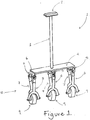
- the walking aid 1 consists of a handle 2, a shaft 3 and an actuator support 4.
- the actuator support has three integral brackets 5 with a plurality of apertures 6.
- the apertures are for pivotally connecting six linear actuators arranged in pairs consisting of a rear actuator 7 and a front actuator 8.
- Each pair of actuators is pivotally connected to a direct drive wheel 9 arranged in a triangular arrangement where the actuator support provides one side of the triangle.
- Each pair of linear actuators and a direct drive wheel can be collectively referred to as a leg 10.
- the front and rear actuators are arranged in the same plane as seen in Figure 5 .
- One actuator corresponds to a single assembly including an armature 11 and an axle 12 on which the other actuator is connected. This assembly fixes one actuator with respect to the axle where the other actuator is allowed to rotate relative to the first actuator. This also prevents the motor from rotating.
- a series of coils 13 which when energised attract permanent magnets 14, housed in a cylinder 15. This cylinder revolves around the armature on ball bearings 16 when the coils are activated. The cylinder is then surrounded by rubber completing the tyre 17.
- the walking aid is driven by three brushless direct drive DC motors 18 which drive the wheels 9.
- the linear actuators are based on stepper motors 19 for leg rotation and elongation.
- Each of the three legs includes rotation and extension sensors 20. They are all driven by the main electronics and computation module 21 which receives sense data from the users hand and fingers and motion and orientation sensors. Low level stability control is performed within the local processor 22.
- Each actuator is individually lengthened or shortened to suit the user's environment, to either rotate the legs forward or backwards, reduce or increase the wheel base or reduce or increase the overall height of the legs.
- the way in which the walking aid can achieve this is described by the following examples.
- One function of the walking aid is to help a user to sit on a toilet or sofa for example, or to stand from a seated position. To sit, a user would bring the walking aid to near where they wanted to sit, the walking aid would then increase its wheelbase to enable a more stable foundation for the user to lean against while sitting. In increasing the wheel base you are also reducing the overall height of the walking aid to follow the user into a sitting position. An example of this is shown in Figure 3 .
- the walking aid requires a smaller wheelbase to be able to navigate indoors, which also avoids the requirement for specially adapted housing.
- the walking aid When the user is walking, either indoors or outside, the walking aid senses the pressure of a user's hand on the handle, the walking aid then moves in the desired direction at the speed required for the hand to always be fully supported.
- the walking aid can reduce its wheelbase to the minimum and act like a Segway (RTM), a self-supported inverse pendulum.
- the walking aid can navigate steps, for example the threshold of a doorway or a pavement edge.
- the walking aid can shorten and extend forward its middle wheel, while lengthening and stabilising the outer two legs to ensure a stable tripod wheelbase to support the user.
- the back legs shorten and move forward to be in the desired position for walking again. The user does not have to lift the walking aid, or walk unsupported at any time.
- the walking aid is also beneficial when walking on a slope.
- pavements in the UK are sloped to help drainage into the gutters of the road.
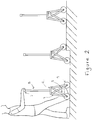
- the fact that each leg of the walking aid is individually adjustable allows the road to be sloped but the actuator support to remain horizontal to best support the user as shown in Figure 4 .
- An advantage to the preferred embodiment is that the walking aid can assist the user in walking, moving around indoors, helping to stand or sit, navigate a step and remain stable while walking along a slope among others features all in one ergonomic device.
- the processor could also digitise local binary audio for use in speech recognition and voice direction finding.
- the walking aid can also replay audio received as MP3 files.
- the walking aid can be Wifi enabled which allows the processor to access cloud services where amongst other health related services, speech recognition services and access to entertaining audio files is performed.
- the walking aid can have an adjustable handle or shaft to suit the height of any user without amending the wheelbase to compensate.
- the walking aid can have 3 linear actuators paired with 3 fixed legs which are pivotally connected to the direct drive wheel, however it is preferable that it has 6 linear actuators arranged in pairs as described hereinbefore.
Landscapes
- Health & Medical Sciences (AREA)
- Epidemiology (AREA)
- Pain & Pain Management (AREA)
- Physical Education & Sports Medicine (AREA)
- Rehabilitation Therapy (AREA)
- Life Sciences & Earth Sciences (AREA)
- Animal Behavior & Ethology (AREA)
- General Health & Medical Sciences (AREA)
- Public Health (AREA)
- Veterinary Medicine (AREA)
- Rehabilitation Tools (AREA)
Applications Claiming Priority (1)
| Application Number | Priority Date | Filing Date | Title |
|---|---|---|---|
| GBGB1616457.6A GB201616457D0 (en) | 2016-09-28 | 2016-09-28 | Electromechanical walking aid |
Publications (1)
| Publication Number | Publication Date |
|---|---|
| EP3300711A1 true EP3300711A1 (fr) | 2018-04-04 |
Family
ID=57539842
Family Applications (1)
| Application Number | Title | Priority Date | Filing Date |
|---|---|---|---|
| EP17193862.4A Withdrawn EP3300711A1 (fr) | 2016-09-28 | 2017-09-28 | Aide à la marche électromécanique |
Country Status (2)
| Country | Link |
|---|---|
| EP (1) | EP3300711A1 (fr) |
| GB (1) | GB201616457D0 (fr) |
Cited By (2)
| Publication number | Priority date | Publication date | Assignee | Title |
|---|---|---|---|---|
| WO2019193303A1 (fr) * | 2018-04-03 | 2019-10-10 | Dennis Majoe | Châssis mobile |
| CN116251011A (zh) * | 2023-02-22 | 2023-06-13 | 浙江福康通康养科技有限公司 | 一种老人行走辅助设备 |
Citations (6)
| Publication number | Priority date | Publication date | Assignee | Title |
|---|---|---|---|---|
| US20030205265A1 (en) * | 2001-12-19 | 2003-11-06 | Mike Nasco | Braking cane |
| US20120018233A1 (en) * | 2010-07-20 | 2012-01-26 | Chang Yoon Young | Walking-assistant device |
| WO2012118263A1 (fr) * | 2011-02-28 | 2012-09-07 | Lg Electronics Inc. | Système d'aide à la marche |
| US20130306120A1 (en) | 2011-02-23 | 2013-11-21 | Murata Manufacturing Co., Ltd. | Walking assist apparatus |
| US20150183463A1 (en) * | 2012-09-18 | 2015-07-02 | Murata Manufacturing Co., Ltd. | Pushcart |
| US20160074262A1 (en) * | 2014-12-26 | 2016-03-17 | Sophia Vasiliki Moses | Intelliwalker, an intelligent, sensor equipped, motorized robotic walking assistance device. |
-
2016
- 2016-09-28 GB GBGB1616457.6A patent/GB201616457D0/en not_active Ceased
-
2017
- 2017-09-28 EP EP17193862.4A patent/EP3300711A1/fr not_active Withdrawn
Patent Citations (6)
| Publication number | Priority date | Publication date | Assignee | Title |
|---|---|---|---|---|
| US20030205265A1 (en) * | 2001-12-19 | 2003-11-06 | Mike Nasco | Braking cane |
| US20120018233A1 (en) * | 2010-07-20 | 2012-01-26 | Chang Yoon Young | Walking-assistant device |
| US20130306120A1 (en) | 2011-02-23 | 2013-11-21 | Murata Manufacturing Co., Ltd. | Walking assist apparatus |
| WO2012118263A1 (fr) * | 2011-02-28 | 2012-09-07 | Lg Electronics Inc. | Système d'aide à la marche |
| US20150183463A1 (en) * | 2012-09-18 | 2015-07-02 | Murata Manufacturing Co., Ltd. | Pushcart |
| US20160074262A1 (en) * | 2014-12-26 | 2016-03-17 | Sophia Vasiliki Moses | Intelliwalker, an intelligent, sensor equipped, motorized robotic walking assistance device. |
Cited By (2)
| Publication number | Priority date | Publication date | Assignee | Title |
|---|---|---|---|---|
| WO2019193303A1 (fr) * | 2018-04-03 | 2019-10-10 | Dennis Majoe | Châssis mobile |
| CN116251011A (zh) * | 2023-02-22 | 2023-06-13 | 浙江福康通康养科技有限公司 | 一种老人行走辅助设备 |
Also Published As
| Publication number | Publication date |
|---|---|
| GB201616457D0 (en) | 2016-11-09 |
Similar Documents
| Publication | Publication Date | Title |
|---|---|---|
| KR101356520B1 (ko) | 보행 보조 시스템 | |
| CN105769482B (zh) | 生活辅助系统和生活辅助方法 | |
| US20160074262A1 (en) | Intelliwalker, an intelligent, sensor equipped, motorized robotic walking assistance device. | |
| US11253415B2 (en) | Body lightening system for gait training | |
| CN108697568A (zh) | 支撑结构 | |
| US20170071804A1 (en) | Powered wheelchair | |
| KR101668711B1 (ko) | 보행 보조 장치 | |
| EP3207908A3 (fr) | Appareil de chaise mobile à pédales | |
| US9969212B2 (en) | Resistance force control structure of driven pulley device | |
| KR20130006902A (ko) | 이동 보조 시스템 | |
| EP3081472A1 (fr) | Dispositif de mobilité électrique avec mécanisme d'inclinaison à plusieurs pivots | |
| EP3641594B1 (fr) | Siège motorisé à gravité nulle | |
| KR20130107487A (ko) | 좌석 각도의 자동 밸런싱과 스마트기기 연동이 가능한 전동 휠체어 | |
| US20220133559A1 (en) | Motorised mobility device | |
| WO2019193303A1 (fr) | Châssis mobile | |
| KR101592321B1 (ko) | 지능형 보행 보조차의 제어방법 | |
| GB2559786A (en) | Mobility apparatus | |
| CN105250118A (zh) | 护理支援装置 | |
| JP2016093221A (ja) | 歩行器 | |
| FI127759B (fi) | Henkilökohotin ja menetelmä henkilökohottimen käyttövoiman tuottamiseksi | |
| TWM527319U (zh) | 一種行動底座以及使用該底座的輪椅 | |
| EP3260335B1 (fr) | Structure de commande de force de freinage de déambulateur avec roues | |
| CN113975108B (zh) | 智能助行装置和控制调整其构型的方法 | |
| KR101537907B1 (ko) | 다기능 휠체어 | |
| KR101350819B1 (ko) | 다리식 휠체어 |
Legal Events
| Date | Code | Title | Description |
|---|---|---|---|
| PUAI | Public reference made under article 153(3) epc to a published international application that has entered the european phase |
Free format text: ORIGINAL CODE: 0009012 |
|
| AK | Designated contracting states |
Kind code of ref document: A1 Designated state(s): AL AT BE BG CH CY CZ DE DK EE ES FI FR GB GR HR HU IE IS IT LI LT LU LV MC MK MT NL NO PL PT RO RS SE SI SK SM TR |
|
| AX | Request for extension of the european patent |
Extension state: BA ME |
|
| STAA | Information on the status of an ep patent application or granted ep patent |
Free format text: STATUS: THE APPLICATION IS DEEMED TO BE WITHDRAWN |
|
| 18D | Application deemed to be withdrawn |
Effective date: 20181005 |