EP3301820A1 - Vektorprozessor und vektorverarbeitungsverfahren zur verringerung des übersprechens in mehreren betriebsarten - Google Patents
Vektorprozessor und vektorverarbeitungsverfahren zur verringerung des übersprechens in mehreren betriebsarten Download PDFInfo
- Publication number
- EP3301820A1 EP3301820A1 EP16306280.5A EP16306280A EP3301820A1 EP 3301820 A1 EP3301820 A1 EP 3301820A1 EP 16306280 A EP16306280 A EP 16306280A EP 3301820 A1 EP3301820 A1 EP 3301820A1
- Authority
- EP
- European Patent Office
- Prior art keywords
- group
- frequency range
- subscriber lines
- mode
- vector processor
- Prior art date
- Legal status (The legal status is an assumption and is not a legal conclusion. Google has not performed a legal analysis and makes no representation as to the accuracy of the status listed.)
- Granted
Links
Images



Classifications
-
- H—ELECTRICITY
- H04—ELECTRIC COMMUNICATION TECHNIQUE
- H04B—TRANSMISSION
- H04B3/00—Line transmission systems
- H04B3/02—Details
- H04B3/32—Reducing cross-talk, e.g. by compensating
Definitions
- the present invention relates to mitigating or cancelling crosstalk in a communication system.
- Particular embodiments relate to a vector processor, a vector controller, a communication unit of a communication system, a vector processing method, and a computer program product.
- G.fast cf. International Telecommunication Union Telecommunication Standardization Sector, ITU-T, specifications G.9700 and G.9701
- DPU distribution point unit
- CPEs customer premises equipments
- FTTdp Distribution Point
- a state-of-the-art technique to reduce the VP complexity is the use of partial crosstalk cancellation (PCC).
- Crosstalk into a line typically comes from a few dominant crosstalkers when considering the VDSL2 (Very-high-bit-rate Digital Subscriber Line 2) frequency range.
- VDSL2 Very-high-bit-rate Digital Subscriber Line 2
- PCC exploits this and restricts cancellation to only a few crosstalkers (using a so-called disturber list), thereby saving on required MACs (Multiply Accumulate units) and memory.
- PCC only performs well under small VDSL2 crosstalk levels.
- performance of PCC significantly degrades compared to full vectoring. It can for example be shown that average (full vectoring) data rates of 800 Mbps are reduced to only 100 Mbps for PCC.
- PCC does not necessarily reduce the complexity of the control path. The reason for the significantly degraded performance is that the crosstalk levels are much higher in G.fast, due to the extended frequency range compared to VDSL2. It can be expected that the same problem occurs for other types of interference-impacted communication systems operating over such extensive frequency ranges, for example over 500 MHz or greater frequency ranges.
- Embodiments of the present invention aim to provide effective operation for communication systems operating over a relatively broad frequency range, for example a total frequency range of at least 35 MHz.
- a non-limiting example of such communication systems is G.fast.
- Such communication systems may use a common frequency range for transmission, for example with a multicarrier technology (i.e. using multiple tones), and may be subject to crosstalk (including not only far-end crosstalk, but also other forms of crosstalk such as near-end crosstalk and echo).
- a vector processor for mitigating crosstalk between a number of subscriber lines of a communication system.
- the vector processor is configured for operating according to a first mode of operation over a first frequency range.
- the first mode of operation comprises mitigating crosstalk for a first group of subscriber lines selected among the number of subscriber lines.
- the vector processor is further configured for operating according to a second mode of operation, distinct from the first mode, over a second frequency range, separate from the first frequency range.
- the second mode of operation comprises mitigating crosstalk for a second group of the number of subscriber lines, the second group being selected as a strict subset of the first group.
- the second mode of operation further comprises disabling direct communication over the second frequency range for subscriber lines of the number of subscriber lines not forming part of the second group.
- operation of the vector processor can be different for the first frequency range than for the second frequency range, which allows to effectively utilize computational resources of the vector processor, since operation over a given frequency range can be tailored taking into account the usefulness of vector processing for that given frequency range.
- the term “separate” may be understood to mean “non-overlapping”.
- the second frequency range is situated above the first frequency range.
- the vector processor is configured for varying the selected subscriber lines of the second group over time, based on traffic information representing traffic load on at least one subscriber line of the number of subscriber lines, and/or by periodically selecting another subset from a plurality of different pre-defined strict subsets of the first group.
- the computational efficiency can be maintained over time.
- the vector processor can better respond to changing traffic load.
- the vector processor is configured for operating according to a third mode of operation, distinct from the first mode and from the second mode, over a third frequency range, separate from the first frequency range and from the second frequency range.
- the third mode of operation comprises mitigating crosstalk for a third group of the number of subscriber lines, the third group being selected as a strict subset of the first group and differing from the second group.
- the third mode of operation further comprises disabling direct communication over the third frequency range for subscriber lines of the number of subscriber lines not forming part of the third group.
- the computational effort of the vector processor can be allocated more effectively, taking into account frequency-dependency for different subscriber lines.
- the vector processor is configured for retrieving a set of pre-stored crosstalk cancellation coefficients in order to mitigate the crosstalk for the second group, derived from channel characteristics of the second group.
- the vector controller may be configured to calculate and pre-store one or more sets of crosstalk cancellation coefficients, for example in a memory of the vector controller, in a memory of the vector processor, and/or in an external memory.
- the vector controller may be configured for controlling the vector processor to perform the retrieving of the set or of one of the sets.
- the vector processor can respond quickly to changes in traffic load (for example on an order of milliseconds) by activating the correct set of crosstalk cancellation coefficients.
- the first group comprises all subscriber lines of the number of subscriber lines.
- the first group comprises a strict subset of the number of subscriber lines. That is, there exist at least one or more subscriber lines of the number of subscriber lines that are not included in the first group.
- crosstalk mitigation can be better targeted to those subscriber lines that stand to gain the most, or that belong to premium users.
- the first group comprises a plurality of sub-groups, wherein each sub-group is selected as a strict subset of victim lines of the first group, and each sub-group is associated with a separate frequency sub-range of the first frequency range.
- each victim line of the first group is preferably included in at least one sub-group of the plurality of sub-groups.
- computational resources can be utilized more efficiently, while performing full vectoring on the sub-groups, by focussing on the impact on fewer victim lines. If these are divided over the first frequency range in an equal manner - that is, if each victim line of the first group is included in at least one sub-group of the plurality of sub-groups - the impact on the data rate can be equalized.
- each victim line of the first group is included in a number of sub-groups greater than or equal to a predetermined threshold - for example, the predetermined threshold may be the greatest integer lower than the cardinality of a typical sub-group (that is, how many lines are included in a typical sub-group) divided by the difference of the number of subscriber lines in the first group and said cardinality.
- one or more victim lines of the first group may be prioritized by including them in a number of sub-groups that is yet greater than the predetermined threshold, while including other victim lines of the first group in a number of sub-groups that is smaller than the predetermined threshold.
- the first mode of operation may further comprise generating at least one boosting signal corresponding to at least one direct communication signal sent using at least one sub-group of the first group over its respective separate frequency sub-range, taking into account crosstalk from at least one of the subscriber lines of the first group not forming part of the respective sub-group over its respective separate frequency sub-range onto the respective sub-group; and transmitting the at least one boosting signal using the at least one of the subscriber lines of the first group not forming part of that respective sub-group over its respective separate frequency sub-range, in order to augment the at least one direct communication signal sent using the at least one respective sub-group of the first group over its respective separate frequency sub-range.
- the second mode of operation comprises generating at least one boosting signal corresponding to at least one direct communication signal sent using the second group, taking into account crosstalk from at least one of the subscriber lines for which direct communication is disabled onto the second group.
- the second mode of operation further comprises transmitting the at least one boosting signal using the at least one of the subscriber lines for which direct communication is disabled, in order to augment the at least one direct communication signal sent using the second group.
- the frequency range parts of the subscriber lines not forming part of the first group, which are not used for direct communication, can be usefully used for augmenting transmission on the active subscriber lines, that is, those of the second group.
- the vector processor is configured for operating according to a fourth mode of operation, distinct from the first mode and from the second mode, over a fourth frequency range, separate from the first frequency range and from the second frequency range.
- the vector processor is configured for operating according to the fourth mode by mitigating crosstalk for a fourth group of the number of subscriber lines, the fourth group being selected as a strict subset of the first group.
- the fourth mode of operation further comprises enabling direct communication over the fourth frequency range for at least some, preferably all, subscriber lines of the number of subscriber lines not forming part of the fourth group.
- the first frequency range is situated below an approximate midpoint of a total frequency range over which the communication system operates, the total frequency range comprising at least the first frequency range and the second frequency range, and the second frequency range is situated above the approximate midpoint of the total frequency range.
- the vector processor is further configured for operating according to a total-frequency-range mode of operation, distinct from the first mode and from the second mode, over a total frequency range over which the communication system operates, the total frequency range comprising at least the first frequency range and the second frequency range.
- the vector processor is configured for operating according to the total-frequency-range mode by mitigating crosstalk for a fifth group of the number of subscriber lines.
- the fifth group comprises strictly fewer of the number of subscriber lines than the first group.
- the same vector processor can also operate to perform full vectoring conventionally, albeit for a reduced number of subscriber lines, namely the fifth group. This allows to apply the same vector processor in a broader array of applications.
- the vector processor is configured for the restricting of the direct communication by setting transmit gain for transmissions using the subscriber lines of the number of subscriber lines not forming part of the second group.
- the transmit gain is set using a transmitter initiated gain adjustment parameter.
- a vector controller configured for configuring a vector processor according to any one of the above described embodiments.
- the vector controller may be a vectoring controller entity coupled to the vector processor.
- the configuring may comprise calculating at least one set of crosstalk cancellation coefficients for the vector processor, storing the at least one set of crosstalk cancellation coefficients, and controlling the vector processor to retrieve and activate the stored at least one set of crosstalk cancellation coefficients.
- a communication unit of a communication system comprises a vector processor according to any one of the embodiments disclosed above.
- the communication unit is operatively coupled to at least the first group of the number of subscriber lines of the communication system.
- a vector processing method for mitigating crosstalk between a number of subscriber lines of a communication system.
- the vector processing method comprises: operating according to a first mode of operation over a first frequency range, wherein the first mode of operation comprises mitigating crosstalk for a first group of subscriber lines selected amongst the number of subscriber lines; and operating according to a second mode of operation, distinct from the first mode, over a second frequency range, separate from the first frequency range, wherein the second mode of operation comprises mitigating crosstalk for a second group of the number of subscriber lines, the second group being selected as a strict subset of the first group.
- the second mode of operation further comprises disabling direct communication over the second frequency range for subscriber lines of the number of subscriber lines not forming part of the second group.
- a computer program product comprising a computer-executable program of instructions for performing, when executed on a computer, the steps of the vector processing method according to any one of the method embodiments disclosed above.
- a vector processor for mitigating crosstalk between a number of subscriber lines of a communication system.
- the vector processor is configured for: operating according to a first mode of operation over a first frequency range, wherein the first mode of operation comprises mitigating crosstalk for a first group of subscriber lines selected among the number of subscriber lines; and operating according to a second mode of operation, distinct from the first mode, over a second frequency range, separate from the first frequency range, wherein the second mode of operation comprises mitigating crosstalk for a second group of the number of subscriber lines.
- the second group is selected as a strict subset of the first group - that is, there exist at least one or more subscriber lines of the first group of the number of subscriber lines that are not included in the second group.
- the second mode of operation further comprises disabling direct communication over the second frequency range for subscriber lines of the number of subscriber lines not forming part of the second group.
- Figure 1 schematically illustrates an embodiment of such a vector processor 1.
- mitigating crosstalk for a given group of subscriber lines may refer to mitigating crosstalk on one or more, preferably all, subscriber lines forming part of that given group, and from one or more, preferably all, subscriber lines forming part of that given group, and, in optional further developments, also from one or more subscriber lines not forming part of that given group.
- Figure 2 schematically illustrates an embodiment of a vector processing method according to the present invention, e.g. as performed by the vector processor 1 embodiment shown in Figure 1 .
- the method comprises operating according to the first mode of operation over the first frequency range.
- the method comprises operating according to the second mode of operation over the second frequency range.
- Particular embodiments of the present disclosure relate to a vector processor that can be used as a vector processor for performing a different type of vectoring processing for the second group than for the first group, for example by using different crosstalk cancellation coefficients. It is noted that such coefficients are called “crosstalk cancellation coefficients”, but that they need not fully cancel all crosstalk - that is, they may simply mitigate (i.e. reduce the effect of) a part of crosstalk to some degree, yet still be called “crosstalk cancellation coefficients”.
- crosstalk may refer not only to far-end crosstalk, but also to near-end crosstalk, and/or echo - for example in a full-duplex transmission communication system.
- the vector processor may be configured as follows, in order to mitigate crosstalk between a number of subscriber lines of a communication system. It may be configured to operate according to a first mode of operation over a first frequency range.
- the first mode of operation may comprise mitigating crosstalk for a first group of subscriber lines selected among the number of subscriber lines.
- It may further be configured to operate according to a second mode of operation, distinct from the first mode, over a second frequency range, separate from the first frequency range.
- the second mode of operation may comprise mitigating crosstalk for a second group of the number of subscriber lines.
- the second group may be selected as a strict subset of the first group.
- the second mode of operation may further comprise disabling direct communication over the second frequency range for subscriber lines of the number of subscriber lines not forming part of the second group.
- the vector processor may perform full vectoring over the first frequency range, for example on the first half of the tones (that is, the specific frequencies on which the communication system operates). In a particular example, there may be 1000 tones starting from the first tone that can be used for transmission.
- the vectoring resources may be left as they are, that is, they may not be adapted based on traffic information - whereas in an alternative embodiment, they may be adapted based on traffic information. In another alternative embodiment, they may be adapted based on a predetermined schedule.
- the vector processor over the second frequency range, for example on the second half of the tones, only a strict subset of the first group may be considered by the vector processor, that is, their corresponding disturbers are cancelled, for example by applying a number of crosstalk cancellation coefficients.
- the vector processor may be configured to retrieve and (thus indirectly) activate a set of pre-stored crosstalk cancellation coefficients (e.g. based on a control signal from a vector controller according to the present invention that is coupled to the vector processor), i.e. have one of the possible subsets active, preferably based on (a preferably instantaneously determined) traffic load.
- the set of pre-stored crosstalk cancellation coefficients may be derived from channel characteristics of the second group.
- the vector controller may be configured for calculating a number of crosstalk cancellation coefficients in order to mitigate the crosstalk for the second group, derived from channel characteristics of the second group, and to control the vector processor to directly activate the calculated number of crosstalk cancellation coefficients.
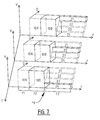
- Figure 3 schematically illustrates operation of the first exemplary embodiment according to the present invention.
- the figure shows several axes, namely a time axis T, indicating passing time from above to below - that is, from top to bottom the figure shows different, subsequent moments in time; a frequency axis F indicating low frequencies on the left and high frequencies on the right; and a subscriber line axis V for the victim lines, combined with a subscriber line axis D for the disturber lines.
- F1 denotes the first frequency range
- F2 denotes the second frequency range.
- F0 denotes a frequency or a range of frequencies separating the first frequency range F1 from the second frequency range F2.
- F0 may represent an approximate midpoint of a total frequency range over which the communication system operates, for example approximately 53 MHz for a communication system operating over a total frequency range of 106 MHz, or approximately 106 MHz for a communication system operating over a total frequency range of 212 MHz. It will be understood that the same notations, where used in the other figures, need not be discussed again.
- the figure displays a first mode of operation for a first group 10 over the first frequency range F1, and a second mode of operation for a second group 21, 22, 24 over the second frequency range F2. It additionally shows the disturber dimension.
- the second group is selected as a strict subset of the first group 10, and therefore comprises fewer subscriber lines of the number of subscriber lines than the first group 10.
- the selected subscriber lines of the second group 21, 22, 24 may vary over time, for example based on obtained traffic information representing traffic load on at least one subscriber line of the number of subscriber lines, preferably on all subscriber lines of the number of subscriber lines.
- the selected subscriber lines of the second group 21, 22, 24 may be varied over time, by periodically selecting another subset from a plurality of different pre-defined strict subsets 21-24 of the first group 10.
- the second frequency range F2 is situated above the first frequency range F1.
- the vector processor 1 may be configured for retrieving a set of pre-stored crosstalk cancellation coefficients in order to mitigate the crosstalk for the second group, derived from channel characteristics of the second group, for example based on intermittently obtained channel estimation values (or derivates) for those subscriber lines - contrast this to the below disclosed second exemplary embodiment, illustrated with reference to Figure 4 , wherein a vector controller according to the present invention may be configured for calculating a number of crosstalk cancellation coefficients in order to mitigate crosstalk for the second group, derived from channel characteristics of the second group, for example based on intermittently obtained channel estimation values (or derivates) for the subscriber lines.
- the second mode of operation may further comprise disabling direct communication over the second frequency range F2 for subscriber lines 23 of the number of subscriber lines not forming part of the second group 21, 22, 24. That is, at the first point in time in the figure, direct communication may be restricted for subscriber lines 22, 23 and 24, that is, for subscriber lines other than those of the second group 21 at that first point in time; at the second point in time in the figure, direct communication may be restricted for subscriber lines 21, 23 and 24, that is, for subscriber lines other than those of the second group 22 at that second point in time; and at the third point in time in the figure, direct communication may be restricted for subscriber lines 21, 22 and 23, that is, for subscriber lines other than those of the second group 24 at that third point in time.
- the second group 21, 22, 24 may for example number only a single victim line of the subscriber lines of the first group 10.
- the second group may for example number multiple victim lines of the subscriber lines of the first group 10.
- the first group 10 may comprise all subscriber lines of the number of subscriber lines. In an alternative embodiment, the first group 10 may comprise a strict subset of the number of subscriber lines.
- the first frequency range F1 may be chosen to be situated below, that is, to be lower (i.e. less) than, an approximate midpoint of a total frequency range over which the communication system operates
- the second frequency range F2 may be chosen to be situated above, that is, to be higher (i.e. greater) than, the approximate midpoint of the total frequency range.
- the total frequency range may comprise at least the first frequency range F1 and the second frequency range F2.
- the approximate midpoint of the total frequency range may be approximately 53 MHz or approximately 106 MHz, particularly in the case of a G.fast communication system operating over a total frequency range of 106 MHz or 212 MHz respectively.
- the vector processor may be further configured for operating according to a total-frequency-range mode of operation, distinct from the first mode and from the second mode, over the total frequency range.
- the vector processor may further be configured for operating according to the total-frequency-range mode by mitigating crosstalk for a fifth group of the number of subscriber lines, wherein the fifth group comprises strictly fewer of the number of subscriber lines than the first group.
- the total frequency range may comprise at least the first frequency range F1 and the second frequency range F2.
- the approximate midpoint of the total frequency range may be approximately 53 MHz or approximately 106 MHz, particularly in the case of a G.fast communication system operating over a total frequency range of 106 MHz or 212 MHz respectively.
- the vector processor is configured for varying the selected subscriber lines of the second group over time
- the choice of which subscriber lines belong to the second group may for example be updated on an order of seconds.
- the vector processor may be configured for retrieving a set of pre-stored crosstalk cancellation coefficients in order to mitigate the crosstalk for the second group, derived from channel characteristics of the second group.
- the choice of which pre-stored crosstalk cancellation coefficients to retrieve may for example be updated on an order of milliseconds, for example by a vector controller according to the present invention.
- the vector processor may be configured as follows. It may be configured to perform full vectoring on a first frequency range, and sparse vectoring on a second frequency range, as explained above.
- the second group may also be called a sparse vectoring block.
- Figure 4 schematically illustrates operation of the second exemplary embodiment according to the present invention.
- the vector processor may be configured for activating a number of crosstalk cancellation coefficients, calculated by a vector controller according to the present invention, in order to mitigate the crosstalk for the second group, for example based on obtained channel estimation values (and derivates) for at least some of the subscriber lines.
- a vector controller according to the present invention may be configured to only calculate coefficients for one second group 21, 22, 24 and to control the vector processor to directly load these into the memory of the vector processor.
- the crosstalk cancellation coefficients are recomputed on-the-spot (instead of retrieved from an existing storage) and directly loaded into the vector processor. This may for example be done using swap memory.
- the lack of sets of pre-stored crosstalk cancellation coefficients is shown in the figure by the lack of "ghost" blocks compared to Figure 3 .
- the vector processor may be configured as follows. It may be configured for operating according to a third mode of operation, distinct from the first mode and the second mode, over a third frequency range, separate from the first frequency range and from the second frequency range.
- the third mode of operation comprises mitigating crosstalk for a third group of the number of subscriber lines, the third group being selected as a strict subset of the first group and differing from the second group.
- the third mode of operation may further comprise disabling direct communication over the third frequency range for subscriber lines of the number of subscriber lines not forming part of the third group.
- FIG. 5 For the first point in time by a second group 21A over a second frequency range F2 (which is in this example smaller than the second frequency range F2 shown with reference to the first and second exemplary embodiment) and a third group 22B over a third frequency range F3, separate from the first frequency range F1 and from the second frequency range F2 (at least for that first point in time), which are different (that is, they comprise different subscriber lines, and they cover different frequency ranges); and for the second point in time by a second group 22A, likewise over the second frequency range F2 as for the first point in time, and a third group 24B, likewise over the third frequency range F3 as for the first point in time.
- a second group 21A over a second frequency range F2 (which is in this example smaller than the second frequency range F2 shown with reference to the first and second exemplary embodiment) and a third group 22B over a third frequency range F3, separate from the first frequency range F1 and from the second frequency range F2 (at least for that first point in time), which
- the second frequency range F2 is situated below the third frequency range F3, but in an alternative embodiment this could also be vice versa .
- the second frequency range F2 is the same for the first and second point in time
- the third frequency range F3 is also the same for the first and second point in time - however, in an alternative embodiment, the specific frequencies included in the second and/or third frequency ranges F2, F3 may differ between the first and second point in time.
- the third point in time there may for example be a second group 21 and no third group, analogously to the first and second exemplary embodiment.
- the second mode of operation may also comprise disabling direct communication over the second frequency range F2 for subscriber lines of the number of subscriber lines not forming part of the second group.
- direct communication may be disabled over the second frequency range F2 for subscriber lines included in blocks 22A, 23 and 24, and in the second point in time shown in the figure, direct communication may be disabled over the second frequency range F2 for subscriber lines included in blocks 21, 23 and 24A.
- direct communication may be disabled over the second frequency range F2 for subscriber lines included in blocks 22, 23 and 24, analogously to the first and second exemplary embodiments.
- direct communication over the third frequency range F3 may be disabled for subscriber lines of the number of subscriber lines not forming part of the third group (e.g. subscriber lines in blocks 21B, 23 and 24 for the first point in time, and subscriber lines in blocks 21, 22B and 23 for the second point in time) - analogously to the disabled direct communication with respect to the second frequency range F2 as explained above.
- the vector processor according to the third exemplary embodiment may be configured to perform full vectoring on the first frequency range F1, and sparse vectoring on the second frequency range F2 and on the third frequency range F3.
- the second frequency range F2 and the third frequency range F3 may together cover the higher-frequency remainder of the total frequency range over which the communication system operates, excepting the first frequency range F1.
- the second frequency range F2 and the third frequency range F3 may cover (a substantial part of, for example at least 85% of) that higher-frequency remainder.
- the vector processor may be a combination of the above described second exemplary embodiment and the above described third exemplary embodiment. That is, it may combine the use of a third group with the calculating and direct activation of the number of crosstalk cancellation coefficients (instead of simply retrieving a pre-stored set and activating that set indirectly).
- Figure 6 schematically illustrates operation of the fourth exemplary embodiment according to the present invention.
- the below disclosed embodiments may include the distinguishing features of the second exemplary embodiment, and/or the distinguishing features of the third exemplary embodiment, and/or the distinguishing features of the fourth exemplary embodiment. Furthermore, they may include the features that were disclosed above in the context of the first exemplary embodiment, whether they are included in the example of Figure 3 or not.
- the vector processor may be configured as follows. It may be configured for operating according to the first mode for a second frequency sub-range f2, for example comprised within the first frequency range; and it may be configured for operating according to a different mode of operation, distinct from the first mode, for a first frequency sub-range f1, for example comprised within the first frequency range, the first frequency sub-range f1 being separate from and preferably situated below the second frequency sub-range. It may preferably be configured for operating according to the different mode by withholding crosstalk mitigation for the first group.
- Figure 7 schematically illustrates operation of the fifth exemplary embodiment according to the present invention. The figure uses f1 to denote the first frequency sub-range and f2 to denote the second frequency sub-range.
- the senor lines 10A may preferably withhold vectoring from subscriber lines 10A over a first frequency sub-range f1, for example comprised within the first frequency range F1, and it may be configured perform full vectoring on subscriber lines 10B over a second frequency sub-range f2, for example comprised within the first frequency range F1, and separate from and preferably situated above the first frequency sub-range f1.
- This fifth exemplary embodiment exploits the insight that non-vectored operation (by withholding crosstalk mitigation) may still result in sufficient data rates at relatively low frequencies.
- the vector processor may be configured as follows, in addition to the operation of any one or more of the other above described exemplary embodiments.
- the vector processor may further be configured for operating according to a fourth mode of operation, distinct from the first mode and from the second mode, over a fourth frequency range, separate from the first frequency range and from the second frequency range.
- the fourth mode may comprise mitigating crosstalk for a fourth group of the number of subscriber lines.
- the fourth group may be selected as a strict subset of the first group and may differ from the second group.
- the fourth mode of operation may further comprise enabling direct communication over the fourth frequency range for at least some (preferably all) subscriber lines of the number of subscriber lines not forming part of the fourth group.
- Figure 7 may for example be re-interpreted such that for example f1 or f2 may denote the fourth frequency range and such that for example block 10A or 10B may denote the fourth group.
- Figures 5 and 6 may for example also be re-interpreted such that for example F3 may denote the fourth frequency range and blocks 21A and 22A may denote the fourth group (for two distinct points in time).
- a sparse vectoring mode of operation may be used, wherein at least some un-vectored (preferably all) victim lines of the subscriber lines are active (i.e. used for direct communication), but crosstalk from only a limited number of disturber lines of the subscriber lines is cancelled. This may also be referred to as disturber selection.
- the vector processor may be configured as follows.
- the first group may comprise a plurality of sub-groups 11, 12, 13, 14.
- Each sub-group 11-14 may be selected as a strict subset of victim lines of the first group 10.
- Each sub-group 11-14 may be associated with a separate frequency sub-range (not shown) of the first frequency range F1. In this manner, complexity may be reduced, by considering only subsets.
- Each victim line of the first group 10 may preferably be included in at least one sub-group of the plurality of sub-groups 11-14, in order to equalize the impact on the data rate.
- each victim line of the first group is included in a number of sub-groups greater than or equal to a predetermined threshold - for example, the predetermined threshold may be the greatest integer lower than the cardinality of a typical sub-group (that is, how many lines are included in a typical sub-group) divided by the difference of the number of subscriber lines in the first group and said cardinality.
- one or more victim lines of the first group may be prioritized by including them in a number of sub-groups that is yet greater than the predetermined threshold, while including other victim lines of the first group in a number of sub-groups that is smaller than the predetermined threshold.
- a particular advantage follows from the insight that the performance depends linearly on the size of the sub-group, whereas memory and MACs depend quadratically (that is, by power 2), and the control path complexity depends cubically (that is, by power 3) thereon.
- Rounded example values for the performance impact are, for example, 70% performance for 50% memory/MAC saving and for 65% control path complexity saving, or 50% performance for 75% memory/MAC saving and for 87.5% control path complexity saving.
- sub-groups 11, 12, 13, 14 may vary over time, for example based on obtained traffic information representing traffic load for at least the first number of subscriber lines, or according to a predetermined schedule, e.g. by periodically selecting another configuration of sub-groups from a plurality of different pre-defined configurations of sub-groups being strict subsets of the first group.
- Figure 8 schematically illustrates operation of the seventh exemplary embodiment according to the present invention.
- the vector processor may be configured as follows, in addition to the operation of the seventh exemplary embodiment.
- the size of the sub-groups may be optimized over different frequencies or sub-bands.
- An example approach for such optimization may comprise the following, assuming a total available budget of crosstalk cancellation coefficients, and assuming no sub-group allocations at the sub-bands.
- a specific increase in size of the sub-group at the sub-band may be determined to give rise to the largest increase in data rate according to some suitable optimization metric.
- the allocation of sub-group sizes over all sub-bands may be optimized (greedily), until the total available budget of crosstalk cancellation coefficients is allocated.
- Embodiments of the present invention may therefore allow to reduce the cost of the vector processor engine and an associated vectoring controller entity, in particular in case of very large G.fast communication systems (for example with 96 or more ports).
- Various embodiments may be considered to be scalable and to follow a pay-as-you-grow principle. This may facilitate gradual upgrades of existing G.fast communication systems to future G.fast communication systems (or other communication systems).
- Embodiments of the present invention may in particular exploit the insight that the uplink does not need to support peak rate performance of all subscriber lines at the same time, which insight may result in reduced vector processor design constraints, leading to reduced complexity and lower costs.
- embodiment of the present invention may be considered to be scalable because they allow full vectoring performance for a 96-port communication system, but allow reduced performance for a communication system with a higher number of ports. This goes hand-in-hand with the above discussed reduced constraints on the uplink.
- Preferred embodiments of the present invention may offer a fixed (preferably large) sustained rate as well as dynamic peak rates, in particular by allocating different types of modes of operation over different frequency ranges, preferably in a time dynamic manner.
- this may be implemented using the NOI/DOI operation (i.e. normal / discontinuous operation interval), combined with dynamic resource allocation, as discussed in the G.fast standard.
- NOI/DOI operation i.e. normal / discontinuous operation interval
- dynamic resource allocation as discussed in the G.fast standard.
- this particular embodiment's implementation may be more expensive in terms of the required vectoring resources (MACs, memory), and there may be an impact on sustained data rates when peaking certain subscriber lines.
- Preferred embodiments of the present invention as described above may be advantageously applied in a context of G.fast communication systems, yet are not to be construed as limited only to G.fast communication systems.
- a vector processor may be included in a transceiver unit apparatus of a communication system operating over a total frequency range of at least 35 MHz. In that case, they may be operatively coupled to at least the first group of the number of subscriber lines of the communication system.
- program storage devices e.g., digital data storage media, which are machine or computer readable and encode machine-executable or computer-executable programs of instructions, wherein said instructions perform some or all of the steps of said above-described methods.
- the program storage devices may be, e.g., digital memories, magnetic storage media such as a magnetic disks and magnetic tapes, hard drives, or optically readable digital data storage media.
- the program storage devices may be resident program storage devices or may be removable program storage devices, such as smart cards.
- the embodiments are also intended to cover computers programmed to perform said steps of the above-described methods.
- processors may be provided through the use of dedicated hardware as well as hardware capable of executing software in association with appropriate software.
- the functions may be provided by a single dedicated processor, by a single shared processor, or by a plurality of individual processors, some of which may be shared.
- explicit use of the term "processor” or “controller” should not be construed to refer exclusively to hardware capable of executing software, and may implicitly include, without limitation, digital signal processor (DSP) hardware, network processor, application specific integrated circuit (ASIC), field programmable gate array (FPGA), read only memory (ROM) for storing software, random access memory (RAM), and non volatile storage.
- DSP digital signal processor
- ASIC application specific integrated circuit
- FPGA field programmable gate array
- ROM read only memory
- RAM random access memory
- any switches shown in the figures are conceptual only. Their function may be carried out through the operation of program logic, through dedicated logic, through the interaction of program control and dedicated logic, or even manually, the particular technique being selectable by the implementer as more specifically understood from the context.
Landscapes
- Engineering & Computer Science (AREA)
- Computer Networks & Wireless Communication (AREA)
- Signal Processing (AREA)
- Cable Transmission Systems, Equalization Of Radio And Reduction Of Echo (AREA)
Priority Applications (2)
| Application Number | Priority Date | Filing Date | Title |
|---|---|---|---|
| EP16306280.5A EP3301820B1 (de) | 2016-09-30 | 2016-09-30 | Vektorprozessor und vektorverarbeitungsverfahren zur verringerung des übersprechens in mehreren betriebsarten |
| PL16306280T PL3301820T3 (pl) | 2016-09-30 | 2016-09-30 | Procesor wektorowy i metoda przetwarzania wektorowego dla łagodzenia przesłuchu w wielu trybach pracy |
Applications Claiming Priority (1)
| Application Number | Priority Date | Filing Date | Title |
|---|---|---|---|
| EP16306280.5A EP3301820B1 (de) | 2016-09-30 | 2016-09-30 | Vektorprozessor und vektorverarbeitungsverfahren zur verringerung des übersprechens in mehreren betriebsarten |
Publications (2)
| Publication Number | Publication Date |
|---|---|
| EP3301820A1 true EP3301820A1 (de) | 2018-04-04 |
| EP3301820B1 EP3301820B1 (de) | 2021-02-24 |
Family
ID=57123938
Family Applications (1)
| Application Number | Title | Priority Date | Filing Date |
|---|---|---|---|
| EP16306280.5A Active EP3301820B1 (de) | 2016-09-30 | 2016-09-30 | Vektorprozessor und vektorverarbeitungsverfahren zur verringerung des übersprechens in mehreren betriebsarten |
Country Status (2)
| Country | Link |
|---|---|
| EP (1) | EP3301820B1 (de) |
| PL (1) | PL3301820T3 (de) |
Cited By (1)
| Publication number | Priority date | Publication date | Assignee | Title |
|---|---|---|---|---|
| US10992341B2 (en) | 2019-06-17 | 2021-04-27 | Nokia Solutions And Networks Oy | Low-complexity beamforming for a multi-line communication system |
Citations (3)
| Publication number | Priority date | Publication date | Assignee | Title |
|---|---|---|---|---|
| US20090046568A1 (en) * | 2007-08-17 | 2009-02-19 | Wen Xu | Communication Apparatus and Method |
| EP2770670A1 (de) * | 2013-02-26 | 2014-08-27 | Alcatel Lucent | Verfahren und Vorrichtung zur Überwachung der Leistung einer Vectoring-Gruppe von Telekommunikationsleitungen |
| WO2016001076A1 (en) * | 2014-07-03 | 2016-01-07 | Alcatel Lucent | Enhanced vectoring operation with single loop unbundling |
-
2016
- 2016-09-30 PL PL16306280T patent/PL3301820T3/pl unknown
- 2016-09-30 EP EP16306280.5A patent/EP3301820B1/de active Active
Patent Citations (3)
| Publication number | Priority date | Publication date | Assignee | Title |
|---|---|---|---|---|
| US20090046568A1 (en) * | 2007-08-17 | 2009-02-19 | Wen Xu | Communication Apparatus and Method |
| EP2770670A1 (de) * | 2013-02-26 | 2014-08-27 | Alcatel Lucent | Verfahren und Vorrichtung zur Überwachung der Leistung einer Vectoring-Gruppe von Telekommunikationsleitungen |
| WO2016001076A1 (en) * | 2014-07-03 | 2016-01-07 | Alcatel Lucent | Enhanced vectoring operation with single loop unbundling |
Cited By (1)
| Publication number | Priority date | Publication date | Assignee | Title |
|---|---|---|---|---|
| US10992341B2 (en) | 2019-06-17 | 2021-04-27 | Nokia Solutions And Networks Oy | Low-complexity beamforming for a multi-line communication system |
Also Published As
| Publication number | Publication date |
|---|---|
| PL3301820T3 (pl) | 2021-06-28 |
| EP3301820B1 (de) | 2021-02-24 |
Similar Documents
| Publication | Publication Date | Title |
|---|---|---|
| JP6330170B2 (ja) | 低電力モードのための時分割 | |
| US9509484B2 (en) | Scheme system and method for power saving in vectored communications | |
| US20160036491A1 (en) | Method and apparatus for crosstalk management among different vectored groups | |
| US20100329386A1 (en) | Crosstalk Control Method and Apparatus Using a Bandwidth-Adaptive Precoder Interface | |
| JP6414715B2 (ja) | Osdシステムにおける回線同期方法、システム、およびベクトル化制御エンティティ | |
| US9413478B2 (en) | Method and systems for reducing crosstalk | |
| EP3375101B1 (de) | System und verfahren zur verwaltung der optimierung der vectoring-leistung | |
| EP2702739B1 (de) | Systeme und verfahren zur g-vektor-initialisierung | |
| EP3301820B1 (de) | Vektorprozessor und vektorverarbeitungsverfahren zur verringerung des übersprechens in mehreren betriebsarten | |
| CN112840631B (zh) | 经由数字用户线路进行通信的方法和设备 | |
| US11095407B2 (en) | Signal processing method, apparatus, and system | |
| JP5033901B2 (ja) | 複数のサブチャネルを複数の端末に割り当てる装置及び方法 | |
| CN118118140A (zh) | 上行参考信号资源传输方法、装置、终端及网络侧设备 | |
| Wolkerstorfer et al. | Dynamic spectrum management for energy-efficient transmission in DSL | |
| CN115734351B (zh) | 传输方法、装置、终端及网络设备 | |
| CN118118987A (zh) | 上行传输的发射功率确定方法、装置、终端及网络侧设备 | |
| KR20250115316A (ko) | 3 tx 안테나 포트 장치를 위한 ul 향상 | |
| US20160182122A1 (en) | Methods and systems for reducing crosstalk for sets of lines | |
| Verdyck et al. | Network utility maximization for adaptive resource allocation in dsl systems | |
| CN105830353B (zh) | 信号发送的方法、装置和系统 | |
| EP3873021A1 (de) | Verfahren und system zur pilottonsynchronisation in punkt-zu-mehrpunkt-systemen | |
| Li et al. | Dynamic partial crosstalk cancellation resource allocation algorithms for DSL access networks | |
| CN107113126B (zh) | 一种信号处理方法、装置及系统 | |
| JP4896253B2 (ja) | 端末を選択する装置および方法 | |
| Sharma et al. | A modified low complexity based distributed iterative water-filling (IWF) spectrum management algorithm |
Legal Events
| Date | Code | Title | Description |
|---|---|---|---|
| PUAI | Public reference made under article 153(3) epc to a published international application that has entered the european phase |
Free format text: ORIGINAL CODE: 0009012 |
|
| STAA | Information on the status of an ep patent application or granted ep patent |
Free format text: STATUS: THE APPLICATION HAS BEEN PUBLISHED |
|
| AK | Designated contracting states |
Kind code of ref document: A1 Designated state(s): AL AT BE BG CH CY CZ DE DK EE ES FI FR GB GR HR HU IE IS IT LI LT LU LV MC MK MT NL NO PL PT RO RS SE SI SK SM TR |
|
| AX | Request for extension of the european patent |
Extension state: BA ME |
|
| RAP1 | Party data changed (applicant data changed or rights of an application transferred) |
Owner name: ALCATEL LUCENT |
|
| STAA | Information on the status of an ep patent application or granted ep patent |
Free format text: STATUS: REQUEST FOR EXAMINATION WAS MADE |
|
| 17P | Request for examination filed |
Effective date: 20181004 |
|
| RBV | Designated contracting states (corrected) |
Designated state(s): AL AT BE BG CH CY CZ DE DK EE ES FI FR GB GR HR HU IE IS IT LI LT LU LV MC MK MT NL NO PL PT RO RS SE SI SK SM TR |
|
| STAA | Information on the status of an ep patent application or granted ep patent |
Free format text: STATUS: EXAMINATION IS IN PROGRESS |
|
| 17Q | First examination report despatched |
Effective date: 20191015 |
|
| GRAP | Despatch of communication of intention to grant a patent |
Free format text: ORIGINAL CODE: EPIDOSNIGR1 |
|
| STAA | Information on the status of an ep patent application or granted ep patent |
Free format text: STATUS: GRANT OF PATENT IS INTENDED |
|
| INTG | Intention to grant announced |
Effective date: 20201207 |
|
| GRAS | Grant fee paid |
Free format text: ORIGINAL CODE: EPIDOSNIGR3 |
|
| GRAA | (expected) grant |
Free format text: ORIGINAL CODE: 0009210 |
|
| STAA | Information on the status of an ep patent application or granted ep patent |
Free format text: STATUS: THE PATENT HAS BEEN GRANTED |
|
| AK | Designated contracting states |
Kind code of ref document: B1 Designated state(s): AL AT BE BG CH CY CZ DE DK EE ES FI FR GB GR HR HU IE IS IT LI LT LU LV MC MK MT NL NO PL PT RO RS SE SI SK SM TR |
|
| REG | Reference to a national code |
Ref country code: CH Ref legal event code: EP |
|
| REG | Reference to a national code |
Ref country code: AT Ref legal event code: REF Ref document number: 1365794 Country of ref document: AT Kind code of ref document: T Effective date: 20210315 |
|
| REG | Reference to a national code |
Ref country code: IE Ref legal event code: FG4D |
|
| REG | Reference to a national code |
Ref country code: DE Ref legal event code: R096 Ref document number: 602016053037 Country of ref document: DE |
|
| REG | Reference to a national code |
Ref country code: NL Ref legal event code: FP |
|
| REG | Reference to a national code |
Ref country code: LT Ref legal event code: MG9D |
|
| PG25 | Lapsed in a contracting state [announced via postgrant information from national office to epo] |
Ref country code: HR Free format text: LAPSE BECAUSE OF FAILURE TO SUBMIT A TRANSLATION OF THE DESCRIPTION OR TO PAY THE FEE WITHIN THE PRESCRIBED TIME-LIMIT Effective date: 20210224 Ref country code: FI Free format text: LAPSE BECAUSE OF FAILURE TO SUBMIT A TRANSLATION OF THE DESCRIPTION OR TO PAY THE FEE WITHIN THE PRESCRIBED TIME-LIMIT Effective date: 20210224 Ref country code: GR Free format text: LAPSE BECAUSE OF FAILURE TO SUBMIT A TRANSLATION OF THE DESCRIPTION OR TO PAY THE FEE WITHIN THE PRESCRIBED TIME-LIMIT Effective date: 20210525 Ref country code: NO Free format text: LAPSE BECAUSE OF FAILURE TO SUBMIT A TRANSLATION OF THE DESCRIPTION OR TO PAY THE FEE WITHIN THE PRESCRIBED TIME-LIMIT Effective date: 20210524 Ref country code: PT Free format text: LAPSE BECAUSE OF FAILURE TO SUBMIT A TRANSLATION OF THE DESCRIPTION OR TO PAY THE FEE WITHIN THE PRESCRIBED TIME-LIMIT Effective date: 20210624 Ref country code: BG Free format text: LAPSE BECAUSE OF FAILURE TO SUBMIT A TRANSLATION OF THE DESCRIPTION OR TO PAY THE FEE WITHIN THE PRESCRIBED TIME-LIMIT Effective date: 20210524 Ref country code: LT Free format text: LAPSE BECAUSE OF FAILURE TO SUBMIT A TRANSLATION OF THE DESCRIPTION OR TO PAY THE FEE WITHIN THE PRESCRIBED TIME-LIMIT Effective date: 20210224 |
|
| REG | Reference to a national code |
Ref country code: AT Ref legal event code: MK05 Ref document number: 1365794 Country of ref document: AT Kind code of ref document: T Effective date: 20210224 |
|
| PG25 | Lapsed in a contracting state [announced via postgrant information from national office to epo] |
Ref country code: SE Free format text: LAPSE BECAUSE OF FAILURE TO SUBMIT A TRANSLATION OF THE DESCRIPTION OR TO PAY THE FEE WITHIN THE PRESCRIBED TIME-LIMIT Effective date: 20210224 Ref country code: LV Free format text: LAPSE BECAUSE OF FAILURE TO SUBMIT A TRANSLATION OF THE DESCRIPTION OR TO PAY THE FEE WITHIN THE PRESCRIBED TIME-LIMIT Effective date: 20210224 Ref country code: RS Free format text: LAPSE BECAUSE OF FAILURE TO SUBMIT A TRANSLATION OF THE DESCRIPTION OR TO PAY THE FEE WITHIN THE PRESCRIBED TIME-LIMIT Effective date: 20210224 |
|
| PG25 | Lapsed in a contracting state [announced via postgrant information from national office to epo] |
Ref country code: IS Free format text: LAPSE BECAUSE OF FAILURE TO SUBMIT A TRANSLATION OF THE DESCRIPTION OR TO PAY THE FEE WITHIN THE PRESCRIBED TIME-LIMIT Effective date: 20210624 |
|
| PG25 | Lapsed in a contracting state [announced via postgrant information from national office to epo] |
Ref country code: CZ Free format text: LAPSE BECAUSE OF FAILURE TO SUBMIT A TRANSLATION OF THE DESCRIPTION OR TO PAY THE FEE WITHIN THE PRESCRIBED TIME-LIMIT Effective date: 20210224 Ref country code: EE Free format text: LAPSE BECAUSE OF FAILURE TO SUBMIT A TRANSLATION OF THE DESCRIPTION OR TO PAY THE FEE WITHIN THE PRESCRIBED TIME-LIMIT Effective date: 20210224 Ref country code: AT Free format text: LAPSE BECAUSE OF FAILURE TO SUBMIT A TRANSLATION OF THE DESCRIPTION OR TO PAY THE FEE WITHIN THE PRESCRIBED TIME-LIMIT Effective date: 20210224 Ref country code: SM Free format text: LAPSE BECAUSE OF FAILURE TO SUBMIT A TRANSLATION OF THE DESCRIPTION OR TO PAY THE FEE WITHIN THE PRESCRIBED TIME-LIMIT Effective date: 20210224 |
|
| REG | Reference to a national code |
Ref country code: DE Ref legal event code: R097 Ref document number: 602016053037 Country of ref document: DE |
|
| PG25 | Lapsed in a contracting state [announced via postgrant information from national office to epo] |
Ref country code: DK Free format text: LAPSE BECAUSE OF FAILURE TO SUBMIT A TRANSLATION OF THE DESCRIPTION OR TO PAY THE FEE WITHIN THE PRESCRIBED TIME-LIMIT Effective date: 20210224 Ref country code: SK Free format text: LAPSE BECAUSE OF FAILURE TO SUBMIT A TRANSLATION OF THE DESCRIPTION OR TO PAY THE FEE WITHIN THE PRESCRIBED TIME-LIMIT Effective date: 20210224 Ref country code: RO Free format text: LAPSE BECAUSE OF FAILURE TO SUBMIT A TRANSLATION OF THE DESCRIPTION OR TO PAY THE FEE WITHIN THE PRESCRIBED TIME-LIMIT Effective date: 20210224 |
|
| PLBE | No opposition filed within time limit |
Free format text: ORIGINAL CODE: 0009261 |
|
| STAA | Information on the status of an ep patent application or granted ep patent |
Free format text: STATUS: NO OPPOSITION FILED WITHIN TIME LIMIT |
|
| PG25 | Lapsed in a contracting state [announced via postgrant information from national office to epo] |
Ref country code: AL Free format text: LAPSE BECAUSE OF FAILURE TO SUBMIT A TRANSLATION OF THE DESCRIPTION OR TO PAY THE FEE WITHIN THE PRESCRIBED TIME-LIMIT Effective date: 20210224 Ref country code: ES Free format text: LAPSE BECAUSE OF FAILURE TO SUBMIT A TRANSLATION OF THE DESCRIPTION OR TO PAY THE FEE WITHIN THE PRESCRIBED TIME-LIMIT Effective date: 20210224 |
|
| 26N | No opposition filed |
Effective date: 20211125 |
|
| PG25 | Lapsed in a contracting state [announced via postgrant information from national office to epo] |
Ref country code: SI Free format text: LAPSE BECAUSE OF FAILURE TO SUBMIT A TRANSLATION OF THE DESCRIPTION OR TO PAY THE FEE WITHIN THE PRESCRIBED TIME-LIMIT Effective date: 20210224 |
|
| PG25 | Lapsed in a contracting state [announced via postgrant information from national office to epo] |
Ref country code: IT Free format text: LAPSE BECAUSE OF FAILURE TO SUBMIT A TRANSLATION OF THE DESCRIPTION OR TO PAY THE FEE WITHIN THE PRESCRIBED TIME-LIMIT Effective date: 20210224 |
|
| REG | Reference to a national code |
Ref country code: CH Ref legal event code: PL |
|
| REG | Reference to a national code |
Ref country code: BE Ref legal event code: MM Effective date: 20210930 |
|
| PG25 | Lapsed in a contracting state [announced via postgrant information from national office to epo] |
Ref country code: IS Free format text: LAPSE BECAUSE OF FAILURE TO SUBMIT A TRANSLATION OF THE DESCRIPTION OR TO PAY THE FEE WITHIN THE PRESCRIBED TIME-LIMIT Effective date: 20210624 Ref country code: MC Free format text: LAPSE BECAUSE OF FAILURE TO SUBMIT A TRANSLATION OF THE DESCRIPTION OR TO PAY THE FEE WITHIN THE PRESCRIBED TIME-LIMIT Effective date: 20210224 |
|
| PG25 | Lapsed in a contracting state [announced via postgrant information from national office to epo] |
Ref country code: LU Free format text: LAPSE BECAUSE OF NON-PAYMENT OF DUE FEES Effective date: 20210930 Ref country code: IE Free format text: LAPSE BECAUSE OF NON-PAYMENT OF DUE FEES Effective date: 20210930 Ref country code: BE Free format text: LAPSE BECAUSE OF NON-PAYMENT OF DUE FEES Effective date: 20210930 |
|
| PG25 | Lapsed in a contracting state [announced via postgrant information from national office to epo] |
Ref country code: LI Free format text: LAPSE BECAUSE OF NON-PAYMENT OF DUE FEES Effective date: 20210930 Ref country code: CH Free format text: LAPSE BECAUSE OF NON-PAYMENT OF DUE FEES Effective date: 20210930 |
|
| PG25 | Lapsed in a contracting state [announced via postgrant information from national office to epo] |
Ref country code: HU Free format text: LAPSE BECAUSE OF FAILURE TO SUBMIT A TRANSLATION OF THE DESCRIPTION OR TO PAY THE FEE WITHIN THE PRESCRIBED TIME-LIMIT; INVALID AB INITIO Effective date: 20160930 |
|
| PG25 | Lapsed in a contracting state [announced via postgrant information from national office to epo] |
Ref country code: CY Free format text: LAPSE BECAUSE OF FAILURE TO SUBMIT A TRANSLATION OF THE DESCRIPTION OR TO PAY THE FEE WITHIN THE PRESCRIBED TIME-LIMIT Effective date: 20210224 |
|
| PG25 | Lapsed in a contracting state [announced via postgrant information from national office to epo] |
Ref country code: MK Free format text: LAPSE BECAUSE OF FAILURE TO SUBMIT A TRANSLATION OF THE DESCRIPTION OR TO PAY THE FEE WITHIN THE PRESCRIBED TIME-LIMIT Effective date: 20210224 |
|
| PG25 | Lapsed in a contracting state [announced via postgrant information from national office to epo] |
Ref country code: TR Free format text: LAPSE BECAUSE OF FAILURE TO SUBMIT A TRANSLATION OF THE DESCRIPTION OR TO PAY THE FEE WITHIN THE PRESCRIBED TIME-LIMIT Effective date: 20210224 |
|
| PG25 | Lapsed in a contracting state [announced via postgrant information from national office to epo] |
Ref country code: MT Free format text: LAPSE BECAUSE OF FAILURE TO SUBMIT A TRANSLATION OF THE DESCRIPTION OR TO PAY THE FEE WITHIN THE PRESCRIBED TIME-LIMIT Effective date: 20210224 |
|
| PGFP | Annual fee paid to national office [announced via postgrant information from national office to epo] |
Ref country code: NL Payment date: 20250814 Year of fee payment: 10 |
|
| PGFP | Annual fee paid to national office [announced via postgrant information from national office to epo] |
Ref country code: DE Payment date: 20250805 Year of fee payment: 10 |
|
| PGFP | Annual fee paid to national office [announced via postgrant information from national office to epo] |
Ref country code: PL Payment date: 20250805 Year of fee payment: 10 |
|
| PGFP | Annual fee paid to national office [announced via postgrant information from national office to epo] |
Ref country code: GB Payment date: 20250807 Year of fee payment: 10 |
|
| PGFP | Annual fee paid to national office [announced via postgrant information from national office to epo] |
Ref country code: FR Payment date: 20250808 Year of fee payment: 10 |