EP3301826A1 - Téléphonie cellulaire - Google Patents
Téléphonie cellulaire Download PDFInfo
- Publication number
- EP3301826A1 EP3301826A1 EP16191547.5A EP16191547A EP3301826A1 EP 3301826 A1 EP3301826 A1 EP 3301826A1 EP 16191547 A EP16191547 A EP 16191547A EP 3301826 A1 EP3301826 A1 EP 3301826A1
- Authority
- EP
- European Patent Office
- Prior art keywords
- aircraft
- base station
- activity
- control system
- communications
- Prior art date
- Legal status (The legal status is an assumption and is not a legal conclusion. Google has not performed a legal analysis and makes no representation as to the accuracy of the status listed.)
- Ceased
Links
Images


Classifications
-
- H—ELECTRICITY
- H04—ELECTRIC COMMUNICATION TECHNIQUE
- H04B—TRANSMISSION
- H04B7/00—Radio transmission systems, i.e. using radiation field
- H04B7/14—Relay systems
- H04B7/15—Active relay systems
- H04B7/185—Space-based or airborne stations; Stations for satellite systems
- H04B7/18502—Airborne stations
- H04B7/18504—Aircraft used as relay or high altitude atmospheric platform
-
- G—PHYSICS
- G05—CONTROLLING; REGULATING
- G05D—SYSTEMS FOR CONTROLLING OR REGULATING NON-ELECTRIC VARIABLES
- G05D1/00—Control of position, course, altitude or attitude of land, water, air or space vehicles, e.g. using automatic pilots
- G05D1/0094—Control of position, course, altitude or attitude of land, water, air or space vehicles, e.g. using automatic pilots involving pointing a payload, e.g. camera, weapon, sensor, towards a fixed or moving target
-
- G—PHYSICS
- G05—CONTROLLING; REGULATING
- G05D—SYSTEMS FOR CONTROLLING OR REGULATING NON-ELECTRIC VARIABLES
- G05D1/00—Control of position, course, altitude or attitude of land, water, air or space vehicles, e.g. using automatic pilots
- G05D1/10—Simultaneous control of position or course in three dimensions
- G05D1/101—Simultaneous control of position or course in three dimensions specially adapted for aircraft
-
- H—ELECTRICITY
- H04—ELECTRIC COMMUNICATION TECHNIQUE
- H04B—TRANSMISSION
- H04B7/00—Radio transmission systems, i.e. using radiation field
- H04B7/14—Relay systems
- H04B7/15—Active relay systems
- H04B7/185—Space-based or airborne stations; Stations for satellite systems
- H04B7/18502—Airborne stations
- H04B7/18506—Communications with or from aircraft, i.e. aeronautical mobile service
-
- H—ELECTRICITY
- H04—ELECTRIC COMMUNICATION TECHNIQUE
- H04W—WIRELESS COMMUNICATION NETWORKS
- H04W24/00—Supervisory, monitoring or testing arrangements
- H04W24/08—Testing, supervising or monitoring using real traffic
-
- H—ELECTRICITY
- H04—ELECTRIC COMMUNICATION TECHNIQUE
- H04W—WIRELESS COMMUNICATION NETWORKS
- H04W36/00—Hand-off or reselection arrangements
- H04W36/08—Reselecting an access point
- H04W36/083—Reselecting an access point wherein at least one of the access points is a moving node
-
- H—ELECTRICITY
- H04—ELECTRIC COMMUNICATION TECHNIQUE
- H04W—WIRELESS COMMUNICATION NETWORKS
- H04W36/00—Hand-off or reselection arrangements
- H04W36/24—Reselection being triggered by specific parameters
- H04W36/26—Reselection being triggered by specific parameters by agreed or negotiated communication parameters
-
- H—ELECTRICITY
- H04—ELECTRIC COMMUNICATION TECHNIQUE
- H04W—WIRELESS COMMUNICATION NETWORKS
- H04W84/00—Network topologies
- H04W84/02—Hierarchically pre-organised networks, e.g. paging networks, cellular networks, WLAN [Wireless Local Area Network] or WLL [Wireless Local Loop]
- H04W84/04—Large scale networks; Deep hierarchical networks
- H04W84/042—Public Land Mobile systems, e.g. cellular systems
Definitions
- the present invention relates to cellular telephony, and in particular to the provision of cellular telephony coverage in remote areas.
- Radio transceivers base stations
- base stations which are capable of radio communication with mobile handsets, and have a backhaul connection, usually but not invariably over a fixed connection, to the rest of the network.
- Each base station has an area of coverage which is dependent on factors such as line of sight, but primarily on the transmission and receive strength of the base station.
- base stations are relatively close together, with signal strength kept down to a level which allows channel re-use over relatively short distances without interference, but in more remote areas where communications traffic is lighter, it is desirable to space the base stations as far apart as possible without leaving significant gaps in coverage.
- the maximum spacing is determined by the distance of the horizon, (which in turn depends on the height of the transceiver above the ground), and on how mountainous the terrain is.
- the aircraft can be unmanned, and is usually tethered to a ground anchor to ensure it maintains position.
- the tether can also provide a convenient means for the backhaul connections and/or a power supply, although satellite communication and solar power are respective possible self-contained alternatives.
- the aircraft can be a lighter-than-air craft such as a balloon, or a powered heavier-than-air such as a "drone".
- An example is discussed in our co-pending European application 16185219.9 filed on August 22nd, 2016 .
- Such arrangements have the ability to hold station at high levels, therefore providing coverage over a wide area, without the need for a tower or mast to be constructed. They are therefore also suited for temporary events.
- a method of operating an aircraft carrying communications equipment for operation as a communications base station for provision, when airborne, of wireless communications connections over a coverage area, in which the aircraft is launched when activity is detected on the ground in the area of coverage.
- the invention provides a control system for operating an aircraft, comprising a flight control system for launching the aircraft in response to detection of activity in a predetermined region served by the aircraft, and a telecommunications registration processor for establishing communication between a communications base station carried by the aircraft and one or more mobile communications terminals in the coverage area.
- the aircraft is returned to the ground when activity ceases.
- Activity may be detected for example by sensors on a highway identifying vehicles approaching the coverage area.
- launch may be triggered by a handover signal received over the backhaul connection from a cellular base station operating in a region neighbouring the coverage area, or by detection by the network of an incoming call to a mobile terminal recorded as being in the area of coverage.
- the invention is intended for use in remote areas, where communications traffic levels are very low and the cost of providing terrestrial base stations would be disproportionately high for the amount of communications traffic on offer.
- the use of an airborne device allows a much wider coverage area to be served by one base station, and therefore one backhaul connection, than would be possible by ground based antennas.
- the invention achieves power and maintenance savings by only launching the aircraft when required.
- backhaul may be provided from a ground station communicating with the aircraft.
- the backhaul may be a landline, or it may be a microwave or satellite connection.
- Such connections are difficult to operate directly from an aircraft because it is more difficult to lock on to a narrowbeam signal from a satellite or microwave station whilst in motion, and even a tethered balloon will turn in the wind.
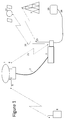
- Figure 1 depicts an airborne device 1 attached by a tether 2 to a ground station 3.
- the device 1 may be a balloon or a powered device such as a "drone”.
- the tethered device 1 carries communications equipment 4 and antenna 5 for communicating, with user terminals 8, and communication means 6 providing a communication link 21 with the ground station 3.
- the communications link 21 may be wireless as depicted, or it may be carried through a cable or optical fibre associated with the tether 2.
- the ground station has a backhaul communications transceiver 25, 26 or 28 for communication with the fixed network at a mobile communications base station 7, a satellite 27, or an exchange 29 in a fixed network.
- Figure 2 depicts a cellular network comprising a number of conventional cellular base stations 10, 11, 12, 13, 14, 15, each having an associated area of coverage. It will be appreciated that in practice the boundaries are not precise, but signal strength and quality generally decline with distance.
- the association between mobile stations 8,88 and base stations 10-15 is performed by a handover and registration management system 19 in a conventional manner (for clarity, a logical connection is only shown between one of the mobile stations 13 and the handover and registration management system 19.
- An area 20 is depicted as not being covered by any of the base stations 10-15, but can be covered by the base station 1 depicted in Figure 1 , when it is airborne. If the airborne base station 1 is capable of controlled flight, the actual area of coverage 20 may be varied according to need, for example to track a mobile terminal moving through the region, or to maximise the signal quality according to the number and locations of a number of mobile terminals in the region.
- the base stations 10-15 each maintain a neighbour list of base stations to which handover can be performed if the currently serving base station (e.g 13) detects that a mobile device 88 is moving out of its area of coverage.
- base stations 11, 13, 15 which adjoin an area 20 having no conventional coverage include the base station 1 in their neighbour list.
- the airborne device is only selected to circumstances where no conventional base station on the neighbour list can detect the mobile device 88.
- the aerial base station 1 (100) may not yet be airborne, and thus cannot yet detect the mobile device 88 itself.
- the handover process is depicted in Figure 3 .
- the handover management system 19 determines that a handover to the base station 1 is required (step 50)
- the handover management system 19 checks the neighbour list of the currently serving cell 13 (step 51). If any neighbour (11, 12 ....) is operational (step 52) the best serving neighbour is selected (step 53) and a handover (57) is performed. If no neighbour is operational, a check is made to determine if an aerial base station 100 is on the neighbour list but currently grounded (54) and thus not operational. If no such neighbour is available, the call has to be terminated (step 55) but if a grounded base station 100 is present it can be launched (step 56).
- the modified handover process is depicted in Figure 4 .
- the process may be initiated 30 by the handover system 57 or by a sensor 16, 17.
- the handover and registration system 19 next determines if the base station 1 is already airborne (step 31) and launches it (step 311) if necessary.
- the ground station 3 keeps a record of the number of mobile terminals currently registered with the base station 1 (step 32) and performs the rest of the handover process 33 in a conventional manner.
- handover from the serving area 20 is handled similarly, with handover 41 to another base station 13 (or to an out-of-connection process if connection is lost) causing the record of the number of terminals currently served to be reduced (step 42).
- the base station remains airborne (step 433) unless no mobile terminals remain registered to it (step 43), in which case it can return to the ground station 3 until required again.
- the base station may also be launched if movement or activity other than handover is detected (step 30), such as movement of a vehicle 8 past a roadside beacon 16, 17 into or out of the region of coverage 20, thus allowing coverage to be provided even if no mobile terminal was active at the time of entry into the region.
- the ground station 3 may be arranged only to launch the aircraft if an incoming call is detected by the backhaul system 29 addressed to a mobile terminal 8, 88 currently recorded by the handover management system 19 as under the control of the base station 1. This allows mobile terminals to be paged whilst in the region 20, but of course such an arrangement would only allow incoming calls to be made.
- aircraft is intended to embrace both heavier-than-air craft and lighter-than-air craft, which may be tethered or capable of controlled flight.
Landscapes
- Engineering & Computer Science (AREA)
- Computer Networks & Wireless Communication (AREA)
- Signal Processing (AREA)
- Physics & Mathematics (AREA)
- Aviation & Aerospace Engineering (AREA)
- General Physics & Mathematics (AREA)
- Astronomy & Astrophysics (AREA)
- Radar, Positioning & Navigation (AREA)
- Remote Sensing (AREA)
- Automation & Control Theory (AREA)
- Mobile Radio Communication Systems (AREA)
Priority Applications (4)
| Application Number | Priority Date | Filing Date | Title |
|---|---|---|---|
| EP16191547.5A EP3301826A1 (fr) | 2016-09-29 | 2016-09-29 | Téléphonie cellulaire |
| US16/338,158 US11184082B2 (en) | 2016-09-29 | 2017-08-15 | Cellular telephony |
| PCT/EP2017/070690 WO2018059820A1 (fr) | 2016-09-29 | 2017-08-15 | Téléphonie cellulaire |
| EP17758828.2A EP3520245B1 (fr) | 2016-09-29 | 2017-08-15 | Téléphonie cellulaire |
Applications Claiming Priority (1)
| Application Number | Priority Date | Filing Date | Title |
|---|---|---|---|
| EP16191547.5A EP3301826A1 (fr) | 2016-09-29 | 2016-09-29 | Téléphonie cellulaire |
Publications (1)
| Publication Number | Publication Date |
|---|---|
| EP3301826A1 true EP3301826A1 (fr) | 2018-04-04 |
Family
ID=57067990
Family Applications (2)
| Application Number | Title | Priority Date | Filing Date |
|---|---|---|---|
| EP16191547.5A Ceased EP3301826A1 (fr) | 2016-09-29 | 2016-09-29 | Téléphonie cellulaire |
| EP17758828.2A Active EP3520245B1 (fr) | 2016-09-29 | 2017-08-15 | Téléphonie cellulaire |
Family Applications After (1)
| Application Number | Title | Priority Date | Filing Date |
|---|---|---|---|
| EP17758828.2A Active EP3520245B1 (fr) | 2016-09-29 | 2017-08-15 | Téléphonie cellulaire |
Country Status (3)
| Country | Link |
|---|---|
| US (1) | US11184082B2 (fr) |
| EP (2) | EP3301826A1 (fr) |
| WO (1) | WO2018059820A1 (fr) |
Cited By (1)
| Publication number | Priority date | Publication date | Assignee | Title |
|---|---|---|---|---|
| CN109164826A (zh) * | 2018-08-15 | 2019-01-08 | 中国电子科技集团公司第二十研究所 | 一种基于改进蚁群算法的大规模无人集群控制方法 |
Families Citing this family (4)
| Publication number | Priority date | Publication date | Assignee | Title |
|---|---|---|---|---|
| EP3288140A1 (fr) | 2016-08-22 | 2018-02-28 | EE Limited | Fourniture de puissance électrique |
| CN110475226A (zh) * | 2018-05-11 | 2019-11-19 | 深圳Tcl新技术有限公司 | 一种基于无人机的基站信号覆盖方法、系统及无人机 |
| US10790898B1 (en) * | 2019-03-06 | 2020-09-29 | RTO Wireless, LLC | Base station altitude automatic adjustment for remote wireless network optimization |
| US20250203477A1 (en) * | 2023-12-19 | 2025-06-19 | Dell Products, L.P. | Seamless terrestrial and non-terrestrial link recovery |
Citations (4)
| Publication number | Priority date | Publication date | Assignee | Title |
|---|---|---|---|---|
| WO2002001756A1 (fr) * | 2000-06-27 | 2002-01-03 | Motorola, Inc. | Infrastructure transportable destinee a un systeme cellulaire se trouvant a bord d'un avion |
| US20140233412A1 (en) * | 2013-02-17 | 2014-08-21 | Parallel Wireless Inc. | Methods of Incorporating an Ad Hoc Cellular Network Into a Fixed Cellular Network |
| WO2016012055A1 (fr) * | 2014-07-25 | 2016-01-28 | Telefonaktiebolaget L M Ericsson (Publ) | Technique d'exploitation de station de base radio mobile |
| US20160191142A1 (en) * | 2014-07-22 | 2016-06-30 | International Business Machines Corporation | Deployment criteria for unmanned aerial vehicles to improve cellular phone communications |
Family Cites Families (18)
| Publication number | Priority date | Publication date | Assignee | Title |
|---|---|---|---|---|
| US4842221A (en) | 1988-04-21 | 1989-06-27 | Westinghouse Electric Corp. | Lightning hardened tether cable and an aerostat tethered to a mooring system therewith |
| US6325330B1 (en) | 1998-08-18 | 2001-12-04 | Lockheed Martin Corporation | Power generation, transmission, and distribution system for an aerostat using a lightweight tether |
| GB0102639D0 (en) | 2001-02-01 | 2001-03-21 | Daly Neil | Broadband communications system |
| US7510142B2 (en) | 2006-02-24 | 2009-03-31 | Stealth Robotics | Aerial robot |
| US7631834B1 (en) | 2006-02-24 | 2009-12-15 | Stealth Robotics, Llc | Aerial robot with dispensable conductive filament |
| US8068937B2 (en) | 2008-02-09 | 2011-11-29 | Stephen Spencer Eaves | Power distribution system with fault protection using energy packet confirmation |
| US8781637B2 (en) | 2009-10-27 | 2014-07-15 | Voltserver Inc. | Safe exposed conductor power distribution system |
| US20120075759A1 (en) | 2009-10-27 | 2012-03-29 | Stephen Spencer Eaves | Safe Exposed Conductor Power Distribution System |
| JP6337001B2 (ja) | 2012-12-07 | 2018-06-06 | ボルトサーバー インコーポレーティッドVoltserver,Inc. | 安全な露出導体電力分配システム |
| US9184795B2 (en) | 2014-01-26 | 2015-11-10 | VoltServer, Inc. | Packet energy transfer in-line communications |
| EP3737141B1 (fr) | 2014-03-18 | 2022-06-01 | Telefonaktiebolaget LM Ericsson (publ) | Fourniture d'une couverture d'un réseau de communication sans fil avec des stations mobiles sur des robots ou des drones |
| CN105083520A (zh) | 2014-05-22 | 2015-11-25 | 南京大五教育科技有限公司 | 利用热气球将移动基站带入平流层恢复通讯 |
| US9302782B2 (en) | 2014-08-18 | 2016-04-05 | Sunlight Photonics Inc. | Methods and apparatus for a distributed airborne wireless communications fleet |
| JP6266174B2 (ja) | 2014-10-21 | 2018-01-24 | ボルトサーバー インコーポレーティッドVoltserver,Inc. | デジタル電力レシーバシステム |
| US9853689B2 (en) | 2014-11-07 | 2017-12-26 | VoltServer, Inc. | Packet energy transfer power control elements |
| US20160363457A1 (en) * | 2015-06-10 | 2016-12-15 | Motorola Solutions, Inc | Method and apparatus for dispatching network equipment within a communication system |
| EP3288140A1 (fr) | 2016-08-22 | 2018-02-28 | EE Limited | Fourniture de puissance électrique |
| US10178531B2 (en) * | 2016-09-15 | 2019-01-08 | Qualcomm Incorporated | Methods and apparatus for efficient sensor data sharing in a vehicle-to-vehicle (V2V) network |
-
2016
- 2016-09-29 EP EP16191547.5A patent/EP3301826A1/fr not_active Ceased
-
2017
- 2017-08-15 US US16/338,158 patent/US11184082B2/en active Active
- 2017-08-15 WO PCT/EP2017/070690 patent/WO2018059820A1/fr not_active Ceased
- 2017-08-15 EP EP17758828.2A patent/EP3520245B1/fr active Active
Patent Citations (4)
| Publication number | Priority date | Publication date | Assignee | Title |
|---|---|---|---|---|
| WO2002001756A1 (fr) * | 2000-06-27 | 2002-01-03 | Motorola, Inc. | Infrastructure transportable destinee a un systeme cellulaire se trouvant a bord d'un avion |
| US20140233412A1 (en) * | 2013-02-17 | 2014-08-21 | Parallel Wireless Inc. | Methods of Incorporating an Ad Hoc Cellular Network Into a Fixed Cellular Network |
| US20160191142A1 (en) * | 2014-07-22 | 2016-06-30 | International Business Machines Corporation | Deployment criteria for unmanned aerial vehicles to improve cellular phone communications |
| WO2016012055A1 (fr) * | 2014-07-25 | 2016-01-28 | Telefonaktiebolaget L M Ericsson (Publ) | Technique d'exploitation de station de base radio mobile |
Non-Patent Citations (4)
| Title |
|---|
| "Lecture Notes of the Institute for Computer Sciences, Social Informatics and Telecommunications Engineering", vol. 123, 27 June 2013, SPRINGER, DE, ISBN: 978-3-642-17758-3, ISSN: 1867-8211, article ALVARO VALCARCE ET AL: "Airborne Base Stations for Emergency and Temporary Events", pages: 13 - 25, XP055357418, DOI: 10.1007/978-3-319-02762-3_2 * |
| CHANDRASEKHARAN SATHYANARAYANAN ET AL: "Designing and implementing future aerial communication networks", IEEE COMMUNICATIONS MAGAZINE, IEEE SERVICE CENTER, PISCATAWAY, US, vol. 54, no. 5, 1 May 2016 (2016-05-01), pages 26 - 34, XP011610414, ISSN: 0163-6804, [retrieved on 20160517], DOI: 10.1109/MCOM.2016.7470932 * |
| TIAN HE ET AL: "VigilNet", ACM TRANSACTIONS ON SENSOR NETWORKS, ACM, 2 PENN PLAZA, SUITE 701 NEW YORK NY 10121-0701 USA, vol. 2, no. 1, 1 February 2006 (2006-02-01), pages 1 - 38, XP058232212, ISSN: 1550-4859, DOI: 10.1145/1138127.1138128 * |
| ZHENHONG SHAO ET AL: "A Rapid and Reliable Disaster Emergency Mobile Communication System via Aerial Ad Hoc BS Networks", WIRELESS COMMUNICATIONS, NETWORKING AND MOBILE COMPUTING (WICOM), 2011 7TH INTERNATIONAL CONFERENCE ON, IEEE, 23 September 2011 (2011-09-23), pages 1 - 4, XP032059845, ISBN: 978-1-4244-6250-6, DOI: 10.1109/WICOM.2011.6040479 * |
Cited By (2)
| Publication number | Priority date | Publication date | Assignee | Title |
|---|---|---|---|---|
| CN109164826A (zh) * | 2018-08-15 | 2019-01-08 | 中国电子科技集团公司第二十研究所 | 一种基于改进蚁群算法的大规模无人集群控制方法 |
| CN109164826B (zh) * | 2018-08-15 | 2021-07-16 | 中国电子科技集团公司第二十研究所 | 一种基于改进蚁群算法的大规模无人集群控制方法 |
Also Published As
| Publication number | Publication date |
|---|---|
| US11184082B2 (en) | 2021-11-23 |
| EP3520245B1 (fr) | 2023-09-13 |
| EP3520245A1 (fr) | 2019-08-07 |
| US20200028569A1 (en) | 2020-01-23 |
| WO2018059820A1 (fr) | 2018-04-05 |
Similar Documents
| Publication | Publication Date | Title |
|---|---|---|
| US11184082B2 (en) | Cellular telephony | |
| US12504753B2 (en) | Circuit, base station, method, and recording medium | |
| EP3507999B1 (fr) | Uav pour communication cellulaire | |
| US10020872B2 (en) | UAV for cellular communication | |
| CA3182282C (fr) | Communications redondantes modulaires pour uav | |
| US11569901B2 (en) | System for employing cellular telephone networks to operate, control and communicate with unmannded aerial vehicles and remote piloted vehicles | |
| CN107172723B (zh) | 一种无人机应急救灾高空基站 | |
| US10212610B2 (en) | System for telecommunications by network of stationary high-altitude platforms and drifting balloons | |
| KR20020060077A (ko) | 부상 배열의 통신 시스템 | |
| JP6928075B2 (ja) | 無線中継システム | |
| PL181701B3 (en) | Sub-oriental high-altitude highly efficient telecommunication system | |
| EP1224751B1 (fr) | Systeme de communication cellulaire a plusieurs avions | |
| CN111034346A (zh) | 移动小区回程协调 | |
| US7403772B2 (en) | Telecommunications system with reflective airborne platform | |
| Ono et al. | S-band radio propagation characteristics in urban environment for unmanned aircraft systems | |
| GB2559102A (en) | Cellular telephony | |
| KR20120070899A (ko) | 공중 자가발전 무선 통신장치 및 그 방법 | |
| WO2011012138A1 (fr) | Aéronef stratosphérique autonome plus léger que l'air et procédé pour assurer les liaisons radio et optiques, la télédiffusion et le monitorage | |
| Bae et al. | Structure of UAV-based emergency mobile communication infrastructure | |
| Iizuka et al. | Low-cost airdropping sensor system based on light balloons and LoRa communication | |
| CN113347640A (zh) | 利用空中基站轨迹调度实现特定模式覆盖的系统和方法 | |
| KR102768660B1 (ko) | 이동백홀 시스템의 빔 탐색 및 관리 방법 | |
| CN118571076A (zh) | 一种通用航空器导航装置及通用航空器低空飞行管制物联网 |
Legal Events
| Date | Code | Title | Description |
|---|---|---|---|
| PUAI | Public reference made under article 153(3) epc to a published international application that has entered the european phase |
Free format text: ORIGINAL CODE: 0009012 |
|
| AK | Designated contracting states |
Kind code of ref document: A1 Designated state(s): AL AT BE BG CH CY CZ DE DK EE ES FI FR GB GR HR HU IE IS IT LI LT LU LV MC MK MT NL NO PL PT RO RS SE SI SK SM TR |
|
| AX | Request for extension of the european patent |
Extension state: BA ME |
|
| 18R | Application refused |
Effective date: 20180427 |