EP3301872A1 - Procédé et appareil de régulation de trafic - Google Patents
Procédé et appareil de régulation de trafic Download PDFInfo
- Publication number
- EP3301872A1 EP3301872A1 EP16817209.6A EP16817209A EP3301872A1 EP 3301872 A1 EP3301872 A1 EP 3301872A1 EP 16817209 A EP16817209 A EP 16817209A EP 3301872 A1 EP3301872 A1 EP 3301872A1
- Authority
- EP
- European Patent Office
- Prior art keywords
- traffic
- allocated
- path
- equivalent
- paths
- Prior art date
- Legal status (The legal status is an assumption and is not a legal conclusion. Google has not performed a legal analysis and makes no representation as to the accuracy of the status listed.)
- Granted
Links
Images





Classifications
-
- H—ELECTRICITY
- H04—ELECTRIC COMMUNICATION TECHNIQUE
- H04L—TRANSMISSION OF DIGITAL INFORMATION, e.g. TELEGRAPHIC COMMUNICATION
- H04L47/00—Traffic control in data switching networks
- H04L47/10—Flow control; Congestion control
- H04L47/12—Avoiding congestion; Recovering from congestion
- H04L47/125—Avoiding congestion; Recovering from congestion by balancing the load, e.g. traffic engineering
-
- H—ELECTRICITY
- H04—ELECTRIC COMMUNICATION TECHNIQUE
- H04L—TRANSMISSION OF DIGITAL INFORMATION, e.g. TELEGRAPHIC COMMUNICATION
- H04L45/00—Routing or path finding of packets in data switching networks
- H04L45/24—Multipath
-
- H—ELECTRICITY
- H04—ELECTRIC COMMUNICATION TECHNIQUE
- H04L—TRANSMISSION OF DIGITAL INFORMATION, e.g. TELEGRAPHIC COMMUNICATION
- H04L45/00—Routing or path finding of packets in data switching networks
- H04L45/28—Routing or path finding of packets in data switching networks using route fault recovery
Definitions
- the invention relates to, but is not limited to traffic control, and in particular to a traffic control method and apparatus.
- ECMP Equal-Cost Multipath
- Traffic is generally classified based on a manner of stream in ECMP, and a hash method is usually used for selecting a path.
- a hash method is usually used for selecting a path.
- the invention provides a traffic control method and apparatus, which can minimize an impact on a normal path during traffic switching.
- the invention provides a traffic control method.
- the number n of pieces of traffic to be divided is determined, n being greater than or equal to 2. All available traffic is divided into n pieces and each piece of the traffic is the same or differs by one unit. N pieces of traffic are allocated to m equivalent paths so that each of the equivalent paths is allocated with n/m or n/m+1 pieces of traffic. In a traffic allocation process, each of the equivalent paths records the traffic allocated to itself and an allocation order of the traffic.
- allocation is performed according to the traffic allocated to the equivalent path and the allocation order of the traffic which are recorded by each of the equivalent paths in a manner of first allocating last allocated traffic to an equivalent path in need, so that the number of pieces of traffic allocated to each of the equivalent paths is the same as each other or differs from each other by one piece.
- the traffic on the failed path is allocated to normal path(s).
- the number of pieces of traffic allocated to the normal path(s) is the same or differs by one piece of traffic.
- the original traffic of the normal path(s) is maintained unchanged, and each of the normal path(s) records the traffic allocated from the failed part to itself and the allocation order of the allocated traffic.
- the normal path(s) allocated with the traffic of the failed path allocates the traffic allocated from the failed path to the failed path which has recovered according to the recorded traffic allocated from the failed path and the recorded allocation order of the allocated traffic.
- each of the original equivalent path(s) allocates the last allocated traffic to the added equivalent path according to the recorded traffic allocated to itself and the recorded allocation order of the traffic.
- the number of pieces of traffic allocated to the added equivalent path by each of the original equivalent path(s) is the same or differs by one piece of traffic, until the number of pieces of traffic allocated to the added equivalent path is the same as or differs from the number of pieces of traffic allocated to each of the original equivalent path(s) by one piece.
- the Least Common Multiple (LCM) of all possible values in the variation range of the number of equivalent paths is taken as the number n of pieces of traffic to be divided.
- the variation range of the number of equivalent paths is a set of all possible values of the number of equivalent paths which can work.
- all available traffic is divided into n pieces according to a preset rule.
- the preset rule is any rule that can make each piece of the traffic the same or differ by one unit.
- the preset rule is values corresponding to addresses of all messages to be forwarded.
- the values corresponding to the addresses of all the messages to be forwarded and the determined number of pieces of traffic are remaindered, and all the traffic with the same remainder is classified into one piece.
- the addresses are a source IP address, or a destination IP address, or a source Media Access Control (MAC) address, or a destination MAC address.
- MAC Media Access Control
- the preset rule is protocol types.
- the traffic for each of the protocol types is divided into n pieces.
- one piece of traffic is allocated to one of the equivalent paths each time in order.
- the same allocating process is repeated until each of the equivalent paths is allocated with n/m or n/m+1 pieces of traffic.
- N/m or n/m+1 pieces of traffic, which should be carried by each of the equivalent paths, are allocated to the corresponding equivalent path once.
- all the m equivalent paths are strung into a loop.
- Each node in the loop represents one equivalent path.
- the traffic allocated to each of the equivalent paths and the allocation order thereof are recorded into the corresponding node.
- the node corresponding to the failed path is deleted from the loop, and then the traffic on the failed path is allocated to the normal path(s).
- the node corresponding to the recovered path is added into the loop, and then the traffic allocated from the failed path is allocated to the path which has recovered.
- an equivalent path is added, the node corresponding to the added equivalent path is added into the loop, and then each of the original equivalent path(s) allocates the last allocated traffic to the added equivalent path according to the recorded traffic allocated to itself and the recorded allocation order of the traffic.
- a stack structure is adopted to record the traffic allocated to each of the equivalent paths and the allocation order of the traffic.
- the traffic is arranged according to a sequence of being allocated to each of the equivalent paths or each of the normal paths.
- the first allocated traffic is at the stack bottom, and the last allocated traffic is at the stack top.
- the traffic of the stack top on the failed path is allocated to the normal path(s), until the number of pieces of traffic allocated to each of the normal path(s) is the same or differs by one piece.
- the normal path allocated with the traffic of the failed path allocates the traffic of its own stack top to the failed path which is recovered, and allocates the traffic allocated from the failed path to the failed path which is recovered, until all the traffic allocated from the failed path is allocated to the path which is recovered.
- each of the original equivalent paths allocates the traffic of its stack top to the added equivalent path, until the number of pieces of traffic allocated to the added equivalent path is the same as or differs from the number of pieces of traffic allocated to each of the original equivalent paths by one piece.
- the invention also provides a traffic control apparatus including a number of pieces of traffic determining module, a traffic dividing module, a traffic allocating module, a traffic information recording module and a traffic control module.
- the number of pieces of traffic determining module is configured to determine the number n of pieces of traffic to be divided and n is greater than or equal to 2.
- the traffic dividing module is configured to divide all available traffic into n pieces. Each piece of the traffic is the same or differs by one unit.
- the traffic allocating module is configured to allocate n pieces of traffic to m equivalent paths so that each of the equivalent paths is allocated with n/m or n/m+1 pieces of traffic.
- the traffic information recording module is configured to record the traffic allocated to each of equivalent paths and the allocation order of pieces of traffic in the traffic allocation process.
- the traffic control module is configured to, when it is required to perform traffic switching, perform, according to the allocated traffic and the allocation order of the traffic which are recorded by the traffic information recording module, allocation in a manner of first allocating the last allocated traffic to an equivalent path in need, so that the number of pieces of traffic allocated to each of the equivalent paths is the same or differ by one piece.
- the traffic control module is configured to, when any path of multiple equivalent paths is failed, allocate the traffic on the failed path to the normal paths, wherein the number of pieces of traffic allocated to each of the normal paths is the same or differs by one piece of traffic.
- the original traffic of each of the normal paths is maintained unchanged, and at the same time, the traffic information recording module is notified to record the traffic allocated from the failed part to each of the normal paths and the allocation order of the allocated traffic.
- the traffic control module is further configured to, after the failed path is recovered, allocate the traffic allocated from the failed path to the failed path which has recovered according to the traffic allocated from the failed path to the normal paths and the allocation order of the allocated traffic which are recorded by the traffic information recording module.
- the original equivalent path allocates the last allocated traffic to the added equivalent path according to the traffic allocated to itself and the allocation order of the traffic which are recorded by the traffic information recording module.
- the number of pieces of traffic allocated to the added equivalent path by the original equivalent path is the same or differs by one piece of traffic, until the number of pieces of traffic allocated to the added equivalent path is the same as or differs from the number of pieces of traffic allocated to the original equivalent path by one piece.
- the number of pieces of traffic determining module is configured to take the LCM of all possible values in the variation range of the number of equivalent paths as the number n of pieces of traffic to be divided.
- the variation range of the number of equivalent paths is the set of all possible values of the number of equivalent paths which can work.
- the traffic dividing module is configured to divide all available traffic into n pieces according to the preset rule.
- the preset rule is any rule that can make each piece of the traffic the same or differ by one unit.
- the traffic allocating module is configured to allocate one piece of traffic to one equivalent path each time in order; and when all the equivalent paths are allocated with the same number of pieces of traffic, repeat the same allocating process until each of the equivalent paths is allocated with n/m or n/m+1 pieces of traffic. Alternatively, n/m or n/m+1 pieces of traffic, which should be carried by each of the equivalent paths, are allocated to the corresponding equivalent path once.
- the traffic information recording module is configured to string all the m equivalent paths into a loop. Each node in the loop represents an equivalent path, and the traffic allocated to each of the equivalent paths and the allocation order of the traffic are recorded into the corresponding node.
- the traffic control module is further configured to, when any path of the multiple equivalent paths is failed, delete the node corresponding to the failed path from the loop, after the failed path has returned to normal, add the node corresponding to the path which has recovered in the loop, and when an equivalent path is added, add the node corresponding to the added equivalent path in the loop.
- the traffic information recording module is configured to adopt the stack structure to record the traffic allocated to each of the equivalent paths and the allocation order of the traffic. That is, for each of the equivalent paths, according to the sequence of allocated traffic, the first allocated traffic is at the stack bottom, and the last allocated traffic is at the stack top.
- the traffic control module is configured to, when any path of the multiple equivalent paths is failed, allocate the traffic of the stack top on the failed path to the normal path each time, until the number of pieces of traffic allocated to each of the normal paths is the same or differs by one piece of traffic.
- the traffic control module is configured to, after the failed path is recovered, allocate the traffic of the stack top of the normal paths to the failed path which has recovered, according to the traffic allocated from the failed path to the normal paths and the allocation order of the allocated traffic which are recorded by the traffic information recording module 1104, until all the traffic allocated from the failed path is allocated to the path which has recovered.
- the traffic control module is configured to, when an equivalent path is added, cause the original equivalent paths to allocate the traffic of their stack tops to the added equivalent path each time according to the traffic allocated to the original equivalent paths and the allocation order of the traffic which are recorded by the traffic information recording module, until the number of pieces of traffic allocated to the added equivalent path is the same as or differs from the number of pieces of traffic allocated to the original equivalent paths by one piece.
- the invention also provides a computer readable storage medium having computer executable instructions stored therein.
- the computer executable instructions implement the above methods when being executed by a processor.
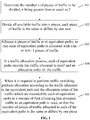
- a traffic allocation method can be applied to either an ECMP system or other similar systems. As shown in FIG. 1 , the method includes the following steps.
- n is greater than or equal to 2.
- step 102 all available traffic is divided into n pieces. Each piece of the traffic is the same as each other or differs from each other by one unit.
- n pieces of traffic are allocated to m equivalent paths so that each of the equivalent paths is allocated with n/m or n/m+1 pieces of traffic.
- each of the equivalent paths records the traffic allocated to itself and an allocation order of the traffic in a traffic allocation process.
- step 105 when it is required to perform traffic switching, allocation is performed according to the traffic allocated to the equivalent path and the allocation order of the traffic which are recorded by each of the equivalent paths in a manner of first allocating last allocated traffic to the equivalent path in need, so that the number of pieces of traffic allocated to each of the equivalent paths is the same or differs by one piece.
- the step 105 includes the following steps.
- the traffic on the failed path is allocated to normal paths, wherein the number of pieces of traffic allocated to each of the normal paths is the same or differs by one piece of traffic.
- each of the normal paths records the traffic allocated from the failed part to itself and the allocation order of the allocated traffic.
- the step 105 further includes the following step.
- the normal paths allocated with the traffic of the failed path allocates the traffic allocated from the failed path to the failed path which has returned to normal according to the recorded traffic allocated from the failed path to itself and the recorded allocation order of the allocated traffic.
- the step 105 further includes the following step.
- each of the original equivalent paths allocates the last allocated traffic to the added equivalent path according to the recorded traffic allocated to itself and the recorded allocation order of the traffic.
- the number of pieces of traffic allocated to the added equivalent path by each of the original equivalent paths is the same or differs by one piece of traffic, until the number of pieces of traffic allocated to the added equivalent path is the same as or differs from the number of pieces of traffic allocated to each of the original equivalent paths by one piece.
- determining the number n of pieces of traffic to be divided in the step 101 includes that the number n of pieces of traffic to be divided is determined according to an experiment value.
- the number of pieces of traffic enables the traffic to be allocated to multiple equivalent paths as evenly as possible. The embodiment is applied to a situation where the number m of equivalent paths is not determined or difficult to be determined.
- determining the number n of pieces of traffic to be divided in the step 101 includes that the LCM of all possible values in the variation range of the number of equivalent paths is taken as the number n of pieces of traffic to be divided.
- the variation range of the number of equivalent paths is a set of all possible values of the number of equivalent paths which can work.
- the variation range (2, 3, 4, 5) of the number of equivalent paths represents that the number of paths which can work may be 2, 3, 4 or 5. If there are 10 equivalent paths, the number of equivalent paths which can work should be 10. However, when the path is failed, the number of equivalent paths which can work will probably decrease. The maximum number of failed apparatus that can be allowed is fixed. When the number of equivalent paths decreases a lot, the system may have been broken down, and it is not required to perform traffic switching. Accordingly, there is a limit to the reduction in the number of equivalent paths which can work, and the variation range of the number of equivalent paths generally can be determined.
- the variation range of the number of equivalent paths can be (8, 9, 10). That is, the number of working paths can be 8, or 9, or 10. When the number of equivalent paths which can work is 8, there are two equivalent paths failed.
- the variation range of the number of equivalent paths can also be (8, 9, 10, 11, 12), which means that two extra equivalent paths which can work are configured.
- the LCM of all possible values from n to n+m is taken as the number of pieces of traffic to be divided, so that absolutely even allocation of the traffic can be ensured.
- the variation range of the number of equivalent paths is (1, 2, 3, 4)
- the LCM 12 of the four possible values 1, 2, 3 and 4 is taken as the number of pieces of traffic to be divided.
- the manner of taking the LCM of all possible values in the variation range of the number of equivalent paths as the number n of pieces of traffic to be divided is applied to a situation where the number of equivalent paths is fixed or predictable. For example, for the networks of most companies, the number of equivalent paths is determined, or is at least in a certain range.
- the step 102 includes that all available traffic is divided into n pieces according to a preset rule, wherein the preset rule is any rule that can make each piece of the traffic the same or differ by one unit.
- the preset rule is values corresponding to addresses of all messages to be forwarded.
- the operation that all available traffic is divided into n pieces according to the preset rule includes that the values corresponding to the addresses of all the messages to be forwarded and the determined number of pieces of traffic are remaindered, and all the traffic with the same remainder is classified into one piece.
- the addresses can be a source IP address, or a destination IP address, or a source MAC address, or a destination MAC address.
- the preset rule can also be protocol types.
- the operation that all available traffic is divided into n pieces according to the preset rule includes that the traffic is divided into n pieces with respect to each of the protocol types.
- the above preset rules can be combined randomly. For example, when the traffic is divided, both the protocol types and the source IP address, the destination IP address, the source MAC address and the destination MAC address can be taken into consideration. As long as the preset rules can make each piece of the traffic the same or differ by one unit, they can be applied to the embodiment of the invention.
- the values corresponding to the source IP addresses of all the messages to be forwarded include 12 to 47.
- the value 0 gotten by remaindering the values 12, 24 and 36 corresponding to the source IP addresses and the determined number of pieces of traffic is classified into one piece
- the value 1 gotten by remaindering the values 13, 25 and 37 corresponding to the source IP addresses and the determined number of pieces of traffic is classified into one piece
- the step 103 includes that one piece of traffic is allocated to one equivalent path each time by circularly allocating in order; and when all the equivalent paths are allocated with the same number of pieces of traffic, the same allocating process is repeated until each of the equivalent paths is allocated with n/m or n/m+1 pieces of traffic. For example, if all available traffic is divided into 12 pieces, when the traffic is allocated by circularly allocating in order, the traffic with the remainder 0 is allocated to the first equivalent path, the traffic with the remainder 1 is allocated to the second equivalent path, the traffic with the remainder 2 is allocated to the third equivalent path, and the traffic with the remainder 3 is allocated to the fourth equivalent path. At this point, all the equivalent paths are allocated with one piece of traffic.
- n/m or n/m+1 pieces of traffic, which should be carried by each of the equivalent paths are allocated to the corresponding equivalent path once by using a method of allocating the number of pieces of traffic, which should be carried by the equivalent path, to each of the equivalent paths once. For example, three pieces of traffic with the remainders 0, 1 and 2 are allocated to the first equivalent path once, three pieces of traffic with the remainders 3, 4 and 5 are allocated to the second equivalent path once, three pieces of traffic with the remainders 6, 7 and 8 are allocated to the third equivalent path once, and three pieces of traffic with the remainders 9, 10 and 11 are allocated to the fourth equivalent path once.
- the step 104 includes that all the m equivalent paths are strung into a loop, wherein each of nodes in the loop represents one of the equivalent paths, and the traffic allocated to each of the equivalent paths and the allocation order of the traffic are recorded into the corresponding node.
- the node corresponding to the failed path is deleted from the loop, and then the traffic on the failed path is allocated to the normal path.
- the node corresponding to the path which has returned to normal is added in the loop, and then the traffic allocated from the failed path is allocated to the path which has returned to normal.
- step 1051' when an equivalent path is added, the node corresponding to the added equivalent path is added in the loop, and then the original equivalent path allocates the last allocated traffic to the added equivalent path according to the traffic allocated to it and the allocation order of the traffic which are recorded.
- Both the step 104 and the step 1052 include that a stack structure is adopted to record the traffic allocated to each of the equivalent paths and the allocation order of the traffic. That is, the traffic is arranged according to a sequence of being allocated to each of the equivalent paths, wherein the first allocated traffic is at the stack bottom, and the last allocated traffic is at the stack top.
- the traffic on the failed path is allocated to the normal path in the step 1051, that after the failed path has returned to normal, the normal path allocated with the traffic of the failed path allocates the traffic allocated from the failed path to the failed path which has returned to normal according to the traffic allocated from the failed path to it and the allocation order of the allocated traffic which are recorded in the step 1053, and that when an equivalent path is added, the original equivalent path allocates the last allocated traffic to the added equivalent path according to the traffic allocated to it and the allocation order of the traffic which are recorded in the step 1051' include that the stack structure is adopted to allocate the traffic to the normal path(s), the failed path which has returned to normal or the added equivalent path.
- the normal path allocated with the traffic of the failed path allocates the traffic of its own stack top to the failed path which has returned to normal, and allocates the traffic allocated from the failed path to the failed path which has returned to normal, until all the traffic allocated from the failed path is allocated to the path which has returned to normal.
- each of the original equivalent paths allocates the traffic of its stack top to the added equivalent path, until the number of pieces of traffic allocated to the added equivalent path is the same as or differs from the number of pieces of traffic allocated to each of the original equivalent paths by one piece.
- the number n of pieces of traffic to be divided is determined as 10 according to an ordinary comprehensive situation.
- All available traffic is divided into 10 pieces and the number of IP addresses included in each piece of traffic is the same or differs by one. For example, each piece of traffic includes 5 IP addresses.
- the 10 pieces of traffic are allocated to 3 equivalent paths by using circularly allocating in order, wherein the number of the equivalent paths can only be determined in a network use process.
- the first piece of traffic a is allocated to the first equivalent path
- the second piece of traffic b is allocated to the second equivalent path
- the third piece of traffic c is allocated to the second equivalent path
- the tenth piece of traffic j is allocated to the first equivalent path.
- a traffic allocation table is shown in Table 3 below.
- the 10 pieces of traffic are allocated to 3 equivalent paths by completing allocation once, wherein the number of the equivalent paths can only be determined in the network use process.
- the first piece of traffic a, the second piece of traffic b, the third piece of traffic c and the fourth piece of traffic d are allocated to the first equivalent path once.
- the fifth piece of traffic e, the sixth piece of traffic f and the seventh piece of traffic g are allocated to the second equivalent path once.
- the eighth piece of traffic h, the ninth piece of traffic i and the tenth piece of traffic j are allocated to the third equivalent path once.
- a traffic allocation table is shown in Table 4 below.
- the second equivalent path is allocated with 4 pieces of traffic
- the first equivalent path and the third equivalent path are allocated with 3 pieces of traffic.
- the third equivalent path is allocated with 4 pieces of traffic
- the first equivalent path and the second equivalent path are allocated with 3 pieces of traffic.
- Table 4 Mode of completing allocation once Path The number of pieces of traffic allocated to each of paths Traffic allocated to each of paths (not represented by remainders) Equivalent path 1 4 a, b, c, d Equivalent path 2 3 e, f, g Equivalent path 3 3 h, i, j
- each of the equivalent paths records the traffic allocated to it and the allocation order of the traffic.
- the above loop processing mode can be adopted.
- the equivalent paths 1, 2 and 3 are strung into a loop, wherein each node in the loop represents an equivalent path, and the traffic allocated to each of the equivalent paths and the allocation order of the traffic are recorded into the corresponding node.
- the equivalent path 2 in the multiple equivalent paths When the equivalent path 2 in the multiple equivalent paths is failed, the node corresponding to the failed path is deleted from the loop, and then the traffic on the failed path is allocated to the normal path, as shown in FIG. 3 . As shown in FIG. 4 , finally the number of pieces of traffic allocated to all the equivalent paths, namely the equivalent paths 1 and 3 are the same, namely 5. After the failed path 2 has returned to normal, the node corresponding to the path 2 which has returned to normal is added in the loop, and then the traffic allocated from the failed path is allocated to the path which has returned to normal. Because the equivalent path 1 knows, via the record, that it has obtained the traffic b from the equivalent path 2 previously, the equivalent path 1 returns the traffic b to the equivalent path 2 which has returned to normal.
- the equivalent path 3 Because the equivalent path 3 knows, through the record, that it has obtained the traffic e and the traffic h from the equivalent path 2 previously, the equivalent path 3 returns the traffic e and the traffic h to the equivalent path 2 which has returned to normal. The final returned traffic is shown in FIG. 2 .
- the equivalent path 4 When the equivalent path 4 is added, the node corresponding to the added equivalent path 4 is added into the loop, and then the original equivalent path allocates the last allocated traffic to the added equivalent path according to the traffic allocated to it and the allocation order of the traffic which are recorded, until the number of pieces of traffic allocated to the added equivalent path and the number of pieces of traffic allocated to the original equivalent path are the same or differ by one piece, as shown in FIG. 5 .
- the equivalent path about to allocate the traffic finds, when preparing to allocate the traffic to the equivalent path about to receive the traffic, that if it allocates one piece of traffic to the equivalent path about to receive the traffic, the number of pieces of traffic allocated to the equivalent path about to receive the traffic will exceed the number of pieces of traffic allocated to the equivalent path about to allocate the traffic, then it stops allocating the piece of traffic.
- the equivalent path 3 finds, when preparing to allocate its one piece of traffic to the added equivalent path 4, that if it allocates the traffic i to the added equivalent path 4, the added equivalent path 4 will have 3 pieces of traffic, and the equivalent path 3 will have 2 pieces of traffic rest, then it will no longer allocate the traffic i to the added equivalent path 4.
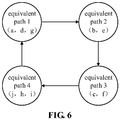
- the equivalent path can also allocate the traffic i to the added equivalent path 4, as shown in FIG. 6 .
- the number of pieces of traffic allocated to which equivalent path is greater than or less than the number of pieces of traffic allocated to other equivalent path by one piece, as long as finally the number of pieces of traffic allocated to each of the equivalent paths in the loop is the same as each other or differs from each other by one piece.
- the loop processing mode can also be adopted.
- the actual implementation is similar to circularly allocating in order to perform traffic allocation, which will not be repeated herein.
- the loop processing mode is not adopted when traffic allocation is performed by using the mode of completing allocation once, or the loop processing mode is not adopted when traffic allocation is performed by using the mode of circularly allocating in order, or the loop processing mode is adopted when traffic allocation is performed by using the mode of completing allocation once, or the loop processing mode is adopted when traffic allocation is performed by using the mode of circularly allocating in order.
- the stack structure can be adopted to record the traffic allocated to each of the equivalent paths and the allocation order of the traffic.
- the loop processing mode is adopted.
- the processing of adopting the stack structure to record the traffic allocated to each of the equivalent paths and the allocation order of the traffic is shown in FIG. 2 to FIG. 6 .
- the traffic is arranged as the sequence of a, d, g, j according to the order of being allocated to the equivalent path 1, wherein the first allocated traffic a is at the stack bottom, and the last allocated traffic a is at the stack top.
- any path 2 of the multiple equivalent paths is failed, as shown in FIG. 2 , FIG. 3 and FIG.
- the equivalent path 2 first allocates the traffic h at its stack top to the equivalent path 3, and then the traffic e becomes the stack top of the equivalent path 2.
- the equivalent path 2 first allocates the traffic e to the equivalent path again, and then the traffic b becomes the stack top of the equivalent path 2.
- the equivalent path 2 allocates the traffic b to the equivalent path 3.
- the normal paths 1 and 3 allocated with the traffic of the failed path allocate the traffic of their own stack tops to the failed path 2 which has returned to normal each time. That is, after returning the traffic e of its stack top to the failed path 2 which has returned to normal, the normal path 1 has returned all the traffic allocated from the path 2 previously to the failed path 2 which has returned to normal. After the normal path 3 returns the traffic b of its stack top to the failed path 2 which has returned to normal, the traffic h becomes the stack top, and is the traffic allocated from the path 2 previously.
- the original equivalent path 1 allocates the traffic j of its stack top to the added equivalent path 4
- the original equivalent path 2 allocates the traffic h of its stack top to the added equivalent path 4
- the original equivalent path 3 allocates the traffic i of its stack top to the added equivalent path 4.
- the number of pieces of traffic allocated to the added equivalent path 4 and the number of pieces of traffic allocated to the original equivalent paths 1, 2 and 3 are the same or differ by one piece, and traffic allocation is stopped.
- the loop processing mode is not adopted when traffic allocation is performed by using the mode of completing allocation once.
- the loop processing mode is not adopted when traffic allocation is performed by using the mode of circularly allocating in order.
- the loop processing mode is adopted when traffic allocation is performed by using the mode of completing allocation once.
- the loop processing mode is adopted when the processing of adopting the stack structure to record the traffic allocated to each of the equivalent paths and the allocation order of the traffic is performed and when traffic allocation is performed by using the mode of circularly allocating in order, which is similar to the processing of adopting the stack structure to record the traffic allocated to each of the equivalent paths and the allocation order of the traffic, so it will not be repeated here.
- the LCM 12 of the four numbers 1, 2, 3 and 4 is taken as the number of pieces of traffic to be divided.
- the values corresponding to the source IP addresses of all the messages to be forwarded include 12 to 47, wherein the value 0 gotten by remaindering the values 12, 24 and 36 corresponding to the source IP addresses and the determined number of pieces of traffic is classified into one piece, the value 1 gotten by remaindering the values 13, 25 and 37 corresponding to the source IP addresses and the determined number of pieces of traffic is classified into one piece, and so on, until the value 11 gotten by remaindering the values 23, 35 and 47 corresponding to the source IP addresses and the determined number of pieces of traffic is classified into one piece.
- the traffic with the remainder 0 is allocated to the first equivalent path
- the traffic with the remainder 1 is allocated to the second equivalent path
- the traffic with the remainder 2 is allocated to the third equivalent path
- the traffic with the remainder 3 is allocated to the fourth equivalent path.
- all the equivalent paths are allocated with one piece of traffic.
- each of the equivalent paths can record the traffic allocated to it and the allocation order of the traffic by using the loop processing mode.
- the equivalent paths 1, 2, 3 and 4 are strung into a loop, wherein each node in the loop represents an equivalent path, and the traffic allocated to each of the equivalent paths and the allocation order of the traffic are recorded into the corresponding node.
- the node corresponding to the failed path 2 is deleted from the loop, and then the traffic on the failed path is allocated to the normal path, as shown in FIG. 8 .
- the number of pieces of traffic allocated to each of the equivalent paths is the same, namely each of the equivalent paths 1, 3 and 4 has 4 pieces of traffic.
- the node corresponding to the path 2 which has returned to normal is added in the loop, and then the traffic allocated from the failed path is allocated to the path which has returned to normal.
- the equivalent path 1 knows, through the record, that it has obtained the traffic with the remainder 9 from the equivalent path 2 previously, the equivalent path 1 returns the traffic with the remainder 9 to the equivalent path 2 which has returned to normal.
- the equivalent path 3 knows, through the record, that it has obtained the traffic with the remainder 5 from the equivalent path 2 previously, the equivalent path 3 returns the traffic with the remainder 5 to the equivalent path 2 which has returned to normal.
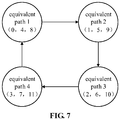
- the final returned traffic is shown in FIG. 7 .
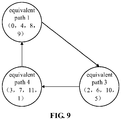
- the node corresponding to the added equivalent path 4 is added into the loop, and then the original equivalent path allocates the last allocated traffic to the added equivalent path according to the traffic allocated to it and the allocation order of the traffic which are recorded, until the number of pieces of traffic allocated to the added equivalent path is the same as or differs from the number of pieces of traffic allocated to the original equivalent path by one piece, as shown in FIG. 10 .
- the equivalent path about to allocate the traffic finds, when preparing to allocate the traffic to the equivalent path about to receive the traffic, that if it allocates one piece of traffic to the equivalent path about to receive the traffic, the number of pieces of traffic allocated to the equivalent path about to receive the traffic will exceed the number of pieces of traffic allocated to the equivalent path about to allocate the traffic, then it stops allocating the piece of traffic.
- one piece of traffic with remainder 11 is allocated from the stack top of the equivalent path 4 to the added equivalent path 5
- one piece of traffic with remainder 10 is allocated from the stack top of the equivalent path 3 to the added equivalent path 5.
- the equivalent path 2 finds, when preparing to allocate the traffic to the equivalent path 5, that the number of pieces of traffic allocated to the added equivalent path 5 is less than it by 1, then it stops traffic allocation.
- the situation of the equivalent path 1 is similar to the above, as shown in Table 5 below.
- the equivalent path 2 can also allocate the traffic 9 of the stack top to the added equivalent path 5.
- the loop processing mode can also be adopted.
- the actual implementation is similar to using the mode of circularly allocating in order to perform traffic allocation, so it will not be repeated herein.
- the loop processing mode is not adopted when traffic allocation is performed by using the mode of completing allocation once, or the loop processing mode is not adopted when traffic allocation is performed by using the mode of circularly allocating in order, or the loop processing mode is adopted when traffic allocation is performed by using the mode of completing allocation once, or the loop processing mode is adopted when traffic allocation is performed by using the mode of circularly allocating in order.
- the stack structure can be adopted to record the traffic allocated to each of the equivalent paths and the allocation order of the traffic.
- the loop processing mode When traffic allocation is performed by using the mode of circularly allocating in order, the loop processing mode is adopted. In this case, the processing of adopting the stack structure to record the traffic allocated to each of the equivalent paths and the allocation order of the traffic is shown in FIG. 7 to FIG. 11 .
- the traffic As shown in FIG. 2 , the traffic is arranged as a sequence of 0, 4, 8, according to the order of being allocated to the equivalent path 1, wherein the first allocated traffic 0 is at the stack bottom, and the last allocated traffic 8 is at the stack top.
- the equivalent path 2 first allocates the traffic with the remainder 9 of its stack top to the equivalent path 1, then the traffic with the remainder 5 becomes the stack top of the equivalent path 2.
- the equivalent path 2 reallocates the traffic with the remainder 5 to the equivalent path 3, then the traffic with the remainder 1 becomes the stack top of the equivalent path 2. In order to make the number of pieces of traffic allocated to all the equivalent paths finally the same, namely each including 4 pieces of traffic, the equivalent path 2 allocates the traffic with the remainder 1 to the equivalent path 4.
- the normal paths 1, 3 and 4 allocated with the traffic of the failed path allocate the traffic of their own stack tops to the failed path 2 which has returned to normal each time. That is, after returning the traffic with the remainder 9 of its stack top to the failed path 2 which has returned to normal, the normal path 1 has returned all the traffic allocated from the path 2 previously to the failed path 2 which has returned to normal. After returning the traffic with the remainder 5 of its stack top to the failed path 2 which has returned to normal, the normal path 3 has returned all the traffic allocated from the path 2 previously to the failed path 2 which has returned to normal, and stops traffic allocation. After returning the traffic with the remainder 1 of its stack top to the failed path 2 which has returned to normal, the normal path 4 has returned all the traffic allocated from the path 2 previously to the failed path 2 which has returned to normal, and stops traffic allocation.
- the original equivalent path 4 allocates the traffic with the remainder 11 of its stack top to the added equivalent path 5
- the original equivalent path 3 allocates the traffic with the remainder 10 of its stack top to the added equivalent path 5
- the number of pieces of traffic allocated to the added equivalent path 5 and the number of pieces of traffic allocated to the original equivalent paths 1, 2, 3 and 4 are the same or differ by one piece, and traffic allocation is stopped.
- the loop processing mode is not adopted when traffic allocation is performed by using the mode of completing allocation once, or the loop processing mode is not adopted when traffic allocation is performed by using the mode of circularly allocating in order, or the loop processing mode is adopted when traffic allocation is performed by using the mode of completing allocation once, the loop processing mode is adopted when the processing of adopting the stack structure to record the traffic allocated to each of the equivalent paths and the allocation order of pieces of traffic is performed and when traffic allocation is performed by using the mode of circularly allocating in order, which is similar to the processing of adopting the stack structure to record the traffic allocated to each of the equivalent paths and the allocation order of the traffic, so it will not be repeated herein.
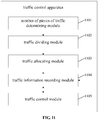
- the embodiment of the invention also discloses a traffic control apparatus. As shown in FIG. 11 , the apparatus includes a number of pieces of traffic determining module 1101, a traffic dividing module 1102, a traffic allocating module 1103, a traffic information recording module 1104 and a traffic control module 1105.
- the number of pieces of traffic determining module 1101 is configured to determine the number n of pieces of traffic to be divided, wherein n is greater than or equal to 2.
- the traffic dividing module 1102 is configured to divide all available traffic into n pieces, wherein each piece of the traffic is the same or differs by one unit.
- the traffic allocating module 1103 is configured to allocate n pieces of traffic to m equivalent paths, so that each of the equivalent paths is allocated with n/m or n/m+1 pieces of traffic.
- the traffic information recording module 1104 is configured to, in the traffic allocation process, record the traffic allocated to each of the equivalent paths and the allocation order of the traffic.
- the traffic control module 1105 is configured to, when it is required to perform traffic switching, perform, according to the traffic allocated to each of the equivalent paths and the allocation order of the traffic which are recorded by the traffic information recording module 1104, allocation in a manner of first allocating the last allocated traffic to the equivalent path in need, so that the number of pieces of traffic allocated to each of the equivalent paths is the same or differs by one piece.
- the traffic control module 1105 is configured to, when it is required to perform traffic switching, perform, according to the traffic allocated to each of the equivalent paths and the allocation order of the traffic which are recorded, allocation in a manner of first allocating the last allocated traffic to the equivalent path in need, so that the number of pieces of traffic allocated to each of the equivalent paths is the same or differs by one piece, in the following manner.
- the traffic on the failed path is allocated to the normal path, wherein the number of pieces of traffic allocated to each of the normal paths is the same or differs by one piece of traffic.
- the original traffic of the normal path is maintained unchanged, and at the same time, the traffic information recording module 1104 is notified to record the traffic allocated from the failed path to each of the normal paths and the allocation order of the allocated traffic.
- the traffic control module 1105 is further configured to, when it is required to perform traffic switching, perform, according to the traffic allocated to each of the equivalent paths and the allocation order of the traffic which are recorded by the traffic information recording module 1104, allocation in a manner of first allocating the last allocated traffic to the equivalent path in need, so that the number of pieces of traffic allocated to each of the equivalent paths is the same or differs by one piece, in the following manner.
- the traffic allocated from the failed path is allocated to the failed path which has returned to the normal according to the traffic allocated from the failed path to the normal path and the allocation order of the allocated traffic which are recorded by the traffic information recording module 1104.
- the traffic control module 1105 is further configured to, when it is required to perform traffic switching, perform, according to the traffic allocated to each of the equivalent paths and the allocation order of the traffic which are recorded, allocation in a manner of first allocating the last allocated traffic to the equivalent path in need, so that the numbers of pieces of traffic allocated to all the equivalent paths are the same or differ by one piece, as follows.
- each of the original equivalent paths allocates the last allocated traffic to the added equivalent path according to the traffic allocated to it and the allocation order of the traffic which are recorded by the traffic information recording module 1104, wherein the number of pieces of traffic allocated to the added equivalent path by each of the original equivalent paths is the same or differs by one piece of traffic, until the number of pieces of traffic allocated to the added equivalent path is the same as or differs from the number of pieces of traffic allocated to the original equivalent path by one piece.
- the number of pieces of traffic determining module 1101 is configured to determine the number n of pieces of traffic to be divided as follows.
- the number n of pieces of traffic to be divided is determined according to an experiment value, and the number of pieces of traffic enables the traffic to be allocated to multiple equivalent paths as evenly as possible.
- the embodiment is applied to a situation where the number m of equivalent paths is not determined or difficult to be determined.
- the number of pieces of traffic determining module 1101 can also be configured to determine the number n of pieces of traffic to be divided as follows.
- the LCM of all possible values in the variation range of the number of equivalent paths is taken as the number n of pieces of traffic to be divided.
- the LCM of all possible values from n to n+m is taken as the number of pieces of traffic to be divided, so that absolutely even allocation of the traffic can be ensured.
- the variation range of the number of equivalent paths is (1, 2, 3, 4)
- the LCM 12 of the four possible values 1, 2, 3 and 4 is taken as the number of pieces of traffic to be divided.
- the manner of taking the LCM of all possible values in the variation range of the number of equivalent paths as the number n of pieces of traffic to be divided is applied to a situation where the number of equivalent paths is fixed or predictable. For example, for the networks of most companies, the number of equivalent paths is determined, or is at least in a certain range.
- the traffic dividing module 1102 is configured to divide all available traffic into n pieces, wherein each piece of the traffic is the same or differs by one unit, as follows. All available traffic is divided into n pieces according to the preset rule, wherein the preset rule is any rule that can make each piece of the traffic the same or differ by one unit.
- the preset rule is the values corresponding to addresses of all messages to be forwarded.
- the traffic dividing module 1102 is configured to divide all available traffic into n pieces according to the preset rule, as follows. The values corresponding to the addresses of all the messages to be forwarded and the determined number of pieces of traffic are remaindered, and all the traffic with the same remainder is classified into one piece.
- the addresses can be the source IP address, or the destination IP address, or the source MAC address, or the destination MAC address.
- the preset rule can also be the protocol types.
- the traffic dividing module 1102 is configured to divide all available traffic into n pieces according to the preset rule, as follows. The traffic is divided into n pieces aiming at each of the protocol types.
- the values corresponding to the source IP addresses of all the messages to be forwarded include 12 to 47, wherein the value 0 gotten by remaindering the values 12, 24 and 36 corresponding to the source IP addresses and the determined number of pieces of traffic is classified into one piece, the value 1 gotten by remaindering the values 13, 25 and 37 corresponding to the source IP addresses and the determined number of pieces of traffic is classified into one piece, and so on, until the value 11 gotten by remaindering the values 23, 35 and 47 corresponding to the source IP addresses and the determined number of pieces of traffic is classified into one piece.
- the traffic allocating module 1103 is configured to allocate the multiple pieces of traffic to m equivalent paths, so that each of the equivalent paths is allocated with n/m or n/m+1 pieces of traffic, as follows.
- One piece of traffic is allocated to one of the equivalent paths each time by using the mode of circularly allocating in order.
- n/m or n/m+1 pieces of traffic, which should be carried by each of the equivalent paths are allocated to the corresponding equivalent path once by using a method of allocating the number of pieces of traffic, which should be carried by the equivalent path, to each of the equivalent paths once. For example, three pieces of traffic with the remainders 0, 1 and 2 are allocated to the first equivalent path once, three pieces of traffic with the remainders 3, 4 and 5 are allocated to the second equivalent path once, three pieces of traffic with the remainders 6, 7 and 8 are allocated to the third equivalent path once, and three pieces of traffic with the remainders 9, 10 and 11 are allocated to the fourth equivalent path once, as shown in Table 2 above.
- the traffic recording module 1104 is configured to, in the traffic allocation process, record the traffic allocated to each of the equivalent paths and the allocation order of the traffic, as follows.
- All the m equivalent paths are strung into a loop, wherein each node in the loop represents an equivalent path, and the traffic allocated to each of the equivalent paths and the allocation order of the traffic are recorded into the corresponding node.
- the traffic control module 1105 is further configured to, when any path of the multiple equivalent paths is failed, delete the node corresponding to the failed path from the loop.
- the traffic control module 1105 is further configured to, after the failed path is recovered, add the node corresponding to the path which has recovered in the loop.
- the traffic control module 1105 is further configured to, when an equivalent path is added, add the node corresponding to the added equivalent path in the loop.
- the traffic information recording module 1104 is configured to, in the traffic allocation process, record the traffic allocated to each of the equivalent paths and the allocation order of the traffic, as follows.
- the stack structure is adopted to record the traffic allocated to each of the equivalent paths and the allocation order of the traffic. That is, the traffic is arranged according to an order of being allocated to the equivalent paths, wherein the first allocated traffic is at the stack bottom, and the last allocated traffic is at the stack top.
- the traffic control module 1105 is configured to, when any path of the multiple equivalent paths is failed, allocate the traffic on the failed path to the normal path, as follows.
- the traffic of the stack top on the failed path is allocated to the normal paths, until the number of pieces of traffic allocated to each of the normal paths is the same or differs by one piece.
- the traffic control module 1105 is configured to, after the failed path has returned to normal, allocate the traffic allocated from the failed path to the normal path according to the traffic allocated from the failed path to the normal path and the allocation order of the allocated traffic which are recorded by the traffic information recording module 1104, as follows.
- the traffic of the stack top of each of the normal paths is allocated to the failed path which has returned to normal according to the traffic allocated from the failed path to each of the normal paths and the allocation order of the allocated traffic which are recorded by the traffic information recording module 1104, until all the traffic allocated from the failed path is allocated to the normal paths, and all the traffic allocated from the failed path is allocated to the path which has returned to normal.
- the traffic control module 1105 is configured to, when an equivalent path is added, enable each of the original equivalent path(s) to allocate the last allocated traffic to the added equivalent path according to the traffic allocated to the original equivalent paths and the allocation order of the traffic which are recorded by the traffic information recording module 1104, as follows.
- each of the original equivalent paths allocates the traffic of its stack top to the added equivalent path each time according to the traffic allocated to the original equivalent paths and the allocation order of the traffic which are recorded by the traffic information recording module 1104, until the number of pieces of traffic allocated to the added equivalent path and the number of pieces of traffic allocated to the original equivalent paths are the same or differ by one piece.
- Any of the above traffic allocation apparatuses can be in the EMCP system or other similar systems.
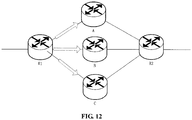
- the paths of the traffic selecting the path 1 and the path 2 in the beginning remain unchanged, and only the traffic going through the path 3 is divided into two pieces going through the path 1 and the path 2 respectively.
- the failed path has returned to normal, it can be ensured that the traffic of the original path 3 still goes through the path 3. In the process, the impact on the traffic of other paths is minimized.
- the traffic control methods of the embodiments of the invention minimize an impact on the original path(s) when traffic switching happens, thereby improving the efficiency of traffic reallocation.
- the embodiments of the invention also provide a computer readable storage medium having computer executable instructions stored therein.
- the computer executable instructions perform the traffic control methods when being executed by a processor.
- ROM Read-Only Memory
- magnetic disk magnetic disk
- compact disk compact disk
- all or part of the steps in the embodiments can also be implemented by using one or more integrated circuits.
- each module/unit in the embodiments can be realized in form of either hardware or software function module. The invention is not limited to any particular combination of hardware and software.
- an impact on the original paths can be minimized during traffic switching, thereby improving the efficiency of traffic reallocation.
Landscapes
- Engineering & Computer Science (AREA)
- Computer Networks & Wireless Communication (AREA)
- Signal Processing (AREA)
- Data Exchanges In Wide-Area Networks (AREA)
Applications Claiming Priority (2)
| Application Number | Priority Date | Filing Date | Title |
|---|---|---|---|
| CN201510374615.5A CN106330748B (zh) | 2015-06-30 | 2015-06-30 | 一种流量控制方法及装置 |
| PCT/CN2016/087107 WO2017000845A1 (fr) | 2015-06-30 | 2016-06-24 | Procédé et appareil de régulation de trafic |
Publications (3)
| Publication Number | Publication Date |
|---|---|
| EP3301872A1 true EP3301872A1 (fr) | 2018-04-04 |
| EP3301872A4 EP3301872A4 (fr) | 2018-06-20 |
| EP3301872B1 EP3301872B1 (fr) | 2019-09-25 |
Family
ID=57607709
Family Applications (1)
| Application Number | Title | Priority Date | Filing Date |
|---|---|---|---|
| EP16817209.6A Active EP3301872B1 (fr) | 2015-06-30 | 2016-06-24 | Procédé et appareil de régulation de trafic |
Country Status (4)
| Country | Link |
|---|---|
| US (1) | US10374957B2 (fr) |
| EP (1) | EP3301872B1 (fr) |
| CN (1) | CN106330748B (fr) |
| WO (1) | WO2017000845A1 (fr) |
Families Citing this family (2)
| Publication number | Priority date | Publication date | Assignee | Title |
|---|---|---|---|---|
| DE102018212360A1 (de) * | 2018-07-25 | 2020-01-30 | Robert Bosch Gmbh | Erste Netzwerkeinheit eines Kommunikationsnetzwerks |
| CN109587068B (zh) * | 2018-12-03 | 2022-08-12 | 深圳前海微众银行股份有限公司 | 流量切换方法、装置、设备及计算机可读存储介质 |
Family Cites Families (15)
| Publication number | Priority date | Publication date | Assignee | Title |
|---|---|---|---|---|
| US6275503B1 (en) * | 1998-07-24 | 2001-08-14 | Honeywell International Inc. | Method for transmitting large information packets over networks |
| US7945705B1 (en) * | 2004-05-25 | 2011-05-17 | Chelsio Communications, Inc. | Method for using a protocol language to avoid separate channels for control messages involving encapsulated payload data messages |
| DE102005057568B4 (de) | 2005-12-02 | 2021-06-17 | Robert Bosch Gmbh | Sendeeinrichtung und Empfangseinrichtung |
| CN101499957B (zh) * | 2008-01-29 | 2011-06-15 | 中国电信股份有限公司 | 一种多径负载均衡的实现方法和数据转发装置 |
| US7929527B2 (en) * | 2008-04-18 | 2011-04-19 | At&T Intellectual Property Ii, Lp | Transport protocol for efficient aggregation of heterogeneous lossy paths |
| CN101272290B (zh) * | 2008-05-12 | 2011-05-11 | 中国电信股份有限公司 | Ip网络中路径拥塞状态的测量方法和测量装置 |
| CN101674224B (zh) * | 2008-09-08 | 2012-08-29 | 华为技术有限公司 | 生成转发表项信息的方法、标签交换路由器及系统 |
| CN101420384A (zh) | 2008-12-12 | 2009-04-29 | 北京邮电大学 | 一种实现ecmp域内自愈保护的方法 |
| JP5392049B2 (ja) * | 2009-12-11 | 2014-01-22 | 富士通株式会社 | 経路制御方法、通信システム、及び通信装置 |
| JPWO2012128146A1 (ja) | 2011-03-24 | 2014-07-24 | 日本電気株式会社 | 通信システム、通信制御方法 |
| US8982689B2 (en) | 2012-04-20 | 2015-03-17 | Telefonaktiebolaget L M Ericsson (Publ) | Split tiebreakers for 802.1AQ |
| CN103078804B (zh) | 2012-12-28 | 2015-07-22 | 福建星网锐捷网络有限公司 | 等价多路径表处理方法、装置及网络设备 |
| CN104144120A (zh) | 2013-05-07 | 2014-11-12 | 杭州华三通信技术有限公司 | 转发信息配置方法及装置 |
| JP2015012343A (ja) * | 2013-06-26 | 2015-01-19 | 日本電信電話株式会社 | 通信ネットワークおよび転送ノード |
| CN104022952B (zh) * | 2014-06-03 | 2017-12-08 | 新华三技术有限公司 | 一种报文转发方法及装置 |
-
2015
- 2015-06-30 CN CN201510374615.5A patent/CN106330748B/zh active Active
-
2016
- 2016-06-24 US US15/738,255 patent/US10374957B2/en active Active
- 2016-06-24 EP EP16817209.6A patent/EP3301872B1/fr active Active
- 2016-06-24 WO PCT/CN2016/087107 patent/WO2017000845A1/fr not_active Ceased
Also Published As
| Publication number | Publication date |
|---|---|
| US20180183712A1 (en) | 2018-06-28 |
| EP3301872A4 (fr) | 2018-06-20 |
| EP3301872B1 (fr) | 2019-09-25 |
| CN106330748A (zh) | 2017-01-11 |
| US10374957B2 (en) | 2019-08-06 |
| WO2017000845A1 (fr) | 2017-01-05 |
| CN106330748B (zh) | 2019-04-09 |
Similar Documents
| Publication | Publication Date | Title |
|---|---|---|
| CN109391549B (zh) | 使用一致性哈希进行ecmp路由 | |
| EP3531288A1 (fr) | Procédé, dispositif et système de stockage de données | |
| EP3562098B1 (fr) | Création d'entrée pour chemins à coûts égaux | |
| CN108718278B (zh) | 一种报文传输方法和装置 | |
| US20230155936A1 (en) | Dynamic forward information base prefix optimization | |
| EP3562097B1 (fr) | Établissement d'entrée de table de chemin à coût égal | |
| US11570105B2 (en) | Dynamic route profile storage in a hardware trie routing table | |
| EP3327993A1 (fr) | Gestion de route | |
| KR101912728B1 (ko) | 데이터 처리 방법 및 장치 | |
| WO2018045862A1 (fr) | Procédé et dispositif d'écriture d'une table à mémoire adressable par contenu ternaire (tcam) | |
| CN109726144B (zh) | 一种数据报文的处理方法和装置 | |
| EP3301872B1 (fr) | Procédé et appareil de régulation de trafic | |
| CN108390954A (zh) | 一种报文传输方法和设备 | |
| US20200236042A1 (en) | Efficient implementation of complex network segmentation | |
| CN106209634B (zh) | 地址映射关系的学习方法及装置 | |
| CN113568863B (zh) | 数据传输方法、路由节点、众核系统、计算机可读介质 | |
| CN112398733B (zh) | 流量调度转发方法及装置 | |
| US11368354B2 (en) | Multi-result lookups | |
| CN113452619A (zh) | 一种基于acl的流量分流方法及装置 | |
| CN121486281B (zh) | 一种数据包处理方法、系统、设备和存储介质 | |
| CN114911728A (zh) | 一种数据查找方法、装置及集成电路 | |
| CN115914089B (zh) | Arp出口快速切换的芯片实现方法及应用 | |
| CN111107142A (zh) | 业务访问方法和装置 | |
| CN111314505A (zh) | 一种网络地址转换方法及装置 | |
| CN111740918A (zh) | 一种负载分担方法、装置、设备及机器可读存储介质 |
Legal Events
| Date | Code | Title | Description |
|---|---|---|---|
| STAA | Information on the status of an ep patent application or granted ep patent |
Free format text: STATUS: THE INTERNATIONAL PUBLICATION HAS BEEN MADE |
|
| PUAI | Public reference made under article 153(3) epc to a published international application that has entered the european phase |
Free format text: ORIGINAL CODE: 0009012 |
|
| STAA | Information on the status of an ep patent application or granted ep patent |
Free format text: STATUS: REQUEST FOR EXAMINATION WAS MADE |
|
| 17P | Request for examination filed |
Effective date: 20171227 |
|
| AK | Designated contracting states |
Kind code of ref document: A1 Designated state(s): AL AT BE BG CH CY CZ DE DK EE ES FI FR GB GR HR HU IE IS IT LI LT LU LV MC MK MT NL NO PL PT RO RS SE SI SK SM TR |
|
| AX | Request for extension of the european patent |
Extension state: BA ME |
|
| A4 | Supplementary search report drawn up and despatched |
Effective date: 20180524 |
|
| RIC1 | Information provided on ipc code assigned before grant |
Ipc: H04L 12/805 20130101ALI20180517BHEP Ipc: H04L 12/803 20130101AFI20180517BHEP |
|
| DAV | Request for validation of the european patent (deleted) | ||
| DAX | Request for extension of the european patent (deleted) | ||
| GRAP | Despatch of communication of intention to grant a patent |
Free format text: ORIGINAL CODE: EPIDOSNIGR1 |
|
| STAA | Information on the status of an ep patent application or granted ep patent |
Free format text: STATUS: GRANT OF PATENT IS INTENDED |
|
| RIC1 | Information provided on ipc code assigned before grant |
Ipc: H04L 12/805 20130101ALI20190325BHEP Ipc: H04L 12/803 20130101AFI20190325BHEP Ipc: H04L 12/703 20130101ALI20190325BHEP Ipc: H04L 12/707 20130101ALI20190325BHEP |
|
| INTG | Intention to grant announced |
Effective date: 20190417 |
|
| GRAS | Grant fee paid |
Free format text: ORIGINAL CODE: EPIDOSNIGR3 |
|
| GRAA | (expected) grant |
Free format text: ORIGINAL CODE: 0009210 |
|
| STAA | Information on the status of an ep patent application or granted ep patent |
Free format text: STATUS: THE PATENT HAS BEEN GRANTED |
|
| AK | Designated contracting states |
Kind code of ref document: B1 Designated state(s): AL AT BE BG CH CY CZ DE DK EE ES FI FR GB GR HR HU IE IS IT LI LT LU LV MC MK MT NL NO PL PT RO RS SE SI SK SM TR |
|
| REG | Reference to a national code |
Ref country code: GB Ref legal event code: FG4D |
|
| REG | Reference to a national code |
Ref country code: CH Ref legal event code: EP |
|
| REG | Reference to a national code |
Ref country code: DE Ref legal event code: R096 Ref document number: 602016021420 Country of ref document: DE |
|
| REG | Reference to a national code |
Ref country code: AT Ref legal event code: REF Ref document number: 1184914 Country of ref document: AT Kind code of ref document: T Effective date: 20191015 |
|
| REG | Reference to a national code |
Ref country code: IE Ref legal event code: FG4D |
|
| REG | Reference to a national code |
Ref country code: NL Ref legal event code: MP Effective date: 20190925 |
|
| PG25 | Lapsed in a contracting state [announced via postgrant information from national office to epo] |
Ref country code: FI Free format text: LAPSE BECAUSE OF FAILURE TO SUBMIT A TRANSLATION OF THE DESCRIPTION OR TO PAY THE FEE WITHIN THE PRESCRIBED TIME-LIMIT Effective date: 20190925 Ref country code: HR Free format text: LAPSE BECAUSE OF FAILURE TO SUBMIT A TRANSLATION OF THE DESCRIPTION OR TO PAY THE FEE WITHIN THE PRESCRIBED TIME-LIMIT Effective date: 20190925 Ref country code: SE Free format text: LAPSE BECAUSE OF FAILURE TO SUBMIT A TRANSLATION OF THE DESCRIPTION OR TO PAY THE FEE WITHIN THE PRESCRIBED TIME-LIMIT Effective date: 20190925 Ref country code: NO Free format text: LAPSE BECAUSE OF FAILURE TO SUBMIT A TRANSLATION OF THE DESCRIPTION OR TO PAY THE FEE WITHIN THE PRESCRIBED TIME-LIMIT Effective date: 20191225 Ref country code: LT Free format text: LAPSE BECAUSE OF FAILURE TO SUBMIT A TRANSLATION OF THE DESCRIPTION OR TO PAY THE FEE WITHIN THE PRESCRIBED TIME-LIMIT Effective date: 20190925 Ref country code: BG Free format text: LAPSE BECAUSE OF FAILURE TO SUBMIT A TRANSLATION OF THE DESCRIPTION OR TO PAY THE FEE WITHIN THE PRESCRIBED TIME-LIMIT Effective date: 20191225 |
|
| REG | Reference to a national code |
Ref country code: LT Ref legal event code: MG4D |
|
| PG25 | Lapsed in a contracting state [announced via postgrant information from national office to epo] |
Ref country code: GR Free format text: LAPSE BECAUSE OF FAILURE TO SUBMIT A TRANSLATION OF THE DESCRIPTION OR TO PAY THE FEE WITHIN THE PRESCRIBED TIME-LIMIT Effective date: 20191226 Ref country code: LV Free format text: LAPSE BECAUSE OF FAILURE TO SUBMIT A TRANSLATION OF THE DESCRIPTION OR TO PAY THE FEE WITHIN THE PRESCRIBED TIME-LIMIT Effective date: 20190925 Ref country code: RS Free format text: LAPSE BECAUSE OF FAILURE TO SUBMIT A TRANSLATION OF THE DESCRIPTION OR TO PAY THE FEE WITHIN THE PRESCRIBED TIME-LIMIT Effective date: 20190925 |
|
| REG | Reference to a national code |
Ref country code: AT Ref legal event code: MK05 Ref document number: 1184914 Country of ref document: AT Kind code of ref document: T Effective date: 20190925 |
|
| PG25 | Lapsed in a contracting state [announced via postgrant information from national office to epo] |
Ref country code: EE Free format text: LAPSE BECAUSE OF FAILURE TO SUBMIT A TRANSLATION OF THE DESCRIPTION OR TO PAY THE FEE WITHIN THE PRESCRIBED TIME-LIMIT Effective date: 20190925 Ref country code: PL Free format text: LAPSE BECAUSE OF FAILURE TO SUBMIT A TRANSLATION OF THE DESCRIPTION OR TO PAY THE FEE WITHIN THE PRESCRIBED TIME-LIMIT Effective date: 20190925 Ref country code: RO Free format text: LAPSE BECAUSE OF FAILURE TO SUBMIT A TRANSLATION OF THE DESCRIPTION OR TO PAY THE FEE WITHIN THE PRESCRIBED TIME-LIMIT Effective date: 20190925 Ref country code: NL Free format text: LAPSE BECAUSE OF FAILURE TO SUBMIT A TRANSLATION OF THE DESCRIPTION OR TO PAY THE FEE WITHIN THE PRESCRIBED TIME-LIMIT Effective date: 20190925 Ref country code: ES Free format text: LAPSE BECAUSE OF FAILURE TO SUBMIT A TRANSLATION OF THE DESCRIPTION OR TO PAY THE FEE WITHIN THE PRESCRIBED TIME-LIMIT Effective date: 20190925 Ref country code: PT Free format text: LAPSE BECAUSE OF FAILURE TO SUBMIT A TRANSLATION OF THE DESCRIPTION OR TO PAY THE FEE WITHIN THE PRESCRIBED TIME-LIMIT Effective date: 20200127 Ref country code: AL Free format text: LAPSE BECAUSE OF FAILURE TO SUBMIT A TRANSLATION OF THE DESCRIPTION OR TO PAY THE FEE WITHIN THE PRESCRIBED TIME-LIMIT Effective date: 20190925 Ref country code: AT Free format text: LAPSE BECAUSE OF FAILURE TO SUBMIT A TRANSLATION OF THE DESCRIPTION OR TO PAY THE FEE WITHIN THE PRESCRIBED TIME-LIMIT Effective date: 20190925 Ref country code: IT Free format text: LAPSE BECAUSE OF FAILURE TO SUBMIT A TRANSLATION OF THE DESCRIPTION OR TO PAY THE FEE WITHIN THE PRESCRIBED TIME-LIMIT Effective date: 20190925 |
|
| PG25 | Lapsed in a contracting state [announced via postgrant information from national office to epo] |
Ref country code: SK Free format text: LAPSE BECAUSE OF FAILURE TO SUBMIT A TRANSLATION OF THE DESCRIPTION OR TO PAY THE FEE WITHIN THE PRESCRIBED TIME-LIMIT Effective date: 20190925 Ref country code: CZ Free format text: LAPSE BECAUSE OF FAILURE TO SUBMIT A TRANSLATION OF THE DESCRIPTION OR TO PAY THE FEE WITHIN THE PRESCRIBED TIME-LIMIT Effective date: 20190925 Ref country code: SM Free format text: LAPSE BECAUSE OF FAILURE TO SUBMIT A TRANSLATION OF THE DESCRIPTION OR TO PAY THE FEE WITHIN THE PRESCRIBED TIME-LIMIT Effective date: 20190925 Ref country code: IS Free format text: LAPSE BECAUSE OF FAILURE TO SUBMIT A TRANSLATION OF THE DESCRIPTION OR TO PAY THE FEE WITHIN THE PRESCRIBED TIME-LIMIT Effective date: 20200224 |
|
| REG | Reference to a national code |
Ref country code: DE Ref legal event code: R097 Ref document number: 602016021420 Country of ref document: DE |
|
| PG2D | Information on lapse in contracting state deleted |
Ref country code: IS |
|
| PG25 | Lapsed in a contracting state [announced via postgrant information from national office to epo] |
Ref country code: DK Free format text: LAPSE BECAUSE OF FAILURE TO SUBMIT A TRANSLATION OF THE DESCRIPTION OR TO PAY THE FEE WITHIN THE PRESCRIBED TIME-LIMIT Effective date: 20190925 Ref country code: IS Free format text: LAPSE BECAUSE OF FAILURE TO SUBMIT A TRANSLATION OF THE DESCRIPTION OR TO PAY THE FEE WITHIN THE PRESCRIBED TIME-LIMIT Effective date: 20200126 |
|
| PLBE | No opposition filed within time limit |
Free format text: ORIGINAL CODE: 0009261 |
|
| STAA | Information on the status of an ep patent application or granted ep patent |
Free format text: STATUS: NO OPPOSITION FILED WITHIN TIME LIMIT |
|
| 26N | No opposition filed |
Effective date: 20200626 |
|
| PG25 | Lapsed in a contracting state [announced via postgrant information from national office to epo] |
Ref country code: SI Free format text: LAPSE BECAUSE OF FAILURE TO SUBMIT A TRANSLATION OF THE DESCRIPTION OR TO PAY THE FEE WITHIN THE PRESCRIBED TIME-LIMIT Effective date: 20190925 |
|
| REG | Reference to a national code |
Ref country code: DE Ref legal event code: R119 Ref document number: 602016021420 Country of ref document: DE |
|
| PG25 | Lapsed in a contracting state [announced via postgrant information from national office to epo] |
Ref country code: MC Free format text: LAPSE BECAUSE OF FAILURE TO SUBMIT A TRANSLATION OF THE DESCRIPTION OR TO PAY THE FEE WITHIN THE PRESCRIBED TIME-LIMIT Effective date: 20190925 |
|
| REG | Reference to a national code |
Ref country code: CH Ref legal event code: PL |
|
| GBPC | Gb: european patent ceased through non-payment of renewal fee |
Effective date: 20200624 |
|
| PG25 | Lapsed in a contracting state [announced via postgrant information from national office to epo] |
Ref country code: LU Free format text: LAPSE BECAUSE OF NON-PAYMENT OF DUE FEES Effective date: 20200624 |
|
| REG | Reference to a national code |
Ref country code: BE Ref legal event code: MM Effective date: 20200630 |
|
| PG25 | Lapsed in a contracting state [announced via postgrant information from national office to epo] |
Ref country code: IE Free format text: LAPSE BECAUSE OF NON-PAYMENT OF DUE FEES Effective date: 20200624 Ref country code: GB Free format text: LAPSE BECAUSE OF NON-PAYMENT OF DUE FEES Effective date: 20200624 Ref country code: CH Free format text: LAPSE BECAUSE OF NON-PAYMENT OF DUE FEES Effective date: 20200630 Ref country code: LI Free format text: LAPSE BECAUSE OF NON-PAYMENT OF DUE FEES Effective date: 20200630 |
|
| PG25 | Lapsed in a contracting state [announced via postgrant information from national office to epo] |
Ref country code: BE Free format text: LAPSE BECAUSE OF NON-PAYMENT OF DUE FEES Effective date: 20200630 Ref country code: DE Free format text: LAPSE BECAUSE OF NON-PAYMENT OF DUE FEES Effective date: 20210101 |
|
| PG25 | Lapsed in a contracting state [announced via postgrant information from national office to epo] |
Ref country code: TR Free format text: LAPSE BECAUSE OF FAILURE TO SUBMIT A TRANSLATION OF THE DESCRIPTION OR TO PAY THE FEE WITHIN THE PRESCRIBED TIME-LIMIT Effective date: 20190925 Ref country code: MT Free format text: LAPSE BECAUSE OF FAILURE TO SUBMIT A TRANSLATION OF THE DESCRIPTION OR TO PAY THE FEE WITHIN THE PRESCRIBED TIME-LIMIT Effective date: 20190925 Ref country code: CY Free format text: LAPSE BECAUSE OF FAILURE TO SUBMIT A TRANSLATION OF THE DESCRIPTION OR TO PAY THE FEE WITHIN THE PRESCRIBED TIME-LIMIT Effective date: 20190925 |
|
| PG25 | Lapsed in a contracting state [announced via postgrant information from national office to epo] |
Ref country code: MK Free format text: LAPSE BECAUSE OF FAILURE TO SUBMIT A TRANSLATION OF THE DESCRIPTION OR TO PAY THE FEE WITHIN THE PRESCRIBED TIME-LIMIT Effective date: 20190925 |
|
| PGFP | Annual fee paid to national office [announced via postgrant information from national office to epo] |
Ref country code: FR Payment date: 20250508 Year of fee payment: 10 |