EP3301875A1 - Procédé d'attribution d'adresses de protocole internet et dispositif de relais - Google Patents
Procédé d'attribution d'adresses de protocole internet et dispositif de relais Download PDFInfo
- Publication number
- EP3301875A1 EP3301875A1 EP15896659.8A EP15896659A EP3301875A1 EP 3301875 A1 EP3301875 A1 EP 3301875A1 EP 15896659 A EP15896659 A EP 15896659A EP 3301875 A1 EP3301875 A1 EP 3301875A1
- Authority
- EP
- European Patent Office
- Prior art keywords
- user
- dhcp
- address
- message
- relay device
- Prior art date
- Legal status (The legal status is an assumption and is not a legal conclusion. Google has not performed a legal analysis and makes no representation as to the accuracy of the status listed.)
- Granted
Links
Images



Classifications
-
- H—ELECTRICITY
- H04—ELECTRIC COMMUNICATION TECHNIQUE
- H04L—TRANSMISSION OF DIGITAL INFORMATION, e.g. TELEGRAPHIC COMMUNICATION
- H04L61/00—Network arrangements, protocols or services for addressing or naming
- H04L61/50—Address allocation
- H04L61/5053—Lease time; Renewal aspects
-
- H—ELECTRICITY
- H04—ELECTRIC COMMUNICATION TECHNIQUE
- H04L—TRANSMISSION OF DIGITAL INFORMATION, e.g. TELEGRAPHIC COMMUNICATION
- H04L61/00—Network arrangements, protocols or services for addressing or naming
- H04L61/50—Address allocation
- H04L61/5007—Internet protocol [IP] addresses
- H04L61/5014—Internet protocol [IP] addresses using dynamic host configuration protocol [DHCP] or bootstrap protocol [BOOTP]
-
- H—ELECTRICITY
- H04—ELECTRIC COMMUNICATION TECHNIQUE
- H04L—TRANSMISSION OF DIGITAL INFORMATION, e.g. TELEGRAPHIC COMMUNICATION
- H04L61/00—Network arrangements, protocols or services for addressing or naming
- H04L61/50—Address allocation
- H04L61/5046—Resolving address allocation conflicts; Testing of addresses
-
- H—ELECTRICITY
- H04—ELECTRIC COMMUNICATION TECHNIQUE
- H04L—TRANSMISSION OF DIGITAL INFORMATION, e.g. TELEGRAPHIC COMMUNICATION
- H04L67/00—Network arrangements or protocols for supporting network services or applications
- H04L67/50—Network services
- H04L67/56—Provisioning of proxy services
Definitions
- Embodiments of the present invention relate to the field of communications technologies, and in particular, to an Internet Protocol address allocation method and a relay device.
- the Dynamic Host Configuration Protocol (Dynamic Host Configuration Protocol, DHCP) is a dynamic address allocation solution based on the TCP/IP (Transmission Control Protocol/Internet Protocol, Transmission Control Protocol/Internet Protocol) protocol.
- TCP/IP parameters including an IP address, a subnet mask, a default gateway, a DNS, and the like
- TCP/IP parameters can be configured automatically, there is a lease time for an allocated IP address, the allocated IP address can be reclaimed and reused after the lease time expires, and the like. Therefore, all configuration information of the TCP/IP protocol may be stored on a DHCP server in a centralized manner. Centralized storage and management can avoid an IP address conflict, and free an administrator from heavy manual configuration work. As a scale of a current network is larger, advantages of DHCP are more obvious.
- a DHCP server and a DHCP client are not directly connected, but are generally connected by using an access device.
- the access device used for relaying and forwarding an DHCP message is a DHCP relay (DHCP relay) device.
- IP address Internet Protocol address
- ARP Address Resolution Protocol, Address Resolution Protocol
- Some of existing relay devices cannot recognize an IP address conflict, and the clients also cannot recognize the IP address conflict due to reasons such as user isolation.
- Some other relay devices can recognize an IP address conflict between a user that goes online later and a user that goes online earlier, but after recognizing the IP address conflict, the relay devices can only discard a message for allocating an IP address by the DHCP server to the user that goes online later. Consequently, the user that goes online later always cannot dial up successfully. Even if a relay device initiates ARP detection to the user that goes online earlier, because the user that goes online earlier is an online user and also responds to the ARP detection, the user that goes online earlier cannot be deleted.
- an embodiment of the present invention provides an IP address allocation method, including: receiving, by a relay device, from a DHCP server, an IP address allocated to a first user; detecting, by the relay device, that the IP address allocated to the first user and an IP address already allocated by the DHCP server to a second user are duplicate, and that the IP address already allocated to the second user is still within a lease time, where the relay device stores the IP address already allocated to the second user and the lease time of the IP address already allocated to the second user; sending, by the relay device, a force renew message to the second user, where the force renew message instructs the second user to request IP address renewal, and the force renew message carries an IP address of the DHCP server; receiving, by the relay device, a DHCP renew request message sent by the second user, and transmitting the DHCP renew request message to the DHCP server, where the DHCP renew request message is used to trigger the DHCP server to renew the IP address of the second user; receiving, by the relay device, from the
- an embodiment of the present invention provides an IP address allocation method, including: receiving, by a relay device, from a DHCP server, an IP address allocated to a first user; detecting, by the relay device, that the IP address allocated to the first user and an IP address already allocated by the DHCP server to a second user are duplicate, and that the IP address already allocated to the second user is still within a lease time, where the relay device stores the IP address already allocated to the second user and the lease time of the IP address already allocated to the second user; sending, by the relay device, a DHCP reject message to the DHCP server, where the DHCP reject message is used to notify the DHCP server that the IP address allocated to the first user is unavailable, and the DHCP reject message carries the IP address allocated to the first user and a Media Access Control MAC address of the first user; and interacting, by the relay device, with the first user and the DHCP server to reallocate an IP address to the first user, where the IP address reallocated to the first user is different
- an embodiment of the present invention provides a relay device, including: a transceiver module, configured to receive, from a DHCP Dynamic Host Configuration Protocol server, an IP address allocated to a first user; and a detection module, configured to detect whether the IP address allocated to the first user and an IP address already allocated by the DHCP server to a second user are duplicate, and whether the IP address already allocated to the second user is still within a lease time, where the relay device stores the IP address already allocated to the second user and the lease time of the IP address already allocated to the second user; where the transceiver module is further configured to: when the detection module detects that the IP address allocated to the first user and the IP address already allocated by the DHCP server to the second user are duplicate, and that the IP address already allocated to the second user is still within the lease time, send a force renew message to the second user, where the force renew message instructs the second user to request IP address renewal, and the force renew message carries an IP address of the DHCP server; receive a transceiver module
- an embodiment of the present invention provides a relay device, including: a transceiver module, configured to receive, from a DHCP Dynamic Host Configuration Protocol server, an IP address allocated to a first user; and a detection module, configured to detect whether the IP address allocated to the first user and an IP address already allocated by the DHCP server to a second user are duplicate, and whether the IP address already allocated to the second user is still within a lease time, where the relay device stores the IP address already allocated to the second user and the lease time of the IP address already allocated to the second user; where the transceiver module is further configured to: when the detection module detects that the IP address allocated to the first user and the IP address already allocated by the DHCP server to the second user are duplicate, and that the IP address already allocated to the second user is still within the lease time, send a DHCP reject message to the DHCP server, where the DHCP reject message is used to notify the DHCP server that the IP address allocated to the first user is unavailable, and the DHCP
- a relay device stores an IP address already allocated to a user and a lease time of the IP address already allocated to the user, and can recognize an IP address conflict. Therefore, a problem that some users cannot go online in a scenario of an IP address conflict is resolved by performing message forwarding, operation and maintenance costs of an existing network device in this scenario are reduced, service experience of the user is improved, and competitiveness of the relay device is enhanced.
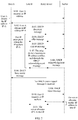
- FIG. 1 is a diagram of interaction between a user, a relay device, and a server in an IP address allocation process according to Embodiment 1 of the present invention.
- user A requests an IP address from a server through a relay device.
- the server responds to the request of user A, and allocates an IP address IP-A to user A.
- user A may send a DHCP discovery (DHCP discovery) message to a DHCP server through the relay device, where the DHCP discovery message is used to discover the DHCP server; the DHCP server feeds back a DHCP offer (DHCP offer) message to user A through the relay device, where the DHCP offer message carries an IP address offered by the DHCP server; then, user A sends a DHCP request (DHCP request) message to the DHCP server through the relay device, where the DHCP request message requests the DHCP server to allocate the IP address offered by the DHCP server; and the DHCP server sends a DHCP acknowledgement (DHCP ACK) message to user A through the relay device, where the DHCP acknowledgement message confirms to allocate the IP address offered by the DHCP server to user A.
- DHCP discovery DHCP discovery
- user B attempts to obtain the IP address IP-A.
- User B first sends a DHCP discovery message to the DHCP server; the DHCP server sends a DHCP offer message to user B through the relay device; user B then sends a DHCP request message to the DHCP server through the relay device; the DHCP server sends a DHCP acknowledgement message to user B through the relay device, where the DHCP acknowledgement message carries the IP address IP-A; and when the DHCP acknowledgement message arrives at the relay device, the relay device discovers that the IP address allocated by the server to user B conflicts with the IP address IP-A of user A, and the relay device discards the DHCP acknowledgement message.
- a conventional practice is: after the relay device discards the DHCP acknowledgement message in step S107, the process goes back to step S103 in which user B initiates a DHCP discovery message to the server again; then, steps S104, S105, S106, and S107 for performing interaction between user B, the relay device, and the server are repeated, and this is performed cyclically.
- the relay device needs to store the IP address already allocated to user A and a lease time of the IP address already allocated to the user A. Therefore, after discovering the IP address conflict, the relay device may further check whether the IP address allocated to user A is within the lease time. If the relay device detects that the IP address allocated to user B and the IP address already allocated by the DHCP server to user A are duplicate, and that the IP address already allocated to user A is still within the lease time, in step S108, the relay device simulates the server to send a DHCP force renew (Force Renew) message to user B, where the DHCP force renew message carries an IP address of the server rather than an IP address of the relay device.
- DHCP force renew Form Renew
- step S109 client A sends a DHCP renew request message to the DHCP server through the relay device, requesting the DHCP server to allocate an IP address to client A.
- the DHCP server feeds back a DHCP acknowledgement message to client A, and allocates another IP address IP-C to client A.
- the relay device stores the new IP address IP-C of the client A.
- step Sill client B requests an IP address through the relay device again, and the DHCP server allocates IP-A to client B in step S112. It should be noted that, in step 112, the DHCP server may also allocate another IP address different from IP-A and IP-C to client B.
- the DHCP server may send a DHCP negative acknowledgement (DHCP NAK) message to user A, where the DHCP negative acknowledgement message notifies user A that the IP address previously allocated to user A is unavailable; then, user A may send a DHCP discovery message to the DHCP server through the relay device, where the DHCP discovery message is used to discover the DHCP server; the DHCP server feeds back a DHCP offer message to user A through the relay device, where the DHCP offer message carries another IP address IP-C offered by the DHCP server; then, user A sends a DHCP request message to the DHCP server through the relay device, where the DHCP request message requests the DHCP server to allocate the IP address IP-C offered by the DHCP server. Then the DHCP server sends a DHCP acknowledgement message to user A through the relay device, where the DHCP acknowledgement message confirms to allocate the IP address IP-C offered by the DHCP NAK
- DHCP NAK DHCP negative acknowledge
- the relay device may check whether user A is online; and if user A is online, perform step S108 to send the force renew message to user A. If user A is not online, data of user A may be deleted, and IP-A is directly allocated to user B.
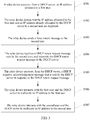
- FIG. 2 is a diagram of interaction between a user, a relay device, and a server in an IP address allocation process according to Embodiment 2 of the present invention.
- Step S101 to step S108 in Embodiment 2 are the same as those in Embodiment 1.
- a difference from Embodiment 1 lies in that, after the relay device simulates the server to send a DHCP force renew message to user A in step S108, where the DHCP force renew message carries an IP address of the server, because client A does not support DHCP force renew, client A does not send a DHCP request message to the server through the relay device.
- the relay device After waiting for a predetermined time, if the relay device does not receive a DHCP request message, the relay device sends a DHCP reject message to the server in step S109, notifying the server that the IP address IP-A is unavailable.
- client B requests an IP address through the relay device again, and the server allocates IP-C to client B in step Sill.
- the time when the relay device waits for the DHCP request message may be determined according to factors such as a quantity of IP addresses on the server and a quantity of clients requesting IP addresses, or may be determined according to a priority of client B, and is not specifically limited herein.
- a process of allocating an IP address to client B in step S110 and step Sill may be fractionalized into four steps: DHCP discovery, DHCP offer, DHCP request, and DHCP acknowledgement.
- FIG. 3 is a flowchart of an IP address allocation method according to Embodiment 3 of the present invention. The method includes the following steps.
- a relay device receives, from a DHCP Dynamic Host Configuration Protocol server, an IP address allocated to a first user.
- the relay device detects that the IP address allocated to the first user and an IP address already allocated by the DHCP server to a second user are duplicate, and that the IP address already allocated to the second user is still within a lease time.
- the relay device stores the IP address already allocated to the second user and the lease time of the IP address already allocated to the second user.
- the relay device sends a force renew message to the second user, where the force renew message instructs the second user to request IP address renewal.
- the force renew message carries an IP address of the DHCP server.
- the IP address allocation method in Embodiment 3 may further include: the relay device checks whether the second user is online, and if the second user is online, sends the force renew message to the second user.
- the relay device receives a DHCP renew request message sent by the second user, and transmits the DHCP renew request message to the DHCP server.
- the DHCP renew request message is used to trigger the DHCP server to renew the IP address of the second user.
- Requesting to renew the IP address of the second user may include at least one of the following two cases: requesting to allocate a new IP address to the second user, or requesting to extend the lease time of the IP address currently used by the second user.
- the relay device receives, from the DHCP server, a DHCP negative acknowledgement (DHCP NAK) message that is sent by the DHCP server in response to the DHCP renew request message, where the DHCP negative acknowledgement message notifies the second user that the IP address already allocated to the second user is unavailable.
- DHCP NAK DHCP negative acknowledgement
- the relay device interacts with the first user and the DHCP server to reallocate an IP address to the first user.
- That the relay device interacts with the first user and the DHCP server to reallocate an IP address to the first user may include: the relay device receives a DHCP discovery message from the first user, and sends the DHCP discovery message to the DHCP server, where the DHCP discovery message is used to discover the DHCP server; the relay device receives a DHCP offer message from the DHCP server, and the relay device sends the DHCP offer message to the first user, where the DHCP offer message carries an IP address offered by the DHCP server; the relay device receives a DHCP request message from the first user, and sends the DHCP request message to the DHCP server, where the DHCP request message requests the DHCP server to allocate the IP address offered by the DHCP server; and the relay device receives a DHCP acknowledgement message from the DHCP server, where the DHCP acknowledgement message confirms to allocate the IP address offered by the DHCP server to the first user.
- the relay device interacts with the second user and the DHCP server to reallocate an IP address to the second user.
- That the relay device interacts with the second user and the DHCP server to reallocate an IP address to the second user may include: the relay device receives a DHCP discovery message from the second user, and sends the DHCP discovery message to the DHCP server, where the DHCP discovery message is used to discover the DHCP server; the relay device receives a DHCP offer message from the DHCP server, and the relay device sends the DHCP offer message to the second user, where the DHCP offer message carries an IP address offered by the DHCP server; the relay device receives a DHCP request message from the second user, and sends the DHCP request message to the DHCP server, where the DHCP request message requests the DHCP server to allocate the IP address offered by the DHCP server; and the relay device receives a DHCP acknowledgement message from the DHCP server, where the DHCP acknowledgement message confirms to allocate the IP address offered by the DHCP server to the second user.
- the IP address reallocated to the second user is different from the IP address already allocated to the second user, and the IP address reallocated to the first user is different from the IP address already allocated to the second user.
- the IP address reallocated to the second user is the same as the IP address already allocated to the second user, and the IP address reallocated to the first user is different from the IP address already allocated to the second user.
- the IP address reallocated to the second user is different from the IP address already allocated to the second user, and the IP address reallocated to the first user is the same as the IP address already allocated to the second user.
- a relay device stores an IP address already allocated to a user and a lease time of the IP address already allocated to the user, and can recognize an IP address conflict. Therefore, a problem that some users cannot go online in a scenario of an IP address conflict is resolved by performing message forwarding, operation and maintenance costs of an existing network device in this scenario are reduced, service experience of the user is improved, and competitiveness of the relay device is enhanced.
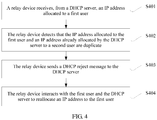
- FIG. 4 is a flowchart of an IP address allocation method according to Embodiment 4 of the present invention. The method includes the following steps.
- a relay device receives, from a DHCP Dynamic Host Configuration Protocol server, an IP address allocated to a first user.
- the relay device detects that the IP address allocated to the first user and an IP address already allocated by the DHCP server to a second user are duplicate, and that the IP address already allocated to the second user is still within a lease time.
- the relay device stores the IP address already allocated to the second user and the lease time of the IP address already allocated to the second user.
- the relay device sends a DHCP reject message to the DHCP server, where the DHCP reject message is used to notify the DHCP server that the IP address allocated to the first user is unavailable.
- the DHCP reject message carries the IP address allocated to the first user and a MAC (Media Access Control, Media Access Control) address of the first user.
- the IP address allocation method in Embodiment 4 may further include: the relay device checks whether the second user is online, and if the second user is online, sends the DHCP reject message to the DHCP server.
- the relay device interacts with the first user and the DHCP server to reallocate an IP address to the first user, where the IP address reallocated to the first user is different from the IP address already allocated to the second user.
- That the relay device interacts with the first user and the DHCP server to reallocate an IP address to the first user may include: the relay device receives a DHCP discovery message from the first user, and sends the DHCP discovery message to the DHCP server, where the DHCP discovery message is used to discover the DHCP server; the relay device receives a DHCP offer message from the DHCP server, and the relay device sends the DHCP offer message to the first user, where the DHCP offer message carries an IP address offered by the DHCP server; the relay device receives a DHCP request message from the first user, and sends the DHCP request message to the DHCP server, where the DHCP request message requests the DHCP server to allocate the IP address offered by the DHCP server; and the relay device receives a DHCP acknowledgement message from the DHCP server, where the DHCP acknowledgement message confirms to allocate the IP address offered by the DHCP server to the first user.
- step S403 in this embodiment of the present invention that is, before the relay device sends the DHCP reject message to the DHCP server, this embodiment of the present invention may further include the following steps.
- the relay device sends a force renew message to the second user, where the force renew message instructs the second user to request IP address renewal.
- the force renew message carries an IP address of the DHCP server.
- the relay device waits for a predetermined time, and determines that no DHCP renew request message is received from the second user within the predetermined time.
- the DHCP renew request message is used to request the DHCP server to renew the IP address of the second user.
- the relay device sends the DHCP reject message to the DHCP server only after confirming that no DHCP request message is received from the second user.
- FIG. 5 is a flowchart of an IP address allocation method according to Embodiment 5 of the present invention. The method includes the following steps.
- a relay device receives, from a DHCP Dynamic Host Configuration Protocol server, an IP address allocated to a first user.
- the relay device detects that the IP address allocated to the first user and an IP address already allocated by the DHCP server to a second user are duplicate, and that the IP address already allocated to the second user is still within a lease time.
- the relay device stores the IP address already allocated to the second user and the lease time of the IP address already allocated to the second user.
- the relay device sends a force renew message to the second user, where the force renew message instructs the second user to request IP address renewal.
- the force renew message carries an IP address of the DHCP server.
- the IP address allocation method in Embodiment 5 may further include: the relay device checks whether the second user is online, and if the second user is online, sends the force renew message to the second user.
- the relay device waits for a predetermined time.
- the relay device If the relay device receives, within the predetermined time, a DHCP renew request message sent by the second user, the relay device transmits the DHCP renew request message to the DHCP server. In this case, in the IP address allocation method in this embodiment, steps S505 to S507 are performed.
- the DHCP renew request message is used to request the DHCP server to renew the IP address of the second user.
- Requesting to renew the IP address of the second user may include at least one of the following two cases: requesting to allocate a new IP address to the second user, or requesting to extend the lease time of the IP address currently used by the second user.
- the relay device receives, from the DHCP server, a DHCP negative acknowledgement message that is sent by the DHCP server in response to the DHCP renew request message, where the DHCP negative acknowledgement message notifies the second user that the IP address already allocated to the second user is unavailable.
- the relay device interacts with the first user and the DHCP server to reallocate an IP address to the first user.
- the relay device interacts with the second user and the DHCP server to reallocate an IP address to the second user.
- the IP address reallocated to the second user is different from the IP address already allocated to the second user, and the IP address reallocated to the first user is different from the IP address already allocated to the second user.
- the IP address reallocated to the second user is the same as the IP address already allocated to the second user, and the IP address reallocated to the first user is different from the IP address already allocated to the second user.
- the IP address reallocated to the second user is different from the IP address already allocated to the second user, and the IP address reallocated to the first user is the same as the IP address already allocated to the second user.
- steps S508 and S509 are performed.
- the relay device sends a DHCP reject message to the DHCP server, where the DHCP reject message is used to notify the DHCP server that the IP address allocated to the first user is unavailable.
- the relay device interacts with the first user and the DHCP server to reallocate an IP address to the first user, where the IP address reallocated to the first user is different from the IP address already allocated to the second user.
- FIG. 6 is a structural diagram of a relay device according to Embodiment 6 of the present invention.
- the relay device includes:
- That the transceiver module 601 interacts with the second user and the DHCP server to reallocate an IP address to the second user includes:
- That the transceiver module 601 interacts with the first user and the DHCP server to reallocate an IP address to the first user includes:
- the IP address reallocated to the second user is different from the IP address already allocated to the second user, and the IP address reallocated to the first user is different from the IP address already allocated to the second user.
- Embodiment 7 of the present invention provides a relay device, including:
- the transceiver module is further configured to: before sending the DHCP reject message to the DHCP server, send a force renew message to the second user, where the force renew message instructs the second user to request IP address renewal, and the force renew message carries an IP address of the DHCP server.
- the detection module is further configured to: after the transceiver module sends the force renew message to the second user, wait for a predetermined time, and detect whether a DHCP renew request message is received from the second user within the predetermined time, where the DHCP renew request message is used to request to renew the IP address of the second user; and if no DHCP request message is received from the second user within the predetermined time, instruct the transceiver module to send the DHCP reject message to the DHCP server.
- the transceiver module may be specifically a transceiver, and the detection module may be specifically a processor.
- a relay device stores an IP address already allocated to a user and a lease time of the IP address already allocated to the user, and can recognize an IP address conflict. Therefore, a problem that some users cannot go online in a scenario of an IP address conflict is resolved by performing message forwarding, operation and maintenance costs of an existing network device in this scenario are reduced, service experience of the user is improved, and competitiveness of the relay device is enhanced.
- the program may be stored in a computer readable storage medium.
- the storage medium may be at least one of the following media: media that are capable of storing program code, such as a Read-Only Memory (Read-Only Memory, ROM for short), a RAM, a magnetic disk, or an optical disc.
Landscapes
- Engineering & Computer Science (AREA)
- Computer Networks & Wireless Communication (AREA)
- Signal Processing (AREA)
- Data Exchanges In Wide-Area Networks (AREA)
- Small-Scale Networks (AREA)
Applications Claiming Priority (1)
| Application Number | Priority Date | Filing Date | Title |
|---|---|---|---|
| PCT/CN2015/082678 WO2017000128A1 (fr) | 2015-06-29 | 2015-06-29 | Procédé d'attribution d'adresses de protocole internet et dispositif de relais |
Publications (3)
| Publication Number | Publication Date |
|---|---|
| EP3301875A1 true EP3301875A1 (fr) | 2018-04-04 |
| EP3301875A4 EP3301875A4 (fr) | 2018-05-23 |
| EP3301875B1 EP3301875B1 (fr) | 2019-08-21 |
Family
ID=57607345
Family Applications (1)
| Application Number | Title | Priority Date | Filing Date |
|---|---|---|---|
| EP15896659.8A Active EP3301875B1 (fr) | 2015-06-29 | 2015-06-29 | Procédé d'attribution d'adresses de protocole internet et dispositif de relais |
Country Status (3)
| Country | Link |
|---|---|
| EP (1) | EP3301875B1 (fr) |
| CN (1) | CN107615723B (fr) |
| WO (1) | WO2017000128A1 (fr) |
Families Citing this family (8)
| Publication number | Priority date | Publication date | Assignee | Title |
|---|---|---|---|---|
| CN108712514A (zh) * | 2018-04-28 | 2018-10-26 | 新华三技术有限公司 | Ip地址管理方法、装置以及电子设备 |
| CN114520965B (zh) * | 2020-11-19 | 2024-03-01 | 瑞昱半导体股份有限公司 | 无线中继装置及用于无线中继装置的配置方法 |
| CN113206879A (zh) * | 2021-04-29 | 2021-08-03 | 广州朗国电子科技有限公司 | 一种终端ip地址自动同步方法、电子设备和存储介质 |
| CN113206894B (zh) * | 2021-05-08 | 2024-04-23 | 腾讯科技(深圳)有限公司 | Dns服务器的发现方法、装置、计算机设备及存储介质 |
| CN113411690A (zh) * | 2021-06-01 | 2021-09-17 | 江西山水光电科技股份有限公司 | 一种otn设备上线管理方法 |
| CN115150363B (zh) * | 2022-06-27 | 2024-05-10 | 中兴通讯股份有限公司 | Ip地址更新方法、网关设备、网关下挂设备和存储介质 |
| CN115987611B (zh) * | 2022-12-20 | 2025-06-20 | 新华三技术有限公司 | 一种信息更新方法、装置、电子设备及存储介质 |
| CN119906697A (zh) * | 2025-01-19 | 2025-04-29 | 新华三技术有限公司 | 前缀冲突的处理方法及装置 |
Family Cites Families (8)
| Publication number | Priority date | Publication date | Assignee | Title |
|---|---|---|---|---|
| DE602005009662D1 (de) * | 2005-04-25 | 2008-10-23 | Alcatel Lucent | Erkennung doppelter Netzadressen durch einen Proxy |
| US20070002833A1 (en) * | 2005-06-30 | 2007-01-04 | Symbol Technologies, Inc. | Method, system and apparatus for assigning and managing IP addresses for wireless clients in wireless local area networks (WLANs) |
| CN100493102C (zh) * | 2005-12-01 | 2009-05-27 | 中国科学院计算技术研究所 | 一种宽带无线城域网中ip地址的分配方法 |
| US8966270B2 (en) * | 2006-12-29 | 2015-02-24 | Alcatel Lucent | Methods and systems for providing controlled access to the internet |
| KR20100040658A (ko) * | 2008-10-10 | 2010-04-20 | 삼성전자주식회사 | UPnP 네트워크의 원격 접속 서비스에서 아이피 주소 충돌 해결 방법 및 장치 |
| CN101510902B (zh) * | 2009-03-25 | 2011-12-21 | 杭州华三通信技术有限公司 | 防止无线客户端在上网过程中掉线的方法、系统和设备 |
| CN101951417B (zh) * | 2010-09-21 | 2013-01-30 | 北京星网锐捷网络技术有限公司 | 多服务器地址分配方法、系统及中继设备 |
| CN102439949A (zh) * | 2011-10-17 | 2012-05-02 | 华为技术有限公司 | 解决网际协议地址分配冲突的方法及相关设备和系统 |
-
2015
- 2015-06-29 CN CN201580080111.0A patent/CN107615723B/zh active Active
- 2015-06-29 EP EP15896659.8A patent/EP3301875B1/fr active Active
- 2015-06-29 WO PCT/CN2015/082678 patent/WO2017000128A1/fr not_active Ceased
Also Published As
| Publication number | Publication date |
|---|---|
| EP3301875B1 (fr) | 2019-08-21 |
| CN107615723B (zh) | 2020-04-14 |
| EP3301875A4 (fr) | 2018-05-23 |
| WO2017000128A1 (fr) | 2017-01-05 |
| CN107615723A (zh) | 2018-01-19 |
Similar Documents
| Publication | Publication Date | Title |
|---|---|---|
| EP3301875B1 (fr) | Procédé d'attribution d'adresses de protocole internet et dispositif de relais | |
| EP3264731B1 (fr) | Procédé, agent de relais, et système d'acquisition d'adresse de protocole internet dans un réseau | |
| KR101352852B1 (ko) | Dhcp를 이용한 화상형성장치의 ip 주소 할당 방법, 그 화상형성장치, 및 dhcp를 이용한 ip주소 할당 시스템 | |
| CN101600001B (zh) | 基于动态主机分配协议的配置信息的获取方法和装置 | |
| CN107733808B (zh) | 一种流量传输方法及装置 | |
| CN105245629B (zh) | 基于dhcp的主机通信方法及装置 | |
| KR20160070471A (ko) | 직접통신 단말기에서 ip를 할당하는 방법 및 장치 | |
| CN100576852C (zh) | 获得互联网协议地址的方法和设备 | |
| CN108429824B (zh) | 一种地址分配方法及装置 | |
| JP5714182B2 (ja) | 通信装置および通信システム | |
| CN102025797A (zh) | 地址前缀处理方法、装置、系统及网络设备 | |
| CN108076025B (zh) | 网络设备的注册方法和装置 | |
| US20110235641A1 (en) | Communication apparatus, method of controlling the communication apparatus,and program | |
| CN104410727B (zh) | 地址分配方法、客户端、服务器及地址分配系统 | |
| EP2238735B1 (fr) | Procédé et dispositif d'attribution de valeurs de paramètre dans un système de communication | |
| JP4662477B2 (ja) | 複数のdhcpサーバにおけるアドレス管理方法、dhcpサーバ及びプログラム | |
| CN104052826A (zh) | 基于dhcp的发现网络媒体服务器的方法和装置 | |
| US10673809B2 (en) | Technique for managing an address in a local area network | |
| CN114615322B (zh) | 电子设备以及前端装置 | |
| CN111586153B (zh) | 一种用于云平台的通信方法及装置 | |
| CN103812722B (zh) | 用于网络系统的检测方法及网络系统 | |
| CN109151093A (zh) | 一种分配ip地址的方法、装置、存储介质和计算机设备 | |
| CN108882224B (zh) | 一种用户身份信息的分配方法及接入业务路由器 | |
| KR20090013865A (ko) | Ip 주소의 중복 할당을 방지하는 방법 및 장치 | |
| JP4893041B2 (ja) | Ipアドレスの割り当て方法 |
Legal Events
| Date | Code | Title | Description |
|---|---|---|---|
| STAA | Information on the status of an ep patent application or granted ep patent |
Free format text: STATUS: THE INTERNATIONAL PUBLICATION HAS BEEN MADE |
|
| PUAI | Public reference made under article 153(3) epc to a published international application that has entered the european phase |
Free format text: ORIGINAL CODE: 0009012 |
|
| STAA | Information on the status of an ep patent application or granted ep patent |
Free format text: STATUS: REQUEST FOR EXAMINATION WAS MADE |
|
| 17P | Request for examination filed |
Effective date: 20171228 |
|
| AK | Designated contracting states |
Kind code of ref document: A1 Designated state(s): AL AT BE BG CH CY CZ DE DK EE ES FI FR GB GR HR HU IE IS IT LI LT LU LV MC MK MT NL NO PL PT RO RS SE SI SK SM TR |
|
| AX | Request for extension of the european patent |
Extension state: BA ME |
|
| A4 | Supplementary search report drawn up and despatched |
Effective date: 20180424 |
|
| RIC1 | Information provided on ipc code assigned before grant |
Ipc: H04L 29/08 20060101ALI20180417BHEP Ipc: H04L 29/12 20060101ALI20180417BHEP Ipc: H04L 12/917 20130101AFI20180417BHEP |
|
| DAV | Request for validation of the european patent (deleted) | ||
| DAX | Request for extension of the european patent (deleted) | ||
| GRAP | Despatch of communication of intention to grant a patent |
Free format text: ORIGINAL CODE: EPIDOSNIGR1 |
|
| STAA | Information on the status of an ep patent application or granted ep patent |
Free format text: STATUS: GRANT OF PATENT IS INTENDED |
|
| INTG | Intention to grant announced |
Effective date: 20190304 |
|
| GRAS | Grant fee paid |
Free format text: ORIGINAL CODE: EPIDOSNIGR3 |
|
| GRAA | (expected) grant |
Free format text: ORIGINAL CODE: 0009210 |
|
| STAA | Information on the status of an ep patent application or granted ep patent |
Free format text: STATUS: THE PATENT HAS BEEN GRANTED |
|
| AK | Designated contracting states |
Kind code of ref document: B1 Designated state(s): AL AT BE BG CH CY CZ DE DK EE ES FI FR GB GR HR HU IE IS IT LI LT LU LV MC MK MT NL NO PL PT RO RS SE SI SK SM TR |
|
| REG | Reference to a national code |
Ref country code: GB Ref legal event code: FG4D |
|
| REG | Reference to a national code |
Ref country code: CH Ref legal event code: EP |
|
| REG | Reference to a national code |
Ref country code: DE Ref legal event code: R096 Ref document number: 602015036520 Country of ref document: DE |
|
| REG | Reference to a national code |
Ref country code: AT Ref legal event code: REF Ref document number: 1171006 Country of ref document: AT Kind code of ref document: T Effective date: 20190915 |
|
| REG | Reference to a national code |
Ref country code: IE Ref legal event code: FG4D |
|
| REG | Reference to a national code |
Ref country code: LT Ref legal event code: MG4D |
|
| REG | Reference to a national code |
Ref country code: NL Ref legal event code: MP Effective date: 20190821 |
|
| PG25 | Lapsed in a contracting state [announced via postgrant information from national office to epo] |
Ref country code: SE Free format text: LAPSE BECAUSE OF FAILURE TO SUBMIT A TRANSLATION OF THE DESCRIPTION OR TO PAY THE FEE WITHIN THE PRESCRIBED TIME-LIMIT Effective date: 20190821 Ref country code: BG Free format text: LAPSE BECAUSE OF FAILURE TO SUBMIT A TRANSLATION OF THE DESCRIPTION OR TO PAY THE FEE WITHIN THE PRESCRIBED TIME-LIMIT Effective date: 20191121 Ref country code: NL Free format text: LAPSE BECAUSE OF FAILURE TO SUBMIT A TRANSLATION OF THE DESCRIPTION OR TO PAY THE FEE WITHIN THE PRESCRIBED TIME-LIMIT Effective date: 20190821 Ref country code: HR Free format text: LAPSE BECAUSE OF FAILURE TO SUBMIT A TRANSLATION OF THE DESCRIPTION OR TO PAY THE FEE WITHIN THE PRESCRIBED TIME-LIMIT Effective date: 20190821 Ref country code: NO Free format text: LAPSE BECAUSE OF FAILURE TO SUBMIT A TRANSLATION OF THE DESCRIPTION OR TO PAY THE FEE WITHIN THE PRESCRIBED TIME-LIMIT Effective date: 20191121 Ref country code: LT Free format text: LAPSE BECAUSE OF FAILURE TO SUBMIT A TRANSLATION OF THE DESCRIPTION OR TO PAY THE FEE WITHIN THE PRESCRIBED TIME-LIMIT Effective date: 20190821 Ref country code: PT Free format text: LAPSE BECAUSE OF FAILURE TO SUBMIT A TRANSLATION OF THE DESCRIPTION OR TO PAY THE FEE WITHIN THE PRESCRIBED TIME-LIMIT Effective date: 20191223 Ref country code: FI Free format text: LAPSE BECAUSE OF FAILURE TO SUBMIT A TRANSLATION OF THE DESCRIPTION OR TO PAY THE FEE WITHIN THE PRESCRIBED TIME-LIMIT Effective date: 20190821 |
|
| PG25 | Lapsed in a contracting state [announced via postgrant information from national office to epo] |
Ref country code: LV Free format text: LAPSE BECAUSE OF FAILURE TO SUBMIT A TRANSLATION OF THE DESCRIPTION OR TO PAY THE FEE WITHIN THE PRESCRIBED TIME-LIMIT Effective date: 20190821 Ref country code: GR Free format text: LAPSE BECAUSE OF FAILURE TO SUBMIT A TRANSLATION OF THE DESCRIPTION OR TO PAY THE FEE WITHIN THE PRESCRIBED TIME-LIMIT Effective date: 20191122 Ref country code: ES Free format text: LAPSE BECAUSE OF FAILURE TO SUBMIT A TRANSLATION OF THE DESCRIPTION OR TO PAY THE FEE WITHIN THE PRESCRIBED TIME-LIMIT Effective date: 20190821 Ref country code: AL Free format text: LAPSE BECAUSE OF FAILURE TO SUBMIT A TRANSLATION OF THE DESCRIPTION OR TO PAY THE FEE WITHIN THE PRESCRIBED TIME-LIMIT Effective date: 20190821 Ref country code: RS Free format text: LAPSE BECAUSE OF FAILURE TO SUBMIT A TRANSLATION OF THE DESCRIPTION OR TO PAY THE FEE WITHIN THE PRESCRIBED TIME-LIMIT Effective date: 20190821 Ref country code: IS Free format text: LAPSE BECAUSE OF FAILURE TO SUBMIT A TRANSLATION OF THE DESCRIPTION OR TO PAY THE FEE WITHIN THE PRESCRIBED TIME-LIMIT Effective date: 20191221 |
|
| REG | Reference to a national code |
Ref country code: AT Ref legal event code: MK05 Ref document number: 1171006 Country of ref document: AT Kind code of ref document: T Effective date: 20190821 |
|
| PG25 | Lapsed in a contracting state [announced via postgrant information from national office to epo] |
Ref country code: TR Free format text: LAPSE BECAUSE OF FAILURE TO SUBMIT A TRANSLATION OF THE DESCRIPTION OR TO PAY THE FEE WITHIN THE PRESCRIBED TIME-LIMIT Effective date: 20190821 |
|
| PG25 | Lapsed in a contracting state [announced via postgrant information from national office to epo] |
Ref country code: AT Free format text: LAPSE BECAUSE OF FAILURE TO SUBMIT A TRANSLATION OF THE DESCRIPTION OR TO PAY THE FEE WITHIN THE PRESCRIBED TIME-LIMIT Effective date: 20190821 Ref country code: IT Free format text: LAPSE BECAUSE OF FAILURE TO SUBMIT A TRANSLATION OF THE DESCRIPTION OR TO PAY THE FEE WITHIN THE PRESCRIBED TIME-LIMIT Effective date: 20190821 Ref country code: DK Free format text: LAPSE BECAUSE OF FAILURE TO SUBMIT A TRANSLATION OF THE DESCRIPTION OR TO PAY THE FEE WITHIN THE PRESCRIBED TIME-LIMIT Effective date: 20190821 Ref country code: RO Free format text: LAPSE BECAUSE OF FAILURE TO SUBMIT A TRANSLATION OF THE DESCRIPTION OR TO PAY THE FEE WITHIN THE PRESCRIBED TIME-LIMIT Effective date: 20190821 Ref country code: EE Free format text: LAPSE BECAUSE OF FAILURE TO SUBMIT A TRANSLATION OF THE DESCRIPTION OR TO PAY THE FEE WITHIN THE PRESCRIBED TIME-LIMIT Effective date: 20190821 Ref country code: PL Free format text: LAPSE BECAUSE OF FAILURE TO SUBMIT A TRANSLATION OF THE DESCRIPTION OR TO PAY THE FEE WITHIN THE PRESCRIBED TIME-LIMIT Effective date: 20190821 |
|
| PG25 | Lapsed in a contracting state [announced via postgrant information from national office to epo] |
Ref country code: IS Free format text: LAPSE BECAUSE OF FAILURE TO SUBMIT A TRANSLATION OF THE DESCRIPTION OR TO PAY THE FEE WITHIN THE PRESCRIBED TIME-LIMIT Effective date: 20200224 Ref country code: SK Free format text: LAPSE BECAUSE OF FAILURE TO SUBMIT A TRANSLATION OF THE DESCRIPTION OR TO PAY THE FEE WITHIN THE PRESCRIBED TIME-LIMIT Effective date: 20190821 Ref country code: CZ Free format text: LAPSE BECAUSE OF FAILURE TO SUBMIT A TRANSLATION OF THE DESCRIPTION OR TO PAY THE FEE WITHIN THE PRESCRIBED TIME-LIMIT Effective date: 20190821 Ref country code: SM Free format text: LAPSE BECAUSE OF FAILURE TO SUBMIT A TRANSLATION OF THE DESCRIPTION OR TO PAY THE FEE WITHIN THE PRESCRIBED TIME-LIMIT Effective date: 20190821 |
|
| REG | Reference to a national code |
Ref country code: DE Ref legal event code: R097 Ref document number: 602015036520 Country of ref document: DE |
|
| PLBE | No opposition filed within time limit |
Free format text: ORIGINAL CODE: 0009261 |
|
| STAA | Information on the status of an ep patent application or granted ep patent |
Free format text: STATUS: NO OPPOSITION FILED WITHIN TIME LIMIT |
|
| PG2D | Information on lapse in contracting state deleted |
Ref country code: IS |
|
| 26N | No opposition filed |
Effective date: 20200603 |
|
| PG25 | Lapsed in a contracting state [announced via postgrant information from national office to epo] |
Ref country code: SI Free format text: LAPSE BECAUSE OF FAILURE TO SUBMIT A TRANSLATION OF THE DESCRIPTION OR TO PAY THE FEE WITHIN THE PRESCRIBED TIME-LIMIT Effective date: 20190821 |
|
| PG25 | Lapsed in a contracting state [announced via postgrant information from national office to epo] |
Ref country code: MC Free format text: LAPSE BECAUSE OF FAILURE TO SUBMIT A TRANSLATION OF THE DESCRIPTION OR TO PAY THE FEE WITHIN THE PRESCRIBED TIME-LIMIT Effective date: 20190821 |
|
| REG | Reference to a national code |
Ref country code: CH Ref legal event code: PL |
|
| GBPC | Gb: european patent ceased through non-payment of renewal fee |
Effective date: 20200629 |
|
| PG25 | Lapsed in a contracting state [announced via postgrant information from national office to epo] |
Ref country code: LU Free format text: LAPSE BECAUSE OF NON-PAYMENT OF DUE FEES Effective date: 20200629 |
|
| REG | Reference to a national code |
Ref country code: BE Ref legal event code: MM Effective date: 20200630 |
|
| PG25 | Lapsed in a contracting state [announced via postgrant information from national office to epo] |
Ref country code: LI Free format text: LAPSE BECAUSE OF NON-PAYMENT OF DUE FEES Effective date: 20200630 Ref country code: FR Free format text: LAPSE BECAUSE OF NON-PAYMENT OF DUE FEES Effective date: 20200630 Ref country code: GB Free format text: LAPSE BECAUSE OF NON-PAYMENT OF DUE FEES Effective date: 20200629 Ref country code: IE Free format text: LAPSE BECAUSE OF NON-PAYMENT OF DUE FEES Effective date: 20200629 Ref country code: CH Free format text: LAPSE BECAUSE OF NON-PAYMENT OF DUE FEES Effective date: 20200630 |
|
| PG25 | Lapsed in a contracting state [announced via postgrant information from national office to epo] |
Ref country code: BE Free format text: LAPSE BECAUSE OF NON-PAYMENT OF DUE FEES Effective date: 20200630 |
|
| REG | Reference to a national code |
Ref country code: DE Ref legal event code: R079 Ref document number: 602015036520 Country of ref document: DE Free format text: PREVIOUS MAIN CLASS: H04L0012917000 Ipc: H04L0047760000 |
|
| PG25 | Lapsed in a contracting state [announced via postgrant information from national office to epo] |
Ref country code: MT Free format text: LAPSE BECAUSE OF FAILURE TO SUBMIT A TRANSLATION OF THE DESCRIPTION OR TO PAY THE FEE WITHIN THE PRESCRIBED TIME-LIMIT Effective date: 20190821 Ref country code: CY Free format text: LAPSE BECAUSE OF FAILURE TO SUBMIT A TRANSLATION OF THE DESCRIPTION OR TO PAY THE FEE WITHIN THE PRESCRIBED TIME-LIMIT Effective date: 20190821 |
|
| PG25 | Lapsed in a contracting state [announced via postgrant information from national office to epo] |
Ref country code: MK Free format text: LAPSE BECAUSE OF FAILURE TO SUBMIT A TRANSLATION OF THE DESCRIPTION OR TO PAY THE FEE WITHIN THE PRESCRIBED TIME-LIMIT Effective date: 20190821 |
|
| PGFP | Annual fee paid to national office [announced via postgrant information from national office to epo] |
Ref country code: DE Payment date: 20250507 Year of fee payment: 11 |