EP3302060B1 - Pyrazolo[4,3-c]chinolin-derivate zur hemmung von beta-glucuronidase - Google Patents
Pyrazolo[4,3-c]chinolin-derivate zur hemmung von beta-glucuronidase Download PDFInfo
- Publication number
- EP3302060B1 EP3302060B1 EP16800725.0A EP16800725A EP3302060B1 EP 3302060 B1 EP3302060 B1 EP 3302060B1 EP 16800725 A EP16800725 A EP 16800725A EP 3302060 B1 EP3302060 B1 EP 3302060B1
- Authority
- EP
- European Patent Office
- Prior art keywords
- pyrazolo
- quinoline
- amino
- quinolin
- diamine
- Prior art date
- Legal status (The legal status is an assumption and is not a legal conclusion. Google has not performed a legal analysis and makes no representation as to the accuracy of the status listed.)
- Active
Links
Images


Classifications
-
- A—HUMAN NECESSITIES
- A61—MEDICAL OR VETERINARY SCIENCE; HYGIENE
- A61K—PREPARATIONS FOR MEDICAL, DENTAL OR TOILETRY PURPOSES
- A61K31/00—Medicinal preparations containing organic active ingredients
- A61K31/33—Heterocyclic compounds
- A61K31/395—Heterocyclic compounds having nitrogen as a ring hetero atom, e.g. guanethidine or rifamycins
- A61K31/435—Heterocyclic compounds having nitrogen as a ring hetero atom, e.g. guanethidine or rifamycins having six-membered rings with one nitrogen as the only ring hetero atom
- A61K31/47—Quinolines; Isoquinolines
- A61K31/4738—Quinolines; Isoquinolines ortho- or peri-condensed with heterocyclic ring systems
- A61K31/4745—Quinolines; Isoquinolines ortho- or peri-condensed with heterocyclic ring systems condensed with ring systems having nitrogen as a ring hetero atom, e.g. phenantrolines
-
- A—HUMAN NECESSITIES
- A61—MEDICAL OR VETERINARY SCIENCE; HYGIENE
- A61K—PREPARATIONS FOR MEDICAL, DENTAL OR TOILETRY PURPOSES
- A61K31/00—Medicinal preparations containing organic active ingredients
- A61K31/33—Heterocyclic compounds
- A61K31/395—Heterocyclic compounds having nitrogen as a ring hetero atom, e.g. guanethidine or rifamycins
- A61K31/435—Heterocyclic compounds having nitrogen as a ring hetero atom, e.g. guanethidine or rifamycins having six-membered rings with one nitrogen as the only ring hetero atom
- A61K31/4353—Heterocyclic compounds having nitrogen as a ring hetero atom, e.g. guanethidine or rifamycins having six-membered rings with one nitrogen as the only ring hetero atom ortho- or peri-condensed with heterocyclic ring systems
- A61K31/437—Heterocyclic compounds having nitrogen as a ring hetero atom, e.g. guanethidine or rifamycins having six-membered rings with one nitrogen as the only ring hetero atom ortho- or peri-condensed with heterocyclic ring systems the heterocyclic ring system containing a five-membered ring having nitrogen as a ring hetero atom, e.g. indolizine, beta-carboline
-
- A—HUMAN NECESSITIES
- A23—FOODS OR FOODSTUFFS; TREATMENT THEREOF, NOT COVERED BY OTHER CLASSES
- A23L—FOODS, FOODSTUFFS OR NON-ALCOHOLIC BEVERAGES, NOT OTHERWISE PROVIDED FOR; PREPARATION OR TREATMENT THEREOF
- A23L33/00—Modifying nutritive qualities of foods; Dietetic products; Preparation or treatment thereof
-
- A—HUMAN NECESSITIES
- A61—MEDICAL OR VETERINARY SCIENCE; HYGIENE
- A61K—PREPARATIONS FOR MEDICAL, DENTAL OR TOILETRY PURPOSES
- A61K31/00—Medicinal preparations containing organic active ingredients
- A61K31/045—Hydroxy compounds, e.g. alcohols; Salts thereof, e.g. alcoholates
- A61K31/05—Phenols
- A61K31/055—Phenols the aromatic ring being substituted by halogen
-
- A—HUMAN NECESSITIES
- A61—MEDICAL OR VETERINARY SCIENCE; HYGIENE
- A61K—PREPARATIONS FOR MEDICAL, DENTAL OR TOILETRY PURPOSES
- A61K45/00—Medicinal preparations containing active ingredients not provided for in groups A61K31/00 - A61K41/00
- A61K45/06—Mixtures of active ingredients without chemical characterisation, e.g. antiphlogistics and cardiaca
-
- A—HUMAN NECESSITIES
- A61—MEDICAL OR VETERINARY SCIENCE; HYGIENE
- A61P—SPECIFIC THERAPEUTIC ACTIVITY OF CHEMICAL COMPOUNDS OR MEDICINAL PREPARATIONS
- A61P35/00—Antineoplastic agents
-
- C—CHEMISTRY; METALLURGY
- C07—ORGANIC CHEMISTRY
- C07D—HETEROCYCLIC COMPOUNDS
- C07D471/00—Heterocyclic compounds containing nitrogen atoms as the only ring hetero atoms in the condensed system, at least one ring being a six-membered ring with one nitrogen atom, not provided for by groups C07D451/00 - C07D463/00
- C07D471/02—Heterocyclic compounds containing nitrogen atoms as the only ring hetero atoms in the condensed system, at least one ring being a six-membered ring with one nitrogen atom, not provided for by groups C07D451/00 - C07D463/00 in which the condensed system contains two hetero rings
- C07D471/04—Ortho-condensed systems
-
- A—HUMAN NECESSITIES
- A23—FOODS OR FOODSTUFFS; TREATMENT THEREOF, NOT COVERED BY OTHER CLASSES
- A23V—INDEXING SCHEME RELATING TO FOODS, FOODSTUFFS OR NON-ALCOHOLIC BEVERAGES AND LACTIC OR PROPIONIC ACID BACTERIA USED IN FOODSTUFFS OR FOOD PREPARATION
- A23V2002/00—Food compositions, function of food ingredients or processes for food or foodstuffs
-
- A—HUMAN NECESSITIES
- A61—MEDICAL OR VETERINARY SCIENCE; HYGIENE
- A61K—PREPARATIONS FOR MEDICAL, DENTAL OR TOILETRY PURPOSES
- A61K31/00—Medicinal preparations containing organic active ingredients
- A61K31/02—Halogenated hydrocarbons
- A61K31/025—Halogenated hydrocarbons carbocyclic
- A61K31/03—Halogenated hydrocarbons carbocyclic aromatic
Definitions
- the present invention relates to a new compound for inhibition of ⁇ -glucuronidase.
- the present invention provides a pyrazolo[4,3-c]quinoline derivative specifically inhibit microbiota ⁇ -glucuronidase.
- Camptothecin an alkaloid isolated from Camptotheca acuminata [ Wall, M. E.; Wani, M. C.; Cook, C. E.; Palmer, K. H.; McPhail, A. T.; Sim, G. A. J. Am. Chem. Soc. 1966, 88, 3888-3890 ; Werbovetz, K. A.; Bhattacharjee, A. K.; Brendle, J. J.; Scovill, J. P. Bioorg. Med. Chem. 2000, 8, 1741-1747 ] has been found to possess significant anticancer activities [ Wall, M.E. Camptothecin and taxol: discovery to clinic. Med. Res. Rev. 18, 299-314 (1998 ) ].
- camptothecin also exhibited marked toxicity and poor bioavailability [ J. F. Pizzolato, L. B. Saltz, Lancet 361, 2235 (2003 ) ] which limited its clinical use.
- Topotecan and irinotecan (CPT-11) are semisynthetic products derived from camptothecin and are currently in clinical use for the treatment of overian cancer and non-small cell lung cancers (topotecan) and colon cancer (CPT-11) [ Mathijssen, R.H., Loos, W.J., Verweij, J. & Sparreboom, A. Pharmacology of topoisomerase I inhibitors irinotecan (CPT-11) and topotecan. Curr.
- CPT-11 is a prodrug, with a carbamate-linked dipiperidino group which is removed in vivo to produce the active metabolite SN-38. It is then glucuronidated in the liver by uridine diphosphate (UDP)-glucuronosyltransferases to form inactive SN38-glucuronide (SN-38G) which is then excreted via the biliary ducts into the gastrointestinal (GI) tract.
- UDP uridine diphosphate
- SN-38G inactive SN38-glucuronide
- SN-38G serves as a substrate for microbiota ⁇ -glucuronidase (e ⁇ G) and was hydrolyzed to bioactive SN-38 which plays an essential role in diarrhea
- e ⁇ G microbiota ⁇ -glucuronidase
- Certain e ⁇ G inhibitors have been discovered to reduce bioactivation of SN-38G and alleviate CPT-11 induced diarrhea [ Benson, A.B., 3rd et al. Recommended guidelines for the treatment of cancer treatment-induced diarrhea. J. Clin. Oncol. 22, 2918-2926 (2004 ) ].
- the CPT-11 is metabolized in the liver to SN-38G which is then excreted into the gastrointestinal (GI) tract and hydrolyzed by e ⁇ G to bioactive SN-38, leading to the intestinal damage and diarrhea and the structures of CPT-11, SN-38 and SN-38G are disclosed in Takasuna, K. et al.
- GI gastrointestinal
- Glucuronidation represents a major route of drug detoxification in human.
- deconjugation of glucuronides by ⁇ -glucuronidase ( ⁇ G) in the intestinal microflora can induce severe toxicity during cancer chemotherapy and promote carcinogenesis for development of colorectal carcinoma.
- the currently used anticancer drugs such as irinotecan (CPT-11) [ Kobayashi, K. Chemotherapy-induced diarrhea. Cancer & chemotherapy 30, 765-771 (2003 ) ], 5-FU [ Cascinu, S. et al. High-dose loperamide in the treatment of 5-fluorouracil-induced diarrhea in colorectal cancer patients.
- CID chemotherapy-induced diarrhea
- glucaro-1,4-lactone a non-selective ⁇ G inhibitor
- mucopolysaccharidosis symptoms due to its strong inhibitory effects against h ⁇ G
- Fittkau, M., et al. Saccharic acid 1,4-lactone protects against CPT-11-induced mucosa damage in rats. J. Cancer Res. Clin. 130, 388-394 (2004 ); Constantopoulos, G., et al. Experimental animal model for mucopolysaccharidosis: suramin-induced glycosaminoglycan and sphingolipid accumulation in the rat. Proc. Natl. Acad. Sci. USA.
- US5447719 provides a ⁇ -glucuronidase inhibitor comprising at least one compound selected from the group consisting of baicalin, oroxylin A-7-O-glucuronide and luteolin-3'-glucuronide; an extract of scutellaria root and/or schizonepeta spike; or a Chinese and Japanese traditional prescription comprised of scutellaria root and/or schizonepeta spike as a crude drug.
- US 20130345235 relates to phenoxy thiophene sulfonamides that inhibit bacterial glucuronidase and compositions including one or more of such compounds and methods of using one or more of such compounds as a co-drug to be used in combination with a camptothecin-derived anticancer drug. It is disclosed in XP-002785724 (i.e. R. A. Mekheimer, "Fused Quinoline Heterocycles. II.
- US 5,192,768 discloses that pyrazolo[4,3-c]quinolines are substituted by amino or alkylamino at the 3-position and have an oxo group at the 4-position in place of phenylamino, and the compounds have anti-inflammatory activity without the activity against ⁇ -glucuronidase.
- US 2012/329785 A1 discloses that pyrazolo[3,4-c]quinolines are substituted at the 4-position by phenylamino, and have protein kinase inhibition activity without ⁇ -glucuronidase inhibition activity.
- WO 2005/028474 A2 discloses that pyrazolo[4,3-c]quinolines have an oxo group at the 4-position instead of phenylamino, act as chk1 kinase inhibitors for the treatment of cancer, and lacks the ⁇ -glucuronidase inhibition activity. It is disclosed in XP-002785725 (i.e. Wallace et al., "Alleviating Cancer Drug Toxicity by Inhibiting a Bacterial Enzyme.” Science, 2010, 330: 831-835 .) that ⁇ -glucuronidase inhibitor are useful for treating diarrhea caused by chemotherapy with the colon cancer chemotherapeutic drug CPT-11. However, these inhibitors are based on 3-(phenylureidomethyl)-quinolin-ones and are structurally close to the compounds sought to be protected in the claims of the present invention.
- the invention provides a compound having the following Formula I,
- the compound of the invention can be used as (1) chemotherapy-adjuvant to prevent chemotherapy-induced diarrhea (CID) and enhance chemotherapeutic efficiency of cancers; (2) as health-food supplement to prevent the carcinogens induced colon carcinoma.
- the compounds and compositions of the invention find use as therapeutics for the treatment and/or prophylaxis of chemotherapy-induced diarrhea and carcinogens induced colon carcinoma in a subject.
- the invention provides a method for reduction/inhibition of reactivation of a therapeutic agent metabolized through glucuronidation in a subject, comprising administering an effective amount of the compound or the composition as described herein to a subject.
- the present invention provides novel pyrazolo[4,3- c ]quinoline derivatives exhibiting specifically inhibition activity to microbiota ⁇ -glucuronidase, whereby providing potent activities to prevent chemotherapy-induced diarrhea (CID) of cancers. Therefore, the compounds of the present invention can be used as (1) chemotherapy-adjuvant to prevent chemotherapy-induced diarrhea (CID) and enhance chemotherapeutic efficiency of cancers; (2) health-food supplement to prevent the carcinogens induced colon carcinoma.
- analogue means one analogue or more than one analogue.
- the term “comprising” means various components can be conjointly employed in the pharmaceutical composition of this invention. Accordingly, the terms “consisting essentially of' and “consisting of' are embodied in the term comprising.
- substituted refers to a group in which one or more hydrogen atoms are each independently replaced with the same or different substituent(s).
- alkyl means straight or branched aliphatic hydrocarbon having 1 to 20 carbon atoms. Particular alkyl has 1 to 8 carbon atoms. More particular is lower alkyl which has 1 to 6 carbon atoms. A further particular group has 1 to 4 carbon atoms. Exemplary straight chained groups include methyl, ethyl n-propyl, and n-butyl. Branched means that one or more lower alkyl groups such as methyl, ethyl, propyl or butyl is attached to a linear alkyl chain, exemplary branched chain groups include isopropyl, iso-butyl, t-butyl and isoamyl.
- alkenyl radical denotes a linear or branched, unsaturated hydrocarbon-based chain containing from 2 to 10 carbon atoms and comprising one or more double bonds.
- alkynyl radical denotes a linear or branched, unsaturated hydrocarbon-based chain containing from 2 to 10 carbon atoms and comprising one or more triple bonds.
- cycloalkyl refers to cyclic hydrocarbyl groups having from 3 to about 10 carbon atoms and having a single cyclic ring or multiple condensed rings, including fused and bridged ring systems, which optionally can be substituted with from 1 to 3 alkyl groups.
- cycloalkyl groups include, by way of example, single ring structures such as cyclopropyl, cyclobutyl, cyclopentyl, cyclooctyl, 1-methylcyclopropyl, 2-methylcyclopentyl, 2-methylcyclooctyl, and the like, and multiple ring structures such as adamantanyl, and the like.
- aryl denotes an aromatic hydrocarbon-based ring or two fused aromatic hydrocarbon-based rings.
- the preferred aryl is phenyl of naphthyl.
- alkoxy refers to straight or branched chain alkoxides of the number of carbon atoms specified (e.g., C 1-10 alkoxy), or any number within this range (i.e., methoxy (MeO-), ethoxy, isopropoxy, etc.)
- alkylthio refers to straight or branched chain alkylsulfides of the number of carbon atoms specified (e.g., C 1-10 alkylthio), or any number within this range (i.e., methylthio (MeS-), ethylthio, isopropylthio, etc.)
- alkylamino refers to straight or branched alkylamines of the number of carbon atoms specified (e.g., C 1-10 alkylamino), or any number within this range (i.e., methylamino, ethylamino, isopropylamino, t-butylamino, etc.)
- heteroaryl refers to a group having from 5 to 14 ring atoms; 6, 10 or 14 pi electrons shared in a cyclic array; and containing carbon atoms and 1, 2 or 3 oxygen, nitrogen and/or sulfur heteroatoms.
- heteroaryl groups include indazolyl, furyl, thienyl, pyrrolyl, imidazolyl, oxazolyl, thiazolyl, imidazolyl, pyrazolyl, isoxazolyl, isothiazolyl, oxadiazolyl, triazolyl, thiadiazolyl, pyridyl, pyridazinyl, pyrimidinyl, pyrazinyl, tetrazolyl, triazinyl, azepinyl, oxazepinyl, morpholinyl, thiazepinyl, diazepinyl, thiazolinyl, benzimidazolyl, benzoxazolyl, imidazopyridinyl, benzoxazinyl, benzothiazinyl, benzothiophenyl oxazolopyridinyl, benzofuranyl, quinolinyl, quina
- salt refers to any salt of a compound of this invention which retains its biological properties and which is not toxic or otherwise undesirable for pharmaceutical use.
- Such salts may be derived from a variety of organic and inorganic counter-ions well known in the art and include.
- solvate refers to a compound of the present invention or a salt thereof that further includes a stoichiometric or non-stoichiometric amount of solvent bound by non-covalent intermolecular forces. Where the solvent is water, the solvate is a hydrate.
- prodrug refers to compounds, including derivatives of the compound of the invention, which have cleavable groups and become by solvolysis or under physiological conditions the compound of the invention which are pharmaceutically active in vivo.
- Such examples include, but are not limited to, choline ester derivatives and the like, N-alkylmorpholine esters and the like.
- disorder As used herein, the terms “disorder,” “condition” and “disease” are used interchangeably to refer to a condition in a subject. Certain conditions may be characterized as more than one disorder.
- the term “effective amount” means the amount of a compound for alleviating a disease or a condition.
- the term “therapeutically effective amount” means the amount of a compound that, when administered to a subject for treating a disease, is sufficient to effect such treatment for the disease.
- the “therapeutically effective amount” can vary depending on the compound, the disease and its severity, and the age, weight, etc., of the subject to be treated.
- the terms “prevent,” “preventing” and “prevention” refer to the prevention of the recurrence, onset, or development of one or more symptoms of a disorder in a subject resulting from the administration of a therapy, or the administration of a combination of therapies.
- treat refers to the reduction or amelioration of the progression, severity and/or duration of a disorder, or the amelioration of one or more symptoms thereof resulting from the administration of one or more therapies.
- the terms “subject” and “patient” are used interchangeably herein.
- the terms “subject” and “subjects” refer to an animal, in certain embodiments a mammal including a non-primate (e.g., a cow, pig, horse, cat, dog, rat, and mouse) and a primate (e.g., a monkey such as a cynomolgous monkey, a chimpanzee and a human), and more particularly a human.
- the subject is a human.
- the present invention provides a compound having the following Formula I, wherein
- each of cycloalkyl, aryl and heteroaryl is unsubstituted or substituted by halogen, CN, OH, NH 2 , NO 2 , alkyl, alkenyl, alkynyl, alkoxy, haloalkyl, unsubstituted cycloalkyl, unsubstituted aryl or unsubstituted heteroaryl.
- heteroaryl is C 6-10 membered ring and has one to three hetero atoms selected from N, O and S.
- R 1 is H, halogen or C 1-10 alkyl substituted at C-5, C-6, C-7 or C-8 position. In a further embodiment, R 1 is H, halogen or C 1-4 alkyl. In a further embodiment, R 1 is H, Cl, F, Br, methyl. In a further embodiment, R 1 is H.
- R 2 is 2'-Cl, 3'-Cl, 4'-Cl, 2'-F, 4'-F, C 1-10 alkylthio, NH 2 , NO 2 , haloalkyl, COR 5 , or COOR 5 substituted at C-2', C-3' or C-4' position.
- R 2 is 2'-Cl, 3'-Cl, 4'-Cl, 2'-F, 4'-F, C 1-4 alkylthio, NH 2 , NO 2 , haloC 1-4 alkyl, C(O)C 1-4 alkyl, or COOH.
- R 2 is OH, NH 2 , methylthio, CF 3 , 2'-Cl, 3'-Cl, 4'-Cl, 2'-F, 4'-F, NO 2 , COOH, C(O)CH 3 .
- R 3 is NR a R b , OH or NO 2 , wherein R a and R b are each independently H or C(O)NR c R d and R c and R d are each independently H or unsubstituted aryl. In some embodiments, aryl are unsubstituted by C 1-6 alkoxy; preferably -OCH 3 . Preferably, R 3 is NH 2 , OH, NO 2 , phenyl, phenyl substituted by -OCH 3 .
- the compound of the invention has one of the following formulae: whrein R 1 and R 2 has the definitions as mentioned above and R is H or one to t4 halogen, CN, OH, NH 2 , NO 2 , alkyl, alkenyl, alkynyl, alkoxy, haloalkyl, unsubstituted or substituted cycloalkyl, unsubstituted or substituted aryl or unsubstituted or substituted heteroaryl.
- the compound of the invention is selected from the group consisting of:
- the compound of the invention is selected from the group consisting of: and
- An enantiomer can be characterized by the absolute configuration of its asymmetric center and is designated (R) or (S) according to the rules of Cahn and Prelog ( Mata and Lobo, 1993, Tetrahedron: Asymmetry 4:657-668 ) or can be characterized by the manner in which the molecule rotates the plane of polarized light and is designated dextrorotatory or levorotatory (i.e., as (+)- or (-)-isomers, respectively).
- a chiral compound can exist as either individual enantiomer or as a mixture thereof. A mixture containing equal proportions of enantiomers is called a "racemic mixture".
- the pharmaceutical salts of the compounds described herein include but are not limited to: (1) acid addition salts formed with organic or inorganic acids such as hydrochloric, hydrobromic, sulfuric, nitric, phosphoric, sulfamic, acetic, trifluoroacetic, trichloroacetic, propionic, hexanoic, cyclopentylpropionic, glycolic, glutaric, pyruvic, lactic, malonic, succinic, sorbic, ascorbic, malic, maleic, fumaric, tartaric, citric, benzoic, 3-(4-hydroxybenzoyl)benzoic, picric, cinnamic, mandelic, phthalic, lauric, methanesulfonic, ethanesulfonic, 1,2-ethane-disulfonic, 2-hydroxyethanesulfonic, benzenesulfonic, 4-chlorobenzenesulfonic, 2-naphthal
- Salts further include, by way of example only, sodium, potassium, calcium, magnesium, ammonium, tetraalkylammonium and the like, and when the compound contains a basic functionality, salts of non-toxic organic or inorganic acids, such as hydrochloride, hydrobromide, tartrate, mesylate, besylate, acetate, maleate, oxalate and the like.
- physiologically acceptable cation refers to a non-toxic, physiologically acceptable cationic counterion of an acidic functional group. Such cations are exemplified by sodium, potassium, calcium, magnesium, ammonium and tetraalkylammonium cations and the like.
- pyrazolo[4,3-c]quinoline derivatives can be prepared according to the protocols as following reaction scheme (Scheme 1).
- Scheme 1 Treatment of 4-hydroxy-2-oxo-1,2-dihydroquinoline-3-carbonitriles ( 1 ) with POCl3 afforded 2,4-dichloroquinoline-3-carbonitriles ( 2 ) which were then reacted with hydrazine to give 4-chloro-1H-pyrazolo[4,3-c]quinolin-3-amines ( 3 ).
- Reaction of compound 3 with substituted aniline produced 3-amino-4-substituted anilino-1 H -pyrazolo [4,3-c]quinolines ( 4-32 ).
- compositions Comprising the Compounds of the Present Invention
- the compound of the invention When employed as a pharmaceutical or a food supplement, the compound of the invention is typically administered in the form of a pharmaceutical or food composition.
- a pharmaceutical or food composition can be prepared in a manner well known in the pharmaceutical or food art and comprise at least one active compound.
- the compound of this invention is administered in an effective amount of a pharmaceutically effective amount.
- the amount of the compound actually administered will typically be determined by a physician, in the light of the relevant circumstances, including the condition to be treated, the chosen route of administration, the actual compound administered, the age, weight, and response of the individual patient, the severity of the patient's symptoms, and the like.
- compositions of the invention can be administered by a variety of routes including oral, rectal, subcutaneous, intra-articular, intravenous and intramuscular.
- routes including oral, rectal, subcutaneous, intra-articular, intravenous and intramuscular.
- a compound of this invention is preferably formulated as either injectable or oral compositions or as salves, as lotions or as patches all for transdermal administration.
- a compound of the present teachings may be incorporated with excipient and used in the form of ingestible tablets, buccal tablets, troches, capsules, elixirs, suspensions, syrups, wafers, and the like.
- the compositions for oral administration can take the form of bulk liquid solutions or suspensions, or bulk powders. More commonly, however, the compositions are presented in unit dosage forms to facilitate accurate dosing.
- unit dosage form refers to physically discrete units suitable as unitary dosages for human subjects and other mammals, each unit containing a predetermined quantity of active material calculated to produce the desired therapeutic effect, in association with a suitable excipient, vehicle or carrier.
- Typical unit dosage forms include prefilled, premeasured ampules or syringes of the liquid compositions or pills, tablets, capsules or the like in the case of solid compositions.
- the compound of the invention is usually a minor component (e.g., 1-6 mg/kg/day) with the remainder being various vehicles or carriers and processing aids helpful for forming the desired dosing form.
- Liquid forms suitable for oral administration may include a suitable aqueous or nonaqueous vehicle with buffers, suspending and dispensing agents, colorants, flavors and the like.
- Solid forms may include, for example, any of the following ingredients, or compounds of a similar nature: a binder such as microcrystalline cellulose, gum tragacanth or gelatin; an excipient such as starch or lactose, a disintegrating agent such as alginic acid, primogel, or corn starch; a lubricant such as magnesium stearate; a glidant such as colloidal silicon dioxide; a sweetening agent such as sucrose or saccharin; or a flavoring agent such as peppermint, methyl salicylate, or orange flavoring.
- a binder such as microcrystalline cellulose, gum tragacanth or gelatin
- an excipient such as starch or lactose, a disintegrating agent such as alginic acid, primogel, or corn starch
- Injectable compositions are typically based upon injectable sterile saline or phosphate-buffered saline or other injectable carriers known in the art.
- the compounds described herein can be formulated in the form of suppositories containing a conventional suppository base such as cocoa butter.
- composition of the present invention can comprise an additional therapeutic agent.
- the therapeutic agent can be any agent metabolized through glucuronidation.
- an therapeutic agent is an anti-cancer agent, an immunopotentiator or an immunomodulator.
- the anti-cancer agent includes but is not limited to tamoxifen, toremifene, raloxifene, droloxifene, iodoxyfene, megestrol acetate, anastrozole, letrazole, borazole, exemestane, flutamide, nilutamide, bicalutamide, cyproterone acetate, goserelin acetate, luprolide, finasteride, herceptin, methotrexate, 5-fluorouracil, cytosine arabinoside, doxorubicin, daunomycin, epirubicin, idarubicin, mitomycin-C, dactinomycin
- the compound of the invention may be used as (1) chemotherapy-adjuvant to prevent chemotherapy-induced diarrhea (CID) and enhance chemotherapeutic efficiency of cancers; (2) health-food supplement to prevent the carcinogens induced colon carcinoma.
- CID chemotherapy-induced diarrhea
- health-food supplement to prevent the carcinogens induced colon carcinoma.
- the compounds and compositions of the invention find use as therapeutics for the treatment or prophylaxis of chemotherapy-induced diarrhea and carcinogens induced colon carcinoma in a subject.
- the present invention provides the compound of the invention, or a composition comprising the compound of the invention for use as a medicament.
- the invention provides a method for selectively inhibiting microbiota ⁇ G but not human ⁇ G (h ⁇ G), comprising administering an effective amount of the compound of the invention to a subject.
- the invention provides a method for reduction/inhibition of reactivation of a therapeutic agent metabolized through glucuronidation in a subject, comprising administering an effective amount of the compound of the invention or the composition of the invention to a subject.
- the invention provides a method for treatment or prophylaxis of chemotherapy-induced diarrhea or carcinogens induced colon carcinoma in a subject, comprising administering an effective amount of the compound of the invention to a subject.
- the invention provides a method for enhancing chemotherapeutic efficiency of cancers, comprising administering an effective amount of the compound of the invention to a subject.
- the compound of the invention for use as a pharmaceutical or food in the treatment or prophylaxis of the aforementioned conditions and diseases. Also provided herein is the use of the present compounds in the manufacture of a medicament or food preparation for the treatment or prophylaxis of one of the aforementioned conditions and diseases.
- a particular regimen of the present method comprises the administration to a subject suffering from a disease involving chemotherapy-induced diarrhea (CID) or the carcinogens induced colon carcinoma; or the administration to a subject to enhance chemotherapeutic efficiency of cancers.
- CID chemotherapy-induced diarrhea
- CID carcinogens induced colon carcinoma
- a further particular regimen of the present method comprises the administration to a subject receiving one or more treatments such as angiogenic inhibitors, chemotherapy, radiation, surgery, or other treatments known to those of skill in the art to prevent and/or treat cancer.
- a particular embodiment of the method comprises administering of an effective amount of the compound of the invention to a subject chemotherapy-induced diarrhea (CID) or the carcinogens induced colon carcinoma.
- Another particular embodiment of the method comprises administering of an effective amount of the compound of the invention to a subject to enhance chemotherapeutic efficiency of a cancer.
- the dose level range from about 1 to about 6 mg/kg/day.
- the compound of the invention When used to prevent the onset of a condition, the compound of the invention will be administered to a patient at risk for developing the condition, typically on the advice and under the supervision of a physician, at the dosage levels described above.
- the compound of the invention can be administered as the sole active agent or it can be administered in combination with other therapeutic agents, preferably any agent metabolized through glucuronidation, including an anti-cancer agent, an immunopotentiator or an immunomodulator.
- other therapeutic agents preferably any agent metabolized through glucuronidation, including an anti-cancer agent, an immunopotentiator or an immunomodulator.
- co-administration of two (or more) agents can be used.
- the compound of the invention is co-administered with an anti-cancer agent for the treatment and/or prophylaxis of a cancer
- agents include but are not limited to the anti-cancer drug metabolized through glucuronidation.
- the compound of the invention may be administered in combination with other therapies including, but not limited to, radiotherapy, chemotherapy or surgery.
- any means of delivering two or more therapeutic agents to the patient as part of the same treatment regime is included any means of delivering two or more therapeutic agents to the patient as part of the same treatment regime, as will be apparent to the skilled person.
- the two or more agents may be administered simultaneously in a single formulation, i.e. as a single pharmaceutical composition, this is not essential.
- the agents may be administered separately in different formulations and at different times.
- TLC precoated (0.2 mm) silica gel 60 F 254 plates from EM Laboratories, Inc.; detection by UV light (254 nm).
- M.p. Electrothermal IA9100 digital melting-point apparatus; uncorrected.
- Example 47 Specific inhibit E.coli ⁇ -glucuronidase activity by pyrazolo[4,3-c]quinoline derivatives
- the pyrazolo[4,3- c ]quinoline derivatives were examined for their inhibition against e ⁇ G or h ⁇ G activity.
- Purified recombinant e ⁇ G or h ⁇ G proteins were incubated with serial dilution of the inhibitors, respectively.
- the ⁇ G activity was determined by color development of a ⁇ G substrate, pNPG.
- the hydrolysis product of pNPG, PNP was measured by OD 420 . Results are displayed as percent inhibition of ⁇ G activity compared with control without inhibitors treated (see Table 1 below).
- the pyrazolo[4,3-c]quinoline derivatives were examined for their inhibition against endogenous e ⁇ G activity. This assay is similar with the in vitro assay. BL21 E. coli cells were grown to an OD 600 of 0.35 in LB medium. E. coli were 4 times diluted and incubated with each inhibitor. The endogenous e ⁇ G activity was measured by detecting PNP as described. Results show that inhibitors including 4 (TCH-3561), 5 (TCH-3562, 17 (TCH-3511), and 32 (TCH-3510) have better inhibition efficacy of endogenous e ⁇ G activity than ⁇ G-Inh at both low (10 ⁇ M) or high concentration (50 ⁇ M) ( Figure 2 ).
- the pyrazolo[4,3-c]quinoline derivatives were examined for cytotoxicity in human cells.
- HEK293 human embryonic kidney cells and CNL normal liver cells were treated with inhibitors.
- ATPliteTM was used to quantitative evaluate the proliferative effects of the inhibitors by detecting adenosine triphosphate of the culture cells.
- Our results show that at low concentration of inhibitors, and that at low concentration of inhibitors, 17 (TCH-3511) or 32 (TCH-3510) treated cells similar survivability compared to the ⁇ G-Inh treated group ( Figure 3 ).
- the pyrazolo[4,3-c]quinoline derivatives were examined for effects on the growth of E. coli.
- T0P10 E. coli cells were grown to an OD 600 of 0.35 in LB medium and treated with each inhibitor. E. coli cell cultures were monitored by reading OD 600 at 6 hour after treatment. The cell viability were compared to non-inhibitor control group and shown in % control.
- the 5 (TCH-3562), 17 (TCH-3511) and 32 (TCH-3510) showed no effects on E. coli growth at high concentration (100 ⁇ M) ( Figure 4 ).
- 17 (TCH-3511) or 32 (TCH-3510) was examined for its inhibition against intestinal ⁇ G activity in mice by in vivo image of e ⁇ G activity.
- 5 (TCH-3562), 17 (TCH-3511) or 32 (TCH-3510) was dissolved in ddH 2 O.
- Healthy 6-10 week old female Balb/cJ mice were oral administrated with 5 (TCH-3562), 17 (TCH-3511), 32 (TCH-3510) or ddH 2 O per day (60 ⁇ g/ 200 ⁇ l) for five consecutive days.
- FDGlcU a ⁇ G fluorescent pro-probe was oral feed at the sixth day.
- the ⁇ G activity was detected by in vivo optical imaging system. Results show that oral administration of 17 (TCH-3511) significantly reduced the fluorescence signal in the intestine, which pointed that 17 (TCH-3511) can effectively inhibit intestinal ⁇ G activity ( Figure 5 ).
- TCH-3511 was given to mice to test whether inhibition of intestinal ⁇ G by bacterial inhibitor 17 (TCH-3511) eliminates CPT-11-induced diarrhea and maintain the therapeutic efficacy in combination with CPT-11 in tumor-bearing mice.
- CT26 murine colon adenocarcinoma cells were s.c. implanted into Balb/cJ mice. After solid tumor formed, 17 (TCH-3511) (3 mg/kg/day) was provided orally along with intraperitoneal injection of CPT-11 (50 mg/kg/day). Signs of diarrhea were according to stool forms and the perianal staining of the anus. As showen in Figrue 6A, 17 (TCH-3511) can reduce CPT-11 induced diarrhea and had no effects on the anti-tumor efficacy of CPT-11 treatment ( Figure 6B ).
- 17 (TCH-3511) was given to C57BL/6J- APC MIN /J mice to check whether prevent DMH-induced intestinal damage and tumorigenesis.
- 17 (TCH-3511) (3 mg/kg, 3 times/week) was provided orally along with intraperitoneal injection of DMH (30 mg/kg, once/week). After 8 weeks of treatment, mice were sacrificed and the tumor in the intestine was examined. As showen in Figure 7 , more than 26 tumors were found in the DMH treated only group, whereas only six tumors in the group with 17 (TCH-3511). Therefore, 17 (TCH-3511) can reduce DMH-induced intestinal damage and prevent tumorigenesis.
Landscapes
- Health & Medical Sciences (AREA)
- Chemical & Material Sciences (AREA)
- Life Sciences & Earth Sciences (AREA)
- Medicinal Chemistry (AREA)
- Pharmacology & Pharmacy (AREA)
- Animal Behavior & Ethology (AREA)
- General Health & Medical Sciences (AREA)
- Public Health (AREA)
- Veterinary Medicine (AREA)
- Organic Chemistry (AREA)
- Epidemiology (AREA)
- Chemical Kinetics & Catalysis (AREA)
- Nuclear Medicine, Radiotherapy & Molecular Imaging (AREA)
- General Chemical & Material Sciences (AREA)
- Mycology (AREA)
- Nutrition Science (AREA)
- Engineering & Computer Science (AREA)
- Food Science & Technology (AREA)
- Polymers & Plastics (AREA)
- Pharmaceuticals Containing Other Organic And Inorganic Compounds (AREA)
- Enzymes And Modification Thereof (AREA)
- Nitrogen Condensed Heterocyclic Rings (AREA)
- Medicines That Contain Protein Lipid Enzymes And Other Medicines (AREA)
Claims (15)
- Chemische Verbindung, bei der es sich um eine Verbindung handelt, die mindestens die folgende Formel I
 n eine ganze Zahl von 0 bis 4 bedeutet;R1 jeweils unabhängig aus H, Halogen, OH, NH2, NO2, Alkyl, Alkenyl, Alkinyl, Alkoxy, Halogenalkyl, unsubstituiertem Cycloalkyl, unsubstituiertem Aryl oder unsubstituiertem Heteroaryl ausgewählt ist;R2 aus 2'-Cl, 3'-Cl, 4'-Cl, 2'-F, 4'-F, 2'-CH3, 3'-CH3, 2'-OCH3, 3'-OCH3, Alkylthio, Alkylamino, OH, NH2, NO2, OR4, SR4, COR5, COOR6, Alkenyl, Alkinyl, Halogenalkyl, unsubstituiertem Cycloalkyl, unsubstituiertem Aryl oder unsubstituiertem Heteroaryl ausgewählt ist;R3 aus Halogen, CN, OH, NO2, NRaRb, Alkyl, Alkenyl, Alkinyl, Alkoxy, Halogenalkyl, Cycloalkyl, unsubstituiertem Aryl oder unsubstituiertem Heteroaryl ausgewählt ist;R4 aus Halogen, OH, NH2, NO2, Alkyl, Alkenyl, Alkinyl, Alkoxy, Halogenalkyl, unsubstituiertem Cycloalkyl, unsubstituiertem Aryl oder unsubstituiertem Heteroaryl ausgewählt ist;R5 und R6 jeweils unabhängig aus H, Halogen, OH, NH2, NO2, Alkyl, Alkenyl, Alkinyl, Alkoxy, Halogenalkyl, unsubstituiertem Cycloalkyl, unsubstituiertem Aryl oder unsubstituiertem Heteroaryl ausgewählt sind;Ra und Rb jeweils unabhängig aus C(O)NRcRd, H, Halogen, OH, CN, NH2, NO2, Alkyl, Alkenyl, Alkinyl, Alkoxy, Halogenalkyl, unsubstituiertem Cycloalkyl, unsubstituiertem Aryl oder unsubstituiertem Heteroaryl ausgewählt sind; undRc und Rd jeweils unabhängig aus H, Halogen, CN, OH, NH2, NO2, Alkyl, Alkenyl, Alkinyl, Alkoxy, Halogenalkyl, unsubstituiertem Cycloalkyl, unsubstituiertem Aryl oder unsubstituiertem Heteroaryl ausgewählt sind.
 - Chemische Verbindung nach Anspruch 1, dadurch gekennzeichnet, dass R1 aus H, Halogen oder einem C1-C10-Alkyl, das an der C-5-, C-6-, C-7- oder C-8-Position substituiert ist, ausgewählt ist.
- Chemische Verbindung nach Anspruch 1 oder 2, dadurch gekennzeichnet, dass R1 aus H, Halogen oder C1-C4-Alkyl ausgewählt ist.
- Chemische Verbindung nach einem der vorhergehenden Ansprüche, wobei R1 aus H, Cl, F, Br oder Methyl ausgewählt ist.
- Chemische Verbindung nach einem der vorhergehenden Ansprüche, dadurch gekennzeichnet, dass R1 für H steht.
- Chemische Verbindung nach einem der vorhergehenden Ansprüche, dadurch gekennzeichnet, dass R2 aus 2'-Cl, 3'-Cl, 4'-Cl, 2'-F, 4'-F, C1-10-Alkylthio, NH2, NO2, Halogenalkyl, COR5 oder COOR5, das an der C-2'-, C-3'-oder C-4'-Position substituiert ist, ausgewählt ist.
- Chemische Verbindung nach einem der vorhergehenden Ansprüche, dadurch gekennzeichnet, dass R2 aus 2'-Cl, 3'-Cl, 4'-Cl, 2'-F, 4'-F, C1-4-Alkylthio, NH2, NO2, Halogen-C1-4-alkyl, C (O) -C1-4-Alkyl oder COOH ausgewählt ist.
- Chemische Verbindung nach einem der vorhergehenden Ansprüche, dadurch gekennzeichnet, dass R2 aus OH, NH2, Methylthio, CF3, 2'-Cl, 3'-Cl, 4'-Cl, 2'-F, 4'-F, NO2, COOH oder C(O)CH3 ausgewählt ist.
- Chemische Verbindung nach einem der vorhergehenden Ansprüche, dadurch gekennzeichnet, dass R3 aus NRaRb, OH oder NO2 ausgewählt ist, wobei Ra und Rb jeweils unabhängig aus H oder C(O)NRcRd ausgewählt sind und Rc und Rd jeweils unabhängig aus H oder unsubstituiertem Aryl ausgewählt sind.
- Chemische Verbindung nach einem der vorhergehenden Ansprüche, dadurch gekennzeichnet, dass die Verbindung ausgewählt ist aus der Gruppe bestehend aus:4-Hydroxy-8-methyl-2-oxo-1,2-dihydrochinolin-3-carbonitril,2,6-Brom-4-hydroxy-2-oxo-1,2-dihydrochinolin-3-carbonitril,2,4-Dichlor-8-methylchinolin-3-carbonitril,4,6-Brom-2,4-dichlorchinolin-3-carbonitril,4-Chlor-6-methyl-1H-pyrazolo[4,3-c]chinolin-3-amin,4-Chlor-7-fluor-1H-pyrazolo[4,3-c]chinolin-3-amin,4,8-Dichlor-1H-pyrazolo[4,3-c]chinolin-3-amin,8-Brom-4-chlor-1H-pyrazolo[4,3-c]chinolin-3-amin,3-Amino-4-(4-chlorphenylamino)-1H-pyrazolo[4,3-c]chinolin,N 4-(4-Chlorphenyl)-6-methyl-1H-pyrazolo[4,3-c]chinolin-3,4-diamin,6-Methyl-N 4-(p-tolyl)-1H-pyrazolo[4,3-c]chinolin-3,4-diamin,N4 -(4-Chlorphenyl)-7-fluor-1H-pyrazolo[4,3-c]chinolin-3,4-diamin,7-Fluor-N4 -(p-tolyl)-1H-pyrazolo[4,3-c]chinolin-3,4-diamin,8-Chlor-N4 -(4-chlorphenyl)-1H-pyrazolo[4,3-c]chinolin-3,4-diamin,8-Chlor-N4 -(p-tolyl)-1H-pyrazolo[4,3-c]chinolin-3,4-diamin,8-Brom-N4 -(4-chlorphenyl)-1H-pyrazolo[4,3-c]chinolin-3,4-diamin,8-Brom-N4 -(p-tolyl)-1H-pyrazolo[4,3-c]chinolin-3,4-diamin,3-Amino-4-anilino-1H-pyrazolo[4,3-c]chinolin, 3-Amino-4-(4-hydroxyphenylamino)-1H-pyrazolo[4,3-c]chinolin,3-Amino-4-(4-aminophenylamino)-1H-pyrazolo[4,3-c]chinolin,3-Amino-4-(4-fluorphenylamino)-1H-pyrazolo[4,3-c]chinolin,3-Amino-4-(4-trifluormethylphenylamino)-1H-pyrazolo[4,3-c]chinolin,3-Amino-4-(4-methoxyphenylamino)-1H-pyrazolo[4,3-c]chinolin,3-Amino-4-(4-methylthiophenylamino)-1H-pyrazolo[4,3-c]chinolin,3-Amino-4-(4-nitrophenylamino)-1H-pyrazolo[4,3-c]chinolin,4-(3-Amino-1H-pyrazolo[4,3-c]chinolin-4-ylamino) benzoesäure,3-Amino-4-(4-acetylphenylamino)-1H-pyrazolo[4,3-c]chinolin,3-Amino-4-(3-hydroxyphenylamino)-1H-pyrazolo[4,3-c]chinolin,N4 -(m-Tolyl)-1H-pyrazolo[4,3-c]chinolin-3,4-diamin,N4 -(3-Chlorphenyl)-1H-pyrazolo[4,3-c]chinolin-3,4-diamin,3-Amino-4-(3-methoxyphenylamino)-1H-pyrazolo[4,3-c]chinolin,3-Amino-4-(3-acetylphenylamino)-1H-pyrazolo[4,3-c]chinolin,3-Amino-4-(2-hydroxyphenylamino)-1H-pyrazolo[4,3-c]chinolin,N4 -(o-Tolyl)-1H-pyrazolo[4,3-c]chinolin-3,4-diamin,N4 -(2-Chlorphenyl)-1H-pyrazolo[4,3-c]chinolin-3,4-diamin,3-Amino-4-(2-methoxyphenylamino)-1H-pyrazolo[4,3-c]chinolin,3-Amino-1H-pyrazolo[4,3-c]chinolin-4(5H)-on,1-(4-Oxo-4,5-dihydro-1H-pyrazolo[4,3-c]chinolin-3-yl)-3-phenylharnstoff,1-(4-Methoxyphenyl)-3-(4-oxo-4,5-dihydro-1H-pyrazolo[4,3-c]chinolin-3-yl)harnstoff,1-{4-[(4-Chlorphenyl)amino]-1H-pyrazolo[4,3-c]chinolin-3-yl}-3-phenylharnstoff,1-Phenyl-3-[4-(p-tolylamino)-1H-pyrazolo[4,3-c]chinolin-3-yl]harnstoff,1-{4-[(4-Chlorphenyl)amino]-1H-pyrazolo[4,3-c]chinolin-3-yl}-3-(4-methoxyphenyl)harnstoff und1-(4-Methoxyphenyl)-3-[4-(p-tolylamino)-1H-pyrazolo[4,3-c]chinolin-3-yl]harnstoff.
- Chemische Verbindung nach einem der vorhergehenden Ansprüche, dadurch gekennzeichnet, dass die Verbindung ausgewählt ist aus der Gruppe bestehend aus:

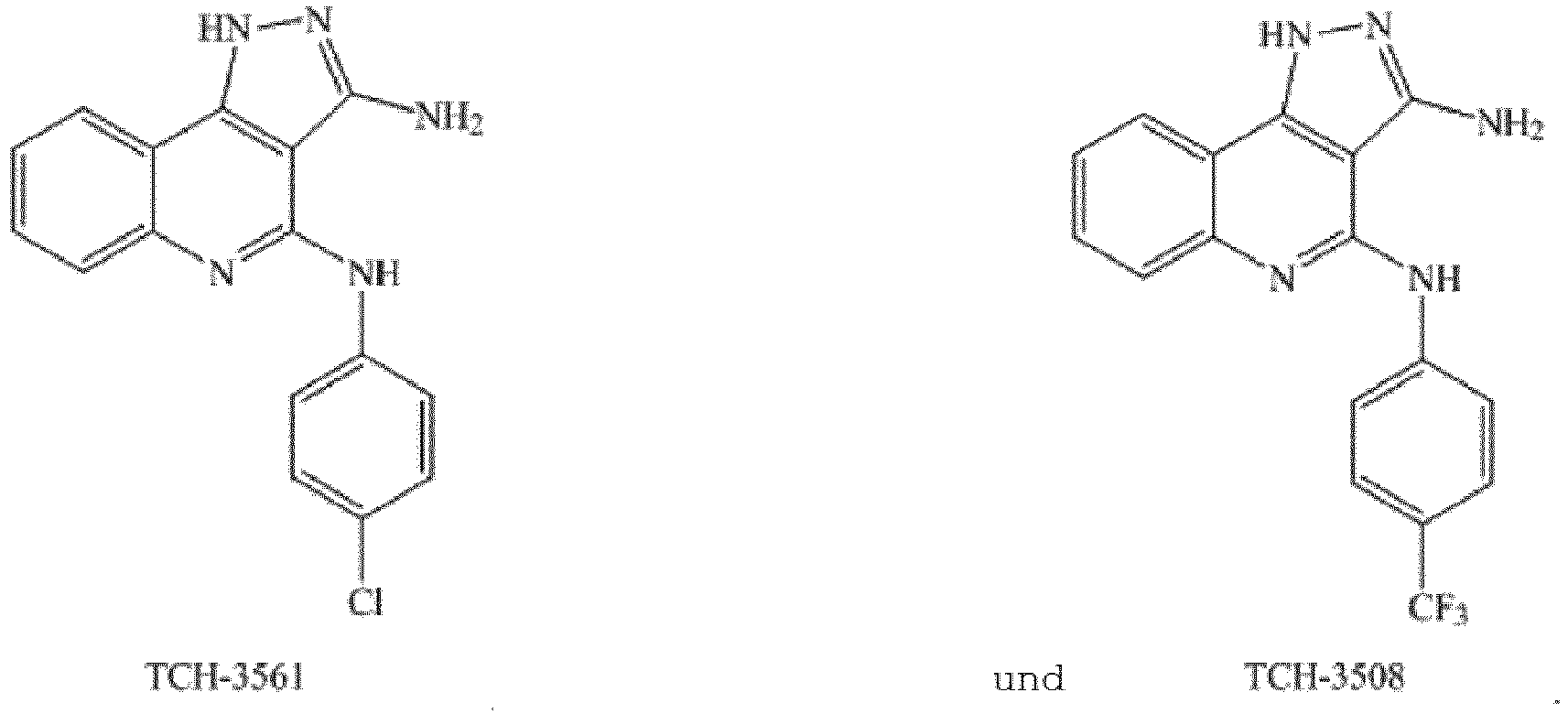
- Zusammensetzung, dadurch gekennzeichnet, dass sie eine Verbindung, ein pharmazeutisch unbedenkliches Salz oder ein Solvat davon nach einem der vorhergehenden Ansprüche und einen pharmazeutisch unbedenklichen Träger umfasst.
- Zusammensetzung nach dem vorhergehenden Anspruch 12, dadurch gekennzeichnet, dass es sich bei der Zusammensetzung um ein Medikament oder ein Nahrungsergänzungsmittel handelt und die Zusammensetzung weiterhin ein zusätzliches Therapeutikum umfasst, wobei es sich bei dem zusätzlichen Therapeutikum um ein durch Glucuronidierung metabolisiertes Mittel handelt.
- Zusammensetzung nach einem der vorhergehenden Ansprüche 12-13, wobei es sich bei dem zusätzlichen Therapeutikum um ein Antikrebsmittel, einen Immunpotentiator oder einen Immunmodulator handelt.
- Zusammensetzung nach einem der vorhergehenden Ansprüche 12-14, dadurch gekennzeichnet, dass das Antikrebsmittel aus Tamoxifen, Toremifen, Raloxifen, Droloxifen, Iodoxyfen, Megestrolacetat, Anastrozol, Letrazol, Borazol, Exemestan, Flutamid, Nilutamid, Bicalutamid, Cyproteronacetat, Goserelinacetat, Luprolid, Finasterid, Herceptin, Methotrexat, 5-Fluoruracil, Cytosinarabinosid, Doxorubicin, Daunomycin, Epirubicin, Idarubicin, Mitomycin-C, Dactinomycin, Mithramycin, Cisplatin, Carboplatin, Melphalan, Chlorambucil, Busulphan, Cyclophosphamid, Ifosfamid, Nitrosoharnstoffen, Thiotephan, Vincristin, Taxol, Taxotere, Etoposid, Teniposid, Amsacrin, Irinotecan, Topotecan oder Epothilon ausgewählt ist.
Priority Applications (1)
| Application Number | Priority Date | Filing Date | Title |
|---|---|---|---|
| EP20153398.1A EP3662751B1 (de) | 2015-05-26 | 2016-05-26 | Pyrazolo[4,3-c]chinolin-derivate zur hemmung von b-glucuronidase |
Applications Claiming Priority (2)
| Application Number | Priority Date | Filing Date | Title |
|---|---|---|---|
| US201562166322P | 2015-05-26 | 2015-05-26 | |
| PCT/US2016/034379 WO2016191576A1 (en) | 2015-05-26 | 2016-05-26 | PYRAZOLO[4,3-C]QUINOLINE DERIVATIVES FOR INHIBITION OF β-GLUCURONIDASE |
Related Child Applications (1)
| Application Number | Title | Priority Date | Filing Date |
|---|---|---|---|
| EP20153398.1A Division EP3662751B1 (de) | 2015-05-26 | 2016-05-26 | Pyrazolo[4,3-c]chinolin-derivate zur hemmung von b-glucuronidase |
Publications (3)
| Publication Number | Publication Date |
|---|---|
| EP3302060A1 EP3302060A1 (de) | 2018-04-11 |
| EP3302060A4 EP3302060A4 (de) | 2018-12-05 |
| EP3302060B1 true EP3302060B1 (de) | 2020-02-12 |
Family
ID=57393133
Family Applications (2)
| Application Number | Title | Priority Date | Filing Date |
|---|---|---|---|
| EP20153398.1A Active EP3662751B1 (de) | 2015-05-26 | 2016-05-26 | Pyrazolo[4,3-c]chinolin-derivate zur hemmung von b-glucuronidase |
| EP16800725.0A Active EP3302060B1 (de) | 2015-05-26 | 2016-05-26 | Pyrazolo[4,3-c]chinolin-derivate zur hemmung von beta-glucuronidase |
Family Applications Before (1)
| Application Number | Title | Priority Date | Filing Date |
|---|---|---|---|
| EP20153398.1A Active EP3662751B1 (de) | 2015-05-26 | 2016-05-26 | Pyrazolo[4,3-c]chinolin-derivate zur hemmung von b-glucuronidase |
Country Status (6)
| Country | Link |
|---|---|
| US (2) | US11135206B2 (de) |
| EP (2) | EP3662751B1 (de) |
| JP (1) | JP6607962B2 (de) |
| CN (2) | CN111514144B (de) |
| TW (1) | TWI614251B (de) |
| WO (1) | WO2016191576A1 (de) |
Families Citing this family (3)
| Publication number | Priority date | Publication date | Assignee | Title |
|---|---|---|---|---|
| TWI680973B (zh) * | 2018-11-09 | 2020-01-01 | 長庚學校財團法人長庚科技大學 | 嗜中性白血球發炎抑制劑及其用途 |
| WO2020093349A1 (en) * | 2018-11-09 | 2020-05-14 | Chang Gung University Of Science And Technology | Neutrophil inflammation inhibitor and uses thereof |
| US10654848B1 (en) * | 2018-11-09 | 2020-05-19 | Chang Gung University Of Science And Technology | Neutrophil inflammation inhibitor and uses thereof |
Family Cites Families (17)
| Publication number | Priority date | Publication date | Assignee | Title |
|---|---|---|---|---|
| DE3620856A1 (de) * | 1986-06-21 | 1987-12-23 | Basf Ag | 3-cyanchinolinderivate |
| DE4014171A1 (de) * | 1990-05-03 | 1991-11-07 | Basf Ag | Cyanochinolinverbindungen |
| US5192768A (en) | 1990-09-14 | 1993-03-09 | Kyowa Hakko Kogyo Co., Ltd. | Pyrazoloquinoline derivatives |
| JP3006925B2 (ja) * | 1990-09-14 | 2000-02-07 | 協和醗酵工業株式会社 | ピラゾロキノリン誘導体 |
| JPH0798752B2 (ja) | 1991-08-09 | 1995-10-25 | 株式会社ツムラ | β−グルクロニダーゼ阻害剤 |
| WO2005028474A2 (en) | 2003-05-29 | 2005-03-31 | Millennium Pharmaceuticals, Inc. | Pyrazoloquinoline derivatives as chk-1 inhibitors |
| NZ568595A (en) * | 2005-12-14 | 2010-04-30 | Bristol Myers Squibb Co | Arylpropionamide, arylacrylamide, arylpropynamide, or arylmethylurea analogs as factor Xla inhibitors |
| US20080076134A1 (en) * | 2006-09-21 | 2008-03-27 | Nuclea Biomarkers, Llc | Gene and protein expression profiles associated with the therapeutic efficacy of irinotecan |
| WO2009037861A1 (ja) * | 2007-09-20 | 2009-03-26 | Kao Corporation | β-グルクロニダーゼ阻害剤 |
| CA2714181C (en) * | 2008-02-04 | 2013-12-24 | Mercury Therapeutics, Inc. | Ampk modulators |
| US20130071474A1 (en) * | 2009-04-22 | 2013-03-21 | James Spencer | COMBINATIONS OF BERBERINE, ARTEMISININ, Loperamide AND THEIR DERIVATIVES TO TREAT MALARIA, DIARRHEA, TRAVELERS' DIARRHEA, DYSENTERY, DENGUE FEVER, PARASITES, CHOLERA AND VIRUSES |
| AU2010265971B2 (en) * | 2009-06-25 | 2014-08-14 | Amgen Inc. | Heterocyclic compounds and their uses as inhibitors of PI3 K activity |
| US8557808B2 (en) * | 2009-12-10 | 2013-10-15 | North Carolina Central University | Selective beta-glucuronidase inhibitors as a treatment for side effects of camptothecin antineoplastic agents |
| WO2011112858A1 (en) | 2010-03-10 | 2011-09-15 | North Carolina Central University | Phenoxy thiophene sulfonamides and their use as inhibitors of glucuronidase |
| AU2012244549B2 (en) * | 2011-04-21 | 2017-04-20 | Origenis Gmbh | Heterocyclic compounds as kinase inhibitors |
| CN102885800B (zh) * | 2012-09-06 | 2014-08-06 | 中国药科大学 | 一种姜黄素的用途 |
| US10654848B1 (en) * | 2018-11-09 | 2020-05-19 | Chang Gung University Of Science And Technology | Neutrophil inflammation inhibitor and uses thereof |
-
2016
- 2016-05-26 EP EP20153398.1A patent/EP3662751B1/de active Active
- 2016-05-26 WO PCT/US2016/034379 patent/WO2016191576A1/en not_active Ceased
- 2016-05-26 CN CN202010389375.7A patent/CN111514144B/zh active Active
- 2016-05-26 EP EP16800725.0A patent/EP3302060B1/de active Active
- 2016-05-26 JP JP2017561964A patent/JP6607962B2/ja active Active
- 2016-05-26 CN CN201680030136.4A patent/CN107708419B/zh active Active
- 2016-05-26 TW TW105116524A patent/TWI614251B/zh active
- 2016-05-26 US US15/577,201 patent/US11135206B2/en active Active
-
2019
- 2019-12-12 US US16/711,623 patent/US11052072B2/en active Active
Non-Patent Citations (1)
| Title |
|---|
| None * |
Also Published As
| Publication number | Publication date |
|---|---|
| US20200113878A1 (en) | 2020-04-16 |
| EP3302060A4 (de) | 2018-12-05 |
| TW201712009A (zh) | 2017-04-01 |
| US11052072B2 (en) | 2021-07-06 |
| US11135206B2 (en) | 2021-10-05 |
| EP3302060A1 (de) | 2018-04-11 |
| JP2018515593A (ja) | 2018-06-14 |
| US20180214426A1 (en) | 2018-08-02 |
| CN111514144A (zh) | 2020-08-11 |
| WO2016191576A1 (en) | 2016-12-01 |
| CN107708419A (zh) | 2018-02-16 |
| TWI614251B (zh) | 2018-02-11 |
| CN107708419B (zh) | 2021-08-27 |
| CN111514144B (zh) | 2021-10-26 |
| JP6607962B2 (ja) | 2019-11-20 |
| EP3662751B1 (de) | 2021-10-13 |
| EP3662751A1 (de) | 2020-06-10 |
Similar Documents
| Publication | Publication Date | Title |
|---|---|---|
| TWI406864B (zh) | 化合物 | |
| HUP0000720A2 (hu) | Imidazo [1,2-a] piridinszármazékok, eljárás előállításukra, ezeket tartalmazó gyógyszerkészítmények és alkalmazásuk | |
| KR20210024574A (ko) | 세포 괴사 억제제 및 이의 제조 방법과 용도 | |
| US11052072B2 (en) | Pyrazolo[4,3-C] quinoline derivatives for inhibition of β-glucuronidase | |
| HK1208438A1 (en) | Heteroaryl alkyne compound and application thereof | |
| EP3284743B1 (de) | Verbindungen mit heterocyclischem imidazol, pharmazeutische zusammensetzungen daraus, herstellungsverfahren dafür und verwendung davon | |
| EP4194441A1 (de) | Nitroxolinderivat, herstellungsverfahren dafür und verwendung davon | |
| JP2013063987A (ja) | 1,4−ジヒドロピリジン縮合ヘテロ環、これらの調製法、使用およびこれらを含有する組成物 | |
| KR20180066985A (ko) | 티에노피리미딘 유도체 및 이의 용도 | |
| CN107614502A (zh) | 激酶抑制剂的制备及应用 | |
| CN105566305B (zh) | 4-(取代苯胺基)喹唑啉衍生物二甲苯磺酸盐的多晶型物及其制备方法和用途 | |
| CN111978325B (zh) | 咪唑并哒嗪类mnk1/mnk2激酶抑制剂及其制备方法和应用 | |
| CN110143948B (zh) | Cdk4/6抑制剂、其药物组合物、制备方法及应用 | |
| CA2792613C (en) | Phenoxy thiophene sulfonamides and their use as inhibitors of glucuronidase | |
| CN113880814A (zh) | 一种嘧啶胺类化合物及应用 | |
| CN117120423B (zh) | 吲哚胺2,3-双加氧酶抑制剂、其制备方法及包含其的药物组合物 | |
| CN111039940B (zh) | 一种Aurora A激酶抑制剂、制备方法、药物组合物及其用途 | |
| CN120518582A (zh) | 一类并环结构取代的新型cdk12/13共价抑制剂或其药物组合物和应用 | |
| CN118930516A (zh) | 多环类化合物及其用途 | |
| CN119431354A (zh) | 苯并五元杂环类衍生物及其应用 | |
| WO2021168341A1 (en) | Solid forms of 1-(5-(3-(7-(3-fluorophenyl)-3h-imidazo[4,5-c]pyridin-2-yl)-1h-pyrazolo[3,4-b]pyridin-5-yl)pyridin-3-yl)-n,n-dimethylmethanamine | |
| HK1206334A1 (en) | Dehydrothiamine [2,3-c]quinoline-12-ketone derivatives, and preparation method and application thereof | |
| HK1206334B (en) | Dehydrothiamine [2,3-c]quinoline-12-ketone derivatives, and preparation method and application thereof |
Legal Events
| Date | Code | Title | Description |
|---|---|---|---|
| STAA | Information on the status of an ep patent application or granted ep patent |
Free format text: STATUS: THE INTERNATIONAL PUBLICATION HAS BEEN MADE |
|
| PUAI | Public reference made under article 153(3) epc to a published international application that has entered the european phase |
Free format text: ORIGINAL CODE: 0009012 |
|
| STAA | Information on the status of an ep patent application or granted ep patent |
Free format text: STATUS: REQUEST FOR EXAMINATION WAS MADE |
|
| 17P | Request for examination filed |
Effective date: 20171127 |
|
| AK | Designated contracting states |
Kind code of ref document: A1 Designated state(s): AL AT BE BG CH CY CZ DE DK EE ES FI FR GB GR HR HU IE IS IT LI LT LU LV MC MK MT NL NO PL PT RO RS SE SI SK SM TR |
|
| AX | Request for extension of the european patent |
Extension state: BA ME |
|
| DAV | Request for validation of the european patent (deleted) | ||
| DAX | Request for extension of the european patent (deleted) | ||
| A4 | Supplementary search report drawn up and despatched |
Effective date: 20181031 |
|
| RIC1 | Information provided on ipc code assigned before grant |
Ipc: A61K 31/44 20060101ALI20181022BHEP Ipc: A01N 43/42 20060101AFI20181022BHEP Ipc: A61P 1/12 20060101ALI20181022BHEP Ipc: C07D 471/04 20060101ALI20181022BHEP Ipc: A61P 35/00 20060101ALI20181022BHEP |
|
| GRAP | Despatch of communication of intention to grant a patent |
Free format text: ORIGINAL CODE: EPIDOSNIGR1 |
|
| STAA | Information on the status of an ep patent application or granted ep patent |
Free format text: STATUS: GRANT OF PATENT IS INTENDED |
|
| INTG | Intention to grant announced |
Effective date: 20190816 |
|
| GRAS | Grant fee paid |
Free format text: ORIGINAL CODE: EPIDOSNIGR3 |
|
| GRAA | (expected) grant |
Free format text: ORIGINAL CODE: 0009210 |
|
| STAA | Information on the status of an ep patent application or granted ep patent |
Free format text: STATUS: THE PATENT HAS BEEN GRANTED |
|
| RIN1 | Information on inventor provided before grant (corrected) |
Inventor name: LUO, WEI-FEN Inventor name: TZENG, CHERNG-CHYI Inventor name: CHEN, YEH-LONG Inventor name: CHENG, TIAN-LU Inventor name: CHENG, TA-CHUN Inventor name: CHANG, KAI-WEN Inventor name: TSENG, CHIH-HUA |
|
| AK | Designated contracting states |
Kind code of ref document: B1 Designated state(s): AL AT BE BG CH CY CZ DE DK EE ES FI FR GB GR HR HU IE IS IT LI LT LU LV MC MK MT NL NO PL PT RO RS SE SI SK SM TR |
|
| REG | Reference to a national code |
Ref country code: GB Ref legal event code: FG4D |
|
| REG | Reference to a national code |
Ref country code: CH Ref legal event code: EP |
|
| REG | Reference to a national code |
Ref country code: AT Ref legal event code: REF Ref document number: 1230891 Country of ref document: AT Kind code of ref document: T Effective date: 20200215 |
|
| REG | Reference to a national code |
Ref country code: IE Ref legal event code: FG4D |
|
| REG | Reference to a national code |
Ref country code: DE Ref legal event code: R096 Ref document number: 602016029694 Country of ref document: DE |
|
| PG25 | Lapsed in a contracting state [announced via postgrant information from national office to epo] |
Ref country code: RS Free format text: LAPSE BECAUSE OF FAILURE TO SUBMIT A TRANSLATION OF THE DESCRIPTION OR TO PAY THE FEE WITHIN THE PRESCRIBED TIME-LIMIT Effective date: 20200212 Ref country code: FI Free format text: LAPSE BECAUSE OF FAILURE TO SUBMIT A TRANSLATION OF THE DESCRIPTION OR TO PAY THE FEE WITHIN THE PRESCRIBED TIME-LIMIT Effective date: 20200212 Ref country code: NO Free format text: LAPSE BECAUSE OF FAILURE TO SUBMIT A TRANSLATION OF THE DESCRIPTION OR TO PAY THE FEE WITHIN THE PRESCRIBED TIME-LIMIT Effective date: 20200512 |
|
| REG | Reference to a national code |
Ref country code: LT Ref legal event code: MG4D |
|
| REG | Reference to a national code |
Ref country code: NL Ref legal event code: MP Effective date: 20200212 |
|
| PG25 | Lapsed in a contracting state [announced via postgrant information from national office to epo] |
Ref country code: LV Free format text: LAPSE BECAUSE OF FAILURE TO SUBMIT A TRANSLATION OF THE DESCRIPTION OR TO PAY THE FEE WITHIN THE PRESCRIBED TIME-LIMIT Effective date: 20200212 Ref country code: SE Free format text: LAPSE BECAUSE OF FAILURE TO SUBMIT A TRANSLATION OF THE DESCRIPTION OR TO PAY THE FEE WITHIN THE PRESCRIBED TIME-LIMIT Effective date: 20200212 Ref country code: BG Free format text: LAPSE BECAUSE OF FAILURE TO SUBMIT A TRANSLATION OF THE DESCRIPTION OR TO PAY THE FEE WITHIN THE PRESCRIBED TIME-LIMIT Effective date: 20200512 Ref country code: HR Free format text: LAPSE BECAUSE OF FAILURE TO SUBMIT A TRANSLATION OF THE DESCRIPTION OR TO PAY THE FEE WITHIN THE PRESCRIBED TIME-LIMIT Effective date: 20200212 Ref country code: GR Free format text: LAPSE BECAUSE OF FAILURE TO SUBMIT A TRANSLATION OF THE DESCRIPTION OR TO PAY THE FEE WITHIN THE PRESCRIBED TIME-LIMIT Effective date: 20200513 Ref country code: IS Free format text: LAPSE BECAUSE OF FAILURE TO SUBMIT A TRANSLATION OF THE DESCRIPTION OR TO PAY THE FEE WITHIN THE PRESCRIBED TIME-LIMIT Effective date: 20200612 |
|
| PG25 | Lapsed in a contracting state [announced via postgrant information from national office to epo] |
Ref country code: NL Free format text: LAPSE BECAUSE OF FAILURE TO SUBMIT A TRANSLATION OF THE DESCRIPTION OR TO PAY THE FEE WITHIN THE PRESCRIBED TIME-LIMIT Effective date: 20200212 |
|
| PG25 | Lapsed in a contracting state [announced via postgrant information from national office to epo] |
Ref country code: RO Free format text: LAPSE BECAUSE OF FAILURE TO SUBMIT A TRANSLATION OF THE DESCRIPTION OR TO PAY THE FEE WITHIN THE PRESCRIBED TIME-LIMIT Effective date: 20200212 Ref country code: SK Free format text: LAPSE BECAUSE OF FAILURE TO SUBMIT A TRANSLATION OF THE DESCRIPTION OR TO PAY THE FEE WITHIN THE PRESCRIBED TIME-LIMIT Effective date: 20200212 Ref country code: EE Free format text: LAPSE BECAUSE OF FAILURE TO SUBMIT A TRANSLATION OF THE DESCRIPTION OR TO PAY THE FEE WITHIN THE PRESCRIBED TIME-LIMIT Effective date: 20200212 Ref country code: SM Free format text: LAPSE BECAUSE OF FAILURE TO SUBMIT A TRANSLATION OF THE DESCRIPTION OR TO PAY THE FEE WITHIN THE PRESCRIBED TIME-LIMIT Effective date: 20200212 Ref country code: DK Free format text: LAPSE BECAUSE OF FAILURE TO SUBMIT A TRANSLATION OF THE DESCRIPTION OR TO PAY THE FEE WITHIN THE PRESCRIBED TIME-LIMIT Effective date: 20200212 Ref country code: ES Free format text: LAPSE BECAUSE OF FAILURE TO SUBMIT A TRANSLATION OF THE DESCRIPTION OR TO PAY THE FEE WITHIN THE PRESCRIBED TIME-LIMIT Effective date: 20200212 Ref country code: LT Free format text: LAPSE BECAUSE OF FAILURE TO SUBMIT A TRANSLATION OF THE DESCRIPTION OR TO PAY THE FEE WITHIN THE PRESCRIBED TIME-LIMIT Effective date: 20200212 Ref country code: CZ Free format text: LAPSE BECAUSE OF FAILURE TO SUBMIT A TRANSLATION OF THE DESCRIPTION OR TO PAY THE FEE WITHIN THE PRESCRIBED TIME-LIMIT Effective date: 20200212 Ref country code: PT Free format text: LAPSE BECAUSE OF FAILURE TO SUBMIT A TRANSLATION OF THE DESCRIPTION OR TO PAY THE FEE WITHIN THE PRESCRIBED TIME-LIMIT Effective date: 20200705 |
|
| REG | Reference to a national code |
Ref country code: DE Ref legal event code: R097 Ref document number: 602016029694 Country of ref document: DE |
|
| REG | Reference to a national code |
Ref country code: AT Ref legal event code: MK05 Ref document number: 1230891 Country of ref document: AT Kind code of ref document: T Effective date: 20200212 |
|
| PLBE | No opposition filed within time limit |
Free format text: ORIGINAL CODE: 0009261 |
|
| STAA | Information on the status of an ep patent application or granted ep patent |
Free format text: STATUS: NO OPPOSITION FILED WITHIN TIME LIMIT |
|
| 26N | No opposition filed |
Effective date: 20201113 |
|
| PG25 | Lapsed in a contracting state [announced via postgrant information from national office to epo] |
Ref country code: MC Free format text: LAPSE BECAUSE OF FAILURE TO SUBMIT A TRANSLATION OF THE DESCRIPTION OR TO PAY THE FEE WITHIN THE PRESCRIBED TIME-LIMIT Effective date: 20200212 Ref country code: CH Free format text: LAPSE BECAUSE OF NON-PAYMENT OF DUE FEES Effective date: 20200531 Ref country code: IT Free format text: LAPSE BECAUSE OF FAILURE TO SUBMIT A TRANSLATION OF THE DESCRIPTION OR TO PAY THE FEE WITHIN THE PRESCRIBED TIME-LIMIT Effective date: 20200212 Ref country code: AT Free format text: LAPSE BECAUSE OF FAILURE TO SUBMIT A TRANSLATION OF THE DESCRIPTION OR TO PAY THE FEE WITHIN THE PRESCRIBED TIME-LIMIT Effective date: 20200212 Ref country code: LI Free format text: LAPSE BECAUSE OF NON-PAYMENT OF DUE FEES Effective date: 20200531 |
|
| PG25 | Lapsed in a contracting state [announced via postgrant information from national office to epo] |
Ref country code: SI Free format text: LAPSE BECAUSE OF FAILURE TO SUBMIT A TRANSLATION OF THE DESCRIPTION OR TO PAY THE FEE WITHIN THE PRESCRIBED TIME-LIMIT Effective date: 20200212 Ref country code: PL Free format text: LAPSE BECAUSE OF FAILURE TO SUBMIT A TRANSLATION OF THE DESCRIPTION OR TO PAY THE FEE WITHIN THE PRESCRIBED TIME-LIMIT Effective date: 20200212 |
|
| REG | Reference to a national code |
Ref country code: BE Ref legal event code: MM Effective date: 20200531 |
|
| PG25 | Lapsed in a contracting state [announced via postgrant information from national office to epo] |
Ref country code: LU Free format text: LAPSE BECAUSE OF NON-PAYMENT OF DUE FEES Effective date: 20200526 |
|
| PG25 | Lapsed in a contracting state [announced via postgrant information from national office to epo] |
Ref country code: IE Free format text: LAPSE BECAUSE OF NON-PAYMENT OF DUE FEES Effective date: 20200526 |
|
| PG25 | Lapsed in a contracting state [announced via postgrant information from national office to epo] |
Ref country code: BE Free format text: LAPSE BECAUSE OF NON-PAYMENT OF DUE FEES Effective date: 20200531 |
|
| PG25 | Lapsed in a contracting state [announced via postgrant information from national office to epo] |
Ref country code: TR Free format text: LAPSE BECAUSE OF FAILURE TO SUBMIT A TRANSLATION OF THE DESCRIPTION OR TO PAY THE FEE WITHIN THE PRESCRIBED TIME-LIMIT Effective date: 20200212 Ref country code: MT Free format text: LAPSE BECAUSE OF FAILURE TO SUBMIT A TRANSLATION OF THE DESCRIPTION OR TO PAY THE FEE WITHIN THE PRESCRIBED TIME-LIMIT Effective date: 20200212 Ref country code: CY Free format text: LAPSE BECAUSE OF FAILURE TO SUBMIT A TRANSLATION OF THE DESCRIPTION OR TO PAY THE FEE WITHIN THE PRESCRIBED TIME-LIMIT Effective date: 20200212 |
|
| PG25 | Lapsed in a contracting state [announced via postgrant information from national office to epo] |
Ref country code: MK Free format text: LAPSE BECAUSE OF FAILURE TO SUBMIT A TRANSLATION OF THE DESCRIPTION OR TO PAY THE FEE WITHIN THE PRESCRIBED TIME-LIMIT Effective date: 20200212 Ref country code: AL Free format text: LAPSE BECAUSE OF FAILURE TO SUBMIT A TRANSLATION OF THE DESCRIPTION OR TO PAY THE FEE WITHIN THE PRESCRIBED TIME-LIMIT Effective date: 20200212 |
|
| PGFP | Annual fee paid to national office [announced via postgrant information from national office to epo] |
Ref country code: DE Payment date: 20250529 Year of fee payment: 10 |
|
| PGFP | Annual fee paid to national office [announced via postgrant information from national office to epo] |
Ref country code: GB Payment date: 20250527 Year of fee payment: 10 |
|
| PGFP | Annual fee paid to national office [announced via postgrant information from national office to epo] |
Ref country code: FR Payment date: 20250526 Year of fee payment: 10 |