EP3302683B1 - Trockenelektrode zur erfassung von biopotenzial und hautimpedanz - Google Patents
Trockenelektrode zur erfassung von biopotenzial und hautimpedanz Download PDFInfo
- Publication number
- EP3302683B1 EP3302683B1 EP16729993.2A EP16729993A EP3302683B1 EP 3302683 B1 EP3302683 B1 EP 3302683B1 EP 16729993 A EP16729993 A EP 16729993A EP 3302683 B1 EP3302683 B1 EP 3302683B1
- Authority
- EP
- European Patent Office
- Prior art keywords
- electrode
- electrodes
- skin
- silicone material
- conductive
- Prior art date
- Legal status (The legal status is an assumption and is not a legal conclusion. Google has not performed a legal analysis and makes no representation as to the accuracy of the status listed.)
- Active
Links
Images




Classifications
-
- A—HUMAN NECESSITIES
- A61—MEDICAL OR VETERINARY SCIENCE; HYGIENE
- A61N—ELECTROTHERAPY; MAGNETOTHERAPY; RADIATION THERAPY; ULTRASOUND THERAPY
- A61N1/00—Electrotherapy; Circuits therefor
- A61N1/02—Details
- A61N1/04—Electrodes
- A61N1/0404—Electrodes for external use
- A61N1/0472—Structure-related aspects
- A61N1/0492—Patch electrodes
- A61N1/0496—Patch electrodes characterised by using specific chemical compositions, e.g. hydrogel compositions, adhesives
-
- A—HUMAN NECESSITIES
- A61—MEDICAL OR VETERINARY SCIENCE; HYGIENE
- A61B—DIAGNOSIS; SURGERY; IDENTIFICATION
- A61B5/00—Measuring for diagnostic purposes; Identification of persons
- A61B5/05—Detecting, measuring or recording for diagnosis by means of electric currents or magnetic fields; Measuring using microwaves or radio waves
- A61B5/053—Measuring electrical impedance or conductance of a portion of the body
- A61B5/0531—Measuring skin impedance
- A61B5/0533—Measuring galvanic skin response
-
- A—HUMAN NECESSITIES
- A61—MEDICAL OR VETERINARY SCIENCE; HYGIENE
- A61B—DIAGNOSIS; SURGERY; IDENTIFICATION
- A61B5/00—Measuring for diagnostic purposes; Identification of persons
- A61B5/24—Detecting, measuring or recording bioelectric or biomagnetic signals of the body or parts thereof
- A61B5/25—Bioelectric electrodes therefor
- A61B5/251—Means for maintaining electrode contact with the body
- A61B5/257—Means for maintaining electrode contact with the body using adhesive means, e.g. adhesive pads or tapes
-
- A—HUMAN NECESSITIES
- A61—MEDICAL OR VETERINARY SCIENCE; HYGIENE
- A61B—DIAGNOSIS; SURGERY; IDENTIFICATION
- A61B5/00—Measuring for diagnostic purposes; Identification of persons
- A61B5/24—Detecting, measuring or recording bioelectric or biomagnetic signals of the body or parts thereof
- A61B5/25—Bioelectric electrodes therefor
- A61B5/263—Bioelectric electrodes therefor characterised by the electrode materials
- A61B5/268—Bioelectric electrodes therefor characterised by the electrode materials containing conductive polymers, e.g. PEDOT:PSS polymers
-
- A—HUMAN NECESSITIES
- A61—MEDICAL OR VETERINARY SCIENCE; HYGIENE
- A61B—DIAGNOSIS; SURGERY; IDENTIFICATION
- A61B5/00—Measuring for diagnostic purposes; Identification of persons
- A61B5/24—Detecting, measuring or recording bioelectric or biomagnetic signals of the body or parts thereof
- A61B5/25—Bioelectric electrodes therefor
- A61B5/271—Arrangements of electrodes with cords, cables or leads, e.g. single leads or patient cord assemblies
- A61B5/273—Connection of cords, cables or leads to electrodes
- A61B5/274—Connection of cords, cables or leads to electrodes using snap or button fasteners
-
- A—HUMAN NECESSITIES
- A61—MEDICAL OR VETERINARY SCIENCE; HYGIENE
- A61B—DIAGNOSIS; SURGERY; IDENTIFICATION
- A61B5/00—Measuring for diagnostic purposes; Identification of persons
- A61B5/24—Detecting, measuring or recording bioelectric or biomagnetic signals of the body or parts thereof
- A61B5/25—Bioelectric electrodes therefor
- A61B5/279—Bioelectric electrodes therefor specially adapted for particular uses
- A61B5/28—Bioelectric electrodes therefor specially adapted for particular uses for electrocardiography [ECG]
-
- A—HUMAN NECESSITIES
- A61—MEDICAL OR VETERINARY SCIENCE; HYGIENE
- A61B—DIAGNOSIS; SURGERY; IDENTIFICATION
- A61B5/00—Measuring for diagnostic purposes; Identification of persons
- A61B5/24—Detecting, measuring or recording bioelectric or biomagnetic signals of the body or parts thereof
- A61B5/25—Bioelectric electrodes therefor
- A61B5/279—Bioelectric electrodes therefor specially adapted for particular uses
- A61B5/291—Bioelectric electrodes therefor specially adapted for particular uses for electroencephalography [EEG]
-
- A—HUMAN NECESSITIES
- A61—MEDICAL OR VETERINARY SCIENCE; HYGIENE
- A61N—ELECTROTHERAPY; MAGNETOTHERAPY; RADIATION THERAPY; ULTRASOUND THERAPY
- A61N1/00—Electrotherapy; Circuits therefor
- A61N1/02—Details
- A61N1/04—Electrodes
- A61N1/0404—Electrodes for external use
- A61N1/0408—Use-related aspects
- A61N1/0456—Specially adapted for transcutaneous electrical nerve stimulation [TENS]
-
- A—HUMAN NECESSITIES
- A61—MEDICAL OR VETERINARY SCIENCE; HYGIENE
- A61B—DIAGNOSIS; SURGERY; IDENTIFICATION
- A61B2560/00—Constructional details of operational features of apparatus; Accessories for medical measuring apparatus
- A61B2560/04—Constructional details of apparatus
- A61B2560/0406—Constructional details of apparatus specially shaped apparatus housings
- A61B2560/0412—Low-profile patch shaped housings
-
- A—HUMAN NECESSITIES
- A61—MEDICAL OR VETERINARY SCIENCE; HYGIENE
- A61B—DIAGNOSIS; SURGERY; IDENTIFICATION
- A61B2562/00—Details of sensors; Constructional details of sensor housings or probes; Accessories for sensors
- A61B2562/02—Details of sensors specially adapted for in-vivo measurements
- A61B2562/0209—Special features of electrodes classified in A61B5/24, A61B5/25, A61B5/283, A61B5/291, A61B5/296, A61B5/053
- A61B2562/0215—Silver or silver chloride containing
-
- A—HUMAN NECESSITIES
- A61—MEDICAL OR VETERINARY SCIENCE; HYGIENE
- A61B—DIAGNOSIS; SURGERY; IDENTIFICATION
- A61B2562/00—Details of sensors; Constructional details of sensor housings or probes; Accessories for sensors
- A61B2562/02—Details of sensors specially adapted for in-vivo measurements
- A61B2562/0209—Special features of electrodes classified in A61B5/24, A61B5/25, A61B5/283, A61B5/291, A61B5/296, A61B5/053
- A61B2562/0217—Electrolyte containing
-
- A—HUMAN NECESSITIES
- A61—MEDICAL OR VETERINARY SCIENCE; HYGIENE
- A61B—DIAGNOSIS; SURGERY; IDENTIFICATION
- A61B2562/00—Details of sensors; Constructional details of sensor housings or probes; Accessories for sensors
- A61B2562/22—Arrangements of medical sensors with cables or leads; Connectors or couplings specifically adapted for medical sensors
- A61B2562/225—Connectors or couplings
- A61B2562/227—Sensors with electrical connectors
-
- A—HUMAN NECESSITIES
- A61—MEDICAL OR VETERINARY SCIENCE; HYGIENE
- A61N—ELECTROTHERAPY; MAGNETOTHERAPY; RADIATION THERAPY; ULTRASOUND THERAPY
- A61N1/00—Electrotherapy; Circuits therefor
- A61N1/02—Details
- A61N1/04—Electrodes
- A61N1/0404—Electrodes for external use
- A61N1/0408—Use-related aspects
- A61N1/0452—Specially adapted for transcutaneous muscle stimulation [TMS]
Definitions
- the present disclosure pertains to an electrode configured to provide electrical contact with skin of a subject.
- Electrodes For many applications in the medical field, skin electrodes are used. Electrodes generally provide electrical contact with a subject's skin to transfer electrical signals between the subject's skin and a medical device. Electrodes generally include a conductive layer or material that is used to transmit and receive electrical signals to and from the subject. Electrodes are generally either dry electrodes or wet electrodes.
- Wet electrodes rely on an electrolyte material, such as a hydrogel or gel, to provide a conductive path and fill in gaps between the electrode and the skin of the subject.
- Wet electrodes are generally used for shorter periods of time due to the hydrogel or gel drying out. Wet electrodes may also cause irritation to the skin due to the gel material.
- Dry electrodes rely on the natural salt and/or sweat on the skin of the subject to provide a flow path for the electrical signals transmitted to and/or received from the skin of the subject. Dry electrodes may be used for longer periods of time because they do not dry out. Dry electrodes may be difficult to couple to the skin of the subject without gaps and may not stay in place well if a subject moves.
- the skin's stratum corneum i.e., upper layer consisting of dead cells
- stratum corneum is a high impedance barrier since it contains limited amount of body fluids with ions. That is, there is minimal, but non-negligible, ionic transfer through the stratum corneum (upper skin layer), which means very weak currents pass through the stratum corneum layer.
- the resistance of the stratum corneum layer is highly dependent on the presence and activity of sweat glands and ducts (as well as other pathways such as sebaceous glands, hair follicles and skin imperfections) which secrete fluids containing Na+, K+ and Cl- ions of differing concentrations than extracellular fluid.
- sweat glands and ducts as well as other pathways such as sebaceous glands, hair follicles and skin imperfections
- this is not a very stable electron- electrolyte contact condition. That is, the sweat production may create a local microclimate but with a dry electrode interface this is not a very stable electrical contact.
- the applications of the skin electrodes use different electrical derivatives of body signals.
- Skin impedance is used to measure, for example, stress (Galvanic Skin Response, GSR) or Electrical Impedance Tomography, EIT (lung monitoring).
- GSR Globalvanic Skin Response
- EIT Pain monitoring
- Another application is electrical stimulation of the skin, such as Transcutaneous Electrical Nerve Stimulation, TENS. Skin impedance measurement is used to make sure the stimulation electrode is in good electrical contact with the skin.
- Patent Application Publication US 2014/0088397 A1 discloses an epidermal electrode whose conductive properties due to a carbon content provided by carbon black powder combine with a substrate medium such as PDMS (Polydimethylsiloxane) to form an electrode adapted for environmentally independent operation such as in water or gases which have electrical properties tending to interfere with conventional electrode communication.
- a substrate medium such as PDMS (Polydimethylsiloxane)
- an electrode that is configured to provide electrical contact with skin of a subject.
- the electrode includes an electrode body configured to be removably coupled with the skin of the subject and to receive electrical signals from and/or transmit electrical signals to the skin of the subject, and an electrical coupling that facilitates coupling the electrode to an external computing system.
- the electrode body includes a conductive silicone material configured to enable uptake or diffusion of moisture from the skin of the subject over which the electrode body is disposed, wherein the conductive silicone material includes a silicone material filled with conductive particles; and a detergent configured to facilitate a flow of ions through the conductive silicone material.
- the word "unitary” means a component is created as a single piece or unit. That is, a component that includes pieces that are created separately and then coupled together as a unit is not a “unitary” component or body.
- the statement that two or more parts or components "engage” one another shall mean that the parts exert a force against one another either directly or through one or more intermediate parts or components.
- the term “number” shall mean one or an integer greater than one (i.e., a plurality).
- FIG. 1 illustrates an electrode 100 in accordance with an embodiment of the present patent application.
- Electrode 100 includes an electrode body 102 configured to be removably coupled with the skin 104 of a subject 106 and to receive electrical signals from and/or transmit electrical signals to skin 104 of subject 106, and an electrical coupling 110 that facilitates coupling electrode 100 to an external computing system 114.
- Electrode body 102 includes a conductive silicone material configured to enable uptake or diffusion of moisture from skin 104 of subject 106 over which electrode body 102 is disposed; and a detergent configured to facilitate a flow of ions through the conductive silicone material.
- the present patent application provides conductive particles filled dry silicone electrode 100 with detergent additives for optimal sensing electrical contact with skin 104 of subject 106.
- Electrode 100 is soft and skin friendly due to the hydrophilic silicone material having moisture regulating properties.
- Electrode body 102 includes silicone material, electrical conductive particles, and detergent.
- the electrical conductive particles may include graphite, carbon or silver flakes or particles.
- the electrical conductive particles are mixed with the silicone material to form a conductive silicone material.
- electrode body 102 may include a range of about 25 to 75 % weight of the silicone material, a range of about 20 to 50 % weight of the conductive particles and a range of about 5 to 25 % weight of the detergent.
- electrode body 102 may include 50 % weight of the silicone material, 35 % weight of the conductive particles and 15 % weight of the detergent.
- electrode body 102 may be formed by mixing 15g of the detergent and 35g of the conductive particles with 50g of the silicone material.
- the silicone material, the conductive particles and the detergent are mixed using mix-extrusion, high speed mixing process, which is performed at temperature ranges of about 10 to 150 0 C.
- the silicone material, the conductive particles and the detergent are mixed using a high speed mixing or mix extrusion device.
- electrode body 102 includes conductive silicone material and detergent. In some embodiments, electrode body 102 may include a range of about 70 to 95 % weight of the conductive silicone material and a range of about 5 to 30 % weight of the detergent. In some embodiments, electrode body 102 may be formed by mixing 20g of the detergent with 80g of the conductive silicone material. In some embodiments, the conductive silicone material and the detergent are mixed using mix-extrusion, high speed mix process, which is performed at temperature ranges of about 10 to 150 0 C. In some embodiments, the conductive silicone material and the detergent are mixed using a mix extruder or high speed mixer device.
- additional materials may be added to facilitate mixing of the conductive silicone material and the detergent and/or mixing the silicone material, the conductive particles and the detergent. In some embodiments, such additional materials may be optional. In some embodiments, such additional materials do not change the impedance of the dry electrode formed from the hydrophilic silicone material and the detergent additives.
- the conductive silicone material is configured to provide moisture regulating properties to electrode 100.
- the conductive silicone material is a hydrophilic conductive silicone material or a PolyDiMethylSiloxane material. The added hydrophilic properties of the conductive silicone material cause moisture uptake from the subject's skin and from the air surrounding the subject's skin. Thus, the conductive silicone material of the electrode provides a comfortable layer against the skin.
- the conductive silicone material may include electrically conductive liquid silicone rubber.
- the conductive silicone material may include commercially available Elastosil ® LR 3162 material.
- the soap or detergent may include alpha-olefin sulfonate, soap, Sodium (C14-16) olefin sulfonate, and olefin sulfonate.
- the soap or detergent are mixed with the conductive silicone material to form a homogeneous material.
- the detergent is not only be mixed with the silicone material, but also chemically bonded onto the backbone of the silicone (e.g., PolyDiMethylSiloxane) material.
- the soap or detergent may include a double-bond, cross-link chemical structure.
- the silicone material may include a cross-link chemical structure.
- the soap or detergent and the conductive silicone material are chemically bonded to each other.
- the soap or detergent may include commercially available Bio-Terge ® AS-90 Beads.
- 9% of detergent e.g., Bio-Terge ® AS-90 Beads
- the conductive silicone material e.g., Elastosil ® LR 3162.
- the detergent is configured to absorb water into the silicone material. In some embodiments, the detergent is configured to absorb more than 20 % by weight of water.
- the interaction of water with the ions (added by the detergent) is configured to function as a salt-bridge. In some embodiments, the interaction of water and/or bodily/body fluids with the ions
- the detergent additives which are mixed into the conductive silicone material are configured to improve the ion flow through the conductive silicone material. This improves the electrode-electrolyte interface of the dry silicone electrode.
- the electrode is configured to enable current to pass across the electrode-electrolyte interface.
- the detergent added to the silicone material may have either a liquid form or a powder/solid form.
- the silicone material is filled with conductive particles (carbon, graphite, or silver) to obtain electrical properties.
- the conductive particle added to the silicone material may have either a liquid form or a powder/solid form. This makes the material conductive for electrons but not for ions.
- the exchange of ions becomes possible and the modified silicone is configured to absorb/drag water from sweat in contact with the skin.
- water uptake is not only from the skin but also from e.g. humidity of air, tap water, humid storage packaging, and/or showering.
- the absorption of water is configured to work as a salt-bridge.
- the silicone is in this way modified into a bulk hydrophilic compound or a bulk ionic conductive hydrophilic compound.
- conductive particles e.g., graphite, carbon or silver flakes or particles
- soap or detergent additives By adding conductive particles (e.g., graphite, carbon or silver flakes or particles) and the soap or detergent additives, better sensing and conduction performance of the electrode may be achieved compared to other electrodes compositions where only conductive particles are mixed in.
- the electrical conductive particles e.g., graphite, carbon or silver particles
- the soap or detergent additives provide a better ionic path into the hydrophilic silicone material.
- the chemical structure of the hydrophilic silicone may be given as follows:
- n in the above chemical structure of the hydrophilic silicone material ranges from 3 to 28. In some embodiments, n ranges from 10 to 18. In some embodiments, n ranges from 12 to 16. In some embodiments, the total number (m+o+1) of repeating units in the above chemical structure of the hydrophilic silicone material may be at least 5 and may be less than 1000, with n and o being integers independently selected from each other and may be at least 6. In some embodiments, the terminal end groups R in the above chemical structure of the hydrophilic silicone material may consist of Si(CH 3 ) 3 and/or hydrogen.
- hydrophilic silicone material in some embodiments, may be schematically shown as follows:
- silicone precursor bearing reactive Si-H group reacts with a hydrophilic monomer such as an alpha-olefin sulfonate.
- a hydrophilic monomer such as an alpha-olefin sulfonate.
- the value of n and m in the above chemical structure may range from 3 to 28. In some embodiments, the value of n and m may range from 10 to 18. In some embodiments, the value of n and m may range from 12 to 16. In some embodiments, the value of o in the above chemical structure may range from 5 to 1000.
- the olefin component may be strongly hydrophilic because it may include a polar, negatively charged head group ( - O 3 S) and a cation (M n+ ) for charge balance.
- the mixing of the hydrophilic olefin component with the hydrophilic silicone precursor may be hampered by the difference in hydrophilicity.
- hydrophilic silicone material according to this present disclosure may include the ion pair composed of the anionic head group and the cationic counter-ion suspended in the hydrophilic matrix of the silicone precursor.
- other alternative detergents that are configured to promote ion flow in the electrode may be used.
- other alternative conductive particle/additives that are configured to increase conductivity between the electrode and the subject's skin and to lower impedance of the electrode material may be used.
- Electrode 100 includes electrical coupling 110. Electrical coupling 110 facilitates coupling of electrode 100 to external computing system 114.
- External computing system 114 is a system configured to deliver electrical stimulation to a subject and/or monitor a physiological parameter or such of the subject.
- external computing system includes one or more of processing devices (e.g., a digital processor, an analog processor, a digital circuit designed to process information, an analog circuit designed to process information, a state machine, and/or other mechanisms for electronically processing information), one or more sensors, one or more interface devices (e.g., a keypad, buttons, switches, a keyboard, knobs, levers, a display screen, a touch screen, speakers, a microphone, an indicator light, an audible alarm, a printer, a tactile feedback device, and/or other interface devices), and/or other components.
- processing devices e.g., a digital processor, an analog processor, a digital circuit designed to process information, an analog circuit designed to process information, a state machine, and/or other mechanisms for electronically processing information
- external computing system includes one or more of measurement devices.
- the one or more of measurement devices may be configured to obtain bioimpedance measurements, biopotential measurements, the electroencephalogram, EEG (brain-activity) measurements, Electrocardiogram, ECG (heart-activity) measurements, Galvanic Skin Response, GSR (stress) measurements, etc.
- external computing system 114 may include a bio sensing systems used for electrocardiography (ECG), electroencephalography (EEG), electromyography (EMG), electrooculography (EOG), and/or other bio sensing applications.
- ECG electrocardiography
- EEG electroencephalography
- EMG electromyography
- EOG electrooculography
- external computing system 114 may include a bio stimulation system used for transcutaneous electrical nerve stimulation (TENS), electrical muscle stimulation (EMS), neuromuscular electrical stimulation (NMES), functional electrical stimulation (FES), Galvanic Skin Response, GSR (stress), and/or other bio stimulation applications.
- ECG electrocardiography
- EEG electromyography
- EOG electrooculography
- external computing system 114 may include a bio stimulation system used for transcutaneous electrical nerve stimulation (TENS), electrical muscle stimulation (EMS), neuromuscular electrical stimulation (NMES), functional electrical stimulation (FES), Galvanic Skin Response, GSR (stress), and/or other bio stimulation applications.
- TESS transcutaneous electrical nerve stimulation
- EMS electrical
- Electrical coupling 110 is electrically coupled to electrode body 102 such that it enables electrical signals to be received and/or transmitted from and/or to skin 104 of the subject 106. In some embodiments, additional components and/or layers of material are disposed between electrical coupling 110 and/or electrode body 102. In other embodiments, electrical coupling 110 is directly coupled to electrode body 102. In some embodiments, electrical coupling 110 comprises one or more of a snap assembly, a magnetic assembly, a button assembly, a clip and/or clamp assembly, a wire assembly, and/or other assemblies to facilitate coupling electrode 100 to external computing system 114. For example, electrical coupling 110 includes a portion of a snap assembly for connecting one or more wires from external computing system 114 to electrode 100. In some embodiments, a portion of electrical coupling 110 may be made of a metallic material. In some embodiments, a portion of electrical coupling 110 may be made from the hydrophilic silicone material (with detergent additives).
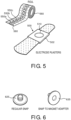
- FIGS. 2-5 illustrate various exemplary configurations of the electrode in accordance with embodiments of the present patent application.
- an electrode 200 may be in the form of a flat electrode with an electrode body 202 and an electrical coupling or snap 210.
- electrodes 200 may be used for Electrocardiogram, ECG (heart-activity) measurements.
- hydrophilic silicone material with detergent additives may be in the form of a sheet that a user or an operator has to cut and/or stamp into the desired shape.
- hydrophilic silicone material (with detergent additives) sheet may have dimensions of 50 by 50 millimeters.
- hydrophilic silicone material (with detergent additives) sheet may have a thickness of 1 millimeter.
- the user or operator may laser cut and/or stamp the hydrophilic silicone material (with detergent additives) sheet into the desired shape.
- electrical coupling 210 may be a male portion of a snap and a corresponding female portion of a snap may be coupled to one or more wires configured to couple electrode 200 to external computing system 114.
- electrical coupling or snap 210 is pierced through the hydrophilic silicone material (with detergent additives) to establish sufficient mechanical as well as electrical contact.
- electrode 300 may be in the form of a flat electrode with an electrode body 302 and an electrical coupling or snap 310. That is, electrode 300 may be flat shaped electrode with snap protrusion 310. In some embodiments, snap 310 may be centrally positioned on electrode 300.
- electrode 400 may be in the form of a structured pin electrode with an electrode body 402 and an electrical coupling or snap 410.
- structured pin electrode 400 may be used, for example, for through-hair measurements.
- structured pin electrode 400 may include multi-pin (e.g., pin 450) design that enables electrode 400 to penetrate the hair of the subject in order to establish a good galvanic contact with the skin of the subject.
- electrode 400 may have a diameter of 25 millimeters.
- pin 450 of electrode 400 may have a height of 5 millimeters.
- pin 450 of electrode 400 may have a diameter of 2 millimeters.
- electrode 500 may be in the form of a plaster electrode 500 with an electrode body 502 and an electrical coupling 510.
- electrode 550 may be in the form of a strip of electrodes 550a, 550b, 550c, etc. wound into a roll 560.
- each of electrodes 550a, 550b, 550c, etc. may include an electrode body and an electrical coupling.
- the strip of electrodes may be rolled and stored in a dispenser device.
- each of the electrodes 550a, 550b, 550c, etc. may be separated from the other electrode(s) by separating portions (e.g., notches, perforating lines). For example, a user, using the notches or the perforating lines, may separate the strip into individual electrodes 550a, 550b, 550c, etc. for use.
- electrode of the present disclosure may include adhesive members or materials to cause electrode to adhere to the skin of the subject.
- adhesive material may be disposed on a rear or a back surface of electrode.
- electrode may be used with different adhesive material types.
- the adhesive for electrode may include skin adhesive material.
- the adhesive for electrode may include hydrocolloid or skin friendly silicone adhesive material.
- FIG. 6 illustrates two exemplary configurations of electrical coupling 110 of electrode 100 in accordance with embodiments of the present patent application.
- different connection to leads may be integrated into electrode 100.
- the left side of FIG. 6 illustrates a portion of a snap assembly 625 for connecting one or more wires from external computing system 114 to electrode 100
- the right side of FIG. 6 illustrates a portion of a snap to magnetic adapter 635 for connecting one or more wires from external computing system 114 to electrode 100.
- easy to use magnetic connections may be integrated into electrode 100.
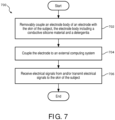
- FIG. 7 illustrates a method 700 for providing electrical contact with skin of a subject via an electrode.
- the electrode includes an electrode body, an electrical coupling, and/or other components. In some embodiments, more than one electrode may be used.
- the procedures of method 700 presented herein are intended to be illustrative. In some embodiments, method 700 may be accomplished with one or more additional procedures not described, and/or without one or more of the procedures discussed. Additionally, the order in which the procedures of method 700 are illustrated in FIG. 7 and described herein is not intended to be limiting.
- the electrode body of electrode is coupled with the skin of the subject.
- Procedure 702 is performed by an electrode body the same as or similar to electrode body 102 (as shown and described with respect to FIG. 1 ).
- the electrode body includes a conductive silicone material configured to enable uptake or diffusion of moisture from the skin of the subject over which the electrode body is disposed; and a detergent configured to facilitate a flow of ions through the conductive silicone material.
- the conductive silicone material is the same as or similar to the conductive silicone material (as described with respect to FIG. 1 ).
- the detergent is the same as or similar to the detergent (as described with respect to FIG. 1 ).
- coupling of the electrode is coupled to an external computing system.
- coupling of the electrode to an external computing system is facilitated via an electrical coupling the same as or similar to electrical coupling 110 (as shown and described with respect to FIG. 1 ).
- procedure 706 of method 700 electrical signals are received and/or transmitted from and/or to the skin of the subject via the electrode body of the electrode.
- procedure 706 is performed by an electrode body the same as or similar to electrode body 102 and an electrode the same as or similar to electrode 100 (as shown and described with respect to FIG. 1 ).
- the electrode of the present disclosure may be used on portable medical devices that patients may take home.
- Other applications of the electrodes of the present disclosure may include other galvanic skin electrode applications such as bio-impedance, Electrocardiogram, ECG (heart-activity), Electroencephalogram, EEG (brain-activity), Electrical Impedance Tomography, EIT (lung monitoring), Transcutaneous Electrical Nerve Stimulation, TENS, Galvanic Skin Response, GSR (stress), etc.
- the electrode may be a conductive skin interface that may be used for bioimpedance measurements, biopotential measurements and/or electrical stimulation.
- the electrode of the present disclosure may be used for enhancing sleep.
- a daily sleep monitoring and enhancing device may be used by problem sleepers on a daily basis. Electrodes with good signal quality, and that provide comfort and ease of use are desirable for the daily sleep monitoring and enhancing device.
- the daily sleep monitoring and enhancing device may be an advanced closed-loop device which may conveniently monitor the electroencephalogram (EEG) measurement data during sleep and deliver auditory stimulation to induce slow waves.
- the daily sleep monitoring and enhancing device may include a headset worn during sleep (i.e., the headgear), dry skin electrodes of the present disclosure, a bio-signal (EEG) amplifier and a wireless audio device.
- the dry electrodes used in the daily sleep monitoring and enhancing device provide ease of use and comfort to the user while providing good EEG signal quality. That is, the dry electrodes of the present disclosure have low galvanic impedance with the skin in order to provide good quality EEG signals.
- the dry silicone electrode of the present patent application has been evaluated in a number of electrode applications for galvanic skin sensing, including, Electrocardiogram, ECG (heart-activity), Electroencephalogram, EEG (brain-activity), Galvanic Skin Response, GSR (stress), etc.
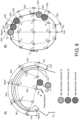
- the dry silicone electrode of the present patent application has been evaluated in an Electroencephalogram, EEG (brain-activity) application in which a comparison of dry silicone electrodes 830 of the present patent application has been made with gel based electrodes 840.
- EEG electroencephalogram
- Both dry silicone electrodes 830 and gel based electrodes 840 were placed on frontal and behind the ears locations of the subject's head.
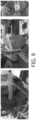
- FIGS. 8 and 9 illustrate configurations, locations and fixation of dry silicone electrodes 830 and gel based electrodes 840 being used for the EEG measurements.
- the EEG measurement data from dry silicone electrodes 830 and gel based electrodes 840 were simultaneous recorded.
- Dry silicone electrodes 830 may include snap interconnect member for electrical coupling(s).
- the snap interconnect member may be a metallic snap interconnect member (insulated from the skin).
- the performance indicators of the EEG measurement data are signal comparison in time domain (e.g., alpha waves); power spectrum overlap in 0.5 - 30 Hz window for eyes closed, and power spectrum overlap in 0.5 - 30 Hz window for eyes open.
- FIGS. 10 and 11 illustrate a comparison and an overlay of EEG measurement data obtained from hydrogel electrodes 840 and dry silicone electrodes 830.
- a ten second section of the EEG measurements, as shown in FIGS. 10 and 11 includes clear alpha waves in the first seconds and includes large eye motion artifacts (eye movement) at the end of the measurement data.
- Signal, DSE shows the dry silicone electrode signal and
- Signal, GE represents the gel electrode signal.
- the signals DSE and GE are overlayed to show the similarities and differences therebetween. Both, alpha waves as well as large eye motion artifacts show very comparable results between data obtained from hydrogel electrodes 840 and dry silicone electrodes 830.
- additional ions are available for charge transfer within the hydrophilic silicone material of the electrode body and improved conduction performance of the electrode.
- the effect of hydrophilicity is introduced to the silicone material by the detergent additives. Good performance of the dry hydrophilic silicone electrodes of the present patent application may further be explained by the enhanced ion transfer compared to other dry electrode materials.
- the dry silicone electrode of the present patent application has also been evaluated in an Electrocardiogram, ECG (heart-activity) application in which a comparison of dry silicone electrodes 1230 of the present patent application has been made with gel based electrodes 1240.
- the right hand side image of FIG. 12 illustrates dry silicone electrodes 1230, while the left hand side image of FIG. 12 illustrates gel based electrodes 1240 and dry silicone electrodes 1230 being used for the ECG measurements.
- a common grounding electrode 1250 was also used during the ECG measurement procedure. The common grounding electrode 1250 was positioned on the left breast.
- the ECG measurement data from dry silicone electrodes 1230 and gel based electrodes 1240 were simultaneous recorded.
- a three lead configuration was used for ECG measurements, with a first channel for dry silicone electrodes 1230, a second channel for gel based electrodes 1240, and a third channel for common grounding electrode 1250.
- the ECG measurement data from dry silicone electrodes 1230 was recorded on one channel and the ECG measurement data from gel based electrodes 1240 was recorded on the second channel.
- the ECG measurements have been conducted using a TMSI Nexus 10 system. Dry silicone electrodes 1230 were made using EK14030.
- Dry silicone electrodes 1230 may include a thickness of 1 millimeter and a geometric configuration having dimensions of 18 by 50 by 1 millimeters. Dry silicone electrodes 1230 may include snap interconnect member for electrical coupling(s). In some embodiments, the snap interconnect member may be a metallic snap interconnect member (insulated from the skin).
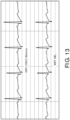
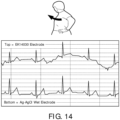
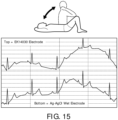
- ECG data signals from dry silicone electrodes 1230 and gel based electrodes 1240 appear very similar. ECG characteristic peaks P, Q, R, S, T were visible in both wet electrodes 1240 and dry silicone electrodes 1230. Motion artifacts were observed for both electrode types, especially during intended motion periods.
- FIGS. 13-15 illustrate comparisons of ECG measurement data obtained from hydrogel electrodes 1240 and dry silicone electrodes 1230.
- FIG. 13 illustrates ECG snapshots (e.g., five seconds) from wet/gel electrodes 1240 and dry silicone electrodes 1230 when the subjects were at a rest position (i.e., sitting on a chair).
- FIG. 14 illustrates ECG data from wet/gel electrodes 1240 and dry silicone electrodes 1230 when the subjects were performing a torso rotation (as shown in FIG. 14 ).
- FIG. 15 illustrates ECG snapshots (e.g., five seconds) for wet/gel electrodes 1240 and dry silicone electrodes 1230 when subjects were performing an up and down movement (as shown in FIG. 15 ).
- hydrophilic materials are hydrophilic silicones, with a crosslinking structure and/or crosslinking density comparable to that of suitable hydrophobic materials.
- Hydrophilic silicones have a normal silicone backbone but instead of hydrophobic methyl or phenyl groups some of these groups are exchanged for more hydrophilic side groups.
- Hydrophilic side groups may contain, for example, alcohol, carboxylic acid, amine, amide and ethylene glycol functional groups.
- any reference signs placed between parentheses shall not be construed as limiting the claim.
- the word “comprising” or “including” does not exclude the presence of elements or steps other than those listed in a claim.
- several of these means may be embodied by one and the same item of hardware.
- the word “a” or “an” preceding an element does not exclude the presence of a plurality of such elements.
- any device claim enumerating several means several of these means may be embodied by one and the same item of hardware.
- the mere fact that certain elements are recited in mutually different dependent claims does not indicate that these elements cannot be used in combination.
Landscapes
- Health & Medical Sciences (AREA)
- Life Sciences & Earth Sciences (AREA)
- Veterinary Medicine (AREA)
- Public Health (AREA)
- Engineering & Computer Science (AREA)
- Biomedical Technology (AREA)
- General Health & Medical Sciences (AREA)
- Animal Behavior & Ethology (AREA)
- Medical Informatics (AREA)
- Heart & Thoracic Surgery (AREA)
- Surgery (AREA)
- Molecular Biology (AREA)
- Physics & Mathematics (AREA)
- Biophysics (AREA)
- Pathology (AREA)
- Nuclear Medicine, Radiotherapy & Molecular Imaging (AREA)
- Radiology & Medical Imaging (AREA)
- Chemical Kinetics & Catalysis (AREA)
- Chemical & Material Sciences (AREA)
- General Chemical & Material Sciences (AREA)
- Cardiology (AREA)
- Dermatology (AREA)
- Measurement And Recording Of Electrical Phenomena And Electrical Characteristics Of The Living Body (AREA)
- Electrotherapy Devices (AREA)
Claims (5)
- Elektrode (100), die so konfiguriert ist, dass sie elektrischen Kontakt mit der Haut eines Subjekts herstellt, wobei die Elektrode umfasst:eine elektrische Kopplung (110), die die Kopplung der Elektrode an ein externes Rechensystem erleichtert;einen Elektrodenkörper (102), der so konfiguriert ist, dass er abnehmbar mit der Haut des Subjekts gekoppelt werden kann und elektrische Signale von der Haut des Subjekts empfängt und/oder elektrische Signale an diese überträgt, wobei der Elektrodenkörper umfasst:
ein leitfähiges Silikonmaterial, das so konfiguriert ist, dass es die Aufnahme oder Diffusion von Feuchtigkeit aus der Haut des Subjekts ermöglicht, über dem der Elektrodenkörper angeordnet ist, wobei das leitfähige Silikonmaterial ein mit leitfähigen Partikeln gefülltes Silikonmaterial umfasst; dadurch gekennzeichnet, dass der Elektrodenkörper umfasst:
ein Reinigungsmittel, das so konfiguriert ist, dass es einen Ionenfluss durch das leitfähige Silikonmaterial erleichtert. - Elektrode nach Anspruch 1, wobei das Reinigungsmittel so konfiguriert ist, dass es Ionen in das leitfähige Silikonmaterial bereitstellt, und wobei eine Wechselwirkung der Feuchtigkeit und der Ionen eine Salzbrücke in der Elektrode bildet, die den Ionenfluss durch das leitfähige Silikonmaterial ermöglicht.
- Elektrode nach Anspruch 1, wobei das Reinigungsmittel so konfiguriert ist, dass es sich chemisch mit dem leitfähigen Silikonmaterial verbindet.
- Elektrode nach Anspruch 1, wobei das leitfähige Silikonmaterial ein hydrophiles Silikonmaterial oder ein PolyDiMethylSiloxan-Material ist.
- Elektrode nach Anspruch 1, wobei die leitfähigen Partikel aus der Gruppe bestehend aus Graphitpartikeln, Kohlenstoffpartikeln und Silberpartikeln ausgewählt sind.
Applications Claiming Priority (2)
| Application Number | Priority Date | Filing Date | Title |
|---|---|---|---|
| US201562167384P | 2015-05-28 | 2015-05-28 | |
| PCT/IB2016/052850 WO2016189422A1 (en) | 2015-05-28 | 2016-05-17 | A dry electrode for bio-potential and skin impedance sensing and method of use |
Publications (2)
| Publication Number | Publication Date |
|---|---|
| EP3302683A1 EP3302683A1 (de) | 2018-04-11 |
| EP3302683B1 true EP3302683B1 (de) | 2023-12-20 |
Family
ID=56134403
Family Applications (1)
| Application Number | Title | Priority Date | Filing Date |
|---|---|---|---|
| EP16729993.2A Active EP3302683B1 (de) | 2015-05-28 | 2016-05-17 | Trockenelektrode zur erfassung von biopotenzial und hautimpedanz |
Country Status (5)
| Country | Link |
|---|---|
| US (1) | US10736528B2 (de) |
| EP (1) | EP3302683B1 (de) |
| JP (1) | JP6843075B2 (de) |
| CN (1) | CN107690307B (de) |
| WO (1) | WO2016189422A1 (de) |
Families Citing this family (38)
| Publication number | Priority date | Publication date | Assignee | Title |
|---|---|---|---|---|
| AU2014207265B2 (en) | 2013-01-21 | 2017-04-20 | Cala Health, Inc. | Devices and methods for controlling tremor |
| US12453853B2 (en) | 2013-01-21 | 2025-10-28 | Cala Health, Inc. | Multi-modal stimulation for treating tremor |
| AU2015271774B2 (en) | 2014-06-02 | 2020-04-16 | Cala Health, Inc. | Systems and methods for peripheral nerve stimulation to treat tremor |
| EP4342516A3 (de) | 2015-06-10 | 2024-07-10 | Cala Health, Inc. | Systeme und verfahren zur peripheren nervenstimulation zur behandlung von tremor mit abnehmbaren therapie- und überwachungseinheiten |
| EP3328277A4 (de) | 2015-07-31 | 2019-03-06 | Cala Health, Inc. | Systeme, vorrichtungen und verfahren zur behandlung von osteoarthritis |
| US10603482B2 (en) | 2015-09-23 | 2020-03-31 | Cala Health, Inc. | Systems and methods for peripheral nerve stimulation in the finger or hand to treat hand tremors |
| KR101727149B1 (ko) * | 2015-10-22 | 2017-04-14 | (주)와이브레인 | 생체 신호 감지용 건식 전극 및 이를 제조하는 방법 |
| AU2017211048B2 (en) | 2016-01-21 | 2022-03-10 | Cala Health, Inc. | Systems, methods and devices for peripheral neuromodulation for treating diseases related to overactive bladder |
| EP3481492B1 (de) | 2016-07-08 | 2024-03-13 | Cala Health, Inc. | Systeme zur stimulierung einer bestimmten anzahl von nerven mit genau derselben anzahl von elektroden und verbesserten trockenelektroden |
| JP7133543B2 (ja) | 2016-08-25 | 2022-09-08 | カラ ヘルス,インコーポレイテッド | 末梢神経刺激による心機能不全の治療のためのシステムおよび方法 |
| US11331480B2 (en) | 2017-04-03 | 2022-05-17 | Cala Health, Inc. | Systems, methods and devices for peripheral neuromodulation for treating diseases related to overactive bladder |
| EP3412203A1 (de) * | 2017-06-06 | 2018-12-12 | Fraunhofer-Gesellschaft zur Förderung der angewandten Forschung e.V. | Vorrichtung zur messung von biosignalen einer lebewesens und entsprechendes verfahren |
| JPWO2019139164A1 (ja) | 2018-01-15 | 2020-12-17 | Nok株式会社 | 生体電極 |
| JP7021263B2 (ja) | 2018-01-15 | 2022-02-16 | Nok株式会社 | 生体電極 |
| WO2019143790A1 (en) | 2018-01-17 | 2019-07-25 | Cala Health, Inc. | Systems and methods for treating inflammatory bowel disease through peripheral nerve stimulation |
| EP3758582A1 (de) * | 2018-02-26 | 2021-01-06 | T&W Engineering A/S | Elektrode zur erfassung bioelektrischer signale |
| WO2019239996A1 (ja) | 2018-06-15 | 2019-12-19 | Nok株式会社 | 生体電極の製造方法 |
| JP7158335B2 (ja) | 2018-06-25 | 2022-10-21 | 信越化学工業株式会社 | 生体電極組成物、生体電極、及び生体電極の製造方法 |
| EP3626159A1 (de) * | 2018-09-24 | 2020-03-25 | Koninklijke Philips N.V. | Körpermontierbare sensoreinheit |
| SE543602C2 (en) * | 2018-10-03 | 2021-04-13 | Azadeh Soroudi | Use of contact paste comprising conductive or semi-conductive particles for contact between skin and electrode |
| EP3868289B1 (de) * | 2018-10-17 | 2026-03-18 | NOK Corporation | Bioelektrode und verfahren zur herstellung von bioelektroden |
| WO2020157043A1 (en) | 2019-01-29 | 2020-08-06 | Koninklijke Philips N.V. | Dry electrode for contacting a skin of a user to receive and/or transmit an electrical signal |
| EP3841970A1 (de) | 2019-12-23 | 2021-06-30 | Koninklijke Philips N.V. | Trockene elektrode zur kontaktierung der haut eines benutzers zur aufnahme und/oder übertragung eines elektrischen signals |
| CN110353678B (zh) * | 2019-07-10 | 2022-03-01 | 南开大学 | 一种基于导电硅胶的防水肌电信号传感器 |
| US12251560B1 (en) | 2019-08-13 | 2025-03-18 | Cala Health, Inc. | Connection quality determination for wearable neurostimulation systems |
| US11890468B1 (en) | 2019-10-03 | 2024-02-06 | Cala Health, Inc. | Neurostimulation systems with event pattern detection and classification |
| JP7456230B2 (ja) * | 2020-03-26 | 2024-03-27 | Nok株式会社 | 生体用電極 |
| US12446791B2 (en) | 2020-05-22 | 2025-10-21 | Welch Allyn, Inc. | Extended wear electrode baseline determination for wearable device |
| US20210378571A1 (en) * | 2020-06-05 | 2021-12-09 | Facebook Technologies, Llc | Composite bioelectrodes |
| IL301602A (en) | 2021-03-12 | 2023-05-01 | Shinetsu Chemical Co | A bio-electrode, a method for producing a bio-electrode, and a method for measuring biological signals |
| EP4070759A1 (de) | 2021-04-09 | 2022-10-12 | Koninklijke Philips N.V. | Mundstück für eine mundpflegevorrichtung |
| US20240325728A1 (en) * | 2021-08-03 | 2024-10-03 | Cala Health, Inc. | Electrodes for neuromodulation |
| WO2023089484A1 (en) * | 2021-11-17 | 2023-05-25 | Novocure Gmbh | Electrode assembly with non-hydrogel conductive adhesive layer and methods of applying tumor treating fields using same |
| DE102022108216A1 (de) | 2022-04-06 | 2023-10-12 | Bayerische Motoren Werke Aktiengesellschaft | Sitzanlage für ein Fahrzeug sowie Verfahren zum Betreiben einer solchen Sitzanlage |
| CN116098624A (zh) * | 2023-01-03 | 2023-05-12 | 复旦大学附属中山医院 | 一种心电图采集系统和方法以及心电图采集机器人 |
| CN116392715A (zh) * | 2023-06-09 | 2023-07-07 | 北京大学口腔医学院 | 一种调控神经肌肉的装置和方法 |
| GB2635132A (en) * | 2023-10-30 | 2025-05-07 | Occam Bci Inc | A wearable sensor having dry electrodes, and a manufacturing method |
| WO2025221799A1 (en) * | 2024-04-15 | 2025-10-23 | Georgia Tech Research Corporation | Wearable non-invasive bladder monitoring technologies |
Family Cites Families (15)
| Publication number | Priority date | Publication date | Assignee | Title |
|---|---|---|---|---|
| EP0043850B1 (de) | 1980-01-23 | 1985-06-19 | Minnesota Mining And Manufacturing Company | Verfahren zur Herstellung einer trockenen biomedizinischen Elektrode |
| US5985990A (en) | 1995-12-29 | 1999-11-16 | 3M Innovative Properties Company | Use of pendant free-radically polymerizable moieties with polar polymers to prepare hydrophilic pressure sensitive adhesive compositions |
| AU4743896A (en) * | 1995-12-29 | 1997-07-28 | Minnesota Mining And Manufacturing Company | Polar, lipophilic pressure-sensitive adhesive compositions and medical devices using same |
| US7099713B2 (en) * | 2002-06-28 | 2006-08-29 | Battelle Memorial Institute | Skin conduction and transport systems |
| US10022457B2 (en) * | 2005-08-05 | 2018-07-17 | Gholam A. Peyman | Methods to regulate polarization and enhance function of cells |
| WO2007092290A2 (en) * | 2006-02-02 | 2007-08-16 | H.B. Fuller Licensing & Financing, Inc. | Conductive articles including hot melt superabsorbent polymer composition and method of making and method of using the same |
| US20100016703A1 (en) * | 2006-07-13 | 2010-01-21 | Cardiac Bio-Systems Inc. | Bio-electrode possessing a hydrophilic skin-contacting layer and an electrolyte substance |
| EP2069001B1 (de) | 2006-09-28 | 2013-02-20 | Wisconsin Alumni Research Foundation | Verfahren und vorrichtung zur förderung von erholsamem schlaf |
| US8608984B1 (en) * | 2010-02-23 | 2013-12-17 | Cleveland Medical Polymers, Inc. | Polymer nano-composites as dry sensor material for biosignal sensing |
| WO2013036988A1 (en) * | 2011-09-13 | 2013-03-21 | Hear Ip Pty Ltd | Biocompatible electrode component and method for fabrication thereof |
| CN102824168B (zh) | 2012-07-03 | 2015-01-07 | 上海交通大学 | 柔性生理干电极及其制备方法 |
| WO2014047032A1 (en) * | 2012-09-18 | 2014-03-27 | Worcester Polytechnic Institute | Fabrication and use of epidermal electrodes |
| EP2868269A1 (de) * | 2013-11-05 | 2015-05-06 | Cleveland Medical Polymers, Inc. | Polymernanoverbundstoffe als trockenes Sensormaterial zur Erfassung von Biosignalen |
| CN104068852A (zh) * | 2014-06-28 | 2014-10-01 | 苏州格林泰克科技有限公司 | 一种生物电信号传感器 |
| US9833607B2 (en) * | 2014-10-30 | 2017-12-05 | West Affum Holdings Corp. | Wearable cardiac defibrillation system with flexible electrodes |
-
2016
- 2016-05-17 EP EP16729993.2A patent/EP3302683B1/de active Active
- 2016-05-17 US US15/572,850 patent/US10736528B2/en active Active
- 2016-05-17 CN CN201680031071.5A patent/CN107690307B/zh active Active
- 2016-05-17 WO PCT/IB2016/052850 patent/WO2016189422A1/en not_active Ceased
- 2016-05-17 JP JP2017560939A patent/JP6843075B2/ja active Active
Also Published As
| Publication number | Publication date |
|---|---|
| JP6843075B2 (ja) | 2021-03-17 |
| WO2016189422A1 (en) | 2016-12-01 |
| US20180116546A1 (en) | 2018-05-03 |
| EP3302683A1 (de) | 2018-04-11 |
| US10736528B2 (en) | 2020-08-11 |
| JP2018515279A (ja) | 2018-06-14 |
| CN107690307A (zh) | 2018-02-13 |
| CN107690307B (zh) | 2021-07-27 |
Similar Documents
| Publication | Publication Date | Title |
|---|---|---|
| EP3302683B1 (de) | Trockenelektrode zur erfassung von biopotenzial und hautimpedanz | |
| US20180117302A1 (en) | A wet/dry convertible electrode and method of use | |
| US10898094B1 (en) | Dry physiological recording device and method of manufacturing | |
| US5465715A (en) | Positive locking biomedical electrode and connector system | |
| US9757049B2 (en) | Electrode and device for detecting biosignal and method of using the same | |
| US5372125A (en) | Positive locking biomedical electrode and connector system | |
| JP2023504347A (ja) | 軟質センサーおよび導電体用吸水性基板の迅速な製造方法 | |
| US11458313B1 (en) | Galvanic vestibular stimulation (GVS) systems, devices and methods | |
| TW201823339A (zh) | 生物體訊號計測用導電性橡膠組成物、生物體訊號計測用導電性構件及生物體訊號計測用衣著 | |
| US20230018091A1 (en) | Medical electrode and system thereof | |
| JP2022505425A (ja) | 電極およびその使用 | |
| EP3597103A1 (de) | Bioelektrodenfolie | |
| Ji et al. | Conductive Hydrogel‐Enabled Electrode for Scalp Electroencephalography Monitoring | |
| Feng et al. | An electronic slime-based epidermal electrode using carbon nanocomposites for biosignal sensing | |
| Sanguantrakul et al. | PDMS/CNT electrodes with bioamplifier for practical in-the-ear and conventional biosignal recordings | |
| WO2018191325A1 (en) | Sensor patch utilizing adhesive microstructures | |
| CN222917532U (zh) | 一种连续监测大脑活动和汗液乳酸的耳内多模态传感系统 | |
| US20250040850A1 (en) | Sensor including electrically conductive abrasive material | |
| EP3609387A1 (de) | Drahtloses herzüberwachungssystem unter verwendung von klebenden mikrostrukturen | |
| CN116019455B (zh) | 柔性高密度头皮脑电电极及其制备方法 | |
| US20200375539A1 (en) | Health patch utilizing adhesive microstructures | |
| WO2025032411A1 (en) | Sensor including electrically conductive abrasive material | |
| HK40083631A (en) | A medical electrode and system thereof |
Legal Events
| Date | Code | Title | Description |
|---|---|---|---|
| STAA | Information on the status of an ep patent application or granted ep patent |
Free format text: STATUS: THE INTERNATIONAL PUBLICATION HAS BEEN MADE |
|
| PUAI | Public reference made under article 153(3) epc to a published international application that has entered the european phase |
Free format text: ORIGINAL CODE: 0009012 |
|
| STAA | Information on the status of an ep patent application or granted ep patent |
Free format text: STATUS: REQUEST FOR EXAMINATION WAS MADE |
|
| 17P | Request for examination filed |
Effective date: 20180102 |
|
| AK | Designated contracting states |
Kind code of ref document: A1 Designated state(s): AL AT BE BG CH CY CZ DE DK EE ES FI FR GB GR HR HU IE IS IT LI LT LU LV MC MK MT NL NO PL PT RO RS SE SI SK SM TR |
|
| AX | Request for extension of the european patent |
Extension state: BA ME |
|
| DAV | Request for validation of the european patent (deleted) | ||
| DAX | Request for extension of the european patent (deleted) | ||
| STAA | Information on the status of an ep patent application or granted ep patent |
Free format text: STATUS: EXAMINATION IS IN PROGRESS |
|
| 17Q | First examination report despatched |
Effective date: 20190613 |
|
| RAP1 | Party data changed (applicant data changed or rights of an application transferred) |
Owner name: KONINKLIJKE PHILIPS N.V. |
|
| GRAP | Despatch of communication of intention to grant a patent |
Free format text: ORIGINAL CODE: EPIDOSNIGR1 |
|
| STAA | Information on the status of an ep patent application or granted ep patent |
Free format text: STATUS: GRANT OF PATENT IS INTENDED |
|
| RIC1 | Information provided on ipc code assigned before grant |
Ipc: A61B 5/274 20210101ALN20230517BHEP Ipc: A61B 5/291 20210101ALI20230517BHEP Ipc: A61B 5/259 20210101ALI20230517BHEP Ipc: A61N 1/04 20060101AFI20230517BHEP |
|
| GRAJ | Information related to disapproval of communication of intention to grant by the applicant or resumption of examination proceedings by the epo deleted |
Free format text: ORIGINAL CODE: EPIDOSDIGR1 |
|
| STAA | Information on the status of an ep patent application or granted ep patent |
Free format text: STATUS: EXAMINATION IS IN PROGRESS |
|
| INTG | Intention to grant announced |
Effective date: 20230612 |
|
| GRAP | Despatch of communication of intention to grant a patent |
Free format text: ORIGINAL CODE: EPIDOSNIGR1 |
|
| STAA | Information on the status of an ep patent application or granted ep patent |
Free format text: STATUS: GRANT OF PATENT IS INTENDED |
|
| INTC | Intention to grant announced (deleted) | ||
| INTG | Intention to grant announced |
Effective date: 20230721 |
|
| RIC1 | Information provided on ipc code assigned before grant |
Ipc: A61B 5/274 20210101ALN20230710BHEP Ipc: A61B 5/291 20210101ALI20230710BHEP Ipc: A61B 5/259 20210101ALI20230710BHEP Ipc: A61N 1/04 20060101AFI20230710BHEP |
|
| GRAS | Grant fee paid |
Free format text: ORIGINAL CODE: EPIDOSNIGR3 |
|
| GRAA | (expected) grant |
Free format text: ORIGINAL CODE: 0009210 |
|
| STAA | Information on the status of an ep patent application or granted ep patent |
Free format text: STATUS: THE PATENT HAS BEEN GRANTED |
|
| AK | Designated contracting states |
Kind code of ref document: B1 Designated state(s): AL AT BE BG CH CY CZ DE DK EE ES FI FR GB GR HR HU IE IS IT LI LT LU LV MC MK MT NL NO PL PT RO RS SE SI SK SM TR |
|
| REG | Reference to a national code |
Ref country code: GB Ref legal event code: FG4D |
|
| REG | Reference to a national code |
Ref country code: CH Ref legal event code: EP |
|
| REG | Reference to a national code |
Ref country code: DE Ref legal event code: R096 Ref document number: 602016084830 Country of ref document: DE |
|
| REG | Reference to a national code |
Ref country code: IE Ref legal event code: FG4D |
|
| PG25 | Lapsed in a contracting state [announced via postgrant information from national office to epo] |
Ref country code: GR Free format text: LAPSE BECAUSE OF FAILURE TO SUBMIT A TRANSLATION OF THE DESCRIPTION OR TO PAY THE FEE WITHIN THE PRESCRIBED TIME-LIMIT Effective date: 20240321 |
|
| REG | Reference to a national code |
Ref country code: LT Ref legal event code: MG9D |
|
| PG25 | Lapsed in a contracting state [announced via postgrant information from national office to epo] |
Ref country code: LT Free format text: LAPSE BECAUSE OF FAILURE TO SUBMIT A TRANSLATION OF THE DESCRIPTION OR TO PAY THE FEE WITHIN THE PRESCRIBED TIME-LIMIT Effective date: 20231220 |
|
| REG | Reference to a national code |
Ref country code: NL Ref legal event code: MP Effective date: 20231220 |
|
| PG25 | Lapsed in a contracting state [announced via postgrant information from national office to epo] |
Ref country code: ES Free format text: LAPSE BECAUSE OF FAILURE TO SUBMIT A TRANSLATION OF THE DESCRIPTION OR TO PAY THE FEE WITHIN THE PRESCRIBED TIME-LIMIT Effective date: 20231220 |
|
| PG25 | Lapsed in a contracting state [announced via postgrant information from national office to epo] |
Ref country code: LT Free format text: LAPSE BECAUSE OF FAILURE TO SUBMIT A TRANSLATION OF THE DESCRIPTION OR TO PAY THE FEE WITHIN THE PRESCRIBED TIME-LIMIT Effective date: 20231220 Ref country code: GR Free format text: LAPSE BECAUSE OF FAILURE TO SUBMIT A TRANSLATION OF THE DESCRIPTION OR TO PAY THE FEE WITHIN THE PRESCRIBED TIME-LIMIT Effective date: 20240321 Ref country code: FI Free format text: LAPSE BECAUSE OF FAILURE TO SUBMIT A TRANSLATION OF THE DESCRIPTION OR TO PAY THE FEE WITHIN THE PRESCRIBED TIME-LIMIT Effective date: 20231220 Ref country code: ES Free format text: LAPSE BECAUSE OF FAILURE TO SUBMIT A TRANSLATION OF THE DESCRIPTION OR TO PAY THE FEE WITHIN THE PRESCRIBED TIME-LIMIT Effective date: 20231220 Ref country code: BG Free format text: LAPSE BECAUSE OF FAILURE TO SUBMIT A TRANSLATION OF THE DESCRIPTION OR TO PAY THE FEE WITHIN THE PRESCRIBED TIME-LIMIT Effective date: 20240320 |
|
| REG | Reference to a national code |
Ref country code: AT Ref legal event code: MK05 Ref document number: 1641982 Country of ref document: AT Kind code of ref document: T Effective date: 20231220 |
|
| PG25 | Lapsed in a contracting state [announced via postgrant information from national office to epo] |
Ref country code: NL Free format text: LAPSE BECAUSE OF FAILURE TO SUBMIT A TRANSLATION OF THE DESCRIPTION OR TO PAY THE FEE WITHIN THE PRESCRIBED TIME-LIMIT Effective date: 20231220 |
|
| PG25 | Lapsed in a contracting state [announced via postgrant information from national office to epo] |
Ref country code: SE Free format text: LAPSE BECAUSE OF FAILURE TO SUBMIT A TRANSLATION OF THE DESCRIPTION OR TO PAY THE FEE WITHIN THE PRESCRIBED TIME-LIMIT Effective date: 20231220 Ref country code: RS Free format text: LAPSE BECAUSE OF FAILURE TO SUBMIT A TRANSLATION OF THE DESCRIPTION OR TO PAY THE FEE WITHIN THE PRESCRIBED TIME-LIMIT Effective date: 20231220 Ref country code: NO Free format text: LAPSE BECAUSE OF FAILURE TO SUBMIT A TRANSLATION OF THE DESCRIPTION OR TO PAY THE FEE WITHIN THE PRESCRIBED TIME-LIMIT Effective date: 20240320 Ref country code: NL Free format text: LAPSE BECAUSE OF FAILURE TO SUBMIT A TRANSLATION OF THE DESCRIPTION OR TO PAY THE FEE WITHIN THE PRESCRIBED TIME-LIMIT Effective date: 20231220 Ref country code: LV Free format text: LAPSE BECAUSE OF FAILURE TO SUBMIT A TRANSLATION OF THE DESCRIPTION OR TO PAY THE FEE WITHIN THE PRESCRIBED TIME-LIMIT Effective date: 20231220 Ref country code: HR Free format text: LAPSE BECAUSE OF FAILURE TO SUBMIT A TRANSLATION OF THE DESCRIPTION OR TO PAY THE FEE WITHIN THE PRESCRIBED TIME-LIMIT Effective date: 20231220 |
|
| PG25 | Lapsed in a contracting state [announced via postgrant information from national office to epo] |
Ref country code: IS Free format text: LAPSE BECAUSE OF FAILURE TO SUBMIT A TRANSLATION OF THE DESCRIPTION OR TO PAY THE FEE WITHIN THE PRESCRIBED TIME-LIMIT Effective date: 20240420 |
|
| PG25 | Lapsed in a contracting state [announced via postgrant information from national office to epo] |
Ref country code: CZ Free format text: LAPSE BECAUSE OF FAILURE TO SUBMIT A TRANSLATION OF THE DESCRIPTION OR TO PAY THE FEE WITHIN THE PRESCRIBED TIME-LIMIT Effective date: 20231220 Ref country code: AT Free format text: LAPSE BECAUSE OF FAILURE TO SUBMIT A TRANSLATION OF THE DESCRIPTION OR TO PAY THE FEE WITHIN THE PRESCRIBED TIME-LIMIT Effective date: 20231220 |
|
| PG25 | Lapsed in a contracting state [announced via postgrant information from national office to epo] |
Ref country code: SK Free format text: LAPSE BECAUSE OF FAILURE TO SUBMIT A TRANSLATION OF THE DESCRIPTION OR TO PAY THE FEE WITHIN THE PRESCRIBED TIME-LIMIT Effective date: 20231220 |
|
| PG25 | Lapsed in a contracting state [announced via postgrant information from national office to epo] |
Ref country code: SM Free format text: LAPSE BECAUSE OF FAILURE TO SUBMIT A TRANSLATION OF THE DESCRIPTION OR TO PAY THE FEE WITHIN THE PRESCRIBED TIME-LIMIT Effective date: 20231220 Ref country code: SK Free format text: LAPSE BECAUSE OF FAILURE TO SUBMIT A TRANSLATION OF THE DESCRIPTION OR TO PAY THE FEE WITHIN THE PRESCRIBED TIME-LIMIT Effective date: 20231220 Ref country code: RO Free format text: LAPSE BECAUSE OF FAILURE TO SUBMIT A TRANSLATION OF THE DESCRIPTION OR TO PAY THE FEE WITHIN THE PRESCRIBED TIME-LIMIT Effective date: 20231220 Ref country code: IT Free format text: LAPSE BECAUSE OF FAILURE TO SUBMIT A TRANSLATION OF THE DESCRIPTION OR TO PAY THE FEE WITHIN THE PRESCRIBED TIME-LIMIT Effective date: 20231220 Ref country code: IS Free format text: LAPSE BECAUSE OF FAILURE TO SUBMIT A TRANSLATION OF THE DESCRIPTION OR TO PAY THE FEE WITHIN THE PRESCRIBED TIME-LIMIT Effective date: 20240420 Ref country code: EE Free format text: LAPSE BECAUSE OF FAILURE TO SUBMIT A TRANSLATION OF THE DESCRIPTION OR TO PAY THE FEE WITHIN THE PRESCRIBED TIME-LIMIT Effective date: 20231220 Ref country code: CZ Free format text: LAPSE BECAUSE OF FAILURE TO SUBMIT A TRANSLATION OF THE DESCRIPTION OR TO PAY THE FEE WITHIN THE PRESCRIBED TIME-LIMIT Effective date: 20231220 Ref country code: AT Free format text: LAPSE BECAUSE OF FAILURE TO SUBMIT A TRANSLATION OF THE DESCRIPTION OR TO PAY THE FEE WITHIN THE PRESCRIBED TIME-LIMIT Effective date: 20231220 |
|
| PG25 | Lapsed in a contracting state [announced via postgrant information from national office to epo] |
Ref country code: PT Free format text: LAPSE BECAUSE OF FAILURE TO SUBMIT A TRANSLATION OF THE DESCRIPTION OR TO PAY THE FEE WITHIN THE PRESCRIBED TIME-LIMIT Effective date: 20240422 Ref country code: PL Free format text: LAPSE BECAUSE OF FAILURE TO SUBMIT A TRANSLATION OF THE DESCRIPTION OR TO PAY THE FEE WITHIN THE PRESCRIBED TIME-LIMIT Effective date: 20231220 |
|
| PG25 | Lapsed in a contracting state [announced via postgrant information from national office to epo] |
Ref country code: PT Free format text: LAPSE BECAUSE OF FAILURE TO SUBMIT A TRANSLATION OF THE DESCRIPTION OR TO PAY THE FEE WITHIN THE PRESCRIBED TIME-LIMIT Effective date: 20240422 Ref country code: PL Free format text: LAPSE BECAUSE OF FAILURE TO SUBMIT A TRANSLATION OF THE DESCRIPTION OR TO PAY THE FEE WITHIN THE PRESCRIBED TIME-LIMIT Effective date: 20231220 |
|
| REG | Reference to a national code |
Ref country code: DE Ref legal event code: R097 Ref document number: 602016084830 Country of ref document: DE |
|
| PG25 | Lapsed in a contracting state [announced via postgrant information from national office to epo] |
Ref country code: DK Free format text: LAPSE BECAUSE OF FAILURE TO SUBMIT A TRANSLATION OF THE DESCRIPTION OR TO PAY THE FEE WITHIN THE PRESCRIBED TIME-LIMIT Effective date: 20231220 |
|
| PLBE | No opposition filed within time limit |
Free format text: ORIGINAL CODE: 0009261 |
|
| STAA | Information on the status of an ep patent application or granted ep patent |
Free format text: STATUS: NO OPPOSITION FILED WITHIN TIME LIMIT |
|
| PG25 | Lapsed in a contracting state [announced via postgrant information from national office to epo] |
Ref country code: SI Free format text: LAPSE BECAUSE OF FAILURE TO SUBMIT A TRANSLATION OF THE DESCRIPTION OR TO PAY THE FEE WITHIN THE PRESCRIBED TIME-LIMIT Effective date: 20231220 |
|
| PG25 | Lapsed in a contracting state [announced via postgrant information from national office to epo] |
Ref country code: SI Free format text: LAPSE BECAUSE OF FAILURE TO SUBMIT A TRANSLATION OF THE DESCRIPTION OR TO PAY THE FEE WITHIN THE PRESCRIBED TIME-LIMIT Effective date: 20231220 Ref country code: DK Free format text: LAPSE BECAUSE OF FAILURE TO SUBMIT A TRANSLATION OF THE DESCRIPTION OR TO PAY THE FEE WITHIN THE PRESCRIBED TIME-LIMIT Effective date: 20231220 |
|
| 26N | No opposition filed |
Effective date: 20240923 |
|
| REG | Reference to a national code |
Ref country code: CH Ref legal event code: PL |
|
| PG25 | Lapsed in a contracting state [announced via postgrant information from national office to epo] |
Ref country code: MC Free format text: LAPSE BECAUSE OF FAILURE TO SUBMIT A TRANSLATION OF THE DESCRIPTION OR TO PAY THE FEE WITHIN THE PRESCRIBED TIME-LIMIT Effective date: 20231220 |
|
| PG25 | Lapsed in a contracting state [announced via postgrant information from national office to epo] |
Ref country code: LU Free format text: LAPSE BECAUSE OF NON-PAYMENT OF DUE FEES Effective date: 20240517 |
|
| GBPC | Gb: european patent ceased through non-payment of renewal fee |
Effective date: 20240517 |
|
| PG25 | Lapsed in a contracting state [announced via postgrant information from national office to epo] |
Ref country code: MC Free format text: LAPSE BECAUSE OF FAILURE TO SUBMIT A TRANSLATION OF THE DESCRIPTION OR TO PAY THE FEE WITHIN THE PRESCRIBED TIME-LIMIT Effective date: 20231220 Ref country code: LU Free format text: LAPSE BECAUSE OF NON-PAYMENT OF DUE FEES Effective date: 20240517 Ref country code: CH Free format text: LAPSE BECAUSE OF NON-PAYMENT OF DUE FEES Effective date: 20240531 |
|
| REG | Reference to a national code |
Ref country code: BE Ref legal event code: MM Effective date: 20240531 |
|
| PG25 | Lapsed in a contracting state [announced via postgrant information from national office to epo] |
Ref country code: IE Free format text: LAPSE BECAUSE OF NON-PAYMENT OF DUE FEES Effective date: 20240517 |
|
| PG25 | Lapsed in a contracting state [announced via postgrant information from national office to epo] |
Ref country code: BE Free format text: LAPSE BECAUSE OF NON-PAYMENT OF DUE FEES Effective date: 20240531 |
|
| PG25 | Lapsed in a contracting state [announced via postgrant information from national office to epo] |
Ref country code: FR Free format text: LAPSE BECAUSE OF NON-PAYMENT OF DUE FEES Effective date: 20240531 |
|
| PG25 | Lapsed in a contracting state [announced via postgrant information from national office to epo] |
Ref country code: GB Free format text: LAPSE BECAUSE OF NON-PAYMENT OF DUE FEES Effective date: 20240517 |
|
| PGFP | Annual fee paid to national office [announced via postgrant information from national office to epo] |
Ref country code: DE Payment date: 20250528 Year of fee payment: 10 |
|
| PG25 | Lapsed in a contracting state [announced via postgrant information from national office to epo] |
Ref country code: CY Free format text: LAPSE BECAUSE OF FAILURE TO SUBMIT A TRANSLATION OF THE DESCRIPTION OR TO PAY THE FEE WITHIN THE PRESCRIBED TIME-LIMIT; INVALID AB INITIO Effective date: 20160517 |
|
| PG25 | Lapsed in a contracting state [announced via postgrant information from national office to epo] |
Ref country code: HU Free format text: LAPSE BECAUSE OF FAILURE TO SUBMIT A TRANSLATION OF THE DESCRIPTION OR TO PAY THE FEE WITHIN THE PRESCRIBED TIME-LIMIT; INVALID AB INITIO Effective date: 20160517 |