EP3302874B1 - Verfahren zur herstellung einer tial-schaufel eines turbinenmotors - Google Patents
Verfahren zur herstellung einer tial-schaufel eines turbinenmotors Download PDFInfo
- Publication number
- EP3302874B1 EP3302874B1 EP16733637.9A EP16733637A EP3302874B1 EP 3302874 B1 EP3302874 B1 EP 3302874B1 EP 16733637 A EP16733637 A EP 16733637A EP 3302874 B1 EP3302874 B1 EP 3302874B1
- Authority
- EP
- European Patent Office
- Prior art keywords
- ingot
- forging
- branch
- main
- manufacturing
- Prior art date
- Legal status (The legal status is an assumption and is not a legal conclusion. Google has not performed a legal analysis and makes no representation as to the accuracy of the status listed.)
- Active
Links
Images



Classifications
-
- B—PERFORMING OPERATIONS; TRANSPORTING
- B22—CASTING; POWDER METALLURGY
- B22F—WORKING METALLIC POWDER; MANUFACTURE OF ARTICLES FROM METALLIC POWDER; MAKING METALLIC POWDER; APPARATUS OR DEVICES SPECIALLY ADAPTED FOR METALLIC POWDER
- B22F9/00—Making metallic powder or suspensions thereof
- B22F9/02—Making metallic powder or suspensions thereof using physical processes
- B22F9/06—Making metallic powder or suspensions thereof using physical processes starting from liquid material
- B22F9/08—Making metallic powder or suspensions thereof using physical processes starting from liquid material by casting, e.g. through sieves or in water, by atomising or spraying
- B22F9/082—Making metallic powder or suspensions thereof using physical processes starting from liquid material by casting, e.g. through sieves or in water, by atomising or spraying atomising using a fluid
-
- B—PERFORMING OPERATIONS; TRANSPORTING
- B21—MECHANICAL METAL-WORKING WITHOUT ESSENTIALLY REMOVING MATERIAL; PUNCHING METAL
- B21C—MANUFACTURE OF METAL SHEETS, WIRE, RODS, TUBES, PROFILES OR LIKE SEMI-MANUFACTURED PRODUCTS OTHERWISE THAN BY ROLLING; AUXILIARY OPERATIONS USED IN CONNECTION WITH METAL-WORKING WITHOUT ESSENTIALLY REMOVING MATERIAL
- B21C23/00—Extruding metal; Impact extrusion
- B21C23/002—Extruding materials of special alloys so far as the composition of the alloy requires or permits special extruding methods of sequences
-
- B—PERFORMING OPERATIONS; TRANSPORTING
- B21—MECHANICAL METAL-WORKING WITHOUT ESSENTIALLY REMOVING MATERIAL; PUNCHING METAL
- B21C—MANUFACTURE OF METAL SHEETS, WIRE, RODS, TUBES, PROFILES OR LIKE SEMI-MANUFACTURED PRODUCTS OTHERWISE THAN BY ROLLING; AUXILIARY OPERATIONS USED IN CONNECTION WITH METAL-WORKING WITHOUT ESSENTIALLY REMOVING MATERIAL
- B21C23/00—Extruding metal; Impact extrusion
- B21C23/02—Making uncoated products
- B21C23/04—Making uncoated products by direct extrusion
- B21C23/14—Making other products
- B21C23/142—Making profiles
-
- B—PERFORMING OPERATIONS; TRANSPORTING
- B21—MECHANICAL METAL-WORKING WITHOUT ESSENTIALLY REMOVING MATERIAL; PUNCHING METAL
- B21C—MANUFACTURE OF METAL SHEETS, WIRE, RODS, TUBES, PROFILES OR LIKE SEMI-MANUFACTURED PRODUCTS OTHERWISE THAN BY ROLLING; AUXILIARY OPERATIONS USED IN CONNECTION WITH METAL-WORKING WITHOUT ESSENTIALLY REMOVING MATERIAL
- B21C23/00—Extruding metal; Impact extrusion
- B21C23/02—Making uncoated products
- B21C23/04—Making uncoated products by direct extrusion
- B21C23/14—Making other products
- B21C23/16—Making turbo blades or propellers
-
- B—PERFORMING OPERATIONS; TRANSPORTING
- B21—MECHANICAL METAL-WORKING WITHOUT ESSENTIALLY REMOVING MATERIAL; PUNCHING METAL
- B21C—MANUFACTURE OF METAL SHEETS, WIRE, RODS, TUBES, PROFILES OR LIKE SEMI-MANUFACTURED PRODUCTS OTHERWISE THAN BY ROLLING; AUXILIARY OPERATIONS USED IN CONNECTION WITH METAL-WORKING WITHOUT ESSENTIALLY REMOVING MATERIAL
- B21C35/00—Removing work or waste from extruding presses; Drawing-off extruded work; Cleaning dies, ducts, containers, or mandrels for metal extruding
- B21C35/02—Removing or drawing-off work
- B21C35/023—Work treatment directly following extrusion, e.g. further deformation or surface treatment
-
- B—PERFORMING OPERATIONS; TRANSPORTING
- B21—MECHANICAL METAL-WORKING WITHOUT ESSENTIALLY REMOVING MATERIAL; PUNCHING METAL
- B21K—MAKING FORGED OR PRESSED METAL PRODUCTS, e.g. HORSE-SHOES, RIVETS, BOLTS OR WHEELS
- B21K3/00—Making engine or like machine parts not covered by sub-groups of B21K1/00; Making propellers or the like
- B21K3/04—Making engine or like machine parts not covered by sub-groups of B21K1/00; Making propellers or the like blades, e.g. for turbines; Upsetting of blade roots
-
- B—PERFORMING OPERATIONS; TRANSPORTING
- B22—CASTING; POWDER METALLURGY
- B22F—WORKING METALLIC POWDER; MANUFACTURE OF ARTICLES FROM METALLIC POWDER; MAKING METALLIC POWDER; APPARATUS OR DEVICES SPECIALLY ADAPTED FOR METALLIC POWDER
- B22F3/00—Manufacture of workpieces or articles from metallic powder characterised by the manner of compacting or sintering; Apparatus specially adapted therefor ; Presses and furnaces
- B22F3/17—Manufacture of workpieces or articles from metallic powder characterised by the manner of compacting or sintering; Apparatus specially adapted therefor ; Presses and furnaces by forging
-
- B—PERFORMING OPERATIONS; TRANSPORTING
- B22—CASTING; POWDER METALLURGY
- B22F—WORKING METALLIC POWDER; MANUFACTURE OF ARTICLES FROM METALLIC POWDER; MAKING METALLIC POWDER; APPARATUS OR DEVICES SPECIALLY ADAPTED FOR METALLIC POWDER
- B22F3/00—Manufacture of workpieces or articles from metallic powder characterised by the manner of compacting or sintering; Apparatus specially adapted therefor ; Presses and furnaces
- B22F3/20—Manufacture of workpieces or articles from metallic powder characterised by the manner of compacting or sintering; Apparatus specially adapted therefor ; Presses and furnaces by extruding
-
- B—PERFORMING OPERATIONS; TRANSPORTING
- B22—CASTING; POWDER METALLURGY
- B22F—WORKING METALLIC POWDER; MANUFACTURE OF ARTICLES FROM METALLIC POWDER; MAKING METALLIC POWDER; APPARATUS OR DEVICES SPECIALLY ADAPTED FOR METALLIC POWDER
- B22F5/00—Manufacture of workpieces or articles from metallic powder characterised by the special shape of the product
- B22F5/04—Manufacture of workpieces or articles from metallic powder characterised by the special shape of the product of turbine blades
-
- B—PERFORMING OPERATIONS; TRANSPORTING
- B23—MACHINE TOOLS; METAL-WORKING NOT OTHERWISE PROVIDED FOR
- B23K—SOLDERING OR UNSOLDERING; WELDING; CLADDING OR PLATING BY SOLDERING OR WELDING; CUTTING BY APPLYING HEAT LOCALLY, e.g. FLAME CUTTING; WORKING BY LASER BEAM
- B23K3/00—Tools, devices or special appurtenances for soldering, e.g. brazing, or unsoldering, not specially adapted for particular methods
- B23K3/04—Heating appliances
-
- B—PERFORMING OPERATIONS; TRANSPORTING
- B23—MACHINE TOOLS; METAL-WORKING NOT OTHERWISE PROVIDED FOR
- B23P—METAL-WORKING NOT OTHERWISE PROVIDED FOR; COMBINED OPERATIONS; UNIVERSAL MACHINE TOOLS
- B23P13/00—Making metal objects by operations essentially involving machining but not covered by a single other subclass
- B23P13/02—Making metal objects by operations essentially involving machining but not covered by a single other subclass in which only the machining operations are important
-
- B—PERFORMING OPERATIONS; TRANSPORTING
- B23—MACHINE TOOLS; METAL-WORKING NOT OTHERWISE PROVIDED FOR
- B23P—METAL-WORKING NOT OTHERWISE PROVIDED FOR; COMBINED OPERATIONS; UNIVERSAL MACHINE TOOLS
- B23P13/00—Making metal objects by operations essentially involving machining but not covered by a single other subclass
- B23P13/04—Making metal objects by operations essentially involving machining but not covered by a single other subclass involving slicing of profiled material
-
- B—PERFORMING OPERATIONS; TRANSPORTING
- B23—MACHINE TOOLS; METAL-WORKING NOT OTHERWISE PROVIDED FOR
- B23P—METAL-WORKING NOT OTHERWISE PROVIDED FOR; COMBINED OPERATIONS; UNIVERSAL MACHINE TOOLS
- B23P15/00—Making specific metal objects by operations not covered by a single other subclass or a group in this subclass
- B23P15/02—Making specific metal objects by operations not covered by a single other subclass or a group in this subclass turbine or like blades from one piece
-
- F—MECHANICAL ENGINEERING; LIGHTING; HEATING; WEAPONS; BLASTING
- F01—MACHINES OR ENGINES IN GENERAL; ENGINE PLANTS IN GENERAL; STEAM ENGINES
- F01D—NON-POSITIVE DISPLACEMENT MACHINES OR ENGINES, e.g. STEAM TURBINES
- F01D5/00—Blades; Blade-carrying members; Heating, heat-insulating, cooling or antivibration means on the blades or the members
- F01D5/12—Blades
- F01D5/14—Form or construction
-
- B—PERFORMING OPERATIONS; TRANSPORTING
- B22—CASTING; POWDER METALLURGY
- B22F—WORKING METALLIC POWDER; MANUFACTURE OF ARTICLES FROM METALLIC POWDER; MAKING METALLIC POWDER; APPARATUS OR DEVICES SPECIALLY ADAPTED FOR METALLIC POWDER
- B22F2998/00—Supplementary information concerning processes or compositions relating to powder metallurgy
- B22F2998/10—Processes characterised by the sequence of their steps
-
- F—MECHANICAL ENGINEERING; LIGHTING; HEATING; WEAPONS; BLASTING
- F05—INDEXING SCHEMES RELATING TO ENGINES OR PUMPS IN VARIOUS SUBCLASSES OF CLASSES F01-F04
- F05D—INDEXING SCHEME FOR ASPECTS RELATING TO NON-POSITIVE-DISPLACEMENT MACHINES OR ENGINES, GAS-TURBINES OR JET-PROPULSION PLANTS
- F05D2230/00—Manufacture
- F05D2230/10—Manufacture by removing material
-
- F—MECHANICAL ENGINEERING; LIGHTING; HEATING; WEAPONS; BLASTING
- F05—INDEXING SCHEMES RELATING TO ENGINES OR PUMPS IN VARIOUS SUBCLASSES OF CLASSES F01-F04
- F05D—INDEXING SCHEME FOR ASPECTS RELATING TO NON-POSITIVE-DISPLACEMENT MACHINES OR ENGINES, GAS-TURBINES OR JET-PROPULSION PLANTS
- F05D2230/00—Manufacture
- F05D2230/20—Manufacture essentially without removing material
- F05D2230/24—Manufacture essentially without removing material by extrusion
-
- F—MECHANICAL ENGINEERING; LIGHTING; HEATING; WEAPONS; BLASTING
- F05—INDEXING SCHEMES RELATING TO ENGINES OR PUMPS IN VARIOUS SUBCLASSES OF CLASSES F01-F04
- F05D—INDEXING SCHEME FOR ASPECTS RELATING TO NON-POSITIVE-DISPLACEMENT MACHINES OR ENGINES, GAS-TURBINES OR JET-PROPULSION PLANTS
- F05D2230/00—Manufacture
- F05D2230/20—Manufacture essentially without removing material
- F05D2230/25—Manufacture essentially without removing material by forging
-
- F—MECHANICAL ENGINEERING; LIGHTING; HEATING; WEAPONS; BLASTING
- F05—INDEXING SCHEMES RELATING TO ENGINES OR PUMPS IN VARIOUS SUBCLASSES OF CLASSES F01-F04
- F05D—INDEXING SCHEME FOR ASPECTS RELATING TO NON-POSITIVE-DISPLACEMENT MACHINES OR ENGINES, GAS-TURBINES OR JET-PROPULSION PLANTS
- F05D2240/00—Components
- F05D2240/20—Rotors
- F05D2240/24—Rotors for turbines
-
- F—MECHANICAL ENGINEERING; LIGHTING; HEATING; WEAPONS; BLASTING
- F05—INDEXING SCHEMES RELATING TO ENGINES OR PUMPS IN VARIOUS SUBCLASSES OF CLASSES F01-F04
- F05D—INDEXING SCHEME FOR ASPECTS RELATING TO NON-POSITIVE-DISPLACEMENT MACHINES OR ENGINES, GAS-TURBINES OR JET-PROPULSION PLANTS
- F05D2300/00—Materials; Properties thereof
- F05D2300/10—Metals, alloys or intermetallic compounds
- F05D2300/17—Alloys
- F05D2300/174—Titanium alloys, e.g. TiAl
Definitions
- the present invention relates to the field of methods for manufacturing turbomachine blades.
- the present invention applies particularly advantageously to the manufacture of turbine engine rotor blades, but can also be applied to the manufacture of stator blades.
- the document RU-2 254 200 C1 relates to a method of manufacturing a turbine engine blade, comprising an extrusion step. It describes in particular the preamble of claim 1.
- the document EP- 2 423 340 B1 relates to a method of manufacturing a turbomachine blade, comprising a double vacuum arc reflow molding step, a hot isostatic extrusion pressing step, a severing step, a heat treatment step and a heat treatment step. machining step.
- the document JP-2007 056340A relates to a method of manufacturing a turbine blade, comprising a casting step, an extrusion step and a forging step.
- a moving vane 4 of a turbomachine comprises a blade 30 extending along the main axis of the vane, between the proximal and distal (ie inner and outer) ends of the vane.
- the vane 30 At its proximal end, the vane 30 comprises a root 10 by which it is fixed to the turbomachine, and in particular to a disk of the rotor of the turbomachine in the case of a vane of a turbomachine rotor.
- the blade 30 may comprise a transverse element, called a heel 20.
- their heels 20 are arranged edge to edge so as to form a crown. circumferential which has, in particular, the function of externally delimiting the flow path of the gas passing through the turbomachine and thus limiting gas leaks at this location.
- the rotation of the mobile vane 4 of the turbomachine generates a centrifugal force oriented in the direction of the main axis of the mobile vane 4, hereinafter called the loading axis Ac.
- the root 10 which provides the mechanical connection between the blade 30 and the rotor disc, is the seat of significant mechanical stresses oriented along the axis Ac loading the blade.
- the moving blades 4 of a turbomachine are conventionally made of a nickel-based alloy by a traditional foundry.
- titanium aluminides hereinafter called titanium aluminides or TiAI, which are alloys consisting of titanium aluminide in which a minority fraction of the aluminum and titanium atoms can be replaced by other atoms, such as zirconium, iron, molybdenum, silicon, or niobium.
- TiAI alloys exhibit specific mechanical properties comparable, up to 750 ° C, to those of a traditional nickel-based alloy.
- the TiAI alloys exhibit, at least partially, a lamellar grain structure which increases their mechanical strength.
- TiAI has a low density, of the order of 4, significantly lower than that of nickel-based alloys, which is of the order of 8. This is why it has been envisaged to manufacture the blades of. turbomachine in TiAI replacing nickel base alloys, with the aim of reducing the mass of the turbomachine blades.
- TiAI alloys have several major drawbacks which complicate their use for the manufacture of turbomachine moving blades. In particular, they exhibit low temperature brittleness resulting in low elongation at break, and reduced crack resistance.
- the shaping of the TiAI alloy in order to manufacture a moving blade of a turbomachine, is very delicate, since the window of industrial forgeability, namely the compromise between temperature and shaping speed, is very narrow.
- the flowability is also problematic because the rapid solidification rate of these alloys exposes the final part to risks of shrinkage and significant porosities.
- E16 isothermal forging makes it possible to approach the finished dimensions significantly more, an important E18 machining step remains necessary.
- E16 isothermal forging is not very productive and expensive, mainly because of the low lifespan of the dies.
- HIP hot isostatic compression
- the invention provides a method of manufacturing a turbine engine blade by shaping a TiAI alloy.
- the invention provides a method of manufacturing a turbomachine blade according to claim 1.
- Claims 2 to 5 relate to embodiments of the method according to the invention.
- substantially perpendicular it can be considered a side branch slightly inclined with respect to the main branch, this inclination possibly being from a few degrees to around ten degrees or even around thirty degrees.
- Spinning makes it possible to refine the structure of TiAI alloys, in order to reduce the flow stress of the alloy, namely the stress necessary to cause plastic deformation of the alloy. It is then possible to use, after spinning, conventional forging means making it possible to obtain parts close to the ribs, that is to say close to the final shape and the final dimensions of the blade, which was impossible in the processes of the state of the art.
- the invention thus makes it possible to limit the subsequent machining steps, which consequently makes it possible to save time and reduce the quantity of material lost.
- the proposed process eliminates the hot isostatic compression step.
- the spinning allows, at the same time, to give the extruded ingot a cross-sectional shape having a main branch and at least one side branch substantially perpendicular to the main branch, which makes it possible to form the root of the blade by forging in the first lateral branch, and the heel, if it exists, in the second lateral branch.
- the shape of the extruded ingot approaches that of the final part, which makes it possible to reduce the deformation required during the final stage of conventional forging.
- the forging of the lateral branch of the extruded ingot causes an orientation of the lamellae of the alloy, by the action of the deformation work, in the direction perpendicular to the loading axis of the blade.
- the orientation of the lamellae of the alloy in the direction perpendicular to the loading axis of the vane makes it possible to increase the resistance of the vane to the mechanical stresses to which it will be subjected in operation.
- the spinning step makes it possible to combine the compaction of the powder, its sintering and its shaping in a single step, and to maintain a fine microstructure.
- the invention is advantageously completed by the following characteristics, taken individually or in any of their technically possible combinations.
- the orifice of the die has a single lateral slot, so as to obtain a spun ingot in the form of a section bar having a main branch and a single lateral branch, the blade of the blade being forged in the main branch while the vane foot will be forged in the side branch.
- the die orifice has a first side slot which extends from one end of the main slot perpendicular thereto, and a second side slot which extends from the other end. of the main slot substantially perpendicular thereto, so as to obtain a bar-shaped extruded ingot having a section having a main branch, a first lateral branch, extending substantially perpendicular to the main branch from one end thereof, and a second side branch extending substantially perpendicular to the main branch from the other end thereof.
- the blade is then forged in the main branch, the root of the blade being forged in the first lateral branch, and the heel in the second lateral branch.
- Forging is carried out in the open air, which is less restrictive than isothermal forging.
- Forging is carried out with a tool temperature of between 600 ° and 950 ° C, which is less restrictive than isothermal forging.
- the manufacturing process when the ingot is obtained by atomization of the powders, the manufacturing process further comprises a step of sheathing the ingot prior to spinning and a stripping step between the spinning step and the forging step.
- the ingot is formed by powder atomization.
- the combined use of a fine powder as well as of the extrusion makes it possible to obtain bars having a chemically homogeneous microstructure and having a small grain size.
- the spinning step makes it possible to group together in a single step the compaction of the powder, its sintering, its shaping and above all to maintain a fine microstructure, which is can make you fat if necessary
- the method may further include a machining step after the forging step which makes it possible to finalize the part.
- the turbomachine blade obtained by a process as described is characterized by the grain of the alloy which constitutes it.
- the grain of the alloy constituting a turbomachine blade obtained by a method as described is of a size of the order of 50 ⁇ m, appreciably smaller than the grain of the alloy of a turbomachine blade. obtained by another process.
- a turbomachine blade obtained by a process as described differs from a turbomachine blade obtained by another process in that the lamellar grains of the alloy are oriented in the direction perpendicular to the loading axis. of dawn.
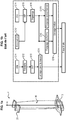
- Step E1 consists in forming an ingot 1 of titanium aluminide.
- the process can be applied to any type of titanium aluminides.
- the process can be applied to the alloy Ti-48Al-2Cr-2Nb (atomic%)), hereinafter denoted TiAI 48-2-2. It constitutes an acceptable compromise in terms of mechanical properties.
- the process can be applied to so-called beta alloys of the type represented by the formula Ti-Al (a) Nb (b) Mo (c) B (d) in which 'a', 'b', 'c' and 'd' are expressed as an atomic percentage, 'a' varying between about 44 and about 48, 'b' varying between about 2 and about 6, 'c' varying between about 0 and about 2 and 'd' varying between about 0 , 01 and about 1.0.
- These alloys exhibit excellent strength and hardness.
- the process can also be applied to alloys of the type represented by the formula Ti-Al-Cr-Nb-Si-Fe-Mo-Zr, such as for example an alloy containing in atoms 44 to 49% aluminum, 0.5 3% zirconium, 0.5 to 2% iron, 0.5 to 2% molybdenum, 0.2 to 0.5% silicon, 0 to 3% niobium, the balance 100% titanium and inevitable impurities.
- alloys of the type represented by the formula Ti-Al-Cr-Nb-Si-Fe-Mo-Zr such as for example an alloy containing in atoms 44 to 49% aluminum, 0.5 3% zirconium, 0.5 to 2% iron, 0.5 to 2% molybdenum, 0.2 to 0.5% silicon, 0 to 3% niobium, the balance 100% titanium and inevitable impurities.
- the ingot is typically produced by casting liquid metal (a process commonly called VIM for 'Vacuun Induction Melting'). During the casting of liquid metal, the various constituents intended to form the alloy are fused by heating, then the bath of molten metal material is poured into a vacuum chamber.
- the ingot 1 is typically cylindrical in shape with a circular section. For this purpose, the enclosure is of hollow cylindrical shape.
- the structure obtained is a relatively heterogeneous solidification structure and with a very large casting grain size (of the order of 300-500 ⁇ m).
- the spinning will homogenize and refine the coarse starting grain structure, until a small grain size of the order of 50 ⁇ m is obtained.
- Beta-type alloys tend to segregate chemically during their production. Spinning makes it possible to act on the size of the grains but has no impact on the chemical homogeneity of the alloy. This is why for the latter, it may be advantageous to start with powders in order to constitute a semi-finished product, before forging, which is more chemically homogeneous.
- the pouring of liquid metal is followed by atomization of powder. This process consists in atomizing a stream of material obtained from the bath of molten metallic material. The droplets of material solidify in an atomization chamber thanks to a convective exchange with the ambient gas, typically argon, and give powder.
- the sheath 7 is typically of hollow cylindrical shape.
- powder metallurgy makes it possible to overcome the difficulties of homogenization of segregating alloys. All operations for handling the powder, filling the sheath as well as its sealing must be carried out in a neutral atmosphere or under vacuum so as to limit contamination of the latter by oxygen.
- the combined use of a fine powder as well as of the extrusion makes it possible to obtain bars having a chemically homogeneous microstructure and having a small grain size.
- Step E2 the ingot undergoes shaping by spinning.
- the spinning allows the forming of the ingot by compression.
- the ingot shaped by spinning is called extruded ingot 2.
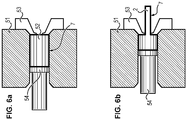
- Step E2 consists in passing the ingot (optionally made ductile by heating to the so-called spinning temperature) through an orifice 52 of a die 53, as illustrated in the diagrams. figures 6a, and 6b .
- the ingot 1 generally placed in a container 51, is pushed into the die 53 by means of a press 54, typically a hydraulic press, a pump or an extruder screw, so as to bring it out through the 'orifice 52 by exerting a thrust.
- Spinning makes it possible to homogenize and very greatly refine the structure of the alloy and consequently to reduce the flow stress, namely the stress necessary to cause plastic deformation of the alloy.
- the spinning makes it possible to refine the structure of the alloy, that is, to reduce the grain size of the alloy.
- the results of the inventors, illustrated on figure 2a show that the spinning step makes it possible to reduce the flow stress of the 48-2-2 alloy by 30 to 40%.
- the inventors have obtained similar results with other TiAI alloys and in particular with a Ti-45Al-2.4Si alloy.
- the spinning allows, at the same time, to give the extruded ingot a shape whose section is defined by the shape of the orifice 52 of the die 53.
- the shape of the orifice 52 of the die 53 is chosen so that that the shape of the extruded ingot approaches that of the final part, which makes it possible to reduce the deformation required during the final stage of conventional forging. It is then possible to obtain by conventional forging a part close to the shape of the final part, and thus to limit the final machining step.
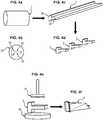
- the ingot 1 is spun in a die, the orifice 52 of which has a main slot 55 and at least one side slot 56.
- the side slot 56 extends perpendicularly to the main slot 55, from one of them. of the ends of it, and on either side of it, as illustrated in the figures 4b and 5b .
- a spun ingot 2 having the shape of a cross-sectional bar having a main branch 25 and at least one side branch 26 perpendicular to the main branch 25, as illustrated in the figures. figures 4c and 5c .
- the side branch is substantially perpendicular to the main slot. However, it can be considered a lateral branch slightly inclined with respect to the main branch, this inclination being able to be from a few degrees to ten degrees or even thirty degrees.
- the orifice 52 of the die 53 has a main slot 55 and a single side slot 56 which extends from one end of the main slot 55 perpendicularly thereto, as illustrated in FIG. figure 4b .
- the orifice 52 of the die 53 has a T-shape.
- the ingot is spun so as to obtain a spun ingot 2 in the form of a bar with a T-shaped section, having a main branch 25 and a side branch 26. perpendicular to the main branch 25, as illustrated on figure 4c .
- the blade 30 will be forged in the main branch 25 while the root 10 of the blade will be forged in the side branch 26.
- the orifice 52 of the die 53 has a main slot 55, a first side slot 56 which extends from one end of the main slot 55 perpendicular thereto, and a second side slot 57 which s 'extends from the other end of the main slot 55 perpendicular to it, as shown in Figure figure 5b .
- the orifice 52 of the die 53 has an H-shaped section. The ingot is spun so as to obtain a bar-shaped spun ingot 2 having an H-shaped section, having a main branch 25, a bar.
- first side branch 26 extending perpendicular to the main branch 25 from one end thereof, and a second side branch 27 extending perpendicular to the main branch 25 from the other end of it, as shown in figure 5c .
- the blade 30 will be forged in the main branch 25 while the root 10 of the blade will be forged in the first side branch 26.
- the heel 20 of the blade will be forged in the blade.
- second lateral branch 26 extending perpendicular to the main branch 25 from one end thereof
- second side branch 27 extending perpendicular to the main branch 25 from the other end of it
- the spinning is a relatively delicate step. Sheathless spinning tests of cast-formed ingots often show deep cracks in certain areas of the bar.
- the ingot 1 is advantageously coated with a sheath 7, for example made of stainless steel, during a sheathing step E1 ', in order to reduce the wall cooling of the ingot during the extrusion and thus avoid deformation at a temperature locally too low which can lead to cracks.
- the ingot 1 coated with its sheath 7 is brought to the spinning temperature before passing through the die 53 through a spinning pot 51.
- a stripping step E6 of the extruded ingot 2 which consists of removing the sheath, for example by turning, before forging. It may also be advantageous to remove the sheathing material by chemical removal.
- the spinning can be carried out without a sheath (not according to the claims).
- step E3 the ingot is cut into sections.
- the ingot is cut along transverse planes by conventional metal cutting techniques such as water jet cutting, laser cutting, or wire cutting.
- extrusion makes it possible, prior to forging, to refine the structure of TiAl alloys, in order to reduce the flow stress of the alloy, namely the stress necessary to cause plastic deformation of the alloy. So he is It is possible to use, after spinning, conventional forging means making it possible to obtain a part close to the final shape of the blade, which was not possible in the prior art.
- conventional forging is understood to mean forging in the open air and with a hot die, as opposed to isothermal forging.
- Forging consists in applying a significant force to the extruded ingot 2 in order to force it to match the shape of the final part, namely the turbine engine blade.
- Forging is carried out by applying a large force to the extruded ingot 2 using a striking device 41, such as a die hydraulically moved at a controlled speed, and a support 42, such as an anvil. or a fixed matrix, as shown in the figures 4th , and 5th .
- a striking device 41 such as a die hydraulically moved at a controlled speed
- a support 42 such as an anvil. or a fixed matrix, as shown in the figures 4th , and 5th .
- the blade is formed by forging in the side branch 26. If the cross section of the extruded ingot has two side branches 25 and 27, the root 10 of the blade will be formed by forging in one of the side branches 25, and the heel 20 in the other side branch 26.
- the shape of the extruded ingot 2 approaches that of the final part 4, which makes it possible to reduce the deformation required during the forging step.
- the blades 4 obtained by forging are more resistant to mechanical stresses because the deformation of metals generates a large number of metallurgical phenomena, both at the microscopic and macroscopic level.
- the spinning causes, by virtue of the shape of the extruded ingot, an orientation of the lamellar grains of the alloy, by the action of the deformation work, in the direction perpendicular to the loading axis of the blade.
- the orientation of the lamellar grains of the alloy in the direction perpendicular to the loading axis of the blade makes it possible to increase the resistance of the blade to the mechanical stresses to which it will be subjected in operation.
- Forging does not need to be isothermal (isothermal forging requires that the tools be brought to the heating temperatures of the metal which will be forged, namely more than 1000 °) and can be carried out in the open air in hot dies with a tooling temperature typically between 600 ° and 950 ° C.
Landscapes
- Engineering & Computer Science (AREA)
- Mechanical Engineering (AREA)
- Manufacturing & Machinery (AREA)
- General Engineering & Computer Science (AREA)
- Forging (AREA)
- Turbine Rotor Nozzle Sealing (AREA)
- Extrusion Of Metal (AREA)
Claims (5)
- Verfahren zur Herstellung einer Turbinenmotorschaufel (4) aus Titanaluminid, das einen Schritt umfasst zur:- (E1) Bildung eines Blocks (1) aus Titanaluminid;- (E2) Strangpressen des Blocks (1) durch eine Öffnung (52) einer Düse (53), wobei die Öffnung (52) einen Hauptschlitz (55) und mindestens einen seitlichen Schlitz (56) umfasst, der sich ausgehend von einem der Enden des Hauptschlitzes (55) im Wesentlichen senkrecht dazu erstreckt, derart, dass ein stranggepresster Block (2) erhalten wird, der die Form eines Strangs mit einem Querschnitt aufweist, der einen Hauptabschnitt (25) und mindestens einen seitlichen Abschnitt (26) umfasst, der im Wesentlichen senkrecht zum Hauptabschnitt (25) ist;- (E3) Querschneiden des stranggepressten Blocks (2) derart, dass Teilabschnitte (3) des stranggepressten Blocks erhalten werden;- (E4) Schmieden jedes Teilabschnitts (3) des stranggepressten Blocks derart, dass eine Turbinenmotorschaufel (4) erhalten wird,wobei das Herstellungsverfahren dadurch gekennzeichnet ist, dass das Schmieden in heißen Matrizen mit einer Temperatur von zwischen 600C° und 950C° ausgeführt wird,dadurch, dass der Block (1) durch Pulverzerstäubung gebildet wird,und dadurch, dass das Herstellungsverfahren ferner einen Schritt zum Umhüllen (E1') des Blocks (1) vor dem Strangpressen (E2) und einen Schritt zum Enthüllen (E6) zwischen dem Schritt zum Strangpressen (E2) und dem Schritt zum Schmieden (E4) umfasst.
- Verfahren zur Herstellung einer Turbinenmotorschaufel (4) nach Anspruch 1, wobei die Öffnung (52) der Düse (53) einen einzigen seitlichen Schlitz (56) aufweist, der sich ausgehend von einem der Enden des Hauptschlitzes (55) senkrecht dazu erstreckt, derart dass ein stranggepresster Block (2) in der Form eines Strangs mit einem Querschnitt erhalten wird, der einen Hauptabschnitt (25) und einen einzigen seitlichen Abschnitt (26) aufweist, der sich ausgehend von einem der Enden des Hauptabschnitts (25) senkrecht dazu erstreckt.
- Verfahren zur Herstellung einer Turbinenmotorschaufel (4) nach Anspruch 1, wobei die Öffnung (52) der Düse (53) einen ersten seitlichen Schlitz (56), der sich ausgehend von einen Ende des Hauptschlitzes (55) im Wesentlichen senkrecht dazu erstreckt, und einen zweiten seitlichen Schlitz (57) aufweist, der sich ausgehend von dem anderen Ende des Hauptschlitzes (55) im Wesentlichen senkrecht dazu erstreckt, derart dass ein stranggepresster Block (2) in der Form eines Strangs erhalten wird, der einen Querschnitt aufweist, der einen Hauptabschnitt (25), einen ersten seitlichen Abschnitt (26), der sich im Wesentlichen senkrecht zu dem Hauptabschnitt (25) ausgehend von einem Ende davon erstreckt, und einen zweiten seitlichen Abschnitt (27) aufweist, der sich im Wesentlichen senkrecht zu dem Hauptabschnitt (25) ausgehend von dem anderen Ende davon erstreckt.
- Verfahren zur Herstellung einer Turbinenmotorschaufel (4) nach einem der vorhergehenden Ansprüche, wobei das Schmieden in freier Luft ausgeführt wird.
- Verfahren zur Herstellung einer Turbinenmotorschaufel (4) nach einem der vorhergehenden Ansprüche, das ferner einen Schritt zur Bearbeitung nach dem Schritt zum Schmieden umfasst.
Applications Claiming Priority (2)
| Application Number | Priority Date | Filing Date | Title |
|---|---|---|---|
| FR1554696A FR3036640B1 (fr) | 2015-05-26 | 2015-05-26 | Procede de fabrication d'une aube de turbomachine en tial |
| PCT/FR2016/051244 WO2016189254A1 (fr) | 2015-05-26 | 2016-05-26 | Procédé de fabrication d'une aube de turbomachine en tial |
Publications (2)
| Publication Number | Publication Date |
|---|---|
| EP3302874A1 EP3302874A1 (de) | 2018-04-11 |
| EP3302874B1 true EP3302874B1 (de) | 2021-10-13 |
Family
ID=54356414
Family Applications (1)
| Application Number | Title | Priority Date | Filing Date |
|---|---|---|---|
| EP16733637.9A Active EP3302874B1 (de) | 2015-05-26 | 2016-05-26 | Verfahren zur herstellung einer tial-schaufel eines turbinenmotors |
Country Status (9)
| Country | Link |
|---|---|
| US (1) | US10758957B2 (de) |
| EP (1) | EP3302874B1 (de) |
| JP (1) | JP6873922B2 (de) |
| CN (1) | CN107666977B (de) |
| BR (1) | BR112017025210A2 (de) |
| CA (1) | CA2986788A1 (de) |
| FR (1) | FR3036640B1 (de) |
| RU (1) | RU2706933C2 (de) |
| WO (1) | WO2016189254A1 (de) |
Families Citing this family (8)
| Publication number | Priority date | Publication date | Assignee | Title |
|---|---|---|---|---|
| DE102017212082A1 (de) * | 2017-07-14 | 2019-01-17 | MTU Aero Engines AG | Schmieden bei hohen temperaturen, insbesondere von titanaluminiden |
| FR3074217B1 (fr) * | 2017-11-24 | 2020-09-25 | Safran Aircraft Engines | Aube pour une turbomachine d'aeronef |
| JP7124652B2 (ja) * | 2018-11-13 | 2022-08-24 | 株式会社豊田自動織機 | TiAl合金製翼車の製造方法 |
| FR3109107B1 (fr) * | 2020-04-09 | 2023-06-23 | Airbus Operations Sas | Procédé de fabrication d’un profilé par extrusion et forgeage, profilé ainsi obtenu |
| CN112122524A (zh) * | 2020-09-18 | 2020-12-25 | 中国航发沈阳黎明航空发动机有限责任公司 | 一种镍基高温合金航空发动机转子叶片热模锻工艺 |
| DE102021000614A1 (de) | 2021-02-08 | 2022-08-11 | Access E.V. | Kokille zur rissfreien Herstellung eines Metallgegenstandes mit mindestens einem Hinterschnitt, insbesondere aus intermetallischen Legierungen wie TiAl, FeAl und anderen spröden oder rissanfälligen Werkstoffen, sowie ein entsprechendes Verfahren. |
| BE1029728B1 (fr) | 2021-09-03 | 2023-04-11 | Safran Aero Boosters | Procédé de fabrication d’une aube de turbomachine |
| CN115446546B (zh) * | 2022-09-02 | 2024-07-19 | 中国航发北京航空材料研究院 | 一种高温合金整体叶盘增材制造过程变形控制装置及方法 |
Family Cites Families (24)
| Publication number | Priority date | Publication date | Assignee | Title |
|---|---|---|---|---|
| US5411700A (en) * | 1987-12-14 | 1995-05-02 | United Technologies Corporation | Fabrication of gamma titanium (tial) alloy articles by powder metallurgy |
| DE59106047D1 (de) * | 1991-05-13 | 1995-08-24 | Asea Brown Boveri | Verfahren zur Herstellung einer Turbinenschaufel. |
| JP2707520B2 (ja) * | 1992-03-06 | 1998-01-28 | 大同特殊鋼株式会社 | Ti−Al系耐熱部品 |
| FR2735406B1 (fr) * | 1995-06-19 | 1997-07-11 | Commissariat Energie Atomique | Procede de mise en forme par frittage reactif de materiaux intermetalliques |
| JPH1110270A (ja) * | 1997-06-18 | 1999-01-19 | Daido Steel Co Ltd | α+β型チタン合金の温間鍛造方法 |
| JP4287991B2 (ja) * | 2000-02-23 | 2009-07-01 | 三菱重工業株式会社 | TiAl基合金及びその製造方法並びにそれを用いた動翼 |
| DE60020611T2 (de) * | 2000-05-17 | 2006-03-16 | Saab Ab | Herstellung von teilen für ventilmechanismus von verbrennungsmotoren |
| DE10062310C2 (de) * | 2000-12-14 | 2002-11-07 | Geesthacht Gkss Forschung | Verfahren zur Behandlung metallischer Werkstoffe |
| FR2855439B1 (fr) * | 2003-05-27 | 2006-07-14 | Snecma Moteurs | Procede de fabrication d'une aube creuse pour turbomachine. |
| RU2254200C1 (ru) * | 2003-12-22 | 2005-06-20 | Федеральное государственное унитарное предприятие "Московское машиностроительное производственное предприятие "САЛЮТ" (ФГУП "ММПП "САЛЮТ") | Способ изготовления заготовки лопатки |
| EP1568486B1 (de) * | 2004-02-26 | 2008-04-30 | Gkss-Forschungszentrum Geesthacht Gmbh | Verfahren zur Herstellung von Bauteilen oder Halbzeugen, die intermetallische Titanaluminid-Legierungen enthalten, sowie mittels des Verfahrens herstellbare Bauteile |
| FR2873940B1 (fr) * | 2004-08-03 | 2008-01-04 | Snecma Moteurs Sa | Procede de fabrication de pieces constitutives d'une aube creuse par laminage |
| JP2007056340A (ja) * | 2005-08-25 | 2007-03-08 | Mitsubishi Heavy Ind Ltd | 耐熱性TiAl基合金部材の製造方法及び耐熱性TiAl基合金部材 |
| US7923127B2 (en) | 2005-11-09 | 2011-04-12 | United Technologies Corporation | Direct rolling of cast gamma titanium aluminide alloys |
| CN101618499B (zh) * | 2008-07-04 | 2010-12-29 | 沈阳黎明航空发动机(集团)有限责任公司 | 一种消除辊轧叶片咬口粗晶的方法 |
| JP2013513055A (ja) * | 2009-11-30 | 2013-04-18 | スネクマ | タービンエンジンブレード用の金属補強材の製造方法 |
| US8357328B2 (en) * | 2009-12-14 | 2013-01-22 | General Electric Company | Methods for processing nanostructured ferritic alloys, and articles produced thereby |
| US8876992B2 (en) * | 2010-08-30 | 2014-11-04 | United Technologies Corporation | Process and system for fabricating gamma TiAl turbine engine components |
| FR2997884B3 (fr) * | 2012-11-09 | 2015-06-26 | Mecachrome France | Procede et dispositif de fabrication d'aubes de turbines. |
| EP3022398A4 (de) * | 2013-07-15 | 2017-03-01 | United Technologies Corporation | Turbinenspielraumsteuerung mit niedrigem alphamaterialanteil |
| RU2551333C1 (ru) * | 2013-11-20 | 2015-05-20 | Федеральное государственное бюджетное образовательное учреждение высшего профессионального образования "Уфимский государственный авиационный технический университет" | Способ изготовления лопаток газотурбинного двигателя |
| CN103801581B (zh) * | 2014-01-24 | 2015-11-11 | 北京科技大学 | 一种高铌钛铝基合金板材的制备方法 |
| CN103789572A (zh) * | 2014-02-28 | 2014-05-14 | 洛阳双瑞精铸钛业有限公司 | 一种高铝钛合金球头用板的生产工艺 |
| CN104328501B (zh) * | 2014-10-09 | 2017-06-27 | 南京理工大学 | 一种片层取向完全可控的TiAl单晶合金及其制备方法 |
-
2015
- 2015-05-26 FR FR1554696A patent/FR3036640B1/fr not_active Expired - Fee Related
-
2016
- 2016-05-26 CN CN201680030781.6A patent/CN107666977B/zh not_active Expired - Fee Related
- 2016-05-26 RU RU2017145407A patent/RU2706933C2/ru active
- 2016-05-26 US US15/576,783 patent/US10758957B2/en not_active Expired - Fee Related
- 2016-05-26 WO PCT/FR2016/051244 patent/WO2016189254A1/fr not_active Ceased
- 2016-05-26 JP JP2017561262A patent/JP6873922B2/ja not_active Expired - Fee Related
- 2016-05-26 CA CA2986788A patent/CA2986788A1/fr not_active Abandoned
- 2016-05-26 BR BR112017025210-4A patent/BR112017025210A2/pt active Search and Examination
- 2016-05-26 EP EP16733637.9A patent/EP3302874B1/de active Active
Non-Patent Citations (1)
| Title |
|---|
| None * |
Also Published As
| Publication number | Publication date |
|---|---|
| CN107666977B (zh) | 2020-05-22 |
| US20180304329A1 (en) | 2018-10-25 |
| US10758957B2 (en) | 2020-09-01 |
| WO2016189254A1 (fr) | 2016-12-01 |
| JP2018528864A (ja) | 2018-10-04 |
| BR112017025210A2 (pt) | 2018-08-07 |
| EP3302874A1 (de) | 2018-04-11 |
| RU2017145407A (ru) | 2019-06-27 |
| RU2706933C2 (ru) | 2019-11-21 |
| FR3036640A1 (fr) | 2016-12-02 |
| CA2986788A1 (fr) | 2016-12-01 |
| RU2017145407A3 (de) | 2019-10-22 |
| FR3036640B1 (fr) | 2017-05-12 |
| CN107666977A (zh) | 2018-02-06 |
| JP6873922B2 (ja) | 2021-05-19 |
Similar Documents
| Publication | Publication Date | Title |
|---|---|---|
| EP3302874B1 (de) | Verfahren zur herstellung einer tial-schaufel eines turbinenmotors | |
| CA2802943C (fr) | Procede de realisation d'un renfort metallique d'aube de turbomachine | |
| CA2804957C (fr) | Procede de realisation d'une piece massive | |
| EP3007844B1 (de) | Verfahren zur herstellung eines titan-aluminium-legierungsteils | |
| JP4368455B2 (ja) | 内燃機関用ポペット弁の製造方法 | |
| US20190299288A1 (en) | METHOD FOR PRODUCING A COMPONENT FROM A GRADED TiAl ALLOY AND COMPONENT PRODUCED THEREFROM | |
| EP3129516B1 (de) | Wärmebehandlung einer aluminium-titan-basis-legierung | |
| EP2321440A2 (de) | Verfahren zur herstellung eines teils aus nickel-superlegierung und so erhaltenes teil | |
| WO1998002387A1 (fr) | Fond de filiere a tetons rapportes | |
| EP3223981B1 (de) | Verfahren zur herstellung dreidimensionaler teile aus einer aluminium-titan-legierung | |
| CA2887335C (fr) | Procede de fabrication d'au moins une piece metallique de turbomachine | |
| FR2883785A1 (fr) | Procede de production d'un metal d'apport consommable servant a une operation de soudage | |
| WO2011067000A1 (de) | Gussform mit stabilisiertem innerem gusskern, gussverfahren und gussteil | |
| EP4076794B1 (de) | Verfahren zur herstellung eines schaufelrades einer turbomaschine aus keramikverstärktem verbundwerkstoff | |
| EP3188857B1 (de) | Verfahren zur herstellung eines keramischen kerns | |
| EP3310527B1 (de) | Schweisselektrode und verfahren zur herstellung einer schweisselektrode | |
| EP4532784A1 (de) | Legierung zur herstellung von werkzeugen zur herstellung von aeronautischen teilen aus verbundwerkstoff | |
| FR3132913A1 (fr) | Poudre d’alliage, procédé de fabrication d’une pièce à base de cet alliage et pièce ainsi obtenue. | |
| FR3113254A1 (fr) | Protection contre l’oxydation ou la corrosion d’une pièce creuse en superalliage | |
| BE558549A (de) | ||
| FR2962482A1 (fr) | Procede de realisation d’une piece massive |
Legal Events
| Date | Code | Title | Description |
|---|---|---|---|
| STAA | Information on the status of an ep patent application or granted ep patent |
Free format text: STATUS: THE INTERNATIONAL PUBLICATION HAS BEEN MADE |
|
| PUAI | Public reference made under article 153(3) epc to a published international application that has entered the european phase |
Free format text: ORIGINAL CODE: 0009012 |
|
| STAA | Information on the status of an ep patent application or granted ep patent |
Free format text: STATUS: REQUEST FOR EXAMINATION WAS MADE |
|
| 17P | Request for examination filed |
Effective date: 20171222 |
|
| AK | Designated contracting states |
Kind code of ref document: A1 Designated state(s): AL AT BE BG CH CY CZ DE DK EE ES FI FR GB GR HR HU IE IS IT LI LT LU LV MC MK MT NL NO PL PT RO RS SE SI SK SM TR |
|
| AX | Request for extension of the european patent |
Extension state: BA ME |
|
| DAV | Request for validation of the european patent (deleted) | ||
| DAX | Request for extension of the european patent (deleted) | ||
| STAA | Information on the status of an ep patent application or granted ep patent |
Free format text: STATUS: EXAMINATION IS IN PROGRESS |
|
| 17Q | First examination report despatched |
Effective date: 20200616 |
|
| REG | Reference to a national code |
Ref country code: DE Ref legal event code: R079 Ref document number: 602016064874 Country of ref document: DE Free format text: PREVIOUS MAIN CLASS: B23P0013020000 Ipc: B23P0013040000 |
|
| GRAP | Despatch of communication of intention to grant a patent |
Free format text: ORIGINAL CODE: EPIDOSNIGR1 |
|
| STAA | Information on the status of an ep patent application or granted ep patent |
Free format text: STATUS: GRANT OF PATENT IS INTENDED |
|
| RIC1 | Information provided on ipc code assigned before grant |
Ipc: B22F 5/04 20060101ALN20210512BHEP Ipc: B21K 3/04 20060101ALN20210512BHEP Ipc: B21C 35/02 20060101ALN20210512BHEP Ipc: B21C 23/16 20060101ALN20210512BHEP Ipc: B21C 23/14 20060101ALN20210512BHEP Ipc: B21C 23/00 20060101ALN20210512BHEP Ipc: B22F 3/20 20060101ALN20210512BHEP Ipc: B22F 3/17 20060101ALN20210512BHEP Ipc: B23P 15/02 20060101ALI20210512BHEP Ipc: B23P 13/04 20060101AFI20210512BHEP |
|
| INTG | Intention to grant announced |
Effective date: 20210602 |
|
| GRAS | Grant fee paid |
Free format text: ORIGINAL CODE: EPIDOSNIGR3 |
|
| GRAA | (expected) grant |
Free format text: ORIGINAL CODE: 0009210 |
|
| STAA | Information on the status of an ep patent application or granted ep patent |
Free format text: STATUS: THE PATENT HAS BEEN GRANTED |
|
| AK | Designated contracting states |
Kind code of ref document: B1 Designated state(s): AL AT BE BG CH CY CZ DE DK EE ES FI FR GB GR HR HU IE IS IT LI LT LU LV MC MK MT NL NO PL PT RO RS SE SI SK SM TR |
|
| REG | Reference to a national code |
Ref country code: GB Ref legal event code: FG4D Free format text: NOT ENGLISH |
|
| REG | Reference to a national code |
Ref country code: CH Ref legal event code: EP |
|
| REG | Reference to a national code |
Ref country code: DE Ref legal event code: R096 Ref document number: 602016064874 Country of ref document: DE |
|
| REG | Reference to a national code |
Ref country code: IE Ref legal event code: FG4D Free format text: LANGUAGE OF EP DOCUMENT: FRENCH |
|
| REG | Reference to a national code |
Ref country code: AT Ref legal event code: REF Ref document number: 1437835 Country of ref document: AT Kind code of ref document: T Effective date: 20211115 |
|
| REG | Reference to a national code |
Ref country code: SE Ref legal event code: TRGR |
|
| REG | Reference to a national code |
Ref country code: LT Ref legal event code: MG9D |
|
| REG | Reference to a national code |
Ref country code: NL Ref legal event code: MP Effective date: 20211013 |
|
| REG | Reference to a national code |
Ref country code: AT Ref legal event code: MK05 Ref document number: 1437835 Country of ref document: AT Kind code of ref document: T Effective date: 20211013 |
|
| PG25 | Lapsed in a contracting state [announced via postgrant information from national office to epo] |
Ref country code: RS Free format text: LAPSE BECAUSE OF FAILURE TO SUBMIT A TRANSLATION OF THE DESCRIPTION OR TO PAY THE FEE WITHIN THE PRESCRIBED TIME-LIMIT Effective date: 20211013 Ref country code: LT Free format text: LAPSE BECAUSE OF FAILURE TO SUBMIT A TRANSLATION OF THE DESCRIPTION OR TO PAY THE FEE WITHIN THE PRESCRIBED TIME-LIMIT Effective date: 20211013 Ref country code: FI Free format text: LAPSE BECAUSE OF FAILURE TO SUBMIT A TRANSLATION OF THE DESCRIPTION OR TO PAY THE FEE WITHIN THE PRESCRIBED TIME-LIMIT Effective date: 20211013 Ref country code: BG Free format text: LAPSE BECAUSE OF FAILURE TO SUBMIT A TRANSLATION OF THE DESCRIPTION OR TO PAY THE FEE WITHIN THE PRESCRIBED TIME-LIMIT Effective date: 20220113 Ref country code: AT Free format text: LAPSE BECAUSE OF FAILURE TO SUBMIT A TRANSLATION OF THE DESCRIPTION OR TO PAY THE FEE WITHIN THE PRESCRIBED TIME-LIMIT Effective date: 20211013 |
|
| PG25 | Lapsed in a contracting state [announced via postgrant information from national office to epo] |
Ref country code: IS Free format text: LAPSE BECAUSE OF FAILURE TO SUBMIT A TRANSLATION OF THE DESCRIPTION OR TO PAY THE FEE WITHIN THE PRESCRIBED TIME-LIMIT Effective date: 20220213 Ref country code: PT Free format text: LAPSE BECAUSE OF FAILURE TO SUBMIT A TRANSLATION OF THE DESCRIPTION OR TO PAY THE FEE WITHIN THE PRESCRIBED TIME-LIMIT Effective date: 20220214 Ref country code: PL Free format text: LAPSE BECAUSE OF FAILURE TO SUBMIT A TRANSLATION OF THE DESCRIPTION OR TO PAY THE FEE WITHIN THE PRESCRIBED TIME-LIMIT Effective date: 20211013 Ref country code: NO Free format text: LAPSE BECAUSE OF FAILURE TO SUBMIT A TRANSLATION OF THE DESCRIPTION OR TO PAY THE FEE WITHIN THE PRESCRIBED TIME-LIMIT Effective date: 20220113 Ref country code: NL Free format text: LAPSE BECAUSE OF FAILURE TO SUBMIT A TRANSLATION OF THE DESCRIPTION OR TO PAY THE FEE WITHIN THE PRESCRIBED TIME-LIMIT Effective date: 20211013 Ref country code: LV Free format text: LAPSE BECAUSE OF FAILURE TO SUBMIT A TRANSLATION OF THE DESCRIPTION OR TO PAY THE FEE WITHIN THE PRESCRIBED TIME-LIMIT Effective date: 20211013 Ref country code: HR Free format text: LAPSE BECAUSE OF FAILURE TO SUBMIT A TRANSLATION OF THE DESCRIPTION OR TO PAY THE FEE WITHIN THE PRESCRIBED TIME-LIMIT Effective date: 20211013 Ref country code: GR Free format text: LAPSE BECAUSE OF FAILURE TO SUBMIT A TRANSLATION OF THE DESCRIPTION OR TO PAY THE FEE WITHIN THE PRESCRIBED TIME-LIMIT Effective date: 20220114 Ref country code: ES Free format text: LAPSE BECAUSE OF FAILURE TO SUBMIT A TRANSLATION OF THE DESCRIPTION OR TO PAY THE FEE WITHIN THE PRESCRIBED TIME-LIMIT Effective date: 20211013 |
|
| REG | Reference to a national code |
Ref country code: DE Ref legal event code: R097 Ref document number: 602016064874 Country of ref document: DE |
|
| PG25 | Lapsed in a contracting state [announced via postgrant information from national office to epo] |
Ref country code: SM Free format text: LAPSE BECAUSE OF FAILURE TO SUBMIT A TRANSLATION OF THE DESCRIPTION OR TO PAY THE FEE WITHIN THE PRESCRIBED TIME-LIMIT Effective date: 20211013 Ref country code: SK Free format text: LAPSE BECAUSE OF FAILURE TO SUBMIT A TRANSLATION OF THE DESCRIPTION OR TO PAY THE FEE WITHIN THE PRESCRIBED TIME-LIMIT Effective date: 20211013 Ref country code: RO Free format text: LAPSE BECAUSE OF FAILURE TO SUBMIT A TRANSLATION OF THE DESCRIPTION OR TO PAY THE FEE WITHIN THE PRESCRIBED TIME-LIMIT Effective date: 20211013 Ref country code: EE Free format text: LAPSE BECAUSE OF FAILURE TO SUBMIT A TRANSLATION OF THE DESCRIPTION OR TO PAY THE FEE WITHIN THE PRESCRIBED TIME-LIMIT Effective date: 20211013 Ref country code: DK Free format text: LAPSE BECAUSE OF FAILURE TO SUBMIT A TRANSLATION OF THE DESCRIPTION OR TO PAY THE FEE WITHIN THE PRESCRIBED TIME-LIMIT Effective date: 20211013 Ref country code: CZ Free format text: LAPSE BECAUSE OF FAILURE TO SUBMIT A TRANSLATION OF THE DESCRIPTION OR TO PAY THE FEE WITHIN THE PRESCRIBED TIME-LIMIT Effective date: 20211013 |
|
| PLBE | No opposition filed within time limit |
Free format text: ORIGINAL CODE: 0009261 |
|
| STAA | Information on the status of an ep patent application or granted ep patent |
Free format text: STATUS: NO OPPOSITION FILED WITHIN TIME LIMIT |
|
| 26N | No opposition filed |
Effective date: 20220714 |
|
| PG25 | Lapsed in a contracting state [announced via postgrant information from national office to epo] |
Ref country code: AL Free format text: LAPSE BECAUSE OF FAILURE TO SUBMIT A TRANSLATION OF THE DESCRIPTION OR TO PAY THE FEE WITHIN THE PRESCRIBED TIME-LIMIT Effective date: 20211013 |
|
| PG25 | Lapsed in a contracting state [announced via postgrant information from national office to epo] |
Ref country code: SI Free format text: LAPSE BECAUSE OF FAILURE TO SUBMIT A TRANSLATION OF THE DESCRIPTION OR TO PAY THE FEE WITHIN THE PRESCRIBED TIME-LIMIT Effective date: 20211013 |
|
| REG | Reference to a national code |
Ref country code: CH Ref legal event code: PL |
|
| REG | Reference to a national code |
Ref country code: SE Ref legal event code: EUG |
|
| REG | Reference to a national code |
Ref country code: BE Ref legal event code: MM Effective date: 20220531 |
|
| GBPC | Gb: european patent ceased through non-payment of renewal fee |
Effective date: 20220526 |
|
| PG25 | Lapsed in a contracting state [announced via postgrant information from national office to epo] |
Ref country code: SE Free format text: LAPSE BECAUSE OF NON-PAYMENT OF DUE FEES Effective date: 20220527 Ref country code: MC Free format text: LAPSE BECAUSE OF FAILURE TO SUBMIT A TRANSLATION OF THE DESCRIPTION OR TO PAY THE FEE WITHIN THE PRESCRIBED TIME-LIMIT Effective date: 20211013 Ref country code: LU Free format text: LAPSE BECAUSE OF NON-PAYMENT OF DUE FEES Effective date: 20220526 Ref country code: LI Free format text: LAPSE BECAUSE OF NON-PAYMENT OF DUE FEES Effective date: 20220531 Ref country code: CH Free format text: LAPSE BECAUSE OF NON-PAYMENT OF DUE FEES Effective date: 20220531 |
|
| PG25 | Lapsed in a contracting state [announced via postgrant information from national office to epo] |
Ref country code: IE Free format text: LAPSE BECAUSE OF NON-PAYMENT OF DUE FEES Effective date: 20220526 |
|
| PG25 | Lapsed in a contracting state [announced via postgrant information from national office to epo] |
Ref country code: GB Free format text: LAPSE BECAUSE OF NON-PAYMENT OF DUE FEES Effective date: 20220526 Ref country code: BE Free format text: LAPSE BECAUSE OF NON-PAYMENT OF DUE FEES Effective date: 20220531 |
|
| PG25 | Lapsed in a contracting state [announced via postgrant information from national office to epo] |
Ref country code: IT Free format text: LAPSE BECAUSE OF NON-PAYMENT OF DUE FEES Effective date: 20220526 |
|
| PGFP | Annual fee paid to national office [announced via postgrant information from national office to epo] |
Ref country code: DE Payment date: 20230419 Year of fee payment: 8 |
|
| PG25 | Lapsed in a contracting state [announced via postgrant information from national office to epo] |
Ref country code: HU Free format text: LAPSE BECAUSE OF FAILURE TO SUBMIT A TRANSLATION OF THE DESCRIPTION OR TO PAY THE FEE WITHIN THE PRESCRIBED TIME-LIMIT; INVALID AB INITIO Effective date: 20160526 |
|
| PG25 | Lapsed in a contracting state [announced via postgrant information from national office to epo] |
Ref country code: MK Free format text: LAPSE BECAUSE OF FAILURE TO SUBMIT A TRANSLATION OF THE DESCRIPTION OR TO PAY THE FEE WITHIN THE PRESCRIBED TIME-LIMIT Effective date: 20211013 Ref country code: CY Free format text: LAPSE BECAUSE OF FAILURE TO SUBMIT A TRANSLATION OF THE DESCRIPTION OR TO PAY THE FEE WITHIN THE PRESCRIBED TIME-LIMIT Effective date: 20211013 |
|
| PG25 | Lapsed in a contracting state [announced via postgrant information from national office to epo] |
Ref country code: TR Free format text: LAPSE BECAUSE OF FAILURE TO SUBMIT A TRANSLATION OF THE DESCRIPTION OR TO PAY THE FEE WITHIN THE PRESCRIBED TIME-LIMIT Effective date: 20211013 |
|
| PG25 | Lapsed in a contracting state [announced via postgrant information from national office to epo] |
Ref country code: MT Free format text: LAPSE BECAUSE OF FAILURE TO SUBMIT A TRANSLATION OF THE DESCRIPTION OR TO PAY THE FEE WITHIN THE PRESCRIBED TIME-LIMIT Effective date: 20211013 |
|
| REG | Reference to a national code |
Ref country code: DE Ref legal event code: R119 Ref document number: 602016064874 Country of ref document: DE |
|
| PG25 | Lapsed in a contracting state [announced via postgrant information from national office to epo] |
Ref country code: DE Free format text: LAPSE BECAUSE OF NON-PAYMENT OF DUE FEES Effective date: 20241203 |
|
| PGFP | Annual fee paid to national office [announced via postgrant information from national office to epo] |
Ref country code: FR Payment date: 20250526 Year of fee payment: 10 |