EP3305543B1 - Sicherheitselement und wertdokument mit diesem sicherheitselement - Google Patents
Sicherheitselement und wertdokument mit diesem sicherheitselement Download PDFInfo
- Publication number
- EP3305543B1 EP3305543B1 EP16192287.7A EP16192287A EP3305543B1 EP 3305543 B1 EP3305543 B1 EP 3305543B1 EP 16192287 A EP16192287 A EP 16192287A EP 3305543 B1 EP3305543 B1 EP 3305543B1
- Authority
- EP
- European Patent Office
- Prior art keywords
- security element
- grid
- layer
- element according
- printed image
- Prior art date
- Legal status (The legal status is an assumption and is not a legal conclusion. Google has not performed a legal analysis and makes no representation as to the accuracy of the status listed.)
- Active
Links
Images


Classifications
-
- B—PERFORMING OPERATIONS; TRANSPORTING
- B42—BOOKBINDING; ALBUMS; FILES; SPECIAL PRINTED MATTER
- B42D—BOOKS; BOOK COVERS; LOOSE LEAVES; PRINTED MATTER CHARACTERISED BY IDENTIFICATION OR SECURITY FEATURES; PRINTED MATTER OF SPECIAL FORMAT OR STYLE NOT OTHERWISE PROVIDED FOR; DEVICES FOR USE THEREWITH AND NOT OTHERWISE PROVIDED FOR; MOVABLE-STRIP WRITING OR READING APPARATUS
- B42D25/00—Information-bearing cards or sheet-like structures characterised by identification or security features; Manufacture thereof
- B42D25/30—Identification or security features, e.g. for preventing forgery
- B42D25/36—Identification or security features, e.g. for preventing forgery comprising special materials
- B42D25/378—Special inks
- B42D25/387—Special inks absorbing or reflecting ultraviolet light
-
- B—PERFORMING OPERATIONS; TRANSPORTING
- B42—BOOKBINDING; ALBUMS; FILES; SPECIAL PRINTED MATTER
- B42D—BOOKS; BOOK COVERS; LOOSE LEAVES; PRINTED MATTER CHARACTERISED BY IDENTIFICATION OR SECURITY FEATURES; PRINTED MATTER OF SPECIAL FORMAT OR STYLE NOT OTHERWISE PROVIDED FOR; DEVICES FOR USE THEREWITH AND NOT OTHERWISE PROVIDED FOR; MOVABLE-STRIP WRITING OR READING APPARATUS
- B42D25/00—Information-bearing cards or sheet-like structures characterised by identification or security features; Manufacture thereof
- B42D25/30—Identification or security features, e.g. for preventing forgery
- B42D25/355—Security threads
-
- B—PERFORMING OPERATIONS; TRANSPORTING
- B42—BOOKBINDING; ALBUMS; FILES; SPECIAL PRINTED MATTER
- B42D—BOOKS; BOOK COVERS; LOOSE LEAVES; PRINTED MATTER CHARACTERISED BY IDENTIFICATION OR SECURITY FEATURES; PRINTED MATTER OF SPECIAL FORMAT OR STYLE NOT OTHERWISE PROVIDED FOR; DEVICES FOR USE THEREWITH AND NOT OTHERWISE PROVIDED FOR; MOVABLE-STRIP WRITING OR READING APPARATUS
- B42D25/00—Information-bearing cards or sheet-like structures characterised by identification or security features; Manufacture thereof
- B42D25/20—Information-bearing cards or sheet-like structures characterised by identification or security features; Manufacture thereof characterised by a particular use or purpose
- B42D25/21—Information-bearing cards or sheet-like structures characterised by identification or security features; Manufacture thereof characterised by a particular use or purpose for multiple purposes
-
- B—PERFORMING OPERATIONS; TRANSPORTING
- B42—BOOKBINDING; ALBUMS; FILES; SPECIAL PRINTED MATTER
- B42D—BOOKS; BOOK COVERS; LOOSE LEAVES; PRINTED MATTER CHARACTERISED BY IDENTIFICATION OR SECURITY FEATURES; PRINTED MATTER OF SPECIAL FORMAT OR STYLE NOT OTHERWISE PROVIDED FOR; DEVICES FOR USE THEREWITH AND NOT OTHERWISE PROVIDED FOR; MOVABLE-STRIP WRITING OR READING APPARATUS
- B42D25/00—Information-bearing cards or sheet-like structures characterised by identification or security features; Manufacture thereof
- B42D25/30—Identification or security features, e.g. for preventing forgery
- B42D25/328—Diffraction gratings; Holograms
Definitions
- the invention relates to a security element in the form of a strip having a first and second polymeric layer, with a luminescent under UV radiation halftone image between the first and second layer, wherein the halftone image has an opacity and at least one imprinting surface forms with a boundary contour within the security element.
- the invention has therefore set itself the task, starting from the above-described prior art, to increase the security against counterfeiting of a security element with a luminescent imprint.
- the invention achieves this object by virtue of the fact that at least one of the two polymer layers has opacity at least in the region of the boundary contour of the imprint area and is adjusted in its opacity to the opacity of the imprint area in order to visually recognize the boundary contour of the imprint area attenuate the luminescent halftone printed image on the security element.
- At least one of the two polymer layers has an opacity in the region of the boundary contour of the imprint area, in particular over the entire area, and is adapted in its opacity to the opacity of the imprint area, in order to reduce the visual perceptibility of the boundary contour of the imprint area of the luminescent halftone image on the security element to a great extent counterfeit-proof security feature on the security element to be created - not least because of the increased manufacturing effort. Furthermore, it is thus possible to provide a security element with a hidden security feature, which security feature does not change the general appearance of the security element under certain conditions.
- the boundary contour of this luminescent imprint can be attenuated or concealed relative to the security element such that the visual recognizability of the imprint, especially under white light, is not or hardly possible - but visually easily recognizable, for example, under UV light irradiation.
- a visually easily recognizable imprint can already provide an indication with respect to a security feature, causing a security feature - which is under certain conditions, especially in white light, not recognizable or difficult recognizable - less attention to the security element according to the invention, which in turn can significantly contribute to the improvement of a proof of authenticity and subsequently the security against counterfeiting.
- halftone print image can be understood to mean a printed image with a print pattern in which the halftone dots or printing dots can be applied next to and above one another.
- an image effect can be generated.
- Raster print images can represent single or multi-color images.
- a printing ink which contains luminescent dyes or pigments.
- luminescent dye and / or luminescent pigment can, for example under the action of radiation, be brought into an energetically excited state and then spontaneously pass into a state of lower energy - whereby photons of a certain wavelength are emitted, which is perceptible by the human eye at the appropriate wavelength ,
- the luminescent imprint and / or the halftone image can be printed by any conventional, for example, contact or non-contact printing method, such as gravure, screen, pad, offset, lithographic, flexographic, high-pressure or inkjet. Printing method, etc. can be applied.
- the opacity of the polymeric layers is understood as the opacity in the wavelength range of visible light.
- the opacity values of the halftone printed image and of at least one of the polymeric layers are substantially the same, a stable and particularly simple and cost-effective visual masking of the boundary contour of the luminescent imprint can be achieved. If the opacity values of the halftone printed image and of the second polymeric layers are substantially the same, or in particular adapted to one another, it can be ensured in a simple manner that the advantages according to the invention are likewise easily achieved in those areas in which no halftone printed image is arranged above the second layer.
- the visual recognizability of the boundary contour of the imprint area of the luminescent halftone printed image on the security element can be attenuated particularly reliably when a diffusely diffusing layer of paint forms the first layer.
- a matt lacquer layer can be distinguished.
- Such a diffusely scattering lacquer layer can namely steadily compensate for different opacities on the security element and thus ensure a desired, above all homogeneous, appearance of the security element.
- a particularly tamper-proof security element is to be provided in this way.
- the security element can be embedded particularly advantageously in a value document if the first layer can be printed.
- the security element can be protected from external influences and at the same time be provided on a valuable document or on any carrier in a manner that are easy to handle. In particular, this can prevent oxidation of the fluorescent dyes of the luminescent printing. According to the invention, such a particularly robust and stable security element can be created.
- the adhesive layer may in particular comprise a heat-sealable or a cold seal adhesive.
- the second layer can also have a self-adhesive coating, a radiation-curing coating or other comparable coatings.
- the second layer can also be translucent.
- a particularly easy to handle and also stable security element can be created, since the second layer does not affect the visual appearance of the security element and thus its security features.
- a multicolor luminescent print can be created in a structurally simple manner. This multi-color luminescent imprint can even be made real-colored if red and / or green and / or blue luminescent screen dots are used.
- a particularly tamper-proof security feature on the luminescent imprint can be created if the raster print image has a honeycomb grid.
- honeycomb grid has hexagonal grid cells which consist of juxtaposed triangular grid points, then the security against forgery of the security feature can be further improved - in particular if the grid points adjoin one another.
- each grid cell in each case has two grid points which have the same luminescent color, the luminescence intensity and the color reproduction of the luminescent print can be made particularly homogeneous.
- the color impression of the raster cell is formed as a function of missing raster points, the variation of the color rendition and the luminescence intensity within the raster print image can be achieved in a structurally simple manner.
- the security element can be distinguished when the color impression of the screen cell is formed as a function of the size of the screen dots.
- a particularly homogeneous raster print image can be created - which in turn can be beneficial to the security against forgery of the security element.
- the raster points of the raster printed image preferably have a size of 10 to 500 ⁇ m, in particular of 50 to 200 ⁇ m.
- the security against forgery of the security element can be further improved if an embossed diffraction structure and a metallization adjoining this diffraction structure are provided between the first and second layer.
- the embossed diffraction structure can cooperate in particular with the subsequent metallization in order to form a reflection hologram.
- such a reflection hologram may be selectively mounted in the viewing direction above or below the luminescent imprint. If the reflection hologram is provided over the imprint, the visual recognizability of the imprint must be ensured by means of corresponding recesses in the reflection hologram.
- the security against forgery of the security element can be further increased if it has machine-readable security features, in particular with magnetic properties, for example in the form of a magnetic strip. It is also conceivable that such magnetic properties are provided in combination with a hologram.
- the security element has a thickness of less than or equal to 30 ⁇ m, in particular less than or equal to 25 ⁇ m.
- a virtually collection-free embedding of the security element in a substrate or value document is possible.
- the security element according to the invention can bring its advantages in particular if it is provided on a substrate of a document of value - thus connected to it.
- a document of value for example, a banknote, a tax stamp, passport, driver's license or identity card and so on imaginable.
- value documents can be distinguished in this regard which have a security element according to the invention which extends continuously from one edge of the substrate to the opposite edge of the substrate.
- a security element according to the invention which extends continuously from one edge of the substrate to the opposite edge of the substrate.
- These may be strip, thread or tape-shaped security elements.
- the security against forgery of the value document can be further improved if the surfaces of the first layer of the security element and of the value document are essentially identical in their haptic properties and / or in their visual appearance.
- a visually recognizable difference in opacity between substrate and luminescent imprint can be avoided - which, when viewed under white light, can hide this steadily in the value document.
- a printable matte lacquer layer on the security element may be particularly distinguished.
- a security element 100 which has a first polymeric layer 1 and a second polymeric layer 2, which are applied to a carrier substrate 10, in particular a carrier film.
- a carrier substrate 10 in particular a carrier film.
- an opacity exhibiting raster print image 3 arranged on the carrier substrate 10, which forms at least one delimited by a boundary contour 4 printing surface 5 on the security element 100 as a security feature.
- the raster printed image 3 can in particular have a higher opacity compared to the unprinted area, or be opaque.
- the first polymeric layer 1 and / or the second polymeric layer 2 are preferably adjusted in their opacity to the opacity of the imprint area 5 in areas of the boundary contour 4 of the imprint area 5, but in particular over their full area, in order to increase the visual perceptibility of the boundary contour 4 of the imprint area 5 weaken.
- the luminescent halftone printed image 3 is therefore hidden in the security element 100 when viewed under white light.
- the conditions under which the halftone printing image 3 is hidden or visible may of course be varied as needed.
- the first polymeric layer 1 is formed by a diffusely scattering matt lacquer layer 6.
- This ensures the advantages according to the invention with respect to the boundary contour 4 - but can also be distinguished by adapting the overall appearance of the security element 100 to that of the value document 200.
- the first layer 1, in particular in the form of the matt lacquer layer 6, can be printed easily and can thus be embedded in a value document in a particularly forgery-proof manner.
- the first layer 1 of the security element 100 is visually adapted to the surface texture of the value document 200, or to the substrate 21 of the document of value 200 - which may also be considered with regard to the haptic properties.
- the second layer 2 is in the, in Fig. 1 illustrated example as a translucent heat sealing lacquer layer 8 is formed.
- a protective lacquer 7 is applied over the heat sealing lacquer 8 in order to protect the luminescent dyes contained in the halftone printed image 3 from oxidation.
- the opacity of the halftone printing image 3 and the second polymeric layer 2 may be substantially the same, whereby the visual recognizability of the boundary contour 4 can be particularly easily reduced.
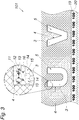
- the raster print image 3 of the security element 100 has, as in the top view in FIG Fig. 3 to recognize red, green and blue luminescent halftone dots 11, 12 and 13.
- the grid points 11, 12, 13 are arranged in a honeycomb grid 14 of the raster print image 3 in such a way that each of the hexagonal grid cells 15 of the honeycomb grid 14 has six grid points 11, 12, 13 arranged next to one another and adjoining one another having.
- Each raster cell 15 shows two red-luminescent halftone dots 11, two green-luminescent halftone dots 12 and two blue-luminescent halftone dots 13.
- the differently colored halftone dots 11, 12, 13 are arranged alternately in color, and have a size of 10 to 500 ⁇ m, in particular from 50 to 200 ⁇ m, up.
- a security element 101 is shown, wherein between the first layer 1 and the second layer 2 an embossing lacquer layer 17 is provided, which has an embossed diffraction structure 18.
- a partial metallization 19 is applied to the embossing lacquer layer 17 as a reflection layer, in order to cooperate with the embossed diffraction structure 18 to form a reflection hologram 20.
- the reflection hologram 20 may be partially provided on the security element 101 in the form of stripes, characters or patterns.
- the security elements 100, 101 according to the invention have a thickness of less than or equal to 30 .mu.m, in particular less than or equal to 25 .mu.m.
- Value documents 200, 201 are shown, wherein a security element 100 or 101 is respectively applied to the substrate 21 of the value document 200, 201.
- the value documents 200, 201 may be a banknote, a driver's license, an identity card, a passport or similar.
- the security elements 100, 101 can thereby extend from one edge of the substrate to the opposite edge of the substrate 21, in particular in the form of a band or a strip, but this has not been shown in detail in the figures.
Landscapes
- Credit Cards Or The Like (AREA)
- Printing Methods (AREA)
- Laminated Bodies (AREA)
Description
- Die Erfindung betrifft ein Sicherheitselement in Form eines Streifens mit einer ersten und zweiten polymeren Schicht, mit einem unter UV-Strahlung lumineszierenden Rasterdruckbild zwischen der ersten und zweiten Schicht, wobei das Rasterdruckbild eine Opazität aufweist und mindestens eine Aufdruckfläche mit einer Grenzkontur innerhalb des Sicherheitselements ausbildet.
- Aus dem Stand der Technik (
EP 1 241 022 A1 ) sind Sicherheitselemente in Form eines Streifens bekannt, die zwischen einer ersten polymeren Schicht und einer zweiten polymeren Schicht einen unter UV-Strahlung lumineszierenden Aufdruck aufweisen. Ein solcher, lumineszierender Aufdruck zeigt jedoch immer eine gewisse Opazität, sodass die Grenzkontur der Aufdruckfläche am Sicherheitselement vergleichsweise stark erkennbar ist. Nachteilig können solche Aufdrucke zu Opazitätsunterschieden am Sicherheitselement führen und somit Fälschungssicherheit usw. beeinträchtigen. - Die Erfindung hat sich daher zur Aufgabe gestellt, ausgehend vom eingangs geschilderten Stand der Technik, die Fälschungssicherheit eines Sicherheitselements mit einem lumineszierenden Aufdruck zu erhöhen.
- Die Erfindung löst die gestellte Aufgabe dadurch, dass mindestens eine der beiden polymeren Schichten zumindest im Bereich der Grenzkontur der Aufdruckfläche eine Opazität aufweist und in ihrer Opazität an die Opazität der Aufdruckfläche angepasst ausgebildet ist, um die visuelle Erkennbarkeit der Grenzkontur der Aufdruckfläche des lumineszierenden Rasterdruckbilds am Sicherheitselement abzuschwächen.
- Weist mindestens eine der beiden polymeren Schichten im Bereich der Grenzkontur der Aufdruckfläche, insbesondere vollflächig, eine Opazität auf und ist in ihrer Opazität an die Opazität der Aufdruckfläche angepasst ausgebildet, um die visuelle Erkennbarkeit der Grenzkontur der Aufdruckfläche des lumineszierenden Rasterdruckbilds am Sicherheitselement abzuschwächen, kann ein in hohem Maße fälschungssicheres Sicherheitsmerkmal am Sicherheitselement geschaffen werden - nicht zuletzt aufgrund des erhöhten Herstellungsaufwands. Des Weiteren ist es derart möglich, ein Sicherheitselement mit einem verdeckten Sicherheitsmerkmal zur Verfügung zu stellen, welches Sicherheitsmerkmal das allgemeine Erscheinungsbild des Sicherheitselements unter bestimmten Bedingungen nicht verändert. Erfindungsgemäß kann die Grenzkontur dieses lumineszierenden Aufdrucks nämlich gegenüber dem Sicherheitselement derart abgeschwächt bzw. verdeckt werden, dass die visuelle Erkennbarkeit des Aufdrucks, insbesondere unter Weißlicht, nicht oder kaum möglich ist - jedoch beispielsweise unter Bestrahlung mit UV-Licht sehr wohl visuell leicht erkennbar ist. Im Gegensatz zum Stand der Technik, bei dem aufgrund nicht gegebener Anpassung der Opazität ein visuell leicht erkennbarer Aufdruck bereits einen Hinweis in Bezug auf ein Sicherheitsmerkmal liefern kann, verursacht ein Sicherheitsmerkmal - welches unter bestimmten Bedingungen, vor allem bei Weißlicht, nicht oder erschwert erkennbar ist - beim erfindungsgemäßen Sicherheitselement weniger Aufmerksamkeit, was wiederum wesentlich zur Verbesserung eines Nachweises der Authentizität und in weiterer Folge der Fälschungssicherheit beitragen kann.
- Im Allgemeinen wird erwähnt, dass unter Rasterdruckbild ein gedrucktes Bild mit einem Druckraster verstanden werden kann, bei welchem die Rasterpunkte bzw. Druckpunkte neben- und übereinander aufgetragen werden können. Durch eine additive Farbmischung und/oder Intensitätsvariation kann eine Bildwirkung erzeugt werden. Rasterdruckbilder können ein- oder mehrfarbige Bilder darstellen.
- Im Allgemeinen wird weiter erwähnt, dass für diesen unter UV-Strahlung lumineszierenden Aufdruck beispielsweise eine Druckfarbe verwendet werden kann, die lumineszierende Farbstoffe oder Pigmente enthält. Solch lumineszierender Farbstoff und/oder lumineszierendes Pigment kann, beispielsweise unter Einwirkung von Strahlung, in einen energetisch angeregten Zustand gebracht werden und danach spontan in einen Zustand niedrigerer Energie übergehen - wobei Photonen einer bestimmten Wellenlänge abgegeben werden, was bei entsprechender Wellenlänge vom menschlichen Auge wahrnehmbar ist.
- Im Allgemeinen wird weiter festgehalten, dass der lumineszierende Aufdruck und/oder das Rasterdruckbild mit jedem gängigen, beispielsweise berührenden oder berührungsfreien Druckverfahren, wie etwa Tiefdruck-, Siebdruck-, Tampondruck-, Offsetdruck-, Lithographiedruck-, Flexodruck-, Hochdruck- oder Inkjet-Druckverfahren etc. aufgebracht werden kann.
- Im Allgemeinen wird zudem erwähnt, dass unter Opazität der polymeren Schichten die Lichtundurchlässigkeit im Wellenlängenbereich des sichtbaren Lichts verstanden wird.
- Sind die Opazitätswerte des Rasterdruckbilds und mindestens einer der polymeren Schichten im Wesentlichen gleich, so kann eine standfeste sowie besonders einfache und kostengünstige visuelle Verdeckung der Grenzkontur des lumineszierenden Aufdrucks erreicht werden. Sind die Opazitätswerte des Rasterdruckbilds und der zweiten polymeren Schichten im Wesentlichen gleich, bzw. insbesondere aneinander angepasst, kann auf einfache Weise sichergestellt werden, dass die erfindungsgemäßen Vorteile ebenfalls in jenen Bereichen einfach erreicht werden, in welchen oberhalb der zweiten Schicht kein Rasterdruckbild angeordnet ist.
- Die visuelle Erkennbarkeit der Grenzkontur der Aufdruckfläche des lumineszierenden Rasterdruckbilds am Sicherheitselement kann besonders zuverlässig abgeschwächt werden, wenn eine diffus streuende Lackschicht die erste Schicht ausbildet. Diesbezüglich kann sich insbesondere eine Mattlackschicht auszeichnen. Solch diffus streuende Lackschicht kann nämlich standfest unterschiedliche Opazitäten am Sicherheitselement ausgleichen und somit für ein gewünschtes, vor allem homogenes, Erscheinungsbild des Sicherheitselements sorgen. Ein besonders fälschungssicheres Sicherheitselement ist derart zur Verfügung zu stellen.
- Im Allgemeinen wird zudem erwähnt, dass das Sicherheitselement besonders vorteilhaft in einem Wertdokument eingebettet werden kann, wenn die erste Schicht bedruckbar ist. Alternativ ist es auch möglich, die erste Schicht und das Wertdokument optisch und/oder haptisch aneinander anzupassen. Durch eine vollflächige Bedruckbarkeit kann die Fälschungssicherheit des Sicherheitselements verbessert werden.
- Ist die zweite Schicht als Klebstoffschicht ausgebildet, so kann das Sicherheitselement vor äußeren Einflüssen geschützt und zugleich handhabungsfreundlich auf einem Wertdokument oder auf einem beliebigen Träger vorgesehen werden. Insbesondere kann dadurch einer Oxidation der Fluoreszenzfarbstoffe des lumineszierenden Aufdrucks vorgebeugt werden. Erfindungsgemäß kann derart ein besonders robustes und standfestes Sicherheitselement geschaffen werden.
Die Klebstoffschicht kann insbesondere einen Heißsiegel- oder einen Kaltsiegelklebestoff aufweisen. Die zweite Schicht kann aber alternativ auch eine Selbstklebebeschichtung, eine strahlungshärtende Beschichtung oder andere vergleichbare Beschichtungen aufweisen. - Im Allgemeinen wird erwähnt, dass die zweite Schicht zudem transluzent sein kann. Dabei kann ein besonders handhabungsfreundliches und zudem standfestes Sicherheitselement geschaffen werden, da die zweite Schicht das optische Erscheinungsbild des Sicherheitselements und damit dessen Sicherheitsmerkmale nicht beeinträchtigt.
- Weist das Rasterdruckbild in unterschiedlichen Farben lumineszierende Rasterpunkte auf, kann auf konstruktiv einfache Weise ein mehrfarbig lumineszierender Aufdruck geschaffen werden. Dieser mehrfarbig lumineszierende Aufdruck kann sogar echtfarbig ausgebildet sein, wenn rot und/oder grün und/oder blau lumineszierende Rasterpunkte Anwendung finden.
- Ein besonders fälschungssicheres Sicherheitsmerkmal am lumineszierenden Aufdruck kann geschaffen werden, wenn das Rasterdruckbild ein Wabenraster aufweist.
- Weist das Wabenraster sechseckige Rasterzellen auf, welche aus nebeneinander angeordneten dreieckförmigen Rasterpunkten bestehen, so kann die Fälschungssicherheit des Sicherheitsmerkmals weiter verbessert werden - insbesondere, wenn die Rasterpunkte aneinander angrenzen.
- Weist jede Rasterzelle jeweils zwei farblich gleich lumineszierende Rasterpunkte auf, können die Lumineszenzintensität und die Farbwiedergabe des lumineszierenden Aufdrucks besonders homogen gestaltet werden.
- Wird der Farbeindruck der Rasterzelle in Abhängigkeit fehlender Rasterpunkte ausgebildet, können die Variation der Farbwiedergabe und der Lumineszenzintensität innerhalb des Rasterdruckbildes auf konstruktiv einfache Art und Weise erreicht werden.
- Zusätzlich kann sich das Sicherheitselement auszeichnen, wenn der Farbeindruck der Rasterzelle in Abhängigkeit der Größe der Rasterpunkte ausgebildet wird. Dadurch kann unter anderem ein besonders homogenes Rasterdruckbild geschaffen werden - was wiederum der Fälschungssicherheit des Sicherheitselements zuträglich sein kann.
- Bevorzugt weisen die Rasterpunkte des Rasterdruckbilds eine Größe von 10 bis 500 µm, insbesondere von 50 bis 200 µm, auf.
- Im Allgemeinen wird erwähnt, dass die Fälschungssicherheit des Sicherheitselements weiter verbesserbar ist, wenn zwischen erster und zweiter Schicht eine eingeprägte Beugungsstruktur und eine an diese Beugungsstruktur anschließende Metallisierung vorgesehen sind. Die eingeprägte Beugungsstruktur kann dabei insbesondere mit der anschließenden Metallisierung zusammenwirken, um ein Reflexionshologramm auszubilden.
- Im Allgemeinen wird festgehalten, dass ein solches Reflexionshologramm wahlweise in Betrachtungsrichtung über oder unter dem lumineszierenden Aufdruck angebracht werden kann. Ist das Reflexionshologramm über dem Aufdruck vorgesehen, so muss durch entsprechende Aussparungen im Reflexionshologramm die visuelle Erkennbarkeit des Aufdrucks gewährleistet werden.
- Im Allgemeinen wird weiter festgehalten, dass die Fälschungssicherheit des Sicherheitselements weiter erhöht werden kann, wenn dieses maschinenlesbare Sicherheitsmerkmale, insbesondere mit magnetischen Eigenschaften, etwa in Form eines Magnetstreifens, aufweist. Vorstellbar ist auch, dass solche magnetischen Eigenschaften in Kombination mit einem Hologramm vorgesehen sind.
- Im Allgemeinen wird zudem festgehalten, dass eine besonders hohe Standfestigkeit und Fälschungssicherheit des Sicherheitselements erreicht werden kann, wenn das Sicherheitselement eine Dicke von kleiner gleich 30 µm, insbesondere von kleiner gleich 25 µm, aufweist. Dadurch ist eine nahezu erhebungsfreie Einbettung des Sicherheitselements in einem Substrat bzw. Wertdokument möglich.
- Das erfindungsgemäße Sicherheitselement kann seine Vorteile insbesondere zur Geltung bringen, wenn es auf einem Substrat eines Wertdokuments vorgesehen - mit diesem also verbunden - ist. Als Wertdokument sind beispielsweise eine Banknote, ein Tax Stamp, ein Reisepass, Führerschein oder Personalausweis und so weiter vorstellbar.
- Vor allem können sich diesbezüglich Wertdokumente auszeichnen, welche ein erfindungsgemäßes Sicherheitselement aufweisen, das sich von einem Rand des Substrats zum gegenüberliegenden Rand des Substrats durchgehend erstreckt. Hierbei kann es sich um streifen-, faden- oder bandförmige Sicherheitselemente handeln.
- Die Fälschungssicherheit des Wertdokuments kann weiter verbessert werden, wenn die Oberflächen der ersten Schicht des Sicherheitselements und des Wertdokuments in ihren haptischen Eigenschaften und/oder in ihrem visuellen Erscheinungsbild im Wesentlichen gleich sind. Damit kann beispielsweise in weiterer Folge ein visuell erkennbarer Opazitätsunterschied zwischen Substrat und lumineszierendem Aufdruck vermieden werden - was diesen bei Betrachtung unter Weißlicht standfest im Wertdokument verbergen kann. In Bezug auf solch einen Opazitätsunterschied kann sich eine bedruckbare Mattlackschicht am Sicherheitselement besonders auszeichnen.
- In den Figuren ist beispielsweise der Erfindungsgegenstand anhand einer Ausführungsvariante näher dargestellt. Es zeigen
- Fig. 1
- eine Schnittansicht durch ein Wertdokument mit einem Sicherheitselement gemäß einer ersten Ausführungsvariante,
- Fig. 2
- eine Schnittansicht durch ein Wertdokument mit einem Sicherheitselement gemäß einer zweiten Ausführungsvariante, und
- Fig. 3
- eine Draufsicht auf das Sicherheitselement aus
Fig. 2 . - Gemäß
Fig. 1 ist ein Sicherheitselement 100 gezeigt, welches eine erste polymere Schicht 1 und eine zweite polymere Schicht 2 aufweist, welche auf einem Trägersubstrat 10, insbesondere einer Trägerfolie, aufgebracht sind. Zwischen der ersten und zweiten polymeren Schicht 1, 2 ist ein unter UV-Strahlung lumineszierendes, eine Opazität aufweisendes Rasterdruckbild 3 auf dem Trägersubstrat 10 angeordnet, welches zumindest eine durch eine Grenzkontur 4 abgegrenzte Aufdruckfläche 5 am Sicherheitselement 100 als Sicherheitsmerkmal ausbildet. Das Rasterdruckbild 3 kann dabei insbesondere eine im Vergleich zum unbedruckten Bereich höhere Opazität aufweisen, bzw. opak sein. - Erfindungsgemäß ist/sind die erste polymere Schicht 1 und/oder die zweite polymere Schicht 2 dabei vorzugsweise in Bereichen der Grenzkontur 4 der Aufdruckfläche 5, insbesondere aber vollflächig, in ihrer Opazität an die Opazität der Aufdruckfläche 5 angepasst, um damit die visuelle Erkennbarkeit der Grenzkontur 4 der Aufdruckfläche 5 abzuschwächen. Im dargestellten Ausführungsbeispiel ist das lumineszierende Rasterdruckbild 3 daher im Sicherheitselement 100 bei Betrachtung unter Weißlicht verborgen. Die Bedingungen, unter denen das Rasterdruckbild 3 verborgen oder sichtbar sind, können selbstverständlich je nach Bedarf variiert werden. Dadurch sind neben der Erhöhung des konstruktiven Aufwands - und somit eines erschwerten Nachbaus - zugleich auch Fälschungssicherheit usw. durch das erfindungsgemäße Sicherheitselement 100 erhöht.
- Besonders auszeichnen kann sich, wenn die erste polymere Schicht 1 durch eine diffus streuende Mattlackschicht 6 ausgebildet wird. Diese stellt die erfindungsgemäßen Vorteile in Bezug auf die Grenzkontur 4 standfest sicher - kann sich aber auch auszeichnen, indem sie das Gesamterscheinungsbild des Sicherheitselements 100 an jenes des Wertdokuments 200 anpasst. Des Weiteren ist die erste Schicht 1, insbesondere in Form der Mattlackschicht 6, einfach bedruckbar und kann somit besonders fälschungssicher in ein Wertdokument eingebettet werden. Die erste Schicht 1 des Sicherheitselements 100 ist dabei an die Oberflächenbeschaffenheit des Wertdokuments 200, bzw. an das Substrat 21 des Wertdokuments 200 visuell angepasst - was auch in Hinblick auf die haptischen Eigenschaften angedacht sein kann.
- Die zweite Schicht 2 ist in dem, in
Fig. 1 dargestellten Beispiel als transluzente Heißsiegellackschicht 8 ausgebildet. Über dem Heißsiegellack 8 ist zudem ein Schutzlack 7 aufgebracht, um die im Rasterdruckbild 3 enthaltenen Lumineszenzfarbstoffe vor Oxidation zu schützen. Die Opazität des Rasterdruckbildes 3 und der zweiten polymeren Schicht 2 können alternativ im Wesentlichen gleich sein, wodurch die visuelle Erkennbarkeit der Grenzkontur 4 besonders einfach reduziert werden kann. - Das Rasterdruckbild 3 des Sicherheitselements 100 weist, wie in aus der Draufsicht in
Fig. 3 zu erkennen, rot, grün und blau lumineszierende Rasterpunkte 11, 12 und 13 auf. Dadurch ergibt sich ein echtfarbig lumineszierendes Rasterdruckbild 3. Die Rasterpunkte 11, 12, 13 sind dabei derart in einem Wabenraster 14 des Rasterdruckbilds 3 angeordnet, dass jede der sechseckigen Rasterzellen 15 des Wabenrasters 14 jeweils sechs nebeneinander angeordnete und aneinander angrenzende Rasterpunkte 11, 12, 13 aufweist. Jede Rasterzelle 15 zeigt dabei jeweils zwei rot lumineszierende Rasterpunkte 11, zwei grün lumineszierende Rasterpunkte 12 und zwei blau lumineszierende Rasterpunkte 13. Die verschiedenfarbigen Rasterpunkte 11, 12, 13 sind jeweils farblich abwechselnd angeordnet, und weisen dabei eine Größe von 10 bis 500 µm, insbesondere von 50 bis 200 µm, auf. - Um den Farbeindruck einer Rasterzelle 15 zu variieren bzw. ein Echtfarbenbild zu erzeugen, werden in der Rasterzelle 15 einzelne Rasterpunkte 16 weggelassen - wie dies im Detailausschnitt in
Fig. 3 gezeigt ist. Ebenso ist vorstellbar, jedoch in den Figuren nicht näher dargestellt, dass der Farbeindruck der Rasterzellen 15 über die variierende Größe der Rasterpunkte 11, 12, 13 ausgebildet wird. - In
Fig. 2 ist ein Sicherheitselement 101 gezeigt, wobei zwischen der ersten Schicht 1 und der zweiten Schicht 2 eine Prägelackschicht 17 vorgesehen ist, welche eine eingeprägte Beugungsstruktur 18 aufweist. An der Prägelackschicht 17 ist zudem eine partielle Metallisierung 19 als Reflexionsschicht aufgebracht, um mit der eingeprägten Beugungsstruktur 18 zu einem Reflexionshologramm 20 zusammenzuwirken. Das Reflexionshologramm 20 kann dabei in Form von Streifen, Zeichen oder Mustern auf dem Sicherheitselement 101 partiell vorgesehen sein. - Die erfindungsgemäßen Sicherheitselemente 100, 101 weisen eine Dicke von kleiner gleich 30 µm, insbesondere von kleiner gleich 25 µm, auf.
- In
Fig. 1 undFig. 2 sind Wertdokumente 200, 201 dargestellt, wobei auf dem Substrat 21 des Wertdokuments 200, 201 jeweils ein Sicherheitselement 100 bzw. 101 aufgebracht ist. Bei den Wertdokumenten 200, 201 kann es sich erfindungsgemäß um eine Banknote, einen Führerschein, einen Personalausweis, einen Reisepass oder Vergleichbarem handeln. - Die Sicherheitselemente 100, 101 können sich dabei von einem Rand des Substrats zum gegenüberliegenden Rand des Substrats 21 durchgehend, insbesondere in Form eines Bands oder eines Streifens, erstrecken, was jedoch in den Figuren nicht näher dargestellt wurde.
Claims (15)
- Sicherheitselement in Form eines Streifens mit einer ersten (1) und zweiten polymeren Schicht (2), mit einem unter UV-Strahlung lumineszierenden Rasterdruckbild (3) zwischen der ersten (1) und zweiten Schicht (2), wobei das Rasterdruckbild (3) eine Opazität aufweist und mindestens eine Aufdruckfläche (5) mit einer Grenzkontur (4) innerhalb des Sicherheitselements (100, 101) ausbildet, wobei mindestens eine der beiden polymeren Schichten (1, 2) zumindest im Bereich der Grenzkontur (4) der Aufdruckfläche (5) eine Opazität aufweist und in ihrer Opazität an die Opazität der Aufdruckfläche (5) angepasst ausgebildet ist, um die visuelle Erkennbarkeit der Grenzkontur (4) der Aufdruckfläche (5) des lumineszierenden Rasterdruckbilds (3) am Sicherheitselement (100, 101) abzuschwächen.
- Sicherheitselement nach Anspruch 1, dadurch gekennzeichnet, dass mindestens eine der beiden polymeren Schichten (1, 2) vollflächig an die Opazität der Aufdruckfläche (5) angepasst ausgebildet ist.
- Sicherheitselement nach einem der Ansprüche 1 oder 2, dadurch gekennzeichnet, dass die Opazitätswerte des Rasterdruckbilds (3) und mindestens einer der polymeren Schichten (1, 2) im Wesentlichen gleich sind.
- Sicherheitselement nach einem der Ansprüche 1 bis 3, dadurch gekennzeichnet, dass eine diffus streuende Lackschicht (6), insbesondere eine Mattlackschicht (6), die erste Schicht (1) ausbildet.
- Sicherheitselement nach einem der Ansprüche 1 bis 4, dadurch gekennzeichnet, dass die zweite Schicht (2) als Klebstoffschicht (8) ausgebildet ist.
- Sicherheitselement nach einem der Ansprüche 1 bis 5, dadurch gekennzeichnet, dass das Rasterdruckbild (3) in unterschiedlichen Farben, insbesondere rot und/oder grün und/oder blau, lumineszierende Rasterpunkte (11, 12, 13) aufweist.
- Sicherheitselement nach einem der Ansprüche 1 bis 6, dadurch gekennzeichnet, dass das Rasterdruckbild (3) ein Wabenraster (14) aufweist.
- Sicherheitselement nach Anspruch 7, dadurch gekennzeichnet, dass das Wabenraster (14) sechseckige Rasterzellen (15) aufweist, welche aus nebeneinander angeordneten, insbesondere aneinander angrenzenden, dreieckförmigen Rasterpunkten (11, 12, 13) bestehen.
- Sicherheitselement nach Anspruch 8, dadurch gekennzeichnet, dass jede Rasterzelle (15) jeweils zwei farblich gleich lumineszierende Rasterpunkte (11, 12, 13) aufweist.
- Sicherheitselement nach Anspruch 9, dadurch gekennzeichnet, dass der Farbeindruck des Rasterdruckbilds (3) in Abhängigkeit fehlender Rasterpunkte (16) ausgebildet wird.
- Sicherheitselement nach Anspruch 9 oder 10, dadurch gekennzeichnet, dass der Farbeindruck des Rasterdruckbilds (3) in Abhängigkeit der Größe der Rasterpunkte (11, 12, 13) ausgebildet wird.
- Sicherheitselement nach einem der Ansprüche 6 bis 11, dadurch gekennzeichnet, dass die Rasterpunkte (11, 12, 13) des Rasterdruckbilds (3) eine Größe von 10 bis 500 µm, insbesondere von 50 bis 200 µm, aufweisen.
- Wertdokument mit einem Substrat (21) und mit einem auf dem Substrat (21) vorgesehenen Sicherheitselement (100, 101) nach einem der Ansprüche 1 bis 12.
- Wertdokument nach Anspruch 13, dadurch gekennzeichnet, dass sich das Sicherheitselement (100, 101) von einem Rand des Substrats (21) zum gegenüberliegenden Rand des Substrats (21) durchgehend erstreckt.
- Wertdokument nach Anspruch 13 oder 14 dadurch gekennzeichnet, dass Oberflächen der ersten Schicht (1) des Sicherheitselements (100, 101) und des Wertdokuments (200, 201) in ihren haptischen Eigenschaften und/oder in ihrem visuellen Erscheinungsbild im Wesentlichen gleich sind.
Priority Applications (13)
| Application Number | Priority Date | Filing Date | Title |
|---|---|---|---|
| PL16192287T PL3305543T3 (pl) | 2016-10-04 | 2016-10-04 | Element zabezpieczający oraz dokument wartościowy z tym elementem zabezpieczającym |
| SI201630460T SI3305543T1 (sl) | 2016-10-04 | 2016-10-04 | Varnostni element in vrednostni dokument s tem varnostnim elementom |
| EP16192287.7A EP3305543B1 (de) | 2016-10-04 | 2016-10-04 | Sicherheitselement und wertdokument mit diesem sicherheitselement |
| HUE16192287A HUE046101T2 (hu) | 2016-10-04 | 2016-10-04 | Biztonsági elem és értékdokumentum ilyen biztonsági elemmel |
| ES16192287T ES2751710T3 (es) | 2016-10-04 | 2016-10-04 | Elemento de seguridad y documento de valor con este elemento de seguridad |
| JP2019515936A JP7092751B2 (ja) | 2016-10-04 | 2017-10-04 | 安全要素及び安全要素を備えた有価文書 |
| MYPI2019001841A MY196899A (en) | 2016-10-04 | 2017-10-04 | Security element and value document having said security element |
| BR112019006649-7A BR112019006649B1 (pt) | 2016-10-04 | 2017-10-04 | Elemento de segurança e documento de valor |
| PCT/EP2017/075264 WO2018065496A1 (de) | 2016-10-04 | 2017-10-04 | Sicherheitselement und wertdokument mit diesem sicherheitselement |
| RU2019112840A RU2741590C2 (ru) | 2016-10-04 | 2017-10-04 | Защитный элемент и ценный документ с этим защитным элементом |
| CN201780060508.2A CN110062702B (zh) | 2016-10-04 | 2017-10-04 | 安全元件和具有该安全元件的有价文件 |
| CA3038600A CA3038600A1 (en) | 2016-10-04 | 2017-10-04 | Security element and value document having said security element |
| US16/339,351 US11117414B2 (en) | 2016-10-04 | 2017-10-04 | Security element and value document having this security element |
Applications Claiming Priority (1)
| Application Number | Priority Date | Filing Date | Title |
|---|---|---|---|
| EP16192287.7A EP3305543B1 (de) | 2016-10-04 | 2016-10-04 | Sicherheitselement und wertdokument mit diesem sicherheitselement |
Publications (2)
| Publication Number | Publication Date |
|---|---|
| EP3305543A1 EP3305543A1 (de) | 2018-04-11 |
| EP3305543B1 true EP3305543B1 (de) | 2019-07-31 |
Family
ID=57123843
Family Applications (1)
| Application Number | Title | Priority Date | Filing Date |
|---|---|---|---|
| EP16192287.7A Active EP3305543B1 (de) | 2016-10-04 | 2016-10-04 | Sicherheitselement und wertdokument mit diesem sicherheitselement |
Country Status (12)
| Country | Link |
|---|---|
| US (1) | US11117414B2 (de) |
| EP (1) | EP3305543B1 (de) |
| JP (1) | JP7092751B2 (de) |
| CN (1) | CN110062702B (de) |
| CA (1) | CA3038600A1 (de) |
| ES (1) | ES2751710T3 (de) |
| HU (1) | HUE046101T2 (de) |
| MY (1) | MY196899A (de) |
| PL (1) | PL3305543T3 (de) |
| RU (1) | RU2741590C2 (de) |
| SI (1) | SI3305543T1 (de) |
| WO (1) | WO2018065496A1 (de) |
Families Citing this family (1)
| Publication number | Priority date | Publication date | Assignee | Title |
|---|---|---|---|---|
| EP4015230A1 (de) * | 2020-12-18 | 2022-06-22 | Hueck Folien Gesellschaft m.b.H. | Sicherheitselement mit reflektierenden und statischen merkmalen |
Family Cites Families (17)
| Publication number | Priority date | Publication date | Assignee | Title |
|---|---|---|---|---|
| JPS56564U (de) * | 1979-06-15 | 1981-01-06 | ||
| DE3932505C2 (de) | 1989-09-28 | 2001-03-15 | Gao Ges Automation Org | Datenträger mit einem optisch variablen Element |
| AU2002364255A1 (en) | 2001-12-24 | 2003-07-15 | Digimarc Id Systems, Llc | Covert variable information on id documents and methods of making same |
| US7258915B2 (en) * | 2003-08-14 | 2007-08-21 | Jds Uniphase Corporation | Flake for covert security applications |
| JP4487090B2 (ja) | 2005-01-13 | 2010-06-23 | 独立行政法人 国立印刷局 | 真偽判別可能な発光印刷物 |
| JP4079449B2 (ja) | 2006-08-21 | 2008-04-23 | 共同印刷株式会社 | 隠蔽カードの製造方法 |
| DE102007057658A1 (de) * | 2007-02-07 | 2009-06-04 | Leonhard Kurz Stiftung & Co. Kg | Sicherheitselement |
| DE102007052176B3 (de) * | 2007-10-30 | 2009-02-05 | Ovd Kinegram Ag | Sicherheitsdokument sowie Verfahren zu seiner Herstellung |
| ITMI20080053A1 (it) * | 2008-01-15 | 2009-07-16 | Fabriano Securities Srl | Elemento di sicurezza, particolarmente per banconote, carte di sicurezza e simili, avente caratteristiche anti-contraffazione. |
| DE102008062149B3 (de) * | 2008-12-16 | 2010-04-29 | Ovd Kinegram Ag | Verfahren zur Herstellung eines Sicherheitselements sowie Transferfolie |
| JP5757379B2 (ja) | 2010-01-29 | 2015-07-29 | 株式会社吉野工業所 | 多重壁構造体 |
| JP2013063611A (ja) | 2011-09-20 | 2013-04-11 | Dainippon Screen Mfg Co Ltd | 画像記録装置、画像記録方法および画像記録物 |
| JP6040540B2 (ja) | 2012-03-07 | 2016-12-07 | 大日本印刷株式会社 | 記録媒体、転写箔及び記録媒体の製造方法 |
| DE102012111054B4 (de) * | 2012-11-16 | 2023-10-19 | Bundesdruckerei Gmbh | Sicherheitselement für ein Wert- und/oder Sicherheitsdokument |
| FR3005068B1 (fr) * | 2013-04-26 | 2017-05-26 | Arjowiggins Security | Element de securite comportant un hologramme en volume. |
| WO2015095976A1 (en) * | 2013-12-23 | 2015-07-02 | Orell Füssli Sicherheitsdruck Ag | Security device for security document |
| EP3034318A1 (de) * | 2014-12-18 | 2016-06-22 | Gemalto SA | Personalisierung von physischen Medien mittels selektiver Aufdeckung und Verdeckung von vorgedruckten Farbpixeln |
-
2016
- 2016-10-04 PL PL16192287T patent/PL3305543T3/pl unknown
- 2016-10-04 SI SI201630460T patent/SI3305543T1/sl unknown
- 2016-10-04 HU HUE16192287A patent/HUE046101T2/hu unknown
- 2016-10-04 ES ES16192287T patent/ES2751710T3/es active Active
- 2016-10-04 EP EP16192287.7A patent/EP3305543B1/de active Active
-
2017
- 2017-10-04 RU RU2019112840A patent/RU2741590C2/ru active
- 2017-10-04 US US16/339,351 patent/US11117414B2/en active Active
- 2017-10-04 CN CN201780060508.2A patent/CN110062702B/zh active Active
- 2017-10-04 CA CA3038600A patent/CA3038600A1/en active Pending
- 2017-10-04 JP JP2019515936A patent/JP7092751B2/ja active Active
- 2017-10-04 WO PCT/EP2017/075264 patent/WO2018065496A1/de not_active Ceased
- 2017-10-04 MY MYPI2019001841A patent/MY196899A/en unknown
Non-Patent Citations (1)
| Title |
|---|
| None * |
Also Published As
| Publication number | Publication date |
|---|---|
| CA3038600A1 (en) | 2018-04-12 |
| RU2019112840A (ru) | 2020-11-06 |
| US11117414B2 (en) | 2021-09-14 |
| WO2018065496A1 (de) | 2018-04-12 |
| HUE046101T2 (hu) | 2020-02-28 |
| RU2741590C2 (ru) | 2021-01-27 |
| CN110062702A (zh) | 2019-07-26 |
| PL3305543T3 (pl) | 2020-05-18 |
| JP2019536656A (ja) | 2019-12-19 |
| CN110062702B (zh) | 2021-10-26 |
| JP7092751B2 (ja) | 2022-06-28 |
| MY196899A (en) | 2023-05-09 |
| US20200047538A1 (en) | 2020-02-13 |
| BR112019006649A2 (pt) | 2019-07-02 |
| EP3305543A1 (de) | 2018-04-11 |
| SI3305543T1 (sl) | 2019-12-31 |
| ES2751710T3 (es) | 2020-04-01 |
| RU2019112840A3 (de) | 2020-11-26 |
Similar Documents
| Publication | Publication Date | Title |
|---|---|---|
| EP2310211B1 (de) | Sicherheitselement sowie verfahren zu seiner herstellung | |
| EP0659936B1 (de) | Sicherheitspapier mit einem faden- oder bandförmigen Sicherheitselement | |
| EP2121348B1 (de) | Sicherheitselement für ein wertdokument | |
| EP2323852B1 (de) | Sicherheitselement mit auf- und durchlicht-informationen | |
| EP2318884B1 (de) | Binäres kippbild | |
| EP1458575A1 (de) | Sicherheitselement f r sicherheitspapiere und wertdokumente | |
| EP2920004B1 (de) | Sicherheitselement für ein wert- und/oder sicherheitsdokument | |
| DE102016007784A1 (de) | Optisch variables Sicherheitselement | |
| DE102004046695A1 (de) | Optisch variables Sicherheitselement | |
| EP4049853B1 (de) | Sicherheitselement mit einem lumineszenzmerkmal, datenträger und herstellungsverfahren | |
| DE102015004027A1 (de) | Sicherheitselement mit Effektpigmenten und einer Prägestruktur sowie Verfahren zu dessen Herstellung | |
| EP4731447A1 (de) | Sicherheitselement für wertdokumente und andere dokumente | |
| WO2011000877A1 (de) | Sicherheitselement und herstellungsverfahren dafür | |
| EP3332982B1 (de) | Sicherheitselement mit lumineszenzmerkmal | |
| EP4000942A1 (de) | Sicherheitselement mit maschinenlesbaren sicherheitsmerkmalen | |
| EP3305541B1 (de) | Sicherheitselement und wertdokument mit diesem sicherheitselement | |
| DE102012222583A1 (de) | Sicherheitssystem für Sicherheitspapiere, Wertdokumente oder dergleichen | |
| DE102017003603A1 (de) | Sicherheitselement mit farbigem Merkmalsbereich | |
| WO2018065496A1 (de) | Sicherheitselement und wertdokument mit diesem sicherheitselement | |
| DE102009056462A1 (de) | Durchsichts-Sicherheitsmerkmal | |
| EP4489977A1 (de) | Datenträger mit von gegenüberliegenden seiten sichtbaren motivbildern und zugehöriges herstellungsverfahren | |
| EP4183592B1 (de) | Durchsichtssicherheitselement und herstellungsverfahren | |
| EP4613500A1 (de) | Sicherheitselement und verfahren zur herstellung eines sicherheitselements |
Legal Events
| Date | Code | Title | Description |
|---|---|---|---|
| PUAI | Public reference made under article 153(3) epc to a published international application that has entered the european phase |
Free format text: ORIGINAL CODE: 0009012 |
|
| STAA | Information on the status of an ep patent application or granted ep patent |
Free format text: STATUS: THE APPLICATION HAS BEEN PUBLISHED |
|
| AK | Designated contracting states |
Kind code of ref document: A1 Designated state(s): AL AT BE BG CH CY CZ DE DK EE ES FI FR GB GR HR HU IE IS IT LI LT LU LV MC MK MT NL NO PL PT RO RS SE SI SK SM TR |
|
| AX | Request for extension of the european patent |
Extension state: BA ME |
|
| RIN1 | Information on inventor provided before grant (corrected) |
Inventor name: SCHMIDEGG, KLAUS Inventor name: CAPIEZ, FABRICE Inventor name: BLANC, MICHEL Inventor name: MARTIN, OLIVIER Inventor name: VILCOT, ROGER Inventor name: LANDERTSHAMER, SONJA |
|
| STAA | Information on the status of an ep patent application or granted ep patent |
Free format text: STATUS: REQUEST FOR EXAMINATION WAS MADE |
|
| 17P | Request for examination filed |
Effective date: 20181011 |
|
| RBV | Designated contracting states (corrected) |
Designated state(s): AL AT BE BG CH CY CZ DE DK EE ES FI FR GB GR HR HU IE IS IT LI LT LU LV MC MK MT NL NO PL PT RO RS SE SI SK SM TR |
|
| GRAJ | Information related to disapproval of communication of intention to grant by the applicant or resumption of examination proceedings by the epo deleted |
Free format text: ORIGINAL CODE: EPIDOSDIGR1 |
|
| STAA | Information on the status of an ep patent application or granted ep patent |
Free format text: STATUS: GRANT OF PATENT IS INTENDED |
|
| GRAP | Despatch of communication of intention to grant a patent |
Free format text: ORIGINAL CODE: EPIDOSNIGR1 |
|
| RIC1 | Information provided on ipc code assigned before grant |
Ipc: B42D 25/387 20140101AFI20190117BHEP |
|
| INTG | Intention to grant announced |
Effective date: 20190207 |
|
| GRAS | Grant fee paid |
Free format text: ORIGINAL CODE: EPIDOSNIGR3 |
|
| GRAA | (expected) grant |
Free format text: ORIGINAL CODE: 0009210 |
|
| STAA | Information on the status of an ep patent application or granted ep patent |
Free format text: STATUS: THE PATENT HAS BEEN GRANTED |
|
| AK | Designated contracting states |
Kind code of ref document: B1 Designated state(s): AL AT BE BG CH CY CZ DE DK EE ES FI FR GB GR HR HU IE IS IT LI LT LU LV MC MK MT NL NO PL PT RO RS SE SI SK SM TR |
|
| REG | Reference to a national code |
Ref country code: CH Ref legal event code: EP Ref country code: GB Ref legal event code: FG4D Free format text: NOT ENGLISH |
|
| REG | Reference to a national code |
Ref country code: AT Ref legal event code: REF Ref document number: 1160509 Country of ref document: AT Kind code of ref document: T Effective date: 20190815 |
|
| REG | Reference to a national code |
Ref country code: IE Ref legal event code: FG4D Free format text: LANGUAGE OF EP DOCUMENT: GERMAN |
|
| REG | Reference to a national code |
Ref country code: DE Ref legal event code: R096 Ref document number: 502016005778 Country of ref document: DE |
|
| REG | Reference to a national code |
Ref country code: SE Ref legal event code: TRGR |
|
| REG | Reference to a national code |
Ref country code: NL Ref legal event code: FP |
|
| REG | Reference to a national code |
Ref country code: CH Ref legal event code: NV Representative=s name: ISLER AND PEDRAZZINI AG, CH |
|
| REG | Reference to a national code |
Ref country code: LT Ref legal event code: MG4D |
|
| PG25 | Lapsed in a contracting state [announced via postgrant information from national office to epo] |
Ref country code: FI Free format text: LAPSE BECAUSE OF FAILURE TO SUBMIT A TRANSLATION OF THE DESCRIPTION OR TO PAY THE FEE WITHIN THE PRESCRIBED TIME-LIMIT Effective date: 20190731 Ref country code: PT Free format text: LAPSE BECAUSE OF FAILURE TO SUBMIT A TRANSLATION OF THE DESCRIPTION OR TO PAY THE FEE WITHIN THE PRESCRIBED TIME-LIMIT Effective date: 20191202 Ref country code: NO Free format text: LAPSE BECAUSE OF FAILURE TO SUBMIT A TRANSLATION OF THE DESCRIPTION OR TO PAY THE FEE WITHIN THE PRESCRIBED TIME-LIMIT Effective date: 20191031 Ref country code: LT Free format text: LAPSE BECAUSE OF FAILURE TO SUBMIT A TRANSLATION OF THE DESCRIPTION OR TO PAY THE FEE WITHIN THE PRESCRIBED TIME-LIMIT Effective date: 20190731 Ref country code: HR Free format text: LAPSE BECAUSE OF FAILURE TO SUBMIT A TRANSLATION OF THE DESCRIPTION OR TO PAY THE FEE WITHIN THE PRESCRIBED TIME-LIMIT Effective date: 20190731 |
|
| PG25 | Lapsed in a contracting state [announced via postgrant information from national office to epo] |
Ref country code: RS Free format text: LAPSE BECAUSE OF FAILURE TO SUBMIT A TRANSLATION OF THE DESCRIPTION OR TO PAY THE FEE WITHIN THE PRESCRIBED TIME-LIMIT Effective date: 20190731 Ref country code: LV Free format text: LAPSE BECAUSE OF FAILURE TO SUBMIT A TRANSLATION OF THE DESCRIPTION OR TO PAY THE FEE WITHIN THE PRESCRIBED TIME-LIMIT Effective date: 20190731 Ref country code: IS Free format text: LAPSE BECAUSE OF FAILURE TO SUBMIT A TRANSLATION OF THE DESCRIPTION OR TO PAY THE FEE WITHIN THE PRESCRIBED TIME-LIMIT Effective date: 20191130 Ref country code: AL Free format text: LAPSE BECAUSE OF FAILURE TO SUBMIT A TRANSLATION OF THE DESCRIPTION OR TO PAY THE FEE WITHIN THE PRESCRIBED TIME-LIMIT Effective date: 20190731 Ref country code: GR Free format text: LAPSE BECAUSE OF FAILURE TO SUBMIT A TRANSLATION OF THE DESCRIPTION OR TO PAY THE FEE WITHIN THE PRESCRIBED TIME-LIMIT Effective date: 20191101 |
|
| REG | Reference to a national code |
Ref country code: HU Ref legal event code: AG4A Ref document number: E046101 Country of ref document: HU |
|
| PG25 | Lapsed in a contracting state [announced via postgrant information from national office to epo] |
Ref country code: TR Free format text: LAPSE BECAUSE OF FAILURE TO SUBMIT A TRANSLATION OF THE DESCRIPTION OR TO PAY THE FEE WITHIN THE PRESCRIBED TIME-LIMIT Effective date: 20190731 |
|
| REG | Reference to a national code |
Ref country code: ES Ref legal event code: FG2A Ref document number: 2751710 Country of ref document: ES Kind code of ref document: T3 Effective date: 20200401 |
|
| PG25 | Lapsed in a contracting state [announced via postgrant information from national office to epo] |
Ref country code: RO Free format text: LAPSE BECAUSE OF FAILURE TO SUBMIT A TRANSLATION OF THE DESCRIPTION OR TO PAY THE FEE WITHIN THE PRESCRIBED TIME-LIMIT Effective date: 20190731 Ref country code: DK Free format text: LAPSE BECAUSE OF FAILURE TO SUBMIT A TRANSLATION OF THE DESCRIPTION OR TO PAY THE FEE WITHIN THE PRESCRIBED TIME-LIMIT Effective date: 20190731 Ref country code: EE Free format text: LAPSE BECAUSE OF FAILURE TO SUBMIT A TRANSLATION OF THE DESCRIPTION OR TO PAY THE FEE WITHIN THE PRESCRIBED TIME-LIMIT Effective date: 20190731 |
|
| PG25 | Lapsed in a contracting state [announced via postgrant information from national office to epo] |
Ref country code: SK Free format text: LAPSE BECAUSE OF FAILURE TO SUBMIT A TRANSLATION OF THE DESCRIPTION OR TO PAY THE FEE WITHIN THE PRESCRIBED TIME-LIMIT Effective date: 20190731 Ref country code: SM Free format text: LAPSE BECAUSE OF FAILURE TO SUBMIT A TRANSLATION OF THE DESCRIPTION OR TO PAY THE FEE WITHIN THE PRESCRIBED TIME-LIMIT Effective date: 20190731 Ref country code: CZ Free format text: LAPSE BECAUSE OF FAILURE TO SUBMIT A TRANSLATION OF THE DESCRIPTION OR TO PAY THE FEE WITHIN THE PRESCRIBED TIME-LIMIT Effective date: 20190731 Ref country code: IS Free format text: LAPSE BECAUSE OF FAILURE TO SUBMIT A TRANSLATION OF THE DESCRIPTION OR TO PAY THE FEE WITHIN THE PRESCRIBED TIME-LIMIT Effective date: 20200224 Ref country code: MC Free format text: LAPSE BECAUSE OF FAILURE TO SUBMIT A TRANSLATION OF THE DESCRIPTION OR TO PAY THE FEE WITHIN THE PRESCRIBED TIME-LIMIT Effective date: 20190731 |
|
| REG | Reference to a national code |
Ref country code: DE Ref legal event code: R097 Ref document number: 502016005778 Country of ref document: DE |
|
| PLBE | No opposition filed within time limit |
Free format text: ORIGINAL CODE: 0009261 |
|
| STAA | Information on the status of an ep patent application or granted ep patent |
Free format text: STATUS: NO OPPOSITION FILED WITHIN TIME LIMIT |
|
| PG2D | Information on lapse in contracting state deleted |
Ref country code: IS |
|
| PG25 | Lapsed in a contracting state [announced via postgrant information from national office to epo] |
Ref country code: LU Free format text: LAPSE BECAUSE OF NON-PAYMENT OF DUE FEES Effective date: 20191004 Ref country code: IS Free format text: LAPSE BECAUSE OF FAILURE TO SUBMIT A TRANSLATION OF THE DESCRIPTION OR TO PAY THE FEE WITHIN THE PRESCRIBED TIME-LIMIT Effective date: 20191030 |
|
| 26N | No opposition filed |
Effective date: 20200603 |
|
| REG | Reference to a national code |
Ref country code: BE Ref legal event code: MM Effective date: 20191031 |
|
| PG25 | Lapsed in a contracting state [announced via postgrant information from national office to epo] |
Ref country code: BE Free format text: LAPSE BECAUSE OF NON-PAYMENT OF DUE FEES Effective date: 20191031 |
|
| PG25 | Lapsed in a contracting state [announced via postgrant information from national office to epo] |
Ref country code: IE Free format text: LAPSE BECAUSE OF NON-PAYMENT OF DUE FEES Effective date: 20191004 |
|
| PG25 | Lapsed in a contracting state [announced via postgrant information from national office to epo] |
Ref country code: CY Free format text: LAPSE BECAUSE OF FAILURE TO SUBMIT A TRANSLATION OF THE DESCRIPTION OR TO PAY THE FEE WITHIN THE PRESCRIBED TIME-LIMIT Effective date: 20190731 |
|
| PG25 | Lapsed in a contracting state [announced via postgrant information from national office to epo] |
Ref country code: MK Free format text: LAPSE BECAUSE OF FAILURE TO SUBMIT A TRANSLATION OF THE DESCRIPTION OR TO PAY THE FEE WITHIN THE PRESCRIBED TIME-LIMIT Effective date: 20190731 |
|
| P01 | Opt-out of the competence of the unified patent court (upc) registered |
Effective date: 20230514 |
|
| PGFP | Annual fee paid to national office [announced via postgrant information from national office to epo] |
Ref country code: PL Payment date: 20250922 Year of fee payment: 10 |
|
| PGFP | Annual fee paid to national office [announced via postgrant information from national office to epo] |
Ref country code: SI Payment date: 20250923 Year of fee payment: 10 |
|
| REG | Reference to a national code |
Ref country code: CH Ref legal event code: U11 Free format text: ST27 STATUS EVENT CODE: U-0-0-U10-U11 (AS PROVIDED BY THE NATIONAL OFFICE) Effective date: 20251101 |
|
| PGFP | Annual fee paid to national office [announced via postgrant information from national office to epo] |
Ref country code: NL Payment date: 20251023 Year of fee payment: 10 |
|
| PGFP | Annual fee paid to national office [announced via postgrant information from national office to epo] |
Ref country code: HU Payment date: 20251106 Year of fee payment: 10 |
|
| PGFP | Annual fee paid to national office [announced via postgrant information from national office to epo] |
Ref country code: DE Payment date: 20251020 Year of fee payment: 10 |
|
| PGFP | Annual fee paid to national office [announced via postgrant information from national office to epo] |
Ref country code: GB Payment date: 20251014 Year of fee payment: 10 |
|
| PGFP | Annual fee paid to national office [announced via postgrant information from national office to epo] |
Ref country code: AT Payment date: 20251021 Year of fee payment: 10 |
|
| PGFP | Annual fee paid to national office [announced via postgrant information from national office to epo] |
Ref country code: IT Payment date: 20251031 Year of fee payment: 10 |
|
| PGFP | Annual fee paid to national office [announced via postgrant information from national office to epo] |
Ref country code: FR Payment date: 20251024 Year of fee payment: 10 |
|
| PGFP | Annual fee paid to national office [announced via postgrant information from national office to epo] |
Ref country code: SE Payment date: 20251023 Year of fee payment: 10 Ref country code: CH Payment date: 20251101 Year of fee payment: 10 |
|
| PGFP | Annual fee paid to national office [announced via postgrant information from national office to epo] |
Ref country code: MT Payment date: 20251021 Year of fee payment: 10 |
|
| PGFP | Annual fee paid to national office [announced via postgrant information from national office to epo] |
Ref country code: BG Payment date: 20251023 Year of fee payment: 10 |
|
| PGFP | Annual fee paid to national office [announced via postgrant information from national office to epo] |
Ref country code: ES Payment date: 20251114 Year of fee payment: 10 |