EP3305547B1 - Pneumatique et son procédé de production - Google Patents
Pneumatique et son procédé de production Download PDFInfo
- Publication number
- EP3305547B1 EP3305547B1 EP16800094.1A EP16800094A EP3305547B1 EP 3305547 B1 EP3305547 B1 EP 3305547B1 EP 16800094 A EP16800094 A EP 16800094A EP 3305547 B1 EP3305547 B1 EP 3305547B1
- Authority
- EP
- European Patent Office
- Prior art keywords
- tire
- compound
- ingredient
- composition
- rubber
- Prior art date
- Legal status (The legal status is an assumption and is not a legal conclusion. Google has not performed a legal analysis and makes no representation as to the accuracy of the status listed.)
- Active
Links
Images


Classifications
-
- B—PERFORMING OPERATIONS; TRANSPORTING
- B60—VEHICLES IN GENERAL
- B60C—VEHICLE TYRES; TYRE INFLATION; TYRE CHANGING; CONNECTING VALVES TO INFLATABLE ELASTIC BODIES IN GENERAL; DEVICES OR ARRANGEMENTS RELATED TO TYRES
- B60C1/00—Tyres characterised by the chemical composition or the physical arrangement or mixture of the composition
- B60C1/0041—Compositions of the carcass layers
-
- B—PERFORMING OPERATIONS; TRANSPORTING
- B29—WORKING OF PLASTICS; WORKING OF SUBSTANCES IN A PLASTIC STATE IN GENERAL
- B29D—PRODUCING PARTICULAR ARTICLES FROM PLASTICS OR FROM SUBSTANCES IN A PLASTIC STATE
- B29D30/00—Producing pneumatic or solid tyres or parts thereof
- B29D30/06—Pneumatic tyres or parts thereof (e.g. produced by casting, moulding, compression moulding, injection moulding, centrifugal casting)
- B29D30/08—Building tyres
-
- B—PERFORMING OPERATIONS; TRANSPORTING
- B29—WORKING OF PLASTICS; WORKING OF SUBSTANCES IN A PLASTIC STATE IN GENERAL
- B29D—PRODUCING PARTICULAR ARTICLES FROM PLASTICS OR FROM SUBSTANCES IN A PLASTIC STATE
- B29D30/00—Producing pneumatic or solid tyres or parts thereof
- B29D30/06—Pneumatic tyres or parts thereof (e.g. produced by casting, moulding, compression moulding, injection moulding, centrifugal casting)
- B29D30/0601—Vulcanising tyres; Vulcanising presses for tyres
-
- B—PERFORMING OPERATIONS; TRANSPORTING
- B29—WORKING OF PLASTICS; WORKING OF SUBSTANCES IN A PLASTIC STATE IN GENERAL
- B29D—PRODUCING PARTICULAR ARTICLES FROM PLASTICS OR FROM SUBSTANCES IN A PLASTIC STATE
- B29D30/00—Producing pneumatic or solid tyres or parts thereof
- B29D30/06—Pneumatic tyres or parts thereof (e.g. produced by casting, moulding, compression moulding, injection moulding, centrifugal casting)
- B29D30/52—Unvulcanised treads, e.g. on used tyres; Retreading
- B29D30/58—Applying bands of rubber treads, i.e. applying camel backs
-
- B—PERFORMING OPERATIONS; TRANSPORTING
- B60—VEHICLES IN GENERAL
- B60C—VEHICLE TYRES; TYRE INFLATION; TYRE CHANGING; CONNECTING VALVES TO INFLATABLE ELASTIC BODIES IN GENERAL; DEVICES OR ARRANGEMENTS RELATED TO TYRES
- B60C5/00—Inflatable pneumatic tyres or inner tubes
- B60C5/01—Inflatable pneumatic tyres or inner tubes without substantial cord reinforcement, e.g. cordless tyres, cast tyres
-
- B—PERFORMING OPERATIONS; TRANSPORTING
- B60—VEHICLES IN GENERAL
- B60C—VEHICLE TYRES; TYRE INFLATION; TYRE CHANGING; CONNECTING VALVES TO INFLATABLE ELASTIC BODIES IN GENERAL; DEVICES OR ARRANGEMENTS RELATED TO TYRES
- B60C9/00—Reinforcements or ply arrangement of pneumatic tyres
- B60C9/02—Carcasses
-
- C—CHEMISTRY; METALLURGY
- C09—DYES; PAINTS; POLISHES; NATURAL RESINS; ADHESIVES; COMPOSITIONS NOT OTHERWISE PROVIDED FOR; APPLICATIONS OF MATERIALS NOT OTHERWISE PROVIDED FOR
- C09J—ADHESIVES; NON-MECHANICAL ASPECTS OF ADHESIVE PROCESSES IN GENERAL; ADHESIVE PROCESSES NOT PROVIDED FOR ELSEWHERE; USE OF MATERIALS AS ADHESIVES
- C09J175/00—Adhesives based on polyureas or polyurethanes; Adhesives based on derivatives of such polymers
- C09J175/04—Polyurethanes
-
- B—PERFORMING OPERATIONS; TRANSPORTING
- B29—WORKING OF PLASTICS; WORKING OF SUBSTANCES IN A PLASTIC STATE IN GENERAL
- B29D—PRODUCING PARTICULAR ARTICLES FROM PLASTICS OR FROM SUBSTANCES IN A PLASTIC STATE
- B29D30/00—Producing pneumatic or solid tyres or parts thereof
- B29D30/06—Pneumatic tyres or parts thereof (e.g. produced by casting, moulding, compression moulding, injection moulding, centrifugal casting)
- B29D30/08—Building tyres
- B29D2030/084—Placing two side portions of the tyre into the mould and introducing, e.g. by extrusion or injection moulding, the tread material to create the toroidal tyre
-
- B—PERFORMING OPERATIONS; TRANSPORTING
- B29—WORKING OF PLASTICS; WORKING OF SUBSTANCES IN A PLASTIC STATE IN GENERAL
- B29D—PRODUCING PARTICULAR ARTICLES FROM PLASTICS OR FROM SUBSTANCES IN A PLASTIC STATE
- B29D30/00—Producing pneumatic or solid tyres or parts thereof
- B29D30/06—Pneumatic tyres or parts thereof (e.g. produced by casting, moulding, compression moulding, injection moulding, centrifugal casting)
- B29D30/08—Building tyres
- B29D2030/086—Building the tyre carcass by combining two or more sub-assemblies, e.g. two half-carcasses
-
- B—PERFORMING OPERATIONS; TRANSPORTING
- B29—WORKING OF PLASTICS; WORKING OF SUBSTANCES IN A PLASTIC STATE IN GENERAL
- B29D—PRODUCING PARTICULAR ARTICLES FROM PLASTICS OR FROM SUBSTANCES IN A PLASTIC STATE
- B29D30/00—Producing pneumatic or solid tyres or parts thereof
- B29D30/06—Pneumatic tyres or parts thereof (e.g. produced by casting, moulding, compression moulding, injection moulding, centrifugal casting)
- B29D30/48—Bead-rings or bead-cores; Treatment thereof prior to building the tyre
- B29D2030/486—Additional components for the tyre bead areas, e.g. cushioning elements, chafers, flippers
Definitions
- the present invention relates to a tire and a method of producing the same.
- JP-A Japanese Patent Application Laid-Open
- JP 2014-227500 discloses a method for producing a joined body
- WO 2014/188914 discloses a laminate and a method for producing the laminate
- JP 2012-066809 discloses a tire which is made of a thermoplastic polymeric material
- WO 2013/129524 discloses a tire having a ring-shaped tire skeleton body formed by a resin material containing and thermoplastic resin and fibers.
- an adhesive When an adhesive is used for fixing an exterior component on a tire frame, it is desirable that such an adhesive is selected as is able to exhibit the required performances for a tire considering the affinity between materials used for either of the components and the adhesive.
- the object of an embodiment of the invention is to provide a tire, in which an exterior component is not apt to detach from a tire frame.
- a tire in which an exterior component is not apt to detach from a tire frame, may be provided.
- Resin is herein a concept including a thermoplastic resin and a thermosetting resin, but excluding a vulcanized rubber, such as a natural rubber or a synthetic rubber.
- Rubber is a polymer compound having elasticity, and is discriminated herein from a thermoplastic resin elastomer.
- thermoplastic resin means a polymeric compound, which material softens and flows with temperature elevation, and when cooled, it comes into a relatively hard and strong state. It is a concept including a thermoplastic elastomer.
- thermoplastic resin elastomer is a polymeric compound having elasticity, and means a thermoplastic resin composed of a copolymer having a polymer constituting a crystalline hard segment with a high melting point, or a hard segment with a high cohesion, and a polymer constituting an amorphous soft segment with a low glass transition temperature.
- thermoplastic resin elastomer a hard segment acts as a pseudo-crosslinking point to develop elasticity (so-called, physical crosslinking).
- a rubber has a double bond, etc. in the molecular chain, and a three dimensional network structure is formed by adding sulfur, etc. for crosslinking (namely, vulcanization) to develop elasticity (namely, development of elasticity by chemical crosslinking). Therefore, in a thermoplastic resin elastomer, a hard segment is melted by heating, and a pseudo-crosslinking point is formed again by cooling.
- a numerical range expressed by "x to y" means herein a range including the values of x and y as the minimum and maximum values, respectively.
- the content means, unless otherwise specified, the total amount of the plural substances existing in the composition.
- a tire according to the first embodiment includes a tire frame, which is toric and is formed from a resin material containing a thermoplastic resin; an adhesion layer, which is formed from a composition including a polythiol compound (hereinafter also referred to as “polythiol compound (A)”), a polyisocyanate compound (hereinafter also referred to as “polyisocyanate compound (B)”), and a radical generator (hereinafter also referred to as “radical generator (C)”), and in which a ratio (S/N) of a number (S) of sulfur atoms contained in the adhesion layer to a number (N) of nitrogen atoms contained in the adhesion layer is three or more; and an exterior component, which contains a rubber, and which is mounted on the tire frame via the adhesion layer such that at least part of the rubber touches the adhesion layer.
- a polythiol compound hereinafter also referred to as "polythiol compound (A)”
- a polythiol compound (A), a polyisocyanate compound (B), and a radical generator (C), as well as a catalyst (D) and a surface conditioner (E) described below may be occasionally referred to respectively as an ingredient (A), an ingredient (B), an ingredient (C), an ingredient (D), and an ingredient (E).
- the tire according to the first embodiment has the above constitution, an exterior component is not apt to detach from a tire frame. Although the reason for the above is not very clear, it is presumed as follows.
- part of thiol groups in an ingredient (A) contained in the composition react with an isocyanate group in an ingredient (B) to cause polymerization of the ingredient (A) with the ingredient (B). It is conceivable that the film strength of an adhesion layer may be increased owing to the copolymerization of the ingredient (A) and the ingredient (B).
- a radical is generated through activation of an ingredient (C), and the generated radical acts on a thiol group in an ingredient (A) having not reacted with an isocyanate group in an ingredient (B) to generate a thiyl radical.
- the thiyl radical causes a thiol-ene reaction with a carbon-carbon double bond included in a rubber of an exterior component to establish a chemical bond at an interface with the rubber, so that the interfacial adhesive strength between an adhesion layer and an exterior component can be enhanced.
- part of thiol groups contained in an ingredient (A) are used for a copolymerization reaction with an ingredient (B), and at least part of thiol groups not having reacted with an isocyanate group in the ingredient (B) are used for a thiol-ene reaction with a rubber.
- the ratio (S/N) in an adhesion layer is three or more.
- the ratio (S/N) in an adhesion layer is 3 or more, a copolymerization reaction with an ingredient (B) and a thiol-ene reaction with a rubber occur with good balance, such that both a high film strength and a high interfacial adhesive strength can be obtained, and an exterior component may become hardly detachable from a tire frame.
- adhesion strength including a film strength and an interfacial adhesive strength may be occasionally referred to as "adhesive strength”.
- a tire according to the first embodiment includes as described above at least a tire frame, an adhesion layer, and an exterior component, and, if necessary, may include another layer.
- examples of such other layer include an undercoat layer to be provided between the tire frame and the adhesion layer
- a tire frame in the first embodiment is formed from a resin material containing a thermoplastic resin.
- thermoplastic resin contains at least a thermoplastic resin, and may contain another ingredient such as an additive.
- thermoplastic resin examples include a polyamide thermoplastic resin, a polyester thermoplastic resin, an olefinic thermoplastic resin, a polyurethane thermoplastic resin, a vinyl chloride thermoplastic resin, and a polystyrene thermoplastic resin. They may be used singly or in combination of two or more kinds thereof. Among them a polyamide thermoplastic resin, a polyester thermoplastic resin, and an olefinic thermoplastic resin are preferable, and a polyamide thermoplastic resin, and an olefinic thermoplastic resin are further preferable.
- thermoplastic elastomer examples include a polyamide thermoplastic elastomer (TPA), a polystyrene thermoplastic elastomer (TPS), a polyurethane thermoplastic elastomer (TPU), an olefinic thermoplastic elastomer (TPO), a polyester thermoplastic elastomer (TPEE), a crosslinked thermoplastic rubber (TPV), and other thermoplastic elastomers (TPZ) as stipulated in JIS K 6418.
- TPA polyamide thermoplastic elastomer
- TPS polystyrene thermoplastic elastomer
- TPU polyurethane thermoplastic elastomer
- TPO olefinic thermoplastic elastomer
- TPEE polyester thermoplastic elastomer
- TPV crosslinked thermoplastic rubber
- TPZ thermoplastic elastomers
- a polyamide thermoplastic elastomer, and a polyolefin thermoplastic elastomer will be described below as an example of a thermoplastic resin contained in a resin material for forming a tire frame.
- a polyamide thermoplastic elastomer means a thermoplastic elastomer, which is composed of a copolymer having a polymer constituting a crystalline hard segment with a high melting point, and a polymer constituting an amorphous soft segment with a low glass transition temperature, and has an amide bond (-CONH-) in a main chain of the polymer constituting a hard segment.
- Examples of a polyamide forming a hard segment may include polyamides to be synthesized with a monomer expressed by the following Formula (1) or Formula (2).
- Formula (1) H 2 N-R 1 -COOH
- R 1 represents a molecular chain of a C2 to C20 hydrocarbon, or a C2 to C20 alkylene group.
- R 2 represents a molecular chain of a C3 to C20 hydrocarbon, or a C3 to C20 alkylene group.
- Examples of a monomer expressed by Formula (1) or Formula (2) may include ⁇ -aminocarboxylic acid and lactam.
- Examples of the polyamide forming a hard segment may include a condensation polymer of the ⁇ -aminocarboxylic acid or the lactam, and a condensation copolymer of a diamine and a dicarboxylic acid.
- Examples of the polyamide forming a hard segment may include a polyamide (polyamide 6) formed by ring opening polycondensation of ⁇ -caprolactam, a polyamide (polyamide 11) formed by ring opening polycondensation of undecane lactam, a polyamide (polyamide 12) formed by ring opening polycondensation of lauryl lactam, a polyamide (polyamide 12) formed by polycondensation of 12-aminododecanoic acid, a polyamide (polyamide 66) formed by polycondensation of a diamine and a dibasic acid, and a polyamide (amide MX) having m -xylylenediamine as a constituent.
- a polyamide (polyamide 6) formed by ring opening polycondensation of ⁇ -caprolactam a polyamide (polyamide 11) formed by ring opening polycondensation of undecane lactam
- An amide MX having m -xylylenediamine as a constituent may be expressed for example with the following constituent (A-1) [in (A-1) n represents an optional number of recurring units], and n is preferably from 2 to 100, and further preferably from 3 to 50.
- the number average molecular weight of a polymer (polyamide) forming the hard segment is preferably from 300 to 15000 from the viewpoint of melt molding property, toughness, and flexibility at low temperature.
- Examples of a polymer for forming the soft segment may include polyester and polyether, as well as poly(ethylene glycol), poly(propylene glycol), poly(tetramethylene ether)glycol (PTMG), and an ABA type triblock polyether. They may be used singly or in combination of two or more kinds thereof.
- a functional group may be introduced to the end of a polymer forming a soft segment.
- the functional group there is no particular restriction on the functional group, insofar as it can react with an end group of a compound to react with a polymer forming a soft segment (namely, a polymer forming a hard segment, a chain extender, etc .).
- examples of the functional group may include an amino group.
- Examples of a polymer forming a soft segment, to which end an amino group is introduced may include a polyether diamine, in which ammonia, etc. is reacted with the end of polyether. Specific examples thereof may include an ABA type triblock polyether diamine.
- Examples of an "ABA type triblock polyether” may include a polyether expressed by the following Formula (3).
- x and z each independently represent an integer from 1 to 20.
- y represents an integer from 4 to 50.
- Examples of "ABA type triblock polyether diamine” may include a polyether diamine expressed by the following Formula (N).
- X N and Z N each independently represent an integer from 1 to 20.
- Y N represents an integer from 4 to 50.
- the number average molecular weight of a polymer forming a soft segment is preferably from 200 to 6000 from the viewpoint of toughness and flexibility at low temperature, more preferably from 400 to 4000, and especially preferably from 600 to 2000.
- examples of a bonding link of a polyamide thermoplastic elastomer may include a part bonded with a chain extender.
- Examples of the chain extender may include a dicarboxylic acid, a diol, and a diisocyanate.
- the dicarboxylic acid at least one kind selected out of, for example, an aliphatic dicarboxylic acid, an alicyclic dicarboxylic acid, an aromatic dicarboxylic acid, or a derivative thereof may be used.
- the diol may include an aliphatic diol, an alicyclic diol, and an aromatic diol.
- As the diisocyanate for example, an aromatic diisocyanate, an aliphatic diisocyanate, an alicyclic diisocyanate, or a mixture thereof may be used.
- the number average molecular weight of a polyamide thermoplastic elastomer is for example from 15,700 to 200,000. When the number average molecular weight of the polyamide thermoplastic elastomer is less than 15,700, the rim assembling performance may be lowered. When the number average molecular weight of the polyamide thermoplastic elastomer exceeds 200,000, the melt viscosity is increased, and it may become necessary to increase a molding temperature, or a mold temperature in order to prevent shortage in filling in forming a tire frame. By doing so, the cycle time may be prolonged to deteriorate the productivity.
- the number average molecular weight of the polyamide thermoplastic elastomer is preferably from 20,000 to 160,000.
- the number average molecular weight of the polyamide thermoplastic elastomer may be measured by gel permeation chromatography (GPC), for which, for example, a GPC system such as "HLC-8320GPC EcoSEC” (produced by Tosoh Corporation) may be used.
- GPC gel permeation chromatography
- the number average molecular weight of another thermoplastic elastomer described below may be measured identically.
- the ratio (x/y) of the mass (x) of the hard segment to the mass (y) of the soft segment is preferably from 30/70 to 80/20 from the viewpoint of securement of tire stiffness and rim assembly ability, and more preferably from 50/50 to 75/25.
- a content such that a functional group at the end of a polymer for forming a soft segment (for example, a hydroxy group, or an amino group), and a carboxyl group of the chain extender are nearly equimolar.
- the polyamide thermoplastic elastomer may be synthesized by copolymerizing a polymer forming the hard segment with a polymer forming the soft segment by a method known in the art.
- the polyamide thermoplastic elastomer may be obtained by polymerizing a monomer to constitute a hard segment (for example, ⁇ -aminocarboxylic acid such as 12-aminododecanoic acid, or a lactam such as lauryl lactam) and a chain extender (for example, adipic acid, or dodecane dicarboxylic acid) in a vessel; then adding a polymer to constitute a soft segment (for example, poly(propylene glycol), an ABA type triblock polyether, or a diamine obtained by modifying the ends thereof to amino groups); and further polymerizing the mixture.
- a hard segment for example, ⁇ -aminocarboxylic acid such as 12-aminododecanoic acid, or a lactam such as lauryl lactam
- a chain extender for example, adipic acid, or dodecane dicarboxylic acid
- synthesis may be conducted by performing normal pressure melt polymerization, or by performing normal pressure melt polymerization and additionally vacuum melt polymerization.
- a lactam is used as a monomer to constitute a hard segment
- coexistence of an appropriate amount of water may be allowed, and production by a method including melt polymerization under a pressure of from 0.1 to 5 MPa, and subsequent normal pressure melt polymerization and/or vacuum melt polymerization is possible.
- the synthesis reaction may be conducted either batch-wise or continuously.
- a batch reactor, a one-vessel type, or a multi-vessel type continuous reaction apparatus, and a tubular continuous reaction apparatus may be used singly or in an appropriate combination thereof.
- a polyolefin thermoplastic resin elastomer means a material, in which at least a polyolefin constitutes a crystalline hard segment with a high melting point, and another polymer (for example, other polyolefin, or poly(vinyl compound)) constitutes an amorphous soft segment with a low glass transition temperature.
- a polyolefin thermoplastic resin elastomer TPO as stipulated in JIS K 6418: 2007.
- Examples of a polyolefin for forming a hard segment may include polyethylene, polypropylene, isotactic polypropylene, and polybutene
- Examples of a polyolefin for forming a soft segment may include polyolefin and poly(vinyl compound), and, for example, an ethylene propylene rubber, such as EPM and EPDM may be used as a soft segment.
- Examples of a polyolefin thermoplastic resin elastomer may include an olefin/ ⁇ -olefin random copolymer, and an olefin block copolymer, such as a propylene block copolymer, an ethylene/propylene copolymer, a propylene/1-hexene copolymer, a propylene/4-methyl-1-pentene copolymer, a propylene/1-butene copolymer, an ethylene/1-hexene copolymer, an ethylene/4-methylpentene copolymer, an ethylene/1-butene copolymer, a 1-butene/1-hexene copolymer, 1-butene/4-methylpentene, an ethylene/methacrylic acid copolymer, an ethylene/methyl methacrylate copolymer, an ethylene/ethyl methacrylate copolymer, an ethylene/butyl methacrylate copolymer
- the percentage of a polyolefin in the polyolefin thermoplastic resin elastomer is preferably from 50% by mass to 100% by mass.
- polyolefin thermoplastic resin elastomer for example, a polyolefin thermoplastic resin elastomer having an acidic group (namely, an acid-modified polyolefin thermoplastic resin elastomer) may be used.
- acid-modified means that an unsaturated compound having an acidic group, such as a carboxylic acid group, a sulfate group, and a phosphate group, is bonded to an olefinic thermoplastic resin elastomer.
- an unsaturated carboxylic acid generally, maleic anhydride
- an unsaturated bond site of the unsaturated carboxylic acid is bonded to an olefinic thermoplastic resin elastomer (for example, graft polymerization).
- the number average molecular weight of a polyolefin thermoplastic resin elastomer is preferably from 5,000 to 10,000,000. When the number average molecular weight of a polyolefin thermoplastic resin elastomer is from 5,000 to 10,000,000, the mechanical properties of a thermoplastic resin material is adequate, and the processability is also superior. From the same viewpoint, the number average molecular weight of the polyolefin thermoplastic resin elastomer is further preferably from 7,000 to 1,000,000, and especially preferably from 10,000 to 1,000,000.
- the mass ratio (x/y) of a hard segment (x) to a soft segment (y) in the polyolefin thermoplastic resin elastomer is preferably from 50/50 to 95/5 from the viewpoint of moldability, and more preferably from 50/50 to 90/10.
- a polyolefin thermoplastic resin elastomer may be synthesized by copolymerization according to a method known in the art.
- Acid modification of a polyolefin thermoplastic resin elastomer may be conducted, for example, through graft copolymerization by kneading an olefinic thermoplastic resin elastomer with an unsaturated compound having an acidic group (for example, unsaturated carboxylic acid) and an organic peroxide using a twin screw extruder.
- the addition amount of the unsaturated compound having an acidic group is preferably from 0.1 part by mass to 20 parts by mass with respect to 100 parts by mass of the olefinic thermoplastic resin elastomer, and further preferably from 0.5 part by mass to 10 parts by mass.
- additives such as various fillers (for example, silica, calcium carbonate, and clay), an anti-aging agent, a vulcanizing agent, a vulcanization accelerator, a metallic oxide, a process oil, a plasticizer, a colorant, an weathering agent, and a reinforcing material, may be added to a tire frame depending on a material to be used. There is no particular restriction on the content of the additive in a resin material (tire frame), and the additive may be added appropriately to the extent that the effects of the invention be not impaired.
- an anti-aging agent may include an anti-aging agent described in International Publication No. WO 2005/063482 .
- Specific examples thereof may include an amine type anti-aging agent including a naphthyl amine, such as phenyl-2-naphthylamine, and phenyl-1-naphthylamine, a diphenyl amine, such as 4,4'-( ⁇ , ⁇ -dimethylbenzyl)diphenylamine, and p-(p -toluenesulfonyl amide)diphenylamine, and a p -phenylenediamine, such as N,N' -diphenyl- p -phenylenediamine, and N -isopropyl- N '-phenyl- p -phenylenediamine; as well as a derivative or a mixture thereof.
- a naphthyl amine such as phenyl-2-naphthylamine
- a vulcanizing agent such as sulfur, an organic peroxide, and a resin vulcanizing agent
- a vulcanization accelerator a vulcanization accelerator known in the art, such as an aldehyde, an ammonia, an amine, a guanidine, a thiourea, a thiazole, a sulfenamide, a thiuram, a dithiocarbamate, and a xanthate, may be used.
- Examples of the fatty acid may include stearic acid, palmitic acid, myristic acid, and lauric acid, and they may be added in a state of a salt such as zinc stearate. Among the above, stearic acid is preferable.
- Examples of a metallic oxide may include zinc white (ZnO), iron oxide, and magnesium oxide, and among others zinc white is preferable.
- As the process oil any of an aromatic, a naphthene, and a paraffinic may be used.
- the melting point (or softening point) of a resin material is ordinarily from 100°C to 350°C, preferably approx. from 100°C to 250°C, and from the viewpoint of the productivity of a tire it is preferably approx. from 120°C to 250°C, and further preferably from 120°C to 200°C.
- a tire of the first embodiment is superior in durability in traveling, such as puncture resistance or abrasion resistance.
- the heating temperature is preferably higher than the melting point (or softening point) of a resin material forming a tire frame segment by from 10°C to 150°C, and further preferably higher by from 10°C to 100°C.
- the tensile yield strength stipulated in JIS K 7113: 1995 of a resin material is preferably 5 MPa or more, more preferably from 5 MPa to 20 MPa, and further preferably from 5 MPa to 17 MPa.
- the tensile yield strength of a resin material is 5 MPa or more, the material is tolerant to deformation due to a load on a tire in traveling.
- the tensile yield elongation stipulated in JIS K 7113: 1995 of a resin material is preferably 10% or more, more preferably from 10% to 70%, and further preferably from 15% to 60%.
- the tensile yield elongation of a resin material is 10% or more, the elastic region is wide, and the rim assembling performance may be improved.
- the tensile elongation at break stipulated in JIS K 7113: 1995 of a resin material is preferably 50% or more, more preferably 100% or more, further preferably 150% or more, and especially preferably 200% or more.
- the rim assembling performance is superior, and resistance to destruction at a collision may be improved.
- the deflection temperature under load stipulated in ISO 75-2 or ASTM D648 of a resin material (0.45 MPa load) is preferably 50°C or higher, more preferably from 50°C to 150°C, and further preferably from 50°C to 130°C.
- the deflection temperature under load of a resin material is 50°C or higher, deformation of a tire frame may be suppressed, even when vulcanization is conducted in producing a tire.
- the tensile modulus of a resin material is preferably from 100 MPa to 500 MPa from the viewpoint of rim assembling performance and inner pressure retaining property, further preferably from 200 MPa to 400 MPa, and especially preferably from 200 MPa to 350 MPa.
- an adhesion layer is a layer formed from a composition containing an ingredient (A), an ingredient (B), and an ingredient (C).
- An adhesion layer formed from the composition may be, for example, an adhesion layer formed by forming a composition layer using the composition, and applying energy for activating the ingredient (C) to the composition layer in a state where the composition layer and a rubber contained in an exterior component are in contact. With the thus formed adhesion layer, the adhesion layer and the exterior component are bonded together chemically as described above, through which a favorable adhesive strength at an interface between the adhesion layer and the exterior component is presumably obtained.
- a composition layer includes, for example, a layer of a coated film obtained by painting a composition, and also a layer of an adhesive composition film prepared by forming a film of a composition through polymerization of the ingredient (A) and the ingredient (B) in the composition for forming a coated film.
- to "form a film” means that a composition is shaped into a film, and an ingredient (A) and an ingredient (B) in a composition are polymerized to harden the film, and to impart a favorable shape retention property thereto.
- the "layer of a coated film” means a state before the composition is formed into a film, and there exist an ingredient (A) and an ingredient (B) unpolymerized.
- composition layer is a layer of a coated film
- energy to the coated film in a state, where the coated film and a rubber contained in an exterior component are in contact a thiol-ene reaction occurs at an interface, and an ingredient (A) and an ingredient (B) are polymerized, so that the coated film becomes an adhesion layer.
- composition layer is a layer of an adhesive composition film
- an ingredient (A) and an ingredient (B) are polymerized in the course of formation of an adhesive composition film. Then, by applying energy to the adhesive composition film in a state where the adhesive composition film and a rubber contained in an exterior component are in contact, a thiol-ene reaction occurs at an interface, so that the adhesive composition film becomes an adhesion layer.
- An adhesion layer satisfies, as described above, the condition that the ratio (S/N) of the number (S) of sulfur atoms contained in the adhesion layer to the number (N) of nitrogen atoms contained in the adhesion layer is three or more.
- the ratio (S/N) in the adhesion layer becomes three or more by selecting the ratio (S/N) in a composition to be used (the ratio of the number (S) of sulfur atoms contained in the composition to the number (N) of nitrogen atoms contained in the composition) at three or more.
- the ratio (S/N) in an adhesion layer is preferably 4.44 or more from the viewpoint of attainment of a favorable adhesive strength.
- Examples of a method of measuring the ratio (S/N) in an adhesion layer may include an elementary analysis. Specifically, a value of the ratio (S/N) may be determined, for example, by removing an exterior component from a tire, slicing out a sample from an adhesion layer, and performing an elementary analysis thereon.
- the thickness of an adhesion layer is preferably from 10 ⁇ m to 1000 ⁇ m, and more preferably from 30 ⁇ m to 300 ⁇ m.
- the thickness of an adhesion layer is in the range, there are advantages that an exterior component becomes resistant to detachment compared to a case with a thickness less than the range, and concentration of a stress to an adhesion layer can be better avoided compared to a case with a thickness more than the range.
- the composition contains at least an ingredient (A), an ingredient (B), and an ingredient (C), and may contain if necessary another ingredient.
- a polythiol compound means herein a compound having two or more thiol groups in a molecule.
- an ingredient (A) only one kind of polythiol compound may be used, or two or more kinds of polythiol compounds may be used in combination.
- the number of thiol groups in a molecule of the polythiol compound (A) may be different in a case of a low-molecular-weight compound and in a case of a high-molecular-weight compound, it may be appropriately decided in a range of ordinarily from 2 to 7, preferably from 3 to 6, and further preferably from 3 to 4. It is to be understood that such ranges do not restrict the scope of the invention.
- the polythiol compound (A) may include a primary, secondary, or tertiary thiol, and a primary thiol is preferable from the viewpoint of enhancement of adhesive strength.
- the molecular weight of the polythiol compound (A) is preferably 3000 or less from the viewpoint of enhancement of adhesive strength, more preferably 2000 or less, further preferably 1000 or less, still further preferably 900 or less, and especially preferably 800 or less. Although there is no particular restriction on the lower limit of the molecular weight of the polythiol compound (A), it is preferably, for example, 200 or more, and further preferably 300 or more. In this regard, in a case in which the polythiol compound (A) is a polymer, the molecular weight means a number average molecular weight in terms of styrene.
- Examples of the polythiol compound (A) may include an aliphatic polythiol, which may have a hetero atom, and an aromatic polythiol, which may have a hetero atom, and an aliphatic polythiol, which may have a hetero atom, is preferable from the viewpoint of enhancement of adhesive strength.
- an "aliphatic polythiol, which may have a hetero atom” means an aliphatic compound, which has two or more thiol groups in a molecule, and may have a hetero atom.
- an "aromatic polythiol, which may have a hetero atom” means an aromatic compound, which has two or more thiol groups in a molecule, and may have a hetero atom.
- the hetero atom is preferably at least one kind selected out of oxygen, nitrogen, sulfur, phosphorus, halogen, or silicon from the viewpoint of enhancement of adhesive strength, more preferably at least one kind selected out of oxygen, nitrogen, sulfur, phosphorus, or halogen, and especially preferably at least one kind selected out of oxygen, nitrogen, or sulfur.
- Examples of an aliphatic polythiol which may have a hetero atom, may include a polythiol, in which a moiety other than a thiol group is an aliphatic hydrocarbon, such as a C2 to C20 alkane dithiol; a polythiol derived from a halohydrin adduct of an alcohol through substitution of a halogen atom with a thiol group; a polythiol composed of a hydrogen sulfide reaction product of a polyepoxide compound; a thioglycolic acid ester obtained by esterification between a polyhydric alcohol having from two to six hydroxy groups in a molecule and a thioglycolic acid; a mercapto fatty acid ester obtained by esterification between a polyhydric alcohol having from two to six hydroxy groups in a molecule and a mercapto fatty acid; a thiol isocyanurate compound obtained by a reaction between
- Examples of the polyhydric alcohol having from two to six hydroxy groups in a molecule may include a C2 to C20 alkanediol, a poly(oxyalkylene)glycol, glycerol, diglycerol, trimethylolpropane, ditrimethylolpropane, pentaerythritol, and dipentaerythritol.
- an aliphatic polythiol which may have a hetero atom
- a polythiol in which a moiety other than a thiol group is an aliphatic hydrocarbon, a polythiol derived from a halohydrin adduct of an alcohol through substitution of a halogen atom with a thiol group, a polythiol composed of a hydrogen sulfide reaction product of a polyepoxide compound, a thioglycolic acid ester, a mercapto fatty acid ester, and a thiol isocyanurate compound are preferable from the viewpoint of enhancement of adhesive strength; a mercapto fatty acid ester, and a thiol isocyanurate compound are more preferable; and a mercapto fatty acid ester is especially preferable.
- a thiol free from a polysulfide group and a siloxane bond is preferable from the viewpoint of enhancement of adhesive strength;
- Examples of a polythiol, in which a moiety other than a thiol group is an aliphatic hydrocarbon, may include a C2 to C20 alkane dithiol.
- Examples of the C2 to C20 alkane dithiol may include 1,2-ethanedithiol, 1,1-propanedithiol, 1,2-propanedithiol, 1,3-propanedithiol, 2,2-propanedithiol, 1,4-butanedithiol, 2,3-butanedithiol, 1,5-pentanedithiol, 1,6-hexanedithiol, 1,8-octanedithiol, 1,10-decanedithiol, 1,1-cyclohexanedithiol, and 1,2-cyclohexanedithiol.
- Examples of a thioglycolic acid ester may include 1,4-butanediol bis(thioglycolate), 1,6-hexanediol bis(thioglycolate), trimethylolpropane tris(thioglycolate), and pentaerythritol tetrakis(thioglycolate).
- a ⁇ -mercapto fatty acid ester having a primary thiol group is preferable from the viewpoint of enhancement of adhesive strength, and a ⁇ -mercaptopropionic acid ester of a polyhydric alcohol having from 2 to 6 hydroxy groups in a molecule is further preferable.
- the number of thiol groups in a molecule is preferably from 4 to 6 from the viewpoint of enhancement of adhesive strength, more preferably from 4 or 5, and further preferably 4.
- ⁇ -mercaptopropionic acid ester having a primary thiol group may include tetraethylene glycol bis(3-mercaptopropionate) [EGMP-4], trimethylolpropane tris(3-mercaptopropionate) [TMMP], pentaerythritol tetrakis(3-mercaptopropionate) [PEMP], and dipentaerythritol hexakis(3-mercaptopropionate) [DPMP].
- EGMP-4 tetraethylene glycol bis(3-mercaptopropionate)
- TMMP trimethylolpropane tris(3-mercaptopropionate)
- PEMP pentaerythritol tetrakis(3-mercaptopropionate)
- DPMP dipentaerythritol hexakis(3-mercaptopropionate)
- PEMP and DPMP are preferable, and PEMP is further preferable.
- Examples of a ⁇ -mercaptopropionic acid ester having a secondary thiol group may include an ester between a polyhydric alcohol having from 2 to 6 hydroxy groups in a molecule and ⁇ -mercaptobutanoic acid, and specifically 1,4-bis(3-mercaptobutyryloxy)butane, and pentaerythritol tetrakis(3-mercaptobutyrate).
- a thiol isocyanurate compound having a primary thiol group is preferable from the viewpoint of enhancement of adhesive strength.
- the number of thiol groups in a molecule is preferably from 2 to 4 from the viewpoint of enhancement of adhesive strength, and 3 is further preferable.
- thiol isocyanurate compound having a primary thiol group tris[(3-mercaptopropionyloxy)ethyl] isocyanurate (TEMPIC) is preferable.
- TEMPIC tris[(3-mercaptopropionyloxy)ethyl] isocyanurate
- Examples of a silicone modified with a thiol group may include a mercapto-modified silicone oil (for example, trade names KF-2001, KF-2004, and X-22-167B (Shin-Etsu Chemical Co., Ltd.), SMS042, and SMS022 (Gelest Inc. Inc.), PS849, and PS850 (United Chemical Technologies, Inc.)).
- a mercapto-modified silicone oil for example, trade names KF-2001, KF-2004, and X-22-167B (Shin-Etsu Chemical Co., Ltd.), SMS042, and SMS022 (Gelest Inc. Inc.), PS849, and PS850 (United Chemical Technologies, Inc.)
- Examples of an aromatic polythiol, which may be used as a polythiol compound (A) may include the following aromatic polythiols. As described above, the aromatic polythiols may have a hetero atom. Examples of an aromatic polythiol may include 1,2-dimercaptobenzene, 1,3-dimercaptobenzene, 1,4-dimercaptobenzene, 1,2-bis(mercaptomethyl)benzene, 1,3-bis(mercaptomethyl)benzene, 1,4-bis(mercaptomethyl)benzene, 1,2-bis(mercaptoethyl)benzene, 1,3-bis(mercaptoethyl)benzene, 1,4-bis(mercaptoethyl)benzene, 1,2,3-trimercaptobenzene, 1,2,4-trimercaptobenzene, 1,3,5-trimercaptobenzene, 1,2,3-tris(mercaptomethyl)benzene, 1,2,4-tris(mercaptomethyl)
- a polyisocyanate compound means herein a compound having two or more isocyanate groups in a molecule.
- An ingredient (B) may contain one, or two or more kinds of polyisocyanate compounds.
- the number of isocyanate groups in a molecule may be different in a case of a low molecular weight compound and in a case of a high molecular weight compound (for example, oligomer, or polymer), it may be from 2 to 70 from the viewpoint of enhancement of adhesive strength, preferably from 2 to 10, and more preferably from 3 to 7.
- the number average molecular weight of an ingredient (B) may be, for example, 50000 or less from the viewpoint of enhancement of adhesive strength, preferably 40000 or less, and more preferably 35000 or less. Although there is no particular restriction on the lower limit of the number average molecular weight of an ingredient (B), the number average molecular weight of an ingredient (B) may be, for example, 2000 or more.
- an ingredient (B) a compound having a cyclic structure besides an isocyanate group in the molecule is preferable.
- a compound having a cyclic structure is used as an ingredient (B)
- an adhesion layer with high heat resistance can be obtained.
- a cyclic structure insofar as a ring is constituted, and examples of a cyclic structure may include an aliphatic ring structure, an aromatic ring structure, and a heterocyclic structure.
- an aliphatic ring structure ring structures constituted with carbon except an aromatic ring structure may be used, and an aliphatic ring structure may be a saturated aliphatic ring structure, or an unsaturated aliphatic ring structure.
- an aliphatic ring structure may include a monocyclic aliphatic ring structure, and more specifically a cycloalkane structure such as cyclohexane, and a cycloalkene structure such as cyclohexene.
- the number of carbon constituting a monocyclic aliphatic ring structure is, for example, in a range of from 3 to 20, preferably a range of from 4 to 12, more preferably a range of from 5 to 8, and most preferably 6.
- An aliphatic ring structure is not limited to monocyclic one, and may be also a polycyclic aliphatic ring structure.
- Examples of a polycyclic aliphatic ring structure may include a polycyclic cycloalkane structure such as decalin, and a polycyclic cycloalkene structure such as norbornene.
- the number of carbon constituting each ring in a polycyclic aliphatic ring structure is, for example, in a range of from 3 to 20, preferably a range of from 4 to 12, and more preferably a range of from 5 to 8, and a polycyclic aliphatic ring structure having a six-membered ring is further preferable.
- an aromatic ring structure may include an unsaturated cyclic structure with annularly aligned carbons having ⁇ electrons.
- Specific examples of an aromatic ring structure may include a monocyclic aromatic ring structure, such as benzene, and [4n+2] annulene (provided that n is from 1 to 4), as well as a polycyclic aromatic ring structure, such as naphthalene, azulene, indene, fluorene, and anthracene.
- a monocyclic or polycyclic aromatic ring structure having a benzene ring namely, a C6 aromatic ring
- a monocyclic benzene ring structure is most preferable.
- a heterocyclic structure is a heterocyclic structure constituted together with one or more hetero atoms, and may be monocyclic or polycyclic, and may be aliphatic or aromatic.
- a hetero atom means an atom constituting a ring structure other than carbon. Specific examples of a hetero atom may include a nitrogen atom, an oxygen atom, and a sulfur atom.
- heterocyclic structure may include a structure obtained through substitution of one or more (specifically, for example, from one to three) carbon atoms in the aliphatic ring structure or the aromatic ring structure with hetero atoms.
- the number of atoms constituting a monocyclic heterocyclic structure may be, for example, from 3 to 10, preferably a range of from 5 to 8, and most preferably 6.
- the number of atoms constituting each ring in a polycyclic heterocyclic structure may be, for example, from 3 to 10, and preferably a range of from 5 to 8.
- a polycyclic heterocyclic structure one having a six-membered ring is further preferable.
- the above aliphatic ring structure, aromatic ring structure, and heterocyclic structure may have a substituent further.
- the substituent may be directly introduced to an atom constituting a cyclic structure, or introduced via a linking group.
- an atom constituting a cyclic structure and an atom constituting the other cyclic structure may be bonded by a single bond, or bonded via a linking group.
- the linking group may include an alkylene group, a carbonyl group, an ether bond, an ester bond, a sulfide bond, an amide bond, a urethane bond, and a urea bond.
- An ingredient (B) may have only one kind of the cyclic structures in a molecule, or have two or more kinds thereof. Further, an ingredient (B) may have only a monocyclic structure in a molecule, or only a polycyclic structure, or may have both a monocyclic structure and a polycyclic structure.
- the number of rings included in a molecule of an ingredient (B) may be, although it may be different between a case of a low molecular weight compound and a case of a high molecular weight compound, for example, from 1 to 100, or from 1 to 50, preferably from 1 to 20, and more preferably from 2 to 10.
- the "number of rings” all of the rings are counted. More specifically, in a case in which only one anthracene structure is present in a molecule as a cyclic structure, the "number of rings" is three.
- an ingredient (B) a compound having a nitrogen atom is preferable from the viewpoint of high film strength of an adhesion layer.
- Examples of a compound having a nitrogen atom may include a compound having as a cyclic structure a heterocyclic structure including a nitrogen atom as a hetero atom, and a compound to which a substituent or a linking group including a nitrogen atom in atoms constituting a cyclic structure is bonded.
- a nitrogen atom included in the substituent or linking group may be directly bonded to an atom constituting the cyclic structure.
- a compound having a nitrogen atom may include a compound having at least either of a urethane skeleton or an isocyanurate ring.
- a compound having a nitrogen atom a compound having both an isocyanurate ring, and a urethane bond is preferable from the viewpoint of favorable securement of both adhesive strength and heat resistance of an adhesion layer.
- Examples of a compound having a urethane skeleton may include a urethane compound obtained by a reaction between an organic isocyanate compound and a hydroxy group-containing compound having one or more reactive functional group and a hydroxy group in the molecule.
- a compound having a urethane skeleton may be a compound obtained by a reaction of an organic isocyanate compound with a hydroxy group-containing compound as well as, if necessary, at least one kind of diol selected out of an alkanediol, a polyether diol, a polybutadiene diol, a polyester diol, a polycarbonate diol, or an amide diol.
- Examples of an organic isocyanate compound may include an aromatic diisocyanate, such as toluene diisocyanate, diphenylmethane diisocyanate, diphenyldimethylmethane diisocyanate, dibenzyl diisocyanate, naphthylene diisocyanate, phenylene diisocyanate, xylene diisocyanate, and tetramethylxylylene diisocyanate; an aliphatic diisocyanate, such as tetramethylene diisocyanate, hexamethylene diisocyanate, lysine diisocyanate, 2-methylpentane-1,5-diisocyanate, 3-methylpentane-1,5-diisocyanate, and 2,2,4-trimethylhexamethylene-1,6-diisocyanate; and an alicyclic diisocyanate, such as isophorone diisocyanate, cyclohexane diiso
- a modified derivative thereof such as an adduct modified derivative, a carbodiimide modified derivative, an allophanate-modified derivative, a biuret modified derivative, a uretdione modified derivative, a uretonimine modified derivative, and an isocyanurate modified derivative, may be included.
- examples of a hydroxy group-containing compound may include a hydroxy group-containing methacrylate, such as 2-hydroxyethyl methacrylate, 2-hydroxypropyl methacrylate, 4-hydroxybutyl methacrylate, glycerol dimethacrylate, trimethylolpropane dimethacrylate, pentaerythritol trimethacrylate, and dipentaerythritol pentamethacrylate.
- a hydroxy group-containing methacrylate such as 2-hydroxyethyl methacrylate, 2-hydroxypropyl methacrylate, 4-hydroxybutyl methacrylate, glycerol dimethacrylate, trimethylolpropane dimethacrylate, pentaerythritol trimethacrylate, and dipentaerythritol pentamethacrylate.
- a compound corresponding to the hydroxy group-containing methacrylate (namely, a compound replacing a methacryloyl group in the hydroxy group-containing methacrylate with one of corresponding reactive functional groups) may be used as a hydroxy group-containing compound.
- Examples of a compound having an isocyanurate ring may include one obtained by reacting a compound having an isocyanurate ring and a hydroxy group with a compound having a reactive functional group to react with a hydroxy group (for example, methacrylic acid).
- Examples of a compound having an isocyanurate ring and a hydroxy group may include tris(2-hydroxyethyl)isocyanurate, and tris(hydroxymethyl)isocyanurate.
- a compound having at least either of a urethane skeleton or an isocyanurate ring include the compounds expressed by the following structural formulas from (B-1) to (B-3) without limitation thereto.
- an ingredient (B) is not limited to the above compounds, and it may be another compound insofar as it is a compound having two or more isocyanate groups.
- Examples of a polyisocyanate having two or more isocyanate groups may include the aforementioned organic isocyanate compound.
- a radical generator means a compound that generates a radical by application of energy such as heat and light, and specifically a compound that acts on a thiol group of a polythiol compound (A) after being activated with heat or light, to generate a thiyl radical.
- an ingredient (C) is an ingredient to contribute to formation of a chemical bond at an interface with a rubber in an exterior component.
- a thermal radical generator As a radical generator (C), a thermal radical generator is used.
- the thermal radical generator is preferable from the viewpoint of enhancement of adhesive strength, and more specifically a thermal radical generator that is a peroxide is used.
- Examples of a thermal radical generator that is a peroxide may include a thermal radical generator that is an organic peroxide, and a thermal radical generator that is an inorganic peroxide, and among them a thermal radical generator that is an organic peroxide is further preferable.
- radical generators (C) a thermal radical generator that is a peroxide, a decomposition product of which has a boiling point of 150°C or higher, is used.
- the boiling point of a decomposition product of a thermal radical generator is more preferably 160°C or higher, and further preferably 180°C or higher.
- the "decomposition product” means a compound, which is formed as the consequence of decomposition of an ingredient (C) through activation by heat to generate a radical.
- a thermal radical generator that is a peroxide a decomposition product of which has a boiling point of 150°C or higher is used as an ingredient (C)
- generation of a gas originated from an ingredient (C) may be suppressed in a production process for a tire. Therefore, a tire with less void at an interface between an obtained adhesion layer and an exterior component may be obtainable more easily.
- the one-minute half-life temperature is preferably 140°C or higher, more preferably from 150°C to 200°C, and further preferably from 160°C to 190°C.
- Thermal radical generators that is an organic peroxide may be used singly or in combination of two or more kinds thereof.
- thermal radical generators that is an inorganic peroxide may include a redox generator that is a combination of an oxidizing agent and a reducing agent, such as a combination of a hydrogen peroxide and an iron (II) salt, and a combination of a persulfate and sodium hydrogen sulfite.
- a redox generator that is a combination of an oxidizing agent and a reducing agent, such as a combination of a hydrogen peroxide and an iron (II) salt, and a combination of a persulfate and sodium hydrogen sulfite.
- Thermal radical generators that is an inorganic peroxide may be used singly or in combination of two or more kinds thereof.
- thermal radical generator that is a peroxide, a decomposition product of which has a boiling point of 150°C or higher, may include dicumyl peroxide, di- t -hexyl peroxide, di- t -octyl peroxide, cumyl- t -hexyl peroxide, cumyl- t -octyl peroxide, 1,3-bis(cumyl peroxyisopropyl)benzene, 1,3-bis( t -hexyl peroxyisopropyl)benzene, and 1,3-bis( t -octyl peroxyisopropyl)benzene.
- a composition used in the first embodiment may further contain an optional ingredient.
- an optional ingredient may include a catalyst, a surface conditioner, a solvent, a binder, a filler, a pigment dispersing agent, a antistatic agent, electrical conducting material, a UV absorber, an antioxidant, an anti-drying agent, a penetrating agent, a pH adjuster, a sequestering agent, an antibacterial and antifungal agent, a surfactant, a plasticizer, a wax, and a leveling agent.
- a composition used in the first embodiment may use a thiourethanization catalyst for promoting a reaction between an ingredient (A) and an ingredient (B) (hereinafter also referred to as “thiourethanization catalyst (D)").
- any optional catalyst may be used.
- the thiourethanization catalyst may include an organic tin compound, such as dibutyltin dilaurate, dibutyltin diacetate, dibutyltin thiocarboxylate, dibutyltin dimaleate, dioctyltin thiocarboxylate, tin octenoate, and monobutyltin oxide; an inorganic tin compound, such as stannous chloride; an organic lead compound, such as lead octenoate; an amine, such as bis(2-dimethylaminoethyl)ether, N,N,N ', N '-tetramethylhexamethylenediamine, triethylenediamine (TEDA), benzyldimethylamine, 2,2'-dimorpholinoethyl ether, and N -methylmorpholine; an organic sulfonic acid, such as p -toluenesulfonic acid, methanesulf
- the amines are preferable as a thiourethanization catalyst, and triethylenediamine (TEDA) is more preferable.
- the catalysts may be used singly or in combination of two or more kinds thereof.
- a composition used in the first embodiment may contain a surface conditioner (hereinafter also referred to as "surface conditioner (E)").
- a surface conditioner (E) any optional surface conditioner may be used.
- the surface conditioner may include an acrylic type, a vinyl type, a silicone type, a fluorine type, and a silicone acrylate type.
- a silicone acrylate type is preferable as a surface conditioner (E) from the viewpoint of compatibility and surface tension reduction power.
- a composition used in the first embodiment may contain a solvent.
- a solvent there is no particular restriction on a solvent, insofar as it does not react with other ingredients to be blended, and examples thereof may include an aromatic solvent and an aliphatic solvent.
- an aromatic solvent may include toluene, and xylene.
- Specific examples of an aliphatic solvent may include hexane, butyl acetate, and MEK (methyl ethyl ketone).
- each ingredient in the first embodiment there is no other restriction on the content of each ingredient in the first embodiment, insofar as they are blended such that the ratio (S/N) in an adhesion layer becomes three or more.
- the contents may be selected appropriately in a range not to impair the effect of the invention.
- a ratio (Iso/SH) of a total mole number (Iso) of isocyanate groups contained in a polyisocyanate compound (B) to a total mole number (SH) of thiol groups contained in a polythiol compound (A) is preferably 0.22 or less
- SH represents the total mole number of thiol groups contained in a polythiol compound (A)
- Iso represents the total mole number of isocyanate groups contained in a polyisocyanate compound (B).
- the proportion of thiol groups in an ingredient (A) with respect to isocyanate groups in an ingredient (B) is high compared to a case in which the ratio is larger than 0.22, so that the amount of thiol groups, which have survived without reacting with an isocyanate group, becomes large.
- a thiol-ene reaction occurs adequately between a thiol group and a carbon-carbon double bond in a rubber, and a high interfacial adhesive strength at an interface between an adhesion layer and a rubber of an exterior component is apt to be obtained.
- the ratio (Iso/SH) of the total mole number (Iso) of isocyanate groups contained in a polyisocyanate compound (B) to the total mole number (SH) of thiol groups contained in a polythiol compound (A) is preferably 0.075 or more.
- the film strength of an adhesion layer becomes higher compared to a case with the ratio less than 0.075.
- the ratio (Iso/SH) is preferably from 0.075 to 0.22 from the viewpoint of attainment of a favorable adhesive strength, and more preferably from 0.1 to 0.2.
- the "total mole number (SH) of thiol groups contained in a polythiol compound (A)” may be calculated by multiplying the mole number of a polythiol compound (A) by the number of thiol groups present in a molecule of the polythiol compound (A).
- the “total mole number (SH) of thiol groups contained in a polythiol compound (A)” means the total amount of thiol groups in the total amount of polythiol compounds (A) contained in the composition, and not the number of thiol groups in a molecule of a polythiol compound.
- the "total mole number (Iso) of isocyanate groups contained in a polyisocyanate compound (B)” may be found by dividing an addition amount by the theoretical molecular weight, and multiplying the quotient by the number of reactive functional groups present in a molecule of the polyisocyanate compound (B).
- the “total mole number (Iso) of isocyanate groups contained in a polyisocyanate compound (B)” means the total amount of isocyanate groups in the total amount of polyisocyanate compound (B) contained in the composition, and not the number of isocyanate groups in a molecule of a polyisocyanate compound (B).
- the total mole number (Iso) of isocyanate groups present in a polyisocyanate compound (B) may be found by a measurement by the method of JIS K 1603-1B.
- an (SH) value, and an (Iso) value may be found by the above methods, after confirming the molecular structures and the contents of an ingredient (A) and an ingredient (B) contained in the composition before conversion to an adhesion layer, for example, by conducting measurements on the adhesion layer by a measurement technique known in the art, such as a NMR measurement and an IR measurement.
- the ratio (radical generator (C)/thiol group) of the total mole number of a radical generator (C) added in a composition to the total mole number of thiol groups contained in the polythiol compound (A) is preferably 0.025 or more. From this an adequate adhesive strength (especially interfacial adhesive strength) may be exhibited. From the same viewpoint, the ratio (radical generator (C)/thiol group) is preferably 0.03 or more, further preferably 0.035 or more, and especially preferably 0.04 or more. From the viewpoint of enhancement of adhesive strength, the ratio (radical generator (C)/thiol group) is preferably 0.80 or less, further preferably 0.70 or less, and especially preferably 0.60 or less.
- a composition may contain a thiourethanization catalyst (D).
- the content of a thiourethanization catalyst (D) in a composition is preferably from 0.00001 part by mass to 5 parts by mass with respect to 100 parts by mass of an ingredient (B) from the viewpoint of enhancement of the film strength of an adhesion layer through adequate promotion of a thiourethanization reaction between an ingredient (A) and an ingredient (B), further preferably from 0.0001 part by mass to 0.5 part by mass, and especially preferably from 0.001 part by mass to 0.1 part by mass.
- a composition may contain another optional ingredient (for example, surface conditioner (E), and solvent) in addition to the ingredients from (A) to (C), and the optional ingredient (D).
- another optional ingredient for example, surface conditioner (E), and solvent
- the total content of the ingredients from (A) to (D) with respect to the total ingredients except a solvent of the composition is preferably 80% by mass or more, more preferably 90% by mass or more, further preferably 95% by mass or more, and especially preferably 98% by mass or more.
- the total content of the ingredients from (A) to (E) with respect to the total ingredients except a solvent of the composition is preferably 90% by mass or more, more preferably 95% by mass or more, further preferably 99% by mass or more, and especially preferably 100% by mass.
- a solvent included in a composition its content with respect to the total contents is preferably 50% by mass or less from the viewpoint of reduction of work load in a drying step, etc. in a production process of a tire, and more preferably 30% by mass or less.
- a tire of the first embodiment has an exterior component.
- Exterior component means herein a component that is placed on the external side of a tire frame to cover at least part of the external surface of a tire frame.
- an exterior component is placed on the external surface of a tire frame via the aforementioned adhesion layer.
- an exterior component may include a tread component place on a crown area of a tire frame, and a side component placed on a side area of a tire frame. Meanwhile, an exterior component is not required to constitute an outermost layer of a tire, and for example a decorative layer or a protection layer may be additionally provided on the external surface of an exterior component.
- An exterior component contains a rubber, and at least part of the rubber contacts an adhesion layer.
- a rubber contained in an exterior component may include a natural rubber (NR); a conjugated diene synthetic rubber, such as a polyisoprene synthetic rubber (IR), a polybutadiene rubber (BR), a styrene/butadiene copolymer rubber (SBR), an acrylonitrile/butadiene rubber (NBR), a chloroprene rubber (CR), and a butyl rubber (IIR); an ethylene/propylene copolymer rubber (EPM); an ethylene/propylene/diene copolymer rubber (EPDM); and a polysiloxane rubber.
- a natural rubber (NR), and a blend (SBR/NR) of a natural rubber and a styrene/butadiene copolymer rubber are preferable from the viewpoint of adhesive strength with an adhesion layer.
- An exterior component is only required to include at least a rubber, and may be also composed of a rubber composition, in which other ingredients such as an additive are added to a rubber according to need.
- an additive may include a reinforcement material such as carbon black, a filler, a vulcanizing agent, a vulcanization accelerator, a fatty acid or a salt thereof, a metallic oxide, a process oil, and an anti-aging agent, and they may be added appropriately.
- An exterior component is obtained, for example, by placing an unvulcanized exterior component, in which a rubber contained therein is in an unvulcanized state, through the intermediary of a composition layer on a tire frame, and by vulcanizing the rubber by heating.
- an exterior component placed on a tire frame through the intermediary of an adhesion layer is obtained, for example, by heating at least part of unvulcanized rubber contained in an unvulcanized exterior component in a state in contact with a composition layer such that the unvulcanized rubber is vulcanized.
- unvulcanized exterior component means an exterior component, in which a rubber ingredient is contained in an unvulcanized state, and which may contain an ingredient other than rubber (for example, resin).
- an exterior component is a tread component
- the same is preferably neither too soft, nor too hard from the viewpoint of adequate development of performances as a tread.
- the tensile modulus of a tread component is preferably from 0.1 to 100 MPa, further preferably from 0.1 to 50 MPa, and especially preferably from 0.1 to 5.0 MPa.
- a tire of the first embodiment may have, as described above, another layer such as an undercoat layer in addition to a tire frame, an adhesion layer, and an exterior component.
- an undercoat layer there is for example a layer, which is formed from an adhesive with adhesiveness to a resin material contained in a tire frame, and is placed between a tire frame and an adhesion layer such that the same contacts both at least part of surface of a tire frame, and a surface of an adhesion layer.
- a tire of the first embodiment may be a tire including a tire frame, which is toric and is formed from a resin material containing a thermoplastic resin; an undercoat layer, which is formed from an adhesive with adhesiveness to the resin material, and is placed in contact with at least part of surface of the tire frame; an adhesion layer, which is formed from a composition including a polythiol compound, a polyisocyanate compound, and a radical generator, which is placed in contact with the undercoat layer, and in which the ratio (S/N) of the number (S) of sulfur atoms contained in the adhesion layer to the number (N) of nitrogen atoms contained in the adhesion layer is three or more; and an exterior component, which contains a rubber, and which is mounted on the tire frame through the intermediary of the undercoat layer, and the adhesion layer such that at least part of the rubber touches the adhesion layer.
- a layered body in which the resin materials contained in a tire frame are bonded together via an adhesive, is prepared, and the peel strength (N/25 mm) at 25°C is measured by pulling the ends of the layered body at a pulling rate of 50 mm/min in a 180° direction.
- the adhesive may be judged as "with adhesiveness to a resin material contained in a tire frame".
- an adhesive with adhesiveness to a resin material contained in a tire frame there is no particular restriction on an adhesive with adhesiveness to a resin material contained in a tire frame, insofar as the above condition is satisfied.
- a solvent dilution type halogenated rubber adhesive is preferable.
- CHEMLOK 2000, METALOC PH56, etc. may be favorably used from the viewpoint of adhesive strength.
- an undercoat layer there is no particular restriction on the thickness of an undercoat layer, and it may be selected appropriately according to the type of an adhesive, or the like. From the viewpoint of suppression of detachment of an exterior component, it is preferably from 10 ⁇ m to 1000 ⁇ m, and more preferably from 20 ⁇ m to 200 ⁇ m.
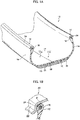
- Figure 1A is a perspective view depicting a cross-section of a part of a tire according to the First embodiment.
- Figure 1B is a cross-sectional view of a bead area fit into a rim.
- the tire 10 of the embodiment exhibits nearly the same cross-sectional shape as a conventional rubber-made pneumatic tire.
- the tire 10 is provided with a tire case 17 (tire frame) constituted with a pair of bead areas 12, which contact a bead sheet 21 and a rim flange 22 of a rim 20 depicted in Figure 1B ; side areas 14 extending from a bead area 12 outward in the radial direction of the tire; and a crown area 16 (outer circumference area) connecting the outer end in the radial direction of the tire of an side area 14 and the outer end in the radial direction of the tire of the other side area 14.
- a tire case 17 tire frame
- side areas 14 extending from a bead area 12 outward in the radial direction of the tire
- a crown area 16 outer circumference area
- a resin material for the tire case 17 of the embodiment for example, a resin composition, which contains a thermoplastic resin, and to which various additives are added, may be used.
- the tire case 17 according to the embodiment is formed from a single resin material, the invention is not limited the constitution, and a thermoplastic resin material with different characteristics may be used for each area of the tire case 17 (side area 14, crown area 16, bead area 12, etc .) identically with a conventional rubber-made pneumatic tire. Further, a reinforcing material (for example, a fiber, a cord, a nonwoven fabric, or a woven fabric, made of a polymeric material or a metal) may be embedded in the tire case 17 (for example, bead area 12, side area 14, or crown area 16) for reinforcing the tire case 17 therewith.
- a reinforcing material for example, a fiber, a cord, a nonwoven fabric, or a woven fabric, made of a polymeric material or a metal
- a tire frame is formed from a single resin material according to the embodiment, a tire frame may be constituted by combining plural materials with respect to a crown area, a side area, etc. of the tire frame.
- the thickness of the crown area of a tire frame may be selected appropriately for adjustment of the flexural modulus, it is preferably from 0.5 mm to 10 mm considering the tire weight, etc ., further preferably from 1 mm to 5 mm, and especially preferably from 1 mm to 4 mm.
- the thickness of the side area of a tire frame is further preferably from 0.5 mm to 10 mm, and especially preferably from 1 mm to 5 mm.
- the thicknesses of the crown area and the side area of a tire frame may be based on the average thickness of a specimen used for measuring the flexural modulus. The thickness of a tire frame may be measured appropriately using a method and an apparatus known in the art.
- the tire case 17 of the embodiment is obtained by jointing a pair of tire case halves (tire frame segments) 17A formed from a resin material together.
- the tire case 17 is formed from the tire case halves 17A with the same toric shape, each of which is molded by injection molding, etc. incorporating a bead area 12, a side area 14, and a half-width crown area 16 in one piece, by jointing the two face to face at the tire equatorial plane part.
- the tire case 17 is not limited to that formed by jointing two components, and may be formed by jointing three or more components.
- the tire case half 17A formed from the resin material may be molded, for example, by vacuum molding, pressure molding, injection molding, melt casting, etc. Therefore, in contrast to a conventional case in which a tire case is molded with a rubber, vulcanization can be omitted and therefore the production process may be significantly simplified to shorten the molding time.
- the tire case halves 17A have a bilaterally symmetric shape, namely a tire case half 17A and the other tire case half 17A have the same shape, there is an advantage that only 1 mold is enough for molding the tire case halves 17A.
- an annular bead core 18 made of a steel cord is embedded in the bead area 12 identically with a conventional pneumatic tire.
- the invention is not limited to the constitution, and the bead core 18 may be omitted, insofar as the stiffness of the bead area 12 is secured, and the fitness with a rim 20 is acceptable.
- a bead core may be constituted with an organic fiber cord, a resin coated organic fiber cord, or a hard resin.
- annular sealing layer 24 made of a material, for example a rubber, with a sealing property superior to a resin material constituting the tire case 17, is formed at a part of the bead area 12 to contact the rim 20, or at least a part to contact a rim flange 22 of the rim 20.
- the sealing layer 24 may be also formed at a part where the tire case 17 (bead area 12) contacts the bead sheet 21.
- a material softer than a resin material constituting the tire case 17 may be used as the material with a sealing property superior to a resin material constituting the tire case 17.
- a rubber to be used for the sealing layer 24 the same kind of rubber as a rubber used for an outer surface of the bead area of a conventional rubber-made pneumatic tire is preferably used.
- a rubber sealing layer 24 may be omitted, or another thermoplastic resin (thermoplastic resin elastomer) with a sealing property superior to the resin material may be used.
- thermoplastic resin examples include a resin, such as a polyurethane resin, a polyolefin resin, a polystyrene thermoplastic resin, and a polyester resin; as well as a blend of the above resin with a rubber or an elastomer.
- a thermoplastic resin elastomer may be also used, and examples thereof may include a polyester thermoplastic resin elastomer, a polyurethane thermoplastic resin elastomer, a polystyrene thermoplastic resin elastomer, and a polyolefin thermoplastic resin elastomer, as well as a combination between the elastomers, and a blend with a rubber.
- a reinforcing cord 26 having a stiffness higher than a resin material constituting the tire case 17 is wound up around the crown area 16 in the circumferential direction of the tire case 17.
- the reinforcing cord 26 is wound up spirally in a state that the cord is at least partly embedded in the crown area 16.
- a rubber-made tread 30 is placed through the intermediary of an undercoat layer 23 (see Figure 2 ) formed from an adhesive having a favorable adhesive strength with respect to a resin material for the tire case 17, and an adhesion layer 19 formed from the aforementioned composition.
- a reinforcing cord layer 28 formed by embedding at least partly the reinforcing cord 26 in the crown area 16 of the tire case 17 will be described referring to Figure 2 .
- Figure 2 is a cross-sectional view along the tire rotation axis depicting a state where a reinforcing cord is embedded in the crown area of a tire case of a tire according to the first embodiment.
- the reinforcing cord 26 is wound up spirally in a state that the cord is at least partly embedded in the crown area 16 in a cross-sectional view along the axial direction of the tire case 17 to form a reinforcing cord layer 28, which is expressed by dashed lines in Figure 2 together with a part of outer circumference of the tire case 17.
- the portion of the reinforcing cord 26 embedded in the crown area 16 is in a state tightly pressed to a resin material constituting the crown area 16 (tire case 17).
- a monofilament namely, single fiber
- a metal fiber namely, an organic fiber, etc.
- a twisted multifilament twisting the fibers including a steel cord with twisted steel fibers namely, twisted wire
- a steel cord is used as the reinforcing cord 26.
- An embedded depth L in Figure 2 represents an embedded depth of the reinforcing cord 26 in the tire case 17 (crown area 16) toward the tire rotation axis.
- the embedded depth L of the reinforcing cord 26 in the crown area 16 is preferably 1/5 or more of the diameter D of the reinforcing cord 26, and more preferably beyond 1/2. Most preferably the entire reinforcing cord 26 is embedded in the crown area 16. When the embedded depth L of the reinforcing cord 26 exceeds 1/2 of the diameter D of the reinforcing cord 26, the reinforcing cord 26 is inhibited from bouncing out from the embedded area for a dimensional reason.
- the reinforcing cord layer 28 is equivalent to a belt placed on an outer peripheral surface of a carcass of a conventional rubber-made pneumatic tire.
- a tread 30 is placed through the intermediary of the undercoat layer 23 and the adhesion layer 19.
- an undercoat layer 23, an adhesion layer 19, and a tread 30 are provided in the mentioned order, for example, over both the surface of the reinforcing cord 26 placed in the crown area 16 and the surface of the crown area 16 where the reinforcing cord 26 is not present.
- the undercoat layer 23 is in direct contact with the surface of the crown area 16.
- the adhesion layer 19 is in direct contact with the undercoat layer 23, and a rubber of the tread 30 is in direct contact with the adhesion layer 19.
- a rubber is used for the tread 30.
- the tread 30 preferably exhibits abrasion resistance superior to a resin material constituting the tire case 17.
- On the tread 30 a tread pattern configured with a plurality of grooves is formed in a contact area with road similarly to a conventional rubber-made pneumatic tire.
- a method of producing a tire according to the embodiment will be described below with an exemplary case using a thermal radical generator as the ingredient (C) of a composition.
- a method of producing the tire according to the embodiment includes, for example, a green tire forming step of forming a green tire including a tire frame, a composition layer, which is formed from a composition, and an unvulcanized exterior component, and a heating step of heating the green tire.
- the unvulcanized exterior component contains an unvulcanized rubber, for example at least part of which is in contact with the composition layer, and is placed on the tire frame through the intermediary of the composition layer.
- the green tire of the embodiment contains an unvulcanized rubber in an exterior component. Namely, by heating the green tire, the unvulcanized rubber in the exterior component is vulcanized, and a composition layer is converted to an adhesion layer thereby yielding the tire of the embodiment.
- tire case halves are formed using a resin material containing a thermoplastic resin as described above.
- the tire case halves are preferably formed by injection molding.
- the tire case halves are supported by a thin metal support ring face to face.
- a jointing mold which touches the outer peripheral surface of of butting parts of the tire case halves, is installed (not illustrated).
- the jointing mold is configured such that the areas around the joints (butting parts) of the tire case halves 17A are pressed at a predetermined pressure. Then the areas around the joints of the tire case halves are pressed at not less than the melting point (or softening point) of a resin material constituting the tire case.
- the joints of the tire case halves are heated and pressed by the jointing mold, the joints are melted to weld together the tire case halves to unite the components in one piece to complete the tire case 17.
- the joints of the tire case halves are heated using a jointing mold, the invention is not limited thereto, and for example, the joints may be heated with a radio frequency heating apparatus installed separately, or the tire case halves may be jointed by softening or melting the halves in advance by hot air, infrared light, or the like, followed by pressing with a jointing mold.
- the reinforcing cord layer 28 may be formed on the outer circumference of the crown area 16 of the tire case 17 by winding and embedding a preheated reinforcing cord 26 from a cord feeder (not illustrated) provided with a reel with a wound up reinforcing cord 26, a cord heater, various rollers, etc., on the outer peripheral surface of the crown area 16.
- a composition layer is formed on the crown area 16 of the tire case 17 where the reinforcing cord 26 has been wound up.
- an undercoat layer 23 formed from an adhesive having adhesiveness to a resin material. Therefore, a composition layer is formed on the crown area 16 of the tire case 17, where the reinforcing cord 26 has been wound up, through the intermediary of a layer of the adhesive having adhesiveness to a resin material.
- "Layer of an adhesive having adhesiveness to a resin material” which is a state before the layer is converted to an undercoat layer 23 by heating, may be hereinafter occasionally referred to as "prime coat layer".
- a composition layer may be yielded by painting a composition on the prime coat layer formed on the crown area 16 of the tire case 17 where the reinforcing cord 26 has been wound up.
- a coating method of painting a composition there are a spray coating method, a dip coating method, and a spin coating method, without particular limitation thereto.
- the thickness, shape, dimension, etc. of a coated film may be decided appropriately according to the intended thickness of an adhesion layer, etc.
- a composition layer is a layer of an adhesive composition film
- a composition layer may be yielded, for example, by painting a composition on a prime coat layer to form a coated film, and then converting the coated film to a film to form an adhesive composition film.
- a composition layer may be yielded, for example, using a support such as a release sheet.
- a support such as a release sheet.
- an adhesive composition film may be formed on the support, which is then made contact to the prime coat layer formed on the crown area 16 of the tire case 17 where the reinforcing cord 26 has been wound up, and then the support is released.
- a coated film of a composition, and a prime coat layer are formed on a support one after another, and the coated film is converted to a film as an adhesive composition film, and the layered product may be bonded such that the prime coat layer contacts the crown area 16 of the tire case 17 where the reinforcing cord 26 has been wound up, and then the support is released.
- a coated film of a composition is formed on a support, which is converted to a film and a prime coat layer is formed on the obtained adhesive composition film, and the layered product may be bonded such that the prime coat layer contacts the crown area 16 of the tire case 17 where the reinforcing cord 26 has been wound up, and then the support is released.
- the support there is no particular restriction on the support, and examples thereof may include a sheet-formed support such as a release sheet and a seating.
- the thickness or the shape of the support may be decided appropriately corresponding to the shape, etc. of an adhesive composition film to be formed.
- Examples of a material to be used for a sheet-formed support may include a paper, a resin, a paper coated with a resin, and a metal.
- Examples of a material to be used for a resin-made release sheet may include a polyester resin, such as poly(ethylene terephthalate), poly(cyclohexylene terephthalate), and poly(ethylene naphthalate); a polyamide resin, such as nylon 46, modified nylon 6T, nylon MXD6, and polyphthalamide; a ketone type resin, such as poly(phenylene sulfide), and poly(thioether sulfone); and a sulfone resin, such as polysulfone, and polyethersulfone.
- a polyester resin such as poly(ethylene terephthalate), poly(cyclohexylene terephthalate), and poly(ethylene naphthalate
- a polyamide resin such as nylon 46, modified nylon 6T, nylon MXD6, and polyphthalamide
- a ketone type resin such as poly(phenylene sulfide), and poly(thioether sulfone)
- a sulfone resin such
- a transparent resin substrate containing as a main ingredient an organic resin such as polyethernitrile, polyalylate, polyetherimide, poly(amide imide), polycarbonate, poly(methyl methacrylate), triacetyl cellulose, polystyrene, and poly(vinyl chloride), may be used favorably.
- a rubber component for a tread which yields the tread 30 by heating as described below, may be used. In this case, it is not necessary to release the support, and a green tire is complete when the respective layers are made contact with each other and bonded together.
- a method of converting a coated film of a composition into a film may be selected appropriately corresponding to the formulation and characteristics of a composition.
- a coated film forms a film to yield an adhesive composition film by leaving a coated film standing at room temperature for a predetermined time.
- the film may be heated, insofar as the ingredient (C) in the composition is not activated.
- the coated film is preferably left standing at a temperature from 0°C to 60°C, and more preferably from 15°C to 40°C.
- the stationary time is preferably one min or longer, and more preferably three min or longer from the viewpoint of shape stability allowing retention of the shape of an adhesive composition film.
- a rubber component for a tread (not illustrated) is mounted on the tire case 17, on which a composition layer is formed.
- the rubber component for a tread is an unvulcanized exterior component, which contains at least an unvulcanized rubber, and by heating the same for vulcanizing the unvulcanized rubber a tread 30 containing a vulcanized rubber is obtained.
- a belt-shaped rubber component for a tread having a tread pattern configured with a plurality of grooves in a contact area with road surface is formed in advance by injection molding. Then, the rubber component for a tread is wound around the tire case 17, such that a rubber in the rubber component for a tread touches directly a composition layer formed on the tire case 17.
- the heating temperature is, for example, preferably from 150°C to 220°C, and further preferably from 160°C to 200°C.
- the rubber component for a tread is preferably pressurized during vulcanization, and the pressure is especially preferably from 0.1 MPa to 20 MPa.
- the heating time is preferably from one min to 60 min, and further preferably from 5 min to 30 min.
- the heating temperature for heating a green tire in the heating step is preferably lower than the boiling point of a decomposition product of the ingredient (C) by 10°C or more from the viewpoint of reduction of voids at an interface between an adhesion layer and an exterior component, and more preferably lower by 20°C or more.
- the heating temperature is preferably B-10 (°C) or lower, and more preferably B-20 (°C) or lower.
- the heating is preferably conducted in a state where at least part of unvulcanized rubber contained in a rubber component for a tread is in direct contact with a composition layer.
- the composition layer is converted to an adhesion layer 19, and an unvulcanized rubber in the rubber component for a tread is vulcanized to form a tread 30.
- the tread 30 is placed on the tire case 17 through the intermediary of the adhesion layer 19 in the tire 10 of the embodiment, the tread 30 (exterior component) is not apt to detach from the tire case 17. Further, since the tire case 17 in the tire 10 is formed from a resin material containing a thermoplastic resin, its structure may be simple and the weight is less than a conventional rubber-made tire. Therefore, the tire 10 of the embodiment has higher resistance to friction and durability. Further, since the tire case 17 and the tread 30 may be produced by injection molding, the productivity can be excellent.
- a reinforcing cord 26 with a stiffness higher than a resin material is wound spirally in the circumferential direction on the outer circumferential surface of the crown area 16 of a tire case 17 formed from the resin material in the tire 10 of the embodiment, the puncture resistance, the cutting resistance, and the circumferential stiffness of the tire 10 are improved.
- the circumferential stiffness of the tire 10 is improved, creeping of a tire case 17 formed from the resin material is prevented.
- a reinforcing cord 26 is at least partly embedded into the outer peripheral surface of the crown area 16 of the tire case 17 formed from a resin material and adheres tightly to the resin material, and therefore entry of air during production may be suppressed, or movement of the reinforcing cord 26 by power input in traveling may be suppressed.
- occurrence of detachment, or the like of the reinforcing cord 26, the tire case 17, and the tread 30 may be suppressed to improve the durability of the tire 10.
- the embedded depth L of the reinforcing cord 26 is 1/5 or more of the diameter D, entry of air during production is effectively suppressed, and movement of the reinforcing cord 26 by power input in traveling may be suppressed further.
- annular bead core 18 made of a metal material is embedded in the bead area 12, the tire case 17, namely the tire 10 may be firmly retained by the rim 20 similarly to a conventional rubber-made pneumatic tire.
- a sealing layer 24 composed of a rubber material with a sealing property superior to a resin material constituting the tire case 17 is placed at a part of the bead area 12 in contact with the rim 20, the sealing property between the tire 10 and the rim 20 is improved. As the result, air leakage from the inside of the tire may be further suppressed compare to a case, in which sealing is performed with only the rim 20 and the resin material constituting the tire case 17. Moreover, when the sealing layer 24 is placed, the rim fittability is also improved.
- the reinforcing cord 26 is configured to be heated, however, for example, it may be also configured that the outer circumference of the reinforcing cord 26 is coated with the same resin material as the tire case 17.
- the outer circumference of the reinforcing cord 26 is coated with the same resin material as the tire case 17.
- entry of air in embedding the reinforcing cord 26 into the crown area 16 can be suppressed effectively by heating the coated resin material together with the reinforcing cord 26.
- a tread 30 is placed on an outer circumferential surface of the layer of the resin material coating the outer circumference of the reinforcing cord 26 via an undercoat layer 23 and an adhesion layer 19, a tire 10 in which the tread 30 is hardly detached from the tire case 17 may be obtained.
- the reinforcing cord 26 is wound around the crown area 16 according to the embodiment, a form omitting the reinforcing cord is also possible.
- a form in which an undercoat layer 23 is placed directly on the crown area 16 of the tire case 17, and the tread 30 is placed via the undercoat layer 23 and the adhesion layer 19, is also possible.
- the tire 10 of the first embodiment is a so-called tubeless tire, in which an air chamber is formed between the tire 10 and the rim 20 by mounting the bead area 12 on the rim 20, however the invention is not limited to such a constitution, and the tire 10 may have a complete tube form.
- Figure 3 is a perspective view depicting a cross-section of a part of a tire according to the second embodiment.
- side components 15 are provided as exterior components outside in the width direction of both the side areas 14.
- the side component 15 is placed on the side area 14 of the tire case 17 via an undercoat layer 23 (not illustrated in Figure 3 ) and an adhesion layer 19.
- a component common to Figure 1 is denoted with the same reference sign, and repeated explanation is omitted.
- the side component 15 is placed as an exterior component in addition to the tread 30 on the surface of the side area 14.
- the side component 15 is formed from the same material as the tread 30, namely with a rubber. It is preferable that the side component 15 is superior in abrasion resistance similarly as the tread 30 compared to a resin material constituting the tire case 17.
- the side component 15 is provided on the surface of the side area 14 via the undercoat layer 23 and the adhesion layer 19.
- the side component 15 may be formed by injection molding similarly to the tread 30. Specifically, for example, a rubber component for a side component, which is formed into an intended shape in advance by injection molding, etc., is mounted on the surface of the side area 14 of the tire case 17 via a prime coat layer and a composition layer. By heating them, an unvulcanized rubber contained in the rubber component for a side component is vulcanized to form a side component 15.
- the edge directed to the crown area 16 of the side component 15 is bonded overlapping the edge of the tread 30 according to the embodiment.
- the edge directed to the crown area 16 of the side component 15 is preferably placed on the radially inner side of the tire compared to the edge of the tread 30.
- the tread 30 and the side component 15 may be configured such that the interface between the overlapped edges may be welded. Namely, firstly a rubber component for a tread is placed on the crown area 16 of the tire case 17 via a prime coat layer and a composition layer, and a rubber component for a side component is placed on the side area 14 via a prime coat layer and a composition layer to form a green tire. A composition layer may be placed at an interface where the edge of the rubber component for a tread and the edge of the rubber component for a side component contact each other.
- a tire according to the invention is not limited to the embodiment, and also a mode, in which the side component 15 is provided only on one side in the width direction of the tire 200, is also possible.
- a tire according to the first embodiment and a tire according to the second embodiment include the following modes of tires.
- a tire according to the third embodiment includes a tire frame, which is toric and is formed from a resin material containing a thermoplastic resin; an adhesion layer, which is obtained by heating a composition layer formed from a composition including a polythiol compound (hereinafter also referred to as "polythiol compound (A)"), a compound having a functional group reactive with a thiol group (hereinafter also referred to as “compound having a functional group reactive with a thiol group (B')", or “compound (B')”), and a thermal radical generator including a peroxide, a decomposition product of which has a boiling point of 150°C or higher (hereinafter also referred to as “thermal radical generator (C')"); and an exterior component, which contains a vulcanized rubber obtained by vulcanizing an unvulcanized rubber at least partly contacting the composition layer, and which is provided on the tire frame via the adhesion layer.
- polythiol compound (A) polythi
- a polythiol compound (A), a compound (B') having a functional group reactive with a thiol group, and a thermal radical generator (C'), as well as a catalyst (D') described below, and a surface conditioner (E) may be occasionally referred to respectively as an ingredient (A), an ingredient (B'), an ingredient (C'), an ingredient (D'), and an ingredient (E).
- a "functional group reactive with a thiol group" contained in the ingredient (B') may be occasionally referred to as a "reactive functional group”.
- a "decomposition product of a thermal radical generator” means a compound generated, because a thermal radical generator is thermally activated and decomposed to generate a radical.
- various materials may be selected as a resin, on condition that the selected material exhibits performances required for a tire.
- an adhesive when used for fixing an exterior component to a tire frame, it is desirable to select an adhesive, which is able to exhibit performances required for a tire, considering the affinity between a material used for both the components and the adhesive.
- an ingredient contained in the adhesive may be conceivably degraded by heat during vulcanization to generate a gas.
- a void may be generated in the adhesion layer (for example, inside the adhesion layer itself, or at an interface between the adhesion layer and the exterior component) due to the gas generation.
- the object of the current embodiment is to provide a tire with less void in an adhesion layer, and a method of producing the same.
- a thermal radical generator a decomposition product of which has a boiling point of 150°C or higher, is used as an ingredient (C') for a tire of the embodiment, a tire with less void in an adhesion layer may be obtained.
- a peroxy group is dissociated by heat to generate a radical.
- the generated radical acts on a thiol group of an ingredient (A) to generate a thiyl radical, and is then stabilized as a decomposition product of the thermal radical generator.
- a thermal radical generator a decomposition product of which has a boiling point lower than a vulcanize temperature
- a gas may be generated during vulcanization inside a composition layer itself, or at an interface between the composition layer and a rubber for an exterior component, and as the result conceivably a void may appear in the adhesion layer of the obtained tire (especially, at an interface between the adhesion layer and the exterior component).
- a thermal radical generator a decomposition product of which has a boiling point of 150°C or higher, is used as an ingredient (C') in the case of a tire of the embodiment, it is presumed that a gas is not apt to be generated during vulcanization, and therefore there appears less void in the adhesion layer.
- a tire of the embodiment uses a composition containing an ingredient (A), an ingredient (B'), and an ingredient (C') as described above, an exterior component is not apt to detach from a tire frame. Although the reason for the above is not very clear, it is presumed as follows.
- a reaction between part of thiol groups of an ingredient (A) contained in a composition and reactive functional groups of an ingredient (B') occurs to polymerize the ingredient (A) and the ingredient (B'). Owing to the copolymerization between the ingredient (A) and the ingredient (B'), the film strength of the adhesion layer is conceivably enhanced.
- a radical is generated through activation of an ingredient (C') by heating a composition layer, and the generated radical acts on a thiol group in an ingredient (A) having not reacted with a reactive functional group in an ingredient (B') to generate a thiyl radical.
- the thiyl radical causes a thiol-ene reaction with a carbon-carbon double bond included in a rubber contacting the composition layer to establish a chemical bond at an interface between the composition layer and the rubber, so that the composition layer comes to an adhesion layer. It is conceivable that the interfacial adhesive strength between the adhesion layer and an exterior component becomes high owing to the chemical bond at the interface.
- both film strength and interfacial adhesive strength are favorably developed, and conceivably detachment of an exterior component form a tire frame is suppressed.
- the overall adhesion strength including a film strength and an interfacial adhesive strength may be occasionally referred to as "adhesive strength”.
- a tire frame, an exterior component, and other layers of a tire of the embodiment the same compositions and constitutions as a tire frame, an exterior component, and other layers of a tire of the first embodiment may be applied.
- a tread as an exterior component is provided on the outer circumferential surface of a crown area of a tire frame via an adhesion layer
- a side component as an exterior component is provided on the outer peripheral surface of a side area of a tire frame via an adhesion layer
- the same method of producing a tire as in the first embodiment may be applied, except that the composition described below is used as a composition.
- An adhesion layer in a tire of the embodiment is obtained by heating a composition layer formed using a composition containing an ingredient (A), an ingredient (B'), and an ingredient (C') as described above.
- an adhesion layer is obtained by heating a composition layer and an unvulcanized rubber contained in an exterior component in a state where the two contact each other to activate the ingredient (C').
- an adhesion layer and an exterior component are chemically bonded as described above, through which a favorable adhesive strength at an interface of the adhesion layer and the exterior component is conceivably obtained.
- a composition layer includes, for example, a layer of a coated film obtained by painting a composition, and also a layer of an adhesive composition film prepared by forming a film of a composition through polymerization of the ingredient (A) and the ingredient (B') in the composition for forming a coated film.
- to "form a film” means that a composition is shaped into a film, and an ingredient (A) and an ingredient (B') in a composition are polymerized to harden the film, and to impart a favorable shape retention property thereto.
- the "layer of a coated film” means a state before the composition is formed into a film, and there exist an ingredient (A) and an ingredient (B') unpolymerized.
- composition layer is a layer of a coated film
- a thiol-ene reaction occurs at an interface, and an ingredient (A) and an ingredient (B') are polymerized, so that the coated film becomes an adhesion layer.
- a composition layer is a layer of an adhesive composition film
- an ingredient (A) and an ingredient (B') are polymerized in the course of formation of an adhesive composition film.
- the ratio (S/N) of the number (S) of sulfur atoms contained in an adhesion layer to the number (N) of nitrogen atoms contained in an adhesion layer, and the thickness of an adhesion layer are the same as the first embodiment.
- the composition contains at least an ingredient (A), an ingredient (B'), and an ingredient (C'), and may contain if necessary another ingredient.
- a 'compound having a functional group reactive with a thiol group (B')' means herein a compound having at least one functional group reactive with a thiol group (reactive functional group) in the molecule.
- Examples of a reactive functional group may include an isocyanate group, an acryloyl group, a methacryloyl group, an epoxy group, an allyl group, a vinyl group, an allyloxy group, a vinyloxy group, and a group having a norbornene skeleton.
- Examples of a group having a norbornene skeleton may include an unsubstituted norbornenyl group.
- the ingredient (B') may be a compound having only one kind of reactive functional group in a molecule, or may be a compound having two or more kinds thereof.
- the number of reactive functional group in a molecule may be, although it may be different between the case of a low molecular weight compound, and the case of a high molecular weight compound (for example, oligomer, or polymer), from 1 to 70 from the viewpoint of enhancement of adhesive strength, preferably from 1 to 20, more preferably from 2 to 10, and further preferably from 3 to 7.
- the number of terminal double bond in a molecule may be, although it may be different between in the case of a low molecular weight compound and in the case of a high molecular weight compound (for example, oligomer, or polymer), from 2 to 70 from the viewpoint of enhancement of adhesive strength, preferably from 2 to 10, and more preferably from 3 to 7.
- a compound having an acryloyl group is highly reactive and apt to polymerize by application of energy, a compound having only one acryloyl group in a molecule may be also used favorably as an ingredient (B').
- a compound not having an acryloyl group is less reactive compared to a compound having an acryloyl group, a compound with the number of reactive functional group in a molecule of two or more may be used favorably as an ingredient (B').
- the number average molecular weight of an ingredient (B') is for example 50000 or less from the viewpoint of enhancement of adhesive strength, preferably 40000 or less, and more preferably 35000 or less. Although there is no particular restriction on the lower limit of the number average molecular weight of an ingredient (B'), the number average molecular weight of an ingredient (B') may be for example 2000 or more.
- Examples of an ingredient (B') may include a polyisocyanate having two or more isocyanate groups, a monoacrylate having an acryloyl group, a poly acrylate having two or more acryloyl groups, a polymethacrylate having two or more methacryloyl groups, an epoxy compound having two or more epoxy groups, an allyl compound having two or more allyl groups, a vinyl compound having two or more vinyl groups, an allyl ether compound or an allyl ester compound having two or more allyloxy groups, a vinyl ether compound or a vinyl ester compound having two or more vinyloxy groups, and a norbornene compound having two or more norbornenyl groups.
- ingredient (B') only one kind of compound having a functional group reactive with a thiol group may be used, or a combination of two or more kinds of compounds having a functional group reactive with a thiol group may be used.
- a compound having a cyclic structure besides a reactive functional group in the molecule is preferable.
- an adhesion layer with high heat resistance can be obtained.
- a cyclic structure insofar as a ring is constituted, and examples of a cyclic structure may include an aliphatic ring structure, an aromatic ring structure, and a heterocyclic structure.
- an aliphatic ring structure ring structures constituted with carbon except an aromatic ring structure may be used, and an aliphatic ring structure may be a saturated aliphatic ring structure, or an unsaturated aliphatic ring structure.
- an aliphatic ring structure may include a monocyclic aliphatic ring structure, and more specifically a cycloalkane structure such as cyclohexane, and a cycloalkene structure such as cyclohexene.
- the number of carbon constituting a monocyclic aliphatic ring structure is, for example, in a range of from 3 to 20, preferably a range of from 4 to 12, more preferably a range of from 5 to 8, and most preferably 6.
- An aliphatic ring structure is not limited to monocyclic one, and may be also a polycyclic aliphatic ring structure.
- Examples of a polycyclic aliphatic ring structure may include a polycyclic cycloalkane structure such as decalin, and a polycyclic cycloalkene structure such as norbornene.
- the number of carbon constituting each ring in a polycyclic aliphatic ring structure is, for example, in a range of from 3 to 20, preferably a range of from 4 to 12, and more preferably a range of from 5 to 8, and a polycyclic aliphatic ring structure having a six-membered ring is further preferable.
- an aromatic ring structure may include an unsaturated cyclic structure with annularly aligned carbons having ⁇ electrons.
- Specific examples of an aromatic ring structure may include a monocyclic aromatic ring structure, such as benzene, and [4n+2] annulene (provided that n is from 1 to 4), as well as a polycyclic aromatic ring structure, such as naphthalene, azulene, indene, fluorene, and anthracene.
- a monocyclic or polycyclic aromatic ring structure having a benzene ring namely, a C6 aromatic ring
- a monocyclic benzene ring structure is most preferable.
- a heterocyclic structure is a heterocyclic structure constituted together with one or more hetero atoms, and may be monocyclic or polycyclic, and may be aliphatic or aromatic.
- a hetero atom means an atom constituting a ring structure other than carbon. Specific examples of a hetero atom may include a nitrogen atom, an oxygen atom, and a sulfur atom.
- heterocyclic structure may include a structure obtained through substitution of one or more (specifically, for example, from 1 to 3) carbon atoms in the aliphatic ring structure or the aromatic ring structure with hetero atoms.
- the number of atoms constituting a monocyclic heterocyclic structure may be, for example, from 3 to 10, preferably a range of from 5 to 8, and most preferably 6.
- the number of atoms constituting each ring in a polycyclic heterocyclic structure may be, for example, from 3 to 10, and preferably a range of from 5 to 8.
- a polycyclic heterocyclic structure one having a six-membered ring is further preferable.
- the above aliphatic ring structure, aromatic ring structure, and heterocyclic structure may have a substituent further.
- the substituent may be directly introduced to an atom constituting a cyclic structure, or introduced via a linking group.
- an atom constituting a cyclic structure and an atom constituting the other cyclic structure may be bonded by a single bond, or boded via a linking group.
- the linking group may include an alkylene group, a carbonyl group, an ether bond, an ester bond, a sulfide bond, an amide bond, a urethane bond, and a urea bond.
- An ingredient (B') may have only one kind of the cyclic structures in a molecule, or have two or more kinds thereof. Further, an ingredient (B') may have only a monocyclic structure in a molecule, or only a polycyclic structure, or may have both a monocyclic structure and a polycyclic structure.
- the number of rings included in a molecule of an ingredient (B') may be, although it may be different between a case of a low molecular weight compound and a case of a high molecular weight compound, for example, from 1 to 100, or from 1 to 50, preferably from 1 to 20, and more preferably from 2 to 10.
- the "number of rings” all of the rings are counted. More specifically, in a case in which only one anthracene structure is present in a molecule as a cyclic structure, the "number of rings" is three.
- a compound having a nitrogen atom is preferable from the viewpoint of high film strength of an adhesion layer.
- Examples of a compound having a nitrogen atom may include a compound having as a cyclic structure a heterocyclic structure including a nitrogen atom as a hetero atom, and a compound to which a substituent or a linking group including a nitrogen atom in atoms constituting a cyclic structure is bonded.
- a nitrogen atom included in the substituent or linking group may be directly bonded to an atom constituting the cyclic structure.
- a compound having a nitrogen atom may include a compound having at least either of a urethane skeleton or an isocyanurate ring.
- a compound having a nitrogen atom a compound having both an isocyanurate ring, and a urethane bond is preferable from the viewpoint of favorable securement of both adhesive strength and heat resistance of an adhesion layer.
- Examples of a compound having a urethane skeleton may include a urethane compound obtained by a reaction between an organic isocyanate compound and a hydroxy group-containing compound having one or more reactive functional group and a hydroxy group in the molecule.
- a compound having a urethane skeleton may be a compound obtained by a reaction of an organic isocyanate compound with a hydroxy group-containing compound as well as, if necessary, at least one kind of diol selected out of an alkanediol, a polyether diol, a polybutadiene diol, a polyester diol, a polycarbonate diol, or an amide diol.
- Examples of an organic isocyanate compound may include an aromatic diisocyanate, such as toluene diisocyanate, diphenylmethane diisocyanate, diphenyldimethylmethane diisocyanate, dibenzyl diisocyanate, naphthylene diisocyanate, phenylene diisocyanate, xylene diisocyanate, and tetramethylxylylene diisocyanate; an aliphatic diisocyanate, such as tetramethylene diisocyanate, hexamethylene diisocyanate, lysine diisocyanate, 2-methylpentane-1,5-diisocyanate, 3-methylpentane-1,5-diisocyanate, and 2,2,4-trimethylhexamethylene-1,6-diisocyanate; and an alicyclic diisocyanate, such as isophorone diisocyanate, cyclohexane diiso
- a modified derivative thereof such as an adduct modified derivative, a carbodiimide modified derivative, an allophanate-modified derivative, a biuret modified derivative, a uretdione modified derivative, a uretonimine modified derivative, and an isocyanurate modified derivative, may be included.
- examples of a hydroxy group-containing compound may include a hydroxy group-containing methacrylate, such as 2-hydroxyethyl methacrylate, 2-hydroxypropyl methacrylate, 4-hydroxybutyl methacrylate, glycerol dimethacrylate, trimethylolpropane dimethacrylate, pentaerythritol trimethacrylate, and dipentaerythritol pentamethacrylate.
- a hydroxy group-containing methacrylate such as 2-hydroxyethyl methacrylate, 2-hydroxypropyl methacrylate, 4-hydroxybutyl methacrylate, glycerol dimethacrylate, trimethylolpropane dimethacrylate, pentaerythritol trimethacrylate, and dipentaerythritol pentamethacrylate.
- a compound corresponding to the hydroxy group-containing methacrylate (namely, a compound replacing a methacryloyl group in the hydroxy group-containing methacrylate with one of corresponding reactive functional groups) may be used as a hydroxy group-containing compound.
- Examples of a compound having an isocyanurate ring may include one obtained by reacting a compound having an isocyanurate ring and a hydroxy group with a compound having a reactive functional group to react with a hydroxy group (for example, methacrylic acid).
- Examples of a compound having an isocyanurate ring and a hydroxy group may include tris(2-hydroxyethyl)isocyanurate, and tris(hydroxymethyl)isocyanurate.
- a compound having at least either of a urethane skeleton or an isocyanurate ring include the compounds expressed by the following structural formulas from (B-1) to (B-3) and the compounds expressed by the following Formulas from (B-4) to (B-6) without limitation thereto.
- R 1 to R 9 each independently represent an acryloyl group, a methacryloyl group, an epoxy group, a vinyl group, or a norbornenyl group
- L 1 to L 9 each independently represent a C1 to C4 alkylene group
- R 1 to R 3 , from R 4 to R 6 , and from R 7 to R 9 are respectively the same group (namely, there is only one kind of reactive functional group in a molecule) from the viewpoint of the film strength of an adhesion layer.
- from L 1 to L 9 preferably have a low carbon number from the viewpoint of heat resistance of a layered body, and are more preferably a C1 to C2 alkylene group.
- an ingredient (B') is not limited to the above compounds, and it may be another compound insofar as it is a compound having a reactive functional group.
- Examples of a polyisocyanate having two or more isocyanate groups may include the aforementioned organic isocyanate compounds.
- a dimethacrylate among polymethacrylates having two or more methacryloyl groups may include a dimethacrylate of a straight chain alkanediol such as 1,6-hexanediol dimethacrylate; a dimethacrylate of an alkanediol having a branched structure such as neopentylglycol dimethacrylate; a dimethacrylate of an alkanediol having a ring structure such as dicyclopentanediol dimethacrylate; and a dimethacrylate of a polyetherdiol such as poly(ethylene glycol) dimethacrylate.
- a straight chain alkanediol such as 1,6-hexanediol dimethacrylate
- a dimethacrylate of an alkanediol having a branched structure such as neopentylglycol dimethacrylate
- a dimethacrylate may also include an alkylene oxide adduct of a dimethacrylate of a straight chain alkanediol, an alkylene oxide adduct of a dimethacrylate of an alkanediol having a branched structure, an alkylene oxide adduct of a dimethacrylate of an alkanediol having a ring structure, and an alkylene oxide adduct of a dimethacrylate of a polyetherdiol.
- the carbon number of an alkanediol of the dimethacrylate of a straight chain alkanediol, the dimethacrylate of an alkanediol having a branched structure, and the dimethacrylate of an alkanediol having a ring structure may be, for example, from 2 to 50.
- the recurring unit number of a polyether in the dioldimethacrylate of polyether may be for example from 2 to 15.
- a tri-functional or higher multifunctional methacrylate may include a methacrylic acid-modified product of a polyhydric alcohol, such as trimethylolpropane, pentaerythritol, and glycerol (for example, an ester between a polyhydric alcohol and methacrylic acid); and an alkylene oxide-modified product of the same (for example, an alkylene oxide adduct of the ester).
- the carbon number of a polyhydric alcohol may be, for example, from 6 to 100.
- tri-functional or higher multifunctional methacrylate may include trimethylolpropane trimethacrylate, dipentaerythritol pentamethacrylate, dipentaerythritol hexamethacrylate, pentaerythritol trimethacrylate, and pentaerythritol tetramethacrylate.
- an epoxy polymethacrylate a polyester polymethacrylate, and a methacryloyl group-containing methacrylic acid ester copolymer may be also used.
- an epoxy polymethacrylate may include a bisphenol type epoxy dimethacrylate as a reaction product of a bisphenol type epoxy resin obtained through a condensation reaction between bisphenol A and epichlorohydrin, with methacrylic acid.
- polyester polymethacrylate may include a compound obtained by a reaction of a polybasic acid such as phthalic acid, a polyhydric alcohol such as ethylene glycol, and methacrylic acid.
- a monoacrylate may include an acrylate of a straight chain alkanol, such as hexyl acrylate and stearyl acrylate; an acrylate of an alkanol having a branched structure, such as 2-ethylhexyl acrylate; an acrylate of an aliphatic alkanol having a ring structure, such as cyclohexyl acrylate, and isobornyl acrylate; and an acrylate of an aromatic alcohol, such as benzyl acrylate.
- an acrylate of a halogenated alcohol such as 2-chloroethyl acrylate
- an acrylate of an alkoxy alcohol such as 3-methoxybutyl acrylate
- a polyacrylate having two or more acryloyl groups may include a compound for which a methacryloyl group of the dimethacrylate or the multifunctional methacrylate is replaced with an acryloyl group.
- Examples of an epoxy compound having two or more epoxy groups may include an aromatic epoxide, an aliphatic epoxide, an alicyclic epoxide, and a modified derivative thereof.
- Examples of an aromatic epoxide may include a bisphenol A epoxy compound, a bisphenol F epoxy compound, a bisphenol S epoxy compound, and a phenol novolac epoxy compound, such as a compound expressed by the following structural formula (B-7), or structural formula (B-8); and a cresol novolac epoxy compound, a polyphenol epoxy compound, a biphenyl epoxy compound, a naphthalene ring-containing epoxy compound, and a fluorene epoxy compound, such as a compound expressed by the following structural formula (B-9).
- Examples of an aliphatic epoxide may include a poly(alkylene glycol) diglycidyl ether such as trimethylolpropane triglycidyl ether, and glycerol polyglycidyl ether.
- Examples of an alicyclic epoxide may include cyclohexanedimethanol diglycidyl ether.
- Examples of a modified derivative of an aromatic epoxide, an aliphatic epoxide, and an alicyclic epoxide may include a hydrogenated bisphenol A epoxy compound, a hydrogenated bisphenol F epoxy compound, a hydrogenated biphenyl epoxy compound, and a brominated bisphenol epoxy compound, such as a compound expressed by the following structural formula (B-10).
- Examples of an allyl ether compound having two or more allyloxy groups may include a compound, in which two or more alcoholic hydroxy groups of a dialcohol or a polyhydric alcohol are substituted with allyloxy groups, such as trimethylolpropane diallyl ether, trimethylolpropane triallyl ether, pentaerythritol triallyl ether, glycerol 1,3-diallyl ether, bisphenol A diallyl ether, and a urethane allyl ether oligomer.
- Examples of an allyl ester compound having two or more allyloxy groups may include diallyl phthalate.
- an allyl compound having two or more allyl groups, a vinyl ether compound having two or more vinyloxy groups, and a vinyl compound having two or more vinyl groups may include a compound, in which an allyloxy group of the allyl ether compound is substituted respectively with an allyl group, a vinyloxy group, and a vinyl group.
- Examples of a vinyl ester compound having two or more vinyloxy groups may include a compound in which an allyloxy group of the allyl ester compound is substituted with a vinyloxy group.
- a norbornene compound having two or more norbornenyl groups may include a compound expressed by the following structural formula (B-11) (PEG-tetranorbornene), a compound expressed by the following structural formula (B-12) (tri-(norborn-2-ene-5-carboxylate), TMPTN), a compound expressed by the following structural formula (B-13) (pentaerythritol tetra-(norborn-2-ene-5-carboxylate), PTN4), a compound expressed by the following structural formula (B-14) (pentaerythritol tri-(norborn-2-ene-5-carboxylate), PTN3), and a compound expressed by the following structural formula (B-15) (di(trimethylolpropane) tetra-(norborn-2-ene-5-carboxylate), DTTN).
- B-11 PEG-tetranorbornene
- B-12 tri-(norborn-2-ene-5-carboxylate
- a thermal radical generator (C') that is a peroxide, a decomposition product of which has a boiling point of 150°C or higher is used as an ingredient (C').
- a "radical generator” means a compound that generates a radical by application of energy such as heat and light, of which a “thermal radical generator” is a compound that is activated by heating to generate a radical. Since a thermal radical generator is used according to the invention as described above, a thermal radical generator (C') is activated by heating to generate a radical, and the generated radical acts on a thiol group in a polythiol compound (A) to generate a thiyl radical. Namely, the ingredient (C') is an ingredient that contributes to formation of a chemical bond at an interface with a rubber of an exterior component.
- boiling point is 150°C or higher means boiling does not occur at one atm at a temperature lower than 150°C.
- the boiling point of a decomposition product of a thermal radical generator is 150°C or higher, preferably 160°C or higher, and more preferably 180°C or higher.
- a decomposition product of a thermal radical generator is, as described above, a compound formed as the result of thermal decomposition of a peroxide constituting a thermal radical generator, and a kind of formed compound depends on the chemical structure of the peroxide.
- a thermal radical generator is a compound expressed by the following Formula (C-1)
- examples of decomposition products of a thermal radical generator include a compound expressed by the following Formula (C-1A), and a compound expressed by the following Formula (C-1B).
- R 1A and R 1B in Formula (C-1), Formula (C-1A), and Formula (C-1B) each independently represent a monovalent organic group.
- a thermal radical generator is a compound expressed by the following Formula (C-2)
- decarboxylation may occasionally occur by heat.
- R 2A and R 2B in Formula (C-2), Formula (C-2A), and Formula (C-2B) each independently represent a monovalent organic group.
- examples of a thermal radical generator (C') may include a compound which is expressed by Formula (C-1), and for which the boiling point of a compound expressed by Formula (C-1A) and the boiling point of a compound expressed by Formula (C-1B) are both 150°C or higher.
- a thermal radical generator (C') preferably does not have a carbonyl peroxy group (namely, not a compound expressed by Formula (C-2B)).
- R 1A and R 1B in a compound which is expressed by Formula (C-1), and a decomposition product of which has a boiling point of 150°C or higher may include independently a C6 or higher straight-chain alkyl group, a C7 or higher branched alkyl group, a C6 or higher alkyl group having an aliphatic ring, or a C6 or higher aralkyl group; and among them a C9 to C12 aralkyl group is preferable.
- Examples of a preferable compound as a thermal radical generator (C') among compounds expressed by Formula (C-1) may include a compound expressed by the following Formula (C-3).
- Formula (C-3) p and q each independently represent an integer from 0 to 3.
- thermal radical generator a decomposition product of which has a boiling point of 150°C or higher
- a thermal radical generator that is an organic peroxide, such as dicumyl peroxide, which is a compound expressed by Formula (C-3) wherein p and q are 0, di- t -hexyl peroxide, di- t -octyl peroxide, cumyl- t -hexyl peroxide, cumyl- t -octyl peroxide, 1,3-bis(cumyl peroxyisopropyl)benzene, 1,3-bis( t -hexyl peroxyisopropyl)benzene, and 1,3-bis( t -octyl peroxyisopropyl)benzene, without limitation thereto.
- the thermal radical generators that is an organic peroxide may be used singly, or in combination of two or more kinds thereof.
- the one-minute half-life temperature of a thermal radical generator (C') is preferably 140°C or higher, more preferably from 150°C to 200°C, and further preferably from 160°C to 190°C.
- a composition to be used according to the invention may include in addition to an ingredient (C') another radical generator (for example, a thermal radical generator, a decomposition product of which has a boiling point below 150°C, and a photo-radical generator) to the extent that the effect of the invention is not impaired.
- another radical generator for example, a thermal radical generator, a decomposition product of which has a boiling point below 150°C, and a photo-radical generator
- Examples of a composition containing another radical generator may include a form in which a reactive functional group in an ingredient (B') is a group having a carbon-carbon double bond, and a photo-radical generator is used as a radical generator for promoting film formation of a composition.
- examples of a reactive functional group having a carbon-carbon double bond may include an acryloyl group, a methacryloyl group, an allyl group, a vinyl group, an allyloxy group, a vinyloxy group, and a norbornenyl group.
- the content of such other radical generator with respect to the total solids of the composition is preferably 5% by mass or less, and more preferably 1% by mass or less.
- a composition used according to the invention may further contain an optional ingredient.
- an optional ingredient may include a catalyst, a surface conditioner, a solvent, a binder, a filler, a pigment dispersing agent, a electroconductivity imparting agent, a UV absorber, an antioxidant, an anti-drying agent, a penetrating agent, a pH adjuster, a sequestering agent, an antibacterial and antifungal agent, a surfactant, a plasticizer, a wax, and a leveling agent.
- a composition used according to the embodiment may use a catalyst for promoting a reaction between an ingredient (A) and an ingredient (B') (hereinafter also referred to as "catalyst (D')").
- an optional thiourethanization catalyst may be used as a catalyst (D').
- the thiourethanization catalyst may include an organic tin compound, such as dibutyltin dilaurate, dibutyltin diacetate, dibutyltin thiocarboxylate, dibutyltin dimaleate, dioctyltin thiocarboxylate, tin octenoate, and monobutyltin oxide; an inorganic tin compound, such as stannous chloride; an organic lead compound, such as lead octenoate; an amine, such as bis(2-dimethylaminoethyl)ether, N,N,N',N' -tetramethylhexamethylenediamine, triethylenediamine (TEDA), benzyldimethylamine, 2,2'-dimorpholinoethyl ether, and N -methylmorpholine; an organic sulfonic acid, such as p -toluenesulfonic acid, methanesulfonic
- the amines are preferable as a thiourethanization catalyst, and triethylenediamine (TEDA) is more preferable.
- the catalysts may be used singly or in combination of two or more kinds thereof.
- an optional Michael addition catalyst may be used.
- Examples of the Michael addition catalyst may include an amine catalyst, a base catalyst, and an organometallic catalyst.
- Examples of an amine catalyst may include proline, triazabicyclodecene (TBD), diazabicycloundecene (DBU), hexahydromethyl pyrimidopyridine (MTBD), diazabicyclononane (DBN), tetramethylguanidine (TMG), and triethylenediamine (TEDA).
- TBD triazabicyclodecene
- DBU diazabicycloundecene
- MTBD hexahydromethyl pyrimidopyridine
- DBN diazabicyclononane
- TMG tetramethylguanidine
- TEDA triethylenediamine
- Examples of a base catalyst may include sodium methoxide, sodium ethoxide, potassium tertiary -butoxide, potassium hydroxide, sodium hydroxide, sodium metal, lithium diisopropylamide (LDA), and butyllithium.
- a base catalyst may include sodium methoxide, sodium ethoxide, potassium tertiary -butoxide, potassium hydroxide, sodium hydroxide, sodium metal, lithium diisopropylamide (LDA), and butyllithium.
- an organometallic catalyst may include a ruthenium catalyst, such as cyclooctadiene cyclooctatriene ruthenium, and ruthenium hydride; an iron catalyst, such as iron trichloride and iron acetylacetonate; a nickel catalyst, such as nickel acetylacetonate, nickel acetate, and nickel salicylaldehyde; a copper catalyst; a palladium catalyst; a scandium catalyst; a lanthanum catalyst; a ytterbium catalyst; and a tin catalyst.
- ruthenium catalyst such as cyclooctadiene cyclooctatriene ruthenium, and ruthenium hydride
- an iron catalyst such as iron trichloride and iron acetylacetonate
- a nickel catalyst such as nickel acetylacetonate, nickel acetate, and nickel salicylaldehyde
- a copper catalyst a
- the catalysts may be used singly or in combination of two or more kinds thereof.
- an amine catalyst is preferable as a Michael addition catalyst, and an amine catalyst having two or more amino groups in a molecule is further preferable, especially preferably an amine catalyst having a ring structure, and among others triethylenediamine is most preferable.
- an optional anionic polymerization catalyst may be used as a catalyst (D')
- an optional anionic polymerization catalyst may be used as a catalyst (D').
- anionic polymerization catalyst may include an amine catalyst.
- Examples of an amine catalyst include a diamine, and include specifically bis(2-dimethylaminoethyl)ether, N,N,N' , N' -tetramethylhexamethylenediamine, triethylenediamine (TEDA), benzyldimethylamine, 2,2'-dimorpholinoethyl ether, and N -methylmorpholine.
- triethylenediamine (TEDA) is preferable.
- the catalysts may be used singly or in combination of two or more kinds thereof.
- a polythiol compound (A), as well as a surface conditioner (E) and a solvent, which are optional ingredients, are the same as the first embodiment.
- the content of each ingredient may be decided appropriately to the extent that the effect of the invention be not impaired.
- the ratio (FG/SH) of the total mole number (FG) of reactive functional groups contained in the compound (B') to the total mole number (SH) of thiol groups contained in the polythiol compound (A) is preferably 0.22 or less.
- SH represents the total mole number of thiol groups contained in a polythiol compound (A)
- FG represents the total mole number of reactive functional groups contained in the compound (B').
- the ratio (FG/SH) is 0.22 or less
- the ratio of thiol groups in an ingredient (A) to reactive functional groups in an ingredient (B') is high compared to a case where the ratio exceeds 0.22, and a larger amount of thiol groups remain unreacted with a reactive functional group.
- a thiol-ene reaction between a thiol group and a carbon-carbon double bond in a rubber occurs adequately, and a high interfacial adhesive strength at an interface between an adhesion layer and a rubber in an exterior component is prone to be obtained.
- the ratio (FG/SH) of the total mole number (FG) of reactive functional groups contained in an compound (B') to the total mole number (SH) of thiol groups contained in an polythiol compound (A) is preferably 0.075 or more.
- the film strength of an adhesion layer may become higher compared to a case where the ratio is below 0.075.
- the ratio (FG/SH) is preferably from 0.075 to 0.22 from the viewpoint of acquisition of favorable adhesive strength, and more preferably from 0.1 to 0.2.
- the "total mole number (SH) of thiol groups contained in a polythiol compound (A)” may be calculated by multiplying the mole number of a polythiol compound (A) by the number of thiol groups present in a molecule of the polythiol compound (A).
- the “total mole number (SH) of thiol groups contained in a polythiol compound (A)” means the total amount of thiol groups in the total amount of polythiol compounds (A) contained in the composition, and not the number of thiol groups in a molecule of a polythiol compound.
- the "total mole number (FG) of reactive functional groups contained in a compound (B')” may be found by dividing an addition amount by the theoretical molecular weight, and multiplying the quotient by the number of reactive functional groups present in a molecule of the compound (B').
- the “total mole number (FG) of reactive functional groups contained in a compound (B')” means the total amount of reactive functional groups in the total amount of the compound (B') contained in the composition, and not the number of reactive functional groups in a molecule of a compound (B').
- the total mole number of isocyanate groups present in the compound (B') may be found by a measurement by the method of JIS K 1603-1B.
- the epoxy equivalent of the epoxy resin (the mass of a resin containing 1 equivalent of epoxy group) is measured by a method according to JIS K 7236:2001, and then the total mole number of epoxy groups contained in the compound (B') may be calculated by dividing the number average molecular weight of an epoxy resin by the obtained epoxy equivalent.
- an (SH) value, and an (FG) value may be found by the above methods, after confirming the molecular structures and the contents of an ingredient (A) and an ingredient (B') contained in the composition before conversion to an adhesion layer, for example, by conducting measurements on the adhesion layer by a measurement technique known in the art, such as a NMR measurement and an IR measurement.
- the ratio (thermal radical generator (C')/thiol group) of the total mole number of a thermal radical generator (C') added in a composition to the total mole number of thiol groups contained in the polythiol compound (A) is preferably 0.025 or more. From this an adequate adhesive strength (especially interfacial adhesive strength) may be exhibited. From the same viewpoint, the ratio (thermal radical generator (C')/thiol group) is preferably 0.03 or more, further preferably 0.035 or more, and especially preferably 0.04 or more. From the viewpoint of enhancement of adhesive strength, the ratio (thermal radical generator (C')/thiol group) is preferably 0.80 or less, further preferably 0.70 or less, and especially preferably 0.60 or less.
- the content of an ingredient (C') with respect to the total solids of the composition is preferably from 20% by mass to 60% by mass from the viewpoint of adhesive strength, and more preferably from 30% by mass to 55% by mass. Since a thermal radical generator, a decomposition product of which has a boiling point of 150°C or higher is used as an ingredient (C') according to the invention, even when the content of the ingredient (C') is high, a void is not apt to appear in an adhesion layer.
- the ratio (photo-radical generator/thiol group) of the total mole number of a photo-radical generator added to the total mole number of thiol groups contained in a polythiol compound (A) is preferably 0.0001 or more from the viewpoint of high film strength of an adhesion layer, further preferably 0.0005 or more, and especially preferably 0.001 or more. Further, from the viewpoint of enhancement of adhesion layer strength, the ratio (photo-radical generator/thiol group) is preferably 0.05 or less, further preferably 0.02 or less, and especially preferably 0.01 or less.
- a thiourethanization catalyst may be contained as an ingredient (D') in a composition.
- the content of a thiourethanization catalyst in a composition is preferably from 0.00001 part by mass to 5 parts by mass with respect to 100 parts by mass of an ingredient (B') containing an isocyanate group from the viewpoint of enhancement of the film strength of an adhesion layer by promoting adequately a thiourethanization reaction between an ingredient (A) and an ingredient (B'), further preferably from 0.0001 part by mass to 0.5 part by mass, and especially preferably from 0.001 part by mass to 0.1 part by mass.
- a Michael addition catalyst may be contained in a composition as an ingredient (D').
- the content of a Michael addition catalyst in a composition is preferably from 0.00001 part by mass to 5 parts by mass with respect to 100 parts by mass of an ingredient (B') containing at least one of an acryloyl group or a methacryloyl group from the viewpoint of enhancement of the film strength of an adhesion layer by promoting a Michael addition reaction between an ingredient (A) and an ingredient (B'), further preferably from 0.0001 part by mass to 0.5 part by mass, and especially preferably from 0.001 part by mass to 0.1 part by mass.
- an anionic polymerization catalyst may be contained as an ingredient (D').
- the content of an anionic polymerization catalyst in a composition is preferably from 0.00001 part by mass to 5 parts by mass with respect to 100 parts by mass of an ingredient (B') containing an epoxy group from the viewpoint of enhancement of the film strength of an adhesion layer by promoting an anionic polymerization between an ingredient (A) and an ingredient (B'), further preferably from 0.0001 part by mass to 0.5 part by mass, and especially preferably from 0.001 part by mass to 0.1 part by mass.
- a composition may contain another optional ingredient (for example, surface conditioner (E), and solvent) in addition to the ingredients (A), (B'), and (C'), as well as an optional ingredient of (D').
- another optional ingredient for example, surface conditioner (E), and solvent
- the total content of the ingredients (A), (B'), (C'), and (D') with respect to the total ingredients except a solvent of the composition is preferably 80% by mass or more, more preferably 90% by mass or more, further preferably 95% by mass or more, and especially preferably 98% by mass or more.
- the total content of the ingredients (A), (B'), (C'), (D'), and (E) with respect to the total ingredients except a solvent of the composition is preferably 90% by mass or more, more preferably 95% by mass or more, further preferably 99% by mass or more, and especially preferably 100% by mass.
- a solvent included in a composition its content with respect to the total contents is preferably 50% by mass or less from the viewpoint of reduction of work load in a drying step, etc. in a production process of a tire, and more preferably 30% by mass or less.
- a method of producing a tire according to the embodiment includes a green tire forming step of forming a green tire including a tire frame, a composition layer, which is formed from a composition, and an unvulcanized exterior component, and a heating step of heating the green tire.
- the unvulcanized exterior component contains an unvulcanized rubber, at least part of which is in contact with the composition layer, and is placed on the tire frame through the intermediary of the composition layer.
- the green tire of the embodiment contains an unvulcanized rubber in an exterior component. Namely, by heating the green tire, the unvulcanized rubber in the exterior component is vulcanized, and a composition layer is converted to an adhesion layer thereby yielding a tire of the Invention.
- tire case halves are formed using a resin material containing a thermoplastic resin as described above.
- the tire case halves are preferably formed by injection molding.
- the tire case halves are supported by a thin metal support ring face to face.
- a jointing mold which touches the outer peripheral surface of of butting parts of the tire case halves, is installed (not illustrated).
- the jointing mold is configured such that the areas around the joints (butting parts) of the tire case halves 17A are pressed at a predetermined pressure. Then the areas around the joints of the tire case halves are pressed at not less than the melting point (or softening point) of a resin material constituting the tire case.
- the joints of the tire case halves are heated and pressed by the jointing mold, the joints are melted to weld together the tire case halves to unite the components in one piece to complete the tire case 17.
- the joints of the tire case halves are heated using a jointing mold, the invention is not limited thereto, and for example, the joints may be heated with a radio frequency heating apparatus installed separately, or the tire case halves may be jointed by softening or melting the halves in advance by hot air, infrared light, or the like, followed by pressing with a jointing mold.
- the reinforcing cord layer 28 may be formed on the outer circumference of the crown area 16 of the tire case 17 by winding and embedding a preheated reinforcing cord 26 from a cord feeder (not illustrated) provided with a reel with a wound up reinforcing cord 26, a cord heater, various rollers, etc., on the outer peripheral surface of the crown area 16.
- a composition layer is formed on the crown area 16 of the tire case 17 where the reinforcing cord 26 has been wound up.
- an undercoat layer 23 formed from an adhesive having adhesiveness to a resin material. Therefore, a composition layer is formed on the crown area 16 of the tire case 17, where the reinforcing cord 26 has been wound up, through the intermediary of a layer of the adhesive having adhesiveness to a resin material.
- "Layer of an adhesive having adhesiveness to a resin material” which is a state before the layer is converted to an undercoat layer 23 by heating, may be hereinafter occasionally referred to as "prime coat layer".
- a composition layer may be yielded by painting a composition on the prime coat layer formed on the crown area 16 of the tire case 17 where the reinforcing cord 26 has been wound up.
- a coating method of painting a composition there are a spray coating method, a dip coating method, and a spin coating method, without particular limitation thereto.
- the thickness, shape, dimension, etc. of a coated film may be decided appropriately according to the intended thickness of an adhesion layer, etc.
- a composition layer is a layer of an adhesive composition film
- a composition layer may be yielded, for example, by painting a composition on a prime coat layer to form a coated film, and then converting the coated film to a film to form an adhesive composition film.
- a composition layer may be yielded, for example, using a support such as a release sheet.
- a support such as a release sheet.
- an adhesive composition film may be formed on the support, which is then made contact to the prime coat layer formed on the crown area 16 of the tire case 17 where the reinforcing cord 26 has been wound up, and then the support is released.
- a coated film of a composition, and a prime coat layer are formed on a support one after another, and the coated film is converted to a film as an adhesive composition film, and the layered product may be bonded such that the prime coat layer contacts the crown area 16 of the tire case 17 where the reinforcing cord 26 has been wound up, and then the support is released.
- a coated film of a composition is formed on a support, which is converted to a film and a prime coat layer is formed on the obtained adhesive composition film, and the layered product may be bonded such that the prime coat layer contacts the crown area 16 of the tire case 17 where the reinforcing cord 26 has been wound up, and then the support is released.
- the support there is no particular restriction on the support, and examples thereof may include a sheet-formed support such as a release sheet and a seating.
- the thickness or the shape of the support may be decided appropriately corresponding to the shape, etc. of an adhesive composition film to be formed.
- Examples of a material to be used for a sheet-formed support may include a paper, a resin, a paper coated with a resin, and a metal.
- Examples of a material to be used for a resin-made release sheet may include a polyester resin, such as poly(ethylene terephthalate), poly(cyclohexylene terephthalate), and poly(ethylene naphthalate); a polyamide resin, such as nylon 46, modified nylon 6T, nylon MXD6, and polyphthalamide; a ketone type resin, such as poly(phenylene sulfide), and poly(thioether sulfone); and a sulfone resin, such as polysulfone, and polyethersulfone.
- a polyester resin such as poly(ethylene terephthalate), poly(cyclohexylene terephthalate), and poly(ethylene naphthalate
- a polyamide resin such as nylon 46, modified nylon 6T, nylon MXD6, and polyphthalamide
- a ketone type resin such as poly(phenylene sulfide), and poly(thioether sulfone)
- a sulfone resin such
- a transparent resin substrate containing as a main ingredient an organic resin such as polyethernitrile, polyalylate, polyetherimide, poly(amide imide), polycarbonate, poly(methyl methacrylate), triacetyl cellulose, polystyrene, and poly(vinyl chloride), may be used favorably.
- a rubber component for a tread which yields the tread 30 by heating as described below, may be used. In this case, it is not necessary to release the support, and a green tire is complete when the respective layers are made contact with each other and bonded together.
- a method of converting a coated film of a composition into a film may be selected appropriately corresponding to the formulation and characteristics of a composition.
- a coated film forms a film to yield an adhesive composition film by leaving a coated film standing at room temperature for a predetermined time.
- the film may be heated, insofar as the ingredient (C') in the composition is not activated.
- the coated film is preferably left standing at a temperature from 0°C to 60°C, and more preferably from 15°C to 40°C.
- the stationary time is preferably one min or longer, and more preferably three min or longer from the viewpoint of shape stability allowing retention of the shape of an adhesive composition film.
- a rubber component for a tread (not illustrated) is mounted on the tire case 17, on which a composition layer is formed.
- the rubber component for a tread is an unvulcanized exterior component, which contains at least an unvulcanized rubber, and by heating the same for vulcanizing the unvulcanized rubber a tread 30 containing a vulcanized rubber is obtained.
- a belt-shaped rubber component for a tread having a tread pattern configured with a plurality of grooves in a contact area with road surface is formed in advance by injection molding. Then, the rubber component for a tread is wound around the tire case 17, such that a rubber in the rubber component for a tread touches directly a composition layer formed on the tire case 17.
- the heating temperature is, for example, preferably from 150°C to 220°C, and further preferably from 160°C to 200°C.
- the rubber component for a tread is preferably pressurized during vulcanization, and the pressure is especially preferably from 0.1 MPa to 20 MPa.
- the heating time is preferably from one min to 60 min, and further preferably from 5 min to 30 min.
- the heating temperature for heating a green tire in the heating step is preferably lower than the boiling point of a decomposition product of the ingredient (C') by 10°C or more from the viewpoint of reduction of voids at an interface between an adhesion layer and an exterior component.
- the heating temperature is preferably B-10 (°C) or lower.
- the heating is conducted in a state where at least part of unvulcanized rubber contained in a rubber component for a tread is in direct contact with a composition layer.
- the composition layer is converted to an adhesion layer 19, and an unvulcanized rubber in the rubber component for a tread is vulcanized to form a tread 30.
- the tread 30 is placed on the tire case 17 through the intermediary of the adhesion layer 19 in the tire 10 of the embodiment, the tread 30 (exterior component) is not apt to detach from the tire case 17. Further, since the adhesion layer 19 in the tire 10 is formed from a composition containing as the ingredient (C') a thermal radical generator that is a peroxide, a decomposition product of which has a boiling point of 150°C or higher, there appears little void in the adhesion layer 19.
- C' a thermal radical generator that is a peroxide
- the tire case 17 in the tire 10 is formed from a resin material containing a thermoplastic resin, its structure may be simple and the weight is less than a conventional rubber-made tire. Therefore, the tire 10 of the embodiment has higher resistance to friction and durability. Further, since the tire case 17 and the tread 30 may be produced by injection molding, the productivity can be excellent.
- a tire according to the third embodiment includes the following modes of tires.
- thermoplastic elastomer produced as below was used.
- a 2 L volume reactor provided with a stirrer, a nitrogen gas feed port, and a condensed water discharge port, 43.7 g of 1,2-aminododecanoic acid (produced by Sigma-Aldrich Co., LLC.), 601 g of aminododecanolactam (produced by Sigma-Aldrich Co., LLC.), and 15.5 g of adipic acid (produced by Sigma-Aldrich Co., LLC.) were charged, the inside of the reactor was purged thoroughly with nitrogen. The temperature was elevated to 280°C, and a reaction was carried out at a pressure of 0.6 MPa for four hours. After releasing the pressure the reaction was continued for another one hour in a nitrogen flow to obtain a white solid of nylon 12 polymer (a hard segment with chain extenders bonded at both the ends "PA12”) having a weight-average molecular weight of 6000.
- 1,2-aminododecanoic acid
- An unvulcanized rubber for forming an exterior component was blended according to the formulation of the following Table 1 to obtain a sample piece of unvulcanized rubber (150 mm long ⁇ 270 mm wide ⁇ 2.5 mm thick).
- Table 1 Formulation NR 20 SBR 80 Carbon black 50 Stearic acid 2 Anti-aging agent 1 Zinc white 3 Vulcanization accelerator 1 0.4 Vulcanization accelerator 2 0.2 Sulfur 1.4 *Values in the table are in part by mass.
- a composition for forming an adhesion layer was blended according to the formulation of the following Table 2 to obtain a composition of each formulation.
- the values of the ratio (Iso/SH) of each formulation example and the ratio (S/N) of each composition are also presented in Table 2.
- Table 2 Formulation example A1 Formulation example A2 Formulation example A3 Formulation example A4 Formulation example A5 Formulation example A6 Formulation example A7
- PEMP pentaerythritol tetrakis(3-mercaptopropionate) (primary thiol, produced by SC Organic Chemical Co., Ltd.)
- PETG represents pentaerythritol tetrakis(thioglycolate) (primary thiol, produced by Yodo Kagaku Co., Ltd.)
- Z-Iso represents the compound expressed by the structural formula (B-1)
- PERBUTYL O represents t -butyl peroxy-2-ethyl hexanoate (Trade name: “PERBUTYL O", boiling point of decomposition product: 82°C, one min half-life temperature: 134°C, produced by NOF Corporation)
- PROCUMYL D represents dicumyl peroxide (Trade name "PERCUMYL D”, boiling point of decomposition product: 202°C, one min half-life temperature: 175°C, produced by NOF Corporation)
- TEDA dicumy
- a solvent dilution type halogenated rubber adhesive (Trade name: CHEMLOK 2000, produced by Lord Corporation) was coated on a release sheet to form a coated film, which was then left to stand at 25°C for 60 min to form a prime coat layer with a thickness of 100 ⁇ m.
- composition of each formulation example set forth in Table 2 was painted on the prime coat layer to form a coated film, and then left to stand at 25°C for 12 hours to obtain a composition layer as a 200 ⁇ m-thick adhesive composition film.
- composition layer as an adhesive composition film was bonded with the sample piece of unvulcanized rubber keeping direct contact, and thereafter only the release sheet was removed.
- an unvulcanized layered body namely, a sample piece of green tire
- a resin material, a prime coat layer, a composition layer, and an unvulcanized rubber are layered one on another in the mentioned order.
- the obtained unvulcanized layered body was kept at a temperature of 150°C under a press pressure of 2 MPa for 30 min.
- the sample piece of unvulcanized rubber is vulcanized, and the composition layer became an adhesion layer, and the prime coat layer became an undercoat layer to obtain a vulcanized layered body (namely, a sample piece of tire), in which a resin material, an undercoat layer, an adhesion layer, and a vulcanized rubber are layered one on another in the mentioned order.
- thermoplastic elastomer produced as below was used.
- a 2 L volume reactor provided with a stirrer, a nitrogen gas feed port, and a condensed water discharge port, 43.7 g of 1,2-aminododecanoic acid (produced by Sigma-Aldrich Co., LLC.), 601 g of aminododecanolactam (produced by Sigma-Aldrich Co., LLC.), and 15.5 g of adipic acid (produced by Sigma-Aldrich Co., LLC.) were charged, the inside of the reactor was purged thoroughly with nitrogen. The temperature was elevated to 280°C, and a reaction was carried out at a pressure of 0.6 MPa for 4 hour. After releasing the pressure the reaction was continued for another 1 hour in a nitrogen flow to obtain a white solid of nylon 12 polymer (a hard segment with chain extenders bonded at both the ends "PA12”) having a weight-average molecular weight of 6000.
- 1,2-aminododecanoic acid
- a composition for forming an adhesion layer was blended according to the formulation of the following Table 5 to obtain a composition of each formulation.
- the values of the ratio (FG/SH) of each formulation example, as well as the ratio (S/N), and the thermal radical generator (C')/thiol group of each composition are also presented in Table 5.
- PEMP pentaerythritol tetrakis(3-mercaptopropionate) (primary thiol, produced by SC Organic Chemical Co., Ltd.)
- PETG represents pentaerythritol tetrakis(thioglycolate) (primary thiol, produced by Yodo Kagaku Co., Ltd.)
- Z-Iso represents the compound expressed by the structural Formula (B-1)
- PERBUTYL O represents t -butyl peroxy-2-ethyl hexanoate (Trade name: "PERBUTYL O", boiling point of decomposition product: 82°C, 1 min half-life temperature: 134°C, produced by NOF Corporation)
- PEROCTA O represents 1,1,3,3-tetramethylbutyl peroxy-2-ethyl hexanoate (Trade name: "PEROCTA O”, decomposition product: plural kinds are generated including a compound with a boiling point
- a solvent dilution type halogenated rubber adhesive (Trade name: CHEMLOK 2000, produced by Lord Corporation) was coated on a release sheet to form a coated film, which was then left to stand at 25°C for 180 min to form a prime coat layer with a thickness of 100 ⁇ m. Then, a composition of each formulation example set forth in Table 5 was painted on the prime coat layer to form a coated film, and then left to stand at 25°C for 12 hours to obtain a composition layer as a 200 ⁇ m-thick adhesive composition film.
- composition layer as an adhesive composition film was bonded with the sample piece of unvulcanized rubber keeping direct contact, and thereafter only the release sheet was removed.
- an unvulcanized layered body namely, a sample piece of green tire
- a resin material, a prime coat layer, a composition layer, and an unvulcanized rubber are layered one on another in the mentioned order.
- the obtained unvulcanized layered body was kept at a temperature of 150°C under a press pressure of 2 MPa for 30 min.
- the sample piece of unvulcanized rubber is vulcanized, and the composition layer became an adhesion layer, and the prime coat layer became an undercoat layer to obtain a vulcanized layered body (namely, a sample piece of tire), in which a resin material, an undercoat layer, an adhesion layer, and a vulcanized rubber are layered one on another in the mentioned order.
Landscapes
- Engineering & Computer Science (AREA)
- Mechanical Engineering (AREA)
- Chemical & Material Sciences (AREA)
- Organic Chemistry (AREA)
- Tires In General (AREA)
Claims (8)
- Pneumatique comprenant:une structure de pneumatique, qui est torique et qui est formée d'un matériau de résine contenant une résine thermoplastique,une couche d'adhésion, qui est formée à partir d'une composition comprenant un composé polythiol, un composé polyisocyanate, et un générateur de radicaux, et dans laquelle un rapport (S/N) d'un nombre (S) des atomes de soufre contenus dans la couche d'adhésion à un nombre (N) des atomes d'azote contenus dans la couche d'adhésion est de trois ou plus, etun composant extérieur, qui contient un caoutchouc, et qui est monté sur la structure de pneumatique par l'intermédiaire de la couche d'adhésion de sorte qu'au moins une partie du caoutchouc touche la couche d'adhésion,le générateur de radicaux étant un générateur de radicaux thermiques qui est un peroxyde, etun point d'ébullition d'un produit de décomposition du générateur de radicaux thermiques qui est le peroxyde est de 150°C ou plus.
- Pneumatique selon la revendication 1, un rapport (Iso/SH) d'un nombre total de moles (Iso) des groupes isocyanate contenus dans le composé polyisocyanate à un nombre total de mole (SH) des groupes thiol contenus dans le composé polythiol étant de 0,22 ou moins.
- Pneumatique selon la revendication 1 ou 2, un rapport (Iso/SH) d'un nombre total de moles (Iso) des groupes isocyanate contenus dans le composé polyisocyanate à un nombre total de mole (SH) des groupes thiol contenus dans le composé polythiol étant de 0,075 ou plus.
- Pneumatique selon l'une quelconque des revendications 1 à 3, le composé polyisocyanate comprenant au moins l'un d'un cycle aromatique, d'un cycle aliphatique, ou d'un cycle hétérocyclique.
- Pneumatique selon l'une quelconque des revendications 1 à 4, une épaisseur de la couche d'adhésion étant de 10 µm à 1 000 µm.
- Pneumatique selon l'une quelconque des revendications 1 à 5, la composition comprenant en outre un catalyseur de thiouréthanisation.
- Procédé de production du pneumatique selon l'une quelconque des revendications 1 à 6, le procédé comprenant:une étape de formation d'un pneumatique cru de formation d'un pneumatique cru comprenant une structure de pneumatique, qui est torique et qui est formée d'un matériau de résine contenant une résine thermoplastique; d'une couche de composition, qui est formée à partir d'une composition comprenant un composé polythiol, un composé polyisocyanate, et un générateur de radicaux thermiques qui est un peroxyde, dont un produit de décomposition présente un point d'ébullition de 150°C ou plus; et d'un composant non vulcanisé extérieur, qui contient un caoutchouc non vulcanisé et qui est monté sur la structure de pneumatique par l'intermédiaire de la couche de composition de sorte qu'au moins une partie du caoutchouc non vulcanisé touche la couche de composition; etune étape de chauffage de vulcanisation du caoutchouc non vulcanisé contenu dans le composant extérieur, et d'activation du générateur de radicaux thermiques contenu dans la couche de composition, en chauffant le pneumatique cru.
- Procédé de production du pneumatique selon la revendication 7, une température de chauffage du pneumatique cru dans l'étape de chauffage étant B-10 (°C) ou moins, B (°C) représentant le point d'ébullition du produit de décomposition du générateur de radicaux thermiques.
Applications Claiming Priority (3)
| Application Number | Priority Date | Filing Date | Title |
|---|---|---|---|
| JP2015108621A JP6452550B2 (ja) | 2015-05-28 | 2015-05-28 | タイヤ |
| JP2015108620A JP6452549B2 (ja) | 2015-05-28 | 2015-05-28 | タイヤ及びその製造方法 |
| PCT/JP2016/065593 WO2016190390A1 (fr) | 2015-05-28 | 2016-05-26 | Pneumatique et son procédé de production |
Publications (3)
| Publication Number | Publication Date |
|---|---|
| EP3305547A1 EP3305547A1 (fr) | 2018-04-11 |
| EP3305547A4 EP3305547A4 (fr) | 2018-06-06 |
| EP3305547B1 true EP3305547B1 (fr) | 2019-07-24 |
Family
ID=57392914
Family Applications (1)
| Application Number | Title | Priority Date | Filing Date |
|---|---|---|---|
| EP16800094.1A Active EP3305547B1 (fr) | 2015-05-28 | 2016-05-26 | Pneumatique et son procédé de production |
Country Status (4)
| Country | Link |
|---|---|
| US (1) | US20180154693A1 (fr) |
| EP (1) | EP3305547B1 (fr) |
| CN (1) | CN107614283A (fr) |
| WO (1) | WO2016190390A1 (fr) |
Families Citing this family (7)
| Publication number | Priority date | Publication date | Assignee | Title |
|---|---|---|---|---|
| JP6785182B2 (ja) | 2017-04-12 | 2020-11-18 | 株式会社ブリヂストン | タイヤ及びタイヤの製造方法 |
| JP6976908B2 (ja) * | 2018-06-22 | 2021-12-08 | 株式会社ブリヂストン | 樹脂被覆コード及び空気入りタイヤ |
| JP2022036330A (ja) * | 2018-09-21 | 2022-03-08 | 株式会社ブリヂストン | タイヤ用樹脂ゴム複合体及びタイヤ |
| FR3089149A3 (fr) * | 2018-12-03 | 2020-06-05 | Michelin & Cie | Stratifié comprenant une couche de liaison comprenant un initiateur radicalaire |
| KR102188669B1 (ko) * | 2019-02-01 | 2020-12-08 | 한국타이어앤테크놀로지 주식회사 | 무용매 반응형 접착 조성물 및 이를 이용한 타이어의 제조방법 |
| IT201900012636A1 (it) * | 2019-07-23 | 2021-01-23 | Bridgestone Europe Nv Sa | Metodo per produrre un dispositivo elettronico per un articolo di gomma |
| US11560462B1 (en) * | 2019-09-20 | 2023-01-24 | The Goodyear Tire & Rubber Company | Functionalized high cis-1,4-polybutadiene |
Family Cites Families (11)
| Publication number | Priority date | Publication date | Assignee | Title |
|---|---|---|---|---|
| DE69126479T2 (de) * | 1990-08-02 | 1997-09-25 | Technical Processing Inc | Methode und Zusammensetzung zur Verbesserung der Verarbeitbarkeit von Kautschuk und Kunststoffen |
| JP2004217817A (ja) * | 2003-01-16 | 2004-08-05 | Sumitomo Rubber Ind Ltd | ゴム組成物およびそれを用いた空気入りタイヤ |
| JP4458186B2 (ja) * | 2007-10-10 | 2010-04-28 | 横浜ゴム株式会社 | ゴム組成物 |
| KR20110117707A (ko) * | 2009-02-17 | 2011-10-27 | 가부시키가이샤 브리지스톤 | 타이어 및 타이어의 제조 방법 |
| JP5818577B2 (ja) * | 2010-08-25 | 2015-11-18 | 株式会社ブリヂストン | タイヤ |
| CN104144800B (zh) * | 2012-02-29 | 2016-09-21 | 株式会社普利司通 | 轮胎 |
| IN2015DN02472A (fr) * | 2012-09-06 | 2015-09-04 | Exxonmobil Chem Patents Inc | |
| JP6085222B2 (ja) * | 2013-05-23 | 2017-02-22 | 株式会社ブリヂストン | 接合体の製造方法 |
| CA2897484A1 (fr) * | 2013-01-08 | 2014-07-17 | Bridgestone Corporation | Stratifie, et procede de fabrication de celui-ci |
| CA2911266A1 (fr) * | 2013-05-24 | 2014-11-27 | Bridgestone Corporation | Composition, agent adhesif, feuille adhesive et stratifie |
| WO2015036815A1 (fr) * | 2013-09-12 | 2015-03-19 | Anurath Abeyratne Malagalage | Roue unitaire pour équipement de support de service au sol |
-
2016
- 2016-05-26 US US15/576,044 patent/US20180154693A1/en not_active Abandoned
- 2016-05-26 EP EP16800094.1A patent/EP3305547B1/fr active Active
- 2016-05-26 CN CN201680030379.8A patent/CN107614283A/zh active Pending
- 2016-05-26 WO PCT/JP2016/065593 patent/WO2016190390A1/fr not_active Ceased
Non-Patent Citations (1)
| Title |
|---|
| None * |
Also Published As
| Publication number | Publication date |
|---|---|
| EP3305547A4 (fr) | 2018-06-06 |
| WO2016190390A1 (fr) | 2016-12-01 |
| CN107614283A (zh) | 2018-01-19 |
| US20180154693A1 (en) | 2018-06-07 |
| EP3305547A1 (fr) | 2018-04-11 |
Similar Documents
| Publication | Publication Date | Title |
|---|---|---|
| EP3305547B1 (fr) | Pneumatique et son procédé de production | |
| JP6452550B2 (ja) | タイヤ | |
| US9732259B2 (en) | Laminate and method for producing same | |
| US9637666B2 (en) | Composition, adhesive and layered body | |
| JP6452549B2 (ja) | タイヤ及びその製造方法 | |
| US9975986B2 (en) | Composition, adhesive agent, adhesive sheet, and laminate | |
| US20170029677A1 (en) | Composition, manufacturing method of adhesive sheet, adhesive sheet, manufacturing method of layered body, and layered body | |
| EP3130647B1 (fr) | Feuille adhésive, son procédé de production ainsi que corps stratifié | |
| EP3130626B1 (fr) | Composition, adhésif et corps stratifié | |
| US10167029B2 (en) | Rubber crawler | |
| EP3130625B1 (fr) | Composition, adhésif et stratifié | |
| JP2015168127A (ja) | 補修タイヤの製造方法 | |
| JP6466935B2 (ja) | 重ね合わせ体、積層体の製造方法、積層体、及び接着組成物膜 | |
| US10414131B2 (en) | Adhesive sheet, manufacturing method therefor, and laminate | |
| JP2015155150A (ja) | 空気入りタイヤ及び空気入りタイヤの製造方法 | |
| JP2015107635A (ja) | 空気入りタイヤ及びその製造方法 | |
| JP2015206017A (ja) | 組成物、マーキング材料、コーティングシート、積層体、及びホース | |
| JP2015071265A (ja) | タイヤ及びタイヤの製造方法 | |
| JP2016023197A (ja) | ゴム接着用積層体 | |
| JP2015206018A (ja) | 組成物、接着剤、接着シート、及び積層体 | |
| JP2016016630A (ja) | 複合積層体及びその製造方法、並びに、免震構造体 |
Legal Events
| Date | Code | Title | Description |
|---|---|---|---|
| STAA | Information on the status of an ep patent application or granted ep patent |
Free format text: STATUS: THE INTERNATIONAL PUBLICATION HAS BEEN MADE |
|
| PUAI | Public reference made under article 153(3) epc to a published international application that has entered the european phase |
Free format text: ORIGINAL CODE: 0009012 |
|
| STAA | Information on the status of an ep patent application or granted ep patent |
Free format text: STATUS: REQUEST FOR EXAMINATION WAS MADE |
|
| 17P | Request for examination filed |
Effective date: 20171130 |
|
| AK | Designated contracting states |
Kind code of ref document: A1 Designated state(s): AL AT BE BG CH CY CZ DE DK EE ES FI FR GB GR HR HU IE IS IT LI LT LU LV MC MK MT NL NO PL PT RO RS SE SI SK SM TR |
|
| AX | Request for extension of the european patent |
Extension state: BA ME |
|
| A4 | Supplementary search report drawn up and despatched |
Effective date: 20180504 |
|
| RIC1 | Information provided on ipc code assigned before grant |
Ipc: B29D 30/06 20060101ALI20180427BHEP Ipc: B29D 30/58 20060101ALI20180427BHEP Ipc: B29D 30/08 20060101ALI20180427BHEP Ipc: B60C 5/01 20060101AFI20180427BHEP |
|
| DAV | Request for validation of the european patent (deleted) | ||
| DAX | Request for extension of the european patent (deleted) | ||
| GRAP | Despatch of communication of intention to grant a patent |
Free format text: ORIGINAL CODE: EPIDOSNIGR1 |
|
| STAA | Information on the status of an ep patent application or granted ep patent |
Free format text: STATUS: GRANT OF PATENT IS INTENDED |
|
| RIC1 | Information provided on ipc code assigned before grant |
Ipc: C09J 175/04 20060101ALI20190117BHEP Ipc: B29D 30/08 20060101ALI20190117BHEP Ipc: B60C 5/01 20060101AFI20190117BHEP Ipc: B60C 1/00 20060101ALI20190117BHEP Ipc: B29D 30/06 20060101ALI20190117BHEP Ipc: B60C 9/02 20060101ALI20190117BHEP Ipc: B29D 30/58 20060101ALI20190117BHEP |
|
| INTG | Intention to grant announced |
Effective date: 20190207 |
|
| GRAS | Grant fee paid |
Free format text: ORIGINAL CODE: EPIDOSNIGR3 |
|
| GRAA | (expected) grant |
Free format text: ORIGINAL CODE: 0009210 |
|
| STAA | Information on the status of an ep patent application or granted ep patent |
Free format text: STATUS: THE PATENT HAS BEEN GRANTED |
|
| AK | Designated contracting states |
Kind code of ref document: B1 Designated state(s): AL AT BE BG CH CY CZ DE DK EE ES FI FR GB GR HR HU IE IS IT LI LT LU LV MC MK MT NL NO PL PT RO RS SE SI SK SM TR |
|
| REG | Reference to a national code |
Ref country code: GB Ref legal event code: FG4D |
|
| REG | Reference to a national code |
Ref country code: CH Ref legal event code: EP |
|
| REG | Reference to a national code |
Ref country code: DE Ref legal event code: R096 Ref document number: 602016017499 Country of ref document: DE |
|
| REG | Reference to a national code |
Ref country code: AT Ref legal event code: REF Ref document number: 1157728 Country of ref document: AT Kind code of ref document: T Effective date: 20190815 |
|
| REG | Reference to a national code |
Ref country code: IE Ref legal event code: FG4D |
|
| REG | Reference to a national code |
Ref country code: NL Ref legal event code: MP Effective date: 20190724 |
|
| REG | Reference to a national code |
Ref country code: LT Ref legal event code: MG4D |
|
| REG | Reference to a national code |
Ref country code: AT Ref legal event code: MK05 Ref document number: 1157728 Country of ref document: AT Kind code of ref document: T Effective date: 20190724 |
|
| PG25 | Lapsed in a contracting state [announced via postgrant information from national office to epo] |
Ref country code: FI Free format text: LAPSE BECAUSE OF FAILURE TO SUBMIT A TRANSLATION OF THE DESCRIPTION OR TO PAY THE FEE WITHIN THE PRESCRIBED TIME-LIMIT Effective date: 20190724 Ref country code: NO Free format text: LAPSE BECAUSE OF FAILURE TO SUBMIT A TRANSLATION OF THE DESCRIPTION OR TO PAY THE FEE WITHIN THE PRESCRIBED TIME-LIMIT Effective date: 20191024 Ref country code: PT Free format text: LAPSE BECAUSE OF FAILURE TO SUBMIT A TRANSLATION OF THE DESCRIPTION OR TO PAY THE FEE WITHIN THE PRESCRIBED TIME-LIMIT Effective date: 20191125 Ref country code: NL Free format text: LAPSE BECAUSE OF FAILURE TO SUBMIT A TRANSLATION OF THE DESCRIPTION OR TO PAY THE FEE WITHIN THE PRESCRIBED TIME-LIMIT Effective date: 20190724 Ref country code: HR Free format text: LAPSE BECAUSE OF FAILURE TO SUBMIT A TRANSLATION OF THE DESCRIPTION OR TO PAY THE FEE WITHIN THE PRESCRIBED TIME-LIMIT Effective date: 20190724 Ref country code: AT Free format text: LAPSE BECAUSE OF FAILURE TO SUBMIT A TRANSLATION OF THE DESCRIPTION OR TO PAY THE FEE WITHIN THE PRESCRIBED TIME-LIMIT Effective date: 20190724 Ref country code: LT Free format text: LAPSE BECAUSE OF FAILURE TO SUBMIT A TRANSLATION OF THE DESCRIPTION OR TO PAY THE FEE WITHIN THE PRESCRIBED TIME-LIMIT Effective date: 20190724 Ref country code: SE Free format text: LAPSE BECAUSE OF FAILURE TO SUBMIT A TRANSLATION OF THE DESCRIPTION OR TO PAY THE FEE WITHIN THE PRESCRIBED TIME-LIMIT Effective date: 20190724 Ref country code: BG Free format text: LAPSE BECAUSE OF FAILURE TO SUBMIT A TRANSLATION OF THE DESCRIPTION OR TO PAY THE FEE WITHIN THE PRESCRIBED TIME-LIMIT Effective date: 20191024 |
|
| PG25 | Lapsed in a contracting state [announced via postgrant information from national office to epo] |
Ref country code: AL Free format text: LAPSE BECAUSE OF FAILURE TO SUBMIT A TRANSLATION OF THE DESCRIPTION OR TO PAY THE FEE WITHIN THE PRESCRIBED TIME-LIMIT Effective date: 20190724 Ref country code: GR Free format text: LAPSE BECAUSE OF FAILURE TO SUBMIT A TRANSLATION OF THE DESCRIPTION OR TO PAY THE FEE WITHIN THE PRESCRIBED TIME-LIMIT Effective date: 20191025 Ref country code: RS Free format text: LAPSE BECAUSE OF FAILURE TO SUBMIT A TRANSLATION OF THE DESCRIPTION OR TO PAY THE FEE WITHIN THE PRESCRIBED TIME-LIMIT Effective date: 20190724 Ref country code: LV Free format text: LAPSE BECAUSE OF FAILURE TO SUBMIT A TRANSLATION OF THE DESCRIPTION OR TO PAY THE FEE WITHIN THE PRESCRIBED TIME-LIMIT Effective date: 20190724 Ref country code: IS Free format text: LAPSE BECAUSE OF FAILURE TO SUBMIT A TRANSLATION OF THE DESCRIPTION OR TO PAY THE FEE WITHIN THE PRESCRIBED TIME-LIMIT Effective date: 20191124 Ref country code: ES Free format text: LAPSE BECAUSE OF FAILURE TO SUBMIT A TRANSLATION OF THE DESCRIPTION OR TO PAY THE FEE WITHIN THE PRESCRIBED TIME-LIMIT Effective date: 20190724 |
|
| PG25 | Lapsed in a contracting state [announced via postgrant information from national office to epo] |
Ref country code: TR Free format text: LAPSE BECAUSE OF FAILURE TO SUBMIT A TRANSLATION OF THE DESCRIPTION OR TO PAY THE FEE WITHIN THE PRESCRIBED TIME-LIMIT Effective date: 20190724 |
|
| PG25 | Lapsed in a contracting state [announced via postgrant information from national office to epo] |
Ref country code: RO Free format text: LAPSE BECAUSE OF FAILURE TO SUBMIT A TRANSLATION OF THE DESCRIPTION OR TO PAY THE FEE WITHIN THE PRESCRIBED TIME-LIMIT Effective date: 20190724 Ref country code: IT Free format text: LAPSE BECAUSE OF FAILURE TO SUBMIT A TRANSLATION OF THE DESCRIPTION OR TO PAY THE FEE WITHIN THE PRESCRIBED TIME-LIMIT Effective date: 20190724 Ref country code: PL Free format text: LAPSE BECAUSE OF FAILURE TO SUBMIT A TRANSLATION OF THE DESCRIPTION OR TO PAY THE FEE WITHIN THE PRESCRIBED TIME-LIMIT Effective date: 20190724 Ref country code: DK Free format text: LAPSE BECAUSE OF FAILURE TO SUBMIT A TRANSLATION OF THE DESCRIPTION OR TO PAY THE FEE WITHIN THE PRESCRIBED TIME-LIMIT Effective date: 20190724 Ref country code: EE Free format text: LAPSE BECAUSE OF FAILURE TO SUBMIT A TRANSLATION OF THE DESCRIPTION OR TO PAY THE FEE WITHIN THE PRESCRIBED TIME-LIMIT Effective date: 20190724 |
|
| PG25 | Lapsed in a contracting state [announced via postgrant information from national office to epo] |
Ref country code: CZ Free format text: LAPSE BECAUSE OF FAILURE TO SUBMIT A TRANSLATION OF THE DESCRIPTION OR TO PAY THE FEE WITHIN THE PRESCRIBED TIME-LIMIT Effective date: 20190724 Ref country code: SM Free format text: LAPSE BECAUSE OF FAILURE TO SUBMIT A TRANSLATION OF THE DESCRIPTION OR TO PAY THE FEE WITHIN THE PRESCRIBED TIME-LIMIT Effective date: 20190724 Ref country code: SK Free format text: LAPSE BECAUSE OF FAILURE TO SUBMIT A TRANSLATION OF THE DESCRIPTION OR TO PAY THE FEE WITHIN THE PRESCRIBED TIME-LIMIT Effective date: 20190724 Ref country code: IS Free format text: LAPSE BECAUSE OF FAILURE TO SUBMIT A TRANSLATION OF THE DESCRIPTION OR TO PAY THE FEE WITHIN THE PRESCRIBED TIME-LIMIT Effective date: 20200224 |
|
| REG | Reference to a national code |
Ref country code: DE Ref legal event code: R097 Ref document number: 602016017499 Country of ref document: DE |
|
| PLBE | No opposition filed within time limit |
Free format text: ORIGINAL CODE: 0009261 |
|
| STAA | Information on the status of an ep patent application or granted ep patent |
Free format text: STATUS: NO OPPOSITION FILED WITHIN TIME LIMIT |
|
| PG2D | Information on lapse in contracting state deleted |
Ref country code: IS |
|
| 26N | No opposition filed |
Effective date: 20200603 |
|
| PG25 | Lapsed in a contracting state [announced via postgrant information from national office to epo] |
Ref country code: SI Free format text: LAPSE BECAUSE OF FAILURE TO SUBMIT A TRANSLATION OF THE DESCRIPTION OR TO PAY THE FEE WITHIN THE PRESCRIBED TIME-LIMIT Effective date: 20190724 |
|
| PG25 | Lapsed in a contracting state [announced via postgrant information from national office to epo] |
Ref country code: MC Free format text: LAPSE BECAUSE OF FAILURE TO SUBMIT A TRANSLATION OF THE DESCRIPTION OR TO PAY THE FEE WITHIN THE PRESCRIBED TIME-LIMIT Effective date: 20190724 Ref country code: CH Free format text: LAPSE BECAUSE OF NON-PAYMENT OF DUE FEES Effective date: 20200531 Ref country code: LI Free format text: LAPSE BECAUSE OF NON-PAYMENT OF DUE FEES Effective date: 20200531 |
|
| REG | Reference to a national code |
Ref country code: BE Ref legal event code: MM Effective date: 20200531 |
|
| GBPC | Gb: european patent ceased through non-payment of renewal fee |
Effective date: 20200526 |
|
| PG25 | Lapsed in a contracting state [announced via postgrant information from national office to epo] |
Ref country code: LU Free format text: LAPSE BECAUSE OF NON-PAYMENT OF DUE FEES Effective date: 20200526 |
|
| PG25 | Lapsed in a contracting state [announced via postgrant information from national office to epo] |
Ref country code: GB Free format text: LAPSE BECAUSE OF NON-PAYMENT OF DUE FEES Effective date: 20200526 Ref country code: IE Free format text: LAPSE BECAUSE OF NON-PAYMENT OF DUE FEES Effective date: 20200526 |
|
| PG25 | Lapsed in a contracting state [announced via postgrant information from national office to epo] |
Ref country code: BE Free format text: LAPSE BECAUSE OF NON-PAYMENT OF DUE FEES Effective date: 20200531 |
|
| PG25 | Lapsed in a contracting state [announced via postgrant information from national office to epo] |
Ref country code: MT Free format text: LAPSE BECAUSE OF FAILURE TO SUBMIT A TRANSLATION OF THE DESCRIPTION OR TO PAY THE FEE WITHIN THE PRESCRIBED TIME-LIMIT Effective date: 20190724 Ref country code: CY Free format text: LAPSE BECAUSE OF FAILURE TO SUBMIT A TRANSLATION OF THE DESCRIPTION OR TO PAY THE FEE WITHIN THE PRESCRIBED TIME-LIMIT Effective date: 20190724 |
|
| PG25 | Lapsed in a contracting state [announced via postgrant information from national office to epo] |
Ref country code: MK Free format text: LAPSE BECAUSE OF FAILURE TO SUBMIT A TRANSLATION OF THE DESCRIPTION OR TO PAY THE FEE WITHIN THE PRESCRIBED TIME-LIMIT Effective date: 20190724 |
|
| P01 | Opt-out of the competence of the unified patent court (upc) registered |
Effective date: 20230531 |
|
| PGFP | Annual fee paid to national office [announced via postgrant information from national office to epo] |
Ref country code: DE Payment date: 20250521 Year of fee payment: 10 |
|
| PGFP | Annual fee paid to national office [announced via postgrant information from national office to epo] |
Ref country code: FR Payment date: 20250528 Year of fee payment: 10 |