EP3305745A1 - Beschichtete filter und verfahren zur herstellung - Google Patents
Beschichtete filter und verfahren zur herstellung Download PDFInfo
- Publication number
- EP3305745A1 EP3305745A1 EP16192346.1A EP16192346A EP3305745A1 EP 3305745 A1 EP3305745 A1 EP 3305745A1 EP 16192346 A EP16192346 A EP 16192346A EP 3305745 A1 EP3305745 A1 EP 3305745A1
- Authority
- EP
- European Patent Office
- Prior art keywords
- filter
- alumina
- coating material
- rod
- carbon
- Prior art date
- Legal status (The legal status is an assumption and is not a legal conclusion. Google has not performed a legal analysis and makes no representation as to the accuracy of the status listed.)
- Withdrawn
Links
- 238000000034 method Methods 0.000 title claims abstract description 44
- 238000004519 manufacturing process Methods 0.000 title abstract description 6
- 238000000576 coating method Methods 0.000 claims abstract description 118
- 239000011248 coating agent Substances 0.000 claims abstract description 110
- PNEYBMLMFCGWSK-UHFFFAOYSA-N Alumina Chemical compound [O-2].[O-2].[O-2].[Al+3].[Al+3] PNEYBMLMFCGWSK-UHFFFAOYSA-N 0.000 claims abstract description 102
- 239000000463 material Substances 0.000 claims abstract description 70
- 239000002243 precursor Substances 0.000 claims abstract description 47
- 238000005507 spraying Methods 0.000 claims abstract description 4
- OKTJSMMVPCPJKN-UHFFFAOYSA-N Carbon Chemical group [C] OKTJSMMVPCPJKN-UHFFFAOYSA-N 0.000 claims description 24
- 238000010285 flame spraying Methods 0.000 claims description 24
- 239000011230 binding agent Substances 0.000 claims description 23
- 229910052799 carbon Inorganic materials 0.000 claims description 23
- 239000000203 mixture Substances 0.000 claims description 20
- 238000007751 thermal spraying Methods 0.000 claims description 20
- 239000007789 gas Substances 0.000 claims description 19
- 229910052751 metal Inorganic materials 0.000 claims description 17
- 239000002184 metal Substances 0.000 claims description 17
- 238000005245 sintering Methods 0.000 claims description 15
- HSFWRNGVRCDJHI-UHFFFAOYSA-N alpha-acetylene Natural products C#C HSFWRNGVRCDJHI-UHFFFAOYSA-N 0.000 claims description 14
- 125000002534 ethynyl group Chemical group [H]C#C* 0.000 claims description 14
- 238000001914 filtration Methods 0.000 claims description 10
- QVGXLLKOCUKJST-UHFFFAOYSA-N atomic oxygen Chemical compound [O] QVGXLLKOCUKJST-UHFFFAOYSA-N 0.000 claims description 8
- 239000001301 oxygen Substances 0.000 claims description 8
- 229910052760 oxygen Inorganic materials 0.000 claims description 8
- 238000002844 melting Methods 0.000 claims description 6
- 230000008018 melting Effects 0.000 claims description 6
- 239000000843 powder Substances 0.000 claims description 5
- MYMOFIZGZYHOMD-UHFFFAOYSA-N Dioxygen Chemical compound O=O MYMOFIZGZYHOMD-UHFFFAOYSA-N 0.000 claims description 4
- 239000000654 additive Substances 0.000 claims description 4
- 229910001882 dioxygen Inorganic materials 0.000 claims description 4
- 238000002156 mixing Methods 0.000 claims description 4
- 239000000758 substrate Substances 0.000 description 36
- 239000011819 refractory material Substances 0.000 description 11
- 239000006260 foam Substances 0.000 description 10
- MCMNRKCIXSYSNV-UHFFFAOYSA-N Zirconium dioxide Chemical compound O=[Zr]=O MCMNRKCIXSYSNV-UHFFFAOYSA-N 0.000 description 9
- 239000002245 particle Substances 0.000 description 9
- 239000002002 slurry Substances 0.000 description 9
- 238000010304 firing Methods 0.000 description 8
- 239000010426 asphalt Substances 0.000 description 6
- 239000000919 ceramic Substances 0.000 description 6
- 239000002904 solvent Substances 0.000 description 6
- 238000001035 drying Methods 0.000 description 5
- 239000000155 melt Substances 0.000 description 5
- 239000007921 spray Substances 0.000 description 5
- VYPSYNLAJGMNEJ-UHFFFAOYSA-N Silicium dioxide Chemical compound O=[Si]=O VYPSYNLAJGMNEJ-UHFFFAOYSA-N 0.000 description 4
- 238000002485 combustion reaction Methods 0.000 description 4
- 238000001746 injection moulding Methods 0.000 description 4
- 239000011159 matrix material Substances 0.000 description 4
- 229920000642 polymer Polymers 0.000 description 4
- 238000000197 pyrolysis Methods 0.000 description 4
- 230000000717 retained effect Effects 0.000 description 4
- 239000011269 tar Substances 0.000 description 4
- XLYOFNOQVPJJNP-UHFFFAOYSA-N water Substances O XLYOFNOQVPJJNP-UHFFFAOYSA-N 0.000 description 4
- CPLXHLVBOLITMK-UHFFFAOYSA-N Magnesium oxide Chemical compound [Mg]=O CPLXHLVBOLITMK-UHFFFAOYSA-N 0.000 description 3
- 229920005830 Polyurethane Foam Polymers 0.000 description 3
- 238000002441 X-ray diffraction Methods 0.000 description 3
- 230000009286 beneficial effect Effects 0.000 description 3
- 238000006243 chemical reaction Methods 0.000 description 3
- 229910052593 corundum Inorganic materials 0.000 description 3
- 239000012535 impurity Substances 0.000 description 3
- 150000002739 metals Chemical class 0.000 description 3
- 239000011295 pitch Substances 0.000 description 3
- 239000011496 polyurethane foam Substances 0.000 description 3
- 239000011148 porous material Substances 0.000 description 3
- 230000035939 shock Effects 0.000 description 3
- XEEYBQQBJWHFJM-UHFFFAOYSA-N Iron Chemical compound [Fe] XEEYBQQBJWHFJM-UHFFFAOYSA-N 0.000 description 2
- ATUOYWHBWRKTHZ-UHFFFAOYSA-N Propane Chemical compound CCC ATUOYWHBWRKTHZ-UHFFFAOYSA-N 0.000 description 2
- 229910000831 Steel Inorganic materials 0.000 description 2
- GWEVSGVZZGPLCZ-UHFFFAOYSA-N Titan oxide Chemical compound O=[Ti]=O GWEVSGVZZGPLCZ-UHFFFAOYSA-N 0.000 description 2
- 238000004458 analytical method Methods 0.000 description 2
- 239000011280 coal tar Substances 0.000 description 2
- 239000000571 coke Substances 0.000 description 2
- 238000001816 cooling Methods 0.000 description 2
- KZHJGOXRZJKJNY-UHFFFAOYSA-N dioxosilane;oxo(oxoalumanyloxy)alumane Chemical compound O=[Si]=O.O=[Si]=O.O=[Al]O[Al]=O.O=[Al]O[Al]=O.O=[Al]O[Al]=O KZHJGOXRZJKJNY-UHFFFAOYSA-N 0.000 description 2
- 239000002270 dispersing agent Substances 0.000 description 2
- 238000002149 energy-dispersive X-ray emission spectroscopy Methods 0.000 description 2
- 239000011521 glass Substances 0.000 description 2
- 229910002804 graphite Inorganic materials 0.000 description 2
- 239000010439 graphite Substances 0.000 description 2
- 238000007749 high velocity oxygen fuel spraying Methods 0.000 description 2
- 230000003993 interaction Effects 0.000 description 2
- 239000007788 liquid Substances 0.000 description 2
- 239000000395 magnesium oxide Substances 0.000 description 2
- VNWKTOKETHGBQD-UHFFFAOYSA-N methane Chemical compound C VNWKTOKETHGBQD-UHFFFAOYSA-N 0.000 description 2
- 229910052863 mullite Inorganic materials 0.000 description 2
- 229920000620 organic polymer Polymers 0.000 description 2
- 239000011301 petroleum pitch Substances 0.000 description 2
- 238000007750 plasma spraying Methods 0.000 description 2
- 239000002994 raw material Substances 0.000 description 2
- 239000000377 silicon dioxide Substances 0.000 description 2
- 239000010959 steel Substances 0.000 description 2
- 239000011318 synthetic pitch Substances 0.000 description 2
- 229920001169 thermoplastic Polymers 0.000 description 2
- 239000004416 thermosoftening plastic Substances 0.000 description 2
- 229910001845 yogo sapphire Inorganic materials 0.000 description 2
- 229910017083 AlN Inorganic materials 0.000 description 1
- PIGFYZPCRLYGLF-UHFFFAOYSA-N Aluminum nitride Chemical compound [Al]#N PIGFYZPCRLYGLF-UHFFFAOYSA-N 0.000 description 1
- 239000005997 Calcium carbide Substances 0.000 description 1
- 229920001732 Lignosulfonate Polymers 0.000 description 1
- FYYHWMGAXLPEAU-UHFFFAOYSA-N Magnesium Chemical compound [Mg] FYYHWMGAXLPEAU-UHFFFAOYSA-N 0.000 description 1
- 229920001247 Reticulated foam Polymers 0.000 description 1
- 229910052581 Si3N4 Inorganic materials 0.000 description 1
- WGLPBDUCMAPZCE-UHFFFAOYSA-N Trioxochromium Chemical compound O=[Cr](=O)=O WGLPBDUCMAPZCE-UHFFFAOYSA-N 0.000 description 1
- 229910026551 ZrC Inorganic materials 0.000 description 1
- OTCHGXYCWNXDOA-UHFFFAOYSA-N [C].[Zr] Chemical compound [C].[Zr] OTCHGXYCWNXDOA-UHFFFAOYSA-N 0.000 description 1
- 239000004411 aluminium Substances 0.000 description 1
- 229910052782 aluminium Inorganic materials 0.000 description 1
- XAGFODPZIPBFFR-UHFFFAOYSA-N aluminium Chemical compound [Al] XAGFODPZIPBFFR-UHFFFAOYSA-N 0.000 description 1
- WNROFYMDJYEPJX-UHFFFAOYSA-K aluminium hydroxide Chemical compound [OH-].[OH-].[OH-].[Al+3] WNROFYMDJYEPJX-UHFFFAOYSA-K 0.000 description 1
- 229910021502 aluminium hydroxide Inorganic materials 0.000 description 1
- RHZUVFJBSILHOK-UHFFFAOYSA-N anthracen-1-ylmethanolate Chemical compound C1=CC=C2C=C3C(C[O-])=CC=CC3=CC2=C1 RHZUVFJBSILHOK-UHFFFAOYSA-N 0.000 description 1
- 239000003830 anthracite Substances 0.000 description 1
- 239000002518 antifoaming agent Substances 0.000 description 1
- 125000003118 aryl group Chemical group 0.000 description 1
- 239000012298 atmosphere Substances 0.000 description 1
- 229910052790 beryllium Inorganic materials 0.000 description 1
- ATBAMAFKBVZNFJ-UHFFFAOYSA-N beryllium atom Chemical compound [Be] ATBAMAFKBVZNFJ-UHFFFAOYSA-N 0.000 description 1
- 239000005388 borosilicate glass Substances 0.000 description 1
- 239000000969 carrier Substances 0.000 description 1
- 238000005266 casting Methods 0.000 description 1
- 238000006555 catalytic reaction Methods 0.000 description 1
- 230000001413 cellular effect Effects 0.000 description 1
- 239000003245 coal Substances 0.000 description 1
- 238000010288 cold spraying Methods 0.000 description 1
- 150000001875 compounds Chemical class 0.000 description 1
- 239000010431 corundum Substances 0.000 description 1
- 238000005336 cracking Methods 0.000 description 1
- 239000010779 crude oil Substances 0.000 description 1
- 230000002939 deleterious effect Effects 0.000 description 1
- 238000010283 detonation spraying Methods 0.000 description 1
- 238000009826 distribution Methods 0.000 description 1
- 230000000694 effects Effects 0.000 description 1
- 238000007710 freezing Methods 0.000 description 1
- 230000008014 freezing Effects 0.000 description 1
- 238000007306 functionalization reaction Methods 0.000 description 1
- 239000001257 hydrogen Substances 0.000 description 1
- 229910052739 hydrogen Inorganic materials 0.000 description 1
- 150000002431 hydrogen Chemical class 0.000 description 1
- 238000011065 in-situ storage Methods 0.000 description 1
- 229910052742 iron Inorganic materials 0.000 description 1
- 229910052749 magnesium Inorganic materials 0.000 description 1
- 239000011777 magnesium Substances 0.000 description 1
- QSHDDOUJBYECFT-UHFFFAOYSA-N mercury Chemical compound [Hg] QSHDDOUJBYECFT-UHFFFAOYSA-N 0.000 description 1
- 229910052753 mercury Inorganic materials 0.000 description 1
- 150000001247 metal acetylides Chemical class 0.000 description 1
- 229910044991 metal oxide Inorganic materials 0.000 description 1
- 150000004706 metal oxides Chemical class 0.000 description 1
- 229920000609 methyl cellulose Polymers 0.000 description 1
- 239000001923 methylcellulose Substances 0.000 description 1
- 235000010981 methylcellulose Nutrition 0.000 description 1
- 238000000386 microscopy Methods 0.000 description 1
- 239000012768 molten material Substances 0.000 description 1
- 239000003345 natural gas Substances 0.000 description 1
- 229910000480 nickel oxide Inorganic materials 0.000 description 1
- 150000004767 nitrides Chemical class 0.000 description 1
- 238000000879 optical micrograph Methods 0.000 description 1
- 239000011368 organic material Substances 0.000 description 1
- 229910052574 oxide ceramic Inorganic materials 0.000 description 1
- 239000011224 oxide ceramic Substances 0.000 description 1
- GNRSAWUEBMWBQH-UHFFFAOYSA-N oxonickel Chemical compound [Ni]=O GNRSAWUEBMWBQH-UHFFFAOYSA-N 0.000 description 1
- 230000035515 penetration Effects 0.000 description 1
- 239000004014 plasticizer Substances 0.000 description 1
- 229920000867 polyelectrolyte Polymers 0.000 description 1
- 229920001451 polypropylene glycol Polymers 0.000 description 1
- 239000001294 propane Substances 0.000 description 1
- 230000035484 reaction time Effects 0.000 description 1
- 150000004760 silicates Chemical class 0.000 description 1
- HBMJWWWQQXIZIP-UHFFFAOYSA-N silicon carbide Chemical compound [Si+]#[C-] HBMJWWWQQXIZIP-UHFFFAOYSA-N 0.000 description 1
- 229910010271 silicon carbide Inorganic materials 0.000 description 1
- HQVNEWCFYHHQES-UHFFFAOYSA-N silicon nitride Chemical compound N12[Si]34N5[Si]62N3[Si]51N64 HQVNEWCFYHHQES-UHFFFAOYSA-N 0.000 description 1
- 239000007787 solid Substances 0.000 description 1
- 239000000243 solution Substances 0.000 description 1
- 238000001179 sorption measurement Methods 0.000 description 1
- 229910052596 spinel Inorganic materials 0.000 description 1
- 239000011029 spinel Substances 0.000 description 1
- 239000000161 steel melt Substances 0.000 description 1
- 239000000126 substance Substances 0.000 description 1
- CLZWAWBPWVRRGI-UHFFFAOYSA-N tert-butyl 2-[2-[2-[2-[bis[2-[(2-methylpropan-2-yl)oxy]-2-oxoethyl]amino]-5-bromophenoxy]ethoxy]-4-methyl-n-[2-[(2-methylpropan-2-yl)oxy]-2-oxoethyl]anilino]acetate Chemical compound CC1=CC=C(N(CC(=O)OC(C)(C)C)CC(=O)OC(C)(C)C)C(OCCOC=2C(=CC=C(Br)C=2)N(CC(=O)OC(C)(C)C)CC(=O)OC(C)(C)C)=C1 CLZWAWBPWVRRGI-UHFFFAOYSA-N 0.000 description 1
- 238000005979 thermal decomposition reaction Methods 0.000 description 1
- 230000032258 transport Effects 0.000 description 1
- MTPVUVINMAGMJL-UHFFFAOYSA-N trimethyl(1,1,2,2,2-pentafluoroethyl)silane Chemical compound C[Si](C)(C)C(F)(F)C(F)(F)F MTPVUVINMAGMJL-UHFFFAOYSA-N 0.000 description 1
- ZBZHVBPVQIHFJN-UHFFFAOYSA-N trimethylalumane Chemical compound C[Al](C)C.C[Al](C)C ZBZHVBPVQIHFJN-UHFFFAOYSA-N 0.000 description 1
- 238000010287 warm spraying Methods 0.000 description 1
- 238000010284 wire arc spraying Methods 0.000 description 1
- 229910052845 zircon Inorganic materials 0.000 description 1
- GFQYVLUOOAAOGM-UHFFFAOYSA-N zirconium(iv) silicate Chemical compound [Zr+4].[O-][Si]([O-])([O-])[O-] GFQYVLUOOAAOGM-UHFFFAOYSA-N 0.000 description 1
Images

Classifications
-
- B—PERFORMING OPERATIONS; TRANSPORTING
- B22—CASTING; POWDER METALLURGY
- B22C—FOUNDRY MOULDING
- B22C9/00—Moulds or cores; Moulding processes
- B22C9/08—Features with respect to supply of molten metal, e.g. ingates, circular gates, skim gates
- B22C9/086—Filters
-
- C—CHEMISTRY; METALLURGY
- C04—CEMENTS; CONCRETE; ARTIFICIAL STONE; CERAMICS; REFRACTORIES
- C04B—LIME, MAGNESIA; SLAG; CEMENTS; COMPOSITIONS THEREOF, e.g. MORTARS, CONCRETE OR LIKE BUILDING MATERIALS; ARTIFICIAL STONE; CERAMICS; REFRACTORIES; TREATMENT OF NATURAL STONE
- C04B41/00—After-treatment of mortars, concrete, artificial stone or ceramics; Treatment of natural stone
- C04B41/009—After-treatment of mortars, concrete, artificial stone or ceramics; Treatment of natural stone characterised by the material treated
-
- C—CHEMISTRY; METALLURGY
- C04—CEMENTS; CONCRETE; ARTIFICIAL STONE; CERAMICS; REFRACTORIES
- C04B—LIME, MAGNESIA; SLAG; CEMENTS; COMPOSITIONS THEREOF, e.g. MORTARS, CONCRETE OR LIKE BUILDING MATERIALS; ARTIFICIAL STONE; CERAMICS; REFRACTORIES; TREATMENT OF NATURAL STONE
- C04B41/00—After-treatment of mortars, concrete, artificial stone or ceramics; Treatment of natural stone
- C04B41/45—Coating or impregnating, e.g. injection in masonry, partial coating of green or fired ceramics, organic coating compositions for adhering together two concrete elements
- C04B41/50—Coating or impregnating, e.g. injection in masonry, partial coating of green or fired ceramics, organic coating compositions for adhering together two concrete elements with inorganic materials
- C04B41/5025—Coating or impregnating, e.g. injection in masonry, partial coating of green or fired ceramics, organic coating compositions for adhering together two concrete elements with inorganic materials with ceramic materials
- C04B41/5031—Alumina
-
- C—CHEMISTRY; METALLURGY
- C04—CEMENTS; CONCRETE; ARTIFICIAL STONE; CERAMICS; REFRACTORIES
- C04B—LIME, MAGNESIA; SLAG; CEMENTS; COMPOSITIONS THEREOF, e.g. MORTARS, CONCRETE OR LIKE BUILDING MATERIALS; ARTIFICIAL STONE; CERAMICS; REFRACTORIES; TREATMENT OF NATURAL STONE
- C04B41/00—After-treatment of mortars, concrete, artificial stone or ceramics; Treatment of natural stone
- C04B41/80—After-treatment of mortars, concrete, artificial stone or ceramics; Treatment of natural stone of only ceramics
- C04B41/81—Coating or impregnation
- C04B41/85—Coating or impregnation with inorganic materials
- C04B41/87—Ceramics
-
- C—CHEMISTRY; METALLURGY
- C23—COATING METALLIC MATERIAL; COATING MATERIAL WITH METALLIC MATERIAL; CHEMICAL SURFACE TREATMENT; DIFFUSION TREATMENT OF METALLIC MATERIAL; COATING BY VACUUM EVAPORATION, BY SPUTTERING, BY ION IMPLANTATION OR BY CHEMICAL VAPOUR DEPOSITION, IN GENERAL; INHIBITING CORROSION OF METALLIC MATERIAL OR INCRUSTATION IN GENERAL
- C23C—COATING METALLIC MATERIAL; COATING MATERIAL WITH METALLIC MATERIAL; SURFACE TREATMENT OF METALLIC MATERIAL BY DIFFUSION INTO THE SURFACE, BY CHEMICAL CONVERSION OR SUBSTITUTION; COATING BY VACUUM EVAPORATION, BY SPUTTERING, BY ION IMPLANTATION OR BY CHEMICAL VAPOUR DEPOSITION, IN GENERAL
- C23C4/00—Coating by spraying the coating material in the molten state, e.g. by flame, plasma or electric discharge
- C23C4/04—Coating by spraying the coating material in the molten state, e.g. by flame, plasma or electric discharge characterised by the coating material
- C23C4/10—Oxides, borides, carbides, nitrides or silicides; Mixtures thereof
- C23C4/11—Oxides
-
- C—CHEMISTRY; METALLURGY
- C23—COATING METALLIC MATERIAL; COATING MATERIAL WITH METALLIC MATERIAL; CHEMICAL SURFACE TREATMENT; DIFFUSION TREATMENT OF METALLIC MATERIAL; COATING BY VACUUM EVAPORATION, BY SPUTTERING, BY ION IMPLANTATION OR BY CHEMICAL VAPOUR DEPOSITION, IN GENERAL; INHIBITING CORROSION OF METALLIC MATERIAL OR INCRUSTATION IN GENERAL
- C23C—COATING METALLIC MATERIAL; COATING MATERIAL WITH METALLIC MATERIAL; SURFACE TREATMENT OF METALLIC MATERIAL BY DIFFUSION INTO THE SURFACE, BY CHEMICAL CONVERSION OR SUBSTITUTION; COATING BY VACUUM EVAPORATION, BY SPUTTERING, BY ION IMPLANTATION OR BY CHEMICAL VAPOUR DEPOSITION, IN GENERAL
- C23C4/00—Coating by spraying the coating material in the molten state, e.g. by flame, plasma or electric discharge
- C23C4/12—Coating by spraying the coating material in the molten state, e.g. by flame, plasma or electric discharge characterised by the method of spraying
- C23C4/129—Flame spraying
-
- C—CHEMISTRY; METALLURGY
- C04—CEMENTS; CONCRETE; ARTIFICIAL STONE; CERAMICS; REFRACTORIES
- C04B—LIME, MAGNESIA; SLAG; CEMENTS; COMPOSITIONS THEREOF, e.g. MORTARS, CONCRETE OR LIKE BUILDING MATERIALS; ARTIFICIAL STONE; CERAMICS; REFRACTORIES; TREATMENT OF NATURAL STONE
- C04B2111/00—Mortars, concrete or artificial stone or mixtures to prepare them, characterised by specific function, property or use
- C04B2111/00241—Physical properties of the materials not provided for elsewhere in C04B2111/00
- C04B2111/0025—Compositions or ingredients of the compositions characterised by the crystal structure
-
- C—CHEMISTRY; METALLURGY
- C04—CEMENTS; CONCRETE; ARTIFICIAL STONE; CERAMICS; REFRACTORIES
- C04B—LIME, MAGNESIA; SLAG; CEMENTS; COMPOSITIONS THEREOF, e.g. MORTARS, CONCRETE OR LIKE BUILDING MATERIALS; ARTIFICIAL STONE; CERAMICS; REFRACTORIES; TREATMENT OF NATURAL STONE
- C04B2111/00—Mortars, concrete or artificial stone or mixtures to prepare them, characterised by specific function, property or use
- C04B2111/00474—Uses not provided for elsewhere in C04B2111/00
-
- C—CHEMISTRY; METALLURGY
- C04—CEMENTS; CONCRETE; ARTIFICIAL STONE; CERAMICS; REFRACTORIES
- C04B—LIME, MAGNESIA; SLAG; CEMENTS; COMPOSITIONS THEREOF, e.g. MORTARS, CONCRETE OR LIKE BUILDING MATERIALS; ARTIFICIAL STONE; CERAMICS; REFRACTORIES; TREATMENT OF NATURAL STONE
- C04B2111/00—Mortars, concrete or artificial stone or mixtures to prepare them, characterised by specific function, property or use
- C04B2111/00474—Uses not provided for elsewhere in C04B2111/00
- C04B2111/00793—Uses not provided for elsewhere in C04B2111/00 as filters or diaphragms
Definitions
- the present invention relates to a method for producing a coated filter suitable for filtering molten metal, and filters made by such a method. More particularly, the invention relates to a method for producing a filter having a coating comprising gamma alumina.
- Molten metals usually contain solids such as oxides of the metal and other impurities which may cause the final cast product to have undesirable characteristics. Filters have been devised to remove these impurities from the molten metal during the casting process. Normally these filters are made of refractory materials to withstand the high temperatures associated with molten metals.
- a type of filter for filtering molten metal which has been extensively employed in the art, comprises an open-cell porous structure comprising refractory particles bound together by an inorganic matrix.
- Filters of this type can be made, for example, by coating a suitable open-celled foam, e.g., reticulated polyurethane foam, with a composition comprising a slurry of refractory particles (e.g. zirconia), a binder (e.g. a borosilicate glass) and water, drying the coated foam and then firing to produce an open-celled porous filter comprising the refractory particles bound together by a glass matrix.
- a suitable open-celled foam e.g., reticulated polyurethane foam
- a composition comprising a slurry of refractory particles (e.g. zirconia), a binder (e.g. a borosilicate glass) and water, drying the coated foam and then firing to produce an open-celled
- the polyurethane foam generally chars and burns away during the firing process and does not contribute significantly to the properties of the produced filter. Filters of this type are disclosed, for example, in EP-A-0412673 and EP-A-0649334 both in the name of Foseco International Ltd.
- Such refractory filters have a foam-like appearance and are referred to in the metal filtration industry as foam filters.
- a foam filter has a network of strands which define a plurality of interconnected open cells. Since the flow-path through such a filter is tortuous, the filtration efficiency is much higher than that of cellular filters.
- Foam filters are usually ceramic foam filters but more recently carbon-bonded filters, where the refractory material is bonded by a material comprising a carbon matrix, have become established for certain applications.
- Carbon-bonded filters may be prepared by coating a disposable foam template with a slurry comprising particles of a refractory material and a carbon-rich binder, drying the coated template and firing.
- Such coatings may provide a chemically active surface which increases the ability of the filter to remove inclusions from the metal.
- Commonly used active coatings include alumina (aluminium oxide, Al 2 O 3 ), spinel, silicates (including silica and mullite), zirconia (ZrO 2 ), and oxides of magnesium and beryllium.
- Alumina is particularly useful as a coating material since it is chemically resistant to many elements at high temperatures.
- ⁇ -alumina corundum
- ⁇ -alumina corundum
- Other forms include ⁇ -, ⁇ -, ⁇ - and ⁇ -alumina.
- ⁇ -alumina which is described as "metastable”
- metal is frequently used in catalysis and adsorption due to its high surface area and porosity, good thermal stability up to 700 °C and useful acid-base surface properties.
- ⁇ -alumina also has a small plate-like structure which small cracks, which gives better thermal shock performance compared to ⁇ -alumina.
- GB2034298B discloses a ceramic foam filter coated with an activated alumina layer.
- the filter was formed by, first, impregnating a polyurethane foam substrate with a ceramic slurry, drying the slurry and repeating to achieve the desired density. The slurry-coated foam was then fired. Then, the ceramic foam was impregnated with an alumina slurry, dried and fired to obtain a ceramic porous body covered with an activated alumina layer.
- Gamma alumina transforms to alpha alumina above 1100 °C.
- a method of producing a coated filter for filtering molten metal comprising thermally spraying a precursor coating material comprising alpha alumina, at a temperature which is sufficiency high to at least partially convert the alpha alumina to gamma alumina, to a carbon-bonded reticulated filter, so as to produce a carbon-bonded filter having a coating comprising gamma alumina.
- Thermal spraying is a coating technique in which precursor coating materials (also known as "feedstock"), in powder or wire form, are heated by electrical or chemical means and sprayed onto a substrate in a molten or semi-molten state. Molten droplets of metals, ceramics, glasses and/or polymers can be sprayed onto a surface using thermal spraying.
- thermal spraying include plasma spraying, detonation spraying, wire arc spraying, flame spraying, high velocity oxy-fuel coating spraying (HVOF), warm spraying and cold spraying.
- the thermal spraying is plasma spraying or flame spraying.
- a carbon bonded filter having a coating comprising gamma alumina can be prepared by applying a precursor coating material comprising alpha alumina using thermal spraying.
- the thermal spraying process melts the alpha alumina, causing it to transform to gamma alumina.
- the alumina cools rapidly such that the gamma alumina form is retained in the coating. This technique creates a plate-like microstructure with small cracks that gives better thermal shock performance in comparison to alpha alumina.
- the gamma alumina will be transformed to the alpha phase; however, the gamma phase will exist for a period of time of the order of microseconds to milliseconds.
- the coating comprising gamma alumina which is achieved by thermal spraying adheres well to the carbon bonded filter substrate such that an additional firing or sintering step is not required.
- the gamma alumina present in the coating can be retained.
- the present invention thus enables the production of carbon bonded filters having a well-adhered coating comprising gamma alumina.
- the method does not include a step of sintering (i.e. firing) the coated filter.
- a carbon bonded filter having a coating comprising gamma alumina is particularly beneficial for the filtration of molten metal because it is able to withstand higher temperatures, resist thermal shock and has lower residual stresses compared to non-coated carbon bonded filters, or carbon-bonded filters with alpha alumina coatings.
- the lower porosity of the coated filter improves inclusion removal, since there is less or no interaction between the melt and the carbon-bonded substrate.
- alpha alumina coatings which are obtained using a cold coating process, sub-oxides formed in situ are transferred at the interface filter/steel and generate a reactive clogging; this can be beneficial for some applications, but there is the risk, that the melt gets impurities of the filter.
- the gamma coating with closed porosity the filter is really working as an active coating catching mainly the alumina inclusions from the melt.
- the thermal spray technique also conveniently enables larger filters to be coated in a short period of time.
- the carbon bonded filter (also referred to herein as the "filter substrate”) may be formed using the methods described in WO2002018075 .
- the filter is formed from a slurry comprising particles of a refractory material and a carbon-rich binder.
- the refractory material can be, for example, any of the well-known refractory materials in the art which provide resistance to the corrosive effect and high temperature of the molten metal which it is desired to filter.
- suitable refractory materials include zirconia, zircon, silica, alumina, titania, carbides (e.g. silicon carbide, zirconium carbide, titanium carbide, calcium carbide, aluminium carbide), nitrides (e.g.
- silicon nitride and aluminium nitride metal oxides (e.g. nickel oxide and chromic oxide), magnesia, mullite, graphite, anthracite, coke, active carbon, graphite-refractory (e.g. graphite-magnesia, graphite-alumina, graphite-zirconia), or mixtures comprising two or more of these.
- metal oxides e.g. nickel oxide and chromic oxide
- magnesia mullite
- graphite anthracite
- coke active carbon
- graphite-refractory e.g. graphite-magnesia, graphite-alumina, graphite-zirconia
- the bonding material comprises a carbon matrix which bonds the refractory particles together and in which the particles are embedded in the filter.
- the bonding material is preferably in the form of a coke or semicoke which is produced by the thermal decomposition of an organic material.
- the relative proportions of particulate refractory material to bonding material in the carbon-bonded filter may be in the range of: at least 50% refractory : no more than 50% bonding material; at least 55% refractory : no more than 45% bonding material; or at least 60% refractory : no more than 40% bonding material, for example approximately 65-75% refractory : approximately 35-25% bonding material.
- a method for making a carbon bonded filter suitable for filtering molten metal may comprise:
- a “precursor coating material”, as used herein, refers to the material which forms the coating, prior to its application to the filter substrate by the thermal spraying process. It will be appreciated that the precursor coating material is distinguished from the coating which is obtained by the thermal spraying process (also referred to as the "final coating material") by the phase composition of the alumina present in the material. Specifically, the precursor coating material will have a lower content of gamma alumina, and a higher content of alpha alumina, compared to the final coating material.
- the precursor coating material comprises at least 50, at least 60, at least 70, at least 80, at least 90, at least 95, at least 98, at least 99 wt% alumina. In some embodiments the precursor coating material is 100 wt% alumina.
- the precursor coating material additionally comprises aluminium hydroxide, and/or any other suitable alumina-generating compound that will be known to those skilled in the art.
- the precursor coating material comprises at least 50, at least 60, at least 70, at least 75, at least 80, at least 85 or at least 90 wt% alpha alumina. In some embodiments, the precursor coating material comprises no more than 98, no more than 95, no more than 90, no more than 85, no more than 80, no more than 75, no more than 70 or no more than 60 wt% alpha alumina. In some embodiments the precursor coating material is 100 wt% alpha alumina.
- the precursor coating material may be in the form of a powder, wire, rod or cord.
- the method further comprises the step of preparing a precursor coating material comprising alpha alumina.
- Preparing the precursor coating material may comprise mixing the alpha alumina with one or more suitable carriers, solvents, binders or additives.
- Additives may be selected from plasticizers (e.g. ligninsulfonate), dispersants (e.g. polyelectrolyte dispersants), polymers (e.g. polypropylene glycol), anti-foaming agents or binders (e.g. binders based on PVA or methyl cellulose).
- the precursor coating material may have a melting temperature of at least 1500, at least 1800, at least 2000 or at least 2200 °C. It has been found that the melting temperature of the precursor coating material influences the depth to which the coating penetrates the filter substrate when it is applied by thermal spraying. The lower the melting temperature the higher is the amount of coating detected in the interior of the filter substrate, and the higher is the coverage on the backside of the struts of the reticulated structure.
- the method further comprises forming a rod of precursor coating material.
- the step of forming the rod may comprise:
- the alpha alumina used for forming the rod may be in powder form.
- the powder may have an average (i.e. mean) particle size of from 1 to 20 ⁇ m.
- the alpha alumina may be calcined.
- the binder may be a thermoplastic injection moulding binder. Suitable binders include SILIPLAST HO (Zschimmer & Schwartz, Koblenz, Germany), which is an injection moulding binder specifically designed for use with oxide ceramic raw materials.
- the binder may be present in the mixture in an amount of no more 25 wt%, no more than 22 wt% or no more than 20 wt%.
- the binder may be present in the mixture in an amount of at least 10 wt%, at least 12 wt% or at least 15wt%.
- the mixture may contain approximately 18 wt% binder.
- the mixture may be extruded in a screw extruder.
- a suitable extruder is a heatable twin screw extruder, as sold by BRABENDER (Duisberg, Germany).
- the step of partially de-binding the extruded mixture may be carried out using a suitable solvent.
- a suitable solvent which is appropriate for the binder system used.
- the solvent is water.
- the solvent may have a temperature of from 30 to 100 °C, from 40 to 80 °C or from 50 to 70 °C.
- De-binding the extruded mixture enables sintering to be carried out without causing micro-cracking of the rod. This is because up to about 65% of the binder can be dissolved by treatment with a solvent, such as warm water, such that less binder is then lost during sintering, leading to straighter and smoother rods.
- Sintering may be carried out at a temperature of from 1100 to 1500 °C, e.g. approximately 1450 °C. Sintering may be carried out for a period of from 30 minutes to 4 hours, or from approximately 1 to 2 hours. The sintering process provides the rod with sufficient mechanical strength for handling during the thermal spraying process.
- the rod may then be cooled prior to carrying out the thermal spray process.
- the precursor coating material can be applied to the filter substrate by thermal spraying.
- the precursor coating material is applied using flame spraying.
- Flame spraying is a type of thermal spraying which utilizes combustible gases to create the energy required to melt the precursor coating material.
- Common combustible gases commonly used in flame spraying include oxygen, hydrogen, acetylene, propane, natural gas and combinations thereof.
- the temperature of the thermal spraying process must be sufficient to melt the precursor coating material so that it can be applied to the filter substrate in molten or semi-molten form.
- the temperature must also be sufficient to at least partially convert the alpha alumina present in the precursor coating material to gamma alumina.
- the temperature profile of the melt must also be sufficient for the conversion of alpha alumina to gamma, and for the rapid cooling of the alumina on contact with the filter substrate so as to retain the gamma alumina phase on freezing. It will be appreciated that the temperature of thermal spraying will depend on the composition of the precursor coating material, specifically the proportion of alpha alumina, and the type and proportions of other components.
- all of the alpha alumina present in the precursor coating material is converted to gamma alumina by the thermal spraying process.
- the temperature is that which is generated by combustion of the combustible gases.
- the temperature generated is influenced by the type of gas and the gas flow rate.
- the combustible gas or combination of gases can therefore be selected by the skilled person in accordance with the desired temperature.
- a temperature of above 1100 °C leads to the conversion of alpha alumina to gamma alumina.
- the precursor coating material is applied by thermal spraying at a temperature of at least 2800, at least 3000 or at least 3100 °C. A temperature exceeding the melting temperature of the alumina is beneficial due to thermal losses.
- Flame spraying can be carried out using a flame spraying gun.
- a range of flame spraying guns are widely available and are tailored to specific applications.
- An example of a flame spraying gun that uses a precursor coating material in the form of a rod, and which is suitable for use in the present invention, is the Master Jet gun, sold by Saint-Gobain Coating Solutions.
- the combustion temperature of the flame spraying process will depend on the combustible gas or gases and, if a mixture of gases is used, their relative ratios.
- the combustible gases are oxygen and acetylene. This combination of gases enables a combustion temperature of up to 3160 °C to be reached.
- the flow rate of the oxygen gas is from 0.8 to 4.0 or from 1.0 to 3.0 or from 2.0 to 2.5 m 3 /hour.
- the oxygen pressure is from 4.0 to 8.0, from 4.5 to 7.0 or from 5.0 to 6.0 bar. In some embodiments the oxygen pressure is approximately 5.5 or 5.6 bar.
- the flow rate of the acetylene gas is from 0.3 to 1.0, from 0.33 to 0.95 or from 0.5 to 0.9 m 3 /hour. In some embodiments the acetylene pressure is from 0.8 to 2.0, from 0.9 to 1.5, from 1.0 to 1.4 or from 1.1 to 1.2 bar.
- the gas flow rates are adjusted to achieve a ratio of the acetylene flow rate to the oxygen flow rate of from 1:1 to 0.3:1, or from 0.7:1 to 0.5:1.
- the high of acetylene (as measured by ball height in a flowmeter) is from 50 to 70 mm, e.g. 60 mm.
- the high of oxygen (as measured by ball height in a flowmeter) is from 40 to 60 mm, e.g. 50 mm.
- the flow rate of the air is from 25 to 50, from 30 to 45 or from 35 to 40 m 3 /hour, e.g. approximately 38 m 3 /hour.
- the air pressure is from 1 to 10, from 2 to 8, from 3 to 7 bar, or from 5 to 6 bar, e.g. 5.5 bar.
- the air functions as a carrier and transports the molten droplets towards the substrate, and also cools the nozzle of the spray gun.
- the feed rate of the rod or wire through the flame spraying gun must be selected. If the feed rate is too low, there is a risk that the rod jams in the feeding tube and delivery of the rod stops. If the feed rate is too high, there is a risk that the reaction time is too short for melting the whole wire or rod such that splitting of the wire or rod occurs.
- the feed rate must therefore be optimized to achieve a regular coating in a short time. In some embodiments, the feed rate is from 35 to 120, from 40 to 100 or from 50 to 70 mm/min.
- the gun-to-substrate distance is the distance between an end of the nozzle of the gun and a surface of the filter substrate which is to be coated. If the distance is too small then the coating and the substrate will be detrimentally affected by the pressurized air. If the distance is too large then a smaller amount of coating material reaches the substrate, and thus the time taken to apply the coating is increased. In some embodiments, the distance between the nozzle of the gun and the filter is from 80 to 150 mm, from 90 to 130 mm or from 100 to 120 mm.
- the filter substrate has at least one first surface for forming a side face of the filter and two opposed second surfaces for forming the through-flow faces of the filter.
- the shape of the filter substrate will generally depend on the intended application of the resulting filter. Commonly, the filter will have a circular, square or rectangular cross section. A filter substrate having a circular cross section will have just one first surface whereas a filter substrate having a square or rectangular cross section will have four first surfaces.
- the precursor coating material is applied to at least the two through-flow faces of the filter substrate. In some embodiments, the precursor coating material is applied to each surface of the filter (i.e. both second surfaces and the or each first surface).
- the precursor coating material may be applied to each surface of the filter for a period of time sufficient to achieve the desired coating thickness, the desired depth of penetration into the filter substrate, the desired filter weight or the desired coating or the filter density. In some embodiments, the precursor coating material is applied to each surface of the filter for a period of time sufficient to ensure that the coating is applied throughout the thickness of the filter. For example, the spray may be directed to the surface of the filter for approximately 1 second per 1-5 cm 2 .
- the coating is applied such that it penetrates the filter surface to a depth of at least 0.3 cm, at least 0.5 cm, at least 1 cm or at least 1.5 cm. In some embodiments, the coating is applied such that it penetrates the filter surface to a depth of at least 1, at least 2, at least 3, at least 4 or at least 5 pores. In some embodiments, the coating is applied such that it penetrates the filter surface to a maximum depth of 6 pores.
- the coating is applied so as to achieve an increase in the weight of the filter substrate by no more than 30%, no more than 20%, no more than 15% or no more than 10%.
- the precursor coating material (e.g. in rod form) enters a flame at a temperature which is sufficient to melt the precursor coating material and transform the alpha alumina to gamma alumina. Tiny droplets of the molten material are sprayed onto the filter substrate, coating the strands of the reticulated carbon bonded filter. Upon contact with the filter substrate the coating material cools rapidly, causing the metastable gamma phase to be retained. The higher the cooling rate, the higher is the proportion of gamma-alumina in the final coating material.
- the filter substrate may be at ambient temperature (i.e. the temperature of the surrounding environment, which may be from 15-25 ° C or from 18-22 ° C), or below ambient temperature. In some embodiments, the filter is precooled prior to coating. Alternatively, it may be preferred not to thermally treat the filter during or prior to coating.
- a carbon-bonded filter having a coating comprising gamma alumina.
- the proportion of gamma-alumina may be at least 50%, at least 60, at least 70, at least 80%, at least 90% or at least 95% of the alumina content of the coating.
- the coating has a thickness of from 30 to 500 ⁇ m, from 40 to 300 ⁇ m, from 50 to 200 ⁇ m, from 60 to 150 ⁇ m or from 80 to 120 ⁇ m, e.g. about 50 ⁇ m or about 100 ⁇ m.
- the open porosity of the coated filter is no greater than 15 vol%, no greater than 12 vol%, no greater than 10 vol% or no greater than 8 vol%.
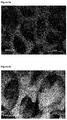
- a C-Al 2 O 3 carbon-bonded filter (of dimensions 50 x 50 x 20 mm) was used as the substrate. This is a reticulated foam filter formed from alumina and graphite refractories, using a pitch to give the carbon bonding on firing. As shown in Figure 2a , no cracks were visible in the filter substrate.
- a rod of precursor coating material was prepared from the following raw materials:
- the alumina used (CT3000SG) is a batch ground alumina having a mono-modal distribution, a Ground Median Size of 0.4 ⁇ m, a Ground Surface Area of 7.5 m 2 /g, and a NaO content of 0.08%.
- the final dimensions of the rods were -600 mm in length; 6-6.2 mm diameter.
- Flame spraying was carried out using a Master Jet flame spraying gun (ROKIDE Spray Unit, Saint-Gobain, Avignon, France).
- the flame spraying gum was directed towards a metal sheet.
- the flow of acetylene gas was set to the highest possible value and the flow of oxygen gas was set to a value of 10-15% below that of the acetylene. With this adjustment it is possible to achieve the highest combustion temperature.
- the rod feed rate was determined.
- the last step was the adjustment of the gun to substrate distance. If the distance is too small then the coating and the substrate will be affected by the pressured air.
- Table 1 Flow rate of oxygen gas (m 3 /hour) 2.0 02 pressure (bar) 5.5 High of 02 - ball (mm) 50 Flow rate of acetylene gas (m 3 /hour) 0.9 Acetylene pressure (bar) 1.1 High of acetylene - ball (mm) 60 Flow rate of air (m 3 /hour) 38.0 Air pressure (bar) 5.5 Gun-to-substrate distance (mm) 100 Rod feed rate (mm/min) 50
- the coating was applied to each face of the filter for about 50-90 s, depending on the coating thickness.
- the coating contained more than 90% gamma alumina.
- the alpha alumina present in the precursor coating material was therefore successfully converted to the gamma phase by the flame spraying process, and retained in the final coating material.
- the coated filter was examined by light microscopy. As shown in Figure 2b , the coated filter has a dense structure.
- EDX Electronic-Dispersive X-ray spectroscopy
- the coated filter was determined to have an open porosity of 7 vol%, as measured by mercury intrusion porosity.
- the porosity of prior art filters coated using ambient-temperature techniques is at least 20 vol%. Despite the high temperature of the flame, no deleterious effects on the structure of the carbon bonded filter were detected.
Landscapes
- Chemical & Material Sciences (AREA)
- Engineering & Computer Science (AREA)
- Ceramic Engineering (AREA)
- Materials Engineering (AREA)
- Organic Chemistry (AREA)
- Mechanical Engineering (AREA)
- Structural Engineering (AREA)
- Plasma & Fusion (AREA)
- Chemical Kinetics & Catalysis (AREA)
- Metallurgy (AREA)
- Physics & Mathematics (AREA)
- Inorganic Chemistry (AREA)
- Filtering Materials (AREA)
Priority Applications (1)
| Application Number | Priority Date | Filing Date | Title |
|---|---|---|---|
| EP16192346.1A EP3305745A1 (de) | 2016-10-05 | 2016-10-05 | Beschichtete filter und verfahren zur herstellung |
Applications Claiming Priority (1)
| Application Number | Priority Date | Filing Date | Title |
|---|---|---|---|
| EP16192346.1A EP3305745A1 (de) | 2016-10-05 | 2016-10-05 | Beschichtete filter und verfahren zur herstellung |
Publications (1)
| Publication Number | Publication Date |
|---|---|
| EP3305745A1 true EP3305745A1 (de) | 2018-04-11 |
Family
ID=57103871
Family Applications (1)
| Application Number | Title | Priority Date | Filing Date |
|---|---|---|---|
| EP16192346.1A Withdrawn EP3305745A1 (de) | 2016-10-05 | 2016-10-05 | Beschichtete filter und verfahren zur herstellung |
Country Status (1)
| Country | Link |
|---|---|
| EP (1) | EP3305745A1 (de) |
Citations (7)
| Publication number | Priority date | Publication date | Assignee | Title |
|---|---|---|---|---|
| GB745257A (en) * | 1952-08-08 | 1956-02-22 | Norton Grinding Wheel Co Ltd | Coating metals and other material with stable metal oxides |
| GB893571A (en) * | 1957-04-26 | 1962-04-11 | British Iron Steel Research | Improvements in or relating to composite refractory bodies |
| GB2034298B (en) | 1978-10-21 | 1982-09-22 | Bridgestone Tire Co Ltd | Ceramic porous bodies |
| EP0412673A2 (de) | 1989-08-08 | 1991-02-13 | Foseco International Limited | Keramischer Schaumfilter |
| EP0649334A1 (de) | 1992-06-05 | 1995-04-26 | Foseco Int | Filter fur leichtmetalle. |
| EP1061316A2 (de) * | 1999-06-15 | 2000-12-20 | Bridgestone Corporation | Trennmittel zum Sintern einer Materialbahn |
| WO2002018075A1 (en) | 2000-08-31 | 2002-03-07 | Foseco International Limited | Refractory articles |
-
2016
- 2016-10-05 EP EP16192346.1A patent/EP3305745A1/de not_active Withdrawn
Patent Citations (7)
| Publication number | Priority date | Publication date | Assignee | Title |
|---|---|---|---|---|
| GB745257A (en) * | 1952-08-08 | 1956-02-22 | Norton Grinding Wheel Co Ltd | Coating metals and other material with stable metal oxides |
| GB893571A (en) * | 1957-04-26 | 1962-04-11 | British Iron Steel Research | Improvements in or relating to composite refractory bodies |
| GB2034298B (en) | 1978-10-21 | 1982-09-22 | Bridgestone Tire Co Ltd | Ceramic porous bodies |
| EP0412673A2 (de) | 1989-08-08 | 1991-02-13 | Foseco International Limited | Keramischer Schaumfilter |
| EP0649334A1 (de) | 1992-06-05 | 1995-04-26 | Foseco Int | Filter fur leichtmetalle. |
| EP1061316A2 (de) * | 1999-06-15 | 2000-12-20 | Bridgestone Corporation | Trennmittel zum Sintern einer Materialbahn |
| WO2002018075A1 (en) | 2000-08-31 | 2002-03-07 | Foseco International Limited | Refractory articles |
Non-Patent Citations (2)
| Title |
|---|
| EMMEL ET AL.: "Functionalization of carbon-bonded alumina filters through the application of active oxide coatings for steel melt filtration", J. MATER. RES., vol. 28, no. 17, 14 September 2013 (2013-09-14), XP055358554, DOI: doi:10.1557/jmr.2013.56 |
| MARCUS EMMEL ET AL: "Functionalization of carbon-bonded alumina filters through the application of active oxide coatings for steel melt filtration", JOURNAL OF MATERIALS RESEARCH, vol. 28, no. 17, 2 May 2013 (2013-05-02), US, pages 2234 - 2242, XP055358554, ISSN: 0884-2914, DOI: 10.1557/jmr.2013.56 * |
Similar Documents
| Publication | Publication Date | Title |
|---|---|---|
| EP2455153B1 (de) | Herstellungsverfahren für eine keramikwabenstruktur | |
| EP1214973B1 (de) | Träger für katalysator und verfahren zu dessen herstellung | |
| KR100576613B1 (ko) | 내화 제품 | |
| EP2221287B1 (de) | Auf aluminiumtitanat basierende keramische wabenstruktur, herstellungsverfahren dafür und ausgangsstoffpulver zu ihrer herstellung | |
| US8449644B2 (en) | Silicon carbide porous body | |
| RU2315650C2 (ru) | Керамический фильтр для фильтрации расплавленного металла и способ его изготовления | |
| CN109020628B (zh) | 一种SiC纳米线增强多孔陶瓷复合材料及其制备方法 | |
| Zhou et al. | Microstructural evolution of SiC coating on C/C composites exposed to 1500° C in ambient air | |
| KR101293826B1 (ko) | 용융된 금속 여과용 필터 및 그 제조 방법 | |
| KR101677486B1 (ko) | 세라믹 허니컴 구조체 및 그 제조 방법 | |
| DK2597075T3 (en) | Porous alpha-SiC-containing shaped body with a continuous open pore structure | |
| EP2607336B1 (de) | Herstellungsverfahren für eine keramische wabenstruktur | |
| EP1639236A2 (de) | Cordieritfilter mit vermindertem druckabfall | |
| DE102011109681A1 (de) | Keramische Filter für die Metallschmelzefiltration auf der Grundlage gängiger Metallschmelze-Filtergeometrien und Verfahren zu ihrer Herstellung | |
| CN104190161A (zh) | 包含石墨烯的熔融金属用陶瓷过滤器 | |
| MX2011002827A (es) | Proceso para elaborar un material sic poroso. | |
| CN101323538A (zh) | 高温泡沫陶瓷的制备方法 | |
| CN110678572A (zh) | 热喷涂粉末和涂层中的纤维孔隙形成填料及其制备和使用方法 | |
| CN104311118A (zh) | 一种超轻氧化铝泡沫陶瓷及其制备方法 | |
| CN101257957A (zh) | 用于熔融金属过滤的过滤器装置及制备这种过滤器的方法 | |
| DE102016100810A1 (de) | Feuerfestwerkstoff und dessen Verwendung | |
| CN105688684A (zh) | 具有三梯度孔隙结构纯质泡沫碳化硅支撑体膜管及制备方法 | |
| JP2025509405A (ja) | グラファイトを含む複合材を含む物品 | |
| WO2003020660A1 (en) | Filter for molten metal filtration and method for producing such filters | |
| WO2007014562A1 (de) | Thermoschock- und korrosionsbeständiger keramikwerkstoff, verfahren zu seiner herstellung sowie verwendung |
Legal Events
| Date | Code | Title | Description |
|---|---|---|---|
| PUAI | Public reference made under article 153(3) epc to a published international application that has entered the european phase |
Free format text: ORIGINAL CODE: 0009012 |
|
| AK | Designated contracting states |
Kind code of ref document: A1 Designated state(s): AL AT BE BG CH CY CZ DE DK EE ES FI FR GB GR HR HU IE IS IT LI LT LU LV MC MK MT NL NO PL PT RO RS SE SI SK SM TR |
|
| AX | Request for extension of the european patent |
Extension state: BA ME |
|
| STAA | Information on the status of an ep patent application or granted ep patent |
Free format text: STATUS: THE APPLICATION IS DEEMED TO BE WITHDRAWN |
|
| 18D | Application deemed to be withdrawn |
Effective date: 20181012 |