EP3305763B1 - Deuterierte oder isotopisch markierte harnstoffderivate oder pharmazeutisch akzeptable salze davon als fprl-1-agonisten - Google Patents
Deuterierte oder isotopisch markierte harnstoffderivate oder pharmazeutisch akzeptable salze davon als fprl-1-agonisten Download PDFInfo
- Publication number
- EP3305763B1 EP3305763B1 EP17196539.5A EP17196539A EP3305763B1 EP 3305763 B1 EP3305763 B1 EP 3305763B1 EP 17196539 A EP17196539 A EP 17196539A EP 3305763 B1 EP3305763 B1 EP 3305763B1
- Authority
- EP
- European Patent Office
- Prior art keywords
- group
- methoxyphenyl
- substituent
- urea
- oxopyrrolidin
- Prior art date
- Legal status (The legal status is an assumption and is not a legal conclusion. Google has not performed a legal analysis and makes no representation as to the accuracy of the status listed.)
- Not-in-force
Links
- 0 CC(C)C(C=C1)=CN(*)C1=O Chemical compound CC(C)C(C=C1)=CN(*)C1=O 0.000 description 21
- JOGYSALTPKSPKF-FUOZMLNRSA-N C/C(/[C@H](CN1)[IH]C1=O)=C(\C)/[F]/[O]=C(/N)\Nc1n[o]c(C)c1 Chemical compound C/C(/[C@H](CN1)[IH]C1=O)=C(\C)/[F]/[O]=C(/N)\Nc1n[o]c(C)c1 JOGYSALTPKSPKF-FUOZMLNRSA-N 0.000 description 1
- HHFMFXQTSJOYLV-UTCJRWHESA-N C/C=C\C(C(CCC1)O)=C1C=C Chemical compound C/C=C\C(C(CCC1)O)=C1C=C HHFMFXQTSJOYLV-UTCJRWHESA-N 0.000 description 1
- BMJCAQIGYACATG-UHFFFAOYSA-N CC(C)(C(C1)c(cc2)ccc2OC)NC1=O Chemical compound CC(C)(C(C1)c(cc2)ccc2OC)NC1=O BMJCAQIGYACATG-UHFFFAOYSA-N 0.000 description 1
- UITOAFCBONEKIJ-UHFFFAOYSA-N CCOC(C(C(C[N+]([O-])=O)c(cc1)ccc1OC)N=C(c1ccccc1)c1ccccc1)=O Chemical compound CCOC(C(C(C[N+]([O-])=O)c(cc1)ccc1OC)N=C(c1ccccc1)c1ccccc1)=O UITOAFCBONEKIJ-UHFFFAOYSA-N 0.000 description 1
- HHMAOSVTCAQEMV-CPCISQLKSA-N CCc1cc(F)c([C@H](CN2)[C@H](C(O)=O)C2=O)c(F)c1 Chemical compound CCc1cc(F)c([C@H](CN2)[C@H](C(O)=O)C2=O)c(F)c1 HHMAOSVTCAQEMV-CPCISQLKSA-N 0.000 description 1
- VDVAPNFEAAQDLF-IAGOWNOFSA-N CN(C[C@@H]([C@H]1NC(Nc(cc2)ccc2Cl)=O)c(cc2)ccc2OC)C1=O Chemical compound CN(C[C@@H]([C@H]1NC(Nc(cc2)ccc2Cl)=O)c(cc2)ccc2OC)C1=O VDVAPNFEAAQDLF-IAGOWNOFSA-N 0.000 description 1
- YRRNUSWUBFQPED-LRDDRELGSA-N CNc1cc(F)c([C@H](CNC2=O)[C@@H]2NC(Nc(cc2)ccc2F)=O)c(F)c1 Chemical compound CNc1cc(F)c([C@H](CNC2=O)[C@@H]2NC(Nc(cc2)ccc2F)=O)c(F)c1 YRRNUSWUBFQPED-LRDDRELGSA-N 0.000 description 1
- OFAVLSKGPGDWEC-UHFFFAOYSA-N COC(C(C(C1(CCCCC1)[N+]([O-])=O)c(cc1)ccc1OC)C(OC)=O)=O Chemical compound COC(C(C(C1(CCCCC1)[N+]([O-])=O)c(cc1)ccc1OC)C(OC)=O)=O OFAVLSKGPGDWEC-UHFFFAOYSA-N 0.000 description 1
- IJAVQNPACXSPIV-UHFFFAOYSA-N COC(C(C(OC)=O)=C(C[N+]([O-])=O)c(cc1)cc2c1OCC2)=O Chemical compound COC(C(C(OC)=O)=C(C[N+]([O-])=O)c(cc1)cc2c1OCC2)=O IJAVQNPACXSPIV-UHFFFAOYSA-N 0.000 description 1
- UGLIBSIQMPCRFB-CPCISQLKSA-N COC([C@@H]([C@@H](CN1)c(c(F)cc2c3CCO2)c3F)C1=O)=O Chemical compound COC([C@@H]([C@@H](CN1)c(c(F)cc2c3CCO2)c3F)C1=O)=O UGLIBSIQMPCRFB-CPCISQLKSA-N 0.000 description 1
- QVBVBWAAJPBSKJ-KWQFWETISA-N COC([C@@H]([C@@H](CN1)c(cc2)cc(F)c2OC)C1=O)=O Chemical compound COC([C@@H]([C@@H](CN1)c(cc2)cc(F)c2OC)C1=O)=O QVBVBWAAJPBSKJ-KWQFWETISA-N 0.000 description 1
- YOUHILLCMZAFEY-NSCUHMNNSA-N COc(c(F)cc(/C=C/[N+]([O-])=O)c1)c1F Chemical compound COc(c(F)cc(/C=C/[N+]([O-])=O)c1)c1F YOUHILLCMZAFEY-NSCUHMNNSA-N 0.000 description 1
- HNLPWKNNRPABQQ-WFASDCNBSA-N COc(c(F)cc([C@H](CNC1=O)[C@@H]1NC(Nc(cc1)ccc1F)=O)c1)c1F Chemical compound COc(c(F)cc([C@H](CNC1=O)[C@@H]1NC(Nc(cc1)ccc1F)=O)c1)c1F HNLPWKNNRPABQQ-WFASDCNBSA-N 0.000 description 1
- YUDGTJUSCOINPM-WKEGUHRASA-N COc(cc(c([C@H](CN1)[C@H](C(O)=O)C1=O)c1)F)c1F Chemical compound COc(cc(c([C@H](CN1)[C@H](C(O)=O)C1=O)c1)F)c1F YUDGTJUSCOINPM-WKEGUHRASA-N 0.000 description 1
- OQDKZJYHCUFKRI-MLGOLLRUSA-N COc1cc(F)c([C@@H](CNC2=O)[C@H]2NC(Nc(cc2)ccc2F)=O)c(F)c1 Chemical compound COc1cc(F)c([C@@H](CNC2=O)[C@H]2NC(Nc(cc2)ccc2F)=O)c(F)c1 OQDKZJYHCUFKRI-MLGOLLRUSA-N 0.000 description 1
- BXUWPXFLARDTPK-BONVTDFDSA-N COc1cc(F)c([C@H](CNC2=O)[C@@H]2NC(Nc2cnc(C(F)(F)F)cc2)=O)c(F)c1 Chemical compound COc1cc(F)c([C@H](CNC2=O)[C@@H]2NC(Nc2cnc(C(F)(F)F)cc2)=O)c(F)c1 BXUWPXFLARDTPK-BONVTDFDSA-N 0.000 description 1
- XGCHMHYJWYJHGJ-JTQLQIEISA-N COc1cc([F]/[O]=C(/N)\Nc2cc(O)ccc2)c([C@@H](C2)CNC2=O)c(F)c1 Chemical compound COc1cc([F]/[O]=C(/N)\Nc2cc(O)ccc2)c([C@@H](C2)CNC2=O)c(F)c1 XGCHMHYJWYJHGJ-JTQLQIEISA-N 0.000 description 1
- FOMFCUCIUOMGLQ-SNAWJCMRSA-N COc1ccc(/C=C/[N+]([O-])=O)c(F)c1 Chemical compound COc1ccc(/C=C/[N+]([O-])=O)c(F)c1 FOMFCUCIUOMGLQ-SNAWJCMRSA-N 0.000 description 1
- HAXBLFNEBXZHSA-GOPGUHFVSA-N C[C@@H]([C@H]([C@@H]1NC(Nc(cc2)ccc2F)=O)c(cc2)ccc2OC)NC1=O Chemical compound C[C@@H]([C@H]([C@@H]1NC(Nc(cc2)ccc2F)=O)c(cc2)ccc2OC)NC1=O HAXBLFNEBXZHSA-GOPGUHFVSA-N 0.000 description 1
- ZKEIBENRSNUGDV-NPPFBWRTSA-N C[C@]1(C(O)=O)[O](C)=C([C@H]2NC(Nc(cc3)ccc3F)=O)N1C[C@H]2c(cc1)ccc1OC Chemical compound C[C@]1(C(O)=O)[O](C)=C([C@H]2NC(Nc(cc3)ccc3F)=O)N1C[C@H]2c(cc1)ccc1OC ZKEIBENRSNUGDV-NPPFBWRTSA-N 0.000 description 1
- SMNSHRFMQNHFJB-WHUIICBVSA-N Cc(c(O)c1)ccc1NC(NC([C@@H](CN1)c(c(F)cc(OC)c2)c2F)C1=O)=O Chemical compound Cc(c(O)c1)ccc1NC(NC([C@@H](CN1)c(c(F)cc(OC)c2)c2F)C1=O)=O SMNSHRFMQNHFJB-WHUIICBVSA-N 0.000 description 1
- RZXMPPFPUUCRFN-UHFFFAOYSA-N Cc(cc1)ccc1N Chemical compound Cc(cc1)ccc1N RZXMPPFPUUCRFN-UHFFFAOYSA-N 0.000 description 1
- JDZYRVFPDFZSMG-CWQZNGJJSA-N Cc(cc1)ccc1NC(NC([C@@H](CN1)c(c(F)cc(OC)c2)c2F)C1=O)=O Chemical compound Cc(cc1)ccc1NC(NC([C@@H](CN1)c(c(F)cc(OC)c2)c2F)C1=O)=O JDZYRVFPDFZSMG-CWQZNGJJSA-N 0.000 description 1
- JNSXXNKXLVHOTE-BJQOMGFOSA-N Cc1cnc(CN(C[C@H](C2NC(Nc(cc3)ccc3F)=O)c(c(F)cc(OC)c3)c3F)C2=O)[o]1 Chemical compound Cc1cnc(CN(C[C@H](C2NC(Nc(cc3)ccc3F)=O)c(c(F)cc(OC)c3)c3F)C2=O)[o]1 JNSXXNKXLVHOTE-BJQOMGFOSA-N 0.000 description 1
- GZCSPKUHJFCWFD-LBPRGKRZSA-N N/C(/Nc1cc2ccccc2[s]1)=[O]\c1c([C@@H](C2)CNC2=O)c(F)cc2c1CCO2 Chemical compound N/C(/Nc1cc2ccccc2[s]1)=[O]\c1c([C@@H](C2)CNC2=O)c(F)cc2c1CCO2 GZCSPKUHJFCWFD-LBPRGKRZSA-N 0.000 description 1
- FTDCGFRSYMALPC-KXBFYZLASA-N NC(CN(C[C@H]([C@@H]1NC(Nc(cc2)ccc2F)=O)c(c(F)c2)cc3c2OCC3)C1=O)=O Chemical compound NC(CN(C[C@H]([C@@H]1NC(Nc(cc2)ccc2F)=O)c(c(F)c2)cc3c2OCC3)C1=O)=O FTDCGFRSYMALPC-KXBFYZLASA-N 0.000 description 1
- NSBLVDHTYXMNJE-UHFFFAOYSA-N NC(Nc(cc1)ccc1F)O Chemical compound NC(Nc(cc1)ccc1F)O NSBLVDHTYXMNJE-UHFFFAOYSA-N 0.000 description 1
- QZSUSLSDKPMIBE-JQWIXIFHSA-N OC([C@@H]([C@@H](CN1)c2cc(CCC3)c3cc2F)C1=O)=O Chemical compound OC([C@@H]([C@@H](CN1)c2cc(CCC3)c3cc2F)C1=O)=O QZSUSLSDKPMIBE-JQWIXIFHSA-N 0.000 description 1
- UOQRZCNCICUPJO-RKDXNWHRSA-N OC([C@H]([C@H](CN1)c2ccccc2)C1=O)=O Chemical compound OC([C@H]([C@H](CN1)c2ccccc2)C1=O)=O UOQRZCNCICUPJO-RKDXNWHRSA-N 0.000 description 1
- FJJBPCSGAJVBNP-ONEGZZNKSA-N [O-][N+](/C=C/C1C(F)=CC(OCCC2)=C2C1)=O Chemical compound [O-][N+](/C=C/C1C(F)=CC(OCCC2)=C2C1)=O FJJBPCSGAJVBNP-ONEGZZNKSA-N 0.000 description 1
- AIWXSWDQMHRAJK-HNQUOIGGSA-N [O-][N+](/C=C/c(c(F)c1)cc2c1[o]cc2)=O Chemical compound [O-][N+](/C=C/c(c(F)c1)cc2c1[o]cc2)=O AIWXSWDQMHRAJK-HNQUOIGGSA-N 0.000 description 1
- GNQYOWICNNDUGJ-OWOJBTEDSA-N [O-][N+](/C=C/c(c(F)cc(O)c1)c1F)=O Chemical compound [O-][N+](/C=C/c(c(F)cc(O)c1)c1F)=O GNQYOWICNNDUGJ-OWOJBTEDSA-N 0.000 description 1
- JCFJCZMBAIYFRX-OWOJBTEDSA-N [O-][N+](/C=C/c(c(F)cnc1)c1F)=O Chemical compound [O-][N+](/C=C/c(c(F)cnc1)c1F)=O JCFJCZMBAIYFRX-OWOJBTEDSA-N 0.000 description 1
- DLJYVQNNTCMKAK-HWKANZROSA-N [O-][N+](/C=C/c(cc1)cc2c1OCC2)=O Chemical compound [O-][N+](/C=C/c(cc1)cc2c1OCC2)=O DLJYVQNNTCMKAK-HWKANZROSA-N 0.000 description 1
Classifications
-
- C—CHEMISTRY; METALLURGY
- C07—ORGANIC CHEMISTRY
- C07D—HETEROCYCLIC COMPOUNDS
- C07D207/00—Heterocyclic compounds containing five-membered rings not condensed with other rings, with one nitrogen atom as the only ring hetero atom
- C07D207/02—Heterocyclic compounds containing five-membered rings not condensed with other rings, with one nitrogen atom as the only ring hetero atom with only hydrogen or carbon atoms directly attached to the ring nitrogen atom
- C07D207/18—Heterocyclic compounds containing five-membered rings not condensed with other rings, with one nitrogen atom as the only ring hetero atom with only hydrogen or carbon atoms directly attached to the ring nitrogen atom having one double bond between ring members or between a ring member and a non-ring member
- C07D207/22—Heterocyclic compounds containing five-membered rings not condensed with other rings, with one nitrogen atom as the only ring hetero atom with only hydrogen or carbon atoms directly attached to the ring nitrogen atom having one double bond between ring members or between a ring member and a non-ring member with hetero atoms or with carbon atoms having three bonds to hetero atoms with at the most one bond to halogen, e.g. ester or nitrile radicals, directly attached to ring carbon atoms
- C07D207/24—Oxygen or sulfur atoms
- C07D207/26—2-Pyrrolidones
- C07D207/273—2-Pyrrolidones with hetero atoms or with carbon atoms having three bonds to hetero atoms with at the most one bond to halogen, e.g. ester or nitrile radicals, directly attached to other ring carbon atoms
-
- A—HUMAN NECESSITIES
- A61—MEDICAL OR VETERINARY SCIENCE; HYGIENE
- A61K—PREPARATIONS FOR MEDICAL, DENTAL OR TOILETRY PURPOSES
- A61K31/00—Medicinal preparations containing organic active ingredients
- A61K31/33—Heterocyclic compounds
- A61K31/395—Heterocyclic compounds having nitrogen as a ring hetero atom, e.g. guanethidine or rifamycins
- A61K31/40—Heterocyclic compounds having nitrogen as a ring hetero atom, e.g. guanethidine or rifamycins having five-membered rings with one nitrogen as the only ring hetero atom, e.g. sulpiride, succinimide, tolmetin, buflomedil
- A61K31/4015—Heterocyclic compounds having nitrogen as a ring hetero atom, e.g. guanethidine or rifamycins having five-membered rings with one nitrogen as the only ring hetero atom, e.g. sulpiride, succinimide, tolmetin, buflomedil having oxo groups directly attached to the heterocyclic ring, e.g. piracetam, ethosuximide
-
- A—HUMAN NECESSITIES
- A61—MEDICAL OR VETERINARY SCIENCE; HYGIENE
- A61K—PREPARATIONS FOR MEDICAL, DENTAL OR TOILETRY PURPOSES
- A61K31/00—Medicinal preparations containing organic active ingredients
- A61K31/33—Heterocyclic compounds
- A61K31/395—Heterocyclic compounds having nitrogen as a ring hetero atom, e.g. guanethidine or rifamycins
- A61K31/40—Heterocyclic compounds having nitrogen as a ring hetero atom, e.g. guanethidine or rifamycins having five-membered rings with one nitrogen as the only ring hetero atom, e.g. sulpiride, succinimide, tolmetin, buflomedil
- A61K31/4025—Heterocyclic compounds having nitrogen as a ring hetero atom, e.g. guanethidine or rifamycins having five-membered rings with one nitrogen as the only ring hetero atom, e.g. sulpiride, succinimide, tolmetin, buflomedil not condensed and containing further heterocyclic rings, e.g. cromakalim
-
- A—HUMAN NECESSITIES
- A61—MEDICAL OR VETERINARY SCIENCE; HYGIENE
- A61K—PREPARATIONS FOR MEDICAL, DENTAL OR TOILETRY PURPOSES
- A61K31/00—Medicinal preparations containing organic active ingredients
- A61K31/33—Heterocyclic compounds
- A61K31/395—Heterocyclic compounds having nitrogen as a ring hetero atom, e.g. guanethidine or rifamycins
- A61K31/40—Heterocyclic compounds having nitrogen as a ring hetero atom, e.g. guanethidine or rifamycins having five-membered rings with one nitrogen as the only ring hetero atom, e.g. sulpiride, succinimide, tolmetin, buflomedil
- A61K31/403—Heterocyclic compounds having nitrogen as a ring hetero atom, e.g. guanethidine or rifamycins having five-membered rings with one nitrogen as the only ring hetero atom, e.g. sulpiride, succinimide, tolmetin, buflomedil condensed with carbocyclic rings, e.g. carbazole
-
- A—HUMAN NECESSITIES
- A61—MEDICAL OR VETERINARY SCIENCE; HYGIENE
- A61K—PREPARATIONS FOR MEDICAL, DENTAL OR TOILETRY PURPOSES
- A61K31/00—Medicinal preparations containing organic active ingredients
- A61K31/33—Heterocyclic compounds
- A61K31/395—Heterocyclic compounds having nitrogen as a ring hetero atom, e.g. guanethidine or rifamycins
- A61K31/435—Heterocyclic compounds having nitrogen as a ring hetero atom, e.g. guanethidine or rifamycins having six-membered rings with one nitrogen as the only ring hetero atom
- A61K31/44—Non condensed pyridines; Hydrogenated derivatives thereof
- A61K31/4427—Non condensed pyridines; Hydrogenated derivatives thereof containing further heterocyclic ring systems
- A61K31/4439—Non condensed pyridines; Hydrogenated derivatives thereof containing further heterocyclic ring systems containing a five-membered ring with nitrogen as a ring hetero atom, e.g. omeprazole
-
- A—HUMAN NECESSITIES
- A61—MEDICAL OR VETERINARY SCIENCE; HYGIENE
- A61P—SPECIFIC THERAPEUTIC ACTIVITY OF CHEMICAL COMPOUNDS OR MEDICINAL PREPARATIONS
- A61P1/00—Drugs for disorders of the alimentary tract or the digestive system
- A61P1/02—Stomatological preparations, e.g. drugs for caries, aphtae, periodontitis
-
- A—HUMAN NECESSITIES
- A61—MEDICAL OR VETERINARY SCIENCE; HYGIENE
- A61P—SPECIFIC THERAPEUTIC ACTIVITY OF CHEMICAL COMPOUNDS OR MEDICINAL PREPARATIONS
- A61P1/00—Drugs for disorders of the alimentary tract or the digestive system
- A61P1/04—Drugs for disorders of the alimentary tract or the digestive system for ulcers, gastritis or reflux esophagitis, e.g. antacids, inhibitors of acid secretion, mucosal protectants
-
- A—HUMAN NECESSITIES
- A61—MEDICAL OR VETERINARY SCIENCE; HYGIENE
- A61P—SPECIFIC THERAPEUTIC ACTIVITY OF CHEMICAL COMPOUNDS OR MEDICINAL PREPARATIONS
- A61P11/00—Drugs for disorders of the respiratory system
-
- A—HUMAN NECESSITIES
- A61—MEDICAL OR VETERINARY SCIENCE; HYGIENE
- A61P—SPECIFIC THERAPEUTIC ACTIVITY OF CHEMICAL COMPOUNDS OR MEDICINAL PREPARATIONS
- A61P11/00—Drugs for disorders of the respiratory system
- A61P11/02—Nasal agents, e.g. decongestants
-
- A—HUMAN NECESSITIES
- A61—MEDICAL OR VETERINARY SCIENCE; HYGIENE
- A61P—SPECIFIC THERAPEUTIC ACTIVITY OF CHEMICAL COMPOUNDS OR MEDICINAL PREPARATIONS
- A61P11/00—Drugs for disorders of the respiratory system
- A61P11/06—Antiasthmatics
-
- A—HUMAN NECESSITIES
- A61—MEDICAL OR VETERINARY SCIENCE; HYGIENE
- A61P—SPECIFIC THERAPEUTIC ACTIVITY OF CHEMICAL COMPOUNDS OR MEDICINAL PREPARATIONS
- A61P13/00—Drugs for disorders of the urinary system
- A61P13/08—Drugs for disorders of the urinary system of the prostate
-
- A—HUMAN NECESSITIES
- A61—MEDICAL OR VETERINARY SCIENCE; HYGIENE
- A61P—SPECIFIC THERAPEUTIC ACTIVITY OF CHEMICAL COMPOUNDS OR MEDICINAL PREPARATIONS
- A61P13/00—Drugs for disorders of the urinary system
- A61P13/12—Drugs for disorders of the urinary system of the kidneys
-
- A—HUMAN NECESSITIES
- A61—MEDICAL OR VETERINARY SCIENCE; HYGIENE
- A61P—SPECIFIC THERAPEUTIC ACTIVITY OF CHEMICAL COMPOUNDS OR MEDICINAL PREPARATIONS
- A61P17/00—Drugs for dermatological disorders
- A61P17/06—Antipsoriatics
-
- A—HUMAN NECESSITIES
- A61—MEDICAL OR VETERINARY SCIENCE; HYGIENE
- A61P—SPECIFIC THERAPEUTIC ACTIVITY OF CHEMICAL COMPOUNDS OR MEDICINAL PREPARATIONS
- A61P19/00—Drugs for skeletal disorders
- A61P19/02—Drugs for skeletal disorders for joint disorders, e.g. arthritis, arthrosis
-
- A—HUMAN NECESSITIES
- A61—MEDICAL OR VETERINARY SCIENCE; HYGIENE
- A61P—SPECIFIC THERAPEUTIC ACTIVITY OF CHEMICAL COMPOUNDS OR MEDICINAL PREPARATIONS
- A61P19/00—Drugs for skeletal disorders
- A61P19/06—Antigout agents, e.g. antihyperuricemic or uricosuric agents
-
- A—HUMAN NECESSITIES
- A61—MEDICAL OR VETERINARY SCIENCE; HYGIENE
- A61P—SPECIFIC THERAPEUTIC ACTIVITY OF CHEMICAL COMPOUNDS OR MEDICINAL PREPARATIONS
- A61P25/00—Drugs for disorders of the nervous system
-
- A—HUMAN NECESSITIES
- A61—MEDICAL OR VETERINARY SCIENCE; HYGIENE
- A61P—SPECIFIC THERAPEUTIC ACTIVITY OF CHEMICAL COMPOUNDS OR MEDICINAL PREPARATIONS
- A61P25/00—Drugs for disorders of the nervous system
- A61P25/04—Centrally acting analgesics, e.g. opioids
-
- A—HUMAN NECESSITIES
- A61—MEDICAL OR VETERINARY SCIENCE; HYGIENE
- A61P—SPECIFIC THERAPEUTIC ACTIVITY OF CHEMICAL COMPOUNDS OR MEDICINAL PREPARATIONS
- A61P25/00—Drugs for disorders of the nervous system
- A61P25/28—Drugs for disorders of the nervous system for treating neurodegenerative disorders of the central nervous system, e.g. nootropic agents, cognition enhancers, drugs for treating Alzheimer's disease or other forms of dementia
-
- A—HUMAN NECESSITIES
- A61—MEDICAL OR VETERINARY SCIENCE; HYGIENE
- A61P—SPECIFIC THERAPEUTIC ACTIVITY OF CHEMICAL COMPOUNDS OR MEDICINAL PREPARATIONS
- A61P27/00—Drugs for disorders of the senses
- A61P27/02—Ophthalmic agents
-
- A—HUMAN NECESSITIES
- A61—MEDICAL OR VETERINARY SCIENCE; HYGIENE
- A61P—SPECIFIC THERAPEUTIC ACTIVITY OF CHEMICAL COMPOUNDS OR MEDICINAL PREPARATIONS
- A61P27/00—Drugs for disorders of the senses
- A61P27/02—Ophthalmic agents
- A61P27/06—Antiglaucoma agents or miotics
-
- A—HUMAN NECESSITIES
- A61—MEDICAL OR VETERINARY SCIENCE; HYGIENE
- A61P—SPECIFIC THERAPEUTIC ACTIVITY OF CHEMICAL COMPOUNDS OR MEDICINAL PREPARATIONS
- A61P29/00—Non-central analgesic, antipyretic or antiinflammatory agents, e.g. antirheumatic agents; Non-steroidal antiinflammatory drugs [NSAID]
-
- A—HUMAN NECESSITIES
- A61—MEDICAL OR VETERINARY SCIENCE; HYGIENE
- A61P—SPECIFIC THERAPEUTIC ACTIVITY OF CHEMICAL COMPOUNDS OR MEDICINAL PREPARATIONS
- A61P3/00—Drugs for disorders of the metabolism
- A61P3/08—Drugs for disorders of the metabolism for glucose homeostasis
- A61P3/10—Drugs for disorders of the metabolism for glucose homeostasis for hyperglycaemia, e.g. antidiabetics
-
- A—HUMAN NECESSITIES
- A61—MEDICAL OR VETERINARY SCIENCE; HYGIENE
- A61P—SPECIFIC THERAPEUTIC ACTIVITY OF CHEMICAL COMPOUNDS OR MEDICINAL PREPARATIONS
- A61P31/00—Antiinfectives, i.e. antibiotics, antiseptics, chemotherapeutics
-
- A—HUMAN NECESSITIES
- A61—MEDICAL OR VETERINARY SCIENCE; HYGIENE
- A61P—SPECIFIC THERAPEUTIC ACTIVITY OF CHEMICAL COMPOUNDS OR MEDICINAL PREPARATIONS
- A61P31/00—Antiinfectives, i.e. antibiotics, antiseptics, chemotherapeutics
- A61P31/04—Antibacterial agents
-
- A—HUMAN NECESSITIES
- A61—MEDICAL OR VETERINARY SCIENCE; HYGIENE
- A61P—SPECIFIC THERAPEUTIC ACTIVITY OF CHEMICAL COMPOUNDS OR MEDICINAL PREPARATIONS
- A61P31/00—Antiinfectives, i.e. antibiotics, antiseptics, chemotherapeutics
- A61P31/12—Antivirals
- A61P31/14—Antivirals for RNA viruses
- A61P31/18—Antivirals for RNA viruses for HIV
-
- A—HUMAN NECESSITIES
- A61—MEDICAL OR VETERINARY SCIENCE; HYGIENE
- A61P—SPECIFIC THERAPEUTIC ACTIVITY OF CHEMICAL COMPOUNDS OR MEDICINAL PREPARATIONS
- A61P35/00—Antineoplastic agents
-
- A—HUMAN NECESSITIES
- A61—MEDICAL OR VETERINARY SCIENCE; HYGIENE
- A61P—SPECIFIC THERAPEUTIC ACTIVITY OF CHEMICAL COMPOUNDS OR MEDICINAL PREPARATIONS
- A61P37/00—Drugs for immunological or allergic disorders
-
- A—HUMAN NECESSITIES
- A61—MEDICAL OR VETERINARY SCIENCE; HYGIENE
- A61P—SPECIFIC THERAPEUTIC ACTIVITY OF CHEMICAL COMPOUNDS OR MEDICINAL PREPARATIONS
- A61P37/00—Drugs for immunological or allergic disorders
- A61P37/02—Immunomodulators
-
- A—HUMAN NECESSITIES
- A61—MEDICAL OR VETERINARY SCIENCE; HYGIENE
- A61P—SPECIFIC THERAPEUTIC ACTIVITY OF CHEMICAL COMPOUNDS OR MEDICINAL PREPARATIONS
- A61P37/00—Drugs for immunological or allergic disorders
- A61P37/08—Antiallergic agents
-
- A—HUMAN NECESSITIES
- A61—MEDICAL OR VETERINARY SCIENCE; HYGIENE
- A61P—SPECIFIC THERAPEUTIC ACTIVITY OF CHEMICAL COMPOUNDS OR MEDICINAL PREPARATIONS
- A61P39/00—General protective or antinoxious agents
- A61P39/02—Antidotes
-
- A—HUMAN NECESSITIES
- A61—MEDICAL OR VETERINARY SCIENCE; HYGIENE
- A61P—SPECIFIC THERAPEUTIC ACTIVITY OF CHEMICAL COMPOUNDS OR MEDICINAL PREPARATIONS
- A61P43/00—Drugs for specific purposes, not provided for in groups A61P1/00-A61P41/00
-
- A—HUMAN NECESSITIES
- A61—MEDICAL OR VETERINARY SCIENCE; HYGIENE
- A61P—SPECIFIC THERAPEUTIC ACTIVITY OF CHEMICAL COMPOUNDS OR MEDICINAL PREPARATIONS
- A61P9/00—Drugs for disorders of the cardiovascular system
-
- A—HUMAN NECESSITIES
- A61—MEDICAL OR VETERINARY SCIENCE; HYGIENE
- A61P—SPECIFIC THERAPEUTIC ACTIVITY OF CHEMICAL COMPOUNDS OR MEDICINAL PREPARATIONS
- A61P9/00—Drugs for disorders of the cardiovascular system
- A61P9/10—Drugs for disorders of the cardiovascular system for treating ischaemic or atherosclerotic diseases, e.g. antianginal drugs, coronary vasodilators, drugs for myocardial infarction, retinopathy, cerebrovascula insufficiency, renal arteriosclerosis
-
- C—CHEMISTRY; METALLURGY
- C07—ORGANIC CHEMISTRY
- C07D—HETEROCYCLIC COMPOUNDS
- C07D207/00—Heterocyclic compounds containing five-membered rings not condensed with other rings, with one nitrogen atom as the only ring hetero atom
- C07D207/02—Heterocyclic compounds containing five-membered rings not condensed with other rings, with one nitrogen atom as the only ring hetero atom with only hydrogen or carbon atoms directly attached to the ring nitrogen atom
- C07D207/18—Heterocyclic compounds containing five-membered rings not condensed with other rings, with one nitrogen atom as the only ring hetero atom with only hydrogen or carbon atoms directly attached to the ring nitrogen atom having one double bond between ring members or between a ring member and a non-ring member
- C07D207/22—Heterocyclic compounds containing five-membered rings not condensed with other rings, with one nitrogen atom as the only ring hetero atom with only hydrogen or carbon atoms directly attached to the ring nitrogen atom having one double bond between ring members or between a ring member and a non-ring member with hetero atoms or with carbon atoms having three bonds to hetero atoms with at the most one bond to halogen, e.g. ester or nitrile radicals, directly attached to ring carbon atoms
-
- C—CHEMISTRY; METALLURGY
- C07—ORGANIC CHEMISTRY
- C07D—HETEROCYCLIC COMPOUNDS
- C07D209/00—Heterocyclic compounds containing five-membered rings, condensed with other rings, with one nitrogen atom as the only ring hetero atom
- C07D209/02—Heterocyclic compounds containing five-membered rings, condensed with other rings, with one nitrogen atom as the only ring hetero atom condensed with one carbocyclic ring
- C07D209/54—Spiro-condensed
-
- C—CHEMISTRY; METALLURGY
- C07—ORGANIC CHEMISTRY
- C07D—HETEROCYCLIC COMPOUNDS
- C07D401/00—Heterocyclic compounds containing two or more hetero rings, having nitrogen atoms as the only ring hetero atoms, at least one ring being a six-membered ring with only one nitrogen atom
- C07D401/02—Heterocyclic compounds containing two or more hetero rings, having nitrogen atoms as the only ring hetero atoms, at least one ring being a six-membered ring with only one nitrogen atom containing two hetero rings
- C07D401/04—Heterocyclic compounds containing two or more hetero rings, having nitrogen atoms as the only ring hetero atoms, at least one ring being a six-membered ring with only one nitrogen atom containing two hetero rings directly linked by a ring-member-to-ring-member bond
-
- C—CHEMISTRY; METALLURGY
- C07—ORGANIC CHEMISTRY
- C07D—HETEROCYCLIC COMPOUNDS
- C07D401/00—Heterocyclic compounds containing two or more hetero rings, having nitrogen atoms as the only ring hetero atoms, at least one ring being a six-membered ring with only one nitrogen atom
- C07D401/02—Heterocyclic compounds containing two or more hetero rings, having nitrogen atoms as the only ring hetero atoms, at least one ring being a six-membered ring with only one nitrogen atom containing two hetero rings
- C07D401/06—Heterocyclic compounds containing two or more hetero rings, having nitrogen atoms as the only ring hetero atoms, at least one ring being a six-membered ring with only one nitrogen atom containing two hetero rings linked by a carbon chain containing only aliphatic carbon atoms
-
- C—CHEMISTRY; METALLURGY
- C07—ORGANIC CHEMISTRY
- C07D—HETEROCYCLIC COMPOUNDS
- C07D401/00—Heterocyclic compounds containing two or more hetero rings, having nitrogen atoms as the only ring hetero atoms, at least one ring being a six-membered ring with only one nitrogen atom
- C07D401/02—Heterocyclic compounds containing two or more hetero rings, having nitrogen atoms as the only ring hetero atoms, at least one ring being a six-membered ring with only one nitrogen atom containing two hetero rings
- C07D401/12—Heterocyclic compounds containing two or more hetero rings, having nitrogen atoms as the only ring hetero atoms, at least one ring being a six-membered ring with only one nitrogen atom containing two hetero rings linked by a chain containing hetero atoms as chain links
-
- C—CHEMISTRY; METALLURGY
- C07—ORGANIC CHEMISTRY
- C07D—HETEROCYCLIC COMPOUNDS
- C07D403/00—Heterocyclic compounds containing two or more hetero rings, having nitrogen atoms as the only ring hetero atoms, not provided for by group C07D401/00
- C07D403/02—Heterocyclic compounds containing two or more hetero rings, having nitrogen atoms as the only ring hetero atoms, not provided for by group C07D401/00 containing two hetero rings
- C07D403/04—Heterocyclic compounds containing two or more hetero rings, having nitrogen atoms as the only ring hetero atoms, not provided for by group C07D401/00 containing two hetero rings directly linked by a ring-member-to-ring-member bond
-
- C—CHEMISTRY; METALLURGY
- C07—ORGANIC CHEMISTRY
- C07D—HETEROCYCLIC COMPOUNDS
- C07D403/00—Heterocyclic compounds containing two or more hetero rings, having nitrogen atoms as the only ring hetero atoms, not provided for by group C07D401/00
- C07D403/02—Heterocyclic compounds containing two or more hetero rings, having nitrogen atoms as the only ring hetero atoms, not provided for by group C07D401/00 containing two hetero rings
- C07D403/12—Heterocyclic compounds containing two or more hetero rings, having nitrogen atoms as the only ring hetero atoms, not provided for by group C07D401/00 containing two hetero rings linked by a chain containing hetero atoms as chain links
-
- C—CHEMISTRY; METALLURGY
- C07—ORGANIC CHEMISTRY
- C07D—HETEROCYCLIC COMPOUNDS
- C07D405/00—Heterocyclic compounds containing both one or more hetero rings having oxygen atoms as the only ring hetero atoms, and one or more rings having nitrogen as the only ring hetero atom
- C07D405/02—Heterocyclic compounds containing both one or more hetero rings having oxygen atoms as the only ring hetero atoms, and one or more rings having nitrogen as the only ring hetero atom containing two hetero rings
- C07D405/04—Heterocyclic compounds containing both one or more hetero rings having oxygen atoms as the only ring hetero atoms, and one or more rings having nitrogen as the only ring hetero atom containing two hetero rings directly linked by a ring-member-to-ring-member bond
-
- C—CHEMISTRY; METALLURGY
- C07—ORGANIC CHEMISTRY
- C07D—HETEROCYCLIC COMPOUNDS
- C07D405/00—Heterocyclic compounds containing both one or more hetero rings having oxygen atoms as the only ring hetero atoms, and one or more rings having nitrogen as the only ring hetero atom
- C07D405/02—Heterocyclic compounds containing both one or more hetero rings having oxygen atoms as the only ring hetero atoms, and one or more rings having nitrogen as the only ring hetero atom containing two hetero rings
- C07D405/12—Heterocyclic compounds containing both one or more hetero rings having oxygen atoms as the only ring hetero atoms, and one or more rings having nitrogen as the only ring hetero atom containing two hetero rings linked by a chain containing hetero atoms as chain links
-
- C—CHEMISTRY; METALLURGY
- C07—ORGANIC CHEMISTRY
- C07D—HETEROCYCLIC COMPOUNDS
- C07D405/00—Heterocyclic compounds containing both one or more hetero rings having oxygen atoms as the only ring hetero atoms, and one or more rings having nitrogen as the only ring hetero atom
- C07D405/14—Heterocyclic compounds containing both one or more hetero rings having oxygen atoms as the only ring hetero atoms, and one or more rings having nitrogen as the only ring hetero atom containing three or more hetero rings
-
- C—CHEMISTRY; METALLURGY
- C07—ORGANIC CHEMISTRY
- C07D—HETEROCYCLIC COMPOUNDS
- C07D409/00—Heterocyclic compounds containing two or more hetero rings, at least one ring having sulfur atoms as the only ring hetero atoms
- C07D409/02—Heterocyclic compounds containing two or more hetero rings, at least one ring having sulfur atoms as the only ring hetero atoms containing two hetero rings
- C07D409/04—Heterocyclic compounds containing two or more hetero rings, at least one ring having sulfur atoms as the only ring hetero atoms containing two hetero rings directly linked by a ring-member-to-ring-member bond
-
- C—CHEMISTRY; METALLURGY
- C07—ORGANIC CHEMISTRY
- C07D—HETEROCYCLIC COMPOUNDS
- C07D409/00—Heterocyclic compounds containing two or more hetero rings, at least one ring having sulfur atoms as the only ring hetero atoms
- C07D409/02—Heterocyclic compounds containing two or more hetero rings, at least one ring having sulfur atoms as the only ring hetero atoms containing two hetero rings
- C07D409/12—Heterocyclic compounds containing two or more hetero rings, at least one ring having sulfur atoms as the only ring hetero atoms containing two hetero rings linked by a chain containing hetero atoms as chain links
-
- C—CHEMISTRY; METALLURGY
- C07—ORGANIC CHEMISTRY
- C07D—HETEROCYCLIC COMPOUNDS
- C07D409/00—Heterocyclic compounds containing two or more hetero rings, at least one ring having sulfur atoms as the only ring hetero atoms
- C07D409/14—Heterocyclic compounds containing two or more hetero rings, at least one ring having sulfur atoms as the only ring hetero atoms containing three or more hetero rings
-
- C—CHEMISTRY; METALLURGY
- C07—ORGANIC CHEMISTRY
- C07D—HETEROCYCLIC COMPOUNDS
- C07D413/00—Heterocyclic compounds containing two or more hetero rings, at least one ring having nitrogen and oxygen atoms as the only ring hetero atoms
- C07D413/02—Heterocyclic compounds containing two or more hetero rings, at least one ring having nitrogen and oxygen atoms as the only ring hetero atoms containing two hetero rings
- C07D413/06—Heterocyclic compounds containing two or more hetero rings, at least one ring having nitrogen and oxygen atoms as the only ring hetero atoms containing two hetero rings linked by a carbon chain containing only aliphatic carbon atoms
-
- C—CHEMISTRY; METALLURGY
- C07—ORGANIC CHEMISTRY
- C07D—HETEROCYCLIC COMPOUNDS
- C07D413/00—Heterocyclic compounds containing two or more hetero rings, at least one ring having nitrogen and oxygen atoms as the only ring hetero atoms
- C07D413/02—Heterocyclic compounds containing two or more hetero rings, at least one ring having nitrogen and oxygen atoms as the only ring hetero atoms containing two hetero rings
- C07D413/12—Heterocyclic compounds containing two or more hetero rings, at least one ring having nitrogen and oxygen atoms as the only ring hetero atoms containing two hetero rings linked by a chain containing hetero atoms as chain links
-
- C—CHEMISTRY; METALLURGY
- C07—ORGANIC CHEMISTRY
- C07D—HETEROCYCLIC COMPOUNDS
- C07D413/00—Heterocyclic compounds containing two or more hetero rings, at least one ring having nitrogen and oxygen atoms as the only ring hetero atoms
- C07D413/14—Heterocyclic compounds containing two or more hetero rings, at least one ring having nitrogen and oxygen atoms as the only ring hetero atoms containing three or more hetero rings
-
- C—CHEMISTRY; METALLURGY
- C07—ORGANIC CHEMISTRY
- C07D—HETEROCYCLIC COMPOUNDS
- C07D417/00—Heterocyclic compounds containing two or more hetero rings, at least one ring having nitrogen and sulfur atoms as the only ring hetero atoms, not provided for by group C07D415/00
- C07D417/02—Heterocyclic compounds containing two or more hetero rings, at least one ring having nitrogen and sulfur atoms as the only ring hetero atoms, not provided for by group C07D415/00 containing two hetero rings
- C07D417/12—Heterocyclic compounds containing two or more hetero rings, at least one ring having nitrogen and sulfur atoms as the only ring hetero atoms, not provided for by group C07D415/00 containing two hetero rings linked by a chain containing hetero atoms as chain links
Definitions
- the present invention relates to a deuterium-substituted or isotopically labeled urea derivative or a pharmacologically acceptable salt thereof or a solvate or hydrate thereof that are useful as pharmaceuticals and have a formyl peptide receptor like 1 (hereinafter may be abbreviated as FPRL1) agonist effect, to a pharmaceutical composition containing the urea derivative or the pharmacologically acceptable salt thereof or the solvate or hydrate thereof, and to a pharmaceutical composition for use in prevention or treatment of certain diseases.
- FPRL1 formyl peptide receptor like 1
- FPRL1 (formyl peptide receptor like 1, also known as Lipoxin A4 Receptor, ALXR, and FPR2) is a G protein-coupled receptor cloned as a subtype of N-formyl peptide receptors (FPRs) by Murphy et al. (Non-Patent Literature 1).
- the FPRL1 was discovered as a receptor that mediates calcium mobilization in response to high concentration of fMLF (formyl methionine leucyl phenylalanine peptide).
- Non-Patent Literature 2 Expression of FPRL1 has been found in neutrophils, monocytes, T-lymphocytes, dendritic cells, etc.
- Non-Patent Literature 3 the role of FPRL1 in a living body is complicated and has therefore not been elucidated sufficiently
- Non-Patent Literature 4 it has been recognized that the reactions become worse. Therefore, it is considered that FPRL1 contributes to the resolution of the inflammation.
- Non-Patent Literatures 5 and 6 Endogenous lipid mediators such as Lipoxin A4 (LXA4) and Resolvin D1 (RvD1) and peptides such as WKYMVm have been reported as agonists that bind to FPRL1 (Non-Patent Literatures 5 and 6).
- Non-Patent Literatures 7 and 8 Such FPRL1 agonists can reduce neutrophil chemotaxis in vitro. Although neutrophils perform host defense, they cause vascular injury, result in an increase in vascular permeability and edema, followed by release of chemotactic factors, and thereby contribute to inflammation (Non-Patent Literature 9). Therefore, it is considered that the FPRL1 agonists exhibit an anti-inflammatory effect.
- Non-Patent Literature 10 peptide agonists exhibit an inhibitory effect on intestinal inflammation
- Non-Patent Literature 11 an inhibitory effect on airway inflammation
- Non-Patent Literature 12 an inhibitory effect on septicemia
- Non-Patent Literature 13 an inhibitory effect on a cancer model
- QuinC1 a non-peptide low-molecular weight compound, inhibits bleomycin-induced lung inflammation
- FPRL1 can be considered as a target of various diseases such as inflammatory diseases, chronic airway diseases, cancers, septicemia, allergic symptoms, HIV retrovirus infection, circulatory disorders, neuroinflammation, nervous disorders, pains, prion diseases, amyloidosis, and immune disorders. Therefore, the FPRL1 agonists can be promising therapeutic agent for these diseases .
- Non-peptide low-molecular weight compound exhibiting FPRL1 agonist activity examples include quinazolinones (Non-Patent Literature 15), pyrazolones (Non-Patent Literature 16), benzimidazoles (Non-Patent Literature 17), aminoazoles (Patent Literatures 1, 2, 3, 4, and 5), spiro[2,4]heptanes (Patent Literature 6), pyridazinones (Non-Patent Literature 18), cycloalkyl and cycloalkenyl-1,2-dicarboxylic acids (Patent Literature 7), dihydronaphthalenes (Patent Literature 8), pyrrolidine-2,5-diones (Patent Literature 9), and phenyl urea derivatives (Patent Literatures 10, 11, 12, and 13) (Non-Patent Literatures 19 and 20) .
- a urea compound represented by the general formula (I) below this compound may be referred to as a compound (I)
- a pharmacologically acceptable salt thereof has a superior FPRL1 agonist effect and is sufficiently satisfactory as a pharmaceutical, and thus the present invention has been completed.
- the present invention is as follows.
- the compound (I) or a pharmacologically acceptable salt thereof exhibited superior agonist activity in, for example, a test of calcium influx into FPRL1-overexpressing cells.
- the compound (I) and salts thereof strongly suppressed lipopolysaccharide-induced neutrophilic infiltration into the lungs of mice.
- the compound (I) and salts thereof have low toxicity and are therefore safe.
- the deuterium-substituted or isotopically labeled compound (I) according to the present invention or a pharmacologically acceptable salt, a solvate or hydrate thereof is useful as a therapeutic or prophylactic agent for inflammatory diseases, chronic airway diseases, cancers, septicemia, allergic symptoms, HIV retrovirus infection, circulatory disorders, neuroinflammation, nervous disorders, pains, prion diseases, amyloidosis, immune disorders and the like.
- the deuterium-substituted or isotopically labeled compound (I) according to the present invention or a pharmacologically acceptable salt, a solvate or hydrate thereof is highly useful for treatment, prevention, or suppression of various disease states associated with the FPRL1 receptor (such as Behcet's disease, Sweet disease, systemic lupus erythematosus (SLE), Wegener's granulomatosis, virus infection, diabetes, amputations, cancers, bacterial infection, physical external injuries, physical disorders including exposure to radiation, vasoconstriction, anaphylactic reactions, allergic reactions, rhinitis, shocks (endotoxic, hemorrhagic, traumatic, splanchnic ischemia, and circulatory shocks), rheumatoid arthritis, gout, psoriasis, benign prostatic hyperplasia, myocardial ischemia, myocardial infarction, brain injuries, pulmonary diseases, COPD, COAD, C
- halogen atom as used herein means a fluorine atom, a chlorine atom, a bromine atom, or an iodine atom.
- the halogen atom is a fluorine atom or a chlorine atom.
- the 5-membered aromatic heterocyclic group in the term "5-membered aromatic heterocyclic group optionally having substituent(s)" as used herein means a 5-membered aromatic heterocyclic group containing, in its ring, 1 to 4 atoms selected from sulfur, oxygen, and nitrogen atoms.
- Examples of the 5-membered aromatic heterocyclic group may include a furyl group, a thienyl group, a pyrrolyl group, an azepinyl group, a pyrazolyl group, an imidazolyl group, an oxazolyl group, an isoxazolyl group, a thiazolyl group, an isothiazolyl group, a 1,2,3-oxadiazolylgroup, a triazolyl group, a tetrazolyl group, a thiadiazolyl group and the like.
- the 6-membered aromatic heterocyclic group in the term "6-membered aromatic heterocyclic group optionally having substituent(s)" as used herein means a 6-membered aromatic heterocyclic group containing, in its ring, 1 to 4 nitrogen atoms.
- Examples of the 6-membered aromatic heterocyclic group may include apyridyl group, apyridazinyl group, apyrimidinyl group, a pyrazinyl group and the like.
- bicyclic aromatic heterocyclic group having 8 or 9 atoms in the term "bicyclic aromatic heterocyclic group having 8 or 9 atoms and optionally having substituent (s)" as used herein means a bicyclic aromatic heterocyclic group having 8 or 9 atoms containing 1 to 4 atoms selected from sulfur, oxygen, and nitrogen atoms.
- Examples of the bicyclic aromatic heterocyclic group having 8 or 9 atoms may include a benzofuranyl group, an isobenzofuranyl group, a benzoxazolylgroup, a benzisoxazolylgroup, a benzothiazolylgroup, a benzisothiazolyl group, a benzimidazolyl group, a benzothiophenyl group, an indolyl group, an isoindolyl group, an indazolyl group, a thiazolopyridyl group, an oxazolopyrazinyl group and the like.
- the C 1 to C 6 alkoxy group in the terms "C 1 to C 6 alkoxy group optionally having substituent(s)" and "C 1 to C 6 alkoxy group” as used herein means a linear or branched alkoxy group having 1 to 6 carbon atoms.
- Examples of the C 1 to C 6 alkoxy group may include a methoxy group, an ethoxy group, a propoxy group, an isopropoxy group, an isobutoxy group, a butoxy group, a sec-butoxy group, a tert-butoxy group, a pentyloxy group, a hexyloxy group and the like.
- Preferred examples may include a methoxy group and an ethoxy group.
- C 1 to C 6 alkyl group in the terms "C 1 to C 6 alkyl group optionally having substituent (s)" and "C 1 to C 6 alkyl group” as used herein means a linear or branched alkyl group having 1 to 6 carbon atoms and optionally having substituent (s).
- Examples of the C 1 to C 6 alkyl group may include a methyl group, an ethyl group, a propyl group, an isopropyl group, a butyl group, an isobutyl group, a sec-butyl group, a tert-butyl group, a pentyl group, an isopentyl group, a neopentyl group, a 1-methylbutyl group, a 2-methylbutyl group, a 1,2-dimethylpropyl group, a hexyl group, an isohexyl group and the like.
- the C 1 to C 6 acyl group in the terms "C 1 to C 6 acyl group optionally having substituent (s) " and "C 1 to C 6 acyl group” as used herein means an acyl group derived from a linear or branched aliphatic carboxylic acid having 1 to 6 carbon atoms.
- Examples of the C 1 to C 6 acyl group may include a formyl group, an acetyl group, a propanoyl group, a butanoyl group, a pentanoyl group, a hexanoyl group and the like.
- the C 1 to C 6 alkylsulfanyl group in the terms "C 1 to C 6 alkylsulfanyl group optionally having substituent(s)" and "C 1 to C 6 alkylsulfanyl group” as used herein means a linear or branched alkylsulfanyl group having 1 to 6 carbon atoms or a cyclic alkylsulfanyl group having 3 to 6 carbon atoms.
- Examples of the C 1 to C 6 alkylsulfanyl group may include a methylsulfanyl group, an ethylsulfanylgroup, apropylsulfanylgroup, anisopropylsulfanyl group, a butylsulfanyl group, an isobutylsulfanyl group, a sec-butylsulfanyl group, a tert-butylsulfanyl group, a cyclopropylsulfanyl group, a cyclobutylsulfanyl group, a cyclopentylsulfanyl group and the like.
- the C 1 to C 6 alkylsulfinyl group in the terms "C 1 to C 6 alkylsulfinyl group optionally having substituent(s)" and "C 1 to C 6 alkylsulfinyl group” as used herein means a linear or branched alkylsulfinyl group having 1 to 6 carbon atoms or a cyclic alkylsulfinyl group having 3 to 6 carbon atoms.
- Examples of the C 1 to C 6 alkylsulfinyl group may include a methylsulfinyl group, anethylsulfinylgroup, apropylsulfinylgroup, anisopropylsulfinyl group, a butylsulfinyl group, an isobutylsulfinyl group, a sec-butylsulfinyl group, a tert-butylsulfinyl group, a cyclopropylsulfinyl group, a cyclobutylsulfinyl group, a cyclopentylsulfinyl group and the like.
- the C 1 to C 6 alkylsulfonyl group in the terms "C 1 to C 6 alkylsulfonyl group optionally having substituent(s)" and "C 1 to C 6 alkylsulfonyl group” as used herein means a linear or branched alkylsulfonyl group having 1 to 6 carbon atoms or a cyclic alkylsulfonyl group having 3 to 6 carbon atoms.
- Examples of the C 1 to C 6 alkylsulfonyl group may include a methylsulfonyl group, an ethylsulfonylgroup, apropylsulfonylgroup, anisopropylsulfonyl group, a butylsulfonyl group, an isobutylsulfonyl group, a sec-butylsulfonyl group, a tert-butylsulfonyl group, a cyclopropylsulfonyl group, a cyclobutylsulfonyl group, a cyclopentylsulfonyl group and the like.
- heterocyclic group in the term "heterocyclic group optionally having substituent(s)" as used herein means a 5- to 7-membered heterocyclic group containing 1 to 4 atoms selected from sulfur, oxygen, and nitrogen atoms.
- the heterocyclic group may include: aromatic heterocyclic groups such as a furyl group, a thienyl group, a pyrrolyl group, an azepinyl group, a pyrazolyl group, an imidazolyl group, an oxazolyl group, an isoxazolyl group, a thiazolyl group, an isothiazolyl group, a 1,2,3-oxadiazolyl group, a triazolyl group, a tetrazolyl group, a thiadiazolyl group, a pyranyl group, a pyridyl group, a pyridazinyl group, a pyrimidinyl group, and a pyrazin
- heterocyclic group may be annelated with another cyclic group.
- heterocyclic group annelated with another cyclic group may include an isobenzofuranyl group, a benzoxazolyl group, a benzisoxazolyl group, a benzothiazolyl group, a benzisothiazolyl group, a chromenyl group, a chromanonyl group, a xanthenyl group, a phenoxathiinyl group, an indolizinyl group, an isoindolizinyl group, an indolyl group, an indazolyl group, a purinyl group, a quinolizinyl group, an isoquinolyl group, a quinolyl group, a phthalazinyl group, a naphthyridinyl group, a quinoxalinyl group, a quinazolinyl group, a carbazoly
- C 3 to C 10 heterocycloalkyl group as used herein means a monocyclic, bicyclic, or tricyclic non-aromatic heterocycloalkyl group which has a ring structure containing at least one nitrogen atom and optionally containing an oxygen atom or a sulfur atom and in which the number of carbon atoms forming the ring (s) of the cyclic group is 4 to 10.
- Examples of the C 3 to C 10 heterocycloalkyl group may include an azetidinyl group, a pyrrolidinyl group, a piperidyl group, a piperazyl group, a morpholyl group and the like.
- the C 3 to C 6 cycloalkyl group in the terms "C 3 to C 6 cycloalkyl group optionally having substituent(s)" and "C 3 to C 6 cycloalkyl group” as used herein means a monocyclic saturated alicyclic hydrocarbon group having 3 to 6 carbon atoms.
- Examples of the C 3 to C 6 cycloalkyl group may include a cyclopropyl group, a cyclobutyl group, a cyclopentyl group, a cyclohexyl group and the like.
- the C 3 to C 6 cycloalkoxy group in the terms "C 3 to C 6 cycloalkoxy group optionally having substituent(s)" and "C 3 to C 6 cycloalkoxy group” as used herein means a cyclic alkoxy group having 3 to 6 carbon atoms .
- Examples of the C 3 to C 6 cycloalkoxy group may include a cyclopropyloxy group, a cyclobutyloxy group, a cyclopentyloxy group, and a cyclohexyloxy group.
- the C 2 to C 6 alkenyl group in the terms "C 2 to C 6 alkenyl group optionally having substituent(s)" and "C 2 to C 6 alkenyl group” as used herein means a linear or branched unsaturated hydrocarbon group having 2 to 6 carbon atoms and having at least one double bond.
- Examples of the C 2 to C 6 alkenyl group may include a vinyl group, a 2-propenyl group, a 1-propenyl group, a 3-propenyl group, a 1-buten-1-yl group, a 1-buten-2-yl group, a 1-buten-3-yl group, a 1-buten-4-yl group, a 2-buten-1-yl group, a 2-buten-2-yl group, a 1-penten-1-ylgroup, a1-penten-2-ylgroup, a1-penten-3-ylgroup, a 2-penten-1-ylgroup, a2-penten-2-ylgroup, a2-penten-3-ylgroup, a 1-hexen-1-yl group, a 1-hexen-2-yl group, a 1-hexen-3-yl group, a 2-methyl-1-propen-1-yl group and the like.
- C 2 to C 6 alkynyl group in the term “C 2 to C 6 alkynyl group optionally having substituent(s)" as used herein means a linear or branched unsaturated hydrocarbon group having 2 to 6 carbon atoms and having at least one triple bond.
- Examples of the C 2 to C 6 alkynyl group may include an ethynyl group, a 1-propynyl group, a 2-propynyl group, a 1-butynyl group, a 2-butynyl group, a 3-butynyl group, a 3-methyl-1-propynyl group, a 1-ethynyl-2-propynyl group, a 2-methyl-3-propynyl group, a 1-pentynyl group, a 1-hexynyl group, a 1,3-hexanediynyl group, a 1,5-hexanediynyl group and the like.
- the C 1 to C 6 alkoxycarbonyl group in the terms "C 1 to C 6 alkoxycarbonyl group optionally having substituent (s)" and "C 1 to C 6 alkoxycarbonyl group” as used herein means a linear or branched alkoxycarbonyl group having 1 to 6 carbon atoms.
- Examples of the C 1 to C 6 alkoxycarbonyl group may include a methoxycarbonyl group, an ethoxycarbonyl group, a propoxycarbonyl group, an isopropoxycarbonyl group, an isobutoxycarbonyl group, a butoxycarbonyl group, a sec-butoxycarbonyl group, a tert-butoxycarbonyl group, a pentyloxycarbonyl group, a hexyloxycarbonyl group and the like.
- Preferred examples thereof may include a methoxycarbonyl group and a tert-butoxycarbonyl group.
- halo-C 1 to C 6 alkoxy group as used herein means a C 1 to C 6 alkoxy group substituted with 1 to 5 halogen atoms of the same type or different types.
- the halo-C 1 to C 6 alkoxy group may include a fluoromethoxy group, a difluoromethoxy group, a trifluoromethoxy group, a 2-fluoroethoxy group, a 2-chloroethoxy group, a 2,2-difluoroethoxy group, a 1,1-difluoroethoxy group, a 1,2-difluoroethoxy group, a 2,2,2-trifluoroethoxy group, a 1,1,2,2,2-pentafluoroethoxy group, a 2,2,2-trichloroethoxy group, a 3-fluoropropoxy group, a 2-fluoropropoxy group, a 1-fluoropropoxy group, a 3,3-difluoropropoxy group,
- hydroxy C 1 to C 6 alkyl group as used herein means a C 1 to C 6 alkyl group substituted with a hydroxy group.
- examples of the hydroxy C 1 to C 6 alkyl group may include a 2-hydroxyethyl group, a 1-hydroxyethyl group, a 3-hydroxypropyl group, a 2-hydroxypropyl group, a 1-hydroxypropyl group, a 4-hydroxybutyl group, a 3-hydroxybutyl group, a 2-hydroxybutyl group, a 1-hydroxybutyl group, a 5-hydroxypentyl group, a 6-hydroxyhexyl group and the like.
- C 1 to C 2 alkylenedioxy group may include a methylenedioxy group (-O-CH 2 -O-) and an ethylenedioxy group (-O-CH 2 CH 2 -O-).
- C 2 to C 6 alkylene group means a divalent linear or branched saturated hydrocarbon chain having 2 to 6 carbon atoms.
- Examples of the C 2 to C 6 alkylene group may include -(CH 2 ) 2 -, -(CH 2 ) 3 -, -CH(CH 3 )CH 2 -, -CH 2 CH(CH 3 )-, -(CH 2 ) 4 -, -CH(CH 3 )-(CH 2 ) 2 -, -(CH 2 ) 2 -CH(CH 3 )-, -CH(CH 2 CH 3 )-CH 2 -, -C(CH 3 ) 2 CH 2 -, -CH 2 -C(CH 3 ) 2 -, -CH(CH 3 )-CH(CH 3 )-, -(CH 2 ) 5 -, -CH(CH 3 )-(CH 2 ) 3 -, -C(CH 3 ) 2 CH 2 CH 2 -
- C 3 to C 5 alkylene group means a divalent linear or branched saturated hydrocarbon chain having 3 to 5 carbon atoms .
- Examples of the C 3 to C 5 alkylene group may include -(CH 2 ) 3 -, -CH(CH 3 )CH 2 -, -CH 2 CH(CH 3 )-, -(CH 2 ) 4 -, -CH(CH 3 )-(CH 2 ) 2 -, -(CH 2 ) 2 -CH(CH 3 )-, -CH(CH 2 CH 3 )-CH 2 -, -C(CH 3 ) 2 CH 2 -, -CH 2 -C(CH 3 ) 2 -, -CH(CH 3 )-CH(CH 3 )-, -(CH 2 ) 5 -, -CH(CH 3 )-(CH 2 ) 3 -, -C(CH 3 ) 2 CH 2 CH 2 - and the like.
- aryloxy group as used herein means an aromatic hydrocarbon alkoxy group having 6 to 14 carbon atoms.
- Examples of the aryloxy group may include a phenyloxy group, an indenyloxy group, a naphthyloxy group, a phenanthrenyloxy group, an anthracenyloxy group and the like.
- carboxy C 1 to C 6 alkyl group as used herein means a C 1 to C 6 alkyl group substituted with a carboxylic acid.
- Examples of the carboxy C 1 to C 6 alkyl group may include a carboxymethyl group, a 2-carboxyethyl group, a 2-carboxypropyl group, a 3-carboxypropyl group, a 4-carboxybutyl group, a 5-carboxypentyl group, a 6-carboxyhexyl group and the like.
- carbamoyl C 1 to C 6 alkyl group as used herein means a C 1 to C 6 alkyl group substituted with a carbamoyl group.
- Examples of the carbamoyl C 1 to C 6 alkyl group may include a carbamoylmethyl group, a 2-carbamoylethyl group, a 2-carbamoylpropyl group, a 3-carbamoylpropyl group, a 4-carbamoylbutyl group, a 5-carbamoylpentyl group, a 6-carbamoylhexyl group and the like.
- mono C 1 to C 6 alkylcarbamoyl C 1 to C 6 alkyl group means a C 1 to C 6 alkyl group substituted with a carbamoyl group in which one hydrogen atom in the amino group is substituted with a C 1 to C 6 alkyl group .
- Examples of the mono C 1 to C 6 alkylcarbamoyl C 1 to C 6 alkyl group may include an N-methylcarbamoylmethyl group, an N-ethylcarbamoylmethyl group, a 2-(N-methylcarbamoyl)ethyl group, a 2-(N-ethylcarbamoyl)ethyl group, a 2-(N-propylcarbamoyl)ethyl group, a 3-(N-methylcarbamoyl)propyl group, a 4-(N-ethylcarbamoyl)butyl group, a 5-(N-ethylcarbamoyl)pentyl group, a 6-(N-propylcarbamoyl)hexyl group and the like.
- di-C 1 to C 6 alkylcarbamoyl C 1 to C 6 alkyl group as used herein means a C 1 to C 6 alkyl group substituted with a carbamoyl group in which two hydrogen atoms in the amino group are substituted with C 1 to C 6 alkyl groups .
- Examples of the di-C 1 to C 6 alkylcarbamoyl C 1 to C 6 alkyl group may include an N, N-dimethylcarbamoylmethyl group, an N-ethyl-N-methylcarbamoylmethyl group, a 2-(N,N-dimethylcarbamoyl)ethyl group, a 2-(N-ethyl-N-methylcarbamoyl)ethyl group, a 2-(N-methyl-N-propylcarbamoyl)ethyl group, a 3-(N,N-dimethylcarbamoyl)propyl group, a 4-(N,N-diethylcarbamoyl)butyl group, a 5-(N-ethyl-N-propylcarbamoyl)pentyl group, a 6-(N,N-dipropylcarbamoyl)hexyl group and the like.
- C 1 to C 6 alkylamino group as used herein means an amino group in which one or two hydrogen atoms in the amino group are substituted with linear or branched alkyl groups having 1 to 6 carbon atoms .
- Examples of the C 1 to C 6 alkylamino group may include a methylamino group, an ethylamino group, a propylamino group, an isopropylamino group, a butylamino group, an isobutylamino group, a sec-butylamino group, a tert-butylamino group, a pentylamino group, an isopentylamino group, a neopentylamino group, a 1-methylbutylamino group, a 2-methylbutylamino group, a 1,2-dimethylpropylamino group, a hexylaminogroup, anisohexylamino group, a dimethylamino group
- C 1 to C 6 acylamino group as used herein means an amino group substituted with C 1 to C 6 acyl.
- Examples of the C 1 to C 6 acylamino group may include a formylamino group, an acetylamino group, a propanoylamino group, a butanoylamino group, a pentanoylamino group, a hexanoylamino group and the like.
- C 1 to C 3 alkyl group as used herein means a linear or branched alkyl group having 1 to 3 carbon atoms.
- Examples of the C 1 to C 3 alkyl group may include a methyl group, an ethyl group, a propyl group, and an isopropyl group.
- C 1 to C 3 alkoxy group as used herein means a linear or branched alkoxy group having 1 to 3 carbon atoms.
- Examples of the C 1 to C 3 alkoxy group may include a methoxy group, an ethoxy group, a propoxy group, and an isopropoxy group.
- hydroxy C 1 to C 4 alkyl group as used herein means a linear or branched alkyl group having 1 to 4 carbon atoms and substituted with a hydroxy group.
- Examples of the hydroxy C 1 to C 4 alkyl group may include a 2-hydroxyethyl group, a 1-hydroxyethyl group, a 3-hydroxypropyl group, a 2-hydroxypropyl group, a 1-hydroxypropyl group, a 4-hydroxybutyl group, a 3-hydroxybutyl group and the like.
- carboxy C 1 to C 3 alkyl group as used herein means a C 1 to C 3 alkyl group substituted with a carboxylic acid.
- Examples of the carboxy C 1 to C 3 alkyl group may include a carboxymethyl group, a 2-carboxyethyl group, a 2-carboxypropyl group, a 3-carboxypropyl group and the like.
- carbamoyl C 1 to C 3 alkyl group as used herein means a C 1 to C 3 alkyl group substituted with a carbamoyl group.
- Examples of the carbamoyl C 1 to C 3 alkyl group may include a carbamoylmethyl group, a 2-carbamoylethyl group, a 2-carbamoylpropyl group, a 3-carbamoylpropyl group and the like.
- mono C 1 to C 2 alkylcarbamoyl C 1 to C 3 alkyl group means a C 1 to C 3 alkyl group substituted with a carbamoyl group in which one hydrogen atom in the amino group is substituted with a C 1 to C 2 alkyl group .
- Examples of the mono C 1 to C 2 alkylcarbamoyl C 1 to C 3 alkyl group may include an N-methylcarbamoylmethyl group, an N-ethylcarbamoylmethyl group, a 2-(N-methylcarbamoyl)ethyl group, a 2-(N-ethylcarbamoyl)ethyl group, a 3-(N-methylcarbamoyl)propyl group and the like.
- di-C 1 to C 2 alkylcarbamoyl C 1 to C 3 alkyl group as used herein means a C 1 to C 3 alkyl group substituted with a carbamoyl group in which two hydrogen atoms in the amino group are substituted with C 1 to C 2 alkyl groups .
- Examples of the di-C 1 to C 2 alkylcarbamoyl C 1 to C 3 alkyl group may include an N, N-dimethylcarbamoylmethyl group, an N-ethyl-N-methylcarbamoylmethyl group, a 2-(N,N-dimethylcarbamoyl)ethyl group, a 2-(N-ethyl-N-methylcarbamoyl)ethyl group, a 3-(N,N-dimethylcarbamoyl)propyl group, a 3-(N,N-diethylcarbamoyl)propyl group and the like.
- Examples of an "aromatic hydrocarbon cyclic group" as used herein may include a phenyl group, an indenyl group, a 1-naphthyl group, a 2-naphthyl group, an azulenyl group, a heptalenyl group, a biphenyl group, an indacenyl group, an acenaphthyl group, a fluorenyl group, a phenalenyl group, a phenanthrenyl group, an anthracenyl group, a benzocyclooctenyl group and the like.
- aromatic heterocyclic group means an aromatic cyclic structure containing a nitrogen atom, an oxygen atom, or a sulfur atom.
- aromatic heterocyclic group may include a furyl group, a thienyl group, a pyrrolyl group, an azepinyl group, a pyrazolyl group, an imidazolyl group, an oxazolyl group, an isoxazolyl group, a thiazolyl group, an isothiazolyl group, a 1,2,3-oxadiazolyl group, a triazolyl group, a tetrazolyl group, a thiadiazolyl group, a pyranyl group, a pyridyl group, a pyridazinyl group, a pyrimidinyl group, a pyrazinyl group and the like.
- heterocyclic group may be annelated with another cyclic group.
- heterocyclic group may include an isobenzofuranylgroup, abenzoxazolylgroup, abenzisoxazolylgroup, a benzothiazolylgroup, a benzisothiazolylgroup, a chromenylgroup, a chromanonyl group, a xanthenyl group, a phenoxathiinyl group, an indolizinyl group, an isoindolizinyl group, an indolyl group, an indazolyl group, a purinyl group, a quinolizinyl group, an isoquinolyl group, a quinolyl group, a phthalazinyl group, a naphthyridinyl group, a quinoxalinyl group, a quinazolinyl group, a carbazolyl group, a carbolinyl
- halo-C 1 to C 6 alkyl group as used herein means a C 1 to C 6 alkyl group substituted with 1 to 5 halogen atoms of the same type or different types.
- examples of the halo-C 1 to C 6 alkyl group may include a fluoromethyl group, a difluoromethyl group, a trifluoromethyl group, a 2-fluoroethyl group, a 2-chloroethyl group, a 2,2-difluoroethyl group, a 1,1-difluoroethyl group, a 1,2-difluoroethyl group, a 2,2,2-trifluoroethyl group, a 1,1,2,2,2-pentafluoroethyl group, a 2,2,2-trichloroethyl group, a 3-fluoropropyl group, a 2-fluoropropyl group, a 1-fluoropropyl group, a 3,3-di
- substituted (s) in the "phenyl group optionally having substituent(s)," the "5-membered aromatic heterocyclic group optionally having substituent(s),” the “6-membered aromatic heterocyclic group optionally having substituent (s),” the "bicyclic aromatic heterocyclic group having 8 or 9 atoms and optionally having substituent(s),” and the "heterocyclic group optionally having substituent(s),” are selected from halogen atoms, an amino group, a hydroxy group, a cyano group, a nitro group, a carboxy group, C 1 to C 6 alkoxycarbonyl groups, a formyl group, C 1 to C 6 acyl groups, C 1 to C 6 alkyl groups, C 1 to C 6 alkylamino groups, C 1 to C 6 alkoxy groups, C 1 to C 6 alkylthio groups, C 3 to C 6 cycloalkyl groups, 4-to10-membered heterocycloalkylgroup
- the present embodiment relates to a deuterium-substituted or isotopically labeled urea compound represented by the following general formula (I) or a pharmacologically acceptable salt thereof or a solvate or hydrate thereof.
- Ar 1 is a phenyl group optionally having substituent(s), a 5-membered aromatic heterocyclic group optionally having substituent(s), a 6-membered aromatic heterocyclic group optionally having substituent(s), or a bicyclic aromatic heterocyclic group having 8 or 9 atoms and optionally having substituent(s);
- Ar 2 is a phenyl group optionally having substituent (s) (except for a phenyl group substituted only with halogen atom(s)), a 5-membered aromatic heterocyclic group optionally having substituent(s), a 6-membered aromatic heterocyclic group optionally having substituent(s), or a bicyclic aromatic heterocyclic group having 8 or 9 atoms and optionally having substituent(s);
- X is a group selected from the group consisting of the following a), b), and c),
- Each carbon atom marked with an asterisk is an asymmetric carbon atom.
- Ar 1 is a group selected from the group consisting of the following B1), B2), B3), B4), B5), B6), B7), B8), B9), B10), B11), and B12).
- Ar 1 is a group selected from the group consisting of the following B1), B2), B6a), B9a), and B9b).
- R 12 is a hydrogen atom, a halogen atom, a hydroxy group, a cyano group, a C 1 to C 6 alkyl group optionally having substituent(s), a C 1 to C 6 alkoxy group optionally having substituent(s), a C 3 to C 6 cycloalkyl group optionally having substituent (s), a C 3 to C 6 cycloalkoxy group optionally having substituent (s), a C 1 to C 6 acyl group optionally having substituent(s), a C 2 to C 6 alkenyl group optionally having substituent(s), a C 2 to C 6 alkynyl group optionally having substituent(s), a C 1 to C 6 alkoxycarbonyl group, a C 1 to C 6 alkylsulfanyl group optionally having substituent(s), a C 1 to C 6 alkylsulfinyl group optionally having substituent(s), a C 1 to C 6 alkylsulfonyl group optional
- R 10 is a hydrogen atom, a C 1 to C 6 alkyl group optionally having substituent(s), a C 1 to C 6 acyl group optionally having substituent(s), or a C 1 to C 6 alkylsulfonyl group optionally having substituent (s) and R 11 is a hydrogen atom or a C 1 to C 6 alkyl group optionally having substituent (s), or R 10 and R 11 may together form a C 3 to C 10 heterocycloalkyl group.
- R 13 may be a hydrogen atom, a halogen atom, a hydroxy group, a cyano group, or a C 1 to C 6 alkyl group.
- each of R 12 and R 13 is any of the above described functional groups, or R 12 and R 13 may together form a C 3 to C 5 alkylene group or a C 1 to C 2 alkylenedioxy group.
- R 14 and R 15 are each independently a hydrogen atom, a halogen atom, a cyano group, a C 1 to C 6 alkyl group, or a C 1 to C 6 alkoxy group.
- One of W 10 and W 11 is a nitrogen atom, and the other thereof is CH or a nitrogen atom.
- W 12 is an oxygen atom, a sulfur atom, or N-R 16 .
- R 16 is a hydrogen atom or a C 1 to C 6 alkyl group.
- W 13 is CH or a nitrogen atom.
- one of W 10 and W 11 is N, and the other thereof is CH.
- W 12 is preferably an oxygen atom or a sulfur atom. W 12 is more preferably a sulfur atom.
- W 13 is preferably CH.
- R 12 is a hydrogen atom, a halogen atom, a cyano group, a C 1 to C 6 alkyl group optionally having substituent (s), or a C 1 to C 6 alkoxy group optionally having substituent(s).
- R 12 is more preferably a hydrogen atom, a fluorine atom, a chlorine atom, a cyano group, a C 1 to C 3 alkyl group, or a C 1 to C 6 alkoxy group and is particularly more preferably a hydrogen atom, a fluorine atom, a chlorine atom, a cyano group, or a C 1 to C 3 alkyl group.
- R 13 is a hydrogen atom, a hydroxy group, a halogen atom, or a C 1 to C 6 alkyl group.
- R 13 is more preferably a hydrogen atom, a fluorine atom, or a chlorine atom.
- R 14 is a hydrogen atom, a fluorine atom, a chlorine atom, a C 1 to C 3 alkyl group, a methoxy group, or an ethoxy group.
- R 15 is preferably a hydrogen atom, a fluorine atom, or a chlorine atom and particularly preferably a hydrogen atom.
- Ar 2 is a group selected from the group consisting of the following A1), A2), A3), A4), A5), A6), A7), A8), A9), and A10).
- Ar 2 is more preferably a group selected from the group consisting of the following A1), A2a), A3), and A7a).
- W 1 is a nitrogen atom or CH optionally substituted with a hydrogen atom, with a halogen atom, or with a C 1 to C 6 alkyl group optionally having substituent(s).
- W 2 is CH or a nitrogen atom.
- W 3 is an oxygen atom, a sulfur atom, or NH optionally substituted with a C 1 to C 6 alkyl group.
- W 4 is CH or a nitrogen atom.
- W 5 is CH 2 , an oxygen atom, or a sulfur atom.
- R 6 is a hydrogen atom, a halogen atom, a hydroxy group, a cyano group, a C 1 to C 6 alkyl group optionally having substituent(s), a C 1 to C 6 alkoxy group optionally having substituent (s), a C 1 to C 6 acyl group optionally having substituent(s), a C 1 to C 6 alkylsulfanyl group optionally having substituent(s), a C 1 to C 6 alkylsulfinyl group optionally having substituent(s), a C 1 to C 6 alkylsulfonyl group optionally having substituent(s), a heterocyclic group optionally having substituent (s), -CONR 10 R 11 , or -NR 10 R 11 .
- R 10 is a hydrogen atom, a C 1 to C 6 alkyl group optionally having substituent(s), a C 1 to C 6 acyl group optionally having substituent (s), or a C 1 to C 6 alkylsulfonyl group optionally having substituent(s) and R 11 is a hydrogen atom or a C 1 to C 6 alkyl group optionally having substituent(s), or R 10 and R 11 may together form a C 3 to C 10 heterocycloalkyl group.
- R 7 is a hydrogen atom, a halogen atom, a C 1 to C 6 alkyl group optionally having substituent(s), or a C 1 to C 6 alkoxygroup optionally having substituent(s).
- R 8 is a hydrogen atom, a halogen atom, or a C 1 to C 6 alkyl group optionally having substituent(s).
- R 9 is a hydrogen atom or a C 1 to C 6 alkyl group.
- m 0 or 1.
- n 0 or 1.
- combinations of the substituents R 6 , R 7 and R 8 exclude a combination of a hydrogen atom and a halogen atom.
- W 1 is CH or N. W 1 is more preferably N.
- W 2 is CH or N.
- W 2 is more preferably CH.
- W 3 is an oxygen atom or a sulfur atom.
- W 3 is more preferably a sulfur atom.
- W 5 is CH 2 or O.
- W 9 is a nitrogen atom.
- m is 0.
- R 6 is a hydrogen atom, a halogen atom, a cyano group, a C 1 to C 6 alkyl group optionally having substituent(s), a C 1 to C 6 alkoxy group optionally having substituent(s), a halo-C 1 to C 6 alkoxy group, a C 1 to C 6 acyl group optionally having substituent(s), a C 1 to C 6 alkylsulfanyl group optionally having substituent(s), a C 1 to C 6 alkylsulfinyl group optionally having substituent(s), -CONR 10 R 11 , or -NR 10 R 11 .
- R 6 is -CONR 10 R 11 or -NR 10 R 11
- R 10 is a hydrogen atom, a C 1 to C 6 alkyl group, or a C 1 to C 6 acyl group and R 11 is a hydrogen atom or a C 1 to C 6 alkyl group, or R 10 and R 11 may together form a pyrrolidinyl group, a piperidinyl group, a piperazinyl group, or a morpholinyl group.
- R 6 is more preferably a hydrogen atom, a fluorine atom, a chlorine atom, a cyano group, a C 1 to C 6 alkoxy group, a halo-C 1 to C 6 alkoxy group, a C 1 to C 6 alkyl group, a C 1 to C 6 alkylsulfanyl group, or a C 1 to C 6 alkylsulfinyl group and is particularly preferably a cyano group, an ethyl group, or a C 1 to C 3 alkoxy group.
- R 7 is a hydrogen atom, a halogen atom, a C 1 to C 6 alkyl group optionally having substituent (s), or a C 1 to C 6 alkoxy group optionally having substituent(s).
- R 7 is more preferably a hydrogen atom, a halogen atom, or a C 1 to C 3 alkyl group and is particularly preferably a hydrogen atom, a fluorine atom, or a chlorine atom.
- R 8 is a hydrogen atom, a halogen atom, or a C 1 to C 6 alkyl group optionally having substituent (s) .
- R 8 is more preferably a hydrogen atom, a halogen atom, or a C 1 to C 6 alkyl group and is particularly preferably a hydrogen atom, a fluorine atom, a chlorine atom, or a C 1 to C 3 alkyl group.
- R 9 is a hydrogen atom, a methyl group, or an ethyl group.
- X is an oxygen atom, NOH, N-(C 1 to C 3 alkyl group), N-O-(C 1 to C 3 alkyl group), or N-O- (hydroxy C 1 to C 4 alkyl group).
- X is more preferably an oxygen atom, NMe, NOMe, NOH, or NOCH 2 CH 2 OH and is particularly preferably an oxygen atom.
- R 1 is a hydrogen atom, a hydroxy group, a C 1 to C 6 alkyl group, a C 1 to C 6 alkoxy group, a halo-C 1 to C 6 alkyl group, a hydroxy C 1 to C 6 alkyl group, a carboxy C 1 to C 6 alkyl group, a carbamoyl C 1 to C 6 alkyl group, a monoalkylcarbamoyl C 1 to C 6 alkyl group, or a dialkylcarbamoyl C 1 to C 6 alkyl group.
- R 1 is more preferably a hydrogen atom, a hydroxy group, a C 1 to C 3 alkyl group, a C 1 to C 3 alkoxy group, or a hydroxy C 1 to C 4 alkyl group and is particularly preferably a hydrogen atom, a methyl group, an ethyl group, or a hydroxyethyl group.
- R 2 is a hydrogen atom or a C 1 to C 3 alkyl group.
- R 2 is more preferably a hydrogen atom or a methyl group and is particularly preferably a hydrogen atom.
- R 3 is a hydrogen atom or a C 1 to C 3 alkyl group.
- R 3 is more preferably a hydrogen atom or a methyl group and is particularly preferably a hydrogen atom.
- Preferred examples of the compounds of formula (I) may include the following compounds:
- the deuterium-substituted or isotopically labeled compound (I) of the present embodiment can be converted to a pharmacologically acceptable salt according to a usual method.
- the pharmacologically acceptable salt means a salt with a pharmacologically acceptable nontoxic base or acid (for example, an inorganic or organic base or an inorganic or organic acid).
- Examples of the salt derived from a pharmacologically acceptable nontoxic base may include: salts with inorganic bases such as sodium salts, potassium salts, calcium salts, magnesium salts and the like; and salts with organic bases such as piperidine, morpholine, pyrrolidine, arginine, lysine and the like.
- Examples of the salt derived from a pharmacologically acceptable nontoxic acid may include: acid addition salts with mineral acids such as hydrochloric acid, hydrobromic acid, sulfuric acid, nitric acid and the like; and acid addition salts with organic acids such as formic acid, acetic acid, maleic acid, fumaric acid, succinic acid, lactic acid, malic acid, tartaric acid, citric acid, methanesulfonic acid, p-toluenesulfonic acid, salicylic acid, stearic acid, palmitic acid and the like.
- mineral acids such as hydrochloric acid, hydrobromic acid, sulfuric acid, nitric acid and the like
- organic acids such as formic acid, acetic acid, maleic acid, fumaric acid, succinic acid, lactic acid, malic acid, tartaric acid, citric acid, methanesulfonic acid, p-toluenesulfonic acid, salicylic acid, stearic acid
- the deuterium-substituted or isotopically labeled compound (I) of the present embodiment or a pharmacologically acceptable salt thereof may be present as a hydrate or a solvate. Any hydrate and solvate formed from the deuterium-substituted or isotopically labeled urea derivative represented by the general formula (I) above, including any of the preferred compounds specifically described above, or a salt thereof are included in the scope of the present invention. Examples of the solvent that can form the solvate may include methanol, ethanol, 2-propanol, acetone, ethyl acetate, dichloromethane, diisopropyl ether and the like.
- the deuterium-substituted or isotopically labeled compound (I) of the present embodiment or a pharmacologically acceptable salt, a solvate or hydrate thereof may be a racemate and also includes their optically active substances, stereoisomers, and rotational isomers.
- the configuration of each asymmetric carbon atoms in the compound (I) of the present embodiment is any of the R configuration and the S configuration. Any of the optical isomers is included in the present invention, and a mixture of these optical isomers is also included in the present invention .
- a mixture of optically active substances maybe a racemate formed of equal amounts of the optical isomers, and this racemate is also included in the scope of the present invention.
- the deuterium-substituted or isotopically labeled compound (I) of the present embodiment is a solid or crystalline racemate, the racemate, a racemic mixture, a racemic solid solution are included in the scope of the present invention.
- the deuterium-substituted or isotopically labeled compound (I) of the present embodiment includes geometrical isomers, all the geometrical isomers are included in the present invention.
- Pharmacologically acceptable salts of the compound (I) include proton tautomers.
- the deuterium-substituted or isotopically labeled compound (I) of the present embodiment or a pharmacologically acceptable salt, a solvate or hydrate thereof may be a compound labeled with an isotope (for example, 3 H, 14 C, 35 S and the like) . Such a compound is also included in the present invention.
- the deuterium-substituted or isotopically labeled compound (I) of the present embodiment or a pharmacologically acceptable salt, a solvate or hydrate thereof may be a deuterium-substituted compound in which 1 H is substituted with 2 H(D). Such a compound is also included in the present invention.
- FPRL1 agonist effect in the present embodiment means agonist activity obtained by the action on formyl peptide receptor like 1 (FPRL1) .
- the compound (I) or a pharmacologically acceptable salt thereof exhibits superior agonist activity in, for example, a test of calcium influx into FPRL1-overexpressing cells.
- the deuterium-substituted or isotopically labeled compound (I) of the present embodiment or a pharmacologically acceptable salt, a solvate or hydrate thereof is useful as a therapeutic or prophylactic agent for inflammatory diseases, chronic airway diseases, cancers, septicemia, allergic symptoms, HIV retrovirus infection, circulatory disorders, neuroinflammation, nervous disorders, pains, prion diseases, amyloidosis, immune disorders and the like.
- the compound (I) or a pharmacologically acceptable salt thereof can be produced, for example, in accordance with any of methods described in the following schemes 1 to 17, methods similar thereto, methods described in other literatures, and methods similar thereto.
- the compound (I) when X is O (this compound is hereinafter referred to as the compound (Ia)) can be produced in accordance with any of methods described in scheme 1, methods similar thereto, methods described in other literatures, and methods similar thereto.
- Ar 1 , Ar 2 , R 1 , R 2 , and R 3 are as described above, and each carbon atom marked with an asterisk is an asymmetric carbon atom.
- This step is a step of reacting the compound (1) with the compound (2) to produce the compound (Ia).
- the compound (Ia) can be produced by, for example, allowing diphenylphosphoryl azide (DPPA) and the like to act on the compound (1) in a solvent in the presence or absence of a base and then reacting the compound (2) with the obtained product.
- DPPA diphenylphosphoryl azide
- the above reaction is usually performed in a solvent that does not adversely affect the reaction, and examples of the solvent used may include benzene, toluene, tetrahydrofuran, acetonitrile, dioxane, mixed solvents of them and the like.
- examples of the base used may include trimethylamine, triethylamine, N-methylmorpholine and the like.
- the amount of the base used is usually about 0.5 to about 100 molar equivalents with respect to 1 mole of the compound and preferably about 1 to about 5 molar equivalents.
- the reaction temperature can usually be performed at -10°C to the reflux temperature of the solvent and is performed preferably at 20°C to 120°C.
- the reaction time varies depending on the starting materials used, the solvent used, the reaction temperature, or the like, but is usually 10 minutes to 3 days.
- the compound (1) used in this step can be produced in accordance with any of methods described below in detail, methods similar thereto, methods described in other literatures, and methods similar thereto.
- the compound (2) used in this step may be a commercially available, or can be produced in accordance with any of methods described in other literatures, and methods similar thereto.
- This step is a step of reacting the compound (3) with the compound (4) to produce the compound (Ia).
- the compound (Ia) can be produced by, for example, reacting the compound (3) with the compound (4) in a solvent in the presence or absence of a base.
- the amount of the compound (4) used is about 0.5 to about 10 molar equivalents with respect to 1 mole of the compound (3) and is preferably about 1 to about 2 molar equivalents.
- the above reaction is usually performed in a solvent that does not adversely affect the reaction, and examples of the solvent used may include dichloromethane, 1,2-dichloroethane, benzene, toluene, tetrahydrofuran, ethyl acetate, methanol, water, mixed solvents of them and the like.
- Examples of the base used may include alkali metal hydrides such as lithium hydride, sodium hydride, potassium hydride and the like, alkali metal hydroxides such as sodium hydroxide, potassium hydroxide and the like, hydrogen carbonates such as sodium hydrogen carbonate, potassium hydrogen carbonate and the like, carbonates such as sodium carbonate, potassium carbonate and the like, organic acid salts such as sodium acetate and the like, tertiary amines such as trimethylamine, triethylamine, N-methylmorpholine and the like, and aromatic amines such as pyridine, picoline, N,N-dimethyl aniline and the like.
- alkali metal hydrides such as lithium hydride, sodium hydride, potassium hydride and the like
- alkali metal hydroxides such as sodium hydroxide, potassium hydroxide and the like
- hydrogen carbonates such as sodium hydrogen carbonate, potassium hydrogen carbonate and the like
- carbonates such as sodium carbonate, potassium carbonate and the like
- organic acid salts
- the amount of the base used is usually about 1 to about 100 molar equivalents with respect to 1 mole of the compound and preferably about 1 to about 5 molar equivalents.
- the reaction temperature can usually be performed at -20°C to the reflux temperature of the solvent and is performed preferably at 0°C to 50°C.
- the reaction time varies depending on the starting materials used, the solvent used, the reaction temperature or the like, but is usually 10 minutes to 48 hours.
- the compound (3) used in this step can be produced in accordance with any of methods described below in detail, methods similar thereto, methods described in other literatures, and methods similar thereto.
- the compound (4) used in this step may be a commercially available, or can be produced in accordance with any of methods described in other literatures, and methods similar thereto.
- the compound (I) when X is O and R 1 is H (this compound may hereinafter be referred to as the compound (Ib)) can be produced in accordance with any of methods described in scheme 2, methods similar thereto, methods described in other literatures, and methods similar thereto.
- Ar 1 , Ar 2 , R 2 , and R 3 are as described above, and each carbon atom marked with an asterisk is an asymmetric carbon atom.
- This step is a step of producing the compound (Ib) from the compound (1a).
- the compound (Ib) by the step 2-1 can be produced in accordance with any of the method described in step 1-1 of scheme 1, methods similar thereto, methods described in other literatures, and methods similar thereto.
- This step is a step of converting the carboxy group in the compound (1a) to a primary amine to produce the compound (3a).
- the compound (3a) can be produced by, for example, allowing diphenylphosphoryl azide (DPPA) and the like to act on the compound (1a) in a solvent A in the presence or absence of a base and then reacting the product obtained with an acid in a solvent B.
- DPPA diphenylphosphoryl azide
- the solvent A may include benzene, toluene, tetrahydrofuran, acetonitrile, dioxane, mixed solvents of them and the like.
- the solvent B may include dioxane, water and the like.
- Examples of the base used may include trimethylamine, triethylamine, N-methylmorpholine and the like.
- Examples of the acid used may include conc. hydrochloric acid, conc. sulfuric acid and the like.
- the reaction temperature can usually be performed at -10°C to the reflux temperature of the solvent and is performed preferably at 0°C to 100°C.
- the reaction time varies depending on the starting materials used, the solvent used, the reaction temperature or the like, but is usually 30 minutes to 3 days.
- This step is a step of producing the compound (5) from the compound (1a).
- the compound (5) can be produced by, for example, allowing diphenylphosphoryl azide (DPPA) and the like to act on the compound (1a) in a solvent in the presence or absence of a base and then reacting the obtained product with benzyl alcohol in a solvent or without any solvent.
- DPPA diphenylphosphoryl azide
- the solvent used may include benzene, toluene, tetrahydrofuran, acetonitrile, dioxane, mixed solvents of them and the like.
- Examples of the base used may include trimethylamine, triethylamine, N-methylmorpholine and the like.
- the reaction temperature can usually be performed at 0°C to the reflux temperature of the solvent and is performed preferably at 10°C to 120°C.
- the reaction time varies depending on the starting materials used, the solvent used, the reaction temperature or the like, but is usually 30 minutes to 3 days.
- This step is a step of deprotecting the Cbz (benzyloxycarbonyl) group in the compound (5) to produce the compound (3a).
- the compound (3a) can be produced by, for example, hydrogenating the compound (5) in a solvent in the presence of a catalyst such as 10% palladium on carbon (10% Pd-C).
- a catalyst such as 10% palladium on carbon (10% Pd-C).
- the solvent used may include methanol, ethanol, dichloromethane, tetrahydrofuran, ethyl acetate, mixed solvents of them and the like.
- the reaction temperature can usually be performed at 0°C to the reflux temperature of the solvent and is performed preferably at 10°C to 40°C.
- the reaction time varies depending on the starting materials used, the solvent used, the reaction temperature or the like, but is usually 30 minutes to 3 days.
- This step is a step of producing the compound (Ib) from the compound (3a).
- the compound (Ib) by the step 2-5 can be produced in accordance with any of the method described in step 1-2 of scheme 1, methods similar thereto, methods described in other literatures, and methods similar thereto.
- the compound (1b) among the compound (1) when R 3 is H can be produced from the compound (6) in accordance with any of methods described in scheme 3, methods similar thereto, methods described in other literatures, and methods similar thereto.
- Ar 2 and R 2 are as described above;
- Q 1 is a C 1-6 alkyl group and the like, and each carbon atom marked with an asterisk is an asymmetric carbon atom.
- This step is a step of reacting the compound (6) with the compound (7) to produce the compound (8).
- the compound (8) can be produced by, for example, reacting the compound (6) with the compound (7) in acetic acid in the presence of ammonium acetate.
- the reaction temperature can usually be performed at 20°C to the reflux temperature of the solvent and is performed preferably at 80°C to 110°C.
- the compound (8) can be produced by reacting the compound (6) with the compound (7) in 2-hydroxyethylammonium formate (2-HEAF) .
- the reaction temperature can usually be performed at 0°C to 80°C and is performed preferably at 10°C to 50°C.
- the reaction time varies depending on the starting materials used, the solvent used, the reaction temperature or the like, but is usually 30 minutes to 3 days.
- the compound (6) and the compound (7) used in this step may be a commercially available, or can also be produced in accordance with any of methods described in other literatures, and methods similar thereto.
- This step is a step of reacting the compound (8) with a malonic ester (9) to produce the compound (10).
- the compound (10) can be produced by, for example, reacting the compound (8) with the compound (9) in a solvent in the presence of a catalyst.
- the solvent used may include benzene, toluene, tetrahydrofuran, methyl t-butyl ether, acetonitrile, methanol, ethanol, ethyl acetate and the like.
- Examples of the catalyst used may include nickel (II) bis[(S,S)-N,N'-dibenzylcyclohexane-1,2-diamine]bromide, nickel(II) bis[(R,R)-N,N'-dibenzylcyclohexane-1,2-diamine]bromide, 1-(3,5-bis(trifluoromethyl)phenyl)-3-((1S,2S)-2-(dimethylamino )cyclohexyl)thiourea, and 1-(3,5-bis(trifluoromethyl)phenyl)-3-((1R,2R)-2-(dimethylamino )cyclohexyl)thiourea that can be obtained according to methods described in Non Patent Literature.
- the amount of the catalyst used is usually 0.001 to 0.2 moles with respect to 1 mole of the compound (8).
- the reaction temperature can usually be performed at -0°C to the reflux temperature of the solvent and is performed preferably at 10°C to 50°C.
- the reaction time varies depending on the starting materials used, the solvent used, the reaction temperature or the like, but is usually 30 minutes to 7 days.
- the compound (9) used in this step maybe a commercially available, or can be produced in accordance with any of methods described in other literatures, and methods similar thereto.
- the compound (8) may be a commercially available in addition to that obtained in step 3-1, or can be produced in accordance with any of methods described in other literatures, and methods similar thereto.
- This step is a step of producing the compound (11) from the compound (10).
- the compound (11) can be produced by, for example, allowing sodium borohydride (NaBH 4 ) to act on the compound (10) in a solvent in the presence of nickel(II) chloride hexahydrate (NiCl 2 ⁇ 6H 2 O).
- the solvent used may include methanol, ethanol, tetrahydrofuran, methyl t-butyl ether and the like.
- the reaction temperature can usually be performed at -30°C to the reflux temperature of the solvent and is performed preferably at 0°C to 80°C.
- the reaction time varies depending on the starting materials used, the solvent used, the reaction temperature or the like, but is usually 30 minutes to 3 days.
- This step is a step of hydrolyzing the ester moiety of the compound (11) to produce the compound (1b).
- the compound (1b) can be produced by, for example, treating the compound (11) with a base in a solvent.
- the solvent used may include water, methanol, ethanol, propanol, 2-propanol, butanol, tetrahydrofuran, mixed solvents of them and the like.
- the base used may include lithium hydroxide, sodium hydroxide, potassium hydroxide and the like.
- the reaction temperature can usually be performed at 0°C to the reflux temperature of the solvent and is performed preferably at 10°C to 70°C.
- the reaction time varies depending on the starting materials used, the solvent used, the reaction temperature or the like, but is usually 30 minutes to 3 days.
- the compound (1) when R 2 and R 3 are not H (this compound may hereinafter be referred to as the compound (1c)) can be produced from the compound (6) in accordance with any of methods described in scheme 4, methods similar thereto, methods described in other literatures, and methods similar thereto.
- R 2' and R 3' are each independently a C 1-6 alkyl group optionally having substituent (s) or together form a C 2 to C 6 alkylene group, and each carbon atom marked with an asterisk is an asymmetric carbon atom.
- This step is a step of reacting the compound (6) with the compound (9) to produce the compound (12).
- the compound (12) can be produced by, for example, reacting the compound (6) with the compound (9) in a solvent in the presence of a base.
- the solvent used may include benzene, toluene, dimethyl sulfoxide, N,N-dimethylformamide, mixed solvents of them and the like.
- Examples of the base used may include aliphatic amines such as piperidine, pyrrolidine, triethylamine, N-methylmorpholine and the like, aromatic amines such as pyridine, picoline, N,N-dimethyl aniline and the like, and organic acid salts such as piperidinium acetate, ammonium acetate and the like.
- the reaction temperature can usually be performed at 0°C to the reflux temperature of the solvent and is performed preferably at 70°C to 110°C.
- the reaction time varies depending on the starting materials used, the solvent used, the reaction temperature or the like. and is usually 30 minutes to 3 days.
- the compound (6) and the compound (9) used in this step may be a commercially available, or can be produced in accordance with any of methods described in other literatures, and methods similar thereto.
- This step is a step of reacting the compound (12) with the compound (13) to produce the compound (14).
- the compound (14) can be produced by, for example, reacting the compound (12) with the compound (13) in a solvent in the presence of a base.
- a solvent used may include toluene, benzene, tetrahydrofuran, acetonitrile, dimethyl sulfoxide, N,N-dimethylformamide, mixed solvents of them and the like.
- the base used may include alumina-treated potassium fluoride (KF-Al 2 O 3 ) and the like.
- the reaction temperature can usually be performed at 0°C to the reflux temperature of the solvent and is performed preferably at 10°C to 40°C.
- the reaction time varies depending on the starting materials used, the solvent used, the reaction temperature or the like, but is usually 30 minutes to 3 days.
- This step is a step of producing the compound (15) from the compound (14).
- the compound (15) can be produced in accordance with any of the method described in step 3-3 of scheme 3, methods similar thereto, methods described in other literatures, and methods similar thereto.
- This step is a step of hydrolyzing the ester moiety of the compound (15) to produce the compound (1c).
- the compound (1c) can be produced in accordance with any of the method described in step 3-4 of scheme 3, methods similar thereto, methods described in other literatures, and methods similar thereto.
- the compound (3) when R 3 is H (this compound may hereinafter be referred to as the compound (3b)) can be produced from the compound (8) in accordance with any of methods described in scheme 5, methods similar thereto, methods described in other literatures, and methods similar thereto.
- Ar 2 , R 2 and Q 1 are as described above, and each carbon atom marked with an asterisk is an asymmetric carbon atom.
- This step is a step of reacting the compound (8) with the compound (16) to produce the compound (17) .
- the compound (17) can be produced by, for example, reacting the compound (16) with the compound (8) in a solvent in the presence of a base.
- the solvent used may include tetrahydrofuran, hexane, mixed solvents of them and the like.
- the base used may include organolithiums such as lithium diisopropylamide (LDA) lithium hexamethyl disilazide (LHMDS) and the like.
- LDA lithium diisopropylamide
- LHMDS lithium hexamethyl disilazide
- the reaction temperature can usually be performed at -78°C to the reflux temperature of the solvent and is performed preferably at -78°C to 30°C.
- the reaction time varies depending on the starting materials used, the solvent used, the reaction temperature or the like, but is usually 30 minutes to 3 days.
- the compound (8) and the compound (16) used in this step may be a commercially available, or can be produced in accordance with any of methods described in other literatures, and methods similar thereto.
- This step is a step of converting the imine moiety of the compound (17) to produce the compound (18).
- the compound (18) can be produced by, for example, reacting the compound (17) with water in acetic acid and then reacting the obtained product with di-tert-butyl dicarbonate ((Boc) 2 O) in a solvent in the presence of a base.
- the solvent used may include water, methanol, ethanol, tetrahydrofuran, ethyl acetate, N,N-dimethylformamide, 1,4-dioxane, acetonitrile, mixed solvents of them and the like.
- the base used may include triethylamine, sodium hydrogen carbonate, sodium carbonate and the like.
- the reaction temperature can usually be performed at 0°C to the reflux temperature of the solvent and is performed preferably at 10°C to 70°C.
- the reaction time varies depending on the starting materials used, the solvent used, the reaction temperature or the like, but is usually 30 minutes to 3 days.
- This step is a step of producing the compound (19) from the compound (18).
- the compound (19) can be produced in accordance with any of the method described in step 3-3 of scheme 3, methods similar thereto, methods described in other literatures, and methods similar thereto.
- This step is a step of deprotecting the tert-butoxycarbonyl (Boc) group in the compound (19) to produce the compound (3b).
- the compound (3b) can be produced by, for example, reacting the compound (19) with an acid such as trifluoroacetic acid (TFA) or hydrogen chloride in a solvent.
- the solvent used may include dichloromethane, dioxane, ethyl acetate, methanol, water, mixed solvents of them and the like.
- the reaction temperature can usually be performed at 0°C to the reflux temperature of the solvent and is performed preferably at 0°C to 60°C.
- the reaction time varies depending on the starting materials used, the solvent used, the reaction temperature or the like, but is usually 30 minutes to 3 days.
- the compound (1) when R 1 is a C 1 to C 6 alkyl group (this compound may hereinafter be referred to as the compound (1d)) can be produced from the compound (20) in accordance with any of methods described in scheme 6, methods similar thereto, methods described in other literatures, and methods similar thereto.
- Ar 2 , R 2 , R 3 , and Q 1 are as described above, R a is a C 1-6 alkyl group, W is an leaving group such as a chlorine atom, a bromine atom, an iodine atom, a methane sulfonyloxy group, a trifluoromethane sulfonyloxy group and the like, and each carbon atom marked with an asterisk is an asymmetric carbon atom.
- This step is a step of chlorinating the compound (20) to produce the compound (21).
- the compound (21) can be produced by, for example, reacting the compound (20) with sulfuryl chloride (SO 2 Cl 2 ) inasolvent.
- SO 2 Cl 2 sulfuryl chloride
- the solvent used may include tetrahydrofuran and the like.
- the reaction temperature can usually be performed at 0°C to the reflux temperature of the solvent and is performed preferably at 20°C to 70°C.
- the reaction time varies depending on the starting materials used, the solvent used, the reaction temperature or the like, but is usually 30 minutes to 3 days.
- the compound (20) used in this step can be produced in accordance with any of methods described in scheme 3 or 4, methods similar thereto, methods described in other literatures, and methods similar thereto.
- This step is a step of reacting the compound (21) with the compound (22) to produce the compound (23).
- the compound (23) can be produced by, for example, reacting the compound (21) with the compound (22) in a solvent in the presence of a base.
- a solvent used may include tetrahydrofuran, N,N-dimethylformamide, mixed solvents of them and the like.
- the base used may include alkali metal hydrides such as lithiumhydride, sodium hydride and the like, alkali metal hydroxides such as sodium hydroxide, potassium hydroxide and the like, and carbonates such as potassium carbonate, cesium carbonate and the like.
- the reaction temperature can usually be performed at -10°C to the reflux temperature of the solvent and is performed preferably at 0°C to 60°C.
- the reaction time varies depending on the starting materials used, the solvent used, the reaction temperature or the like, but is usually 30 minutes to 3 days.
- the compound (22) used in this step may be a commercially available, or can also be produced in accordance with any of methods described in other literatures, and methods similar thereto.
- This step is a step of dechlorinating the compound (23) to produce the compound (24).
- the compound (24) can be produced by, for example, reacting the compound (23) with zinc powder (Zn powder) in a solvent in the presence of acetic acid.
- the solvent used may include methanol, ethanol, water, tetrahydrofuran, mixed solvents of them and the like.
- the reaction temperature can usually be performed at 0°C to the reflux temperature of the solvent and is performed preferably at 10°C to 40°C.
- the reaction time varies depending on the starting materials used, the solvent used, the reaction temperature or the like, but is usually 30 minutes to 3 days.
- This step is a step of hydrolyzing the ester moiety of the compound (24) to produce the compound (1d).
- the compound (1d) can be produced in accordance with any of the method described in step 3-4 of scheme 3, methods similar thereto, methods described in other literatures, and methods similar thereto.
- the compound (1) when R 1 is a -O-C 1 to C 6 alkyl group (this compound may hereinafter be referred to as the compound (1e)) can be produced from the compound (14) in accordance with any of methods described in scheme 7, methods similar thereto, methods described in other literatures, and methods similar thereto.
- Ar 2 , R 2 , R 3 , R a , Q 1 , and W are as described above, and each carbon atom marked with an asterisk is an asymmetric carbon atom.
- This step is a step of producing the compound (25) from the compound (14).
- the compound (25) can be produced by, for example, reacting the compound (14) with zinc powder in a solvent in the presence of ammonium chloride.
- the solvent used may include methanol, ethanol, water, tetrahydrofuran, mixed solvents of them and the like.
- the reaction temperature can usually be performed at 0°C to the reflux temperature of the solvent and is performed preferably at 10°C to 40°C.
- the reaction time varies depending on the starting materials used, the solvent used, the reaction temperature or the like, but is usually 10 minutes to 3 days.
- This step is a step of reacting the compound (25) with the compound (22) to produce the compound (26).
- the compound (26) can be produced in accordance with any of the method described in step 6-2 of scheme 6, methods similar thereto, methods described in other literatures, and methods similar thereto.
- This step is a step of hydrolyzing the ester moiety of the compound (26) to produce the compound (1e).
- the compound (1e) can be produced in accordance with any of the method described in step 3-4 of scheme 3, methods similar thereto, methods described in other literatures, and methods similar thereto.
- the compound (1) when R 1 is a hydrogen atom and Ar 2 is a group represented by A7) (this compound may hereinafter be referred to as the compound (1f)) can be produced from the compound (27) in accordance with any of methods described in scheme 8, methods similar thereto, methods described in other literatures, and methods similar thereto.
- R 2 , R 3 , R 7 , R 8 , Q 1 , and m are as described above, and each carbon atom marked with an asterisk is an asymmetric carbon atom.
- This step is a step of deprotecting the tert-butyldimethylsilyl (TBS) group in the compound (27) to produce the compound (28).
- the compound (28) can be produced by, for example, reacting the compound (27) with an aqueous hydrogen chloride solution in a solvent.
- the solvent used may include tetrahydrofuran, water, mixed solvents of them and the like.
- the reaction temperature can usually be performed at 0°C to the reflux temperature of the solvent and is performed preferably at 20°C to 40°C.
- the reaction time varies depending on the starting materials used, the solvent used, the reaction temperature or the like, but is usually 30 minutes to 3 days.
- the compound (27) used in this step can be produced in accordance with any of methods described in scheme 3 or 4, methods similar thereto, methods described in other literatures, and methods similar thereto.
- This step is a step of reducing the hydroxy group in the compound (28) to produce the compound (29).
- the compound (29) can be produced by, for example, hydrogenating the compound (28) in a solvent in the presence of a catalyst such as 10% palladium on carbon (10% Pd-C) .
- a catalyst such as 10% palladium on carbon (10% Pd-C) .
- the solvent used may include methanol, ethanol, dichloromethane, tetrahydrofuran, ethyl acetate, acetic acid, mixed solvents of them and the like.
- the reaction temperature can usually be performed at 0°C to the reflux temperature of the solvent and is performed preferably at 20°C to 40°C.
- the reaction time varies depending on the starting materials used, the solvent used, the reaction temperature or the like, but is usually 30 minutes to 3 days.
- This step is a step of hydrolyzing the ester moiety of the compound (29) to produce the compound (1f).
- the compound (1f) can be produced in accordance with any of the method described in step 3-4 of scheme 3, methods similar thereto, methods described in other literatures, and methods similar thereto.
- the compound (3) when R 1 is a C 1 to C 6 alkyl group optionally having substituent (s) (these compounds may hereinafter be referred to as the compound (3c), the compound (3d), and the compound (3e)) can be produced from the compound (3a) in accordance with any of methods described in scheme 9, methods similar thereto, methods described in other literatures, and methods similar thereto.
- Ar 2 , R 2 , R 3 , R a , Q 1 , and W are as described above, R b and R c are each independently a hydrogen atom or a C 1-6 alkyl group, Y 1 is a C 1-3 alkylene, Y 2 is a single bond or a C 1-3 alkylene group, and each carbon atom marked with an asterisk is an asymmetric carbon atom.
- This step is a step of protecting the amino group in the compound (3a) with a tert-butoxycarbonyl (Boc) group to produce the compound (30).
- the compound (30) can be produced by, for example, reacting the compound (3a) with di-tert-butyl dicarbonate ((Boc) 2 O) in a solvent in the presence or absence of a base.
- the solvent used may include water, methanol, ethanol, tetrahydrofuran, N,N-dimethylformamide, 1,4-dioxane, acetonitrile, mixed solvents of them and the like.
- the base used may include trimethylamine, triethylamine, N-methylmorpholine and the like.
- the reaction temperature can usually be performed at 0°C to the reflux temperature of the solvent and is performed preferably at 10°C to 60°C.
- the reaction time varies depending on the starting materials used, the solvent used, the reaction temperature or the like, but is usually 30 minutes to 3 days.
- This step is a step of reacting the compound (30) with the compound (22) to produce the compound (31).
- the compound (31) can be produced by, for example, reacting the compound (30) with the compound (22) in a solvent in the presence of a base.
- a solvent used may include tetrahydrofuran, N,N-dimethylformamide, mixed solvents of them and the like.
- the base used may include lithium hydride, sodium hydride, potassium tert-butoxide and the like.
- the reaction temperature can usually be performed at -10°C to the reflux temperature of the solvent and is performed preferably at 0°C to 60°C.
- the reaction time varies depending on the starting materials used, the solvent used, the reaction temperature or the like, but is usually 30 minutes to 3 days.
- the compound (22) used in this step may be a commercially available, or can be produced in accordance with any of methods described in other literatures, and methods similar thereto.
- This step is a step of deprotecting the tert-butoxycarbonyl (Boc) group in the compound (31) to produce the compound (3c).
- the compound (3c) can be produced in accordance with any of the method described in step 5-4 of scheme 5, methods similar thereto, methods described in other literatures, and methods similar thereto.
- This step is a step of reacting the compound (30) with the compound (32) to produce the compound (33).
- the compound (33) can be produced in accordance with any of the method described in step 9-2 of scheme 9, methods similar thereto, methods described in other literatures, and methods similar thereto.
- the compound (32) used in this step may be a commercially available, or can be produced in accordance with any of methods described in other literatures, and methods similar thereto.
- This step is a step of deprotecting the TBS and Boc groups in the compound (33) to produce the compound (3d).
- the compound (3d) can be produced by, for example, reacting the compound (33) with an acid such as trifluoroacetic acid (TFA) or hydrogen chloride in a water-containing solvent.
- an acid such as trifluoroacetic acid (TFA) or hydrogen chloride
- the solvent used may include mixtures of water with methanol, ethanol, dioxane, and so on.
- the reaction temperature can usually be performed at -10°C to the reflux temperature of the solvent and is performed preferably at 0°C to 60°C.
- the reaction time varies depending on the starting materials used, the solvent used, the reaction temperature or the like, but is usually 30 minutes to 3 days.
- This step is a step of reacting the compound (30) with the compound (34) to produce the compound (35).
- the compound (35) can be produced in accordance with any of the method described in step 9-2 of scheme 9, methods similar thereto, methods described in other literatures, and methods similar thereto.
- the compound (34) used in this step may be a commercially available, or can be produced in accordance with any of methods described in other literatures, and methods similar thereto.
- This step is a step of deprotecting the Boc group in the compound (35) to produce the compound (3e).
- the compound (3e) can be produced in accordance with any of the method described in step 5-4 of scheme 5, methods similar thereto, methods described in other literatures, and methods similar thereto.
- the compounds (3c) and (3d) can be produced from the compound (5) in accordance with any of methods described in scheme 10, methods similar thereto, methods described in other literatures, and methods similar thereto.
- Ar 2 , R 2 , R 3 , R a , W, and Y 1 are as described above, and each carbon atom marked with an asterisk is an asymmetric carbon atom.
- This step is a step of reacting the compound (5) with the compound (22) to produce the compound (36).
- the compound (36) can be produced in accordance with any of the method described in step 9-2 of scheme 9, methods similar thereto, methods described in other literatures, and methods similar thereto.
- the compound (22) used in this step may be a commercially available, or can also be produced in accordance with any of methods described in other literatures, and methods similar thereto.
- This step is a step of deprotecting the benzyloxycarbonyl (Cbz) group in the compound (36) to produce the compound (3c).
- the compound (3c) can be produced in accordance with any of the method described in step 2-4 of scheme 2, methods similar thereto, methods described in other literatures, and methods similar thereto.
- This step is a step of reacting the compound (5) with the compound (32) to produce the compound (37).
- the compound (37) can be produced in accordance with any of the method described in step 9-2 of scheme 9, methods similar thereto, methods described in other literatures, and methods similar thereto.
- the compound (32) used in this step may be a commercially available, or can also be produced in accordance with any of methods described in other literatures, and methods similar thereto.
- This step is a step of deprotecting the TBS group in the compound (37) to produce the compound (38).
- the compound (38) can be produced by, for example, reacting the compound (37) with tetrabutylammonium fluoride (TBAF) in a solvent.
- TBAF tetrabutylammonium fluoride
- the solvent used may include tetrahydrofuran, N,N-dimethylformamide, mixed solvents of them and the like.
- the reaction temperature can usually be performed at 0°C to the reflux temperature of the solvent and is performed preferably at 10°C to 40°C.
- the reaction time varies depending on the starting materials used, the solvent used, the reaction temperature or the like, but is usually 30 minutes to 3 days.
- This step is a step of deprotecting the Cbz group in the compound (38) to produce the compound (3d).
- the compound (3d) can be produced in accordance with any of the method described in step 2-4 of scheme 2, methods similar thereto, methods described in other literatures, and methods similar thereto.
- the compounds represented by the following formula (3f) (the compound may hereinafter be referred to as the compound (3f)) and represented by the following formula (3g) (the compound may hereinafter be referred to as the compound (3g)) among the compound (3) can be produced from the compound (39) in accordance with any of methods described in scheme 11, methods similar thereto, methods described in other literatures, and methods similar thereto.
- Ar 2 , R 2 , R 3 , R a , Q 1 , and W are as described above, and each carbon atom marked with an asterisk is an asymmetric carbon atom.
- This step is a step of reacting the compound (39) with the compound (22) to produce the compound (40).
- the compound (40) can be produced by, for example, reacting the compound (39) with the compound (22) in a solvent in the presence of a base.
- a solvent may include tetrahydrofuran and the like.
- the base used may include organolithiums such as lithium diisopropylamide (LDA), lithium hexamethyl disilazide (LHMDS) and the like.
- LDA lithium diisopropylamide
- LHMDS lithium hexamethyl disilazide
- the reaction temperature can usually be performed at -78°C to the reflux temperature of the solvent and is performed preferably at -78°C to 30°C.
- the reaction time varies depending on the starting materials used, the solvent used, the reaction temperature or the like, but is usually 30 minutes to 3 days.
- the compound (39) used in this step can be produced in accordance with any of the method described in step 9-2 of scheme 9, methods similar thereto, methods described in other literatures, and methods similar thereto.
- the compound (22) used in this step may be a commercially available, or can be produced in accordance with any of methods described in other literatures, and methods similar thereto.
- This step is a step of reducing the ester moiety of the compound (40) to produce the compound (41).
- the compound (41) can be produced by, for example, reacting the compound (40) with a reducing agent such as lithium borohydride (LiBH 4 ), lithium aluminum hydride (LiAlH 4 ), diisobutylaluminium hydride (DIBAL) and the like in a solvent.
- a reducing agent such as lithium borohydride (LiBH 4 ), lithium aluminum hydride (LiAlH 4 ), diisobutylaluminium hydride (DIBAL) and the like in a solvent.
- the solvent used may include tetrahydrofuran and the like.
- the reaction temperature can usually be performed at -20°C to the reflux temperature of the solvent and is performed preferably at 0°C to 30°C.
- the reaction time varies depending on the starting materials used, the solvent used, the reaction temperature or the like, but is usually 30 minutes to
- This step is a step of deprotecting the Boc group in the compound (41) to produce the compound (3f).
- the compound (3f) can be produced in accordance with any of the method described in step 5-4 of scheme 5, methods similar thereto, methods described in other literatures, and methods similar thereto.
- This step is a step of deprotecting the Boc group in the compound (40) to produce the compound (3g).
- the compound (3g) can be produced in accordance with any of the method described in step 5-4 of scheme 5, methods similar thereto, methods described in other literatures, and methods similar thereto.
- the compound (3g) can be produced from the compound (42) in accordance with any of methods described in scheme 12, methods similar thereto, methods described in other literatures, and methods similar thereto.
- Ar 2 , R 2 , R 3 , R a , and Q 1 are as described above, and each carbon atom marked with an asterisk is an asymmetric carbon atom.
- This step is a step of reacting the compound (22) with the compound (42) to produce the compound (43).
- the compound (43) can be produced in accordance with any of the method described in step 11-1 of scheme 11, methods similar thereto, methods described in other literatures, and methods similar thereto.
- the compound (42) used in this step can be produced in accordance with any of the method described in step 10-1 of scheme 10, methods similar thereto, methods described in other literatures, and methods similar thereto.
- This step is a step of deprotecting the Cbz group in the compound (43) to produce the compound (3g).
- the compound (3g) can be produced in accordance with any of the method described in step 2-4 of scheme 2, methods similar thereto, methods described in other literatures, and methods similar thereto.
- the compounds represented by the following formula (3h) (the compound may hereinafter be referred to as the compound (3h)) and represented by the following formula (3i) (the compound may hereinafter be referred to as the compound (3i)) among the compound (3) can be produced from the compound (5) in accordance with any of methods described in scheme 13, methods similar thereto, methods described in other literatures, and methods similar thereto.
- Ar 2 , R 2 , R 3 , R a , R b , R c , Q 1 , W, and Y 2 are as described above, and each carbon atom marked with an asterisk is an asymmetric carbon atom.
- This step is a step of reacting the compound (5) with the compound (34) to produce the compound (44).
- the compound (44) can be produced in accordance with any of the method described in step 9-2 of scheme 9, methods similar thereto, methods described in other literatures, and methods similar thereto.
- the compound (34) used in this step may be a commercially available, or can also be produced in accordance with any of methods described in other literatures, and methods similar thereto.
- This step is a step of hydrolyzing the ester moiety of the compound (44) to produce the compound (45).
- the compound (45) can be produced in accordance with any of the method described in step 3-4 of scheme 3, methods similar thereto, methods described in other literatures, and methods similar thereto.
- This step is a step of reacting the compound (45) with the compound (46) to produce the compound (47).
- the compound (47) can be produced by, for example, reacting the compound (45) with the compound (46) in a solvent in the presence or absence of a base and in the presence of a condensing agent.
- the solvent used may include N,N-dimethylformamide, dichloromethane, 1,4-dioxane, tetrahydrofuran, mixed solvents of them and the like.
- Examples of the condensing agent used may include 1-ethyl-3-(3-dimethylaminopropyl)carbodiimide (EDCI), dicyclohexylcarbodiimide (DCC), 2-(1H-7-azabenzotriazol-1-yl)-1,1,3,3-tetramethyluronium hexafluorophosphate methanaminium (HATU) and the like.
- EDCI 1-ethyl-3-(3-dimethylaminopropyl)carbodiimide
- DCC dicyclohexylcarbodiimide
- HOBT 1-hydroxybenzotriazole
- the reaction temperature can usually be performed at 0°C to the reflux temperature of the solvent and is performed preferably at 0°C to 30°C.
- Examples of the usable base may include potassium carbonate, sodium carbonate, triethylamine, N,N-diisopropylethylamine and the like.
- the reaction time varies depending on the starting materials used, the solvent used, the reaction temperature or the like, but is usually 30 minutes to 3 days.
- the compound (46) used in this step may be a commercially available, or can also be produced in accordance with any of methods described in other literatures, and methods similar thereto.
- This step is a step of producing the compound (48) from the compound (47).
- the compound (48) can be produced by, for example, reacting the compound (47) with triphenylphosphine, triethylamine, and 1,1,1,2,2,2-hexachloroethane in a solvent.
- the solvent used may include dichloromethane and the like.
- the reaction temperature can usually be performed at -78°C to the reflux temperature of the solvent and is performed preferably at 0°C to 30°C.
- the reaction time varies depending on the starting materials used, the solvent used, the reaction temperature or the like, but is usually 30 minutes to 3 days.
- This step is a step of deprotecting the Cbz group in the compound (48) to produce the compound (3h).
- the compound (3h) can be produced in accordance with any of the method described in step 2-4 of scheme 2, methods similar thereto, methods described in other literatures, and methods similar thereto.
- This step is a step of reacting the compound (45) with the compound (49) to produce the compound (50).
- the compound (50) can be produced in accordance with any of the method described in step 13-3 of scheme 13, methods similar thereto, methods described in other literatures, and methods similar thereto.
- the compound (49) used in this step may be a commercially available, or can also be produced in accordance with any of methods described in other literatures, and methods similar thereto.
- This step is a step of oxidizing the alcohol moiety of the compound (50) to a ketone to produce the compound (51).
- the compound (51) can be produced by, for example, reacting the compound (50) with an oxidizer such as 2-iodoxybenzoic acid in a solvent.
- an oxidizer such as 2-iodoxybenzoic acid
- the solvent used may include dimethyl sulfoxide and the like.
- the reaction temperature can usually be performed at 0°C to the reflux temperature of the solvent and is performed preferably at 10°C to 30°C.
- the reaction time varies depending on the starting materials used, the solvent used, the reaction temperature or the like, but is usually 30 minutes to 3 days.
- This step is a step of producing the compound (52) from the compound (51).
- the compound (52) can be produced by, for example, reacting the compound (51) with triphenylphosphine and triethylamine in a solvent.
- the solvent used may include carbon tetrachloride and the like.
- the reaction temperature can usually be performed at 0°C to the reflux temperature of the solvent and is performed preferably at 50°C to 90°C.
- the reaction time varies depending on the starting materials used, the solvent used, the reaction temperature or the like, but is usually 30 minutes to 3 days.
- This step is a step of deprotecting the Cbz group in the compound (52) to produce the compound (3i).
- the compound (3i) can be produced in accordance with any of the method described in step 2-4 of scheme 2, methods similar thereto, methods described in other literatures, and methods similar thereto.
- the compound represented by the following formula (3j) (the compound may hereinafter be referred to as the compound (3j)) among the compound (3) can be produced from the compound (53) in accordance with any of methods described in scheme 14, methods similar thereto, methods described in other literatures, and methods similar thereto.
- Ar 2 , R 2 , R 3 , and R a are as described above, and each carbon atom marked with an asterisk is an asymmetric carbon atom.
- This step is a step of converting the sulfanyl group in the compound (53) to a sulfonyl group to produce the compound (54).
- the compound (54) can be produced by, for example, treating the compound (53) with an oxidizer such as meta-chloroperoxybenzoic acid (m-CPBA) in a solvent.
- an oxidizer such as meta-chloroperoxybenzoic acid (m-CPBA) in a solvent.
- the solvent used may include dichloromethane, acetonitrile, tetrahydrofuran, mixed solvents of them and the like.
- the amount of the oxidizer used is usually about 2 to 5 molar equivalents with respect to 1 mole of the compound (53).
- the reaction temperature can usually be performed at 0°C to the reflux temperature of the solvent and is performed preferably at 0°C to 30°C.
- the reaction time varies depending on the starting materials used, the solvent used, the reaction temperature or the like, but is usually 30
- the compound (53) used in this step can be produced in accordance with any of the method described in step 10-1 of scheme 10, methods similar thereto, methods described in other literatures, and methods similar thereto.
- This step is a step of deprotecting the Cbz group in the compound (54) to produce the compound (3j).
- the compound (3j) can be produced in accordance with any of the method described in step 2-4 of scheme 2, methods similar thereto, methods described in other literatures, and methods similar thereto.
- the compounds represented by the following formulas (Ic), (Id), and (Ie) (the compounds may hereinafter be referred to as the compounds (Ic), (Id), and (Ie)) among the compound (I) can be produced from the compound (3e) in accordance with any of methods described in scheme 15, methods similar thereto, methods described in other literatures, and methods similar thereto.
- Ar 1 , Ar 2 , R 2 , R 3 , R b , R c , Y 2 , and Q 1 are as described above, Q 2 and Q 3 are each independently a hydrogen atom or a C 1-6 alkyl group optionally having substituent (s) or Q 2 and Q 3 together form an alkylene group, and each carbon atom marked with an asterisk is an asymmetric carbon atom.
- This step is a step of reacting the compound (3e) with the compound (4) to produce the compound (Ic).
- the compound (Ic) can be produced in accordance with any of the method described in step 1-2 of scheme 1, methods similar thereto, methods described in other literatures, and methods similar thereto.
- This step is a step of hydrolyzing the ester moiety of the compound (Ic) to produce the compound (Id).
- the compound (Id) can be produced in accordance with any of the method described in step 3-4 of scheme 3, methods similar thereto, methods described in other literatures, and methods similar thereto.
- This step is a step of reacting the compound (Id) with the compound (55) to produce the compound (Ie).
- the compound (Ie) can be produced in accordance with any of the method described in step 13-3 of scheme 13, methods similar thereto, methods described in other literatures, and methods similar thereto.
- the compound (55) used in this step may be a commercially available, or can be produced in accordance with any of methods described in other literatures, and methods similar thereto.
- the compounds represented by the following formulas (If), (Ig), (Ih), and (Ii) (the compounds may hereinafter be referred to as the compounds (If), (Ig), (Ih), and (Ii)) among the compound (I) of the embodiment can be produced from the compound (56) in accordance with any of methods described in scheme 16, methods similar thereto, methods described in other literatures, and methods similar thereto.
- Ar 1 , R 2 , R 3 , R 7 , R 8 , Q 1 , Q 2 , and Q 3 are as described above, and each carbon atom marked with an asterisk is an asymmetric carbon atom.
- This step is a step of protecting the phenolic hydroxy group in the compound (56) with a benzyl (Bn) group to produce the compound (57).
- the compound (57) can be produced by, for example, reacting the compound (56) with benzyl bromide in a solvent in the presence of a base.
- the solvent used may include tetrahydrofuran, N,N-dimethylformamide, mixed solvents of them and the like.
- Examples of the base used may include sodium carbonate, potassium carbonate, cesium carbonate and the like.
- the reaction temperature can usually be performed at 0°C to the reflux temperature of the solvent and is performed preferably at 10°C to 40°C.
- the reaction time varies depending on the starting materials used, the solvent used, the reaction temperature or the like, but is usually 30 minutes to 3 days.
- the compound (56) used in this step can be produced in accordance with any of methods described in scheme 3 or 4, methods similar thereto, methods described in other literatures, and methods similar thereto.
- This step is a step of hydrolyzing the ester moiety of the compound (57) to produce the compound (58).
- the compound (58) can be produced in accordance with any of the method described in step 3-4 of scheme 3, methods similar thereto, methods described in other literatures, and methods similar thereto.
- This step is a step of producing the compound (59) from the compound (58).
- the compound (59) can be produced in accordance with any of the method described in step 1-1 of scheme 1, methods similar thereto, methods described in other literatures, and methods similar thereto.
- This step is a step of deprotecting the Bn group in the compound (59) to produce the compound (If).
- the compound (If) can be produced by, for example, hydrogenating the compound (59) in a solvent in the presence of a catalyst such as 10% palladium on carbon (10% Pd-C) and the like.
- a catalyst such as 10% palladium on carbon (10% Pd-C) and the like.
- the solvent used may include methanol, ethanol, dichloromethane, tetrahydrofuran, ethyl acetate, mixed solvents of them and the like.
- the reaction temperature can usually be performed at 0°C to the reflux temperature of the solvent and is performed preferably at 10°C to 40°C.
- the reaction time varies depending on the starting materials used, the solvent used, the reaction temperature or the like, but is usually 30 minutes to 3 days.
- This step is a step of trifluoromethane-sulfonylating the hydroxy group in the compound (If) to produce the compound (60).
- the compound (60) can be produced by, for example, reacting the compound (If) with a trifluoromethane-sulfonylation agent in a solvent in the presence of a base.
- the solvent used may include dichloromethane, 1,2-dichloroethane, pyridine, tetrahydrofuran, N,N-dimethylformamide, 1,4-dioxane, acetonitrile, diethyl ether, mixed solvents of them and the like.
- Examples of the trifluoromethane-sulfonylation agent may include N-phenyl bis(trifluoromethanesulfonimide), trifluoromethanesulfonic anhydride and the like.
- Examples of the base used may include potassium carbonate, sodium carbonate, sodium hydride, potassium phosphate,N,N-diisopropylethylamine, triethylamine, 2,6-lutidine and the like.
- the reaction temperature can usually be performed at -78°C to the reflux temperature of the solvent and is performed preferably at -20°C to 30°C.
- the reaction time varies depending on the starting materials used, the solvent used, the reaction temperature or the like, but is usually 30 minutes to 3 days.
- This step is a step of producing the compound (Ig) from the compound (60).
- the compound (Ig) can be produced by, for example, reacting the compound (60) with the compound (55) in a solvent in the presence of acetonitrile, cesium carbonate, 2,2'-bis(diphenylphosphino)-1,1'-binaphthyl (BINAP), palladium acetate(II), and molybdenum hexacarbonyl (Mo(CO) 6 ).
- the solvent used may include toluene and the like.
- the reaction temperature can usually be performed at 0°C to the reflux temperature of the solvent and is performed preferably at 50°C to 80°C.
- the reaction time varies depending on the starting materials used, the solvent used, the reaction temperature or the like, but is usually 30 minutes to 3 days.
- This step is a step of producing the compound (Ih) from the compound (60).
- the compound (Ih) can be produced by, for example, reacting the compound (60) with zinc cyanide (Zn(CN) 2 ) in a solvent using a palladium reagent as a catalyst.
- the solvent used may include 1,4-dioxane, toluene, N,N-dimethylformamide, mixed solvents of them and the like.
- the palladium reagent used may include tetrakis(triphenylphosphine) palladium (0) (Pd(PPh 3 ) 4 ) and the like.
- the reaction temperature can usually be performed at 20°C to the reflux temperature of the solvent and is performed preferably at 60°C to 100°C.
- the reaction time varies depending on the starting materials used, the solvent used, the reaction temperature or the like, but is usually 30 minutes to 3 days.
- This step is a step of hydrolyzing the cyano group in the compound (Ih) to an amido group to produce the compound (Ii).
- the compound (Ii) can be produced by, for example, reacting the compound (Ih) in a solvent in the presence of a base.
- a solvent used may include water, methanol, ethanol, propanol, 2-propanol, butanol, tetrahydrofuran, mixed solvents of them and the like.
- Examples of the base used may include lithium hydroxide, sodium hydroxide, potassium hydroxide and the like.
- the reaction temperature can usually be performed at 0°C to the reflux temperature of the solvent and is performed preferably at 60°C to 100°C.
- the reaction time varies depending on the starting materials used, the solvent used, the reaction temperature or the like, but is usually 30 minutes to 3 days.
- the compound represented by the following formula (Ij) (the compound may hereinafter be referred to as the compound (Ij)) among the compound (I) can be produced in accordance with any of methods described in scheme 1, methods similar thereto, methods described in other literatures, and methods similar thereto.
- the compounds represented by the following formulas (Ik) and (Il) (the compounds may hereinafter be referred to as the compounds (Ik) and (Il)) among the compound (I) can be produced from the compound (Ij) in accordance with any of methods described in scheme 17, methods similar thereto, methods described in other literatures, and methods similar thereto.
- Ar 1 , R 1 , R 2 , R 3 , R 7 , and R 8 are as described above, R e is a C 1-6 alkyl group, and each carbon atom marked with an asterisk is an asymmetric carbon atom.
- This step is a step of converting the sulfanyl group in the compound (Ij) to a sulfinyl group to produce the compound (Ik).
- the compound (Ik) can be produced by, for example, treating the compound (Ij) with an oxidizer such as meta-chloroperoxybenzoic acid (m-CPBA) in a solvent.
- an oxidizer such as meta-chloroperoxybenzoic acid (m-CPBA) in a solvent.
- the solvent used may include dichloromethane, acetonitrile, tetrahydrofuran, mixed solvents of them and the like.
- the amount of the oxidizer used is usually about 1 to 2 molar equivalents with respect to 1 mole of the compound (Ij).
- the reaction temperature can usually be performed at 0°C to the reflux temperature of the solvent and is performed preferably at 0°C to 30°C.
- the reaction time varies depending on the starting materials used, the solvent used, the reaction temperature or the like, but is usually 30 minutes to 3 days.
- This step is a step of converting the sulfanyl group in the compound (Ij) to a sulfonyl group to produce the compound (Il).
- the compound (Il) can be produced by, for example, treating the compound (Ij) with an oxidizer such as meta-chloroperoxybenzoic acid (m-CPBA) in a solvent.
- an oxidizer such as meta-chloroperoxybenzoic acid (m-CPBA) in a solvent.
- the solvent used may include dichloromethane, acetonitrile, tetrahydrofuran, mixed solvents of them and the like.
- the amount of the oxidizer used is usually about 2 to 5 molar equivalents with respect to 1 mole of the compound (Ij).
- the reaction temperature can usually be performed at 0°C to the reflux temperature of the solvent and is performed preferably at 0°C to 30°C.
- the reaction time varies depending on the starting materials used, the solvent used, the reaction temperature or the like, but is usually 30 minutes to 3 days.
- the compound represented by the following formula (Im) (the compound may hereinafter be referred to as the compound (Im)) among the compound (I) can be produced in accordance with any of methods described in scheme 1, methods similar thereto, methods described in other literatures, and methods similar thereto.
- the compounds represented by the following formulas (In), (Io) and (Ip) (the compounds may hereinafter be referred to as the compounds (In), (Io) and (Ip)) among the compound (I) can be produced from the compound (Im) in accordance with any of methods described in scheme 18, methods similar thereto, methods described in other literatures, and methods similar thereto.
- Ar 2 , R 1 , R 2 , R 3 , R 13 , Q 1 , Q 2 , and Q 3 are as described above, and each carbon atom marked with an asterisk is an asymmetric carbon atom.
- This step is a step of reducing the ester moiety of the compound (Im) to produce the compound (In).
- the compound (In) can be produced by, for example, treating the compound (Im) with a reducing agent such as diisobutylaluminum hydride in a solvent.
- a reducing agent such as diisobutylaluminum hydride
- the solvent used may include dichloromethane, tetrahydrofuran, toluene, mixed solvents of them and the like.
- the reaction temperature can usually be performed at 0°C to the reflux temperature of the solvent and is performed preferably at 0°C to 30°C.
- the reaction time varies depending on the starting materials used, the solvent used, the reaction temperature or the like, but is usually 30 minutes to 3 days.
- This step is a step of hydrolyzing the ester moiety of the compound (Im) to produce the compound (Io).
- the compound (Io) can be produced in accordance with any of the method described in step 3-4 of scheme 3, methods similar thereto, methods described in other literatures, and methods similar thereto.
- This step is a step of reacting the compound (Io) with the compound (55) to produce the compound (Ip).
- the compound (Ip) can be produced in accordance with any of the method described in step 13-3 of scheme 13, methods similar thereto, methods described in other literatures, and methods similar thereto.
- the compound represented by the following formula (Iq) (the compound may hereinafter be referred to as the compound (Iq)) among the compound (I) of the embodiment can be produced from the compound (61) in accordance with any of method described in scheme 19, methods similar thereto, methods described in other literatures, and methods similar thereto.
- Ar 1 , Ar 2 , R 2 , and R 3 are as described above, R f is a C 1-6 alkyl group, a C 1-6 alkoxy group, or a TBSO group, and each carbon atom marked with an asterisk is an asymmetric carbon atom.
- This step is a step of producing the compound (Iq) from the compound (61).
- the compound (Iq) can be produced in accordance with any of the method described in step 1-2 of scheme 1, methods similar thereto, methods described in other literatures, and methods similar thereto.
- the compound (61) can be produced from the compound (5) in accordance with any of methods described in scheme 20, methods similar thereto, methods described in other literatures, and methods similar thereto.
- Ar 2 , R 2 , R 3 , and R f are as described above, and each carbon atom marked with an asterisk is an asymmetric carbon atom.
- This step is a step of producing the compound (62) from the compound (5).
- the compound (62) can be produced by, for example, reacting the compound (5) with triethyloxonium hexafluorophosphate (Et 3 OPF 6 ) in a solvent.
- the solvent used may include dichloromethane and the like.
- the reaction temperature can usually be performed at 0°C to the reflux temperature of the solvent and is performed preferably at 10°C to 40°C.
- the reaction time varies depending on the starting materials used, the solvent used, the reaction temperature or the like, but is usually 30 minutes to 3 days.
- This step is a step of reacting the compound (62) with the compound (63) to produce the compound (64).
- the compound (64) can be produced by, for example, reacting the compound (62) with the compound (63) in a solvent in the presence or absence of an acid or a base.
- the solvent used may include methanol, ethanol, toluene, tetrahydrofuran, acetonitrile, dioxane, mixed solvents of them and the like.
- the acid may include hydrogen chloride, ammonium chloride and the like.
- Examples of the base that maybe used may include trimethylamine, triethylamine, N-methylmorpholine and the like.
- the reaction temperature can usually be performed at 0°C to the reflux temperature of the solvent and is performed preferably at 0°C to 50°C.
- the reaction time varies depending on the starting materials used, the solvent used, the reaction temperature or the like, but is usually 10 minutes to 3 days.
- the compound (63) may be a commercially available, or can be produced in accordance with any of methods described in other literatures, and methods similar thereto.
- This step is a step of deprotecting the Cbz group in the compound (64) to produce the compound (61).
- the compound (61) can be produced in accordance with any of the method described in step 2-4 of scheme 2, methods similar thereto, methods described in other literatures, and methods similar thereto.
- the compound (Ir) can be produced from the compound (65) in accordance with any of methods described in scheme 21, methods similar thereto, methods described in other literatures, and methods similar thereto.
- Ar 1 , Ar 2 , R 2 , and R 3 are as described above, and each carbon atom marked with an asterisk is an asymmetric carbon atom.
- This step is a step of deprotecting the TBS group in the compound (65) to produce the compound (Ir).
- the compound (Ir) can be produced by, for example, reacting the compound (65) with an acid such as trifluoroacetic acid (TFA) or hydrogen chloride in a solvent mixture of water-dioxane.
- the reaction temperature can usually be performed at -20°C to the reflux temperature of the solvent and is performed preferably at 0°C to 30°C.
- the reaction time varies depending on the starting materials used, the solvent used, the reaction temperature or the like, but is usually 30 minutes to 3 days.
- the compound (65) used in this step can be produced in accordance with any of methods described in scheme 19, methods similar thereto, methods described in other literatures, and methods similar thereto.
- the compound represented by the following formula (Is) (the compound may hereinafter be referred to as the compound (Is)) among the compound (I) can be produced in accordance with any of methods described in scheme 1, methods similar thereto, methods described in other literatures, and methods similar thereto.
- the compound represented by the following formula (It) (the compound may hereinafter be referred to as the compound (It)) among the compound (I) can be produced, for example, from the compound (Is) in accordance with any of methods described in scheme 22, methods similar thereto, methods described in other literatures, and methods similar thereto.
- Ar 2 , R 1 , R 2 , R 3 , and R 13 are as described above, X is a halogen atom, and each carbon atom marked with an asterisk is an asymmetric carbon atom.
- This step is a step of reacting the compound (Is) with trimethylsilylacetylene (66) to produce the compound (67).
- the compound (67) can be produced by, for example, reacting the compound (Is) with trimethylsilylacetylene (66) in a solvent in the presence of dichlorobis(triphenylphosphine)palladium(II), copper(I) iodide, and triethylamine.
- the solvent used may include N,N-dimethylformamide and the like.
- the reaction temperature can usually be performed at 0°C to the reflux temperature of the solvent and is performed preferably at 40°C to 60°C.
- the reaction time varies depending on the starting materials used, the solvent used, the reaction temperature or the like, but is usually 30 minutes to 3 days.
- This step is a step of deprotecting the TMS group in the compound (67) to produce the compound (It).
- the compound (It) can be produced by, for example, reacting the compound (67) with potassium carbonate in a solvent.
- the solvent used may include methanol and the like.
- the reaction temperature can usually be performed at 0°C to the reflux temperature of the solvent and is performed preferably at 20°C to 40°C.
- the reaction time varies depending on the starting materials used, the solvent used, the reaction temperature or the like, but is usually 30 minutes to 3 days.
- the compound represented by the following formula (Iu) (the compound may hereinafter be referred to as the compound (Iu)) among the compound (I) can be produced, for example, from the compound (68) in accordance with any of method described in scheme 23, methods similar thereto, methods described in other literatures, and methods similar thereto.
- Ar 1 , R 1 , R 2 , R 3 , R 7 , R 8 , and R a are as described above, and each carbon atom marked with an asterisk is an asymmetric carbon atom.
- This step is a step of deprotecting the Boc group in the compound (68) to produce the compound (Iu).
- the compound (Iu) can be produced in accordance with any of the method described in step 5-4 of scheme 5, methods similar thereto, methods described in other literatures, and methods similar thereto.
- the compound (68) used in this step can be produced in accordance with any of methods described in scheme 1, methods similar thereto, methods described in other literatures, and methods similar thereto.
- the compound represented by the following formula (Iv) (the compound may hereinafter be referred to as the compound (Iv)) among the compound (I) can be produced in accordance with any of methods described in scheme 1, methods similar thereto, methods described in other literatures, and methods similar thereto.
- the compound represented by the following formula (Iw) (the compound may hereinafter be referred to as the compound (Iw)) among the compound (I) can be produced, for example, from the compound (Iv) in accordance with any of methods described in scheme 24, methods similar thereto, methods described in other literatures, and methods similar thereto.
- Ar 1 , R 1 , R 2 , R 3 , R 7 , R 8 , and m are as described above, and each carbon atom marked with an asterisk is an asymmetric carbon atom.
- This step is a step of converting the hydroxy group in the compound (Iv) to a ketone to produce the compound (Iw).
- the compound (Iw) can be produced by, for example, treating the compound (Iv) with an oxidizer such as Dess-Martin periodinane in a solvent.
- an oxidizer such as Dess-Martin periodinane in a solvent.
- the solvent used may include dichloromethane, acetonitrile, mixed solvents of them and the like.
- the amount of the oxidizer used is usually about 1 to 2 molar equivalents with respect to 1 mole of the compound.
- the reaction temperature can usually be performed at 0°C to the reflux temperature of the solvent and is performed preferably at 20°C to 30°C.
- the reaction time varies depending on the starting materials used, the solvent used, the reaction temperature or the like, but is usually 30 minutes to 3 days.
- the compound represented by the following formula (Ix) (the compound may hereinafter be referred to as the compound (Ix)) among the compound (I) can be produced, for example, from the compound (69) in accordance with any of method described in scheme 25, methods similar thereto, methods described in other literatures, and methods similar thereto.
- Ar 1 , R 1 , R 2 , R 3 , R 7 , R 8 , and m are as described above, and each carbon atom marked with an asterisk is an asymmetric carbon atom.
- This step is a step of deprotecting the Bn group in the compound (69) to produce the compound (Ix).
- the compound (Ix) can be produced by, for example, hydrogenating the compound (69) in a solvent in the presence of a catalyst such as 10% palladium on carbon (10% Pd-C) .
- a catalyst such as 10% palladium on carbon (10% Pd-C) .
- the solvent used may include methanol, ethanol, dichloromethane, tetrahydrofuran, ethyl acetate, N,N-dimethylformamide, mixed solvents of them and the like.
- Examples of the base used may include triethylamine acetate and the like.
- the reaction temperature can usually be performed at 0°C to the reflux temperature of the solvent and is performed preferably at 20°C to 40°C.
- the reaction time varies depending on the starting materials used, the solvent used, the reaction temperature or the like, but is usually 30 minutes to 3 days.
- the compound (69) used in this step can be produced in accordance with any of methods described in scheme 1, methods similar thereto, methods described in other literatures, and methods similar thereto.
- the compound represented by the following formula (Iy) (the compound may hereinafter be referred to as the compound (Iy)) among the compound (I) can be produced in accordance with any of methods described in scheme 1, methods similar thereto, methods described in other literatures, and methods similar thereto.
- the compound represented by the following formula (Iz) (the compound may hereinafter be referred to as the compound (Iz)) among the compound (I) can be produced, for example, from the compound (Iy) in accordance with any of methods described in scheme 26, methods similar thereto, methods described in other literatures, and methods similar thereto.
- Ar 1 , Ar 2 , R 2 , R 3 , and Y 1 are as described above, and each carbon atom marked with an asterisk is an asymmetric carbon atom.
- This step is a step of producing the compound (Iz) from the compound (Iy).
- the compound (Iz) can be produced by, for example, reacting the compound (Iy) with sodium azide in a solvent in the presence of triethylamine and acetic acid.
- the solvent used may include toluene, N,N-dimethylformamide, isopropanol, water, mixed solvents of them and the like.
- the reaction temperature can usually be performed at 0°C to the reflux temperature of the solvent and is performed preferably at 100°C to 130°C.
- the reaction time varies depending on the starting materials used, the solvent used, the reaction temperature or the like, but is usually 30 minutes to 3 days.
- a pharmacologically acceptable salt of the compound (I) of the present embodiment can be produced using the compound (I) of the present embodiment according to a usual method.
- the intermediates used for preparation of the deuterium-substituted or isotopically labeled compound (I) of the present embodiment or a pharmacologically acceptable salt, a solvate or hydrate thereof can be isolated/purified, as necessary, by solvent extraction, crystallization, recrystallization, chromatography, or preparative high-performance liquid chromatography or the like, that is an isolation/purification means well-known to a skilled person in the art.
- FPRL1 agonist effect means that agonist activity exhibits through the action on formyl peptide receptor like 1 (FPRL1).
- LXA4 and peptides reported as endogenous agonists of FPRL1 contribute to resolution of inflammation.
- the compound (I) or a pharmacologically acceptable salt thereof exhibits superior agonist activity in, for example, a test of calcium influx into FPRL1-overexpressing cells. Therefore, the deuterium-substituted or isotopically labeled compound (I) of the present embodiment or a pharmacologically acceptable salt, a solvate or hydrate thereof is useful as a therapeutic or prophylactic agent for inflammatory diseases, chronic airway diseases, cancers, septicemia, allergic symptoms, HIV retrovirus infection, circulatory disorders, neuroinflammation, nervous disorders, pains, prion diseases, amyloidosis, immune disorders and the like.
- the deuterium-substituted or isotopically labeled compound (I) of the present embodiment or a pharmacologically acceptable salt, a solvate or hydrate thereof can also be used to produce pharmaceuticals for treatment or prevention of inflammatory diseases, chronic airway diseases, cancers, septicemia, allergic symptoms, HIV retrovirus infection, circulatory disorders, neuroinflammation, nervous disorders, pains, prion diseases, amyloidosis, immune disorders and the like.
- pharmaceuticals containing, as an active ingredient, the deuterium-substituted or isotopically labeled compound (I) of the present embodiment or a pharmacologically acceptable salt, a solvate or hydrate thereof can be used as, for example, prophylactic or therapeutic agents for various disease states associated with the FPRL1 receptor (such as Behcet's disease, Sweet disease, systemic lupus erythematosus (SLE), Wegener's granulomatosis, virus infection, diabetes, amputations, cancers, bacterial infection, physical external injuries, physical disorders including exposure to radiation, vasoconstriction, anaphylactic reactions, allergic reactions, rhinitis, shocks (endotoxic, hemorrhagic, traumatic, splanchnic ischemia, and circulatory shocks), rheumatoid arthritis, gout, psoriasis, benign prostatic hyperplasia, myocardial ischemia, myocardial infarction, brain
- a pharmaceutical containing, as an active ingredient, the deuterium-substituted or isotopically labeled compound (I) of the present embodiment or a pharmacologically acceptable salt, a solvate or hydrate thereof can have various forms according to the usages.
- the forms may include powders, granules, fine granules, dry syrups, tablets, capsules, injections, liquids, ointments, suppositories, patches, sublingual tablets and the like, which are administered orally or parenterally.
- Such a pharmaceutical can be formed as a pharmaceutical composition containing, as an active ingredient, the deuterium-substituted or isotopically labeled compound (I) of the present embodiment or a pharmacologically acceptable salt, a solvate or hydrate thereof and a pharmacologically acceptable additive using a well-known method according to the form of the pharmaceutical.
- the additive contained in the pharmaceutical composition may include an excipient, a disintegrant, a binder, a lubricant, a diluent, a buffering agent, an isotonizing agent, an antiseptic, a humectant, an emulsifier, a dispersant, a stabilizer, a solubilizing agent and the like.
- the pharmaceutical composition can be prepared by appropriately mixing the deuterium-substituted or isotopically labeled compound (I) of the present embodiment or a pharmacologically acceptable salt, a solvate or hydrate thereof with an additive or by diluting the deuterium-substituted or isotopically labeled compound (I) or a pharmacologically acceptable salt, a solvate or hydrate thereof with an additive and dissolving it in the additive.
- a pharmaceutical composition can be produced by forming active ingredients of these components into a formulation simultaneously or separately in the manner described above.
- the pharmaceutical according to the present embodiment can be systemically or locally administered orally or parenterally (transnasally, pulmonary, intravenously, intrarectally, hypodermically, intramuscularly, percutaneously and the like).
- the dose of the deuterium-substituted or isotopically labeled compound (I) of the present embodiment or the pharmacologically acceptable salt, a solvate or hydrate thereof used as the active ingredient is appropriately determined according to the age, sex, and body weight of the patient, the disease of the patient, the degree of the treatment and the like.
- oral administration it may be appropriately administered to an adult (the body weight is assumed to be 60 kg) at a daily dose within the range of about 0.03 to about 1,000 mg/body in one portion or several divided portions.
- the dose per day as an oral administration is preferably 0.06 to 540 mg/body and more preferably 0.18 to 180 mg/body.
- parenteral administration it may be appropriately administered to an adult at a daily dose within the range of about 0.01 to about 300 mg/body in one portion or several divided portions.
- the dose per day as a parenteral administration is preferably 0.01 to 100 mg/body and more preferably 0.06 to 60 mg/body.
- the dose of the deuterium-substituted or isotopically labeled compound (I) of the present embodiment or a pharmacologically acceptable salt, a solvate or hydrate thereof may be reduced according to the dose of agents other than the FPRL1 receptor agonist.
- Ref.No. represents Reference Example Number
- Ex.No. represents Example Number
- P.D. represents physical chemical data
- Str. represents a structural formula
- 1 H-NMR represents a proton nuclear magnetic resonance spectrum.
- CDCl 3 represents chloroform-d
- DMSO-d 6 represents dimethyl sulfoxide-d 6 .
- MS (ESI + ) represents mass spectral data measured by electron-spray ionization.
- An optical rotation represents a specific optical rotation, which measured in described solvent at described concentration and temperature using sodium D-line as light source.
- Wedge-shaped solid line and dashed line in a structural formula represent relative configuration in an optically active substance, but do not represent absolute configuration.
- Thick solid line and dashed line represent relative configuration in a racemate and an optically active substance obtained by resolution of a racemate.
- a carbon atom marked with "*” represents an asymmetric carbon.
- a wavy line bond of carbon atom marked with "*” represents the presence of a racemate.
- Both R* and S* in the name of a compound represent relative steric configuration about an asymmetric carbon atom.
- cis means that the two adjacent substituents are on the same side
- trans means that the two adjacent substituents are on the respective opposite sides.
- Nickel(II) bis[(R,R)-N,N'-dibenzylcyclohexane-1,2-diamine]bromide was used as a catalyst in place of nickel(II) bis[(S,S)-N,N'-dibenzylcyclohexane-1,2-diaminelbromide, and the same method as in Reference Example 2-1 was performed to obtain the title compound.
- Nickel(II) chloride hexahydrate (1.3 g) was added to a solution of (R*)-2-[1-(4-methoxyphenyl)-2-nitroethyl]malonic acid dimethyl ester (1.7 g) in methanol (110 mL) under an argon atmosphere, to produce a reaction solution.
- sodium borohydride (1.03 g) was added in several doses under ice-cooling, and the reaction solution was warmed to room temperature, and stirred for 2 hours.
- a saturated aqueous ammonium chloride solution and ethyl acetate were added to the reaction solution, and the mixture was stirred at room temperature for 1 hour.
- Triethylamine (3.95 mL) and diphenylphosphoryl azide (6.2 mL) were added to a solution of (-)-(3S*,4R*)-4-(4-methoxyphenyl)-2-oxopyrrolidine-3-carboxyl ic acid (6.04 g) in toluene (128 mL) to produce a reaction solution.
- the reaction solution was stirred at room temperature for 4.5 hours.
- the reaction temperature of the reaction solution was heated up to 80°C, and the reaction solution was then stirred for 30 minutes.
- benzyl alcohol (13.3 mL) was added, and the reaction solution was stirred at 120°C for 5 hours .
- Triethylamine (1.0 mL) and diphenylphosphoryl azide (1.5 mL) were added to a solution of (3S*,4R*)-4-(2-fluoro-4-methoxyphenyl)-2-oxopyrrolidine-3-car boxylic acid (1.6 g) in a mixture of toluene (63 mL) and acetonitrile (10 mL) to produce a reaction solution.
- the reaction solution was stirred at room temperature for 3 hours.
- the reaction temperature of the reaction solution was heated up to 80°C, and the reaction solution was then stirred for 30 minutes.
- benzyl alcohol (3.3 mL) was added, and the reaction solution was stirred at 110°C for 3.5 hours.
- Triethylamine (2.64 mL) and diphenylphosphoryl azide (4.07 mL) were added to a solution of (-)-(3S*,4R*)-4-(4-methoxyphenyl)-2-oxopyrrolidine-3-carboxyl ic acid (4.05 g) in toluene (80 mL) to produce a first reaction solution.
- the first reaction solution was stirred at room temperature for 5 hours.
- the reaction temperature of the first reaction solution was heated up to 80°C, and the first reaction solution was then stirred for 20 minutes. After that, the first reaction solution was concentrated under reduced pressure.
- the third reaction solution was concentrated under reduced pressure, water was added to the residue, and the mixture was extracted with ethyl acetate. The organic layer was washed with a brine, and dried over anhydrous sodium sulfate. The solvent was removed under reduced pressure, and the crude product was washed with chloroform, to obtain the title compound as a white solid (2.97 g).
- Lithium hexamethyldisilazide (3.8 mL, 1.3 mol/L tetrahydrofuran solution) was added to a solution of 2- ⁇ (3S*,4R*)-3-[(tert-butoxycarbonyl)amino]-4-(4-methoxyphenyl) -2-oxopyrrolidin-1-yl ⁇ acetic acid ethyl ester (384 mg) in tetrahydrofran (10 mL) at -78°C, to produce a reaction solution. The reaction solution was stirred for 30 minutes. Methyl iodide (0.31 mL) was added to the reaction solution, the temperature was heated up to room temperature, and the reaction solution was stirred for 24 hours.
- Lithium borohydride (1.5 mL, 3 mol/L tetrahydrofuran solution) was added to a solution of 2- ⁇ (3S*,4R*)-3-[(tert-butoxycarbonyl)amino]-4-(4-methoxypheny l)-2-oxopyrrolidin-1-yl ⁇ -2-methylpropionic acid ethyl ester (421 mg) in tetrahydrofran (10 mL) under ice-cooling, to produce a reaction solution.
- the reaction solution was stirred at room temperature for 2 hours.
- a 10% citric acid aqueous solution was added to the reaction solution, and the mixture was extracted with ethyl acetate .
- Meta-chloroperoxybenzoic acid (79 mg) was added to a solution of ⁇ (3S*,4R*)-4-(2,6-difluoro-4-methoxyphenyl)-1-[(methylthio) me thyl]-2-oxopyrrolidin-3-yl ⁇ carbamic acid benzyl ester (56 mg) in dichloromethane (2.2 mL) under ice-cooling to produce a reaction solution. The reaction solution was stirred at room temperature for 4 hours . A saturated aqueous sodium sulfite solution was added to the reaction solution, and the mixture was extracted with dichloromethane.
- Zinc powder (2.0 g) and an aqueous solution (5 mL) of ammonium chloride (0.9 g) was added to a solution of (+)-(S*)-2-[1-(4-methoxyphenyl)-2-nitroethyl]malonic acid dimethyl ester (1.04 g) in methanol (30 mL) to produce a reaction solution.
- the reaction solution was stirred for 1 hour.
- Ethyl acetate was added to the reaction solution, and the reaction solution was filtered over Celite. The filtrate was washed with a 1 mol/L hydrochloric acid, water, and a brine successively, and dried over anhydrous sodium sulfate.
- Example 1-1 The same method as in Example 1-1 was performed using (3S*,4R*)-4-[4-(benzyloxy)-2,6-difluorophenyl]-2-oxopyrrolidi ne-3-carboxylic acid in place of (-)-(3S*,4R*)-4-(4-methoxyphenyl)-2-oxopyrrolidine-3-carboxyl ic acid to obtain the title compound.
- Trifluoromethanesulfonoc acid 3,5-di fluoro-4- ⁇ (3R*,4S*)-4-[3-(4-fluorophenyl)ureido]-5-oxopyrroli din-3-yl ⁇ phenyl ester
- Triethyloxonium hexafluoro phosphate (446 mg) was added to a suspension of (-)-[(3S*,4R*)-4-(4-methoxyphenyl)-2-oxopyrrolidin-3-yl]carba mic acid benzyl ester (500mg) in dichloromethane (3.7mL) to produce a reaction solution.
- the reaction solution was stirred at room temperature for 20 hours. After that, a saturated aqueous sodium hydrogen carbonate solution was added, and the reaction solution was stirred at room temperature for 30 minutes, and extracted with dichloromethane.
- O-methylhydroxylamine hydrochloride (91 mg) was added to a solution of [(3R*,4S*)-5-ethoxy-3-(4-methoxyphenyl)-3,4-dihydro-2H-pyrrolo-4-yl]carbamic acid benzyl ester (325 mg) in methanol (2 mL) to produce a reaction solution.
- the reaction solution was stirred at room temperature for 3.5 hours. After that, a saturated aqueous sodium hydrogen carbonate solution was added to the reaction solution under ice-cooling, and the mixture was extracted with ethyl acetate. The organic layer was washed with a brine, and dried over anhydrous sodium sulfate.
- Reference Example 29-1 The same method as in Reference Example 29-1 was performed using a corresponding Cbz substance and amine to obtain the following Reference Examples 29-8 to 29-13.
- Example 32-1 The same method as in Example 32-1 was followed using ((3S*,4R*,Z)-2- ⁇ [(tert-butyldimethylsilyl)oxy]imino ⁇ -4-(4-met hoxyphenyl)pyrrolidin-3-yl)carbamic acid benzyl ester in place of [(3S*,4R*,Z)-2-(methoxyimino)-4-(4-methoxyphenyl)pyrrolidin-3 -yl)carbamic acid benzyl ester to obtain the title compound.
- Example 32-1 The same method as in Example 32-1 was followed using ((3S*,4R*,Z)-2- ⁇ [(tert-butyldimethylsilyl)oxy]imino ⁇ -4-(2,6-d ifluoro-4-methoxyphenyl)pyrrolidin-3-yl)carbamic acid benzyl ester in place of [(3S*,4R*,Z)-2-(methoxyimino)-4-(4-methoxyphenyl)pyrrolidin-3 -yl]carbamic acid benzyl ester to obtain the title compound.
- Lithium diisopropylamide (1.1 mL, 1.05 M in tetrahydrofuran/hexane) was added to a solution of 2-[(diphenylmethylene)amino]acetic acid ethyl ester (300 mg) in tetrahydrofuran (2.3 mL) at -78°C to produce a reaction solution.
- the reaction solution was stirred for 1 hour, a solution of (E)-1,3-difluoro-5-methoxy-2-(2-nitrovinyl)benzene (241 mg) in tetrahydrofuran was added, and the reaction solution was stirred at the same temperature for 15 minutes.
- Acetic acid (4.2 mL) and water (0.8 mL) were added to 3-(2,6-difluoro-4-methoxyphenyl)-2-[(diphenylmethylene)amino] -4-nitrobutyric acid ethyl ester (530 mg) at room temperature to produce a first reaction solution.
- the first reaction solution was stirred at 60°C for 7 hours.
- the reaction solution was concentrated under reduced pressure, a saturated aqueous sodium hydrogen carbonate solution was added to the residue until the pH was 8, to produce a second reaction solution.
- An isomer A(-) with a retention time of 13.4 minutes and an isomer B(+) with a retention time of 22.5 minutes that were the title compounds were each obtained as a white solid by the optical resolution.
- An isomer A(-) with a retention time of 7.5 minutes and an isomer B(+) with a retention time of 10.2 minutes that were the title compounds were each obtained as a white solid by the optical resolution.
- Trimethylsilylacetylene (115 ⁇ L) and triethylamine (115 ⁇ L) were added to a solution of 1-[(3S*,4R*)-4-(2,6-difluoro-4-methoxyphenyl)-2-oxopyrrolidin -3-yl]-3-(4-iodophenyl)urea (80 mg), bis(triphenylphosphine)palladium(II) dichloride (11.5 mg), and copper(I) iodide (15.6 mg) in N,N-dimethylformamide (2 mL) to produce a reaction solution. The reaction solution was stirred at 50°C for 9 hours.
Landscapes
- Chemical & Material Sciences (AREA)
- Organic Chemistry (AREA)
- Health & Medical Sciences (AREA)
- Life Sciences & Earth Sciences (AREA)
- General Health & Medical Sciences (AREA)
- Veterinary Medicine (AREA)
- Medicinal Chemistry (AREA)
- Public Health (AREA)
- Animal Behavior & Ethology (AREA)
- Pharmacology & Pharmacy (AREA)
- Chemical Kinetics & Catalysis (AREA)
- Nuclear Medicine, Radiotherapy & Molecular Imaging (AREA)
- General Chemical & Material Sciences (AREA)
- Bioinformatics & Cheminformatics (AREA)
- Engineering & Computer Science (AREA)
- Epidemiology (AREA)
- Pulmonology (AREA)
- Immunology (AREA)
- Neurosurgery (AREA)
- Neurology (AREA)
- Biomedical Technology (AREA)
- Diabetes (AREA)
- Oncology (AREA)
- Urology & Nephrology (AREA)
- Ophthalmology & Optometry (AREA)
- Rheumatology (AREA)
- Pain & Pain Management (AREA)
- Communicable Diseases (AREA)
- Physical Education & Sports Medicine (AREA)
- Heart & Thoracic Surgery (AREA)
- Cardiology (AREA)
- Virology (AREA)
- AIDS & HIV (AREA)
- Dermatology (AREA)
- Tropical Medicine & Parasitology (AREA)
- Vascular Medicine (AREA)
- Obesity (AREA)
- Hospice & Palliative Care (AREA)
- Hematology (AREA)
- Endocrinology (AREA)
Claims (15)
- Mit Deuterium substituierte oder isotopisch markierte Verbindung, dargestellt durch die allgemeine Formel (I), oder ein pharmakologisch verträgliches Salz davon, oder ein Solvat oder Hydrat davon:
 wobei, in der Formel (I), Ar1 eine Phenylgruppe ist, gegebenenfalls mit Substituent(en), eine 5-gliedrige aromatische heterocyclische Gruppe, gegebenenfalls mit Substituent(en), eine 6-gliedrige aromatische heterocyclische Gruppe, gegebenenfalls mit Substituent(en), oder eine bicyclische aromatische heterocyclische Gruppe mit 8 oder 9 Atomen und gegebenenfalls mit Substituent(en) ist;Ar2 eine Phenylgruppe, gegebenenfalls mit Substituent(en) (ausgenommen eine Phenylgruppe, die lediglich mit Halogenatom(en) substituiert ist), eine 5-gliedrige aromatische heterocyclische Gruppe, gegebenenfalls mit Substituent(en), eine 6-gliedrige aromatische heterocyclische Gruppe, gegebenenfalls mit Substituent(en), oder eine bicyclische aromatische heterocyclische Gruppe mit 8 oder 9 Atomen und gegebenenfalls mit Substituent(en) ist;X eine Gruppe ist, die ausgewählt ist aus der Gruppe, bestehend aus den folgenden a), b) und c),a) einem Sauerstoffatom oder einem Schwefelatom,b) NR4, undc) NOR4, wobei,wenn X b) oder c) ist, R4 ein Wasserstoffatom, eine Phenylgruppe, gegebenenfalls mit Substituent(en), eine heterocyclische Gruppe, gegebenenfalls mit Substituent(en), oder eine C1- bis C6-Alkylgruppe, gegebenenfalls mit Substituent(en), ist;R1 ein Wasserstoffatom, eine Hydroxygruppe, eine C1- bis C6-Alkoxygruppe, gegebenenfalls mit Substituent(en), oder eine C1- bis C6-Alkylgruppe, gegebenenfalls mit Substituent(en), ist;R2 und R3 jeweils unabhängig ein Wasserstoffatom oder eine C1- bis C6-Alkylgruppe, gegebenenfalls mit Substituent(en), sind oder zusammen eine C2- bis C6-Alkylengruppe bilden; undjedes mit einem Sternchen markierte Kohlenstoffatom ein asymmetrisches Kohlenstoffatom ist;wobei der Begriff "gegebenenfalls mit Substituent(en)" bedeutet gegebenenfalls substituiert mit einem oder mehreren Substituenten, die ausgewählt sind aus der Gruppe, bestehend aus:Halogenatomen, einer Aminogruppe, einer Hydroxygruppe, einer Cyanogruppe, einer Nitrogruppe, einer Carboxygruppe, C1- bis C6-Alkoxycarbonylgruppen, einer Formylgruppe, C1- bis C6-Acylgruppen, C1- bis C6-Alkylgruppen, C1- bis C6-Alkylaminogruppen, Di-C1- bis -C6-Alkylaminogruppen, C1- bis C6-Alkoxygruppen, C1-bis C6-Alkylthiogruppen, C3- bis C6-Cycloalkylgruppen, 4- bis 10-gliedrigen Heterocycloalkylgruppen, cyclischen aromatischen Kohlenwasserstoffgruppen, gegebenenfalls mit einem Halogenatom, aromatischen heterocyclischen Gruppen, C1- bis C6-Alkylcarbonylaminogruppen, C3- bis C6-Cycloalkylcarbonylaminogruppen, 4- bis 10-gliedrigen Heterocycloalkylcarbonylaminogruppen, cyclischen aromatischen Kohlenwasserstoff-Carbonylaminogruppen und aromatischen heterocyclischen Carbonylaminogruppen,mit der Maßgabe, dass, wenn die Gruppe, die gegebenenfalls mit Substituent(en) aufweist, ausgewählt ist aus der Gruppe bestehend aus Phenyl, einer 5-gliedrigen aromatischen heterocyclischen Gruppe, einer 6-gliedrigen aromatischen heterocyclischen Gruppe, einer bicyclischen aromatischen heterocyclischen Gruppe mit 8 oder 9 Atomen und einer heterocyclischen Gruppe, wobei der optionale Substituent keine Di-C1- bis -C6-alkylaminogruppe ist.
 - Mit Deuterium substituierte oder isotopisch markierte Verbindung nach Anspruch 1 oder ein pharmakologisch verträgliches Salz davon, oder ein Solvat oder Hydrat davon, wobei der Begriff "gegebenenfalls mit Substituent(en)" die in Anspruch 1 festgelegt Bedeutung hat, und wobei,
in der Formel (I), Ar2 eine Gruppe ist, die ausgewählt ist aus der Gruppe, bestehend aus den folgenden A1), A2), A3), A4), A5), A6), A7), A8), A9) und A10): wobei, wenn Ar2 A2) ist, W1 ein Stickstoffatom oder CH ist, das gegebenenfalls substituiert ist mit einem Wasserstoffatom, mit einem Halogenatom oder mit einer C1- bis C6-Alkylgruppe, gegebenenfalls mit Substituent(en);wenn Ar2 A2) ist, W2 CH oder ein Stickstoffatom ist;wenn Ar2 A3), A4), A5) oder A6) ist, W3 ein Sauerstoffatom, ein Schwefelatom oder NH ist, gegebenenfalls substituiert mit einer C1- bis C6-Alkylgruppe;wenn Ar2 A3), A4) oder A6) ist, W4 CH oder ein Stickstoffatom ist;wenn Ar2 A7) ist, W5 CH2, ein Sauerstoffatom oder ein Schwefelatom ist;wenn Ar2 A7) ist, W6 C=O, CH2, CF2, CHOH, NH, gegebenenfalls substituiert mit einer C1- bis C6-Alkylgruppe, SO, SO2, ein Sauerstoffatom oder ein Schwefelatom ist;wenn Ar2 A8) ist, W7 NH, gegebenenfalls substituiert mit einer C1- bis C6-Alkylgruppe, oder C=O ist;wenn Ar2 A8) ist, W8 C=O ist mit W7 als NH, gegebenenfalls substituiert mit einer C1- bis C6-Alkylgruppe, und W8 NH ist, gegebenenfalls substituiert mit einer C1- bis C6-Alkylgruppe, wobei W7 C=O ist;wenn Ar2 A10) ist, W9 ein Stickstoffatom oder N=O ist;wenn Ar2 A1), A2), A3), A4) oder A5) ist, R6 ein Wasserstoffatom, ein Halogenatom, eine Hydroxygruppe, eine Cyanogruppe, eine C1- bis C6-Alkylgruppe, gegebenenfalls mit Substituent(en), eine C1- bis C6-Alkoxygruppe, gegebenenfalls mit Substituent(en), eine C1- bis C6-Acylgruppe, gegebenenfalls mit Substituent(en), eine C1-bis C6-Alkylsulfanylgruppe, gegebenenfalls mit Substituent(en), eine C1- bis C6-Alkylsulfinylgruppe, gegebenenfalls mit Substituent(en), eine C1- bis C6-Alkylsulfonylgruppe, gegebenenfalls mit Substituent(en), eine heterocyclische Gruppe, gegebenenfalls mit Substituent(en), -CONR10R11 oder -NR10R11 ist, wobei, wenn R6-CONR10R11 oder -NR10R11 ist, R10 ein Wasserstoffatom, eine C1- bis C6-Alkylgruppe, gegebenenfalls mit Substituent(en), eine C1- bis C6-Acylgruppe, gegebenenfalls mit Substituent(en), oder eine C1- bis C6-Alkylsulfonylgruppe, gegebenenfalls mit Substituent(en), ist und R11 ein Wasserstoffatom oder eine C1- bis C6-Alkylgruppe, gegebenenfalls mit Substituent(en), ist, oder R10 und R11 zusammen eine C3- bis C10-Heterocycloalkylgruppe bilden;wenn Ar2 A1), A2), A3), A4), A5), A6), A7), A8), A9) oder A10) ist, R7 ein Wasserstoffatom, ein Halogenatom, eine C1- bis C6-Alkylgruppe, gegebenenfalls mit Substituent(en), oder eine C1- bis C6-Alkoxygruppe, gegebenenfalls mit Substituent(en), ist;wenn Ar2 A1), A7), A8) oder A10) ist, R8 ein Wasserstoffatom, ein Halogenatom oder eine C1- bis C6-Alkylgruppe, gegebenenfalls mit Substituent(en), ist;wenn Ar2 A9) ist, R9 ein Wasserstoffatom oder eine C1- bis C6-Alkylgruppe ist;wenn Ar2 A7) ist, m 0 oder 1 ist; undwenn Ar2 A8) ist, n 0 oder 1 ist;mit der Maßgabe, dass, wenn Ar2 A1) ist, Kombinationen der Substituenten R6, R7 und R8 eine Kombination eines Wasserstoffatoms und eines Halogenatoms ausschließen.
 - Mit Deuterium substituierte oder isotopisch markierte Verbindung nach Anspruch 2 oder ein pharmakologisch verträgliches Salz davon, oder ein Solvat oder Hydrat davon, wobei der Begriff "gegebenenfalls mit Substituent(en)" die in Anspruch 1 festgelegte Bedeutung hat, und wobei,
in der Formel (I), Ar1 eine Gruppe ist, die ausgewählt ist aus der Gruppe, bestehend aus den folgenden B1), B2), B3), B4), B5), B6), B7), B8), B9), B10), B11) und B12): wobei, wenn Ar1 B2), B3), B7), B8), B10), B11) oder B12) ist, R12 ein Wasserstoffatom, ein Halogenatom, eine Hydroxygruppe, eine Cyanogruppe, eine C1- bis C6-Alkylgruppe, gegebenenfalls mit Substituent(en), eine C1- bis C6-Alkoxygruppe, gegebenenfalls mit Substituent(en), eine C3- bis C6-Cycloalkylgruppe, gegebenenfalls mit Substituent(en), eine C3- bis C6-Cycloalkoxygruppe, gegebenenfalls mit Substituent(en), eine C1- bis C6-Acylgruppe, gegebenenfalls mit Substituent(en), eine C2- bis C6-Alkenylgruppe, gegebenenfalls mit Substituent(en), eine C2- bis C6-Alkinylgruppe, eine C1- bis C6-Alkoxycarbonylgruppe, eine C1- bis C6-Alkylsulfanylgruppe, gegebenenfalls mit Substituent(en), eine C1- bis C6-Alkylsulfinylgruppe, gegebenenfalls mit Substituent(en), eine C1- bis C6-Alkylsulfonylgruppe, gegebenenfalls mit Substituent(en), -CONR10R11, -NR10R11, eine Aryloxygruppe oder eine heterocyclische Gruppe, gegebenenfalls mit Substituent(en), sind, wobei, wenn R12 -CONR10R11 oder -NR10R11 ist, R10 ein Wasserstoffatom, eine C1- bis C6-Alkylgruppe, gegebenenfalls mit Substituent(en), eine C1- bis C6-Acylgruppe, gegebenenfalls mit Substituent(en), oder eine C1- bis C6-Alkylsulfonylgruppe, gegebenenfalls mit Substituent(en), ist und R11 ein Wasserstoffatom oder eine C1- bis C6-Alkylgruppe, gegebenenfalls mit Substituent(en), ist, oder R10 und R11 zusammen eine C3- bis C10-Heterocycloalkylgruppe bilden;wenn Ar1 B1) ist, R12 ein Wasserstoffatom, ein Halogenatom, eine Hydroxygruppe, eine Cyanogruppe, eine C1- bis C6-Alkylgruppe, gegebenenfalls mit Substituent(en), eine C1- bis C6-Alkoxygruppe, gegebenenfalls mit Substituent(en), eine C3- bis C6-Cycloalkylgruppe, gegebenenfalls mit Substituent(en), eine C3- bis C6-Cycloalkoxygruppe, gegebenenfalls mit Substituent(en), eine C1- bis C6-Acylgruppe, gegebenenfalls mit Substituent(en), eine C2- bis C6-Alkenylgruppe, gegebenenfalls mit Substituent(en), eine C2- bis C6-Alkinylgruppe, eine C1- bis C6-Alkoxycarbonylgruppe, eine C1- bis C6-Alkylsulfanylgruppe, gegebenenfalls mit Substituent(en), eine C1- bis C6-Alkylsulfinylgruppe, gegebenenfalls mit Substituent(en), eine C1- bis C6-Alkylsulfonylgruppe, gegebenenfalls mit Substituent(en), -CONR10R11, -NR10R11, eine Aryloxygruppe oder eine heterocyclische Gruppe, gegebenenfalls mit Substituent(en), ist, wobei, wenn R12 -CONR10R11 oder -NR10R11 ist, R10 ein Wasserstoffatom, eine C1- bis C6-Alkylgruppe, gegebenenfalls mit Substituent(en), eine C1- bis C6-Acylgruppe, gegebenenfalls mit Substituent(en) oder eine C1- bis C6-Alkylsulfonylgruppe, gegebenenfalls mit Substituent(en), ist und R11 ein Wasserstoffatom oder eine C1- bis C6-Alkylgruppe, gegebenenfalls mit Substituent(en), ist, oder R10 und R11 zusammen eine C3- bis C10-Heterocycloalkylgruppe bilden, und R13 ein Wasserstoffatom, ein Halogenatom, eine Hydroxygruppe, eine Cyanogruppe oder eine C1- bis C6-Alkylgruppe ist, oder R12 und R13 zusammen eine C3- bis C5-Alkylengruppe oder eine C1- bis C2-Alkylendioxygruppe bilden können;wenn Ar1 B6) ist, R13 ein Wasserstoffatom, ein Halogenatom, eine Hydroxygruppe, eine Cyanogruppe oder eine C1- bis C6-Alkylgruppe ist;wenn Ar1 B9) ist, R14 und R15 jeweils unabhängig ein Wasserstoffatom, ein Halogenatom, eine Cyanogruppe, eine C1- bis C6-Alkylgruppe oder eine C1- bis C6-Alkoxygruppe sind;wenn Ar1 B2) ist, eines von W10 und W11 ein Stickstoffatom ist, und das andere davon CH oder ein Stickstoffatom ist;wenn Ar1 B6), B7), B8), B9), B10), B11) oder B12) ist, W12 ein Sauerstoffatom, ein Schwefelatom oder N-R16 ist, wobei, wenn W12 ein N-R16 ist, R16 ein Wasserstoffatom oder eine C1- bis C6-Alkylgruppe ist; undwenn Ar1 B6), B7), B8) oder B9) ist, W13 CH oder ein Stickstoffatom ist.
 - Mit Deuterium substituierte oder isotopisch markierte Verbindung nach Anspruch 3 oder ein pharmakologisch verträgliches Salz davon, oder ein Solvat oder Hydrat davon, wobei der Begriff "gegebenenfalls mit Substituent(en)" die in Anspruch 1 festgelegte Bedeutung hat, und wobei,
wenn Ar2 A1), A2), A3), A4) oder A5) ist, R6 ein Wasserstoffatom, ein Halogenatom, eine Hydroxygruppe, eine Cyanogruppe, eine C1- bis C6-Alkylgruppe, eine C1- bis C6-Alkoxygruppe, eine Halogen-C1- bis -C6-alkoxygruppe, eine C1- bis C6-Acylgruppe, eine C1- bis C6-Alkylsulfanylgruppe, eine C1- bis C6-Alkylsulfinylgruppe, eine C1- bis C6-Alkylsulfonylgruppe, eine heterocyclische Gruppe, gegebenenfalls mit Substituent(en), -CONR10R11 oder -NR10R11 ist, wobei, wenn R6 -CONR10R11 oder-NR10R11 ist, R10 ein Wasserstoffatom, eine C1- bis C6-Alkylgruppe, eine C1- bis C6-Acylgruppe oder eine C1- bis C6-Alkylsulfonylgruppe ist und R11 ein Wasserstoffatom oder eine C1- bis C6-Alkylgruppe ist, oder R10 und R11 zusammen eine C3- bis C10-Heterocycloalkylgruppe bilden;
wenn Ar2 A1), A2), A3), A4), A5), A6), A7), A8), A9) oder A10) ist, R7 ein Wasserstoffatom, ein Halogenatom, eine C1- bis C6-Alkylgruppe oder eine C1- bis C6-Alkoxygruppe ist;
wenn Ar2 A1), A7), A8) oder A10) ist, R8 ein Wasserstoffatom, ein Halogenatom oder eine C1- bis C6-Alkylgruppe ist; und
wenn Ar2 A9) ist, R9 ein Wasserstoffatom oder eine C1- bis C6-Alkylgruppe ist;
mit der Maßgabe, dass, wenn Ar2 A1) ist, Kombinationen der Substituenten R6, R7 und R8 eine Kombination eines Wasserstoffatoms und eines Halogenatoms ausschließen. - Mit Deuterium substituierte oder isotopisch markierte Verbindung nach Anspruch 4 oder ein pharmakologisch verträgliches Salz davon, oder ein Solvat oder Hydrat davon, wobei der Begriff "gegebenenfalls mit Substituent(en)" die in Anspruch 1 festgelegte Bedeutung hat, und wobei
R1 ein Wasserstoffatom, eine Hydroxygruppe, eine C1- bis C6-Alkylgruppe, eine C1- bis C6-Alkoxygruppe, eine Halogen-C1- bis -C6-alkylgruppe, eine Hydroxy-C1- bis-C6-alkylgruppe, eine Carboxy-C1- bis -C6-alkylgruppe, eine Carbamoyl-C1- bis -C6-alkylgruppe, eine Mono-C1- bis -C6-alkylcarbamoyl-C1- bis -C6-alkylgruppe, eine Di-C1-bis -C6-alkylcarbamoyl-C1- bis -C6-alkylgruppe, eine Aminosulfonyl-C1- bis -C6-alkylgruppe, eine aromatische heterocyclische C1- bis C3-Alkylgruppe, gegebenenfalls mit Substituent(en), oder eine Phenyl-C1- bis -C3-alkylgruppe, gegebenenfalls mit Substituent(en), ist;
R2 und R3 jeweils unabhängig ein Wasserstoffatom oder eine C1- bis C3-Alkylgruppe sind oder zusammen eine C2- bis C6-Alkylengruppe bilden;
wenn Ar1 B2), B3), B7), B8), B10), B11) oder B12) ist, R12 ein Wasserstoffatom, ein Halogenatom, eine Hydroxygruppe, eine Cyanogruppe, eine C1- bis C6-Alkylgruppe, eine Halogen-C1- bis -C6-alkylgruppe, eine Hydroxy-C1- bis -C6-alkylgruppe, eine C1- bis C6-Alkoxygruppe, eine C3- bis C6-Cycloalkylgruppe, eine C3- bis C6-Cycloalkoxygruppe, eine C1- bis C6-Acylgruppe, eine C2- bis C6-Alkenylgruppe, eine C2- bis C6-Alkinylgruppe, eine C1- bis C6-Alkoxycarbonylgruppe, eine C1- bis C6-Alkylsulfanylgruppe, eine C1- bis C6-Alkylsulfinylgruppe, eine C1- bis C6-Alkylsulfonylgruppe, -CONR10R11, -NR10R11, eine Aryloxygruppe oder eine heterocyclische Gruppe, gegebenenfalls mit Substituent(en), ist, wobei, wenn R12-CONR10R11 oder -NR10R11 ist, R10 ein Wasserstoffatom, eine C1- bis C6-Alkylgruppe, eine C1- bis C6-Acylgruppe oder eine C1- bis C6-Alkylsulfonylgruppe ist und R11 ein Wasserstoffatom oder eine C1- bis C6-Alkylgruppe ist, oder R10 und R11 zusammen eine C3- bis C10-Heterocycloalkylgruppe bilden;
wenn Ar1 B1) ist, R12 ein Wasserstoffatom, ein Halogenatom, eine Hydroxygruppe, eine Cyanogruppe, eine C1- bis C6-Alkylgruppe, eine Halogen-C1- bis-C6-alkylgruppe, eine Hydroxy-C1- bis -C6-alkylgruppe, eine C1- bis C6-Alkoxygruppe, eine C3- bis C6-Cycloalkylgruppe, eine C3- bis C6-Cycloalkoxygruppe, eine C1- bis C6-Acylgruppe, eine C2- bis C6-Alkenylgruppe, eine C2- bis C6-Alkinylgruppe, eine C1- bis C6-Alkoxycarbonylgruppe, eine C1- bis C6-Alkylsulfanylgruppe, eine C1- bis C6-Alkylsulfinylgruppe, eine C1- bis C6-Alkylsulfonylgruppe, -CONR10R11, -NR10R11, eine Aryloxygruppe oder eine heterocyclische Gruppe, gegebenenfalls mit Substituent(en), ist, wobei, wenn R12 -CONR10R11 oder -NR10R11 ist, R10 ein Wasserstoffatom, eine C1- bis C6-Alkylgruppe, eine C1- bis C6-Acylgruppe oder eine C1- bis C6-Alkylsulfonylgruppe ist und R11 ein Wasserstoffatom oder eine C1- bis C6-Alkylgruppe ist, oder R10 und R11 zusammen eine C3- bis C10-Heterocycloalkylgruppe bilden, und R13 ein Wasserstoffatom, ein Halogenatom, eine Hydroxygruppe, eine Cyanogruppe oder eine C1- bis C6-Alkylgruppe ist, oder R12 und R13 zusammen eine C3- bis C5-Alkylengruppe oder eine C1-bis C2-Alkylendioxygruppe bilden können; und
X eine Gruppe ist, die ausgewählt ist aus der Gruppe, bestehend aus den folgenden a), b) und c),a) einem Sauerstoffatom,b) NR4, undc) NOR4, wobei,wenn X b) oder c) ist, R4 ein Wasserstoffatom, eine Hydroxy-C1- bis -C6-alkylgruppe, eine Phenylgruppe, eine heterocyclische Gruppe oder eine C1- bis C6-Alkylgruppe ist. - Mit Deuterium substituierte oder isotopisch markierte Verbindung nach Anspruch 5 oder ein pharmakologisch verträgliches Salz davon, oder ein Solvat oder Hydrat davon, wobei,
in der Formel (I), Ar2 eine Gruppe ist, die ausgewählt ist aus der Gruppe, bestehend aus A1), A2a), A3) und A7a): wobei, wenn Ar2 A2a) ist, W2 das gleiche ist wie jenes, das in Anspruch 2 festgelegt ist, wenn Ar2 A2) ist;wenn Ar2 A3) ist, W4 das gleiche ist wie jenes, das in Anspruch 2 festgelegt ist, wenn Ar2 A3) ist;wenn Ar2 A7a) ist, W6 das gleiche ist wie jenes, das in Anspruch 2 festgelegt ist, wenn Ar2 A7) ist;wenn Ar2 A1), A2a), A3) oder A7a) ist, R7 das gleiche ist wie jenes, das in Anspruch 4 festgelegt ist, wenn Ar2 A1), A2), A3) oder A7) ist;wenn Ar2 A1) oder A7a) ist, R8 das gleiche ist wie jenes, das in Anspruch 4 festgelegt ist, wenn Ar2 A1) oder A7) ist;wenn Ar2 A7a) ist, m das gleiche ist wie jenes, das in Anspruch 2 festgelegt ist, wenn Ar2 A7) ist;wenn Ar2 A1), A2a) oder A3) ist, R6 ein Wasserstoffatom, ein Halogenatom, eine Cyanogruppe, eine C1- bis C6-Alkylgruppe, eine C1- bis C6-Alkoxygruppe, eine Halogen-C1- bis -C6-alkoxygruppe, eine C1- bis C6-Acylgruppe, eine C1- bis C6-Alkylsulfanylgruppe, eine C1- bis C6-Alkylsulfinylgruppe, -CONR10R11 oder -NR10R11 ist, wobei, wenn R6 -CONR10R11 oder -NR10R11 ist, R10 ein Wasserstoffatom, eine C1- bis C6-Alkylgruppe oder eine C1- bis C6-Acylgruppe ist und R11 ein Wasserstoffatom oder eine C1- bis C6-Alkylgruppe ist, oder R10 und R11 zusammen eine Pyrrolidinylgruppe, eine Piperidinylgruppe, eine Piperazinylgruppe oder eine Morpholinylgruppe bilden können; undwenn Ar2 A3) ist, W3 ein Sauerstoffatom oder ein Schwefelatom ist;mit der Maßgabe, dass, wenn Ar2 A1) ist, Kombinationen der Substituenten R6, R7 und R8 eine Kombination eines Wasserstoffatoms und eines Halogenatoms ausschließen.
 - Mit Deuterium substituierte oder isotopisch markierte Verbindung nach Anspruch 6 oder ein pharmakologisch verträgliches Salz davon, oder ein Solvat oder Hydrat davon, wobei der Begriff "gegebenenfalls mit Substituent(en)" die in Anspruch 1 definierte Bedeutung hat, und wobei,
in der Formel (I), Ar1 eine Gruppe ist, die ausgewählt ist aus der Gruppe, bestehend aus B1), B2), B6a), B9a) und B9b): wobei, wenn Ar1 B6a) ist, R13 das gleiche ist wie jenes, das in Anspruch 3 festgelegt ist, wenn Ar1 B6) ist;wenn Ar1 B9a) oder B9b) ist, R14 und R15 die gleichen sind wie jene, die in Anspruch 3 definiert sind, wenn Ar1 B9) ist;wenn Ar1 B2) ist, W10 und W11 die gleichen sind wie jene, die in Anspruch 3 definiert sind, wenn Ar1 B2) ist;wenn Ar1 B2) ist, R12 ein Wasserstoffatom, ein Halogenatom, ein Hydroxygruppe, eine Cyanogruppe, eine C1- bis C6-Alkylgruppe, eine Halogen-C1- bis -C6-alkylgruppe, eine Hydroxy-C1- bis -C6-alkylgruppe, eine C1- bis C6-Alkoxygruppe, eine C3- bis C6-Cycloalkylgruppe, eine C3- bis C6-Cycloalkoxygruppe, eine C1- bis C6-Acylgruppe, eine C2- bis C6-Alkenylgruppe, eine C1- bis C6-Alkoxycarbonylgruppe, eine C1- bis C6-Alkylsulfanylgruppe, eine C1- bis C6-Alkylsulfinylgruppe, eine C1- bis C6-Alkylsulfonylgruppe, -CONR10R11, -NR10R11, eine Aryloxygruppe oder eine heterocyclische Gruppe, gegebenenfalls mit Substituent(en), ist, wobei, wenn R12-CONR10R11 oder -NR10R11 ist, R10 ein Wasserstoffatom, eine C1- bis C6-Alkylgruppe oder eine C1- bis C6-Acylgruppe ist und R11 ein Wasserstoffatom oder eine C1- bis C6-Alkylgruppe ist, oder R10 und R11 zusammen eine Pyrrolidinylgruppe, eine Piperidinylgruppe, eine Piperazinylgruppe oder eine Morpholinylgruppe bilden können;wenn Ar1 B1) ist, R12 ein Wasserstoffatom, ein Halogenatom, eine Hydroxygruppe, eine Cyanogruppe, eine C1- bis C6-Alkylgruppe, eine Halogen-C1- bis-C6-alkylgruppe, eine Hydroxy-C1- bis -C6-alkylgruppe, eine C1- bis C6-Alkoxygruppe, eine C3- bis C6-Cycloalkylgruppe, eine C3- bis C6-Cycloalkoxygruppe, eine C1- bis C6-Acylgruppe, eine C2- bis C6-Alkenylgruppe, eine C1- bis C6-Alkoxycarbonylgruppe, eine C1- bis C6-Alkylsulfanylgruppe, eine C1- bis C6-Alkylsulfinylgruppe, eine C1- bis C6-Alkylsulfonylgruppe, -CONR10R11, -NR10R11, eine Aryloxygruppe oder eine heterocyclische Gruppe, gegebenenfalls mit Substituent(en), ist, wobei, wenn R12-CONR10R11 oder -NR10R11 ist, R10 ein Wasserstoffatom, eine C1- bis C6-Alkylgruppe oder eine C1- bis C6-Acylgruppe ist und R11 ein Wasserstoffatom oder eine C1- bis C6-Alkylgruppe ist, oder R10 und R11 zusammen eine Pyrrolidinylgruppe, eine Piperidinylgruppe, eine Piperazinylgruppe oder eine Morpholinylgruppe bilden können, und R13 ein Wasserstoffatom, ein Halogenatom, eine Hydroxygruppe, eine Cyanogruppe, oder eine C1- bis C6-Alkylgruppe ist, oder R12 und R13 zusammen eine C3- bis C5-Alkylengruppe oder eine C1- bis C2-Alkylendioxygruppe bilden können; undwenn Ar1 B6a), B9a) oder B9b) ist, W12 ein Sauerstoffatom oder ein Schwefelatom ist.
 - Mit Deuterium substituierte oder isotopisch markierte Verbindung nach Anspruch 7 oder ein pharmakologisch verträgliches Salz davon, oder ein Solvat oder Hydrat davon, wobei,
in der Formel (I), Ar2 eine Gruppe ist, die ausgewählt ist aus der Gruppe, bestehend aus A1a), A2b), A3a) und A7b): wobei, wenn Ar2 A1a) ist, R6 das gleiche ist wie jenes, das in Anspruch 6 festgelegt ist, wenn Ar2 A1) ist;wenn Ar2 A1a) oder A7b) ist, R8 das gleiche ist wie jenes, das in Anspruch 4 festgelegt ist, wenn Ar2 A1) oder A7) ist;wenn Ar2 A7b) ist, m das gleiche ist wie jenes, das in Anspruch 2 festgelegt ist, wenn Ar2 A7) ist;R1 ein Wasserstoffatom, eine Hydroxygruppe, eine C1- bis C3-Alkylgruppe, eine C1- bis C3-Alkoxygruppe, eine Hydroxy-C1- bis -C4-alkylgruppe, eine Carboxy-C1- bis-C3-alkylgruppe, eine Carbamoyl-C1- bis -C3-alkylgruppe, eine Mono-C1- bis -C2-alkylcarbamoyl-C1- bis -C3-alkylgruppe oder eine Di-C1- bis -C2-alkylcarbamoyl-C1- bis-C3-alkylgruppe ist;R2 und R3 jeweils unabhängig ein Wasserstoffatom oder eine C1- bis C3-Alkylgruppe sind;wenn X b) oder c) ist, R4 ein Wasserstoffatom, eine Hydroxy-C1- bis -C4-alkylgruppe oder eine C1- bis C3-Alkylgruppe ist;wenn Ar2 A2b) oder A3a) ist, R6a eine C1- bis C3-Alkoxygruppe ist;wenn Ar2 A1a), A2b), A3a) oder A7b) ist, R7 ein Wasserstoffatom, ein Fluoratom, ein Chloratom oder eine C1- bis C3-Alkylgruppe ist; undwenn Ar2 A7b) ist, W6 C=O, CH2, CF2, CHOH oder ein Sauerstoffatom ist;mit der Maßgabe, dass, wenn Ar1 A1a) ist, Kombinationen der Substituenten R6, R7 und R8 eine Kombination eines Wasserstoffatoms und eines Halogenatoms ausschließen.
 - Mit Deuterium substituierte oder isotopisch markierte Verbindung nach Anspruch 8 oder ein pharmakologisch verträgliches Salz davon, oder ein Solvat oder Hydrat davon, oder ein mit Deuterium substituiertes Derivat davon, wobei,
in der Formel (I), Ar2 eine Gruppe ist, die ausgewählt ist aus der Gruppe, bestehend aus A1a), A2b) und A7c): wobei, wenn Ar2 A2b) ist, R6a das gleiche ist wie jenes, das in Anspruch 8 festgelegt ist, wenn Ar2 A2b) ist;wenn Ar2 A1a) oder A7c) ist, R8 das gleiche ist wie jenes, das in Anspruch 4 festgelegt ist, wenn Ar2 A1) oder A7) ist;wenn Ar2 A7c) ist, m das gleiche ist wie jenes, das in Anspruch 8 festgelegt ist, wenn Ar2 A7b) ist;wenn Ar2 A1a) ist, R6 ein Wasserstoffatom, ein Fluoratom, ein Chloratom, eine Cyanogruppe, eine C1- bis C6-Alkylgruppe, eine C1- bis C6-Alkoxygruppe, eine Halogen-C1- bis -C6-alkoxygruppe, eine C1- bis C6-Alkylsulfanylgruppe, eine C1- bis C6-Alkylsulfinylgruppe oder -CONR10R11 ist, wobei, wenn R6 -CONR10R11 ist, R10 ein Wasserstoffatom, eine C1- bis C6-Alkylgruppe oder eine C1- bis C6-Acylgruppe ist und R11 ein Wasserstoffatom oder eine C1- bis C6-Alkylgruppe ist, oder R10 und R11 zusammen eine Pyrrolidinylgruppe, eine Piperidinylgruppe, eine Piperazinylgruppe oder eine Morpholinylgruppe bilden können; undwenn Ar2 A1a), A2b) oder A7c) ist, R7 ein Wasserstoffatom, ein Fluoratom oder ein Chloratom ist;mit der Maßgabe, dass, wenn Ar2 A1a) ist, Kombinationen der Substituenten R6, R7 und R8 eine Kombination eines Wasserstoffatoms und eines Halogenatoms ausschließen.
 - Mit Deuterium substituierte oder isotopisch markierte Verbindung nach Anspruch 9 oder ein pharmakologisch verträgliches Salz davon, oder ein Solvat oder Hydrat davon, wobei,
in der Formel (I), Ar1 eine Gruppe ist, die ausgewählt ist aus der Gruppe, bestehend aus B1), B2), B6b), B9c) und B9d): wobei R1 ein Wasserstoffatom, eine Hydroxygruppe, eine C1- bis C3-Alkylgruppe, eine C1- bis C3-Alkoxygruppe oder eine Hydroxy-C1- bis -C4-alkylgruppe ist;wenn Ar1 B1) oder B2) ist, R12 ein Wasserstoffatom, ein Fluoratom, ein Chloratom, eine Cyanogruppe, eine C1- bis C3-Alkylgruppe oder eine C1- bis C6-Alkoxygruppe ist;wenn Ar1 B1) oder B6b) ist, R13 ein Wasserstoffatom, eine Hydroxygruppe, ein Fluoratom oder ein Chloratom ist;wenn Ar1 B9c) oder B9d) ist, R14 ein Wasserstoffatom, ein Fluoratom, ein Chloratom, eine C1- bis C3-Alkylgruppe, eine Methoxygruppe oder eine Ethoxygruppe ist;wenn Ar1 B9c) oder B9d) ist, R15 ein Wasserstoffatom, ein Fluoratom oder ein Chloratom ist; undwenn Ar1 B2) ist, eines von W10 und W11 N ist, und das andere davon CH ist.
 - Mit Deuterium substituierte oder isotopisch markierte Verbindung nach Anspruch 10 oder ein pharmakologisch verträgliches Salz davon, oder ein Solvat oder Hydrat davon, wobei,
in der Formel (I), Ar1 eine Gruppe ist, die ausgewählt ist aus der Gruppe, bestehend aus B1), B6b) und B9c1): wobei, wenn Ar1 B1) ist, R12 das gleiche ist wie jenes, das in Anspruch 10 festgelegt ist, wenn Ar1 B1) ist;wenn Ar1 B1) oder B6b) ist, R13 das gleiche ist wie jenes, das in Anspruch 10 festgelegt ist, wenn Ar1 B1) oder B6b) ist; undwenn Ar1 B9c1) ist, R14 das gleiche ist wie jenes, das in Anspruch 10 festgelegt ist, wenn Ar1 B9c) ist.
 - Mit Deuterium substituierte oder isotopisch markierte Verbindung nach Anspruch 11 oder ein pharmakologisch verträgliches Salz davon, oder ein Solvat oder Hydrat davon, oder ein mit Deuterium substituiertes Derivat davon, wobei,
in der Formel (I), Ar2 eine Gruppe ist, die ausgewählt ist aus der Gruppe, bestehend aus A1b), A2b) und A7c):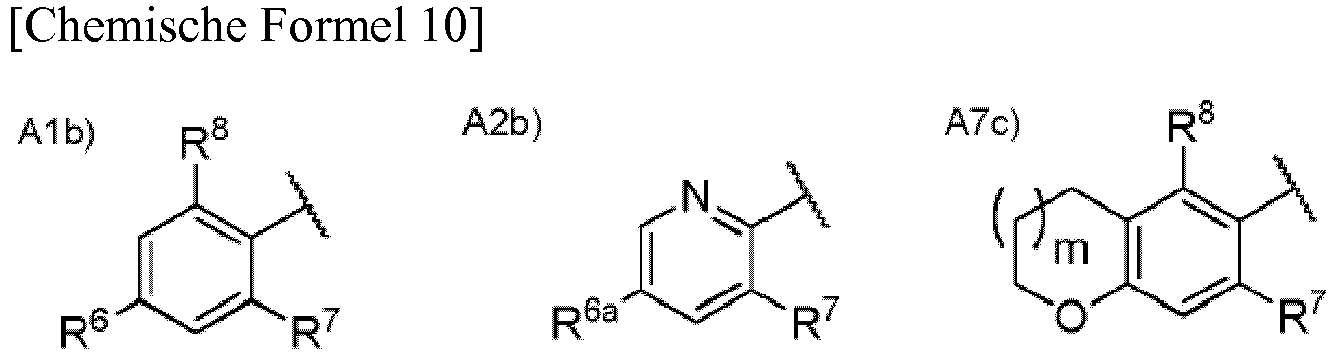 wobei, wenn Ar2 A2b) ist, R6a das gleiche ist wie jenes, das in Anspruch 8 festgelegt ist, wenn Ar2 A2b) ist;wenn Ar2 A7c) ist, m das gleiche ist wie jenes, das in Anspruch 8 festgelegt ist, wenn Ar2 A7b) ist;wenn Ar2 A1b) ist, R6 eine Cyanogruppe, eine Ethylgruppe oder eine C1- bis C3-Alkoxygruppe ist;R7 ein Fluoratom oder ein Chloratom ist; undwenn Ar2 A1b) oder A7c) ist, R8 ein Wasserstoffatom, ein Fluoratom, ein Chloratom oder eine C1- bis C3-Alkylgruppe ist.
 - Mit Deuterium substituierte oder isotopisch markierte Verbindung nach Anspruch 1 oder ein pharmakologisch verträgliches Salz davon, oder ein Solvat oder Hydrat davon, wobei
die durch die Formel (1) dargestellte Verbindung ist(-)-1-(4-Fluorphenyl)-3-[(3S*,4R*)-4-(4-methoxyphenyl)-2-oxopyrrolidin-3-yl]harnstoff,(-)-1-(4-Chlorphenyl)-3-[(3S*,4R*)-4-(4-methoxyphenyl)-2-oxopyrrolidin-3-yl] harnstoff,(-)-1-(3,4-Difluorphenyl)-3-[(3S*,4R*)-4-(4-methoxyphenyl)-2-oxopyrrolidin-3-yl]harnstoff,(-)-1-(4-Cyanophenyl)-3-[(3S*,4R*)-4-(4-methoxyphenyl)-2-oxopyrrolidin-3-yl]harnstoff,(-)-1-(4-Chlorphenyl)-3-[(3S*,4R*)-4-(4-methoxyphenyl)-1-methyl-2-oxopyrrolidin-3-yl]harnstoff,(-)-1-(4-Fluorphenyl)-3-[(3S*,4R*)-4-(4-methoxyphenyl)-1-methyl-2-oxopyrrolidin-3-yl]harnstoff,(-)-1-[(3S*,4R*)-4-(3-Fluor-4-methoxyphenyl)-2-oxopyrrolidin-3-yl]-3-(4-fluorphenyl)harnstoff,(-)-1-[(3S*,4R*)-4-(2-Fluor-4-methoxyphenyl)-2-oxopyrrolidin-3-yl]-3-(4-fluorphenyl)harnstoff,1-[(3S*,4R*)-4-(2-Chlor-4-methoxyphenyl)-2-oxopyrrolidin-3-yl]-3-(4-fluorphenyl)harnstoff,(-)-1-(4-Fluorphenyl)-3-[(3S*,4R*)-4-(4-methoxy-2-methylphenyl)-2-oxopyrrolidin-3-yl]harnstoff,(-)-1-[(3S*,4R*)-4-(2,6-Difluor-4-methoxyphenyl)-2-oxopyrrolidin-3-yl]-3-(4-fluorphenyl)harnstoff,(-)-1-[(3S*,4R*)-4-(2,5-Difluor-4-methoxyphenyl)-2-oxopyrrolidin-3-yl]-3-(4-fluorphenyl)harnstoff,(-)-1-[(3S*,4R*)-4-(3,5-Difluor-4-methoxyphenyl)-2-oxopyrrolidin-3-yl]-3 -(4-fluorphenyl)harnstoff,(-)-1-[(3S*,4R*)-4-(6-Fluor-2,3-dihydrobenzofuran-5-yl)-2-oxopyrrolidin-3-yl]-3-(4-fluorphenyl)harnstoff,(-)-1-[(3S*,4R*)-4-(3-Fluor-5-methoxypyridin-2-yl)-2-oxopyrrolidin-3-yl-3 -(4-fluorphenyl)harnstoff,(-)-1-(4-Fluorphenyl)-3-[(3S*,4R*)-4-(5-methoxythiophen-2-yl)-2-oxopyrrolidin-3-yl]harnstoff,(-)-1-(4-Fluorphenyl)-3-[(3S*,4R*)-4-(4-methylthiophenyl)-2-oxopyrrolidin-3-yl]harnstoff,(-)-1-(4-Chlorphenyl)-3-[(3S*,4R*)-4-(2,6-difluor-4-methoxyphenyl)-2-oxopyrrolidin-3-yl]harnstoff,(-)-1-(4-Cyanophenyl)-3-[(3S*,4R*)-4-(2,6-difluor-4-methoxyphenyl)-2-oxopyrrolidin-3-yl]harnstoff,(-)-1-[(3S*,4R*)-4-(2,6-Difluor-4-methoxyphenyl)-2-oxopyrrolidin-3-yl]-3-(4-methoxyphenyl)harnstoff,(-)-1-(5-Chlorthiazol-2-yl)-3-[(3S*,4R*)-4-(2,6-difluor-4-methoxyphenyl)-2-oxopyrrolidin-3-yl]harnstoff,(-)-1-(6-Chlorpyridin-3-yl)-3-[(3S*,4R*)-4-(2,6-difluor-4-methoxyphenyl)-2-oxopyrrolidin-3-yl]harnstoff,(-)-1-(5-Chlorpyridin-2-yl)-3-[(3S*,4R*)-4-(2,6-difluor-4-methoxyphenyl)-2-oxopyrrolidin-3-yl]harnstoff,(-)-1-(Benzo[b]thiophen-2-yl)-3-[(3S*,4R*)-4-(2,6-difluor-4-methoxyphenyl)-2-oxopyrrolidin-3-yl]harnstoff,(-)-1-[(3S*,4R*)-4-(2,6-Difluor-4-methoxyphenyl)-2-oxopyrrolidin-3-yl]-3-(5-methylthiophen-2-yl)harnstoff,(-)-1-(4-Fluorphenyl)-3-[(3S*,4R*,5S*)-4-(4-methoxyphenyl)-5-methyl-2-oxopyrrolidin-3-yl]harnstoff,(-)-1-(4-Fluorphenyl)-3-[(3S*,4R*,5R*)-4-(4-methoxyphenyl)-5-methyl-2-oxopyrrolidin-3 -yl] harnstoff,(+)-1-(4-Chlorphenyl)-3-[(3R*,4S*)-2-oxo-4-phenylpyrrolidin-3-yl]harnstoff,(±)-trans-1-(4-Chlorphenyl)-3-[4-(4-methoxyphenyl)-1-methyl-2-oxopyrrolidin-3-yl]harnstoff,(±)-trans-1-(4-Fluorphenyl)-3-[4-(4-methoxyphenyl)-2-oxopyrrolidin-3-yl]harnstoff,(±)-trans-1-(4-Chlorphenyl)-3-[4-(4-methoxyphenyl)-1-methyl-2-oxopyrrolidin-3-yl]harnstoff,(-)-1-[(3S*,4R*)-4-(2,6-Difluor-4-methoxyphenyl)-2-oxopyrrolidin-3-yl]-3 - [4-(trifluormethoxy)phenyl] harnstoff,(-)-1-[(3S*,4R*)-4-(2,6-Difluor-4-methoxyphenyl)-2-oxopyrrolidin-3-yl]-3-phenylharnstoff,(-)-1-[(3S*,4R*)-4-(2,6-Difluor-4-methoxyphenyl)-2-oxopyrrolidin-3-yl]-3-(4-phenoxyphenyl)harnstoff,(-)-1-[(3S*,4R*)-4-(2,6-Difluor-4-methoxyphenyl)-2-oxopyrrolidin-3-yl]-3-(3-fluorphenyl)harnstoff,(-)-1-[(3S*,4R*)-4-(2,6-Difluor-4-methoxyphenyl)-2-oxopyrrolidin-3-yl]-3-(3,4-difluorphenyl)harnstoff,(-)-1-(5-Chlorthiophen-2-yl)-3-[(3S*,4R*)-4-(2,6-difluor-4-methoxyphenyl)-2-oxopyrrolidin-3-yl]harnstoff,(-)-1-[(3S*,4R*)-4-(2,6-Difluor-4-methoxyphenyl)-2-oxopyrrolidin-3-yl]-3-(p-tolyl)harnstoff,(-)-1-[(3S*,4R*)-1-Ethyl-4-(4-methoxyphenyl)-2-oxopyrrolidin-3-yl]-3-(4-fluorphenyl)harnstoff,(-)-1-(4-Fluorphenyl)-3-[(3S*,4R*)-1-(1-hydroxy-2-methylpropan-2-yl)-4-(4-methoxyphenyl)-2-oxopyrrolidin-3-yl]harnstoff,(±)-trans-1-(4-Chlorphenyl)-3-[1-(2-hydroxyethyl)-4-(4-methoxyphenyl)-2-oxopyrrolidin-3-yl]harnstoff,(+)-trans-1-(4-Chlorphenyl)-3-[1-(2-hydroxyethyl)-4-(4-methoxyphenyl)-2-oxopyrrolidin-3-yl]harnstoff,(-)-trans-1-(4-Chlorphenyl)-3-[1-(2-hydroxyethyl)-4-(4-methoxyphenyl)-2-oxopyrrolidin-3-yl]harnstoff,(-)-2-{(3S*,4R*)-3-[3-(4-Fluorphenyl)ureido]-4-(4-methoxyphenyl)-2-oxopyrrolidin-1-yl}-N-methylacetamid,(-)-2-{(3S*,4R*)-3-[3-(4-Fluorphenyl)ureido]-4-(4-methoxyphenyl)-2-oxopyrrolidin-1-yl}propionsäure (Isomer A),(-)-2-{(3S*,4R*)-3-[3-(4-Fluorphenyl)ureido]-4-(4-methoxyphenyl)-2-oxopyrrolidin-1-yl}-N-methylpropionamid (Isomer A),(-)-2-{(3S*,4R*)-3-[3-(4-Fluorphenyl)ureido]-4-(4-methoxyphenyl)-2-oxopyrrolidin-1-yl}propionsäure (Isomer B),(-)-2-{(3S*,4R*)-3-[3-(4-Fluorphenyl)ureido]-4-(4-methoxyphenyl)-2-oxopyrrolidin-1-yl}-N-methylpropionamid (Isomer B),(-)-2-{(3S*,4R*)-3-[3-(4-Fluorphenyl)ureido]-4-(4-methoxyphenyl)-2-oxopyrrolidin-1-yl}-N,2-dimethylpropionamid,(-)-1-[(3S*,4R*)-4-(2,6-Difluor-4-methoxyphenyl)-1-methyl-2-oxopyrrolidin-3-yl]-3-(4-fluorphenyl)harnstoff,(-)-1-[(3S*,4R*)-4-(2-Fluor-4-methoxyphenyl)-1-(2-hydroxyethyl)-2-oxopyrrolidin-3-yl]-3-(4-fluorphenyl)harnstoff,(-)-1-[(3S*,4R*)-4-(2,6-Difluor-4-methoxyphenyl)-1-(2-hydroxyethyl)-2-oxopyrrolidin-3-yl]-3-(4-fluorphenyl)harnstoff,(+)-1-(4-Fluorphenyl)-3-[(3R*,4S*)-1-methoxy-4-(4-methoxyphenyl)-2-oxopyrrolidin-3-yl]harnstoff,(-)-3,5-Difluor-4-{(3R*,4S*)-4-[3-(4-fluorphenyl)ureido]-5-oxopyrrolidin-3-yl}benzamid,(-)-1-(4-Fluorphenyl)-3-[(3S*,4R*,Z)-2-(methoxyimino)-4-(4-methoxyphenyl)pyrrolidin-3-yl]harnstoff,(-)-1-[(3S*,4R*,Z)-4-(2-Fluor-4-methoxyphenyl)-2-(methoxyimino)pyrrolidin-3-yl]-3-(4-fluorphenyl)harnstoff,(-)-1-[(3S*,4R*,Z)-4-(2,6-Difluor-4-methoxyphenyl)-2-(methoxyimino)pyrrolidin-3-yl]-3-(4-fluorphenyl)harnstoff,(-)-1-(4-Fluorphenyl)-3-{(3S*,4R*,Z)-2-[(2-hydroxyethoxy)imino]-4-(4-methoxyphenyl)pyrrolidin-3-yl}harnstoff,(-)-1-{(3S*,4R*,Z)-4-(2,6-Difluor-4-methoxyphenyl)-2-[(2-hydroxyethoxy)imino]pyrrolidin-3-yl}-3-(4-fluorphenyl)harnstoff,(-)-1-[(3S*,4R*,Z)-4-(2,6-Difluor-4-methoxyphenyl)-2-(methylimino)pyrrolidin-3-yl]-3-(4-fluorphenyl)harnstoff,(-)-1-(4-Fluorphenyl)-3-[(3S*,4R*,Z)-2-(2-hydroxyimino)-4-(4-methoxyphenyl)pyrrolidin-3-yl] harnstoff,(-)-1-[(3S*,4R*)-4-(2,6-Difluor-4-methoxyphenyl)-2-oxopyrrolidin-3-yl]-3-(3-hydroxy-4-methylphenyl)harnstoff,(-)-1-[(3S*,4R*)-4-(2,6-Difluor-4-methoxyphenyl)-2-oxopyrrolidin-3-yl]-3-(4-fluor-3-hydroxyphenyl)harnstoff,(-)-1-(4-Chlor-3-hydroxyphenyl)-3-[(3S*,4R*)-4-(2,6-difluor-4-methoxyphenyl)-2-oxopyrrolidin-3-yl]harnstoff,(-)-1-(4-Cyanophenyl)-3-[(3S*,4R*)-4-(6-fluor-2,3-dihydrobenzofuran-5-yl)-2-oxopyrrolidin-3-yl]harnstoff,(-)-1-{(3S*,4R*,Z)-4-(2,6-Difluor-4-methoxyphenyl)-2-[(2-hydroxyethoxy)imino]pyrrolidin-3-yl}-3-(p-tolyl)harnstoff, oder(-)-1-[(3S*,4R*)-4-(2,6-Difluor-4-methoxyphenyl)-1-(2-hydroxyethyl)-2-oxopyrrolidin-3-yl]-3-phenylharnstoff. - Pharmazeutikum, umfassend, als einen aktiven Inhaltsstoff, die mit Deuterium substituierte oder isotopisch markierte Verbindung nach einem der Ansprüche 1 bis 13 oder ein pharmakologisch verträgliches Salz davon oder ein Solvat oder Hydrat davon.
- Pharmazeutische Zusammensetzung, enthaltend die mit Deuterium substituierte oder isotopisch markierte Verbindung nach einem der Ansprüche 1 bis 13 oder ein pharmakologisch verträgliches Salz davon oder ein Solvat oder Hydrat davon, und einen pharmazeutisch verträglichen Träger für die Verwendung bei der Verhütung oder Behandlung von entzündlichen Erkrankungen, chronischen Atemwegserkrankungen, Carcinoma, Septikämie, allergischen Symptomen, HIV-Retrovirusinfektion, Kreislaufstörungen, Nervenentzündung, Nervenstörungen, Schmerzen, Prionen-Erkrankungen, Amyloidose und Immunstörungen.
Applications Claiming Priority (3)
| Application Number | Priority Date | Filing Date | Title |
|---|---|---|---|
| JP2013245502 | 2013-11-28 | ||
| EP14865553.3A EP3075726B1 (de) | 2013-11-28 | 2014-11-27 | Harnstoffderivate oder pharmazeutisch akzeptable salze davon als fprl-1-agonisten |
| PCT/JP2014/005933 WO2015079692A1 (ja) | 2013-11-28 | 2014-11-27 | ウレア誘導体、またはその薬理学的に許容される塩 |
Related Parent Applications (1)
| Application Number | Title | Priority Date | Filing Date |
|---|---|---|---|
| EP14865553.3A Division EP3075726B1 (de) | 2013-11-28 | 2014-11-27 | Harnstoffderivate oder pharmazeutisch akzeptable salze davon als fprl-1-agonisten |
Publications (2)
| Publication Number | Publication Date |
|---|---|
| EP3305763A1 EP3305763A1 (de) | 2018-04-11 |
| EP3305763B1 true EP3305763B1 (de) | 2019-07-24 |
Family
ID=53198654
Family Applications (2)
| Application Number | Title | Priority Date | Filing Date |
|---|---|---|---|
| EP17196539.5A Not-in-force EP3305763B1 (de) | 2013-11-28 | 2014-11-27 | Deuterierte oder isotopisch markierte harnstoffderivate oder pharmazeutisch akzeptable salze davon als fprl-1-agonisten |
| EP14865553.3A Active EP3075726B1 (de) | 2013-11-28 | 2014-11-27 | Harnstoffderivate oder pharmazeutisch akzeptable salze davon als fprl-1-agonisten |
Family Applications After (1)
| Application Number | Title | Priority Date | Filing Date |
|---|---|---|---|
| EP14865553.3A Active EP3075726B1 (de) | 2013-11-28 | 2014-11-27 | Harnstoffderivate oder pharmazeutisch akzeptable salze davon als fprl-1-agonisten |
Country Status (35)
| Country | Link |
|---|---|
| US (6) | US9822069B2 (de) |
| EP (2) | EP3305763B1 (de) |
| JP (3) | JP6453231B2 (de) |
| KR (1) | KR102252270B1 (de) |
| CN (1) | CN105814019B (de) |
| AU (2) | AU2014355887B2 (de) |
| BR (1) | BR112016011755B1 (de) |
| CA (1) | CA2932010C (de) |
| CL (1) | CL2016001283A1 (de) |
| CY (1) | CY1120089T1 (de) |
| DK (1) | DK3075726T3 (de) |
| EA (1) | EA030474B1 (de) |
| ES (2) | ES2659156T3 (de) |
| HR (1) | HRP20180199T1 (de) |
| HU (1) | HUE036497T2 (de) |
| IL (1) | IL245823B (de) |
| LT (1) | LT3075726T (de) |
| MA (1) | MA39069B1 (de) |
| MX (1) | MX367193B (de) |
| MY (1) | MY179516A (de) |
| NO (1) | NO3075726T3 (de) |
| NZ (2) | NZ752095A (de) |
| PE (1) | PE20161206A1 (de) |
| PH (1) | PH12016500806B1 (de) |
| PL (1) | PL3075726T3 (de) |
| PT (1) | PT3075726T (de) |
| RS (1) | RS57036B1 (de) |
| SA (1) | SA516371205B1 (de) |
| SG (1) | SG11201604296QA (de) |
| SI (1) | SI3075726T1 (de) |
| SM (1) | SMT201800061T1 (de) |
| TN (1) | TN2016000210A1 (de) |
| TW (1) | TWI649305B (de) |
| WO (1) | WO2015079692A1 (de) |
| ZA (1) | ZA201603624B (de) |
Families Citing this family (22)
| Publication number | Priority date | Publication date | Assignee | Title |
|---|---|---|---|---|
| NZ752095A (en) * | 2013-11-28 | 2022-07-01 | Kyorin Seiyaku Kk | Urea derivative or pharmacologically acceptable salt thereof |
| US10525058B2 (en) | 2015-05-27 | 2020-01-07 | Kyorin Pharmaceutical Co., Ltd | Urea derivative or pharmacologically acceptable salt thereof |
| KR102772801B1 (ko) | 2015-12-10 | 2025-02-24 | 브리스톨-마이어스 스큅 컴퍼니 | 피페리디논 포르밀 펩티드 2 수용체 및 포르밀 펩티드 1 수용체 효능제 |
| TW201815762A (zh) | 2016-09-21 | 2018-05-01 | 德商歌林達有限公司 | 經尿素及苯基取代之6員環狀胺或內醯胺 |
| JP2020015664A (ja) * | 2016-11-21 | 2020-01-30 | 宇部興産株式会社 | 含窒素多環式ヘテロ環誘導体 |
| RU2742417C1 (ru) * | 2017-01-13 | 2021-02-05 | Тобиси Фармасьютикал Ко., Лтд. | Регулятор активации нейтрофилов |
| MX2019013926A (es) | 2017-05-22 | 2020-01-20 | Bristol Myers Squibb Co | Uso novedoso de un agonista del receptor 2 de formil peptido/receptor a4 de lipoxina (fpr2/alx) para el tratamiento de insuficiencia cardiaca. |
| CN110996950B (zh) * | 2017-06-09 | 2023-04-04 | 百时美施贵宝公司 | 哌啶酮甲酰基肽2受体激动剂和甲酰基肽1受体激动剂 |
| ES2869129T3 (es) | 2017-06-09 | 2021-10-25 | Bristol Myers Squibb Co | Agonistas de piperidinona del receptor 2 de péptidos formilados |
| KR102615099B1 (ko) | 2017-06-09 | 2023-12-15 | 브리스톨-마이어스 스큅 컴퍼니 | 아릴 헤테로시클릭 피페리디논 포르밀 펩티드 2 수용체 및 포르밀 펩티드 1 수용체 효능제 |
| EP3634958B1 (de) * | 2017-06-09 | 2021-07-21 | Bristol-Myers Squibb Company | Cyclopropyl-harnstoff-formylpeptid-2-rezeptor- und formylpeptid-1-rezeptor-agonisten |
| SG11202008504SA (en) * | 2018-03-05 | 2020-10-29 | Bristol Myers Squibb Co | Phenylpyrrolidinone formyl peptide 2 receptor agonists |
| AR114383A1 (es) * | 2018-03-09 | 2020-08-26 | Gruenenthal Gmbh | Piperidinas o piperidonas sustituidas con urea y fenilo |
| JP2022507585A (ja) | 2018-11-16 | 2022-01-18 | ブリストル-マイヤーズ スクイブ カンパニー | 1-((3s,4r)-4-(2,6-ジフルオロ-4-メトキシフェニル)-2-オキソピロリジン-3-イル)-3-フェニル尿素の製造のための合成方法 |
| ES2964299T3 (es) * | 2018-11-26 | 2024-04-05 | Bristol Myers Squibb Co | Derivados de pirrolidinona como agonistas del receptor del péptido formilado 2 |
| EP3789378A1 (de) * | 2019-09-06 | 2021-03-10 | Grünenthal GmbH | Mit harnstoff und heteroaryl substituierte piperidine oder piperidone |
| JP7700210B2 (ja) | 2020-07-09 | 2025-06-30 | ブリストル-マイヤーズ スクイブ カンパニー | ピラゾロンホルミルペプチド2受容体アゴニスト |
| KR20230038515A (ko) * | 2020-07-09 | 2023-03-20 | 브리스톨-마이어스 스큅 컴퍼니 | 옥소피롤리딘 fpr2 효능제 |
| JP7802765B2 (ja) * | 2020-08-12 | 2026-01-20 | ブリストル-マイヤーズ スクイブ カンパニー | オキソピロリジン尿素fpr2アゴニスト |
| US12479854B2 (en) | 2021-07-29 | 2025-11-25 | Enanta Pharmaceuticals, Inc. | Spiropyrrolidine derived antiviral agents |
| JP2024545270A (ja) | 2021-12-15 | 2024-12-05 | アダマ・アガン・リミテッド | 種々の農薬及びそのマーカーの調製に有用な化合物 |
| WO2025217248A1 (en) * | 2024-04-11 | 2025-10-16 | Corteva Agriscience Llc | Formulations containing substituted 5-membered ring pesticides and methods of use |
Family Cites Families (34)
| Publication number | Priority date | Publication date | Assignee | Title |
|---|---|---|---|---|
| US13001A (en) | 1855-06-05 | Method of composing- music | ||
| US5202344A (en) | 1990-12-11 | 1993-04-13 | G. D. Searle & Co. | N-substituted lactams useful as cholecystokinin antagonists |
| CN1894580A (zh) * | 2003-11-07 | 2007-01-10 | 阿卡蒂亚药品公司 | 脂氧素受体fprl1作为一种用于鉴定能有效治疗疼痛和炎症化合物的工具 |
| EP1692502A2 (de) | 2003-11-07 | 2006-08-23 | Acadia Pharmaceuticals Inc. | Verwendung des lipoxinrezeptors fprl1 als mittel zur identifizierung von bei der behandlung von schmerzen und entzündungen wirksamen verbindungen |
| CN100506802C (zh) * | 2004-06-04 | 2009-07-01 | 中国科学院上海药物研究所 | 一类甲酰肽样受体-1调节剂、其制备方法和用途 |
| US20070123508A1 (en) | 2005-05-27 | 2007-05-31 | Roger Olsson | PAR2-modulating compounds and their use |
| AR069650A1 (es) | 2007-12-14 | 2010-02-10 | Actelion Pharmaceuticals Ltd | Derivados de aminopirazol como agonistas no peptidicos del receptor alx humano |
| DK2225231T3 (da) | 2007-12-18 | 2011-10-17 | Actelion Pharmaceuticals Ltd | Aminotriazolderivater som alx-agonister |
| JP5580741B2 (ja) * | 2008-09-19 | 2014-08-27 | 武田薬品工業株式会社 | 含窒素複素環化合物およびその用途 |
| US7881231B2 (en) | 2009-02-13 | 2011-02-01 | Microsoft Corporation | Detection of home network configuration problems |
| KR20110117194A (ko) | 2009-02-23 | 2011-10-26 | 에프. 호프만-라 로슈 아게 | 암 치료를 위한 신규한 오르토-아미노아미드 |
| US8674111B2 (en) | 2009-06-12 | 2014-03-18 | Actelion Pharmaceuticals Ltd. | Oxazole and thiazole derivatives as ALX receptor agonists |
| CA2803920A1 (en) | 2010-06-24 | 2011-12-29 | Richard Beard | Derivatives of cycloalkyl- and cycloalkenyl-1,2-dicarboxylic acid compounds having formyl peptide receptor like-1 (fprl-1) agonist or antagonist activity |
| CA2814826C (en) | 2010-11-17 | 2019-02-12 | Actelion Pharmaceuticals Ltd | Bridged spiro[2.4]heptane ester derivatives |
| CA2819457A1 (en) | 2010-12-03 | 2012-06-07 | Allergan, Inc. | Pharmaceutical compositions comprising 3,4-dihydroisoquinolin-2(1h)-yl-3-phenylurea derivatives having formyl peptide receptor like-1 (fprl-1) agonist or antagonist activity |
| KR101847672B1 (ko) | 2010-12-07 | 2018-04-10 | 이도르시아 파마슈티컬스 리미티드 | Alx 수용체 작용제로서의 히드록실화 아미노트리아졸 유도체 |
| CA2816376C (en) | 2010-12-07 | 2018-11-20 | Actelion Pharmaceuticals Ltd | Oxazolyl-methylether derivatives as alx receptor agonists |
| WO2012109544A1 (en) * | 2011-02-11 | 2012-08-16 | Allergan, Inc. | Novel 1-(1-oxo-1,2,3,4-tetrahydroisoquinolin-7-yl)urea derivatives as n-formyl peptide receptor like-1 (fprl-1) receptor modulators |
| US8653299B2 (en) | 2011-03-17 | 2014-02-18 | Allergan, Inc. | Dihydronaphthalene and naphthalene derivatives as N-formyl peptide receptor like-1 (FPRL-1) receptor modulators |
| KR102001364B1 (ko) | 2011-05-13 | 2019-07-22 | 어레이 바이오파마 인크. | Trka 키나제 저해제로서의 피롤리디닐 유레아 및 피롤리디닐 티오유레아 화합물 |
| CA2841983A1 (en) | 2011-07-11 | 2013-01-17 | Allergan, Inc. | Polycyclic pyrrolidine-2,5-dione derivatives as -formyl peptide receptor like-1 (fprl-1) receptor modulators |
| PT2770989T (pt) * | 2011-10-26 | 2018-12-04 | Allergan Inc | Derivados de amida de aminoácidos substituídos por n-ureia como moduladores de recetor tipo-1 do recetor de péptidos formil (fprl-1) |
| US8541577B2 (en) * | 2011-11-10 | 2013-09-24 | Allergan, Inc. | Aryl urea derivatives as N-formyl peptide receptors like-1 (FPRL-1) receptor modulators |
| US8492556B2 (en) | 2011-11-10 | 2013-07-23 | Allergan, Inc. | 2,5-Dioxoimidazolidin-1-yl-3-phenylurea derivatives as formyl peptide receptor like-1 (FPRL-1) receptor modulators |
| WO2013158597A1 (en) | 2012-04-16 | 2013-10-24 | Allergan, Inc. | (2-ureidoacetamido)alkyl derivatives as formyl peptide receptor 2 modulators |
| WO2014078378A1 (en) | 2012-11-13 | 2014-05-22 | Array Biopharma Inc. | Pyrrolidinyl urea, thiourea, guanidine and cyanoguanidine compounds as trka kinase inhibitors |
| US9790178B2 (en) | 2012-11-13 | 2017-10-17 | Array Biopharma Inc. | Pyrrolidinyl urea, thiourea, guanidine and cyanoguanidine compounds as TrkA kinase inhibitors |
| UA116455C2 (uk) | 2012-11-13 | 2018-03-26 | Еррей Біофарма Інк. | Сполуки n-піролідинілсечовини, n'-піразолілсечовини, тіосечовини, гуанідину та ціаногуанідину як інгібітори кінази trka |
| AU2014290618B2 (en) | 2013-07-16 | 2018-04-05 | Allergan, Inc. | Derivatives of N-urea substituted amino acids as formyl peptide receptor modulators |
| AR097279A1 (es) | 2013-08-09 | 2016-03-02 | Actelion Pharmaceuticals Ltd | Derivados de benzimidazolil-metil urea como agonistas del receptor de alx |
| NZ752095A (en) | 2013-11-28 | 2022-07-01 | Kyorin Seiyaku Kk | Urea derivative or pharmacologically acceptable salt thereof |
| MD4889C1 (ro) | 2013-12-03 | 2024-10-31 | Фмк Корпорейшн | Pirolidinone în calitate de erbicide |
| MY191956A (en) | 2014-05-15 | 2022-07-20 | Array Biopharma Inc | 1-((3s,4r)-4-(3-fluorophenyl)-1-(2-methoxyethyl)pyrrolidin-3-yl)-3-(4-methyl-3-(2-methylpyrimidin-5-yl)-1-phenyl-1h-pyrazol-5-yl)urea as a trka kinase inhibitor |
| BR112017015760A2 (pt) | 2015-01-23 | 2018-03-27 | Gvk Biosciences Private Limited | inibidores de quinase trka |
-
2014
- 2014-11-27 NZ NZ752095A patent/NZ752095A/en not_active IP Right Cessation
- 2014-11-27 MX MX2016006500A patent/MX367193B/es active IP Right Grant
- 2014-11-27 EP EP17196539.5A patent/EP3305763B1/de not_active Not-in-force
- 2014-11-27 LT LTEP14865553.3T patent/LT3075726T/lt unknown
- 2014-11-27 SM SM20180061T patent/SMT201800061T1/it unknown
- 2014-11-27 EA EA201691119A patent/EA030474B1/ru not_active IP Right Cessation
- 2014-11-27 KR KR1020167014901A patent/KR102252270B1/ko active Active
- 2014-11-27 WO PCT/JP2014/005933 patent/WO2015079692A1/ja not_active Ceased
- 2014-11-27 SG SG11201604296QA patent/SG11201604296QA/en unknown
- 2014-11-27 PL PL14865553T patent/PL3075726T3/pl unknown
- 2014-11-27 US US15/039,964 patent/US9822069B2/en active Active
- 2014-11-27 NZ NZ720508A patent/NZ720508A/en unknown
- 2014-11-27 JP JP2015550566A patent/JP6453231B2/ja active Active
- 2014-11-27 HR HRP20180199TT patent/HRP20180199T1/hr unknown
- 2014-11-27 RS RS20180121A patent/RS57036B1/sr unknown
- 2014-11-27 PE PE2016000697A patent/PE20161206A1/es unknown
- 2014-11-27 SI SI201430579T patent/SI3075726T1/en unknown
- 2014-11-27 NO NO14865553A patent/NO3075726T3/no unknown
- 2014-11-27 AU AU2014355887A patent/AU2014355887B2/en active Active
- 2014-11-27 CA CA2932010A patent/CA2932010C/en active Active
- 2014-11-27 ES ES14865553.3T patent/ES2659156T3/es active Active
- 2014-11-27 EP EP14865553.3A patent/EP3075726B1/de active Active
- 2014-11-27 MY MYPI2016701933A patent/MY179516A/en unknown
- 2014-11-27 BR BR112016011755-7A patent/BR112016011755B1/pt active IP Right Grant
- 2014-11-27 TN TN2016000210A patent/TN2016000210A1/en unknown
- 2014-11-27 HU HUE14865553A patent/HUE036497T2/hu unknown
- 2014-11-27 DK DK14865553.3T patent/DK3075726T3/en active
- 2014-11-27 CN CN201480064964.0A patent/CN105814019B/zh active Active
- 2014-11-27 MA MA39069A patent/MA39069B1/fr unknown
- 2014-11-27 PT PT148655533T patent/PT3075726T/pt unknown
- 2014-11-27 TW TW103141341A patent/TWI649305B/zh active
- 2014-11-27 ES ES17196539T patent/ES2752733T3/es active Active
-
2016
- 2016-04-29 PH PH12016500806A patent/PH12016500806B1/en unknown
- 2016-05-24 IL IL245823A patent/IL245823B/en active IP Right Grant
- 2016-05-26 SA SA516371205A patent/SA516371205B1/ar unknown
- 2016-05-26 CL CL2016001283A patent/CL2016001283A1/es unknown
- 2016-05-27 ZA ZA2016/03624A patent/ZA201603624B/en unknown
-
2017
- 2017-10-03 US US15/724,002 patent/US10029983B2/en active Active
-
2018
- 2018-02-08 CY CY20181100158T patent/CY1120089T1/el unknown
- 2018-06-18 US US16/011,050 patent/US10252992B2/en active Active
- 2018-12-12 JP JP2018232763A patent/JP2019059772A/ja not_active Ceased
-
2019
- 2019-02-07 US US16/270,363 patent/US10464891B2/en active Active
- 2019-05-03 AU AU2019203119A patent/AU2019203119B2/en not_active Ceased
- 2019-09-24 US US16/580,909 patent/US10696630B2/en not_active Expired - Fee Related
-
2020
- 2020-05-21 US US16/880,443 patent/US11261155B2/en active Active
- 2020-09-08 JP JP2020150498A patent/JP2021001181A/ja not_active Withdrawn
Non-Patent Citations (1)
| Title |
|---|
| None * |
Also Published As
Similar Documents
| Publication | Publication Date | Title |
|---|---|---|
| US11261155B2 (en) | Urea derivative or pharmacologically acceptable salt thereof | |
| EP3303284B1 (de) | Harnstoff derivat oder pharmakologisch verträgliches salz davon | |
| EP3331884B1 (de) | Harnstoffderivat oder pharmazeutisch akzeptables salz davon | |
| MX2007008558A (es) | Tetrahidropiridinas 3,4,(5)-sustituidas. | |
| HK1229324B (en) | Urea derivatives or pharmacologically acceptable salts thereof useful as formyl peptide receptor like 1 (fprl-1) agonists | |
| HK1229324A1 (en) | Urea derivatives or pharmacologically acceptable salts thereof useful as formyl peptide receptor like 1 (fprl-1) agonists | |
| AU2013275090B2 (en) | Piperidine derivatives for GPR119 agonist |
Legal Events
| Date | Code | Title | Description |
|---|---|---|---|
| PUAI | Public reference made under article 153(3) epc to a published international application that has entered the european phase |
Free format text: ORIGINAL CODE: 0009012 |
|
| STAA | Information on the status of an ep patent application or granted ep patent |
Free format text: STATUS: THE APPLICATION HAS BEEN PUBLISHED |
|
| AC | Divisional application: reference to earlier application |
Ref document number: 3075726 Country of ref document: EP Kind code of ref document: P |
|
| AK | Designated contracting states |
Kind code of ref document: A1 Designated state(s): AL AT BE BG CH CY CZ DE DK EE ES FI FR GB GR HR HU IE IS IT LI LT LU LV MC MK MT NL NO PL PT RO RS SE SI SK SM TR |
|
| STAA | Information on the status of an ep patent application or granted ep patent |
Free format text: STATUS: REQUEST FOR EXAMINATION WAS MADE |
|
| 17P | Request for examination filed |
Effective date: 20181008 |
|
| RBV | Designated contracting states (corrected) |
Designated state(s): AL AT BE BG CH CY CZ DE DK EE ES FI FR GB GR HR HU IE IS IT LI LT LU LV MC MK MT NL NO PL PT RO RS SE SI SK SM TR |
|
| GRAP | Despatch of communication of intention to grant a patent |
Free format text: ORIGINAL CODE: EPIDOSNIGR1 |
|
| STAA | Information on the status of an ep patent application or granted ep patent |
Free format text: STATUS: GRANT OF PATENT IS INTENDED |
|
| INTG | Intention to grant announced |
Effective date: 20190201 |
|
| GRAS | Grant fee paid |
Free format text: ORIGINAL CODE: EPIDOSNIGR3 |
|
| GRAA | (expected) grant |
Free format text: ORIGINAL CODE: 0009210 |
|
| STAA | Information on the status of an ep patent application or granted ep patent |
Free format text: STATUS: THE PATENT HAS BEEN GRANTED |
|
| AC | Divisional application: reference to earlier application |
Ref document number: 3075726 Country of ref document: EP Kind code of ref document: P |
|
| AK | Designated contracting states |
Kind code of ref document: B1 Designated state(s): AL AT BE BG CH CY CZ DE DK EE ES FI FR GB GR HR HU IE IS IT LI LT LU LV MC MK MT NL NO PL PT RO RS SE SI SK SM TR |
|
| REG | Reference to a national code |
Ref country code: GB Ref legal event code: FG4D |
|
| REG | Reference to a national code |
Ref country code: CH Ref legal event code: EP |
|
| REG | Reference to a national code |
Ref country code: DE Ref legal event code: R096 Ref document number: 602014050733 Country of ref document: DE |
|
| REG | Reference to a national code |
Ref country code: AT Ref legal event code: REF Ref document number: 1157993 Country of ref document: AT Kind code of ref document: T Effective date: 20190815 |
|
| REG | Reference to a national code |
Ref country code: IE Ref legal event code: FG4D |
|
| REG | Reference to a national code |
Ref country code: NL Ref legal event code: MP Effective date: 20190724 |
|
| REG | Reference to a national code |
Ref country code: LT Ref legal event code: MG4D |
|
| REG | Reference to a national code |
Ref country code: AT Ref legal event code: MK05 Ref document number: 1157993 Country of ref document: AT Kind code of ref document: T Effective date: 20190724 |
|
| PG25 | Lapsed in a contracting state [announced via postgrant information from national office to epo] |
Ref country code: NO Free format text: LAPSE BECAUSE OF FAILURE TO SUBMIT A TRANSLATION OF THE DESCRIPTION OR TO PAY THE FEE WITHIN THE PRESCRIBED TIME-LIMIT Effective date: 20191024 Ref country code: FI Free format text: LAPSE BECAUSE OF FAILURE TO SUBMIT A TRANSLATION OF THE DESCRIPTION OR TO PAY THE FEE WITHIN THE PRESCRIBED TIME-LIMIT Effective date: 20190724 Ref country code: AT Free format text: LAPSE BECAUSE OF FAILURE TO SUBMIT A TRANSLATION OF THE DESCRIPTION OR TO PAY THE FEE WITHIN THE PRESCRIBED TIME-LIMIT Effective date: 20190724 Ref country code: LT Free format text: LAPSE BECAUSE OF FAILURE TO SUBMIT A TRANSLATION OF THE DESCRIPTION OR TO PAY THE FEE WITHIN THE PRESCRIBED TIME-LIMIT Effective date: 20190724 Ref country code: HR Free format text: LAPSE BECAUSE OF FAILURE TO SUBMIT A TRANSLATION OF THE DESCRIPTION OR TO PAY THE FEE WITHIN THE PRESCRIBED TIME-LIMIT Effective date: 20190724 Ref country code: PT Free format text: LAPSE BECAUSE OF FAILURE TO SUBMIT A TRANSLATION OF THE DESCRIPTION OR TO PAY THE FEE WITHIN THE PRESCRIBED TIME-LIMIT Effective date: 20191125 Ref country code: SE Free format text: LAPSE BECAUSE OF FAILURE TO SUBMIT A TRANSLATION OF THE DESCRIPTION OR TO PAY THE FEE WITHIN THE PRESCRIBED TIME-LIMIT Effective date: 20190724 Ref country code: BG Free format text: LAPSE BECAUSE OF FAILURE TO SUBMIT A TRANSLATION OF THE DESCRIPTION OR TO PAY THE FEE WITHIN THE PRESCRIBED TIME-LIMIT Effective date: 20191024 Ref country code: NL Free format text: LAPSE BECAUSE OF FAILURE TO SUBMIT A TRANSLATION OF THE DESCRIPTION OR TO PAY THE FEE WITHIN THE PRESCRIBED TIME-LIMIT Effective date: 20190724 |
|
| PG25 | Lapsed in a contracting state [announced via postgrant information from national office to epo] |
Ref country code: GR Free format text: LAPSE BECAUSE OF FAILURE TO SUBMIT A TRANSLATION OF THE DESCRIPTION OR TO PAY THE FEE WITHIN THE PRESCRIBED TIME-LIMIT Effective date: 20191025 Ref country code: LV Free format text: LAPSE BECAUSE OF FAILURE TO SUBMIT A TRANSLATION OF THE DESCRIPTION OR TO PAY THE FEE WITHIN THE PRESCRIBED TIME-LIMIT Effective date: 20190724 Ref country code: AL Free format text: LAPSE BECAUSE OF FAILURE TO SUBMIT A TRANSLATION OF THE DESCRIPTION OR TO PAY THE FEE WITHIN THE PRESCRIBED TIME-LIMIT Effective date: 20190724 Ref country code: RS Free format text: LAPSE BECAUSE OF FAILURE TO SUBMIT A TRANSLATION OF THE DESCRIPTION OR TO PAY THE FEE WITHIN THE PRESCRIBED TIME-LIMIT Effective date: 20190724 Ref country code: IS Free format text: LAPSE BECAUSE OF FAILURE TO SUBMIT A TRANSLATION OF THE DESCRIPTION OR TO PAY THE FEE WITHIN THE PRESCRIBED TIME-LIMIT Effective date: 20191124 |
|
| PG25 | Lapsed in a contracting state [announced via postgrant information from national office to epo] |
Ref country code: TR Free format text: LAPSE BECAUSE OF FAILURE TO SUBMIT A TRANSLATION OF THE DESCRIPTION OR TO PAY THE FEE WITHIN THE PRESCRIBED TIME-LIMIT Effective date: 20190724 |
|
| REG | Reference to a national code |
Ref country code: ES Ref legal event code: FG2A Ref document number: 2752733 Country of ref document: ES Kind code of ref document: T3 Effective date: 20200406 |
|
| PG25 | Lapsed in a contracting state [announced via postgrant information from national office to epo] |
Ref country code: RO Free format text: LAPSE BECAUSE OF FAILURE TO SUBMIT A TRANSLATION OF THE DESCRIPTION OR TO PAY THE FEE WITHIN THE PRESCRIBED TIME-LIMIT Effective date: 20190724 Ref country code: DK Free format text: LAPSE BECAUSE OF FAILURE TO SUBMIT A TRANSLATION OF THE DESCRIPTION OR TO PAY THE FEE WITHIN THE PRESCRIBED TIME-LIMIT Effective date: 20190724 Ref country code: PL Free format text: LAPSE BECAUSE OF FAILURE TO SUBMIT A TRANSLATION OF THE DESCRIPTION OR TO PAY THE FEE WITHIN THE PRESCRIBED TIME-LIMIT Effective date: 20190724 Ref country code: EE Free format text: LAPSE BECAUSE OF FAILURE TO SUBMIT A TRANSLATION OF THE DESCRIPTION OR TO PAY THE FEE WITHIN THE PRESCRIBED TIME-LIMIT Effective date: 20190724 |
|
| PG25 | Lapsed in a contracting state [announced via postgrant information from national office to epo] |
Ref country code: CZ Free format text: LAPSE BECAUSE OF FAILURE TO SUBMIT A TRANSLATION OF THE DESCRIPTION OR TO PAY THE FEE WITHIN THE PRESCRIBED TIME-LIMIT Effective date: 20190724 Ref country code: SM Free format text: LAPSE BECAUSE OF FAILURE TO SUBMIT A TRANSLATION OF THE DESCRIPTION OR TO PAY THE FEE WITHIN THE PRESCRIBED TIME-LIMIT Effective date: 20190724 Ref country code: SK Free format text: LAPSE BECAUSE OF FAILURE TO SUBMIT A TRANSLATION OF THE DESCRIPTION OR TO PAY THE FEE WITHIN THE PRESCRIBED TIME-LIMIT Effective date: 20190724 Ref country code: IS Free format text: LAPSE BECAUSE OF FAILURE TO SUBMIT A TRANSLATION OF THE DESCRIPTION OR TO PAY THE FEE WITHIN THE PRESCRIBED TIME-LIMIT Effective date: 20200224 |
|
| REG | Reference to a national code |
Ref country code: DE Ref legal event code: R097 Ref document number: 602014050733 Country of ref document: DE |
|
| REG | Reference to a national code |
Ref country code: CH Ref legal event code: PL |
|
| PLBE | No opposition filed within time limit |
Free format text: ORIGINAL CODE: 0009261 |
|
| STAA | Information on the status of an ep patent application or granted ep patent |
Free format text: STATUS: NO OPPOSITION FILED WITHIN TIME LIMIT |
|
| PG2D | Information on lapse in contracting state deleted |
Ref country code: IS |
|
| PG25 | Lapsed in a contracting state [announced via postgrant information from national office to epo] |
Ref country code: MC Free format text: LAPSE BECAUSE OF FAILURE TO SUBMIT A TRANSLATION OF THE DESCRIPTION OR TO PAY THE FEE WITHIN THE PRESCRIBED TIME-LIMIT Effective date: 20190724 Ref country code: CH Free format text: LAPSE BECAUSE OF NON-PAYMENT OF DUE FEES Effective date: 20191130 Ref country code: LI Free format text: LAPSE BECAUSE OF NON-PAYMENT OF DUE FEES Effective date: 20191130 Ref country code: LU Free format text: LAPSE BECAUSE OF NON-PAYMENT OF DUE FEES Effective date: 20191127 |
|
| 26N | No opposition filed |
Effective date: 20200603 |
|
| REG | Reference to a national code |
Ref country code: BE Ref legal event code: MM Effective date: 20191130 |
|
| PG25 | Lapsed in a contracting state [announced via postgrant information from national office to epo] |
Ref country code: SI Free format text: LAPSE BECAUSE OF FAILURE TO SUBMIT A TRANSLATION OF THE DESCRIPTION OR TO PAY THE FEE WITHIN THE PRESCRIBED TIME-LIMIT Effective date: 20190724 |
|
| PG25 | Lapsed in a contracting state [announced via postgrant information from national office to epo] |
Ref country code: IE Free format text: LAPSE BECAUSE OF NON-PAYMENT OF DUE FEES Effective date: 20191127 |
|
| PG25 | Lapsed in a contracting state [announced via postgrant information from national office to epo] |
Ref country code: BE Free format text: LAPSE BECAUSE OF NON-PAYMENT OF DUE FEES Effective date: 20191130 |
|
| PG25 | Lapsed in a contracting state [announced via postgrant information from national office to epo] |
Ref country code: CY Free format text: LAPSE BECAUSE OF FAILURE TO SUBMIT A TRANSLATION OF THE DESCRIPTION OR TO PAY THE FEE WITHIN THE PRESCRIBED TIME-LIMIT Effective date: 20190724 |
|
| PG25 | Lapsed in a contracting state [announced via postgrant information from national office to epo] |
Ref country code: MT Free format text: LAPSE BECAUSE OF FAILURE TO SUBMIT A TRANSLATION OF THE DESCRIPTION OR TO PAY THE FEE WITHIN THE PRESCRIBED TIME-LIMIT Effective date: 20190724 Ref country code: HU Free format text: LAPSE BECAUSE OF FAILURE TO SUBMIT A TRANSLATION OF THE DESCRIPTION OR TO PAY THE FEE WITHIN THE PRESCRIBED TIME-LIMIT; INVALID AB INITIO Effective date: 20141127 |
|
| PGFP | Annual fee paid to national office [announced via postgrant information from national office to epo] |
Ref country code: ES Payment date: 20211206 Year of fee payment: 8 Ref country code: DE Payment date: 20211005 Year of fee payment: 8 Ref country code: FR Payment date: 20211109 Year of fee payment: 8 Ref country code: GB Payment date: 20211007 Year of fee payment: 8 |
|
| PGFP | Annual fee paid to national office [announced via postgrant information from national office to epo] |
Ref country code: IT Payment date: 20211012 Year of fee payment: 8 |
|
| PG25 | Lapsed in a contracting state [announced via postgrant information from national office to epo] |
Ref country code: MK Free format text: LAPSE BECAUSE OF FAILURE TO SUBMIT A TRANSLATION OF THE DESCRIPTION OR TO PAY THE FEE WITHIN THE PRESCRIBED TIME-LIMIT Effective date: 20190724 |
|
| REG | Reference to a national code |
Ref country code: DE Ref legal event code: R119 Ref document number: 602014050733 Country of ref document: DE |
|
| GBPC | Gb: european patent ceased through non-payment of renewal fee |
Effective date: 20221127 |
|
| PG25 | Lapsed in a contracting state [announced via postgrant information from national office to epo] |
Ref country code: IT Free format text: LAPSE BECAUSE OF NON-PAYMENT OF DUE FEES Effective date: 20221127 Ref country code: GB Free format text: LAPSE BECAUSE OF NON-PAYMENT OF DUE FEES Effective date: 20221127 Ref country code: DE Free format text: LAPSE BECAUSE OF NON-PAYMENT OF DUE FEES Effective date: 20230601 |
|
| PG25 | Lapsed in a contracting state [announced via postgrant information from national office to epo] |
Ref country code: FR Free format text: LAPSE BECAUSE OF NON-PAYMENT OF DUE FEES Effective date: 20221130 |
|
| REG | Reference to a national code |
Ref country code: ES Ref legal event code: FD2A Effective date: 20240105 |
|
| PG25 | Lapsed in a contracting state [announced via postgrant information from national office to epo] |
Ref country code: ES Free format text: LAPSE BECAUSE OF NON-PAYMENT OF DUE FEES Effective date: 20221128 |
|
| PG25 | Lapsed in a contracting state [announced via postgrant information from national office to epo] |
Ref country code: ES Free format text: LAPSE BECAUSE OF NON-PAYMENT OF DUE FEES Effective date: 20221128 |