EP3306502A1 - Appareil et procédé informatique pour identifier des ressources de soins de santé utilisées par un patient ayant reçu un diagnostic potentiel - Google Patents
Appareil et procédé informatique pour identifier des ressources de soins de santé utilisées par un patient ayant reçu un diagnostic potentiel Download PDFInfo
- Publication number
- EP3306502A1 EP3306502A1 EP17166979.9A EP17166979A EP3306502A1 EP 3306502 A1 EP3306502 A1 EP 3306502A1 EP 17166979 A EP17166979 A EP 17166979A EP 3306502 A1 EP3306502 A1 EP 3306502A1
- Authority
- EP
- European Patent Office
- Prior art keywords
- hcru
- patient
- subgraph
- resources
- healthcare
- Prior art date
- Legal status (The legal status is an assumption and is not a legal conclusion. Google has not performed a legal analysis and makes no representation as to the accuracy of the status listed.)
- Withdrawn
Links
Images








Classifications
-
- G—PHYSICS
- G16—INFORMATION AND COMMUNICATION TECHNOLOGY [ICT] SPECIALLY ADAPTED FOR SPECIFIC APPLICATION FIELDS
- G16H—HEALTHCARE INFORMATICS, i.e. INFORMATION AND COMMUNICATION TECHNOLOGY [ICT] SPECIALLY ADAPTED FOR THE HANDLING OR PROCESSING OF MEDICAL OR HEALTHCARE DATA
- G16H50/00—ICT specially adapted for medical diagnosis, medical simulation or medical data mining; ICT specially adapted for detecting, monitoring or modelling epidemics or pandemics
- G16H50/20—ICT specially adapted for medical diagnosis, medical simulation or medical data mining; ICT specially adapted for detecting, monitoring or modelling epidemics or pandemics for computer-aided diagnosis, e.g. based on medical expert systems
-
- G—PHYSICS
- G06—COMPUTING OR CALCULATING; COUNTING
- G06Q—INFORMATION AND COMMUNICATION TECHNOLOGY [ICT] SPECIALLY ADAPTED FOR ADMINISTRATIVE, COMMERCIAL, FINANCIAL, MANAGERIAL OR SUPERVISORY PURPOSES; SYSTEMS OR METHODS SPECIALLY ADAPTED FOR ADMINISTRATIVE, COMMERCIAL, FINANCIAL, MANAGERIAL OR SUPERVISORY PURPOSES, NOT OTHERWISE PROVIDED FOR
- G06Q10/00—Administration; Management
- G06Q10/06—Resources, workflows, human or project management; Enterprise or organisation planning; Enterprise or organisation modelling
- G06Q10/063—Operations research, analysis or management
- G06Q10/0631—Resource planning, allocation, distributing or scheduling for enterprises or organisations
-
- G—PHYSICS
- G16—INFORMATION AND COMMUNICATION TECHNOLOGY [ICT] SPECIALLY ADAPTED FOR SPECIFIC APPLICATION FIELDS
- G16H—HEALTHCARE INFORMATICS, i.e. INFORMATION AND COMMUNICATION TECHNOLOGY [ICT] SPECIALLY ADAPTED FOR THE HANDLING OR PROCESSING OF MEDICAL OR HEALTHCARE DATA
- G16H10/00—ICT specially adapted for the handling or processing of patient-related medical or healthcare data
- G16H10/60—ICT specially adapted for the handling or processing of patient-related medical or healthcare data for patient-specific data, e.g. for electronic patient records
-
- G—PHYSICS
- G16—INFORMATION AND COMMUNICATION TECHNOLOGY [ICT] SPECIALLY ADAPTED FOR SPECIFIC APPLICATION FIELDS
- G16H—HEALTHCARE INFORMATICS, i.e. INFORMATION AND COMMUNICATION TECHNOLOGY [ICT] SPECIALLY ADAPTED FOR THE HANDLING OR PROCESSING OF MEDICAL OR HEALTHCARE DATA
- G16H20/00—ICT specially adapted for therapies or health-improving plans, e.g. for handling prescriptions, for steering therapy or for monitoring patient compliance
- G16H20/40—ICT specially adapted for therapies or health-improving plans, e.g. for handling prescriptions, for steering therapy or for monitoring patient compliance relating to mechanical, radiation or invasive therapies, e.g. surgery, laser therapy, dialysis or acupuncture
-
- G—PHYSICS
- G16—INFORMATION AND COMMUNICATION TECHNOLOGY [ICT] SPECIALLY ADAPTED FOR SPECIFIC APPLICATION FIELDS
- G16H—HEALTHCARE INFORMATICS, i.e. INFORMATION AND COMMUNICATION TECHNOLOGY [ICT] SPECIALLY ADAPTED FOR THE HANDLING OR PROCESSING OF MEDICAL OR HEALTHCARE DATA
- G16H40/00—ICT specially adapted for the management or administration of healthcare resources or facilities; ICT specially adapted for the management or operation of medical equipment or devices
- G16H40/20—ICT specially adapted for the management or administration of healthcare resources or facilities; ICT specially adapted for the management or operation of medical equipment or devices for the management or administration of healthcare resources or facilities, e.g. managing hospital staff or surgery rooms
-
- G—PHYSICS
- G16—INFORMATION AND COMMUNICATION TECHNOLOGY [ICT] SPECIALLY ADAPTED FOR SPECIFIC APPLICATION FIELDS
- G16H—HEALTHCARE INFORMATICS, i.e. INFORMATION AND COMMUNICATION TECHNOLOGY [ICT] SPECIALLY ADAPTED FOR THE HANDLING OR PROCESSING OF MEDICAL OR HEALTHCARE DATA
- G16H40/00—ICT specially adapted for the management or administration of healthcare resources or facilities; ICT specially adapted for the management or operation of medical equipment or devices
- G16H40/60—ICT specially adapted for the management or administration of healthcare resources or facilities; ICT specially adapted for the management or operation of medical equipment or devices for the operation of medical equipment or devices
- G16H40/63—ICT specially adapted for the management or administration of healthcare resources or facilities; ICT specially adapted for the management or operation of medical equipment or devices for the operation of medical equipment or devices for local operation
-
- G—PHYSICS
- G16—INFORMATION AND COMMUNICATION TECHNOLOGY [ICT] SPECIALLY ADAPTED FOR SPECIFIC APPLICATION FIELDS
- G16H—HEALTHCARE INFORMATICS, i.e. INFORMATION AND COMMUNICATION TECHNOLOGY [ICT] SPECIALLY ADAPTED FOR THE HANDLING OR PROCESSING OF MEDICAL OR HEALTHCARE DATA
- G16H50/00—ICT specially adapted for medical diagnosis, medical simulation or medical data mining; ICT specially adapted for detecting, monitoring or modelling epidemics or pandemics
- G16H50/30—ICT specially adapted for medical diagnosis, medical simulation or medical data mining; ICT specially adapted for detecting, monitoring or modelling epidemics or pandemics for calculating health indices; for individual health risk assessment
-
- G—PHYSICS
- G16—INFORMATION AND COMMUNICATION TECHNOLOGY [ICT] SPECIALLY ADAPTED FOR SPECIFIC APPLICATION FIELDS
- G16H—HEALTHCARE INFORMATICS, i.e. INFORMATION AND COMMUNICATION TECHNOLOGY [ICT] SPECIALLY ADAPTED FOR THE HANDLING OR PROCESSING OF MEDICAL OR HEALTHCARE DATA
- G16H50/00—ICT specially adapted for medical diagnosis, medical simulation or medical data mining; ICT specially adapted for detecting, monitoring or modelling epidemics or pandemics
- G16H50/50—ICT specially adapted for medical diagnosis, medical simulation or medical data mining; ICT specially adapted for detecting, monitoring or modelling epidemics or pandemics for simulation or modelling of medical disorders
-
- G—PHYSICS
- G16—INFORMATION AND COMMUNICATION TECHNOLOGY [ICT] SPECIALLY ADAPTED FOR SPECIFIC APPLICATION FIELDS
- G16H—HEALTHCARE INFORMATICS, i.e. INFORMATION AND COMMUNICATION TECHNOLOGY [ICT] SPECIALLY ADAPTED FOR THE HANDLING OR PROCESSING OF MEDICAL OR HEALTHCARE DATA
- G16H50/00—ICT specially adapted for medical diagnosis, medical simulation or medical data mining; ICT specially adapted for detecting, monitoring or modelling epidemics or pandemics
- G16H50/70—ICT specially adapted for medical diagnosis, medical simulation or medical data mining; ICT specially adapted for detecting, monitoring or modelling epidemics or pandemics for mining of medical data, e.g. analysing previous cases of other patients
-
- G—PHYSICS
- G06—COMPUTING OR CALCULATING; COUNTING
- G06Q—INFORMATION AND COMMUNICATION TECHNOLOGY [ICT] SPECIALLY ADAPTED FOR ADMINISTRATIVE, COMMERCIAL, FINANCIAL, MANAGERIAL OR SUPERVISORY PURPOSES; SYSTEMS OR METHODS SPECIALLY ADAPTED FOR ADMINISTRATIVE, COMMERCIAL, FINANCIAL, MANAGERIAL OR SUPERVISORY PURPOSES, NOT OTHERWISE PROVIDED FOR
- G06Q50/00—Information and communication technology [ICT] specially adapted for implementation of business processes of specific business sectors, e.g. utilities or tourism
- G06Q50/10—Services
- G06Q50/22—Social work or social welfare, e.g. community support activities or counselling services
Definitions
- the present invention relates to potential medical resource utilization by an individual or a living subject, usually referred to as a patient, when there is a new diagnosis.
- the patient may be a human or potentially an animal, such as a specimen of a rare breed or even a pet.
- the patient is of a medical institution, such as a hospital, or doctor's, dentist's or veterinarian's practice.
- the term medical institution can also cover a medical conglomeration across different locations and hospital/practices.
- the patient may already be suffering from a disorder, but in others the patient is currently healthy, and thus the term medical condition includes conditions such as pregnancy, as well as disorders, illnesses and diseases.
- the invention is thus widely applicable in provision of healthcare and veterinary healthcare.
- Resource utilization is the amount of a good or service consumed or the pattern of use of a good or service within a specified time period. Quality care remains the goal in healthcare and outcome-focused plans of care have been shown to contain resource utilization and enhance quality. The success of quality care services depends on good coordination and management of the health care resources utilization in the medical institutions.
- Expenditure prediction models typically incorporate information on clinical conditions based on data from medical records. Some of the approaches to this are (1) the relative risk or risk ratio (RR), (2) the Diagnostic Cost Group (DCG) model, (3) the Medical Episode Grouper (MEG) methodology, (4) and episode treatment group (ETG) methodology.
- RR relative risk or risk ratio
- DCG Diagnostic Cost Group
- MEG Medical Episode Grouper
- ESG episode treatment group
- resource measures focus on hospitals, including simple measures such as a mean length of stay and more complex multiple-output measures using econometric or mathematical programming techniques.
- a computer apparatus to identify healthcare resources used by a patient given a potential diagnosis comprising:
- Embodiments of the invention provide a way of estimating potential resource utilization of healthcare resources for a patient.
- the inventors have found a way of identifying potential healthcare utilization which is tailored to the patient and potentially also to the medical institution concerned but which also incorporates a standard framework using open data (for example in the form of one or more publically available healthcare and/or medical services databases) and clinician input, which can act to standardise the results across a population of patients.
- the impact estimator can use graph-based mining to estimate how the HCRU subgraph associated with the potential diagnosis will affect the patient HCRU subgraph.
- Vertices in the updated patient HCRU subgraph associated with the potential diagnosis may be provided with scores related to the probability of the resource utilization and use of the medical services.
- Invention embodiments are not limited in application to a single patient, but can be used to assess healthcare resource utilization of a population of patients.
- the computer apparatus is to identify healthcare resources potentially used by a population of patients (for example of a medical institution).
- the impact estimator can receive a PCO for each patient of the patient population. The sum of the updated patient HCRU subgraphs can then be used to estimate potential healthcare resource utilization across the population.
- the PCO may be provided as a graph centred on a patient ID vertex, with edges linking the patient ID vertex to vertices representing clinical data, and (directly or indirectly) linking to vertices representing resource utilization and medical services. These service and resource vertices form the patient HCRU subgraph.
- the PCO may be limited (by the user or automatically) to one or more of: a condition, an episode of a condition, a timeframe, and a diagnosis. This allows the original and updated HCRU subgraphs (and their analysis) to be more specific
- the potential diagnosis information can include a diagnosis and any relations it may have to symptoms, drugs, and treatments. This allows easier matching with the HCRU KG.
- the HCRU KG and PCO may be provided by one or more other systems.
- the processor is further configured to provide: a healthcare resource utilization, HCRU, knowledge graph, KG, builder; and a patient HCRU engine; wherein:
- the computer apparatus may further comprise an HCRU KG customizer wherein:
- the HCRU KG builder may be configured to collect seeds for an initial set of medical services terms and for an initial set of medical resources terms from the clinician information; and to reconcile the collected initial sets of terms from the clinician with the open data to provide an enhanced set of terms proposed by the clinicians and annotated using the open data.
- the HCRU KG builder may then create two models, one representing healthcare resources and the other representing healthcare services; and create relations between the two models, using relation mining in the open data, scoring the relations according to the number of occurrences of the relations in the open data.
- the occurrence scoring can use any suitable methodology, usually based on co-occurrence of the terms in the same dataset or within a predefined distance in the same dataset for example.
- the HCRU KG customizer functions to fit the medical institution and HCRU KG data together.
- the HCRU KG customizer may customize the HCRU KG by any of: identifying services of the medical institution that are represented in the HCRU KG; filtering out services in the HCRU KG that are not provided in the medical institution; and identifying what resources are used from medical institution data and removing resources from the HCRU KG that are not available in the medical institution.
- the HCRU KG customizer may use process mining to discover how resources are used in the medical institution (in terms of what services use what resources) and to adapt the HCRU KG to the particular way that resources are used in the medical institution.
- the HCRU KG customizer may input an electronic medical institution log and internal regulations of the medical institution. It can then extract process knowledge from the electronic medical institution log (using known process mining techniques) and project the extracted process knowledge onto the internal regulations of the medical institution to check if the extracted process knowledge conforms to the internal regulations of the medical institution.
- the patient HCRU engine can use any suitable methodology to add the resource data to the PCO. It may use clinical data present in the PCO and add links to new vertices representing healthcare resources using the customized subgraph of the HCRU KG as a template (for instance by using the links in the HCRU KG between services and resources to link the same or similar services in the PCO to new resources, which are taken from the corresponding position in the HCRU KG).
- a computer-implemented method to identify healthcare resources used by a patient given a potential diagnosis comprising:
- a computer program which when executed on a computer carries out a method to identify healthcare resources used by a patient given a potential diagnosis, the method comprising:
- An apparatus or computer program according to preferred embodiments of the present invention can comprise any combination of the method aspects.
- Methods or computer programs according to further embodiments can be described as computer-implemented in that they require processing and memory capability.
- the apparatus is described as configured or arranged to, or simply "to" carry out certain functions.
- This configuration or arrangement could be by use of hardware or middleware or any other suitable system.
- the configuration or arrangement is by software.
- a program which when loaded onto the at least one computer configures the at least one computer to carry out the method steps according to any of the preceding method definitions or any combination thereof.
- the computer may comprise the elements listed as being configured or arranged to provide the functions defined.
- this computer may include memory, processing, and a network interface.
- the invention can be implemented in digital electronic circuitry, or in computer hardware, firmware, software, or in combinations of them.
- the invention can be implemented as a computer program or computer program product, i.e., a computer program tangibly embodied in a non-transitory information carrier, e.g., in a machine-readable storage device, or in a propagated signal, for execution by, or to control the operation of, one or more hardware modules.
- a computer program can be in the form of a stand-alone program, a computer program portion or more than one computer program and can be written in any form of programming language, including compiled or interpreted languages, and it can be deployed in any form, including as a stand-alone program or as a module, component, subroutine, or other unit suitable for use in a data processing environment.
- a computer program can be deployed to be executed on one module or on multiple modules at one site or distributed across multiple sites and interconnected by a communication network.
- Method steps of the invention can be performed by one or more programmable processors executing a computer program to perform functions of the invention by operating on input data and generating output.
- Apparatus of the invention can be implemented as programmed hardware or as special purpose logic circuitry, including e.g., an FPGA (field programmable gate array) or an ASIC (application-specific integrated circuit).
- processors suitable for the execution of a computer program include, by way of example, both general and special purpose microprocessors, and any one or more processors of any kind of digital computer.
- a processor will receive instructions and data from a read-only memory or a random access memory or both.
- the essential elements of a computer are a processor for executing instructions coupled to one or more memory devices for storing instructions and data.
- test script versions can be edited and invoked as a unit without using object-oriented programming technology; for example, the elements of a script object can be organized in a structured database or a file system, and the operations described as being performed by the script object can be performed by a test control program.
- separately defined means may be implemented using the same memory and/or processor as appropriate.
- Precision medicine is an emerging approach for disease diagnosis, treatment and prevention that takes into account individual variability in genes, physiology, anatomy, environment, and lifestyle. Precision medicine represents a disruption to the current clinical workflows and resource utilization of the healthcare ecosystem.
- invention embodiments create and use a Knowledge Graph (KG) of health resources utilization along with their specific features, and their associated Patient Clinical Object (PCO) i.e. patient's treatments, diagnosis, and drugs.
- KG Knowledge Graph
- PCO Patient Clinical Object
- Invention embodiments focus effort on the prediction of the healthcare resources utilization to provide a better assistance to the patients without concern about the costs.
- the approach uses a deep Healthcare Resource Utilization Knowledge Graph, interlinked, adaptive and scalable to make estimations.
- PCO Principal Clinical Object
- the system receives feedback about historical patients' behaviour in the healthcare resources utilization in past incidents from the PCO, enriching the platform and using this information for future estimations.
- Invention embodiments can achieve accurate and customized estimations for each hospital after analysing Hospital Logs & Regulations using text mining techniques and building Healthcare Resource Utilization subgraphs to calculate the predictions.
- Invention embodiments create or use a network of health care resource utilization of a given patient. Moreover, the embodiments evaluate the potential impact of a new diagnosis for such patient, in terms of healthcare resource utilization.
- FIG. 1 is a block diagram of a system 1 according to a general invention embodiment for identifying healthcare resources to be used by a patient given a potential diagnosis. It shows a memory which stores instruction for a processor which executes those instructions to form an impact estimator 60.
- a first identification module in the impact estimator receives input both in the form of a graph of generalised (or medical-institution specific) knowledge about the relationship between services and resources in healthcare (the HCRU KG) and in the form of diagnosis information. This module identifies and extracts potential resources and services associated with a diagnosis.
- a second module inputs the potential resources and services (which are in the form of a subgraph of the HCRU KG) and inputs the HCRU subgraph from the PCO of a patient.
- This second module uses graph analysis to provide an updated HCRU subgraph for the patient which takes the potential diagnosis into account.
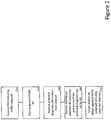
- Figure 2 shows a flow diagram of a general invention embodiment providing a computer-implemented method to identify healthcare resources used by a patient given a potential diagnosis. This method includes the following steps:
- the system consists of three main core modules and the HCRU KG and patient HCRU KG are created within the system. In other embodiments, they may be provided from other systems.
- the three core modules are:
- one embodiment of the system includes a Health Care Resource Utilization (HCRU) Knowledge Graph (KG) Engine module 70, which uses open data such as information obtained from the relevant online literature, and available standards.
- This HCRU KG engine encompasses the healthcare resource utilization, HCRU, knowledge graph, KG, builder 30 and the HCRU KG customizer 40.
- the patient HCRU graph engine module 50 associates/annotates the existing patient clinical history with the HCRU Knowledge Graph.
- the impact estimator module 60 estimates the impact of a potential new diagnosis on the patient, in terms of health care resource utilization graph.
- PCO Patient Clinical Object
- the PCO may be provided by a PCO builder (not shown).
- This PCO builder module can be part of the system, or provided by a separate system. It takes as input the following information:
- the open data (in the last 3 bullet points above relating to the Biomedical research literature, prescription and dispensing of drugs and set of knowledge from available medical standards) is used for enrichment of the terms. That is, the PCO may be enriched by equating PCO parts with standard vocabulary from the classifications listed above and hence annotating entities in the patient data as necessary with corresponding concepts/information from the open data. This facilitates later use of the PCO in conjunction with other standard data.
- the expert knowledge need not be essential to make the PCO, but can be used to verify and potentially enrich the knowledge in the PCO, for example by adjusting the diagnoses in the PCO using the expert knowledge, to make sure they are in line with current medical thinking. Additionally or alternatively, any diagnoses in the PCO which are in contradiction with the expert knowledge may be highlighted to the user for manual input and in this way the expert knowledge can act as a cross-check for the quality of the PCOs.
- the patient clinical object builder collects, extracts, integrates, curates and cleans the aforementioned data sources and produces the Patient Clinical Object (also known as a patient's egocentric network or ego-net) for each patient, which contains all the related information about the patient, namely age group, gender, a list of hospital visits grouped by unit, e.g., emergency room, outpatient, inpatient, and day hospital, and a list of previous diagnoses grouped by hospital visits and units.
- Patient Clinical Object also known as a patient's egocentric network or ego-net
- the PCO can be produced from clinical data as a graph centred on the patient vertex, with information about the patient at neighbouring vertices linked along edges to the patient by categories, such as any of diagnosis, symptom, treatment, hospital visit and prescription.
- the clinical data may be provided, for example from hospital records, or health authority records.
- This module captures the evidence based on data derived from literature and public data sources, such HFA-DB, European health for all database, health care resources and health care utilization and expenditure (http://data.euro.who.int/hfadb/) and HL7-FHIR, Fast Healthcare Interoperability Resources (hftps://www.hl7.org/fhir/summary.html).
- HFA-DB European health for all database, health care resources and health care utilization and expenditure
- HL7-FHIR High Healthcare Interoperability Resources
- This HCRU Engine module includes two main sub-modules, an HCRU KG builder 30 and an HCRU KG customizer 40, which each in turn consist of several components.
- FIG. 5 depicts the main flow of this sub-module.
- This sub-module comprises components which:
- Figure 6 illustrates the main components of the HCRU KG Builder 30, as explained in more detail below.
- resources are physical items, people, time, etc. the presentation of the resources' collector will be a list of terms or cluster of terms more than a hierarchy itself.
- the categorised list of health care resources terms can be extracted from the healthcare literature and the clinicians' expertise. Categories can be, for example, time taken, people resource, administrative people resource and item resource, as exemplified in the excerpt of seed terms below.
- the component will collect and store the enhanced sets of terms into the system.
- This component aims at identifying multiple representation of the same real-word object, in other words identifying equivalent terms in the two different data sources. In this particular case this may be by performing matching/alignment between the collected terms from the clinicians and one or more public data sources offering a standardised (and maybe multilingual) vocabulary of terms related to health care services and/or resources.
- the outcome of the component is to have the enhanced set of terms, proposed by the clinicians, annotated in standardized terms.
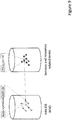
- Figure 9 shows an overview example of reconciliation between the HFA-DB term "Number of primary care health units” from WHO and the services and resources related term “primary care unit” from clinician input.
- This component takes as input the set of terms and their relations and creates an initial set of two models, 110 and 120, one for representing the information of healthcare services and other for representing healthcare resources.
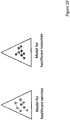
- Figures 10 and 11 present the output of this component.
- Figure 10 is an overview of the output of the model builder, showing the two separate models.
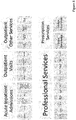
- Figure 11 illustrates exemplary vertices of both models and their internal connections, which are formed according to the structure of the clinician information and of the open health data used.
- This component is in charge of creating links that relates healthcare services with the resources.
- the component extracts the relations, by performing a relation mining analysis, of the previously identified entities from the public data sources, which are part of the models for healthcare services and resources.
- the extracted relations will also have a score based on the number of occurrences of the relations within the open data standards/public data sources. For example, the score may be derived from the number of co-occurrences of the terms divided by the sum of the occurrences of either term, or some other suitable metric.
- relations may be labelled with their significance, for example a service may have a particular resource, or a service may imply the presence of a resource and vice versa.
- Figure 12 presents a basic example of the output of the matcher, showing a link between acute inpatient admissions and number of hospital beds.
- Figure 13 is a more contextualised example of the output for the matcher of services and resources models, showing the scores for some exemplary relations.
- the final module aims at integrating the extracted entities along with their relations, including the scores information mentioned above and the provenance information.
- Figure 14 shows part of an HCRU KG, with the services distinguished from the resources using paler shading.
- the system presents the HealthCare Resources Utilization Knowledge Graph to the clinicians in a very intuitive way (in graph form, as shown in figure 14 ), and they will be able to manually curate and fix any potential inconsistencies of the generated graph.
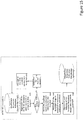
- FIG. 15 depicts the main flow of the HCRU KG Customizer 40.
- This sub-module comprises components which:
- Figure 16 illustrates the main components of the HCRU KG Customizer.
- This sub-module can customize the standard healthcare resources utilization knowledge graph for a particular medical institution.
- the various components of the customizer are described in the following.
- the Alignment processor 150 takes the hospital services portfolio and identifies the services that are contained in the General HCRU KG.
- the HC services filter 160 removes from the General HCRU KG the services not included in the hospital services portfolio.
- the Utilization patterns extractor 170 by means of process mining techniques over the Hospital Regulations and Logs, identifies what and how the resources of the hospital are really used.
- the HC resources filter 180 removes out all the resources that are not used in the hospital, and it produces the HCRU Knowledge Graph.
- Utilization patterns extractor 180 takes the hospital logs, and extracts process knowledge, e.g., process models in order to discover, monitor and improve the healthcare processes specific for the given hospital.
- a hospital log can be seen as a record of named activities ("Check Medications", "Patient Examination") which is created as a by-product of EHR use. These events occur in an order relative to each other, usually represented by time stamps.
- the component checks if the observed behaviour in the logs conforms to the given model, provided by the hospital internal regulations. For example, it may be checked whether a medical guideline which states that always a lab test and an X-ray needs to be done is always followed.
- the component performs a projection of the information extracted from the logs onto the model, i.e., the hospital internal regulation in this case.
- performance information may be projected on a discovered healthcare process in order to see for which examinations a long waiting time exists.
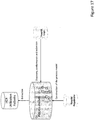
- Figure 17 shows the flow of this component for this, in which the hospital logs and hospital regulations are matched and patterns extracted to provide HCR utilization patterns.
- the HCR utilization pattern contains a customized subgraph of the HCRU KG.
- This customized subgraph of the HCRU KG will be part of the HCRU KG.
- the input of the extractor is the customized version of the HCRU KG for a particular hospital according to the specific services and resources that the given hospital provides.
- the logs and internal regulations we can identify how the services and resources are really used by the hospital and modify the subgraph accordingly.
- the clinicians and managers will be able to check how the healthcare resources and services are actually used within the hospital. This information will help to enrich the PCO of a particular patient, by including the resources and services the patient is using. In addition this will help with the estimation of the healthcare resource utilization for a potential diagnoses, by use of the impact estimator module.
- This engine enriches the Patient Clinical Object (PCO) by including information related to the health care resource utilization taken from the HCRU Knowledge Graph.
- the module annotates and associates the patient clinical history with concepts from the HCRU.
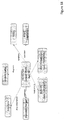
- Figure 18 shows an example of a PCO
- Figure 19 shows the resultant PCO enriched with the health care resource utilization graph.
- the former PCO contains information about clinical history, diagnoses, risks, treatments, symptoms, and drugs.
- the PCO will include the information about health care resources as exemplified in Figure 19 .
- the HCRU KG customized subgraph provides information related to the health care resources, and this information is matched against the clinical history of the PCO, e.g., ER visits or inpatients. Those visits imply that the patient have used some health care resources of the given hospital. Therefore, the enriched (or annotated) PCO reflects this information in Figure 16 .
- This module takes as input the annotated PCO that already includes the health care resource utilization (as a subgraph) for the particular patient; potential new diagnosis information for such patient; and the HCRU Knowledge Graph and uses graph mining.
- the module produces as a result a subgraph of the potential health care resource utilization along with scores.
- nodes of this resultant subgraph which correspond to the health care resources, each have an individual score that represents the probability of potential use (for that health care resource) for the particular patient when the potential diagnosis is given.
- the subgraph of potential health care resource utilization includes nodes from the original HCRU.
- the graph mining step can be viewed as a "pruning" of the original HCRU graph. This then restricts the subgraph to those resources which are relevant to the potential diagnosis.
- the potential diagnosis is related to previous diagnoses, drug prescription, and other health care resources, which are collected together in the system as the PCO.
- the potential diagnosis data may be manual (for example if it is from the clinician that estimated the potential diagnosis) or semiautomatic (if it is provided with the help of a diagnosis support system).
- Figure 20 shows the impact estimator 60, with inputs from the PCO and the HCRU KG, as well as from a clinician or clinician assisted by a diagnosis support system.
- the module takes the diagnosis related information and searches on the HCRU Knowledge Graph using a sub-module for the "Identification of HCR for a given diagnosis” that is in charge of identifying for a given diagnosis the related subgraph of the HCRU KG (see figure 20 ).
- the HCRU KG includes resources and services, and the diagnosis related information includes a diagnosis and its relations to other symptoms, drugs, and treatments. The relations of drugs and treatments can thus be linked to the HCRU KG.
- This search collects potential health care resources and services associated with the new "status" of the patient, after his/her new diagnosis. Once the potential associated health care resources are identified, the impact estimator estimates if these health care resources would affect patient current resource usage and how, using graph-based mining. The outcome is a final HCRU sub-graph for the patient that reflects the potential utilization of resources.
- a new diagnosis can affect resource usage in different ways. For example if the diagnosis is that the patient is dead, the hospital will have an empty bed. If there is already a future visit scheduled to a specialist of the same speciality, then potentially more time resource might be required rather than a further visit. In another example, if the diagnosis is that the patient remains on the same status, the doctors might require that he/she stays in a bed and continue to give him/her drugs, or change the drugs or amount thereof. Assuming there is no usage affected by the diagnosis, in that case, if the patient is already in the hospital, the patient would continue using the same resources/services as before.
- the graph mining module takes as input the two subgraphs (1) existing patient HCRU sub-graph, and (2) associated HCRU to a given diagnosis; and performs graph analysis to obtain the potential HCRU for the given new diagnosis of the patient.
- the graph analysis explores all the nodes of the graphs in order to find which nodes (from the different subgraphs) are potentially related and how. Specifically in this case this finds what healthcare resources (and services) from the subgraphs are related and how they are related.
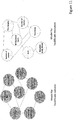
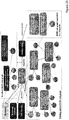
- Figure 20 depicts the flow of the process, including the starting position of the existing patient HCRU subgraph shown at the bottom left, the potential diagnosis at the bottom centre and the HCRU knowledge graph at the bottom right. Combination of the part of the HCRU KG which is relevant to the potential diagnosis (middle right, paler nodes) with the existing patient HCRU subgraph (middle left, darker nodes) forms an interim result and at the top centre is shown the sub graph of the HCRU, following graph mining. Nodes in Figure 20 are illustrative, they do not represent a particular situation, which is however depicted in the worked example later.
- the 3 nodes to the right are shown paler in the graph mining process to highlight that they come from a different places: the HCRU KG at the bottom right (they are not added).
- the 3 nodes to the left come from the HCRU subgraph of the PCO.
- the related values of the healthcare resources might change, for example to add some time to a specialist visit that is already scheduled.
- the dashed lines represent a relation between the nodes coming from the different subgraphs.
- this module has three main tasks:
- Figure 21 shows a worked example of an existing patient HCRU sub-graph with services and resources, a potential diagnosis of anxiety states and the HCRU sub-graph associated with that diagnosis.
- the resultant HCRU sub-graph of which only the additional nodes are shown, includes two additional services and associated additional resources beyond the previous existing patient HCRU subgraph.
- There is a new prescription (without date, whereas the previous prescriptions are dated in the past) and a new visit to a specialist which uses resources including tests, doctors and a visit of 1 hour.
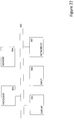
- Figure 22 is a block diagram of a computing device, such as a data storage server which embodies the present invention, and which may be used to implement a method of an embodiment of a computer-implemented method to identify healthcare resources used by a patient of a medical institution.
- the computing device comprises a processor 993, and memory, 994.
- the computing device also includes a network interface 997 for communication with other computing devices, for example with other computing devices of invention embodiments.
- an embodiment may be composed of a network of such computing devices.
- the computing device also includes one or more input mechanisms such as keyboard and mouse 996, and a display unit such as one or more monitors 995.
- the components are connectable to one another via a bus 992.
- the memory 994 may include a computer readable medium, which term may refer to a single medium or multiple media (e.g., a centralized or distributed database and/or associated caches and servers) configured to carry computer-executable instructions or have data structures stored thereon.
- Computer-executable instructions may include, for example, instructions and data accessible by and causing a general purpose computer, special purpose computer, or special purpose processing device (e.g., one or more processors) to perform one or more functions or operations.
- the term “computer-readable storage medium” may also include any medium that is capable of storing, encoding or carrying a set of instructions for execution by the machine and that cause the machine to perform any one or more of the methods of the present disclosure.
- the term “computer-readable storage medium” may accordingly be taken to include, but not be limited to, solid-state memories, optical media and magnetic media.
- such computer-readable media may include non-transitory computer-readable storage media, including Random Access Memory (RAM), Read-Only Memory (ROM), Electrically Erasable Programmable Read-Only Memory (EEPROM), Compact Disc Read-Only Memory (CD-ROM) or other optical disk storage, magnetic disk storage or other magnetic storage devices, flash memory devices (e.g., solid state memory devices).
- RAM Random Access Memory
- ROM Read-Only Memory
- EEPROM Electrically Erasable Programmable Read-Only Memory
- CD-ROM Compact Disc Read-Only Memory
- flash memory devices e.g., solid state memory devices
- the processor 993 is configured to control the computing device and execute processing operations, for example executing code stored in the memory to implement the various different functions of modules described here and in the claims.
- the memory 994 stores data being read and written by the processor 993.
- a processor may include one or more general-purpose processing devices such as a microprocessor, central processing unit, or the like.
- the processor may include a complex instruction set computing (CISC) microprocessor, reduced instruction set computing (RISC) microprocessor, very long instruction word (VLIW) microprocessor, or a processor implementing other instruction sets or processors implementing a combination of instruction sets.
- CISC complex instruction set computing
- RISC reduced instruction set computing
- VLIW very long instruction word
- the processor may also include one or more special-purpose processing devices such as an application specific integrated circuit (ASIC), a field programmable gate array (FPGA), a digital signal processor (DSP), network processor, or the like.
- ASIC application specific integrated circuit
- FPGA field programmable gate array
- DSP digital signal processor
- a processor is configured to execute instructions for performing the operations and steps discussed herein.
- the display unit 997 may display a representation of data stored by the computing device, such as the HCRU KG , or part thereof, or the PCO or part thereof and may also display a cursor and dialog boxes and screens enabling interaction between a user and the programs and data stored on the computing device.
- the input mechanisms 996 may enable a user to input data and instructions to the computing device. For example it can allow a clinician to enter or amend the seed terms used for medical services and healthcare resources.
- the network interface (network I/F) 997 may be connected to a network, such as the Internet, and is connectable to other such computing devices via the network, for example to access open data.
- the network I/F 997 may control data input/output from/to other apparatus via the network.
- Other peripheral devices such as microphone, speakers, printer, power supply unit, fan, case, scanner, trackerball etc may be included in the computing device.
- the HCRU KG builder may comprise processing instructions stored on a portion of the memory 994, the processor 993 to execute the processing instructions, and a portion of the memory 994 to store the data making up the HCRU KG during the execution of the processing instructions.
- the HCRU KG may be stored on the memory 994 and/or on a connected storage unit.
- the HCRU KG customizer may comprise processing instructions stored on a portion of the memory 994, the processor 993 to execute the processing instructions, and a portion of the memory 994 to store data contributing to the customized subgraph during the execution of the processing instructions.
- the customized subgraph may be stored on the memory 994 and/or on a connected storage unit.
- the patient HCRU engine may comprise processing instructions stored on a portion of the memory 994, the processor 993 to execute the processing instructions, and a portion of the memory 994 to store data making up the enriched PCO during the execution of the processing instructions.
- the enriched PCO may be stored on the memory 994 and/or on a connected storage unit.
- the impact estimator may comprise processing instructions stored on a portion of the memory 994, the processor 993 to execute the processing instructions, and a portion of the memory 994 to store data making up the subgraphs during the execution of the processing instructions.
- the resultant and potentially amended HCRU sub-graph may be stored on the memory 994 and/or on a connected storage unit.
- Methods embodying the present invention may be carried out on a computing device such as that illustrated in Figure 22 .
- a computing device need not have every component illustrated in Figure 22 , and may be composed of a subset of those components.
- a method embodying the present invention may be carried out by a single computing device in communication with one or more data storage servers via a network.
- the computing device may be a data storage itself storing the resultant graphs in the invention.
- a method embodying the present invention may be carried out by a plurality of computing devices operating in cooperation with one another.
- One or more of the plurality of computing devices may be a data storage server storing at least a portion of the graphs.
- Health Care Utilization The measure of the population's use of the health care services available to them. This includes the utilization of Hospital resources, Personal Care Home (PCH) resources, and physician resources. Health care utilization and health status are used to examine how efficiently a health care system produces health in a population.
- PCH Personal Care Home
- Health status An indication of the risk of death of patients based on the type and number of comorbid conditions or on a number of socio-economic indicators.
- Medical treatment the management and care of a patient, it includes nursing, psychological intervention and specialist mental health rehabilitation.
- Diagnosis the process of determining by examination the nature and circumstance of a disease condition from its signs and symptoms
- Drugs something that treats or prevents or alleviates the symptoms of a disease.
- Health care services means the furnishing of medicine, medical or surgical treatment, nursing, hospital service, dental service, optometrical service, complementary health services or any or all of the enumerated services or any other necessary services of like character, whether or not contingent upon sickness or personal injury, as well as the furnishing to any person of any and all other services and goods for the purpose of preventing, alleviating, curing or healing human illness, physical disability or injury.
- Health resources are all materials, personnel, facilities, funds, and anything else that can be used for providing health care and services.
Landscapes
- Engineering & Computer Science (AREA)
- Health & Medical Sciences (AREA)
- Public Health (AREA)
- Medical Informatics (AREA)
- Primary Health Care (AREA)
- Epidemiology (AREA)
- General Health & Medical Sciences (AREA)
- Business, Economics & Management (AREA)
- Biomedical Technology (AREA)
- Data Mining & Analysis (AREA)
- Databases & Information Systems (AREA)
- Human Resources & Organizations (AREA)
- General Business, Economics & Management (AREA)
- Pathology (AREA)
- Strategic Management (AREA)
- Economics (AREA)
- Entrepreneurship & Innovation (AREA)
- Game Theory and Decision Science (AREA)
- Marketing (AREA)
- Operations Research (AREA)
- Quality & Reliability (AREA)
- Tourism & Hospitality (AREA)
- Physics & Mathematics (AREA)
- Educational Administration (AREA)
- General Physics & Mathematics (AREA)
- Theoretical Computer Science (AREA)
- Development Economics (AREA)
- Urology & Nephrology (AREA)
- Surgery (AREA)
- Nuclear Medicine, Radiotherapy & Molecular Imaging (AREA)
- Medical Treatment And Welfare Office Work (AREA)
- Measuring And Recording Apparatus For Diagnosis (AREA)
Priority Applications (1)
| Application Number | Priority Date | Filing Date | Title |
|---|---|---|---|
| JP2017188642A JP6992370B2 (ja) | 2016-10-06 | 2017-09-28 | 潜在的な診断を所与として患者により利用される医療資源を特定するためのコンピュータ装置及び方法 |
Applications Claiming Priority (1)
| Application Number | Priority Date | Filing Date | Title |
|---|---|---|---|
| DE102016219430 | 2016-10-06 |
Publications (1)
| Publication Number | Publication Date |
|---|---|
| EP3306502A1 true EP3306502A1 (fr) | 2018-04-11 |
Family
ID=58709745
Family Applications (1)
| Application Number | Title | Priority Date | Filing Date |
|---|---|---|---|
| EP17166979.9A Withdrawn EP3306502A1 (fr) | 2016-10-06 | 2017-04-19 | Appareil et procédé informatique pour identifier des ressources de soins de santé utilisées par un patient ayant reçu un diagnostic potentiel |
Country Status (3)
| Country | Link |
|---|---|
| US (1) | US11127502B2 (fr) |
| EP (1) | EP3306502A1 (fr) |
| JP (1) | JP6992370B2 (fr) |
Cited By (1)
| Publication number | Priority date | Publication date | Assignee | Title |
|---|---|---|---|---|
| US20230153646A1 (en) * | 2021-11-15 | 2023-05-18 | International Business Machines Corporation | Indentifying relevant graph patterns in a knowledge graph background |
Families Citing this family (9)
| Publication number | Priority date | Publication date | Assignee | Title |
|---|---|---|---|---|
| CN110033838A (zh) * | 2019-03-13 | 2019-07-19 | 武汉金豆医疗数据科技有限公司 | 一种医疗数据三重逻辑校验系统及其校验方法 |
| BR112022003401A2 (pt) * | 2019-08-26 | 2022-05-17 | Koninklijke Philips Nv | Método implementado por computador, sistema para prever resultados clínicos ideais e mídia não transitória legível por máquina |
| US20220310271A1 (en) * | 2019-08-26 | 2022-09-29 | Koninklijke Philips N.V. | Methods for the automatic construction of state transition graphs from the timeline data of individuals |
| CN113268700B (zh) * | 2021-05-21 | 2023-05-09 | 中安万业大数据有限公司 | 一种用于智慧医疗的互联网+资源管理方法 |
| WO2023054645A1 (fr) * | 2021-09-30 | 2023-04-06 | 富士フイルム株式会社 | Dispositif de traitement d'information, procédé de traitement d'information, et programme de traitement d'information |
| US20240395371A1 (en) * | 2021-10-01 | 2024-11-28 | A3P Biomedical Ab (Publ) | Method and system for management of medical care resources |
| US20240161911A1 (en) * | 2022-11-15 | 2024-05-16 | Operait Health Inc. | Artificial intelligence-based scheduling of medical procedures in operating rooms |
| WO2024202068A1 (fr) * | 2023-03-31 | 2024-10-03 | 富士通株式会社 | Procédé d'affichage, dispositif de traitement d'informations et programme d'affichage |
| US20250014748A1 (en) * | 2023-07-05 | 2025-01-09 | Iqvia Inc. | Graph fusion system for embedding disparate domain data |
Citations (3)
| Publication number | Priority date | Publication date | Assignee | Title |
|---|---|---|---|---|
| US20060074720A1 (en) * | 2004-09-21 | 2006-04-06 | Alfons Brutting | Medical planning agent |
| US20120173253A1 (en) * | 2006-02-09 | 2012-07-05 | Syus, Llc | System, method, and computer program product for reducing the burden on scheduling systems by forecasting a demand for medical resources |
| US20160283880A1 (en) * | 2015-03-27 | 2016-09-29 | Mckesson Corporation | Health care enterprise resource planning system and method for utilizing web data |
Family Cites Families (15)
| Publication number | Priority date | Publication date | Assignee | Title |
|---|---|---|---|---|
| US5991728A (en) | 1997-04-30 | 1999-11-23 | Deroyal Industries, Inc. | Method and system for the tracking and profiling of supply usage in a health care environment |
| US6061657A (en) | 1998-02-18 | 2000-05-09 | Iameter, Incorporated | Techniques for estimating charges of delivering healthcare services that take complicating factors into account |
| US6581204B2 (en) * | 1999-08-24 | 2003-06-17 | Ge Medical Systems Information Technologies, Inc. | Modular tracking and profiling system |
| US7702522B1 (en) | 2000-09-01 | 2010-04-20 | Sholem Steven L | Method and apparatus for tracking the relative value of medical services |
| US20030065534A1 (en) | 2001-10-02 | 2003-04-03 | Mccartney Michael J. | Health care management method and system |
| US20050246189A1 (en) | 2004-04-29 | 2005-11-03 | Arnold Monitzer | System for determining medical resource utilization characteristics |
| US20090112618A1 (en) | 2007-10-01 | 2009-04-30 | Johnson Christopher D | Systems and methods for viewing biometrical information and dynamically adapting schedule and process interdependencies with clinical process decisioning |
| JP5219556B2 (ja) | 2008-02-29 | 2013-06-26 | 悦功 飯塚 | 実施計画作成支援装置及び実施計画作成支援プログラム |
| US8271295B1 (en) | 2008-07-23 | 2012-09-18 | Sprint Communications Company L.P. | Health clinic broker |
| US20140236625A1 (en) * | 2013-02-15 | 2014-08-21 | Covidien Lp | Social network techniques applied to the use of medical data |
| US20140278454A1 (en) | 2013-03-13 | 2014-09-18 | FTV Solutions, Inc. | Dynamic pricing of healthcare resources |
| JP6101563B2 (ja) | 2013-05-20 | 2017-03-22 | 株式会社日立製作所 | 情報構造化システム |
| WO2016054043A1 (fr) * | 2014-09-29 | 2016-04-07 | Cornell University | Système et procédés de gestion de ressources de soins de santé |
| US20160253687A1 (en) | 2015-02-26 | 2016-09-01 | Aetna Inc. | System and method for predicting healthcare costs |
| US20170083673A1 (en) * | 2015-09-17 | 2017-03-23 | Thomas J. DAWSON, III | Systems and methods for estimating lifecare service costs |
-
2017
- 2017-04-19 EP EP17166979.9A patent/EP3306502A1/fr not_active Withdrawn
- 2017-09-05 US US15/695,438 patent/US11127502B2/en not_active Expired - Fee Related
- 2017-09-28 JP JP2017188642A patent/JP6992370B2/ja not_active Expired - Fee Related
Patent Citations (3)
| Publication number | Priority date | Publication date | Assignee | Title |
|---|---|---|---|---|
| US20060074720A1 (en) * | 2004-09-21 | 2006-04-06 | Alfons Brutting | Medical planning agent |
| US20120173253A1 (en) * | 2006-02-09 | 2012-07-05 | Syus, Llc | System, method, and computer program product for reducing the burden on scheduling systems by forecasting a demand for medical resources |
| US20160283880A1 (en) * | 2015-03-27 | 2016-09-29 | Mckesson Corporation | Health care enterprise resource planning system and method for utilizing web data |
Cited By (1)
| Publication number | Priority date | Publication date | Assignee | Title |
|---|---|---|---|---|
| US20230153646A1 (en) * | 2021-11-15 | 2023-05-18 | International Business Machines Corporation | Indentifying relevant graph patterns in a knowledge graph background |
Also Published As
| Publication number | Publication date |
|---|---|
| US20180101654A1 (en) | 2018-04-12 |
| US11127502B2 (en) | 2021-09-21 |
| JP6992370B2 (ja) | 2022-01-13 |
| JP2018060537A (ja) | 2018-04-12 |
Similar Documents
| Publication | Publication Date | Title |
|---|---|---|
| US11127502B2 (en) | Computer apparatus and method to identify healthcare resources used by a patient given a potential diagnosis | |
| US10943679B2 (en) | Computer apparatus and method to identify healthcare resources used by a patient of a medical institution | |
| JP7035314B2 (ja) | 患者の診断を支援するシステムおよび方法 | |
| JP6915282B2 (ja) | オープンデータ及び臨床医の入力を用いて患者の治療リスクを評価するシステム及び方法 | |
| JP6780520B2 (ja) | オープンデータ及び臨床医の入力を用いて患者のリスクを評価するシステム及び方法 | |
| US8527293B2 (en) | Method and system for supporting clinical decision-making | |
| Alahmar et al. | Ontological framework for standardizing and digitizing clinical pathways in healthcare information systems | |
| US20130275153A1 (en) | Method of optimizing patient-related outcomes | |
| Wang et al. | Creating hospital-specific customized clinical pathways by applying semantic reasoning to clinical data | |
| TW201513033A (zh) | 用以最佳化網路環境中臨床流程及運行效率之系統及方法 | |
| Fox et al. | Dental extractions under general anesthesia: new insights from process mining | |
| GB2548627A (en) | A system and a method for assessing patient treatment risk using open data and clinician input | |
| Yao et al. | A Context-Aware framework for patient Navigation and Engagement (CANE) | |
| Pecoraro et al. | A system of concepts to support the integration of Health and social care and assistive domotics services: The Health@ Home project | |
| Do Prado et al. | Quantification and visualisation methods of data-driven chronic care delivery pathways: protocol for a systematic review and content analysis | |
| Haule et al. | The what, why, and how of health information systems: A systematic review | |
| Domínguez et al. | Development and evaluation of an open-source, standards-based approach to explainable artificial intelligence for managing co-morbidity and clinical guidelines using argumentation techniques and the Transition-based Medical Recommendation model | |
| Miñarro-Giménez et al. | Ontology Model for Supporting Process Mining on Healthcare-Related Data | |
| Lathrop et al. | Medical terminology coding systems and medicolegal death investigation data: Searching for a standardized method of electronic coding at a statewide medical examiner’s office | |
| Liu et al. | Explore Data Quality Challenges Based on Data Structure of Electronic Health Records | |
| Vizza et al. | An Innovative Framework for Bioimage Annotation and Studies | |
| Alahmar | A novel framework for standardizing and digitizing clinical pathways in healthcare information systems | |
| Panda et al. | AI Clinical Decision Support System (CDSS) for Teleconsultations in eSanjeevani, India Telemedicine Service: A Prospective Implementation Study | |
| van der Aalst et al. | Process Modeling and Conformance Checking in Healthcare: A COVID-19 Case Study | |
| Carreño-Bolufer et al. | A Conceptual Model-Based Application for the Treatment and Management of Data in Pediatric Oncology: The Neuroblastoma Use Case. |
Legal Events
| Date | Code | Title | Description |
|---|---|---|---|
| PUAI | Public reference made under article 153(3) epc to a published international application that has entered the european phase |
Free format text: ORIGINAL CODE: 0009012 |
|
| STAA | Information on the status of an ep patent application or granted ep patent |
Free format text: STATUS: THE APPLICATION HAS BEEN PUBLISHED |
|
| AK | Designated contracting states |
Kind code of ref document: A1 Designated state(s): AL AT BE BG CH CY CZ DE DK EE ES FI FR GB GR HR HU IE IS IT LI LT LU LV MC MK MT NL NO PL PT RO RS SE SI SK SM TR |
|
| AX | Request for extension of the european patent |
Extension state: BA ME |
|
| STAA | Information on the status of an ep patent application or granted ep patent |
Free format text: STATUS: REQUEST FOR EXAMINATION WAS MADE |
|
| 17P | Request for examination filed |
Effective date: 20180829 |
|
| RBV | Designated contracting states (corrected) |
Designated state(s): AL AT BE BG CH CY CZ DE DK EE ES FI FR GB GR HR HU IE IS IT LI LT LU LV MC MK MT NL NO PL PT RO RS SE SI SK SM TR |
|
| STAA | Information on the status of an ep patent application or granted ep patent |
Free format text: STATUS: EXAMINATION IS IN PROGRESS |
|
| 17Q | First examination report despatched |
Effective date: 20190225 |
|
| STAA | Information on the status of an ep patent application or granted ep patent |
Free format text: STATUS: THE APPLICATION HAS BEEN WITHDRAWN |
|
| 18W | Application withdrawn |
Effective date: 20190611 |