EP3306533B1 - Support d'information de type sans contact - Google Patents
Support d'information de type sans contact Download PDFInfo
- Publication number
- EP3306533B1 EP3306533B1 EP16802932.0A EP16802932A EP3306533B1 EP 3306533 B1 EP3306533 B1 EP 3306533B1 EP 16802932 A EP16802932 A EP 16802932A EP 3306533 B1 EP3306533 B1 EP 3306533B1
- Authority
- EP
- European Patent Office
- Prior art keywords
- plate electrode
- antenna coil
- film base
- electrode
- plate electrodes
- Prior art date
- Legal status (The legal status is an assumption and is not a legal conclusion. Google has not performed a legal analysis and makes no representation as to the accuracy of the status listed.)
- Active
Links
Images







Classifications
-
- G—PHYSICS
- G06—COMPUTING OR CALCULATING; COUNTING
- G06K—GRAPHICAL DATA READING; PRESENTATION OF DATA; RECORD CARRIERS; HANDLING RECORD CARRIERS
- G06K19/00—Record carriers for use with machines and with at least a part designed to carry digital markings
- G06K19/06—Record carriers for use with machines and with at least a part designed to carry digital markings characterised by the kind of the digital marking, e.g. shape, nature, code
- G06K19/067—Record carriers with conductive marks, printed circuits or semiconductor circuit elements, e.g. credit or identity cards also with resonating or responding marks without active components
- G06K19/07—Record carriers with conductive marks, printed circuits or semiconductor circuit elements, e.g. credit or identity cards also with resonating or responding marks without active components with integrated circuit chips
- G06K19/077—Constructional details, e.g. mounting of circuits in the carrier
-
- G—PHYSICS
- G06—COMPUTING OR CALCULATING; COUNTING
- G06K—GRAPHICAL DATA READING; PRESENTATION OF DATA; RECORD CARRIERS; HANDLING RECORD CARRIERS
- G06K19/00—Record carriers for use with machines and with at least a part designed to carry digital markings
- G06K19/06—Record carriers for use with machines and with at least a part designed to carry digital markings characterised by the kind of the digital marking, e.g. shape, nature, code
- G06K19/067—Record carriers with conductive marks, printed circuits or semiconductor circuit elements, e.g. credit or identity cards also with resonating or responding marks without active components
- G06K19/07—Record carriers with conductive marks, printed circuits or semiconductor circuit elements, e.g. credit or identity cards also with resonating or responding marks without active components with integrated circuit chips
- G06K19/077—Constructional details, e.g. mounting of circuits in the carrier
- G06K19/07749—Constructional details, e.g. mounting of circuits in the carrier the record carrier being capable of non-contact communication, e.g. constructional details of the antenna of a non-contact smart card
-
- G—PHYSICS
- G06—COMPUTING OR CALCULATING; COUNTING
- G06K—GRAPHICAL DATA READING; PRESENTATION OF DATA; RECORD CARRIERS; HANDLING RECORD CARRIERS
- G06K19/00—Record carriers for use with machines and with at least a part designed to carry digital markings
- G06K19/06—Record carriers for use with machines and with at least a part designed to carry digital markings characterised by the kind of the digital marking, e.g. shape, nature, code
- G06K19/067—Record carriers with conductive marks, printed circuits or semiconductor circuit elements, e.g. credit or identity cards also with resonating or responding marks without active components
- G06K19/07—Record carriers with conductive marks, printed circuits or semiconductor circuit elements, e.g. credit or identity cards also with resonating or responding marks without active components with integrated circuit chips
- G06K19/0723—Record carriers with conductive marks, printed circuits or semiconductor circuit elements, e.g. credit or identity cards also with resonating or responding marks without active components with integrated circuit chips the record carrier comprising an arrangement for non-contact communication, e.g. wireless communication circuits on transponder cards, non-contact smart cards or RFIDs
- G06K19/0726—Record carriers with conductive marks, printed circuits or semiconductor circuit elements, e.g. credit or identity cards also with resonating or responding marks without active components with integrated circuit chips the record carrier comprising an arrangement for non-contact communication, e.g. wireless communication circuits on transponder cards, non-contact smart cards or RFIDs the arrangement including a circuit for tuning the resonance frequency of an antenna on the record carrier
Definitions
- the present invention relates to a contactless information medium.
- Patent Document 1 discloses an example of an RFID medium (a contactless information medium) such as a contactless IC card which performs wireless communication using signals in an HF band (for example, 13.56 MHz).
- An antenna pattern of an antenna coil of such an RFID medium can be designed in any shape as long as functional requirements for performing wireless communications with external devices are met.
- an area where an antenna pattern can be arranged is set in order to provide an opening (a region having no wiring pattern) formed inside an antenna coil.
- the area where the antenna pattern can be arranged is set to be an annular area obtained by removing, from a rectangular region having a length of 49 mm and a width of 81 mm, a substantially rectangular region having a length of 34 mm and a width of 64 mm (this rectangular region having corners rounded with R3 mm) and centered in the rectangular region.
- Patent Document 2 describes a resonance circuit including a front-side coil-shaped conductor and a back-side coil-shaped conductor in cuboid shapes, which are arranged on the front and back surfaces of a dielectric sheet so as to be opposed to each other.
- Coil-shaped conductors are respectively wound from first ends to second ends and coupled with capacitance interposed therebetween so as to be opposed to each other.
- the opposed section is equal or substantially equal in conductor width
- the outermost windings and the innermost windings are preferably configured in a line shape, and each arranged so that two sides are thicker in conductor width than any other winding.
- Patent Document 3 describes an integrated circuit device including a contactless integrated circuit inlay.
- the inlay includes a substrate.
- a passive integrated circuit chip is adhesively attached to a first surface of substrate.
- a capacitance portion capable of propagating high-frequency signals using parallel plate electrodes may be provided in a circuit.
- a wiring pattern to connect the parallel plate electrodes to an antenna coil is necessary, and therefore it may be difficult to meet the requirements of the above standard.
- the requirements of the above standard cannot be met.
- the requirements of the above standard are not met and the area of the opening of the antenna coil is insufficient, the radiation efficiency of the antenna may decrease, and therefore it is recommended that the wiring pattern be preferably accommodated within the annular area as set according to the above standard to provide the opening of the antenna coil.
- an object of the present invention is to provide a contactless information medium having parallel plate electrodes and designed to have an opening of an antenna coil.
- the contactless information medium includes a film base, an antenna coil, an IC chip, a first plate electrode, and a second plate electrode.
- the antenna coil is disposed on a first surface of the film base, and formed in a spiral shape to perform wireless communication with an external device.
- the IC chip is disposed on the first surface of the film base, connected to the antenna coil via an IC chip-mounted portion, and performs wireless communication processing via the antenna coil.
- the first plate electrode is disposed on the first surface of the film base, and connected to at least one of an inner end and an outer end of the antenna coil.
- the second plate electrode is disposed on a second surface of the film base so as to be opposite to the first plate electrode in the thickness direction of the film base.
- each of the first plate electrode and the second plate electrode has a first electrode portion and a second electrode portion.
- the first electrode portion and the second electrode portion respectively extend along a first side direction of the antenna coil and a second side direction intersecting with the first side direction so that the first and second electrode portions are adjacent to an inner periphery or an outer periphery of the antenna coil when viewed perpendicular to the film base.
- the first and second plate electrodes are disposed along greater than or equal to one-third of the entire length of the inner periphery or the outer periphery of the antenna coil so as to be adjacent to the inner periphery or the outer periphery of the antenna coil when viewed perpendicular to the film base.
- the first plate electrode has a first inner plate electrode connected to the inner end of the antenna coil, and a first outer plate electrode connected to the outer end of the antenna coil.
- the second plate electrode has a second inner plate electrode opposite to the first inner plate electrode in the thickness direction of the film base, and a second outer plate electrode opposite to the first outer plate electrode in the thickness direction of the film base.
- the first outer plate electrode is disposed on the opposite side of the first inner plate electrode with respect to a center point or center line on the plane of the film base.
- the first plate electrode and the like are arranged well-balanced on the surface of the film base, enabling the contactless information medium to have parallel plate electrodes and an opening of the antenna coil under the constraints imposed by the limited outer dimensions of the contactless information medium.
- the contactless information medium further includes a jumper portion connecting the second inner plate electrode to the second outer plate electrode on the second surface of the film base.
- the second inner plate electrode and the second outer plate electrode are disposed on opposite sides of the film base without the plate electrodes directly connecting to each other, and a capacitance portion capable of propagating high-frequency signals can be provided in a circuit. This enables an electrical connection between electrodes to be made with greater reliability because propagation of signals by the capacitance portion will not be disturbed even if the film base expands when heated.
- the first plate electrode may have a first inner plate electrode connected to the inner end of the antenna coil, and a first outer plate electrode connected to the outer end of the antenna coil.
- the second plate electrode may have a second inner plate electrode opposite to the first inner plate electrode in the thickness direction of the film base, and a second outer plate electrode opposite to the first outer plate electrode in the thickness direction of the film base.
- Each of the first inner plate electrode and the first outer plate electrode may have the first electrode portion and the second electrode portion.
- the first plate electrode and the like are arranged well-balanced on the surface of the film base, thus enabling the contactless information medium to have parallel plate electrodes and an opening of the antenna coil, under the constraints imposed by the limited outer dimensions of the contactless information medium.
- the pair of inner plate electrodes consisting of the first inner plate electrode and the second inner plate electrode, and the pair of outer plate electrodes consisting of the first outer plate electrode and the second outer plate electrode may be arranged such that, when viewed perpendicular to the film base, a portion of the antenna coil along which the pair of the inner plate electrodes are disposed is different from a portion of the antenna coil along which the pair of the outer plate electrodes are disposed.
- the pair of the inner plate electrodes inside the antenna coil, and the pair of the outer plate electrodes outside the antenna coil are arranged such that they do not share the same portions of the antenna coil.
- the pair of the inner plate electrodes and the pair of the inner plate electrodes are arranged so that the two pairs do not adjoin each other and do not sandwich the same portion of the antenna coil therebetween.
- the antenna coil, the pair of the inner plate electrodes, and the pair of the outer plate electrodes are disposed on the film base in a balanced manner.
- the antenna coil and the plate electrodes can be adequately arranged in an equally spaced and annular antenna pattern arranging area defined in a standard (for example, ISO/IEC 14443-1, class 1) and the like.
- At least one of the pair of inner plate electrodes consisting of the first inner plate electrode and the second inner plate electrode, and the pair of outer plate electrodes consisting of the first outer plate electrode and the second outer plate electrode may be arranged such that an electric current flows in the same direction as an electric current passing through the antenna coil.
- the number of coil turns can be effectively increased by enabling at least one of the pair of inner plate electrodes and the pair of outer plate electrodes to function as a radiating element that passes an electric current in the same direction as an electric current passing through the antenna coil.
- the IC chip mounting portion may be disposed outside the antenna coil when viewed perpendicular to the film base.
- the area of the opening of the antenna coil can be increased.
- the IC chip mounting portion may be disposed outside the antenna coil when viewed perpendicular to the film base, and the pair of outer plate electrodes consisting of the first outer plate electrode and the second outer plate electrode may be disposed, when viewed perpendicular to the film base, along the outer periphery of the antenna coil and the IC chip mounting portion.
- the plate electrodes can be disposed by effectively using an empty space outside the antenna coil on the film base.
- the first and second plate electrodes may be disposed on the film base such that one of the plate electrodes entirely covers the other plate electrode when viewed perpendicular to the film base. Further, in the contactless information medium, the first and second plate electrodes may be disposed on the film base such that, when viewed perpendicular to the film base, one of the plate electrodes entirely covers the other plate electrode in the first direction parallel to the surface of the film base, and the latter plate electrode entirely covers the former plate electrode in the second direction parallel to the surface of the film base and perpendicular to the first direction.
- an antenna arranging region having a frame shape, where the antenna coil is disposed is defined on the periphery of the first surface of the film base.
- the antenna arranging region may be located between the outer periphery of the film base and an antenna non-arranging region that covers about more than half of the entire area of the first surface and that is defined in the center of the first surface. Defining such an antenna arranging region enables the contactless information medium to have parallel plate electrodes and a required opening of the antenna coil (an antenna non-arranging region), under the constraints imposed by the limited outer dimensions of the contactless information medium.
- the first plate electrode may be disposed adjacent to the closest antenna coil such that the space between the first plate electrode and the inner periphery or the outer periphery of the antenna coil is 0.5 mm or less. This allows the first plate electrode and the antenna coil to be arranged with greater efficiency.
- the film base may include an intermediate base formed of a dielectric, a first dielectric layer for adjustment formed of a dielectric and formed on a first surface of the intermediate base, and a second dielectric layer for adjustment formed of a dielectric and formed on a second surface of the intermediate base.
- the thickness of the film base formed of dielectric material namely the distance between the first and second plate electrodes, can be easily adjusted, for example, by changing the thickness of the first or second dielectric layer. This allows easy adjustment of the capacitance of a capacitor formed by the first and second plate electrodes without changing the shape and the like of an electrode pattern of the plate electrodes constituting the capacitor.
- an electrical connection is made by a capacitor formed by the first plate electrode connected to the antenna coil and the second plate electrode disposed on the rear surface.
- the dielectric constants of the dielectrics constituting the first and second dielectric layers may be greater than or equal to the dielectric constant of the dielectric constituting the intermediate base. This configuration enables easy adjustment of the capacitance of the capacitor formed by the first and second plate electrodes even if the first and second dielectric layers are thin.
- the first and second dielectric layers may be thinner than the intermediate base.
- the dielectric layers for adjusting the capacitance of the capacitor made of the first and second plate electrodes are thin, which minimizes variations in total thickness of the film base in products.
- a dielectric material constituting the first and second dielectric layers may be the same as or different from a dielectric material constituting the intermediate base.
- the first and second dielectric layers may be formed by applying the dielectric material to the intermediate base followed by curing. This configuration enables easy adjustment of the thickness and the like of the first and second dielectric layers, thus allowing the capacitance of the capacitor made of the first and second plate electrodes to be easily adjusted.
- the metal foil constituting the antenna coil may be thicker than the metal foil constituting the second plate electrode. In that case, the electrical resistance of the antenna coil is reduced, increasing the radiation efficiency of the antenna of the contactless information medium.
- the present invention provides a contactless information medium designed to have an opening of an antenna coil and parallel plate electrodes.
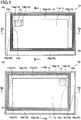
- Fig. 1(a) is a top view of the contactless communication medium, showing its internal structure
- Fig. 1(b) is a rear view thereof, according to the first embodiment of the present invention
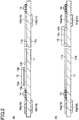
- Fig. 2(a) is a cross-sectional view of the contactless communication medium shown in Fig. 1 , taken along the line IIa-IIa
- Fig. 2(b) is a cross-sectional view of the contactless communication medium shown in Fig. 1 , taken along the line IIb-IIb.
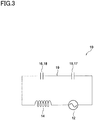
- Fig. 3 is a circuit diagram showing an equivalent circuit of the contactless communication medium shown in Fig. 1.
- Fig. 1(a) is a top view of the contactless communication medium, showing its internal structure
- Fig. 1(b) is a rear view thereof, according to the first embodiment of the present invention.
- Fig. 2(a) is a cross-sectional view of the contactless communication medium shown in Fig. 1 , taken along the line IIa-IIa
- the contactless communication medium is a contactless information medium capable of performing contactless communication with an external read/write device, such as a reader/writer, using signals primarily in the HF band, by applying RFID technology.
- a contactless communication medium 10 has a rectangular film base 11.
- On a top surface (a first surface) 11a of the film base 11 are an IC chip 12, an IC chip mounting portion 13, an antenna coil 14, a first inner plate electrode 15, and a first outer plate electrode 16.
- On a rear surface (a second surface) 11b of the film base 11 are a second inner plate electrode 17, a second outer plate electrode 18, and a jumper wire (a jumper portion) 19.
- the film base 11 is formed of materials having insulating properties and durability, for example, polyethylene naphthalate (PEN), polyethylene terephthalate copolymer (PET-G) and the like.
- PEN polyethylene naphthalate
- PET-G polyethylene terephthalate copolymer
- a metal foil is laminated to both the front and rear surfaces 11a and 11b of the film base 11. These metal foils are etched, for example, to form the IC chip mounting portion 13, the antenna coil 14, the first plate electrodes 15 and 16, the second plate electrodes 17 and 18, and the jumper wire 19.
- the IC chip 12 may be an IC chip for an IC tag storing ID information. Further, the IC chip 12 may be a module where an IC is mounted on a substrate and the like having terminals 12a and 12b.
- the IC chip 12 is mounted on the IC chip mounting portion 13 disposed at any location along a length of the antenna coil 14 on the top surface 11a of the film base 11.
- the IC chip mounting portion 13 has a pair of supporting portions 13a and 13b spaced from each other.
- the supporting portion 13a is connected to an inner end 14a of the antenna coil 14.
- the supporting portion 13b is connected to the first inner plate electrode 15.
- the terminals 12a and 12b disposed at the periphery of the IC chip 12 are joined to the pair of supporting portions 13a and 13b by ultrasonic welding and the like. Consequently, the IC chip 12 is connected to the antenna coil 14 via the IC chip mounting portion 13.
- the IC chip 12 may be mounted on the IC chip mounting portion 13 using other methods (for example, thermocompression bonding, adhesion by conductive adhesive, laser beam welding and the like).
- the IC chip 12 performs wireless communication processing via the conducted antenna coil 14, and sends and receives predetermined signals to and from an external read/write device
- the antenna coil 14 is a planar spiral antenna and is electromagnetically coupled to an antenna of an external read/write device such as a reader/writer in order to perform wireless communication.
- the number of turns of the antenna coil 14 is, for example, about 2 to 6.
- Fig. 1 shows an example with 4 turns, but the present invention is not limited to this.
- the width of each antenna wire constituting the antenna coil 14 is, for example, about 0.01 mm to 0.7 mm, more preferably about 0.02 mm to 0.6 mm. Further, the distance between the antenna wires constituting the antenna coil 14 is about 0.01 mm to 0.4 mm, more preferably about 0.02 mm to 0.3 mm. With this configuration, the antenna coil 14 sends and receives signals and receives power via wireless communication in a contactless manner.
- the antenna coil 14 is formed from a conductor disposed on the top surface 11a of the film base 11. Specifically, the antenna coil 14 is formed into a rectangular pattern by etching a copper foil or an aluminum foil having a thickness of 5 ⁇ m to 50 ⁇ m laminated on the top surface 11a side of the film base 11 having insulating properties which is made of, for example, polyethylene terephthalate (PET) or polyethylene naphthalate (PEN) having a thickness of 15 ⁇ m to 50 ⁇ m.
- PET polyethylene terephthalate
- PEN polyethylene naphthalate
- This antenna coil 14 is connected to the first outer plate electrode 16 at the outer end 14b.
- the antenna coil 14 is connected to the first inner plate electrode 15 at the inner end 14a via the IC chip mounting portion 13 and the IC chip 12.
- a first inner plate electrode 15 is a planar electrode formed inside the antenna coil 14 on the top surface 11 a of the film base 11.
- the first inner plate electrode 15 has a first electrode portion 15a extending along a long side direction (a first side direction) of the antenna coil 14, and a second electrode portion 15b extending along a short side direction (a second side direction) perpendicular to (intersecting) the long side direction of the antenna coil 14.
- the first electrode portion 15a and the second electrode portion 15b are each disposed adjacent to the inner periphery of the antenna coil 14 when viewed perpendicular to the film base 11.
- a first outer plate electrode 16 is a planar electrode formed outside the antenna coil 14 on the top surface 11a of the film base 11.
- the first outer plate electrode 16 has a first electrode portion 16a extending along the long side direction of the antenna coil 14, and a second electrode portion 16b extending along the short side direction of the antenna coil 14, thus forming an L-shape as a whole.
- the first electrode portion 16a and the second electrode portion 16b are each disposed adjacent to the outer periphery of the antenna coil 14 when viewed perpendicular to the film base 11. It is preferred that the first electrode portion 16a and the second electrode portion 16b be disposed adjacent to the antenna coil 14 such that a spacing S defined by the outer periphery of the antenna coil 14 is 0.5 mm or less as shown in Fig.
- plate electrodes 15, 17, 18 and the like be disposed such that the spacing S defined by the inner periphery or the outer periphery of the antenna coil 14 is 0.5 mm or less. This close arrangement provides the required number of turns of the antenna coil 14 and realizes suitable arrangements of the plate electrodes 15 to 18 while providing the opening located at the center of the contactless communication medium 10.
- the portion of the antenna coil 14 along which the first inner plate electrode 15 is disposed i.e., in the example of Fig. 1(a) , the upper edge and the right edge of the antenna coil 14
- the portion of the antenna coil 14 along which the first outer plate electrode 16 is disposed i.e., in the example of Fig. 1(a) , the left edge and the lower edge of the antenna coil 14. That is, the first inner plate electrode 15 and the first outer plate electrode 16 are disposed such that they do not share the same portions (edges) of the antenna coil 14.
- the first outer plate electrode 16 is disposed on the opposite side (i.e., point symmetrically) of the first inner plate electrode 15 with respect to a center point or a center line on the plane (surface 11a) of the film base 11.
- a symmetric arrangement also applies to the arrangement of a second inner electrode 17 and a second outer electrode 18 described later.
- the distance between the first inner plate electrode 15 and the inner periphery of the antenna coil 14, and the distance between the first outer plate electrode 16 and the outer periphery of the antenna coil 14, are, for example, substantially the same as the separation width at the same circumferential position within the antenna coil 14, and as described above, it is, for example, preferably 0.5 mm or less. However, the distance mentioned above may be greater than the separation width within the antenna coil 14, or may be less than the separation width.
- the first plate electrodes 15 and 16 are formed into a pattern by etching the metal foil laminated on the top surface 11a of the film base 11 similarly to the antenna coil 14. Second plate electrodes 17 and 18 and a jumper wire 19 described later are also similarly patterned by etching the metal foil laminated on the rear surface 11b of the film base 11.
- the second inner plate electrode 17 is a planar electrode paired with the first inner plate electrode 15, and is disposed on the rear surface 11b of the film base 11 so that it is opposite to the first inner plate electrode 15 in the thickness direction of the film base 11.
- the second inner plate electrode 17 has a first electrode portion 17a extending along the long side direction of the antenna coil 14, and a second electrode portion 17b extending along the short side direction of the antenna coil 14, thus forming an L-shape as a whole.
- the first and second electrode portions 17a and 17b are disposed opposite to the first and second electrode portions 15a and 15b of the first inner plate electrode 15 in the thickness direction of the film base 11.
- the first and second electrode portions 17a and 17b are disposed adjacent to the inner periphery of the antenna coil 14 when viewed perpendicular to the film base 11, similarly to the first and second electrode portions 15a and 15b of the first inner plate electrode 15.
- the second outer plate electrode 18 is a planar electrode paired with the first outer plate electrode 16, and is disposed on the rear surface 11b of the film base 11 so that it is opposite to the first outer plate electrode 16 in the thickness direction of the film base 11.
- the second outer plate electrode 18 has a first electrode portion 18a extending along the long side direction of the antenna coil 14, and a second electrode portion 18b extending along the short side direction of the antenna coil 14, to form an L-shape as a whole.
- the first and second electrode portions 18a and 18b are disposed opposite to the first and second electrode portions 16a and 16b of the first outer plate electrode 16 in the thickness direction of the film base 11. Therefore, the first and second electrode portions 18a and 18b are each disposed adjacent to the outer periphery of the antenna coil 14 when viewed perpendicular to the film base 11, similarly to the first and second electrode portions 16a and 16b of the first outer plate electrode 16.
- the first plate electrodes 15 and 16 and the second plate electrodes 17 and 18 each form a capacitance portion (see Fig. 3 ).
- the first plate electrodes 15 and 16 and the second plate electrodes 17 and 18 are disposed on the film base 11 such that the first plate electrodes 15 and 16 entirely cover the second plate electrodes 17 and 18 when viewed perpendicular to the film base 11.
- the jumper wire 19 is a wire that connects the second inner plate electrode 17 to the second outer plate electrode 18 on the rear surface 11b of the film base 11.
- the jumper wire 19 connects a tip portion of the second electrode portion 17b of the second inner plate electrode 17 to a side portion at the tip portion side of the first electrode portion 18a of the second outer plate electrode 18. It is preferred that the electrostatic capacitance between the jumper wire 19 and a portion of the antenna coil 14 opposite to the jumper wire 18 is low, and therefore it is preferred that the width is as small as possible (for example, about 1 to 3 mm).
- the jumper wire 19, disposed opposite to a portion of the antenna coil 14 in the thickness direction of the film base 11, is preferably formed perpendicular to the antenna coil 14.
- the term "perpendicular” does not only include the case where the antenna coil 14 and the jumper wire 19 intersect each other at right angles when viewed perpendicular to the film base 11 (or when viewed through the antenna forming surface of the film base 11), but also includes the case where they intersect each other at 90° plus or minus 10° (from 80° to 100°), which is a range permissible from a design perspective of.
- "disposed perpendicular to” mentioned above means that the antenna coil 14 and the jumper wire 19 are "perpendicular to each other" at least at a portion where they are intersecting each other, but it is not necessarily required that the entire jumper wire 19 be "perpendicular" to the antenna coil 14.
- the jumper wire 19 connects the second plate electrodes 17 and 18 so that the distance therebetween is the shortest. This in turn reduces resistance losses of the jumper wire 19.
- Such a jumper wire 19 allows an electrical connection between the second inner plate electrode 17 and the second outer plate electrode 18.
- the contactless communication medium 10 having such a configuration can be expressed as an equivalent circuit shown in Fig. 3 .
- the contactless communication medium 10 constitutes a circuit having the IC chip 12, the antenna coil 14, the first capacitance portion 16 and 18, the jumper wire 19, and the second capacitance portion 15 and 17 connected in series in that order.
- the pair of inner plate electrodes 15 and 17 consisting of the first inner plate electrode 15 and the second inner plate electrode 17 (namely, the pair of plate electrodes forming the second capacitance portion 15 and 17), and the pair of the outer plate electrodes 16 and 18 consisting of the first outer plate electrode 16 and the second outer plate electrode 18 (namely, the pair of plate electrodes forming the first capacitance portion 16 and 18) are arranged such that an electric current flows in the same direction as an electric current passing through the antenna coil 14.
- Such an arrangement is realized by providing the jumper wire 19 such that the electric current passing through the pair of outer plate electrodes 16 and 18, the jumper wire 19, and the pair of inner plate electrodes 15 and 17 flows in the same direction as the electric current passing through the antenna coil 14 when viewed perpendicular to the film base 11 (for example, clockwise or counterclockwise when viewed in the top surface 11a side of the film base 11).
- the electric current having flowed into the electrode portion 15a returns to the outer end 14b of the antenna coil 14 via the pair of inner plate electrodes 15 and 17, the jumper wire 19, and the pair of outer plate electrodes 16 and 18.
- the direction of the electric current flowing in that order is a clockwise direction as shown in the figure of Fig. 1(a) , and therefore conforms to the direction of the electric current passing through the antenna coil 14.
- capacitance portions capable of propagating high-frequency signals are formed by the first plate electrodes 15 and 16, and the second plate electrodes 17 and 18, which are respectively disposed on the surfaces 11a and 11b of the film base 11 so that they are opposite to each other .
- first plate electrodes 15 and 16, and the second plate electrodes 17 and 18 have the first electrode portions 15a, 16a, 17a, and 18a extending along the long side direction of the antenna coil 14, and the second electrode portions 15b, 16b, 17b, and 18b extending along the short side direction of the antenna coil 14 so that they are adjacent to the inner periphery or the outer periphery of the antenna coil 14 formed in a rectangular spiral shape when viewed perpendicular to the film base 11.
- This arrangement of the plate electrodes enables the contactless communication medium to have parallel plate electrodes and an opening of the antenna coil 14 (a region having no wiring pattern) under the constraints imposed by the limited outer dimensions of the contactless communication medium. More specifically, for example, as shown in Fig.
- an opening 11c having no antenna coil 14 is disposed in a central portion of the top surface 11a of the film base 11, and on the periphery, an antenna arranging region 11d, where the antenna coil 14 is to be arranged, is defined.
- the antenna coil 14 and the first plate electrodes 15 and 16 are disposed in the antenna arranging region 11d, and the region of the opening 11c covers about more than half of the entire area of the top surface 11a, which provides a sufficiently large opening.
- the IC chip mounting portion 13 and the IC chip 12 may be disposed in the opening 11c; however, unlike the antenna coil 14, these members are unlikely to pose problems when disposed in this position.
- the pair of inner plate electrodes 15 and 17, and the pair of outer plate electrodes 16 and 18 are arranged such that, when viewed perpendicular to the film base 11, the portion (edge) of the antenna coil 14 along which the pair of the inner plate electrodes 15 and 17 are disposed is different from the portion (edge) of the antenna coil 14 along which the pair of the outer plate electrodes 16 and 18 are disposed.
- the pair of inner plate electrodes 15 and 17 inside the antenna coil 14 and the pair of outer plate electrodes 16 and 18 outside the antenna coil 14 are arranged such that they do not share the same portions of the antenna coil 14.
- the pair of inner plate electrodes 15 and 17 and the pair of outer plate electrodes 16 and 18 are arranged such that they are not adjacent to each other and do not sandwich the same portion of the antenna coil 14 therebetween.
- the antenna coil 14, the pair of inner plate electrodes 15 and 17, and the pair of outer plate electrodes 16 and 18 are disposed on the film base 11 in a balanced manner.
- the antenna coil 14, and the plate electrodes 15, 16, 17, and 18 are appropriately arranged in an equally spaced and annular antenna pattern arrangement area as set according to a standard (for example, ISO/IEC 14443-1, Class 1) and the like.
- the effective number of coil turns has been increased by 1 due to the plate electrodes 15, 16, 17, and 18, and the jumper wire 19, and thus, the antenna coil 14 has an antenna function equivalent to that of the antenna coil 14 with 5 turns. Consequently, the number of turns (i.e., a region of an antenna pattern) required of the antenna coil 14 is reduced due to the effectively increased number of coil turns, thus increasing the area of the opening of the antenna coil 14.
- both the pair of inner plate electrodes 15 and 17, and the pair of outer plate electrodes 16 and 18 are disposed along two sides of the rectangular antenna coil 14.
- the pair of inner plate electrodes may be disposed along one side of the antenna coil 14 and the pair of outer plate electrodes may be disposed along the remaining three sides in a U-shape.
- the pair of outer plate electrodes may be disposed along one side of the antenna coil 14 and the pair of inner plate electrodes may be disposed along the remaining three sides of the antenna coil 14.
- a contactless communication medium 20 of the present embodiment differs from the contactless communication medium 10 of the first embodiment in that a jumper wire 21, connecting the second inner plate electrode 17 to the second outer plate electrode 18, connects a tip portion of the first electrode portion 17a of the second inner plate electrode 17 to a side portion near a tip portion of the second electrode portion 18b of the second outer plate electrode 18.
- the pair of inner plate electrodes 15 and 17, and the pair of outer plate electrodes 16 and 18 do not pass an electric current in the same direction as an electric current passing through the antenna coil 14.
- an electric current passing through the antenna coil 14 of the contactless communication medium 20 at a given instant will be described by providing an example case where the electric current passing through the antenna coil 14 flows from its outer end 14b toward its inner end 14a.
- the electric current passing through the antenna coil 14 flows from its outer end 14b in a clockwise direction, circles around several times (for example, 4 times in the present embodiment) along the antenna coil 14 in a rectangular shape, and flows into the electrode portion 15a of the first inner plate electrode 15 via the inner end 14a, the IC chip mounting portion 13, and the IC chip 12.
- the electric current flowing into the electrode portion 15a returns to the outer end 14b of the antenna coil 14 via the pair of inner plate electrodes 15 and 17, the jumper wire 19, and the pair of outer plate electrodes 16 and 18.
- the direction of the electric current flowing in this order is a counterclockwise direction as shown in Fig. 4(a) , and therefore does not conform to the direction of the electric current passing through the antenna coil 14.
- the pair of inner plate electrodes 15 and 17 and the pair of outer plate electrodes 16 and 18 do not function as radiating elements, but as capacitance portions.
- the contactless communication medium 20 has a structure similar to the contactless communication medium 10 of the first embodiment regarding points other than the above, and therefore produces effects similar to those of the contactless communication medium 10.
- FIG. 5(a) is a top view of a contactless communication medium, showing its internal structure, according to the third embodiment of the present invention, while Fig. 5(b) is a rear view thereof.
- Fig. 5(b) is a rear view thereof, where the top view shown in Fig. 5(a) is reversed about its central longitudinal axis.
- a contactless communication medium 30 of the present embodiment differs from the contactless communication medium 10 of the first embodiment in that, instead of not having the pair of outer plate electrodes 16 and 18, and the jumper wire 19, it has a conduction portion 31 for electrically connecting the outer end 14b of the antenna coil 14 and the second inner plate electrode 17.
- the conduction portion 31 is a wire extending from the tip portion of the first electrode portion 17a of the second inner plate electrode 17 to the position overlapping the outer end 14b of the antenna coil 14 in the thickness direction of the film base 11.
- the tip of the conduction portion 31 and the outer end 14b are connected to each other by caulking, welding and the like via a through hole disposed in the film base 11.
- the contactless communication medium 30 constitutes an equivalent circuit of a structure where the first capacitance portion 16 and 18, and the jumper wire 19 are replaced by the conduction portion 31 in the equivalent circuit shown in Fig. 3 .
- a capacitance portion capable of propagating high-frequency signals is formed of the first inner plate electrode 15 and the second inner plate electrode 17 respectively disposed on surfaces 11a and 11b of the film base 11 so as to be opposite to each other.
- the first inner plate electrode 15 and the second inner plate electrode 17 respectively have the first electrode portions 15a and 17a extending along the long side direction of the antenna coil 14, and the second electrode portions 16b and 18b extending along the short side direction of the antenna coil 14 so as to be adjacent to the inner periphery of the antenna coil 14 formed in a rectangular spiral shape when viewed perpendicular to the film base 11.
- the pair of outer plate electrodes 16 and 18, which are formed outside the antenna coil 14, are omitted among the plate electrodes constituting the contactless communication medium 10 of the first embodiment.
- the pair of inner plate electrodes 15 and 17 may be omitted instead of the pair of outer plate electrodes 16 and 18.
- the IC chip mounting portion 13 is disposed anywhere between the inner end 14a and the outer end 14b of the antenna coil 14, and a conduction portion is provided for electrically connecting the inner end 14a of the antenna coil 14 and the second outer plate electrode 18.
- Fig. 6(a) is a top view of a contactless communication medium, showing its inner structure, according to the fourth embodiment of the present invention, while Fig. 6(b) is a rear view thereof. Further, Fig. 6(b) is a rear view thereof, where the top view shown in Fig. 6(a) is reversed about its central longitudinal axis.
- a contactless communication medium 40 of the present embodiment a configuration that is primarily different from that of the contactless communication medium 10 of the first embodiment is hereinafter described.
- the contactless communication medium 40 has a first inner plate electrode 41 and a first outer plate electrode 42 formed inside and outside the rectangular antenna coil 14 on the top surface 11a of the film base 11.
- the first inner plate electrode 41 is disposed along the four sides of the antenna coil 14 so as to be adjacent to the inner periphery of the antenna coil 14. That is, the first inner plate electrode 41 is formed such that portions along each of the four sides of the antenna coil 14 are coupled to one another, and almost make a circle around the inner periphery of the antenna coil 14.
- the first inner plate electrode 41 has an electrode portion extending along each of the long side direction and the short side direction of the antenna coil 14 when viewed perpendicular to the film base 11.
- the first outer plate electrode 42 is disposed along the short side portion of the antenna coil 14 outside the antenna coil 14.
- the first outer plate electrode 42 consists of a rectangular first portion 42a covering more than half of the entire area, and 14 rectangular second portions 42b connected to a wiring pattern branched off from the central portion of the short side portion of the first portion 42a.
- the second portion 42b is smaller than the first portion 42a, and the portions are arranged in 2 rows, 7 pieces each.
- the contactless communication medium 40 has a second inner plate electrode 43 and a second outer plate electrode 44 formed on the inside and the outside of a rectangular shaped region (i.e., a region showing the antenna coil 14 by dashed lines in Fig. 6(b) corresponding to the antenna coil 14 on the rear surface 11b of the film base 11.
- the second inner plate electrode 43 is formed so as to be opposite to the first inner plate electrode 41 in the thickness direction of the film base 11.
- the second inner plate electrode 43 is arranged along the 4 sides of the rectangular shaped region so as to be adjacent to the inner periphery of the rectangular shaped region corresponding to the antenna coil 14, similarly to the first inner plate electrode 41.
- the second inner plate electrode 43 has an electrode portion extending along each of the long side direction and the short side direction of the antenna coil 14 when viewed perpendicular to the film base 11.
- the second outer plate electrode 44 is formed so as to be opposite to the first outer plate electrode 42 in the thickness direction of the film base 11.
- the second outer plate electrode 44 consists of a rectangular shaped first portion 44a covering half or more of the entire area, and 2 rectangular shaped second portions 44b connected to wiring patterns extending from both edges of a short side portion of the first portion 44a.
- the first portion 44a is arranged so as to be opposite to the first portion 42a of the first outer plate electrode 42 in the thickness direction of the film base 11.
- the second portion 44b is arranged so as to be opposite to 1 column (i.e., 7 pieces) of the second portions 42b of the first outer plate electrode 42 in the thickness direction of the film base 11.
- a terminal of the second inner plate electrode 43 and the first portion 44a of the second outer plate electrode 44 are connected with a jumper wire 45.
- a flow of an electric current passing through the antenna coil 14 of the contactless communication medium 40 at a given instant is hereinafter described by providing an example of the case where the electric current passing through the antenna coil 14 flows from its outer end 14b toward its inner end 14a.
- the electric current passing through the antenna coil 14 flows from its outer end 14b in a clockwise direction as shown in the figure, circles around the antenna coil 14 in a rectangular shape several times, (for example, 5 times in the present embodiment), and flows into the first inner plate electrode 41 via the inner end 14a, the IC chip mounting portion 13, and the IC chip 12.
- the electric current flowing into the first inner plate electrode 41 returns to the outer end 14b of the antenna coil 14 via the pair of the inner plate electrodes 41 and 43 consisting of the first inner plate electrode 41 and the second inner plate electrode 43, the jumper wire 45, and the pair of outer plate electrodes 42 and 44 consisting of the first outer plate electrode 42 and the second outer plate electrode 44.
- the pair of inner plate electrodes 41 and 43 are formed in a shape almost making a circle clockwise as shown in Fig. 6(a) in the inner circumference side of the antenna coil 14 along the 4 sides of the antenna coil 14 when viewed perpendicular to the film base 11. Therefore, the direction of the electric current passing through the pair of inner plate electrodes 41 and 43 conforms to the direction of the electric current passing through the antenna coil 14.
- the pair of inner plate electrodes 41 and 43 are arranged so as to pass the electric current along the same direction as the direction of the electric current passing through the antenna coil 14.
- the effective number of coil turns can be increased by having the pair of inner plate electrodes 41 and 43 function as a radiating element that passes the electric current in the same direction as the direction of the electric current passing through the antenna coil 14.
- the pair of outer plate electrodes 42 and 44 do not function as a radiating element, but purely function as a capacitance portion.
- the first inner plate electrode 41 and the second inner plate electrode 43 are arranged on the film base 11 such that the first inner plate electrode 41 entirely covers the second inner plate electrode 43 when viewed perpendicular to the film base 11.
- the first electrode portion 42a of the first outer plate electrode 42, and the first electrode portion 44a of the second outer plate electrode 44 are arranged on the film base 11 such that the first electrode portion 42a entirely covers the first electrode portion 44a when viewed perpendicular to the film base 11.
- the second electrode portion 42b of the first outer plate electrode 42, and the second electrode portion 44b of the corresponding second outer plate electrode 44 are arranged on the film base 11 such that the second electrode portion 42b entirely covers the second electrode portion 44b in the longitudinal direction of the film base 11 (a first direction parallel to the surface of the film base), and the second electrode portion 44b entirely covers the second electrode portion 42b in the transverse direction of the film base 11 (a second direction parallel to the surface of the film base and perpendicular to the first direction), when viewed perpendicular to the film base 11.
- the first inner plate electrode 41 and the second inner plate electrode 43 are arranged so as to be adjacent to the antenna coil 14 along the 4 sides of the antenna coil 14 when viewed perpendicular to the film base 11.
- This arrangement of the plate electrodes enables the contactless communication medium to have parallel plate electrodes and an opening of the antenna coil 14 under the constraints imposed by the limited outer dimensions of the contactless communication medium.
- Fig. 7(a) is a top view showing an internal structure of a contactless communication medium of the fifth embodiment of the present invention
- Fig. 7(b) is a rear view thereof.
- Fig. 7(b) shows a rear side view thereof, where the top view shown in Fig. 7(a) is reversed about its central longitudinal axis.
- a contactless communication medium 50 of the present embodiment is primarily different from the contactless communication medium 10 of the first embodiment in that the IC chip mounting portion 13 is arranged on the outside of the antenna coil 14 when viewed perpendicular to the film base 11, but is similar to the structure of the contactless communication medium 10 of the first embodiment regarding other aspects. Namely, although there are a few differences in size and position, the contactless communication medium 50 has first plate electrodes 51 and 52, and second plate electrodes 53 and 54 which is a structure similar to the first plate electrodes 15 and 16, and the second plate electrodes 17 and 18 in the contactless communication medium 10. Further, the contactless communication medium 50 has a jumper wire 55 connecting a second inner plate electrode 53 and a second outer plate electrode 54, similarly to the jumper wire 19 in the contactless communication medium 10.
- the IC chip mounting portion 13 is arranged along a corner of the top surface 11a of the film base 11.
- the antenna coil 14 and the first plate electrodes 51 and 52 are arranged along a corner facing, in a diagonal direction, a corner where the IC chip mounting portion 13 is arranged on the top surface 11a of the film base 11.
- one supporting portion 13a of the IC chip mounting portion 13 is connected to a second electrode portion 52b of the first outer plate electrode 52 via a predetermined wiring pattern.
- the other supporting portion 13b of the IC chip mounting portion 13 is connected to the outer end 14b of the antenna coil 14.
- the contactless communication medium 50 of the fifth embodiment it is possible to obtain effects similar to those produced by the contactless communication medium 10 of the first embodiment described above, and concurrently the area of the opening of the antenna coil 14 can be increased by arranging relatively large parts such as the IC chip mounting portion 13 and the IC chip 12 mounted on the IC chip mounting portion 13 not in the inside, but on the outside of the antenna coil 14.
- Fig. 8(a) is a top view showing an internal structure of a contactless communication medium of the sixth embodiment of the present invention
- Fig. 8(b) is a rear view thereof.
- Fig. 8(b) shows a rear side view thereof, where the top view shown in Fig. 8(a) is reversed about its central longitudinal axis.
- a contactless communication medium 60 of the present embodiment is primarily different from the contactless communication medium 40 of the fourth embodiment in that the IC chip mounting portion 13 is arranged on the outside of the antenna coil 14 when viewed perpendicular to the film base 11, but is similar to the structure of the contactless communication medium 40 of the fourth embodiment regarding other details. Namely, although there are a few differences in size and position, the contactless communication medium 60 has first plate electrodes 61 and 62, and second plate electrodes 63 and 64 which is a structure similar to the first plate electrodes 41 and 42, and the second plate electrodes 43 and 44 in the contactless communication medium 40. Further, the contactless communication medium 60 has a jumper wire 65 connecting a second inner plate electrode 63 and a second outer plate electrode 64, similarly to the jumper wire 45 in the contactless communication medium 40.
- the IC chip mounting portion 13 is arranged along a corner of the top surface 11a of the film base 11, similarly to the contactless communication medium 50 of the fifth embodiment.
- the antenna coil 14 and the first inner plate electrode 61 are arranged along a corner facing, in a diagonal direction, a corner where the IC chip mounting portion 13 is arranged on the top surface 11a of the film base 11.
- one supporting portion 13a of the IC chip mounting portion 13 is connected to a first electrode portion 62b of the first outer plate electrode 62 via a predetermined wiring pattern.
- the other supporting portion 13b of the IC chip mounting portion 13 is connected to the outer end 14b of the antenna coil 14.
- the contactless communication medium 60 of the sixth embodiment it is possible to obtain effects similar to those produced by the contactless communication medium 40 of the fourth embodiment described above, and concurrently the area of the opening of the antenna coil 14 can be increased by arranging relatively large parts such as the IC chip mounting portion 13 and the IC chip 12 mounted on the IC chip mounting portion 13 not in the inside, but on the outside of the antenna coil 14.
- the pair of outer plate electrodes 62 and 64 consisting of the first outer plate electrode 62 and the second outer plate electrode 64 are arranged along the outer periphery and the IC chip mounting portion 13 in the short side portion of the antenna coil 14 when viewed perpendicular to the film base 11.
- a space on the film base 11 where the first outer plate electrode 62 and the second outer plate electrode 64 are arranged is a space necessarily formed when the IC chip mounting portion 13 is arranged on the outside of the antenna coil 14.
- Fig. 9(a) is a top view showing an internal structure of a contactless communication medium of the seventh embodiment of the present invention
- Fig. 9(b) is a rear view thereof.
- Fig. 9(b) shows a rear side view thereof, where the top view shown in Fig. 9(a) is reversed about its central longitudinal axis.
- a contactless communication medium 70 of the present embodiment is different from the contactless communication medium 60 of the sixth embodiment in that it further has a first outer plate electrode 71, a second outer plate electrode 72, and a jumper wire 73, but is similar to the contactless communication medium 60 regarding other details.
- the first outer plate electrode 71 and the second outer plate electrode 72 are arranged along the outer periphery and the IC chip mounting portion 13 in the short side portion of the antenna coil 14 when viewed perpendicular to the film base 11. Further, the jumper wire 73 is branched off from the jumper wire 65, and connects the second outer plate electrode 72 and the second plate electrodes 63 and 64.
- the area of plate electrodes functioning as a capacitance portion can be further increased by arranging the plate electrodes (the first outer plate electrode 71 and the second outer plate electrode 72) while effectively using also a space necessarily formed on the outside of the long side portion of the antenna coil 14, and performance as a capacitance portion can be stabilized.
- a structure omitting the first outer plate electrode 62 and the second outer plate electrode 64, namely, a structure of arranging the plate electrodes while effectively using only a space necessarily formed in the outside of the long side portion of the antenna coil 14, may be employed.
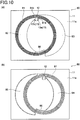
- Fig. 10(a) is a top view showing an internal structure of a contactless communication medium of the eighth embodiment of the present invention
- Fig. 10(b) is a rear view thereof.
- Fig. 10(b) shows a rear side view thereof, where the top view shown in Fig. 10(a) is reversed about its central longitudinal axis.
- a contactless communication medium 80 of the present embodiment is different in shape from the contactless communication medium 10 of the first embodiment in that first plate electrodes 82 and 83, and second plate electrodes 84 and 85 are formed not in an "L" shape, but in a crescent shape, but is equivalent to the contactless communication medium 10 regarding its function as a circuit (which is to be described later in detail).
- the first inner plate electrode 82 is a crescent shaped planar electrode formed in the inside of an antenna coil 81 which is a pattern formed in a circle on the top surface 11a of the film base 11.
- the first inner plate electrode 82 is arranged along substantially half of the inner periphery of the antenna coil 81 (i.e., at least a third or more of the entire length of the inner circumference of the antenna coil 81), so as to be adjacent to the inner periphery of the antenna coil 81 when viewed perpendicular to the film base 11.
- the first outer plate electrode 83 is a crescent shaped planar electrode formed on the outside of the antenna coil 81 which is a pattern formed in a circle on the top surface 11a of the film base 11.
- the first outer plate electrode 83 is arranged along substantially half of the outer periphery of the antenna coil 81 (i.e., at least a third or more of the entire length of the outer circumference of the antenna coil 81), so as to be adjacent to the outer periphery of the antenna coil 81 when viewed perpendicular to the film base 11.
- a portion of the antenna coil 81 along which the first inner plate electrode 82 is arranged i.e., the left half of an arc portion of the antenna coil 81
- a portion of the antenna coil 81 along which the first inner plate electrode 82 is arranged i.e., the right half of the arc portion of the antenna coil 81 in an example of Fig. 10(a)
- the first inner plate electrode 82 and the first outer plate electrode 83 are arranged such that they do not share the same portions of the antenna coil 81 (the arc portion).
- the first outer plate electrode 83 is arranged on the opposite side (i.e., point symmetrically) to the first inner plate electrode 82 with respect to a center point or a center line on the plane (surface 11a) of the film base 11, similarly to the first embodiment and the like. Further, this holds true for the arrangement relation between the second inner plate electrode 84 and the second outer plate electrode 85 as described later.
- the second inner plate electrode 84 is a crescent-shaped planar electrode forming a pair with the first inner plate electrode 82, and is arranged on the rear surface 11b of the film base 11 so as to be opposite to the first inner plate electrode 82 in the thickness direction of the film base 11.
- the second inner plate electrode 84 extends along substantially half of the inner periphery of the antenna coil 81 (i.e., at least a third or more of the entire length of the inner circumference of the antenna coil 81) when viewed perpendicular to the film base 11, similarly to the first inner plate electrode 82.
- the second outer plate electrode 85 is a crescent-shaped planar electrode forming a pair with the first outer plate electrode 83, and is arranged on the rear surface 11b of the film base 11 so as to be opposite to the first outer plate electrode 83 in the thickness direction of the film base 11.
- the second outer plate electrode 85 extends along substantially half of the outer periphery of the antenna coil 81 (i.e., at least a third or more of the entire length of the outer circumference of the antenna coil 81) when viewed perpendicular to the film base 11, similarly to the first outer plate electrode 83.
- the second inner plate electrode 84 and the second outer plate electrode 85 are connected with a jumper wire 86.
- the first plate electrodes 82 and 83 and the second plate electrodes 84 and 85 form each of the 2 capacitance portions by arranging the first plate electrodes 82 and 83 and the second plate electrodes 84 and 85 to be opposite to each other.
- the first plate electrodes 82 and 83, and the second plate electrodes 84 and 85 are arranged on the film base 11 such that the first plate electrodes 82 and 83 entirely cover the second plate electrodes 84 and 85 when viewed perpendicular to the film base 11.
- the contactless communication medium 80 having such a structure constitutes an equivalent circuit of the contactless communication medium 10 shown in Fig. 3 , where the antenna coil 14 is replaced by the antenna coil 81, the first capacitance portions 15 and 17 are replaced by the capacitance portions 82 and 84 formed by the first inner plate electrode 82 and the second inner plate electrode 84, the jumper wire 19 is replaced by the jumper wire 86, and the second capacitance portions 16 and 18 is replaced by the capacitance portions 83 and 85 formed by the first outer plate electrode 83 and the second outer plate electrode 85.
- the contactless communication medium 80 is different from the contactless communication medium 10 of the first embodiment regarding the shape of each portion, but is equivalent thereto in the function as a circuit.
- the pair of inner plate electrodes 82 and 84 consisting of the first inner plate electrode 82 and the second inner plate electrode 84 (namely, the pair of plate electrodes forming the capacitance portions 82 and 84), and the pair of outer plate electrodes 83 and 85 consisting of the first outer plate electrode 83 and the second outer plate electrodes 85 (namely, the pair of plate electrodes forming the capacitance portion 83 and 85) are arranged so as to pass an electric current along the same direction as the direction of an electric current passing through the antenna coil 81.
- Such an arrangement is realized by setting up the jumper wire 86 such that the electric current passing through the pair of inner plate electrodes 82 and 84, the jumper wire 86, and the pair of outer plate electrodes 83 and 85 passes in the same direction as the direction of the electric current passing through the antenna coil 81 when viewed perpendicular to the film base 11 (for example, a clockwise or counterclockwise direction when viewed in the top surface 11a side of the film base 11).
- a flow of an electric current passing through the antenna coil 81 at a given instant is hereinafter described by providing an example of the case where the electric current passing through the antenna coil 81 flows from its outer end 81b toward its inner end 81a.
- the electric current passing through the antenna coil 81 flows from its outer end 81b in a counterclockwise direction as shown in the figure, circles around the antenna coil 81 in a circular shape several times, (for example, 4 times in the present embodiment), and flows into the first inner plate electrode 82 via the inner end 81a, the IC chip mounting portion 13, and the IC chip 12.
- the electric current flowing into the first inner plate electrode 82 returns to the outer end 81b of the antenna coil 81 via the pair of inner plate electrodes 82 and 84, the jumper wire 86, and the pair of outer plate electrodes 83 and 85.
- the direction of such electric current is a counterclockwise direction as shown in Fig. 10(a) , and therefore conforms to the direction of the electric current passing through the antenna coil 81.
- capacitance portions capable of propagating high-frequency signals are formed on both surfaces 11a and 11b of the film base 11 such that the first plate electrodes 82 and 83 and the second plate electrodes 84 and 85 are arranged disposed to each other.
- the first plate electrodes 82 and 83 and the second plate electrodes 84 and 85 are arranged along roughly half or more of the inner periphery or the outer periphery of the antenna coil 81 so as to be adjacent to the inner periphery or the outer periphery of the antenna coil 81 formed in a circular spiral shape when viewed perpendicular to the film base 11.
- This arrangement of the plate electrodes enables the contactless communication medium to have parallel plate electrodes and an opening of the antenna coil 81 under the constraints imposed by the limited outer dimensions of the contactless communication medium.
- the pair of inner plate electrodes 82 and 84 and the pair of outer plate electrodes 83 and 85 are arranged such that, when viewed perpendicular to the film base 11, the portion (an arc portion) of the antenna coil 81 along which the pair of inner plate electrodes 82 and 84 are arranged is different from the portion (an arc portion) of the antenna coil 81 along which the pair of outer plate electrodes 83 and 85 are arranged.
- the pair of inner plate electrodes 82 and 84 in the inside of the antenna coil 81, and the pair of outer plate electrodes 83 and 85 of the antenna coil 81 are arranged such that they do not share the same portions of the antenna coil 81.
- the pair of inner plate electrodes 82 and 84 and the pair of outer plate electrodes 83 and 85 are arranged such that they are not adjacent to each other and do not sandwich the same portion of the antenna coil 14 therebetween.
- the antenna coil 81, the pair of inner plate electrodes 82 and 84, and the pair of outer plate electrodes 83 and 85 can be arranged on the film base 11 with balance.
- the antenna coil 81, and the plate electrodes 82, 83, 84, and 85 can be appropriately arranged in an equally spaced and annular antenna pattern arrangement area as set in a standard (for example, ISO/IEC 14443-1, Class 1) and the like.
- the pair of inner plate electrodes 82 and 84, and the pair of outer plate electrodes 83 and 85 are arranged so as to pass an electric current along the same direction as the electric current passing through the antenna coil 81 as described above.
- the effective number of coil turns can be increased by having the pair of inner plate electrodes 82 and 84 and the pair of outer plate electrodes 83 and 85 function as radiating elements that pass an electric current along the same direction as the direction of an electric current passing through the antenna coil 81.
- the number of turns of the antenna coil 81 is 4.
- the effective number of coil turns is increased by 1 due to the plate electrodes 82, 83, 84, and 85, and the jumper wire 86, and an antenna function equivalent to that of the antenna coil 81 but having 5 turns can be provided.
- the number of turns namely, the area of an antenna pattern
- the area of the opening of the antenna coil 81 can be increased.
- present embodiment is illustrated by an example where the pair of inner plate electrodes 82 and 84 are arranged along substantially half of the inner periphery of the antenna coil 81 when viewed perpendicular to the film base 11, and the pair of outer plate electrodes 83 and 85 are arranged along substantially half of the outer periphery of the antenna coil 81 when viewed perpendicular to the film base 11.
- the pair of inner plate electrodes may be arranged along about more than half of the inner periphery of the antenna coil 81 when viewed perpendicular to the film base 11, while the pair of outer plate electrodes 83 and 85 may not be arranged along substantially half of the outer periphery of the antenna coil 81 when viewed perpendicular to the film base 11.
- the pair of outer plate electrodes 83 and 85 may be arranged along about more than half of the outer periphery of the antenna coil 81 when viewed perpendicular to the film base 11, while the pair of inner plate electrodes may not be arranged along about more than half of the inner periphery of the antenna coil 81 when viewed perpendicular to the film base 11. Namely, it is only necessary that at least one of the pair of inner plate electrodes and the pair of outer plate electrodes are arranged along about more than half of the inner periphery or the outer periphery of the antenna coil 81.
- the shape of the antenna coil 81 may not be a circular shape, but an elliptic shape, or it may have a polygonal shape. In the case of using an antenna coil having such a shape other than a circular shape, a structure of a contactless communication medium based on the idea similar to the content described in the present embodiment may be adopted.
- Fig. 11(a) is a top view showing an internal structure of a contactless communication medium of a ninth embodiment of the present invention
- Fig. 11(b) is a rear view thereof.
- Fig. 11(b) shows a rear side view thereof, where the top view shown in Fig. 11(a) is reversed about its central longitudinal axis.
- a contactless communication medium 90 of the present embodiment is primarily different from the contactless communication medium 80 of the eighth embodiment in that the IC chip mounting portion 13 is arranged on the outside of the antenna coil 81 when viewed perpendicular to the film base 11.
- the contactless communication medium 90 is primarily different from the contactless communication medium 80 of the eighth embodiment in that the pair of crescent-shaped inner plate electrodes 82 and 84 are replaced by a pair of inner plate electrodes 92 and 94 formed along nearly the entire inner circumference of the antenna coil 81 when viewed perpendicular to the film base 11
- the first inner plate electrode 92 is arranged along nearly the entire inner periphery of the antenna coil 81 so as to be adjacent to the inner periphery of the antenna coil 81 when viewed perpendicular to the film base 11.
- the first outer plate electrode 93 is arranged along substantially half of the outer periphery of the antenna coil 81 so as to be adjacent to the outer periphery of the antenna coil 81 when viewed perpendicular to the film base 11, similarly to the first outer plate electrode 83 in the contactless communication medium 80 of the eighth embodiment.
- the second plate electrodes 94 and 95 are formed on the rear surface 11b of the film base 11 so as to be opposite to the first plate electrodes 92 and 93 in the thickness direction of the film base 11.
- the second inner plate electrode 94 and the second outer plate electrode 95 are connected with a jumper wire 96.
- a flow of an electric current passing through the antenna coil 81 of the contactless communication medium 90 at a given instant is hereinafter described by providing an example of the case where the electric current passing through the antenna coil 81 flows from its outer end 81b toward its inner end 81a.
- the electric current passing through the antenna coil 81 flows from its outer end 81b in a counterclockwise direction as shown in the figure, circles around the antenna coil 81 in a circular shape several times, (for example, 4 times in the present embodiment), and flows into the first inner plate electrode 92 from the inner end 81a.
- the electric current flowing into the first inner plate electrode 92 returns to the outer end 14b of the antenna coil 14 via the pair of inner plate electrodes 92 and 94, the jumper wire 96, and the pair of outer plate electrodes 93 and 95.
- the pair of inner plate electrodes 92 and 94 are formed in a shape almost making a circle counterclockwise, as shown in Fig. 11(a) , along the inner periphery of the antenna coil 81 when viewed perpendicular to the film base 11. Therefore, the direction of the electric current passing through the pair of inner plate electrodes 92 and 94 conforms to the direction of the electric current passing through the antenna coil 81.
- the pair of inner plate electrodes 92 and 94 are arranged so as to pass the electric current in the same direction as the direction of the electric current passing through the antenna coil 81.
- the effective number of coil turns can be increased by having the pair of inner plate electrodes 92 and 94 function as a radiating element that passes an electric current along the same direction as the direction of an electric current passing through the antenna coil 81.
- the pair of outer plate electrodes 93 and 95 do not function as a radiating element, but purely function as a capacitance portion.
- the contactless communication medium 90 of the ninth embodiment it is possible to increase the area of the opening of the antenna coil 81 by arranging relatively large parts such as the IC chip mounting portion 13 and the IC chip 12 mounted on the IC chip mounting portion 13 not in the inside, but on the outside of the antenna coil 81.
- the contactless communication medium of the present embodiment may be as described above, but the contactless communication medium of the present invention is not limited to the embodiment described above, and various modifications can be applied.
- the structure of each portion described in the first to ninth embodiments described above can be adequately combined in aspects other than the combinations adopted in the embodiments described above.
- the contactless communication media described above may include not only a contactless IC card, but also, for example, contactless communication media such as an electronic passport and the like, and are not particularly limited. The same holds true for the following modifications.
- the film base 111 is a base made up of dielectric and having, for example, a triple-layer structure, and has a structure having an intermediate base 111c as the main base having insulating properties and durability such as polyethylene naphthalate (PEN), polyethylene terephthalate copolymer (PET-G) and the like.
- PEN polyethylene naphthalate
- PET-G polyethylene terephthalate copolymer
- first and second dielectric layers 111d and 111 e having a smaller thickness than that of the intermediate base 111c, are provided for adjustment. Further, details of the first and second dielectric layers 111d and 111e will be described later.
- a metal foil is laminated on both the front and rear surfaces 111a and 111b of the film base 111 prior to processing by etching and the like, and the antenna coil 113, the first plate electrodes 114a and 114b, the second plate electrodes 116a and 116b, and the jumper wire 117 are formed by processing the metal foil such as by etching.
- the metal foil arranged on each of the front and rear surfaces 111a and 111b of the film base 111 may have the same thickness, or the thickness of the metal foil on the top surface 111a side where the antenna coil 113 is arranged may be made larger than the thickness of the metal foil on the rear surface 111b side where the second plate electrodes 116a and 116b are arranged, since the antenna coil 113 is arranged with a small pitch and the electrical resistance of the antenna coil 113 needs to be reduced. Further, such a three-layer structure may obviously be applied to the contactless communication medium 10 and the like of the first embodiment to the ninth embodiment described above.
- the IC chip 112 is constituted by an IC tag storing, for example, ID information.
- the IC chip 112 is arranged along a length of the antenna coil antenna coil 113 on the top surface 111a of the film base 111, and both its terminals are connected to the antenna coil 113.
- the IC chip 112 performs wireless communication processing via the conducted antenna coil 113, and sends and receives predetermined signals to and from an external read/write device.
- the antenna coil 113 is a plane spiral shaped antenna for performing contactless wireless communication by electromagnetically coupling with an antenna of an external read/write device such as a reader/writer.
- the antenna coil 113 sends and receives signals and receives power by wireless communication in a contactless state.
- the antenna coil 113 is formed from a conductor (metal foil) arranged on the top surface 111a of the film base 111.
- the antenna coil 113 is patterned, for example, by etching a copper foil or an aluminum foil having a thickness of 5 ⁇ m to 50 ⁇ m laminated on the top surface 111a side of the film base 111 having a thickness of 15 ⁇ m to 50 ⁇ m.
- Such an antenna coil 113 is connected to the plate electrode 114a at its outer end, and is connected to the plate electrode 114b at its inner end.
- the first plate electrodes 114a and 114b are each a rectangular shaped plate electrode, and are arranged in parallel at one side of the top surface 111a of the film base 111 sandwiching a portion of the antenna coil 113 therebetween.
- the plate electrode 114b is formed in the inside of the antenna coil 113, and therefore its electrode area is smaller than that of the plate electrode 114a.
- the electrode areas of plate electrodes 114a and 114b may be the same, or the electrode area of the plate electrode 114b may be larger than that of the plate electrode 114a.
- the plate electrode 114a is connected to the outer end of the antenna coil 113 as described above, and the plate electrode 114b is connected to the inner end of the antenna coil 113.
- first plate electrodes 114a and 114b are patterned by etching the metal foil laminated on the top surface 111a side of the film base 111 similarly to the antenna coil 113.
- the second plate electrodes 116a and 116b, and the jumper wire 117 to be described later are also similarly formed.
- the second plate electrodes 116a and 116b are each a rectangular plate electrode, and are arranged in parallel at one side of the rear surface 111b of the film base 111, with a portion of the region corresponding to the antenna coil 113 located therebetween.
- the plate electrode 116b is formed in the inside of the region corresponding to the antenna coil 113 (region of the antenna coil 113 shown by dotted lines in Fig. 13(b) ), and therefore its electrode area is smaller than that of the plate electrode 116a, which is, however, not limited, similarly to the first plate electrodes 114a and 114b. Further, as shown in Fig. 14(a) and Fig.
- the second plate electrodes 116a and 116b are formed so as to be opposite to the first plate electrodes 114a and 114b in the thickness direction of the film base 111. More specifically, the plate electrode 114a and the plate electrode 116a are opposite to each other, and the plate electrode 114b and the plate electrode 116b are opposite to each other. With such an arrangement, the first plate electrodes 114a and 114b, and the second plate electrodes 116a and 116b each form 2 capacitance portions (see Fig. 15 ).
- plate electrodes 114a and 116a opposite to each other have the same shape and the same size (area), and plate electrodes 114b and 116b opposite to each other similarly have the same shape and the same size. Further, each plate electrode of these first plate electrodes 114a and 114b, and the second plate electrodes 116a and 116b are in conformity when viewed perpendicular to the film base 111. Further, the second plate electrodes 116a and 116b, unlike the first plate electrodes 114a and 114b, are not connected to the antenna coil 113.
- the jumper wire 117 is a wire which connects the second plate electrodes 116a and 116b on the rear surface 11b of the film base 111.
- the jumper wire 117 preferably has a small electrostatic capacitance between it and a portion of the antenna coil 113 opposite to the jumper wire 117, and therefore its width is preferably as small as possible, for example, in the order of 1 to 3 mm.
- the jumper wire 117 is connected to the plate electrodes 116a and 116b in the long side direction of the plate electrodes 116a and 116b shown in the upper portion of the figure, but it may be connected at other portions such as a central portion.
- the contactless communication medium 110 having such a structure can be expressed as an equivalent circuit as shown in Fig. 15 .
- the contactless communication medium 110 is constituted by a circuit having the IC chip 112, the antenna coil 113, the first capacitance portion 114a and 116a, the jumper wire 117, and the second capacitance portion 114b and 116b arranged in this order.
- a layer structure of the film base 111 of the contactless communication medium 110 having such a structure, and effects and functions produced thereby will be further described in detail with reference to Fig. 14(a) and Fig. 14(b) .
- the film base 111 constituting the contactless communication medium 110 has a three-layer structure having, in addition to the intermediate base 111c which is the primary base, a first dielectric layer for adjustment 111d comprising dielectric and formed on a surface of the intermediate base 111c shown in the upper portion of the figure, and a second dielectric layer for adjustment 111e comprising dielectric and formed on a surface of the intermediate base 111c shown in the lower portion of the figure.
- the reason that the film base 111 has such a three-layer structure in the contactless communication medium 110 of the present modification is to enable adjustment by simple means of the electrostatic capacitance values of the capacitance portion (capacitor) formed by the first and second plate electrodes 114a and 116a, and the capacitance portion (capacitor) formed by the first and second plate electrodes 114b and 116b, by adjusting the thickness, dielectric constant and the like of the first and second dielectric layers 111d and 111e.
- the first and second dielectric layers 111d and 111e are layers for adjusting the electrostatic capacitance value, and from the perspective of making the contactless communication medium 110 thinner, it is preferable that it is thinner than the thickness of the intermediate base 111c, which is not limited.
- the dielectric material constituting the first and second dielectric layers 111d and 111e may be constituted by a different material from a dielectric material of the intermediate base 111c, for example, comprising PET and the like, but may be constituted by the same material.
- a material constituting the first and second dielectric layers 111d and 111e includes, for example, polyester-based resin, polyether-based resin, polyethylene, polypropylene, EVA resin and the like.
- the first and second dielectric layers 111d and 111e may be formed by coating such dielectric material on both the front and rear surfaces of the intermediate base 111 c, followed by curing.
- the thicknesses and the materials used (i.e., dielectric constant) of the first and second dielectric layers 111d and 111e can be adequately adjusted.
- the film base 111 of such a three-layer structure may obviously be adopted in the structure of the film base 111 used in the first embodiment to the ninth embodiment described above, and by adopting the structure of the film base 111 in the film base 11, it is possible to similarly produce the same functions, effects and the like to be described later in the contactless communication medium and the like of the first embodiment to the ninth embodiment.
- the film base 111 sandwiched between the first plate electrodes 114a and 114b and the second plate electrodes 116a and 116b has a three-layer structure having the intermediate base 111c, and the first and second dielectric layers 111d and 111e.
- the thickness of the film base 111 comprising the dielectric namely the separation distances between the first and second plate electrodes 114a and 116a, and between 114b and 116b can be easily adjusted, for example, by changing the thickness of the first and second dielectric layers 111d and 111e, and it is possible to easily adjust the capacitances of the capacitors made of the first and second plate electrodes 114a, 114b, 116a, and 116b without changing the shapes (areas) and the like of the electrode pattern of the plate electrodes 114a, 114b, 116a, and 116b constituting the capacitors.
- the structure is such that conduction is achieved with capacitors formed between the first plate electrodes 114a and 114b connected to the antenna coil 113, and the second plate electrodes 116a and 116b arranged on the rear surface side, and therefore production and inspection processes can be simplified and connection reliability can be improved compared to the case where the start end and the finish end of the antenna coil 113 are directly connected to a conductor pattern on the rear surface side.
- the dielectric constants of the dielectrics constituting the first and second dielectric layers 111d and 111e are equivalent to or more than the dielectric constant of the dielectric constituting the intermediate base 111c. Therefore, even when the layer thicknesses of the first and second dielectric layers for adjustment 111d and 111e are small, the capacitances of the capacitors made of the first and second plate electrodes 114a, 114b, 116a, and 116b can be easily adjusted.
- the thicknesses of the first and second dielectric layers 111d and 111e are smaller than the thickness of the intermediate base 111c.
- the dielectric layers for adjustment for adjusting the capacitances of the capacitors made of the first and second plate electrodes 114a, 114b, 116a, and 116b can be made thin, and therefore it is possible to control the variance in total thickness of the film base 111 in each product. Further, the whole contactless communication medium 110 can be made thinner.
- the first and second dielectric layers 111d and 111e are formed by coating a predetermined dielectric material on the intermediate base 111c, followed by curing.
- the thicknesses, dielectric constants and the like of the first and second dielectric layers 111d and 111e can be easily adjusted, and therefore it is possible to easily adjust the capacitances of the capacitors made of the first and second dielectric layers 114a, 114b, 116a, and 116b.
- the thickness of the metal foil constituting the antenna coil 113 is larger than the thickness of the metal foil constituting the second plate electrode 116a and 116b. As such, electrical resistance in the antenna coil 113 can be reduced, and it is possible to improve the radiation efficiency of the antenna of the contactless communication medium 110. Further, this structure may be adopted in the structure of the contactless communication medium used in the first embodiment to the ninth embodiment of the present invention described above.
- the area in the plane of the second plate electrode 116a arranged on the rear surface 111b side may be larger than the area in the plane of the first plate electrode 114a, and that, when viewed in a direction perpendicular to the plane of the first and second plate electrodes 114a and 116a, the first plate electrode 114a may be surrounded by the second plate electrode 116a.
- a position and the like of both plate electrodes 114a and 116a may be somewhat misaligned from designed values due to production errors and the like.
- the area in the plane of the first plate electrode 114a may be larger than the area in the plane of the second plate electrode 116a, and that, when viewed perpendicular to the plane of the first and second plate electrodes 114a and 116a, the second plate electrode 116a may be surrounded by the first plate electrode 114a.
- the antenna coil 113 is also formed on the same side as the first plate electrode 114a, and therefore, by making the size of the second plate electrode 116a larger, the contactless information medium 110 as a whole is likely to be downsized. Further, a relation between areas of the first and second plate electrodes 114a and 116a was described above, but the same holds true for a relation between areas of the first and second plate electrodes 114b and 116b.
- Fig. 19 is a cross sectional view schematically showing a flow of an electric current between plate electrodes of the contactless communication medium shown in Fig. 18(a) and (b).
- Fig. 20 is a circuit diagram showing an equivalent circuit of the contactless communication medium shown in Fig. 18(a) and (b).
- the contactless communication medium 110a has the film base 111, the IC chip 112, the antenna coil 113, the first plate electrodes 114a and 114b, the second plate electrodes 116a and 116b, and the jumper wire 117, similarly to the first modification.
- plate electrodes 114a, 114b, 116a, and 116b are formed on a flow path of an electric current passing through the antenna coil 113 and constituting a portion of a coil pattern.
- the plate electrodes 114a, 114b, 116a, and 116b are included in the coil pattern including the antenna coil 113, and therefore, for example as shown in Fig. 19 , an electric current passes from the plate electrode 114b to the plate electrode 116b across the film base 111.
- the electric current passes along the travelling direction indicated by arrows in the figure, and therefore the amount of electric current passing through the first plate electrode 114b is larger than the amount of electric current passing through the second plate electrode 116b in region ⁇ , whereas the amount of electric current passing through the second plate electrode 116b is larger than the amount of electric current passing through the first plate electrode 114b in region ⁇ .
- the relation between the amounts of electric currents holds true between the planar electrodes 114a and 116a.
- an average electric current density in an electrode cross section of each of the plate electrodes 114a, 114b, 116a, and 116b may be used as an index in place of the amount of electric current, similarly to the case of using the amount of electric current.
- the plate electrodes 114a, 114b, 116a, and 116b can be used as a portion of the antenna, and under the limited antenna forming region, it is possible to increase the number of coil turns and concurrently enlarge the opening area of the antenna. Further, an equivalent circuit of such a contactless communication medium 110a is shown in Fig. 20 .
- the plate electrode 114b may be shaped such that one side is a broad portion 114c and the other side is a thin portion 114d as shown in Fig. 21(a)
- the plate electrode 116b may be shaped such that one side is a thin portion 116c and the other side is a broad portion 116d as shown in Fig. 21(b) . In this case, as shown in Fig.
- the area of the first plate electrode 114b (114c) is larger than the area of the second plate electrode 116b (116c).
- the area of the second plate electrode 116b (116d) is larger than the area of the first plate electrode 114b (114d).
- the area of the second plate electrode 116b is larger than the area of the first plate electrode 114b. Therefore, it is possible to enlarge the forming region of another member such as the antenna coil 113 and the like similarly as described above. Further, also in the case of the second modification, this structure may be adequately applied in the structures of the contactless communication medium of the first embodiment to the ninth embodiment described above similarly to the first modification.
- the film base 111 is constituted by a three-layer structure.
- the present invention is not limited to a three-layer structure, and the film base 111 may be formed from a structure having 4 or more layers, each comprising a dielectric. In this case, it is possible to more finely adjust the capacitances of the capacitors constituted by the first and second plate electrodes 114a, 114b, 116a, and 116b.
- the present invention provides a contactless information medium having parallel plate electrodes and designed to have an opening of an antenna coil.
Landscapes
- Engineering & Computer Science (AREA)
- Computer Hardware Design (AREA)
- Microelectronics & Electronic Packaging (AREA)
- Physics & Mathematics (AREA)
- General Physics & Mathematics (AREA)
- Theoretical Computer Science (AREA)
- Computer Networks & Wireless Communication (AREA)
- Details Of Aerials (AREA)
Claims (13)
- Support d'informations sans contact (10) comprenant :un matériau de base de film (11) ;une bobine d'antenne (14) disposée sur une première surface (11a) du matériau de base de film, et formée dans une forme de spirale pour effectuer une communication sans fil avec un dispositif externe ;une puce de circuit intégré (12) raccordée à la bobine d'antenne par l'intermédiaire d'une partie de montage de puce de circuit intégré (13), et effectuant un traitement de communication sans fil par l'intermédiaire de la bobine d'antenne ;une première électrode à plaque (15, 16) disposée sur la première surface du matériau de base de film, et raccordée à au moins une d'une extrémité intérieure et d'une extrémité extérieure de la bobine d'antenne ; etune seconde électrode à plaque (17, 18) disposée sur une seconde surface du matériau de base de film de manière à être opposée à la première électrode à plaque dans une direction d'épaisseur du matériau de base de film,dans lequel chacune de la première électrode à plaque et de la seconde électrode à plaqueprésente une première partie d'électrode (15a, 16a, 17a, 18a) et une seconde partie d'électrode (15b, 16b, 17b, 18b) s'étendant chacune le long d'une première direction latérale de la bobine d'antenne et d'une seconde direction latérale croisant la première direction latérale de manière à être adjacente à une périphérie intérieure ou une périphérie extérieure de la bobine d'antenne dans une vue perpendiculaire au matériau de base de film, ouest disposée le long d'un tiers ou plus de la longueur totale de la périphérie intérieure ou de la périphérie extérieure de la bobine d'antenne de manière à être adjacente à la périphérie intérieure ou à la périphérie extérieure de la bobine d'antenne dans une vue perpendiculaire au matériau de base de film,dans lequel la première électrode à plaque présente une première électrode à plaque intérieure (15) raccordée à l'extrémité intérieure de la bobine d'antenne, et une première électrode à plaque extérieure (16) raccordée à l'extrémité extérieure de la bobine d'antenne,la seconde électrode à plaque présente une seconde électrode à plaque intérieure (17) opposée à la première électrode à plaque intérieure dans la direction d'épaisseur du matériau de base de film, et une seconde électrode à plaque extérieure (18) opposée à la première électrode à plaque extérieure dans la direction d'épaisseur du matériau de base de film, etla première électrode à plaque extérieure (15) est disposée sur le côté opposé de la première électrode à plaque intérieure (16) par rapport à un point central ou à un axe central sur un plan du matériau de base de film, caractérisé en ce quela puce de circuit intégré (12) est disposée sur la première surface du matériau de base de film, etle support d'informations sans contact comprend en outre une partie de cavalier (19) raccordant la seconde électrode à plaque intérieure et la seconde électrode à plaque extérieure sur la seconde surface du matériau de base de film.
- Support d'informations sans contact selon la revendication 1,
dans lequel la première électrode à plaque présente la première électrode à plaque intérieure (15) raccordée à l'extrémité intérieure de la bobine d'antenne, et la première électrode à plaque extérieure (18) raccordée à l'extrémité extérieure de la bobine d'antenne,
la seconde électrode à plaque présente la seconde électrode à plaque intérieure (17) opposée à la première électrode à plaque intérieure dans la direction d'épaisseur du matériau de base de film, et la seconde électrode à plaque extérieure (18) opposée à la première électrode à plaque extérieure dans la direction d'épaisseur du matériau de base de film, et
chacune de la première électrode à plaque intérieure (15) et de la première électrode à plaque extérieure (16) présente la première partie d'électrode et la seconde partie d'électrode. - Support d'informations sans contact selon l'une quelconque des revendications 1 ou 2,
dans lequel une paire d'électrodes à plaque intérieures comprenant la première électrode à plaque intérieure (15) et la seconde électrode à plaque intérieure (17), et une paire d'électrodes à plaque extérieures comprenant la première électrode à plaque extérieure (16) et la seconde électrode à plaque extérieure (18) sont agencées de sorte que, dans une vue perpendiculaire au matériau de base de film, une partie de la bobine d'antenne le long de laquelle la paire d'électrodes à plaque intérieures est disposée soit différente d'une partie de la bobine d'antenne le long de laquelle la paire d'électrodes à plaque extérieures est disposée. - Support d'informations sans contact selon l'une quelconque des revendications 1 à 3,
dans lequel au moins une de la paire d'électrodes à plaque intérieures comprenant la première électrode à plaque intérieure (15) et la seconde électrode à plaque intérieure (17) et de la paire d'électrodes à plaque extérieures comprenant la première électrode à plaque extérieure (16) et la seconde électrode à plaque extérieure (18) est agencée de sorte qu'un courant électrique circule le long de la même direction qu'un courant électrique traversant la bobine d'antenne. - Support d'informations sans contact selon l'une quelconque des revendications 1 à 4,
dans lequel la bobine d'antenne (14) est formée dans l'une quelconque d'une forme polygonale incluant une forme rectangulaire, d'une forme circulaire et d'une forme elliptique, et/ou
dans lequel la partie de montage de puce de circuit intégré (13) est disposée à l'extérieur de la bobine d'antenne dans une vue perpendiculaire au matériau de base de film. - Support d'informations sans contact selon l'une quelconque des revendications 1 à 5,
dans lequel la partie de montage de puce de circuit intégré (13) est disposée à l'extérieur de la bobine d'antenne lors d'une vue perpendiculaire au matériau de base de film, et
la paire d'électrodes à plaque extérieures comprenant la première électrode à plaque extérieure (16) et la seconde électrode à plaque extérieure (18) est disposée le long de la périphérie extérieure de la bobine d'antenne et de la partie de montage de puce de circuit intégré dans une vue perpendiculaire au matériau de base de film. - Support d'informations sans contact selon l'une quelconque des revendications 1 à 6,
dans lequel la première électrode à plaque (15, 16) et la seconde électrode à plaque (17, 18) sont disposées sur le matériau de base de film (11) de sorte que, dans une vue perpendiculaire au matériau de base de film, l'une ou l'autre des électrodes à plaque recouvre entièrement l'autre électrode à plaque. - Support d'informations sans contact selon l'une quelconque des revendications 1 à 6,
dans lequel la première électrode à plaque (15, 16) et la seconde électrode à plaque (17, 18) sont disposées sur le matériau de base de film (11) de sorte que, dans une vue perpendiculaire au matériau de base de film, l'une ou l'autre des électrodes à plaque recouvre entièrement l'autre électrode à plaque dans une première direction parallèle à la surface du matériau de base de film, et la dernière électrode à plaque recouvre entièrement la première électrode à plaque dans une seconde direction parallèle à la surface du matériau de base de film et perpendiculaire à la première direction. - Support d'informations sans contact selon l'une quelconque des revendications 1 à 8,
dans lequel une région d'agencement d'antenne (11d) où la bobine d'antenne est agencée est définie dans une forme de trame sur un côté périphérique de la première surface du matériau de base de film, et
la région d'agencement d'antenne (11d) est fournie entre la périphérie extérieure du matériau de base de film et une région de non-agencement d'antenne (11c) recouvrant environ plus de la moitié de la zone totale de la première surface et définie dans une partie centrale de la première surface. - Support d'informations sans contact selon l'une quelconque des revendications 1 à 9,
dans lequel la première électrode à plaque (15, 16) est disposée de manière adjacente à la bobine d'antenne de sorte qu'un espacement entre la première électrode à plaque et la périphérie intérieure la plus proche ou la périphérie extérieure la plus proche de la bobine d'antenne soit de 0,5 mm ou moins. - Support d'informations sans contact selon l'une quelconque des revendications 1 à 10,
dans lequel le matériau de base de film (11) présente un matériau de base intermédiaire (111c) comprenant un diélectrique, une première couche diélectrique pour un ajustement comprenant un diélectrique et formée sur une première surface du matériau de base intermédiaire, et une seconde couche diélectrique pour un ajustement comprenant un diélectrique et formée sur une seconde surface du matériau de base intermédiaire. - Support d'informations sans contact selon la revendication 11, dans lequel au moins une des conditions a) à d) suivantes est satisfaite :a) des constantes diélectriques des diélectriques constituant les première et seconde couches diélectriques sont supérieures ou égales à une constante diélectrique d'un diélectrique constituant le matériau de base intermédiaire,b) une épaisseur totale des première et seconde couches diélectriques est inférieure à une épaisseur du matériau de base intermédiaire,c) des matériaux diélectriques constituant les première et seconde couches diélectriques sont différents d'un matériau diélectrique constituant le matériau de base intermédiaire,d) les première et seconde couches diélectriques sont formées par l'application d'un matériau diélectrique au matériau de base intermédiaire, suivie par un durcissement.
- Support d'informations sans contact selon l'une quelconque des revendications 1 à 12,
dans lequel une épaisseur d'une feuille métallique constituant la bobine d'antenne (14) est supérieure à une épaisseur d'une feuille métallique constituant la seconde électrode à plaque.
Applications Claiming Priority (3)
| Application Number | Priority Date | Filing Date | Title |
|---|---|---|---|
| JP2015112425A JP6481517B2 (ja) | 2015-06-02 | 2015-06-02 | 非接触型情報媒体 |
| JP2015122778A JP6435999B2 (ja) | 2015-06-18 | 2015-06-18 | 非接触型情報媒体 |
| PCT/JP2016/062275 WO2016194495A1 (fr) | 2015-06-02 | 2016-04-18 | Support d'information de type sans contact |
Publications (3)
| Publication Number | Publication Date |
|---|---|
| EP3306533A1 EP3306533A1 (fr) | 2018-04-11 |
| EP3306533A4 EP3306533A4 (fr) | 2019-01-23 |
| EP3306533B1 true EP3306533B1 (fr) | 2020-12-30 |
Family
ID=57440460
Family Applications (1)
| Application Number | Title | Priority Date | Filing Date |
|---|---|---|---|
| EP16802932.0A Active EP3306533B1 (fr) | 2015-06-02 | 2016-04-18 | Support d'information de type sans contact |
Country Status (5)
| Country | Link |
|---|---|
| US (1) | US10217040B2 (fr) |
| EP (1) | EP3306533B1 (fr) |
| KR (1) | KR102483490B1 (fr) |
| ES (1) | ES2844849T3 (fr) |
| WO (1) | WO2016194495A1 (fr) |
Families Citing this family (4)
| Publication number | Priority date | Publication date | Assignee | Title |
|---|---|---|---|---|
| CN102668241B (zh) * | 2010-03-24 | 2015-01-28 | 株式会社村田制作所 | Rfid系统 |
| KR102649484B1 (ko) * | 2017-01-18 | 2024-03-20 | 주식회사 위츠 | 이중 루프 안테나 |
| JP6798052B1 (ja) * | 2020-02-04 | 2020-12-09 | 富士フイルム株式会社 | 非接触式通信媒体、磁気テープカートリッジ、非接触式通信媒体の動作方法、及びプログラム |
| WO2023191684A1 (fr) * | 2022-03-28 | 2023-10-05 | Fingerprint Cards Anacatum Ip Ab | Carte à puce biométrique avec convertisseur de tension et procédé de fabrication de la carte à puce |
Family Cites Families (11)
| Publication number | Priority date | Publication date | Assignee | Title |
|---|---|---|---|---|
| JP2000059260A (ja) * | 1998-08-04 | 2000-02-25 | Sony Corp | 記憶装置 |
| JP2004355442A (ja) | 2003-05-30 | 2004-12-16 | Navitas Co Ltd | 非接触データキャリア |
| JP4653440B2 (ja) * | 2004-08-13 | 2011-03-16 | 富士通株式会社 | Rfidタグおよびその製造方法 |
| US7926728B2 (en) * | 2007-10-31 | 2011-04-19 | Infineon Technologies Ag | Integrated circuit device including a contactless integrated circuit inlay |
| US20110132988A1 (en) * | 2008-07-31 | 2011-06-09 | Renesas Electronics Corporation | Non-contact electronic device |
| JP5629999B2 (ja) | 2009-09-29 | 2014-11-26 | 大日本印刷株式会社 | Icタグ及びその製造方法 |
| JP5051213B2 (ja) * | 2009-12-24 | 2012-10-17 | 三菱電機株式会社 | 無線通信装置 |
| WO2011108339A1 (fr) * | 2010-03-03 | 2011-09-09 | 株式会社村田製作所 | Module de radiocommunication, dispositif de radiocommunication et terminal de radiocommunication |
| US8528827B2 (en) * | 2010-06-18 | 2013-09-10 | Semiconductor Energy Laboratory Co., Ltd. | Antenna, semiconductor device, and method of manufacturing antenna |
| CN105914447B (zh) * | 2010-07-29 | 2019-03-01 | 株式会社村田制作所 | 谐振电路及天线装置 |
| US9747481B1 (en) * | 2015-07-16 | 2017-08-29 | OE Connection LLC | System controlled by data bearing records |
-
2016
- 2016-04-18 WO PCT/JP2016/062275 patent/WO2016194495A1/fr not_active Ceased
- 2016-04-18 ES ES16802932T patent/ES2844849T3/es active Active
- 2016-04-18 KR KR1020177033051A patent/KR102483490B1/ko active Active
- 2016-04-18 EP EP16802932.0A patent/EP3306533B1/fr active Active
-
2017
- 2017-11-14 US US15/811,755 patent/US10217040B2/en active Active
Non-Patent Citations (1)
| Title |
|---|
| None * |
Also Published As
| Publication number | Publication date |
|---|---|
| ES2844849T3 (es) | 2021-07-22 |
| WO2016194495A1 (fr) | 2016-12-08 |
| EP3306533A4 (fr) | 2019-01-23 |
| EP3306533A1 (fr) | 2018-04-11 |
| US10217040B2 (en) | 2019-02-26 |
| KR20180015130A (ko) | 2018-02-12 |
| KR102483490B1 (ko) | 2022-12-30 |
| US20180068213A1 (en) | 2018-03-08 |
Similar Documents
| Publication | Publication Date | Title |
|---|---|---|
| US7967216B2 (en) | Wireless IC device | |
| US9881248B2 (en) | RFIC module and RFID tag including the same | |
| US8847831B2 (en) | Antenna and antenna module | |
| JP5949973B2 (ja) | アンテナ装置 | |
| JP4872713B2 (ja) | 非接触式データキャリア装置 | |
| US20170229235A1 (en) | Inductor bridge and electronic device | |
| CN103703617B (zh) | 磁性体天线、天线装置及电子设备 | |
| EP2051329A1 (fr) | Bobine d'antenne et dispositif d'antenne | |
| US10664739B2 (en) | Dual IC card | |
| EP3306533B1 (fr) | Support d'information de type sans contact | |
| CN207459190U (zh) | 天线装置 | |
| JP5365677B2 (ja) | 非接触式データキャリア装置 | |
| US12537286B2 (en) | RFID module | |
| JP6481517B2 (ja) | 非接触型情報媒体 | |
| JP6435999B2 (ja) | 非接触型情報媒体 | |
| US20260068727A1 (en) | Ic modules and ic cards | |
| US20250094761A1 (en) | Antenna device and ic card having the same | |
| JP2013229937A (ja) | ブースターアンテナ基板 | |
| JP6225508B2 (ja) | デュアルicカード | |
| US20240322420A1 (en) | Antenna device and ic card having the same | |
| US20250233302A1 (en) | Antenna device and ic card provided therewith | |
| JP7159663B2 (ja) | ブースタアンテナおよびデュアルicカード | |
| WO2025254055A1 (fr) | Support de type carte | |
| CN204441483U (zh) | 线圈元件及通信终端装置 | |
| CN118676590A (zh) | 天线装置及具备该天线装置的ic卡 |
Legal Events
| Date | Code | Title | Description |
|---|---|---|---|
| STAA | Information on the status of an ep patent application or granted ep patent |
Free format text: STATUS: THE INTERNATIONAL PUBLICATION HAS BEEN MADE |
|
| PUAI | Public reference made under article 153(3) epc to a published international application that has entered the european phase |
Free format text: ORIGINAL CODE: 0009012 |
|
| STAA | Information on the status of an ep patent application or granted ep patent |
Free format text: STATUS: REQUEST FOR EXAMINATION WAS MADE |
|
| 17P | Request for examination filed |
Effective date: 20171120 |
|
| AK | Designated contracting states |
Kind code of ref document: A1 Designated state(s): AL AT BE BG CH CY CZ DE DK EE ES FI FR GB GR HR HU IE IS IT LI LT LU LV MC MK MT NL NO PL PT RO RS SE SI SK SM TR |
|
| AX | Request for extension of the european patent |
Extension state: BA ME |
|
| DAV | Request for validation of the european patent (deleted) | ||
| DAX | Request for extension of the european patent (deleted) | ||
| A4 | Supplementary search report drawn up and despatched |
Effective date: 20190103 |
|
| RIC1 | Information provided on ipc code assigned before grant |
Ipc: G06K 19/077 20060101AFI20181219BHEP |
|
| STAA | Information on the status of an ep patent application or granted ep patent |
Free format text: STATUS: EXAMINATION IS IN PROGRESS |
|
| 17Q | First examination report despatched |
Effective date: 20200206 |
|
| GRAP | Despatch of communication of intention to grant a patent |
Free format text: ORIGINAL CODE: EPIDOSNIGR1 |
|
| STAA | Information on the status of an ep patent application or granted ep patent |
Free format text: STATUS: GRANT OF PATENT IS INTENDED |
|
| INTG | Intention to grant announced |
Effective date: 20200909 |
|
| RIN1 | Information on inventor provided before grant (corrected) |
Inventor name: KATAOKA SHIN |
|
| GRAS | Grant fee paid |
Free format text: ORIGINAL CODE: EPIDOSNIGR3 |
|
| GRAA | (expected) grant |
Free format text: ORIGINAL CODE: 0009210 |
|
| STAA | Information on the status of an ep patent application or granted ep patent |
Free format text: STATUS: THE PATENT HAS BEEN GRANTED |
|
| AK | Designated contracting states |
Kind code of ref document: B1 Designated state(s): AL AT BE BG CH CY CZ DE DK EE ES FI FR GB GR HR HU IE IS IT LI LT LU LV MC MK MT NL NO PL PT RO RS SE SI SK SM TR |
|
| REG | Reference to a national code |
Ref country code: GB Ref legal event code: FG4D |
|
| REG | Reference to a national code |
Ref country code: DE Ref legal event code: R096 Ref document number: 602016050697 Country of ref document: DE |
|
| REG | Reference to a national code |
Ref country code: AT Ref legal event code: REF Ref document number: 1350666 Country of ref document: AT Kind code of ref document: T Effective date: 20210115 |
|
| REG | Reference to a national code |
Ref country code: IE Ref legal event code: FG4D |
|
| PG25 | Lapsed in a contracting state [announced via postgrant information from national office to epo] |
Ref country code: NO Free format text: LAPSE BECAUSE OF FAILURE TO SUBMIT A TRANSLATION OF THE DESCRIPTION OR TO PAY THE FEE WITHIN THE PRESCRIBED TIME-LIMIT Effective date: 20210330 Ref country code: RS Free format text: LAPSE BECAUSE OF FAILURE TO SUBMIT A TRANSLATION OF THE DESCRIPTION OR TO PAY THE FEE WITHIN THE PRESCRIBED TIME-LIMIT Effective date: 20201230 Ref country code: FI Free format text: LAPSE BECAUSE OF FAILURE TO SUBMIT A TRANSLATION OF THE DESCRIPTION OR TO PAY THE FEE WITHIN THE PRESCRIBED TIME-LIMIT Effective date: 20201230 Ref country code: GR Free format text: LAPSE BECAUSE OF FAILURE TO SUBMIT A TRANSLATION OF THE DESCRIPTION OR TO PAY THE FEE WITHIN THE PRESCRIBED TIME-LIMIT Effective date: 20210331 |
|
| REG | Reference to a national code |
Ref country code: AT Ref legal event code: MK05 Ref document number: 1350666 Country of ref document: AT Kind code of ref document: T Effective date: 20201230 |
|
| PG25 | Lapsed in a contracting state [announced via postgrant information from national office to epo] |
Ref country code: SE Free format text: LAPSE BECAUSE OF FAILURE TO SUBMIT A TRANSLATION OF THE DESCRIPTION OR TO PAY THE FEE WITHIN THE PRESCRIBED TIME-LIMIT Effective date: 20201230 Ref country code: BG Free format text: LAPSE BECAUSE OF FAILURE TO SUBMIT A TRANSLATION OF THE DESCRIPTION OR TO PAY THE FEE WITHIN THE PRESCRIBED TIME-LIMIT Effective date: 20210330 Ref country code: LV Free format text: LAPSE BECAUSE OF FAILURE TO SUBMIT A TRANSLATION OF THE DESCRIPTION OR TO PAY THE FEE WITHIN THE PRESCRIBED TIME-LIMIT Effective date: 20201230 |
|
| REG | Reference to a national code |
Ref country code: NL Ref legal event code: MP Effective date: 20201230 |
|
| PG25 | Lapsed in a contracting state [announced via postgrant information from national office to epo] |
Ref country code: HR Free format text: LAPSE BECAUSE OF FAILURE TO SUBMIT A TRANSLATION OF THE DESCRIPTION OR TO PAY THE FEE WITHIN THE PRESCRIBED TIME-LIMIT Effective date: 20201230 |
|
| REG | Reference to a national code |
Ref country code: LT Ref legal event code: MG9D |
|
| REG | Reference to a national code |
Ref country code: ES Ref legal event code: FG2A Ref document number: 2844849 Country of ref document: ES Kind code of ref document: T3 Effective date: 20210722 |
|
| PG25 | Lapsed in a contracting state [announced via postgrant information from national office to epo] |
Ref country code: LT Free format text: LAPSE BECAUSE OF FAILURE TO SUBMIT A TRANSLATION OF THE DESCRIPTION OR TO PAY THE FEE WITHIN THE PRESCRIBED TIME-LIMIT Effective date: 20201230 Ref country code: CZ Free format text: LAPSE BECAUSE OF FAILURE TO SUBMIT A TRANSLATION OF THE DESCRIPTION OR TO PAY THE FEE WITHIN THE PRESCRIBED TIME-LIMIT Effective date: 20201230 Ref country code: EE Free format text: LAPSE BECAUSE OF FAILURE TO SUBMIT A TRANSLATION OF THE DESCRIPTION OR TO PAY THE FEE WITHIN THE PRESCRIBED TIME-LIMIT Effective date: 20201230 Ref country code: PT Free format text: LAPSE BECAUSE OF FAILURE TO SUBMIT A TRANSLATION OF THE DESCRIPTION OR TO PAY THE FEE WITHIN THE PRESCRIBED TIME-LIMIT Effective date: 20210430 Ref country code: SK Free format text: LAPSE BECAUSE OF FAILURE TO SUBMIT A TRANSLATION OF THE DESCRIPTION OR TO PAY THE FEE WITHIN THE PRESCRIBED TIME-LIMIT Effective date: 20201230 Ref country code: RO Free format text: LAPSE BECAUSE OF FAILURE TO SUBMIT A TRANSLATION OF THE DESCRIPTION OR TO PAY THE FEE WITHIN THE PRESCRIBED TIME-LIMIT Effective date: 20201230 |
|
| PG25 | Lapsed in a contracting state [announced via postgrant information from national office to epo] |
Ref country code: AT Free format text: LAPSE BECAUSE OF FAILURE TO SUBMIT A TRANSLATION OF THE DESCRIPTION OR TO PAY THE FEE WITHIN THE PRESCRIBED TIME-LIMIT Effective date: 20201230 Ref country code: PL Free format text: LAPSE BECAUSE OF FAILURE TO SUBMIT A TRANSLATION OF THE DESCRIPTION OR TO PAY THE FEE WITHIN THE PRESCRIBED TIME-LIMIT Effective date: 20201230 |
|
| PG25 | Lapsed in a contracting state [announced via postgrant information from national office to epo] |
Ref country code: IS Free format text: LAPSE BECAUSE OF FAILURE TO SUBMIT A TRANSLATION OF THE DESCRIPTION OR TO PAY THE FEE WITHIN THE PRESCRIBED TIME-LIMIT Effective date: 20210430 |
|
| REG | Reference to a national code |
Ref country code: DE Ref legal event code: R097 Ref document number: 602016050697 Country of ref document: DE |
|
| PG25 | Lapsed in a contracting state [announced via postgrant information from national office to epo] |
Ref country code: IT Free format text: LAPSE BECAUSE OF FAILURE TO SUBMIT A TRANSLATION OF THE DESCRIPTION OR TO PAY THE FEE WITHIN THE PRESCRIBED TIME-LIMIT Effective date: 20201230 Ref country code: AL Free format text: LAPSE BECAUSE OF FAILURE TO SUBMIT A TRANSLATION OF THE DESCRIPTION OR TO PAY THE FEE WITHIN THE PRESCRIBED TIME-LIMIT Effective date: 20201230 |
|
| PLBE | No opposition filed within time limit |
Free format text: ORIGINAL CODE: 0009261 |
|
| STAA | Information on the status of an ep patent application or granted ep patent |
Free format text: STATUS: NO OPPOSITION FILED WITHIN TIME LIMIT |
|
| PG25 | Lapsed in a contracting state [announced via postgrant information from national office to epo] |
Ref country code: DK Free format text: LAPSE BECAUSE OF FAILURE TO SUBMIT A TRANSLATION OF THE DESCRIPTION OR TO PAY THE FEE WITHIN THE PRESCRIBED TIME-LIMIT Effective date: 20201230 Ref country code: MC Free format text: LAPSE BECAUSE OF FAILURE TO SUBMIT A TRANSLATION OF THE DESCRIPTION OR TO PAY THE FEE WITHIN THE PRESCRIBED TIME-LIMIT Effective date: 20201230 |
|
| 26N | No opposition filed |
Effective date: 20211001 |
|
| GBPC | Gb: european patent ceased through non-payment of renewal fee |
Effective date: 20210418 |
|
| PG25 | Lapsed in a contracting state [announced via postgrant information from national office to epo] |
Ref country code: LU Free format text: LAPSE BECAUSE OF NON-PAYMENT OF DUE FEES Effective date: 20210418 |
|
| REG | Reference to a national code |
Ref country code: BE Ref legal event code: MM Effective date: 20210430 |
|
| PG25 | Lapsed in a contracting state [announced via postgrant information from national office to epo] |
Ref country code: LI Free format text: LAPSE BECAUSE OF NON-PAYMENT OF DUE FEES Effective date: 20210430 Ref country code: CH Free format text: LAPSE BECAUSE OF NON-PAYMENT OF DUE FEES Effective date: 20210430 Ref country code: GB Free format text: LAPSE BECAUSE OF NON-PAYMENT OF DUE FEES Effective date: 20210418 Ref country code: FR Free format text: LAPSE BECAUSE OF NON-PAYMENT OF DUE FEES Effective date: 20210430 |
|
| PG25 | Lapsed in a contracting state [announced via postgrant information from national office to epo] |
Ref country code: SI Free format text: LAPSE BECAUSE OF FAILURE TO SUBMIT A TRANSLATION OF THE DESCRIPTION OR TO PAY THE FEE WITHIN THE PRESCRIBED TIME-LIMIT Effective date: 20201230 |
|
| PG25 | Lapsed in a contracting state [announced via postgrant information from national office to epo] |
Ref country code: IE Free format text: LAPSE BECAUSE OF NON-PAYMENT OF DUE FEES Effective date: 20210418 |
|
| PG25 | Lapsed in a contracting state [announced via postgrant information from national office to epo] |
Ref country code: IS Free format text: LAPSE BECAUSE OF FAILURE TO SUBMIT A TRANSLATION OF THE DESCRIPTION OR TO PAY THE FEE WITHIN THE PRESCRIBED TIME-LIMIT Effective date: 20210430 |
|
| PG25 | Lapsed in a contracting state [announced via postgrant information from national office to epo] |
Ref country code: BE Free format text: LAPSE BECAUSE OF NON-PAYMENT OF DUE FEES Effective date: 20210430 |
|
| PG25 | Lapsed in a contracting state [announced via postgrant information from national office to epo] |
Ref country code: NL Free format text: LAPSE BECAUSE OF NON-PAYMENT OF DUE FEES Effective date: 20201230 Ref country code: CY Free format text: LAPSE BECAUSE OF FAILURE TO SUBMIT A TRANSLATION OF THE DESCRIPTION OR TO PAY THE FEE WITHIN THE PRESCRIBED TIME-LIMIT Effective date: 20201230 |
|
| P01 | Opt-out of the competence of the unified patent court (upc) registered |
Effective date: 20230530 |
|
| PG25 | Lapsed in a contracting state [announced via postgrant information from national office to epo] |
Ref country code: SM Free format text: LAPSE BECAUSE OF FAILURE TO SUBMIT A TRANSLATION OF THE DESCRIPTION OR TO PAY THE FEE WITHIN THE PRESCRIBED TIME-LIMIT Effective date: 20201230 Ref country code: HU Free format text: LAPSE BECAUSE OF FAILURE TO SUBMIT A TRANSLATION OF THE DESCRIPTION OR TO PAY THE FEE WITHIN THE PRESCRIBED TIME-LIMIT; INVALID AB INITIO Effective date: 20160418 |
|
| PG25 | Lapsed in a contracting state [announced via postgrant information from national office to epo] |
Ref country code: MK Free format text: LAPSE BECAUSE OF FAILURE TO SUBMIT A TRANSLATION OF THE DESCRIPTION OR TO PAY THE FEE WITHIN THE PRESCRIBED TIME-LIMIT Effective date: 20201230 |
|
| PGFP | Annual fee paid to national office [announced via postgrant information from national office to epo] |
Ref country code: DE Payment date: 20240227 Year of fee payment: 9 |
|
| PG25 | Lapsed in a contracting state [announced via postgrant information from national office to epo] |
Ref country code: MT Free format text: LAPSE BECAUSE OF FAILURE TO SUBMIT A TRANSLATION OF THE DESCRIPTION OR TO PAY THE FEE WITHIN THE PRESCRIBED TIME-LIMIT Effective date: 20201230 |
|
| PGFP | Annual fee paid to national office [announced via postgrant information from national office to epo] |
Ref country code: ES Payment date: 20250506 Year of fee payment: 10 |
|
| REG | Reference to a national code |
Ref country code: DE Ref legal event code: R119 Ref document number: 602016050697 Country of ref document: DE |
|
| PG25 | Lapsed in a contracting state [announced via postgrant information from national office to epo] |
Ref country code: TR Free format text: LAPSE BECAUSE OF FAILURE TO SUBMIT A TRANSLATION OF THE DESCRIPTION OR TO PAY THE FEE WITHIN THE PRESCRIBED TIME-LIMIT Effective date: 20201230 |
|
| PG25 | Lapsed in a contracting state [announced via postgrant information from national office to epo] |
Ref country code: DE Free format text: LAPSE BECAUSE OF NON-PAYMENT OF DUE FEES Effective date: 20251104 |