EP3306540A1 - Système et procédé pour l'analyse d'affinité de contenu - Google Patents
Système et procédé pour l'analyse d'affinité de contenu Download PDFInfo
- Publication number
- EP3306540A1 EP3306540A1 EP17153044.7A EP17153044A EP3306540A1 EP 3306540 A1 EP3306540 A1 EP 3306540A1 EP 17153044 A EP17153044 A EP 17153044A EP 3306540 A1 EP3306540 A1 EP 3306540A1
- Authority
- EP
- European Patent Office
- Prior art keywords
- learning
- data
- graph
- nodes
- affinity
- Prior art date
- Legal status (The legal status is an assumption and is not a legal conclusion. Google has not performed a legal analysis and makes no representation as to the accuracy of the status listed.)
- Ceased
Links
Images




Classifications
-
- G—PHYSICS
- G06—COMPUTING OR CALCULATING; COUNTING
- G06F—ELECTRIC DIGITAL DATA PROCESSING
- G06F16/00—Information retrieval; Database structures therefor; File system structures therefor
- G06F16/20—Information retrieval; Database structures therefor; File system structures therefor of structured data, e.g. relational data
- G06F16/24—Querying
- G06F16/245—Query processing
- G06F16/2457—Query processing with adaptation to user needs
- G06F16/24578—Query processing with adaptation to user needs using ranking
-
- G—PHYSICS
- G06—COMPUTING OR CALCULATING; COUNTING
- G06F—ELECTRIC DIGITAL DATA PROCESSING
- G06F16/00—Information retrieval; Database structures therefor; File system structures therefor
- G06F16/20—Information retrieval; Database structures therefor; File system structures therefor of structured data, e.g. relational data
- G06F16/28—Databases characterised by their database models, e.g. relational or object models
- G06F16/284—Relational databases
-
- G—PHYSICS
- G06—COMPUTING OR CALCULATING; COUNTING
- G06F—ELECTRIC DIGITAL DATA PROCESSING
- G06F16/00—Information retrieval; Database structures therefor; File system structures therefor
- G06F16/90—Details of database functions independent of the retrieved data types
- G06F16/901—Indexing; Data structures therefor; Storage structures
- G06F16/9024—Graphs; Linked lists
-
- G—PHYSICS
- G09—EDUCATION; CRYPTOGRAPHY; DISPLAY; ADVERTISING; SEALS
- G09B—EDUCATIONAL OR DEMONSTRATION APPLIANCES; APPLIANCES FOR TEACHING, OR COMMUNICATING WITH, THE BLIND, DEAF OR MUTE; MODELS; PLANETARIA; GLOBES; MAPS; DIAGRAMS
- G09B5/00—Electrically-operated educational appliances
- G09B5/06—Electrically-operated educational appliances with both visual and audible presentation of the material to be studied
- G09B5/065—Combinations of audio and video presentations, e.g. videotapes, videodiscs, television systems
-
- G—PHYSICS
- G09—EDUCATION; CRYPTOGRAPHY; DISPLAY; ADVERTISING; SEALS
- G09B—EDUCATIONAL OR DEMONSTRATION APPLIANCES; APPLIANCES FOR TEACHING, OR COMMUNICATING WITH, THE BLIND, DEAF OR MUTE; MODELS; PLANETARIA; GLOBES; MAPS; DIAGRAMS
- G09B7/00—Electrically-operated teaching apparatus or devices working with questions and answers
Definitions
- the embodiments herein relate to a method and system for performing content affinity analytics in data management systems such as assessment management systems (AMS) / content management systems (CMS) / learning management system (LMS). These also relate to an efficient method and system for a complex analysis of large volumes of data and also making the analysis results available to a network of such systems.
- AMS assessment management systems
- CMS content management systems
- LMS learning management system
- Closure-tree a tree-based index
- C-tree Closure-tree
- Each node in the tree contains discriminative information about its descendants in order to facilitate effective pruning.
- This summary information is represented as a graph closure, a "bounding box" of the structural information of the constituent graphs.
- the C-tree supports both subgraph queries and similarity queries on various kinds of graphs.
- the graph closures capture the entire structure of constituent graphs, which implies high pruning rates.
- Another solution provides a relationship graph of nodes representing entities and edges representing relationships among the entities is searched to find a match on search criteria, such as an individual or a company.
- This solution uses a graph database as it provides best performance for such type of analytics.
- Another solution provides an e-learning system and methodology structures content so that the content is reusable and flexible.
- the content structure allows the creator of a course to reuse existing content to create new or additional courses.
- the content structure provides flexible content delivery that may be adapted to the learning styles of different learners. This solution focusses on finding out the association between a learning objective and their associate content;
- the system performs analytics on learning content by capturing learning data from learning management systems into a relational database that is used as an intermediate data store. Further the incremental leaning data is filtered in, initiated by triggers in the intermediate data store, and is pushed into a data queue. From this data queue the learning data is transformed into graph form and stored into a graph database. The data is transformed in a way that the graph data is in the form of learning nodes.
- the learning nodes are represented as books, assignments, questions and learning objectives and relationships between these learning nodes are established.
- an affinity analytics process is executed that establishes relationships representing the edges between learning nodes, wherein the relationship is based on the hierarchy of the learning nodes.
- affinity insights between the learning nodes are established, based on the number of relationships established between nodes and weightage arrived at on the edges between nodes. This establishes a readiness of the graph database for the invoker of a query to receive affinity data.
- the system receives input data from a user in the form of questions, to which recommended affined cluster of questions are generated and sent back to the requester through a web interface.
- the system also enables sending the comprehensive learning data across multiple learning management systems and user groups.
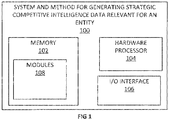
- FIG. 1 is a block diagram of a Content Affinity Analytics system 100 according to an embodiment of the present disclosure.
- the Content Affinity Analytics system 100 comprises a memory 102, a hardware processor 104, and an input/output (I/O) interface 106.
- the memory 102 further includes one or more modules 108 (or modules 108).
- the memory 102, the hardware processor 104, the input/output (I/O) interface 106, and/or the modules 108 may be coupled by a system bus or a similar mechanism.
- the memory 102 may store instructions, any number of pieces of information, and data, used by a computer system, for example Content Affinity Analytics system 100 to implement the functions (or embodiments) of the present disclosure.
- the memory 102 may include for example, volatile memory and/or non-volatile memory. Examples of volatile memory may include, but are not limited to volatile random access memory (RAM).
- the non-volatile memory may additionally or alternatively comprise an electrically erasable programmable read only memory (EEPROM), flash memory, hard drive, or the like.
- EEPROM electrically erasable programmable read only memory
- Some examples of the volatile memory includes, but are not limited to, random access memory, dynamic random access memory, static random access memory, and the like.
- non-volatile memory includes, but are not limited to, hard disks, magnetic tapes, optical disks, programmable read only memory, erasable programmable read only memory, electrically erasable programmable read only memory, flash memory, and the like.
- the memory 102 may be configured to store information, data, applications, instructions or the like for enabling the sensor data fusing system 100 to carry out various functions in accordance with various example embodiments.
- the hardware processor 104 may be implemented as one or more microprocessors, microcomputers, microcontrollers, digital signal processors, central processing units, state machines, logic circuitries, and/or any devices that manipulate signals based on operational instructions. Further, the hardware processor 104 may comprise a multi-core architecture. Among other capabilities, the hardware processor 104 is configured to fetch and execute computer-readable instructions or modules stored in the memory 102.
- Fig 8 depicts the overall schematic view of the system 100 wherein the AMS/LMS component 701 is responsible for execution of actual use cases of AMS/LMS.
- the component 701 helps educators to choose a book, create questions, group them into assignment and then serve to the students.
- the data for the AMS/LMS module is stored in 702 a traditional Entity-Relationship (ER) database depicted here as the SQL DB.
- the Data Capture Services Layer 703 AMS/LMS data is collected in real time, transformed into a Graph model and stored in a graph Database 209 depicted here as Graph DB.
- the Affinity Analytics Layer 705 is a once-daily batch process that analyses the data in the Graph DB 209 and executes the affinity algorithm that generates affinity data based on the contents of the Graph DB and stores the additional affinity data within the nodes and edges of the Graph DB. This arrangement has been made to eliminate the need for execution of the affinity algorithm during any online query, as the data volume is likely to be substantial thereby making the likelihood of a quick query turnaround unlikely.
- the Reporting Layer 704 is responsible for receiving input data from an invoker as questions, executing graph queries on the Graph DB based on the input and sending the data back to the invoker. In one embodiment the data may be sent as a JSON response to the invoker and REST service interfaces may be used for this data input and output.
- the Data Capture Service layer as depicted in Fig 2 represents a method wherein real time data is collected from the SQL DB 209, transformed into Graph Entity-Relationship model and persists in the Graph DB 216.
- use of techniques like Oracle Advanced Queue can guarantee that the insertion order is preserved and retrieval is done in order.
- Neo4J may be employed as the graph database, but technically any graph database may be implemented. Building the Affinity data using Graph DB is much more optimal than doing it using relational / No-SQL Tabular or document oriented structure.
- Retrieving data from the Graph DB 216 is a constant time operation. Affinity data can be rebuilt very quickly using Graph DB 216 and much more efficiently performing in nature than relational databases.
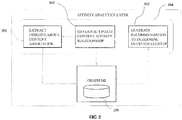
- the Affinity Analytics Layer 304 as depicted in Fig 3 is responsible for executing the affinity algorithm on the Graph DB 209 and to populate new relationships / attributes. This layer does the following steps:
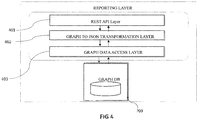
- the Reporting Layer as depicted in Fig 4 is responsible for receiving input data from a human invoker through a web interface as questions, executing graph queries on the underlying graph database Graph DB 209 based on the input data, and for sending the resultant data as an affined group of questions back to the invoker again through the web interface.
- the data may be sent as a JSON response to the invoker and REST service interfaces may be used for this data interface and transfer.
- Affinity Analysis as performed by the Affinity Analysis Layer 304, is depicted in Fig 5 and is described here.
- the historical data about the usage of the content is very important.
- aggregation of learning content serves a learning plan.
- Usage history of the learning content as well as fitment history of the learning content within the learning plan is very important to generate affinity insights.
- a graph model has been used to model the entity and the edge between the nodes is representing a relationship of those two entities. Any specific facts about this relationship are captured as attributes of the edge.
- Fig 5 shows a graphical model of the relationships that exist among the AMS entities.
- a Book 501 is a node and has some attributes like [Author, ISBN, Edition, Publication] and contains (or is associated with) different number of Assignments 502.
- An assignment 502 is nothing but an aggregation of questions 503 catering one learning objective 504.
- An Assignment node 502 has attributes like [Id, Title, Description, Start Date, End Date, Author_ID].
- a question 503 is situated at the atomic level and is tagged to a Learning Objective 504 and it checks students' understanding of one particular learning objective 504 or multiple learning objectives.
- the attributes of question 503 are [Question Title, Question Weight, Question Source System, Question_ID].
- a question 503 can be tagged to multiple learning objectives 504.
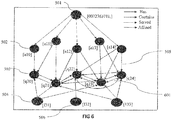
- Fig 6 shows an embodiment of a representative set where below relations are represented in the Graph Model, where a Book ⁇ 0072363711] 501 is considered: Node [Attribute] Relationship Node Book [0072363711] :[has] ⁇ [a10],[a11],[a12],[a13],a[14] ⁇ Assignment [a10] :[contains] ⁇ [q20] ⁇ Assignment [a11] :[contains] ⁇ [q20],[q21] ⁇ Assignment [a12] :[contains] ⁇ [q21],[q22],[q23] ⁇ Assignment [a13] :[contains] ⁇ [q23],[q24] ⁇ Assignment [a14] :[contains] ⁇ [q22],[q23],[q24] ⁇ Learning Objective [131] :[serves] ⁇ [q20],[q21],[q23] ⁇ Learning Objective [132] :[serves] ⁇ [q22] ⁇ Learning
- Query response time Function of (graph density, graph size, query degree) • Relational Database (RDBMS): Exponential slowdown as each factor increases • Graph DB (like Neo4j):
- Graph Database is fundamentally very fast in executing "Arbitrary Path Query". For example, with reference to Fig 6 and the nodes depicted within, consider a problem at hand which is to find out that which Questions 502 are associated with one Question [q20] for the below mentioned record set.
- the RDBMS has to scan the full table multiple time for each question whether it has any affined question for [q20]. So as the number of records grow, the scanning time also increases and resulting into exponential growth of the response time.
- extension of a Caliper framework to exchange Affinity Analytics data may be used.
- the Caliper framework guides the exchange of only learning analytics data.
- Affinity Analytics data is a real new world of information, so there is a need to exchange this information as well within the Caliper framework.
- LTI Learning Tools Interoperability
- QTI Question and Test Interoperability
- the Caliper Framework helps establish a means to consistently capture and present measures of learning activity, define a common language for labelling learning data and provide a standard way of measuring learning activities and effectiveness.
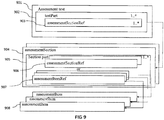
- a standard QTI Package Schema is depicted in Fig 9 .
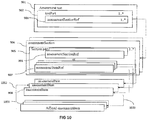
- the QTI schema will be as depicted in Fig 10 and illustrates how the Affinity Data would be housed inside it.
- a collection of affined assessment items embodied here as “assessmentItem” collection 908 will be tagged to each of the assessment item references “assessmentItemRef” 907.
- the AffinedassignmentItem collection 1001 would have a pointer back to the original assessmentItem 908 so that data does not have to be duplicated.
- the "weight” and any additional attribute can be accommodated in the AffinedassignmentItem 1001 data structure. This would then help an existing Caliper framework to transport the affinity analytics data within the same QTI package.
Landscapes
- Engineering & Computer Science (AREA)
- Theoretical Computer Science (AREA)
- General Physics & Mathematics (AREA)
- Physics & Mathematics (AREA)
- Databases & Information Systems (AREA)
- Educational Administration (AREA)
- Educational Technology (AREA)
- Business, Economics & Management (AREA)
- Data Mining & Analysis (AREA)
- General Engineering & Computer Science (AREA)
- Multimedia (AREA)
- Software Systems (AREA)
- Computational Linguistics (AREA)
- Information Retrieval, Db Structures And Fs Structures Therefor (AREA)
Applications Claiming Priority (1)
| Application Number | Priority Date | Filing Date | Title |
|---|---|---|---|
| IN201621034707 | 2016-10-10 |
Publications (1)
| Publication Number | Publication Date |
|---|---|
| EP3306540A1 true EP3306540A1 (fr) | 2018-04-11 |
Family
ID=57909476
Family Applications (1)
| Application Number | Title | Priority Date | Filing Date |
|---|---|---|---|
| EP17153044.7A Ceased EP3306540A1 (fr) | 2016-10-10 | 2017-01-25 | Système et procédé pour l'analyse d'affinité de contenu |
Country Status (2)
| Country | Link |
|---|---|
| US (1) | US10754861B2 (fr) |
| EP (1) | EP3306540A1 (fr) |
Cited By (2)
| Publication number | Priority date | Publication date | Assignee | Title |
|---|---|---|---|---|
| CN109376153A (zh) * | 2018-09-27 | 2019-02-22 | 浪潮软件集团有限公司 | 一种基于NiFi的数据写入图数据库的系统及方法 |
| CN112000809A (zh) * | 2020-09-29 | 2020-11-27 | 迪爱斯信息技术股份有限公司 | 一种文本类别的增量学习方法及装置、可读存储介质 |
Families Citing this family (2)
| Publication number | Priority date | Publication date | Assignee | Title |
|---|---|---|---|---|
| US11366967B2 (en) | 2019-07-24 | 2022-06-21 | International Business Machines Corporation | Learning roadmaps from unstructured text |
| US11829421B2 (en) * | 2019-11-08 | 2023-11-28 | Tableau Software, LLC | Dynamic graph generation for interactive data analysis |
Citations (3)
| Publication number | Priority date | Publication date | Assignee | Title |
|---|---|---|---|---|
| US20030033179A1 (en) * | 2001-08-09 | 2003-02-13 | Katz Steven Bruce | Method for generating customized alerts related to the procurement, sourcing, strategic sourcing and/or sale of one or more items by an enterprise |
| US20140272914A1 (en) * | 2013-03-15 | 2014-09-18 | William Marsh Rice University | Sparse Factor Analysis for Learning Analytics and Content Analytics |
| WO2015102659A1 (fr) * | 2014-01-02 | 2015-07-09 | Linkedin Corporation | Système et procédé reposant sur un graphique pour le stockage et l'extraction d'informations |
Family Cites Families (19)
| Publication number | Priority date | Publication date | Assignee | Title |
|---|---|---|---|---|
| US6711585B1 (en) * | 1999-06-15 | 2004-03-23 | Kanisa Inc. | System and method for implementing a knowledge management system |
| US7014467B2 (en) | 2002-02-11 | 2006-03-21 | Sap Ag | E-learning course structure |
| US7539697B1 (en) | 2002-08-08 | 2009-05-26 | Spoke Software | Creation and maintenance of social relationship network graphs |
| US7421306B2 (en) * | 2004-09-16 | 2008-09-02 | Sanghati, Llc | Apparel size service |
| US20060265508A1 (en) * | 2005-05-02 | 2006-11-23 | Angel Franklin J | System for administering a multiplicity of namespaces containing state information and services |
| WO2007100834A2 (fr) | 2006-02-27 | 2007-09-07 | The Regents Of The University Of California | Interrogation de graphes, extraction de motifs de graphes et découverte de grappes |
| US20090253112A1 (en) * | 2008-04-07 | 2009-10-08 | Microsoft Corporation | Recommending questions to users of community qiestion answering |
| US8731966B2 (en) * | 2009-09-24 | 2014-05-20 | Humedica, Inc. | Systems and methods for real-time data ingestion to a clinical analytics platform to generate a heat map |
| US10303999B2 (en) * | 2011-02-22 | 2019-05-28 | Refinitiv Us Organization Llc | Machine learning-based relationship association and related discovery and search engines |
| US20130022953A1 (en) * | 2011-07-11 | 2013-01-24 | Ctb/Mcgraw-Hill, Llc | Method and platform for optimizing learning and learning resource availability |
| TW201344652A (zh) * | 2012-04-24 | 2013-11-01 | Richplay Information Co Ltd | 製作知識地圖之方法 |
| EP2879118A4 (fr) * | 2012-07-26 | 2016-01-13 | Sony Corp | Dispositif de traitement d'informations, procédé de traitement d'informations et système |
| US20160189444A1 (en) * | 2012-12-29 | 2016-06-30 | Cloudcar, Inc. | System and method to orchestrate in-vehicle experiences to enhance safety |
| US9348947B2 (en) * | 2013-07-26 | 2016-05-24 | Helynx, Inc. | Systems and methods for visualizing and manipulating graph databases |
| US20150170536A1 (en) | 2013-12-18 | 2015-06-18 | William Marsh Rice University | Time-Varying Learning and Content Analytics Via Sparse Factor Analysis |
| US20150302300A1 (en) * | 2014-04-18 | 2015-10-22 | Voalte, Inc. | Efficient graph-based rule engine for complex, dynamic, unstructured data |
| US20160180248A1 (en) * | 2014-08-21 | 2016-06-23 | Peder Regan | Context based learning |
| US10235637B2 (en) * | 2015-08-28 | 2019-03-19 | Salesforce.Com, Inc. | Generating feature vectors from RDF graphs |
| US9330138B1 (en) * | 2015-09-18 | 2016-05-03 | Linkedin Corporation | Translating queries into graph queries using primitives |
-
2017
- 2017-01-25 EP EP17153044.7A patent/EP3306540A1/fr not_active Ceased
- 2017-01-27 US US15/418,324 patent/US10754861B2/en active Active
Patent Citations (3)
| Publication number | Priority date | Publication date | Assignee | Title |
|---|---|---|---|---|
| US20030033179A1 (en) * | 2001-08-09 | 2003-02-13 | Katz Steven Bruce | Method for generating customized alerts related to the procurement, sourcing, strategic sourcing and/or sale of one or more items by an enterprise |
| US20140272914A1 (en) * | 2013-03-15 | 2014-09-18 | William Marsh Rice University | Sparse Factor Analysis for Learning Analytics and Content Analytics |
| WO2015102659A1 (fr) * | 2014-01-02 | 2015-07-09 | Linkedin Corporation | Système et procédé reposant sur un graphique pour le stockage et l'extraction d'informations |
Non-Patent Citations (1)
| Title |
|---|
| ANONYMOUS: "Introduction to Oracle Database Advanced Queuing", 24 June 2016 (2016-06-24), XP055428410, Retrieved from the Internet <URL:https://web.archive.org/web/20160624030716/https://docs.oracle.com/database/121/ADQUE/aq_intro.htm> [retrieved on 20171124] * |
Cited By (4)
| Publication number | Priority date | Publication date | Assignee | Title |
|---|---|---|---|---|
| CN109376153A (zh) * | 2018-09-27 | 2019-02-22 | 浪潮软件集团有限公司 | 一种基于NiFi的数据写入图数据库的系统及方法 |
| CN109376153B (zh) * | 2018-09-27 | 2021-05-18 | 浪潮软件股份有限公司 | 一种基于NiFi的数据写入图数据库的系统及方法 |
| CN112000809A (zh) * | 2020-09-29 | 2020-11-27 | 迪爱斯信息技术股份有限公司 | 一种文本类别的增量学习方法及装置、可读存储介质 |
| CN112000809B (zh) * | 2020-09-29 | 2024-05-17 | 迪爱斯信息技术股份有限公司 | 一种文本类别的增量学习方法及装置、可读存储介质 |
Also Published As
| Publication number | Publication date |
|---|---|
| US20180101535A1 (en) | 2018-04-12 |
| US10754861B2 (en) | 2020-08-25 |
Similar Documents
| Publication | Publication Date | Title |
|---|---|---|
| Meier et al. | SQL & NoSQL databases | |
| AU2019204976B2 (en) | Intelligent data ingestion system and method for governance and security | |
| CN115221337B (zh) | 数据编织处理方法、装置、电子设备及可读存储介质 | |
| Ayankoya et al. | Intrinsic relations between data science, big data, business analytics and datafication | |
| Medhi et al. | Relational database and graph database: A comparative analysis | |
| EP3594822A1 (fr) | Système intelligent d'ingestion de données et procédé de gouvernance et de sécurité | |
| US20230252006A1 (en) | System for annotating input data using graphs via a user interface | |
| CN113779261B (zh) | 知识图谱的质量评价方法、装置、计算机设备及存储介质 | |
| CN113392864B (zh) | 模型生成方法及视频筛选方法、相关装置、存储介质 | |
| US20220107980A1 (en) | Providing an object-based response to a natural language query | |
| US11816770B2 (en) | System for ontological graph creation via a user interface | |
| CN116662441A (zh) | 一种分布式数据血缘构建及展现方法 | |
| Olszak et al. | Information technology tools for business intelligence development in organizations | |
| CN116049379B (zh) | 知识推荐方法、装置、电子设备和存储介质 | |
| US10754861B2 (en) | System and method for content affinity analytics | |
| US20190079957A1 (en) | Centralized feature management, monitoring and onboarding | |
| Kaufmann et al. | Sql and nosql databases | |
| CN119622047B (zh) | 基于知识图谱的数据挖掘方法、查询方法和问答方法 | |
| US20200226160A1 (en) | Database for unstructured data | |
| CN119669203A (zh) | 多模态数据管理系统、方法、设备及介质 | |
| Hijazi | Big Data and Knowledge Management: A Possible Course to Combine Them Together. | |
| Moalla et al. | Data warehouse design from social media for opinion analysis: the case of Facebook and Twitter | |
| CN120450663A (zh) | 一种基于大数据分析的精准居间匹配系统 | |
| US20110246532A1 (en) | System for managing electronically stored information | |
| US20260105252A1 (en) | Methods for utilizing knowledge graphs to provide real time ai insights in a collaborative chat environment and systems thereof |
Legal Events
| Date | Code | Title | Description |
|---|---|---|---|
| PUAI | Public reference made under article 153(3) epc to a published international application that has entered the european phase |
Free format text: ORIGINAL CODE: 0009012 |
|
| STAA | Information on the status of an ep patent application or granted ep patent |
Free format text: STATUS: THE APPLICATION HAS BEEN PUBLISHED |
|
| AK | Designated contracting states |
Kind code of ref document: A1 Designated state(s): AL AT BE BG CH CY CZ DE DK EE ES FI FR GB GR HR HU IE IS IT LI LT LU LV MC MK MT NL NO PL PT RO RS SE SI SK SM TR |
|
| AX | Request for extension of the european patent |
Extension state: BA ME |
|
| STAA | Information on the status of an ep patent application or granted ep patent |
Free format text: STATUS: REQUEST FOR EXAMINATION WAS MADE |
|
| 17P | Request for examination filed |
Effective date: 20181011 |
|
| RBV | Designated contracting states (corrected) |
Designated state(s): AL AT BE BG CH CY CZ DE DK EE ES FI FR GB GR HR HU IE IS IT LI LT LU LV MC MK MT NL NO PL PT RO RS SE SI SK SM TR |
|
| STAA | Information on the status of an ep patent application or granted ep patent |
Free format text: STATUS: EXAMINATION IS IN PROGRESS |
|
| 17Q | First examination report despatched |
Effective date: 20190221 |
|
| STAA | Information on the status of an ep patent application or granted ep patent |
Free format text: STATUS: THE APPLICATION HAS BEEN REFUSED |
|
| 18R | Application refused |
Effective date: 20200629 |