EP3308569B1 - Procédé et appareil de détermination d'un faisceau pour diriger un signal à envoyer à un équipement d'utilisateur - Google Patents
Procédé et appareil de détermination d'un faisceau pour diriger un signal à envoyer à un équipement d'utilisateur Download PDFInfo
- Publication number
- EP3308569B1 EP3308569B1 EP15895078.2A EP15895078A EP3308569B1 EP 3308569 B1 EP3308569 B1 EP 3308569B1 EP 15895078 A EP15895078 A EP 15895078A EP 3308569 B1 EP3308569 B1 EP 3308569B1
- Authority
- EP
- European Patent Office
- Prior art keywords
- user equipment
- beams
- network node
- sequence
- information related
- Prior art date
- Legal status (The legal status is an assumption and is not a legal conclusion. Google has not performed a legal analysis and makes no representation as to the accuracy of the status listed.)
- Active
Links
- 238000000034 method Methods 0.000 title claims description 26
- 238000004891 communication Methods 0.000 claims description 37
- 230000033001 locomotion Effects 0.000 claims description 28
- 238000004422 calculation algorithm Methods 0.000 claims description 17
- 230000009471 action Effects 0.000 description 27
- 230000006399 behavior Effects 0.000 description 11
- 238000010586 diagram Methods 0.000 description 11
- 230000005540 biological transmission Effects 0.000 description 9
- 238000004590 computer program Methods 0.000 description 7
- 239000013598 vector Substances 0.000 description 6
- 230000008901 benefit Effects 0.000 description 3
- 230000001413 cellular effect Effects 0.000 description 3
- 238000005516 engineering process Methods 0.000 description 3
- 238000005259 measurement Methods 0.000 description 3
- 238000010295 mobile communication Methods 0.000 description 3
- 230000001419 dependent effect Effects 0.000 description 2
- 230000026058 directional locomotion Effects 0.000 description 2
- 230000006870 function Effects 0.000 description 2
- 230000007774 longterm Effects 0.000 description 2
- 238000012986 modification Methods 0.000 description 2
- 230000004048 modification Effects 0.000 description 2
- 238000012544 monitoring process Methods 0.000 description 2
- 230000010363 phase shift Effects 0.000 description 2
- 230000011664 signaling Effects 0.000 description 2
- 241000760358 Enodes Species 0.000 description 1
- 238000013459 approach Methods 0.000 description 1
- 238000004364 calculation method Methods 0.000 description 1
- 239000000969 carrier Substances 0.000 description 1
- 230000010267 cellular communication Effects 0.000 description 1
- 230000008859 change Effects 0.000 description 1
- 238000013213 extrapolation Methods 0.000 description 1
- 230000006872 improvement Effects 0.000 description 1
- 230000000977 initiatory effect Effects 0.000 description 1
- 238000013507 mapping Methods 0.000 description 1
- 239000011159 matrix material Substances 0.000 description 1
- 230000000737 periodic effect Effects 0.000 description 1
- 230000008569 process Effects 0.000 description 1
- 230000009467 reduction Effects 0.000 description 1
- 238000001228 spectrum Methods 0.000 description 1
Images



Classifications
-
- H—ELECTRICITY
- H04—ELECTRIC COMMUNICATION TECHNIQUE
- H04W—WIRELESS COMMUNICATION NETWORKS
- H04W72/00—Local resource management
- H04W72/04—Wireless resource allocation
- H04W72/044—Wireless resource allocation based on the type of the allocated resource
- H04W72/046—Wireless resource allocation based on the type of the allocated resource the resource being in the space domain, e.g. beams
-
- H—ELECTRICITY
- H04—ELECTRIC COMMUNICATION TECHNIQUE
- H04W—WIRELESS COMMUNICATION NETWORKS
- H04W16/00—Network planning, e.g. coverage or traffic planning tools; Network deployment, e.g. resource partitioning or cells structures
- H04W16/24—Cell structures
- H04W16/28—Cell structures using beam steering
-
- H—ELECTRICITY
- H04—ELECTRIC COMMUNICATION TECHNIQUE
- H04W—WIRELESS COMMUNICATION NETWORKS
- H04W76/00—Connection management
- H04W76/20—Manipulation of established connections
- H04W76/25—Maintenance of established connections
-
- H—ELECTRICITY
- H04—ELECTRIC COMMUNICATION TECHNIQUE
- H04W—WIRELESS COMMUNICATION NETWORKS
- H04W4/00—Services specially adapted for wireless communication networks; Facilities therefor
- H04W4/02—Services making use of location information
-
- H—ELECTRICITY
- H04—ELECTRIC COMMUNICATION TECHNIQUE
- H04W—WIRELESS COMMUNICATION NETWORKS
- H04W4/00—Services specially adapted for wireless communication networks; Facilities therefor
- H04W4/30—Services specially adapted for particular environments, situations or purposes
-
- H—ELECTRICITY
- H04—ELECTRIC COMMUNICATION TECHNIQUE
- H04W—WIRELESS COMMUNICATION NETWORKS
- H04W88/00—Devices specially adapted for wireless communication networks, e.g. terminals, base stations or access point devices
- H04W88/02—Terminal devices
Definitions
- Embodiments herein relate to an apparatus and a method therein for determining a beam to direct a signal to be transmitted from a network node to user equipment.
- UE User Equipments
- MS Mobile Stations
- wireless terminals wireless terminals
- UEs are enabled to communicate wirelessly in a wireless communications network or wireless communication system, sometimes also referred to as a cellular radio system or cellular networks.
- the communication may be performed e.g. between two UEs, between a mobile station and a regular telephone and/or between a mobile station and a server via a Radio Access Network (RAN) and possibly one or more core networks, comprised within the wireless communications network.
- RAN Radio Access Network
- LTE Long Term Evolution
- UMTS Universal Mobile Telecommunications System
- GSM Global System for Mobile communications
- UEs may further be referred to as mobile telephones, cellular telephones, laptops, or surf plates with wireless capability, just to mention some further examples.
- the UEs in the present context may be, for example, portable, pocket-storable, hand-held, computer-comprised, or vehicle-mounted mobile devices, enabled to communicate voice and/or data, via the RAN, with another entity, such as another mobile station or a server.
- the wireless communications network covers a geographical area which is divided into cell areas, wherein each cell area being served by an access node such as a Base Station (BS), e.g. a Radio Base Station (RBS), which sometimes may be referred to as e.g. "eNB”, “eNodeB”, “NodeB”, “B node”, or BTS (Base Transceiver Station), depending on the technology and terminology used.
- BS Base Station
- RBS Radio Base Station
- eNB Radio Base Station
- eNodeB eNodeB
- NodeB Node
- BTS Base Transceiver Station
- the base stations may be of different classes such as e.g. macro eNodeB, home eNodeB or pico base station, based on transmission power and thereby also cell size.
- a cell is the geographical area where radio coverage is provided by the base station at a base station site.
- One base station, situated on the base station site may serve one or several cells.
- each base station may support one or several communication technologies.
- the base stations communicate over the air interface operating on radio frequencies with the UEs within range of the base stations.
- the expression Downlink (DL) is used for the transmission path from the base station to the mobile station.
- the expression Uplink (UL) is used for the transmission path in the opposite direction i.e. from the mobile station to the base station.
- One way of handling increased wireless data traffic in the wireless communications network is to deploy more BSs and densify the wireless communications network. However, this will increase interference and deployment cost.
- Another, seemingly simpler option in terms of deployment cost, for increasing the data rate is to introduce more antennas at the base station. By using more antennas at a transmitter, it is possible to direct a transmitted signal to intended user equipment. This is known as beamforming in the literature. Additionally, with many base station antennas it is also possible to simultaneously transmit payload data to multiple user equipment on the same frequency and/or time resources. This is often referred to as multi-user scheduling.
- the transmitter When performing beamforming, the transmitter needs to have some kind of channel knowledge such that it knows how to shift the amplitude and phase of the different antenna elements.
- this channel knowledge may be obtained through channel reciprocity or through Channel State Information (CSI) reports.
- CSI Channel State Information
- the UE In for example Transmission Mode (TM) 10, the UE is set up to measure on certain reference signals, CSI Reference Signals (CSI-RS). The UE then reports the CSI in the uplink in the form of a Channel Quality Indicator (CQI), a Rank Indicator (RI) and a Precoding-Matrix Indicator (PMI).
- CQI Channel Quality Indicator
- RI Rank Indicator
- PMI Precoding-Matrix Indicator
- the PMI indicates which precoder to use at the transmitter, that is, which weights to put on the antenna elements such that the energy is transmitted towards the UE.
- a different way to obtain the channel knowledge is to transmit different beams and let the UE measure on those and report back one or more preferred beams.
- the UE would only need to indicate which beam to choose from instead of a precoder index indicating phase shifts. This means that the UE only has to measure the signal strength of the beam rather than trying out different phase shifts and estimate the corresponding quality.
- a cell, or in other words the base station may send out a large number of beams to measure on in all possible directions. However, this costs significant energy and overhead in the cell.
- the antenna gain may quickly drop such that every time the base station receives a feedback, it is to some extent no longer valid, thus making a beamforming choice less effective.
- the user equipment risks receiving the data sent through a beam which is not best suited for the instantaneous position but rather for a previous position.
- WO 2014/036150 A1 discloses how historical data related to movements of a wireless transmit/receive unit, WTRU, can be used as a basis for predicting the position of the WTRU when performing beam tracking and beam selection.
- WO 2015/027118 A1 discloses how a mobile communication device can be positioned or located by transmitting a reference signal in a beam directed in a sequence of directional angles in a horizontal plane, and by measuring a parameter associated with the most probable directional angle.
- EP 2326117 A1 discloses how estimated parameters of motion of a mobile unit can be used as a basis for transmitting a communication channel to the mobile unit in an array of beam spots in a cellular communication system.
- Embodiments herein improve the determination of beams or in other words improve the determination of an antenna array or a precoding vector to direct a signal to be transmitted to a user equipment.
- the object is achieved by a method performed by a network node for determining a beam to direct a signal to be transmitted from the network node to a user equipment.
- the network node and the user equipment operate in a wireless communications network.
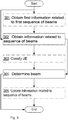
- the network node obtains information related to a sequence of beams associated with the user equipment.
- the network node determines the beam based on the information related to the sequence of beams.
- the object is achieved by a network node for determining a beam to direct a signal to be transmitted from the network node to a user equipment.
- the network node and the user equipment are configured to operate in a wireless communications network.
- the network node is configured to obtain information related to a sequence of beams associated with the user equipment.
- the network node is further configured to determine the beam based on the information related to the sequence of beams.
- the network node determines the beam based on the information related to the sequence of beams associated with the user equipment, the determination of the beam is improved.
- the improved determination results in that the system performance of the wireless communications network is enhanced. Especially user equipment throughput is enhanced.
- embodiments herein improve the performance of the determination of the beam in scenarios where it may not be possible to acquire accurate enough CSI or accurate channel statistics at the network node. This may for example be during the initial data transmission or when the user equipment travels with relatively high speed.
- a problem with prior art is to handle measurements related to beams when a UE is moving.
- An improved algorithm may send out beams in an area around the previously reported beam. This may be more efficient if the smaller area is significantly less than the coverage area of the entire cell. However, also this algorithm often sends a large number of unnecessary beams.
- Embodiments herein improve the determination of a beam by capturing correlations in mobility patterns.
- the network node may restrict the beam search space to those beams that are most probable to be relevant based on beforehand collected sequences of beams also referred to as beamforming patterns.
- the beforehand collected sequences of beams may e.g. be stored in a database.
- This restriction of the beam search space may be used as a complementing tool to the reported beams from the user equipment since the sequences of reports from the user equipment may be used to map the available sequences of beams, i.e. classify or associate the user equipment, to a beam forming pattern which results in a high performance of the beamforming.
- the reported beams may also be used to continue improve the database of beamforming patterns, i.e. used for statistics collection for future beamforming patterns.
- embodiments herein determine a beam to direct a signal to be transmitted to a user equipment, e.g. by restricting the set of beams that is to be searched for each user equipment.
- the determination, and thus the restriction is based on information related to a sequence of beams associated with the user equipment.
- the sequence of beams may also be referred to as a beam pattern or beam trace.
- Information related to a sequence of beams associated with the user equipment may comprise some information related to historical behavior, of the user equipment. Additionally the restriction may be based on some information related to historical behavior of other UEs.
- interesting behavior of the UEs to monitor is related to beamforming patterns, for instance beamforming patterns related to directional movements, mobility patterns and/or directional changes.
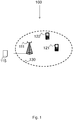
- FIG. 1 is a schematic block diagram depicting a wireless communications network 100 also known as a radio communications network, a telecommunications network or similar.
- the wireless communications network 100 may comprise one or more Radio Access Networks (RAN) and one or more Core Networks (CN).
- the wireless communications network 100 may use a number of different technologies, such as Long Term Evolution (LTE), LTE-Advanced, Wideband Code Division Multiple Access (WCDMA), Global System for Mobile communications/Enhanced Data rate for GSM Evolution (GSM/EDGE), Worldwide Interoperability for Microwave Access (WiMAX), BLE, Wi-Fi or Ultra Mobile Broadband (UMB), just to mention a few possible implementations.
- LTE Long Term Evolution
- WCDMA Wideband Code Division Multiple Access
- GSM/EDGE Global System for Mobile communications/Enhanced Data rate for GSM Evolution
- WiMAX Worldwide Interoperability for Microwave Access
- BLE Wi-Fi or Ultra Mobile Broadband (UMB)
- UMB Ultra Mobile Broadband
- network nodes capable of communicating with user equipment operate.
- a network node 111, 115 capable of communicating with user equipment operates in the wireless communications network 100.
- the network node 111, 115 is configured to operate in the wireless communications network 100.
- the network node 111, 115 is a network node capable of radio communication, e.g. a base station 111.
- the network node 111, 115 may also be referred to as a radio base station and e.g. a NodeB, an evolved Node B (eNB, eNode B), a base transceiver station, Access Point Base Station, base station router, or any other network unit capable of communicating with user equipment.
- eNB evolved Node B
- eNode B evolved Node B
- base transceiver station Access Point Base Station
- base station router or any other network unit capable of communicating with user equipment.
- the network node 111, 115 is a network node that communicates with the user equipment via a radio network node.
- the network node 111, 115 may for example be a Radio Network Controller (RNC) 115.
- RNC Radio Network Controller
- the functions performed in the network node 111, 115 may be performed by several distributed nodes, such as the base station 111 and the RNC 115.
- a user equipment 121 also known as a mobile station, wireless device, wireless communications device and/or a wireless terminal, operates in the wireless communications network 100.
- the user equipment 121 may communicate with the wireless communications network 100 via radio network nodes, such as the base station 111.
- the user equipment 121 may for example communicate with the network node 111, 115.
- user equipment is a non-limiting term which means for example any wireless communications device, wireless terminal, user equipment, Machine Type Communication (MTC) device, a Device to Device (D2D) terminal, or node e.g. Personal Digital Assistant (PDA), laptop, mobile, sensor, relay, mobile tablets or even a small base station.
- MTC Machine Type Communication
- D2D Device to Device
- node e.g. Personal Digital Assistant (PDA), laptop, mobile, sensor, relay, mobile tablets or even a small base station.
- PDA Personal Digital Assistant
- the wireless communications network 100 covers a geographical area which may be divided into cell areas, e.g. a cell 130 being served by the base station 111.
- a cell is a geographical area where radio coverage is provided by radio base station equipment at a base station site or at remote locations in Remote Radio Units (RRU).
- RRU Remote Radio Units
- the base station 111 is able to direct a radio signal to the user equipment 121 located in the cell 130.
- a method is disclosed herein for determining a beam to direct a signal to be transmitted from the network node 111, e.g. the base station 111, to the user equipment 121.
- the user equipment 121 may be moving, e.g. when located in a car, and the channel is changing, the feedbacks from the user equipment 121 need to be updated such that they reflect current channel conditions.
- the moving user equipment 121 may be described with a velocity and a direction of this velocity.
- the network node 111, 115 monitors and collects prior knowledge related to the behavior of user equipments, such as the user equipment 121 and the second user equipment 122, in terms of beam forming patterns, i.e. a sequence of beams.
- the beam forming patterns may be related to directional movements of the user equipments. For example, there may be beam forming patterns related to user equipment travelling with a high speed in a certain direction, and there may be other beam forming patterns related to user equipment travelling with a low speed in a certain direction.
- the network node 111, 115 may store the beam forming patterns in a database for further use.
- the user equipments may be classified in or associated with different beam forming classes, i.e., user equipment that share beam forming statistics or beam forming patterns. For example, there may be one class for user equipment travelling with a high speed on the country side and there may be another class for user equipment travelling with a low speed in the city.
- the network node 111, 115 determines a beam to direct a signal to be transmitted to the user equipment 121, based on the obtained information.
- the determining may comprise initiating the beam forming algorithm for the user equipment 121 based on this obtained information.
- the beam tracking and/or reporting may be constrained more appropriately according to the collected knowledge.
- An advantage is that the beam reporting is reduced to a few alternatives of estimated beams, or in other words beamformers.
- the network node 111, 115 may keep collecting data related to the beam forming behavior of user equipment, such as the user equipment 121, and may update the prior information. If needed, the network node 111, 115 may go back to gather more information.
- Estimated beamformers do not need to be restricted to those in a codebook, i.e. they do not need to be restricted to predetermined beams. Further the estimated beamformers may also be applied for pilot signals, which are reference symbols used for channel estimation of the received channel. That is, the estimated beamformers may also be applied to reconfigure how the different pilot signals are mapped to specific antenna elements, e.g. port to antenna mapping, and not only to data. This helps extending the coverage area of the cell 130 as it provides means of making more accurate beamforming of for example the Enhanced Physical Downlink Control Channel (EPDCCH) in LTE.
- the network node 111, 115 may keep monitoring the used precoders/beamforming vectors and update the database accordingly.
- precoder or beamforming vector or beamformers may relate to a single precoder/beam or a set of possible precoders/beams and relates to the antenna pattern used for transmitting a signal.
- the signal may be data or a reference signal, where the reference signal may be used for demodulation and/or channel state measurements.
- Figure 2 is a combined signalling diagram and flow chart that describes a method for determining the beam to direct the signal to be transmitted to the user equipment 121 according to embodiments herein.
- Figure 3 is a flowchart that describes a method performed by the network node 111 for determining the beam to direct the signal to be transmitted to the user equipment 121 according to embodiments herein.
- Figure 4a, Figure 4b and Figure 4c are schematic block diagrams illustrating further details of a method performed by the network node 111, 115 for determining the beam. Specifically, Figures 4a, 4b and 4c illustrate different beam sequences and beams comprised in these beam sequences. Figure 4a and 4b illustrate simplified examples of how such determining may be performed.
- a first sequence 410 of beams 411-416 comprising beams 411, 412, 413, 414, 415 and 416, has been obtained and stored by the network node 111, 115.
- the first sequence 410 of beams 411-416 may be associated with user equipment, such as the user equipment 121 and/or the second user equipment 122.
- a second sequence 420 of beams 422, 424 comprises a first beam 422 and a second beam 424.
- the second sequence 420 of beams 422, 424 is associated with the user equipment 121.
- a task for the network node 111, 115 is to determine the next beam, 426, to be used after beam 424 for the user equipment 121.
- the network node 111, 115 obtains earlier information related to sequences of beams associated with user equipment. This earlier information may be used to correlate movement patterns of user equipment with earlier used beam sequences. With such correlations at hand, the network node 111, 115 may correlate present information related to a sequence of beams with a future beam to be used for the user equipment 121 in an improved way.
- the network node 111, 115 obtains a first information related to a first sequence 410 of beams 411-416 associated with any one or more out of the user equipment 121 and the second user equipment 122.
- this first information comprises beams 412, 414 or information about and/or related to beams 412, 414 that are associated with the second user equipment 122.
- the first information may for example be used to build a data base of sequences of beams.
- the first information may also be used to make classes of user equipment based on information related to beams. The classes may later be used to classify user equipments, such as the user equipment 121.
- first sequences may be obtained from different user equipment, such as the user equipment 121 and the second user equipment 122.
- the network node 111, 115 may process the first information to obtain combined sequences of beams or computed sequences of beams which may become useful when the network node 111, 115 is to determine beams in the future.
- This action may be performed by an obtaining module 710 comprised in the network node 111, 115.
- the network node 111, 115 When the network node 111, 115 is to determine the beam 426 for the user equipment 121, the network node 111, 115 obtains information related to a sequence 420 of beams 422, 424 associated with the user equipment 121.
- the sequence of beams associated with different user equipment may comprise beams that have been measured, assigned to user equipment and not used, used and reported. The information will be used to determine the beam 426 to be used below in actions 203 and 303 by using the information to extrapolate the sequence 420 of beams 422, 424 to a future beam 426.
- the information related to the sequence 420 of beams 422, 424 may comprise information related to a movement or a movement pattern of the user equipment 121.
- the information may for example comprise information about a position of the user equipment 121, a velocity of the user equipment 121 and direction of the user equipment 121.
- An example of such information may be whether the user equipment 121 reduces its speed on a highway before an exit such that the network node 111, 115 may conclude whether the user equipment 121 will continue its movement in one or another specific direction.
- Another example is when there is a red-light. If the cars ahead are slowing down, then it is probable that the user equipment will as well.
- Another example is a scenario where there are common paths, for example along roads, highways, sidewalks, such that the network node 111, 115 may extract information of the most probable movement pattern.
- the information related to the sequence 420 of beams 422, 424 associated with the user equipment 121 is a second information related to a second sequence 420 of beams 422, 424 associated with the user equipment 121.
- the first sequence 410 of beams 411-416 may be a historic sequence 420 of beams 422, 424 that have been stored for example in a database and that is somehow related to the second sequence 420 of beams 422, 424.
- the network node 111, 115 may use historic knowledge about for example correlations between sequences of beams, movements or movement patterns of user equipment and the result of the historic beamforming.
- This action may be performed by the obtaining module 710 comprised in the network node 111, 115.
- the user equipments may be classified in different beam forming classes, e.g., user equipment that share beam forming statistics or beam forming patterns.
- the network node 111 classifies the user equipment to a first beam forming class.
- the first beam forming class may for example be related to user equipment moving with high velocities on highways.
- the network node 111, 115 classifies the user equipment 121 based on the information related to the sequence 420 of beams 422, 424.
- classifying the user equipment 121 may comprise relating the first information to the second information. This may be used to improve the determination of the beam 426, for example regarding the determination time, as described below in relation to actions 204 and 304.
- the determination time may for example be shortened by relating to each class a relatively small set of beams which the network node 111, 115 may choose from when determining the beam 426.
- This action may be performed by a classifying module 730 comprised in the network node 111, 115.
- the network node 111, 115 determines the beam 426 to direct the signal to be transmitted to the user equipment 121 based on the information related to the sequence 420 of beams 422, 424. Determining may for example comprise calculating and/or selecting.
- the determination of the beam 426 is improved since the information related to the sequence 420 of beams 422, 424 is used to extrapolate the sequence 420 of beams 422, 424 to the future beam 426.
- the extrapolation is optionally performed also based on earlier stored beam sequences or beam patterns which may be related to the sequence 420 of beams 422, 424.
- An improvement may for example be a shortened determination time.
- the network node may for example restrict the beam search space to those beams that are most probable to be relevant based on a beforehand collected database of sequences of beams.
- determining the beam 426 is further based on a result of relating the first information to the second information.
- Relating the first information to the second information may for example comprise comparing the second sequence 420 of beams 422, 424 with the first sequence 410 of beams 411-416 and determining that the two beams have partly the same content.
- Another example comprises relating or associating the second sequence 420 of beams 422, 424 to a beamforming class which is based on the first sequence 410 of beams 411-416.
- Figure 4a illustrates a simplified example of how such determining may be performed.
- the first sequence 410 of beams 411-416 has been obtained and stored.
- the second sequence 420 presently comprises beams 422, 424.
- the network node 111, 115 is about to determine the next beam 426 for the user equipment 121.
- the network node 111, 115 may for example use the beam 416 as a starting point for beam tracking and or beam reporting. This is illustrated with the arrow 440.
- the first information and the second information may be related by for example having the same or similar content or partly the same or similar content.
- Determining the beam 426 may further comprise determining any one or more out of a beam forming algorithm and an input to the beam forming algorithm, based on the information related to the sequence 420 of beams 422, 424.
- An example of an input to the beam forming algorithm is a velocity of the user equipment 121. In an example related to Figure 4a the user equipment 121 moves or travels with a higher velocity than the second user equipment 122 did at the time for the first sequence 410 of beams 411-416. The first sequence 410 of beams 411-416 is related to the second user equipment 122. In this example it is assumed that there is a match between the first sequence 410 of beams 411-416 and the second sequence 420 of beams 422, 424 in Figure 4a .
- the network node 111, 115 may use only every second beam for the sequence 420 of beams 422, 424 used for the user equipment 121 compared to the sequence 420 of beams 422, 424 of the slower second user equipment 122 due to the velocity difference.
- the beams in this case do not have to be sampled from fixed beams but may also be interpolated beams.
- determining the beam 426 comprises constraining any one or more out of a beam tracking and a beam reporting, to a set 430 of determined beams 426, 426* based on the information related to the sequence 420 of beams 422, 424. This is illustrated in Figure 4b .
- the determining time may be improved, which improves the chances of the determined beam 426 to be a suitable beam for the user equipment 121 also when the user equipment 121 is moving, e.g. with high speed.
- determining the beam 426 may comprise constraining any one or more out of the beam tracking and the beam reporting to the set 430 of determined beams 426, 426*. In this case determining the beam 426 may further be based on a result of relating the first information to the second information and further based on the first sequence 410 of beams 411-416.
- the classification may speed up the determination. Therefore determining the beam 426 based on the information related to the sequence 420 of beams 422, 424 may comprise that it is based on a result of classifying the user equipment 121.
- the result may for example be a beamforming class, such as a first beamforming class.
- the determination may be realised by using sets of determined beams 426, 426* for each beamforming class. Preferably, the sets of determined beams 426, 426* are relatively small.
- This action may be performed by a determining module 720 comprised in the network node 111, 115.
- the beam 426 or the set 430 of beams 426, 426* may be used for transmitting the signal to the user equipment 121.
- the determined beam 426 or set 430 of beams 426, 426* are used for initial transmissions to the user equipment 121.
- the beam tracking and the beam reporting may be based on the determined beam 426 or set 430 of beams 426, 426*.
- the beam tracking and/or beam reporting may be initialized based on the set 430 of determined beams 426, 426*.
- a final determination of the beam 426 for a specific signal to be transmitted may be performed after the initial transmissions, which may comprise beam tracking and/or beam reporting. Such final determination may thus also be based on the information related to the sequence 420 of beams 422, 424 associated with the user equipment 121.
- the signal may be transmitted using the finally determined beam 426.
- This action may be performed by a transmitting module 750, such as a transmitter, comprised in the network node 111, 115.
- the network node 111, 115 may keep collecting data related to the beam forming behavior of user equipment, such as the user equipment 121, and may update the prior information. For example, the network node 111, 115 may keep monitoring the used precoders/beamforming vectors and update the database accordingly.
- the network node 111, 115 when the network node 111, 115 has determined the beam 426, the network node 111, 115 updates the information related to the sequence 420 of beams 422, 424 based on information related to the beam 426.
- the updated sequence 420 of beams 422, 424, 426 then comprises the determined beam 426. This is illustrated in Figure 4c .
- This action may be performed by an updating module 740 comprised in the network node 111, 115.
- the network node 111, 115 may apply beams which have shown to be efficient in similar situations. This may involve collecting beam choices for different user equipment and making some kind of summary of the collected beam choices and related information. For example, on a highway, there may be an exit which in practice typically means that user equipment, such as the user equipment 121, travelling along the highway will either continue along the highway or slow down and turn towards the exit. If the network node 111, 115 notices a speed reduction of the user equipment 121, it may apply the beams of the sequence of beams which comprises historical beamforming choices.
- the network node 111, 115 may apply a corresponding sequence of beams used for such historical high speed user equipment. This has been illustrated in Figure 5 .
- the user equipment 121 is travelling on a highway and approaches an exit. Based on the speed, the network node 111, 115 may use the beams best suited for each area, N11 or N12. More precisely, if the speed of the user equipment 121 shows a decrease, then the network node 111, 115 may conclude that the user equipment 121 will exit the highway. Then the network node 111, 115 uses the beams that are known to be suited for area N11.
- These beams and/or information related to these beams may be stored in a memory 790 comprised in the network node 111, 115 and the beams and/or the information related to the beams may be updated regularly. If on the other hand the speed of the user equipment 121 remains the same, then the network node 111, 115 concludes that the user equipment 121 will continue along the highway and hence uses the beams that are suited for area N12.
- This scheme is based on the history of beam sequences used over time.
- the network node 111, 115 may notice that a certain set of beams are used consecutively over time. This may be understood from the illustrative example given in Figure 6 .
- a table is depicted which has been obtained from historical beam tracing of the user equipment 121.
- Each number in each table element depicted in Figure 6 corresponds to a beam. For instance, assume for the user equipment 121 that currently a preferred beam is beam 23, and a previous preferred beam has been beam 13. Based on the previously obtained information stored in the table the next beam is expected to be beam 33.
- This scheme in general may be used to detect the movement pattern explained in the paragraph above.
- the behavior of the user equipment such as the user equipment 121
- a preferred beam for the user equipment 121 in combination with the time and/or specific behavior may be stored in a memory, such as the memory 790, to be used later for better estimation of the beam to be used.
- the user equipment 121 who has a daily routine may be detected and once detected, preferred beamforming vectors may be used. This may either be implemented as described above in relation to the description of Figure 5 or by storing the identity of the user equipment 121 and apply beamforming according to what historical data has shown to be effective for the user equipment 121.
- Another aspect of a user equipment based scheme is to utilize a behavior of other user equipment.
- the movement or movement pattern of user equipment such as the user equipment 121
- the movement or movement pattern of other user equipment such as the second user equipment 122.
- Sequences for such behavior may be found with historical data and be applied such that the beamforming take into account information associated with other user equipment. For example, if a traffic light turns red and the car closest to the red light slows down, it is probable that cars behind will do the same.
- Another example of this is a group of user equipment travelling together for instance on a bus or a train. Then the determination of a beam for the user equipment 121 may be based on measurements by another user equipment.
- the network node 111, 115 keeps track of different user equipment and also finds similar beam patterns among user equipment to find a beamforming with a high performance, e.g. the highest, for each user equipment.
- the network node 111, 115 collects information related to the sequence of beams associated with the user equipment 121.
- the information may be available at the network node 111, 115.
- the information may be obtained in any of the exemplary ways as explained above.
- the user equipment 121 may signal this information to the network node 111, 115. That is, the user equipment 121 may inform the network node 111, 115 about its movement for an amount of time, that may be agreed upon a priori or may be extended for an arbitrary amount of time, or may send the information in a periodic manner to keep the network node 111, 115 updated of its intentions.
- the network node 111, 115 may request the user equipment 121 to update this information.
- the collected information may also be based on for example traffic information, e.g. from the news. If that information provides information related to a difference in a typical movement or movement pattern of the user equipment 121, then that information may be useful information on how to change the beamforming.
- the network node 111, 115 may base the beamforming algorithm on a sequence of beams during a similar period in the past. That is, from the past when there was a speed limit of 70 km/h.
- the network node 111, 115 may base the beamforming algorithm on a sequence of beams during a period with 110 km/h as speed limit.
- the network node 111, 115 may collect information which gives a better understanding of the properties of for example the movement or movement pattern of the user equipment 121.
- Such information may be derived from surrounding conditions, such as weather, roadwork, time of day etc. in addition to or instead of the radio behaviour of the user equipment 121.
- the network node 111, 115 determines, e.g. by calculation, the beam 426, or in other words the precoder or beamforming vector, that is to be used for the user equipment 121, based on the available information for the user equipment 121.
- the beam 426 or a set 430 of beams 426, 426* that are determined for the user equipment 121 may be used for transmissions to the user equipment 121.
- the network node 111, 115 may also update the sequence of beams that are specific for each area and/or scenario. Also, information related to the user equipment 121 may be stored, for example in the memory 790.
- the network node 111, 115 comprises the following arrangement depicted in Figure 7 .
- the network node 111, 115 and the user equipment 121 are each configured to operate in the wireless communications network 100.
- the network node 111, 115 is configured to, e.g. by means of the obtaining module 710 configured to, obtain information related to the sequence 420 of beams 422, 424 associated with the user equipment 121.
- the information related to the sequence 420 of beams 422, 424 may comprise information related to the movement or the movement pattern of the user equipment 121.
- the network node 111, 115 may further be configured to obtain the first information related to the first sequence 410 of beams 411-416 associated with any one or more out of the user equipment 121 and the second user equipment 122. Then the information related to the sequence 420 of beams 422, 424 associated with the user equipment 121 comprises the second information related to the second sequence 420 of beams 422, 424 associated with the user equipment 121.
- the obtaining module 710 may be implemented by a receiver or a processor 780 in the network node 111, 115.
- the network node 111, 115 is further configured to, e.g. by means of the determining module 720 configured to, determine the beam 426 based on information related to the sequence 420 of beams 422, 424.
- the network node 111, 115 is configured to determine the beam 426 by being configured to constrain any one or more out of the beam tracking and the beam reporting to the set 430 of determined beams 426, 426* based on information related to the sequence 420 of beams 422, 424.
- the network node may be configured to determine the beam 426 by being configured to determine any one or more out of the beam forming algorithm and an input to the beam forming algorithm, based on information related to the sequence 420 of beams 422, 424.
- the network node 111, 115 is configured to determine the beam 426 further based on a result of relating the first information to the second information.
- the network node 111, 115 may be configured to determine the beam 426 by being configured to constrain any one or more out of the beam tracking and the beam reporting to the set 430 of determined beams 426, 426*. The network node 111, 115 may then be configured to constrain any one or more out of the beam tracking and the beam reporting to the set 430 of determined beams 426, 426* further based on the result of relating the first information to the second information and further based on the first sequence 410 of beams 411-416.
- the network node 111, 115 may be further configured to determine the beam 426 based on information related to the sequence 420 of beams 422, 424 by being configured to determine the beam 426 based on the result of classifying the user equipment 121.
- the determining module 720 may be implemented by the processor 780 in the network node 111, 115.
- the network node 111, 115 may further be configured to, e.g. by means of the classifying module 730 configured to, classify the user equipment 121 based on information related to the sequence 420 of beams 422, 424.
- the classifying module 730 may be implemented by the processor 780 in the network node 111, 115.
- the network node 111, 115 may further be configured to, e.g. by means of the updating module 740 configured to, update information related to the sequence 420 of beams 422, 424 based on information related to the beam 426 when the network node 111, 115 has determined the beam 426.
- the updating module 740 may be implemented by the processor 780 in the network node 111, 115.
- the embodiments herein for determining the beam 426 to direct the signal to be transmitted to the user equipment 121 may be implemented through one or more processors, such as the processor 780 in the network node 111, 115 depicted in Figure 7 together with computer program code for performing the functions and actions of the embodiments herein.
- the program code mentioned above may also be provided as a computer program product 791 for instance in the form of a data carrier carrying computer program code 792 for performing the embodiments herein when being loaded into the network node 111, 115.
- One such carrier may be in the form of a CD ROM disc. It is however feasible with other data carriers such as a memory stick.
- the computer program code may furthermore be provided as pure program code on a server and downloaded to.
- the methods according to the embodiments described herein for the network node 111, 115 may be implemented by means of a computer program product, comprising instructions, i.e., software code portions, which, when executed on at least one processor, cause the at least one processor to carry out the actions described herein, as performed by the network node 111, 115.
- the computer program product may be stored on a computer-readable storage medium.
- the computer-readable storage medium, having stored there on the computer program may comprise the instructions which, when executed on at least one processor, cause the at least one processor to carry out the actions described herein, as performed by the network node 111, 115.
- the computer-readable storage medium may be a non-transitory computer-readable storage medium.
- the obtaining module 710, the determining module 720, the classifying module 730 and the updating module 740 described above may refer to a combination of analogue and digital circuits, and/or one or more processors configured with software and/or firmware, e.g. stored in the memory 790 that when executed by the one or more processors such as the processor 780 perform as described above.
- processors as well as the other digital hardware, may be included in a single ASIC, or several processors and various digital hardware may be distributed among several separate components, whether individually packaged or assembled into a SoC.
- the network node 111, 115 may further be configured to, e.g. by means of the memory 790 configured to, store for example, the information related to the sequence of beams, the first information, the second information, the sequence of beams, classifications, information related to user equipments, beam forming algorithms, inputs to the beam forming algorithms and configurations, schedulings and applications etc. to perform the methods herein when being executed in the network node 111, 115.
- the memory 790 comprises one or more memory units.
- first network node and a second network node should be considered to be non-limiting and does in particular not imply a certain hierarchical relation between the two.
Landscapes
- Engineering & Computer Science (AREA)
- Computer Networks & Wireless Communication (AREA)
- Signal Processing (AREA)
- Mobile Radio Communication Systems (AREA)
Claims (12)
- Procédé effectué par un nœud de réseau (111, 115) permettant la détermination d'un faisceau (426) pour diriger un signal à transmettre depuis le nœud de réseau (111, 115) à destination d'un équipement d'utilisateur (121), le nœud de réseau (111, 115) et l'équipement d'utilisateur (121) fonctionnant dans un réseau de communication sans fil (100), le procédé comprenant :l'obtention (202, 302) d'informations relatives à une séquence (420) de faisceaux (422, 424) d'un motif de formation de faisceau associé à l'équipement d'utilisateur (121), dans lequel les informations relatives à la séquence (420) de faisceaux (422, 424) comprennent des informations relatives à un mouvement ou à un motif de mouvement de l'équipement d'utilisateur (121),caractérisé en ce que le procédé comprend en outre :la classification (203, 303) de l'équipement d'utilisateur (121) dans une classe de formation de faisceau pour des équipements d'utilisateur qui partagent des statistiques de formation de faisceau ou des motifs de formation de faisceau, sur la base des informations relatives à la séquence (420) de faisceaux (422, 424), etla détermination (204, 304) dudit faisceau (426) pour diriger ledit signal à transmettre depuis le nœud de réseau (111, 115) à destination de l'équipement d'utilisateur (121), sur la base des informations relatives à la séquence (420) de faisceaux (422, 424) et sur la base d'un résultat de la classification de l'équipement d'utilisateur (121).
- Procédé selon la revendication 1, dans lequel la détermination (204, 304) du faisceau (426) comprend la contrainte d'un ou plusieurs d'un suivi de faisceau et d'un rapport de faisceau à un ensemble (430) de faisceaux déterminés (426, 426*) sur la base des informations relatives à la séquence (420) de faisceaux (422, 424).
- Procédé selon l'une quelconque des revendications 1 et 2, dans lequel la détermination (204, 304) du faisceau (426) comprend la détermination d'un ou plusieurs d'un algorithme de formation de faisceau et d'une entrée dans l'algorithme de formation de faisceau, sur la base des informations relatives à la séquence (420) de faisceaux (422, 424).
- Procédé selon l'une quelconque des revendications 1 à 3, comprenant en outre l'obtention (201, 301) d'une première information relative à une première séquence (410) de faisceaux (411-416) associés à l'un ou plusieurs de l'équipement d'utilisateur (121) et d'un deuxième équipement d'utilisateur (122), dans lequel les informations relatives à la séquence (420) de faisceaux (422, 424) associés à l'équipement d'utilisateur (121) sont une deuxième information relative à une deuxième séquence (420) de faisceaux (422, 424) associés à l'équipement d'utilisateur (121), et dans lequel la détermination (204, 304) du faisceau (426) est en outre basée sur un résultat de la mise en relation de la première information avec la deuxième information.
- Procédé selon la revendication 4, dans lequel la détermination (204, 304) du faisceau (426) comprend la contrainte d'un ou plusieurs du suivi de faisceau et du rapport de faisceau à l'ensemble (430) de faisceaux déterminés (426, 426*), en outre sur la base du résultat de la mise en relation de la première information avec la deuxième information et en outre sur la base de la première séquence (410) de faisceaux (411-416).
- Procédé selon l'une quelconque des revendications 1 à 5, comprenant en outre :
lorsque le nœud de réseau (111, 115) a déterminé le faisceau (426), la mise à jour (206, 305) des informations relatives à la séquence (420) de faisceaux (422, 424) sur la base d'informations relatives au faisceau (426). - Nœud de réseau (111, 115) permettant la détermination d'un faisceau (426) pour diriger un signal à transmettre depuis le nœud de réseau (111, 115) à destination d'un équipement d'utilisateur (121), le nœud de réseau (111, 115) et l'équipement d'utilisateur (121) étant configurés pour fonctionner dans un réseau de communication sans fil (100), le nœud de réseau (111, 115) étant configuré pour :l'obtention d'informations relatives à une séquence (420) de faisceaux (422, 424) d'un motif de formation de faisceau associé à l'équipement d'utilisateur (121), dans lequel les informations relatives à la séquence (420) de faisceaux (422, 424) comprennent des informations relatives à un mouvement ou à un motif de mouvement de l'équipement d'utilisateur (121),caractérisé en ce que le nœud de réseau (111, 115) est en outre configuré pour :la classification de l'équipement d'utilisateur (121) dans une classe de formation de faisceau pour des équipements d'utilisateur qui partagent des statistiques de formation de faisceau ou des motifs de formation de faisceau, sur la base des informations relatives à la séquence (420) de faisceaux (422, 424), etla détermination dudit faisceau (426) pour diriger ledit signal à transmettre depuis le nœud de réseau (111, 115) à destination de l'équipement d'utilisateur (121), sur la base des informations relatives à la séquence (420) de faisceaux (422, 424) et sur la base d'un résultat de la classification de l'équipement d'utilisateur (121).
- Nœud de réseau (111, 115) selon la revendication 7, configuré pour la détermination du faisceau (426) en étant configuré pour la contrainte d'un ou plusieurs d'un suivi de faisceau et d'un rapport de faisceau à un ensemble (430) de faisceaux déterminés (426, 426*) sur la base des informations relatives à la séquence (420) de faisceaux (422, 424).
- Nœud de réseau (111, 115) selon l'une quelconque des revendications 7 et 8, configuré pour la détermination du faisceau (426) en étant configuré pour la détermination d'un ou plusieurs d'un algorithme de formation de faisceau et d'une entrée dans l'algorithme de formation de faisceau, sur la base des informations relatives à la séquence (420) de faisceaux (422, 424).
- Nœud de réseau (111, 115) selon l'une quelconque des revendications 7 à 9, configuré en outre pour :- l'obtention d'une première information relative à une première séquence (410) de faisceaux (411-416) associés à l'un ou plusieurs de l'équipement d'utilisateur (121) et d'un deuxième équipement d'utilisateur (122), dans lequel les informations relatives à la séquence (420) de faisceaux (422, 424) associés à l'équipement d'utilisateur (121) sont une deuxième information relative à une deuxième séquence (420) de faisceaux (422, 424) associés à l'équipement d'utilisateur (121), et- la détermination du faisceau (426) en outre sur la base d'un résultat de la mise en relation de la première information avec la deuxième information.
- Nœud de réseau (111, 115) selon la revendication 10, configuré pour la détermination du faisceau (426) en étant en outre configuré pour la contrainte d'un ou plusieurs du suivi de faisceau et du rapport de faisceau à un ensemble (430) de faisceaux déterminés (426, 426*), en outre sur la base du résultat de la mise en relation de la première information avec la deuxième information et en outre sur la base de la première séquence (410) de faisceaux (411-416).
- Nœud de réseau (111, 115) selon l'une quelconque des revendications 7 à 11, configuré en outre pour la mise à jour des informations relatives à la séquence (420) de faisceaux (422, 424) sur la base d'informations relatives au faisceau (426) lorsque le nœud de réseau (111, 115) a déterminé le faisceau (426).
Applications Claiming Priority (1)
| Application Number | Priority Date | Filing Date | Title |
|---|---|---|---|
| PCT/SE2015/050673 WO2016200302A1 (fr) | 2015-06-10 | 2015-06-10 | Procédé et appareil de détermination d'un faisceau pour diriger un signal à envoyer à un équipement d'utilisateur |
Publications (3)
| Publication Number | Publication Date |
|---|---|
| EP3308569A1 EP3308569A1 (fr) | 2018-04-18 |
| EP3308569A4 EP3308569A4 (fr) | 2018-05-30 |
| EP3308569B1 true EP3308569B1 (fr) | 2019-12-18 |
Family
ID=57503892
Family Applications (1)
| Application Number | Title | Priority Date | Filing Date |
|---|---|---|---|
| EP15895078.2A Active EP3308569B1 (fr) | 2015-06-10 | 2015-06-10 | Procédé et appareil de détermination d'un faisceau pour diriger un signal à envoyer à un équipement d'utilisateur |
Country Status (4)
| Country | Link |
|---|---|
| US (1) | US10375694B2 (fr) |
| EP (1) | EP3308569B1 (fr) |
| CN (1) | CN107736071B (fr) |
| WO (1) | WO2016200302A1 (fr) |
Cited By (1)
| Publication number | Priority date | Publication date | Assignee | Title |
|---|---|---|---|---|
| US11569893B1 (en) | 2021-12-08 | 2023-01-31 | Nec Corporation | User equipment trajectory based beam selection |
Families Citing this family (7)
| Publication number | Priority date | Publication date | Assignee | Title |
|---|---|---|---|---|
| CN108574954A (zh) * | 2017-03-08 | 2018-09-25 | 索尼公司 | 无线通信系统中的电子设备和方法 |
| CN110366092A (zh) * | 2018-04-03 | 2019-10-22 | 电信科学技术研究院有限公司 | 一种波束跟踪的方法及装置 |
| KR102460324B1 (ko) * | 2018-04-17 | 2022-10-28 | 삼성전자 주식회사 | 무선 통신 시스템에서 단말의 이동성을 지원하는 방법 및 장치 |
| EP3788723B1 (fr) | 2018-05-03 | 2026-01-21 | Telefonaktiebolaget Lm Ericsson (Publ) | Systèmes et procédés de commande d'un composant d'un noeud de réseau dans un système de communication |
| WO2020062859A1 (fr) * | 2018-09-24 | 2020-04-02 | Huawei Technologies Co., Ltd. | Système et procédé de gestion de faisceau |
| CN113812192A (zh) * | 2019-05-10 | 2021-12-17 | 瑞典爱立信有限公司 | 用于无线电波束确定的方法和设备 |
| US11096176B2 (en) * | 2019-05-24 | 2021-08-17 | Huawei Technologies Co., Ltd. | Location-based beam prediction using machine learning |
Family Cites Families (12)
| Publication number | Priority date | Publication date | Assignee | Title |
|---|---|---|---|---|
| US5890067A (en) * | 1996-06-26 | 1999-03-30 | Bnr Inc. | Multi-beam antenna arrays for base stations in which the channel follows the mobile unit |
| CN101507342A (zh) * | 2006-08-15 | 2009-08-12 | 艾利森电话股份有限公司 | 用于多蜂窝无线通信系统中调度资源与避免干扰的方法及设备 |
| EP2099140A1 (fr) * | 2008-03-04 | 2009-09-09 | Alcatel, Lucent | Procédé d'adaptation de lien de station de base |
| CN102067472B (zh) * | 2008-08-15 | 2015-03-18 | 上海贝尔股份有限公司 | 基于固定波束族的波束赋形方法、基站和用户设备 |
| KR101478843B1 (ko) * | 2009-01-22 | 2015-01-05 | 엘지전자 주식회사 | 협력적 다중 셀 무선통신 시스템에서 데이터를 송신하는 방법 |
| JP5444374B2 (ja) * | 2009-02-27 | 2014-03-19 | アルカテル−ルーセント | 協調ビーム形成方法、協調ビーム形成装置、および協調ビーム形成基地局 |
| US9681455B2 (en) * | 2010-01-28 | 2017-06-13 | Alcatel Lucent | Methods for reducing interference in a communication system |
| KR101847400B1 (ko) * | 2011-09-01 | 2018-04-10 | 삼성전자주식회사 | 무선 통신 시스템에서 최적의 빔을 선택하기 위한 장치 및 방법 |
| WO2013047924A1 (fr) | 2011-09-29 | 2013-04-04 | Hankuk University Of Foreign Studies Research And Industry-University Cooperation Foundation | Formation de faisceau pour des communications sans fil |
| US9629171B2 (en) | 2012-08-28 | 2017-04-18 | Idac Holdings, Inc. | Method for millimeter wave beam tracking |
| EP2992619B1 (fr) * | 2013-04-30 | 2020-06-03 | Samsung Electronics Co., Ltd. | Appareil et procédé de transmission/réception de signal de référence dans un système de communication sans fil prenant en charge un schéma de mise en forme de faisceaux |
| US9377522B2 (en) | 2013-08-22 | 2016-06-28 | Qualcomm Incorporated | Utilizing a reference signal for indoor positioning |
-
2015
- 2015-06-10 US US15/578,323 patent/US10375694B2/en active Active
- 2015-06-10 CN CN201580080708.5A patent/CN107736071B/zh not_active Expired - Fee Related
- 2015-06-10 EP EP15895078.2A patent/EP3308569B1/fr active Active
- 2015-06-10 WO PCT/SE2015/050673 patent/WO2016200302A1/fr not_active Ceased
Non-Patent Citations (1)
| Title |
|---|
| None * |
Cited By (1)
| Publication number | Priority date | Publication date | Assignee | Title |
|---|---|---|---|---|
| US11569893B1 (en) | 2021-12-08 | 2023-01-31 | Nec Corporation | User equipment trajectory based beam selection |
Also Published As
| Publication number | Publication date |
|---|---|
| US20180152933A1 (en) | 2018-05-31 |
| EP3308569A4 (fr) | 2018-05-30 |
| CN107736071A (zh) | 2018-02-23 |
| CN107736071B (zh) | 2021-11-12 |
| WO2016200302A1 (fr) | 2016-12-15 |
| US10375694B2 (en) | 2019-08-06 |
| EP3308569A1 (fr) | 2018-04-18 |
Similar Documents
| Publication | Publication Date | Title |
|---|---|---|
| EP3308569B1 (fr) | Procédé et appareil de détermination d'un faisceau pour diriger un signal à envoyer à un équipement d'utilisateur | |
| US11424791B2 (en) | Machine learning model selection in beamformed communications | |
| US12250050B2 (en) | Beam selection refinement for wireless communication in static conditions | |
| EP3646659A1 (fr) | Procédé et noeuds de réseau permettant de déterminer si un dispositif sans fil est aérien | |
| CN109792275A (zh) | 无线通信系统中的波束成形 | |
| CN115515245A (zh) | 一种信息协调的方法和装置 | |
| WO2019004885A1 (fr) | Premier nœud radio et procédés associés pour ajuster un ensemble de faisceaux pour la communication dans un réseau de communication sans fil | |
| US12464386B2 (en) | Techniques for beam selection based on measurement periodicities | |
| US11751077B2 (en) | Method, computer program, apparatus, and vehicle for generating a quality of service map | |
| CN120957242B (zh) | 一种通信方法及相关装置 | |
| US12375954B2 (en) | Reporting environmental states of a user equipment | |
| US11700049B2 (en) | Techniques for beam switching in wireless communications | |
| EP4320911B1 (fr) | Détermination basée sur un capteur d'une liste de faisceaux de route fournie | |
| WO2023236073A1 (fr) | Associations de signaux de référence pour la gestion prédictive de faisceaux | |
| EP3016458B1 (fr) | Appareil, procédé et programme informatique pour fournir des informations relatives à un état de canal prédit | |
| CN120077718A (zh) | 蜂窝系统中基于预测的定位 | |
| WO2023009490A1 (fr) | Techniques de sélection de faisceau basée sur des périodiques de mesure | |
| CN120092416A (zh) | 信道预测 | |
| US20250097758A1 (en) | Reducing user equipment (ue) measurement overhead by using an external source | |
| WO2024234741A1 (fr) | Gestion de faisceau pour services de détection | |
| US20260032481A1 (en) | Enhancements of measuring and reporting | |
| WO2025117234A1 (fr) | Réduction de gestion de ressources radio de cellule voisine pour agrégation de porteuses ou double connectivité | |
| WO2025210165A1 (fr) | Améliorations de mesure et de rapport |
Legal Events
| Date | Code | Title | Description |
|---|---|---|---|
| STAA | Information on the status of an ep patent application or granted ep patent |
Free format text: STATUS: THE INTERNATIONAL PUBLICATION HAS BEEN MADE |
|
| PUAI | Public reference made under article 153(3) epc to a published international application that has entered the european phase |
Free format text: ORIGINAL CODE: 0009012 |
|
| STAA | Information on the status of an ep patent application or granted ep patent |
Free format text: STATUS: REQUEST FOR EXAMINATION WAS MADE |
|
| 17P | Request for examination filed |
Effective date: 20171024 |
|
| AK | Designated contracting states |
Kind code of ref document: A1 Designated state(s): AL AT BE BG CH CY CZ DE DK EE ES FI FR GB GR HR HU IE IS IT LI LT LU LV MC MK MT NL NO PL PT RO RS SE SI SK SM TR |
|
| AX | Request for extension of the european patent |
Extension state: BA ME |
|
| STAA | Information on the status of an ep patent application or granted ep patent |
Free format text: STATUS: EXAMINATION IS IN PROGRESS |
|
| A4 | Supplementary search report drawn up and despatched |
Effective date: 20180502 |
|
| RIC1 | Information provided on ipc code assigned before grant |
Ipc: H01Q 3/00 20060101ALI20180424BHEP Ipc: H04W 76/25 20180101ALI20180424BHEP Ipc: H04W 16/28 20090101AFI20180424BHEP Ipc: H04W 4/02 20180101ALN20180424BHEP Ipc: H04W 72/04 20090101ALI20180424BHEP |
|
| 17Q | First examination report despatched |
Effective date: 20180518 |
|
| DAV | Request for validation of the european patent (deleted) | ||
| DAX | Request for extension of the european patent (deleted) | ||
| RIC1 | Information provided on ipc code assigned before grant |
Ipc: H01Q 3/00 20060101ALI20190627BHEP Ipc: H04W 4/02 20180101ALN20190627BHEP Ipc: H04W 76/25 20180101ALI20190627BHEP Ipc: H04W 16/28 20090101AFI20190627BHEP Ipc: H04W 72/04 20090101ALI20190627BHEP |
|
| RIC1 | Information provided on ipc code assigned before grant |
Ipc: H04W 16/28 20090101AFI20190718BHEP Ipc: H04W 72/04 20090101ALI20190718BHEP Ipc: H04W 76/25 20180101ALI20190718BHEP Ipc: H04W 4/02 20180101ALN20190718BHEP Ipc: H01Q 3/00 20060101ALI20190718BHEP |
|
| RIC1 | Information provided on ipc code assigned before grant |
Ipc: H04W 16/28 20090101AFI20190719BHEP Ipc: H04W 72/04 20090101ALI20190719BHEP Ipc: H01Q 3/00 20060101ALI20190719BHEP Ipc: H04W 4/02 20180101ALN20190719BHEP Ipc: H04W 76/25 20180101ALI20190719BHEP |
|
| GRAP | Despatch of communication of intention to grant a patent |
Free format text: ORIGINAL CODE: EPIDOSNIGR1 |
|
| STAA | Information on the status of an ep patent application or granted ep patent |
Free format text: STATUS: GRANT OF PATENT IS INTENDED |
|
| RIC1 | Information provided on ipc code assigned before grant |
Ipc: H04W 4/02 20180101ALN20190912BHEP Ipc: H04W 72/04 20090101ALI20190912BHEP Ipc: H04W 16/28 20090101AFI20190912BHEP Ipc: H04W 76/25 20180101ALI20190912BHEP |
|
| INTG | Intention to grant announced |
Effective date: 20190927 |
|
| RAP1 | Party data changed (applicant data changed or rights of an application transferred) |
Owner name: TELEFONAKTIEBOLAGET LM ERICSSON (PUBL) |
|
| RIN1 | Information on inventor provided before grant (corrected) |
Inventor name: RAMACHANDRA, PRADEEPA Inventor name: CIRKIC, MIRSAD Inventor name: MOOSAVI, REZA Inventor name: ERIKSSON, ERIK Inventor name: BERGLUND, JOEL |
|
| GRAS | Grant fee paid |
Free format text: ORIGINAL CODE: EPIDOSNIGR3 |
|
| GRAA | (expected) grant |
Free format text: ORIGINAL CODE: 0009210 |
|
| STAA | Information on the status of an ep patent application or granted ep patent |
Free format text: STATUS: THE PATENT HAS BEEN GRANTED |
|
| AK | Designated contracting states |
Kind code of ref document: B1 Designated state(s): AL AT BE BG CH CY CZ DE DK EE ES FI FR GB GR HR HU IE IS IT LI LT LU LV MC MK MT NL NO PL PT RO RS SE SI SK SM TR |
|
| REG | Reference to a national code |
Ref country code: CH Ref legal event code: EP |
|
| REG | Reference to a national code |
Ref country code: DE Ref legal event code: R096 Ref document number: 602015044103 Country of ref document: DE |
|
| REG | Reference to a national code |
Ref country code: IE Ref legal event code: FG4D |
|
| REG | Reference to a national code |
Ref country code: AT Ref legal event code: REF Ref document number: 1215965 Country of ref document: AT Kind code of ref document: T Effective date: 20200115 |
|
| REG | Reference to a national code |
Ref country code: NL Ref legal event code: MP Effective date: 20191218 |
|
| PG25 | Lapsed in a contracting state [announced via postgrant information from national office to epo] |
Ref country code: LT Free format text: LAPSE BECAUSE OF FAILURE TO SUBMIT A TRANSLATION OF THE DESCRIPTION OR TO PAY THE FEE WITHIN THE PRESCRIBED TIME-LIMIT Effective date: 20191218 Ref country code: NO Free format text: LAPSE BECAUSE OF FAILURE TO SUBMIT A TRANSLATION OF THE DESCRIPTION OR TO PAY THE FEE WITHIN THE PRESCRIBED TIME-LIMIT Effective date: 20200318 Ref country code: GR Free format text: LAPSE BECAUSE OF FAILURE TO SUBMIT A TRANSLATION OF THE DESCRIPTION OR TO PAY THE FEE WITHIN THE PRESCRIBED TIME-LIMIT Effective date: 20200319 Ref country code: FI Free format text: LAPSE BECAUSE OF FAILURE TO SUBMIT A TRANSLATION OF THE DESCRIPTION OR TO PAY THE FEE WITHIN THE PRESCRIBED TIME-LIMIT Effective date: 20191218 Ref country code: BG Free format text: LAPSE BECAUSE OF FAILURE TO SUBMIT A TRANSLATION OF THE DESCRIPTION OR TO PAY THE FEE WITHIN THE PRESCRIBED TIME-LIMIT Effective date: 20200318 Ref country code: LV Free format text: LAPSE BECAUSE OF FAILURE TO SUBMIT A TRANSLATION OF THE DESCRIPTION OR TO PAY THE FEE WITHIN THE PRESCRIBED TIME-LIMIT Effective date: 20191218 Ref country code: SE Free format text: LAPSE BECAUSE OF FAILURE TO SUBMIT A TRANSLATION OF THE DESCRIPTION OR TO PAY THE FEE WITHIN THE PRESCRIBED TIME-LIMIT Effective date: 20191218 |
|
| REG | Reference to a national code |
Ref country code: LT Ref legal event code: MG4D |
|
| PG25 | Lapsed in a contracting state [announced via postgrant information from national office to epo] |
Ref country code: HR Free format text: LAPSE BECAUSE OF FAILURE TO SUBMIT A TRANSLATION OF THE DESCRIPTION OR TO PAY THE FEE WITHIN THE PRESCRIBED TIME-LIMIT Effective date: 20191218 Ref country code: RS Free format text: LAPSE BECAUSE OF FAILURE TO SUBMIT A TRANSLATION OF THE DESCRIPTION OR TO PAY THE FEE WITHIN THE PRESCRIBED TIME-LIMIT Effective date: 20191218 |
|
| PG25 | Lapsed in a contracting state [announced via postgrant information from national office to epo] |
Ref country code: AL Free format text: LAPSE BECAUSE OF FAILURE TO SUBMIT A TRANSLATION OF THE DESCRIPTION OR TO PAY THE FEE WITHIN THE PRESCRIBED TIME-LIMIT Effective date: 20191218 |
|
| PG25 | Lapsed in a contracting state [announced via postgrant information from national office to epo] |
Ref country code: PT Free format text: LAPSE BECAUSE OF FAILURE TO SUBMIT A TRANSLATION OF THE DESCRIPTION OR TO PAY THE FEE WITHIN THE PRESCRIBED TIME-LIMIT Effective date: 20200513 Ref country code: CZ Free format text: LAPSE BECAUSE OF FAILURE TO SUBMIT A TRANSLATION OF THE DESCRIPTION OR TO PAY THE FEE WITHIN THE PRESCRIBED TIME-LIMIT Effective date: 20191218 Ref country code: RO Free format text: LAPSE BECAUSE OF FAILURE TO SUBMIT A TRANSLATION OF THE DESCRIPTION OR TO PAY THE FEE WITHIN THE PRESCRIBED TIME-LIMIT Effective date: 20191218 Ref country code: NL Free format text: LAPSE BECAUSE OF FAILURE TO SUBMIT A TRANSLATION OF THE DESCRIPTION OR TO PAY THE FEE WITHIN THE PRESCRIBED TIME-LIMIT Effective date: 20191218 Ref country code: EE Free format text: LAPSE BECAUSE OF FAILURE TO SUBMIT A TRANSLATION OF THE DESCRIPTION OR TO PAY THE FEE WITHIN THE PRESCRIBED TIME-LIMIT Effective date: 20191218 |
|
| PG25 | Lapsed in a contracting state [announced via postgrant information from national office to epo] |
Ref country code: SM Free format text: LAPSE BECAUSE OF FAILURE TO SUBMIT A TRANSLATION OF THE DESCRIPTION OR TO PAY THE FEE WITHIN THE PRESCRIBED TIME-LIMIT Effective date: 20191218 Ref country code: SK Free format text: LAPSE BECAUSE OF FAILURE TO SUBMIT A TRANSLATION OF THE DESCRIPTION OR TO PAY THE FEE WITHIN THE PRESCRIBED TIME-LIMIT Effective date: 20191218 Ref country code: IS Free format text: LAPSE BECAUSE OF FAILURE TO SUBMIT A TRANSLATION OF THE DESCRIPTION OR TO PAY THE FEE WITHIN THE PRESCRIBED TIME-LIMIT Effective date: 20200418 |
|
| REG | Reference to a national code |
Ref country code: DE Ref legal event code: R097 Ref document number: 602015044103 Country of ref document: DE |
|
| REG | Reference to a national code |
Ref country code: AT Ref legal event code: MK05 Ref document number: 1215965 Country of ref document: AT Kind code of ref document: T Effective date: 20191218 |
|
| PLBE | No opposition filed within time limit |
Free format text: ORIGINAL CODE: 0009261 |
|
| STAA | Information on the status of an ep patent application or granted ep patent |
Free format text: STATUS: NO OPPOSITION FILED WITHIN TIME LIMIT |
|
| PG25 | Lapsed in a contracting state [announced via postgrant information from national office to epo] |
Ref country code: DK Free format text: LAPSE BECAUSE OF FAILURE TO SUBMIT A TRANSLATION OF THE DESCRIPTION OR TO PAY THE FEE WITHIN THE PRESCRIBED TIME-LIMIT Effective date: 20191218 Ref country code: ES Free format text: LAPSE BECAUSE OF FAILURE TO SUBMIT A TRANSLATION OF THE DESCRIPTION OR TO PAY THE FEE WITHIN THE PRESCRIBED TIME-LIMIT Effective date: 20191218 |
|
| 26N | No opposition filed |
Effective date: 20200921 |
|
| PG25 | Lapsed in a contracting state [announced via postgrant information from national office to epo] |
Ref country code: AT Free format text: LAPSE BECAUSE OF FAILURE TO SUBMIT A TRANSLATION OF THE DESCRIPTION OR TO PAY THE FEE WITHIN THE PRESCRIBED TIME-LIMIT Effective date: 20191218 Ref country code: SI Free format text: LAPSE BECAUSE OF FAILURE TO SUBMIT A TRANSLATION OF THE DESCRIPTION OR TO PAY THE FEE WITHIN THE PRESCRIBED TIME-LIMIT Effective date: 20191218 |
|
| PG25 | Lapsed in a contracting state [announced via postgrant information from national office to epo] |
Ref country code: IT Free format text: LAPSE BECAUSE OF FAILURE TO SUBMIT A TRANSLATION OF THE DESCRIPTION OR TO PAY THE FEE WITHIN THE PRESCRIBED TIME-LIMIT Effective date: 20191218 Ref country code: MC Free format text: LAPSE BECAUSE OF FAILURE TO SUBMIT A TRANSLATION OF THE DESCRIPTION OR TO PAY THE FEE WITHIN THE PRESCRIBED TIME-LIMIT Effective date: 20191218 |
|
| REG | Reference to a national code |
Ref country code: CH Ref legal event code: PL |
|
| PG25 | Lapsed in a contracting state [announced via postgrant information from national office to epo] |
Ref country code: PL Free format text: LAPSE BECAUSE OF FAILURE TO SUBMIT A TRANSLATION OF THE DESCRIPTION OR TO PAY THE FEE WITHIN THE PRESCRIBED TIME-LIMIT Effective date: 20191218 |
|
| PG25 | Lapsed in a contracting state [announced via postgrant information from national office to epo] |
Ref country code: LU Free format text: LAPSE BECAUSE OF NON-PAYMENT OF DUE FEES Effective date: 20200610 |
|
| REG | Reference to a national code |
Ref country code: BE Ref legal event code: MM Effective date: 20200630 |
|
| PG25 | Lapsed in a contracting state [announced via postgrant information from national office to epo] |
Ref country code: IE Free format text: LAPSE BECAUSE OF NON-PAYMENT OF DUE FEES Effective date: 20200610 Ref country code: CH Free format text: LAPSE BECAUSE OF NON-PAYMENT OF DUE FEES Effective date: 20200630 Ref country code: LI Free format text: LAPSE BECAUSE OF NON-PAYMENT OF DUE FEES Effective date: 20200630 |
|
| PG25 | Lapsed in a contracting state [announced via postgrant information from national office to epo] |
Ref country code: BE Free format text: LAPSE BECAUSE OF NON-PAYMENT OF DUE FEES Effective date: 20200630 |
|
| PG25 | Lapsed in a contracting state [announced via postgrant information from national office to epo] |
Ref country code: TR Free format text: LAPSE BECAUSE OF FAILURE TO SUBMIT A TRANSLATION OF THE DESCRIPTION OR TO PAY THE FEE WITHIN THE PRESCRIBED TIME-LIMIT Effective date: 20191218 Ref country code: MT Free format text: LAPSE BECAUSE OF FAILURE TO SUBMIT A TRANSLATION OF THE DESCRIPTION OR TO PAY THE FEE WITHIN THE PRESCRIBED TIME-LIMIT Effective date: 20191218 Ref country code: CY Free format text: LAPSE BECAUSE OF FAILURE TO SUBMIT A TRANSLATION OF THE DESCRIPTION OR TO PAY THE FEE WITHIN THE PRESCRIBED TIME-LIMIT Effective date: 20191218 |
|
| PG25 | Lapsed in a contracting state [announced via postgrant information from national office to epo] |
Ref country code: MK Free format text: LAPSE BECAUSE OF FAILURE TO SUBMIT A TRANSLATION OF THE DESCRIPTION OR TO PAY THE FEE WITHIN THE PRESCRIBED TIME-LIMIT Effective date: 20191218 |
|
| PGFP | Annual fee paid to national office [announced via postgrant information from national office to epo] |
Ref country code: GB Payment date: 20220628 Year of fee payment: 8 |
|
| PGFP | Annual fee paid to national office [announced via postgrant information from national office to epo] |
Ref country code: FR Payment date: 20220627 Year of fee payment: 8 |
|
| PGFP | Annual fee paid to national office [announced via postgrant information from national office to epo] |
Ref country code: DE Payment date: 20220629 Year of fee payment: 8 |
|
| REG | Reference to a national code |
Ref country code: DE Ref legal event code: R119 Ref document number: 602015044103 Country of ref document: DE |
|
| GBPC | Gb: european patent ceased through non-payment of renewal fee |
Effective date: 20230610 |
|
| PG25 | Lapsed in a contracting state [announced via postgrant information from national office to epo] |
Ref country code: DE Free format text: LAPSE BECAUSE OF NON-PAYMENT OF DUE FEES Effective date: 20240103 Ref country code: GB Free format text: LAPSE BECAUSE OF NON-PAYMENT OF DUE FEES Effective date: 20230610 |
|
| PG25 | Lapsed in a contracting state [announced via postgrant information from national office to epo] |
Ref country code: FR Free format text: LAPSE BECAUSE OF NON-PAYMENT OF DUE FEES Effective date: 20230630 |