EP3308580B1 - Acquisition d'informations de système à faible surcharge pour une communication sans fil - Google Patents
Acquisition d'informations de système à faible surcharge pour une communication sans fil Download PDFInfo
- Publication number
- EP3308580B1 EP3308580B1 EP15851634.4A EP15851634A EP3308580B1 EP 3308580 B1 EP3308580 B1 EP 3308580B1 EP 15851634 A EP15851634 A EP 15851634A EP 3308580 B1 EP3308580 B1 EP 3308580B1
- Authority
- EP
- European Patent Office
- Prior art keywords
- sequence
- preamble
- additional
- enb
- transmission
- Prior art date
- Legal status (The legal status is an assumption and is not a legal conclusion. Google has not performed a legal analysis and makes no representation as to the accuracy of the status listed.)
- Active
Links
Images




Classifications
-
- H—ELECTRICITY
- H04—ELECTRIC COMMUNICATION TECHNIQUE
- H04W—WIRELESS COMMUNICATION NETWORKS
- H04W48/00—Access restriction; Network selection; Access point selection
- H04W48/08—Access restriction or access information delivery, e.g. discovery data delivery
- H04W48/14—Access restriction or access information delivery, e.g. discovery data delivery using user query or user detection
-
- H—ELECTRICITY
- H04—ELECTRIC COMMUNICATION TECHNIQUE
- H04W—WIRELESS COMMUNICATION NETWORKS
- H04W48/00—Access restriction; Network selection; Access point selection
- H04W48/08—Access restriction or access information delivery, e.g. discovery data delivery
- H04W48/10—Access restriction or access information delivery, e.g. discovery data delivery using broadcasted information
-
- H—ELECTRICITY
- H04—ELECTRIC COMMUNICATION TECHNIQUE
- H04W—WIRELESS COMMUNICATION NETWORKS
- H04W48/00—Access restriction; Network selection; Access point selection
- H04W48/16—Discovering, processing access restriction or access information
-
- H—ELECTRICITY
- H04—ELECTRIC COMMUNICATION TECHNIQUE
- H04W—WIRELESS COMMUNICATION NETWORKS
- H04W74/00—Wireless channel access
- H04W74/002—Transmission of channel access control information
- H04W74/006—Transmission of channel access control information in the downlink, i.e. towards the terminal
Definitions
- This application relates to the provision of system information (SI) to a user equipment (UE) implementing wireless communications technology.
- SI system information
- UE user equipment
- LTE Long-Term Evolution
- base stations so-called enhanced NodeBs or eNodeBs (eNBs)
- PHY physical layer
- PDCCH Physical Downlink Control Channel
- UE user equipment
- LTE-A LTE Advanced
- PCells Primary Cells
- SCells Secondary Cells
- UEs are not allowed to camp on such cells operating in small cell on/off mode.
- overhead is controlled by switching between no transmission and transmission of legacy waveforms, i.e., those standardized since LTE Release 8.
- a PCell can slowly ramp down its transmit power to simulate the effect of mobility at the UE, thus triggering a handover to an adjacent cell.
- the eNB can turn off its radio front-end, resulting in the desired energy savings and interference reductions, namely, spectral efficiency enhancements.
- the eNB turning off the PCell can use the X2 Application Protocol (X2AP), used on the X2 interface connecting eNBs, to communicate to other eNBs the reason for turning off the PCell in question. This ensures that ping-pong effects are avoided, for example, the event in which an adjacent eNB tries to hand over a UE back to the PCell that is to be turned off.
- X2AP X2 Application Protocol
- LTE Release 12 provisions a more dynamic scheme which uses Release 10 Carrier Aggregation (CA) procedures to (de)activate SCells based on the short-term traffic load in the Medium Access Control (MAC) layer buffer of the eNB.
- CA Carrier Aggregation
- MAC Medium Access Control
- the eNB For a deactivated SCell, the eNB only sends Discovery Reference Signals (DRS). Further, the eNB can control the transmission bandwidth and periodicity of the DRS using the Radio Resource Control (RRC) protocol.
- RRC Radio Resource Control
- the SCell is activated, proper eNB operation dictates that Release 8 wideband, periodic, cell-specific waveforms are transmitted for backward compatibility.
- WO 2008/044664 A1 describes a signaling technique in a base station of a mobile telecommunications system. Primary system information is maintained and is periodically broadcast while secondary system information is broadcast in response to a trigger event.
- WO 2008/084949 A1 describes a method of performing a random access procedure in a wireless communication system.
- the method includes transmitting a random access preamble, receiving a random access response from a network as a response to the random access preamble, transmitting a connection request message comprising information on a temporary identifier, and receiving a contention resolution message from the network.
- the temporary identifier is randomly generated and the contention resolution message is addressed to the temporary identifier.
- a User Equipment according to claim 1 a Base Station according to claim 10 and an Article comprising a computer-readable medium according to claim 13 are provided.
- LOSIA low overhead system information acquisition
- the LOSIA method includes several techniques for transmitting common channels in a next generation Radio Access Technology (xRAT). Instead of transmitting system information in a periodic, static, cell-specific, wideband manner, the transmission is triggered by user equipment in an "on demand" manner.
- xRAT Radio Access Technology
- the LOSIA method allows the network to control the overhead, bandwidth, and periodicity, as well as other characteristics.
- the LOSIA method employs several different techniques to trigger the information upon which the network can act, for example, by transmitting different payloads depending on the received trigger.
- PHY physical layer
- PCell primary cell
- LTE-A Long-Term Evolution Advanced
- FIG 1 is a simplified block diagram of a low overhead system information acquisition (LOSIA) method 100, according to some embodiments.
- the LOSIA method 100 works by allowing the user equipment (UE) to send a random access preamble signature that prompts the base station, or enhanced NodeB (eNodeB/eNB), to transmit system information "on demand” rather than in a periodic, static, cell-specific, wideband manner, as is done under LTE and LTE-A.
- UE user equipment
- eNodeB/eNB enhanced NodeB
- the LOSIA method 100 as described herein operates in a wireless network.
- the LOSIA method 100 operates in a wireless cellular network.
- the LOSIA method operates in a novel fifth generation Radio Access Technology (5G RAT).
- 5G RAT Radio Access Technology
- channels, signals, and information elements prefixed with an "x" denote the corresponding counterpart in LTE modified for the 5G RAT, which will itself be referred to herein as xRAT.
- xRAT the Physical Downlink Shared Channel
- xPDSCH Physical Downlink Shared Channel
- DMRS DeModulation Reference Signal
- MIB Master Information Block
- the UE receives from the eNB a minimal set of system information 60, 70, as described in Figure 2 , below.
- This system information allows the UE to transmit a trigger, for example, an enhanced Physical Random Access Channel (xPRACH) 80.
- xPRACH enhanced Physical Random Access Channel
- the eNB Upon reception of the xPRACH trigger, the eNB sends additional system information 90.
- the xPRACH can trigger different kinds of such additional system information.
- each scheme within the LOSIA method 100 may vary in robustness, complexity, latency, and capacity, as compared to another scheme.
- LTE-A LTE-Advanced
- LOSIA method 100 by allowing the user equipment to trigger transmission of the system information, energy savings and interference reduction, and hence improved spectral efficiency are achieved, in some embodiments.
- the benefits of the LOSIA method 100 vary for certain applications and deployments as detailed herein, for example, for millimeter-wave spectrum, Device-to-Device (D2D) communications, or Machine-Type Communications (MTC).
- the LOSIA method 100 thus fulfills the vision of a flexible next generation radio access technology (xRAT), by specifying a means of transmitting common channels in an efficient and flexible manner as proposed herein.
- xRAT next generation radio access technology
- the LTE common channel design relies on cell-specific, periodic, wideband, carrier aggregation (CA) and load-agnostic mechanisms. These contradict the flexible PHY air interface design paradigm for fifth generation networks.
- the LOSIA method 100 proposes techniques to transmit all system information (SI) beyond those enabling an xPRACH transmission "on demand" based on a trigger sent by user equipment, namely, the xPRACH.
- the xPRACH channel is also used by the UE for uplink synchronization, to make a scheduling request, to make an RRC connection setup request, and to perform other tasks.
- the LOSIA method 100 thus enhances its use for triggering system information transmission as well.
- FIG. 2 depicts steps performed by the LOSIA method 100, in which system information transmission is triggered "on demand," according to some embodiments.
- the steps are described as five steps, denoted 50, 60, 70, 80, and 90, performed by the eNB or the UE, as indicated. It is to be understood, however, that these steps may each include multiple steps or operations.
- the channels also known as signals or waveforms
- step 80 is distinguished from the other steps because steps 50, 60, 70, and 90 are downlink transmissions from the eNB over the air while step 80 is an uplink transmission from the UE to the eNB.
- the UE when first attempting to attach to a radio access network (RAN), the UE performs a cell search operation. During the cell search, the UE obtains minimum system information (SI) necessary to access the network. Then, the UE performs what is known as a random access procedure by transmitting a preamble sequence (also called a "signature") to establish a radio link with the eNB. In addition to acquiring necessary uplink timing information before UL and DL transmissions can take place, the UE also obtains a unique identifier during the random access procedure.
- SI system information
- the UE performs what is known as a random access procedure by transmitting a preamble sequence (also called a "signature") to establish a radio link with the eNB.
- a preamble sequence also called a "signature”
- the UE also obtains a unique identifier during the random access procedure.
- the Physical Broadcast Channel includes part of the SI used by the UE to access the network, namely, the Master Information Block (MIB).
- the Physical Hybrid Automatic Request (HARQ) Indicator Channel (PHICH) is used for retransmission messaging.
- HARQ Physical Hybrid Automatic Request
- PHICH Physical Hybrid Automatic Request
- the UE Before receiving the Physical Downlink Control Channel (PDCCH), the UE obtains the PHICH configuration (cf. Fig. 2 , 60).
- the PDCCH is, in turn, obtained both before reception of the Physical Downlink Shared Channel (PDSCH) from the eNB and for scheduling grants that enable the UE to transmit to the eNB using the Physical Uplink Shared Channel (PUSCH).
- PDSCH Physical Downlink Shared Channel
- PUSCH Physical Uplink Shared Channel
- the PDSCH and PUSCH are the main transmission channels used for data transmission between the UE and the eNB.
- the Physical Random Access Channel (PRACH) is used for random access by the UE.
- Transport channels in the MAC layer map to the above physical channels. Physical channels that do not correspond to a transport channel are used, among others, for Downlink Control Information (DCI) providing the UE with information to decode DL and/or UL transmissions.
- DCI Downlink Control Information
- PSS/SSS Primary and secondary synchronization signals
- RRM radio resource management
- the UE first obtains coarse time and frequency synchronization from the PSS/SSS.
- PSS/SSS transmissions from the eNB also indicate the cyclic prefix (CP) length, the duplex mode, and the Physical Cell ID (PCI) of the cell.
- the duplex mode indicates whether the eNB uses time domain duplexing (TDD) or frequency domain duplexing (FDD), while the PCI is a physical layer identifier associated with the cell of the eNB.
- TDD time domain duplexing
- FDD frequency domain duplexing
- the coarse time/frequency synchronization allows the UE to synchronize its clock with that of the eNB.
- MIB Master Information Block
- SFN System Frame Number
- CRS Cell-specific Reference Signal
- SIBs System Information Blocks
- CRC Cyclic Redundancy Check
- LTE payloads for the PDSCH, scheduled by the PDCCH are shown.
- One or more System Information Blocks (xSIBs) provide an xPRACH configuration.
- the Downlink Control Information (DCI) transmitted on the PDCCH schedules PDSCH transmissions on which the SIBs are conveyed.
- the UE acquires SIB1 and SIB2 to transmit a PRACH as they contain, among others, the PRACH configuration, the Random Access Channel (RACH) configuration, as well as the downlink reference signal transmit power, which the UE uses for pathloss compensation when transmitting the PRACH sequence.
- RACH Random Access Channel
- xSIB1 other payloads and other partitions of system information into SIBs are not precluded and are generically referred to as xSIB1 here.
- the steps 50, 60, and 70 are transmitted by the eNB over the wireless media (air interface) using continuous and periodic signals/channels.
- the UE After reception of the xPRACH configuration from the eNB in step 70, the UE has enough information to know which sequence to use in which time/frequency resources to trigger transmission of further System Information (SI) by the network.
- SI System Information
- the step 80 features uplink transmissions from the UE to the eNB, in some embodiments.
- the UE employs a random access preamble signature to trigger the "on demand" SI acquisition, i.e., the transmission of additional system information beyond what has been receive din steps 60,70.
- the xPRACH channel is used for many different things. Therefore, in some embodiments, after all necessary system information to transmit the xPRACH is acquired, the UE can modulate the xPRACH transmission with a dedicated sequence (or signature) to indicate that it is requesting transmission of additional SI from the eNB. This triggers the eNB to send the SI in the step 90 and may require a contention-based random access procedure in some embodiments.
- the steps 80 and 90 are swapped.
- the eNB performs downlink transmissions as steps 50, 60, 70, and 90, continuously and periodically (although the periodicities of each step may not be identical).
- the UE would send the PRACH 80 to connect to the network, i.e., to request RRC connection setup.
- the UE sends the xPRACH (operation 80) to trigger "on demand" transmission of the step 90, namely, the transmission of additional system information from the network to the UE.
- continuous and periodic transmission of all SI as in LTE is not necessary resulting in the claimed energy savings end spectral efficiency improvements.
- the UE may transmit the xPRACH without intent to request RRC connection setup but rather to trigger transmission of additional SI.
- the downlink transmission of step 90 is no longer continuous and periodic, but is instead performed "on demand”.
- the random access preamble sequence (signature) of the UL step 80 further enhancements can be achieved as described below.
- Embodiment 1 Returning to Figure 1 , in one embodiment of the LOSIA method 100, a single sequence for the random access preamble is reserved per cell or cell group either by specification or configuration.
- the eNB receiver detects this dedicated sequence from any UE in its cell, the eNB subsequently transmits system information in the downlink.
- the UE after transmission of the random access preamble sequence using the xPRACH channel to trigger the downlink transmission of system information, monitors for the eNB's SI transmission and, upon successful decoding, acquires the remaining system information.
- step 70 the eNB indicates a dedicated sequence for SI acquisition in the xPRACH configuration. Any UE in that cell or cell group thus can transmit the sequence on the xPRACH channel, as indicated in step 80. SI transmission by the eNB triggered by a UE then follows in step 90.
- the aforementioned transmission of system information by the eNB, which the UE has triggered by its xPRACH transmission is cell-specific or cell group-specific.
- the payload is common for all UEs within a single cell; in the latter, the payload is common for all UEs within multiple cells.
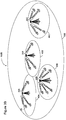
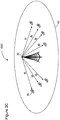
- Figures 3A and 3B illustrate possible uplink transmissions and Figure 3C shows the downlink transmission for this embodiment.
- a cellular neighborhood 150A consists of four cells 40A, 40B, 40C, and 40D (collectively, “cell(s)s 40"), each of which is provided by a single respective eNB 30A, 30B, 30C, and 30D (collectively, "eNB(s) 30") as well as one or more UEs 20.
- the eNB 30A of cell 40A configures xPRACH sequence A for the purpose of triggering transmission of SI for cell 40A for any one or all of the UEs 20 in its cell; similarly, the eNB 30B of cell 40B configures xPRACH sequence B for the purpose of triggering transmission of SI for cell 40B, the eNB 30C of cell 40C configures xPRACH sequence C for the purpose of triggering transmission of SI for cell 40C, and the eNB 30D of cell 40D configures xPRACH sequence D for the purpose of triggering transmission of SI for cell 40D.
- any one of the UEs 20 in a given cell may transmit the cell-specific sequence (that is, the random access preamble signature used for SI acquisition, as illustrated in step 80 of Figure 2 ). Only one UE 20 in each cell 40 transmits the appropriate sequence, and the eNB 30 will subsequently transmit downlink SI information.
- the cell-specific sequence that is, the random access preamble signature used for SI acquisition, as illustrated in step 80 of Figure 2 .
- the cellular neighborhood 150B is actually the same cellular neighborhood as in Figure 3A , but this time cells 40A - 40D with respective eNBs 30A - 30D constitute a cell group 40E.
- each eNB 30 in the cellular neighborhood configures the same xPRACH sequence, sequence E, for the purpose of triggering transmission of SI of a respective cell 40.
- sequence E for the purpose of triggering transmission of SI of a respective cell 40.
- the eNBs 30 of Figure 3B are coordinated as a single cell group, thus enabling the same sequence to be used throughout the cell group.
- One UE 20 transmitting the sequence designated for the entire cell group 40E and one eNB from the cell group transmitting the SI information is sufficient.
- Figure 3C shows that, whether coordinated by cell or cell group, the eNB 30 transmits the same system information to all UEs 20 within the cell 40.
- Embodiment 2 Returning to Figure 1 , in one embodiment of the LOSIA method 100, the UE randomly selects a random access sequence from a set of predefined sequences known to both the UE and the eNB. When the eNB receiver detects this randomly selected sequence from any UE in its cell, the eNB subsequently transmits system information in the downlink, but this time, the information will be dedicated to the requesting UE, as described below.
- the set of known sequences to be selected by the UE can be dedicated for the LOSIA method 100, or, alternatively, can be the same set of sequences used for other random access procedures, such as those used to obtain uplink synchronization or to send a Scheduling Request (SR).
- SR Scheduling Request
- the SI information may be transmitted "UE-specifically" and this feature is utilized in the second embodiment.
- a feature may be desired in a cellular environment populated with UEs having different capabilities.
- one UE may be an inexpensive phone with limited capabilities while another UE may be a feature rich smartphone.
- This embodiment enables the eNB to tailor the type of system information transmitted to each UE.
- a cell 40 includes an eNB 30 and several UEs 20.
- Each UE randomly selects from a lookup table 44 of predefined sequences, denoted sequence F, G, H,..., Z, with the number of predefined sequences in the lookup table 44 being configurable or fixed.
- each UE 20 randomly selects a different sequence to transmit via the xPRACH channel to the eNB 30.
- the eNB 30 is able to uniquely identify each UE.
- FIG 4B is a flow diagram including operations performed in the second embodiment.
- the UE 20 makes a random selection from the available predefined sequences known to both the UE and the eNB 30 (block 202), such as from the lookup table 44.
- the selected sequence is transmitted, as random access preamble signature (see Figure 2 , step 80) from the UE 20 to the eNB 30 using the xPRACH channel (block 204).
- the eNB 30 detects the transmitted sequence (block 206). If more than one UE 20 transmitted the same sequence (block 208), the eNB 30 will perform contention resolution before further transmissions take place (block 210). Since the UE has randomly chosen the initial sequence from a set of predefined sequences, if multiple UEs simultaneously choose the same sequence, before the eNB 30 can transmit the UE-specific SI, this intermediate contention resolution step resolves the conflict.
- the eNB 30 Upon successful detection of the UE's xPRACH transmission (and/or contention resolution), the eNB 30 sends a Random Access Response (RAR) in a predefined RAR time window, rather than the system information itself, to the UE 20 (block 212).
- the RAR message contains at least 1) the identity of the detected preamble, 2) a timing alignment instruction for subsequent synchronous uplink transmission, and 3) an UL grant for the UE to transmit the next message in the uplink (block 214).
- the RAR assigns a unique identifier to the UE 20, e.g., a Cell Radio Network Temporary Identifier (C-RNTI) (block 216).
- C-RNTI Cell Radio Network Temporary Identifier
- the C-RNTI one dedicated to each UE 20 that has initiated communication with the eNB 30, replaces the randomly selected sequence as the identifier, e.g., it is a unique tag that remains associated with the UE as long as the UE is connected to the cellular network.
- the UE 20 instructs the eNB to transmit the remaining system information, using the UL grant in the RAR (block 218).
- the eNB 30 transmits UE-specific SI to the UE 20 (block 220).
- the UE retrieves the SI from the xPDCCH and xPDSCH channels (step 90 of Figure 2 ).
- the UE 20 retrieves the UE-specific SI (step 220) by monitoring a common or UE-specific search space for the xPDCCH with the CRC scrambled by the C-RNTI. Since the UE is not assigned the unique identifier, C-RNTI, until after contention resolution, in some embodiments, a random access RNTI (RA-RNTI) is used to scramble the CRC of the xPDCCH scheduling the RAR (step 212).
- RA-RNTI random access RNTI
- a unique identifier can be used to schedule the SI transmission in the downlink.
- the UE transmits the random access preamble sequence using the xPRACH channel (block 252).
- the eNB scrambles the CRC of the xPDCCH scheduling the SI transmission using a unique SI Radio Network Temporary Identifier (SI-RNTI) (block 254).
- SI-RNTI SI Radio Network Temporary Identifier
- the UE monitors the common search space (block 256) for an xPDCCH with CRC scrambled by the SI-RNTI (block 258). If one is detected, the UE then uses the Downlink Control Information (DCI) contained in this xPDCCH to decode the SI in the xPDSCH (block 260).
- DCI Downlink Control Information
- the eNB 30 transmits the system information using the xPDCCH (as in step 90 of Figure 2 ) and scrambles the CRC of the xPDCCH using SI-RNTI.
- UE 20A monitors the common and/or UE-specific search space for an xPDCCH that use the SI-RNTI to scramble the CRC.
- the SI is broadcast to all UEs in the cell 40 (or cell group as the case may be)
- only the UE 20A receives the system information (successful receipt is indicated with thick arrow).
- the UE instead monitors the common or UE-specific search space for an xPDCCH with CRC scrambled by the C-RNTI. Since the UE is not assigned a unique identifier until after contention resolution, a random access RNTI (RA-RNTI) is used to scramble the CRC of the xPDCCH scheduling the RAR.
- RA-RNTI random access RNTI
- Embodiment 3 Returning to Figure 1 , in one embodiment of the LOSIA method 100, different sequences are dedicated to trigger different types of SI transmissions from the eNB, either by specification or by broadcasting such information in the xSIB1.
- Figures 6A and 6B illustrate this embodiment.
- Figure 6A depicts an example of a flexible xRAT design with different partitions for different services and applications. Services may, for example, be divided into mission-critical MTC (Machine-Type Communications), massive MTC, and mobile broadband.
- Mission-critical MTC may include UEs in automobiles that communicate with one another, UEs that operate a power grid for a community, and so on, services in which very high reliability and low latency (delay) are desired.
- Massive MTC may include what is known in industry parlance as the Internet of Things (IoT), such as a home in which every appliance features a UE (e.g., the coffee maker, the toaster, the refrigerator). Because these are not critical services, they are characterized by "best effort" reliability and can successfully operate even with a large latency.
- IoT Internet of Things
- Mobile broadband which includes making and receiving voice calls, viewing and downloading video, and so on, is another service or application category.
- a short-TTI (Transmission Time Interval) partition may be reserved for mission critical MTC (Machine-Type Communications) services, a long-TTI partition for massive MTC services, and a normal TTI partition for mobile broadband services.
- the coarse time and frequency synchronization (step 50) and the bandwidth (step 60) are supplied by the eNB to any UE wanting to connect to the network.
- the eNB By partitioning the spectrum into different sections, and dedicating those sections to different UE service and application categories, each UE knows which section or partition of the time/frequency domain to access for receiving system information.
- the partitioning shown in Figure 6A is just one example of how the time/frequency domain may be allocated and other UE service or application categories may be defined.
- the different sequences dedicated to trigger SI transmissions from the eNB can be linked to these different partitions. Consequently, a UE can trigger SI acquisition (i.e., transmission of SI information by the eNB) for a given partition (in other words, service or application) by employing the associated sequence in its xPRACH transmission sent as a trigger.
- SI acquisition i.e., transmission of SI information by the eNB
- partition in other words, service or application
- the SI transmission by the eNB is not UE-specific but service-specific or RAT-specific.
- Figure 6B illustrates the operations of the LOSIA method 100, according to some embodiments.
- the eNB provides the sequences for different services or applications in the xSIB message(s) (step 70 of Figure 2 ) to each UE.
- the sequences for different services or applications are predefined and thus known to each UE.
- the UE selects the appropriate sequence (block 302) for services and applications it provides and transmits the sequence using the xPRACH channel (block 304).
- the eNB detects the xPRACH transmission by the UE (block 306).
- the eNB determines which service category of UE sent the xPRACH transmission. If a mission-critical MTC UE sent the sequence (block 308), the appropriate mission-critical MTC system information is broadcast (block 310). If a massive MTC UE sent the sequence (block 312), massive MTC system information is broadcast by the eNB (block 314). If a mobile broadband UE sent the sequence, mobile broadband system information is broadcast (block 316). Because the mobile broadband UE may be feature rich with multiple services, its SI information is more extensive than for the massive MTC UE, which may only perform one or two operations (e.g., indicate that the toast is done if the UE is used in a toaster).
- different sequences reserved to trigger SI transmissions from the eNB can be linked to different air interfaces.
- one xPRACH sequence can be linked to Device-to-Device (D2D) communications while another xPRACH sequence may be linked to relay communications.
- D2D Device-to-Device
- Embodiment 4 Returning to Figure 1 , in one embodiment of the LOSIA method 100, dedicated xPRACH sequence(s) may be transmitted less frequently compared to xPRACH sequences for uplink synchronization.
- the xPRACH transmission instances used for SI transmission triggering can be predefined or configured by higher layers via MIB, SIBs, or dedicated RRC signaling.
- N OFFSET,PRACH and PRACH PERIODICITY are defined by the parameter I PRACH , which is given in Table 1. Note that other values of I PRACH , N OFFSET,PRACH , and PRACH PERIODICITY can be extended from the examples as shown in Table 1. Table 1. xPRACH periodicity and subframe offset configuration xPRACH configuration index I PRACH xPRACH periodicity PRACH PERIODICITY (ms) xPRACH subframe offset N OFFSET,PRACH 0 - 4 5 I PRACH 5 - 14 10 I PRACH - 5 15 - 34 20 I PRACH - 15 35 - 74 40 I PRACH - 35 75 - 154 80 I PRACH - 75
- UEs assigned xPRACH configuration index I PRACH 0 - 4 will have a periodicity, PRACH PERIODICITY of 5ms with a subframe offset N OFFSET,PRACH of I PRACH (0 - 4) while UEs assigned xPRACH configuration index I PRACH 5 - 14 will have a periodicity of 10 ms with a subframe offset I PRACH - 5 (0 - 9), and so on.
- This embodiment enables the eNB to "listen" for xPRACH transmissions from a UE in a specific time and frequency resource, rather than having to monitor all the time.
- each cell (eNB) may be assigned a different subframe for monitoring xPRACH transmissions.
- Embodiment 5 Returning to Figure 1 , in one embodiment of the LOSIA method 100, dedicated time/frequency resources are reserved for xPRACH transmissions triggering SI acquisition. In one example, a dedicated frequency resource is allocated for xPRACH to trigger SI transmission. When UE transmits the xPRACH signal in this dedicated frequency resource, eNB will transmit the SI upon successful detection of the xPRACH signal.
- a dedicated time resource is allocated for xPRACH to trigger SI transmission.
- xPRACH used to trigger SI transmission can be transmitted in subframe 0, 2, 4, 6, 8, within a single frame while xPRACH used for uplink synchronization can be transmitted in subframe 1, 3, 5, 7, 9 within a single frame.
- TDM time-division multiplexing
- FDM frequency-division multiplexing
- CDM code-division multiplexing
- the xPRACH channel is also used by the UE for uplink synchronization, to make a scheduling request, to make an RRC connection setup request, and to perform other tasks.
- the UE sends the xPRACH to trigger common or service/RAT-specific SI acquisition (that is, not UE-specific SI acquisition)
- the communication for SI acquisition is broadcast or multicast in nature.
- the eNB assigns a C-RNTI to the UE (e.g., embodiment 2)
- the SI acquisition procedure is unicast in nature.
- the eNB may not estimate the timing advance from the xPRACH transmission and may not respond to the xPRACH with a timing advance assignment or uplink grant. This significantly decreases eNB receiver and scheduler complexity, as the eNB merely detects the sequence transmitted on the xPRACH that triggers the SI transmission.
- the detection performance at the eNB is improved due to macro diversity.
- An example of macro diversity is when the transmission from one UE is blocked (such as by a building) but the eNB nevertheless receives the transmission from another UE, resulting in transmission of triggered SI.
- the LOSIA method 100 employs both macro diversity and SFN to improve detection performance.
- the UE since the UE does not send the xPRACH to connect to a cell - but rather to obtain SI - multiple eNBs can detect the xPRACH transmission and can jointly transmit the SI in an SFN fashion, assuming the backhaul and coordination capabilities of the network controlling these eNBs allow for such processing.
- multiple UEs may transmit the same sequence to each cell or cell group.
- the cell group may be made up of a single macro eNB and several small cell eNBs, with the smaller cells helping to improve coverage or boost capacity. From the perspective of the UE, multiple eNBs may look like a single cell.
- the network could dynamically decide which eNB of the plurality of eNBs receiving the xPRACH can transmit the SI. This gives rise to a "cell-less" RRC_IDLE state since the UE is not camping on a given cell of a given eNB.
- the LOSIA method 100 may define the eNB that receives the xPRACH with the strongest received power as the one to transmit the SI.
- Figure 7 illustrates the SI transmission window in response to the xPRACH transmission by the UE, according to some embodiments.
- the UE can start to monitor for SI transmission three subframes after the xPRACH transmission.
- the xPRACH uplink transmission takes place in the third subframe while the eNB sends the xPDCCH and xPDSCH channels in the eleventh subframe.
- the window size is configured in an SI-ResponseWindowSize information element (IE), where a range of 0 - 10 subframes is indicated.
- IE SI-ResponseWindowSize information element
- independent xPRACH sequences may be used to trigger the SI transmission for different applications, partitions, or services.
- different Radio Network Temporary Identifiers may be considered.
- an SI-D2D-RNTI and SI-MTC-RNTI may be defined for SI transmission of the D2D and MTC applications, respectively.
- UEs with D2D capability would decode xPDCCHs with CRC scrambled by SI-D2D-RNTI and the corresponding xPDSCH for D2D SI transmission, whereby the scrambling initialization of xPDSCH is by the SI-D2D-RNTI.
- the UE As part of its Radio Resource Management (RRM) procedures, the UE continuously and periodically performs RRM measurements. If the RRM procedures indicate that the UE is moving out of the coverage of one cell/transmission point and into the coverage of another (e.g., the relative strength of the Reference Signal Received Power (RSRP) changes in favor of a different cell/transmission point), the UE performs the steps outlined in Figure 2 to obtain the xPRACH configuration of the new, stronger cell and subsequently obtains the SI for the new cell.
- RRM Radio Resource Management
- Embodiment 6 Returning to Figure 1 , in one embodiment of the LOSIA method 100, the system information acquisition scheme operates in one of two modes to account for differences in network/traffic load. A flag updated by the eNB and available to all UEs, is used to discern between the two operating modes.
- the system information is periodically broadcasted at all times. This is very efficient when the load in the network is high, as UEs in RRC-IDLE mode can autonomously receive SI without network intervention. Only when moving from one tracking area to another does the UE send a PRACH to inform the network of its new tracking area. However, at times of low load and especially low mobility, the periodic and continuous transmission of SI is inefficient.
- UEs may not move between cells and may not have data to transmit or receive.
- UEs simply acquire SI with very long periodicity according to a defined timer, e.g., every three hours.
- the continuous and periodic transmission of SI every tens or hundreds of milliseconds by the eNB thus leads to enormous energy consumption at the eNB transmitter, during which no (or few) UEs are receiving the transmissions.
- the LOSIA method 100 thus enables the network to configure the eNBs to transmit SI differently, depending on the system load.
- the LOSIA method 100 addresses the energy consumption issue as illustrated in the flow diagram 350 of Figure 8 .
- the illustration is split into two parts, with a crescent moon shape indicating typical nighttime, namely, low network/traffic load behavior (fewer UE connections to the network) and a sun shape indicating typical daytime behavior, namely, medium to high network/traffic load (more UE connections to the network).
- the LOSIA method 100 envisions two modes of behavior, e.g., daytime (high load) mode and nighttime (low load) mode.
- the operations associated with the nighttime mode may nevertheless occur during the day and the operations associated with the daytime mode may occur during the night.
- the flow diagram 350 begins with the eNB broadcasting the xMIB/xSIB1 transmissions that enable the UE to access the network, as illustrated in steps 50, 60, and 70 of Figure 2 (block 352).
- a flag is consulted to determine whether the eNB is to operate in daytime mode or nighttime mode (block 354).
- the eNB broadcasts the flag (e.g., in the xMIB or the xSIB1) to indicate the current mode of SI transmission.
- the flag is set to FALSE (block 354) and legacy LTE procedures apply, that is, all xSIBs are periodically and continuously transmitted, and UEs can autonomously receive xSIB2 (block 362) and/or RRC_IDLE mode SI (block 364).
- the network sets the broadcasted flag to TRUE (block 354).
- the flag is set to TRUE (block 354) and procedures apply according to the embodiments herein, that is, xSIBs are transmitted (block 358) based on a trigger from a UE (block 356).
- the change in the flag value may not trigger all UEs to reacquire all SI. Instead, those UEs obtaining new access to the network or those updating their SI may simply check the xMIB/xSIB1 for the value of the flag.
- the eNB when changing the flag broadcasted in the xMIB/xSIB1, the eNB does not immediately cease transmission of all SI, but allows for some grace period where UEs currently decoding the SI have enough time to finish final SI acquisition.
- the network can either continue transmission of the triggered SI for a certain grace period as described above, or, alternatively, the network can let the triggered SI transmission occur at the same time/frequency resources as the periodic continuous ones, such that the change is transparent to the UE.
- the grace period addresses the fact that the eNB does not receive feedback from the UE once the UE has completed SI acquisition.
- the LOSIA method 100 employs a timer that is activated at the UE upon transmission of the xPRACH triggering SI acquisition and at the eNB upon successful reception of the aforementioned xPRACH. Note that the aforementioned timer may be different for the eNB and the UE. Until this timer expires, the eNB sends copies of the same SI messages in order to allow the aforementioned procedures using IR at the UE.
- the first triggered xSIB could contain a schedule to instruct the UE how to combine SI transmissions for IR, e.g., the concept of SI windows could be applied in a manner similar to that of the LTE specification.
- the eNB stops transmitting SI if the network is in the nighttime mode and no other xPRACH triggering SI transmission has been received. If the timer expires and the UE has not yet successfully decoded the SI, the UE repeats the procedure by sending another xPRACH to trigger another burst of SI transmissions from the eNB.
- the UE can transmit another xPRACH. This results in unnecessary xPRACH transmissions by the UE since SI information meanwhile has become continuous and periodic from the eNB.
- the UE can check the flag in the xMIB/xSIB1 before sending another xPRACH to trigger SI acquisition.
- the UE can either first check the xMIB/xSIB1 for the flag before resuming SI acquisition (in case the eNB has ceased periodic and continuous transmission of SI). Alternatively, the UE can simply assume that the eNB is still in the high load case and it is left to UE implementation when the UE checks for the flag to trigger SI transmission via an xPRACH, in case the mode has switched from high load to low load during the SI acquisition procedure at the UE.
- Embodiment 7 Returning to Figure 1 , in one embodiment of the LOSIA method 100, to improve robustness and latency of the SI acquisition, all SI for RRC connection setup are continuously and periodically transmitted whereas any of the aforementioned examples and embodiments only apply to the SI required for RRC_IDLE mode.
- the UEs essentially operate in one of three modes. They are either off, in which case the network has no access to the UE, they are actively being used (connected mode), or they are connected to the network but not in use (idle mode). When in idle mode, the network nevertheless may be able to access the UE, such as when the UE receives a voice call, a text message, and so on.
- the SI namely, the SI for RRC connection setup
- the majority of SI which applies to RRC_IDLE mode only, is transmitted on demand, in some embodiments. Since the RRC_IDLE mode generally is more tolerant to delay, the majority of energy savings can be retained without sacrificing robustness or latency for delay-sensitive RRC connection setup procedures.
- Embodiment 8 Returning to Figure 1 , in one embodiment of the LOSIA method 100, the aforementioned flag broadcasted as part of the xMIB/xSIB1 ( Figure 8 ) is not set depending on the load but depending on other considerations.
- the communication link between the eNB and the UE might suffer from severe pathloss.
- This pathloss is generally overcome by employing analog (or RF or passband) beamforming at both the transmitter (Tx) and/or receiver (Rx) such that the equivalent channel, incorporating both the physical propagation channel as well as the Tx and Rx RF beamforming, has acceptable coupling losses between the transmitter and receiver.
- analog beamforming is generally UE-specific and requires extensive training. It may thus be beneficial to limit the amount of cell-specific transmissions (which are potentially omni-directional) and to transmit as much information as possible via dedicated unicast channels, which can benefit from the aforementioned analog beamforming.
- Figure 9 shows one such example of a millimeter-wave communications system.
- PSS, SSS, PBCH, as well as PDCCH and PDSCH associated with xSIB1 are sent by the eNB in a broadcast fashion.
- SFN SFN
- time domain repetition, or beam scanning techniques can be employed. This, however, results in a decrease of the spectral efficiency, since resources are being used repeatedly in frequency, time, and space, respectively.
- the eNB millimeter-wave transmitter can send the remaining SI using optimal (UE specific) analog beamformers, resulting in an increase of spectral efficiency.
- circuitry may refer to, be part of, or include an ASIC, an electronic circuit, a processor (shared, dedicated, or group), and/or memory (shared, dedicated, or group) that execute one or more software or firmware programs, a combinational logic circuit, and/or other suitable hardware components that provide the described functionality.
- the circuitry may be implemented in, or functions associated with the circuitry may be implemented by, one or more software or firmware modules.
- circuitry may include logic, at least partially operable in hardware.
- FIG. 10 illustrates, for one embodiment, example components of a User Equipment (UE) device 800.
- the UE device 800 may include application circuitry 802, baseband circuitry 804, Radio Frequency (RF) circuitry 806, front-end module (FEM) circuitry 808 and one or more antennas 810, coupled together at least as shown.
- RF Radio Frequency
- FEM front-end module
- the application circuitry 802 may include one or more application processors.
- the application circuitry 802 may include circuitry such as, but not limited to, one or more single-core or multi-core processors.
- the processor(s) may include any combination of general-purpose processors and dedicated processors (e.g., graphics processors, application processors, etc.).
- the processors may be coupled with and/or may include a storage medium 812 or other type of memory/storage and may be configured to execute instructions stored in the memory/storage to enable various applications and/or operating systems to run on the system.
- the baseband circuitry 804 may include circuitry such as, but not limited to, one or more single-core or multi-core processors.
- the baseband circuitry 804 may include one or more baseband processors and/or control logic to process baseband signals received from a receive signal path of the RF circuitry 806 and to generate baseband signals for a transmit signal path of the RF circuitry 806.
- Baseband processing circuitry 804 may interface with the application circuitry 802 for generation and processing of the baseband signals and for controlling operations of the RF circuitry 806.
- the baseband circuitry 804 may include a second generation (2G) baseband processor 804A, third generation (3G) baseband processor 804B, fourth generation (4G) baseband processor 804C, a fifth generation (5G) baseband processor 804D, and/or other baseband processor(s) 804E for other existing generations, generations in development, or to be developed in the future (e.g., sixth generation (6G), etc.).
- the baseband circuitry 804 e.g., one or more of baseband processors 804A - E
- the radio control functions may include, but are not limited to, signal modulation/demodulation, encoding/decoding, radio frequency shifting, etc.
- modulation/demodulation circuitry of the baseband circuitry 804 may include Fast-Fourier Transform (FFT), precoding, and/or constellation mapping/demapping functionality.
- encoding/decoding circuitry of the baseband circuitry 804 may include convolution, tail-biting convolution, turbo, Viterbi, and/or Low Density Parity Check (LDPC) encoder/decoder functionality.
- FFT Fast-Fourier Transform
- encoding/decoding circuitry of the baseband circuitry 804 may include convolution, tail-biting convolution, turbo, Viterbi, and/or Low Density Parity Check (LDPC) encoder/decoder functionality.
- LDPC Low Density Parity Check
- the baseband circuitry 804 may include elements of a protocol stack such as, for example, elements of an EUTRAN protocol including, for example, physical (PHY), media access control (MAC), radio link control (RLC), packet data convergence protocol (PDCP), and/or radio resource control (RRC) elements.
- a central processing unit (CPU) 804G of the baseband circuitry 804 may be configured to run elements of the protocol stack for signaling of the PHY, MAC, RLC, PDCP, and/or RRC layers.
- the baseband circuitry may include one or more audio digital signal processor(s) (DSP) 804F.
- DSP digital signal processor
- the audio DSP(s) 804F may include elements for compression/decompression and echo cancellation and may include other suitable processing elements in other embodiments.
- Components of the baseband circuitry may be suitably combined in a single chip, a single chipset, or disposed on a same circuit board in some embodiments.
- some or all of the constituent components of the baseband circuitry 804 and the application circuitry 802 may be implemented together such as, for example, on a system on a chip (SOC).
- SOC system on a chip
- the baseband circuitry 804 may provide for communication compatible with one or more radio technologies.
- the baseband circuitry 804 may support communication with an EUTRAN and/or other wireless metropolitan area networks (WMAN), a wireless local area network (WLAN), or a wireless personal area network (WPAN).
- WMAN wireless metropolitan area networks
- WLAN wireless local area network
- WPAN wireless personal area network
- Embodiments in which the baseband circuitry 804 is configured to support radio communications of more than one wireless protocol may be referred to as multi-mode baseband circuitry.
- RF circuitry 806 may enable communication with wireless networks using modulated electromagnetic radiation through a non-solid medium.
- the RF circuitry 806 may include switches, filters, amplifiers, etc., to facilitate the communication with the wireless network.
- RF circuitry 806 may include a receive signal path which may include circuitry to down-convert RF signals received from the FEM circuitry 808 and provide baseband signals to the baseband circuitry 804.
- RF circuitry 806 may also include a transmit signal path which may include circuitry to up-convert baseband signals provided by the baseband circuitry 804 and provide RF output signals to the FEM circuitry 808 for transmission.
- the RF circuitry 806 may include a receive signal path and a transmit signal path.
- the receive signal path of the RF circuitry 806 may include mixer circuitry 806A, amplifier circuitry 806B and filter circuitry 806C.
- the transmit signal path of the RF circuitry 806 may include filter circuitry 806C and mixer circuitry 806A.
- RF circuitry 806 may also include synthesizer circuitry 806D for synthesizing a frequency for use by the mixer circuitry 806A of the receive signal path and the transmit signal path.
- the mixer circuitry 806A of the receive signal path may be configured to down-convert RF signals received from the FEM circuitry 808 based on the synthesized frequency provided by synthesizer circuitry 806D.
- the amplifier circuitry 806B may be configured to amplify the down-converted signals and the filter circuitry 806C may be a low-pass filter (LPF) or band-pass filter (BPF) configured to remove unwanted signals from the down-converted signals to generate output baseband signals.
- Output baseband signals may be provided to the baseband circuitry 804 for further processing.
- the output baseband signals may be zero-frequency baseband signals, although this is not a requirement.
- mixer circuitry 806A of the receive signal path may comprise passive mixers, although the scope of the embodiments is not limited in this respect.
- the mixer circuitry 806A of the transmit signal path may be configured to up-convert input baseband signals based on the synthesized frequency provided by the synthesizer circuitry 806D to generate RF output signals for the FEM circuitry 808.
- the baseband signals may be provided by the baseband circuitry 804 and may be filtered by filter circuitry 806C.
- the filter circuitry 806C may include a low-pass filter (LPF), although the scope of the embodiments is not limited in this respect.
- the mixer circuitry 806A of the receive signal path and the mixer circuitry 806A of the transmit signal path may include two or more mixers and may be arranged for quadrature downconversion and/or upconversion, respectively.
- the mixer circuitry 806A of the receive signal path and the mixer circuitry 806A of the transmit signal path may include two or more mixers and may be arranged for image rejection (e.g., Hartley image rejection).
- the mixer circuitry 806A of the receive signal path and the mixer circuitry may be arranged for direct downconversion and/or direct upconversion, respectively.
- the mixer circuitry 806A of the receive signal path and the mixer circuitry of the transmit signal path may be configured for super-heterodyne operation.
- the output baseband signals and the input baseband signals may be analog baseband signals, although the scope of the embodiments is not limited in this respect.
- the output baseband signals and the input baseband signals may be digital baseband signals.
- the RF circuitry 806 may include analog-to-digital converter (ADC) and digital-to-analog converter (DAC) circuitry and the baseband circuitry 804 may include a digital baseband interface to communicate with the RF circuitry 806.
- ADC analog-to-digital converter
- DAC digital-to-analog converter
- a separate radio IC circuitry may be provided for processing signals for each spectrum, although the scope of the embodiments is not limited in this respect.
- the synthesizer circuitry 806D may be a fractional-N synthesizer or a fractional N/N+1 synthesizer, although the scope of the embodiments is not limited in this respect as other types of frequency synthesizers may be suitable.
- synthesizer circuitry 806D may be a delta-sigma synthesizer, a frequency multiplier, or a synthesizer comprising a phase-locked loop with a frequency divider.
- the synthesizer circuitry 806D may be configured to synthesize an output frequency for use by the mixer circuitry 806A of the RF circuitry 806 based on a frequency input and a divider control input. In some embodiments, the synthesizer circuitry 806D may be a fractional N/N+1 synthesizer.
- frequency input may be provided by a voltage controlled oscillator (VCO), although that is not a requirement.
- VCO voltage controlled oscillator
- Divider control input may be provided by either the baseband circuitry 804 or the applications processor 802 depending on the desired output frequency.
- a divider control input (e.g., N) may be determined from a look-up table based on a channel indicated by the applications processor 802.
- Synthesizer circuitry 806D of the RF circuitry 806 may include a divider, a delay-locked loop (DLL), a multiplexer, and a phase accumulator.
- the divider may be a dual modulus divider (DMD) and the phase accumulator may be a digital phase accumulator (DPA).
- the DMD may be configured to divide the input signal by either N or N+1 (e.g., based on a carry out) to provide a fractional division ratio.
- the DLL may include a set of cascaded, tunable, delay elements, a phase detector, a charge pump, and a D-type flip-flop.
- the delay elements may be configured to break a VCO period up into N d equal packets of phase, where N d is the number of delay elements in the delay line.
- N d is the number of delay elements in the delay line.
- synthesizer circuitry 806D may be configured to generate a carrier frequency as the output frequency, while in other embodiments, the output frequency may be a multiple of the carrier frequency (e.g., twice the carrier frequency, four times the carrier frequency), and used in conjunction with quadrature generator and divider circuitry to generate multiple signals at the carrier frequency with multiple different phases with respect to each other.
- the output frequency may be a LO frequency (f LO ).
- the RF circuitry 806 may include an IQ/polar converter.
- FEM circuitry 808 may include a receive signal path which may include circuitry configured to operate on RF signals received from one or more antennas 810, amplify the received signals and provide the amplified versions of the received signals to the RF circuitry 806 for further processing.
- FEM circuitry 808 may also include a transmit signal path which may include circuitry configured to amplify signals for transmission provided by the RF circuitry 806 for transmission by one or more of the one or more antennas 810.
- the FEM circuitry 808 may include a TX/RX switch to switch between transmit mode and receive mode operation.
- the FEM circuitry may include a receive signal path and a transmit signal path.
- the receive signal path of the FEM circuitry may include a low-noise amplifier (LNA) to amplify received RF signals and provide the amplified received RF signals as an output (e.g., to the RF circuitry 806).
- the transmit signal path of the FEM circuitry 808 may include a power amplifier (PA) to amplify input RF signals (e.g., provided by RF circuitry 806), and one or more filters to generate RF signals for subsequent transmission (e.g., by one or more of the one or more antennas 810.
- PA power amplifier
- the UE device 800 may include additional elements such as, for example, memory/storage, display, camera, sensor, and/or input/output (I/O) interface.
- additional elements such as, for example, memory/storage, display, camera, sensor, and/or input/output (I/O) interface.
- the LOSIA method 100 may be implemented by a user equipment (UE) in a first example occupying a Radio Access Network (RAN), the UE to initiate a cell search of the RAN to decode a limited set of system information (SI), transmit a preamble/sequence to a RAN base station transceiver, wherein the preamble/sequence indicates a request for additional SI, and monitor for transmission of the additional SI in the RAN.
- UE user equipment
- RAN base station transceiver wherein the preamble/sequence indicates a request for additional SI
- monitor for transmission of the additional SI in the RAN monitor for transmission of the additional SI in the RAN.
Landscapes
- Engineering & Computer Science (AREA)
- Computer Networks & Wireless Communication (AREA)
- Signal Processing (AREA)
- Computer Security & Cryptography (AREA)
- Mobile Radio Communication Systems (AREA)
Claims (13)
- Un équipement utilisateur, UE, occupant un réseau d'accès radio, RAN, l'UE étant configuré pour :commencer une recherche de cellule du RAN pour décoder un ensemble limité d'informations système, SI ;sélectionner aléatoirement un préambule/séquence dans un ensemble de préambules/séquences prédéfinis, et transmettre le préambule/séquence sélectionné à un émetteur/récepteur de station de base de RAN, le préambule/séquence indiquant une requête de SI additionnelles, la transmission du préambule/séquence déclenchant les SI additionnelles associées à un identifiant, l'identifiant étant un identifiant temporaire de réseau radio cellulaire, C-RNTI, dédié à l'UE ;surveiller la transmission des SI additionnelles dans le RAN ; etdécoder les SI additionnelles, les SI additionnelles étant spécifiques à l'UE par rapport à d'autres UE opérant dans le RAN, et l'UE étant ensuite capable de communiquer avec la station de base de RAN.
- L'UE de la revendication 1, dans lequel le préambule/séquence indique une requête d'envoi des informations système additionnelles pour un service ou une application prédéterminés.
- L'UE de la revendication 2, dans lequel l'UE est en outre configuré pour identifier l'association du préambule/séquence à partir de transmissions de SI diffusées en broadcast.
- L'UE de la revendication 1, dans lequel l'UE est en outre configuré pour transmettre le préambule/séquence dans une ressource fréquentielle dédiée.
- L'UE de la revendication 1, dans lequel l'UE est en outre configuré pour transmettre le préambule/séquence dans une ressource temporelle dédiée.
- L'UE de la revendication 1, dans lequel l'UE est en outre configuré pour recevoir les SI additionnelles en provenance d'une pluralité d'émetteurs/récepteurs de station de base.
- L'UE de la revendication 1, dans lequel l'UE est en outre configuré pour recevoir les SI additionnelles dans une fenêtre temporelle prédéfinie.
- L'UE de la revendication 1, dans lequel l'UE est configuré pour, en outre :
vérifier un drapeau diffusé en broadcast, le drapeau indiquant si les SI additionnelles sont périodiques ou bien déclenchées. - L'UE de la revendication 1, dans lequel l'UE est configuré pour, en outre :démarrer une temporisation sur transmission du préambule/séquence ; etretransmettre le préambule/séquence si les SI additionnelles n'ont pas été décodées par l'UE à l'expiration de la temporisation.
- Une station de base, BS, occupant un réseau d'accès radio, RAN, la BS étant configurée pour :transmettre un ensemble limité d'informations système, SI, d'une manière périodique ; ettransmettre des SI additionnelles sur réception d'un ou plusieurs préambules/séquences, les SI additionnelles n'étant pas transmises de façon continue et périodique, la transmission des SI additionnelles étant associée à un identifiant, l'identifiant étant un identifiant temporaire de réseau radio cellulaire, C-RNTI, dédié à un UE opérant dans le RAN, et les SI additionnelles étant spécifiques à l'UE par rapport à d'autres UE opérant dans le RAN.
- La BS de la revendication 10, dans laquelle la BS est configurée pour, en outre :
diffuser en broadcast (352) un drapeau, le drapeau indiquant si les SI additionnelles sont ou non transmises de façon continue et périodique. - La BS de la revendication 10, configurée en outre pour :recevoir un second préambule/séquence en provenance d'un second UE, le second préambule/séquence étant identique au préambule/séquence ; etexécuter une procédure de résolution des conflits pour distinguer l'UE du second UE.
- Un article comprenant un support lisible par calculateur comprenant des instructions pour faire en sorte qu'un dispositif électronique, sur exécution d'instructions par un ou plusieurs processeurs du dispositif électronique, matérialise un dispositif tel que revendiqué dans l'une des revendications précédentes.
Applications Claiming Priority (2)
| Application Number | Priority Date | Filing Date | Title |
|---|---|---|---|
| US201562174140P | 2015-06-11 | 2015-06-11 | |
| PCT/IB2015/002621 WO2016198909A1 (fr) | 2015-06-11 | 2015-12-24 | Acquisition d'informations de système à faible surcharge pour une communication sans fil |
Publications (2)
| Publication Number | Publication Date |
|---|---|
| EP3308580A1 EP3308580A1 (fr) | 2018-04-18 |
| EP3308580B1 true EP3308580B1 (fr) | 2020-03-25 |
Family
ID=55754330
Family Applications (1)
| Application Number | Title | Priority Date | Filing Date |
|---|---|---|---|
| EP15851634.4A Active EP3308580B1 (fr) | 2015-06-11 | 2015-12-24 | Acquisition d'informations de système à faible surcharge pour une communication sans fil |
Country Status (5)
| Country | Link |
|---|---|
| US (2) | US10708853B2 (fr) |
| EP (1) | EP3308580B1 (fr) |
| KR (1) | KR102399944B1 (fr) |
| CN (2) | CN107624255B (fr) |
| WO (1) | WO2016198909A1 (fr) |
Families Citing this family (56)
| Publication number | Priority date | Publication date | Assignee | Title |
|---|---|---|---|---|
| CN106341896B (zh) * | 2015-07-07 | 2020-01-24 | 电信科学技术研究院 | 一种数据传输方法和设备、系统 |
| JP6525104B2 (ja) * | 2015-08-19 | 2019-06-05 | 富士通株式会社 | 複数種類の伝送時間間隔をサポートするランダムアクセス方法、装置及び通信システム |
| CN106686693B (zh) * | 2015-11-06 | 2020-05-01 | 中国移动通信集团公司 | 一种系统信息的传输方法和设备 |
| WO2017081800A1 (fr) * | 2015-11-12 | 2017-05-18 | 富士通株式会社 | Dispositif terminal, dispositif de station de base, système de communication sans fil et procédé de communication sans fil |
| EP3383081B1 (fr) * | 2015-12-31 | 2020-08-19 | Huawei Technologies Co., Ltd. | Procédé de transmission d'informations système, station de base et équipement utilisateur |
| US11540320B2 (en) | 2016-01-15 | 2022-12-27 | Ntt Docomo, Inc. | User terminal, radio base station and radio communication method |
| CN114126003B (zh) * | 2016-02-04 | 2024-10-29 | 夏普株式会社 | 终端装置、基站装置、通信方法以及集成电路 |
| JP2019057749A (ja) * | 2016-02-04 | 2019-04-11 | シャープ株式会社 | 端末装置、基地局装置、通信方法、および、集積回路 |
| US10616869B2 (en) * | 2016-02-12 | 2020-04-07 | Qualcomm Incorporated | Uplink channel design for slot-based transmission time interval (TTI) |
| EP3409048B1 (fr) * | 2016-02-29 | 2020-12-02 | Samsung Electronics Co., Ltd. | Appareil et procédé de signalisation d'informations de système |
| ES2878125T3 (es) * | 2016-06-24 | 2021-11-18 | Guangdong Oppo Mobile Telecommunications Corp Ltd | Método y dispositivo de transmisión de información |
| CN107734684B (zh) * | 2016-08-12 | 2023-06-30 | 华为技术有限公司 | 一种系统信息发送方法及装置 |
| US10506640B2 (en) * | 2016-12-21 | 2019-12-10 | Htc Corporation | Device and method of handling system information |
| KR102531880B1 (ko) | 2016-12-22 | 2023-05-12 | 한국전자통신연구원 | 통신 네트워크에서 시스템 정보를 전송하는 통신 노드의 동작 방법 |
| WO2018117677A1 (fr) * | 2016-12-22 | 2018-06-28 | 한국전자통신연구원 | Procédé de fonctionnement pour un nœud de communication transmettant des informations système dans un réseau de communication |
| CN108235446A (zh) * | 2016-12-22 | 2018-06-29 | 夏普株式会社 | 用户设备和相关方法 |
| CN113365261B (zh) | 2017-01-05 | 2024-12-10 | 日本电气株式会社 | 源无线接入网节点、无线终端及其方法 |
| US11012186B2 (en) | 2017-01-06 | 2021-05-18 | Idac Holdings, Inc. | Error check-based synchronization and broadcast channel |
| CN106792998B (zh) * | 2017-01-06 | 2020-03-20 | 展讯通信(上海)有限公司 | 一种系统信息的按需获取方法及装置 |
| US10798642B2 (en) | 2017-01-06 | 2020-10-06 | Mediatek Inc. | On-demand system information delivery procedure |
| CN108347757A (zh) * | 2017-01-24 | 2018-07-31 | 株式会社Ntt都科摩 | 按需处理方法、用户设备和基站 |
| BR112019007229B1 (pt) | 2017-02-01 | 2021-11-23 | Lg Electronics Inc. | Método e dispositivo para solicitar informações de sistema |
| JP6951458B2 (ja) * | 2017-03-20 | 2021-10-20 | オッポ広東移動通信有限公司Guangdong Oppo Mobile Telecommunications Corp., Ltd. | システム情報を伝送する方法、基地局及び端末 |
| US10834759B2 (en) | 2017-03-20 | 2020-11-10 | Motorola Mobility Llc | Feedback for a system information request |
| EP3379886A1 (fr) * | 2017-03-20 | 2018-09-26 | ASUSTek Computer Inc. | Procédé et appareil pour une procédure d'accès aléatoire d'une demande d'informations système dans un système de communication sans fil |
| WO2018175813A1 (fr) * | 2017-03-24 | 2018-09-27 | Intel IP Corporation | Suivi de signaux de référence pour une nouvelle radio |
| CN108632766B (zh) * | 2017-03-24 | 2019-11-22 | 电信科学技术研究院 | 一种系统信息发送、获取方法、基站及终端 |
| WO2018171801A1 (fr) | 2017-03-24 | 2018-09-27 | Mediatek Inc. | Appareils et procédés d'identification de faisceau au moyen du canal d'accès aléatoire physique (prach) et utilisation de ressource de canal prach efficace |
| WO2018171746A1 (fr) * | 2017-03-24 | 2018-09-27 | Mediatek Inc. | Appareils et procédés destinés à une demande d'informations de système à la demande (si) par l'intermédiaire d'une procédure d'accès aléatoire |
| CN110463274B (zh) * | 2017-03-31 | 2021-12-03 | 瑞典爱立信有限公司 | 用于管理由无线通信网络提供的系统信息的无线通信设备和方法 |
| WO2018191839A1 (fr) * | 2017-04-17 | 2018-10-25 | 北京小米移动软件有限公司 | Procédé utilisé pour demander des informations de système, appareil, équipement utilisateur et station de base |
| CN107223347B (zh) * | 2017-04-18 | 2020-09-11 | 北京小米移动软件有限公司 | 信息获取方法、装置及可读存储介质 |
| WO2018199647A1 (fr) * | 2017-04-26 | 2018-11-01 | Samsung Electronics Co., Ltd. | Procédé et appareil permettant d'exécuter une procédure d'accès aléatoire |
| AU2018258490B2 (en) * | 2017-04-28 | 2022-12-15 | FG Innovation Company Limited | Random access procedure(s) for radio system |
| WO2018203633A1 (fr) * | 2017-05-02 | 2018-11-08 | Lg Electronics Inc. | Procédé et appareil permettant d'obtenir des informations de système |
| WO2018204593A1 (fr) | 2017-05-03 | 2018-11-08 | Motorola Mobility Llc | Retour d'informations pour demande d'informations système |
| US12095565B2 (en) * | 2017-05-05 | 2024-09-17 | Hannibal Ip Llc | System information transmission method and wireless communication system |
| CN114697881B (zh) * | 2017-05-05 | 2023-11-17 | 摩托罗拉移动有限责任公司 | 用于系统信息的信令的方法和装置 |
| WO2018205095A1 (fr) * | 2017-05-08 | 2018-11-15 | 北京小米移动软件有限公司 | Procédé et appareil de configuration de ressource |
| US11570693B2 (en) * | 2017-05-11 | 2023-01-31 | Beijing Xiaomi Mobile Software Co., Ltd. | Method and apparatus for sending and receiving system information, and user equipment and base station |
| EP3416427A1 (fr) | 2017-06-16 | 2018-12-19 | Panasonic Intellectual Property Corporation of America | Équipement utilisateur et station de base participant à une procédure d'acquisition d'informations système |
| US10849106B2 (en) | 2017-08-10 | 2020-11-24 | Qualcomm Incorporated | Delivery of system information |
| JP7128896B6 (ja) | 2018-03-28 | 2022-10-04 | オッポ広東移動通信有限公司 | システム情報の取得方法、端末デバイス及びネットワークデバイス |
| CN111343728B (zh) * | 2018-05-04 | 2021-03-05 | 华为技术有限公司 | 通信方法,装置和可读存储介质 |
| US11252748B2 (en) * | 2018-05-07 | 2022-02-15 | Qualcomm Incorporated | System information for access and backhaul |
| US11006347B2 (en) * | 2018-05-07 | 2021-05-11 | Qualcomm Incorporated | Preventing user equipment that does not support cell-specific reference signal (CRS) muting from camping on CRS muted carriers |
| EP3567932A1 (fr) | 2018-05-10 | 2019-11-13 | Panasonic Intellectual Property Corporation of America | Acquisition d'informations système à la demande |
| CN110636578B (zh) * | 2018-06-21 | 2023-10-31 | 中兴通讯股份有限公司 | 一种请求系统消息的方法、装置、存储介质及终端 |
| CN112292888A (zh) * | 2018-06-25 | 2021-01-29 | Oppo广东移动通信有限公司 | 无线通信方法、网络设备和终端设备 |
| US11147093B2 (en) * | 2018-06-28 | 2021-10-12 | Qualcomm Incorporated | System information scheduling |
| JP7235851B2 (ja) * | 2019-03-27 | 2023-03-08 | 京セラ株式会社 | 通信制御方法 |
| CN112671439A (zh) | 2019-10-16 | 2021-04-16 | 上海华为技术有限公司 | 一种基于波束成形的通信方法和网络设备 |
| US11968065B1 (en) * | 2020-05-20 | 2024-04-23 | Marvell Asia Pte, Ltd. | Methods and apparatus for receiving a user message in a communication network |
| CN116438749A (zh) | 2020-11-12 | 2023-07-14 | 三星电子株式会社 | 用于处理无线信号的电子装置及其操作方法 |
| CN117692146A (zh) * | 2022-08-26 | 2024-03-12 | 维沃移动通信有限公司 | 系统信息消息接收方法、发送方法、终端及网络侧设备 |
| CN120434818A (zh) * | 2024-02-05 | 2025-08-05 | 维沃移动通信有限公司 | 信号传输方法、装置、终端及网络侧设备 |
Family Cites Families (21)
| Publication number | Priority date | Publication date | Assignee | Title |
|---|---|---|---|---|
| GB2447878A (en) * | 2006-10-04 | 2008-10-01 | Nec Corp | Signalling system information in mobile telecommunications |
| KR101384865B1 (ko) | 2007-01-09 | 2014-04-16 | 엘지전자 주식회사 | 충돌 해결을 위한 랜덤 액세스 방법 |
| CN101610098B (zh) * | 2008-06-19 | 2012-10-10 | 中兴通讯股份有限公司 | 系统消息接收方法及装置、系统消息发送装置 |
| CN101730258B (zh) * | 2008-10-27 | 2012-10-03 | 展讯通信(上海)有限公司 | 增强随机接入信道的接入方法及用户设备 |
| US20110237239A1 (en) * | 2010-03-25 | 2011-09-29 | Industrial Technology Research Institiute | Method and apparatus for selectively muting a control channel for a femtocell for interference avoidance |
| EP2384060B1 (fr) * | 2010-04-26 | 2016-12-21 | BlackBerry Limited | Appareil et procédé de recherche et de rapport de PLMN de réseaux mobiles terrestres publics dans un système de télécommunication mobile |
| US8902830B2 (en) * | 2010-12-28 | 2014-12-02 | Motorola Mobility Llc | Energy-saving base station and method |
| WO2012135998A1 (fr) * | 2011-04-04 | 2012-10-11 | Renesas Mobile Corporation | Procédures d'accès aléatoire avec programmation inter porteuses |
| CN102892198B (zh) * | 2011-07-20 | 2016-08-03 | 华为技术有限公司 | 数据传输方法、用户设备、接入点和网络系统 |
| CN102264150B (zh) * | 2011-08-01 | 2018-01-02 | 中兴通讯股份有限公司 | 载波聚合中的prach传输方法及装置 |
| KR101962245B1 (ko) * | 2011-09-23 | 2019-03-27 | 삼성전자 주식회사 | 광대역 단말과 협대역 단말을 함께 운용하는 무선통신시스템에서 협대역 단말의 시스템 접속 방법 및 장치 |
| US9112267B2 (en) * | 2011-10-11 | 2015-08-18 | Alcatel Lucent | Method of accessing a wireless network and a wireless device |
| WO2013068364A1 (fr) * | 2011-11-08 | 2013-05-16 | Koninklijke Kpn N.V. | Distribution d'informations systèmes dans un système de télécommunications à accès sans fil |
| EP2777330A1 (fr) * | 2011-11-08 | 2014-09-17 | Koninklijke KPN N.V. | Distribution d'informations systèmes dans un système de télécommunications à accès sans fil |
| CN110225570B (zh) * | 2011-11-08 | 2021-09-07 | 荷兰皇家Kpn电信集团 | 无线接入电信系统中的系统信息分配的方法、终端和小区 |
| CN103220652B (zh) * | 2012-01-21 | 2016-09-07 | 华为技术有限公司 | 系统信息更新方法及接入网设备、用户设备 |
| CN102595481A (zh) * | 2012-02-15 | 2012-07-18 | 新邮通信设备有限公司 | 载波聚合下定时参考小区的确定方法 |
| CN109327822B (zh) * | 2012-10-05 | 2022-10-25 | 交互数字专利控股公司 | 增强机器类型通信(mtc)设备覆盖的方法和装置 |
| WO2014126445A1 (fr) * | 2013-02-18 | 2014-08-21 | Lg Electronics Inc. | Procédé et appareil de mise en oeuvre d'une transmission de données dans un système de communication sans fil |
| WO2015012654A1 (fr) * | 2013-07-25 | 2015-01-29 | Lg Electronics Inc. | Procédé et appareil d'amélioration de couverture |
| WO2016153130A1 (fr) * | 2015-03-23 | 2016-09-29 | 엘지전자(주) | Procédé et dispositif pour transmettre ou recevoir des données par un terminal dans un système de communication sans fil |
-
2015
- 2015-12-24 EP EP15851634.4A patent/EP3308580B1/fr active Active
- 2015-12-24 CN CN201580079954.9A patent/CN107624255B/zh active Active
- 2015-12-24 US US15/571,332 patent/US10708853B2/en active Active
- 2015-12-24 CN CN202110437271.3A patent/CN113115406B/zh active Active
- 2015-12-24 KR KR1020177032482A patent/KR102399944B1/ko active Active
- 2015-12-24 WO PCT/IB2015/002621 patent/WO2016198909A1/fr not_active Ceased
-
2020
- 2020-07-06 US US16/921,272 patent/US11197235B2/en active Active
Non-Patent Citations (1)
| Title |
|---|
| None * |
Also Published As
| Publication number | Publication date |
|---|---|
| KR20180018492A (ko) | 2018-02-21 |
| US10708853B2 (en) | 2020-07-07 |
| CN113115406A (zh) | 2021-07-13 |
| CN113115406B (zh) | 2024-12-13 |
| US11197235B2 (en) | 2021-12-07 |
| US20200374781A1 (en) | 2020-11-26 |
| WO2016198909A1 (fr) | 2016-12-15 |
| HK1249330A1 (zh) | 2018-10-26 |
| CN107624255A (zh) | 2018-01-23 |
| KR102399944B1 (ko) | 2022-05-18 |
| EP3308580A1 (fr) | 2018-04-18 |
| CN107624255B (zh) | 2021-04-13 |
| US20180288683A1 (en) | 2018-10-04 |
Similar Documents
| Publication | Publication Date | Title |
|---|---|---|
| US11197235B2 (en) | Low overhead system information acquisition for wireless communication | |
| US12225517B2 (en) | Data and control channels in synchronization bursts for millimeter wave new radio | |
| CN114900280B (zh) | 用于峰均功率比降低的同步信号传输技术 | |
| US20200015316A1 (en) | Techniques for controlling timing of downstream nodes in wireless communications | |
| JP2024517895A (ja) | 低減された能力のデバイス用の電力節約 | |
| EP4664838A2 (fr) | Techniques d'attribution de blocs de ressources dans des communications sans fil | |
| EP4014618B1 (fr) | Techniques d'indication de capacités de transmission en liaison montante dans des communications sans fil | |
| EP4302559B1 (fr) | Indication de transmission de liaison descendante pour des occasions de rach | |
| US11728856B2 (en) | User equipment antenna panel distribution reporting | |
| US12549238B2 (en) | User equipment initiated panel status reporting | |
| US11974334B2 (en) | Bundle size configuration for demodulation reference signal bundling in case of uplink random access channel message repetition | |
| US12237963B2 (en) | Synchronization signal block patterns for higher subcarrier spacing | |
| US11777779B2 (en) | Dynamic symbol offset indication for search spaces | |
| HK1249330B (zh) | 系统信息获取的方法、装置和介质及其ue和基站 | |
| EP4285534A1 (fr) | Configuration de taille de faisceau pour groupage de signaux de référence de démodulation en cas de répétition de message de canal d'accès aléatoire de liaison montante |
Legal Events
| Date | Code | Title | Description |
|---|---|---|---|
| STAA | Information on the status of an ep patent application or granted ep patent |
Free format text: STATUS: THE INTERNATIONAL PUBLICATION HAS BEEN MADE |
|
| PUAI | Public reference made under article 153(3) epc to a published international application that has entered the european phase |
Free format text: ORIGINAL CODE: 0009012 |
|
| STAA | Information on the status of an ep patent application or granted ep patent |
Free format text: STATUS: REQUEST FOR EXAMINATION WAS MADE |
|
| 17P | Request for examination filed |
Effective date: 20171110 |
|
| AK | Designated contracting states |
Kind code of ref document: A1 Designated state(s): AL AT BE BG CH CY CZ DE DK EE ES FI FR GB GR HR HU IE IS IT LI LT LU LV MC MK MT NL NO PL PT RO RS SE SI SK SM TR |
|
| AX | Request for extension of the european patent |
Extension state: BA ME |
|
| RIN1 | Information on inventor provided before grant (corrected) |
Inventor name: ZHANG, YUJIAN Inventor name: BENDLIN, RALF Inventor name: XIONG, GANG Inventor name: FWU, JONG-KAE |
|
| RIN1 | Information on inventor provided before grant (corrected) |
Inventor name: XIONG, GANG Inventor name: FWU, JONG-KAE Inventor name: ZHANG, YUJIAN Inventor name: BENDLIN, RALF |
|
| RIN1 | Information on inventor provided before grant (corrected) |
Inventor name: BENDLIN, RALF Inventor name: XIONG, GANG Inventor name: ZHANG, YUJIAN Inventor name: FWU, JONG-KAE |
|
| RIN1 | Information on inventor provided before grant (corrected) |
Inventor name: ZHANG, YUJIAN Inventor name: XIONG, GANG Inventor name: FWU, JONG-KAE Inventor name: BENDLIN, RALF |
|
| DAV | Request for validation of the european patent (deleted) | ||
| DAX | Request for extension of the european patent (deleted) | ||
| RIN1 | Information on inventor provided before grant (corrected) |
Inventor name: BENDLIN, RALF Inventor name: FWU, JONG-KAE Inventor name: XIONG, GANG Inventor name: ZHANG, YUJIAN |
|
| STAA | Information on the status of an ep patent application or granted ep patent |
Free format text: STATUS: EXAMINATION IS IN PROGRESS |
|
| 17Q | First examination report despatched |
Effective date: 20190205 |
|
| GRAP | Despatch of communication of intention to grant a patent |
Free format text: ORIGINAL CODE: EPIDOSNIGR1 |
|
| STAA | Information on the status of an ep patent application or granted ep patent |
Free format text: STATUS: GRANT OF PATENT IS INTENDED |
|
| INTG | Intention to grant announced |
Effective date: 20191010 |
|
| RIN1 | Information on inventor provided before grant (corrected) |
Inventor name: BENDLIN, RALF Inventor name: XIONG, GANG Inventor name: FWU, JONG-KAE Inventor name: ZHANG, YUJIAN |
|
| GRAS | Grant fee paid |
Free format text: ORIGINAL CODE: EPIDOSNIGR3 |
|
| GRAA | (expected) grant |
Free format text: ORIGINAL CODE: 0009210 |
|
| STAA | Information on the status of an ep patent application or granted ep patent |
Free format text: STATUS: THE PATENT HAS BEEN GRANTED |
|
| AK | Designated contracting states |
Kind code of ref document: B1 Designated state(s): AL AT BE BG CH CY CZ DE DK EE ES FI FR GB GR HR HU IE IS IT LI LT LU LV MC MK MT NL NO PL PT RO RS SE SI SK SM TR |
|
| REG | Reference to a national code |
Ref country code: GB Ref legal event code: FG4D |
|
| REG | Reference to a national code |
Ref country code: DE Ref legal event code: R096 Ref document number: 602015049585 Country of ref document: DE |
|
| REG | Reference to a national code |
Ref country code: AT Ref legal event code: REF Ref document number: 1250048 Country of ref document: AT Kind code of ref document: T Effective date: 20200415 Ref country code: IE Ref legal event code: FG4D |
|
| REG | Reference to a national code |
Ref country code: FI Ref legal event code: FGE |
|
| REG | Reference to a national code |
Ref country code: SE Ref legal event code: TRGR |
|
| PG25 | Lapsed in a contracting state [announced via postgrant information from national office to epo] |
Ref country code: NO Free format text: LAPSE BECAUSE OF FAILURE TO SUBMIT A TRANSLATION OF THE DESCRIPTION OR TO PAY THE FEE WITHIN THE PRESCRIBED TIME-LIMIT Effective date: 20200625 Ref country code: RS Free format text: LAPSE BECAUSE OF FAILURE TO SUBMIT A TRANSLATION OF THE DESCRIPTION OR TO PAY THE FEE WITHIN THE PRESCRIBED TIME-LIMIT Effective date: 20200325 |
|
| REG | Reference to a national code |
Ref country code: DE Ref legal event code: R081 Ref document number: 602015049585 Country of ref document: DE Owner name: APPLE INC., CUPERTINO, US Free format text: FORMER OWNER: INTEL IP CORPORATION, SANTA CLARA, CA, US Ref country code: DE Ref legal event code: R081 Ref document number: 602015049585 Country of ref document: DE Owner name: APPLE INC., CUPERTINO, US Free format text: FORMER OWNER: INTEL IP CORPORATION, SANTA CLARA, CALIF., US |
|
| PG25 | Lapsed in a contracting state [announced via postgrant information from national office to epo] |
Ref country code: HR Free format text: LAPSE BECAUSE OF FAILURE TO SUBMIT A TRANSLATION OF THE DESCRIPTION OR TO PAY THE FEE WITHIN THE PRESCRIBED TIME-LIMIT Effective date: 20200325 Ref country code: GR Free format text: LAPSE BECAUSE OF FAILURE TO SUBMIT A TRANSLATION OF THE DESCRIPTION OR TO PAY THE FEE WITHIN THE PRESCRIBED TIME-LIMIT Effective date: 20200626 Ref country code: BG Free format text: LAPSE BECAUSE OF FAILURE TO SUBMIT A TRANSLATION OF THE DESCRIPTION OR TO PAY THE FEE WITHIN THE PRESCRIBED TIME-LIMIT Effective date: 20200625 Ref country code: LV Free format text: LAPSE BECAUSE OF FAILURE TO SUBMIT A TRANSLATION OF THE DESCRIPTION OR TO PAY THE FEE WITHIN THE PRESCRIBED TIME-LIMIT Effective date: 20200325 |
|
| REG | Reference to a national code |
Ref country code: NL Ref legal event code: MP Effective date: 20200325 |
|
| REG | Reference to a national code |
Ref country code: LT Ref legal event code: MG4D |
|
| PG25 | Lapsed in a contracting state [announced via postgrant information from national office to epo] |
Ref country code: NL Free format text: LAPSE BECAUSE OF FAILURE TO SUBMIT A TRANSLATION OF THE DESCRIPTION OR TO PAY THE FEE WITHIN THE PRESCRIBED TIME-LIMIT Effective date: 20200325 |
|
| PG25 | Lapsed in a contracting state [announced via postgrant information from national office to epo] |
Ref country code: RO Free format text: LAPSE BECAUSE OF FAILURE TO SUBMIT A TRANSLATION OF THE DESCRIPTION OR TO PAY THE FEE WITHIN THE PRESCRIBED TIME-LIMIT Effective date: 20200325 Ref country code: CZ Free format text: LAPSE BECAUSE OF FAILURE TO SUBMIT A TRANSLATION OF THE DESCRIPTION OR TO PAY THE FEE WITHIN THE PRESCRIBED TIME-LIMIT Effective date: 20200325 Ref country code: LT Free format text: LAPSE BECAUSE OF FAILURE TO SUBMIT A TRANSLATION OF THE DESCRIPTION OR TO PAY THE FEE WITHIN THE PRESCRIBED TIME-LIMIT Effective date: 20200325 Ref country code: SM Free format text: LAPSE BECAUSE OF FAILURE TO SUBMIT A TRANSLATION OF THE DESCRIPTION OR TO PAY THE FEE WITHIN THE PRESCRIBED TIME-LIMIT Effective date: 20200325 Ref country code: EE Free format text: LAPSE BECAUSE OF FAILURE TO SUBMIT A TRANSLATION OF THE DESCRIPTION OR TO PAY THE FEE WITHIN THE PRESCRIBED TIME-LIMIT Effective date: 20200325 Ref country code: PT Free format text: LAPSE BECAUSE OF FAILURE TO SUBMIT A TRANSLATION OF THE DESCRIPTION OR TO PAY THE FEE WITHIN THE PRESCRIBED TIME-LIMIT Effective date: 20200818 Ref country code: IS Free format text: LAPSE BECAUSE OF FAILURE TO SUBMIT A TRANSLATION OF THE DESCRIPTION OR TO PAY THE FEE WITHIN THE PRESCRIBED TIME-LIMIT Effective date: 20200725 Ref country code: SK Free format text: LAPSE BECAUSE OF FAILURE TO SUBMIT A TRANSLATION OF THE DESCRIPTION OR TO PAY THE FEE WITHIN THE PRESCRIBED TIME-LIMIT Effective date: 20200325 |
|
| REG | Reference to a national code |
Ref country code: AT Ref legal event code: MK05 Ref document number: 1250048 Country of ref document: AT Kind code of ref document: T Effective date: 20200325 |
|
| REG | Reference to a national code |
Ref country code: DE Ref legal event code: R097 Ref document number: 602015049585 Country of ref document: DE |
|
| PG25 | Lapsed in a contracting state [announced via postgrant information from national office to epo] |
Ref country code: ES Free format text: LAPSE BECAUSE OF FAILURE TO SUBMIT A TRANSLATION OF THE DESCRIPTION OR TO PAY THE FEE WITHIN THE PRESCRIBED TIME-LIMIT Effective date: 20200325 Ref country code: IT Free format text: LAPSE BECAUSE OF FAILURE TO SUBMIT A TRANSLATION OF THE DESCRIPTION OR TO PAY THE FEE WITHIN THE PRESCRIBED TIME-LIMIT Effective date: 20200325 Ref country code: AT Free format text: LAPSE BECAUSE OF FAILURE TO SUBMIT A TRANSLATION OF THE DESCRIPTION OR TO PAY THE FEE WITHIN THE PRESCRIBED TIME-LIMIT Effective date: 20200325 Ref country code: DK Free format text: LAPSE BECAUSE OF FAILURE TO SUBMIT A TRANSLATION OF THE DESCRIPTION OR TO PAY THE FEE WITHIN THE PRESCRIBED TIME-LIMIT Effective date: 20200325 |
|
| PLBE | No opposition filed within time limit |
Free format text: ORIGINAL CODE: 0009261 |
|
| STAA | Information on the status of an ep patent application or granted ep patent |
Free format text: STATUS: NO OPPOSITION FILED WITHIN TIME LIMIT |
|
| PG25 | Lapsed in a contracting state [announced via postgrant information from national office to epo] |
Ref country code: PL Free format text: LAPSE BECAUSE OF FAILURE TO SUBMIT A TRANSLATION OF THE DESCRIPTION OR TO PAY THE FEE WITHIN THE PRESCRIBED TIME-LIMIT Effective date: 20200325 |
|
| 26N | No opposition filed |
Effective date: 20210112 |
|
| REG | Reference to a national code |
Ref country code: FI Ref legal event code: PCE Owner name: APPLE INC. |
|
| PG25 | Lapsed in a contracting state [announced via postgrant information from national office to epo] |
Ref country code: SI Free format text: LAPSE BECAUSE OF FAILURE TO SUBMIT A TRANSLATION OF THE DESCRIPTION OR TO PAY THE FEE WITHIN THE PRESCRIBED TIME-LIMIT Effective date: 20200325 |
|
| REG | Reference to a national code |
Ref country code: CH Ref legal event code: PL |
|
| PG25 | Lapsed in a contracting state [announced via postgrant information from national office to epo] |
Ref country code: MC Free format text: LAPSE BECAUSE OF FAILURE TO SUBMIT A TRANSLATION OF THE DESCRIPTION OR TO PAY THE FEE WITHIN THE PRESCRIBED TIME-LIMIT Effective date: 20200325 |
|
| REG | Reference to a national code |
Ref country code: BE Ref legal event code: MM Effective date: 20201231 |
|
| PG25 | Lapsed in a contracting state [announced via postgrant information from national office to epo] |
Ref country code: IE Free format text: LAPSE BECAUSE OF NON-PAYMENT OF DUE FEES Effective date: 20201224 Ref country code: FR Free format text: LAPSE BECAUSE OF NON-PAYMENT OF DUE FEES Effective date: 20201231 Ref country code: LU Free format text: LAPSE BECAUSE OF NON-PAYMENT OF DUE FEES Effective date: 20201224 |
|
| PG25 | Lapsed in a contracting state [announced via postgrant information from national office to epo] |
Ref country code: CH Free format text: LAPSE BECAUSE OF NON-PAYMENT OF DUE FEES Effective date: 20201231 Ref country code: LI Free format text: LAPSE BECAUSE OF NON-PAYMENT OF DUE FEES Effective date: 20201231 |
|
| PG25 | Lapsed in a contracting state [announced via postgrant information from national office to epo] |
Ref country code: TR Free format text: LAPSE BECAUSE OF FAILURE TO SUBMIT A TRANSLATION OF THE DESCRIPTION OR TO PAY THE FEE WITHIN THE PRESCRIBED TIME-LIMIT Effective date: 20200325 Ref country code: MT Free format text: LAPSE BECAUSE OF FAILURE TO SUBMIT A TRANSLATION OF THE DESCRIPTION OR TO PAY THE FEE WITHIN THE PRESCRIBED TIME-LIMIT Effective date: 20200325 Ref country code: CY Free format text: LAPSE BECAUSE OF FAILURE TO SUBMIT A TRANSLATION OF THE DESCRIPTION OR TO PAY THE FEE WITHIN THE PRESCRIBED TIME-LIMIT Effective date: 20200325 |
|
| PG25 | Lapsed in a contracting state [announced via postgrant information from national office to epo] |
Ref country code: MK Free format text: LAPSE BECAUSE OF FAILURE TO SUBMIT A TRANSLATION OF THE DESCRIPTION OR TO PAY THE FEE WITHIN THE PRESCRIBED TIME-LIMIT Effective date: 20200325 Ref country code: AL Free format text: LAPSE BECAUSE OF FAILURE TO SUBMIT A TRANSLATION OF THE DESCRIPTION OR TO PAY THE FEE WITHIN THE PRESCRIBED TIME-LIMIT Effective date: 20200325 |
|
| PG25 | Lapsed in a contracting state [announced via postgrant information from national office to epo] |
Ref country code: BE Free format text: LAPSE BECAUSE OF NON-PAYMENT OF DUE FEES Effective date: 20201231 |
|
| P01 | Opt-out of the competence of the unified patent court (upc) registered |
Effective date: 20230526 |
|
| REG | Reference to a national code |
Ref country code: GB Ref legal event code: 732E Free format text: REGISTERED BETWEEN 20240704 AND 20240710 |
|
| PGFP | Annual fee paid to national office [announced via postgrant information from national office to epo] |
Ref country code: DE Payment date: 20250930 Year of fee payment: 11 |
|
| PGFP | Annual fee paid to national office [announced via postgrant information from national office to epo] |
Ref country code: GB Payment date: 20251001 Year of fee payment: 11 |
|
| PGFP | Annual fee paid to national office [announced via postgrant information from national office to epo] |
Ref country code: FI Payment date: 20251211 Year of fee payment: 11 |
|
| PGFP | Annual fee paid to national office [announced via postgrant information from national office to epo] |
Ref country code: SE Payment date: 20251001 Year of fee payment: 11 |