EP3309187A1 - Plastifiant réactif pour compositions durcissant à l'humidité comprenant des polymères à fonction silane - Google Patents
Plastifiant réactif pour compositions durcissant à l'humidité comprenant des polymères à fonction silane Download PDFInfo
- Publication number
- EP3309187A1 EP3309187A1 EP16194078.8A EP16194078A EP3309187A1 EP 3309187 A1 EP3309187 A1 EP 3309187A1 EP 16194078 A EP16194078 A EP 16194078A EP 3309187 A1 EP3309187 A1 EP 3309187A1
- Authority
- EP
- European Patent Office
- Prior art keywords
- silane
- mol
- composition according
- polymer
- group
- Prior art date
- Legal status (The legal status is an assumption and is not a legal conclusion. Google has not performed a legal analysis and makes no representation as to the accuracy of the status listed.)
- Granted
Links
- 239000000203 mixture Substances 0.000 title claims abstract description 115
- 239000004014 plasticizer Substances 0.000 title claims abstract description 79
- 229920001002 functional polymer Polymers 0.000 title claims abstract description 70
- BLRPTPMANUNPDV-UHFFFAOYSA-N Silane Chemical compound [SiH4] BLRPTPMANUNPDV-UHFFFAOYSA-N 0.000 title claims abstract description 64
- 229910000077 silane Inorganic materials 0.000 title claims abstract description 40
- 238000006243 chemical reaction Methods 0.000 claims abstract description 40
- 238000000034 method Methods 0.000 claims abstract description 17
- 239000000853 adhesive Substances 0.000 claims abstract description 14
- 230000001070 adhesive effect Effects 0.000 claims abstract description 14
- 238000013008 moisture curing Methods 0.000 claims abstract description 14
- 238000000576 coating method Methods 0.000 claims abstract description 9
- 230000008569 process Effects 0.000 claims abstract description 9
- 239000000565 sealant Substances 0.000 claims abstract description 9
- 229920000642 polymer Polymers 0.000 claims description 68
- 150000004756 silanes Chemical class 0.000 claims description 29
- 239000003054 catalyst Substances 0.000 claims description 25
- 239000000758 substrate Substances 0.000 claims description 21
- 125000004432 carbon atom Chemical group C* 0.000 claims description 16
- 229920000570 polyether Polymers 0.000 claims description 15
- 125000000217 alkyl group Chemical group 0.000 claims description 13
- IJGRMHOSHXDMSA-UHFFFAOYSA-N nitrogen Substances N#N IJGRMHOSHXDMSA-UHFFFAOYSA-N 0.000 claims description 11
- 238000005809 transesterification reaction Methods 0.000 claims description 10
- LFQSCWFLJHTTHZ-UHFFFAOYSA-N Ethanol Chemical compound CCO LFQSCWFLJHTTHZ-UHFFFAOYSA-N 0.000 claims description 9
- 239000004721 Polyphenylene oxide Substances 0.000 claims description 9
- 239000007795 chemical reaction product Substances 0.000 claims description 9
- 229910052757 nitrogen Inorganic materials 0.000 claims description 8
- 229920000515 polycarbonate Polymers 0.000 claims description 8
- 239000004417 polycarbonate Substances 0.000 claims description 8
- 239000011541 reaction mixture Substances 0.000 claims description 8
- NINIDFKCEFEMDL-UHFFFAOYSA-N Sulfur Chemical group [S] NINIDFKCEFEMDL-UHFFFAOYSA-N 0.000 claims description 7
- 125000005842 heteroatom Chemical group 0.000 claims description 7
- 239000001301 oxygen Chemical group 0.000 claims description 7
- 229910052760 oxygen Inorganic materials 0.000 claims description 7
- 239000004215 Carbon black (E152) Substances 0.000 claims description 5
- 239000004793 Polystyrene Substances 0.000 claims description 5
- QVGXLLKOCUKJST-UHFFFAOYSA-N atomic oxygen Chemical group [O] QVGXLLKOCUKJST-UHFFFAOYSA-N 0.000 claims description 5
- 239000011248 coating agent Substances 0.000 claims description 5
- 229930195733 hydrocarbon Natural products 0.000 claims description 5
- QJGQUHMNIGDVPM-UHFFFAOYSA-N nitrogen group Chemical group [N] QJGQUHMNIGDVPM-UHFFFAOYSA-N 0.000 claims description 5
- 229920002223 polystyrene Polymers 0.000 claims description 5
- 239000000376 reactant Substances 0.000 claims description 5
- 229910052717 sulfur Chemical group 0.000 claims description 5
- 239000011593 sulfur Chemical group 0.000 claims description 5
- 238000007792 addition Methods 0.000 claims description 4
- 125000003262 carboxylic acid ester group Chemical group [H]C([H])([*:2])OC(=O)C([H])([H])[*:1] 0.000 claims description 4
- 238000003756 stirring Methods 0.000 claims description 4
- 239000004575 stone Substances 0.000 claims description 4
- 238000003776 cleavage reaction Methods 0.000 claims description 3
- WIEGKKSLPGLWRN-UHFFFAOYSA-N ethyl 3-oxobutanoate;titanium Chemical compound [Ti].CCOC(=O)CC(C)=O WIEGKKSLPGLWRN-UHFFFAOYSA-N 0.000 claims description 3
- 238000010438 heat treatment Methods 0.000 claims description 3
- 150000002430 hydrocarbons Chemical class 0.000 claims description 3
- 238000002156 mixing Methods 0.000 claims description 3
- 229920003023 plastic Polymers 0.000 claims description 3
- 239000004033 plastic Substances 0.000 claims description 3
- 229920003229 poly(methyl methacrylate) Polymers 0.000 claims description 3
- 239000004926 polymethyl methacrylate Substances 0.000 claims description 3
- 239000004800 polyvinyl chloride Substances 0.000 claims description 3
- 229920000915 polyvinyl chloride Polymers 0.000 claims description 3
- 230000007017 scission Effects 0.000 claims description 3
- 239000002023 wood Substances 0.000 claims description 3
- 238000009835 boiling Methods 0.000 claims description 2
- 230000002829 reductive effect Effects 0.000 claims description 2
- 238000002360 preparation method Methods 0.000 abstract description 10
- 230000008901 benefit Effects 0.000 abstract description 8
- 230000005012 migration Effects 0.000 abstract description 2
- 238000013508 migration Methods 0.000 abstract description 2
- -1 ester compounds Chemical class 0.000 description 72
- 229920005862 polyol Polymers 0.000 description 61
- 150000003077 polyols Chemical class 0.000 description 61
- 229920001451 polypropylene glycol Polymers 0.000 description 33
- 239000004814 polyurethane Substances 0.000 description 26
- 229920002635 polyurethane Polymers 0.000 description 26
- FZHAPNGMFPVSLP-UHFFFAOYSA-N silanamine Chemical class [SiH3]N FZHAPNGMFPVSLP-UHFFFAOYSA-N 0.000 description 26
- 229920003171 Poly (ethylene oxide) Polymers 0.000 description 25
- 150000002009 diols Chemical class 0.000 description 23
- 125000002887 hydroxy group Chemical group [H]O* 0.000 description 21
- KAKZBPTYRLMSJV-UHFFFAOYSA-N Butadiene Chemical compound C=CC=C KAKZBPTYRLMSJV-UHFFFAOYSA-N 0.000 description 16
- XLYOFNOQVPJJNP-UHFFFAOYSA-N water Substances O XLYOFNOQVPJJNP-UHFFFAOYSA-N 0.000 description 16
- 238000001723 curing Methods 0.000 description 15
- MTHSVFCYNBDYFN-UHFFFAOYSA-N diethylene glycol Chemical compound OCCOCCO MTHSVFCYNBDYFN-UHFFFAOYSA-N 0.000 description 15
- NKSJNEHGWDZZQF-UHFFFAOYSA-N ethenyl(trimethoxy)silane Chemical compound CO[Si](OC)(OC)C=C NKSJNEHGWDZZQF-UHFFFAOYSA-N 0.000 description 14
- IQPQWNKOIGAROB-UHFFFAOYSA-N isocyanate group Chemical group [N-]=C=O IQPQWNKOIGAROB-UHFFFAOYSA-N 0.000 description 14
- 239000003921 oil Substances 0.000 description 14
- 239000000047 product Substances 0.000 description 14
- 150000001875 compounds Chemical class 0.000 description 13
- PEDCQBHIVMGVHV-UHFFFAOYSA-N Glycerine Chemical compound OCC(O)CO PEDCQBHIVMGVHV-UHFFFAOYSA-N 0.000 description 12
- 239000005056 polyisocyanate Substances 0.000 description 11
- 229920001228 polyisocyanate Polymers 0.000 description 11
- 239000003925 fat Substances 0.000 description 10
- 239000000945 filler Substances 0.000 description 10
- 239000000126 substance Substances 0.000 description 10
- 150000004072 triols Chemical class 0.000 description 10
- 125000003545 alkoxy group Chemical group 0.000 description 9
- 235000014113 dietary fatty acids Nutrition 0.000 description 9
- 239000000194 fatty acid Substances 0.000 description 9
- 229930195729 fatty acid Natural products 0.000 description 9
- WYURNTSHIVDZCO-UHFFFAOYSA-N Tetrahydrofuran Chemical compound C1CCOC1 WYURNTSHIVDZCO-UHFFFAOYSA-N 0.000 description 8
- XXROGKLTLUQVRX-UHFFFAOYSA-N allyl alcohol Chemical compound OCC=C XXROGKLTLUQVRX-UHFFFAOYSA-N 0.000 description 8
- 229920001577 copolymer Polymers 0.000 description 8
- BUZRAOJSFRKWPD-UHFFFAOYSA-N isocyanatosilane Chemical compound [SiH3]N=C=O BUZRAOJSFRKWPD-UHFFFAOYSA-N 0.000 description 8
- SJECZPVISLOESU-UHFFFAOYSA-N 3-trimethoxysilylpropan-1-amine Chemical compound CO[Si](OC)(OC)CCCN SJECZPVISLOESU-UHFFFAOYSA-N 0.000 description 7
- NLHHRLWOUZZQLW-UHFFFAOYSA-N Acrylonitrile Chemical compound C=CC#N NLHHRLWOUZZQLW-UHFFFAOYSA-N 0.000 description 7
- LYCAIKOWRPUZTN-UHFFFAOYSA-N Ethylene glycol Chemical group OCCO LYCAIKOWRPUZTN-UHFFFAOYSA-N 0.000 description 7
- IAYPIBMASNFSPL-UHFFFAOYSA-N Ethylene oxide Chemical compound C1CO1 IAYPIBMASNFSPL-UHFFFAOYSA-N 0.000 description 7
- 150000001298 alcohols Chemical class 0.000 description 7
- IISBACLAFKSPIT-UHFFFAOYSA-N bisphenol A Chemical compound C=1C=C(O)C=CC=1C(C)(C)C1=CC=C(O)C=C1 IISBACLAFKSPIT-UHFFFAOYSA-N 0.000 description 7
- 239000003795 chemical substances by application Substances 0.000 description 7
- 125000001495 ethyl group Chemical group [H]C([H])([H])C([H])([H])* 0.000 description 7
- 238000005227 gel permeation chromatography Methods 0.000 description 7
- 229920005906 polyester polyol Polymers 0.000 description 7
- 238000003860 storage Methods 0.000 description 7
- KWYUFKZDYYNOTN-UHFFFAOYSA-M Potassium hydroxide Chemical compound [OH-].[K+] KWYUFKZDYYNOTN-UHFFFAOYSA-M 0.000 description 6
- XUIMIQQOPSSXEZ-UHFFFAOYSA-N Silicon Chemical group [Si] XUIMIQQOPSSXEZ-UHFFFAOYSA-N 0.000 description 6
- HEMHJVSKTPXQMS-UHFFFAOYSA-M Sodium hydroxide Chemical compound [OH-].[Na+] HEMHJVSKTPXQMS-UHFFFAOYSA-M 0.000 description 6
- 238000004132 cross linking Methods 0.000 description 6
- 125000001301 ethoxy group Chemical group [H]C([H])([H])C([H])([H])O* 0.000 description 6
- 238000005984 hydrogenation reaction Methods 0.000 description 6
- 238000011065 in-situ storage Methods 0.000 description 6
- 125000000956 methoxy group Chemical group [H]C([H])([H])O* 0.000 description 6
- 125000002496 methyl group Chemical group [H]C([H])([H])* 0.000 description 6
- 229920002857 polybutadiene Polymers 0.000 description 6
- 238000006116 polymerization reaction Methods 0.000 description 6
- 229910052710 silicon Inorganic materials 0.000 description 6
- 239000005062 Polybutadiene Substances 0.000 description 5
- 239000000470 constituent Substances 0.000 description 5
- 125000005442 diisocyanate group Chemical group 0.000 description 5
- 238000002474 experimental method Methods 0.000 description 5
- 125000004435 hydrogen atom Chemical group [H]* 0.000 description 5
- 229910052751 metal Inorganic materials 0.000 description 5
- 239000002184 metal Substances 0.000 description 5
- SLCVBVWXLSEKPL-UHFFFAOYSA-N neopentyl glycol Chemical compound OCC(C)(C)CO SLCVBVWXLSEKPL-UHFFFAOYSA-N 0.000 description 5
- 239000002994 raw material Substances 0.000 description 5
- 238000012360 testing method Methods 0.000 description 5
- QGZKDVFQNNGYKY-UHFFFAOYSA-N Ammonia Chemical compound N QGZKDVFQNNGYKY-UHFFFAOYSA-N 0.000 description 4
- PAYRUJLWNCNPSJ-UHFFFAOYSA-N Aniline Chemical compound NC1=CC=CC=C1 PAYRUJLWNCNPSJ-UHFFFAOYSA-N 0.000 description 4
- VGGSQFUCUMXWEO-UHFFFAOYSA-N Ethene Chemical compound C=C VGGSQFUCUMXWEO-UHFFFAOYSA-N 0.000 description 4
- 239000005977 Ethylene Substances 0.000 description 4
- 238000004566 IR spectroscopy Methods 0.000 description 4
- GOOHAUXETOMSMM-UHFFFAOYSA-N Propylene oxide Chemical compound CC1CO1 GOOHAUXETOMSMM-UHFFFAOYSA-N 0.000 description 4
- PPBRXRYQALVLMV-UHFFFAOYSA-N Styrene Chemical compound C=CC1=CC=CC=C1 PPBRXRYQALVLMV-UHFFFAOYSA-N 0.000 description 4
- KKEYFWRCBNTPAC-UHFFFAOYSA-N Terephthalic acid Chemical compound OC(=O)C1=CC=C(C(O)=O)C=C1 KKEYFWRCBNTPAC-UHFFFAOYSA-N 0.000 description 4
- ZJCCRDAZUWHFQH-UHFFFAOYSA-N Trimethylolpropane Chemical compound CCC(CO)(CO)CO ZJCCRDAZUWHFQH-UHFFFAOYSA-N 0.000 description 4
- YIMQCDZDWXUDCA-UHFFFAOYSA-N [4-(hydroxymethyl)cyclohexyl]methanol Chemical compound OCC1CCC(CO)CC1 YIMQCDZDWXUDCA-UHFFFAOYSA-N 0.000 description 4
- TZCXTZWJZNENPQ-UHFFFAOYSA-L barium sulfate Chemical compound [Ba+2].[O-]S([O-])(=O)=O TZCXTZWJZNENPQ-UHFFFAOYSA-L 0.000 description 4
- WERYXYBDKMZEQL-UHFFFAOYSA-N butane-1,4-diol Chemical compound OCCCCO WERYXYBDKMZEQL-UHFFFAOYSA-N 0.000 description 4
- HUCVOHYBFXVBRW-UHFFFAOYSA-M caesium hydroxide Chemical compound [OH-].[Cs+] HUCVOHYBFXVBRW-UHFFFAOYSA-M 0.000 description 4
- VTYYLEPIZMXCLO-UHFFFAOYSA-L calcium carbonate Substances [Ca+2].[O-]C([O-])=O VTYYLEPIZMXCLO-UHFFFAOYSA-L 0.000 description 4
- 238000007334 copolymerization reaction Methods 0.000 description 4
- 239000007857 degradation product Substances 0.000 description 4
- 150000001993 dienes Chemical class 0.000 description 4
- 150000005690 diesters Chemical class 0.000 description 4
- 150000002118 epoxides Chemical class 0.000 description 4
- 150000004665 fatty acids Chemical class 0.000 description 4
- 125000000524 functional group Chemical group 0.000 description 4
- 238000007037 hydroformylation reaction Methods 0.000 description 4
- QQVIHTHCMHWDBS-UHFFFAOYSA-N isophthalic acid Chemical compound OC(=O)C1=CC=CC(C(O)=O)=C1 QQVIHTHCMHWDBS-UHFFFAOYSA-N 0.000 description 4
- 229920002521 macromolecule Polymers 0.000 description 4
- 239000000178 monomer Substances 0.000 description 4
- 239000013500 performance material Substances 0.000 description 4
- 125000005372 silanol group Chemical group 0.000 description 4
- 150000005846 sugar alcohols Polymers 0.000 description 4
- DNIAPMSPPWPWGF-VKHMYHEASA-N (+)-propylene glycol Chemical compound C[C@H](O)CO DNIAPMSPPWPWGF-VKHMYHEASA-N 0.000 description 3
- YPFDHNVEDLHUCE-UHFFFAOYSA-N 1,3-propanediol Substances OCCCO YPFDHNVEDLHUCE-UHFFFAOYSA-N 0.000 description 3
- LCZVSXRMYJUNFX-UHFFFAOYSA-N 2-[2-(2-hydroxypropoxy)propoxy]propan-1-ol Chemical class CC(O)COC(C)COC(C)CO LCZVSXRMYJUNFX-UHFFFAOYSA-N 0.000 description 3
- 239000004593 Epoxy Substances 0.000 description 3
- DUFKCOQISQKSAV-UHFFFAOYSA-N Polypropylene glycol (m w 1,200-3,000) Chemical class CC(O)COC(C)CO DUFKCOQISQKSAV-UHFFFAOYSA-N 0.000 description 3
- 229920002396 Polyurea Polymers 0.000 description 3
- XSTXAVWGXDQKEL-UHFFFAOYSA-N Trichloroethylene Chemical compound ClC=C(Cl)Cl XSTXAVWGXDQKEL-UHFFFAOYSA-N 0.000 description 3
- 239000000370 acceptor Substances 0.000 description 3
- WNLRTRBMVRJNCN-UHFFFAOYSA-N adipic acid Chemical compound OC(=O)CCCCC(O)=O WNLRTRBMVRJNCN-UHFFFAOYSA-N 0.000 description 3
- HORIEOQXBKUKGQ-UHFFFAOYSA-N bis(7-methyloctyl) cyclohexane-1,2-dicarboxylate Chemical compound CC(C)CCCCCCOC(=O)C1CCCCC1C(=O)OCCCCCCC(C)C HORIEOQXBKUKGQ-UHFFFAOYSA-N 0.000 description 3
- CDQSJQSWAWPGKG-UHFFFAOYSA-N butane-1,1-diol Chemical class CCCC(O)O CDQSJQSWAWPGKG-UHFFFAOYSA-N 0.000 description 3
- 229910052799 carbon Inorganic materials 0.000 description 3
- 239000006229 carbon black Substances 0.000 description 3
- 150000001735 carboxylic acids Chemical class 0.000 description 3
- 239000004806 diisononylester Substances 0.000 description 3
- 239000000539 dimer Substances 0.000 description 3
- IEJIGPNLZYLLBP-UHFFFAOYSA-N dimethyl carbonate Chemical compound COC(=O)OC IEJIGPNLZYLLBP-UHFFFAOYSA-N 0.000 description 3
- FWDBOZPQNFPOLF-UHFFFAOYSA-N ethenyl(triethoxy)silane Chemical compound CCO[Si](OCC)(OCC)C=C FWDBOZPQNFPOLF-UHFFFAOYSA-N 0.000 description 3
- 150000002191 fatty alcohols Chemical class 0.000 description 3
- 238000009472 formulation Methods 0.000 description 3
- MHIBEGOZTWERHF-UHFFFAOYSA-N heptane-1,1-diol Chemical class CCCCCCC(O)O MHIBEGOZTWERHF-UHFFFAOYSA-N 0.000 description 3
- ACCCMOQWYVYDOT-UHFFFAOYSA-N hexane-1,1-diol Chemical class CCCCCC(O)O ACCCMOQWYVYDOT-UHFFFAOYSA-N 0.000 description 3
- 239000012948 isocyanate Substances 0.000 description 3
- 150000002513 isocyanates Chemical class 0.000 description 3
- NIMLQBUJDJZYEJ-UHFFFAOYSA-N isophorone diisocyanate Chemical compound CC1(C)CC(N=C=O)CC(C)(CN=C=O)C1 NIMLQBUJDJZYEJ-UHFFFAOYSA-N 0.000 description 3
- BDJRBEYXGGNYIS-UHFFFAOYSA-N nonanedioic acid Chemical compound OC(=O)CCCCCCCC(O)=O BDJRBEYXGGNYIS-UHFFFAOYSA-N 0.000 description 3
- 150000001282 organosilanes Chemical class 0.000 description 3
- 125000005375 organosiloxane group Chemical group 0.000 description 3
- UWJJYHHHVWZFEP-UHFFFAOYSA-N pentane-1,1-diol Chemical class CCCCC(O)O UWJJYHHHVWZFEP-UHFFFAOYSA-N 0.000 description 3
- 238000006068 polycondensation reaction Methods 0.000 description 3
- 229920000728 polyester Polymers 0.000 description 3
- 229920000166 polytrimethylene carbonate Polymers 0.000 description 3
- CXMXRPHRNRROMY-UHFFFAOYSA-N sebacic acid Chemical compound OC(=O)CCCCCCCCC(O)=O CXMXRPHRNRROMY-UHFFFAOYSA-N 0.000 description 3
- 239000010703 silicon Substances 0.000 description 3
- 239000003707 silyl modified polymer Substances 0.000 description 3
- ZIBGPFATKBEMQZ-UHFFFAOYSA-N triethylene glycol Chemical compound OCCOCCOCCO ZIBGPFATKBEMQZ-UHFFFAOYSA-N 0.000 description 3
- QXJQHYBHAIHNGG-UHFFFAOYSA-N trimethylolethane Chemical compound OCC(C)(CO)CO QXJQHYBHAIHNGG-UHFFFAOYSA-N 0.000 description 3
- GRXOWOKLKIZFNP-UHFFFAOYSA-N undecane-1,1-diol Chemical class CCCCCCCCCCC(O)O GRXOWOKLKIZFNP-UHFFFAOYSA-N 0.000 description 3
- 125000000391 vinyl group Chemical group [H]C([*])=C([H])[H] 0.000 description 3
- 229920002554 vinyl polymer Polymers 0.000 description 3
- WYTZZXDRDKSJID-UHFFFAOYSA-N (3-aminopropyl)triethoxysilane Chemical compound CCO[Si](OCC)(OCC)CCCN WYTZZXDRDKSJID-UHFFFAOYSA-N 0.000 description 2
- SBJCUZQNHOLYMD-UHFFFAOYSA-N 1,5-Naphthalene diisocyanate Chemical compound C1=CC=C2C(N=C=O)=CC=CC2=C1N=C=O SBJCUZQNHOLYMD-UHFFFAOYSA-N 0.000 description 2
- RNFJDJUURJAICM-UHFFFAOYSA-N 2,2,4,4,6,6-hexaphenoxy-1,3,5-triaza-2$l^{5},4$l^{5},6$l^{5}-triphosphacyclohexa-1,3,5-triene Chemical compound N=1P(OC=2C=CC=CC=2)(OC=2C=CC=CC=2)=NP(OC=2C=CC=CC=2)(OC=2C=CC=CC=2)=NP=1(OC=1C=CC=CC=1)OC1=CC=CC=C1 RNFJDJUURJAICM-UHFFFAOYSA-N 0.000 description 2
- PQXKWPLDPFFDJP-UHFFFAOYSA-N 2,3-dimethyloxirane Chemical compound CC1OC1C PQXKWPLDPFFDJP-UHFFFAOYSA-N 0.000 description 2
- WMRCTEPOPAZMMN-UHFFFAOYSA-N 2-undecylpropanedioic acid Chemical compound CCCCCCCCCCCC(C(O)=O)C(O)=O WMRCTEPOPAZMMN-UHFFFAOYSA-N 0.000 description 2
- HXLAEGYMDGUSBD-UHFFFAOYSA-N 3-[diethoxy(methyl)silyl]propan-1-amine Chemical compound CCO[Si](C)(OCC)CCCN HXLAEGYMDGUSBD-UHFFFAOYSA-N 0.000 description 2
- ZYAASQNKCWTPKI-UHFFFAOYSA-N 3-[dimethoxy(methyl)silyl]propan-1-amine Chemical compound CO[Si](C)(OC)CCCN ZYAASQNKCWTPKI-UHFFFAOYSA-N 0.000 description 2
- UPMLOUAZCHDJJD-UHFFFAOYSA-N 4,4'-Diphenylmethane Diisocyanate Chemical compound C1=CC(N=C=O)=CC=C1CC1=CC=C(N=C=O)C=C1 UPMLOUAZCHDJJD-UHFFFAOYSA-N 0.000 description 2
- OKTJSMMVPCPJKN-UHFFFAOYSA-N Carbon Chemical compound [C] OKTJSMMVPCPJKN-UHFFFAOYSA-N 0.000 description 2
- 241000579895 Chlorostilbon Species 0.000 description 2
- XFXPMWWXUTWYJX-UHFFFAOYSA-N Cyanide Chemical compound N#[C-] XFXPMWWXUTWYJX-UHFFFAOYSA-N 0.000 description 2
- MYMOFIZGZYHOMD-UHFFFAOYSA-N Dioxygen Chemical compound O=O MYMOFIZGZYHOMD-UHFFFAOYSA-N 0.000 description 2
- 229920013646 Hycar Polymers 0.000 description 2
- 229920002121 Hydroxyl-terminated polybutadiene Polymers 0.000 description 2
- PMMYEEVYMWASQN-DMTCNVIQSA-N Hydroxyproline Chemical compound O[C@H]1CN[C@H](C(O)=O)C1 PMMYEEVYMWASQN-DMTCNVIQSA-N 0.000 description 2
- VQTUBCCKSQIDNK-UHFFFAOYSA-N Isobutene Chemical group CC(C)=C VQTUBCCKSQIDNK-UHFFFAOYSA-N 0.000 description 2
- 239000005058 Isophorone diisocyanate Substances 0.000 description 2
- 229920002633 Kraton (polymer) Polymers 0.000 description 2
- KDXKERNSBIXSRK-UHFFFAOYSA-N Lysine Natural products NCCCCC(N)C(O)=O KDXKERNSBIXSRK-UHFFFAOYSA-N 0.000 description 2
- 239000004472 Lysine Substances 0.000 description 2
- 239000004594 Masterbatch (MB) Substances 0.000 description 2
- CERQOIWHTDAKMF-UHFFFAOYSA-N Methacrylic acid Chemical class CC(=C)C(O)=O CERQOIWHTDAKMF-UHFFFAOYSA-N 0.000 description 2
- 229910018540 Si C Inorganic materials 0.000 description 2
- BOTDANWDWHJENH-UHFFFAOYSA-N Tetraethyl orthosilicate Chemical compound CCO[Si](OCC)(OCC)OCC BOTDANWDWHJENH-UHFFFAOYSA-N 0.000 description 2
- 239000002253 acid Substances 0.000 description 2
- 150000007513 acids Chemical class 0.000 description 2
- 238000006136 alcoholysis reaction Methods 0.000 description 2
- 239000003513 alkali Substances 0.000 description 2
- 229910052783 alkali metal Inorganic materials 0.000 description 2
- 229910052782 aluminium Inorganic materials 0.000 description 2
- XAGFODPZIPBFFR-UHFFFAOYSA-N aluminium Chemical compound [Al] XAGFODPZIPBFFR-UHFFFAOYSA-N 0.000 description 2
- WNROFYMDJYEPJX-UHFFFAOYSA-K aluminium hydroxide Chemical class [OH-].[OH-].[OH-].[Al+3] WNROFYMDJYEPJX-UHFFFAOYSA-K 0.000 description 2
- 235000012211 aluminium silicate Nutrition 0.000 description 2
- 150000001414 amino alcohols Chemical class 0.000 description 2
- 125000003277 amino group Chemical group 0.000 description 2
- 229910021529 ammonia Inorganic materials 0.000 description 2
- 150000008064 anhydrides Chemical class 0.000 description 2
- 239000011952 anionic catalyst Substances 0.000 description 2
- 125000003118 aryl group Chemical group 0.000 description 2
- 239000010428 baryte Substances 0.000 description 2
- 229910052601 baryte Inorganic materials 0.000 description 2
- 239000011449 brick Substances 0.000 description 2
- 235000010216 calcium carbonate Nutrition 0.000 description 2
- 150000007942 carboxylates Chemical class 0.000 description 2
- 239000004359 castor oil Substances 0.000 description 2
- 235000019438 castor oil Nutrition 0.000 description 2
- 238000007385 chemical modification Methods 0.000 description 2
- 230000000052 comparative effect Effects 0.000 description 2
- 238000009833 condensation Methods 0.000 description 2
- 230000005494 condensation Effects 0.000 description 2
- 238000006482 condensation reaction Methods 0.000 description 2
- 125000004122 cyclic group Chemical group 0.000 description 2
- QSAWQNUELGIYBC-UHFFFAOYSA-N cyclohexane-1,2-dicarboxylic acid Chemical compound OC(=O)C1CCCCC1C(O)=O QSAWQNUELGIYBC-UHFFFAOYSA-N 0.000 description 2
- 238000006731 degradation reaction Methods 0.000 description 2
- 238000006471 dimerization reaction Methods 0.000 description 2
- WOZVHXUHUFLZGK-UHFFFAOYSA-N dimethyl terephthalate Chemical compound COC(=O)C1=CC=C(C(=O)OC)C=C1 WOZVHXUHUFLZGK-UHFFFAOYSA-N 0.000 description 2
- 229910052876 emerald Inorganic materials 0.000 description 2
- 239000010976 emerald Substances 0.000 description 2
- 238000006735 epoxidation reaction Methods 0.000 description 2
- 150000002148 esters Chemical class 0.000 description 2
- 239000003063 flame retardant Substances 0.000 description 2
- ZEMPKEQAKRGZGQ-XOQCFJPHSA-N glycerol triricinoleate Natural products CCCCCC[C@@H](O)CC=CCCCCCCCC(=O)OC[C@@H](COC(=O)CCCCCCCC=CC[C@@H](O)CCCCCC)OC(=O)CCCCCCCC=CC[C@H](O)CCCCCC ZEMPKEQAKRGZGQ-XOQCFJPHSA-N 0.000 description 2
- XXMIOPMDWAUFGU-UHFFFAOYSA-N hexane-1,6-diol Chemical compound OCCCCCCO XXMIOPMDWAUFGU-UHFFFAOYSA-N 0.000 description 2
- 150000004677 hydrates Chemical class 0.000 description 2
- 230000003301 hydrolyzing effect Effects 0.000 description 2
- 238000006459 hydrosilylation reaction Methods 0.000 description 2
- 150000004679 hydroxides Chemical class 0.000 description 2
- 239000004615 ingredient Substances 0.000 description 2
- 150000002596 lactones Chemical class 0.000 description 2
- 239000003446 ligand Substances 0.000 description 2
- 239000007788 liquid Substances 0.000 description 2
- 238000004519 manufacturing process Methods 0.000 description 2
- 150000004702 methyl esters Chemical class 0.000 description 2
- 238000012544 monitoring process Methods 0.000 description 2
- PHQOGHDTIVQXHL-UHFFFAOYSA-N n'-(3-trimethoxysilylpropyl)ethane-1,2-diamine Chemical compound CO[Si](OC)(OC)CCCNCCN PHQOGHDTIVQXHL-UHFFFAOYSA-N 0.000 description 2
- 125000000962 organic group Chemical group 0.000 description 2
- 229920000620 organic polymer Polymers 0.000 description 2
- 150000001283 organosilanols Chemical class 0.000 description 2
- AHHWIHXENZJRFG-UHFFFAOYSA-N oxetane Chemical compound C1COC1 AHHWIHXENZJRFG-UHFFFAOYSA-N 0.000 description 2
- 230000003647 oxidation Effects 0.000 description 2
- 238000007254 oxidation reaction Methods 0.000 description 2
- 238000005949 ozonolysis reaction Methods 0.000 description 2
- XNGIFLGASWRNHJ-UHFFFAOYSA-N phthalic acid Chemical compound OC(=O)C1=CC=CC=C1C(O)=O XNGIFLGASWRNHJ-UHFFFAOYSA-N 0.000 description 2
- 229920000193 polymethacrylate Polymers 0.000 description 2
- 125000002924 primary amino group Chemical group [H]N([H])* 0.000 description 2
- 238000007142 ring opening reaction Methods 0.000 description 2
- SCPYDCQAZCOKTP-UHFFFAOYSA-N silanol Chemical compound [SiH3]O SCPYDCQAZCOKTP-UHFFFAOYSA-N 0.000 description 2
- 125000005624 silicic acid group Chemical class 0.000 description 2
- 229910010271 silicon carbide Inorganic materials 0.000 description 2
- 235000012239 silicon dioxide Nutrition 0.000 description 2
- SVPYVBAHWDJDAX-UHFFFAOYSA-N silylmethyl 2-methylprop-2-enoate Chemical class CC(=C)C(=O)OC[SiH3] SVPYVBAHWDJDAX-UHFFFAOYSA-N 0.000 description 2
- 239000003381 stabilizer Substances 0.000 description 2
- 239000007858 starting material Substances 0.000 description 2
- TXDNPSYEJHXKMK-UHFFFAOYSA-N sulfanylsilane Chemical compound S[SiH3] TXDNPSYEJHXKMK-UHFFFAOYSA-N 0.000 description 2
- YLQBMQCUIZJEEH-UHFFFAOYSA-N tetrahydrofuran Natural products C=1C=COC=1 YLQBMQCUIZJEEH-UHFFFAOYSA-N 0.000 description 2
- 125000003396 thiol group Chemical group [H]S* 0.000 description 2
- 239000013008 thixotropic agent Substances 0.000 description 2
- ARCGXLSVLAOJQL-UHFFFAOYSA-N trimellitic acid Chemical compound OC(=O)C1=CC=C(C(O)=O)C(C(O)=O)=C1 ARCGXLSVLAOJQL-UHFFFAOYSA-N 0.000 description 2
- JOYRKODLDBILNP-UHFFFAOYSA-N urethane group Chemical group NC(=O)OCC JOYRKODLDBILNP-UHFFFAOYSA-N 0.000 description 2
- PAPBSGBWRJIAAV-UHFFFAOYSA-N ε-Caprolactone Chemical compound O=C1CCCCCO1 PAPBSGBWRJIAAV-UHFFFAOYSA-N 0.000 description 2
- DNIAPMSPPWPWGF-GSVOUGTGSA-N (R)-(-)-Propylene glycol Chemical compound C[C@@H](O)CO DNIAPMSPPWPWGF-GSVOUGTGSA-N 0.000 description 1
- GFNDFCFPJQPVQL-UHFFFAOYSA-N 1,12-diisocyanatododecane Chemical compound O=C=NCCCCCCCCCCCCN=C=O GFNDFCFPJQPVQL-UHFFFAOYSA-N 0.000 description 1
- MHYXPAGFFCSTCJ-UHFFFAOYSA-N 1,2-bis(2-isocyanatopropan-2-yl)naphthalene Chemical compound C1=CC=CC2=C(C(C)(C)N=C=O)C(C(C)(N=C=O)C)=CC=C21 MHYXPAGFFCSTCJ-UHFFFAOYSA-N 0.000 description 1
- RTTZISZSHSCFRH-UHFFFAOYSA-N 1,3-bis(isocyanatomethyl)benzene Chemical compound O=C=NCC1=CC=CC(CN=C=O)=C1 RTTZISZSHSCFRH-UHFFFAOYSA-N 0.000 description 1
- OHLKMGYGBHFODF-UHFFFAOYSA-N 1,4-bis(isocyanatomethyl)benzene Chemical compound O=C=NCC1=CC=C(CN=C=O)C=C1 OHLKMGYGBHFODF-UHFFFAOYSA-N 0.000 description 1
- ROHUXHMNZLHBSF-UHFFFAOYSA-N 1,4-bis(isocyanatomethyl)cyclohexane Chemical compound O=C=NCC1CCC(CN=C=O)CC1 ROHUXHMNZLHBSF-UHFFFAOYSA-N 0.000 description 1
- LGLNTUFPPXPHKF-UHFFFAOYSA-N 1,4-diisocyanato-2,3,5,6-tetramethylbenzene Chemical compound CC1=C(C)C(N=C=O)=C(C)C(C)=C1N=C=O LGLNTUFPPXPHKF-UHFFFAOYSA-N 0.000 description 1
- ALQLPWJFHRMHIU-UHFFFAOYSA-N 1,4-diisocyanatobenzene Chemical compound O=C=NC1=CC=C(N=C=O)C=C1 ALQLPWJFHRMHIU-UHFFFAOYSA-N 0.000 description 1
- CDMDQYCEEKCBGR-UHFFFAOYSA-N 1,4-diisocyanatocyclohexane Chemical compound O=C=NC1CCC(N=C=O)CC1 CDMDQYCEEKCBGR-UHFFFAOYSA-N 0.000 description 1
- 229940008841 1,6-hexamethylene diisocyanate Drugs 0.000 description 1
- UZPYEEKHKOIWQM-UHFFFAOYSA-N 1-diethoxysilylethoxy(methyl)carbamic acid Chemical compound CCO[SiH](C(C)ON(C)C(=O)O)OCC UZPYEEKHKOIWQM-UHFFFAOYSA-N 0.000 description 1
- CZJANJXGJYUQAE-UHFFFAOYSA-N 1-dimethoxysilylethoxy(methyl)carbamic acid Chemical compound CC(ON(C)C(=O)O)[SiH](OC)OC CZJANJXGJYUQAE-UHFFFAOYSA-N 0.000 description 1
- ICLCCFKUSALICQ-UHFFFAOYSA-N 1-isocyanato-4-(4-isocyanato-3-methylphenyl)-2-methylbenzene Chemical compound C1=C(N=C=O)C(C)=CC(C=2C=C(C)C(N=C=O)=CC=2)=C1 ICLCCFKUSALICQ-UHFFFAOYSA-N 0.000 description 1
- HDYFAPRLDWYIBU-UHFFFAOYSA-N 1-silylprop-2-en-1-one Chemical class [SiH3]C(=O)C=C HDYFAPRLDWYIBU-UHFFFAOYSA-N 0.000 description 1
- KHYIKGUDQQHSTP-UHFFFAOYSA-N 2,2-diethyl-3-(3-trimethoxysilylpropylamino)butanedioic acid Chemical compound C(C)C(C(C(=O)O)NCCC[Si](OC)(OC)OC)(C(=O)O)CC KHYIKGUDQQHSTP-UHFFFAOYSA-N 0.000 description 1
- MZEGJNMYXWIQFF-UHFFFAOYSA-N 2,5-diisocyanato-1,1,3-trimethylcyclohexane Chemical compound CC1CC(N=C=O)CC(C)(C)C1N=C=O MZEGJNMYXWIQFF-UHFFFAOYSA-N 0.000 description 1
- DBUOTWAGHJHKQL-UHFFFAOYSA-N 2-(3-trimethoxysilylpropylamino)butanedioic acid Chemical compound CO[Si](OC)(OC)CCCNC(C(O)=O)CC(O)=O DBUOTWAGHJHKQL-UHFFFAOYSA-N 0.000 description 1
- NNTRMVRTACZZIO-UHFFFAOYSA-N 3-isocyanatopropyl-dimethoxy-methylsilane Chemical compound CO[Si](C)(OC)CCCN=C=O NNTRMVRTACZZIO-UHFFFAOYSA-N 0.000 description 1
- WJIOHMVWGVGWJW-UHFFFAOYSA-N 3-methyl-n-[4-[(3-methylpyrazole-1-carbonyl)amino]butyl]pyrazole-1-carboxamide Chemical compound N1=C(C)C=CN1C(=O)NCCCCNC(=O)N1N=C(C)C=C1 WJIOHMVWGVGWJW-UHFFFAOYSA-N 0.000 description 1
- LVACOMKKELLCHJ-UHFFFAOYSA-N 3-trimethoxysilylpropylurea Chemical compound CO[Si](OC)(OC)CCCNC(N)=O LVACOMKKELLCHJ-UHFFFAOYSA-N 0.000 description 1
- PNEYBMLMFCGWSK-UHFFFAOYSA-N Alumina Chemical class [O-2].[O-2].[O-2].[Al+3].[Al+3] PNEYBMLMFCGWSK-UHFFFAOYSA-N 0.000 description 1
- 239000004971 Cross linker Substances 0.000 description 1
- FBPFZTCFMRRESA-FSIIMWSLSA-N D-Glucitol Natural products OC[C@H](O)[C@H](O)[C@@H](O)[C@H](O)CO FBPFZTCFMRRESA-FSIIMWSLSA-N 0.000 description 1
- FBPFZTCFMRRESA-KVTDHHQDSA-N D-Mannitol Chemical compound OC[C@@H](O)[C@@H](O)[C@H](O)[C@H](O)CO FBPFZTCFMRRESA-KVTDHHQDSA-N 0.000 description 1
- FBPFZTCFMRRESA-JGWLITMVSA-N D-glucitol Chemical compound OC[C@H](O)[C@@H](O)[C@H](O)[C@H](O)CO FBPFZTCFMRRESA-JGWLITMVSA-N 0.000 description 1
- IEPRKVQEAMIZSS-UHFFFAOYSA-N Di-Et ester-Fumaric acid Natural products CCOC(=O)C=CC(=O)OCC IEPRKVQEAMIZSS-UHFFFAOYSA-N 0.000 description 1
- MQIUGAXCHLFZKX-UHFFFAOYSA-N Di-n-octyl phthalate Natural products CCCCCCCCOC(=O)C1=CC=CC=C1C(=O)OCCCCCCCC MQIUGAXCHLFZKX-UHFFFAOYSA-N 0.000 description 1
- RTZKZFJDLAIYFH-UHFFFAOYSA-N Diethyl ether Chemical compound CCOCC RTZKZFJDLAIYFH-UHFFFAOYSA-N 0.000 description 1
- IEPRKVQEAMIZSS-WAYWQWQTSA-N Diethyl maleate Chemical compound CCOC(=O)\C=C/C(=O)OCC IEPRKVQEAMIZSS-WAYWQWQTSA-N 0.000 description 1
- ZVFDTKUVRCTHQE-UHFFFAOYSA-N Diisodecyl phthalate Chemical compound CC(C)CCCCCCCOC(=O)C1=CC=CC=C1C(=O)OCCCCCCCC(C)C ZVFDTKUVRCTHQE-UHFFFAOYSA-N 0.000 description 1
- 238000006834 Hetero-Michael addition reaction Methods 0.000 description 1
- 239000005057 Hexamethylene diisocyanate Substances 0.000 description 1
- DGAQECJNVWCQMB-PUAWFVPOSA-M Ilexoside XXIX Chemical compound C[C@@H]1CC[C@@]2(CC[C@@]3(C(=CC[C@H]4[C@]3(CC[C@@H]5[C@@]4(CC[C@@H](C5(C)C)OS(=O)(=O)[O-])C)C)[C@@H]2[C@]1(C)O)C)C(=O)O[C@H]6[C@@H]([C@H]([C@@H]([C@H](O6)CO)O)O)O.[Na+] DGAQECJNVWCQMB-PUAWFVPOSA-M 0.000 description 1
- 229920005863 Lupranol® Polymers 0.000 description 1
- OFOBLEOULBTSOW-UHFFFAOYSA-N Malonic acid Chemical compound OC(=O)CC(O)=O OFOBLEOULBTSOW-UHFFFAOYSA-N 0.000 description 1
- 229930195725 Mannitol Natural products 0.000 description 1
- RLAHWVDQYNDAGG-UHFFFAOYSA-N Methanetriol Chemical class OC(O)O RLAHWVDQYNDAGG-UHFFFAOYSA-N 0.000 description 1
- 238000006845 Michael addition reaction Methods 0.000 description 1
- JHJFAYFACLJKDN-UHFFFAOYSA-N N(=C=O)CCC[Si](OCC)(OCC)OCC.N(=C=O)C[SiH2]C(OCC)OCC Chemical compound N(=C=O)CCC[Si](OCC)(OCC)OCC.N(=C=O)C[SiH2]C(OCC)OCC JHJFAYFACLJKDN-UHFFFAOYSA-N 0.000 description 1
- ALQSHHUCVQOPAS-UHFFFAOYSA-N Pentane-1,5-diol Chemical compound OCCCCCO ALQSHHUCVQOPAS-UHFFFAOYSA-N 0.000 description 1
- YGYAWVDWMABLBF-UHFFFAOYSA-N Phosgene Chemical compound ClC(Cl)=O YGYAWVDWMABLBF-UHFFFAOYSA-N 0.000 description 1
- OAICVXFJPJFONN-UHFFFAOYSA-N Phosphorus Chemical compound [P] OAICVXFJPJFONN-UHFFFAOYSA-N 0.000 description 1
- 239000004952 Polyamide Substances 0.000 description 1
- 239000004698 Polyethylene Substances 0.000 description 1
- 229910018557 Si O Inorganic materials 0.000 description 1
- 229910008051 Si-OH Inorganic materials 0.000 description 1
- 229910002808 Si–O–Si Inorganic materials 0.000 description 1
- 229910006358 Si—OH Inorganic materials 0.000 description 1
- 235000021355 Stearic acid Nutrition 0.000 description 1
- CZMRCDWAGMRECN-UGDNZRGBSA-N Sucrose Chemical compound O[C@H]1[C@H](O)[C@@H](CO)O[C@@]1(CO)O[C@@H]1[C@H](O)[C@@H](O)[C@H](O)[C@@H](CO)O1 CZMRCDWAGMRECN-UGDNZRGBSA-N 0.000 description 1
- 229930006000 Sucrose Natural products 0.000 description 1
- TVXBFESIOXBWNM-UHFFFAOYSA-N Xylitol Natural products OCCC(O)C(O)C(O)CCO TVXBFESIOXBWNM-UHFFFAOYSA-N 0.000 description 1
- UKLDJPRMSDWDSL-UHFFFAOYSA-L [dibutyl(dodecanoyloxy)stannyl] dodecanoate Chemical compound CCCCCCCCCCCC(=O)O[Sn](CCCC)(CCCC)OC(=O)CCCCCCCCCCC UKLDJPRMSDWDSL-UHFFFAOYSA-L 0.000 description 1
- 125000005595 acetylacetonate group Chemical group 0.000 description 1
- 239000013543 active substance Substances 0.000 description 1
- 125000004423 acyloxy group Chemical group 0.000 description 1
- 239000002318 adhesion promoter Substances 0.000 description 1
- 239000001361 adipic acid Substances 0.000 description 1
- 235000011037 adipic acid Nutrition 0.000 description 1
- 230000002411 adverse Effects 0.000 description 1
- 239000003619 algicide Substances 0.000 description 1
- 125000001931 aliphatic group Chemical group 0.000 description 1
- 150000001340 alkali metals Chemical class 0.000 description 1
- 150000001343 alkyl silanes Chemical class 0.000 description 1
- 125000002947 alkylene group Chemical group 0.000 description 1
- 229920001871 amorphous plastic Polymers 0.000 description 1
- 238000004458 analytical method Methods 0.000 description 1
- 238000003556 assay Methods 0.000 description 1
- 238000005102 attenuated total reflection Methods 0.000 description 1
- 239000011324 bead Substances 0.000 description 1
- 235000012216 bentonite Nutrition 0.000 description 1
- 150000001558 benzoic acid derivatives Chemical class 0.000 description 1
- 239000003139 biocide Substances 0.000 description 1
- 230000015572 biosynthetic process Effects 0.000 description 1
- BJQHLKABXJIVAM-UHFFFAOYSA-N bis(2-ethylhexyl) phthalate Chemical compound CCCCC(CC)COC(=O)C1=CC=CC=C1C(=O)OCC(CC)CCCC BJQHLKABXJIVAM-UHFFFAOYSA-N 0.000 description 1
- ZFMQKOWCDKKBIF-UHFFFAOYSA-N bis(3,5-difluorophenyl)phosphane Chemical compound FC1=CC(F)=CC(PC=2C=C(F)C=C(F)C=2)=C1 ZFMQKOWCDKKBIF-UHFFFAOYSA-N 0.000 description 1
- 238000009435 building construction Methods 0.000 description 1
- BRPQOXSCLDDYGP-UHFFFAOYSA-N calcium oxide Chemical compound [O-2].[Ca+2] BRPQOXSCLDDYGP-UHFFFAOYSA-N 0.000 description 1
- 239000000292 calcium oxide Substances 0.000 description 1
- ODINCKMPIJJUCX-UHFFFAOYSA-N calcium oxide Inorganic materials [Ca]=O ODINCKMPIJJUCX-UHFFFAOYSA-N 0.000 description 1
- BVKZGUZCCUSVTD-UHFFFAOYSA-N carbonic acid Chemical class OC(O)=O BVKZGUZCCUSVTD-UHFFFAOYSA-N 0.000 description 1
- 150000004649 carbonic acid derivatives Chemical class 0.000 description 1
- 238000005266 casting Methods 0.000 description 1
- 230000008859 change Effects 0.000 description 1
- 239000004567 concrete Substances 0.000 description 1
- 238000010276 construction Methods 0.000 description 1
- 239000013078 crystal Substances 0.000 description 1
- 230000001419 dependent effect Effects 0.000 description 1
- 239000002274 desiccant Substances 0.000 description 1
- 239000012973 diazabicyclooctane Substances 0.000 description 1
- 239000012975 dibutyltin dilaurate Substances 0.000 description 1
- 150000001991 dicarboxylic acids Chemical class 0.000 description 1
- RECJVUVMDRZCPY-UHFFFAOYSA-N diethoxymethoxysilane Chemical class C(C)OC(O[SiH3])OCC RECJVUVMDRZCPY-UHFFFAOYSA-N 0.000 description 1
- GJEMZHNSJOJQPY-UHFFFAOYSA-N diethoxymethyl(3-isocyanatopropyl)silane Chemical compound CCOC(OCC)[SiH2]CCCN=C=O GJEMZHNSJOJQPY-UHFFFAOYSA-N 0.000 description 1
- NJENXARIYIZSNO-UHFFFAOYSA-N diethyl 2-(3-triethoxysilylpropylamino)butanedioate Chemical compound CCOC(=O)CC(C(=O)OCC)NCCC[Si](OCC)(OCC)OCC NJENXARIYIZSNO-UHFFFAOYSA-N 0.000 description 1
- VSNLCLFPPHBFLV-UHFFFAOYSA-N diethyl 2-(3-trimethoxysilylpropylamino)butanedioate Chemical compound CCOC(=O)CC(C(=O)OCC)NCCC[Si](OC)(OC)OC VSNLCLFPPHBFLV-UHFFFAOYSA-N 0.000 description 1
- 238000009792 diffusion process Methods 0.000 description 1
- HBGGXOJOCNVPFY-UHFFFAOYSA-N diisononyl phthalate Chemical compound CC(C)CCCCCCOC(=O)C1=CC=CC=C1C(=O)OCCCCCCC(C)C HBGGXOJOCNVPFY-UHFFFAOYSA-N 0.000 description 1
- 239000003085 diluting agent Substances 0.000 description 1
- TXBYHILLCCZTLT-UHFFFAOYSA-N dimethoxymethyl(isocyanatomethyl)silane 3-isocyanatopropyl(trimethoxy)silane Chemical compound N(=C=O)CCC[Si](OC)(OC)OC.N(=C=O)C[SiH2]C(OC)OC TXBYHILLCCZTLT-UHFFFAOYSA-N 0.000 description 1
- ROORDVPLFPIABK-UHFFFAOYSA-N diphenyl carbonate Chemical compound C=1C=CC=CC=1OC(=O)OC1=CC=CC=C1 ROORDVPLFPIABK-UHFFFAOYSA-N 0.000 description 1
- XPPKVPWEQAFLFU-UHFFFAOYSA-J diphosphate(4-) Chemical group [O-]P([O-])(=O)OP([O-])([O-])=O XPPKVPWEQAFLFU-UHFFFAOYSA-J 0.000 description 1
- SZXQTJUDPRGNJN-UHFFFAOYSA-N dipropylene glycol Chemical compound OCCCOCCCO SZXQTJUDPRGNJN-UHFFFAOYSA-N 0.000 description 1
- 238000009826 distribution Methods 0.000 description 1
- 239000000975 dye Substances 0.000 description 1
- 230000000694 effects Effects 0.000 description 1
- 239000003480 eluent Substances 0.000 description 1
- PESLMYOAEOTLFJ-UHFFFAOYSA-N ethoxymethylsilane Chemical class CCOC[SiH3] PESLMYOAEOTLFJ-UHFFFAOYSA-N 0.000 description 1
- 230000007717 exclusion Effects 0.000 description 1
- 238000001125 extrusion Methods 0.000 description 1
- 230000002349 favourable effect Effects 0.000 description 1
- 239000000835 fiber Substances 0.000 description 1
- 230000002538 fungal effect Effects 0.000 description 1
- 239000000417 fungicide Substances 0.000 description 1
- 239000011521 glass Substances 0.000 description 1
- 239000002241 glass-ceramic Substances 0.000 description 1
- 239000003292 glue Substances 0.000 description 1
- 239000010438 granite Substances 0.000 description 1
- 238000009499 grossing Methods 0.000 description 1
- 239000010440 gypsum Substances 0.000 description 1
- 229910052602 gypsum Inorganic materials 0.000 description 1
- RRAMGCGOFNQTLD-UHFFFAOYSA-N hexamethylene diisocyanate Chemical compound O=C=NCCCCCCN=C=O RRAMGCGOFNQTLD-UHFFFAOYSA-N 0.000 description 1
- SBVCEDLIWDSBGE-UHFFFAOYSA-N iminosilane Chemical class [SiH2]=N SBVCEDLIWDSBGE-UHFFFAOYSA-N 0.000 description 1
- 238000012613 in situ experiment Methods 0.000 description 1
- 238000002329 infrared spectrum Methods 0.000 description 1
- 230000002401 inhibitory effect Effects 0.000 description 1
- 239000011256 inorganic filler Substances 0.000 description 1
- 150000002500 ions Chemical class 0.000 description 1
- QRFPECUQGPJPMV-UHFFFAOYSA-N isocyanatomethyl(trimethoxy)silane Chemical compound CO[Si](OC)(OC)CN=C=O QRFPECUQGPJPMV-UHFFFAOYSA-N 0.000 description 1
- 125000003253 isopropoxy group Chemical group [H]C([H])([H])C([H])(O*)C([H])([H])[H] 0.000 description 1
- 125000001449 isopropyl group Chemical group [H]C([H])([H])C([H])(*)C([H])([H])[H] 0.000 description 1
- 239000004922 lacquer Substances 0.000 description 1
- 239000000594 mannitol Substances 0.000 description 1
- 235000010355 mannitol Nutrition 0.000 description 1
- 239000004579 marble Substances 0.000 description 1
- 239000011159 matrix material Substances 0.000 description 1
- 238000005259 measurement Methods 0.000 description 1
- 239000012528 membrane Substances 0.000 description 1
- HEBKCHPVOIAQTA-UHFFFAOYSA-N meso ribitol Natural products OCC(O)C(O)C(O)CO HEBKCHPVOIAQTA-UHFFFAOYSA-N 0.000 description 1
- 229910001092 metal group alloy Inorganic materials 0.000 description 1
- WQEWAQFTKKOSJK-UHFFFAOYSA-N methoxymethylsilane Chemical class COC[SiH3] WQEWAQFTKKOSJK-UHFFFAOYSA-N 0.000 description 1
- SWCBJPFUUHBWJP-UHFFFAOYSA-N methyl(silylmethoxy)carbamic acid Chemical class [SiH3]CON(C(O)=O)C SWCBJPFUUHBWJP-UHFFFAOYSA-N 0.000 description 1
- 239000002808 molecular sieve Substances 0.000 description 1
- DNIAPMSPPWPWGF-UHFFFAOYSA-N monopropylene glycol Natural products CC(O)CO DNIAPMSPPWPWGF-UHFFFAOYSA-N 0.000 description 1
- 239000004570 mortar (masonry) Substances 0.000 description 1
- INJVFBCDVXYHGQ-UHFFFAOYSA-N n'-(3-triethoxysilylpropyl)ethane-1,2-diamine Chemical compound CCO[Si](OCC)(OCC)CCCNCCN INJVFBCDVXYHGQ-UHFFFAOYSA-N 0.000 description 1
- NHBRUUFBSBSTHM-UHFFFAOYSA-N n'-[2-(3-trimethoxysilylpropylamino)ethyl]ethane-1,2-diamine Chemical compound CO[Si](OC)(OC)CCCNCCNCCN NHBRUUFBSBSTHM-UHFFFAOYSA-N 0.000 description 1
- XFFPIAQRIDTSIZ-UHFFFAOYSA-N n'-[3-(dimethoxymethylsilyl)propyl]ethane-1,2-diamine Chemical compound COC(OC)[SiH2]CCCNCCN XFFPIAQRIDTSIZ-UHFFFAOYSA-N 0.000 description 1
- LIBWSLLLJZULCP-UHFFFAOYSA-N n-(3-triethoxysilylpropyl)aniline Chemical compound CCO[Si](OCC)(OCC)CCCNC1=CC=CC=C1 LIBWSLLLJZULCP-UHFFFAOYSA-N 0.000 description 1
- KFOZMMAXUUCIKU-UHFFFAOYSA-N n-(3-triethoxysilylpropyl)butan-1-amine Chemical compound CCCCNCCC[Si](OCC)(OCC)OCC KFOZMMAXUUCIKU-UHFFFAOYSA-N 0.000 description 1
- KBJFYLLAMSZSOG-UHFFFAOYSA-N n-(3-trimethoxysilylpropyl)aniline Chemical compound CO[Si](OC)(OC)CCCNC1=CC=CC=C1 KBJFYLLAMSZSOG-UHFFFAOYSA-N 0.000 description 1
- XCOASYLMDUQBHW-UHFFFAOYSA-N n-(3-trimethoxysilylpropyl)butan-1-amine Chemical compound CCCCNCCC[Si](OC)(OC)OC XCOASYLMDUQBHW-UHFFFAOYSA-N 0.000 description 1
- 230000006855 networking Effects 0.000 description 1
- 239000012299 nitrogen atmosphere Substances 0.000 description 1
- 238000005935 nucleophilic addition reaction Methods 0.000 description 1
- QIQXTHQIDYTFRH-UHFFFAOYSA-N octadecanoic acid Chemical compound CCCCCCCCCCCCCCCCCC(O)=O QIQXTHQIDYTFRH-UHFFFAOYSA-N 0.000 description 1
- OQCDKBAXFALNLD-UHFFFAOYSA-N octadecanoic acid Natural products CCCCCCCC(C)CCCCCCCCC(O)=O OQCDKBAXFALNLD-UHFFFAOYSA-N 0.000 description 1
- 239000012766 organic filler Substances 0.000 description 1
- 150000003961 organosilicon compounds Chemical class 0.000 description 1
- CAPBXYLOGXJCFU-UHFFFAOYSA-N oxiran-2-ylmethoxysilane Chemical class [SiH3]OCC1CO1 CAPBXYLOGXJCFU-UHFFFAOYSA-N 0.000 description 1
- 125000004430 oxygen atom Chemical group O* 0.000 description 1
- 239000003973 paint Substances 0.000 description 1
- 238000010422 painting Methods 0.000 description 1
- 235000011837 pasties Nutrition 0.000 description 1
- WXZMFSXDPGVJKK-UHFFFAOYSA-N pentaerythritol Chemical compound OCC(CO)(CO)CO WXZMFSXDPGVJKK-UHFFFAOYSA-N 0.000 description 1
- 125000002467 phosphate group Chemical group [H]OP(=O)(O[H])O[*] 0.000 description 1
- 229910052698 phosphorus Inorganic materials 0.000 description 1
- 239000011574 phosphorus Substances 0.000 description 1
- 125000005498 phthalate group Chemical class 0.000 description 1
- XNGIFLGASWRNHJ-UHFFFAOYSA-L phthalate(2-) Chemical compound [O-]C(=O)C1=CC=CC=C1C([O-])=O XNGIFLGASWRNHJ-UHFFFAOYSA-L 0.000 description 1
- 239000000049 pigment Substances 0.000 description 1
- 229920000548 poly(silane) polymer Polymers 0.000 description 1
- 229920002647 polyamide Polymers 0.000 description 1
- 229920001083 polybutene Polymers 0.000 description 1
- 229920000573 polyethylene Polymers 0.000 description 1
- 229920000582 polyisocyanurate Polymers 0.000 description 1
- 229920001343 polytetrafluoroethylene Polymers 0.000 description 1
- 239000004810 polytetrafluoroethylene Substances 0.000 description 1
- 239000000843 powder Substances 0.000 description 1
- SCUZVMOVTVSBLE-UHFFFAOYSA-N prop-2-enenitrile;styrene Chemical compound C=CC#N.C=CC1=CC=CC=C1 SCUZVMOVTVSBLE-UHFFFAOYSA-N 0.000 description 1
- BYOIQYHAYWYSCZ-UHFFFAOYSA-N prop-2-enoxysilane Chemical compound [SiH3]OCC=C BYOIQYHAYWYSCZ-UHFFFAOYSA-N 0.000 description 1
- 235000013772 propylene glycol Nutrition 0.000 description 1
- 238000000197 pyrolysis Methods 0.000 description 1
- 230000005855 radiation Effects 0.000 description 1
- 230000035484 reaction time Effects 0.000 description 1
- 230000009467 reduction Effects 0.000 description 1
- 239000006254 rheological additive Substances 0.000 description 1
- 239000000523 sample Substances 0.000 description 1
- 238000007789 sealing Methods 0.000 description 1
- 125000000467 secondary amino group Chemical group [H]N([*:1])[*:2] 0.000 description 1
- SBIBMFFZSBJNJF-UHFFFAOYSA-N selenium;zinc Chemical compound [Se]=[Zn] SBIBMFFZSBJNJF-UHFFFAOYSA-N 0.000 description 1
- LIVNPJMFVYWSIS-UHFFFAOYSA-N silicon monoxide Inorganic materials [Si-]#[O+] LIVNPJMFVYWSIS-UHFFFAOYSA-N 0.000 description 1
- 125000005373 siloxane group Chemical group [SiH2](O*)* 0.000 description 1
- 229910052708 sodium Inorganic materials 0.000 description 1
- 239000011734 sodium Substances 0.000 description 1
- URGAHOPLAPQHLN-UHFFFAOYSA-N sodium aluminosilicate Chemical compound [Na+].[Al+3].[O-][Si]([O-])=O.[O-][Si]([O-])=O URGAHOPLAPQHLN-UHFFFAOYSA-N 0.000 description 1
- 239000007787 solid Substances 0.000 description 1
- 239000002904 solvent Substances 0.000 description 1
- 239000000600 sorbitol Substances 0.000 description 1
- 235000010356 sorbitol Nutrition 0.000 description 1
- 241000894007 species Species 0.000 description 1
- 238000005507 spraying Methods 0.000 description 1
- 230000003068 static effect Effects 0.000 description 1
- 239000008117 stearic acid Substances 0.000 description 1
- 229920000638 styrene acrylonitrile Polymers 0.000 description 1
- 238000006467 substitution reaction Methods 0.000 description 1
- 239000005720 sucrose Substances 0.000 description 1
- 235000000346 sugar Nutrition 0.000 description 1
- 150000008163 sugars Chemical class 0.000 description 1
- 125000001273 sulfonato group Chemical group [O-]S(*)(=O)=O 0.000 description 1
- 150000003459 sulfonic acid esters Chemical class 0.000 description 1
- 238000003786 synthesis reaction Methods 0.000 description 1
- 238000010998 test method Methods 0.000 description 1
- LFQCEHFDDXELDD-UHFFFAOYSA-N tetramethyl orthosilicate Chemical compound CO[Si](OC)(OC)OC LFQCEHFDDXELDD-UHFFFAOYSA-N 0.000 description 1
- 239000002562 thickening agent Substances 0.000 description 1
- 230000009974 thixotropic effect Effects 0.000 description 1
- 239000012974 tin catalyst Substances 0.000 description 1
- 238000004448 titration Methods 0.000 description 1
- RUELTTOHQODFPA-UHFFFAOYSA-N toluene 2,6-diisocyanate Chemical compound CC1=C(N=C=O)C=CC=C1N=C=O RUELTTOHQODFPA-UHFFFAOYSA-N 0.000 description 1
- 230000002110 toxicologic effect Effects 0.000 description 1
- 231100000027 toxicology Toxicity 0.000 description 1
- BOTMPGMIDPRZGP-UHFFFAOYSA-N triethoxy(isocyanatomethyl)silane Chemical compound CCO[Si](OCC)(OCC)CN=C=O BOTMPGMIDPRZGP-UHFFFAOYSA-N 0.000 description 1
- JXUKBNICSRJFAP-UHFFFAOYSA-N triethoxy-[3-(oxiran-2-ylmethoxy)propyl]silane Chemical compound CCO[Si](OCC)(OCC)CCCOCC1CO1 JXUKBNICSRJFAP-UHFFFAOYSA-N 0.000 description 1
- IMNIMPAHZVJRPE-UHFFFAOYSA-N triethylenediamine Chemical compound C1CN2CCN1CC2 IMNIMPAHZVJRPE-UHFFFAOYSA-N 0.000 description 1
- SRPWOOOHEPICQU-UHFFFAOYSA-N trimellitic anhydride Chemical compound OC(=O)C1=CC=C2C(=O)OC(=O)C2=C1 SRPWOOOHEPICQU-UHFFFAOYSA-N 0.000 description 1
- BPSIOYPQMFLKFR-UHFFFAOYSA-N trimethoxy-[3-(oxiran-2-ylmethoxy)propyl]silane Chemical compound CO[Si](OC)(OC)CCCOCC1CO1 BPSIOYPQMFLKFR-UHFFFAOYSA-N 0.000 description 1
- XSQUKJJJFZCRTK-UHFFFAOYSA-N urea group Chemical group NC(=O)N XSQUKJJJFZCRTK-UHFFFAOYSA-N 0.000 description 1
- 150000003672 ureas Chemical class 0.000 description 1
- 239000001993 wax Substances 0.000 description 1
- 239000000080 wetting agent Substances 0.000 description 1
- 239000000811 xylitol Substances 0.000 description 1
- HEBKCHPVOIAQTA-SCDXWVJYSA-N xylitol Chemical compound OC[C@H](O)[C@@H](O)[C@H](O)CO HEBKCHPVOIAQTA-SCDXWVJYSA-N 0.000 description 1
- 235000010447 xylitol Nutrition 0.000 description 1
- 229960002675 xylitol Drugs 0.000 description 1
Images
Classifications
-
- C—CHEMISTRY; METALLURGY
- C09—DYES; PAINTS; POLISHES; NATURAL RESINS; ADHESIVES; COMPOSITIONS NOT OTHERWISE PROVIDED FOR; APPLICATIONS OF MATERIALS NOT OTHERWISE PROVIDED FOR
- C09J—ADHESIVES; NON-MECHANICAL ASPECTS OF ADHESIVE PROCESSES IN GENERAL; ADHESIVE PROCESSES NOT PROVIDED FOR ELSEWHERE; USE OF MATERIALS AS ADHESIVES
- C09J175/00—Adhesives based on polyureas or polyurethanes; Adhesives based on derivatives of such polymers
- C09J175/04—Polyurethanes
- C09J175/08—Polyurethanes from polyethers
-
- C—CHEMISTRY; METALLURGY
- C08—ORGANIC MACROMOLECULAR COMPOUNDS; THEIR PREPARATION OR CHEMICAL WORKING-UP; COMPOSITIONS BASED THEREON
- C08G—MACROMOLECULAR COMPOUNDS OBTAINED OTHERWISE THAN BY REACTIONS ONLY INVOLVING UNSATURATED CARBON-TO-CARBON BONDS
- C08G18/00—Polymeric products of isocyanates or isothiocyanates
- C08G18/06—Polymeric products of isocyanates or isothiocyanates with compounds having active hydrogen
- C08G18/08—Processes
- C08G18/10—Prepolymer processes involving reaction of isocyanates or isothiocyanates with compounds having active hydrogen in a first reaction step
-
- C—CHEMISTRY; METALLURGY
- C08—ORGANIC MACROMOLECULAR COMPOUNDS; THEIR PREPARATION OR CHEMICAL WORKING-UP; COMPOSITIONS BASED THEREON
- C08G—MACROMOLECULAR COMPOUNDS OBTAINED OTHERWISE THAN BY REACTIONS ONLY INVOLVING UNSATURATED CARBON-TO-CARBON BONDS
- C08G18/00—Polymeric products of isocyanates or isothiocyanates
- C08G18/06—Polymeric products of isocyanates or isothiocyanates with compounds having active hydrogen
- C08G18/08—Processes
- C08G18/16—Catalysts
- C08G18/22—Catalysts containing metal compounds
- C08G18/222—Catalysts containing metal compounds metal compounds not provided for in groups C08G18/225 - C08G18/26
-
- C—CHEMISTRY; METALLURGY
- C08—ORGANIC MACROMOLECULAR COMPOUNDS; THEIR PREPARATION OR CHEMICAL WORKING-UP; COMPOSITIONS BASED THEREON
- C08G—MACROMOLECULAR COMPOUNDS OBTAINED OTHERWISE THAN BY REACTIONS ONLY INVOLVING UNSATURATED CARBON-TO-CARBON BONDS
- C08G18/00—Polymeric products of isocyanates or isothiocyanates
- C08G18/06—Polymeric products of isocyanates or isothiocyanates with compounds having active hydrogen
- C08G18/28—Polymeric products of isocyanates or isothiocyanates with compounds having active hydrogen characterised by the compounds used containing active hydrogen
- C08G18/2805—Compounds having only one group containing active hydrogen
- C08G18/2815—Monohydroxy compounds
- C08G18/283—Compounds containing ether groups, e.g. oxyalkylated monohydroxy compounds
-
- C—CHEMISTRY; METALLURGY
- C08—ORGANIC MACROMOLECULAR COMPOUNDS; THEIR PREPARATION OR CHEMICAL WORKING-UP; COMPOSITIONS BASED THEREON
- C08G—MACROMOLECULAR COMPOUNDS OBTAINED OTHERWISE THAN BY REACTIONS ONLY INVOLVING UNSATURATED CARBON-TO-CARBON BONDS
- C08G18/00—Polymeric products of isocyanates or isothiocyanates
- C08G18/06—Polymeric products of isocyanates or isothiocyanates with compounds having active hydrogen
- C08G18/28—Polymeric products of isocyanates or isothiocyanates with compounds having active hydrogen characterised by the compounds used containing active hydrogen
- C08G18/40—High-molecular-weight compounds
- C08G18/48—Polyethers
- C08G18/4825—Polyethers containing two hydroxy groups
-
- C—CHEMISTRY; METALLURGY
- C08—ORGANIC MACROMOLECULAR COMPOUNDS; THEIR PREPARATION OR CHEMICAL WORKING-UP; COMPOSITIONS BASED THEREON
- C08G—MACROMOLECULAR COMPOUNDS OBTAINED OTHERWISE THAN BY REACTIONS ONLY INVOLVING UNSATURATED CARBON-TO-CARBON BONDS
- C08G18/00—Polymeric products of isocyanates or isothiocyanates
- C08G18/06—Polymeric products of isocyanates or isothiocyanates with compounds having active hydrogen
- C08G18/28—Polymeric products of isocyanates or isothiocyanates with compounds having active hydrogen characterised by the compounds used containing active hydrogen
- C08G18/40—High-molecular-weight compounds
- C08G18/48—Polyethers
- C08G18/4833—Polyethers containing oxyethylene units
- C08G18/4837—Polyethers containing oxyethylene units and other oxyalkylene units
- C08G18/4841—Polyethers containing oxyethylene units and other oxyalkylene units containing oxyethylene end groups
-
- C—CHEMISTRY; METALLURGY
- C08—ORGANIC MACROMOLECULAR COMPOUNDS; THEIR PREPARATION OR CHEMICAL WORKING-UP; COMPOSITIONS BASED THEREON
- C08G—MACROMOLECULAR COMPOUNDS OBTAINED OTHERWISE THAN BY REACTIONS ONLY INVOLVING UNSATURATED CARBON-TO-CARBON BONDS
- C08G18/00—Polymeric products of isocyanates or isothiocyanates
- C08G18/06—Polymeric products of isocyanates or isothiocyanates with compounds having active hydrogen
- C08G18/28—Polymeric products of isocyanates or isothiocyanates with compounds having active hydrogen characterised by the compounds used containing active hydrogen
- C08G18/40—High-molecular-weight compounds
- C08G18/48—Polyethers
- C08G18/50—Polyethers having heteroatoms other than oxygen
- C08G18/5096—Polyethers having heteroatoms other than oxygen containing silicon
Definitions
- the present invention relates to the field of elastic adhesives, sealants and coatings based on silane-functional polymers.
- compositions based on silane-functional polymers and their use as adhesives, sealants or coatings have long been known and described many times.
- Polysilanes which are provided with various moisture-reactive silane groups are used as silane-functional polymers, which are formulated with other constituents, such as fillers, plasticizers and catalysts, as moisture-curing compositions.
- other constituents such as fillers, plasticizers and catalysts
- moisture-curing compositions Depending on the nature and amount of the ingredients can thus be prepared compositions with different properties and applications.
- plasticizers usually contain significant amounts of plasticizers.
- plasticizers for example, phthalate-based plasticizers, polyethers, benzoic acid esters or other ester compounds are known. Depending on the application, however, the use of such plasticizers is not without problems.
- plasticizers due to their mobility and chemical-physical affinity, migrate into certain adhesive substrates and visually impair or mechanically damage the adhesive substrates. This can lead to dark spots, for example, in wooden bonds or on natural stone substrates, which are very difficult to remove or lead to stress cracks in the bonding of transparent amorphous plastics, such as, for example, polystyrene, polycarbonate or polymethyl methacrylate. Furthermore, it can be problematic if, for example, joint seals must be painted over and plasticizers migrate into the paint layers.
- Reactive plasticizers One way to counter these disadvantages.
- These reactive plasticizers are usually also silane-functional polymers which, however, only carry one silane group, in contrast to silane-functional polymers having two or more silane groups which, as described above, cure in a moisture-curing manner with crosslinking to form the cured sealant, adhesive or coating product. Since such monofunctional reactive plasticizers are synthetically constructed but practically the same as the silane-functional polymers for curing, they are also expensive and a significant cost savings of adhesive or sealant formulation by high plasticizer content can not be achieved using such plasticizers.
- compositions based on silane-functional polymers which overcome the disadvantages of the prior art and contain favorable, easily preparable reactive plasticizers.
- compositions according to claim 1 solve this problem.
- the use of reactive plasticizers made from hydroxy-functional polymers and silanes in moisture-curing compositions based on silane-functional polymers Surprisingly, these compositions have unexpectedly good mechanical properties after curing.
- These reactive plasticizers are synthetically easily accessible from inexpensive raw materials and have the advantages of conventional reactive plasticizers, such as low migration tendency, but without significantly increasing the cost of the compositions.
- polymer in the present document comprises on the one hand a collective of chemically uniform, but differing in terms of degree of polymerization, molecular weight and chain length macromolecules, which was prepared by a polyreaction (polymerization, polyaddition, polycondensation).
- the term also encompasses derivatives of such a collective of macromolecules from polyreactions, compounds obtained by reactions, such as additions or substitutions, of functional groups on given macromolecules which may be chemically uniform or chemically nonuniform.
- prepolymers that is, reactive oligomeric pre-adducts whose functional groups are involved in the construction of macromolecules.
- polyurethane polymer includes all polymers which are prepared by the so-called diisocyanate polyaddition process. This also includes those polymers which are almost or completely free of urethane groups. Examples of polyurethane polymers are polyether-polyurethanes, polyester-polyurethanes, polyether-polyureas, polyureas, polyester-polyureas, polyisocyanurates and polycarbodiimides.
- silane denotes compounds which, on the one hand, have at least one, usually two, three or four alkoxy groups or acyloxy groups bonded via Si-O bonds directly to the silicon atom.
- organosilane denotes silanes which additionally have at least one, sometimes also two or three, via an Si-C bond, having directly attached to the silicon atom organic radical.
- Such silanes are also known to the person skilled in the art as organoalkoxysilanes or organoacyloxysilanes. Accordingly, "tetraalkoxysilanes” are not organosilanes according to this definition, but they belong to the silanes.
- silane group refers to the silicon-containing group attached to the organic group of the silane bonded through the Si-C bond.
- the silanes, or their alkoxy or acyloxysilane groups have the property of hydrolyzing on contact with moisture.
- organosilanols that is, organosilicon compounds containing one or more silanol groups (Si-OH groups) and, by subsequent condensation reactions, organosiloxanes, that is, organosiloxane compounds containing one or more siloxane groups (Si-O-Si groups).
- silane-functional refers to compounds having silane groups.
- silane-functional polymers are accordingly polymers which have at least one silane group.
- Silane-group-containing polymers are in particular silane-containing organic polymers, which are usually and in particular in this document synonymous as “silane-functional polymers", “silane-modified polymers” (SMP) or “silane-terminated polymers” (STP).
- SMP silane-modified polymers
- STP silane-terminated polymers
- Their crosslinking proceeds via the condensation of silanol groups to form siloxane bonds and is conventionally catalyzed by means of organotin compounds, in particular dialkyltin (IV) carboxylates.
- silane-containing polyether also includes silane-containing organic polymers, which in addition to polyether units may also contain urethane groups, urea groups or thiourethane groups. Such silane-containing polyethers may also be referred to as "silane-containing polyurethanes”.
- aminosilanes denotes organosilanes whose organic radical has an amino group, hydroxyl group or a mercapto group.
- primary aminosilanes aminosilanes are referred to which have a primary amino group, ie an NH 2 group attached to an organic radical.
- secondary aminosilanes aminosilanes are referred to which have a secondary amino group, ie an NH group which is bonded to two organic radicals.
- a “stable in storage” or “storable” refers to a substance or composition when it can be stored at room temperature in a suitable container for extended periods of time, typically at least 3 months to 6 months or more, without resorting to its application or use properties, in particular the viscosity and the crosslinking rate, changed by the storage in a relevant for their use to the extent.
- room temperature refers to a temperature of approx. 23 ° C.
- weight percent refers to a percentage by weight which, unless otherwise stated, refers to the mass (weight) of the total composition, or to the context of the entire molecule.
- molecular weight is meant in this document the molar mass (in grams per mole) of a molecule or part of a molecule, also referred to as “residue”.
- average molecular weight is meant the number average Mn of an oligomeric or polymeric mixture of molecules or residues, which is usually determined by gel permeation chromatography (GPC) against polystyrene as a standard.
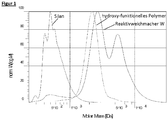
- FIG. 1 Figure 4 shows an exemplary GPC analysis (mass distribution) with the signal of the silane S, the hydroxy-functional polymer POH and the reactive plasticizer W. The significance of these species is explained in detail below.
- composition according to the invention contains at least one silane-functional polymer P with alkoxy end groups, these end groups being in particular end groups of the formula (I).
- the radical R 1 is an alkyl group having 1 to 8 C atoms, in particular a methyl or an ethyl group.
- the radical R 2 is an alkyl group having 1 to 12 C atoms, in particular an alkyl group having 2 to 8 C atoms, preferably a methyl, ethyl or isopropyl group, most preferably a methyl or ethyl group ,
- the radical R 3 is a linear or branched, optionally cyclic, alkylene group having 1 to 12 C atoms, optionally with aromatic moieties, and optionally with one or more heteroatoms, in particular with one or more nitrogen and / or oxygen atoms.
- the index a stands for a value of 0 or 1 or 2, in particular for a value of 0.
- the radical R 2 is a methyl or ethyl group, that is to say that in the composition according to the invention as described above, the alkoxy end groups of the silane-functional polymer P are methoxy or ethoxy groups.
- silane-functional polymers which have ethoxy groups as alkoxy end groups is that ethanol is liberated on crosslinking with water, as a result of which the compositions are harmless from an ecological and toxicological point of view.
- silane-functional polymers which have methoxy groups as alkoxy end groups is that they are particularly reactive in the crosslinking with water and can be dispensed with toxicologically questionable crosslinking catalysts such as tin catalysts.
- the silane-functional polymer P is a silane-functional polyurethane polymer P1 obtainable by reacting a silane having at least one isocyanate-reactive group with a polyurethane polymer having isocyanate groups. This reaction is preferably carried out in a stoichiometric ratio of the isocyanate-reactive groups to the isocyanate groups of 1: 1 or with a slight excess of isocyanate-reactive groups, so that the resulting silane-functional polyurethane polymer P1 is completely free from isocyanate groups.
- the silane which has at least one isocyanate-reactive group
- a polyurethane polymer having isocyanate groups the silane may in principle, although not preferred, be used substoichiometrically, so that a silane-functional polymer is obtained which contains both silane groups Has isocyanate groups.
- the silane which has at least one isocyanate-reactive group is, for example, a hydroxysilane, a mercaptosilane or an aminosilane, in particular a hydroxysilane or an aminosilane.
- the aminosilane is preferably an aminosilane AS of the formula (II) wherein R 1 , R 2 , R 3 and a have already been described above and R 4 is a hydrogen atom or a linear or branched, monovalent hydrocarbon radical having 1 to 20 C atoms, which optionally has cyclic moieties, or a radical of Formula (III) stands.
- the radicals R 5 and R 6 are each independently of one another a hydrogen atom or a radical from the group consisting of -R 8 , -COOR 8 and -CN.
- the radical R 7 is a hydrogen atom or a radical from the group consisting of -CH 2 -COOR 8 , -COOR 8 , -CONHR 8 , -CON (R 8 ) 2 , -CN, -NO 2 , -PO ( OR 8 ) 2 , -SO 2 R 8 and -SO 2 OR 8 .
- the radical R 8 is a, optionally having at least one heteroatom, hydrocarbon radical having 1 to 20 carbon atoms.
- suitable aminosilanes AS are primary aminosilanes such as 3-aminopropyltrimethoxysilane, 3-aminopropyldimethoxymethylsilane, 3-aminopropyltriethoxysilane, 3-aminopropyldiethoxymethylsilane; secondary aminosilanes such as N-butyl-3-aminopropyltrimethoxysilane, N-butyl-3-aminopropyltriethoxysilane, N-phenyl-3-aminopropyltrimethoxysilane and N-phenyl-3-aminopropyltriethoxysilane; the Michael-like addition products of primary aminosilanes such as 3-aminopropyltrimethoxysilane or 3-aminopropyldiethoxymethylsilane to Michael acceptors such as acrylonitrile, (meth) acrylic acid esters, (meth) acrylic acid amides, maleic and fumaric diester
- aminosilanes AS are secondary aminosilanes, in particular aminosilanes AS, in which R 4 in formula (II) is different from H.
- R 4 in formula (II) is different from H.
- the Michael-type adducts in particular N- (3-trimethoxysilyl-propyl) -aminobernsteinklathylester and N- (3-triethoxysilyl-propyl) -amino-succinic acid diethyl ester.
- Morphosel acceptor in the present document denotes compounds which, owing to the double bonds which are activated by electron acceptor radicals, are capable of reacting with primary amino groups (NH 2 groups) in a manner analogous to Michael addition, nucleophilic addition reactions ( hetero-Michael addition).
- aminosilanes are, in particular, those which are obtainable from the reaction of an N-aminoethylaminoalkyltrialkoxysilane with a maleic or fumaric diester.
- suitable aminosilanes are described, for example, in WO 01/00632 the entire disclosure of which is hereby incorporated by reference.
- Silane-terminated polyurethane polymers prepared with the corresponding aminosilanes are described, for example, in the European patent application with the application number EP09153120.2 the entire disclosure of which is hereby also incorporated by reference.
- Suitable hydroxysilanes for the preparation of polymers P1 are, for example, those used in the EP2805985 (in particular S. 2, Z. 51 to S. 3, Z. 28) and the WO 2013/174891 (in particular S. 6, Z. 11 to S. 8, Z. 5) and the WO 2013/174892 (especially page 6, lines 6 to 7, line 6), the entire disclosure of which is hereby incorporated by reference.
- Suitable isocyanate-functional polyurethane polymers for preparing a silane-functional polyurethane polymer P1 are polymers which are obtainable by the reaction of at least one polyol with at least one polyisocyanate, in particular a diisocyanate. This reaction can be carried out by reacting the polyol and the polyisocyanate with customary processes, for example at from 50.degree. C. to 100.degree. C., if appropriate with concomitant use of suitable catalysts, the polyisocyanate being metered in this way, that its isocyanate groups are present in stoichiometric excess relative to the hydroxyl groups of the polyol.
- the excess of polyisocyanate is chosen so that in the resulting polyurethane polymer after the reaction of all hydroxyl groups of the polyol, a content of free isocyanate groups from 0.1 to 5 wt .-%, preferably 0.1 to 2.5 wt .-%, particularly preferably 0.2 to 1 wt. -%, based on the total polymer, remains.
- the polyurethane polymer can be prepared with the concomitant use of plasticizers, wherein the plasticizers used contain no isocyanate-reactive groups.
- polyurethane polymers having the stated content of free isocyanate groups which are obtained from the reaction of diisocyanates with high molecular weight diols in an NCO: OH ratio of 1.5: 1 to 2.2: 1.
- Suitable polyols for the preparation of the polyurethane polymer are in particular polyether polyols, polyester polyols and polycarbonate polyols and mixtures of these polyols.
- Suitable polyether polyols also called polyoxyalkylene polyols or oligoetherols, are in particular those which are polymerization products of ethylene oxide, 1,2-propylene oxide, 1,2- or 2,3-butylene oxide, oxetane, tetrahydrofuran or mixtures thereof, optionally polymerized with the aid of a starter molecule with two or more active hydrogen atoms such as water, ammonia or compounds with multiple OH or NH groups such as 1,2-ethanediol, 1,2- and 1,3-propanediol, neopentyl glycol, diethylene glycol, triethylene glycol, the isomeric dipropylene glycols and Tripropylene glycols, the isomeric butanediols, pentanediols, hexanediols, heptanediols, octanediols, nonanediols,
- Both polyoxyalkylene polyols having a low degree of unsaturation can be used D-2849-69 and expressed in milliequivalents of unsaturation per gram of polyol (mEq / g) prepared, for example, by means of so-called double metal cyanide complex catalysts (DMC catalysts) as well as polyoxyalkylene polyols having a higher degree of unsaturation, prepared for example with Help of anionic catalysts such as NaOH, KOH, CsOH or alkali alcoholates.
- DMC catalysts double metal cyanide complex catalysts
- polyoxyethylene polyols and polyoxypropylene polyols are particularly suitable, in particular polyoxyethylene diols, polyoxypropylene diols, polyoxyethylene triols and polyoxypropylene triols.
- polyoxyalkylenediols or polyoxyalkylenetriols having a degree of unsaturation lower than 0.02 meq / g and having a molecular weight in the range from 1,000 to 30,000 g / mol, and also polyoxyethylenediols, polyoxyethylenetriols, polyoxypropylenediols and polyoxypropylenetriols having a molecular weight of from 400 to 20,000 g / mol.
- ethylene oxide-terminated ethylene oxide-terminated
- polyoxypropylene polyols are specific polyoxypropylene polyoxyethylene polyols obtained, for example, by further alkoxylating pure polyoxypropylene polyols, especially polyoxypropylene diols and triols, upon completion of the polypropoxylation reaction with ethylene oxide, thereby having primary hydroxyl groups.
- Preferred in this case are polyoxypropylene polyoxyethylene diols and polyoxypropylene polyoxyethylene triols.
- hydroxyl-terminated polybutadiene polyols such as those prepared by polymerization of 1,3-butadiene and allyl alcohol or by oxidation of polybutadiene, and their hydrogenation products.
- styrene-acrylonitrile grafted polyether polyols such as are commercially available for example under the trade name Lupranol ® by the company Elastogran GmbH, Germany.
- Suitable polyester polyols are in particular polyesters which carry at least two hydroxyl groups and are prepared by known processes, in particular the polycondensation of hydroxycarboxylic acids or the polycondensation of aliphatic and / or aromatic polycarboxylic acids with dihydric or polyhydric alcohols.
- polyester polyols which are prepared from bis-trihydric alcohols such as 1,2-ethanediol, diethylene glycol, 1,2-propanediol, dipropylene glycol, 1,4-butanediol, 1,5-pentanediol, 1,6-hexanediol, neopentyl glycol, Glycerol, 1,1,1-trimethylolpropane or mixtures of the abovementioned alcohols with organic dicarboxylic acids or their anhydrides or esters such as succinic, glutaric, adipic, trimethyladipic, suberic, azelaic, sebacic, dodecanedicarboxylic, maleic, fumaric, dimer fatty, phthalic, phthalic, Isophthalic acid, terephthalic acid, dimethyl terephthalate, hexahydrophthalic acid, trimellitic acid and trimellitic anhydride or mixtures of the
- polyesterdiols in particular those prepared from adipic acid, azelaic acid, sebacic acid, dodecanedicarboxylic acid, dimer fatty acid, phthalic acid, isophthalic acid and terephthalic acid as dicarboxylic acid or from lactones such as ⁇ -caprolactone and from ethylene glycol, diethylene glycol, neopentyl glycol, 1,4-butanediol , 1,6-hexanediol, dimer fatty acid diol and 1,4-cyclohexanedimethanol as the dihydric alcohol.
- Suitable polycarbonate polyols are, in particular, those which are obtainable by reacting, for example, the abovementioned alcohols used for the synthesis of the polyester polyols with dialkyl carbonates, such as dimethyl carbonate, diaryl carbonates, such as diphenyl carbonate or phosgene. Also suitable are polycarbonates which are accessible from the copolymerization of CO 2 with epoxides, such as ethylene oxide and propylene oxide. Particularly suitable are polycarbonate diols, in particular amorphous polycarbonate diols.
- polystyrene resins are poly (meth) acrylate polyols.
- polyhydroxy-functional fats and oils for example natural fats and oils, in particular castor oil, or so-called oleochemical polyols obtained by chemical modification of natural fats and oils, the epoxy polyesters obtained, for example, by epoxidation of unsaturated oils and subsequent ring opening with carboxylic acids or alcohols or epoxypolyethers, or obtained by hydroformylation and hydrogenation of unsaturated oils polyols.
- polyols which are obtained from natural fats and oils by degradation processes such as alcoholysis or ozonolysis and subsequent chemical linkage, for example by transesterification or dimerization, of the degradation products or derivatives thereof thus obtained.
- Suitable degradation products of natural fats and oils are in particular fatty acids and fatty alcohols and fatty acid esters, in particular the methyl esters (FAME), which can be derivatized for example by hydroformylation and hydrogenation to hydroxy fatty acid esters.
- FAME methyl esters
- polyhydrocarbon polyols also called oligohydrocarbonols, for example polyhydroxy-functional ethylene-propylene, ethylene-butylene or ethylene-propylene-diene copolymers, as are produced, for example, by Kraton Polymers, USA, or polyhydroxy-functional copolymers of dienes, such as 1,3-butadiene or diene mixtures and vinyl monomers such as styrene, acrylonitrile or isobutylene, or polyhydroxy-functional polybutadiene polyols, for example those which are prepared by copolymerization of 1,3-butadiene and allyl alcohol and may also be hydrogenated.
- polyhydrocarbon polyols also called oligohydrocarbonols
- polyhydroxy-functional ethylene-propylene, ethylene-butylene or ethylene-propylene-diene copolymers as are produced, for example, by Kraton Polymers, USA
- polyhydroxy-functional copolymers of dienes such as
- polyhydroxy-functional acrylonitrile / butadiene copolymers such as those from epoxides or amino alcohols and carboxyl-terminated acrylonitrile / butadiene copolymers, which are commercially available under the name Hypro ® (formerly Hycar ® ) CTBN from Emerald Performance Materials, LLC, USA , can be made.
- All said polyols preferably have an average molecular weight of from 250 to 30,000 g / mol, in particular from 1,000 to 30,000 g / mol, and an average OH functionality in the range from 1.6 to 3.
- Particularly suitable polyols are polyester polyols and polyether polyols, especially polyoxyethylene polyol, polyoxypropylene polyol and polyoxypropylene polyoxyethylene polyol, preferably polyoxyethylene diol, polyoxypropylene diol, polyoxyethylene triol, polyoxypropylene triol, polyoxypropylene polyoxyethylene diol and polyoxypropylene polyoxyethylene triol.
- small amounts of low molecular weight di- or polyhydric alcohols such as 1,2-ethanediol, 1,2- and 1,3-propanediol, neopentyl glycol, diethylene glycol, triethylene glycol, the isomeric dipropylene glycols and tripropylene glycols, the isomeric butanediols, Pentanediols, hexanediols, heptanediols, octanediols, nonanediols, decanediols, undecanediols, 1,3- and 1,4-cyclohexanedimethanol, hydrogenated bisphenol A, dimeric fatty alcohols, 1,1,1-trimethylolethane, 1,1,1-trimethylolpropane, glycerol, Pentaerythritol, sugar alcohols such as xylito
- polyisocyanates in particular diisocyanates, can be used as polyisocyanates for the preparation of the polyurethane polymer.
- hydroxysilane-functionalized polymers P1 which are suitable and preferred for the present invention are, for example, in WO 2013/174891 and WO 2013/174892 described, the entire disclosure of which is hereby incorporated by reference.
- the silane-functional polymer P is, in a second embodiment, a silane-functional polyurethane polymer P2 obtainable by the reaction of an isocyanatosilane IS with a polymer which has isocyanate-reactive functional end groups, in particular hydroxyl groups, mercapto groups and / or amino groups. This reaction is carried out in the stoichiometric ratio of the isocyanate groups to the isocyanate-reactive functional end groups of 1: 1, or with a slight excess of isocyanate-reactive functional end groups, for example at temperatures of 20 ° C to 100 ° C, optionally with concomitant use of catalysts.
- Suitable isocyanatosilane IS are compounds of the formula (IV).
- isocyanatosilanes IS of the formula (IV) are isocyanatomethyltrimethoxysilane, isocyanatomethyldimethoxymethylsilane 3-isocyanatopropyltrimethoxysilane, 3-isocyanatopropyldimethoxymethylsilane, isocyanatomethyltriethoxysilane, isocyanatomethyldiethoxymethylsilane 3-isocyanatopropyltriethoxysilane, 3-isocyanatopropyldiethoxymethylsilane, and their analogs having isopropoxy groups instead of the methoxy or ethoxy groups on the silicon.
- the polymer preferably has hydroxyl groups as isocyanate-reactive functional end groups.
- polymers having hydroxyl groups are suitable for use already mentioned high molecular weight polyoxyalkylene polyols, preferably polyoxypropylene diols having a degree of unsaturation lower than 0.02 meq / g and having a molecular weight in the range of 4000 to 30 000 g / mol, in particular those having a molecular weight in the range of 8 '000 to 30,000 g / mol.
- hydroxyl-terminated, in particular hydroxyl-terminated, polyurethane polymers are also suitable for reaction with isocyanatosilanes IS of the formula (IV).
- Such polyurethane polymers are obtainable by the reaction of at least one polyisocyanate with at least one polyol.
- This reaction can be carried out by reacting the polyol and the polyisocyanate with customary processes, for example at from 50 ° C. to 100 ° C., if appropriate with concomitant use of suitable catalysts, the polyol being metered in such a way that its hydroxyl groups in the Ratio to the isocyanate groups of the polyisocyanate in stoichiometric excess are present.
- Preference is given to a ratio of hydroxyl groups to isocyanate groups of from 1.3: 1 to 4: 1, in particular from 1.8: 1 to 3: 1.
- the polyurethane polymer can be prepared with the concomitant use of plasticizers, wherein the plasticizers used contain no isocyanate-reactive groups.
- Suitable for this reaction are the same polyols and polyisocyanates already mentioned as being suitable for preparing an isocyanate group-containing polyurethane polymer used to prepare a silane-functional polyurethane polymer P1 .
- silane-functional polymers P2 are commercially available under the trade name Silquest ® A-Link silanes from the company Momentive Performance Materials Inc., USA.
- the silane-functional polymer P is a silane-functional polymer P3 which is obtainable by a hydrosilylation reaction of polymers having terminal double bonds, for example poly (meth) acrylate polymers or polyether polymers, in particular allyl-terminated polyoxyalkylene polymers, described, for example, in US Pat US 3,971,751 and US 6,207,766 the entire disclosure of which is hereby incorporated by reference.
- the silane-functional polymer P is silane-functional polyether polymers which are obtainable via a copolymerization of epoxide monomers with glycidoxysilanes, or silane-functional polybutadienes which are obtainable, for example, via hydrosilylation of polybutadiene.
- the silane-functional polymer P is preferably a silane-functional polymer P1 or P2, in particular P1.
- silane-functional polymers P1 and P2 Compared with the silane-functional polymer P3 , silane-functional polymers P1 and P2 have the advantage that they are more reactive and thus crosslink faster. Another advantage is that they have improved mechanical properties comparable to classical polyurethane compositions. Furthermore, they have a lower tendency to creep behavior and improved resilience. These properties are particularly pronounced for silane-functional polymers P1, whereby these are most preferred. Due to the totality of these properties, preferred compositions are particularly suitable for use in joints, for example in dilatation joints.
- the silane-functional polymer P is present in an amount of 10 to 80 wt .-%, in particular in an amount of 15 to 50 wt .-%, preferably 20 to 40 wt .-%, based on the total composition.
- Suitable hydroxy-functional polymers POH are polymers having one, two or three hydroxyl groups per polymer, which are represented in formula (V). Preference is given to polymers having one hydroxyl group (monools) or two hydroxyl groups (diols), in particular monools.
- the hydroxy-functional polymer POH comprises a polyether, and / or a hydrocarbon polymer, which must have at least one hydroxyl group.
- Suitable polyether mono- or polyols also called polyoxyalkylene mono- or polyols or oligoetherols, are in particular those which are polymerization products of ethylene oxide, 1,2-propylene oxide, 1,2- or 2,3-butylene oxide, oxetane, tetrahydrofuran or mixtures thereof, optionally polymerized with the aid of a starter molecule having two or more active hydrogen atoms, such as, for example, water, ammonia or compounds having several OH or NH groups, such as 1,2-ethanediol, 1,2- and 1,3-propanediol, neopentyl glycol, diethylene glycol, Triethylene glycol, the isomeric dipropylene glycols and tripropylene glycols, the isomeric butanediols, pentanediols, hexanediols, heptanediols, octanedio
- Both polyoxyalkylene polyols having a low degree of unsaturation (measured according to ASTM D-2849-69 and expressed in milliequivalents of unsaturation per gram of polyol (mEq / g)) prepared, for example, by means of so-called double metal cyanide complex catalysts (DMC Catalysts), as well as polyoxyalkylene polyols having a higher degree of unsaturation, prepared for example with the aid of anionic catalysts such as NaOH, KOH, CsOH or alkali metal alkoxides.
- DMC Catalysts double metal cyanide complex catalysts
- polyoxyethylene mono- or polyols and polyoxypropylene mono- or polyols are particularly suitable, in particular polyoxyethylene monools, polyoxyethylene diols, polyoxypropylene monools, polyoxypropylene diols, polyoxyethylene triols and polyoxypropylene triols.
- polyoxyalkylene monools polyoxyalkylenediols or polyoxyalkylenetriols having a degree of unsaturation lower than 0.02 meq / g and having a molecular weight in the range from 1,000 to 20,000 g / mol
- polyoxyethylene diols polyoxyethylene triols
- polyoxypropylene diols polyoxypropylene triols having a molecular weight of from 400 to 20 '000 g / mol
- so-called ethylene oxide-terminated (“EOendcapped", ethylene oxide-endcapped) polyoxypropylene mono- or polyols are so-called ethylene oxide-terminated ("EOendcapped", ethylene oxide-endcapped) polyoxypropylene mono- or polyols.
- polyoxypropylene-polyoxyethylene mono- or polyols obtained, for example, by further alkoxylating pure polyoxypropylene mono- or polyols, especially polyoxypropylene monools, polyoxypropylene diols and triols, upon completion of the polypropoxylation reaction with ethylene oxide, thereby having primary hydroxyl groups.
- polyoxypropylene-polyoxyethylene monools polyoxypropylene-polyoxyethylene diols and polyoxypropylene-polyoxyethylene triols
- particularly preferred are polyoxypropylene-polyoxyethylene monools and polyoxypropylene-polyoxyethylene diols, especially polyoxypropylene-polyoxyethylene monools.
- hydroxyl-containing hydrocarbon polymers ie Polykohlenwasserstoffmono- or polyols, also called Oligohydrocarbonole, for example, mono- or polyhydroxy-functional ethylene-propylene, ethylene-butylene or ethylene-propylene-diene copolymers, as described for example by Kraton Polymers, USA , or polyhydroxy-functional copolymers of dienes such as 1,3-butadiene or diene mixtures and vinyl monomers such as styrene, acrylonitrile or isobutylene, or polyhydroxy-functional polybutadiene polyols, for example those which are prepared by copolymerization of 1,3-butadiene and allyl alcohol and are also hydrogenated can.
- hydroxyl-containing hydrocarbon polymers ie Polykohlenwasserstoffmono- or polyols, also called Oligohydrocarbonole, for example, mono- or polyhydroxy-functional ethylene-propylene, ethylene-butylene or ethylene-propy
- Suitable are mono- or polyhydroxy-functional fats and oils for example natural fats and oils, in particular castor oil, or by chemical modification of natural fats and oils, so-called oleochemical, polyols, for example, by epoxidation of unsaturated oils and subsequent ring opening with carboxylic acids or
- mono- or polyols which are obtained from natural fats and oils by degradation processes such as alcoholysis or ozonolysis and subsequent chemical linkage, for example by transesterification or dimerization, of the degradation products or derivatives thereof thus obtained.
- Suitable degradation products of natural fats and oils are in particular fatty acids and fatty alcohols and fatty acid esters, in particular the methyl esters (FAME), which can be derivatized for example by hydroformylation and hydrogenation to hydroxy fatty acid esters.
- acrylonitrile / butadiene copolymers as for example, from epoxides or aminoalcohols and carboxyl-terminated acrylonitrile / butadiene copolymers, which are commercially available under the name Hypro ® (formerly Hycar ®) CTBN performance by the company Emerald Performance Materials, LLC, USA.
- hydroxyl-terminated polybutadiene mono- or polyols such as those prepared by polymerization of 1,3-butadiene and allyl alcohol or by oxidation of polybutadiene, and their hydrogenation products.
- Suitable silanes S are all silanes of the formula (VI) or oligomers thereof.
- aminosilanes are particularly suitable such as 3-aminopropyltrimethoxysilane, 3-aminopropyl-dimethoxymethylsilane, N- (2-aminoethyl) -3-aminopropyltrimethoxysilane, N- (2-aminoethyl) -3-aminopropyldimethoxymethylsilan, N- (2-aminoethyl) - N '- [3- (trimethoxysilyl) propyl] ethylenediamine or its analogues having ethoxy instead of methoxy groups.
- N-phenyl-, N-cyclohexyl- or N-alkylaminosilanes are also suitable.
- mercaptosilanes epoxysilanes, (meth) acrylosilanes, anhydridosilanes, carbamatosilanes, alkylsilanes or iminosilanes, oligomeric forms of these silanes, adducts of primary aminosilanes with epoxysilanes or (meth) acrylosilanes or anhydridosilanes.
- tetramethoxysilane, tetraethoxysilane, vinyltrimethoxysilane, vinyltriethoxysilane or organoalkoxysilanes which have a functional group in the ⁇ -position to the silane group, in particular N- (methyldimethoxysilylmethyl) -O-methyl-carbamate, (methacryloxymethyl) silanes, methoxymethylsilanes, in particular vinyltrimethoxysilane or vinyltriethoxysilane ;
- the silane S comprises mainly or exclusively oligomeric silanes.
- Oligomeric silanes are oligomers that are accessible from silanes of formula (VI) by condensation to form sliox bonds.
- Suitable oligomeric silanes preferably have a molecular weight of between 200 and 2,500 g / mol, preferably between 250 and 2,000 g / mol, in particular between 300 and 1,500 g / mol, particularly preferably between 350 and 1,000 g / mol. mol.
- suitable as the silane S are oligomeric silanes such as under the name Dynasylan ® oligomers (from Evonik) are available, for example Dynasilan ® 6490.
- oligomers silanes are that they allow particularly high tensile strength in the compositions of this invention the advantage, in particular in combination with a hydroxy-functional polymer POH having a molecular weight of less than 1000 g / mol. In combination with a hydroxy-functional polymer POH having a molecular weight of 1,000 g / mol or more, they advantageously enable a particularly good balance of high tensile strength and high elongation at break.
- silanes S are tetralkoxysilanes, trialkoxyvinylsilanes, aminopropyltriaoxysilanes, or oligomers of such silanes, the alkoxy groups preferably being methoxy or ethoxy groups.
- the reactive plasticizer W is prepared from the at least one hydroxy-functional polymer POH and the at least one silane S, or oligomers thereof.
- This reaction is a transesterification reaction on the silane ester, wherein at least one hydroxyl of the polymer POH of the formula (V) having at least one alkoxy or hydroxyl group on the silicon atom of the silane S of the formula (VI) condensed and n equivalents of a low molecular weight alcohol as a cleavage product arises.
- Possible and preferred products of this reaction are shown in formulas (VII) and (VIII) R 11 -OH (VII) wherein R 9 , R 10 , R 11 , n and x have the meanings described above.
- formula (VIII) shows a preferred form of the reactive plasticizer W, it also being possible, of course, for polyoxysilanes which have been repeatedly transesterified to be obtained.
- the reaction is preferably carried out with continuous removal of the resulting alcohol R 11 OH at reduced pressure and / or elevated temperature and in the presence of a catalyst K for the transesterification of silane esters, with a reaction yield of reactive plasticizer W of at least 50%, in particular at least 75% preferably at least 90%, carried out.
- the reaction yield in mol% with respect to the hydroxy-functional polymer POH used as the reactant , is understood here to be the amount of the reaction product which results from the reaction (transesterification reaction) of the silane S with the hydroxy-functional polymer POH forms.
- This reaction product comprises a mixture of transesterification products which may be chemically identical or different.
- the determination of the reaction yield can be carried out by suitable methods. Infrared spectroscopy (IR spectroscopy) has proved to be advantageous since samples can thus be taken from the reaction mixture and measured rapidly. Suitable, for example, ATR-IR (attenuated total reflectance IR) spectrometers, which are known to the person skilled in the art and can also measure samples which have only low transparency.
- in situ ATR IR probes can be used, which protrude directly into the reaction mixture and allow real-time monitoring.
- the determination of the reaction yield in the context of the present invention by means of IR spectroscopy is preferably carried out by monitoring the OH band of the hydroxy-functional polymer POH in the range of 3400-3500 cm -1 . In this case, the decrease in the band intensity with respect to the baseline (in%) is equated to the reaction yield. The resulting product can then be verified for the molecular weight after the reaction by GPC.
- Another aspect of the invention is the reaction product obtained from the above method, which corresponds to the reactive plasticizer W.
- Suitable catalysts K are all substances which catalyze the transesterification of silane esters.
- Suitable examples are metal complexes, in particular titanates, alkali or Erdalkalialkoxylate such as sodium, and ion exchangers. Preference is given to alkali metal alkoxylates and metal complexes, in particular titanates. Titanates have the advantage that they are particularly active but do not discolor the product undesirably.
- Suitable organotitanates include ligands selected from the group consisting of alkoxy group, sulfonate group, carboxylate group, dialkyl phosphate group, dialkyl pyrophosphate group and acetylacetonate group, where all ligands may be the same or different from each other.
- Preferred organotitanate is titanium ethylacetoacetate.
- Suitable organo example under the trade names Tyzor ® AA, GBA, GBO, AA-75, AA-65, AA-105, DC, BEAT, Ibay commercially available from the company Dorf Ketal, India, or under the trade names Tytan TM PBT TET, X85, TAA, ET, S2, S4 or S6 commercially available from Borica, Taiwan.
- the proportion of the catalyst K in the preparation of the reactive plasticizer W is preferably between 1 and 3 mol%, in particular 1.5 to 2.5 mol%, preferably 1.8 to 2.2 mol%, based on the molar amount of the silane used S.
- the present invention relates to the use of a reaction product of at least one hydroxy-functional polymer POH of the formula (V) as vorgüängig described with n equivalents of at least one silane S of formula (VI) or oligomers thereof, as described above, comprising as a reactive plasticizer in a moisture-curing composition at least one silane-functional polymer P.
- the composition further comprises a filler.
- the filler affects both the rheological properties of the uncured composition and the mechanical properties and surface finish of the cured composition.
- Suitable fillers are inorganic and organic fillers, for example natural, ground or precipitated calcium carbonates, which are optionally coated with fatty acids, in particular stearic acid, barium sulfate (BaSO 4 , also called barite or barite), calcined kaolins, aluminum oxides, aluminum hydroxides, silicic acids, in particular highly dispersed silicic acids from pyrolysis processes, Russian, in particular industrially produced carbon black (Russ carbon black), PVC powder or hollow spheres.
- fatty acids in particular stearic acid, barium sulfate (BaSO 4 , also called barite or barite)
- BaSO 4 barium sulfate
- calcined kaolins aluminum oxides, aluminum hydroxides
- silicic acids in particular highly dispersed
- Preferred fillers are calcium carbonates, calcined kaolins, carbon black, finely divided silicas and flame-retardant fillers, such as hydroxides or hydrates, in particular hydroxides or hydrates of aluminum, preferably aluminum hydroxide. It is quite possible and may even be advantageous to use a mixture of different fillers.
- a suitable amount of filler is for example in the range of 10 to 70 wt .-%, in particular 15 to 60 wt .-%, preferably 30 to 60 wt .-%, based on the total composition.
- composition according to the invention may additionally contain further constituents.
- constituents are plasticizers such as esters of organic carboxylic acids or their anhydrides, such as phthalates, for example dioctyl phthalate, diisononyl phthalate or diisodecyl phthalate, adipates, for example dioctyl adipate, azelates and sebacates, polyols, for example polyoxyalkylene polyols or polyester polyols, organic phosphorus and sulfonic acid esters or polybutenes; Solvent; Fibers, such as polyethylene; dyes; pigments; Rheology modifiers such as thickening agents or thixotropic agents, for example urea compounds of the type used as a thixotropic endowing agent in WO 02/48228 A2 described on pages 9 to 11, polyamide waxes, bentonites or fumed silicas; Adhesion promoters, for example epoxysilanes, (me
- the novel compositions contain less than 10 wt .-%, preferably less than 5 wt .-%, plasticizer as described above, based on the total composition, especially plasticizer with carboxylic acid ester groups. It is particularly preferred if the composition according to the invention contains at most 2.5% by weight, based on the total composition, of plasticizers, in particular plasticizers with carboxylic acid ester groups. Furthermore, it is also possible to use, in addition to the reactive plasticizers W according to the invention, other so-called reactive diluents which are incorporated into the polymer matrix during the curing of the composition, in particular by reaction with the silane groups.
- composition described above is preferably prepared and stored in the absence of moisture.
- the composition is shelf-stable, that is, it can be stored in the absence of moisture in a suitable package or assembly, such as a keg, bag or cartridge, for a period of time from several months to one year and longer without they change in their application properties or in their properties after curing in a relevant for their use to the extent.
- the storage stability is determined by measuring the viscosity or the extrusion force.
- composition according to the invention contain from 15 to 50% by weight, preferably from 20 to 40% by weight, Polymer P and between 10 and 30 wt .-%, preferably between 15 and 25 wt .-%, reactive plasticizer W and between 0 and 60 wt .-%, preferably between 10 and 50 wt .-%, filler and less than 10 wt .-%, preferably less than 5 wt .-%, plasticizer, in particular plasticizer with carboxylic acid ester groups.
- the silane groups contained in the composition come into contact with moisture.
- the silane groups have the property of hydrolyzing on contact with moisture. This forms organosilanols and, by subsequent condensation reactions, organosiloxanes. As a result of these reactions, which can be accelerated by the use of catalysts, the composition finally hardens. This process is also referred to as networking.
- the water needed for curing can either come from the air (atmospheric moisture), or else the above-described composition can be contacted with a water-containing component, for example by painting, for example with a smoothing agent, or by spraying, or it can the composition in the application of a water-containing component may be added, for example in the form of a water-containing paste, which is mixed, for example via a static mixer.
- a water-containing component for example by painting, for example with a smoothing agent, or by spraying, or it can the composition in the application of a water-containing component may be added, for example in the form of a water-containing paste, which is mixed, for example via a static mixer.
- the rate of cure is determined by various factors, such as water diffusion rate, temperature, ambient humidity and adhesive geometry, and typically slows as the cure progresses.
- the present invention comprises the use of a previously described composition as an adhesive, sealant or coating. Furthermore, the present invention comprises the use of a previously described composition as an adhesive, sealant or Coating in particular on substrates selected from the group comprising wood, natural stone and plastics, in particular polyvinyl chloride, polystyrene, polymethyl methacrylate and polycarbonate.
- Suitable substrates S1 and / or S2 are in particular substrates which are selected from the group consisting of concrete, mortar, brick, brick, gypsum, a natural stone such as granite or marble, glass, glass ceramic, metal or metal alloy, wood, plastic and lacquer ,
- the composition of the invention preferably has a pasty consistency with pseudoplastic properties.
- a composition is applied to the substrate by means of a suitable device, preferably in the form of a bead, this advantageously having a substantially round or triangular cross-sectional area.
- suitable Methods for applying the composition are, for example, the application of commercially available cartridges, which are operated manually or by means of compressed air, or from a barrel or hobbock by means of a feed pump or an extruder, optionally by means of an application robot.
- a composition according to the invention with good application properties has high stability and a short yarn tension. This means that it remains in the applied form after application, so it does not flow apart and, after the application device has been set down, it pulls no or only a very short thread, so that the substrate is not contaminated.
- the invention relates to an article which has been sealed, bonded or coated with a moisture-curing composition as described above.
- the invention relates to a cured composition which is obtainable from a composition as described above, after its curing with water, in particular in the form of atmospheric moisture, ie a cured composition as described above.
- the articles which are glued, sealed or coated with a composition according to the invention are, in particular, a building, in particular a building construction or civil engineering, a means of transport or a part thereof, an industrially manufactured good or a consumer good , In particular a floor, a window, a household appliance, or a means of transport or an attachment of a means of transport.
- the tensile strength and the elongation at break were determined according to DIN EN 53504 (tensile speed: 200 mm / min) on films cured at 23 ° C. and 50% relative humidity for 7 days with a layer thickness of 2 mm.
- GPC Gel permeation chromatography
- FIG. 1 shows a GPC chart that was measured by this method.
- hydroxyfuntionelles polymer POH (see below) and catalyst K (titanium ethylacetoacetate, 2 mol% relative to the silane) were weighed into a round bottom flask and mixed well. Then, the silane S (30 mmol each) was added. For all reactions, the molar content of silane S was kept constant and the molar content of hydroxy-functional polymer POH varied depending on its OH functionality, so that if, for example, in the case of a Monools 30 mmol were used, in the case of a diol only 15 mmol.
- the reaction mixture was heated to 80 ° C in a water bath and vorreagiert by means of rotary evaporator with vigorous rotation for 30 min. Then, the pressure over the reaction mixture was lowered to 200 mbar. The reaction was run at 80 ° C and at 200 mbar pressure for 2 to 3 hours. During this period were at regular intervals of about 30 min IR spectra measured (Perkin Elmer ATR IR spectrometer with ZnSe crystal and MCT detector). The reaction was stopped when no further reduction of the OH band (at 3400-3500 cm -1 ) could be detected between two measurements. The reaction product thus prepared was filled in an airtight bottle and used in the adhesive formulations as a reactive plasticizer W.
- the reaction was stopped as soon as free isocyanate was no longer detectable by IR spectroscopy (2275 - 2230 cm-1).
- the product was cooled to room temperature (23 ° C) and stored with exclusion of moisture.
- the silane-functional polyurethane polymer P-1 thus prepared is liquid at room temperature.
- N- (3-trimethoxysilyl-propyl) -amino-succinic acid diethyl ester was prepared as follows: 51.0 g of 3-aminopropyltrimethoxysilane (Silquest® A-1110, Momentive Performance Materials Inc., USA) were initially charged. With good stirring, 49.0 g of diethyl maleate (Sigma Aldrich, Switzerland) were slowly added at room temperature and the mixture was stirred for 2 hours at room temperature.
- a masterbatch was first prepared which contains all the components in addition to the plasticizer or reactive plasticizer W and the curing catalyst.
- 23 parts by weight of polymer P-1 and 2 parts by weight of vinyltrimethoxysilane (Silquest * A-171, Momentive) were used in a vacuum mixer. submitted and mixed for 5 min.
- 48 parts by weight of dried, ground chalk (Omyacarb ® 5-GU, Omya AG, Switzerland), 0.1 parts by weight of stabilizer (Irganox ® 1076, BASF) and 1.9 parts by weight of thixotropic agent (Thixatrol ® ST, Elementis Specialties) for 15 minutes at 60 ° C kneaded.
- a number of reactive plasticizers W according to the invention were prepared.
- the raw materials used for their preparation by the method described above are shown in Table 1.
- the term "monool” describes polymers having a hydroxy function (hydroxyl group).
- the term “diol” describes polymers having two hydroxyl groups.
- the abbreviation "PPG” stands for polypropylene glycol
- the abbreviation “EO” stands for ethylene oxide.
- the listed polymers are polyaddition products (polyethers) of propylene oxide which have been partially reacted with ethylene oxide monomers terminally.
- a series of example compositions were prepared according to the method described above, which according to the invention contain a previously prepared reactive plasticizer W (in each case 22% by weight). These Examples Z-1 to Z-5 and Z-7 to Z-16 are shown in Table 2. The educts of the reactive plasticizers W used in each case are listed in columns 2 and 3 of the table.
- a reference example (Z-6) was prepared yet which contains, instead of a reactive plasticizer W a conventional plasticizers in the same amount. In all examples mechanical values were measured after curing. It was found that the inventive examples consistently higher tensile strengths and at the same time have at least the same, but usually higher elongation at break than the reference example Z-6.
- compositions were prepared containing the same amount of hydroxy-functional Polymer POH and silane S contain, as 3 inventive examples, with the difference that from the hydroxy-functional polymers POH and the silanes S previously no reactive plasticizer W has been prepared.
- These tests referred to as in situ , are shown in Table 3 in addition to the comparable experiments according to the invention.
Landscapes
- Chemical & Material Sciences (AREA)
- Organic Chemistry (AREA)
- Health & Medical Sciences (AREA)
- Chemical Kinetics & Catalysis (AREA)
- Medicinal Chemistry (AREA)
- Polymers & Plastics (AREA)
- Paints Or Removers (AREA)
- Adhesives Or Adhesive Processes (AREA)
- Compositions Of Macromolecular Compounds (AREA)
Priority Applications (2)
| Application Number | Priority Date | Filing Date | Title |
|---|---|---|---|
| EP16194078.8A EP3309187B1 (fr) | 2016-10-17 | 2016-10-17 | Plastifiant réactif pour compositions durcissant à l'humidité comprenant des polymères à fonction silane |
| PCT/EP2017/076326 WO2018073166A1 (fr) | 2016-10-17 | 2017-10-16 | Plastifiant réactif pour des compositions durcissant sous l'effet de l'humidité présentant des polymères à fonctionnalité silane |
Applications Claiming Priority (1)
| Application Number | Priority Date | Filing Date | Title |
|---|---|---|---|
| EP16194078.8A EP3309187B1 (fr) | 2016-10-17 | 2016-10-17 | Plastifiant réactif pour compositions durcissant à l'humidité comprenant des polymères à fonction silane |
Publications (2)
| Publication Number | Publication Date |
|---|---|
| EP3309187A1 true EP3309187A1 (fr) | 2018-04-18 |
| EP3309187B1 EP3309187B1 (fr) | 2020-08-05 |
Family
ID=57153335
Family Applications (1)
| Application Number | Title | Priority Date | Filing Date |
|---|---|---|---|
| EP16194078.8A Withdrawn - After Issue EP3309187B1 (fr) | 2016-10-17 | 2016-10-17 | Plastifiant réactif pour compositions durcissant à l'humidité comprenant des polymères à fonction silane |
Country Status (2)
| Country | Link |
|---|---|
| EP (1) | EP3309187B1 (fr) |
| WO (1) | WO2018073166A1 (fr) |
Cited By (1)
| Publication number | Priority date | Publication date | Assignee | Title |
|---|---|---|---|---|
| EP3892669A1 (fr) | 2020-04-07 | 2021-10-13 | PolyU GmbH | Extension de chaîne sans isocyanate et réticulation au moyen des silanes fonctionnels |
Families Citing this family (1)
| Publication number | Priority date | Publication date | Assignee | Title |
|---|---|---|---|---|
| CN109666139B (zh) * | 2018-12-27 | 2021-04-16 | 博邦新材料科技(广州)有限公司 | 一种适合作为润湿分散剂的加成化合物及其制备方法 |
Citations (11)
| Publication number | Priority date | Publication date | Assignee | Title |
|---|---|---|---|---|
| US3971751A (en) | 1975-06-09 | 1976-07-27 | Kanegafuchi Kagaku Kogyo Kabushiki Kaisha | Vulcanizable silylether terminated polymer |
| WO2001000632A2 (fr) | 1999-06-25 | 2001-01-04 | Bayer Aktiengesellschaft | Derives de piperazinone presentant des groupes d'alcoxysilane |
| US6207766B1 (en) | 1997-04-21 | 2001-03-27 | Asahi Glass Company Ltd. | Room temperature-setting compositions |
| WO2002048228A2 (fr) | 2000-12-13 | 2002-06-20 | Sika Schweiz Ag | Compositions de polyurethanne a un composant tres resistantes aux intemperies et durcissables a l'humidite |
| DE102006003821A1 (de) * | 2006-01-26 | 2007-08-02 | Wacker Chemie Ag | Alkoxysilanterminierte Polymere enthaltende Polymerabmischungen |
| DE102008021221A1 (de) * | 2008-04-28 | 2009-10-29 | Henkel Ag & Co. Kgaa | Härtbare Zusammensetzung auf Basis silylierter Polyurethane |
| EP2221331A1 (fr) | 2009-02-18 | 2010-08-25 | Sika Technology AG | Polymère de polyuréthane terminé par silane |
| WO2013174891A2 (fr) | 2012-05-23 | 2013-11-28 | Sika Technology Ag | Polymère contenant des groupes silane |
| WO2013174892A1 (fr) | 2012-05-23 | 2013-11-28 | Sika Technology Ag | Polymère contenant des groupes silane |
| EP2789636A1 (fr) * | 2013-04-10 | 2014-10-15 | Sika Technology AG | Adhérence sans primaire de substances adhésives ou étanches à base de polymères à silanes fonctionnels |
| EP2805985A1 (fr) | 2013-05-22 | 2014-11-26 | Sika Technology AG | Hydroxysilane et polymère contenant des groupes silanes |
-
2016
- 2016-10-17 EP EP16194078.8A patent/EP3309187B1/fr not_active Withdrawn - After Issue
-
2017
- 2017-10-16 WO PCT/EP2017/076326 patent/WO2018073166A1/fr not_active Ceased
Patent Citations (11)
| Publication number | Priority date | Publication date | Assignee | Title |
|---|---|---|---|---|
| US3971751A (en) | 1975-06-09 | 1976-07-27 | Kanegafuchi Kagaku Kogyo Kabushiki Kaisha | Vulcanizable silylether terminated polymer |
| US6207766B1 (en) | 1997-04-21 | 2001-03-27 | Asahi Glass Company Ltd. | Room temperature-setting compositions |
| WO2001000632A2 (fr) | 1999-06-25 | 2001-01-04 | Bayer Aktiengesellschaft | Derives de piperazinone presentant des groupes d'alcoxysilane |
| WO2002048228A2 (fr) | 2000-12-13 | 2002-06-20 | Sika Schweiz Ag | Compositions de polyurethanne a un composant tres resistantes aux intemperies et durcissables a l'humidite |
| DE102006003821A1 (de) * | 2006-01-26 | 2007-08-02 | Wacker Chemie Ag | Alkoxysilanterminierte Polymere enthaltende Polymerabmischungen |
| DE102008021221A1 (de) * | 2008-04-28 | 2009-10-29 | Henkel Ag & Co. Kgaa | Härtbare Zusammensetzung auf Basis silylierter Polyurethane |
| EP2221331A1 (fr) | 2009-02-18 | 2010-08-25 | Sika Technology AG | Polymère de polyuréthane terminé par silane |
| WO2013174891A2 (fr) | 2012-05-23 | 2013-11-28 | Sika Technology Ag | Polymère contenant des groupes silane |
| WO2013174892A1 (fr) | 2012-05-23 | 2013-11-28 | Sika Technology Ag | Polymère contenant des groupes silane |
| EP2789636A1 (fr) * | 2013-04-10 | 2014-10-15 | Sika Technology AG | Adhérence sans primaire de substances adhésives ou étanches à base de polymères à silanes fonctionnels |
| EP2805985A1 (fr) | 2013-05-22 | 2014-11-26 | Sika Technology AG | Hydroxysilane et polymère contenant des groupes silanes |
Cited By (2)
| Publication number | Priority date | Publication date | Assignee | Title |
|---|---|---|---|---|
| EP3892669A1 (fr) | 2020-04-07 | 2021-10-13 | PolyU GmbH | Extension de chaîne sans isocyanate et réticulation au moyen des silanes fonctionnels |
| WO2021204874A1 (fr) | 2020-04-07 | 2021-10-14 | Polyu Gmbh | Extension de chaîne sans isocyanate et réticulation au moyen de silanes fonctionnels |
Also Published As
| Publication number | Publication date |
|---|---|
| WO2018073166A1 (fr) | 2018-04-26 |
| EP3309187B1 (fr) | 2020-08-05 |
Similar Documents
| Publication | Publication Date | Title |
|---|---|---|
| EP2872541B1 (fr) | Composition à haute teneur en charge à base de polymères à terminaison silane | |
| EP2398836B1 (fr) | Polymères de polyuréthane à terminaison silane | |
| EP2470599B1 (fr) | Compositions à base de polymères fixés par silane | |
| EP2098548B1 (fr) | Composition à adhérence améliorée sur des substrats poreux | |
| EP2999737B1 (fr) | Hydroxysilane et polymère contenant des groupes silanes | |
| EP2435491B1 (fr) | Polyester à silane fonctionnel dans des compositions durcissant à l'humidité à base de polymères à silane fonctionnel | |
| EP2435492B1 (fr) | Composition durcissable à l'humidité avec une résistance initiale élevée | |
| EP2852635B1 (fr) | Composition à base de polymères à terminaison silane ne dégageant pas de méthanol lors du durcissement | |
| EP2952533A1 (fr) | Matériau d'étanchéité sans étain ni phtalate à base de polymères à terminaisons silane | |
| WO2006117338A2 (fr) | Composition durcissant a l'humidite presentant une expansibilite accrue | |
| EP2984115B1 (fr) | Adhérence sans primaire de substances adhésives ou étanches à base de polymères à silanes fonctionnels | |
| EP1717240A1 (fr) | Organoalkkoxysilanes pour l'usage dans des compositions durcissables à l'humidité | |
| EP2828331B1 (fr) | Composition à base de polymères fixés par silane | |
| EP2103648A1 (fr) | Composition durcissant à l'humidité ayant une bonne stabilité de stockage et une perte de volume réduite | |
| EP3131993B1 (fr) | Composition à base de polymères fixés par silane avec additifs de cyanamide destinée à améliorer des propriétés mécaniques | |
| EP3309187A1 (fr) | Plastifiant réactif pour compositions durcissant à l'humidité comprenant des polymères à fonction silane | |
| EP2336210B1 (fr) | Polymère comportant des fonctions silanes ne libérant pas de méthanol à la réticulation |
Legal Events
| Date | Code | Title | Description |
|---|---|---|---|
| PUAI | Public reference made under article 153(3) epc to a published international application that has entered the european phase |
Free format text: ORIGINAL CODE: 0009012 |
|
| STAA | Information on the status of an ep patent application or granted ep patent |
Free format text: STATUS: THE APPLICATION HAS BEEN PUBLISHED |
|
| AK | Designated contracting states |
Kind code of ref document: A1 Designated state(s): AL AT BE BG CH CY CZ DE DK EE ES FI FR GB GR HR HU IE IS IT LI LT LU LV MC MK MT NL NO PL PT RO RS SE SI SK SM TR |
|
| AX | Request for extension of the european patent |
Extension state: BA ME |
|
| STAA | Information on the status of an ep patent application or granted ep patent |
Free format text: STATUS: REQUEST FOR EXAMINATION WAS MADE |
|
| 17P | Request for examination filed |
Effective date: 20181018 |
|
| RBV | Designated contracting states (corrected) |
Designated state(s): AL AT BE BG CH CY CZ DE DK EE ES FI FR GB GR HR HU IE IS IT LI LT LU LV MC MK MT NL NO PL PT RO RS SE SI SK SM TR |
|
| STAA | Information on the status of an ep patent application or granted ep patent |
Free format text: STATUS: EXAMINATION IS IN PROGRESS |
|
| 17Q | First examination report despatched |
Effective date: 20191023 |
|
| GRAP | Despatch of communication of intention to grant a patent |
Free format text: ORIGINAL CODE: EPIDOSNIGR1 |
|
| STAA | Information on the status of an ep patent application or granted ep patent |
Free format text: STATUS: GRANT OF PATENT IS INTENDED |
|
| INTG | Intention to grant announced |
Effective date: 20200327 |
|
| GRAS | Grant fee paid |
Free format text: ORIGINAL CODE: EPIDOSNIGR3 |
|
| GRAA | (expected) grant |
Free format text: ORIGINAL CODE: 0009210 |
|
| STAA | Information on the status of an ep patent application or granted ep patent |
Free format text: STATUS: THE PATENT HAS BEEN GRANTED |
|
| PUAC | Information related to the publication of a b1 document modified or deleted |
Free format text: ORIGINAL CODE: 0009299EPPU |
|
| STAA | Information on the status of an ep patent application or granted ep patent |
Free format text: STATUS: GRANT OF PATENT IS INTENDED |
|
| STAA | Information on the status of an ep patent application or granted ep patent |
Free format text: STATUS: THE APPLICATION HAS BEEN WITHDRAWN |
|
| AK | Designated contracting states |
Kind code of ref document: B1 Designated state(s): AL AT BE BG CH CY CZ DE DK EE ES FI FR GB GR HR HU IE IS IT LI LT LU LV MC MK MT NL NO PL PT RO RS SE SI SK SM TR |
|
| REG | Reference to a national code |
Ref country code: GB Ref legal event code: FG4D Free format text: NOT ENGLISH |
|
| DB1 | Publication of patent cancelled |
Effective date: 20200710 |
|
| REG | Reference to a national code |
Ref country code: AT Ref legal event code: REF Ref document number: 1298634 Country of ref document: AT Kind code of ref document: T Effective date: 20200815 |
|
| 18W | Application withdrawn |
Effective date: 20200707 |
|
| REG | Reference to a national code |
Ref country code: IE Ref legal event code: FG4D Free format text: LANGUAGE OF EP DOCUMENT: GERMAN |
|
| REG | Reference to a national code |
Ref country code: LU Ref legal event code: HK Effective date: 20200805 |
|
| REG | Reference to a national code |
Ref country code: AT Ref legal event code: REZ Ref document number: 1298634 Country of ref document: AT Kind code of ref document: T Effective date: 20200805 |