EP3309252B1 - On-array-ligationsanornung - Google Patents
On-array-ligationsanornung Download PDFInfo
- Publication number
- EP3309252B1 EP3309252B1 EP17196353.1A EP17196353A EP3309252B1 EP 3309252 B1 EP3309252 B1 EP 3309252B1 EP 17196353 A EP17196353 A EP 17196353A EP 3309252 B1 EP3309252 B1 EP 3309252B1
- Authority
- EP
- European Patent Office
- Prior art keywords
- double
- oligonucleotides
- stranded
- tethered
- ligation product
- Prior art date
- Legal status (The legal status is an assumption and is not a legal conclusion. Google has not performed a legal analysis and makes no representation as to the accuracy of the status listed.)
- Active
Links
Images



Classifications
-
- C—CHEMISTRY; METALLURGY
- C12—BIOCHEMISTRY; BEER; SPIRITS; WINE; VINEGAR; MICROBIOLOGY; ENZYMOLOGY; MUTATION OR GENETIC ENGINEERING
- C12P—FERMENTATION OR ENZYME-USING PROCESSES TO SYNTHESISE A DESIRED CHEMICAL COMPOUND OR COMPOSITION OR TO SEPARATE OPTICAL ISOMERS FROM A RACEMIC MIXTURE
- C12P19/00—Preparation of compounds containing saccharide radicals
- C12P19/26—Preparation of nitrogen-containing carbohydrates
- C12P19/28—N-glycosides
- C12P19/30—Nucleotides
- C12P19/34—Polynucleotides, e.g. nucleic acids, oligoribonucleotides
-
- C—CHEMISTRY; METALLURGY
- C12—BIOCHEMISTRY; BEER; SPIRITS; WINE; VINEGAR; MICROBIOLOGY; ENZYMOLOGY; MUTATION OR GENETIC ENGINEERING
- C12N—MICROORGANISMS OR ENZYMES; COMPOSITIONS THEREOF; PROPAGATING, PRESERVING, OR MAINTAINING MICROORGANISMS; MUTATION OR GENETIC ENGINEERING; CULTURE MEDIA
- C12N15/00—Mutation or genetic engineering; DNA or RNA concerning genetic engineering, vectors, e.g. plasmids, or their isolation, preparation or purification; Use of hosts therefor
- C12N15/09—Recombinant DNA-technology
- C12N15/10—Processes for the isolation, preparation or purification of DNA or RNA
- C12N15/102—Mutagenizing nucleic acids
- C12N15/1031—Mutagenizing nucleic acids mutagenesis by gene assembly, e.g. assembly by oligonucleotide extension PCR
-
- C—CHEMISTRY; METALLURGY
- C12—BIOCHEMISTRY; BEER; SPIRITS; WINE; VINEGAR; MICROBIOLOGY; ENZYMOLOGY; MUTATION OR GENETIC ENGINEERING
- C12N—MICROORGANISMS OR ENZYMES; COMPOSITIONS THEREOF; PROPAGATING, PRESERVING, OR MAINTAINING MICROORGANISMS; MUTATION OR GENETIC ENGINEERING; CULTURE MEDIA
- C12N15/00—Mutation or genetic engineering; DNA or RNA concerning genetic engineering, vectors, e.g. plasmids, or their isolation, preparation or purification; Use of hosts therefor
- C12N15/09—Recombinant DNA-technology
- C12N15/10—Processes for the isolation, preparation or purification of DNA or RNA
- C12N15/1003—Extracting or separating nucleic acids from biological samples, e.g. pure separation or isolation methods; Conditions, buffers or apparatuses therefor
- C12N15/1006—Extracting or separating nucleic acids from biological samples, e.g. pure separation or isolation methods; Conditions, buffers or apparatuses therefor by means of a solid support carrier, e.g. particles, polymers
-
- C—CHEMISTRY; METALLURGY
- C12—BIOCHEMISTRY; BEER; SPIRITS; WINE; VINEGAR; MICROBIOLOGY; ENZYMOLOGY; MUTATION OR GENETIC ENGINEERING
- C12N—MICROORGANISMS OR ENZYMES; COMPOSITIONS THEREOF; PROPAGATING, PRESERVING, OR MAINTAINING MICROORGANISMS; MUTATION OR GENETIC ENGINEERING; CULTURE MEDIA
- C12N15/00—Mutation or genetic engineering; DNA or RNA concerning genetic engineering, vectors, e.g. plasmids, or their isolation, preparation or purification; Use of hosts therefor
- C12N15/09—Recombinant DNA-technology
- C12N15/63—Introduction of foreign genetic material using vectors; Vectors; Use of hosts therefor; Regulation of expression
- C12N15/66—General methods for inserting a gene into a vector to form a recombinant vector using cleavage and ligation; Use of non-functional linkers or adaptors, e.g. linkers containing the sequence for a restriction endonuclease
-
- C—CHEMISTRY; METALLURGY
- C12—BIOCHEMISTRY; BEER; SPIRITS; WINE; VINEGAR; MICROBIOLOGY; ENZYMOLOGY; MUTATION OR GENETIC ENGINEERING
- C12Q—MEASURING OR TESTING PROCESSES INVOLVING ENZYMES, NUCLEIC ACIDS OR MICROORGANISMS; COMPOSITIONS OR TEST PAPERS THEREFOR; PROCESSES OF PREPARING SUCH COMPOSITIONS; CONDITION-RESPONSIVE CONTROL IN MICROBIOLOGICAL OR ENZYMOLOGICAL PROCESSES
- C12Q1/00—Measuring or testing processes involving enzymes, nucleic acids or microorganisms; Compositions therefor; Processes of preparing such compositions
- C12Q1/68—Measuring or testing processes involving enzymes, nucleic acids or microorganisms; Compositions therefor; Processes of preparing such compositions involving nucleic acids
- C12Q1/6813—Hybridisation assays
- C12Q1/6834—Enzymatic or biochemical coupling of nucleic acids to a solid phase
- C12Q1/6837—Enzymatic or biochemical coupling of nucleic acids to a solid phase using probe arrays or probe chips
Definitions
- High-throughput synthesis and assembly of DNA constructs is an integral part of synthetic biology and the bio-engineering cycle which aims to revolutionize how molecular and biological products are developed and manufactured.
- a number of methods for the assembly of synthetic DNA oligonucleotides into longer constructs have been developed over the past several years. Many methods utilize a combination of polymerase or ligase enzymes to join shorter oligonucleotides (e.g., molecules that are 50 to 200 nucleotides in length) to form constructs that are as long as 1,000 to 5,000 base-pairs. These methods are sufficient for the construction of whole genes coding for functional proteins.
- EP 3 000 883 A1 discloses methods including primer extension to generate overlapping and second construction oligonucleotides and assembly of the polynucleotides of interest onto anchor support-bound oligonucleotides.
- the first construction oligonucleotide comprises at its 3' end sequence complementarity to a 3' end of the second construction oligonucleotide
- the 5' end of the anchor oligonucleotide comprises sequence complementarity to a 5' end of the first construction oligonucleotide. While these systems reduce the cost of labor, the reagent costs, including the starting oligonucleotides, are still considerable given the number and the volume of the various reactions required for the assembly.
- the method may comprise hybridizing a first double-stranded oligonucleotides and a second double-stranded oligonucleotide to a substrate comprising surface-tethered oligonucleotides and ligating the surface-distal ends of the first and second double-stranded oligonucleotides together, thereby producing a first ligation product that is tethered to the support at both ends.
- nucleic acids are written left to right in 5' to 3' orientation; amino acid sequences are written left to right in amino to carboxy orientation, respectively.
- a primer refers to one or more primers, i.e., a single primer and multiple primers.
- claims can be drafted to exclude any optional element. As such, this statement is intended to serve as antecedent basis for use of such exclusive terminology as “solely,” “only” and the like in connection with the recitation of claim elements, or use of a “negative” limitation.
- array is intended to describe a two-dimensional arrangement of addressable regions bearing oligonucleotides associated with that region.
- the oligonucleotides of an array may be covalently attached to substrate at any point along the nucleic acid chain, but are generally attached at one terminus (e.g. the 3' or 5' terminus).
- Any given substrate may carry one, two, four or more arrays disposed on a front surface of the substrate.
- any or all of the arrays may be the same or different from one another and each may contain multiple spots or features.
- An array may contain at least 10, at least 100, at least 1,000, at least 10,000, at least 100,000, or at least 10 6 or more features, in an area of less than 20 cm 2 , e.g., in an area of less than 10 cm 2 , of less than 5 cm 2 , or of less than 1 cm 2 .
- features may have widths (that is, diameter, for a round spot) in the range from 1 ⁇ m to 1.0 cm, although features outside of these dimensions are envisioned.
- a feature may have a width in the range of 3.0 ⁇ m to 200 ⁇ m, e.g., 5.0 ⁇ m to 100 ⁇ m or 10 ⁇ m to 50 ⁇ m.
- Interfeature areas will typically be present which do not carry any polymeric compound. It will be appreciated though, that the interfeature areas, when present, could be of various sizes and configurations.
- Each array may cover an area of less than 100 cm 2 , e.g., less than 50 cm 2 , less than 10 cm 2 or less than 1 cm 2 .
- the substrate carrying the one or more arrays will be shaped generally as a rectangular or square solid (although other shapes are possible), having a length of more than 4 mm and less than 10 cm, e.g., more than 5 mm and less than 5 cm, and a width of more than 4 mm and less than 10 cm, e.g., more than 5 mm and less than 5 cm.
- Arrays can be fabricated using drop deposition from pulse jets of either polynucleotide precursor units (such as monomers) in the case of in situ fabrication, or the previously obtained polynucleotide.
- polynucleotide precursor units such as monomers
- Such methods are described in detail in, for example, US 6,242,266 , US 6,232,072 , US 6,180,351 , US 6,171,797 , US 6,323,043 , U.S. Patent Application Serial No. 09/302,898 filed April 30, 1999 by Caren et al. , and the references cited therein.
- Other drop deposition methods can be used for fabrication, as previously described herein.
- photolithographic array fabrication methods may be used. Interfeature areas need not be present particularly when the arrays are made by photolithographic methods.
- An array is "addressable” when it has multiple regions of different moieties (e.g., different polynucleotide sequences) such that a region (i.e., a "feature", “spot” or “area” of the array) is at a particular predetermined location (i.e., an "address") on the array.
- Array features are typically, but need not be, separated by intervening spaces.
- nucleotide is intended to include those moieties that contain not only the known purine and pyrimidine bases, but also other heterocyclic bases that have been modified. Such modifications include methylated purines or pyrimidines, acylated purines or pyrimidines, or other heterocycles.
- nucleotide includes those moieties that contain hapten or fluorescent labels and may contain not only conventional ribose and deoxyribose sugars, but other sugars as well.
- Modified nucleosides or nucleotides also include modifications on the sugar moiety, e.g., wherein one or more of the hydroxyl groups are replaced with halogen atoms or aliphatic groups, or are functionalized as ethers, amines, or the like.
- nucleic acid and “polynucleotide” are used interchangeably herein to describe a polymer of any length, e.g., greater than about 2 bases, greater than about 10 bases, greater than about 100 bases, greater than about 500 bases, greater than 1000 bases, up to about 10,000 or more bases composed of nucleotides, e.g., deoxyribonucleotides or ribonucleotides, and may be produced enzymatically or synthetically (e.g., PNA as described in U.S. Patent No.
- Naturally-occurring nucleotides include guanine, cytosine, adenine, thymine, uracil (G, C, A, T and U respectively).
- DNA and RNA have a deoxyribose and ribose sugar backbone, respectively, whereas PNA's backbone is composed of repeating N-(2-aminoethyl)-glycine units linked by peptide bonds.
- LNA locked nucleic acid
- a locked nucleic acid is a modified RNA nucleotide.
- the ribose moiety of an LNA nucleotide is modified with an extra bridge connecting the 2' oxygen and 4' carbon. The bridge "locks" the ribose in the 3'-endo (North) conformation, which is often found in the A-form duplexes.
- LNA nucleotides can be mixed with DNA or RNA residues in the oligonucleotide whenever desired.
- unstructured nucleic acid is a nucleic acid containing non-natural nucleotides that bind to each other with reduced stability.
- an unstructured nucleic acid may contain a G' residue and a C' residue, where these residues correspond to non-naturally occurring forms, i.e., analogs, of G and C that base pair with each other with reduced stability, but retain an ability to base pair with naturally occurring C and G residues, respectively.
- Unstructured nucleic acid is described in US20050233340 .
- oligonucleotide denotes a multimer of nucleotide of about 2 to 200 nucleotides, up to 500 nucleotides in length. In some embodiments, an oligonucleotide may be in the range of 30 to 300 nucleotides in length. Oligonucleotides may contain ribonucleotide monomers (i.e., may be oligoribonucleotides) and/or deoxyribonucleotide monomers. An oligonucleotide may be 10 to 20, 21 to 30, 31 to 40, 41 to 50, 51-60, 61 to 70, 71 to 80, 80 to 100, 100 to 150 or 150 to 200 nucleotides in length, for example.
- pre-defined is intended to refer to something that is known prior to being made.
- mixture is intended to refer to a solution in which the components are interspersed with one another and not spatially separated.
- aqueous is intended to refer to a medium in which the solvent comprises water.
- the terms “sets”, “multiple” and “plurality” refer to a population that contains at least 2 members. In certain cases, a plurality may have at least 10, at least 100, at least 1,000, at least 10,000, at least 100,000, at least 10 6 , at least 10 7 , at least 10 8 or at least 10 9 or more members.
- the term "in the solution phase” is intended to refer to a polymeric compound that is in an aqueous environment that is not bound or tethered to a solid substrate. Such a polymeric compound may be dissolved in the aqueous environment.
- contacting is intended to mean placing into contact.
- contacting an array with a solution is intended to encompass direct contact between an array and solution, e.g., by dipping or misting, as well as depositing a solution on the surface of the substrate by other means.
- a "mixture of double-stranded oligonucleotides” refers to an aqueous solution that contains a plurality of different double-stranded oligonucleotides dissolved therein.
- a mixture may comprise at least 50, at least 100, at least 500 at least 1,000, at least 5,000, at least 10,000 or at least 50,000 or more of oligonucleotides.
- a mixture of oligonucleotides may be made by synthesizing the oligonucleotides in situ, i.e., synthesizing the oligonucleotides in place in an array and then cleaving the oligonucleotides from the surface of the array after they have been synthesized. See, e.g., Cleary et al. (Nature Methods 2004 1: 241-248 ) and LeProust et al. (Nucleic Acids Research 2010 38: 2522-2540 ).
- multiple sets in the context of a composition comprising multiple sets of oligonucleotides, refers to multiple distinct populations of oligonucleotides, where a set of oligonucleotides may comprise at least 2, at least 5, at least 10, at least 50, or at least 100 or more (e.g., 3 to 50, e.g., 4 to 30) of oligonucleotides and the composition may contain at least 5, at least 10, at least 50, at least 100, at least 500, at least 1,000 or at least 5,000 or more sets of oligonucleotides.
- a set of double-stranded oligonucleotides that can be assembled to produce a synthon refers to a set of oligonucleotides that can be enzymatically assembled into a longer sequence, referred to herein as a "synthon", that contains sequences from each of the oligonucleotides in a defined order.
- the double-stranded oligonucleotides of a set may contain: (i) a terminal overhang that hybridizes to an array and (ii) an assembly sequence, wherein the assembly sequences of each set of oligonucleotides can be assembled to produce a synthon.
- ordered ligation refers to a protocol in which double-stranded fragments are ligated to one another to produce a synthon using DNA ligase, where the order of fragments in the synthon is dictated by the sequences of the overhangs that are ligated together.
- ordered ligation methods double-stranded fragments are ligated to one another to produce a synthon using DNA ligase, where the order of fragments in the synthon is dictated by the sequences of the overhangs that are ligated together.
- indexer sequence refers to a unique sequence that occurs at in the overhang of a double-stranded oligonucleotide, wherein the oligonucleotides within each set of oligonucleotides have the same indexer sequence and each set of oligonucleotides has a different indexer sequence. Indexer sequences are different from one another or their complements. For example, a first unique sequence has a different nucleotide sequence than a second unique sequence or its complement. Indexer sequences do not hybridize to each other, i.e., they have been designed so that they do not anneal to one another under stringent conditions.
- a terminal indexer sequence may be 8-50 bases in length, e.g., 10-35 bases in length. In some instances, a terminal indexer sequence may be up to 100 bases in length.
- spatially-separating in the context of spatially-separating different sets of double-stranded oligonucleotides from one another, refers to separating different sets of oligonucleotides from one another such that the different sets of oligonucleotides are present at different locations on an array. Specifically, the oligonucleotides in a first set become associated with a first location on an array, the oligonucleotides in a second set become associated with a second location on the array, and the oligonucleotides in a third set become associated with a third location on the array, and so on.
- double stranded oligonucleotide refers to an oligonucleotide molecule that is substantially double-stranded, e.g., contains a double stranded region of at least 50 base pairs.
- a double-stranded oligonucleotide may be composed of complementary single-stranded oligonucleotides that are hybridized together.
- nucleic acid refers to a synthetic nucleic acid that has been assembled in vitro from several shorter nucleic acids.
- surface-tethered refers to a molecule that is attached to a surface covalently or non-covalently.
- surface-distal refers to the end of a surface-tethered oligonucleotide that is closest to the surface.
- surface-proximal refers to the end of a surface-tethered oligonucleotide that is furthest to the surface.
- overhang refers to a single-stranded region at the end of a double-stranded oligonucleotide.
- An overhang can be a 5' overhang (in which case the 3' end is recessed) or a 3' overhang (in which the 5' end is recessed).
- ligation compatible refers to two overhangs of the same length that are complementary to one another. Such overhangs can be ligated together by a ligase.
- This disclosure provides, among other things, a method for assembling a synthon by ordered ligation on a support.
- the method may be used to produce synthon by ligating sequences from two, three or four or more double-stranded oligonucleotides in a defined order.
- the method may be multiplexed in that a plurality of different synthons (e.g., at least 2, at least 10, at least 100, at least 1,000 or at least 10,000 synthons) can be produced on the same substrate, where each synthon is produced in a feature of the substrate.
- the first steps of the method generally involve hybridizing a first double-stranded oligonucleotide and a second double-stranded oligonucleotide to a substrate comprising surface-tethered oligonucleotides, and ligating the surface-distal ends of the first and second double-stranded oligonucleotides together, thereby producing a first ligation product that is tethered to the support at both ends.
- One end of this product can be cleaved from the support, thereby producing another overhang that can be ligated to other double-stranded molecules that are on the support and contain a ligation compatible overhang.
- some embodiments of the method may comprise obtaining: (i) a substrate 2 comprising a support 4 and a population of oligonucleotides 6 that are tethered to the support, (ii) a first double-stranded oligonucleotide 8 having overhangs at both ends (overhangs 12 and 16 ), and (iii) a second double-stranded oligonucleotide 10 having overhangs at both ends (overhangs 14 and 18 ).
- the oligonucleotides that are tethered to the support may be tethered by their 5' end or their 3' end, and they may be tethered covalently or non-covalently.
- the overhangs at the first end of the first and second double-stranded oligonucleotides are ligation compatible
- the overhangs at the second end of the first and second double-stranded oligonucleotides are each complementary to a surface-tethered oligonucleotide 6.
- the sequences of overhangs 16 and 18 can be the same or different, as long as they are complementary with and capable of hybridizing to a surface-tethered oligonucleotide 6.
- the sequences that hybridize to the surface-tethered oligonucleotides may be referred to as an "indexer" sequence in other parts of this disclosure.
- the next step of the method involves hybridizing the first double-stranded oligonucleotide 8 and the second double-stranded oligonucleotide 10 with the surface-tethered oligonucleotides 6 to produce product 20 .
- this hybridization step results in hybridization of the second ends of the first and second oligonucleotides (i.e., the ends of double stranded oligonucleotides 8 and 10 that contain overhangs 16 and 18 ) to different surface-tethered oligonucleotides, thereby tethering the second ends of the first and second double-stranded oligonucleotides to the support.
- the substrate comprises both double-stranded oligonucleotides in their double-stranded form.
- the method involves ligating the first ends (i.e., compatible overhangs 12 and 14 ) of the first end of first and second double-stranded oligonucleotides (which are now distal to the surface of the support) together, thereby producing a first ligation product 22 that is tethered to the support at both ends. Since the overhangs of the oligonucleotides have compatible ends, the oligonucleotides do not need to be filled in, chewed back or otherwise made blunt, and the ligation does not need to be mediated by a split. As shown, both strands of the first double-stranded oligonucleotide are ligated to the second double stranded oligonucleotide to produce first ligation product 22.
- the double-stranded oligonucleotides are synthetically made molecules, not fragments of genome, cDNA or in any way derived from living entity.
- the double-stranded oligonucleotides may be made by hybridizing two or more complementary single-stranded oligonucleotides to one other to make a duplex that comprises a double-stranded region with overhangs at both ends.
- the double-stranded oligonucleotides may have a double-stranded region of at least 50 base pairs, at least 100 base pairs, at least 150 base pairs or at least 200 base pairs, depending on the length of the desired product and how the method is implemented.
- the lengths of the overhangs may vary and, in some embodiments, may be in the range of 1 to 40 bases in length.
- the overhangs that are at the first end of the first and second double-stranded oligonucleotides i.e., the overhangs that are ligated together
- the overhangs at the other end of the second double-stranded oligonucleotides may be in the range of 10 to 40 nucleotides in length, e.g., 12-30 nucleotides in length.
- the double-stranded oligonucleotides may be treated with mutS, thereby removing any double-stranded oligonucleotides that do not have perfectly complementary sequences (i.e., contain a "bulge").
- any hybridizing step (e.g., the step during which the overhangs at the second end of the first and second double-stranded oligonucleotides are hybridized to the tethered oligonucleotides on the support) should done under conditions that do not denature the first and second double-stranded oligonucleotides.
- the hybridizing is done at a temperature of 55 °C to 70 °C, or equivalent conditions thereof.
- the temperature and buffer conditions may be selected to minimize non-specific hybridization of oligonucleotides that are intended for a different feature, while not significantly reducing specific binding between oligonucleotides. Such conditions are relatively straightforward to determine given the large difference in T m s of the double-stranded region and the overhangs.
- the first double stranded oligonucleotide may be designed so that the recessed strand of the second end of that oligonucleotide is ligatable to the surface-tethered oligonucleotide after hybridization of the first double stranded oligonucleotide to the surface-tethered oligonucleotide.
- the complex produced by hybridization of the first double-stranded oligonucleotide to a surface tethered oligonucleotide may contain a nick 24 that can be sealed with a ligase.
- the ligation step may also ligate the second end of the first double-stranded oligonucleotide to a surface-tethered oligonucleotide to produce ligation junction 26.
- the first ligation product 22 may comprise a strand 28 that contains the sequence of a surface tethered oligonucleotide, one of the strands of the first double-stranded oligonucleotide, and one of the strands of the second double-stranded oligonucleotide, in covalent linkage.
- the second end of the second double-stranded oligonucleotide does not need to be ligated to a surface-tethered oligonucleotide.
- first ligation product 22 there may be a "gap" 30 between the end of one of the strands of the ligation product 22 and the surface-tethered oligonucleotide, although ligation between the second end of the second double-stranded oligonucleotide and the surface tethered oligonucleotide can be prevented by other means.
- the method may further comprise cleaving the second end of the second oligonucleotide to release one end of the first ligation product from the support to produce product 32.
- cleavage can result in production of a new overhang 34 at the surface end distal of the first ligation product (i.e., the end that is not tethered to the support).
- This overhang can ligated to another molecule that has a compatible overhang.
- the cleavage step may be implemented using a restriction endonuclease or by cleaving a cleavable linkage 36 (which may be photocleavable or chemically cleavable).
- the cleavage reaction may result in an end comprising a 3' hydroxyl or 5' phosphate (depending on which end is tethered to the substrate), thereby allowing that end to participate in another ligation, if needed.
- the cleavable linkage may be 1 to 9 nucleotides (e.g., 1, 2, 3, 4, 5, or 6 or more nucleotides) upstream or downstream from the end of the other strand, thereby allowing for the production of an overhang when the linkage is cleaved. Cleavage of such a linker can also release the end of the first ligation product from the substrate.
- product 32 contains a sequence 38 that is from the first double stranded oligonucleotide and a second sequence 36 that is from the second double-stranded oligonucleotide.
- the linker may be chemically cleavable (e.g., using gaseous ammonia or another cleavant) or photocleavable, for example.
- cleavage of a cleavable linker may result in a 3'-hydroxyl, while in other instances cleavage of a cleavable inker may result in a 5' phosphate.
- a suitable phosphoramidite that can be cleaged to produce a terminal 5'-phosphate is shown below. This and other suitable linkers that leave behind a 5'-terminal phosphate can be obtained from commercial sources.
- suitable phosphoramidite monomers include the Unylinker®-related phosphoramidite ( US20040152905 ) and thymidine-succinyl hexamide CED phosphoramidite (Chemgenes).
- Unylinker®-related phosphoramidite US20040152905
- thymidine-succinyl hexamide CED phosphoramidite linker Use of the thymidine-succinyl hexamide CED phosphoramidite linker, will result in a 3' hydroxylated T residue at the 3'-end.
- Alternative linkers could be constructed so that the oligonucleotide is terminated by any desired base.
- Photochemically cleavable linkers can also be used.
- a commercially available (Glen Research) photocleavable linker phosphoramidite that leaves behind the desired phosphate on the 5'-end is shown below.
- the method may further comprise ligating the overhang to a ligatably compatible overhang of another double-stranded nucleic acid.
- the other double-stranded nucleic acid may be tethered to support 4.
- the other double-stranded nucleic acid may be a third double-stranded oligonucleotide that is anchored to the support, or a ligation product containing the same, e.g., a ligation product containing the third double-stranded nucleic acid and a fourth double-stranded nucleic acid.
- the end of the other double-stranded oligonucleotide or ligation product containing the same can be designed to have an overhang that is compatible with overhang 34, thereby allowing the production of another ligation product - a "second" ligation product - that is tethered to the solid support at both ends.
- the method may further comprise cleaving an end of the second ligation product (e.g., using a chemical or photo-cleavable linkage), thereby releasing one end of the second ligation product from the support.
- the released end of the second ligation product can be designed to contain another overhang, which again can be joined to another double-stranded oligonucleotide or ligation product containing the same, thereby allowing the second ligation product to be extended.
- the method may be used to make a synthon of any length.
- the overhang at the end of the first ligation product may be ligated to a third double-stranded oligonucleotide, wherein the third double-stranded oligonucleotide has a first end that is tethered to the support (e.g., hybridized to or covalently linked with) and a second end that has an overhang that is ligation compatible with the overhang at the end of the first ligation product.
- the overhang at the end of the first ligation product may by ligated to another construct, wherein the other construct product comprises the third double-stranded oligonucleotide, and wherein the other construct has a first end that is tethered to (e.g., hybridized to or covalently linked with) the support and a second end that has an overhang that is ligation compatible with the overhang at the end of the first ligation product.
- the other construct may be made in the same way as the first ligation product, i.e., by hybridizing the support with two double-stranded oligonucleotides that have overhangs at both ends (i.e., a third and a fourth double stranded oligonucleotide), where the overhang at one end of both double-stranded oligonucleotides hybridizes to the tethered oligonucleotides on the support, and the other end of both double-stranded oligonucleotides are ligation compatible, ligating the compatible ends together to produce the other construct, and then cleaving one end of the construct to produce an overhang that is compatible with the overhang of the first ligation product.
- the second ligation product may be amplified.
- the method may comprise amplifying the second ligation product, e.g., using PCR or another amplification method. If PCR is used, then the amplification may be done in a way that results in amplification products that are free in solution, or amplification products that are tethered to the support by at least one end.
- the second ligation products may be cleaved from the support, and then amplified.
- the support may be planar. In other embodiments, the support may be a bead or the like. In particular embodiments, the support may comprise multiple populations of surface-tethered oligonucleotides, wherein each population of surface-tethered oligonucleotides occupies a spatially distinct region on the support, e.g., in the form of an array.
- multiple populations of double-stranded oligonucleotides may be produced, e.g., as a mixture, and the overhangs at the second ends of those oligonucleotides allow multiple sets of double-stranded oligonucleotides (i.e., where a "set" is composed of the oligonucleotides that are going to be ligated together) to be spatially separated from one another on the substrate, thereby allowing the double-stranded oligonucleotides of each set to be ligated together in a defined area without interference from double-stranded oligonucleotides from other sets.
- each double-stranded oligonucleotide of a set will have the same or similar second overhang (i.e., the second overhang may comprise an "indexer" sequence) and the double-stranded oligonucleotides of different sets have different overhangs.
- various double-stranded oligonucleotides can be ligated together in discrete spatially separated parts of a substrate.
- any treatments can be done by exposing all of the reactions to the treatment at the same time, e.g., by dipping the substrate into a solution containing the treatment, flooding the substrate with the treatment, or flowing the treatment across the top of the support, for example.
- the reactions are kept separate from one another, and the various treatments are done in droplets on the surface of the support.
- the method may comprise obtaining a mixture of multiple sets of double-stranded oligonucleotides, where each set corresponds to a different synthon, and the double-stranded oligonucleotides for the different sets have different overhangs at their second end, thereby allowing them to be spatially separated on an array.
- Such double-stranded oligonucleotides can be made by synthesizing various single-stranded oligos in situ on the surface of the same substrate (e.g., using the methods of e.g., Cleary et al., Nature Methods 2004 1: 241-248 , LeProust et al., Nucleic Acids Research 2010 38: 2522-2540 ), cleaving those oligonucleotides from the support and then hybridizing them together in solution.
- Each set of oligonucleotides can be assembled to produce a synthon, i.e., can be enzymatically assembled into a longer sequence that contains sequences from each of the double-stranded oligonucleotides in a defined order.
- the oligonucleotides within each set each comprise the same "indexing" overhang and which allows them to be grouped on an array.
- the oligonucleotide within each set contain the same overhang, and the oligonucleotides in the different sets differ from one another by their overhang.
- the method may comprise hybridizing the mixture of double-stranded oligonucleotide to an array, thereby spatially-separating the different sets of oligonucleotides from one another.
- the double-stranded oligonucleotides of one set locate to one feature and the double-stranded oligonucleotides of another set locate to another feature.
- the synthons can then be collected in the aqueous phase and, in certain cases, amplified using primers (e.g., universal primers) that bind to sites at the ends of the synthons.
- primers e.g., universal primers
- the method may be used to make at least 10, at least 50, at least 100, at least 500, at least 1,000, at least 5,000, at least 10,000 or at least 50,000 synthons in parallel.
- the synthons may by amplified in situ, i.e., while they are attached to the surface of the array, using primers that are in the solution phase.
- the synthon itself can be of any sequence and, in certain cases, may encode a sequence of amino acids, i.e., may be a coding sequence.
- the synthon can be a regulatory sequence such as a promoter or enhancer.
- the synthon may encode a regulatory RNA.
- a synthon may have a biological or structural function.
- a synthon may be cloned into an expression vector designed for expression of the synthon.
- the expression vector may contain a promoter, terminator and other necessary regulatory elements to effect transcription and in certain cases translation of the synthon, either as a single protein, or as a fusion with another protein.
- the method may further comprises transferring the expression vector into a cell to produce the expression product (e.g., a protein) encoded by the synthon. This embodiment of the method may comprise screening the expression product for an activity.
- the method may involve:
- Sets of DNA oligonucleotides are synthesized by a large scale process (e.g., using the methods of e.g., Cleary et al., Nature Methods 2004 1: 241-248 , LeProust et al., Nucleic Acids Research 2010 38: 2522-2540 ), and designed so that they will hybridize to form long-double stranded DNA strands with single-stranded overhangs on both ends. On one end is a 5' overhang that is moderate length indexing sequences (10-40 nt) for the purpose of specifically attaching the duplex to a surface-tethered oligonucleotide within a feature on an array.
- oligonucleotide pairs are depicted in solution in Fig. 1 .
- the total length of the oligonucleotides may be between 100 and 400 nucleotides.
- Mut-S has the property that it binds to mismatched bulges in double stranded DNA. It can be used to remove sequences with synthesis errors if it is attached to beads (or other solid support) or if they are bound by antibodies that are themselves attached to beads (e.g. magnetic beads) and those beads are removed from the solution phase.
- the mixture of double-stranded oligonucleotides is hybridized to an array.
- the probe oligonucleotides i.e., the oligonucleotides that are tethered to the array
- the probe oligonucleotides are attached to the substrate at their 3'-ends.
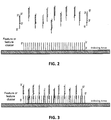
- the product of this hybridization step is shown in Fig. 3 .
- These probe oligonucleotides can be between 10 nucleotides and 100 nucleotides in length, and in some embodiments may be between 20 and 60 nt in length.
- all duplexes targeted by a given index feature to include a common 5'-overhanging index sequence.
- Fig. 3 it can be advantageous for them to have two distinct indexing sequences for each target feature, where one subset is complementary toward the 3'-end of the index probe, and another subset is complementary toward the 5'-end. This latter embodiment is depicted in Fig. 3 .
- This method may be performed in a flow cell, or an array of flow cells on a single slide, or between two slides. If two slides are used, then one or both slides may be used for the assembly. Reagents are flowed into the flow cell and flushed out after each step.
- the flow cell is also equipped with temperature control. The distance between the two slides or the top and bottom surfaces is minimized to minimize reagent volume while maximizing concentrations. Optimal conditions for hybridization to arrays are well known to those skilled in the art.
- a mixture of ligase and ligase buffer (with the appropriate cofactor, ATP or NAD) is added to the flow cell to ligate the shorter overhanging ends of the double-stranded oligonucleotides to each other, as shown in Fig. 4 . Only those overhangs that are complementary are ligated by the enzymes. Further, that complementarity is used to define the order of assembly of the parts to make the full-length synthons.
- the ligase enzymes that are most useful for this process are those that have good activity at a temperature where the probe oligonucleotides remain annealed, and have stronger activity for overhanging ends than for blunt ends. This is compatible with most non-thermostable enzymes.
- T7-ligase and T4-ligase include T7-ligase and T4-ligase (NEB, Enzymatics or Qiagen). See, e.g., Pohl et al (Eur. J. Biochem. 1982 123: 141-52 ) and Ferretti et al (Nucleic Acids Research 1981 9: 85 ).
- oligonucleotides it is useful for some downstream process for some of the constructs to be ligated to the capture. probes.
- This can be easily done by designing the oligonucleotides so that their recessed end is immediately adjacent to the end of a surface-tethered oligonucleotide on the array.
- the oligonucleotides that will be ligated in this way are those at the 3'-end of the final full length construct.
- the surface-tethered oligonucleotides may have a phosphate group at their exposed 5'-ends.
- Fig. 4 depicts the assembled oligonucleotides forming bridges between tethered probes on the array, with oligonucleotides ligated to the capture probe indicated by a dot.
- each bridge construct can be liberated by cleaving the overhanging one end of each ligated duplex, and, if necessary, melting away the overhanging fragments by increasing the temperature (but not so high as to melt the duplexes of the longer constructs).
- This cleavage can be accomplished enzymatically by a restriction enzyme, or chemically by cleavable linkers.
- the cleavable linkers (represented by small circles in Fig. 4 ) can be photocleavable or chemically cleavable, depending on the efficiencies of available chemistries.
- Cleavage of the overhang does not leave a blunt end, but leaves a short overhang of a few (1-10) nucleotides to allow for specific ligation of the constructs, shown in Fig 5 .
- the 5'-ends of the remaining construct may need to be repaired by addition of a phosphate (using a kinase), depending on the cleavable linker chemistry used.
- T7-endonuclease I A second complementary error reduction approach that uses T7-endonuclease I can be employed here.
- This enzyme recognizes unmatched DNA, including cruciforms, Holliday structures, junctions and heteroduplexes, then cleaves the duplex oligonucleotides with errors at a phosphate linkage 5' to the mismatched regions.
- the flow cell can be heated to denature the double-strands, if error reduction is performed, the array is stringently washed while hot to remove cleaved fragments.
- a mixture of ligase and ligase buffer is added to the flow cell to ligate the shorter overhanging ends of the double-stranded constructs to each other, as shown in Fig. 6 . Again, only those overhangs that are complementary are ligated by the enzymes.
- Full length constructs now include four of the original synthesize oligonucleotides, nearly quadrupling the overall length of the original synthesis. As shown in Fig. 7 , both strands of a completed synthon may be bond to the support
- the synthons can be optionally harvested by cleaving them from the array, e.g., using restriction enzyme or orthogonal cleavable linker, and amplified en masse.
- the synthons can be amplified without cleaving them from the array, e.g., using conventional PCR.
- the PCR can be performed in bulk by filling the whole flow cell chamber with master mix and thermally cycling.
- the amplification reaction it can be performed in droplets on the surface of the support, as described in US20150361422 .
- a four-well chamber was cooled to 3 °C on a temperature controlled block and kept cool during loading.
- a first array was loaded with an enzyme mix with 84,000 units T7 ligase and nominal ATP with needle and syringe.
- the well was quickly eluted leaving droplets of enzyme on the surface.
- the chamber was backfilled with fluorinated oil (Novek 7500) to preserve the droplets.
- 30 ul of 10 mM solution of ATP was added to the elution from the first well and injected into a second.
- the same procedure was followed for a third and fourth well using T4 ligase.
- the apparatus was warmed to 20 degrees for 30 minutes, then warmed to 25 °C for an additional 30 minutes.
- the oil was removed from each well.
Landscapes
- Health & Medical Sciences (AREA)
- Life Sciences & Earth Sciences (AREA)
- Chemical & Material Sciences (AREA)
- Engineering & Computer Science (AREA)
- Genetics & Genomics (AREA)
- Organic Chemistry (AREA)
- Zoology (AREA)
- Wood Science & Technology (AREA)
- Bioinformatics & Cheminformatics (AREA)
- Biotechnology (AREA)
- General Engineering & Computer Science (AREA)
- Biomedical Technology (AREA)
- Molecular Biology (AREA)
- Biochemistry (AREA)
- Microbiology (AREA)
- General Health & Medical Sciences (AREA)
- Biophysics (AREA)
- Physics & Mathematics (AREA)
- Plant Pathology (AREA)
- Proteomics, Peptides & Aminoacids (AREA)
- Crystallography & Structural Chemistry (AREA)
- Analytical Chemistry (AREA)
- Immunology (AREA)
- Chemical Kinetics & Catalysis (AREA)
- General Chemical & Material Sciences (AREA)
- Measuring Or Testing Involving Enzymes Or Micro-Organisms (AREA)
Claims (14)
- Ein Verfahren zur Herstellung eines Ligationsprodukts, umfassend:i. Hybridisieren eines ersten doppelsträngigen Oligonukleotids und eines zweiten doppelsträngigen Oligonukleotids an ein Substrat, das Oberflächen-gebundene Oligonukleotide umfasst; undii. Zusammen-Ligieren der Oberflächen-distalen Enden des ersten und zweiten doppelsträngigen Oligonukleotids, dadurch Herstellen eines ersten doppelsträngigen Ligationsprodukts, das an beiden Enden an dem Träger gebunden ist, worin:i. das erste doppelsträngige Oligonukleotid an beiden Enden einen Überhang hat;ii. das zweite doppelsträngige Oligonukleotid an beiden Enden einen Überhang hat;iii. die Überhänge an einem ersten Ende des ersten und zweiten doppelsträngigen Oligonukleotids Ligations-kompatibel sind; undiv. die Überhänge an einem zweiten Ende des ersten und zweiten doppelsträngigen Oligonukleotids komplementär zu einem Oberflächen-gebundenen Oligonukleotid sind.
- Das Verfahren nach Anspruch 1, wobei die Überhänge an dem ersten Ende des ersten und zweiten doppelsträngigen Oligonukleotids im Bereich von 1 bis 9 Basen-Länge sind und/oder wobei die Überhänge dem zweiten Ende des ersten und zweiten doppelsträngigen Oligonukleotids im Bereich von 10 bis 40 Basen-Länge sind.
- Das Verfahren nach einem der vorstehenden Ansprüche, wobei die Ligation auch das Oberflächen-proximale Ende des ersten doppelsträngigen Oligonukleotids an ein Oberflächengebundenes Oligonukleotid ligiert.
- Das Verfahren nach einem der vorstehenden Ansprüche, das weiterhin das Spalten des Oberflächen-proximalen Endes des zweiten doppelsträngigen Oligonukleotids umfasst, um ein Ende des ersten Ligationsprodukts vom Träger freizusetzen.
- Das Verfahren nach Anspruch 4, wobei das zweite doppelsträngige Oligonukleotid eine spaltbare Bindung umfasst, und die Spaltung durch Spalten der spaltbaren Bindung, vorzugsweise durch (i) Verwendung eines Restriktionsenzyms, oder (ii) wenn das zweite doppelsträngige Oligonukleotid eine Licht-spaltbare oder chemisch spaltbare Bindung aufweist, durch Aussetzen des Ligationsprodukts an Licht oder einer Chemikalie erfolgt.
- Das Verfahren nach Anspruch 4 oder 5, wobei Spaltung in der Erzeugung eines Überhangs an dem Ende des ersten Ligationsprodukts resultiert.
- Das Verfahren nach Anspruch 6, das weiterhin das Ligieren des Überhangs an dem Ende des ersten Ligationsprodukts an einen kompatiblen Überhang eines dritten doppelsträngigen Oligonukleotids umfasst, das an den Träger gebunden ist, oder eines Ligationsprodukts, das das dritte doppelsträngige Oligonukleotid umfasst, wodurch ein zweites Ligationsprodukt erzeugt wird, das an beiden Enden an den festen Träger gebunden ist.
- Das Verfahren nach Anspruch 7, worini. der Überhang an dem Ende des ersten Ligationsprodukts an ein drittes doppelsträngiges Oligonukleotid ligiert ist, wobei das dritte doppelsträngige Oligonukleotid ein erstes Ende aufweist, das an den Träger gebunden ist, und ein zweites Ende, das einen an Überhang aufweist, der Ligations-kompatibel mit dem Überhang an dem Ende des ersten Ligationsprodukts ist, oderii. der Überhang an dem Ende des ersten Ligationsprodukts an ein drittes Ligationsprodukt ligiert ist, wobei das dritte Ligationsprodukt das dritte doppelsträngige Oligonukleotid umfasst, und das Ligationsprodukt ein erstes Ende aufweist, das an den Träger gebunden ist, und ein zweites Ende, das einen an Überhang aufweist, der Ligations-kompatibel mit dem Überhang an dem Ende des ersten Ligationsprodukts ist.
- Das Verfahren nach Anspruch 7 oder 8, das weiterhin das Spalten eines Endes des zweiten Ligationsprodukts umfasst, wodurch ein Ende des Ligationsprodukts vom Träger freigesetzt wird.
- Das Verfahren nach einem der Ansprüche 7-9, das weiterhin das Amplifizieren des zweiten Ligationsprodukts umfasst.
- Das Verfahren nach einem der vorstehenden Ansprüche, wobei der Träger flach ist.
- Das Verfahren nach einem der vorstehenden Ansprüche, wobei die Hybridisierung bei einer Temperatur erfolgt, die das erste und zweite doppelsträngige Oligonukleotid nicht denaturiert, vorzugsweise bei einer Temperatur von 55 °C bis 70 °C unter hoch-stringenten Bedingungen, oder einem Äquivalent davon.
- Das Verfahren nach einem der vorstehenden Ansprüche, wobei das Substrat multiple Populationen des Oberflächen-gebunden Oligonukleotids umfasst, wobei jede Population des Oberflächen-gebunden Oligonukleotids eine räumlich getrennte Region auf dem Träger belegt.
- Das Verfahren nach Anspruch 13, wobei der Träger mindestens 100 Populationen des Oberflächen-gebundenen Oligonukleotids umfasst, wobei jede Population des Oberflächen-gebunden Oligonukleotids eine räumlich getrennte Region auf dem Träger belegt.
Applications Claiming Priority (2)
| Application Number | Priority Date | Filing Date | Title |
|---|---|---|---|
| US201662407748P | 2016-10-13 | 2016-10-13 | |
| US15/782,648 US10538796B2 (en) | 2016-10-13 | 2017-10-12 | On-array ligation assembly |
Publications (2)
| Publication Number | Publication Date |
|---|---|
| EP3309252A1 EP3309252A1 (de) | 2018-04-18 |
| EP3309252B1 true EP3309252B1 (de) | 2020-07-15 |
Family
ID=60201817
Family Applications (1)
| Application Number | Title | Priority Date | Filing Date |
|---|---|---|---|
| EP17196353.1A Active EP3309252B1 (de) | 2016-10-13 | 2017-10-13 | On-array-ligationsanornung |
Country Status (2)
| Country | Link |
|---|---|
| US (1) | US10538796B2 (de) |
| EP (1) | EP3309252B1 (de) |
Families Citing this family (3)
| Publication number | Priority date | Publication date | Assignee | Title |
|---|---|---|---|---|
| CN109825431A (zh) * | 2019-03-18 | 2019-05-31 | 中国人民解放军军事科学院军事医学研究院 | 寡核苷酸原位组装仪 |
| EP4381063A4 (de) | 2021-08-02 | 2025-07-02 | Agilent Technologies Inc | Anordnung von langen nukleinsäuren durch ligation unter verwendung indizierter splint-oligos |
| WO2024006816A1 (en) * | 2022-06-29 | 2024-01-04 | 10X Genomics, Inc. | Compositions and methods for oligonucleotide inversion on arrays |
Citations (1)
| Publication number | Priority date | Publication date | Assignee | Title |
|---|---|---|---|---|
| WO2014151696A1 (en) * | 2013-03-15 | 2014-09-25 | Gen9, Inc. | Compositions and methods for multiplex nucleic acids synthesis |
Family Cites Families (13)
| Publication number | Priority date | Publication date | Assignee | Title |
|---|---|---|---|---|
| US5948902A (en) | 1997-11-20 | 1999-09-07 | South Alabama Medical Science Foundation | Antisense oligonucleotides to human serine/threonine protein phosphatase genes |
| US6242266B1 (en) | 1999-04-30 | 2001-06-05 | Agilent Technologies Inc. | Preparation of biopolymer arrays |
| US6323043B1 (en) | 1999-04-30 | 2001-11-27 | Agilent Technologies, Inc. | Fabricating biopolymer arrays |
| US6180351B1 (en) | 1999-07-22 | 2001-01-30 | Agilent Technologies Inc. | Chemical array fabrication with identifier |
| US6232072B1 (en) | 1999-10-15 | 2001-05-15 | Agilent Technologies, Inc. | Biopolymer array inspection |
| US6171797B1 (en) | 1999-10-20 | 2001-01-09 | Agilent Technologies Inc. | Methods of making polymeric arrays |
| US20040152905A1 (en) | 2003-01-31 | 2004-08-05 | Guzaev Andrei P. | Universal building blocks and support media for synthesis of oligonucleotides and their analogs |
| US20050233340A1 (en) | 2004-04-20 | 2005-10-20 | Barrett Michael T | Methods and compositions for assessing CpG methylation |
| JP5103398B2 (ja) | 2005-06-06 | 2012-12-19 | 454 ライフ サイエンシーズ コーポレイション | 両末端配列決定(pairedendsequencing) |
| US7544473B2 (en) | 2006-01-23 | 2009-06-09 | Population Genetics Technologies Ltd. | Nucleic acid analysis using sequence tokens |
| US9295965B2 (en) | 2010-11-12 | 2016-03-29 | Gen9, Inc. | Methods and devices for nucleic acid synthesis |
| WO2013028643A1 (en) | 2011-08-20 | 2013-02-28 | Integenx Inc. | Preparation of polynucleotides on a solid substrate for sequencing |
| US20150361422A1 (en) | 2014-06-16 | 2015-12-17 | Agilent Technologies, Inc. | High throughput gene assembly in droplets |
-
2017
- 2017-10-12 US US15/782,648 patent/US10538796B2/en active Active
- 2017-10-13 EP EP17196353.1A patent/EP3309252B1/de active Active
Patent Citations (1)
| Publication number | Priority date | Publication date | Assignee | Title |
|---|---|---|---|---|
| WO2014151696A1 (en) * | 2013-03-15 | 2014-09-25 | Gen9, Inc. | Compositions and methods for multiplex nucleic acids synthesis |
Also Published As
| Publication number | Publication date |
|---|---|
| US20180105853A1 (en) | 2018-04-19 |
| EP3309252A1 (de) | 2018-04-18 |
| US10538796B2 (en) | 2020-01-21 |
Similar Documents
| Publication | Publication Date | Title |
|---|---|---|
| EP3155146B1 (de) | Hochdurchsatzgenassemblierung in tröpfchen | |
| EP3797170B1 (de) | Polynukleotidsyntheseverfahren, system und kit | |
| EP3570972B1 (de) | Verfahren und reagenzien zur synthese von polynukleotidmolekülen | |
| US10240194B2 (en) | Methods for nucleotide sequencing and high fidelity polynucleotide synthesis | |
| US9187777B2 (en) | Methods and devices for in situ nucleic acid synthesis | |
| US20150361423A1 (en) | High throughput gene assembly in droplets | |
| JP6479759B2 (ja) | 固体支持体上での核酸増幅方法 | |
| EP3824100B1 (de) | Polynukleotidsyntheseverfahren | |
| US11041151B2 (en) | RNA array compositions and methods | |
| CN112423885A (zh) | 多核苷酸合成方法、试剂盒和系统 | |
| EP4028538A1 (de) | Polynukleotidsyntheseverfahren, kit und system | |
| EP3309252A1 (de) | On-array-ligationsanornung | |
| US11414687B2 (en) | Method and system for enzymatic synthesis of oligonucleotides | |
| EP4347872B1 (de) | Oligomodifizierte nukleotidanaloga zur herstellung von nukleinsäuren | |
| US20240287505A1 (en) | Methods and compositions for combinatorial indexing of bead-based nucleic acids | |
| EP2456892B1 (de) | Verfahren zur sequenzierung einer polynukleotidmatrize | |
| CN107937389B (zh) | 阵列上连接组装 | |
| CA2473308A1 (en) | Assay and kit for analyzing gene expression | |
| US12281302B2 (en) | Assembly of long nucleic acids by ligation using indexed splint oligos |
Legal Events
| Date | Code | Title | Description |
|---|---|---|---|
| PUAI | Public reference made under article 153(3) epc to a published international application that has entered the european phase |
Free format text: ORIGINAL CODE: 0009012 |
|
| STAA | Information on the status of an ep patent application or granted ep patent |
Free format text: STATUS: REQUEST FOR EXAMINATION WAS MADE |
|
| 17P | Request for examination filed |
Effective date: 20171013 |
|
| AK | Designated contracting states |
Kind code of ref document: A1 Designated state(s): AL AT BE BG CH CY CZ DE DK EE ES FI FR GB GR HR HU IE IS IT LI LT LU LV MC MK MT NL NO PL PT RO RS SE SI SK SM TR |
|
| AX | Request for extension of the european patent |
Extension state: BA ME |
|
| STAA | Information on the status of an ep patent application or granted ep patent |
Free format text: STATUS: EXAMINATION IS IN PROGRESS |
|
| 17Q | First examination report despatched |
Effective date: 20190820 |
|
| GRAP | Despatch of communication of intention to grant a patent |
Free format text: ORIGINAL CODE: EPIDOSNIGR1 |
|
| STAA | Information on the status of an ep patent application or granted ep patent |
Free format text: STATUS: GRANT OF PATENT IS INTENDED |
|
| INTG | Intention to grant announced |
Effective date: 20200207 |
|
| GRAS | Grant fee paid |
Free format text: ORIGINAL CODE: EPIDOSNIGR3 |
|
| GRAA | (expected) grant |
Free format text: ORIGINAL CODE: 0009210 |
|
| STAA | Information on the status of an ep patent application or granted ep patent |
Free format text: STATUS: THE PATENT HAS BEEN GRANTED |
|
| AK | Designated contracting states |
Kind code of ref document: B1 Designated state(s): AL AT BE BG CH CY CZ DE DK EE ES FI FR GB GR HR HU IE IS IT LI LT LU LV MC MK MT NL NO PL PT RO RS SE SI SK SM TR |
|
| REG | Reference to a national code |
Ref country code: CH Ref legal event code: EP Ref country code: GB Ref legal event code: FG4D |
|
| REG | Reference to a national code |
Ref country code: IE Ref legal event code: FG4D |
|
| REG | Reference to a national code |
Ref country code: DE Ref legal event code: R096 Ref document number: 602017019712 Country of ref document: DE |
|
| REG | Reference to a national code |
Ref country code: AT Ref legal event code: REF Ref document number: 1291078 Country of ref document: AT Kind code of ref document: T Effective date: 20200815 |
|
| REG | Reference to a national code |
Ref country code: LT Ref legal event code: MG4D |
|
| REG | Reference to a national code |
Ref country code: AT Ref legal event code: MK05 Ref document number: 1291078 Country of ref document: AT Kind code of ref document: T Effective date: 20200715 |
|
| REG | Reference to a national code |
Ref country code: NL Ref legal event code: MP Effective date: 20200715 |
|
| PG25 | Lapsed in a contracting state [announced via postgrant information from national office to epo] |
Ref country code: SE Free format text: LAPSE BECAUSE OF FAILURE TO SUBMIT A TRANSLATION OF THE DESCRIPTION OR TO PAY THE FEE WITHIN THE PRESCRIBED TIME-LIMIT Effective date: 20200715 Ref country code: BG Free format text: LAPSE BECAUSE OF FAILURE TO SUBMIT A TRANSLATION OF THE DESCRIPTION OR TO PAY THE FEE WITHIN THE PRESCRIBED TIME-LIMIT Effective date: 20201015 Ref country code: NO Free format text: LAPSE BECAUSE OF FAILURE TO SUBMIT A TRANSLATION OF THE DESCRIPTION OR TO PAY THE FEE WITHIN THE PRESCRIBED TIME-LIMIT Effective date: 20201015 Ref country code: GR Free format text: LAPSE BECAUSE OF FAILURE TO SUBMIT A TRANSLATION OF THE DESCRIPTION OR TO PAY THE FEE WITHIN THE PRESCRIBED TIME-LIMIT Effective date: 20201016 Ref country code: ES Free format text: LAPSE BECAUSE OF FAILURE TO SUBMIT A TRANSLATION OF THE DESCRIPTION OR TO PAY THE FEE WITHIN THE PRESCRIBED TIME-LIMIT Effective date: 20200715 Ref country code: PT Free format text: LAPSE BECAUSE OF FAILURE TO SUBMIT A TRANSLATION OF THE DESCRIPTION OR TO PAY THE FEE WITHIN THE PRESCRIBED TIME-LIMIT Effective date: 20201116 Ref country code: LT Free format text: LAPSE BECAUSE OF FAILURE TO SUBMIT A TRANSLATION OF THE DESCRIPTION OR TO PAY THE FEE WITHIN THE PRESCRIBED TIME-LIMIT Effective date: 20200715 Ref country code: HR Free format text: LAPSE BECAUSE OF FAILURE TO SUBMIT A TRANSLATION OF THE DESCRIPTION OR TO PAY THE FEE WITHIN THE PRESCRIBED TIME-LIMIT Effective date: 20200715 Ref country code: FI Free format text: LAPSE BECAUSE OF FAILURE TO SUBMIT A TRANSLATION OF THE DESCRIPTION OR TO PAY THE FEE WITHIN THE PRESCRIBED TIME-LIMIT Effective date: 20200715 Ref country code: AT Free format text: LAPSE BECAUSE OF FAILURE TO SUBMIT A TRANSLATION OF THE DESCRIPTION OR TO PAY THE FEE WITHIN THE PRESCRIBED TIME-LIMIT Effective date: 20200715 |
|
| PG25 | Lapsed in a contracting state [announced via postgrant information from national office to epo] |
Ref country code: RS Free format text: LAPSE BECAUSE OF FAILURE TO SUBMIT A TRANSLATION OF THE DESCRIPTION OR TO PAY THE FEE WITHIN THE PRESCRIBED TIME-LIMIT Effective date: 20200715 Ref country code: PL Free format text: LAPSE BECAUSE OF FAILURE TO SUBMIT A TRANSLATION OF THE DESCRIPTION OR TO PAY THE FEE WITHIN THE PRESCRIBED TIME-LIMIT Effective date: 20200715 Ref country code: LV Free format text: LAPSE BECAUSE OF FAILURE TO SUBMIT A TRANSLATION OF THE DESCRIPTION OR TO PAY THE FEE WITHIN THE PRESCRIBED TIME-LIMIT Effective date: 20200715 Ref country code: IS Free format text: LAPSE BECAUSE OF FAILURE TO SUBMIT A TRANSLATION OF THE DESCRIPTION OR TO PAY THE FEE WITHIN THE PRESCRIBED TIME-LIMIT Effective date: 20201115 |
|
| PG25 | Lapsed in a contracting state [announced via postgrant information from national office to epo] |
Ref country code: NL Free format text: LAPSE BECAUSE OF FAILURE TO SUBMIT A TRANSLATION OF THE DESCRIPTION OR TO PAY THE FEE WITHIN THE PRESCRIBED TIME-LIMIT Effective date: 20200715 |
|
| REG | Reference to a national code |
Ref country code: DE Ref legal event code: R097 Ref document number: 602017019712 Country of ref document: DE |
|
| PG25 | Lapsed in a contracting state [announced via postgrant information from national office to epo] |
Ref country code: DK Free format text: LAPSE BECAUSE OF FAILURE TO SUBMIT A TRANSLATION OF THE DESCRIPTION OR TO PAY THE FEE WITHIN THE PRESCRIBED TIME-LIMIT Effective date: 20200715 Ref country code: CZ Free format text: LAPSE BECAUSE OF FAILURE TO SUBMIT A TRANSLATION OF THE DESCRIPTION OR TO PAY THE FEE WITHIN THE PRESCRIBED TIME-LIMIT Effective date: 20200715 Ref country code: RO Free format text: LAPSE BECAUSE OF FAILURE TO SUBMIT A TRANSLATION OF THE DESCRIPTION OR TO PAY THE FEE WITHIN THE PRESCRIBED TIME-LIMIT Effective date: 20200715 Ref country code: EE Free format text: LAPSE BECAUSE OF FAILURE TO SUBMIT A TRANSLATION OF THE DESCRIPTION OR TO PAY THE FEE WITHIN THE PRESCRIBED TIME-LIMIT Effective date: 20200715 Ref country code: IT Free format text: LAPSE BECAUSE OF FAILURE TO SUBMIT A TRANSLATION OF THE DESCRIPTION OR TO PAY THE FEE WITHIN THE PRESCRIBED TIME-LIMIT Effective date: 20200715 Ref country code: SM Free format text: LAPSE BECAUSE OF FAILURE TO SUBMIT A TRANSLATION OF THE DESCRIPTION OR TO PAY THE FEE WITHIN THE PRESCRIBED TIME-LIMIT Effective date: 20200715 |
|
| PLBE | No opposition filed within time limit |
Free format text: ORIGINAL CODE: 0009261 |
|
| STAA | Information on the status of an ep patent application or granted ep patent |
Free format text: STATUS: NO OPPOSITION FILED WITHIN TIME LIMIT |
|
| PG25 | Lapsed in a contracting state [announced via postgrant information from national office to epo] |
Ref country code: AL Free format text: LAPSE BECAUSE OF FAILURE TO SUBMIT A TRANSLATION OF THE DESCRIPTION OR TO PAY THE FEE WITHIN THE PRESCRIBED TIME-LIMIT Effective date: 20200715 |
|
| REG | Reference to a national code |
Ref country code: CH Ref legal event code: PL |
|
| 26N | No opposition filed |
Effective date: 20210416 |
|
| PG25 | Lapsed in a contracting state [announced via postgrant information from national office to epo] |
Ref country code: LU Free format text: LAPSE BECAUSE OF NON-PAYMENT OF DUE FEES Effective date: 20201013 Ref country code: MC Free format text: LAPSE BECAUSE OF FAILURE TO SUBMIT A TRANSLATION OF THE DESCRIPTION OR TO PAY THE FEE WITHIN THE PRESCRIBED TIME-LIMIT Effective date: 20200715 Ref country code: SK Free format text: LAPSE BECAUSE OF FAILURE TO SUBMIT A TRANSLATION OF THE DESCRIPTION OR TO PAY THE FEE WITHIN THE PRESCRIBED TIME-LIMIT Effective date: 20200715 |
|
| REG | Reference to a national code |
Ref country code: BE Ref legal event code: MM Effective date: 20201031 |
|
| PG25 | Lapsed in a contracting state [announced via postgrant information from national office to epo] |
Ref country code: FR Free format text: LAPSE BECAUSE OF NON-PAYMENT OF DUE FEES Effective date: 20201031 |
|
| PG25 | Lapsed in a contracting state [announced via postgrant information from national office to epo] |
Ref country code: SI Free format text: LAPSE BECAUSE OF FAILURE TO SUBMIT A TRANSLATION OF THE DESCRIPTION OR TO PAY THE FEE WITHIN THE PRESCRIBED TIME-LIMIT Effective date: 20200715 Ref country code: LI Free format text: LAPSE BECAUSE OF NON-PAYMENT OF DUE FEES Effective date: 20201031 Ref country code: BE Free format text: LAPSE BECAUSE OF NON-PAYMENT OF DUE FEES Effective date: 20201031 Ref country code: CH Free format text: LAPSE BECAUSE OF NON-PAYMENT OF DUE FEES Effective date: 20201031 |
|
| PG25 | Lapsed in a contracting state [announced via postgrant information from national office to epo] |
Ref country code: IE Free format text: LAPSE BECAUSE OF NON-PAYMENT OF DUE FEES Effective date: 20201013 |
|
| PG25 | Lapsed in a contracting state [announced via postgrant information from national office to epo] |
Ref country code: TR Free format text: LAPSE BECAUSE OF FAILURE TO SUBMIT A TRANSLATION OF THE DESCRIPTION OR TO PAY THE FEE WITHIN THE PRESCRIBED TIME-LIMIT Effective date: 20200715 Ref country code: MT Free format text: LAPSE BECAUSE OF FAILURE TO SUBMIT A TRANSLATION OF THE DESCRIPTION OR TO PAY THE FEE WITHIN THE PRESCRIBED TIME-LIMIT Effective date: 20200715 Ref country code: CY Free format text: LAPSE BECAUSE OF FAILURE TO SUBMIT A TRANSLATION OF THE DESCRIPTION OR TO PAY THE FEE WITHIN THE PRESCRIBED TIME-LIMIT Effective date: 20200715 |
|
| PG25 | Lapsed in a contracting state [announced via postgrant information from national office to epo] |
Ref country code: MK Free format text: LAPSE BECAUSE OF FAILURE TO SUBMIT A TRANSLATION OF THE DESCRIPTION OR TO PAY THE FEE WITHIN THE PRESCRIBED TIME-LIMIT Effective date: 20200715 |
|
| P01 | Opt-out of the competence of the unified patent court (upc) registered |
Effective date: 20230527 |
|
| PGFP | Annual fee paid to national office [announced via postgrant information from national office to epo] |
Ref country code: GB Payment date: 20250821 Year of fee payment: 9 |
|
| PGFP | Annual fee paid to national office [announced via postgrant information from national office to epo] |
Ref country code: DE Payment date: 20250819 Year of fee payment: 9 |