EP3310015A1 - Filtrage réseau à l'aide des données de connexion de routeur - Google Patents
Filtrage réseau à l'aide des données de connexion de routeur Download PDFInfo
- Publication number
- EP3310015A1 EP3310015A1 EP16193361.9A EP16193361A EP3310015A1 EP 3310015 A1 EP3310015 A1 EP 3310015A1 EP 16193361 A EP16193361 A EP 16193361A EP 3310015 A1 EP3310015 A1 EP 3310015A1
- Authority
- EP
- European Patent Office
- Prior art keywords
- network
- data
- filter system
- data traffic
- routing apparatus
- Prior art date
- Legal status (The legal status is an assumption and is not a legal conclusion. Google has not performed a legal analysis and makes no representation as to the accuracy of the status listed.)
- Withdrawn
Links
- 238000001914 filtration Methods 0.000 title description 11
- 238000000034 method Methods 0.000 claims abstract description 35
- 238000013519 translation Methods 0.000 claims abstract description 9
- 230000005540 biological transmission Effects 0.000 claims description 28
- 230000007246 mechanism Effects 0.000 claims description 18
- 230000008901 benefit Effects 0.000 description 7
- 230000008569 process Effects 0.000 description 4
- 238000012423 maintenance Methods 0.000 description 3
- 238000004321 preservation Methods 0.000 description 3
- 238000012552 review Methods 0.000 description 3
- 238000010586 diagram Methods 0.000 description 2
- 238000012545 processing Methods 0.000 description 2
- 230000004044 response Effects 0.000 description 2
- 238000013459 approach Methods 0.000 description 1
- 230000009286 beneficial effect Effects 0.000 description 1
- 238000013507 mapping Methods 0.000 description 1
- 238000012986 modification Methods 0.000 description 1
- 230000004048 modification Effects 0.000 description 1
- 230000000737 periodic effect Effects 0.000 description 1
Images


Classifications
-
- H—ELECTRICITY
- H04—ELECTRIC COMMUNICATION TECHNIQUE
- H04L—TRANSMISSION OF DIGITAL INFORMATION, e.g. TELEGRAPHIC COMMUNICATION
- H04L61/00—Network arrangements, protocols or services for addressing or naming
- H04L61/09—Mapping addresses
- H04L61/25—Mapping addresses of the same type
- H04L61/2503—Translation of Internet protocol [IP] addresses
- H04L61/255—Maintenance or indexing of mapping tables
-
- H—ELECTRICITY
- H04—ELECTRIC COMMUNICATION TECHNIQUE
- H04L—TRANSMISSION OF DIGITAL INFORMATION, e.g. TELEGRAPHIC COMMUNICATION
- H04L61/00—Network arrangements, protocols or services for addressing or naming
- H04L61/09—Mapping addresses
- H04L61/25—Mapping addresses of the same type
- H04L61/2503—Translation of Internet protocol [IP] addresses
- H04L61/2514—Translation of Internet protocol [IP] addresses between local and global IP addresses
-
- H—ELECTRICITY
- H04—ELECTRIC COMMUNICATION TECHNIQUE
- H04L—TRANSMISSION OF DIGITAL INFORMATION, e.g. TELEGRAPHIC COMMUNICATION
- H04L61/00—Network arrangements, protocols or services for addressing or naming
- H04L61/09—Mapping addresses
- H04L61/25—Mapping addresses of the same type
- H04L61/2503—Translation of Internet protocol [IP] addresses
- H04L61/2591—Identification of devices behind NAT devices
-
- H—ELECTRICITY
- H04—ELECTRIC COMMUNICATION TECHNIQUE
- H04L—TRANSMISSION OF DIGITAL INFORMATION, e.g. TELEGRAPHIC COMMUNICATION
- H04L63/00—Network architectures or network communication protocols for network security
- H04L63/02—Network architectures or network communication protocols for network security for separating internal from external traffic, e.g. firewalls
- H04L63/0227—Filtering policies
- H04L63/0236—Filtering by address, protocol, port number or service, e.g. IP-address or URL
-
- H—ELECTRICITY
- H04—ELECTRIC COMMUNICATION TECHNIQUE
- H04L—TRANSMISSION OF DIGITAL INFORMATION, e.g. TELEGRAPHIC COMMUNICATION
- H04L63/00—Network architectures or network communication protocols for network security
- H04L63/02—Network architectures or network communication protocols for network security for separating internal from external traffic, e.g. firewalls
- H04L63/0227—Filtering policies
- H04L63/0254—Stateful filtering
-
- H—ELECTRICITY
- H04—ELECTRIC COMMUNICATION TECHNIQUE
- H04L—TRANSMISSION OF DIGITAL INFORMATION, e.g. TELEGRAPHIC COMMUNICATION
- H04L63/00—Network architectures or network communication protocols for network security
- H04L63/02—Network architectures or network communication protocols for network security for separating internal from external traffic, e.g. firewalls
- H04L63/0227—Filtering policies
- H04L63/0263—Rule management
-
- H—ELECTRICITY
- H04—ELECTRIC COMMUNICATION TECHNIQUE
- H04L—TRANSMISSION OF DIGITAL INFORMATION, e.g. TELEGRAPHIC COMMUNICATION
- H04L61/00—Network arrangements, protocols or services for addressing or naming
- H04L61/09—Mapping addresses
- H04L61/25—Mapping addresses of the same type
- H04L61/2503—Translation of Internet protocol [IP] addresses
- H04L61/2517—Translation of Internet protocol [IP] addresses using port numbers
Definitions
- the invention relates to network routing and filtering techniques.
- Network routers are devices that forward data packets between computer networks. When a data packet comes in from one of the computer networks, the router reads the address information in the packet and determines the intended destination. It then directs the packet to the next network.
- the most familiar type of routers are home routers or small office routers that direct traffic between home or office computers and the internet. Such routers are often cable routers or DSL (Digital Subscriber Line) routers which establish a connection to the internet through an ISP (Internet Service Provider).
- ISP Internet Service Provider
- enterprise routers exist to provide routing services to large business or ISP networks, and there are powerful core routers that act at the internet backbone.
- Home and small office routers often do not just provide routing services but also add security and filtering features. This provides significant advantages as it helps protecting the home or small office network.
- security and filtering features need to be implemented, configured, maintained, and updated at each routing device. This is inconvenient on the one hand as it requires users or providers to adjust their settings in the routing device or update its firmware from time to time. On the other hand, if this maintenance is not performed thoroughly, then the routing device itself may cause security risks to the home or small office network.
- the routing device is configured to direct any data traffic from the home or small office network to a dedicated server or server farm which has implemented a network filter system. Since all the traffic from the users is directed to this network filter system, it is not necessary for the router itself to implement its own security and filter mechanisms. All security features are provided by the network filter system on the server(s), and it is then just required that the network filter system be maintained and updated to exclude any known security risk. This centralized approach therefore provides tremendous advantages to users as the users are relieved of any maintenance tasks and nevertheless can appreciate most up to date security and filtering features.
- the network filter system can provide its services to a huge number of different users at the same time. All of the users can then benefit from the high level security provided by the system.
- the network filter system can identify the routing devices from which it receives the various data traffics, it can also provide different security or filter mechanisms to different routing devices, i.e., to different home or small office networks behind such routing devices.
- IP masquerading techniques that hide an entire IP (Internet Protocol) address space behind a single IP address.
- An example of routing devices that use IP masquerading are NAT (Network Address Translation) routers.
- NAT Network Address Translation
- a routing device masquerades its private network, i.e., the home or small office network, then it substantially replaces any address of the home or small office network with the router's own address which is an address of the public address space.
- IP masquerading techniques there are other situations which make it difficult or impossible for a server based network filter system to identify users or devices in the private home or small office network behind a routing device.
- network filter systems could identify particular devices in the private home or small office network, then it would be possible to apply different security standards or specific filter conditions to different types of devices such as television apparatus, thermostats, webcams, notebooks, IoT (Internet of Things) devices, or the like. It would also be possible to identify different users and apply user specific filter conditions. Just as an example, it would then be possible to apply parental filtering standards to devices to which children have access. Apart from this, user specific security and/or filtering conditions would be beneficial for almost all types of users and client devices.
- VPN Virtual Private Network
- An improved technique is provided which allows a network filter system to which any client data traffic is routed, to identify client devices behind a router, without requiring establishing VPN tunnels.
- a network routing apparatus and network filter system as well as corresponding methods and media are provided.
- the network routing apparatus directs any data traffic originating from a client device through the network filter system.
- the network routing apparatus performs address translation and connection tracking and it repeatedly send at least part of the tracked connection data to the network filter system.
- the network filter system uses this data to identify the client device which the data traffic passing through the network filter system originates from, or is destined for.
- the data communicated from the network routing apparatus to the network filter system may include the private address of the client device and the respective port number used.
- the first computer network comprises at least one client device
- the second computer network comprises at least one server device and a network filter system.
- the network routing apparatus is arranged to direct any data traffic originating from the at least one client device and destined for the at least one server device through the network filter system.
- the network routing apparatus comprises an address translation unit for translating addresses within the address space of the first computer network to addresses within the address space of the second computer network.
- the network routing apparatus further comprises a connection tracking table storing data describing data traffic that has passed the network routing apparatus.
- the data includes addresses within the address space of the first computer network and respective translated addresses within the address space of the second computer network.
- the network routing apparatus further comprises a connection data transmission unit for repeatedly sending at least part of the data stored in the connection tracking table to the network filter system.
- the at least part of the data includes information suitable for the network filter system to identify, for a given data traffic passing through the network filter system, the client device from which this data traffic originates.
- the at least part of the data is data that has changed in the connection tracking table since the last transmission.
- the at least part of the data may include at least one address of a client device within the address space of the first computer network, and a port number used for the data traffic originating from the client device.
- the at least part of the data may further include an address of a server device which the data traffic originating from the client device is destined for, and a port number of the server device which the data traffic originating from the client device is destined for.
- the network routing apparatus is arranged to operate in accordance with the ICMP protocol and the connection data transmission unit is further arranged to send ICMP sequence numbers to the network filter system.
- the network routing apparatus may be arranged to comply with IPsec and the connection data transmission unit may then be further arranged to send SPI tags to the network filter system.
- the at least part of the data may include a MAC address of the client device from which the data traffic originates.
- the network filter system for applying at least one network security and/or filter mechanism to data traffic received from and/or sent to a network routing apparatus.
- the network routing apparatus is arranged for directing data traffic between a first computer network comprising at least one client device and a second computer network comprising the network filter system.
- the network filter system comprises a security filter unit for applying the at least one network security and/or filter mechanism, and a connection data reception unit for repeatedly receiving from the network routing apparatus data describing data traffic that has passed the network routing apparatus.
- the data includes information suitable to identify, for a given data traffic passing through the network filter system, the client device from which this data traffic originates and/or which this data traffic is destined for.
- the network filter system further comprises a connection data store for storing the data received by the connection data reception unit.
- the security filter unit may be arranged to identify from the received data the client device which a current data traffic originates from and/or which this data traffic is destined for, and individually adjust the at least one network security and/or filter mechanism to the identified client device.
- the information includes an address of the client device within the address space of the first computer network, and a port number used for the data traffic originating from, or destined for, the client device.
- the information may further include an address of a server device which the data traffic originating from the client device is destined for, or which the data traffic destined for the client device is originating from, and a associated port number of the server device.
- the information includes an address of the network routing apparatus within the address space of the second computer network.
- a method of operating a network routing apparatus for directing data traffic between a first computer network and a second computer network comprises at least one client device, and the second computer network comprises at least one server device and a network filter system.
- the network routing apparatus is arranged to direct any data traffic originating from the at least one client device and destined for the at least one server device through the network filter system.
- the method comprises translating addresses within the address space of the first computer network to addresses within the address space of the second computer network.
- the method further comprises storing data in a connection tracking table, wherein the data describes data traffic that has passed the network routing apparatus and includes addresses within the address space of the first computer network and respective translated addresses within the address space of the second computer network.
- the method comprises repeatedly sending at least part of the data stored in the connection tracking table to the network filter system.
- the at least part of the data includes information suitable for the network filter system to identify, for a given data traffic passing through the network filter system, the client device from which this data traffic originates.
- a method of operating a network filter system to apply at least one network security and/or filter mechanism to data traffic received from and/or sent to a network routing apparatus The network routing apparatus is arranged for directing data traffic between a first computer network comprising at least one client device and a second computer network comprising the network filter system.
- the method comprises receiving data traffic from the network routing apparatus and/or from an internet server, and applying the at least one network security and/or filter mechanism to the received data traffic.
- the method further comprises repeatedly receiving, from the network routing apparatus, data describing data traffic that has passed the network routing apparatus.
- a computer-readable storage medium that stores instructions that, when executed by at least one processor, cause the at least one processor to perform the method of any of the embodiments described in the disclosure or shown in the drawings.
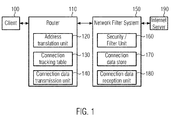
- the system is shown to include a router 110 which may be any network routing apparatus.
- the router 110 is used to connect a home or small office network to the internet, and it may preferably be a NAT router and/or a router using IP masquerading techniques.
- the router 110 directs data traffic between a first computer network, which is the router's private network including one or more hardware or software clients 100, and a second computer network which may be the router's public network.
- This second computer network includes a network filter system 150 and at least one internet server 190.
- the network filter system 150 will be described in more detail below.
- the internet server 190 may be any server that is connected to the internet and provides services in response to a request from one of the clients 100.
- the router 110 is arranged to direct any data traffic originating from any client 100 and destined for the internet server 190 through the network filter system 150. This allows the router 110 to delegate any security and/or filter tasks to the network filter system 150.
- the router 110 comprises an address translation unit 120 that translates addresses within the private address space to addresses within the public address space.
- the router further includes a connection tracking table 130 which stores data describing the traffic that has passed the router.
- the router 110 is linux-based and operates a Netfilter framework for connection tracking.
- the user-space tool conntrack and its associated daemon conntrackd may be used to review the Netfilter connections in the connection tracking table 130. It is noted that other techniques may be used to track connection data in table 130.
- the router 110 further includes a connection data transmission unit 140 that repeatedly sends at least part of the data stored in the connection tracking table 130 to the network filter system 150.
- the connection data transmission unit 140 sends most recently added data of the connection tracking table 130 to the network filter system 150, to reduce the amount of data to be sent.
- the connection data transmission unit 140 repetitively copies the entire connection tracking table 130 to the network filter system 150 rather than performing incremental transmissions.
- connection data transmission unit 140 performs the data transmissions on a periodic basis. In another embodiment, the transmission is performed whenever new data has been stored in the connection tracking table 130.
- connection data transmission unit 140 performs the transmission of the connection data on its own
- the connection data transmission unit 140 is arranged to perform its transmissions upon request.
- the network filter system 150 requests connection data from the router 110 and the router's connection data transmission unit 140 is arranged to send connection data to the network filter system 150 in response to such a request.
- this system may be server based or cloud based. It includes a security/filter unit 160 that applies security and/or filter mechanisms to data traffic passing through the network filter system 150.
- the security and/or filter mechanisms may be applied to data traffic in either direction, from router 110 to internet server 190 and vice versa. In an embodiment, different mechanisms may be used for data traffic of different directions.
- the security/filter unit 160 may apply client specific security and/or filter conditions, depending on the type or identity of the client device or user.
- the network filter system 150 further may include a connection data reception unit 180 that receives connection data from the router 110, sent by the router's connection data transmission unit 140.
- the connection data reception unit 180 is capable of sending requests to the router 110 to cause the router's connection data transmission unit 140 to send connection data to the network filter system 150.
- the network filter system 150 may further comprise a connection data store 170 that stores the connection data received from the connection data reception unit 180.
- the router 110 applies port preservation at least for TCP (Transmission Control Protocol) connections. If, for instance, client 100 has a private IP address of 192.168.178.100 and attempts to access the internet server 190 at its public IP address 40.50.60.70 using port 80, then the router 110 (which may have a public IP address of 20.30.40.50) chooses an arbitrary source port, e.g., 1234, but preserves this when replacing the client's private IP address with the router's public IP address. Thus, the initial request 192.168.178.100:1234 ⁇ 40.50.60.70:80 will be translated to: 20.30.40.50:1234 ⁇ 40.50.60.70:80.
- TCP Transmission Control Protocol
- the router 110 has replaced the client's private IP address 192.168.178.100 with the router's public IP address 20.30.40.50, but it has preserved the source port 1234.
- the router 110 then translates 192.168.178.200:4321 ⁇ 40.50.60.70:80 to the following request in the public network: 20.30.40.50:4321 ⁇ 40.50.60.70:80.
- the requests from the two different clients differ in just the source port number.
- At least the private IP addresses of the clients and the respective source ports may be stored, in this embodiment, in the connection tracking table 130 and communicated to the network filter system 150.
- the security/filter unit 160 can therefore identify the client 100 from which the data traffic originates, even though the data traffic sent from the router 110 to the network filter system 150 did not include the client's private IP address.
- the router 110 may operate in accordance with the ICMP, Internet Control Message Protocol, and the connection data transmission unit 140 may then send ICMP sequence numbers to the network filter system 150.
- the router 110 may comply with IPsec, Internet Protocol Security, and the connection data transmission unit 140 may then send SPI, Security Parameter Index, tags to the network filter system 150.
- the router 110 may send the client's MAC, Media Access Control, address to the network filter system 150. Any of this information may be used by the network filter system's security/filter unit 160 to identify the client device or user in the private network of router 110. It is noted that any of the above techniques (port preservation, ICMP, SPI, MAC) may be used with any other of these techniques at the same time, thereby combining these techniques to even more improve the options for client identification.
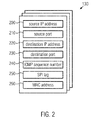
- connection tracking table 130 may include a data field 200 to store source IP addresses such as 192.168.178.100, a data field 210 to store source ports such as 1234, a data field 220 to store destination IP addresses such as 40.50.60.70, a data field 230 to store destination ports such as 80, a data field 240 to store ICMP sequence numbers, a data field 250 to store SPI tags, and a data field 260 to store MAC addresses. It is noted that in other embodiments, the connection tracking table 130 may include just some of these data fields, and/or additional data fields.
- step 300 data traffic is received from one of the clients 100.
- step 310 performs address translation in the address translation unit 120 of the router 110.
- step 320 the router 110 performs connection tracking and stores the connection data in the connection tracking table 130.
- step 330 the router 110 sends the received data traffic to the network filter system 150. This data traffic may use addresses translated in step 310.
- step 340 the router's connection data transmission unit 140 sends connection data to the network filter system 150.
- this connection data may be any subset of the data discussed above and shown in FIG. 2 , and it may also include other data.
- FIG. 3 illustrates the steps to be performed in a certain order
- step 310 of performing address translation and step 320 of tracking connection data may be performed in a different sequence, or even simultaneously, or independently from each other and asynchronously.
- step 330 of sending the data traffic to the network filter system 150 and step 340 of sending the connection data to the network filter system 150 may be performed independently from each other and not necessarily in the order shown.
- connection data is received from the router 110 and stored in the connection data store 170.
- the connection data stored in the connection data store 170 are the same as shown in FIG. 2 . In other embodiments, only a subset of this data is received in step 400 and stored.
- step 410 the network filter system 150 receives data traffic from the router 110 and/or from the internet server 190.
- step 420 the security/filter unit 160 queries the connection data stored in the connection data store 170 to identify the user or client device 100 from which the data traffic originates or for which the data traffic is destined. Once the client has been identified, step 430 applies user or client specific security and/or filter mechanisms by means of security/filter unit 160.
- the data traffic is forwarded in step 440 to the respective recipient, i.e., to the client 100 through the router 110 or to the internet server 190.
- a network filtering technique may be server based or cloud based and that protects clients from malware and/or provides client specific filtering with minimum or no maintenance requirements at the router.
- Parental filtering services and dedicated services particularly suited to IoT devices are just some of the examples where the invention may be of particular advantages.
- No VPN tunnels are required, thereby avoiding particular drawbacks involved with such techniques, such as latency, data overhead, degraded processing performance and reduced stability.
- the router 110 may keep its public IP address so that the router and its client(s) remain accessible from the public network. The invention is easy to implement, in particular where connection tracking tables are already present in the router 110.
- Another advantage of the invention is that the transmission of the connection data from the router 110 to the network filter system 150 and the use of this data in the network filter system 150 may be separated from other routing and filtering functionality so that the technique of the embodiments has no negative influence on the functioning of any internet services.
- the invention provides significant advantages to users as well as to service providers.
Landscapes
- Engineering & Computer Science (AREA)
- Computer Networks & Wireless Communication (AREA)
- Signal Processing (AREA)
- Computer Hardware Design (AREA)
- Computer Security & Cryptography (AREA)
- Computing Systems (AREA)
- General Engineering & Computer Science (AREA)
- Business, Economics & Management (AREA)
- General Business, Economics & Management (AREA)
- Data Exchanges In Wide-Area Networks (AREA)
Priority Applications (1)
| Application Number | Priority Date | Filing Date | Title |
|---|---|---|---|
| EP16193361.9A EP3310015A1 (fr) | 2016-10-11 | 2016-10-11 | Filtrage réseau à l'aide des données de connexion de routeur |
Applications Claiming Priority (1)
| Application Number | Priority Date | Filing Date | Title |
|---|---|---|---|
| EP16193361.9A EP3310015A1 (fr) | 2016-10-11 | 2016-10-11 | Filtrage réseau à l'aide des données de connexion de routeur |
Publications (1)
| Publication Number | Publication Date |
|---|---|
| EP3310015A1 true EP3310015A1 (fr) | 2018-04-18 |
Family
ID=57137870
Family Applications (1)
| Application Number | Title | Priority Date | Filing Date |
|---|---|---|---|
| EP16193361.9A Withdrawn EP3310015A1 (fr) | 2016-10-11 | 2016-10-11 | Filtrage réseau à l'aide des données de connexion de routeur |
Country Status (1)
| Country | Link |
|---|---|
| EP (1) | EP3310015A1 (fr) |
Cited By (2)
| Publication number | Priority date | Publication date | Assignee | Title |
|---|---|---|---|---|
| CN109218127A (zh) * | 2018-07-06 | 2019-01-15 | Oppo(重庆)智能科技有限公司 | 数据处理方法、装置以及移动终端 |
| CN113923186A (zh) * | 2020-06-22 | 2022-01-11 | 华为技术有限公司 | Ipv6网络通信方法、装置及系统 |
Citations (3)
| Publication number | Priority date | Publication date | Assignee | Title |
|---|---|---|---|---|
| US20040010712A1 (en) * | 2002-07-11 | 2004-01-15 | Hui Man Him | Integrated VPN/firewall system |
| US20040013112A1 (en) * | 2001-05-09 | 2004-01-22 | Packet Technologies Ltd. | Dynamic packet filter utilizing session tracking |
| US20150082417A1 (en) * | 2013-09-13 | 2015-03-19 | Vmware, Inc. | Firewall configured with dynamic collaboration from network services in a virtual network environment |
-
2016
- 2016-10-11 EP EP16193361.9A patent/EP3310015A1/fr not_active Withdrawn
Patent Citations (3)
| Publication number | Priority date | Publication date | Assignee | Title |
|---|---|---|---|---|
| US20040013112A1 (en) * | 2001-05-09 | 2004-01-22 | Packet Technologies Ltd. | Dynamic packet filter utilizing session tracking |
| US20040010712A1 (en) * | 2002-07-11 | 2004-01-15 | Hui Man Him | Integrated VPN/firewall system |
| US20150082417A1 (en) * | 2013-09-13 | 2015-03-19 | Vmware, Inc. | Firewall configured with dynamic collaboration from network services in a virtual network environment |
Non-Patent Citations (1)
| Title |
|---|
| P SRISURESH: "NAT Working Group", 1 June 1999 (1999-06-01), XP055335132, Retrieved from the Internet <URL:https://tools.ietf.org/pdf/draft-ietf-nat-terminology-03.pdf> [retrieved on 20170113] * |
Cited By (4)
| Publication number | Priority date | Publication date | Assignee | Title |
|---|---|---|---|---|
| CN109218127A (zh) * | 2018-07-06 | 2019-01-15 | Oppo(重庆)智能科技有限公司 | 数据处理方法、装置以及移动终端 |
| CN109218127B (zh) * | 2018-07-06 | 2021-05-07 | Oppo(重庆)智能科技有限公司 | 数据处理方法、装置以及移动终端 |
| CN113923186A (zh) * | 2020-06-22 | 2022-01-11 | 华为技术有限公司 | Ipv6网络通信方法、装置及系统 |
| CN113923186B (zh) * | 2020-06-22 | 2025-05-23 | 华为技术有限公司 | Ipv6网络通信方法、装置及系统 |
Similar Documents
| Publication | Publication Date | Title |
|---|---|---|
| US12212635B2 (en) | Traffic forwarding and disambiguation by using local proxies and addresses | |
| US12457196B2 (en) | Secure private traffic exchange in a unified network service | |
| US10931797B2 (en) | Correlating packets in communications networks | |
| US7633864B2 (en) | Method and system for creating a demilitarized zone using network stack instances | |
| CN107995324B (zh) | 一种基于隧道模式的云防护方法及装置 | |
| US20200186600A1 (en) | Mirroring network traffic of virtual networks at a service provider network | |
| WO2020248963A1 (fr) | Procédé et appareil permettant d'établir une connexion réseau de bout en bout, et système de réseau | |
| WO2016153935A1 (fr) | Conversion d'un trafic mobile entre un vpn ip et un vpn de niveau de transport | |
| US11621917B2 (en) | Transparent multiplexing of IP endpoints | |
| WO2016210202A1 (fr) | Serveur de relais de contenu multimédia | |
| US11595304B2 (en) | Communication device, communication control system, communication control method, and communication control program | |
| CN115883316B (zh) | 生成基于应用的代理自动配置 | |
| US12500843B2 (en) | Method and apparatus for metadata conversion with a flow identifier of a packet sequence in a tunnel-less SDWAN | |
| US9509600B1 (en) | Methods for providing per-connection routing in a virtual environment and devices thereof | |
| US8285853B2 (en) | Message and system for implementing the inter-access of stack members | |
| Jeong et al. | LISP controller: a centralized LISP management system for ISP networks | |
| Al-Azzawi et al. | Testbed for the Security Analysis of the 464XLAT IPv6 Transition Technology in a Virtual Environment | |
| RU2635216C1 (ru) | Способ маршрутизации IP-пакетов при использовании VPLS совместно с DHCP в сети с коммутацией пакетов | |
| CN119788602B (zh) | Vpn网关流量转发方法、装置、电子设备及存储介质 | |
| US20250365263A1 (en) | Ipv6 address translation for compatibility with multiple carriers | |
| US20250310255A1 (en) | Ipv6 address translation for compatibility with multiple carriers | |
| Duarte Jr et al. | Beware: NAT Traversal is a Simple and Efficient Approach to Open Firewall Holes | |
| Pittner | Customizing Application Headers for Improved Warfighting Communications | |
| Nachum et al. | The Scalable Address Resolution Protocol (SARP) for Large Data Centers | |
| CN116457756A (zh) | 用于内联透明计算机网络设备的高效虚拟化的方法和系统 |
Legal Events
| Date | Code | Title | Description |
|---|---|---|---|
| PUAI | Public reference made under article 153(3) epc to a published international application that has entered the european phase |
Free format text: ORIGINAL CODE: 0009012 |
|
| AK | Designated contracting states |
Kind code of ref document: A1 Designated state(s): AL AT BE BG CH CY CZ DE DK EE ES FI FR GB GR HR HU IE IS IT LI LT LU LV MC MK MT NL NO PL PT RO RS SE SI SK SM TR |
|
| AX | Request for extension of the european patent |
Extension state: BA ME |
|
| STAA | Information on the status of an ep patent application or granted ep patent |
Free format text: STATUS: THE APPLICATION IS DEEMED TO BE WITHDRAWN |
|
| 18D | Application deemed to be withdrawn |
Effective date: 20181019 |