EP3310082A1 - Activation sécurisée - Google Patents
Activation sécurisée Download PDFInfo
- Publication number
- EP3310082A1 EP3310082A1 EP16002189.5A EP16002189A EP3310082A1 EP 3310082 A1 EP3310082 A1 EP 3310082A1 EP 16002189 A EP16002189 A EP 16002189A EP 3310082 A1 EP3310082 A1 EP 3310082A1
- Authority
- EP
- European Patent Office
- Prior art keywords
- server system
- identifier
- new value
- randomized code
- appeui
- Prior art date
- Legal status (The legal status is an assumption and is not a legal conclusion. Google has not performed a legal analysis and makes no representation as to the accuracy of the status listed.)
- Granted
Links
Images
Classifications
-
- H—ELECTRICITY
- H04—ELECTRIC COMMUNICATION TECHNIQUE
- H04W—WIRELESS COMMUNICATION NETWORKS
- H04W12/00—Security arrangements; Authentication; Protecting privacy or anonymity
- H04W12/06—Authentication
-
- H—ELECTRICITY
- H04—ELECTRIC COMMUNICATION TECHNIQUE
- H04L—TRANSMISSION OF DIGITAL INFORMATION, e.g. TELEGRAPHIC COMMUNICATION
- H04L41/00—Arrangements for maintenance, administration or management of data switching networks, e.g. of packet switching networks
- H04L41/08—Configuration management of networks or network elements
- H04L41/0803—Configuration setting
- H04L41/0806—Configuration setting for initial configuration or provisioning, e.g. plug-and-play
-
- H—ELECTRICITY
- H04—ELECTRIC COMMUNICATION TECHNIQUE
- H04L—TRANSMISSION OF DIGITAL INFORMATION, e.g. TELEGRAPHIC COMMUNICATION
- H04L9/00—Cryptographic mechanisms or cryptographic arrangements for secret or secure communications; Network security protocols
- H04L9/32—Cryptographic mechanisms or cryptographic arrangements for secret or secure communications; Network security protocols including means for verifying the identity or authority of a user of the system or for message authentication, e.g. authorization, entity authentication, data integrity or data verification, non-repudiation, key authentication or verification of credentials
- H04L9/3226—Cryptographic mechanisms or cryptographic arrangements for secret or secure communications; Network security protocols including means for verifying the identity or authority of a user of the system or for message authentication, e.g. authorization, entity authentication, data integrity or data verification, non-repudiation, key authentication or verification of credentials using a predetermined code, e.g. password, passphrase or PIN
- H04L9/3228—One-time or temporary data, i.e. information which is sent for every authentication or authorization, e.g. one-time-password, one-time-token or one-time-key
-
- H—ELECTRICITY
- H04—ELECTRIC COMMUNICATION TECHNIQUE
- H04W—WIRELESS COMMUNICATION NETWORKS
- H04W12/00—Security arrangements; Authentication; Protecting privacy or anonymity
- H04W12/04—Key management, e.g. using generic bootstrapping architecture [GBA]
- H04W12/043—Key management, e.g. using generic bootstrapping architecture [GBA] using a trusted network node as an anchor
- H04W12/0431—Key distribution or pre-distribution; Key agreement
-
- H—ELECTRICITY
- H04—ELECTRIC COMMUNICATION TECHNIQUE
- H04W—WIRELESS COMMUNICATION NETWORKS
- H04W12/00—Security arrangements; Authentication; Protecting privacy or anonymity
- H04W12/30—Security of mobile devices; Security of mobile applications
- H04W12/35—Protecting application or service provisioning, e.g. securing SIM application provisioning
-
- H—ELECTRICITY
- H04—ELECTRIC COMMUNICATION TECHNIQUE
- H04W—WIRELESS COMMUNICATION NETWORKS
- H04W12/00—Security arrangements; Authentication; Protecting privacy or anonymity
- H04W12/50—Secure pairing of devices
-
- H—ELECTRICITY
- H04—ELECTRIC COMMUNICATION TECHNIQUE
- H04W—WIRELESS COMMUNICATION NETWORKS
- H04W4/00—Services specially adapted for wireless communication networks; Facilities therefor
- H04W4/50—Service provisioning or reconfiguring
-
- H—ELECTRICITY
- H04—ELECTRIC COMMUNICATION TECHNIQUE
- H04L—TRANSMISSION OF DIGITAL INFORMATION, e.g. TELEGRAPHIC COMMUNICATION
- H04L67/00—Network arrangements or protocols for supporting network services or applications
- H04L67/01—Protocols
- H04L67/12—Protocols specially adapted for proprietary or special-purpose networking environments, e.g. medical networks, sensor networks, networks in vehicles or remote metering networks
Definitions
- the present invention is directed towards a method for secure communication between an end-device and a server system and is furthermore directed towards a communication protocol implementing the suggested method. Furthermore, the present invention is directed towards a communication system, which can be operated in accordance with the suggested method and the suggested communication protocol.
- a computer program product is suggested providing instructions, which implement the respective method steps and store the transmissions being triggered by the communication protocol.
- WO 2016/128 364 A1 teaches a safety lock, wherein a transponder is a Lo-RaWAN transponder and the inlay is a LoRaWAN inlay.
- LoRaWAN The LoRaWAN specification by LoRa Alliance, Version 1.0 dated January 2015, is publicly available over the internet and introduces basic concepts, which form the starting point for the present invention.
- the LoRaWAN network protocol is optimized for battery-powered end-devices that may be either mobile or mounted at fixed locations.
- LoRaWAN networks are laid out in star-of-stars topology in which gateways relay messages between end-devices and a central network server at the backend. Gateways are connected to the network server via standard IP connections while end-devices use single-Hop-LoRa or other further communication means.
- each end-device To participate in a LoRaWAN LPWA network, each end-device has to be activated.
- OMA Over-The-Air Activation
- end-devices must follow a join procedure prior to participating in data exchanges with the network-server.
- each end-device is activated once on deployment, and it proceeds to continuously send data to the network server on a set schedule with the same session context information obtained from the join procedure.
- An end-device has to go through a new join procedure every time it is reset or has lost the session context information. Otherwise, it does not need to do a join procedure again.
- join-request message It joins the network by sending a join-request message.
- AppEUI and DevEUI is static, hence the strength of the authentication request relies on the randomness of the 2 bytes (16-bit) DevNonce, or 65536 permutations.
- the join procedure is always initiated from the end-device by sending a join-request message.
- the join-request message contains the AppEUI and DevEUI of the end-device followed by a nonce of 2 octets (DevNonce).
- DevNonce is a random value. DevNonce can be extracted by issuing a sequence of RSSI measurements under the assumption that the quality of randomness fulfills the criteria of true randomness. For each end-device, the network server keeps track of a certain number of DevNonce values used by the end-device in the past, and ignores join-requests with any of these DevNonce values from that end-device.
- the DevNonce is a part of the overall data frame comprising 2 bytes.
- the DevEUI and the AppEUI each comprise 8 bytes and are further frames in the overall join-request message.
- the DevNonce can be extracted by issuing a sequence of RSSI measurements under the assumption that the quality of randomness fulfills the criteria of true randomness.
- the device manufacturers may use software-based pseudo random number generators as well.
- an attacker may be able to impose external factors on the end-device to cause it to generate a static or smaller range of DevNonce, e.g. freezing or magnetically shielding the end-device etc.
- the result could be a reduction in randomness from 65536 permutations to 1000 permutations, resulting in only 1.5% of the original quality.
- an object of the present invention to provide an improved method and communication protocol, which allows a secure communication and especially a secure activation in a wide area network without large technical effort. It is furthermore an object of the present invention to provide a communication system being arranged in accordance with the suggested method and communication protocol along with a computer program product comprising instructions implementing the suggested method and communication protocol.
- a method for secure communication between an end-device and a server system is suggested.
- a first step transmitting at least one identifier and a randomized code from the end-device to the server system is performed.
- the server system randomly assigns a new value to the at least one identifier and uses the new value along with the randomized code for further data transmissions between the end-device and the server system and furthermore, the end-device is instructed to change the at least one identifier to the new value.
- the secure communication being performed according to the suggested method may be the activation of the end-device as commonly known in the art. It is an aspect of the present invention that the LoRaWAN specification can be re-used and is adapted according to the present invention. This means that the overall protocol can be re-used as it is suggested merely to adapt the values of the respective data frames. Consequently, a lower technical effort arises as existing end-devices and server system can be re-used.
- One option to implement the present invention is to adapt the applied communication protocols and communication infrastructure such that the additional steps of assigning a new value to the at least one identifier and instructing the end-device to change the at least one identifier to the new value are realized.
- the technical considerations, which led to the present invention involve that the security code, namely DevNonce, can be attacked and the generation of the respective value can be compromised. This can be performed by a freezing or magnetically shielding the end-device. An attacker may for instance decrease the range of random numbers to be generated, such that a range of possibilities being small enough to be evaluated by trial and error results. This is known as the so-called brute-force attack which can be performed using merely a small number of iterations until the respective code is identified by chance.
- the present invention does not require any hardware amendments and is therefore of special advantage. As the suggested subject matter is in conformance with the LoRaWAN specification as introduced as background art the deployment is straight forward and again can be accomplished at a minimum of effort.
- the end-device may be a device being applied in the context of the so-called internet of things. This means that the end-device is typically equipped with only a minimum of hardware resources and uses for instance a battery or an induction coil for providing energy. Consequently, the end-device may comprise additional sensors or the like.
- the server system may be formed by a commonly known server or several servers or computing devices in general. The method steps are performed by respective computer implemented means such as instruction sets, which may be distributed over the network or be physically located on a single server system.
- the underlying communication infrastructure can be a wide area network, especially a low-power wide-area network.
- additional hardware means are required for establishing data transmissions. These may involve the usage of further commonly known protocols.
- a security code for instance the randomized code
- the randomized code serves as a security information being used for identifying single sessions. This randomized value is used for each session, which prevents replay attacks by sending previously recorded join-request messages with the intention of disconnection of the respective end-device from the network.
- the randomized code is regenerated in each session, it is fostered that once an end-device is granted access a second end-device cannot provide the same recorded information and thereby steal the identification of the end-device, which is already granted access. In case such an attack occurs, the server will recognized that the randomized code has already been used and expects a different randomized code.
- each session for each end-device can be numbered accordingly and made unique such that the replay attack is no more possible.
- the identifier may identify the respective end device, for instance by means of a serial number or may identify the respective application, which is to be activated. This can, for instance, be performed by respective data frames comprising 8 bytes.
- the respective identifiers can be implemented such that for instance two disjoint identifiers are provided.
- the present invention expands the randomized code and uses the identifier information in addition to the randomized code, for instance DevNonce, for security concerns. It is therefore an advantage of the present invention that for instance not only 2 bytes are used for security information but 10 bytes in case one identifier is used and 18 bytes in case two identifiers are used. This corresponds to the sum of the bytes being provided by the randomized code, for instance two bytes, a first identifier, for instance DevEUI with 8 bytes and furthermore a second identifier, for instance AppEUI with 8 bytes.
- further data frames can as well be used for expanding the randomized code, namely DevNonce.
- the identifiers such as DevEUI and AppEUI
- DevEUI and AppEUI are static values, which are adapted according to an aspect of the present invention. Their data type is changed such that a dynamic assignment is made possible. Hence, the same algorithms can be used as commonly known but the data types of the identifiers are amended such that in further steps newly generated values can be assigned.
- the server system randomly assigns a new value to the at least one identifier and uses the new value along with the randomized code for further data transmissions between the end-device and the server system.
- the new value again is a randomized value which is stored under DevEUI and/or AppEUI but semantically contributes to DevNonce.
- additional information is coded without requiring additional memory or additional data transmissions.
- Merely further data transmissions arise from the fact that the end-device has to be made aware of the newly generated identifiers. Consequently, a message may be sent to the end-device instructing the end-device to change its identifiers accordingly.
- the end-device can then implement the new values being generated by the server so that both communication partners, namely the end-device and the server system, both know which identifier values to use.
- the data transmissions can proceed and both communication partners know about the at least one identifier value and the randomized code.
- the randomized code and the new value provide a security information.
- This provides the advantage that for instance session control can be accomplished on the basis of the identifiers without the necessity to introduce further data frames. Consequently, the transmissions are not increased in number even though the randomized code is enhanced.
- This is the case as both the identifier or the identifiers and the randomized code carry security information.
- This can be accomplished as the identifiers can hold any value, which has not previously been used. As any value is possible for the identifiers it can likewise be accomplished to use the randomly generated value of the identifier for security concerns.
- the new value is chosen to be unique in the life cycle of the end-device. This fosters the advantage that no replay attack can be accomplished as the server always expects a newly introduced randomized code.
- the server infrastructure may provide means, which log the respective values and disable already used values. Such a log file may for instance provide an end-device unique number along with the values being assigned to the identifiers.
- the server device can consult the history and generate a new value in case an already used value is generated.
- At least two identifiers are transmitted, which are randomly selected to have the new value assigned.
- This provides the advantage that an attacker will not know which one of the identifiers is used for providing a security information.
- two identifiers for instance DevEUI and AppEUI
- first identifier or the second identifier or even both identifiers can be adapted in accordance with the present invention.
- This means a new value can be assigned to any subset of the provided identifiers.
- a handshake between the end-device and the server system, a registration of the end-device at the server system and/or an activation of the end-device is performed.
- the at least one identifier provides information about an end-device identification and/ or about an identification of an instruction set. This provides the advantage that the information about an end-device may correspond with the known DevEUI and the information about an identification of an instruction set may correspond with AppEUI. Furthermore, the identifiers are arranged to uniquely identify the respective end-device.
- the end-device and the server system communicate via a low-power wide-area network.
- a low-power wide-area network This provides the advantage that known specifications for such networks can be re-used and the so-called internet of things can be established.
- the suggested method is specifically tailored to such networks as the suggested method steps do not consume large amounts of energy but can be executed on devices providing only limited hardware resources.
- the end-device is a mobile end-device.
- This provides that advantage as set forth above the internet of things can be established and devices which are only able to store a limited amount of energy can execute the suggested method as well.
- the technical teaching is furthermore able to perform over-the-air activation thereby using wireless communication techniques.
- the method is performed in accordance with the LoRaWAN specification by LoRa Alliance, Version 1.0 dated January 2015. This provides the advantage that compliance with existing specifications and protocols is established.
- the settings as being described in the LoRaWAN specification can be re-used in accordance with the present invention.
- the suggested technical teaching can be performed in the context of LoRaWAN and rely on the specified infrastructure.
- the LoRaWAN specification is freely available from the website of Lo-Ra Alliance.
- the randomized code is in accordance with the DevNonce. This provides the advantage that the suggested technical teaching of the randomized code can be applied using DevNonce and vice versa.
- the at least one identifier is in accordance with DevEUI and/ or AppEUI.
- This provides the advantage that one identifier for DevEUI and one identifier for AppEUI can be provided.
- the at least one identifier can be implemented using each of DevEUI and/or AppEUI.
- AppEUI is a global application ID in IEEE EUI64 address space that uniquely identifies the application provider, for instance owner, of the end-device.
- the AppEUI is stored in the end-device before the activation procedure is executed.
- DevEUI is a global end-device ID in IEEE EUI64 address space that uniquely identifies the end-device.
- the present invention can be used to perform a join procedure.
- join procedure consists of two MAC messages exchanged with the server, namely a join-request and a join accept.
- the join procedure may be initiated from the end-device by sending a join-request message.
- the join-request message contains the AppEUI and DevEUI of the end-device followed by a nonce of 2 octets, namely DevNonce.
- the object is also solved by a communication protocol for secure communication between an end-device and a server system comprising steps or triggering communication in accordance with the above described method steps.
- a system for secure communication between an end-device and a server system comprising an interface being arranged to transmit at least one identifier and a randomized code from the end-device to the server system, wherein the server system to randomly assign a new value to the at least one identifier and uses the new value along with the randomized code for further data transmissions between the end-device and furthermore, the server system and the end device is instructed to change the at least one identifier to the new value.
- the object is also solved by a computer program product comprising instructions for performing the suggested method and establishing the suggested communication protocol.
- the suggested method steps can be implemented by means of physical elements and therefore be implemented by the respective communication system. Consequently, the described procedural aspects can as well be formed by means of structural aspects using the suggested hardware. Furthermore, the described communication system can be operated by usage of the suggested method and communication protocol. The other way round the communication system is arranged to perform the suggested method steps.
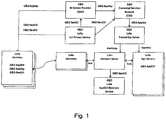
- Fig. 1 shows a diagram illustrating an example of an implementation of the suggested communication system.
- the rectangular blocks demonstrate means, which perform method steps.
- the arrows indicate communication flow between the modules.
- the solution according to an aspect of the present invention is to not rely entirely on the DevNonce for the random factor in the join-request message. Assuming the 2 bytes (16-bit) DevNonce can be compromised, the invention is to make the 8 bytes AppEUI and 8 bytes DevEUI dynamic instead of static to compensate for the reduction in randomness.
- the EUI Privacy Service allows manufacturers as well as application providers to use an anonymous EUI in place of the manufacturer's and application provider's real and static EUI.
- the invention is to use a range of EUI to function as an extended random factor, i.e. a virtual, extended DevNonce.
- AppEUI instead of a fixed AppEUI such as 0102030405060708 (hex), we use a dynamic AppEUI where the last 2 bytes are random: 112233445566xxxx (hex). For larger random permutations, more bytes can be used, or both AppEUI and DevEUI can be made dynamic.
- the invention sends a command to the end-device to change the AppEUI/DevEUI after every successful join procedure. This ensures a new extended and compensated random value is in place the next time the end-device has to send a join-request message according to an aspect of the present invention.
- the invention keeps track of a certain number of dynamic AppEUI/ DevEUI values used by the end-device in the past, and prevents those from being issued to that end-device.
- the following shows the flow when an end-device performs a LPWA OTAA join procedure according to an aspect of the present invention.
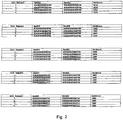
- Fig. 2 shows five tables of values for join-requests.
- the identifiers according to Fig. 2 are named AppEUI and DevEUI and the randomized value is called DevNonce.
- AppEUI and DevEUI the randomized value
- DevNonce random probability is 1 in 65536.
- the DevNonce namely the randomized code, is chosen to be equally distributed within the range of possible randomized codes. Consequently, no attack has occurred.
- the second table shows a compromised LPWA join-request operation, wherein an attack has occurred.
- DevNonce random probability is 1 in 1.
- the security is therefore breached as the attacker will certainly identify DevNonce. This is the case as on the right-hand side of the second table in the last row DevNonce is 1000 among all lines. Consequently, only one single DevNonce occurs, which can be easily estimated.
- the third table shows a secured LPWA join-request operation, where an attack occurred but the DevEUI is protected in accordance with the present invention.
- the DevNonce random probability is 1 in 65536. As can be seen the DevNonce has been attacked as it is not altered in its value but the DevEUI is distributed. Consequently, as DevEUI is used as security information as well different numbers occur increasing the random probability such that a wider range of security codes is possible.
- the fourth table shows a secured LPWA join-request operation, with an attack and the subject matter of the present invention being applied on AppEUI.
- the DevNonce random probability is 1 in 65536. This is the case as the AppEUI, as can be seen in the second column, has been changed.
- the fifth table shows the best performance as both DevEUI and AppEUI are adapted in accordance with the present invention.
- This can be named a highly secured LPWA join-request.
- the DevNonce random probability is 1 in 4294967296. Consequently, the procedure is secured although the DevNonce has been attacked.
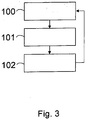
- Fig. 3 shows a method for secure communication between an end-device and a server system, comprising the steps of transmitting 100 at least one identifier and a randomized code from the end-device to the server system, wherein the server system randomly assigns 101 a new value to the at least one identifier and uses the new value along with the randomized code for further data transmissions between the end-device and the server system and the end-devices is instructed 102 to change the at least one identifier to the new value.
Landscapes
- Engineering & Computer Science (AREA)
- Computer Security & Cryptography (AREA)
- Computer Networks & Wireless Communication (AREA)
- Signal Processing (AREA)
- Mobile Radio Communication Systems (AREA)
Priority Applications (1)
| Application Number | Priority Date | Filing Date | Title |
|---|---|---|---|
| EP16002189.5A EP3310082B1 (fr) | 2016-10-11 | 2016-10-11 | Activation sécurisée |
Applications Claiming Priority (1)
| Application Number | Priority Date | Filing Date | Title |
|---|---|---|---|
| EP16002189.5A EP3310082B1 (fr) | 2016-10-11 | 2016-10-11 | Activation sécurisée |
Publications (2)
| Publication Number | Publication Date |
|---|---|
| EP3310082A1 true EP3310082A1 (fr) | 2018-04-18 |
| EP3310082B1 EP3310082B1 (fr) | 2019-12-11 |
Family
ID=57137788
Family Applications (1)
| Application Number | Title | Priority Date | Filing Date |
|---|---|---|---|
| EP16002189.5A Active EP3310082B1 (fr) | 2016-10-11 | 2016-10-11 | Activation sécurisée |
Country Status (1)
| Country | Link |
|---|---|
| EP (1) | EP3310082B1 (fr) |
Cited By (1)
| Publication number | Priority date | Publication date | Assignee | Title |
|---|---|---|---|---|
| FR3087311A1 (fr) * | 2018-10-16 | 2020-04-17 | Idemia Identity & Security France | Procede de communication d’un objet avec un reseau d’objets connectes pour signaler qu’un clone se fait potentiellement passer pour l’objet dans le reseau |
Citations (4)
| Publication number | Priority date | Publication date | Assignee | Title |
|---|---|---|---|---|
| US20150026330A1 (en) * | 2013-07-16 | 2015-01-22 | Cellco Partnership D/B/A Verizon Wireless | Generating unique identifiers for mobile devices |
| US20150071438A1 (en) * | 2013-09-10 | 2015-03-12 | Marvell World Trade Ltd. | Secure device bootstrap identity |
| US20150222621A1 (en) * | 2014-02-04 | 2015-08-06 | Texas Instruments Incorporated | Auto-provisioning for internet-of-things devices |
| WO2016128364A1 (fr) | 2015-02-13 | 2016-08-18 | Confidex Oy | Verrou de sécurité |
-
2016
- 2016-10-11 EP EP16002189.5A patent/EP3310082B1/fr active Active
Patent Citations (4)
| Publication number | Priority date | Publication date | Assignee | Title |
|---|---|---|---|---|
| US20150026330A1 (en) * | 2013-07-16 | 2015-01-22 | Cellco Partnership D/B/A Verizon Wireless | Generating unique identifiers for mobile devices |
| US20150071438A1 (en) * | 2013-09-10 | 2015-03-12 | Marvell World Trade Ltd. | Secure device bootstrap identity |
| US20150222621A1 (en) * | 2014-02-04 | 2015-08-06 | Texas Instruments Incorporated | Auto-provisioning for internet-of-things devices |
| WO2016128364A1 (fr) | 2015-02-13 | 2016-08-18 | Confidex Oy | Verrou de sécurité |
Non-Patent Citations (1)
| Title |
|---|
| IN NO "THORSTEN KRAMP;NICOLAS SORNIN" ET AL: "2015 LoRa(TM) Alliance", SPECIAL OR 25 EXEMPLARY, INCIDENTIAL, PUNITIVE OR CONSEQUENTIAL DAMAGES OF ANY KIND, IN CONTRACT OR 26 IN TORT, IN CONNECTION WITH THIS DOCUMENT OR THE INFORMATION CONTAINED HEREIN, EVEN IF, 11 May 2016 (2016-05-11), XP055326484, Retrieved from the Internet <URL:https://www.lora-alliance.org/portals/0/specs/LoRaWAN%20Specification%201R0.pdf> [retrieved on 20161206] * |
Cited By (3)
| Publication number | Priority date | Publication date | Assignee | Title |
|---|---|---|---|---|
| FR3087311A1 (fr) * | 2018-10-16 | 2020-04-17 | Idemia Identity & Security France | Procede de communication d’un objet avec un reseau d’objets connectes pour signaler qu’un clone se fait potentiellement passer pour l’objet dans le reseau |
| EP3641268A1 (fr) * | 2018-10-16 | 2020-04-22 | Idemia Identity & Security France | Procédé de communication d'un objet avec un réseau d'objets connectés pour signaler qu'un clone se fait potentiellement passer pour l'objet dans le réseau |
| US11212314B2 (en) | 2018-10-16 | 2021-12-28 | Idemia Identity & Security France | Method for an object to communicate with a connected objects network to report that a clone may be impersonating the object in the network |
Also Published As
| Publication number | Publication date |
|---|---|
| EP3310082B1 (fr) | 2019-12-11 |
Similar Documents
| Publication | Publication Date | Title |
|---|---|---|
| CN116235524B (zh) | 一种安全通信方法以及装置 | |
| US10158608B2 (en) | Key establishment for constrained resource devices | |
| US10079814B2 (en) | Secure node-to-multinode communication | |
| CN108028829A (zh) | 用于获得对网络的初始接入的方法以及相关的无线设备和网络节点 | |
| KR20170104180A (ko) | 전자 장치 및 전자 장치 간의 인증 수행 방법 | |
| CN103297224A (zh) | 密钥信息分发方法及相关设备 | |
| CN105262773A (zh) | 一种物联网系统的验证方法及装置 | |
| CN106304043A (zh) | 一种配网方法、装置、系统、无线终端及无线路由器 | |
| CN100591013C (zh) | 实现认证的方法和认证系统 | |
| EP3932044B1 (fr) | Distribution automatique de clés de protocole de configuration d'hôte dynamique (dhcp) par l'intermédiaire d'un protocole de découverte de couche de liaison (lldp) | |
| EP3310082B1 (fr) | Activation sécurisée | |
| CN107819888A (zh) | 一种分配中继地址的方法、装置以及网元 | |
| US10601824B2 (en) | Provision of access to a network | |
| CN108141359B (zh) | 用于产生共同的秘密的方法和设备 | |
| KR101730404B1 (ko) | 네트워크 경로를 관리하는 방법 및 이를 수행하는 네트워크 엔티티 | |
| CN108307683A (zh) | 通讯方法、微基站、微基站控制器、终端和系统 | |
| EP4322458A1 (fr) | Intégration post quantum pour l'échange de clé authentifié par mot de passe | |
| EP4322455A1 (fr) | Procédés et systèmes d'établissement de sécurité améliorée | |
| EP4322457A1 (fr) | Procédés et systèmes d'établissement de sécurité améliorée | |
| EP4322456A1 (fr) | Protocoles et systèmes basés sur un mot de passe authentifiés implicites et quantum securisés | |
| EP4322472A1 (fr) | Procédés et systèmes d'établissement de sécurité améliorée | |
| KR102857104B1 (ko) | 재난 문자 검증 방법 및 장치 | |
| EP4322460A1 (fr) | Réglage de fiabilité pour procédés et systèmes d'établissement de sécurité améliorés | |
| EP4322462A1 (fr) | Procédés et systèmes d'établissement de sécurité améliorés dans lesquels des clés sont dérivées d'une transcription de protocole | |
| CN106790331B (zh) | 一种业务接入方法、系统及相关装置 |
Legal Events
| Date | Code | Title | Description |
|---|---|---|---|
| PUAI | Public reference made under article 153(3) epc to a published international application that has entered the european phase |
Free format text: ORIGINAL CODE: 0009012 |
|
| STAA | Information on the status of an ep patent application or granted ep patent |
Free format text: STATUS: THE APPLICATION HAS BEEN PUBLISHED |
|
| AK | Designated contracting states |
Kind code of ref document: A1 Designated state(s): AL AT BE BG CH CY CZ DE DK EE ES FI FR GB GR HR HU IE IS IT LI LT LU LV MC MK MT NL NO PL PT RO RS SE SI SK SM TR |
|
| AX | Request for extension of the european patent |
Extension state: BA ME |
|
| STAA | Information on the status of an ep patent application or granted ep patent |
Free format text: STATUS: REQUEST FOR EXAMINATION WAS MADE |
|
| 17P | Request for examination filed |
Effective date: 20181018 |
|
| RBV | Designated contracting states (corrected) |
Designated state(s): AL AT BE BG CH CY CZ DE DK EE ES FI FR GB GR HR HU IE IS IT LI LT LU LV MC MK MT NL NO PL PT RO RS SE SI SK SM TR |
|
| STAA | Information on the status of an ep patent application or granted ep patent |
Free format text: STATUS: EXAMINATION IS IN PROGRESS |
|
| 17Q | First examination report despatched |
Effective date: 20190211 |
|
| GRAP | Despatch of communication of intention to grant a patent |
Free format text: ORIGINAL CODE: EPIDOSNIGR1 |
|
| STAA | Information on the status of an ep patent application or granted ep patent |
Free format text: STATUS: GRANT OF PATENT IS INTENDED |
|
| RIC1 | Information provided on ipc code assigned before grant |
Ipc: H04W 12/00 20090101ALI20190607BHEP Ipc: H04W 12/04 20090101ALI20190607BHEP Ipc: H04L 29/08 20060101ALN20190607BHEP Ipc: H04L 9/32 20060101ALI20190607BHEP Ipc: H04W 4/50 20180101ALI20190607BHEP Ipc: H04W 4/00 20180101ALI20190607BHEP Ipc: H04L 12/24 20060101ALI20190607BHEP Ipc: H04W 12/06 20090101AFI20190607BHEP |
|
| INTG | Intention to grant announced |
Effective date: 20190709 |
|
| GRAS | Grant fee paid |
Free format text: ORIGINAL CODE: EPIDOSNIGR3 |
|
| GRAA | (expected) grant |
Free format text: ORIGINAL CODE: 0009210 |
|
| STAA | Information on the status of an ep patent application or granted ep patent |
Free format text: STATUS: THE PATENT HAS BEEN GRANTED |
|
| AK | Designated contracting states |
Kind code of ref document: B1 Designated state(s): AL AT BE BG CH CY CZ DE DK EE ES FI FR GB GR HR HU IE IS IT LI LT LU LV MC MK MT NL NO PL PT RO RS SE SI SK SM TR |
|
| REG | Reference to a national code |
Ref country code: GB Ref legal event code: FG4D |
|
| REG | Reference to a national code |
Ref country code: CH Ref legal event code: EP |
|
| REG | Reference to a national code |
Ref country code: AT Ref legal event code: REF Ref document number: 1213413 Country of ref document: AT Kind code of ref document: T Effective date: 20191215 |
|
| REG | Reference to a national code |
Ref country code: DE Ref legal event code: R096 Ref document number: 602016025845 Country of ref document: DE |
|
| REG | Reference to a national code |
Ref country code: IE Ref legal event code: FG4D |
|
| REG | Reference to a national code |
Ref country code: NL Ref legal event code: MP Effective date: 20191211 |
|
| REG | Reference to a national code |
Ref country code: LT Ref legal event code: MG4D |
|
| PG25 | Lapsed in a contracting state [announced via postgrant information from national office to epo] |
Ref country code: LV Free format text: LAPSE BECAUSE OF FAILURE TO SUBMIT A TRANSLATION OF THE DESCRIPTION OR TO PAY THE FEE WITHIN THE PRESCRIBED TIME-LIMIT Effective date: 20191211 Ref country code: SE Free format text: LAPSE BECAUSE OF FAILURE TO SUBMIT A TRANSLATION OF THE DESCRIPTION OR TO PAY THE FEE WITHIN THE PRESCRIBED TIME-LIMIT Effective date: 20191211 Ref country code: GR Free format text: LAPSE BECAUSE OF FAILURE TO SUBMIT A TRANSLATION OF THE DESCRIPTION OR TO PAY THE FEE WITHIN THE PRESCRIBED TIME-LIMIT Effective date: 20200312 Ref country code: LT Free format text: LAPSE BECAUSE OF FAILURE TO SUBMIT A TRANSLATION OF THE DESCRIPTION OR TO PAY THE FEE WITHIN THE PRESCRIBED TIME-LIMIT Effective date: 20191211 Ref country code: NO Free format text: LAPSE BECAUSE OF FAILURE TO SUBMIT A TRANSLATION OF THE DESCRIPTION OR TO PAY THE FEE WITHIN THE PRESCRIBED TIME-LIMIT Effective date: 20200311 Ref country code: BG Free format text: LAPSE BECAUSE OF FAILURE TO SUBMIT A TRANSLATION OF THE DESCRIPTION OR TO PAY THE FEE WITHIN THE PRESCRIBED TIME-LIMIT Effective date: 20200311 Ref country code: FI Free format text: LAPSE BECAUSE OF FAILURE TO SUBMIT A TRANSLATION OF THE DESCRIPTION OR TO PAY THE FEE WITHIN THE PRESCRIBED TIME-LIMIT Effective date: 20191211 |
|
| PG25 | Lapsed in a contracting state [announced via postgrant information from national office to epo] |
Ref country code: RS Free format text: LAPSE BECAUSE OF FAILURE TO SUBMIT A TRANSLATION OF THE DESCRIPTION OR TO PAY THE FEE WITHIN THE PRESCRIBED TIME-LIMIT Effective date: 20191211 Ref country code: HR Free format text: LAPSE BECAUSE OF FAILURE TO SUBMIT A TRANSLATION OF THE DESCRIPTION OR TO PAY THE FEE WITHIN THE PRESCRIBED TIME-LIMIT Effective date: 20191211 |
|
| PG25 | Lapsed in a contracting state [announced via postgrant information from national office to epo] |
Ref country code: AL Free format text: LAPSE BECAUSE OF FAILURE TO SUBMIT A TRANSLATION OF THE DESCRIPTION OR TO PAY THE FEE WITHIN THE PRESCRIBED TIME-LIMIT Effective date: 20191211 |
|
| PG25 | Lapsed in a contracting state [announced via postgrant information from national office to epo] |
Ref country code: CZ Free format text: LAPSE BECAUSE OF FAILURE TO SUBMIT A TRANSLATION OF THE DESCRIPTION OR TO PAY THE FEE WITHIN THE PRESCRIBED TIME-LIMIT Effective date: 20191211 Ref country code: PT Free format text: LAPSE BECAUSE OF FAILURE TO SUBMIT A TRANSLATION OF THE DESCRIPTION OR TO PAY THE FEE WITHIN THE PRESCRIBED TIME-LIMIT Effective date: 20200506 Ref country code: NL Free format text: LAPSE BECAUSE OF FAILURE TO SUBMIT A TRANSLATION OF THE DESCRIPTION OR TO PAY THE FEE WITHIN THE PRESCRIBED TIME-LIMIT Effective date: 20191211 Ref country code: EE Free format text: LAPSE BECAUSE OF FAILURE TO SUBMIT A TRANSLATION OF THE DESCRIPTION OR TO PAY THE FEE WITHIN THE PRESCRIBED TIME-LIMIT Effective date: 20191211 Ref country code: ES Free format text: LAPSE BECAUSE OF FAILURE TO SUBMIT A TRANSLATION OF THE DESCRIPTION OR TO PAY THE FEE WITHIN THE PRESCRIBED TIME-LIMIT Effective date: 20191211 Ref country code: RO Free format text: LAPSE BECAUSE OF FAILURE TO SUBMIT A TRANSLATION OF THE DESCRIPTION OR TO PAY THE FEE WITHIN THE PRESCRIBED TIME-LIMIT Effective date: 20191211 |
|
| PG25 | Lapsed in a contracting state [announced via postgrant information from national office to epo] |
Ref country code: SK Free format text: LAPSE BECAUSE OF FAILURE TO SUBMIT A TRANSLATION OF THE DESCRIPTION OR TO PAY THE FEE WITHIN THE PRESCRIBED TIME-LIMIT Effective date: 20191211 Ref country code: IS Free format text: LAPSE BECAUSE OF FAILURE TO SUBMIT A TRANSLATION OF THE DESCRIPTION OR TO PAY THE FEE WITHIN THE PRESCRIBED TIME-LIMIT Effective date: 20200411 Ref country code: SM Free format text: LAPSE BECAUSE OF FAILURE TO SUBMIT A TRANSLATION OF THE DESCRIPTION OR TO PAY THE FEE WITHIN THE PRESCRIBED TIME-LIMIT Effective date: 20191211 |
|
| REG | Reference to a national code |
Ref country code: DE Ref legal event code: R097 Ref document number: 602016025845 Country of ref document: DE |
|
| REG | Reference to a national code |
Ref country code: AT Ref legal event code: MK05 Ref document number: 1213413 Country of ref document: AT Kind code of ref document: T Effective date: 20191211 |
|
| PLBE | No opposition filed within time limit |
Free format text: ORIGINAL CODE: 0009261 |
|
| STAA | Information on the status of an ep patent application or granted ep patent |
Free format text: STATUS: NO OPPOSITION FILED WITHIN TIME LIMIT |
|
| PG25 | Lapsed in a contracting state [announced via postgrant information from national office to epo] |
Ref country code: DK Free format text: LAPSE BECAUSE OF FAILURE TO SUBMIT A TRANSLATION OF THE DESCRIPTION OR TO PAY THE FEE WITHIN THE PRESCRIBED TIME-LIMIT Effective date: 20191211 |
|
| 26N | No opposition filed |
Effective date: 20200914 |
|
| PG25 | Lapsed in a contracting state [announced via postgrant information from national office to epo] |
Ref country code: SI Free format text: LAPSE BECAUSE OF FAILURE TO SUBMIT A TRANSLATION OF THE DESCRIPTION OR TO PAY THE FEE WITHIN THE PRESCRIBED TIME-LIMIT Effective date: 20191211 Ref country code: AT Free format text: LAPSE BECAUSE OF FAILURE TO SUBMIT A TRANSLATION OF THE DESCRIPTION OR TO PAY THE FEE WITHIN THE PRESCRIBED TIME-LIMIT Effective date: 20191211 |
|
| PG25 | Lapsed in a contracting state [announced via postgrant information from national office to epo] |
Ref country code: IT Free format text: LAPSE BECAUSE OF FAILURE TO SUBMIT A TRANSLATION OF THE DESCRIPTION OR TO PAY THE FEE WITHIN THE PRESCRIBED TIME-LIMIT Effective date: 20191211 |
|
| PG25 | Lapsed in a contracting state [announced via postgrant information from national office to epo] |
Ref country code: PL Free format text: LAPSE BECAUSE OF FAILURE TO SUBMIT A TRANSLATION OF THE DESCRIPTION OR TO PAY THE FEE WITHIN THE PRESCRIBED TIME-LIMIT Effective date: 20191211 |
|
| REG | Reference to a national code |
Ref country code: DE Ref legal event code: R119 Ref document number: 602016025845 Country of ref document: DE |
|
| REG | Reference to a national code |
Ref country code: CH Ref legal event code: PL |
|
| GBPC | Gb: european patent ceased through non-payment of renewal fee |
Effective date: 20201011 |
|
| PG25 | Lapsed in a contracting state [announced via postgrant information from national office to epo] |
Ref country code: LU Free format text: LAPSE BECAUSE OF NON-PAYMENT OF DUE FEES Effective date: 20201011 Ref country code: MC Free format text: LAPSE BECAUSE OF FAILURE TO SUBMIT A TRANSLATION OF THE DESCRIPTION OR TO PAY THE FEE WITHIN THE PRESCRIBED TIME-LIMIT Effective date: 20191211 |
|
| REG | Reference to a national code |
Ref country code: BE Ref legal event code: MM Effective date: 20201031 |
|
| PG25 | Lapsed in a contracting state [announced via postgrant information from national office to epo] |
Ref country code: DE Free format text: LAPSE BECAUSE OF NON-PAYMENT OF DUE FEES Effective date: 20210501 Ref country code: FR Free format text: LAPSE BECAUSE OF NON-PAYMENT OF DUE FEES Effective date: 20201031 |
|
| PG25 | Lapsed in a contracting state [announced via postgrant information from national office to epo] |
Ref country code: LI Free format text: LAPSE BECAUSE OF NON-PAYMENT OF DUE FEES Effective date: 20201031 Ref country code: GB Free format text: LAPSE BECAUSE OF NON-PAYMENT OF DUE FEES Effective date: 20201011 Ref country code: CH Free format text: LAPSE BECAUSE OF NON-PAYMENT OF DUE FEES Effective date: 20201031 Ref country code: BE Free format text: LAPSE BECAUSE OF NON-PAYMENT OF DUE FEES Effective date: 20201031 |
|
| PG25 | Lapsed in a contracting state [announced via postgrant information from national office to epo] |
Ref country code: IE Free format text: LAPSE BECAUSE OF NON-PAYMENT OF DUE FEES Effective date: 20201011 |
|
| PG25 | Lapsed in a contracting state [announced via postgrant information from national office to epo] |
Ref country code: TR Free format text: LAPSE BECAUSE OF FAILURE TO SUBMIT A TRANSLATION OF THE DESCRIPTION OR TO PAY THE FEE WITHIN THE PRESCRIBED TIME-LIMIT Effective date: 20191211 Ref country code: MT Free format text: LAPSE BECAUSE OF FAILURE TO SUBMIT A TRANSLATION OF THE DESCRIPTION OR TO PAY THE FEE WITHIN THE PRESCRIBED TIME-LIMIT Effective date: 20191211 Ref country code: CY Free format text: LAPSE BECAUSE OF FAILURE TO SUBMIT A TRANSLATION OF THE DESCRIPTION OR TO PAY THE FEE WITHIN THE PRESCRIBED TIME-LIMIT Effective date: 20191211 |
|
| PG25 | Lapsed in a contracting state [announced via postgrant information from national office to epo] |
Ref country code: MK Free format text: LAPSE BECAUSE OF FAILURE TO SUBMIT A TRANSLATION OF THE DESCRIPTION OR TO PAY THE FEE WITHIN THE PRESCRIBED TIME-LIMIT Effective date: 20191211 |