EP3310432B1 - Dispositif pour neurostimulation efficace non invasive en deux étapes - Google Patents
Dispositif pour neurostimulation efficace non invasive en deux étapes Download PDFInfo
- Publication number
- EP3310432B1 EP3310432B1 EP16732270.0A EP16732270A EP3310432B1 EP 3310432 B1 EP3310432 B1 EP 3310432B1 EP 16732270 A EP16732270 A EP 16732270A EP 3310432 B1 EP3310432 B1 EP 3310432B1
- Authority
- EP
- European Patent Office
- Prior art keywords
- stimulation
- stimuli
- generated
- mode
- sequence
- Prior art date
- Legal status (The legal status is an assumption and is not a legal conclusion. Google has not performed a legal analysis and makes no representation as to the accuracy of the status listed.)
- Active
Links
Images


Classifications
-
- A—HUMAN NECESSITIES
- A61—MEDICAL OR VETERINARY SCIENCE; HYGIENE
- A61M—DEVICES FOR INTRODUCING MEDIA INTO, OR ONTO, THE BODY; DEVICES FOR TRANSDUCING BODY MEDIA OR FOR TAKING MEDIA FROM THE BODY; DEVICES FOR PRODUCING OR ENDING SLEEP OR STUPOR
- A61M21/00—Other devices or methods to cause a change in the state of consciousness; Devices for producing or ending sleep by mechanical, optical, or acoustical means, e.g. for hypnosis
- A61M21/02—Other devices or methods to cause a change in the state of consciousness; Devices for producing or ending sleep by mechanical, optical, or acoustical means, e.g. for hypnosis for inducing sleep or relaxation, e.g. by direct nerve stimulation, hypnosis, analgesia
-
- A—HUMAN NECESSITIES
- A61—MEDICAL OR VETERINARY SCIENCE; HYGIENE
- A61B—DIAGNOSIS; SURGERY; IDENTIFICATION
- A61B5/00—Measuring for diagnostic purposes; Identification of persons
- A61B5/05—Detecting, measuring or recording for diagnosis by means of electric currents or magnetic fields; Measuring using microwaves or radio waves
- A61B5/053—Measuring electrical impedance or conductance of a portion of the body
- A61B5/0531—Measuring skin impedance
-
- A—HUMAN NECESSITIES
- A61—MEDICAL OR VETERINARY SCIENCE; HYGIENE
- A61B—DIAGNOSIS; SURGERY; IDENTIFICATION
- A61B5/00—Measuring for diagnostic purposes; Identification of persons
- A61B5/103—Measuring devices for testing the shape, pattern, colour, size or movement of the body or parts thereof, for diagnostic purposes
- A61B5/11—Measuring movement of the entire body or parts thereof, e.g. head or hand tremor or mobility of a limb
- A61B5/1101—Detecting tremor
-
- A—HUMAN NECESSITIES
- A61—MEDICAL OR VETERINARY SCIENCE; HYGIENE
- A61B—DIAGNOSIS; SURGERY; IDENTIFICATION
- A61B5/00—Measuring for diagnostic purposes; Identification of persons
- A61B5/24—Detecting, measuring or recording bioelectric or biomagnetic signals of the body or parts thereof
- A61B5/316—Modalities, i.e. specific diagnostic methods
- A61B5/369—Electroencephalography [EEG]
- A61B5/372—Analysis of electroencephalograms
-
- A—HUMAN NECESSITIES
- A61—MEDICAL OR VETERINARY SCIENCE; HYGIENE
- A61B—DIAGNOSIS; SURGERY; IDENTIFICATION
- A61B5/00—Measuring for diagnostic purposes; Identification of persons
- A61B5/40—Detecting, measuring or recording for evaluating the nervous system
- A61B5/4029—Detecting, measuring or recording for evaluating the nervous system for evaluating the peripheral nervous systems
- A61B5/4035—Evaluating the autonomic nervous system
-
- A—HUMAN NECESSITIES
- A61—MEDICAL OR VETERINARY SCIENCE; HYGIENE
- A61B—DIAGNOSIS; SURGERY; IDENTIFICATION
- A61B5/00—Measuring for diagnostic purposes; Identification of persons
- A61B5/48—Other medical applications
- A61B5/4836—Diagnosis combined with treatment in closed-loop systems or methods
-
- A—HUMAN NECESSITIES
- A61—MEDICAL OR VETERINARY SCIENCE; HYGIENE
- A61B—DIAGNOSIS; SURGERY; IDENTIFICATION
- A61B5/00—Measuring for diagnostic purposes; Identification of persons
- A61B5/68—Arrangements of detecting, measuring or recording means, e.g. sensors, in relation to patient
- A61B5/6846—Arrangements of detecting, measuring or recording means, e.g. sensors, in relation to patient specially adapted to be brought in contact with an internal body part, i.e. invasive
- A61B5/6867—Arrangements of detecting, measuring or recording means, e.g. sensors, in relation to patient specially adapted to be brought in contact with an internal body part, i.e. invasive specially adapted to be attached or implanted in a specific body part
- A61B5/6868—Brain
-
- A—HUMAN NECESSITIES
- A61—MEDICAL OR VETERINARY SCIENCE; HYGIENE
- A61N—ELECTROTHERAPY; MAGNETOTHERAPY; RADIATION THERAPY; ULTRASOUND THERAPY
- A61N1/00—Electrotherapy; Circuits therefor
- A61N1/18—Applying electric currents by contact electrodes
- A61N1/32—Applying electric currents by contact electrodes alternating or intermittent currents
- A61N1/36—Applying electric currents by contact electrodes alternating or intermittent currents for stimulation
- A61N1/36014—External stimulators, e.g. with patch electrodes
-
- A—HUMAN NECESSITIES
- A61—MEDICAL OR VETERINARY SCIENCE; HYGIENE
- A61N—ELECTROTHERAPY; MAGNETOTHERAPY; RADIATION THERAPY; ULTRASOUND THERAPY
- A61N1/00—Electrotherapy; Circuits therefor
- A61N1/18—Applying electric currents by contact electrodes
- A61N1/32—Applying electric currents by contact electrodes alternating or intermittent currents
- A61N1/36—Applying electric currents by contact electrodes alternating or intermittent currents for stimulation
- A61N1/36014—External stimulators, e.g. with patch electrodes
- A61N1/36025—External stimulators, e.g. with patch electrodes for treating a mental or cerebral condition
-
- A—HUMAN NECESSITIES
- A61—MEDICAL OR VETERINARY SCIENCE; HYGIENE
- A61N—ELECTROTHERAPY; MAGNETOTHERAPY; RADIATION THERAPY; ULTRASOUND THERAPY
- A61N1/00—Electrotherapy; Circuits therefor
- A61N1/18—Applying electric currents by contact electrodes
- A61N1/32—Applying electric currents by contact electrodes alternating or intermittent currents
- A61N1/36—Applying electric currents by contact electrodes alternating or intermittent currents for stimulation
- A61N1/3605—Implantable neurostimulators for stimulating central or peripheral nerve system
- A61N1/3606—Implantable neurostimulators for stimulating central or peripheral nerve system adapted for a particular treatment
- A61N1/36064—Epilepsy
-
- A—HUMAN NECESSITIES
- A61—MEDICAL OR VETERINARY SCIENCE; HYGIENE
- A61N—ELECTROTHERAPY; MAGNETOTHERAPY; RADIATION THERAPY; ULTRASOUND THERAPY
- A61N1/00—Electrotherapy; Circuits therefor
- A61N1/18—Applying electric currents by contact electrodes
- A61N1/32—Applying electric currents by contact electrodes alternating or intermittent currents
- A61N1/36—Applying electric currents by contact electrodes alternating or intermittent currents for stimulation
- A61N1/3605—Implantable neurostimulators for stimulating central or peripheral nerve system
- A61N1/3606—Implantable neurostimulators for stimulating central or peripheral nerve system adapted for a particular treatment
- A61N1/36067—Movement disorders, e.g. tremor or Parkinson disease
-
- A—HUMAN NECESSITIES
- A61—MEDICAL OR VETERINARY SCIENCE; HYGIENE
- A61N—ELECTROTHERAPY; MAGNETOTHERAPY; RADIATION THERAPY; ULTRASOUND THERAPY
- A61N1/00—Electrotherapy; Circuits therefor
- A61N1/18—Applying electric currents by contact electrodes
- A61N1/32—Applying electric currents by contact electrodes alternating or intermittent currents
- A61N1/36—Applying electric currents by contact electrodes alternating or intermittent currents for stimulation
- A61N1/3605—Implantable neurostimulators for stimulating central or peripheral nerve system
- A61N1/3606—Implantable neurostimulators for stimulating central or peripheral nerve system adapted for a particular treatment
- A61N1/36082—Cognitive or psychiatric applications, e.g. dementia or Alzheimer's disease
-
- A—HUMAN NECESSITIES
- A61—MEDICAL OR VETERINARY SCIENCE; HYGIENE
- A61N—ELECTROTHERAPY; MAGNETOTHERAPY; RADIATION THERAPY; ULTRASOUND THERAPY
- A61N1/00—Electrotherapy; Circuits therefor
- A61N1/18—Applying electric currents by contact electrodes
- A61N1/32—Applying electric currents by contact electrodes alternating or intermittent currents
- A61N1/36—Applying electric currents by contact electrodes alternating or intermittent currents for stimulation
- A61N1/3605—Implantable neurostimulators for stimulating central or peripheral nerve system
- A61N1/3606—Implantable neurostimulators for stimulating central or peripheral nerve system adapted for a particular treatment
- A61N1/361—Phantom sensations, e.g. tinnitus
-
- A—HUMAN NECESSITIES
- A61—MEDICAL OR VETERINARY SCIENCE; HYGIENE
- A61N—ELECTROTHERAPY; MAGNETOTHERAPY; RADIATION THERAPY; ULTRASOUND THERAPY
- A61N1/00—Electrotherapy; Circuits therefor
- A61N1/18—Applying electric currents by contact electrodes
- A61N1/32—Applying electric currents by contact electrodes alternating or intermittent currents
- A61N1/36—Applying electric currents by contact electrodes alternating or intermittent currents for stimulation
- A61N1/3605—Implantable neurostimulators for stimulating central or peripheral nerve system
- A61N1/3606—Implantable neurostimulators for stimulating central or peripheral nerve system adapted for a particular treatment
- A61N1/36103—Neuro-rehabilitation; Repair or reorganisation of neural tissue, e.g. after stroke
-
- A—HUMAN NECESSITIES
- A61—MEDICAL OR VETERINARY SCIENCE; HYGIENE
- A61N—ELECTROTHERAPY; MAGNETOTHERAPY; RADIATION THERAPY; ULTRASOUND THERAPY
- A61N1/00—Electrotherapy; Circuits therefor
- A61N1/18—Applying electric currents by contact electrodes
- A61N1/32—Applying electric currents by contact electrodes alternating or intermittent currents
- A61N1/36—Applying electric currents by contact electrodes alternating or intermittent currents for stimulation
- A61N1/3605—Implantable neurostimulators for stimulating central or peripheral nerve system
- A61N1/36128—Control systems
- A61N1/36135—Control systems using physiological parameters
- A61N1/36139—Control systems using physiological parameters with automatic adjustment
-
- A—HUMAN NECESSITIES
- A61—MEDICAL OR VETERINARY SCIENCE; HYGIENE
- A61N—ELECTROTHERAPY; MAGNETOTHERAPY; RADIATION THERAPY; ULTRASOUND THERAPY
- A61N1/00—Electrotherapy; Circuits therefor
- A61N1/18—Applying electric currents by contact electrodes
- A61N1/32—Applying electric currents by contact electrodes alternating or intermittent currents
- A61N1/36—Applying electric currents by contact electrodes alternating or intermittent currents for stimulation
- A61N1/3605—Implantable neurostimulators for stimulating central or peripheral nerve system
- A61N1/36128—Control systems
- A61N1/36146—Control systems specified by the stimulation parameters
- A61N1/36167—Timing, e.g. stimulation onset
- A61N1/36175—Pulse width or duty cycle
-
- A—HUMAN NECESSITIES
- A61—MEDICAL OR VETERINARY SCIENCE; HYGIENE
- A61N—ELECTROTHERAPY; MAGNETOTHERAPY; RADIATION THERAPY; ULTRASOUND THERAPY
- A61N1/00—Electrotherapy; Circuits therefor
- A61N1/18—Applying electric currents by contact electrodes
- A61N1/32—Applying electric currents by contact electrodes alternating or intermittent currents
- A61N1/36—Applying electric currents by contact electrodes alternating or intermittent currents for stimulation
- A61N1/3605—Implantable neurostimulators for stimulating central or peripheral nerve system
- A61N1/36128—Control systems
- A61N1/36146—Control systems specified by the stimulation parameters
- A61N1/36167—Timing, e.g. stimulation onset
- A61N1/36178—Burst or pulse train parameters
-
- A—HUMAN NECESSITIES
- A61—MEDICAL OR VETERINARY SCIENCE; HYGIENE
- A61N—ELECTROTHERAPY; MAGNETOTHERAPY; RADIATION THERAPY; ULTRASOUND THERAPY
- A61N2/00—Magnetotherapy
- A61N2/004—Magnetotherapy specially adapted for a specific therapy
- A61N2/006—Magnetotherapy specially adapted for a specific therapy for magnetic stimulation of nerve tissue
-
- A—HUMAN NECESSITIES
- A61—MEDICAL OR VETERINARY SCIENCE; HYGIENE
- A61B—DIAGNOSIS; SURGERY; IDENTIFICATION
- A61B2562/00—Details of sensors; Constructional details of sensor housings or probes; Accessories for sensors
- A61B2562/02—Details of sensors specially adapted for in-vivo measurements
- A61B2562/0219—Inertial sensors, e.g. accelerometers, gyroscopes, tilt switches
-
- A—HUMAN NECESSITIES
- A61—MEDICAL OR VETERINARY SCIENCE; HYGIENE
- A61B—DIAGNOSIS; SURGERY; IDENTIFICATION
- A61B5/00—Measuring for diagnostic purposes; Identification of persons
- A61B5/05—Detecting, measuring or recording for diagnosis by means of electric currents or magnetic fields; Measuring using microwaves or radio waves
- A61B5/053—Measuring electrical impedance or conductance of a portion of the body
- A61B5/0531—Measuring skin impedance
- A61B5/0533—Measuring galvanic skin response
-
- A—HUMAN NECESSITIES
- A61—MEDICAL OR VETERINARY SCIENCE; HYGIENE
- A61B—DIAGNOSIS; SURGERY; IDENTIFICATION
- A61B5/00—Measuring for diagnostic purposes; Identification of persons
- A61B5/40—Detecting, measuring or recording for evaluating the nervous system
- A61B5/4058—Detecting, measuring or recording for evaluating the nervous system for evaluating the central nervous system
- A61B5/4064—Evaluating the brain
-
- A—HUMAN NECESSITIES
- A61—MEDICAL OR VETERINARY SCIENCE; HYGIENE
- A61B—DIAGNOSIS; SURGERY; IDENTIFICATION
- A61B5/00—Measuring for diagnostic purposes; Identification of persons
- A61B5/40—Detecting, measuring or recording for evaluating the nervous system
- A61B5/4076—Diagnosing or monitoring particular conditions of the nervous system
- A61B5/4082—Diagnosing or monitoring movement diseases, e.g. Parkinson, Huntington or Tourette
-
- A—HUMAN NECESSITIES
- A61—MEDICAL OR VETERINARY SCIENCE; HYGIENE
- A61B—DIAGNOSIS; SURGERY; IDENTIFICATION
- A61B5/00—Measuring for diagnostic purposes; Identification of persons
- A61B5/40—Detecting, measuring or recording for evaluating the nervous system
- A61B5/4076—Diagnosing or monitoring particular conditions of the nervous system
- A61B5/4088—Diagnosing of monitoring cognitive diseases, e.g. Alzheimer, prion diseases or dementia
-
- A—HUMAN NECESSITIES
- A61—MEDICAL OR VETERINARY SCIENCE; HYGIENE
- A61B—DIAGNOSIS; SURGERY; IDENTIFICATION
- A61B5/00—Measuring for diagnostic purposes; Identification of persons
- A61B5/40—Detecting, measuring or recording for evaluating the nervous system
- A61B5/4076—Diagnosing or monitoring particular conditions of the nervous system
- A61B5/4094—Diagnosing or monitoring seizure diseases, e.g. epilepsy
-
- A—HUMAN NECESSITIES
- A61—MEDICAL OR VETERINARY SCIENCE; HYGIENE
- A61B—DIAGNOSIS; SURGERY; IDENTIFICATION
- A61B5/00—Measuring for diagnostic purposes; Identification of persons
- A61B5/68—Arrangements of detecting, measuring or recording means, e.g. sensors, in relation to patient
- A61B5/6846—Arrangements of detecting, measuring or recording means, e.g. sensors, in relation to patient specially adapted to be brought in contact with an internal body part, i.e. invasive
- A61B5/6847—Arrangements of detecting, measuring or recording means, e.g. sensors, in relation to patient specially adapted to be brought in contact with an internal body part, i.e. invasive mounted on an invasive device
- A61B5/686—Permanently implanted devices, e.g. pacemakers, other stimulators, biochips
-
- A—HUMAN NECESSITIES
- A61—MEDICAL OR VETERINARY SCIENCE; HYGIENE
- A61M—DEVICES FOR INTRODUCING MEDIA INTO, OR ONTO, THE BODY; DEVICES FOR TRANSDUCING BODY MEDIA OR FOR TAKING MEDIA FROM THE BODY; DEVICES FOR PRODUCING OR ENDING SLEEP OR STUPOR
- A61M21/00—Other devices or methods to cause a change in the state of consciousness; Devices for producing or ending sleep by mechanical, optical, or acoustical means, e.g. for hypnosis
- A61M2021/0005—Other devices or methods to cause a change in the state of consciousness; Devices for producing or ending sleep by mechanical, optical, or acoustical means, e.g. for hypnosis by the use of a particular sense, or stimulus
- A61M2021/0022—Other devices or methods to cause a change in the state of consciousness; Devices for producing or ending sleep by mechanical, optical, or acoustical means, e.g. for hypnosis by the use of a particular sense, or stimulus by the tactile sense, e.g. vibrations
-
- A—HUMAN NECESSITIES
- A61—MEDICAL OR VETERINARY SCIENCE; HYGIENE
- A61M—DEVICES FOR INTRODUCING MEDIA INTO, OR ONTO, THE BODY; DEVICES FOR TRANSDUCING BODY MEDIA OR FOR TAKING MEDIA FROM THE BODY; DEVICES FOR PRODUCING OR ENDING SLEEP OR STUPOR
- A61M21/00—Other devices or methods to cause a change in the state of consciousness; Devices for producing or ending sleep by mechanical, optical, or acoustical means, e.g. for hypnosis
- A61M2021/0005—Other devices or methods to cause a change in the state of consciousness; Devices for producing or ending sleep by mechanical, optical, or acoustical means, e.g. for hypnosis by the use of a particular sense, or stimulus
- A61M2021/0027—Other devices or methods to cause a change in the state of consciousness; Devices for producing or ending sleep by mechanical, optical, or acoustical means, e.g. for hypnosis by the use of a particular sense, or stimulus by the hearing sense
-
- A—HUMAN NECESSITIES
- A61—MEDICAL OR VETERINARY SCIENCE; HYGIENE
- A61M—DEVICES FOR INTRODUCING MEDIA INTO, OR ONTO, THE BODY; DEVICES FOR TRANSDUCING BODY MEDIA OR FOR TAKING MEDIA FROM THE BODY; DEVICES FOR PRODUCING OR ENDING SLEEP OR STUPOR
- A61M21/00—Other devices or methods to cause a change in the state of consciousness; Devices for producing or ending sleep by mechanical, optical, or acoustical means, e.g. for hypnosis
- A61M2021/0005—Other devices or methods to cause a change in the state of consciousness; Devices for producing or ending sleep by mechanical, optical, or acoustical means, e.g. for hypnosis by the use of a particular sense, or stimulus
- A61M2021/0044—Other devices or methods to cause a change in the state of consciousness; Devices for producing or ending sleep by mechanical, optical, or acoustical means, e.g. for hypnosis by the use of a particular sense, or stimulus by the sight sense
-
- A—HUMAN NECESSITIES
- A61—MEDICAL OR VETERINARY SCIENCE; HYGIENE
- A61M—DEVICES FOR INTRODUCING MEDIA INTO, OR ONTO, THE BODY; DEVICES FOR TRANSDUCING BODY MEDIA OR FOR TAKING MEDIA FROM THE BODY; DEVICES FOR PRODUCING OR ENDING SLEEP OR STUPOR
- A61M21/00—Other devices or methods to cause a change in the state of consciousness; Devices for producing or ending sleep by mechanical, optical, or acoustical means, e.g. for hypnosis
- A61M2021/0005—Other devices or methods to cause a change in the state of consciousness; Devices for producing or ending sleep by mechanical, optical, or acoustical means, e.g. for hypnosis by the use of a particular sense, or stimulus
- A61M2021/0055—Other devices or methods to cause a change in the state of consciousness; Devices for producing or ending sleep by mechanical, optical, or acoustical means, e.g. for hypnosis by the use of a particular sense, or stimulus with electric or electro-magnetic fields
-
- A—HUMAN NECESSITIES
- A61—MEDICAL OR VETERINARY SCIENCE; HYGIENE
- A61M—DEVICES FOR INTRODUCING MEDIA INTO, OR ONTO, THE BODY; DEVICES FOR TRANSDUCING BODY MEDIA OR FOR TAKING MEDIA FROM THE BODY; DEVICES FOR PRODUCING OR ENDING SLEEP OR STUPOR
- A61M21/00—Other devices or methods to cause a change in the state of consciousness; Devices for producing or ending sleep by mechanical, optical, or acoustical means, e.g. for hypnosis
- A61M2021/0005—Other devices or methods to cause a change in the state of consciousness; Devices for producing or ending sleep by mechanical, optical, or acoustical means, e.g. for hypnosis by the use of a particular sense, or stimulus
- A61M2021/0066—Other devices or methods to cause a change in the state of consciousness; Devices for producing or ending sleep by mechanical, optical, or acoustical means, e.g. for hypnosis by the use of a particular sense, or stimulus with heating or cooling
-
- A—HUMAN NECESSITIES
- A61—MEDICAL OR VETERINARY SCIENCE; HYGIENE
- A61M—DEVICES FOR INTRODUCING MEDIA INTO, OR ONTO, THE BODY; DEVICES FOR TRANSDUCING BODY MEDIA OR FOR TAKING MEDIA FROM THE BODY; DEVICES FOR PRODUCING OR ENDING SLEEP OR STUPOR
- A61M21/00—Other devices or methods to cause a change in the state of consciousness; Devices for producing or ending sleep by mechanical, optical, or acoustical means, e.g. for hypnosis
- A61M2021/0005—Other devices or methods to cause a change in the state of consciousness; Devices for producing or ending sleep by mechanical, optical, or acoustical means, e.g. for hypnosis by the use of a particular sense, or stimulus
- A61M2021/0072—Other devices or methods to cause a change in the state of consciousness; Devices for producing or ending sleep by mechanical, optical, or acoustical means, e.g. for hypnosis by the use of a particular sense, or stimulus with application of electrical currents
-
- A—HUMAN NECESSITIES
- A61—MEDICAL OR VETERINARY SCIENCE; HYGIENE
- A61M—DEVICES FOR INTRODUCING MEDIA INTO, OR ONTO, THE BODY; DEVICES FOR TRANSDUCING BODY MEDIA OR FOR TAKING MEDIA FROM THE BODY; DEVICES FOR PRODUCING OR ENDING SLEEP OR STUPOR
- A61M2230/00—Measuring parameters of the user
- A61M2230/08—Other bio-electrical signals
- A61M2230/10—Electroencephalographic signals
-
- A—HUMAN NECESSITIES
- A61—MEDICAL OR VETERINARY SCIENCE; HYGIENE
- A61M—DEVICES FOR INTRODUCING MEDIA INTO, OR ONTO, THE BODY; DEVICES FOR TRANSDUCING BODY MEDIA OR FOR TAKING MEDIA FROM THE BODY; DEVICES FOR PRODUCING OR ENDING SLEEP OR STUPOR
- A61M2230/00—Measuring parameters of the user
- A61M2230/60—Muscle strain, i.e. measured on the user
-
- A—HUMAN NECESSITIES
- A61—MEDICAL OR VETERINARY SCIENCE; HYGIENE
- A61N—ELECTROTHERAPY; MAGNETOTHERAPY; RADIATION THERAPY; ULTRASOUND THERAPY
- A61N1/00—Electrotherapy; Circuits therefor
- A61N1/18—Applying electric currents by contact electrodes
- A61N1/32—Applying electric currents by contact electrodes alternating or intermittent currents
- A61N1/36—Applying electric currents by contact electrodes alternating or intermittent currents for stimulation
- A61N1/36014—External stimulators, e.g. with patch electrodes
- A61N1/36021—External stimulators, e.g. with patch electrodes for treatment of pain
-
- A—HUMAN NECESSITIES
- A61—MEDICAL OR VETERINARY SCIENCE; HYGIENE
- A61N—ELECTROTHERAPY; MAGNETOTHERAPY; RADIATION THERAPY; ULTRASOUND THERAPY
- A61N1/00—Electrotherapy; Circuits therefor
- A61N1/18—Applying electric currents by contact electrodes
- A61N1/32—Applying electric currents by contact electrodes alternating or intermittent currents
- A61N1/36—Applying electric currents by contact electrodes alternating or intermittent currents for stimulation
- A61N1/36014—External stimulators, e.g. with patch electrodes
- A61N1/3603—Control systems
- A61N1/36031—Control systems using physiological parameters for adjustment
-
- A—HUMAN NECESSITIES
- A61—MEDICAL OR VETERINARY SCIENCE; HYGIENE
- A61N—ELECTROTHERAPY; MAGNETOTHERAPY; RADIATION THERAPY; ULTRASOUND THERAPY
- A61N1/00—Electrotherapy; Circuits therefor
- A61N1/18—Applying electric currents by contact electrodes
- A61N1/32—Applying electric currents by contact electrodes alternating or intermittent currents
- A61N1/36—Applying electric currents by contact electrodes alternating or intermittent currents for stimulation
- A61N1/36014—External stimulators, e.g. with patch electrodes
- A61N1/3603—Control systems
- A61N1/36034—Control systems specified by the stimulation parameters
-
- A—HUMAN NECESSITIES
- A61—MEDICAL OR VETERINARY SCIENCE; HYGIENE
- A61N—ELECTROTHERAPY; MAGNETOTHERAPY; RADIATION THERAPY; ULTRASOUND THERAPY
- A61N2/00—Magnetotherapy
- A61N2/002—Magnetotherapy in combination with another treatment
-
- A—HUMAN NECESSITIES
- A61—MEDICAL OR VETERINARY SCIENCE; HYGIENE
- A61N—ELECTROTHERAPY; MAGNETOTHERAPY; RADIATION THERAPY; ULTRASOUND THERAPY
- A61N2/00—Magnetotherapy
- A61N2/02—Magnetotherapy using magnetic fields produced by coils, including single turn loops or electromagnets
Definitions
- the invention relates to a device for effective non-invasive two-stage neurostimulation by means of varying stimulus sequences.
- nerve cell associations are active in circumscribed areas of the brain in a pathologically synchronized manner.
- a large number of neurons synchronously form action potentials, i. that is, the neurons involved fire excessively synchronously.
- the neurons in these brain areas fire qualitatively differently, e.g. B. in an uncorrelated manner.
- the pathologically synchronous activity in the thalamus and in the basal ganglia changes the neuronal activity in other brain areas, e.g. B. in areas of the cerebral cortex such as the primary motor cortex.
- the pathologically synchronous activity in the area of the thalamus and basal ganglia for example, imposes their rhythm on the areas of the cerebral cortex, so that ultimately the muscles controlled by these areas have pathological activity, eg. B. develop a rhythmic tremor (tremor).
- Chronic subjective tinnitus has pathological synchronous activity in a network of auditory and non-auditory brain areas.
- Acoustic CR stimulation is used to treat chronic subjective tonal or narrow-band tinnitus.
- therapy tones are adapted to the dominant tinnitus tone and applied in the sense of CR stimulation in order to achieve a long-lasting desynchronization of the morbidly synchronous activity or even persistent desynchronization of the stimulation when it is switched off.
- Acoustic CR stimulation for the treatment of tinnitus causes a significant and pronounced decrease in the symptoms (cf. PA Tass, I. Adamchic, H.-J. Freund, T. von Stackelberg, C. Hauptmann: Counteracting tinnitus by acoustic coordinated reset neuromodulation.
- Parkinson's disease can be treated in an analogous manner using vibrotactile CR stimulation.
- Further indications are e.g. B. epilepsy, functional disorders after a stroke, chronic pain syndromes (using vibrotactile and / or thermal CR stimulation), migraines (eg using visual CR stimulation).
- these diseases can be treated with transcranial magnetic stimulation or direct electrical stimulation of the Treat brain or direct brain stimulation using ultrasound.
- DE 10 2010 016404 A1 discloses a device with a non-invasive first stimulation unit for generating first stimuli that suppress pathologically synchronous activity of neurons in the brain and / or spinal cord of the patient when administered to a patient, a non-invasive second stimulation unit for generating optical and / or acoustic and / or tactile and / or vibratory and / or thermal second stimuli, and a control unit for controlling the first and second stimulation units, the generation of the first and second stimuli optionally taking place in a first or a second operating mode, and the control unit controls the first and second stimulation units such that in the first operating mode the generation of at least 60% of the second stimuli is temporally coupled to the generation of the first stimuli and in the second operating mode the generation of at least 60% of the second stimuli takes place without the generation of the first stimuli ,
- the invention has for its object to provide a device and a method for stimulating neurons with which robust therapeutic effects can be achieved despite reduced stimulus strength and without a significantly increased duration of stimulation.
- a device 1 for the stimulation of neurons with a pathologically synchronous and oscillatory neuronal activity is shown schematically.
- the device 1 consists of a control unit 10 and a stimulation unit 11, which stimulates neurons in the brain and / or spinal cord 30 of a patient via a plurality of stimulation channels.
- Each stimulation channel enables the stimulation of another target area in the patient's brain and / or spinal cord 30, the target areas assigned to the stimulation channels not necessarily having to be disjoint, ie completely separated from one another, but also overlapping one another.
- the stimulation via four stimulation channels 12, 13, 14 and 15 is shown as an example. Of course, it can also be via a different number of stimulation channels, e.g. B. 2, 3, 5, 6, etc., are stimulated.
- control unit 10 controls the stimulation unit 11.
- control unit 10 generates control signals 21 which are received by the stimulation unit 11.
- the stimulation unit 11 uses the control signals 21 to generate stimuli 22 in the stimulation channels 12 to 15, which are administered to the patient.
- the stimuli 22 can be sensory stimuli, e.g. B. acoustic, visual, tactile, vibratory, thermal, olfactory, gustatory, transcutaneous electrical, transcutaneous magnetic, transcranial electrical and / or transcranial magnetic stimuli and / or ultrasound stimuli.
- tactile and vibratory stimuli 22 are also applied together and are then used as vibrotactile stimuli 22 designated.
- the stimuli 22 can in particular be consciously perceptible by the patient.
- the stimuli 22 are designed to suppress the pathologically synchronous and oscillatory neuronal activity when administered to the patient via the stimulation channels 12 to 15 and in particular to desynchronize the neurons with the pathologically synchronous and oscillatory activity.
- the stimulation unit 11 and in particular also the control and analysis unit 10 are non-invasive units, i. that is, during the operation of the device 1, they are outside the patient's body and are not surgically implanted in the patient's body.
- the device 1 and below, in connection with Fig. 4 Device 2 described can be used in particular for the treatment of neurological or psychiatric disorders, for.
- the above-mentioned diseases can be caused by a disruption in the bioelectrical communication of neuron groups which are connected in specific circuits.
- a neuron population generates persistent pathological neuronal activity and possibly one associated pathological connectivity (network structure).
- a large number of neurons form action potentials synchronously, ie the neurons involved fire excessively synchronously.
- the diseased neuron population has an oscillatory neuronal activity, ie the neurons fire rhythmically.
- the mean frequency of the abnormal rhythmic activity of the affected neuronal groups is approximately in the range from 1 to 30 Hz, but can also be outside this range. In healthy people, however, the neurons fire qualitatively differently, e.g. B. in an uncorrelated manner.
- Fig. 1 the device 1 is shown during a CR stimulation.
- the stimulation unit 11 generates sensory stimuli 22 which are picked up by the patient and passed on via the nervous system to the pathologically active neuron population 31 in the brain and / or spinal cord 30.
- the stimuli 22 are designed such that the time-shifted (or phase-shifted) stimulation causes at least two stimulation channels to desynchronize the pathologically synchronous activity of the neuron population 31.
- a reduction in the coincidence rate of the neurons brought about by the stimulation can lead to a reduction in the synaptic weights and thus to an unlearning of the tendency to produce pathologically synchronous activity.
- the stimuli 22 administered during CR stimulation bring about a reset in the neuron population 30, a so-called reset, the phase of the neuronal activity of the stimulated neurons.
- the phase of the stimulated neurons is independent of the current phase value at or close to a certain phase value, e.g. B. 0 °, set (in practice it is not possible to set a specific phase value exactly, but this is also not necessary for successful CR stimulation).
- the phase controls the neuronal activity of the pathological neuron population 31 by means of targeted stimulation. Since the pathological neuron population 31 is stimulated at different points via the stimulation channels 12 to 15, the phases of the neuronal activity of the in Fig.
- the pathological neuron population 31 is reset at different times by the stimuli 22 being applied with a time delay (or out of phase) via the stimulation channels 12 to 15.
- the pathological neuron population 31 the neurons of which were previously synchronous and active with the same frequency and phase, is split into several subpopulations with different phases.
- the subpopulation 32 is stimulated via the stimulation channel 12
- the subpopulation 33 is stimulated via the stimulation channel 13
- the subpopulation 34 is stimulated via the stimulation channel 14
- the subpopulation 35 is stimulated via the stimulation channel 15.
- each of the subpopulations 32 to 35 the neurons continue to be in sync after the phase reset and continue to fire at the same pathological frequency, but each of the subpopulations 32 to 35 has the phase in terms of its neuronal activity that is due to that in the respective stimulation channel 12 until 15 generated stimulus 22 was forced. This means that the neuronal activities of the individual subpopulations 32 to 35 continue to have an approximately sinusoidal course with the same pathological frequency after the resetting of their phases, but different phases.
- the state generated by the stimulation is unstable with at least two subpopulations, and the entire neuron population 31 rapidly approaches a state of complete desynchronization in which the neurons fire uncorrelated.
- the desired state ie the complete desynchronization, is therefore not after the time-shifted (or phase-shifted) application of the phase-resetting stimuli 22 immediately available, but usually occurs within a few periods or even in less than one period of the pathological frequency.
- a theory to explain the success of the stimulation is based on the fact that the ultimately desired desynchronization is only made possible by the pathologically increased interaction between the neurons.
- a self-organization process is used, which is responsible for the pathological synchronization. The same has the effect that a division of an entire population 31 into subpopulations 32 to 35 with different phases is followed by desynchronization. In contrast, there would be no desynchronization without pathologically increased interaction of the neurons.
- the CR stimulation can reorganize the connectivity of the disrupted neural networks, so that long-lasting therapeutic effects can be brought about.
- the synaptic remodeling achieved is of great importance for the effective treatment of neurological or psychiatric disorders.
- the stimuli 22 are usually applied at different points in the brain and / or spinal cord 30 at different times in the context of a so-called sequence.
- exactly one stimulus 22 is generated within a sequence in each of the stimulation channels 12 to 15, so that stimulation occurs exactly once at each of the different stimulation locations, ie each of the subpopulations 32 to 35 is stimulated exactly once within a sequence.
- CR stimulation with a rapidly varying sequence is applied with a very low stimulus strength, a desynchronizing effect occurs under stimulation, which typically does not last long after the end of the stimulation.
- CR stimulation with a fixed or slowly varying sequence there is typically no desynchronizing effect at very low stimulus strength, neither during nor after the stimulation.
- an epoch with a desynchronizing stimulation with a rapidly varying sequence does not in itself have a long-lasting desynchronizing effect with a low stimulus strength, but in combination with an epoch with a desynchronizing stimulation with a slowly varying sequence of higher stimulus strength it causes a long-lasting desynchronizing effect that is at least equivalent or even significantly better than the effect that is achieved by two successive epochs with a desynchronizing stimulation (with a fixed, rapidly varying or slowly varying sequence) with the higher stimulus strength.
- the invention consequently uses a two-stage stimulation, in which stimulation in the first stage with a rapidly varying sequence is stimulated with a low stimulus intensity and in the second stage with slowly varying sequence at a higher stimulus intensity.
- the stimulation unit 11 can be operated in two different stimulation modes (or operating modes). During at least 75% of the time of a first time interval, the control unit 10 operates the stimulation unit 11 in a first stimulation mode.
- the control unit 10 controls the stimulation unit 11 in such a way that the stimulation unit 11 repetitively generates sequences of stimuli 22 and the sequence of the stimulation channels 12 to 15, in which the stimuli 22 are generated within a sequence, for at most 5 in succession generated sequences is constant and is then varied, the strength of the stimuli 22 in the first stimulation mode being less than or equal to a predetermined stimulus strength.
- the first time interval is followed by a second time interval.
- the second time interval can immediately follow the first time interval, ie without a pause in between.
- the control unit 10 operates the stimulation unit in the second stimulation mode.
- the control unit 10 controls the stimulation unit 11 in such a way that the stimulation unit 11 repetitively generates sequences of stimuli 22 and the sequence of the stimulation channels 12 to 15, in which the stimuli 22 are generated within a sequence, is constant for at least 25 sequentially generated sequences and is then varied.
- the strength of the stimuli 22 in the second stimulation mode is at least 1.3 times the predetermined stimulus strength.
- the form of stimulation described above is sufficiently robust that it is sufficient for the desired stimulation success if the stimulation unit 11 is operated in the first stimulation mode for only 75% of the time of the first time interval and in the second stimulation mode for only 75% of the time of the second time interval becomes.
- the operating times of the first and second stimulation modes can also be increased in the respective time interval.
- the stimulation unit 11 can be operated in the first stimulation mode during the complete first time interval and in the second stimulation mode during the complete second time interval.
- no stimulation or a stimulation which in particular can be implemented differently than the stimulation described in this application, respectively.
- the onset of side effects can be significantly weakened. There can even be habituation effects, so that the side effects in the later permanently applied second stimulation mode are lower than without the fractional transition.
- the duration between switching back and forth between the first and the second stimulation mode can vary over time as part of the transition, e.g. B. increase, as exemplified in Fig. 2 is shown.
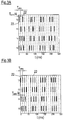
- Exemplary embodiments for stimulations in the first and second stimulation modes are shown in 3A and 3B shown.
- Figure 3A shows a CR stimulation in which 12 to 15 repetitively rapidly varying sequences of stimuli 22 are generated in four stimulation channels in the first stimulation mode.
- the stimuli 22 generated in the stimulation channels 12 to 15 are plotted against the time t.
- the sequences are generated in a predetermined time grid consisting of successive cycles.
- the individual cycles are in Figure 3A separated from each other by dashed lines. Each cycle has the length T stim .
- each sequence in the present example consists of a sequence of four time-shifted stimuli 22 which are generated in particular in different stimulation channels 12 to 15 , wherein the time offset can relate in particular to the starting times of the stimuli 22.
- the sequence of the stimulation channels 12 to 15 in which the stimuli 22 are generated within the respective sequence is varied in the present example.
- a different filling of the in Figure 3A bars shown, which symbolize the stimuli 22, show a variation in the order.
- the stimuli 22 in the stimulation channels 12 to 15 in the first in Figure 3A cycle shown in the order 15-12-14-13 generated. In the second cycle the order is 15-13-14-12 and in the third cycle the order is 12-15-14-13.
- sequences remain the same for a maximum of 5 successively generated sequences and are subsequently changed.
- sequences can be varied with a constant rhythm, ie a variation always takes place, for example, after i Modus_1 cycles, where i Modus_1 is an integer from 1 to 5.
- the number of cycles after which the sequence is varied can be determined according to stochastic or deterministic or mixed stochastic-deterministic rules.
- the in Figure 3A shown CR stimulation only the order of the stimulation channels 12 to 15, in which the stimuli 22 are generated within the respective sequence, varies. All other stimulation parameters can remain constant during CR stimulation.
- the variation of the sequences can e.g. B. stochastic or deterministic or mixed stochastic deterministic.
- the CR stimulation takes place continuously in the first stimulation mode, ie sequences of stimuli 22 are always generated in successive cycles. Alternatively, breaks can also be observed during CR stimulation, in particular during entire cycles.
- stimuli 22 can be generated during n mode_1 consecutive cycles and no stimuli 22 can be generated during the subsequent m mode_1 cycles which are designed to desynchronize the pathologically synchronous and oscillatory neuronal activity, where n mode_1 and m mode_1 non-negative integers are.
- the pattern of n mode_1 cycles with stimulation and m mode_1 cycles without stimulation can be continued periodically. For those in Figure 3A
- the cycles without stimulation are not counted in one embodiment, that is, in this embodiment there is a variation in the sequence of the stimulation channels 12 to 15 , in which the stimuli 22 are generated within the respective sequence, only when a sequence of stimuli 22 has actually been applied in i mode_1 cycles.
- Each of the four stimulation channels 12 to 15 stimulates a respective one of the in Fig. 1 Subpopulations 32 to 34 of the pathological neuron population 31 shown.
- the stimulus 22 is applied periodically with the period T stim in each of the stimulation channels 12 to 15.
- the stimuli 22 cause a phase reset of the neuronal Activity of the stimulated subpopulation.
- the time delay between stimuli 22 T stim / 4 generated directly in time within a sequence and generated in different stimulation channels is , since in the present exemplary embodiment four stimulation channels 12 to 15 are used for CR stimulation.
- the time delay between stimuli directly consecutive within a sequence and generated in different stimulation channels would be 22 T stim / P (this value can also be up to ⁇ 5%, for example , ⁇ 10% or ⁇ 20%).
- the time delay T stim / P can relate to the starting times of the stimuli 22.
- the stimuli 22 generated in different stimulation channels can be identical except for the different starting times.
- the period T stim which on the one hand specifies the duration of a cycle and on the other hand the period with which constant sequences and the stimuli 22 generated in a respective stimulation channel 12 to 15 are repeated, can be close to the mean period of the pathological oscillation of the neuron population 31 with the pathologically synchronous and oscillatory neuronal activity or deviate from the mean period by up to ⁇ 5%, ⁇ 10% or ⁇ 20%.
- the period of the pathological oscillation of the neuron population 31 to be stimulated can be measured, for example by means of EEG. However, it is also possible to use literature or empirical values relating to the respective disease to be treated for the period of the pathological oscillation.
- the phase-resetting stimuli 22 can be, for example, individual stimuli or also composite stimuli.
- each stimulus 22 can consist of a pulse train with 2 to 100, in particular 2 to 10, individual pulses. Within a pulse train, the individual pulses are repeated without interruption at a frequency in the range from 50 to 500 Hz, in particular in the range from 100 to 150 Hz.
- the pulses of a pulse train can be identical. Depending on the type of stimulation, it can be an acoustic, visual, tactile, vibratory (in particular vibrotactile), thermal, olfactory, gustatory, transcutaneous electrical, transcutaneous magnetic, transcranial electrical and / or transcranial magnetic pulse train and / or an ultrasonic pulse train.
- the strength of the stimuli 22, i.e. H. the amplitude of the stimuli 22 is less than or equal to a predetermined stimulus strength in the first stimulation mode.
- the predefined stimulus strength can in particular be subliminal in the sense that the stimuli 22 only have desynchronizing effects during the stimulation, but do not survive the end of the stimulation, i. that is, after the end of the stimulation with the stimuli 22, the stimulus strength of which does not exceed the predetermined stimulus strength, the desynchronizing effect disappears.
- the stimulation unit 11 can be possible to stimulate via the stimulation unit 11 via any number L of stimulation channels (L 2 2), but stimuli 22 do not necessarily have to be generated during a stimulation; for example, only a selection of P of the L stimulation channels the stimuli 22 are generated (2 ⁇ P ⁇ L).
- P stimulation channels P! possible different sequences, with exactly one stimulus 22 being generated in each of these sequences in each of the P stimulation channels. It is conceivable that all P! possible sequences for the stimulation or from the set of P! possible sequences to select a subset for the stimulation. This subset can also vary in time according to stochastic or deterministic or mixed stochastic-deterministic rules.
- the sequence of the sequences can be random or can be determined before the start or during the stimulation.
- the stimulation in the first stimulation mode brings the neuron population 31 into a state in which it is used for the subsequent stimulation in the second Stimulation mode with a slowly varying sequence and higher stimulus strength is significantly more receptive.
- the stimulation in the second stimulation mode can, apart from the number of cycles after which the sequence is varied, and the stimulus strength have the same configurations as those in connection with FIG Figure 3A explained stimulation in the first stimulation mode.
- the differences between the stimulation in the second stimulation mode and the stimulation in the first stimulation mode are described below using Figure 3B explained.
- Figure 3B shows a CR stimulation in which repetitively slowly varying sequences of stimuli 22 are generated in the four stimulation channels 12 to 15 in the second stimulation mode.
- the sequence of the stimulation channels 12 to 15, in which the stimuli 22 are generated within a sequence is kept constant for at least 25 successively generated sequences and is only varied thereafter. It is also conceivable to increase the repetition of the same sequence and to keep the sequence in which the stimuli 22 are generated in the stimulation channels 12 to 15 per cycle constant in the second stimulation mode, for example for at least 30 or at least 35 sequences generated in succession.
- the sequences can already be varied after less than 25 sequences. However, this is only a simplified illustration of one compared to Figure 3A to understand slow sequence variation.
- the sequences can be varied in the second stimulation mode with a constant rhythm, ie, for example, a variation always takes place after i mode_2 cycles, where i mode_2 ⁇ 25 applies.
- the number of cycles after which the sequence is varied can be determined according to stochastic or deterministic or mixed stochastic-deterministic rules.
- the sequence of the stimulation channels in which the stimuli 22 are generated per sequence can be varied with the stimulation in the second stimulation mode. All other stimulation parameters can remain constant during the stimulation.
- the variation of the sequences can e.g. B. stochastic or deterministic or mixed stochastic deterministic.
- the CR stimulation can take place continuously in the second stimulation mode, ie sequences of stimuli 22 are always generated in successive cycles. Alternatively, breaks can also be observed during CR stimulation, in particular during entire cycles. Thus, stimuli 22 can be generated during n mode_2 successive cycles and no stimuli 22 can be generated during the subsequent m mode_2 cycles which are designed to desynchronize the pathologically synchronous and oscillatory neuronal activity, where n mode_2 and m mode_2 non-negative integers are.
- the pattern of n mode_2 cycles with stimulation and m mode_2 cycles without stimulation can be continued periodically. For those in Figure 3B
- the values for n mode_2 and m mode_2 of the second stimulation mode can, but need not, be identical to the values for n mode_1 or m mode_1 of the first stimulation mode .
- the Cycles without stimulation are not counted, ie in this embodiment the sequence of the stimulation channels 12 to 15 in which the stimuli 22 are generated only takes place when a sequence of stimuli 22 has actually been applied in i mode_2 cycles.
- the strength of the stimuli 22, i.e. H. the amplitude of the stimuli 22 in the second stimulation mode is at least 1.3 times the predetermined stimulus strength.
- the strength of the stimuli 22 can, in particular, be so great that one would achieve a pronounced and lasting therapeutic and / or desynchronizing effect if the stimuli 22 were to be used during the entire stimulation period, i. H. would apply during the first and second periods.
- the lower limit for the stimulus intensity in the second stimulation mode is greater than 1.3 times the predetermined stimulus intensity and is 1.5 or 1.7 times the predetermined stimulus intensity.
- the stimulus strength is added without loss or limitation of the effectiveness.
- a subliminal stimulus strength is sufficient, which can significantly reduce unwanted effects.
- the stimulation in the first stimulation mode brings the neuron population 31 into a state in which it is significantly more receptive to the stimulation subsequently carried out in the second stage in the second stimulation mode.
- the two-stage stimulation consequently enables an improved stimulation effect with simultaneously reduced side effects and other undesirable effects.
- the underlying principle of action of the two-stage stimulation namely the enhancement of the desynchronizing effect of the stimulation with a slowly varying sequence by upstream stimulation with a rapidly varying sequence, does not only apply to the subliminal stimulus strength of the stimulation with a rapidly varying sequence Sequence. Rather, the effect of the two-stage stimulation with an above-threshold first stage tends to be at least better than all other variants of the CR stimulation of the same intensity and duration. In the case of the first stage with excess threshold stimulus, however, there is no particular advantage that by using the subliminal stimulation side effects and other undesirable effects can be avoided or at least reduced.
- Device 1 shown for the stimulation of neurons with a pathologically synchronous and oscillatory neuronal activity carries out a so-called "open loop” stimulation, ie a stimulation without sensors, which are used for feedback and / or control of the stimulation.
- Fig. 4 shows schematically a device 2 for the stimulation of neurons with a pathologically synchronous and oscillatory neuronal activity, with which a "closed loop" stimulation can be carried out.
- the device 2 is a development of the in Fig. 1
- the device 1 shown and, like the device 1, contains a control unit 10 and a non-invasive stimulation unit 11 which have the same functions and properties as the control and stimulation units 10, 11 of the device 1 described above.
- the device 2 comprises a measuring unit 16.
- the stimulation effect achieved by the stimuli 22 is monitored with the aid of the measuring unit 16.
- the measuring unit 16 receives one or more measurement signals 23 measured on the patient, converts these, if necessary, into electrical signals 24 and feeds them to the control unit 10.
- the measuring unit 16 can be used to measure the neural activity in the stimulated target area or in an area connected to the target area, the neural activity of this area correlating sufficiently closely with the neuronal activity of the target area.
- a non-neural, e.g. B. muscular activity or the Activation of the autonomic nervous system can be measured, provided that these are sufficiently closely correlated with the neuronal activity of the target area.
- the measuring unit 16 contains one or more sensors which in particular make it possible to detect a decrease or increase in the amplitude of the pathological oscillatory activity.
- Non-invasive sensors can be used as sensors, e.g. B. chronically or intermittently used electroencephalography (EEG) - or electromyography (EMG) electrodes or magnetic encephalography (MEG) sensors.
- the neuronal activity can also be determined by detecting characteristic movement patterns such as tremor, akinesis or epileptic seizures with the help of an accelerometer or gyroscope or indirectly by measuring the activation of the autonomic nervous system by measuring the skin resistance.
- Mental values can also be read by the patient in portable devices, e.g. B. smartphones, can be used to control the stimulation success. Such mental values can also be determined using short questionnaires.
- the sensors can be implanted in the patient's body.
- invasive sensors for example, epicortical electrodes, deep brain electrodes for measuring z.
- B. local field potentials, sub- or epidural brain electrodes, subcutaneous EEG electrodes and sub- or epidural spinal cord electrodes are used.
- the control unit 10 processes the signals 24, e.g., the signals 24 can be amplified and / or filtered and analyzes the processed signals 24.
- the control unit 10 checks the stimulation success on the basis of the measurement signals 23 recorded in response to the application of the stimuli 22.
- an input unit coupled to the control unit 10 can be provided, which can be operated by the patient and / or the treating doctor, and which can be used to switch from the first stimulation mode to the second stimulation mode.
- the success of the stimulation can be checked in particular by means of a threshold value comparison. Depending on which signals are used to determine the success of the stimulation, different threshold value comparisons result.
- Is z. B. the pathological neural synchronization via the sensors of the measuring unit 16, z. B. EEG electrodes or deep electrodes (as LFP signal) measured experience has shown that the reduction in synchronization by a predetermined value, z. B. by at least 20% compared to the situation without stimulation in order to determine a sufficient stimulation success and to switch from the first to the second stimulation mode.
- larger values e.g. B. 50% and more can be selected to stimulate longer in the first stimulation mode and thus with less stimulus strength.
- the improvement in clinical findings is determined on the basis of typical changes in clinical scores or questionnaires known to the person skilled in the art.
- B. the values known from the literature Delta S for a "minimal clinically relevant change" (minimal clinically relevant change) or larger values, z. B. 2 x Delta S, related.
- a further control can be provided, which acts on a slower time scale. If a therapy success over a predefined period, e.g. B. 1 hour, the stimulation is switched off. Therapy success is measured as described above, the threshold values for sufficient therapy success can be preset by the user, e.g. B. 80% reduction in initial synchronization. If these thresholds for a predefined duration, e.g. B. 60 s, are exceeded again and / or the patient reports a condition that is no longer sufficiently improved, the two-stage stimulation is restarted as described above.
- values for the lengths of the first time interval and the second time interval for a respective patient can be estimated, which are required in order to achieve the desired stimulation success. This information can then be used for an application with the device 1, which has no measuring unit.
- the lengths of the first and second time intervals can be in the minutes or hours range.
- the measurement unit 16 can be used to determine the predefined stimulus intensity, from which the upper and lower limits for the stimulus intensities result in the first and second stimulation modes. This information can also subsequently be used in an application with the device 1.
- the stimulation unit 11 is used, for. B. operated in the first stimulation mode and the strength of the stimuli 22 is increased starting from zero until an acute effect occurs, ie a reduction in the synchronization of the stimulated neuron population 31, which however disappears after the end of the stimulation.
- the predefined stimulus strength can be derived from the stimulus strength obtained in this way, for example by selecting the predefined stimulus strength from a range whose lower limit is the stimulus strength at which there is a reduction in synchronization the stimulated neuron population sets in, represents and its upper limit z.
- B. is 1.1 times the above stimulus strength.
- control unit 10 can have a processor, e.g. B. contain a microcontroller.
- the stimulation methods described herein can be stored as software code in a memory assigned to the control unit 10.
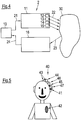
- Fig. 5 schematically shows a device 40 for non-invasive acoustic stimulation of neurons with a pathologically synchronous and oscillatory neuronal activity according to an embodiment of the invention.
- Acoustic stimuli in particular acoustic CR stimuli, are administered to the patient via earphones or headphones 41 or loudspeakers of another design, an earphone being a loudspeaker placed in the ear canal.
- the control signals used for this are generated by a control unit 42.
- Non-invasively fixed EEG electrodes 43 which are connected via a cable 44, are used for "closed loop" stimulation.
- a small component 45 which preferably contains a measuring amplifier and is connected via cables 46, 47 to the EEG electrodes 43 or the earphones or headphones 41, and / or in the actual one, the battery or the Accu accommodating control unit 42 performed.
- the control unit 42 and the component 45 are shown in FIG Fig. 5 embodiment shown connected telemetrically; in this case the component 45 (or a component connected to it by cable) also contains a battery.
- the control unit 42 and the component 45 can also be connected to one another via cables, so that the component 45 is fed by the control unit 42 via the power supply.
- the stimulus strength is given by the volume of the stimuli 22.
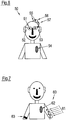
- Fig. 6 schematically shows a device 50 for non-invasive visual stimulation of neurons with a pathologically synchronous and oscillatory neuronal activity according to an embodiment of the invention.
- the patient wears stimulation glasses 51 which, for. B. is attached via bracket 52 to the patient's head.
- a component 53 contains a billing and telemetry unit. The latter is used to connect to the actual control unit 54 that houses the battery or accumulator.
- the component 53 and the control unit 54 are connected to one another telemetrically; in this case the component 53 (or a component connected to it by cable) also contains a battery.
- the component 53 and the control unit 54 can also be connected to one another via cables.
- Non-invasively fixed EEG electrodes 55 are used for "closed loop" stimulation.
- the EEG electrodes 55 are connected to the component 53 via cables 56, 57.
- the visual stimuli generated by the stimulation glasses 51 can be based on a luminosity or brightness variation (or variation of the light intensity or light intensity), for example they can be applied as pulses or as sequences of pulses with varied luminosity or brightness.
- the visual stimuli can, depending on the design, as luminance modulation of natural visual stimuli, e.g. B. by means of homogeneous or segmented transmission glasses, in which the transmission can be regulated depending on the voltage, as in addition to a natural visual stimulus occurring, modulated visual stimulus, for. B. by means of partially transparent light glasses, or as an artificial visual brightness stimulus, for. B. by means of opaque light glasses.
- the stimulation glasses 51 are preferably divided into different segments, the luminosity or transmission or brightness of which is controlled separately can be used to stimulate different parts of the retina independently of each other.
- Fig. 7 schematically shows a device 60 for non-invasive tactile, vibratory, thermal, transcutaneous electrical and / or transcutaneous magnetic stimulation and / or ultrasound stimulation of neurons with a pathologically synchronous and oscillatory neuronal activity according to an embodiment of the invention.
- the device 60 comprises a stimulation unit 61, a control unit 62 which controls the stimulation unit 61 and an accelerometer (accelerometer) 63 for recording measurement signals.
- the stimulation unit 61 and the accelerometer 63 can be connected to the control unit 62 telemetrically or by cable.
- the stimulation unit 61 comprises a plurality of stimulation elements for generating tactile, vibratory, thermal, transcutaneous electrical and / or transcutaneous magnetic stimuli and / or ultrasound stimuli.
- the stimulation elements are designed such that they can be placed on the patient's skin. Depending on the disease or the affected body parts, the stimulation elements are attached to the patient's skin in a suitable arrangement, for example on the arm, leg, hand and / or foot of the patient.
- the plurality of stimulation elements makes it possible to stimulate different receptive areas of the skin in a coordinated manner in time and space via the individual stimulation elements.
- Stimulation elements for generating tactile and / or vibratory stimuli are, for example, vibration actuators which press into the patient's skin at a frequency in the range from 1 to 300 Hz and in particular 1 to 60 Hz and preferably 100 to 300 Hz and thereby generate the desired stimuli.
- the stimulus strength is given by the amplitude of the vibration actuators.
- Stimulation elements for generating thermal stimuli can for example, lasers or other elements for generating heat, in particular heat radiation. The strength of the stimulus is given by the temperature generated by the thermal stimuli.
- Electrodes are typically attached to the patient's skin to generate transcutaneous electrical stimuli.
- Transcutaneous magnetic stimuli can be generated by appropriate stimulation elements for generating magnetic stimuli, in particular current-carrying coils.
- Ultrasound stimuli are generated by stimulation elements for generating ultrasound waves. In the above stimulation modalities, the stimulus strength is given by the current strength of the transcutaneous electrical stimuli, the magnetic field strength generated by the magnetic stimuli at the stimulation location and the amplitude of the ultrasound waves.
- the tactile, vibratory, thermal, transcutaneous electrical and / or transcutaneous magnetic stimuli and / or ultrasound stimuli can be absorbed by receptors located in or under the skin and passed on to the nervous system. These receptors include, for example, Merkel cells, Ruffini bodies, Meissner bodies and hair follicle receptors, which act in particular as receptors for the tactile stimuli.
- the vibratory stimuli mainly target depth sensitivity.
- the vibratory stimuli can be absorbed by receptors located in the skin, muscles, subcutaneous tissue and / or tendons of the patient. Examples of the receptors for the vibratory stimuli are the father Pacini bodies, which transmit vibrations and accelerations.
- the thermal stimuli are absorbed by the skin's thermal receptors. These are warm receptors (also called heat receptors, warm sensors or heat sensors) and cold sensors (also called cold sensors, cold receptors or cold receptors).
- the cold sensors lie more superficially in the human skin, the warm receptors a little deeper.
- the transcutaneous electrical and transcutaneous magnetic stimuli and the ultrasound stimuli do not act specifically on only one group of receptors located in or under the skin and can also directly irritate nerve fibers.
- the targeted stimulation of certain areas of the brain or spinal cord is made possible by the tonotopic or somatotopic assignment of body regions to these areas.
- acoustic stimuli in the inner ear are converted into nerve impulses and passed on to the auditory cortex via the auditory nerve.
- the tonotopic arrangement of the auditory cortex activates a certain part of the auditory cortex during acoustic stimulation of the inner ear at a certain frequency.
- the stimulation elements can be attached, for example, to the foot, lower leg and thigh, or else to the hand, forearm and upper arm of the patient, in order to be able to thereby stimulate certain neurons.
- each stimulation channel is assigned to a different frequency range from which the tones that are applied as acoustic stimuli in the respective stimulation channel are selected.
- the stimulation channels are determined by different points or areas in the patient's visual field.
- the visual stimuli generated in a respective stimulation channel are generated at a respective point or in a respective area of the visual field.
- the stimulation channels of the tactile, vibratory, thermal, transcutaneous electrical and / or transcutaneous magnetic stimuli and / or ultrasound stimuli are determined by the locations of the skin which are stimulated with the respective stimulation elements. Consequently, each stimulation channel is assigned to a particular location or area of the skin.
- the stimulation channels of the gustatory stimuli are determined by the locations of the tongue, which are stimulated with the corresponding taste qualities or electrical stimuli.
- An olfactory stimulation uses psychophysically sufficiently disjunctive olfactory stimuli, through which the stimulation channels would be determined.
- the psychophysically sufficiently disjoint Odor stimuli could e.g. B. personalized, ie adapted to the individual patient.
- electrodes or magnetic field generators in particular current-carrying coils, are attached to the patient's body, in particular to the head.
- the electrodes and magnetic field generators can be used to generate currents or magnetic fields in the patient's brain and / or spinal cord, the strength of these currents or magnetic fields indicating the strength of the stimulus.
- different target areas in the brain and / or spinal cord can be stimulated.
- the stimulation channels are consequently determined by the locations on the patient's body at which the electrodes or magnetic field generators are attached.
- the stimulation unit described above can accordingly separately stimulate different areas of the brain or spinal cord via different stimulation channels, in that the applied stimuli are passed on to different target areas located in the brain and / or spinal cord via nerve conduction.
- the target areas can be stimulated with possibly different and / or delayed stimuli during the stimulation.
- the stimuli 22 in CR stimulation cause a reset, a so-called reset, the phase of the neuronal activity of the stimulated neurons.
- the phase reset of the individual stimuli 22 can be checked with the aid of the measurement signals 23 recorded by the measuring unit 16. Such an examination can be carried out before the actual therapeutic two-stage neurostimulation.
- a signal is measured via a sensor of the measuring unit 16, which is sufficient for the activity of the subpopulation stimulated via the jth stimulation channel represents.
- This signal is obtained either directly from the subpopulation via a non-invasive measurement, e.g. B. via EEG or MEG electrodes, or an invasive measurement, for. B. via implanted electrodes, as a surface EEG or as a local field potential via depth electrodes.
- the signal can also be determined indirectly by measuring a variable correlated with the activity of the stimulated subpopulation.
- neural signals typically contain rhythmic activity in different frequency bands, it is advantageous in such cases, e.g. B. by means of bandpass filtering or wavelet analysis or empirical mode decomposition to determine the signal x j (t), which represents the pathological oscillatory activity of the subpopulation stimulated by the jth stimulation channel.
- a little complex procedure to check a phase reset is to determine the averaged stimulus response.
- a stimulus with identical stimulus parameters is applied at times ⁇ 1 , ⁇ 2 , ..., ⁇ l .
- the distances between the individual stimuli ⁇ k + 1 - ⁇ k should be sufficiently large and randomized, i.e. not constant, in order to avoid settling processes (cf. PA Tass: Transmission of stimulus-locked responses in two coupled phase oscillators. Phys. Rev. E 69, 051909-1-24 (2004 )).
- the distances ⁇ k + 1 - ⁇ k should be in the range of at least ten times, better hundred times the mean period of the pathological oscillation.
- z. B. the amount of the post-stimulus response in principle or for a predetermined minimum duration, e.g. B. 20 ms exceeds this characteristic threshold, there is a non-zero averaged response. In this case there may be a phase reset. That is, the stimulus strength would have to be increased until the post-stimulus response differs from a zero line.
- other statistical tests known to those skilled in the art can also be used for signal analysis.
- phase ⁇ j ( t ) of x j ( t ) is determined. This is done by means of Hilbert transformation from the signal determined by means of bandpass filtering or empirical mode decomposition, which represents the pathological oscillatory activity.
- empirical mode decomposition enables a parameter-independent determination of physiologically relevant modes in different frequency ranges (cf. NE Huang et al .: The empirical mode decomposition and the Hilbert spectrum for nonlinear and non-stationary time series analysis. Proc. R. Soc. A: Math. Phys. Closely. Sci.
- the combination of empirical mode decomposition with the subsequent Hilbert transformation is referred to as the Hilbert-Huang transformation (cf. NE Huang et al .: A confidence limit for the empirical mode decomposition and Hilbert spectral analysis, Proceedings of the Royal Society of London Series A, 459, 2317-2345 (2003 )).
- the phase ⁇ j ( t ) can also be determined using wavelet analysis.
- Various methods are known to the person skilled in the art with which it can be demonstrated that a distribution has a cluster value (ie a peak).
- a phase reset occurs when ⁇ (t) z. B. exceeds the maximum or the 99th percentile of the pre-stimulus distribution of ⁇ (t) (at a point in time or within a small time window, for example 20 ms wide).
- the simulation is based on a network of 200 neurons, where all neurons have a strong stimulating short-range coupling and a weak inhibitory long-range coupling.
- the synaptic coupling strengths in the network can change according to STDP (Spike Timing-Dependent Plasticity) rules.
- STDP Spike Timing-Dependent Plasticity
- stimulation was carried out continuously, ie without cycles in which pauses were observed.
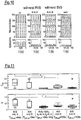
- the figures in the top row show when each individual neuron fires during different time intervals: before, during and after the application of CR stimulation.
- the left column shows the neural activity during the last 80 ms before the CR stimulation starts.
- the middle column shows the neural activity during the last 80 ms of CR stimulation, and the right column refers to the last 80 ms at the end of the subsequent 64 s stimulation-free period.
- the images in the top row are grid plots of the neuronal activity, ie electrical discharges of the individual neurons are marked as dots.
- the figures in the bottom row show how many neurons fire simultaneously within 1 ms during the respective periods.
- CR stimulation with a rapidly varying sequence and subliminal stimulus strength RVS
- SVS slowly varying sequence and excess threshold stimulus strength
- the network was in before the CR stimulation was applied 8 and 9 in the same initial state.
- the rapidly varying CR stimulation with low stimulus strength is sufficient for an acute effect in which the degree of synchronization decreases during the CR stimulation and increases significantly again after the end of the CR stimulation.
- the in Fig. 9 shown sole use of a slowly varying CR stimulation with higher stimulus strength for no long-term desynchronization.
- Fig. 10 The simulations shown were the CR stimulations from the 8 and 9 combined with each other.
- the first column from the left shows the neural activity during the last 80 ms before the CR stimulation starts.
- the second column shows the neuronal activity during the last 80 ms of CR stimulation with a rapidly varying sequence and subliminal stimulus strength.
- the third column shows the neuronal activity during the last 80 ms of CR stimulation with a slowly varying sequence and a transient stimulus intensity.
- the fourth column refers to the last 80 ms at the end of the subsequent 64 s stimulation-free period. The same stimulation parameters were used as in the 8 and 9 used.
- the box corresponds to the area in which the middle 50% of the data is located, the antennas ("whiskers") correspond to the lower and upper 25% of the data.
- Open circles denote outliers and are defined as values that are at least 1.5 times the length of the box below or above the box.
- An asterisk indicates that the two-stage stimulation (middle column) with an initial CR stimulation with a rapidly varying sequence and subliminal stimulus strength and a subsequent CR stimulation with a slowly varying sequence and subliminal stimulus strength is statistically significantly more successful than that One-stage stimulation lasting 64 s or 128 s (one-sided Mann-Whitney U test, p ⁇ 0.05).
Landscapes
- Health & Medical Sciences (AREA)
- Life Sciences & Earth Sciences (AREA)
- Biomedical Technology (AREA)
- Engineering & Computer Science (AREA)
- General Health & Medical Sciences (AREA)
- Animal Behavior & Ethology (AREA)
- Veterinary Medicine (AREA)
- Public Health (AREA)
- Neurology (AREA)
- Neurosurgery (AREA)
- Nuclear Medicine, Radiotherapy & Molecular Imaging (AREA)
- Radiology & Medical Imaging (AREA)
- Heart & Thoracic Surgery (AREA)
- Biophysics (AREA)
- Physics & Mathematics (AREA)
- Molecular Biology (AREA)
- Surgery (AREA)
- Pathology (AREA)
- Medical Informatics (AREA)
- Psychology (AREA)
- Physiology (AREA)
- Hospice & Palliative Care (AREA)
- Psychiatry (AREA)
- Anesthesiology (AREA)
- Developmental Disabilities (AREA)
- Child & Adolescent Psychology (AREA)
- Dentistry (AREA)
- Oral & Maxillofacial Surgery (AREA)
- Pain & Pain Management (AREA)
- Acoustics & Sound (AREA)
- Hematology (AREA)
- Rehabilitation Therapy (AREA)
- Social Psychology (AREA)
- Dermatology (AREA)
- Electrotherapy Devices (AREA)
Claims (12)
- Dispositif (1 ; 2) de stimulation de neurones (31) comprenant- un module de stimulation non invasif (11) pour la génération de stimuli (22) dans une pluralité de canaux de stimulation (12 à 15), dans lequel le module de stimulation (11) est conçu de telle sorte que les stimuli (22) stimulent une population de neurones (31) dans le cerveau et/ou la moelle épinière (30) d'un patient par le biais des canaux de stimulation à différents endroits respectivement, et- un module de commande (10) qui exploite le module de stimulation (11) pendant un premier intervalle de temps et un second intervalle de temps succédant au premier intervalle de temps dans différents modes de stimulation, dans lequel- le module de commande (10) commande le module de stimulation (11) pendant au moins 75 % de la durée du premier intervalle de temps dans un premier mode de stimulation de telle sorte que le module de stimulation (11) génère des séquences de stimuli (22) de manière répétitive et l'ordre des canaux de stimulation (12 à 15) dans lesquels les stimuli (22) sont générés au sein d'une séquence est constant pour au plus 5 séquences générées successivement et est ensuite varié,- le module de commande (10) commande le module de stimulation (11) pendant au moins 75 % de la durée du second intervalle de temps dans un second mode de stimulation de telle sorte que le module de stimulation (11) génère des séquences de stimuli (22) de manière répétitive et l'ordre des canaux de stimulation (12 à 15) dans lesquels les stimuli (22) sont générés au sein d'une séquence est constant pour au moins 25 séquences générées successivement et est ensuite varié, et- dans lequel l'intensité des stimuli (22) dans le premier mode de stimulation est inférieure ou égale à une intensité de stimulus prédéfinie et l'intensité des stimuli (22) dans le second mode de stimulation est au moins 1,3 fois l'intensité de stimulus prédéfinie.
- Dispositif (1 ; 2) selon la revendication 1, dans lequel les séquences dans le premier et/ou second mode de stimulation sont générées dans un schéma de temps qui se compose de cycles successifs et une séquence de stimuli (22) est à chaque fois générée au moins dans certains des cycles.
- Dispositif (1 ; 2) selon la revendication 2, dans lequel soit exactement une séquence de stimuli (22) est générée, soit aucun stimulus n'est généré au sein d'un cycle respectif.
- Dispositif (1 ; 2) selon la revendication 2 ou 3, dans lequel des stimuli (22) sont générés pendant n cycles successifs et aucun stimulus n'est généré pendant les m cycles subséquents et ce modèle est poursuivi périodiquement, dans lequel n et m sont des nombres entiers non négatifs.
- Dispositif (1 ; 2) selon une des revendications précédentes, dans lequel le modèle, d'après lequel l'ordre des canaux de stimulation (12 à 15) dans le premier mode de stimulation dans lesquels les stimuli (22) sont générés au sein d'une séquence est constant pour au plus 5 séquences générées successivement et l'ordre est ensuite varié, est répété plusieurs fois.
- Dispositif (1 ; 2) selon une des revendications précédentes, dans lequel le modèle, d'après lequel l'ordre des canaux de stimulation (12 à 15) dans le second mode de stimulation dans lesquels les stimuli (22) sont générés au sein d'une séquence est constant pour au moins 25 séquences générées successivement et l'ordre est ensuite varié, est répété plusieurs fois.
- Dispositif (1 ; 2) selon une des revendications précédentes, dans lequel le module de stimulation (11) génère exactement un stimulus (22) au sein d'une séquence respective dans chaque canal de stimulation (11 à 15).
- Dispositif (1 ; 2) selon la revendication 7, dans lequel exactement un stimulus (22) est exactement un train d'impulsions.
- Dispositif (2) selon une des revendications précédentes, comprenant un module de mesure (16) pour l'enregistrement de signaux de mesure (23) qui restituent une activité neuronale de la population de neurones (31) stimulée avec les stimuli (22).
- Dispositif (2) selon la revendication 9, dans lequel le module de commande (10) est conçu de telle sorte qu'il commute du premier mode de stimulation au second mode de stimulation lorsque le module de commande (10) constate à l'aide des signaux de mesure (23) qu'un degré de synchronisation de la population de neurones stimulée (31) est réduit d'au moins une valeur seuil prédéfinie par l'application des stimuli (22) dans le premier mode de stimulation.
- Dispositif (1 ; 2) selon une des revendications précédentes, dans lequel les stimuli (22) sont des stimuli acoustiques, visuels, tactiles, vibratoires, thermiques, olfactifs, gustatifs, électriques transcutanés, magnétiques transcutanés, électriques transcrâniens et/ou magnétiques transcrâniens et/ou des stimuli ultrasoniques.
- Produit de programme informatique comprenant des parties de programme qui, lorsqu'elles sont chargées dans un ordinateur, sont conçues pour la réalisation d'un procédé mis en oeuvre par ordinateur, lors duquel- un module de stimulation non invasif (11) génère des stimuli (22) dans une pluralité de canaux de stimulation (12 à 15), dans lequel les stimuli (22) stimulent une population de neurones (31) dans le cerveau et/ou la moelle épinière (30) d'un patient par le biais des canaux de stimulation (12 à 15) à différents endroits respectivement, dans lequel- le module de stimulation (11) est exploité pendant un premier intervalle de temps et un second intervalle de temps succédant au premier intervalle de temps dans différents modes de stimulation,- le module de stimulation (11) est exploité pendant au moins 75 % de la durée du premier intervalle de temps dans un premier mode de stimulation de telle sorte que le module de stimulation (11) génère des séquences de stimuli (22) de manière répétitive et l'ordre des canaux de stimulation (12 à 15) dans lesquels les stimuli (22) sont générés au sein d'une séquence est constant pour au plus 5 séquences générées successivement et est ensuite varié,- le module de stimulation (11) est exploité pendant au moins 75 % de la durée du second intervalle de temps dans un second mode de stimulation de telle sorte que le module de stimulation (11) génère des séquences de stimuli (22) de manière répétitive et l'ordre des canaux de stimulation (12 à 15) dans lesquels les stimuli (22) sont générés au sein d'une séquence est constant pour au moins 25 séquences générées successivement et est ensuite varié, et- dans lequel l'intensité des stimuli (22) dans le premier mode de stimulation est inférieure ou égale à une intensité de stimulus prédéfinie et l'intensité des stimuli (22) dans le second mode de stimulation est au moins 1,3 fois l'intensité de stimulus prédéfinie.
Applications Claiming Priority (2)
| Application Number | Priority Date | Filing Date | Title |
|---|---|---|---|
| DE102015109986.1A DE102015109986B4 (de) | 2015-06-22 | 2015-06-22 | Vorrichtung zur effektiven nicht-invasiven Zwei-Stufen-Neurostimulation |
| PCT/EP2016/064472 WO2016207247A1 (fr) | 2015-06-22 | 2016-06-22 | Dispositif et procédé pour neurostimulation efficace non invasive en deux étapes |
Publications (2)
| Publication Number | Publication Date |
|---|---|
| EP3310432A1 EP3310432A1 (fr) | 2018-04-25 |
| EP3310432B1 true EP3310432B1 (fr) | 2020-01-01 |
Family
ID=56235807
Family Applications (1)
| Application Number | Title | Priority Date | Filing Date |
|---|---|---|---|
| EP16732270.0A Active EP3310432B1 (fr) | 2015-06-22 | 2016-06-22 | Dispositif pour neurostimulation efficace non invasive en deux étapes |
Country Status (6)
| Country | Link |
|---|---|
| US (1) | US10722678B2 (fr) |
| EP (1) | EP3310432B1 (fr) |
| DE (1) | DE102015109986B4 (fr) |
| DK (1) | DK3310432T3 (fr) |
| ES (1) | ES2781201T3 (fr) |
| WO (1) | WO2016207247A1 (fr) |
Families Citing this family (11)
| Publication number | Priority date | Publication date | Assignee | Title |
|---|---|---|---|---|
| US20170325718A1 (en) * | 2016-05-12 | 2017-11-16 | Bragi GmbH | Neuropathic Diagnosis and Monitoring Using Earpiece Device, System, and Method |
| JP7069716B2 (ja) * | 2017-12-28 | 2022-05-18 | 株式会社リコー | 生体機能計測解析システム、生体機能計測解析プログラム及び生体機能計測解析方法 |
| CN109260591B (zh) * | 2018-08-02 | 2022-08-19 | 深圳英智科技有限公司 | 经颅刺激方法和装置 |
| US20210316110A1 (en) * | 2018-09-03 | 2021-10-14 | Gretap Ag | Medical Treatment Device and Method for Stimulating Neurons of a Patient to Suppress a Pathologically Synchronous Activity of the Neurons |
| US11964152B2 (en) | 2019-05-06 | 2024-04-23 | Advanced Neuromodulation Systems, Inc. | Neurostimulation using one or more cycling parameters for a non-paresthesia stimulation pattern |
| US20200353269A1 (en) * | 2019-05-06 | 2020-11-12 | Advanced Neuromodulation Systems, Inc. | Neurostimulation using one or more cycling parameters for a non-paresthesia stimulation pattern |
| CN110548226B (zh) * | 2019-07-31 | 2023-04-11 | 中国医学科学院生物医学工程研究所 | 一种根据节律耦合特征建立经颅磁刺激模式的方法 |
| CN111768802B (zh) * | 2020-09-03 | 2020-12-08 | 江苏爱谛科技研究院有限公司 | 一种人工耳蜗语音处理方法及系统 |
| JP2023543503A (ja) | 2020-10-06 | 2023-10-16 | グレタップ アーゲー | 患者のニューロンを刺激してその病理学的同期活動を抑制するための医療デバイス |
| WO2022117736A1 (fr) | 2020-12-02 | 2022-06-09 | Gretap Ag | Dispositif médical permettant de stimuler les neurones d'un patient afin de supprimer une activité neuronale synchrone pathologique |
| US20240277968A1 (en) * | 2021-06-21 | 2024-08-22 | Gretap Ag | Medical device for stimulating neurons of a patient which prevents blank window stimulation |
Family Cites Families (5)
| Publication number | Priority date | Publication date | Assignee | Title |
|---|---|---|---|---|
| DE102008052078B4 (de) * | 2008-10-17 | 2011-06-01 | Forschungszentrum Jülich GmbH | Vorrichtung zur konditionierten desynchronisierenden Stimulation |
| DE102009015723B4 (de) | 2009-03-31 | 2013-12-19 | Forschungszentrum Jülich GmbH | Stimulationselektrode |
| DE102010016404A1 (de) | 2010-04-12 | 2012-12-27 | Forschungszentrum Jülich GmbH | Vorrichtung und Verfahren zur konditionierten desynchronisierenden nicht-invasiven Stimulation |
| DE102010016461B4 (de) | 2010-04-15 | 2013-03-21 | Forschungszentrum Jülich GmbH | Vorrichtung zur Behandlung von Erkrankungen des Gehirns und/oder Rückenmarks mittels Neurofeedback |
| EP3180080B1 (fr) * | 2014-08-14 | 2021-01-06 | Functional Neuromodulation, Inc. | Système de stimulation du cerveau comprenant de multiples modes de stimulation |
-
2015
- 2015-06-22 DE DE102015109986.1A patent/DE102015109986B4/de not_active Expired - Fee Related
-
2016
- 2016-06-22 EP EP16732270.0A patent/EP3310432B1/fr active Active
- 2016-06-22 US US15/738,693 patent/US10722678B2/en active Active
- 2016-06-22 DK DK16732270.0T patent/DK3310432T3/da active
- 2016-06-22 WO PCT/EP2016/064472 patent/WO2016207247A1/fr not_active Ceased
- 2016-06-22 ES ES16732270T patent/ES2781201T3/es active Active
Non-Patent Citations (1)
| Title |
|---|
| None * |
Also Published As
| Publication number | Publication date |
|---|---|
| US20180169373A1 (en) | 2018-06-21 |
| DE102015109986A1 (de) | 2016-12-22 |
| WO2016207247A1 (fr) | 2016-12-29 |
| DK3310432T3 (da) | 2020-04-06 |
| EP3310432A1 (fr) | 2018-04-25 |
| US10722678B2 (en) | 2020-07-28 |
| ES2781201T3 (es) | 2020-08-31 |
| DE102015109986B4 (de) | 2017-04-27 |
Similar Documents
| Publication | Publication Date | Title |
|---|---|---|
| EP3183033B1 (fr) | Dispositif de neurostimulation non-invasive efficace à l'aide de séquences d'excitation variables | |
| EP3310432B1 (fr) | Dispositif pour neurostimulation efficace non invasive en deux étapes | |
| EP3188794B1 (fr) | Dispositif de neurostimulation non effractive au moyen de rafales multicanaux | |
| EP2826448B1 (fr) | Dispositif de stimulation auditive | |
| EP2797667B1 (fr) | Dispositif d'étalonnage d'une neurostimulation désynchronisante non effractive | |
| EP2358430B1 (fr) | Dispositif de stimulation conditionnelle de desynchronisation | |
| DE102012002437B4 (de) | Vorrichtung zur Eichung einer invasiven, elektrischen und desynchronisierenden Neurostimulation | |
| EP3397336B1 (fr) | Dispositif pour la neurostimulation neurologique invasive efficace à plusieurs segments | |
| EP3183031B1 (fr) | Dispositif de neurostimulation désynchronisante efficace non invasive | |
| EP1613394A1 (fr) | Dispositif de desynchronisation de l'activite cerebrale neuronale | |
| EP3285854B1 (fr) | Dispositif de stimulation neurologique invasive efficace à deux niveaux | |
| EP3183032A1 (fr) | Dispositif et procédé de neurostimulation invasive efficace à l'aide de séquences d'excitation variables | |
| DE102020208431B4 (de) | Nicht-invasive Dynamic Coordinated Reset (DCR) Stimulation |
Legal Events
| Date | Code | Title | Description |
|---|---|---|---|
| STAA | Information on the status of an ep patent application or granted ep patent |
Free format text: STATUS: THE INTERNATIONAL PUBLICATION HAS BEEN MADE |
|
| PUAI | Public reference made under article 153(3) epc to a published international application that has entered the european phase |
Free format text: ORIGINAL CODE: 0009012 |
|
| STAA | Information on the status of an ep patent application or granted ep patent |
Free format text: STATUS: REQUEST FOR EXAMINATION WAS MADE |
|
| 17P | Request for examination filed |
Effective date: 20180118 |
|
| AK | Designated contracting states |
Kind code of ref document: A1 Designated state(s): AL AT BE BG CH CY CZ DE DK EE ES FI FR GB GR HR HU IE IS IT LI LT LU LV MC MK MT NL NO PL PT RO RS SE SI SK SM TR |
|
| AX | Request for extension of the european patent |
Extension state: BA ME |
|
| DAV | Request for validation of the european patent (deleted) | ||
| DAX | Request for extension of the european patent (deleted) | ||
| GRAP | Despatch of communication of intention to grant a patent |
Free format text: ORIGINAL CODE: EPIDOSNIGR1 |
|
| STAA | Information on the status of an ep patent application or granted ep patent |
Free format text: STATUS: GRANT OF PATENT IS INTENDED |
|
| RIC1 | Information provided on ipc code assigned before grant |
Ipc: A61M 21/02 20060101ALI20181221BHEP Ipc: A61N 2/00 20060101ALI20181221BHEP Ipc: A61B 5/0476 20060101ALI20181221BHEP Ipc: A61B 5/11 20060101ALI20181221BHEP Ipc: A61M 21/00 20060101ALI20181221BHEP Ipc: A61N 1/36 20060101AFI20181221BHEP Ipc: A61B 5/053 20060101ALI20181221BHEP Ipc: A61N 2/02 20060101ALI20181221BHEP Ipc: A61B 5/00 20060101ALI20181221BHEP Ipc: A61B 5/0488 20060101ALI20181221BHEP |
|
| INTG | Intention to grant announced |
Effective date: 20190128 |
|
| GRAS | Grant fee paid |
Free format text: ORIGINAL CODE: EPIDOSNIGR3 |
|
| GRAA | (expected) grant |
Free format text: ORIGINAL CODE: 0009210 |
|
| STAA | Information on the status of an ep patent application or granted ep patent |
Free format text: STATUS: THE PATENT HAS BEEN GRANTED |
|
| AK | Designated contracting states |
Kind code of ref document: B1 Designated state(s): AL AT BE BG CH CY CZ DE DK EE ES FI FR GB GR HR HU IE IS IT LI LT LU LV MC MK MT NL NO PL PT RO RS SE SI SK SM TR |
|
| REG | Reference to a national code |
Ref country code: GB Ref legal event code: FG4D Free format text: NOT ENGLISH |
|
| REG | Reference to a national code |
Ref country code: CH Ref legal event code: EP Ref country code: AT Ref legal event code: REF Ref document number: 1219026 Country of ref document: AT Kind code of ref document: T Effective date: 20200115 |
|
| REG | Reference to a national code |
Ref country code: IE Ref legal event code: FG4D Free format text: LANGUAGE OF EP DOCUMENT: GERMAN |
|
| REG | Reference to a national code |
Ref country code: DE Ref legal event code: R096 Ref document number: 502016008244 Country of ref document: DE |
|
| REG | Reference to a national code |
Ref country code: DK Ref legal event code: T3 Effective date: 20200330 |
|
| REG | Reference to a national code |
Ref country code: NL Ref legal event code: FP |
|
| REG | Reference to a national code |
Ref country code: LT Ref legal event code: MG4D |
|
| PG25 | Lapsed in a contracting state [announced via postgrant information from national office to epo] |
Ref country code: NO Free format text: LAPSE BECAUSE OF FAILURE TO SUBMIT A TRANSLATION OF THE DESCRIPTION OR TO PAY THE FEE WITHIN THE PRESCRIBED TIME-LIMIT Effective date: 20200401 Ref country code: FI Free format text: LAPSE BECAUSE OF FAILURE TO SUBMIT A TRANSLATION OF THE DESCRIPTION OR TO PAY THE FEE WITHIN THE PRESCRIBED TIME-LIMIT Effective date: 20200101 Ref country code: RS Free format text: LAPSE BECAUSE OF FAILURE TO SUBMIT A TRANSLATION OF THE DESCRIPTION OR TO PAY THE FEE WITHIN THE PRESCRIBED TIME-LIMIT Effective date: 20200101 Ref country code: PT Free format text: LAPSE BECAUSE OF FAILURE TO SUBMIT A TRANSLATION OF THE DESCRIPTION OR TO PAY THE FEE WITHIN THE PRESCRIBED TIME-LIMIT Effective date: 20200527 Ref country code: CZ Free format text: LAPSE BECAUSE OF FAILURE TO SUBMIT A TRANSLATION OF THE DESCRIPTION OR TO PAY THE FEE WITHIN THE PRESCRIBED TIME-LIMIT Effective date: 20200101 Ref country code: LT Free format text: LAPSE BECAUSE OF FAILURE TO SUBMIT A TRANSLATION OF THE DESCRIPTION OR TO PAY THE FEE WITHIN THE PRESCRIBED TIME-LIMIT Effective date: 20200101 |
|
| PGFP | Annual fee paid to national office [announced via postgrant information from national office to epo] |
Ref country code: DK Payment date: 20200629 Year of fee payment: 5 |
|
| PG25 | Lapsed in a contracting state [announced via postgrant information from national office to epo] |
Ref country code: IS Free format text: LAPSE BECAUSE OF FAILURE TO SUBMIT A TRANSLATION OF THE DESCRIPTION OR TO PAY THE FEE WITHIN THE PRESCRIBED TIME-LIMIT Effective date: 20200501 Ref country code: GR Free format text: LAPSE BECAUSE OF FAILURE TO SUBMIT A TRANSLATION OF THE DESCRIPTION OR TO PAY THE FEE WITHIN THE PRESCRIBED TIME-LIMIT Effective date: 20200402 Ref country code: BG Free format text: LAPSE BECAUSE OF FAILURE TO SUBMIT A TRANSLATION OF THE DESCRIPTION OR TO PAY THE FEE WITHIN THE PRESCRIBED TIME-LIMIT Effective date: 20200401 Ref country code: LV Free format text: LAPSE BECAUSE OF FAILURE TO SUBMIT A TRANSLATION OF THE DESCRIPTION OR TO PAY THE FEE WITHIN THE PRESCRIBED TIME-LIMIT Effective date: 20200101 Ref country code: SE Free format text: LAPSE BECAUSE OF FAILURE TO SUBMIT A TRANSLATION OF THE DESCRIPTION OR TO PAY THE FEE WITHIN THE PRESCRIBED TIME-LIMIT Effective date: 20200101 Ref country code: HR Free format text: LAPSE BECAUSE OF FAILURE TO SUBMIT A TRANSLATION OF THE DESCRIPTION OR TO PAY THE FEE WITHIN THE PRESCRIBED TIME-LIMIT Effective date: 20200101 |
|
| PGFP | Annual fee paid to national office [announced via postgrant information from national office to epo] |
Ref country code: BE Payment date: 20200629 Year of fee payment: 5 |
|
| REG | Reference to a national code |
Ref country code: ES Ref legal event code: FG2A Ref document number: 2781201 Country of ref document: ES Kind code of ref document: T3 Effective date: 20200831 |
|
| REG | Reference to a national code |
Ref country code: DE Ref legal event code: R097 Ref document number: 502016008244 Country of ref document: DE |
|
| PG25 | Lapsed in a contracting state [announced via postgrant information from national office to epo] |
Ref country code: SK Free format text: LAPSE BECAUSE OF FAILURE TO SUBMIT A TRANSLATION OF THE DESCRIPTION OR TO PAY THE FEE WITHIN THE PRESCRIBED TIME-LIMIT Effective date: 20200101 Ref country code: RO Free format text: LAPSE BECAUSE OF FAILURE TO SUBMIT A TRANSLATION OF THE DESCRIPTION OR TO PAY THE FEE WITHIN THE PRESCRIBED TIME-LIMIT Effective date: 20200101 Ref country code: SM Free format text: LAPSE BECAUSE OF FAILURE TO SUBMIT A TRANSLATION OF THE DESCRIPTION OR TO PAY THE FEE WITHIN THE PRESCRIBED TIME-LIMIT Effective date: 20200101 Ref country code: EE Free format text: LAPSE BECAUSE OF FAILURE TO SUBMIT A TRANSLATION OF THE DESCRIPTION OR TO PAY THE FEE WITHIN THE PRESCRIBED TIME-LIMIT Effective date: 20200101 |
|
| PLBE | No opposition filed within time limit |
Free format text: ORIGINAL CODE: 0009261 |
|
| STAA | Information on the status of an ep patent application or granted ep patent |
Free format text: STATUS: NO OPPOSITION FILED WITHIN TIME LIMIT |
|
| PGFP | Annual fee paid to national office [announced via postgrant information from national office to epo] |
Ref country code: CH Payment date: 20200724 Year of fee payment: 5 |
|
| 26N | No opposition filed |
Effective date: 20201002 |
|
| PG25 | Lapsed in a contracting state [announced via postgrant information from national office to epo] |
Ref country code: MC Free format text: LAPSE BECAUSE OF FAILURE TO SUBMIT A TRANSLATION OF THE DESCRIPTION OR TO PAY THE FEE WITHIN THE PRESCRIBED TIME-LIMIT Effective date: 20200101 |
|
| PG25 | Lapsed in a contracting state [announced via postgrant information from national office to epo] |
Ref country code: SI Free format text: LAPSE BECAUSE OF FAILURE TO SUBMIT A TRANSLATION OF THE DESCRIPTION OR TO PAY THE FEE WITHIN THE PRESCRIBED TIME-LIMIT Effective date: 20200101 Ref country code: PL Free format text: LAPSE BECAUSE OF FAILURE TO SUBMIT A TRANSLATION OF THE DESCRIPTION OR TO PAY THE FEE WITHIN THE PRESCRIBED TIME-LIMIT Effective date: 20200101 |
|
| PG25 | Lapsed in a contracting state [announced via postgrant information from national office to epo] |
Ref country code: LU Free format text: LAPSE BECAUSE OF NON-PAYMENT OF DUE FEES Effective date: 20200622 |
|
| REG | Reference to a national code |
Ref country code: DK Ref legal event code: EBP Effective date: 20210630 |
|
| REG | Reference to a national code |
Ref country code: CH Ref legal event code: PL |
|
| REG | Reference to a national code |
Ref country code: BE Ref legal event code: MM Effective date: 20210630 |
|
| REG | Reference to a national code |
Ref country code: DE Ref legal event code: R081 Ref document number: 502016008244 Country of ref document: DE Owner name: GRETAP AG, CH Free format text: FORMER OWNER: FORSCHUNGSZENTRUM JUELICH GMBH, 52428 JUELICH, DE |
|
| REG | Reference to a national code |
Ref country code: DE Ref legal event code: R081 Ref document number: 502016008244 Country of ref document: DE Owner name: GRETAP AG, CH Free format text: FORMER OWNER: TASS, PETER, PROF. DR. DR., 83684 TEGERNSEE, DE |
|
| PG25 | Lapsed in a contracting state [announced via postgrant information from national office to epo] |
Ref country code: LI Free format text: LAPSE BECAUSE OF NON-PAYMENT OF DUE FEES Effective date: 20210630 Ref country code: CH Free format text: LAPSE BECAUSE OF NON-PAYMENT OF DUE FEES Effective date: 20210630 |
|
| PG25 | Lapsed in a contracting state [announced via postgrant information from national office to epo] |
Ref country code: TR Free format text: LAPSE BECAUSE OF FAILURE TO SUBMIT A TRANSLATION OF THE DESCRIPTION OR TO PAY THE FEE WITHIN THE PRESCRIBED TIME-LIMIT Effective date: 20200101 Ref country code: MT Free format text: LAPSE BECAUSE OF FAILURE TO SUBMIT A TRANSLATION OF THE DESCRIPTION OR TO PAY THE FEE WITHIN THE PRESCRIBED TIME-LIMIT Effective date: 20200101 Ref country code: CY Free format text: LAPSE BECAUSE OF FAILURE TO SUBMIT A TRANSLATION OF THE DESCRIPTION OR TO PAY THE FEE WITHIN THE PRESCRIBED TIME-LIMIT Effective date: 20200101 |
|
| PG25 | Lapsed in a contracting state [announced via postgrant information from national office to epo] |
Ref country code: MK Free format text: LAPSE BECAUSE OF FAILURE TO SUBMIT A TRANSLATION OF THE DESCRIPTION OR TO PAY THE FEE WITHIN THE PRESCRIBED TIME-LIMIT Effective date: 20200101 Ref country code: AL Free format text: LAPSE BECAUSE OF FAILURE TO SUBMIT A TRANSLATION OF THE DESCRIPTION OR TO PAY THE FEE WITHIN THE PRESCRIBED TIME-LIMIT Effective date: 20200101 |
|
| PG25 | Lapsed in a contracting state [announced via postgrant information from national office to epo] |
Ref country code: DK Free format text: LAPSE BECAUSE OF NON-PAYMENT OF DUE FEES Effective date: 20210630 Ref country code: BE Free format text: LAPSE BECAUSE OF NON-PAYMENT OF DUE FEES Effective date: 20210630 |
|
| PGFP | Annual fee paid to national office [announced via postgrant information from national office to epo] |
Ref country code: NL Payment date: 20220621 Year of fee payment: 7 Ref country code: IE Payment date: 20220616 Year of fee payment: 7 |
|
| PGFP | Annual fee paid to national office [announced via postgrant information from national office to epo] |
Ref country code: AT Payment date: 20220617 Year of fee payment: 7 |
|
| PGFP | Annual fee paid to national office [announced via postgrant information from national office to epo] |
Ref country code: IT Payment date: 20220630 Year of fee payment: 7 Ref country code: ES Payment date: 20220719 Year of fee payment: 7 |
|
| REG | Reference to a national code |
Ref country code: NL Ref legal event code: MM Effective date: 20230701 |
|
| REG | Reference to a national code |
Ref country code: AT Ref legal event code: MM01 Ref document number: 1219026 Country of ref document: AT Kind code of ref document: T Effective date: 20230622 |
|
| REG | Reference to a national code |
Ref country code: IE Ref legal event code: MM4A |
|
| PG25 | Lapsed in a contracting state [announced via postgrant information from national office to epo] |
Ref country code: NL Free format text: LAPSE BECAUSE OF NON-PAYMENT OF DUE FEES Effective date: 20230701 |
|
| PG25 | Lapsed in a contracting state [announced via postgrant information from national office to epo] |
Ref country code: IE Free format text: LAPSE BECAUSE OF NON-PAYMENT OF DUE FEES Effective date: 20230622 |
|
| PG25 | Lapsed in a contracting state [announced via postgrant information from national office to epo] |
Ref country code: AT Free format text: LAPSE BECAUSE OF NON-PAYMENT OF DUE FEES Effective date: 20230622 |
|
| PG25 | Lapsed in a contracting state [announced via postgrant information from national office to epo] |
Ref country code: IE Free format text: LAPSE BECAUSE OF NON-PAYMENT OF DUE FEES Effective date: 20230622 Ref country code: AT Free format text: LAPSE BECAUSE OF NON-PAYMENT OF DUE FEES Effective date: 20230622 |
|
| PG25 | Lapsed in a contracting state [announced via postgrant information from national office to epo] |
Ref country code: IT Free format text: LAPSE BECAUSE OF NON-PAYMENT OF DUE FEES Effective date: 20230622 |
|
| REG | Reference to a national code |
Ref country code: ES Ref legal event code: FD2A Effective date: 20240801 |
|
| PG25 | Lapsed in a contracting state [announced via postgrant information from national office to epo] |
Ref country code: ES Free format text: LAPSE BECAUSE OF NON-PAYMENT OF DUE FEES Effective date: 20230623 |
|
| REG | Reference to a national code |
Ref country code: GB Ref legal event code: 732E Free format text: REGISTERED BETWEEN 20240926 AND 20241002 |
|
| PG25 | Lapsed in a contracting state [announced via postgrant information from national office to epo] |
Ref country code: ES Free format text: LAPSE BECAUSE OF NON-PAYMENT OF DUE FEES Effective date: 20230623 |
|
| PGFP | Annual fee paid to national office [announced via postgrant information from national office to epo] |
Ref country code: DE Payment date: 20250618 Year of fee payment: 10 |
|
| PGFP | Annual fee paid to national office [announced via postgrant information from national office to epo] |
Ref country code: GB Payment date: 20250620 Year of fee payment: 10 |
|
| PGFP | Annual fee paid to national office [announced via postgrant information from national office to epo] |
Ref country code: FR Payment date: 20250626 Year of fee payment: 10 |