EP3310541B1 - Method of producing a laminated wood product, and laminated wood products - Google Patents
Method of producing a laminated wood product, and laminated wood products Download PDFInfo
- Publication number
- EP3310541B1 EP3310541B1 EP16811121.9A EP16811121A EP3310541B1 EP 3310541 B1 EP3310541 B1 EP 3310541B1 EP 16811121 A EP16811121 A EP 16811121A EP 3310541 B1 EP3310541 B1 EP 3310541B1
- Authority
- EP
- European Patent Office
- Prior art keywords
- lamellae
- wood
- log
- base surfaces
- base surface
- Prior art date
- Legal status (The legal status is an assumption and is not a legal conclusion. Google has not performed a legal analysis and makes no representation as to the accuracy of the status listed.)
- Active
Links
Images



Classifications
-
- B—PERFORMING OPERATIONS; TRANSPORTING
- B27—WORKING OR PRESERVING WOOD OR SIMILAR MATERIAL; NAILING OR STAPLING MACHINES IN GENERAL
- B27M—WORKING OF WOOD NOT PROVIDED FOR IN SUBCLASSES B27B - B27L; MANUFACTURE OF SPECIFIC WOODEN ARTICLES
- B27M3/00—Manufacture or reconditioning of specific semi-finished or finished articles
- B27M3/0013—Manufacture or reconditioning of specific semi-finished or finished articles of composite or compound articles
- B27M3/0026—Manufacture or reconditioning of specific semi-finished or finished articles of composite or compound articles characterised by oblong elements connected laterally
- B27M3/0053—Manufacture or reconditioning of specific semi-finished or finished articles of composite or compound articles characterised by oblong elements connected laterally using glue
-
- B—PERFORMING OPERATIONS; TRANSPORTING
- B27—WORKING OR PRESERVING WOOD OR SIMILAR MATERIAL; NAILING OR STAPLING MACHINES IN GENERAL
- B27M—WORKING OF WOOD NOT PROVIDED FOR IN SUBCLASSES B27B - B27L; MANUFACTURE OF SPECIFIC WOODEN ARTICLES
- B27M3/00—Manufacture or reconditioning of specific semi-finished or finished articles
- B27M3/0013—Manufacture or reconditioning of specific semi-finished or finished articles of composite or compound articles
- B27M3/0026—Manufacture or reconditioning of specific semi-finished or finished articles of composite or compound articles characterised by oblong elements connected laterally
-
- B—PERFORMING OPERATIONS; TRANSPORTING
- B27—WORKING OR PRESERVING WOOD OR SIMILAR MATERIAL; NAILING OR STAPLING MACHINES IN GENERAL
- B27M—WORKING OF WOOD NOT PROVIDED FOR IN SUBCLASSES B27B - B27L; MANUFACTURE OF SPECIFIC WOODEN ARTICLES
- B27M3/00—Manufacture or reconditioning of specific semi-finished or finished articles
- B27M3/0013—Manufacture or reconditioning of specific semi-finished or finished articles of composite or compound articles
- B27M3/006—Manufacture or reconditioning of specific semi-finished or finished articles of composite or compound articles characterised by oblong elements connected both laterally and at their ends
-
- B—PERFORMING OPERATIONS; TRANSPORTING
- B27—WORKING OR PRESERVING WOOD OR SIMILAR MATERIAL; NAILING OR STAPLING MACHINES IN GENERAL
- B27M—WORKING OF WOOD NOT PROVIDED FOR IN SUBCLASSES B27B - B27L; MANUFACTURE OF SPECIFIC WOODEN ARTICLES
- B27M3/00—Manufacture or reconditioning of specific semi-finished or finished articles
- B27M3/0013—Manufacture or reconditioning of specific semi-finished or finished articles of composite or compound articles
- B27M3/0086—Manufacture or reconditioning of specific semi-finished or finished articles of composite or compound articles characterised by connecting using glue
-
- E—FIXED CONSTRUCTIONS
- E04—BUILDING
- E04B—GENERAL BUILDING CONSTRUCTIONS; WALLS, e.g. PARTITIONS; ROOFS; FLOORS; CEILINGS; INSULATION OR OTHER PROTECTION OF BUILDINGS
- E04B1/00—Constructions in general; Structures which are not restricted either to walls, e.g. partitions, or floors or ceilings or roofs
- E04B1/02—Structures consisting primarily of load-supporting, block-shaped, or slab-shaped elements
- E04B1/10—Structures consisting primarily of load-supporting, block-shaped, or slab-shaped elements the elements consisting of wood
-
- E—FIXED CONSTRUCTIONS
- E04—BUILDING
- E04C—STRUCTURAL ELEMENTS; BUILDING MATERIALS
- E04C2/00—Building elements of relatively thin form for the construction of parts of buildings, e.g. sheet materials, slabs, or panels
- E04C2/02—Building elements of relatively thin form for the construction of parts of buildings, e.g. sheet materials, slabs, or panels characterised by specified materials
- E04C2/10—Building elements of relatively thin form for the construction of parts of buildings, e.g. sheet materials, slabs, or panels characterised by specified materials of wood, fibres, chips, vegetable stems, or the like; of plastics; of foamed products
- E04C2/12—Building elements of relatively thin form for the construction of parts of buildings, e.g. sheet materials, slabs, or panels characterised by specified materials of wood, fibres, chips, vegetable stems, or the like; of plastics; of foamed products of solid wood
-
- E—FIXED CONSTRUCTIONS
- E04—BUILDING
- E04C—STRUCTURAL ELEMENTS; BUILDING MATERIALS
- E04C3/00—Structural elongated elements designed for load-supporting
- E04C3/02—Joists; Girders, trusses, or trusslike structures, e.g. prefabricated; Lintels; Transoms; Braces
- E04C3/12—Joists; Girders, trusses, or trusslike structures, e.g. prefabricated; Lintels; Transoms; Braces of wood, e.g. with reinforcements, with tensioning members
- E04C3/122—Laminated
-
- B—PERFORMING OPERATIONS; TRANSPORTING
- B27—WORKING OR PRESERVING WOOD OR SIMILAR MATERIAL; NAILING OR STAPLING MACHINES IN GENERAL
- B27B—SAWS FOR WOOD OR SIMILAR MATERIAL; COMPONENTS OR ACCESSORIES THEREFOR
- B27B1/00—Methods for subdividing trunks or logs essentially involving sawing
- B27B1/005—Methods for subdividing trunks or logs essentially involving sawing including the step of dividing the log into sector-shaped segments
Definitions
- the present invention relates to a method according to the preamble of claim 1, of forming a laminated product, which may be used as a beam, a joist, a stud, a pillar or the like.
- the invention also relates to a laminated wood product according to the preamble of claim 10.
- glue-laminated beams in Europe are mostly produced according to DIN 1052:2008 (German standard) or DIN EN 14080: 2013-09 (harmonized European standard).
- the beams are built up with visually graded or machine graded boards, which are produced and kiln-dried in sawmills in the traditional way.
- the gluelam producer takes these boards as raw material, grades them and produces the required lamellae by cutting out defects (e.g. knots) and finger-jointing the pieces together. After the finger-jointed lamellae have been planed, glue is applied and the beam is formed by gluing the lamellae together.
- the final steps may comprise planing the beam, removing optical defects, packaging and loading it.
- EP1277552A2 discloses a similar method of forming a wood beam by cutting a round piece of timber into a plurality of strips having a trapezoidal cross section and laminating together the pieces thus formed into a beam.
- US4122878 discloses a method of converting balsa wood of relatively small diameter into panels.
- a particular object includes the provision of a structural member which makes better use of existing raw materials and which is stronger. Further objects include the provision of improved control of the production process of structural members, such that properties of resulting members will present less variation.
- a method of forming a laminated wood product which is adapted for receiving a load in a direction perpendicular to a principal fiber direction of the wood, the method comprising cutting a log along the principal fiber direction of the log, into a plurality of wood lamellae, such that the wood lamellae are formed as radial sections of the log.
- the method further comprises forming the wood lamellae to provide each wood lamella with a trapezoidal cross section, whereby the wood lamellae present a respective planar major base surface that is formed at a radially outer part of the log and a respective planar minor base surface that is formed at a radially inner part of the log, arranging the lamellae as at least one layer in which planar major base surfaces of immediately adjacent lamellae face opposite directions, and gluing together the lamellae side surface to side surface such that a wood billet is formed.
- the method further comprises arranging the wood lamellae such that the major base surfaces of immediately adjacent wood lamellae taper in opposite directions.
- the gluing comprises wet gluing.
- major base surface is defined as the greater one of the two base surfaces of a body having a trapezoidal cross section.
- minor base surface is defined as the smaller one of the base surfaces of a body having trapezoidal cross section.
- dry gluing is defined as gluing at a moisture content of the wood lamellae greater than 25 % by dry mass, preferably greater than 30 % by dry mass.
- a glue that is suitable for wet gluing may be a polyurethane based glue.
- the forming comprises a first forming step, in which the major base surfaces are formed along the outermost part of the log, preferably along a direction which is substantially parallel with the outermost surface of the log.
- substantially parallel is understood that there is an angular deviation of less than 3°, preferably less than 2° or less than 1°.
- the minor base surfaces may be formed along a direction which, as seen in a plane containing the pith, presents an angle relative to a pith direction, that is greater than an angle between the major base surface and the outermost surface of the log.
- the forming may comprise a second forming step, in which the minor base surfaces are formed by removal of material at a portion of the respective lamella, which is closest to the pith, and wherein more of a height of the trapezoidal cross section is removed when forming the minor base surface than when forming the major base surface.
- the wood lamellae are formed such that a distance, along a surface normal of the base surfaces, between the base surfaces, is at least 75 % of a radius of the log, preferably at least 80 % of the radius of the log.
- the cutting may comprise cutting the wood lamellae to an apex angle of less than 45°, preferably less than or equal to 40°, less than or equal to 36° or less than or equal to 30°.
- Specifically preferred angles may be 45°, 40°, 36°, 30°, 24°, or 22.5°.
- the method further comprises a step wherein the wood lamellae are subjected to surface drying prior to gluing the wood lamellae together.
- the surface drying may affect the moisture content of the wood lamellae by less than 5 %, preferably by less than 1 %, most preferably by less than 0.5 %.
- arranging the lamellae comprises arranging the lamellae as a single layer, with base surfaces exposed.
- the arranging may comprise turning every second lamella 180° about its longitudinal axis and 180° about an axis which is perpendicular to the longitudinal axis and perpendicular to its base surfaces.
- the method further comprises cutting the billet along a plane which is parallel to the principal fiber direction, and preferably perpendicular to the base surfaces, thus forming a plurality of planks.
- the method may further comprise cutting the billet along a plane which is parallel to the principal fiber direction, and preferably parallel with the base surfaces, thus forming a plurality of sheets.
- each plank comprises portions of at least two glued-together lamellae.
- each plank may comprise portions of 2, 3, 4, 5, 6 or more lamellae.
- the method may further comprise subjecting the planks to a drying step, such as a kiln drying.
- the method further comprises joining together at least two of the dried planks in an end-to-end manner, e.g. through finger-jointing, such that a longer plank is formed.
- Such finger-jointing may be performed by a dry-gluing method.
- the method further comprises laminating together at least two dried planks and/or joined-together planks by gluing base surface to base surface.
- a laminated wood product adapted for receiving a load in a direction perpendicular to a principal fiber direction of the wood.
- the wood product comprises at least two glued-together wood lamellae, which are formed as radial sections of a log, each having a lamella cross section which is parallel with a cross section of the wood product and a longitudinal direction which is parallel with a longitudinal direction of the wood product and with a principal fiber direction of the wood lamellae.
- the lamellae present cross sections which are trapezoidal and present a respective planar major base surface that is formed at a radially outer part of the log and a respective minor base surface that is formed at a radially inner part of the log.
- the lamellae are arranged as at least one layer in which major base surfaces of immediately adjacent lamellae face opposite directions.
- the major base surfaces of immediately adjacent wood lamellae taper in opposite directions.
- the wood lamellae are glued together by a glue suitable for wet gluing.
- Such a laminated wood product may have a moisture content of less than 25 % by dry mass, preferably less than 15 % or less than 10 %.
- the lamellae are arranged as at least two layers, which are glued together base surface to base surface.
- Such at least two layers may be glued together by wet gluing or dry gluing.
- the wood lamellae may present a height, along a surface normal of the base surfaces, between the base surfaces, which may be at least 50 % of a radius of the log, preferably at least 60 %, at least 70 % or at least 80 % of the radius of the log.
- an elongate wood member comprising at least two laminated wood products as described above, which are joined together end-to-end, e.g. by a finger joint connection.
- an area of the cross section may be smaller than an area of any adjoining side perpendicular to the cross section.
- the wood product is formed of a plurality of lamellae.
- At least one of the lamellae may have incomplete trapezoidal cross sections due to sawing in a direction perpendicular to the cross section.
- At least 50 %, preferably at least 75 % or at least 95 %, of the wood lamellae may present a modulus of rupture greater than 6 MPa ⁇ 10 3 , preferably greater than 10 MPa ⁇ 10 3 or greater than 15 MPa ⁇ 10 3 .
- At least 50 %, preferably at least 75 % or at least 95 %, of the wood lamellae may present a density of at least 200 kg/m 3 , preferably at least 400 kg/m 3 or at least 600 kg/m 3 , said density taken at 15 % RH, 25 °C (about 5 % moisture ratio).
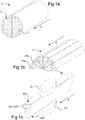
- Fig. 1a schematically illustrates a log 2, which has been cut longitudinally into two halves 2'.
- the log 2 may have been debarked prior to this cutting.
- the cutting may be performed by any type of cutting device, such as, but not limited to, a saw, e.g. a circular saw or a band saw.
- Fig. 1b schematically illustrates a log half 2' after it has provided with a longitudinally extending groove 23 along its pith and cut longitudinally into six radial sections 2"a, 2"b, as will be further described with reference to Figs 2a-2b .
- Fig. 1c schematically illustrates processing of one of the radial sections 2"a, 2"b into a lamella 20a, 20b.
- the lamella 20a, 20b is subjected to forming of base surfaces bs1, bs2, to form a lamella 20a, 20b, which will present a trapezoidal cross section.
- the base surfaces bs1, bs2 thus formed comprise a major base surface bs1, which is formed by tool 31 closest to the bark of the log and along the bark side.
- the base surfaces further comprise a minor base surface bs2, which is formed close to the pith and parallel with the major base surface bs1 by tool 32.
- the tools 31, 32 may be any type of tool capable of forming a planar surface, including but not limited to milling cutters, circular saw blades or band saw blades.
- the first tool 31 which forms the major base surface bs1, is arranged to use the bark side as reference, such that the major base side bs1 is formed along a direction parallel with the bark side.
- the second tool 32 which forms the minor base surface bs2, is arranged to use the major base surface and/or the bark side as a reference, such that the minor base surface bs2 is formed along a direction parallel with the major surface and/or the bark side.
- the cross section of the lamellae 20a, 20b is trapezoidal having a constant height.
- the major base surface bs1 being formed substantially parallel with the bark, and with the log presenting a frusto-conical shape, it is recognized that the major base surface bs1 will taper along the central direction of the log C. That is, the log will taper in a direction towards the top of the tree from which it was formed. This direction is also parallel with the principal fiber direction of the log and of the wood lamellae.
- minor base surface bs2 will also taper along the central direction C of the log.
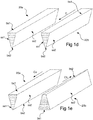
- each lamella will have a major and a minor base surface bs1, bs2 and a pair of side surfaces ss1, ss2, which will be identical.
- every second lamella 20b will now be turned or flipped about 180° about its longitudinal axis and about 180° about an axis perpendicular to the longitudinal axis and perpendicular to the major base surface bs1, such that the lamellae will become positioned as illustrated in Fig. 1e . That is, the directions of taper Ca and Cb will extend in opposite directions.
- the wood is still "wet", that is, its moisture content is more than 25 % by dry mass, preferably more than 30 %. Hence, the wood has not been subjected to any accelerated or intentional drying, such as kiln drying.
- the lamellae are then wet glued together side surface to side surface.
- Such wet gluing may be made without the cut surface, i.e. the side surfaces, being subjected to any further surface processing other than cleaning and removal of free water from the cut surface.
- a brief surface drying step basically having no effect except for on the very surface, may be performed, e.g. by means of a fan.
- Fig. 1f schematically illustrates the two lamellae 20a, 20b when arranged adjacent each other, side surface ss1 to side surface ss2 and with base surfaces bs1, bs2 of the pair of thus adjacent lamellae 20a, 20b tapering in opposite directions.
- a pair of glue applicators 33a, 33b which apply glue to side surfaces of lamellae 20a, 20b, respectively.
- a single, or even more, glue applicators may be used.
- the lamellae are then arranged as illustrated in Fig. 1g , i.e. with the base surfaces bs1, bs2 of every pair of adjacent wood lamellae 20a, 20b tapering towards substantially opposite directions and major base surfaces bs1 of every pair of adjacent wood lamellae facing substantially opposite directions.
- the glue used is a glue adapted for wet gluing wood, such as a water activated glue.
- a glue adapted for wet gluing wood
- PU polyurethane
- the lamellae 20a, 20b will be subjected to a pressing tool 34 pressing the lamellae 20a, 20b together in directions perpendicular to the base surfaces 20a, 20b and/or parallel with base surfaces 20a, 20b and perpendicular to longitudinal axes C.
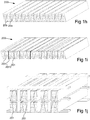
- Figs 1h-1k schematically illustrate a first way of processing the billet 200.
- an intermediate wood product here referred to as a "billet" 200 is provided, made up of wood lamellae 20a, 20b glued together first side surface ss1 to first side surface ss1 and second side surface ss2 to second side surface ss2.
- the billet 200 consists of a single layer of lamellae 20a, 20b, which are arranged side surface to side surface and with major base surfaces bs1 of immediately adjacent lamellae facing opposite directions and with base surfaces bs1, bs2 of immediately adjacent lamellae tapering in width in opposite directions.
- the billet 200 may be divided by cuts 2012 into a plurality of wood pieces 201 having substantially rectangular or square cross section and being of desired dimensions. These cuts 2012 may extend in planes that are perpendicular to the base surfaces and parallel with the principal fiber direction C of the lamellae 20a, 20b.
- Each wood piece 201 will consist of parts of at least two lamellae 20a, 20b, frequently of three or more lamellae, which are arranged such that base surfaces bs1, bs2 every pair of adjacent wood lamellae 20a, 20b taper towards substantially opposite directions and major base surfaces bs1 of every pair of adjacent wood lamellae face substantially opposite directions. At least one of the wood lamellae 20a, 20b may present an incomplete trapezoidal cross section.
- the planks 201 may have a width corresponding to 1-3, preferably 1-2 major base surfaces of the lamellae 20a, 20b it is made up of.
- planks have a thickness which is more than 75 % of the radius of the log from which the lamellae were formed, preferably more than 80 % of such radius, more than 85 % of such radius or even more than 90 % of such radius.
- the wood pieces 201 are then subjected to an accelerated drying, such as kiln drying, so as to reduce their moisture content to less than 20 % by dry mass, preferably less than 15 % by dry mass or less than 10 % by dry mass.
- an accelerated drying such as kiln drying
- a pair, or more of the dried wood pieces 201 may be provided with a joint, such as a finger joint 202, such that a plank of a desired length is provided, after which they can be used as construction material.
- Such wood pieces or planks may be further formatted, such as planed on one or more sides thereof and/or profiled.
- Areas of use for such wood pieces or planks include primarily structural members, such as joists, beams, studs or pillars.
- Fig. 2a is a schematic side view of a device 300 for producing wood lamellae 20a, 20b from a half-log 2'.
- the device comprises a groove cutter 311 and a set 312 of radial cutters 321a, 321b, 321c, 321d and 321e.
- the device 300 may comprise a conveyor arrangement 300a, 300b, 300c for causing relative movement between the log and the cutters 311, 312.
- the log may be moved relative to stationary cutters 311, 312.
- the half log 2' has typically been longitudinally cut in half prior to being introduced into the device 300. That is, the log has been cut longitudinally along a plane containing a central axis C of the log.
- the log may have been pre-cut into an appropriate length, such as 1-10 m, preferably 1-5 m, 1-3 m or 1-2 m.
- the log may have been wholly or partially debarked.
- the log can be said to present a planar surface 22 and a convex surface 21.
- the log may be conveyed with its planar surface facing downwardly and oriented horizontally.
- Fig. 2b is a cross sectional view taken along line A-A in Fig. 2a .
- Fig. 2b it is illustrated how the groove cutter 311 provides a longitudinal groove at the central portion of the log, i.e. at the pith area.
- the groove cutter 311 may be formed as a circular, rotatable cutter having a cutting edge with a cross section that corresponds to a desired cross section of the groove 23.
- the groove 23 formed by the groove cutter 311 may presents a substantially concave surface, which may be substantially half circular, or which may be polygonal.
- the groove cutter 311 may extend upwardly from a support on which the log is to be supported with its planar surface 22 facing downwardly.
- Figs 3a-3c schematically illustrate another way of processing the billet 200 formed at Fig. 1g and illustrated in Fig. 1h .
- Fig. 3a illustrates a cutting scheme which differs from that disclosed with respect to Fig. 1i .
- the vertical cuts 2012' i.e. cuts extending substantially parallel with a principal fiber direction of the lamellae 20a, 20b and perpendicular to the base surfaces bs1, bs2 have a greater spacing, such that wider planks 201' are provided.
- a horizontal cut 2013, i.e. a cut extending substantially parallel with a principal fiber direction of the lamellae, but parallel with the base surfaces bs1, bs2.
- each such plank 201' will then be formed of parts of two or more lamellae having trapezoidal cross section.
- planks 201 may have a width of 2-6 major base surfaces bs1, preferably 2-4 major base surfaces bs1.
- planks 201' may be subjected to an accelerated drying process, such as kiln drying, as described with respect to Fig. 1j .
- planks 201' Before, or after the drying, planks 201' may be joined in an end-to-end manner, as described with respect to Fig. 1k , thus forming extended planks.
- Fig. 3b schematically illustrates a process of gluing together such planks 201' and/or extended planks base surface to base surface by applying glue to the base surfaces.
- gluing may be a dry gluing.
- a glue applicator 36 which applies glue to the surface of the wood pieces 201' (and/or finger jointed beams/planks) that is formed by the base surfaces bs1, bs2.
- the wood pieces 201' are then glued together base surface bs1, bs2 to base surface bs1, bs2 as illustrated in Fig. 3b .
- the wood pieces may be subjected to a pressing tool 37 pressing them together in directions parallel to the base surfaces and/or perpendicular to base surfaces and perpendicular to longitudinal axes C.
- a predetermined number of wood pieces 201' or planks may be glued together in this manner to form e.g. a glulam beam 205.
- Fig.3c schematically illustrates such a glulam beam 205, which has been formed by the process described with respect to Figs. 3a-3c .
- the beam 205 is formed by a plurality of layers, which each comprise lamellae 20a, 20b having trapezoidal cross section, which are glued together side surface to side surface.
- the layers are glued together base surface to base surface.
- the layers may have substantially equal thickness, that is equal thickness +/- less than 10 %, preferably +/- less than 5 % or +/- less than 2 %.
- Each layer may have a thickness which is 50 % or less of a radius of a log from which the lamellae making up the layers were formed, possibly 40 % or less or 30 % or less.
- Figs 4a-4c schematically illustrate yet another way of processing the billet 200 formed at Fig. 1g .
- the billet 200 is cut along the length direction C, perpendicular to the base surfaces and along the principal fiber direction of the wood lamellae 20a, 20b, into a plurality of wood pieces 201", by a saw 35, as illustrated in Fig. 4a .
- the saw may be of the same type as the saw used for the cutting outlined with respect to Fig. 1i .
- planks 201 may have a width of 2-6 major base surfaces bs1, preferably 2-4 major base surfaces bs1 and a thickness which is more than 75 % of the radius of the log from which the lamellae were formed, or even more than 90 % of such radius.
- the thus produced wood pieces 201" may be subjected to accelerated drying, e.g. kiln drying, in the same manner as was described with respect to Fig. 1j .
- planks 201" may be formatted, such as planed on one or more sides, before or after the finger jointing step.
- a glue applicator 36 which applies glue to the surface of the wood pieces 201" (and/or finger jointed beams/planks) that is formed by the base surfaces bs1, bs2.
- the wood pieces 201" are then glued together base surface bs1, bs2 to base surface bs1, bs2 as illustrated in Fig. 4b .
- the wood pieces 201" are subjected to a pressing tool 37 pressing them together in directions parallel to the base surfaces and/or perpendicular to base surfaces and perpendicular to longitudinal axes C.
- a predetermined number of wood pieces 201" or planks may be glued together in this manner to form e.g. a glulam billet 206.
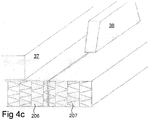
- the glulam billet 206 may be used as is, or, it may be cut into one or more beams 207 as illustrated in Fig. 4c . That is, the billet 206 comprising lamellae 20a, 20b having trapezoidal cross section, that are glued together both side surface to side surface and base surface to base surface, may be cut along plane that is parallel to the base surfaces and with the principal fiber direction of the wood lamellae 20a, 20b.
- Such a beam 207 may comprise at least two layers, preferably 2-5 layers, that have substantially the same thickness and one or two layers having a smaller thickness, e.g. having a thickness which is 70 % or less than the thickness of the other layers, or even 50 % or less or 30 % or less.
Landscapes
- Engineering & Computer Science (AREA)
- Life Sciences & Earth Sciences (AREA)
- Wood Science & Technology (AREA)
- Architecture (AREA)
- Forests & Forestry (AREA)
- Manufacturing & Machinery (AREA)
- Structural Engineering (AREA)
- Civil Engineering (AREA)
- Physics & Mathematics (AREA)
- Electromagnetism (AREA)
- Mechanical Engineering (AREA)
- Chemical And Physical Treatments For Wood And The Like (AREA)
- Dry Formation Of Fiberboard And The Like (AREA)
- Rod-Shaped Construction Members (AREA)
Priority Applications (1)
| Application Number | Priority Date | Filing Date | Title |
|---|---|---|---|
| PL16811121T PL3310541T3 (pl) | 2015-06-18 | 2016-06-16 | Sposób wytwarzania laminowanego produktu z drewna i laminowane produkty z drewna |
Applications Claiming Priority (2)
| Application Number | Priority Date | Filing Date | Title |
|---|---|---|---|
| SE1550853A SE541538C2 (en) | 2015-06-18 | 2015-06-18 | Method of producing a laminated wood product, and laminated wood products |
| PCT/IB2016/053566 WO2016203416A1 (en) | 2015-06-18 | 2016-06-16 | Method of producing a laminated wood product, and laminated wood products |
Publications (3)
| Publication Number | Publication Date |
|---|---|
| EP3310541A1 EP3310541A1 (en) | 2018-04-25 |
| EP3310541A4 EP3310541A4 (en) | 2019-02-27 |
| EP3310541B1 true EP3310541B1 (en) | 2021-11-17 |
Family
ID=57545078
Family Applications (1)
| Application Number | Title | Priority Date | Filing Date |
|---|---|---|---|
| EP16811121.9A Active EP3310541B1 (en) | 2015-06-18 | 2016-06-16 | Method of producing a laminated wood product, and laminated wood products |
Country Status (10)
| Country | Link |
|---|---|
| US (1) | US10589441B2 (pl) |
| EP (1) | EP3310541B1 (pl) |
| JP (1) | JP6811192B2 (pl) |
| CN (1) | CN107735233B (pl) |
| AU (1) | AU2016280249B2 (pl) |
| EA (1) | EA036506B1 (pl) |
| PL (1) | PL3310541T3 (pl) |
| SE (1) | SE541538C2 (pl) |
| UA (1) | UA123993C2 (pl) |
| WO (1) | WO2016203416A1 (pl) |
Families Citing this family (6)
| Publication number | Priority date | Publication date | Assignee | Title |
|---|---|---|---|---|
| EP3352986B1 (en) * | 2015-09-21 | 2024-07-03 | Stora Enso Oyj | Method of forming a laminated wood component, and laminated wood component thus formed |
| DE102017125829A1 (de) * | 2017-11-06 | 2019-05-09 | Binder Beteiligungs AG | Verfahren zur Herstellung von Wandbauteilen für Gebäude |
| CN208624953U (zh) * | 2018-02-13 | 2019-03-22 | 福建权昱工业有限公司 | 扶手 |
| US11396756B2 (en) * | 2018-09-28 | 2022-07-26 | Charles Wiebe | Hand rail system and associated components and methods |
| CN112223476A (zh) * | 2020-11-05 | 2021-01-15 | 北京林业大学 | 一种可作为梁柱的径解原木交错组合形式 |
| US11478952B1 (en) * | 2021-12-07 | 2022-10-25 | Charles R. Collier | Log cutter |
Family Cites Families (22)
| Publication number | Priority date | Publication date | Assignee | Title |
|---|---|---|---|---|
| US1369743A (en) * | 1920-04-05 | 1921-02-22 | Laminated Materials Company Lt | Method of making plywood |
| US1883616A (en) * | 1929-01-29 | 1932-10-18 | Laminating Patents Corp | Method of making plywood |
| GB1412903A (en) * | 1972-07-18 | 1975-11-05 | Dantani Plywood Co | Process for producing sliced veneer and fancy plywood therefrom |
| US3961654A (en) * | 1973-02-20 | 1976-06-08 | Earl Dean Hasenwinkle | Log cutting and rejoining process |
| US3897581A (en) * | 1973-03-27 | 1975-07-29 | Sumitomo Bakelite Co | Plywood veneer of edge-bonded wet wood pieces and method of making same |
| JPS49125503A (pl) * | 1973-04-10 | 1974-12-02 | ||
| US4111247A (en) * | 1977-01-13 | 1978-09-05 | Weyerhaeuser Company | Log cutting and rejoining process for lumber manufacture |
| US4122878A (en) * | 1977-12-14 | 1978-10-31 | Baltek Corporation | Technique for converting balsa logs into panels |
| US4476663A (en) | 1983-08-15 | 1984-10-16 | Bikales Victor W | Structure with composite members |
| NZ260406A (en) * | 1990-12-21 | 1995-11-27 | Nz Secretary Forestry | Joining pieces of wood using a formaldehyde-based adhesive and a cure-promoter |
| SE505056C2 (sv) * | 1991-03-19 | 1997-06-16 | Martin Wiklund | Förfarande för sönderdelning av stockar |
| AU686093B2 (en) * | 1991-09-03 | 1998-02-05 | Radial Corporation Limited | Backsawn timber production from radially sawn wedges |
| DE9316636U1 (de) * | 1993-10-30 | 1994-01-20 | Holzbau Krämer GmbH, 73441 Bopfingen | Endlosbauholzstange |
| FI95887C (fi) * | 1994-11-01 | 2001-05-18 | Tapojaervi Eero Antero | Liitosjärjestely puuelementtiaihion yhteydessä |
| SE509600C2 (sv) | 1996-06-28 | 1999-02-15 | Lars Hammarstroem | Förfarande, anordning samt användning vid limning |
| JP3076430U (ja) * | 2000-09-20 | 2001-04-06 | 木頭杉集成材加工協同組合 | 台形集成材 |
| DE102005005339A1 (de) | 2005-01-27 | 2006-08-10 | Hd Wood Technologies Ltd. | Verfahren zur Furnierherstellung |
| GB2465148A (en) * | 2008-11-05 | 2010-05-12 | Peter Ransom | Method of manufacturing a plank of wood from wedge shaped pieces |
| AT11958U1 (de) | 2010-09-07 | 2011-08-15 | Hans-Peter Ing Leitinger | Verfahren zur verarbeitung von roh-rundholz und keilverzinkte holzverbundprodukte |
| CN102172928A (zh) * | 2011-02-28 | 2011-09-07 | 刘佐财 | 非等厚竹片集成板材及其生产工艺方法 |
| AP2014007554A0 (en) * | 2011-09-02 | 2014-04-30 | Spencer Drake Trust | Construction timber |
| CN103372898B (zh) * | 2012-04-23 | 2015-07-15 | 梅州市汇胜木制品有限公司 | 一种木材异形单元板条集成胶合方法 |
-
2015
- 2015-06-18 SE SE1550853A patent/SE541538C2/en unknown
-
2016
- 2016-06-16 EA EA201890083A patent/EA036506B1/ru not_active IP Right Cessation
- 2016-06-16 EP EP16811121.9A patent/EP3310541B1/en active Active
- 2016-06-16 AU AU2016280249A patent/AU2016280249B2/en active Active
- 2016-06-16 JP JP2017565100A patent/JP6811192B2/ja active Active
- 2016-06-16 UA UAA201800477A patent/UA123993C2/uk unknown
- 2016-06-16 CN CN201680035561.2A patent/CN107735233B/zh active Active
- 2016-06-16 PL PL16811121T patent/PL3310541T3/pl unknown
- 2016-06-16 WO PCT/IB2016/053566 patent/WO2016203416A1/en not_active Ceased
- 2016-06-16 US US15/579,635 patent/US10589441B2/en active Active
Non-Patent Citations (1)
| Title |
|---|
| ERIK SERRANO ET AL: "Wet glued laminated beams using side boards of Norway spruce", 1 January 2011 (2011-01-01), XP055641764, Retrieved from the Internet <URL:https://www.diva-portal.org/smash/get/diva2:439333/FULLTEXT01.pdf> [retrieved on 20191112] * |
Also Published As
| Publication number | Publication date |
|---|---|
| US20180154547A1 (en) | 2018-06-07 |
| SE541538C2 (en) | 2019-10-29 |
| NZ737785A (en) | 2023-09-29 |
| WO2016203416A1 (en) | 2016-12-22 |
| EA036506B1 (ru) | 2020-11-18 |
| CA2988513A1 (en) | 2016-12-22 |
| CN107735233B (zh) | 2021-11-02 |
| JP2018526241A (ja) | 2018-09-13 |
| AU2016280249A1 (en) | 2017-12-14 |
| EA201890083A1 (ru) | 2018-05-31 |
| EP3310541A4 (en) | 2019-02-27 |
| UA123993C2 (uk) | 2021-07-07 |
| PL3310541T3 (pl) | 2022-03-28 |
| AU2016280249B2 (en) | 2021-05-27 |
| EP3310541A1 (en) | 2018-04-25 |
| SE1550853A1 (en) | 2016-12-19 |
| CN107735233A (zh) | 2018-02-23 |
| JP6811192B2 (ja) | 2021-01-13 |
| US10589441B2 (en) | 2020-03-17 |
Similar Documents
| Publication | Publication Date | Title |
|---|---|---|
| AU2016280249B2 (en) | Method of producing a laminated wood product, and laminated wood products | |
| US20130183477A1 (en) | Method for processing raw timber to form finger-jointed wood products | |
| EP3352986B1 (en) | Method of forming a laminated wood component, and laminated wood component thus formed | |
| WO2008113890A1 (en) | Glued wood product and a method for manufacturing a glued wood product | |
| US3903943A (en) | Log cutting and rejoining process | |
| CA2957254C (en) | A gluelam structural member and a method of producing such a gluelam structural member | |
| WO1989004747A1 (en) | Method of sawing timber and timber products formed thereby | |
| CA2988513C (en) | Method of producing a laminated wood product, and laminated wood products | |
| SE542164C2 (en) | Laminated wood products and methods of their manufacture | |
| NZ737785B2 (en) | Method of producing a laminated wood product, and laminated wood products | |
| EP3259103B1 (en) | Method and device for producing wood lamellae | |
| US3443612A (en) | Method for producing studs from cordwood and veneer cores | |
| Sandberg et al. | The Concept of Value Activation: the PrimWood Method for Improved Properties. | |
| Banks | Modern Trends and New Timber Products in the Timber Industry | |
| NZ728649B2 (en) | A gluelam structural member and a method of producing such a gluelam structural member |
Legal Events
| Date | Code | Title | Description |
|---|---|---|---|
| STAA | Information on the status of an ep patent application or granted ep patent |
Free format text: STATUS: THE INTERNATIONAL PUBLICATION HAS BEEN MADE |
|
| PUAI | Public reference made under article 153(3) epc to a published international application that has entered the european phase |
Free format text: ORIGINAL CODE: 0009012 |
|
| STAA | Information on the status of an ep patent application or granted ep patent |
Free format text: STATUS: REQUEST FOR EXAMINATION WAS MADE |
|
| 17P | Request for examination filed |
Effective date: 20180118 |
|
| AK | Designated contracting states |
Kind code of ref document: A1 Designated state(s): AL AT BE BG CH CY CZ DE DK EE ES FI FR GB GR HR HU IE IS IT LI LT LU LV MC MK MT NL NO PL PT RO RS SE SI SK SM TR |
|
| AX | Request for extension of the european patent |
Extension state: BA ME |
|
| DAV | Request for validation of the european patent (deleted) | ||
| DAX | Request for extension of the european patent (deleted) | ||
| A4 | Supplementary search report drawn up and despatched |
Effective date: 20190124 |
|
| RIC1 | Information provided on ipc code assigned before grant |
Ipc: E04C 3/12 20060101ALI20190118BHEP Ipc: B27M 3/00 20060101ALI20190118BHEP Ipc: B27B 1/00 20060101AFI20190118BHEP Ipc: E04B 1/10 20060101ALI20190118BHEP Ipc: E04C 2/12 20060101ALI20190118BHEP |
|
| STAA | Information on the status of an ep patent application or granted ep patent |
Free format text: STATUS: EXAMINATION IS IN PROGRESS |
|
| 17Q | First examination report despatched |
Effective date: 20191121 |
|
| GRAP | Despatch of communication of intention to grant a patent |
Free format text: ORIGINAL CODE: EPIDOSNIGR1 |
|
| STAA | Information on the status of an ep patent application or granted ep patent |
Free format text: STATUS: GRANT OF PATENT IS INTENDED |
|
| INTG | Intention to grant announced |
Effective date: 20210607 |
|
| GRAS | Grant fee paid |
Free format text: ORIGINAL CODE: EPIDOSNIGR3 |
|
| GRAA | (expected) grant |
Free format text: ORIGINAL CODE: 0009210 |
|
| STAA | Information on the status of an ep patent application or granted ep patent |
Free format text: STATUS: THE PATENT HAS BEEN GRANTED |
|
| AK | Designated contracting states |
Kind code of ref document: B1 Designated state(s): AL AT BE BG CH CY CZ DE DK EE ES FI FR GB GR HR HU IE IS IT LI LT LU LV MC MK MT NL NO PL PT RO RS SE SI SK SM TR |
|
| REG | Reference to a national code |
Ref country code: GB Ref legal event code: FG4D |
|
| REG | Reference to a national code |
Ref country code: IE Ref legal event code: FG4D |
|
| REG | Reference to a national code |
Ref country code: DE Ref legal event code: R096 Ref document number: 602016066378 Country of ref document: DE |
|
| REG | Reference to a national code |
Ref country code: AT Ref legal event code: REF Ref document number: 1447683 Country of ref document: AT Kind code of ref document: T Effective date: 20211215 |
|
| REG | Reference to a national code |
Ref country code: FI Ref legal event code: FGE |
|
| REG | Reference to a national code |
Ref country code: SE Ref legal event code: TRGR |
|
| REG | Reference to a national code |
Ref country code: LT Ref legal event code: MG9D |
|
| REG | Reference to a national code |
Ref country code: NO Ref legal event code: T2 Effective date: 20211117 |
|
| REG | Reference to a national code |
Ref country code: NL Ref legal event code: MP Effective date: 20211117 |
|
| REG | Reference to a national code |
Ref country code: SK Ref legal event code: T3 Ref document number: E 39109 Country of ref document: SK |
|
| PG25 | Lapsed in a contracting state [announced via postgrant information from national office to epo] |
Ref country code: RS Free format text: LAPSE BECAUSE OF FAILURE TO SUBMIT A TRANSLATION OF THE DESCRIPTION OR TO PAY THE FEE WITHIN THE PRESCRIBED TIME-LIMIT Effective date: 20211117 Ref country code: LT Free format text: LAPSE BECAUSE OF FAILURE TO SUBMIT A TRANSLATION OF THE DESCRIPTION OR TO PAY THE FEE WITHIN THE PRESCRIBED TIME-LIMIT Effective date: 20211117 Ref country code: BG Free format text: LAPSE BECAUSE OF FAILURE TO SUBMIT A TRANSLATION OF THE DESCRIPTION OR TO PAY THE FEE WITHIN THE PRESCRIBED TIME-LIMIT Effective date: 20220217 |
|
| PG25 | Lapsed in a contracting state [announced via postgrant information from national office to epo] |
Ref country code: IS Free format text: LAPSE BECAUSE OF FAILURE TO SUBMIT A TRANSLATION OF THE DESCRIPTION OR TO PAY THE FEE WITHIN THE PRESCRIBED TIME-LIMIT Effective date: 20220317 Ref country code: PT Free format text: LAPSE BECAUSE OF FAILURE TO SUBMIT A TRANSLATION OF THE DESCRIPTION OR TO PAY THE FEE WITHIN THE PRESCRIBED TIME-LIMIT Effective date: 20220317 Ref country code: NL Free format text: LAPSE BECAUSE OF FAILURE TO SUBMIT A TRANSLATION OF THE DESCRIPTION OR TO PAY THE FEE WITHIN THE PRESCRIBED TIME-LIMIT Effective date: 20211117 Ref country code: LV Free format text: LAPSE BECAUSE OF FAILURE TO SUBMIT A TRANSLATION OF THE DESCRIPTION OR TO PAY THE FEE WITHIN THE PRESCRIBED TIME-LIMIT Effective date: 20211117 Ref country code: HR Free format text: LAPSE BECAUSE OF FAILURE TO SUBMIT A TRANSLATION OF THE DESCRIPTION OR TO PAY THE FEE WITHIN THE PRESCRIBED TIME-LIMIT Effective date: 20211117 Ref country code: GR Free format text: LAPSE BECAUSE OF FAILURE TO SUBMIT A TRANSLATION OF THE DESCRIPTION OR TO PAY THE FEE WITHIN THE PRESCRIBED TIME-LIMIT Effective date: 20220218 Ref country code: ES Free format text: LAPSE BECAUSE OF FAILURE TO SUBMIT A TRANSLATION OF THE DESCRIPTION OR TO PAY THE FEE WITHIN THE PRESCRIBED TIME-LIMIT Effective date: 20211117 |
|
| PG25 | Lapsed in a contracting state [announced via postgrant information from national office to epo] |
Ref country code: SM Free format text: LAPSE BECAUSE OF FAILURE TO SUBMIT A TRANSLATION OF THE DESCRIPTION OR TO PAY THE FEE WITHIN THE PRESCRIBED TIME-LIMIT Effective date: 20211117 Ref country code: EE Free format text: LAPSE BECAUSE OF FAILURE TO SUBMIT A TRANSLATION OF THE DESCRIPTION OR TO PAY THE FEE WITHIN THE PRESCRIBED TIME-LIMIT Effective date: 20211117 Ref country code: DK Free format text: LAPSE BECAUSE OF FAILURE TO SUBMIT A TRANSLATION OF THE DESCRIPTION OR TO PAY THE FEE WITHIN THE PRESCRIBED TIME-LIMIT Effective date: 20211117 |
|
| REG | Reference to a national code |
Ref country code: DE Ref legal event code: R097 Ref document number: 602016066378 Country of ref document: DE |
|
| PLBE | No opposition filed within time limit |
Free format text: ORIGINAL CODE: 0009261 |
|
| STAA | Information on the status of an ep patent application or granted ep patent |
Free format text: STATUS: NO OPPOSITION FILED WITHIN TIME LIMIT |
|
| 26N | No opposition filed |
Effective date: 20220818 |
|
| PG25 | Lapsed in a contracting state [announced via postgrant information from national office to epo] |
Ref country code: AL Free format text: LAPSE BECAUSE OF FAILURE TO SUBMIT A TRANSLATION OF THE DESCRIPTION OR TO PAY THE FEE WITHIN THE PRESCRIBED TIME-LIMIT Effective date: 20211117 |
|
| PG25 | Lapsed in a contracting state [announced via postgrant information from national office to epo] |
Ref country code: SI Free format text: LAPSE BECAUSE OF FAILURE TO SUBMIT A TRANSLATION OF THE DESCRIPTION OR TO PAY THE FEE WITHIN THE PRESCRIBED TIME-LIMIT Effective date: 20211117 |
|
| PG25 | Lapsed in a contracting state [announced via postgrant information from national office to epo] |
Ref country code: MC Free format text: LAPSE BECAUSE OF FAILURE TO SUBMIT A TRANSLATION OF THE DESCRIPTION OR TO PAY THE FEE WITHIN THE PRESCRIBED TIME-LIMIT Effective date: 20211117 |
|
| REG | Reference to a national code |
Ref country code: BE Ref legal event code: MM Effective date: 20220630 |
|
| PG25 | Lapsed in a contracting state [announced via postgrant information from national office to epo] |
Ref country code: LU Free format text: LAPSE BECAUSE OF NON-PAYMENT OF DUE FEES Effective date: 20220616 Ref country code: IE Free format text: LAPSE BECAUSE OF NON-PAYMENT OF DUE FEES Effective date: 20220616 Ref country code: FR Free format text: LAPSE BECAUSE OF NON-PAYMENT OF DUE FEES Effective date: 20220630 |
|
| REG | Reference to a national code |
Ref country code: AT Ref legal event code: UEP Ref document number: 1447683 Country of ref document: AT Kind code of ref document: T Effective date: 20211117 |
|
| PG25 | Lapsed in a contracting state [announced via postgrant information from national office to epo] |
Ref country code: IT Free format text: LAPSE BECAUSE OF FAILURE TO SUBMIT A TRANSLATION OF THE DESCRIPTION OR TO PAY THE FEE WITHIN THE PRESCRIBED TIME-LIMIT Effective date: 20211117 Ref country code: BE Free format text: LAPSE BECAUSE OF NON-PAYMENT OF DUE FEES Effective date: 20220630 |
|
| PG25 | Lapsed in a contracting state [announced via postgrant information from national office to epo] |
Ref country code: HU Free format text: LAPSE BECAUSE OF FAILURE TO SUBMIT A TRANSLATION OF THE DESCRIPTION OR TO PAY THE FEE WITHIN THE PRESCRIBED TIME-LIMIT; INVALID AB INITIO Effective date: 20160616 |
|
| PG25 | Lapsed in a contracting state [announced via postgrant information from national office to epo] |
Ref country code: MK Free format text: LAPSE BECAUSE OF FAILURE TO SUBMIT A TRANSLATION OF THE DESCRIPTION OR TO PAY THE FEE WITHIN THE PRESCRIBED TIME-LIMIT Effective date: 20211117 Ref country code: CY Free format text: LAPSE BECAUSE OF FAILURE TO SUBMIT A TRANSLATION OF THE DESCRIPTION OR TO PAY THE FEE WITHIN THE PRESCRIBED TIME-LIMIT Effective date: 20211117 |
|
| PG25 | Lapsed in a contracting state [announced via postgrant information from national office to epo] |
Ref country code: TR Free format text: LAPSE BECAUSE OF FAILURE TO SUBMIT A TRANSLATION OF THE DESCRIPTION OR TO PAY THE FEE WITHIN THE PRESCRIBED TIME-LIMIT Effective date: 20211117 |
|
| PG25 | Lapsed in a contracting state [announced via postgrant information from national office to epo] |
Ref country code: MT Free format text: LAPSE BECAUSE OF FAILURE TO SUBMIT A TRANSLATION OF THE DESCRIPTION OR TO PAY THE FEE WITHIN THE PRESCRIBED TIME-LIMIT Effective date: 20211117 |
|
| PGFP | Annual fee paid to national office [announced via postgrant information from national office to epo] |
Ref country code: FI Payment date: 20250520 Year of fee payment: 10 |
|
| PGFP | Annual fee paid to national office [announced via postgrant information from national office to epo] |
Ref country code: PL Payment date: 20250602 Year of fee payment: 10 Ref country code: DE Payment date: 20250520 Year of fee payment: 10 |
|
| PGFP | Annual fee paid to national office [announced via postgrant information from national office to epo] |
Ref country code: GB Payment date: 20250520 Year of fee payment: 10 |
|
| PGFP | Annual fee paid to national office [announced via postgrant information from national office to epo] |
Ref country code: NO Payment date: 20250522 Year of fee payment: 10 |
|
| PGFP | Annual fee paid to national office [announced via postgrant information from national office to epo] |
Ref country code: RO Payment date: 20250612 Year of fee payment: 10 Ref country code: AT Payment date: 20250522 Year of fee payment: 10 |
|
| PGFP | Annual fee paid to national office [announced via postgrant information from national office to epo] |
Ref country code: SK Payment date: 20250526 Year of fee payment: 10 |
|
| PGFP | Annual fee paid to national office [announced via postgrant information from national office to epo] |
Ref country code: CZ Payment date: 20250529 Year of fee payment: 10 |
|
| PGFP | Annual fee paid to national office [announced via postgrant information from national office to epo] |
Ref country code: SE Payment date: 20250520 Year of fee payment: 10 |
|
| PGFP | Annual fee paid to national office [announced via postgrant information from national office to epo] |
Ref country code: CH Payment date: 20250701 Year of fee payment: 10 |