EP3311237B1 - System und verfahren zur ereignisdetektion mithilfe von streaming-signalen - Google Patents
System und verfahren zur ereignisdetektion mithilfe von streaming-signalen Download PDFInfo
- Publication number
- EP3311237B1 EP3311237B1 EP16812541.7A EP16812541A EP3311237B1 EP 3311237 B1 EP3311237 B1 EP 3311237B1 EP 16812541 A EP16812541 A EP 16812541A EP 3311237 B1 EP3311237 B1 EP 3311237B1
- Authority
- EP
- European Patent Office
- Prior art keywords
- mean
- envelope
- dysfunction
- shift
- signal
- Prior art date
- Legal status (The legal status is an assumption and is not a legal conclusion. Google has not performed a legal analysis and makes no representation as to the accuracy of the status listed.)
- Active
Links
Images





Classifications
-
- G—PHYSICS
- G06—COMPUTING OR CALCULATING; COUNTING
- G06F—ELECTRIC DIGITAL DATA PROCESSING
- G06F18/00—Pattern recognition
- G06F18/20—Analysing
- G06F18/24—Classification techniques
- G06F18/243—Classification techniques relating to the number of classes
- G06F18/2433—Single-class perspective, e.g. one-against-all classification; Novelty detection; Outlier detection
-
- E—FIXED CONSTRUCTIONS
- E21—EARTH OR ROCK DRILLING; MINING
- E21B—EARTH OR ROCK DRILLING; OBTAINING OIL, GAS, WATER, SOLUBLE OR MELTABLE MATERIALS OR A SLURRY OF MINERALS FROM WELLS
- E21B45/00—Measuring the drilling time or rate of penetration
-
- E—FIXED CONSTRUCTIONS
- E21—EARTH OR ROCK DRILLING; MINING
- E21B—EARTH OR ROCK DRILLING; OBTAINING OIL, GAS, WATER, SOLUBLE OR MELTABLE MATERIALS OR A SLURRY OF MINERALS FROM WELLS
- E21B44/00—Automatic control systems specially adapted for drilling operations, i.e. self-operating systems which function to carry out or modify a drilling operation without intervention of a human operator, e.g. computer-controlled drilling systems; Systems specially adapted for monitoring a plurality of drilling variables or conditions
-
- G—PHYSICS
- G06—COMPUTING OR CALCULATING; COUNTING
- G06F—ELECTRIC DIGITAL DATA PROCESSING
- G06F2218/00—Aspects of pattern recognition specially adapted for signal processing
- G06F2218/08—Feature extraction
- G06F2218/10—Feature extraction by analysing the shape of a waveform, e.g. extracting parameters relating to peaks
Definitions
- the present disclosure relates in general to the field of hydrocarbon drilling. More particularly, embodiments of the present invention relate to a system and method related to drilling dysfunctions.
- Signal dysfunction also known as outlier, anomaly, novelty or event detection
- outlier anomaly
- novelty or event detection represents one of the most challenging subjects in real time data mining due to the difficulties in achieving computational efficiency, causality, and minimum information drift (i.e., time shifting).
- time shifting minimum information drift
- WO2011017627A1 describes a method for calculating signal dysfunction in real time by calculating an envelope function for a drilling parameter and deriving a mean function, with the deviation from the mean being indicative of drilling dysfunction.
- the present disclosure addresses limitations in the art by providing a system and method for computing dysfunctions via amplitude envelopes that deviate from a mean (normal) state behavior.
- the envelope function is constructed from a recursive application of the maximum signal value within a given window size.
- the mean function allows for estimating the normal state of the signal within the same predefined window size.
- a dysfunction operator is defined as the relative change of the envelope with respect to the mean signal at each temporal point.
- the aforementioned operations are causal and computationally affordable as relative short moving windows are required to trail the current point. Therefore, the proposed envelope and dysfunction calculations are amenable for any source of data streams measured at high sample rates.
- the effectiveness of the present invention is validated on several channels representing multiple physics in real time field drilling operations.
- the drilling vibration also causes the drill string to deviate from ideal, uniform circular rotations.
- the mapping of the non-uniform rotations of the drill string leads a better understanding of the dynamics of drill-string dysfunctions.
- the present invention calls for using measured acceleration data to map the positions of drill-string motions continuously and produces various attributes to quantify the drilling dysfunctions. 2D and 3D visualizations of various dysfunction attributes describes how the vibration affects the drill-string motions. When combined with other information, it may be used to reduce drilling vibration.
- the present invention enables the development of efficient and robust workflows for controlling and optimizing well drilling operations in real time.
- Envelopes provide a meaningful representation for computing dysfunctions and classifying and summarizing signal trends as well.
- Dysfunctions are critical for proactively detecting events that may lead to equipment failures. In the particular case of real time drilling, results should aid at improving rate of penetration and minimizing well bit failures.
- Extensions of the present invention could be oriented to impact any automated activity that require an efficient way to determine envelopes and dysfunctions in real time signals as produced by sensors, satellite and other mobile devices.
- Implementations of the present invention can include one or more of the following features: the method identifies dysfunctions for detecting equipment failure; such equipment comprises drilling equipment; the signal data comprises acceleration data; the acceleration data may be translated from a local moving coordinate frame to a global stationary coordinate frame; the vector cross product of radial acceleration and axial accelerations can estimate the tangential acceleration; the signal may include: axial vibration, down-hole RPM, down-hole torque, gravitational acceleration, centripetal acceleration, radial acceleration, tangential acceleration, distance from surface, surface RPM, surface torque, hole depth, and rig state.
- subject matter may be embodied as methods, devices, components, or systems.
- These computer program instructions can be provided to a processor of a general purpose computer, special purpose computer, ASIC, or other programmable data processing apparatus, such that the instructions, which execute via the processor of the computer or other programmable data processing apparatus, implement the functions/acts specified in the block diagrams or operational block or blocks.
- server should be understood to refer to a service point which provides processing, database, and communication facilities.
- server can refer to a single, physical processor with associated communications and data storage and database facilities, or it can refer to a networked or clustered complex of processors and associated network and storage devices, as well as operating software and one or more database systems and application software that support the services provided by the server.
- Servers may vary widely in configuration or capabilities, but generally a server may include one or more central processing units and memory.
- a server may also include one or more mass storage devices, one or more power supplies, one or more wired or wireless network interfaces, one or more input/output interfaces, or one or more operating systems, such as Windows Server, Mac OS X, Unix, Linux, FreeBSD, or the like.
- a computer readable medium stores computer data, which data can include computer program code (or computer-executable instructions) that is executable by a computer, in machine readable form.
- a computer readable medium may comprise computer readable storage media, for tangible or fixed storage of data, or communication media for transient interpretation of code-containing signals.
- Computer readable storage media refers to physical or tangible storage (as opposed to signals) and includes without limitation volatile and non-volatile, removable and non-removable media implemented in any method or technology for the tangible storage of information such as computer-readable instructions, data structures, program modules or other data.
- Computer readable storage media includes, but is not limited to, RAM, ROM, EPROM, EEPROM, flash memory or other solid state memory technology, CD-ROM, DVD, or other optical storage, magnetic cassettes, magnetic tape, magnetic disk storage or other magnetic storage devices, or any other physical or material medium which can be used to tangibly store the desired information or data or instructions and which can be accessed by a computer or processor.
- a "network” should be understood to refer to a network that may couple devices so that communications may be exchanged, such as between a server and a client device or other types of devices, including between wireless devices coupled via a wireless network, for example.
- a network may also include mass storage, such as network attached storage (NAS), a storage area network (SAN), or other forms of computer or machine readable media, for example.
- a network may include the Internet, one or more local area networks (LANs), one or more wide area networks (WANs), wire-line type connections, wireless type connections, cellular or any combination thereof.
- sub-networks which may employ differing architectures or may be compliant or compatible with differing protocols, may interoperate within a larger network.
- Various types of devices may, for example, be made available to provide an interoperable capability for differing architectures or protocols.
- a router may provide a link between otherwise separate and independent LANs.
- a communication link or channel may include, for example, analog telephone lines, such as a twisted wire pair, a coaxial cable, full or fractional digital lines including T1, T2, T3, or T4 type lines, Integrated Services Digital Networks (ISDNs), Digital Subscriber Lines (DSLs), wireless links including satellite links, or other communication links or channels, such as may be known to those skilled in the art.
- ISDNs Integrated Services Digital Networks
- DSLs Digital Subscriber Lines
- wireless links including satellite links, or other communication links or channels, such as may be known to those skilled in the art.
- a computing device or other related electronic devices may be remotely coupled to a network, such as via a telephone line or link, for example.
- a wireless network should be understood to couple client devices with a network.
- a wireless network may employ stand-alone ad-hoc networks, mesh networks, Wireless LAN (WLAN) networks, cellular networks, or the like.
- a wireless network may further include a system of terminals, gateways, routers, or the like coupled by wireless radio links, or the like, which may move freely, randomly or organize themselves arbitrarily, such that network topology may change, at times even rapidly.
- a wireless network may further employ a plurality of network access technologies, including Long Term Evolution (LTE), WLAN, Wireless Router (WR) mesh, or 2nd, 3rd, or 4th generation (2G, 3G, or 4G) cellular technology, or the like.
- Network access technologies may enable wide area coverage for devices, such as client devices with varying degrees of mobility, for example.
- a network may enable RF or wireless type communication via one or more network access technologies, such as Global System for Mobile communication (GSM), Universal Mobile Telecommunications System (UMTS), General Packet Radio Services (GPRS), Enhanced Data GSM Environment (EDGE), 3GPP Long Term Evolution (LTE), LTE Advanced, Wideband Code Division Multiple Access (WCDMA), North American/CEPT frequencies, radio frequencies, single sideband, radiotelegraphy, radioteletype (RTTY), Bluetooth, 802.11b/g/n, or the like.
- GSM Global System for Mobile communication
- UMTS Universal Mobile Telecommunications System
- GPRS General Packet Radio Services
- EDGE Enhanced Data GSM Environment
- LTE Long Term Evolution
- LTE Advanced LTE Advanced
- WCDMA Wideband Code Division Multiple Access
- a wireless network may include virtually any type of wireless communication mechanism by which signals may be communicated between devices, such as a client device or a computing device, between or within a network, or the like.
- a computing device may be capable of sending or receiving signals, such as via a wired or wireless network, or may be capable of processing or storing signals, such as in memory as physical memory states, and may, therefore, operate as a server.
- devices capable of operating as a server may include, as examples, dedicated rack-mounted servers, desktop computers, laptop computers, set top boxes, integrated devices combining various features, such as two or more features of the foregoing devices, or the like.
- Servers may vary widely in configuration or capabilities, but generally a server may include one or more central processing units and memory.
- a server may also include one or more mass storage devices, one or more power supplies, one or more wired or wireless network interfaces, one or more input/output interfaces, or one or more operating systems, such as Windows Server, Mac OS X, Unix, Linux, FreeBSD, or the like.
- a client (or consumer or user) device may include a computing device capable of sending or receiving signals, such as via a wired or a wireless network.
- a client device may, for example, include a desktop computer or a portable device, such as a cellular telephone, a smart phone, a display pager, a radio frequency (RF) device, an infrared (IR) device an Near Field Communication (NFC) device, a Personal Digital Assistant (PDA), a handheld computer, a tablet computer, a laptop computer, a set top box, a wearable computer, an integrated device combining various features, such as features of the forgoing devices, or the like.
- RF radio frequency
- IR infrared
- NFC Near Field Communication
- PDA Personal Digital Assistant
- a client device may vary in terms of capabilities or features. Claimed subject matter is intended to cover a wide range of potential variations.
- a mobile device may include a numeric keypad or a display of limited functionality, such as a monochrome liquid crystal display (LCD) for displaying text.
- a web-enabled client device may include one or more physical or virtual keyboards, mass storage, one or more accelerometers, one or more gyroscopes, global positioning system (GPS) or other location-identifying type capability, or a display with a high degree of functionality, such as a touch-sensitive color 2D or 3D display, for example.
- GPS global positioning system
- a client device may include or may execute a variety of operating systems, including a personal computer operating system, such as a Windows, iOS or Linux, or a mobile operating system, such as iOS, Android, or Windows Mobile, or the like.
- a client device may include or may execute a variety of possible applications, such as a client software application enabling communication with other devices, such as communicating one or more messages.
- the client device, mobile device, or wireless communication device, in accordance with the disclosure may be a portable or mobile telephone including smart phones, a Personal Digital Assistant (PDA), a wireless video or multimedia device, a portable computer, an embedded communication processor or similar wireless communication device.
- PDA Personal Digital Assistant
- the communication device will be referred to generally as User Equipment (UE) for illustrative purposes and it is not intended to limit the disclosure to any particular type of communication device.
- UE User Equipment
- Certain modern handheld electronic devices (UE) comprise the necessary components to connect to a cellular network, such as a 2G, 2.5G, 3G, and/or LTE network, and the necessary components to connect to a non-cellular IP Connectivity Access Network (IP CAN) such as a wireless LAN network (e.g. IEEE 802.1 1a/b/g/n) or a wired LAN network (e.g. IEEE 802.3).
- IP CAN IP Connectivity Access Network
- the efficient calculation of signal envelopes and dysfunctions enables real time data mining, optimization and control of well drilling operations.
- the present invention further enables the development of efficient and robust workflows for mining, controlling and optimizing well drilling operations in real time.
- Envelopes provide a meaningful representation for computing dysfunctions and classifying and summarizing signal trends as well.
- Dysfunctions are key for proactively detecting events that may lead to equipment failures. In the particular case of real time drilling, results should aid at improving rate of penetration and minimizing well bit failures.
- Extensions of the present invention could be oriented to impact any automated activity that require an efficient way to determine envelopes and dysfunctions in real time signals as produced by sensor, satellite and cellular devices.
- the present invention provides for a real time and causal envelope calculation similar to those obtained by the Hilbert transform (Johansson, 1999) on large sequences of off-line temporal data.
- the envelope of the present invention is suitable for efficient dysfunction calculations as the maximum value at any temporal sample is effective to provide an upper bound representation for any signal.
- the first condition can be effectively solved by recursive application of moving average operations.
- the second condition can be effectively solved by applying the sign function operator upon each maximum calculation.
- the RMS energy has the potential problem of producing a similar response than the mean operator for positive values thus undershooting the expected shape of a reasonable envelope and, in the case of negative values, it can significantly overshoot the envelope. Consequently, the RMS energy operator is not a suitable two-side envelope operator.
- data may describe significant variations in amplitude, frequency, scale and sign thus imposing strong requirements to develop flexible and robust methodologies for estimating envelopes across a wide range of signal characteristics and trends. These strong requirements are usually overlooked in most, if not all, reported works for envelope calculation.
- Most methodologies (such as shown in Caetano, 2010) rely on a set of temporal assumptions for which the signal may enter into periods of higher energy and low energy.
- focus is directed to generating a real time and causal envelope calculation on large sequences of off-line temporal data.
- the envelope is capable of simple implementation and suitable for efficient dysfunction calculations. It is found that the maximum value at any temporal sample is effective to provide an upper bound representation for any signal. Nevertheless, the resulting envelope had a blocky shape thus resulting too rough for further practical calculations. Additionally, changes in signal signs may require a special treatment as the maximum of a negative value becomes the minimum of the value producing an undesired lower bound to the signal.
- the first situation may be effectively solved by recursive application of moving average operations.
- the second issue may be sorted out by applying the sign function operator upon each maximum calculation. Many other options are possible to preserve consistency, boundness and translation invariance to the proposed operators. Dysfunction calculations are possible by aligning the mean calculation and smoothness with the envelope calculation. Given the resulting smoothness of both envelope and mean signals it was possible to generate a corresponding smooth and dimensionless profile for dysfunctions.
- the present invention provides important advantages to decrease floating point and memory costs thus enabling real time processing on instrumented measurements.
- Envelope and mean profiles are implicitly smoothed out by recursive application of moving averages that is more efficient than known spectral and interpolation methods.
- the way these two operations are defined unlocks several possibilities for defining a physical sound measurement for dysfunction.
- using a simple deviation from the mean value provides an informative and dimensionless quantity to describe dysfunctions for multiple physics such as torque, weight on bit and radial accelerations measured at different locations of the drill string.
- one or more algorithms may be utilized to calculate the envelope and mean values for purposes of determining dysfunction.
- MATLAB matrix laboratory
- MicrosoftWorks a multi-paradigm numerical computing environment and fourth-generation programming language, which allows matrix manipulations, plotting of functions and data, implementation of algorithms, creation of user interfaces, and interfacing with programs written in other languages, including C, C++, Java, Fortran and Python.
- the below algorithms are non-limiting in terms of programming language and may be carried out by any computing environment.
- the loop on index i sweeps each sample point in the signal represented by the vector variable y.
- the variable w represents a predefined window size.
- a trailing buffer, namely the vector variable 1, of temporal sample points of size less than w is controlled by the value of variable shift.
- the buffer 1 has a maximum size of w and includes the current point as the leading one.
- the envelope results from the maximum value contained within the moving windows of size shift.
- the moving_average operation on the envelope defined within a given window is recursively applied as a new sample point in time is assimilated. This means that each point located w positions from the end of the signal is smoothed out w times. This induces an implicit way to interpolate the resulting envelope profile.
- Mean Algorithm In analogous fashion to the envelope algorithm, the mean operations computes recursively the smooth mean value in a moving window:
- step 3 This represents a pointwise calculation of the ratio between the difference of the envelope and the mean value of the signal.
- a pointwise division over the mean is performed at each trailing point (following a Matlab programming convention, the dot ".” operation emphasizes this pointwise division).
- the operator for the maximum operator is a vector of size (shift). The maximum operator provides a envelope for the dysfunction calculation.
- FIG. 1 shows a highly varying signal 104 that may be challenging for many envelope techniques proposed in the literature.
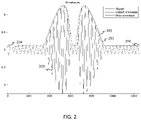
- the Hilbert transform is the method of choice when the complete signal is available Johanson, 1999. This solution is sought as the reference one.
- the example illustrates one potential drawback regarding the Hilbert transform 201 when dealing with boundary values.
- a ringing artifact 204 is induced by truncating the transform at the edges of the signal.
- FIG. 3 shows the resulting dysfunction profiles 301, 302 for the present invention wherein the ringing artifact 204 is further provided.
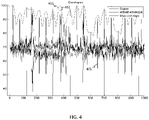
- FIG. 4 shows the calculation of the envelope on a real field data section having signal 405.
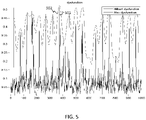
- the Hilbert transform tends to generate a more detailed envelope 402 than the present invention 403. Nevertheless, the Hilbert transform overshoots sections with lowest values (i.e., across valleys). These results are actually reflected in the corresponding dysfunction envelope depicted in FIG 5 .
- the present invention is applied to segmented signal data 701 as illustrated in FIG. 7 .
- Max envelope 722, Hilbert envelope 721 the maximum and mean calculations are restarted whenever the signal becomes zero 702, invalid or undergo important changes in trend as it may happen when the drill bit stops, sensor measurements are somehow interrupted or the drill operates at different conditions.
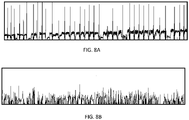
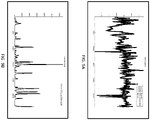
- FIG. 8A and 8B show how the envelope, mean and dysfunction ( FIG. 8B ) profiles look like on more than 10,000 samples of torque data.
- FIG. 9A and 9B show the performance of the present invention when the signal displays frequent changes in sign.
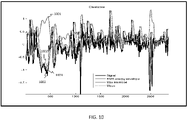
- FIG. 10 further shows the max dysfuntion performance when compared to RMS energy signals (signal 1000, RMS energy envelope 1001, Max envelope 1002, Mean 1003). A correction based on the sign function is used to keep the consistency of calculations. Note that when the RMS energy criteria for computing envelopes is employed, negative values are overshot.
- internal architecture 1100 of a computing device(s), computing system, computing platform and the like for purposes of calculating and presenting the data presented by the present invention includes one or more processing units, processors, or processing cores, (also referred to herein as CPUs) 1112, which interface with at least one computer bus 1102.
- Computer-readable medium, or media 1106, network interface 1114, memory 1104, e.g., random access memory (RAM), run-time transient memory, read only memory (ROM), media disk drive interface 1120 as an interface for a drive that can read and/or write to media including removable media such as floppy, CD-ROM, DVD, media, display interface 1110 as interface for a monitor or other display device 1122, keyboard interface 1116 as interface for a keyboard, pointing device interface 1118 as an interface for a mouse or other pointing device, and miscellaneous other interfaces not shown individually, such as parallel and serial port interfaces and a universal serial bus (USB) interface.
- RAM random access memory
- ROM read only memory
- media disk drive interface 1120 as an interface for a drive that can read and/or write to media including removable media such as floppy, CD-ROM, DVD, media
- display interface 1110 as interface for a monitor or other display device 1122
- keyboard interface 1116 as interface for a keyboard
- pointing device interface 1118 as an interface
- Memory 1104 interfaces with computer bus 1102 so as to provide information stored in memory 1104 to CPU 1112 during execution of software programs such as an operating system, application programs, device drivers, and software modules that comprise program code, and/or computer executable process steps, incorporating functionality described herein, e.g., one or more of process flows described herein.
- CPU 1112 first loads computer executable process steps from storage, e.g., memory 1104, computer readable storage medium/media 1106, removable media drive 1108, and/or other storage device.
- CPU 1112 can then execute the stored process steps in order to execute the loaded computer-executable process steps.
- Stored data e.g., data stored by a storage device, can be accessed by CPU 1112 during the execution of computer-executable process steps.
- Persistent storage e.g., medium/media 1106, can be used to store an operating system and one or more application programs. Persistent storage can also be used to store device drivers, such as one or more of a digital camera driver, monitor driver, printer driver, scanner driver, or other device drivers, web pages, content files, playlists and other files. Persistent storage can further include program modules and data files used to implement one or more embodiments of the present disclosure, e.g., listing selection module(s), targeting information collection module(s), and listing notification module(s), the functionality and use of which in the implementation of the present disclosure are discussed in detail herein.
- Network link 1128 typically provides information communication using transmission media through one or more networks to other devices that use or process the information.
- network link 1128 may provide a connection through local network 1124 to a host computer 1126 or to equipment operated by a Network or Internet Service Provider (ISP) 1130.
- ISP equipment in turn provides data communication services through the public, worldwide packet-switching communication network of networks now commonly referred to as the Internet 1132.
- a computer called a server host 1134 connected to the Internet 1132 hosts a process that provides a service in response to information received over the Internet 1132.
- server host 1134 hosts a process that provides information representing video data for presentation at display 1110. It is contemplated that the components of system 1100 can be deployed in various configurations within other computer systems, e.g., host and server.
- At least some embodiments of the present disclosure are related to the use of computer system 1100 for implementing some or all of the techniques described herein. According to one embodiment, those techniques are performed by computer system 1100 in response to processing unit 1112 executing one or more sequences of one or more processor instructions contained in memory 1104. Such instructions, also called computer instructions, software and program code, may be read into memory 1104 from another computer-readable medium 1106 such as storage device or network link. Execution of the sequences of instructions contained in memory 1104 causes processing unit 1112 to perform one or more of the method steps described herein. In alternative embodiments, hardware, such as ASIC, may be used in place of or in combination with software. Thus, embodiments of the present disclosure are not limited to any specific combination of hardware and software, unless otherwise explicitly stated herein.
- the signals transmitted over network link and other networks through communications interface carry information to and from computer system 1100.
- Computer system 1100 can send and receive information, including program code, through the networks, among others, through network link and communications interface.
- a server host transmits program code for a particular application, requested by a message sent from computer, through Internet, ISP equipment, local network and communications interface.
- the received code may be executed by processor 1102 as it is received, or may be stored in memory 1104 or in storage device or other non-volatile storage for later execution, or both.
- a module is a software, hardware, or firmware (or combinations thereof) system, process or functionality, or component thereof, that performs or facilitates the processes, features, and/or functions described herein (with or without human interaction or augmentation).
- a module can include sub-modules.
- Software components of a module may be stored on a computer readable medium for execution by a processor. Modules may be integral to one or more servers, or be loaded and executed by one or more servers. One or more modules may be grouped into an engine or an application.
Landscapes
- Engineering & Computer Science (AREA)
- Data Mining & Analysis (AREA)
- Life Sciences & Earth Sciences (AREA)
- Theoretical Computer Science (AREA)
- Physics & Mathematics (AREA)
- Artificial Intelligence (AREA)
- Evolutionary Computation (AREA)
- General Physics & Mathematics (AREA)
- General Engineering & Computer Science (AREA)
- Geology (AREA)
- Mining & Mineral Resources (AREA)
- Bioinformatics & Cheminformatics (AREA)
- Bioinformatics & Computational Biology (AREA)
- Computer Vision & Pattern Recognition (AREA)
- Evolutionary Biology (AREA)
- Fluid Mechanics (AREA)
- Geochemistry & Mineralogy (AREA)
- General Life Sciences & Earth Sciences (AREA)
- Environmental & Geological Engineering (AREA)
- Measuring And Recording Apparatus For Diagnosis (AREA)
- Geophysics And Detection Of Objects (AREA)
- Measurement And Recording Of Electrical Phenomena And Electrical Characteristics Of The Living Body (AREA)
Claims (1)
- Verfahren zur Analyse von Bohrausrüstungsversagen, beinhaltend eine Echtzeitberechnung von Signalstörung bei gemessenen Beschleunigungsdaten, wobei das Verfahren umfasst:(a) Ermitteln, mittels einer Rechenvorrichtung, einer Amplitudenhüllkurve, weiter umfassend Konfigurieren einer Hüllkurvenfunktion (403, 1002) aus einer rekursiven Anwendung des Maximalsignalwerts innerhalb einer gegebenen Fenstergröße;(b) Konfigurieren, mittels der Rechenvorrichtung, einer Mittelfunktion (1003) zum Schätzen eines Normalzustands des Signals innerhalb der Fenstergröße;(c) Ermitteln in Echtzeit, mittels der Rechenvorrichtung, eines Störungsoperators, der als die relative Änderung der Hüllkurve in Bezug auf die Mittelfunktion jedes Zeitpunkts definiert ist, um ein Störungsprofil (301, 302) zu erzeugen, indem die Hüllkurvenfunktion mit der Mittelfunktion verglichen wird; und(d) Abbilden, mittels der Rechenvorrichtung, der verschiedenen Attribute des Vergleichs, wobei Abbilden umfasst, das Störungsprofil auf eine Bohraktivität anzuwenden, die das Signal erzeugt; dadurch gekennzeichnet, dass Algorithmen i, ii und iii verwendet werden, um die Hüllkurve und Mittelfunktionen zu berechnen und das Störungsprofil zu ermittelni. Hüllkurvenfunktion:
Für i = 1,2,...1) Verschiebung = min(w,i)2) 1 = i - Verschiebung +1: i3) yenv (i) = max(y(1))4) y env (1) = gleitender_Durchschnitt(y env (1),m)wobei "yenv" die Amplitudenhüllkurve bedeutet; wobei die Schleife auf Index i jeden Abtastungspunkt in dem Signal überstreicht, der von Vektorvariable y dargestellt wird; Variable w eine vordefinierte Fenstergröße darstellt; ein nachfolgender Puffer, nämlich Vektorvariable 1, der die zeitlichen Abtastungspunkte von i-Verschiebung+1 bis i beinhaltet und kleiner als w ist, von dem Wert der Variablenverschiebung gesteuert wird, und gleitender_Durchschnitt() eine gleitende Durchschnittsoperation an der Hüllkurve ist, die innerhalb eines gegebenen Fensters m definiert ist und rekursiv angewendet wird, wenn ein neuer Abtastungspunkt über Zeit angeglichen wird;
Endeii. Mittelfunktion, mit der ein glatter Mittelwert in einem gleitenden Fenster berechnet wird:
Für i = 1,2,...1) Verschiebung = min(w,i)2) 1 = i - Verschiebung +1: i3) yMittel (i) = Mittel(y(l))4) yMitteil (1) = gleitender_Durchschnitt(yMittel (1),m)
Endeiii. Störungsoperator, in dem Schritt 3) eine punktweise Berechnung eines Verhältnisses zwischen der Differenz der Amplitudenhüllkurve und dem Mittelwert des Signals darstellt, wobei eine punktweise Division über dem Mittelwert bei jedem nachfolgenden Punkt durchgeführt wird:
Für i = 1,2,...1) Verschiebung = min(w,i)2) 1 = i - Verschiebung +1: i3) ydys (i) = max(|yenv (1)-yMittel (1)|./yMittel (1))wobei "ydys" das Störungsprofil bedeutet.
Ende
Applications Claiming Priority (2)
| Application Number | Priority Date | Filing Date | Title |
|---|---|---|---|
| US201562182056P | 2015-06-19 | 2015-06-19 | |
| PCT/US2016/038123 WO2016205679A1 (en) | 2015-06-19 | 2016-06-17 | System and method for event detection using streaming signals |
Publications (3)
| Publication Number | Publication Date |
|---|---|
| EP3311237A1 EP3311237A1 (de) | 2018-04-25 |
| EP3311237A4 EP3311237A4 (de) | 2018-06-20 |
| EP3311237B1 true EP3311237B1 (de) | 2022-08-03 |
Family
ID=61656375
Family Applications (1)
| Application Number | Title | Priority Date | Filing Date |
|---|---|---|---|
| EP16812541.7A Active EP3311237B1 (de) | 2015-06-19 | 2016-06-17 | System und verfahren zur ereignisdetektion mithilfe von streaming-signalen |
Country Status (2)
| Country | Link |
|---|---|
| EP (1) | EP3311237B1 (de) |
| CN (1) | CN107850917B (de) |
Family Cites Families (15)
| Publication number | Priority date | Publication date | Assignee | Title |
|---|---|---|---|---|
| US6817425B2 (en) * | 2000-11-07 | 2004-11-16 | Halliburton Energy Serv Inc | Mean strain ratio analysis method and system for detecting drill bit failure and signaling surface operator |
| JP4823880B2 (ja) * | 2006-12-05 | 2011-11-24 | 株式会社日立製作所 | 包絡線異常検出機能を備えた光ディスクドライブ |
| CA2700732A1 (en) * | 2007-10-19 | 2009-04-23 | Shell Internationale Research Maatschappij B.V. | Cryogenic treatment of gas |
| US9202114B2 (en) * | 2008-05-28 | 2015-12-01 | Medtronic Bakken Research Center B.V. | Method and system for determining a threshold for spike detection of electrophysiological signals |
| NO338750B1 (no) * | 2009-03-02 | 2016-10-17 | Drilltronics Rig Systems As | Fremgangsmåte og system for automatisert styring av boreprosess |
| CA2770230C (en) * | 2009-08-07 | 2016-05-17 | Exxonmobil Upstream Research Company | Methods to estimate downhole drilling vibration amplitude from surface measurement |
| CA2770232C (en) * | 2009-08-07 | 2016-06-07 | Exxonmobil Upstream Research Company | Methods to estimate downhole drilling vibration indices from surface measurement |
| GB0914661D0 (en) * | 2009-08-21 | 2009-09-30 | Antech Ltd | System for derermination of downhole position |
| GB2479383A (en) * | 2010-04-08 | 2011-10-12 | Schlumberger Holdings | Automated control of parameters of an industrial process from sensor data segmented at potential changepoints based upon models |
| NL2004660C2 (en) * | 2010-05-04 | 2011-11-07 | Technologies88 B V | Device and method for motion capture and analysis. |
| CN102368095B (zh) * | 2011-09-10 | 2013-03-27 | 吉林大学 | 多指数拟合核磁共振地下水探测信号弛豫时间谱提取方法 |
| EP2900913B1 (de) * | 2012-11-05 | 2017-08-09 | Landmark Graphics Corporation | System, verfahren und computerprogrammprodukt für die modellierung von bohrlosereignissen anhand rimlier-daten |
| WO2015054432A1 (en) * | 2013-10-08 | 2015-04-16 | Fastcap Systems Corporation | Dynamics monitoring system with rotational sensor |
| US9957790B2 (en) * | 2013-11-13 | 2018-05-01 | Schlumberger Technology Corporation | Wellbore pipe trip guidance and statistical information processing method |
| CN104376881B (zh) * | 2014-11-20 | 2016-10-26 | 西安交通大学 | 基于希尔伯特变换和数据筛选的核电站松动件定位方法 |
-
2016
- 2016-06-17 EP EP16812541.7A patent/EP3311237B1/de active Active
- 2016-06-17 CN CN201680035691.6A patent/CN107850917B/zh active Active
Also Published As
| Publication number | Publication date |
|---|---|
| EP3311237A1 (de) | 2018-04-25 |
| EP3311237A4 (de) | 2018-06-20 |
| CN107850917A (zh) | 2018-03-27 |
| CN107850917B (zh) | 2021-12-07 |
Similar Documents
| Publication | Publication Date | Title |
|---|---|---|
| US10655453B2 (en) | System and method for determining drill string motions using acceleration data | |
| US11140179B1 (en) | Cybersecurity investigation tools utilizing information graphs | |
| CN111264033B (zh) | 用无线电信号变换器学习无线电信号的方法、系统和装置 | |
| AU2016278958B2 (en) | System and method for event detection using streaming signals | |
| Mittal et al. | Topological characterization and early detection of bifurcations and chaos in complex systems using persistent homology | |
| US20150294256A1 (en) | Scenario modeling and visualization | |
| CA2696664C (en) | Systems and methods for computing a variogram model | |
| US12481946B2 (en) | Resource provisioning by a reinforcement learning framework using guided ordering of services | |
| CN110553714A (zh) | 智能振动增强现实测试方法及相关产品 | |
| CN114201823A (zh) | 一种显式嵌套网格装配方法、装置及存储介质 | |
| CN115857018A (zh) | 基于密度聚类的偶极子声波测井频散校正方法及相关装置 | |
| CN114117219A (zh) | 会话推荐方法和推荐模型的训练方法、装置、设备及介质 | |
| CN112612277B (zh) | 车辆轨迹规划方法、装置、设备和计算机可读介质 | |
| CN116541627A (zh) | 一种储层参数确定方法、装置、计算机设备及可读介质 | |
| EP3311237A1 (de) | System und verfahren zur ereignisdetektion mithilfe von streaming-signalen | |
| JP2019148876A (ja) | 制御装置、データ処理制御方法、及びプログラム | |
| CN115877450B (zh) | 一种有机质含量预测方法、装置、计算机设备及可读介质 | |
| US20240119251A1 (en) | Fast graph model selection via meta-learning | |
| US20220004801A1 (en) | Image processing and training for a neural network | |
| CN115358022A (zh) | 一种工程机械载荷谱确定方法、装置及系统 | |
| EP3295219B1 (de) | System und verfahren zur bestimmung von bohrstrangbewegungen mit beschleunigungsdaten | |
| CN119535535A (zh) | 一种无需关联分析的地震检测定位方法、装置及电子设备 | |
| CN110187340B (zh) | 一种基于熵的探测目标的信息表征方法及系统 | |
| Baker et al. | Towards standardization of engineering geophysics–CHERT example | |
| Han et al. | Develop A Web-Based Visualisation Platform For Wireless Sensor Network Generation |
Legal Events
| Date | Code | Title | Description |
|---|---|---|---|
| STAA | Information on the status of an ep patent application or granted ep patent |
Free format text: STATUS: THE INTERNATIONAL PUBLICATION HAS BEEN MADE |
|
| PUAI | Public reference made under article 153(3) epc to a published international application that has entered the european phase |
Free format text: ORIGINAL CODE: 0009012 |
|
| STAA | Information on the status of an ep patent application or granted ep patent |
Free format text: STATUS: REQUEST FOR EXAMINATION WAS MADE |
|
| 17P | Request for examination filed |
Effective date: 20171211 |
|
| AK | Designated contracting states |
Kind code of ref document: A1 Designated state(s): AL AT BE BG CH CY CZ DE DK EE ES FI FR GB GR HR HU IE IS IT LI LT LU LV MC MK MT NL NO PL PT RO RS SE SI SK SM TR |
|
| AX | Request for extension of the european patent |
Extension state: BA ME |
|
| REG | Reference to a national code |
Ref country code: DE Ref legal event code: R079 Ref document number: 602016074003 Country of ref document: DE Free format text: PREVIOUS MAIN CLASS: G06E0001000000 Ipc: E21B0044000000 |
|
| STAA | Information on the status of an ep patent application or granted ep patent |
Free format text: STATUS: EXAMINATION IS IN PROGRESS |
|
| A4 | Supplementary search report drawn up and despatched |
Effective date: 20180517 |
|
| RIC1 | Information provided on ipc code assigned before grant |
Ipc: E21B 44/00 20060101AFI20180511BHEP Ipc: G06K 9/00 20060101ALI20180511BHEP Ipc: G06K 9/62 20060101ALI20180511BHEP |
|
| 17Q | First examination report despatched |
Effective date: 20180612 |
|
| DAV | Request for validation of the european patent (deleted) | ||
| DAX | Request for extension of the european patent (deleted) | ||
| RIN1 | Information on inventor provided before grant (corrected) |
Inventor name: KLIE, HECTOR Inventor name: RAMSAY, STACEY Inventor name: ANNO, PHIL D. |
|
| RAP1 | Party data changed (applicant data changed or rights of an application transferred) |
Owner name: CONOCOPHILLIPS COMPANY |
|
| RAP1 | Party data changed (applicant data changed or rights of an application transferred) |
Owner name: CONOCOPHILLIPS COMPANY |
|
| GRAP | Despatch of communication of intention to grant a patent |
Free format text: ORIGINAL CODE: EPIDOSNIGR1 |
|
| STAA | Information on the status of an ep patent application or granted ep patent |
Free format text: STATUS: GRANT OF PATENT IS INTENDED |
|
| INTG | Intention to grant announced |
Effective date: 20220524 |
|
| GRAS | Grant fee paid |
Free format text: ORIGINAL CODE: EPIDOSNIGR3 |
|
| GRAA | (expected) grant |
Free format text: ORIGINAL CODE: 0009210 |
|
| STAA | Information on the status of an ep patent application or granted ep patent |
Free format text: STATUS: THE PATENT HAS BEEN GRANTED |
|
| AK | Designated contracting states |
Kind code of ref document: B1 Designated state(s): AL AT BE BG CH CY CZ DE DK EE ES FI FR GB GR HR HU IE IS IT LI LT LU LV MC MK MT NL NO PL PT RO RS SE SI SK SM TR |
|
| REG | Reference to a national code |
Ref country code: AT Ref legal event code: REF Ref document number: 1508901 Country of ref document: AT Kind code of ref document: T Effective date: 20220815 Ref country code: CH Ref legal event code: EP |
|
| REG | Reference to a national code |
Ref country code: DE Ref legal event code: R096 Ref document number: 602016074003 Country of ref document: DE |
|
| REG | Reference to a national code |
Ref country code: IE Ref legal event code: FG4D |
|
| REG | Reference to a national code |
Ref country code: NO Ref legal event code: T2 Effective date: 20220803 |
|
| REG | Reference to a national code |
Ref country code: LT Ref legal event code: MG9D |
|
| REG | Reference to a national code |
Ref country code: NL Ref legal event code: MP Effective date: 20220803 |
|
| PG25 | Lapsed in a contracting state [announced via postgrant information from national office to epo] |
Ref country code: SE Free format text: LAPSE BECAUSE OF FAILURE TO SUBMIT A TRANSLATION OF THE DESCRIPTION OR TO PAY THE FEE WITHIN THE PRESCRIBED TIME-LIMIT Effective date: 20220803 Ref country code: RS Free format text: LAPSE BECAUSE OF FAILURE TO SUBMIT A TRANSLATION OF THE DESCRIPTION OR TO PAY THE FEE WITHIN THE PRESCRIBED TIME-LIMIT Effective date: 20220803 Ref country code: PT Free format text: LAPSE BECAUSE OF FAILURE TO SUBMIT A TRANSLATION OF THE DESCRIPTION OR TO PAY THE FEE WITHIN THE PRESCRIBED TIME-LIMIT Effective date: 20221205 Ref country code: NL Free format text: LAPSE BECAUSE OF FAILURE TO SUBMIT A TRANSLATION OF THE DESCRIPTION OR TO PAY THE FEE WITHIN THE PRESCRIBED TIME-LIMIT Effective date: 20220803 Ref country code: LV Free format text: LAPSE BECAUSE OF FAILURE TO SUBMIT A TRANSLATION OF THE DESCRIPTION OR TO PAY THE FEE WITHIN THE PRESCRIBED TIME-LIMIT Effective date: 20220803 Ref country code: LT Free format text: LAPSE BECAUSE OF FAILURE TO SUBMIT A TRANSLATION OF THE DESCRIPTION OR TO PAY THE FEE WITHIN THE PRESCRIBED TIME-LIMIT Effective date: 20220803 Ref country code: FI Free format text: LAPSE BECAUSE OF FAILURE TO SUBMIT A TRANSLATION OF THE DESCRIPTION OR TO PAY THE FEE WITHIN THE PRESCRIBED TIME-LIMIT Effective date: 20220803 Ref country code: ES Free format text: LAPSE BECAUSE OF FAILURE TO SUBMIT A TRANSLATION OF THE DESCRIPTION OR TO PAY THE FEE WITHIN THE PRESCRIBED TIME-LIMIT Effective date: 20220803 |
|
| REG | Reference to a national code |
Ref country code: AT Ref legal event code: MK05 Ref document number: 1508901 Country of ref document: AT Kind code of ref document: T Effective date: 20220803 |
|
| PG25 | Lapsed in a contracting state [announced via postgrant information from national office to epo] |
Ref country code: PL Free format text: LAPSE BECAUSE OF FAILURE TO SUBMIT A TRANSLATION OF THE DESCRIPTION OR TO PAY THE FEE WITHIN THE PRESCRIBED TIME-LIMIT Effective date: 20220803 Ref country code: IS Free format text: LAPSE BECAUSE OF FAILURE TO SUBMIT A TRANSLATION OF THE DESCRIPTION OR TO PAY THE FEE WITHIN THE PRESCRIBED TIME-LIMIT Effective date: 20221203 Ref country code: HR Free format text: LAPSE BECAUSE OF FAILURE TO SUBMIT A TRANSLATION OF THE DESCRIPTION OR TO PAY THE FEE WITHIN THE PRESCRIBED TIME-LIMIT Effective date: 20220803 Ref country code: GR Free format text: LAPSE BECAUSE OF FAILURE TO SUBMIT A TRANSLATION OF THE DESCRIPTION OR TO PAY THE FEE WITHIN THE PRESCRIBED TIME-LIMIT Effective date: 20221104 |
|
| PG25 | Lapsed in a contracting state [announced via postgrant information from national office to epo] |
Ref country code: SM Free format text: LAPSE BECAUSE OF FAILURE TO SUBMIT A TRANSLATION OF THE DESCRIPTION OR TO PAY THE FEE WITHIN THE PRESCRIBED TIME-LIMIT Effective date: 20220803 Ref country code: RO Free format text: LAPSE BECAUSE OF FAILURE TO SUBMIT A TRANSLATION OF THE DESCRIPTION OR TO PAY THE FEE WITHIN THE PRESCRIBED TIME-LIMIT Effective date: 20220803 Ref country code: DK Free format text: LAPSE BECAUSE OF FAILURE TO SUBMIT A TRANSLATION OF THE DESCRIPTION OR TO PAY THE FEE WITHIN THE PRESCRIBED TIME-LIMIT Effective date: 20220803 Ref country code: CZ Free format text: LAPSE BECAUSE OF FAILURE TO SUBMIT A TRANSLATION OF THE DESCRIPTION OR TO PAY THE FEE WITHIN THE PRESCRIBED TIME-LIMIT Effective date: 20220803 Ref country code: AT Free format text: LAPSE BECAUSE OF FAILURE TO SUBMIT A TRANSLATION OF THE DESCRIPTION OR TO PAY THE FEE WITHIN THE PRESCRIBED TIME-LIMIT Effective date: 20220803 |
|
| REG | Reference to a national code |
Ref country code: DE Ref legal event code: R097 Ref document number: 602016074003 Country of ref document: DE |
|
| PG25 | Lapsed in a contracting state [announced via postgrant information from national office to epo] |
Ref country code: SK Free format text: LAPSE BECAUSE OF FAILURE TO SUBMIT A TRANSLATION OF THE DESCRIPTION OR TO PAY THE FEE WITHIN THE PRESCRIBED TIME-LIMIT Effective date: 20220803 Ref country code: EE Free format text: LAPSE BECAUSE OF FAILURE TO SUBMIT A TRANSLATION OF THE DESCRIPTION OR TO PAY THE FEE WITHIN THE PRESCRIBED TIME-LIMIT Effective date: 20220803 |
|
| PLBE | No opposition filed within time limit |
Free format text: ORIGINAL CODE: 0009261 |
|
| STAA | Information on the status of an ep patent application or granted ep patent |
Free format text: STATUS: NO OPPOSITION FILED WITHIN TIME LIMIT |
|
| PG25 | Lapsed in a contracting state [announced via postgrant information from national office to epo] |
Ref country code: AL Free format text: LAPSE BECAUSE OF FAILURE TO SUBMIT A TRANSLATION OF THE DESCRIPTION OR TO PAY THE FEE WITHIN THE PRESCRIBED TIME-LIMIT Effective date: 20220803 |
|
| 26N | No opposition filed |
Effective date: 20230504 |
|
| PG25 | Lapsed in a contracting state [announced via postgrant information from national office to epo] |
Ref country code: SI Free format text: LAPSE BECAUSE OF FAILURE TO SUBMIT A TRANSLATION OF THE DESCRIPTION OR TO PAY THE FEE WITHIN THE PRESCRIBED TIME-LIMIT Effective date: 20220803 |
|
| REG | Reference to a national code |
Ref country code: DE Ref legal event code: R119 Ref document number: 602016074003 Country of ref document: DE |
|
| P01 | Opt-out of the competence of the unified patent court (upc) registered |
Effective date: 20231207 |
|
| PG25 | Lapsed in a contracting state [announced via postgrant information from national office to epo] |
Ref country code: MC Free format text: LAPSE BECAUSE OF FAILURE TO SUBMIT A TRANSLATION OF THE DESCRIPTION OR TO PAY THE FEE WITHIN THE PRESCRIBED TIME-LIMIT Effective date: 20220803 |
|
| PG25 | Lapsed in a contracting state [announced via postgrant information from national office to epo] |
Ref country code: MC Free format text: LAPSE BECAUSE OF FAILURE TO SUBMIT A TRANSLATION OF THE DESCRIPTION OR TO PAY THE FEE WITHIN THE PRESCRIBED TIME-LIMIT Effective date: 20220803 |
|
| REG | Reference to a national code |
Ref country code: CH Ref legal event code: PL |
|
| REG | Reference to a national code |
Ref country code: BE Ref legal event code: MM Effective date: 20230630 |
|
| PG25 | Lapsed in a contracting state [announced via postgrant information from national office to epo] |
Ref country code: LU Free format text: LAPSE BECAUSE OF NON-PAYMENT OF DUE FEES Effective date: 20230617 |
|
| REG | Reference to a national code |
Ref country code: IE Ref legal event code: MM4A |
|
| PG25 | Lapsed in a contracting state [announced via postgrant information from national office to epo] |
Ref country code: LU Free format text: LAPSE BECAUSE OF NON-PAYMENT OF DUE FEES Effective date: 20230617 |
|
| PG25 | Lapsed in a contracting state [announced via postgrant information from national office to epo] |
Ref country code: IE Free format text: LAPSE BECAUSE OF NON-PAYMENT OF DUE FEES Effective date: 20230617 |
|
| PG25 | Lapsed in a contracting state [announced via postgrant information from national office to epo] |
Ref country code: IE Free format text: LAPSE BECAUSE OF NON-PAYMENT OF DUE FEES Effective date: 20230617 Ref country code: DE Free format text: LAPSE BECAUSE OF NON-PAYMENT OF DUE FEES Effective date: 20240103 Ref country code: CH Free format text: LAPSE BECAUSE OF NON-PAYMENT OF DUE FEES Effective date: 20230630 |
|
| PG25 | Lapsed in a contracting state [announced via postgrant information from national office to epo] |
Ref country code: IT Free format text: LAPSE BECAUSE OF FAILURE TO SUBMIT A TRANSLATION OF THE DESCRIPTION OR TO PAY THE FEE WITHIN THE PRESCRIBED TIME-LIMIT Effective date: 20220803 Ref country code: FR Free format text: LAPSE BECAUSE OF NON-PAYMENT OF DUE FEES Effective date: 20230630 Ref country code: BE Free format text: LAPSE BECAUSE OF NON-PAYMENT OF DUE FEES Effective date: 20230630 |
|
| PG25 | Lapsed in a contracting state [announced via postgrant information from national office to epo] |
Ref country code: BG Free format text: LAPSE BECAUSE OF FAILURE TO SUBMIT A TRANSLATION OF THE DESCRIPTION OR TO PAY THE FEE WITHIN THE PRESCRIBED TIME-LIMIT Effective date: 20220803 |
|
| PG25 | Lapsed in a contracting state [announced via postgrant information from national office to epo] |
Ref country code: BG Free format text: LAPSE BECAUSE OF FAILURE TO SUBMIT A TRANSLATION OF THE DESCRIPTION OR TO PAY THE FEE WITHIN THE PRESCRIBED TIME-LIMIT Effective date: 20220803 |
|
| PG25 | Lapsed in a contracting state [announced via postgrant information from national office to epo] |
Ref country code: CY Free format text: LAPSE BECAUSE OF FAILURE TO SUBMIT A TRANSLATION OF THE DESCRIPTION OR TO PAY THE FEE WITHIN THE PRESCRIBED TIME-LIMIT; INVALID AB INITIO Effective date: 20160617 |
|
| PG25 | Lapsed in a contracting state [announced via postgrant information from national office to epo] |
Ref country code: HU Free format text: LAPSE BECAUSE OF FAILURE TO SUBMIT A TRANSLATION OF THE DESCRIPTION OR TO PAY THE FEE WITHIN THE PRESCRIBED TIME-LIMIT; INVALID AB INITIO Effective date: 20160617 |
|
| PG25 | Lapsed in a contracting state [announced via postgrant information from national office to epo] |
Ref country code: TR Free format text: LAPSE BECAUSE OF FAILURE TO SUBMIT A TRANSLATION OF THE DESCRIPTION OR TO PAY THE FEE WITHIN THE PRESCRIBED TIME-LIMIT Effective date: 20220803 |
|
| PGFP | Annual fee paid to national office [announced via postgrant information from national office to epo] |
Ref country code: GB Payment date: 20260520 Year of fee payment: 11 |
|
| PGFP | Annual fee paid to national office [announced via postgrant information from national office to epo] |
Ref country code: NO Payment date: 20260521 Year of fee payment: 11 |