EP3312201B1 - Geträgerter hybridkatalysator und verfahren zur herstellung eines olefinpolymers damit - Google Patents
Geträgerter hybridkatalysator und verfahren zur herstellung eines olefinpolymers damit Download PDFInfo
- Publication number
- EP3312201B1 EP3312201B1 EP17744611.9A EP17744611A EP3312201B1 EP 3312201 B1 EP3312201 B1 EP 3312201B1 EP 17744611 A EP17744611 A EP 17744611A EP 3312201 B1 EP3312201 B1 EP 3312201B1
- Authority
- EP
- European Patent Office
- Prior art keywords
- group
- independently
- chemical formula
- solution
- hybrid catalyst
- Prior art date
- Legal status (The legal status is an assumption and is not a legal conclusion. Google has not performed a legal analysis and makes no representation as to the accuracy of the status listed.)
- Active
Links
Classifications
-
- C—CHEMISTRY; METALLURGY
- C08—ORGANIC MACROMOLECULAR COMPOUNDS; THEIR PREPARATION OR CHEMICAL WORKING-UP; COMPOSITIONS BASED THEREON
- C08F—MACROMOLECULAR COMPOUNDS OBTAINED BY REACTIONS ONLY INVOLVING CARBON-TO-CARBON UNSATURATED BONDS
- C08F4/00—Polymerisation catalysts
- C08F4/42—Metals; Metal hydrides; Metallo-organic compounds; Use thereof as catalyst precursors
- C08F4/44—Metals; Metal hydrides; Metallo-organic compounds; Use thereof as catalyst precursors selected from light metals, zinc, cadmium, mercury, copper, silver, gold, boron, gallium, indium, thallium, rare earths or actinides
- C08F4/60—Metals; Metal hydrides; Metallo-organic compounds; Use thereof as catalyst precursors selected from light metals, zinc, cadmium, mercury, copper, silver, gold, boron, gallium, indium, thallium, rare earths or actinides together with refractory metals, iron group metals, platinum group metals, manganese, rhenium technetium or compounds thereof
- C08F4/62—Refractory metals or compounds thereof
- C08F4/64—Titanium, zirconium, hafnium or compounds thereof
- C08F4/659—Component covered by group C08F4/64 containing a transition metal-carbon bond
- C08F4/6592—Component covered by group C08F4/64 containing a transition metal-carbon bond containing at least one cyclopentadienyl ring, condensed or not, e.g. an indenyl or a fluorenyl ring
- C08F4/65922—Component covered by group C08F4/64 containing a transition metal-carbon bond containing at least one cyclopentadienyl ring, condensed or not, e.g. an indenyl or a fluorenyl ring containing at least two cyclopentadienyl rings, fused or not
- C08F4/65927—Component covered by group C08F4/64 containing a transition metal-carbon bond containing at least one cyclopentadienyl ring, condensed or not, e.g. an indenyl or a fluorenyl ring containing at least two cyclopentadienyl rings, fused or not two cyclopentadienyl rings being mutually bridged
-
- C—CHEMISTRY; METALLURGY
- C08—ORGANIC MACROMOLECULAR COMPOUNDS; THEIR PREPARATION OR CHEMICAL WORKING-UP; COMPOSITIONS BASED THEREON
- C08F—MACROMOLECULAR COMPOUNDS OBTAINED BY REACTIONS ONLY INVOLVING CARBON-TO-CARBON UNSATURATED BONDS
- C08F10/00—Homopolymers and copolymers of unsaturated aliphatic hydrocarbons having only one carbon-to-carbon double bond
-
- C—CHEMISTRY; METALLURGY
- C08—ORGANIC MACROMOLECULAR COMPOUNDS; THEIR PREPARATION OR CHEMICAL WORKING-UP; COMPOSITIONS BASED THEREON
- C08F—MACROMOLECULAR COMPOUNDS OBTAINED BY REACTIONS ONLY INVOLVING CARBON-TO-CARBON UNSATURATED BONDS
- C08F10/00—Homopolymers and copolymers of unsaturated aliphatic hydrocarbons having only one carbon-to-carbon double bond
- C08F10/02—Ethene
-
- C—CHEMISTRY; METALLURGY
- C08—ORGANIC MACROMOLECULAR COMPOUNDS; THEIR PREPARATION OR CHEMICAL WORKING-UP; COMPOSITIONS BASED THEREON
- C08F—MACROMOLECULAR COMPOUNDS OBTAINED BY REACTIONS ONLY INVOLVING CARBON-TO-CARBON UNSATURATED BONDS
- C08F10/00—Homopolymers and copolymers of unsaturated aliphatic hydrocarbons having only one carbon-to-carbon double bond
- C08F10/04—Monomers containing three or four carbon atoms
- C08F10/06—Propene
-
- C—CHEMISTRY; METALLURGY
- C08—ORGANIC MACROMOLECULAR COMPOUNDS; THEIR PREPARATION OR CHEMICAL WORKING-UP; COMPOSITIONS BASED THEREON
- C08F—MACROMOLECULAR COMPOUNDS OBTAINED BY REACTIONS ONLY INVOLVING CARBON-TO-CARBON UNSATURATED BONDS
- C08F10/00—Homopolymers and copolymers of unsaturated aliphatic hydrocarbons having only one carbon-to-carbon double bond
- C08F10/04—Monomers containing three or four carbon atoms
- C08F10/08—Butenes
-
- C—CHEMISTRY; METALLURGY
- C08—ORGANIC MACROMOLECULAR COMPOUNDS; THEIR PREPARATION OR CHEMICAL WORKING-UP; COMPOSITIONS BASED THEREON
- C08F—MACROMOLECULAR COMPOUNDS OBTAINED BY REACTIONS ONLY INVOLVING CARBON-TO-CARBON UNSATURATED BONDS
- C08F10/00—Homopolymers and copolymers of unsaturated aliphatic hydrocarbons having only one carbon-to-carbon double bond
- C08F10/14—Monomers containing five or more carbon atoms
-
- C—CHEMISTRY; METALLURGY
- C08—ORGANIC MACROMOLECULAR COMPOUNDS; THEIR PREPARATION OR CHEMICAL WORKING-UP; COMPOSITIONS BASED THEREON
- C08F—MACROMOLECULAR COMPOUNDS OBTAINED BY REACTIONS ONLY INVOLVING CARBON-TO-CARBON UNSATURATED BONDS
- C08F110/00—Homopolymers of unsaturated aliphatic hydrocarbons having only one carbon-to-carbon double bond
- C08F110/02—Ethene
-
- C—CHEMISTRY; METALLURGY
- C08—ORGANIC MACROMOLECULAR COMPOUNDS; THEIR PREPARATION OR CHEMICAL WORKING-UP; COMPOSITIONS BASED THEREON
- C08F—MACROMOLECULAR COMPOUNDS OBTAINED BY REACTIONS ONLY INVOLVING CARBON-TO-CARBON UNSATURATED BONDS
- C08F12/00—Homopolymers and copolymers of compounds having one or more unsaturated aliphatic radicals, each having only one carbon-to-carbon double bond, and at least one being terminated by an aromatic carbocyclic ring
- C08F12/02—Monomers containing only one unsaturated aliphatic radical
- C08F12/04—Monomers containing only one unsaturated aliphatic radical containing one ring
- C08F12/06—Hydrocarbons
- C08F12/08—Styrene
-
- C—CHEMISTRY; METALLURGY
- C08—ORGANIC MACROMOLECULAR COMPOUNDS; THEIR PREPARATION OR CHEMICAL WORKING-UP; COMPOSITIONS BASED THEREON
- C08F—MACROMOLECULAR COMPOUNDS OBTAINED BY REACTIONS ONLY INVOLVING CARBON-TO-CARBON UNSATURATED BONDS
- C08F12/00—Homopolymers and copolymers of compounds having one or more unsaturated aliphatic radicals, each having only one carbon-to-carbon double bond, and at least one being terminated by an aromatic carbocyclic ring
- C08F12/34—Monomers containing two or more unsaturated aliphatic radicals
- C08F12/36—Divinylbenzene
-
- C—CHEMISTRY; METALLURGY
- C08—ORGANIC MACROMOLECULAR COMPOUNDS; THEIR PREPARATION OR CHEMICAL WORKING-UP; COMPOSITIONS BASED THEREON
- C08F—MACROMOLECULAR COMPOUNDS OBTAINED BY REACTIONS ONLY INVOLVING CARBON-TO-CARBON UNSATURATED BONDS
- C08F36/00—Homopolymers and copolymers of compounds having one or more unsaturated aliphatic radicals, at least one having two or more carbon-to-carbon double bonds
- C08F36/02—Homopolymers and copolymers of compounds having one or more unsaturated aliphatic radicals, at least one having two or more carbon-to-carbon double bonds the radical having only two carbon-to-carbon double bonds
- C08F36/04—Homopolymers and copolymers of compounds having one or more unsaturated aliphatic radicals, at least one having two or more carbon-to-carbon double bonds the radical having only two carbon-to-carbon double bonds conjugated
- C08F36/045—Homopolymers and copolymers of compounds having one or more unsaturated aliphatic radicals, at least one having two or more carbon-to-carbon double bonds the radical having only two carbon-to-carbon double bonds conjugated conjugated hydrocarbons other than butadiene or isoprene
-
- C—CHEMISTRY; METALLURGY
- C08—ORGANIC MACROMOLECULAR COMPOUNDS; THEIR PREPARATION OR CHEMICAL WORKING-UP; COMPOSITIONS BASED THEREON
- C08F—MACROMOLECULAR COMPOUNDS OBTAINED BY REACTIONS ONLY INVOLVING CARBON-TO-CARBON UNSATURATED BONDS
- C08F36/00—Homopolymers and copolymers of compounds having one or more unsaturated aliphatic radicals, at least one having two or more carbon-to-carbon double bonds
- C08F36/02—Homopolymers and copolymers of compounds having one or more unsaturated aliphatic radicals, at least one having two or more carbon-to-carbon double bonds the radical having only two carbon-to-carbon double bonds
- C08F36/04—Homopolymers and copolymers of compounds having one or more unsaturated aliphatic radicals, at least one having two or more carbon-to-carbon double bonds the radical having only two carbon-to-carbon double bonds conjugated
- C08F36/06—Butadiene
-
- C—CHEMISTRY; METALLURGY
- C08—ORGANIC MACROMOLECULAR COMPOUNDS; THEIR PREPARATION OR CHEMICAL WORKING-UP; COMPOSITIONS BASED THEREON
- C08F—MACROMOLECULAR COMPOUNDS OBTAINED BY REACTIONS ONLY INVOLVING CARBON-TO-CARBON UNSATURATED BONDS
- C08F4/00—Polymerisation catalysts
- C08F4/42—Metals; Metal hydrides; Metallo-organic compounds; Use thereof as catalyst precursors
- C08F4/44—Metals; Metal hydrides; Metallo-organic compounds; Use thereof as catalyst precursors selected from light metals, zinc, cadmium, mercury, copper, silver, gold, boron, gallium, indium, thallium, rare earths or actinides
- C08F4/52—Metals; Metal hydrides; Metallo-organic compounds; Use thereof as catalyst precursors selected from light metals, zinc, cadmium, mercury, copper, silver, gold, boron, gallium, indium, thallium, rare earths or actinides selected from boron, aluminium, gallium, indium, thallium or rare earths
-
- C—CHEMISTRY; METALLURGY
- C08—ORGANIC MACROMOLECULAR COMPOUNDS; THEIR PREPARATION OR CHEMICAL WORKING-UP; COMPOSITIONS BASED THEREON
- C08F—MACROMOLECULAR COMPOUNDS OBTAINED BY REACTIONS ONLY INVOLVING CARBON-TO-CARBON UNSATURATED BONDS
- C08F2420/00—Metallocene catalysts
- C08F2420/04—Cp or analog not bridged to a non-Cp X ancillary anionic donor
-
- C—CHEMISTRY; METALLURGY
- C08—ORGANIC MACROMOLECULAR COMPOUNDS; THEIR PREPARATION OR CHEMICAL WORKING-UP; COMPOSITIONS BASED THEREON
- C08F—MACROMOLECULAR COMPOUNDS OBTAINED BY REACTIONS ONLY INVOLVING CARBON-TO-CARBON UNSATURATED BONDS
- C08F2420/00—Metallocene catalysts
- C08F2420/06—Cp analog where at least one of the carbon atoms of the non-coordinating part of the condensed ring is replaced by a heteroatom
-
- C—CHEMISTRY; METALLURGY
- C08—ORGANIC MACROMOLECULAR COMPOUNDS; THEIR PREPARATION OR CHEMICAL WORKING-UP; COMPOSITIONS BASED THEREON
- C08F—MACROMOLECULAR COMPOUNDS OBTAINED BY REACTIONS ONLY INVOLVING CARBON-TO-CARBON UNSATURATED BONDS
- C08F2420/00—Metallocene catalysts
- C08F2420/10—Heteroatom-substituted bridge, i.e. Cp or analog where the bridge linking the two Cps or analogs is substituted by at least one group that contains a heteroatom
-
- C—CHEMISTRY; METALLURGY
- C08—ORGANIC MACROMOLECULAR COMPOUNDS; THEIR PREPARATION OR CHEMICAL WORKING-UP; COMPOSITIONS BASED THEREON
- C08F—MACROMOLECULAR COMPOUNDS OBTAINED BY REACTIONS ONLY INVOLVING CARBON-TO-CARBON UNSATURATED BONDS
- C08F4/00—Polymerisation catalysts
- C08F4/42—Metals; Metal hydrides; Metallo-organic compounds; Use thereof as catalyst precursors
- C08F4/44—Metals; Metal hydrides; Metallo-organic compounds; Use thereof as catalyst precursors selected from light metals, zinc, cadmium, mercury, copper, silver, gold, boron, gallium, indium, thallium, rare earths or actinides
- C08F4/60—Metals; Metal hydrides; Metallo-organic compounds; Use thereof as catalyst precursors selected from light metals, zinc, cadmium, mercury, copper, silver, gold, boron, gallium, indium, thallium, rare earths or actinides together with refractory metals, iron group metals, platinum group metals, manganese, rhenium technetium or compounds thereof
- C08F4/62—Refractory metals or compounds thereof
- C08F4/64—Titanium, zirconium, hafnium or compounds thereof
- C08F4/659—Component covered by group C08F4/64 containing a transition metal-carbon bond
- C08F4/65912—Component covered by group C08F4/64 containing a transition metal-carbon bond in combination with an organoaluminium compound
-
- C—CHEMISTRY; METALLURGY
- C08—ORGANIC MACROMOLECULAR COMPOUNDS; THEIR PREPARATION OR CHEMICAL WORKING-UP; COMPOSITIONS BASED THEREON
- C08F—MACROMOLECULAR COMPOUNDS OBTAINED BY REACTIONS ONLY INVOLVING CARBON-TO-CARBON UNSATURATED BONDS
- C08F4/00—Polymerisation catalysts
- C08F4/42—Metals; Metal hydrides; Metallo-organic compounds; Use thereof as catalyst precursors
- C08F4/44—Metals; Metal hydrides; Metallo-organic compounds; Use thereof as catalyst precursors selected from light metals, zinc, cadmium, mercury, copper, silver, gold, boron, gallium, indium, thallium, rare earths or actinides
- C08F4/60—Metals; Metal hydrides; Metallo-organic compounds; Use thereof as catalyst precursors selected from light metals, zinc, cadmium, mercury, copper, silver, gold, boron, gallium, indium, thallium, rare earths or actinides together with refractory metals, iron group metals, platinum group metals, manganese, rhenium technetium or compounds thereof
- C08F4/62—Refractory metals or compounds thereof
- C08F4/64—Titanium, zirconium, hafnium or compounds thereof
- C08F4/659—Component covered by group C08F4/64 containing a transition metal-carbon bond
- C08F4/65916—Component covered by group C08F4/64 containing a transition metal-carbon bond supported on a carrier, e.g. silica, MgCl2, polymer
-
- C—CHEMISTRY; METALLURGY
- C08—ORGANIC MACROMOLECULAR COMPOUNDS; THEIR PREPARATION OR CHEMICAL WORKING-UP; COMPOSITIONS BASED THEREON
- C08F—MACROMOLECULAR COMPOUNDS OBTAINED BY REACTIONS ONLY INVOLVING CARBON-TO-CARBON UNSATURATED BONDS
- C08F4/00—Polymerisation catalysts
- C08F4/42—Metals; Metal hydrides; Metallo-organic compounds; Use thereof as catalyst precursors
- C08F4/44—Metals; Metal hydrides; Metallo-organic compounds; Use thereof as catalyst precursors selected from light metals, zinc, cadmium, mercury, copper, silver, gold, boron, gallium, indium, thallium, rare earths or actinides
- C08F4/60—Metals; Metal hydrides; Metallo-organic compounds; Use thereof as catalyst precursors selected from light metals, zinc, cadmium, mercury, copper, silver, gold, boron, gallium, indium, thallium, rare earths or actinides together with refractory metals, iron group metals, platinum group metals, manganese, rhenium technetium or compounds thereof
- C08F4/62—Refractory metals or compounds thereof
- C08F4/64—Titanium, zirconium, hafnium or compounds thereof
- C08F4/659—Component covered by group C08F4/64 containing a transition metal-carbon bond
- C08F4/6592—Component covered by group C08F4/64 containing a transition metal-carbon bond containing at least one cyclopentadienyl ring, condensed or not, e.g. an indenyl or a fluorenyl ring
-
- C—CHEMISTRY; METALLURGY
- C08—ORGANIC MACROMOLECULAR COMPOUNDS; THEIR PREPARATION OR CHEMICAL WORKING-UP; COMPOSITIONS BASED THEREON
- C08L—COMPOSITIONS OF MACROMOLECULAR COMPOUNDS
- C08L23/00—Compositions of homopolymers or copolymers of unsaturated aliphatic hydrocarbons having only one carbon-to-carbon double bond; Compositions of derivatives of such polymers
- C08L23/02—Compositions of homopolymers or copolymers of unsaturated aliphatic hydrocarbons having only one carbon-to-carbon double bond; Compositions of derivatives of such polymers not modified by chemical after-treatment
- C08L23/04—Homopolymers or copolymers of ethene
- C08L23/08—Copolymers of ethene
- C08L23/0807—Copolymers of ethene with unsaturated hydrocarbons only containing four or more carbon atoms
- C08L23/0815—Copolymers of ethene with unsaturated hydrocarbons only containing four or more carbon atoms with aliphatic 1-olefins containing one carbon-to-carbon double bond
Definitions
- the present invention relates to a supported hybrid catalyst and a method for preparing olefin polymer using the same.
- Ziegler-Natta catalysts such as titanium or vanadium compounds have been widely used.
- the Ziegler-Natta catalyst has high activity, it is a multi-active-site catalyst, and thus, has a limit in securing desired properties because the molecular weight distribution of the produced polymer is wide and the compositional distribution of comonomers is not uniform.
- metallocene catalysts wherein a transition metal such as titanium, zirconium, hafnium and the like, and a ligand comprising a cyclopentadiene functional group are bonded were developed and are being widely used.
- the metallocene compound is generally activated with aluminoxane, borane, borate or other activators before use.
- a metallocene compound having a ligand comprising a cyclopentadienyl group and two sigma chloride ligands use aluminoxane as an activator.
- the polymer prepared from the metallocene catalyst has excellent mechanical properties.
- the metallocene catalyst since the metallocene catalyst has a single active site, it produces polymer with narrow molecular weight distribution.
- the olefin polymer prepared from the metallocene catalyst is known to have poor processibility.
- a supported hybrid catalyst comprising a carrier; a transition metal compound represented by the following Chemical Formula 1, which is supported on the carrier; and one or more kinds of transition metal compounds represented by the following Chemical Formula 2, which are supported on the carrier, is provided:
- R 1 to R 4 may be each independently, hydrogen, a C1-20 alkyl group, a C1-20 alkoxy group, or a C2-20 alkenyl group.
- R 5 and R 6 may be each independently, hydrogen, a C1-20 alkyl group, a C1-20 alkoxy group, or a C2-20 alkenyl group.
- R 7 to R 14 may be each independently, hydrogen, a C1-20 alkyl group, a C1-20 alkoxy group, or a C2-20 alkenyl group, or one or more neighboring pairs of R 7 to R 14 may be connected to each other to form a substituted or unsubstituted aliphatic ring.
- Q 1 and Q 2 may be each independently, a C1-20 alkyl group, or a C6-20 aryl group.
- X 1 to X 4 may be each independently, halogen, a C1-20 alkyl group, or a C1-20 alkoxyl group.
- T 2 may be an ethylene group, an n-propylene group, an iso-propylene group, an ethylidene group, a 1-propylidene group, 2-propylidene group, or T 3 (Q 3 )(Q 4 );
- T 3 may be Si; and Q 3 and Q 4 may be identical to or different from each other, and each independently, a C1-20 alkyl group, a C1-20 alkoxy group, or a C2-20 alkoxyalkyl group.
- Cp1 and Cp2 may be identical to or different from each other, and each independently, -N(tert-butyl)-, a cyclopentadienyl group, a tetramethylcyclopentadienyl group, a tert-butoxyhexylcyclopentadienyl group, an indenyl group, a tetrahydroindenyl group, a fluorenyl group, a 5,10-dihydroindeno[1,2-b]indolyl group, or a 5,8-dimethyl-5,10-dihydroindeno[1,2-b]indolyl group.
- the transition metal compound represented by the Chemical Formula 1 may be a compound represented by the following Chemical Formula 3 or 4:
- the transition metal compound represented by the Chemical Formula 2 may be dimethylsilylene(tetramethylcyclopentadienyl)(9H-fluorene-9-yl)zirconium dichloride.
- the supported hybrid catalyst may further comprise one or more kinds of cocatalysts selected from the group consisting of the compounds represented by the following Chemical Formulas 5 to 7: [Chemical Formula 5] R 19 -[Al(R 18 )-O] n -R 20 in the Chemical Formula 5,
- the carrier of the supported hybrid catalyst may be silica, alumina, magnesia or a mixture thereof.
- the transition metal compound represented by the Chemical Formula 1 and the transition metal compound represented by the Chemical Formula 2 may be included in the weight ratio of 10:0.01 to 10:50.
- a method for preparing olefin polymer comprisng the step of polymerizing olefin monomers in the presence of the above described supported hybrid catalyst, is provided.
- the olefin monomers that can be used in the preparation method may include one or more kinds selected from the group consisting of ethylene, propylene, 1-butene, 1-pentene, 4-methyl-1-pentene, 1-hexene, 1-heptene, 1-octene, 1-decene, 1-undecene, 1-dodecene, 1-tetradecene, 1-hexadecene, 1-eicosene, norbornene, norbornadiene, ethylidenenorbordene, phenylnorbordene, vinylnorbordene, dicyclopentadiene, 1,4-butadiene, 1,5-pentadiene, 1,6-hexadiene, styrene, alpha-methylstyrene, divinylbenzene, and 3-chloromethylstyrene.
- olefin polymer that maintains excellent mechanical strength of olefin polymer polymerized with the existing metallocene catalyst, but exhibits remarkably improved processibility compared to the existing olefin polymer, can be provided.
- a supported hybrid catalyst comprising a carrier; a transition metal compound represented by the following Chemical Formula 1, which is supported on the carrier; and one or more kinds of transition metal compounds represented by the following Chemical Formula 2, which are supported on the carrier, s provided:
- Halogen may be fluorine(F), chlorine(Cl), bromine(Br) or iodine(I).
- a C1-20 alkyl group may be a linear, branched or cyclic alkyl group.
- the C1-20 alkyl group may be a C1-20 linear alkyl group; a C1-10 linear alkyl group; a C1-5 linear alkyl group; a C3-20 branched or cyclic alkyl group; a C3-15 branched or cyclic alkyl group; or a C3-10 branched or cyclic alkyl group.
- the C1-20 alkyl group may be methyl, ethyl, n-propyl, iso-propyl, n-butyl, iso-butyl, tert-butyl, n-pentyl, iso-pentyl, tert-butyl, n-pentyl, iso-pentyl, neo-pentyl, or cyclohexyl, etc.
- a C1-5 alkylene group may be a linear or branched alkylene group.
- the C1-5 alkylene group may be a C1-5 linear alkylene group; or a C3-5 branched alkylene group. More specifically, the C1-5 alkylene group may be methylene, ethylene, n-propylene, 1,2-propylene, n-butylene, 1,2-butylene or isobutylene, etc.
- a C2-10 alkylidene group may be a linear or branched alkylidene group.
- the C2-10 alkylidene group may be a C2-10 linear alkylidene group; a C2-5 linear alkylidene group; a C3-10 branched alkylidene group; or a C3-5 branched alkylidene group. More specifically, the C2-10 alkylidene group may be ethylidene or propylidene, etc.
- a C2-20 heterocycloalkyl group may be a cyclic alkyl group comprising one or more atoms other than carbon, such as oxygen, nitrogen or sulfur, etc.
- the C2-20 heterocycloalkyl group may be a C2-15 heterocycloalkyl group, a C2-10 heterocycloalkyl group or a C4-7 heterocycloalkyl group.
- the C2-20 heterocycloalkyl group may be an epoxy group, a tetrahydrofuranyl group, a tetrahydropyranyl group, a tetrahydrothiophenyl group, or a tetrahydropyrrolyl group, etc.
- a C1-20 alkoxy group may be a linear, branched or cyclic alkoxy group.
- the C1-20 alkoxy group may be a C1-20 linear alkoxy group; a C1-10 linear alkoxy group; a C1-5 linear alkoxy group; a C3-20 branched or cyclic alkoxy group; a C3-15 branched or cyclic alkoxy group; or a C3-10 branched or cyclic alkoxy group.
- the C1-20 alkoxy group may be a methoxy group, an ethoxy group, an an-propoxy group, an iso-propoxy group, an n-butoxy group, an iso-butoxy group, a tert-butoxy group, an n-pentoxy group, an iso-pentoxy group, a neo-pentoxy group, or a cyclohexoxy group, etc.
- a C2-20 alkoxyalkyl group may be a structure comprising -R a -O-R b wherein one or more hydrogen atoms of an alkyl group(-R a ) are substituted with an alkoxy group(-O-R b ).
- the C2-20 alkoxyalkyl group may be a methoxymethyl group, a methoxyethyl group, an ethoxymethyl group, an isopropoxymethyl group, an iso-propoxyethyl group, an iso-propoxyheptyl group, a tert-butoxymethyl group, a tert-butoxyethyl group, or a tert-butoxyhexyl group, etc.
- a C1-20 silyl group may be a substituent wherein one or more hydrogen atoms of -SiH 3 are substituted with an alkyl group or an alkoxy group.
- the C1-20 silyl group may be a methylsilyl group, a dimethylsilyl group, a trimethylsilyl group, a dimethylethylsilyl group, a diethylmethylsilyl group, a dimethylpropylsilyl group, a methoxysilyl group, a dimethoxysilyl group, a trimethoxysilyl group, a dimethoxyethoxysilyl group, a diethoxymethylsilyl group or a dimethoxypropylsilyl group, etc.
- a C1-20 silylalkyl group may be a substituent wherein one or more hydrogen atoms of an alkyl group are substituted with a silyl group.
- the C1-20 silylalkyl group may be a dimethoxypropylsilylmethyl group, etc.
- a C1-20 silyloxyalkyl group may be a substituent wherein one or more hydrogen atoms of an alkyl group are substituted with a silyloxy group.
- the C1-20 silyloxyalkyl group may be a dimethoxypropylsilyloxymethyl group, etc.
- a C2-20 alkenyl group may be a linear, branched or cyclic alkenyl group.
- the C2-20 alkenyl group may be a C2-20 linear alkenyl group, a C2-10 linear alkenyl group, a C2-5 linear alkenyl group, a C3-20 branched alkenyl group, a C3-15 branched alkenyl group, a C3-10 branched alkenyl group, a C5-20 cyclic alkenyl group or a C5-10 cyclic alkenyl group.
- the C2-20 alkenyl group may be an ethenyl group, a propenyl group, a butenyl group, a pentenyl group or a cyclohexenyl group, etc.
- a C1-20 carboxylate has a structure of -COOR c wherein R c may be a C1-20 hydrocarbyl group.
- the hydrocarbyl group is a monovalent functional group obtained by removing a hydrogen atom from hydrocarbon, and may include an alkyl group, an aryl group, etc.
- the C1-20 carboxylate may be pivalate, etc.
- a C6-20 aryl group means monocyclic, bicyclic or tricyclic aromatic hydrocarbon.
- the aryl group may be used to include an aralkyl group wherein one or more hydrogen atoms of an alkyl group are substituted with an aryl group.
- the C6-20 aryl group a phenyl group, a naphthyl group, an anthracenyl group or a benzyl group, etc.
- a C5-20 heteroaryl group may be a cyclic aryl group comprising one or more atoms other than carbon, such as oxygen, nitrogen and sulfur, etc.
- the C5-20 heteroaryl group may be a C5-15 heteroaryl group or a C5-10 heteroaryl group. More specifically, the C5-20 heteroaryl group may be a furanyl group, a pyranyl group, a thiophenyl group, or a pyrrolyl group, etc.
- a C1-20 sulfonate group has a structure of -O-SO 2 -R d wherein R d may be a C1-20 hydrocarbyl group.
- R d may be a C1-20 hydrocarbyl group.
- the C1-20 sulfonate group may be a methanesulfonate group or a phenylsulfonate group, etc.
- a C1-20 sulfone group has a structure of -R e' -SO 2 -R e" wherein R e' and R e" may be identical to or different from each other, and each independently, a C1-20 hydrocarbyl group.
- the C1-20 sulfone group may be a methylsulfonylmethyl group, a methylsulfonylpropyl group, a methylsulfonylbutyl group or a phenylsulfonylpropyl group, etc.
- the description that one or more neighboring pairs of substituents are connected to each other to form a substituted or unsubstituted aliphatic or aromatic ring means that among the pairs of two substituents neighboring with each other, one or more pairs of the substituents are connected to each other to form an aliphatic or aromatic ring, and that the aliphatic or aromatic ring may be substituted with any substituents.
- substituents may be optionally substituted with one or more substituents selected from the group consisting of a hydroxy group, halogen, an alkyl group, a heterocycloalkyl group, an alkoxy group, an alkenyl group, a silyl group, a phosphine group, a phosphide group, a sulfonate group, a sulfone group, an aryl group and a heteroaryl group, within a range where the effects equivalent or similar to aimed effects are manifested.
- substituents selected from the group consisting of a hydroxy group, halogen, an alkyl group, a heterocycloalkyl group, an alkoxy group, an alkenyl group, a silyl group, a phosphine group, a phosphide group, a sulfonate group, a sulfone group, an aryl group and a heteroaryl group, within a range where the effects equivalent
- olefin polymer that maintains excellent mechanical strength of olefin polymer polymerized with the existing metallocene catalyst, but exhibits remarkably improved processibility compared to the existing olefin polymer, can be provided.
- the cyclopentadienyl ligand in the structure of the transition metal compound represented by the Chemical Formula 1 may have an influence on olefin polymerization activity, for example.
- R 1 to R 4 of the cyclopentadienyl ligand may be each independently, hydrogen C1-20 alkyl group, C1-20 alkoxy group or C2-20 alkenyl group. More specifically, R 1 to R 4 may be each independently, a methyl group, an ethyl group, a propyl group or a butyl group. In this case, the supported hybrid catalyst may exhibit very high activity in the process of olefin polymerization.
- the tetrahydroindenyl ligand in the transition metal compound represented by the Chemical Formula 1 may, for example, control the degree of steric hindrance effect according to the kind of substituted functional groups, thus easily controlling the molecular weight of prepared olefin polymer.
- R 5 and R 6 may be each independently, hydrogen, a C1-20 alkyl group, a C1-20 alkoxy group or a C2-20 alkenyl group
- R 7 to R 14 may be each independently, hydrogen, a C1-20 alkyl group, a C1-20 alkoxy group or a C2-20 alkenyl group, or one or more neighboring pairs of R 7 to R 14 may be connected to each other to form a substituted or unsubstituted aliphatic or aromatic ring.
- R 5 and R 6 may be each independently, hydrogen, a C1-4 alkyl group, a C1-4 alkoxy group or a C2-4 alkenyl group
- R 7 to R 14 may be each independently, hydrogen, a C1-4 alkyl group, a C1-4 alkoxy group or a C2-4 alkenyl group, or one or more neighboring pairs of R 7 to R 14 may be connected to each other to form a substituted or unsubstituted aliphatic ring.
- the supported hybrid catalyst may provide olefin polymer with excellent processibility.
- the cyclopentadienyl ligand and the tetrahydroindenyl ligand may be cross linked by -T 1 (Q 1 )(Q 2 )- to exhibit excellent stability and more improved catalytic activity.
- a transition metal compound wherein Q 1 and Q 2 are each independently a C1-20 alkyl group or a C6-20 aryl group, may be used. More specifically, a transition metal compound wherein Q 1 and Q 2 are identical to each other, and a methyl group, ethyl group, a propyl group, a butyl group, a phenyl group or a benzyl group, may be used. And, T 1 may be C, Si, Ge, Sn or Pb; or C or Si; or Si.
- M 1 (X 1 )(X 2 ) exhibits, which may have an influence on the storage stability of metal complex.
- a transition metal compound wherein X 1 and X 2 are each independently halogen, a C1-20 alkyl group or a C1-20 alkoxy group, may be used. More specifically, a transition metal compound wherein X 1 and X 2 are each independently F, Cl, Br or I, may be used. And, M 1 may be Ti, Zr or Hf; or Zr or Hf; or Zr.
- a transition metal compound capable of providing olefin polymer with more improved processbility may be a compound represented by the following Chemical Formula 3 or 4.
- the substituents of the tetrahydroindenyl ligand, R 16 and R 17 may be each independently, hydrogen, a C1-20 alkyl group, a C1-20 alkoxy group, a C2-20 alkenyl group or a C6-20 aryl group; or hydrogen, a C1-4 alkyl group, a C1-4 alkoxy group, a C2-4 alkenyl group or a C6-10 aryl group, so as to provide olefin polymer with more excellent processibility.
- one or more kinds of transition metal compounds represented by the Chemical Formula 2 may be supported together with the transition metal compound of the Chemical Formula 1, thus providing olefin polymer with improved processibility.
- a transition metal compound wherein Cp1 and Cp2 of the Chemical Formula 2 are each independently, -N(tert-butyl)-, a cyclopentadienyl group, a tetramethylcyclopentadienyl group, a tert-butoxyhexylcyclopentadienyl group, an indenyl group, a tetrahydroindenyl group, a fluorenyl group, 5,10-dihydroindeno[1,2-b]indolyl group or a 5,8-dimethyl-5,10-dihydroindeno[1,2-b]indolyl group, may be used.
- T 2 crosslinking the Cp1 and Cp2 is an ethylene group, an n-propylene group, an iso-propylene group, an ethylidene group, a 1-propylidene group, 2-propylidene group, or T 3 (Q 3 )(Q 4) , may be used.
- T 3 may be Si; and Q 3 and Q 4 may be identical to or different from each other, and each independently, a C1-20 alkyl group, a C1-20 alkoxy group, or a C2-20 alkoxyalkyl group.
- M 2 (X 3 )(X 4 ) exists, which may have an influence on the storage stability of metal complex.
- a transition metal compound wherein X 3 and X 4 are each independently halogen, a C1-20 alkyl group or a C1-20 alkoxy group may be used. More specifically, a transition metal compound wherein X 3 and X 4 are each independently F, Cl, Br or I, may be used.
- M 2 may be Ti, Zr or Hf; or Ti or Zr.
- transition metal compound represented by the Chemical Formula 2 one kind or two or more kinds may be used. Among them, in order to economically provide olefin polymer with desired properties, one kind or two kinds of the transition metal compounds represented by the Chemical Formula 2 may be used.
- the supported hybrid catalyst may comprise one kind of the transition metal compound represented by the Chemical Formula 1 and one kind of the transition metal compound represented by the Chemical Formula 2, wherein the transition metal compound represented by the Chemical Formula 1 may comprise the compound of the Chemical Formula 3 wherein R 16 and R 17 are hydrogen and 1 is 0, or the compound of the Chemical Formula 4 wherein R 16 and R 17 are hydrogen, and the transition metal compound represented by the Chemical Formula 2 may comprise dimethylsilylene(tetramethylcyclopentadienyl)(9H-fluoren-9-yl)zirconium dichloride, thus providing olefin polymer exhibiting more excellent catalytic activity and having more excellent processibility,
- the transition metal compounds represented by the Chemical Formulas 1 and 2 may be synthesized applying known reactions, and for more detailed synthesis method, preparation examples may be referred to.
- the supported hybrid catalyst according to one embodiment may further comprise a cocatalyst so as to activate the transition metal compounds of the Chemical Formulas 1 and 2.
- a cocatalyst those commonly used in the technical field to which the present invention pertains may be used without specific limitations.
- the cocatalyst may be one or more compounds selected from the group consisting of the compounds represented by the following Chemical Formulas 5 to 7. [Chemical Formula 5] R 19 -[Al(R 18 )-O] n -R 20 in the Chemical Formula 5,
- Non-limiting examples of the compound represented by the Chemical Formula 5 may include methylaluminoxane, ethylaluminoxane, isobutylaluminoxane, tert-butylaluminoxane, etc.
- non-limiting examples of the compound represented by the Chemical Formula 6 may include trimethylaluminum, triethylaluminum, triisobutylaluminum, tripropylaluminum, tributylaluminum, dimethylchloroaluminum, triisopropylaluminum, tri-sec-butylaluminum, tricyclopentylaluminum, tripentylaluminum, triisopentylaluminum, trihexylaluminum, trioctylaluminum, ethyldimethylaluminum, methyldiethylaluminum, triphenylaluminum, tri-p-tolylaluminum, dimethylaluminum methoxide, dimethyla
- non-limiting examples of the compound represented by the Chemical Formula 7 may include trimethylammonium tetrakis(pentafluorophenyl)borate, triethylammonium tetrakis(pentafluorophenyl)borate, N,N-dimethylanilinium tetrakis(pentafluorophenyl)borate, N,N-dimethylanilinium n-butyltris(pentafluorophenyl)borate, N,N-dimethylanilinium benzyltris(pentafluorophenyl)borate, N,N-dimethylanilinium tetrakis(4-(t-butyldimethylsilyl)-2,3,5,6-tetrafluorophenyl)borate, N,N-dimethylanilinium tetrakis(4-(triisopropylsilyl)-2,3,5,6-tetrafluorophen
- the cocatalyst may be used in an appropriate content so that the activation of the transition metal compounds of the Chemical Formulas 1 and 2 may be sufficiently progressed.
- carriers containing hydroxyl groups or siloxane groups on the surface may be used.
- carriers dried at high temperature to remove moisture on the surface, thus containing highly reactive hydroxyl groups or siloxane groups may be used.
- silica, alumina, magnesia or a mixture thereof may be used.
- the carrier may be dried at high temperature, and may commonly include oxide, carbonate, sulfate, nitrate components such as Na 2 O, K 2 CO 3 , BaSO 4 , Mg(NO 3 ) 2 , etc.
- the supported hybrid catalyst according to one embodiment may be prepared, for example, by the steps of supporting a cocatalyst on a carrier; and supporting the transition metal compound of the Chemical Formula 1 and the transition metal compound of the Chemical Formula 2 on the cocatalyst-supported carrier one at a time regardless of the sequence or simultaneously.
- a high temperature dried carrier and a cocatalyst may be mixed, and stirred at a temperature of about 20 to 120°C, thus preparing a cocatalyst-supported carrier.
- the transition metal compounds of the Chemical Formulas 1 and 2 may be simultaneously added to the cocatalyst-supported carrier; or one of the transition metal compounds of the Chemical Formulas 1 and 2 may be added. And, the obtained solution may be stirred at a temperature of about 20 to 120°C. If only one kind of the transition metal compound has been added previously, the other kind of the metal transition metal compound may be added, and the obtained solution be stirred again at a temperature of about 20 to 120°C, thus preparing a supported catalyst.
- the transition metal compound of the Chemical Formula 1 and transition metal compound of the Chemical Formula 2 may be mixed at an appropriate ratio according to the use of olefin polymer to be provided.
- the transition metal compound of the Chemical Formula 1 and transition metal compound of the Chemical Formula 2 may be used at a weight ratio of 10:0.01 to 10:50, at a weight ratio of 10:0.1 to 10:20, at a weight ratio of 10:1 to 10:15, or at a weight ratio of 10:1 to 10:12.
- the two or more kinds of the compounds may be used so that the total content may satisfy the above range.
- the contents of the carrier, cocatalyst, cocatalyst-supported carrier, and the transition metal compounds of the Chemical Formulas 1 and 2 used to prepare the supported hybrid catalyst may be appropriately controlled according to the intended properties or effects of the supported catalyst.
- aliphatic hydrocarbon solvents such as pentane, hexane, heptanes, nonane, decane and isomers thereof; aromatic hydrocarbon solvents such as toluene, xylene and benzene; or chlorine-substituted hydrocarbon solvents such as dichloromethane and chlorobenzene, etc.
- aromatic hydrocarbon solvents such as toluene, xylene and benzene
- chlorine-substituted hydrocarbon solvents such as dichloromethane and chlorobenzene, etc.
- the supported hybrid catalyst since the supported hybrid catalyst sensitively reacts with moisture or oxygen, it may be prepared under inert atmosphere such as nitrogen or argon.
- preparation examples described below may be referred to.
- the prepration method of a supported hybrid catalyst is not limited to the contents described herein, but the preparation method may further adopt the steps commonly adopted in the technical field to which the present invention pertains, and the step(s) of the preparation method may be modified by commonly modifiable step(s).
- a method for preparing olefin polymer comprsing the step of polymerizing olefin monomers in the presence of the above described supported hybrid catalyst is provided.
- the supported hybrid catalyst may synthesize olefin polymer with remarkably improved processibility, due to the specific structure of the transition metal compounds of the Chemical Formulas 1 and 2.
- the olefin monomers that can be polymerized with the supported hybrid catalyst may include ethylene, alpha-oleifn, cyclic olefin, etc., and diene olefin monomers or triene olefin monomers, etc. having two or more double bonds may be polymerized.
- the monomers may include ethylene, propylene, 1-butene, 1-pentene, 4-methyl-1-pentene, 1-hexene, 1-heptene, 1-octene, 1-decene, 1-undecene, 1-dodecene, 1-tetradecene, 1-hexadecene, 1-eicosene, norbornene, norbornadiene, ethylidenenorbordene, phenylnorbordene, vinylnorbordene, dicyclopentadiene, 1,4-butadiene, 1,5-pentadiene, 1,6-hexadiene, styrene, alpha-methylstyrene, divinylbenzene, and 3-chloromethylstyrene, etc., and two or more kinds of these monomers may be mixed and copolymerized.
- the comonomers may be preferably one or more comonomes selected from the group consisting of propylene, 1-butene, 1-hexene, 4-methyl-1-pentene and 1-octene.
- polymerization reaction of the olefin monomers various polymerization processes known as the polymerization reaction of olefin monomers such as a continuous type solution polymerization process, a bulk polymerization process, a suspension polymerization process, a slurry polymerization process or an emulsion polymerization process, etc. may be used. Such polymerization reactions may be conducted at a temperature of about 50 to 110°C or about 60 to 100°C under pressure of about 1 to 100 bar or about 10 to 80 bar.
- the supported hybrid catalyst may be used while being dissolved or diluted in a solvent such as pentane, hexane, heptanes, nonane, decane, toluene, benzene, dichloromethane, chlorobenzene, etc.
- a solvent such as pentane, hexane, heptanes, nonane, decane, toluene, benzene, dichloromethane, chlorobenzene, etc.
- a solvent such as pentane, hexane, heptanes, nonane, decane, toluene, benzene, dichloromethane, chlorobenzene, etc.
- olefin polymer with high processibility can be prepared.
- the olefin polymer prepared through the supported hybrid catalyst may exhibit MFRR (10/2.16) (melt flow rate ratio (10/2.16)) of 9.1 or more.
- the MFRR is a value measured under the conditions described in the experimental example below.
- Such olefin polymer may exhibit remarkably improved processibility compared to the existing olefin polymer, while maintaining the excellent mechanical strength of the olefin polymer polymerized with the existing metallocene catalyst.
- tetramethylcyclopentadiene(TMCP, 6.0mL, 40mmol) was dissolved in THF (60 mL), and then, the solution was cooled to - 78°C. Subsequently, to the solution, n-BuLi (2.5M, 17mL, 42mmol) was slowly added dropwise, and then, the obtained solution was stirred at room temperature overnight.
- dichlorodimethylsilane (4.8mL, 40mmol) was dissolved in n-hexane, and then, the solution was cooled to -78°C. Subsequently, to the solution, the previously prepared TMCP-lithiation solution was slowly introduced. And, the obtained solution was stirred at room temperature overnight.
- indene (0.93mL, 8.0mmol) was dissolved in THF (30mL), and then, the solution was cooled to -78°C. Subsequently, to the solution, n-BuLi (2.5M, 3.4mL, 8.4mmol) was slowly added dropwise, and then, the obtained solution was stirred at room temperature for about 5 hours.
- reaction product was filtered to obtain dimethylsilylene(tetramethylcyclopentadienyl)(indenyl)zirconium dichloride (1.3g, containing LiCl (0.48g), 1.8mmol) in the form of yellow solid, followed by solvent removal from the filtrate and washing with n-hexane to additionally obtain yellow solid (320mg, 0.70mmol) (total 44% yield).
- the previously synthesized dimethylsilylene(tetramethylcyclopentadienyl)(indenyl)zirconium dichloride (1.049g, 2.3mmol) was put in a mini bombe in a glove box. And, platinum oxide (52.4mg, 0.231mmol) was additionally put in the mini bombe, and the mini bombe was assembled, and then, anhydrous THF (30 mL) was put into the mini bombe using a canuula, and hydrogen was filled to the pressure of about 30 bar.
- the mixture in the mini bombe was stirred at about 60°C for about one day, and then, the temperature of the mini bombe was cooled to room temperature, and hydrogen was substituted with argon while slowly lowering the pressure of the mini bombe.
- TMCP-Li 1.3g, 10 mmol
- CuCN 45mg, 5mol%
- THF 10mL
- the obtained solution was decompressed to remove the solvent from the solution.
- the obtained solid was dissolved in hexane, and filtered to remove remaining LiCl, and the filtrate was decompressed to remove hexane from the filtrate, thus obtainining diphenyl(indenyl)(tetramethylcyclopentadienyl)silane.
- the obtained solution was decompressed to remove the solvent from the solution.
- the obtained solid was dissolved in dichloromethane(DCM) to remove remaining LiCl, and the filtrate was vacuum dried to remove DCM.
- the obtained solid was put in 30mL of toluene and stirred for 16 hours, and then, filtered to obtain diphenylsilylene(tetramethylcyclopentadienyl)indenyl)zirconium dichloride in the form of lemon-colored solid (2.1g, 3.6mmol) (36% yield).
- reaction product was passed through a celite pad to remove solid from the reaction product, thus obtaining diphenylsilylene(tetramethylcyclopentadienyl)(tetrahydroindenyl)zirconium dichloride (hereinafter, referred to as 'metallocene catalyst precursor B') (0.65g, 1.1mmol, 65% yield).
- 'metallocene catalyst precursor B' diphenylsilylene(tetramethylcyclopentadienyl)(tetrahydroindenyl)zirconium dichloride
- dichlorodimethylsilane (1.2 mL, 10 mmol, Fw 129.06, d 1.07 g/mL) was dissolved in 30 mL of hexane, and then, the solution was cooled to -78°C. Subsequently, to the solution, the previously prepared lithiated solution was slowly introduced. And, the obtained solution was stirred at room temperature for a day.
- the chloro(9H-fluoren-9-yl)dimethylsilane solution stirred for a day and the lithiated-TMCP solution were mixed with a cannula.
- the mixture of the two solutions was stirred for a day, and then, 50 mL of water was put in the flask to finish the reaction, and an organic layer was separated.
- the obtained product was dried under vacuum, and then, the obtained slurry was filtered with a schlenk filter to obtain yellow solid.
- the yellow solid was put in a new 250 mL schlenk flask, and 50 mL of toluene was introduced to prepare a suspension.
- reaction product was filtered with a schlenk filter under argon for removal of LiCl, but since the solubility of the product was not good, dimethylsilylene(tetramethylcyclopentadienyl)(9H-fluoren-9-yl)zirconium dichloride (hereinafter, referred to as 'metallocene catalyst precursor D') was obtained in the form of a filtercake (3.551 g, 6.024 mmol, 61.35% yield, NMR based purity 85.6 wt% (remaining content is LiCl), Mw 504.68 g/mol).
- 'metallocene catalyst precursor D' dimethylsilylene(tetramethylcyclopentadienyl)(9H-fluoren-9-yl)zirconium dichloride
- 6-t-buthoxyhexane was confirmed through 1 H-NMR. It could be seen from the 6-t-buthoxyhexane that a Gringanrd reaction progressed well. Thus, 6-t-buthoxyhexyl magnesium chloride was synthesized.
- the temperature of the mixture was slowly raised to room temperature and the mixture was stirred for a day, and then, ether was removed to about 1/5 volume in the mixture by vacuum suction, and hexane was added in the volume of 5 times of the remaining solvent to recrystallize.
- the prepared hexane slurry was filtered under argon, and the solvents were evaporated under vacuum suction in both the filtered solid and the filtrate. The filter cake remaining on the top and the filtrate were respectively confirmed through NMR, and weighed in a glove box to confirm the yield and purity.
- the prepared hexane slurry was filtered under argon, and the solvents were evaporated under vacuum suction in both the filtered solid and the filtrate.
- the filter cake remaining on the top and the filtrate were respectively confirmed through NMR, and weighed in a glove box to confirm the yield and purity.
- a supported catalyst was prepared by the same method as Preparation Example 9, except that the metallocene catalyst precursor D (0.20 g) prepared in Preparation Example 3 was used instead of the metallocene catalyst precursor C (0.22 g) in Preparation Example 9.
- a supported catalyst was prepared by the same method as Preparation Example 9, except that the metallocene catalyst precursor F (0.10 g) prepared in Preparation Example 5 was used instead of the metallocene catalyst precursor C (0.22 g) in Preparation Example 9.
- the metallocene catalyst precursor A prepared in Preparation Example 1 (0.50 g), dichloro[rac-ethylenebis(indenyl)]zirconium (CAS Number: 100080-82-8, manufactured by Sigma-Aldrich Company, hereinafter referred to as 'metallocene catalyst precursor G') (0.22 g), 30 mL of toluene, and 0.3 g of triisobutylaluminium were introduced, and the solution was stirred at room temperature for 15 minutes. And the obtained mixture was introduced into the glass reactor, the temperature of the glass reactor was raised to 70°C, and then, the mixture was stirred for 2 hours.
- a supported catalyst was prepared by the same method as Preparation Example 12, except that the metallocene catalyst precursor C (0.20 g) was used instead of the metallocene catalyst precursor G (0.22 g) in Preparation Example 12.
- a supported catalyst was prepared by the same method as Preparation Example 12, except that the metallocene catalyst precursor D (0.25 g) prepared in Preparation Example 3 was used instead of the metallocene catalyst precursor G (0.22 g) in Preparation Example 12.
- a supported catalyst was prepared by the same method as Preparation Example 12, except that the metallocene catalyst precursor K (0.18 g) prepared in Preparation Example 8 was used instead of the metallocene catalyst precursor G (0.22 g) in Preparation Example 12.
- the metallocene catalyst precursor B prepared in Preparation Example 2 (0.40 g)
- the metallocene catalyst precursor D prepared in Preparation Example 3 (0.31 g)
- 30 mL of toluene 30 mL
- toluene 30 mL
- toluene 30 mL
- triisobutylaluminium 30 mL
- the obtained mixture was introduced into the glass reactor, the temperature of the glass reactor was raised to 70°C, and then, the mixture was stirred for 2 hours.
- a supported catalyst was prepared by the same method as Preparation Example 17, except that the metallocene catalyst precursor E (0.23 g) prepared in Preparation Example 4 was used instead of the metallocene catalyst precursor D (0.31 g) prepared in Preparation Example 3.
- a supported catalyst was prepared by the same method as Preparation Example 17, except that dichloro[rac-ethylenebis(4,5,6,7-tetrahydro-1-indenyl)]zirconium (CAS Number: 100163-29-9, manufactured by Sigma-Aldrich Company, hereinafter referred to as 'metallocene catalyst precursor H') was used instead of the metallocene catalyst precursor D (0.31 g) prepared in Preparation Example 3.
- a supported catalyst was prepared by the same method as Preparation Example 17, except that the metallocene catalyst precursor I (0.30 g) prepared in Preparation Example 6 was used instead of the metallocene catalyst precursor D (0.31 g) prepared in Preparation Example 3.
- the metallocene catalyst precursor B prepared in Preparation Example 2 (0.30 g)
- the metallocene catalyst precursor D prepared in Preparation Example 3 (0.26 g)
- 30 mL of toluene 30 mL
- toluene 30 mL
- 0.5 g of triisobutylaluminium 30 mL
- the obtained mixture was introduced into the glass reactor, the temperature of the glass reactor was raised to 70°C, and then, the mixture was stirred for 2 hours.
- a supported catalyst was prepared by the same method as Preparation Example 21, except that the metallocene catalyst precursor J (0.2 g) prepared in Preparation Example 7 was used instead of the metallocene catalyst precursor D (0.26 g) prepared in Preparation Example 3.
- the metallocene catalyst precursor B (0.30 g), the metallocene catalyst precursor C (0.17 g), the metallocene catalyst precursor J (0.15 g), 30 mL of toluene, and 0.5 g of triisobutylaluminium were introduced, and the solution was stirred at room temperature for 15 minutes. And, the obtained mixture was introduced into the glass reactor, the temperature of the glass reactor was raised to 70°C, and then, the mixture was stirred for 2 hours.
- a supported catalyst was prepared by the same method as Preparation Example 23 except that the metallocene catalyst precursor D (0.13 g) was used instead of the metallocene catalyst precursor C (0.17 g), and the metallocene catalyst precursor K (0.10 g) was used instead of the metallocene catalyst precursor J (0.15 g).
- a supported catalyst was prepared by the same method as Preparation Example 25, except that the metallocene catalyst precursor K (0.18 g) was used instead of the metallocene catalyst precursor J (0.30 g).
- the metallocene catalyst precursor J (0.40 g), the metallocene catalyst precursor H (0.12 g), 30 mL of toluene, and 0.3 g of triisobutylaluminium were introduced, and the solution was stirred at room temperature for 15 minutes. And, the obtained mixture was introduced into the glass reactor, the temperature of the glass reactor was raised to 70°C, and then, the mixture was stirred for 2 hours.
- a supported catalyst was prepared by the same method as Preparation Example 9, except that the metallocene catalyst precursor F prepared in Preparation Example 5 was used instead of the metallocene catalyst precursor A, and dichloro[bis(6-tert-butoxyhexyl)cyclopentadienyl]zirconium (hereinafter, referred to as 'metallocene catalyst precursor L') was used instead of the metallocene catalyst precursor C.
- 'metallocene catalyst precursor L' dichloro[bis(6-tert-butoxyhexyl)cyclopentadienyl]zirconium
- Olefin polymers were prepared by the same method as Example 1, except that the catalysts described in the following Table 1 were used instead of the supported catalyst of Example 1, and the polymerization conditions were controlled as described in the following Table 1.
- Supported catalyst [content, mg] Composition of metallocene catalyst precursor The mixing weight ratio of metallocene catalyst precursor Polymerization time[minute] H 2 input [mol%]
- Example 1 Preparation Example 9 [60.2] A/C 10/4.40 60 0.10
- Example 2 Preparation Example 10 [32.1] A/D 10/4.00 60 0.13
- Example 3 Preparation Example 11 [52.7] A/F 10/2.00 58 0.15
- Example 4 Preparation Example 12 [27.3] A/G 10/4.40 60 0.08
- Example 5 Preparation Example 13 [38.8] A/C 10/4.00 40 0.11
- Example 6 Preparation Example 14 [22.2] A/D 10/5.00 60 0.13
- Example 7 Preparation Example 15 [35.5] A/K 10/3.60 60 0.
- MFRR Melt Flow Rate Ratio
- the melting temperature (TM) of the olefin polymer was measured using a Differential Scanning Calorimeter (DSC, device name: DSC 2920, manufacturing company: TA instrument). Specifically, the olefin polymer was heated to 220°C, and then, the temperature was maintained for 5 mintes, and cooled to 20°C, and then, heated again to 220°C, thus obtaining Tm. Here, the temperature rise speed and drop speed were respectively controlled to 10°C/min.
- the weight average molecular weight (Mw) and the number average molecular weight(Mn) of the olefin polymer were measured, and polydispersity index(PDI) was calculated by dividing the weight average molecular weight by the number average molecular weight.
- the analysis temperature was set to 160°C, trichlorobenzene was used as a solvent, and the molecular weight was measured by standardization with polystyrene.
Landscapes
- Chemical & Material Sciences (AREA)
- Health & Medical Sciences (AREA)
- Chemical Kinetics & Catalysis (AREA)
- Medicinal Chemistry (AREA)
- Polymers & Plastics (AREA)
- Organic Chemistry (AREA)
- Engineering & Computer Science (AREA)
- Materials Engineering (AREA)
- Crystallography & Structural Chemistry (AREA)
- Transition And Organic Metals Composition Catalysts For Addition Polymerization (AREA)
Claims (15)
- Geträgerter Hybridkatalysator, umfassend einen Träger; eine Übergangsmetallverbindung, dargestellt durch die folgende chemische Formel 1, die auf den Träger aufgebracht wird; und eine oder mehrere Übergangsmetallverbindungen, dargestellt durch die folgende chemische Formel 2, die auf den Träger aufgebracht werden:
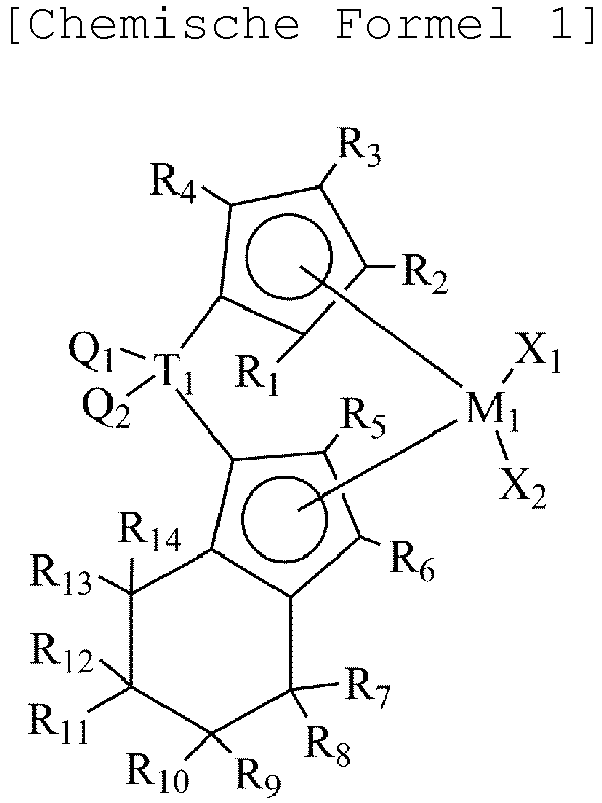
 in den chemischen Formeln 1 und 2 sind M1 und M2 identisch oder verschieden voneinander und jeweils unabhängig voneinander Ti, Zr oder Hf,X1, X2, X3 und X4 sind identisch oder verschieden voneinander und jeweils unabhängig voneinander Halogen, eine Nitrogruppe, eine Amidogruppe, eine Phosphingruppe, eine Phosphidgruppe, eine C1-20-Alkylgruppe, eine C1-20-Alkoxygruppe, eine C2-20-Alkoxyalkylgruppe, eine C1-20-Silylgruppe, eine C2-20-Alkenylgruppe, eine C6-20-Arylgruppe, eine C1-20-Sulfonatgruppe oder eine C1-20-Sulfonylgruppe,T1 ist C, Si, Ge, Sn oder Pb,T2 ist eine C1-5-Alkylengruppe, eine C2-10-Alkylidengruppe oder T3(Q3)(Q4),T3 ist C, Si, Ge, Sn oder Pb,Q1, Q2, Q3 und Q4 sind identisch oder verschieden voneinander und jeweils unabhängig voneinander Wasserstoff, Halogen, eine C1-20-Alkylgruppe, eine C2-20-Heterocycloalkylgruppe, eine C1-20-Alkoxygruppe, eine C2-20-Alkoxyalkylgruppe, ein C1-20-Carboxylat, eine C2-20-Alkenylgruppe, eine C6-20-Arylgruppe oder eine C5-20-Heteroalkylgruppe,R1 bis R6 sind identisch oder verschieden voneinander und jeweils unabhängig voneinander Wasserstoff, eine C1-20-Alkylgruppe, eine C1-20-Alkoxylgruppe, eine C2-20-Alkoxyalkylgruppe, eine C1-20-Silylgruppe, eine C1-20-Silylalkylgruppe, eine C1-20-Silyloxyalkylgruppe, eine C2-20-Alkenylgruppe oder eine C6-20-Arylgruppe,R7 bis R14 sind identisch oder verschieden voneinander und jeweils unabhängig voneinander Wasserstoff, eine C1-20-Alkylgruppe, eine C1-20-Alkoxylgruppe, eine C2-20-Alkoxyalkylgruppe, eine C1-20-Silylgruppe, eine C1-20-Silylalkylgruppe, eine C1-20-Silyloxyalkylgruppe, eine C2-20-Alkenylgruppe oder eine C6-20-Arylgruppe, oder ein oder mehrere benachbarte Paare von R7 bis R14 sind miteinander verbunden, um einen substituierten oder unsubstituierten aliphatischen oder aromatischen Ring zu bilden,Cp1 und Cp2 sind identisch oder verschieden voneinander und jeweils unabhängig voneinander -NR15-, ein aromatischer Ring, ausgewählt aus einer Cyclopentadienylgruppe, einer Indenylgruppe, einer Tetrahydroindenylgruppe, einer Fluorenylgruppe oder einer Indenoindolylgruppe, oder der obige aromatische Ring, bei dem ein oder mehrere Wasserstoffatome unabhängig voneinander mit einer C1-20-Alkylgruppe, einer C1-20-Alkoxygruppe, einer C2-20-Alkoxyalkylgruppe, einer C1-20-Silylgruppe, einer C2-20-Silylalkylgruppe oder einer C6-20-Arylgruppe substituiert sind, undR15 ist eine C1-20-Alkylgruppe.
 - Geträgerter Hybridkatalysator gemäß Anspruch 1, wobei R1 bis R4 jeweils unabhängig voneinander Wasserstoff, eine C1-20-Alkylgruppe, eine C1-20-Alkoxygruppe oder eine C2-20-Alkenylgruppe sind.
- Geträgerter Hybridkatalysator gemäß Anspruch 1, wobei R5 und R6 jeweils unabhängig voneinander Wasserstoff, eine C1-20-Alkylgruppe, eine C1-20-Alkoxygruppe oder eine C2-20-Alkenylgruppe sind.
- Geträgerter Hybridkatalysator gemäß Anspruch 1, wobei R7 bis R14 jeweils unabhängig voneinander Wasserstoff, eine C1-20-Alkylgruppe, eine C1-20-Alkoxygruppe oder eine C2-20-Alkenylgruppe sind, oder ein oder mehrere benachbarte Paare von R7 bis R14 miteinander verbunden sind, um einen substituierten oder unsubstituierten aliphatischen Ring zu bilden.
- Geträgerter Hybridkatalysator gemäß Anspruch 1, wobei Q1 und Q2 jeweils unabhängig voneinander eine C1-20-Alkylgruppe oder eine C6-20-Arylgruppe sind.
- Geträgerter Hybridkatalysator gemäß Anspruch 1, wobei X1 bis X4 jeweils unabhängig voneinander Halogen, eine C1-20-Alkylgruppe oder eine C1-20-Alkoxylgruppe sind.
- Geträgerter Hybridkatalysator gemäß Anspruch 1, wobei T2 eine Ethylengruppe, eine n-Propylengruppe, eine Iso-Propylengruppe, eine Ethylidengruppe, eine 1-Propylidengruppe, eine 2-Propylidengruppe oder T3(Q3)(Q4) ist; wobei T3 Si ist; und Q3 und Q4 identisch oder verschieden voneinander sind, und jeweils unabhängig voneinander eine C1-20-Alkylgruppe, eine C1-20-Alkoxygruppe oder eine C2-20-Alkoxyalkylgruppe sind.
- Geträgerter Hybridkatalysator gemäß Anspruch 1, wobei Cp1 und Cp2 identisch oder verschieden voneinander, und jeweils unabhängig voneinander -N(tert-Butyl)-, eine Cyclopentadienylgruppe, eine Tetramethylcyclopentadienylgruppe, eine tert-Butoxyhexylcyclopentadienylgruppe, eine Indenylgruppe, eine Tetrahydroindenylgruppe, eine Fluorenylgruppe, eine 5,10-Dihydroindeno-[1,2-b]indolylgruppe oder eine 5,8-Dimethyl-5,10-dihydroindeno-[1,2-b]indolylgruppe sind.
- Geträgerter Hybridkatalysator gemäß Anspruch 1, wobei die durch die chemische Formel 1 dargestellte Übergangsmetallverbindung eine Verbindung ist, die durch die folgende chemische Formel 3 oder 4 dargestellt wird:

 in den chemischen Formeln 3 und 4 sind R16 und R17 identisch oder verschieden voneinander, und jeweils unabhängig voneinander Wasserstoff, eine C1-20-Alkylgruppe, eine C1-20-Alkoxygruppe, eine C2-20-Alkoxyalkylgruppe, eine C1-20-Alkylsilylgruppe, eine C1-20-Silylalkylgruppe, eine C1-20-Alkoxysilylgruppe, eine C1-20-Silyloxyalkylgruppe, eine C2-20-Alkenylgruppe, eine C6-20-Arylgruppe, eine C7-20-Alkylarylgruppe oder eine C7-20-Arylalkylgruppe undl ist eine ganze Zahl von 0 bis 5.
 - Geträgerter Hybridkatalysator gemäß Anspruch 1, wobei die durch die chemische Formel 2 dargestellte Übergangsmetallverbindung Dimethylsilylen(tetramethylcyclopentadienyl) (9H-fluorene-9-yl)zirkoniumdichlorid ist.
- Geträgerter Hybridkatalysator gemäß Anspruch 1, ferner umfassend eine oder mehrere Arten von Cokatalysatoren, ausgewählt aus der Gruppe bestehend aus den Verbindungen der folgenden chemischen Formeln 5 bis 7:
[Chemische Formel 5] R19-[Al(R18)-O]n-R20
in der chemischen Formel 5,sind R18, R19 und R20 jeweils unabhängig voneinander Wasserstoff, Halogen, eine C1-20-Kohlenwasserstoffgruppe oder eine mit Halogen substituierte C1-20-Kohlenwasserstoffgruppe undn ist eine ganze Zahl von 2 oder mehr,
[Chemische Formel 6] D(R21)3
in der chemischen Formel 6,ist D Aluminium oder Bor,R21 sind jeweils unabhängig voneinander Halogen, eine C1-20-Kohlenwasserstoffgruppe oder eine mit Halogen substituierte C1-20-Kohlenwasserstoffgruppe,
[Chemische Formel 7] [L-H]+[Z(A)4]- oder [L]+[Z(A)4]-
in der chemischen Formel 7,ist L eine neutrale oder kationische Lewis-Base, H ist ein Wasserstoffatom,Z ist ein Atom der Gruppe 13, A sind jeweils unabhängig voneinander eine C1-20-Kohlenwasserstoffgruppe, eine C1-20-Kohlenwasserstoffoxygruppe, oder eine C1-20-Kohlenwasserstoffgruppe oder eine C1-20-Kohlenwasserstoffoxygruppe, bei der ein oder mehrere Wasserstoffatome mit Halogen, einer C1-20-Kohlenwasserstoffoxygruppe oder einer C1-20-Kohlenwasserstoffsilylgruppe substituiert sind. - Geträgerter Hybridkatalysator gemäß Anspruch 1, wobei der Träger Siliziumdioxid, Aluminiumoxid, Magnesiumoxid oder eine Mischung davon ist.
- Geträgerter Hybridkatalysator gemäß Anspruch 1, wobei die durch die chemische Formel 1 dargestellte Übergangsmetallverbindung und die durch die chemische Formel 2 dargestellte Übergangsmetallverbindung in dem Gewichtsverhältnis von 10:0,01 bis 10:50 enthalten sind.
- Verfahren zur Herstellung von Olefinpolymer, umfassend den Schritt der Polymerisation von Olefinmonomeren in Gegenwart des geträgerten Hybridkatalysators gemäß Anspruch 1.
- Verfahren gemäß Anspruch 14, wobei das Olefinmonomer eines oder mehrere, ausgewählt aus der Gruppe bestehend aus Ethylen, Propylen, 1-Buten, 1-Penten, 4-Methyl-1-Penten, 1-Hexen, 1-Hepten, 1-Hepten, 1-Octen, 1-Decen, 1-Undecen, 1-Dodecen, 1-Tetradecen, 1-Hexadecen, 1-Eicosin, Norbornen, Norbornadien, Ethylidenenorborden, Phenylnorborden, Vinylnorborden, Dicyclopentadien, 1,4-Butadien, 1,5-Pentadien, 1,6-Hexadien, Styrol, Alpha-Methylstyrol, Divinylbenzol und 3-Chlormethylstyrol enthält.
Applications Claiming Priority (2)
| Application Number | Priority Date | Filing Date | Title |
|---|---|---|---|
| KR20160010098 | 2016-01-27 | ||
| PCT/KR2017/000993 WO2017131490A2 (ko) | 2016-01-27 | 2017-01-26 | 혼성 담지 촉매 및 이를 이용하는 올레핀 중합체의 제조 방법 |
Publications (3)
| Publication Number | Publication Date |
|---|---|
| EP3312201A2 EP3312201A2 (de) | 2018-04-25 |
| EP3312201A4 EP3312201A4 (de) | 2018-12-26 |
| EP3312201B1 true EP3312201B1 (de) | 2019-12-25 |
Family
ID=59398598
Family Applications (1)
| Application Number | Title | Priority Date | Filing Date |
|---|---|---|---|
| EP17744611.9A Active EP3312201B1 (de) | 2016-01-27 | 2017-01-26 | Geträgerter hybridkatalysator und verfahren zur herstellung eines olefinpolymers damit |
Country Status (5)
| Country | Link |
|---|---|
| US (1) | US10669356B2 (de) |
| EP (1) | EP3312201B1 (de) |
| KR (1) | KR101927460B1 (de) |
| CN (1) | CN108602908B (de) |
| WO (1) | WO2017131490A2 (de) |
Families Citing this family (7)
| Publication number | Priority date | Publication date | Assignee | Title |
|---|---|---|---|---|
| KR101950462B1 (ko) | 2016-02-24 | 2019-02-20 | 주식회사 엘지화학 | 올레핀 중합체 및 이의 제조 방법 |
| KR102140260B1 (ko) * | 2016-12-22 | 2020-07-31 | 주식회사 엘지화학 | 올레핀 중합체 및 이의 제조 방법 |
| KR102753857B1 (ko) * | 2018-11-15 | 2025-01-14 | 롯데케미칼 주식회사 | 프로필렌 중합용 담지촉매 및 이를 이용하는 폴리프로필렌 수지의 제조방법 |
| KR102602239B1 (ko) * | 2019-01-28 | 2023-11-13 | 주식회사 엘지화학 | 폴리올레핀 |
| KR102530448B1 (ko) * | 2019-03-13 | 2023-05-08 | 주식회사 엘지화학 | 전이 금속 화합물 및 이를 포함하는 촉매 조성물 |
| KR102475975B1 (ko) * | 2019-10-17 | 2022-12-08 | 한화솔루션 주식회사 | 혼성 촉매 조성물, 이를 포함하는 촉매 및 이들의 제조방법 |
| WO2025254478A1 (ko) * | 2024-06-05 | 2025-12-11 | 주식회사 엘지화학 | 혼성 담지 메탈로센 촉매 및 이를 이용한 폴리에틸렌의 제조방법 |
Family Cites Families (31)
| Publication number | Priority date | Publication date | Assignee | Title |
|---|---|---|---|---|
| JP3517471B2 (ja) | 1994-12-28 | 2004-04-12 | 三井化学株式会社 | 環状オレフィン共重合体の製造方法 |
| US6225426B1 (en) * | 1996-04-10 | 2001-05-01 | Uniroyal Chemical Company, Inc. | Process for producing polyolefin elastomer employing a metallocene catalyst |
| KR20000029869A (ko) | 1996-08-09 | 2000-05-25 | 그레이스 스티븐 에스. | 포화된삼환상리간드를함유하는금속착체및올레핀중합방법 |
| DE19644039A1 (de) * | 1996-10-31 | 1998-05-07 | Hoechst Ag | Metallocene |
| DE19652340A1 (de) | 1996-12-17 | 1998-06-18 | Hoechst Ag | Verfahren zur Herstellung von Cycloolefincopolymers |
| US6180736B1 (en) | 1996-12-20 | 2001-01-30 | Exxon Chemical Patents Inc | High activity metallocene polymerization process |
| DE69908452T2 (de) * | 1998-03-09 | 2004-05-06 | Tosoh Corp., Shinnanyo | Katalysator für Olefinpolymerisation und Verfahren zur Herstellung von Olefinpolymer unter Verwendung desselben |
| AU1270500A (en) | 1998-11-18 | 2000-06-05 | Montell Technology Company B.V. | Bis(tetrahydro-indenyl) metallocenes as olefin-polymerisation-catalyst |
| US6534665B1 (en) * | 1999-10-26 | 2003-03-18 | Repsol Quimica S.A. | Single-carbon bridges bys cyclopentadienyl compounds and metallocene complexes thereof |
| US7041617B2 (en) * | 2004-01-09 | 2006-05-09 | Chevron Phillips Chemical Company, L.P. | Catalyst compositions and polyolefins for extrusion coating applications |
| EP1300423A1 (de) | 2001-09-27 | 2003-04-09 | Atofina Research S.A. | Katalysatorsystem aus einer Mischung von Katalysatorbestandteilen zur Herstellung einer Polyolefinmischung |
| WO2004037872A2 (en) | 2002-10-24 | 2004-05-06 | Exxonmobil Chemical Patents Inc. | Branched crystalline polypropylene |
| US6911508B2 (en) | 2003-06-05 | 2005-06-28 | Univation Technologies, Llc | Class of metallocenes and method of producing polyethylene |
| EP1762577A1 (de) | 2005-09-02 | 2007-03-14 | Total Petrochemicals Research Feluy | Schlagfeste propylen-copolymere vorbereitet in einem reactor |
| ATE529431T1 (de) * | 2005-12-14 | 2011-11-15 | Exxonmobil Chem Patents Inc | Halogensubstituierte metallocenverbindungen für die olefinpolymerisation |
| WO2007086112A1 (ja) * | 2006-01-25 | 2007-08-02 | Osg Corporation | 焼きばめ式工具ユニット及びその焼きばめ式工具ユニットに使用される工具ホルダ並びに回転工具 |
| US7619047B2 (en) | 2006-02-22 | 2009-11-17 | Chevron Phillips Chemical Company, Lp | Dual metallocene catalysts for polymerization of bimodal polymers |
| EP2003166A1 (de) | 2007-06-12 | 2008-12-17 | Repsol Ypf S.A. | Polyethylenzusammensetzungen und ihre Verwendung bei der Herstellung von Röhren |
| KR101137007B1 (ko) * | 2009-06-02 | 2012-04-19 | 공주대학교 산학협력단 | 후전이금속 담지촉매, 그의 제조방법 및 상기 담지촉매를 사용하는 올레핀 중합방법 |
| US8067652B2 (en) * | 2009-08-13 | 2011-11-29 | Chemtura Corporation | Processes for controlling the viscosity of polyalphaolefins |
| US20120322961A1 (en) | 2011-06-16 | 2012-12-20 | Fina Technology, Inc. | Multi-component metallocene catalyst systems for the production of reactor blends of polypropylene |
| KR101827523B1 (ko) | 2012-03-06 | 2018-03-22 | 에스케이이노베이션 주식회사 | 혼성 담지 메탈로센 촉매, 이의 제조방법 및 이를 이용한 폴리올레핀의 제조방법 |
| KR101365884B1 (ko) * | 2012-06-29 | 2014-02-24 | 롯데케미칼 주식회사 | 알파-올레핀 합성용 전이금속 화합물을 포함하는 탠덤 촉매 시스템, 및 이를 이용한 폴리에틸렌의 제조 방법 |
| KR101492571B1 (ko) * | 2012-11-26 | 2015-02-11 | 주식회사 엘지화학 | 혼성 담지 메탈로센 촉매와 그 제조방법 |
| KR101650092B1 (ko) | 2013-08-01 | 2016-08-22 | 주식회사 엘지화학 | 메탈로센 화합물, 이를 포함하는 촉매 조성물 및 이를 이용하는 올레핀계 중합체의 제조방법 |
| KR101631700B1 (ko) | 2013-10-18 | 2016-06-17 | 주식회사 엘지화학 | 혼성 담지 메탈로센 촉매의 제조방법 |
| KR101606825B1 (ko) | 2013-11-28 | 2016-03-28 | 주식회사 엘지화학 | 혼성 담지 메탈로센 촉매의 제조방법 |
| KR101658172B1 (ko) | 2013-12-02 | 2016-09-20 | 주식회사 엘지화학 | 혼성 담지 메탈로센 촉매 및 이를 이용하는 올레핀계 중합체의 제조방법 |
| KR101685664B1 (ko) | 2014-09-05 | 2016-12-12 | 주식회사 엘지화학 | 혼성 담지 촉매 및 이를 이용하는 올레핀계 중합체의 제조방법 |
| KR102028063B1 (ko) | 2014-12-22 | 2019-10-02 | 주식회사 엘지화학 | 전이 금속 화합물, 이를 포함하는 촉매 조성물 및 이를 이용하는 올레핀 중합체의 제조 방법 |
| KR101950462B1 (ko) | 2016-02-24 | 2019-02-20 | 주식회사 엘지화학 | 올레핀 중합체 및 이의 제조 방법 |
-
2017
- 2017-01-26 CN CN201780002569.3A patent/CN108602908B/zh active Active
- 2017-01-26 WO PCT/KR2017/000993 patent/WO2017131490A2/ko not_active Ceased
- 2017-01-26 EP EP17744611.9A patent/EP3312201B1/de active Active
- 2017-01-26 US US15/742,001 patent/US10669356B2/en active Active
- 2017-01-26 KR KR1020170012949A patent/KR101927460B1/ko active Active
Non-Patent Citations (1)
| Title |
|---|
| None * |
Also Published As
| Publication number | Publication date |
|---|---|
| CN108602908A (zh) | 2018-09-28 |
| EP3312201A4 (de) | 2018-12-26 |
| KR101927460B1 (ko) | 2018-12-10 |
| CN108602908B (zh) | 2020-09-11 |
| WO2017131490A3 (ko) | 2018-08-02 |
| US10669356B2 (en) | 2020-06-02 |
| EP3312201A2 (de) | 2018-04-25 |
| KR20170089786A (ko) | 2017-08-04 |
| WO2017131490A2 (ko) | 2017-08-03 |
| US20180194873A1 (en) | 2018-07-12 |
Similar Documents
| Publication | Publication Date | Title |
|---|---|---|
| EP3037167B1 (de) | Hybridgeträgerter metallocenkatalysator | |
| KR102209393B1 (ko) | 혼성 담지 촉매 | |
| EP3312201B1 (de) | Geträgerter hybridkatalysator und verfahren zur herstellung eines olefinpolymers damit | |
| EP3040124B1 (de) | Verfahren zur herstellung eines hybridgestützten metallocenkatalysators | |
| JP6681462B2 (ja) | エチレンスラリー重合用混成担持触媒システムおよびこれを用いたエチレン重合体の製造方法 | |
| JP6440832B2 (ja) | メタロセン化合物、メタロセン担持触媒およびこれを用いるポリオレフィンの製造方法 | |
| KR20170099691A (ko) | 혼성 담지 메탈로센 촉매 및 이를 이용한 폴리올레핀의 제조 방법 | |
| EP4043470B1 (de) | Übergangsmetallverbindung und katalysatorzusammensetzung damit | |
| EP3184556B1 (de) | Metallocen-geträgerter katalysator und verfahren zur herstellung von polyolefin damit | |
| EP3363820A1 (de) | Hybrider geträgerter metallocenkatalysator und verfahren zur herstellung von polyolefin damit | |
| EP3138846B1 (de) | Metallocenverbindung, katalysatorzusammensetzung damit und verfahren zur herstellung eines olefinbasierten polymers damit | |
| KR102228069B1 (ko) | 혼성 담지 메탈로센 촉매의 제조방법 | |
| KR20160143552A (ko) | 메탈로센 담지 촉매 및 이를 이용하는 폴리올레핀의 제조 방법 | |
| KR20170075529A (ko) | 전이 금속 화합물, 이를 포함하는 촉매 조성물 및 이를 이용한 올레핀 중합체의 제조 방법 | |
| EP3330296B1 (de) | Verfahren zur herstellung eines geträgerten metallocen-katalysators | |
| KR102074510B1 (ko) | 혼성 담지 촉매 및 이를 이용하는 올레핀 중합체의 제조 방법 | |
| WO2017155211A1 (ko) | 에틸렌 슬러리 중합용 혼성 담지 촉매 시스템 및 이를 이용한 에틸렌 중합체의 제조 방법 |
Legal Events
| Date | Code | Title | Description |
|---|---|---|---|
| STAA | Information on the status of an ep patent application or granted ep patent |
Free format text: STATUS: THE INTERNATIONAL PUBLICATION HAS BEEN MADE |
|
| PUAI | Public reference made under article 153(3) epc to a published international application that has entered the european phase |
Free format text: ORIGINAL CODE: 0009012 |
|
| STAA | Information on the status of an ep patent application or granted ep patent |
Free format text: STATUS: REQUEST FOR EXAMINATION WAS MADE |
|
| 17P | Request for examination filed |
Effective date: 20180118 |
|
| AK | Designated contracting states |
Kind code of ref document: A2 Designated state(s): AL AT BE BG CH CY CZ DE DK EE ES FI FR GB GR HR HU IE IS IT LI LT LU LV MC MK MT NL NO PL PT RO RS SE SI SK SM TR |
|
| AX | Request for extension of the european patent |
Extension state: BA ME |
|
| R17D | Deferred search report published (corrected) |
Effective date: 20180802 |
|
| A4 | Supplementary search report drawn up and despatched |
Effective date: 20181128 |
|
| RIC1 | Information provided on ipc code assigned before grant |
Ipc: C08F 110/02 20060101ALI20181123BHEP Ipc: C08F 4/6592 20060101ALI20181123BHEP Ipc: C08F 10/00 20060101AFI20181123BHEP |
|
| DAV | Request for validation of the european patent (deleted) | ||
| DAX | Request for extension of the european patent (deleted) | ||
| REG | Reference to a national code |
Ref country code: DE Ref legal event code: R079 Ref document number: 602017010182 Country of ref document: DE Free format text: PREVIOUS MAIN CLASS: C08F0004659200 Ipc: C08F0010000000 |
|
| RIC1 | Information provided on ipc code assigned before grant |
Ipc: C08F 4/6592 20060101ALI20190812BHEP Ipc: C08F 10/00 20060101AFI20190812BHEP Ipc: C08F 110/02 20060101ALI20190812BHEP |
|
| GRAP | Despatch of communication of intention to grant a patent |
Free format text: ORIGINAL CODE: EPIDOSNIGR1 |
|
| STAA | Information on the status of an ep patent application or granted ep patent |
Free format text: STATUS: GRANT OF PATENT IS INTENDED |
|
| INTG | Intention to grant announced |
Effective date: 20190920 |
|
| GRAS | Grant fee paid |
Free format text: ORIGINAL CODE: EPIDOSNIGR3 |
|
| GRAA | (expected) grant |
Free format text: ORIGINAL CODE: 0009210 |
|
| STAA | Information on the status of an ep patent application or granted ep patent |
Free format text: STATUS: THE PATENT HAS BEEN GRANTED |
|
| AK | Designated contracting states |
Kind code of ref document: B1 Designated state(s): AL AT BE BG CH CY CZ DE DK EE ES FI FR GB GR HR HU IE IS IT LI LT LU LV MC MK MT NL NO PL PT RO RS SE SI SK SM TR |
|
| REG | Reference to a national code |
Ref country code: GB Ref legal event code: FG4D |
|
| REG | Reference to a national code |
Ref country code: CH Ref legal event code: EP |
|
| REG | Reference to a national code |
Ref country code: DE Ref legal event code: R096 Ref document number: 602017010182 Country of ref document: DE |
|
| REG | Reference to a national code |
Ref country code: AT Ref legal event code: REF Ref document number: 1217035 Country of ref document: AT Kind code of ref document: T Effective date: 20200115 |
|
| REG | Reference to a national code |
Ref country code: IE Ref legal event code: FG4D |
|
| REG | Reference to a national code |
Ref country code: NL Ref legal event code: MP Effective date: 20191225 |
|
| PG25 | Lapsed in a contracting state [announced via postgrant information from national office to epo] |
Ref country code: GR Free format text: LAPSE BECAUSE OF FAILURE TO SUBMIT A TRANSLATION OF THE DESCRIPTION OR TO PAY THE FEE WITHIN THE PRESCRIBED TIME-LIMIT Effective date: 20200326 Ref country code: NO Free format text: LAPSE BECAUSE OF FAILURE TO SUBMIT A TRANSLATION OF THE DESCRIPTION OR TO PAY THE FEE WITHIN THE PRESCRIBED TIME-LIMIT Effective date: 20200325 Ref country code: BG Free format text: LAPSE BECAUSE OF FAILURE TO SUBMIT A TRANSLATION OF THE DESCRIPTION OR TO PAY THE FEE WITHIN THE PRESCRIBED TIME-LIMIT Effective date: 20200325 Ref country code: FI Free format text: LAPSE BECAUSE OF FAILURE TO SUBMIT A TRANSLATION OF THE DESCRIPTION OR TO PAY THE FEE WITHIN THE PRESCRIBED TIME-LIMIT Effective date: 20191225 Ref country code: SE Free format text: LAPSE BECAUSE OF FAILURE TO SUBMIT A TRANSLATION OF THE DESCRIPTION OR TO PAY THE FEE WITHIN THE PRESCRIBED TIME-LIMIT Effective date: 20191225 Ref country code: LV Free format text: LAPSE BECAUSE OF FAILURE TO SUBMIT A TRANSLATION OF THE DESCRIPTION OR TO PAY THE FEE WITHIN THE PRESCRIBED TIME-LIMIT Effective date: 20191225 Ref country code: LT Free format text: LAPSE BECAUSE OF FAILURE TO SUBMIT A TRANSLATION OF THE DESCRIPTION OR TO PAY THE FEE WITHIN THE PRESCRIBED TIME-LIMIT Effective date: 20191225 |
|
| REG | Reference to a national code |
Ref country code: LT Ref legal event code: MG4D |
|
| PG25 | Lapsed in a contracting state [announced via postgrant information from national office to epo] |
Ref country code: RS Free format text: LAPSE BECAUSE OF FAILURE TO SUBMIT A TRANSLATION OF THE DESCRIPTION OR TO PAY THE FEE WITHIN THE PRESCRIBED TIME-LIMIT Effective date: 20191225 Ref country code: HR Free format text: LAPSE BECAUSE OF FAILURE TO SUBMIT A TRANSLATION OF THE DESCRIPTION OR TO PAY THE FEE WITHIN THE PRESCRIBED TIME-LIMIT Effective date: 20191225 |
|
| PG25 | Lapsed in a contracting state [announced via postgrant information from national office to epo] |
Ref country code: AL Free format text: LAPSE BECAUSE OF FAILURE TO SUBMIT A TRANSLATION OF THE DESCRIPTION OR TO PAY THE FEE WITHIN THE PRESCRIBED TIME-LIMIT Effective date: 20191225 |
|
| PG25 | Lapsed in a contracting state [announced via postgrant information from national office to epo] |
Ref country code: NL Free format text: LAPSE BECAUSE OF FAILURE TO SUBMIT A TRANSLATION OF THE DESCRIPTION OR TO PAY THE FEE WITHIN THE PRESCRIBED TIME-LIMIT Effective date: 20191225 Ref country code: EE Free format text: LAPSE BECAUSE OF FAILURE TO SUBMIT A TRANSLATION OF THE DESCRIPTION OR TO PAY THE FEE WITHIN THE PRESCRIBED TIME-LIMIT Effective date: 20191225 Ref country code: PT Free format text: LAPSE BECAUSE OF FAILURE TO SUBMIT A TRANSLATION OF THE DESCRIPTION OR TO PAY THE FEE WITHIN THE PRESCRIBED TIME-LIMIT Effective date: 20200520 Ref country code: RO Free format text: LAPSE BECAUSE OF FAILURE TO SUBMIT A TRANSLATION OF THE DESCRIPTION OR TO PAY THE FEE WITHIN THE PRESCRIBED TIME-LIMIT Effective date: 20191225 Ref country code: CZ Free format text: LAPSE BECAUSE OF FAILURE TO SUBMIT A TRANSLATION OF THE DESCRIPTION OR TO PAY THE FEE WITHIN THE PRESCRIBED TIME-LIMIT Effective date: 20191225 |
|
| PG25 | Lapsed in a contracting state [announced via postgrant information from national office to epo] |
Ref country code: SM Free format text: LAPSE BECAUSE OF FAILURE TO SUBMIT A TRANSLATION OF THE DESCRIPTION OR TO PAY THE FEE WITHIN THE PRESCRIBED TIME-LIMIT Effective date: 20191225 Ref country code: IS Free format text: LAPSE BECAUSE OF FAILURE TO SUBMIT A TRANSLATION OF THE DESCRIPTION OR TO PAY THE FEE WITHIN THE PRESCRIBED TIME-LIMIT Effective date: 20200425 Ref country code: SK Free format text: LAPSE BECAUSE OF FAILURE TO SUBMIT A TRANSLATION OF THE DESCRIPTION OR TO PAY THE FEE WITHIN THE PRESCRIBED TIME-LIMIT Effective date: 20191225 |
|
| REG | Reference to a national code |
Ref country code: CH Ref legal event code: PL |
|
| REG | Reference to a national code |
Ref country code: DE Ref legal event code: R097 Ref document number: 602017010182 Country of ref document: DE |
|
| PG25 | Lapsed in a contracting state [announced via postgrant information from national office to epo] |
Ref country code: MC Free format text: LAPSE BECAUSE OF FAILURE TO SUBMIT A TRANSLATION OF THE DESCRIPTION OR TO PAY THE FEE WITHIN THE PRESCRIBED TIME-LIMIT Effective date: 20191225 |
|
| REG | Reference to a national code |
Ref country code: BE Ref legal event code: MM Effective date: 20200131 |
|
| PG25 | Lapsed in a contracting state [announced via postgrant information from national office to epo] |
Ref country code: DK Free format text: LAPSE BECAUSE OF FAILURE TO SUBMIT A TRANSLATION OF THE DESCRIPTION OR TO PAY THE FEE WITHIN THE PRESCRIBED TIME-LIMIT Effective date: 20191225 Ref country code: ES Free format text: LAPSE BECAUSE OF FAILURE TO SUBMIT A TRANSLATION OF THE DESCRIPTION OR TO PAY THE FEE WITHIN THE PRESCRIBED TIME-LIMIT Effective date: 20191225 Ref country code: LU Free format text: LAPSE BECAUSE OF NON-PAYMENT OF DUE FEES Effective date: 20200126 |
|
| PLBE | No opposition filed within time limit |
Free format text: ORIGINAL CODE: 0009261 |
|
| STAA | Information on the status of an ep patent application or granted ep patent |
Free format text: STATUS: NO OPPOSITION FILED WITHIN TIME LIMIT |
|
| REG | Reference to a national code |
Ref country code: AT Ref legal event code: MK05 Ref document number: 1217035 Country of ref document: AT Kind code of ref document: T Effective date: 20191225 |
|
| PG25 | Lapsed in a contracting state [announced via postgrant information from national office to epo] |
Ref country code: BE Free format text: LAPSE BECAUSE OF NON-PAYMENT OF DUE FEES Effective date: 20200131 Ref country code: LI Free format text: LAPSE BECAUSE OF NON-PAYMENT OF DUE FEES Effective date: 20200131 Ref country code: SI Free format text: LAPSE BECAUSE OF FAILURE TO SUBMIT A TRANSLATION OF THE DESCRIPTION OR TO PAY THE FEE WITHIN THE PRESCRIBED TIME-LIMIT Effective date: 20191225 Ref country code: CH Free format text: LAPSE BECAUSE OF NON-PAYMENT OF DUE FEES Effective date: 20200131 |
|
| 26N | No opposition filed |
Effective date: 20200928 |
|
| PG25 | Lapsed in a contracting state [announced via postgrant information from national office to epo] |
Ref country code: IE Free format text: LAPSE BECAUSE OF NON-PAYMENT OF DUE FEES Effective date: 20200126 Ref country code: AT Free format text: LAPSE BECAUSE OF FAILURE TO SUBMIT A TRANSLATION OF THE DESCRIPTION OR TO PAY THE FEE WITHIN THE PRESCRIBED TIME-LIMIT Effective date: 20191225 |
|
| PG25 | Lapsed in a contracting state [announced via postgrant information from national office to epo] |
Ref country code: PL Free format text: LAPSE BECAUSE OF FAILURE TO SUBMIT A TRANSLATION OF THE DESCRIPTION OR TO PAY THE FEE WITHIN THE PRESCRIBED TIME-LIMIT Effective date: 20191225 |
|
| PG25 | Lapsed in a contracting state [announced via postgrant information from national office to epo] |
Ref country code: TR Free format text: LAPSE BECAUSE OF FAILURE TO SUBMIT A TRANSLATION OF THE DESCRIPTION OR TO PAY THE FEE WITHIN THE PRESCRIBED TIME-LIMIT Effective date: 20191225 Ref country code: MT Free format text: LAPSE BECAUSE OF FAILURE TO SUBMIT A TRANSLATION OF THE DESCRIPTION OR TO PAY THE FEE WITHIN THE PRESCRIBED TIME-LIMIT Effective date: 20191225 Ref country code: CY Free format text: LAPSE BECAUSE OF FAILURE TO SUBMIT A TRANSLATION OF THE DESCRIPTION OR TO PAY THE FEE WITHIN THE PRESCRIBED TIME-LIMIT Effective date: 20191225 |
|
| PG25 | Lapsed in a contracting state [announced via postgrant information from national office to epo] |
Ref country code: MK Free format text: LAPSE BECAUSE OF FAILURE TO SUBMIT A TRANSLATION OF THE DESCRIPTION OR TO PAY THE FEE WITHIN THE PRESCRIBED TIME-LIMIT Effective date: 20191225 |
|
| PGFP | Annual fee paid to national office [announced via postgrant information from national office to epo] |
Ref country code: GB Payment date: 20251222 Year of fee payment: 10 |
|
| PGFP | Annual fee paid to national office [announced via postgrant information from national office to epo] |
Ref country code: FR Payment date: 20251223 Year of fee payment: 10 |
|
| PGFP | Annual fee paid to national office [announced via postgrant information from national office to epo] |
Ref country code: DE Payment date: 20251222 Year of fee payment: 10 |
|
| PGFP | Annual fee paid to national office [announced via postgrant information from national office to epo] |
Ref country code: IT Payment date: 20251223 Year of fee payment: 10 |