EP3312929A1 - Elektrolyt für lithiumsekundärbatterie und lithiumsekundärbatterie damit - Google Patents
Elektrolyt für lithiumsekundärbatterie und lithiumsekundärbatterie damit Download PDFInfo
- Publication number
- EP3312929A1 EP3312929A1 EP16814659.5A EP16814659A EP3312929A1 EP 3312929 A1 EP3312929 A1 EP 3312929A1 EP 16814659 A EP16814659 A EP 16814659A EP 3312929 A1 EP3312929 A1 EP 3312929A1
- Authority
- EP
- European Patent Office
- Prior art keywords
- secondary battery
- lithium secondary
- electrolyte
- perfluoro
- compound
- Prior art date
- Legal status (The legal status is an assumption and is not a legal conclusion. Google has not performed a legal analysis and makes no representation as to the accuracy of the status listed.)
- Granted
Links
Images

Classifications
-
- H—ELECTRICITY
- H01—ELECTRIC ELEMENTS
- H01M—PROCESSES OR MEANS, e.g. BATTERIES, FOR THE DIRECT CONVERSION OF CHEMICAL ENERGY INTO ELECTRICAL ENERGY
- H01M10/00—Secondary cells; Manufacture thereof
- H01M10/05—Accumulators with non-aqueous electrolyte
- H01M10/056—Accumulators with non-aqueous electrolyte characterised by the materials used as electrolytes, e.g. mixed inorganic/organic electrolytes
- H01M10/0564—Accumulators with non-aqueous electrolyte characterised by the materials used as electrolytes, e.g. mixed inorganic/organic electrolytes the electrolyte being constituted of organic materials only
- H01M10/0566—Liquid materials
- H01M10/0567—Liquid materials characterised by the additives
-
- C—CHEMISTRY; METALLURGY
- C07—ORGANIC CHEMISTRY
- C07C—ACYCLIC OR CARBOCYCLIC COMPOUNDS
- C07C255/00—Carboxylic acid nitriles
- C07C255/01—Carboxylic acid nitriles having cyano groups bound to acyclic carbon atoms
- C07C255/10—Carboxylic acid nitriles having cyano groups bound to acyclic carbon atoms containing cyano groups and halogen atoms, or nitro or nitroso groups, bound to the same acyclic carbon skeleton
-
- H—ELECTRICITY
- H01—ELECTRIC ELEMENTS
- H01M—PROCESSES OR MEANS, e.g. BATTERIES, FOR THE DIRECT CONVERSION OF CHEMICAL ENERGY INTO ELECTRICAL ENERGY
- H01M10/00—Secondary cells; Manufacture thereof
- H01M10/05—Accumulators with non-aqueous electrolyte
- H01M10/052—Li-accumulators
-
- H—ELECTRICITY
- H01—ELECTRIC ELEMENTS
- H01M—PROCESSES OR MEANS, e.g. BATTERIES, FOR THE DIRECT CONVERSION OF CHEMICAL ENERGY INTO ELECTRICAL ENERGY
- H01M10/00—Secondary cells; Manufacture thereof
- H01M10/05—Accumulators with non-aqueous electrolyte
- H01M10/052—Li-accumulators
- H01M10/0525—Rocking-chair batteries, i.e. batteries with lithium insertion or intercalation in both electrodes; Lithium-ion batteries
-
- H—ELECTRICITY
- H01—ELECTRIC ELEMENTS
- H01M—PROCESSES OR MEANS, e.g. BATTERIES, FOR THE DIRECT CONVERSION OF CHEMICAL ENERGY INTO ELECTRICAL ENERGY
- H01M10/00—Secondary cells; Manufacture thereof
- H01M10/05—Accumulators with non-aqueous electrolyte
- H01M10/056—Accumulators with non-aqueous electrolyte characterised by the materials used as electrolytes, e.g. mixed inorganic/organic electrolytes
- H01M10/0564—Accumulators with non-aqueous electrolyte characterised by the materials used as electrolytes, e.g. mixed inorganic/organic electrolytes the electrolyte being constituted of organic materials only
- H01M10/0566—Liquid materials
- H01M10/0569—Liquid materials characterised by the solvents
-
- H—ELECTRICITY
- H01—ELECTRIC ELEMENTS
- H01M—PROCESSES OR MEANS, e.g. BATTERIES, FOR THE DIRECT CONVERSION OF CHEMICAL ENERGY INTO ELECTRICAL ENERGY
- H01M4/00—Electrodes
- H01M4/02—Electrodes composed of, or comprising, active material
- H01M4/36—Selection of substances as active materials, active masses, active liquids
- H01M4/48—Selection of substances as active materials, active masses, active liquids of inorganic oxides or hydroxides
-
- H—ELECTRICITY
- H01—ELECTRIC ELEMENTS
- H01M—PROCESSES OR MEANS, e.g. BATTERIES, FOR THE DIRECT CONVERSION OF CHEMICAL ENERGY INTO ELECTRICAL ENERGY
- H01M2300/00—Electrolytes
- H01M2300/0017—Non-aqueous electrolytes
- H01M2300/0025—Organic electrolyte
-
- H—ELECTRICITY
- H01—ELECTRIC ELEMENTS
- H01M—PROCESSES OR MEANS, e.g. BATTERIES, FOR THE DIRECT CONVERSION OF CHEMICAL ENERGY INTO ELECTRICAL ENERGY
- H01M2300/00—Electrolytes
- H01M2300/0017—Non-aqueous electrolytes
- H01M2300/0025—Organic electrolyte
- H01M2300/0028—Organic electrolyte characterised by the solvent
- H01M2300/0037—Mixture of solvents
- H01M2300/004—Three solvents
-
- H—ELECTRICITY
- H01—ELECTRIC ELEMENTS
- H01M—PROCESSES OR MEANS, e.g. BATTERIES, FOR THE DIRECT CONVERSION OF CHEMICAL ENERGY INTO ELECTRICAL ENERGY
- H01M4/00—Electrodes
- H01M4/02—Electrodes composed of, or comprising, active material
- H01M4/36—Selection of substances as active materials, active masses, active liquids
- H01M4/48—Selection of substances as active materials, active masses, active liquids of inorganic oxides or hydroxides
- H01M4/52—Selection of substances as active materials, active masses, active liquids of inorganic oxides or hydroxides of nickel, cobalt or iron
- H01M4/525—Selection of substances as active materials, active masses, active liquids of inorganic oxides or hydroxides of nickel, cobalt or iron of mixed oxides or hydroxides containing iron, cobalt or nickel for inserting or intercalating light metals, e.g. LiNiO2, LiCoO2 or LiCoOxFy
-
- H—ELECTRICITY
- H01—ELECTRIC ELEMENTS
- H01M—PROCESSES OR MEANS, e.g. BATTERIES, FOR THE DIRECT CONVERSION OF CHEMICAL ENERGY INTO ELECTRICAL ENERGY
- H01M4/00—Electrodes
- H01M4/02—Electrodes composed of, or comprising, active material
- H01M4/36—Selection of substances as active materials, active masses, active liquids
- H01M4/58—Selection of substances as active materials, active masses, active liquids of inorganic compounds other than oxides or hydroxides, e.g. sulfides, selenides, tellurides, halogenides or LiCoFy; of polyanionic structures, e.g. phosphates, silicates or borates
- H01M4/583—Carbonaceous material, e.g. graphite-intercalation compounds or CFx
- H01M4/587—Carbonaceous material, e.g. graphite-intercalation compounds or CFx for inserting or intercalating light metals
-
- H—ELECTRICITY
- H01—ELECTRIC ELEMENTS
- H01M—PROCESSES OR MEANS, e.g. BATTERIES, FOR THE DIRECT CONVERSION OF CHEMICAL ENERGY INTO ELECTRICAL ENERGY
- H01M4/00—Electrodes
- H01M4/02—Electrodes composed of, or comprising, active material
- H01M4/62—Selection of inactive substances as ingredients for active masses, e.g. binders, fillers
- H01M4/621—Binders
- H01M4/622—Binders being polymers
- H01M4/623—Binders being polymers fluorinated polymers
-
- Y—GENERAL TAGGING OF NEW TECHNOLOGICAL DEVELOPMENTS; GENERAL TAGGING OF CROSS-SECTIONAL TECHNOLOGIES SPANNING OVER SEVERAL SECTIONS OF THE IPC; TECHNICAL SUBJECTS COVERED BY FORMER USPC CROSS-REFERENCE ART COLLECTIONS [XRACs] AND DIGESTS
- Y02—TECHNOLOGIES OR APPLICATIONS FOR MITIGATION OR ADAPTATION AGAINST CLIMATE CHANGE
- Y02E—REDUCTION OF GREENHOUSE GAS [GHG] EMISSIONS, RELATED TO ENERGY GENERATION, TRANSMISSION OR DISTRIBUTION
- Y02E60/00—Enabling technologies; Technologies with a potential or indirect contribution to GHG emissions mitigation
- Y02E60/10—Energy storage using batteries
Definitions
- the present disclosure relates to an electrolyte capable of improving battery characteristics of a lithium secondary battery, particularly, capable of improving a cathode film forming characteristic and a battery resistance characteristic at a high voltage, and a lithium secondary battery including the same.
- a lithium secondary battery is rapidly expanded not only as portable power sources for mobile phones, notebook computers, digital cameras, and camcorders, etc., but also as medium and large power sources for power tools, electric bicycles, hybrid electric vehicles (HEV), plug-in hybrid electric vehicles (PHEV), etc.
- HEV hybrid electric vehicles
- PHEV plug-in hybrid electric vehicles
- the lithium secondary battery is produced by using materials capable of inserting and removing lithium ions as an anode and a cathode, installing a porous separator between the two electrodes, and injecting a liquid electrolyte. Electricity is generated or consumed by an oxidation-reduction reaction according to the insertion and removal of the lithium ions in the anode and the cathode.
- An object of the present disclosure is to provide an electrolyte capable of improving battery characteristics of a lithium secondary battery, particularly, capable of improving a cathode film forming characteristic and a battery resistance characteristic at a high voltage.
- Another object of the present disclosure is to provide a lithium secondary battery including the electrolyte.
- an electrolyte for a lithium secondary battery includes a perfluoro nitrile compound as an electrolyte additive.
- the perfluoro nitrile compound may be any one selected from the group consisting of a perfluoro mononitrile compound, a perfluoro dinitrile compound, a perfluoro trinitrile compound, a perfluoro tetranitrile compound, and a combination thereof.
- the perfluoro nitrile compound may be represented by Chemical Formulas 1 to 4 below: wherein n is 1 to 15.
- the perfluoro nitrile compound may be perfluorohexane-1,6-dinitrile.
- the electrolyte for a lithium secondary battery may further include hexane-1,6-dinitrile.
- the hexane-1,6-dinitrile may have a content of 1 to 80 parts by weight based on 100 parts by weight of the perfluorohexane-1,6-dinitrile.
- the electrolyte for a lithium secondary battery may further include an organic solvent and a lithium salt.
- a lithium secondary battery in another general aspect, includes: a cathode including a cathode active material, an anode disposed opposite to the cathode and including an anode active material, and an electrolyte interposed between the cathode and the anode, wherein the electrolyte includes a perfluoro nitrile compound as an electrolyte additive.
- the electrolyte additive may have a content of 0.1 to 10 wt% based on the total weight of the electrolyte.
- the perfluoro nitrile compound may be perfluorohexane-1,6-dinitrile.
- the electrolyte for a lithium secondary battery may further include hexane-1,6-dinitrile.
- the hexane-1,6-dinitrile may have a content of 1 to 80 parts by weight based on 100 parts by weight of the perfluorohexane-1,6-dinitrile.
- the electrolyte for a lithium secondary battery according to the present disclosure may improve the battery characteristics of the lithium secondary battery, particularly, the cathode film forming characteristic and the battery resistance characteristic at the high voltage.
- a combination thereof means that two or more substituents are bonded to each other through a single bond or a linking group, or two or more substituents are condensed and connected unless otherwise specified.
- the electrolyte according to an exemplary embodiment of the present disclosure includes a perfluoro nitrile compound as an electrolyte additive.
- the perfluoro nitrile compound means a hydrocarbon compound including one or more nitrile groups, wherein all hydrogen atoms are substituted with fluorine.
- the hydrocarbon compound means a hydrocarbon compound having 1 to 15 carbon atoms consisting of carbon and hydrogen, and includes an aliphatic chain type or branched hydrocarbon group and an alicyclic hydrocarbon group.
- propane butane, pentane, hexane, heptane, octane, cyclohexane, benzene, toluene, xylene, biphenyl, and naphthalene, etc.
- the perfluoro nitrile compound may be any one selected from the group consisting of a perfluoro mononitrile compound, a perfluoro dinitrile compound, a perfluoro trinitrile compound, a perfluoro tetranitrile compound, and a combination thereof, according to the number of nitrile groups.
- the perfluoro mononitrile compound may be represented by Chemical Formula 1 below: wherein n is 1 to 15.
- the perfluoro mononitrile compound may have a linear form or a branched form such as NC-CF 3 , NC-CF 2 CF 3 , NC-CFCF 3 CF 3 , NC-CF 2 CF 2 CF 3 , etc.
- perfluoro dinitrile compound may be represented by Chemical Formula 2 below: wherein n is 1 to 15.
- the perfluoro dinitrile compound may be any one selected from the group consisting of perfluoro dinitrile in a linear form, such as NC-CF 2 -CN, NC-CF 2 CF 2 -CN, NC-CF 2 CF 2 CF 2 -CN, NC-CF 2 CF 2 CF 2 -CN, NC-CF 2 CF 2 CF 2 CF 2 -CN, NC-CF 2 CF 2 CF 2 CF 2 -CN, NC-CF 2 CF 2 CF 2 CF 2 CF 2 -CN, NC-CF 2 CF 2 CF 2 CF 2 CF 2 -CN, etc., and perfluoro dinitrile in a branched form, such as [NC-CF 2 CF (CF 3 ) CF 2 -CN] , NC-CF 2 CF 2 CF(CN)CF 3 , etc., and a combination thereof.
- perfluoro dinitrile in a linear form such as NC-CF 2 -CN, NC-CF 2 CF 2
- perfluoro trinitrile compound may be represented by Chemical Formula 3 below: wherein n 1 to n 3 are each independently 1 to 15.
- the perfluoro trinitrile compound may have a branched form, such as CF-(CF 2 -CN) 2 (CF 2 CF 2 -CN), CF-(CF 2 -CN) 2 (CF 2 CF 2 CF 2 -CN), CF-(CF 2 -CN) 2 (CF 2 CF 2 CF 2 -CN), CF-(CF 2 -CN) 2 (CF 2 CF 2 CF 2 CF 2 -CN) or CF-(CF 2 -CN) 3 , CF-(CF 2 -CN) 2 (CF 2 CF 2 -CN), CF-(CF 2 -CN)(CF 2 CF 2 -CN) 2 , CF-(CF 2 -CN)(CF 2 CF 2 -CN)(CF 2 CF 2 -CN), etc.
- perfluoro tetranitrile compound may be represented by Chemical Formula 4 below: wherein n 1 to n 4 are each independently 1 to 15.
- the perfluoro trinitrile compound may have a branched form, such as C-(CF 2 -CN) 3 (CF 2 CF 2 -CN), C-(CF 2 -CN) 3 (CF 2 CF 2 CF 2 -CN), C-(CF 2 -CN) 3 (CF 2 CF 2 CF 2 CF 2 -CN), C-(CF 2 -CN) 3 (CF 2 CF 2 CF 2 CF 2 -CN), C-(CF 2 -CN)(CF 2 CF 2 CF 2 CF 2 CF 2 CF 2 CF 2 -CN) or C- (CF 2 -CN) 4 , C-(CF 2 -CN)(CF 2 CF 2 -CN), CF-(CF 2 -CN) 2 (CF 2 CF 2 -CN) 2 , etc.
- the electrolyte for a lithium battery including at least one electrolyte additive selected from the group consisting of the compounds represented by Chemical Formulas 1 to 4 may be used to solve the above-described problem.
- the nitrile group (-CN) helps to form a film on the cathode, and fluorine (F), which is rich in electrons, fills deficient electrons to balance the cathode.
- Chemical Formulas 1 to 4 in consideration of an improvement degree in the battery characteristic improving effect according to the use of the electrolyte additive, it may be more preferable to use an alkylene group having 1 to 15 carbon atoms, and more preferably, an alkylene group having 4 to 10 carbon atoms.
- the perfluoro nitrile compound represented by Chemical Formula 1 may be perfluoro pentane nitrile
- the perfluoro dinitrile compound represented by Chemical Formula 2 may be perfluorohexane-1,6-dinitrile
- the perfluoro trinitrile compound represented by Chemical Formula 3 may be 3-(cyano difluoro methyl)-2,2,3,4,4-penta fluoro pentane dinitrile
- the perfluoro tetranitrile compound represented by Chemical Formula 4 may be 3,3-bis(cyano difluoromethyl)-2,2,4,4-tetra fluoro pentane dinitrile.
- the perfluorohexane-1,6-dinitrile may be used together with hexane-1,6-dinitrile.
- the perfluorohexane-1,6-dinitrile and the hexane-1,6-dinitrile are used together, it is possible to further improve the battery characteristics of the lithium secondary battery, particularly, the high-voltage lifetime and storage characteristics, and to obtain a synergistic effect in which the recovery capacity and the swelling characteristic are further improved.
- the hexane-1,6-dinitrile may have a content of 1 to 80 parts by weight, specifically, 5 to 70 parts by weight, and more specifically, 8 to 50 parts by weight based on 100 parts by weight of the perfluorohexane-1,6-dinitrile.
- the content of the hexane-1,6-dinitrile is less than 1 part by weight based on 100 parts by weight of the perfluorohexane-1,6-dinitrile, sufficient electrons are not able to be supplied to the cathode during discharging, and thus the synergistic effect may not be obtained, and when the content thereof is more than 80 parts by weight, a thick film may be formed on the cathode, resulting in a large resistance.
- the electrolyte additive including the perfluoronitrile compound represented by Chemical Formulas 1 to 4 may have a content of 0.1 to 10 wt%, preferably 0.2 to 7 wt%, and more preferably, 0.5 to 5 wt% based on the total weight of the electrolyte.
- the content of the electrolyte additive is less than 0.1 wt%, sufficient electrons may not be supplied to the cathode at the time of discharging, and thus the effect may not be obtained, and when the content of the electrolyte additive is more than 10 wt%, a thick film may be formed on the cathode, resulting in a large resistance.
- the battery characteristics of the lithium secondary battery particularly, the lifetime characteristic and low resistance characteristic may be improved.
- the electrolyte may further include an organic solvent and a lithium salt in addition to the electrolyte additive.
- the organic solvent may be used without specific limitation as long as it is able to act as a medium through which ions involved in an electrochemical reaction of the battery are able to move.
- the organic solvent may be an ester solvent, an ether solvent, a ketone solvent, an aromatic hydrocarbon solvent, an alkoxyalkane solvent, a carbonate solvent, or the like, wherein these solvents may be used alone or in combination of two or more thereof.
- ester solvent may include methyl acetate, ethyl acetate, n-propyl acetate, dimethyl acetate, methyl propionate, ethyl propionate, ⁇ -butyrolactone, decanolide, ⁇ -valerolactone, mevalonolactone, ⁇ -caprolactone, ⁇ -valerolactone, ⁇ -caprolactone, etc.
- ether-based solvent may include dibutyl ether, tetraglyme, 2-methyltetrahydrofuran, tetrahydrofuran, etc.
- ketone-based solvent may include cyclohexanone, etc.
- aromatic hydrocarbon-based organic solvent may include benzene, fluorobenzene, chlorobenzene, iodobenzene, toluene, fluorotoluene, xylene, or the like.
- alkoxyalkane solvent may include dimethoxy ethane, diethoxy ethane, etc.
- the carbonate solvent may include dimethyl carbonate (DMC), diethyl carbonate (DEC), dipropyl carbonate (DPC), methyl propyl carbonate (MPC), ethyl propyl carbonate (EPC), methyl ethyl carbonate (MEC), ethyl methyl carbonate (EMC), ethylene carbonate (EC), propylene carbonate (PC), butylene carbonate (BC), fluoroethylene carbonate (FEC), or the like.
- DMC dimethyl carbonate
- DEC diethyl carbonate
- DPC dipropyl carbonate
- MPC methyl propyl carbonate
- EPC ethyl propyl carbonate
- MEC methyl ethyl carbonate
- EMC ethyl methyl carbonate
- EMC ethyl methyl carbonate
- EMC ethylene carbonate
- PC propylene carbonate
- BC butylene carbonate
- FEC fluoroethylene carbonate
- the carbonate-based solvent as the organic solvent.
- the carbonate-based solvents it is more preferable to mix a high dielectric constant carbonate-based organic solvent having a high ionic conductivity to be capable of increasing charge/discharge performance of the battery with a carbonate-based organic solvent having a low viscosity that is able to appropriately control the viscosity of the organic solvent having a high dielectric constant.
- the organic solvent having a high dielectric constant selected from the group consisting of ethylene carbonate, propylene carbonate, and a mixture thereof, and the organic solvent having a low viscosity selected from the group consisting of ethylmethyl carbonate, dimethyl carbonate, diethyl carbonate, and a mixture thereof may be mixed to be used. More preferably, it is preferable to mix the organic solvent having a high dielectric constant and the organic solvent having a low viscosity at a volume ratio of 2 : 8 to 8 : 2.
- ethylene carbonate or propylene carbonate; ethyl methyl carbonate; and dimethyl carbonate or diethyl carbonate may be mixed at a volume ratio of 5 : 1 : 1 to 2 : 5 : 3, preferably at a volume ratio of 3 : 5 : 2.
- the lithium salt may be used without particular limitation as long as it is a compound capable of providing lithium ions used in the lithium secondary battery.
- the lithium salt may be selected from the group consisting of LiPF 6 , LiClO 4 , LiAsF 6 , LiBF 4 , LiSbF 6 , LiAlO 4 , LiAlCl 4 , LiCF 3 SO 3 , LiC 4 F 9 SO 3 , LiN (C 2 F 5 SO 3 ) 2 , LiN (C 2 F 5 SO 2 ) 2 , LiN (CF 3 SO 2 ) 2 , LiN (C a F 2a+1 SO 2 )(C b F 2b+1 SO 2 ) (wherein a and b are natural numbers, preferably 1 ⁇ a ⁇ 20 and 1 ⁇ b ⁇ 20), LiCl, LiI, LiB(C 2 O 4 ) 2 and a mixture thereof, and preferably lithium hexafluorophosphate (LiPF 6 ).
- the lithium salt When the lithium salt is dissolved in the electrolyte, the lithium salt functions as a source of lithium ions in the lithium secondary battery and is able to promote movement of lithium ions between the cathode and the anode. Accordingly, it is preferable that the lithium salt has a concentration of about 0.6M to 2M in the electrolyte.
- concentration of the lithium salt When the concentration of the lithium salt is less than 0.6M, conductivity of the electrolyte may be lowered, and thus the performance of the electrolyte may be deteriorated. When the concentration thereof is more than 2M, viscosity of the electrolyte may be increased, and thus mobility of the lithium ion may be lowered.
- the concentration of the lithium salt is controlled to be approximately 0.7M to 1.6M in the electrolyte.
- the electrolyte may further include additives (hereinafter, referred to as other additives) that are generally usable for an electrolyte for the purpose of improving lifetime characteristic of the battery, suppressing reduction in battery capacity, and improving battery discharge capacity, etc.
- additives hereinafter, referred to as other additives
- the other additives may include vinylenecarbonate (VC), metal fluoride (for example, LiF, RbF, TiF, AgF, AgF 2 , BaF 2 , CaF 2 , CdF 2 , FeF 2 , HgF 2 , Hg 2 F 2 , MnF 2 , NiF 2 , PbF 2 , SnF 2 , SrF 2 , XeF 2 , ZnF 2 , AlF 3 , BF 3 , BiF 3 , CeF 3 , CrF 3 , DyF 3 , EuF 3 , GaF 3 , GdF 3 , FeF 3 , HoF 3 , InF 3 , LaF 3 , LuF 3 , MnF 3 , NdF 3 , PrF 3 , SbF 3 , ScF 3 , SmF 3 , TbF 3 , TiF 3 , TmF 3 , YF 3 , YbF 3 , TbF
- the other additives may have a content of 0.1 to 20 wt%, preferably 0.2 to 5 wt% based on the total weight of the electrolyte.
- a lithium secondary battery including the electrolyte.
- the lithium secondary battery according to an exemplary embodiment of the present disclosure may be classified into a lithium ion battery, a lithium ion polymer battery, and a lithium polymer battery depending on the type of the separator and the electrolyte used.
- the lithium secondary battery may be classified into a cylindrical type lithium secondary battery, a square type lithium secondary battery, a coin type lithium secondary battery, a pouch type lithium secondary battery, etc., depending on the shape, and may be divided into a bulk type lithium secondary battery and a thin film type lithium secondary battery depending on the size.
- the electrolyte according to the exemplary embodiment of the present disclosure may be particularly excellent to be applied to a lithium ion battery, an aluminum laminated battery, and a lithium polymer battery.
- the lithium secondary battery includes a cathode and an anode that are disposed opposite to each other, wherein the cathode includes a cathode active material and the anode includes an anode active material, and the electrolyte interposed between the cathode and the anode.
- FIG. 1 is a partial perspective view of a lithium secondary battery 1 according to an exemplary embodiment of the present disclosure.
- the lithium secondary battery 1 according to another exemplary embodiment of the present disclosure may be produced by disposing an anode 3, a cathode 5, and a separator 7 interposed between the anode 3 and the cathode 5 to produce an electrode assembly 9, positioning the electrode assembly 9 in a case 15, and injecting a non-aqueous electrolyte thereinto so that the anode 3, the cathode 5, and the separator 7 are impregnated into the electrolyte.
- Conductive lead members 10 and 13 for collecting a current generated at the time of battery operation may be attached to the anode 3 and the cathode 5, respectively, and the conductive lead members 10 and 13 may lead the currents generated in the cathode 5 and the anode 3 to cathode and anode terminals, respectively.
- the cathode 5 may be produced by mixing a cathode active material, a conductive agent and a binder to prepare a composition for forming a cathode active material layer, and applying the composition for forming the cathode active material layer to a cathode current collector such as aluminum foil, or the like, followed by rolling.
- a cathode current collector such as aluminum foil, or the like
- a compound capable of performing reversible intercalation and deintercalation of lithium (a lithiated intercalation compound) may be used.
- a lithiated intercalation compound a compound capable of performing reversible intercalation and deintercalation of lithium
- an olivine-type lithium metal compound represented by Chemical Formula 5 below may be used: [Chemical Formula 5] Li x M y M' z XO 4-w Y w
- M and M' are each independently an element selected from the group consisting of Fe, Ni, Co, Mn, Cr, Zr, Nb, Cu, V, Mo, Ti, Zn, Al, Ga, Mg, B, and a combination thereof
- X is an element selected from the group consisting of P, As, Bi, Sb, Mo, and a combination thereof
- Y is an element selected from the group consisting of F, S, and a combination thereof, 0 ⁇ x ⁇ 1, 0 ⁇ y ⁇ 1, 0 ⁇ z ⁇ 1, 0 ⁇ x + y + z ⁇ 2, and 0 ⁇ w ⁇ 0.5.
- a material from the group consisting of LiCoO 2 , LiMnO 2 , LiMn 2 O 4 , LiNiO 2 , LiNi x Mn (1-x) O 2 (provided that 0 ⁇ x ⁇ 1), LiM lx M 2y O 2 (provided that 0 ⁇ x ⁇ 1, 0 ⁇ y ⁇ 1, 0 ⁇ x + y ⁇ 1, M 1 and M 2 are each independently any one selected from the group consisting of Al, Sr, Mg and La), and a mixture thereof.
- the anode 3 may be produced by mixing an anode active material, a binder and optionally a conductive agent in the same manner as the cathode 5 to prepare a composition for forming an anode active material layer, and then applying the composition to an anode current collector such as copper foil, etc.
- anode active material a compound capable of reversible intercalation and deintercalation of lithium may be used.
- the anode active material may include carbonaceous materials such as artificial graphite, natural graphite, graphitized carbon fiber, and amorphous carbon, etc.
- a metallic compound capable of being alloyed with lithium, or a composite material including the metallic compound and the carbonaceous material may be used as the anode active material.
- At least one of Si, Al, Sn, Pb, Zn, Bi, In, Mg, Ga, Cd, Si alloy, Sn alloy and Al alloy may be used as the metal capable of being alloyed with lithium.
- a metal lithium thin film may be used as the anode active material.
- any one selected from the group consisting of crystalline carbon, amorphous carbon, carbon composite, lithium metal, alloy including lithium, and a mixture thereof may be used in view of high stability.
- the lithium secondary battery may be produced by a conventional method, and thus, detailed description thereof will be omitted herein. Even though the pouch type lithium secondary battery is described as an example in the present exemplary embodiment, the present disclosure is not limited to the pouch type lithium secondary battery, and may have any shape as long as it is operable as a battery.
- the lithium secondary battery including the electrolyte according to the exemplary embodiment of the present disclosure may exhibit low DC-IR characteristic, high-temperature storage characteristic, and improved output characteristic to thereby be useful for portable devices such as a mobile phone, a notebook computer, a digital camera, and a camcorder, etc., that require a fast charging speed, electric vehicles such as hybrid electric vehicle (HEV), plug-in hybrid electric vehicles (PHEV), etc., and medium and large energy storage systems.
- HEV hybrid electric vehicle
- PHEV plug-in hybrid electric vehicles
- slurry prepared by mixing LiCoO 2 as a cathode active material, carbon black as a conductive agent, polyvinylidene fluoride (PVDF) as a binder, and n-methyl-2-pyrrolidone (NMP) as a solvent was coated on an aluminum (Al) substrate to be used.
- slurry prepared by mixing mesocarbon microbead (MCMB) which was artificial graphite and carbon black, PVDF as a binder, and NMP as a solvent was coated on a copper (Cu) substrate to be used.
- An aluminum pouch type (Al-pouch type) lithium secondary battery was produced by using the electrolytic solution prepared above and cathode and the anode previously produced.
- An aluminum pouch type (Al-pouch type) lithium secondary battery was produced by using the electrolytic solution prepared above and cathode and anode previously produced.
- An aluminum pouch type (Al-pouch type) lithium secondary battery was produced by using the electrolytic solution prepared above and cathode and anode previously produced.
- An aluminum pouch type (Al-pouch type) lithium secondary battery was produced by using the electrolytic solution prepared above and cathode and anode previously produced.
- An aluminum pouch type (Al-pouch type) lithium secondary battery was produced by using the electrolytic solution prepared above and cathode and anode previously produced.
- An aluminum pouch type lithium secondary battery was produced by using the electrolytic solution prepared above and cathode and anode previously produced.
- An aluminum pouch type (Al-pouch type) lithium secondary battery was produced by using the electrolytic solution prepared above and the cathode and the anode previously produced.
- An aluminum pouch type (Al-pouch type) lithium secondary battery was produced by using the electrolytic solution prepared above and the cathode and the anode previously produced.
- An aluminum pouch type (Al-pouch type) lithium secondary battery was produced by using the electrolytic solution prepared above and the cathode and the anode previously produced.
- An aluminum pouch type (Al-pouch type) lithium secondary battery was produced by using the electrolytic solution prepared above and the cathode and the anode previously produced.
- the battery characteristics of the lithium secondary battery particularly, the cathode film forming characteristic and the battery resistance characteristic at a high voltage could be improved.
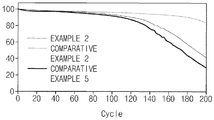
- Example 2 The batteries produced in Example 2, Example 5, and Comparative Example 2 were charged at 4.45 V and stored for 4 weeks at 60 , wherein a remaining discharge solution of the battery was measured to measure a recovery capacity, and whether swelling of the battery occurred was measured to determine swelling characteristic. Results thereof were shown in Tables 2 and 3, respectively.
- Example 5 where the hexane-1,6-dinitrile and the perfluorohexane-1,6-dinitrile were mixed together obtained a synergistic effect in which the recovery capacity and the swelling characteristic were further improved even though the total content of the electrolytic solution additive was the same as compared to Example 2 using only the perfluorohexane-1,6-dinitrile.
- the present disclosure relates to an electrolyte for a lithium secondary battery and a lithium secondary battery including the same, wherein the electrolyte for a lithium secondary battery may improve the battery characteristics of the lithium secondary battery, particularly, the cathode film forming characteristic and the battery resistance characteristic at the high voltage.
Landscapes
- Chemical & Material Sciences (AREA)
- Chemical Kinetics & Catalysis (AREA)
- Electrochemistry (AREA)
- General Chemical & Material Sciences (AREA)
- Engineering & Computer Science (AREA)
- Manufacturing & Machinery (AREA)
- Inorganic Chemistry (AREA)
- Condensed Matter Physics & Semiconductors (AREA)
- General Physics & Mathematics (AREA)
- Physics & Mathematics (AREA)
- Organic Chemistry (AREA)
- Materials Engineering (AREA)
- Secondary Cells (AREA)
Priority Applications (1)
| Application Number | Priority Date | Filing Date | Title |
|---|---|---|---|
| PL16814659T PL3312929T3 (pl) | 2015-06-22 | 2016-06-22 | Elektrolit do litowego ogniwa wtórnego oraz litowe ogniwo wtórne zawierające ten elektrolit |
Applications Claiming Priority (2)
| Application Number | Priority Date | Filing Date | Title |
|---|---|---|---|
| KR20150088579 | 2015-06-22 | ||
| PCT/KR2016/006587 WO2016208946A1 (ko) | 2015-06-22 | 2016-06-22 | 리튬 이차 전지용 전해질 및 이를 포함하는 리튬 이차 전지 |
Publications (3)
| Publication Number | Publication Date |
|---|---|
| EP3312929A4 EP3312929A4 (de) | 2018-04-25 |
| EP3312929A1 true EP3312929A1 (de) | 2018-04-25 |
| EP3312929B1 EP3312929B1 (de) | 2019-04-17 |
Family
ID=57737400
Family Applications (1)
| Application Number | Title | Priority Date | Filing Date |
|---|---|---|---|
| EP16814659.5A Active EP3312929B1 (de) | 2015-06-22 | 2016-06-22 | Elektrolyt für lithiumsekundärbatterie und lithiumsekundärbatterie denselben umfassend |
Country Status (6)
| Country | Link |
|---|---|
| US (1) | US10720665B2 (de) |
| EP (1) | EP3312929B1 (de) |
| JP (1) | JP6559263B2 (de) |
| KR (3) | KR102520457B1 (de) |
| HU (1) | HUE045457T2 (de) |
| PL (1) | PL3312929T3 (de) |
Cited By (3)
| Publication number | Priority date | Publication date | Assignee | Title |
|---|---|---|---|---|
| CN110797576A (zh) * | 2019-11-08 | 2020-02-14 | 广州天赐高新材料股份有限公司 | 一种高电压锂离子电池电解液及锂离子电池 |
| CN111682263A (zh) * | 2020-05-09 | 2020-09-18 | 厦门大学 | 腈类化合物在制备高压电池体系用电解液中的应用 |
| US20220045362A1 (en) * | 2019-04-26 | 2022-02-10 | Contemporary Amperex Technology Co., Limited | Electrolyte, lithium-ion battery, and apparatus containing such lithium-ion battery |
Families Citing this family (7)
| Publication number | Priority date | Publication date | Assignee | Title |
|---|---|---|---|---|
| JP6812827B2 (ja) * | 2017-02-17 | 2021-01-13 | Tdk株式会社 | 非水電解液およびそれを用いた非水電解液電池 |
| KR102383073B1 (ko) | 2017-07-21 | 2022-04-04 | 삼성에스디아이 주식회사 | 리튬 이차 전지용 전해질 및 이를 포함하는 리튬 이차 전지 |
| CN112002942B (zh) * | 2018-09-21 | 2022-08-02 | 宁德新能源科技有限公司 | 一种电解液及包含该电解液的电化学装置 |
| KR102448303B1 (ko) * | 2019-02-07 | 2022-09-28 | 삼성에스디아이 주식회사 | 유기 전해액, 및 이를 포함하는 이차전지 |
| CN111864261A (zh) * | 2019-04-26 | 2020-10-30 | 宁德时代新能源科技股份有限公司 | 电解液及锂离子电池 |
| CN110994026B (zh) * | 2019-12-24 | 2021-03-09 | 河南省法恩莱特新能源科技有限公司 | 一种用于三元掺锰锂电池的宽温电解液及其制备方法 |
| CN116514681B (zh) * | 2023-05-04 | 2025-03-11 | 珠海市赛纬电子材料股份有限公司 | 多腈化合物、及其非水电解液及锂离子电池 |
Family Cites Families (18)
| Publication number | Priority date | Publication date | Assignee | Title |
|---|---|---|---|---|
| JP2000124077A (ja) | 1998-10-19 | 2000-04-28 | Matsushita Electric Ind Co Ltd | 電気二重層キャパシタ |
| JP4918740B2 (ja) * | 2001-02-02 | 2012-04-18 | ダイキン工業株式会社 | 電極表面被膜形成剤 |
| JP4934917B2 (ja) * | 2001-06-22 | 2012-05-23 | 三菱化学株式会社 | 非水系電解液二次電池及びそれに用いる非水系電解液 |
| JP4476530B2 (ja) | 2001-12-21 | 2010-06-09 | 三星エスディアイ株式会社 | 電解質及びリチウム二次電池並びにリチウム二次電池の製造方法 |
| US20030157412A1 (en) | 2001-12-21 | 2003-08-21 | Takitaro Yamaguchi | Electrolyte and rechargeable lithium battery |
| DE602004004956T2 (de) | 2003-08-20 | 2007-11-08 | Samsung SDI Co., Ltd., Suwon | Elektrolyt für wiederaufladbare Lithium-Batterie und wiederaufladbare Lithium-Batterie enthaltend denselben |
| KR20050020067A (ko) | 2003-08-20 | 2005-03-04 | 삼성에스디아이 주식회사 | 리튬 이차 전지용 전해액 및 이를 포함하는 리튬 이차 전지 |
| TWI302760B (en) | 2004-01-15 | 2008-11-01 | Lg Chemical Ltd | Electrochemical device comprising aliphatic nitrile compound |
| US8968938B2 (en) | 2006-01-12 | 2015-03-03 | Lg Chem, Ltd. | Non-aqueous electrolyte and electrochemical device with an improved safety |
| KR100814827B1 (ko) | 2007-04-05 | 2008-03-20 | 삼성에스디아이 주식회사 | 리튬 이차 전지용 전해질 및 이를 포함하는 리튬 이차 전지 |
| JP5217400B2 (ja) * | 2007-06-28 | 2013-06-19 | 三菱化学株式会社 | 二次電池用非水系電解液及びそれを用いた非水系電解液二次電池 |
| CN102017240B (zh) | 2008-05-07 | 2014-11-12 | 日立麦克赛尔株式会社 | 非水二次电池及电子器械 |
| JP5398321B2 (ja) * | 2009-03-30 | 2014-01-29 | 関東電化工業株式会社 | 二次電池用非水電解液及び非水電解液二次電池 |
| US9093702B2 (en) | 2009-09-03 | 2015-07-28 | Samsung Sdi Co., Ltd. | Electrolytic solution for lithium battery, lithium battery employing the same and method for operating the lithium battery |
| WO2012029388A1 (ja) * | 2010-09-02 | 2012-03-08 | 日本電気株式会社 | 二次電池 |
| CN102412418B (zh) | 2010-09-26 | 2014-03-12 | 比亚迪股份有限公司 | 一种锂离子电池电解液及含有该电解液的锂离子电池 |
| JP5977573B2 (ja) * | 2012-04-27 | 2016-08-24 | 旭化成株式会社 | 非水系二次電池 |
| JP5435760B2 (ja) * | 2013-07-09 | 2014-03-05 | 日立マクセル株式会社 | 非水二次電池 |
-
2015
- 2015-11-24 KR KR1020150164593A patent/KR102520457B1/ko active Active
- 2015-11-24 KR KR1020150164598A patent/KR20160150570A/ko not_active Ceased
-
2016
- 2016-06-22 EP EP16814659.5A patent/EP3312929B1/de active Active
- 2016-06-22 KR KR1020160077676A patent/KR20160150604A/ko not_active Ceased
- 2016-06-22 HU HUE16814659A patent/HUE045457T2/hu unknown
- 2016-06-22 PL PL16814659T patent/PL3312929T3/pl unknown
- 2016-06-22 US US15/737,396 patent/US10720665B2/en active Active
- 2016-06-22 JP JP2017566809A patent/JP6559263B2/ja active Active
Cited By (4)
| Publication number | Priority date | Publication date | Assignee | Title |
|---|---|---|---|---|
| US20220045362A1 (en) * | 2019-04-26 | 2022-02-10 | Contemporary Amperex Technology Co., Limited | Electrolyte, lithium-ion battery, and apparatus containing such lithium-ion battery |
| CN110797576A (zh) * | 2019-11-08 | 2020-02-14 | 广州天赐高新材料股份有限公司 | 一种高电压锂离子电池电解液及锂离子电池 |
| CN111682263A (zh) * | 2020-05-09 | 2020-09-18 | 厦门大学 | 腈类化合物在制备高压电池体系用电解液中的应用 |
| CN111682263B (zh) * | 2020-05-09 | 2021-10-15 | 厦门大学 | 腈类化合物在制备高压电池体系用电解液中的应用 |
Also Published As
| Publication number | Publication date |
|---|---|
| HUE045457T2 (hu) | 2019-12-30 |
| JP2018523270A (ja) | 2018-08-16 |
| PL3312929T3 (pl) | 2019-10-31 |
| KR20160150604A (ko) | 2016-12-30 |
| KR102520457B1 (ko) | 2023-04-12 |
| US20180183100A1 (en) | 2018-06-28 |
| EP3312929A4 (de) | 2018-04-25 |
| JP6559263B2 (ja) | 2019-08-14 |
| KR20160150570A (ko) | 2016-12-30 |
| KR20160150569A (ko) | 2016-12-30 |
| US10720665B2 (en) | 2020-07-21 |
| EP3312929B1 (de) | 2019-04-17 |
Similar Documents
| Publication | Publication Date | Title |
|---|---|---|
| EP3312929B1 (de) | Elektrolyt für lithiumsekundärbatterie und lithiumsekundärbatterie denselben umfassend | |
| KR20150022656A (ko) | 전해질 및 이를 포함하는 리튬 이차 전지 | |
| KR20160002314A (ko) | 전해질 및 이를 포함하는 리튬 이차 전지 | |
| KR20160006096A (ko) | 전해질 및 이를 포함하는 리튬 이차 전지 | |
| KR102371079B1 (ko) | 전해질 및 이를 포함하는 리튬 이차 전지 | |
| KR20170052906A (ko) | 전해질 및 이를 포함하는 리튬 이차 전지 | |
| KR20160078071A (ko) | 전해질 및 이를 포함하는 리튬 이차 전지 | |
| KR102291944B1 (ko) | 전해질 및 이를 포함하는 리튬 이차 전지 | |
| KR102414682B1 (ko) | 전해질 및 이를 포함하는 리튬 이차 전지 | |
| KR20170061017A (ko) | 전해질 및 이를 포함하는 리튬 이차 전지 | |
| KR102483368B1 (ko) | 리튬 이차 전지용 전해질 및 이를 포함하는 리튬 이차 전지 | |
| KR102355703B1 (ko) | 전해질 및 이를 포함하는 리튬 이차 전지 | |
| KR102375099B1 (ko) | 전해질 및 이를 포함하는 리튬 이차 전지 | |
| KR20170061030A (ko) | 전해질 및 이를 포함하는 리튬 이차 전지 | |
| KR20170061028A (ko) | 전해질 및 이를 포함하는 리튬 이차 전지 | |
| KR20170057939A (ko) | 리튬 이차전지 전해질 및 이를 포함하는 리튬 이차전지 | |
| KR20170061024A (ko) | 전해질 및 이를 포함하는 리튬 이차 전지 | |
| KR101921545B1 (ko) | 전해질 및 이를 포함하는 리튬 이차 전지 | |
| KR20170057937A (ko) | 전해질 및 이를 포함한 리튬 이차전지 | |
| KR101921543B1 (ko) | 전해질 및 이를 포함하는 리튬 이차 전지 | |
| KR101894403B1 (ko) | 전해질 및 이를 포함하는 리튬 이차 전지 | |
| KR102327302B1 (ko) | 전해질 및 이를 포함하는 리튬 이차 전지 | |
| KR20170071892A (ko) | 리튬 이차전지 전해질 및 이를 포함하는 리튬 이차전지 | |
| KR20170060829A (ko) | 전해질 및 이를 포함하는 리튬 이차 전지 | |
| KR20170060944A (ko) | 전해질 및 이를 포함하는 리튬 이차 전지 |
Legal Events
| Date | Code | Title | Description |
|---|---|---|---|
| STAA | Information on the status of an ep patent application or granted ep patent |
Free format text: STATUS: THE INTERNATIONAL PUBLICATION HAS BEEN MADE |
|
| PUAI | Public reference made under article 153(3) epc to a published international application that has entered the european phase |
Free format text: ORIGINAL CODE: 0009012 |
|
| STAA | Information on the status of an ep patent application or granted ep patent |
Free format text: STATUS: REQUEST FOR EXAMINATION WAS MADE |
|
| 17P | Request for examination filed |
Effective date: 20171221 |
|
| A4 | Supplementary search report drawn up and despatched |
Effective date: 20180326 |
|
| AK | Designated contracting states |
Kind code of ref document: A1 Designated state(s): AL AT BE BG CH CY CZ DE DK EE ES FI FR GB GR HR HU IE IS IT LI LT LU LV MC MK MT NL NO PL PT RO RS SE SI SK SM TR |
|
| AX | Request for extension of the european patent |
Extension state: BA ME |
|
| DAV | Request for validation of the european patent (deleted) | ||
| DAX | Request for extension of the european patent (deleted) | ||
| GRAP | Despatch of communication of intention to grant a patent |
Free format text: ORIGINAL CODE: EPIDOSNIGR1 |
|
| STAA | Information on the status of an ep patent application or granted ep patent |
Free format text: STATUS: GRANT OF PATENT IS INTENDED |
|
| RIC1 | Information provided on ipc code assigned before grant |
Ipc: H01M 10/0567 20100101AFI20181030BHEP Ipc: H01M 10/052 20100101ALI20181030BHEP |
|
| INTG | Intention to grant announced |
Effective date: 20181123 |
|
| GRAS | Grant fee paid |
Free format text: ORIGINAL CODE: EPIDOSNIGR3 |
|
| GRAA | (expected) grant |
Free format text: ORIGINAL CODE: 0009210 |
|
| STAA | Information on the status of an ep patent application or granted ep patent |
Free format text: STATUS: THE PATENT HAS BEEN GRANTED |
|
| AK | Designated contracting states |
Kind code of ref document: B1 Designated state(s): AL AT BE BG CH CY CZ DE DK EE ES FI FR GB GR HR HU IE IS IT LI LT LU LV MC MK MT NL NO PL PT RO RS SE SI SK SM TR |
|
| REG | Reference to a national code |
Ref country code: GB Ref legal event code: FG4D |
|
| REG | Reference to a national code |
Ref country code: CH Ref legal event code: EP |
|
| REG | Reference to a national code |
Ref country code: DE Ref legal event code: R096 Ref document number: 602016012673 Country of ref document: DE |
|
| REG | Reference to a national code |
Ref country code: AT Ref legal event code: REF Ref document number: 1122574 Country of ref document: AT Kind code of ref document: T Effective date: 20190515 Ref country code: IE Ref legal event code: FG4D |
|
| REG | Reference to a national code |
Ref country code: NL Ref legal event code: MP Effective date: 20190417 |
|
| REG | Reference to a national code |
Ref country code: LT Ref legal event code: MG4D |
|
| PG25 | Lapsed in a contracting state [announced via postgrant information from national office to epo] |
Ref country code: NL Free format text: LAPSE BECAUSE OF FAILURE TO SUBMIT A TRANSLATION OF THE DESCRIPTION OR TO PAY THE FEE WITHIN THE PRESCRIBED TIME-LIMIT Effective date: 20190417 |
|
| PG25 | Lapsed in a contracting state [announced via postgrant information from national office to epo] |
Ref country code: HR Free format text: LAPSE BECAUSE OF FAILURE TO SUBMIT A TRANSLATION OF THE DESCRIPTION OR TO PAY THE FEE WITHIN THE PRESCRIBED TIME-LIMIT Effective date: 20190417 Ref country code: ES Free format text: LAPSE BECAUSE OF FAILURE TO SUBMIT A TRANSLATION OF THE DESCRIPTION OR TO PAY THE FEE WITHIN THE PRESCRIBED TIME-LIMIT Effective date: 20190417 Ref country code: LT Free format text: LAPSE BECAUSE OF FAILURE TO SUBMIT A TRANSLATION OF THE DESCRIPTION OR TO PAY THE FEE WITHIN THE PRESCRIBED TIME-LIMIT Effective date: 20190417 Ref country code: NO Free format text: LAPSE BECAUSE OF FAILURE TO SUBMIT A TRANSLATION OF THE DESCRIPTION OR TO PAY THE FEE WITHIN THE PRESCRIBED TIME-LIMIT Effective date: 20190717 Ref country code: FI Free format text: LAPSE BECAUSE OF FAILURE TO SUBMIT A TRANSLATION OF THE DESCRIPTION OR TO PAY THE FEE WITHIN THE PRESCRIBED TIME-LIMIT Effective date: 20190417 Ref country code: PT Free format text: LAPSE BECAUSE OF FAILURE TO SUBMIT A TRANSLATION OF THE DESCRIPTION OR TO PAY THE FEE WITHIN THE PRESCRIBED TIME-LIMIT Effective date: 20190817 Ref country code: AL Free format text: LAPSE BECAUSE OF FAILURE TO SUBMIT A TRANSLATION OF THE DESCRIPTION OR TO PAY THE FEE WITHIN THE PRESCRIBED TIME-LIMIT Effective date: 20190417 Ref country code: SE Free format text: LAPSE BECAUSE OF FAILURE TO SUBMIT A TRANSLATION OF THE DESCRIPTION OR TO PAY THE FEE WITHIN THE PRESCRIBED TIME-LIMIT Effective date: 20190417 |
|
| PG25 | Lapsed in a contracting state [announced via postgrant information from national office to epo] |
Ref country code: GR Free format text: LAPSE BECAUSE OF FAILURE TO SUBMIT A TRANSLATION OF THE DESCRIPTION OR TO PAY THE FEE WITHIN THE PRESCRIBED TIME-LIMIT Effective date: 20190718 Ref country code: LV Free format text: LAPSE BECAUSE OF FAILURE TO SUBMIT A TRANSLATION OF THE DESCRIPTION OR TO PAY THE FEE WITHIN THE PRESCRIBED TIME-LIMIT Effective date: 20190417 Ref country code: RS Free format text: LAPSE BECAUSE OF FAILURE TO SUBMIT A TRANSLATION OF THE DESCRIPTION OR TO PAY THE FEE WITHIN THE PRESCRIBED TIME-LIMIT Effective date: 20190417 Ref country code: BG Free format text: LAPSE BECAUSE OF FAILURE TO SUBMIT A TRANSLATION OF THE DESCRIPTION OR TO PAY THE FEE WITHIN THE PRESCRIBED TIME-LIMIT Effective date: 20190717 |
|
| REG | Reference to a national code |
Ref country code: AT Ref legal event code: MK05 Ref document number: 1122574 Country of ref document: AT Kind code of ref document: T Effective date: 20190417 |
|
| REG | Reference to a national code |
Ref country code: HU Ref legal event code: AG4A Ref document number: E045457 Country of ref document: HU |
|
| PG25 | Lapsed in a contracting state [announced via postgrant information from national office to epo] |
Ref country code: IS Free format text: LAPSE BECAUSE OF FAILURE TO SUBMIT A TRANSLATION OF THE DESCRIPTION OR TO PAY THE FEE WITHIN THE PRESCRIBED TIME-LIMIT Effective date: 20190817 |
|
| REG | Reference to a national code |
Ref country code: DE Ref legal event code: R119 Ref document number: 602016012673 Country of ref document: DE |
|
| PG25 | Lapsed in a contracting state [announced via postgrant information from national office to epo] |
Ref country code: DK Free format text: LAPSE BECAUSE OF FAILURE TO SUBMIT A TRANSLATION OF THE DESCRIPTION OR TO PAY THE FEE WITHIN THE PRESCRIBED TIME-LIMIT Effective date: 20190417 Ref country code: EE Free format text: LAPSE BECAUSE OF FAILURE TO SUBMIT A TRANSLATION OF THE DESCRIPTION OR TO PAY THE FEE WITHIN THE PRESCRIBED TIME-LIMIT Effective date: 20190417 Ref country code: AT Free format text: LAPSE BECAUSE OF FAILURE TO SUBMIT A TRANSLATION OF THE DESCRIPTION OR TO PAY THE FEE WITHIN THE PRESCRIBED TIME-LIMIT Effective date: 20190417 Ref country code: RO Free format text: LAPSE BECAUSE OF FAILURE TO SUBMIT A TRANSLATION OF THE DESCRIPTION OR TO PAY THE FEE WITHIN THE PRESCRIBED TIME-LIMIT Effective date: 20190417 Ref country code: CZ Free format text: LAPSE BECAUSE OF FAILURE TO SUBMIT A TRANSLATION OF THE DESCRIPTION OR TO PAY THE FEE WITHIN THE PRESCRIBED TIME-LIMIT Effective date: 20190417 Ref country code: MC Free format text: LAPSE BECAUSE OF FAILURE TO SUBMIT A TRANSLATION OF THE DESCRIPTION OR TO PAY THE FEE WITHIN THE PRESCRIBED TIME-LIMIT Effective date: 20190417 Ref country code: SK Free format text: LAPSE BECAUSE OF FAILURE TO SUBMIT A TRANSLATION OF THE DESCRIPTION OR TO PAY THE FEE WITHIN THE PRESCRIBED TIME-LIMIT Effective date: 20190417 |
|
| REG | Reference to a national code |
Ref country code: CH Ref legal event code: PL |
|
| PLBE | No opposition filed within time limit |
Free format text: ORIGINAL CODE: 0009261 |
|
| STAA | Information on the status of an ep patent application or granted ep patent |
Free format text: STATUS: NO OPPOSITION FILED WITHIN TIME LIMIT |
|
| PG25 | Lapsed in a contracting state [announced via postgrant information from national office to epo] |
Ref country code: SM Free format text: LAPSE BECAUSE OF FAILURE TO SUBMIT A TRANSLATION OF THE DESCRIPTION OR TO PAY THE FEE WITHIN THE PRESCRIBED TIME-LIMIT Effective date: 20190417 Ref country code: IT Free format text: LAPSE BECAUSE OF FAILURE TO SUBMIT A TRANSLATION OF THE DESCRIPTION OR TO PAY THE FEE WITHIN THE PRESCRIBED TIME-LIMIT Effective date: 20190417 |
|
| 26N | No opposition filed |
Effective date: 20200120 |
|
| REG | Reference to a national code |
Ref country code: BE Ref legal event code: MM Effective date: 20190630 |
|
| PG25 | Lapsed in a contracting state [announced via postgrant information from national office to epo] |
Ref country code: TR Free format text: LAPSE BECAUSE OF FAILURE TO SUBMIT A TRANSLATION OF THE DESCRIPTION OR TO PAY THE FEE WITHIN THE PRESCRIBED TIME-LIMIT Effective date: 20190417 |
|
| PG25 | Lapsed in a contracting state [announced via postgrant information from national office to epo] |
Ref country code: IE Free format text: LAPSE BECAUSE OF NON-PAYMENT OF DUE FEES Effective date: 20190622 Ref country code: DE Free format text: LAPSE BECAUSE OF NON-PAYMENT OF DUE FEES Effective date: 20200101 |
|
| PG25 | Lapsed in a contracting state [announced via postgrant information from national office to epo] |
Ref country code: CH Free format text: LAPSE BECAUSE OF NON-PAYMENT OF DUE FEES Effective date: 20190630 Ref country code: BE Free format text: LAPSE BECAUSE OF NON-PAYMENT OF DUE FEES Effective date: 20190630 Ref country code: LU Free format text: LAPSE BECAUSE OF NON-PAYMENT OF DUE FEES Effective date: 20190622 Ref country code: SI Free format text: LAPSE BECAUSE OF FAILURE TO SUBMIT A TRANSLATION OF THE DESCRIPTION OR TO PAY THE FEE WITHIN THE PRESCRIBED TIME-LIMIT Effective date: 20190417 Ref country code: LI Free format text: LAPSE BECAUSE OF NON-PAYMENT OF DUE FEES Effective date: 20190630 |
|
| PG25 | Lapsed in a contracting state [announced via postgrant information from national office to epo] |
Ref country code: FR Free format text: LAPSE BECAUSE OF NON-PAYMENT OF DUE FEES Effective date: 20190630 |
|
| GBPC | Gb: european patent ceased through non-payment of renewal fee |
Effective date: 20200622 |
|
| PG25 | Lapsed in a contracting state [announced via postgrant information from national office to epo] |
Ref country code: GB Free format text: LAPSE BECAUSE OF NON-PAYMENT OF DUE FEES Effective date: 20200622 |
|
| PG25 | Lapsed in a contracting state [announced via postgrant information from national office to epo] |
Ref country code: CY Free format text: LAPSE BECAUSE OF FAILURE TO SUBMIT A TRANSLATION OF THE DESCRIPTION OR TO PAY THE FEE WITHIN THE PRESCRIBED TIME-LIMIT Effective date: 20190417 |
|
| PG25 | Lapsed in a contracting state [announced via postgrant information from national office to epo] |
Ref country code: MT Free format text: LAPSE BECAUSE OF FAILURE TO SUBMIT A TRANSLATION OF THE DESCRIPTION OR TO PAY THE FEE WITHIN THE PRESCRIBED TIME-LIMIT Effective date: 20190417 |
|
| PG25 | Lapsed in a contracting state [announced via postgrant information from national office to epo] |
Ref country code: MK Free format text: LAPSE BECAUSE OF FAILURE TO SUBMIT A TRANSLATION OF THE DESCRIPTION OR TO PAY THE FEE WITHIN THE PRESCRIBED TIME-LIMIT Effective date: 20190417 |
|
| PGFP | Annual fee paid to national office [announced via postgrant information from national office to epo] |
Ref country code: PL Payment date: 20250328 Year of fee payment: 10 |
|
| PGFP | Annual fee paid to national office [announced via postgrant information from national office to epo] |
Ref country code: HU Payment date: 20250529 Year of fee payment: 10 |