EP3313111B1 - Changement de souscription de domaine d'opérateur initié par un réseau de communication - Google Patents
Changement de souscription de domaine d'opérateur initié par un réseau de communication Download PDFInfo
- Publication number
- EP3313111B1 EP3313111B1 EP16195098.5A EP16195098A EP3313111B1 EP 3313111 B1 EP3313111 B1 EP 3313111B1 EP 16195098 A EP16195098 A EP 16195098A EP 3313111 B1 EP3313111 B1 EP 3313111B1
- Authority
- EP
- European Patent Office
- Prior art keywords
- operator domain
- subscriber identity
- domain
- operator
- subscription
- Prior art date
- Legal status (The legal status is an assumption and is not a legal conclusion. Google has not performed a legal analysis and makes no representation as to the accuracy of the status listed.)
- Active
Links
Images




Classifications
-
- H—ELECTRICITY
- H04—ELECTRIC COMMUNICATION TECHNIQUE
- H04W—WIRELESS COMMUNICATION NETWORKS
- H04W12/00—Security arrangements; Authentication; Protecting privacy or anonymity
- H04W12/06—Authentication
-
- H—ELECTRICITY
- H04—ELECTRIC COMMUNICATION TECHNIQUE
- H04W—WIRELESS COMMUNICATION NETWORKS
- H04W12/00—Security arrangements; Authentication; Protecting privacy or anonymity
- H04W12/30—Security of mobile devices; Security of mobile applications
- H04W12/35—Protecting application or service provisioning, e.g. securing SIM application provisioning
-
- H—ELECTRICITY
- H04—ELECTRIC COMMUNICATION TECHNIQUE
- H04W—WIRELESS COMMUNICATION NETWORKS
- H04W4/00—Services specially adapted for wireless communication networks; Facilities therefor
- H04W4/50—Service provisioning or reconfiguring
-
- H—ELECTRICITY
- H04—ELECTRIC COMMUNICATION TECHNIQUE
- H04W—WIRELESS COMMUNICATION NETWORKS
- H04W12/00—Security arrangements; Authentication; Protecting privacy or anonymity
- H04W12/40—Security arrangements using identity modules
- H04W12/45—Security arrangements using identity modules using multiple identity modules
-
- H—ELECTRICITY
- H04—ELECTRIC COMMUNICATION TECHNIQUE
- H04W—WIRELESS COMMUNICATION NETWORKS
- H04W60/00—Affiliation to network, e.g. registration; Terminating affiliation with the network, e.g. de-registration
- H04W60/005—Multiple registrations, e.g. multihoming
Definitions
- the present invention relates to a method of switching operator domain subscriptions in a communication network. More specifically, the invention relates to a communication network initiated method of switching between different user subscriptions. The invention also relates to a communication terminal for carrying out the method.
- Mobile phones or terminals (sometimes also referred to as user equipment (UE)) supporting, amongst others, 3rd (3G) generation partnership project (3GPP) compliant access technologies can access a single radio access network (RAN), network and service domain at a time. Accessing several domains simultaneously would require several modems and universal integrated circuit cards (UICCs).
- the UICC identifies the user of a mobile terminal to a wireless network operator so that the operator knows the user's plan and services.
- the UICC can store the user's contacts, and enables a secure and reliable voice and multimedia data connection, and global roaming.
- the UICC is the universal application delivery platform that works with any 3G or 4G device.
- the UICC is a smart card and works in all mobile telecommunication networks.
- the UICC comprises a computer, or microprocessor, its own data storage and software. It is an evolution of the subscriber identity module (SIM) used to identify subscribers in global system for mobile communications (GSM) networks.
- SIM subscriber identity module
- UICC universal subscriber identity module
- UMTS universal mobile telecommunications system
- HSPA high speed packet access
- LTE long term evolution
- IP internet protocol
- ISIM multimedia services identity module
- UICC can communicate using IP, the same standard used in the internet and the new generation of wireless networks.
- US2013/0023235 A1 discloses a method which relates to provisioning an UICC with multiple services.
- the UICC enables a wireless communication device to communicate through multiple carriers by using a unique virtual SIM to register with each carrier.
- the unique virtual SIM is one of a plurality of virtual SIMs stored on and managed by the UICC.
- a carrier network includes a server for provisioning a new virtual SIM on a UICC over-the-air (OTA) when a new customer requests a service such as voice, data, or other type of service.
- OTA over-the-air
- These UICCs may also include logic to automatically select the best carrier for a voice call depending on the user settings.
- EP2 448 301 A1 relates to a method that allows a device to migrate wireless service across multiple wireless networks.
- the method enables storing and switching between multiple electronic SIMs (eSIMs), where each eSIM is specific to a different carrier network.
- eSIMs electronic SIMs
- the user device can authenticate itself with the selected carrier, rather than roaming.
- the user equipment can load one or more of the previously stored eSIMs. Selection of the eSIM can be done manually by the user or can be driven by the user equipment based on desired context; for example, based on carrier signal strength, cost-effectiveness, etc.
- US2013/0165073 A1 relates to a method for emulating a plurality of subscriptions.
- multiple virtual UICCs may be configured as independent UICCs and they may be hosted by a eUICC.
- the method is configured to enable two or more subscriptions (eg profiles), implemented on two or more vUICCs, that are configured to emulate multiple active network subscriptions that result in at least a dual SIM environment.
- EP 3 073 773 A2 discloses a method for performing a remote management of a multi-subscription SIM module.
- the multi-subscription SIM module comprises at least one memory adapted to store a first and a second profile associated with a respective first and a second mobile network operator, such that a respective content may be associated with each profile.
- the proposed new solution has the advantage that the switching can be automatically initiated by the communication network once a given criterion is met. Thus, the communication terminal can simply follow the instructions received from the communication network.
- the proposed solution also increases public safety, because thanks to the invention, it is extremely unlikely that the communication terminal would find itself in a situation where it cannot connect to any operator domain.
- a computer program product arranged to execute the method according to the first aspect of the present invention.
- a network processing unit arranged to carry out the method according to the first aspect of the present invention.
- eSIM embedded SIM
- eSIMs are reprogrammable.
- the profile of a chosen operator can be installed, activated or changed via an encrypted communication over a mobile or fixed network.
- a domain controlling unit referred to as a network algorithm or first algorithm, which in the described embodiment is on the network domain side, will be able to activate an appropriate USIM/ISIM (and deactivate another USIMs/ISIMs) according to various use cases or scenarios, remotely or via a controlling application (app) installed on the communication terminal.
- a wireless communication device 3 which in this example is a mobile phone or terminal (also known as a UE) comprises a single subscriber identity unit 5 (ie only one subscriber identity unit 5 and only one hardware slot for it), which in this example is a UICC.
- the mobile phone 3 supports multiple subscriber identities.
- the subscriber identity unit is understood any kind of subscriber identity module or card (or subscriber identified for short) which somehow identifies the user of the mobile phone and which can have various subscriber identity applications on it.
- the subscriber identity unit may comprise security credentials and/or one or more subscriber keys.
- the subscriber identity unit covers UICCs and eSIMs for example.
- the UICC 5 comprises multiple USIM and ISIM applications 7 defining (eg by the security credentials and/or subscriber identity information) a user subscription to a specific operator domain of the communication network.
- the subscription information is saved on the USIM and/or ISIM.
- there is a corresponding ISIM so that they can be considered as a USIM/ISIM pair enabling communications with a specific operator domain.
- the operation of the USIMs/ISIMs can be controlled by a second algorithm 9, referred to here as a UICC algorithm.
- the UICC algorithm is configured to activate/deactivate and optionally reboot or reset the USIMs/ISIMs according to instructions received from a first application programming interface (API) 11, referred to here as an API reset, and/or a second application programming interface 13, referred to here as an API domain change, which in this example also comprises an API OTA SMS (API over-the-air programming short message service).
- API application programming interface
- the API reset 11 is configured to reset the UICC to operate in a master or default domain corresponding in this example to the USIM/ISIM 1.
- the API reset 11 is configured to select and activate the USIM/ISIM associated with the master domain, and deactivate the other USIM/ISIMs. In this example, the API reset 11 is not configured to activate other USIMs or ISIMs.
- the API reset 11 is configured to receive instructions from a terminal specific human interface 15, which is part of the mobile phone 3.
- the mobile phone 3 further comprises a control application 17, referred to as a control app, which is also configured to send instructions to the API reset unit 11.
- the control app 17 is also configured to bidirectionally communicate with the API domain change 13 as explained later in more detail.
- a network processing unit 19 (one per operator domain), which in this example comprises three elements as shown in Figure 1 .
- a third API 21 is located between the network algorithm 23 and a service and/or network domain 25, which is the master domain (service and/or network domain 1).
- an OTA platform 27 which is configured to bidirectionally communicate with the API OTA SMS of the API domain change 13. The security of the system can be improved, if only a registered and/or previously approved control app 17 and/or the OTA platform 27 is/are able to access the APIs of the UICC 9. Furthermore, if the APIs of the UICC 9 cannot provide feedback on the switching procedure, the control app 17 may be able to poll other APIs of the mobile phone 3 to access the information.
- the network side is understood to comprise all the elements of Figure 1 apart from the mobile phone 3 and the elements included therein.
- the network processing unit 19 is part of the master domain, controlled by the master domain and is arranged to send responses received from the UICC algorithm 9 (via its API 21) back to the master domain.
- the master domain has a comprehensive control over the mobile phone 3. Only the master domain (and more specifically its network processing unit 19) can decide to initiate the subscription switching procedure.
- the network processing unit 19 preferably has knowledge about the network conditions (eg network congestion, malfunction etc) in all the operator domains of the communication network 1.
- the knowledge about the operational conditions in the different domains can be derived automatically (via eg obtaining the network status from the different domains) or by human intervention (eg after a catastrophic situation, such as earthquake, terror attack etc).
- a network operator also known as a service provider or communication network carrier, is a provider of services that owns or controls all the elements necessary to sell and deliver services to an end user including eg radio spectrum allocation, wireless or wired infrastructure and/or core network infrastructure.
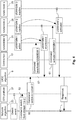
- an operator domain switching or handover (the word handover is used here in its broad sense) from the service and/or network domain 1 to the service and/or network domain 2 (through the access domain 2) is carried out by using the control app 17.
- the processing unit 19 and more specifically the network algorithm 23 detects that a given switching condition or criterion is fulfilled or that a given event has taken place in the domain 1, which triggers the operator domain handover or switching procedure.
- the condition or event may be for example at least one of the following: network outage, network malfunction, network performance (degradation), network service break and network redundancy in another domain.
- the physical location of the mobile phone 3 could also be used for determining which subscription should be used next.
- the physical location may be obtained from a satellite positioning system or from a cell identity of a cellular network, for instance.
- a first subscription could be used when the terminal is within a given boundary (eg company premises or a campus) and a second subscription when outside of the boundary.
- a time aspect could be also used alone or in combination with the above events/criteria for determining which subscription should be used. For example, from Monday to Friday, the first subscription should be used while on Saturday and Sunday the second subscription should be used.
- Login information or status eg to a company domain or to a specific information technology (IT) domain
- IT information technology
- Step 31 may also comprise determining to which operator domain the switching procedure should be performed.
- the domain 1 is aware of the network operational conditions in the other domains and may even, based on this information, rank the domains in order of preference. In this example, it is determined that the domain 2 is the most suitable operator domain for the mobile phone 3 under the present circumstances.
- the network algorithm 23 commands the control app 17 to move the communications of the mobile phone from the domain 1 to the domain 2.
- the control app 17 commands the UICC algorithm 9 to switch from the domain 1 to the domain 2.
- the UICC algorithm 9 deactivates the USIM/ISIM 1 and in step 39 it receives a confirmation from the USIM/ISIM 1 that the USIM/ISIM 1 is now inactive.
- step 41 the UICC algorithm 9 activates the USIM/ISIM 2 and in step 43 it receives a confirmation from the USIM/ISIM 2 that the USIM/ISIM 2 is now active.
- activation refers to activation of the relevant USIM/ISIM (or any corresponding unit) and the following network attach procedure
- deactivation comprises the deactivation of the relevant USIM/ISIM and the following network detach procedure.
- step 45 the UICC algorithm 9 informs the control app 17 that the switching procedure to the operator domain 2 was successful and in step 47, the control app 17 informs the network algorithm 23 that the switching procedure has been successful.
- the activation and deactivation steps may be performed in a reverse order or substantially simultaneously and that the feedback information is optional (also in the following scenarios). Furthermore, according to the present invention, if the switching procedure fails for some reason, then the mobile phone 3 may be switched back to the master domain or it can be ordered to use its default subscription.
- the flow chart of Figure 3 illustrates a scenario where an operator domain switching procedure from the service and/or network domain 2 to the service and/or network domain 3 (through the access domain 3) is carried out by using the control app 17.
- the process is substantially identical to the process illustrated in the flow chart of Figure 2 apart from the fact that now the switch is performed to the domain 3 as opposed to the domain 2 in the flow chart of Figure 2 .
- the flow chart of Figure 4 illustrates a scenario where an operator domain switching procedure from the service and/or network domain 1 to the service and/or network domain 2 (through the access domain 2) is carried out by using the OTA platform 27.
- the process is quite similar to the process illustrated in the flow chart of Figure 2 with the difference that the control app 17 is not involved in this scenario.
- the processing unit 19 and more specifically the network algorithm 23 detects an event in the network (or that a switching criterion has been fulfilled), which triggers the switching procedure.
- This step also comprises determining to which operator domain the mobile phone should be switched. In this example, it is determined that the domain 2 is the most suitable operator domain for the mobile phone 3 under the present circumstances.
- step 53 the network algorithm 23 commands the OTA platform 27 to execute the operator domain switching procedure from the domain 1 to the domain 2.
- the OTA platform 27 commands the UICC algorithm 9 to switch the mobile phone 3 from the domain 1 to the domain 2.
- the remaining steps 57, 59, 61, 63 and 67 substantially correspond to the steps 37, 39, 41, 43 and 47 with the exception that in step 67, the response is directly sent from the UICC algorithm 9 to the network algorithm 23 or via the control app 17.
- the flow chart of Figures 5a and 5b illustrates a scenario where an operator domain switching procedure from the service and/or network domain 2 to the service and/or network domain 3 (through the access domain 3) is carried out by using the OTA platform 27.
- the processing unit 19 and more specifically the network algorithm 23 detects an event in the network (or that a switching criterion has been fulfilled), which triggers the operator domain switching procedure.
- the criterion or event may be at least one of the criteria and/or events explained above.
- This step also comprises determining to which operator domain the mobile phone 3 should be switched. In this example, it is determined that the domain 3 is the most suitable operator domain for the mobile phone 3 under the present circumstances.
- the network algorithm 23 commands the control app 17 to execute the operator domain switching procedure from the domain 2 to the domain 3.
- the OTA platform 27 cannot directly command the switch to the domain 3, because the over-the-air provisioning is only possible between an operator and subscriber identity modules belonging to it.
- the OTA mechanism enables the operator to provision/modify the network settings of a specific user terminal of its subscriber basis. Since the subscriber identity module credentials are directly linked to a specific operator, it is not possible for the operator to send OTA commands to subscriber identity modules which do not belong to it.
- a set of short messages is typically sent to a specific terminal to (re)configure it.
- step 75 the control app 17 commands the UICC algorithm 9 to switch from the domain 2 to the domain 1. More specifically, in this case the control app 17 instructs the API reset 11 to switch the mobile phone 3 to the master domain (the domain 1).
- step 77 the UICC algorithm 9 deactivates the USIM/ISIM 2 and in step 79 it receives a confirmation from the USIM/ISIM 2 that the USIM/ISIM 2 is now inactive.
- step 81 the UICC algorithm 9 activates the USIM/ISIM 1 and in step 83 it receives a confirmation from the USIM/ISIM 1 that the USIM/ISIM 1 has been activated.
- step 85 the UICC algorithm 9 informs the control app 17 that the switch to the operator domain 1 was successful and in step 87, the control app 17 informs the network algorithm 23 that the switch to the domain 1 was successful.
- the OTA platform 27 can be used to execute the switching procedure to the domain 3.
- the network algorithm 23 commands the OTA platform 27 to switch the mobile phone 3 to the domain 3.
- the OTA platform 27 instructs the UICC algorithm 9 via a short message to switch the mobile phone 3 to the domain 3.
- the UICC algorithm 9 deactivates the USIM/ISIM 1 and receives, in step 95, a confirmation from the USIM/ISIM 1 that the USIM/ISIM 1 is now inactive.
- the UICC algorithm 9 activates the USIM/ISIM 3 and receives, in step 99, a confirmation from the USIM/ISIM 3 that the USIM/ISIM 13 is now active.
- the UICC algorithm confirms, via the OTA platform 27, to the network algorithm 23 that the switching procedure has been successfully completed to the domain 3.
- the teachings of the present invention were explained in the context of the UICC. However, the teachings of the present invention are likewise applicable to eSIMs, for example.
- the USIM/ISIM configurations could be deleted and/or installed remotely.
- the interface 15, or any other corresponding element may be used by the user of the mobile phone 3 to force the mobile phone 3 to the master domain at any moment. In this case, the interface 15 would instruct the API reset 11 to switch the UICC/eSIM algorithm 9 to the master domain.
- the UICC 9 may be configured to detect any domain or subscription switch request initiated by external systems and is configured to react as programmed.
- the OTA platform 27 could be replaced by another communication platform to allow electronic communication between that communication platform and the API domain change 13.
- control app 17 may possess all or some of the functionalities of the network processing unit 19.
- the mobile phone 3 would have at least some control over the domain switching. This way of operating would be enabled by the network processing unit 19 and could be used eg in some emergency situations. The user initiated switching may however need to be approved by the network processing unit 19. Furthermore, it is possible to carry out the switching process so that if the mobile phone 3 comprises the USIM/ISIM pair, then only one of these modules is switched to another domain (eg so that the USIM 1 and ISIM 2 are both active at the same time).
- the network algorithm 23 decides how to initiate the switching process and how to execute it. There are several ways to transfer the switching command from the network algorithm 23 to the UICC 9 depending for example on the domain and access technology, and the network algorithm 23 should be able to select the most suitable one. For instance, if the mobile phone 3 is currently connected to the master domain, then the OTA approach (via SMS) may be the preferred one. If the mobile phone 3 is connected to a secondary domain via LTE or via another IP network connection, then the existing IP connection by using the control app 17 may be used.
- an IP connection could be initiated via a push SMS (and the switch could be carried out by using the control app 17).
- the control app 17 could regularly or not poll for any pending event (from the network algorithm 23).
- Switching a USIM/ISIM includes the process of writing new the credentials and settings to a memory of the UICC 9 (referred to as a memory swap).
- a memory swap has a negative impact on the UICC lifetime and should preferably be avoided.
- not the entire USIM content is swapped but advantageously only the relevant parts. For instance, if the subscriptions are changed within the same operator, large portions of the data (eg the home public land mobile network (HPLMN)) are the same between these subscriptions.
- HPLMN home public land mobile network
Landscapes
- Engineering & Computer Science (AREA)
- Computer Security & Cryptography (AREA)
- Computer Networks & Wireless Communication (AREA)
- Signal Processing (AREA)
- Mobile Radio Communication Systems (AREA)
Claims (13)
- Un procédé initié par un réseau de communication pour une unité de traitement de réseau (19) pour commander un terminal de communication (3) dans un réseau de communication (1) pour exécuter un changement de souscription de domaine d'opérateur d'une première souscription de domaine d'opérateur à une deuxième souscription de domaine d'opérateur, différente de la première souscription de domaine d'opérateur, le terminal de communication (3) comprenant une unité d'identité d'abonné (5) comprenant au moins une première application d'identité d'abonné (7) définissant la première souscription de domaine d'opérateur pour accéder à un premier domaine d'opérateur (25), et une deuxième application d'identité d'abonné (7) définissant la deuxième souscription de domaine d'opérateur pour accéder à un deuxième domaine d'opérateur (25), le procédé comprenant les étapes suivantes :• l'unité de traitement de réseau (19) dans le réseau de communication (1) détectant (31) qu'au moins un critère de changement a été rempli dans le réseau de communication (1) ;• l'unité de traitement de réseau (19) classant une multiplicité de domaines d'opérateur du réseau de communication (1) par ordre de préférence ; et• l'unité de traitement de réseau (19) envoyant (33), en réponse à au moins un critère de changement détecté, une commande, reposant sur le classement, au terminal de communication (3) de rediriger le terminal de communication (3) pour utiliser la deuxième souscription de domaine d'opérateur au lieu d'utiliser la première souscription de domaine d'opérateur en désactivant la première application d'identité d'abonné (7), et en activant (41) la deuxième application d'identité d'abonné (7) pour communiquer dans le deuxième domaine d'opérateur (25) en utilisant la deuxième souscription de domaine d'opérateur.
- Le procédé selon la revendication 1, dans lequel au moins un critère de changement est au moins l'un des critères suivants : panne de domaine d'opérateur, dysfonctionnement de domaine d'opérateur, redondance de domaine d'opérateur, coupure de service de domaine d'opérateur, lieu physique donné du terminal de communication et instant donné.
- Le procédé selon l'une quelconque des revendications précédentes, dans lequel le deuxième domaine d'opérateur (25) est différent du premier domaine d'opérateur (25).
- Le procédé selon l'une quelconque des revendications précédentes, dans lequel une application de contrôle (17) du terminal de communication (3) traite la requête et demande à un algorithme de traitement (9) sur l'unité d'identité d'abonné (5) de désactiver la première application d'identité d'abonné (7), et d'activer la deuxième application d'identité d'abonné (7).
- Le procédé selon la revendication 4, dans lequel l'unité de traitement de réseau (19) comprend une plateforme de programmation en direct (27), et dans lequel l'unité de traitement de réseau (19) demande à l'application de contrôle (17) de rediriger le terminal de communication (3) pour utiliser de nouveau la première souscription d'opérateur, et dans lequel la plateforme de programmation en direct (27) envoie un message à l'algorithme de traitement (9) pour désactiver la première application d'identité d'abonné (7), et pour activer une troisième application d'identité d'abonné (7) de l'unité d'identité d'abonné (5) pour communiquer dans un troisième domaine d'opérateur (25).
- Le procédé selon l'une quelconque des revendications 1 à 4, dans lequel l'unité de traitement de réseau (19) comprend une plateforme de programmation en direct (27), et dans lequel la plateforme de programmation en direct (27) envoie un message à un algorithme de traitement (9) sur l'unité d'identité d'abonné (5) pour désactiver la première application d'identité d'abonné (7) et pour activer la deuxième application d'identité d'abonné (7).
- Le procédé selon l'une quelconque des revendications précédentes, dans lequel le procédé comprend en outre le terminal de communication (3) recevant via une interface utilisateur (15) une commande en provenance de l'utilisateur pour rediriger de nouveau le terminal de communication (3) pour utiliser la première souscription de domaine d'opérateur.
- Le procédé selon l'une quelconque des revendications précédentes, dans lequel le premier domaine d'opérateur (25) est un domaine d'opérateur par défaut du terminal de communication (3), et dans lequel l'unité de traitement de réseau (19) est située dans le premier domaine d'opérateur (25).
- Le procédé selon l'une quelconque des revendications précédentes, dans lequel une application de contrôle (17) du terminal de communication (3) détermine que le terminal de communication (3) devrait être de nouveau redirigé pour utiliser la première souscription de domaine, et dans lequel l'application de contrôle (17) demande à un algorithme de traitement (9) sur l'unité d'identité d'abonné (5) de désactiver la deuxième application d'identité d'abonné (7) et d'activer la première application d'identité d'abonné (7).
- Le procédé selon l'une quelconque des revendications précédentes, dans lequel le terminal de communication (3) est un terminal de communication (3) à unité d'identité d'abonné unique.
- Le procédé selon l'une quelconque des revendications précédentes, dans lequel l'unité d'identité d'abonné (5) est une carte à circuit intégré universelle ou un module d'identité d'abonné intégré.
- Le procédé selon l'une quelconque des revendications précédentes, dans lequel la première application d'identité d'abonné (7) comprend un premier module d'identité d'abonné universel et/ou un module d'identité de services multimédia de protocole Internet du premier domaine d'opérateur (25), tandis que la deuxième application d'identité d'abonné (7) comprend un deuxième module d'identité d'abonné universel et/ou un module d'identité de services multimédia de protocole Internet du deuxième domaine d'opérateur (25).
- Une unité de traitement de réseau (19) pour donner l'ordre à un terminal de communication (3) dans un réseau de communication (1) d'exécuter un changement de souscription de domaine d'opérateur dans le réseau de communication (1), d'une première souscription de domaine d'opérateur à une deuxième souscription de domaine d'opérateur, différente de la première souscription de domaine d'opérateur, la première souscription de domaine d'opérateur étant définie par une première application d'identité d'abonné (7) pour accéder à un premier domaine d'opérateur (25), et la deuxième souscription de domaine d'opérateur étant définie par une deuxième application d'identité d'abonné (7) pour accéder à un deuxième domaine d'opérateur (25), l'unité de traitement de réseau (19) comprenant des moyens pour :• détecter qu'au moins un critère de changement a été rempli dans le réseau de communication (1) ;• classer une multiplicité de domaines d'opérateur du réseau de communication (1) par ordre de préférence ; et• envoyer, en réponse à au moins un critère de changement détecté, une commande, reposant sur le classement, au terminal de communication (3) de rediriger le terminal de communication (3) pour utiliser la deuxième souscription de domaine d'opérateur au lieu d'utiliser la première souscription de domaine d'opérateur en désactivant la première application d'identité d'abonné (7), et en activant la deuxième application d'identité d'abonné (7) pour communiquer dans le deuxième domaine d'opérateur (25) en utilisant la deuxième souscription de domaine d'opérateur.
Priority Applications (1)
| Application Number | Priority Date | Filing Date | Title |
|---|---|---|---|
| EP16195098.5A EP3313111B1 (fr) | 2016-10-21 | 2016-10-21 | Changement de souscription de domaine d'opérateur initié par un réseau de communication |
Applications Claiming Priority (1)
| Application Number | Priority Date | Filing Date | Title |
|---|---|---|---|
| EP16195098.5A EP3313111B1 (fr) | 2016-10-21 | 2016-10-21 | Changement de souscription de domaine d'opérateur initié par un réseau de communication |
Publications (2)
| Publication Number | Publication Date |
|---|---|
| EP3313111A1 EP3313111A1 (fr) | 2018-04-25 |
| EP3313111B1 true EP3313111B1 (fr) | 2019-11-20 |
Family
ID=57211298
Family Applications (1)
| Application Number | Title | Priority Date | Filing Date |
|---|---|---|---|
| EP16195098.5A Active EP3313111B1 (fr) | 2016-10-21 | 2016-10-21 | Changement de souscription de domaine d'opérateur initié par un réseau de communication |
Country Status (1)
| Country | Link |
|---|---|
| EP (1) | EP3313111B1 (fr) |
Families Citing this family (3)
| Publication number | Priority date | Publication date | Assignee | Title |
|---|---|---|---|---|
| CN108834089B (zh) * | 2018-06-28 | 2021-11-16 | 努比亚技术有限公司 | Sim卡切换方法、移动终端及计算机可读存储介质 |
| US11340879B2 (en) | 2018-08-08 | 2022-05-24 | Apple Inc. | Techniques for dynamically provisioning electronic subscriber identity modules to mobile devices |
| EP3975601A1 (fr) | 2020-09-29 | 2022-03-30 | Thales DIS France SA | Procédé de fourniture d'un abonnement dans un dispositif contraint |
Family Cites Families (4)
| Publication number | Priority date | Publication date | Assignee | Title |
|---|---|---|---|---|
| US20120108206A1 (en) * | 2010-10-28 | 2012-05-03 | Haggerty David T | Methods and apparatus for access control client assisted roaming |
| US9351236B2 (en) * | 2011-07-19 | 2016-05-24 | At&T Intellectual Property I, L.P. | UICC carrier switching via over-the-air technology |
| US8954067B2 (en) * | 2011-12-23 | 2015-02-10 | Nokia Corporation | Method and apparatus for emulating a plurality of subscriptions |
| US20160285493A1 (en) * | 2015-03-23 | 2016-09-29 | Stmicroelectronics S.R.L. | Methods for performing a remote management of a multi-subscription sim module, and corresponding sim module and computer program product |
-
2016
- 2016-10-21 EP EP16195098.5A patent/EP3313111B1/fr active Active
Non-Patent Citations (1)
| Title |
|---|
| None * |
Also Published As
| Publication number | Publication date |
|---|---|
| EP3313111A1 (fr) | 2018-04-25 |
Similar Documents
| Publication | Publication Date | Title |
|---|---|---|
| US11864267B2 (en) | Methods and apparatus for efficient transfer of multiple cellular service credentials | |
| US11012852B2 (en) | Cellular service account transfer error recovery mechanisms | |
| US9940141B2 (en) | Method and apparatus for selecting bootstrap ESIMs | |
| US20240007848A1 (en) | eSIM PROFILE MANAGEMENT FOR WIRELESS DEVICES | |
| US12022567B2 (en) | Cellular wireless service preferences transfer | |
| WO2015142905A1 (fr) | Interrogation par carte de circuit intégré universelle pour abonnement à distance | |
| JP2018207479A (ja) | 二次無線デバイス用プロファイルの更新 | |
| US12273957B2 (en) | Profile and subscription management for wireless devices | |
| EP3059923B1 (fr) | Techniques pour soutenir dynamiquement différents algorithmes d'authentification | |
| CN106131816B (zh) | 虚拟sim卡管理方法及终端 | |
| KR102723867B1 (ko) | 온-디바이스 물리적 sim에서 esim으로의 전환 | |
| EP3387815B1 (fr) | Mécanisme de coexistence pour client d'application vocale téléchargeable | |
| EP4099739A1 (fr) | Planification de boîte à outils sim pour de multiples profils esim activés | |
| US12483878B2 (en) | On-device shared provisioning SIM/eSIM controller for a wireless device | |
| EP3313111B1 (fr) | Changement de souscription de domaine d'opérateur initié par un réseau de communication | |
| US20240007847A1 (en) | eSIM PROFILE MANAGEMENT FOR WIRELESS DEVICES | |
| EP3328135B1 (fr) | Fixation de domaine d'opérateur simultanée d'un terminal de communication | |
| WO2025159892A1 (fr) | Gestion de notification push pour une connexion esim de réserve | |
| WO2024054333A1 (fr) | Gestion dynamique d'une esim d'approvisionnement pour un dispositif sans fil | |
| US20250031119A1 (en) | Cellular services switching system for wireless devices | |
| US20250240615A1 (en) | PUSH NOTIFICATION MANAGEMENT FOR A RESERVE eSIM CONNECTION | |
| WO2025019162A1 (fr) | Système de commutation de services cellulaires pour dispositifs sans fil | |
| EP4449751A1 (fr) | Procédé de mise à disposition d'un profil à un élément sécurisé | |
| EP4728766A1 (fr) | Pseudo-mode sim unique et gestion d'esims de cbrs fantômes | |
| CN111586683A (zh) | 含两个iSIM和用于自动选择网络的接口的移动无线通信设备 |
Legal Events
| Date | Code | Title | Description |
|---|---|---|---|
| PUAI | Public reference made under article 153(3) epc to a published international application that has entered the european phase |
Free format text: ORIGINAL CODE: 0009012 |
|
| STAA | Information on the status of an ep patent application or granted ep patent |
Free format text: STATUS: THE APPLICATION HAS BEEN PUBLISHED |
|
| AK | Designated contracting states |
Kind code of ref document: A1 Designated state(s): AL AT BE BG CH CY CZ DE DK EE ES FI FR GB GR HR HU IE IS IT LI LT LU LV MC MK MT NL NO PL PT RO RS SE SI SK SM TR |
|
| AX | Request for extension of the european patent |
Extension state: BA ME |
|
| STAA | Information on the status of an ep patent application or granted ep patent |
Free format text: STATUS: REQUEST FOR EXAMINATION WAS MADE |
|
| 17P | Request for examination filed |
Effective date: 20181018 |
|
| RBV | Designated contracting states (corrected) |
Designated state(s): AL AT BE BG CH CY CZ DE DK EE ES FI FR GB GR HR HU IE IS IT LI LT LU LV MC MK MT NL NO PL PT RO RS SE SI SK SM TR |
|
| GRAP | Despatch of communication of intention to grant a patent |
Free format text: ORIGINAL CODE: EPIDOSNIGR1 |
|
| STAA | Information on the status of an ep patent application or granted ep patent |
Free format text: STATUS: GRANT OF PATENT IS INTENDED |
|
| RIC1 | Information provided on ipc code assigned before grant |
Ipc: H04W 12/06 20090101AFI20190529BHEP Ipc: H04W 60/00 20090101ALN20190529BHEP Ipc: H04W 12/00 20090101ALI20190529BHEP Ipc: H04W 4/50 20180101ALI20190529BHEP Ipc: H04W 4/00 20180101ALI20190529BHEP |
|
| INTG | Intention to grant announced |
Effective date: 20190628 |
|
| RIC1 | Information provided on ipc code assigned before grant |
Ipc: H04W 12/00 20090101ALI20190614BHEP Ipc: H04W 60/00 20090101ALN20190614BHEP Ipc: H04W 4/50 20180101ALI20190614BHEP Ipc: H04W 12/06 20090101AFI20190614BHEP Ipc: H04W 4/00 20180101ALI20190614BHEP |
|
| GRAS | Grant fee paid |
Free format text: ORIGINAL CODE: EPIDOSNIGR3 |
|
| GRAA | (expected) grant |
Free format text: ORIGINAL CODE: 0009210 |
|
| STAA | Information on the status of an ep patent application or granted ep patent |
Free format text: STATUS: THE PATENT HAS BEEN GRANTED |
|
| AK | Designated contracting states |
Kind code of ref document: B1 Designated state(s): AL AT BE BG CH CY CZ DE DK EE ES FI FR GB GR HR HU IE IS IT LI LT LU LV MC MK MT NL NO PL PT RO RS SE SI SK SM TR |
|
| REG | Reference to a national code |
Ref country code: GB Ref legal event code: FG4D |
|
| REG | Reference to a national code |
Ref country code: CH Ref legal event code: EP |
|
| REG | Reference to a national code |
Ref country code: IE Ref legal event code: FG4D |
|
| REG | Reference to a national code |
Ref country code: CH Ref legal event code: NV Representative=s name: VENI GMBH, CH Ref country code: CH Ref legal event code: NV Representative=s name: LUMI IP GMBH, CH |
|
| REG | Reference to a national code |
Ref country code: AT Ref legal event code: REF Ref document number: 1205577 Country of ref document: AT Kind code of ref document: T Effective date: 20191215 |
|
| REG | Reference to a national code |
Ref country code: DE Ref legal event code: R096 Ref document number: 602016024587 Country of ref document: DE |
|
| REG | Reference to a national code |
Ref country code: NL Ref legal event code: MP Effective date: 20191120 |
|
| REG | Reference to a national code |
Ref country code: LT Ref legal event code: MG4D |
|
| PG25 | Lapsed in a contracting state [announced via postgrant information from national office to epo] |
Ref country code: LV Free format text: LAPSE BECAUSE OF FAILURE TO SUBMIT A TRANSLATION OF THE DESCRIPTION OR TO PAY THE FEE WITHIN THE PRESCRIBED TIME-LIMIT Effective date: 20191120 Ref country code: LT Free format text: LAPSE BECAUSE OF FAILURE TO SUBMIT A TRANSLATION OF THE DESCRIPTION OR TO PAY THE FEE WITHIN THE PRESCRIBED TIME-LIMIT Effective date: 20191120 Ref country code: NL Free format text: LAPSE BECAUSE OF FAILURE TO SUBMIT A TRANSLATION OF THE DESCRIPTION OR TO PAY THE FEE WITHIN THE PRESCRIBED TIME-LIMIT Effective date: 20191120 Ref country code: NO Free format text: LAPSE BECAUSE OF FAILURE TO SUBMIT A TRANSLATION OF THE DESCRIPTION OR TO PAY THE FEE WITHIN THE PRESCRIBED TIME-LIMIT Effective date: 20200220 Ref country code: GR Free format text: LAPSE BECAUSE OF FAILURE TO SUBMIT A TRANSLATION OF THE DESCRIPTION OR TO PAY THE FEE WITHIN THE PRESCRIBED TIME-LIMIT Effective date: 20200221 Ref country code: BG Free format text: LAPSE BECAUSE OF FAILURE TO SUBMIT A TRANSLATION OF THE DESCRIPTION OR TO PAY THE FEE WITHIN THE PRESCRIBED TIME-LIMIT Effective date: 20200220 Ref country code: FI Free format text: LAPSE BECAUSE OF FAILURE TO SUBMIT A TRANSLATION OF THE DESCRIPTION OR TO PAY THE FEE WITHIN THE PRESCRIBED TIME-LIMIT Effective date: 20191120 Ref country code: SE Free format text: LAPSE BECAUSE OF FAILURE TO SUBMIT A TRANSLATION OF THE DESCRIPTION OR TO PAY THE FEE WITHIN THE PRESCRIBED TIME-LIMIT Effective date: 20191120 |
|
| PG25 | Lapsed in a contracting state [announced via postgrant information from national office to epo] |
Ref country code: HR Free format text: LAPSE BECAUSE OF FAILURE TO SUBMIT A TRANSLATION OF THE DESCRIPTION OR TO PAY THE FEE WITHIN THE PRESCRIBED TIME-LIMIT Effective date: 20191120 Ref country code: RS Free format text: LAPSE BECAUSE OF FAILURE TO SUBMIT A TRANSLATION OF THE DESCRIPTION OR TO PAY THE FEE WITHIN THE PRESCRIBED TIME-LIMIT Effective date: 20191120 Ref country code: IS Free format text: LAPSE BECAUSE OF FAILURE TO SUBMIT A TRANSLATION OF THE DESCRIPTION OR TO PAY THE FEE WITHIN THE PRESCRIBED TIME-LIMIT Effective date: 20200320 |
|
| PG25 | Lapsed in a contracting state [announced via postgrant information from national office to epo] |
Ref country code: AL Free format text: LAPSE BECAUSE OF FAILURE TO SUBMIT A TRANSLATION OF THE DESCRIPTION OR TO PAY THE FEE WITHIN THE PRESCRIBED TIME-LIMIT Effective date: 20191120 |
|
| PG25 | Lapsed in a contracting state [announced via postgrant information from national office to epo] |
Ref country code: CZ Free format text: LAPSE BECAUSE OF FAILURE TO SUBMIT A TRANSLATION OF THE DESCRIPTION OR TO PAY THE FEE WITHIN THE PRESCRIBED TIME-LIMIT Effective date: 20191120 Ref country code: RO Free format text: LAPSE BECAUSE OF FAILURE TO SUBMIT A TRANSLATION OF THE DESCRIPTION OR TO PAY THE FEE WITHIN THE PRESCRIBED TIME-LIMIT Effective date: 20191120 Ref country code: DK Free format text: LAPSE BECAUSE OF FAILURE TO SUBMIT A TRANSLATION OF THE DESCRIPTION OR TO PAY THE FEE WITHIN THE PRESCRIBED TIME-LIMIT Effective date: 20191120 Ref country code: ES Free format text: LAPSE BECAUSE OF FAILURE TO SUBMIT A TRANSLATION OF THE DESCRIPTION OR TO PAY THE FEE WITHIN THE PRESCRIBED TIME-LIMIT Effective date: 20191120 Ref country code: EE Free format text: LAPSE BECAUSE OF FAILURE TO SUBMIT A TRANSLATION OF THE DESCRIPTION OR TO PAY THE FEE WITHIN THE PRESCRIBED TIME-LIMIT Effective date: 20191120 Ref country code: PT Free format text: LAPSE BECAUSE OF FAILURE TO SUBMIT A TRANSLATION OF THE DESCRIPTION OR TO PAY THE FEE WITHIN THE PRESCRIBED TIME-LIMIT Effective date: 20200412 |
|
| REG | Reference to a national code |
Ref country code: AT Ref legal event code: MK05 Ref document number: 1205577 Country of ref document: AT Kind code of ref document: T Effective date: 20191120 |
|
| REG | Reference to a national code |
Ref country code: DE Ref legal event code: R097 Ref document number: 602016024587 Country of ref document: DE |
|
| PG25 | Lapsed in a contracting state [announced via postgrant information from national office to epo] |
Ref country code: SK Free format text: LAPSE BECAUSE OF FAILURE TO SUBMIT A TRANSLATION OF THE DESCRIPTION OR TO PAY THE FEE WITHIN THE PRESCRIBED TIME-LIMIT Effective date: 20191120 Ref country code: SM Free format text: LAPSE BECAUSE OF FAILURE TO SUBMIT A TRANSLATION OF THE DESCRIPTION OR TO PAY THE FEE WITHIN THE PRESCRIBED TIME-LIMIT Effective date: 20191120 |
|
| PLBE | No opposition filed within time limit |
Free format text: ORIGINAL CODE: 0009261 |
|
| STAA | Information on the status of an ep patent application or granted ep patent |
Free format text: STATUS: NO OPPOSITION FILED WITHIN TIME LIMIT |
|
| 26N | No opposition filed |
Effective date: 20200821 |
|
| PG25 | Lapsed in a contracting state [announced via postgrant information from national office to epo] |
Ref country code: PL Free format text: LAPSE BECAUSE OF FAILURE TO SUBMIT A TRANSLATION OF THE DESCRIPTION OR TO PAY THE FEE WITHIN THE PRESCRIBED TIME-LIMIT Effective date: 20191120 Ref country code: SI Free format text: LAPSE BECAUSE OF FAILURE TO SUBMIT A TRANSLATION OF THE DESCRIPTION OR TO PAY THE FEE WITHIN THE PRESCRIBED TIME-LIMIT Effective date: 20191120 Ref country code: AT Free format text: LAPSE BECAUSE OF FAILURE TO SUBMIT A TRANSLATION OF THE DESCRIPTION OR TO PAY THE FEE WITHIN THE PRESCRIBED TIME-LIMIT Effective date: 20191120 |
|
| PG25 | Lapsed in a contracting state [announced via postgrant information from national office to epo] |
Ref country code: IT Free format text: LAPSE BECAUSE OF FAILURE TO SUBMIT A TRANSLATION OF THE DESCRIPTION OR TO PAY THE FEE WITHIN THE PRESCRIBED TIME-LIMIT Effective date: 20191120 |
|
| PG25 | Lapsed in a contracting state [announced via postgrant information from national office to epo] |
Ref country code: MC Free format text: LAPSE BECAUSE OF FAILURE TO SUBMIT A TRANSLATION OF THE DESCRIPTION OR TO PAY THE FEE WITHIN THE PRESCRIBED TIME-LIMIT Effective date: 20191120 Ref country code: LU Free format text: LAPSE BECAUSE OF NON-PAYMENT OF DUE FEES Effective date: 20201021 |
|
| REG | Reference to a national code |
Ref country code: BE Ref legal event code: MM Effective date: 20201031 |
|
| PG25 | Lapsed in a contracting state [announced via postgrant information from national office to epo] |
Ref country code: BE Free format text: LAPSE BECAUSE OF NON-PAYMENT OF DUE FEES Effective date: 20201031 |
|
| PG25 | Lapsed in a contracting state [announced via postgrant information from national office to epo] |
Ref country code: IE Free format text: LAPSE BECAUSE OF NON-PAYMENT OF DUE FEES Effective date: 20201021 |
|
| PG25 | Lapsed in a contracting state [announced via postgrant information from national office to epo] |
Ref country code: TR Free format text: LAPSE BECAUSE OF FAILURE TO SUBMIT A TRANSLATION OF THE DESCRIPTION OR TO PAY THE FEE WITHIN THE PRESCRIBED TIME-LIMIT Effective date: 20191120 Ref country code: MT Free format text: LAPSE BECAUSE OF FAILURE TO SUBMIT A TRANSLATION OF THE DESCRIPTION OR TO PAY THE FEE WITHIN THE PRESCRIBED TIME-LIMIT Effective date: 20191120 Ref country code: CY Free format text: LAPSE BECAUSE OF FAILURE TO SUBMIT A TRANSLATION OF THE DESCRIPTION OR TO PAY THE FEE WITHIN THE PRESCRIBED TIME-LIMIT Effective date: 20191120 |
|
| PG25 | Lapsed in a contracting state [announced via postgrant information from national office to epo] |
Ref country code: MK Free format text: LAPSE BECAUSE OF FAILURE TO SUBMIT A TRANSLATION OF THE DESCRIPTION OR TO PAY THE FEE WITHIN THE PRESCRIBED TIME-LIMIT Effective date: 20191120 |
|
| P01 | Opt-out of the competence of the unified patent court (upc) registered |
Effective date: 20230527 |
|
| REG | Reference to a national code |
Ref country code: CH Ref legal event code: U11 Free format text: ST27 STATUS EVENT CODE: U-0-0-U10-U11 (AS PROVIDED BY THE NATIONAL OFFICE) Effective date: 20251101 |
|
| PGFP | Annual fee paid to national office [announced via postgrant information from national office to epo] |
Ref country code: DE Payment date: 20251021 Year of fee payment: 10 |
|
| PGFP | Annual fee paid to national office [announced via postgrant information from national office to epo] |
Ref country code: GB Payment date: 20251022 Year of fee payment: 10 |
|
| PGFP | Annual fee paid to national office [announced via postgrant information from national office to epo] |
Ref country code: FR Payment date: 20251030 Year of fee payment: 10 |
|
| PGFP | Annual fee paid to national office [announced via postgrant information from national office to epo] |
Ref country code: CH Payment date: 20251101 Year of fee payment: 10 |