EP3313482B1 - Dispositif de sûreté en plusieurs parties pour une seringue - Google Patents
Dispositif de sûreté en plusieurs parties pour une seringue Download PDFInfo
- Publication number
- EP3313482B1 EP3313482B1 EP16722250.4A EP16722250A EP3313482B1 EP 3313482 B1 EP3313482 B1 EP 3313482B1 EP 16722250 A EP16722250 A EP 16722250A EP 3313482 B1 EP3313482 B1 EP 3313482B1
- Authority
- EP
- European Patent Office
- Prior art keywords
- syringe body
- sleeve element
- syringe
- distal end
- guide
- Prior art date
- Legal status (The legal status is an assumption and is not a legal conclusion. Google has not performed a legal analysis and makes no representation as to the accuracy of the status listed.)
- Active
Links
Images



Classifications
-
- A—HUMAN NECESSITIES
- A61—MEDICAL OR VETERINARY SCIENCE; HYGIENE
- A61M—DEVICES FOR INTRODUCING MEDIA INTO, OR ONTO, THE BODY; DEVICES FOR TRANSDUCING BODY MEDIA OR FOR TAKING MEDIA FROM THE BODY; DEVICES FOR PRODUCING OR ENDING SLEEP OR STUPOR
- A61M5/00—Devices for bringing media into the body in a subcutaneous, intra-vascular or intramuscular way; Accessories therefor, e.g. filling or cleaning devices, arm-rests
- A61M5/178—Syringes
- A61M5/31—Details
- A61M5/32—Needles; Details of needles pertaining to their connection with syringe or hub; Accessories for bringing the needle into, or holding the needle on, the body; Devices for protection of needles
- A61M5/3205—Apparatus for removing or disposing of used needles or syringes, e.g. containers; Means for protection against accidental injuries from used needles
- A61M5/321—Means for protection against accidental injuries by used needles
- A61M5/3243—Means for protection against accidental injuries by used needles being axially-extensible, e.g. protective sleeves coaxially slidable on the syringe barrel
- A61M5/326—Fully automatic sleeve extension, i.e. in which triggering of the sleeve does not require a deliberate action by the user
-
- A—HUMAN NECESSITIES
- A61—MEDICAL OR VETERINARY SCIENCE; HYGIENE
- A61M—DEVICES FOR INTRODUCING MEDIA INTO, OR ONTO, THE BODY; DEVICES FOR TRANSDUCING BODY MEDIA OR FOR TAKING MEDIA FROM THE BODY; DEVICES FOR PRODUCING OR ENDING SLEEP OR STUPOR
- A61M5/00—Devices for bringing media into the body in a subcutaneous, intra-vascular or intramuscular way; Accessories therefor, e.g. filling or cleaning devices, arm-rests
- A61M5/178—Syringes
- A61M5/31—Details
- A61M5/32—Needles; Details of needles pertaining to their connection with syringe or hub; Accessories for bringing the needle into, or holding the needle on, the body; Devices for protection of needles
- A61M5/3205—Apparatus for removing or disposing of used needles or syringes, e.g. containers; Means for protection against accidental injuries from used needles
- A61M5/321—Means for protection against accidental injuries by used needles
- A61M5/3243—Means for protection against accidental injuries by used needles being axially-extensible, e.g. protective sleeves coaxially slidable on the syringe barrel
- A61M5/3271—Means for protection against accidental injuries by used needles being axially-extensible, e.g. protective sleeves coaxially slidable on the syringe barrel with guiding tracks for controlled sliding of needle protective sleeve from needle exposing to needle covering position
-
- A—HUMAN NECESSITIES
- A61—MEDICAL OR VETERINARY SCIENCE; HYGIENE
- A61M—DEVICES FOR INTRODUCING MEDIA INTO, OR ONTO, THE BODY; DEVICES FOR TRANSDUCING BODY MEDIA OR FOR TAKING MEDIA FROM THE BODY; DEVICES FOR PRODUCING OR ENDING SLEEP OR STUPOR
- A61M5/00—Devices for bringing media into the body in a subcutaneous, intra-vascular or intramuscular way; Accessories therefor, e.g. filling or cleaning devices, arm-rests
- A61M5/178—Syringes
- A61M5/31—Details
- A61M5/32—Needles; Details of needles pertaining to their connection with syringe or hub; Accessories for bringing the needle into, or holding the needle on, the body; Devices for protection of needles
- A61M5/3205—Apparatus for removing or disposing of used needles or syringes, e.g. containers; Means for protection against accidental injuries from used needles
- A61M5/321—Means for protection against accidental injuries by used needles
- A61M5/3243—Means for protection against accidental injuries by used needles being axially-extensible, e.g. protective sleeves coaxially slidable on the syringe barrel
- A61M5/3271—Means for protection against accidental injuries by used needles being axially-extensible, e.g. protective sleeves coaxially slidable on the syringe barrel with guiding tracks for controlled sliding of needle protective sleeve from needle exposing to needle covering position
- A61M5/3272—Means for protection against accidental injuries by used needles being axially-extensible, e.g. protective sleeves coaxially slidable on the syringe barrel with guiding tracks for controlled sliding of needle protective sleeve from needle exposing to needle covering position having projections following labyrinth paths
-
- A—HUMAN NECESSITIES
- A61—MEDICAL OR VETERINARY SCIENCE; HYGIENE
- A61M—DEVICES FOR INTRODUCING MEDIA INTO, OR ONTO, THE BODY; DEVICES FOR TRANSDUCING BODY MEDIA OR FOR TAKING MEDIA FROM THE BODY; DEVICES FOR PRODUCING OR ENDING SLEEP OR STUPOR
- A61M5/00—Devices for bringing media into the body in a subcutaneous, intra-vascular or intramuscular way; Accessories therefor, e.g. filling or cleaning devices, arm-rests
- A61M5/178—Syringes
- A61M5/31—Details
- A61M5/32—Needles; Details of needles pertaining to their connection with syringe or hub; Accessories for bringing the needle into, or holding the needle on, the body; Devices for protection of needles
- A61M5/3205—Apparatus for removing or disposing of used needles or syringes, e.g. containers; Means for protection against accidental injuries from used needles
- A61M5/321—Means for protection against accidental injuries by used needles
- A61M5/3243—Means for protection against accidental injuries by used needles being axially-extensible, e.g. protective sleeves coaxially slidable on the syringe barrel
- A61M5/326—Fully automatic sleeve extension, i.e. in which triggering of the sleeve does not require a deliberate action by the user
- A61M2005/3267—Biased sleeves where the needle is uncovered by insertion of the needle into a patient's body
-
- A—HUMAN NECESSITIES
- A61—MEDICAL OR VETERINARY SCIENCE; HYGIENE
- A61M—DEVICES FOR INTRODUCING MEDIA INTO, OR ONTO, THE BODY; DEVICES FOR TRANSDUCING BODY MEDIA OR FOR TAKING MEDIA FROM THE BODY; DEVICES FOR PRODUCING OR ENDING SLEEP OR STUPOR
- A61M2205/00—General characteristics of the apparatus
- A61M2205/02—General characteristics of the apparatus characterised by a particular materials
-
- A—HUMAN NECESSITIES
- A61—MEDICAL OR VETERINARY SCIENCE; HYGIENE
- A61M—DEVICES FOR INTRODUCING MEDIA INTO, OR ONTO, THE BODY; DEVICES FOR TRANSDUCING BODY MEDIA OR FOR TAKING MEDIA FROM THE BODY; DEVICES FOR PRODUCING OR ENDING SLEEP OR STUPOR
- A61M5/00—Devices for bringing media into the body in a subcutaneous, intra-vascular or intramuscular way; Accessories therefor, e.g. filling or cleaning devices, arm-rests
- A61M5/178—Syringes
- A61M5/31—Details
- A61M5/32—Needles; Details of needles pertaining to their connection with syringe or hub; Accessories for bringing the needle into, or holding the needle on, the body; Devices for protection of needles
- A61M5/3205—Apparatus for removing or disposing of used needles or syringes, e.g. containers; Means for protection against accidental injuries from used needles
- A61M5/321—Means for protection against accidental injuries by used needles
- A61M5/322—Retractable needles, i.e. disconnected from and withdrawn into the syringe barrel by the piston
- A61M5/3221—Constructional features thereof, e.g. to improve manipulation or functioning
Definitions
- the invention relates to a safety device for avoiding puncture injuries for a syringe with a syringe body and a lancing means arranged at the distal end of the syringe body, comprising a sleeve element which extends along an axial direction (X) and at least partially surrounds the lancing means and the syringe body the sleeve element can be rotatably arranged on a distal end region of the syringe body.
- a protective device with an integrated needle is off US 2014 228 772 A1 known.
- Other protective devices are out US 5,591,138 A and US 6 238 371 B1 known.
- needle guards have been developed which are firmly connected to the syringe and which automatically pick up the needle again after use of the syringe.
- a needle protection device is for example in DE 11 2009 001 083 T5 disclosed.
- a spring-driven safety sleeve is shown, which surrounds the cannula in an extended state and secures it against injuries to the user.
- the safety sleeve has a curved path in which at least one guide pin runs, as a result of which different positions of the safety sleeve can be realized depending on the needle tip.
- the at least one guide pin must be attached to the front geometry of the syringe via a collar or must be firmly connected to the syringe in another way.
- the collar with the guide pin must not or can only be removed with difficulty from the syringe with a cannula. Accordingly, a correspondingly tight fit in the axial direction is necessary.
- the corresponding collar element is usually only suitable for arrangement on special front geometries of the syringe body, as a result of which the area of application of the safety device is restricted.
- a rotatable seat of the pin element with simultaneous security against movement / pulling in the direction of the longitudinal direction of the syringe body is difficult to achieve in terms of production technology.
- the safety device is characterized in that it comprises a contact element which contacts the skin of a patient when the syringe is used, which is arranged at the distal end of the sleeve element and can be rotated independently of the sleeve element .
- a lancing device can be a cannula, a needle or a lancet.
- the lancing agent emerges from the sleeve element.
- the contact element lies against the patient's skin.
- a rotation of the sleeve element in order to allow the lancing means to emerge is not transferred to the contact element according to the invention, since the contact element can be rotated independently of the sleeve element.
- independently rotatable is to be understood here to mean that the static friction between the sleeve element and the contact element is smaller than the static friction between the patient's skin and the contact element.
- the sleeve element can thus rotate without this rotational movement being transmitted to the contact element.
- the contact element can preferably be rotated in a plane perpendicular to the axial direction (X). Furthermore, the contact element is preferably arranged in this plane on the sleeve element. As a rule, syringes are used in such a way that they are oriented perpendicular to the surface of the skin. Accordingly, it is advantageous for the contact element to rotate in a plane perpendicular to the axial direction (X) in order to prevent transmission of the rotation of the sleeve element to the patient's skin.
- the safety device comprises a collar element which can be arranged on the distal end region of the syringe body and fastens the safety device to the syringe body.
- the safety device is thus firmly arranged on the syringe body by the collar element.
- Such a collar element can be designed in a simple manner since it does not have to be made rotatable relative to the syringe body.
- the collar element can be designed to compensate for these tolerances and thus to ensure optimal fastening of the safety device.
- the collar element can be designed in such a way that it can be attached to syringes with different front geometries.
- Plastic syringes from different manufacturers in particular can have such different front geometries.
- the collar element preferably has at least one guide projection which engages in at least one guide link of the sleeve element.
- At least one guide projection is formed integrally with the syringe body in the distal end region of the syringe body, the at least one guide projection engaging in at least one guide link of the sleeve element.
- Such an embodiment is particularly conceivable for plastic syringes.
- the guide projection in the at least one guide slot of the sleeve element is guided essentially along the axial direction (X) when the syringe body moves relative to the sleeve element.
- the safety device presses the syringe against the patient's skin.
- a rotation of the sleeve element along a circumferential direction (U) is caused by the relative movement of the syringe body to the sleeve element and the guidance of the guide projection in the guide link.
- the sleeve element thereby preferably slides over the syringe body, as a result of which the lancing agent passes through a corresponding opening in the sleeve element.
- the sleeve element also has two diametrically opposite guide links, in each of which a guide projection is guided. This would ensure a particularly stable guidance of the sleeve element.
- the sleeve element has a distal end section which has a circumferential guide groove.
- the contact element also has a guide projection which engages in the guide groove of the sleeve element. The contact element is thus locked to the sleeve element with respect to the axial direction (X) and can also be rotated in a plane perpendicular to the axial direction (X). It would also be conceivable for the surfaces of the guide groove and / or the guide projection to have a coating which reduces the friction between the two or increases the slidability. This would achieve a smooth rotation of the contact element.
- the contact element is configured in a ring shape.
- the central perpendicular of the annular contact element and the opening of the sleeve element, through which the lancing agent passes when the syringe is used, preferably lie one above the other. As a result, the lancing agent passes through the center of the annular contact element when the syringe is used.
- the contact element has an end face which contacts the skin of a patient when the syringe is used.
- This end face advantageously has a soft and / or smooth feel.
- the end face thus has a feel that is pleasant for the skin.
- the contact element can preferably be produced from such a material which is pleasant to the skin. It would also be conceivable to provide the end face with a pleasant-looking surface structure, for example by means of coatings or the like.
- the collar element is essentially designed as a hollow circular cylinder.
- the circular cylinder preferably has a lateral surface on which the at least one guide projection is arranged.
- the at least one guide projection preferably extends radially away from the lateral surface.
- the guide projection is preferably designed as a circular cylinder or as a pin.
- the syringe body is preferably designed as a hollow circular cylinder and has in its distal end region a conical end piece on which the lancing means is arranged.
- a projection is preferably formed on the conical end piece, on which an end face of the distal end of the collar element can be engaged, as a result of which the collar element and thus the safety device can be locked in the axial direction.
- the safety device is also preferably configured essentially in the form of a hollow circular cylinder.
- the safety device preferably has at least one spring element which is operatively connected to the syringe body and counteracts the relative movement of the syringe body to the sleeve element or the safety device. Accordingly, the lancing agent remains within the sleeve element until the intended use. During use, the sleeve element must be moved against the spring force so that the cannula can pass through the opening of the sleeve element. By guiding the guide projection in the guide link, the sleeve element rotates along the circumferential direction (U).
- the spring element preferably comprises a spiral spring.
- Other types of springs are also conceivable, such as leg springs or torsion springs. It would also be conceivable to design the spring element as an elastomer.
- the at least one guide link comprises a first and a second link area, which are separated from one another by a fictitious dividing line running along the axial direction (X) of the syringe body, the guide projection being able to be arranged in a starting position in the first link area and can be transferred from the first into the second link area into an end position by crossing the dividing line if a distal end of the lancing element is arranged at the level of the distal opening of the sleeve element during the relative movement from syringe body to sleeve element.
- the guide projection can be transferred from the first backdrop area to the second backdrop area. This transfer takes place when the lead projection has a fictitious dividing line that separates the first and the second backdrop area from one another, exceeds. If the guide projection is in the first link area, that is to say in a starting position, the syringe has not yet been triggered, ie the lancing device has not yet left the safety device. If the guide projection is in the second link area, the lancing means has already emerged from the safety device, so that an injection is possible. At the transition from the first link area to the second link area, ie precisely when the guide projection crosses the dividing line, the distal end of the lancing means is located at the level of the distal opening of the safety device.
- the guide projection can preferably be transferred from the second link area by means of a link of the second link area to an end area in which a relative movement of the sleeve element to the syringe body is essentially at least restricted along the axial direction (X).
- a relative movement of the sleeve element to the syringe body is essentially at least restricted along the axial direction (X).
- FIG. 1 an isometric view of a syringe (2) with a safety device (1) for avoiding stab wounds is shown.
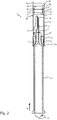
- FIG. 2 and 3rd A sectional view of a syringe (2) with a safety device (1) is shown in each case.
- the syringe (2) comprises a syringe body (3) which is designed as a hollow circular cylinder.
- the syringe body has a distal end region (8) with a distal end (4).
- a lancing device (5) is arranged at the distal end (4).
- This lancing means (5) is connected to the cavity of the syringe body (3) via a bore in the distal end region (8), so that the medium to be injected emerges from the cavity through the lancing means (5) when the syringe (2) is used can.
- the distal end region (8) is designed as a conical end piece, which has a smaller outer diameter than the syringe body (3).
- the syringe also has a transition region (25) in which the outer diameter of the syringe body (3) merges into the outer diameter of the end piece.
- the safety device (1) for avoiding puncture injuries for a syringe (2) with a syringe body (3) and a lancing means (5) arranged on the distal end (4) of the syringe body (3) comprises a along an axial direction (X ) extending sleeve element (6), which at least partially surrounds the lancing means (5) and the syringe body (3), the sleeve element (6) being rotatable on a distal end region (8) of the syringe body (3).
- the safety device (1) comprises a contact element (7) which contacts the skin of a patient when the syringe (2) is used, which is arranged on the distal end (9) of the sleeve element (6) and can be rotated independently of the sleeve element (6) , wherein the contact element (7) is rotatable in a plane perpendicular to the axial direction (X).
- the safety device (1) further comprises a collar element (10) which can be arranged on the distal end region (8) of the syringe body (3).
- the safety device (1) is fastened to the syringe body (3) by the collar element (10).
- the collar element (10) is also essentially designed as a hollow circular cylinder (17).
- the locking in the axial direction is made possible by a projection (26) or a thickening at the distal end (4) of the syringe body (3), against which the collar element (10) lies with its distal end (27).
- the circular cylinder (17) also has a lateral surface (17a) on which two guide projections (11) are arranged.
- the guide projections (11) extend radially away from the lateral surface (17a) and are diametrically opposed.
- a safety device (1) is also shown, which has a spring element (18) in the form of a spiral spring, which is operatively connected to the syringe body (3) and counteracts the relative movement of the sleeve element (6) to the safety device (1).
- the sleeve element (6) and the contact element (7) are in the Figures 4 and 5 detailed, where Fig. 4 a side view and Fig. 5 show a sectional view of the sleeve element (6) and the contact element (7).
- the sleeve element (6) is essentially cylindrical and comprises a distal end section (13) which has an inner diameter (28) and an outer diameter (29). Both the inside diameter (28) and the outside diameter (29) of the distal end section (13) are smaller than an inside diameter (31) and an outside diameter (30) of the adjoining section of the sleeve element (6). Furthermore, the sleeve element (6) has a greater wall thickness in this distal end section (13). As a result, on the one hand a support surface (32) is formed, on which the spring element (18) bears in the axial direction (X). On the other hand, a guide groove (14) is formed in the lateral surface of the distal end section (13).
- the contact element (10) is designed in a ring shape and has an end face (16) which contacts the skin of a patient when the syringe (2) is used.
- This end face (16) can have a soft and / or smooth feel, as a result of which this is pleasant to the skin.
- the surface of the contact element (10) opposite the end surface (16) lies on an end surface (33) of the distal end section (13).
- a guide extension (34) extends in the axial direction (X), on which a guide projection (15) is arranged. This guide projection (15) engages in the circumferential guide groove (14) of the sleeve element.
- the guide extension (34) is designed such that the outer diameter (35) of the contact element (7) corresponds to the outer diameter (30) of the sleeve element (6).
- the central axes of the annular contact element (7) and the distal opening (23) of the sleeve element are also located (6) one above the other so that when the syringe is used, the lancing agent passes through the center of the annular contact element (7).
- the lancing device (5) remains within the sleeve element (6) until the intended use of the syringe (2).
- the syringe When used, the syringe is pressed against the patient's skin.
- the sleeve element (6) must be displaced against the spring force of the spring element (18) so that the lancing means (5) can pass through the distal opening (23) of the sleeve element (6) and through the ring-shaped contact element (7).
- the sleeve element is pushed over the distal end region (8) of the syringe body (3).
- the sleeve element (6) rotates along the circumferential direction (U).
- the sleeve element (6) Due to the contact pressure, the static friction between the patient's skin and the contact element (7) is greater than the static friction between the contact element (7) and the sleeve element (6). Accordingly, rotation of the sleeve element (6) is not transmitted to the contact element (7) or the patient's skin.
- the sleeve element (6) is automatically pushed over the lancing means (5), driven by the spring force of the spring element (22).
- the sleeve element (6) rotates in the opposite direction of the circumference (U), whereby this rotation is also not transmitted to the patient's skin for the reasons mentioned above.
- the axis of rotation corresponds to the central axis (36) of the safety device.
- the guide links (12) of the sleeve element (6) comprise a first (19) and a second link area (20), which are separated from one another by a fictitious dividing line (21) running along the axial direction (X) of the syringe body (3) are separated, whereby the guide projection (11) can be arranged in an initial position in the first link area (19) and can be transferred from the first (19) to the second link area (20) into an end position by crossing the dividing line (25) when a distal end (22) of the lancing means (5) is arranged at the height of the distal opening (23) of the sleeve element (6) during the relative movement from the syringe body (3) to the sleeve element (6).
- the sleeve element (6) also has an end region (24).
- the guide projections (11) can be transferred from the second link area (20) by means of a link of the second link area (20) to an end area (24).
- this end area (24) a relative movement of the sleeve element (6) to the syringe body (3) essentially along the axial direction (X) is at least restricted.
Landscapes
- Health & Medical Sciences (AREA)
- Engineering & Computer Science (AREA)
- Heart & Thoracic Surgery (AREA)
- Vascular Medicine (AREA)
- Anesthesiology (AREA)
- Biomedical Technology (AREA)
- Environmental & Geological Engineering (AREA)
- Hematology (AREA)
- Life Sciences & Earth Sciences (AREA)
- Animal Behavior & Ethology (AREA)
- General Health & Medical Sciences (AREA)
- Public Health (AREA)
- Veterinary Medicine (AREA)
- Infusion, Injection, And Reservoir Apparatuses (AREA)
Claims (10)
- Corps de seringue (3) d'une seringue (2) comportant un moyen piquant (5) disposé sur son extrémité distale (4), dans lequel, sur le corps de seringue (3), est disposé un dispositif de sécurité (1) destiné à éviter les blessures par piqûre, lequel dispositif de sécurité (1) comporte un élément manchon (6) s'étendant le long d'une direction axiale (X), lequel entoure au moins partiellement le moyen piquant (5) et le corps de seringue (3), dans lequel l'élément manchon (6) présente une section d'extrémité distale (13) et une autre section s'y raccordant, et est disposé sur une région d'extrémité distale (8) du corps de seringue (3),
caractérisé par le fait que
le dispositif de sécurité (1) comporte un élément collier (10) au moyen duquel le dispositif de sécurité (1) est disposé de manière fixe sur la région d'extrémité distale (8) du corps de seringue (3), dans lequel l'élément manchon (6) comporte au moins une coulisse de guidage (12), dans lequel, lors d'un déplacement relatif du corps de seringue (3) par rapport à l'élément manchon (6) sensiblement le long de la direction axiale (X), par un guidage d'au moins une saillie de guidage (11) dans ladite au moins une coulisse de guidage (12), l'élément manchon (6) tourne le long de la direction périphérique (U) par rapport au corps de seringue (3), dans lequel le dispositif de sécurité (1) comporte un élément de contact (7) venant en contact avec la peau d'un patient lors d'une utilisation de la seringue (2), lequel élément de contact (7) est disposé sur l'extrémité distale (9) de l'élément manchon (6) et est apte à tourner le long de la direction périphérique (U) indépendamment de l'élément manchon (6), ce par quoi une rotation de l'élément manchon (6) durant l'utilisation de la seringue (2) n'est pas transférable à l'élément de contact (7), dans lequel une rainure de guidage périphérique (14) est formée dans une surface d'enveloppe de la section d'extrémité distale (13), et dans lequel l'élément de contact (7) présente une saillie de guidage (15), laquelle s'engage dans la rainure de guidage (14) de l'élément manchon (6), dans lequel une épaisseur de paroi de l'élément manchon (6) est plus grande dans la section d'extrémité distale (13) que dans l'autre section. - Corps de seringue (3) selon la revendication 1,
caractérisé par le fait que
l'élément de contact (7) est apte à tourner dans un plan perpendiculaire à la direction axiale (X). - Corps de seringue (3) selon la revendication 1,
caractérisé par le fait que
l'élément collier (10) présente au moins une saillie de guidage (11), laquelle s'engage dans ladite au moins une coulisse de guidage (12) de l'élément manchon (6). - Corps de seringue (3) selon l'une des revendications 1 et 2,
caractérisé par le fait que
dans la région d'extrémité distale (8) du corps de seringue (3), au moins une saillie de guidage (11) est formée d'un seul tenant avec le corps de seringue (3), dans lequel ladite au moins une saillie de guidage (11) s'engage dans ladite au moins une coulisse de guidage (12) de l'élément manchon (6). - Corps de seringue (3) selon l'une des revendications précédentes,
caractérisé par le fait que
l'élément de contact (7) est configuré de forme annulaire. - Corps de seringue (3) selon l'une des revendications précédentes,
caractérisé par le fait que
l'élément de contact (7) présente une face frontale (16), laquelle vient en contact avec la peau d'un patient lors de l'utilisation de la seringue (2), la face frontale (16) présentant une haptique souple et/ou lisse. - Corps de seringue (3) selon l'une des revendications précédentes,
caractérisé par le fait que
l'élément collier (10) est formé sensiblement en tant que cylindre creux à base circulaire (17), le cylindre à base circulaire (17) présentant une surface d'enveloppe (17a) sur laquelle est disposée ladite au moins une saillie de guidage (11). - Corps de seringue (3) selon l'une des revendications précédentes,
caractérisé par le fait que
le dispositif de sécurité (1) présente au moins un élément ressort (18) qui est relié fonctionnellement au corps de seringue (3) et s'oppose au déplacement relatif du corps de seringue (3) par rapport à l'élément manchon (6). - Corps de seringue (3) selon l'une des revendications précédentes,
caractérisé par le fait que
la coulisse de guidage (12) comporte une première (19) et une seconde région de coulisse (20) qui sont séparées l'une de l'autre par une ligne de séparation fictive (21) s'étendant le long de la direction axiale (X) du corps de seringue (3), dans lequel la saillie de guidage (11) est apte être disposée dans la première région de coulisse (19) dans une position de départ et est transférable de la première région de coulisse (9) dans la seconde région de coulisse (20) dans une position de fin par dépassement de la ligne de séparation (21), lorsqu'une extrémité distale (22) du moyen piquant (5) est disposée au niveau de l'ouverture distale (23) de l'élément manchon (6) lors du déplacement relatif du corps de seringue (3) par rapport à l'élément manchon (6). - Corps de seringue (3) selon la revendication 9,
caractérisé par le fait que
ladite au moins une saillie de guidage (11) est transférable de la seconde région de coulisse (20) au moyen d'une coulisse de la seconde région de coulisse (20) dans une région d'extrémité (24), dans laquelle un déplacement relatif de l'élément manchon (6) par rapport au corps de seringue (3) est au moins limité sensiblement le long de la direction axiale (X).
Applications Claiming Priority (2)
| Application Number | Priority Date | Filing Date | Title |
|---|---|---|---|
| DE102015110343.5A DE102015110343A1 (de) | 2015-06-26 | 2015-06-26 | Mehrteilige Sicherheitsvorrichtung für eine Spritze |
| PCT/EP2016/060863 WO2016206862A1 (fr) | 2015-06-26 | 2016-05-13 | Dispositif de sécurité en plusieurs parties pour seringue |
Publications (2)
| Publication Number | Publication Date |
|---|---|
| EP3313482A1 EP3313482A1 (fr) | 2018-05-02 |
| EP3313482B1 true EP3313482B1 (fr) | 2020-06-24 |
Family
ID=55967306
Family Applications (1)
| Application Number | Title | Priority Date | Filing Date |
|---|---|---|---|
| EP16722250.4A Active EP3313482B1 (fr) | 2015-06-26 | 2016-05-13 | Dispositif de sûreté en plusieurs parties pour une seringue |
Country Status (6)
| Country | Link |
|---|---|
| US (1) | US10682471B2 (fr) |
| EP (1) | EP3313482B1 (fr) |
| JP (1) | JP6751410B2 (fr) |
| CN (1) | CN107635608B (fr) |
| DE (1) | DE102015110343A1 (fr) |
| WO (1) | WO2016206862A1 (fr) |
Families Citing this family (9)
| Publication number | Priority date | Publication date | Assignee | Title |
|---|---|---|---|---|
| EP3107603B1 (fr) * | 2014-02-18 | 2018-03-28 | Skufca, Peter | Systeme d'administration pour l'administration de composes medicaux ou pharmaceutiques |
| FR3063909B1 (fr) | 2017-03-17 | 2022-03-11 | Biocorp Prod | Dispositif de protection d'aiguille pour une seringue pre-remplie a aiguille collee et seringue comprenant un tel dispositif |
| EP3664874B1 (fr) * | 2017-08-11 | 2023-10-04 | West Pharmaceutical Services, Inc. | Collier extensible et rétractable automatiquement et son procédé d'utilisation |
| IT201800005554A1 (it) * | 2018-05-21 | 2019-11-21 | Iniettore di lente intraoculare | |
| CN113304359B (zh) * | 2020-02-27 | 2024-03-15 | 易迪思工业设计顾问(上海)有限公司 | 一种用于注射器的保护装置 |
| EP3881881A1 (fr) | 2020-03-16 | 2021-09-22 | Gerresheimer Regensburg GmbH | Fonction supplémentaire d'un dispositif de sécurité pour seringues |
| EP4319848A4 (fr) | 2021-04-08 | 2025-02-26 | Love Lifesciences LLC | Dispositifs de sécurité et injecteurs de seringue pré-remplie, systèmes et procédés d'utilisation |
| USD1109322S1 (en) | 2023-10-02 | 2026-01-13 | Regeneron Pharmaceuticals, Inc. | Drug-delivery device |
| USD1108627S1 (en) | 2023-10-02 | 2026-01-06 | Regeneron Pharmaceuticals, Inc. | Drug-delivery device |
Citations (1)
| Publication number | Priority date | Publication date | Assignee | Title |
|---|---|---|---|---|
| DE112009001083T5 (de) * | 2008-05-06 | 2011-03-24 | Hyposafe Investments (PTY) LTD, Woodmeand | Hypodermische Nadelschutzeinrichtung |
Family Cites Families (7)
| Publication number | Priority date | Publication date | Assignee | Title |
|---|---|---|---|---|
| SE9403433D0 (sv) * | 1994-10-10 | 1994-10-10 | Pharmacia Ab | Injection device |
| US5591138A (en) * | 1995-08-10 | 1997-01-07 | Vaillancourt; Vincent L. | Protected needle assembly |
| GB0601309D0 (en) * | 2006-01-23 | 2006-03-01 | Medical House The Plc | Injection device |
| WO2010126432A1 (fr) * | 2009-04-27 | 2010-11-04 | Shl Group Ab | Dispositif d'aiguille de stylo de sécurité |
| EP2572746A1 (fr) * | 2011-09-23 | 2013-03-27 | Sanofi-Aventis Deutschland GmbH | Dispositif de sécurité d'aiguille |
| EP2822621B1 (fr) | 2012-03-07 | 2016-09-21 | West Pharmaceutical Services, Inc. | Dispositif de securite d'aiguille de profil radial reduit |
| US9623194B2 (en) * | 2013-12-10 | 2017-04-18 | Becton, Dickinson And Company | Passive safety pen needle assembly |
-
2015
- 2015-06-26 DE DE102015110343.5A patent/DE102015110343A1/de not_active Withdrawn
-
2016
- 2016-05-13 US US15/573,041 patent/US10682471B2/en active Active
- 2016-05-13 JP JP2017559506A patent/JP6751410B2/ja active Active
- 2016-05-13 CN CN201680027591.9A patent/CN107635608B/zh active Active
- 2016-05-13 EP EP16722250.4A patent/EP3313482B1/fr active Active
- 2016-05-13 WO PCT/EP2016/060863 patent/WO2016206862A1/fr not_active Ceased
Patent Citations (1)
| Publication number | Priority date | Publication date | Assignee | Title |
|---|---|---|---|---|
| DE112009001083T5 (de) * | 2008-05-06 | 2011-03-24 | Hyposafe Investments (PTY) LTD, Woodmeand | Hypodermische Nadelschutzeinrichtung |
Also Published As
| Publication number | Publication date |
|---|---|
| EP3313482A1 (fr) | 2018-05-02 |
| JP2018518250A (ja) | 2018-07-12 |
| US10682471B2 (en) | 2020-06-16 |
| CN107635608B (zh) | 2020-12-29 |
| WO2016206862A1 (fr) | 2016-12-29 |
| US20180126091A1 (en) | 2018-05-10 |
| JP6751410B2 (ja) | 2020-09-02 |
| CN107635608A (zh) | 2018-01-26 |
| DE102015110343A1 (de) | 2016-12-29 |
Similar Documents
| Publication | Publication Date | Title |
|---|---|---|
| EP3313482B1 (fr) | Dispositif de sûreté en plusieurs parties pour une seringue | |
| EP3369450B1 (fr) | Seringue avc dispositif de sécurité | |
| EP3325053B1 (fr) | Dispositif de sécurité pour une seringue | |
| EP3106191B1 (fr) | Dispositif de sécurité pour une seringue | |
| EP3325054B1 (fr) | Dispositif de sécurité pour seringue | |
| DE69320889T2 (de) | Sicherheitsspritze zum Anschliessen an eine intravenöse Zugangsöffnung | |
| DE69704513T2 (de) | Baueinheit aus Spritze und Nadelschutz | |
| DE19755125B4 (de) | Nadelschutzvorrichtung für Injektionsgeräte | |
| DE60026237T2 (de) | Schutzvorrichtung für Injektions- oder Aspirationsnadel | |
| DE69531914T2 (de) | Einhand-betätigbarer Nadelschutz für Spritzvorrichtung | |
| EP1363690B9 (fr) | Dispositif de protection d'une aiguille de seringue | |
| EP2063937B1 (fr) | Dispositif de protection d'aiguille présentant une position de protection bloquée | |
| EP2063938B1 (fr) | Dispositif de protection d'aiguille comprenant une protection distale et une protection proximale | |
| DE60220362T2 (de) | Sicherheitsvorrichtung für eine vorgefüllte und mit Nadelschutzkappe versehene Spritze | |
| DE602004000425T2 (de) | Kontrollierter Presssitz für einen konischen Luer-Anschluss | |
| EP1566194B1 (fr) | Seringue, en particulier pour usages médicaux | |
| EP0022977A1 (fr) | Dispositif pour seringues hypodermiques | |
| EP3881881A1 (fr) | Fonction supplémentaire d'un dispositif de sécurité pour seringues | |
| DE19947998A1 (de) | Nadelschutz für den Nadelteil eines Spritzenkörpers | |
| WO2009046560A2 (fr) | Dispositif de sécurité pour la canule d'un instrument invasif | |
| DE29503750U1 (de) | Fixiervorrichtung | |
| EP2626007B1 (fr) | Dispositif de sécurité pour une canule | |
| DE102023126547A1 (de) | Abwinkelbarer Kanülenschutz zur Einhandbedienung und Anordnung | |
| WO2024100128A1 (fr) | Bouchon multi-composant pour seringue médicale et seringue médicale | |
| WO2004096325A1 (fr) | Aiguille pour une seringue medicale |
Legal Events
| Date | Code | Title | Description |
|---|---|---|---|
| STAA | Information on the status of an ep patent application or granted ep patent |
Free format text: STATUS: THE INTERNATIONAL PUBLICATION HAS BEEN MADE |
|
| PUAI | Public reference made under article 153(3) epc to a published international application that has entered the european phase |
Free format text: ORIGINAL CODE: 0009012 |
|
| STAA | Information on the status of an ep patent application or granted ep patent |
Free format text: STATUS: REQUEST FOR EXAMINATION WAS MADE |
|
| 17P | Request for examination filed |
Effective date: 20171025 |
|
| AK | Designated contracting states |
Kind code of ref document: A1 Designated state(s): AL AT BE BG CH CY CZ DE DK EE ES FI FR GB GR HR HU IE IS IT LI LT LU LV MC MK MT NL NO PL PT RO RS SE SI SK SM TR |
|
| AX | Request for extension of the european patent |
Extension state: BA ME |
|
| DAV | Request for validation of the european patent (deleted) | ||
| DAX | Request for extension of the european patent (deleted) | ||
| STAA | Information on the status of an ep patent application or granted ep patent |
Free format text: STATUS: EXAMINATION IS IN PROGRESS |
|
| 17Q | First examination report despatched |
Effective date: 20190717 |
|
| GRAP | Despatch of communication of intention to grant a patent |
Free format text: ORIGINAL CODE: EPIDOSNIGR1 |
|
| STAA | Information on the status of an ep patent application or granted ep patent |
Free format text: STATUS: GRANT OF PATENT IS INTENDED |
|
| INTG | Intention to grant announced |
Effective date: 20191125 |
|
| GRAS | Grant fee paid |
Free format text: ORIGINAL CODE: EPIDOSNIGR3 |
|
| GRAJ | Information related to disapproval of communication of intention to grant by the applicant or resumption of examination proceedings by the epo deleted |
Free format text: ORIGINAL CODE: EPIDOSDIGR1 |
|
| GRAL | Information related to payment of fee for publishing/printing deleted |
Free format text: ORIGINAL CODE: EPIDOSDIGR3 |
|
| STAA | Information on the status of an ep patent application or granted ep patent |
Free format text: STATUS: EXAMINATION IS IN PROGRESS |
|
| INTC | Intention to grant announced (deleted) | ||
| GRAJ | Information related to disapproval of communication of intention to grant by the applicant or resumption of examination proceedings by the epo deleted |
Free format text: ORIGINAL CODE: EPIDOSDIGR1 |
|
| GRAP | Despatch of communication of intention to grant a patent |
Free format text: ORIGINAL CODE: EPIDOSNIGR1 |
|
| GRAR | Information related to intention to grant a patent recorded |
Free format text: ORIGINAL CODE: EPIDOSNIGR71 |
|
| STAA | Information on the status of an ep patent application or granted ep patent |
Free format text: STATUS: GRANT OF PATENT IS INTENDED |
|
| GRAA | (expected) grant |
Free format text: ORIGINAL CODE: 0009210 |
|
| STAA | Information on the status of an ep patent application or granted ep patent |
Free format text: STATUS: THE PATENT HAS BEEN GRANTED |
|
| INTG | Intention to grant announced |
Effective date: 20200504 |
|
| AK | Designated contracting states |
Kind code of ref document: B1 Designated state(s): AL AT BE BG CH CY CZ DE DK EE ES FI FR GB GR HR HU IE IS IT LI LT LU LV MC MK MT NL NO PL PT RO RS SE SI SK SM TR |
|
| REG | Reference to a national code |
Ref country code: GB Ref legal event code: FG4D Free format text: NOT ENGLISH |
|
| REG | Reference to a national code |
Ref country code: CH Ref legal event code: EP |
|
| REG | Reference to a national code |
Ref country code: AT Ref legal event code: REF Ref document number: 1283269 Country of ref document: AT Kind code of ref document: T Effective date: 20200715 |
|
| REG | Reference to a national code |
Ref country code: DE Ref legal event code: R096 Ref document number: 502016010320 Country of ref document: DE |
|
| REG | Reference to a national code |
Ref country code: IE Ref legal event code: FG4D Free format text: LANGUAGE OF EP DOCUMENT: GERMAN |
|
| PG25 | Lapsed in a contracting state [announced via postgrant information from national office to epo] |
Ref country code: LT Free format text: LAPSE BECAUSE OF FAILURE TO SUBMIT A TRANSLATION OF THE DESCRIPTION OR TO PAY THE FEE WITHIN THE PRESCRIBED TIME-LIMIT Effective date: 20200624 Ref country code: NO Free format text: LAPSE BECAUSE OF FAILURE TO SUBMIT A TRANSLATION OF THE DESCRIPTION OR TO PAY THE FEE WITHIN THE PRESCRIBED TIME-LIMIT Effective date: 20200924 Ref country code: SE Free format text: LAPSE BECAUSE OF FAILURE TO SUBMIT A TRANSLATION OF THE DESCRIPTION OR TO PAY THE FEE WITHIN THE PRESCRIBED TIME-LIMIT Effective date: 20200624 Ref country code: GR Free format text: LAPSE BECAUSE OF FAILURE TO SUBMIT A TRANSLATION OF THE DESCRIPTION OR TO PAY THE FEE WITHIN THE PRESCRIBED TIME-LIMIT Effective date: 20200925 Ref country code: FI Free format text: LAPSE BECAUSE OF FAILURE TO SUBMIT A TRANSLATION OF THE DESCRIPTION OR TO PAY THE FEE WITHIN THE PRESCRIBED TIME-LIMIT Effective date: 20200624 |
|
| REG | Reference to a national code |
Ref country code: LT Ref legal event code: MG4D |
|
| PG25 | Lapsed in a contracting state [announced via postgrant information from national office to epo] |
Ref country code: HR Free format text: LAPSE BECAUSE OF FAILURE TO SUBMIT A TRANSLATION OF THE DESCRIPTION OR TO PAY THE FEE WITHIN THE PRESCRIBED TIME-LIMIT Effective date: 20200624 Ref country code: RS Free format text: LAPSE BECAUSE OF FAILURE TO SUBMIT A TRANSLATION OF THE DESCRIPTION OR TO PAY THE FEE WITHIN THE PRESCRIBED TIME-LIMIT Effective date: 20200624 Ref country code: LV Free format text: LAPSE BECAUSE OF FAILURE TO SUBMIT A TRANSLATION OF THE DESCRIPTION OR TO PAY THE FEE WITHIN THE PRESCRIBED TIME-LIMIT Effective date: 20200624 Ref country code: BG Free format text: LAPSE BECAUSE OF FAILURE TO SUBMIT A TRANSLATION OF THE DESCRIPTION OR TO PAY THE FEE WITHIN THE PRESCRIBED TIME-LIMIT Effective date: 20200924 |
|
| REG | Reference to a national code |
Ref country code: NL Ref legal event code: MP Effective date: 20200624 |
|
| PG25 | Lapsed in a contracting state [announced via postgrant information from national office to epo] |
Ref country code: AL Free format text: LAPSE BECAUSE OF FAILURE TO SUBMIT A TRANSLATION OF THE DESCRIPTION OR TO PAY THE FEE WITHIN THE PRESCRIBED TIME-LIMIT Effective date: 20200624 Ref country code: NL Free format text: LAPSE BECAUSE OF FAILURE TO SUBMIT A TRANSLATION OF THE DESCRIPTION OR TO PAY THE FEE WITHIN THE PRESCRIBED TIME-LIMIT Effective date: 20200624 |
|
| PG25 | Lapsed in a contracting state [announced via postgrant information from national office to epo] |
Ref country code: CZ Free format text: LAPSE BECAUSE OF FAILURE TO SUBMIT A TRANSLATION OF THE DESCRIPTION OR TO PAY THE FEE WITHIN THE PRESCRIBED TIME-LIMIT Effective date: 20200624 Ref country code: ES Free format text: LAPSE BECAUSE OF FAILURE TO SUBMIT A TRANSLATION OF THE DESCRIPTION OR TO PAY THE FEE WITHIN THE PRESCRIBED TIME-LIMIT Effective date: 20200624 Ref country code: PT Free format text: LAPSE BECAUSE OF FAILURE TO SUBMIT A TRANSLATION OF THE DESCRIPTION OR TO PAY THE FEE WITHIN THE PRESCRIBED TIME-LIMIT Effective date: 20201026 Ref country code: EE Free format text: LAPSE BECAUSE OF FAILURE TO SUBMIT A TRANSLATION OF THE DESCRIPTION OR TO PAY THE FEE WITHIN THE PRESCRIBED TIME-LIMIT Effective date: 20200624 Ref country code: IT Free format text: LAPSE BECAUSE OF FAILURE TO SUBMIT A TRANSLATION OF THE DESCRIPTION OR TO PAY THE FEE WITHIN THE PRESCRIBED TIME-LIMIT Effective date: 20200624 Ref country code: RO Free format text: LAPSE BECAUSE OF FAILURE TO SUBMIT A TRANSLATION OF THE DESCRIPTION OR TO PAY THE FEE WITHIN THE PRESCRIBED TIME-LIMIT Effective date: 20200624 Ref country code: SM Free format text: LAPSE BECAUSE OF FAILURE TO SUBMIT A TRANSLATION OF THE DESCRIPTION OR TO PAY THE FEE WITHIN THE PRESCRIBED TIME-LIMIT Effective date: 20200624 |
|
| PG25 | Lapsed in a contracting state [announced via postgrant information from national office to epo] |
Ref country code: PL Free format text: LAPSE BECAUSE OF FAILURE TO SUBMIT A TRANSLATION OF THE DESCRIPTION OR TO PAY THE FEE WITHIN THE PRESCRIBED TIME-LIMIT Effective date: 20200624 Ref country code: SK Free format text: LAPSE BECAUSE OF FAILURE TO SUBMIT A TRANSLATION OF THE DESCRIPTION OR TO PAY THE FEE WITHIN THE PRESCRIBED TIME-LIMIT Effective date: 20200624 Ref country code: IS Free format text: LAPSE BECAUSE OF FAILURE TO SUBMIT A TRANSLATION OF THE DESCRIPTION OR TO PAY THE FEE WITHIN THE PRESCRIBED TIME-LIMIT Effective date: 20201024 |
|
| REG | Reference to a national code |
Ref country code: DE Ref legal event code: R097 Ref document number: 502016010320 Country of ref document: DE |
|
| PG25 | Lapsed in a contracting state [announced via postgrant information from national office to epo] |
Ref country code: DK Free format text: LAPSE BECAUSE OF FAILURE TO SUBMIT A TRANSLATION OF THE DESCRIPTION OR TO PAY THE FEE WITHIN THE PRESCRIBED TIME-LIMIT Effective date: 20200624 |
|
| PLBE | No opposition filed within time limit |
Free format text: ORIGINAL CODE: 0009261 |
|
| STAA | Information on the status of an ep patent application or granted ep patent |
Free format text: STATUS: NO OPPOSITION FILED WITHIN TIME LIMIT |
|
| 26N | No opposition filed |
Effective date: 20210325 |
|
| PG25 | Lapsed in a contracting state [announced via postgrant information from national office to epo] |
Ref country code: SI Free format text: LAPSE BECAUSE OF FAILURE TO SUBMIT A TRANSLATION OF THE DESCRIPTION OR TO PAY THE FEE WITHIN THE PRESCRIBED TIME-LIMIT Effective date: 20200624 |
|
| REG | Reference to a national code |
Ref country code: CH Ref legal event code: PL |
|
| PG25 | Lapsed in a contracting state [announced via postgrant information from national office to epo] |
Ref country code: MC Free format text: LAPSE BECAUSE OF FAILURE TO SUBMIT A TRANSLATION OF THE DESCRIPTION OR TO PAY THE FEE WITHIN THE PRESCRIBED TIME-LIMIT Effective date: 20200624 Ref country code: LU Free format text: LAPSE BECAUSE OF NON-PAYMENT OF DUE FEES Effective date: 20210513 Ref country code: LI Free format text: LAPSE BECAUSE OF NON-PAYMENT OF DUE FEES Effective date: 20210531 Ref country code: CH Free format text: LAPSE BECAUSE OF NON-PAYMENT OF DUE FEES Effective date: 20210531 |
|
| REG | Reference to a national code |
Ref country code: BE Ref legal event code: MM Effective date: 20210531 |
|
| PG25 | Lapsed in a contracting state [announced via postgrant information from national office to epo] |
Ref country code: IE Free format text: LAPSE BECAUSE OF NON-PAYMENT OF DUE FEES Effective date: 20210513 |
|
| REG | Reference to a national code |
Ref country code: AT Ref legal event code: MM01 Ref document number: 1283269 Country of ref document: AT Kind code of ref document: T Effective date: 20210513 |
|
| PG25 | Lapsed in a contracting state [announced via postgrant information from national office to epo] |
Ref country code: BE Free format text: LAPSE BECAUSE OF NON-PAYMENT OF DUE FEES Effective date: 20210531 |
|
| PG25 | Lapsed in a contracting state [announced via postgrant information from national office to epo] |
Ref country code: AT Free format text: LAPSE BECAUSE OF NON-PAYMENT OF DUE FEES Effective date: 20210513 |
|
| P01 | Opt-out of the competence of the unified patent court (upc) registered |
Effective date: 20230523 |
|
| PG25 | Lapsed in a contracting state [announced via postgrant information from national office to epo] |
Ref country code: CY Free format text: LAPSE BECAUSE OF FAILURE TO SUBMIT A TRANSLATION OF THE DESCRIPTION OR TO PAY THE FEE WITHIN THE PRESCRIBED TIME-LIMIT Effective date: 20200624 |
|
| PG25 | Lapsed in a contracting state [announced via postgrant information from national office to epo] |
Ref country code: HU Free format text: LAPSE BECAUSE OF FAILURE TO SUBMIT A TRANSLATION OF THE DESCRIPTION OR TO PAY THE FEE WITHIN THE PRESCRIBED TIME-LIMIT; INVALID AB INITIO Effective date: 20160513 |
|
| PG25 | Lapsed in a contracting state [announced via postgrant information from national office to epo] |
Ref country code: MK Free format text: LAPSE BECAUSE OF FAILURE TO SUBMIT A TRANSLATION OF THE DESCRIPTION OR TO PAY THE FEE WITHIN THE PRESCRIBED TIME-LIMIT Effective date: 20200624 |
|
| PG25 | Lapsed in a contracting state [announced via postgrant information from national office to epo] |
Ref country code: MT Free format text: LAPSE BECAUSE OF FAILURE TO SUBMIT A TRANSLATION OF THE DESCRIPTION OR TO PAY THE FEE WITHIN THE PRESCRIBED TIME-LIMIT Effective date: 20200624 |
|
| PGFP | Annual fee paid to national office [announced via postgrant information from national office to epo] |
Ref country code: DE Payment date: 20250519 Year of fee payment: 10 |
|
| PGFP | Annual fee paid to national office [announced via postgrant information from national office to epo] |
Ref country code: GB Payment date: 20250522 Year of fee payment: 10 |
|
| PGFP | Annual fee paid to national office [announced via postgrant information from national office to epo] |
Ref country code: FR Payment date: 20250521 Year of fee payment: 10 |
|
| PG25 | Lapsed in a contracting state [announced via postgrant information from national office to epo] |
Ref country code: TR Free format text: LAPSE BECAUSE OF FAILURE TO SUBMIT A TRANSLATION OF THE DESCRIPTION OR TO PAY THE FEE WITHIN THE PRESCRIBED TIME-LIMIT Effective date: 20200624 |