EP3313932B1 - Polyethylenzusammensetzung mit hohen mechanischen eigenschaften und guter verarbeitbarkeit - Google Patents
Polyethylenzusammensetzung mit hohen mechanischen eigenschaften und guter verarbeitbarkeit Download PDFInfo
- Publication number
- EP3313932B1 EP3313932B1 EP16727197.2A EP16727197A EP3313932B1 EP 3313932 B1 EP3313932 B1 EP 3313932B1 EP 16727197 A EP16727197 A EP 16727197A EP 3313932 B1 EP3313932 B1 EP 3313932B1
- Authority
- EP
- European Patent Office
- Prior art keywords
- polyethylene composition
- ethylene
- weight
- compound
- polymerization
- Prior art date
- Legal status (The legal status is an assumption and is not a legal conclusion. Google has not performed a legal analysis and makes no representation as to the accuracy of the status listed.)
- Active
Links
Images
Classifications
-
- B—PERFORMING OPERATIONS; TRANSPORTING
- B32—LAYERED PRODUCTS
- B32B—LAYERED PRODUCTS, i.e. PRODUCTS BUILT-UP OF STRATA OF FLAT OR NON-FLAT, e.g. CELLULAR OR HONEYCOMB, FORM
- B32B27/00—Layered products comprising a layer of synthetic resin
- B32B27/06—Layered products comprising a layer of synthetic resin as the main or only constituent of a layer, which is next to another layer of the same or of a different material
- B32B27/08—Layered products comprising a layer of synthetic resin as the main or only constituent of a layer, which is next to another layer of the same or of a different material of synthetic resin
-
- B—PERFORMING OPERATIONS; TRANSPORTING
- B32—LAYERED PRODUCTS
- B32B—LAYERED PRODUCTS, i.e. PRODUCTS BUILT-UP OF STRATA OF FLAT OR NON-FLAT, e.g. CELLULAR OR HONEYCOMB, FORM
- B32B27/00—Layered products comprising a layer of synthetic resin
- B32B27/32—Layered products comprising a layer of synthetic resin comprising polyolefins
- B32B27/327—Layered products comprising a layer of synthetic resin comprising polyolefins comprising polyolefins obtained by a metallocene or single-site catalyst
-
- C—CHEMISTRY; METALLURGY
- C08—ORGANIC MACROMOLECULAR COMPOUNDS; THEIR PREPARATION OR CHEMICAL WORKING-UP; COMPOSITIONS BASED THEREON
- C08F—MACROMOLECULAR COMPOUNDS OBTAINED BY REACTIONS ONLY INVOLVING CARBON-TO-CARBON UNSATURATED BONDS
- C08F4/00—Polymerisation catalysts
- C08F4/42—Metals; Metal hydrides; Metallo-organic compounds; Use thereof as catalyst precursors
- C08F4/44—Metals; Metal hydrides; Metallo-organic compounds; Use thereof as catalyst precursors selected from light metals, zinc, cadmium, mercury, copper, silver, gold, boron, gallium, indium, thallium, rare earths or actinides
- C08F4/60—Metals; Metal hydrides; Metallo-organic compounds; Use thereof as catalyst precursors selected from light metals, zinc, cadmium, mercury, copper, silver, gold, boron, gallium, indium, thallium, rare earths or actinides together with refractory metals, iron group metals, platinum group metals, manganese, rhenium technetium or compounds thereof
- C08F4/62—Refractory metals or compounds thereof
- C08F4/64—Titanium, zirconium, hafnium or compounds thereof
- C08F4/646—Catalysts comprising at least two different metals, in metallic form or as compounds thereof, in addition to the component covered by group C08F4/64
- C08F4/6465—Catalysts comprising at least two different metals, in metallic form or as compounds thereof, in addition to the component covered by group C08F4/64 containing silicium
-
- C—CHEMISTRY; METALLURGY
- C08—ORGANIC MACROMOLECULAR COMPOUNDS; THEIR PREPARATION OR CHEMICAL WORKING-UP; COMPOSITIONS BASED THEREON
- C08L—COMPOSITIONS OF MACROMOLECULAR COMPOUNDS
- C08L23/00—Compositions of homopolymers or copolymers of unsaturated aliphatic hydrocarbons having only one carbon-to-carbon double bond; Compositions of derivatives of such polymers
- C08L23/02—Compositions of homopolymers or copolymers of unsaturated aliphatic hydrocarbons having only one carbon-to-carbon double bond; Compositions of derivatives of such polymers not modified by chemical after-treatment
- C08L23/04—Homopolymers or copolymers of ethene
- C08L23/08—Copolymers of ethene
- C08L23/0807—Copolymers of ethene with unsaturated hydrocarbons only containing four or more carbon atoms
- C08L23/0815—Copolymers of ethene with unsaturated hydrocarbons only containing four or more carbon atoms with aliphatic 1-olefins containing one carbon-to-carbon double bond
-
- F—MECHANICAL ENGINEERING; LIGHTING; HEATING; WEAPONS; BLASTING
- F16—ENGINEERING ELEMENTS AND UNITS; GENERAL MEASURES FOR PRODUCING AND MAINTAINING EFFECTIVE FUNCTIONING OF MACHINES OR INSTALLATIONS; THERMAL INSULATION IN GENERAL
- F16L—PIPES; JOINTS OR FITTINGS FOR PIPES; SUPPORTS FOR PIPES, CABLES OR PROTECTIVE TUBING; MEANS FOR THERMAL INSULATION IN GENERAL
- F16L9/00—Rigid pipes
- F16L9/12—Rigid pipes of plastics with or without reinforcement
-
- B—PERFORMING OPERATIONS; TRANSPORTING
- B32—LAYERED PRODUCTS
- B32B—LAYERED PRODUCTS, i.e. PRODUCTS BUILT-UP OF STRATA OF FLAT OR NON-FLAT, e.g. CELLULAR OR HONEYCOMB, FORM
- B32B2307/00—Properties of the layers or laminate
- B32B2307/50—Properties of the layers or laminate having particular mechanical properties
- B32B2307/558—Impact strength, toughness
-
- B—PERFORMING OPERATIONS; TRANSPORTING
- B32—LAYERED PRODUCTS
- B32B—LAYERED PRODUCTS, i.e. PRODUCTS BUILT-UP OF STRATA OF FLAT OR NON-FLAT, e.g. CELLULAR OR HONEYCOMB, FORM
- B32B2307/00—Properties of the layers or laminate
- B32B2307/70—Other properties
- B32B2307/72—Density
-
- B—PERFORMING OPERATIONS; TRANSPORTING
- B32—LAYERED PRODUCTS
- B32B—LAYERED PRODUCTS, i.e. PRODUCTS BUILT-UP OF STRATA OF FLAT OR NON-FLAT, e.g. CELLULAR OR HONEYCOMB, FORM
- B32B2307/00—Properties of the layers or laminate
- B32B2307/70—Other properties
- B32B2307/732—Dimensional properties
-
- B—PERFORMING OPERATIONS; TRANSPORTING
- B32—LAYERED PRODUCTS
- B32B—LAYERED PRODUCTS, i.e. PRODUCTS BUILT-UP OF STRATA OF FLAT OR NON-FLAT, e.g. CELLULAR OR HONEYCOMB, FORM
- B32B2597/00—Tubular articles, e.g. hoses, pipes
-
- C—CHEMISTRY; METALLURGY
- C08—ORGANIC MACROMOLECULAR COMPOUNDS; THEIR PREPARATION OR CHEMICAL WORKING-UP; COMPOSITIONS BASED THEREON
- C08F—MACROMOLECULAR COMPOUNDS OBTAINED BY REACTIONS ONLY INVOLVING CARBON-TO-CARBON UNSATURATED BONDS
- C08F10/00—Homopolymers and copolymers of unsaturated aliphatic hydrocarbons having only one carbon-to-carbon double bond
-
- C—CHEMISTRY; METALLURGY
- C08—ORGANIC MACROMOLECULAR COMPOUNDS; THEIR PREPARATION OR CHEMICAL WORKING-UP; COMPOSITIONS BASED THEREON
- C08F—MACROMOLECULAR COMPOUNDS OBTAINED BY REACTIONS ONLY INVOLVING CARBON-TO-CARBON UNSATURATED BONDS
- C08F2/00—Processes of polymerisation
- C08F2/001—Multistage polymerisation processes characterised by a change in reactor conditions without deactivating the intermediate polymer
-
- C—CHEMISTRY; METALLURGY
- C08—ORGANIC MACROMOLECULAR COMPOUNDS; THEIR PREPARATION OR CHEMICAL WORKING-UP; COMPOSITIONS BASED THEREON
- C08F—MACROMOLECULAR COMPOUNDS OBTAINED BY REACTIONS ONLY INVOLVING CARBON-TO-CARBON UNSATURATED BONDS
- C08F210/00—Copolymers of unsaturated aliphatic hydrocarbons having only one carbon-to-carbon double bond
- C08F210/14—Monomers containing five or more carbon atoms
-
- C—CHEMISTRY; METALLURGY
- C08—ORGANIC MACROMOLECULAR COMPOUNDS; THEIR PREPARATION OR CHEMICAL WORKING-UP; COMPOSITIONS BASED THEREON
- C08F—MACROMOLECULAR COMPOUNDS OBTAINED BY REACTIONS ONLY INVOLVING CARBON-TO-CARBON UNSATURATED BONDS
- C08F210/00—Copolymers of unsaturated aliphatic hydrocarbons having only one carbon-to-carbon double bond
- C08F210/16—Copolymers of ethene with alpha-alkenes, e.g. EP rubbers
-
- C—CHEMISTRY; METALLURGY
- C08—ORGANIC MACROMOLECULAR COMPOUNDS; THEIR PREPARATION OR CHEMICAL WORKING-UP; COMPOSITIONS BASED THEREON
- C08F—MACROMOLECULAR COMPOUNDS OBTAINED BY REACTIONS ONLY INVOLVING CARBON-TO-CARBON UNSATURATED BONDS
- C08F2500/00—Characteristics or properties of obtained polyolefins; Use thereof
- C08F2500/04—Broad molecular weight distribution, i.e. Mw/Mn > 6
-
- C—CHEMISTRY; METALLURGY
- C08—ORGANIC MACROMOLECULAR COMPOUNDS; THEIR PREPARATION OR CHEMICAL WORKING-UP; COMPOSITIONS BASED THEREON
- C08F—MACROMOLECULAR COMPOUNDS OBTAINED BY REACTIONS ONLY INVOLVING CARBON-TO-CARBON UNSATURATED BONDS
- C08F2500/00—Characteristics or properties of obtained polyolefins; Use thereof
- C08F2500/07—High density, i.e. > 0.95 g/cm3
-
- C—CHEMISTRY; METALLURGY
- C08—ORGANIC MACROMOLECULAR COMPOUNDS; THEIR PREPARATION OR CHEMICAL WORKING-UP; COMPOSITIONS BASED THEREON
- C08F—MACROMOLECULAR COMPOUNDS OBTAINED BY REACTIONS ONLY INVOLVING CARBON-TO-CARBON UNSATURATED BONDS
- C08F2500/00—Characteristics or properties of obtained polyolefins; Use thereof
- C08F2500/09—Long chain branches
-
- C—CHEMISTRY; METALLURGY
- C08—ORGANIC MACROMOLECULAR COMPOUNDS; THEIR PREPARATION OR CHEMICAL WORKING-UP; COMPOSITIONS BASED THEREON
- C08F—MACROMOLECULAR COMPOUNDS OBTAINED BY REACTIONS ONLY INVOLVING CARBON-TO-CARBON UNSATURATED BONDS
- C08F2500/00—Characteristics or properties of obtained polyolefins; Use thereof
- C08F2500/12—Melt flow index or melt flow ratio
-
- C—CHEMISTRY; METALLURGY
- C08—ORGANIC MACROMOLECULAR COMPOUNDS; THEIR PREPARATION OR CHEMICAL WORKING-UP; COMPOSITIONS BASED THEREON
- C08F—MACROMOLECULAR COMPOUNDS OBTAINED BY REACTIONS ONLY INVOLVING CARBON-TO-CARBON UNSATURATED BONDS
- C08F4/00—Polymerisation catalysts
- C08F4/42—Metals; Metal hydrides; Metallo-organic compounds; Use thereof as catalyst precursors
- C08F4/44—Metals; Metal hydrides; Metallo-organic compounds; Use thereof as catalyst precursors selected from light metals, zinc, cadmium, mercury, copper, silver, gold, boron, gallium, indium, thallium, rare earths or actinides
- C08F4/60—Metals; Metal hydrides; Metallo-organic compounds; Use thereof as catalyst precursors selected from light metals, zinc, cadmium, mercury, copper, silver, gold, boron, gallium, indium, thallium, rare earths or actinides together with refractory metals, iron group metals, platinum group metals, manganese, rhenium technetium or compounds thereof
- C08F4/62—Refractory metals or compounds thereof
- C08F4/64—Titanium, zirconium, hafnium or compounds thereof
- C08F4/647—Catalysts containing a specific non-metal or metal-free compound
- C08F4/649—Catalysts containing a specific non-metal or metal-free compound organic
- C08F4/6491—Catalysts containing a specific non-metal or metal-free compound organic hydrocarbon
- C08F4/6492—Catalysts containing a specific non-metal or metal-free compound organic hydrocarbon containing aliphatic unsaturation
-
- C—CHEMISTRY; METALLURGY
- C08—ORGANIC MACROMOLECULAR COMPOUNDS; THEIR PREPARATION OR CHEMICAL WORKING-UP; COMPOSITIONS BASED THEREON
- C08F—MACROMOLECULAR COMPOUNDS OBTAINED BY REACTIONS ONLY INVOLVING CARBON-TO-CARBON UNSATURATED BONDS
- C08F4/00—Polymerisation catalysts
- C08F4/42—Metals; Metal hydrides; Metallo-organic compounds; Use thereof as catalyst precursors
- C08F4/44—Metals; Metal hydrides; Metallo-organic compounds; Use thereof as catalyst precursors selected from light metals, zinc, cadmium, mercury, copper, silver, gold, boron, gallium, indium, thallium, rare earths or actinides
- C08F4/60—Metals; Metal hydrides; Metallo-organic compounds; Use thereof as catalyst precursors selected from light metals, zinc, cadmium, mercury, copper, silver, gold, boron, gallium, indium, thallium, rare earths or actinides together with refractory metals, iron group metals, platinum group metals, manganese, rhenium technetium or compounds thereof
- C08F4/62—Refractory metals or compounds thereof
- C08F4/64—Titanium, zirconium, hafnium or compounds thereof
- C08F4/65—Pretreating the metal or compound covered by group C08F4/64 before the final contacting with the metal or compound covered by group C08F4/44
- C08F4/652—Pretreating with metals or metal-containing compounds
- C08F4/654—Pretreating with metals or metal-containing compounds with magnesium or compounds thereof
- C08F4/6543—Pretreating with metals or metal-containing compounds with magnesium or compounds thereof halides of magnesium
- C08F4/6545—Pretreating with metals or metal-containing compounds with magnesium or compounds thereof halides of magnesium and metals of C08F4/64 or compounds thereof
-
- C—CHEMISTRY; METALLURGY
- C08—ORGANIC MACROMOLECULAR COMPOUNDS; THEIR PREPARATION OR CHEMICAL WORKING-UP; COMPOSITIONS BASED THEREON
- C08L—COMPOSITIONS OF MACROMOLECULAR COMPOUNDS
- C08L2203/00—Applications
- C08L2203/18—Applications used for pipes
-
- C—CHEMISTRY; METALLURGY
- C08—ORGANIC MACROMOLECULAR COMPOUNDS; THEIR PREPARATION OR CHEMICAL WORKING-UP; COMPOSITIONS BASED THEREON
- C08L—COMPOSITIONS OF MACROMOLECULAR COMPOUNDS
- C08L2205/00—Polymer mixtures characterised by other features
- C08L2205/02—Polymer mixtures characterised by other features containing two or more polymers of the same C08L -group
- C08L2205/025—Polymer mixtures characterised by other features containing two or more polymers of the same C08L -group containing two or more polymers of the same hierarchy C08L, and differing only in parameters such as density, comonomer content, molecular weight, structure
-
- C—CHEMISTRY; METALLURGY
- C08—ORGANIC MACROMOLECULAR COMPOUNDS; THEIR PREPARATION OR CHEMICAL WORKING-UP; COMPOSITIONS BASED THEREON
- C08L—COMPOSITIONS OF MACROMOLECULAR COMPOUNDS
- C08L2308/00—Chemical blending or stepwise polymerisation process with the same catalyst
-
- C—CHEMISTRY; METALLURGY
- C08—ORGANIC MACROMOLECULAR COMPOUNDS; THEIR PREPARATION OR CHEMICAL WORKING-UP; COMPOSITIONS BASED THEREON
- C08L—COMPOSITIONS OF MACROMOLECULAR COMPOUNDS
- C08L2314/00—Polymer mixtures characterised by way of preparation
- C08L2314/02—Ziegler natta catalyst
Definitions
- the present disclosure provides a polyethylene composition having density from 0.945 to 0.950 g/cm 3 and high mechanical properties.
- the present composition is particularly suitable for making extruded articles such as pipes, even with large diameter.
- the present disclosure also relates to a multi-stage polymerization process for preparing the said polyethylene composition.
- polyethylene materials can be used for producing pipes, particularly by extrusion.
- polyethylene materials with medium to high density can be so designed, by properly selecting their molecular structure and molecular weight distribution, as to obtain a suitable balance of FNCT, impact resistance and processability in the extrusion processes, as disclosed in EP2256160 , wherein the highest mechanical properties are reported in combination with density values higher than 0.950 g/cm 3 .
- the present disclosure provides a polyethylene composition having the following features:
- the MIP values for the present polyethylene compositions range from about 0.08 to about 0.3 g/10 min. (approximated values).
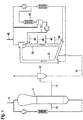
- the drawing is an illustrative embodiment of a simplified process-flow diagram of two serially connected gas-phase reactors suitable for use in accordance with various embodiments of ethylene polymerization processes disclosed herein to produce various embodiments of the polyethylene compositions disclosed herein.
- polyethylene composition is intended to embrace a composition of two or more ethylene polymer components, preferably with different molecular weights, such composition being also called “bimodal” or “multimodal” polymer in the relevant art.
- the present polyethylene composition comprises one or more ethylene copolymers.
- the said HMWcopo index values of from 13 to 22.5 are associated with a density equal to or lower than 0.950 cm 3 /g.
- the ratio MIF/MIP provides a rheological measure of molecular weight distribution.
- M w_MALLS is the weight average molar mass measured with MALLS coupled to GPC
- M n_GPC is the number average molar mass, measured by GPC (Gel Permeation Chromatography), as explained in the examples.
- Preferred M w_MALLS /M n_GPC values for the present polyethylene composition range from 12 to 24.
- the M w_MALLS values are preferably equal to or higher than 350,000 g/mol, in particular from 350,000 to 500,000 g/mol.
- the present polyethylene composition has preferably at least one of the following additional features.
- the present composition comprises:
- a specific MIE ranges for component A) is of 60 to 85 g/10 min.
- the present polyethylene composition can be advantageously used in producing pipes, particularly by extrusion, thanks to its valuable mechanical properties.
- the pipes can be monolayer of multilayer, wherein at least one layer comprises the present polyethylene composition.
- the present polyethylene composition can be melt-processed even at high output rates, still without undergoing sagging and wall thickness instability.
- the pipes are produced generally by extrusion according to well known techniques.
- the production process involves extrusion of a molten thermoplastic resin through an extrusion apparatus equipped with a cooling section and a pulling and cutting device.
- the present polyethylene composition can be prepared by a gas phase polymerization process in the presence of a Ziegler-Natta catalyst.
- a Ziegler-Natta catalyst comprises the product of the reaction of an organometallic compound of group 1, 2 or 13 of the Periodic Table of elements with a transition metal compound of groups 4 to 10 of the Periodic Table of Elements (new notation).
- the transition metal compound can be selected among compounds of Ti, V, Zr, Cr and Hf and is preferably supported on MgCl 2 .
- catalysts comprise the product of the reaction of said organometallic compound of group 1, 2 or 13 of the Periodic Table of elements, with a solid catalyst component comprising a Ti compound supported on MgCl 2 .
- Preferred organometallic compounds are the organo-Al compounds.
- the present polyethylene composition is obtainable by using a Ziegler-Natta polymerization catalyst, more preferably a Ziegler-Natta catalyst supported on MgCl 2 , even more preferably a Ziegler-Natta catalyst comprising the product of reaction of:
- the ED/Ti molar ratio ranges from 1.5 to 3.5 and the Mg/Ti molar ratio is higher than 5.5, in particular from 6 to 80.
- titanium compounds are the tetrahalides or the compounds of formula TiX n (OR 1 ) 4-n , where 0 ⁇ n ⁇ 3, X is halogen, preferably chlorine, and R 1 is C 1 -C 10 hydrocarbon group.
- X is halogen, preferably chlorine, and R 1 is C 1 -C 10 hydrocarbon group.
- the titanium tetrachloride is the preferred compound.
- the ED compound is generally selected from alcohol, ketones, amines, amides, nitriles, alkoxysilanes, aliphatic ethers, and esters of aliphatic carboxylic acids.
- the ED compound is selected among amides, esters and alkoxysilanes.
- esters which are thus particularly preferred as ED compound.
- Specific examples of esters are the alkyl esters of C1-C20 aliphatic carboxylic acids and in particular C1-C8 alkyl esters of aliphatic mono carboxylic acids such as ethylacetate, methyl formiate, ethylformiate, methylacetate, propylacetate, i-propylacetate, n-butylacetate, i-butylacetate.
- the MgCl 2 is the basic support, even if minor amount of additional carriers can be used.
- the MgCl 2 can be used as such or obtained from Mg compounds used as precursors that can be transformed into MgCl 2 by the reaction with halogenating compounds.
- Particularly preferred is the use of MgCl 2 in active form which is widely known from the patent literature as a support for Ziegler-Natta catalysts.
- Patents USP 4,298,718 and USP 4,495,338 were the first to describe the use of these compounds in Ziegler-Natta catalysis.
- the magnesium dihalides in active form used as support or co-support in components of catalysts for the polymerization of olefins are characterized by X-ray spectra in which the most intense diffraction line that appears in the ASTM-card reference of the spectrum of the non-active halide is diminished in intensity and broadened.
- said most intense line is diminished in intensity and replaced by a halo whose maximum intensity is displaced towards lower angles relative to that of the most intense line.
- the catalysts wherein the solid catalyst component a) is obtained by first contacting the titanium compound with the MgCl 2 , or a precursor Mg compound, optionally in the presence of an inert medium, thus preparing an intermediate product a') containing a titanium compound supported on MgCl 2 , which intermediate product a') is then contacted with the ED compound which is added to the reaction mixture alone or in a mixture with other compounds in which it represents the main component, optionally in the presence of an inert medium.
- the said ED compound must be the main component in terms of molar amount, with respect to the other possible compounds excluded inert solvents or diluents used to handle the contact mixture.
- the ED treated product can then be subject to washings with the proper solvents in order to recover the final product. If needed, the treatment with the ED compound desired can be repeated one or more times.
- a precursor of MgCl 2 can be used as starting essential Mg compound. This can be selected for example among Mg compound of formula MgR' 2 where the R' groups can be independently C1-C20 hydrocarbon groups optionally substituted, OR groups, OCOR groups, chlorine, in which R is a C1-C20 hydrocarbon groups optionally substituted, with the obvious proviso that the R' groups are not simultaneously chlorine. Also suitable as precursors are the Lewis adducts between MgCl 2 and suitable Lewis bases.
- a particular and preferred class being constituted by the MgCl 2 (R"OH) m adducts in which R" groups are C1-C20 hydrocarbon groups, preferably C1-C10 alkyl groups, and m is from 0.1 to 6, preferably from 0.5 to 3 and more preferably from 0.5 to 2.
- Adducts of this type can generally be obtained by mixing alcohol and MgCl 2 in the presence of an inert hydrocarbon immiscible with the adduct, operating under stirring conditions at the melting temperature of the adduct (100-130°C). Then, the emulsion is quickly quenched, thereby causing the solidification of the adduct in form of spherical particles.
- MgCl 2 ⁇ (EtOH) m adducts in which m is from 0.15 to 1.7 obtained subjecting the adducts with a higher alcohol content to a thermal dealcoholation process carried out in nitrogen flow at temperatures comprised between 50 and 150°C until the alcohol content is reduced to the above value.
- a process of this type is described in EP 395083 .
- the dealcoholation can also be carried out chemically by contacting the adduct with compounds capable to react with the alcohol groups.
- these dealcoholated adducts are also characterized by a porosity (measured by mercury method ) due to pores with radius up to 0.1 ⁇ m ranging from 0.15 to 2.5 cm 3 /g preferably from 0.25 to 1.5 cm 3 /g.
- adducts are reacted with the TiX n (OR 1 ) 4-n compound (or possibly mixtures thereof) mentioned above which is preferably titanium tetrachloride.
- the reaction with the Ti compound can be carried out by suspending the adduct in TiCl 4 (generally cold). The mixture is heated up to temperatures ranging from 80-130°C and kept at this temperature for 0.5-2 hours.
- the treatment with the titanium compound can be carried out one or more times. Preferably it is repeated twice. It can also be carried out in the presence of an electron donor compound as those mentioned above.
- the solid is recovered by separation of the suspension via the conventional methods (such as settling and removing of the liquid, filtration, centrifugation) and can be subject to washings with solvents. Although the washings are typically carried out with inert hydrocarbon liquids, it is also possible to use more polar solvents (having for example a higher dielectric constant) such as halogenated hydrocarbons.
- the intermediate product is then brought into contact with the ED compound under conditions able to fix on the solid an effective amount of donor.
- the amount of donor used can widely vary. As an example, it can be used in molar ratio with respect to the Ti content in the intermediate product ranging from 0.5 to 20 and preferably from 1 to 10.
- the contact is typically carried out in a liquid medium such as a liquid hydrocarbon.
- the temperature at which the contact takes place can vary depending on the nature of the reagents. Generally it is comprised in the range from -10° to 150°C and preferably from 0° to 120°C.
- the time of the treatment can vary in dependence of other conditions such as nature of the reagents, temperature, concentration etc.
- this contact step can last from 10 minutes to 10 hours more frequently from 0.5 to 5 hours. If desired, in order to further increase the final donor content, this step can be repeated one or more times.
- the solid is recovered by separation of the suspension via the conventional methods (such as settling and removing of the liquid, filtration, centrifugation) and can be subject to washings with solvents.
- the washings are typically carried out with inert hydrocarbon liquids, it is also possible to use more polar solvents (having for example a higher dielectric constant) such as halogenated or oxygenated hydrocarbons.
- the said solid catalyst component is converted into catalysts for the polymerization of olefins by reacting it, according to known methods, with an organometallic compound of group 1, 2 or 13 of the Periodic Table of elements, in particular with an Al-alkyl compound.
- the alkyl-Al compound is preferably chosen among the trialkyl aluminum compounds such as for example triethylaluminum, triisobutylaluminum, tri-n-butylaluminum, tri-n-hexylaluminum, tri-n-octylaluminum. It is also possible to use alkylaluminum halides, alkylaluminum hydrides or alkylaluminum sesquichlorides such as AlEt 2 Cl and Al 2 Et 3 Cl 3 optionally in mixture with said trialkyl aluminum compounds.
- the external electron donor compound ED ext optionally used to prepare the said Ziegler-Natta catalysts can be equal to or different from the ED used in the solid catalyst component a).
- it is selected from the group consisting of ethers, esters, amines, ketones, nitriles, silanes and their mixtures.
- it can advantageously be selected from the C2-C20 aliphatic ethers and in particulars cyclic ethers preferably having 3-5 carbon atoms such as tetrahydrofurane and dioxane.
- the catalyst can be prepolymerized according to known techniques, by producing reduced amounts of polyolefin, preferably polypropylene or polyethylene.
- the prepolymerization can be carried out before adding the electron donor compound ED, thus by subjecting to prepolymerization the intermediate product a'). Alternatively it is possible to subject to prepolymerization the solid catalyst component a).
- the amount of prepolymer produced can be up to 500 g per g of intermediate product a') or of component a). Preferably it is from 0.5 to 20 g per g of intermediate product a').
- the prepolymerization is carried out with the use of a suitable cocatalyst such as organoaluminum compounds that can also be used in combination with an external electron donor compound as discussed above.
- a suitable cocatalyst such as organoaluminum compounds that can also be used in combination with an external electron donor compound as discussed above.
- It can be carried out at temperatures from 0 to 80°C, preferably from 5 to 70°C, in the liquid or gas phase.
- the catalysts wherein the intermediate product a') is subjected to prepolymerization as described above are particularly preferred.
- the present polyethylene composition can be prepared in a process comprising the following steps, in any mutual order:
- fast fluidization conditions are established by feeding a gas mixture comprising one or more olefins (ethylene and comonomers) at a velocity higher than the transport velocity of the polymer particles.
- the velocity of said gas mixture is preferably comprised between 0.5 and 15 m/s, more preferably between 0.8 and 5 m/s.
- transport velocity and fast fluidization conditions are well known in the art; for a definition thereof, see, for example, " D. Geldart, Gas Fluidisation Technology, page 155 et seq. , J. Wiley & Sons Ltd. , 1986 ".
- the polymer particles flow under the action of gravity in a densified form, so that high values of density of the solid are reached (mass of polymer per volume of reactor), which approach the bulk density of the polymer.
- the polymer flows vertically down through the downcomer in a plug flow (packed flow mode), so that only small quantities of gas are entrained between the polymer particles.
- Such process allows to obtain from step a) an ethylene polymer with a molecular weight lower than the ethylene copolymer obtained from step b).
- a copolymerization of ethylene to produce a relatively low molecular weight ethylene copolymer is performed upstream the copolymerization of ethylene to produce a relatively high molecular weight ethylene copolymer (step b).
- a gaseous mixture comprising ethylene, hydrogen, comonomer and an inert gas is fed to a first gas-phase reactor, preferably a gas-phase fluidized bed reactor.
- the polymerization is carried out in the presence of the previously described Ziegler-Natta catalyst.
- Hydrogen is fed in an amount depending on the specific catalyst used and, in any case, suitable to obtain in step a) an ethylene polymer with a melt flow index MIE of 50 to 85 g/10 min.
- MIE melt flow index
- the hydrogen/ethylene molar ratio is indicatively from 1 to 5, the amount of ethylene monomer being from 2 to 20 % by volume, preferably from 8 to 15 % by volume, based on the total volume of gas present in the polymerization reactor.
- the remaining portion of the feeding mixture is represented by inert gases and one or more comonomers, if any. Inert gases which are necessary to dissipate the heat generated by the polymerization reaction are conveniently selected from nitrogen or saturated hydrocarbons, the most preferred being propane.
- the operating temperature in the reactor of step a) is selected between 50 and 120°C, preferably between 65 and 100°C, while the operating pressure is between 0.5 and 10 MPa, preferably between 2.0 and 3.5 MPa.
- the ethylene polymer obtained in step a) represents from 30 to 70 % by weight of the total ethylene polymer produced in the overall process, i. e. in the first and second serially connected reactors.
- the ethylene polymer coming from step a) and the entrained gas are then passed through a solid/gas separation step, in order to prevent the gaseous mixture coming from the first polymerization reactor from entering the reactor of step b) (second gas-phase polymerization reactor). Said gaseous mixture can be recycled back to the first polymerization reactor, while the separated ethylene polymer is fed to the reactor of step b).
- a suitable point of feeding of the polymer into the second reactor is on the connecting part between the downcomer and the riser, wherein the solid concentration is particularly low, so that the flow conditions are not negatively affected.
- the operating temperature in step b) is in the range of 65 to 95°C, and the pressure is in the range of 1.5 to 4.0 MPa.
- the second gas-phase reactor is aimed to produce a relatively high molecular weight ethylene copolymer by copolymerizing ethylene with one or more comonomers. Furthermore, in order to broaden the molecular weight distribution of the final ethylene polymer, the reactor of step b) can be conveniently operated by establishing different conditions of monomers and hydrogen concentration within the riser and the downcomer.
- step b) the gas mixture entraining the polymer particles and coming from the riser can be partially or totally prevented from entering the downcomer, so to obtain two different gas composition zones.
- This can be achieved by feeding a gas and/or a liquid mixture into the downcomer through a line placed at a suitable point of the downcomer, preferably in the upper part thereof.
- Said gas and/or liquid mixture should have a suitable composition, different from that of the gas mixture present in the riser.
- the flow of said gas and/or liquid mixture can be regulated so that an upward flow of gas counter-current to the flow of the polymer particles is generated, particularly at the top thereof, acting as a barrier to the gas mixture entrained among the polymer particles coming from the riser.
- One or more comonomers can be fed to the downcomer of step b), optionally together with ethylene, propane or other inert gases.
- the hydrogen/ethylene molar ratio in the downcomer of step b) is comprised between 0.005 and 0.2, the ethylene concentration being comprised from 0.5 to 15 % , preferably 0.5 - 10 % , by volume, the comonomer concentration being comprised from 0.2 to 1.5 % by volume, based on the total volume of gas present in said downcomer.
- the rest is propane or similar inert gases. Since a very low molar concentration of hydrogen is present in the downcomer, by carrying out the present process it is possible to bond a relatively high amount of comonomer to the high molecular weight polyethylene fraction.
- the polymer particles coming from the downcomer are reintroduced in the riser of step b).
- the concentration of said comonomer drops to a range of 0.1 to 1.2 % by volume, based on the total volume of gas present in said riser.
- the comonomer content is controlled in order to obtain the desired density of the final polyethylene.
- the hydrogen/ethylene molar ratio is in the range of 0.01 to 0.5, the ethylene concentration being comprised between 5 and 15 % by volume based on the total volume of gas present in said riser.
- the rest is propane or other inert gases.
- HMWcopo High Molecular Weight Copolymer Index
- Samples are prepared in a melt-press at 200 °C, under 200 bar pressure for 4min, in a plate of thickness of approximately 1mm and stamped out to 25mm diameter discs, which are inserted in the rheometer.
- the measurement is done in dynamic oscillatory shear mode as a so-called "frequency-sweep", measuring at frequencies from 620 to 0.02 rad/s, under constant strain-amplitude of 5 % (in the linear rheological regime).
- the t maxDSC is determined using a Differential Scanning Calorimetry apparatus, TA Instruments Q2000, under isothermal conditions at a constant temperature of 124 °C. 5-6 mg of sample are weighted and brought into the aluminium DSC pans.
- the sample is heated with 20K/min up to 200 °C and cooled down also with 20K/min to the test temperature, in order to erase the thermal history.
- the isothermal test begins immediately after and the time is recorded until crystallization occurs.
- the time interval until the crystallization heat flow maximum (peak), t maxDSC is determined using the vendor software (TA Instruments).
- melt viscosity ⁇ 0.02 value is multiplied by the t maxDSC value and the product is normalized by a factor of 100000 (10 ⁇ 5).
- the determination of the molar mass distributions and the mean number average mol. weight Mn was carried out by high-temperature gel permeation chromatography using a method described in ISO 16014-1, -2, -4, issues of 2003.
- the specifics according to the mentioned ISO standards are as follows: Solvent 1,2,4-trichlorobenzene (TCB), temperature of apparatus and solutions 135°C and as concentration detector a PolymerChar (Valencia, Paterna 46980, Spain) IR-4 infrared detector, capable for use with TCB.
- the solvent was vacuum destilled under Nitrogen and was stabilized with 0.025 % by weight of 2,6-di-tert-butyl-4-methylphenol.
- the molecular weight calibration was established by using monodisperse polystyrene (PS) standards from Polymer Laboratories (now Agilent Technologies, Reifenberger Str. 130, 71034 Boeblingen, Germany)) in the range from 580g/mol up to 11600000g/mol and additionally with Hexadecane.
- PS monodisperse polystyrene
- the calibration curve was then adapted to Polyethylene (PE) by means of the Universal Calibration method ( Benoit H., Rempp P. and Grubisic Z., & in J. Polymer Sci., Phys. Ed., 5, 753(1967 )).
- the LCB index corresponds to the branching factor g', measured for a molecular weight of 10 6 g/mol.
- the branching factor g' which allows determining long-chain branches at high Mw, was measured by Gel Permeation Chromatography (GPC) coupled with Multi-Angle Laser-Light Scattering (MALLS).
- GPC Gel Permeation Chromatography
- MALLS Multi-Angle Laser-Light Scattering
- the radius of gyration for each fraction eluted from the GPC (as described above but with a flow-rate of 0.6 ml/min and a column packed with 30 ⁇ m particles) is measured by analyzing the light scattering at the different angles with the MALLS (detector Wyatt Dawn EOS, Wyatt Technology, Santa Barbara, Calif.).
- a laser source of 120mW of wavelength 658nm was used.
- the specific index of refraction was taken as 0.104 ml/g. Data evaluation was done with Wyatt ASTRA 4.
- the ⁇ Rg 2 > linear ref.,M is calculated by the established relation between radius-of-gyration and molecular weight for a linear polymer in solution (Zimm and Stockmayer WH 1949)) and confirmed by measuring a linear PE reference with the same apparatus and methodology described.
- the comonomer content is determined by means of IR in accordance with ASTM D 6248 98, using an FT-IR spectrometer Tensor 27 from Bruker, calibrated with a chemometric model for determining ethyl- or butyl- side-chains in PE for butene or hexene as comonomer, respectively. The result is compared to the estimated comonomer content derived from the mass-balance of the polymerization process and was found to be in agreement.
- the test specimen is loaded with standard condition suggested by the ISO 16770 with constant load of 5 MPa at 90°C in an aqueous solution of 2 % by weight of ARKOPAL N100 and 5 % of anionic surfactant GENAPOL Paste. Time until rupture of test specimen is detected.
- the measurement is carried out substantially in accordance with the Charpy measurement method in accordance with ISO 179-1, with modified test specimens and modified impact geometry (distance between supports). All test specimens are conditioned to the measurement temperature of 0°C over a period of from 2 to 3 hours. A test specimen is then placed without delay onto the support of a pendulum impact tester in accordance with ISO 179-1. The distance between the supports is 60 mm.
- the drop of the 2 J hammer is triggered, with the drop angle being set to 160°, the pendulum length to 225 mm and the impact velocity to 2.93 m/s.
- the fracture toughness value is expressed in kJ/m 2 and is given by the quotient of the impact energy consumed and the initial cross-sectional area at the notch, aFM. Only values for complete fracture and hinge fracture can be used here as the basis for a common meaning (see suggestion by ISO 179-1).
- Time-to-Sagging is measured at a pipe-extrusion line with a Battenfeld-Cincinnati BEX 1-60-30B extruder, a screw diameter of 60mm, screw length of 30D, barrier screw with mixing part (E3034 60-30B 051-1).
- the head is with a lattice basket die of 132mm, pin of 106mm and die-gap of 13mm.
- the barrel is heated at 200 °C, the pipe head at 210 °C and the melt at 200°C.
- the output is set at 17kg/h after all processing parameters are constant.
- the extruder is run for 30min at these constant conditions, then the molten polymer tube is cut and, with an LCD stopwatch, the time is measured for the melt to sag down to a distance of 724mm.
- the samples were extruder in a Battenfeld-Cincinnati BEX 1-60-30B extruder, a screw diameter of 60mm, screw length of 30D, barrier screw with mixing part (E3034 60-30B 051-1).
- the head is with a lattice basket die of 132mm, pin of 106mm and die-gap of 13mm.
- the barrel is heated at 200 °C, the pipe head at 210 °C and the melt at 200°C.
- the power and screw rpm of the extruded are adjusted to keep a constant output of 200kg/h with a drawdown velocity of 1.1 m/min.
- the energy consumption required for the extrusion of the tested grade under constant output of 200kg/h is calculated by: the recorded power consumption (kW), divided by the screw (rpm) and drawdown velocity (m/min).
- the wall thickness of the pipes extruded as described above is measured after the extruded pipes are cooled using a precision micrometer at 4 positions radially distributed.
- the maximum and minimum reported values of wall-thickness of 10 pipe samples (cut at 1m length) are recorded and the difference of max. ⁇ min. thickness in mm is given as thickness tolerance and as a measure of the final product quality and process-ability.
- the polymerization process was carried out under continuous conditions in a plant comprising two serially connected gas-phase reactors, as shown in Figure 1 .
- the solid catalyst component is prepared as follows.
- a magnesium chloride and alcohol adduct was prepared following the method described in Example 2 of USP 4,399,054 , but working at 2000 RPM instead of 10000 RPM.
- the adduct contained about 3 mols of alcohol and about 2.5 % wt of H 2 O and had an average size of about 55 ⁇ m.
- the adduct was subject to a thermal treatment, under nitrogen stream, over a temperature range of 50-150 °C until a weight content of 25 % of alcohol was reached.
- the temperature was raised to 130°C in 2 hours and maintained for 60 min. Then, the stirring was discontinued, the solid product was allowed to settle (in 1h keeping still 130°C) and the supernatant liquid was siphoned off.
- a volume of fresh TiCl 4 was introduced into the reactor in order to have again 1L of total slurry and the temperature was raised to 110°C under stirring. This temperature was kept for 15' then the stirring was stopped and the solid was allowed to settle (in 1h at 110°C), and the supernatant liquid was siphoned off.
- the spherically shaped solid has a magnesium content of 19.0 % wt, and an average particle size (P50) of 57 micron.
- the consumption of propylene in the reactor was monitored and the polymerization was discontinued when a theoretical conversion of 1.3g of polymer per g of catalyst was deemed to be reached.
- the prepolymer particles were allowed to settle.
- the product was washed four times with hexane at a temperature of 20°C (60g/L) and dried under vacuum at 30°C.
- the slurry was kept under stirring for 2h still having 50°C as internal temperature.
- the catalyst enters the first gas-phase polymerization reactor 1 of Fig. 1 via line 10.
- ethylene was polymerized using H 2 as molecular weight regulator and in the presence of propane as inert diluent.
- 48 kg/h of ethylene and 290 g/h of hydrogen were fed to the first reactor via line 9. No comonomer was fed to the first reactor.
- the polymerization was carried out at a temperature of 80°C and at a pressure of 2.9 MPa.
- the polymer obtained in the first reactor was discontinuously discharged via line 11, separated from the gas into the gas/solid separator 12, and reintroduced into the second gas-phase reactor via line 14.
- the polymer produced in the first reactor had a melt index MIE of about 80 g/10 min and a density of 0.966 kg/dm 3 .
- the second reactor was operated under polymerization conditions of about 80°C, and a pressure of 2.5 MPa.
- the riser has an internal diameter of 200 mm and a length of 19 m.
- the downcomer has a total length of 18 m, an upper part of 5 m with an internal diameter of 300 mm and a lower part of 13 m with an internal diameter of 150 mm.
- the second reactor was operated by establishing different conditions of monomers and hydrogen concentration within the riser 32 and the downcomer 33. This is achieved by feeding via line 52, 170 kg/h of a liquid stream (liquid barrier) into the upper part of the downcomer 33.
- Said liquid stream has a composition different from that of the gas mixture present in the riser.
- Said different concentrations of monomers and hydrogen within the riser, the downcomer of the second reactor and the composition of the liquid barrier are indicated in Table 1.
- the liquid stream of line 52 comes from the condensation step in the condenser 49, at working conditions of 58°C and 2.5 MPa, wherein a part of the recycle stream is cooled and partially condensed.
- a separating vessel and a pump are placed, in the order, downstream the condenser 49.
- the monomers to the downcomer were fed in 3 positions (lines 46). In dosing point 1, located just below the barrier, 10 kg/h of ethylene and 1.55 kg/h of 1-hexene were introduced.
- dosing point 2 located 2.3 meters below dosing point 1, 5 kg/h of ethylene were introduced. In dosing point 3, located 4 meters below dosing point 2, 5 kg/h of ethylene were introduced. In each of the 3 dosing points, a liquid taken from stream 52 was additionally fed in ratio to ethylene of 1:1. 5 kg/h of propane, 23.3 kg/h of ethylene and 1.3 g/h of hydrogen were fed through line 45 into the recycling system.
- the final polymer was discontinuously discharged via line 54.
- the polymerization process in the second reactor produced relatively high molecular weight polyethylene fractions.
- Table 1 the properties of the final product are specified. It can be seen that the melt index of the final product is decreased as compared to the ethylene resin produced in the first reactor, showing the formation of high molecular weight fractions in the second reactor.
- the first reactor produced around 51 % by weight (split wt % ) of the total amount of the final polyethylene resin produced by both first and second reactors.
- the comonomer (hexene-1) amount was of about 2.2 (determined by IR) % by weight.
- the polymerization process was carried out with the same setup, the same polymerization catalyst and under the same conditions as in Example 1, except for the following:
- the polymerization process was carried out with the same setup, the same polymerization catalyst and under the same conditions as in Example 1, except for the following:
- the polymer of this comparative example is a polyethylene composition available on the market with the commercial name HDPE XLS12B black (Total).
- the polymer of this comparative example is a polyethylene composition available on the market with the commercial name Eltex TUB 125 N2025 orange (Ineos).
Landscapes
- Chemical & Material Sciences (AREA)
- Chemical Kinetics & Catalysis (AREA)
- Engineering & Computer Science (AREA)
- Health & Medical Sciences (AREA)
- Medicinal Chemistry (AREA)
- Polymers & Plastics (AREA)
- Organic Chemistry (AREA)
- General Engineering & Computer Science (AREA)
- Mechanical Engineering (AREA)
- Materials Engineering (AREA)
- Addition Polymer Or Copolymer, Post-Treatments, Or Chemical Modifications (AREA)
- Transition And Organic Metals Composition Catalysts For Addition Polymerization (AREA)
Claims (9)
- Polyethylenzusammensetzung mit den folgenden Merkmalen:1) einer Dichte von 0,945 bis 0,950 g/cm3, bestimmt gemäß ISO 1183 bei 23 °C;2) einem Verhältnis von MIF/MIP von 25 bis 43, wobei MIF der Schmelzflussindex bei 190 °C unter einer Last von 21,60 kg ist, und MIP der Schmelzflussindex bei 190 °C unter einer Last von 5 kg ist, wobei beide gemäß ISO 1133 bestimmt werden;3) einem MIF von 3,5 bis weniger als 8,5 g/10 min;4) einem HMWcopo-Index von 1 bis 40;5) einem langkettigen Verzweigungsindex, LCBI, gleich oder größer als 0,83;wobei der HMWcopo-Index gemäß der folgenden Formel bestimmt wird:
 wobei η0,02 die komplexe Viskosität der Schmelze in Pa s, gemessen bei einer Temperatur von 190 °C, in einem Parallelplattenrheometer unter einem dynamisch oszillierenden Schermodus mit einer angelegten Kreisfrequenz von 0,02 rad/s ist; die tmaxDSC die Zeit in Minuten ist, die erforderlich ist, um den Maximalwert des Wärmeflusses (in mW) der Kristallisation bei einer Temperatur von 124 °C unter Ruhebedingungen zu erreichen, gemessen im isothermen Modus in einer Differentialscanningkalorimetrieapparatur, DSC; LCBI das Verhältnis des gemessenen mittleren quadratischen Trägheitsradius Rg, gemessen durch GPC-MALLS, zu dem mittleren quadratischen Trägheitsradius für ein lineares PE mit demselben Molekulargewicht bei einem Molekulargewicht von 1.000.000 g/mol ist, wobei die Zusammensetzung umfasst:A) 30 bis 70 Gew.% eines Ethylenhomopolymers oder -copolymers (wobei das Homopolymer bevorzugt ist) mit einer Dichte gleich oder größer als 0,960 g/cm3 und einem Schmelzflussindex MIE bei 190 °C unter einer Last von 2,16 kg gemäß ISO 1133 von 50 bis 85 g/10 min;B) 30 bis 70 Gew.% eines Ethylencopolymers mit einem MIE-Wert unter dem MIE-Wert von A).
 - Polyethylenzusammensetzung nach Anspruch 1, die aus einem oder mehreren Ethylencopolymeren besteht oder diese umfasst.
- Polyethylenzusammensetzung nach den Ansprüchen 1 oder 2, die unter Verwendung eines Ziegler-Natta-Polymerisationskatalysators erhältlich ist.
- Polyethylenzusammensetzung nach Anspruch 3, wobei der Ziegler-Natta-Polymerisationskatalysator das Reaktionsprodukt vona) einer festen Katalysatorkomponente, die eine auf MgCl2 geträgerte Ti-Verbindung umfasst, wobei die Komponente erhalten wird, indem die Titanverbindung mit dem MgCl2 oder einer Vorläuferverbindung von Mg kontaktiert wird, gegebenenfalls in Gegenwart eines inerten Mediums, wodurch ein Intermediärprodukt a') erhalten wird, dann a') Präpolymerisation und Kontakt mit einer Elektronendonorverbindung ausgesetzt wird;b) einer Organoverbindung von Al; und gegebenenfallsc) einer externen Elektronendonorverbindung umfasst.
- Polyethylenzusammensetzung nach Anspruch 1 mit mindestens einem der folgenden zusätzlichen Merkmale:― einem MIP von 0,1 bis 0,3 g/10 min.;― einem z durchschnittlichen Molekulargewicht Mz gleich oder größer als 1.500.000 g/mol, insbesondere 1.600.000 bis 3.000.000 g/mol, gemessen mittels GPC-MALLS;― Werten von Mw_MALLS/Mn_GPC von 12 bis 24;― einem Comonomergehalt gleich oder kleiner als 2,6 Gew.%, insbesondere 1 bis 2,4 Gew.% in Bezug auf das Gesamtgewicht der Zusammensetzung.
- Gefertigte Artikel, umfassend die Polyethylenzusammensetzung nach Anspruch 1.
- Gefertigte Artikel nach Anspruch 6 in Form von ein- oder mehrschichtigen Rohrleitungen, wobei mindestens eine Schicht die Polyethylenzusammensetzung gemäß Anspruch 1 umfasst.
- Verfahren zur Herstellung der Polyethylenzusammensetzung nach Anspruch 1, wobei alle der Polymerisationsschritte in Gegenwart eines Ziegler-Natta-Polymerisationskatalysators durchgeführt werden, der auf MgCl2 geträgert ist.
- Verfahren nach Anspruch 8, umfassend die folgenden Schritte in beliebiger Reihenfolge:a) Polymerisieren von Ethylen, gegebenenfalls zusammen mit einem oder mehreren Comonomeren, in einem Gasphasenreaktor in Gegenwart von Wasserstoff;b) Copolymerisieren von Ethylen mit einem oder mehreren Comonomeren in einem anderen Gasphasenreaktor in Gegenwart einer Menge an Wasserstoff, die kleiner als in Schritt a) ist;wobei in mindestens einem der Gasphasenreaktoren die wachsenden Polymerpartikel durch eine erste Polymerisationszone unter schnellen Verwirbelungs- oder Transportbedingungen aufwärts fließen, das Steigrohr verlassen und in eine zweite Polymerisationszone eintreten, durch die sie unter Einwirkung der Schwerkraft abwärts fließen, die zweite Polymerisationszone verlassen und wieder in die erste Polymerisationszone eingebracht werden, wodurch ein Polymerkreislauf zwischen den beiden Polymerisationszonen etabliert wird.
Applications Claiming Priority (2)
| Application Number | Priority Date | Filing Date | Title |
|---|---|---|---|
| US201562185281P | 2015-06-26 | 2015-06-26 | |
| PCT/EP2016/062748 WO2016206959A1 (en) | 2015-06-26 | 2016-06-06 | Polyethylene composition having high mechanical properties and processability |
Publications (2)
| Publication Number | Publication Date |
|---|---|
| EP3313932A1 EP3313932A1 (de) | 2018-05-02 |
| EP3313932B1 true EP3313932B1 (de) | 2021-11-17 |
Family
ID=56101470
Family Applications (1)
| Application Number | Title | Priority Date | Filing Date |
|---|---|---|---|
| EP16727197.2A Active EP3313932B1 (de) | 2015-06-26 | 2016-06-06 | Polyethylenzusammensetzung mit hohen mechanischen eigenschaften und guter verarbeitbarkeit |
Country Status (4)
| Country | Link |
|---|---|
| US (1) | US10457800B2 (de) |
| EP (1) | EP3313932B1 (de) |
| CN (1) | CN107690443B (de) |
| WO (1) | WO2016206959A1 (de) |
Cited By (1)
| Publication number | Priority date | Publication date | Assignee | Title |
|---|---|---|---|---|
| WO2025257124A1 (en) * | 2024-06-13 | 2025-12-18 | Basell Polyolefine Gmbh | Composition for industrial packaging comprising recyclate polyethylene |
Families Citing this family (7)
| Publication number | Priority date | Publication date | Assignee | Title |
|---|---|---|---|---|
| US11479660B2 (en) | 2016-11-17 | 2022-10-25 | Basell Polyolefine Gmbh | Polethylene composition having high swell ratio |
| EP3728456B1 (de) * | 2017-12-18 | 2022-09-21 | Basell Polyolefine GmbH | Polyethylenzusammensetzung mit hoher beständigkeit gegenüber umgebungsbedingter spannungsrissbildung |
| ES2907066T3 (es) * | 2018-05-14 | 2022-04-21 | Basell Polyolefine Gmbh | Composición de polietileno que tiene alta relación de hinchamiento, FNCT y resistencia al impacto |
| JP2021527753A (ja) * | 2018-09-20 | 2021-10-14 | バーゼル・ポリオレフィン・ゲーエムベーハー | フィルム用ポリエチレン組成物 |
| US12049527B2 (en) * | 2018-09-28 | 2024-07-30 | Univation Technologies, Llc | Bimodal polyethylene copolymer composition and pipe made thereof |
| US20240043666A1 (en) | 2022-08-04 | 2024-02-08 | Equistar Chemicals, Lp | Polyethylene recyclate blend products |
| US20250243351A1 (en) | 2024-01-29 | 2025-07-31 | Equistar Chemicals, Lp | Polyethylene recyclate blend products |
Family Cites Families (15)
| Publication number | Priority date | Publication date | Assignee | Title |
|---|---|---|---|---|
| DK133012C (da) | 1968-11-21 | 1976-08-09 | Montedison Spa | Katalysator til polymerisation af alkener |
| YU35844B (en) | 1968-11-25 | 1981-08-31 | Montedison Spa | Process for obtaining catalysts for the polymerization of olefines |
| IT1096661B (it) | 1978-06-13 | 1985-08-26 | Montedison Spa | Procedimento per la preparazione di prodotti in forma sferoidale solidi a temperatura ambiente |
| IT1098272B (it) | 1978-08-22 | 1985-09-07 | Montedison Spa | Componenti,di catalizzatori e catalizzatori per la polimerizzazione delle alfa-olefine |
| FI80055C (fi) | 1986-06-09 | 1990-04-10 | Neste Oy | Foerfarande foer framstaellning av katalytkomponenter foer polymerisation av olefiner. |
| IT1230134B (it) | 1989-04-28 | 1991-10-14 | Himont Inc | Componenti e catalizzatori per la polimerizzazione di olefine. |
| JP2879347B2 (ja) | 1989-10-02 | 1999-04-05 | チッソ株式会社 | オレフィン重合用触媒の製法 |
| DE69821710T2 (de) | 1997-03-29 | 2005-01-13 | Basell Poliolefine Italia S.P.A. | Magnesiumdihalogenid/alkohol addukte, verfahren zu ihrer herstellung und damit hergestellte katalysatorbestandteile |
| AU2004242899A1 (en) | 2003-05-29 | 2004-12-09 | Basell Poliolefine Italia S.R.L | Process for the preparation of a catalyst component and components therefrom obtained |
| BRPI0413229B1 (pt) | 2003-08-20 | 2015-05-05 | Basell Poliolefine Srl | Processo para preparar um polietileno de larga distribuição de pesos moleculares |
| EP2909264B1 (de) | 2012-10-22 | 2020-11-25 | Basell Polyolefine GmbH | Polyethylenzusammensetzung mit hohem schwellverhältnis |
| EP2738212A1 (de) * | 2012-11-28 | 2014-06-04 | Basell Polyolefine GmbH | Polyethylenzusammensetzung mit hohen mechanischen Eigenschaften |
| US9428623B2 (en) * | 2012-10-22 | 2016-08-30 | Basell Polyolefine Gmbh | Polyethylene composition having high swell ratio |
| EP2860204B1 (de) * | 2013-10-10 | 2018-08-01 | Borealis AG | Polyethylenzusammensetzung für Rohranwendungen |
| EP3313929B1 (de) * | 2015-06-26 | 2020-11-04 | Basell Polyolefine GmbH | Polyethylenzusammensetzung mit hohen mechanischen eigenschaften und guter verarbeitbarkeit |
-
2016
- 2016-06-06 EP EP16727197.2A patent/EP3313932B1/de active Active
- 2016-06-06 US US15/739,826 patent/US10457800B2/en active Active
- 2016-06-06 CN CN201680033131.7A patent/CN107690443B/zh active Active
- 2016-06-06 WO PCT/EP2016/062748 patent/WO2016206959A1/en not_active Ceased
Non-Patent Citations (1)
| Title |
|---|
| None * |
Cited By (1)
| Publication number | Priority date | Publication date | Assignee | Title |
|---|---|---|---|---|
| WO2025257124A1 (en) * | 2024-06-13 | 2025-12-18 | Basell Polyolefine Gmbh | Composition for industrial packaging comprising recyclate polyethylene |
Also Published As
| Publication number | Publication date |
|---|---|
| US10457800B2 (en) | 2019-10-29 |
| CN107690443A (zh) | 2018-02-13 |
| US20180237621A1 (en) | 2018-08-23 |
| EP3313932A1 (de) | 2018-05-02 |
| CN107690443B (zh) | 2020-08-25 |
| WO2016206959A1 (en) | 2016-12-29 |
Similar Documents
| Publication | Publication Date | Title |
|---|---|---|
| EP3313929B1 (de) | Polyethylenzusammensetzung mit hohen mechanischen eigenschaften und guter verarbeitbarkeit | |
| EP3545006B1 (de) | Polyethylenzusammensetzung zum blasformen mit hoher spannungsrissbeständigkeit | |
| US10457800B2 (en) | Polyethylene composition having high mechanical properties and processability | |
| EP3545008B1 (de) | Polyethylenzusammensetzung zum blasformen mit hohem schwellverhältnis und hoher aufprallbeständigkeit | |
| US9458312B2 (en) | Polyethylene composition having high mechanical properties | |
| EP3013898B2 (de) | Polyethylenzusammensetzung mit hoher schlag- und spannungsrissbeständigkeit | |
| EP3545007B1 (de) | Polyethylenzusammensetzung zum blasformen mit hoher spannungsrissbeständigkeit | |
| EP3221397B1 (de) | Polyethylenzusammensetzung mit hoher spannungsrissbeständigkeit | |
| EP3313930B1 (de) | Polyethylenzusammensetzung für folien | |
| EP3728456B1 (de) | Polyethylenzusammensetzung mit hoher beständigkeit gegenüber umgebungsbedingter spannungsrissbildung | |
| US20240343847A1 (en) | Polyethylene composition for blow molding having high swell ratio, impact resistance and tensile modulus | |
| EP3221398B1 (de) | Polyethylenzusammensetzung mit hoher spannungsrissbeständigkeit | |
| EP3541852B1 (de) | Polyethylenzusammensetzung mit hohem schwellverhältnis | |
| CA3225336C (en) | Polyethylene composition for blow molding having high swell ratio, impact resistance and tensile modulus | |
| EP3794071B1 (de) | Polyethylenzusammensetzung mit hohem quellverhältnis, fnct und schlagzähigkeit |
Legal Events
| Date | Code | Title | Description |
|---|---|---|---|
| STAA | Information on the status of an ep patent application or granted ep patent |
Free format text: STATUS: THE INTERNATIONAL PUBLICATION HAS BEEN MADE |
|
| PUAI | Public reference made under article 153(3) epc to a published international application that has entered the european phase |
Free format text: ORIGINAL CODE: 0009012 |
|
| STAA | Information on the status of an ep patent application or granted ep patent |
Free format text: STATUS: REQUEST FOR EXAMINATION WAS MADE |
|
| 17P | Request for examination filed |
Effective date: 20171213 |
|
| AK | Designated contracting states |
Kind code of ref document: A1 Designated state(s): AL AT BE BG CH CY CZ DE DK EE ES FI FR GB GR HR HU IE IS IT LI LT LU LV MC MK MT NL NO PL PT RO RS SE SI SK SM TR |
|
| AX | Request for extension of the european patent |
Extension state: BA ME |
|
| DAV | Request for validation of the european patent (deleted) | ||
| DAX | Request for extension of the european patent (deleted) | ||
| RIN1 | Information on inventor provided before grant (corrected) |
Inventor name: DOETSCH, DIANA Inventor name: MAVRIDIS, HARILAOS Inventor name: WIESECKE, JENS Inventor name: VITTORIAS, IAKOVOS Inventor name: SCHUELLER, ULF Inventor name: MEIER, GERHARDUS Inventor name: MAUS, ANDREAS Inventor name: MARCZINKE, BERND LOTHAR |
|
| STAA | Information on the status of an ep patent application or granted ep patent |
Free format text: STATUS: EXAMINATION IS IN PROGRESS |
|
| 17Q | First examination report despatched |
Effective date: 20200511 |
|
| RIN1 | Information on inventor provided before grant (corrected) |
Inventor name: MAVRIDIS, HARILAOS Inventor name: MARCZINKE, BERND LOTHAR Inventor name: WIESECKE, JENS Inventor name: DOETSCH, DIANA Inventor name: SCHUELLER, ULF Inventor name: MEIER, GERHARDUS Inventor name: VITTORIAS, IAKOVOS Inventor name: MAUS, ANDREAS |
|
| GRAP | Despatch of communication of intention to grant a patent |
Free format text: ORIGINAL CODE: EPIDOSNIGR1 |
|
| STAA | Information on the status of an ep patent application or granted ep patent |
Free format text: STATUS: GRANT OF PATENT IS INTENDED |
|
| RIC1 | Information provided on ipc code assigned before grant |
Ipc: C08L 23/08 20060101AFI20210531BHEP Ipc: C08F 2/00 20060101ALI20210531BHEP Ipc: B32B 27/32 20060101ALI20210531BHEP Ipc: B32B 27/08 20060101ALI20210531BHEP Ipc: F16L 9/12 20060101ALI20210531BHEP |
|
| INTG | Intention to grant announced |
Effective date: 20210617 |
|
| GRAS | Grant fee paid |
Free format text: ORIGINAL CODE: EPIDOSNIGR3 |
|
| GRAA | (expected) grant |
Free format text: ORIGINAL CODE: 0009210 |
|
| STAA | Information on the status of an ep patent application or granted ep patent |
Free format text: STATUS: THE PATENT HAS BEEN GRANTED |
|
| AK | Designated contracting states |
Kind code of ref document: B1 Designated state(s): AL AT BE BG CH CY CZ DE DK EE ES FI FR GB GR HR HU IE IS IT LI LT LU LV MC MK MT NL NO PL PT RO RS SE SI SK SM TR |
|
| REG | Reference to a national code |
Ref country code: GB Ref legal event code: FG4D |
|
| REG | Reference to a national code |
Ref country code: DE Ref legal event code: R096 Ref document number: 602016066305 Country of ref document: DE |
|
| REG | Reference to a national code |
Ref country code: IE Ref legal event code: FG4D |
|
| REG | Reference to a national code |
Ref country code: AT Ref legal event code: REF Ref document number: 1448036 Country of ref document: AT Kind code of ref document: T Effective date: 20211215 |
|
| REG | Reference to a national code |
Ref country code: LT Ref legal event code: MG9D |
|
| REG | Reference to a national code |
Ref country code: NL Ref legal event code: MP Effective date: 20211117 |
|
| REG | Reference to a national code |
Ref country code: AT Ref legal event code: MK05 Ref document number: 1448036 Country of ref document: AT Kind code of ref document: T Effective date: 20211117 |
|
| PG25 | Lapsed in a contracting state [announced via postgrant information from national office to epo] |
Ref country code: RS Free format text: LAPSE BECAUSE OF FAILURE TO SUBMIT A TRANSLATION OF THE DESCRIPTION OR TO PAY THE FEE WITHIN THE PRESCRIBED TIME-LIMIT Effective date: 20211117 Ref country code: LT Free format text: LAPSE BECAUSE OF FAILURE TO SUBMIT A TRANSLATION OF THE DESCRIPTION OR TO PAY THE FEE WITHIN THE PRESCRIBED TIME-LIMIT Effective date: 20211117 Ref country code: FI Free format text: LAPSE BECAUSE OF FAILURE TO SUBMIT A TRANSLATION OF THE DESCRIPTION OR TO PAY THE FEE WITHIN THE PRESCRIBED TIME-LIMIT Effective date: 20211117 Ref country code: BG Free format text: LAPSE BECAUSE OF FAILURE TO SUBMIT A TRANSLATION OF THE DESCRIPTION OR TO PAY THE FEE WITHIN THE PRESCRIBED TIME-LIMIT Effective date: 20220217 Ref country code: AT Free format text: LAPSE BECAUSE OF FAILURE TO SUBMIT A TRANSLATION OF THE DESCRIPTION OR TO PAY THE FEE WITHIN THE PRESCRIBED TIME-LIMIT Effective date: 20211117 |
|
| PG25 | Lapsed in a contracting state [announced via postgrant information from national office to epo] |
Ref country code: IS Free format text: LAPSE BECAUSE OF FAILURE TO SUBMIT A TRANSLATION OF THE DESCRIPTION OR TO PAY THE FEE WITHIN THE PRESCRIBED TIME-LIMIT Effective date: 20220317 Ref country code: SE Free format text: LAPSE BECAUSE OF FAILURE TO SUBMIT A TRANSLATION OF THE DESCRIPTION OR TO PAY THE FEE WITHIN THE PRESCRIBED TIME-LIMIT Effective date: 20211117 Ref country code: PT Free format text: LAPSE BECAUSE OF FAILURE TO SUBMIT A TRANSLATION OF THE DESCRIPTION OR TO PAY THE FEE WITHIN THE PRESCRIBED TIME-LIMIT Effective date: 20220317 Ref country code: PL Free format text: LAPSE BECAUSE OF FAILURE TO SUBMIT A TRANSLATION OF THE DESCRIPTION OR TO PAY THE FEE WITHIN THE PRESCRIBED TIME-LIMIT Effective date: 20211117 Ref country code: NO Free format text: LAPSE BECAUSE OF FAILURE TO SUBMIT A TRANSLATION OF THE DESCRIPTION OR TO PAY THE FEE WITHIN THE PRESCRIBED TIME-LIMIT Effective date: 20220217 Ref country code: NL Free format text: LAPSE BECAUSE OF FAILURE TO SUBMIT A TRANSLATION OF THE DESCRIPTION OR TO PAY THE FEE WITHIN THE PRESCRIBED TIME-LIMIT Effective date: 20211117 Ref country code: LV Free format text: LAPSE BECAUSE OF FAILURE TO SUBMIT A TRANSLATION OF THE DESCRIPTION OR TO PAY THE FEE WITHIN THE PRESCRIBED TIME-LIMIT Effective date: 20211117 Ref country code: HR Free format text: LAPSE BECAUSE OF FAILURE TO SUBMIT A TRANSLATION OF THE DESCRIPTION OR TO PAY THE FEE WITHIN THE PRESCRIBED TIME-LIMIT Effective date: 20211117 Ref country code: GR Free format text: LAPSE BECAUSE OF FAILURE TO SUBMIT A TRANSLATION OF THE DESCRIPTION OR TO PAY THE FEE WITHIN THE PRESCRIBED TIME-LIMIT Effective date: 20220218 Ref country code: ES Free format text: LAPSE BECAUSE OF FAILURE TO SUBMIT A TRANSLATION OF THE DESCRIPTION OR TO PAY THE FEE WITHIN THE PRESCRIBED TIME-LIMIT Effective date: 20211117 |
|
| PG25 | Lapsed in a contracting state [announced via postgrant information from national office to epo] |
Ref country code: SM Free format text: LAPSE BECAUSE OF FAILURE TO SUBMIT A TRANSLATION OF THE DESCRIPTION OR TO PAY THE FEE WITHIN THE PRESCRIBED TIME-LIMIT Effective date: 20211117 Ref country code: SK Free format text: LAPSE BECAUSE OF FAILURE TO SUBMIT A TRANSLATION OF THE DESCRIPTION OR TO PAY THE FEE WITHIN THE PRESCRIBED TIME-LIMIT Effective date: 20211117 Ref country code: RO Free format text: LAPSE BECAUSE OF FAILURE TO SUBMIT A TRANSLATION OF THE DESCRIPTION OR TO PAY THE FEE WITHIN THE PRESCRIBED TIME-LIMIT Effective date: 20211117 Ref country code: EE Free format text: LAPSE BECAUSE OF FAILURE TO SUBMIT A TRANSLATION OF THE DESCRIPTION OR TO PAY THE FEE WITHIN THE PRESCRIBED TIME-LIMIT Effective date: 20211117 Ref country code: DK Free format text: LAPSE BECAUSE OF FAILURE TO SUBMIT A TRANSLATION OF THE DESCRIPTION OR TO PAY THE FEE WITHIN THE PRESCRIBED TIME-LIMIT Effective date: 20211117 Ref country code: CZ Free format text: LAPSE BECAUSE OF FAILURE TO SUBMIT A TRANSLATION OF THE DESCRIPTION OR TO PAY THE FEE WITHIN THE PRESCRIBED TIME-LIMIT Effective date: 20211117 |
|
| REG | Reference to a national code |
Ref country code: DE Ref legal event code: R097 Ref document number: 602016066305 Country of ref document: DE |
|
| PLBE | No opposition filed within time limit |
Free format text: ORIGINAL CODE: 0009261 |
|
| STAA | Information on the status of an ep patent application or granted ep patent |
Free format text: STATUS: NO OPPOSITION FILED WITHIN TIME LIMIT |
|
| 26N | No opposition filed |
Effective date: 20220818 |
|
| PG25 | Lapsed in a contracting state [announced via postgrant information from national office to epo] |
Ref country code: AL Free format text: LAPSE BECAUSE OF FAILURE TO SUBMIT A TRANSLATION OF THE DESCRIPTION OR TO PAY THE FEE WITHIN THE PRESCRIBED TIME-LIMIT Effective date: 20211117 |
|
| PG25 | Lapsed in a contracting state [announced via postgrant information from national office to epo] |
Ref country code: SI Free format text: LAPSE BECAUSE OF FAILURE TO SUBMIT A TRANSLATION OF THE DESCRIPTION OR TO PAY THE FEE WITHIN THE PRESCRIBED TIME-LIMIT Effective date: 20211117 |
|
| PG25 | Lapsed in a contracting state [announced via postgrant information from national office to epo] |
Ref country code: MC Free format text: LAPSE BECAUSE OF FAILURE TO SUBMIT A TRANSLATION OF THE DESCRIPTION OR TO PAY THE FEE WITHIN THE PRESCRIBED TIME-LIMIT Effective date: 20211117 |
|
| REG | Reference to a national code |
Ref country code: CH Ref legal event code: PL |
|
| REG | Reference to a national code |
Ref country code: BE Ref legal event code: MM Effective date: 20220630 |
|
| GBPC | Gb: european patent ceased through non-payment of renewal fee |
Effective date: 20220606 |
|
| PG25 | Lapsed in a contracting state [announced via postgrant information from national office to epo] |
Ref country code: LU Free format text: LAPSE BECAUSE OF NON-PAYMENT OF DUE FEES Effective date: 20220606 Ref country code: LI Free format text: LAPSE BECAUSE OF NON-PAYMENT OF DUE FEES Effective date: 20220630 Ref country code: IE Free format text: LAPSE BECAUSE OF NON-PAYMENT OF DUE FEES Effective date: 20220606 Ref country code: CH Free format text: LAPSE BECAUSE OF NON-PAYMENT OF DUE FEES Effective date: 20220630 |
|
| PG25 | Lapsed in a contracting state [announced via postgrant information from national office to epo] |
Ref country code: IT Free format text: LAPSE BECAUSE OF FAILURE TO SUBMIT A TRANSLATION OF THE DESCRIPTION OR TO PAY THE FEE WITHIN THE PRESCRIBED TIME-LIMIT Effective date: 20211117 Ref country code: GB Free format text: LAPSE BECAUSE OF NON-PAYMENT OF DUE FEES Effective date: 20220606 Ref country code: BE Free format text: LAPSE BECAUSE OF NON-PAYMENT OF DUE FEES Effective date: 20220630 |
|
| P01 | Opt-out of the competence of the unified patent court (upc) registered |
Effective date: 20230507 |
|
| PG25 | Lapsed in a contracting state [announced via postgrant information from national office to epo] |
Ref country code: HU Free format text: LAPSE BECAUSE OF FAILURE TO SUBMIT A TRANSLATION OF THE DESCRIPTION OR TO PAY THE FEE WITHIN THE PRESCRIBED TIME-LIMIT; INVALID AB INITIO Effective date: 20160606 |
|
| PG25 | Lapsed in a contracting state [announced via postgrant information from national office to epo] |
Ref country code: MK Free format text: LAPSE BECAUSE OF FAILURE TO SUBMIT A TRANSLATION OF THE DESCRIPTION OR TO PAY THE FEE WITHIN THE PRESCRIBED TIME-LIMIT Effective date: 20211117 Ref country code: CY Free format text: LAPSE BECAUSE OF FAILURE TO SUBMIT A TRANSLATION OF THE DESCRIPTION OR TO PAY THE FEE WITHIN THE PRESCRIBED TIME-LIMIT Effective date: 20211117 |
|
| PG25 | Lapsed in a contracting state [announced via postgrant information from national office to epo] |
Ref country code: MT Free format text: LAPSE BECAUSE OF FAILURE TO SUBMIT A TRANSLATION OF THE DESCRIPTION OR TO PAY THE FEE WITHIN THE PRESCRIBED TIME-LIMIT Effective date: 20211117 |
|
| PGFP | Annual fee paid to national office [announced via postgrant information from national office to epo] |
Ref country code: DE Payment date: 20250509 Year of fee payment: 10 |
|
| PGFP | Annual fee paid to national office [announced via postgrant information from national office to epo] |
Ref country code: FR Payment date: 20250512 Year of fee payment: 10 |
|
| PG25 | Lapsed in a contracting state [announced via postgrant information from national office to epo] |
Ref country code: TR Free format text: LAPSE BECAUSE OF FAILURE TO SUBMIT A TRANSLATION OF THE DESCRIPTION OR TO PAY THE FEE WITHIN THE PRESCRIBED TIME-LIMIT Effective date: 20211117 |