EP3315980B1 - Prüfverfahren für einen gleichstromschutzschalter - Google Patents
Prüfverfahren für einen gleichstromschutzschalter Download PDFInfo
- Publication number
- EP3315980B1 EP3315980B1 EP16814236.2A EP16814236A EP3315980B1 EP 3315980 B1 EP3315980 B1 EP 3315980B1 EP 16814236 A EP16814236 A EP 16814236A EP 3315980 B1 EP3315980 B1 EP 3315980B1
- Authority
- EP
- European Patent Office
- Prior art keywords
- current
- circuit
- circuit breaker
- voltage
- breaking
- Prior art date
- Legal status (The legal status is an assumption and is not a legal conclusion. Google has not performed a legal analysis and makes no representation as to the accuracy of the status listed.)
- Active
Links
Images


Classifications
-
- G—PHYSICS
- G01—MEASURING; TESTING
- G01R—MEASURING ELECTRIC VARIABLES; MEASURING MAGNETIC VARIABLES
- G01R31/00—Arrangements for testing electric properties; Arrangements for locating electric faults; Arrangements for electrical testing characterised by what is being tested not provided for elsewhere
- G01R31/327—Testing of circuit interrupters, switches or circuit-breakers
- G01R31/3271—Testing of circuit interrupters, switches or circuit-breakers of high voltage or medium voltage devices
- G01R31/3272—Apparatus, systems or circuits therefor
-
- G—PHYSICS
- G01—MEASURING; TESTING
- G01R—MEASURING ELECTRIC VARIABLES; MEASURING MAGNETIC VARIABLES
- G01R31/00—Arrangements for testing electric properties; Arrangements for locating electric faults; Arrangements for electrical testing characterised by what is being tested not provided for elsewhere
- G01R31/327—Testing of circuit interrupters, switches or circuit-breakers
- G01R31/333—Testing of the switching capacity of high-voltage circuit-breakers ; Testing of breaking capacity or related variables, e.g. post arc current or transient recovery voltage
- G01R31/3333—Apparatus, systems or circuits therefor
- G01R31/3336—Synthetic testing, i.e. with separate current and voltage generators simulating distance fault conditions
Definitions
- Embodiments of the present disclosure relate to a testing method for verifying the current breaking performance of a DC circuit breaker.
- a testing method called a synthetic testing method is known as a current breaking testing method for such AC circuit breakers (see, for example, Non-Patent Document 1).
- This synthetic testing method is performed using a testing device including a current source circuit for supplying a short-circuit current equivalent to a fault current to an AC circuit breaker subjected to a test, and a voltage source circuit that supplies a high-frequency current to apply a recovery voltage to an AC circuit breaker subjected to a test, in which both circuits are connected in parallel with each other.
- DC circuit breakers are applied to protect a system from the short-circuit accident of a DC system.
- the DC circuit breaker breaks a fault current due to short circuit, etc.
- the DC circuit breaker needs to have a predetermined current breaking performance in accordance with the DC system.
- JP 2003 115242 A relates to a circuit-breaker test circuit for verifying interruption capability of a DC circuit breaker.
- WO 2015/037223 A1 relates to a device and a test method for testing a DC circuit breaker.
- Non-Patent Document 1 The Institute of Electrical Engineers of Japan, Japanese Electrotechnical Committee, AC circuit breaker, JEC-2300-1998
- a testing device applied for the synthetic testing method for an AC circuit breaker may be applied for the current breaking performance test of a DC circuit breaker.
- the current breaking performance test cannot be performed through the above schemes. That is, according to the above synthetic testing method, the current and the voltage equivalent to the accident of a DC system cannot be applied together to the DC circuit breaker, and the current breaking performance of the DC circuit breaker cannot be verified.
- a testing method for a DC circuit breaker according to an embodiment of the present disclosure has been made to address the foregoing disadvantages, and an objective is to provide testing a method for a DC circuit breaker verifying the current breaking performance of the DC circuit breaker.
- FIG. 1 is a circuit diagram illustrating a structure of a testing device for a DC circuit breaker according to this embodiment.
- the testing device for a DC circuit breaker is a device that tests the DC current breaking performance of a DC circuit breaker 1 to be tested.
- the testing device for the DC circuit breaker according to this embodiment employs a structure similar to that of a synthetic testing circuit applied in conventional current breaking test for an AC circuit breaker. That is, according to this embodiment, the synthetic testing circuit is used with the AC circuit breaker installed in the synthetic testing circuit replaced by a DC circuit breaker, and the current breaking performance of the DC circuit breaker is verified. More specifically, this testing device includes two power supply circuits to be described later in order to simulate the occurrence of an accident in the DC system.
- Example DC systems are a DC power transmission system such as a long-distance power transmission and systems between electric power companies, DC power distribution in buildings and large-scale commercial facilities, etc., and DC systems for electric railroads, etc.
- the DC circuit breaker 1 is a circuit breaker which breaks a DC current flowing in the DC circuit breaker 1.
- the DC circuit breaker 1 includes a breaker unit 101 and an energy absorbing unit 102.
- the breaker unit 101 and the energy absorbing unit 102 are provided in parallel with each other.
- the breaker unit 101 is a switch that breaks and makes the current flowing through the circuit.
- the breaker unit 101 includes, for example, a semiconductor circuit breaker employing a semiconductor.
- the breaker unit 101 may include a mechanical breaker unit that mechanically breaks and makes the current.
- the energy absorbing unit 102 is a so-called surge absorber (hereinafter, also referred to as a surge absorber 102).
- the surge absorber 102 absorbs transient high-voltage energy applied to the surge absorber 102.
- the surge absorber 102 limits the magnitude of the voltage after the current breaking by the breaker unit 101.
- the testing device includes a current source circuit A that supplies an AC current to the DC circuit breaker 1, and a voltage source circuit B that applies a recovery voltage to the DC circuit breaker 1, and these circuits A and B are connected in parallel relative to the DC circuit breaker 1.
- the current source circuit A supplies an AC current to the DC circuit breaker 1.
- the current source circuit A includes a short-circuit generator 2, a protection circuit breaker 3, a closing switch 4, a reactor 5, a resistor 6, a capacitor 7, and an auxiliary circuit breaker 8.
- the short-circuit generator 2 is a generator that generates a short-circuit current.
- the short-circuit current generated from the short-circuit generator 2 is an AC current.
- the short-circuit current generated by the short-circuit generator 2 is output to the DC circuit breaker 1 via the reactor 5.
- the closing switch 4 is a switch for connecting the short-circuit generator 2 to the testing circuit, and switches a connection and a break of the short-circuit generator 2 relative to the DC circuit breaker 1.
- the protection circuit breaker 3 is a circuit breaker that breaks the AC short-circuit current flowing through the current source circuit A. The protection circuit breaker 3 breaks the AC short-circuit current at the current zero point of this current.
- auxiliary circuit breaker 8 and a surge absorbing unit are provided.
- the auxiliary circuit breaker 8 is connected to the short-circuit generator 2, and switches a connection and a break of the DC circuit breaker 1 to be tested with the short-circuit generator 2.
- the auxiliary circuit breaker 8 is, for example, a mechanical circuit breaker.
- the auxiliary circuit breaker 8 is provided at the DC circuit breaker 1-side among the components.
- the current can be supplied from the short-circuit generator 2 to the DC circuit breaker 1, and when the auxiliary circuit breaker 8 is in the opened state, the current source circuit A is disconnected from the DC circuit breaker 1, and current is not supplied from the short-circuit generator 2 to the DC circuit breaker 1.
- the surge absorbing unit is connected to the auxiliary circuit breaker 8, and absorbs a surge generated when broken by the auxiliary circuit breaker 8.
- the resistor 6 and the capacitor 7 are connected in series, and the capacitor 7 absorbs the surge via the resistor 6, facilitating the auxiliary circuit breaker 8 to break.
- the voltage source circuit B applies a recovery voltage to the DC circuit breaker 1.
- the voltage source circuit B includes a voltage source capacitor 10, a charging device 9, a starting switch 11, a reactor 12, a resistor 13, and a capacitor 14.
- the voltage source capacitor 10 is a DC capacitor serving as a voltage source for the voltage source circuit B.
- the voltage source capacitor 10 applies the recovery voltage to the DC circuit breaker 1 via the reactor 12 when the starting switch 11 is in the closed state.
- the voltage source capacitor 10 has a capacity for supplying a part of the short-circuit current at the time of a DC system accident of the DC system of the DC circuit breaker 1.
- other capacitors may be applied to adjust the transient recovery voltage.
- the charging device 9 is a device connected in parallel with the voltage source capacitor 10, and charges the voltage source capacitor 10.
- the starting switch 11 is a device for switching ON and OFF of the voltage application from the voltage source capacitor 10.
- the voltage source circuit B includes a transient oscillation circuit (an LCR circuit) with the voltage source capacitor 10 as a DC voltage source. That is, the reactor 12, the resistor 13, and the capacitor 14 are connected in series relative to the voltage source capacitor 10 to construct a transient oscillation circuit.
- This transient oscillation circuit causes a transient phenomenon, to adjust the voltage to be applied to the DC circuit breaker 1.
- the recovery voltage applied by the voltage source circuit B to the DC circuit breaker 1 is a high-frequency voltage.
- the capacitor 14 is a voltage adjusting capacitor that adjusts the voltage supplied by the voltage source capacitor 10.
- the capacitor 14 is provided together with the voltage source capacitor 10 to adjust the voltage applied to the DC circuit breaker 1 at the time of the DC system accident.
- the testing method in this embodiment is a method of verifying the current breaking performance of a DC circuit breaker including a semiconductor circuit breaker for a short-circuit fault current in a DC system, and (1) a first testing method for verifying the current breaking performance at the instant time of current breaking, and (2) a second testing method for verifying the current breaking performance after the current breaking are carried out separately.
- the testing method for the current breaking performance at the instant time of current breaking will be described with reference to FIGs. 2 and 3 .
- FIG. 2 is a current waveform diagram in the process of the short-circuit current breaking in the first testing method.
- FIG. 3 is a voltage waveform diagram in the process of the short-circuit current breaking in the first testing method.
- the DC circuit breaker 1 is connected to the testing device with the protection circuit breaker 3 and the auxiliary circuit breaker 8 in the closed state, the closing switch 4 and the starting switch 11 in the opened state, the short-circuit generator 2 in an excited state in a predetermined voltage beforehand, and the voltage source capacitor 10 charged to a predetermined voltage by the charging device 9 beforehand.
- the closing switch 4 is closed at a time A, and an AC current is supplied from the short-circuit generator 2 to the breaker unit 101 of the DC circuit breaker 1.
- This AC current is 0 A at the time A, and then increases.
- the magnitude of this AC current is adjusted by the reactor 5.
- the starting switch 11 is closed.
- This closing timing is before the AC current supplied by the short-circuit generator 2 reaches the peak value. That is, it may be up to 1/4 cycle of the AC current.
- the current supplied to the breaker unit 101 until the starting switch 11 is closed is less than the fault current due to the system accident in the DC system.
- the closing timing of the starting switch 11 may be before the breaker unit 101 of the DC circuit breaker 1 breaks the current, and includes at the same time as the current breaking or a time right before the current breaking. In this embodiment, the closing timing of the starting switch 11 is before the current breaking.
- the starting switch 11 When the starting switch 11 is closed, the AC current having a frequency determined by the voltage source capacitor 10 and the reactor 12 is supplied to the breaker unit 101. That is, when the starting switch 11 is closed, the voltage source circuit B is connected to the DC circuit breaker, and the AC current from the voltage source circuit B is superimposed on the AC current from the short-circuit generator 2. As illustrated in FIG. 2 , this superimposed current 15 is supplied to the breaker unit 101 and increases. In addition, because the starting switch 11 is closed at the time B, the voltage source circuit B is connected to the DC circuit breaker 1, and a voltage is applied to the DC circuit breaker 1. Since the main power supply of the voltage source circuit B is the voltage source capacitor 10, as illustrated in FIG. 3 , the voltage of the voltage source capacitor 10 decreases due to the discharging.
- the current 15 is current chopped by opening the breaker unit 101 and the auxiliary circuit breaker 8 at a time C which the current 15 becomes equal to or more than the fault current, and the current 15 is broken.
- the current 15 is broken when reaching the current equivalent to the fault current.
- a transient recovery voltage 17 from the voltage source circuit B is applied across the breaker unit 101 of the DC circuit breaker 1, and the surge absorber 102 absorbs the overvoltage, and as illustrated in FIG. 2 , the current supplied from the voltage source capacitor 10 becomes a surge absorber current 16 that flows through the surge absorber 102.
- the voltage of the voltage source capacitor 10 at a time C is equal to or higher than the voltage equivalent to the voltage applied to the DC circuit breaker 1 at the time of current breaking due to the accident in the DC system.
- the closing timing of the starting switch 11 is simply set to be prior to the current breaking by the DC circuit breaker 1, but like the above embodiment, if the voltage source of the voltage source circuit B is constructed by a capacitor, it is preferable that the closing timing should be set to be immediately before the current breaking by the DC circuit breaker 1. That is, in such structure, as illustrated in FIG. 3 , the voltage of the voltage source circuit B decreases by the discharge of the capacitor. Hence, when the starting switch 11 is closed at a stage quite earlier than the current breaking, there is a possibility that the predetermined recovery voltage cannot be applied at the time of current breaking.
- the closing of the starting switch 11, that is, the connection of the DC circuit breaker 1 to the voltage source circuit B is set to be immediately before the current breaking.
- the term "immediately before the current breaking" in this case means the timing at which the voltage source circuit B is capable of applying, to the DC circuit breaker 1, the predetermined recovery voltage equivalent to the voltage with the breaking of the fault current at the time of current breaking.
- FIG. 4 is a circuit diagram of a testing device that is the testing device in FIG. 1 without the reactor 12 and the capacitor 14 of the voltage source circuit B. In the second testing method, this testing device is applied. Since the voltage source circuit B does not include the reactor 12 and the capacitor 14, the voltage applied to the DC circuit breaker 1 is a DC voltage.
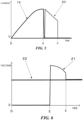
- FIG. 5 is a current waveform diagram in the process of breaking the short-circuit current according to the second testing method.
- FIG. 6 is a voltage waveform diagram in the process of breaking the short-circuit current according to the second testing method.
- the DC circuit breaker 1 is connected to the testing device, with the protection circuit breaker 3 and the auxiliary circuit breaker 8 in the closed state, the closing switch 4 and the starting switch 11 in the opened state, the short-circuit generator 2 in the excited state by the predetermined voltage beforehand, and the voltage source capacitor 10 charged to the predetermined voltage by the charging device 9 beforehand.
- the closing switch 4 is closed at a time D, and an AC current is supplied from the short-circuit generator 2 to the breaker unit 101 of the DC circuit breaker 1.
- This AC current has the magnitude adjusted by the reactor 5, and is supplied to the breaker unit 101 as a fault current 19. Note that as illustrated in FIG. 6 , even when the closing switch 4 is closed, since the voltage source circuit B is not connected to the DC circuit breaker 1, a voltage 18 of the voltage source capacitor 10 is kept constant.
- the DC circuit breaker 1 breaks a current 19. That is, at the time at which the current 19 reaches the current equivalent to the fault current due to the system accident in the DC system, the breaker block 101 is opened to current chop the current, and the current 19 is broken.
- the connection of the current source circuit A to the DC breaker 1 is maintained.
- the starting switch 11 is closed, and the auxiliary circuit breaker 8 is opened to chop the current.
- a DC voltage equivalent to the voltage source capacitor voltage 22 accumulated in the voltage source capacitor 10 is applied to the DC circuit breaker 1.
- the timing at which the voltage is applied to the DC circuit breaker 1 using the voltage source circuit B is delayed until the recovery voltage after the current breaking equivalent to the fault current is applied, the recovery voltage for the DC circuit breaker 1 can be compensated.
- the application of the DC voltage from the voltage source circuit B is set to be a timing after the current breaking and before the recovery voltage applied to the breaker unit 101 of the DC circuit breaker 1 becomes less than the voltage equivalent to the DC system fault voltage.
- This enables a verification of the withstand voltage performance of the DC circuit breaker 1 after the breaking of the fault current.
- the recovery voltage 21 keenly decreases at the timing of the time F, this is because all the energy accumulated in the reactor 5 is discharged.
- the recovery voltage can be applied to the DC circuit breaker 1 without a delay. That is, when the current breaking by the DC circuit breaker 1 is performed by a circuit breaker like a semiconductor breaker that can perform current breaking instantaneously, even if the connection of the voltage source circuit B to the DC circuit breaker 1 is attempted simultaneously with the current breaking, such connection is delayed from the time at which the current breaking is performed, and a time difference between the current breaking and the application of the recovery voltage may occur.
- the voltage source circuit B since the voltage source circuit B is connected before the current breaking and the voltage is applied, the time at which the current reaches the current equivalent to the fault current by the current breaking, and the time at which the voltage source circuit B applies the recovery voltage can be automatically matched. Hence, the recovery voltage can be applied simultaneously with the current breaking without a delay.
- the superimposed current is supplied from the voltage source circuit B, the current supplied by the current source circuit A can be reduced by what corresponds to the superimposed current.
- the voltage source circuit B is connected to the DC circuit breaker 1 simultaneously with the current breaking, it becomes unnecessary to have the short-circuit generator 2 with a large current supply for the current source circuit A. Consequently, there are advantages such that variations in use of the testing device and circuit design can be increased.
- the voltage source circuit B includes the voltage source capacitor 10 serving as the voltage source, and the connection of the voltage source circuit B to the DC circuit breaker 1 is set to be a timing at which the current is broken and immediately before the current reaches the current equivalent to the fault current. Consequently, the predetermined recovery voltage can be surely applied at the time of current breaking. That is, when the voltage source is a capacitor, the energy is discharged along with the elapsed time of the connection of the voltage source circuit B, and the voltage decreases. Hence, when the voltage source circuit B is connected to the DC circuit breaker 1 at a stage quite earlier than the current breaking, there is a possibility that the predetermined recovery voltage for verifying the current breaking performance cannot be applied at the time of current breaking. Hence, in order to avoid this disadvantage, the connection timing is set to be immediately before the current reaches the fault current, and the predetermined recovery voltage can be further surely applied at the time of current breaking.
- the current breaking testing method for the DC circuit breaker 1 in this embodiment is a testing method for a DC circuit breaker to verify the current breaking performance using the testing device including the current source circuit A and the voltage source circuit B, and includes supplying, to the DC circuit breaker 1, a current equivalent to the fault current due to the system accident in the DC system from the current source circuit A, breaking the current by the DC circuit breaker 1, applying the recovery voltage from the current source circuit A to the DC circuit breaker 1, and applying the DC voltage from the voltage source circuit B to the DC circuit breaker 1 while the connection of the current source circuit A to the DC circuit breaker 1 is maintained and the recovery voltage is applied.
- the application of the DC voltage from the voltage source circuit B is performed while the recovery voltage is applied, no voltage is applied from the voltage source circuit B to the DC circuit breaker 1 at least until the current breaking.
- the voltage of the voltage source circuit B can be maintained, and a condition, in which the recovery voltage becomes less than the voltage equivalent to the accident voltage of the DC system after the current breaking, disrupting the verification of the withstand voltage performance after the current breaking can be avoided.
- the recovery voltage of the breaker unit 101 of the DC circuit breaker 1 after the DC breaker 1 has completed the breaking of the fault current from the current source circuit A can be compensated, and the withstand voltage performance after the current breaking can be verified.
- the overvoltage is absorbed by the surge absorber 102 provided in parallel with the breaker unit 101 of the DC circuit breaker 1. Accordingly, an application of the overvoltage to the breaker unit 101 of the DC circuit breaker 1 is suppressed, facilitating an application of the predetermined recovery voltage.
- the above testing method for the current breaking at the instant time and testing method after the current breaking can be achieved not by a worker, but by a control unit.
- the control unit is a computer including a storage medium having stored therein a program to perform a sequence control, and may output connection or breaking instruction to the respective devices of each circuits A and B at a predetermined timing by executing the program.
- the method of verifying the current breaking performance for the DC circuit breaker by the testing device to be applied to the synthetic testing method for AC circuit breakers has been described, but a testing device equivalent to the synthetic testing method may be applied.
- the surge absorber 102 is provided in the DC circuit breaker 1, but may be provided outside the DC circuit breaker 1 as long as it is provided in parallel with the breaker unit 101.
Landscapes
- Physics & Mathematics (AREA)
- General Physics & Mathematics (AREA)
- Tests Of Circuit Breakers, Generators, And Electric Motors (AREA)
- Arc-Extinguishing Devices That Are Switches (AREA)
- Driving Mechanisms And Operating Circuits Of Arc-Extinguishing High-Tension Switches (AREA)
Claims (3)
- Prüfverfahren für einen Gleichstromschutzschalter (1) zum Überprüfen einer Stromabschaltungsleistung unter Verwendung einer Prüfvorrichtung, die eine Stromquellenschaltung (A) und eine Spannungsquellenschaltung (B) umfasst, wobei das Verfahren umfasst:Versorgen des Gleichstromschutzschalters (1) mit einem Wechselstrom von mindestens der Stromquellenschaltung (A);Abschalten des Stroms durch den Gleichstromschutzschalter (1) an einem Zeitpunkt, an dem der Strom aufgrund einer Systemstörung in einem Gleichstromsystem gleichwertig mit einem Fehlerstrom wird; undvor dem Stromabschalten, Anlegen einer Spannung an den Gleichstromschutzschalter (1) durch Verbinden der Spannungsquellenschaltung (B) mit dem Gleichstromschutzschalter (1) und Anlegen einer vorbestimmten wiederkehrenden Spannung von der Spannungsquellenschaltung (B) gleichzeitig mit dem Stromabschalten,wobei:die Spannungsquellenschaltung (B) einen Kondensator (10) umfasst, der als eine Spannungsquelle dient; unddie Verbindung der Spannungsquellenschaltung (B) mit dem Gleichstromschutzschalter (1) eingestellt wird, um ein Zeitpunkt unmittelbar vor dem Stromabschalten zu sein,wobei mit dem Zeitpunkt unmittelbar vor dem Stromabschalten der Zeitpunkt gemeint ist, an dem die Spannungsquellenschaltung (B) in der Lage ist, die vorbestimmte wiederkehrende Spannung an einem Zeitpunkt des Stromabschaltens an den Gleichstromschutzschalter (1) anzulegen,dadurch gekennzeichnet, dass:die Stromquellenschaltung (A) den Gleichstromschutzschalter (1) mit einem Wechselstrom versorgt, der niedriger als ein Strom ist, der gleichwertig mit dem Fehlerstrom ist; unddie Spannungsquellenschaltung (B) vor dem Stromabschalten durch den Gleichstromschutzschalter (1) mit dem Gleichstromschutzschalter (1) verbunden ist, um einen Strom von der Spanungsquellenschaltung (B) auf dem Strom der Stromquellenschaltung (A) zu überlagern, um den Strom zu erhalten, der gleichwertig mit dem Fehlerstrom ist, und eine Spannung an den Gleichstromschutzschalter (1) anzulegen.
- Prüfverfahren für den Gleichstromschutzschalter (1) nach Anspruch 1, wobei die Prüfvorrichtung eine Prüfvorrichtung ist, die für ein synthetisches Prüfverfahren für Wechselstromschutzschalter angewandt wird.
- Prüfverfahren für einen Gleichstromschutzschalter (1) nach einem der Ansprüche 1 bis 2, wobei:der Gleichstromschutzschalter (1) eine Abschaltereinheit (101) umfasst, die einen Strom abschaltet; undbeim Anlegen der wiederkehrenden Spannung von der Spannungsquellenschaltung (B) eine Überspannung durch einen Wellenschlucker absorbiert wird, der parallel mit der Abschaltereinheit (101) des Gleichstromschutzschalters (1) bereitgestellt ist.
Applications Claiming Priority (2)
| Application Number | Priority Date | Filing Date | Title |
|---|---|---|---|
| JP2015128419A JP6645758B2 (ja) | 2015-06-26 | 2015-06-26 | 直流遮断器の試験方法 |
| PCT/JP2016/067736 WO2016208465A1 (ja) | 2015-06-26 | 2016-06-15 | 直流遮断器の試験方法 |
Publications (3)
| Publication Number | Publication Date |
|---|---|
| EP3315980A1 EP3315980A1 (de) | 2018-05-02 |
| EP3315980A4 EP3315980A4 (de) | 2019-02-20 |
| EP3315980B1 true EP3315980B1 (de) | 2024-05-15 |
Family
ID=57585437
Family Applications (1)
| Application Number | Title | Priority Date | Filing Date |
|---|---|---|---|
| EP16814236.2A Active EP3315980B1 (de) | 2015-06-26 | 2016-06-15 | Prüfverfahren für einen gleichstromschutzschalter |
Country Status (4)
| Country | Link |
|---|---|
| EP (1) | EP3315980B1 (de) |
| JP (1) | JP6645758B2 (de) |
| CN (1) | CN107110912B (de) |
| WO (1) | WO2016208465A1 (de) |
Families Citing this family (10)
| Publication number | Priority date | Publication date | Assignee | Title |
|---|---|---|---|---|
| WO2018146748A1 (ja) * | 2017-02-08 | 2018-08-16 | 三菱電機株式会社 | 直流遮断器の試験装置及び試験方法 |
| CN107526030A (zh) * | 2017-07-05 | 2017-12-29 | 全球能源互联网研究院 | 一种高压直流断路器的合成试验装置和方法 |
| CN109188121B (zh) * | 2018-08-14 | 2020-09-08 | 西北工业大学 | 三级式起动/发电机静止状态下旋转整流器故障检测方法 |
| CN110161405B (zh) * | 2019-07-01 | 2020-08-04 | 大连理工大学 | 一种三电源直流开断合成试验回路及其试验方法 |
| CN112630640B (zh) * | 2020-12-09 | 2022-02-22 | 西安交通大学 | 一种两电平电压源的直流断路器合成试验回路及方法 |
| CN113567850B (zh) * | 2021-07-27 | 2023-04-11 | 西安交通大学 | 一种验证中低压直流配电开关设备开断性能的系统及方法 |
| CN113625160A (zh) * | 2021-08-06 | 2021-11-09 | 甘肃电器科学研究院 | 126kv高压交流断路器合成试验同步控制系统 |
| CN115980558A (zh) * | 2021-10-14 | 2023-04-18 | 西安高压电器研究院股份有限公司 | 一种合成试验回路 |
| CN113777437B (zh) * | 2021-11-15 | 2022-02-11 | 中国电力科学研究院有限公司 | 一种用于对特高压直流穿墙套管进行试验的系统及方法 |
| CN114325377A (zh) * | 2022-01-04 | 2022-04-12 | 中车株洲电力机车有限公司 | 真空主断路器故障诊断和预测的系统与方法、机车 |
Family Cites Families (9)
| Publication number | Priority date | Publication date | Assignee | Title |
|---|---|---|---|---|
| DE2336713A1 (de) * | 1973-07-19 | 1975-02-06 | Dieter Prof Dr Ing Kind | Anordnung zur synthetischen pruefung von hochspannungs-gleichstromschaltern |
| JPS5280476A (en) * | 1975-12-26 | 1977-07-06 | Tokyo Shibaura Electric Co | Dc breaker equivalent tester |
| JPS5757267A (en) * | 1980-09-24 | 1982-04-06 | Hitachi Ltd | Combined equivalent testing apparatus for dc breaker |
| EP0242707A1 (de) * | 1986-04-22 | 1987-10-28 | BBC Brown Boveri AG | Prüfkreis |
| JP2003115242A (ja) * | 2001-10-03 | 2003-04-18 | Toshiba Corp | 遮断器試験回路 |
| JP2015056389A (ja) * | 2013-09-13 | 2015-03-23 | 株式会社東芝 | 直流遮断器の試験装置及びその試験方法 |
| JP2015059891A (ja) * | 2013-09-20 | 2015-03-30 | 株式会社東芝 | 直流遮断器の試験装置及び直流遮断器の試験装置による試験方法 |
| CN104535923B (zh) * | 2014-12-27 | 2017-10-31 | 中国西电电气股份有限公司 | 一种用于直流断路器开断性能检测的试验回路及试验方法 |
| CN106646206B (zh) * | 2015-10-29 | 2019-11-08 | 全球能源互联网研究院 | 高电压大电流复合注入的直流断路器合成试验电路和方法 |
-
2015
- 2015-06-26 JP JP2015128419A patent/JP6645758B2/ja active Active
-
2016
- 2016-06-15 EP EP16814236.2A patent/EP3315980B1/de active Active
- 2016-06-15 WO PCT/JP2016/067736 patent/WO2016208465A1/ja not_active Ceased
- 2016-06-15 CN CN201680004929.9A patent/CN107110912B/zh active Active
Also Published As
| Publication number | Publication date |
|---|---|
| EP3315980A1 (de) | 2018-05-02 |
| JP6645758B2 (ja) | 2020-02-14 |
| CN107110912A (zh) | 2017-08-29 |
| JP2017009552A (ja) | 2017-01-12 |
| WO2016208465A1 (ja) | 2016-12-29 |
| CN107110912B (zh) | 2019-08-27 |
| EP3315980A4 (de) | 2019-02-20 |
Similar Documents
| Publication | Publication Date | Title |
|---|---|---|
| EP3315980B1 (de) | Prüfverfahren für einen gleichstromschutzschalter | |
| EP3557268B1 (de) | Prüfvorrichtung für gleichstromschutzschalter | |
| Belda et al. | Full-power test of HVDC circuit-breakers with AC short-circuit generators operated at low power frequency | |
| McDermit et al. | Medium voltage switching transient induced potential transformer failures; prediction, measurement and practical solutions | |
| CN101958530A (zh) | 抽水蓄能电站主变压器差动保护ct极性校验方法 | |
| CN109031106B (zh) | 一种混合式直流断路器开断试验装置 | |
| JP2015059891A (ja) | 直流遮断器の試験装置及び直流遮断器の試験装置による試験方法 | |
| WO2015037223A1 (ja) | 直流遮断器の試験装置及びその試験方法 | |
| Dworakowski et al. | Protection of radial MVDC electric network based on DC circuit breaker and DC fuses | |
| NL2006296C2 (en) | Device to protect an electric power distribution network against current faults. | |
| Meddeb et al. | Impact of distributed generation on the protection system in Tunisian distribution network | |
| Yao et al. | Experimental study of series DC arc in distribution systems | |
| CN102213740B (zh) | 停电状态下单侧电源中高压电力线路故障检测方法及系统 | |
| Nadeem et al. | Multi-Terminal HVDC fault current analysis during line to ground fault | |
| Auran et al. | A novel pole-to-ground fault detection algorithm for meshed HVDC grids with half-bridge MMC converters and full recourse to DC circuit breakers | |
| Banerjee et al. | Protection and dynamic analysis during bottom-up restoration process in MV/LV microgrids | |
| Belda et al. | Performance demonstration of HVDC circuit breakers | |
| Bui-Van et al. | Performance of series-compensated line circuit breakers under delayed current-zero conditions | |
| Berger et al. | Proposal of a time-domain platform for short-circuit protection analysis in rapid transit train DC auxiliary systems | |
| WO2018042516A1 (ja) | 機械式開閉器の試験方法及びその試験装置 | |
| JPH0735831A (ja) | 遮断器の試験方法及びその装置 | |
| De Oliveira et al. | Introduction of the mechanically switched capacitors (MSCs) application on power transmission systems | |
| CN120033812A (zh) | 交流滤波器母线充电和小滤波器投运的母线过电压系统及计算方法 | |
| Usman et al. | Development of a 500V/0.3 kA DC Circuit Breaker Testbed Using a DC Chopper Energized Capacitor Bank | |
| Hjertberg | Fault energy implications of distributed converter interfaced generation: A case study of an underground mine grid |
Legal Events
| Date | Code | Title | Description |
|---|---|---|---|
| STAA | Information on the status of an ep patent application or granted ep patent |
Free format text: STATUS: THE INTERNATIONAL PUBLICATION HAS BEEN MADE |
|
| PUAI | Public reference made under article 153(3) epc to a published international application that has entered the european phase |
Free format text: ORIGINAL CODE: 0009012 |
|
| STAA | Information on the status of an ep patent application or granted ep patent |
Free format text: STATUS: REQUEST FOR EXAMINATION WAS MADE |
|
| 17P | Request for examination filed |
Effective date: 20171219 |
|
| AK | Designated contracting states |
Kind code of ref document: A1 Designated state(s): AL AT BE BG CH CY CZ DE DK EE ES FI FR GB GR HR HU IE IS IT LI LT LU LV MC MK MT NL NO PL PT RO RS SE SI SK SM TR |
|
| AX | Request for extension of the european patent |
Extension state: BA ME |
|
| DAV | Request for validation of the european patent (deleted) | ||
| DAX | Request for extension of the european patent (deleted) | ||
| A4 | Supplementary search report drawn up and despatched |
Effective date: 20190121 |
|
| RIC1 | Information provided on ipc code assigned before grant |
Ipc: G01R 31/333 20060101AFI20190115BHEP Ipc: G01R 31/327 20060101ALI20190115BHEP |
|
| STAA | Information on the status of an ep patent application or granted ep patent |
Free format text: STATUS: EXAMINATION IS IN PROGRESS |
|
| 17Q | First examination report despatched |
Effective date: 20220503 |
|
| GRAP | Despatch of communication of intention to grant a patent |
Free format text: ORIGINAL CODE: EPIDOSNIGR1 |
|
| STAA | Information on the status of an ep patent application or granted ep patent |
Free format text: STATUS: GRANT OF PATENT IS INTENDED |
|
| INTG | Intention to grant announced |
Effective date: 20240214 |
|
| GRAS | Grant fee paid |
Free format text: ORIGINAL CODE: EPIDOSNIGR3 |
|
| GRAA | (expected) grant |
Free format text: ORIGINAL CODE: 0009210 |
|
| STAA | Information on the status of an ep patent application or granted ep patent |
Free format text: STATUS: THE PATENT HAS BEEN GRANTED |
|
| RAP3 | Party data changed (applicant data changed or rights of an application transferred) |
Owner name: KABUSHIKI KAISHA TOSHIBA |
|
| AK | Designated contracting states |
Kind code of ref document: B1 Designated state(s): AL AT BE BG CH CY CZ DE DK EE ES FI FR GB GR HR HU IE IS IT LI LT LU LV MC MK MT NL NO PL PT RO RS SE SI SK SM TR |
|
| REG | Reference to a national code |
Ref country code: CH Ref legal event code: EP Ref country code: GB Ref legal event code: FG4D |
|
| REG | Reference to a national code |
Ref country code: DE Ref legal event code: R096 Ref document number: 602016087547 Country of ref document: DE |
|
| REG | Reference to a national code |
Ref country code: IE Ref legal event code: FG4D |
|
| PGFP | Annual fee paid to national office [announced via postgrant information from national office to epo] |
Ref country code: NL Payment date: 20240527 Year of fee payment: 9 |
|
| PGFP | Annual fee paid to national office [announced via postgrant information from national office to epo] |
Ref country code: GB Payment date: 20240524 Year of fee payment: 9 |
|
| PGFP | Annual fee paid to national office [announced via postgrant information from national office to epo] |
Ref country code: DE Payment date: 20240522 Year of fee payment: 9 |
|
| REG | Reference to a national code |
Ref country code: LT Ref legal event code: MG9D |
|
| REG | Reference to a national code |
Ref country code: NL Ref legal event code: MP Effective date: 20240515 |
|
| PG25 | Lapsed in a contracting state [announced via postgrant information from national office to epo] |
Ref country code: IS Free format text: LAPSE BECAUSE OF FAILURE TO SUBMIT A TRANSLATION OF THE DESCRIPTION OR TO PAY THE FEE WITHIN THE PRESCRIBED TIME-LIMIT Effective date: 20240915 |
|
| PG25 | Lapsed in a contracting state [announced via postgrant information from national office to epo] |
Ref country code: BG Free format text: LAPSE BECAUSE OF FAILURE TO SUBMIT A TRANSLATION OF THE DESCRIPTION OR TO PAY THE FEE WITHIN THE PRESCRIBED TIME-LIMIT Effective date: 20240515 |
|
| PG25 | Lapsed in a contracting state [announced via postgrant information from national office to epo] |
Ref country code: HR Free format text: LAPSE BECAUSE OF FAILURE TO SUBMIT A TRANSLATION OF THE DESCRIPTION OR TO PAY THE FEE WITHIN THE PRESCRIBED TIME-LIMIT Effective date: 20240515 Ref country code: FI Free format text: LAPSE BECAUSE OF FAILURE TO SUBMIT A TRANSLATION OF THE DESCRIPTION OR TO PAY THE FEE WITHIN THE PRESCRIBED TIME-LIMIT Effective date: 20240515 |
|
| PG25 | Lapsed in a contracting state [announced via postgrant information from national office to epo] |
Ref country code: GR Free format text: LAPSE BECAUSE OF FAILURE TO SUBMIT A TRANSLATION OF THE DESCRIPTION OR TO PAY THE FEE WITHIN THE PRESCRIBED TIME-LIMIT Effective date: 20240816 |
|
| PG25 | Lapsed in a contracting state [announced via postgrant information from national office to epo] |
Ref country code: PT Free format text: LAPSE BECAUSE OF FAILURE TO SUBMIT A TRANSLATION OF THE DESCRIPTION OR TO PAY THE FEE WITHIN THE PRESCRIBED TIME-LIMIT Effective date: 20240916 |
|
| REG | Reference to a national code |
Ref country code: AT Ref legal event code: MK05 Ref document number: 1687320 Country of ref document: AT Kind code of ref document: T Effective date: 20240515 |
|
| PG25 | Lapsed in a contracting state [announced via postgrant information from national office to epo] |
Ref country code: NL Free format text: LAPSE BECAUSE OF FAILURE TO SUBMIT A TRANSLATION OF THE DESCRIPTION OR TO PAY THE FEE WITHIN THE PRESCRIBED TIME-LIMIT Effective date: 20240515 |
|
| PG25 | Lapsed in a contracting state [announced via postgrant information from national office to epo] |
Ref country code: ES Free format text: LAPSE BECAUSE OF FAILURE TO SUBMIT A TRANSLATION OF THE DESCRIPTION OR TO PAY THE FEE WITHIN THE PRESCRIBED TIME-LIMIT Effective date: 20240515 |
|
| PGFP | Annual fee paid to national office [announced via postgrant information from national office to epo] |
Ref country code: CH Payment date: 20240701 Year of fee payment: 9 |
|
| PG25 | Lapsed in a contracting state [announced via postgrant information from national office to epo] |
Ref country code: AT Free format text: LAPSE BECAUSE OF FAILURE TO SUBMIT A TRANSLATION OF THE DESCRIPTION OR TO PAY THE FEE WITHIN THE PRESCRIBED TIME-LIMIT Effective date: 20240515 |
|
| PG25 | Lapsed in a contracting state [announced via postgrant information from national office to epo] |
Ref country code: PL Free format text: LAPSE BECAUSE OF FAILURE TO SUBMIT A TRANSLATION OF THE DESCRIPTION OR TO PAY THE FEE WITHIN THE PRESCRIBED TIME-LIMIT Effective date: 20240515 |
|
| PG25 | Lapsed in a contracting state [announced via postgrant information from national office to epo] |
Ref country code: LV Free format text: LAPSE BECAUSE OF FAILURE TO SUBMIT A TRANSLATION OF THE DESCRIPTION OR TO PAY THE FEE WITHIN THE PRESCRIBED TIME-LIMIT Effective date: 20240515 |
|
| PG25 | Lapsed in a contracting state [announced via postgrant information from national office to epo] |
Ref country code: PT Free format text: LAPSE BECAUSE OF FAILURE TO SUBMIT A TRANSLATION OF THE DESCRIPTION OR TO PAY THE FEE WITHIN THE PRESCRIBED TIME-LIMIT Effective date: 20240916 Ref country code: PL Free format text: LAPSE BECAUSE OF FAILURE TO SUBMIT A TRANSLATION OF THE DESCRIPTION OR TO PAY THE FEE WITHIN THE PRESCRIBED TIME-LIMIT Effective date: 20240515 Ref country code: NO Free format text: LAPSE BECAUSE OF FAILURE TO SUBMIT A TRANSLATION OF THE DESCRIPTION OR TO PAY THE FEE WITHIN THE PRESCRIBED TIME-LIMIT Effective date: 20240815 Ref country code: NL Free format text: LAPSE BECAUSE OF FAILURE TO SUBMIT A TRANSLATION OF THE DESCRIPTION OR TO PAY THE FEE WITHIN THE PRESCRIBED TIME-LIMIT Effective date: 20240515 Ref country code: LV Free format text: LAPSE BECAUSE OF FAILURE TO SUBMIT A TRANSLATION OF THE DESCRIPTION OR TO PAY THE FEE WITHIN THE PRESCRIBED TIME-LIMIT Effective date: 20240515 Ref country code: IS Free format text: LAPSE BECAUSE OF FAILURE TO SUBMIT A TRANSLATION OF THE DESCRIPTION OR TO PAY THE FEE WITHIN THE PRESCRIBED TIME-LIMIT Effective date: 20240915 Ref country code: HR Free format text: LAPSE BECAUSE OF FAILURE TO SUBMIT A TRANSLATION OF THE DESCRIPTION OR TO PAY THE FEE WITHIN THE PRESCRIBED TIME-LIMIT Effective date: 20240515 Ref country code: GR Free format text: LAPSE BECAUSE OF FAILURE TO SUBMIT A TRANSLATION OF THE DESCRIPTION OR TO PAY THE FEE WITHIN THE PRESCRIBED TIME-LIMIT Effective date: 20240816 Ref country code: FI Free format text: LAPSE BECAUSE OF FAILURE TO SUBMIT A TRANSLATION OF THE DESCRIPTION OR TO PAY THE FEE WITHIN THE PRESCRIBED TIME-LIMIT Effective date: 20240515 Ref country code: ES Free format text: LAPSE BECAUSE OF FAILURE TO SUBMIT A TRANSLATION OF THE DESCRIPTION OR TO PAY THE FEE WITHIN THE PRESCRIBED TIME-LIMIT Effective date: 20240515 Ref country code: BG Free format text: LAPSE BECAUSE OF FAILURE TO SUBMIT A TRANSLATION OF THE DESCRIPTION OR TO PAY THE FEE WITHIN THE PRESCRIBED TIME-LIMIT Effective date: 20240515 Ref country code: AT Free format text: LAPSE BECAUSE OF FAILURE TO SUBMIT A TRANSLATION OF THE DESCRIPTION OR TO PAY THE FEE WITHIN THE PRESCRIBED TIME-LIMIT Effective date: 20240515 Ref country code: RS Free format text: LAPSE BECAUSE OF FAILURE TO SUBMIT A TRANSLATION OF THE DESCRIPTION OR TO PAY THE FEE WITHIN THE PRESCRIBED TIME-LIMIT Effective date: 20240815 |
|
| PG25 | Lapsed in a contracting state [announced via postgrant information from national office to epo] |
Ref country code: DK Free format text: LAPSE BECAUSE OF FAILURE TO SUBMIT A TRANSLATION OF THE DESCRIPTION OR TO PAY THE FEE WITHIN THE PRESCRIBED TIME-LIMIT Effective date: 20240515 |
|
| PG25 | Lapsed in a contracting state [announced via postgrant information from national office to epo] |
Ref country code: EE Free format text: LAPSE BECAUSE OF FAILURE TO SUBMIT A TRANSLATION OF THE DESCRIPTION OR TO PAY THE FEE WITHIN THE PRESCRIBED TIME-LIMIT Effective date: 20240515 |
|
| PG25 | Lapsed in a contracting state [announced via postgrant information from national office to epo] |
Ref country code: CZ Free format text: LAPSE BECAUSE OF FAILURE TO SUBMIT A TRANSLATION OF THE DESCRIPTION OR TO PAY THE FEE WITHIN THE PRESCRIBED TIME-LIMIT Effective date: 20240515 |
|
| PG25 | Lapsed in a contracting state [announced via postgrant information from national office to epo] |
Ref country code: SK Free format text: LAPSE BECAUSE OF FAILURE TO SUBMIT A TRANSLATION OF THE DESCRIPTION OR TO PAY THE FEE WITHIN THE PRESCRIBED TIME-LIMIT Effective date: 20240515 Ref country code: RO Free format text: LAPSE BECAUSE OF FAILURE TO SUBMIT A TRANSLATION OF THE DESCRIPTION OR TO PAY THE FEE WITHIN THE PRESCRIBED TIME-LIMIT Effective date: 20240515 |
|
| PG25 | Lapsed in a contracting state [announced via postgrant information from national office to epo] |
Ref country code: SM Free format text: LAPSE BECAUSE OF FAILURE TO SUBMIT A TRANSLATION OF THE DESCRIPTION OR TO PAY THE FEE WITHIN THE PRESCRIBED TIME-LIMIT Effective date: 20240515 |
|
| PG25 | Lapsed in a contracting state [announced via postgrant information from national office to epo] |
Ref country code: SM Free format text: LAPSE BECAUSE OF FAILURE TO SUBMIT A TRANSLATION OF THE DESCRIPTION OR TO PAY THE FEE WITHIN THE PRESCRIBED TIME-LIMIT Effective date: 20240515 Ref country code: SK Free format text: LAPSE BECAUSE OF FAILURE TO SUBMIT A TRANSLATION OF THE DESCRIPTION OR TO PAY THE FEE WITHIN THE PRESCRIBED TIME-LIMIT Effective date: 20240515 Ref country code: RO Free format text: LAPSE BECAUSE OF FAILURE TO SUBMIT A TRANSLATION OF THE DESCRIPTION OR TO PAY THE FEE WITHIN THE PRESCRIBED TIME-LIMIT Effective date: 20240515 Ref country code: EE Free format text: LAPSE BECAUSE OF FAILURE TO SUBMIT A TRANSLATION OF THE DESCRIPTION OR TO PAY THE FEE WITHIN THE PRESCRIBED TIME-LIMIT Effective date: 20240515 Ref country code: DK Free format text: LAPSE BECAUSE OF FAILURE TO SUBMIT A TRANSLATION OF THE DESCRIPTION OR TO PAY THE FEE WITHIN THE PRESCRIBED TIME-LIMIT Effective date: 20240515 Ref country code: CZ Free format text: LAPSE BECAUSE OF FAILURE TO SUBMIT A TRANSLATION OF THE DESCRIPTION OR TO PAY THE FEE WITHIN THE PRESCRIBED TIME-LIMIT Effective date: 20240515 |
|
| PG25 | Lapsed in a contracting state [announced via postgrant information from national office to epo] |
Ref country code: IT Free format text: LAPSE BECAUSE OF FAILURE TO SUBMIT A TRANSLATION OF THE DESCRIPTION OR TO PAY THE FEE WITHIN THE PRESCRIBED TIME-LIMIT Effective date: 20240515 Ref country code: MC Free format text: LAPSE BECAUSE OF FAILURE TO SUBMIT A TRANSLATION OF THE DESCRIPTION OR TO PAY THE FEE WITHIN THE PRESCRIBED TIME-LIMIT Effective date: 20240515 |
|
| PG25 | Lapsed in a contracting state [announced via postgrant information from national office to epo] |
Ref country code: LU Free format text: LAPSE BECAUSE OF NON-PAYMENT OF DUE FEES Effective date: 20240615 |
|
| REG | Reference to a national code |
Ref country code: DE Ref legal event code: R097 Ref document number: 602016087547 Country of ref document: DE |
|
| PLBE | No opposition filed within time limit |
Free format text: ORIGINAL CODE: 0009261 |
|
| STAA | Information on the status of an ep patent application or granted ep patent |
Free format text: STATUS: NO OPPOSITION FILED WITHIN TIME LIMIT |
|
| PG25 | Lapsed in a contracting state [announced via postgrant information from national office to epo] |
Ref country code: IE Free format text: LAPSE BECAUSE OF NON-PAYMENT OF DUE FEES Effective date: 20240615 |
|
| 26N | No opposition filed |
Effective date: 20250218 |
|
| PG25 | Lapsed in a contracting state [announced via postgrant information from national office to epo] |
Ref country code: SI Free format text: LAPSE BECAUSE OF FAILURE TO SUBMIT A TRANSLATION OF THE DESCRIPTION OR TO PAY THE FEE WITHIN THE PRESCRIBED TIME-LIMIT Effective date: 20240515 Ref country code: BE Free format text: LAPSE BECAUSE OF NON-PAYMENT OF DUE FEES Effective date: 20240630 |
|
| PG25 | Lapsed in a contracting state [announced via postgrant information from national office to epo] |
Ref country code: FR Free format text: LAPSE BECAUSE OF NON-PAYMENT OF DUE FEES Effective date: 20240715 |
|
| REG | Reference to a national code |
Ref country code: BE Ref legal event code: MM Effective date: 20240630 |
|
| PG25 | Lapsed in a contracting state [announced via postgrant information from national office to epo] |
Ref country code: SE Free format text: LAPSE BECAUSE OF FAILURE TO SUBMIT A TRANSLATION OF THE DESCRIPTION OR TO PAY THE FEE WITHIN THE PRESCRIBED TIME-LIMIT Effective date: 20240515 |
|
| PG25 | Lapsed in a contracting state [announced via postgrant information from national office to epo] |
Ref country code: CY Free format text: LAPSE BECAUSE OF FAILURE TO SUBMIT A TRANSLATION OF THE DESCRIPTION OR TO PAY THE FEE WITHIN THE PRESCRIBED TIME-LIMIT; INVALID AB INITIO Effective date: 20160615 |
|
| REG | Reference to a national code |
Ref country code: DE Ref legal event code: R119 Ref document number: 602016087547 Country of ref document: DE |
|
| PGFP | Annual fee paid to national office [announced via postgrant information from national office to epo] |
Ref country code: SE Payment date: 20240913 Year of fee payment: 9 |
|
| REG | Reference to a national code |
Ref country code: CH Ref legal event code: H13 Free format text: ST27 STATUS EVENT CODE: U-0-0-H10-H13 (AS PROVIDED BY THE NATIONAL OFFICE) Effective date: 20260127 |
|
| GBPC | Gb: european patent ceased through non-payment of renewal fee |
Effective date: 20250615 |
|
| PG25 | Lapsed in a contracting state [announced via postgrant information from national office to epo] |
Ref country code: HU Free format text: LAPSE BECAUSE OF FAILURE TO SUBMIT A TRANSLATION OF THE DESCRIPTION OR TO PAY THE FEE WITHIN THE PRESCRIBED TIME-LIMIT; INVALID AB INITIO Effective date: 20160615 |
|
| PG25 | Lapsed in a contracting state [announced via postgrant information from national office to epo] |
Ref country code: GB Free format text: LAPSE BECAUSE OF NON-PAYMENT OF DUE FEES Effective date: 20250615 |
|
| PG25 | Lapsed in a contracting state [announced via postgrant information from national office to epo] |
Ref country code: DE Free format text: LAPSE BECAUSE OF NON-PAYMENT OF DUE FEES Effective date: 20260101 |
|
| PG25 | Lapsed in a contracting state [announced via postgrant information from national office to epo] |
Ref country code: CH Free format text: LAPSE BECAUSE OF NON-PAYMENT OF DUE FEES Effective date: 20250630 |