EP3316387A1 - Système d'accumulation d'énergie - Google Patents
Système d'accumulation d'énergie Download PDFInfo
- Publication number
- EP3316387A1 EP3316387A1 EP16814022.6A EP16814022A EP3316387A1 EP 3316387 A1 EP3316387 A1 EP 3316387A1 EP 16814022 A EP16814022 A EP 16814022A EP 3316387 A1 EP3316387 A1 EP 3316387A1
- Authority
- EP
- European Patent Office
- Prior art keywords
- storage cell
- operation mode
- battery
- usage history
- unit
- Prior art date
- Legal status (The legal status is an assumption and is not a legal conclusion. Google has not performed a legal analysis and makes no representation as to the accuracy of the status listed.)
- Withdrawn
Links
Images



Classifications
-
- H—ELECTRICITY
- H01—ELECTRIC ELEMENTS
- H01M—PROCESSES OR MEANS, e.g. BATTERIES, FOR THE DIRECT CONVERSION OF CHEMICAL ENERGY INTO ELECTRICAL ENERGY
- H01M10/00—Secondary cells; Manufacture thereof
- H01M10/42—Methods or arrangements for servicing or maintenance of secondary cells or secondary half-cells
- H01M10/48—Accumulators combined with arrangements for measuring, testing or indicating the condition of cells, e.g. the level or density of the electrolyte
-
- B—PERFORMING OPERATIONS; TRANSPORTING
- B60—VEHICLES IN GENERAL
- B60L—PROPULSION OF ELECTRICALLY-PROPELLED VEHICLES; SUPPLYING ELECTRIC POWER FOR AUXILIARY EQUIPMENT OF ELECTRICALLY-PROPELLED VEHICLES; ELECTRODYNAMIC BRAKE SYSTEMS FOR VEHICLES IN GENERAL; MAGNETIC SUSPENSION OR LEVITATION FOR VEHICLES; MONITORING OPERATING VARIABLES OF ELECTRICALLY-PROPELLED VEHICLES; ELECTRIC SAFETY DEVICES FOR ELECTRICALLY-PROPELLED VEHICLES
- B60L3/00—Electric devices on electrically-propelled vehicles for safety purposes; Monitoring operating variables, e.g. speed, deceleration or energy consumption
- B60L3/12—Recording operating variables ; Monitoring of operating variables
-
- B—PERFORMING OPERATIONS; TRANSPORTING
- B60—VEHICLES IN GENERAL
- B60L—PROPULSION OF ELECTRICALLY-PROPELLED VEHICLES; SUPPLYING ELECTRIC POWER FOR AUXILIARY EQUIPMENT OF ELECTRICALLY-PROPELLED VEHICLES; ELECTRODYNAMIC BRAKE SYSTEMS FOR VEHICLES IN GENERAL; MAGNETIC SUSPENSION OR LEVITATION FOR VEHICLES; MONITORING OPERATING VARIABLES OF ELECTRICALLY-PROPELLED VEHICLES; ELECTRIC SAFETY DEVICES FOR ELECTRICALLY-PROPELLED VEHICLES
- B60L58/00—Methods or circuit arrangements for monitoring or controlling batteries or fuel cells, specially adapted for electric vehicles
- B60L58/10—Methods or circuit arrangements for monitoring or controlling batteries or fuel cells, specially adapted for electric vehicles for monitoring or controlling batteries
- B60L58/16—Methods or circuit arrangements for monitoring or controlling batteries or fuel cells, specially adapted for electric vehicles for monitoring or controlling batteries responding to battery ageing, e.g. to the number of charging cycles or the state of health [SoH]
-
- G—PHYSICS
- G01—MEASURING; TESTING
- G01R—MEASURING ELECTRIC VARIABLES; MEASURING MAGNETIC VARIABLES
- G01R31/00—Arrangements for testing electric properties; Arrangements for locating electric faults; Arrangements for electrical testing characterised by what is being tested not provided for elsewhere
- G01R31/36—Arrangements for testing, measuring or monitoring the electrical condition of accumulators or electric batteries, e.g. capacity or state of charge [SoC]
- G01R31/392—Determining battery ageing or deterioration, e.g. state of health
-
- H—ELECTRICITY
- H01—ELECTRIC ELEMENTS
- H01M—PROCESSES OR MEANS, e.g. BATTERIES, FOR THE DIRECT CONVERSION OF CHEMICAL ENERGY INTO ELECTRICAL ENERGY
- H01M10/00—Secondary cells; Manufacture thereof
- H01M10/42—Methods or arrangements for servicing or maintenance of secondary cells or secondary half-cells
- H01M10/425—Structural combination with electronic components, e.g. electronic circuits integrated to the outside of the casing
-
- H—ELECTRICITY
- H01—ELECTRIC ELEMENTS
- H01M—PROCESSES OR MEANS, e.g. BATTERIES, FOR THE DIRECT CONVERSION OF CHEMICAL ENERGY INTO ELECTRICAL ENERGY
- H01M10/00—Secondary cells; Manufacture thereof
- H01M10/42—Methods or arrangements for servicing or maintenance of secondary cells or secondary half-cells
- H01M10/48—Accumulators combined with arrangements for measuring, testing or indicating the condition of cells, e.g. the level or density of the electrolyte
- H01M10/486—Accumulators combined with arrangements for measuring, testing or indicating the condition of cells, e.g. the level or density of the electrolyte for measuring temperature
-
- Y—GENERAL TAGGING OF NEW TECHNOLOGICAL DEVELOPMENTS; GENERAL TAGGING OF CROSS-SECTIONAL TECHNOLOGIES SPANNING OVER SEVERAL SECTIONS OF THE IPC; TECHNICAL SUBJECTS COVERED BY FORMER USPC CROSS-REFERENCE ART COLLECTIONS [XRACs] AND DIGESTS
- Y02—TECHNOLOGIES OR APPLICATIONS FOR MITIGATION OR ADAPTATION AGAINST CLIMATE CHANGE
- Y02E—REDUCTION OF GREENHOUSE GAS [GHG] EMISSIONS, RELATED TO ENERGY GENERATION, TRANSMISSION OR DISTRIBUTION
- Y02E60/00—Enabling technologies; Technologies with a potential or indirect contribution to GHG emissions mitigation
- Y02E60/10—Energy storage using batteries
-
- Y—GENERAL TAGGING OF NEW TECHNOLOGICAL DEVELOPMENTS; GENERAL TAGGING OF CROSS-SECTIONAL TECHNOLOGIES SPANNING OVER SEVERAL SECTIONS OF THE IPC; TECHNICAL SUBJECTS COVERED BY FORMER USPC CROSS-REFERENCE ART COLLECTIONS [XRACs] AND DIGESTS
- Y02—TECHNOLOGIES OR APPLICATIONS FOR MITIGATION OR ADAPTATION AGAINST CLIMATE CHANGE
- Y02T—CLIMATE CHANGE MITIGATION TECHNOLOGIES RELATED TO TRANSPORTATION
- Y02T10/00—Road transport of goods or passengers
- Y02T10/60—Other road transportation technologies with climate change mitigation effect
- Y02T10/70—Energy storage systems for electromobility, e.g. batteries
Definitions
- the present invention relates to an energy storage system.
- PTL 1 reports a technique for diagnosing remaining service life in an on-board energy storage system for automobiles. In this technique, the remaining service life is diagnosed from changes in the fuel consumption of classified driving modes from a drive measurement unit.
- a lithium-ion battery is known to deteriorate in a manner that depends on ambient environmental conditions.
- PTL 2 reports a technique for diagnosing remaining service life in an on-board energy storage system for automobiles, whereby the proportion of each classified driving mode from a drive measurement unit is calculated, and the remaining service life is diagnosed by using the pre-measured result for each driving mode in a life database.
- Deterioration of lithium-ion batteries is heavily dependent on use conditions, for example, such as current value, voltage, and temperature.
- the feature of the techniques disclosed in PTL 1 and PTL 2 lies in the diagnosis of remaining service life using data related to different driving modes of an automobile.
- battery deterioration depends on the conditions of the environment where the battery is used, and other factors such as temperature, current value, and the state of charge of the battery, it would not be possible with the techniques of PTL 1 and PTL 2 to detect detailed information of the battery state, and the accuracy of deterioration prediction will probably be poor. It is accordingly an object of the present invention to improve the prediction accuracy of battery deterioration.
- a feature of the present invention for solving the foregoing problem is, for example, as follows.
- An energy storage system comprising: a storage cell; a battery usage history detection unit that detects a usage history of the storage cell; an operation mode classification unit that classifies an operation mode of the storage cell according to the usage history of the storage cell; an SOH estimation unit that estimates a deterioration index value of the storage cell according to the usage history of the storage cell; and a remaining-service-life estimation unit that calculates a remaining service life of the storage cell according to the usage history of the operation mode of the storage cell, and the deterioration index value of the storage cell.
- An energy storage system in which the usage history of the storage cell represents a current value of the storage cell, a battery temperature of the storage cell, and a battery voltage of the storage cell.
- An energy storage system in which the operation mode classification unit classifies an operation mode of the storage cell according to ranges of at least two characteristic values selected from a current value of the storage cell, a battery temperature of the storage cell, and an SOC of the storage cell calculated from a battery voltage of the storage cell.
- An energy storage system in which the operation mode classification unit calculates a characteristic value of the usage history of the storage cell for each operation mode classified by the operation mode classification unit.
- An energy storage system in which the remaining-service-life estimation unit calculates a remaining service life of the storage cell according to a deterioration prediction formula for each operation mode of the storage cell, and the deterioration index value of the storage cell.
- An energy storage system comprising: a storage cell; a battery usage history detection unit that detects a usage history of the storage cell; an operation mode classification unit that classifies an operation mode of the storage cell according to the usage history of the storage cell; and an SOH estimation unit that estimates a deterioration index value of the storage cell according to the usage history of the storage cell, wherein the energy storage system receives a remaining service life of the storage cell calculated in a cloud server according to the usage history of the operation mode of the storage cell, and the deterioration index value of the storage cell.
- An energy storage system in which a deterioration prediction formula of the storage cell is updated according to the extent by which a predicted value calculated by the cloud server for the battery deterioration index of the storage cell deviates from a predicted value recorded in the cloud server for the battery deterioration index of the storage cell.
- the present invention can improve the prediction accuracy of battery deterioration.
- Other objects, configurations, and advantages will be apparent from the descriptions of the embodiment below.
- control method and computer programs of the present invention will be described in a series of procedures. However, the order of the procedures described below is not intended to limit the order in which these procedures can be executed. When implementing the control method and computer programs of the present invention, the order of the procedures may therefore be varied, as long as it does not interfere with the substance of the present invention.
- the procedures of the control method and computer programs of the present invention do not need to be executed at different times. That is, the procedures may be executed such that, for example, a part of the procedures may occur while some other procedure is being executed, or different procedures may be executed at the same time, either in part or as a whole.
- FIG. 1 is a diagram representing an output process for the result of a diagnosis of the remaining service life of a lithium-ion battery according to the embodiment of the present invention.
- An energy storage system (lithium-ion battery system) 100 is configured from a battery pack 110, and a battery life output section 120.
- the battery pack 110 is configured from series-parallel storage cells, such lithium-ion batteries 111, and a current measurement unit 112, a voltage measurement unit 113, and a battery temperature measurement unit 114 provided alongside the lithium-ion batteries 111, and that measure the current value, the voltage value, and the temperature of the lithium-ion batteries 111.
- the battery life output section 120 is configured from a battery usage history detection unit 121, an operation mode classification unit 122, a characteristic value aggregation unit 123, a deterioration prediction formula storage unit 124, a deterioration prediction formula calculation unit 125, an SOH estimation unit 126, a remaining-service-life estimation unit 127, and a display section 128.
- the battery life output section 120 includes a CPU (Central Processing Unit), a RAM (Random Access Memory), a ROM (Read Only Memory), and peripheral circuits.
- system components such as the operation mode classification unit 122, and the characteristic value aggregation unit 123 may be stored in the ROM, and may be executed by the CPU using the RAM.
- the battery usage history detection unit 121 has a means to communicate with the current measurement unit 112, the voltage measurement unit 113, and the battery temperature measurement unit 114, and functions to detect the usage history (battery usage history) of the current value, the voltage value, and the battery temperature of the lithium-ion battery 111.
- the detected usage history of current value, voltage value, and battery temperature is used for classification of operation modes (described later), and for calculations performed in the diagnosis of remaining service life.
- the characteristic values extracted from the battery usage history detection unit 121 are output to the operation mode classification unit 122.
- the charged state of the lithium-ion battery, and an SOC are estimated from the current value, the voltage value, and the battery temperature of the lithium-ion battery.
- the lithium-ion battery 111 is classified by operation mode.
- operation mode refers to a mode that is classified according to various operational states of a battery in an environment in which the battery is used.
- the lithium-ion battery 111 is classified into different operation modes according to the parameter values detected in the battery usage history detection unit 121, including, for example, current value, battery temperature, and SOC. The classification method will be described later.
- a characteristic value is calculated for the characteristic value of the parameter value of each operation mode at regular intervals, for example, every 12 hours or 24 hours.
- the characteristic value include average current value, effective current value, average temperature, and average SOC.
- Average current value, effective current value, average temperature, and average SOC are selected as characteristic values because these values have large impact on deterioration of the lithium-ion battery 111, and using the mean values of these battery usage histories improves the diagnosis accuracy of remaining service life.
- the characteristic values, including average current value, effective current value, average temperature, and average SOC, calculated in the operation mode classification unit 122 are regularly output to the characteristic value characteristic value aggregation unit 123 on a regular basis.
- each average characteristic value calculated for different operation modes from the start of system operation is regularly updated.
- the updated average characteristic value for each operation mode is used for calculations in the diagnosis of remaining service life (described later).
- diagnosis accuracy of remaining service life improves.
- the deterioration state of the lithium-ion battery 111 can be estimated with improved accuracy, and the diagnosis accuracy of remaining service life improves when a deterioration prediction formula, customized for each operation mode, is used in combination.
- the characteristic value aggregation unit 123 also functions to calculate an operation rate from the past operation time of the operation mode, in addition to the average characteristic value, and store the result of calculation.
- the deterioration prediction formula storage unit 124 stores the deterioration prediction formula constructed from the result of a previously conducted battery test.
- the deterioration prediction formula for each operation mode is regularly updated using the prediction formula stored in the deterioration prediction formula storage unit 124, and the characteristic value regularly updated for each operation mode in the characteristic value aggregation unit 123.
- the prediction formula stored in the deterioration prediction formula storage unit 124 is configured to accept parameter values so that the formula is completed upon inputting the average current value, the effective current value, the average temperature, the average SOC, and other parameter values calculated in the characteristic value aggregation unit 123.
- the updated deterioration prediction formula for each operation mode is used in calculations for the diagnosis of the remaining service life of the lithium-ion battery 111.
- the deterioration state of the lithium-ion battery 111 can be estimated with improved accuracy, and the diagnosis accuracy of remaining service life improves.
- the SOH estimation unit 126 estimates the state of battery deterioration, or SOH, from the current value, the voltage value, and the battery temperature. Specifically, the deterioration index value of the lithium-ion battery 111 is estimated.
- a battery's SOH is 100% when the battery capacity or battery resistance is at its initial value, and SOH is used as an index of the extent of battery deterioration.
- the remaining-service-life estimation unit 127 estimates the remaining service life of the lithium-ion battery 111.
- the remaining service life of the lithium-ion battery 111 is diagnosed by using the deterioration prediction formula for each operation mode regularly updated in the deterioration prediction formula calculation unit 125, the operation rate of each operation mode calculated in the characteristic value aggregation unit 123, and the SOH calculated in the SOH estimation unit 126.
- changes in the deterioration of the lithium-ion battery 111 can be estimated with improved accuracy, and the diagnosis accuracy of remaining service life improves.
- the diagnosis accuracy of remaining service life further improves with the use of the current SOH, and the estimated change in the deterioration of the lithium-ion battery 111.
- the display section 128 displays information, for example, the diagnosis result for the remaining service life of the lithium-ion battery 111, on a screen, according to the result from the remaining-service-life estimation unit 127.
- the result sent to the display section 128 may be the calculated remaining service life, or advice concerning operation of the lithium-ion battery 111.
- the remaining service life of the lithium-ion battery 111 is diagnosed with the configurations described above.
- the following describes the technique used to classify the operation mode in the operation mode classification unit 122 of the battery life output section 120.
- the relationship between the use condition of a battery, and battery deterioration is described first.
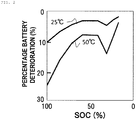
- FIG. 2 is a characteristic diagram representing how the SOC of a lithium-ion battery, and the lithium-ion battery temperature are related to deterioration of the lithium-ion battery.
- FIG. 2 represents an example of a characteristic diagram of the relationship between the use condition of a lithium-ion battery, and deterioration of the lithium-ion battery.
- the characteristic diagram is based on the calculations of the deterioration of the lithium-ion battery 111 when the lithium-ion battery 111 at different SOC levels is stored at different temperatures.
- the percentage deterioration of lithium-ion battery capacity as an index of deterioration of the lithium-ion battery 111 is shown for temperatures of 25°C and 50°C.
- the horizontal axis represents SOC
- the vertical axis represents the percentage capacity deterioration of the lithium-ion battery 111.
- the deterioration of the lithium-ion battery 111 is dependent on the temperature and the SOC of the lithium-ion battery 111.
- the temperature and the SOC of the lithium-ion battery 111 are expected to fluctuate during the operation.
- the accurate temperature and SOC values of the lithium-ion battery 111 cannot be found when the calculated values are the mean temperature and SOC of the lithium-ion battery 111 throughout its operation. Without the accurate values, accuracy cannot be expected for the values input to the deterioration prediction formula storage unit 124 of the battery life output section 120, and the remaining service life of the lithium-ion battery 111 cannot be diagnosed with accuracy.
- the operation mode is classified by setting thresholds for environmental conditions, such as the temperature and the SOC of the lithium-ion battery 111.
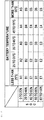
- FIG. 3 represents an example of a table classifying the operation mode.
- the operation mode is classified into 25 operation modes, A1 to E5, according to the values of SOC and battery temperature.
- the classification is based on the SOC and the battery temperature of a lithium-ion battery.
- the operation mode may be classified according to a combination of SOC and current value, or a combination of battery temperature and current value. It is also possible to combine SOC, battery temperature, and current value. Battery life is diagnosed using the characteristic values of each operation mode so classified.
- the prediction accuracy for the life of the lithium-ion battery 111 improves when the operation mode classification unit 122 classifies the operation mode of the lithium-ion battery 111 according to ranges of at least two characteristic values selected from the current value of the lithium-ion battery 111, the battery temperature of the lithium-ion battery 111, and the SOC of the lithium-ion battery 111 calculated according to the battery voltage of the lithium-ion battery 111.
- the operation mode can be classified into a total of 245 operation modes as in the three-dimensional matrix shown in FIG. 5 .
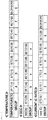
- FIG. 4 represents tables showing the reference thresholds used to classify the operation mode using three kinds of battery usage histories.
- FIG. 5 shows an example in which the operation mode is classified using three kinds of battery usage histories.
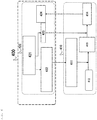
- FIG. 6 is a diagram representing an output process for the result of a diagnosis of the remaining service life of a lithium-ion battery according to another embodiment of the present invention.
- FIG. 4 is characterized in the use of a cloud server 410. With the cloud server 410 taking a part of the calculation system for the diagnosis of remaining service life, it is possible to reduce the size of an energy storage system 400.
- the energy storage system 400 is configured so that a battery life output section 420 includes a battery usage history detection unit 421, an operation mode classification unit 422, an SOH estimation unit 423, and a display section 424.
- the battery life output section 420 includes a CPU (Central Processing Unit), a RAM (Random Access Memory), a ROM (Read Only Memory), and peripheral circuits.
- CPU Central Processing Unit
- RAM Random Access Memory
- ROM Read Only Memory
- system components such as the battery usage history detection unit 421, and the operation mode classification unit 422 may be stored in the ROM, and may be executed by the CPU using the RAM.
- the cloud server 410 is configured from a characteristic value aggregation unit 411, a deterioration prediction formula storage unit 412, a deterioration prediction formula calculation unit 413, and a remaining-service-life estimation unit 414.
- the battery usage history detection unit 421 functions to detect, for example, the current value, the voltage value, and the battery temperature of the lithium-ion battery.
- the characteristic values extracted from the battery usage history detection unit 421 are output to the operation mode classification unit 422.
- the charged state of the lithium-ion battery, or SOC is estimated from the current value, the voltage value, and the battery temperature of the lithium-ion battery.
- the lithium-ion battery is classified by operation mode.
- the operation mode is classified according to the current value, the battery temperature, the SOC, and other parameter values of the lithium-ion battery detected in the battery usage history detection unit 421.
- a characteristic value is calculated for the parameter value (battery usage history) of each operation mode at regular intervals, such as every 12 hours or 24 hours. Examples of the characteristic value include average current value, effective current value, average temperature, and average SOC.
- the characteristic values including average current value, effective current value, average temperature, and average SOC, calculated in the operation mode classification unit 422 are output to the characteristic value aggregation unit 411 of the cloud server 410 on a regular basis. In this way, more accurate information can be obtained for the usage history of the lithium-ion battery 111, and the diagnosis accuracy of remaining service life of the lithium-ion battery 111 improves.
- each average characteristic value calculated for each operation mode from the start of system operation is regularly updated.
- the characteristic value aggregation unit 411 also functions to calculate an operation rate from the past operation time of the operation mode, in addition to the average characteristic value, and store the result of calculation.
- the deterioration prediction formula storage unit 412 stores the prediction formula constructed from the result of a battery test previously conducted for the lithium-ion battery.
- the deterioration prediction formula of the lithium-ion battery for each operation mode is regularly updated using the prediction formula stored in the deterioration prediction formula storage unit 412, and the characteristic value of each operation mode regularly updated in the characteristic value aggregation unit 411.
- the prediction formula stored in the deterioration prediction formula storage unit 412 is configured to accept parameter values so that the formula is completed upon inputting the average current value, the effective current value, the average temperature, the average SOC, or other parameter values calculated in the characteristic value aggregation unit 411.
- the SOH estimation unit 423 estimates the state of battery deterioration, or SOH, from the current value, the voltage value, and the battery temperature of the lithium-ion battery.
- the SOH is also sent to the cloud server 410 on a regular basis.
- the remaining-service-life estimation unit 414 estimates the remaining service life of the lithium-ion battery.
- the remaining service life of the lithium-ion battery is diagnosed by using the deterioration prediction formula regularly updated for each operation mode in the deterioration prediction formula calculation unit 413, the operation rate of each operation mode calculated in the characteristic value aggregation unit 411, and the SOH.
- the diagnosis result for the remaining service life of the lithium-ion battery is sent to the battery life output section 420, and the display section 424 outputs the result.
- FIG. 7 represents an embodiment in which multiple energy storage systems, which include such as a second energy storage system 500, and a third energy storage system 510, are used in the embodiment of FIG. 6 .
- the characteristic value aggregation unit 411 of the cloud server 410 regularly updates characteristic values, specifically, the average current value, the effective current value, the average temperature, and the average SOC for each operation mode of each energy storage system, using data sent from the operation mode classification units of the multiple energy storage systems, which include the energy storage system 400, and the second energy storage system 500 and the third energy storage system 510.
- the characteristic value aggregation unit 411 calculates the operation rate of each operation mode for each energy storage system, in addition to the average characteristic value, and stores the result of calculation.
- the remaining service life of the lithium-ion battery of each energy storage system is diagnosed using the characteristic value of each operation mode regularly updated by the characteristic value aggregation unit 411 for each energy storage system, the deterioration prediction formula stored in the deterioration prediction formula storage unit 412, and the SOH sent from the SOH estimation unit of each energy storage system.
- the diagnosis result for the lithium-ion battery remaining service life is sent to the battery life output section of each energy storage system, and the display section outputs the result.
- a feature of the embodiment represented in FIG. 5 is that the deterioration prediction formula is regularly updated by assessing the validity of the deterioration prediction formula of lithium-ion battery stored in the deterioration prediction formula storage unit 412 of the cloud server 410, using information from different energy storage systems, including the second energy storage system 500 and the third energy storage system 510. The following describes how the prediction formula is updated.
- the characteristic values of each energy storage system including the average current value, the effective current value, the average temperature, and the average SOC, aggregated for each operation mode by the characteristic value aggregation unit 411 of the cloud server 410 are regularly sent to a deterioration prediction formula storage unit 415 for cloud server, and stored therein.
- the characteristic values may be stored at any intervals, for example, every day, every month, or every 6 months. However, from the standpoint of usefulness of data, and data storage capacity, the storage interval is preferably every month or a similar interval, because it is desirable to have larger numbers of data for update of prediction formula.
- the SOH sent from the SOH estimation unit of each energy storage system is regularly sent to the deterioration prediction formula storage unit 415 for cloud server, and stored therein.
- the SOH may be stored at any intervals, and is stored preferably every month or at similar intervals for the same reason described for the characteristic values. The following description will be given through the case where the storage interval is every month.
- the average characteristic values for each operation mode of each energy storage system stored in the deterioration prediction formula storage unit 415 for cloud server, and the SOH of each energy storage system are regularly sent to an SOH verification unit 416.
- the SOH verification unit 416 assesses the validity of the deterioration prediction formula of lithium-ion battery stored in the deterioration prediction formula storage unit 412.
- a monthly estimate of SOH is calculated for each energy storage system using the deterioration prediction formula stored in the deterioration prediction formula storage unit 412, and the average characteristic values for each operation mode of each energy storage system, and the validity of the estimated value is assessed by comparing it with the SOH value actually measured every month for each energy storage system and sent from the deterioration prediction formula storage unit 415 for cloud server.
- the SOH verification unit 416 determines that the estimated SOH value for each energy storage system deviates from the measured SOH value by an error of, for example, 10% or more, the system determines that the prediction formula needs an update, and the update process is started.
- a process that optimizes the coefficient of the input-type deterioration prediction formula stored in the deterioration prediction formula storage unit 412 of the cloud server 410 is performed so that the error between the estimated SOH value and the measured SOH value becomes less than 10%.
- the deterioration prediction formula in the deterioration prediction formula storage unit 412 may be updated at any intervals, for example, once in at least every 6 months, during which a relatively large data volume will be collected.
- the accuracy of the deterioration prediction formula in the deterioration prediction formula storage unit 412, and therefore the diagnosis accuracy of the remaining service life of each energy storage system can improve by performing the foregoing steps of the embodiment of FIG. 7 .
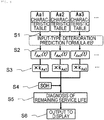
- FIG. 8 represents the procedure for diagnosing the remaining service life of a lithium-ion battery according to different operation modes in an embodiment of the present invention.
- the values of the characteristic table of each operation mode are input to the input-type prediction formula.
- a prediction formula is constructed for each operation mode.
- a coefficient is calculated from the operation rate of each operation mode, and combined with the deterioration prediction formula for each operation mode to construct a single complex formula.
- the complex prediction formula and the SOH are used to diagnose remaining service life.
- the diagnosis result for the remaining service life of the lithium-ion battery is output to the display.
- advice related to use of lithium-ion battery is also displayed with a message, for example, "avoid hard breaking or hard acceleration while the temperature is low".
Landscapes
- Engineering & Computer Science (AREA)
- Manufacturing & Machinery (AREA)
- Chemical & Material Sciences (AREA)
- Chemical Kinetics & Catalysis (AREA)
- Electrochemistry (AREA)
- General Chemical & Material Sciences (AREA)
- Sustainable Energy (AREA)
- Sustainable Development (AREA)
- Life Sciences & Earth Sciences (AREA)
- Power Engineering (AREA)
- Transportation (AREA)
- Mechanical Engineering (AREA)
- Physics & Mathematics (AREA)
- General Physics & Mathematics (AREA)
- Microelectronics & Electronic Packaging (AREA)
- Secondary Cells (AREA)
- Tests Of Electric Status Of Batteries (AREA)
- Charge And Discharge Circuits For Batteries Or The Like (AREA)
Applications Claiming Priority (2)
| Application Number | Priority Date | Filing Date | Title |
|---|---|---|---|
| JP2015127206 | 2015-06-25 | ||
| PCT/JP2016/060877 WO2016208251A1 (fr) | 2015-06-25 | 2016-04-01 | Système d'accumulation d'énergie |
Publications (2)
| Publication Number | Publication Date |
|---|---|
| EP3316387A1 true EP3316387A1 (fr) | 2018-05-02 |
| EP3316387A4 EP3316387A4 (fr) | 2018-12-19 |
Family
ID=57585481
Family Applications (1)
| Application Number | Title | Priority Date | Filing Date |
|---|---|---|---|
| EP16814022.6A Withdrawn EP3316387A4 (fr) | 2015-06-25 | 2016-04-01 | Système d'accumulation d'énergie |
Country Status (3)
| Country | Link |
|---|---|
| EP (1) | EP3316387A4 (fr) |
| JP (1) | JPWO2016208251A1 (fr) |
| WO (1) | WO2016208251A1 (fr) |
Cited By (7)
| Publication number | Priority date | Publication date | Assignee | Title |
|---|---|---|---|---|
| DE102017125274B3 (de) | 2017-10-27 | 2019-03-21 | Borgward Trademark Holdings Gmbh | Verfahren zur Erfassung des Gesundheitszustands einer Batterie, zugehörige Einrichtung, zugehöriges System und Speichermedium |
| DE102018220494A1 (de) * | 2018-11-28 | 2020-05-28 | Robert Bosch Gmbh | Verfahren zum Überwachen eines Energiespeichers in einem Bordnetz |
| EP3770619A4 (fr) * | 2018-03-20 | 2021-04-28 | GS Yuasa International Ltd. | Dispositif d'estimation de dégradation, programme informatique et procédé d'estimation de dégradation |
| EP3770620A4 (fr) * | 2018-03-20 | 2021-05-26 | GS Yuasa International Ltd. | Dispositif d'estimation de détérioration, programme informatique et procédé d'estimation de détérioration |
| EP3734743A4 (fr) * | 2017-12-27 | 2022-02-16 | Future Science Research Inc. | Dispositif de gestion d'accumulateur, accumulateur, et programme de gestion d'accumulateur |
| US12392841B2 (en) | 2020-09-23 | 2025-08-19 | Gs Yuasa International Ltd. | Information processing device, information processing method, and computer program |
| US12522098B2 (en) | 2021-09-21 | 2026-01-13 | Prime Planet Energy & Solutions, Inc. | Charging and discharging management device |
Families Citing this family (8)
| Publication number | Priority date | Publication date | Assignee | Title |
|---|---|---|---|---|
| JP6804411B2 (ja) * | 2017-08-29 | 2020-12-23 | 三菱電機株式会社 | 蓄電池制御装置および蓄電池制御方法 |
| JP2019113410A (ja) * | 2017-12-22 | 2019-07-11 | 三菱自動車工業株式会社 | 二次電池の劣化状態推定装置 |
| JP7060561B2 (ja) * | 2019-11-08 | 2022-04-26 | 本田技研工業株式会社 | バッテリ状態判定システム、バッテリ状態判定方法、およびプログラム |
| JP2021163600A (ja) * | 2020-03-31 | 2021-10-11 | Apb株式会社 | リチウムイオン電池システムおよび電池状態推定システム |
| JP7299274B2 (ja) * | 2021-07-27 | 2023-06-27 | 本田技研工業株式会社 | 電池モデル構築方法及び電池劣化予測装置 |
| JP7834618B2 (ja) * | 2022-09-14 | 2026-03-24 | カワサキモータース株式会社 | バッテリ管理方法および移動体 |
| JP7658396B2 (ja) * | 2023-06-27 | 2025-04-08 | いすゞ自動車株式会社 | バッテリの管理装置および管理方法 |
| JP2025098594A (ja) * | 2023-12-20 | 2025-07-02 | 株式会社日立製作所 | 二次電池の劣化予測システム、及び、二次電池の劣化予測方法 |
Family Cites Families (4)
| Publication number | Priority date | Publication date | Assignee | Title |
|---|---|---|---|---|
| US20030184307A1 (en) * | 2002-02-19 | 2003-10-02 | Kozlowski James D. | Model-based predictive diagnostic tool for primary and secondary batteries |
| JP5852399B2 (ja) * | 2011-10-17 | 2016-02-03 | インターナショナル・ビジネス・マシーンズ・コーポレーションInternational Business Machines Corporation | バッテリの状態予測システム、方法及びプログラム |
| JP6488538B2 (ja) * | 2013-07-23 | 2019-03-27 | 日本電気株式会社 | 劣化係数決定システム、劣化予測システム、劣化係数決定方法およびプログラム |
| JP2015104225A (ja) * | 2013-11-25 | 2015-06-04 | ソニー株式会社 | 蓄電システムおよび二次電池の充電方法 |
-
2016
- 2016-04-01 JP JP2017524682A patent/JPWO2016208251A1/ja active Pending
- 2016-04-01 WO PCT/JP2016/060877 patent/WO2016208251A1/fr not_active Ceased
- 2016-04-01 EP EP16814022.6A patent/EP3316387A4/fr not_active Withdrawn
Cited By (9)
| Publication number | Priority date | Publication date | Assignee | Title |
|---|---|---|---|---|
| DE102017125274B3 (de) | 2017-10-27 | 2019-03-21 | Borgward Trademark Holdings Gmbh | Verfahren zur Erfassung des Gesundheitszustands einer Batterie, zugehörige Einrichtung, zugehöriges System und Speichermedium |
| EP3734743A4 (fr) * | 2017-12-27 | 2022-02-16 | Future Science Research Inc. | Dispositif de gestion d'accumulateur, accumulateur, et programme de gestion d'accumulateur |
| US11525866B2 (en) | 2017-12-27 | 2022-12-13 | Future Science Research Inc. | Secondary battery management device, secondary battery, and secondary battery management program |
| EP3770619A4 (fr) * | 2018-03-20 | 2021-04-28 | GS Yuasa International Ltd. | Dispositif d'estimation de dégradation, programme informatique et procédé d'estimation de dégradation |
| EP3770620A4 (fr) * | 2018-03-20 | 2021-05-26 | GS Yuasa International Ltd. | Dispositif d'estimation de détérioration, programme informatique et procédé d'estimation de détérioration |
| DE102018220494A1 (de) * | 2018-11-28 | 2020-05-28 | Robert Bosch Gmbh | Verfahren zum Überwachen eines Energiespeichers in einem Bordnetz |
| CN113039089A (zh) * | 2018-11-28 | 2021-06-25 | 罗伯特·博世有限公司 | 用于监测车载电网中的蓄能器的方法 |
| US12392841B2 (en) | 2020-09-23 | 2025-08-19 | Gs Yuasa International Ltd. | Information processing device, information processing method, and computer program |
| US12522098B2 (en) | 2021-09-21 | 2026-01-13 | Prime Planet Energy & Solutions, Inc. | Charging and discharging management device |
Also Published As
| Publication number | Publication date |
|---|---|
| EP3316387A4 (fr) | 2018-12-19 |
| JPWO2016208251A1 (ja) | 2018-03-08 |
| WO2016208251A1 (fr) | 2016-12-29 |
Similar Documents
| Publication | Publication Date | Title |
|---|---|---|
| EP3316387A1 (fr) | Système d'accumulation d'énergie | |
| Dong et al. | Data-driven battery health prognosis using adaptive Brownian motion model | |
| EP3904894B1 (fr) | Dispositif et procédé d'entraînement, et dispositif, procédé et programme d'estimation | |
| JP7538227B2 (ja) | 電池パックの診断方法、セルの診断方法、電池パックの診断装置及びセルの診断装置 | |
| CN111688542B (zh) | 电池寿命学习装置、电池寿命预测装置、方法及存储有程序的存储介质 | |
| CN114829961B (zh) | 利用机器学习模型预测电池健康状况的方法和系统 | |
| CN110161414B (zh) | 一种动力电池热失控在线预测方法及系统 | |
| JP7546702B2 (ja) | バッテリー異常診断装置及び方法 | |
| CN109116242B (zh) | 一种动力电池的数据处理方法和装置 | |
| US9519029B2 (en) | Model-based battery monitoring | |
| CN106785107B (zh) | 用于诊断电池系统问题的方法和系统 | |
| US20220140617A1 (en) | Drooping cell detection and state of cell health monitoring | |
| JP2017510800A (ja) | 様々な使用範囲の充電状態(soc)を有する複数のセルを備えるバッテリの、充電状態の評価方法 | |
| CN115219932A (zh) | 用于评价设备电池组的相对老化状态的方法和装置 | |
| CN113075575A (zh) | 车辆电池包安全状态评估方法、系统、装置及存储介质 | |
| JP2015524048A (ja) | バッテリの充電状態の推定 | |
| EP3862765B1 (fr) | Système d'évaluation de dégradation de batterie, procédé d'évaluation de dégradation de batterie, et programme d'évaluation de dégradation de batterie | |
| TWI810098B (zh) | 電池管理裝置、電池管理程式 | |
| WO2020240324A1 (fr) | Procédé d'estimation de la résistance interne d'une batterie rechargeable et système de détection d'anomalie pour batterie rechargeable | |
| US12142090B2 (en) | Battery diagnosis apparatus for vehicle and method thereof | |
| CN112912745A (zh) | 根据开路电压图形确定电化学电池的充电状态和老化状态的方法 | |
| CN116893366A (zh) | 用于运行系统以识别设备的电蓄能器的异常的方法和装置 | |
| CN117799440A (zh) | 动力电池的一致性预警方法、装置和计算机设备 | |
| EP4530650A1 (fr) | Procédé et appareil d'estimation et de visualisation de cohérence pour batterie d'alimentation | |
| CN114919413B (zh) | 一种电动车辆电池异常诊断的方法及系统 |
Legal Events
| Date | Code | Title | Description |
|---|---|---|---|
| STAA | Information on the status of an ep patent application or granted ep patent |
Free format text: STATUS: THE INTERNATIONAL PUBLICATION HAS BEEN MADE |
|
| PUAI | Public reference made under article 153(3) epc to a published international application that has entered the european phase |
Free format text: ORIGINAL CODE: 0009012 |
|
| STAA | Information on the status of an ep patent application or granted ep patent |
Free format text: STATUS: REQUEST FOR EXAMINATION WAS MADE |
|
| 17P | Request for examination filed |
Effective date: 20180125 |
|
| AK | Designated contracting states |
Kind code of ref document: A1 Designated state(s): AL AT BE BG CH CY CZ DE DK EE ES FI FR GB GR HR HU IE IS IT LI LT LU LV MC MK MT NL NO PL PT RO RS SE SI SK SM TR |
|
| AX | Request for extension of the european patent |
Extension state: BA ME |
|
| DAV | Request for validation of the european patent (deleted) | ||
| DAX | Request for extension of the european patent (deleted) | ||
| A4 | Supplementary search report drawn up and despatched |
Effective date: 20181119 |
|
| RIC1 | Information provided on ipc code assigned before grant |
Ipc: H01M 10/48 20060101ALI20181113BHEP Ipc: H02J 7/00 20060101ALI20181113BHEP Ipc: B60L 3/00 20060101ALI20181113BHEP Ipc: H01M 10/42 20060101AFI20181113BHEP Ipc: G01R 31/36 20060101ALI20181113BHEP |
|
| STAA | Information on the status of an ep patent application or granted ep patent |
Free format text: STATUS: THE APPLICATION HAS BEEN WITHDRAWN |
|
| 18W | Application withdrawn |
Effective date: 20181220 |